
I approach the subject of the physics of energy and the economy with some trepidation. An economy seems to be a dissipative system, but what does this really mean? There are not many people who understand dissipative systems, and very few who understand how an economy operates. The combination leads to an awfully lot of false beliefs about the energy needs of an economy.
The primary issue at hand is that, as a dissipative system, every economy has its own energy needs, just as every forest has its own energy needs (in terms of sunlight) and every plant and animal has its own energy needs, in one form or another. A hurricane is another dissipative system. It needs the energy it gets from warm ocean water. If it moves across land, it will soon weaken and die.
There is a fairly narrow range of acceptable energy levels–an animal without enough food weakens and is more likely to be eaten by a predator or to succumb to a disease. A plant without enough sunlight is likely to weaken and die.
In fact, the effects of not having enough energy flows may spread more widely than the individual plant or animal that weakens and dies. If the reason a plant dies is because the plant is part of a forest that over time has grown so dense that the plants in the understory cannot get enough light, then there may be a bigger problem. The dying plant material may accumulate to the point of encouraging forest fires. Such a forest fire may burn a fairly wide area of the forest. Thus, the indirect result may be to put to an end a portion of the forest ecosystem itself.
How should we expect an economy to behave over time? The pattern of energy dissipated over the life cycle of a dissipative system will vary, depending on the particular system. In the examples I gave, the pattern seems to somewhat follow what Ugo Bardi calls a Seneca Cliff.

Figure 1. Seneca Cliff by Ugo Bardi
The Seneca Cliff pattern is so-named because long ago, Lucius Seneca wrote:
It would be some consolation for the feebleness of our selves and our works if all things should perish as slowly as they come into being; but as it is, increases are of sluggish growth, but the way to ruin is rapid.
The Standard Wrong Belief about the Physics of Energy and the Economy
There is a standard wrong belief about the physics of energy and the economy; it is the belief we can somehow train the economy to get along without much energy.
In this wrong view, the only physics that is truly relevant is the thermodynamics of oil fields and other types of energy deposits. All of these fields deplete if exploited over time. Furthermore, we know that there are a finite number of these fields. Thus, based on the Second Law of Thermodynamics, the amount of free energy we will have available in the future will tend to be less than today. This tendency will especially be true after the date when “peak oil” production is reached.
According to this wrong view of energy and the economy, all we need to do is design an economy that uses less energy. We can supposedly do this by increasing efficiency, and by changing the nature of the economy to use a greater proportion of services. If we also add renewables (even if they are expensive) the economy should be able to get along fine with very much less energy.
These wrong views are amazingly widespread. They seem to underlie the widespread hope that the world can reduce its fossil fuel use by 80% between now and 2050 without badly disturbing the economy. The book 2052: A Forecast for the Next 40 Years by Jorgen Randers seems to reflect these views. Even the “Stabilized World Model” presented in the 1972 book The Limits to Growth by Meadow et al. seems to be based on naive assumptions about how much reduction in energy consumption is possible without causing the economy to collapse.
The Economy as a Dissipative System
If an economy is a dissipative system, it needs sufficient energy flows. Otherwise, it will collapse in a way that is analogous to animals succumbing to a disease or forests succumbing to forest fires.
The primary source of energy flows to the economy seems to come through the leveraging of human labor with supplemental energy products of various types, such as animal labor, fossil fuels, and electricity. For example, a man with a machine (which is made using energy products and operates using energy products) can make more widgets than a man without a machine. A woman operating a computer in a lighted room can make more calculations than a woman who inscribes numbers with a stick on a clay tablet and adds them up in her head, working outside as weather permits.
As long as the quantity of supplemental energy supplies keeps rising rapidly enough, human labor can become increasingly productive. This increased productivity can feed through to higher wages. Because of these growing wages, tax payments can be higher. Consumers can also have ever more funds available to buy goods and services from businesses. Thus, an economy can continue to grow.
Besides inadequate supplemental energy, the other downside risk to continued economic growth is the possibility that diminishing returns will start making the economy less efficient. These are some examples of how this can happen:
- Deeper wells or desalination are needed for water because aquifers deplete and population grows.
- More productivity is needed from each acre of arable land because of growing population (and thus, falling arable land per person).
- Larger mines are required as ores of high mineral concentration are exhausted and we are forced to exploit less productive mines.
- More pollution control devices or higher-cost workarounds (such as “renewables”) are needed as pollution increases.
- Fossil fuels from cheap-to-extract locations are exhausted, so extraction must come from more difficult-to-extract locations.
In theory, even these diminishing returns issues can be overcome, if the leveraging of human labor with supplemental energy is growing quickly enough.
Theoretically, technology might also increase economic growth. The catch with technology is that it is very closely related to energy consumption. Without energy consumption, it is not possible to have metals. Most of today’s technology depends (directly or indirectly) on the use of metals. If technology makes a particular type of product cheaper to make, there is also a good chance that more products of that type will be sold. Thus, in the end, growth in technology tends to allow more energy to be consumed.
Why Economic Collapses Occur
Collapses of economies seem to come from a variety of causes. One of these is inadequate wages of low-ranking workers (those who are not highly educated or of managerial rank). This tends to happen because if there are not enough energy flows to go around, it tends to be the wages of the “bottom-ranking” employees that get squeezed. In some cases, not enough jobs are available; in others, wages are too low. This could be thought of as inadequate return on human labor–a different kind of low Energy Return on Energy Invested (EROEI) than is currently analyzed in most of today’s academic studies.
Another area vulnerable to inadequate energy flows is the price level of commodities. If energy flows are inadequate, prices of commodities will tend to fall below the cost of producing these commodities. This can lead to a cutoff of commodity production. If this happens, debt related to commodity production will also tend to default. Defaulting debt can be a huge problem, because of the adverse impact on financial institutions.
Another way that inadequate energy flows can manifest themselves is through the falling profitability of companies, such as the falling revenue that banks are now experiencing. Still another way that inadequate energy flows can manifest themselves is through falling tax revenue. Governments of commodity exporters are particularly vulnerable when commodity prices are low. Ultimately, these inadequate energy flows can lead to bankrupt companies and collapsing governments.
The closest situation that the US has experienced to collapse is the Depression of the 1930s. The Great Recession of 2007-2009 would represent a slight case of inadequate energy flows–one that could be corrected by a large dose of Quantitative Easing (QE)(leading to the lower cost of borrowing), plus debt stimulus by China. These helped bring oil prices back up again, after they fell in mid-2008.

Figure 2. World Oil Supply (production including biofuels, natural gas liquids) and Brent monthly average spot prices, based on EIA data.
Clearly, we are now again beginning to experience the effects of inadequate energy flows. This is worrying, because many economies have collapsed in the past when this situation occurred.
How Energy Flows of an Economy are Regulated
In an economy, the financial system is the regulator of the energy flows of the system. If the price of a product is low, it dictates that a small share of energy flows will be directed toward that product. If it is high, it indicates that a larger share of energy flows will be directed toward that product. Wages follow a similar pattern, with low wages indicating low flows of energy, and high wages indicating higher flows of energy. Energy flows in fact “pay for” all aspects of the system, including more advanced technology and the changes to the system (more education, less time in the workforce) that make advanced technology possible.
One confusing aspect to today’s economy is the use of a “pay you later” approach to paying for energy flows. If the energy flows are inadequate using what we would think of as the natural flows of the system, debt is often used to increase energy flows. Debt has the effect of directing future energy flows in a particular direction, such as paying for a factory, a house, or a car. These flows will be available when the product is already part of the system, and thus are easier to accommodate in the system.
The use of increasing debt allows total “demand” for products of many kinds to be higher, because it directs both future flows and current flows of energy toward a product. Since factories, houses and cars are made using commodities, the use of an increasing amount of debt tends to raise commodity prices. With higher commodity prices, more of the resources of the economy are directed toward producing energy products. This allows for increasing energy consumption. This increased energy consumption tends to help flows of energy to many areas of the economy at the same time: wages, taxes, business profitability, and funds for interest and dividend payments.
The need for debt greatly increases when an economy begins using fossil fuels, because the use of fossil fuels allows a step-up in lifestyle. There is no way that this step-up in lifestyle can be paid for in advance, because the benefits of the new system are so much better than what was available without fossil fuels. For example, a farmer raising crops using only a hoe for a tool will never be able to save up sufficient funds (energy flows) needed to pay for a tractor. While it may seem bizarre that banks loan money into existence, this approach is in fact essential, if adequate energy flows are to be available to compensate for the better lifestyle that the use of fossil fuels makes possible.
Debt needs are low when the cost (really energy cost) of producing energy products is low. Much more debt is needed when the cost of energy extraction is high. The reason more debt is needed is because fossil fuels and other types of energy products tend to leverage human labor, making human labor more productive, as mentioned previously. In order to maintain this leveraging, an adequate quantity of energy products (measured in British Thermal Units or Barrels of Oil Equivalent or some similar unit) is needed.
As the required price for energy-products rises, it takes ever-more debt to finance a similar amount of energy product, plus the higher cost of homes, cars, factories, and roads using the higher-cost energy. In fact, with higher energy costs, capital goods of all kinds will tend to be more expensive. This is a major reason why the ratio of debt to GDP tends to rise as the cost of producing energy products rises. At this point, in the United States it takes approximately $3 of additional debt to increase GDP by $1 (author’s calculation).

Figure 3. Inflation adjusted Brent oil prices (in $2014, primarily from BP Statistical Review of World Energy) shown beside two measures of debt for the US economy. One measure of debt is all-inclusive; the other excludes Financial Business debt. Both are based on data from FRED-Federal Reserve of St. Louis.
Clearly one of the risk factors to an economy using fossil fuels is that debt levels will become unacceptably high. A second risk is that debt will stop rising fast enough to keep commodity prices at an acceptably high level. The recent slowdown in the growth of debt (Figure 3) no doubt contributes to current low commodity prices.
A third risk to the system is that the rate of economic growth will slow over time because even with the large amount of debt added to the system, the leveraging of human labor with supplemental energy will not be sufficient to maintain economic growth in the face of diminishing returns. In fact, it is clearly evident that US economic growth has trended downward over time (Figure 4).

Figure 4. US annual growth rates (using “real” or inflation adjusted data from the Bureau of Economic Analysis).
A fourth risk is that the whole system will become unsustainable. When new debt is issued, there is no real matching with future energy flow. For example, will the wages of those taking on debt to pay for college be sufficiently high that the debtors can afford to have families and buy homes? If not, their lack of adequate income will be one of the factors that make it difficult for the prices of commodities to stay high enough to encourage extraction.
One of the issues in today’s economy is that promises of future energy flows extend far beyond what is formally called debt. These promises include shareholder dividends and payments under government programs such as Social Security and Medicare. Reneging on promises such as these is likely to be unpopular with citizens. Stock prices are likely to drop, and private pensions will become unpayable. Governments may be overthrown by disappointed citizens.
Examples of Past Collapses of Economies
Example of the Partial Collapse of the Former Soviet Union
One recent example of a partial collapse was that of the Former Soviet Union (FSU) in December 1991. I call this a partial collapse, because it “only” involved the collapse of the central government that held together the various republics. The governments of the individual republics remained in place, and many of the services they provided, such as public transportation, continued. The amount of manufacturing performed by the FSU dropped precipitously, as did oil extraction. Prior to the collapse, the FSU had serious financial problems. Shortly before its collapse, the world’s leading industrial nations agreed to lend the Soviet Union $1 billion and defer repayment on $3.6 billion more in debt.
A major issue that underlay this collapse was a fall in oil prices to the $30 per barrel range in the 1986 to 2004 period. The Soviet Union was a major oil exporter. The low price had an adverse impact on the economy, a situation similar to that of today.

Figure 5. Oil production and price of the Former Soviet Union, based on BP Statistical Review of World Energy 2015.
Russia continued to pump oil even after the price dropped in 1986. In fact, it raised oil production, to compensate for the low price (energy flow it received per barrel). This is similar to the situation today, and what we would expect if oil exporters are very dependent on these energy flows, no matter how small. Oil production didn’t fall below the 1986 level until 1989, most likely from inadequate funds for reinvestment. Oil production rose again, once prices rose.
Figure 6 shows that the FSU’s consumption of energy products started falling precipitously in 1991, the year of the collapse–very much a Seneca Cliff type of decline.

Figure 6. Former Soviet Union energy consumption by source, based on BP Statistical Review of World Energy Data 2015.
In fact, consumption of all fuels, even nuclear and hydroelectric, fell simultaneously. This is what we would expect if the FSU’s problems were caused by the low prices it was receiving as an oil exporter. With low oil prices, there could be few good-paying jobs. Lack of good-paying jobs–in other words, inadequate return on human labor–is what cuts demand for energy products of all kinds.
A drop in population took place as well, but it didn’t begin until 1996. The decrease in population continued until 2007. Between 1995 and 2007, population dropped by a total of 1.6%, or a little over 0.1% per year. Before the partial collapse, population was rising about 0.9% per year, so the collapse seems to have reduced the population growth rate by about 1.0% per year. Part of the drop in population was caused by excessive alcohol consumption by some men who had lost their jobs (their sources of energy flows) after the fall of the central government.
When commodity prices fall below the cost of oil production, it is as if the economy is cold because of low energy flows. Prof. Francois Roddier describes the point at which collapse sets in as the point of self-organized criticality. According to Roddier (personal correspondence):
Beyond the critical point, wealth condenses into two phases that can be compared to a gas phase and a liquid phase. A small number of rich people form the equivalent of a gas phase, whereas a large number of poor people form what corresponds to a liquid phase. Like gas molecules, rich people monopolize most of the energy and have the freedom to move. Embedded in their liquid phase, poor people have lost access to both energy and freedom. Between the two, the so-called middle class collapses.
I would wonder whether the ones who die would be equivalent to the solid state. They can no longer move at all.
Analysis of Earlier Collapses
A number of studies have been performed analyzing earlier collapses. Turchin and Nefedov in Secular Cycles analyze eight pre-fossil fuel collapses in detail. Figure 7 shows my interpretation of the pattern they found.

Figure 7. Shape of typical Secular Cycle, based on work of Peter Turchin and Sergey Nefedov in Secular Cycles.
Again, the pattern is that of a Seneca Cliff. Some of the issues leading to collapse include the following:
- Rising population relative to farmland. Either farmland was divided up into smaller plots, so each farmer produced less, or new workers received “service” type jobs, at much reduced wages. The result was falling earnings of many non-elite workers.
- Spiking food and energy prices. Prices were high at times due to lack of supply, but held down by low wages of workers.
- Rising need for government to solve problems (for example, fight war to get more land; install irrigation system so get more food from existing land). Led to a need for increased taxes, which impoverished workers could not afford.
- Increased number of nobles and high-level administrators. Result was increased disparity of wages.
- Increased debt, as more people could not afford necessities.
Eventually, the workers who were weakened by low wages and high taxes tended to succumb to epidemics. Some died in wars. Again, we have a situation of low energy flows, and the lower wage workers not getting enough of these flows. Many died–in some cases as many as 95%. These situations were much more extreme than those of the FSU. On the favorable side, the fact that there were few occupations back in pre-industrial days meant that those who did survive could sometimes resettle with other nearby communities and continue to practice their occupations.
Joseph Tainter in The Collapse of Complex Societies talks about the need for increasing complexity, as diminishing returns set in. This would seem to correspond to the need for increased government services and an increased role for businesses. Also included in increased complexity would be increased hierarchical structure. All of these changes would leave a smaller share of the energy flows for the low-ranking workers–a problem mentioned previously.
Dr. Tainter also makes the point that to maintain complexity, “Sustainability may require greater consumption of resources, not less.”
A Few Insights as to the Nature of the Physics Problem
The Second Law of Thermodynamics seems to work in a single direction. It talks about the natural tendency of any “closed” system to degenerate into a more disordered system. With this view, the implication is that the universe will ultimately end in a heat-death, in which everything is at the same temperature.
Dissipative systems work in the other direction; they create order where no order previously existed. Economies get ever-more complex, as businesses grow larger and more hierarchical in form, governments provide more services, and the number of different jobs filled by members of the economy proliferate. How do we explain this additional order?
According to Ulanowicz, the traditional focus of thermodynamics has been on states, rather than on the process of getting from one state to another. What is needed is a theory that is more focused on processes, rather than states. He writes,
. . . the prevailing view of the second law is an oversimplified version of its true nature. Simply put, entropy is not entirely about disorder. Away from equilibrium, there is an obverse and largely unappreciated side to the second law that, in certain circumstances, mandates the creation of order.
We are observing the mandated creation of order. For example, the human body takes chemical energy and transforms it to mechanical energy. There is a dualism to the entropy system that many have not stopped to appreciate. Instead of a trend toward heat death always being the overarching goal, systems have a two-way nature to them. Dissipative systems are able to grow until they reach a point called self-organized criticality or the “critical point”; then they shrink from inadequate energy flows.
In forests, this point of self-organized criticality comes when the growth of the tall trees starts blocking out the light to the shorter plants. As mentioned earlier, at that point the forest starts becoming more susceptible to forest fires. Ulanowicz shows that for ecosystems with more than 12 elements, there is quite a narrow “window of viability.”

Figure 8. Illustration of close clustering of ecosystems with more than 12 elements, indicating the narrow “window of viability” of such ecosystems. From Ulanowicz
If we look at world per capita energy consumption, it seems to indicate a very narrow “window of viability” as well.

Figure 9. World energy consumption per capita, based on BP Statistical Review of World Energy 2105 data. Year 2015 estimate and notes by G. Tverberg.
When we look at what happened in the world economy alongside the history of world energy consumption, we can see a pattern. Back prior to 1973, when oil was less than $30 per barrel, oil consumption and the economy grew rapidly. A lot of infrastructure (interstate highways, electric transmission lines, and pipelines) was added in this timeframe. The 1973-1974 price shock and related recession briefly brought energy consumption down.
It wasn’t until the restructuring of the economy in the late 1970s and early 1980s that energy consumption really came down. There were many changes made: cars became smaller and more fuel efficient; electricity production was changed from oil to other approaches, often nuclear; regulation of utilities was changed toward greater competition, thus discouraging building infrastructure unless it was absolutely essential.
The drop in energy consumption after 1991 reflects the fall of the Former Soviet Union. The huge ramp-up in energy consumption after 2001 represents the effect of adding China (with all of its jobs and coal consumption) to the World Trade Organization. With this change, energy needs became permanently higher, if China was to have enough jobs for its people. Each small dip seems to represent a recession. Recently energy consumption seems to be down again. If we consider low consumption along with low commodity prices, it makes for a worrying situation. Are we approaching a major recession, or worse?
If we think of the world economy relative to its critical point, the world economy has been near this point since 1981, but various things have pulled us out.
One thing that has helped the economy is the extremely high interest rate (18%) implemented in 1981. This high interest rate pushed down fossil fuel usage at that time. It also gave interest rates a very long way to fall. Falling interest rates have a very favorable impact on the economy. They encourage greater lending and tend to raise the selling prices of stocks. The economy has received a favorable boost from falling interest rates for almost the entire period between 1981 and the present.
Other factors were important as well. The fall of the Soviet Union in 1991 bought the rest of the world a little time (and saved oil extraction for later); the addition of China to the World Trade Organization in 2001 added a great deal of cheap coal to the energy mix, helping to bring down energy costs. These low energy costs, plus all of the debt China was able to add, allowed energy consumption and the world economy to grow again–temporarily pulling the world away from the critical point.
In 2008, oil prices dropped very low. It was only with QE that interest rates could be brought very low, and commodity prices bounced back up to adequate levels. Now we are again faced with low prices. It looks as if we are again at the critical point, and thus the edge of collapse.
Once a dissipative structure is past its critical point, Roddier says that what is likely to bring it down is an avalanche of bifurcations. In the case of an economy, these might be debt defaults.
In a dissipative structure, both communication and stored information are important. Stored information, which is very close to technology, becomes very important when food is hard to find or energy is high cost to extract. When energy is low-cost to extract, practically anyone can find and make use of energy, so technology is less important.
Communication in an economy is done in various ways, including through the use of money and debt. Few people understand the extent to which debt can give false signals about future availability of energy flows. Thus, it is possible for an economy to build up to a very large size, with few realizing that this approach to building an economy is very similar to a Ponzi Scheme. It can continue only as long as energy costs are extremely low, or debt is being rapidly added.
In theory, EROEI calculations (comparing energy produced by a device or energy product to fossil fuel energy consumed increasing this product) should communicate the “value” of a particular energy product. Unfortunately, this calculation is based the common misunderstanding of the nature of the physics problem that I mentioned at the beginning of the article. (This is also true for similar analyses, such as Lifecycle Analyses.) These calculations would communicate valuable information, if our problem were “running out” of fossil fuels, and if the way to mitigate this problem were to use fossil fuels as sparingly as possible. If our problem is rising debt levels, EROEI and similar calculations do nothing to show us how to mitigate the problem.
If the economy collapses, it will collapse down to a lower sustainable level. Much of the world’s infrastructure was built when oil could be extracted for $20 per barrel. That time is long gone. So, it looks like the world will need to collapse back to a level before fossil fuels–perhaps much before fossil fuels.
If it is any consolation, Prof. Roddier says that once new economies begin to form again, the survivors after collapse will tend to be more co-operative. In fact, he offers this graphic.

Figure 10. F. Roddier view of what happens on the two sides of the critical point. From upcoming translation of his book, “The Thermodynamics of Evolution.”
We know that if there are survivors, new economies will be likely. We don’t know precisely what they will be like, except that they will be limited to using resources that are available at that time.
Some References to Francois Roddier’s Work (in French)
THERMODYNAMIQUE DE L’ÉVOLUTION “UN ESSAI DE THERMO-BIO-SOCIOLOGIE” -The Thermodynamics of Evolution – Book, soon to be translated to English. Will at some point be available from the same site in English.
Roddier writes:
This is a talk I gave at the CNAM (Paris) on December 2, 2013. The title is:Thermodynamique et économie ; des sciences exactes aux sciences humaines
In this talk, I show that Per Bak’s neural network model can be used to describe an economic system as a neural network of agents exchanging money. The paper gives a brief explanation on how economies collapse.
The other talk is one I gave in Paris on March 12, 2015, for Jancovici’s Shift Project. The title is:
La thermodynamique des transitions économiques
A video of this talk is available on the web at the following address:
https://www.youtube.com/watch?v=5-qap1cQhGA
In this talk, I describe economy in terms of Gibbs-Duhem potentials (akin to chemical potentials). Money flows measure entropy flows (with opposite sign). The cost of energy plays the role of an inverse temperature. I show that economic cycles are similar to those of a steam engine. They self organize around a critical point.


Always amusing to read what the idiots who inhabit the comments section of ZH have to say about FW articles…
http://www.zerohedge.com/news/2016-02-10/physics-energy-economy
Too long, didn’t read.
When do I get MY free Obamaphone, that’s what I want to know.
I agree with you, Fast Eddy, regarding those making jabs at FW and Gail herself there. Noticed you may have used a new avatar image/name at Zero Hedge…Mr. Magoo!
That fits perfectly, hopefully we will have the same fortune and walk through the chaos untouched as Mr Magoo does in the cartoon. I doubt it.
Word for word
Magooo’s picture
Or in other words:
HOW HIGH OIL PRICES WILL PERMANENTLY CAP ECONOMIC GROWTH
For most of the last century, cheap oil powered global economic growth. But in the last decade, the price of oil production has quadrupled, and that shift will permanently shackle the growth potential of the world’s economies. http://www.bloomberg.com/news/articles/2012-09-23/how-high-oil-prices-will-permanently-cap-economic-growth
BUT OIL COMPANES NEED $100+ OIL
Steven Kopits from Douglas-Westwood said the productivity of new capital spending has fallen by a factor of five since 2000. “The vast majority of public oil and gas companies require oil prices of over $100 to achieve positive free cash flow under current capex and dividend programmes. Nearly half of the industry needs more than $120,” he said http://www.telegraph.co.uk/finance/newsbysector/energy/oilandgas/11024845/Oil-and-gas-company-debt-soars-to-danger-levels-to-cover-shortfall-in-cash.html
Nice try, Fast Eddie, but you were ignored.
We cannot just think of a society of frugal farmers reaping what the sun provides. In such a society a band of robbers would be extremely successful eliminating the farmers. History of technology is also history of wars. What will happen if some countries still have access to cheap oil while others have not? Safety reasons could soon be the limiting factor of human existance. And that’s not only in respect of the refugees coming to Europe.
Dear Gail and Finite Worlders
This post is consistent with what I said regarding some of the thermodynamic models (I won’t name names):
steve from virginia says:
02/10/2016 AT 5:56 PM
Everyone and their brother keep saying how crud(ish) prices are going to be higher after ____ months/years. Salvation: when enough drillers fail and get out of the business. There will be shortages and … higher prices!
What these experts don’t ever say is HOW the prices are going to be higher!
Where is the money going to come from?
Money is credit: what group/organization/banking sector/finance is going to lend to ordinary end users when these same users cannot earn a penny by burning their fuel?
Leave out farmers, deliverymen, bus drivers and bulldozer owners. A person does not fly to Disney World to pay for the fuel used in the airplane, he does something else. The commuter does not drive back and forth to work in order to pay for his commute, he does something else. A businessman does not waste fuel to pay for it; all of these folks borrow, either directly from their own lenders, or indirectly by way of their bosses’ companies … or the governments in their place. No borrowing, no fuel buying.
Somehow or other a shortage of fuel is going to render these hapless borrowers able to borrow when a ‘glut’ of fuel cannot.
What Jeffrey Brown points out over and over is the so-called ‘glut’ is simply another finance industry -slash- media narrative, a pleasant lie that glosses over the fact that fuel supply is declining, that purchasing power is declining along with it and that no easy solutions to these declines exist. (The only solution is stringent conservation — getting rid of the cars).
Underway is a structural breakdown of the fuel financing regime. It is not going to ‘unbreakdown’ itself, any shortages will make matters worse.
Back to me. I was looking at WTI futures. I believe the 2019 December future is only 45 dollars. I don’t think very many people can go out and find any new oil at that price. I doubt that tar sands and Orinoco heavy can be produced at that price. I doubt that fracking pays at that price. Some in-fill drilling might pay at that price, because the infrastructure is basically already in place. Tending many existing wells will make sense at that price.
So the choice we have is to either use the oil remaining in the way we have been using it, which seems to be taking us over the Seneca Cliff. The alternative is to ration oil (in one way or another) to the most valuable uses, which I think would involve building infrastructure which will survive after the Oil Age is over. If we choose the latter option, we have to get busy immediately, because we have an awful lot to do.
Don Stewart
Yes, I generally agree with Steve Ludlum.
Gail
Relative to cooperation vs. competition. Rob O’Grady, in 150 Strong, reports on Kropotkin’s study of pioneers settling the American West. Initially in a new settlement, things tilted toward cooperation, apparently because everyone had very little…just what they were able to bring in a wagon or maybe on foot with a pack animal. After a few years, as the people in the group got a little richer, cooperation declined. Kropotkin showed that cooperation almost always yielded better results in small groups. I would speculate that, after self-reliance becomes possible, the aggravations of trying to get along with other people swing the participants toward avoiding the hassles of cooperating.
At any rate, just based on the evidence I have, I would think that Janine Benyus may be closer to the truth than Roddier. Tough times favor cooperation.
Don Stewart
I suspect the found it useful to cooperate to kill the threat of the native tribes….
My son spent a year on an Israeli Kibbutz, which had lost it’s socialist ideals and was privatizing. He said “Poverty is easier to share than poverty.”
Whoops! I meant “Poverty is easier to share than prosperiy.”
lnterguru
I knew what you meant. I had heard the phrase before…possibly from you.
Thanks…Don Stewart
Good point!
Bonjour Don,
you seem to be very focused on the Dunbar number, these days!
I agree it looks like the most efficient organisation, if you don’t need high-tech devices.
Also agree that Kropotkin had a whole lot of very wise statements.
My final take on cooperation is that grouping happens (and lasts) only if the group yields more energy than the sum of separate individuals.
Merely staying alive being the first condition to achieve that.
As for Roddier, I think there’s a slight misunderstanding. Don’t know when they expect to publish his book in English version…
Stefeun
The book ‘150 Strong’ is provocative. For example, I am going to our annual Farming and Climate Change conference in about a month. A soil scientist from Asheville is always there. She and I were talking back in October at another farm conference about carbon sequestered in the soil….which helps with myriad problems we face.
Albert Bates and others have written about attempts by the United Nations to promote soil sequestration as a solution. The 150 Strong book got me thinking about it from the other end of the spectrum.
Could we not, right here in our little town, get 147 consumers and 3 farmers to buy into a group of 150 which agrees to a CSA (consumer supported agriculture) model whereby the 3 farmers agree to adopt good practices and transparently give us reports on how they are doing. The 147 agree to purchase their farm products. If we can do it cheaper or for the same amount of money as present, no problem. Even if it costs 10 percent more, I think we could find the 147 people. Pretty quickly, I believe, the costs on the carbon farms would decline below what the cost is today. It’s just getting over the initial conversion that is the barrier for a cash-poor farmer.
I have proposed it to the soil scientist. We’ll see what she has to say.
Don
https://www.youtube.com/watch?v=eZeYVIWz99I
Or else
http://www.thirteen.org/13pressroom/files/2014/02/Livingstone-0637.jpg
I have a version of the text of his book. In my opinion, it still could use more editing. The other point is that the book is really more about evolution than it is about economies and how they work.
I have other unpublished material of his that is more about an economy as a dissipative structure.
Why?
Is Gail six months earlier than the “experts” in reporting trends?
http://www.zerohedge.com/news/2016-02-10/bps-stunning-warning-every-oil-storage-tank-will-be-full-few-months
Not quite six months ahead, but far enough.
New York State government is preparing for disruption by making sure police and government will not be without power.
http://documents.dps.ny.gov/public/Common/ViewDoc.aspx?DocRefId={F3E1213D-89D6-4151-AE5E-DC8EF1F7D7FC}
“The Company states that the primary design objective of the Potsdam project is to develop utility services allowing the microgrid to deliver electricity to microgrid-connected customers for up to two weeks, during widespread power outages that would otherwise leave those customers
without power, thereby allowing essential services to continue. For this demonstration, the focus is on customers and services that include the State University of New York, Potsdam (SUNY Potsdam), Clarkson University, gas stations, banks, grocery stores, drug stores, and critical facilities such as local police, fire, hospital, shelters, water and sewer, and governmental facilities
(collectively referred to as critical services for the purpose of this document).”
Individual citizen do not make the cut.
I checked about timing. It is still at least a couple of years away in timing. In fact, it looks like it still has to be built starting about mid 2017.
Staff has determined that the Potsdam Resiliency
Project will be implemented within a reasonable timeframe.
National Grid expects both the conceptual design to be completed
and the audit-grade detailed engineering study to begin by June
2016. The preliminary service proposals and rate designs will
then be developed and presented to the Potsdam microgrid
customers by the end of 2016. The Company indicates that over
the first six months of 2017, affected parties within the
Potsdam community will evaluate and compare National Grid’s
offerings, and the financial/business plans will be finalized.
Therefore, the total duration of the demonstration is expected
to be one and a half years.
“simply has concentrated the inflation to the sorts of assets the monied set buys: private jets, penthouse apartments, fine art, large gemstones, etc. So yes, their efforts produced price inflation; just of the wrong sort.”
“Keyenesians” will tell you that this is exactly the right thing to do, everybody should have gold taps in their bathroom. It’s the primary bankers hogging all the credit that causes the problems. 😉
The following was from peak prosperity, found on on peak oil dot com, and is a really good read, dovetailing well with Gail’s posts.
http://peakoil.com/business/the-return-of-crisis
“The public has yet to wake up to the mathematical reality that over $200 trillion in debt and perhaps another $500 trillion of un(der)funded liabilities really cannot ever be paid back under current terms. However, this fact is dawning within the minds of more and more critical thinkers with each passing day.
In order for these obligations to be reset to a reality-based level, something has to give. The central banks have tried to modify the phrase “under current terms” by debasing the currency these obligations are written in via inflation. Try as they have, though, they’ve been unable to create the sort of “goldilocks” low-level inflation that would slowly sublimate that massive pile of debt into something more manageable.
Wide-spread inflation has not happened. Why not? Because they’ve failed to note that plan of handing all of their newly printed money to a very wealthy elite — while a socially popular thing to do among the cocktail party set — simply has concentrated the inflation to the sorts of assets the monied set buys: private jets, penthouse apartments, fine art, large gemstones, etc. So yes, their efforts produced price inflation; just of the wrong sort.
Even worse, all the central banks have really accomplished is to assure that when the deflation monster finally arrives it will be gigantic, highly damaging and possibly uncontrollable. I’ll admit to being worried about this next crash/crisis because I imagine it will involve record-setting losses, human misery due to lost jobs and dashed dreams, and possibly even the prospect of wars and serious social unrest.
Let me be blunt: this next crash will be far worse and more dramatic than any that has come before. Literally, the world has never seen anything like the situation we collectively find ourselves in today. The so-called Great Depression happened for purely monetary reasons. Before, during and after the Great Depression, abundant resources, spare capacity and willing workers existed in sufficient quantities to get things moving along smartly again once the financial system had been reset.
This time there’s something different in the story line: the absence of abundant and high-net energy oil. Many of you might be thinking “Hey, the price of oil is low!” which is true, but only momentarily. Remember that price is not the same thing as net energy, which is what’s left over after you expend energy to get a fossil fuel like oil out of the ground. As soon as the world economy tries to grow rapidly again, we’ll discover that oil will quickly go through two to possibly three complete doublings in price due to supply issues. And those oil price spikes will collide into that tower of outstanding debt, making the economic growth required to inflate them away a lot more expensive (both cost-wise and energetically) to come by.
With every passing moment, the world has slightly less high-net energy conventional oil and is replacing that with low-net energy oil. Consider how we’re producing less barrels of production in the North Sea while coaxing more out of the tar sands. From a volume or a price standpoint right now, the casual observer would notice nothing. But it takes a lot more energy to get a barrel of oil from tar sands. So there’s less net energy which can be used to grow the world economy after that substitution.
Purely from a price standpoint, our model at Peak Prosperity includes the idea that there’s a price of oil that’s too high for the economy to sustain (the ceiling) and a price that’s too low for the oil companies to remain financially solvent (the floor). That ceiling and that floor are drawing ever closer. When we reach the point at which there’s not enough of a gap between them to sustainably power the growth our economy currently is depending on, there’s nothing left but to adjust our economic hopes and dreams to more realistic — and far lower — levels.
When this happens most folks will undergo a “forced simplification” of their lifestyles (as well as their financial portfolios), which they will experience as disruptive and emotionally difficult. That’s not fear-mongering; it’s just math.”
My only reservation of that information from peak prosperity, is the following:
“As soon as the world economy tries to grow rapidly again, we’ll discover that oil will quickly go through two to possibly three complete doublings in price due to supply issues.”
I doubt there is enough flexibility in the global economy to sustain doubling to tripling of oil price without immediate contraction. But I suppose that depends on how low the price goes. If it goes down to 15 a barrel, it could double to 30 and triple to 45. That’s possible, but forget 80-120 again.
My prediction for the next oil price peak, $60/barrel. I do not think it will hold for long, maybe four months. When will it happen, 2020.
I don´t understand how we could get to 2020 http://www.bloomberg.com/quote/BDIY:IND
What I see is a Mega- Giga-Titanic sinking. The sinking has started and now the only way to go is down. Sometimes faster, sometimes slower, but down and down we go.
It´s weird to watch this behemoth slowly dying. Some seem to have some comprehension about the situation, but others seem unable to see what will follow “Wow, look at that arterial wound, it must be pumping that blood 3ft high, at least, cool!”
If you have any great ideas how the heck this beast of ours could get to 2020, then please share.
Van Kent
I’m not Ed and this won’t save the Beast….but might amuse you for a few minutes.
I am thinking that things might really be different this time, in a different way. First, I think it is true that the economy is really a double entry bookkeeping sort of operation. There has to be production, but the ordinary person has to be provided with income in order to buy the products and services produced. If the balance between the debits and the credits goes awry, things go wrong.
Yet humans may very well be losing the competition with the machines. For example, consider this post:
http://howtosavetheworld.ca/2016/02/08/a-theory-of-no-mind/
Not necessary to parse it all closely….just note that humans are deemed to be pretty delusional, and it is built into the kind of critters we turned out to be.
Now if you want to make a product or service, which will you favor:
*A machine which does what it is programmed to do, without complaint, low maintenance?
*A high maintenance, delusional human?
As our ability to make machines whose capabilities are expanding steadily, it seems that the humans are demoted to every lower status jobs…the by now expected monthly addition of waiters and bartenders to the payrolls. Even in professions which seem like they might be immune to some of the stresses, things can be bad. I was visiting with a PhD in Nursing who took early retirement from a local University Hospital. She was fed up, and couldn’t see punishing herself anymore. She now works as a gardener. She said ‘all the nursing is now done by nurses aides’ and ‘RNs don’t really do the work anymore’. Might it be true that RNs, being a little more extensively educated, might have ideas they are not supposed to have, so work is devolved down to lightly educated nurses aides so that instructions are followed? Next best thing to a robot?
I only add this to the list of problems…I do not offer it as a Complete Explanation of Everything.
Don Stewart
Van Kent and et.al.,
Once again it depends on whether you cling to the fast collapse or slow collapse model in whether we get to 2020 with an intact economy and civilization or not. I was struck by the graph in Gail’s post from Roddier regarding the Critical Point. There is Slow Macroevolution–same as slow collapse, where we end up with survivors engaging in Collaboration and adaptation. This is my bet on how things will unfold. Or, we will have Fast Microevolution which has survivors reverting to Individualism and adaption. This is Fast Eddy’s bet on how things will unfold.
The CEO of Deutsche Bank (DB) came out today and said “we’re rock solid.”
Alan Schwartz at Bear Stearns said the same thing to his traders and to the public two days before Bear Stearns went bankrupt.
Everything is rock solid — and then it’s not…
Jean-Claude Juncker : ‘When it becomes serious, you have to lie’.
When I smell smoke and I read that there’s nothing to worry about from a politician or a business leader — I get my fire extinguisher ready…..
I feel a straight line extrapolation is just to simple. It is a big complex system with many layers and many smart people and many ruthless people. I can see lots of triage by 2020. One group US, Canada, UK, France, Germany, Scandinavia, Russia, China, Japan, Oz and NZ. The other group the rest of the world. First, the survivors in the ROW learn to farm. Sure, by 2030 we all learn to farm.
Yes, the financial system will be dead before 2020 but there are other layers.
Indeed, when looking at past records $60 oil did not last long. My latest post:
9/2/2016
IEA in Davos warns of higher oil prices in a few year’s time
http://crudeoilpeak.info/iea-in-davos-2016-warns-of-higher-oil-prices-in-a-few-years-time
My guesstimate has also been to hit $60, but the timing may be as soon as sometime in the latter half of this year, but even if it does there is no way around what it says in the article, i.e.; There’s a price of oil that’s too high for the economy to sustain (the ceiling) and a price that’s too low for the oil companies to remain financially solvent (the floor). That ceiling and that floor are drawing ever closer.
The floor differs depending on producer, but the point is oil we can still go after is restricted to costs below the ceiling. It may be the ceiling has already dipped below many non-conventional sources thus restricting URR. That’s something a lot of people do not get – they think oh, there’s 1.7 trillion barrels of oil that is URR, but that all depends on what’s above the floor and below the ceiling. With that range narrowing, the available new net energy sources are quickly moving out of our reach, precipitously dropping URR. It will be a terrible feeling to for producers to know all that energy is right down there, yet uneconomical to extract.
Do you want to observe cognitive dissonance’s head coming out of his shell?
Show this to someone — then ask them to explain how we fix this — and what the implications are of not fixing it.
I’ve dropped this onto a few sites and that puts an end to the comments section — I dip onto Wolf Street from time to time — and now my comments are all held for moderation …. on the orders of cognitive dissonance….
HOW HIGH OIL PRICES WILL PERMANENTLY CAP ECONOMIC GROWTH For most of the last century, cheap oil powered global economic growth. But in the last decade, the price of oil production has quadrupled, and that shift will permanently shackle the growth potential of the world’s economies. http://www.bloomberg.com/news/articles/2012-09-23/how-high-oil-prices-will-permanently-cap-economic-growth
THE OIL INDUSTRY NEEDS $100+ OIL Steven Kopits from Douglas-Westwood said the productivity of new capital spending has fallen by a factor of five since 2000. “The vast majority of public oil and gas companies require oil prices of over $100 to achieve positive free cash flow under current capex and dividend programmes. Nearly half of the industry needs more than $120,” he said http://www.telegraph.co.uk/finance/newsbysector/energy/oilandgas/11024845/Oil-and-gas-company-debt-soars-to-danger-levels-to-cover-shortfall-in-cash.html
The Bloomberg article is by Jeff Rubin–another person I haven’t seen in a long time. Worked at a big bank in Vancouver, until he got fired for his peak oil beliefs.
He was chief economist of CIBC …. a large Canadian bank…..
Right. I should remember that. I was too lazy last night to look it up.
Agreed. Or if it gets down to $5, it could double to $10 or triple to $15.
I am afraid that the time when there was an overlap between what citizens can afford and oil companies need is long gone. It is wishful thinking that we will ever get the price up high enough, for long enough, that the system will restart again. Also, all of the oil, gas and renewables are leading to a whole lot of debt. We should have stopped a while ago, if we wanted to keep the debt at a reasonable level. There are a lot of similarities to the thirties, but we don’t have cheap oil and the possibility of war funded by debt to get the oil flowing. Also, the oil then was very cheap to extract.
“We should have stopped a while ago,”
Gail, the central banks should have that framed in their offices – lol.
Yes really good read Stil but I was already scared, the next step I suppose is I turn catatonic.
Yeah bandits, it seems like so many bits of information have come together, like nails in a coffin the only thing to do is wait and see when s actually h the fan. The reactions of those that bought ‘Recovery’ ought to be a fun consolation prize.
http://www.reuters.com/article/us-usa-fed-idUSKCN0VJ1F2
Rather a fascinating set of quotes from Yellen, parsing her words regarding future outlook due to global economic weakness. What an interesting situation she finds herself; wanting to raise interest rates but not really finding a lot of reasons to do so.
‘Fed’s Yellen says global risks could pose U.S. growth threat’
But Yellen acknowledged that some of the weaknesses in the global economy have become self re-enforcing, with weak growth in major manufacturers like China and oversupply on commodity markets rattling the world’s oil and mineral exporters. A broad sense of a world slowdown, in turn, and uncertainty about the depth of China’s problems, has tightened financial conditions for U.S. businesses.”
“These developments if they prove persistent, could weigh on the outlook for economic activity and the labor market,” Yellen said in remarks prepared for her semi-annual appearance before the House Committee on Financial Services. A hearing before the committee began at 10 a.m..
An accompanying report said the U.S. financial sector “has been resilient” to stress from oil and weakening corporate debt markets around the world, with “limited” exposure among large U.S. banks. But “if conditions in these sectors worsen…wider stresses could emerge.”
FE, any insight on the US banks?
That’s a very kind way to tell us that the hurricane is on the way…
When the banks go down will it be the First National Bank of the United States by Bernie Sanders or the Trump Bank of Manhattan? 😉
I watched the victory lap speeches last evening during the New Hampshire primary. Bernie was claiming he could start a revolution for the people and Trump was claiming he had connections with business people to make deals to make America great again.
Oh the stuff politicians will conjure up to entice registered voters is really remarkable – lol!
I love that graph too — but do I think that is how the end game plays out — not in a billion years….
I am not sure why they even reference this with the word ‘collapse’ – collapse is by definition fast.
I am in the Korowicz camp…… where once the party gets started — we go from having food and power and water and sewage and medical care to nothing — in a period of a few weeks.
Thanks! I hope she (and other world financial leaders) sits down and read the list of problems Deutsche Bank said needed to be fixed.
http://www.zerohedge.com/news/2016-02-09/deutsche-bank-terrified-here-what-needs-be-done-its-own-words
Gail, fixed as in kicking the can down the road? Then, I’m all for it! Next stop, ban cash! Bankster bonuses must live on! lol
If the Elders have determined that cash must be banned to keep BAU going awhile longer…. then go right ahead and ban cash…
Of course Stockman and Roberts and Zero Hedge are going to scream blue murder over this ….. they are very good at channeling and diffusing the sheeple’s angst….
That is their role in all of this … they are just as necessary as Krugman….
As sure as night follows day the ban on cash WILL happen, they are already trial ballooning the concept, if we haven’t collapsed first. The all your money will be theirs, well it was always theirs, since bank depositors are considered as unsecured creditors. F#cken Lol…
See the War on Cash, http://goo.gl/qzp8TS
Speaking of banning cash. I noticed that the parking meters and vending machines accept credit cards now
Where I am public transport no longer accepts cash either. Need a card.
Starting to get scary now
http://www.zerohedge.com/news/2016-02-10/bps-stunning-warning-every-oil-storage-tank-will-be-full-few-months
http://www.bloomberg.com/quote/CL1:COM
Add to that the price of WTI at the moment is 27.89!
http://www.zerohedge.com/sites/default/files/images/user5/imageroot/2016/02/03/20160205_cush.jpg
That’s the graph shown for Cushing oil storage in Oklahoma, from that article, thestarl. It’s currently at 64174 with a capacity of 73014, which means it is at 88% of capacity. Apparently that’s the reason for the recent downturn in WTI price as shown in my following post. They caution if capacity is reached, oil price will tumble into the teens.
The amount of fill (crude oil + products) seems to vary by week. A huge amount was added a week ago (9.6 million barrels), but hardly anything this week (0.3 million barrels). Cushing been quite full for a while now. There is theoretically a fair amount of products storage available, but companies may not to spend the money on refining oil, and then store it. Also, gasoline sold in the summer is a different blend. I can’t imagine that anyone wants to hold over a lot of winter gasoline, when summer gasoline is needed.
I agree. When storage for natural gas is full, the price can go to $0, or even negative. There is a problem for oil as well.
NG going negative, interest rates going negative, … and then all the rest?
Are we entering into some kind of ‘reverse economy’, in which producers pay for consumers?
In some way, it’s already the case, if oil producers are selling at a price lower than their cost (same with other commodities?).
The catch is that someone has to pay fo the gap, eventually.
According to Deutsche Bank, that should be ‘the savers’ (funny guys!). OK, why not, but it can only last for so long; who’s next?
http://youtu.be/zYMD_W_r3Fg
Are we entering into some kind of ‘reverse economy’
Good is bad… decent results = end of stimulus
Bad is good…. = collapsing companies grab zirp cash and buy back shares and their stock price rises..
Black is white… up is down… in is out…. crazy is sane… sane is crazy….
The horror…the horror…..
Rather bizarre, isn’t it?
Just in case anyone is interested, Seneca’s original Latin (Epistula XCI {91:6} — with a slight modification of the orthography and punctuation by me) is: « Esset aliquod imbecillitatis nostræ solacium rerumque nostrarum, si tam tarde perirent cuncta quam fiunt; nunc, incrementa lente exeunt, festinatur in damnum. »
It does indeed look like we are beginning the descend into the dreaded “bottleneck” of which biologists and paleoanthropologists speak. We are not exempt from the laws of nature.
Thanks! I did have a little high school Latin. Google translate will give a translation of the whole thing, or of individual words.
Pingback: The Physics of Energy and the Economy | Green e...
So, thou wouldst frighten us all to death, Nemesis: most evil man in the whole history of the known multiverse! But fear not, for little baby Jesus will surely save us all. 🙂
There are no happy endings – collapse is preferable to all-out nuclear war. I think The Empire may have miscalculated financial collapse which is upon us now.
Here’s a question; on the Seneca Cliff where are we currently? My best guesstimate is 4 gray vertical bars back from the far right black border, where it meets the blue line. Any other guesstimates?
A reader sent me this image, which he had made from one of my graphs. I thought it was pretty good!
The resolution is a little better in the original. He has connected the line that goes through the 2020 consumption amount, with the 1925 consumption amount, showing that he expects those two amounts to be equal.
I have always like this graph. If the crisis part of the cycle is as long as 20-50 years and we are in year 10, I consider that to be slow collapse.
From a personal perspective, the “slower” the collapse the better. But 20-50 years in the history of a civilisation, it’s but a blink in time.
Didn’t want to scare folks too much. Losing electricity or banks would be a much quicker problem.
We are at the end of a system, not the end of history. Though I have to admit, things look pretty bad this time.
Our present system is determined by Judeo-American control of global politics and markets. We are moving to a multi-polar world and a much slower world, not dissimilar to how things were hundreds of years ago.
Interesting, but true.
With a lot of luck, we are moving to a system from hundreds of years ago. The catch is that we are not adapted for such a system–few horses, no buggies, way too many people, buildings too large to heat with local materials, businesses not of the right kind or set up to operate without electricity. More likely, we are a lot worse off than folks were a few hundred years ago. It may, in fact, be the end of history. If there are a few people left, they may not be able to preserve books and writing. History may go the way of the floppy disk.
We may go back to the stone age, but without knowing how to shape the stones…
A magnificent post — all-star post!
Thanks FE,
not sure I want to be one of those clueless naked apes…
… but it won’t matter, since there will no longer be any animal left to kill.
(longpork, maybe)
You are far too optimistic…. we are on the cusp of extinction ….. or if not …. a world of dire suffering for anyone who survives….
Dear Finite Worlders
The continuing adventures of Marjorie Wildcraft among the Tarahumara in Mexico. Off the grid, but with a single government supplied solar panel plus a light bulb. Handmade baskets rather than plastic buckets. Hand cranked metal corn grinder. Looks like adobe buildings, but recently lived in caves. Mix of traditional and western style dress…I imagine industrial cloth, probably from SE Asia. Use of carefully collected manure. Children have specific jobs.
Don Stewart
And here’s Mr Martenson selling more snake oil….
http://www.zerohedge.com/news/2016-02-09/return-crisis
But It Gets Worse; A Lot Worse
If only the greatest near-term risks were limited to the bad actions of the banks. But that’s sadly not the case.
The collapse in the price of oil has been vicious, but it’s likely not done. The oil patch has morphed into a capital-destruction zone for many drillers and as we have been warning all last year, the fallout is going to be worse than we can imagine. And it’s just getting underway.
In Part 2: The Breakdown Has Begun, we lay out our prediction for the terrifying wave of defaults that will swamp the energy sector soon, as well as the many, many related industries that service it. Avoiding losses during this period will be the key priority. And precious metals will regain their role as a preferred save-haven asset class — a victory long-suffering bullion holders should cheer.
We are now in the chaos management phase of this story. Take care to make smart choices now. Your future prosperity depends on it.
Click here to read Part 2 of this report (free executive summary, enrollment required for full access)
So we are out of cheap oil …. fantastic… so I wonder what I get if I pay to enrol…. is he going to tell me to buy guns and ammo and 500 cases of beans?
Or is he going to tell me to enjoy my final days — along with some advice on how to max out the credit cards along with strategies to leave the bank hanging until the SHTF?
Dear Fast Eddie;
My favorite uncle has a heart problem that guaranteed him 4F status for WWII. In fact, the doctors said that he would never see 40. So, he lived for the moment. His dad died at about 50, and all his brothers did as well. When he turned 50, he reasoned that it was time to live life to the fullest. He had a good amount saved up, so he bought an RV and hit the road. Life was good, he and my Aunt saw all 50 states, and lived well.
Then the money started to run out, no matter, social security would keep them set for the few years he had left. Then his wife died. “No worries”, said he, “I haven’t got long before I am with her.” But with her death, his social security went to about $500/month.
He is 90 now.
Predictions are hard, especially about the future. If you are not just being dramatic, you could easily find yourself poor and old as BAU continues.
Not presciently yours,
Pintada
“It’s tough to make predictions, especially about the future.”
– Yogi Berra
That may be apocryphal – Neils Bohr is credited with the same.
Probably been doing the rounds since 3000 BC: no less true for all that…..
Quantum mechanics is really surprising, sometimes.
Pintada,
“Predictions are hard, especially about the future. If you are not just being dramatic, you could easily find yourself poor and old as BAU continues.”
Be careful, now, with all of that reasonableness. I’ve been saying the same thing on this site for years now, so I’m a troll. Unfortunately, the absolute metaphysical certitude about the future on this site is mind-boggling.
Don’t worry about Fast Eddy … Fast dances while the music plays…. Fast is going down with the ship with a glass of champagne in hand — you can bet the house on that
https://www.youtube.com/watch?v=RZxGElvaea0
Fast will not live till 90… Fast will be lucky to be alive in 2017.
Can you name even one profession that does not involve snake oil?
We are born into a tub of snake oil, we breathe it, we drink it.
The term snake oil implies that there are honest professions and dishonest.
The reality is all of our control of resources comes from use of force.
We may do wonderful lovely things with the resources under our control art, music charity science you name it. The truth of it is its all blood money. And that goes for every individual, political system, and nation on the planet.
I have sympathy for those here interested in providing basic needs in a way not perceived as using force,
They work the land but then they do something like have a half dozen children.
Force
It is all our species knows.
“The term snake oil implies that there are honest professions and dishonest.”
Yes. A person whose entire profession is selling a product that they know does not do what they claim it does, is a dishonest profession. There is no honest way to succeed at selling snake oil elixers. Snake oil cannot cure every illness / reverse aging / whatever.
If I sell firewood, it is going to be the thing described, it will do the thing advertised – it will burn to generate heat. A dishonest person could rip you off on the quantity sold, or by adding in hidden fees. There can be dishonest people working within an honest profession, but that does not make the profession itself dishonest.
Thank you for the perfect example. The firewood seller takes a finite resource and steals it from the forest. No it is not a renewable resource. Deforestation occurs much much faster than forests grow. In theory it is a renewable resource in practice just another aquisition of a resource using force.. Here is the first gallon of snake oil the fairy tale of the forest being a renewable resource. Just kill the tree and all of the life forms that depend on the tree.- ITS RENEWABLE. Kill and consume everthing! Nature will provide. Massive amounts of fossil fuel ala liquid force are used to carve the wood up. Then massive amounts of liquid force are used to transport it. Then some lucky human gets to indulge in fire worship and quicly release the carbon.
Not that I have anything against wood cutters. They are no more or no less of a snake oil profession than any other. I hang out with woodcutters more days than not and we get along just fine.
There is no “honest profession”. Yes if your applied force-money- gets you the agreed upon BTUs you are satisfied. What is the dishonest is that their is no acknowledgment that every single profession is a explicit use of force to consume finite materials. The dishonesty is considering one profession as means of obtaining the force ala $- used to sponsor more acts of force- honest while another is not.
Your definition of honesty is the most common one. I got what I wanted so everything is kosher. Yes from a honor among thieves (humans) standpoint this is a definition of honesty but the real honesty, the truth is that all professions are entitlement pure and simple.
Im sure you will find many lies on your google searchs that dispute what I say. After all your honest.
‘Deforestation occurs much much faster than forests grow’
If that were the case the world would long ago have resembled Easter Island…. there are plenty of examples of sustainable forestry management around the world
Will Deutsche Bank Be The Trigger?
https://2.bp.blogspot.com/-ZbCmYenASrM/VrpjXGMHvDI/AAAAAAAAufY/oyC9loT-jPE/s640/deutsche_bank.png
Stock at $15. Down -40% since 2016…
http://www.zerohedge.com/news/2016-02-09/deutsche-bank-terrified-here-what-needs-be-done-its-own-words
Absolutely NOT! (sarc)
Deutsche Bank Selling Resumes After CEO Assures Employees Bank Is “Absolutely Rock Solid”
http://www.zerohedge.com/news/2016-02-09/deutsche-bank-selling-resumse-after-ceo-assures-risk-positions-rock-solid
All we need now is for Cramer to urge the sheeple to buy DB — and we’ll know the end game is imminent..
Lol!
Deutsche Bank stock rallied 5% today.
No doubt on the assumption of a bail out….
Gail, your use of the Seneca Cliff description of how societies collapse reminds me of a section of the Panarchy model developed by Buzz Hollings. Panarchy explains how systems cycle through growth, collapse and replenishment. Our economic system, anarchy says, has been on the upslope of growth for a longer period than normal, because of the input of energy from fossil fuels. Consequently, we can expect the collapse prior to rebuilding to be sharper and deeper than normal.
There is nothing we can do about this, and putting off the collapse will only make it deeper and steeper.
We need a way of living that accommodates this natural cycle, not one that attempts to break free of it. We call this sustainability….
Gunderson, Lance H. & Holling C.S. (2002), Panarchy: Understanding Transformations in Human and Natural Systems, Island Press
http://www.sustainablescale.org/ConceptualFramework/UnderstandingScale/MeasuringScale/Panarchy.aspx
That is an interesting observation. I have heard about the Panarchy model before. I have also heard the idea that prior small collapses relieved the stress of overpopulation and allowed farmland to lie fallow and forests to regrow. Soil could also regenerate, through the wearing down of base rock. Thus, the collapses were good for the overall world ecosystem. New economies that built up would be better adapted for changing conditions.
In fact, the collapse of the Former Soviet Union left some of the oil that we are now extracting to be left in the ground. If it weren’t for that collapse, the big collapse would have come sooner.
Now there is a great deal of emphasis on preventing bad impacts on oil companies using derivatives, and preventing banks from failing thanks to new rules. The new rules may slightly put off collapse, but they make the inevitable collapse worse. (If worse is possible.)
Gail
Your on point great posts but why? Academic curiosity? So a few see the pit what glory is that? Obviously we’re beyond recovery. If Ourfiniteworld is all there is then eat and drink and die. I will not believe that or express that. However any rational mind will conclude that if there is a solution its outer earthly.
Why seek any knowledge?
Why not just sit in front of the tee vee and american idol reruns…. eat 3for1 pizza and guzzle family sized colas — then jump onto facebook to check out videos of cats being chased by dog up trees….. so long as the welfare cheque and food stamps make ends meet….
Not that a) is necessarily a better scenario that b)….. in fact it could be argued that b) is the preferred scenario…..
Is this not better than sitting on death row for years?
https://www.youtube.com/watch?v=Xy3MtznDeqg
But for some b) is not a choice…. you cannot unsee what you have seen…. you cannot beat curiousity out of someone…..
That said – curiousity lead us to where we are….. (it also killed the cat….)
I agree if three is a solution, it is “outer earthly.” And I won’t rule that possibility out.
There are at least a few people who are curious about the issue I am researching. Somehow, I have figured out a whole lot of things that people haven’t understood, or have misunderstood. It is a little like figuring out a big puzzle.
If the alternative is developing insurance models that basically deny the problems we are approaching, then I consider what I am doing right now to be more worthwhile. I won’t get any acclamation from the insurance industry, or from people whose theories I have disagreed with, but that is OK. I have met some interesting people along the way, including many people who make comments here.
Great article, Gail! Thank you again.
I had an idea for you for the next article – real share of energy in global economy. Usually, the economists use monetary turnover as a share of total GDP. It gives aroudn 5% for “developed economies” and even 19% for energy producers (Norway in this case).
http://www.statista.com/statistics/217556/percentage-of-gdp-from-energy-in-selected-countries/
We know it is not true. Actually the energy is in every product we consume in different forms – from extraction and processing of raw materials/resources, manufacturing, transportation and marketing. It looks unquantifiable like the real EROEI calculation. After simple mind experiment I got the feeling that the only way to make this calculation viable is to analyse “industrial” energy production to actual human work ratio (100W for physical tasks). The problem occurs when you try to include the “intellectual work” factor. Humans are still more efficient in most abstract processes than computers, although we are getting too costly for many global corporations. This ratio is decreasing through automation / robotisation / digitalization.
Just a thought. Maybe this could be interesting inspiration for analysis.
Already done, kesar0,
see https://ourfiniteworld.com/2015/09/14/how-our-energy-problem-leads-to-a-debt-collapse-problem/, especially in the appendix the link to a paper by Gaël Giraud, related to your questions.
The elasticity of energy to GDP is in the range of 60 to 70% (cost share is meaningless), and the gain in efficiency (improved technology) is in the range of 1% per year.
Thanks, Stefeun. This analysis deals with GROWTH of GDP divided between efficiency gains and increased energy consumption.
I think my idea is a little different, though. I would like to see analysis of human vs. non-human (ff) work. The efficiency gains was described many times by Gail, like globalization, off-shoring, digitalization, robotisation, etc. There must be some limits to this process in mathematical model perspective.
I think it might show some interesting conclusions. Just a guess.
If I get it correctly this time ;), now you’re talking about the “energy slaves” topic.
The figure I have in mind is 200 as a world average, meaning it’s like if each of us had 200 slaves (not eating, not resting) permanently at her/his service. Of course there’s a tenfold gap between the US and India.
I know there are other calculations that give slightly different result.
Exactly, I’m curious how this looks in global scale.
Thanks for reminding us of his paper. I know you have mentioned it before.
Thanks for the idea!
I expect part of the question that people are interested in is the extent to which one factor of production is substitutable for another. Your 100 watt light bulb makes it look as though fossil fuels are a really cheap substitute for manual human labor. But people need to have jobs–otherwise there is a huge problem. So even if the change is possible, in some parts of the world policy will discourage such changes. I know that India tries to guarantee jobs, and I am sure that finding adequate jobs for its people is a goal for China as well. What is optimal from a business profitability point of view may not be optimal from the point of view of the economy as a whole–unless businesses pay a very high tax to compensate for the workers not hired because of automation.
Excellent article!
The hamster not only needs to keep running — but he must increase his speed — by whatever means possible (steroids, HGH, speed, crack….) — eventually the hamster collapses from a heart attack… he is still alive … but he is feeble and unable to even stand up never mind get back on the wheel….
‘If it is any consolation, Prof. Roddier says that once new economies begin to form again, the survivors after collapse will tend to be more co-operative. In fact, he offers this graphic.’
And these new economies will tap into whatever energy source is available — and that will be the forests — and we will end up right back where we started….
I am not consoled … I am sure the other species that are on the planet will not be consoled… best if we were just extincted.
Glad you liked the article. It is a difficult topic for a lot of folks.
It is hard to see a way out. If we go back to a small group of survivors, we simply replay part of the story over again.
Gail, given the uncertainties involved I thought your “consoled”-add-on was a good call.
Us regular commentators we are aware of the whole shebang. But to a mind that is not properly indoctrinated with all the eventualities, maybe some consoling is a good thing? Maybe it´s that much easier to approach the subject when maybe, just maybe, there could be something better after the bottleneck.
Anyways, just had to say I liked it.
Great article, Gail. But I want to know: do you think Deutsche Bank is collapsing right now?
Nassim Nicholas Taleb:
“I had no concern over Deutsche Bank until the German Finance Minister stated we should have no concern over Deutsche Bank.”
When the politicians say not to worry — it’s time to worry
We should set up a lottery: Which big bank fails first and exactly when. I agree that Deutche Bank is high on the list, but there are others on the watch list, too, including Royal Bank of Scotland and the big bank in Italy with problems.
This is a Zerohedge article talking about the immanent collapse of Deutche Bank.http://www.zerohedge.com/news/2016-02-09/deutsche-bank-terrified-here-what-needs-be-done-its-own-words
This is what Deutche Bank says needs to be done.
So back to the original question WHAT NEEDS TO BE DONE. Simple?
I agree these are big problems, probably for quite a few banks–not just Deutche Bank. The Basel 3 rules mentioned above are stupid. By requiring extra capital, they make it harder for a bank to be profitable. They also tend to hold down total lending. This could be a catastrophe, if the economy depends on having sufficient growth in total debt. But if regulators “can’t see the forest for the trees,” they design rules that theoretically protect individual banks, but at the same time make the overall system subject to collapse.
Thanks, let’s do that lottery, winner gets some DB stocks 🙂
Great!
Paul, both Yellen & the Bernack are/were simply hired hands; the retail store front of the con. They were elevated to their positions of prominence to lend stature & prestige to a criminal racketeering operation. Neither are capable of thinking (ie dealing with the emotional issues) in terms of how state power is really exercised.
To that, we merely have to reference history to provide a basic guideline. It doesn’t matter if it’s the Roman Imperium, William the Invader, Hitler, or the USA’s recent bombing of a field hospital. Those that actually achieve heights of power are what regular serfs call ‘psychopaths’. They do what has to be done in order to maintain power & control. If that means torturing, mass murder, enslavement, salting the fields, etc, then it’s done with as much regard as someone swatting a fly.
Everyone likes the glitter, but when they get a peek at what it really takes, some simply cannot stomach the horror. Those that pass the test then move smoothly to the next level of unconscious, seamless lying eg Tony Blair.
Once you understand how the world works, you can either complain, or you can get with the program.
Maybe; maybe not.
There are many would like to think that the Jimmy Carters of the world will be victorious, with ever more solar panels saving us.
What they understand is that if they revert to Koombaya there are bad MOFs out there who will have no problem with yoking them and sending them into the field and raping their women….
So if you recognize this and act — you are a psychopath… I reckon you’d be a realist….
I bought to shotguns last week (already have a couple of high powered rifles)… I have a rabbit problem on the farm… I think I saw some ground hogs too…. I don’t feel like a psychopath….
2
Thanks Gail. Another whopper delivered. You have a genius for building arguments, block by block, layer by layer, and pulling in arguments from varied disciplines using all manner of analogies and metaphors to illustrate your point. This post restates points you have made previously many times but builds new evidence to support those points. The input from Ulanowicz and Roddier that you provided was particularly telling. At this point I will need to outline your arguments and do a careful reread to tease out the dynamics and try to pull it all together in my mind.. This post was quite a performance.
I ended up having to start this article four different times. Each of the previous approaches didn’t work for one reason or another. I am sure I have an extra 50 exhibits on the “cutting room floor.”
Thanks again Gail. Another great article!
Dear Gail and Finite Worlders
(There won’t be a single quote from Hill in this…)
I suggest that people take several steps:
*Take a look at
http://earth.nullschool.net
The default screen is a picture of the western hemisphere and the Atlantic and the wind direction and wind speed. Click on the word Earth and you can change the projection of the map and you can overlay things like temperatures. Click on Earth again to get rid of the scale selection panel.
What you almost always see is severe storms in the Southern Ocean. Ponder it a little and you begin to think about the extreme difference between the temperatures in Antarctica and the tropics. And you begin to get the idea that the energy gradient has something to do with the formation of those storms. You may not be able to put precise mathematics to it, but it will begin to seem intuitive that a cold spot and some warm latitudes are going to interact and the interaction will take place through structures. (For discovering this Prigogine got a Nobel?)
Now consider that when Bill Mollison developed Permaculture, he advised people to look for these gradients and use both the built environment and plants to harvest the energy present in gradients.
What we are talking about with both the map and Permaculture are ‘dissipative structures’ in the lingo of thermodynamics. There is nothing sinister or ‘hopeless’ about the term ‘dissipative structure’. We have known since the Buddha, at least, that everything changes and there is nothing permanent. Dissipative structures facilitate the changes.
*Consider the thermodynamics of a primary energy source. If the primary energy source is the sun, then the energy is supplied by fusion happening 93 million miles away on time scales which, to a human, are essentially unimaginable. Consider them a constant. However, Evolution has given us Dissipative Structures which help the creatures on Earth harvest that solar energy and use it. For example, the mitochondria in all multi-celled creatures make the power which keeps our cells running. A plant leaf is a marvelous example of a dissipative structure. The plant plus the soil food web is an example of a dissipative structure combined with a recycling system…recycling not the energy, but the materials such as minerals and atoms such as carbon or phosphorus.
*But if the energy source is fossil fuels, an additional complication arises. It takes fossil fuels to produce fossil fuels from the raw materials in Earth. We can make analogies between a human societies use of fossil fuels and a plant/ soil food web society which uses solar energy, but the primary energy can no longer be considered as free. Unlike sunlight, we have to do work to harvest and use fossil fuels. (We can turn harvesting sunlight into an energy intensive process…keep that thought.)
*If we try to model the fossil fuel system, we find a number of components:
#How much energy does it take for the oil, coal, and gas industries to produce and distribute intermediate products, such as barrels of oil and cubic feed of gas and tons of coal? So we have to subtract the energy used by the energy system to derive a ’net energy’ in one form or another.
#How much energy does it take for the society to turn the barrels of oil, cubic feet of gas, and tons of coal into something which is actually useful to humans, such as food, warmth in a house, and a hole made by a power drill driven by electricity?
And we will find that we spend more energy on the second part of that equation than the first. If we consider only a barrel of oil, we can first estimate how much primary energy the oil industry uses to produce the barrel and refine it and distribute it as products delivered to a pump. Then we can estimate how much energy is required to keep the society running which can turn the product at the pump into something which is actually useful to humans…you can’t drink gasoline or diesel.
Hill’s model puts those two aspects together with some elegant equations. Gail usually approaches the issues with heuristic approaches.
I want to deal with the issue of efficiency in the use of fossil fuels. Consider the Maya farmer that I have recently written about. The Maya use, and have used for 8000 years, hand tools. But the Spanish brought steel, which was produced before fossil fuels but would now be closely associated with fossil fuel use. A Mayan today is frequently pictured with steel-bladed machete in hand…because Milpa agriculture is more about thinning than it is about planting. Having a steel blade makes everything easier. So using some fossil fuels to produce steel is likely a quite efficient use of energy for a Maya farmer.
On the other hand, consider Charles Hugh Smith’s post yesterday:
http://www.oftwominds.com/blogfeb16/fragile-middle-class2-16.html
Charles shows that the income of the bottom 90 percent has flatlined since 1968. But consider that, since 1968, we have all become fatter and sicker and health care expenditures have increased from around 6 percent of GDP to 20 percent of GDP. The cost of a college education has likewise grown enormously. So, at first blush, we would have to say that the real welfare of the bottom 90 percent is probably less than it was in 1968. And if we look at the cost of producing oil from Hill’s graphs, we find that oil is much more costly than it was in 1968 (current price does not reflect cost!). To the extent that being able to make a living depends on how much oil one can use to produce things, and the cost of the oil, then the situation for the bottom 90 percent looks like it is deteriorating. We also know that the bottom 90 percent have a lot more debt than they did in 1968. So more of their income is being syphoned off to the financial institutions which are dominated by the 1 percent and 10 percent.
If you put Charles graph together with my preceding paragraph, you have reason to believe that the affordability of oil and its products is declining for the great majority of Americans. Probably the same phenomena is happening all over the OECD. And probably China is getting a whiff of the same bad air.
Charles frequently writes about the necessity to get rid of the dissipative structures which have arisen to feast on the energy gradient between banks which can print money and the bottom 90 percent who have to negotiate treacherous shoals if they want to repay the debt. Crony capitalism and regulatory capture and the corruption of politics with 200K speeches to bankers and falling prey to the Coca-Colas of the world are all glaring inefficiencies which result, believe it or not, in falling prices for oil and eventually the End of the Oil Age.
It is always true that exponential curves do not go on forever, and our world really is finite, so eventually we would have to learn to live without fossil fuels no matter how efficiently we used them. However, we could extend the Age of Oil IF we were able to rid ourselves of the wasteful dissipative structures which dominate our society. More machetes, fewer derivative traders. More small farmers, less big agriculture and big food. Possibly more groups of 150 and fewer votes by hundreds of millions of ‘citizens’.
Don Stewart
Thanks Don! Here is my contribution to the dissipation discussion. The average Nuclear Power plant age in the USA is 35 years old now, they were designed to last 30 – 40 years. They provide most of the Base Load for the electric Grid. Smaller Gas units are being installed quickly. Hopefully they can provide enough power to keep things going a bit longer. Got to run!, have to sharpen my sword and get my daily Kumdo practice in.
Especially on the US East Coast, there is a lot of nuclear. Also California.
I have suggested to the NY PSC that they build four new nukes on the India Point site just north of NYC. NY currently has six nuclear reactors. On one occasion I made the suggestion at a public meeting in Ulster county, a hippie/green county. The PSC staff on the panel was so happy to hear the words nuclear power, they perked right up, after being barraged with PV and off shore wind.
Is it made from Obsidian?
“Though not approved by the US Food and Drug Administration (FDA) for use on humans, obsidian is used by some surgeons for scalpel blades, as well-crafted obsidian blades have a cutting edge many times sharper than high-quality steel surgical scalpels, the cutting edge of the blade being only about 3 nanometers thick.”
https://en.wikipedia.org/wiki/Obsidian
Or you could invest in one of these…
“Nanotech Used 2000 Years Ago to Make History’s Sharpest Swords. Damascus swords — sharp enough to slice a falling piece of silk in half, strong enough to split stones without dulling — owe their legendary qualities to carbon nanotubes, says chemist and Nobel laureate Robert Curl”
http://www.wired.com/2008/01/nanotech-used-2/
Happy chopping!
Fast Eddy always talks about the spent fuel pools. With the use of the current nuclaer power system the fuel is used once or recycled once (MOX) and then it is waste. With the use of Generation IV Reactors the spent fuel can be breeded and reused many many many times more often. So the gradient of nuclear is much much smaller by time.
The other advantage is that the spent fuel from GenIV is “low activity” for some 1000 years only. The (BIG) disadvantage is that it involves the handling of very huge amounts of Plutonium.
The question remains if we have enough conventional energy left to build up all these plants. I think there is no alternative and it will be interesting to see how this develops. Currently the US government has invested in two GenIV “startups” what they call them now. England is teaming up with China in the area of nuclear technology. Maybe we will build some sort of global HVAC grid for the greens and then plug in some genIV in some remote areas.
‘With the use of Generation IV Reactors the spent fuel can be breeded and reused many many many times more often’
And if we could pound stake into the centre of the earth we’d have endless energy….
Or if we could run a cable into the sun back to earth … that would generate infinite energy….
The problem is — none of these are happening now — and they must happen now.
Because the banking system is verging on collapse…
If anyone is getting nervous about Douche Bank…. just wait until a few major commodity industry companies tip over…..
The party is just getting started.
Ha ha ha. More techno-douche talk. Gen-IV. About as effective as bilge pumps on the Titanic and as feasible as two Saturdays in one week…lol…
But their website says it is really great.
” TerraPower’s TWR creates a cost-competitive nuclear energy technology. The TWR’s great thermal and fuel efficiency, paired with its simplified fuel cycle, positions it as a sustainable option among current and proposed reactor designs.
Cost-saving Features
The traveling wave reactor integrates proven technologies into an innovative design, reducing development costs.
The reactor also introduces safety features that reduce risks often associated with nuclear energy, in turn lowering costs.
By using depleted uranium as fuel, it reduces the need for costly enrichment as well as offers an improved waste management scheme.
Lastly, it also eliminates the need for reprocessing, removing an expensive step from the fuel cycle.
Overall, the TWR’s simplified fuel cycle emphasizing energy-only applications offers countries greater independence and diversifies their energy mix.”
http://terrapower.com/pages/cost
Is this meant as a sarcastic comment?
The point is that from a thermodynamic viewpoint you must look at the level of waste to get the entropy difference of a process. The nuclear fission process down to terminal waste can last for a long time if you include breeder reactors. That is a fact. That only the russians built one single item also is a fact. If it can scale up fast enough is unproven. Financial issues do not count because money is no force of nature. Its behaviour can be altered on a keystroke.
I am not so sure about this: ” Financial issues do not count because money is no force of nature.”
It represents flows of energy that are needed to make the system work. You ignore financial constraints at your own peril.
My understanding is that recycling is an expensive, complex system. It likely requires a very large portion of our current system to operate in order to be viable–roads, international trade, electric grid, higher education, and government, at a minimum. Even if we get started in this area, I wouldn’t expect us to continue down this path very long.
One thing I thought striking in the Charles Hughes Smith post from yesterday is that he showed this chart:
This chart is originally from a study of wage distributions from IRS tax forms.http://www.forbes.com/sites/louiswoodhill/2013/03/28/the-mystery-of-income-inequality-broken-down-to-one-simple-chart/#3c4802a94f486c7362f94f48
In the post, I say,
If you look at the above chart, you see that wages started diverging then.
I also show this chart with Roddier’s views of what happens before and after the critical point.
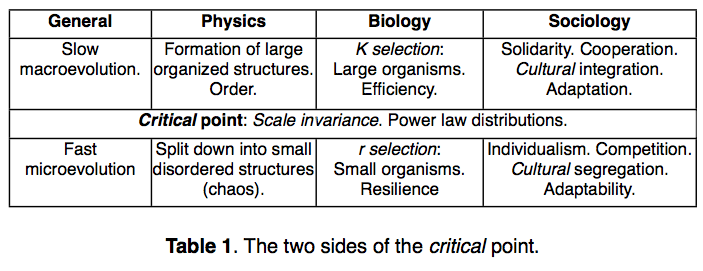
He talks about power law distributions after the critical point. By this, he means growing wage disparity, with wages following the power law (or Pareto distribution). This is exactly what we are seeing in the figure Charles Hughes Smith showed.
As I look back at history, it is striking how the accomplishments of the presidents fit in with this the changing pattern of wage growth:
Ronald Reagan served as president from 1981 to 1989. He talked about, “Getting the government off your back.” He was the country’s first divorced president. His wife consulted an astrologer about precisely what time of day bills should be signed into law. In some ways, he was the Donald Trump of the day. He advocated tax rate reduction to spur economic growth, control of the money supply to curb inflation, economic deregulation, and reduction in government spending. The fact that there had been high inflation previously meant that wages had actually kept up with the inflationary effects of oil prices, even though spending power had not kept up with the pre 1968 period.
Prior to 1981, things were much more focused on unity and tradition. John Kennedy back in the 1961 said, “Ask not what your country can do for you; ask what you can do for your country.” Lyndon Johnson, who was president from 1963 to 1969 designed the “Great Society” and fought the “War on Poverty.” Medicare and Medicaid were introduced under Johnson, as was the Voting Rights Act and greater emphasis on civil rights. We then had Richard Nixon, who was impeached, as president from 1969 to 1974. Gerald Ford was appointed to be president, serving from 1974-1977. All he is known for is pardoning Nixon. Jimmy Carter was then elected president, serving from 1977-1981. He was a very “nice” man, known for teaching Sunday School classes. He put solar panels on the White House, and asked everyone to turn down the heat in their home. Most scholars didn’t consider him a very effective president.
Gail
I do not know why Roddier thinks that individualism will triumph in a crisis. I heard Janine Benyus, of Biomimicry fame, talk on crisis and adaptation. She said that every case she had studied had shown increased cooperation when things got tough.
In The Hidden Half of Nature, the explanation for symbiotic relationships is that it’s a tough world out there, and two entities who can form a symbiotic relationship simply compete better with those who cannot form symbiotic relationships. I suppose it may depend on what your standard is. JFK talked about a national sense of solidarity. Bush II talked, in the midst of the attacks on the World Trade Center, about ‘competing’. Obama seems to have some amorphous ideas about globalism which I frankly can’t make sense of. To Kennedy and Obama, the notion of a group of 150 as the cooperative group for survival might sound like blatant individualism. To Bush II, it might sound like communism.
The symbiotic relationships explored in The Hidden Half of Nature are always between a relatively few entities, all of whom gain by the symbioses. For example, a plant exudes a third or more of the sugar it makes in photosynthesis into the soil to attract microbes which trade minerals (such as phosphorus for calcium) for the sugars. The microbes can’t make the sugars, and the plant isn’t really designed to go out and get the phosphorus or calcium with the same ease as a fungus.
Biologists, raised on Darwin and ‘red in tooth and claw’ are uncomfortable with the idea that plants ‘cooperate’. For example, a plant generates alarm signals when it is attacked by an insect, Nearby plants pick up the signals and make defensive compounds. Is the plant ‘signaling’ other plants to take defensive action? Some experiments have demonstrated that the signals are also picked up by different parts of the plant which was attacked, so maybe the plant is only signaling to itself and the other plants are just eavesdropping.
I can’t get too excited by the distinction they are trying to make. The point is that plants rely on each other and they rely on microbes and, in many cases, they pay each other in the currency of food or warnings or offering a strong support for another plant to twine around. To try to assign them the hormonal status that humans get when they help each other is stretching things and isn’t necessary to make the point that reliance on ones own microflora, the microbes which inhabit us, and fellow humans is essential to survival.
It would be interesting to know why Benyus and Roddier seem to be in disagreement. My money is on the 150 good people in a crunch.
Don Stewart
Perhaps he is saying the very large groups we have now will break down. That could sill get you to 150 people in a group.
Gail
The book 150 Strong by Rob O’Grady is well worth reading. Published by Dmitry Orlov.
The gist of his argument is that any governance which rests primarily on impersonal relationships, bureaucratic administrations, appeal to our bad side, and so forth cannot last. We are approaching the end of capitalism, not only because of physical problems such as pollution and depletion, but also because people have lost faith in governance and because people are fed up with the narrow focus of profit maximization and concentration of wealth.
The solution he sketches out is organization in groups of 150. 150 people can get to know each other. The group provides for most needs. Above the group, there are additional layers consisting of no more than 150 people to take care of things like railroads and highways and water systems and such. Vast amounts of current laws and regulations eliminated, as people interact with each other rather than with courts and administrative tribunals.
In a group of 150 the strands of competition and cooperation are twined very tightly. Classically, two boys in the village both love the same girl. She chooses a winner and a loser. Yet, tomorrow, both boys go out to hunt together.
I’m not claiming he has got it just exactly right. But there is some truth in it.
Don Stewart
PS My wife would point out that, in a properly ordered society, the Matriarchs get together and decide how to pair the youngsters up…cuts out a vast amount of nonsense.
Sounds like a reasonable way of doing things.
Gail
Also, I posted this same thing on Peak Oil. One commenter took me to task for failing to take into account transfer payments. He claims that increased transfer payments have eased the pain of the 90 percent.
My response to him was that dependency is deadly. People need to be self-reliant…not dependent on hand-outs. If society is headed down the path of increased dependence, then we can expect all sorts of social dysfunction….which is what we are experiencing right now. I sit in the coffee shop and eavesdrop on conversations between young people who have apparently met on the internet. There is always careful questioning on the subject of fiscal solvency. I don’t think girls are impressed by a boy who explains ‘I don’t make much money, but I get food stamps and I have disability allowance’. I am pretty sure girls want a boy who can take care of himself (and her, when she has a child).
Don Stewart
Don, I have a friend who rents to low income people. He prefers section 8 tenants because the government always pays. I think a young woman of a certain class would think the same; his money is guaranteed by the government. Yes, you and I know how quickly that can change but they do not.
Agreed, but I might not use those words to describe the problem. If the government supports everyone, there is no reason to have children–the government will take care of you later. There is no reason to stay with your spouse if another better looking one comes along–just pick up and leave. Work a bit if you like, but not too hard.
” If the government supports everyone, there is no reason to have children–the government will take care of you later.”
Government reduces the financial motivation for having lots of children, but at the same time the government needs population growth to pay for the social services. Talk about shooting yourself in the foot. I wonder how no one foresaw the flaws in this idea.
The actuaries are no doubt pushing Angela Merkel and others to import some young people.
Cuba has far fewer people per square mile than other Caribbean nations partly because there was no motivation to have children, and partly because there was no system (probably using debt) to build new housing. Cubans have also been able to migrate to the US. The result in Cuba is a far better living situation than in Haiti, Cuba’s nearest neighbor.
Gail
One more thought on ‘cooperation’. A cow cannot digest grass. The microbes in its body digest the grass and turn it into compounds which are essential to the cows nutrition. Lots of short chain fatty acids. (Microbes do the same for us.) The cow eats the products the microbes make, and then eats some of the microbes, which supply the cow with most of the protein in its diet.
Are you looking at competition or cooperation? Or are the words ‘competition’ and ‘cooperation’ merely human projections onto something that those words do not adequately describe.
Wendell Berry, in one of his books, talks about two farmers who enjoyed hoeing weeds together. The work is lighter when you have somebody else you enjoy talking with going down the row next to you. Would you describe that as cooperation? But the farmers do not pool their money…each farm is independent. They are essentially trading work. White farmers and free black farmers traded work before the Civil War.
One of the reasons I think the group of 150 is the right approach is because these sorts of cooperative ventures can emerge, be tried, succeed or fail, without a lot of red tape and ideological posturing. If it works, do it! If it doesn’t, do something else.
Don Stewart
Is the next financial crisis nigh? Could closure of Third Avenue Fund finally explode the post-crisis asset bubble?
The closure of a number of US funds linked to the high yield corporate debt market is eerily reminiscent of the events that led up to the global financial
Standard & Poor’s recently warned that an astonishing 50pc of US energy junk bonds are at risk of default, or $180bn in total. If we extrapolate this out to the $2 trillion of debt sold globally by energy and mining companies since 2010, the numbers begin to look strikingly similar to the sub-prime mortgage lending that front-ran the financial crisis. Of the $2 trillion of mortgage lending that became distressed, $800bn was sub-prime and $1.2 trillion Alt-A.
High yield debt markets have also helped fund the explosive growth of mergers and acquisitions in recent years, particularly in pharmaceuticals and telecoms. Some of this also shows signs of distress.
So, is Third Avenue the long dreaded popper that will finally puncture the post-crisis asset bubble, all puffed up by years of ultra-low interest rates and relentless central bank money printing?
http://www.telegraph.co.uk/finance/economics/12052433/Third-Avenue-could-be-the-event-that-will-finally-explode-the-post-crisis-asset-bubble.html
What goes up must come down
We will have to wait and see. Can things hang together until April (or perhaps May), when the March 31 valuations of oil and gas assets start affecting companies’ balance sheets? It seems like by that time, we are going to see quite a number funds similar to Third Avenue Fund in trouble.
No Soil & Water Before 100% Renewable Energy
https://lokisrevengeblog.wordpress.com/2016/01/24/no-soil-water-before-100-renwable-energy/
Interesting, but a little depressing! With a name like “renewables,” a person would think that there is no problem. In fact, I expect that is the reason for the choice of the name.
Thanks Gail, big fan of your good work.
For readers,
In 2007 the IPCC told humanity we had until 2015 to reduce emissions.
In 2014 the IPCC told humanity we had until 2030 to reduce emissions.
The IPCC told humanity we can do this by burning 1 billion acres of plants in a way that will reduce carbon from the air. That technology does not exist.
We would need to mine 10 billion tons of carbon from the air per year to make a difference. At present the most we now mine is about 1 billion tons of iron per year.
There are 12 million square miles of arable land, we now lose 38,000 square miles per year – this rate will increase.
50% of Northern Europe’s “renewable energy” comes from burning wood shipped in worldwide for electricity.
5% of Northern Europe’s diesel fuel is made of imported palm and soy oils. They cancelled plans to increase it to 7% last year. Their carbon credit markets are a mockery of intent.
We are not all going to get jobs installing solar panels and windmills to make cars that burn palm oil.
Comparing the energy needs of all North America to a rinky dink country like Denmark is disingenuous at best.
All the best to you.
+10 all very depressing. Cognitive dissonance at its worst to say the least.
In the peak oil community, there was a lot of speculation that the climate story was adopted, because the peak oil story was too scary to tell. The IEA had been telling the peak oil story in its annual energy reports, I believe up until 1998. There was no 1999 report. In 2000, the USGS came up with its “oil everywhere” report about resources, and the IEA forgot about peak oil.
It was not long after that that the IEA got deeply involved with the IPCC report. In fairness, if they really did believe that all the resources that seemed to be extractable really were, there would indeed be a climate change problem. What the IEA missed was the fact that the depletion issue that underlies peak oil tends to bring the economy down. So there really was an upcoming collapse issue, rather than the high price issue that they had originally been concerned about.
Wango tango Gail, just in:
At the current battery cost of $325 per kWh, the authors find that the price of oil would need to exceed $350 per barrel before an electric vehicle would have a lower cost of ownership than an equivalent gasoline powered vehicle.
All these new fuels require more water than ever. We are flushing water down wells to get more less energy. lol
http://www.commondreams.org/views/2016/02/10/biodiversity-loss-and-doomsday-clock-invisible-disaster-almost-no-one-talking-about
she’s a tough row to hoe Gail, cheers
Let’s see, to get to $350 per barrel, we have a ways to go.
Lokis, wonderful article. At last someone points out it is only electric they are talking about. You show we will not grow our way out we must reduce the number of people.
Economically complex societies do not ‘collapse’ – they fade away. First its slow, but then its quick. Physics may be useful in explaining some aspects of our economies, but the biochemistry of a living, reproducing, single-cell (non-photosynthesizing) organism might be better.
Such a living cell needs to acquire its macro and micro nutrient supplies from its surrounding environment. It will have an internal energy-generating capacity which will draw on one or more of its macro nutrients. Typically a chemically reduced hydrocarbon (a fatty acid) is used for synthesis of high energy metabolites, which are in turn consumed by the organism on a continual basis. Catabolic waste products, which may be toxic to the organism, have to be excreted into the environment. Sound familiar? It should.
Permagrowth is the reigning economic paradigm. That is, the rate of economic growth is exactly the same as compounding interest – its an exponentially expanding quantity. Hence, it requires exponentially expanding quantities of energy and raw materials. Now, the very best of luck with that.
Bacon and Feynman are also useful – but Albert Bartlett* actually put the problem of the exponential use of finite resources into the public domain – exponentials are very nasty indeed!
* Bartlett, A. “Forgotten Fundamentals of the Energy Crisis”. (1978) American Journal of Physics, 46(9), September; 876-888.
See also: “Dr Albert Bartlett’s “Laws of Sustainability”” – posted by GT: ‘The Oil Drum’ – Nov. 6th 2009.
For an economic commentary (by a forgotton economist) – Georgescu-Roegen, N. (1977) “The Steady State and Ecological Salvation: A Theromdynamic Analysis”. BioScience, 27(4), 266-270.
Traditional economists do not do – and appear to have little appreciation of the fact, that our economy is a physical process, occurring in a physical setting and consuming finite resources. But the Efficient Market Hypothesis will solve all. Indeed!
I see that the summary of Georgescu-Roegen’s article says:
I am glad his conclusion came out in that direction. As long as humans are using renewable resources faster than they can regenerate (forests, soil, aquifers) and non-renewable resources at all (fossil fuels, ores of any kind), there is clearly a problem. For one thing, there is a problem with depletion, and ever-higher costs (energy, especially) of extraction. There is also an ever-higher need for mitigation of pollution, again having an energy cost. The whole situation is unsustainable. After a point, everyone is working at producing energy products to run the system, because the cost of producing energy products escalates as well. The are no workers for anything else.
By the way, in the imaginary scenario you gave, I think that the rate of permagrowth has to be even higher than the rate of compounding interest, because as the economy grows, it becomes ever more complex. Because of this, an ever-larger share of output needs to go into managerial salaries. I expect more needs to go into capital spending as well, leading to more interest and dividend payments. If the low wage earners are not to be squeezed out, the rate of permagrowth must be higher.
Try this:
Trade Off: Financial system supply-chain cross contagion – a study in global systemic collapse
Jun 17, 2012 12 Comments by David Korowicz
This new study by David Korowicz explores the implications of a major financial crisis for the supply-chains that feed us, keep production running and maintain our critical infrastructure. He uses a scenario involving the collapse of the Eurozone to show that increasing socio-economic complexity could rapidly spread irretrievable supply-chain failure across the world.
http://www.feasta.org/2012/06/17/trade-off-financial-system-supply-chain-cross-contagion-a-study-in-global-systemic-collapse/
Then let’s talk
From the previous article comments
‘Surely one of these Elder types should have cracked by now and fled for the hills leaving more than a few people wondering why’
http://www.zerohedge.com/news/2015-09-24/janet-yellen-falters-during-speech-receives-medical-attention-all-clear-given
https://www.youtube.com/watch?v=xJ2UAYgIXG8
Also – recall Bernanke’s speeches — he sounded like a robot…. he appeared under very heavy pressure….
Thanks for getting the new article up – even with the wrist injury!
“In 2008, oil prices dropped very low. It was only with QE that interest rates could be brought very low, and commodity prices bounced back up to adequate levels. Now we are again faced with low prices. It looks as if we are again at the critical point, and thus the edge of collapse.”
Great post, Gail, because it helped me to better understand the dire situation we face. We will see what fiscal contortions are attempted to circumvent this critical point.
Glad the post helped your understanding! When we have a widespread wrong understanding of what the problem is, it is especially hard to see that the story needs to be re-written.
Another very nice essay Gail.
I think I see now where we may disagree on debt. In my essay I said debt allows us to enjoy 100% of a house now rather than waiting 20 years to save enough money to purchase it. In your example, you say that a subsistence farmer could never save enough money to purchase a tractor.
I think we may both be correct if we distinguish between productive revenue generating expenditures and non-productive expenditures. Most productive assets in our advanced civilization are complex and require so much up front capital they could not be built without debt. On the other hand, non-productive expenditures such as large homes, fancy cars, and long distance vacations could be purchased later in life from savings.
I suppose you could argue that if everyone deferred non-productive purchases until they had saved the total price then no businesses would exist to provide the non-productive items because there would be insufficient revenue for them to qualify for the required up front debt.
My main point was that growth enables debt which allows us to enjoy a lot more today than without growth. And your essay does an excellent job of explaining why we need increasing energy flows for growth.
Governments have figured out that if they want to maximize consumption and bid up commodity prices, it is necessary to “push” debt.
I think the problem with your argument is that people need to live somewhere. If they rent an apartment rather than buy a house, the station changes to one in which the people rent for 20 years, and pay a landlord for that time. The landlord in turn finances the apartment building, using debt. (This is a productive expenditure for him!) At the end of 20 years, the renters have saved up not nearly enough money to buy the house, because of all of their expenses. The tax breaks associated with interest on debt have gone to the landlord instead of the renters. They are back to renting again.
There is a similar problem with a car. Without a car, the person can’t get to work (at least in most of the US). The person can perhaps find a much lower-paying job nearby. In this case, the person is paying for the car with lost wages. Or the person can take a taxi to work, and the taxi-owner can finance the car using debt (which is now “productive”).
I find the “productive” vs “nonproductive” argument less than compelling.
I know that at least at one time, the tax code in the US was such that small businesses could only deduct vehicles if they weighed over a certain amount. Thus, the only productive vehicles for small businesses were SUVs or trucks. (I am sure the tax code was written by US auto companies.) The result encouraged a lot of big cars or trucks; these were of course financed by debt.
I used the words “large” home and “fancy” car to imply that more was being purchased that was required to survive and earn an income. In any case, I see your point. Keep up the good work.
All our energy problems can be solved by harnessing the power of a black hole, says Stephen Hawking:
http://www.livescience.com/53627-hawking-proposes-mini-black-hole-power-source.html
“In a lecture on Feb. 2, the famed scientist said tiny black holes, about as massive as the average mountain, could power all of the world’s energy needs.”
All we need is another 10,000 years of BAU to figure out how to do it.
But seriously, how come our supposedly brightest scientists are able to dream up all kinds of remote possibilities, yet they miss the collapse right in front of us? Isn’t Stephen Hawking smart enough to understand dissipative structures?
May I remind you that Mr. Hawking is incapable of even picking up a pencil, or cleaning up after himself. Without massive resources and healthcare, he’s dead.
I reserve the right to ridicule people with ridiculous ideas.
Couldn’t agree more. And the problem isn’t just energy. I’m sick of all these hair brained ideas that try and perpetuate the unsustainable especially when the solution is so obvious. Less people. A lot less people. A virus that wipes out 4/5ths of mankind would be a blessing in disguise.
This is the theme of the latest book from Dan Brown. It is to be a movie with Tom Hanks. http://www.imdb.com/title/tt0112857/reviews…
The link failed. The book is Inferno. (spoilers ahead) https://en.wikipedia.org/wiki/Inferno_(Brown_novel)
That’s actually pretty funny 🙂
All people have a certain pattern of belief that they follow in life, that they, for the most part can not escape, including all who write on this web site. The smartest, the dumbest, it doesn’t matter. Many people in our society have achieved great success due to their pattern of thinking and for the most part it is not really possible for them to escape that pattern of thinking. If you look at it on a world scale, the entire world has developed a pattern of belief that has served it for millennia, but likely will be tested during the coming ‘Long Emergency’. It is even possible the the world’s pattern of belief will not change during the coming eternal recession. It is ultimately our decision.
Hawking I think has a Star Trek paradigm. Going to the stars is easy, taking care of one planet is somehow harder. AIs will be dangerous, pollution is bad, collapse is something that steel framed buildings do when office chairs burn for a hour.
Celebrity scientist are as susceptible to cognitive biases https://en.wikipedia.org/wiki/List_of_cognitive_biases as everybody else. Actually one of the worst biases we have is wanting agree with the majority opinion, no matter how ridiculous that is..
“…collapse is something that steel framed buildings do when office chairs burn for a hour”
LOL! good one.
Belief that what is published in academic articles is necessarily true needs some sort of category of its own. Some of it is correct (say 50%), but some of it is not. It is hard looking at articles to know which is which. The process of picking up the findings of earlier articles and using them in a new article adds new problems. The result may be cited, without fully understanding where it is applicable (perhaps not in this application) or caveats may be missed. There is the huge problem of wrong theories getting repeated endlessly, for example, in economics. If the theory was good enough 100 years ago, it is good enough now.
At least in health care, we see some studies that bring together several similar studies. People have learned that sometimes ideas need to change.
hawking proposes that we will prolong the existence of humanity by colonising planets in other galaxies.
with all due sympathy to his physical situation—the man is off his trolley
https://c1.staticflickr.com/5/4021/4396954632_1fb8815143.jpg
It seems to me that people are pretty narrowly educated. They understand one little piece of the story, but not the rest. Or they assume that what they read in the papers must be right.
Another problem is being convinced something is true, when it really is not. A common belief is that if we can see coal, oil, and natural gas in the ground, we certainly can get them out. This is especially true if the technology is available to do something; the only problem is that the price is too high. They assume that somehow, this really won’t matter. Either the price will rise high enough so the high cost won’t be an issue, or technology will be developed to bring the cost down.
They also assume that renewable technologies can be scaled up at ever lower cost, thanks to efficiencies of scale. In fact, renewables are likely to add a great deal to our debt problem and many of the materials that renewables are made of are subject to depletion issues. So costs are likely to go up, and our ability to pay for them is likely to go down. There is also the Liebig’s Law of the Minimum issue–if any necessary part of the chain for building these devices is missing, this will be the end of the devices. For example, it is hard to see how the devices could be made or maintained without banks.
You are too kind…
On the other hand…
Let’s call this what it is…. INSANITY of the highest order. This is Elmer Fudd talk…. this is rootin tootin crazy talk!!!!
http://pixel.nymag.com/imgs/daily/vulture/2013/03/28/28-04-jack-nicholson-the-shinning.w529.h352.jpg
So Stevey H — how does this work?
Do we throw a lasso around a black hole and capture all that bucking energy and turn it into electricity? Who needs hydro or nuclear or coal. We’ve got us a first rate bucking Black Hole….
http://www.buckingbulls.org/wp-content/uploads/2010/06/RJ661_Apollo_I_Bucking_1-29-01.jpg
Smart people can be so utterly stupid at times….
Oh no, you came out with a new post just as I’m falling asleep. I’ll read it just as soon as I wake up.
Don Stewart usually places a comment by shortonoil here. So, I’ll do it for him.
Gail, another worthy topic and thank you for expanding the discussion
shortonoil on Mon, 25th May 2015 4:20 pm
“Is this because exploration, production, and refining, plus transport, are using a much higher share of the gross production volume? Or is there some system decay (whatever that is) accumulation?”
With time, the system is using a larger share of the gross per unit energy production. This results from the entropy production that the Second Law says must occur in that system for it to go forward. Since we know the properties of that system (mass flow rate, temperature, and specific heat) it is a calculable quantity. When the energy to produce petroleum becomes equal to its energy content the process has hit equilibrium, or the “dead state”. Production ceases. The entropic state of the system is determined by the amount of petroleum that has been extracted, and its physical properties. Or, in other words, the amount of petroleum that remains to be extracted is determined by what has already been removed, not the amount remaining that may be. Once the dead state is reached, what remains will become impossible to use as an energy source, and the age of oil will end.
We outline the computation in our 67 page report
http://peakoil.com/consumption/why-economists-were-totally-wrong-about-cheap-oil
Found this too regarding physics
shortonoil on Mon, 11th Aug 2014 8:18 am
If you take one gallon of 35.7 deg API crude you can get a maximum of 99,400 BTU of usable energy out of its 140,000 BTU content. That is a calculated value that is based on the most fundamental laws of physics that are known to man. The laws of physics inform us that some of that 140,000 BTU content MUST be given up as waste heat for the process to go forward. Mother Nature is telling us that: “sorry, you don’t get something for nothing”!
The petroleum industry is a 150 year old industry that has developed some of the most sophisticated technology on earth. As provider of the world’s most important extractive commodity it has had access to a large portion of the world’s capital resources. If one sits down an computes (like we have done) the operational efficiency of the world’s petroleum process you will find that it is now working at very close to its maximum theoretical efficiency. The petroleum industry is probably the most efficiently run industry on earth.
For petroleum there is just not much room for improvement. Anyone stating that efficiency is going to save the day from depletion is selling smoke, and mirrors dissolved in snake oil. From this point forward there is only one solution to our petroleum depletion problem: USE LESS OF IT! And, that is guaranteed to happen
http://peakoil.com/generalideas/peak-oil-written-on-tombstones
Explain to me how using less of a product, for which the selling price is way below the extraction cost, will fix the problem. This is more of the wrong-thinking that I object to.
Gail, my intent on these was not to contradict your position and no more from shortonoil from me. However, I took it to mean we will be using LESS, whether we like it or not due to natural laws. How that pans out remains to be seen and can transpire in a number of scenarios. Actually, what I read here is in agreement to you overall.
I found the statement concerning the oil industry and efficiency appropriate to your theme topic here.
I find BW Hill and your writing both of value. Interesting to see the details going forward in the months ahead….because I do not see years in the equation.
The sustainability groups have a theory that if we can just learn to use less fossil fuels, particularly oil, everything will be OK.
I think we are kidding ourselves if we think we can have a system that runs on any amount of fossil fuels or electricity. The problem is that the system breaks. You no longer have a job that allows you to buy oil. Your bank is closed because it no longer has electricity.
If you expect to continue, you have a much higher hurdle to jump over than just the “use less oil, convert more devices to electricity” hurdle.
You are already seeing what happens when we use just slightly less…. oil drops below $30 … when it needs to be over $100 — and the result is that oil producers are on the verge of bankruptcy ….
And you are suggesting we can use less oil and everything will come up roses?
Where are you dialing in from — it’s not Delusistan by any chance?
This is not how we reach the end of oil. It is the common misunderstanding of the physics of energy and the economy that I talk about at the beginning of my post. I have asked Don to please stop quoting these items, for that reason.
Gail, I am really trying to understand your viewpoint can you comment on my summary of our situation to help me understand : The global economy is a complex self organized structure/system that temporarily decreases its entropy by using energy sources – most importantly oil, to leverage human labour to increase societal complexity,. As the EROEI for energy sources decreases because of depletion, the system finds it increasingly difficult to maintain a low entropy state, let alone continue decreasing entropy (economic growth).
I understand why the inevitable decrease in complexity could be rapid (Seneca cliff) because of the interconnected nature of the system and that societal structure isn’t able to return to lower technology levels abruptly without total collapse.
Aren’t debt, low wages and the financial problems, symptoms of trying to maintain low entropy when cheap energy isn’t available?
Although the financial problems are a result of the physics problem the financial system is like the central nervous system of the structure and therefore failure causes collapse of the whole organism.
Is what you are analysing – the ways the financial system reacts to the physics problem?
Is the problem most have understanding this – not seeing the intertwining of the financial with the physics?
Please tell me if this is accurate.
I’ll give an explantion that I hope is relevant. For some incomprehensible reason “we” believe that a “stable” financial system must expand in the range 1% – 10% per year with 10% being better. Hold that thought.
The financial markets provide an means of communicating information, the most important data defines which processes have the highest efficiency, rewarding the winners, and destroying the losers.
Whether by accident or design, “we” have financial systems that expand (inflate, boom) and collapse (recession, bust), though collapse is usually defended by intervention.
At present the viability of systems dependent on fossil fuels is questionable, and that means that some current crude oil production (among other things) is unaffordable.
In earlier times, this wasn’t a problem, theoretically, we could exchange food for oil.
Today there are no good choices, hence money has few or no ways to show a profit, and pay for the needed inflation. The negative interest rates merely make manifest the instability already built into the financial systems.
Hope that helps. When looking at the entire system, changes in productivity are the key.
Changes in productivity seem to be associated with the quantity of energy products consumed. The quantity of energy products consumed seems to be correlated whether wages are keeping up with increased fuel cost. Also, whether there is sufficient increase in debt to keep up demand.
When I look back at the 1970s (see my comments to Don), it looks like employers made certain that wages kept up with the rising cost of living. This was helpful in keeping consumption up then, even with rising fuel prices. I suppose that part of the reason the kept wages up is because the economy still needed an increasing number of workers. This could only happen if a growing share of the population joined the workforce. This would only happen if wages were high enough.
Now we are dealing with a far more competitive world. Wages can’t possible keep up with the impact of high energy prices. If they did, there would be other countries that under-bid us. Since wages don’t rise with high energy costs, demand is badly cut back by high oil, so prices fall.
Explained in a manner to which I’ve become accustomed…thanks Gail. I never really understood what was happening, when productivity and inflation were linked with wages. As you explain the 70’s and 80’s wages kept pace with cost of living but I never associated it with energy. Now the wage earner is locked out of real wage rises, demand falls along with energy use and everything else associated with an economy that is growing. It’s probably a reason why the hyper inflation believers think the way they do, or maybe it’s the way they don’t think. The economy is consuming itself……….since 2008.
I hadn’t really stopped to think about the 1970s situation I wrote the comment. The labor force participation rate kept going up, and the inflation rate was high. Interest rates went up too, finally hitting 18% in 1981.
People who try to judge the risk of inflation now by what happened in the 1970s need to be very careful.
BTW, great article Gail. Regarding collapse, I tend to avoid making judgements on likely paths because the nature of these transitions tends to be unforecastable. Knowlege of future events tends to alter outcomes unpredictably.
Regarding productivity, this is exactly real GDP per capita employed, neither more nor less. I’ll admit defining these precisely is problematic. If I might paraphrase you thoughts with an anecdote: Ford installed a production line operated entirely by robots. The manager ased the union organiser “How are you going to organise these workers?” The union guy replied “How are you going to sell them cars?”
It seems we have a world with too much production and too few jobs. I’d comment on the nature of government and the need for the State, but that’s an issue for another day. I think your point on productivity was that increases tend to come with increased energy consumption. That may be because of a coincidence of increased demand, lower energy costs, and globalisation of trade. After the expansion the work gets refined – “doing more with less”.
I think you are generally right. The economy and the financial system are very close to the same thing. If we lose our current financial system, we will lose a lot of essential pieces of the economy, including the international trade system. Governments and businesses also depend on the financial system. Without a way to collect taxes, governments fail. Businesses cannot buy the aw materials they need, and they cannot pay their workers. The whole system soon falls flat.
I suppose increasing debt, low wages, and the resulting financial problems could be considered symptoms of trying to maintain low entropy when cheap energy is not possible.
I have some problem with using EROEI as a measure of energy costs, because it leaves out such a large share of costs. But it does generally move in the right direction, especially if all EROEIs are on a “calendar year” basis, rather than model estimates of lifetime EROEI. If researchers had been aware of the symptoms that indicate energy costs are not low enough, they would have said, “Whoa! We can’t bring down EROEI any lower than it already is,” way back in the 1970s or early 1980s. Of course, papers saying this would have been unpopular. One response might have been to look for high EROEI sources, such as coal from China and India, as a way of increasing energy production. If energy needs are really per capita, this approach doesn’t entirely work, though. Adding so many more consumers quickly gets us back to an even worse bind than where we were before, especially if we start running into limits of some type–too much pollution, or more factories than are needed for the long haul.
Dear Gail and Finite Worlders
I suggest looking at two items:
*The post today by Charles Hugh Smith, which illustrates the two-tiered economy we have experienced since financialization really started booming around 1980.
http://www.oftwominds.com/blogfeb16/fragile-middle-class2-16.html
*My comment on your last post discussing how triage might occur under Ulanowicz scenarios:
‘http://people.clas.ufl.edu/ulan/files/Harmony.pdf
indicates that a sort of triage will prevail as energy shrinks. But what will be the units of triage?
Countries (what Nicole Foss usually talks about)? Socioeconomic classes (what Marxists and their relatives talk about)? Lifestyle and cultural classes (what Hillary Clinton would like to talk about)? The group of 150 vs. the unorganized mass (what Dmitry Orlov would talk about)? The Makers or the Takers (what Daniel Quinn would talk about)?’
Thinking in terms of an economy as a single entity may be wrong in a collapse. We need to define which part will collapse in order to get some idea of what may follow. Charles suggests that the bottom 9 percent of the top 10 percent may be quite vulnerable, since they are highly financialized. An earlier post by me on this article talks about the collapse of the upper classes in Classic Maya civilization, leaving the lower classes to tend to their forest gardens. In other words, for 90 percent of the Mayans, ‘collapse’ may have mostly eliminated a burdensome overhead, allowing them to enjoy more of the fruits of their labors.
I don’t want to oversimplify. But assume that the stock market crashes and 401Ks collapse and the top 90 to 99 percentile can no longer fly around the world and maintain thousands of square feet of house per person. Does that not leave more oil for fueling the F150s? If politicians are unable to start wars because they can’t get anyone to buy the debt, does that not free up more oil for the farmers to use? If the debt-heavy oil companies BK, does that not put in place a restart where the use of oil is likely to be much more related to real work?
In the above scenario, something HAS collapsed. But it is possible that not EVERYTHING has collapsed. I agree that it was easier for the Maya, but I wouldn’t rule out entirely something similar in the OECD countries. Those Maya who have been able to continue in the old ways, and have not succumbed to debt and NAFTA and other insane plots against them may remember some of the old stories about how all the overhead was magically lifted from their shoulders.
Don Stewart
PS If you look at Charles analysis of the situation of the 90 to 99 percentile, you see a Seneca Cliff in the making. A small change in income has a catastrophic change on solvency.
So just where is this so elegant solution? Do you have your OWN blog, perhaps?
I posted this comment over at XrayMike’s http://www.thecollapseofindustrialcivilization.com, a couple of days ago. Has some connection to this post.
Humans were not consciously complicit in the forces of evolution that pulled them towards technology, a new set of information and tools that unlocked previously inaccessible resources. We were, more or less, putty in the hands of an evolutionary process that leaves no stone unturned in the search for energy. Most humans, even today, are not aware that humans are not responsible for their own technological civilization. It is more reasonable to say that physics is responsible for our brief and spectacular divergence from the slowly co-evolving ecosystem. Like a warm current flowing into colder seas, humans opened the spill gate on fossil fuels, released to seek their equilibrium and with this flow of energy built his societies and structures. But instead of an ever circulating current, the human species will end up at the end of some clade as the species that burned everything in sight and then burned-out. To maintain structure we must continuously find something to degrade, to turn into entropic waste with the liberation of heat and we’re doing it so very well with our evolving tools. But when the resources are gone, the once mighty, rapidly growing infrastructure will degrade. Nature has made finding energy rich resources a feel good experience, both for the lizard eating the cricket and for the man slicing through an old growth forest or accessing a massive seam of coal.
Also unrecognized is the fact that man functions in an evolving technological system like RNA functions in the cellular system. Immersed in his new technological system, he seems not to recognize his dependence upon the health of the ecosystem that he believes he has exited. He will never exit until perhaps he designs and builds his own technological replacements to increase efficacy and efficiency in some sort of strange self-defeating effort. But Homo sapiens is still not aware and functions according to the dictates of thermodynamics moving towards an energetic dead-end that cannot be avoided.
Human capacity for reasoning is limited. But we are learning slowly. I do not see our slow progress as sinful or evil just a fact of our limited brains and limited experience. Have some compassion for our species.
Both Roddier and Ulanowicz argue that the energetic dead end that everyone seems to believe in is not clear. The title of the Ulanowicz article was “Increasing Entropy: Heat Death or Perpetual Harmonies?”
From the Ulanowicz article: ” As a system begins to disintegrate, some fragmentary subsystems could decay (classically) into total dissolution, whereas, if the decline in resources is gradual enough, others might settle into enduring equilibrial harmonies.”
The gradual decline in resources that establishes “equilibrial harmonies” refers to the ecosystem and the sun. Civilization is an equilibrium destroying cancer that will “decay (classically) into total dissolution. Even a human technological solar economy would likely poison and disrupt the ecosystem over relatively short time scales. But why worry about killing the ecosystem in a few thousand years of unfettered human solar technology growth when we can kill it so much faster as a malignant, exponentially growing, fossil fuel species.
I agree, except I don’t see solar technologies without fossil fuels. I expect solar technologies to be a quick dead-end, except perhaps when considered from the point of view of homeowners buying them. Then they may be of some short-term benefit, especially off-grid.
Yes – still one of the best commenters. Still … knowing what you know, why not take advantage of that knowledge? What do you like to do? What are your primary interests? None of us have much time given our brief stage appearances, so why waste your (life) moment on anything that doesn’t maximize your enjoyment?
Everyone of us here knows the score. There never was a solution; in fact, there never has been a “solution”. Just yeast consuming resources (energy) while exponentially multiplying (overshoot) and producing waste (degradation).
So, what do you “do about it”? Well, you first have to realize that those in power completely understand these dynamics. So what do they enjoy? Power, wealth, prestige, etc. Are they willing to give it up? No, they will fight to their last breath to preserve what they have.
What does that mean to us? Well, it means that since they control finance and the military, they will utilize those tools to their collective advantage. Gone will be the quaint notion of lending “capital” and the “moral obligation” of “re-paying ones debts”; or the really beautiful con of democracy & social justice.
So, once again, bank (pun intended) on:
1. re-valuation (first NIRP, then outright targeted devaluation)
2. price controls (to combat [hyper] inflation)
3. rationing (to provide core foodstuffs)
4. speech, assembly & travel restrictions (many WW1 & II espionage & sedition acts are still in place, not to mention Patriot acts 1 & 2)
These actions are simply baked in – it’s your responsibility to act accordingly in order to benefit when the dominoes start falling.
B9K9, I agree, TPTB will not play nice when push comes to shove.
Like most humans I’m doing what I like to do. I get mucho dopamine from making new synaptic connections when thinking about all of this. I just wish more humans could find the natural complexity of the ecosystem rewarding. I used to hang-out with some wealthy people that play polo, race horses, buy nice cars, big homes and so on, and they were unbearably boring. I got more out of my unscripted explorations of the natural world than hanging-out at the Club.
Humans, like other organisms, must obtain regular infusions of energy. The brain has evolved to be preoccupied with obtaining rewards (energy, mates, power, status). Those memories that result in reward are reinforced and are likely to “enter the mind” once again when cued from the environment. The entire truth written in the human brain is “happy, happy, reward, reward, happy, happy ……………that’s what keeps us alive and that is what will ultimately kill us. For instance, you’re out on your Hatteras yacht (status) fishing in the Florida Keys (status) and you catch a big fish (reward seeking behavior) and what comes to mind? “When I bring this thing back to port their going to think I’m big man at the marina?” (status), “That fish is sure going to taste good, blackened or otherwise.” (food reward.) “I’m going to have this thing stuffed and hang it on the wall in my office.” (status). How many would have some empathy and imagine the fish returning to the sea to meld back in with a healthy ecosystem? (Not many, it’s just not very rewarding.)
Humans naturally and blindly pursue rewards without any thought as to the consequences. Here’s a thought that rarely enters their minds as they consume the planet like locusts: “Where will my children live when we destroy the ecosystem? ” The prefrontal cortices may rarely entertain such ideas but the limbic system dominates by pushing aside the worrisome idea and putting something more rewarding on the mental menu. The limbic system must keep us alive and so we move on to the next opioid releasing reward.
The consequences are arriving.
“I get mucho dopamine from making new synaptic connections when thinking about all of this.”
Yes, intelligent people thrive on the acquisition of (new) knowledge. But what happens when certain subjects become so familiar, or one develops a level of expertise, that the matters no longer hold any personal interest?
You know what is happening & what is going to occur; a whole host of other readers/commenters do as well. What new connection(s) are you making from thinking about these events? Any student of history knows that major civilization collapse events occur on a fairly regular basis. Sure, well outside of normal human lifespans – perhaps by multiple generations – but still frequent enough to form a consistent pattern.
It’s the same old, same old: resource exhaustion, population overshoot and environmental degradation leading to die-off & collapse. Some get a fever to forewarn others, but why is Cassandra such an ancient, recurring metaphor? Because in every generation since the dawn of man, certain thinkers can clearly see casual relationships and express them in terms of future projections. They are ignored by the stupid (the 98%), and persecuted by the PTB, who know full well what is occurring, but use that knowledge for their personal benefit to acquire/hold wealth & power.
What’s left when it’s all very, very clear? Perhaps something outside the realm of social rewards? For example, the champion fisherman who decides to train, prepare and build his own custom equipment to wrestle in a trophy fish, then let it go without anyone knowing about it? That’s the zen experience that transcends inter-personal recognition by satisfying only the true self.
I get bored, but not as bored as if I were just chasing dollars. I like studying human brains, the foolcrums upon which everything balances, or not. I’m beginning to see the human brain solely as an elaborate reward seeking organ whose various propitiously attached organs have allowed a successful searching of the environment for energy and subsequent DNA, RNA, protein type organization for rapid evolution and energy flow. The humans that took that route, not through choice, have displaced those that didn’t, temporarily, until the energy runs out.
I suppose I should be writing computer algorithms that can maximize financial gain through the breakdown of civilization. Then I could hire an army of goons to protect what I take from the true believers. Nah, the poor and unseen (but adaptable) will have a better chance at survival.
B9 … where have you been?
‘It’s the same old, same old: resource exhaustion, population overshoot and environmental degradation leading to die-off & collapse’
When has this ever happened on a global scale?
I would suggest this is no the ‘same old same old’
This is unique .. one of a kind…. extinction of a species is a one-off event….
“2. price controls (to combat [hyper] inflation)”…………. you still don’t get it at all, still beating the hPa drum. If you are out of work, if something you need costs a dollar or a million and you have no money, hyper-inflation means squat. You want hyper-inflation, get people to work and earn wages to allow them bid up the price of consumer items and services. Until then inflation is a pipe dream of governments around the world. Price controls…..what the hell for…..you obviously assume that nothing has happened over the last 8 years.
Act NOW! I’d probably just buy gold. It will be the 2nd last man standing… the last man will be
http://previews.123rf.com/images/jirkaejc/jirkaejc1005/jirkaejc100500346/7026237-photo-shot-of-beans-in-tin-can-Stock-Photo-baked.jpg
Rather than phase transitions, definitions of life fit better i.e. the ability to move.
Why use physics as an analogy for human society when biology is so much better suited.
Biology is inextricably linked to physics. And a good analogy, wherever it comes from, helps illuminate the subject. It’s a way of seeing, and there are many ways of seeing, so there is no need for you to attempt to dictate to people which sort of analogy they should use.
Physics is saying that economies are like a lot of other thing, including plants and animals. So I suppose it is possible to make analogies directly with them as well.
Now we’re talking Gail, physics, physics, physics. It’s all about physics and the nature of reality which is absolute, non-negotiable, period.
Richard Feynman, one of the greatest physicists in history quoted the following that stuck with me to this day.
To Physics students:
“No matter how smart you are, now matter how beautiful your theory is, if it disagrees with experiment it is wrong”
Slamming NASAs management post Challenger Disaster:
“For a successful technology, reality must take precedence over Public Relations, for nature cannot be fooled”
“Nature, to be commanded, must be obeyed.” Francis Bacon, Novum Organum
Francis Bacon knew that in order to command nature, one must act according to its rules and identity. The statement Reality is Absolute is the explicit recognition of the primacy of existence. This means that reality is not subject to wishes, whims, prayers, or miracles. If you want to change the world, you must act according to reality. Nothing else will affect reality. If you evade this fact, your actions will most likely not have their desired effects. Your failure will be metaphysical justice.
Todays elites are doing the exact opposite when it comes to the laws of reality therefore we’re stuffed. They focus mainly on public relations. Behind the scenes they understand reality and it’s no coincidence we see war, threat of a world war looming. As painful as that is to consider, it is a real logical possibility. Kill the competition, stop them and take their resources before they do the same to you.
There are an awfully lot of people who think that the only thing physics affects is fossil fuel supply. I have been told several times,”If the financial system breaks, all we need to do is create a new one. Since it is a man-made system, this should be easy to do.”
If there is a basic reason why this one doesn’t work, why should a new one work any better–especially if there is a physics problem underlying our predicament?
“If there is a basic reason why this one doesn’t work, why should a new one work any better–especially if there is a physics problem underlying our predicament?”
“A dissipative system is a thermodynamically open system which is operating out of, and often far from, thermodynamic equilibrium in an environment with which it exchanges energy and matter.
A dissipative structure is a dissipative system that has a dynamical régime that is in some sense in a reproducible steady state. This reproducible steady state may be reached by natural evolution of the system, by artifice, or by a combination of these two.”
Might it not be possible for us to replace our current, fossil fuel based unsustainable dissipative system, with a solar (not electricity, but thermal and photosynthesis) based steady state dissipative structure?
Something more like the Pharoahs of Egypt and other Bronze Age societies, with financial and economic systems based more around maximum stability, rather than maximum growth?
The Nile River for years provided a long-lived stable way of providing food to the Nile Valley, because every year, the floods brought with them top soil as well as water. Thus, agriculture could continue for thousands of years there. The Nile River also provided an easy means of transportation.
Now, we have messed up the system first with the Aswan Dam, and more recently with the Grand Ethiopian Renaissance Dam (not yet finished). Also, the population has grown to such an extent that much of what used to be arable land is now covered with buildings. At one time, I know that Egypt was the world’s biggest importer of wheat. It may still be.
It would be a big change to get the old Nile system back. Perhaps it could be done. It would require getting rid of the dams and 98% of the buildings.
Away from the Nile, I know that other areas suffered greatly from excess salt deposits. They tried irrigation, but without the annal overflow of the Nile, the soil tended to build up too much salt. It was also harder to maintain fertility. The climate has changed as well from the Bronze Age. This is what happens in a finite world–climates don’t remain the same. Also, earlier civilizations in Greece and the Middle East cut down the trees. Read Joshua Chapter 17. The family of Joshua was told to cut down the trees on the hillsides when they moved to the Promised Land, because the valleys were already inhabited. This is a good way to cause erosion. I have been told that Greece has very little soil now–mostly bare rocks. I think that a good deal of what Bronze Age Civilizations had, has permanently been lost–at least for several thousand years–until new soil can be formed and climate can change again.
I just watched the “The Salt of the Earth” movie.
https://youtu.be/OivMlWXtWpY
Beautiful movie – I highly recommend it.
It describes the career of Sebastiao Selgado – a photographer. At the end of the movie he described his family homestead at the Atlantic coast. In 1999 he returned there with his family and found pure desert – (effect of over 100 years cattle raising and exporting, I assume).
They had to plant 60 milion trees over 600ha of land. Very inspiring.
You can see their history and result of their work on their web site:
http://www.institutoterra.org/eng/conteudosLinks.php?id=22&tl=QWJvdXQgdXM=&sb=Mjk=
This is a fantastic movie — Salgado is a heavy duty misanthrope…. (as am I)
This is by far one of your best pieces of analysis to date, by orders of magnitude, you’ve raised the bar. It raises so many deeper questions.
As for the ‘shake your head’ simplistic solutions presented, I guess to a degree, we’re all guilty of this, thinking heuristically to incredibly complex problems. Even heuristic thinking is energy related, the conservation of energy principle. Reasoning by analogy rather than first principles is what most of us do, it’s much easier, we conserve energy this way, choose the path of least resistance. You’d never be able to get through the day reasoning by 1st principles, you’d probably short circuit, so we just copy with slight iterations, we ‘conclude’ when we get tired of thinking. I put it down to our faulty brains.
I know the sister of one of the world’s smartest mathematicians, possibly in history, Grigori Perelman. He’s one of the greatest mathematicians in history because he solved the 100 year old Poincare Conjecture, Ricci Flow and then incredibly turned down the Nobel prize equivalent along with the $1 million prize money. From St Petersburg but now lives in Sweden working in the field of nanotech. My point is, it took him a whopping 7 years of absolute focus and concentration to solve this 100 year old problem. It took 4 years for experts in the field to check through, understand and verify his theory. 7 years of focus and deep thought! Most of us can’t focus for 10 minutes today.
I don’t know why, but the truth is that natural human tendency is to suffer wishful thinking. Most of us do not have an innate scientific sense, most of us do not have brains (here’s the key) that are calibrated against reality and I believe in so far as we’re concerned within our dimension and maybe beyond, there is an absolute reality, it’s final and non-negotiable, if we deviate and fail as a result, well that’s metaphysical justice.
Physics and the natural world is really hard because only those with an innate scientific sense, those with carefully calibrated brains can just about grasp its immense complexity, figure out a few universal laws here and there. That said, applying the physics framework for thinking to my mind at least is the most effective method we’ve ever developed for navigating the complexities of the unknown, giving us counter intuitive stuff like quantum mechanics, crazy but true, where you can have perfect information and never predict the outcome which throws classical phsyics out of whack.
What you’re demonstrating now is an innate scientific sense to all this, a much deeper questioning of the world, that much of the world quite franky is incapable of understanding anymore than a child could operate a complex piece of machinery.
Feyman says it best, one of the few great scientists out there that has actually discovered a law of nature. “I know what it means to know something, how easy it is to fool yourself…”
https://www.youtube.com/watch?v=IaO69CF5mbY
Great thought provoking post!
“most of us do not have brains that are calibrated against reality”
Nicely put.
Glad you liked my post. I think it was over the top of heads of quite a few folks.
By the way, an outfit called TalkMarkets says my article is featured content on their site today in their “Editor’s Choice Section.” This is a link if you want to see it there. http://www.talkmarkets.com/content/the-physics-of-energy-and-the-economy?post=85282&uid=19258.
Somehow, I am supposed to get some small benefit from folks clicking on the link.
Happy for you. Gail is going mainstream, people!
If I don’r recall wrong I think it was Feynman who said something like:
“Thermodynamics seems to be the simplest field of physics but is infact the most difficult.”
(Freely from my memory.)
It is much less stringent than classical mechanics, general relativity and quantum mechanics where for instance time lacks any particular direction. That is the equations are symmetric with respect to time reversal. This contaradicts our everyday experience. A glass shatters but glass fractions never meet and form a glass. Civilizations build cities, extract raw materials and decline with a seneca cliff style. Never the other way around. And so on. This is where entropy enters. Entropy gives time a direction and it’s supposed to measure the quality of the available energy, defined by Rudolf Clausius (dQ/T). The direction of time is the direction in which entropy not decreases. The problem is that entropy is a difficult concept. Bolzmann managed to understand it better but it was only for very particular models of matter. Time is still a riddle…
At the same time, snowflakes form. New babies are born. Flowers bloom. Some of physics got stuck in closed systems. Order does come about, if you know where to look.
Ulanowicz does some interesting things taking the standard entropy equation and rearranging terms. He comes up with a way of quantifying the extent to which order exists, relative to some standard of what order is (using conditional probabilities). It is too complicated to explain. The article is worth looking at.
“At the same time, snowflakes form. New babies are born. Flowers bloom. Some of physics got stuck in closed systems. Order does come about, if you know where to look.”
Yes but order form in particular ways. Order also gets destroyed in particular ways. You rarely see order forming as a rewind of order getting destroyed and vice versa. People are born, they live and die. You never see old bodies coming to life and grow younger. Time has a certain direction you don’t get the same world if we change the direction of time. The funny thing is time does not have a particular direction in the equations of physics like those used by classical mechanics, general relativity or quatum mechanics. This is a mystery. Entropy tries to explain this and seems to be something emergent. A system of a small number of particles seems to lack entropy.
“Ulanowicz does some interesting things taking the standard entropy equation and rearranging terms. He comes up with a way of quantifying the extent to which order exists, relative to some standard of what order is (using conditional probabilities). It is too complicated to explain. The article is worth looking at.”
I only had a quick glance at the paper you refered to. It does seem to be interesting. Unfortunately my time is limited. Maybe I will give it another try. Anyway, Ulanowicz used the Boltzmann entropy and modified it. Boltzmann entropy was orignialy used on particular models of matter where it turns out to be another way of expressing the Clausius entropy. This is an important property. Without this Boltzmanns formula would only have been a formula. I don’t see how the Ulanowicz formula can be connected to the physical entropy of Clausius.This doesn’t mean that Ulanowicz paper doesn’t say anything important but it may be a limitation.
The natural sciences are sometimes overrated. Maybe there is a particular logic to history, very different from the logic of the natural sciences? This is what Oswald Spengler proposes in his book “Decline of the west”. He is using Goethes morphology (the logic of the poet) to understand history. I usually recommend people to give this book a try (at least an abridged version).
‘If there is a basic reason why this one doesn’t work, why should a new one work any better’
I cannot improve on that
@ Gail will click through, check em out. Make sure you get a good “paid per click” deal 🙂 Re: Physics, not surprised, it’s insanely hard to wrap one’s head around. When you listen to the pundits on Bloomberg and the likes, it’s just painful listening to them sat in confusion asking the “economists” and market players who are even more confused what they think’s going on. Even Yellen’s confused, as are the lawmakers. The blind are leading the blind who are leading the blind.
@ Van Kent makes sense right re: brain calibration? Great post here by Nadeem over at Market Oracle in a little more depth about the evolution of Home S…with some tongue in cheek slap stick comedy thrown in. Ominous signs ahead from his analysis. http://www.marketoracle.co.uk/Article52704.html
@ Christopher This is indeed true however “The use of thermodynamics in biology has a long history rich in confusion.” Harold J. Morowitz
Nothing in the universe violates 2LOT…period. That said you still wouldn’t believe the nonsense that some idiots still try to pass off as science.
Summary:
2LOT is a straightforward law of physics. In a closed system, you can’t finish any real physical process with as much useful energy as you had to start with — some is always wasted, end of debate. So a ‘perpetual motion’ is impossible. 2LOT was formulated after 19thC engineers noticed that heat was unable to pass from a colder to a warmer body by itself.
For a more indepth and interesting dive, read this: http://www.panspermia.org/seconlaw.htm
Then when finished read through this great piece of work http://www.pnas.org/content/112/31/9511.abstract
“Human domination of the biosphere: Rapid discharge of the earth-space battery foretells the future of humankind”
Abstract:
“Earth is a chemical battery where, over evolutionary time with a trickle-charge of photosynthesis using solar energy, billions of tons of living biomass were stored in forests and other ecosystems and in vast reserves of fossil fuels. In just the last few hundred years, humans extracted exploitable energy from these living and fossilized biomass fuels to build the modern industrial-technological-informational economy, to grow our population to more than 7 billion, and to transform the biogeochemical cycles and biodiversity of the earth. This rapid discharge of the earth’s store of organic energy fuels the human domination of the biosphere, including conversion of natural habitats to agricultural fields and the resulting loss of native species, emission of carbon dioxide and the resulting climate and sea level change, and use of supplemental nuclear, hydro, wind, and solar energy sources. The laws of thermodynamics governing the trickle-charge and rapid discharge of the earth’s battery are universal and absolute; the earth is only temporarily poised a quantifiable distance from the thermodynamic equilibrium of outer space. Although this distance from equilibrium is comprised of all energy types, most critical for humans is the store of living biomass. With the rapid depletion of this chemical energy, the earth is shifting back toward the inhospitable equilibrium of outer space with fundamental ramifications for the biosphere and humanity. Because there is no substitute or replacement energy for living biomass, the remaining distance from equilibrium that will be required to support human life is unknown.”
Abstract Scary Conclusion:
“The earth-space battery paradigm provides a simple framework for understanding the historical effects of humans on the energy dynamics of the biosphere, including the unalterable thermodynamic boundaries that now pose severe challenges to the future of humankind. Living biomass is the energy capital that runs the biosphere and supports
the human population and economy. There is an urgent need not only to halt the depletion of this biological capital, but to move as rapidly as possible toward an approximate equilibrium between NPP and respiration.There is simply no reserve tank of biomass for planet Earth. The laws of thermodynamics have no mercy. Equilibrium is inhospitable, sterile, and final.”
Now we know why Elon Musk believes we should have a “civilizational backup plan” on Mars, even if the odds of success (whatever that means) are negligible. Ironically he warns us that the main immediate risk stopping the project dead in its tracks could be WW3, which as I’ve stated many times is the logical “entropic” conclusion to a system that’s now starting to breaking collapse into disorder. We see this clearly in Syria and the regional Middle East, Eastern Europe, South East Asia and the top of the world Arctic.
Look forwards to further debate without too much complicated physics mumbo jumbo. My brain can only take so much 🙂
The topic here is Thermo-Bio-Sociology.
If you start with biology, you miss the first step, which is not the best to do if you’re trying to higlight the underlying principles.
We can only strap up from biology. Imagine science, or math for that matter, if humans did not possess sight. Not saying you are wrong in the broadest sense. More saying that we can only know small fraction of what is to be known.
And I suspect that biological potential for knowledge, or at least wisdom, is deeper than we can know as well. But that speculation is worth the bet I made upon sharing it here.
Yes Steven,
The more we know, the more we’re aware there’s yet a lot more to discover.
Comments no longer seem to work on the previous article, so here are a couple of replies to some comments by bandits101:
“$3 a gallon for fuel on Monday and $2 a gallon on the following Wednesday, is that an example of inflation or deflation”
Neither, it is simply a change in the price of gasoline. As far as I understand, mainstream Keynesian economics does not include changes in the price of food or energy in core inflation. As best I understand, the Austrian school considers inflation to be increase in money supply times velocity.
” can you let me know what powers the homes at night”
The solar CSP collects all the heat into giant storage tanks, which power turbines, which make electricity. That way, the power is dispatchable and it produces about the same amount 24/7, or it may be able to generate more or less power on demand. The trade off is that it is much more expensive than Solar PVC.
“what cleans the panels and maintains the system and who owns and maintains the grid.”
Hopefully they included that in the cost of operation.
“What emissions were created during construction.”
Nobody seems to measure that for any project, as far as I can tell.
For more than 40 years I have been a fan of the late economist Nicholas Georgescu-Roegen. He discussed free energy and bound energy. There is a massive amount of energy in the oceans but is it is not bound? Essentially useless for doing useful work? He also attempted to apply the entropy law to materials such as copper. Successfully in my opinion but not without controversy. Hermann Daly was one of his students. https://www.ucl.ac.uk/basc/prospective/core/atk/tabcontent/essay-examples/econophysics_entropy_and_its_discontents
For most purposes, the cost of obtaining the usage of the energy in what is important.
Temperature differences can be useful for some purposes, if the cost of tapping the difference is small enough.
Gail, wonderful article. Your example of the farmer with the hoe trying to save for a tractor is the first time I have understood the legitimate use/value of debt.
Gail: “Governments may be overthrown by disappointed citizens.”
Fast Eddy: “Your neighbors will be eating your liver as you watch.” (imagined quote)
I guess I am somewhere in between for level of drama. I continue to enjoy the massively understated Norwegian. Eddy, you are Canadian not folks know to be hot blooded are you maybe Italian or Greek by ethnic background?
Glad you liked the article.
I suppose I should give the analogy of a would-be doctor working at McDonalds to earn enough for med school. McDonald’s does require fossil fuels though. Even so, I doubt the would-be doctor would be able to save up enough earnings from working at McDonalds to go to med school, even if he worked until age 70 or 80. You can see the problem involved.
Dear Finite Worlders
This is to bring some closure to an open issue from previous post…sustainable agriculture and the book:
http://www.amazon.com/Maya-Forest-Garden-Sustainable-Cultivation/dp/1611329981
I have not studied the book closely. I did spend an hour today in the University library looking at the book. So take the following as mostly giving you information which can enable you to decide whether you would like to pursue this further.
The book traces the continuity of Mayan Forest Gardens from the transition from dry and cool to more humid tropical weather about 8000 years ago until today. Until the Spanish conquest, the Maya tended their forest gardens with no animals, no plowing, no irrigation, and no steel hand tools. The Spanish introduced steel hand tools, and a picture of a Mayan farmer today might typically show him wielding a machete. The style of farming is called ‘Milpa’, but the old Milpa style was high yield and considerable hand labor, while some modern derivatives are low yield without much labor. In the old style, fertility was maintained through cycles which could essentially repeat forever (or until the climate changed again). In the new styles, less attention is paid to maintaining fertility. The land is now threatened with conversion to pastures to grow beef cattle for the North American and European markets, and by the dying out of the immense amount of knowledge which was required to maintain the old style.
We can begin the cycle with a controlled burn of a section of the forest which will become a mixed field with corn as the primary crop. The burn clears the land and leaves a deposit of biochar and minerals. After about 4 years, the burned area will begin to revert back to forest, as the initial burst of productivity for annual crops begins to wane. Some of the first plants to invade the area will be weeds, which specialize in pioneering. The weeds quickly cover the soil and begin to add carbon and biomass. But they are soon shaded out by taller shrubs and trees. The Maya carefully select which shrubs and trees will be allowed to continue to grow, mostly based on whether they have benefits for humans. By the time the forest is mature, 90 percent of the plants will be beneficial to humans. The mature forest will be more diverse than a forest would be in the absence of humans. The forest will also support more wildlife than it would in the absence of humans. Finally, a section of the mature forest will be selected for a burn, and the cycle repeats.
The authors maintain that many of those who have studied the Milpa system have applied mistaken methods because they are approaching it from a European or North American perspective. The authors point out how mistakes have been made, including claims that the system collapsed. The authors maintain that there is no credible evidence of collapse of the Milpa system, and it appears that there is an unbroken, but evolving, 8000 year old tradition. For example, pollen sediments which have been used to justify the ‘collapse’ thesis represent only 2 percent of the plants in a typical Maya forest. Eye witnesses have given conflicting testimony. For example, Cortez led a military contingent into this area after his conquest of Mexico. He reported lots of people growing lots of food.
The cities were abandoned, but the farms remained.
A considerable amount of the book is devoted to things such as plant lists. I don’t know anything about tropical plants. I can only guess that the plants are chosen because they are useful, are resilient to droughts, and because they work in polycultures.
At least until the Spanish conquest, Toby Hemenway’s complaint about the arduous work done by the women grinding the corn every day would have been true. By the time I visited Yucatan around 1970, the farmers took their corn to a local mill, frequently by strapping a bag to a bicycle.
So what you would see today is different from what Cortez would have found in at least these ways:
*Industrial clothing
*no grinding corn with two rocks
*steel tools
*probably more selling at markets
Don Stewart
Thank you Gail,
I understand it’s been quite difficult to put together and explain with simple words. Great post, but not for economists, I’m afraid.
Next time I’ll use pictures instead.
Dissipative systems use exergy, which might be just a nitpicking, but I think not: to use those words make the process of dissipation more palpable.
I see the economy as a net of pathways, consisting of production units (from big companies down to single crafts(wo)men), which works most effectively in a semi-stable environment, i.e. no big fast changes. Then, the units can develop routine and skill in their respective task and the net does not suffer high transaction losses. Parameters change all the time: some production units become more effective than others, the amount of work to get raw materials changes, sometimes to lower, sometimes to higher levels, demand structure changes, the terms of exchange (aka prices) change and so on. To a certain extent, the net can rearrange, its elements can learn new skills, so that the overall efficiency does not plunge.
I support here the Marxian notion, that the relative value of anything on the market is in the long run defined by the amount of human work put into it.
So, to be more precise in definition, a collapse of the economy can be seen as the net beeing ripped apart, which leaves some chains of production more or less intact, while others, neighbouring to the rip, “die from starvation”, so to say. The overall production falls to the level of what is delivered by the relatively intact part.
Now enter two characters on the stage: productivity gains by investment, which is investment of work of course, reflected by a money stream, and information loss about the environment, aka negentropy loss, or entropy increase. They are somehow distant relatives of one another.
Productivity gains by investment decrease more and more, reflecting the fact, that human needs stay – more or less – the same, while the production process is approaching the most effective way to fulfill those needs.
OTOH, negentropy loss places a growing strain on the production system. Lower and lower concentration levels of raw materials can be compensated for by higher and higher exergy use for their concentration. A bigger and bigger part of our yearly exergy budgets is directed to raw material extraction, while the exergy stream is itself beeing limited by external factors, most prominently global warming, and secondly the growing scarcety of high concentration exergy itself.
Can the economy deal with this strain? My answer is: yes, if, and only if, the changes, which are undoubtedly profound, don’t come at too fast a pace, and if the economy is made deliberately more resilient.
What is a resilient economy? One with a little bit less specialization and more general skills, one with sounder financing to prevent one mesh of the net cracking to initiate a rip across the system.
The more jargon a person uses, the fewer people understand the stuff.
I agree that human labor is important in costs. This gets lost in EROEI calculations.
You see some chains of production being ripped apart, and others lasting. Everything is so interconnected in a networked economy that I doubt this will happen.
I am doubtful a little less specialization will get you anywhere, unless you want to be a waiter or bus boy. A networked economy doesn’t shrink back well.
I concede that you have a point concerning the use of specialized terms – they may be more precise, but exclude more people. Most people unknowingly use the concept of exergy when they talk about energy, anyway, in the context of the finite-resources-discourse.
Also I concede, that in a big crisis, no chain of production stays completely unharmed. A general drop of turnover affects all, but not all to the same amount. E.g. people cut back on big cars, long distance vacations and fancy electronic gadgets, but hardly on food.
With reduction of specialization i meant rather “learn more” than “learn less”. Spending more time learning costs time producing. But you are then able to switch jobs easier, if necessary. So you are in a way less efficient in your current job, but more resilient. The same holds for companies to a certain extent. To preserve the ability to shift focus, to have a “plan B” in your sleeve, costs more than a “do one thing well” paradigm. But it is more resilient.
Dear Gail. I love your mind. You have awakened me. Thank you.
Glad you liked it.
Small typo – you say “after 1991 when China entered WTO”. Clearly you mean after 2001.
best
Phil
Thanks! Will fix it.
This is another very useful article but I have mixed feelings about it now. Most of this stuff is too esoteric for widespread understanding.
What interests me is: race, demographics, territory, geopolitics, human psychology, and triage of remaining resources.
Let me simplify for everybody here how the future will look:
1) Humans are tribal, talking creatures who compete for life, status, and resources
2) There is less and less to go around
3) Ergo, we will compete to the death for whatever is remaining
I know with 100% certainty that this is coming, so I have chosen to drop out. I don’t really care about the outcome, I’m living during the peak and I have no interest in what people do with the long decline.
If you actually care, you are missing the point. It’s all BS. The entirety of our financial system and global economy is BS. Its collapse should not really bother you that much.
dolph, you didn´t get quite all of what Gail was writing. I suggest you read the part again with: “If it is any consolation, Prof. Roddier says that once new economies begin to form again, the survivors after collapse will tend to be more co-operative.” and let it sink in slowly, word by word.
Feel better?
When you’ve finished suggesting, I suggest you read this…and yes there are death projections in the billions, particularly for those so-called “advanced” economies.
http://www.johnstonsarchive.net/nuclear/nuclearwar1.html
“The following is an approximate description of the effects of a global nuclear war. For the purposes of illustration it is assumed that a war resulted in mid-1988 from military conflict between the Warsaw Pact and NATO. This is in some ways a worst-case scenario (total numbers of strategic warheads deployed by the superpowers peaked about this time; the scenario implies a greater level of military readiness; and impact on global climate and crop yields are greatest for a war in August). Some details, such as the time of attack, the events leading to war, and the winds affecting fallout patterns, are only meant to be illustrative. This applies also to the global geopolitical aftermath, which represents the author’s efforts at intelligent speculation.”
Come back telling me how better you feel after the man-made global asteriod strike equivalent..
Even if we have a nuclear war, I doubt it could go global. Nuke a country and you will destroy a lot of its viable infrastructure and personnel. How difficult would it then be for the victim country to respond with a matching hi-tech nuclear attack? Perhaps it would be impossible.
Of course it would go global. You suggest the classic dangerous assumption in purely conventional terms. Once nukes fly, all convention is over forever, therefore nuclear hostilities on a global scale could easily begin with the doctrine of preemptive strikes. Enemies would be forced to quickly calculate, post tactical nuke launch and the destruction of space “eyes on systems” that the other side would be launching. Remember the first thing to go would be the truth in any nuclear exchange. You could therefore easily see how an inter continental nuclear barrage carrying thousands of warheads to their designated targets could be launched as counterforce strikes against the US, NATO allies and Russia, non aligned block allies.
Nuclear weapons are detonated aboard multiple satellites in low Earth orbit over the U.S. and other areas, generating EMPs. This devastates electronics. Most unhardened computers and related equipment are rendered useless, destroying communication, information, and power supply networks on a nationwide scale. Transportation vehicles using electronics are inoperable. Many satellites are disabled. While few human casualties have occurred so far, much of the civilian elements of a continent-spanning society are devastated. For most American civilians this is the only warning of the coming attack they will receive: no effective civil defense program exists as an example.
I don’t think you understand the risks well enough.
“I don’t think you understand the risks well enough.”
Of course there are risks. Of course country A could reduce much of country B to smithereens. But will country B have time to respond to an attack by country A, if parts of its communications and infrastructure and personnel are taken out? And how much use would any survivors be, operating from underground bunkers?
“How difficult would it then be for the victim country to respond with a matching hi-tech nuclear attack? Perhaps it would be impossible.”
Look up second and third strike capabilities. Means of retaliation are an integral part of mutually assured destruction. So far, there has always been one person who had the sense to veto launching a nuclear strike. May we continue to have such luck.
“Look up second and third strike capabilities. Means of retaliation are an integral part of mutually assured destruction.”
If a nuclear war breaks out, NOTHING will be assured. The issue of COMPLEXITY touches on this subject. What if you fire a nuke, and it fails to go off? And when was the lat time you PROPERLY tested one of your nukes – to make sure it will obliterate a whole city (or even country) ? It’s partly down to the plans of mice and men, you see. Look at the Deep Water Horizon fiasco. What if a nuclear war broke out, but your shiny hi-tech nukes did NOT work like, er, clockwork? 🙂
So, I repeat: nothing is assured. Especially since we’ve never experienced a two-sided nuclear war, we have no experience to fall back on. So, you lean to your idea that everything will run totally smoothly, whereas I just wonder – knowing human beings, their fallibility, and the fallibility of their machines. I suggest that you have drunk too deeply of the techno-dream, not to have considered these possibilities.
Equally, your scenario could turn out to be correct. Whether it would turn out to be true in each of, say, 10 nuclear wars, we will never know. Maybe we could suggest it to some reality TV producer. Let’s run 10 nuclear wars, back to back. “Hey, that’s a great idea! I’ll just get on the phone to that North Korean dictator! And we’ll ask the Donald to call him a fat coward in public – all nukes and no trousers – game on!”
“If a nuclear war breaks out, NOTHING will be assured.”
You are missing the entire point. Mutually Assured Destruction means that no sane person starts a nuclear war. So far, MAD has worked 100 percent of the time. Hopefully, it continues to do so.
“You are missing the entire point. Mutually Assured Destruction means that no sane person starts a nuclear war. So far, MAD has worked 100 percent of the time. Hopefully, it continues to do so.”
I am not missing the entire point. Mutual destruction is NOT *ASSURED*. Humans are fallible, so is technology. Fair enough, though, if that fear stops us from attempting it. Not all politicians are sane or even level-headed, as we know. Just watch the old TV footage of Tony Blair strutting alongside George Dubya and looking like the cat who’d got the cream, after he’d joined the war against Iraq on the basis of very flimsy evidence.
Anyway, it’s late, so put your nightie on and go to bed. 🙂
crrrk…. this is 9er 9er… we’ve got missiles launching out of Novgorod…. crrrk… confirm missiles 9er… we’ve got 20 missiles launched heading USA… roger that 9er…
PBR street gang…. crrrrk… PBR street gang…. almighty almighty standing by over… …
Missiles are away
We don’t really know how this will work out. If many of us die in our sleep, without ever knowing what hit us, it would not be an entirely bad result (at least in comparison to other possible outcomes). Historically, most deaths during collapses seem to have been from disease–epidemics spreading through the weakened people.
I am not willing to rule out some kind of religious ending to the story, but I don’t know exactly how that would work out. I don’t expect one chosen set of “believers” to be saved, and the others to be left out.
An interesting question—of many—should not focus in why will America breaks down while a shrinking portion lives in opulence.
The interesting question, in my view, is: Will Americans learn, and accept to live in favelas like in Brazil?
There is always a great deal more energy usage in cold countries than warm countries. Shanty-towns don’t catch on in cold countries.
Yup, the definitive final chapter, thanks Gail!
Surprised to see you finishing the post even with your wrist broken. Probably should let it rest now for a while?
I have been doing one-handed typing. That works, but slowly.
“I have been doing one-handed typing. That works, but slowly.”
If you have a microphone, you could consider using speech-to-text and simply dictate rather than type. This obviously works best if you have a quiet place with privacy to work.