
|
Getting your Trinity Audio player ready...
|
The underlying problems are energy-related
A few years ago, I analyzed the growth of world energy consumption, breaking it down into (a) the growth in energy consumption needed to support the growth in world population, and (b) the growth in energy consumption available to support higher standards of living. This analysis covered the period 1820 to 2020. I found that periods of low growth tended to coincide with wars, depressions, and collapses. This is not surprising in a world economy governed by the laws of physics. Every part of the economy requires adequate energy of appropriate kinds.

In this post, I analyze data for 5-year periods, ending in 2024, to obtain an updated view of recent energy consumption and population trends. My conclusion is that total energy consumption growth in recent years has not been sufficient to forestall major problems. A more detailed analysis reveals that growth in certain vital resources (the diesel+jet fuel part of oil supply, and critical minerals related to electricity production and usage) is particularly problematic.
These findings indicate that the economy is already beginning to hit energy limits. Because of energy-related shortages that are already being encountered, national economies are beginning to act like the players in a game of musical chairs, with one too few chairs. Leaders have taken to building up armies, cutting off exports of critical minerals, imposing tariffs, and bombing other countries, even though these actions might not make sense to peace-loving citizens.
[1] Figure 2 is a stacked bar chart showing similar indications to Figure 1.

The total of the red and blue segments is the average annual increase in world energy consumption over a particular 10-year period. The blue amounts (usually at the bottom) are those necessary to provide services at the same level as in the past, given the population increase. The red amounts (usually at the top) are determined by subtraction. Large red caps are good, while red caps below the zero line are very bad. They indicate that the per-capita energy supply is declining.
[2] The largest increases in Figure 2 correspond to favorable economic times.
The vertical text in Figure 1 provides examples of how low points in energy consumption have proven to be very bad. In this section, I show that the opposite is also true: High points tend to correspond to very good times economically.
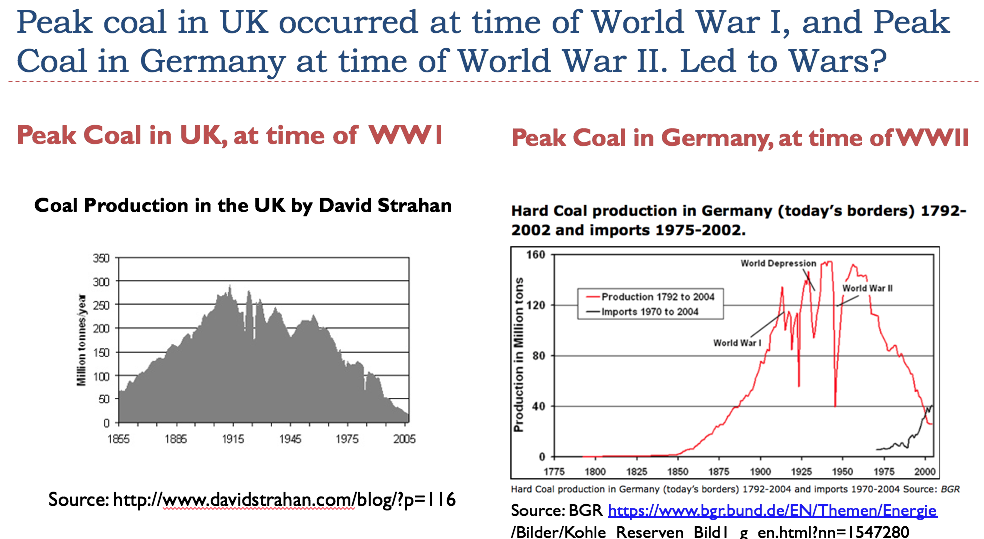
One peak in Figures 1 and 2 coincides with the 1901 to 1910 period. This period corresponds to early electrification and advances in the mechanization of agriculture. It was before 1913 when the United Kingdom hit peak coal, limiting the amount of coal that could be profitably extracted. Germany hit peak hard coal shortly before World War II. After peak coal was reached, less coal was available per capita. Leaders felt the pressure of “not enough coal to go around” and opted for war.
In Figures 1 and 2, rapid energy growth occurred after World War II, during the 1950s, 1960s and 1970s. The lower peak in the 2001-2010 period coincided with much greater use of coal after China was added to the World Trade Organization (WTO) in late 2001. High-wage countries started transferring their industry to China because costs would be lower in two ways: Wage costs were lower, and coal was an inexpensive fuel, reducing energy costs. Furthermore, by transferring industry, including manufacturing and mining, to China, high-wage countries could also lower their own CO2 emissions, as required by the 1997 Kyoto Protocol.
We would expect the patterns we are seeing in Figures 1 and 2 if the world economy is governed by the laws of physics. The availability of plenty of inexpensive energy, of kinds that match built infrastructure, is what is needed to allow the world economy to grow.
[3] Figure 3 shows more recent world energy data organized by 5-year periods. It shows how small the “red caps” of the types leading to favorable economic outcomes have been in the last decade.

The latest two 5-year periods comprise the years 2015 to 2024. The short red caps on these two 5-year periods mean that the economy is already being squeezed in the direction of not-enough-to go-around.
[4] Viewed on this same basis, diesel and jet fuel supplies are being squeezed even more than the overall supply of energy products.
Diesel and jet fuel are somewhat similar in composition. They are grouped together in some energy reports as “middle distillates.” They are relatively heavy oil products that come out of oil refineries. If there is a shortage of one, there likely is a shortage of the other as well.

Diesel and jet fuel are of concern because, since 2015, there has been an actual shrinkage in the amount of these fuels available relative to population. In fact, every five-year period since the 2000 to 2004 period has shown less growth in diesel and jet fuel than in the overall world energy supply. (Compare Figures 3 and 4.)
The low growth of diesel+jet fuel is particularly concerning because these fuels are essential for international transportation. With too little of these oil types, trade across the Atlantic and Pacific needs to shrink back. The physics of the situation makes tariffs look like an attractive solution for reducing trade.

Another concern is that diesel is essential for food production and transportation. Even if some other types of energy are available in plentiful supply, we cannot get along without food. While wind and solar are popular energy types today, they are not very useful for either international transport or for operating modern agricultural equipment.
[5] The underlying problem is that populations tend to outgrow their resource bases, including energy supplies.
The issue of the world not being able to support endlessly rising human population is an issue that no politician, auto maker, or economist wants to mention. The standard work-around is to show energy supplies without using an adjustment to a per-capita basis. This tends to make the energy situation look much better than it really is. Figure 6 is an example of such a chart.

Figure 6 emphasizes how modest the recent add-ons to the fossil fuel supply really are. These add-ons are made possible by fossil fuels; they would tend to disappear if fossil fuels were to disappear. Nuclear, which is the largest of the add-ons, requires both uranium and fossil fuels. The category “Wind+Solar” is the tiny green stripe at the top of Figure 6. In 2024, Wind+Solar amounted to 2.8% of world energy supply.
[6] It is easy to make electricity look like a growth area that can continue its pattern forever.
Figure 7 is a world electricity chart that, like Figure 6, is not on a per-capita basis.

There are a few details that are easy to miss:
(a) Current electricity production is quite small compared to the total energy supply. As counted by the Energy Institute, electricity amounts to only about 20% of total energy, varying by year and by part of the world. It is already incorporated in Figure 6.
(b) Almost all the non-fossil fuel part of the energy supply (“Add-Ons”) is electricity. In Figure 6, the only type of non-fossil energy shown that is not electricity is biofuels. These are mostly ethanol and biodiesel.
(c) Another detail that is easy to miss is the fact that the growth in the world’s electricity supply, as shown in Figure 7, has been almost exclusively outside the Advanced Economies–that is, members of the Organization for Economic Co-operation and Development (OECD). The Advanced Economies group includes the US, most of Europe, Japan, Australia, and several other countries.

Figure 8 shows the growth in electricity generation separately for the Advanced Economies and the Other Economies. The chart shows that generation of electricity by the Advanced Economies grew until 2007 but flattened after that date. Electricity generation by the Other Economies has grown the entire time since 1985. The rate of electricity production growth of Other Economies became noticeably more rapid after China joined the WTO in 2001.
Also, population growth since 1985 has disproportionately taken place in Other Economies, as contrasted with Advanced Economies.

[7] In the Advanced Economies, electricity production has recently been falling on a per capita basis, making a shift to greater electrification seem difficult.
A major issue is that the Advanced Economies are already seeing their electricity supplies per capita declining as shown on Figure 10 below. This is true for all five of the selected economies. Some of the lower consumption is due to efficiency improvements, but some is the result of the offshoring of jobs and industries to low-wage countries.

In comparison, electricity production per capita of other economies, with typically lower wages than Advanced Economies and often accompanied by more rapid population growth, has tended to rise, as shown on Figure 11.

The four “Other Economies” are less similar to each other than the five Advanced Economies. But what is striking is that they all have shown growth in per-capita electricity production since 1999. In 2024, Saudi Arabia’s electricity production had risen to about the per-capita level of the US’s electricity production. By 2024, China’s per-capita electricity production had surpassed that of both the EU and the UK. Russia was part of the Soviet Union before the latter collapsed in 1991. Once Russia’s economy had started recovering from the collapse, about 1999, its per-capita electricity production also began to rise.
[8] Other issues are also making a continued shift to electrification appear difficult, particularly for the Advanced Economies.
Trying to work around using fossil fuels leads to the need for more specialized minerals to produce high tech electrical goods and electricity transmission. The problem faced by Advanced Economies is that they produce practically none of these minerals; they must import them. The US has a long list of minerals it considers critical.

Some of these minerals aren’t rare in the earth’s crust. Part of the problem is the lack of industrial capacity in Advanced Economies today, as industry has been moved overseas to reduce costs and local CO2 emissions. For example, the US used to be a major producer of aluminum, but this production has dwindled; other countries, including China, can produce aluminum at lower cost.
Another issue is that China produces the majority of quite a few of these minerals. The US, and probably the other Advanced Economies, had planned to buy what they needed on the world market. Now, production is not keeping up with the amount the world could easily use. In 2025, China announced export restrictions on some minerals, including gallium, germanium and antimony. It has become clear that if Advanced Economies want to have adequate supplies of high-demand minerals (including silver, copper, platinum, rare earth minerals, and uranium, among others), they need to start producing them themselves.
Diesel is used in extracting many of these minerals. If diesel is in short supply, that adds another layer of problems. All these issues may lie behind President Trump’s interest in Greenland.
[9] We don’t hear about these issues partly because academic researchers live in ivory towers, and partly because politicians don’t dare explain the issues to voters.
Part of the problem is that economists don’t understand how tightly the various parts of the world economy are interconnected through the laws of physics. Economists tend to believe that if there is a shortage, prices will rise, and these higher prices will solve nearly all problems. This is not necessarily the case. Buyers cannot purchase more than they can afford. Prices may spike temporarily and then fall back. Production of fossil fuels or minerals may end because prices do not rise high enough, for long enough, for producers to depend upon the higher prices for the long term.
In the case of a shortage, most people assume that the only change the economy will make is in prices. However, the economy is tightly interconnected. It can move production to a different part of the world, where wages and energy costs are lower. An indirect result, in the country losing jobs, may be more wage and wealth disparity. The US seems to be experiencing this issue now, with fewer young people being able to find a job that pays well.
Needless to say, politicians aren’t willing to admit, “We have difficulties for which we can see no solution.” Even leaders of universities are reluctant to suggest that there might be major problems ahead. They don’t want to frighten students or their parents. University officials want all problems to be ones their students can work on, with the hope of solving them in the next few years.
[10] What is happening now is similar to the outcome of a game of musical chairs, when there is one fewer chair than the number of players.

In the game of musical chairs, players walk around a group of chairs until the music stops. At the end of each round, one chair is removed, leaving one fewer chair than the number of players. In the next round, the remaining players all scramble for the chairs available, which often leads to small fights over who gets a chair. This not-enough-to-go-around problem explains the poor relations we see today among countries and political parties. It is also the underlying reason for the interest in imposing tariffs and in bombing other countries.
Financial markets tend to perform well during periods of economic growth. However, if certain kinds of essential resources are in short supply, this will tend to hold back growth. Debt defaults and falling stock markets could result. For these reasons, problems in financial markets may be ahead.
Major governmental changes may be ahead. Representative governments require more energy than simpler types of organizations, such as dictatorships. Furthermore, citizens do not like disorder; they may want to overthrow leaders who seem to allow too much disorder. They may vote them out of office or even try to assassinate them. The problem of resource inadequacy is structural, however. Getting rid of a particular leader doesn’t necessarily help the situation.
Everywhere in the world, at least part of today’s problem is that there are not enough jobs available that pay well. Economists have told us to expect high prices if there are shortages. In a way, not having enough jobs that pay well is the opposite problem. But from a physics standpoint, the result is the same. Only a few people can afford many of the goods that are available. The economists’ misinterpretation of what is going wrong further confuses people’s understanding of our current situation.
Mainstream media needs to cater to advertisers. Because of this issue, we cannot expect them to tell us what is happening. That task seems to fall to bloggers, like me. I try to write an article approximately every month. I hope that the graphs and other figures I have presented in this article will help readers understand why we are currently seeing more types of disruptions, such as tariffs and bombings.


“California’s $2.2 billion solar plant is shutting down.“?
https://x.com/Electroversenet/status/2029164958127407473?s=20
Once hailed as a breakthrough, the Ivanpah Solar Facility in the Mojave Desert is now a case study in failed technology and environmental risk.
Built with $1.6 billion in federal loans in 2014, the plant was hailed as a symbol of America’s clean energy future.
It used 173,000 mirrors to focus sunlight onto three massive towers, heating fluid to drive steam turbines.
Complicated.
Expensive.
And it never delivered on its promise. After just 11 years, the technology is now obsolete.
On top of that, the facility became notorious for its environmental toll, with estimates of at least 6,000 birds incinerated each year by the concentrated beams.
The promise was affordable, reliable, green power. The reality was high costs, technical failures and ecological damage.
The price of oil dropped in 2014. This solar plant was no doubt planned when optimism was high that oil prices would stay high forever. Our biggest problem would be too much CO2 because we could extract as much fossil fuel out as we wanted to. But prices haven’t stayed high, and early models of the promise of solar energy were optimistic. This particular attempt worked out badly.
Damn. I’m going to miss seeing that bright spot on the horizon when flying to Mexico.
Serious inquiry, so it was really visible out there as a “landmark” ?
I was ~born on the rock-hill and lived on another one for most of my life – so for people like us – it’s just in the bloodstream always watching deep into the country (while eating / working from home / any activity), the outlook into changing horizon 24 / 365. I even met few people formed via similar experience as brought up in skyscrapers, so it must be a real evolutionary-psycho thing (not only for rocky – hill billies as it were..)
Dutch TTF update: easing.. and more importunately almost a nothing burger if you zoom out on that past ~5yrs graphs as [ the bug and UKRo ] war years where the real deal price spike mayhem.. (~5x worse)..
https://www.barchart.com/futures/quotes/TG*1
ps obviously as mentioned previously one thing are virtual trade charts and another is physical commodity delivery (abrupt-ed)..
Agreed! Look at the 5-year graph.
The Austrian police ends up with electric cars: they are too heavy and slow
https://auto.pravda.sk/magazin/clanok/788518-elektromobily-pre-nas-vhodne-nie-su-tvrdi-nemecka-policia/?utm_source=pravda&utm_medium=hp-box&utm_campaign=shp_9clanok_box
But if Austria has no oil, it needs to figure out something else. Heavy, slow electric vehicles seem to be the alternative.
Russia, which is under serious pressure, promises stable energy prices for Hungary, despite the volatality on the world market
https://hnonline.sk/finweb/zahranicna-ekonomika/96268558-madarsko-ziskalo-od-ruska-zaruku-stabilnych-cien-energii-napriek-globalnej-krize-oznamil-szijjarto-z-moskvy
Well, now they realize that stopping enery supply is a bad idea in the world of high oil and gas extraction prices.
Reliability of supply matters most.
[ HU ] tends to import oil from [ RU ] via that old Druzhba pipeline as well as the Adriatic route connected line. Both have its own sets of (political) problems (as shown recently) attached to it, so NOT guaranteed stability at all..
btw. there are elections in HU next month, people argue if the Trump (overplayed-)card would sink the current leader – govs or there will be other internal issues for the contest, and obviously as your article alluded also the UKR question; Slovaks finally moved from talk to action and “disconnected” their grid for real from any future balancing (exports) there unless UKR govs repairs or actually merely switches on the pipeline again..
If you are into betting the odds are still good, I once put bet on political event [ DE ], and won large bucks, that scared me, so did not follow up on it yet..
Reliability is best achieved from multiple sources. Relying largely on Russia was a mistake that created a dangerous weakness.
Theoretically yes.
In practice it depends.. as I just enumerated above.
As UKRo denies the old main pipeline, and at the same time Croatia or someone on that Adriatic southern route denied them (Hungary) as well.
If I’m not mistaken you (SK) could perhaps get something the other southern leg directly via Austria or perhaps Bavaria->Czech-> .. and so on..
Fortunately now Russia will unilaterally stop. This will give Europe a chance to diversify.
Diversify from where ? Yes , they can — wood , coal , s**t pancakes ( a la India ) .🤣
Ravi> it was deliberate top honcho EU bureaucrats policy to dismantle the various coal technologies for ever, the mines-shafts , the processing facilities, the power plants all has been discarded – sold for scrap metal, flooded, etc. So coal can’t be brought back in many / most parts of EU ! There are some exceptions like [ PL ] though..
The elites clearly showed their hand there, the desired mid-long term depop plan was revealed confirmed by this very act (and other further steps in sync).
According to the article:
Szijjártó recalled that the global market faces serious challenges, especially as a result of the military conflict in Iran and the threatened closure of the Strait of Hormuz, which could lead to a drastic increase in energy prices in Europe and the world.
“We agreed to find alternatives in the event of blockage of transport routes. If pipeline transport of oil encounters obstacles, we will consider the possibilities of maritime transport,” added the Hungarian minister, emphasizing that the Druzhba oil pipeline and the TurkStream gas pipeline are critical for Hungary’s security.
What alternatives??
I am not sure. Short of meeting Russians at that famous Carpathian summit (“turul” (mythic Hungarian Eagle) symbol, not far from that historical summit in Carpathian mountains, that current Ukrainian authorities have forcefully removed recently: https://www.hungarianconservative.com/articles/culture_society/mukachevo_trident_turul_transcarpathia/ ) there is not much land-locked Hungary can do. Croatians and Slovenians are pro-West and (at least Croatia is) pro-Ukraine. Romania will not help – they mutually dislike each other with Hungary from centuries. Romania currently (since 1944?) occupies Hungarian Transylvania/TransIlvania (so do artificial “Slovakia”, Serbia (occupying former Hungarian Vojvodina) and ailing “Ukraine” currently clutching to former Hungarian Transcarpahia – all Stalin’s gifts to fellow commie dictators back in the day). Serbia (another Russian asset in the Balkans), will assist, but they have their own problems (no sea access, if I remember correctly).
While not being sure, I feel like Hungarians are being propped to go and take what was theirs (while reconnecting the pipelines to Russian-occupied (or owned) pumping stations). Serbians too. “Slovakians” are going to get what they deserve, immediately after “Ukraine” gets what is due 😅
This is clearly an AI video. Are the allegations in this video true? It alleges Iran has been able to take out much of the US radar defense system it had put into place.
Looking for the news on youtube is a waste of time. They have no policy similar to reputable media channels regarding AI generated stuff.
LOL, you are naive.
In Germany, the first public television station has just embarrassed itself with AI videos.
This is the first war that is 99.44% of all publicly facing information is simply impossible to verify. This is the first time I just listened to people who I have not seen tricked.
Scott Ritter comes to mind in particular.
AI has ended news and most journalism
The New York Times — not a Telegram channel, not a Russian state broadcaster, the New York Times — has published satellite imagery confirming what Iran said it was doing while Washington was busy telling you it wasn’t working. Every major US base across the Gulf. Systematically and methodically.
Bahrain, Fifth Fleet headquarters, the nerve centre of American naval power in the region. Al Udeid Qatar — already missing its $1.1 billion AN/TPY-2 radar. Camp Arifjan Kuwait. Ali Al Salem. Prince Sultan in Saudi Arabia. UAE facilities. SATCOM terminals destroyed. Radomes cracked open. Satellite dishes gone. Missile tracking infrastructure — the AN/TPY-2 radar systems that coordinate every Patriot and THAAD battery in theater — targeted with what the imagery confirms was not luck but architecture.
Iran didn’t just strike US bases. It mapped the communication and coordination layer that makes American missile defense function as a unified system and then it peeled it apart, base by base, across five countries simultaneously.
https://x.com/IslanderWORLD/status/2029076466298737120/photo/1
Yes, I posted this few days ago, Gail even replied on that article but perhaps then did not pay attention to these two large radar domes erased – not cheap and long order time to be expected.. What struck me was the precision (3x disctinct bldg/objects within that areal), this was like 3-4dayz ago, so perhaps the command structures who scored there dug out somewhere inside Iran have been already eliminated by latest western air raids.
I wasn’t sure if this was the same one you referenced before. I didn’t remember the details being referenced. The AI video does seem to have some truth to it. I was wondering if there were glaring errors.
Interesting. We are now getting conflicting stories from MSM. The New York Times, which we would expect to be following the MSM line, would be expected to tell the government-preferred version of the truth. But now, it seems to be telling the truth.
I’ve been listening to this moneyoverhistory channel since it started. It seems pretty reliable. I consider it as a Hand outlet underming the Zionist establishment and in service of the anti-imperial national socialisms. It definitely tracks with what the MOA folks think. b deleted all my posts last night and blocked me because I was making way too much success way too quickly in establishing the DA with the hip crowd there. The squares there were having hissy fits left and right. It the third time that’s happened over the years but this time they were way more receptive because the politics of the war are so absurd that people are looking for answers as to how such a political clustfuck is possible. So that was good to see. b certainly didn’t do himself any favors deleting me but he don’t give a fuck about anybody but himself.
Tough crowd. I don’t care what anyone says I still like you.
I picked up a Brinly one-bottom plow for the IH 184 from a younger farmer whose extended family works 600 acres and has 100 head of cattle. He said to use “suitcase weights” on the tractor so I don’t have to stand on the front wheels but Dad wants to hang pipes full of quickcrete instead. I’m making a 300’ trench to bury my 3/4” poly irrigation hose from a seepage spring for a main feeder line to a manifold and orbit timers for watering the nut, berry and fruit orchards. Stuewe D40L deepots with oak and hickory seeds are germinating in the bay window with serviceberry, plum, persimmon, hazelnut and chestnut seeds in the fridge. Chop wood, carry water.. Resilience is resistance.
That’s beneath you, you’re for standing on the uphill side on that sideslope.Trenching with a moldboard plow that’s great. Great selection of plants, congrats on the germination. Hope the shed project is coming along. When the BNS hit I decided I’d better get back into eggs again right quick and after drb said that he doesn’t have to feed his hens nothing but chicken poop. I spoiled myself and got 15 pullets that just started laying, getting a dozen a day. Can feed the extras to the dogs and the cat and back to the chickens as necessary. I’m converting one of my Portahuts into a coop, have the roost built-in and still need to install the battery powered automatic door. I have a second hut with an open front next to it as a day room for rainy weather. Flip them upside down like turtles and drag them around the fields. Sweet, friendly little birds. ISO Browns. They are loving milk for the first time in their lives.
Yes, reante – we all like you and ask you, please, do not get banned here, at the hospitable and energy-centered OFW.
Thanks Gail seems to have found the sweet spot to my occasional chagrin. 🙂
I like you too, Reante. But I sometimes scratch my head over trying to interpret your acronyms. 🙂
Remember, I’m a boomer and Norman is ah honorary member of the Greatest Generation. I think he just sneaks in there by a whisker.
Sorry T I’ll make the effort to spell things out. I mean Tim!
Young people are losing interest in driving licences
https://www.trend.sk/spravy/mladi-odkladaju-robenie-vodicakov-cestach-zacina-ticha-revolucia
Compressed per capita income (vs recent quasi opulent times):
– new carz are ~twice as expensive (vs few yrs ago) because of the emission/climate mandates (that also affects the expenditures to keep up the old clunkers upto regulatory nonsense – hence not cheap option either)
– parking inside cities is expensive
– people (incl. young ones) rather turned into incells living inside their phone app worlds
– public transport is still pretty good at places
– more concentrated urban pop hence less freq. visiting in the country-side needed anymore
..
.
Young people especially have low incomes, making driving unaffordable.
I have a friend who suggests bombing the barn containing the red heifers to slow the coming of God.
Does not matter. The red heifer was born and raised in. UsA. Already disqualified.
The US has lots of light types of oil, used in chemical plants.
https://www.zerohedge.com/energy/us-chemical-companies-net-beneficiaries-middle-east-energy-disruption-crisis
US Chemical Companies “Net Beneficiaries” Of Middle East Energy Disruption Crisis
Fischer pointed out that as oil prices rise, naphtha-based competitors in Europe and Asia are squeezed, while U.S. chemical makers that rely more on natural gas are relatively insulated due to domestic production. That, in turn, widens the U.S. margin advantage.
These U.S. chemical manufacturers use raw materials such as natural gas, crude oil liquids, salt, sulfur, and other minerals to produce products like:
basic chemicals: ethylene, propylene, methanol, chlorine, ammonia
plastics/resins: polyethylene, PVC, polyurethane inputs
fertilizers: nitrogen, phosphate products
industrial chemicals: solvents, coatings, acids, adhesives
specialty chemicals: ingredients used in electronics, autos, construction, packaging, and consumer goods
The violence seems to spread, all the way to the Mediterranean:
https://www.zerohedge.com/energy/tankers-burn-strait-hormuz-mediterranean-sea-amid-spillover-war-risks
Russia Says Ukrainian Drone Boat Blew Up Shadow LNG Tanker In Mediterranean
At least ten tankers have reportedly been hit by IRGC forces in the Strait of Hormuz, according to Iran’s semi-official Mehr News. At the same time, the battlefield appears to be widening beyond the Gulf region. A Russian-flagged LNG tanker, Arctic Metagaz, carrying fuel from Russia’s blacklisted Arctic LNG 2 project, was reportedly hit by Ukrainian drone boats in the Mediterranean.
Not too surprising:
https://www.freightwaves.com/news/air-freight-rates-expected-to-spike-as-iran-war-escalates
Air Freight Rates To Spike As Iran War Escalates
Airlines are suspending flights, rerouting traffic around the conflict zone and unable to use key transload hubs in Dubai, Abu Dhabi and Qatar because of retaliatory missile attacks by Iran. More scheduling changes are anticipated in the days ahead.
Longer routes require more fuel, reducing the amount of cargo aircraft can carry so as not to exceed weight limits. Some airlines are expected to add refueling stops.
That’s from a co-author on the fall of Roman empire book we discussed some time ago.. Basically, in this interview about his new “Collapse” book you can start from 15 or 50min time mark. Dancing and nibbling around the edges but essentially confirming Gail’s (and Tim’s at Surplus) vector of thought, about the post WWII 2-3x decades as energy (and edu) boosted temporary one hit wonder.. It’s on Ytube :
—
“Rich Countries Are the Most Likely to COLLAPSE | Aaron Bastani Meets John Rapley”
The notion that the Global South is affected ‘first and worst’ by global shocks they didn’t cause, namely climate change, is one of the cornerstones of leftist thought. But what if it’s not entirely true? What if, contrary to this tenet, it’s wealthy Western nations who have over-developed and lost their resilience in the process? This is the argument made by John Rapley in his latest book ‘Icarus Economics’. Rapley is a political economist at the University of Cambridge and a Senior Fellow at the Johannesburg Institute for Advanced Studies.
In conversation with Aaron Bastani, Rapley discusses how the West’s growth has reached certain limits, most notably those imposed by the natural world in which we are all embedded. Has a focus on the wrong kind of growth in the West reduced resilience to shocks from the natural world? Are the majority of us already in a recession, despite what GDP figures tell us? And what can the Global North learn from the Global South?
I am wondering if perhaps we are headed a system with only a relatively few winners because the others have been squeezed out. There will be high prices for fuels, consistently, to encourage the production of marginal supplies. The system will have higher complexity than today. The direction will be in the one that Eric Chaisson talks about.
Their narrative is some sort of return to more /natural state/, meaning less complex societies ahead.
That author John Rapley characters seems as proper closeted PO collapsnik indeed, there is a split second occasion where he attributes that recent mega spike of affluence to accessed energy surplus. But he intentionally doesn’t go further perhaps as not fit audience venue for it, the interviewer did not catch it at all. Similarly, as we don’t discuss it with all of our friends, family, etc.
high prices for fuels wont work
it only works when you have high uses for fuels—and that requires billions of people—at our scale of usage
Actually, if fuels can be used very efficiently, it seems like it works, even for a relatively small population.
i disagree Gail
the only fuel source that works for a small population is trees—history shows that
it isnt possible to sink/maintain wells and refineries to serve a small number of people—an elite if you like.
the sums just dont add up im afraid.
if you had say, half a dozen wells and one refinery in the usa—the cost of transporting it to users would be prohibitive.
It would be an agarian preindustrial society with a rather large supply of fuel for cooking and heating. You’re suggesting that a tiny supply of fossil fuels could sustain an industrial society. In theory, it could, in reality it could not because of all the other resources required for an industrial supply chain for an industrial society.
The West is based on favourable geography and corresponding climate conditions, which provide it with energy advantage.
There is no other landmass which has similarly fabourable conditions in the Southern hemisphere.
Zion is carpet bombing with B52s flying from US to Iran and back. When the major cities are gone in Iran where will they turn next? My guess carpet bombing of western Russia.
gonna need a bigger carpet (eyeroll)
“… Norwegian aluminum producer Norsk Hydro’s Qatari smelter is shutting down after its partner stopped gas supply amid attacks from Iran.
Qatar smelter shutdown exacerbates Iran war aluminium fears Norsk-Hydro said the shutdown of the 648,000 metric ton per year smelter was expected to be completed by the end of March and that a full restart … ”
Supposedly, that’s almost 10% global production (source?), half year shutdown at the minimum.
Attacks on Iran could spike fertilizer costs for U.S. farmers
The conflict in Iran threatens to disrupt a major fertilizer production and shipping hub, raising the risk of higher crop costs and food inflation.
The Gulf region is home to some of the world’s largest fertilizer plants, and the Strait of Hormuz handles about one-third of the global trade for the nutrients. Prices were already high before the latest conflict in the Middle East erupted, and the fresh tensions come as Northern Hemisphere farmers are set to start applying the products to their fields.
The timing of the conflict “literally could not be worse” for the industry, Josh Linville, vice president for fertilizers at brokerage StoneX Group, said by email. “There is never a good time for war, but this couldn’t be much worse.”
https://www.farmprogress.com/marketing/fertilizer-prices-set-to-spike-what-the-iran-conflict-means-for-your-farm
https://www.wwnytv.com/2026/03/03/attacks-iran-could-spike-fertilizer-costs-us-farmers/
JP Morgan Warns of Catastrophic Oil Supply Loss from Middle East War
https://x.com/OilHeadlineNews/status/2029175840186012026
= oil price shock!
Year of the horse, cause we’ll be riding them soon. 🙂
https://x.com/AzizSapphire/status/2029176005739303411
Not all carbon molecules are the same . Paper barrels vs Physical barrels .
https://theuaob.substack.com/p/paper-barrels-vs-physical-molecules?utm_source=post-email-title&publication_id=7011593&post_id=189771978&utm_campaign=email-post-title&isFreemail=true&r=26quge&triedRedirect=true&utm_medium=email
The author is talking about the lack of middle distillates in today’s mix of crude oil. Iran’s oil tends to be on the heavier side.
According to the article:
If the physical flow of middle distillates is constricted, the economy doesn’t just ‘choose’ to consume less; it loses the biophysical capacity to operate. The missing exergy will cause the entire macro-economy to shrink violently. This generates a non-linear feedback loop: the lack of diesel destroys logistics, which destroys manufacturing and retail, which obliterates GDP and consumer purchasing power.
The resulting ‘demand destruction’ will be vastly deeper and faster than traditional supply-demand dynamics suggest. The market expects a standard price correction; physics dictates an economic amputation.
Finance can buy paper barrels in lockstep today, but it cannot change the molecular weight of a hydrocarbon tomorrow.
Force Majeure galore .
https://www.aa.com.tr/en/economy/after-halting-lng-production-qatarenergy-declares-force-majeure-to-affected-buyers/3849941
https://www.argusmedia.com/zh/news-and-insights/latest-market-news/2796111-uae-s-fujairah-bunker-suppliers-declare-force-majeure
https://oilprice.com/Latest-Energy-News/World-News/Chevron-Declares-Force-Majeure-as-Israel-Shuts-Leviathan-Gas-Field.html
Probably nothing to worry about 😵💫😵💫
https://x.com/AzizSapphire/status/2029176005739303411/photo/1
JUST IN – Maltese-flagged Safeen Prestige container ship hit by unknown “projectile” in the Strait of Hormuz, “causing a fire in the engine room,” with all crew abandoning the vessel.
https://x.com/disclosetv/status/2029184148103995636/photo/1
Send in the US navy .🤣
They spent five hundred billion dollars building a plan to keep chips away from China. Nobody spent a dollar on a plan to keep missiles away from the chips.
Amazon data centre in UAE hit . AWS is down .
https://www.cnbc.com/2026/03/03/iran-war-uae-drone-strikes-aws-data-centers.html
India is in deep s**t for LNG . Total storage is now only 7 days . Already a 40% cut in supply to fertiliser plants etc is implemented . In the metropolitan cities all taxis , 3 wheeler auto rickshaws etc were converted into CNG because of pollution . 40% of LNG comes from Qatar . No loadings from Qatar as force majeure declared . How do you cook without gas ?? Back to the future ( wood, coal ) .
https://www.argusmedia.com/en/news-and-insights/latest-market-news/2796083-lng-supply-crunch-from-iran-war-hits-india-s-downstream
Here is a video on the LNG crisis in India . Please click settings for English subtitles . 7 minutes .
Lack of LNG will hurt India terribly. They decided to use natural gas for cooking and for their light weight passenger vehicles. India’s own natural gas supply has been dwindling. It now imports over half of the natural gas it consumes.
Humans have evolved to need to eat cooked food. In India, the alternative to bottled gas for cooking is coal. Burning coal for cooking is terribly polluting. India has terrible air pollution already in the big cities. But also inside homes.
Restarting an LNG plant takes weeks apparently. Something to do with getting the temperature to where it needs to be.
It will take months to get over this crisis, if ever. There is no point in starting any of it back up, if there is a chance it will all be shut down again.
Container ship being attacked??
Yes .
Sort of a huge drop!
First article says:
QatarEnergy declared force majeure on Wednesday to affected buyers after halting production of liquefied natural gas (LNG) and related products, the company said in a statement.
This disproportionately affects European buyers of LNG. Spikes LNG prices in Europe.
The second article says:
Bunker suppliers in Fujairah, UAE, the Middle East’s largest marine fuels hub, have started declaring force majeure following Iran’s retaliation strikes after the US and Israel launched attacks against the country at the weekend.
This is the very heavy, polluting fuel for ships that regulators are trying to get rid of.
The third article is:
Chevron Declares Force Majeure as Israel Shuts Leviathan Gas Field
According to the article:
The Leviathan consortium recently approved a $2.3 billion first phase of an expansion project designed to lift capacity from about 12 Bcm per year to roughly 21 Bcm annually. The field holds an estimated 22.9 trillion cubic feet of recoverable gas and underpins a $35 billion long-term export deal with Egypt running through 2040.
This natural gas field is off the Gaza strip. It arguably should belong to Palestine. Palestine is terribly short of both electricity and water. This natural gas could be used to help Palestine, but the part Israel doesn’t think it needs for itself is being sold to Egypt.
Effective IMMEDIATELY, I have ordered the United States Development Finance Corporation (DFC) to provide, at a very reasonable price, political risk insurance and guarantees for the Financial Security of ALL Maritime Trade, especially Energy, traveling through the Gulf. This will be available to all Shipping Lines. If necessary, the United States Navy will begin escorting tankers through the Strait of Hormuz, as soon as possible. No matter what, the United States will ensure the FREE FLOW of ENERGY to the WORLD. The United States’ ECONOMIC and MILITARY MIGHT is the GREATEST ON EARTH — More actions to come. Thank you for your attention to this matter! President DONALD J. TRUMP
Stupid is what stupid does .— Forrest Gump
More debt for the US.
It is a nothing burger . Warships cannot accompany tankers . They are sitting ducks . Hormuz is a two way lane . One lane for incoming ships and one way for outgoing ships . All must go in line , veer off and you hit a sandbank and are grounded . As far as insurance is concerned even the Fed’s balance sheet is not strong enough . Understanding a VLCC is 2 million barrels of oil = $ 150 million and the ship is worth $ 100 million . The total liability is $ 250 million per shipment . Problem number two : the insurer of the cargo is different from the insurer of the ship . Ships can be owned by a Greek company but be flying under a Panama flag or Liberian flag . Who gets paid ? Too many legal issues . Shipping companies are not stupid . With Lloyds which has 150 years of history and then the backup of the reinsurance who wants to go to an assurance by Trump . Like I said ” Stupid ” .
Stats from
@kpler
on Hormoz. Tanker transits are down 88% .
https://x.com/Amena__Bakr/status/2029125945958056405/photo/1
Wow! That is low.
Apologies for the long cut ‘n’ paste, but the following information and speculation from Russian commentators (translated by John Helmer I think) is interesting. There is more at the link at the bottom. The writer reports on analyst Vladimir Chernov’s view that US$200 a barrel is a possible consequence of an extended conflict, and that this would send the market into a panic and trigger an economic crisis or recession.
March 3, 2026
When will the conflict in the Middle East become dangerous for Russia
By Olga Samofalova
Even without the official blocking of the Strait of Hormuz, there is a now disruption of shipping in the region. And attacks on Saudi Arabia’s largest refinery and the infrastructure of Qatar, a major LNG supplier, create even more problems for the supply of oil, petroleum products and LNG. Russia is almost the only one to whom the Middle East conflict promises great economic benefits. But only if the situation does not go beyond manageable risks. Where is the line between benefit and harm?
The conflict between the United States and Iran threatens the established global structure of hydrocarbon supplies. Moreover, we are talking about interrupting the traditional flows of not only crude oil, but also of petroleum products and LNG.
Firstly, there is a dangerous situation in the Strait of Hormuz, through which about 20% of the world’s oil and petroleum products exports (from Saudi Arabia, Kuwait, Iraq, United Arab Emirates and Iran) pass, as well as between 20% and 30% of LNG supplies (from Qatar and United Arab Emirates).
There is no official Iranian blockade of the strait, but there is still no normal traffic there.
Companies themselves have stopped the passage of their ships through the Strait due to the risk of attacks. This was done, for example, by the Danish shipping company Norden, which has a fleet of about 500 ships. The media have reported about three victims of the attacks on tankers transporting crude oil which have been damaged. The deaths of sailors have been reported. Hundreds of tankers carrying oil and LNG have begun to accumulate in the area of the Strait, and hundreds more tankers are now located in areas outside the Strait itself, avoiding its passage.
The Strait of Hormuz is a fairly narrow “gateway” to the Persian Gulf, its width at its narrowest point is only 54 km. Due to the narrowness of the Strait of Hormuz, it is easy to launch missile strikes and attack ships with drones. These risks are deterring and have already led to tanker freight rates doubling since Friday.
Another problem has arisen due to a drone strike on the largest refinery in Saudi Arabia, in the port of Ras Tanura. After that, Saudi Aramco announced the shutdown of the plant. At the same time, the refinery produces 550,000 [per day]. 40% of the fuel from this plant goes to the domestic market, and the rest is exported.
An attack on the infrastructure of Qatar Energy is also reported, and Qatar is one of the largest gas suppliers in the world, providing almost 20% of global LNG production. According to media reports, QatarEnergy announced the suspension of LNG production. Attacks on the Iranian oil infrastructure may also follow in response. Damage to this oil and gas infrastructure is dangerous because it cannot be launched as quickly as the passage through the Strait of Hormuz. It may take a long time to restore it.
At the same time, experts call the blow to the Qatari LNG the most sensitive. First of all, it’s easier to hurt it. “The bulk of LNG production in the Persian Gulf is concentrated in small Qatar, which is one of the three largest LNG suppliers in the world. This means that it takes much less effort to cause serious damage to the Qatari LNG industry than to damage the oil industry of Saudi Arabia or the UAE,” says Sergei Kaufman, analyst at Finam.
Secondly, LNG is more vulnerable because gas is more difficult to replace than oil. “If part of the shortage with oil can be covered by reserves and the redistribution of flows, then for LNG bottlenecks lead more quickly to price spikes and problems for specific buyers. At best, the consequences will be market-based. A sharp increase in the risk premium, rising freight and insurance prices, interruptions in individual shipments, but without a prolonged shutdown of production. In the worst case, this is a physical loss of volumes if key facilities at Ras Laffan and Mesaieed are stopped, and companies and insurers are actually blocking shipments,” says Vladimir Chernov, analyst at Freedom Finance Global.
https://johnhelmer.net/how-russia-counts-the-benefits-and-the-risks-of-the-iran-war/#more-93565
I hadn’t realized this:
Qatar is one of the largest gas suppliers in the world, providing almost 20% of global LNG production.
I can imagine that some US LNG producers have been thinking: With LNG production by Qatar out of the way, we can sell LNG to Europe at a higher price. We can perhaps sell LNG to India, without going through Hormuz. All of this demand for world LNG will help drive up US natural gas prices, and make it more profitable to extract. From the point of view of US natural gas producers, the problems in the Middle East would seem to be helpful.
Increased prices will not mean increased NG production . Conventional gas has already plateaued . All NG new production was associated with gas from shale production . That has peaked also . With gas the problem is not so much production but carrying capacity , that is why gas is flared . Geology is infallible .
But drillers are always hopeful that higher prices will help them.
the same evil thought occurred to me as soon as the iran war started—
first, donnie cuts out solar and wind—thus throwing more reliance on gas and oil—
then he closes Hormuz, which further jacks up prices of USA oil and gas—-
which lines the pockets of his oil soaked billionaire contributors…..
it’s all part of ”turning the planet into cash”—
of course, donnie to thick to figure out that it’s not the oil that creates wealth it’s finding ever-expanding uses for it… The USA cannot survive on its own, other than as a peasant economy.
ive said before– donnie’s (or much more likely, those behind him) intention is economic world domination—Hitler without the wermacht—
bbbbbut—the majority of americans voted this lunatic into office—so what do I know?
The Demographic Myth Behind the Attack on Iran
https://senecaeffect.substack.com/p/the-demographic-myth-behind-the-attack
This is an article by Ugo Bardi.
Excerpts:
The idea that Israel needs space for an expanding population is rarely explicitly expressed, but it is often implied in the idea that Israel has a housing crisis and hence needs to build new settlements in the West Bank.
My comment: Both Israel and Palestine have high birth rates. They don’t have enough land or fresh water for their current populations.
The TFR [Total Fertility Rate] among ultra-Orthodox (Haredi) women is about 6.1 in 2024, one of the highest in the world. The Haredim represent today only 12.5% of the population of Israel, yet they have a disproportionate influence on the Government. Netanyahu’s coalition depends almost entirely on Haredi parties.
The Haredi population is expanding in Israel, pushed by its high fertility rate.
No comment needed.
Yet, at present, the dreams of a Greater Israel seem to be driven by the perception of an unavoidable demographic expansion. It is a situation similar to that of several European countries a century ago, which saw a rapid population growth and whose governments believed that they needed to expand into other countries by military means.
The Iranian society has changed a lot, with its low birth rate it has become similar to the West. Thus the change of the regime in Iran is supported by a large portion of the population which has become more secular.
The hard limits of the environment make the population expansion impossible. The majority of inhabitants of Israel are secular, non-religious.
It is a fight against the religious part of the population that wants growth which is not possible.
There are only two options: population growth = war, violence, crime, and stopping the population growth = adopting new values like low birth rates, environmental protection.
The Jewish orthodox minority in Israel is not liked by the secular majority. This Jewish orthodox minority is just a kind of state funded folclore.
Demographics don’t really matter. The minority will continue to define and control the destiny of the country. The secular majority might as well be guest workers or slaves in terms of having any power in the government.
From Ugo Bardi:
Of Drones and CO2: New Technologies for Killing People
https://senecaeffect.substack.com/p/of-drones-and-co2
Mr. Trump seems to be very happy about what he did. But killing people is a dangerous hobby, no matter how well you can argue that your victims deserved their fate. Does Trump understand the consequences of what he did? From now on, no country leader is safe in his palace, and not even in his bunker, and that includes Trump himself.
Can you believe that what’s happening today is all the work of a man who’s soon turning 80 and shows all the symptoms of brain damage? The huge machine dedicated to killing people has returned, and it is out of control, just as it was in 1945. It has only changed its targets a little, and now they include leaders as well as civilians.
=======
Drones are far from new, of course. Did you know that they were behind the mysterious English crop circles of the late 1980s? Read these old blog posts by Jacques Vallee, who was the prototype for the ufologist in “Close Encounters of the Third Kind”. Wise Jacques, who is still alive, knows that some strange phenomena most definitely have humans behind them.
https://boingboing.net/2010/03/23/in-search-of-alien-g.html
https://boingboing.net/2010/04/28/of-flattened-flora-a.html
https://boingboing.net/2010/04/08/crop-circles-part-de.html
https://boingboing.net/2010/06/21/of-crop-circles-meme.html
Hello Gail,
many thanks for your very interesting article.
I take the opportunity to say hello to you, drb, Ravi and all dear friends on ourfiniteworld.
Sorry if I’m not much active lately here, but I’m spending my time more on Telegram where I have the impression that one can find many reliable updates than mainstream media.
So I need to optimize my time, as it is also a nightmare from business side…
I would suggest you to open a channel on Telegram too, because my impression is that , at the moment , it is the best way for you to receive updates (although maybe it could be more work for you to follow it).
I just wanted to give you my opinion.
All the best and talk to you soon!
Thanks for the idea. I am not sure what is needed to “open a channel on Telegram.” I have copied my article over to Substack.
hello to yo as well. do not forget to give us a short list of favorite telegram channels. telegram, incidentally, will be banned in Russia april 1. only on telephone lines. having a router on cable plus a vpn will still work.
Here we are:
Press TV
Intel Slava
Lord Bebo & Friends
Seyed Mohammad Marandi
/Cig/ Telegram/ Counter Intelligence Global
Bellum Acta, Intel, Urgent News
Free Palestine TV (by Laith Marouf)
Alex Christoforou
Russians with Attitude
Alastair Crooke
The Real Politick by Mark Sleboda
MT news
Not necessarily on this order.
They are of course of various backgrounds, but in this hystorical phase one needs to rebalance everything.
And they are needed for me because there are a lot of censorship and banned news in Europe, but maybe in US too.
Hope useful, in case please anyone free to add.
All the best
Kind regards
Pingback: The Bulletin: February 25-March 3, 2026 – Olduvai.ca
https://x.com/CoffeeandaMike/status/2028975999933952033
If I correctly understand what he’s saying, Martin Armstrong is claiming nuclear weapons don’t exist / are a lie. Assuming this is not AI.
OK nevermind, he meant Iran never had WMDs, not that nuclear weapons don’t exist.
It’s a “False Alarm”
But so is nearly everything Trump says.
Illegal immigrant criminals
Drug boats
Crime out of control in the streets.
Etc.Etc.
I thought this was an interesting video about battery plants along California’s coast exploding. There were 8 such explosions in 2025. One of them went on for 3.5 weeks. They emit toxic metals in their plumes.
Good analysis Gail. We can postulate reasons for the various wars and at the surface level it appears as if it’s resource related.
However, the more rabbit holes you go down, the less surface level explanations really compute. WWI, the Great Depression and WWII were designed to rearrange the world order, introduce the World Bank, UN, WTO etc etc.
Do 13-19 ancient bloodline families control things behind the scenes and are they themselves controlled by other entities? Why are advanced industrial artefacts found deep in mines embedded in rock formations that are millions of years old? Why don’t historical timelines make sense when you look into them and what about the erasure of Tartaria from the historical record?
Surely you don’t believe Trump is anything more than a useful idiot, as are Macron, Starmer, Merz, Trudeau, Biden and any other Western leader you want to name?
Anyway, I filled up with the last cheap gas (for a while) here yesterday, having just bought a V8 classic car. Might as well enjoy end times, if that’s what they are, although I reckon this ‘lucky country’ will stay that way for a while longer . . . more or less.
We’re too far away and too supine for anyone to care too much about us.
Cheer up doomers!
I am looking forward to the TV news item that shows the lucky person buying the last gallon / litre of petrol / gas in the world and the fanfare around it all. 😉
i do a lot of industrial history reasearch fred
can you let me have the details/info of industrial artifacts found in ancient rock formations?
Forbidden Archaeology: Secret Discoveries of Early Man Documentary
https://www.youtube.com/watch?v=mBw385mYK3k
https://www.amazon.co.uk/Forbidden-Archeology-Hidden-History-Human/dp/0892132949/
The Hidden History of the Human Race: The Condensed Edition of Forbidden Archeology
https://www.amazon.co.uk/Hidden-History-Human-Race-Archeology-ebook/dp/B07JGMB22R
=======================
Parallels: Ancient Insights into Modern UFO Phenomena
By Richard L Thompson
https://www.amazon.co.uk/Parallels-Ancient-Insights-Modern-Phenomena-ebook/dp/B07BNY59MS
This is a fascinating book that ought to be a classic. One of my favourites. It is insightful and entertaining in equal measure.
Petrodollar prices are about up for the year: https://oil-price.net/
As they strain affordability, what happens to the economy?
The AI hype bubble was already showing signs of topping, this will likely be an accelerant to its demise.
US producers could use higher oil prices. With higher prices, marginal shale fields become economic. So, from that perspective, higher oil prices are helpful. At $75 per barrel, they are still pretty low, in the whole scheme of things.
Careful what you wish for… there a lots of bubbles that could pop.
American shale drillers cannot increase production quickly enough to resolve an oil supply crisis caused by Donald Trump’s war in Iran, industry chiefs warned, saying that a large increase in production would take months to materialize.
Scott Sheffield, a veteran chief of shale, said producers would resist new and expensive drilling programs until they were sure that oil prices, which reached an 18-month high above $80 per barrel this week amid fears of Gulf supply disruptions.
The lack of good drilling prospects would also slow down companies, which have cut expenses, paralyzed platforms and laid off workers in the last 12 months during a period of weak oil prices, he said.
“It will simply give them an additional cash flow. They can reduce the debt. They can make repurchases. They can pay dividends,” Sheffield said about this week’s price increase. “But once the war is over, the fall will be quite fast.”
He added: “In addition, we must remember that companies are running out of [drilling] inventory… I don’t expect anyone to add platforms.”
call me an old cynic, but—–
oil billionaires contribute to donnies election campaign—
then
donnie gets rid of solar/wind power—-meaning oil is more in demand
donnie invades iran, choking off 30% of the worlds oil supply—
usa oil prices shoot up again..
some interesting pockets are being lined here i think
High oil prices will not increase US production .
The illusion of shale oil.
https://archive.md/Mbae0
US shale drillers cannot ramp up production quickly enough to solve an oil supply crisis caused by Donald Trump’s war on Iran, industry chiefs warned, saying a big production increase would take months to materialize.
Scott Sheffield, a veteran shale chief, said producers would resist new and expensive drilling programs until they were sure that oil prices, which hit an 18-month high above $80 a barrel this week amid fears of Gulf supply disruptions, would stabilize.
The lack of good drilling prospects would also put a damper on companies, which have cut spending, idled rigs and laid off workers in the past 12 months during a period of weak oil prices, he said.
“It will simply give them additional cash flow. They can reduce debt. They can do share buybacks. They can pay dividends,” Sheffield said of this week’s price increase. “But once the war is over, the fall will be quite rapid.”
He added: “Furthermore, it must be remembered that companies are running out of [drilling] inventory… I don’t foresee anyone adding rigs.”
Copy/paste Quark
A central resource that Gail does not cover is WATER. The middle east and India have extreme water shortages. The middle east relies on oil power desalinization plants for water to drink, cook, clean. It relies on imported foods. India and China will be fighting over Himalayan melt water.
With say 50% of fossil fuel production bombed out of existence production of water and purchase of food will become more difficult.
China has invested at scale in several energy technologies it should be fine. Europe on the other hand will struggle, same for India.
I agree that water is a problem. It is partly a, “Too much population for water,” problem. There is a need for water for crops.
It is also a, “Too-much- electricity-generated-and-dispatched-using-turbines problem.” It is not just fossil fuels; it is also hydro and nuclear.
In a way, wind and solar are better because they don’t use water in their process. But it is a whole lot easier to keep the electrical waves in sink at a steady rate if there is significant turbine generated electricity that is part of the system.
When you become senile, you lose inhibitions and become impulsive. This seems to fit Trump 2, who is rather different from Trump 1. And he is one of the two current Western war leaders. The other war leader is Netanyahu. It’s quite obvious that October 7th 2023 was contrived. One of the world’s most heavily guarded borders was deliberately and inexplicably left open. Then Netanyahu used that as an excuse to flatten Gaza and murder its people and children. Proof enough that the man is a sadistic moral-and-conscience-free psychopath.
And meanwhile – probably even beforehand – Trump chirped about turning Gaza into a beautiful Middle Eastern riviera. What did he know, and when did he know it? So an inhibition-lite senile geriatric and a psychopath have unleashed this destabilising war on the world. Just where will it all end, with those two in charge?
“October 7 Was An Inside Job” – documentary (2024) by John Hankey
The people now in Gaza were in the area that is now Israel. The Jews moved in and pushed the Palestinian people aside. They would like to make the situation complete.
There is not enough water and energy products for everyone is a big part of the problem, as far as I can tell.
EVEN A CEASEFIRE WON’T FIX THE OIL SHOCK
Anas Alhajji says markets only priced in a short, limited conflict, not Gulf strikes or a slowdown through the Strait of Hormuz.
He warns that even if the war ends tomorrow, a backlog of tankers would create a bottleneck lasting days, triggering at least a week of global disruption.
Alhajji says if ships cannot move and storage fills up, producers will be forced to cut output, meaning the energy shock could outlast the fighting itself.
https://x.com/MarioNawfal/status/2028666675478843627
Restarting output is not necessarily easy, either.
Thanks to Patrick Raymond from France .
“They are cute, the US and Israeli leaders (especially the prime minister who fled , sorry, continuing the fight elsewhere) hoping that what didn’t work will finally work, with an almost empty arsenal.
Ali Khamenei was a pious man, and a pious man, especially at 87 years old, has little fear of dying. For him, death meant being at God’s right hand, at least, if that image is correct for Shiites, at a venerable age. He didn’t even try to hide, even though he knew he was a target. He had accepted his fate and his destiny. Perhaps he even found a purpose in his death.
In any case, the “decapitation” strikes had been anticipated, and in Iran, redundancy and resilience of structures had been planned, by replacing “moderates” with younger wolves with sharper teeth.
Even more serious for Western rhetoric is the hundred or so schoolgirls killed by a strike, of course described as “surgical”, no doubt because it caused a lot of bloodshed.
Although the fate of the Ayatollah is presented here as having led to scenes of joy, I have many doubts about the veracity of these, and in any case, the hundred or so young girls killed will create hatred.
The Iranian response was massive, and the Western media, pitifully, practically said that it was all over, that the market economy, pardon plutocracy, er, democracy, had won.
They even dug out an old relic from its mothballs, the Shah’s son. He’s just as pathetic as those Cubans who’ve been in exile since 1960 and think they know Cuba.
In short, Iran struck everywhere, even British bases in Cyprus, and we were told it wasn’t a problem, all the US bases had been evacuated… To where???
In fact, at present they must be in ruins, and the Strait of Hormuz blocked except for Russian and Chinese oil tankers.
As for those who say that the Iranian navy is no match, it should not be forgotten that the Gulf is a bathtub and that the maneuvering capacity is very limited and that hypersonic missiles travel very fast.
US and Israeli air defenses are nonexistent, below zero, completely ineffective, and antediluvian. The infamous Patriot missiles were designed in the early 1970s and “modernized” by adding a sticker claiming they were also missile-proof, even though Moshe Arens, in early 1991, estimated their effectiveness at exactly 0%, contrary to George H.W. Bush’s claim of 98.7%. Perhaps they’ve added another sticker since then?
Some say Russia is “weakened” by the fact that its ally is now unable to help it. I have a different interpretation: US ammunition, already very low, will run out even faster. Zelensky, already in deep trouble, will sink even further.
There’s also a fog of war surrounding US losses. Given the precision of Iranian missiles, they must be heavy, very heavy, if all previous precautions have been abandoned. Fixed US bases must be irreparably destroyed. Some speak of 560 US dead and wounded, which others deny and call disinformation (it’s amusing to see the disinformation spreaders complain), but this toll is plausible if Iran continues its attacks.
Conversely, the admitted 4 deaths and 4 serious injuries, is that out of modesty?
US morale is low, as are the US troops, and sabotage is rampant on the aircraft carriers. Apparently, the toilets are blocked with brooms and t-shirts…
In France, we can talk about alternative parties. The National Rally (RN) is intelligent on domestic policy and cautious on foreign policy, avoiding being attacked or simply aligning itself with the establishment? Time will tell. The left is foolish on domestic policy with its support for immigration, while the population is overwhelmingly against it, and more astute in its reservations regarding foreign policy. Although Mélenchon, by calling Khamenei a tyrant, is simply following the usual media rhetoric. That’s hardly a sign of intelligence.
Israel, which boasts of having subdued Lebanon, has resumed its attacks. If Lebanon were truly on its knees, what would be the point of starting again? Mobilizing 100,000 soldiers? What for?
Regarding the Arab regimes, if they are hostile to Iran, what about the Sunni public? Do they like Americans, Israelis, and Jews? I have my doubts about the answer…
It’s unlikely that Russia and China will abandon Iran. Worse still, with the US navy preoccupied in the Gulf, China can have a free hand in the South China Sea. There’s probably no availability for Taiwan. And besides, a few missiles fired from the Caspian Fleet might go unnoticed…
Trump is talking about a four-week war, probably because Scott Ritter’s estimated ammunition reserves last for five weeks. In any case, after that, the US will be defenseless for a decade and will have to fight with baseball bats.
Trump talks about a “powerful new wave,” but it’s business as usual. They’re going indiscriminately, hitting as hard as they can. After that, there’ll be nothing left. In 1975, the US was capable of using 10,000 tons of World War II bombs to halt the North Vietnamese advance at Xuan Loc. Now, they don’t even have that much.
I think that this is probably true:
“Trump is talking about a four-week war, probably because Scott Ritter’s estimated ammunition reserves last for five weeks. In any case, after that, the US will be defenseless for a decade and will have to fight with baseball bats.”
Also,
“with the US navy preoccupied in the Gulf, China can have a free hand in the South China Sea.”
The US cannot come to Taiwan’s rescue, or try to take control of any drilling rigs in the South Sea, because of the Diesel+Jet Fuel limit I talked about. At most, the US can work with what it has at home, and what it can trade for, in area somewhat similar to that shown in Figure 5 of my post.
Four weeks ? MoA says this is because his visit to China is slated for the end of March . Cannot go there with the current situation or be insulted if China cancels his visit . Must resolve ASAP .
How can they finish it in 4 weeks, without abandoning all the bases which have come under fire? and can they really abandon Israel, if it gets a missile strike every two days? I think this admin is dissolving in total chaos. but the fact is that they will have no AD in a month and possibly sooner.
The Powers that Be Give orders. Or perhaps, it is the current military leaders. I am not certain that Trump has a major say in what happens.
AD = Air defence.
Hd 2 lk it up. So many abbrevs these days. 🙁
Precision strikes (March 1) at US 5th fleet in Bahrain in detail and other stuff..
https://simplicius76.substack.com/p/us-suffers-worst-day-of-air-losses
Interesting!
One insight:
Friendly fire story about one of our most expensive jets being shot down may be false. It looks like Iran may have shot down three expensive jets, within an hour or two, and covered it up with a friendly fire story.
Another insight:
“The White House seems to want to negotiate, but decapitation leaves you with nobody who is clearly empowered to negotiate.”
Good and amusing(new sticker) write up from Patrick. To add to the problems that the murder of Khamenei raises, there’s the fact that the whole of the Shia world will rise to the call(just look at all the attacks on US bases/embassies). Most of the oil is in Shia strongholds, in almost all regional countries.
Then the little fact, that gets even smaller mention, is who Khamenei took with him. It was a truely inspired decision, to not only accept death, but to allow certain traitors the honour of a martyrs end and so avoid all the issues that dealing with them would have caused. A nice clearing of the decks.
Coupling that with the deliberate attack on the young girls school, murdering over 100 7-12 year old girls, followed very closely by the attack on the medical centre next door, has released the Iranians from their self imposed constraints and it’s been very impressive to watch how they have taken to the task(I particularly like the replies to the whining Arabs).
Fitz, I had thought inviting everyone for a big meeting and then getting blown up was a huge mistake. But now I see it your way it was a clean and quick removing of the bad seeds.
As to the 100 young girls, well, Baal’s tastes have not changed in three thousand years.
Not all bad ed, I believe there were at least a few, that like those of Khamenei’s family that stayed by his side, chose that path, to let the next generation take over.
Feel you are correct about the beliefs, as there have been multiple attacks on girls schools/sporting venues. Something about virgin sacrifice probably.
According to “Popular Mechanics,” the world’s population may have been under-calculated by a cool billion people.
Maybe. We also hear that China’s population might be overcounted by several hundred million. I don’t think we know precisely what the world population is.
This is a Zerohedge article showing the tiny share of babies born in what we think are advanced nations.
https://www.zerohedge.com/geopolitical/85-babies-2026-will-be-born-asia-and-africa
The US+Canada has only 3% of the world’s babies being born. Europe+Russia, including Turkey and Israel, has only 5% of babies being born in 2026. The babies are all from Asia (49%) and Africa (36%).
as i said many years ago—-collapse will not come through shortage of oil, but by fighting over whats left….this is what we are seeing right now—-this has been playing out with numerous oilwars since america lost its position as swing oil producer in 1969/70—the common fallacy being these things happen ‘overnight’-
they dont, it’s taken 55 years to get here—mid 2020s, to the schedule i said it would some years ago…
the underlying problem is a lack of cheap surplus energy..(ie in excess of our requirements for everyday living.)
The overlying problem is the universal certainty that we can vote our way out of this mess… (MAGA anybody)?? or pray our way out of it.
the nation currently holding the title of ”most powerful”—-also has the religious intellect and certainties of 14th c Europe.
an unpleasant mix….
so here we are—mid 2020s—project 25 running exactly to plan, the head of state no more than a useful idiot—
to stay in power he must create an emergency ahead of the mid terms….just as i said he would….. all dictators create external wars to divert attention from problems at home…..
donnie has personal problems—-epstein—and national problems—energy depletion/collapse—-all the result of other people, naturally—yet his core base insist that he is gods chosen one….14th c europe again.
when energy shortage reduces us to the level of the horse and cart, then we will be reduced to the theo-fascist peasant regime of 14th c europe—-except that the usa will be dissolved into warring states….each certain that god is on their side…
Norm a good summary comment.
Seemingly on tangent but to the point nevertheless, recently watched not a skilled force to deal with several cubic meters of compost, basically re-arranging the large bins of fresh (last fall) and old leafs compost etc. That guy was visibly tired after few hours on the job. Then on other occasion saw a real pro (better ergonomics) doing even more material with less effort, so let’s say ~2-3x more effectively at hand. And then you have (fuel powered) machinery scaling up the work eff. even by factor of ~50-200x ..
The regression of humanoids to their natural state enviros won’t be funny.
Well Norm, the Luciferian Scientific Materialism, that you seem to worship, is responsible for creating the ecological, economic and military horrors we are now facing. But there has to be some new techno-gizmo that will save everything, right /s
i can only hope you are indulging in irony dobbs
Don’t pat yourself on the back so hard, Norman.
Back in 1970, even I was predicting that 56 years later it would be 2026. And it turns out I was right.
But your serial harping on about how “I was right” and “everything is unfolding exactly as I have foreseen, ha ha ha,” put me in mind of something John Helmer has recently written:
in investigating war and peace, life and death, truth and lies, innocence and guilt, there is hindsight bias and there is confirmation bias. Hindsight bias occurs when, with the evidence of what has just happened, the investigator is sure he anticipated the outcome from the beginning and is convinced he knew it all along. Confirmation bias operates forward in time, and also retrospectively, as new evidence is searched for in an investigation, interpreted when found, even fabricated, to prove what the investigator already suspected or believed to be the truth. These are the biases you the reader, and I the investigator, must beware of, especially now, if to believe the following reconstruction of the war which has just begun.
https://johnhelmer.net/on-the-brink-of-israeli-nuclear-attack-on-iran-trump-just-said-so/
Norman, there must have been plenty of things you have predicted or projected or forecast or foreseen that haven’t come to pass, or that have turned out very different from how you thought they would. But you have forgotten them and never think of them. It’s the successful predictions that you remember and congratulate yourself on.
I suspect you are much more like Donald Trump than either of you would care to admit. Perhaps that blend of supreme self-confidence, arrogance, narcissism, forgetfulness and conceit is a big part of why the two of you have lived so happily for long, nest-ce pas?
Me and Norm’s narcissisms are in stiff competition. Something’s gotta give. The emergency action before the midterms is going to be a military coup that ends all of the administration in one fell swoop rather than the anointing of King Lear.
A toxic waste dam in Romania that has no solution, just to be filled up more and more
Welcome to Geamăna, a once-picturesque village in rural Romania that now lies under dozens of metres of corrosive, disgusting toxic sludge.
https://youtu.be/oIR8vd-bi8I?si=t9R5XbV81HnUuyq_
This has to do with a copper mine in Romania, trying to mine low grade copper sulfide. (Most copper mining is leaching of copper oxide, which is a whole lot more environmentally friendly.) This mining started in 1978, with a plan to simply move people out of the way of the toxic sludge that resulted.
I asked Brave “When did George W Bush first threaten Iran?”
The response:
George W. Bush first publicly labeled Iran as part of the “Axis of Evil” in his State of the Union address on January 29, 2002. In this speech, he accused Iran, along with Iraq and North Korea, of pursuing weapons of mass destruction and supporting terrorism, framing them as a dangerous threat to global peace. This declaration marked a significant escalation in U.S.-Iran relations and was widely seen as a direct threat.
The speech intensified diplomatic tensions and was criticized for implying a formal alliance among the three nations, which did not exist. Despite the harsh rhetoric, the Bush administration did not pursue military action against Iran during this period—unlike the invasion of Iraq in 2003. However, the “Axis of Evil” label became a defining feature of U.S. foreign policy toward Iran under Bush and continued to influence perceptions of Iran in American politics.
At the time I could not understand this, other than Dubya becoming trigger-happy as a result of 9/11. But Dubya was a neo-con, or at least the figurehead of the neo-cons. I think Dick Cheney was pulling his strings behind the scenes. And of course the history of 9/11 all looks very murky and suspicious from today’s perspective.
If I were a youngster now, I am sure I would not understand the enmity between the USA and Iran. There’s quite a history there now. I asked “brave”: “Describe Western foreign involvement against Iran since 1920”. It responded as follows:
British and Western Intervention in Iran since 1920
Western involvement in Iran intensified after 1920, driven primarily by strategic and economic interests, especially control over oil. The British played a central role, supporting Reza Shah Pahlavi in a 1921 coup, which established the Pahlavi dynasty. This intervention was motivated by British concerns over Soviet influence and the protection of oil interests, particularly after the 1901 D’Arcy Concession granted British firms exclusive rights to Iranian oil, leading to the creation of the Anglo-Persian Oil Company (APOC), later BP.
In 1941, during World War II, Britain and the Soviet Union invaded Iran to secure the “Persian Corridor” supply route to the Soviet Union and to remove Reza Shah, who was seen as too sympathetic to Nazi Germany. They forced him to abdicate in favor of his son, Mohammad Reza Shah, further entrenching Western influence.
The most pivotal moment came in 1953, when the CIA and British MI6 orchestrated a coup to overthrow Prime Minister Mohammad Mosaddegh, a nationalist leader who had nationalized Iran’s oil industry. The U.S. and Britain feared Mosaddegh’s policies would align Iran with the Soviet Union and threatened Western control over oil profits. This coup restored the Shah to power and entrenched a pro-Western regime, deepening anti-Western sentiment in Iran.
Following the 1979 Revolution, Western involvement continued through covert operations, including CIA support for opposition groups like Jundallah in the 2000s, and military and diplomatic actions aimed at countering Iran’s regional influence. The U.S.-led invasion of Iraq in 2003 and ongoing support for regional allies like Israel further strained relations. The 1979 hostage crisis, the Iran-Contra affair, and repeated threats of military action—including Donald Trump’s 2025 “unconditional surrender” demand—reflect a persistent pattern of confrontation.
These actions have solidified a legacy of deep mistrust and hostility toward the West in Iran, rooted in a century of intervention, resource exploitation, and regime change.
We saw in Germany that resentment of its treatment after the First World War led to paranoia, a siege mentality, and extremist politics in the 1930s. Similar resentment led Iran to develop a siege mentality and extremist politics in more recent times. Israel has a siege mentality because it is a Jewish state surrounded by Arabs. So now we have two regimes with siege mentalities fighting it out with one another. Israel gets help from USA, whose leaders are pro-Zionist for various reasons, and of course USA wants to be top dog in the Middle East, and also desire for access to Iran’s oil and other wealth is certainly part of the mix, whether consciously or not.
The enmity between Israel and Iran goes back to Biblical days.
The US needs an excuse to have a stronghold in the Middle East. The long-term connection with Israel gives the US such a connection.
It’s easy to forget that Trump was fist elected claiming to be against foreign wars. How times change. He will have noted that he has become unpopular with much of the electorate of late, and unpopular leaders often launch a foreign war to boost their ratings. Sadly, such a ploy succeeds rather often.
As for Netanyahu, he needs an excuse to stay in power, because he faces multiple charges across three separate cases, all related to corruption and abuse of power, so wars of this sort appeal to his domestic audience.
From Brave:
Case 1000 (The “Gifts Affair”): Alleged fraud and breach of trust for receiving lavish gifts—including cigars, champagne, and jewellery—worth approximately $200,000 from billionaire businessmen Arnon Milchan (Israeli-Hollywood producer) and James Packer (Australian billionaire). Prosecutors claim he used his political influence to benefit them in exchange, such as lobbying for Milchan’s US visa renewal and supporting tax laws favorable to Israelis abroad.
Case 2000: Accused of fraud and breach of trust for allegedly negotiating with Arnon Mozes, publisher of Yedioth Ahronoth, to secure favorable media coverage in exchange for legislative efforts to restrict the circulation of Israel Hayom, a free newspaper owned by Sheldon Adelson, a Netanyahu ally.
Case 4000: Involves bribery, fraud, and breach of trust, accusing Netanyahu of exchanging regulatory favors for positive media coverage. Prosecutors allege he helped Shaul Elovitch, owner of Bezeq Telecom, with regulatory decisions worth $500 million, in return for favorable coverage on Walla!, a news site controlled by Elovitch.
In addition to these domestic charges, the International Criminal Court (ICC) has issued arrest warrants for Netanyahu on war crimes and crimes against humanity, including starvation as a method of warfare and intentional attacks on civilians in Gaza from October 2023 to May 2024.
Netanyahu denies all charges, calling them a “witch hunt” orchestrated by a biased judiciary and media. He has requested a presidential pardon from President Isaac Herzog, a move that has sparked significant political and legal debate.
Back in Biblical days, the Persians freed the Judeans from bondage by the rivers of Babylon.
In the early 6th century BC the Babylonians conquered Judah, destroyed Solomon’s Temple in Jerusalem (traditionally dated to 587/586 BC), and deported many inhabitants—especially leaders, skilled workers, and religious figures—to Babylon. This period is called the Babylonian Exile.
In 539 BC the Persian king Cyrus II (Cyrus the Great) defeated Babylon and took control of its territories. The Persians were more tolerant of local religions and customs than the Babylonians had been.
According to the Hebrew Bible (notably Ezra 1:1–4 and 2 Chronicles 36:22–23) and supported by the famous Cyrus Cylinder (an ancient Persian inscription with somewhat different emphasis), Cyrus issued an edict allowing captive peoples to return to their homelands and restore their temples. For the Judeans, this meant permission to return to Judah (the land around Jerusalem) and to rebuild the Temple.
What all this has to do with today’s Israelis and Iranians is a vexed question. The Judeans and the Persians are long gone and anyone tracing their ancestry back over 2,000 years needs to reckon with quite a bit of admixture. It is also very doubtful that a modern Iranian would understand much ancient Persian or that a modern Israeli would understand much ancient Hebrew if it they heard it spoken.
I reckon modern Iranians and Israelis have much more in common with each other than they do with their remote ancestors, and I think they could get along with each other tolerably well if they didn’t have such horrible regimes ruling over and indoctrinating them. But I’m a romantic at heart, so take my opinion with a pinch of salt.
So the Iranian regime is not toppled yet, and may even never be. Some younger Iranians were beginning to look nostalgically at the old Shah of Iran, who was deposed in the late 1970s. But as I recall, he wasn’t so great either.
I asked “Brave”: “Was the shah of Iran a kleptocrat?”
Mohammad Reza Pahlavi, the last Shah of Iran, is widely described in historical and contemporary sources as a kleptocrat—a ruler who uses state power for personal enrichment.
Systemic Corruption: The Pahlavi dynasty, beginning with his father Reza Shah, was marked by large-scale corruption. Reza Shah amassed vast landholdings through forced sales and confiscations, becoming Iran’s richest individual by the time he was exiled in 1941.
Dynastic Wealth: Under Mohammad Reza Pahlavi, corruption became institutionalized. The Pahlavi Foundation, a nominally charitable entity, served as a tax haven and a vehicle for royal family wealth, fostering official corruption across government and business.
Personal Enrichment: The Shah’s inner circle—including his sister Princess Ashraf and half-brother Prince Hamid Reza—were implicated in scandals involving drug trafficking, addiction, and financial misconduct.
Foreign Bribery: British and American officials documented rampant bribery in defense deals. For example, a British military aide facilitated a £255,000 bribe to an Iranian intermediary, with the Shah’s approval, to secure a £4.5 million contract.
Economic Disparity: Despite economic growth—GDP rose 3300% between 1953 and 1978—this wealth was concentrated among the elite. The general population faced rising inequality, repression, and a sense of betrayal as public funds were diverted to royal and military interests.
While some modern narratives attempt to downplay the Shah’s kleptocracy, citing economic progress or political stability, the overwhelming evidence from diplomatic reports, academic research, and historical analysis confirms that the Shah’s regime was deeply corrupt and self-serving, with power and wealth systematically funneled to the royal family and their allies.
Except, if we look around the world, kings were generally rich. And a lot of other rulers (think of Herod in Biblical days) were rich, too. Perhaps the view was that if someone was going to be a leader of a moderately large economy, that person should be rich also, thanks to the powers of his office.
There is wealth, and then there is sheer avarice, Gail. Look at he description again: large-scale corruption; forced sales and confiscations; rampant bribery. OK, I’m not naive enough to believe that monarchs are as pure as the driven snow – I do live under a monarchy – but really, Gail!
kingship, by and large, was always acquired by physical violence….
the mafia under a gold crown if you like.
those subservient to the king, paid protection money—mafiosi again.
kingship was handed down through the ‘family’—-if you were tough enough to keep it—hence eternal turf wars….thhe king himself used to lead his armies into battle—with his life on the line…
Yes, but realistically at least in eurocontext after say ~12-13th century the king was not necessarily the spear head charging on the battlefield anymore. Yes he was present a bit aside and locked in a cluster of bodyguards, but more or less as a symbolic figure there.. BUT indeed as it happened on several occasions, should the fortunes turn quickly around, such as suddenly dead king on the battlefield underlined resulting defeat.
BUT you have not calculated what impact A1 will have on jobs and what that means.
BUT A1 also needs electricity so another calculation has to be made as to who has sufficient capital to build etc.
The issue isn’t just building the electrical plants and the transmission. Somehow, fuel must be found.
One plan is to build lots of natural gas plants. These are quick and cheap to build. But we don’t necessarily have natural gas, pipelines, and storage to go with the natural gas.
Also, a large amount of US natural gas is planned to be shipped overseas as LNG. Whether there will be enough natural gas for both is not clear. And we don’t know how long US natural gas production will be holding up. If shale oil production is peaking, I would guess gas from shale would be peaking, too. Gas usually sells for a very low price compared to oil. Extraction operations that started with oil+gas perhaps will not be profitable, if they move to gas-only operations.
Also, uranium is in short supply. Processing and upgrading is mostly in Russia. The US can’t do these things by ourselves. This is a chart showing the uranium deficit the Global West is facing, even without adding a lot of new nuclear power plants. (We have been down-blending old nuclear war heads, but our supply is low.)
Regarding the bombings. Well, it’s early days yet. No doubt, it will all be over by Christmas, although not necessarily by next Christmas.
Douglas Macgregor has a grim assessment of the Israel/US attack on Iran. He thinks the global hegemon will run out of bombs.
below are excerpts from the first half of his 45-minute talk with Glenn Diesen:
I think the first thing we can say is that the Iranians have targeted at least 27 bases, including port facilities in the Middle East, ranging from Incirlik Air Base all the way down to Dubai in the Gulf. So the war has been effectively regionalized, and the consequences of these actions cannot really be fully appreciated yet.
Everyone knows about the Gulf and what has already happened in the oil markets. Today the oil markets in Europe opened about 20% higher, simply based on the probability that the oil supply would be disrupted for some period of time. So I think we’re headed towards more than $100 a barrel. We’ll get there pretty quickly. How high, I don’t know, but I think that’s going to happen.
And if you look at a place like the United Arab Emirates, very inexpensive drones have defeated what appear to be some of the world’s most expensive air and missile defenses and put a number of airstrips, airports, out of business. You have to understand that in the Gulf, there are all sorts of international conglomerates, especially a lot of Indian conglomerates that do huge business through the United Arab Emirates and Dubai. All of this is effectively being shut down.
You also have millions of people. There are about 4.6 million Indians who own businesses in the Emirates who are now stranded, and they are a critical component of the economy. In addition to those are hundreds of thousands, probably millions of Europeans, Americans and others who are stranded right now. You’ve got to cross the mountains down to Muscat in order to find an aircraft that’ll take you out.
I think the damage that’s being done to the oil infrastructure is only now really beginning. We have evidence that some oil refineries have been struck, particularly in Saudi Arabia. I think we’re going to see more of that. So we’re at the beginning of what is ostensibly a long regional war, and we haven’t even begun to assess the possibility that others may become involved, because this emergency created by the Gulf war affects India, it affects Northeast Asia, it affects Turkey, it affects Europe. Effectively, the entire world is now focused on this war that is ostensibly between Israel and Iran.
Now, the funny thing about this war is that it did not begin with a joint Israeli-American assault. It began with an Israeli attack. And Secretary of State Rubio seems to have told the Group of Eight — these are senators in the US Senate that are part of the Senate Armed Services Committee — that Israel began the attack. We had not been informed of it. We were not warned that they were going to do this. All we knew was it was always a possibility, and we decided to simply join in because we were not yet satisfied with our posture at the beginning of this. So we seem to have come late to the party, and now we’ve begun to feel the full impact of all these missiles.
The Indians have already turned to purchase oil again from the Russians. And that makes perfect sense for them. I’m surprised they ever went along with us to begin with.
All of the ports we habitually use to replenish our naval forces, to reload our naval forces with missiles and rockets and so forth. All of those have been destroyed. In other words, we are forced to fall back all the way to India, which is quite a distance from the region. Now, we can fall back to Italy at this point. I think Crete may be just out of reach. I hope so. But the point is that everything that we were accustomed to doing now has to change. War has become a much more arduous task for us.
Remember, they’ve not only shut down the Straits of Hormuz; they’ve also shut down the Suez Canal for all intents and purposes because they’ve shut down the Red Sea. So, the commercial picture is grim. The military picture is problematic. I don’t think that we can manufacture missiles at a sufficiently fast rate to keep up with their expenditure. And we have been supplying all the time vast numbers of missiles to Ukraine. And now, we’re beginning to feel the pain because so much of that is gone. It won’t be long—perhaps a few more days—before we begin to more economically expend our missiles. And that means you can’t shoot down most of what’s being shot at you.
On the same topic Diesen had that Austrian trader who mentioned ~super spikes occurrence in energy prices as the ~$200T global capital joins the party.. Hence $200-300 per barrel at some elevated future point possible if this drags on. Obviously, meant as temporary flash-spike event, not average price level.
Yes, Persians pioneered the mass production of Shaheed cheap long range drones.. Now, copied by everyone (RU, UKR, and the west joined as well recently..) ..
Conceptually, it basically trades cheap materials and low skill labor (at assembly point) vs that exclusive-expensive industry of AA systems and its ammo..
Obviously, it will be at some point dealt with some new approach, e.g. the Israelis are testing new laser beam based AA systems, not sure how it is powered chem or el. but if it can stay pulsing several hours per day then it could be the final answer for this particular “flood the zone” of drones approach.. And hence new circle begins..
This laser that they say they are testing, assuming it could do what is claimed, would just get destroyed as soon as it was turned off. Even if it could run 24/7 it would just get a volley of mach 15 hypersonics dancing towards it at 5.2km/s and that would be the end of that. It’s also electric, as far as I know, so you would need it to protect its own fuel supply, which leaves everything else open. You probably need China’s consent to produce it as well.
To my mind, it won’t happen, because it’s as real as the US having manoeuvrable hypersonic weapons. There’s also the little problem of all the kiddie killing squatters industry going boom(including data centres, which should make everyone happy).
Yes, you could be correct. My aim was simply to point out that someday, somehow this cheap drone delta wing would be matched by some new advance – angle in the war effort cycle.. as always throughout history.
As linked in other thread here, the NYT sat image and in situ phone vid how it destroyed US mil large scale radome speaks volumes it’s like >$10M ..
oops 100k vs 10M perhaps..
The West doesn’t appear capable anymore(that’s before we mention the lack of critical materials) and how much further on will Iran/China/Russia be, by the time we have caught up to their Shahed 136, their most basic weaponry. Iran are 2nd at drones and 3rd at missile tech, so unless the ray guns are real(as if) and we have them at true scale now, it would appear too late.
Trump admits he killed the people he thought he’d ‘deal’ with.
Ali Khamenei laughs and the Ummah rises.
Bahrain, Kuwait and Iraq, followed by various others all the way to Pakistan one way and Turkey(already been attacked) the other, are ripe.
A long way still to go, but it’s looking more and more like a “best served cold” situation. A dish of historic proportions hopefully.
Have you seen the alleged video of it zapping Hezbollah missiles yesterday?
No I haven’t. I’m banned from every single social media thingy.
Got a link?
Two small problems.
1. Hezbollah missile? Rockets surely.
2. Why are they using it to (unsuccessfully)protect a couple of tanks, when anyone with sense would have it beside the important stuff, against the proper missiles.
Yes rockets thanks. The footage is a little ways down on this page. Don’t know if it is the iron beam, there seems to be some dispute over it.
https://www.theyeshivaworld.com/news/israel-news/2518994/%f0%9f%94%a5game-changer-footage-captures-israels-first-ever-use-of-iron-beam-laser-against-hezbollah-drone-see-video.html
I don’t see any incoming(phone screen, so might be missing it) and it looks like either a malfunctioning piece of junk, or a useless Roman candle. Has Musk been putting on another firework display?
I didn’t read the article(far too underwhelming a display to bother. Hollywood would be mortified), so struggling to see how that’s supposed to be a laser.
Dubious media outlet as well.
Thanks, Tim, for the very nice write-up. Perhaps Trump didn’t really start this; perhaps he went along with Israel’s lead. It is hard to imagine that the US has enough ammunition to fight much of a war. But once a war is started, it is hard to get out of. And bombs on Saudi Arabian oil production will decrease supply, apart from everything else.
when it became obvious as to the dear leader’s overall intentions, and incompetence, i said he would need a distraction as the mid. terms approached.
his conduct since his election makes the outcome of the mid terms pretty certain….and he can’t risk that.
then threatening canada—invading venezuala…now iran.
the common factor?—Oil.
the childlike fixation that if you have oil—your problems will be solved…while everyone else is on the economic skids.
so war as forecast, right on cue….neatly mid 2020s, just a half-century since the usa ceased to become oil world swing producer….with oil wars since then, all around the middle east—-check the succession of war-dates.
throw in the godnuts of the usa and israel, and you have a toxic mix of collective insanity—all with the intention of holding on to power at any cost.
“No doubt, it will all be over by Christmas, although not necessarily by next Christmas.”
Please watch your words, Tim! You’ve scared the good people of Narnia very badly now. Yes, Jadis has come back to life and Narnia, and she’s in league with the Terrible Two of the USA and Izhrail. 🙁
Gail, thank your for this great and timely new article.
You are welcome!
Beware of investing into real estate in Dubai: home in a desert, high temperatures and humidity, constantly running air-conditioning, questionable construction quality, fees you do not see and additional ones that can be collected from you.
They lured him with an apartment in Dubai. Nobody wanted him, I am losing €1,600 a month, says the disappointed Slovak.
https://www.sme.sk/index/c/nalakali-ho-na-apartman-v-dubaji-nik-ho-nechcel-mesacne-prerabam-1600-eur-vravi-sklamany-majitel
https://spravy.pravda.sk/domace/clanok/787604-za-byt-v-petrzalke-tolko-ako-v-dubaji-expertka-varuje-najvacsi-omyl-je-mysliet-si-ze-pust-vzdy-zaraba/
https://www.startitup.sk/investicny-raj-sa-zmenil-na-pascu-vojnovy-konflikt-odhalil-slabinu-nehnutelnosti/
Dubai was hoping to become a mecca for holiday visitors, I believe. They thought tourism would bring long-time guests as well. This doesn’t seem to be happening.
this always seems like black humour to me
a state dependent on oil revenues—somehow switching to long distance tourists when the oil has gone….saudi is doing the same thing—
truly bizarre..
Maybe tourists wind up the planes before they take off.
pedal power
tourists are too fat anyway
Gail, thanks for the new post.
Regarding the game of musical chairs.
It is clear that this game will end at some point in the future.
So either “everything ends” (one extreme outcome) or
some new game will be played (for some time) or
maybe some co-ordination of performing musicians will arise.
Or any mixture of the above or something entirely different.
The current game sucks.
We most likely are not able to change it on our own.
We will be forced to change it but nevertheless should be prepared mentally that some change has to happen.
Speaking of musical chairs, Snowball the dancing cockatoo knows all about that game.
https://youtu.be/cJOZp2ZftCw
Good point! I think that somehow the world economy needs to increasingly split into regional economies. I don’t know how this will happen, however.
I am doubtful that everything will end, unless somehow we have a quick religious ending.
Assuming the world regionalizes, I expect that new religions, or new religious variants, will need to arise. People need to learn self-control, again. This is a big part of what religions teach.
you can be sure that the usa will have at least 6 primary versions of god—and of course it will be necessary make war with those who have different gods to yours….
Norman, I have some news, so please sit down and keep any sharp objects, or hot drinks well out of the way before you click.
https://thecradle.co/articles/us-commanders-tell-troops-iran-war-gods-divine-plan-trump-anointed-to-ignite-armageddon-report
Just to prove his specialness, the persimmon pedo has announced that the US navy will escort ships through the Straights of Hormuz (he even included insurance), which lets be honest, is probably going to need devine intervention.
Is that simplicius’ latest excellent nickname or did you come up with that?
“Is that simplicius”
Don’t read the ss herder. Lots of info, but contradicts itself and tries to frame the readers perception far too obviously and always the same way.
I’m that term has been used before me though, as there aren’t that many words associated with the colour orange that begin with p and I almost used it when I called him the pumpkin pedo a while ago.
I don’t read him for the same reason but I did love his nectarine narcissist nickname when an excerpt of his was copied here a few months ago. But maybe he didn’t come up with that either. Someone did. Persimmon pedo pairs nicely with nectarine narcissist. Though we have to admit he’s not really doing the orange thing anymore. He must have caught wind of the ridicule. Would have been hard to miss.
I know you are sceptical and rightly so but I’m liking how the BNS is shaping up into an American coup. Trump wanting to send the navy into Hormuz is premium coup fodder among all the other mass formative clowning going on with the war.
you mean ive been right about the godnuts and jesusfreaks all these years?
Thanks for that fitz, much appreciated
I didn’t believe it when I first heard and I’m still somewhat shocked.
Maybe they replaced all those sacked commanders with end days weirdos. You’ll know them when you see “the end is near” sandwich boards those freaks like walking around in.
You participate in social media I believe. Have a look around at the clips of Trump and the gang of retards, it’s truly shocking(kegsbreath and the rube make Trump appear almost, but not quite coherent).
On a different(it’s the same really) matter, this, from last month will make you laugh(not as much as kegsbreath though).
https://www.normalisland.co.uk/p/little-tommy-robinson-is-now-a-refugee?lli=1&utm_source=profile&utm_medium=reader2
how long will it be before soldiers and anyone woho works for the us government will be asked about their religious beliefs?
all part of the theo-fascism ive been promising.
It’s just another engineered mass formation psyop in service of the coming American coup just like the mass formation during the plandemic Norm.
Falling profits, lets sell the shares…
https://www.reuters.com/business/finance/hungarian-central-bank-launches-probe-into-some-mol-share-transactions-2026-02-24/
This is from the MSN version of the story:
The National Bank of Hungary has launched a probe into some transactions related to shares of oil group MOL to examine whether they violated rules on insider trading, the bank said on Tuesday in an emailed reply to Reuters’ questions.
“Based on a report filed citing suspicion of insider trading in MOL PIc. shares, the central bank is examining whether the provisions on prohibited insider trading have been violated in connection with certain capital market transactions linked to the issuer,” the central bank said.
. . .
Local website 24.hu reported earlier on Tuesday that TEBESZ, the association of retail stock investors, had filed a report with the central bank — the capital markets supervisory authority — related to some recent sales of MOL shares by MOL officials in the days following the January 27 halt in crude shipments on the Druzhba pipeline to Hungary.
Those selling the selling the shares of stock seemed to have inside knowledge that oil reserves would be released to offset the rise in price from the cutoff in supply.
Here some data of Austria as an example of a modern economy (in percent of primary energy consumption):
percent of primary enery consumption:
nuclear 2%
solar 3%
wind 4%
hydropower 9%
biomass 2%
wood 19%
coal 7%
natural gas 21%
fossil oil 31%
Hydropower can maintain the base load for wind and solar.
The efficiency of fossile electricity production is very bad. Austria produces 60% of it’s electricity by hydropower and 16% by wind and solar. Electricity is always a good idea where it needn’t be stored. It powers the Austrian railways, which are heavily needed to circle around the Alps around which Austria was build. Hydropower contains a lot of grey energy or energy invested, though. Hydropower destroys the traditional waterways, especially for floating wood, so wood has to be transported with diesel lorries or by electric train.
Electric busses have been discarded, the batteries are inefficient with the cold winters and the steep hills. Recently, the police has discarded electric cars as too unreliable to follow criminals.
Due to it’s mountains, Austria produces a lot of wood and wood waste from industrial production. It needs diesel for the harvesters to be produced, though. It is used for thermal energy, especially heating and hot water.
Osterreich needed Schlesien and Bohmen to function
No, it needs trusted “Slovakians” to pull the plough…
The Slovakian ploughers have already died out. Austrians are being replaced by immigrants.
Well, to be objective one has to conclude Austria was / is one of the historical exceptions how empires could not die out – simplify in somewhat graceful and meaningful fashion.
Obviously, the country is not w.out couple of large problems of their own making etc. But over-all that hey had great run for +century so far..
Real estate in Vienna?
Empty apartments that are impossible to afford.
Sorry I haven’t gotten back to you yet on Claire’s stack, x. I’m procrastinating on my reading homework what with all this BNS business. MOA got the better of me.
For what it is worth, the Statistical Review of World Energy report says that total energy (not just electricity) per capita for Austria hit a peak back in 2005. It has been declining since.
Needless to say, all petroleum is imported into Austria. This report says that fossil oil consumption in 2024 is .4748 exajoules. Total energy consumption is 1.1190 exajoules. This comes to 42.4% fossil oil in Austria in 2024.
Some organizations seem to count electricity as being worth more than others. There could be other differences, also.
They don’t have a full scale (real) army, also comparatively speaking more of a spending conservative leaning pop – hence one joule/kWh of energy goes *longer way than in other w. countries.. They also collect not insignificant revenue from their investments among the regional peers ( banking and insurance, food chain supermarkets, various services, .. ).
—
* hilly profile and snowy so the infrastructure upkeep is more expensive on the other hand..
Gail, I notice that you’ve drawn your black line around Greenland, Iceland, and the west coast of Ireland.
Did you know there was a Trump property on the west coast of Ireland? It’s the Trump International Golf Links & Hotel Doonbeg Ireland on the west coast of County Clare.
https://www.google.com/maps/place/Trump+International+Golf+Links+%26+Hotel+Doonbeg+Ireland/@52.7583561,-12.1106451,609184m/data=!3m1!1e3!4m9!3m8!1s0x485b06a7a2549b67:0x79bc7df71e1ffc46!5m2!4m1!1i2!8m2!3d52.7583561!4d-9.4765015!16s%2Fm%2F07s89v5?entry=ttu&g_ep=EgoyMDI2MDIyNS4wIKXMDSoASAFQAw%3D%3D
I am not very good with the black pen. I should redo that image before I use it again.
Very funny!
This substack article, written a few days before the start of this new war, predicts we will go to war on the basis of falling EROI and shale field depletion. https://theuaob.substack.com/p/the-imperial-noble-lie-translating
I am not a fan of EROEI for a number of reasons. I will agree with shale depletion being an issue.
When things are not going well, countries do tend to go to war.
Russia has 60 years worth of recoverable oil.
https://www.rt.com/russia/633301-russia-oil-reserves-sixty-years/
If the price is somehow high enough, any oil is recoverable. Its oil tends to be fairly heavy. Keeping the price up high enough is the challenge.
the price of oil has just one prime sustaining element—–
users…
and users can only sustain oil use if there is sufficient ‘surplus’ in the energy production process…
to put it simply, if you can get hold of a barrel of oil by using say–5% of that barrel’s energy to get hold of it—you can have all the shiny toys we take for granted…..
If on the other hand, you have to consume 95% of the barrel’s energy just to get hold of it—you have oil, but cannot produce the means by which it is used.
civilisation simply withers away….
Berman’s latest: “Iran: Another Shock to a Fragile System”
https://www.artberman.com/blog/iran-another-shock-to-a-fragile-system/
This article makes the important point that LNG in Europe was more price impacted than oil.
“Natural gas has reacted more sharply. Roughly 20% of global LNG trade transits Hormuz. With Qatari operations reportedly paused, Dutch TTF futures have jumped more than 40% since Friday. Gas markets are less flexible than oil, effects are seen sooner.”
After years of reading OFW, today I finally got to use the musical chairs explanation of oil/resource depletion. It was a good discussion with a friend.
Thanks Gail
US crude production is peaking and an oil war has been started by Trump. I have the suspicion that there is a connection. And as the Russian oil peak was approaching we have the Ukraine war.
The Middle East war will physically impact on Asia including of course China
19 Feb 2026
How many barrels of OPEC crude oil exports would be impacted in case of
a Persian Gulf war?
https://crudeoilpeak.info/how-many-barrels-of-opec-crude-oil-exports-would-be-impacted-in-case-of-a-persian-gulf-war
In relation to diesel I have done this analysis:
2 March 2026
Australia’s diesel import dependency on Strait of Hormuz is around 50%. Update with Dec 2025 data
https://crudeoilpeak.info/australias-diesel-import-dependency-on-strait-of-hormuz-is-around-50
Excellent commentary Gail. Thank you!
Europe has drastically reduced its dependence on Russia, which should mean that one expects Russia to take sides. Germany and France have today expressed their will to enter the war. The EU imports about 20% of its oil needs from the Middle East.
In that regard the new development from [ FR ] enlarging it’s “protective nuclear shield” over Europe will now likely happen. France announced they had to boost up their ~300pcs stockpile for that new enlarged role-mission, the pay-in participants to be are BE, NL, DK, .. perhaps some Baltics eventually as well.
Which brings us back to that eventual annihilation grand scenario.
Macron= Le Petit Napoleon . A midget posing as a giant . Hated in his own country .
That’s why I posted it, because this time he “wins” ..
Very informative first link Matt. India will be rushing back, to beg Russia for that which it just denounced and a good view of where Iraqi oil goes(and so who really controls it). Figure 8 gives a nice overview of flows as well.
“Do you want Rubio to come out and say ‘We had to bolster the petrodollar and squeeze China’s energy supply so we could trade oil to them for critical minerals and parts.’? That wasn’t going to happen. So thus is the cover. US needed Iran taken down for these reasons, Israel for obviously different reasons, but the objectives overlapped. Jesus Ed, stooping to suggesting Israel manipulated us into war is tucker carlson / charles lindbergh level drivel.“?
https://x.com/LMaranoid/status/2028689414147187035?s=20
Two competing controlled opposition narratives.