
|
Getting your Trinity Audio player ready...
|
The underlying problems are energy-related
A few years ago, I analyzed the growth of world energy consumption, breaking it down into (a) the growth in energy consumption needed to support the growth in world population, and (b) the growth in energy consumption available to support higher standards of living. This analysis covered the period 1820 to 2020. I found that periods of low growth tended to coincide with wars, depressions, and collapses. This is not surprising in a world economy governed by the laws of physics. Every part of the economy requires adequate energy of appropriate kinds.

In this post, I analyze data for 5-year periods, ending in 2024, to obtain an updated view of recent energy consumption and population trends. My conclusion is that total energy consumption growth in recent years has not been sufficient to forestall major problems. A more detailed analysis reveals that growth in certain vital resources (the diesel+jet fuel part of oil supply, and critical minerals related to electricity production and usage) is particularly problematic.
These findings indicate that the economy is already beginning to hit energy limits. Because of energy-related shortages that are already being encountered, national economies are beginning to act like the players in a game of musical chairs, with one too few chairs. Leaders have taken to building up armies, cutting off exports of critical minerals, imposing tariffs, and bombing other countries, even though these actions might not make sense to peace-loving citizens.
[1] Figure 2 is a stacked bar chart showing similar indications to Figure 1.

The total of the red and blue segments is the average annual increase in world energy consumption over a particular 10-year period. The blue amounts (usually at the bottom) are those necessary to provide services at the same level as in the past, given the population increase. The red amounts (usually at the top) are determined by subtraction. Large red caps are good, while red caps below the zero line are very bad. They indicate that the per-capita energy supply is declining.
[2] The largest increases in Figure 2 correspond to favorable economic times.
The vertical text in Figure 1 provides examples of how low points in energy consumption have proven to be very bad. In this section, I show that the opposite is also true: High points tend to correspond to very good times economically.
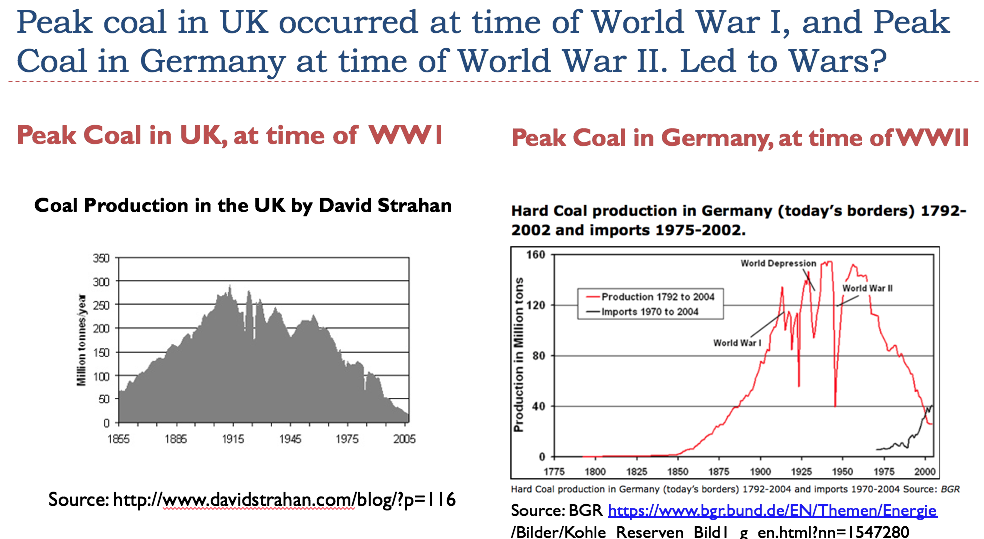
One peak in Figures 1 and 2 coincides with the 1901 to 1910 period. This period corresponds to early electrification and advances in the mechanization of agriculture. It was before 1913 when the United Kingdom hit peak coal, limiting the amount of coal that could be profitably extracted. Germany hit peak hard coal shortly before World War II. After peak coal was reached, less coal was available per capita. Leaders felt the pressure of “not enough coal to go around” and opted for war.
In Figures 1 and 2, rapid energy growth occurred after World War II, during the 1950s, 1960s and 1970s. The lower peak in the 2001-2010 period coincided with much greater use of coal after China was added to the World Trade Organization (WTO) in late 2001. High-wage countries started transferring their industry to China because costs would be lower in two ways: Wage costs were lower, and coal was an inexpensive fuel, reducing energy costs. Furthermore, by transferring industry, including manufacturing and mining, to China, high-wage countries could also lower their own CO2 emissions, as required by the 1997 Kyoto Protocol.
We would expect the patterns we are seeing in Figures 1 and 2 if the world economy is governed by the laws of physics. The availability of plenty of inexpensive energy, of kinds that match built infrastructure, is what is needed to allow the world economy to grow.
[3] Figure 3 shows more recent world energy data organized by 5-year periods. It shows how small the “red caps” of the types leading to favorable economic outcomes have been in the last decade.

The latest two 5-year periods comprise the years 2015 to 2024. The short red caps on these two 5-year periods mean that the economy is already being squeezed in the direction of not-enough-to go-around.
[4] Viewed on this same basis, diesel and jet fuel supplies are being squeezed even more than the overall supply of energy products.
Diesel and jet fuel are somewhat similar in composition. They are grouped together in some energy reports as “middle distillates.” They are relatively heavy oil products that come out of oil refineries. If there is a shortage of one, there likely is a shortage of the other as well.

Diesel and jet fuel are of concern because, since 2015, there has been an actual shrinkage in the amount of these fuels available relative to population. In fact, every five-year period since the 2000 to 2004 period has shown less growth in diesel and jet fuel than in the overall world energy supply. (Compare Figures 3 and 4.)
The low growth of diesel+jet fuel is particularly concerning because these fuels are essential for international transportation. With too little of these oil types, trade across the Atlantic and Pacific needs to shrink back. The physics of the situation makes tariffs look like an attractive solution for reducing trade.

Another concern is that diesel is essential for food production and transportation. Even if some other types of energy are available in plentiful supply, we cannot get along without food. While wind and solar are popular energy types today, they are not very useful for either international transport or for operating modern agricultural equipment.
[5] The underlying problem is that populations tend to outgrow their resource bases, including energy supplies.
The issue of the world not being able to support endlessly rising human population is an issue that no politician, auto maker, or economist wants to mention. The standard work-around is to show energy supplies without using an adjustment to a per-capita basis. This tends to make the energy situation look much better than it really is. Figure 6 is an example of such a chart.

Figure 6 emphasizes how modest the recent add-ons to the fossil fuel supply really are. These add-ons are made possible by fossil fuels; they would tend to disappear if fossil fuels were to disappear. Nuclear, which is the largest of the add-ons, requires both uranium and fossil fuels. The category “Wind+Solar” is the tiny green stripe at the top of Figure 6. In 2024, Wind+Solar amounted to 2.8% of world energy supply.
[6] It is easy to make electricity look like a growth area that can continue its pattern forever.
Figure 7 is a world electricity chart that, like Figure 6, is not on a per-capita basis.

There are a few details that are easy to miss:
(a) Current electricity production is quite small compared to the total energy supply. As counted by the Energy Institute, electricity amounts to only about 20% of total energy, varying by year and by part of the world. It is already incorporated in Figure 6.
(b) Almost all the non-fossil fuel part of the energy supply (“Add-Ons”) is electricity. In Figure 6, the only type of non-fossil energy shown that is not electricity is biofuels. These are mostly ethanol and biodiesel.
(c) Another detail that is easy to miss is the fact that the growth in the world’s electricity supply, as shown in Figure 7, has been almost exclusively outside the Advanced Economies–that is, members of the Organization for Economic Co-operation and Development (OECD). The Advanced Economies group includes the US, most of Europe, Japan, Australia, and several other countries.

Figure 8 shows the growth in electricity generation separately for the Advanced Economies and the Other Economies. The chart shows that generation of electricity by the Advanced Economies grew until 2007 but flattened after that date. Electricity generation by the Other Economies has grown the entire time since 1985. The rate of electricity production growth of Other Economies became noticeably more rapid after China joined the WTO in 2001.
Also, population growth since 1985 has disproportionately taken place in Other Economies, as contrasted with Advanced Economies.

[7] In the Advanced Economies, electricity production has recently been falling on a per capita basis, making a shift to greater electrification seem difficult.
A major issue is that the Advanced Economies are already seeing their electricity supplies per capita declining as shown on Figure 10 below. This is true for all five of the selected economies. Some of the lower consumption is due to efficiency improvements, but some is the result of the offshoring of jobs and industries to low-wage countries.

In comparison, electricity production per capita of other economies, with typically lower wages than Advanced Economies and often accompanied by more rapid population growth, has tended to rise, as shown on Figure 11.

The four “Other Economies” are less similar to each other than the five Advanced Economies. But what is striking is that they all have shown growth in per-capita electricity production since 1999. In 2024, Saudi Arabia’s electricity production had risen to about the per-capita level of the US’s electricity production. By 2024, China’s per-capita electricity production had surpassed that of both the EU and the UK. Russia was part of the Soviet Union before the latter collapsed in 1991. Once Russia’s economy had started recovering from the collapse, about 1999, its per-capita electricity production also began to rise.
[8] Other issues are also making a continued shift to electrification appear difficult, particularly for the Advanced Economies.
Trying to work around using fossil fuels leads to the need for more specialized minerals to produce high tech electrical goods and electricity transmission. The problem faced by Advanced Economies is that they produce practically none of these minerals; they must import them. The US has a long list of minerals it considers critical.

Some of these minerals aren’t rare in the earth’s crust. Part of the problem is the lack of industrial capacity in Advanced Economies today, as industry has been moved overseas to reduce costs and local CO2 emissions. For example, the US used to be a major producer of aluminum, but this production has dwindled; other countries, including China, can produce aluminum at lower cost.
Another issue is that China produces the majority of quite a few of these minerals. The US, and probably the other Advanced Economies, had planned to buy what they needed on the world market. Now, production is not keeping up with the amount the world could easily use. In 2025, China announced export restrictions on some minerals, including gallium, germanium and antimony. It has become clear that if Advanced Economies want to have adequate supplies of high-demand minerals (including silver, copper, platinum, rare earth minerals, and uranium, among others), they need to start producing them themselves.
Diesel is used in extracting many of these minerals. If diesel is in short supply, that adds another layer of problems. All these issues may lie behind President Trump’s interest in Greenland.
[9] We don’t hear about these issues partly because academic researchers live in ivory towers, and partly because politicians don’t dare explain the issues to voters.
Part of the problem is that economists don’t understand how tightly the various parts of the world economy are interconnected through the laws of physics. Economists tend to believe that if there is a shortage, prices will rise, and these higher prices will solve nearly all problems. This is not necessarily the case. Buyers cannot purchase more than they can afford. Prices may spike temporarily and then fall back. Production of fossil fuels or minerals may end because prices do not rise high enough, for long enough, for producers to depend upon the higher prices for the long term.
In the case of a shortage, most people assume that the only change the economy will make is in prices. However, the economy is tightly interconnected. It can move production to a different part of the world, where wages and energy costs are lower. An indirect result, in the country losing jobs, may be more wage and wealth disparity. The US seems to be experiencing this issue now, with fewer young people being able to find a job that pays well.
Needless to say, politicians aren’t willing to admit, “We have difficulties for which we can see no solution.” Even leaders of universities are reluctant to suggest that there might be major problems ahead. They don’t want to frighten students or their parents. University officials want all problems to be ones their students can work on, with the hope of solving them in the next few years.
[10] What is happening now is similar to the outcome of a game of musical chairs, when there is one fewer chair than the number of players.

In the game of musical chairs, players walk around a group of chairs until the music stops. At the end of each round, one chair is removed, leaving one fewer chair than the number of players. In the next round, the remaining players all scramble for the chairs available, which often leads to small fights over who gets a chair. This not-enough-to-go-around problem explains the poor relations we see today among countries and political parties. It is also the underlying reason for the interest in imposing tariffs and in bombing other countries.
Financial markets tend to perform well during periods of economic growth. However, if certain kinds of essential resources are in short supply, this will tend to hold back growth. Debt defaults and falling stock markets could result. For these reasons, problems in financial markets may be ahead.
Major governmental changes may be ahead. Representative governments require more energy than simpler types of organizations, such as dictatorships. Furthermore, citizens do not like disorder; they may want to overthrow leaders who seem to allow too much disorder. They may vote them out of office or even try to assassinate them. The problem of resource inadequacy is structural, however. Getting rid of a particular leader doesn’t necessarily help the situation.
Everywhere in the world, at least part of today’s problem is that there are not enough jobs available that pay well. Economists have told us to expect high prices if there are shortages. In a way, not having enough jobs that pay well is the opposite problem. But from a physics standpoint, the result is the same. Only a few people can afford many of the goods that are available. The economists’ misinterpretation of what is going wrong further confuses people’s understanding of our current situation.
Mainstream media needs to cater to advertisers. Because of this issue, we cannot expect them to tell us what is happening. That task seems to fall to bloggers, like me. I try to write an article approximately every month. I hope that the graphs and other figures I have presented in this article will help readers understand why we are currently seeing more types of disruptions, such as tariffs and bombings.


hey x-, here’s another Inverted Perestroika echo of the original Perestroika. Gabbard topped out at Lieutenant Colonel. Putin topped out at Lieutenant Colonel. Gabbard ‘skipped steps’ all the way up to DNI. Putin ‘skipped steps’ all the way up to becoming the head of the FSB. The rest is history.
My take is that Bondi was just fired because The Trump admin has caught wind of a faction on the move centered around the DNI office and Bondi got thrown under the bus because she over saw the Trump-related Epstein files suppression. Last week I perused the available photo and video evidence of the last Cabinet meeting and did not see Gabbard present. AI could not confirm nor deny. Perhaps that tipped off the administration, who knows. It also just came out in a leak that Trump has been polling staffers on whether to fire Gabbard….
If there is going to be a coup then the wheels must be turning already because time-wise I feel like we must be more than halfway through the Big Nuclear Scare by now.
Pingback: Losing the Iran War May Be the Best Outcome for the WorldOur Finite World
https://www.youtube.com/watch?v=015pejVWKgI
It is time to seize the means of production.
and who will do the seizing????
the chews of course.
Great gobblers
Interesting comment at ZH. WTI going up at a faster rate than Brent. Suggestion is that Brent contracts are being canceled because they cannot be delivered. Global supply shifting west which means higher inflation and interest in USA.
If this a reasonable explanation is this an example of no supply at whatever price?
No idea who posted this but I noticed the price run ups this morning.
Also a suggestion that the Iranians are messing with the news drops to influence the markets just to screw up the insiders in DC. Once again I have no proof of this but it makes sense. They sure figured out the whole trolling thing in a hurry
Thanks. Sounds like maybe sellers are having trouble moving and delivering the oil. Regarding supply shifting West, prices in USA are a complex function of both supply and demand. And inflation is a holistic monetary phenomenon not a provincial price dynamic.
I think the AI lego trolling is the Hand, and the bureaucratic trolling is guided by the Hand. It seems out of step with the religion. But that’s just me, as I took Khameini’s pre-war trash talking as a clear confirmation that Iran was now an official protectorate of the Non-Public Degrowth Agenda in accordance with the Horsetrading Theory of Everything sub-framework that predicts Iran will get to participate in Phase 2 on a level playing field and in a world without Zionism and possibly Israel altogether.
I put no stock in the idea that Iran propaganda is influencing markets and DC insiders. The Hand’s AI Shanaka account is probably exerting more influence all by itself.
I did put a new post up!
Thanks Gail for all your work.
Pete Hegseth “Back to the Stone Age.”
https://x.com/PeteHegseth/status/2039520449483145622
I am finishing up a new post. I expect to have it up within hours.
Wow, thanks Gail, any thoughts in it of DTs address last night?
Asking for a friend with the initials FE.
If I may stand in, it was a huge disappointment in term of any new info, basically just rehash of already stated policy goals right before it.
So, he could try to notably escalate ( by various means and scale ) with the aim of expedient-abrupt withdrawal very soon after the carnage-event taking place, ..
Also, it could be all just mumbo-jumbo, and mere [ play-full ] attempt at entering negotiations to then horse trade various deals of the concerned parties.
All of us will be going back when the wells run dry..poetic justice
Pete Hegseth “Back to the Stone Age.”
Like father, like son.
the USevilEmpire won’t be stopping for a couple of weeks.
But Fast Eddy claims it all fake..
https://www.youtube.com/watch?v=yiCP738oTpA
Australia’s Fuel Story Just Flipped Again — Emergency Plan Activated as Bowsers Run Dry
Those Dingo’s will be good mans best friend soon enough
Can we roughly cross-compare train ticket prices around the globe before
the further fuel limitation / mandates /.. strike in ?
I’m interested in the lowest cat. of trains – diesel / LNG fueled regional passenger ” slow ” trains. For EU domain it’s roughly 10EUR per 100km traveled per person, which is absurdly high, although you can take it down a bit with various membership cards pre-%sale mileage, employee vouchers etc.
US, CAN, GB, IND, AUS, .. folks ?
PS ” absurdly high ” .. yes I know even that ticket price is heavily subsidized by regional / national govs to begin with.. as you can imagine such not fully occupied modern train just burns money like crazy ( high capital %expense ); the train unit itself usually in the ballpark of <120seats per say with ~70l consumption per 100km that’s almost one liter of diesel per passenger or less if allowed to double up the passenger load ( standing folks like in subway train etc. ).. +add expense in upkeep of the rail track like snow, new gravel, .. y/y
Hence not much vs. HOV ( ~3-5people on board) of ICE carz.. which run now on gasoline not diesel..
About the same in Oregon. $11 to go from Salem to Portland which is 53mi.
Interesting, but eventually meaningless question. I remember comparisons from the days of Peak Oil (what – ~15 years ago or earlier than that?), showing rail transport being the cheapest by 10x (after initial infrastructure investment).
Look into light rail – that many smaller US cities utilized before late 1950s, when automobile/oil mafia lured Boomer’s parents into “happy motoring” and wasteful suburbian living. Light rail must have been very economic, if almost everybody was running it.
Soviets heavily relied on fully electrified light rail (“tramways”) in their largest cities (even those with proper Metro/Subway systems).
ICE engines are wasteful, individual automobiles upkeep is unsupportably uneconomic, and the biggest – well-paved asphalt roads. Asphalt roads are expensive to upkeep and are easily damaged by both lack of regular upkeep and heavy machinery (military and/or agricultural one). Concrete is out of the question, I think – too energy-intense and otherwise expensive.
Some kind of rails are the future, in worst case – human-powered 💪 Small tribe and/or family based “National Socialist” agricultural farms will be coming too – poor (in every possible sense of the word) inhabitants will be on the record for the upcoming (or lost) pre-planned harvest and will be summarily taken to showers in the case of lost harvest. Remaining kids/babies will be promptly “redistributed” to the nearby, rail-connected still populated nad functioning “family owned farms”. No any long-distance travel in HOV lanes on well-paved highways will be necessary/allowed. There will be no highways – just well kept railways, like in Auschwitz-Birkenau.
One nation at a time .
India’s central bank has activated crisis-era measures to support the rupee, which has fallen to an all-time low as oil prices soared and foreign investors pulled money out at a record pace.
Amid the strain, the Reserve Bank of India has stepped in to curb speculative activity via arbitrage trades.
Here is what the central bank is trying to achieve through its measures.
Too much money flight . BOP will come to many nations .
https://www.republicworld.com/business/rupee-rebounds-rbi-bans-ndf-contracts-and-caps-bank-positions-to-curb-speculation
Learned a long while ago natural diamonds have been rationed by the cartel to keep the prices high. Russia, also mines them and is a member of the cartel.
Imagine with the downturn in the economy, many holders will be forced to sell their jewelry diamonds, further depressing prices.
My PhysChem professor was telling us a story (back in the early 1990s) about what she saw at some Soviet Chemistry expo a few years earlier (in 1987-1988, shortly before the USSR collapse(?)). About a human-sized robot-like “cossack”/козак figure, using high temp and pressure, making miniature (fraction of a mm, but visible under special illuminating light) synthetic diamonds in its “mouth” chamber… She was not a good lecturer, did not keep in touch with her audience well, but somehow I remembered that interesting tidbit. She had also said, diamonds, inherently, are worth very little (and shown us the relevant carbon crystal structure). She also mentioned that “cossack”/козак thingy was made in one of the (Soviet) Ukrainian research institutes (therefore locally ethnic reference).
This had me nodding with excitement initially, then my natural cynicism started to creep in, until at last I saw the date at the bottom:
The German government to build 15 new nuclear power plants and lift sanctions immediately on all Russian oil and natural gas.
German Chancellor Merz has also agreed to pay to rebuild the Nord Stream pipeline to Russia.
All wind and solar projects have been cancelled.
“It’s time for Germany to open our energy economy. The best way to do this is via free markets, lowering taxes and regulations”.
For Immediate Release.
Berlin, April 1 2026.
https://x.com/WallStreetMav/status/2039126040686248240
I don’t understand!?
April Fools
A Day late and a dollar short. At least the Donald lived up to the prank with his address to the nation.
Hope Iran doesn’t mind too much going back to the stone age. Translation ..bomb you back with nukes.
How is Europe going to survive this? Just listened to Nate Hagens interview on energy and it seems like they were too dependent on energy imports. This is one place where will see financial voodoo fail. He is talking about the great simplification but i don’t think it is that simple. You can’t ride a bicycle backwards. They don’t produce anything
we have multiplied ourselves x10 since we started using cheap surplus energy from fossil fuels….
you dont need to be a professor of mathematics to figure out the end result…
You can ride a fixie backwards. Good, simple collapse set-up. Don’t even need brakes.
Nathanial> As per msm: Core ten countries of Europe are now considering how to navigate ahead when legacy NATO block structure is on its way out. So, eventually in parallel ( soonish as to be step ahead of Don ), they will surely form up some sort of their own placeholder org in this very domain.
Hence some sort of slowly simmering militaristic agenda will continue ~[ out of necessity ] into the future.. , don’t worry to be ” .. left behind by them .. “
Yes but they still need to produce something or have some energy to compensate. I don’t know how they are going to take someone else’s.
Oil up 7% !!
https://oilprice.com/oil-price-charts/block/1
Wholesale Heating Oil up 13%. Diesel is probably close
That’s 116% YTD
But actually I thought it was going to be a lot worse per Donald Trump.
Yeah, also it’s good for us because we have lots to sell…
How the hell did WTI suddenly overtake Brent. The pipeline thing from yesterday?
In my view, I’ve been thinking for a few weeks that the ground offensive is precisely what Trump’s administration is looking for staging a Iwo-Jima-style bloodbath.
Iwo Jima / Okinawa were actually the battle that later “justified” the use of atomic bombs against Japan.
So, they’re looking for a ‘casus belli’ along the lines of, “These people are crazy, we have to stop them,” just as they did with the Japanese.
I just hope that Russia and China are keeping a close eye on these developments, but I hope also that American people are realizing of what a hell of a corner they are going in.
In my opinion, it’s 100% clear that the Trump’s administration and the Netanyahu’s one are aiming to escalate to the use of nuclear weapons….
Good point. I doubt that Russia will say anything if Bibi takes responsibility. Or maybe they will issue a stern rebuke. You see, there are 2M russians whose sensitivities are important.
And as a businessman, Donald Trump desires a return on investment and what better way to see it? Actually, it’s cost effective. Avoid the cost of decommissioning them as they pass their expiration date.
Sarcasm…yes, I agree, these two are itching for an excuse to let them loose
Consider the recent civilian breakthroughs of using synthetic aperture radar (SAR) to discover and define ultra deep underground megalithic formations under the great pyramids in Egypt.
Now extrapolate this to military use for the discovery and definition of ultra deep underground military bases (UDUMB) in Iran (ie missile cities):
Access points, check;
vents, check,
launch tubes, check;
countermeasure partitions, check.
All that is required is for special forces to gain access to critical nodes of the UDUMB network and deploy man-portable micro nuclear weapons to destroy the UDUMBS with overpressure.
Plausible deniability is achieved. Any radiological signature can be attributed to Iranian nuclear material stored in the UDUBS.
Indeed, no Iranian nuclear material need be present for the radiological signature to be attributed entirely to Iran.
Sounds good. Let us embed some scientists with the boots on the ground. You also need a good mainframe to analyze the complex data.
Iranian conditions for peace:
>> MOSCOW, April 1. /TASS/. Iranian Ambassador to Russia Kazem Jalali has outlined Iran’s demands to the United States and Israel in order to achieve lasting peace in an interview with TASS.
>> The list contains four points. “1. A definitive and complete cessation of aggression and terrorist attacks; 2. The provision of objective and credible guarantees to prevent any resumption of aggression or war; 3. Full compensation for material and moral damages; 4. Respect for Iran’s legal jurisdiction in the Strait of Hormuz for the purpose of ensuring international maritime security,” the diplomat said.
https://tass.com/world/2110185
My reading of the four points is that Iran has partially softened its stance, no longer demanding the US to leave the Middle East bases. This supports the notion that Iran is taking heavy damage or their missile stocks are less extensive or less effective than reported by pro-BRICS sources. The “compensation” part is non-starter for the US-side though. I suppose we’ll have to wait to see how serious Iranian leadership is about standing its ground and whether Iranian demands/conditions have really shifted.
Well, maybe with negotiations can Iran get reparations by allowing the Strait of Hormuz being renamed the Strait of Trump and charging the toll.
Win, win for each side. I can see that in the deal
great. or straits of america if he is too demure.
I think you are misreading the second point. You might find that Iran consider the only “credible guarantee” to be, no US bases within a thousand miles. I doubt that they will accept words as guarantees anymore.
Damage is almost exclusively civilian, so changes little militarily and the running out claim is starting to sound very similar to “two weeks away from making a bomb”, that we’ve heard repetitively since 1993. How many times have we now heard “100% effective” and it’s only been going on a month.
Listen to the yank journalist in the squat, talking about running out(3:30ish). This happened around the same time that Trump was expelling his verbal sewage.
https://youtu.be/zUjh29v_LRU?si=nH1npKJq7qi4Kkbe
I’d be more inclined to believe Commander Amir Ali Hajizadeh
“If we start today unveiling a missile city every week, it won’t be finished even in two years.”
Taken from the below(which is a good read. Even mentions Bagration)
https://indi.ca/americas-military-is-never-coming-back-from-this/
Given the words and actions of the last 24hrs, I’m more interested in the words of Enrahim Zolfaqari(following on from others) and how they rhyme with a very clear message, conveyed through the medium of Lego(which was apparently shown on national tv)
https://m.youtube.com/watch?v=MXCwgMhPU7E
Undenial and Indi.ca are unreadable for me due to the celebration of anti-White racism. At least Kulm gets dome pushback bless his Soul. Safe journey to rainbow land thru the emboldened hordes of head choppers, grooming gangs and approved religious fanatics.
Indi is a very good writer. Undenial sux.
The drinking game at my house is dressing up like injuns and putting Malcolm X speeches on repeat. Every time he says white devil or blue-eyed devil you have to drink. But I’m just a hipster. Wanna come over sometime?
Welcome to the national socialist Separatisms and the primate world. Yin and the yang.
” On April 1, Iranian-linked drones struck Castrol oil warehouses on the Erbil to Mosul road in Iraqi Kurdistan. Massive fires. Secondary explosions. Castrol storage infrastructure destroyed. No casualties reported. The strike was retaliation for British basing of American strike aircraft at RAF Fairford, Lakenheath, and Diego Garcia. Keir Starmer, who says this is not Britain’s war, has issued no statement.
Nobody has mentioned who owns Castrol. Castrol is a subsidiary of BP. ” ?
https://x.com/shanaka86/status/2039349898597077368?s=20
” . . . saying we cannot source naphtha and the cracker cannot run without naphtha and the naphtha cannot arrive because the strait is not open and the strait is not open because a war that started 4,000 kilometres away has turned the most important waterway on earth into a permissioned corridor. The plant is intact. The plant is also useless. Asia is hit first and hardest. China, India, South Korea, and Taiwan are the primary importers of Gulf polyethylene and ethylene derivatives. Packaging plants are already rationing. Polyethylene spot prices in Asia and Europe spiked 10 to 15 percent within hours of the announcement. Construction supply chains that depend on polyethylene pipe and insulation are extending lead times. Automotive interiors, textiles, consumer electronics casings, and agricultural films all trace back to the same cracker that is now sitting cold in the Saudi desert because the molecule that feeds it cannot pass through a strait 1,500 kilometres away. ” ?
https://x.com/shanaka86/status/2039528213555368091?s=20
“This is the asymmetry the air campaign cannot resolve. America wins every sortie. Iran survives every sortie. America destroys 90 percent. Iran fires from the remaining 10. The bombing is a masterpiece. The masterpiece does not produce surrender. It produces a slower version of the same war, fought with fewer missiles from deeper tunnels on a rail system that vanishes underground before the satellite can respond.
Iran’s spokesperson promised bigger. The marketplace will price it as though bigger is coming, regardless of whether it arrives. The strait will stay closed until someone in Beijing decides it should open.
The speech said the war is nearly over. The missiles said otherwise.” ?
https://x.com/shanaka86/status/2039590304421163438?s=20
yup the USevilEmpire looks like it will do a lot more bombbing for a couple weeks and then leave.
China will probably take the lead in working with Iran to raise the flow thru the strait.
the flow of resources will never recover fully.
Questions that have no answer if you are looking for a link:
How does USA intend to move their troops to Kharg Island without being shot at?
No, you are the expert. During COVID, it is shown there are no more “experts”
That question has no answer anywhere because you’re not asking the right question. Why on Earth would you think that the USA is thinking about how it can not get shot at? Welcome to war CTG. You get shot at.
Kharg Island rumors seem to have been mere speculation.
there could be ground action, but I doubt it.
time will tell.
the USevilEmpire looks like they are going to leave, after initiating massive destruction in the ME.
of course they have done similar things many times before.
Interesting times:
https://www.zerohedge.com/energy/first-valero-refinery-now-largest-us-gasoline-pipeline-damaged-georgia#comment-stream
refinery is now operational again, after that minor event there.
if the CIA or FBI finds out that these were intentional, it shouldn’t be long before it’s in the news and in the courts.
ADNOC is Abu Dhabi National Oil Company so these numbers can be assumed legitimate.
https://x.com/ADNOCGroup/status/2039370079188783322
It has become pointless to watch WTI and Brent. Both are so manipulated.
Check out Sulfur.
https://tradingeconomics.com/commodity/sulfur
The first link discusses what goes through the Straight of Hormuz. It says (relative to global sea trade):
35% of crude oil
30% of LPG
20% of Jet Fuel
10% of Diesel
It also says (relative to global sea trade):
55% of sulfur
30% of urea
25% of ammonia
Of course, we don’t know how much global sea trade there is, exactly. I presume that most US supplies are not involved in global sea trade.
The sulfur price is way up, but a person would think that there would be a lot of sulfur available to ship. Refining “sour” oil or gas produces a lot of sulfur.
FT: US foreign policy: ” Trump threatened to stop weapons for Ukraine unless Europe joined Hormuz coalition ”
..
Nato’s top official urged key alliance members to offer help to US to reopen key waterway
..
an hour ago
—
==> So, the ” desperation tantrum ” runs for yet another day, hm interesting, actually expected another – different angle by today. This is getting annoyingly self-repeating..
Quality short summary of the ” FORK AHEAD ” under 15min.. via British LBC
(But obviously w.out the the tribal-lobby pre-forcing on POTUS mentioned..)
https://youtu.be/ztCu9G6dBuY
Don could pre-announce US ~withdrawal from NATO tonight !
(As part of new evangelical agenda not Vlad’s dossier..)
From another LBC segment:
https://youtu.be/pX9uOd6aQk0
+ The Cavalry Colonel on the subject of the FORK ahead:
https://youtu.be/vBlS-S9AEoY
Well, even inside that atrocious ” MS NOW ” TV channel hell they report today about MAGA figures for the first time in serious tone as Alex Jones, Rogan, Tucker, .. distance themselves from POTUS or even openly call him to quit..
This clearly constitutes that proverbial towel into a ring moment, his admin would have to help wheel out Don out of the office somehow now, most likely even way before November, he could obviously also resign momentarily.. Realistically, they could dump him with some beyond atrocious econ negative numbers percolating in say two more months..
Running out of ammunition. Have to figure out something.
Iran’s president appeals to the American public amid ‘war of narratives’
Al Jazeera English
Apr 1, 2026 #MasoudPezeshkian #IranPresidentLetterToAmerica #Trump
Iranian President Masoud Pezeshkian has issued an open letter to the American people, stating that Iran harbours no hostility towards the US, Europe, or neighbouring countries, but warning that attacks on its vital infrastructure constitute war crimes with consequences extending far beyond Iran’s borders.
https://youtu.be/bdO5rnG_Ass
so the protesterslaughtering gayhating womenoppressing IslamicRetardedGuard still has some missssilies to use, though obviously in a reduced daily rate.
whoa they hit an Amazon data centre!
70% of Irranian steel industry was destttroyed last week, and this is all they got?
the IRGC have their cushy lifestyles to protect, definitely some of the best jobs to have in Iran, though not so great on 2/28.
” 70% of Irranian steel industry was destttroyed last week, and this is all they got? ”
You mean like we have destroyed their ballistic making ability . 🤣🤣
Yes , they hit their Amazon centre . Does it make a difference ? Did Iran sink any ships in SOH before the insurance companies withdrew their cover ? Hey , the SOH is open for those who have insurance cover and are willing to pay the toll to Tehran . This is asymmetrical warfare . A hit at an Amazon centre is not going to be felt in Bahrain but at Wall Street . You are a linear thinker — try lateral thinking .
Q ; There are 10 birds on an electrical wire . If I shoot 1 then how many are left for me to shoot ?
Answer David ; 9
Answer Ravi ; None . The other 9 flew away . 🤣🤣
david has turned into the new Investor Guy. Nevermind the objective anthropological reasons for why both fundamentalist Judaism and Islam both have highly conservative ideologies regarding sexual politics that david fails to recognize also extends to straight men of the patriarchy. Arid desert climates require farming cultures to be extremely socially conservative in order to match the material conservation required to survive such consistently thin surpluses.
Much of the world has always had very conservative beliefs. As you say, they go with thin surpluses. It is only when huge amounts of fossil fuels are added that an area can start taking a more liberal approach. When it looks like we are about to run off a cliff, Wile-E-Kyote Like, and populations need to be much smaller, then young people think of how they can live, if they can no longer have families. This is a major thing that leads to gay lifestyles, I expect. Large number of unmarriageable spouses can lead to similar result.
wow such a powerful use of emojis.
as a self-proclaimed lateral thinker, you should use even more emojis to bolster your lateral thinking.
This is the first time I’ve used them since I started here . Your comments deserve that and no less . Anything less would be an insult . 😭
I don’t disagree with many of the details in your above comment.
I have thought highly of your comments in the past.
but feel free to degrade yourself with emojis.
On the front lines, Russian soldiers pay officers to stay alive
The war against Ukraine has created a corrupt economy of blood money
Here I hope this will make you happy .The Economist . I don’t make the news , just report it . Please don’t shoot the messenger .
https://www.economist.com/europe/2026/04/01/on-the-front-lines-russian-soldiers-pay-officers-to-stay-alive?utm_content=ed-picks-image-link-3&etear=nl_weekly_3&utm_campaign=a.the-economist-this-week&utm_medium=email.internal-newsletter.np&utm_source=salesforce-marketing-cloud&utm_term=4/1/2026&utm_id=2178101
To me, it conveys ridicule and scorn while providing a plausible front of lightheartedness and congeniality – “we’re all just having fun here, right?”. Oh well, that’s the internet for you. The appropriate amount of time to spend being irritated by emojis is zero, but I fear we’ve all wasted time and even irritation on flame wars at one point or another. Who knows – in a decade or two or three, we might encounter some real problems.
Ravi, especially during the early yrs of the conflict when this all brand new concept of drone war ( and anti-measures ) have been hastily developing there in East-UKR battleground, many of the ” to be lost ” soldiers were specifically pre-selected ” material ” – i.e. lower IQ, and or various units consisting of felons etc.
This changed profoundly in say past 2yrs when the counter measures and offensives demanded real mil. pros. be it ~stunt riders on crossbikes / atv , complex fnc drones operators etc.
It’s no longer just wave after wave of massacred storming units.. ala trench WWI.
The fronts have gigantic km span and ~few people inside. Most action directed from behind the warzone line inside IT filled bunkers and hi tech field repair shops.
how about this lateral thinking:
Amazon hit in Bahrain, world business sees a dangerrous GCC future, capital flees the GCC, much of it is reinvested in the USA.
I’m not saying that’s a guaranteed future, but I think lateral thinking can always be extended.
you should try is someday.
Learning fast David . The capital from GCC is moving to Hong Kong .
good to know, thanks.
outflows for now?
100% with no exceptions?
lateral thinking might lead to realizing that any capital flows in March don’t have to proceed entirely the same from here forward.
anyway, the GCC looks to be declining fast from here forward due to capital outflows.
Uh, Hong Kong is US Dollar based. All your base are belong to us. Kevin Walmsley is the antithesis of based.
That claim of 70% is originally attributed to Netanyahu.
I see confirmations from:
Cleveland Jewish News
JNS.org
The Jerusalem Post
X.Mossadi
Please provide some other confirmations/links.
I think my first source was Naked Capitalism, or Moon of Alabama, and both seem to me to be pro-Iran and anti-Trump.
a search shows:
“Some social‑media posts appear to be misinterpreting the IDF’s “60–70% of pre‑war targets destroyed” statement as referring to Iran’s steel industry. The credible sources do not support that interpretation.”
so look at that, I have learned something, and that happens a lot, I learn.
I may not use that 70% again since it isn’t supported to have happened.
perhaps the protesterslaughtering womenoppressing IslamicRetardedGuard has most of its steel industry intact.
but then why did Iran retalliate against nearby aluminum plants if their metals industry wasn’t hit?
david I wanna get in on this whole lateral thinking deal too. Here goes. I figure that they attacked nearby aluminum plants even though their steel industry wasn’t hit because everybody knows that in rock paper scissors steel beats aluminum.
if you had asked me who in OFW is a r*cist big*t a few months ago, I would have never guessed David. Live and learn.
huh I have nothing against the many good people of Iran.
I am 100% for them.
I think that is quite clear.
Which part of ” they elected the government” you do not understand? It is in fact a much more democratic system than the USA. Plus the good people of Iran have been the only nation willing to do something for the Palestinians (apologies to sub-national groups like Houthis and Hzbollah). And now the good people of Iran want to terminate all the US bases in the region, with or without the soldiers in them.
that’s not much of a comparison to the USevilEmpire.
so the elected government slllaughtered 1000s of protestters, okay.
my sympathies to you since some of the good people you met in Iran might have been in that slllaughter.
also I am caucasian and my understanding is that Iranians are also caucasians.
I’ve never thought of them as other than caucasians.
Looking at it from a distance, it may seem as if Iran is a place where the entire male population wears turbans, haggles at the bazaar and prays at the mosques five times a day while the women wear veils and carry photos of the current Ayatollah, do all the cooking and cleaning, and nothing much else goes on.
But if we look closer, we will see that there are lots of different kinds of Iranians. It’s a country of high linguistic, cultural, and genetic diversity that doesn’t fit the label “Caucasian” very well. Major ethnic groups include Persians, Azeri Turks, Kurds, Lurs, Baluch, Arabs, Turkmen, while smaller groups include Armenians, Assyrians, etc.
If we use “Caucasian” in the old anthropological sense (light-skinned people who originated in the area around the Caucuses who broadly inhabited Europe and parts of Western Asia until recent centuries took them farther afield), many Iranians would be grouped as “Caucasian.” But that usage ignores major ethnic, linguistic, and cultural differences, and as such it is now considered outdated, imprecise, and scientifically inadequate.
However, if “Caucasian” is used as U.S. shorthand for “white people of European origin,” it is a poor fit for many Middle Eastern peoples and can be misleading, as Middle Eastern populations are typically considered a distinct regional group, although in some legal/administrative contexts in the U.S., people from the Middle East are categorized as “White/Caucasian.”
thanks.
humans and their cultures are so much more than just the few raccial classifications.
decades ago I had concluded that I am not “White”, and Caucasian is the much better term.
Take the Bakhtiari, a prominent Lor tribe in southwestern Iran, primarily residing in the Zagros Mountains, and well known for their semi-nomadic lifestyle.
They speak the Bakhtiari dialect of the Luri language, share a rich cultural heritage, and are traditionally organized into tribes, with many engaging in seasonal migrations (Kooch) with their sheep and goats.
The most famous person of Bakhtiari heritage in the US is probably Rudi Bakhtiar, a journalist who was a CNN anchor woman/lady/person around the turn of the century and then went on to work for Fox, where she complained of sexual harassment, was terminated shortly thereafter in 2007, and received a favorable settlement after confidential mediation. She is now 59 years old and is reported to be living with Parkinson’s disease.
Another prominent member of the clan is Soraya Esfandiary Bakhtiari, who was the second wife of Shah Mohammad Reza Pahlavi and Queen of Iran from 1951 to 1958. I am not sure if these two ladies are closely related. The surname is a common one in Iran, signifying members of the Bakthiari tribe, and apparently it means “lucky” or “fortunate.”
Back when Rudi was a young girl, Dr. Jacob Bronowski took a BBC team up into the Zagros Mountains to film the tribe for his series The Ascent of Man.
For anyone interested in nomadic lifestyles, the segment is not to be missed. It’s the next best thing to being there. I felt very sorry for the dog left behind when its owner was no longer able to ford a river.
The Bakhtiari make their appearance at 5:00 in, but I think it is worth watching this from the start.
https://www.dailymotion.com/video/x1ztord
Tim , you missed Sam Bakhtiari , the Iranian oil chief . Perhaps Gail and other old peak oilers remember him because I do . RIP .
https://en.wikipedia.org/wiki/Ali_Morteza_Samsam_Bakhtiari
See how the Indian government went from 7-8 days reserve to 60 days reserve. All are lying.
Iran attacks the Amazon centre in Bahrain just as promised .
https://theconversation.com/why-iran-targeted-amazon-data-centers-and-what-that-does-and-doesnt-change-about-warfare-278642
Do you suppose a Psy Op has been undertaken here?
Of course . The target is not Bahrain it is Wall Street .
Then it suggests something wicked comes this way this week.
Here none know about General Hamid Gul . He was head of ISI , Pakistan and organised the Taliban and guided them to victory over Russia . Without him US dollars to infinity would have achieved nothing . In an interview after retirement he admitted ” Afghanistan was the excuse , Pakistan was the conduit and Russia was the target ” . Asymmetrical warfare — the target may be different from the flight of the arrow .
Interesting!
Just for some who know some Urdu this is what he said in Urdu ,basically it sounds like a nursery rhyme .
Afghanistan ” bahana ” tha .
Pakistan ” thikana ” tha .
Soviet union ” nishana ” tha .
See the rhyme bahana , thikana and nishana .
Stammer says he/UK will not attack Iran. He chooses to go against Greater Israel! I guess there is some benefit to large Muslim settlement of UK.
Structural Anti-Khazarism (re: reante) showing its true colors?
Interesting point!
”Two hundred strikes in 24 hours. B-52s from English fields. A-10s from English bases. JASSM-ERs from a British territory in the Indian Ocean. Three launch points, all on British soil or under British sovereignty, delivering American ordnance onto Iranian infrastructure while the British Prime Minister tells a crowd in Wolverhampton that none of this has anything to do with Britain. ” ?
https://x.com/shanaka86/status/2039326083603173817?s=20
Btw. interesting that non clean burn of the B-52 engines in the video.. One would assume it has been replaced by some more modern setup already, or perhaps just “rich mix” applied for such heavy cargo during the take-off seq. only..
Structural Anti-Khazarites running amok back in good old Europe:
https://halturnerradioshow.com/index.php/component/content/article/nato-has-collapsed
Iran shows the emerging crisis of the US airborne battle management fleet
The aircraft that help orchestrate US air operations are in high demand, short supply and nearing a breaking point while the need for early warning and battle management is growing.
https://breakingdefense.com/2026/03/iran-shows-the-enduring-need-and-emerging-crisis-of-the-us-airborne-battle-management-fleet/
While drone and cruise missile threats are abundant, the United States lacks enough available and updated ABM aircraft to support its defense priorities. Instead of resourcing solutions to this challenge, the Department of Defense has aggravated the issue by attempting to cancel future ABM systems in favor of unproven or unequal alternatives.
Without a change of approach, the United States risks under-resourcing one of its most important enablers at a time when the effectiveness of air operations is at a strategic premium.
…..
Prolonged, high-intensity air operations—and the current air campaign does not appear to be closing anytime soon—impose wear and tear on any platform and crew. Airframes approaching fifty years old are no exception. Rather than slowing down as the campaign progresses, it is also possible that E-3s are now assuming an even greater role following the destruction US ground radars—an outcome that would only increase the toll on readiness. If the US air campaign continues unabated for several more weeks, the number of aircraft headed for what one former Air Combat Command head has termed “hospice care” is likely to increase with no obvious replacement.
But its will be over in a few days…per Trump
Well, even for ” superpowers ” the resources are not limitless.
So, they had to #1 aim focus on the long game ( or ideally two steps ahead at that ), i.e. the whole new domain of global high fidelity sat imaging and AI data processing it ” in real-time ” , replacing much of that old radar and air command centers structure..
And at this very moment they don’t have the new stuff completely ready, while the legacy systems has been now ~destroyed by non peer level sparring partner ( Iran ), hence embarrassment squared ( for nearest now-ish horizon ).
We don’t figure out what we need until we are in the middle of a war, and then it is too late.
https://rayonegro.substack.com/p/el-ocaso-del-shale-oil-en-eeuu-ha
Don’t tell Art Berman
Fracking in the u.s is in decline. It does not bode well for Europe
”The A-10 carries a GAU-8 Avenger cannon that fires 3,900 depleted uranium rounds per minute. It loiters for two hours at low altitude with 16,000 pounds of ordnance. It exists for a single purpose: protecting troops on the ground while they are being shot at. . . .
The A-10 has no function in a standoff air campaign. It cannot launch cruise missiles from 500 miles away. It cannot strike from 40,000 feet. It flies low, slow, and close to the people it is protecting, absorbing ground fire with a titanium bathtub that surrounds the cockpit and keeps the pilot alive while the cannon does the work. If you deploy A-10s, you are planning for a scenario in which American soldiers are close enough to the enemy to need a gun that fires 65 rounds per second directly over their heads. That scenario has a name. It is called a ground operation. The most credible target is Kharg Island. Eight square miles of infrastructure sitting 16 to 26 kilometres off the Iranian coast, handling 90 percent of Iran’s crude exports through a terminal with 30 to 34 million barrels of storage capacity. A rapid seizure by Marines and special operations forces, supported by A-10 close air support and carrier-based air superiority, could reopen Iranian oil flows without occupying the mainland. Take the island. Control the terminal. Force the negotiation from a position where America holds the one piece of geography Iran cannot afford to lose. ” ?
https://x.com/shanaka86/status/2039314870030741966?s=20
Written by AI. It has no depth. So many things inaccurate but trying to pass off as being knowledgeable
What did you find inaccurate?
Use critical thinking to find out. Don’t just rely on URLs. Tesch yourself how to fish.
Actually CTG telepathy is what’s needed to find out. Do you mind? It’s an unspoken rule that we have to ask first. It’s not that we’re like vampires; rather, we are why vampire folklore exists.
Well, I hear you, it’s pure logic.
But lot ( or perhaps most ) of the folklore on vampirism is based on something else, namely oral-histories of past events when blood sacrifice was used in rituals ( their own or via invading adversaries ) etc.
Beyond that, the origins are natural anyway, as some (mini)-regions were infested with blood sucking swarms of ” flying mice ” attacking cattle ( seasonally NOT 24/365 ).
So, parts of Balkans and various East European regional sites proper were prone to that phenomenon for long span of time to establish such narratives, which then spread westward as curiosities..
Thanks Jr. I was making use of artistic license. Telepathy as bloodsucking straight from the neck after biting. An extreme invasion of privacy. So you gotta ask permission to come in before doing it. Of course, I don’t actually believe in telepathy.
Did you ever see the Swedish vampire movie “Let The Right One In.” It’s a great movie, highly recommend it.
Shanaka writes a lot of things in a very short time. The question has been raised before regarding whether they are AI output.
About the slovak story Tapakovci by Timrava
Protestantism in Slovakia died after Liz Bathory, a Lutheran, and protestants were treated as lepers there. So, Timrava’s family was like what the Kurds are in the middle east now.
From the few info about her available in English, it is said that she was part of a 10 sibling family, out of which 6 survived to adulthood, so overshoot was in her family. Her father, for reasons unknown, kept her near him until he died when she was 42 or so, meaning she did not marry or reproduce.
She spent most of her life in the house her father left her and moved to a nearby town when she got old. She lived to see the so-called Czecho-slovakia becoming a communist country, which paid her a small pension.
If she wrote in German, which she would have known since her dad was a Lutheran pastor to begin with, her books would have been better known but since she wrote in Slovak there are not much info about her outside of there.
That aside, the pattern of a resource poor town coping with the reality is consistent with other films I have seen about this subject, such as the Ballad of Narayama.
There is a movie in youtube, incredibly.
https://youtu.be/jC_mtJQQrd8?si=-FNABV1i0h4P_Ko-
I can’t read slovak so I don’t know how faithful this production is to the original, but not a bad adaptation.
perfect example of the fallout from price caps >>
Some French Gas Stations Run Dry as Price Caps Spur Rush to Fill
Hundreds of French filling stations have run dry as drivers rushed to fill up vehicles, after fuel-price caps were introduced because of global supply disruptions caused by the Middle East war.
Out of 900 stations that have run out of at least one type of fuel, 700 of them belong to TotalEnergies SA, the energy ministry said in a statement on Wednesday. That’s being caused by logistical issues, rather than domestic supply shortages, it said. (Bloomberg)
https://x.com/chigrl/status/2039293114662174762
Oracle Layoffs: Company Slashes 30,000 Jobs in Global Firing Spree, 12,000 In India Alone .
https://www.indmoney.com/blog/us-stocks/oracle-layoffs-company-slashes-30000-jobs-globally-12000-in-india
Wow! That is huge. And India is reeling from a lack of LNG already.
Off topic, but maybe energy related according to Spock
We Finally Know How The Lights Turned on at The Dawn of Time
Space 31 March 2026 ByMichelle Starr
https://www.sciencealert.com/we-finally-know-how-the-lights-turned-on-at-the-dawn-of-time
“We have now entered uncharted territory with the JWST,” said astrophysicist Themiya Nanayakkara of Swinburne University of Technology in Australia.
“This work opens up more exciting questions that we need to answer in our efforts to chart the evolutionary history of our beginnings.”
The research was published in Nature.
An earlier version of this article was originally published in March 2024.
Hurry up gentlemen and ladies, we don’t have much BAU time left then find out.
What does it have to do with anything? All of this “Cosmology” is borderline pseudoscience: n=1, not falsifiable and not recreateable in laboratory conditions.
Beware of heavy “deep-space-squirrel” type distractions in civilizationally transitioning times (they did it back to us in 1990-1991, during the USSR controlled demolition, then all the “UFO”-sighting “news” disappeared from the newspapers by early 1992 or so…)
I agree with this.
Hell Yeah. Lightcraft. If anyone wants to watch one last documentary before they think they might die within the year and so other things become more important, like saying your goodbyes, I recommend “Photon,” a Polish documentary. Was having a good conversation with a guy on Substack the other year and he said to me, “I just watched this crazy documentary that said the exact same stuff you’re saying,” and he gave me the link and I got halfway through it and never got back to it but it is dope so far. It’s another kind of “Baraka,” for anybody who used to get stoned with the boyz about once a year and sit down to watch “Baraka.”
https://youtu.be/-FJVCrldAfM
Iran war will affect the future of the UK and define the country ‘for a generation,’ says PM
https://www.lbc.co.uk/article/iran-uk-future-define-uk-for-a-generation-5HjdX9j_2/
WOW!
Ah, as an old boomer reliving the energy crisis of the 1970s because of Israel (again) is rather biblical..maybe we’re going to need Moses to part the Red Sea so conveys can truck our oil to market.
I couldn’t make some of this stuff up…but it’s happening
Amen Mike
It will affect the future of the entire world for a generation
or much more.
if this really is the breakup of the surplus energy economic system….
then it will affect our current mode of existence literally forever…
I’m wondering if people are being a little bit hyperbolic here that is why I appreciate David comments. Sometimes you have to pump the brakes and see maybe it won’t be too bad.
Norman is sorta half correct.
this Strait of Hormuz event will affect IC in many ways, until there is no more IC late in this century.
degrowth is certain, but hopefully gradually and slowly.
que sera sera.
its really very simple to understand….
before 1700 we had an agrarian economic system, with very little surplus energy
after 1700 we begam to create a system that was dependent on surplus energy being consumed–
ie…you had to produce ”more” next year, in order to cover this years investments.
this system lasted about 300 years…
we now appear to be at the end of that era…
i hope i.m wrong…
but a century of industrialsed warfare would suggest that i am right.
I think you are correct.
I would add that 300 years up and then 30 years down is the general idea of how degrowth will proceed.
gradually and slowly to the people who live to experience it.
but from a 4 century wide view, the degrowth will appear to be very swift.
the 2nd half of this century is going to be brutal.
“Prediction is hazardous,” as the old Danish adage has it, “especially about the future.”
We shouldn’t delude ourselves that we know enough about present conditions and trends to be able to judge with certainty how everything will pan out. There are just too many unknowables and too many imponderables.
I’ve been concerned about the collapse of industrial society and the end of the oil age since well before I first watched Mad Max nearly half a century ago. Back then, it was generally agreed that we would all be facing miserable times by 2000, but BAU has chugged alone.
Paul R. Ehrlich (1932–2026), doomer-in-chief and author of the 1968 book The Population Bomb, was convinced in the early seventies that we would be out of oil by the mid-eighties.
Just about the only “futurologist” that comes to mind who has made accurate and useful forecasts of any practical nature was Alvin Toffler, who predicted in his 1980 book The Third Wave that in the future, technology would allow people to work, shop, and learn from home, turning the household into a central economic and social hub—a concept he called the “electronic cottage.”
Despite all the things we think we know, we may still have quite a long way to go.
Take Dame Esther Rantzen. She has had terminal cancer since 2023, but she’s still giving TV and press interviews and she still doesn’t know how long she’s got.
Personally, I’ve never seen someone take so long to walk through death’s door after putting one foot in the grave.
https://www.mirror.co.uk/tv/tv-news/esther-rantzen-issues-emotional-cancer-36952676
Never look a gift horse in the mouth, Tim.
Olduvai theory is an exception to your ‘rule’ and if the godfather — the Limits to Growth “BAU Scenario”, otherwise known as the Projection For Disaster — didn’t have such a retarded, nonsensical population curve in it, it would be a perfect exception. Of course, the GOAT theory is the Non-Public Degrowth Agenda because of its holistic depth and living nature out on the creative commons; the DA is nothing short of electrifying for those few hardy souls with the eyes to see.
Three obvious examples.
“Certainty” is an idealistic cop-out and a strawman. Patterning is all that there is.
I think have to add a formerly unseen development to the future….the rise of cheap, drone warfare. I fear this development will contribute to such unstability that things eventually go nuclear. See what Ukraine is doing to Russia. If Iran can gate the GUH using nothing more than drone threats, the developed economies have another stab to the heart of BAU.
i agree…
”fighting over whats left” will take many forms , most of them unforesseable…
who would have thought, at the time, that hitlers v rockets would evolve to this
Donald is stealing Iran but UK can still steal some of the little ones like Qatar.
silly
”The peak consumer impact of the Hormuz fertilizer shock will not arrive until late 2026 or early 2027. By then the news cycle will have moved on. The connection between an Iranian missile strike on Ras Laffan in March and your grocery bill in December will be invisible to most people.
But the mechanism is already locked in. Farmers are making planting decisions right now based on fertilizer prices right now. Those decisions are irreversible. You cannot un-plant a soybean field in July when urea prices come down. ” ?
https://x.com/veronken/status/2038894615512965512?s=20
One can easily imagine the nitro fixing co-plants ( from the air ) will be cleaned out from every nursery / plant shop in short order now. Yes, ~quick to copy new ones, but this will take a few seasons given likely demand over-hang . And obviously we are talking small holders / diyers as the >mid and big AG world is not ( structurally ) prepared for such regen avenue of labor intensity per plant yield at all ( for now ).
Hm, perhaps the great time to ~panic shortly, and buy bulk jars of all these ordinary pickled small fruit / berries. Grrrr, there was a mega sale just a month ago locally which I passed in high horse style needlessly, lol.
Don’t make the same mistake priority-wise, as big AG grains and chlorinated chickens ware/(whore?)-houses will last uberlong till the very protracted end on their own unattractive merits throughout this choked oilz affair, hah.
Very linear thinking. If this happens, then that will happen. Similarly to what we, when as children were being asked the question: there are 10 birds on the overhead electric cable. If I were to take a gun amd shoot one, how many birds left? The linear answer is 9 but in reality, none because all flew away
Yes, for one ( key ) thing: the int. trade in fertilizer / food operates in an aggregate, that involves large, medium, and small players and each of them is focused on their own game and time-lines, the over-all systemic coordination is usually minimal. At some threshold of disruption to previously ongoing flow of goods ( be it seemingly marginal ) ” on autopilot ” the stress in the system tends to ricochet at amplified wave..
So, in practical example a bakery can be backed up by large supplier with months of stored grain, but their resins supplier is on lean storage, delayed shipment dates instead, hence the final bakeries product is no longer able to be completed, so it’s de-listed and the consumer must look elsewhere and likely into different substitution product at that.
Now, you multiply this mess by tens of thousands of products on offer and their various specific supply micro cross-chain nightmares.. Lower volume and variety of product results.
That’s the classic-proverbial ” empty shops ” situation throughout human-iod crisis history..
Yep
I’m half way through this two-hour interview with Bret Weinstein—listening with one ear while working, so I’m multi-tasking!
And I feel so refreshed to be listening to a sane, reasonable, compassionate, and intelligent commentator giving his views on what’s going on with Epstein, Trump, Netanyahoo, the Neocons, Wokery, as well all sorts of much more important stuff like evolutionary dynamics, belief structures and religions, AI, jaw-dropping levels of corporate fraud in the US, and how the current unpleasantness around the Persian Gulf is likely to impact the world economy and your stock portfolio.
I really cannot recommend this one highly enough, especially if you are tired of listening to AI videos or the latest commentary on the wars by various retired military types. Bret also recommends we all read Webb’s The Great Taking. It’s available to read online or download and it’s free. Anyone read that one?
Around 2:00:00, they discuss religion. Religion is like music. There is no APPARENT evolutionary advantage, but the benefits of unifying groups of people may give them a survival advantage, even if religion has historically been an underlying source of conflict between large groups. Music, too, gathers people around the campfire and promotes bonding within a clan up to a national level. There is evolutionary survival benefit to this, even if only with populations at the Dunbar Level.
Same reason the Irish famine was conducted.
At that time the total population which could be called United Kingdom was 15 million and Ireland was 8 million
Now the population of UK is 65 mil and Ireland is 5 mil. Ireland won’t last for more than a week if UK seriously invades it.
A problem solved for ever.
The house of Trevelyan is still going well. If the Irish had a backbone they would have hunted down every single descendants of Charles Trevelyan but they are sissies so the Trevelyan clan will be forever.
The depop is to save the advanced world from the rest. A masterstroke.
The population of England is now well above sustainable levels.
If the industrialized food system collapses, the 5 million Irish could probably survive on potatoes, pasture-grazing animals and fish. The 57.7 million English (including residents who identify as something else) would quickly face a Fast Eddy challenge. Although, on the up side, this would quickly solve the pigeon problem in Trafalgar Square.
England currently produces 60% of the food it consumes—and that’s with adequate fuel and fertilizer.
Although the Trevelyans have been a solid part of the British establishment for centuries, the name originates in Cornwall. According to Google, they are recorded in the Domesday Book of 1086 referring to the location as Trewellen., making them Celtic rather than Anglo-Saxon, Norse, or Norman.
Google goes on to say that the family is associated with the Trevelyan Baronetcy of Nettlecombe in Somerset, created in 1662 for George Trevilian, a Royalist supporter. The spelling was later standardized to Trevelyan.
While having deep southwestern roots, the family became prominent in British administration and history, notably with Sir Charles Edward Trevelyan (1807–1886), a significant figure in the Irish Great Famine (1845–1852) and civil service reform.
Sir Charles the senior British official responsible for administering relief in Ireland during the famine. He championed laissez-faire economics and, (according to Wikipedia—although how Wikipedia could know the contents of his mind I have no idea) motivated by strong prejudice, he limited financial relief to force reliance on market forces.
Sir Charles sounds to me like the kind of gentry that Kulm would whole-heartedly endorse. He prevented the useless eaters from draining too much of the food supply while maintaining prices, thus helping to keep the country solvent and guard the wealth of all the stakeholders who mattered.
Australian Seafood Industry into the crapper.
https://www.abc.net.au/news/2026-04-01/seafood-industry-calls-for-support-as-fuel-prices-bite/106512038
https://www.bairdmaritime.com/fishing/aquaculture/steep-fuel-bills-force-half-of-dutch-fishing-fleet-to-stay-ashore
Steep fuel bills force half of Dutch fishing fleet to stay ashore
Dutch fleet hit hardest by high diesel costs
https://thefishingdaily.com/latest-news/dutch-government-refuses-fuel-support-to-desperate-fishing-fleet/