
|
Getting your Trinity Audio player ready...
|
The underlying problems are energy-related
A few years ago, I analyzed the growth of world energy consumption, breaking it down into (a) the growth in energy consumption needed to support the growth in world population, and (b) the growth in energy consumption available to support higher standards of living. This analysis covered the period 1820 to 2020. I found that periods of low growth tended to coincide with wars, depressions, and collapses. This is not surprising in a world economy governed by the laws of physics. Every part of the economy requires adequate energy of appropriate kinds.

In this post, I analyze data for 5-year periods, ending in 2024, to obtain an updated view of recent energy consumption and population trends. My conclusion is that total energy consumption growth in recent years has not been sufficient to forestall major problems. A more detailed analysis reveals that growth in certain vital resources (the diesel+jet fuel part of oil supply, and critical minerals related to electricity production and usage) is particularly problematic.
These findings indicate that the economy is already beginning to hit energy limits. Because of energy-related shortages that are already being encountered, national economies are beginning to act like the players in a game of musical chairs, with one too few chairs. Leaders have taken to building up armies, cutting off exports of critical minerals, imposing tariffs, and bombing other countries, even though these actions might not make sense to peace-loving citizens.
[1] Figure 2 is a stacked bar chart showing similar indications to Figure 1.

The total of the red and blue segments is the average annual increase in world energy consumption over a particular 10-year period. The blue amounts (usually at the bottom) are those necessary to provide services at the same level as in the past, given the population increase. The red amounts (usually at the top) are determined by subtraction. Large red caps are good, while red caps below the zero line are very bad. They indicate that the per-capita energy supply is declining.
[2] The largest increases in Figure 2 correspond to favorable economic times.
The vertical text in Figure 1 provides examples of how low points in energy consumption have proven to be very bad. In this section, I show that the opposite is also true: High points tend to correspond to very good times economically.
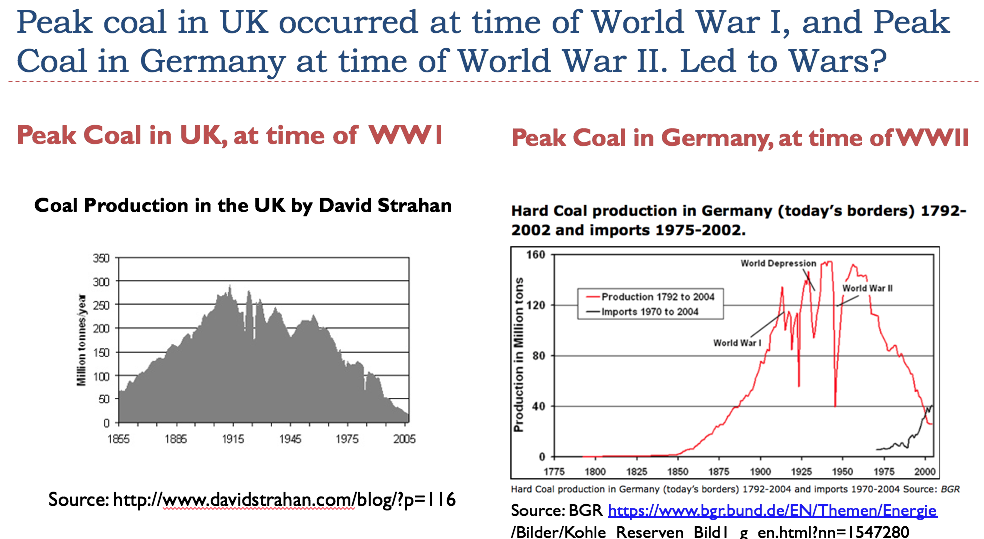
One peak in Figures 1 and 2 coincides with the 1901 to 1910 period. This period corresponds to early electrification and advances in the mechanization of agriculture. It was before 1913 when the United Kingdom hit peak coal, limiting the amount of coal that could be profitably extracted. Germany hit peak hard coal shortly before World War II. After peak coal was reached, less coal was available per capita. Leaders felt the pressure of “not enough coal to go around” and opted for war.
In Figures 1 and 2, rapid energy growth occurred after World War II, during the 1950s, 1960s and 1970s. The lower peak in the 2001-2010 period coincided with much greater use of coal after China was added to the World Trade Organization (WTO) in late 2001. High-wage countries started transferring their industry to China because costs would be lower in two ways: Wage costs were lower, and coal was an inexpensive fuel, reducing energy costs. Furthermore, by transferring industry, including manufacturing and mining, to China, high-wage countries could also lower their own CO2 emissions, as required by the 1997 Kyoto Protocol.
We would expect the patterns we are seeing in Figures 1 and 2 if the world economy is governed by the laws of physics. The availability of plenty of inexpensive energy, of kinds that match built infrastructure, is what is needed to allow the world economy to grow.
[3] Figure 3 shows more recent world energy data organized by 5-year periods. It shows how small the “red caps” of the types leading to favorable economic outcomes have been in the last decade.

The latest two 5-year periods comprise the years 2015 to 2024. The short red caps on these two 5-year periods mean that the economy is already being squeezed in the direction of not-enough-to go-around.
[4] Viewed on this same basis, diesel and jet fuel supplies are being squeezed even more than the overall supply of energy products.
Diesel and jet fuel are somewhat similar in composition. They are grouped together in some energy reports as “middle distillates.” They are relatively heavy oil products that come out of oil refineries. If there is a shortage of one, there likely is a shortage of the other as well.

Diesel and jet fuel are of concern because, since 2015, there has been an actual shrinkage in the amount of these fuels available relative to population. In fact, every five-year period since the 2000 to 2004 period has shown less growth in diesel and jet fuel than in the overall world energy supply. (Compare Figures 3 and 4.)
The low growth of diesel+jet fuel is particularly concerning because these fuels are essential for international transportation. With too little of these oil types, trade across the Atlantic and Pacific needs to shrink back. The physics of the situation makes tariffs look like an attractive solution for reducing trade.

Another concern is that diesel is essential for food production and transportation. Even if some other types of energy are available in plentiful supply, we cannot get along without food. While wind and solar are popular energy types today, they are not very useful for either international transport or for operating modern agricultural equipment.
[5] The underlying problem is that populations tend to outgrow their resource bases, including energy supplies.
The issue of the world not being able to support endlessly rising human population is an issue that no politician, auto maker, or economist wants to mention. The standard work-around is to show energy supplies without using an adjustment to a per-capita basis. This tends to make the energy situation look much better than it really is. Figure 6 is an example of such a chart.

Figure 6 emphasizes how modest the recent add-ons to the fossil fuel supply really are. These add-ons are made possible by fossil fuels; they would tend to disappear if fossil fuels were to disappear. Nuclear, which is the largest of the add-ons, requires both uranium and fossil fuels. The category “Wind+Solar” is the tiny green stripe at the top of Figure 6. In 2024, Wind+Solar amounted to 2.8% of world energy supply.
[6] It is easy to make electricity look like a growth area that can continue its pattern forever.
Figure 7 is a world electricity chart that, like Figure 6, is not on a per-capita basis.

There are a few details that are easy to miss:
(a) Current electricity production is quite small compared to the total energy supply. As counted by the Energy Institute, electricity amounts to only about 20% of total energy, varying by year and by part of the world. It is already incorporated in Figure 6.
(b) Almost all the non-fossil fuel part of the energy supply (“Add-Ons”) is electricity. In Figure 6, the only type of non-fossil energy shown that is not electricity is biofuels. These are mostly ethanol and biodiesel.
(c) Another detail that is easy to miss is the fact that the growth in the world’s electricity supply, as shown in Figure 7, has been almost exclusively outside the Advanced Economies–that is, members of the Organization for Economic Co-operation and Development (OECD). The Advanced Economies group includes the US, most of Europe, Japan, Australia, and several other countries.

Figure 8 shows the growth in electricity generation separately for the Advanced Economies and the Other Economies. The chart shows that generation of electricity by the Advanced Economies grew until 2007 but flattened after that date. Electricity generation by the Other Economies has grown the entire time since 1985. The rate of electricity production growth of Other Economies became noticeably more rapid after China joined the WTO in 2001.
Also, population growth since 1985 has disproportionately taken place in Other Economies, as contrasted with Advanced Economies.

[7] In the Advanced Economies, electricity production has recently been falling on a per capita basis, making a shift to greater electrification seem difficult.
A major issue is that the Advanced Economies are already seeing their electricity supplies per capita declining as shown on Figure 10 below. This is true for all five of the selected economies. Some of the lower consumption is due to efficiency improvements, but some is the result of the offshoring of jobs and industries to low-wage countries.

In comparison, electricity production per capita of other economies, with typically lower wages than Advanced Economies and often accompanied by more rapid population growth, has tended to rise, as shown on Figure 11.

The four “Other Economies” are less similar to each other than the five Advanced Economies. But what is striking is that they all have shown growth in per-capita electricity production since 1999. In 2024, Saudi Arabia’s electricity production had risen to about the per-capita level of the US’s electricity production. By 2024, China’s per-capita electricity production had surpassed that of both the EU and the UK. Russia was part of the Soviet Union before the latter collapsed in 1991. Once Russia’s economy had started recovering from the collapse, about 1999, its per-capita electricity production also began to rise.
[8] Other issues are also making a continued shift to electrification appear difficult, particularly for the Advanced Economies.
Trying to work around using fossil fuels leads to the need for more specialized minerals to produce high tech electrical goods and electricity transmission. The problem faced by Advanced Economies is that they produce practically none of these minerals; they must import them. The US has a long list of minerals it considers critical.

Some of these minerals aren’t rare in the earth’s crust. Part of the problem is the lack of industrial capacity in Advanced Economies today, as industry has been moved overseas to reduce costs and local CO2 emissions. For example, the US used to be a major producer of aluminum, but this production has dwindled; other countries, including China, can produce aluminum at lower cost.
Another issue is that China produces the majority of quite a few of these minerals. The US, and probably the other Advanced Economies, had planned to buy what they needed on the world market. Now, production is not keeping up with the amount the world could easily use. In 2025, China announced export restrictions on some minerals, including gallium, germanium and antimony. It has become clear that if Advanced Economies want to have adequate supplies of high-demand minerals (including silver, copper, platinum, rare earth minerals, and uranium, among others), they need to start producing them themselves.
Diesel is used in extracting many of these minerals. If diesel is in short supply, that adds another layer of problems. All these issues may lie behind President Trump’s interest in Greenland.
[9] We don’t hear about these issues partly because academic researchers live in ivory towers, and partly because politicians don’t dare explain the issues to voters.
Part of the problem is that economists don’t understand how tightly the various parts of the world economy are interconnected through the laws of physics. Economists tend to believe that if there is a shortage, prices will rise, and these higher prices will solve nearly all problems. This is not necessarily the case. Buyers cannot purchase more than they can afford. Prices may spike temporarily and then fall back. Production of fossil fuels or minerals may end because prices do not rise high enough, for long enough, for producers to depend upon the higher prices for the long term.
In the case of a shortage, most people assume that the only change the economy will make is in prices. However, the economy is tightly interconnected. It can move production to a different part of the world, where wages and energy costs are lower. An indirect result, in the country losing jobs, may be more wage and wealth disparity. The US seems to be experiencing this issue now, with fewer young people being able to find a job that pays well.
Needless to say, politicians aren’t willing to admit, “We have difficulties for which we can see no solution.” Even leaders of universities are reluctant to suggest that there might be major problems ahead. They don’t want to frighten students or their parents. University officials want all problems to be ones their students can work on, with the hope of solving them in the next few years.
[10] What is happening now is similar to the outcome of a game of musical chairs, when there is one fewer chair than the number of players.

In the game of musical chairs, players walk around a group of chairs until the music stops. At the end of each round, one chair is removed, leaving one fewer chair than the number of players. In the next round, the remaining players all scramble for the chairs available, which often leads to small fights over who gets a chair. This not-enough-to-go-around problem explains the poor relations we see today among countries and political parties. It is also the underlying reason for the interest in imposing tariffs and in bombing other countries.
Financial markets tend to perform well during periods of economic growth. However, if certain kinds of essential resources are in short supply, this will tend to hold back growth. Debt defaults and falling stock markets could result. For these reasons, problems in financial markets may be ahead.
Major governmental changes may be ahead. Representative governments require more energy than simpler types of organizations, such as dictatorships. Furthermore, citizens do not like disorder; they may want to overthrow leaders who seem to allow too much disorder. They may vote them out of office or even try to assassinate them. The problem of resource inadequacy is structural, however. Getting rid of a particular leader doesn’t necessarily help the situation.
Everywhere in the world, at least part of today’s problem is that there are not enough jobs available that pay well. Economists have told us to expect high prices if there are shortages. In a way, not having enough jobs that pay well is the opposite problem. But from a physics standpoint, the result is the same. Only a few people can afford many of the goods that are available. The economists’ misinterpretation of what is going wrong further confuses people’s understanding of our current situation.
Mainstream media needs to cater to advertisers. Because of this issue, we cannot expect them to tell us what is happening. That task seems to fall to bloggers, like me. I try to write an article approximately every month. I hope that the graphs and other figures I have presented in this article will help readers understand why we are currently seeing more types of disruptions, such as tariffs and bombings.


Trump and his “sadistic” buddy, Netanyahu have no idea the present they just gave the world. I’m sure they don’t care as long as Netanyahu can continue his genocide in the ME.
”Without syngas, the 24 Fischer-Tropsch reactors sit cold. Without Fischer-Tropsch, no diesel, no naphtha, no kerosene, no base oils. The entire $19 billion facility becomes an industrial monument.” ?
https://x.com/veronken/status/2036550606916296714?s=20
I’m afraid this article is article is correct. Qatars’s major industries are offline for at least five years.
Five years? I can’t recall from my business studies in college,
Is that short term or long term, or in-between the two?
Would help in placing it in my spreadsheet portfolio AI investment advisor tracker.
Or should I just enter, it “It’s all Over, Folks”
https://www.youtube.com/watch?v=Ye1uOB4B_qE
I couldn’t have made this stuff up myself..
Too bad Sleepy Joe Biden didn’t get re-elected and
withdrew because of cancer.
Things would have been much better.
he Pharmaceutical Clock
This is a very real issue for India, which is an issue for a US (and Canada and Europe) that gets so much of its generic drugs from India.
The pharmaceutical clock. India’s API inventory buffers are two to three months, measured from the war’s onset on February 28. Late May is the depletion window. Methanol at 87.7 percent Hormuz exposure feeds the solvent chain for paracetamol, ibuprofen, metformin, and antibiotics. Once buffers are depleted, the shortage becomes a patient access crisis for the 47 percent of US generics that originate in India.
Russia also gets 35% of its drugs from India, but it is also a very major exporter of methanol. Perhaps a deal is made that India keeps supplying Russia and it will provide the methanol? China is pretty much self-sufficient in pharmaceuticals, but is a very major importer of methanol. Again, the question is whether or not Russia will redirect its exports to aid its friends and punish its enemies. China can also prioritize its methanol usage, as much of it is not used for pharmaceuticals. Not mentioned by Perera is that Europe is also a major methanol importer (but not from the Gulf states), and has a large pharmaceutical industry.
https://rogerboyd.substack.com/p/seven-clocks-of-the-us-war-of-aggression?utm_source=post-email-title&publication_id=571129&post_id=191689048&utm_campaign=email-post-title&isFreemail=true&r=26quge&triedRedirect=true&utm_medium=emai
Losing many common medicines, including antibiotics, will be a big deal. Illnesses that were easily cured before, will no longer be easy to cure.
from zerohedge today …”I’ve Reached Peak Lobotomized Consumer”.
“And hey, if a random company hit my card like this, I’d immediately spiral. I’d be calling my bank, questioning my entire digital security setup. But when it’s Apple or Amazon, I assume the problem is me. I must have done something. Bought something. Subscribed to something. Needed something. Movie rental. NFL Thursday night football. Cascade brand dishwasher detergent. AppleCare. Prime subscription. Recurring donation to feed starving children I signed up for at Whole Foods.
Who the fu*k knows? The point is, I don’t check. I accept. Getting older. Brain functioning less. Surrendering more to Skynet. “
FARMING SHIFT IN EUROPE
French farmers are ditching corn 🌽 for sunflower 🌻 — and it’s a BIG warning sign.
Why?
• Fertilizer costs skyrocketing
• Fuel & energy prices emerging
• Economic uncertainty linked to Iran conflict
Corn = high input cost
Sunflower = cheaper, less fertilizer, less energy.
https://x.com/gaurav_kochar/status/2037240064082927739
Cyclone Narelle shuts three Australian LNG plants—8% of global supply—as global market already reeling from Qatar damage and Hormuz closure.
Chevron’s Gorgon and Wheatstone, Woodside’s North West Shelf offline . Category 4 storm, 250km/h gusts. Offshore crews evacuated; production to resume when safe .
LNG prices already up 90% since war began. “The worst time for buyers trying to replace Qatari supply” — IEEFA.
First the Strait. Then Ras Laffan. Now the Pilbara. Supply keeps shrinking.
More LNG goes off the market .
New Zealand, a first-world country, is now staring down the possibility of running out of fuel in just a few weeks.
No strategic reserves to fall back on. Refineries shut down.
Domestic energy production crippled. And deep-sea oil exploration banned.
All of it the result of short-sighted, self-inflicted policy decisions under Jacinda Ardern.
Decisions that traded energy security for political optics.
What we’re seeing now isn’t bad luck; it’s the predictable consequence of reckless leadership.
https://x.com/ricwe123/status/2037416313585340577/photo/1
FERTILIZER SHOCK HITS INDIA — JUST BEFORE SOWING SEASON
Prices are exploding. Supply is tightening. And the timing couldn’t be worse.
📊 Price surges since pre-war levels:
• Urea: $508 ➝ $750/ton
• DAP: $650 ➝ $800/ton
• MOP: $290 ➝ $385/ton
⚠️ On top of that:
• 33 lakh ton shortage looming
• Major exporters like China & Russia restricting supplies
• Imports delayed, global supply chains disrupted
🌾 What this means:
• Higher input costs for farmers
• Lower fertilizer usage → lower yields
• Food inflation pressure building
This isn’t just a price spike.
It’s a direct threat to the next harvest cycle.
India is walking into a sowing season with less supply, higher prices, and rising uncertainty.
https://x.com/gaurav_kochar/status/2037202623120740825/photo/1
An update .
eat your bugz!
The Cycles Warn The US Cannot Defeat Iran
https://www.armstrongeconomics.com/international-news/iran/the-cycles-warn-the-us-cannot-defeat-iran/
Bad news for chip makers. Qatar produces 34% of world helium production. The US produces 44% of world helium production, but world supply is tight with existing production.
https://www.zerohedge.com/markets/airgas-declares-force-majeure-helium-shipments-qatar-production-collapses
AirGas Declares Force Majeure On Helium Shipments As Qatar Production Collapses
Earlier this week we reported that global chip production was in peril as “Qatar Warns Helium Exports Set To Collapse.” Best known as the gas that makes party balloons float, helium is far more important as a key input in chipmaking, space rockets and medical imaging. The problem is that Qatar supplies a third of the world’s helium, and the Gulf nation had to halt production after Iranian strikes against the region’s energy producing infrastructure crippled its LNG production which is critical to make helium, leading Qatar’s state-owned gas company to warn helium exports would collapse.
The sudden halt of the helium supply chain has forced AirGas, one of the largest distributors of packaged gases in the US, to curtail helium shipments after Qatar halted LNG production.
Airgas, an Air Liquide SA company, declared a force majeure event on March 17 at 12:01 a.m. Eastern time, according to letters dated last week that were reviewed by Bloomberg News. The company anticipates that it will provide some customers with up to half of their normal monthly helium deliveries, and it will add a $13.50 per hundred cubic feet surcharge.
As noted above, Helium has several critical uses, including in health care and manufacturing. Hospitals use helium to keep MRI machines running and to treat patients with certain respiratory diseases. The inert gas is also essential to the manufacture of high-end semiconductors, such as Nvidia Corp.’s AI accelerator chips. Any shortages of the material could squeeze an already strained supply chain. The semiconductor industry is working to keep up with the massive demand for components used in the data centers that are needed for the build-out of AI infrastructure.
leaked “energy emergency plan” for Australia (possible/rumor)
*Lockdown April 14th
*Essential travel only
*20 liters (4 gallons) purchases max (every two days)
*No boats, or Gas can purchases
*Banks have to report gas station transactions
*30% of grocery stores will be delivery/pick up only
https://x.com/daisymay4263/status/2037038384057823443
https://fuelalert.io/
Both Perth and Brisbane are at ~10 stations each that show as being “Out”. Perth was at 6 yesterday.
‘THE MOST SEVERE ENERGY CRISIS IN THE HISTORY OF MANKIND IS APPROACHING’ — Putin’s special envoy Dmitriev
‘Neither Europe nor Britain is prepared for it’
https://tass.com/politics/2107667
ECB President Lagarde: We haven’t even begun to realize the magnitude of this shock from the Gulf
https://x.com/MacroEdgeRes/status/2037202271985889566
Just wait for the fertilizer shortage to spread its tentacles globally. These neocons have NO idea what they have unleashed on the world. The sad part is, they don’t F-in care. They are willing to burn down the planet as long as they notch a Win in the W/L column.
We see that the most powerful energy crisis in the history of humanity is approaching. Neither Europe nor the UK is prepared for it at all. Moreover, they have shot themselves in the foot by abandoning Russian energy resources,” Dmitriev said. . .
“Without a doubt, Russia is in the strongest position because we are a major producer not only of oil and gas, but also of fertilizers. And now a crisis is beginning in the fertilizers and agricultural sector markets. Therefore, Russia is currently in a very strong position,” Dmitriev said.
In the same breath they (RU) warn there (in next Tass agency release) that the price could rapidly decline after this expected short time spike-shock again.. If they for real assume massive onset of recession then or other outcome is unclear.
There is endless commentary on the events of the day. Also none of them considers how finite resources shapes events. From my limited point of view China is doing the best job of new technologies and building them at scale. Most analysis is who will bomb who out of existence and hence return to the previous status quo. They are all wrong there is not returning to the world that once was.
I really like
https://www.helionenergy.com/
for energy
I see AI and Optimus as important to the future human society. I do not mean ridiculous trillion dollar “data centers”. I mean $10,000 compute devices attached to cameras and robot arms and legs. It will take decades to develop cheap and smart AI. For the next ten years it will be >$100,000 compute and robot.
I agree we cannot return to the world as it was. The self-organizing economy is figuring out a solution for us (I hope).
Fusion energy I am not sure about. It is off in the future. I have friends who are thinking about space solar energy, but that is off in the future, as well, if it can be made to work.
My education is in physics so I have a strong bias in favor of fusion. 🙂
Including bombs.
Hear, hear!
We thrash this one to death here every year or so. Where is the fuel going to come from is one of the greatest challenges.
if fusion ever happens, it will produce electricity—and only electricity….
few realise that our existence depends not on electricity, but by converting electricity into something else,…
if you dont believe me, try flicking an electric light switch with no bulb in the socket….(and no wire to the bulb)
Good point. Electricity doesn’t operate very much agricultural equipment, or ship food to grocery stores, either.
That’s why the rush towards semi trucks, or as I mentioned hybrid trains already in several countries ( trolley / diesel / battery operation), quarry-open pit mine large vehicles (battery powered), ..
That’s why these very modes have been pre-identified as the ~easiest, immediate to retrofit arenas of interest.
Obviously, the depletion and human folly (wars, econ crisis, ..) will likely tend to march quicker than these adaptive measures phasing in..
This has been also preceded by introduction of plugins (PHEVs) into segments such as ~midsized delivery vans, pickups etc..
So, %%most of the “wasted diesel” local mileage daily, say 20-40-80km per day, could be offloaded on to the grid.
If this ends next week. Do we still have systemic crises on our hands?
I am afraid so.
Gail, can we have an open thread for people to update once the 31st day is upon us?
Didn’t ZH have an article this morning on an American Deepseek-type efficient AI model that was just unveiled. Always said that deepseek would be the AI of Phase 2 of the Non-Public Degrowth Agenda (DA), not that that wasn’t an easy call. The only reason it wasn’t that way from the beginning was to blow the AI bubble that kept Extend and Pretend going for another couple years. Bubblenomics is so ugly.
Prof. Mearsheimer explains what is going on in more detail. The new head of Mossad convinced Trump that Iran would quickly fold, if Israel/ USA attacked it, against the advice of the USA intelligence agencies and indeed contrary to the analysis of the old head of Mossad.
Trump was lying on Monday morning about ‘peace talks’ to keep the price of oil down and the markets up, and to avoid the threatened ‘big’ USA attack on Iran on Monday night. (Some people basically bet on Trump being a liar on Monday morning, and it was a sound bet.)
> Prof. John Mearsheimer : No Way for Trump to Win
Even a loss for the US/Israel could be a win for the world, in my opinion.
The new self-organized system, after the war, needs to work better than the old system, given the declining availability of resources of many kinds. It needs to be more efficient than the old system. In other word, it needs to use resources of all kinds, including energy resources, more sparingly.
what is the motto? By deceit we make war.
“what is the motto? By deceit we make war.”
“Currency wars, trade wars, world wars. When all else fails, they take you to war”
– Gerald Celente
Gail … why is it that there is only mostly men on these sites??
Is that true in the actuary’s world?
Regarding why so many contributors are men, men may be able to tolerate a worrisome topic, such as this, than women are. Women tend to worry about their families and the future.
Becoming a Casualty Actuary (my field) requires a huge amount of study, besides actual work in the field. It is a difficult career for women to enter unless they finish their exams before they have their families. Finishing the exams often takes 10 years. I finished the exams when I was 27. Most women finishing the exams are older.
I found an article talking about women in the Casualty Actuarial Society. This is from 2020:
https://www.casact.org/article/cas-releases-2020-women-cas-infographic
Women make up 31% of all CAS members and 35% of new members who have joined since 2010. Women make up 60% of the insurance industry and 46% of people employed in mathematics fields, suggesting more can be done to increase female representation in CAS membership. Women make up 37% of candidates taking CAS exams in 2019.
Ok , NOT my view ” Men think from the head and woman from the heart ” —- Bollywood movie dialog .
A doctor was asked to operate on Aishwraya Rai ( Miss Universe ) for a tumor .
Doctor :- There is nothing here .
Nurse : – You are looking in the wrong place , try the knee . 🤣
It is a very tough sell to sell a hand-to-mouth lifestyle to someone who is used to the finer things in life . Poor women and women with mental problems may be used to scarcity and difficulties and may accept going back to the stone age. Everyone else will gravitate towards green techno utopianism. Or more of the same but different.
https://www.cnbc.com/2026/03/26/uk-could-be-worse-hit-from-iran-war-of-all-major-economies-oecd.html
The article says:
The U.K. is more exposed to the global energy price shock than many other nations, as the country imports most of its oil and natural gas, and has limited gas storage facilities. The last inflation print published earlier this week, showing the consumer price index unchanged at 3% in February, is now expected to rise.
I would also point out that the UK is comprised of islands. Island countries need to import practically everyting. They tend to have more energy problems than “core” countries.
https://rayonegro.substack.com/p/un-mirada-al-largo-plazo
If the war stops tomorrow; we still have problems
Quark looks at a lot of data to conclude that the world seems now to be at “peak oil.” Production will fall from here. He says:
Markets can do as they please, but the decline in global oil production has begun, and with it, the decline of Western civilization. It is no surprise, therefore, that there is this desperate attempt to keep stock markets at record highs, despite the Middle East disaster, in order to maintain confidence in a heavily indebted system that is no longer self-sustaining.
This article demonstrates that the outcome of the war will not change the economic trend toward contraction , which has undoubtedly already begun. Dependence on oil remains significant, and conflict zones are multiplying daily.
He then shows a map labeled, “Energy Lockdown Has Started.”
Quark is only capable of following the surface plot. Peak Oil happened 7 years ago when looking at the fitted curve. Quarks reading of the history is like a casual, illiterate reading of the plot of “Crime and Punishment” without realizing that Raskolnikov is the most enlightened character. The casual condemns Raskolnikov. The literary type finishes the book cries for him(self) for three straight days.
Quark blog..
Miguel 10h
(excerpt)
..The markets can do whatever they want, but the decline in global oil production has begun and with it, the decline of Western civilization. That last sentence of yours is the most important you have written in months. And the data supports it completely.
But there is a dimension that deserves to be added: the war in Iran has not created this decline, it has catapulted us 4 or 5 years into the future.
What geology and models placed between 2029 and 2032 is happening now, in 2026, with fertilizer inventories running out, Gulf infrastructure structurally damaged, American shale on plateau and declining rates of mature deposits accelerating simultaneously.
We have not fallen down the cliff you described in your first articles. They pushed us.”
Interesting point!
Perhaps our models have tended to be too optimistic. They have assumed more oil and LNG will be available than is really the case. Affordability is one of the big issues. The other thing that models have missed is the high price producers really require, if governments of oil exporters are to be able to collect adequate taxes to support their growing populations.
We have been able to use growing debt to pretend that demand is available that is not really available. As the system unwinds, we find that the world economy needs to take a step down, to be in balance.
Unfortunately, that stepp down is looking more and more like Wile-e-Coyote’s cliff edge
BLACK IS WHITE
(There are two colors in my head)
WAR IS PEACE
(Everything in its right place)
DECELERATIONISM IS ACCELERATIONISM
(What, what was that you tried to say?)
https://youtu.be/NUnXxh5U25Y
“[ What geology and models placed between 2029 and 2032 is happening now, in 2026 ], with fertilizer inventories running out, Gulf infrastructure structurally damaged, American shale on plateau and declining rates of mature deposits accelerating simultaneously.”
This accelerated step-down in general ongoing “PO vector” could be confirmed only from rear view mirror in few yrs time, but perhaps it is likely correct and not a pretty one..
Now, the obvious “ever bargaining – are we there yet?” question is what about the following ~rebound potency in the near-mid term future afterwards? Shallow, insignificant, short of duration, region and industrial domain specific, host of few countries limited only, .. ?
[ Peak Oil happened 7yrs ago – fitted curve ]
Broadly agree, the issue though is that such mega societal / industrial hist. turning points are NOT exactly sharply defined as we would like to have them. Likely, it’s more of a ~fluid process with a bottleneck crisis and gestation phase, followed by short abrupt / phase change into another state ala say terminal patient suddenly hospitalized and at one conseq.day the body is dead.
It’s an empirical statement Jr. Late 2018 is when the fitted curve peaked, and that’s not even taking net energy into account. If we were taking net energy into account then, like you say, there would be no sharply defined curve because there’s no formal accounting for net energy, but by definition the peak would be earlier hence all the QE and hollowing out of the middle class. The sharply defined and wholly premeditated demand destruction of oil (and therefore supply) caused by the plandemic war on submicroscopic ‘terror’ is also a great aid in seeing the peak because it put the peak in stark relief in order to buy about 5 more years of capitalism.
The dynamics you are describing relate to the civilizational consequences of the empirical, fitted curve.
According to Mark Rutte, Russia is the “main threat to peace”, and obviously, the panacea is an increase in Nato’s military expenses.
https://tass.com/world/2107525
It’s true that April Fools’ Day is approaching, but if Rutte really means it, I would advise him to take a look at what’s happening in the world, especially in the Middle East. Hopefully he will realize that even Burundi poses a greater threat to world peace than Russia.
I am afraid that Europe needs a near-by country to be afraid of. European leaders need a war, and preparations for war, to try to hide the problems that European nations are having. They don’t want to dive into the Iran war. They would rather create their own war.
35-Day Shutdown Alert: India’s 2nd Largest Refinery Plans To Halt Operations Amid Iran War Over 6,000 Pumps Could Be Affected . https://www.timesnownews.com/business-economy/economy/to-halt-operations-amid-iran-war-hike-fuel-prices-article-153927365
The article says:
Nayara Energy, India’s second-largest refinery, plans to halt operations for about 35 days starting in early April, potentially reducing the nation’s refining capacity by nearly 8%. The closure coincides with heightened geopolitical tensions affecting oil availability.
But, the higher cost is only partly being passed on to consumers. This no doubt leads to long lines at the pump. The increases seem to be going industrial and commercial users.
FIGHTS ARE BREAKING OUT IN INDIA AT GAS STATIONS. SEVERAL PEOPLE DEAD.
https://x.com/Jvnior/status/2036889396092281293
Ok ; There are lines at the pump but no fighting and no one is dead . I already posted a video about this yesterday . This guy is in my opinion from Pakistan or just a dissatisfied India based Muslim . When the fights will start is May /June when farmers get in line for fertilizer and there is none . Already posted a few messages on this matter .
So May or June before fighting to the death for 3 litres of fuel starts?
Well, lets not saddle the high horse..
As comparatively an India-peasant could from meager 3L of fuel derive food for a horde of whiteys..
The 82nd Airborne is being sent to Iran as a gambit piece.
I do not disapprove it.
During the liberation of Italy in 1943 , someone suggested dropping the 82th to Rome to block the German retreat.
Either Maxwell Taylor or Matthew Ridgeway killed the plan, which would have shortened the war in Italy by a year (although Churchill, for whatever reason, had plans to lead the troops to, out of all places, Vienna!). I don’t know much about Taylor. But Ridgeway, later, in Korea stopped the American approach after the Chinese were routed, leading to North Korea’s viability even now!
All because these cowards wanted to save a few thousand “American Lives”.
I am glad that at least Trump and Hegseth have realized that most American lives are mostly worthless. It does not have to succeed. Their deaths galvanizing the American opinion is well worth their sacrifices.
Yes, it is Trump’s Gambit or bluff. Up to now it does not appear to have the desired affect on the actions of Iran. In Chess an opening Gambit sacrificing a minor piece, like a pawn, to gain an advantage in the Middle game over your opponent. Trump’s sneak attack was his Gambit. It did not work.
Now he’s restoring to Gambit 2.0 sacrificing to buy more time.
Desperation when you have a weak position or play
“Trump was
18:37
supposed to attend a fundraiser, charity fundraiser at Mara Lago Friday night. He was going to be the special guest. He’s
18:47
he’s canled that. Um and he was supposed to speak at CPAC on Sunday and he’s
18:54
canled that. So those are again what I call warning indicators that you know he’s clearing his schedule”
AKA clearing up schedule for incoming B.A.T. “bunker activity time” ?
He’s going in for a third, last minute attempt at getting that tent peg removed before Gabbard drops the files and he’s forced to drop his pants because everyone insists on empirical evidence. Hard as they’ve tried they haven’t been able to get that little hook loose from his comatose sphincter before the anaesthetic wears off.
“16:30 don’t think would give Trump, you know, his strong man look. you know, he wants to look a winner and and you know,
16:39 the ships turn around and go home isn’t going to present him as a sort of winner in the leadup to elections“?
A move of desperation.
“Pentagon considers diverting Ukraine military aid to the Middle East … ”
https://www.reuters.com/world/europe/pentagon-considers-diverting-ukraine-military-aid-middle-east-washington-post-2026-03-26/
trollol..
If Ukraine is really taking out Russian ports:
https://www.nbcnews.com/world/russia/least-40-russias-oil-export-capacity-halted-reuters-calculations-show-rcna265150
At least 40% of Russia’s oil export capacity halted, Reuters calculations show
I can see why the US would halt exports of munitions to Ukraine.
Falling profitability in Slovakia
https://www.trend.sk/biznis/vychod-pada-firmy-palia-zisky-a-region-sklzava-do-pasce?itm_modul=react_trend_topbox&itm_brand=trend&itm_template=hp&itm_position=1&itm_cb_position=top_main_1
The East is in decline. Companies are burning through profits, and the region is sliding into a trap
The Košice region has found itself caught in a trap of low incomes, weak demand, and rising costs. New data shows that this is not just a short-term slowdown, but a deeper and more systemic problem
Lower profits or slow profit growth are becoming a problem for an increasing number of companies. According to the latest data, this affects up to 65 percent of businesses, of which approximately 35 percent are reporting a slight decline and another 31 percent are reporting a significant drop.
The situation is most critical in the eastern part of the country. In the Košice region, as many as 47 percent of businesses report a significant drop, while in the Prešov region, it is approximately one-third. Conversely, only about one-tenth of small businesses are reporting revenue growth. This is not an isolated fluctuation. Increasingly, data suggests that corporate profitability is declining despite relatively stable sales. While companies are selling, they are earning less.
Translated with DeepL.com (free version)
I have never understood this preoccupation with ‘profit growth’. I guess I would not have made a good business leader at least in the US. It seems like if I owned a multi-generational plumbing business and we were only clearing $1 million per year every year, but never more than that, I would be viewed as a failure?
“Profit” first started with the “King” who extracted wealth from the peasants without working. In medieval times when people lived in villages, the king would protect the people with his army from raiders or others who would harm them. And in exchange he extracted a profit.
they could also be forced to go to war on his behalf if he ordered it
Actually, it usually was kin of nobility and the upper classes that fought wars. And that was how they earned their stripes as knights, kings, royals, etc.
Then later on they changed it to hereditary. Which Thomas Paine later harshly criticized
““A hereditary monarch is as absurd a position as a hereditary doctor or mathematician.”
― Thomas Paine, Common Sense
sorry—but you are wrong
the mass of any army was always the peasantry—
yes, nobles went to war as well….but you couldnt fight a war with just aristocracy—not enough.
Profits are needed for investment in new equipment. If there are inadequate profits, wages of workers are likely to be kept very low. Low profits tends to lead to worker dissatisfaction, strikes, and actions to bring down heads of states.
In the US, I recently finished a complete repaint of an outdated kitchen with stained wood cabinets and glass inlays. I had a good repoire with the husband who was an engineer and sportsmen but I sensed anxiety and sadness with the wife. When I asked the woman if She was happy with the work She was in her phone screen and seemed to be on to the next thing. I mentioned this to the husband and He seemed relived that I noticed the preoccupation. Later She told the wife of my friend that I didn’t seem to have any ambition although I am friendly and deliver an almost perfect result at a reasonable price. My friend’s wife defended me by saying that I value quality of life over profit. As I see the world slipping into depression, I’ve decided to make the transition from painting to running a backyard native nursery taking this a step further and valuing the returns that fruit and nut trees provide from voluntary relationships, sweat equity and building healthy soil. Let the dead bury the dead is my take on the profit illness
Yes, there is a lot of “dead” people aiming for profits. Let them die for their deadly visions.
you have absolutey the right attitude…
i too have been fortunate enough to take my working life into an interesting retirement—not many are that lucky
Welcome to life, the universe, and everything. Momentum is everything when you’re running from entropy in competition with everything else alive that’s running from entropy. You stand still and you’re falling behind. That’s the rule and the secret is to not overdo the rule. Triangulation, because 3 is the magic number. Let’s see how the Hand seeks to avoid overdoing the Big Nuclear Scare.
Targeting ME excess refining capacity is the ultimate twofer. Kills globalization and also kills the Export Land Model. Targeting Russian excess refinery capacity, ditto. Targeting Russian oil export ports reduces Russian export capacity for Phase 2 towards the hyper efficient regional pipeline method.
Rystad Energy estimates repair and restoration costs from the Middle East conflict to energy infrastructure at least $25 billion, with further increases expected.
https://www.rystadenergy.com/news/middle-east-conflict-rebuild-energy-cost?utm_campaign=&utm_content=&utm_medium=&utm_source=twitter
This assumes that repair is even possible. I expect that critical minerals will be needed from China, for one thing.
This. You are mostly correct..
Because $25B is a chump change that the proverbial “FED” hallway receptionist could immediately sign on..
US troops are being sent to Iran. The purpose of troops is to kill people and destroy things. All people and things can be dealt with safely using large yield fusion bombs. Why send people? B2 delivery works fine. Or even ICBM delivery. I oppose this war but if the US, the congress, is going to fight then use the safe way that saves American lives.
All my life the US have destroyed and killed all over the world, I don’t care one iota for your solders!
Yes, it’s not personal, lot of great folks stateside..
But the imperial bug runs deep ” inside the brain “.
Usually – historically, each over dominant country-culture must go through the cycle of weaning itself of it, it takes centuries though.. And unfortunately, the more sucking in new pop all the time through migration and ~assimilation the longer that needed run has to be eventually..
The imperial bug is the civilization bug. So the deepest reason that Americans have the imperial bug is that they subliminally know that if it’s not them then it’s gonna be someone else doing it right back to them. Welcome to structural hierarchy. There was never any question that the combination of American natural resources, climate, and Ashkenazi cultural control would come to thoroughly dominate the oil age.
The truth is the American Lives are not that previous too much.
I don’t know where you live but I have dealt with plenty of American lowlives, and I have to say that they are cheaper than the lives of many other countries
The low wages of young people today is a sign that the lives of young people are not very much valued, I am afraid. These young people increasingly get involved with drugs of various kinds. Depression becomes a problem.
The military can be an appealing employer for people who have a hard time succeeding in getting a well-paying job from businesses. A person does have to be moderately physically fit, but they don’t have to be very bright or ambitious.
What is the objective of the war?
A sequence of 40 fusion bombs of 50 mega tons each along the south west coast of Iran will remove the oil/gas industry from Iran. Is that the objective?
“What is the objective of the war?”
Regime change so that Israel has one less enemy in their way. The ultimate goal is for Israel to become the hegemon in the ME. They want the entire region. There are reports that several high ranking Israeli officials want Turkey next after Iran falls.
According to Esc at Substack, the objective of the war is……
…… wait for it …..
To destroy Iran’s energy infrastructure and also its financial infrastructure, so that it cannot rebuild on its own terms, but only on terms set by international financial institutions whose conditions include ISSB taxonomies, NGFS scenarios, and digital infrastructure specifications.
Iran is an independent actor operating outside of the global control architecture. We can’t have that now, chaps, can we?
https://escapekey.substack.com/p/iran
How quaint. 🙂
“What is the objective of the war?”
The ‘tail’ doesn’t wag the ‘dog’? Existential threat?
“To retain its military power and reserve currency the US needs leverage to force China to provide it with rare earth minerals, and the US intends to use Iran’s oil as that leverage.“?
https://un-denial.com/2026/03/05/cactus-view-of-the-iran-war/
Interesting! I can believe the goal is getting at the rare earth minerals of China using Iran’s oil as leverage as a goal.
Lol. Yet Iran’s oil tankers are sailing right past the US Navy and what’s more sanctions have been ‘temporarily’ lifted. And the US has zero hope of regime change.
Things that make you go hmmmmm, just like Ukraine.
Interesting question: When Allies Become Liabilities – Regime Change in Israel?
https://www.armstrongeconomics.com/international-news/iran/when-allies-become-liabilities-regime-change-in-israel/
Interesting!
What is perhaps more surprising and not yet in the press is that Netanyahu’s problems have intensified under the Trump administration, which was expected to provide unconditional support for his Iranian conquest. Recent sources report a deep frustration within Trump’s team regarding Netanyahu.
The question of Benjamin Netanyahu’s political survival and whether there is serious discussion about regime change in Israel represents one of the most sensitive and complex dynamics in current Middle Eastern geopolitics being discussed behind the curtain. The short answer is that there has been significant talk—both public and private—about the need for Netanyahu to be removed from power, . . .
This is not talk of military intervention or external overthrow. Rather, it is a discussion about using diplomatic pressure, conditioning aid and support, leveraging legal processes, and supporting domestic opposition to facilitate Netanyahu’s removal through ostensibly democratic means. The distinction matters, but the intention—removing a sitting leader perceived as an obstacle to broader policy objectives—is fundamentally the same.
Without Netanyahu’s removal, it is going to be extremely hard to convince Iran that Israel will not attack again or try to assassinate all of their leaders in another covert action.
The American Coup will see to it that Zionism is no more if the Big Nuclear Scare hasn’t already seen to it.
I am not sure how versed in Jesus Bibi is. He should remember Jesus said
“Do not think that I have come to bring peace to the earth. I have not come to bring peace, but a sword. 35 For I have come to set a man against his father, and a daughter against her mother, and a daughter-in-law against her mother-in-law. 36 And a person’s enemies will be those of his own household.”
The notion being to divide good from evil. A most apt subject for today.
“And a man’s foes shall be they of his own household.” Matthew 10:36
Australian Bushveld Lt Harold Harbord “Breaker” Morant’s epitaph on his grave in S Africa after being executed by the English.
https://www.youtube.com/watch?v=BRLsxkVSH8E @00:16
Scapegoats of the empire.
good one
“So we boiled my son and ate him.” 2 Kings 6:29
obviously a maganut
Did Norm just call Jesus a maganut? This is a new low for him.
Of course, he will be craven about the Epstein class.
quote====
///Do not think that I have come to bring peace to the earth. I have not come to bring peace, but a sword. 35 For I have come to set a man against his father, and a daughter against her mother, and a daughter-in-law against her mother-in-law. 36 And a person’s enemies will be those of his own household.”///
that describes a maganut……
If there is not enough food and other necessities to go around, fighting can indeed take place within families. Why pay for the copay in Grandma’s medical treatment, if that money could be used elsewhere within the family?
Also, much of the wealth of families has historically been passed down through inheritance. The oldest son tends to get almost everything, in Biblical history. Killing off relatives can add to a person’s share.
My impression that this is maladaptive.I think in-fighting within families will leave the ruthless survivors atomized and vulnerable to ruthless groups where family members work together.
At least 40% of Russia’s oil export capacity halted, Reuters calculations show
https://www.reuters.com/business/energy/least-40-russias-oil-export-capacity-halted-reuters-calculations-show-2026-03-25/
Will China lockdown now?
This is an NBC news version of the story. A great deal more detail is given at this link. It sounds pretty awful for the world market:
https://www.nbcnews.com/world/russia/least-40-russias-oil-export-capacity-halted-reuters-calculations-show-rcna265150
At least 40% of Russia’s oil export capacity halted, Reuters calculations show
Ukraine intensified drone attacks on Russia’s oil and fuel export infrastructure this month, hitting all three of its major western oil export ports.
At least 40% of Russia‘s oil export capacity is at a halt following Ukrainian drone attacks, a disputed attack on a major pipeline and the seizure of tankers, according to Reuters calculations based on market data.
The shutdown is the most severe oil supply disruption in the modern history of Russia, the world’s second largest oil exporter, and has hit Moscow just as oil prices exceeded $100 a barrel due to the Iran war.
This would be in addition to Middle East disruptions.
I should add that China is not affected by this:
Russia continues uninterrupted supplies via pipelines to China, including the Skovorodino-Mohe and Atasu-Alashankou routes, as well as ESPO Blend exports by sea via the port of Kozmino.
It is Europe and the rest of the world.
This is why China choose to sit and watch while its enemy damages itself. Though I do believe it is China that is providing pin point in space, time, staff, accurate reconnaissance.
It looks like they are going to send in ground troops… maybe 3 weeks?
I’m not sure what the outcome is going to be. Maybe lots of land mines. Seems like a dumb idea but if it’s not your kids 🤷
April 19 – May 1.. “Season of Sacrifice.”
Traumatic Events on/around April 18-19:
April 18, 1906: The San Francisco Earthquake and subsequent four-day fire.
April 19, 1775: The Battle of Lexington & Concord (start of RevolutionaryWar).
April 19, 1904: The Great Fire of Toronto.
April 19, 1936: Significant Nazi military display.
April 18-19, 1943: The Warsaw Ghetto Uprising.
April 19, 1993: The end of the Waco siege (fire).
April 19, 1995: The Oklahoma City Bombing.
April 20, 1999: The Columbine High School shooting.
April 18, 1983: The U.S. Embassy bombing in Beirut.
not quite before May 1 but what the heck
On May 13, 1985, Philadelphia police dropped a bomb on a row house occupied by MOVE, a Black liberation organization, killing 11 people—including five children—and destroying 61 homes in a deliberately allowed fire.
Following an armed standoff, authorities bombed the Cobbs Creek headquarters and allowed the fire to burn for 90 minutes.
Years ago there was a an Anti Death Penalty rally at the Governors mansion led by the Buddhist nuns from the Grafton Peace Pagota and the Cops were sneering at the crowd with some young guy walking the opposite direction with his hand in his jacket like he was about to pull a gun, a provocateur. I’ve met some of the Black nationalists from Philly and AIM members from Pine Ridge who took over the Federal Bldg after the goon squads snd suspicious deaths on the Rez.. the testing/targetting I experienced was trauma-bssed conditioning with some exotic tech and veiled threats. Honestly, the internal path with grounding through relocalization is your best bet as I detect you are grappling with the same demons judging by your recent posting.
Former CIA agent Larry Johnson thinks, possibly much sooner than that in this 13 min segment.
Larry Johnson says that very skilled troops are being sent, but with apparently little planning. One of troops said, “I hope they send a priest along to give last rites.” This is not the kind of joking you usually hear before troops leave. Troops may be at the island by this weekend. Iran will retaliate. Would need one million men, to really win.
Agree need one million but they have been working to staff up selective service boards for more than a year.
My youngest is 30 years old.
I completely object to the war but if Americans are going to die I supporting using every technical means. The includes HIGH yield fusion bombs. The island is small, one fusion bomb of 100 mega tons will remove the island from existence no American soldier need die.
Real nice ed
Starting at the 35:55 timing, following Nima Alkhorshid’s brief remarks, Laith Marouf (Lebanese reporter) explains the three possible fronts along which a U.S. ground invasion of Iran could take place.
(The entire interview is interesting, but for those who don’t have time).
The only good reason for US side to have a ground invasion, from my point of view, is to have a bloodbath of Americans in order to justify the use of nukes.
They are surely that crazy to think that.
Basically, the same strategy used with Japan.
Lindsay Graham recently said that on Iwo Jima, certain American units had a mortality rate of 80%, so “we shouldn’t be afraid to invade Iran.”
Additionally, I think that US and Israel should decide to let Israel drop nukes, it would be more difficult for Russia and China to retaliate.
Some of the first ones to have fear of this should be the Arab Gulf States, all the radioactivity will arrive also to them and will stay there for years.
But also Pakistan, Azerbaijan and others.
My impression is that if US/Israel will drop 2/3 nukes on 2/3 Iranian cities, no nuke responses will arrive.
The real point is not to discuss about how stupid and failed idea would be to start a ground invasion, but what the Americans would like to achieve with a ground invasion.
Having said that, US/Israel will become the “Rogue States” of the world.
Everyone in the world will love, will rejoice to see an American or an Israeli to suffer, from little to big things.
From looking to someone falling from the pavement to closing economic deals with US/Israel.
This is the only thing that an American and an Israeli should think about, although normally he/she consider to be protecred by 2 oceans…
https://www.youtube.com/live/pY9rLw5RV4c?si=SVI_fCFJI7GCbdJv
Italy now running out of fuel
“Out of petrol” signs are increasing in Italian petrol stations
https://qds.it/aumentano-i-cartelli-benzina-esaurita-nei-distributori-italiani/
I wonder if GasBuddy is going to put up a special section for this ever expanding scenario.
South Africa running out too.
https://www.news24.com/business/economy/work-from-home-back-on-the-table-in-sa-amid-fuel-price-crisis-20260325-0867
[https://fuelalert.io/](https://fuelalert.io/)
This will be interesting to watch for Australia, New Zealand and UK.
Thanks, that’s useful information.
Here’s a “world monitor” open source
https://www.worldmonitor.app/
Iran monitor
https://www.iranmonitor.org/
“About” section from Iran Monitor:
>> A real-time, open-source crisis monitoring platform built by the Iranian diaspora to track, document, and amplify events inside Iran.
Am I reading that right? To **amplify** (i.e. exacerbate?) events inside Iran.
Perhaps, “Allow others to hear”
To allow the world to see the crimes against humanity being done by Israel/US.
In terms of mitigation-inspiration..
Reviewer puts +600lbs of loose granite to the test in posh cargo (mid drive) ebike..
Spoiler: good results! Well, disc brakes ~smokin..
https://youtu.be/H7w57U3ijHY
35% grade lol. And he made that claim twice. Impossible to tell but I’d put it at 10% tops. 35% is like a gnarly drop on a double black diamond mountain bike trail.
Yes, %%that was exaggerated, the guy is clearly a clown personality meant in the good sense, btw. the bailing out of bikes / motorcycles in motion was a legit part, he has evidently done that in his past !
PS that brand also offers more cargo only specked version for hauling.. ; obviously there are many such vendors but this one is truly special – have you noticed how that gigantic bike frame (+ full suspension) completely east vibrations, even on cobbled stones, .. ?
And it’s not $10k anymore, like ~7k ish during promo sales.. throughout the year. Yes, obviously still NOT in my budget range, when proven cargo ebikes (of smaller size and spec) are under two grand.
Yeah it looks like a quality bicycle for sure with all that rock in there.
[Tern] and few other of the quality cargo-brands also usually allow for component spec build up – so if you add up say Rohloff gearhub and G.belt drive, the price in such top specification then spikes a lot from base listing..
But that’s not the case with this extra purpose vehicle though (drivetrain-wise).
With rain cover for driver I would consider this could be fun.
The Trumpenyahu gift that keeps on giving for creating this catastrophic mess. As the title of Carpenter’s song says..”We’ve only just begun”.
Unless Iran gets Nuked, they are playing the LONG game, to inflict as much pain on the global eCONomy.
https://www.youtube.com/watch?v=kfyOXDXBoHA
THE U.S. DRAWS A RED LINE AND IRAN RESPONDS! | Larry C. Johnson (25:06)
4,429 views https://www.youtube.com/watch?v=kfyOXDXBoHA
U.S.-Iran Tensions Raise Fears of Major Escalation
Tensions between the United States and Iran are once again drawing global attention as fears grow over a possible large-scale military confrontation. Strong rhetoric, military movements, and growing instability across the Middle East have fueled speculation that the situation could worsen rapidly.
Observers say any direct strike involving the U.S. and Iran would have serious consequences for the entire region. A broader conflict could affect shipping routes, energy markets, and the security balance in the Middle East. The possibility of retaliation from allied armed groups has also increased concerns among international analysts.
While no full-scale war has officially begun, the pressure is clearly rising. Both sides remain under close watch as the world waits to see whether the crisis will cool down through diplomacy or explode into a far more dangerous conflict.
noisy23
3h
I’m involved in agriculture because I own several hectares of olive groves and cereal crops in Mexico and Burgos. The miracle of agriculture, as in the entire economy, is nothing other than energy. Diesel and gas have been vital for increasing productivity. In the case of fertilizers, it’s been tremendous because by synthesizing three NPK elements—the nutrients plants need most, although in reality there are more than 30—they’ve achieved a miracle in production. The problem is that these compounds only work if it rains; otherwise, they volatilize, since they are gases. This has led many farmers to apply more because that’s what these compounds are designed for: creating dependency. The result is soils dead of microorganisms and aquifers contaminated with nitrates, precisely when water is most needed. And don’t forget that we’ve just broken the all-time record for average global temperature, so prepare for climate change, which is another consequence. What I mean is that if these compounds aren’t used, the short-term damage will be tremendous because I estimate crop yields will be less than 50%. However, in the long run, our stomachs will thank us. I should also mention that restoring soil structure and replenishing nitrogen and glyphosate fertilizers takes more than five years, so the overall picture is dire. Each year, as the soil is further damaged and the fertilizers become more volatile, more and more needs to be applied… that’s why I say cutting off the supply will be truly devastating.
Copy/paste from Quark .
The quote makes good points! We need living soils.
We also need a diversity of seeds that can deal with changing weather or climate. But we have moved away from this also.
The easiest and cheapest way is to inter-plant species which promote growth-accumulation of needed nutrients( food-web and fungi ) just next to the cover crop. But that in layman’s eyes *seemingly lessens-degrades the ~needed revenue-yield from ha/acre in his bank-state agri subsidy approved spreadsheets..
Or at least introduces another level/s of needed management in situ, and agri-people got quite lazy sitting on these ~one-task only diesel powered contraptions over the past few decades..
—
* obviously depends on many further nuanced factors but chiefly how degraded the soil under heavy-cultivation already is ..
This video is clearly psychological warfare. How is it possible that the CIA, NSA, DIA, MOSSAD have not demanded of google to have it removed? Is there some sort of split in the deep state?
The rich powerful Jew should risk death with the little Jews? I do not think that is the way Jewish society thinks. That is not even the way American society thinks. Donald is not going down with the foot soldiers.
In the revolutionary war Washington was an active combatant on the front line, by the civil war Lincoln stayed safely away from the front line, in WWI there was an entire ocean protecting the leader, likewise for WW2. This romantic notion that the leader fights at the front is over 250 years out of date.
Can anyone of us picture Vander Lynan shooting Russian at the front, Xi shooting Taiwanese, Stamer shooting Russians, Donald shooting Cubans. Personal honor and courage are a thing of the past.
https://www.youtube.com/watch?v=cRbua6x6O3o
No water for Tel Aviv?
This now gives The US the excuse to bomb out Iran’s water facilities. Hold on tight this ride is starting to get dangerous.
Iran have stated that if Israel or the US goes after its water then Iran will target every Gulf State member in the region. Say goodbye to Abu Dhabi, Dubail, Saudi Arabia etc.
I would not believe “No water for Tel Aviv” until I hear it from a trusted source. This is an AI video. It can easily make things up.
I should have seen this would be a crime against humanity and the Persian believe in God and do not commit crimes against humanity. Duh.
The Don is sending 7000 paratroopers. Iran has 4000 wells (says google). At 500 troopers per well Don needs two million troopers.
Maybe Europe can contribute bodies to the robbery. EU needs the hydrocarbons.
But Trump and the EU claims, “What is our Oil doing under your sand?” …a very old joke from decades ago from an editorial cartoon
If you have lower heat and enough water, you just need more heat to sustain the human population.
If you have too much heat and too little water, you need a lot more energy to sustain the human population. And you need those colder areas for food.
If you have too little heat and frozen water, you need a lot more energy to sustain the human population. And you need those warmer areas for food.
USA and Europe: Our oil under your sand and permafrost.
[ off topic ] sorry, there seems to be some headlines leading to .SK mass media sites about developing story how American girl was charged under the suspicion of burning down .CZ drone factory, which the plotters assumed had Israeli-Gaza war theater links..
perhaps at some point you can report short summary of that case.. thanks
https://spravy.stvr.sk/2026/03/osoba-ktoru-na-slovensku-zadrzali-v-pripade-poziaru-v-pardubiciach-ide-do-vazby-ide-o-zenu-z-usa/
I have read that one of the persons was detained in Slovakia.
Bahrain urges residents to keep their vehicle fuel tanks as full as possible keep their mobile phones remain fully charged at all times.
https://x.com/TheCradleMedia/status/2036772184501178395
Where are they supposed to drive to? KSA?
The cars are supposed to be used as storage tanks for oil producers.
Emergency playbook for worldwide crises quietly released: ‘Get ready for lockdown 2.0’
“The quiet release of an emergency energy playbook has sparked global concern, with some warning to ‘get ready for lockdown 2.0’ if fuel shortages worsen.
The guidance comes from the International Energy Agency (IEA), which last week released its report ‘Sheltering From Oil Shocks’ outlining 10 steps countries could take if supplies tighten.
The report was issued in response to the ongoing conflict in the Middle East, which has all but choked off traffic through the Strait of Hormuz, one of the world’s most critical oil routes, triggering fears of prolonged shortages and soaring fuel prices.
https://www.dailymail.co.uk/sciencetech/article-15675413/emergency-energy-playbook-lockdown-iea.html?ns_mchannel=rss&ns_campaign=1490&ito=social-twitter_mailonline
Badly affected countries will have to do something. It would not be surprising if people are expected to stay at home more. We don’t know what else will happen. Home schooling or schooling in local groups, paid for by the parents, may come about.
The fine Surplus commentariat people speculate about the hidden potential in the jet fuel feed-stock, which could be supposedly re-oriented for diesel production instead. AKA to ground large chunk of “frivolous tourist & pseudobiz” air traffic for this very purpose.
That would help at least with some of the food delivery and these various diesel dependent heavy duty services – application (grid and other utilities in running order, ..)
I was talking to my boss about what he and the office staff would do if petrol was unavailable and he replied they would just work from home , I and the the rest of the blue collar workers that work on public transport will probably be guaranteed a fuel allowance as we are classified as ” Essential Workers” this is exactly what happened during the covid plandemic we were classified ‘Essential Workers” and had to perform our normal roles.
This time there is no risk of death from going to work in person.
https://www.westsideconnect.com/news/local-news/shock-waves-of-modesto-del-monte-plant-closure-hit-local-fruit-farms-growers-to-lose-550-million-in-peaches-alone/
I wonder how sustainable the making of “tin” cans is, especially if long-distance sourcing of raw materials is becoming increasingly constrained. If the price of tin cans rises too much, people won’t buy canned peaches.
The US can make recycled steel. But the US has not produced tin since 1993.
https://me.smenet.org/tin/
There are workarounds for using tin as a coating for steel cans. But I don’t know how this works in practice.
Time to break out those Tesla Electric Semi’s.
(dark humor)
This is very recent:
https://electrek.co/2026/03/23/tesla-semi-jay-leno-garage-new-details-production-specs/
“Tesla Semi has a million-mile battery, claims Tesla”
“Tesla originally promised Semi production in 2019, and the program has been delayed repeatedly since then. The 50,000-unit annual capacity target is ambitious for a truck that has never been manufactured at scale. But the product itself, based on the engineering details revealed here, looks ready. ”
Oh la la land .🤣
Especially if mineral supplies of many kinds are now constrained, besides heavy oil and LNG.
It’s real stuff (always was), only delayed.
Many articles out there about the key causes of the slower progress to mass manuf. level in this particular case. I’d point out to some batt. chem/technology considerations there, because that space changed dramatically just in last decade+ ; basically the newer incoming batts today are like 2-3x generations beyond what they assumed initially..
“beyond” meant as ahead, i.e. better..
In terms of batt. technology there are several approaches..
For example, if you look at ABB, they either revitalize old existing diesels based machines or manuf. completely brand new train sets for clients all around the world. So, for their LTO (lithium titanite oxid) batt packs the min. specs are like 20-40k life cycle re-charges.. and that has been mass manuf. for past several yrs already..
Hence TSLA for semi is surely using something at least double that advanced.. Hence energy saving through that vector to some extent are already baked in..
https://www.abb.com/global/en/areas/motion/traction/traction-battery/pro
https://www.abb.com/global/en/areas/motion/applications/rail-vehicles
Hm, this LTO batt tech seems like CHN bought out the original US inventor? early first manuf. Now it’s being manufactured in Japan and China instead; and supposedly new HU/EU factory under construction as well.
The LTO is more of a great (dis)charge cycling chemistry than condensed storage though, so this exactly fits – it’s great for hybrid trains and mining site mega trucks.. hence work on new approaches continues. TSLA tried aluminium-ion apart from advancing the known LFP batts.. , certainly among various other things under wraps..
IRAQ OIL OUTPUT COLLAPSES AMID HORMUZ DISRUPTION
Iraq has slashed oil production by about 80%—down to roughly 800,000 barrels per day—as storage fills and exports through the Strait of Hormuz remain blocked by conflict.
Baghdad has ordered further cuts, instructing majors like BP and Eni to reduce output at key southern fields.
Officials warn production could fall even more if disruptions persist.
https://x.com/DeItaone/status/2036799577601261576
Unbelievable
Iraq has very little storage. There seems to be a possibility that some oil can be exported through the north, to Turkey.
How many times can dementia Donald lie about “a deal” and the market believes it?! Are we living on borrowed time? I don’t see how Iran can even negotiate when they get stabbed in the back. I don’t think there will be an agreement unless China and Russia step in
It’s true. Trump is a compulsive dealomaniac. He’s hoping to win this year’s Nobel Prize for Deals. It makes me wonder why he fell out with Elon Musk. He probably wanted Musk to attack Mars, so that the Martians would be forced to ask Trump for a deal. Happily, Musk said “No deal!” and bailed out.
Perfect!! MegaDealamaniac even.
Megalo’Deal’amaniac. FTFY.
” I’m going to show you why the physical hardware inside Ras Laffan Industrial City is the real reason Qatar’s recovery will take half a decade. Why the global supply chain for the most critical components cannot produce replacements at the speed or scale required. And why five workshops in Germany, Italy, Japan, and Wisconsin hold the timeline for the entire global energy market in their hands.
This is the story nobody on this app is telling you. Because almost nobody on this app knows what an Air Separation Unit is.
They’re about to find out. ”
Quark and all readers this is a masterpiece. We now have a perma crisis.
Qatar’s Real Problem Isn’t War. It’s the Machines.
https://x.com/veronken/status/2036550606916296714
This article is about the long time-lines for repair. These are indeed a problem.
But we are also running short of critical minerals. Many of these come from China. I am sure that many critical minerals are used in making new machines. If these critical minerals are not available, there is a real problem. The machines cannot be replaced at all. We could get started on replacement, and then we could find after a lot of expenditure that we can get no further.
A must read,thank you for the link, very well explained in detail and reasoning.
Seems complexity and logistics will hamper any recovery or salvation.
Hope the arms manufactured and those “investors” in their actions are satisfied with the “returns”. It will be satisfying I’m sure, in a cold dark room
It’s not a masterpiece it’s AI doomporn.
Well, perhaps it is bit over the top, but the bottom case is a good one. These industrial sites take enormous myriad of special order equipment only, often can be sourced from handful of small companies-affiliates globally, which themselves struggle with keeping the older skilled pros working longer not retiring etc. Basically, it’s often that proverbial single bottleneck component-unit inside the whole workflow of said industrial site which causes months/years of delayz..
Wasn’t suggesting it’s over the top on the systems level. Just saying that AI can only produce content porn. It can’t produce masterpieces. Because you can’t cheat your way through a masterpiece.
As an engineer, we know about the details especially lead times. Customized products have very long lead time and at times the blueprints are lost because it is customized. People keep spares but nearby. So, if there are spares, it would be destroyed if it is stored nearby when the bombs fall. Customized printed circuit board is even worse. Normal stuff like elevators may have customized boards and parts may not be easily accessible.
So, honestly, that is why I say that we have weeks. From an engineering perspective, rebuilding what was destroyed is logistically not possible. Even just a capacitor that was not manufactured anymore will cause the whole circuit board to fail. In normal times and not rushed, it is possible to have a work around but now, I think it is not possible.
Even the bombed out grounds, is it still ok to install the massive structures? Are parts easily available in large quantities (like gaskets or seals) when petrochemical industry is collapsing due to “no feedstock”?
Panic in India . No commentary only visuals of lines at the petrol pumps .
Oh, dear!
The first dude looks like real doom-pro if he brought true stainless vessel-bin..
Taiwan may be forced to ration power or reduce electricity to its industrial sector.
https://x.com/FaytuksNetwork/status/2036545553769832471
Taiwan may become less of a prize for China to try to grab.
BLACKROCK CEO LARRY FINK SAID, “IF THE PRICE OF OIL HITS $150 A BARREL IT WILL TRIGGER A GLOBAL RECESSION,” BBC REPORTED.
https://x.com/FirstSquawk/status/2036716220473540921
About 34% higher than current $99 barrel.
He is optimistic . No recession ,but collapse . Maybe he is just scared to say it .
I wouldn’t say collapse. I tend to agree with Larry Fink that we will be looking at a global recession and if it continues upward, a global depression. Either way everything is going to become way more expensive with an already tapped out consumer.
can’t help but be reminded of all the ridicule i used to get, especially from the faker-in- chief (and a few others) about my “End of More” book, published in 2013
I don’t vote, never have. I didn’t vote for Trump nor your bedroom idol, Joe Biden. So I don’t understand the insinuation.
it wasn’t aimed at you personally—merely an observation……
and as a non voter, you get the politician/government you deserve
Ah yes, Norm. Because we could have voted our way out of this…
we cannot vote our way out of energy depletion—-but we can vote for someone who can help us deal with it in a sane fashion, and not rant on about making the country great again
“and as a non voter, you get the politician/government you deserve”
Wrong!
I prefer to think of it another way. The election process everywhere is a joke, regardless of country. In Europe, those in power target the opposition either with jail time or rig the elections in their favor.
It reminds of a famous quote: “Your vote decides nothing. It’s those who count the votes, decide everything”
Comedian George Carlin once said, “if you don’t vote, you have a right to complain because if the person you voted for, made everything worse, then you were part of the problem”.
We are being governed by Clowns. Surely you lot in the UK thought Starmer was going to be an upgrade over the buffoon known as Boris Johnson.
As bad as Boris Johnson was, Keir Starmer makes Boris look like a genius. Imagine voting for either one of those?
Rodster , the last great depression was in 1929 . Almost 100 years ago . We are in 2026 . Everything has changed , in this case history has become irrelevant .
Stable, permanently high plateau, you think?
” The fact is that even the worse oil shocks of the past – the 1973 oil embargo and the 1979 Iranian revolution – pale in comparison to the loss of oil and gas that Europe is about to experience.” ?
https://consciousnessofsheep.co.uk/2026/03/21/a-great-reset-of-sorts/?fbclid=IwY2xjawQwnRNleHRuA2FlbQIxMQBicmlkETFoUGR6NzVpTVFaZElZS2x1c3J0YwZhcHBfaWQBMAABHg6-IQcGvZtA8Tgio1P__ZpL1DBl3OPEPR4TcbcJSlebs2KTSsX3lT_z7W4Q_aem_eT6Ba42GQjqucksZCpkXBQ
time to break out those Tesla electric semi’s…
Recession may already be around the corner, at current oil prices. There are too many people with low wages. And contractors, who don’t get enough hours of work at a high enough amount per hour.
Recession may be around the corner 😂 that may be the understatement of the year!
You are right!
The western economies cannot function with oil at $90 or above. On the other hand, collapse is always 2 years away!