
Economists, including Ben Bernanke, give all kinds of reasons for the Great Depression of the 1930s. But what if the real reason for the Great Depression was an energy crisis?
When I put together a chart of per capita energy consumption since 1820 for a post back in 2012, there was a strange “flat spot” in the period between 1920 and 1940. When we look at the underlying data, we see that coal production was starting to decline in some of the major coal producing parts of the world at that time. From the point of view of people living at the time, the situation might have looked very much like peak energy consumption, at least on a per capita basis.

Figure 1. World Energy Consumption by Source, based on Vaclav Smil estimates from Energy Transitions: History, Requirements and Prospects (Appendix) together with BP Statistical Data for 1965 and subsequent, divided by population estimates by Angus Maddison.
Even back in the 1820 to 1900 period, world per capita energy had gradually risen as an increasing amount of coal was used. We know that going back a very long time, the use of water and wind had never amounted to very much (Figure 2) compared to burned biomass and coal, in terms of energy produced. Humans and draft animals were also relatively low in energy production. Because of its great heat-producing ability, coal quickly became the dominant fuel.

Figure 2. Annual energy consumption per head (megajoules) in England and Wales during the period 1561-70 to 1850-9 and in Italy from 1861-70. Figure by Wrigley
In general, we know that energy products, including coal, are necessary to enable processes that contribute to economic growth. Heat is needed for almost all industrial processes. Transportation needs energy products of one kind or another. Building roads and homes requires energy products. It is not surprising that the Industrial Revolution began in Britain, with its use of coal.
We also know that there is a long-term correlation between world GDP growth and energy consumption.

Figure 3. X-Y graph of world energy consumption (from BP Statistical Review of World Energy, 2017) versus world GDP in 2010 US$, from World Bank.
The “flat period” in 1920-1940 in Figure 1 was likely problematic. The economy is a self-organized networked system; what was wrong could be expected to appear in many parts of the economy. Economic growth was likely far too low. The chance for conflict among nations was much higher because of stresses in the system–there was not really enough coal to go around. These stresses could extend to the period immediately before 1920 and after 1940, as well.
A Peak in Coal Production Hit the UK, United States, and Germany at Close to the Same Time
This is a coal supply chart for the UK. Its peak coal production (which was an all time peak) was in 1913. The UK was the largest coal producer in Europe at the time.

Figure 4. United Kingdom coal production since 1855, in a href=”http://www.davidstrahan.com/blog/?p=116″>figure by David Strahan. First published in New Scientist, 17 January 2008.
The United States hit a peak in its production only five years later, in 1918. This peak was only a “local” peak. There were also later peaks, in 1947 and 2008, after coal production was developed in new areas of the country.

Figure 5. US coal production, in Wikipedia exhibit by contributor Plazak.
By type, US coal production is as shown on Figure 6.

Figure 6. US coal production by type, in Wikipedia exhibit by contributor Plazak.
Evidently, the highest quality coal, Anthracite, reached a peak and began to decline about 1918. Bituminous coal hit a peak about the same time, and dropped way back in production during the 1930s. The poorer quality coals were added later, as the better-quality coals became less abundant.
The pattern for Germany’s hard coal shows a pattern somewhat in between the UK and the US pattern.

Figure 7. Source GBR.
Germany too had a peak during World War I, then dropped back for several years. It then had three later peaks, the highest one during World War II.
What Affects Coal Production?
If there is a shortage of coal, fixing it is not as simple as “inadequate coal supply leads to higher price,” quickly followed by “higher price leads to more production.” Clearly the amount of coal resource in the ground affects the amount of coal extraction, but other things do as well.
[1] The amount of built infrastructure for taking the coal out and delivering the coal. Usually, a country only adds a little coal extraction capacity at a time and leaves the rest in the ground. (This is how the US and Germany could have temporary coal peaks, which were later surpassed by higher peaks.) To add more extraction capacity, it is necessary to add (a) investment needed for getting the coal out of the ground as well as (b) infrastructure for delivering coal to potential users. This includes things like trains and tracks, and export terminals for coal transported by boats.
[2] Prices available in the marketplace for coal. These fluctuate widely. We will discuss this more in a later section. Clearly, the higher the price, the greater the quantity of coal that can be extracted and delivered to users.
[3] The cost of extraction, both in existing locations and in new locations. These costs can perhaps be reduced if it is possible to add new technology. At the same time, there is a tendency for costs within a given mine to increase over time, as it becomes necessary to access deeper, thinner seams. Also, mines tend to be built in the most convenient locations first, with best access to transportation. New mines very often will be higher cost, when these factors are considered.
[4] The cost and availability of capital (shares of stock and sale of debt) needed for building new infrastructure, and for building new devices made possible by new technology. These are affected by interest rates and tax levels.
[5] Time lags needed to implement changes. New infrastructure and new technology are likely to take several years to implement.
[6] The extent to which wages can be recycled into demand for energy products. An economy needs to have buyers for the products it makes. If a large share of the workers in an economy is very low-paid, this creates a problem.
If there is an energy shortage, many people think of the shortage as causing high prices. In fact, the shortage is at least equally likely to cause greater wage disparity. This might also be considered a shortage of jobs that pay well. Without jobs that pay well, would-be workers find it hard to purchase the many goods and services created by the economy (such as homes, cars, food, clothing, and advanced education). For example, young adults may live with their parents longer, and elderly people may move in with their children.
The lack of jobs that pay well tends to hold down “demand” for goods made with commodities, and thus tends to bring down commodity prices. This problem happened in the 1930s and is happening again today. The problem is an affordability problem, but it is sometimes referred to as “low demand.” Workers with inadequate wages cannot afford to buy the goods made by the economy. There may be a glut of a commodity (food, or oil, or coal), and commodity prices that fall far below what producers need to make a profit.

Figure 8. U.S. Income Shares of Top 10% and Top 1%, Wikipedia exhibit by Piketty and Saez.
The Fluctuating Nature of Commodity Prices
I have noted in the past that fossil fuel prices tend to move together. This is what we would expect, if affordability is a major issue, and affordability changes over time.

Figure 9. Price per ton of oil equivalent, based on comparative prices for oil, natural gas, and coal given in BP Statistical Review of World Energy. Not inflation adjusted.
We would expect metal prices to follow fossil fuel prices, because fossil fuels are used in the extraction of ores of all kinds. Investment strategist Jeremy Grantham (and his company GMO) noted this correlation among commodity prices, and put together an index of commodity prices back to 1900.

Figure 10. GMO Commodity Index 1900 to 2011, from GMO April 2011 Quarterly Letter. “The Great Paradigm Shift,” shown at the end is not really the correct explanation, something now admitted by Grantham. If the graph were extended beyond 2010, it would show high prices in 2010 to 2013. Prices would fall to a much lower level in 2014 to 2017.
Reason for the Spikes in Prices. As we will see in the next few paragraphs, the spikes in prices generally arise in situations in which everyday goods (food, homes, clothing, transportation) suddenly became more affordable to “non-elite” workers. These are workers who are not highly educated, and are not in supervisory positions. These spikes in prices don’t generally “come about” by themselves; instead, they are engineered by governments, trying to stimulate the economy.
In both the World War I and World War II price spikes, governments greatly raised their debt levels to fund the war efforts. Some of this debt likely went directly into demand for commodities, such as to make more bombs, and to operate tanks, and thus tended to raise commodity prices. In addition, quite a bit of the debt indirectly led to more employment during the period of the war. For example, women who were not in the workforce were hired to take jobs that had been previously handled by men who were now part of the war effort. (These women were new non-elite workers.) Their earnings helped raise demand for goods and services of all kinds, and thus commodity prices.
The 2008 price spike was caused (at least in part) by a US housing-related debt bubble. Interest rates were lowered in the early 2000s to stimulate the economy. Also, banks were encouraged to lend to people who did not seem to meet usual underwriting standards. The additional demand for houses raised prices. Homeowners, wishing to cash in on the new higher prices for their homes, could refinance their loans and withdraw the cash related to the new higher prices. They could use the funds withdrawn to buy goods such as a new car or a remodeled basement. These withdrawn funds indirectly supplemented the earnings of non-elite workers (as did the lower interest rate on new borrowing).
The 2011-2014 spike was caused by the extremely low interest rates made possible by Quantitative Easing. These low interest rates made the buying of homes and cars more affordable to all buyers, including non-elite workers. When the US discontinued its QE program in 2014, the US dollar rose relative to many other currencies, making oil and other fuels relatively more expensive to workers outside the US. These higher costs reduced the demand for fuels, and dropped fuel prices back down again.

Figure 11. Monthly Brent oil prices with dates of US beginning and ending QE.
The run-up in oil prices (and other commodity prices) in the 1970s is widely attributed to US oil production peaking, but I think that the rapid run-up in prices was enabled by the rapid wage run-up of the period (Figure 12 below).

Figure 12. Growth in US wages versus increase in CPI Urban. Wages are total “Wages and Salaries” from US Bureau of Economic Analysis. CPI-Urban is from US Bureau of Labor Statistics.
The Opposing Force: Energy prices need to fall, if the economy is to grow. All of these upward swings in prices can be at most temporary changes to the long-term downward trend in prices. Let’s think about why.
An economy needs to grow. To do so, it needs an increasing supply of commodities, particularly energy commodities. This can only happen if energy prices are trending lower. These lower prices enable the purchase of greater supply. We can see this in the results of some academic papers. For example, Roger Fouquet shows that it is not the cost of energy, per se, that drops over time. Rather, it is the cost of energy services that declines.

Figure 13. Total Cost of Energy and Energy Services, by Roger Fouquet, from Divergences in Long Run Trends in the Prices of Energy and Energy Services.
Energy services include changes in efficiency, besides energy costs themselves. Thus, Fouquet is looking at the cost of heating a home, or the cost of electrical services, or the cost of transportation services, in inflation-adjusted units.
Robert Ayres and Benjamin Warr show a similar result, related to electricity. They also show that usage tends to rise, as prices fall.

Figure 14. Ayres and Warr Electricity Prices and Electricity Demand, from “Accounting for growth: the role of physical work.”
Ultimately, we know that the growth in energy consumption tends to rise at close to the same rate as the growth in GDP. To keep energy consumption rising, it is helpful if the cost of energy services is falling.

Figure 15. World GDP growth compared to world energy consumption growth for selected time periods since 1820. World real GDP trends for 1975 to present are based on USDA real GDP data in 2010$ for 1975 and subsequent. (Estimated by author for 2015.) GDP estimates for prior to 1975 are based on Maddison project updates as of 2013. Growth in the use of energy products is based on a combination of data from Appendix A data from Vaclav Smil’s Energy Transitions: History, Requirements and Prospects together with BP Statistical Review of World Energy 2015 for 1965 and subsequent.
How the Economic Growth Pump Works
There seems to be a widespread belief, “We pay each other’s wages.” If this is all that there is to economic growth, all that is needed to make the economy grow faster is for each of us to sell more services to each other (cut each other’s hair more often, or give each other back rubs, and charge for them). I think this story is very incomplete.
The real story is that energy products can be used to leverage human labor. For example, it is inefficient for a human to walk to deliver goods to customers. If a human can drive a truck instead, it leverages his ability to deliver goods. The more leveraging that is available for human labor, the more goods and services that can be produced in total, and the higher inflation-adjusted wages can be. This increased leveraging of human labor allows inflation-adjusted wages to rise. Some might call this result, “a higher return on human labor.”
These higher wages need to go back to the non-elite workers, in order to keep the growth-pump operating. With higher-wages, these workers can afford to buy goods and services made with commodities, such as homes, cars, and food. They can also heat their homes and operate their vehicles. These wages help maintain the demand needed to keep commodity prices high enough to encourage more commodity production.
Raising wages for elite workers (such as managers and those with advanced education), or paying more in dividends to shareholders, doesn’t have the same effect. These individuals likely already have enough money to buy the necessities of life. They may use the extra income to buy shares of stock or bonds to save for retirement, or they may buy services (such as investment advice) that require little use of energy.
The belief, “We pay each other’s wages,” becomes increasingly false, if wages and wealth are concentrated in the hands of relatively few. For example, poor people become unable to afford doctors’ visits, even with insurance, if wage disparity becomes too great. It is only when wages are fairly equal that all can afford a wide range of services provided by others in the economy.
What Went Wrong in 1920 to 1940?
Very clearly, the first thing that went wrong was the peaking of UK coal production in 1913. Even before 1913, there were pressures coming from the higher cost of coal production, as mines became more depleted. In 1912, there was a 37-day national coal strike protesting the low wages of workers. Evidently, as extraction was becoming more difficult, coal prices were not able to rise sufficiently to cover all costs, and miners’ wages were suffering. The debt for World War I seems to have helped raise commodity prices to allow wages to be somewhat higher, even if coal production did not return to its previous level.
Suicide rates seem to behave inversely compared to earning power of non-elite workers. A study of suicide rates in England and Wales shows that these were increasing prior to World War I. This is what we would expect, if coal was becoming increasingly difficult to extract, and because of this, the returns for everyone, from owners to workers, was low.

Figure 16. Suicide rates in England and Wales 1861-2007 by Kyla Thomas and David Gunnell from International Journal of Epidemiology, 2010.
World War I, with its increased debt (which was in part used for more wages), helped the situation temporarily. But after World War I, the Great Depression set in, and with it, much higher suicide rates.
The Great Depression is the kind of result we would expect if the UK no longer had enough coal to make the goods and services it had made previously. The lower production of goods and services would likely be paired with fewer jobs that paid well. In such a situation, it is not surprising that suicide rates rose. Suicide rates decreased greatly with World War II, and with all of the associated borrowing.
Looking more at what happened in the 1920 to 1940 period, Ugo Bardi tells us that prior to World War I, the UK exported coal to Italy. With falling coal production, the UK could no longer maintain those exports after World War I. This worsened relations with Italy, because Italy needed coal imported from the UK to rebuild after the war. Ultimately, Italy aligned with Germany because Germany still had coal available to export. This set up the alliance for World War II.
Looking at the US, we see that World War I caused favorable conditions for exports, because with all of the fighting, Europe needed to import more goods (including food) from the United States. After the war ended in 1918, European demand was suddenly lower, and US commodity prices fell. American farmers found their incomes squeezed. As a result, they cut back on buying goods of many kinds, hurting the US economy.
One analysis of the economy of the 1920s tells us that from 1920 to 1921, farm prices fell at a catastrophic rate. “The price of wheat, the staple crop of the Great Plains, fell by almost half. The price of cotton, still the lifeblood of the South, fell by three-quarters. Farmers, many of whom had taken out loans to increase acreage and buy efficient new agricultural machines like tractors, suddenly couldn’t make their payments.”
In 1943, M. King Hubbert offered the view that all-time employment had peaked in 1920, except to the extent that it was jacked up by unusual means, such as war. In fact, some historical data shows that for four major industries combined (foundries, meat packing, paper, and printing), the employment index rose from 100 in 1914, to 157 in 1920. By September 1921, the employment index had fallen back to 89. The peak coal problem of the UK had been exported to the US as low commodity prices and low employment.
It was not until the huge amount of debt related to World War II that the world economy could be stimulated enough so that total energy production per capita could continue to rise. The use of oil especially became much greater starting after World War II. It was the availability of cheap oil that allowed the world economy to grow again.

Figure 17. Per capita energy consumption by fuel, separately for several energy sources, using the same data as in Figure 1.
The stimulus of all the debt-enabled spending for World War II seems to have been what finally encouraged the production of the oil needed to pull the world economy out of the problems it was having. GDP and Disposable Personal Income could again rise (Figure 18.)

Figure 18. Comparison of 3-year average change in disposable personal income with 3-year change average in GDP, based on US BEA Tables 1.1.5 and 2.1.
Furthermore, total per capita energy consumption began to rise, with growing oil consumption (Figure 1). This growth in energy consumption per capita seems to be what allows the world economy to grow.
I might note that there is one other exceptional period: 1980 to 2000. Space does not allow for an explanation of the situation here, but falling per capita energy consumption seems to have led to the collapse of the former Soviet Union in 1991. This was a different situation, caused by lower oil consumption related to efficiency gains. This was a situation of an oil producer being “squeezed out” because additional oil was not needed at that time. This is an example of a different type of economic disruption caused by flat per capita energy consumption.
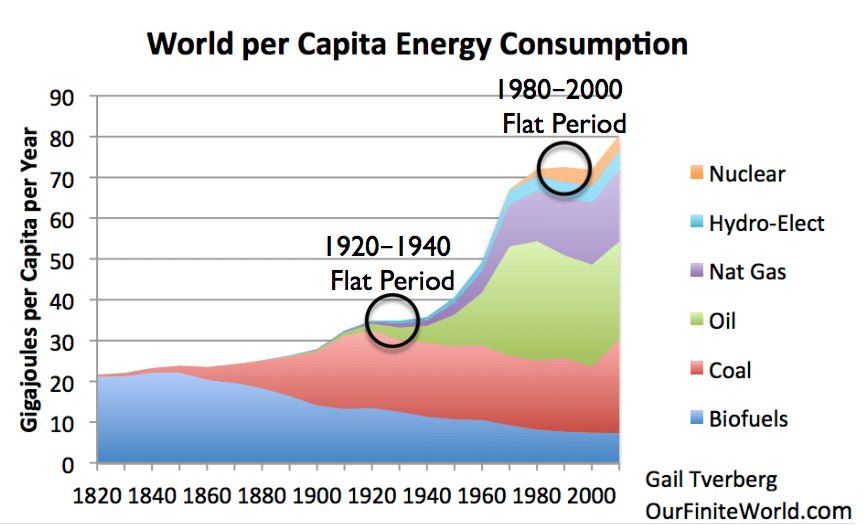
Figure 19. World per Capita Energy Consumption with two circles relating to flat consumption. World Energy Consumption by Source, based on Vaclav Smil estimates from Energy Transitions: History, Requirements and Prospects (Appendix) together with BP Statistical Data for 1965 and subsequent, divided by population estimates by Angus Maddison.
Conclusion
There have been many views put forth about what caused the Depression of the 1930s. To my knowledge, no one has put forth the explanation that the Depression was caused by Peak Coal in 1913 in the UK, and a lack of other energy supplies that were growing rapidly enough to make up for this loss. As the UK “exported” this problem around the world, it led to greater wage disparity. US farmers were especially affected; their incomes often dropped below the level needed for families to buy the necessities of life.
The issue, as I have discussed in previous posts, is a physics issue. Creating GDP requires energy; when not enough energy (often fossil fuels) is available, the economy tends to “freeze out” the most vulnerable. Often, it does this by increased wage disparity. The people at the top of the hierarchy still have plenty. It is the people at the bottom who find themselves purchasing less and less. Because there are so many people at the bottom of the hierarchy, their lower purchasing power tends to pull the system down.
In the past, the way to get around inadequate wages for those at the bottom of the hierarchy has been to issue more debt. Some of this debt helps add more wages for non-elite workers, so it helps fix the affordability problem.

Figure 20. Three-year average percent increase in debt compared to three year average percent increase in non-government wages, including proprietors’ income, which I call my wage base.
At this time, we seem to be reaching the point where, even with more debt, we are running out of cheap energy to add to the system. When this happens, the economic system seems more prone to fracture. Ugo Bardi calls the situation “reaching the inflection point in a Seneca Cliff.”

Figure 21. Seneca Cliff by Ugo Bardi
We were very close to the inflection point in the 1930s. We were very close to that point in 2008. We seem to be getting close to that point again now. The model of the 1930s gives us an indication regarding what to expect: apparent surpluses of commodities of all types; commodity prices that are too low; a lack of jobs, especially ones that pay an adequate wage; collapsing financial institutions. This is close to the opposite of what many people assume that peak oil will look like. But it may be a better representation of what we really should expect.


In December 2013, the world followed agog the plight of yet another “scientific expedition”, when 52 kkkklimate activists, accompanied by reporters from the BBC and the Guardian, sailed into the Antarctic to measure the effects of GGG WWWWWW on its sea-ice. By Christmas their ship was so dangerously trapped by thick, multi-year ice that they had to be helicoptered to a Chinese ship 10 miles away, which itself then got so trapped in ice that they had to be airlifted again to two other ships even further away.
http://www.telegraph.co.uk/news/worldnews/antarctica/10540241/Thick-ice-thwarts-efforts-to-rescue-ship-trapped-in-Antarctic.html
Har har har har…..
When it gets cold enough, water freezes. The humans figured this out long ago. Then, they called it ice. Clever, the humans.
But, alas, it just isn’t happening. In recent years there has been more polar ice in the world than at any time since satellite records began in 1979. In the very year they had forecast that the Arctic would be “ice free”, its thickness increased by a third. Polar bear numbers are rising, not falling. Temperatures in Greenland have shown no increase for decades.
Yee Haw!! BMC! As much as you want… it doesn’t matter
Empiricism trumps theory; there are comments that the sun is going through a solar minimum which during the Maunder Minimum coincided with the Little Ice Age. Apparently the sun spots are still more active now than during this period(disclaimer, I have not counted them nor verified those who claim to have done so) and assuming FF usage declines, it could become very interesting.
FE does have a unique way of pointing out certain contradictions of fact and reality.
Dennis L.
The following articles can be found on iceagenow.info.
Little Ice Age Tipping Point-Dec 17
The sun is blank – No sunspots
The sun is blank–no sunspots. Credit: SDO/HMI
“The sun is blank,” says reader Jack Hydrazine. “NASA data shows it to be dimming.”
“As the sun gets successively more blank with each day, due to lack of sunspots, it is also dimming. According to data from NASA’s Spaceweather, so far in 2017, 98 days (28%) of the days observing the sun have been without sunspots.
“Across the entire electromagnetic spectrum, the sun’s output has dropped nearly 0.1% compared to the Solar Maximum of 2012-2014.”
___________________
“Yesterday at Cape Canaveral, SpaceX launched a new sensor to the International Space Station named TSIS-1,” says reader Marcus. Its mission: to measure the dimming of the sun. As the sunspot cycle plunges toward its 11-year minimum, NASA satellites are tracking a decline in total solar irradiance (TSI).
“It appears that total Solar Irradiance is dropping,” says Marcus. “Although it may be a small change, small changes in the Sun’s output seem to have a large effect on this planet.
From another article on iceagenow.info
Sunspot count now lower than during the Dalton Minimum
According to NASA, the sunspot cycle we are now passing through – Sunspot Cycle 24 – is the smallest such cycle since Cycle 14, which ended back in 1906.
That is incorrect, says reader J. H. Walker.
“The problem with NASA’s sunspot count is that these are inflated by every blemish and spot fragment due to the optics they use,” says Walker.
If you use the Landscheidt sunspot-counting method, which counts only those spots that can be seen by 40MM optics, you realize that the current count is less than Solar Cycle 5. That solar cycle began in May 1798 and ended in December 1810.
It also corresponded with the Dalton Minimum.
The Dalton Minimum, a period of low solar activity named after English meteorologist John Dalton, lasted from about 1790 to 1830, says Wikipedia.
Like the Maunder Minimum and Spörer Minimum, the Dalton Minimum coincided with a period of lower-than-average global temperatures. The Oberlach Station in Germany, for example, experienced a 2.0°c decline over 20 years.
The “year without a summer” also occurred during the Dalton Minimum.
This is disturbing…
I am going to load up my 4 bah 4 with rocks right NOW… and drive around the block all evening.
Now I understand why Al Gore lives in such a big house. He KNOWS>
Efforts to reduce climate emissions seems to have had an opposite effect. Maybe Al Gore is the hero, making us burn more coal because he is secretly afraid of glowball kkkooling?
Thank you Jesse; there are more than a few people around here really dig out data which to quote some well known person trumps theory. One has to love the double entendre
made possible by current political leadership.
Dennis L.
How to identify Fake New:
Watch for repetition across the MSM….
All news is issued from the MNR – Ministry of Truth:
The cheapest source of the news wins (i.e. the same text sold to many media) and, moreover, the news must be in line with the media needs, i.e. profit from the product placement etc. Otherwise the media would sooner or later turn into doomer news…
All of them are actors or actresses, they say whatever is needed, some of them have/try the carrier of pronno actors, too.
So taken in had others been by all these dire predictions, that in 2008 the activist Gordon Lewis Pugh, after speaking at a conference alongside
Al Gore, set out to paddle a kayak to the North Pole – only to have to abort his trip after a few days because “the ice was too thick”. In 2009, the three-man Caitlin expedition, sponsored by a “kkklimate risk” insurance company, and backed by the BBC and the Prince of Wales, set out to walk to the North Pole.
Their intention was to measure the thickness of the vanishing ice with an electronic instrument, but it froze so hard that they had to resort to a tape measure. Again, after a few weeks, they had to be airlifted back to a rescue ship because the constantly shifting ice was “too thick”.
http://www.telegraph.co.uk/comment/11763272/How-Arctic-ice-has-made-fools-of-all-those-poor-warmists.html
Thus, rather than focusing on the idea of a conservative ploy to undermine Rouhani or that foreign policy is the driver of discontent, one should perhaps focus on the main grievance of the protesters — namely, “high prices.”
It is often assumed that low living standards and desperation will induce political mobilization. Yet protests are rarely triggered by the level of poverty in itself — namely, absolute poverty — but rather poverty on a relative contextual basis.
Enter the role of inflation. Theories such as the J-curve — which argue that “revolution is most likely to occur when a long period of rising expectations and gratifications is followed by a period during which gratifications … suddenly drop off while expectations … continue to rise” — seek to explain popular mobilization in the face of contemporary poverty by linking it to previous levels of wealth for the same group. Accordingly, “the majority of revolutionaries thus are likely to be poor people at loose endswho have made some progress toward a new and better life and see themselves now failing to do so.”
Here, the impact of oil price fluctuations on the shah’s regime is highly instructive. The shah’s vast, state-led development plans induced by the spike in oil revenue in the early 1970s radically increased money supply, causing spiraling inflation. Indeed, the average inflation between 1973 and 1977 was 15.66%, five times that of the preceding five-year period.
When oil prices receded between 1975 and 1979, Iran suddenly experienced an economic contraction that forced the government to cut down on services even as inflation remained high. Consequentially, the relative position of the working and middle classes in Iranian society remained static, with members of these key groups seeing their ambitions thwarted as inflation eradicated anticipated socio-economic gains. That the shah, through radical measures, managed to contain inflation in 1978, one year before his fall, was evidently too little too late. As such, applied in the Iranian context, the J-curve theorem explains the revolutionary potential and fermentation of political opposition as a result of thwarted expectations of continuing increases of living standards.
https://www.al-monitor.com/pulse/originals/2017/12/iran-protests-change-unlikely-mashhad-inflation-high-prices.html#ixzz52lCenNkS
XX makes a girl. XY makes a boy. YY doesn’t exist. The X chromosome is always present and the original. Life is female in form and origin. The sole purpose of man is to mix the dna. That’s what makes us men interesting and super intelligent…otherwise the females would lose interest in us…well…we try at least…
Lol
somehow reminds me of this great(est) love song:
Google search gave this, quoted verbatim , “This song is presumably about a rock ‘n roll relationship (either between two rockstars or one rockstar and someone who waits at home). He describes the rock n roll lifestyle and how it affects his relationship – e.g ‘my voice too rough with cigarettes’ and ‘I sometimes think I should just go home’.
It’s obviously a very sexual relationship – You welcome me with open arms and open legs’ – and when they see each other its for such a short time that most of it is spent passionately. Therefore when he says ‘I love you’ she says ‘you’d better!’ because otherwise their relationship would be JUST sexual, instead of a romantic relationship that simply isn’t granted much of a chance due to long distance.”
Man goes out to make a buck and asks for darn little. Assume “razor” refers to cocaine: Still, he asks her to “shove me back into line now.” It is what he has to give, keeps going with cigarettes(they work and HBR noted some time ago reduce health care costs overall), drugs, booze and of course sex at the end of the road.
Typical job for a male, here he works so damn hard(it is not easy to bring a crowd together) that it is pretty easy to lose it.
Dennis L.
The way to get a date is up to you, but the best way to handle the first date is get her laughing. Laughing is the key.
Best not to mention end of the world scenarios on a first date… or second or third…
BUT…. it would be a great way to break up with someone if you haven’t the heart to dump them….
“Best not to mention end of the world scenarios on a first date…”
though I can always hope she shows up wearing a t-shirt that says BAU tonight, baby!
But if you don’t like or wish to be bothered by people, lay it out to them straight…every time.
Yes, that is about it except part of being a man is going off to war, real or metaphorical and being fit enough and lucky enough to survive. Thus, we enhance the survival of the species, we men are so very useful and so ready to self sacrifice for the greater good. Makes one feel good to be lucky enough to be a man and take on these wonderful tasks.
Comment on rabble: The rabble have historically in America people who were willing to go to hard, dirty, boring jobs and do them day after day for a beer and TV at the end of the day so their children could have a better life. For this thankless task starting with the “Honeymooners,” they have taken it in the shorts being laughed at and ultimately labeled as deplorables and now rabble.
Point of grammar, in the use of rabble by Second Coming, rabbles’ is correct as we assume plural and a possessive here, it is the rabble who own the hopelessness. Private Security Contractors unless a proper name should not be capitalized. Lastly, this post assumes a deterministic system where Gail is strongly hinting the system is self organizing which implies little or no determinism. Determinism goes back to a time when there were no solutions to the three body problem, oh, heck think this one out for yourself.
Dennis L.
As far as I understand—which is dimly at best, there are many kinds of determinism (causal determinism [including nomological or physical determinism], historical determinism, theological determinism, necessitarianism, predeterminism, fatalism, logical determinism, etc.) and and a potentially infinite number of three body problems for which there appear to be no complete general solutions, possibly because three body systems appear to evolve chaotically over time.
I may be as thick os a whale omelette, and I can’t speak for the rest of the laity, but I’m afraid your comment sounds both ambiguous and incoherent to my untutored ears. Id est, it’s gone right over my head.
If you could explain, leaving out the philosophy, complex maths, and if at all possible avoiding words longer than three syllables, how this post assumes a deterministic system, how self-organization implies little or no determinism, and also whether this means that the author has become mired in contradiction at one or more semantic levels and on what epistemological grounds, it would be a kindness to those who really want to know what you are trying to elucidate but who can’t think “it” out for themselves because they are unable to read the signposts pointing to the “it” that you’ve left us.
https://imgur.com/k6ewk2L
Part of the collapse…we will go backwards…step by step…Homeland Guard, NSA, Private Security Contractors, and surveillance cameras and other tracking methods (GPS), will keep the working poor in line to the new world order.
Work hard, save and you have an opportunity to make it!
Hope Trump gets reelected… Not that we need any confirmation on the rabbles hopelessness
These will be the most powerful economies in the world by 2050 according to the PwC report
https://www.weforum.org/agenda/2017/12/these-will-be-the-most-powerful-economies-in-the-world-by-2050
They believe in infinite rise of the economies, not even taking into account that some of them have a history of defaults. And who knows which of them will still exist, when the states fall apart due to the energy decline. Especially, they believe in unrealistic annual average growth rates of the GDP, as if we do not know how the Japan economy looks like when the populations are ageing and the desperate Germany allowing the EU to be flooded by the lower quality immigrant workforce to save it from the decline of the highly qualified workforce. Etc.
https://www.pwc.com/world2050
Southern Barbaria will increase GDP with 700%? Tourism?
Experts seem capable of little less than extrapolation. Like the HDI projections a frew years ago predicting the world by 2030 would be run by the PIGS countries.
GIGO. Garbage in, garbage out…
These rosy views of the future are often combined with political correctness
https://www.weforum.org/agenda/2017/12/resolutions-2018-economics-bitcoin-top-stories-of-week
https://www.weforum.org/agenda/2017/12/same-sex-marriage-and-rights-for-saudi-women-reasons-to-be-cheerful-in-2017
Rosy visions of the future appeal to people who don’t know enough about history to know many similar predictions made by Bill Gates here
youtube.com/watch?v=rvj4dWsQ8Tk
were made in the past regarding less working hours. If people around the world are becoming more knowledgeable, this would have never happened.
youtube.com/watch?v=rvj4dWsQ8Tk
They must take some drugs when they make such crazy predictions…
Where do you think where all that demand for drugs came from?
As soon as the incomes of the top (ten?) percent started to grow much faster than everyone else in the late 1970s, drug use became a huge problem.
I assume that the top ten percent used a significant amount of their income on drugs in the 1980s. Plenty of poor people bought drugs but I think that they made lousy customers since they soon ran out of money. I was very young at the time, does anyone have any recollection of who was consuming all the illegal drugs in the 1980s? There sure was a lot of crime attributed to it.
There’a no need for drug use. Those predictions are part of a more civilized superior worldview.
http://muskanism.com/muskanism.html
In today’s social climate, words are violence.
https://www.nytimes.com/2017/07/14/opinion/sunday/when-is-speech-violence.html
You must not say nuthin bad or bad thing will happen and it will be nobody’s fault but your own.
People need to publish something. Every economy gets bigger and better in their models. China will be the world’s number 1 economy; then India; then the US; then Indonesia.
These people never thought about the need for energy of the right types to keep the economy going.
Yeah, but do Bill Gates and washed up music artists need to do conferences based on this faulty data? I doubt that conferences contribute very much to GDP. The money circulates among too few people.
The rankings don’t matter very much to me.
I don’t think they’re wrong about the sheer size of the developing economies. What they were wrong about in 2009 and are still wrong about how developing economies will drive global growth. There were some variations on this view of developing countries driving growth that suggest that growth will continue because developed economies will consume dramatically less. Developed countries were expected to undergo a noticeable reduction in living standards without collapsing. Capitalists would somehow intervene to keep the law and order in place. Developing economies were expected to pick up the slack on consumption but they would consume more efficiently–because the people who live in them were not entitled and because of innovations of efficiency that would allow the average person , (conveniently described as a college grad) to buy a $1000 car. There were numerous articles about how the U.S. needed to produce more engineers to retain its living standards because the return on capital was so great in developing countries. Economists were looking at the high levels of inflation that happened throughout the 2000s, and under the quantitative easing policies following the 2008 financial crisis in developing countries and assumed capital was flocking there because the return on all investment was phenomenal, particularly the investment of human labor.
I expect that they didn’t really stop to figure out that there really wasn’t enough energy supplies to go around, so that it wouldn’t be possible for the lesser developed economies to continue to grow. There really has to be buyers for all of the goods made in the world. The people with the low wages cannot really afford to pay for the goods that are being made today. The system stops growing, especially if debt growth slows and stops.
What is so special about the coal as energy source?
First of all, its storage is very cheap – you can store it outside, freely heaped. Not like oil or natural gas, which require pipes and storage tanks.
When the humans started to extract coal, only simple tools were needed. Human energy was enough to obtain large quantities of this energy source.
Today, with ever deeper and distant mines, we need more and more sophisticated machines to get it. Also, we need oil, natural gas and nuclear to build these sophisticated machines. The coal is no more a self-sufficient energy source to keep the civilization going on.
This widenind gap between the humans and the external accumulated energy they need for the survival is filled by machines, which constitute the more and more important intermediary.
In that way, the atheism is the product of this widening gap: the humans need more and more sophisticated technology to be in contact with the god – the external accumulated energy which creates the world suitable for the living of the human species.
That is why the technology becomes the god itself, as without the technology, there is practically no external accumulated energy (except for the wood) available for the humans.
IMO, the more the fuel emits CO2 while burning (per kwh), the better it is, as an energy source, for human civilization (not necessarily for individual countries). CO2 emisson from given fuel, is an indicator of energy denisty, and complexity needed to obtain it.
More carbon per kwh in fuel, means that the nature made more work to “prepare” this fuel for us. Less carbon per kwh, means, that it is we, that have to do more work to “prepare” this fuel. By “prepare” I mean whole global system needed to get energy from given fuel.
For example, coal is less energy dense, than oil, but it requires less complexity to get energy from it, and this is represented by higher CO2 emission. So, IMO coal is better for human civlization, than oil.
BURN MORE COAL!
It’s all good if it involves burning carbon … that’s for sure!
More C02!
MC02 = BAU!
There certainly are a lot of people who see technology as a god. In fact, people think technology can replace the need for energy.
Russian tankers fueled North Korea via transfers at sea
Russian tankers have supplied fuel to North Korea on at least three occasions in recent months by transferring cargoes at sea, according to two senior Western European security sources.
The sales of oil or oil products from Russia breach U.N. sanctions, the security sources said.
https://www.cnbc.com/2017/12/29/russian-tankers-fueled-north-korea-via-transfers-at-sea-reuters.html
Vlad the Bad….Strikes Again…
Or maybe Vlad the good.
Russia needs cheap North Korea workers. Who cares the UN sanctions when they need to pay North Korea for the supply of the desperately needed workforce?
https://www.nytimes.com/2017/07/11/world/europe/north-korea-russia-migrants.html
North Korea is a country that got terribly far behind with the collapse of the Soviet Union in 1991. They have never been able to catch up at all. No wonder they are so unhappy with the rest of the world. If Russia has work for some of its citizens, perhaps that is a solution.
They are building very sophisticated nuclear weapons and missiles which require very advanced manufacturing and knowledge level skills. Where is the capital both intellectual and physical coming from? Peurto Rico according to an earlier post is having great difficulty restoring a simple three phase electrical system. Why?
Are the North Koreans unhappy with rest of the world or is the rest of the world unhappy with them?
Dennis L.
I would suggest that Puerto Rico be turned into a test site for new bomb technology.
Set up a reality tv show of the island being bombed into the stone age.
Entertainment ++++
http://www.accuracy.org/wp/wp-content/uploads/2016/01/baghdad-bombing.jpg
Those NK laborers will probably work their way up pretty quickly, although Russia isn’t exactly a huge opportunity for advancement. Never has been unless a person is part of the small inner circle of Russian billionaires. Things really haven’t changed since the Tzars, just different players.
The NY Times labels some workers as slaves. An elitist paper read by super consumers comfortable in their excessive use of FF to live like kings, labels other workers as slaves. Those slave may have a differential perspective. The work may be opportunity.
Back in New Testament times, there was no distinction between slaves and servants.
When we visited The House of Seven Gables in Salem Massachusetts recently, we learned that the owners of the home used either slave or indentured servants in their home. Indentured servants were working to pay back their loans for care to cross the ocean. Their sleeping quarters did not have a fireplace. It was in the attic. It probably go pretty cold.
Many indentured servants were also sold over just as slaves war after being captured as war prisoners in Ireland or as beggars in cities like London, etc.
It would be better for all of us that the Russians and Chinese find ways to continue to supply North Korea with the oil they need to keep going. A collapsed North Korea would be very bad news. Yes, it must happen eventually anyway, but putting it off a bit longer and allowing it to happen naturally (so to speak) is better than forcing it to happen now.
It looks to me that the leaders of Russia and China recognise that better than most.
This article is from 2013 but shows the intention of Russia and China to integrate NK and SK into the Belt-Road Initiative-
“Russian President Vladimir Putin was in South Korea on Wednesday to push a pet project for a new major trading route linking Asia and Europe by rail that requires prying open North Korea.
Putin hopes his brief visit will include the signing of a memorandum of understanding on the ambitious project, which envisages an ‘Iron Silk Road’ uniting the rail networks of South and North Korea and connecting them to Europe via the Trans-Siberian Railway.
Russia took a first step in September, when it completed a 54-kilometre track from its southeast border town of Khasan to the North Korean port of Rajin.
Located in the far northeast, where the borders of North Korea, Russia and China converge, Rajin offers a warm-water port for the North’s two giant neighbours.
Putin’s desire is to see the rail link extended through North Korea, across the world’s last Cold War frontier, and all the way down to the southern South Korean port of Busan.
Media reports say Russia is looking for South Korea to take a 34 per cent share in the project, with Moscow holding 36 per cent and Pyongyang 30 per cent.
“But this is clearly going to cost billions of dollars and what companies are going to risk that much investment with North Korea in the current climate?” he asked.
“I’m sure North Korea will be keen, because once it got started, it would provide Pyongyang with a new project to manipulate and use to pressure others,” he added.
Lankov said the same financial and political risks applied to plans to build a pipeline to supply both Koreas with Russian natural gas.
Observers highlight the precedent of the Kaesong industrial zone jointly run by North and South Korea, which Pyongyang unilaterally shut down in April as military tensions surged.”
http://www.scmp.com/news/asia/article/1355114/putin-seoul-push-new-silk-road-north-korea
More than 8,000 store closures were announced in 2017 — here’s the full list
http://www.businessinsider.com/list-stores-that-closed-this-year-2017-12
How about all the new stores opening up? Dollar Tree, Dollar General, Family Dollar, Ross,
Marshall, TJ Max, all seem to be expanding….
Dollar General Dreams Big With 2,000-Store Growth Plan
The deep discounter looks to expand its footprint, while larger retail rivals reduce theirs.
Rich Duprey (TMFCop) Dec 15, 2017 at 6:05AM
A dollar and a dream might buy you a lottery ticket to riches, but Dollar General (NYSE:DG) is taking a different path to financial glory. The deep discount retailer unveiled a 2,000 store growth plan for next year that will see 900 new stores opened, 1,000 renovated, and 100 relocated.
Don’t discount the power of cheap
The dollar store concept is one of the few retail concepts that’s working. Where most retailers are trying to reduce their footprint, the leading dollar chains are expanding. Through the first three quarters of 2017, Dollar General opened over 1,000 new locations and remodeled or relocated more than 700 others, giving it a total of 14,321 stores in operation
Rival Dollar Tree (NASDAQ:DLTR), which operates 14,744 stores under banners, including Dollar Tree, Family Dollar, and Dollar Tree Canada, opened 466 stores so far this year and ultimately believes it can have as many as 10,000 Dollar Trees and more than 15,000 Family Dollars across the U.S.
Despite an improving economy, many people still struggle financially, and the deep discount chains are proving to be an effective way for consumers to stretch their wallets further. While the dollar stores still largely function as a destination for fill-in shopping, as they expand their food selections and increase the amount of perishables they offer by installing more refrigerators and freezers, they’re increasing both the number of visits consumers make as well as the basket size
https://www.fool.com/investing/2017/12/15/dollar-general-dreams-big-with-2000-store-growth-p.aspx
The new and improved BAU Baby
Yes….this is what you call a transitional period — as the consumer loses buying power — due to falling real wages and job losses…. he/she no longer goes to the Mall… or restaurants… or sporting events…. he/she shops only for what is necessary … any discretionary income goes to places where the best deals are (Dollar Stores)….
http://aspirekc.com/images/820992690fc1_12DAA/cliff.jpg
As the transition plays out…. this is what happens
http://static1.businessinsider.com/image/50dc9f8ceab8ea1d20000004/3-ways-to-cushion-our-fall-off-the-fiscal-cliff.jpg
http://cdn.shopify.com/s/files/1/0870/8326/products/earthquake_smashed_meredith_2725__51766_grande.jpeg
U.S. Economy: Squeezing The Consumer From Both Sides
Michael Lebow
December 27, 2017
The Federal Reserve raised the Federal Funds rate on December 13, 2017, marking the fifth increase over the last two years.
Even with interest rates remaining at historically low levels, the Fed’s actions are resulting in greater interest expense for short-term and floating rate borrowers.
The effect of this was evident in last week’s Producer Price Inflation (PPI) report from the Bureau of Labor Statistics (BLS). Within the report was the following commentary: “About half of the November rise in the index for final demand services can be traced to prices for loan services (partial), which increased 3.1 percent.”
While there are many ways in which higher interest rates affect economic activity, the focus of this article is the effect on the consumer.
The Consumer Squeeze
With personal consumption representing about 70% of economic activity, higher interest rates can be a cost or a benefit depending on whether you are a borrower or a saver. For borrowers, as the interest expense of new and existing loans rises, some consumption is typically sacrificed as a higher percentage of budgets are allocated to meeting interest expense. On the flip side, for those with savings, higher interest rates generate more wealth and thus provide a marginal boost to consumption as they have more money to spend.
This article focuses on borrowers and savers to show how the current interest rate cycle is squeezing consumers. Said differently, the rising cost of borrowing is dwarfing the benefit of saving.
Borrowers
As mentioned but worth repeating, personal consumption accounts for the bulk of economic activity. To gauge how higher interest rates might affect individuals’ spending, we classify personal debt into the following five categories: mortgages, home equity lines, auto loans, student loans and credit card debt. The following table shows the amount of debt outstanding in each category and estimates the percentage of each loan type that has fixed interest rates and floating interest rates.
Distinguishing between fixed and floating interest rates is important, as borrowers using fixed-rate loans are largely unaffected by higher interest rates. Accordingly, we focus this analysis on floating rate debt as those borrowers and consumers will see immediate increases in their interest expenses every time the Fed raises rates.
Based on the table, approximately $2.8 trillion of consumer loans outstanding are floating rate. We calculate that every 25 basis point (0.25%) interest rate hike by the Fed will increase interest expense higher by $7 billion annually for these consumers. Since December 2015, when the Fed began to hike interest rates, the Fed Funds rate and other interest rates to which consumer debt is frequently indexed are about 125 basis points higher. Thus on an annual basis, the additional cost of borrowing is approximately $35 billion. Looking forward, if the Fed raises rates three times in 2018 as they currently forecast, the annual interest expense will increase by another $21 billion to bring the total to $56 billion per year
Savers
To do a complete analysis of the effect of higher rates on consumption, we must look beyond the increased interest costs, as quantified above, and also consider the benefits of higher interest rates to savers. According to the Fed, personal savings equals $471 billion. The increase in interest rates should reward savers, which will help offset the economic burden related to the increase in interest expense.
Interestingly, what should happen and what has happened are two different stories. The truth of the situation is that individual savers have barely benefited from higher rates as banks and financial intermediaries are not passing on higher rates to savers. The chart below provided by WalletHub and Wolfstreet.com compares the change in the Fed funds rates and credit card interest rates to instruments of savings. Please note the table does not include the most recent increase in rates on December 13, 2017.
Interest rate changes by loan type years 2015 to 2017
interest rate changes by loan type 2015 to 2017. Source: Wallet Hub via wolf street.com
Based on the graph and the data above, it is fair to say that borrowers have benefited by less than ten basis points (0.10%) on average despite 125 basis points (1.25%) of interest rate increases. Based on total savings of $471 billion, we can approximate the benefit to borrowers is a mere $600 million.
Summary
Consumers are being squeezed. Debt linked to short-term interest rates is rising lockstep with the Federal Funds rate while savings rates remain stubbornly low. While the dollar amounts are not massive, the transmission mechanism of the Fed’s rate hikes is acting like a tightening vice that will result in less consumption and slower economic growth.
One of the key takeaways from the Fed’s action during and following the financial crisis of 2008 has been a prolonged and intentional effort aimed at crushing savers. Near zero percent savings rates is part of the Fed’s strategy to incentivize savers to move out of the security of cash and invest in riskier assets and/or consume. Even today, despite the rise in interest rates, banks accept the benefits of higher rates imposed on borrowers while refusing to adjust rates for savers. As one of the primary regulators of the financial system, the Fed could encourage a change in that behavior, but to date, no such influence has even been mentioned. Interestingly, the savings rates that banks earn on deposits at the Fed has increased lockstep with Fed Funds.
After nearly a decade of imposing its unique brand of price controls over the cost of money, the Fed admittedly is not willing to do that which is in the best interest of the general public
https://www.seeitmarket.com/u-s-economy-squeezing-the-consumer-from-both-sides-17619/
I am sure you are trying to make a point with this…. Reader’s Digest version?
Lots of charts that Gail likes to post!
You go Girl….
Any New Years Resolutions…. Anybody?
Consumers are definitely being squeezed by higher short-term interest rates. Long-term interest rates don’t seem to be up much yet. The article talks about the consumer being “squeezed from both sides,” but doesn’t mention higher energy prices, at least that I noticed.
JHK with an excellent article today… wildly entertaining… he concludes:
“Coming on Monday: Forecast 2018. Spoiler alert: I’m notoriously wrong about everything, further proof that reality is a slippery fellow….”
ha!
a short time ago, I posted here on OFW how infamously wrong he usually is…
gold star for me!
though…
he’s echoing my post now… (my ego grows…)
could it be that he reads OFW?
right, JHK?
He is so wrong. All the time. And yet, he writes so well. It is a conundrum. So, Fast Eddy, JHK, and Alex Tribek walk into bar …
he writes so well:
http://www.theamericanconservative.com/articles/beyond-cynicism-america-fumbles-towards-kafkas-castle/
“This will be the moment when either nobody has any money, or there is plenty of worthless money for everyone. Either way, the functional bankruptcy of the nation will be complete, and nothing will work anymore, including getting enough to eat.”
we soon will see if he predicts this for 2018.
“So, Fast Eddy, JHK, and Alex Trebek walk into bar …”
the bartender says “Look, I’m getting pretty tired of being the subject of your jokes.”
Eddy says “Is that because you’re a more on?”
JHK says “This will be the moment when either nobody has any money, or there is plenty of worthless money for everyone.”
Trebek says “I’m sorry, James, that wasn’t in the form of a question.”
Nicely done!
I will be performing here at the Venetian room (aka OFW) on weekend nights through 2029.
I know that JHK reads OFW at least some of the time.
I had asked JHK to interview you Gail for his podcast. Any chance? He said he was interested in doing so.
That’s a great idea..I second that.
JHK has interviewed me on his podcast. He did a good job. He was quite knowledgeable about what I had been writing about.
https://www.bloomberg.com/energy
WTI oil edges up over $60 a barrel! Price has been steadily inclining now for quite a few months.
Is that not only a function of the dollar weakening?
dollar heads for worst year since 2003…
https://www.cnbc.com/2017/12/28/dollar-wallows-near-1-month-low-commodity-currencies-supported.html
of course, “worst” depends on which side you’re on.
Lower dollar = higher price of oil.
Oil producers need higher price of oil, so lower dollar is good, at least for a while.
https://www.usnews.com/opinion/economic-intelligence/articles/2017-08-22/under-trump-the-dollar-is-weakening-when-it-should-be-strong
“President Donald Trump seems to favor measuring his economic performance by the way in which the U.S. stock market is doing. However, a more revealing and less rosy measure of his economic performance might be coming from the currency markets.
Following an initial bump up in the dollar’s value at the end of last year, on the prospect of a Trump presidency, the dollar has lost as much as 10 percent of its value since January 2017, Trump’s inauguration. This sharp dollar decline suggests growing doubts on the part of currency traders as to the direction of U.S. economic policy.
The dollar’s recent decline is particularly troubling, as it comes at a time when two historically very dollar-supportive factors are in play. The first is that the Federal Reserve has not only continued to raise interest rates, but has also intimated that it would soon start to reduce the size of its balance sheet.”
This makes sense because what investors want is STABILITY. It’s when things are unstable the markets get shaky. Trump is a volatile president instigating arguments, verbal and twitter fights while also edging close to war with NK.
The lower the value of the dollar, the more dollars it takes to buy a barrel of oil.
I would mention that Rogoff- Reinhart have published research that pegs a GDP to national debt ratio of 95% + as the line where large debt holding become dangerous. We have been around 105% for several years now.
With the new GOP Tax Bill, we are adding around 1.5Trillion$ to the US National Debt. So this gives us a GDP/Debt ratio of around 112%+.
Deep in the danger zone.
what if they are flat out wrong?
(isn’t there a new normal?)
what if the real danger zone is 300 or 400 or 500 percent?
https://www.bloomberg.com/graphics/2017-arctic/the-economic-arctic/
There’s at least one big reason why Russia is poised to remain a dominant player in the region: the country is rich in natural resources, a disproportionate amount of which lie in the Arctic. That’s why the north already makes up about 20 percent of the Russian gross domestic product, and Russia contributes about two-thirds to the overall Arctic economy. President Vladimir Putin has presided over financially and technically ambitious energy exploration goals. He officially opened a $27 billion liquefied natural gas plant, called Yamal LNG, the first week of December on northwestern Siberia’s Yamal Peninsula.
Russia’s Arctic list is heavily populated with hydrocarbon projects, from new or expanded gas fields to refineries and the ports, pipelines and rail needed to move the product.
Drilling opportunities are expanding in the U.S. The Trump administration is preparing to open Alaska’s Arctic National Wildlife Refuge along with the Chukchi and Beaufort seas to drilling.
China’s ambitions in these regions have not received due attention, in part, Brady says, because so few Western journalists speak and read Chinese. The country has deployed what she calls “two-track messaging,” sending alternative signals to domestic and international audiences. President Xi Jingping in November 2014, for example, spoke in Hobart, Australia, where for the first time he stated that his country will be “joining the ranks of the Polar great powers,” which Western media largely missed.
In June, the government broadened its ambitious Belt and Road Initiative for trade to include the Arctic. China cannot physically claim Arctic territory, but it can buy stakes and influence wherever it seems wise.
BAU is alive and well for 2018
The Arctic is probably mostly natural gas, rather than oil. Natural gas is not worth a whole lot. Shipping costs don’t leave much for extraction costs.
“BAU is alive and well for 2018”
ah, a voice of reason.
US Government CBO Office Projects Less Than 2% Economic Growth Over The Next Ten Years
https://www.cbo.gov/publication/52801
The Great Depression 1929-1940 Economic Growth 1% GDP
https://en.wikipedia.org/wiki/Great_Depression
http://www.history.com/topics/great-depression
Americans View Government as Nation’s Top Problem in 2017
http://news.gallup.com/poll/224219/americans-view-government-nation-top-problem-2017.aspx
Ultimately, our top problem is that we cannot afford to do everything we want to do. Protecting the environment looks like it might be a nice goal, but we don’t have the resources to do it. We would like to continue all of our programs for the elderly and the unemployed, but these become too expensive as well. These become “government problems.”
What about our Military spending it accounts for nearly half or our entire budget. The Pentagon is the largest employer in the entire world.
Not true. Entitlements are the biggest source of spending. Military amounts to 16% of spending. Too many people focus on “discretionary spending.”
https://media.nationalpriorities.org/uploads/total_spending_pie%2C__2015_enacted.png
I don’t pretend to understand how all of that works, but I lean toward the Carlin ideal that I don’t believe government stats. I would guess at least 1/3 or that money is “stolen”. Where’s the CB’s pie slice that shows the injections to the private banks and wall street?
(Grrrr, I’m just in a cynical mood, no need to answer)
Just to add, saw this on reddit.
https://www.liveleak.com/view?i=08f_1514326890
In some sense, there is no difference between Social Security, Medicare, and all of our other spending. Checks get printed each year, and they go to buy goods and services that year. Part of the taxes that are collected each year are Social Security and Medicare “contributions” (really taxes). When there was some intentional over-collection of Social Security amounts, those amounts got spent, anyhow, on something else. CBs didn’t make injections in 2015.
If CBs buy debt, I don’t think it would show up in the calculation, though. In theory, it is extra funds that were spent. And now when that these securities are being sold, this is negative spending. This is a real problem, and should somehow be reflected. It would likely lead to higher interest rates.
The Republican party does not like it when the numbers of poor decline like they did during Bill Clinton’s presidency. A special joy fills them (because of the winner take all mentality), especially during xmas holidays to know of the burgeoning numbers of homeless, but I think we are just at the tip of the ice berg to come. As entitlements are ripped to pieces this next year (to help pay for deficits caused by reducing corp. taxes from 35 to 21%) before the next elections, look for those homeless numbers to balloon.
The number of poor declined when oil prices were very low.
As I recall, it was Bill Clinton who ripped entitlements to pieces back in the 90s with his overhaul of the nation’s cash assistance program for the poor, converting it from an open-ended benefit to a time-limited one conditioned on work effort and funded by a fixed federal grant to the states (plus state dollars). Supporters hailed the new program, Temporary Assistance for Needy Families (TANF), as the antidote to the previous system’s perverse incentives for dependency, especially among single mothers. Opponents feared it would cast poor women and children into deeper privation. Among the opponents was then-Rep. Bernie Sanders (I-Vt.), who has lately been claiming vindication, blaming the Clinton-era bill for “scapegoating” vulnerable people and doubling the number of families in extreme poverty.
The real defense expenditures are about 25% of the US federal budget.
https://cdn.theatlantic.com/static/mt/assets/steve_clemons/Defense%20Budget%202012%202013.jpg
Sorry, below is the whole article.
https://www.theatlantic.com/politics/archive/2012/02/the-real-defense-budget/253327/
Military spending fluctuates every year. You attempt to prove Gail wrong and by posting data from a different year and from a source known to have a very liberal bias,
The U.S. intelligence operations should be counted as part of the U.S. defense budget. Why are figures for the money the U.S. federal government spends on espionage not included?
This discussion about Republicans wanting to raise military spending ignores the reality that you probably would not be alive without the U.S. military making sure you consume way more than your share of the world’s national resources.
http://beta.latimes.com/politics/la-na-pol-trump-military-20170303-story.html
And Trump wants 54 billion more for Defense, but I think that’s just a taste of the increases he wants. 2018 will bring Ryan’s new plans for Social Security, Medicare and Medicaid in which each one of those is greatly reduced to shift more emphasis to defense. Trump asserts Defense has been hollowed out, so there probably is no end to how much more he’d spend of Ryan can free it up.
US Military Spending VS Other Countries
https://ibb.co/c4VqUw
I think you and Baby Doomer would be happier if you two moved to Canada.
How many times are we going to be subject to political rants, as if prosperity can be voted into office?
Think of “Defense” as just another way of making government jobs for people. We can call them whatever we want–looking for guns in carryon luggage, for example. Whether we want to call this defense or not–who cares? Japan and China very directly make jobs for people. In the US, the way be make jobs for people is through “defense.” If we can sell weapons to other countries, this also helps make jobs for people.
And….. a strong military means we get most of the meat from the kill…. we leave victims fighting over the bones….
Where does the electric for electric cars come from? Walking and bicycles are the future.
Walking;
https://www.interesly.com/wp-content/uploads/2017/02/tread-mill_resize.jpg
Bicycling:
https://i.pinimg.com/736x/69/c6/22/69c6220700b9b2b19978136ff3839130.jpg
Of course you are right, Ed. Running is good too.
However, I do think the bicycling is a little iffy.
Making bicycles and repairing them takes energy as well. I think walking is the way of the future.
https://www.youtube.com/watch?v=8z15LXcTnJQ
https://www.youtube.com/watch?v=JM_x0qPM8Ok
I have a new app for self driving cars. In high rent areas people can sleep in their car as it randomly cruises down slow 30mph roads all night long. Silicon Valley will no longer have a housing problem. For abut 800 $ per month of gasoline you have your home far cheaper than rent. Add a club fit membership for shower and dinner, breakfast and lunch at work you are set. You can even have a cloud cat.
What if you wake up in your self-driving car at 2AM in a Rodeo Drive neighborhood and need to deal with immediate bathroom issues?
Asia’s Fastest Growing Economies Have the Fastest Growing Slums
https://www.bloomberg.com/news/articles/2017-03-01/booming-asian-nations-grapple-with-the-rise-of-shantytowns?cmpid=socialflow-twitter-business&utm_content=business&utm_campaign=socialflow-organic&utm_source=twitter&utm_medium=social
One thing I notice is that India is conspicuously absent from the list. I would think that India would have a very significant share of its population in slums. It also is growing a whole lot faster than China. (The article is about the “fastest-growing countries.”)
Also, I am sure you can define “slums” in different ways. China seems to have better control over urban population than other countries. But China still shows as high a population in slums as several other countries. I don’t think it is informally built homes, to nearly the extent it is in some other countries.
As the article says in the second paragraph, it’s about East Asia and the Pacific.
Many years ago, when I was working in Singapore, a Singaporean Chinese colleague was telling me about her cousin visiting Mumbai and not seeing any “Asians” there! I just replied that it was like saying you had been to Italy but couldn’t see Europeans there. Have noticed the tendency to use “Asia” and “Asians” to mean East Asia in media over the years.
Yes, “asians” are people of mongoloid race from the asian continent.
“Indians” are indians, and indian-looking people, pakistan, bangladesh.
Going further west it becomes tricky because labels become more loaded.
China has not slums…. because they give away free apartments to the homeless…
https://www.forbes.com/sites/wadeshepard/2016/11/18/chinas-most-infamous-ghost-city-resorts-to-coupons-to-fill-vacant-homes/#c66b58d7c01c
https://www.sbs.com.au/news/sites/sbs.com.au.news/files/styles/big_picture/public/images/gallery/5172/ordos3.jpg
Exactly!
Photographer: Laurentiu Garofeanu/Barcroft via Getty Images
The U.S. Population Is Growing by One Person Every 18 Seconds
https://www.bloomberg.com/news/articles/2017-12-28/the-u-s-population-is-growing-by-one-person-every-18-seconds?cmpid=socialflow-twitter-business&utm_content=business&utm_campaign=socialflow-organic&utm_source=twitter&utm_medium=social
I bet they’ll be ample opportunity for good jobs, living wages, potable water, breathable air and affordable communities for all of them. /s
“breathable air ”
That’s all they need.
time to buy!
https://www.cnbc.com/2017/12/28/teslas-back-in-bear-market-territory-but-it-could-be-a-great-buy-here-says-market-watcher.html
also…
Ripple (XRP) doubles!
now $2.19…
market cap $84 billion!
this is going to save the world!
http://static2.businessinsider.com/image/559c37c56bb3f708695ff6da-1200-924/bull-gore-san-fermin-festival.jpg
man vs nature…
ever notice how TPTB never allow anarchy?
Baltimore has now had 343 homicides in 2017, sets record for killings per capita
http://www.baltimoresun.com/news/maryland/crime/bs-md-ci-per-capita-homicides-20171227-story.html
Clearly, a sign of institutionalized racism at work. /sarcasm
Just got to focus on the good, ignore the bad,,,like in Florida (sarcasm)
A strategy that’s clearly working.
Data just released by the Florida Department of Juvenile Justice shows 884 fewer teenagers in-trouble with the law over the last fiscal year. That’s a 14% drop.
“It certainly is a proud moment for us,” said McKinnon
ernor Rick Scott credits innovative and aggressive reforms aimed at keeping teens out of the system.
Statewide, the number of juveniles arrested in the last fiscal year dropped below 65,000. That’s the lowest number in 42-years.
“That really amounts to hard work, a lot of good, old fashioned police work, and educating the public and us working together to keep these crimes down,” McKinnon said.
http://www.fox13news.com/news/local-news/juvenile-crime-down-14-statewide
RIDA POLITICS
Rick Scott: Juvenile crime is down, pay correctional workers more
A.G. GANCARSKI
12 hours ago
Gov. Rick Scott trumpeted a 42-year low in juvenile arrests Thursday in an attempt to secure a double-digit pay hike for youth correctional workers.
Governor Scott said, “Our state has made significant strides in reforming our juvenile justice system and I am proud to announce today that juvenile arrests have dropped to a historic 42-year low. Today’s announcement would not be possible without Florida’s juvenile detention and probation officers, who work each day to redirect our youth to a successful path. I will be working with the legislature during the upcoming session to pass a 10 percent pay raise for juvenile detention and juvenile probation officers so we can reward them for their critical work.”
Orange and Hillsborough Counties paced the field, with 15 percent and 14 percent dips in youth arrests year over year.
But some categories — felony drug arrests, weapon/firearm intake, fraud/forgery/counterfeiting, felony vandalism, stolen property, escape intake, obstruction of justice, and “other” felonies — saw statewide year over year increases.
Despite those categorical complications of narrative, Department of Juvenile Justice Secretary Christina Daly offered a buoyant note.
“More than six years ago, DJJ committed to improve Florida’s juvenile justice system through innovative and aggressive reforms. The continued decline in juvenile arrests year after year demonstrates our reform efforts are working,” Daly said.
“We will continue to work with law enforcement and our community partners to keep even more kids out of the juvenile justice system, provide the very best services for those that do come into our system, and work hard to help steer every youth down the right path,” Daly added.
Other states, ranging from Alabama to California, have seen decreases in youth crime in recent years — which raises questions as to whether “innovative and aggressive reforms” are actually responsible for the statistical decrease.
Amanda Slama, deputy communications director for the DJJ, said that Florida is benefiting from increased use of civil citations and other diversion tactics, which “keep kids out of the system.”
Regarding areas with increase statewide, such as those enumerated above, they signify that there still is “work to do,” per Slama.
You got to love propaganda…it makes me feel warm all over!
Here in South Florida all we hear on the news is “kids killing kids” with guns and “its got to stop”. Who is taking the stats anyway? Or maybe they’re not doing a very good job! LOL
On the outskirts of town next to the nuclear power plant there is a bar called “Know Limits.” The bartenders name is Stan. One day, a lawyer a doctor and Fast Eddy walked into the bar. What’ll have?, asked Stan. A shot of whiskey for everyone said the lawyer.
All of a sudden it began to rain really hard. The doctor said, “that’s a real Deluge, eh Stan?” Fast Eddy screamed, “where?, where?”
He then pulled out his laptop and began typing furiously.
Thank you, thank you very much. I’ll be here for the next two years doing two shows a night in the Venetian room.
got it!
but whoa… took me a few minutes…
I guess I’m getting old.
ps: an old saying: it’s not funny if you have to explain it.
pps: the Venetian room will be open through the 2020s.
A Politician and Geologist walk into a bar
The Bartender says ” I don’t have any beer, we ran out of cheap oil and the economy collapsed”
The Politician says “Nobody saw this coming”…. 🙂
a termite walks into the bar and asks:
“where’s the bar tender?”
And … inside the brick…. as we can see from this xray is:
https://pbs.twimg.com/media/CiAuPXXXEAAGIQX.jpg
Is it a donut?
Is it a long round finger pointing at the moon?
No, dare’s a turd (as the Irish say) explanation for it.
The person being photographed is a victim of the “Baltimore Broil”.
Question for FW readers.
Did you ever notice that the people who deny we are going to collapse the most. Are also the people who have the most to loose?
Not really. There are a lot of poor people who believe in BAU…in technological progress, , that education and buying house are avenues out of poverty.Poor people, or people who are trying to improve their living standards have a lot to lose if their hopes, now based on trying to achieve Heaven on Earth rather than going there after they die, have just as much invested in BAU as the rich.
C’mon, Cliff. You know better to imply that all doomers are people who are angry at the world and would love to see it burn.
first of all, the persons who have the most to lose are younger.
old rich persons really don’t have much to lose… they’ve lived their jet set lifestyles and soon will enter the nothingness of eternal death.
younger persons, say 32 years old or less, likely would have more than half of their lives still ahead of them…
if The Collapse happens sooner rather than later, they lose those decades that could have been prosperous.
guys like me, late 50s, should have gotten enough out of life by now…
so I don’t see where I have much at all to lose if The Collapse is “sooner”…
but I still predict it will be “later”, at least into the 2030s.
“I still predict it will be “later”, at least into the 2030s.”
I agree. Collapse has been predicted ever since I first found out about peak oil in 2005 and here we are about to begin 2018 and nothing in our area is any different, more oil than ever is being extracted and produced into products, life expectancy hasn’t changed much and people are still having kids. So I guess collapse is still going to happen, but it seems like 2030’s is as good a guess as any.
Either that or there won’t be any collapse per se’. The other scenario that is possible is TPTB find ways to eradicate the poor and population numbers dwindle to reduce pressure on resource consumption. They could use insect drones fitted with syringes to sterilize the poor in their sleep and no one would know because they would be the size of a fly. Even if someone smacked one, it would just smash into nothing. In this same manner they could also inject them with PCP to become temporarily psychopathic and kill one another. I would venture to guess republican politicians discuss these type of scenarios quite often with their super wealthy clientele. “Well, what do you think of this possibility? I heard from a pharmacist there is another way to do this. I have a friend that has developed an insect drone that can deliver the serum.” That type of talk at luncheons and so on.
Yes, a massive reduction in number of humans is needed.
Problem is if you do that US loses power. If you do it all over NATO soon the world would be run by Vlad and The Chinks.
You need a population decline over the whole industrialised world.
And why is that a problem….Vlad running things?
If the purpose with killing of 90% of US/Nato population is saving the environment/resources, Vlad and The Chinks running things might mean they use the resources instead.
Yes a global reduction of 99.9%
JH you are a political bigot.
“guys like me, late 50s, should have gotten enough out of life by now…”
so I don’t see where I have much at all to lose if The Collapse is “sooner”…
This view is incorrect. I don’t think your personal outlook is a reflection of the outlook of most people your age and above. There are plenty of older people who get upset at any reduction in their standard of living, whether that is in the form of higher taxes or reduced benefits. They may not be able to get as much out of life as younger people can, but they still want to stick around for what they feel that they are entitled to. I can’t speak for other countries but I can say that, as someone who lives in the U.S., reducing the amount of money spent on entitlement programs is the third rail in U.S. politics.
I have a relative, 70 years, who is reduced to watching tv, and must cost a fortune in health care. He won’t check out earlier than he has to.
That ties in with my schadenfreude theory about wealthy people who scrutinize every dime…. and believe they are precious….
They will be the last to accept the nature of our predicament…. they cannot imagine eating boiled rat…. with an appetizer of cat meat.
tastes like chicken…
er…
so I’ve been told.
In the gulags it was not the peasants who survived the longest; it is my understanding that many wealthy Germans after WWII were still wealthy. Is it possible that there is something more than money to the 1%?
Joke:
Cowboy is met at the gates of Heaven by St. Pete who asks the cowboy,” what you like?” The cowboy answers with a question, “You mean I can have anything I want?” St. Pet answers, “Yes.” The cowboy asks for a new pair of jeans, a new pair of boots, a new cowboy hat and a pocket full of money. St. Pete grants his wish and invites the next in line to come forward and asks the same question to which he gets this answer the new soon to be resident of heaven. “I would like his name and address and that of six more just like him.”
The more things change the more they stay the same.
Dennis L.
Did you ever notice that the people who deny we are going to collapse the most. Are also the people who have the most to loose?
No, I never noticed this. But then again, over 99 percent of all the people I’ve spoken with about the subject have been deniers. Generally, it has never occurred to them that economic collapse, as we use the term, could possibly happen, and when confronted with the possibility it is unsurprising that their first reaction is one of incredulity.
So what is the person you are talking with supposed to do? I am here listening for answers and the most consistent is to party like it is 1999. With little joy I suspect we are closer to major change than most of would like to admit, but it didn’t happen in 2017 for all practical purposes.
A simple thing like a garden is a tremendous amount of work and for a reasonable amount work just does not have enough calories. In my youth my parents had a garden, my mother canned, things ran out in spring; the grocery store filled the gap.
Recently driving down the road I saw a lovely array of solar panels, they were covered with snow. They are expensive as the dickens and when it snows, they don’t work and yes the sun was shining.
How should we then live? Shakespeare understood well the twin masks of tragedy and comedy. Both Shakespeare and the Bible were written/collected with out FF, if it has been done, it can be done.
Dennis L.
We live in a world of self-organized systems. Now all of our systems depend both on electricity and on having an oil-based transportation system. In fact, they also depend on having international trade, and on having financial systems.
Back years ago, we had a different self-organized system, built around what was available then. There were candlemakers. Women learned to spin their own wool. Many fewer people were able to go to school. People often walked many miles to school.
The big problem is that we cannot go backwards. If one self-organized system “breaks,” we cannot go back to a previous one. An obvious example is that we cannot go back to using horses, instead of cars. We don’t have enough horses, and even if we did, we would have a huge manure problem in the cities, with all of the horses used for transportation. We don’t have the sheep for growing our own wool, and people doing have the skills to spin our own wool yarn and make our own clothing. We would not be able to heat our homes, if we didn’t have electric heat, or natural gas heat. Pipes would freeze. Jobs would very quickly disappear.
I find it fortunate to have malls to walk in, especially in the cold. But it isn’t a slam dunk. The mall management feels they have to hire security people to monitor the crowd, and they can be badly trained. This has made me see the importance of having living situations that are combines with mall-like spaces which allow (especially seniors) to walk safely. That kind of development would tend to supply work and entertainment within this monitored space. More people would tend to stay in one place and neither travel by land nor by air. Being able to work and socialize on Facebook takes the edge off of not traveling physically. This does not seem impossible in the near term, addressing what you say about road transportation, which of course can’t be foregone. But it seems we can move a little closer to a “shelter-in-place” kind of civilization. A reworking of existing malls and strip development might be a good area for growth.
I’m not a guru, a preacher or a sage. Well, in fact, I used to have a tendency to preaching so these days I make an effort not to mount the pulpit. Even when asked for advice on what another person should do, I hesitate to give it because I’m not an authority on anybody else’s life. We are each of us the ultimate authority regarding our own experience, and so I hope I would never try to tell another person how they should live their life.
In my conversations with other people, for the most part I play the interviewer. I try to find out what they believe and what their opinions and concerns are. That way I can get an idea of how close their “reality” is to my own. But I’m mindful that for each of us, our own experience is absolute. It isn’t something we can or need to negotiate with others and try to come to an agreement about.
Online, things are a bit different, as a lot of the characters who pop up to comment on blogs or news/opinion articles are cartoon caricatures of real humans—and there are a few of them on OFW too. At least, whether they know it or not, this type of blog commenter is a performance artist, so if we engage with them, it is quite all right to do so in an over-the-top Loony Tunes vein.
Generally speaking, each of us is ultimately responsible for how we live our life. That’s our burden as human beings. As Jesus put it, “Foxes have dens and birds have nests, but the Son of Man has no place to lay his head.” My take on that is that other animals don’t have the flexibility of choice that we have as people, but on the other hand they don’t suffer the anguish of having to think and worry and make complicated decisions and contemplate their fate. Also, Shakespeare offers some fruitful insights. One that seems apt for contemplating our individual and collective fate this one from Macbeth:
She should have died hereafter.
There would have been a time for such a word.
Tomorrow, and tomorrow, and tomorrow,
Creeps in this petty pace from day to day
To the last syllable of recorded time,
And all our yesterdays have lighted fools
The way to dusty death. Out, out, brief candle!
Life’s but a walking shadow, a poor player
That struts and frets his hour upon the stage
And then is heard no more. It is a tale
Told by an idiot, full of sound and fury,
Signifying nothing.
Looking back now, as a child, I lived much more in the present and didn’t dwell very much on the past or the future. I had been taught that all living things were bound to die, but I personally felt immortal. Old age and death were well over the horizon for me then. Now I am approaching 60 and I am strolling through a world of old age and death personified in a long list of relatives, friends, acquaintances and even a few enemies. It seems the most natural thing in the world that I am going to get personally acquainted with old age some time soon if death doesn’t take me first. So regardless of whether BAU continues or what form collapse takes, I am not personally going to enjoy eternal health, peace and prosperity in this world, and I will be really really chuffed if I get to experience it in the next.
At most times and in most places, human life has been nasty, brutal and short. We in the affluent parts of the world have been fortunate—blessed even—to have been able to party, thanks in the main to a combination of cheap fossil fuels and ingenuity. Over the past half-century, the party has become an orgy, and orgies seldom end without a hangover. Most people who consider the situation at all are assuming that as long as we keep applying enough ingenuity, we can get by without cheap fossil fuels. One of the reasons that wind turbines and solar panels have become so ubiquitous is that they symbolize the hope and confidence that we as good citizens are expected to have in our sustainable prosperity. Just as the crucifix symbolizes our eternal life in Christ, so these renewables remind us that we don’t have to go back to a world in which human life is nasty, brutal and short. Hence the nickname, “Solar Jesus”.
If we don’t have faith in Solar Jesus, there are lots of other ways we can get by joyfully. There are a variety of faiths built on the idea that we don’t have to be attached to outcomes, or that we should not be concerned about those things that are beyond our individual control, or that our true liberation comes when we free ourselves from the tyranny of our own egoistic thoughts and pretensions, or even that “life is but a dream”, as the Eton Boating Song has it.
I don’t know how the world is going to roll on from here. I don’t know if Seneca cliffs or leaking spent fuel rods will do for us, or if the El Ders will cull us with bioweapons, or if our civilization is going to keep rolling merrily onward. But I think Gail’s economic analyses make a lot of sense in the light of what we know about the world, and I also note that I’ve never seen any serious attempt to “debunk” or invalidate her work. And if she was seriously mistaken, I would have expected to have seen that by now. And while Gail, quite wisely, doesn’t go in for doomsday predictions, her analyses clearly point in the direction that the current system cannot continue and renewables as currently envisaged cannot save the day. So if and when collapse happens, at least readers of OFW will not be surprised.
You are almost there Dennis…. you are beginning to understand the futility of attempting to survive…
The answer to your question is — there is nothing we can do other than try to keep BAU alive for as long as possible — because when BAU goes — violence, disease, starvation and spent fuel pond radiation bust through the castle gate …. and overrun us.
Have a good day. Make sure to enjoy every minute of it. It could be your last.
Higher oil prices needed to sharply boost U.S. drilling: Dallas Fed
https://www.reuters.com/article/us-energy-spending-usa/higher-oil-prices-needed-to-sharply-boost-u-s-drilling-dallas-fed-idUSKBN1EM1P1
WTI now $60.15…
just sayin’.
$60.27 but who’s counting?
https://imgur.com/a/5kKu2
Demonization Begins – WaPo Ominously Warns That Bitcoin Is Being Used By “Extremist Groups”
Demonization is the first step toward making something illegal.
Over the past couple of months, Bitcoin and other cryptocurrencies have experienced a tremendous surge in popularity. Personally, I was completely floored the other day when my nephew wanted to ask me questions about investing in Bitcoin.
It seems like the whole world is getting caught up in the cryptocurrency revolution, and needless to say, the powers that be cannot be thrilled about this. Independently-controlled cryptocurrencies represent an existential threat to the global debt-based central banking system that we have today, and so the elite have a very strong incentive to bring about the demise of Bitcoin and other emerging cryptocurrencies.
So it is no surprise that one of the key mouthpieces for the elite, the Washington Post, has begun to demonize Bitcoin. And if you are going to demonize something, one of the fastest ways to do that is to link it with racists. The following is an excerpt from an article that the Post just published entitled “Bitcoin’s Boom Is A Boon For Extremist Groups”…
http://theeconomiccollapseblog.com/archives/the-washington-post-ominously-warns-that-bitcoin-is-being-used-by-extremist-groups
The states have the control over the lotteries, so they also must have the control over Bitcon and similar money hazard.
What is amusing is that the rationale for Bitcoin is that it makes CBs obsolete…. one or more of them is apparently going to be the new reserve currency or some bull sh it like that.
Yep… and the Fed – the master franchise holder — will be powerless to stop that from happening.
The same people who kill babies to maintain their power…. (see Albright Iraq) …. are just going to let some geek in his closet write some code that makes them obsolete…. plenty of gullibles out there.
A few weeks ago I posted a comment on ZH stating that the Fed owns the NSA therefore could easily identify anyone trading cryptos — they could declare them illegal — and force people to delete their holdings under threat of heavy prison sentences. That would immediately make all CCs worthless.
ZH deleted the comment. How bizarre how bizarre.
did ZH delete it?
or the NSA?
or the Fed?
you will never know.
Who cares who deleted it? The populations have the final word, not conspiracies. Everybody is mortal.
I agree…
that was borderline sarc…
there are almost always better explanations for events than con spire seas.
The danger with Bitcoin is what happens when enough companies and countries take it as payment for public and private debts. Could get really ugly (see Albright Iraq).
in 5 days, it went from $19,800 to $12,500…
who is going to take that as payment?
Because there are many countries out there that hate Western system so much they would do anything if they thought it could get them around the global banking cartel.
They will be sorely disappointed.
How is Bitcoin any worse than this:
http://1.bp.blogspot.com/_nSTO-vZpSgc/SUa272c5yXI/AAAAAAAAD-8/nQkDGOA9LAk/w1200-h630-p-k-no-nu/Bernanke-QE-Cartoon.png
But the red flag here is that people are actually putting more faith in something even more virtual than fiat. Now that is scary. That tells me there is nothing productive left to invest in.
“The danger with Bitcoin is what happens when enough companies and countries take it as payment for public and private debts.”
How are they going to do that when Bitcoin is so volatile?
These are desperate times. No telling what will happen. Everything is operating in reverse to historical trends.
You can’t beat Don Draper …. he has a tool kit of dirty tricks….. he’ll run you up … down … sideways… he can twist you in knots…. he can put you in the asylum…. he can make you question what is real and what is not…. he can humiliate you … he can decide that you are a dangerous criminal… he can frame you … he can jail you… he can invite ruin upon you…. he can rendition you…. he can destroy you….
He is the master of control….. and he takes his orders from … The El ders…
And always remember…. don’t f789 with the El Ders. Do NOT f789 with the El ders.
No matter how wealthy you are – no matter how important you think you are — no matter how clever you are — you can never win.
https://www.youtube.com/watch?v=vRTiTgfsuv8
“Some of the biggest men in the United States, in the field of commerce and manufacture, are afraid of somebody, are afraid of something. They know that there is a power somewhere so organized, so subtle, so watchful, so interlocked, so complete, so pervasive that they had better not speak above their breath when they speak in condemnation of it.” ― Woodrow Wilson
Let’s see how Russia and China make out …. they of course have atomic weapons.
The consequences of the intensive mining in the Ostrava region, Czech Republic:
The undermined church (under which 27 coal seems with the total thicknes of 52,8 meters were mined) sunken by 37 meters:
https://upload.wikimedia.org/wikipedia/commons/thumb/1/12/Kostel_sv._Petra_z_Alkantary%2C_Karvin%C3%A1_%286%29.JPG/1280px-Kostel_sv._Petra_z_Alkantary%2C_Karvin%C3%A1_%286%29.JPG
http://www.hornicky-klub.info/foto/kostel4.png
http://www.waymarking.com/waymarks/WM8TJF_Oblique_Church_of_St_Peter_from_Alcantara_Karvin_Czech_Republic
Wow. Keep going.
soon it will be a famous tourist attraction.
Lots of “sunken costs” in that mine.
soon that church will be totally fracked.
Why some countries are seriously considering handing out free money
Elon Musk and Mark Zuckerberg are some of the biggest advocates of universal basic income, saying it could provide flexibility for workers who could lose their jobs to robots or automation.
http://www.scmp.com/tech/leaders-founders/article/2126013/why-some-countries-are-seriously-considering-handing-out-free?utm_content=buffer94d2d&utm_medium=social&utm_source=twitter.com&utm_campaign=buffer
mostly sounds like “unemployment insurance”, at least the Finnish text case …
but why stop at 500 euros per month?
why not 5,000 per month?
for every person… everywhere…
that would end all poverty…
everyone would have 60,000 per year…
the world will be saved!
Finnish test case…
If we want to see off the chart inflation … yes … let’s give free money to all.
Money is not the problem — in a single key stroke we could deposit 1 million dollars in everyone’s account…. that would not help.
The economy is a surplus energy equation, not a monetary one, and growth in output (and in the global population) since the Industrial Revolution has resulted from the harnessing of ever-greater quantities of energy. But the critical relationship between energy production and the energy cost of extraction is now deteriorating so rapidly that the economy as we have known it for more than two centuries is beginning to unravel. http://ftalphaville.ft.com/files/2013/01/Perfect-Storm-LR.pdf
and of course you are absolutely right…
is that x-ray below that of Musk or Zuck?
Giving away money to everyone should, in theory, drive commodity prices upward, and ensure more rapid extraction of finite commodities. It means a quicker, surer end to the overall economy.
The economy normally allows survival of the best adapted. If we substitute survival of everyone, the survival is likely for a shorter time period, because that is the way to assure resources will be exhausted..
That suggests a program that Trump might in some way be aiding: Cut loose all the peripheral places. Build some metaphorical wall to prevent them moving from where they are. Don’t go taking their land and water, since that would not be in keeping with them staying where they are.
Off subject: I looked at a map of the Tropics, and it seems that Africa is far and away the least dependent on fossil fuel energy for heating, and has the most year-round ability to grow food.
https://www.google.com/search?q=world+map+of+the+tropics&biw=1184&bih=686&tbm=isch&source=iu&ictx=1&fir=OT8ah0eEOP9dwM%253A%252C4plGien0h5jLfM%252C_&usg=__aP33GA1uxF-ZQkkMr7GrDGALCNo%3D&sa=X&ved=0ahUKEwj13ePkkq_YAhVWwGMKHRMpBWUQ9QEILjAA#imgrc=OT8ah0eEOP9dwM:
While Africa doesn’t seem like a picnic with mosquitos, parasites and irregular weather I think aftricans are in much better shape than westerners (including immigrants from Africa).Not at all unusal not being able to concieve without help and then birth by cesarian.
“genetic shape”
“mostly sounds like “unemployment insurance”, at least the Finnish text case …”
That is what UBI haters don’t get. In europe everyone gets money one way or another, UBI wouldnt mean more money distributed, only less administration and probably less degradation.
But I don’t think it is politically feasible in a democracy. Voters don’t want anyone to get money for nothing even though they are ok that old, students, unemployed, sick, infants parents etc get money for nothing.
The old are rewarded for past service to society, and the students get money to prepare them for future service. That’s how some see it. Requires cheap energy everyone says.
Ron Paul: ‘We Are On The Verge Of Something Like What Happened In ’89 When The Soviet System Just Collapsed’
Dec 27, 2017
“Ron Paul does not believe the U.S. will break into separate countries, like the Soviet Union did, but expects changes in the U.S. monetary policy, as well as the crumbling of the country’s “overseas empire.”
In a recent interview with the Washington Examiner, Paul said, “We’re on the verge of something like what happened in ’89 when the Soviet system just collapsed. I’m just hoping our system comes apart as gracefully as the Soviet system. We have ownership of these countries, but it’s not quite like the Soviets did. I think our stature in the world and our empire will end, and that’s when, hopefully, the doors will be open.”
https://www.inquisitr.com/4704540/ron-paul-we-are-on-the-verge-of-something-like-what-happened-in-89-when-the-soviet-system-just-collapsed/
It’s funny. In 1989, the USSR was a moribund state economy unable to adapt to a rapidly changing world. Soviet citizens referred to the national leadership as a cadre of corpses. The economic veins of the USSR were filled with corruption, mordida, excessive resources going into the military vs civilian economy, military forces fighting a bleeding war in Afghanistan.
At that point, the west was surging ahead with the internet revolution, financial innovations like derivatives, while college seniors were aiming at Wall Street bond trading desks. We had Clinton as Prez- who largely kept the country out of wealth draining land wars. America and the west were on a multi-decade roll.
Today we are reversed in a number of ways. The US is now the moribund economy that has it’s veins so choked with financial scam operations, massive debt, and corporate/political mordida that the nation seems to be unable to solve ANY kind of problems or to effect changes necessary to it’s future. Healthcare is a disaster which nobody seems to know how to fix. We just can’t seem to gain any traction in Afghanistan despite 17years of US superpower operations there. US prestige in the world is collapsing- a good part of which is due to US voters electing criminals and incompetents to important positions of power.
The difference, of course, was that the Soviet Union was an oil exporter in a time period when oil prices were too low. With low prices, it did not make sense to develop additional resources that were known about but higher cost. So in a way, the Soviet Union was like Venezuela or Saudi Arabia now.
We are more facing a situation like the roaring 1920s, just before the collapse in prices and wages, and major debt defaults. This was not as “neat” an outcome.
A fundamental problem for the economies of Eastern Europe and the Soviet Union was the decline in Russian oil production. Russia was the main oil producer for the communist countries, and it’s production decline starting in 1988 pushed the economies of the Soviet Empire over the brink of disaster, and into collapse. What is more, the oil production decline did not stop with the break up but continued until 1996, exacerbating the economic problems of Russia and the former states. Certainly much of Soviet economic stagnation in the 1970’s and 1980’s was caused by a lack of innovation. Possibly military defense spending played a role in furthering the economic collapse, and Gorbachev and his policy of glasnost were a big factor in changing Soviet society since this allowed people to feel free to react politically and express their desire to change communist rule. However, the straw that broke the camels back and that ultimately caused the decline and fall of the Soviet Union was an oil shortage.
-Professor Douglas B Reynolds PhD, Oil and Energy Economics
Study: “Cold War Energy: The Rise and Fall of The Soviet Union”
If prices had been higher, the Soviet Union could have invested in other, more costly oil production. But with low prices, they collapsed, just as Venezuela seems to be headed. In fact, Saudi Arabia is headed that way too, if prices don’t rise.
Another thing I think plays a factor in the collapse of the USSR and Venezuela’s current situation (I can’t call it a collapse if the leadership has not collapsed) is that closed or highly centralized economies tend to collapse sooner because they don’t realize or are not very good at accumulating surpluses. Communism , with a few exceptions seemed to take hold in places that did not have a lot of low-cost resources .
Russia has had a huge amount of oil and gas, and a fair amount of coal. They were all low cost, and it was a communist country.
China was communist, and had an amazing amount of cheap coal.
The main thing I noticed about Communist countries is that they are unwilling to use debt and sale of shares of stock to finance projects in a capitalistic approach. This keeps development more limited. The government instead takes a leadership role, using revenue it has collected from taxes.
Yes, resource wise we have a lot less to fall back on now.
The Russians had a lot of other problems in the mix-
– lack of an entrepreneurial culture
– slow adaptation to the microchip world,
– rough quality manufactured goods that could not compete with western product quality & desirability.
– keeping up with Reagan defense buildup was a drain on their economy
Here is a very good comparison by Dimitr Orlov if you have not seen it. In it, he compares the US to the Soviet Union and discusses how each either fared (or will fare) in collapse.
http://www.resilience.org/stories/2006-12-04/closing-collapse-gap-ussr-was-better-prepared-collapse-us/
One difference between 1929 and the current situation is that the 20s were a period where the world was accelerating into the new petroleum economy. Petroleum was not just good stuff as a fuel but enabled all kinds of other resources, energy, and products to be discovered, built, fueled, feeding of 8 Billion people etc.
Today the world or Saudi or Venezuela are not entering a brave new petroleum world- they are sifting out the dregs of the past petroleum prosperity and wondering what the heck to do.
And we have no petroleum prosperity to anticipate.
Yes, moving to more energy dense and cheaper fuels is easy. The reverse, not so much.
We are also in an age of transition…..
From an orgy of consumption to extinction.
true…
I’m guessing the transition is very slow through the 2020s…
Creeping Collapse…
then goes off the Seneca Cliff later…
I predict human extinction in the year 2357.
That seems to be a bit more than two years away.
true…
and good thing!
at first, I was having a hard time deciding between 2357 and 2358…
but then I realized the obvious choice was 2357.
also obvious: BAU tonight, baby!
‘We just can’t seem to gain any traction in Afghanistan despite 17years of US superpower operations there.’
Traction…. I am not even clear why we are in the mud… where are we going?
The CIA is running a profitable drug business there.
LOL!
Securing the supply of opium for the production of Oxycontin ….
WOW. Are we borrowing money from the social security trust fund and all the other retirement funds to pay for the military to keep troops in Afghanistan to guard the poppy fields? Wow!!
Lots of us need pain meds for sure in times like these.
FE, that is a misconception. Several countries around the world, including the UK, permit the commercial cultivation of Papaver Somniferum (the opium poppy) under licence for the pharmaceutical industry. Funnily enough Tasmania is the biggest poppy-alkaloid exporter of all.
I believe NZ also grows the poppy…
Healthcare is a disaster because it’s ultimately unaffordable.
You must be very young. You don’t question why we are still there–why we cannot let the people in Afghanistan manage their own affairs–but why we haven’t made much headway–as if all wars are winnable. There was a war called the Vietnam War. It wasn’t winnable, either.
U.S. never had much prestige in most parts of the world. The U.S. is better known for dropping bombs and stealing natural resources than anything you think they were known for. There’s not much of a change in foreign policy between Obama and Trump except that Trump wants a ban on Muslim immigrants from countries the U.S. has been at war with. It makes sense given the problems Muslims have assimilating due to differences in cultural values.
and greivances about the U.S waging war on Muslims. I don’t think it makes sense to take large numbers of people who may have grudges against you into your home, but then I’m not a bleeding heart.
I would go further. I don’t think it makes much sense to let the hoi polloi migrate around the world, period. Not unless we want to see them fighting each other like coyotes on every street corner. Elites such as you and I are a different kettle of fish, of course. We can rub shoulders and raise chopsticks with anyone.
Wealthy and educated people tend to be more similar culturally because they all had similar experiences as consumers and in occupation, but the differences become more pronounced when average people from different cultures that never interact, interact. The process of determining which cultural values are deemed more important, creates winners and losers.
Pepe Escobar On China’s Petro-Yuan Bombshell
12-27-2017
The era of the petro-yuan is at hand.
An extensive report by DBS in Singapore hits most of the right notes linking the internationalization of the yuan with the expansion of BRI.
In 2018, six major BRI projects will be on overdrive; the Jakarta-Bandung high-speed railway, the China-Laos railway, the Addis Ababa-Djibouti railway, the Hungary-Serbia railway, the Melaka Gateway project in Malaysia, and the upgrading of Gwadar port in Pakistan.
It’s important to keep in mind that the “belt” in BRI should be seen as a series of corridors connecting Eastern China with oil/gas rich regions in Central Asia and the Middle East, while the “roads” soon to be plied by high-speed rail traverse regions filled with – what else – un-mined gold.
A key determinant of the future of the petro-yuan is what the House of Saud will do about it. Should Crown Prince – and inevitable future king – MBS opt to follow Russia’s lead, to dub it as a paradigm shift would be the understatement of the century.
Yuan-denominated gold contracts will be traded not only in Shanghai and Hong Kong but also in Dubai. Saudi Arabia is also considering to issue so-called Panda bonds, after the Emirate of Sharjah is set to take the lead in the Middle East for Chinese interbank bonds.
A key feature of the geoconomic heart of the world moving from the West to Asia is that by the start of the next decade the petro-yuan and trade bypassing the US dollar will be certified facts on the ground across Eurasia.
https://www.zerohedge.com/news/2017-12-27/pepe-escobar-chinas-petro-yuan-bombshell
The world’s power players are now lining up their ducks for the coming wars over resources.
I will believe this when I see this. High speed rail does not work very well. It tends to be way too expensive for the common people. The savings of a very hours is not worth very much. Another issue is the huge amount of debt China already has, and its low return on its recent “investments.”
The high speed train goal probably won’t make sense- however a comprehensive freight rail system linking the EU and the Asian economies probably would. Germany, being disgusted with the Trumpists, is now looking east for friends and is (post-Obama) becoming more favorable to permanent economic bonds with the East.
However, the resources of Eurasia are being rounded up and will be under Chinese Russian control and will be denied to western economic players when necessary. This means that as the US economy stalls & the dollar drops, the prices of needed energy and industrial resources will skyrocket- not to mention the cost of everything from computer chips to shoes….
Stephen Leeb has been studying the China/resources question for a long time-
“Key commodities that are essential to our daily lives and that are widely believed to be abundant are running critically short. Even worse, the Chinese are doing what they can to monopolize the world’s dwindling resources.
“The U.S. is now largely dependent on our greatest economic rival for rare earth elements as well as a host of other minerals – all of which are absolutely essential to the development of alternative energies and are critically important for our defense industry, computers, cell phones, and other electronic devices.
” While America has been fighting wars in Iraq and Afghanistan, China has focused its substantial muscle on securing vital commodities from these and other lands to upgrade its infrastructure and industrial strength to meet the resource challenge head-on.”
“”Leeb’s most recent book Red Alert argues that the Chinese understand the issue of resource scarcity much better than the West and as a result of their accumulation of vital resources may leave the West in a nearly untenable position within the next decade.”
oh, the Petro-yawn…
yawn…
“… by the start of the next decade the petro-yuan and trade bypassing the US dollar will be certified facts on the ground across Eurasia.”
Holy Cow, Batman!
the end of the US dollar as the world’s reserve currency?
nooooooooooooooooo!!!!!!!!!!!!!!!!!!!!!!!!!!!!!!!!!!!!
say it ain’t so!
The Empire business just isn’t what it used to be.
true…
the age of empires is almost over…
almost.
Maybe, just maybe, this is about the intermediate of exchange, and not about the way of transporting stuff.
We’ve all had this experience.
https://i.imgur.com/nXenx5m.jpg
Yes, fat people are stupid. Especially if old.
Cliffhanger/Baby Doomer is doing what he does best, swamping the comments with stuff he finds humorous. If it goes on, Gail will be forced by her sense of propriety to clean up the swamp again.
Hey Fast Eddy,
I was watching CNN on Black Friday and they had a reporter inside a Target store somewhere in America. And the store was totally dead inside. And the host asked him where were all the shoppers? .And the reporter said that the store was dead because so many people were staying at home and watching Netflix…I am not kidding they blamed Netflix..
Ayn Rand — ‘We can ignore reality, but we cannot ignore the consequences of ignoring reality.’
The masses will believe the excuses — but at some point that will be irrelevant — when consumption drops below a certain level — reality will be made apparent — when the power goes off.
We are told Christmas sales were the strongest in years — how can that be?
Real wages have not increased — the consumer is maxxed out on debt ……
I say again … how can that be?
Soothing words … for the cattle…. as they are herded closer to
http://i.dailymail.co.uk/i/pix/2016/06/16/article-doc-by4dp-4WJGQsCOwo5076ad7ab811c46c6b-77_634x394.jpg
https://i.redd.it/8zuds3a0ek601.png
Tweet: Who gives a f789.
These photos show even the oldest mall in America isn’t immune to the ‘retail apocalypse’
http://www.businessinsider.com/shopping-mall-northgate-retail-apocalypse-photos-2017-12
US Dollar Touches 1-Month Low as It Heads for Worst Year Since 2003
https://www.bloomberg.com/news/articles/2017-12-28/dollar-declines-to-three-week-low-after-treasury-yields-drop
The yield on Ten-year treasuries is very very low, despite all we hear about raising rates. As a result, the US dollar is lower compared to the Euro, and to a lesser extent, the Yen.
The lower $ does help Saudi Arabia somewhat. But it is a big reason why oil prices are higher, and thus oil import prices are higher.
No surprise with THAT! Trump even stated before he was elected his aim for a weaker dollar, not being able to pay back debt, promoting exports, and increasing deficits.
That does not translate to a strong currency!
Unfortunately, given our state of resources, Trump’s attempt to run up more debt (through tax cuts for corporations and the wealthy) is probably as good a strategy as any for keeping BAU going a bit longer. Obama’s emphasis on trying to fix climate change cannot possibly work.
Given the physics of the situation, we know that a pull-back from international trade is inevitable. International organizations need to shrink in influence. The physics of the situation is on Trump’s side, no matter how awful that may seem based on our view of what seems to be “right.”
I agree. Removing regulations and increasing tax breaks is about the best strategy to keep the wheels on the wagon a bit longer. There is no wiggle room left in the energy or financial budget to worry about the environment or ecosystem.
The massive corporate tax reduction … and the removal of deep sea drilling regulations … signal a new phase in The Long Emergency.
The Fed is not yet out of bullets?
You may be right, Gail, but doesn’t it just make the fall from grace, whenever that eventually occurs and even bigger drop? But I guess the idea is keep on going as long as possible. I keep wondering if when some sort of collapse does occur what will happen to people’s living situations. Are tens of millions of people going to quickly become homeless or will they let people live out what’s left in their defaulted loan homes?
Ha ha ha…. you really have no clue….
When collapse happens — there will be no energy available… none. No petrol – no electricity – nothing. Governments will cease to exist.
And that means starvation – it means chaos — it means violence – it means disease — it means mega radiation releases from spent fuel ponds…
To summarize .. it means extinction.
Got children? Grandchildren?
They suffer and die.
Burn More Coal – Long Live BAU!
BMC!
Of course the collapse will get worse and worse the longer and harder we apply these Hail Mary tactics to stave off collapse. That is the idea of Seneca cliff collapse. Keep pushing harder and harder to avoid the inevitable. Until one day you fall straight down. That is the inevitable result when a society attempts to out maneuver the effects of exponential growth and diminishing returns.
I don’t think people who cannot pay their mortgages will be thrown out on the street. But if everything else goes wrong at the same time, people may prefer to be closer to food and water. Homes may not be in the right place. A 20th floor condo with no electricity probably is not a good place to be. Likely no water pumped upward either.
Yes, it “works” until it doesn’t. If one bothered listening to Trump beyond his attacking insults to his political rivals, no surprise regarding policy,. Essentially, dismantling every action President Obama did domestically.
When the wheels fall off it will be FAST
http://abcnews.go.com/International/wireStory/venezuelans-abroad-panhandle-useless-cash-52020193
Venezuelans abroad panhandle with their useless cash
Soon it will read
Americans abroad panhandle with their useless cash
We were warned
This may be hard for some people to grasp, but the Gods move in mysterious ways. In Their infinite wisdom, they placed Donald Trump into the White House to fulfill the dreams of some, try the patience of others, and to make mad those they wish to destroy by means of Trump derangement syndrome.
Getting rid of the policies of the dude with the dodgy birth certificate is an excellent strategy for doing all that while also giving the Globalists a black eye and Making America Great AgainTM. And even if it doesn’t work out, think of the entertainment value of having Trump in charge. Here’s a leader its perfectly OK to insult, curse and lampoon without being labelled racist, sexist or otherphobic. So Trump’s therapeutic too. What more could one ask of a POTUS?
When the wheels fall off it will be FAST
That’s what usually happens when wheels fall off.
But until then, we’ll keep rolling along as best we can.
https://youtu.be/fsXoMS9-xxg
This is what Obama did…. and Trump will continue the Plan
https://www.zerohedge.com/sites/default/files/images/user5/imageroot/2016/05/31/20160301_obama_1.jpg
You are likely correct. Although Trump will get government debt to rise more, and will perhaps not run as quickly after intermittent renewables.
The point being, ‘energy collapse studies’ is for many of us, and to various degrees, an excuse to reinforce our beliefs and prejudices. Some see collapse as an excuse to be cynical and nihilistic, others see it as a valid template for the hippie utopia they have always wanted; still others see a return to a singularity-based oligarchy, or an 18th c lifestyle with conservatism and tricornes. The rest just use the context of fossil fuel depletion to dream about green tech or space lasers.
Thus each of us arrive at our collapse-based worldview by deconstructing every other worldview except the ones we like. This of course applies to all human beings qua solutions to the world’s ills. That is why there is no way to avert violent collapse, and no way to achieve a peaceful transition to a low energy use civilisation. There are no elders, no reptilians etc. who are running/ruining everything. There is only the Tolstoyan mass of humanity which is, quite contrary to its belief in the power of rational governance, culture or ideology over itself, an unconscious and unthinking force of nature unto itself.
The tragicomic part of course is that it doesn’t *have* to be this way. People don’t *have* to abandon reason and accountability when their precious delusions are threatened, but they do.
“People don’t *have* to abandon reason and accountability when their precious delusions are threatened, but they do.”
We are in a time of irrationality, fed by ballooning debt worldwide people think can just keep getting outrageously more massive. By R politicians giving tax cuts mostly to the super rich, but getting regular people riled up they don’t have more because of illegals taking their jobs. By those that realize more salsa will make their burrito hotter but can’t come to grips with more see oh too and me th ane doing the same to the weather.
But JH, there is a limit to the amount of extra spiciness you can give a burrito by simply drowning it in more and more of the same old supermarket salsa. To get it really really hot, you would need to use hotter homemade salsa, just like Pancho Villa’s abuella used to make!
Spoken like a true gringo. My abuela just ordered the maid to make the salsa. She was generally busy playing canasta with her friends.
And absolutely nothing we can do about climate change. If BAU collapses, it will reduce fossil fuel usage to virtually zero. This will “fix” the world’s problem, far better than we could ever dream of doing.
According to global dimming theory, weeks after the fossil fuel use stops the temperature will almost instantly go up a few degrees. I dont think anyone believes it will “fix” anything. Either way, almost everyone will perish by the first wave, the second will most assuredly get everyone else.
Or the sunspot activity will continue to decrease to the point we enter a mini ice age. We just don’t know.
Or a butterfly may flap its wings in what’s left of the Amazon rainforest, causing a ripple of chaos that transforms the most meticulously plotted weather forecast maps into a facsimile of the Mandelbrot set. We just don’t know.
http://petefalzone.com/graphing/mandel1.JPG
Yipppee! Another excuse to Burn More COAL!
BMC!
I do think that people have to “have happily ever after” versions to our current predicament. The world tells people that traditional religions are old fashioned. Instead, people need to adopt techno-fantacies, and spend their days playing video games, rather than traveling or interacting with people.
I’ve recently come to a somewhat tragicomic conclusion about collapse bloggers/commenters. For the past year and a half I’ve read most of the energy-related collapse blogs. With only one exception, all of their perspectives of collapse seem to be informed primarily by their general worldview, and then by any facts pertaining to collapse.
yes…
the optimistic personalities become Cornucopians…
and the pessimistic personalities become Doomers…
so…
what’s the “only one exception”?
you won’t show your cards?
what’s the “only one exception”?
please?
Sorry, only just now saw your incredibly insightful and almost horrifyingly poignant response. The exception I was referring to is Steve from the Economic undertow blog. Of all the collapse bloggers he seems to be the only one who can reliably segregate prejudice from analysis. His “triangle of doom” and “dollar preference” theories were ‘Collapse 101’ for me.
thanks.
Steve sounds no different than many others…
he compiles massive amounts of economic problems, and suggests that it’s all gonna fall apart…
because there are such massive amounts of economic problems…
he’s clearly biased towards the Doomer psyche…
though his veneer is one of rational analysis…
I prefer energy based analysis…
where the real economy grew and will now shrink because of the century long changes in cheap fossil fuels…
perhaps Steve covers this thoroughly.
Bitcoin never sleeps:
https://finance.yahoo.com/news/ripple-overtakes-bitcoin-cash-third-210200472.html
under $14,000… uh oh…
meanwhile, Ripple is up to $1.18…
wow, a buying opportunity!
today!
Ripple!
$1.45…
wow!
who’s buying?
$1.47…
almost 2% higher!
test
https://www.googleadservices.com/pagead/aclk?sa=L&ai=DChcSEwjY9KWjw7fYAhWWtcAKHVJ9BBEYABABGgJpbQ&ohost=www.google.com&cid=CAASE-RomKspUsB12SVupzky5Nkj3dc&sig=AOD64_0DUOCndxm_WqJqDxw2rIFqGJjEVA&adurl=&ctype=5&q=&nb=9&res_url=https%3A%2F%2Fsearch.yahoo.com%2F&rurl=https%3A%2F%2Fwww.yahoo.com%2F&nm=2&nx=39&ny=32&is=220×218&clkt=181&bg=!FRalFg5EBSXLGQ7MrCICAAAAVVIAAAAzmQEyz34ixpZXAzSwNQ_EOZ0ja7J4M1Ms-DVj4mz94jyCsqNc7c0n_gOefZF9ZtpbEk5B8ek1Q9-k9Cv8gtAT0nD7B5HGMcmjy6A5wFGsMbDjYNozAWTFWJ9fBQVjsyHBwIetBsQ6ouHOr5xqp8xQaLcn_fPYpBoY8V8QZoSdFlKXqryLznGsjJSGBkBLDeqmsMy0Fgb_wq9nKt5TmIpji5zzrBiAZkvojA6E6O0kYMxEmodfvnXs-4qmgAHNE28f9hTR95HlbYiMTE4wlXQytdXjwoaWVNQIsDbPmZTKkME4fdU4Lo8W5knsgp5z5UXm40O0WtwXDjhtj1IkR8zgBORkbzf5Cq78XRaw2wPE-0_pu7x4T1RIed6Y7HdoCblgyyV9iAUJz37nGCSK20uOcukqDvM5
More Californians living in cars? A wheel estate boom is coming
http://www.sandiegouniontribune.com/opinion/sd-living-in-cars-in-california-20171227-story.html?utm_campaign=trueAnthem:+Trending+Contentutm_content=5a445e3a04d30108c7d39b09utm_medium=trueAnthemutm_source=twitter
In China, I understand that some of the apartments in Tier 1 cities are terribly small. This would seem to be another version of the approach to build affordable housing.
uring the last homeless count, volunteers counted 2,363 campers in the city of Los Angeles that had been turned into makeshift dwellings. That number has been rising steadily in recent years, along with the rise in homelessness. Last week, KPCC showed just how ordinary the practice has become, reporting that some enterprising landlords have begun buying RVs at impound lots in order to rent them for $200 to $1,000 or more a month. Others have bought box trucks or other vehicles and rented those as homes too.
Los Angeles City Councilman Mitch Englander thinks this is an outrage. He said last week that he wants the city to regulate or ban people from renting out vehicles to be used as dwellings, which he calls a “predatory practice” that exploits homeless people. He also recently asked the city to consider further restrictions or to enact an outright ban on RV parking on public streets.
These are not normal times. We are in housing crisis that is fueling a homelessness crisis. There are few vacancies in Los Angeles and rents have skyrocketed.
http://www.latimes.com/opinion/editorials/la-ed-rv-rental-ban-20171204-story.html
Beginning to look a lot like the Depression…what will we call them?
Not Hoovervilles but TRUMPestates!
Perhaps better than being totally homeless, however.
https://www.nytimes.com/2017/12/27/world/americas/venezuela-oil-pdvsa.html?smid=tw-nytimes&smtyp=cur
Venezuela needs much higher prices, for its oil reserves to actually be useful.
speaking of retirement:
https://www.cnsnews.com/commentary/terence-p-jeffrey/social-security-beneficiaries-hit-record-61859250
two workers per SSI beneficiary…
this may not end well.
Agreed!
also considering that when the system started 100 years ago, it was 28 to 1
Actuaries always look at this ratio, because they assume that as long as there are enough adult children paying into the system, they can support the older people. Actuaries never stopped to think that resource, especially energy resources, would be important as well.
We end up with a double problem:
(1) Too few adult children to keep the system going.
(2) The wages these adult children are earning are really high enough either. They cannot afford very big contributions.
There is also the problem of the large number of disabled people, thanks to the poor eating habits of people in the US.
I have an idea how to handle the retirement problem:
http://cerasis.com/wp-content/uploads/2015/12/change-management-e1449261335586.jpg
Is that the Apple board?
No high tech company offers pensions.
Back to fundamentals
A repeat of the Taper Tantrum, which roiled financial markets in Asia and elsewhere, is highly unlikely. Furthermore, Asian countries hit hardest during that episode of financial stress, most notably India and Indonesia, have used the breathing room afforded by the gradual pace of US interest rate hikes to reinforce their fundamentals.
In the medium term, however, higher US interest rates herald an ongoing tightening of global liquidity conditions. Balance sheet normalization by the Fed and ECB as they unwind massive holdings of assets purchased during quantitative easing programmes will further tighten global liquidity, as will ongoing deleveraging in many economies.
100 % guaranteed collapse in 2018 don’t say it is not planned they know exactly what they are doing . They are preparing us for a cashless society when worldwide negative interest rates are introduced
“Balance sheet normalization by the Fed…”
sure, that 30 year plan won’t have any impact in 2018…
“100 % guaranteed collapse in 2018 don’t say it is not planned they know exactly what they are doing.”
well, predictions are one thing, but the hubris of “guaranteed” is something else…
I predict 365 days of BAU in the USA in 2018…
and here’s one guarantee:
BAU tonight, baby!
There are two possibilities, in my opinion, when the age of oil ends.
1.) Collapse, chaos and death of our species.
2.) Controlled depopulation (afterwards: iron boot stamping on a human face — in perpetuity. Aka feudalism improved by modern technology.
https://imgur.com/a/6dEDt
3.) the long sought for Utopia of rainbows and unicorns when the populations of the world cease their fighting over resources and return to the golden days of yore when peace and justice fell upon all faces like warm summer rain and the unspoiled Earth was green with more than enough low hanging fruit to satisfy the hunger of all persons as they danced around the Pole of Happiness and sang songs of love and prosperity.
before theydied of plague and other unspeakable diseases
One thing we discovered at TheOilDrum.com was how poorly models based on how many resources had been discovered, and how they were being developed, worked in practice. Tony Ericson would put together models that would show that surely, next year, we would reach peak production, because not enough oil was being exploited. Of course, this never happened.
We gradually discovered that an awfully lot of oil came from better exploitation of previously discovered areas. The model was not nearly as good as Tony hoped.
I would add that prices seem to be terribly important. When prices are high, things that didn’t look like resources suddenly become much more available. When prices are low, then what looked like resources before, are no longer resources. With high prices, much more oil can be extracted than with low prices, because higher cost techniques can be used.
brilliant article, :The Glut economy
https://www.newyorker.com/magazine/2018/01/01/the-dark-bounty-of-texas-oil?mbid=nl_Humor%20122717&CNDID=24125701&spMailingID=12642648&spUserID=MTMzMTgyMzIzMTcwS0&spJobID=1302435770&spReportId=MTMwMjQzNTc3MAS2
wow! that is some article…
gushers, nuclear bombs in Texas, diapers, flying cockroaches, opera…
highly recommended reading…
a few questionable opinions…
25 years remaining for Texas oil and gas?
“25 years remaining for Texas oil and gas?” – The amount of oil and gas remaining is an incalculable figure. It is thrown around so much though that people believe it. Too many moving targets to estimate how many years of oil and gas is left. I predict we have more than a million years of oil left in Texas. And I am right. Why, because we will never be able to extract it all. It is such a useless statement to say we have xx years of oil, gas or coal left.
M. King Hubbert and his model gave people an idea of how to estimate future oil availability, but this model gives gross overestimates of true fossil fuel availability. In fact, the economy has to “stay together” for the oil or coal or natural gas to be extractable. Even the loss of use for fossil fuels creates a problem, because it drops prices too low.
When I read this part…
There is a science-fiction quality to the fracking process. Several tubes, called perforating guns, are snaked to the end of the well bore. The guns contain explosives that rupture the surrounding strata. Meanwhile, on the surface, twenty or so trucks line up on either side of the well.
Pipes and hoses emanating from the trucks connect to a metal apparatus known as a manifold, which looks like a giant insect. A mighty sound suddenly erupts as the trucks begin pumping fluid and proppant into the manifold and down the well, at between five hundred and eight hundred gallons per minute. Ferocious jets of fluid shoot out of the perforating guns, opening up fresh micro-fractures in the shale. The process is repeated, again and again, until the entire horizontal plane of the well has been blasted open. It takes about a month to bring a well into production.
The S. H. Griffin No. 4 is in a grassy field, inside a cage of chain-link fencing. It looked small and inert on the surface. Unlike an oil well, there was no pump jack. Instead, the well was covered by what is known in the industry as a “Christmas tree”—a bunch of pipes and valves that control the flow of gas and direct the emissions into olive-green condensate tanks. On the northern horizon, there was a cloud of black smoke, perhaps from an oil fire or a gas flare.
I think of my darling BAU….
http://disinherited.com/wp-content/uploads/2013/10/Life-support-1.jpg
yeah, but that guy is Venezuela or Syria etc…
Interesting article!
The article mentions the below average electricity prices, thanks to the subsidies of renewables. It doesn’t mention that this really is not a good thing. It is not like oil and gas producers of the Permian basin are making reasonable profits. The subsidies of wind and solar are detrimental to obtaining an adequate price, especially for natural gas. Also, they tend to push existing nuclear power plants out of business, leading to the need to burn more fossil fuels.
It is almost like people just assume our infrastructure will always magically be there and well maintained as wind turbines and solar panes feed electricity onto wires strung up across the countryside. Such magical thinking.
Shale has a significant history, and one that clearly demonstrate the material realities on which it rests. Indeed, encouraging shale production was one response to the oil price shocks of the 1970s. Wanting to reduce American dependence on foreign oil, the Carter administration initiated a programme to develop ‘synfuels’ that focused first and foremost on shale.
This shale project attracted significant investment from oil companies, and production began in the late 1970s in the Green River Formation, which straddles Colorado, Wyoming and Utah and contains the largest shale oil deposits in the world. But when the price of oil crashed in 1982 at a time of relatively high interest rates these projects were rendered unviable. (Hirsch et al. 2005) (Yergin 2012)
-Thompson, Helen. Oil and the Western Economic Crisis
When shale peaks what do you do?
Post-Deepwater-Horizon Regulations Get Rolled Back
“They’re blocking research into the risks. What is Secretary Zinke afraid of?”
By Nick Cunningham, Oilprice.com:
The Trump administration is hoping to slash regulations on offshore oil drilling that were implemented after the 2010 Deepwater Horizon disaster that killed nearly a dozen people and led to an oil leak that spewed for months.
https://wolfstreet.com/2017/12/27/post-deepwater-horizon-regulations-get-rolled-back/
Do it quietly. Roll back those regulations. There is no choice. There is not enough of a profit margin to afford regulations. Gotta make this black goo economic to extract, environment, ecosystems, human health be damned.
At one point, it looked like we could afford all of these nice regulations. Now, it is clear that we are truly desperate.
It will be interesting to see what happens when we get our next Deep Water blow out….
There will be zero media coverage of the next Deep Water blow-out. Instead the media will focus on Russia meddling in the US election process. Or, perhaps the blow-out will be blamed on Russia or NK and we will go bomb them.
I am afraid I don’t see America enveloped by radical evil. I see America running into a shortage of jobs that pay well, and young people not doing as well as their parents. Some people would like to see reduced immigration, because there is no longer extra to share.
We would like to think that we can change things, but in many ways we cannot. We can do our best with what has been given to us, that is all. And be thankful for what we have.
Excellent perspective. I think part of the OFW perspective which comes from understanding system complexity is that there are not really many options. People think they are clever and try to take action but usually are either ignoring or discounting some system effect.
True humility reflects the sober perspective that not only are there no man-made miracles on the horizon, but there was never really a “they” in charge – just the temporary magical sense of possibility and power made possible by excess energy which covers a multitude of mistakes.
Since wealth is on the way out, I think it’s high time to return to an ethic which eschews materialism. Poor people used to be proud that they made “good” lives not preoccupied with pursuing wealth.
i still think that their is a ‘they’ who are busy working behind the veil of normalcy attempting to keep the system going they are essentially working for the greater good mankind’s continued existence
“Since wealth is on the way out…”
there may be a significant psychological aspect to this…
a person with a big income increase to $40K per year (say from $20K) feels a lot better about their situation than a person with a big income decrease to $40K (say from $80K)…
same $40K income, different psychology…
there is something about how the psychological impact of a loss is relatively greater than the impact of a win…
someone here with a psych background perhaps could embellish…
so…
little Aubrey and Finn may be growing up with lots of stuff provided by their two working parents…
when they become adults, they may very well be stunned or even depressed by the lack of stuff that they can afford.
Bingo – what you really lose in becoming poor (beside the change of comfort) is what wealth MEANT to you – your social status, imaginary future, purpose of your activities…
This must be the reason the worlds richest country is drugging itself to death?
If a person thinks deeply enough about our modern world, it is somewhat like a drug. Much of it is an artificially created illusion. It gives folks a high tech “high”. Take cars for example. There are people who pay tens of thousands of dollars for the petrol powered high of a sports car. Or, a fancy home. AC is another drug. The comfort drug. Whole house heating – automatic thermostatically controlled too! Just spoilage. When that is lost, one will need drugs to overcome the withdrawl from all these luxuries of modern living.
Or a tall building from which to leap….or a bullet… or a rock cut…. or a double dose of Oxycontin….
Energy products are akin to having magical powers – even if everyone else has (some) of them, too.
only the poorer parts of it. Paris Hilton and friends are doing just fine.
The wealth of physical and mental well-being should not be underestimated.
‘Poor people used to be proud that they made “good” lives not preoccupied with pursuing wealth.’
And they took solace in the belief that they would be rewarded in the next life…. (ho ho ha ha hee hee guffaw guffaw….)
that ingratitude for you
look what you were in your past life—and think what you are now
If 5 starving dogs are locked in a pen — and one pound of meat is throw in — and one of the dogs kills all the other dogs — and eats the meat…. is that dog evil……
That is the situation that some are already facing — that we will all be facing ….
the new world order is coming fast eddie and their motto is ‘ no one is left behind’ so dont worry no starving dogs will be fighting over that meat they will be sharing that meat
so, Almighty Adonis…
how is it that you have been let in on the secrets of the Elites?
by invitation?
did you RSVP?
was the food and drink really great?
how were your overnight accommodations?
how did I miss out?
i have been studying peak oil for 17 years ever since i saw that article in the scientific american yes i too was thinking we were history but some things just did not add up i smelt a rat how could the world be so ignorant and uneducated when it came to peak oil and diminishing returns were they truly dumb and dumber no it could only mean 1 thing they had a plan a very unpopular plan involving deception on a grand scale i will not be saying anything more except that I agree with their plans it is our only hope. Why spoil a good plot if you’re shrewd enough you should be able to connect the dots.
Earth calling adonis, come in adonis… over…
i’m really disappointed that you made two complete sentences out of that last paragraph, adonis. content is good, however.
5% VAT introduced in Saudi and UAE:
http://www.dailymail.co.uk/news/article-5215089/Tax-free-no-Saudi-Arabia-UAE-roll-5pc-VAT.html
I am sure this will not make the people of those countries happy. Will help reduce those country’s demand for goods of all kinds.
https://imgur.com/a/Nvuwa
Many Americans Don’t Know How They’re Paying for Retirement
Americans Are Not Prioritizing Their Finances
Americans might say they want to get better with money, but to actually improve their habits, they need to make it a priority. Unfortunately, this doesn’t appear to be happening.
A survey conducted earlier this year seemed to confirm this. When asked how much time they spent on social media compared to their finances each week, the average American reported spending more than double the time on social media versus their finances: 5.3 hours compared to 2.6 hours.
Indeed, Americans make saving for retirement harder for themselves. Despite fears of not saving enough, another GOBankingRates survey found that about 40 percent of respondents said they aren’t saving because retirement isn’t a priority.
This lack of prioritization is evident in Americans’ future plans. According to another survey, 26 percent of Americans said they plan to rely on a 401k or IRA the most when they retire. Yet, nearly 40 percent said they didn’t know what they will rely on in retirement, including 42 percent of respondents ages 45 to 54 and 29 percent ages 55 to 64
n our 2017 Household Debt survey, GOBankingRates found that the average overall debt among all respondents (including those who report having no debt) is approximately $63,000. The most common type of debt is mortgage debt followed by credit card debt. The survey also found older Gen Xers (ages 45-54) have the most debt, and a quarter of Americans have student loan debt.
http://m.nasdaq.com/article/2017-year-in-review-a-look-at-americans-financial-habits-cm892260
Interesting survey to look at in total.
Saving for retirement only works when the world economy is growing. Once the system starts collapsing, paper savings of all kinds are likely to disappear.
I agree. Most US citizens alive today know what the term “retirement” means. And they have this feeling “retirement” has always been the norm for folks in the late 50s and early 60s. Retirement has been only a recent phenomenon. Just like electricity, telephones, cars and TV’s. All this stuff depends on growth and economies of scale. When growth stops, all this “stuff” goes away.
the concept of pensions and retirement all all only established itself when the industrial economy became well established
the first pensions were in uk in 1908, to men of 70or over—when the max average age was 50/60
now pensions are unaffordable at every level
Again I agree Norm. It was an era of cheap and abundant energy that has financed all of our modern comforts, benefits and privileges. I used the past tense “was” on purpose because that era is over.
Precisely because you can’t “save” energy. If currency represents a “claim” on a share of current energy products, then savings represents a claim on future shares of energy products. Retirement works when the future flow of energy products is larger then in the present – all adjustments for notional inflation and investment returns aside.
This is where people who focus on debt and ignore energy go seriously wrong – even if a country has a “high savings rate” a future of collapse could not be averted if energy resource bases are overshot.
the vast majority cannot and will not grasp such a concept
even though its true
How are “energy resource bases…overshot.”? You and others have probably explained it often, but it could be much clearer.
Every year, we use the food grown in that year, and the oil extracted in that year (maybe a small amount of carry-over, but not a lot). What is important is food per person, oil per person, and other resources per person (for example, road repaving resources per person).
In the year 2018 or 2020 or 2030, what is important is the resources per person available in each of those years. If there is not enough food per person, this becomes a problem, regardless of how much people might think that they have in their bank accounts. If there are not enough energy resources to keep jobs going, young people will lose their jobs. The amount of goods manufactured will drop. Whatever people think they have “saved” will likely be irrelevant. If there are not goods manufactured, and not enough food, no amount of savings will buy these things.
It is more like we are overshooting our resource base. By resource base I mean things such as food, coal, oil, copper iron etc. If you add up all the monetary promises out there today in the form of pensions, retirements, derivatives, stocks etc, there is more money out there than there are resources to build everything that “money” wants to buy. The future availability of resources is simply not there. So, in this scenario, money has value only when it is not spent.
it’s easier to give an example of a resource base overshoot (at least as I see it) bearing in mind that money is only a token by which one form of energy is converted into another form:
when i bought my house 50 years ago , I put down a deposit of 10%, and paid off my mortgage over 25 years with no problems, because I was able to maintain myself and family, and accrue a surplus because cheap surplus oil coal and gas was keeping the energy pump primed, industry turning and my employment viable throughout that time.
50 years ago, my mortgage was effectively a bet that energy would continue to flow into the system (though i wasnt a doomster then and didn’t think much about it)
My “resource conversion” (ie work) kept up with my “debt commitments” and left me comfortably off, and still within my original ‘resource base’ when I retired. I was part of the ”debt economy” if you like. Throughout my working life people continued to make and sell ”stuff” (fuelburning) which gave me a job designing/writing about it.
Someone who buys a house ”now” and puts down a deposit of 10%—that deposit represents ”energy” that’s been earned and converted into ready cash and put in the bank.
That 10% is part of the ”resource base” that exists right now, and on which our current industrial infrastructure functions
Problem is, the mortgage bet ‘now’ is on there being sufficient ”cheap surplus fuel” to keep the current system running for ANOTHER 25 years. (not forgetting overpopulation and climate change too)
If there is, then we stay within our resource base and have no problems.
If there isn’t, then we “overshoot” and the system collapses because without energy input, there can be no employment and productivity by which to sustain our commercial infrastructure and keep our debt economy running
This is what’s happening right now across the middle east. They are enged in wars of survival, even though they may not know it yet.
They have overshot their resource base
All That New Shale Oil May Not Be Enough as Big Discoveries Drop
Discoveries of new reserves this year were the fewest on record and replaced just 11 percent of what was produced, according to a Dec. 21 report by consultant Rystad Energy. While shale wells are creating a glut now, without more investment in bigger, conventional supply, the world may see output deficits as soon as 2019, according to Canadian producer Suncor Energy Inc.
https://www.bloomberg.com/news/articles/2017-12-27/all-that-new-shale-oil-may-not-be-enough-as-big-discoveries-drop
Wow. Not surprising though. Shale wells peak much faster than conventional wells.
its worse than that
we replaced only 2.5% of what we used
Wonder what the oil inventory draw down is looking like now? I’ll have to check that out. Seems like we are going to be in a world of hurt when the excess oil inventory is used up.
The mathematicians will be furiously trying to calculate how much money granny has in her bank account …. and how much she is withdrawing to make ends meet… to compensate for her meager income
If supplies can’t meet demand and we have an oil shortage what would be the results?
German Military (leaked) Peak Oil study concludes: oil is used in the production of 95% of all industrial goods, so a shortage of oil would collapse the world economy & world governments
https://www.permaculture.org.au/files/Peak%20Oil_Study%20EN.pdf
With some countries setting mandates for use of EV’s to replace ICE’s, increasing number of EV’s, China now making EV’s, oil price relatively low to cost of exploration and extraction and discoveries of oil pockets of smaller size, is there any doubt incentive for exploration keeps dropping?
Whether people think it’s feasible or not, the transition to EV’s is well underway, because oil supply at some point will drop, oil price will rise much more and incentive to get an EV will rise even further. The fact much more oil is being used than discovered is further proof the transition is underway. These are all signs of the transition.
We drove through Corte Madera on our way to Sausalito to see a relative for Xmas, and saw a Tesla dealership where there are charging stations, and Tesla’s charging up. I grew up there so it was interesting to see that change.
EV’S are a cult purchase for rich yuppies. And only about 1/3 drivers own a garage in the US and even less in Asia and Europe…And if EV’S knock off some oil demand the price of oil will drop and people who use oil will buy more of it and the demand will rise once again.
Thank you for the latest installment of …. JH’s Wonderful World of Delusion….
Meanwhile:
Tesla sales stopped dead in Hong Kong after a tax break for electric cars was scrapped
http://www.businessinsider.com/tesla-sales-stopped-in-hong-kong-tax-break-for-electric-cars-scrapped-2017-7?IR=T
Fiat Chrysler Automobiles Chief Executive Sergio Marchionne has a request for potential buyers of the automaker’s Fiat 500e electric car: Don’t buy it. He’s tired of losing money.
Speaking at a conference in Washington on Wednesday, Marchionne said Tesla Motors Inc was the only company making money on electric cars and that was because of the higher price point for its Model S sedan. Decrying the federal and state mandates that push manufacturers to build electric cars, Marchionne said he hoped to sell the minimum number of 500e cars possible.
“I hope you don’t buy it because every time I sell one it costs me $14,000,” he said to the audience at the Brookings Institution about the 500e. “I‘m honest enough to tell you that.”
https://www.reuters.com/article/chrsyelr-ceo-evs/fiat-chrysler-ceo-please-dont-buy-fiat-500e-electric-car-idUSL1N0O71MS20140521
If too many people buy EVs….. then all car manufacturers will collapse….. or perhaps the CBs will just bail them out eternally….. don’t rule that out!
Oh hang on…. didn’t I read the other day that there is only enough cobalt for max 2,000,000 EVs? Didn’t the Glencore chairman indicate that unless they could replace cobalt with some other ingredient then there was going to soon be an insurmountable problem….
And there is the cost of these ingredients as you scale up —- but that is not a problem because the CBs will subsidize….
And then there is the issue with charging stations
I have found that the number of EV charging points required along the A9 trunk road to cope with peak summer traffic is of the order 134. This assumes each charger being used at 100% efficiency which is clearly never going to happen.
Furthermore, there is bound to be uneven distribution of traffic with clusters arriving at certain charging stations at the same time. Drivers may adapt to and accept the need to stop for <30 minutes on a journey to recharge their batteries but would likely become quite irate if they had to wait for 30 to 60 minutes in a queue. To be safe, ~ 250 charging points is perhaps a more realistic number. There are scenic towns all along the route and one could envisage 10 charging stations, ~ 10 miles apart, each with ~25 charging points.
This all seems quite reasonable and achievable. However, we should not lose sight of the fact that this is for a relatively short journey. If we look at Glasgow-Thurso it is 276 miles and takes ~ 5.5 hours. In a medium sized diesel you could make this return trip without refuelling. In an EV you are looking at at least two perhaps 3 recharging stops adding one to one and a half hours to the journey time.
http://euanmearns.com/electrifying-the-a9-trunk-road-in-scotland/
JH — you must have the world's largest collection of Duuunce caps!
Cobalt is a strategic metal. It is used in high-strength steel alloys, so it is important for much more than Li batteries. I was part of a study for US reserves of cobalt. If cut off from land supplies (there are none in the US), there is plenty of cobalt in Pacific seamount ferromanganese crusts and in deep-sea ferromanganese nodules, the latter also a source of nickel and copper at up to 2% by weight. Crusts have up to 2% by weight cobalt, nodules up to 0.5%. One seamount has enough cobalt to supply the USA for a year’s production. There are lots of old seamounts within the US EEZ (Exclusive Economic Zone). Dredging and in situ leaching of surficial deposits are mining options.
South Korea, and probably also Japan and China have the technology ready to mine in the ocean, when the economic conditions are right. I’ve seen the SK equipment sitting in garages, waiting for the word.
How muchy….
http://www.innovic.com.au/wp-content/uploads/2017/06/Money-627×390.jpg
Ah … I found it…
While Glencore plans to double cobalt production over the next two years as its Katanga Mine in the DRC is brought back online, that 34,000 TPY increase is little more than a drop in the bucket compared to Glencore’s expectation of 106,000 TPY of incremental cobalt demand from the EV sector by 2024 and 313,000 PY of incremental cobalt demand from the EV sector by 2030.
To quote Mr. Glassenberg, “The world will have to find a better solution.”
Let’s get real folks. The CEO of the world’s biggest cobalt producer is effectively saying “We can sell all the cobalt we can produce at prices our stockholders will love, but we can’t possibly satisfy demand growth of the magnitude we foresee.”
https://seekingalpha.com/article/4133264-tesla-cobalt-cliff-kubler-ross-model-denial-river-egypt?isDirectRoadblock=false&utoken=ebdb04b81c96ecd337dc2eaed2021aa1
“South Korea, and probably also Japan and China have the technology ready to mine in the ocean, when the economic conditions are right.”
fossil fuel powered mining on the ocean floor?
when will economic conditions ever be right for that?
“… equipment sitting in garages, waiting for the word.”
Keith’s garage?
It obviously costs more to mine the ocean floor than on land. There is also the problem of flooding the market with excess commodity and then the price drops. But, if you need it, and your supplies are cut off, like they were back in the early 1980s in Africa when they had a revolution and the cobalt miners were chased off and/or fled for their lives, then the price of cobalt skyrocketed from something like $7-8 US per ounce to over $30-40 per ounce, very quickly.
Another way of looking at this is the US used to keep a supply of cobalt as a strategic reserve, enough for a year without a supply line. That changed as a result of our work, when the government planners realized that they could dredge crusts from an EEZ seamount, if needed. The US then sold their cobalt reserve. The senior Hawaii senator (Dan Inoye) used the information to persuade the federal govenment to part with some of the profits to fund a new Pacific Ocean Science and Technology (POST) building at the University of Hawaii. Ironically, the exterior windows of that building are tinted colbalt blue!
” But, if you need it, and your supplies are cut off, like they were back in the early 1980s…”
and if you have the abundant conventional oil like back in the 1980s.
no doubt, any one commodity that is really “needed” could be obtained…
but, commodities will become ever more expensive and unobtainable.
this will be the future:
it’s high on the list if a commodity is needed for food production…
otherwise, get in line.
All it takes is lots of fossil fuels to extract the cobalt.
How the **** do you expect to be able to build EV’s without oil? JFC.
To expand, since I’m not so sure you will connect the dots:
Do you think we can perform the mining (strip mining!) necessary for EV production without diesel (oil) powered machines?
Do you think we can refine the metals (an extremely energy intensive process) without fossil fuels?
Do you think we can produce the plastics without oil as a base? If you think we can use bioplastics, do you have an understanding of how much agricultural land would be needed to devote to the raw material production?
Do you think we can perform the necessary industrial scale agriculture without yet more oil powered machines? Do you think we can grow those plants without gas derived fertilizer and mined phosphorus and potassium?
Do you think we can power the massive ships needed to move the materials without oil? What about the trucks, do you really think they can be run(and built!) without oil?
Do you expect the steel and plastic “renewable” energy sources you imagine can be constructed without oil powered machines and oil derived inputs?
Do you think the materials for the batteries can be mined and refined without oil?
If you somehow think this is all possible, do you think we can do it cheaply enough for civilization to bear the costs?
There is no EV transition. There is only misplaced hope in a future that will never come.
Plus the EVs are pretty much running on coal transformed to electricity transformed to chemicals transformed back into electricity. WHo could have guessed that the future would be so revolutionary.
Burn More Coal…
Fascinating…. to observe how no matter how well you explain this rather simple issue … to someone … they just cannot get their mind around it.
I agree completely! There is no such thing as a transition from oil based transport to EV transportation. A true transition would mean replacing one method with another using completely different inputs. That is not the case at all with EV, solar panels or wind turbines. The transition is an illusion. People are gullible. People assume too much. People see only the end product, not the process to produce it. And to make matters worse, people assume that when something is built it last forever.
EVs are a plan for the poor to subsidize cars for a relatively few rich people. They are not a solution to anything.
If you look real hard after yellow painted houses, you will probably find a lot of them on your christmas vacation road trip. But if you count all the non-yellow painted houses as well, you will see that there is no transition, just different kinds of paint.
We are running out of paint.
” because oil supply at some point will drop, oil price will rise much more and incentive/desire to get an EV will rise even further, but peoples hopes will be dashed by the unaffordability of owning and operating an EV. ”
there….fixed it for you.
The price of EV’s will come down as competition builds, number of units produced increases which will make EV’s more affordable. Also, keep in mind the cost of repairs goes down by the number of moving parts. There, fixed your arse for you.
How many times must I post this before you get it – you know that you are exhibiting signs of mental re tar dat ion…
Renewable energy ‘simply won’t work’: Top Google engineers
Two highly qualified Google engineers who have spent years studying and trying to improve renewable energy technology have stated quite bluntly that whatever the future holds, it is not a renewables-powered civilisation: such a thing is impossible.
Both men are Stanford PhDs, Ross Koningstein having trained in aerospace engineering and David Fork in applied physics. These aren’t guys who fiddle about with websites or data analytics or “technology” of that sort: they are real engineers who understand difficult maths and physics, and top-bracket even among that distinguished company.
Even if one were to electrify all of transport, industry, heating and so on, so much renewable generation and balancing/storage equipment would be needed to power it that astronomical new requirements for steel, concrete, copper, glass, carbon fibre, neodymium, shipping and haulage etc etc would appear.
All these things are made using mammoth amounts of energy: far from achieving massive energy savings, which most plans for a renewables future rely on implicitly, we would wind up needing far more energy, which would mean even more vast renewables farms – and even more materials and energy to make and maintain them and so on. The scale of the building would be like nothing ever attempted by the human race.
In reality, well before any such stage was reached, energy would become horrifyingly expensive – which means that everything would become horrifyingly expensive (even the present well-under-one-per-cent renewables level in the UK has pushed up utility bills very considerably).
http://www.theregister.co.uk/2014/11/21/renewable_energy_simply_wont_work_google_renewables_engineers/
Does this help?
In reality, well before any such stage was reached, energy would become horrifyingly expensive – which means that everything would become horrifyingly expensive (even the present well-under-one-per-cent renewables level in the UK has pushed up utility bills very considerably).
In reality, well before any such stage was reached, energy would become horrifyingly expensive – which means that everything would become horrifyingly expensive (even the present well-under-one-per-cent renewables level in the UK has pushed up utility bills very considerably).
In reality, well before any such stage was reached, energy would become horrifyingly expensive – which means that everything would become horrifyingly expensive (even the present well-under-one-per-cent renewables level in the UK has pushed up utility bills very considerably).
In reality, well before any such stage was reached, energy would become horrifyingly expensive – which means that everything would become horrifyingly expensive (even the present well-under-one-per-cent renewables level in the UK has pushed up utility bills very considerably).
In reality, well before any such stage was reached, energy would become horrifyingly expensive – which means that everything would become horrifyingly expensive (even the present well-under-one-per-cent renewables level in the UK has pushed up utility bills very considerably).
In reality, well before any such stage was reached, energy would become horrifyingly expensive – which means that everything would become horrifyingly expensive (even the present well-under-one-per-cent renewables level in the UK has pushed up utility bills very considerably).
In reality, well before any such stage was reached, energy would become horrifyingly expensive – which means that everything would become horrifyingly expensive (even the present well-under-one-per-cent renewables level in the UK has pushed up utility bills very considerably).
there’s an echo in here…
I miss Keith.
Here’s a fancy idea for EV trucking. But isn’t it just a dressed up version of the Roach Coach (mobile food truck) that runs on gas?
https://www.moderncities.com/article/2017-dec-turning-parking-spaces-into-grocery-stores
If people do not have enough money to buy food, how will a staff-less grocery store work. I have seen pictures of guards in inner city food stores. I suppose that somehow this need will be eliminated. Somehow, only “nice” people will come in and buy the things they need with their debit cards.
it wasn’t transport that made us wealthy
it was wealth (from fossil fuels) that enabled us to have cheap transport
…………..
try to understand that journeys do not provide your standard of living, it’s the purpose of your journey.
Thus EVs are irrelevant
martian colonies are irrelevant
musk fantasies are irrelevant.
why?
because the fixation is on travel, that somehow as long as we have powered wheels, all will be will and our cornucopian future is assured
cars, from our perspective, have made us all wealthy. So as long as we have them, our wealth is guaranteed.
But that has been our fundamental error–it has been our access to cheap suplus energy that allowed us all to have wheels. When there’s no cheap fuel, the wheels of our ”economy” will fall off.
Please try to understand that. I’m tired of explaining it.
Good points!
And here we get to peer into the skull of JH:
http://i.dailymail.co.uk/i/pix/2013/09/04/article-2411767-1B9D6257000005DC-674_634x446.jpg
This is what is known as DelusiSTANI Syndrome…. as you can see… the brain changes to brick…
In some way wheels are really necessary for our lives because we have built our homes X km from our jobs.
Also, we do not have space or resources to rebuild our homes, next to our jobs.
” Also, keep in mind the cost of repairs goes down by the number of moving parts.” – I don’t know about that. EV batteries are incredibly expensive and have no moving parts. And materials to build them are limited in supply.
Exactly. First we need to convince the companies to move the workplaces out from the hubs and then build new homes close to work.
And since we can’t afford new homes without 1.2% interest and no mortgage payment …
As M. King Hubbert (1962) shows, Peak Oil is about discovering less oil, and eventually producing less oil due to lack of discovery.
https://imgur.com/a/6dEDt
Or unconventional oil might prove to be a solution, or new (higher-priced) techniques might greatly increase the amount of oil produced from existing conventional oil fields.
The issue is that price might never rise high enough to allow these alternatives to work.
Chevron CEO warns US shale oil alone cannot meet the world’s growing demand for crude
https://www.cnbc.com/2017/05/01/us-shale-cannot-meet-the-worlds-growing-oil-demand-chevron-ceo-warns.html
HSBC Study 2017
For oil supplies to meet increasing demand the world will have to discover and bring online five and half new Saudi Arabia’s worth of oil by 2040
https://www.scribd.com/document/367688629/HSBC-Peak-Oil-Report-2017
Saudi Aramco CEO believes oil shortage coming despite U.S. shale boom
http://www.foxbusiness.com/markets/2017/07/10/saudi-aramco-ceo-believes-oil-shortage-coming-despite-u-s-shale-boom.html