
(This post consists of a short overview article I recently wrote for Transform, a magazine for Environment and Sustainability Professionals, plus six related Questions and Answers.)
Reading many of today’s energy articles, it is easy to get the impression that our energy problem is a quality problem—some energy is polluting; other energy is hoped to be less polluting.
There is a different issue that we are not being told about. It is the fact that having enough energy is terribly important, as well. Total world energy consumption has risen quickly over time.

Figure 1. World Energy Consumption by Source, based on Vaclav Smil estimates from Energy Transitions: History, Requirements and Prospects and together with BP Statistical Data for years 1965 and subsequent.
In fact, the amount of energy consumed, on average, by each person (also called “per capita”) has continued to rise, except for two flat periods.
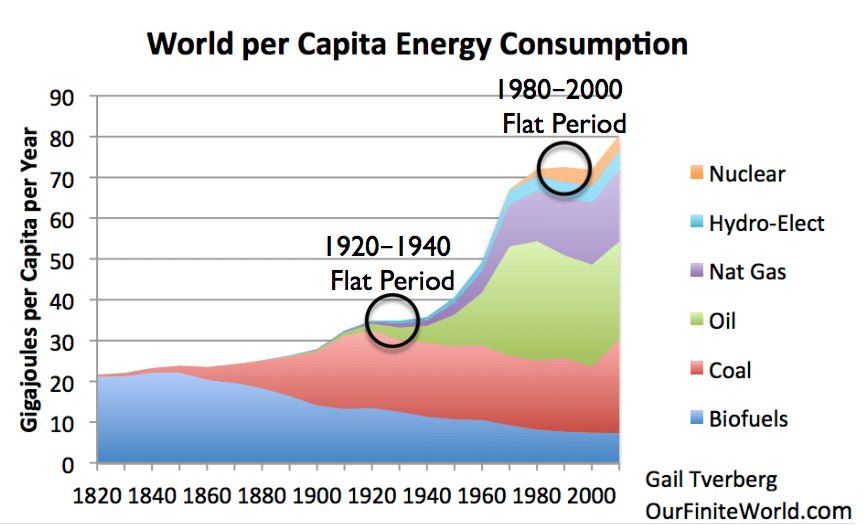
Figure 2. World per Capita Energy Consumption with two circles relating to flat consumption. World Energy Consumption by Source, based on Vaclav Smil estimates from Energy Transitions: History, Requirements and Prospects (Appendix) together with BP Statistical Data for 1965 and subsequent, divided by population estimates by Angus Maddison.
There is a good reason why energy consumed has risen over time on a per capita basis. Every human being needs energy products, as does every business. Energy is what allows food to be cooked and homes to be heated. Energy products allow businesses to manufacture and transport goods. Without energy products of all kinds, workers would be less productive in their jobs. Thus, it would be hard for the world economy to grow.
When energy consumption per capita is rising, it is easy for workers to become more productive because the economy is building more tools (broadly defined) for them to use, making their work easier. Manufacturing cell phones and computers requires energy. Even things like roads, pipelines, and electricity transmission lines are built using energy.
Once energy consumption growth flattens, as it did in the 1920-1940 period, the world economy is negatively affected. The Great Depression of the 1930s occurred during the 1920-1940 period. Problems, in fact, started even earlier. Coal production in the United Kingdom started to drop in 1914, the same year that World War I began. The Great Depression didn’t end until World War II, which was immediately after the 1920-1940 period.
In the 1920-1940 period, many people, especially farmers, were not able to earn an adequate living. This is a situation not too different from the one today, in which many young people are not able to earn an adequate living. Strange as it may seem, this type of wage disparity is a sign of inadequate energy per capita, because jobs that pay well require energy consumption.
The 1980-2000 flat period was in many ways not as bad as the earlier one, because the lack of growth in energy consumption was planned. The United States changed to smaller, more energy-efficient cars in order to reduce the amount of gasoline consumed. Oil-powered electricity generation was taken out of service and replaced with other types of generation, such as nuclear. Heating of homes and businesses was changed to more efficient systems that did not burn oil.
The indirect effect of the planned reduction in oil consumption was a drop in oil prices. Low oil prices adversely affected all oil exporters, but the Soviet Union was especially affected. Its central government collapsed, at least partly because of its reduced revenue stream. Member republics continued to operate, somewhat as in the past. Russia and Ukraine cut back greatly on their industrialization, leading to less use of energy products. Population tended to drop, as citizens found better work prospects elsewhere.
Eventually, in the early 2000s, oil prices rose again. Russia was able to become a major oil exporter again, but Ukraine and other industrialized areas were permanently handicapped by the collapse. Countries affiliated with the Soviet Union (including Eastern European countries, North Korea, and Cuba) found themselves permanently lagging behind the US and Western Europe.
Recently (2013-2017), the world economy seems to have again reached a period of flat energy consumption, on a per capita basis.

Figure 3. Based on data of BP Statistical Review of World Energy, 2017, and 2017 UN Population Estimates.
In fact, in many ways the flattening looks like that of the 1920 to 1940 period. Increased wage disparity is again becoming a problem. Oil gluts are again becoming a problem, because those at the bottom of the wage hierarchy cannot afford goods using oil, such as motorcycles. Young people are finding their standards of living falling relative to the living standards of their parents. They cannot afford to buy a home and have a family. Governments are becoming less interested in cooperating with other governments.
Why is world energy consumption per capita flat, or actually falling slightly, after 2013? The answer seems to be diminishing returns with respect to coal production. Diminishing returns refers to the fact that while at first coal is inexpensive to extract, the cost of extraction rises after the thickest seams and those closest to the surface have been extracted.
A chart of China’s energy production shows how China’s coal production first rose as low cost made its usage advantageous, and then fell due to diminishing returns. China experienced a major ramp-up in coal production after it was added to the World Trade Organization in 2001.

Figure 4. China’s energy production, based on data from BP Statistical Review of World Energy, 2017.
As the extraction of coal progressed, China found itself with many mines with rising production costs. Coal prices did not rise to match the higher cost of production, so a large number of unprofitable mines were closed, starting in about 2012.
A major reason for the flat world per capita energy consumption starting in 2013 is the fall in China’s coal production after 2013. Coal production is falling in quite a number of other countries as well, as the cost of production rises, and as users become aware of coal’s environmental issues. Other sources of energy have not been rising sufficiently to keep total per capita energy consumption rising. A person can see in the China chart that wind and solar production are not rising sufficiently to offset its loss of coal production. (Wind and solar are part of Other Renewables.) This situation occurs elsewhere, as well.
What role do wind and solar play in maintaining world energy supply? The truth is, very little. While a great deal of money has been spent building them, wind and solar together amounted to only about 1% of total world primary energy supply in 2015, according to the International Energy Association.
A major problem is that wind and solar do not scale well. As larger quantities are added to electricity networks, more workarounds for their intermittency (such as batteries and long distance transmission) are needed. Bid prices for wind and solar give a misleadingly low impression of their real cost, unless the projects include many hours’ worth of storage to offset the impact of intermittency.
The key to rising energy consumption seems to be the falling cost of energy services, when efficiency is included. For example, the cost of delivering a package of a given size a given distance must be falling, relative to inflation. Similarly, the cost of heating a home of a given size must be falling. Governments must be able to tax producers of energy products, rather than providing subsidies.
Globalization requires ever-expanding energy supplies to meet the needs of a rising world population. To maintain globalization, we need a growing supply of energy products that are very cheap and scalable. Unfortunately, wind and solar don’t seem to meet our needs. Fossil fuels are no longer cheap to extract, because we extracted the resources that were least expensive to extract first. Our problem today is that we have not been able to find substitutes that are sufficiently cheap, non-polluting, and scalable.
A Few Related Questions and Answers:
(1) What is the biggest impediment to raising total energy consumption?
We cannot get the price of oil and of other fuels to rise high enough, for long enough, to encourage the production of the fossil fuel supplies that seem to be in the ground. What happens, instead, is that energy prices hit an affordability limit and fall back.

Figure 5. NASDAQ three month price chart for Brent Crude oil. Source: NASDAQ
The recent strike in Brazil over high diesel prices shows the kind of issues that occur. Oil prices are still far below what many oil exporters (such as Norway, Venezuela, and Iraq) really need, when needed taxes are included.
Of course, the problem with not being able to get prices high enough also discourages the use of alternatives to fossil fuels, such as wind and solar.
(2) Aren’t wind and solar low-cost approaches?
It is easy to think that wind and solar will be huge improvements over burning fossil fuels directly for fuel, but nearly all of these analyses overlook the problems that are added by introducing intermittency to the electric grid. The assumption was made in early analyses that with enough scale, intermittency in one location would tend to offset intermittency in another location. Also, it was hoped that electricity consumption could be shifted to different times of day.
There have been several recent analyses that look more closely at these assumptions. Jean-Marc Jancovici has shown that if sufficient storage is added for wind and solar to make it “dispatchable,” it takes an order of magnitude more physical resources to produce wind and solar compared to what it takes to produce the dispatchable nuclear electricity used in France. Both have low long-term operating costs. Thus, we would expect the true cost of wind and solar to be far higher than France’s nuclear electricity.

Figure 6. Source: Favorable to all scenario from https://jancovici.com/en/energy-transition/renewables/100-renewable-electricity-at-no-extra-cost-a-piece-of-cake/
Roger Andrews, writing on Euan Mearns site Energy Matters, shows that some recent solar and wind auction prices appear to be far below actual costs, when reasonable minimum cost assumptions are used.
Regarding “Demand Response” as a solution to intermittency, Roger Andrews shows how little time of day pricing for consumers affects consumption curves. It appears that people don’t stop eating dinner after they get home in the evening, no matter how high the cost of electricity is at that time.
Interruptible supply is another way of reducing demand. This link describes some of the issues encountered when interruptible supply was tried on a large scale in California.
(3) Can’t we simply get along using less energy? That is what everyone tells us is possible.
The historical record in Figure 2 doesn’t give much indication that this is possible. Whenever there is even a small drop in energy consumption per capita, it seems to have an adverse effect. On Figure 3, even the small dip in energy consumption per capita in 2008 and 2009 led to a serious recession in many countries of the world.
The people who talk about getting along with less energy haven’t thought through the likely ramifications of this. There would be fewer jobs that pay well, because jobs such as those for construction workers would disappear. The economy would shrink, because of the fewer jobs, in a much worse recession than the Great Recession of 2008-2009.
We know that in past collapses, one of the big problems was inability of governments to collect enough taxes. We would likely encounter the same problem again, if there are fewer people making high wages. Most of the tax dollars for the US Federal Government are paid by private citizens (as income taxes or as Social Security funding), rather than by corporations.

Figure 7. Sources of US Federal Governments Revenue, based on US Bureau of Economic Analysis data.
The last year shown on Figure 7 is 2017, which is before the recent corporate tax reduction. This change will tend to shift the burden on Federal Taxes even further in the direction of payroll related taxes.
(4) How about efficiency savings? Can’t efficiency savings fix our problem?
There are two issues involved. If we were really efficient at fuel savings, as we were in the early 1980s, oil and other energy prices would drop dramatically. This would push oil, coal, and gas producers worldwide toward bankruptcy. Governments of oil exporting countries, such as Venezuela and Saudi Arabia, would have difficulty collecting enough tax revenue. They would likely collapse from lack of tax revenue, substantially reducing supply.
A second issue is that historically we have been adding efficiency. In fact, efficiency is what has tended to make fuel more affordable. As noted in the article, energy use could grow, as the cost of energy services fell.

Figure 8. Total Cost of Energy and Energy Services, by Roger Fouquet, from Divergences in Long Run Trends in the Prices of Energy and Energy Services. The cost of energy services combines (a) the cost of energy with (b) the impact of efficiency savings.
Some of the changes we have been making recently go in the opposite direction of efficiency. For example, the recent article, Biggest Ever Change in Oil Markets Could Send Prices Higher, discusses a new regulation requiring the use of low-sulfur fuel oil for ships. Doing this would greatly reduce the quantity of sulfur being released to the atmosphere as emissions. This is not a change toward efficiency; it is a change toward higher cost of production, which is the opposite of efficiency. Regulators plan to use part of our energy supply to eliminate the excess sulfur before the oil is sold.
As undesirable as sulfur pollution is, the problem is affordability and higher cost. Wages are not high enough for workers around the world to afford the required higher cost of food (because food production and transport use oil) to support the new regulation. So, the likely result of the regulation is to push the world toward recession. Beyond a certain affordability point, it is hard to push oil prices higher, because wages don’t rise at the same time.
(5) Could you explain further why flat energy consumption per capita is not sufficient for the world economy–this amount really has to grow?
Perhaps looking at charts of recent trends in energy consumption of a few countries can help explain what happens when overall per capita energy consumption is flat.
Joseph Tainter in The Collapse of Complex Societies explains that economies often use “complexity” to work around problems as they approach resource limits. In the particular version of complexity tried in this case, manufacturing was increasingly globalized. Workers suddenly found themselves competing for wages with workers from much lower wage countries. Wage disparity became more of a problem.
When workers are increasingly poor, they can afford to purchase fewer goods and services. This can be seen in energy consumption per capita data. Figure 9 shows energy consumption per capita for three European countries experiencing difficulties. In all three, energy consumption per capita has been falling for several years. When manufacturing was sent to Asia, workers found themselves earning less, so they were able to purchase fewer goods made with energy products. Also, European products were less competitive on the world market, with the new competition from low-cost markets.

Figure 9. Energy Consumption per Capita for three European Countries, based on BP Statistical Review of World Energy data and UN 2017 population estimates.
The countries that have been able to grow more rapidly in response to globalization (such as those in Figure 10) need to keep up their patterns of growth, or they start encountering financial problems because their prior growth was generally financed with debt. Without sufficiently rapid growth, they have difficulty repaying debt with interest.

Figure 10. Energy Consumption per Capita for five countries that recently have been growing rapidly. Based on BP Statistical Review of World Energy data and UN 2017 population estimates.
Brazil’s energy consumption per capita has recently fallen, and it is encountering severe problems. Argentina is a country with flattening energy consumption growth. China’s growth in energy consumption has slowed as well; we often read statements about its debt problems.
One of the problems that these rapidly growing countries encounter is currency fluctuations. As long as their particular country seems to be growing rapidly, the currency level of their country can remain high, relative to the US dollar or the Euro. But if obstacles are encountered, such as the low price of their major export, or slower economic growth, the currency of the country may fall relative to major currencies.
A falling currency relative to major currencies is a problem for these rapidly growing countries for three reasons. For one, imports become expensive. For another, any debt denominated in a foreign currency (such as the US dollar) becomes more difficult to repay. The reason why this is an issue is because rapidly growing countries often do not find enough credit available locally, so are forced to borrow internationally. A third problem with slowing growth and a falling currency relativity is that it becomes more difficult to attract new investment to the country. Instead, outside investors may decide to leave; they want to seek the next growth opportunity, in different, more rapidly growing country.
Turkey and Argentina both seem to be having problems with their currencies falling relative to the US dollar.
Another issue that makes flat worldwide per capita energy consumption unworkable is “diminishing returns” as resources become depleted. For example, wells for fresh water must be dug deeper, ores of metals include higher percentages of waste materials, and oil wells must be sunk in less convenient locations. These problems can be worked around, but they require increased energy consumption. All of these uses for energy products leave less for the rest of the economy. Thus, if we deduct the extra energy needed to compensate for diminishing returns, what at first looks like flat per capita energy consumption worldwide really equates to declining per capita energy consumption.
(6) Isn’t there anything that we can do to reduce carbon dioxide emissions?
The task of reducing carbon dioxide emissions is much more difficult than it appears to be, because the world economy requires energy consumption in order to operate.
The best thing I can see that an individual can do is reduce his or her consumption of meat and other animal products (fish, cheese, milk, leather). To offset, a major increase should be made in the consumption of vegetables that are filling to eat (such as potatoes, beets, carrots, beans, sweet potatoes, taro root, turnips, and corn). Some of these perhaps can be grown locally. Humans’ use of animal products adds to carbon dioxide levels, partly because of the quantity of food that needs to be grown and transported to feed the animals, and partly because of the direct emissions of some animals (including cattle, pigs, buffalo, chicken, sheep and goats).
In fact, cutting back on highly processed food of all sorts (particularly sugars, high fructose corn syrup, and oils) would seem to be worthwhile, as well. Growing, processing, and transporting the crops used in these highly processed foods all add to CO2 emissions.
Our problem is that we have grown attached to the flavors of these foods, and we have become convinced that they help us grow big and strong. While they may do this, they also set us up for problems in old age. Starchy vegetables have played a major role in the diets of long lived people. We may need to start giving them, and other less processed foods, a more prominent role again.


https://imgur.com/a/4kIqZhY
Chinese Paper Slams U.S. Stance on Taiwan, Says Should Prepare for ‘Crisis’
https://www.usnews.com/news/world/articles/2018-06-07/chinese-paper-slams-us-stance-on-taiwan-says-should-prepare-for-crisis
But the US is number one:
https://i.imgur.com/wPo6FMUl.jpg
Wax on, wax off: Shale oil’s ‘waxy’ features crimp U.S. jet fuel supply
It seems that the growing use of shale might create a large spread in fuel prices. Gasoline will become suppressed and diesel and jet fuel might have quite a price jump.
The voters use gasoline; that is all they care about. Low prices for gasoline are a primary objects. I think adding ethanol to the fuel supply was an attempt to keep gasoline prices affordable.
Venezuela’s Oil Exports Are Headed Toward Zero
https://www.forbes.com/sites/rrapier/2018/06/08/venezuelas-oil-exports-are-headed-toward-zero/#3bb6c81a6876
China Deals Shocking Blow to Solar Industry
A few years ago, China had an overhang of unsold solar panels, which it could not sell as other countries cut back on their demand. At one point, I posted a link claiming that the person who cooked up the idea of the encouraging the use of the unsalable solar panels in China was fired for corruption. China now seems to be cutting the feed-in subsidy–something that is necessary if it really does not think the panels are all that helpful to the system.
It seems like every country that uses solar panels starts taking a big step back after a few years, after they discover the high cost of subsidies and the problems they cause for backup producers. Worldwide, China was supposed to be the big growth area, but now, it too seems to be going the way of other users that have been “burnt.”
Interesting thanks.
Furthermore it’s not only about panels, but also about the power electronics.
Recently several old manufs in that field folded and or at least severely gutted their formerly wide portfolio of products, which is now predominantly and often exclusively focused on grid tied application only.
“As the Fed continues to press forward hiking rates into the current economic cycle, the risk of a credit related event continues to rise. For all the reasons currently prognosticated that rising rates won’t affect the “bull market,” such is the equivalent of suggesting “this time is different.” It isn’t.”
https://seekingalpha.com/article/4180191-coming-collision-debt-rates
“…while economic collapses aren’t good for anyone, it’s everyday Americans who are left particularly exposed, their very livelihoods threatened. If Main Street’s lagging recovery from the most recent financial crisis is any indication, they will be playing catch-up for years…”
http://www.businessinsider.com/next-stock-market-crash-warm-up-for-bigger-issue-facing-main-street-2018-6?IR=T
Huh. So, it wasn’t just the cold snap.
“The [UK] high street has recorded its worst year-on-year May performance for 12 years despite the royal wedding, warm weather and two bank holidays, figures show.”
https://www.independent.co.uk/news/business/news/high-street-sales-fall-royal-wedding-warm-weather-bdo-tracker-a8388391.html
But at least we’re not Italy!
“Judging by the continued jitters in Italy’s government bond market, which has suddenly become the most closely watched gauge of investor sentiment, last week’s panic over the formation of the first populist and Eurosceptic government in a leading European economy was justified.
“More worryingly, Italy’s political crisis has exposed the vulnerability of Europe’s banks which – unlike their US peers that were recapitalised and subjected to rigorous stress tests soon after the global financial crisis erupted – remain saddled with non-performing loans (NPL) worth around €1 trillion (US$1.17 trillion) and have been forced to grapple with negative interest rates, which have eroded their already weak profitability.
“Confidence in Europe’s banking sector has once again been undermined by the “doom loop”, a self-reinforcing and highly contagious cycle of financial stress stemming from banks’ large holdings of government bonds, resulting in weak banks and risky sovereigns dragging each other down during periods of market turmoil…
“Even Italy’s own central bank governor warned that the country “was a few short steps away” from losing “the asset of trust”.
“While there are plenty of other potential triggers for the next crash, ranging from the pitfalls of unwinding years or ultra-loose monetary policy to a sudden re-emergence of concerns about China’s economy, the scope for Italy’s banking woes to rapidly become a systemic threat to the global economy is considerable, despite efforts over the past several years to “de-risk” Europe’s banking sector…
“Combine Italian populism with the end of quantitative easing and a vulnerable banking sector, and it is once again Europe that is sowing the seeds of the next financial crisis.”
http://www.scmp.com/comment/insight-opinion/article/2149668/will-italy-and-its-ailing-banks-trigger-next-global
Italy certainly is of concern. I hope regulators have some creative solutions. Maybe they can use them in China as well.
Worse food; uglier, fatter, graceless women; gloomier climate, chavs. No, not Italy…… 🙂
Touché!
Here is Anthony Bourdain with a group of children in Gaza..
https://imgur.com/a/rjHfqyT
I don’t have a TV, but often while in hotels I would view his show.
A loss for sure.
If I were to have a tv … I could use Bourdain as a valid excuse….
Kitchen Confidential … classic.
I was very much saddened when Madame Fast nudged me from slumber last night and said Anthony Bourdain is dead.
After Trip to Gaza, Anthony Bourdain Accused World of Robbing Palestinians of Their Basic Humanity
https://www.democracynow.org/2018/6/8/after_trip_to_gaza_anthony_bourdain
‘the world’ = ……
I volunteer to take over for Anthony:
Last year, Bourdain boiled down the main idea behind Parts Unknown for the New Yorker magazine: “I travel around the world, eat a lot of s***, and basically do whatever the f*** I want.”
The show featured meals in both out-of-the-way restaurants and the homes of locals, providing what the New Yorker called a “communion with a foreign culture so unmitigated that it feels practically intravenous.”
Bill Gates is giving a free book to all college grads in America that says the world has never been better..
https://www.theguardian.com/books/2018/jun/08/bill-gates-gives-a-book-to-every-us-student-graduating-in-2018?CMP=twt_gu&__twitter_impression=true
You can’t make this stuff up..
It must be amazing how good the world looks when you’re sitting on 93 billion dollars.
Not really: the rich tend to suffer from Money Sickness, it really messes with the mind. It poisons all relationships.
And the worse thing is that we poorer people can forget about money and enjoy life, but they never can, not really.
Did I say the worse thing? Correction: serves them right!
My take on the very wealthy is that they are obsessed with the concept more…
This is why I will never fly in a private jet.
What he fails to understand is the average college grad no longer reads.
here is perfect example of propaganda
https://youtu.be/0RRnCnO1Y2c
in this video show how peaceful is Yugoslavia in 80s
but in reality things were getting worse everyday
Excellent, thank you TWP.
The digs at the Russians are amusing.
I’m quite bemused by the naked blonde draped over a rock while a photographer has what appear to be fits – propaganda certainly isn’t so entertaining these days!
Slovenian girls are rather attractive: there was a pizza restaurant here where all the staff came from there, and pretended to be Italian,which they could do easily. In fact, they were much nicer to look at than the real Sicilians we have here now…..
The manager also had a rather ‘southern’ attitude, and I received many free coffees, beers and pizzas as a fellow business owner in the same street and a daily regular.
you want to see another hilarious propaganda video
here is
https://youtu.be/TgzrI1okwrQ
Stalin’s Fictionalized Arrival in Berlin in “Fall of Berlin”
I highly recommend the Guardian article on Slavery in Mauretania: in this case, Muslim Berbers enslaving black Africans. Excellent photos, too. A nice dose of Reality.
A charming, centuries-old tradition, it would appear; of course, they did the same thing to the Basques and other Spaniards when they had the chance long ago – black, white it doesn’t matter to them but now they don’t have an empire, so just the poor and defenceless blacks will do…..
Charles H Smith ,who likes to think he is a philosopher of some kind, likes to promise people a better ‘human-scale’ world when nasty old Global Capitalism has gone, in which he will strum his guitar.
Well, this all looks very ‘human-scale’ to me and very non-fossil fuel based!
Every nasty, degraded, thing in this world is ‘human- scale’. We have all of us ancestors who were slaves (and slave-owners) at some point, whatever our race;when modernity goes away, this will be the future – if any human communities survive above the most basic level.
In another Guardian article today, George Monbiot shows that he has failed to grasp that the domestication of animals for meat and diary products (and leather, bone,horn, wool, fur,sinews, etc) occurred because it was necessary in many climates for human survival, and is not a luxurious indulgence one can just drop to drink almond milk and eat Vegan sausages dressed in plastic clothes from Asia…..and what is the environmental impact of those things, for 7.5 billion humans,George?
Regarding the Guardian article, perhaps humans have spread beyond the part of the world where we are best adapted. In the tropics, there is a lot of vegetable material available, year around, thanks to abundant solar energy. It is not necessary to go beyond this for survival. It is not necessary to store up food supply for winter. With the use of burned biomass, plant food can be cooked, making some types of vegetables more useful than they otherwise would be. As humans spread toward the polar regions, they needed to increase the amount of animal products in their diets to have enough.
Industrialized farming led to a situation where even the plant products produced less nutrition, and also led to many plant products that our bodies were not well adapted to using (finely ground flour, sugar, and abundant use of oils, particularly). Our bodies seem to be looking for a fairly high ratio of nutrients and fiber to food mass eaten. We are not getting this from our industrialized food. This is part of the reason why health results in the US are so poor. Other countries have not gone as far overboard on industrialized food.
We are adapted to Northern climates as hunter gatherers. It is civilization that is destroying the environment. Humans that domesticate and farm in Northern climates are like an invasive species spreading everywhere and taking over the ecology, choking off every other living thing.
I agree that we invaded Northern climates as hunter-gatherers. I also know that the farming installations I saw relics of in Norway were far behind those of civilizations farther south. So while humans could live in Northern climates, it was more difficult to live as well in northern climates.
Humans have always been able to eat meat. It tends to be convenient for people new to an area, because it tends not to be poisonous. Unknown plants can be poisonous. For young people, a lot a meat may not be a problem, but as people age, it seems to be unhelpful, especially when added to all of the other issues associated with industrialization (antibiotics and pesticides in meat, too much highly refined grains, too little nutrients and fiber from plants, too little exercise).
Knitting was another nail in our collective coffin, as Freeman Dyson explained in his book of essays, Infinite in All Directions:
Another technology with far-reaching effects on human society is knitting. Knitting emerged later than hay but just as anonymously. The historical importance of knitting is explained in an article by Lynn White in the American Historical Review of February 1974. The title of the article is “Technology Assessment from the Stance of a Medieval Historian.” The first unequivocal evidence of knitting technology is on an altarpiece painted in the last decade of the fourteenth century, now in the Hamburg Kunsthalle. It shows the Virgin Mary knitting a shirt on four needles for the Christ Child. White collects evidence indicating that the invention of knitting made it possible for the first time to keep small children tolerably warm through the Northern winter, that the result of keeping children warm was a substantial decrease in infant mortality, that the decrease in mortality allowed parents to become emotionally more involved with their children, and that the increasing attachment of parents to children led to the appearance of the modern child-centered family. The chain of evidence linking the knitting needle with the playroom and the child psychiatrist is circumstantial but plausible. As White says at the conclusion of his analysis: “Late medieval mothers and grandmothers with clacking needles undoubtedly assessed knitting correctly as regards infant comfort and health, but that in the long run a new notion of relationships within the family would thereby be encouraged could scarcely have been foreseen.
Interesting!
Yep, in summary humanoids being selected as the primary acting agent to terraform this planet (reset to another state/equilibrium/potential, .. next one, ..), that has been mentioned here several times already. It’s just how nature-cosmos seems to operate.
Exactly, it’s all about climate.
Personally, I have tried an all-vegetarian diet in the winter, and was miserable and could only think about beef and lamb, animal fat dumplings, etc.
Without dairy products I would have been in despair – rice pudding made with milk is a wonderful thing in a Northern winter.
I also crave alcohol much more in the cold and damp of winter than in the summer.
One can understand where the idea of feasting in the Halls of Valhalla came from…….
“perhaps humans have spread beyond the part of the world where we are best adapted”
Speaking of what part of the world “we humans” are best adapted to is a nonsensical statement. Different population groups are adapted to living in different parts of the world—Northern Europeans, Siberians, and Inuit are more adapted to a high fat diet and to lower sunlight and lower temperature environments as compared to Australian Aborigines, Zulus, and Berbers. Beyond differences in metabolism and in skin tone (which make groups prone to vitamin D deficiency or skin cancer in areas they are too dark/too pale for), there are also differences in heat tolerance and cold tolerance.
The worst thing is what we are doing now with insane migration and even maintaining some of the population movements from things like Australian colonization. You have north-adapted people who need air conditioning living in tropical climates and tropical peoples who need the heat at 80°F living in places like Sweden and Canada.
And the IEA talks about the great potential for air conditioning in Africa and India! What is the IEA thinking of?
but i have ask one thing why black people are preferred as slaves compared to
other races for ex you see this also in collapse country called Libya
In Cuba, I was told that black slaves were imported because, for working in the sugar plantations, they could tolerate the heat (direct sun?) better than workers from other places.
Places like Cuba and Haiti tried groups like the Irish as slaves first, but they couldn’t tolerate the heat and sun exposure and died off too quickly. Then Portuguese and Dutch slave traders showed up offering slaves captured in Africa as an alternative.
Strength in the heat. In the British colonies of the West Indies they didn’t die so quickly as the white slaves – originally prisoners of war from the English Civil War and Jacobite Rebellions were sent there and they just didn’t last long enough.
The Iranians also liked black slaves a lot, and often married them to their sons – so you will see some Iranians today with slight African features if you look carefully enough. They were well-treated it seems.
Didn’t know blacks are so tough physically.
T’Challa ought to be proud!
Duke of Cambridge insists there are too many people in the world in a passionate speech about population growth – after his father Prince Charles warned the earth can’t ‘sustain us all’
Prince William, 35, made speech at Tusk gala dinner in London last night
Warned Africa’s growing population set to more than double by 2050
Duke is hugely concerned about impact on wildlife and natural resources
http://www.dailymail.co.uk/femail/article-5046845/Prince-William-warns-s-people-world.html
but this guy have 3 children of his own
but question others to reduce population
I’m afraid you don’t appreciate fully the delicate situation at hand..
Members of royal families have to multiply like rabbits, it’s a standing law, because they know directly and quite precisely from past (wider) family history, after a while there usually comes a larger wave of change throughout the centuries, which might be powerful enough to wipe almost 100% of all the clan descendants to throne..
It’s a prep..
This mission of honor can’t be in simplistic terms compared to the unwashed masses out there, especially the 2nd and 3rd world one..
/sarc-sardon off
Well, the ultimate large wave of change coming everyone’s way, if it does not wipe out their descendants, is certainly still going to make life very, very difficult for the poor toddlers. So much so, I imagine they’re not going to be very pleased with their royal daddies and mummies for letting them come into this sorry world in the first place.
Or perhaps they recognize that due to centuries of breeding cousins and siblings the bloodlines are riddled with re tar dation …. and that only one in 10 has an IQ above 85….. so you breed like rats… hoping that you can produce an offspring that has one semi straight row of teeth top and bottom … an actual chin… and the ability to add 2+2 and answer in sentences.
Tis true. He ought to go on Celebrity Big Brother and get televised being publicly castrated for charity. 😉
I’m no fan of royal families, but I must say I still find this… a bit sick…
If it’s just “a bit sick”, it will be perfect for Western TV, to pull in lots of decadent viewers. Now let me guess where you’re from – Singapore?
“A bit sick” – that bothers me. It means you want me to try harder. How about we also microwave his children too, live on air? 😉
Incidentally, we have this thing called “extreme satire” in the West, so don’t take it too seriously, or I’ll have you kidnapped and sent to North Ko~rea. (I’m joking!).
I don’t know about that…
I like this idea. If he is looking to raise money for the cause I’ll throw in $100.
Bravo! Is that for the fifth limb, or the dangly bits?
the women of Great Britain are saving the world!
http://www.dailymail.co.uk/femail/article-5819361/Women-refuse-babies-save-planet.html
thank you for all of your sacrifices!
The Royal Family ought to blush with shame in front of these ladies.
There are only contributing to the deflationary pressures
Exactly: people working as assistants in baby shops, others working in Asian factories, will lose their jobs as a result of the ostensibly noble sacrifice made by the baby-less ones.
So would you prefer that more human souls be brought into this world — one that’s going to become extremely unpleasant to live in for well-nigh everyone, including those innocent toddlers?
If it means the BAU staggers on for a few years longer than ya… breed mutherf789ers breed….
As long I don’t have to watch my kids suffer … but then that’s not going to be an issue
thank god there was a brown women in this atricle
or alt right guys would have say White genocide
What about reducing living standards? It is not that big a sacrifice not to bring a few dirty dishrag single wh-re mother larvae into a first world society where pretty much every basic human desire is more than satisfied. Different, of course, for a society where number of kids is a legitimate survival strategy (tending to the farm, a fraction dying out from disease, low life expectancy etc).
A Japan-like society of rampant ditzy consumers who refuse to die is what is truly unsustainable. Not that overpopulation *isn’t* an issue – one of the major ones facing humanity – but it is still only one out of several facets of collapse.
I doubt reducing our living standards will help much. The ultimate move we can make is to abandon the whole ideology of growth altogether — except that doing so will make the whole system crash immediately.
Abandon the ideology of growth? BAU will end straight away.
Don’t abandon it? BAU will still end, but a little later.
As for the population problem, if we keep having kids, we face the overpopulation problem.
But if we don’t have kids, we face the problem of a greying population.
Damned if you do and damned if you don’t… (Sigh…)
Here is the most recent scholarly book on collapse written last year..For free..Enjoy..
N.M. Ahmed,
Failing States, Collapsing Systems,
Springer Energy, 2017
http://www.academia.edu/34816514/Failing_States_Collapsing_Systems_BioPhysical_Triggers_of_Political_Violence_SPRINGER_BRIEFS_IN_ENERGY_
… the IMF has officially bailed out the country – again – this time with a $50 billion, 36-month stand-by loan, and coming in about $10 billion more than rumored earlier in the week, it was the largest ever bailout loan in IMF history, meant to help restore investor confidence in a nation that, between its soaring external debt and current account deficit, prompted JPMorgan to suggest that along with Turkey, Argentina is in effect, doomed.
https://www.zerohedge.com/news/2018-06-07/argentina-bailed-out-biggest-ever-loan-imf-history
https://www.zerohedge.com/sites/default/files/styles/inline_image_desktop/public/inline-images/turkey%20argentina.jpg
three cheers for the IMF!!!
good thing they can create (out of nothing) $50 billion on their computers…
sending it to Argentina?
a great move…
now, they will move on to Italy, Brazil, Turkey etc…
$50 billion isn’t really very much, when compared to the derivative problems and bailout experienced in 2008. The reference that I gave previously https://www.thenation.com/article/aig-bailout-scandal/
claimed that the AIG bailout from its problems (and various banks related problems) cost $182 billion.
The world’s two biggest sudden loosers in their pecking order status among nations throughout past half/century are often cited as to be the examples of Argentina and Czechoslovakia. Interestingly, both semi-core industrialized countries in the respective fields (new and old world domain)..
The road to ruin can be really quick (few generations or mere decades), that’s why it would be interesting to watch/early *identify other prospective contenders from the semi-core stable as they enter the historical slaughter house as we move slowly from the lull of this ~stagnation phase to more pronounced overall decline phase, speaking about this civilization.
* guys at Surplus are debating this a lot..
I would add Ukraine to the list of sudden losers.
That’s a good point and probably the most expedient example there.
Not being expert on Russia, however, I’d argue it was even fast tracked by the proximity of relatively prospering Belarus and Russia proper where lot of Ukrainian talent could have emigrated pronto during past ~two decades.. speaking about the mil-science and energy sectors..
Didn’t the third reich move to Argentina? Or was that Antartica? Look for Antartica bailout in the future.
The strength of former Argentinian prosperity was largely pre WWII based anyway, although it’s well known their particular version of the post WWII prosperity hockey stick was even boosted up a notch by influx of some “tainted” people and money leaving several European countries not only Germany..
Man kicks person lying on San Francisco street amid homelessness crisis – video
https://www.theguardian.com/us-news/video/2018/jun/08/man-kicks-person-lying-on-san-francisco-street-amid-homelessness-crisis-video
https://imgur.com/a/Gys1VzM
And Fast Eddy identifies the perpetrator:
http://hattershostels.com/wp-content/uploads/2015/06/clockwork-orange.jpg
When Communism wins the space race so you quickly change the finish line..
https://imgur.com/a/WnMZ4ML
JFK predicts Americans on the moon by 1969:
https://www.space.com/11772-president-kennedy-historic-speech-moon-space.html
he said that in 1961… !!!!!!!
30 years later, USSR imploded… ha ha ha ha ha…
certainly, the USA is often far from being a force for good in the world…
but let’s set aside the animosity for now…
not only did the USA “win” the race in 1969, but that feat is often acknowledged as the pinnacle of human civilization…
ps: that’s a very feeble pinnacle, but nonetheless, there it is…
why do you consider it a “feeble pinnacle”? how many other manned attempts at space exploration are you aware if? please don’t mention the space shuttle or international space station.
but it was filmed in a film studio 🙂
i saw that movie. that’s why the brought back Moon rocks, to prove they made the trip.
The issue about “honor among thieves” is rather puzzling there..
Well, the easiest explanations is perhaps the Russians and Chinese just continue to uphold to quasi higher moral ground and sticking to old treaties. The tech debate has been settled decades ago, as it was “only” orbital flight plus some studio effects work..
is international space station is also fake ?
? don’t trolllll
The moon landings were faked. I’m as certain as certain can be about this because my sister’s hairdresser’s uncle was the man who used to say “beep” to prompt the astronauts to reply to mission control.
you forget adding /s to your comment
Because that big skydady .gov would never ever deceive me.. lolz.
Children demand fairy-tales while adults hold crutches and deploy various mental anchors to perceived bonding pseudo reality mirage just to cope with the nasty world outside. It’s understandable of humanoids, but in this time and age clear opt out.
WMD was real … as real as the moon landings… for most people.
ok moon landing was fake
but fast eddy is international space station is also fake ?
I have no idea….
The MSM tells me it is real… but the MSM tells me that solar and wind are viable… that EVs will save the world — and that ggg wwww is going to broil us…
Germany’s manufacturing machine is weakening as factory orders fall
https://www.bloomberg.com/news/articles/2018-06-07/german-manufacturing-woes?utm_campaign=socialflow-organic&utm_source=twitter&cmpid=socialflow-twitter-businessweek&utm_medium=social&utm_content=businessweek
Perhaps problems in Italy and some other Eurozone areas are reducing German orders, since Eurozone orders are especially down.
Ben Bernanke: The US Economy Is Going To Go Off The Cliff In 2020
https://www.bloomberg.com/news/articles/2018-06-07/bernanke-says-u-s-economy-faces-wile-e-coyote-moment-in-2020
Dr Bernanke knows the oil shortage and spike is coming around 2020..He know’s the world comes to an end when it starts to run out of oil..
https://www.forbes.com/sites/rrapier/2018/03/23/is-the-world-sleepwalking-into-an-oil-crisis/#509edc8b44cf
https://media1.tenor.co/images/636679fedfa787be9126014184b0a850/tenor.gif?itemid=8644559
thanks for the great news!
I just checked my calendar and it says June 2018…
BAU is still spelled BAU…
tonight is still spelled t o n i g h t…
baby is still spelled b a b y…
Yes, our little club of “+2020 estimates” has been a minority voice over here, but the trends look like we were onto something in predicting and sequencing analysis. Nothing is guaranteed, but the first salvo of tremors of the next big cycle reshuffle ahead are clearly few years away.. at least for the +IC core and semi grouping of global pop (<2.5B people)..
You have the core/strong/stable regions like North America, EU, Russia, China, Japan which I think will endure quite a while with slow inpoverishment of the non-elites. The rest of the world will fall to pieces one country at a time as their resource/financial/military support gets withdrawn.
He knows we are in massive overshoot.
Every time I read about another Tesla death…I smile… because it’s one less green groopie
https://www.zerohedge.com/news/2018-06-07/tesla-accelerated-seconds-slamming-highway-barrier-killing-driver-ntsb
Of course you don’t. You think Tesla driver’s are Green? I doubt it. Nor do I. But you pretend to not want a habitable planet. That is utter nonsense, unless you’re not alive. That’s possible I suppose but, if so, I don’t like what AI produces, using the “I” term loosely.
Funny… I jumped in on discussion with Tesla owners on another site … mocking the subsidies and massive repair costs…
And the chorus sang ‘it’s worth it because we are saving the world’
After so many years, technology transfers of big manufs, and lured in armies of managers/technical staffers from other major car companies, and the result is still noticeably inferior product at least for that price range. And I don’t even mean the evdrive itself but the overall horrendous build quality and cheap shortcuts..
For that money it’s nobrainer better to stay with BMW, Benz, or even LR/Jag (some issues prevailing but at least from mature company).. not mentioning some possible offerings from the Asians as well..
Teslas seem to be popular amount “peak oil” enthusiasts. They seem to think that by moving away from oil, they are being helpful.
It’s not all green groupies..The right loves Musk just about as much..
Any dead DelusiSTANI … is the only good DelusiSTANI…
Cover of the Economist..
https://imgur.com/a/NZSUJcL
America’s just faithfully following the illustrious example of the people from whom she inherited her language.
or this:
https://www.youtube.com/watch?v=0sOq6Rrre7c
by the way, best song ever under one and a half minutes…
We are scraping at the bottom of the oil barrel so much, we are going to punch a hole in it soon!
probably by the year 2030!
The Gig Economy Is Basically a Myth
https://www.motherjones.com/kevin-drum/2018/06/the-gig-economy-is-basically-a-myth/
Fearing fragile economies, a London hedge fund has started a doomsday fund
https://qz.com/1298262/algebris-investments-has-started-a-tail-risk-fund-managed-by-alberto-gallo/
Are all civilizations doomed to destroy themselves?
https://www.weforum.org/agenda/2018/06/how-would-alien-civilizations-deal-with-climate-change
They are all dissipative structures. They all have finite lifetimes. Without plants and animal inhabitants, I don’t know whether the climate change question is relevant. They would be expected to act like earth, if there are plants and animals.
” This scenario occurs in the models when the population recognizes it is having a negative effect on the planet and switches from using high-impact resources, such as oil, to low-impact resources, such as solar energy.”
As to solar energy supplanting oil and coal, somebody should read OFW. It’s hard for them to understand the entire FF-dependent networked chain in the conception, research, manufacture, use, support infrastructure, etc..
Some civilizations have been able to last thousands of years (allowing for occasional hiccups). And could have quite conceivably gone on a whole lot longer had it not been for some stupid thing called… IC.
https://i.redd.it/lwudcr1z8m211.jpg
https://imgur.com/a/QPcRvzE
People are dying of happiness!!
There must be any number of creative answers to that apparent conundrum.
isn’t it obvious?
more dead addicts = more job openings…
US media openly calling for Venezuela military coup
https://www.rt.com/usa/429038-us-media-coup-venezuela/
but could their military produce more oil?
Socialism ends when you run out of other peoples money..Capitalism ends when people run out of their own money..
https://fred.stlouisfed.org/series/PSAVERT
https://imgur.com/a/OK3zWHP
I don’t think either capitalism or socialism in there pure form are desirable. In my view, a blend of two would work best. Nevertheless, without sufficient energy neither socialism or capitalism work.
“Nevertheless, without sufficient energy neither socialism or capitalism work.”
This blend seems to follow human psychology and social practicality. But I would add to the reasons why it’s so hard to pull off is that society is organized in chunks that are too big to manage. We omit the psychological need for small-enough groups to where everyone knows each other and accountability can be managed. Once you lose this level of organization your seem to be serving some powerful interest other than your own.
As the great E F Schumacher said, “Small is Beautiful”. (He devoted an entire chapter of his magnum opus to a discussion on the optimal size of human communities.)
Trudeau, Macron lay down hard line on U.S. tariffs ahead of G7
https://www.theglobeandmail.com/world/article-trudeau-macron-lay-down-hard-line-on-us-tariffs-ahead-of-g7/
https://twitter.com/AFP/status/1004726220116852736
McDonald’s announces job cuts to ‘eliminate layers’ in corporate structure: WSJ
https://www.marketwatch.com/story/mcdonalds-announces-job-cuts-to-eliminate-layers-in-corporate-structure-wsj-2018-06-07
Dead canary in a coal mine..
Howard Schultz: The $21 trillion national debt is the ‘greatest threat domestically to the country’
https://www.cnbc.com/2018/06/05/howard-schultz-21-trillion-debt-is-biggest-threat-to-us-domestically.html?__source=twitter%7Cmain
Detroit, Greece, Puerto Rico, Venezuela, next comes the larger countries like the US and China..
Owe it to who?
“The Fed is “gradually entering a new world when rates are at 2 percent,” nearing zero on a real basis and approaching where they are no longer felt to be stimulating economic activity, said Thomas Costerg, senior U.S. economist at Pictet Wealth Management. The last time rates moved into positive real territory on a sustained basis was the spring of 2005 when the Fed began tightening rapidly after a period of arguably too-lax monetary policy, ending just months before the start of the 2007-2009 financial crisis.”
https://www.reuters.com/article/us-usa-fed-rates-analysis/fed-clambers-back-to-positive-real-rates-now-debate-is-when-to-stop-idUSKCN1J30DE
“…after the major banks lowered interest rates and started to print money, investors rushed to find higher returns. They moved toward risky investments and relatively volatile markets [junk bonds]… according to the Securities Industry and Financial Markets Association (SIFMA), between 2009 and 2017, $2.4 trillion worth of high-yield bonds were issued. In the previous nine years, junk bond issuance was just around $849.2 billion.”
https://www.lombardiletter.com/central-banks-rising-interest-rates-could-trigger-crisis/28635/
“According to a key valuation metric, investors are headed for the kind of bullishness on high-yield bonds that’s been seen just twice before: during the halcyon days of 1997’s tech bubble before the Asia crash, and on the eve of the global financial crisis a decade later.”
https://www.bloombergquint.com/markets/2018/06/06/junk-bond-valuations-hark-back-to-1997-bubble-pre-lehman-heyday
Don’t sound like good precedents
I imagine this helped tight oil companies, because their bond yields would be at least a little higher than government yields.
From the article:
“After the expected June increase the Fed’s target interest rate will be set at a range of between 1.75 percent and 2 percent, matching the Fed’s inflation target and roughly in-line with the latest inflation data. That translates to a real rate of roughly zero and is already at neutral, according to some policymakers who feel the Fed should stop hiking now.”
There ought to be some charge for “time-shifting” – getting to pay for a device, over the period when it is used, for example. Over long term history, I understand that interest rates of 5% per year were common, but I don’t know about inflation rates. Certainly, the interest rate should at least be higher than the inflation rate.
This article is saying the perhaps the economy cannot withstand an interest rate that is higher than the inflation rate. If that is the case, the Federal Reserve should stop tightening now. I would agree. A growing economy should be able to withstand a significantly higher interest rate, but economies are only barely growing. They depend on rising debt to grow.
“Nearly 4 million adults in the UK have been forced to use food banks due to ”shocking” levels of deprivation, figures have revealed for the first time.”
https://www.independent.co.uk/news/uk/home-news/food-banks-uk-how-many-people-adults-poverty-a8386811.html
“German factory orders unexpectedly dropped for a fourth month in April, raising the prospect that an economic slowdown at the start of the year may be worsening.”
https://www.bloomberg.com/news/articles/2018-06-07/german-factory-orders-extend-slide-as-economic-worries-build?utm_source=google&utm_medium=bd&cmpId=google
“If one adds the Bank of Italy’s Target 2 liabilities to the Italian public debt total, the public debt to GDP ratio rises to 160%, taking that ratio to its highest level in over 100 years. Sadly, there is every reason to expect that Italy’s Target 2 balance will worsen in the months ahead as the unsettled Italian political situation encourages capital flight. Another reason to think the Italian official public debt numbers are understated is they do not take into account the likely cost of government support for the country’s troubled banking system.”
https://seekingalpha.com/article/4179675-italys-public-debt-worse-think
Germany and Japan both doing badly–that is a problem.
In the US, we expect the UK government to take care of almost everyone, but that doesn’t seem to really happen.
There seem to be quite a large number – perhaps 500k, perhaps a million, people in the UK, often recent arrivals, who may not be in the system.
That would not prevent them getting health care, finding accommodation if they want it and food too. Unless, of course, others, seemingly often earlier arrivals from the same cultures, offered to “help” them before the incomers approached the relevant authorities.
Whether the numbers suggested using free food providers are correct is probably impossible to confirm. One must be mindful of charitable politics and virtue signalling via inflated numbers of something.
Bear in mind that a dreadful housing tower block fire in London a year ago that resulted in over 70 fatalities has seen many of those who survived and were made homeless living in hotels for the past year. Alongside them were quite a few who claimed they lived in the building, had lost relatives and were now homeless and traumatised but have been found to be making totally fraudulent claims. 9 more people were arrested today.
The idea of a free lunch (and breakfast and tea and supper if offered) is something that many people would consider as a trivial offer to take up when available whether they needed the help or not. After all, compared with claiming to be a fire victim, taking free food is no crime at all.
“Debt contagion in Argentina and Turkey is spreading to other countries. There is now concerns over a “high” concentration of risk in Lebanon, Columbia and South Africa which could spread further through the global economy…”
http://uk.businessinsider.com/debt-contagion-in-argentina-and-turkey-is-spreading-to-other-countries-2018-6
“Turkey’s main stock index dropped to the lowest level in dollar terms since the global financial crisis in 2008 after a sell-off in the lira and concerns about economic stability persisted.”
https://ahvalnews.com/turkey-stocks/turkish-stock-market-hits-lowest-2008-crisis
“Tunisian Prime Minister Youssef Chahed on Wednedsay fired Interior Minister Lotfi Brahem, a government statement said, after one of the worst migrant boat accidents in recent years. The boat packed with some 180 migrants sank on Sunday off Tunisia’s coast. The death toll has risen to at least 68, with dozens still missing.
“Most of the people on board the boat that sank on Sunday were Tunisians trying to escape unemployment and an economic crisis that has gripped the North African country since the toppling of autocrat Zine El-Abidine Ben Ali in 2011.”
http://www.france24.com/en/20180606-tunisia-interior-minister-brahem-fired-migrant-shipwreck
“Protests have erupted in Amman and other Jordanian cities in recent days over rising prices and IMF-backed austerity measures including a new tax bill aimed at reducing the country’s chronic deficits. The crisis has already seen the replacement of the country’s prime minister and a call by Jordan’s King Abdullah for a review of the controversial draft tax law.”
http://www.france24.com/en/20180606-jordan-crisis-gulf-diplomacy-economic-saudi-arabia-israel-usa-palestinians
“Franklin Templeton Investments has cut back its debt holdings in Bahrain, citing the “very serious” threat that the cash-strapped nation will experience an economic crisis in the next 12 months if financial aid from neighbors doesn’t come through.”
https://www.bloomberg.com/news/articles/2018-06-06/franklin-templeton-sheds-bahrain-debt-warns-of-economic-crisis
I looked up Bahrain in Wikipedia:
“Unemployment, especially among the young, and the depletion of both oil and underground water resources are major long-term economic problems.”
EIA data shows that oil production is down a little in 2016 and 2017. Total liquids production was 65,000 BPD in 2015; 63,000 BPD in 2016; and 59,000 barrels per day in 2017. Lower prices are no doubt compounding the problem. In fact, lower prices may be part of the reason that production is down.
https://www.eia.gov/beta/international/data/browser/#/?pa=0000000000000000000000000000000000vg&c=00008&ct=0&tl_id=5-A&vs=INTL.53-1-BHR-TBPD.A&cy=2015&vo=0&v=H&end=2017&showdm=y
Jordan is a Middle Eastern country without oil. According to the CIA Factbook:
https://www.cia.gov/library/publications/the-world-factbook/geos/jo.html
I wonder how it has kept going this long!
Moaning Millenials might care to reflect that in many countries people have to do that sort of thing at huge risk in order to have any hope of something better.
What little oil production that Tunisia has is way down from its peak of 120,000 barrels per day in 1982 and 1983. I am sure that this contributes to its problems.
We don’t need debt contagion to spread!
Wind Disappears in Britain Leaving Turbines at a Standstill
https://www.bloomberg.com/news/articles/2018-06-05/wind-disappears-in-britain-leaving-turbines-at-a-standstill
Millions of Americans are relying on family money to be financially independent
https://www.marketwatch.com/story/millions-of-americans-are-relying-on-family-money-to-be-financially-independent-2018-06-07
Handouts from living parents have to rank pretty high in the lives of young people today, also.
Must be nice….
Daddy oh daddy… can you die soon? Have another piece of cake….. you really should start smoking again….
Despair
https://www.zerohedge.com/news/2018-06-06/opioids-are-responsible-20-millennial-deaths-crisis-will-impact-us-generations
interesting that it’s not just the good ole USA but Canada also…
but this will NOT have an impact “for generations”…
the Creeping Collapse from declining surplus energy will make this opioid “crisis” look trivial…
Prelude to the apocalypse ….
The headline should read: Diminishing Returns Leads To Despair/Drug Use – No Relief in Sight
who dares to short Tesla?
https://www.cnbc.com/2018/06/06/shorts-against-teslas-stock-lose-more-than-1-billion.html
b w a h a h a h a h a…
What Recovery?
https://imgur.com/a/h1k9k35
https://www.zerohedge.com/news/2018-06-06/americans-evacuate-us-consulate-china-after-debilitating-sonic-attacks
here you can buy a HRC bobblehead doll:
https://www.amazon.com/Hillary-Clinton-Striped-Pantsuit-Bobblehead/dp/B01N4WSJN0/ref=sr_1_3?ie=UTF8&qid=1528345903&sr=8-3&keywords=hillary+bobblehead+doll
buyer beware:
the doll’s head doesn’t bobble as well as the real thing…
Foreign investment into the U.S. fell almost 40% in 2017 – the deepest drop in four decades that wasn’t associated with a recession..
https://imgur.com/a/QHWnIRm
I don’t think that this chart is very helpful. Foreign direct investment depends very much on how the dollar is floating. The big change that seems to have happened has occurred in the first quarter of 2018, which is not shown in your charts.
These are a couple of related charts that I downloaded from the FRED. They show that despite the decline, US foreign direct investment was still high in 2017. Of course, these charts also do not show the big expected upswing in early 2018. This first chart shows quarterly flows of direct investment:
https://gailtheactuary.files.wordpress.com/2018/06/foreign-direct-investment-in-us-quarterly-asset-flow-to-4-qtr-2017.png
The second shows accumulated amounts. A person can also see that the only time these plateau is during recessions.
https://gailtheactuary.files.wordpress.com/2018/06/foreign-direct-investment-in-us-asset-level-to-4-qtr-2017.png
And here we have the toss pot of the day award:
https://www.zerohedge.com/news/2018-06-06/raul-ilargi-meijer-kill-monsanto-it-kills-your-kids
You want 8 billion people? You gotta feed 8 billion people.
And that means chemicals… lots and lots of chemicals….
And Monsanto is an expert in making sure that we can grow food in dead soil… and keep the bugs from eating it before we do.
Hail Monsanto!!!
Sadly Monsanto will not exist post BAU … so there will be nothing to eat.
That’s the deal we have made with the devil… by kicking the can with these new technologies century after century…. we have guaranteed our extinction ….
Monsanto has only delivered on what we wanted… enough food to feed our kids….
Raul will never get this though …. stewpid people will never change their minds … particularly when they perceive themselves as smart….
BTW – I used to despise Monsanto…. until I thought about it
BTW – I used to despise Monsanto…. until I thought about it
You need a update– Monsanto is in the rear view mirror,
It is now Bayer from Germany–
bigger strong faster better
https://imgur.com/a/ndFq3VV
i wonder if monsanto have a fan club hows that for an idea start the first monsanto fan club
and Roundup works great on poison ivy…
This is one instance where I sort of agree with Crazy Eddy. Praising Monsanto is obviously crazy (which is why Eddy plopped it atop what could have been a sane argument), but organic food won’t feed billions. Besides that, people who have made a lifestyle out of paying more for food are to stupid to understand that organic farming increases GHG emissions and reduces crop yield that could have been used to feed African children.
By kicking the can we have ensured our extinction. If not we would have muddled along with a local famine here and a little war there.
Not sure about that… in the middle ages deforestation was a huge problem….
I suspect that if we had not harnessed coal we would have Easter Islanded the planet
Time and time again Easter Islanded locally, but always interrupted by cycles of disease and strife. The black plague, 30 years war…always plenty of time and space in between for another layer of green.
Now it’s global with entrenched consequences, that lasts too long for any such historical recovery, and a quickly reacting system that reclaims absolutely anything that might threaten to recover ecologically, fill in people everywhere, and that in a short time.
This time we’ll more than just Easter Island, locally.
(Though on a note, John Michael Greer’s view is that spent fuel ponds will only radiate strongly on a local level, but not strong enough to disturb human life itself. I for another part wonder what the diseases of our ancestors combined will do with the disease of modernity, to the survivors of the collapse?)
It’s close but I think I am going with the Harvard report that was commissioned to address the implications of a terrorist attack on a spent fuel pond…. and that Canadian guy with the PHD and Nobel prize…
Over this guy’s off the cuff comments….
http://zeroequalstwo.net/wp-content/uploads/2016/01/john-michael-greer-20160107.jpg
Trucking Booms, Heavy Truck Orders Soar, Shippers Grapple with “Capacity Crisis”
“Veterans in this industry are saying this is the best freight market they have ever seen.” But shippers struggle with rising costs.
Orders for Class 8 trucks – the heavy trucks that haul trailers across the US – surged 114% in May, compared to a year ago. With 35,200 orders, it was the highest May on record, according to transportation data provider FTR. Order volume over the past six month averaged nearly 40,000 units a month, “volumes never seen before in the industry.”
Manufacturers are now sitting on an order backlog of over 200,000 Class 8 trucks, or 8.4 months of production.
“This is an astonishing rate of order placement,” Kenny Vieth, President of ACT Research, told the Wall Street Journal. “What’s facilitating it is that truckers are absolutely crushing it on freight rates and profitability right now.”
https://wolfstreet.com/2018/06/06/trucking-booms-class-8-truck-orders-soar-industry-grapples-with-capacity-crisis/
https://wolfstreet.com/wp-content/uploads/2018/05/US-Cass-Truckload-linehaul-YOY-2018-04.png
I am confused. I thought the consumer was tapped out…. who’s consuming all this stuff on these trucks?
https://imgur.com/a/BFNFI0e
Outstanding!!!!!!
I think the reason why the demand for trucks is up in the US has to do with recent changes that effectively limit the number of miles each US truck driver can drive in a day. A new mechanized reporting device showing actual hours behind the wheel is required, which is hard to cheat on. Before the devices were mandatory, drivers were driving many more hours than safely regulations permitted. http://thefederalist.com/2018/01/11/3-reasons-truckings-new-driver-surveillance-rule-will-hurt-truckers/
The new reporting of time behind the wheel means that it takes more trucks to transport the same quantity of goods, because truckers can drive fewer miles in a day. Truckers are very unhappy. Their compensation, prior to the change, was based on miles traveled. Now they cannot earn as high wages. Many of the truckers are owner-operators who have payments to make on the trucks they own. The shortfall comes out of their take-home pay. This makes it hard to hire more drivers, because drivers consider current wages too low, given the limit on how long the drivers can drive. (The new usage of trucks is inefficient, because it now takes truckers longer to cover the same number of miles.) There are a huge number of truck drivers in the US–it is the single largest category of work for those without advanced education. Pressure to add more truck drivers could be part of the reason why the unemployment rate is very low, as well.
Also, trucks are being used for trucking intermediate oil and gas products, because pipelines are full. This adds to demand for trucks.
There may also be factors related to the US doing relatively better than other countries because of the active oil and gas industries in the US (even if the businesses are not very profitable to the owners). US growth has allowed US interest rates to rise. The “hot” investment money has moved from Emerging Markets to the US, raising the level of the dollars. Other countries are getting a double hit–rising oil prices, and the impact of their currencies falling relative to the dollars.
!!!
America’s ‘War on Terror’ Has Cost Taxpayers $5.6 Trillion
https://www.thenation.com/article/americas-war-on-terror-has-cost-taxpayers-5-6-trillion/
Dividing and conquering (and plundering) comes with a cost…. and BAU is worth it
$5.6 trillion spending stimulus plan…
Yes of course.. nothing is wasted
“The Three Crises That Will Synchronize a Global Meltdown by 2025”
http://charleshughsmith.blogspot.com/2018/06/the-three-crises-that-will-synchronize.html
a very excellent thought piece…
“The financial, energy and governance buffers will all start collapsing in a global synchronized meltdown in the 2021 – 2025 period. Why synchronized? Because the global financial and energy markets are one system. Once the system’s buffers collapse, everyone dependent on trade, global finance and energy will collapse in a domino effect that will start with the weakest periphery nations.”
that sounds pretty darn close…
it could be said that the “collapse in a domino effect” has already begun…
I would guess that the full “meltdown” will be after 2025…
buy hey, it’s just June of 2018…
why worry?
Dr. HSBC says I have less than 6 months to live….
Where And Why The World Is Getting More Dangerous
https://www.forbes.com/sites/dominicdudley/2018/06/06/why-the-world-is-getting-more-dangerous/#598313455a6d
I don’t have to read the Forbes article to understand what is going on. It is well known that in times of plenty we get along fairly well. In times of scarcity we fight like cats in a sack. We are heading more and more towards scarcity of resources. Not rocket science.
And when BAU breaks down..We break down..
Indonesian Borneo is finished: They Also Rape Orangutans
How destructive can man get, how ruthless, in his quest to secure maximum profit, even as he endangers the very survival of our planet?
The tropical forests of Kalimantan (known as Borneo in Malaysia), the third largest island in the world, have almost totally disappeared. Coalmines are savagely scarring the hills; the rivers are polluted, and countless species are endangered or already extinct.
It is all a terrible sight, whether you see it from the air or when driving (or walking) through the devastation that is taking place on the ground. The soil is black; it is often saturated with chemicals. Dead stubs of trees are accusatively pointing towards the sky. Many wonderful creatures, big and small, who used to proudly inhabit this tropical paradise, are now hiding in the depth of what remains of one of the largest tropical jungles on earth.
Engines are instantly roaring everywhere; huge equipment is continually cutting through something pure, or digging and finally transporting what has already been extracted, killed, or taken down mercilessly.
Ms. Mira Lubis, Senior Lecturer at Tanjungpura University, Pontianak in Western Kalimantan, summarizes the situation honestly but brutally:
“I think we, the people of Borneo, have lost our sovereignty over our own space and resources, under the pressure of global capitalism… Apparently, we just became poor despite all the wealth that we have.”
https://www.investigaction.net/en/indonesian-borneo-is-finished-they-also-rape-orangutans/
folks how great are homo sapiens
I’ll go out on a limb and suggest that Ms. Mira Lubis, Senior Lecturer at Tanjungpura University is not practicing subsistence living. She is most likely is enjoying all the fruits of global capitalism which she denounces. It is so easy to profess that others cut back when a person is awash with wealth while the other people struggle to survive. It is human nature for the have-nots to want their share of the ill gained “prosperity”. So, the mining, raping and pillaging of Borneo will go on so they too can live like Ms Mira Lubis.
But, that doesn’t negate the conditions in Borneo— they are that way.
Capitalism in its unregulated form.
I would say it is governments suffering from declining energy, over population and pursuing wealth. Soviet Union, socialist I think, had enormous pollution and environmental exploitation problems.
Throwing the excuse that it is just capitalism is an easy, PC excuse. The reality is that any government of almost any stripe will rape the environment when energy is getting scarcer.
But we are dealing with Borneo — it is unregulated capitalism.
Just keeping to the actual subject.
Regulated capitalism involves Green Groopies protesting to clean up our environment by shifting polluting industries to places like China…..
Orangutans practice subsistence living and don’t seek the fruits of global capitalism. Unfortunately, they can’t speak up for themselves.
She must be a good mate of Al Gore’s….
https://christopherfountain.files.wordpress.com/2012/04/al-gores-mansion.jpg
This is old news… I went to Borneo in the early 90’s… we felt like we were going into the heart of darkness as our boat snaked up river….
But then we had a flight out … and we could see that either side of the river had vegetation for maybe half a km…. but beyond that the jungle had been wiped out and readied for palm plantations
https://www.worldwildlife.org/pages/which-everyday-products-contain-palm-oil
TINA