
(This post consists of a short overview article I recently wrote for Transform, a magazine for Environment and Sustainability Professionals, plus six related Questions and Answers.)
Reading many of today’s energy articles, it is easy to get the impression that our energy problem is a quality problem—some energy is polluting; other energy is hoped to be less polluting.
There is a different issue that we are not being told about. It is the fact that having enough energy is terribly important, as well. Total world energy consumption has risen quickly over time.

Figure 1. World Energy Consumption by Source, based on Vaclav Smil estimates from Energy Transitions: History, Requirements and Prospects and together with BP Statistical Data for years 1965 and subsequent.
In fact, the amount of energy consumed, on average, by each person (also called “per capita”) has continued to rise, except for two flat periods.
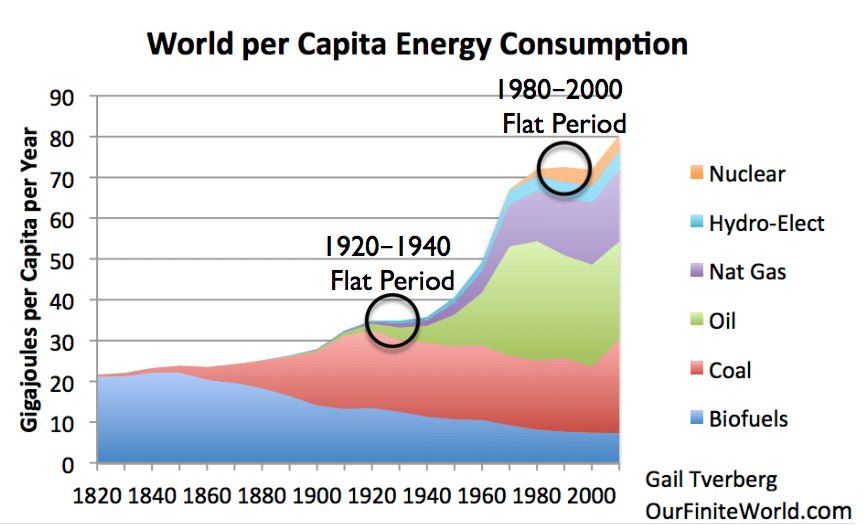
Figure 2. World per Capita Energy Consumption with two circles relating to flat consumption. World Energy Consumption by Source, based on Vaclav Smil estimates from Energy Transitions: History, Requirements and Prospects (Appendix) together with BP Statistical Data for 1965 and subsequent, divided by population estimates by Angus Maddison.
There is a good reason why energy consumed has risen over time on a per capita basis. Every human being needs energy products, as does every business. Energy is what allows food to be cooked and homes to be heated. Energy products allow businesses to manufacture and transport goods. Without energy products of all kinds, workers would be less productive in their jobs. Thus, it would be hard for the world economy to grow.
When energy consumption per capita is rising, it is easy for workers to become more productive because the economy is building more tools (broadly defined) for them to use, making their work easier. Manufacturing cell phones and computers requires energy. Even things like roads, pipelines, and electricity transmission lines are built using energy.
Once energy consumption growth flattens, as it did in the 1920-1940 period, the world economy is negatively affected. The Great Depression of the 1930s occurred during the 1920-1940 period. Problems, in fact, started even earlier. Coal production in the United Kingdom started to drop in 1914, the same year that World War I began. The Great Depression didn’t end until World War II, which was immediately after the 1920-1940 period.
In the 1920-1940 period, many people, especially farmers, were not able to earn an adequate living. This is a situation not too different from the one today, in which many young people are not able to earn an adequate living. Strange as it may seem, this type of wage disparity is a sign of inadequate energy per capita, because jobs that pay well require energy consumption.
The 1980-2000 flat period was in many ways not as bad as the earlier one, because the lack of growth in energy consumption was planned. The United States changed to smaller, more energy-efficient cars in order to reduce the amount of gasoline consumed. Oil-powered electricity generation was taken out of service and replaced with other types of generation, such as nuclear. Heating of homes and businesses was changed to more efficient systems that did not burn oil.
The indirect effect of the planned reduction in oil consumption was a drop in oil prices. Low oil prices adversely affected all oil exporters, but the Soviet Union was especially affected. Its central government collapsed, at least partly because of its reduced revenue stream. Member republics continued to operate, somewhat as in the past. Russia and Ukraine cut back greatly on their industrialization, leading to less use of energy products. Population tended to drop, as citizens found better work prospects elsewhere.
Eventually, in the early 2000s, oil prices rose again. Russia was able to become a major oil exporter again, but Ukraine and other industrialized areas were permanently handicapped by the collapse. Countries affiliated with the Soviet Union (including Eastern European countries, North Korea, and Cuba) found themselves permanently lagging behind the US and Western Europe.
Recently (2013-2017), the world economy seems to have again reached a period of flat energy consumption, on a per capita basis.

Figure 3. Based on data of BP Statistical Review of World Energy, 2017, and 2017 UN Population Estimates.
In fact, in many ways the flattening looks like that of the 1920 to 1940 period. Increased wage disparity is again becoming a problem. Oil gluts are again becoming a problem, because those at the bottom of the wage hierarchy cannot afford goods using oil, such as motorcycles. Young people are finding their standards of living falling relative to the living standards of their parents. They cannot afford to buy a home and have a family. Governments are becoming less interested in cooperating with other governments.
Why is world energy consumption per capita flat, or actually falling slightly, after 2013? The answer seems to be diminishing returns with respect to coal production. Diminishing returns refers to the fact that while at first coal is inexpensive to extract, the cost of extraction rises after the thickest seams and those closest to the surface have been extracted.
A chart of China’s energy production shows how China’s coal production first rose as low cost made its usage advantageous, and then fell due to diminishing returns. China experienced a major ramp-up in coal production after it was added to the World Trade Organization in 2001.

Figure 4. China’s energy production, based on data from BP Statistical Review of World Energy, 2017.
As the extraction of coal progressed, China found itself with many mines with rising production costs. Coal prices did not rise to match the higher cost of production, so a large number of unprofitable mines were closed, starting in about 2012.
A major reason for the flat world per capita energy consumption starting in 2013 is the fall in China’s coal production after 2013. Coal production is falling in quite a number of other countries as well, as the cost of production rises, and as users become aware of coal’s environmental issues. Other sources of energy have not been rising sufficiently to keep total per capita energy consumption rising. A person can see in the China chart that wind and solar production are not rising sufficiently to offset its loss of coal production. (Wind and solar are part of Other Renewables.) This situation occurs elsewhere, as well.
What role do wind and solar play in maintaining world energy supply? The truth is, very little. While a great deal of money has been spent building them, wind and solar together amounted to only about 1% of total world primary energy supply in 2015, according to the International Energy Association.
A major problem is that wind and solar do not scale well. As larger quantities are added to electricity networks, more workarounds for their intermittency (such as batteries and long distance transmission) are needed. Bid prices for wind and solar give a misleadingly low impression of their real cost, unless the projects include many hours’ worth of storage to offset the impact of intermittency.
The key to rising energy consumption seems to be the falling cost of energy services, when efficiency is included. For example, the cost of delivering a package of a given size a given distance must be falling, relative to inflation. Similarly, the cost of heating a home of a given size must be falling. Governments must be able to tax producers of energy products, rather than providing subsidies.
Globalization requires ever-expanding energy supplies to meet the needs of a rising world population. To maintain globalization, we need a growing supply of energy products that are very cheap and scalable. Unfortunately, wind and solar don’t seem to meet our needs. Fossil fuels are no longer cheap to extract, because we extracted the resources that were least expensive to extract first. Our problem today is that we have not been able to find substitutes that are sufficiently cheap, non-polluting, and scalable.
A Few Related Questions and Answers:
(1) What is the biggest impediment to raising total energy consumption?
We cannot get the price of oil and of other fuels to rise high enough, for long enough, to encourage the production of the fossil fuel supplies that seem to be in the ground. What happens, instead, is that energy prices hit an affordability limit and fall back.

Figure 5. NASDAQ three month price chart for Brent Crude oil. Source: NASDAQ
The recent strike in Brazil over high diesel prices shows the kind of issues that occur. Oil prices are still far below what many oil exporters (such as Norway, Venezuela, and Iraq) really need, when needed taxes are included.
Of course, the problem with not being able to get prices high enough also discourages the use of alternatives to fossil fuels, such as wind and solar.
(2) Aren’t wind and solar low-cost approaches?
It is easy to think that wind and solar will be huge improvements over burning fossil fuels directly for fuel, but nearly all of these analyses overlook the problems that are added by introducing intermittency to the electric grid. The assumption was made in early analyses that with enough scale, intermittency in one location would tend to offset intermittency in another location. Also, it was hoped that electricity consumption could be shifted to different times of day.
There have been several recent analyses that look more closely at these assumptions. Jean-Marc Jancovici has shown that if sufficient storage is added for wind and solar to make it “dispatchable,” it takes an order of magnitude more physical resources to produce wind and solar compared to what it takes to produce the dispatchable nuclear electricity used in France. Both have low long-term operating costs. Thus, we would expect the true cost of wind and solar to be far higher than France’s nuclear electricity.

Figure 6. Source: Favorable to all scenario from https://jancovici.com/en/energy-transition/renewables/100-renewable-electricity-at-no-extra-cost-a-piece-of-cake/
Roger Andrews, writing on Euan Mearns site Energy Matters, shows that some recent solar and wind auction prices appear to be far below actual costs, when reasonable minimum cost assumptions are used.
Regarding “Demand Response” as a solution to intermittency, Roger Andrews shows how little time of day pricing for consumers affects consumption curves. It appears that people don’t stop eating dinner after they get home in the evening, no matter how high the cost of electricity is at that time.
Interruptible supply is another way of reducing demand. This link describes some of the issues encountered when interruptible supply was tried on a large scale in California.
(3) Can’t we simply get along using less energy? That is what everyone tells us is possible.
The historical record in Figure 2 doesn’t give much indication that this is possible. Whenever there is even a small drop in energy consumption per capita, it seems to have an adverse effect. On Figure 3, even the small dip in energy consumption per capita in 2008 and 2009 led to a serious recession in many countries of the world.
The people who talk about getting along with less energy haven’t thought through the likely ramifications of this. There would be fewer jobs that pay well, because jobs such as those for construction workers would disappear. The economy would shrink, because of the fewer jobs, in a much worse recession than the Great Recession of 2008-2009.
We know that in past collapses, one of the big problems was inability of governments to collect enough taxes. We would likely encounter the same problem again, if there are fewer people making high wages. Most of the tax dollars for the US Federal Government are paid by private citizens (as income taxes or as Social Security funding), rather than by corporations.

Figure 7. Sources of US Federal Governments Revenue, based on US Bureau of Economic Analysis data.
The last year shown on Figure 7 is 2017, which is before the recent corporate tax reduction. This change will tend to shift the burden on Federal Taxes even further in the direction of payroll related taxes.
(4) How about efficiency savings? Can’t efficiency savings fix our problem?
There are two issues involved. If we were really efficient at fuel savings, as we were in the early 1980s, oil and other energy prices would drop dramatically. This would push oil, coal, and gas producers worldwide toward bankruptcy. Governments of oil exporting countries, such as Venezuela and Saudi Arabia, would have difficulty collecting enough tax revenue. They would likely collapse from lack of tax revenue, substantially reducing supply.
A second issue is that historically we have been adding efficiency. In fact, efficiency is what has tended to make fuel more affordable. As noted in the article, energy use could grow, as the cost of energy services fell.

Figure 8. Total Cost of Energy and Energy Services, by Roger Fouquet, from Divergences in Long Run Trends in the Prices of Energy and Energy Services. The cost of energy services combines (a) the cost of energy with (b) the impact of efficiency savings.
Some of the changes we have been making recently go in the opposite direction of efficiency. For example, the recent article, Biggest Ever Change in Oil Markets Could Send Prices Higher, discusses a new regulation requiring the use of low-sulfur fuel oil for ships. Doing this would greatly reduce the quantity of sulfur being released to the atmosphere as emissions. This is not a change toward efficiency; it is a change toward higher cost of production, which is the opposite of efficiency. Regulators plan to use part of our energy supply to eliminate the excess sulfur before the oil is sold.
As undesirable as sulfur pollution is, the problem is affordability and higher cost. Wages are not high enough for workers around the world to afford the required higher cost of food (because food production and transport use oil) to support the new regulation. So, the likely result of the regulation is to push the world toward recession. Beyond a certain affordability point, it is hard to push oil prices higher, because wages don’t rise at the same time.
(5) Could you explain further why flat energy consumption per capita is not sufficient for the world economy–this amount really has to grow?
Perhaps looking at charts of recent trends in energy consumption of a few countries can help explain what happens when overall per capita energy consumption is flat.
Joseph Tainter in The Collapse of Complex Societies explains that economies often use “complexity” to work around problems as they approach resource limits. In the particular version of complexity tried in this case, manufacturing was increasingly globalized. Workers suddenly found themselves competing for wages with workers from much lower wage countries. Wage disparity became more of a problem.
When workers are increasingly poor, they can afford to purchase fewer goods and services. This can be seen in energy consumption per capita data. Figure 9 shows energy consumption per capita for three European countries experiencing difficulties. In all three, energy consumption per capita has been falling for several years. When manufacturing was sent to Asia, workers found themselves earning less, so they were able to purchase fewer goods made with energy products. Also, European products were less competitive on the world market, with the new competition from low-cost markets.

Figure 9. Energy Consumption per Capita for three European Countries, based on BP Statistical Review of World Energy data and UN 2017 population estimates.
The countries that have been able to grow more rapidly in response to globalization (such as those in Figure 10) need to keep up their patterns of growth, or they start encountering financial problems because their prior growth was generally financed with debt. Without sufficiently rapid growth, they have difficulty repaying debt with interest.

Figure 10. Energy Consumption per Capita for five countries that recently have been growing rapidly. Based on BP Statistical Review of World Energy data and UN 2017 population estimates.
Brazil’s energy consumption per capita has recently fallen, and it is encountering severe problems. Argentina is a country with flattening energy consumption growth. China’s growth in energy consumption has slowed as well; we often read statements about its debt problems.
One of the problems that these rapidly growing countries encounter is currency fluctuations. As long as their particular country seems to be growing rapidly, the currency level of their country can remain high, relative to the US dollar or the Euro. But if obstacles are encountered, such as the low price of their major export, or slower economic growth, the currency of the country may fall relative to major currencies.
A falling currency relative to major currencies is a problem for these rapidly growing countries for three reasons. For one, imports become expensive. For another, any debt denominated in a foreign currency (such as the US dollar) becomes more difficult to repay. The reason why this is an issue is because rapidly growing countries often do not find enough credit available locally, so are forced to borrow internationally. A third problem with slowing growth and a falling currency relativity is that it becomes more difficult to attract new investment to the country. Instead, outside investors may decide to leave; they want to seek the next growth opportunity, in different, more rapidly growing country.
Turkey and Argentina both seem to be having problems with their currencies falling relative to the US dollar.
Another issue that makes flat worldwide per capita energy consumption unworkable is “diminishing returns” as resources become depleted. For example, wells for fresh water must be dug deeper, ores of metals include higher percentages of waste materials, and oil wells must be sunk in less convenient locations. These problems can be worked around, but they require increased energy consumption. All of these uses for energy products leave less for the rest of the economy. Thus, if we deduct the extra energy needed to compensate for diminishing returns, what at first looks like flat per capita energy consumption worldwide really equates to declining per capita energy consumption.
(6) Isn’t there anything that we can do to reduce carbon dioxide emissions?
The task of reducing carbon dioxide emissions is much more difficult than it appears to be, because the world economy requires energy consumption in order to operate.
The best thing I can see that an individual can do is reduce his or her consumption of meat and other animal products (fish, cheese, milk, leather). To offset, a major increase should be made in the consumption of vegetables that are filling to eat (such as potatoes, beets, carrots, beans, sweet potatoes, taro root, turnips, and corn). Some of these perhaps can be grown locally. Humans’ use of animal products adds to carbon dioxide levels, partly because of the quantity of food that needs to be grown and transported to feed the animals, and partly because of the direct emissions of some animals (including cattle, pigs, buffalo, chicken, sheep and goats).
In fact, cutting back on highly processed food of all sorts (particularly sugars, high fructose corn syrup, and oils) would seem to be worthwhile, as well. Growing, processing, and transporting the crops used in these highly processed foods all add to CO2 emissions.
Our problem is that we have grown attached to the flavors of these foods, and we have become convinced that they help us grow big and strong. While they may do this, they also set us up for problems in old age. Starchy vegetables have played a major role in the diets of long lived people. We may need to start giving them, and other less processed foods, a more prominent role again.


World Bank warns trade tensions could cause 2008-level crisis
https://www.theguardian.com/business/2018/jun/05/world-bank-warns-us-trade-war-could-cause-2008-level-crisis
Michael Moore predicted this would happen last year..
Michael Moore predicts Trump-driven economic crash and advises not to invest in stock market
https://www.marketwatch.com/story/michael-moore-predicts-trump-driven-economic-crash-and-advises-not-to-invest-in-stock-market-2017-08-11
The Collapse of Civilization Manifesto
https://imgur.com/a/pYxKa
Indeed, extraordinary claims like getting infinite amounts of energy in a finite world. The number of extraordinary claims today is rather astonishing. Solar/wind powered future, artificial intelligence, non-polluting super capacitor batteries, shale oil, abiotic oil, thorium, fusion, driver-less cars, robots completely taking over manufacturing, colonization of Mars/Moon, MAGA, etc etc. It is interesting to note that all past complex societies rose, peaked and collapsed throughout history. In that context, to say “this time it is different” – is an extraordinary claim that requires extraordinary proof!
Sagan never lived up to his own dictum. He seriously believed in ‘scientific’ claims for which there was no serious evidence, and on the other hand there did seem interesting evidence in favor of the existence of various unusual things like the paranormal, but as far as I know he was dismissive of them.
7 In 10 Americans Feel ‘Worn Out’ By The News, Survey Says
https://www.yahoo.com/news/7-10-americans-feel-apos-081314358.html
Really? I thought it was more like 10 out of 10 judging by my co-workers reactions.
Well, watching your planet fall into fascism does get you burned out by the end of the day.
It would appear that the establishment has it out for FB…. blow after blow after blow….
Perhaps someone has decided that FB is killing productivity … and it needs to go?
https://www.zerohedge.com/news/2018-06-06/facebook-gave-user-data-access-chinese-firm-flagged-us-intelligence
But FB could be our only way out. If the species can’t talk to itself across the globe. it can’t plan. It isn’t planning now, and uses FB for foolishness, but as long as there’s the prospect of planning globally, we can use (or might need) FB.
Is it safe to assume that FB or any other similar facility can ever be global? And effective for the purpose envisaged?
With 2 billion users, I thought its range was relatively global already. Who don’t realize that it’s global (or have any idea what that means) are its users.
https://www.internetworldstats.com/facebook.htm
Can’t we use sms for that?
The RAND corporation came to the conclusion that the best way to rule the Middle East was through “divide and rule” by igniting a sectarian war between Sunni and Shia.
GW Bush just had to tip the balance in Iraq by removing Saddam and the Baath regime and give the power to the Shia. Bush gave Iraq to Iran and Iran walked straight into the trap. Mission Accomplished.
A sectarian war ignited. The Sunni tribes supported al Qaeda and later ISIS against the Shia regime and Iran now in power in Baghdad.
A former French FM said on French national TV that high officials in Britain had confessed to him that they were training rebels that would be sent into Syria two years before the violence started.
The Arab Spring and the protest gave them an opportunity to send in the rebels. It doesn’t matter which rebels are armed (FSA, al Qaeda or ISIS) as long as they fight the Shia sect in power in Damascus. The Assad regime was losing the war and invited Iran into Syria.
Iran was now engaged in two costly war, or in fact three with Yemen, dreaming of a Shia empire and of all of the oil wealth in the Middle East.
Trump then just wiped out ISIS. Thousands of corps are still rotting in the ruins of Mosul and Raqqa.
Iran then suddenly was the winner of the war and became a “major threat” to the entire region…
And the saga goes on with the Syria war, which seems to relate at least partly to offshore oil and gas. I posted this yesterday:
This February 2018 article https://oilprice.com/Energy/Energy-General/Russia-Is-Taking-Over-Syrias-Oil-And-Gas.html is called, “Russia is taking over Syria’s oil and gas.” According to this article:
In accordance with an energy cooperation framework agreement signed in late January, Russia will have exclusive rights to produce oil and gas in Syria. . .
It’s an understatement to say that whoever takes over Syria’s energy sector will receive a desolate ruin. The country’s refineries need thorough reconstruction after their throughput capacity has halved from the pre-war level of 250,000 barrels per day. This task will most likely be carried out by Iranian companies, in accordance with agreements signed in September last year, which also involved the reconstruction of Syria’s damaged power grid.
Yes, Russia is part of the party as well. That makes this war a lot more complex. God knows what they are doing in the Middle East.
Russia is my neighbor, but seems like a distant strange nation. I will never figure them out.
“There is such a personality in the US – Mr. [George] Soros, who interferes in all affairs around the world. I often hear from my American friends that ‘America as a state has nothing to do with [his activities],” Putin, who is traveling to Austria on an official visit on Tuesday, said.
“There are rumors circulating now that Mr. Soros is planning to make the euro highly volatile. Experts are already discussing this. Ask the [US] State Department why he is doing this. The State Department will say that it has nothing to do with them – rather it is Mr. Soros’ private affair. With us, it is Mr. Prigozhin’s private affair. This is my answer. Are you satisfied with it?”
I am afraid George is grasping at straws.
“It is increasingly difficult to justify the complacency in global financial markets in the light of the magnitude and potential significance of events in the United States, Europe and beyond which could be defining elements of the next global financial crisis…
“There is a genuine danger of drifting into a global trade war, given US President Donald Trump has finally imposed the long-promised tariffs on steel and aluminium imports from the European Union, Canada and Mexico. If not handled by all sides with considerable care, this could precipitate a global slump such as that created by protectionist legislation in the US in 1930.
“The Eurozone also faces a potentially existential crisis as the result of the new anti-austerity, anti-EU, heavily indebted government in Italy. As the Eurozone’s third largest economy (ranking 7th or 8th globally, and six times the size of Greece) the risk is of a debt crisis that would dwarf the Greek debt crisis in severity and threaten the future of the Eurozone (and perhaps of the EU).
“As if all this uncertainty isn’t enough, there is renewed concern about oil prices, global (especially Chinese) debt, the transition – being led by the US Federal Reserve – to “normalise” interest rates, and key elections in emerging markets (Turkey, Brazil and Columbia), with other key emerging nations in dire, debt/inflation-ridden economic circumstances…
“Against this background I was particularly struck by, and disturbed by, our Reserve Bank’s comment on the global situation in this week’s announcement on the cash rate. “Financial markets have been affected by political developments in the eurozone, particularly in Italy,” it said. “There are also concerns about the direction of international trade policy in the United States and economic developments in a few emerging market economies.”
“These “weasel words” have become so typical of Reserve Bank/ Treasury ease. While making absolutely no attempt to spell out the risks and potential consequences…
“…Exactly what would they do to handle another global financial crisis?”
https://www.smh.com.au/business/markets/alarm-bells-are-ringing-loudly-but-markets-are-doing-nothing-20180606-p4zjrc.html
“It’s time to review the world’s capacity to respond to crises.
“The “global financial safety net” refers to the mishmash of global, regional and bilateral institutions and mechanisms designed to help countries facing economic and financial crises and to prevent these problems from spreading.
“The most well-known institution is the IMF, which has around $1 trillion in crisis-fighting resources. The World Bank, with around $263 billion, has provided assistance in previous crises.
“There is also a range of regional mechanisms, such as Asia’s Chiang Mai Initiative Multilateralisation agreement (with $240 billion) and the European Stability Mechanism (with $600 billion). Bilateral currency swap arrangements, under which one country’s central bank can exchange its currency for that of another, are also an important part of the safety net…
“I pose a simple question: can the safety net provide at least the same level of support today that has been required of it in the past?
“To find out, I war-gamed three regional crises – the Asian financial crisis, the European debt crisis and the Latin American debt crisis – and six country-specific crises in Argentina, Turkey, Ecuador, Russia, Mexico and Chile.
“…my analysis produced some alarming results. The safety net… struggles to cope with widespread shocks. Providing the same level of support today that was provided during the Asian financial crisis would exhaust all currency swap lines, all regional mechanisms, all regional development banks and the entire World Bank, and would require exceptional access to the IMF’s resources. If the European debt crisis occurred today, the entire global financial safety net would be exhausted.
“The lead-up to the 2008 crisis was characterised by a dangerous sense of complacency. That complacency should not be allowed to take hold again.” [too late!]
https://www.business-standard.com/article/international/the-world-is-awfully-ill-prepared-to-fight-economic-crisis-here-s-how-118060600233_1.html
Right! We are sleepwalking into another crisis. The secret is that world economies cannot really withstand higher interest rates. Attempting to normalize interest rates is a big mistake. The process can make the US look better for a short time, as its currency rises compared to other currencies. But ultimately, the process has to fail. We will have many countries around the world defaulting on their debts in US dollars, and that doesn’t work.
I suppose the players either have no other investment choices or, they know they will be bailed out.
“A growing number of private firms [in China] could face cash flow problems in the second half of the year as they are the most vulnerable to the government’s crackdown on shadow banking.”
http://www.scmp.com/news/china/economy/article/2149408/chinas-deleveraging-efforts-are-sinking-private-sector-while-debt
“Japan’s household spending unexpectedly contracted in April and services sector activity slowed in May, figures out on Tuesday showed, raising the possibility of the economy falling into recession this quarter.”
https://www.businesstimes.com.sg/government-economy/weak-japan-figures-hint-at-economic-recession
“Australian new home sales fell heavily in April, adding to a long list of housing market indicators that are weakening at present.”
https://www.businessinsider.com.au/australia-property-market-new-home-sales-april-2018-6
This sounds like a self-perpetuating problem:
If you want housing prices to rise, it is necessary to create an increase in the amount of debt available. This can come through lower interest rates or increasingly lenient lending standards. Doing the opposite (which seems to be the case now) is pretty much a guarantee that home prices will fall.
Well, I’ll wager that access to finance would be no problem if there was sufficient levels of fossil fueled resource consumption and economic growth. The economy must grow or it will collapse. The evidence of this is so overwhelming.
But China does seem to be at least a little aware of the problem. It keeps trying to ease requirements a bit.
“Foreign investors pulled $12.3 billion from emerging markets last month — the largest outflow since November 2016, according to the Institute of International Finance.”
https://www.bloomberg.com/news/articles/2018-06-05/emerging-markets-sees-biggest-outflow-in-18-months
“Pro-business leaders in South America’s largest economies are struggling to spark growth as their policies run head-on into domestic crises and emerging market turbulence.”
https://www.bloomberg.com/news/articles/2018-06-05/south-american-economies-dive-south-as-growth-outlook-dims
“Brazil’s extraordinary efforts to shore up its currency weren’t enough to stem a rout that left the real at the weakest level since former President Dilma Rousseff’s impeachment in 2016.”
https://uk.investing.com/news/forex-news/brazils-heavier-hand-in-currency-market-cant-stop-reals-slump-1204392
“… monetary policy tightening in the United States is pressuring the currencies of emerging markets: the Turkish lira is down more than 18% against the USD year-to-date (and more than half its value since 2013). This in turn makes it harder for Turkish companies to service their foreign debt. Currency depreciation coupled with rising oil prices have also contributed to widening the country’s current account deficit.””
https://www.fxstreet.com/news/turkey-economy-runs-into-serious-headwinds-nbf-201806050939
“South Africa’s economy contracted at the sharpest rate in almost a decade in the first three months of the year, according to official statistics, underlining the challenge confronting President Cyril Ramaphosa’s bid to revive growth.”
https://www.ft.com/content/06022992-68ad-11e8-b6eb-4acfcfb08c11
Ouch! We have this problem several places.
Unfortunately, emerging markets are dependent on foreign investors. We ran into this problem before. The “hot money” goes wherever prospects are best. This turns a little downturn into a big downturn.
It seems that “hot” money is a bit too liquid and movable. Perhaps a symptom of the crises that continue to hit various spots in the modern global economy is that “hot” money can move around too easily and that this, in and of itself is part of the problem. “Hot” money can then become a manufactured weapon.
Existing oil reserves are scheduled to begin a catastrophic crash within 1 to 3 years. When it hits the economic and social damage will be catastrophic. The end of Western Civilization, from China to Europe, to the US, will not occur when oil runs out. The economic and social chaos will occur when supplies are merely reduced sufficiently….
https://imgur.com/a/6dEDt
https://arxiv.org/pdf/1708.03150.pdf
https://www.scientificamerican.com/article/has-peak-oil-already-happened/
http://www.sciencedirect.com/science/article/pii/S0301421509001281
https://www.scribd.com/document/375110698/The-end-of-Peak-Oil-Why-this-topic-is-still-relevant-despite-recent-denials-Chapman-2014
https://www.scribd.com/document/375110317/Projection-of-World-Fossil-Fuels-by-Country-Mohr-2015
http://www.energybulletin.net/sites/default/files/Peak%20Oil_Study%20EN.pdf
http://www.scribd.com/document/367688629/HSBC-Peak-Oil-Report-2017
“The economic and social chaos will occur when supplies are merely reduced sufficiently….”
No, that is not the way the system works. The problem occurs when total energy supply (including coal, natural gas, wind turbines, and everything else) stops rising quickly enough. Total energy consumption needs to rise faster than population growth (in other world, rise on a per capita basis). The reason this is the case is
(a) Every person needs energy supplies in many ways, including food production. Otherwise, return on human labor falls too low. There is too much wage disparity; too many fall out of the bottom of the wage distribution–they find themselves unsuitable for all jobs, or the jobs don’t pay enough to cover transportation to work.
(b) Increasing diminishing returns takes a growing bite out of usable energy –Diminishing returns is much broader than “energy used in energy production”
Because the limit is a per capita one, we hit a limit before total oil production ever turns downward. All that needs to happen is total energy consumption does not rise rapidly enough. So we may very well be hitting a limit within one to three years, but not for the reasons you give. The limit will likely hit other places in the system, such as the financial system.
Geologists came up with the peak oil theory. They could not understand the role prices play. They could not understand the role population plays. They had views in their heads that said,
(1) “What we can see in the ground we can get out, if we have the technology to do so.”
(2) “We can get along with whatever smaller amount that we need to get along with.”
These two false beliefs have permeated the beliefs of many academic and governmental groups. These groups have tended to believe we have a great deal more energy supplies available to us than we really do. This is a big part of what got us into the “climate change is our number one problem” story. These false beliefs are also the basis of the idea that we can simply “move away from fossil fuels” if we want. All a person needs to do is assume improving technology and ever-rising prices, and it is possible to extract an amazingly large amount of fossil fuels with the supplies we already know about.
Conversely, all a person needs to do is assume we can get along with ever smaller supplies, and we can walk away from fossil fuels. Peak oilers started down these incorrect roads long ago. Their work did point out the finiteness of supplies, but it represents a very incomplete understanding of how the overall system really works. But once it is in peer reviewed literature, the views are endlessly repeated.
Points A & B are the best and most succinct summary of the issues discussed here I’ve ever read!
Thanks!
No Profit? No Problem! Loss-Making Companies Flood the IPO Market
Dropbox Inc. and Spotify Technology SA are poised to join a growing list of newly public companies that aren’t making money, signaling an increasing tolerance for loss-makers when investors believe there’s potential.
More than three-quarters of the 108 companies that completed IPOs in 2017 reported per-share losses in the 12 months leading up to their debuts, according to data tracked by Jay Ritter, a finance professor at the University of Florida.
The share of loss-makers in the IPO market has been rising. Last year, it reached the highest percentage since the peak of the dot-com boom in 2000. By contrast, data spanning nearly four decades shows 38% of companies are typically unprofitable when they go public.
The shift suggests investors are comfortable giving companies more space to grow their businesses, often by sacrificing immediate profitability for higher spending on marketing or research and development, according to Mr. Ritter.
That’s particularly true in the tech sector, where 17% were profitable last year, barely higher than 14% in 2000. Recent tech fervor has fueled concerns in some corners that the hot sector is once again getting frothy. Many of those dot-com era firms, like e-commerce retailer Pets.com Inc. and online grocery business Webvan Group Inc., later failed spectacularly.
The data “instantly evokes parallels to the dot com mania,” said Callum Thomas, of macro research firm Topdown Charts, in a blog post this week. “Certainly, this is the sort of thing you typically see toward the end of a market cycle.”
Tech companies, new and old, have been a key pillar of the long bull market. The tech-heavy Nasdaq Composite index has climbed 27% over the last 12 months, versus the broader S&P 500’s 16% rise. But experts are quick to point out that today’s tech firms that pursue IPOs generate more revenue than they did two decades ago, and often choose to forgo profitability to grow their businesses and compete with larger rivals.
“A lot of the companies are reporting losses but could report profits if they wanted to,” Mr. Ritter said.
U.S.-listed technology companies that went public over the last 12 months are trading about 50% above their IPO prices on average, according to Dealogic data through Thursday. Some loss-making IPOs are doing even better. Zscaler, a cloud security company that began trading Friday, finished the day at more than double its IPO price of $16 a share.
Dropbox, a web storage and collaboration company that is set to start trading next week, said in financial disclosures that it had a net loss of $111.7 million last year, or 57 cents per share. That loss has narrowed in the last few years from $210.2 million, or $1.11 per share, in 2016, and $325.9 million, or $1.77 per share, in 2015.
Spotify, the music-streaming company that begins trading early next month, had a loss of €1.24 billion in 2017, wider than losses of €539 million in the prior year and €230 million in 2015. Spotify’s chief financial officer, Barry McCarthy, told potential investors Thursday that the company will continue to invest in growth and, because of that, won’t focus on profit. He said that the company expects that such growth will ultimately increase its enterprise value.
Both companies look a lot different than the tech IPOs from around the year 2000, particularly in terms of how much revenue they generate. Dropbox reported sales of $1.1 billion in 2017, up from $844.8 million in 2016 and $603.8 million in 2015. On top of that, Dropbox generated $305 million in free cash flow last year.
Spotify posted €4.1 billion of revenue in 2017, up nearly 39% from the prior year.
Tech companies that go public these days tend to be more mature. Last year, such firms had median sales of $181.5 million over the 12 months leading up to their public offerings, well above the median of $16.6 million in 2000, according to Mr. Ritter’s inflation-adjusted data.
Still, the losses among newly public companies have concerned some analysts. Snapchat parent Snap Inc., which went public a year ago, reported losses in the final three months of 2017 that doubled from a year earlier. Less than a fifth of the 36 analysts that track the company have a buy rating on the stock, according to FactSet. But losses narrowed from the prior quarter, and some believe the company is moving toward profitability.
Another reason for the drop in profitability among newly public companies is that nearly 30% are biotechnology firms that come to market before they have an approved drug. Some of the successful ones will sell themselves to large pharmaceutical companies while others will fail, Mr. Ritter said.
When they go public, they typically aren’t generating much revenue. The median sales among the 32 biotech companies that went public last year was less than $1 million.
– Maureen Farrell contributed to this article.
https://blogs.wsj.com/moneybeat/2018/03/16/spotify-and-dropbox-to-join-a-growing-club-profitless-public-companies/
Growth is the thing of interest today. Who cares about profits?
Driving home tonight, it got progressively colder, darker and wetter. Lo and behold, within 10 km of home there were not one, but two electric cars on the side of the road, with one in the process of being put on a recovery truck. Bit of a miscalculation methinks.
So it got colder; that cost range, it got wetter, that needed wipers, and it got dark so on came the lights. One of the dudes standing by the vehicle looked every bit the ‘sheople’; sheepish and green and…. muppet!
Outstanding…. I hope you drove by and waved and shouted Green Groopies suckers! And gave them a blast of exhaust….
Stewpidity has no limits….
I would be curious to look at countries that are 100% renewable grid power and see how much fossil fuel energy they use. I think Costa Rica is 98% Wind and Hydro powered. But how much of their total energy use is fossil fuel?
The reason is to try to demonstrate that 100% renewable grid doesn’t mean the end of FF use. Could Costa Rica run all it’s vehicles on electricity, for example?
The fallacy in that concept is that Costa Rica will import asphalt for roads, materials produced elsewhere using oil and will probably ship whatever they export on ships powered by oil. Much of this oil resource is not reported in their own energy use.
What JesseJames said. Unless countries use electricity for everything they produce and only import from countries that also produce only using renewable electricity and export using only hand built freight ships (from materials produces renewably), as well as only export to other countries by hand made ships, they will never be 100% carbon free.
I think the new thing is aiming for ”carbon neutral”, not 100% renewable.
Intermittent electricity is not equivalent to dispatchable electricity. In fact, intermittent electricity may have zero or negative value because the cost of fixing it essentially makes the process an energy sink. If a researcher overlooks this problem, he or she can claim carbon neutrality a whole lot sooner than otherwise.
George W Bush suggested we use “switch grass” to meet our energy needs…
We are getting moderately close of oil independence now. That is why you hear so little about it now. It is also a big reason why the US is doing so much better economically than Europe, Japan, and Australia, none of which are oil independent. These are my calculations using heat energy data. This basis gives a less flattering view than a barrels of oil production vs consumption approach, because Natural gas liquids and ethanol are less dense than oil. The heat value corrects for the difference in heat value.
According to EIA data,
US total energy consumption in 2017 – 97.728 quads
US total energy production in 2017 – 87.607 quads
So, in 2017, the US seems to have produced about 90% of the total energy it consumed.
With respect to oil and other liquids,
Consumption of Petroleum + Natural Gas Liquids in 2017 = 36.241 quads
Production of Petroleum in 2017 = 19.538 quads
Production of Natural Gas Liquids in 2017 = 5.046 quads
Total Petroleum + Natural Gas Liquids Production = 24.584 quads
US Ratio of Petroleum and Natural Gas Production to Consumption = 68%
In addition to the above, the US also consumed and produced biofuels, other than wood (primarily ethanol).
Consumption of biofuels in 2017 = 2.286 quads
Production of biofuels in 2017 = 2.332 quads
So we were are small exporter of biofuels (ethanol)
If we calculate “Total Liquids” by adding together “Oil + Natural Gas Liquids + Biofuels” we get:
Consumption in 2017 = 38.527 quads
Production in 2017 = 26.916 quads
US All Liquids ratio of production to consumption = 70%
Worlds largest Multinational bank (HSBC)
Peak oil view from a year ago.
They nailed the Brent price 75$..
Growing demand until 2040. Any comments?
but she adds that supply will be dropping by as much as 40 million barrels per day by the year 2040… (which okay, I think it’s very probable)…
perhaps she thinks of “demand” in the sense of “wanting”…
the human population will be “wanting” more oil until 2040? because of the rising population?
but she doesn’t get the connection that the falling energy surplus will make oil much less affordable by 2040…
she should be reading OFW…
I suspect she knows that there will be no Playboy Calendars issued in 2040…. don’t want to scare the sheeple too much
Don’t want to spook the horses ahead of time..
She understands “peak oil,” but not how a networked economy works. The financial system will collapse before then.
I suspect most people will watch that…. and have the look of a deer caught in the headlights… their brains will just go blank…. Cognitive Dissonance will kick in blocking out the implications….
This is kinda like the doctor saying — you’ve got around 6 months to live…. maybe more… maybe less…
Like Henry Ford said (on a different topic):
The only statement I care to make is that this fits what is going on.
He’s joining John Key — enjoying the final days before BAU ends
https://www.zerohedge.com/news/2018-06-05/david-koch-stepping-down-all-business-political-activities
Starbucks CEO just stepped down today as well..
He undoubtedly is going to either 1) spend more time with family or 2) run for public office, I mean public service (snicker)
Putting the finishing touches on the doomsday bunker?
We can’t have too many captains step down… we need people to keep the Titanic afloat for as long as possible
He may be taking off to avoid arrest for being part of the NWO cabal, or for putting Soylent Green in the chai tea latte.
https://youtu.be/WkAHD4lYBR0
You know how much I hate correcting other people :), but I must point out that Howard Schultz was the CEO of Starbucks from 1986-2000 and again from 2008-2017, but since 2017 he’s been the firm’s executive chairman, which means he’s allowed priority use of the executive washroom.
“The Hitch-Hiker’s Guide to the Galaxy also mentions alcohol. It says that the best drink in existence is the Pan Galactic Gargle Blaster, the effect of which is like having your brains smashed out with a slice of lemon wrapped round a large gold brick.”
― Douglas Adams, The Hitchhiker’s Guide to the Galaxy
It sounds delightful.
When it all crashes and burns, and we find ourselves on the Other Side, there at the end of the famous beckoning tunnel of light will be….God? The gods? Douglas Adams and damn good drink: what was it? A Gargleblaster?
the Other Side is a creation of uneducated superstitious early humans who thought of Reality as a Three Story Universe…
there is no good solid evidence for the existence of the Other Side…
there is a vast amount of evidence that all of the writings about the Other Side were created through the human imagination…
at this point in time, I echo what I’ve heard from others:
if I find myself on the Other Side (after I die, of course), I will be greatly surprised…
https://twitter.com/AP/status/1004064258424856576
This Social Security calculation (lasting until 2034) assumes that the US government will continue to pay its debt, as it becomes due. This is necessary in the calculation, because there the contributions allowed for some pre-funding, but this money was spent for other purposes (wars, mostly). The government put in government debt that cannot be sold to the public instead.
Of course, all of these calculations are based on models–how much young people will be contributing and how much will be needed to pay older and disabled people.
https://twitter.com/RichardDawkins/status/1003933488523988992
Call the nurse quick! Dr. Dawkins is off his meds and has access to his Twitter account again.
https://twitter.com/caitoz/status/1004000288418623488
This is how I see the economic collapse looking when it happens..
I see it more like in the Robocop movies, a society with ever increasing inequality. Wealthy elite corporate rule vs poor drug addicts in the streets. Or are we already there?
https://m.youtube.com/watch?v=6tC_5mp3udE
Solar panels, batteries and teslas might be much expensive, but maybe cheaper than maintaining the grid for all the useless eaters.
I may appear to be ‘useless’ but I’m fairly decorative and try to be cheerful (except here!) – this surely justifies my daily plate of Solent Green! And maybe even seconds……
Solar panels and batteries are not sustainable either. Teslas won’t have roads to run on. It is all a farce.
Charade….
The elite know what is coming. They are probably desperate to roll out the armed robots to control everything.
This is what I have been saying.
https://www.independent.co.uk/news/business/news/carbon-bubble-global-wealth-mass-unemployment-fossil-fuels-climate-change-research-a8382631.html
“Trillions of dollars of fossil fuel wealth will be wiped out at some point over the next 17 years even if governments fail to impose binding carbon emissions limits on industry to curb global warming, according to a major new study. Environmentalists and policymakers have long warned of the threat of a “carbon bubble” and “stranded assets” for listed energy companies, based on the possibility they will never be able to realise the value of their vast stores of oil, gas and coal if politicians actually deliver on their decarbonisation promises.
But today a group of scientists and analysts from Cambridge, Nijmegen, Macao and the Open University take that warning a step further by arguing that these assets are destined to be stranded regardless of official policies to discourage the use of fossil fuels because clean energy technologies are now developing so rapidly that those polluting assets will be worthless in any case. “Our analysis suggests that, contrary to investor expectations, the stranding of fossil fuels assets may happen even without new climate policies. This suggests a carbon bubble is forming and it is likely to burst,” said Professor Jorge Viñuales from Cambridge University. If policymakers did deliver on the decarbonisation programmes, the loss for investors would be even more rapid.
The research is at odds with work from the International Energy Agency, which projects steady price rises for fossil fuels until 2040. And Donald Trump’s decision last year to pull the United States out of the Paris Agreement on climate change has also done nothing to persuade most investors to take the stranded assets warning seriously. But the researchers’ new “simulation-based, energy-economy-carbon-cycle climate” model suggests investing in fossil fuel firms today is likely to prove a disastrous bet, suggesting that between $1 trillion and $4 trillion could be wiped off the value of global fossil fuel assets by 2035.”
A better description of the problem might be that fossil fuel prices will fall too low, causing a drop in fossil fuel production.
Low prices will happen because of diminishing returns in many parts of the economy: fresh water will take energy to extract; metal ores will include more waste product, so will take ore energy to extract; pollution controls of all kinds will become more expensive, adding a different kind of efficiency; and the extraction of energy supplies will become less efficient. Returns of all kinds will drop, as they have already dropped. Profitability will drop, calling for lower business tax rates (already happened!). Interest rates will be low. Obtaining worker productivity gains will be more and more difficult. Wages disparity will become greater, as businesses strive to keep costs down by using automation to replace low-pad workers. With fewer potential customers who can afford to buy goods (cars, homes, motorcycles) that use fossil fuels, prices will drop below the cost of extraction. Spikes in prices will be brief. Eventually, low prices will stop the extraction of fossil fuels.
Without fossil fuels, all industrial assets will be stranded, as will all commercial assets. Most residential assets will be stranded as well. Fossil fuels will indeed be stranded, but so will wind turbines, solar panels, and electricity transmission lines.
I am afraid this problem will happen regardless of climate policies. It is hard to see why one would want this collapse to happen earlier than it otherwise would happen. Thus, climate policies discouraging fossil fuel use make no sense.
the sustainable movement is responsible for the direction we find ourselves in they really do not understand the crux of the problem which is diminishing returns they have a plan for saving the earth and all its inhabitants but do not realize they will kill us all instead.
You are right!
Sustainability movement? Are you kidding….this is laughable.
All I see anywhere I look is plastic.
cemeteries are littered with plastic flowers. If I were dead I would want someone to occasionally remember me with REAL LIVE FLOWERS rather than this fake crap.
The medical and biotech industries use plastic like it is going out of style.Of course, they all talk about sustainability…it is a joke.
Our entire factory food delivery system is based on plastic packaging.
This idea that we are being green is such a bad joke. Humans are the dirtiest, most polluting item on this planet.
++++++
!!!!!!!!!!!!!!!!!!!!!!!!!!!!!!!!
I am putting my name in to lead the NZ Green Groopie Party.
My platform:
Extinct the Humans! Extinct the Humans!
Save the World
https://www.clker.com/cliparts/w/q/m/8/G/J/now-hi.png
if I could, I would vote for you…
I think you just might have found your true calling in life…
I’m running off the bumper stickers now….. I’m going to put one on every car in every parking lot in Queenstown.
A Vote for Fast Eddy – Is a Vote for Human Extinction.
Saving the Planet – By Extincting All Humans
Off to the Ovens with All Humans – Save the World!
this article shows the faulty thinking of the believers in sustainability https://theconversation.com/the-decoupling-delusion-rethinking-growth-and-sustainability-71996
Notice that comments are not allowed.
That is the number tell when spotting edicts from the Ministry of Truth. Dissent cannot be tolerated.
When I skim through that article… I am reminded of another issue that it is perilous to challenge… if one does one is shouted down… insulted… ridiculed… because it is politically incorrect to argue that man’s burning of FF has minimal impact on the kkkklimmmmate.
Back in the day I remember PR for Celine Dion … presenting her as sexy …
https://i.pinimg.com/originals/17/ab/9e/17ab9e8afb4b6f293e2f229456bef09b.jpg
She is anything but …. but to suggest otherwise at the time was to expose oneself to ridicule..
THAT is the power of the MSM.
1+1 = 4 …. if the MSM tells the stewwpid humans to think that… because stuuuupidd humans think whatever the MSM tells them to think
Real
http://iv1.lisimg.com/image/5258050/598full-c%C3%A9line-dion.jpg
FE, thanks for the “sexy” pict of Celine. I gave me a laugh today!
The article which adonis linked to does allow comments. 187 comments were made on that article.
Perhaps they have blocked me out …
The author makes a half-way step. He ends the article saying,
“The decoupling delusion simply props up GDP growth as an outdated measure of well-being. Instead, we need to recouple the goals of human progress and a healthy environment for a sustainable future.”
It is very hard to see a sustainable future, under any scenario.
If today’s electrical grid, infrastructure and social programs are all collapsing and unaffordable under the extreme benefit of fossil fuels, how could they possibly be affordable with renewable energy? It has only been a 100 year old experiment, grid, autos, highways and social programs. Why do we act as though it were god given from time immemorial.
because…
it is a given that not only was it inevitable that human civilization would rise to where it is now, but that Progress will continue infinitely…
that’s perhaps the most well known modern myth…
I mean that it’s well known and accepted, not that it’s known to actually be a myth…
We will be the stranded assets along with any and all of the businesses/infrastructure that depends on energy to be useful.
Its ironic that people see ‘renewable energy’ as a factor in causing fossil fuels to become stranded assets, and celebrate it. People can’t/won’t see the implications thereof.
https://encrypted-tbn0.gstatic.com/images?q=tbn:ANd9GcTvebzPDtrXYNmS1vr8AcQ8Q1mQRSpnR6AaHxOv2pBobZLqG_5uFg
Well…. this is a pretty stewpid species we are looking at … so not unexpected
And the same people behind all of this fly around the world in private jets…
Does that not tell you something?
Wow, “the researchers’ new “simulation-based, energy-economy-carbon-cycle climate” model ” ….I bet this model is much more accurate the the old ones! I bet they even found a way to avoid the BS in/BS out law of modeling.
Now a doomsday hedge fund to add to the equally ridiculous doomsday seed-vault:
“The fund will be run by Alberto Gallo, a popular investment bank strategist turned hedge fund manager, and will attempt to buy the equivalent of doomsday insurance through investments in credit, fixed income and equities which profit when those markets plummet or gyrate with unusual violence.”
https://ftalphaville.ft.com/2018/06/05/1528167600000/Algebris-has-launched-an–end-of-the-world-fund-/
“Tail risk” funds will work when there is some volatility, but not enough to take the system down. Clearly, nothing can prevent a big enough shock from taking the system down.
I expect the tail risk program is funded with derivatives. It is likely that at some point, derivatives will run into problems.
I’ve been having trouble finding serious scientific discussion or articles online. Every science site seems to have Popular Mechanics approach to science but I want something more rigorous, even though I may have trouble understanding all of it but it’s hard to come by.
Quite often these articles have a link to an underlying academic study or two. A person can follow these through. Even if they don’t have a link, they will likely give the name of an author and his institution. It is possible to look up that author’s list of articles list of articles, and use that to find something of interest.
The academic articles are often very narrow in scope. But at least you can figure that out, if you the article in front of you.
The derivatives event in 2008 was still fairly small. Only 10% of the derivatives are connected to mortgages and 10% are connected to interest rates, but 80% are connected to currencies.
When currencies start to move out of control, like they have now in EM, then you just can’t be on the wrong side of the bet, since it will kiII you.
The fx traders that I’m following are saying that the dollar rise will now take a pause. This will be the last window of opportunity for those who are long euro to get out of their bets, because soon the euro will fall and that fall will be a monster.
They have been quite good in their predictions so far…so?
The movement will begin after Summer Solstice again as usual?
I am afraid you may be right. If the European Union starts to break up (because of Italy, UK, and Greece), there could be a big fall in the Euro, relative to the dollar. As a result, there could be a major problem with Euro/Dollar derivatives. This is one of the things that could push the financial system over.
My understanding of timing is not good. It probably has to do with what goes wrong in Italy, UK, and Greece, and perhaps with Deutsche Bank.
Thanks for the article Gail, some related data in the links below:
https://www.carbonbrief.org/factcheck-less-than-1-per-cent-uk-gas-supplies-come-from-russia
https://www.carbonbrief.org/a-detailed-look-at-why-uk-homes-are-using-less-energy
I’d guess that the UK and parts of Europe are ahead of many parts of the world because of recent history and limited access to fossil fuels. One thing’s for sure, it is really difficult to look at one or more homes and to then try to develop the National picture. Forecasting is difficult, especially about the future.
As I look at these articles, one thing that strikes me is the lack of information about industrial use of natural gas. Also commercial use of natural gas. In the US, these represent a substantial share of the total. Offshoring manufacturing to China would tend to reduce natural gas usage (and substitute coal). It would also reduce UK’s electricity use.
In the following chart of US electricity use, you can see that it is industrial usage (yellow line) that is trending down. The up and down movement show the impact of electrical heating in the winter and air conditioning in the summer. Air conditioning has the bigger impact.
https://gailtheactuary.files.wordpress.com/2017/12/eia-retail-sales-of-electricity-monthly.png
The chart below is an older chart of US natural gas consumption by sector. You can see here that industrial use of natural gas is trending downward (as jobs head to China). Electricity generation is picking up the slack.
https://gailtheactuary.files.wordpress.com/2011/08/us-natural-gas-use-by-sector-line.png
It would be interesting to see the numbers by sector for the UK. Normally, household usage is only 35% to 40% of the total.
At the same time, businesses have been concerned about efficiency as well. They have built their new, efficient factories in China, however.
What if the falling energy consumption per capita is a result of economic downturn and not the other way around? Maybe I’m missing something here, but I really want to understand this. Anyways, great written by Gail (again). Looking forward for some constructive comments. Thanks.
In a networked system, we have many things going on at the same time.
When there are not enough energy products to go around, this generally appears as increased wage disparity. This is because of the physics of the situation. The high-earning people will not really spend all of their wages on physical goods; instead, they will buy financial products, and services like private college education for their children and tax avoidance services. With this wage disparity, fewer goods and services made with energy products are actually purchased than if wages were evenly distributed. This is a big part of the reason why demand tends to fall. It is not a uniform fall in the demand for services; it is the people who cannot obtain jobs that pay enough who continue to live in their parents’ basements and go to school endlessly. Also, the people without advanced education, who find their wages falling behind, due to competition with other countries.
Governments are affected by this increasing wage disparity. Part of the problem is that it is much harder to get political parties to agree. Those on the top of the hierarchy would like to eliminate the low-wage earners all together. Those at the bottom would like more equal sharing.
Another governmental issue is difficulty collecting enough taxes. If wages are becoming more unequal, it becomes impossible to get enough taxes from the many poor people. Rich people and businesses tend to have more political pull. They also are having problems with investments becoming less profitable. They successfully lobby for lower taxes, as we have seen in the US. There has been discussion of taxes being cut in the UK and Italy as well.
With these issues, the workaround for poor people is more debt–perhaps auto loans with longer terms. The workaround for businesses is share-buybacks and more debt. This makes it look like businesses are more profitable than they really are. The workaround for governments is more debt (in part, because they are not collecting enough taxes). Also Quantitative Easing to lower interest rates, so that more debt is possible.
Once we come to a “bump in the road,” like temporarily higher oil prices, it stresses the system. Debt defaults become a problem. Governments start regulating debt, so that less new debt is added. The lack of new debt holds down the number of new jobs. Effects vary in different countries, however, with some countries affected more than others. At some point, a chain reaction is set off that leads to recession, lots of defaults (including defaults in derivatives), and lots of layoffs.
The underlying problem is that growth leads to economies of scale for businesses. Lack of growth means that fixed expenses (like mortgage payments) become a bigger share of revenue, leading to a need to lay of workers. Governments have promised pension payments, and these also require growth. It is slowing growth in energy consumption (indirectly caused by temporarily higher prices) that ultimately causes the system to collapse, because insufficient growth can occur. Without adequate growth, debt defaults also become a major problem.
With the recession, energy and other commodity prices fall. The decline comes because so many people are out of work, and because of this, they cannot afford new cars, or a bigger home. In fact, they may cut back on things like going out to eat in restaurants and charitable contributions.
So we really have a system with many things happening at the same time. It is hard to decide which comes first, “the chicken or the egg.”
It is hard to decide which comes first, “the chicken or the egg.”
The egg, by a bird that wasn’t a chicken..
The World Egg, born out of Chaos?
The last president of the United States?
https://youtu.be/LcIxGu86oVw
Wow! The MSM is out in force… playing all the cards….
18% of the vote.. to 0…. hmmmm ….
https://www.google.co.nz/search?rlz=1C1GGRV_enMT751MT751&ei=yi8WW9v4Msay8QXJhan4BQ&q=Patrick+Little+antisemitic&oq=Patrick+Little+antisemitic&gs_l=psy-ab.3…4312.8170.0.8429.18.14.2.0.0.0.553.2105.2-2j2j1j1.6.0….0…1c.1.64.psy-ab..12.0.0….0.UbfSyytO3mE
https://www.adl.org/blog/anti-semitic-robocalls-supporting-patrick-little-proliferate-in-california
One might argue that… he has a point.
Now let’s swap the word jjjeeeewwww for Sri Lankan. Not quite so offensive … is it
Here is what will probably happen.
Since oil energy moves nearly everything we use at some point from when it is manufactured to where it is used, oil is the critical energy source civilization can’t yet replace with anything as cheap and abundant.
So, not long after oil production begins to decline, so will economic activity, due to the long supply chains built to exploit the lowest cost labor. The global economy will shrink because the amount of work able to be done will decline. That is physics. We won’t have time to reorient the economy to reduce the distance trillions of items need to be transported. The globalized economy has taken roughly 40 years to develop. It would take a couple of decades to adjust it so more things were made locally, thus reducing oil demand significantly. And who could coordinate that effort? The communists tried to replace the capitalist pricing system. It didn’t turn out too well. Imagine the task or relocating millions of plants and all the other elements in the global supply chains. It is impossible.
It won’t take long for major economic problems to begin as the economy begins to shrink, which is the definition of a recession. Debt is difficult to repay in a shrinking economy. Anyone remember what bad housing debt did in 2008? And that was from a human created financial problem. Imagine how much worse something based on physics will be.
Bad debts will take out the entire banking system. The banking house of cards nearly collapsed in 2008. I suspect less oil on the market will be the thing that destroys it for good. Banks aren’t designed to function in a shrinking economy.
I doubt electrification of transport can be implemented in time to avoid it, mostly because most people think the coming decline in oil production isn’t much of a problem. That prevents action until there isn’t enough time left to replace the oil shortage with trillions of batteries which we would need to replace the oil energy faster than it declines.
so then should we just give up?
humankind won’t give up
that it not in our collective nature
however, no oil will force a change of circumstance—which we will resist, convinced that it is a hoax/plot/political fault—you name it.
the fight for the last of the oil began years ago—but that has just been a dress rehearsal for what will happen when oil really isn’t available anymore—people will remain convinced that it is there, but is being witheld for whatever reason
then the fighting will start in earnest, and the fighting itself will destroy whatever’s left of the oil based economic system
in the usa that means civil war and breakup—elsewhere nations will revert to their old habits of warfare and looting
My hope is that at least a few communities around the world — besides the hunter-gatherers who never adopted the industrial way of life in the first place — will understand what has happened, change, and adapt. Cuba was supposed to have done just that in the 1990s when the Soviet collapse precipitated a sharp decline in Cuba’s oil supply.
Cuba’s oil imports look like they have been recovering in recent times.
https://www.ceicdata.com/en/indicator/cuba/crude-oil-imports.
Most recently a deal to import from Algeria since Venezuela is a bit problematic at the moment.
Here’s a graph better related to the 1990s comment above.
https://www.ceicdata.com/en/indicator/cuba/crude-oil-imports
(If this does not show a graph starting circa 1990s hit the “MAX” button in the selection criteria to display all available data.
Following up the above the site seems to have some severe problems with its titling and legends so there may be some questionable information displayed in the graphs.
Fortunately all will be wiped out… due to the spent fuel ponds…
And Cuba never unplugged… they still had electricity etc…
I wonder why you hope that humans will survive. I could understand that if one had children one would not want them to perish…
But beyond that — as a species — if you look at the big picture — would it not be better that we were wiped out? Have we not done enough damage?
If we love this planet — then should we not pray that this is energy bottleneck strangles every last one of us?
I wonder why you hope that humans will not survive. :rolleyes:
Oh I dunno … could it be because humans have extincted many thousands of species… perhaps it is our industrial farming/torture of animals that I think should be extincted… or maybe it is because we pollute and ruin every place on the planet that we touch….
Cancers are bad things… they need to be eliminated… the best cancer is one that eliminates itself … by releasing massive amounts of radiation into its environment…
We are the very best cancer… self- curing 🙂
And btw – those of you with kids —- think of them as cancer… (which they are)… replicating cancer cells…. and you won’t feel so badly when they suffer and die post BAU.
It is not clear to me that electricity is any more sustainable than oil. If nothing else, we need oil to keep electricity transmission lines repaired. Oil is used at all points in our system. We cannot take a fraction of oil use, and somehow direct it toward keeping only the electricity sector operating. Oil would also be needed to keep roads repaired. I am doubtful that people who are hoping for electric cars have stopped to think this through either.
I am afraid that the whole system will collapse. We aren’t in the same situation that people were in years ago, when a large share of the population were farmers or merchants, and perhaps a few other common types of occupations. These people could join another nearby civilization, it their local government collapsed. We don’t have the same luxury, partly because we now have a world economy, and partly because without electricity, there will be no jobs for programmers and for those in the advertising industry (to give a couple of examples). Everyone may need to learn subsistence farming at once, or hunter-gathering.
https://i5.walmartimages.com/asr/37da9cfa-7c6d-4a41-9603-1330efdd8bc7_1.2bf52cf007a09a69f2738f3b7409e400.jpeg
Won’t that be funny when this becomes literal….
https://nataliaantonova.files.wordpress.com/2013/12/cannot-handle-the-hysterical-laughter.gif
It was Tainter who redefined “sustainability” for me by asking “What are we sustaining, who are we sustaining it for, and for how long?”
The whole concept doesn’t hold water. Any activity which diffuses energy or finite resources is not sustainable. Even the sun isn’t sustainable in the long run.
For me, Richard Heinberg distilled the best definitions of “sustainable” in his “Five Axioms” piece, though they all boil down to: if the behaviour consumes resources faster than their renewal rate or damages the environment, then that behaviour isn’t sustainable. Of course, ultimately, nothing is sustainable but there are certain behaviours that we could think of as sustainable compared to, say the lifespan of a species. Certain astronomical events could change matters, too.
Did Heinberg consider the fact that population continues to rise? This means that we need more of the supposedly renewable resources every year, just to stay even. This population problem is ultimately unsustainable.
https://gailtheactuary.files.wordpress.com/2018/01/world-population-through-2018_un-2017-estimates.png
It covers population growth implicitly. If the population grows resulting in use of resources that is beyond the renewal rate, then it’s unsustainable. Fossil fuels have a very low renewal rate. So called renewables have a high renewal rate. But both have a renewal rate.
How would you measure the sustainability limits of, for example, wind, solar and non-pumped hydro? Taking into account annual variability?
At what point can you successfully predict the amount of wind energy that can be sustainably expected for the next 50 years?
And when you discover, for example, that yet again there are too many consumers consuming too much to be certain of being able to support all of them, what do you do next?
Grant, a sustainable society would be completely different from what we see today. It’s probably not even imaginable to most people. The sustainability limits for wind, solar, etc., as seen today, are probably zero (i.e. they are not sustainable). How you measure this stuff also is an open question. A sustainable society will be living only on what can be grown (ultimately, this is solar energy) but there is zero chance of our society transitioning to that.
So if sustainability as a concept is so likely to be impossible to achieve in any meaningful way that anyone today would understand, why is it such an overused buzzword?
And why do people profess to care about it so much?
Grant, they care about it so much only in so far as it can be used to assuage guilt. Sometimes people know what “sustainable” means, even without understanding the definition, i.e. that it can go on indefinitely. So lots of people would like to think it’s possible to live sustainably and they use phrases like “more sustainable” with no understanding that it means “unsustainable” but it makes them feel better. Renewable energy is “more sustainable”, organic farming is “more sustainable”, lowering energy use is “more sustainable”. If people really understood what it takes to live sustainably, they wouldn’t want it (even though the alternative is … well … unsustainable).
So we’ve invented many words and phrases to make us feel better (including “green” and “environmentally friendly”) but they are meaningless and never accompanied with actions that may move us more towards the real meaning of those terms. Behavioural change is never discussed.
Well indeed.
Maybe people would think about more as a need for behaviour change if it was referred to as “potential sustainability enhancement against failure.”
On the other hand it the problem is insoluble why worry? It’s going to end badly anyway so what the heck.
Maybe it’s a sign of the lost purpose of life. A little like politicians talking about “social mobility” without discussing the effects of direction.
Why worry? Well, not because it (collapse) can be stopped but because it can’t be stopped. We can’t know the future in detail but being more resilient would certainly improve the chances of you and yours. I guess most who realise that collapse is coming think it probably won’t be too bad during their lifetimes so it’ll be someone else’s serious problem. Personally, I don’t rule out the situation becoming very bad in my lifetime, even though I likely don’t have more than 30 years left, if that.
You know in movies where you are hoping that the bad guy gets wiped out… like the Borg in Star Trek….
We are the bad guy. We are the evil intruder that is destroying an amazing planet….
See Avatar.
Isn’t it amusing to see how humans flocked to a movie… that takes the pi ss of them…. I am not sure what to make of that
Wind, solar, and hydro all need replacement parts. Solar needs to be kept clean. Hydro needs to be dug out. All of them need a working transportation system (including roads) to deliver the spare parts. Often wind needs helicopters to deliver replacement parts. (The electric grid also may need helicopters to make repairs in out of the way places.) It helps a lot of the manufacturer is still in business, and is still providing spare parts to the US. An awfully lot of manufacturers have gone out of business.
The amount of wind that can be sustained for 50 years is no doubt zero. Without subsidies, wind and solar don’t last long. This article is called, Wind Farm Lifetime Extensions and Repowering: Managing the Death Spiral
Gail,
I had already discounted anything highly industrialised based on the comment to which I was adding some musings.
Humans might, if few enough and lacking in too much personal ambition, be capable of redeveloping sailing ships and subsistence farming to make use of solar energy.
For a while.
May 60s Hippie dreams a generation too late for the dreamers …
Right! We won’t wait for fossil fuels to renew.
I must remember to buy some solar panels… and a Tesla battery… and hook them up to my freezer… and leap in when BAU goes down… shutting the cover … then coming back to life 100 millions years later… just as the next industrial revolution kicks off…
DoomsdayVampire.com … check it out
Replacement of oil by alternative sources
While oil has many other important uses (lubrication, plastics, roadways, roofing) this section considers only its use as an energy source. The CMO is a powerful means of understanding the difficulty of replacing oil energy by other sources. SRI International chemist Ripudaman Malhotra, working with Crane and colleague Ed Kinderman, used it to describe the looming energy crisis in sobering terms.[13] Malhotra illustrates the problem of producing one CMO energy that we currently derive from oil each year from five different alternative sources. Installing capacity to produce 1 CMO per year requires long and significant development.
Allowing fifty years to develop the requisite capacity, 1 CMO of energy per year could be produced by any one of these developments:
4 Three Gorges Dams,[14] developed each year for 50 years, or
52 nuclear power plants,[15] developed each year for 50 years, or
104 coal-fired power plants,[16] developed each year for 50 years, or
32,850 wind turbines,[17][18] developed each year for 50 years, or
91,250,000 rooftop solar photovoltaic panels[19] developed each year for 50 years
The world consumes approximately 3 CMO annually from all sources. The table [10] shows the small contribution from alternative energies in 2006.
http://en.wikipedia.org/wiki/Cubic_mile_of_oil
Digging in the dirt for bugs… and eating them raw…
Sustainable
Good points!
Sustaining it long enough so that the next generation can take over and wreck it even more….
My Prediction
Financial catastrophe resulting from resource depletion and a debasement of value of fiat currencies. Then a 3-month window of tyranny and government lockdown on citizens, followed by a 3-month window of absolute carnage and death. Then, a period of about 6 months of slow die-off and that’s pretty much that. Oh, and starting sometime within the next 5 years or so..
https://www.cnbc.com/2018/06/04/hedge-funds-get-bearish-on-oil-as-shorts-hit-highest-in-6-months.html
“The short-term trend could reverse after an OPEC meeting on June 22, with bulls regaining control of momentum as Venezuela’s output falls and Iran faces U.S. sanctions.”
“short-term trend could reverse”…
it happens all the time…
the beginning of the end:
https://www.reuters.com/article/us-california-income/california-city-fights-poverty-with-guaranteed-income-idUSKCN1J015D
“Michael Tubbs, the 27-year-old mayor of Stockton, California, has a radical plan to combat poverty in his cash-strapped city: a “no strings” guaranteed basic income of $500 a month for its residents.
Starting in early 2019, Tubbs plans to provide the monthly stipend to a select group of residents as part of a privately funded 18-month experiment to assess how people use the money.”
“experiment”…
a generous idea
but it still doesn’t separate money from the energy that underpins it
this is why all UBI systems must fail because the money being doled out is in fact the token of someone else’s energy production
Which is the basis of all supplementary benefit systems—UBI is just another name for it
This is why democracy is not possible…. if a referendum were called asking the people to vote yes or no:
Should every citizen be entitled to a free Ferrari a 4 bedroom house… and and after tax income of 250k per annum….
We know what the result would be…
A “radical” plan…..he must be a deep thinker.
JHK with his latest today:
“Things go on until they can’t, economist Herb Stein observed, back in the quaint old 20th century, as the USA revved up toward the final blowoff we’ve now entered. The shale oil “miracle” (so-called) has given even thoughtful adults the false impression that the California template for modern living will continue indefinitely. I’d give it less than five years now.”
wow… less than five years…
given his track record of being way too early with his predictions, “more than five years” would be a good bet…
Last year we consumed around 35 billion barrels of oil..And discovered around seven billion new barrels..
https://imgur.com/a/rBtIrfg
Basic math is not that hard.
We do have a huge inventory, however, if a person counts all of the expensive to extract oil that we have. Venezuela as of 12/31/2016 had the highest oil reserves in the world, at least counting the expensive to extract oil. Most oil is expensive to extract, however, if we include necessary taxes, particularly of oil exporters. But even when oil is produced for local use, taxes on oil companies tend to be high.
Yes, but anyone can do the math.
My father was in oil, and a relative was on Drakes first well—–
I was educated to be a historian, however.
The harder, deeper, or 45+ oil is what is in the future
I’ve seen estimates of 1.5 trillion barrels of remaining oil reserves…
if say only 20% of that is reasonable to extract…
that’s 300 billion depleting by 30 billion per year = 10 years
that’s a simplistic model of the next 10 years…
I think it’s also a realistic low range estimate…
I haven’t checked those estimates but I’m not sure it’s valid to estimate the quantity “reasonabe to extract” (I assume you meant economical to extract) by simply inventing a percentage. Maybe it’s only 5% or as much as 40%. However, the critical point is when it’s not possible to increase the amount of “all liquids” year on year, any longer. That is the peak and economic and societal decline sets in after that. Now, “economical to extract” covers not just the cost of extraction but also whether it can be sold at prices that make it economical to extract and whether it takes too much energy to extract it (and so has a too low net energy to maintain society).
Experience has taught us that the peak point is difficult to determine as rising prices can make it profitable (even if only nominally) to extract more difficult reserves. Who would have thought that the US would set a new monthly production record, this late in the game? Conventional oil has been past its peak for many years but more liquids keep being produced but it certainly isn’t going up as quickly as it used to. Peak will happen eventually and probably quite soon (within 10 years) but it is very difficult to predict. The weird thing is that the world generally still hasn’t gotten the message that fossil fuels are (essentially) finite resources, on the timescale of human lifetimes and are doing almost nothing to mitigate the situation (or at least try to mitigate).
Also … when die off is the alternative it seems like more resources become economic to extract.
In my opinion, peak oil will happen when the financial system collapses, or when we otherwise reach an end to our current system (World War III?).
The problem with the “peak oil” view is that it anticipates a problem when oil production collapses. I think the problem comes earlier. It comes when total energy consumption stops rising fast enough. Total energy consumption needs to rise faster than population is rising (a) to have enough to go around to all the new people, and (b) to work around growing inefficiencies (diminishing returns, more concern about pollution).
The total energy problem can really be a coal problem, not an oil problem.
ultimately the problem will be fighting over what’s left, not extracting what’s actually in the ground
The quantities of all organic life. The Guardian gives a good summary of a new study:
https://www.google.no/amp/s/amp.theguardian.com/environment/2018/may/21/human-race-just-001-of-all-life-but-has-destroyed-over-80-of-wild-mammals-study
And yet after reading this … most humans will still believe we are a brilliant species… that we MUST survive the end of BAU ….
They seriously believe that…
If anything, the Green Parties around the world … should be lobbying for the extermination of humans.
Do the planet a favour — if you have young children … or grandchildren… take a pillow … and smother them….
Another reason to celebrate every mass shooting… because every little bit helps.
More guns!!!!
You’re advocating murder here Fast Eddy. I doubt Gail would want to display such sentiments here.
If I could push a button — and wipe out every single human — and render the spent fuel ponds harmless….
I would… without a second thought… (although I might wait till the moment before BAU is about to end)
in the next few centuries, those spent fuel ponds could stimulate some fascinating mutations of the surviving life forms…
The human race will die out due to the lack of the energy for protecting themselves against other species and the changing climbit/environment.
Correct: It is impossible to be both Green and pro human. Anybody who claims to be Green ought to idolize the great mass murderers of history.
Perhaps this kind of relationship is behind my feeling that we should be eating more vegetables of all kinds instead of animals. It is this problem, as much as any, that has put the human race so much out of balance with the rest of the creatures in the world.
We cannot really save the world by doing this, but eating more plant food and less animal food would make our pressure on the world at least a bit less of a problem.
our civilization look like this as showing in this painting
https://upload.wikimedia.org/wikipedia/commons/1/1a/Cole_Thomas_The_Consummation_The_Course_of_the_Empire_1836.jpg
and this how will it will be ending
https://upload.wikimedia.org/wikipedia/commons/6/64/Cole_Thomas_The_Course_of_Empire_Destruction_1836.jpg
I blame the City planners.
As for the upper painting, the last time I can recall seeing that much gold (ir is it gilt?) used in architecture was several decades ago when visiting the Island of Gozo – part of Malta.
At the time it was a relatively undeveloped place with, I would guess, a low per capita income for the Mediterranean area of Europe. However the church we visited seemed to be dripping in gold.
There are, these days, photos on line should anyone wish see what I mean.
Love the dramatic, tempestuous skyscape in the lower pic above.
There’s a lot of really good post-apocalyptic art out there. Have to say I’m personally kind of partial to Max Ernst’s Europe After the Rain as a depiction of a world after the collapse…
http://www.max-ernst.com/images/paintings/europe-after-rain.jpg
btw these paintings are called The Course of Empire
https://en.wikipedia.org/wiki/The_Course_of_Empire_(paintings)
https://memegenerator.net/img/instances/69060396/whoa-thats-cool.jpg
https://newearth.media/how-the-washington-monument-may-actually-be-a-gigantic-phallus/
behold, the greatness of America…
http://www.teachingcollegeenglish.com/wp-content/uploads/2011/10/the-road-by-cormac-mccarthy-landscape.jpg
Cold.. gray….bleak… desolate…. ruined…..
Think of a miserable cold rainy day…. and how that makes you feel… then think of the same day without any electricity very little food…. for all eternity….
End of the world: holiday for all the slaves?
After they have visited the Restaurant at the End of the Universe.
Understand the economics here:
https://www.youtube.com/watch?v=dGMewD6GDCQ
and the wider effects here
https://www.youtube.com/watch?v=bAF35dekiAY
and then discuss the menu options presented.
Here is a lesson about green economics.
😉
42
Slaves depend on the same energy supply as the rest of us.
I was trying to be cheerful! Yes, the slaves snuff it, too.
Thanks for the article Gail, but…
June 1 come and gone. MONDAY June 4 more than halfway through, and no collapse yet! Well OK lots of collapse if you know where to look, but I’m yearning for news footage of bankers jumping from skyscrapers and repulsive celebrities publicly strangled with pianowire.
while many of us might want to be “entertained” by a fast collapsing world (especially if it’s “televised”)…
the process, which seemed to be accelerating in 2008/2009, has shown itself to be a long slow drawn out slow long grinding slow motion creeping slow piece by piece slow little by little dull slow boring slow up and down slow unspectacular slow process…
I would expect more of the same for the next few years…
even a decade or two…
okay, back to regular day to day life…
I am hoping we will get a new yootoob channel where we can watch raw footage taken by drones in places like Venezuela and Yemen… of riots… mayhem… starvation ….suffering …. chaos….
Ah ha… The Chaos Channel. Total Chaos — All the Time.
This would be huge.
Really? Even if you are joking you are a sick puppy buddy! You like to see people suffer? Maybe you are suffering yourself…sorry to that but think about spending your last days a little different…
If you can’t maybe you should head over to zero hedge and join your bros’ there…..
Leave this comment section to adults. Thanks!
Did I need to slap a sarc tag on that… really?
Going in another direction here… why does America not allow bodies of its dead soldiers to be filmed and broadcast?
Why is it a crime to publish this?
https://www.youtube.com/watch?v=Yw442y2fTeU
I’ll slap the rhetorical tag on here… so as not to confuse you
China is the principle exporter to many of the third world countries. As more and more of these peripheral countries collapse, I would expect it to affect China’s exports.
Interesting point. I noticed when I visited Cuba that their busses tended to be from China.
“…long slow drawn out slow long grinding slow…”
Right now, it seems that way to me and evidently to you as well. Reason being that collapse hasn’t hit us yet. Do either of us really belong to the category of people who shall enjoy the privilege of being bored by collapse a decade or two from now? I hope so, but something tells me that is an inverted “sour grapes” rationalisation.
Yes the needle is pointing towards “slow”. All economic indicators are in the red, but still no collapse… I like to call things as I see them, and so far only peripheral countries have collapsed. And a good bunch other countries slowly getting worse to live in, more and more people supported by less and less resources.
And for each year that pass more and more people will be supported by less and less people, with still more countries slowly getting worse to live in. Latin-America, Africa and parts of Asia have lots of prime candidates. Where most people already live on the edge of poverty, and the masses will not go quietly over the edge.
The core will maintain its status quo for as long as possible, since the core US/EU has control over the global money/finance/trading system and will maneuver the resources inwards.
Detroit, Baltimore, soon to include Chicago and Illinois…numerous US cities that are bankrupt. The Dallas Police and Fire Pension fund. CALPERS, now demanding even more money from strapped local governments. The collapse is happening all around us. It is not going to get any better.
Military contractor predicts a 90 percent die off in the US by 2025..
http://www.deagel.com/country/United-States-of-America_c0001.aspx
This forecast is on the bizarre side. It forecasts that US population will drop from 327 million in 2017 to 100 million in 2025. This is a decrease of 69%; I don’t know where the 90% decrease came from, unless somewhere else the report US population first rises from 327 million to 1 billion, something I would consider very far-fetched. Perhaps BD has an arithmetic problem. World population only falls from 7.4 billion to 6.9 billion, so the die off is a very local die-off.
US GDP drops from $19.4 trillion to $2.4 trillion between 2017 and 2025, a decrease of 88%. At the same time, world GDP decreases from $79 trillion to $65 trillion. Thus, the GDP for the world excluding the United States increases from $59.6 trillion in 2017 to $62.6 trillion. So the rest of the world gets along fairly well without the US.
This shows the strange forecasts that people can make, more than anything else, IMO.
Sorry I thought it said 10 million..This is a strange site..I did a bunch of digging online and couldn’t find much info..All I could find was it was a military contractor..Personally I don’t think the world economy could survive without the US..Even the Economist magazine said last month that ‘The world economy is a sewer and all pipes lead through New York..And out of the worlds top 500 companies, 125 are located in the US..
“Personally I don’t think the world economy could survive without the US”
That’s not a far reach because when the US economy goes up in flames “Hawaii Volcano” style the world will circle the drain almost instantly. Hank Paulson told G.W. Bush back in 2008 during the finanical meltdown, that if the “TBTF Banks were not rescued, the entire global financial system would come to a grinding halt/stop and the US would have to implement Martial Law and tanks would be roaming the streets to keep order”.
It doesn’t matter all the happy talk about China and it’s Yuan as a future reserve currency because it’s lights out for industrial civilization when the inevitable global financial collapse happens.
The global economy almost died because of Lehman…. so most obviously it could not survive without the US.
Just look at all the market chaos that a little country like Greece caused when they threatened to default on their loans to the EU and now Italy is causing concerns for the global economy. So we once again have these small brush fires popping up in different parts of the world. The banksters are having to play wack-o-mole to keep the global financial system appearing normal and stable.
Eventually a black swan will appear and all hell will break loose, by then it will be too late because the banksters used all their ammo in 2008.
no… things will be fine…
the banksters will start a new game…
whack-a-swan…
all problems solved…
no worries…
Re Lehman. Think of six people in a lifeboat after a shipwreck with nothing to eat …
Also, post WW2 when a country got into the state the USA was in, in 2008, the IMF stepped in, impoverished their ruling elite and sold off some of their or their country’s assets. Problem solved.
yes I wonder can the banks keep refining the system to keep it going say another 25 years in which most people here will be dead….by old age and cancer….waiting for the big game that never came…sigh…..
They will try … however I expect that we would run into an oil supply bottleneck well before then… we are pedal to the metal on shale and that falls rapidly from peak… and as HSBC states – 80% of of all oil production is well into decline….
HSBC: Brace for the oil, food and financial crash of 2018
80% of the world’s oil has peaked, and the resulting oil crunch will flatten the economy
https://medium.com/insurge-intelligence/brace-for-the-financial-crash-of-2018-b2f81f85686b#.z9uwvj2gd
https://reflectionsofarationalrepublican.files.wordpress.com/2011/05/twilight-in-the-desert.jpg
today’s joke
London Heathrow to build 3rd runway, to be ready by 2026
Yeah, that’s pretty funny but it’s happening all the time. There is no thought that our situation might deteriorate to the point that business as usual just isn’t possible. We are constantly hearing about 30 year plans, investments that cover 5 years, 10 year, 20 years and construction plans out to 2030 and so on. There is never any question that our energy, resource and environmental situation is going to change. It’s maddening.
http://www.shortlifequotes.com/wp-content/uploads/2014/12/Short-Life-Quotes-Keep-Dancing.jpg
Gail, I am thinking about this pattern: “Workers suddenly found themselves competing for wages with workers from much lower wage countries”
What is the reason that workers are cheaper in some countries? Of course, less standard of living is a big thing. But every country wants a higher standard and so follow the same pattern as the developed countires. Can’t we say (in one way) that governments also compete?
If a government is very effective, it needs less taxes than comparable other governments but is able to offering the same services (Health care, security, education…)
The things that I see that lead to lower wages include the following:
(1) Milder climate, so that little or no heating or air conditioning is required. These countries did not industrialize early, primarily because they had no need to industrialize. People could live on locally grown food, including a lot of root vegetables and grains, without a huge amount of added fossil fuels. Their primary use for fuel was cooking. Homes could be very flimsy. Walking outside for transportation was an option. The industrialized countries discovered deforestation was a problem very early, so that they had to move on to other, more energy dense, fuels.
(2) Willingness to use coal, animal dung, and wood as fuels. All are cheap and contribute greatly to indoor pollution. They give workers health problems.
(3) Willingness to look the other way at pollution problems in general. It is a whole lot cheaper to extract rare earth minerals and to make solar panels, if a country is not terribly worried about the health of their population.
(4) A large share of people in the country performing subsistence level agriculture, using their own labor and perhaps the labor of animals. The wages of these people tend to be very low, because their labor adds very little “value” to the chain. These workers may be earning $1 per day of less. They find any option for higher wages to be an improvement. At the same time, if a little mechanization (and energy consumption) can be added to the process, other farmers can take over their land, without loss of productivity.
(5) Currency relativities to the US dollar that are very low. They seem to reflect the fact that most people live on the food they produce themselves, and simple homes that they build themselves. The cost of imported goods is likely very high in these countries, but most people cannot afford them. This countries have much higher GDP on a Purchasing Power Parity (PPP) basis than they do on a basis where their output is converted to US dollars. So the earnings that they get provide a surprisingly large amount of benefit when it comes to purchasing local food and handicrafts.
About tubers, eating them did not do too well for the Irish, who were culled like this:
https://kulmthestatusquo.wordpress.com/2017/08/31/the-1846-irish-famine-helped-civilization/
It was a very great success for the British rulers and Irish landowners. FYI, the baronetcy of Trevelyan is still extant. The current holder of that title is said to be an up and coming concert pianist. I am sure he doesn’t worry too much about being retaliated by IRA for what his great-…-grandpa did.
during the irish famine, ireland was still exporting food
right now, millions of people around the industrialised world rely on foodbanks for subsistence, those nations still export food
the difference is only marginal
@Tim Groves
I don’t know how to verify the claims of those Japanese beefmongers who create hundreds of years of history out from nothing, but a simple story will probably put their claims to rest.
The famous Kobe beef is actually Matsuzaka beef, raised a few dozen miles away.
Kobe is a port city. You don’t raise cattle in port cities.
What happened is, when Japan opened up for trade, Westerners in western Japan settled at Kobe. Japanese farmers began to raise cattle to sell to the Westerners, which they were not allowed to eat, because since the westerners were not subject to Japanese law they could eat meat as they pleased.
So, cattle raised at Matsuzaka and other surrounding towns were brought to Kobe where they were slaughtered, and the Westerners came to call the beef in that region Kobe beef.
Korea sent a bunch of envoys in the 17th and 18th centuries to Edo. Although the Koreans, even at that time, ate beef whenever they could (corroborated by the accounts of French missionaries to there during the 19th century) because the breed of cattle raised in Korea at that time ate plants humans did not eat, they do not record seeing beef in their entire trip to Edo and back. At best they record pheasant meat, and ‘wild boar’ meat, supposedly killed when the animal threatened a village.
Korea had a pariah caste of butchers. In Japan, butchery was unknown, except maybe for a few people preparing the meat for the Hollandish settlers at Nagasaki.
words of wisdom?
https://www.cnbc.com/2018/05/31/billionaire-dalio-shares-his-most-important-investing-tips-life-advice.html
“Billionaire Ray Dalio shares his best life advice: Sell expensive stocks and ‘party like crazy’…
June 1st in the rear view mirror:
https://www.cnbc.com/2018/06/03/oil-markets-record-us-output-and-higher-opec-supplies-in-focus.html
“U.S. crude production rose in March to 10.47 million barrels per day (bpd), a monthly record, the Energy Information Administration said on Thursday.
U.S. drillers added two oil rigs in the week to June 1, bringing the total to 861, the most since March 2015, General Electric’s Baker Hughes energy services firm said on Friday. That was the eighth time drillers have added rigs in the past nine weeks.”
record high in March (latest official totals)…
more drilling rigs in April and May…
do I have to spell it out? BAU…
“diminishing returns” is something so familiar, that perhaps we have missed the boat that the eventual destination is indeed “negative returns”…
examples, please!
off the top of my head, there’s Bitcoin etc…
a massive waste of electricity to produce digital coins…
which really add nothing to human civilization…
so that is a clear case of “negative returns”…
anyone think of anything else?
anyone think of anything else?
A long list comes to mind, but I don’t want to waste a massive amount of electricity in compiling and sharing it with you.
Still, any such list would have to have Justin Bieber, Justin Timberlake and Justin Trudeau on it. What have those three ever done for civilization?
https://youtu.be/s7nzRhXllvY
Samurai Tim…
sure, anything that is essentially entertainment would qualify…
please waste lots of electricity and share more…
anything that burns through finite resources is ultimately on a negative return
If you don’t intend to use it it isn’t a resource.
If you can do without it voluntarily that too means it is not a resource other than some short term fad.
Or are you suggesting that these “resources” should not be depleted too far that a future (far far into the future) resurgence of some sort of post-apocalypse intelligence – whatever its origin – has no chance to repeat the development that humanity has achieved in the past few millennia – or longer if you consider the potential that ancient skeletal remains seem to suggest creatures with advanced abilities have existed?
This is a chart I copied from the WSJ. It shows the actual financial returns reported by US companies, through the 1st quarter of 2018.
https://gailtheactuary.files.wordpress.com/2018/05/us-corporate-taxes-without-benefit-of-tax-cut-wsj-lahart.png
According to the article https://www.wsj.com/articles/why-corporate-profits-may-be-weaker-than-they-seem-1527701696
corporate profits of US companies, in the aggregate, were -6% in the fourth quarter of 2017 and +0.1% in the first quarter of 2018. The catch is that the first quarter of 2018 includes the benefit of the tax cut. When the benefit of the tax cut is taking into account, profits were down 6% in the first quarter of 2018. So we have two quarters in a row, with negative profits, if it weren’t for the tax cut.
So in the negative returns department, we are already there, looking at profits in the aggregate, I am afraid. People are so interested in rising sales that they don’t pay attention to profits.
I will not be surprised if we see yet another massive corporate tax cut….
Perhaps other cuts … personal income tax… GSTs…. etc…..
The interesting thing is that post 2008 I was suggesting to some people that this time is different… there will be no reset of the business cycle…. and was scoffed at… now as CBs delve deeper into desperation …. nobody I know believes we are going to come out of this without massive chaos…. what I am hearing now is ‘hopefully they can keep this charade going for another 10 years’….
Most people recognize — at least on some level … that this ends very badly….
I know that the UK and Italy have both talked about the possibility of tax cuts to try to fix some of their problems.
I think you are right about “most people” or at least quite a few people, recognizing that this has to end very badly.
Is rising inequality responsible for greater stress, anxiety and mental illness?
That’s the claim made by the authors of The Inner Level, which furthers arguments first laid out in their 2009 work, The Spirit Level. They reveal the bleak truth about uneven societies.
https://www.theguardian.com/books/2018/jun/03/is-rising-inequality-responsible-for-greater-stress-anxiety-and-mental-illness-the-inner-level
Status anxiety disorder. lol
declining into a life of dire poverty is absolutely responsible for “greater stress, anxiety and mental illness”…
That and lead piping.
A combination of losing the American colonies and lead piping led to the stress, anxiety and eventually madness of King George.
it is now thought to be porphyria
otherwise george 3rd was a man who cared about people, insofar as his situation allowed him to
as it is—one madman losing the us colonies led to the current situation of a madman in charge of the us colonies again
Entertainer… not madman?
this is very disappointing news:
http://www.breitbart.com/tech/2018/06/03/elon-musks-spacex-delays-plans-for-first-space-tourists-to-circle-moon/
can I get a refund?
https://www.rt.com/news/428395-assad-interview-rt-highlights-syria/
After watching this … I am left wondering …. why does he not ask the obvious question…. what is the purpose of the US meddling in Syria….
It would appear that the energy angle is not allowed to be discussed.
Well, Assad is being nasty to people, and the US doesn’t like people being nasty to people, so the US goes in to stop it. That’s because the US is a nice country. Every morning President Trump asks himself before he gets out of bed, “How can I be NICE today?”
Excellent use of sarcasm.
If it wasn’t for the bad people..How would you know who the good people were?
same applies to lunatics
Western firms primed to cash in on Syria’s oil and gas ‘frontier’
https://medium.com/insurge-intelligence/western-firms-plan-to-cash-in-on-syria-s-oil-and-gas-frontier-6c5fa4a72a92
This 2015 article is claiming that the resources that others are fighting over is offshore oil and gas. This February 2018 article https://oilprice.com/Energy/Energy-General/Russia-Is-Taking-Over-Syrias-Oil-And-Gas.html is called, “Russia is taking over Syria’s oil and gas.” According to this article:
Resource shortages are not something anyone dares talk about.
The Deuche Bag crisis? The derivatives contracts must according to law be settled first. Who’s got $50T under the madras?
https://pbs.twimg.com/media/DexwaeyWsAEw_lZ?format=jpg
I’m sure TPTB can force the settlement of derivative contracts any way they want to…
instead of blowing up the whole system, these contracts will be “settled” for fractions of a penny per dollar…
I don’t remember derivatives blowing up the system in 2008/2009…
surely Deuche Bag will be bailed out…
I’m not an expert on derivatives. But someone else is on the other side of the bet.
In 2008 the five big Wall Street banks were on the right side of the bet and gobbled up the banks on the wrong side. The derivatives then go to zero.
DB is on the wrong side of the bet and is bleeding to death now?
JP Morgan warned that this time the banks might not want to take over the banks on the wrong side of the bet, since those banks might have too much toxic debt on their balance sheets.
What happens then?
The AIG bailout was derivatives-related. https://www.thenation.com/article/aig-bailout-scandal/
Also, from the same article: