
|
Getting your Trinity Audio player ready...
|
For many years, there has been a theory that imports of oil would become a problem before there was an overall shortage of fossil fuels. In fact, when I look at the data, it seems to be clear that oil imports are already constrained.

As I look at the data, it appears to me that coal and natural gas imports are becoming constrained, as well. There was evidence of this constrained supply in the spiking prices for these fuels in Europe in late 2021 and early 2022, starting well before the Ukraine conflict began.
Oil, coal, and natural gas are different enough from each other that we should expect somewhat different patterns. Oil is inexpensive to transport. It is especially important for the production of food and for transportation. Prices tend to be worldwide prices.
Coal and natural gas are both more expensive to transport than oil. They tend to be used in industry, in the heating and cooling of buildings, and in electricity production. Their prices tend to be local prices, rather than the worldwide price we expect for oil. Prices for importers of these fuels can jump very high if there are shortages.
In this post, I first look at the trends in the overall supply of these fuels, since a big part of the import problem is fossil fuel supply not growing quickly enough to keep pace with world population growth. I also give more background how the three fossil fuels differ.
After this introductory material, I provide charts and some analysis of fossil fuel imports and exports by region, based on data from the 2023 Statistical Review of World Energy. Theoretically, the total of regional imports should be very close to the total of regional exports. This analysis gives a little more insight into what is going wrong and where.
[1] On a worldwide basis, total supplies of both oil and coal seem to be constrained.
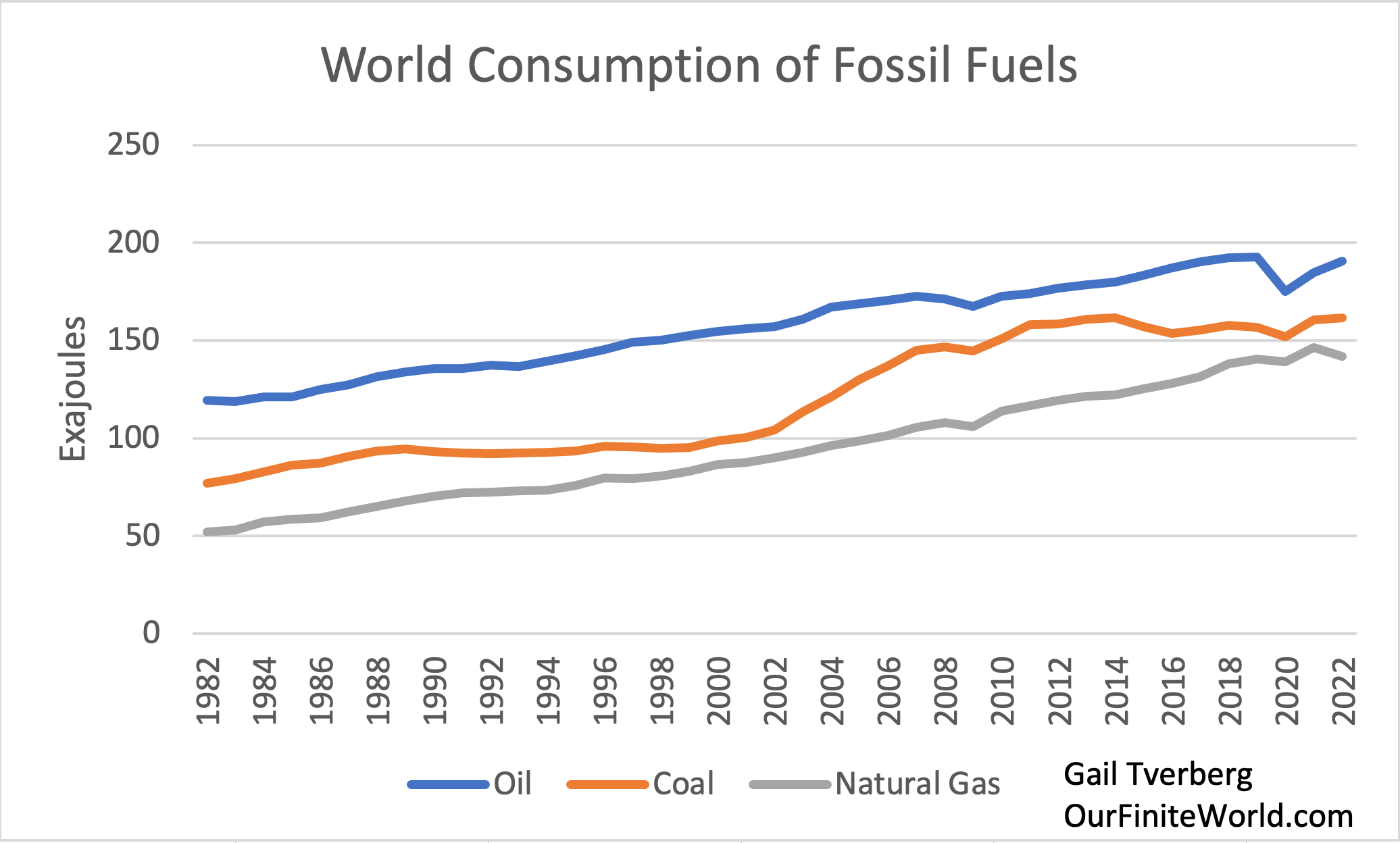
Figure 2 shows that world supplies of all three fossil fuels follow the same general pattern: They tend to rise in close to parallel lines, with oil supply on top, coal next, and natural gas providing the least supply.
The total supply of fossil fuels needs to be shared by the world’s population. It therefore makes sense to look at supply on a per capita basis.
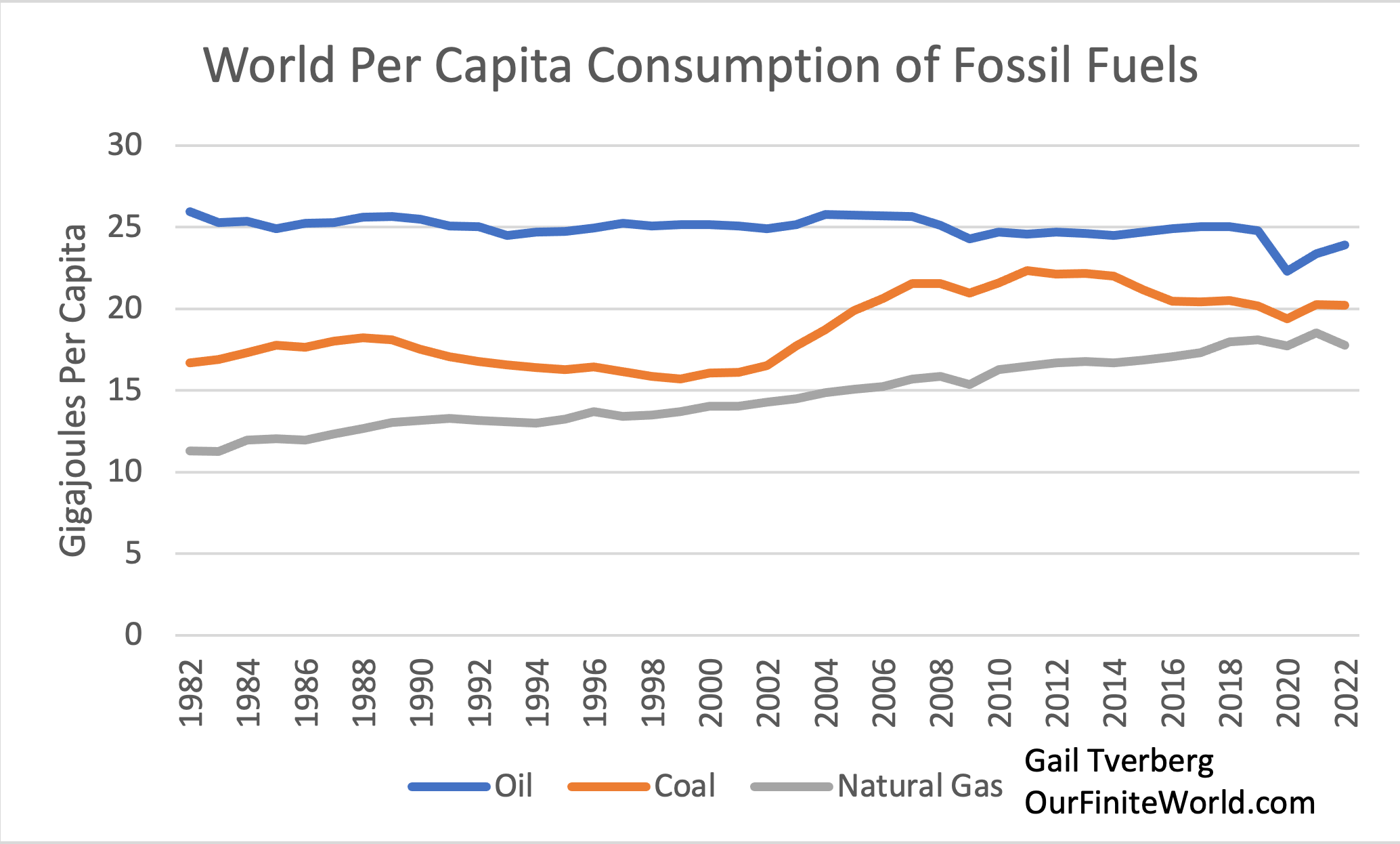
On Figure 3, the top line, oil supply per capita, is almost perfectly level, suggesting that having a greater supply of oil enables having a larger world population. This relationship makes sense because oil is used to a significant extent in growing today’s food, and shipping it to market. Oil products also make herbicides, insecticides, and drugs for animals that enable the growing supply of food needed to feed today’s population. Oil products are also helpful in road making, and in providing lubrication for machinery of all kinds.
We might conclude that oil supply is essential to the growth of human population. It is only by way of a huge change in the economy, such as the one that took place in 2020, that there is a big dip in oil usage. Even now, some of the changes are “sticking.” Some people are continuing to work from home. Business travel is still low. People are still not buying fancy clothing as much as before 2020. All these things help reduce fossil fuel usage, particularly oil usage.
Figure 3 also shows that on a per capita basis, coal supply has fallen by 9% since its peak in 2011. This fact, plus the fact that coal prices have been spiking around the world in recent years, leads me to believe that coal supply is already constrained, even apart from the export issue.
[2] The share of oil traded interregionally is more than double the share of coal or natural gas traded interregionally.
The reason why oil is disproportionately high in Figure 1 compared to Figure 2 is because a little over 40% of oil is shipped between regions. In comparison, only about 18% of coal production is traded with other regions, and about 17% of natural gas production is shipped interregionally. Oil is much easier (and cheaper) to transport between regions than either coal or natural gas. Shipping costs tend to escalate rapidly, the farther either natural gas or coal is shipped.
Natural gas has a second problem over and above the high cost of shipping: It requires storage (which may be high cost) if it is not used immediately. Storage is needed for both natural gas and coal because both fuels are often used for heat in winter, either by direct burning or by creating electricity that can be used to heat buildings. Storage for coal is close to free because it can be stored in piles outside.
Besides heat in winter, coal is also used to provide electricity for air conditioning in summer, so its demand curve has peaks in both summer and winter. Natural gas is much more of a winter-heat fuel in the US, so it has a large peak corresponding to winter usage (Figure 4).
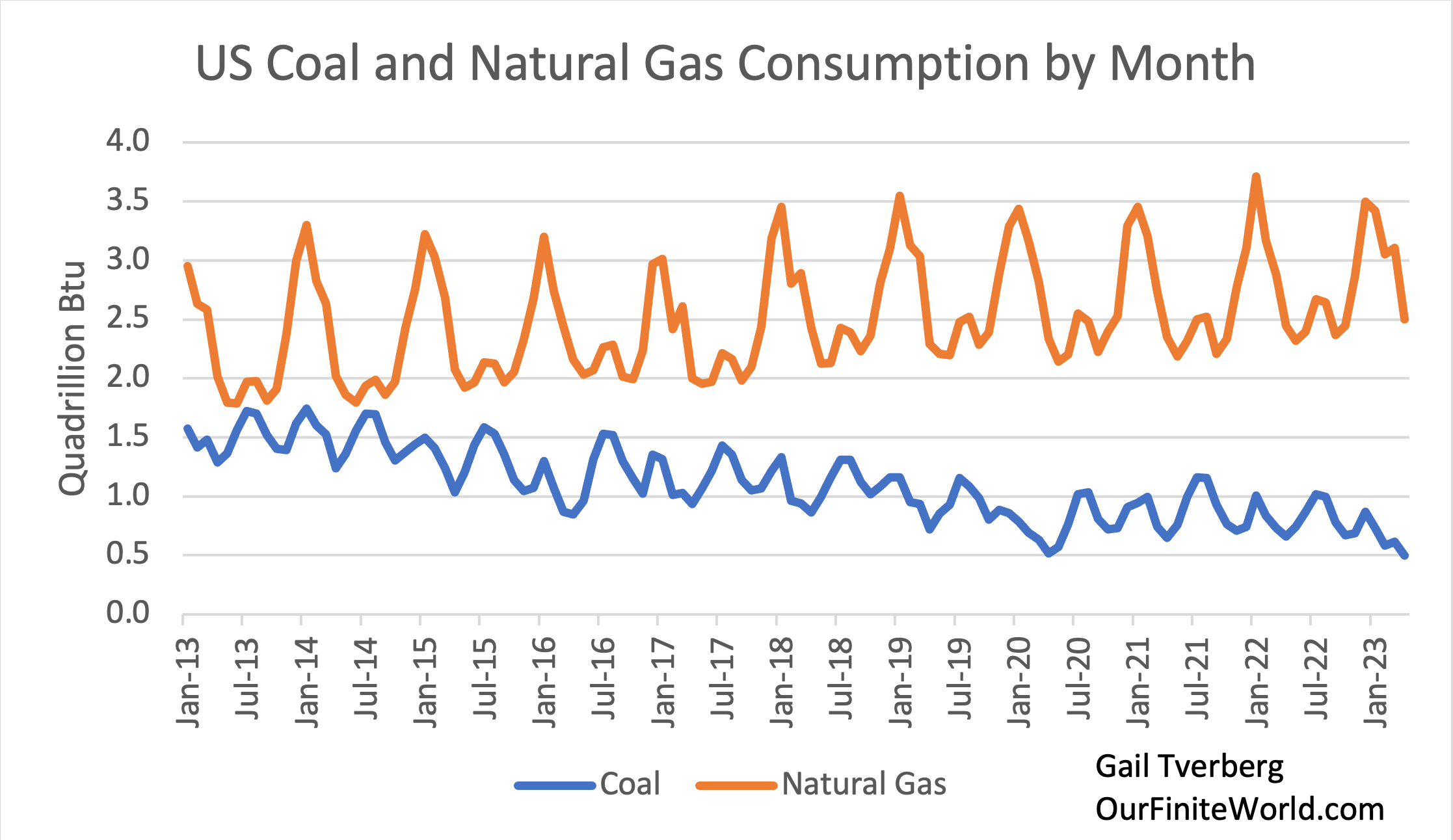
Storage for natural gas needs to be available in every area where users expect to use it for winter heat. The cost of this storage will be low if there are depleted natural gas caverns that can be used for storage. It is likely to be high if above ground storage is required. Natural gas importing areas often do not have suitable caverns for storage. The easy approach is to try to get by with a bare minimum of storage, and hope that imports can somehow make up the difference.
The big question for any fuel is, “Can consumers afford to pay a high enough price to cover all the costs involved in getting the fuel from endpoint to endpoint, at the time it is needed?“
Citizens become very unhappy if the cost of winter heat becomes extremely expensive. They demand subsidies and rebates from the government, in order to keep costs down. This is a sign that prices are too high for the consumer.
Both coal and natural gas are also heavily used in manufacturing. Their prices vary greatly from location to location and from time to time. If coal or natural gas prices rise in a particular location, the cost of manufactured goods from that location will also tend to rise. These higher prices will particularly hurt a manufacturing country, such as Germany, because its manufactured goods will become less competitive in the world marketplace. GDP growth will be reduced, and the profitably of manufacturers will tend to fall.
Because of these issues, long-distance trade in both coal and natural gas tend to hit barriers that may be difficult to see simply by looking at the trend in world production.
[3] Natural gas exports may already be becoming constrained, even though the total amount extracted still seems to be rising.
A huge amount of investment is needed to make long-distance sale of natural gas possible. Such investment includes:
- The cost of developing a natural gas field for export use, usually over many years.
- Pipelines covering every inch traveled by the natural gas, other than any portion of the trip for which transfer as liquefied natural gas (LNG) is planned.
- Special ships to transport the LNG.
- Facilities to chill natural gas, so it can be shipped overseas as LNG.
- Regasification plants, to make the natural gas ready to ship by pipeline after it has been transferred as LNG.
- Storage facilities, so that sufficient natural gas is available for winter.
Not all of these investments are made by the same organizations. They all need to provide an adequate return. Even if “only” very long-distance pipelines are used, the cost can be high.
Pipelines work best when there is no conflict among countries. They can be blown up by another country that seeks to raise natural gas prices, or that wants to retaliate for some perceived misdeed. For this reason, most growth in natural gas exports/imports in recent years has been as LNG.
Organizations investing in high-cost infrastructure for extracting and shipping natural gas would like long-term contracts at high prices in order to cover their costs. Without a stable long-term supply contract, natural gas purchase prices can be extremely variable. Japan has tended to buy LNG under such long-term contracts, but many other countries have taken a wait-and-see attitude toward prices, hoping that “spot” prices will be lower. They don’t want to lock themselves into a long-term high-priced contract.
There are two different things that tend to go wrong:
- Spot prices bounce up above even what the long-term contract price would have been, creating a huge high-price problem for consumers.
- Spot prices, on average, turn out to be too low for natural gas exporters. As a result, they cut back on investment, so that the amount of future exports can be expected to fall.
I believe that there is a significant chance that natural gas exports are now reaching a situation where prices cannot please all users simultaneously. Not all investors can get an adequate return on the huge investments that they have made in advance. Some investments that should have been made will be omitted. For example, there might be enough natural gas storage for a warm winter, but not for a very cold winter in Europe.
A prime characteristic of a fossil fuel (or any resource) that is not economic to extract is that the industry has difficulty paying its workers an adequate wage. Recently, there has been news about a union strike against Chevron at an Australian natural gas extraction site used to provide gas for liquefied natural gas (LNG) export. This suggests that natural gas may already be hitting long-distance export limits. Prices can’t stay high enough for producers to pay their workers an adequate wage.
[4] Oil imports by area suggest that the rapidly growing manufacturing parts of the world are squeezing out the imports desired by high-wage, service-oriented countries.
Because oil is so important in international trade, I looked at the amounts two ways. The first is based on trade flows, as reported by the Energy Institute:
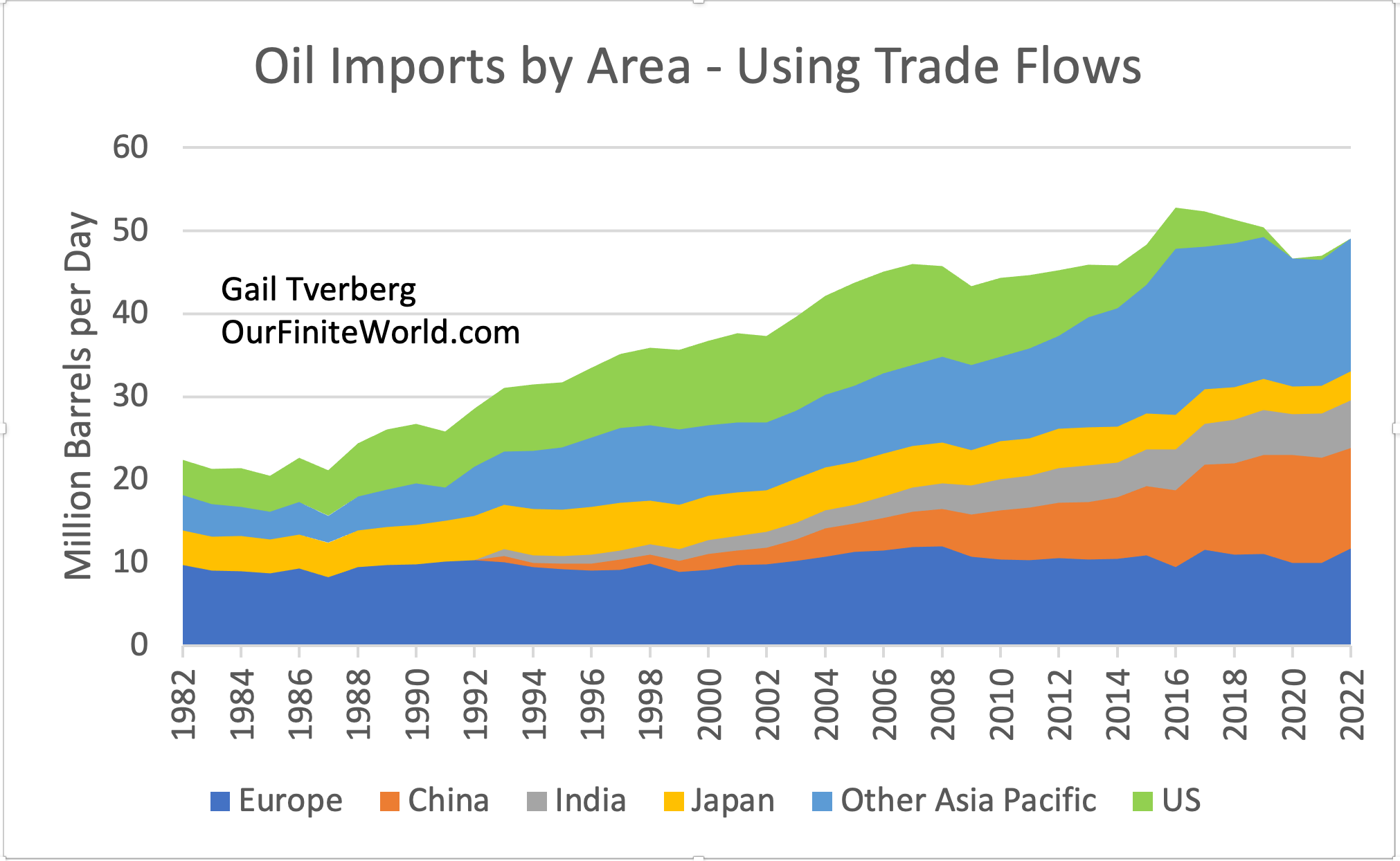
The second is based upon a comparison of reported production and consumption for the same year, using the assumption that if consumption is higher than production, the difference must be attributable to imported oil. The problem with this later approach is that it can easily be distorted by changes in inventory levels. There may also be difficulties with my approach of netting out flows in two different directions, especially if the flows are partly of crude oil and partly of “oil products” of various types.
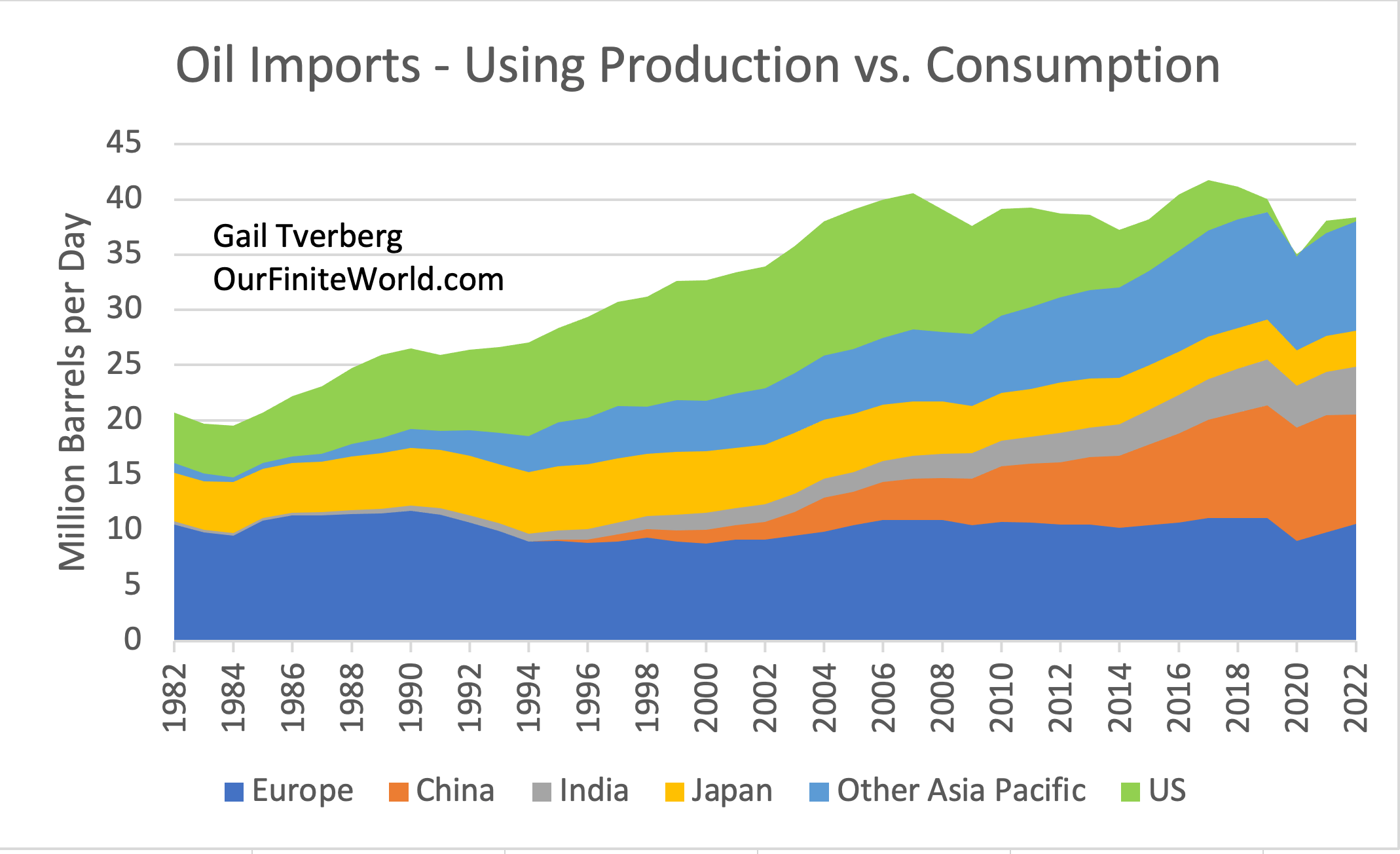
In both charts, imports for China, India, and Other Asia Pacific are clearly much higher in recent years, while imports for the US, Japan, and Europe are down. The peak year for imports (in total) was about 2016 or 2017. Imports were about 3.5 million barrels a day lower in 2022, compared to peak, with both approaches.
[5] Oil imports by area indicate that nearly all oil exporters around the globe are having difficulty maintaining export levels.
Here, again I show two indications, using the same methods as for oil imports. Since trade is two sided, I would expect total import indications to more or less equal the total of all amounts exported.
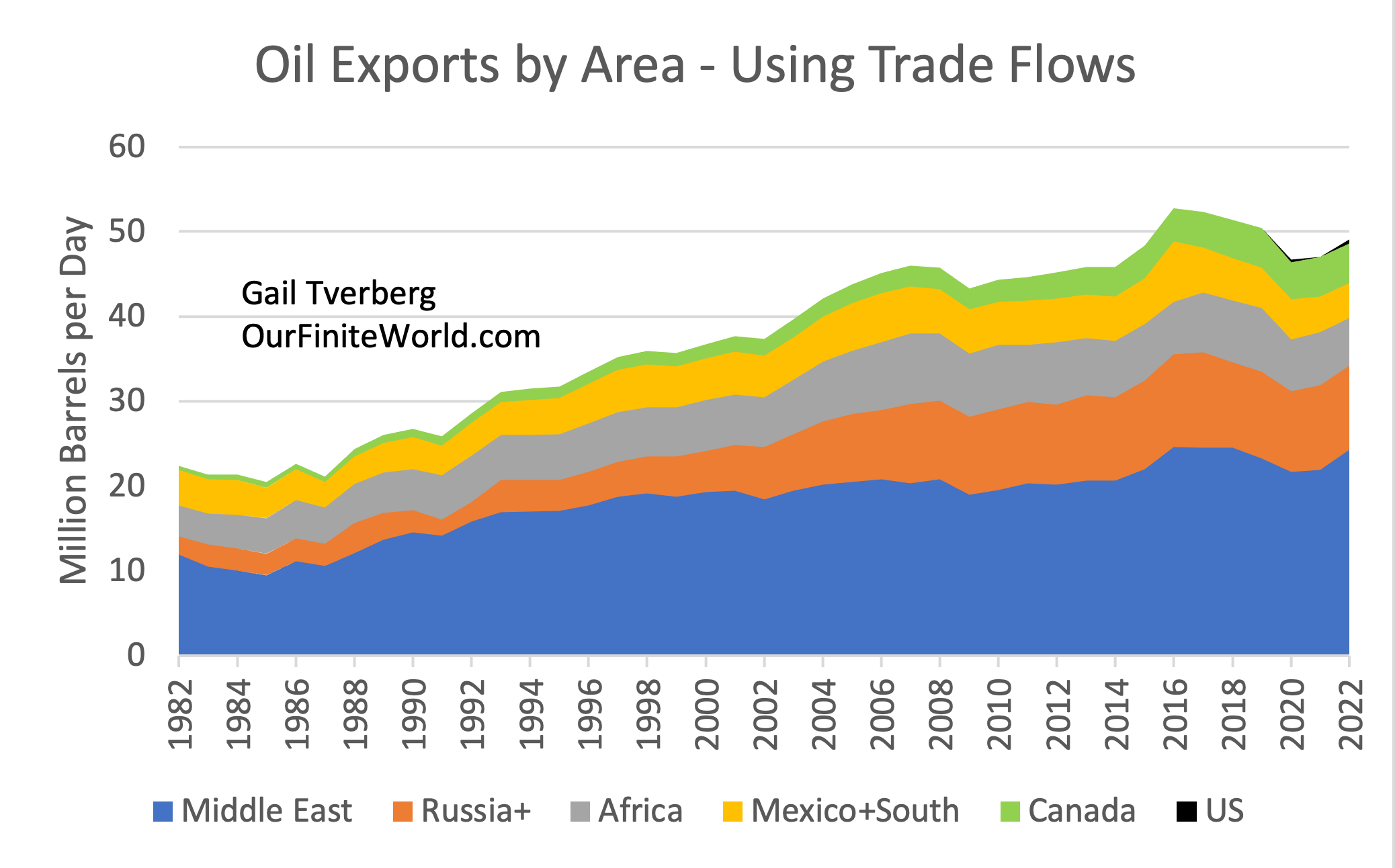
On Figure 7, peak oil exports (in total) occur in 2016, with the runner up year being 2017. US oil exports are shown to be nearly zero, even in recent years, because US imports and US oil exports more or less cancel out.
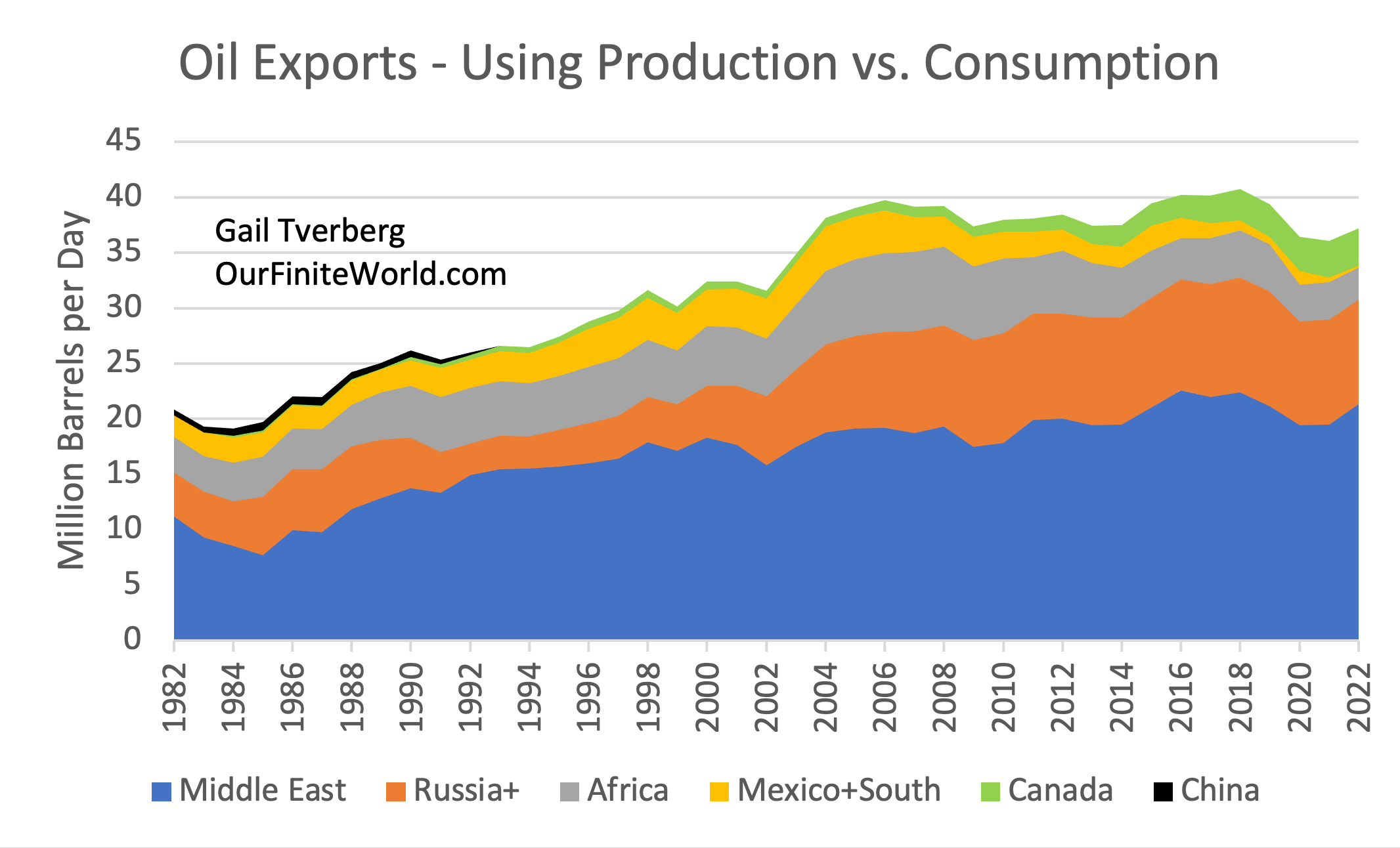
The indications of Figure 8 show that apart from Canada, the amount of oil exported for all the other export groupings shown is lower in recent years than it was a few years ago. This is also evident in Figure 7, but not as clearly.
To some extent, the lower production in recent years is related to the cutbacks announced by OPEC+ (including what I call Russia+). While these cutbacks are “voluntary,” they reflect the fact that based on current oil prices, and based on investments made in recent years, these countries have made the decision to cut back production. No oil exporter would dare mention that it is running short of oil that can be extracted without considerably more investment.
On Figures 7 and 8, “Mexico+South” refers to all the oil being produced from Mexico southward. Besides Mexico, this includes Brazil, Venezuela, Argentina, Columbia, Ecuador, and a number of other small producers. Most of them are experiencing falling production. Brazil is doing a bit better, but it does not seem to be experiencing much growth in exports.
Africa’s peak year for oil exports seems to have been in 2007 (both approaches), with recent exports at a much lower level.
With respect to Russia+, its exports seem to be down from their peak in 2017 or 2018, but not any more than for oil producers from the Middle East. The European Union oil embargo doesn’t seem to have had much of an impact.
The star performer seems to be Canada, with its rising production and exports from the Canadian Oil Sands.
In this analysis, I have “netted out” imports and exports. On this basis, the US hasn’t moved into significant oil exporter status yet. I am sure that there are some people hoping that the oil production of the US will continue to increase, but whether this will happen is unclear. The growth of US oil production in recent years has helped offset (and thus hide from view) the falling exports of many countries around the world.
[6] Coal exports appear to have peaked about 2016. Europe has reduced its imports of coal, leaving more for other importers.

The peak in coal imports seems to have occurred about 2016. In particular, Europe’s imports of coal have fallen significantly since 2006. At the same time, coal imports have risen for many Asian countries, including China, India, South Korea, and Other Asia Pacific. Even Japan seems to have been able to obtain a fairly consistent level of coal imports for the 22-year period shown on Figure 9.

One thing that is striking about coal exports is that they are disproportionately from countries in the Far East. Even the coal exports of the US and Canada are from North America’s West Coast, across the Pacific. Russia’s coal exports tend to be from Siberia.
The coal exports of South Africa have declined significantly since 2018, and other African countries are eager for their imports. Today’s largest source of coal exports is Indonesia. Coal exports from Russia+, at least until 2021, have been been a source of coal export growth.
A major share of the delivered price of coal is transportation cost, which tends to be fueled by oil, particularly diesel. Overland transit is particularly expensive. The real reason for Europe’s decline in coal imports since 2006 (shown in Figure 9) may be that there are practically no affordable coal exports available to it because it is too geographically remote from major exporters. Of course, this is not a story politicians care to tell voters. They prefer to spin the story as Europe’s choice, to prevent climate change.
[7] Natural gas imports and exports have only recently started to become constrained.

Figure 11 shows that natural gas exports from Russia+ (really Russia, with a little extra production from other countries in the Commonwealth of Independent States) have stayed fairly level, except for a big drop-off in 2009 (probably recession related) and in 2022.
The overall level of natural gas exports has been rising because of contributions from several parts of the world. Africa was an early producer of natural gas exports, but its exports have been dropping off somewhat recently as local gas consumption rises.
More importantly, exports have increased in recent years from the Middle East, Australia, and North America. With this growing supply of exports, it has been possible for importers to increase their imports.

Europe was able to maintain a fairly stable level of natural gas imports between 1990 and 2018, and even to increase them by 2021. China was able to ramp up its natural gas imports. Even Japan was able to ramp up its natural gas imports until about 2014. It has tapered them back since then. India and Other Asia Pacific both have been able to add a small layer of imports, too.
[8] What lies ahead?
The countries that have the greatest advantage in using fossil fuel imports are the countries that don’t heat or cool their homes, and that don’t have large numbers of private citizens with private passenger automobiles. Because of their sparing use of fossil fuel imports, their economies can afford to pay higher prices to import these fossil fuel imports than other countries. Thus, they are likely to be winners in the competition for fossil fuel imports.
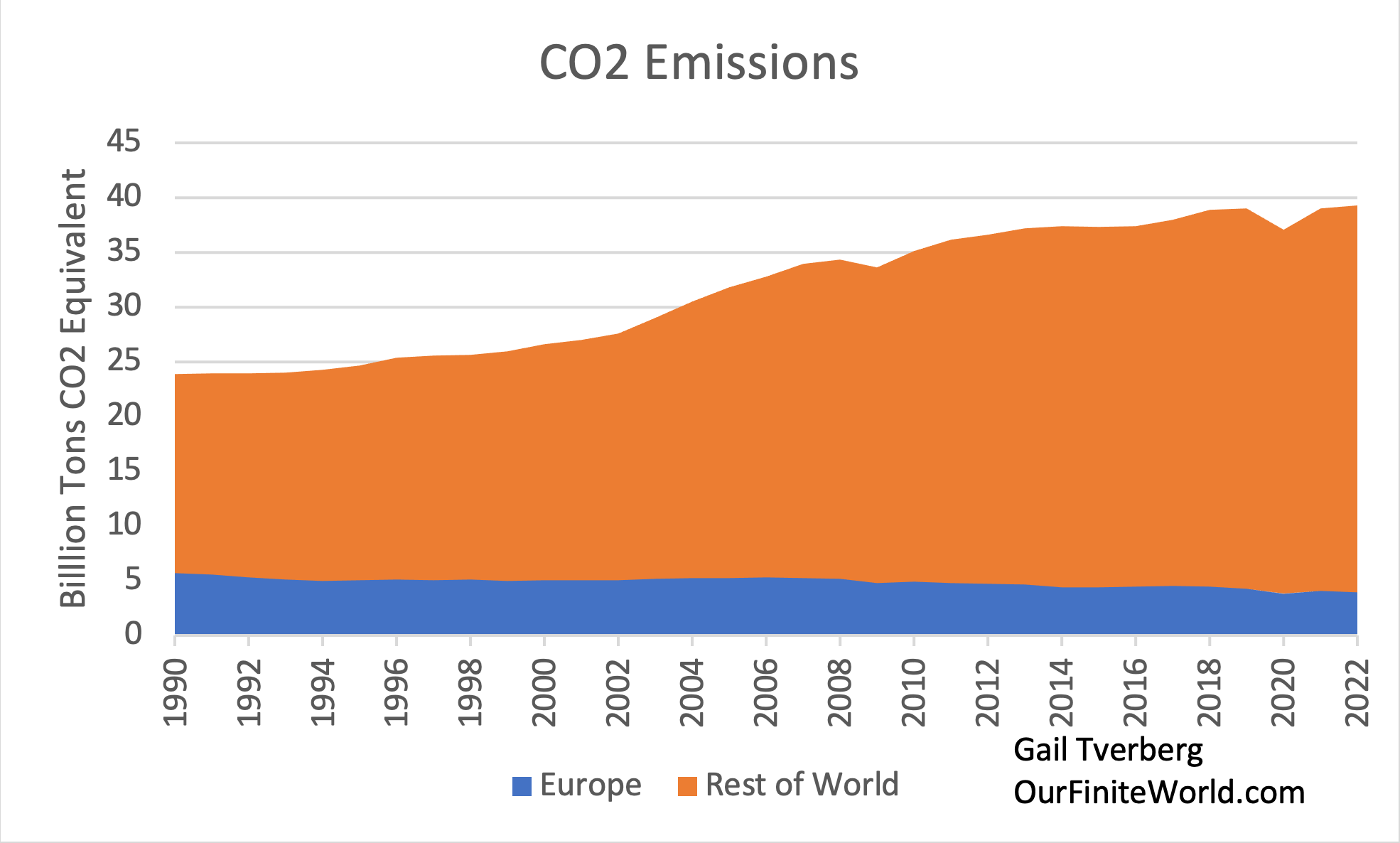
Europe stands out to be an early loser of imports. It is already losing oil and coal imports, and it also seems to be an early loser of natural gas imports. However, for all its talk about preventing climate change, the reduction in European imports of fossil fuels hasn’t made much of a dent in global carbon dioxide emissions (Figure 13).
I am afraid that no country will really come out ahead. In some sense, the United States is better off than many countries because it is producing slightly more fossil fuels than it consumes. But it still depends on China and other countries for many imported goods, including computers. Given this situation, the United States likely cannot continue business as usual for very long, either.


Shares of the world’s largest offshore wind farm developer crashed in Copenhagen trading on Wednesday after it warned: “The situation in US offshore wind is severe.”
Orsted A/S was hit with a massive 16 billion Danish kroner ($2.3 billion) impairment on its US portfolio due to snarled supply chains, soaring interest rates, and easy money tax credits drying up — a warning sign the green energy revolution bubble is in trouble.
CEO Mads Nipper warned investors on a conference call: “The situation in US offshore wind is severe.”
https://www.zerohedge.com/markets/worlds-largest-offshore-wind-farm-maker-crashes-most-record-after-catastrophic-results
Offshore wind projects are facing an economic crisis that erased billions of US dollars in planned spending this week — just as the world needs clean energy more than ever.
A unit of Spain’s Iberdrola SA agreed to cancel a contract to sell power from a planned wind farm off the coast of Massachusetts. Danish developer Orsted A/S lost a bid to provide offshore wind power to Rhode Island, whose main utility said rising costs made the proposal too expensive. Swedish state-owned utility Vattenfall AB scuttled plans for a wind farm off the coast of Britain, citing inflation.
…. Together, the three affected projects would have provided 3.5 gigawatts of power — more than 11% of the total offshore wind fleet currently deployed in the waters of the US and Europe. And the numbers could soon expand. At least 9.7 gigawatts of US projects are at risk because their developers want to renegotiate or exit contracts to sell power at prices that they say are now too low to make the investments worth it, according to BloombergNEF.
fortune.com/2023/07/22/offshore-wind-projects-nixed-due-to-costs-despite-clean-energy-needs/
Maybe, the offshore wind turbine craze will go away.
They are not very durable, out in the salt water, and the transmission to shore is a problem. The out put is still variable, too.
Oil supply per capita remaining level has little to do with the non-transport uses for oil, because they make up a rather small percentage of oil use. It’s a lot more to do with transport per capita having remained fairly constant for a long time. This makes sense because transport technology has not changed in any fundamental way during all this time. Efficiency of engines has improved a bit, but the cost of oil has gone up as well. Consumers have aimed to spend more or less the same amount of time and money in transport during all this time. The question now becomes what would happen if this was no longer possible, because further efficiency is not technically feasible, oil supply becomes constrained, and the alternative of electric vehicles is too expensive to be a useful alternative. The most likely answer is that many people would try to maintain this aim to spend the same time and money in transport by switching to vehicles that are radically more efficient, that is, switch to using scooters rather than cars. Non-essential transport would be cut down altogether, by cutting down unnecessary business travel or working from home whenever possible. Commercial transport doesn’t have this option, as generally they are already using the most efficient vehicles possible for transporting freight, but as more and more people switch to scooters, the prices of oil would go down and relieve this problem.
United States may be producing a little more fossil fuels than it consumes, but that’s only because it produces a lot of coal. Coal can’t be used for transport except if it’s converted first to oil, and the process makes it expensive, and the United States is used to very cheap refined oil products.
The petrochemical agriculture cannot be replaced by coal or electricity. If we have reason to forcast a decline of available oil, we should worry first of all about our food production – and distribution. It is very well understood in the historic sciences, that food has limited the sizes of cities in the past. It was just not possible to get more food into the cities (and rubbish out) than for about 50.000 people – even for cities located at rivers. This means, all cities larger than that cannot be maintained, when energy declines under a certain level.
you are quite correct jan
there have been one or two exceptions—Ancient Rome had 1m people, but they were supported by slave labour as an energy resoirce
I agree that we should first worry about our food production.
I hadn’t heard about the 50,000 limit on population. I knew that there needed to be some type of limit. The biggest old city I knew of was Ur. This link gives its population as 65,000, which is pretty close to your limit.
Without adequate energy supplies, today’s big cities are certainly endangered.
Apparently several cities had more than 50,000 inhabitants:
Rome, Italy: Ancient Rome was one of the largest and most influential cities of the pre-industrial world, with population estimates ranging from 450,000 to over a million during its peak.
Alexandria, Egypt: In antiquity, Alexandria was a major center of trade and culture, with a population that exceeded 100,000 people.
Constantinople (Istanbul), Turkey: The Byzantine capital of Constantinople was a bustling metropolis with populations that reached several hundred thousand during its height.
Chang’an (Xi’an), China: As the capital of several Chinese dynasties, Chang’an was one of the world’s most populous cities, with estimates exceeding 1 million people during certain periods.
Baghdad, Iraq: During the Islamic Golden Age, Baghdad was a significant center of learning and commerce, and its population surpassed 1 million in the 8th and 9th centuries.
Tenochtitlán, Mexico: The capital of the Aztec Empire, Tenochtitlán, had a population estimated at over 200,000
Pingback: A World Running On Empty: The Decline Of Fossil Fuel Supply – The Burning Platform
norm – real? https://t.me/downtherabbitholewegofolks/84859
Now they are telling women 20 to 25 that they may have heart attacks or strokes during childbirth
https://www.bitchute.com/video/S0F59AqjGQOc/
Telling people this as predictive programming will probably work, with the mentally defective (hello Norm!) I’m sure:
‘You never knew, but people had a heart attack doing X Y Z all the time! And now CC has made it worse!’
I overheard an old woman and a teenager discussing this in the village street. The kid looked worried, and the woman was saying:
‘ The ad says it’s always affected some young people, but you would have thought it’s just the old, wouldn’t you?’
Like moving in to a flat-share, starting to feel sick everyday because your flatmate is poisoning the food in the fridge, and they tell you, sympathetically ‘There’s something going around I hear’…..
How on earth can people live for decades and be so trusting?
We live as a group, we die alone; simple bet and always 80/20.
Dennis L.
keep your words pressed between leaves of your own creation xabier
that’s the only way they will be preserved for posterity
reading the rest of your childish (hello eddy?) diatribe confirms my certainty
More Boosters coming soon norm … that should put you into high spirits
‘I’ll take every shot that is offered’ keith
Is it any wonder that Fast Eddy expresses utter disdain for most humans.
Intelligent… hahahahahahaha…. more like Vile and Stooopid. And cruel
The sad news is that FE has died unexpectedly. The current “FE” is either a bot or Hoolio posting as FE.
Consider the evidence. FE is always one of the first to comment after Gail releases a new post. This time he wasn’t. And he always, but ALWAYS, writes “Thanks for the new post!” This time, it never happened. Go figure.
I will post a photo of Hoolio reading today’s newspaper later… I have to find a newspaper first
So, the “Fast Eddy” bot thinks that dogs can read. That’s artificial intelligence for you. 🙁
Reading and writing are right up there with farming in terms of stooopidity…. we passed on our expertise in stooopidity through writing ….
China technology propaganda
https://youtube.com/@ChinaFactChasers?si=hKS8amaPI7hKAIXC
https://alexberenson.substack.com/p/a-10-point-primer-on-why-the-mrna
1: mRNAs are not vaccines in any traditional sense. They work in a very different way.
2: Before 2020 mRNA biotechnology was – at best – several years from use outside clinical trials. The scientists working on it were struggling with the risks of repeated dosing.
3: The two large clinical trials in 2020 from Pfizer and Moderna that led to the approval of the mRNAs did NOT show that they reduced deaths from Covid, or from other causes.
4: mRNAs were not proven to work better or to be safer than – or even as safe as – traditional vaccines. They were not and have never been tested head-to-head against traditional vaccines.
5: The clinical trials showed the mRNAs caused more and more severe side effects than most traditional vaccines, especially flu shots. Real-world experience confirmed the trial findings.
6: The major clinical trials were effectively stopped in early 2021, and as a result we do not have long-term placebo-controlled safety data on the mRNAs.
7: We also do not have long-term controlled data on their effectiveness. This gap matters less, though, since everyone now agrees that – at best – they worked against Covid infection or transmission for a few months in 2021.
8: The evidence health authorities offer for their claims that the shots work against severe disease and death – even after they fail against infection – comes from “observational” studies. Those are hopelessly untrustworthy. The reason is that people are generally not vaccinated if they are on or near their deathbeds – and terminally ill people are obviously at very high risk of death from all causes, including Covid.
In essence, the people who receive vaccinations cannot be compared to those who do not. Health authorities are well aware of this issue, but they ignore it, because it enables them to claim the vaccines work.
9: The mRNAs appear to have zero or negative effectiveness against Omicron infection. Negative effectiveness means they may actually increase the risk of infection. Some studies show that the infection risk RISES with each additional dose.
10: Data from many countries that used mRNAs shows the booster campaigns in early 2022 and late 2022/early 2023 coincided with increases in all-cause deaths. This correlation is particularly striking in the second campaign, because it cannot be attributed to Covid.
Pfizer Documents Show COVID-19 Vaccines Contain Potentially Harmful ‘Modified’ RNA, Not mRNA
It keeps getting better and worser….
‘Messenger RNA occurs naturally and lives in our cells, and it does not last long enough to initiate an immune response before being destroyed by the immune system—it is modRNA that is synthetically created, according to Klaus Steger, a molecular biologist who headed several gene technology laboratories, regularly applying RNA-based technologies’
It is not a natural market phenomenon for interest rates to fall to near-zero. That was engineered by the Federal Reserve conjuring $8 trillion out of this air to buy Treasury bonds and mortgage-backed securities.
Additional trillions were distributed to households, businesses and fraudsters in the 2020-2023 tsunami of federal stimulus, much of it borrowed, a policy response that has pushed federal debt far above the nation’s GDP, a “red line” that typically generates systemic problems such as inflation and stagflation.
Inflation and stagflation are very much in the news, along with debates about what should be done to insure a “soft landing,” i.e. the eradication of inflation and stagflation without causing a recession.
In effect, the implicit goal everyone seems to agree upon is that there should never again be any pain administered via the credit cycle or business cycle: debts should never be written off, assets foreclosed, lenders and zombies bankrupted, and so on, all of which reflect human psychology: credit gets easier and cheaper, people borrow and spend more and speculate wildly, and then losses have to be taken and credit, spending and speculation all recede to pre-mania levels. Balance sheets and savings are slowly rebuilt and the cycle begins anew.
This is now forbidden, and the obvious fear post-2008 is that the system can no longer survive even a modest retrenchment of debt/credit, spending and speculation.
There are many qualitative differences between the 1980s and the present era which rarely get noted, much less analyzed. This is of course a matter of time: only those of us over 60 years of age experienced the early 1980s recession as workers, borrowers, consumers, employees and employers. Everyone younger is relying on narratives that are largely lifeless economic data: inflation was high, interest rates went to 18% to snuff out inflation, the result was 40 years of glorious growth, etc.
This simplistic narrative leaves out the many qualitative differences between then and now that I see as poorly understood even as they will become increasingly consequential.
https://charleshughsmith.substack.com/p/comparing-recessions-1981-and-2023
Interest rates lagging effects , treasury vs DoD > Luke Gorman .
I would argue otherwise. It seems natural (to me) for interest rates to be negative in a de-growth scenario, when present investment in the aggregate is unlikely to yield future returns.
As CHS says in the opening line “It is not a natural market phenomenon for interest rates to fall to near-zero. That was engineered by the Federal Reserve conjuring $8 trillion out of this air to buy Treasury bonds and mortgage-backed securities. ”
Interest is the cost of money . If interest rates are zero or negative that means money is free . Nothing is free . Give something free and you will be bankrupt . The Zirp and Nirp was an experiment in financial engineering to band aid the exploding financial system . Same like QE . These manipulations work for some time until the system starts bleeding again and then it has to return to the mean . As Luke Gorman says interest rate rises has a lagging effect and it will take time before we will see the real breakdown , right now the breakdown is at the margins . Further note his observation regarding the conflict of interest between the treasury and DoD . Maintaining an empire is not cheap . It can be ” Guns or Butter ” but not ” Guns and Butter ” .
That seems reasonable to me; assuming the currency is not being printed.
My interpretation is investments which are heavily dependent on cheap energy have NPV of zero or less.
Dennis L.
I think you are right, Lidia.
There aren’t good investments any more.
The only investments that somehow look good to companies are government subsidized (or at least mandated). But governments will quickly go broke with all of these subsidies of approaches that don’t really work. The system will tend to collapse.
Yes, the covid debacle only strengthened the command (inorganic, state-driven) aspects of the economy at the expense of everything else. I’m not sure why I don’t jump on these financial bandwagons… just too squeamish.
‘Some’ are going to be ‘disappointed’?
“Construction Spending for Factories Soars, after Decades in the Doldrums”?
https://wolfstreet.com/2023/09/03/construction-spending-for-factories-soars-after-decades-in-the-doldrums/
Postkey , they will all be stranded assets . All Giga factories . This is the future . It arrived while you were asleep .
https://oilprice.com/Latest-Energy-News/World-News/UK-Battery-Maker-Sees-Shares-Crash-As-It-Needs-To-Raise-Funds-Within-Weeks.html
I agree with you. All of the subsidies are just ways of keeping current employment up.
Maybe they could crowd fun this? Tap into the power of delusional thinking!
And…. This: https://phillipaltman.substack.com/p/australian-government-forced-to-cheat
EXCESS DEATHS
I’ve previously listed my top 10 tricks the Australian government is using to cover up the Covid disastrous policies and dangers of the injections. CLICK HERE to view.
While it is easy to hand wave away any causal link between the Covid injections and deaths reported in the Australian adverse event reporting system (DAEN), it is difficult to hide the fact that tens of thousands of Australians have died non-Covid deaths above the numbers normally expected in 2021 and 2022 after the shots were released (but not in 2020 when there were no Covid injections but the virus was at its most virulent). The most obvious explanation is that the Covid injections are causing an increase in unexpected recorded deaths from all causes. Until our government comes up with an alternative, credible and supportable explanation – we should all assume this to be the case.
So…..problem solved…..just get the Australian Bureau of Statistics (ABS) to change the historical baseline expected number of deaths from all causes before Covid. Maybe go to an outside consultant to get the number you want, pay them heaps, so one can claim “we didn’t do it….this was expert advice”. This latest trick is done using non-transparent modelling (the rule is to use guesswork modelling when the actual data does not support your case). Check out the numbers shortly to be published in Principia Scientific by Dr. Sy Wilson, an Australian expert statistical data analyst (below). Whacko! 12,000 Excess Deaths disappear and the total number of Excess Deaths following the Covid injection rollouts is now (only) 18,000 and not 30,000!
The only reliable estimate of Excess Deaths in 2022 is that number calculated in [a] where all deaths in 2020 were used as part of the baseline to calculate Excess Deaths (it was a year with, surprisingly, low numbers of total deaths)! The ABS have not provided a credible explanation as to why the total number of deaths in 2020 was not used in baseline calculations.
I wonder if other governments including the USA are doing this… actually I don’t wonder….
Someone made a good point over at MOA (moonofalabama.org) that the West must continue to prop up Ukraine financially or else they suffer an even bigger financial burden of dealing with all the refugees/migration. I hadn’t thought about that. This will continue to bleed the West; the Afghanistan quagmire for Russia will be the same for the West as well.
good point, though when Russia is done taking as much of Ukraine as it wants, the remainder might be quite small.
DUNCAN IDAHO alert:
he posted at MoA yesterday; readers can judge the quality of the sentence:
“As China becomes the dominate country on the planet, the US fights back in a embarrassing way.
Posted by: Duncan Idaho | Sep 1 2023 17:04 utc | 1”
he also posted recently as Hightrekker on peakoilbarrel so the jabs didn’t take him out.
The Ukie pukie is doing a great job of reducing the numbers of virile white christian males, especially the type who particpated in the wrongs of the hollo cause.
keep it going.
Replace the donors with African Immi’s.
Win
Win
Pingback: A World Running On Empty: The Decline Of Fossil Fuel Supply – Bugaluu – News
“A 14-year-old boy with no known prior medical history has died suddenly in his sleep.
William Pfeiffer, from Queenstown, Adelaide, spent his final hours at his grandparents’ house last Sunday,
when he fell asleep and didn’t wake up.
His devastated parents, Karen Lynch and Mike Shaw, said William was a “happy and healthy” boy with a heart of gold.
https://www.news.com.au/lifestyle/real-life/news-life/shock-as-14yearold-adelaide-boy-dies-unexpectedly-in-sleep/news-story/fdba3d5df0aa3dff6586e21014933257
We can rule out the CV19 vax because we know they are 100% safe and effective.
Also not many given recently.
Pingback: A World Running On Empty: The Decline Of Fossil Fuel Supply – Wall Street Whisper
hahahahaha https://t.me/downtherabbitholewegofolks/84232
norm believes… and keith https://t.me/downtherabbitholewegofolks/84231
Apparently Somalia is planning to put a man on the moon in December hahaha
F789ing Fools
Somali space pirates
Pingback: A World Running On Empty: The Decline Of Fossil Fuel Supply | Entrepreneur Canada
“In some sense, the United States is better off than many countries because it is producing slightly more fossil fuels than it consumes. ”
I would like for you to “qualify” this statement, as the US uses 20 million barrels a day and pumps around 12.3 mbpd. To try and combine the oil, gas, and coal into one lump sum of “fossil fuel” produced would be ridiculous as there is no way…….as you have recently discovered and reported…….coal or natural gas can replace diesel.
The US burns 369 million gallons of gasoline a day which is the refined equivalent of 18.5 mbpd.
I think your statement is bogus and irresponsible……..for someone that makes a living as a purveyor or actuarial data.
Oil is defined differently, different places. This is a headache.
I was trying to make apples to apples comparisons. I was using Energy Institute’s data, which didn’t give me all of the breakdowns that US EIA data gives. Energy Institute’s oil data supposedly excludes biofuels and “refinery gain.”
If we look at EIA data for 2022:
Crude oil and lease condensate 11.9 million barrels per day
Natural gas plant liquids 5.9 million barrels per day
Other liquids (almost all ethanol) 1.4 million barrels per day
Refinery processing gain (mostly related to imported oil) 1.0 million barrels per day
Total of the above = total liquids = 20.2 million barrels per day.
From the Crude Oil and Petroleum Products Supplied chart 20.0 million barrels per day
So these two things are pretty much telling the same story: Consumption is equal to production (in volume), if you put in everything. If you back out ethanol from both sides, you still get the same result.
I have no idea whether some of the natural gas plant liquids were sold off (low in energy value), and more crude oil substituted, with higher energy value. All we get is volume, on this chart.
Good thing an actuary is running this show.
Statista showed usa oil imports 2bby or ONLY half mill a day.
So I’m guessing all that is re exported.
Just the fact that we now consume what we produce means it will be more difficult to get imports if fracking dwindles. I remember reading fracking was well known way back so maybe it was import shortages that forced it.
Perhaps it would be an idea to use Watts?
watts are energy, watt-hour is power. Energy usefulness is dependent upon amount of power, or the time factor.
Run a 1hp motor long enough and it will use/produce as much energy as a 5hp, but at a first approximation it will take 5x as long, same with a generator going the opposite direction.
Dennis L.
watts are energy, watt-hour is power
Wrong way round.
Well spotted!
Bogus? BOGUS?
As in not genuine or true (used in a disapproving manner when deception has been attempted; eg. “a bogus insurance claim”)?
Are you suggesting that Gail is practicing to deceive?
What a tangled web she must be weaving.
for someone that makes a living as a purveyor or actuarial data
As far as I’m aware, Gail isn’t making a living on purveying anything. She’s getting by on her pension.
Do you see any donation buttons on this site?
Bogus? BOGUS?
The nerve of this character!
https://getyarn.io/yarn-clip/da2b5981-aa82-4ee5-a7e8-d458a5881671
Yes, Tim, she has done well by everyone; it is nice not to be hustled; some opinions here are wrong, some are right, but with light moderation it is for us to judge and use as we see fit.
Dennis L.
Gail is one of the adults in this forum
criticism is brushed off, it doesnt result in a frenzy of childish tantrums, with toys thrown out of the pram
We don’t consume 20 mbs that’s misleading. That includes oil we import and refine and ship back to overseas to sell, etc.
We consumer around 12.3 and produce slightly more than that. This is why you need to look at “net” calculations when trying do the math.
Better luck next time Brah!
I am going to reply to you, “brah” and I’ll expound on the math so maybe thus time you can understand it.
We use 369 million gallons of gasoline every day in the US, brah. There are 20 gallons of gasoline in a 42 gallon barrel of oil. Therefore, we have to refine 18.5 mbpd just to produce the gas we consume. That is fact……and simple math.
I have a million barrels of oil, you have a million tons of coal, and Gail has a bcf of natural gas. None of those are like the others except that they will burn. You can’t burn coal in a diesel truck or gasoline car. You can’t fly jets on natural gas.
We are not even close to energy independence in this country at our current way of life. Sure there is a lot of energy, but things will change dramatically once the oil gets cut back significantly……..and that day is fast approaching.
Plan accordingly.
Since it seems like a large discrepancy let us start looking at where the differences would be. American oil is overwhelmingly fracking oil, and so there might be more than 20 gallons in a barrel of oil (and conversely less diesel). Then there is the fact that today natural gas liquids are routinely added to gasoline, and NGL are some 35% (IIRC) of total liquids produced.
Brian , interesting math . My question . The refinery input as per EIA ( Energy Inaccuracy Agency ) in the US is 16.5-16.8 mbpd . Where is the gasoline coming from ? The real black goo that provides the distillates is about 3.5-4 mbpd .
Lower 48 ( stripper wells etc ) 2.5 mbpd
GOM 1,0 mbpd
Alaska 0.5 mbpd = Total 4mbpd
Upper limit . Average is 3.5 mbpd with the shutdowns due to maintaince and weather ( hurricanes in GOM ) .
The rest is not good for producing transportation fuel . Shale has an API of 50 . This is as good as gasoline but the shale producers have to export 3.5-4 mbpd because it cannot be used by US refineries . The NGPL , NGL , refinery gains etc are all BS . There was for several years the situation when Europe shipped gasoline to US and US shipped diesel to Europe . What now with the European sanctions on Russian oil ? Are India and China shipping gasoline to US because they are buying all the Russian oil ? Can you provide info on diesel in USA ? Only 12 gallons per barrel available after refining . I believe it will be diesel that is going to crash the system . I had posted in the last post a report by Lars (Sweden) on the ” ELM model ” and his conclusion on diesel availability to the world markets in 2025/2026 . Have you read that ?
EIA = Energy Inaccuracy Agency is credited to Mr Mike Shellman . Must give credit where it is due .
We are buying a lot of refined product from the open markets. We were getting up to 2 mbpd from Russia. That now comes from other sources like Europe and Asia that are still buying Russian oil.
Europe and Asia have excess refining capacity. We “sell” them oil and buy back refined product.
The US is on a razor’s edge from day to day in regards to energy supply and demand.
If we couldn’t buy around 8 mbpd of crude and refined products, our economy would collapse within days. Those in the know will collapse it when they see that day approaching……..and it very well could be in progress right now.
I agree that there is a whole lot of trading that has to go on to keep the system operating.
Pingback: A World Running On Empty: The Decline Of Fossil Fuel Supply – Understanding Deep Politics
Pingback: A World Running On Empty: The Decline Of Fossil Fuel Supply - AlltopCash.com
Jackson Hole 2023
It’s hard for me to disagree with Doug Noland who, in discussing Powell’s main speech commented, “Our era will be studied and debated for generations. There will be those who argue that the Fed’s aggressive tightening measures were responsible for financial and economic crises. A year of higher rates is not the problem. It’s loose financial conditions for the better part of three decades. It’s repeated market bailouts. It’s runaway Credit growth and a historic Speculative Cycle.”
In the course of Powell’s talk he sought to quell suggestions that the Fed was considering raising their tolerated inflation rate of two percent to accommodate present day circumstances. Noland wryly suggests that “those advocating raising the inflation target completely miss a critical point: even a 2% inflation target was grossly deficient in promoting a sound monetary environment. Money and Credit growth were excessive, asset price inflation was excessive, and speculation and speculative leverage were precariously excessive. The inflationists would like to believe that raising the target today will protect the economy from aggressive tightening measures. More likely, a higher inflation target would only guarantee a more precarious Speculative Cycle.”
creditbubblebulletin.blogspot.com/2023/08/weekly-commentary-speculative-cycle.html
In a subsequent speech, Lagarde is quoted as saying: “Central banks have responded by tightening monetary policy and, while progress is being made, the fight against inflation is not yet won,” Lagarde said … In the case of Europe, she said, the ECB will keep setting rates “at sufficiently restrictive levels” to try to get Eurozone inflation down to two percent.
mideastdiscourse.com/2023/08/26/eu-top-banker-lagarde-predicts-long-term-downturn-insists-german-economy-not-broken/
good luck with that! Odd, though, that the elephant everyone blithely ignores is that many of the world’s major economies are NOT suffering from central bankers raising interest rates. In the world’s no 2 economy China the PBoC has been decreasing rates for some time while Japan, the world’s no 3 economy has had rates steady at -0.1%pa for a considerable time. Anyone curious to examine global inflation levels can find the data here
tradingeconomics.com/country-list/inflation-rate?continent=world
Using
https://tradingeconomics.com/country-list/core-inflation-rate?continent=world
This is a partial list of core inflation rates:
Japan 3.1%
Russia 3.18%
South Africa 4.7%
United States 4.7%
Italy 4.78%
Euro Area 5.3%
Germany 5.5%
Australia 5.9%
European Union 6.16%
Brazil 6.25%
Norway 6.4%
UK 6.9%
New Zealand 7.1%
Ukraine 12.3%
Pakistan 18.4%
Turkey 56.09%
Argentina 112%
Another partial list from same source
Afghanistan -6.5
Costa Rica -2.29
Burkina Faso -1.1
China -0.3
Bahrain 0.4%
Thailand 0.38%
Switzerland 1.6%
Hong Kong 1.8%
Malaysia 2%
What is that list labeled?
It’s from the top of the table of countries (lower inflation rates) I cited
tradingeconomics.com/country-list/inflation-rate?continent=world
Your partial list is of core inflation rather than inflation rates. I posted this data as I wished to illustrate that not all economies appear to be suffering from high inflation rates that their central banks are attempting to supress with higher interest rates.
I did label my inflation rates as core inflation rates. I didn’t search hard enough to find “inflation rates.”
I know hospital cost inflation is changed only once a year, I believe in October. It has been bringing US inflation rates down for the last almost 12 months. When it is changed, the inflation rate is set to rise as a result. There are some other things in the overall inflation rate that distort it, too.
Regarding Noland’s statement, “A year of higher rates is not the problem. It’s loose financial conditions for the better part of three decades. It’s repeated market bailouts. It’s runaway Credit growth and a historic Speculative Cycle.””
Loose financial conditions for the better part of three decades were required to hide the fact that the growth in fossil fuel supply wasn’t fast enough, otherwise. We have been trying to hide energy problems for a long time with more debt and lower interest rates. We have run out of places to hide.
So a long time mortgage at an interest rate less than the current market rate would be a good bet?
Liquidity is always an issue, I suppose a couple year cushion to avoid foreclosure?
Dennis L.
“So a long time mortgage at an interest rate less than the current market rate would be a good bet?”
Dennis, what are your objectives? Don’t you already have a fashionable city townhouse, a farm next to the Amish and a dacha on the moon? So, what’s the mortgage for? Asteroid capturing? The collateral?
Deflationists, or credit bubble poppers, believe a bit like Xabier in “… fantasies of justice, vengeance and a purified world.” I’m not sure that divine justice is to be found this side of the curtain, but Socrates promises “the gift of prophecy comes most readily to men at the point of death.” Far, far from Norm.
Prepared for a collapse of collateral values? A temporary interest cover may not offer much protection to assets acquired at the peak. And to me the biggest risk of all dealing with these slimy creatures of the financial depths is counterparty risk. Do you want or need all this crap in your life?
Not Investment Advice – No One Knows The Future
Disclosure: utter cretin
It’s my view that Noland considers we’re brick on the accelerator towards a deflationary collapse. He’s blind to energy, tectonic geopolitics, nuclear annihilation. After reading his weekly commentary regularly twenty plus years I feel I have some insight into his beliefs, after all they’ve been extremely formative on my own. Noland anticipates a catastrophic default of credit obligations seizing up the entire architecture of out hallowed western financial octopus. All hail
It’s odd how some analysts I follow have views, both omission as commission, with aspects of their life, huge quality of life issues with which I may adamantly disagree but nevertheless find their thinking of sufficient engagement with mine. There’s much I myself don’t know. Is there a planned concealment of energy statistics? I’ve no idea nor the qualification to understand it deeply without considerable research and life’s diminishing day by day. Same with the gold bug suppression “conspiracy”. Is god a mushroom? They’re all around.
Pingback: A World Running On Empty: The Decline Of Fossil Fuel Supply – Rightwave
Pingback: A World Running On Empty: The Decline Of Fossil Fuel Supply – TAKIN' IT BACK
Pingback: A World Running On Empty: The Decline Of Fossil Fuel Supply – Patriosity.com
A prophetic passage from Ramon Fernando Duran circa 2012. If there is to be a quibble with the work, however, it is that it did not foresee the advent and impact of shale oil.
https://corporateeurope.org/sites/default/files/attachments/breakdown_capitalism_final.pdf
“In our understanding, one of the possible future scenarios will emerge
in the form of a triad: a collapse of the current financial–corporate
world, a rupture of global capitalism, and a breakdown of the hegemony of the United States, and of the dominion of the West in general.
These are intimately related, although their occurrence may not be
simultaneous. But as has been indicated they will occur within the
next two decades, and sooner rather than later. The overwhelming
military might of the United States may delay, though not by much, the
crisis of US hegemony, a crisis that has been obvious for many years.
However, its high dependency on oil, which is increasingly sourced
offshore, makes the US particularly vulnerable to the energy decline.
Moreover, its heavy dependence on the world of Wall Street and on
the dollar as the world currency, along with its elevated fiscal deficit
and debt – 10 per cent and 100 per cent of GDP respectively (IMF,
2010), makes the US very sensitive to any financial and monetary crisis.
We have been observing this since 2007-2008, although up to now
the worst has been contained. What is more probable is that the crisis
of the hegemony of the US will be anything but peaceful.”
Ramon Fernando Duran makes good points. I am afraid he is probably right about
“What is more probable is that the crisis of the hegemony of the US will be anything but peaceful.”
Nice find.
But fell on deaf ears then.
Falling on ‘no ears’ now
Cheena is = f789ed if not worse
Pingback: A World Running On Empty: The Decline Of Fossil Fuel Supply – 67x.info
Pingback: A World Running On Empty: The Decline Of Fossil Fuel Supply | ZeroHedge
Pingback: A World Running On Empty: The Decline Of Fossil Fuel Supply - Investing Book Deals
Pingback: A World Running On Empty: The Decline Of Fossil Fuel Supply – MAGAtoon
Pingback: A World Running On Empty: The Decline Of Fossil Fuel Supply – Victory MAGA
Pingback: A World Running On Empty: The Decline Of Fossil Fuel Supply – Activist Donor
Pingback: A World Running On Empty: The Decline Of Fossil Fuel Supply – UltraMAGAPatriots
Pingback: A World Running On Empty: The Decline Of Fossil Fuel Supply - The Daily Conservative Report
Pingback: A World Running On Empty: The Decline Of Fossil Fuel Supply – altnews.org
Pingback: A World Running On Empty: The Decline Of Fossil Fuel Supply - ZubuBrothers.com
Pingback: A World Running On Empty: The Decline Of Fossil Fuel Supply – D4RKW3B
Pingback: A World Running On Empty: The Decline Of Fossil Fuel Supply – iftttwall
Our Human Ancestors Very Nearly Went Extinct 900,000 Years Ago, Genetics Suggest
A study proposes that the population that gave rise to modern humans may have been reduced to roughly 1,300 reproducing individuals
Brian Handwerk Science Correspondent August 31, 2023
https://www.smithsonianmag.com/science-nature/genetics-suggest-our-human-ancestors-very-nearly-went-extinct-900000-years-ago-180982830/
The study, published Thursday in Science, analyzed the genetic lineages of 3,154 modern humans to trace their characteristics backward in time and model the population patterns likeliest to have produced their existing genomes. Wangjie Hu, of the Chinese Academy of Sciences, and colleagues suggest that between 813,000 and 930,000 years ago the population of ancient humans that would eventually give rise to our own species, Homo sapiens, experienced what geneticists call a “bottleneck.” For unknown reasons, perhaps difficult environmental conditions, their numbers plunged dramatically to a point where our lineage was within a whisper of total extinction. Based on the study’s estimates, some 98.7 percent of our human ancestors were wiped out.
“The estimated population size for our ancestral lineage is tiny, and the bottleneck lasted for a remarkably long time, if accurately modeled,” says paleoanthropologist Chris Stringer, of the Natural History Museum in London, who wasn’t part of the study. “If this bottleneck did occur, it would certainly have brought our ancestors very close to extinction.”
The estimated population size for our ancestral lineage is tiny, and the bottleneck lasted for a remarkably long time, if accurately modeled,” says paleoanthropologist Chris Stringer, of the Natural History Museum in London, who wasn’t part of the study. “If this bottleneck did occur, it would certainly have brought our ancestors very close to extinction.”
The geneticists suggest that the bottleneck may have led to increased inbreeding and a subsequent loss in human genetic diversity that has persisted to this day. They also theorize that the bottleneck may have given rise to a notable new hominin species. The timeline of the bottleneck matches some existing genetic estimates pegging that same time period as when a new hominin appeared that may be the last common ancestor of the later Pleistocene’s three big-brained species: Neanderthals, Denisovans and ourselves.
So, Gail may be correct again by suggesting the survival of humans after this
Interesting!
Survival of the best adapted works in strange ways. It seems to be most effective when most of the population is lost. Then the few who are left who are best adapted to the new conditions can continue.
80/20, always 80/20 or thereabouts.
Dennis L.
“Our Human Ancestors Very Nearly Went Extinct”
Fascinating article, it is open on my desktop. Amazing what they can get out of sequencing current day genomes.
“In addition, coincident with this bottleneck, two ancestral chromosomes are believed to have fused to form chromosome 2 in humans around 900 to 740 kyr BP”
We have one fewer pairs than our close ape relatives. This seems to happen only with a small population.
Or with active manipulation of the genome by outside agency.
A lot more likely
Oh my Cro, you are starting to think there are too many coincidences as well?
Dennis L.
Pingback: A World Running On Empty: The Decline Of Fossil Fuel Supply : by Tyler Durden – Dawson County Journal
And here we have more complete fakery https://t.me/downtherabbitholewegofolks/84228
Odd that they landed on the dark side of the moon — wonder why?
This is a f789ing joke.
You are right. The video gives no evidence that India’s spaceship landed on the dark side of the moon. It could very well be a made up narrative, to fit in with all of the other narratives we seem to hear.
The Story Of The Dark Side Of The Moon
Without a doubt this was done in order to commemorate Pink Floyd’s
50TH ANNIVERSARY OF PINK FLOYD‘S ‘THE DARK SIDE OF THE MOON’. OUT MARCH 24
https://m.youtube.com/watch?v=iSLJHJSNTAM&pp=ygUZdGhlIGRhcmsgc2lkZSBvZiB0aGUgbW9vbg%3D%3D
Announcing the release of Pink Floyd’s ‘The Dark Side Of The Moon’ as a deluxe box set to celebrate 50 years since the release of one of the best-selling albums of all time. Newly remastered, the box set will be released on 24th March 2023.
One of the most iconic and influential albums ever, Pink Floyd’s ‘The Dark Side Of The Moon’ continues to find new audiences globally. The album was partly developed during live performances, and the band premiered an early version of the suite at London’s Rainbow Theatre several months before recording began. ‘The Dark Side Of The Moon’ is the eighth studio album by Pink Floyd, originally released in the US on 1 March and then in the UK on 16th March 1973. The new material was recorded in 1972 and 1973 at EMI Studios (now Abbey Road studios) in London. The iconic sleeve, which depicts a prism spectrum, was designed by Storm Thorgerson of Hipgnosis and drawn by George Hardie. ‘The Dark Side Of The Moon’ has sold over 50 million copies worldwide.
We do not know the intent of the Elders on the surface 🌑
Hi Gail! It’s been a long time since the Houston ASPO-USA Conference when we last conversed. Nice reprise of all the indicators. I look at the reported levels of proven oil and gas reserves and how long they’ll last at the current rates of extraction, while taking into consideration Canada’s inability to process its stated bitumen reserves due to critical resource constraints (Gas and water). For the USA, I expect depletion rates to become a very big issue by 2026 for both oil and gas extraction, while rationing by price will lead to social unrest since the commodities aren’t considered national assets but private ones. Globally, the picture is somewhat different because of how the altering geopolitical and geoeconomic situation will affect energy trade. BRICS+ now controls over half oil & gas production and will increase its heft when Algeria, Qatar, Kazakhstan, Iraq Venezuela, and other join as soon as next year.
You appear to be doing quite well. To your good health!
>> For the USA, I expect depletion rates to become a very big issue by 2026 for both oil and gas extraction
I don’t hear many folks give timelines, though that’s perhaps the single most important thing to know at this point. How do you estimate that date?
>> BRICS+ now controls over half oil & gas production and will increase its heft when Algeria, Qatar, Kazakhstan, Iraq Venezuela, and other join as soon as next year.
To quote George Carlin: “It’s a big club, and you [USA] ain’t in it!”
It sure is a big club and getting bigger. Potentially over 20 countries could join next year. They could rename it to The Global Majority. Has a ring of truth about it.
Unfortunately, the west isn’t and won’t be in it, as it’s a concept they just can’t grasp.
“Russia today flatly rejects the notion of a single path of development for all of mankind. Instead Russia is saying that each country should develop in keeping with its national traditions and values. Each must find its own path to realization of its economic and human potential”
https://gilbertdoctorow.com/2023/09/02/is-the-expanded-brics-truly-a-new-international-institution-or-just-the-nonaligned-bloc-2-0/
Lavrov doesn’t hold out any hope for the west waking from its fever dream anytime soon.
“I can’t judge when the West will be prepared to see sense. The functionaries who are at the head of governments in the overwhelming majority of Western countries, are united in their determination to promote the US agenda under Washington’s guidance, including (as we see it in Europe) to the detriment of their own economies and citizens. It is an ideology-driven group of countries, which, as President Putin once put it, see themselves as inhabitants of the Heaven and are trying to replace our Lord God.
Occasionally we come in contact with people of this sort and talk to them behind the scenes, but we do not see even a glimmer of common sense there. “You should,” “you must…” Who do we owe or are obliged to? This is not the case where you can hope to bring your point of view across to an interlocutor via a dialogue and expect them at least to hear it.”
https://www.mid.ru/en/foreign_policy/news/1901537/
I am doing just fine, health wise, thank you.
It is easy to forget that there are a whole lot of things that could go wrong besides depletion rates. It is my understanding that the US is importing drilling pipe for oil extraction from China, for example. If this supply chain stops working, or if there are other things we can’t import from China that we need (computers, for example, or cell phones), extraction may fall. We could also lose a world war.
I am not sure whether any of the “proven reserves” are worth the pixels they are written on. They are someone’s guess. If there is a major change in government (for example, after loss of a world war), things could change dramatically. A change in techniques could make a big difference.
If there is nothing/little left to drill, investment in sunk costs of manufacturing pipe might not be a good use of resources.
Better, go up, mine asteroids, process on the moon, skip the ore state in manufacturing pipe, use metals passing by in space.
Need rocket fuel? Scoop up methane on Uranus, or Titan if viewing rings is your thing, the forest service does it all the time, no fire hazard in space, no oxygen.
Can someone please tell me why there are hydrocarbons in space, no dinosaurs and only on earth are hydrocarbon fuels labeled fossil?
Dennis L.
have you thought of joining Ken ham’s church Dennis?
Hey norm … I’ve got 217 Tommy Telegram messages waiting to be read …. stay tuned for a deluge
Wow, genes reveal that humans went through a ‘super bottleneck’ about 850,000 years ago. The population fell from about 100,000 to about 1,280 for about 117,000 years. We very nearly went extinct and it seems remarkable that we did not.
(Humans tend to have a boom-bust pattern of population expansion and collapse and we occasionally go through bottlenecks. This was a species-wide ‘super bottleneck’ way back when.)
It coincided with climate change and the loss of other species. Likely the adoption of fire helped us to survive and then later to recover somewhat.
About 65% of human genetic diversity was lost and it seems to have led to the speciation event that marked our last common ancestor with Denisovans and Neanderthals.
https://www.sci.news/othersciences/anthropology/pleistocene-human-bottleneck-12232.html
Early Human Ancestors Went Through Severe Population Bottleneck 850,000 Years Ago: Study
…. Using a new model called fast infinitesimal time coalescent process (FitCoal), East China Normal University’s Dr. Yi-Hsuan Pan and colleagues analyzed present-day human genomic sequences of 3,154 individuals. Their results show that human ancestors went through a severe population bottleneck with about 1,280 breeding individuals between around 930,000 and 813,000 years ago; this bottleneck lasted for about 117,000 years and brought human ancestors close to extinction. The decline appears to have coincided with both major climate change and subsequent speciation events.
…. Using the FitCoal model, the authors analyzed present-day human genomic sequences of 3,154 individuals from 10 African and 40 non-African populations.
They detected a reduction in the population size of our ancestors from about 100,000 to about 1,280 individuals, which persisted for about 117,000 years.
“The gap in the African and Eurasian fossil records can be explained by this bottleneck in the Early Stone Age as chronologically,” said Dr. Giorgio Manzi, an anthropologist at Sapienza University of Rome.
“It coincides with this proposed time period of significant loss of fossil evidence.”
“The fact that FitCoal can detect the ancient severe bottleneck with even a few sequences represents a breakthrough,” said Dr. Yun-Xin Fu, a theoretical population geneticist at University of Texas Health Science Center at Houston.
An estimated 65.85% of current genetic diversity may have been lost due to the ancient bottleneck, and the prolonged period of minimal numbers of breeding individuals threatened humanity as we know it today.
This bottleneck appears to have coincided with glaciation events that led to changes in temperatures, severe droughts, and extinctions of other species, potentially used as food by ancient humans.
https://www.eurekalert.org/news-releases/999720
…. An estimated 65.85% of current genetic diversity may have been lost due to this bottleneck in the early to middle Pleistocene era, and the prolonged period of minimal numbers of breeding individuals threatened humanity as we know it today. However, this bottleneck seems to have contributed to a speciation event where two ancestral chromosomes may have converged to form what is currently known as chromosome 2 in modern humans. With this information, the last common ancestor has potentially been uncovered for the Denisovans, Neanderthals, and modern humans (Homo sapiens).
…. Now that there is reason to believe an ancestral struggle occurred between 930,000 and 813,000 years ago, researchers can continue digging to find answers to these questions and reveal how such a small population persisted in assumably tricky and dangerous conditions. The control of fire, as well as the climate shifting to be more hospitable for human life, could have contributed to a later rapid population increase around 813,000 years ago.
Full paper: https://www.biorxiv.org/content/10.1101/2021.05.16.444351v3.full
Genomic inference of a human super bottleneck in Mid-Pleistocene transition
…. We find that African populations have passed through a population super bottleneck, a small effective size of approximately 1,280 breeding individuals between 930 and 813 thousand years ago. Further analyses confirm the existence of the super bottleneck on non-African populations although it cannot be directly inferred.
Thanks! I commented a few minutes ago on Mike Jones’ report on this based on a Smithsonian article. You seem to have other references.
Yes, human population does drop low, and climate does change.
There used to be articles saying that the activity of humans kept the earth from going back into an ice age.
I am extremely skeptical that the research quoted here can reveal what the quotation claims it reveals.
Wow, gee whiz, and gosh notwithstanding, the piece is full of may haves, might haves, could haves, and appears to have, which is hardly very solid ground for claiming to have established anything.
Australopithecus might have walked upright on the moon (if they invented space travel). Homo erectus could have invented calculus (if their education hadn’t been sadly neglected). Homo habilis may have been handymen (as their name suggests). Any of the early humans might have been gender non-binary or pansexual (for all we know).
See how easy it is to write this stuff? It practically writes itself.
They detected a reduction in the population size of our ancestors from about 100,000 to about 1,280 individuals, which persisted for about 117,000 years….. This bottleneck appears to have coincided with glaciation events that led to changes in temperatures, severe droughts, and extinctions of other species, potentially used as food by ancient humans.
This “bottleneck” stretched across almost three orbital obliquity cycles (in which angle of the Earth’s axial tilt with respect to the orbital plane varies between 22.1° and 24.5°, over a period of about 41,000 years.) and almost five orbital precession cycles (in which the direction of the Earth’s axis of rotation moves relative to the fixed stars, over a period of about 25,700 years), plus an Apsidal Precession cycle (in which the Earth’s elliptical orbit changes in an irregular fashion over the course of about 112,000 years relative to the fixed stars. There is no period of more than 100,000 years over the past two million years of the Earth’s history that didn’t include several “glaciation events”. So any such hypothetical bottleneck of that length of time would be bound to include one or more of of them
Wow! Here’s a graph of what ice cores and other proxy measurements have “revealed” to “the experts” about “the Earth’s average temperature” over the past million years:
https://www.wfla.com/wp-content/uploads/sites/71/2023/07/climate-GLOBAL-AVERAGE-TEMPERATURE-LAST-MILLION-YEARS-GFX.jpg?w=900
And then we come across this obvious fallacy: An estimated 65.85% of current genetic diversity may have been lost due to the ancient bottleneck…
Did anyone else spot and chuckle a that one?
Too right! By definition, 100% of current genetic diversity exists currently. Anybody want to argue against that statement?
So, such a wonderfully precise estimate, and at the same time such a woefully inaccurate one.
The real estate demolitions in China which put an end to the years of false growth:
https://youtu.be/meJItedDm2Y?si=BW4ROMB3mlPN7XYa
The Chinese property building scheme was a Ponzi Scheme. It was building apartments for imaginary people to live in. Now, many of these apartments for imaginary people are being blown up.
I would point out that these properties were “assets” of someone, somewhere. Banks expected to have loans with interest repaid on them. Somehow, these blown up apartment buildings have to affect the economy.
The video points out that building these apartments was pretty much a Ponzi Scheme too. I would point out that the world’s economy is pretty much a Ponzi Scheme. Both of these Ponzi Schemes were temporarily held up by adequate supplies of energy, but these are running short. That is today’s problem.
to define a ponzi scheme
one where money (aka energy) is put in, by an ever increasing number of people, who have been collectively conditioned to believe that that they (personally) will grow richer on the process at some point in the future.
the actual size of the scheme is irrelevant, only the process itself matters.
As with all Ponzi schemes, the Chinese one was a criminal enterprise. The tower blocks were empty shells, into which gullible people were persuaded to invest their surplus cash on the promise of future wealth
there is none and the chinese government know this.
trouble is, this also defines much of the economic system of the developed world.
Not really Norm,
“A Ponzi scheme (/ˈpɒnzi/, Italian: [ˈpontsi]) is a form of fraud that lures investors and pays profits to earlier investors with funds from more recent investors.”
“Instead of engaging in a legitimate business activity, the con artist attempts to attract new investors to make the payments that were promised to earlier investors.[7][8][9][10] The operator of the scheme also diverts clients’ funds for the operator’s personal use.”
The workers were paid by transforming energy and embedded energy in materials to structures by contributing their time and skills. Cheaper way to keep peace and buy some time.
Social Security would be the Ponzi scheme and in the US it is going under sometime in the next ten years. So run on a political platform that promises higher payments in and lower payments out.
The answer is above us, TINA
Dennis L.
i accept your points Dennis
but i think its a subtle shade of meaning
clients funds–aka investors cash
diverted into other purposes
I think Gail is referring to the investment of capital by citizens with the outlook positive for future gains that have now vanished. Since the future gains were dependent on future investors paying even higher prices for properties that have limited value, it would be defined as a Ponzi in that light.
just slight shades of meaning—leading to the same outcome
investors lose all their money
So this article details the death of a mother and unborn child…
claiming it was the flu that did this?
and then goes on to run the ad for more flu injections?
I wonder if the article would share the mother’s vaccination status?
I don’t think so.
This is absolutely tragic beyond words.
This a family on the Gold Coast and I hope the loved one are willing to ask the tough questions.
Deepest and sincere condolences to her husband and family.
Absolutely heartbreaking.
🙏😣
“A mother and her unborn baby both tragically died within a month of each other after contracting the flu.
Lauren Maree Clanchy, 35, died from complications related to influenza A and pneumonia,
after spending five weeks in hospital.
In that time she lost her unborn baby, Finn, at 32 weeks.
In the weeks that followed, Ms Clanchy developed pneumonia and an infection which led to both of her legs and one of her arms being amputated.”
https://www.news.com.au/national/queensland/news
This is how st000000000pid they think (KNOW) you are!
https://amp.cnn.com/cnn/2023/08/18/health/covid-vaccine-arm-wellness/index.html
Apology haha https://t.me/downtherabbitholewegofolks/84505
Mask study published by NIH suggests N95 Covid masks may expose wearers to dangerous level of toxic compounds linked to seizures and cancer
https://mol.im/a/12443319
norm do you still wear a mask? (for safe etc)
R.I.P Luca Sartori
Died: 1969-2023 ( 54 Years old)
Cause of Death: “Luca had no known health conditions, but had a seizure of some kind and his heart just stopped. The paramedics tried to revive him for 50 minutes, but sadly he never regained consciousness.”
No way that can be bailed out.
We are on borrowed time.
I would say that China knew full well that it was all false growth. They built ghost cities, ghost factories to give the world the illusion that China was growing. What it did was also grow the world’s economy as well.
As Gail mentioned, it was all a Ponzi Scheme and that Ponzi Scheme ended when the developers went bankrupt and took banks with them. It began to all collapse like dominoes.
In that video that was a ghost development. All that was made possible by fairly cheap energy which is now in short supply.
It kept peace, it allowed China to build the largest manufacturing base in the world, it gave millions and millions education and hope and now it is giving China chance at the moon; they are exploring the south pole of the moon which has some anomalies hinting at large metal deposits. Meteors, asteroids are not ore, they are metal, no oxygen in space, no rust, etc. No refining, the stuff is ready to alloy.
Sometimes holding a group together demands extraordinary effort, to date they are doing that, no guarantees.
Dennis L.
dennis
when they come back with a couple of pounds of moon-iron
order yourself some garden tools (say) made from it
Let me know how big a mortgage you had to take out to get them
I think we should send you to the Moon, Mr. Pagett. You could do something useful at last, after all those excess decades of drawing pension. Mind you, we wouldn’t mollycoddle you. You’d have to provide your own oxygen or do without. Now that would teach you to stand on your own two feet.
Apparently the Moon is roughly the size of Africa, so we’d send all the good people of Africa too, to keep you company. Then we evil whiteys could plunder their resources and extend BAU for a few more decades. It’s only right.
yes zemi—i do agree that i am overdrawn on my pension account
if it were practicable, I would extend my gratitude to your good self for the above, but as the currency unit currently in use cannot be broken down into fractions of a penny, returning the sum of 0.0000001p to you each week, (as your due proportion of my income) would be a little tiresome for your bank to process.
they might even suggest that you take your business elsewhere.—-assuming that is, that they did not suspect you of money laundering
in which case the would call the police and have you arrested.
hardly seems worth the trouble somehow?
N.P. wrote:
“returning the sum of 0.0000001p to you each week, (as your due proportion of my income) would be a little tiresome for your bank to process”
OK, then, let’s compromise. I’ll accept a quarter farthing. I expect you remember getting them in your pay packet every week.
https://en.numista.com/catalogue/photos/royaume-uni/8991-original.jpg
i do i do
but earlier than that
in fact i often got paid in groats
Let’s send her to the moon with norm https://t.me/downtherabbitholewegofolks/79056
Norm,
e.g. iron. It is not ore, no embedded energy to mine say 20 to 1 weights, no added coal, no added limestone, free energy, no concerns about pollution, all engineering, the science is already done.
We scoop water from lakes to fight fires from airplanes. There is no shortage of hydrocarbons on Neptune, Uranus and Titan, moon of Saturn, and no fire danger in scooping them up. It has positive net energy at concentrated extraction rates which is power and power makes the world go around, not energy.
Everything on earth came from up there and rusted over millennia and more. Mine it rust free in a low gravity well.
I am not convinced ff are really that, there are too many hydrocarbons in space and insufficient dinosaurs.
TINA
Dennis L.
Dennis L.
dennis
having read your last comment
—i formally give up
I wonder if solar panel installations and wind turbines will be blown up similarly, once the subsidies stop. The subsidy of going first on the grid is a big one.
Have no idea, but thinking a real time experiment if I have enough real time left.
Use solar at the source, I am thinking farming. Haven’t done the math, considering two Harvestore silo’s on farm, use as pumped storage, they are on a hill side. Voila, 24 hour power.
Do we need huge farm machines or multiple smaller ones? Do we need incredibly complicated combines or can we harvest corn on the cob? Can we shell it with solar energy after drying it in cribs with wind and solar energy? The Amish do it and they seem to live quite well around me. The limiting factor with farm equipment has been the endurance of the operator, AI to the rescue. Some farmers are already doing DYI GPS, etc. tractors, quite an interesting little group.
Things will change, we will change.
My country church put in a very nice playground as well as an outdoor shelter. Last Sunday had a gospel singer, large attendance. Music brings people together, sometimes the message can be hopeful and helpful instead of degrading and sordid. We survive in groups, we as groups will find a way.
I know, everything is going to fail, machines, transport, etc. But, humans are self replicating and from less than 2K population we have done okay in a very short period of time compared to the age of the universe.
Dennis L.
” Things will change, we will change.” . Yes , they will — for the worse . Only in a world of unlimited resources can men live as brothers .
A massive restructuring of society, favoring the haves, the enfranchised, the property owners and marginalizing the rest is inevitable as energy declines.
Individual success mean nothing as far as the ruling class is concerned. If one is not born in an elite family one is basically doomed.
All which matters is lineage.
When I drive around and see a poor mother and child(ren) I feel like a bird watcher looking at a rare bird. All the rare species will go extinct as humans would be too busy to care about them, but that’s another story.
kul,
Rich men get better wives, better wives get better men; result is better children. Earth is biological, we are biology no more, no less.
Dennis L.
Dennis…currently that is entirely untrue.
Remove the entire fossil fuel derived edifice and then it will be partly true.
Remove cereal grain agriculture and thus collapse civilization and it will be mostly true.
Medicine today has been about helping many of the poorly adapted survive–for example, pre-term babies, and babies with some serious handicap.
Some of the handicaps can be advantageous (for example, autism, in a few instances) but some of them are a real problem. Rich countries end up with a lot of citizens that would not have survived to adulthood in poor countries.
I see it and agree, I see it in meetings when some incredibly complicated procedures are presented.
Was at a party earlier today, cardiology came up, listened carefully; cause mentioned alcohol, over eating, and others, self induced.
My community is incredibly productive medically, but I wonder where all the money will be coming from; in La Crosse I know for a fact just under 50% of all income to local hospitals/clinics was medicare/medicaid. Last I looked, Uncle Sam had a spending problem. Bummer.
Dennis L.
I’d believe that if I saw Barron drum for alternative agriculture. Or if Epstein had another best buddy than the brother of the current.
yup
thats why you often see a bimbo on the arm of an old billionaire—(oh I luuuurrvvve him)
so far it hasnt worked for me
maybe not yet old enough or not enough billions
oh well
Kulm, you and the Rev. Thomas Malthus would have gotten on like a house on fire.
I also think that if and when available energy declines to 18th-century levels in Europe and America, Malthusian sentiments and Dickensian squalor will be back in fashion.
On the other hand, there is still an awful lot of energy wasted both on and by the barely productive classes. Which means we might still have a way to go before we get back to the good old days of little match girls freezing to death in the snow.
And remember, nuclear fusion, too cheap to meter, is only 20 years away, space-based solar power could pay for itself in five months, and factories on the moon, Dyson spheres, zero-point energy, Domesday, and whatever might yet be game changers !!!
Not sure about fusion, my guess is that requires a certain scale which is not practical on earth, indeed about 93 million miles of separation is not a bad idea.
We have made it this far in a very short period of time once we got going, we are going faster, not slower.
Saw a YouTube video on the Space X port in Tx. Incredible sums of money, already tearing down large buildings less than ten years old, moving forward.
If Starship goes this year, there is much hope; the wonderful thing about Musk’s ideas, once you have made an error, you know what doesn’t work.
Dennis L.
Dennis, I admire your optimism. But there is so much that could go wrong on a round trip to Mars that it is inconceivable that everything will work properly enough to get the Starship passengers there and back again.
https://bizzinfohub.com/the-mars-colonization-delusion/
On the other hand, you don’t actually have to go to Mars to fool the public that you have gone to Mars.
First things first… let’s try to get to the moon
Eddie, is this related to the jab ?
Sacramento Bee
12-year-old dies after collapsing in PE class, California family says. ‘Devastating’
Daniella Segura
Thu, August 31, 2023 at 1:07 PM EDT
https://www.yahoo.com/news/12-old-dies-collapsing-pe-170709263.html
Maybe this is and she will surely be missed. 💋😍
33 year old female fitness trainer suffers double cardiac arrest.
https://www.paulcraigroberts.org/2023/09/01/yet-another-victim-of-the-death-shot/
Boy, that’s just terrible, and such a young beautiful 😍 Lady too.. and to think another round of mandatory jabs are being rolled out in the months ahead.
They best give me 2 days more vacation days this time around at work, not just one…..
Keeping fit is now a high risk activity … (if you are Rat Juiced)
norm – be careful with those 5kg dead lifts
fear not eddy
in my gym, people stop me and ask how I’m doing what I’m doing—i n a minor way I teach technique when I’m asked.
All perfectly true—and at 88 a bit of flattery doesnt go amiss—most of my contemporaries are dead or in care or on a walker.
and laugh all you want eddy—I can afford to give you that much. I guess little else colours your life.
the one thing i dont indulge in is BS.
except for jabs which are obvious BS.
Yes but mentally you are not all there norm.
eddy
theres enough of me there to keep pace with your mental meanderings
(a slow saunter being all that’s required)
We all lose it in the end—for some, delusion arrives early. Speaking for myself, your prime function is to constantly remind me to be glad about what i am not.
But you failed the test norm … Safe and Effective!
hahahahaha
I’m with Norman on this one.
There’s enough of him “there” to engage in verbal swordplay on OFW.
And how many of us can truly say we are mentally “all there”?
I had a moment of satori this afternoon when it all became so clear to me that we don’t exist as physical entities—our bodies are not us—just ask any piece of cut toenail—and everything we experience is just experience, and ephemeral experience at that….. but experienced by what?
Well, it was a very hot afternoon, touching 37ºC, so the old brain was not firing on all cylinders.
every comment thread is vax-centric with eddy.
weirdness in any context fascinates me—always has.
especially the inability to prise oneself out of a talk-rut and meaningfully engage in a different subject.
It’s been nearly 3 years now eddy
your audience has long gone
I could feel the anxiety … when Fast Eddy failed to notice the new OFW post for a couple of days … cuz the email was clogged with a billion SS posts after being out in the bush for a couple of days….
Recently, in Slovakia, 2 fitness and yoga couches died:
https://odzadu.startitup.sk/po-smrti-znamej-slovenky-prisla-rana-opustila-nas-dalsia-mlada-fitness-trenerka/
I guess we should not attribute it solely to the vaccines, but also to the unhealthy and stressful lifestyle that hides behind the social network facades. Maybe some inborn health issues, too.
I’m sure the coaches were really upset upon hearing the news about their couches.
There is no doubt about it.
Surely, there were some people who profited from them.
Rihanna’s Cousin Tanella Alleyne Dead at 28
Tanella Alleyne, died suddenly at the age of 28, according to Loop Barbados News, with a service celebrating her life taking place earlier this week.
https://parade.com/news/rihanna-cousin-tanella-alleyne-dead-28
‘Joe the Plumber’, who challenged Obama on taxes in 2008, dies aged 49
https://www.theguardian.com/us-news/2023/aug/28/joe-plumber-dead-obama-campaign
Joe was neither a Joe or a plumber. He was a faux news (PSYOP)
Joe has lots in common with the Ukey War
“these deaths are a result of Long Covid. I will take every shot that is offered” keith
Of course not!!!! How dare you even raise this …
The Rat Juice is ….. Safe….. and…. Effective.
As effective as this?
https://m.media-amazon.com/images/I/81KDg940WPL._AC_SL1500_.jpg
But will it eliminate NOFs?
One of the leading politiacal parties in the upcomming parliamentary elections in Slovakia promotes the life partnerships for everybody:
https://domov.sme.sk/c/23211573/zivotne-partnerstva-pre-kazdeho-aj-tri-velke-nemocnice-progresivne-slovensko-predstavilo-program.html
As living costs rise, there becomes more of a need for partnerships of some sort. Multigenerational families, if nothing else.
There have been a lot of situations with widowed sisters living together to share expenses.
In my neighborhood, there seem to be houses owned by one person, with bedrooms rented out to one or more friends or coworkers.
It is my understanding that in the past, when things didn’t work out for each male to afford one wife, workarounds were found. Perhaps one rich man would have several wives, if other men were too poor to afford wives. Or, if too many men died off in war, several women could share one husband. Back in Bible days, if a woman’s husband died without leaving her a male child, it was the responsibility of the husband’s brother to take in the widow and provide a male heir.
It seems like the reverse could happen, too, with several brothers sharing one wife.
My neighbour told me that there are females who advertise for accom here who hint at ‘extras’… I’ve got 3 empty bedrooms … but M Fast has veto power
We are beyond the PEAK…hold on….
https://phys.org/news/2023-09-atlantification-arctic-ocean.amp
New research by an international team of scientists explains what’s behind a stalled trend in Arctic Ocean sea ice loss since 2007. The findings indicate that stronger declines in sea ice will occur when an atmospheric feature known as the Arctic dipole reverses itself in its recurring cycle.
The authors write that, “Water exchanges between the Nordic seas and the Arctic Ocean are critically important for the state of the Arctic climate system” and that sea ice decline is “a true indicator of
….
The authors write that the switchgear mechanism regulating inflows of sub-Arctic waters has “profound” impacts on marine life. It can lead to potentially more suitable living conditions for sub-Arctic boreal species near the eastern part of the Eurasian Basin, relative to its western part.
“We are beyond the peak of the currently positive Arctic dipole regime, and at any moment it could switch back again,” Polyakov said. “This could have significant climatological repercussions, including a potentially faster pace of sea-ice loss across the entire Arctic and sub-Arctic climate systems.”
Very fascinating….any moment….hold on…
Anthropogenic Global Stalling?
What we need is a total lockdown to prevent this!
September 1, 2025: The Federal Reserve announced that the nation’s inflation rate has finally reached its target of 3%, after seasonal and hedonic adjustments. “The brief period of modestly higher inflation from 2022 to 2025 has drawn to a close, and we are confident that the inflation rate can be maintained at 3%.”
When asked about the disparity between the official rate of inflation and soaring prices in the real world, the spokesperson declined to comment, referring reporters to a dossier of academic studies issued by the Fed over the past two years.
One heckler shouted, “We can’t eat academic studies!”
In local news, the city council announced that a new building providing permanent housing for the homeless has been financed by Grayrock.
Grayrock, with $72 trillion under management, serves America’s burgeoning billionaire class which has largely side-stepped the inflationary devastation visited upon most households.
The city spokesperson said, “We’re thrilled to secure these 24 units of new permanent housing for the homeless at a cost of only $3 million per unit, thanks to the financing offered by Grayrock.”
As part of the deal, Grayrock will take ownership of City Hall and adjacent properties. A permit for the building is expected to be approved within four years, as there are 17 different federal, state, county and city agencies that must sign off on the project.
The homeless population, estimated at 10,000, was unavailable for comment.
Another abandoned office tower caught fire and burned to a blackened shell, causing the evacuation of dozens of squatters who had rigged electrical wiring and cable service from an abandoned high-tech server center which was shut down when the AI bubble burst.
One of the squatters said, “I used to work at that server center. This building was the only affordable housing in this whole city. Now where do we go?”
https://charleshughsmith.substack.com/p/september-1-2025-fed-reaches-inflation
congratulations eddy
an entire comment without mentioning covid or vaccinations
(though i think most of it was cut an pasted)
This is Charles Hugh Smith’s view of the huge inflation that might happen by September 1, 2025.
Amazing: “24 units of permanent housing at a cost of $3 million per unit is utterly” absurd.
The post later talks about a grilled cheese sandwich costing $120, and “Delivery by armored vehicle” being available.
Very difficult to make real world decisions regarding the future and currenet liquidity needs.
Dennis L.
Jimmy Buffett, Legendary ‘Margaritaville’ Singer, Dead at 76
“”He lived his life like a song till the very last breath and will be missed beyond measure by so many,” read a statement shared to his website”
https://www.rollingstone.com/music/music-news/jimmy-buffett-margaritaville-singer-dead-obituary-1234817183/
A one hit wonder of the world!
RIP
What was the cause of Jimmy Buffet’s death?
“The exact cause of his death remains undisclosed to the public.”
But… he was a sick man… Back in May, Fox reported:
“Jimmy Buffett health update: Singer shares next steps after being released from hospital — ‘Margaritaville’ singer was recently hospitalized for an unnamed medical issue”
https://www.foxnews.com/entertainment/jimmy-buffett-health-update-singer-shares-next-steps-being-released-hospital
From the photos, he looked about ready to shed this mortal coil. So perhaps it was “old age” that did for Jimmy at 76?
Causation is basically an illusion, much like “free will”.
It’s of the main reasons they created the early religions. Since people get scared if they don’t have answers. (Humans fear what they don’t understand). If you dig deep enough it will turn into chicken or an egg.
If I smoke for 30 years and take the jab and get lung cancer and die a year later.
What caused my death?
Smoking or the jab? or both?
If a squirrel nibbles on a wire on a powerline and causes a power outage
Was it the squirrel who caused the outage?
Or was it the power company putting up lines in the squirrel’s backyard and not having enough safety defenses and foresight?
They should have put up point defense and electronic warfare. Or does the power company not care about its assets or customers? The squirrels will now resort to guerilla warfare and insurgency to drag the power company into a quagmire.
Wonder if he loves Jesus now?
My Head Hurts, My Feet Stink and I Don’t Love Jesus
By: Jimmy Buffett1975
My head hurts, my feet stink, and I don’t love Jesus (oh my lordy it’s that…)
It’s that kind of mornin’
Really was that kind of night
Tryin’ to tell myself that my condition is improvin’
And if I don’t die by Thursday I’ll be roarin’ Friday night
Went down to the snake pit
To drink a little beer
Listen to the jukebox
Merle was comin’ in clear
All of a sudden I wad’n alone
Pickin’ country music with ol’ Joe Bones
Duval Street was rockin’
My eyes they starting poppin’
Because there she sat at the corner of the bar
As I broke another string on my ol’ guitar
Someone call a cab
Lady won’tcha pay my tab
And now my head hurts, my feet stink, and I don’t love Jesus
(Oh my lordy it’s that…)
It’s that kinda mornin’
Really was that kinda night
Tryin’ to tell myself that my condition is improvin’
And if I don’t die by Thursday I’ll be roarin’ Friday night
Gotta get a little orange juice
And a Darvon for my head
I can’t spend all day
Baby layin’ in the bed
I’m goin’ down to Fausto’s get some chocolate milk
Can’t spend my life in yer sheets of silk
I’ve got to find my way
Crawl out and greet the day
But now my head hurts, my feet stink, and I don’t love Jesus
(Oh my lordy it’s that…)
It’s that kinda mornin’
Really was that kinda night
Tryin’ to tell myself that my condition is improvin’
And if I don’t die by Thursday I’ll be roarin’ Friday night
Let me tell ya, I be roarin’ Friday night
I mean I’ll be
Roarin’
Friday
Night
Source: Musixmatch
Saw this in a music record section and it floored me out then…but it’s a pretty good tune
Is Beijing Losing Control Of Its Economy?
By Metal Miner – Aug 29, 2023, 10:00 AM CDT
China’s attempts to stimulate its economy through various measures have not been successful, leading to concerns about deflation and impact on metal prices.
Weak consumer confidence and a struggling property sector are adding to the economic woes, causing imports to decrease and affecting domestic demand.
Despite these challenges, the article suggests that the slowdown is cyclical and won’t necessarily lead to the end of China’s economic growth or a collapse in commodity prices.
They’re saying cyclical this could be the big one finite worlders the one we have been waiting for sooo long, watch this space.
Writers everywhere know the “proper” way to spin an article:
“Despite these challenges, the article suggests that the slowdown is cyclical and won’t necessarily lead to the end of China’s economic growth or a collapse in commodity prices.”
It’s amusing: when the once apparently unstoppable arrow of unlimited Progress hits an obstacle, it’s comforting to retreat to a cyclical view of things, which implies near or mid-term recovery, and sounds wise and reassuring……
X,
I think of it as knowing what doesn’t work and trying something else; there are many mistakes in the world, share them, be generous and learn from others.
Dennis L.