
|
Getting your Trinity Audio player ready...
|
Recently, I explained the key role played by diesel and jet fuel. In this post, I try to explain the energy bottleneck the world is facing because of an inadequate supply of these types of fuels, and the effects such a bottleneck may have. The world’s self-organizing economy tends to squeeze out what may be considered non-essential parts when bottlenecks are hit. Strangely, it appears to me that some central governments may be squeezed out. Countries that are rich enough to have big pension programs for their citizens seem to be especially vulnerable to having their governments collapse.

This squeezing out of non-essential parts of the economy can happen by war, but it can also happen because of financial problems brought about by “not sufficient actual goods and services to go around.” An underlying problem is that governments can print money, but they cannot print the actual resources needed to produce finished goods and services. I think that in the current situation, a squeezing out for financial reasons, or because legislators can’t agree, is at least as likely as another world war.
For example, the US is having trouble electing a Speaker of the House of Representatives because legislators disagree about funding plans. I can imagine a long shutdown occurring because of this impasse. Perhaps not this time around, but sometime in the next few years, such a disagreement may lead to a permanent shutdown of the US central government, leaving the individual states on their own. Programs of the US central government, such as Social Security and Medicare, would likely disappear. It would be up to the individual states to sponsor whatever replacement programs they are able to afford.
[1] An overview of the problem
In my view, we are in the midst of a great “squeezing out.” The economy, and in fact the entire universe, is a physics-based system that constantly evolves. Every part of the economy requires energy of the right types. Humans and animals eat food. Today’s economy requires many forms of fossil fuels, plus human labor. This evolution is in the direction of ever-greater complexity and ever-greater efficiency.
Right now, there is a bottleneck in energy supply caused by too much population relative to the amount of oil of the type used to make diesel and jet fuel (Figure 1). My concern is that many governments and businesses will collapse in response to what I call the Second Squeezing Out. In 1991, the central government of the Soviet Union collapsed, following a long downward slide starting about 1982.
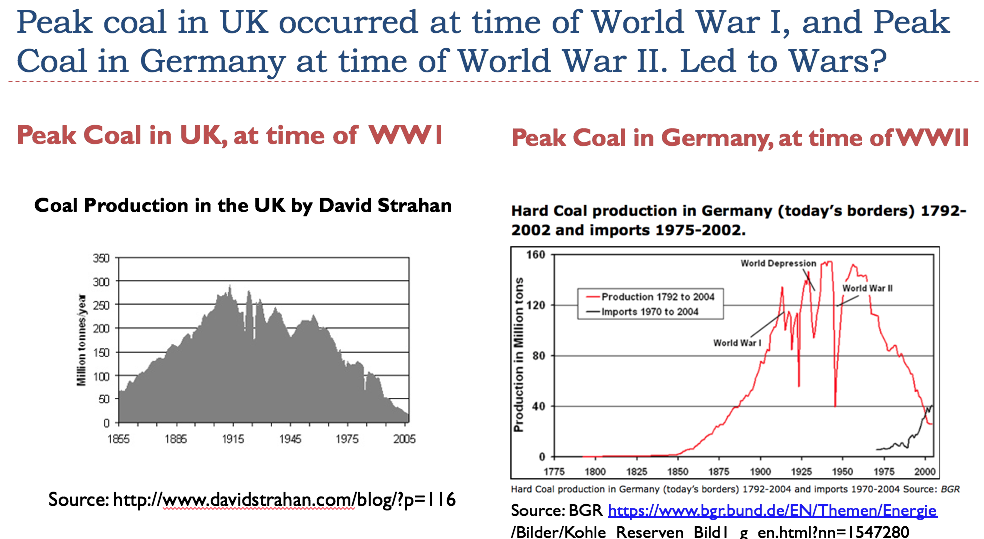
All parts of economies, including government organizations and businesses, constantly evolve. They grow for a while, but when limits are hit, they are likely to shrink and may collapse. The current energy bottleneck is sufficiently dire that some observers worry about another world war taking place. Such a war could change national boundaries and reduce import capabilities of parts of the world. This would be a type of squeezing out of major parts of the world economy. In fact, shortages of coal seem to have set the stage for both World War I and World War II.
Each squeezing out is different. When there are physically not enough goods and services to go around, some inefficient parts of the economy must be squeezed out. Payments to pensioners seem to me to be particularly inefficient because pensioners are not themselves creating finished goods and services.
World leaders would like us to believe that they are in charge of what happens in the world economy. But what these leaders can accomplish is limited by the actual resources that can be extracted and the finished goods and services that can be produced with these resources. When there are not enough goods and services to go around, unplanned changes to the economy tend to take place. These changes work in the direction of allowing parts of the system to go forward, without being burdened by the less efficient portions.
[2] The importance of diesel and jet fuel
Diesel and jet fuel are important to today’s industrial economy because they fuel nearly all long-distance transportation of goods, whether by ship, train, large truck, or airplane. Diesel also powers most of today’s modern agricultural equipment. Without the use of modern agricultural equipment, overall food production would decline drastically.
Without diesel, there would also be many other problems besides reduced food production. Diesel is used to power many of the specialized vehicles used in road maintenance. Without the ability to use these vehicles, it would become difficult to keep roads repaired.
Without diesel and jet fuel, there would also be an electricity problem because transmission lines are maintained using a combination of land-based vehicles powered by diesel and helicopters powered by jet fuel. Without electricity transmission, homes and offices without their own solar panels and batteries wouldn’t be able to keep the lights on. Gasoline pumps require electricity to operate, so they wouldn’t operate either. Without diesel and electricity, the list of problems is endless.
[3] Green energy is itself a dead end, but subsidizing green energy can temporarily hide other problems.
Green energy sounds appealing, but it is terribly limited in what it can do. Green energy cannot operate agricultural machinery. It cannot make new wind turbines or solar panels. Green energy cannot exist without fossil fuels. It is simply an add-on to the current system.
The reason why we hear so much about green energy is because making people believe that a green revolution is possible provides many temporary benefits. For example:
- The extra debt needed to subsidize green energy indirectly increases GDP. (GDP calculations ignore whether added debt was used to produce the added goods and services counted as GDP.)
- Manufacturers can pretend that their products (such as vehicles) will operate as they do today for years and years.
- The educational system is given many more areas to provide courses in.
- Citizens are given the hope that the economy will grow endlessly.
- Young people are given hope for the future.
- Politicians look like they are doing something for voters.
Unfortunately, by the time that the debt comes due to pay for subsidized green energy, it will be apparent that the return on this technology is far too low. The overall system will tend to collapse. Green energy is only a temporary Band-Aid to hide a very disturbing problem. Its impact is tiny and short-lived. And it cannot prevent climate change.
[4] Energy bottlenecks are a frequent problem.
Energy bottlenecks are a frequent problem partly because the human population has tended to increase ever since early humans learned to control fire. At the same time, resources, such as arable land, fresh water supply, and minerals of all kinds, are in limited supply. Extraction becomes increasingly difficult over time (requiring more inputs to produce the same output) because the easiest-to-produce resources tend to be exploited first. Extracting more fossil fuels to meet the energy needs of a growing economy may look like it would be easy, but, in practice, it is not.
As a result of energy bottlenecks, civilizations often collapse. Sometimes war with another group is involved. In such a case, the population of the losing civilization falls.
[5] The standard supply and demand model of economics makes it look like prices will rise in response to fossil fuel shortages. The discussion in Section [4] shows that energy supply bottlenecks often occur. When they do occur, the response is very different.

The model of many economists is far too simple. Based on the model shown on Figure 2, it is easy to get the idea that a shortage of oil will lead to a rise in prices. As a result, more oil will be produced, and the problem will be solved. Or perhaps efficiency changes, or substitution for a different type of fuel, will fix the problem.
When bottlenecks appear, the real situation is quite different. For example, increases in oil prices tend to cause food prices to rise, and thus increase inflation. Politicians know that citizens don’t like inflation and therefore will not vote for them. As a result, politicians tend to hold down prices. The resulting prices tend to fall too low for producers, and they start producing less, rather than more.
Energy products of the right kinds are essential for making every part of GDP. If there is not enough of the right kinds of energy products to go around, what I call some kind of “squeezing out” is likely to take place. Early on, there may be changes that reduce energy consumption, such as cutbacks in international trade. More businesses may fail. Eventually, some parts of the world economy may disappear, such as the central government of the Soviet Union in 1991. Or war may take place.
[6] When there is not enough energy of the right kinds to go around, spreading what little is available “thinner” doesn’t work.
As an example, if people need to eat 2,000 kilocalories per day, and if the food supply that is available would only supply 500 kilocalories per day (on average), giving everyone the same quantity would lead to everyone starving. Similarly, if a communist government gives every worker the same wage, lateness and “slacking off” become huge problems. Experience in many places has shown that equal pay for all, regardless of native abilities, responsibilities, or effort, simply doesn’t work. Somehow, diligent work and greater responsibility needs to be rewarded.
When an energy bottleneck occurs (leading to too little finished goods and services in total being produced), what I call a “squeezing out” takes place. Such a squeezing out may be initiated in many ways, including a war, angry citizens overturning a government, financial problems, or a shift in climate. The winners in a squeezing out end up ahead; the losers see collapsing institutions of many kinds, including failing businesses and disappearing government organizations.
[7] Most people do not understand the interconnected nature of the world economy, and the way the whole system tends to evolve.
The Universe is made up of many temporary structures, each of which needs to “dissipate” energy to stay away from a cold, dead state. We are all aware that plants and animals behave in this manner, but businesses of all kinds and government organizations also require energy of the right kinds to grow. They get much of their energy from financial payments that act as temporary placeholders for goods and services that will be made in the future using various types of energy, including human labor.
Strangely enough, because of the physics of the situation, business and government organizations are also temporary in nature, and in some sense, they also evolve. In physics terms, all these structures are dissipative structures. Physicist Francois Roddier writes about this broader kind of evolution in his book, The Thermodynamics of Evolution. In fact, economies themselves are dissipative structures. I have written about the economy as a self-organizing system powered by energy many times, including here, here, and here. All these self-organizing structures eventually come to an end.
History is full of records of economies that have collapsed. The book Secular Cycles by Peter Turchin and Serjey Nefedov analyzes eight of these failed economies. Populations tend to grow after a new resource is found or is acquired through war. Once population growth hits what Turchin calls carrying capacity, these economies hit a period of stagflation. This period lasted 50 to 60 years in the sample of eight economies analyzed. Stagflation was followed by a major contraction, typically with failing or overturned governments and declining overall population.
[8] Logic and some calculations suggest that the world economy is likely to be reaching a major downturn, about now.
One way of estimating when a major contraction (or squeezing out) would occur would be to look at oil supply. We know that US oil production hit a peak and started to decline in 1970, changing the dynamics of the world economy. This started a period of stagflation for many of the wealthier economies of the world. Adding 50 to 60 years to 1970 suggests that a major downturn would take place in the 2020 to 2030 timeframe. Since it was the wealthier economies that first entered stagflation, it would not be surprising if these economies tend to collapse first.
There have been several studies computing estimates of when the extraction of fossil fuels would become unaffordable. Back in 1957, Rear Admiral Hyman Rickover of the US Navy gave a speech in which he talked about the connection of the level of fossil fuel supply to the standard of living of an economy, and to the ability of its military to defend the country. With respect to the timing of limits to affordable supply, he said, “. . .total fossil fuel reserves recoverable at not over twice today’s unit cost are likely to run out at some time between the years 2000 and 2050, if present standards of living and population growth rates are taken into account.”
Confusion arises because some people would like to believe that fossil fuel prices can rise to extraordinarily high levels, and this will somehow permit more fossil fuels to be extracted. However, as I discussed in Section [5], the problem is really a two-sided one. Politicians want to hold fossil fuel prices down to prevent inflation, while oil producers (such as those in OPEC+) choose to reduce production if prices are not sufficiently high to meet their needs.
An easily missed point is that tax revenue from the sale of oil is often a large share of the total tax revenue of oil exporting countries. Because of this issue, in order for prices of oil to be adequate for oil exporters, they must include a wide margin for payment of taxes. These taxes are used to support the rest of the economy. For example, in Saudi Arabia, taxes provide support for huge building programs that provide jobs for citizens, but are of questionable long term value. These projects keep citizens happy, at least temporarily. Without adequate subsidy from tax revenue, citizens would want to overturn governments–a form of collapse.
[9] Energy problems are easily hidden because “scientific models” are considered to be important in forecasting the future. These models tend to be misleading because they leave out important elements regarding how the economy really works.
The easiest models to make are the ones that seem to say, “the future will be very similar to the recent past.” These models miss turning points. They assume that growth will continue even though resource extraction can be expected to become more difficult. Some examples of overly simple models include the following:
- Money is a store of value. (Not if the economy has stopped functioning properly because insufficient energy resources are available.)
- Forecasts of Social Security payments recipients will be able to receive in the future are overstated. (It takes energy of the right kinds to produce the goods and services that the elderly require. If the economy is not producing enough goods and services because of energy extraction limits, the share that pensioners can receive will need to fall so that workers can be paid adequately. Inflation-adjusted benefits to the elderly must be much lower or disappear completely.)
- Climate models give high estimates. (These models miss the real-world difficulty of extracting fossil fuels. They also assume the economy can grow indefinitely, greatly overstating future CO2.)
- Future energy supply based on “Reserve to Production” ratios give high estimates. (Reserve amounts are often puffed-up numbers to make an oil exporting country look wealthy.)
- Energy Return on Energy Invested models greatly overestimate the value of intermittent wind and solar energy. (It is easy to assume that all types of energy are equivalent, but intermittent wind and solar cannot replace diesel and jet fuel.)
[10] Added complexity is not a solution to our energy problems.
Many people believe that if we can just be smarter, we can solve our energy problem. We can add more fuel-efficient engines, more advanced education, and more international trade, for example. Unfortunately, many things go wrong, leading to an upward energy complexity spiral. Difficulties include:
- The complexity changes with the best payback tend to be discovered and implemented very early.
- Added complexity may lead to higher energy consumption if cost savings result. For example, more vehicles may be sold if reduced fuel consumption makes their operation more affordable to a wider number of users.
- Wage disparity results because the wages paid to highly educated employees and those in managerial positions leave little funding available to pay less-skilled workers.
- Less-skilled workers indirectly compete with similarly skilled workers in low-wage countries, further holding their wages down.
It is clear that we are now moving past the limits of complexity. For example, international trade as a percentage of GDP has been falling for the world, the US, and China.

Countries are now actively trying to bring supply lines back closer to home. Trips for goods across the Atlantic and the Pacific Oceans are being reduced, saving diesel and jet fuel.
[11] Repayment of debt with interest acts like a Ponzi Scheme if there is inadequate growth in the energy supply.
Most people today do not realize the extent to which the entire financial system is dependent on growing inexpensive-to-produce energy supply of the right kinds. It takes physical resources of the right kinds to produce goods and services. Resources such as fresh water, copper, lithium, and fossil fuels require more and more energy consumption to produce the same amount of supply because the easiest-to-extract resources are extracted first.
When the economy is far from limits, adding more debt (or other types of promises, such as shares of stock) does seem to increase “demand” for finished goods and services, and this, in turn, tends to increase the production of fossil fuels and other commodities. Thus, for a while, increased debt does indeed increase energy supply.
But when we start reaching extraction limits, instead of producing more fossil fuels and other commodities, higher debt tends to produce inflation. (In other words, more money plus practically the same amount of finished goods and services tends to lead to inflation.) This is the issue central banks are up against today. Central banks raise interest rates in response to the higher level of inflation, partly to compensate lenders for the inflation that is taking place, and partly to make their own economies more competitive in the world economy. The combination of higher interest rates and higher inflation is problematic in many ways:
(a) Ordinary citizens find that they must cut back on discretionary goods and services to balance their budgets. This tends to push economies in the direction of recession and debt defaults. Some citizens find they need to apply for government assistance programs for the first time.
(b) Businesses find it more difficult to operate profitably with higher interest rates and inflation. Businesses increasingly expand in programs supported by government subsidies, such as those for electric cars and batteries, as it becomes increasingly difficult to make a profit without a subsidy. In the US, defaults seem especially likely on commercial real estate loans.
(c) Governments become especially squeezed. Many of them find that their own tax revenue is falling at precisely the time when citizens need their programs most. Governments also find that with higher interest rates, interest costs on their own debt rises. Subsidized programs increasingly seem to be needed to keep the economy operating. The number of retirees also grows year after year. Government debt levels spiral upward, as shown for the US on Figure 6.
With all these issues, the world becomes increasingly prone to war. Political parties, and even groups within political parties, find it increasingly difficult to agree on solutions to problems. The stage seems to be set for an array of worrisome outcomes, including major debt defaults, failing governments, and even widespread war.
[12] The world economy was able to grow rapidly in the 1950 to 1980 period because of a rapid rise in energy consumption. Now, there is an energy bottleneck. The recent increases in interest rates seem likely to burst debt bubbles. They may even squeeze out some major economies with pension programs for their citizens.

On Figure 4, the significant increases in interest rates up until 1981 corresponded to a huge increase in world energy consumption in the 1950 to 1980 period (Figure 5).
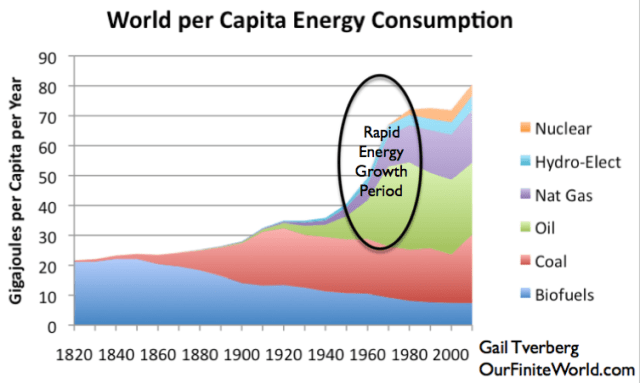
The rapid rise in fossil fuel consumption in Figure 5 was the reason why the economy was able to grow as rapidly as it did in the 1950 to 1980 period. Raising interest rates acted like brakes on the economy and lowered oil prices. The Soviet Union was the economy most harmed by these low oil prices. It also had a communist form of government that did not work well, compared to capitalism. Ultimately, the central government of the Soviet Union collapsed in 1991.
Now, the rise in interest rates during 2022 and 2023 on Figure 4 correspond to a very different situation. Extraction of fossil fuels, and in particular the heavy oil used to produce diesel and jet fuel, is no longer growing rapidly. Instead, what has been growing is debt, especially government debt. Figure 6 shows US government debt through April 2023. US government debt spurted upward in 2020 and is still rising rapidly.

The business closures in 2020 and interruptions in travel reduced oil prices and provided a good excuse for more government debt. All this debt added buying power, but it didn’t actually produce very many goods and services. Instead, it added a debt bubble. Similarly, investing in close-to-useless green energy temporarily added GDP, but it mostly added a huge debt bubble. Raising interest rates is likely to burst these debt bubbles.
The US and other rich countries have also put in place pension plans for the elderly. These are not treated as debt, but they depend upon resources of all kinds being available to feed, clothe, and provide shelter to a growing army of retirees. If there is not enough diesel to allow as many goods and services to be produced as are produced today, there is likely to be a huge problem if payouts to pensioners aren’t significantly reduced. Other citizens will be unhappy if retirees get a disproportionately large share of the reduced supply of goods and services. Some will say, “Why work if retirees on pensions get more than those of us who are still working?”
Thus, the world seems to be increasingly in a situation where more squeezing out will take place. Major governments, especially those with pension plans for their citizens, seem especially vulnerable. No one understood that there had been a temporary rapid rise in energy consumption per capita in the 1950 to 1980 period (Figure 5) that led to a temporary spurt in interest rates on bonds. This temporary rise in interest rates made pension programs look far more feasible than they really are for the longterm.
[13] How does the problem resolve itself?
It seems to me that the problem of debt bubbles and of unaffordably generous pension plans is very widespread. Analysts of all kinds have missed the hidden brakes on economies caused by inadequate energy resources of the right kinds, relative to rising populations. Collapse of at least some central governments seems possible. Perhaps some of these collapses can be postponed by rollbacks in government-sponsored programs, particularly those for the elderly and for those who are not working.
But even aside from the pension problem, there is a problem with many debts not being repayable in an economy that is forced to slow, as described in Section [11]. Many other promises become iffy as well. For instance, derivatives may not be able to pay as planned.
If there are problems with inadequate supply of essential materials, they are likely to spill over to asset values. For example, a farm that cannot purchase fuel for its agricultural equipment is, in some sense, not worth very much, since workers with simple tools like shovels cannot produce very much food. Likewise, a factory with permanently broken supply lines is not worth much.
I wish I could provide a happy-ever-after ending. The closest I can come to such an ending is to say that it appears to me that there is a literal Higher Power that is somehow providing an enormous amount of energy in a way that allows the Universe to continually expand. This literal Higher Power is, in some way, influencing the world today, through the self-organizing nature of the economy. The book Rare Earth: Why Complex Life Is Uncommon in the Universe, by Ward and Brownlee, explains that life could not have happened on the Earth, as quickly as it did, by chance alone. Perhaps things will turn out differently than we expect.


The situation in the eastern Mediterranean mirror the run up to WW1. Everybody deploys and deploys, escalates and escalates, eventually they are left with no way out.
good to know.
WW1 was merely a regional war, after all.
Not in terms of civilization.
The 10 million dead, plus the much more numerous injured or at least disillusioned peoples were more valuable than all the deaths of WW2, who came mostly from USSR, eastern Europe, China and Japan, who are , I have to say, somewhat less essential for Civilization.
A short youtube on China’s thorium reactor project.
https://youtu.be/W95DY3q61T4
My understanding from Oil Drum days was that the world has lots of thorium, but no one has figured out how to make it give a sustainable reaction that would produce electricity for the long term. (It also is not good for making nuclear weapons, so no one wants to invest in it.)
If the Chinese have actually figured this out, there still would be a lag before they could get power plants up and running using thorium, I would expect. And it still doesn’t fix our need for diesel. So it would help a little, over the long run. But the world would still need fossil fuels.
Clever little chap, bing.
“es, the United States did build an experimental prototype thorium reactor. The Molten Salt Reactor Experiment (MSRE) was built at Oak Ridge National Laboratory and operated from 1965 to 19691. The reactor used U-233 fuel, the fissile material created by bombarding thorium with neutrons1. However, in 1973, the US government largely discontinued thorium-related nuclear research and settled on uranium technology1. The reasons were that uranium-fueled reactors were more efficient, the research was proven, and thorium’s breeding ratio was thought insufficient to produce enough fuel to support the development of a commercial nuclear industry1”
Dennis L.
the United States did build an experimental prototype thorium reactor.
And it was garbage. It had a great many unplanned outages due to technical problems.
It turned out working with hot liquid radioactive metals was quite tricky.
This is piquant? Offshore bondholders for USD19B are being offered as settlement a swap into equity in two other HK listed Evergrande subsidiaries, one of which is Evergrande New Energy Vehicle Group. Lawyers recommend the deal as it’ll likely bring 2c in the dollar, in excess of estimated proceeds from the liquidation of Evergrande.
scmp.com/business/companies/article/3239948/evergrande-proposes-new-debt-plan-where-offshore-creditors-get-30-equity-stake-subsidiaries-sources
that’ll please those former USD holders
The heading says Evergrande proposes new debt plan where offshore creditors get 30% equity stake in subsidiaries: sources
This article doesn’t mention what those subsidiaries are.
I notice that Wikepedia has an Evergrande New Energy Auto. There seems to be a price war in China with respect to EVs, with consolidation coming.
https://www.canalys.com/newsroom/global-ev-sales-h1-2023
EV Auto sales is likely to be a tough place to make money.
cut and paste (same link) from my screen:
A lawyer representing an ad hoc group of key bondholders told a Hong Kong court on Monday the restructuring plan could have a higher recovery rate for creditors than a liquidation scenario of less than 3 per cent.
Shares in the units the bondholders will be offered the stake in, Evergrande Property Services Group and Evergrande New Energy Vehicle Group, have fallen by more than 80 per cent this year amid Evergrande’s debt woes.
Their combined market value was only around HK$9 billion (US$1.15 billion) as of Wednesday morning, with the parent holding 52 per cent of the property arm and 59 per cent of the vehicle firm.
This sounds like a winner! https://en.wikipedia.org/wiki/Evergrande_New_Energy_Auto
hahaha
WeWork plans to file for bankruptcy over massive debt pile and losses
https://www.cweb.com/wework-to-file-for-bankruptcy-as-early-as-next-week-reports-say/
It seems like this bankruptcy has the potential to spill over into the commercial real estate market. Office buildings had high vacancy rates before; this makes them even higher. Interest rates on mortgages are now higher too.
Matthew Perry is not the only actor to die unexpectedly this year. There are at least 33 more.
https://vigilantnews.com/post/actors-dying-suddenly-matthew-perry-age-54-tyler-christopher-age-50-are-the-most-recent-losses
Rasmussen Reports has just released yet another devastating survey about the COVID vaccine.
Their latest survey, released at 10:30am EST on November 2, confirms (yet again) that the COVID vaccine is a train wreck, the biggest healthcare disaster in our lifetime.
Follow @Vigilant_News
https://vigilantnews.com/post/rasmussen-poll-a-stunning-42-of-americans-would-likely-join-a-class-action-lawsuit-against-covid-vax-makers-if-it-was-permitted-by-law-2
Vigilantnews (https://vigilantnews.com/post/rasmussen-poll-a-stunning-42-of-americans-would-likely-join-a-class-action-lawsuit-against-covid-vax-makers-if-it-was-permitted-by-law-2)
Rasmussen poll: A stunning 42% of Americans would likely join a class action lawsuit against COVID vax makers if it was permitted by law
The poll implies that 500,000 Americans were killed by the jab. How many more Americans must be killed before this deadly vaccine
Too late.. too late…
Primed… for Detonation.
Oh and btw our visitors are headed back to QT today … the one with 3 different infections (boosted to the moon) continues to experience ear blockage despite antibiotics for a week… asking about a referral to a doctor
https://www.paulcraigroberts.org/2023/11/02/your-family-friends-were-used-as-lab-rats-covid-vaccines-have-caused-a-dangerously-deadly-alliance-between-mrna-graphene-nanotechnology/
The article says,
“The big news is that if you believe 1M people died from COVID, then this poll suggests that 500K people died from the COVID vaccine.”
Wow! The timing overlapped enough that it is hard to tell one from the other.
Maybe this is a prelude to the cannisters + all out nuklear war? https://t.me/downtherabbitholewegofolks/89320
“Australia deploys defense force personnel and RAAF aircraft to the Middle East, acting PM says.”
What? Australia?
Uh…. the same folks who organized the Hamas folks to kill some of the JOOS so that the JOOS could kill all the Pallys? Am I close? https://t.me/leaklive/16676
Hey — a Funeral! We need a helicopter gun ship to open fire
https://t.me/leaklive/16675
More funny stuff https://t.me/leaklive/16674
“Israeli police on Wednesday attacked, arrested members of Neturei Karta Orthodox Jewish group, who tried to display Palestinian flags in Jerusalem during their attempt to show support for Palestinian people amid Israel’s attack on Gaza.”
hahahaha laugh with me https://t.me/leaklive/16672
All ah … crack bar https://t.me/leaklive/16670
The military allows someone to take video? https://t.me/leaklive/16669
The MOREONS prefer KFC. And Rat Juice. Cuz bbccnn
https://charleshughsmith.substack.com/p/how-much-do-you-spend-on-food
I like Charles Hugh Smith’s point 8:
SARS-CoV-2, the Spike Protein and Oncogenesis
How the SARS-CoV-2 and its Spike Protein cause Cancer by mimicking (and perhaps inducing) Cancer’s genetic altering of cellular functions.
https://wmcresearch.substack.com/p/sars-cov-2-the-spike-protein-and
“Beyond Meat Slashes Outlook As Fake Meat Demand Falls”
https://www.zerohedge.com/markets/beyond-meat-slashes-outlook-fake-meat-demand-falls
Nothing against beanburgers or veggie sausages but if it’s the same price as actual meat i’m not stupid enough to buy it.
The same people who buy this… buy EVs… solar panels… and shoot Rat Juice every few months.
They believe they are saving the world –cuz bbccnn told them so
“The same people who buy this”
Love the BBC
Our bodies expect unprocessed foods. “Beyond meat” is hardly unprocessed.
But eating fake meat will save the planet and it’s nutritionally better for us. I know this because the media told me so and they wouldn’t lie, that’s not their job.
“It might not be quite 25 times worse for the environment – but there are now multiple studies which have concluded that producing cell-based protein in a lab will be far more energy intensive when it’s produced at scale,”
“In addition to these concerns, there is a distinct lack of nutritional data from the cell-based protein industry – and that’s not good. There are a lot of big claims, but no data whatsoever to back them up,”
https://www.beefcentral.com/news/leading-cell-based-meat-expert-backs-recent-study-on-its-environmental-impact/
Ukraine’s top general on the breakthrough he needs to beat Russia
General Valery Zaluzhny admits the war is at a stalemate
Five months into its counter-offensive, Ukraine has managed to advance by just 17 kilometres. Russia fought for ten months around Bakhmut in the east “to take a town six by six kilometres”. Sharing his first comprehensive assessment of the campaign with The Economist in an interview this week, Ukraine’s commander-in-chief, General Valery Zaluzhny, says the battlefield reminds him of the great conflict of a century ago. “Just like in the first world war we have reached the level of technology that puts us into a stalemate,” he says. The general concludes that it would take a massive technological leap to break the deadlock. “There will most likely be no deep and beautiful breakthrough.”
Well now, just like the COVID vaccine, it’s a gift that keeps giving..
Endless war..stalemate…music to the ears of the arms manufacturers, military and the rest of the profiters…
Yes..we need a massive technological leap, a beautiful breakthrough..
Like anything external will solve out inner turmoil….
We need to move on to a different crisis, when stalemate occurs.
“stalemate” is Ukraine propaganda.
Russia took 4 oblasts quickly in 2022, so the score is 4 to 0.
after taking those majority Russian speaking oblasts, Russia saw that the West was willing to keep on sending troops and equipment into the range of Russian artillery, so Russia stopped moving forward and began their wise war of attrition.
so any appearance of “stalemate” is exactly in favor of Russia and has become a temporary part of their strategy.
at some point in the near future, enhanced by aid for Ukraine declining as most of it moves to Israel, Ukraine military force will be weak enough where Russia will move forward and take as many oblasts as they want.
I doubt that they want the majority Ukrainian speaking oblasts, but those will be demilitarized and perhaps left as a rump country as a buffer zone.
the “stalemate” illusion will not last much longer.
the “stalemate” illusion will not last much longer.
Perhaps in a year or maybe a decade.
good one!
the wise war of attrition strategy takes time, so the Russians won’t be in any hurry, as long as the west keeps sending stuff within range for the Russians to blow up.
(Luogocomune + Franco Fracassi + Israeli twitter channel: Itay Epshtain)
”Ethnic cleansing of Gaza: here’s the original plan”
https://luogocomune.net/29-palestina/6360-pulizia-etnica-di-gaza-ecco-il-piano-originale
https://t.me/Franco_Fracassi/3737
“Itay Epshtain @EpshtainItay
BREAKING:
@mekomit
expose shows that the directive to deport 2.4 million #Palestinians out of occupied #Gaza and onto #Egypt and beyond has been officially endorsed by #Israel’s Ministry of Intelligence on 13 October. A war crime in the making!”
https://twitter.com/EpshtainItay/status/1718578424644514241
Thank you Student..my suspicion has been confirmed..not that it needed to be…very obvious, as they say
PS. The extreme flooding of Milan Italy was when in our network nightly News broadcast on ABC here in the USA…
https://www.tiktok.com/@abcnews/video/7296758452758531370
Concerning Milan, I can tell you that it has always happened when it rains a lot.
😀
It has always happened so and it is related to the big buildings constructions on the north area of the metropolis after the second world war (in the typical period of economic expansion).
So my guess is that journalists are hunting like crazy for flooding around the world 😀 in order to take the opportunity to keep alive the argument of climate change on the audience.
Too many people in total for resources. Some of them have to go to make the balance work.
Just genocide the millions of Palestinians and hey presto, the settler colony gets it all.
“Geologists and natural resources economists have confirmed that the Occupied Palestinian Territory lies above sizeable reservoirs of oil and natural gas wealth, in Area C of the occupied West Bank and the Mediterranean coast off the Gaza Strip.
However, occupation continues to prevent Palestinians from developing their energy fields so as to exploit and benefit from such assets. As such, the Palestinian people have been denied the benefits of using this natural resource to finance socioeconomic development and meet their need for energy.
The accumulated losses are estimated in the billions of dollars. The longer Israel prevents Palestinians from exploiting their own oil and natural gas reserves, the greater the opportunity costs and the greater the total costs of the occupation borne by Palestinians become.
This study identifies and assesses existing and potential Palestinian oil and natural gas reserves that could be exploited for the benefit of the Palestinian people, which Israel is either preventing them from exploiting or is exploiting without due regard for international law.”
https://unctad.org/publication/economic-costs-israeli-occupation-palestinian-people-unrealized-oil-and-natural-gas
It’s all about the Leviathan natural gas field, Tamar field and Gaza Marine.
In 2021 a deal with Egypt was organised to steal the Palestinian oil and gas.
Nuttyyahoo has stated that the timeline resulting from these bilateral Israel-Egypt “secret talks” i.e. confiscation of Palestine’s offshore Maritime Gas Reserves is the beginning of 2024. Can’t let those animals have their own resources and build a life for themselves, so best get on with the slaughter, eh Benny.
“During a public event held at the Gaza port Sept. 13, the Palestinian factions laid the foundation stone for a sea corridor linking the Gaza Strip with the outside world, and inaugurated a mural inscribed with the text, “Our gas is our right.”
In their speeches during the event, the faction leaders demanded that the Palestinians be allowed to benefit from their own gas resources, and stressed that they would not allow Israel to steal it.”
https://www.al-monitor.com/originals/2022/10/egypt-persuades-israel-extract-gazas-natural-gas#ixzz8GnZcqWWC
Western trained Abdel Fattah el-Sisi will get a taste of the Muammar Muhammad Abu Minyar al-Gaddafi treatment, if that becomes widespread knowledge on the streets of Egypt.
https://www.brookings.edu/wp-content/uploads/2016/06/gaza-marine-web.pdf
That’s also why we have been desperately trying to destroy Syria as well, because they did an exploration deal with Russia and it turns out the whole Eastern Mediterranean is covered in relatively easy to access and pipe oil and gas(mainly gas, but just look at the prices now)
We could also talk about the stolen water from Palestinian aquifers to support their European dietary needs, which wouldn’t be so depleted if the genuine people of the region were allowed to farm in their millennia old ways.
Anyway, what’s happened to all the people that are usually blaming a small religious group for all their woes?
Must be the trained levels of racism keeping them shtoom, when there’s an open goal just begging to be hit.
https://indi.ca/the-deep-coding-of-genocide-in-the-western-brain/
There is another option for all those children and I can see Nuttyyahoo’s people being onboard with the idea.
A Modest Proposal from Dr. Jonathan Swift(1729)
https://www.gutenberg.org/files/1080/1080-h/1080-h.htm
Kulm, don’t get to exited when you read that.
Why does a species that tortures animals … get so worked up about genocide???
Bovine eejit, don’t conflate a species with the dumb screen raised cattle that you proudly show yourself to be.
Thanks for proving at least one point.
All wars are resource wars.
Mostly true Ed, just trying to show the resource reasons behind the latest.
it turns out the whole Eastern Mediterranean is covered in relatively easy to access and pipe oil and gas
No it isn’t. There are some gas fields that may just about be viable.
Thank you Withnail – a bit of truth.
“Gaza Marine was one of the first discoveries in
the basin. It is estimated to hold 1 tcf of natural
gas. Despite these other successes Gaza Marine
remains untapped despite its location in signifi-
cantly shallower waters and considerably closer to
shore than either Tamar or Leviathan.6 Technical-
ly, Gaza Marine is a comparatively simple field to
exploit.”
That’ll be “just about be viable” will it. More like easy to access and pipe.
The Russians were eager to develop the Syrian offshore gas and they don’t generally throw good money after bad, but you know better. Do explain.
It’s been stated by various different groups(The U.S. Geological Survey for one) that there is lots still undiscovered in the region and all nations are hankering to stake their claim, so if you disagree, show why you know more than them(I’m happy to learn).
Your simple proclamations don’t offer much apart from your personal view and as you’ve shown, that’s based on keeping the status quo intact, so you can do nothing.
What’s generation X by the way?
I don’t follow the teachings of the media, so no idea what pigeon hole I’m supposed to put myself in(if I’d be so eagerly manipulated).
What’s generation X by the way?
It’s also known as the MTV generation, the slacker generation or the latchkey generation.
It’s the one between Boomers and Millenials.
Just as well I don’t go along with it then, or I’d be one.
MTV only makes me think of one thing.
“We can’t rewind, we’ve gone to far”
https://youtu.be/W8r-tXRLazs?feature=shared
MTV only makes me think of one thing.
“We can’t rewind, we’ve gone to far”
Video Killed the Radio Star was the first video ever shown on MTV
Just as well I don’t go along with it then, or I’d be one.
You are one. You can claim to be special and unique and not at all like the others, if you want.
I’m none of those things, but neither am I gullible enough to believe I fit into some meaningless description, because someone else put an idiotic name to it.
None of how you describe it fits me, or ever has, so it is meaningless to me and only suitable for those that feel the need to be placed in a pigeon hole.
Is there a term for each and every generation, or is it just modern make-believe?
Just looked and it’s make-believe. There doesn’t appear to have been any generations before 1900.
https://journeymatters.ai/7-generations/
I assume you go along with the term AI because a small group told you so?
You don’t get to choose what generation you are. You’re Generation X, suck it up.
If you choose to believe a fantasy, I’ll leave you to it, Mr AI😁
Is there a term for each and every generation
Yes there is, how do you not know this?
If you choose to believe a fantasy, I’ll leave you to it, Mr AI😁
I have repeatedly and vociferously denied the existence of anything that could legitimately be called AI. You could try reading some of my past comments about the topic.
No need to re-read, that’s why I chose that term.
What generation would someone born in 1843 be?
They can’t even make their mind up on how many years make up a generation, but seeing as there only appears to be 7, in the whole of human history, I won’t quibble about a few years and you can start looking forward to the turn of the next century.
Dennis will probably be posting from Titan by then, Kulm would have found singularity and Eddy will be telling everyone about canisters.
Only 7. WTF. Better go and dig my dad up and apologise a lot.
What generation would someone born in 1843 be?
Oh we don’t go back that far. mostly just people alive now.
Only 7. WTF. Better go and dig my dad up and apologise a lot.
He would almost certainly have been Greatest Generation or Silent Generation depending on his year of birth.
Most Generation X have Silent Generation parents.
Very catch tune!
They don’t make pop songs like this any more.
There is a recent substack article called “Everyone wants Gaza’s Gas” https://www.planetcritical.com/p/everybody-wants-gazas-gas
It claims that Israel wants all of the natural gas for itself. The article says:
I think you are right about Israel trying to grab Gaza’s natural gas. There likely isn’t oil there, but there is enough gas there to likely want to fight about, especially with the scarcity of natural gas recently.
“From 2011: ‘WikiLeaks cable reveals Israel told U.S. officials in 2008 it would keep Gaza’s economy “on the brink of collapse” while avoiding a humanitarian crisis “?
https://x.com/wikileaks/status/1715676803938013227?s=20
Herd them out like cattle… they should have done this years ago
Hmmm https://t.me/leaklive/16656
You don’t say? 🧐
“Electric Vehicles Set To Be Auto Market’s ‘Next Big Flop,’ Says FreedomWorks Economist”
https://www.zerohedge.com/energy/electric-vehicles-set-be-auto-markets-next-big-flop-says-freedomworks-economist
I can believe that Electric Vehicles will be the auto market’s next big flop. They are not at all convenient.
Electric vehicles have been the backbone of public transportation in many countries for a century now. But these have all been rail based. And they aren’t powered by batteries, they draw power directly from the grid via sliding contact with a catenary cable or third rail.
If electric transportation is to play a greater role in the future, surely it would be wiser to build that solution around technologies that are already demonstrated by a century of operating experience? When I was in Prague a few years back, I noticed how few people travelled by car. Most people were either on foot or in trams. The tram is a direct-electric vehicle. This is far more energy and resource sustainable than attempting to provide everyone with an electric car.
These public transport vehicles operate on fairly flat ground. They work best when they don’t have to compete with automobiles for the same space. Electricity can even be used on a track, up a hill, to move passengers to the top of a steep hill. If population is quite concentrated and end points aren’t too dispersed, the system can be made to work.
But it is hard to make a public transport system to work well when population and end points are widely dispersed, as they are in the Atlanta area. The cost and upkeep of the infrastructure is just too high.
And this approach doesn’t transfer well to shipping heavy goods long distances, including lots of inclines. It is a human population mover, when there are a lot of humans to move in one direction or another.
Any idea why engineers don’t have to compensate for the curvature of the earth … https://www.bitchute.com/video/XvAwLc7FZm2z/
80 years ago most large towns had trams
then they were taken out by the IC makers—to sell more cars
theres your problem—profit
Profit is an extremely important motivator, I agree.
‘Ferris Bueller,’ ‘Succession’ star CRASHES TRUCK INTO L.A. PIZZA SHOP
Actor Alan Ruck, best known for his roles in “Ferris Bueller’s Day Off” and “Succession,” was questioned by police after his truck crashed into other cars and eventually a pizza shop in Hollywood on Halloween night, TMZ first reported.
The collision happened around 9 p.m. at the busy intersection of La Brea Avenue and Hollywood Boulevard, at the west end of Hollywood’s famous Walk of Fame.
https://ktla.com/news/local-news/ferris-bueller-actor-crashes-into-hollywood-pizza-shop-tmz/
Ukraine plans to stop the transit of Russian natural gas to Europe as from 2025. A three-party agreement is considered where the customer receives the Russian gas on the Russia-Ukraine border and organizes its transport to Europe via Ukraine.
https://ekonomika.pravda.sk/energetika/clanok/686964-ukrajina-zastavuje-dodavky-ruskeho-plynu-na-zapad-slovenski-plynari-rozmyslaju-co-bude-dalej/?utm_source=pravda&utm_medium=hp-box&utm_campaign=shp_9clanok_box
This sounds like an expensive way to get gas to Europe.
Ukraine ramps up its own production and Gazprom does not pay for transport as agreed.
https://www.aktuality.sk/clanok/RphjUrV/ukrajina-od-roku-2025-nebude-prepravovat-rusky-plyn-na-zapad/
Will there even be a Ukraine in 2025?
Will there be Russia in 2025?
The population and economic collapse is a ticking bomb. The recruitment of the young becomes impossible, if there are no advances, just killings on both sides.
Don’t be silly now. Ukraine has lost 10 million in the space of 18 months to emigration and military losses. How is that more sustainable?
Warmer Ukraine needs less resources for smaller, although aged, population. But colder Russia needs rising imports for its elderly care. Who is silly?
Who cares about elderly care? Just give them the Soylent Green euthanasia centre treatment if necessary.
measuring energy resources, food production and fresh water, low debt economy, large population of real men not psychowoketards, conventional military strength, hypersonic missiles, oh and nuclear weapons as well…
Russia is the strongest country on Earth.
if there is no Russia in 2025, every country will have been collapsed/destroyed by then.
That is the past. Russia benefited from favourable relations with warmer countries nearby.
Gazprom is stopping transit through Ukraine anyway in 2024.
Anyone find it strange that the UKEY war was turned off like a light switch?
Suddenly… and it’s gone.
All ad campaigns have a start and finish date.
and trannys are gone and love for refuges is gone
and amazed that Joe Biden is successfully casting himself as the viral man defending us against all the various baddies in the middle east.
A lot of people talk about Henry Kissinger.
I am not going to say what he did was good or not.
However , he idolized people like Metternich and Castlereagh, and emphasized stability. Whatever his intentions might have been, not from United States, he conveniently forgot the inconvenient fact that all these people who did NOT like such arrangement came to United States, and led it to become a country which HATED civilization and wanted to kill it.
So he based his philosophy in an outdated political system and wanted to make USA center of such system, using China as a counterpart.
It might be a dramatic irony that he, who visited Beijing a few months before, was treated as an old baggage by Xi Jinping and his colleagues. Kissinger is not someone who would say he f’ked up, but it is unfortunate that he believed the Balance of Power shit, which DOES NOT WORK.
I wonder how it will be like the Congress of Riyadh, circa 2025, hosted by Mohammed bin Salman to celebrate the fall of the Wokist regime and to celebrate the return of Oriental Despotism, where fellow despots of China, Russia, Persia, North Korea, and a bunch of other authoritarian regimes to return the world back to the days of camels and imperial processions.
Brooke Shields, 58, was rushed to hospital after ‘frothing at the mouth’ and turning ‘totally blue’
The ‘Suddenly Susan’ star revealed she suffered a seizure in September
https://www.hellomagazine.com/healthandbeauty/health-and-fitness/506426/brooke-shields-rushed-hospital-bradley-cooper-frothing-mouth-totally-blue/?dicbo=v2-TOAsGAm&obInternalId=71118
Unreal!
ah i see…
Brooke revealed that doctors believed her seizure came from a result of drinking too much water and not having enough salt in her diet. Brooke went on to make a full recovery was even to make the opening night of her one-woman show, which began on September 12.
Was that soda water, by any chance?
The lies are becoming ever more ridiculous.
Monkey sounds.
Los Angeles- and London-based Playboy, Virgin Atlantic, and fashion model Tabby Brown, 38, died last week from a sudden and unexpected ‘cardiac event.’
Tabby was in great shape. In one article that ran in the UK Sun, one of Tabby’s close friends told reporters, “She didn’t drink or smoke or, do drugs, and she was really fit and healthy; but apparently she died from a heart attack.”
Apparently. Apparently she died from a catastrophic, no-warning heart attack at thirty-eight years old.
https://www.coffeeandcovid.com/p/bat-brained-wednesday-november-1
It definitely wasn’t the CV19 vaccines because they are 100% and effective. In fact Albert Bourla the CEO of Pfizer is getting nervous that CV19 vaccine sales are much lower than expected. He’s worried there are way more FastEddy’s than there are Norms.
So boost up everybody. Here’s to your health! 🥳
“Pfizer To Shut Down Two Facilities Amid Major Cost Cuts”
https://www.zerohedge.com/medical/pfizer-shut-down-two-facilities-amid-major-cost-cuts
Clearly the shots are far safer and far more effective than advertised… folks feel so safe and effective that they no longer feel the need to boost
Too much Botox? Too much liposuction? Too much plastic surgery? Too much makeup?
Whatever. She will take her beauty secrets to the grave.
https://nypost.com/wp-content/uploads/sites/2/2023/10/tabby-brown.jpg?quality=75&strip=all
50% of UK ‘farmers’ want to quit.
https://youtu.be/BF1yezkulMM?si=6DScrnzGGe1QVbjt
‘farmer’ means something different in UK from other countries. UK is notorious for the lack of smaller farmers; most of the ‘farmers’ are ‘gentlemen farmers’ , aristocrats and long term landowners who don’t have to worry about going hungry.
The people of United Kingdom are going to experience what the people of Ireland did in 1845, unless they are rich enough to run to some other places.
Well. what goes, does come around, even though it might take a while. The nobles will flee, as always, but I don’t feel bad about the people of UK looking like boer camp residents like this
https://www.youtube.com/watch?v=Dh5tXcNp86U
UK (sans NI) has 65.6 mil. So maybe 10-15 mil deaths by starvation might be a good estimate.
Gail et al,
I have been trying to follow a specific thread through this long conversation. It’s very difficult because most people cannot think beyond a short meme or stereotype.
Withnail, Cromagnon – thanks for your good points. Can you try to provide a good summary?
The question is: can humanity survive after industrial civ collapse and at what level.
My point was that rural and town life was almost unchanged for 5000 years before industrial revolution. So this mode of life has proven enduring and applicable to most environment (except desert and maybe jungle).
Withnail suggested the lack of metal ore would stop that. But there is enough metal rusting on the surface of the Earth to support a medieval lifestyle for thousands of years. I cannot project what will happen after – except that yes, in a million or so years, Homo Sapiens will go extinct.
Note: of course we are talking about a reduced population. Most collapses reduce population 5X to 20X. Even if you consider this collapse special (because of nuclear reactors causing no-go zones) – there are so many people on earth that even a 100X reduction will leave about the same people as in 500 to 1000 BC (https://www.census.gov/data/tables/time-series/demo/international-programs/historical-est-worldpop.html). If you want to know how people lived then, read Greek comedians, Sumerian hero stories or Egyptian love poems.
So I think that most of people insisting that EVERYONE has to die are simply just entitled first-worlders that cannot imagine life without hot showers. 80% of the world does not have hot showers and they are probably happier than us…
Cancer
It’s not just any old towns or rural areas. Many of these, especially in America, which largely developed post-industrial revolution, are quite unsustainable even by medieval standards. You have to be in one that has enough rural land within, say, a 10 mile radius, to supply food (grains, vegetables, fruits, eggs, meat) and a water supply that can work without FF inputs within and around its outskirts to support the locality’s residents. You also need an abundance of trees for heating and for metal working. Some deficiencies in this regard can be expanded or ameliorated if you are along a navigable river, bay or ocean coast with access to fishing or by trade with other localities nearby.
In the Roman empire virtually all major settlements either had direct sea access or were a short river journey away.
Roads were not used for long distances if anyone could help it; contrary to popular belief, most of the roads, while straight, were just dirt tracks.
It takes an awfully lot of energy of some type to make a paved road that is usable for very long.
Moving goods by boat saves a lot of problems, if it is possible to avoid having to build and maintain a paved road.
We still have a working canal system here in the UK.
It could be useful in future.
the key word you used was ”rusting”
they key metal is iron, (and steel)—it rusts.
metal cannot be salvaged without more heat being put in, than was used to make the object in the first place.
(think of a car engine block, and what it would take to reform into other things.)
You cannot form, say, piece of sheet metal from a car door into an axe head, without a lot of expertise and heat. (it may not even be possible at all.)
The heat source is the killer, because you need charcoal, (ie trees)
the only (fairly common) metal not to oxidise is gold, and gold is useless for survival.
“back then” people did not their environmental support base.
we did, and thought we could get away with it.
we can’t, as we are about to find out
Civilizations have to be developed by a process of adding complexity to a system that has many supports already. It is hard to believe that today, we can go backward to develop a civilization.
If there are be cities for trade, there need to be rural areas with surpluses, and a way to transport the surpluses to the cities. The food surpluses must be storable without electricity. Somehow, both the city people and the rural area will need heat. There will need to be a way to transport any waste products out of cities. Somehow, soil needs to be kept fertile.
There needs to be a financial system, and people need means of transport–perhaps walking. There are many details that a civilization works out over time. It seems hard to find a way to drop to a lower level of civilization, because it is impossible to think about the details in advance.
“It seems hard to find a way to drop to a lower level of civilization, because it is impossible to think about the details in advance.”
Thanks Gail, we agree. The reason I am so interested in this subject is because I don’t see a way from here to there.
What we know is that historically, the dark ages to follow take care of that – simply by destroying the financial system, the govts, the large scale militaries and so on.
Then after 500 years or so, the small villages and towns have recovered enough so they can start making the same mistakes again.
The metaphor that I like (someone on theoildrum mentioned it) is that human civilizations are like climbing up a tree: on the way up there are many paths, so there are many types of civilisations, from peaceful and long lasting (like Egypt) to mentally deranged and self destructive (like the Aztecs or USA).
On the way down though there is only one destination: back on the ground state of most of history, aka dark ages.
Could this collapse be so bad that we revert to a pre-civilized state? That means no cities, just nomadic tribes? I don’t believe so. What do you think?
Perhaps somewhat different things will happen in different parts of the world, just as civilizations have been different have been different in different parts of the world.
It is hard to see how some civilizations could stay in place through collapse, but perhaps a some, say from Central Africa, could stay in place. If people have been used to pretty much getting along without fossil fuels, maybe they could do better than others.
Then after 500 years or so, the small villages and towns have recovered enough so they can start making the same mistakes again.
Not this time. Nothing left to mine.
Of course there is iron left. The mines suitable for large scale production of cheap iron will be depleted I agree. But other sources will be available, for instance bog iron is far from depleted. Not sufficient for an advanced civilization but the vikings managed fine with this source of iron.
Not sufficient for an advanced civilization but the vikings managed fine with this source of iron.
People were talking about having a civilisation, not Vikings making a few swords from bog iron.
plus looting and pillaging everywhere else they could
There will be iron enough for charlemagne epoc civilization likely even more advanced. Sure, no more industrial civilization.
our ”standard of living” will be at the level of energy available to support it—no more.
that is the part we can only guess at.
and everybody’s guess will be wrong.
What if Starship works? Ed mentions November 6.
Dennis L.
ok dennis
a leap of fantasy—starship works—
Then what?
Tell me
Dennis, why not the 5th, like all respectable firework displays?
Norm, I still like spaced based solar power satellites.
“There needs to be a financial system.”
Agree but, it will mostly be for transactions of goods sold and short term stores of wealth between harvests, or mining. Also, a positive of BitCoin is the inability to inflate it without energy.
Something about the Amish works, horses may well be more efficient along with self replicating workers, i.e. children.
They have weekly services, rules, beliefs renewed; that seems very necessary and has been lost in the US. I seems with the Amish when you are in, you are in. Once out, you are out.
Dennis L.
ISM Manufacturing Plunges to 46.7 Percent. New Orders, Backlogs in Contraction
Economists expected the ISM® manufacturing PMI® to hold steady at 49.0. Instead, it went into significant contraction with a steep drop in employment.
https://mishtalk.com/economics/ism-manufacturing-plunges-to-46-7-percent-new-orders-backlogs-in-contraction/
This is US manufacturing that is not doing well. Later in the post, Mish mentions that electric vehicles in particular are not selling well.
EVs – you can ignore reality but you cannot ignore the consequences of ignoring reality
They are very real
Would be interesting to see what breakeven on Tesla is; a guess, much lower than many think. The value of the company may well be in the knowledge base of extrusion and manufacturing processes.
Observation only, no facts: Amish appear to market flowers, etc. That would be selling to high end clients enabling purchase of land, etc. They would not market low margin grains; those feed the horses.
Something in the communities around me works.
Dennis L.
Lay offs are coming next. The u.s and Europe are in trouble. People don’t look too far ahead. Great Depression is coming….
I’m being laid off myself in January. That’s OK for me being a paranoid zero debts OFW sort of person, but not so OK for the people with mortgages/kids/car payments.
It does look like most of those who leave will choose, like me, to do so voluntarily and there will be enough jobs left for those who really need them.
Hope you find another job. People with nothing to do tend not to live very long.
if I lose my job … I will apply for position of p.imp at the gents club in town.
I am confident given my low connections I could expand the business dramatically
People with nothing to do tend not to live very long.
Really? I don’t exactly feel like the job enriches my life though.
Gail is correct
ive been retired 20 years, I never stop doing stuff. There’s always something to get involved in.
Stop and you’re dead.
And let’s not forget… you have Super Snatch to live for
Those who can—do, eddy
Those who can’t obsess about it
When response is absent, out comes subject normal for eddy.
hard to tell fake from real i guess.
I was certain what your reaction would be to my comment—the usual open book.
lol
I have heard that there is a spike in deaths the year after retirement, whatever year that is. That is probably for men. (I am a casualty actuary, not a “life” actuary, so I don’t have very direct access to these things, except in article intended for actuaries of all types.)
I know that the life expectance for married men is a lot better than for single men, but I expect that is partly because women tend not to marry men with huge problems. Also people who are drug addicts, or moving from one low-paid job to another, tend not to get married.
You could start a new hobby/habit… Bolivian Blow?
Or how about running down CovIDIOTS as they leave the Rat Juice clinic?
ive been retired 20 years, I never stop doing stuff. There’s always something to get involved in.
I’m Generation X, we’re cynical slackers. We don’t really believe in anything.
What are you involved in?
i write stuff about what i know. (that will give eddy a years worth of laffs) There’s stuff you know—write it down. Once you start writing, you never stop.
There are others with the same interests as you. Find them.
I was promised a gold watch for 10 years on OFW. (hasn’t arrived yet)
I get asked to do lectures, they keep your brain lively thats for sure.
Swim 3 miles a week.
That’s how I got 100% fitness pass on monday, and can still deadlift 100lb at 88.
plus other misc. stuff.
One bit of absolute certainty—if your body thinks you don’t need it any more—i guarantee it will shut down.
but something will knock me over in the next 10 years. Hopefully shot by a jealous husband and not a bus.
lectures? At the university of DelusiSTAN?
I have heard that there is a spike in deaths the year after retirement, whatever year that is. That is probably for men.
Not my generation then. Generation X isn’t wired that way. We all know work sucks.
You could start a new hobby/habit… Bolivian Blow?
You’re talking to a Generation Xer here.
“That’s OK for me being a paranoid zero debts OFW sort of person, but not so OK for the people with mortgages/kids/car payments”
This is literally me.
I just got laid off yesterday (whole plant closed down), and while it sucks and I’m worried for the future, at least I’ve saved up and I’ve made sure to keep my expenses pretty low. But I think about all my clueless coworkers who are so pickled in debt that they need to find work before their severance runs out, and it makes me worried a lot of them aren’t going to land on their feet…
Cheers,
-GBV
Employers want you to have those kinds of commitments because then they know they own you and you’ll do anything to keep your precious job.
British police arrested a man for posting a video on social media complaining about the Palestinian flags that have been going up in his neighborhood.
https://twitter.com/CatchUpFeed/status/1719582820455363018
It always makes me laugh when socialist television people talk about ‘British values’ and how much better this place is than China or Iran because of all of the ‘freedoms’ we have. I think what is remarkable about the comparison between Britain and China is how similar they really are. In neither place do you really have any freedom of speech, or any privacy.
Fun fact: If British police raid your home and find a sum of money greater than £1000, they can take it. To get it back, you have to explain where you got it from and if they aren’t satisfied, they can keep it.
They can ask to show them where the money came from to buy your car. If you cannot show them, they can take your car. If they find a sword in your house, they can confiscate it. If they find a gun or taser, you go to prison, just for having it in your house. You don’t need to commit a crime with it. You are a criminal just for having it. If they find Nazi symbols or literature that could be considered ‘hateful’ you can be arrested. Just for owning it. They can confiscate your computer, mobile phone and personal possessions. They can ask you for the password for your phone and if you don’t provide it, you are a charged with terror offences. You can go to prison for saying something or posting online something that someone doesn’t like or finds disrespectful. They have armies of trolls, searching facebook and twitter for anyone that posts things they don’t like.
Welcome to ‘Free and Democratic’ Britain. So much better than China. It is actually one of the most oppressive places on Earth. Television people never miss an opportunity to tell the world how free and democratic it is. I think mainly because they know full well that it is the opposite and denying reality is easier than facing the truth. It is as bad as anything that George Orwell could have dreamed up.
Peter, there are 3 different ways they can demand your pin, not just under terror legislation.
This explains it
https://youtu.be/gOB4TKyCdyE?feature=shared
Sad about the man being arrested, but that’s just for show after the police’s action during the Palestine march. You can be arrested for saying, from the river to the sea, in support of Palestine, but you are free to shout the same words in support of the illegal genocidal encampment anywhere you choose.
There haven’t been any socialist television people for decades, that’s just a disguise for the gullible, so they don’t look in the correct direction.
This country is owned by the Corporation and all the media/politicians work for them. They own you as well. Look into the true meaning of your birth certificate. You are theirs under maritime law, the moment your parents signed it(a legally binding contract).
Talking of corporations and contracts, what’s this all about
https://find-and-update.company-information.service.gov.uk/company/OE027515
In New York State there are two propositions on the ballot. Both on the back where nobody looks. One to allow school districts to borrow money. The other to allow towns to borrow money. We are playing a game of chicken who will be the last to go bankrupt.
Adding more debt tends to temporarily stimulate the economy. The problem is paying it back.
Gail has selected a name for the site that reflects the core issue. The world is finite and humans have chosen not to control the number of humans. The fighting over the oil and fossil fuels is transient and will be done in three generations.
Places like Korea, Japan, China seem to have some effort to control the number of humans.
I absolutely agree, the world is finite. For all practical purposes the solar system is not, the universe seems to expand on its own, laying out a future as yet unseen or imagined or more precisely discovered.
We try ideas, the ones which don’t work are failed investments of time and money. I always try and watch who is getting paid, helps to understand agendas. Or, money counts; couldn’t resist that one.
Dennis L.
The problem in Korea, Japan, and China, is that even with recent control of population, the population density is still very high.
Worlds largest offshore wind developer drops two US projects.
https://www.zerohedge.com/markets/worlds-largest-offshore-wind-farm-developer-abandons-two-major-us-projects-renewable-bust
This follows a UK government offshore wind auction receiving no bids at all. With interest rates on the rise, the renewables ponzi scheme is unravelling.
This collection of technologies has no shortage of advocates and believers. Most of them have not a shred of technical expertise. They just find the idea of drawing power from sunlight and wind to be emotionally appealing. That is the sole basis of this investment decision. So they happily embraced technologies that need 10-100x the embodied energy and materials compared to fossil or nuclear powerplants. Most of the embodied energy is derived from fossil fuels. The renewables boom has been one of the biggest misallocations of resources in human history. Amidst shrinking net energy production from fossil fuels, this absurdity perpetuated by poorly educated idealists, has made the problem worse than it needed to be.
Another Zerohedge article, not from Oil Price. This is about monthly US oil production for August 2023. It is based on a Goldman report, available only to subscribers. It has lots of charts.
US Crude Production Breaks Records As Shale Drives All Growth In Global Oil Supply Over Past Decade
Copy/paste from Quark . This will be revised as usual .
“In the monthly supply there appears an adjustment figure (after two months of reviews of 632,000 b/d) that does not seem acceptable. But it doesn’t matter, I am very clear that they will drill what they need as long as oil comes out. And the same with the others.
https://www.eia.gov/petroleum/supply/monthly/pdf/table3.pdf
The problem is that reserves are not increasing and we are only producing more in exchange for faster depletion. If instead of oil for 20 years, we leave it at 18 years, it is clear that production can increase by increasing the wells. This is what Russia and probably the US and the others are doing. They are using massive infill drilling to prevent further decline of the old supergiant fields, at the cost of limiting the life of the reservoir. Nothing new and we will only see it later.
But with debt we are seeing the same thing. Stretch the gum until something breaks. Japan can no longer hold out buying its own debt and today has released part of the curve control program. The result has been a devaluation of the yen close to 2% and the breaking of important resistances that we will see where they take them.
In the case of the US, they are holding on as the world’s reserve currency, but the growth of their debt has broken all the molds. It is unsustainable and you just have to wait for the final explosion…
Greetings.
quarkOctober 31, 2023, 7:58 p.m.
A sample of the adjustment of the oil market.
1º) Increase in production.
Production record in the USA.
https://oilprice.com/Latest-Energy-News/World-News/US-Crude-Production-Breaks-Records.html
Unexpected increase in Russian exports.
https://oilprice.com/Energy/Energy-General/Russias-Oil-Exports-Climb-Despite-Its-Commitment-To-Cut-Supply.html
Russia’s crude oil exports by sea have been exceeding reductions in The country has been targeting exports as part of the OPEC+ pact for weeks, with shipments seen in the most recent week as high as 360,000 barrels per day (bpd) above target, according to tanker tracking data monitored by Bloomberg. showed on Tuesday.
Iran increases its production by almost 1 million b/d compared to last year.
2nd) Decrease in demand.
Europe in recession.
USA with drops in gasoline consumption.
China, having a hard time with its real estate problem, does not increase its consumption as much.
3rd). Oil prices in dollars (the dollar is very strong) leave out almost all of Africa and even Argentina.
https://www.eleconomista.es/energia/noticias/12516508/10/23/por-que-argentina-se-queda-sin-gasolina-si-produce-mas-petroleo-que-nunca.html
And so it is gain a little more time again.
Greetings.
REPLY
hole in headOctober 31, 2023, 8:29 p.m.
I am with Quark. From 13.00 to 13.05 is only 5000 barrels and we are doing a victory lap. This is not a pissing contest. It will not make a blip and of course it will be revised downwards as is the normal with US data. Anyway Mike S at OSB had already forecast that this could happen. He said what you will have to look for is April 2024 when the DUC’s run out. Congratulations the world avoided death by 19 seconds. What a way to go?
Yes, we are producing the oil faster, so it will run out more quickly. There is also not much diesel in the oil that the US extracts.
Here comes the revision : “U.S. August oil production increased by 94 kb/d to 13,053kb/d, a new record high by 53 kb/d over November 2019. The increase was primarily due to increases in Texas, New Mexico and North Dakota. Note that July production was revised down from 12,991 kb/d to 12,959 kb/d, which accounts for 32 kb/d of the 94 kb/d August increase. “
The world economy seems to be hitting stagflation, according to Zerohedge:
Manufacturing Surveys Scream Stagflation: Inflation Accelerated, Demand Muted, Jobs Cut For First Time Since COVID
The article ends by saying that inflation expectation are rising again, too.
I take your two last posts together and conclude that diesel is driving the economy (and therefore the stagflation). The light crude from the Permian is just for joyrides.
It’s always stated that the industrial economy (trucking, heavy machines) runs on diesel. I don’t see why that has to be the case. Yes it’s better, but some countries use CNG for example … it can be made to work and so can gasoline, we should do what we can to extend the collapse timeline.
The vehicles would have to be smaller to run on less energy-dense fuels than diesel. We would need a lot more of the vehicles, and a lot more drivers. There would be bottlenecks in trying to do all of this. Where would we get all of the materials, for example?
There is a rising lack of drivers for public transport… The public transport lines experience shut downs here in Slovakia.
In the UK there are increasingly frequent strikes by unhappy bus and train drivers
It is hard to make public transport prices high enough for to cover both fuel costs and the cost of high enough wages for workers.
In Slovakia, the bus drivers simply retire and there is no substitute for them.
>> The vehicles would have to be smaller to run on less energy-dense fuels than diesel.
No, they would need some combination of larger fuel tanks and more frequent refueling. I don’t think that the size of the fuel tank is a limiting factor for hardly any heavy equipment these days, so it can be increased. Therefore, society wouldn’t need a complete rebuild of its vehicle manufacturing to accommodate the changes. I realize this only buys time, but it could be useful.
You can’t move to less energy dense fuel than the system is set up for without severe economic consequences.
The light crude from the Permian helps keep US cars going. It makes bottled gas, like propane and butane. Some of it is light enough to be natural gas. Some countries actually need the light oil to mix with heavier oil.
Offshore wind is yet again showing that it is not sustainable. Higher interest rates are the final nail in the coffin.
From Zerohedge:
https://www.zerohedge.com/markets/worlds-largest-offshore-wind-farm-developer-abandons-two-major-us-projects-renewable-bust
Conclusion regarding wind power: Its use must be local, historical examples, e.g. Netherlands for industrial usage farms for pumping water.
Implications: decreased return on capital secondary to power source, it takes more capital to earn the same income or less capital is earned from a given unit of capital. Capital is a depreciating asset, thus return decreases each unit of time. A solar farm has negative end of life value, it is industrial pollution at that point. Future value is always there, up or down.
Issuers of fiat can print as much as they want, they affect monetary value only, real increases are impossible; one is selling an illusion. It is merely redistribution: so make a good bet on the direction.
If this is approx true, one invests capital close to home and loses less than investing in mega projects, e.g. wind turbines. A farm needs water, without it the land is worth much less(need to support the self replicating workers who need water). Windmill and storage of water is a good idea, storage is relatively cheap and easy.
Would be interesting to see a graph on size of turbines vs total return on investment. Like most things, should have a peak; hopefully a peak as without a peak it is a real loser. Similar calculations would be interesting on solar farms, including the negative cost of cleaning up and removing the old panels.
Dennis L.
in the ultimate sense, all capital is a measure of energy return on energy invested, though this is obviously masked by the twists and turns of commerce and industry itself, and by our lifestyle in general terms
On our world, to a great degree true, But, for the universe as a whole of which we are a part, entropy goes backwards. Ours is a local phenomenon, the universe will allow us to discover the global aspect and it will be done when needed, not before and not after.
Dennis L.
Dennis
“entropy goes backwards”
for once i am utterly lost for words
Wow, another youngish TV drama actor bites the dust suddenly and unexpectedly.
‘General Hospital’ Alum Tyler Christopher Dead at 50 After ‘Cardiac Event’
https://www.breitbart.com/entertainment/2023/11/01/general-hospital-alum-tyler-christopher-dead-at-50-after-cardiac-event/
Someone died? How awful. Apparently 166,324 people will die today worldwide.
Yeah, but this guy was a celeb. With over a thousand episodes of General Hospital under his belt. And two trophy ex-wives!
Let’s not cheapen his status by lumping him in with the lumpenproletariat.
Also, apparently, your estimate of the number of people who will die today is way way to high. Unless you know something about Netanyahu’s plans that the rest of us are not privy to.
As of September 2021, the global crude death rate (CDR) was estimated at around 7.7 deaths per 1,000 population per year, which translates to approximately 21,000 deaths per day worldwide. To get the figure you quote, a whole week’s worth of bereavements would have to occur on the same day. Not even the Canadian health service has managed to achieve that level of performance.
https://worldpopulationreview.com/countries/deaths-per-day
World Death Rate
Deaths per Day: 166,324
Deaths per Hour: 6,930
Deaths per Minute: 116
Deaths per Second: 1.93
How many of the 1.9 are the result of rat juice?
I calculate 168767 based on 8B people 7.7 deaths per 1000 per year.
yes but he died from the Rat Juice shot …. therefore this qualifies as a SCHAD event
What will their average age be?
Have you taken the latest jab combo? If not, why not?
Personally I recommend all nice people here go and take all the jabs provided by the government OR come out and admit you are a dirty antivaxxer, just like me.
Before you all get excited, Tyler had substance abuse issues apparently.
“The actor had been plagued by legal problems involving alcohol in recent years: He was arrested six months ago after passing out drunk at an LA airport, which marked his second public intoxication arrest in three years.
“Christopher was found on the floor fast asleep at Burbank Airport in Los Angeles on May 26, when police were alerted to the snoozing soap star and woke him, according to TMZ.”
https://www.dailymail.co.uk/tvshowbiz/article-12695483/Tyler-Christopher-dead-50-Ex-husband-Eva-Longoria-General-Hospital-star-passes-away-following-cardiac-event-San-Diego-apartment.html
Ahhh.. for a moment there the vaxxers were experiencing high anxiety… but now they are calmed and attribute his demise to bad choices in life…
It’s all better now …
Which reminds the Vaxxers… best to stay safe and effective and get around to the next booster
Pingback: Gail Tverberg: Energie/ grondstoffen tekorten leiden tot de val van regeringen | Paradoxnl's Blog
What causes heart disease?
In the 1960s and 1970s, a debate emerged over what caused heart disease. On one side, John Yudkin argued that the sugar being added to our food by the processed food industry was the chief culprit.
On the other side, Ancel Keys (who attacked Yudkin’s work) argued that it was due to saturated fat and cholesterol.
Keys won, Yudkin’s work was largely dismissed, and the demonization of saturated fat and cholesterol became nutritional dogma.
It gradually became recognized that Ancel Keys did not accurately report the data he used to substantiate his arguments. Fifty years after the initial debate, one of the most prestigious medical journals in the world published internal sugar industry documents. They showed the sugar industry had used bribes to make scientists place the blame for heart disease on fat so Yudkin’s work would not threaten the sugar industry.
It is now generally accepted that Yudkin was entirely right and had we listened to him, an immense amount of suffering could have been prevented. Despite this, the cholesterol hypothesis of heart disease persists (despite very little evidence supporting it and a significant amount refuting it), and we still provide diabetics with disastrous dietary advice (eat carbs and no fats) that originated from the work of Keys.
https://metatron.substack.com/p/cholesterol-and-statins
What causes heart disease?
It doesn’t matter what causes it just like it doesn’t matter what causes cancer or Alzheimers. These are diseases that overwhelmingly affect old people. In the future few people will live long enough to even be at risk.
The future can take care of itself. In the present, it matters a lot to old people who want to know if they can risk another donut.
i eat far too much crap food
i was double jabbed on friday
i had my annual gym medical check on monday—they do that because they do not want me to die on their premises
Passed every check well into the green zone on all counts.
I suspect they did not test for brain fog
well yes—i confess to failing on brain fog.
my test person said it looked like i was O/D’ing on vowels—and had i been reading stuff on the internet which carried an excess of O’s and A’s?
I said i had given up a while ago.
He then warned that the O and A effect was residual, and might last for years, well known problem i wasn’t aware of.
Apparently i had given up just in time—with some people the effect is terminal.
Test for brain fog:
https://hackaday.com/wp-content/uploads/2019/07/indiamoon_feat.jpg
In the present, it matters a lot to old people who want to know if they can risk another donut.
Why worry about it. Eat a donut if you want.
I disagree.
JM Greer suggested that cancer will be a major cause of death in the future. Once the industrial economy bites the dust, all the stockpiles of radioactive, poisonous and mutagenic substances will slowly leak into the environment.
So there will definitely be parts of the world where cancer will affect young people and even children for millenia to come.
How about, “Eat unprocessed food, or lightly processed food, to the extent you can. Vegetables and fruit are carbohydrates, but your body needs these. Eating a lot of highly processed grains clearly doesn’t work. Sugars aren’t good either. Whole-grain rice together with fish and vegetables seems to be the diet of the Japanese. Japanese women have either the longest, or one of the longest, life expectancies on the planet.”
Japanese women have a lot of will power, Gail. Many times I’ve heard Japanese wives say that their overriding ambition or goal in life is to get their husband cremated and then enjoy a just few years’s of peace and quiet.
The Okinawans live the longest among the Japanese. They enjoy a nice climate without the cold winters that take their toll further north. And they are inordinately fond of pork as well as the seafood they have in abundance. But perhaps the biggest secret to their longevity is the Okinawa sweet potato.
I’ve never eaten this particular tuber, but they sure look picturesque.
https://sakura.co/blog/okinawa-sweet-potato-japans-amazing-purple-superfood/
No lightly processed foods. No rice of any sort.
Nothing spraying with poison.
The machine is trying to kill us (or at least shorten our life spans)… the machine is the enemy.
There can be no compromise. Reject the machine.
Neurological Manifestations Post-COVID-19 Vaccination: A Review of Case Studies (P12-3.010)
Results: Among the 51 cases, AstraZeneca was the most frequently administered vaccine (28, 55%), followed by Pfizer-BioNTech (8, 16%), Moderna (2,4%), Janssen (2,4%), Sputnik (1, 2%), and COVAXIN (1, 2%). The most common CNS manifestation was cerebral venous sinus thrombosis (CVST) (n=14) in females (64%) younger than 50 years (71%) after the first AstraZeneca dose (93%). Others included CNS demyelinating disorders [transverse myelitis, ADEM, multiple sclerosis, and neuromyelitis optica] (n=9), encephalopathy/encephalitis (n=3), seizures (n=3), and aseptic meningoencephalitis (n=1). The most common PNS manifestation was Guillain–Barré syndrome (GBS) (n=14) in males (71%) older than 50 years (79%), followed by Bell’s palsy (n=5), small fiber neuropathy (n=1), and phantosmia (n=1); most of these occurred with AstraZeneca (28.55%) and Pfizer-BioNTech (9.18%). IVIG and steroids were the treatment of choice. Nine out of the 14 patients with CVST (64%) died. However, most cases overall (42 out of 51) were non-fatal (82%).
Conclusions: Several post-marketing CNS and PNS adverse events have occurred following the COVID-19 vaccination, including CVST, GBS, and TM. Further studies with non-vaccinated controls might help understand the pathophysiologic mechanisms of these neurological manifestations.
Disclosure: Miss Beard has nothing to disclose. Kanika Sharma has nothing to disclose. Dr. Sharma has nothing to disclose. Dr. Basha has nothing to disclose. Mr. JHA has nothing to disclose. Dr. Sriwastava has nothing to disclose.
https://n.neurology.org/content/100/17_Supplement_2/2200
This explains norm … and keith.
It might also explain why a company that I engaged to refinish a set of folding doors and double glaze them — forgot to do the external surface. Even though it was in the quote and the discussion (they had even asked me what paint colour was required).
Then I was discussing another door in need of some repairs with the manager… he says why not get them to make a new door – the cost will be 1000+… he measures it etc… and tells me he’ll get me a quote by Monday… nothing…. So we started refinishing it … my neighbour who is a painter is handling … he said a new solid wood custom made door like that would cost multiple thousands (likely close to 5k)…
I suspect vax injury – brain death
Boris Johnson said ‘the old should accept their fate’ as he failed to stop Covid deaths
Boris Johnson claimed coronavirus was ‘nature’s way of dealing with old people’ as he refused to introduce lockdown restrictions that could have saved lives during the pandemic.
Diary entries written by Chief Scientific Adviser Sir Patrick Vallance also exposed Mr Johnson’s attitude towards the pandemic in private. The top scientist complained about “quite bonkers” conversations with the then PM, who he wrote was “obsessed with older people accepting their fate and letting the young get on with life and the economy going”.
https://www.mirror.co.uk/news/politics/boris-johnson-said-the-old-31329350
If Johnson really said that and believed it, then he goes up in my estimate.
But there’s a lot more to it that the old accepting their fate. What about the end-of-life protocols, the Midazolam and opiates and dehydration and isolation and masking and lockdowns and banning one night stands between strangers, and making medical treatment almost unobtainable, and jabbing and more jabbing and clapping for carers and scaring people to death?
Boris was in charge of the country from 2019 to 2022. To give him his due, he got Brexit done, but he presided over some of the most draconian COVID policies in the world. He’s got a lot of ‘splaining to do.
But I am sure the Brits will forgive him because he’s such a jolly nice chap.
The top scientist complained about “quite bonkers” conversations with the then PM, who he wrote was “obsessed with older people accepting their fate and letting the young get on with life and the economy going”.
That sounds like a completely sane point of view from Boris Johnson.
It was the policy adopted by the UK during
Asian flu 1957-58
Kong Kong flu 1968-69
Russian flu 1977-78.
Normal life went on, except for treating in hospital the few people who were taken seriously ill. It seems completely sane to me and I doubt that the UK could have significantly improved on it. This normality was also the basis of the UK’s 2011 ‘pandemic plan’. It was torn up in Feb or Mar 2020.
Downing Street must have had an urgent telephone call from Bill Gates, ordering them to do the opposite of what had made sense just days earlier. Vaccines don’t sell themselves, you know…
was that before or after Gates put iron filings in his vaccines so he could track us all via his 5g masts and use us all as personal magnets?
ive always wanted ”personal magnetism”—those vaccines never did it for me
Yeah. There was nothing strange about putting the whole country under house arrest for a year. Anyone questioning the necessity of that must be crazy.
Come on guys, let’s try to be update with the flow of events.
He said that before changing idea because then he and his government imposed lockdowns on people, like everywhere in the western world.
And it was also before the decision to launch the experimental super clot-machine vaccine AstraZ.
It’s alleged that Travis Kelce’s publicist spilled the beans on a startling secret: the much-publicized relationship between pop sensation Taylor Swift and NFL star Travis Kelce might be nothing more than a meticulously orchestrated PR stunt. With this shocking disclosure making its rounds, fans of both celebrities are grappling with the notion that their favorite couple’s love story could potentially be more fiction than fact.
https://www.msn.com/en-us/entertainment/entertainment-celebrity/woman-claims-to-have-proof-taylor-swift-travis-kelces-relationship-is-fake/ar-AA1iXIlt
Funny thing… I was watching an NFL game recently and the announcers were gushing over this relationship – one said — this is what America needs right now.
Immediately I knew it was fake
Taylor Swift’s grandmother was a famous opera singer in South America.
Adult fans of hers refer to themselves as ‘Swifties’
And I refer to them as MOREONS
They are just having fun.
Astrophysicist explains why dinosaurs died when crocodiles survived
https://www.cnn.com/videos/world/2023/11/01/asteroid-dust-dinosaur-extinction-hakeem-oluseyi-nn-sot-vpx.cnn
Fine dust from the asteroid shut out sunlight and killed off the plant food for animals that lived on plants, and the animals that lived on the animals that lived on plants.
Mostly, it was the warm blooded animals that died off. The cold blooded animals needed much less food, so they could survive.
https://dailysceptic.org/2023/10/31/mark-groeneveld-20-becomes-fifth-dutch-cyclist-to-die-or-suffer-serious-heart-problems-this-year/
What are the odds…..
It could have been so much worse. At least it is one more sacrifice for the elder.
So is the reason why Small Nuclear Reactors (Uranium/Molten Salt), Deuterium, Helium-3, Thorium or Uranium Breeder plants disincentivized, because they just don’t want cheap abundant energy to make a more unruly and unintelligent population to breed, given advancements in the future of biotech that can make transhuman immortals?
Lots of details make the plan unworkable. For one thing, uranium processing is concentrated in Russia. The world has not even been producing enough uranium for today’s nuclear reactors; adding a whole lot more would be a problem.
We need a solution today, not 50 or 100 years from now. As a practical matter, implementing such a plan would take a very long time.
given advancements in the future of biotech that can make transhuman immortals?
No such advancements exist or ever will exist. Look around you at the shuttered stores and the potholes in the roads and the homeless encampments. Do you see the difference between reality and the shiny sci fi near future you imagine?
We were supposed to have had flying cars and hoverboards by 2015!
But progress in many medical fields has been immense. Dentistry, ophthalmology, brain surgery, polyp removal…..
I was very glad to see the last of those leeches.
That is ridiculous…
But consider what would happen if we had unlimited cheap or free clean energy.
Think long and hard about that
I hope you do keep commenting now and again, first of all because this forum needs to not automatically dismiss all ideas just because wind and solar are stupid (resource demands, intermittency) and second, because this forum also misses the geopolitical aspects and transhumanist possibilities. We are on the cusp of entering an entirely new era unless our leadership and devolving human mass runs it into the ground.
We have a race of technology against the time limits imposed by the resource requirements of the current system. Upgrading humanity’s intelligence (transhumanism) could literally unlock the universe, but we may be out of time.
Kicking the problem down the road a bit has worked for an amazingly long time. Even if 99.99% of ideas don’t work, perhaps all that is needed is the 0.01% of ideas that do work (inexpensively, at scale, with all the required infrastructure) to move at least some substantial subset of the world economy along.
There are things we don’t know. We need to have a little humility.
surplus energy allows us to have technology
surplus technology does not deliver energy.
human intelligence has not increased fot 000s of years, we had the lucky break of adding cheap iron and the steam engine to our toybox—everything stems from that, it did not make us ”more intelligent”.
less so in fact.
we are in the process of making our only home uninhabitable—no other species does that—how clever are we?
How else would you measure intelligence?
>> surplus technology does not deliver energy.
What are you rambling about? Matter is energy, it’s all around us. Technology allows us to unlock that energy, for example with Uranium and now Thorium and excavators for coal and drilling rigs for oil etc. So obviously technology delivers energy, even if it doesn’t create it.
As for technology making us more intelligent, how did you misinterpret that? I’m saying we now have the skills to do things like increase the size of the neocortex and even specific lobes of the brain. We can (and should) make smarter humans. The only questions that remain are (1) will we and (2) can we get them to produce the required technologies in the time we have left.
We can choose to destroy everything as we’ve been doing, or we can choose to be a stepping stone towards a species that may be smart enough to figure out solutions. We all die either way.
technology allows us to ”access” more energy
it does not produce more energy than already exists
humankind fosters the self delusion that the more technology we throw at the it, the more we will come to solve our energy problem.
i must read up on ”increasing brain size”—thats a new one on me—do we get bigger heads to go with it?
So obviously technology delivers energy, even if it doesn’t create it.
Energy powers technology. Technology on its own does nothing. Lots of technology existed in the UK after the peak and decline of UK coal production in 1913. It became useless without cheap fuel and the factories and steelworks were abandoned.
Yes, delivers energy from existing sources. Sufficiently advanced technology (eg. thorium reactors) can unlock sources not previously available. We have lots of energy around us, as I stated: all matter is energy.
if it costs more in energy, to get hold of energy, then no matter how much technology you throw it it, energy will remain unused
which is the point we are headed for right now
Yes, delivers energy from existing sources. Sufficiently advanced technology (eg. thorium reactors) can unlock sources not previously available.
There are no thorium reactors and if there were any, the reactors, the electrical infrastructure and the fuel would not exist without fossil fuels.
MOREONS believe thorium cuz bbccnn…etc.
Thar she blows https://www.scmp.com/business/article/3239847/number-hongkongers-under-water-their-mortgages-more-triples-amid-slumping-home-prices
Upside down loans seem likely to become a problem at some point.
Here the article is home prices, but it seems like upside down loans on commercial real estate will exist, as well. I know that the last time around, the usual “solution” on commercial properties was to “extend and pretend.” In other words, pretend that the value really hadn’t fallen, and extend the loan with another short-term loan.
The catch now is that short term rates are a lot higher than they were in the past. Even if lenders pretend that commercial values haven’t fallen, the new loans, at a higher interest rate, will be even more impossible for those trying to purchase commercial property to handle.
Rewind to 2008…. I smelled a rat a year or so before this and dumped into gold … with the intention of waiting on the property market in HK to crash…
And crash it did… I watched as it tanked 25%… but was anticipating a much more serious decline… so I did not act.
Then BOOM. The Fed bails out the world and the spigot opened wide… F789. I missed out.
I think this time is different… there will be no spigot to rescue the market..
Cuz inflation
Is this the biggie?
BOJ Is Handing Back the Japanese Bond Market to Investors
The Bank of Japan is bringing an end to its near monopoly of control over the nation’s bond market.
Japan’s central bank has tightly overseen the government debt market since it introduced yield-curve control in September 2016, with its ownership of outstanding bonds surpassing 50%. But with the authority now suggesting it’s ready to let the benchmark 10-year yield rise beyond 1%, investors look set to take back the helm.
bloomberg.com/news/articles/2023-10-31/boj-is-handing-back-the-japanese-bond-market-to-investors
Yesterday, 10yr yields rose 5bp, quite a significant move for securities yielding 0.88%pa. Far from stimulating the appetites of foreigners, in a 1.7% move the JPY weakened to its lowest in 33 years
At some point the unfortunate Nip zombie is going to be able to carry the yoke no longer
Oh, dear.
Ending a monopoly of control is not good at all, in terms of keeping things level. I would expect that derivatives could suddenly start to have problems.
that might be quite fun to see.
probably not for Japan though.
hey Investors, step right up and lock in 1% interest for 10 years!
I am surely not getting the appeal of such an investment.
“Is this the biggie?”
no.
just one more tiny move in the early stages of the Endgame.
Cool… we add Japan to the list of “going to collapse” that already has other countries like USA, Europe, Middle East and Canada. South Korea has a magnificent amount of debt and so is Singapore where inflation is super hot. Wow…
North Korea and Cuba.. Either we have no information about them or they are just doing fine
The problems with North Korea and Cuba are lack of adequate energy per capita. The people aren’t very productive, and they haven’t added much debt. The countries have been in bad shape for a long time.
The other countries listed have tried to substitute huge amounts of debt, to keep up energy consumption per capita. So North Korea and Cuba have different problems than the other countries.
Peter Schiff on the Japanese currency and BOJ . Starts at about 9min 30 secs .
Re: I’ve seen the future and it’s murder (h/t Leonard Cohen)
For those interested in some theorizing about how a decentralized locality might negotiate and deal with the coming collapse of centralized governments, you may find it worthwhile to watch or read Hans Hermann Hoppe’s “On Centralization, Decentralization, and Self-Defense”, in which he addresses the problem of dealing with gangs, from the level of the state on down.
https://dollarcollapse.com/hans-hermann-hoppe-on-centralization-decentralization-and-self-defense/
Snippet: “two guiding principles must be followed by small states and even more so by secessionist movements, whether leading to another, smaller state or a state-less territory (an anarchic social order): First, do not provoke, and second, be armed. I will take up and elaborate on both requirements in turn.”
D Orlov says somewhere that he expects that drug gangs will take over and run urban areas following collapse. It’s more unclear I think what will happen in rural areas. Certainly it is possible that armed gangs (“war lords”) will take over certain areas and establish what essentially are fiefdoms, transforming themselves and their heirs into new “aristocrats”. A time-vetted pattern and result discernible in the fall of the Western Roman Empire, and essentially well-recognized and internalized by the mass of people as a possibility as evidenced by the fact that this is a constant theme in shows like The Walking Dead. Establish a small community growing its own food and having some services and you set yourself up as a target for an armed gang that wishes to live off the fat of your land and work. The most prominent of such story arcs in TWD is that involving Negan.
While rural Americans tend to be well-armed, they are not well-connected or socially cohesive, nor do they necessarily have defensible positions, because of the American pattern of establishing housing along miles and miles of a highway, as distinguished form the old mediaeval practice of having villages surrounded by a commons worked together. This rural geographic pattern and America’s every man for himself mentality will likely make for easy pickings.
Interesting to speculate about.
People do need to be in a cohesive group to look out for each other, when times are bad. I think that this is a major reason for churches or small local religions.
this depends on the genetic allele composition of the nearby groups. if they are in-bred for ethnocentrism and allocentricism with high iq, not even a hurricane had one person looting or rioting in JP. If the government says to stay in place, the majority will.
of course knowing america, there are plenty of 70-95 iq people to go around and opportunism exists with egocentricity being dominant so, yes besides the conservativist alleles + defend the property + community genes, most people will be out of luck
a society is a reflection of its ancestral population as it is mostly composed of fourth and fifth cousins when homogenous. china will fare the worst if something like that happens as they already have 0-trust, cheating is winning in life mentality from harsh competition. fake socialites, fake buildings, fake food, infancitide, scamming by jumping out into cars, corruption at all levels.
best to be near around upper class people with guarded gates and bunkers.
you can always get a job guarding rich people in their bunkers, then eat them when they stop paying your wages
Can you give an example from history?
I.e. has it ever happened like this?
Dennis L.
I imagine there is a hierarchy of guards. I imagine the kings personnel guard are always well feed. If the less guards are not feed they just walk away. Every empire in history has fallen.
The Praetorian Guards in Rome murdered more than one would-be emperor when he didn’t offer to pay them as much as they wished.
yup
if a bunch of guys offer to be your praetorian guard on the cheap, there’s always a catch—beware the ides of March
This smacks of mental illness
“D Orlov says somewhere that he expects that drug gangs will take over and run urban areas following collapse.”
I doubt he said that, since he’s quite smart and should understand that “urban areas” will have ZERO food following collapse.
Orlov is a MOREON– he also injected Rat Juice so Ultra MOREON
Did he really? In a country where avoiding the vaxx is cheap and easy? wow. But in character. Thanks for the tidbit.
Орлов – придурок!
Is he REALLY injected? Sounds like fake news. He can’t be THAT credulous, surely?
what does one have to do to pass eddy’s non-moron test?
I think that Dmitry Orlov did say something similar to that in one of his early books. Early in collapse, there may still be food in cities. If governments stop paying police and other officers, drug gangs could, in theory, provide “protection” to homes in need of services.
I think of San Francisco, and some similar areas, such as in Oregon. Even Los Angeles.
Elon and group has leased space in SF for Chatgpt. SF has a very good harbor, it will be fine.
Gangs are incapable of building, they mostly destroy and the fabric of the universe is not kind to this.
Dennis L.
“Gangs are incapable of building, they mostly destroy”
You just described the imperial US for the last 40 (or more) years.
Interesting thought!
Because he shot the rat juice and now is vax injured…
He would not understand that the purpose of the rat juice was to destroy immune systems and prep for the pathogen designed to exploit this damage and kill 6B vaxxers
The A vaxxers will be so scared as they watch billions die from this pathogen … they will lock themselves in their homes… and starve to death
Rural Americans are typically well connected with their locality and community. Safety patrols will crop up. Well armed and pretty well trained at shooting and other measures will make life difficult for the rural gangs. Shots (sound) travels far in the country, making any incursions obvious. Also, long range riflemen can surprise the druggies…
Prepare for this scenario. It will happen.
Lack of fuel will prevent long distance transport of large groups. These aren’t forager groups used to living off the land and the natural fauna has been killed off anyways. Large groups of city folk won’t get far. (I’m screwed.)
Hopefully you’ll die relatively quickly from cholera and not be tortured to death by marauders.
Or eaten by rats while still alive but too weak to move. That would be bad.
You’re a real optimist, aren’t you?
Would you consider being nuked from orbit a blessing for city folks, or just a piece of incredibly good luck?
Amish hunt, are well connected and more self sufficient than most.
Dennis L.
There are currently 360,000 Amish in the US. Lets say they are the lone survivors on planet Earth how long will it take for them to repopulate to eight billion? Using a doubling time of 50 years and 15 doubling needed we get 750 years and all are wearing bonnets and breads.
I think there are far more than 360K. For many old order Amish families, some kids become new order, some become Mennonites and a few leave the religion…Add the above together and I think there are millions.
you miss the point ed
we got from zero to 1bn over about a million years or so
we then jumped to 8bn in just 300 years
if you believe our species can repeat that, and its just a matter of ”doublings”….. then there’s no point in me trying to persuade you otherwise.
I understand the oil and high grade ores are gone. So maybe not 8B maybe just 1B. My point is humans are like rabbits we breed profligately. We will always be up against starvation until we learn a way to breed less.
There’s too much gloom and doom here which doesn’t help with coming up with solutions to our pickled state.
There’s plenty of potential energy, and solar now seems to be the cheapest of all sources from various sources.
https://www.americanexperiment.org/the-environmental-disaster-of-solar-energy/
I agree and Starship is supposed to launch in November; subject to Fish and Wildlife I guess.
We are awash in a sea of riches and they are all over our head not buried in hole.
Dennis L.
The launch date is Nov 6.
is Musk going to try to bring back a few more grams of outer space resources?
game changing if true!
The journey of a thousand miles begins with a single step.
Dennis L.
Dennis, don’t you have things upside-down?
It actually goes: the journey of 100 miles begins with a giant step of 200,000 miles.
1969-1972: 6(or was it 7) trips to the Moon, bringing back tons of Lunar rock (some of it petrified wood) with absolutely no problem.
2023: If Russian don’t help, how is US going to the minimal orbit of 100 miles up?
That’s what I call progress!
According to your link, “the volume of waste produced by solar panels and wind turbines vastly exceeds that associated with reliable power sources.”
Solar with its cadmium is particularly terrible.
Solar cells are materially wasteful compared to nuclear power, that’s true. But the problem with lead and cadmium leaching is exagerated. Cadmium is used by a specific solar cell technology, that is not widely used.
https://www.freeingenergy.com/are-solar-panels-really-full-of-toxic-materials-like-cadmium-and-lead/
Yawn!
https://peakoilbarrel.com/open-thread-non-petroleum-october-23-2023/#comment-765434
CARNOT
IGNORED
10/31/2023 at 11:45 am
OFM
The smallest and lightest element in the universe., and not only that it is also fairly reactive. Just how would hydrogen survive in the earths crust in any quantity that could be recovered. It would have to exist beneath a rock that has a perfect seal with a porous rock below because hydrogen will find a way out.
Though hydrogen is the most plentiful element in the universe the chance of there being significant volumes in the earth’s crust is practically zero. If was present in large volumes we would have found it by now.
This is a bit like abiotic oil. Often talked about but never proven to exist.
The few reservoirs that have re-charged are most likely to have been recharged by oil continuing to migrate from a source rock, below the reservoir.
I spend much of my working looking at new technologies- mainly for the production of petrochemicals . I have an open mind and in most cases I am correct. Many of the so called new technologies will never be commercial. In general, in the energy sector we are already using the best technology Other technologies that exist just cannot better the current processes. Here are some failures:
1. Biomass gasification and Fischer Tropsch chemistry – it works but needs a big subsidy.
2. Algae to fuels – only for loonies
3. SAF – sustainable aviation fuel – wishful thinking
4 Oxidative coupling of methane to produce ethylene – decades in development and no-where near close
5. Direct air capture of carbon dioxide and carbon recycling- dumber than dumb
6. Hydrogen by electrolysis – needs a lot of expensive power
I could go on but all of these processes are being championed as a way to reduce fossil fuel use. However you look at it we will need a lot of hydrocarbons to continue to produce petrochemicals, without which you can just about forget everything we use in our everyday lives. Think about the humble toothbrush or the polymer insulation that allows us to use a myriad electrical items.
Never trust anything that you read on the internet. OilPrice.com is a classic source of wishful thinking. Most of the content is cut and paste gibberish, with the weekly, don’t miss out, must buy technology.
After 45 years in this business I have seen many crackpot ideas, some of which a pure scams, and others written by academics trying to retain their tenure.
We just need to burn ammonia. The atmosphere is mostly nitrogen, no stupid carbon sequestration needed. Thorium-powered hydrolysis to separate hydrogen + Haber Bosch to generate ammonia. Will we actually do it? Probably not in the US. Maybe China or Russia or Japan will do it.
Ammonia engine
https://www.youtube.com/watch?v=Pcm4fCDQ4dY&pp=ygUOYW1tb25pYSBlbmdpbmU%3D
Paper on ammonia technology
https://www.sciencedirect.com/science/article/pii/S1540748918306345
The good thing about ammonia synthesis driven by nuclear energy is that you can build the reactors almost anywhere. The ammonia is a compressed saturated liquid that can be transported. It is made from nitrogen and water, both of which are abundant everywhere.
Such a system can also exploit huge economies of scale because it is not limited by grid transmission. So several tens of GW of capacity could be built at a single site. The reactors would need to be breeders. Larger size improves neutron economy.
When I read this the word that comes to mind is…
Insanity
It appears that no one here has a valid technical criticism of my proposal. Oh well.
Thorium reactors? You’ve been watching too many youtube videos.
There are no thorium reactors and never will be.
Withnail, they’re already operating in China and China is building bigger ones now that the demos worked. The US demonstrated it decades ago but wanted plutonium, so went the current route. Stop with the denialism, please stick to observable facts.
Withnail, they’re already operating in China and China is building bigger ones now that the demos worked.
I doubt any of this is true.
The Shippingport reactor operated on Th232-U233 fuel cycle between 1977 and 1982.
https://en.m.wikipedia.org/wiki/Shippingport_Atomic_Power_Station
It is old technology now. We havn’t really used it on a large scale because we havn’t needed to. So long as uranium remains cheap, reprocessing provides no economic advantage. Molten salt reactors obviate the need for reprocessing altogether. But long term performance of a reactor vessel containing molten flouride salts is a big unknown. The aircraft reactor experiment only ran for 3 years. I we invest billions of dollars into a new reactor design, it is a real pain if we find out that corrosion issues limit the life of the reactor to 20 years. That is the real reason that no one wants to build molten salt.
you should write more comprehensively about it el mar
you obviously know your stuff
Excellent points! The big issue is affordable. Academics need to be publishing something that “might” work if the cost could be brought down far enough. They look at a tiny piece of the picture; they practically never considered “required sales price” after all costs are considered.
One point I have made is that any type of energy source must be inexpensive enough to provide taxes to their local governments–typically fairly high taxes. This is a primary way the “surplus energy” of the system transfers its benefits to the rest of the economy. Any type of “energy source” that requires ongoing subsidies, even the subsidy of “going first” for wind and solar, is an energy sink in my view.
There’s too much gloom and doom here which doesn’t help with coming up with solutions to our pickled state.
There are no solutions. If you believe there are then you haven’t been able to understand the blog.
There could very well be some people who survive and make it through today’s energy bottleneck. Early people made it through the ice ages. People migrate to areas where growing conditions are better. Moderately high radiation doesn’t necessarily kill people.
We also don’t know how timing works. Things continue to work to keep the economic system going for longer than I would expect.
Coincidences have worked in humans’ favor for an awfully long time. Dennis may very well be right. The scales may be tipped in our favor, in ways we don’t understand.
I have spent a lifetime trying to get people to “spilt the difference.”
There is no techno solution…..there is survivability however.
But just try to get ANY modern westerner to put real resources toward the survivability option and you will quickly find a solid unscalable wall.
I have given up.
If someone wants to prove me wrong and invest in woolly cattle/woolly horses/woolly camels with me and is willing to live part time in the 14th century…….then I am all ears.
Cromagnon,
I think there will be survivors.
But the modern spoiled westerners share the same entitled mentality as Louis XV (“apres moi le deluge”) so they would rather die than live like a peasant of the 14th century. I think the Universe will give them their wish.
But if you look at the poor Gazans walking for hours in the rubble to get a bucket of water, don’t you agree that for them 14th century living will be a step up?
So yes, humans will survive. Just not the “humans” infesting the internet with their memes, their ideology and their insufferable feeling of superiority.
No One Knows The Future
We hope the Universe (or insert deity of preference) gives us what we deserve
said smuggly with entitled mentality
Carnot & Hideaway do a good job of refuting the arguments at oil barrel blog but to no avail. The folks over there are well aware of the predicament but think that solutions are available. But that’s not to say things won’t drastically change. Are they supposed to surrender & do nothing? LoL you try that. The Goebbels did.
Maybe FE is right & the world will collapse into a Kulm model (god forbid)
That blog has some Pollyanna aspects as opposed to the Cassandraism here.
Chris on cadmium made my pendulum lose momentum.Ivan that’s interesting .
We need to calm down… the Elders have it all in hand… fortunately they know that nobody survives.. so therefore they have made certain that death will involve minimal suffering…
https://www.headsupster.com/forumthread?shortId=220
Oct.23, 2023 (VIDEO ABOVE) – Gujarat, India – 10 cardiac arrest DEATHS within 24 hours at Garba Events in Gujarat (including 13, 17 and 24 year olds) and 521 Emergency Ambulance calls for heart related issues and 609 calls for breathlessness
https://makismd.substack.com/p/videos-collapsed-and-died-suddenly
“The real concern for life insurers lies in preparing for an unexpected wave of death claims and the impact on their assets under management,” (industry executive Samantha Chow) said. “Do they have enough reserves to weather these outflows, given the excess deaths? It’s not just about death or health. It is about the industry’s ability and readiness to manage this monumental outflow.”
(Capgemini’s recent) World Life Insurance Report (predicted) a massive outflow of nearly 40% of life insurers’ assets under management (AUM), totaling $7.8 trillion, by 2040.
“When we factor in the rise of payouts on death claims, the magnitude of the situation demands urgent attention by the industry,” (the report) said.
https://www.coffeeandcovid.com/p/stabbed-in-the-bunker-tuesday-october
I am afraid I don’t really understand the “massive outflow of nearly 40% of life insurer’s assets under management by 2040.” There is a long time between now and then. I am not sure what the mix of the coverage is in the report. If it is heavily term life and group life, premiums would seem to change quickly. If it is “whole life,” there may be a problem, but there would seem to be investment problems as well.
If what Ed Dowd is saying is right, disability claims might be more of a problem, but they aren’t analyzed. I am afraid I don’t understand the whole story.
I found a more complete quote that better explains the issue, from this link:
https://insurancenewsnet.com/innarticle/excess-mortality-continuing-surge-causes-concerns
I am wondering if the problem is that a large share of the whole life insurance that has been sold, has been sold to people who will soon die. Their offspring are not buying the policies at anywhere near the same rate. This is what is depleting the life insurers’ assets under management.
“I am wondering if the problem is that a large share of the whole life insurance that has been sold, has been sold to people who will soon die.”
Insightful and consistent with wealth differential between generations.
Dennis L.
In other words, the whole industry is nothing but a giant Ponzi scheme.
The whole industry has been built up assuming that growth can continue, both in selling policies and in giving modeled return on investments. It doesn’t work this way, so it necessarily will fail.
By the way, I personally have an annuity policy from a life insurance company, as a way of diversifying investments. The insurance company was willing to guarantee me that the stock market would rise (using their stock picks), on average, 6% per year, in figuring out the payout. I figured my life expectancy is significantly longer than average, as well. I expect that life insurance companies are as likely as any for bail outs by the government when they start printing endless money.
I can’t imagine that the economy will actually do as well as expected, but perhaps as a method of diversification, doing this works. Our whole financial system depends on endless growth, unfortunately. In the case of endless money printing, I probably still can’t buy much.