
Usually, we don’t stop to think about how the whole economy works together. A major reason is that we have been lacking data to see long-term relationships. In this post, I show some longer-term time series relating to energy growth, GDP growth, and debt growth–going back to 1820 in some cases–that help us understand our situation better.
When examining these long-term time series, I come to the conclusion that what we are doing now is building debt to unsustainably high levels, thanks to today’s high cost of producing energy products. I doubt that this can be turned around. To do so would require immediate production of huge quantities of incredibly cheap energy products–that is oil at less than $20 per barrel in 2014$, and other energy products with comparably low cost structures.
Our goal would need to be to get back to the energy cost levels that we had prior to the run-up in costs in the 1970s. Growth in energy use would probably need to rise back to pre-1975 levels as well. Of course, such a low-price, high-growth scenario isn’t really sustainable in a finite world either. It would have adverse follow-on effects, too, including climate change.
In this post, I explain the reasoning that leads to this conclusion. Some back-up information is provided in the Appendix as well.
Insight 1. Economic growth tends to take place when a civilization can make goods and services more cheaply–that is, with less human labor, and often with smaller quantities of resources of other kinds as well.
When an economy learns how to make goods more cheaply, the group of people in that economy can make more goods and services in total because, on average, each worker can make more goods and services in his available work-time. We might say that members of that economy are becoming more productive. This additional productivity can be distributed among workers, supervisors, governments, and businesses, allowing what we think of as economic growth.
Insight 2. The way that increased productivity usually takes place is through leveraging of human labor with supplemental energy from other sources.
The reason why we would expect supplemental energy to be important is because the amount of energy an individual worker can provide is not very great without access to supplemental energy. Analysis shows that human mechanical power amounts to about 100 watts over a typical laboring day–about equal to the energy of a 100-watt light bulb.
Human energy can be leveraged with other energy in many other forms–the burning of wood (for example, for cooking); the use of animals such as dogs, oxen, and horses to supplement our human labor; the harnessing of water or wind energy; the burning of fossil fuels and the use of nuclear energy. The addition of increasingly large amounts of energy products tends to lead to greater productivity, and thus, greater economic growth.
As an example of one kind of leveraging, consider the use of oil for delivering goods in trucks. A business might still be able to deliver goods without this use of oil. In this case, the business might hire an employee to walk to the delivery location and carry the goods to be delivered in his hands.
A big change occurs when oil and other modern fuels become available. It is possible to manufacture trucks to deliver goods. (In fact, modern fuels are needed to make the metals used in building the truck.) Modern fuels also make it possible to build the roads on which the truck operates. Finally, oil products are used to operate the truck.
With the use of a truck, the worker can deliver goods more quickly, since he no longer has to walk to his delivery locations. Thus, the worker can deliver far more goods in a normal work-day. This is the way his productivity increases.
Insight 3. Growth in GDP has generally been less than 1.0% more than the growth in energy consumption. The only periods when this was not true were the periods 1975-1985 and 1985-1995.
This is an exhibit I prepared using data from the sources listed.

Figure 1. World GDP growth compared to world energy consumption growth for selected time periods since 1820. World real GDP trends for 1975 to present are based on USDA real GDP data in 2010$ for 1975 and subsequent. (Estimated by author for 2015.) GDP estimates for prior to 1975 are based on Maddison project updates as of 2013. Growth in the use of energy products is based on a combination of data from Appendix A data from Vaclav Smil’s Energy Transitions: History, Requirements and Prospects together with BP Statistical Review of World Energy 2015 for 1965 and subsequent.
The difference between energy growth and GDP growth is attributed to Efficiency and Technology. In fact, energy use and technology use work hand in hand. People don’t buy oil just to have oil; they buy oil for the services that devices using oil can provide. Efficiency is important too. If a device is cheaper to use, thanks to efficient use of energy, consumers find it more affordable (if the cost of the device itself is not too expensive). Thus, efficiency can lead to more use of energy.
The period between 1975 and 1985 was the period when the developed economies were making many changes including
- Changes to make automobiles smaller and more fuel efficient
- Replacement of oil-fired electricity generation with nuclear (which needed no fossil fuels for ongoing fuel) and with coal
- Replacement of home heating using oil with more modern heating units, not using oil
Some of this effort continued into the 1985-1995 period, as newer cars gradually replaced older cars, and modern furnaces gradually replaced oil-fired furnaces. Thus, we should not be surprised that the 1975-1985 and 1985-1995 periods were the ones with unusually high growth in Efficiency/Technology.
Insight 4. The value of energy to society is not the same as the cost of extracting it, refining it, and shipping it to the desired end location.
The value of energy to society reflects the additional goods and services that we as a society can produce, thanks to the benefits energy adds to the system as a whole. This value can be either higher or lower than the cost of extracting the energy from the ground, processing it, and delivering it so that it will work in our devices.
If the price of oil, or of other energy products, is low, we would expect the cost of production to be lower than its value to society. We can visualize the relationship to be as shown in Figure 2. It is the low price that provides the leveraging benefit of oil.

Figure 2. Illustration by author.
In the example given in Insight 2 of the worker driving a truck over a road to deliver goods, there are actually many “players” involved:
- The company extracting the oil
- The government of the company extracting the oil
- The business making the truck
- The government of the country building the road
- The business hiring the worker delivering the goods
- The worker himself
The benefit of the efficiency gain is shared among the different players listed above. How this sharing is done is based on relative price levels and government tax levels. Thus, there are many different types of entities (which I refer to on Figure 2 as “consumers”) all getting a benefit from the leveraging impact of the oil products at the same time.
The value to society of oil and of other energy products is pretty much fixed, based on the energy content (in Btus or whatever other unit a person desires). The value to society can change a little with energy efficiency, if we learn to pave roads with less use of energy products, and if we learn to manufacture trucks with less use of energy products, and if we can make the trucks that use it become more efficient per mile.
If the cost of producing oil or other energy product rises (in other words, the left bar in Figure 2 gets taller), then the “gap” between the cost of production and the value to society (right bar) may fall too low. The amount of money to distribute, resulting from the gain that comes from using energy to leverage human labor, falls. None of the entities involved can get an adequate distribution: There is less money to pay interest payments on debt; there is less money to pay dividend payments to stockholders; there is less money to give the workers raises. In fact, it reminds me of the situation described in my post Why We Have an Oversupply of Almost Everything (Oil, labor, capital, etc.)
If there is too little gap between the selling price of oil and its value to society, there gets to be pressure for the price of oil to fall. Partly, this comes from low wage increases (because wages are being squeezed). If workers cannot buy finished products such as homes and cars, the price of commodities such as steel and oil tends to drop. This seems to be the situation today. Partly this pressure come from the fact that society can live for a while with “squeezed margins. Eventually, some of the “pain” needs to go back to the oil producers (the difference between the left bar and the middle bar on Figure 2), instead of only being borne by the oil consumers (the difference between the middle bar and the right bar on Figure 2). This is why we should expect the kind of oil price drop experienced in the past year.
Insight 5. We would expect world economic growth to slow as oil prices rise, because of Insights (1) and (2).
According to (1), we need to make goods increasingly cheaply to support economic growth. Oil is the energy product with the highest use worldwide. If its cost rises, it takes a huge amount of savings elsewhere in the system to allow the combination to continue to produce goods increasingly cheaply.
According to (2), it is the energy content that needs to rise. With higher prices, consumers can afford less. As a result, they tend to consume less, in energy content. This lower energy consumption lowers the leveraging of human energy, so there tends to be less economic growth.

Figure 3. Historical World Energy Price in 2014$, from BP Statistical Review of World History 2015.
Figure 3 shows world oil prices. Given Insights (1) and (2), we would expect the rate of economic growth to slow during the 1975-1985 period and during the 2005-2015 period, and indeed they do, in Figure 1.
Insight 6. Increasing debt seems to be a major driver of demand growth, and thus energy consumption.
There are many reasons why we would expect debt to be hugely beneficial to economic growth:
Debt is used to “smooth” many kinds of transactions. For example, the payment of wages to an individual represents a kind of debt, since otherwise, the employer would need to pay the worker daily, using the type of goods produced by the business–something that would be very inconvenient.
Debt is also helpful in enabling big financial transactions, such as the purchase of a house or a factory or a car. With debt, the amount that needs to be saved up in advance is greatly reduced. Most of the cost can be paid in monthly installments over the life of the item purchased. If debt is used to pay for a factory, the output of the factory can be used to repay the debt.
An indirect impact of adding debt is that it helps raise the price of commodities, such as oil, steel, and electricity. This happens because with the use of debt, “demand” for expensive products like homes, factories, and cars is greater, because more people and businesses can afford to buy them, thanks to the availability of debt. These expensive products are made with commodities like steel, wood, oil, and coal. With more debt, the prices of these commodities tend to balance at a higher level than they would otherwise. For example, oil prices may balance at $100 per barrel, instead of $70 per barrel. At these higher price levels, production from higher-cost sources becomes profitable–for example, oil from deeper wells, water from desalination, and coal transported over longer distances.
Because of these benefits of debt use, it is hard for me to imagine that fossil fuel extraction could have occurred without the use of very large amounts of debt. I first discussed this issue in Why Malthus Got His Forecast Wrong.
Figure 4 shows an estimate of how world debt has grown, on an annual, inflation-adjusted basis, compared to inflation-adjusted GDP. (See the Appendix for additional information.)

Figure 4. Worldwide average inflation-adjusted annual growth rates in debt and GDP, for selected time periods. See Appendix for information regarding calculation.
Figure 4 indicates that the growth of debt spurted about 1950. One influence may have been John Maynard Keynes’ book, The General Theory of Employment, Interest and Money, written in 1936. This book advocated the use of additional debt to stimulate economies that were growing at below their full potential. We also know that governments with war debts needed to offset the repayment of these war debts with new “peace debts” (debt available to businesses and consumers) if they didn’t want their economies to shrink for lack of debt growth. See my post The United States’ 65-Year Debt Bubble.
Insight 7. Once inflation-adjusted oil prices passed $20 per barrel, a change took place. We started needing much more debt to generate a dollar of GDP.
This problem can be seen on Figure 4–the lines diverge, starting in the 1975-1985 period. Up until about 1975, the rise in debt levels was similar to GDP growth. In fact, if we look at Figure 1, energy growth also tended to grow with debt and GDP in the pre-1975 time period. After 1975, we started needing increasing amounts of debt to generate GDP growth.
We can understand the need for more debt by thinking about how leveraging really works. Leveraging works because of the energy content of the supplemental energy. To get the desired quantity of energy content, a larger dollar amount of investment is needed to produce the same quantity of energy, if the cost of producing the energy product is higher.
Most people look at debt growth as a percentage of GDP growth, but this misses an important dynamic: is our problem occurring because debt growth is high, or because GDP growth in response to the debt growth is low? When I look at Figure 4, my conclusion is that when energy costs were low–basically at pre-1975 levels of $20 a barrel for oil, and similarly cheap levels for nuclear and other fossil fuels–it was possible for debt growth to approximately match GDP growth. Once energy costs started to rise, more debt was needed. Some of this was additional debt related directly to the process of creating energy products; some of this debt related to international trade and to buyers’ need to finance higher-cost end products.
Based on Figure 4, even the drop back to the $30 to $40 per barrel range in the 1985 to 2000 period didn’t fix the rising debt to GDP ratio problem. To truly fix the situation, we need to get the cost of producing fuels to a low enough level that they can profitably be sold at the equivalent of less than $20 per barrel. With diminishing returns, this seems to be impossible.
Insight 8. Adding more energy efficiency may require more debt growth as well.
The biggest spurt of debt came in the 1975-1985 period. If we compare Figure 4 to Figure 1, and consider what was happening at that time, quite a bit of this additional debt may have related to changes associated with increased energy efficiency: new efficient nuclear electricity generation to replace oil generation of electricity; new more efficient home heating to replace old oil based heating units; and the building of new, more fuel-efficient cars.
Insight 9. The limit we are reaching can be viewed as a debt limit.
If demand really comes from additional debt, then what we need to keep GDP growth high is debt that grows sufficiently rapidly. (An alternative way of keeping demand high would be through rising wages of non-elite workers. Unfortunately, these wages tend to be depressed by diminishing returns–a problem I wasn’t able to cover in this post. See my post, How Economic Growth Fails.)
Many people believe that energy demand can rise endlessly. It seems to me that this belief is very close to the belief that the ratio of debt to GDP can rise endlessly.
Insight 10. Our debt system is very close to a Ponzi Scheme.
A Ponzi Scheme is a fraudulent investment program in which the operator promises a high rate of return to investors. Instead of obtaining these returns from true profits, the operator funds payouts to existing investors using ever-rising amounts of new investment. Eventually the plan fails, from lack of new investment dollars.
Our economic growth situation is not fraudulent, but otherwise it has uncomfortable similarities to a Ponzi Scheme. Instead of adding new investors each year, our economy needs to increase its amount of debt each year, in order to continue to grow GDP. GDP would not grow on its own, without additional investment funded by debt. To make matters worse, the required amount of additional debt rises, as the cost of producing additional energy products rises.
According to McKinsey Global Institute, global debt amounted to 286% of GDP in mid-2014. It had been “only” 246% of GDP in 2000. A person can see from Figure 4 that even with this rate of debt growth, both energy growth and GDP growth have been slowing in recent time periods. The answer would seem to be to add more debt growth. Unfortunately, adding more debt puts us in a position where debt repayments becomes too high relative to ongoing spending needs.
It is this debt problem that leads to my concern that we are headed for a near-term financial system crash. Even purposely slowing debt growth tends to make the economy slow, and thus lead to a crash. Because of the Ponzi nature of our arrangement, any kind of slowing of debt growth is likely to lead to a debt crash. There are several reasons to support this contention:
- With lower debt, commodity prices are likely to stay low, or fall further. Our economy’s long-term tendency toward inflation will shift toward deflation, making all existing debt harder to repay.
- Without a rapid rise in debt, the price of oil and other commodities will tend to stay low, leading to huge defaults in these sectors.
- Once debt defaults start, lenders are likely to require higher interest rates to compensate for rising level of defaults.
Appendix
Background on Long Term World GDP, Energy, and Debt Indications
Economic theories have grown up over roughly 200 years without the benefit of information regarding the relationship between economic growth, debt, and the use of energy products, on an aggregate basis. Long-term data are mostly compiled on an individual country basis. Many countries are missing from standard listings, especially for recent years and for distant past years, making unadjusted summations of the amounts shown misleading. Fluctuations in currency levels add to the confusion.
Because of these issues, it is quite possible for economists to develop theories, but never have good aggregate data to test them against. Aggregate data are very important to me, because we now live in a globalized world. It is hard to make sense of the world economy if the group of oil exporting nations shows one pattern, the group of newly industrialized countries shows another pattern, and the US, Europe, and Japan show a third pattern. Analyses limited to a handful of countries “like us” can provide very distorted indications.
Fortunately, there are some data sources that permit aggregation of data for the world as a whole. In particular, the USDA Economic Research Service conveniently “fills in the blanks” with reasonable estimates of GDP, making it possible to sum indications to a world total, at least for 1969 and subsequent. Another source of world GDP data is the “Maddison Project,” started by Angus Maddison and now updated by Bolt and van Zanden. Long-term world energy data are also available from BP for 1965 and subsequent years, and from Smil, for the years 1820 to 2008, but there are data differences that need to be bridged to combine them.
Figure 1A is a repeat of Figure 1 above, showing the long-term trend in world GDP, broken down between growth in energy use and other changes, primarily related to improvement in technology and greater efficiency.
Figure 1A. World GDP growth compared to world energy consumption growth for selected time periods since 1820. World real GDP trends for 1975 to present are based on USDA real GDP data in 2010$ for 1975 and subsequent. (Estimated by author for 2015.) GDP estimates for prior to 1975 are based on Maddison project updates as of 2013. Growth in the use of energy products is based on a combination of data from Appendix A data from Vaclav Smil’s Energy Transitions: History, Requirements and Prospects together with BP Statistical Review of World Energy 2015 for 1965 and subsequent.
Based on Figure 1A, growth of energy consumption ranged from 52% to 89% of GDP growth. Over the period 1965 to present, growth in energy consumption averaged 68% of GDP. Some academic research gives a similar result. Gael Giraud, who analyzes the results for 50 countries between 1970 and 2011, says that in the timeframe he studied, “The long-run output elasticity evolved between 60% and 70%.” Giraud’s results contrast with an economic theory that says that energy is only responsible for a share of economic growth proportional to its cost as a percentage of GDP–typically something like 8%.
If we look at the Efficiency/Technology piece separately, the only times it contributed more than 1% per year to economic growth were during the 1975-1985 and 1985-1995 timeframes, when GDP growth exceeded energy growth by 1.4% and 1.3% respectively. This was the time when major changes to the economy were being made in response to the price spikes of the 1970s. As indicated in Figure 4A, this was also the time when increases in debt were very high relative to GDP growth, suggesting that very high debt growth is needed to produce these higher efficiency gains.
Figure 2A shows another way of looking at the same data as in Figure 1A. The slope of the fitted line is .97, indicating that energy consumption and GDP have tended to grow at almost the same rate over the long term.

Figure 2A. Data in Figure 1, displayed in X-Y chart format.
Of course, the extraction of energy products is enabled by technology growth. Consumers want the use of end products (like refrigerators and cars), not the use of the fuel itself. Increased energy efficiency also enables growth in energy use, because it makes products cheaper for buyers, enabling economic growth. For example, Figure 3A shows the rapid growth in electricity usage in the 1900 to 1998 time period, as US electricity prices fell.

Figure 3A. Ayres and Warr Electricity Prices and Electricity Demand, from “Accounting for growth: the role of physical work.”
Another thing besides technology and energy efficiency that enables the extraction of fossil fuels is growth in debt. Here again, there is a problem with inadequate data, on a long-term worldwide basis. We have some information about recent global debt ratios to GDP based on a McKinsey study. In addition, Bawerk provides a graph showing a long-term rise in the ratio of US total credit market debt to GDP. Longer-term debt patterns related to US Federal debt by itself are also available. One thing that becomes clear is that there has been a strong upward trend in debt levels, relative to GDP, for the US and for the world, for a very long period.
If we use worldwide data to the extent it is available, and substitute US total debt ratios on early periods, it is possible to make a reasonable approximation as to how this growth in debt must have taken place. To correct for inflation, I have applied these debt to GDP ratios to the inflation-adjusted GDP amounts underlying Figure 1A. Once we have debt amounts on an inflation-adjusted basis, it is possible to calculate average annual growth rates in this inflation-adjusted debt. This is what I show in Figure 4A.
Figure 4A. Worldwide average inflation-adjusted annual growth rates in debt and GDP, for selected time periods.
Since 1975, energy has gradually been changing to require much more debt per unit of energy produced, for three reasons:
- The overall cost of production of these energy products rose starting in the mid-1970s. As a result, debt went “less far” when it came to producing additional barrels of oil or kilowatt-hours of electricity.
- The nature of energy production began shifting toward greater use of front-end investment compared to ongoing expense. This change led to a need for more debt, because front-end investment tends to be financed by debt, while ongoing expense does not. Examples requiring heavy front-end investment include oil sands, oil from shale, deep-sea oil projects, wind turbines, and solar PV.
- If investment costs are low, oil and gas companies can often use profits from prior projects to finance new projects, so there is no real need for borrowing. When profits are squeezed by rapidly rising extraction costs, as has been the case in recent years, oil companies begin to borrow to pay ordinary expenses, such as paying dividends. They are so cash-strapped that almost any expense needs to be accomplished using debt.
The rest of the economy has also experienced a greater need for debt as energy prices rise. For example, oil imported at a high price requires much more debt than oil imported at a low price. A house built using expensive oil and other energy products is more expensive to purchase, and so requires a higher mortgage. When automobiles are made to be more fuel efficient, this tends to raise their cost and thus, the amount of debt required by those purchasing those automobiles.
It is clear that this increase in debt ratios cannot continue endlessly, for reasons discussed in the main text. Perhaps those evaluating alternative energy sources should be computing estimated “energy return on debt investment” ratios for these new sources. The ideal new energy source will be very close to self-funding, with little build-up of debt.


Pingback: How Our Energy Problems Lead To A Debt Collapse Problem | JPPress
Pingback: How Our Energy Problems Lead To A Debt Collapse Problem | State of Globe
Pingback: How Our Energy Problems Lead To A Debt Collapse Problem | Timber Exec
Think back to when you first learned of these issues and tried to talk about them to acquaintances. What kinds of response did you get? Amused disbelief, usually. Or a nervous look that said, “And until now I’d always thought you were entirely sane…” Now what do we get? Furious denial, more and more. This at least shows we are being taken seriously.
This pretty much dovetails with what Gail has been saying.
“The receding tide of oil price foreshadows the incoming DEFLATION TSUNAMI”
http://poaec.blogspot.com/
‘In our economy of false signals, (Central Bank inflated stocks, a Quantitative Eased Bond Market, mind-numbingly exotic derivatives, quirky University of Michigan numbers, manipulated CPIs, arbitrary debt ceilings, smashed VIXs , etc. etc.) OIL is screaming the truth.
Price is falling because demand is falling because the real economy is contracting.
Deflation is coming and The Pyramid Scheme of Our Age is about to unravel.’
“The Pyramid Scheme of Our Age is about to unravel.”
Starting from the top.
http://thenextturn.com/wp-content/uploads/2014/11/energy-needs-hierarchy.png
This pyramid is totally ridiculous.
It is basically upside down.
Right–it unravels from a triangle with a small energy base, not from the small Arts piece on top. It sounds like it was put together by the people who believe in $200 oil. They think we will get there by doing away with the Arts–everything will hang together nicely.
Exactly, plus one could argue that there was more art, or that art was taking a bigger part in people’s life in low EROEI society than in current one.
Plus the fact that low EROEI society were not “extracting” energy, they were more harvesting the result of the existing energy flow (that is typically solar energy ending up as plants and animals).
I like the flames alongside the article 🙂
I didn’t see any indication as to who wrote the material with the flames. He never references me–instead mentions Heinberg, Martinson, etc.
FE: Soldiers undergo a lot of psychological testing, and are particularly unaware of actual immediate events/situations if their superiors don’t provide correct info – they also tend to be far from home, and have been slammed into unquestioning obedience – so even if this “family” thinking occurs, it will likely be after the fact for all too many – You’ve been pretty good at pointing out what selfish, brutish -and ignorant – beasts we are. i’m sure there will be some mix of outcomes, but TPTB have proven pretty adept at letting the hoi polloi suffer and die when it suits their purpose -and there are still way too many willing tools. They’ll get theirs – but probably way after the 99% have passed.
Soldiers are conditioned to hate and kill enemy soldiers…. not family members. I very much doubt that many soldiers would agree to get on board with an order than would mean they barricade their families behind city walls to starve….
The PTB have indeed been adept at maintaining their positions —- in places where BAU is strong and wealth can be leveraged to control the mad dog military men ….
But if you look at places where there is or has been chaos — the war lords tend to run the show…. see Afghanistan post-Russia for an example of that…
We are not reverting to BAU 1700’s style… or even BAU Roman style…..
We are headed into a world without energy — without food — with 7B+ starving people…. and likely with erupting nuclear waste ponds….
Effectively the new BAU is going to be total chaos….
I am unable to contemplate how some men who are indeed clever when it comes to pushing chess pieces about will continue to control the world when the chess board is smashed into pieces and used to start a cooking fire….
I have no doubt that the new ‘central bankers’ will be those who live by violence….
Of course many banker-types would be able to make this transition quite easily … they already have many of the traits that will be valuable in the world that is coming…
But I cannot see how there will be any sort of centralized control …. even trying to exercise local control in a world of total chaos would be difficult enough….
Wrong, wrong & wrong. Read Norman Mailer’s superb book, “The Naked & Dead” to get an accurate insight into squad level operations. Foot soldiers don’t hate anyone (well, other than officers); rather, they’re worn down, demoralized & depressed. There aren’t any heroes – so-called vets are ready to bolt given the opportunity at any chance.
What keeps them in place is fear – fear of court-martial, of literally being summarily executed. They’re whipped until they can no longer rationally think, so when a commander shouts at them to do something, they merely begrudgingly follow.
General Cummings, who represents the fascist American state (note that this book was published in 1948), accurately observes that the best soldiers are (a) impoverished ie worn down through poor nutrition, lack of sleep, overwork, etc; but (b) equipped and supported by the best materiel.
That’s how it goes down.
Yep! Fear and ignorance, to the max. Soldiers “safe course” usually means following orders -and they won’t know what or why. Thought it obvious
I have that book up on the shelf… will get to it at some point..
I have had a look at the summary — and I do not think it is relevant.
Because it takes place in a world that has plenty of energy – plenty of wealth – functioning governments and infrastructure — rule of law — FOOD.
Referencing history is of no use.
You appear to be trapped in your cognitive dissonance thinking that what is coming is akin to a world war — or another Great Depression…. only worse.
It is nothing of the sort. This time is different.
You’ll soon see.
Benign Canine,
You are also wrong, wrong, wrong, and clearly never served in the military in a combat role. Soldiers don’t fight begrudgingly or out of exhaustion, depression or fear of a courts-martial. Soldiers fight for each other. Small squads form tight bonds of brotherhood that extend to about the platoon level. They are loyal to their own and will fight to the death for each other. All this talk of the best soldiers being malnourished and worn down is uninformed nonsense.
The chess symbolic reminds me of the refugees in germany, chess move “all in” one week later chess move “close borders”. Looks like the board has been altered…
“Soldiers are conditioned to hate and kill enemy soldiers…. not family members. I very much doubt that many soldiers would agree to get on board with an order than would mean they barricade their families behind city walls to starve…. ” Maybe they plan on recruiting illegals?
Bahrain brought in Saudi soldiers — and I believe some from Pakistan…. they have no qualms about open fire on Bahranis…
Don’t think that could happen in the US…. the military would put a bullet in the head of anyone who even suggested it
A good principle for ruthless repression.
For example, the Spanish Guardia Civil was set up as a militarised civil control force in the 19th century: men never served in their home regions, so, in a very regionalised society, they were happy beating, shooting and torturing the peasants who were in their eyes nothing to do with them.
‘Devils from Hell’ as they called them in the Basque mountains.
“I am unable to contemplate how some men who are indeed clever when it comes to pushing chess pieces about will continue to control the world when the chess board is smashed into pieces and used to start a cooking fire….”
I have to agree with this. The future belongs to geographically remote survivalists and to the physically fit with a flair for hands-on violence – not to Tony Blair, the Koch brothers et al.
And some people seem to think the cops will be cooperating … helping ….with them when the SHTF….
Me thinks it’s the cops that you’ll be fighting …. they’ll be the ones shooting you — beating you — and sending you into the organic garden every day to make sure they are fed —- you might save your life by learning how to make a good donut…. that will make you useful to your new masters….
Here’s the latest reminder of what you can expect from the Men in Blue:
A US teenager has been detained with the use of force and hit several times for jaywalking in Stockton, California.
Witnesses say that before the camera started rolling, the cop was telling the teenager to sit down, but the boy continued walking to his bus.
The officer kept grabbing his arm, but the kid still went on, so the cop took out his baton.
The footage begins with the cop restraining the young man and then starting to beat the teenager with a baton.
“It’s a f**cking kid!” someone in the group of onlookers keeps shouting as the situation unfolds. “Get off him! He’s been jaywalking! Leave him alone, he didn’t do anything wrong!”
“Stop resisting!” the cop shouts, not paying any attention.
The boy is seen sitting in shock, with his face in his hands, with a group of passers-by watching. The cop who detained the guy apparently called for reinforcement as more cops arrive at the scene to detain the jaywalker.
Four police officers come up to the teen and wrestle him to the ground. Then another four law enforcers cordon off the scene from the public.
In the end, there are nine officers involved in detaining the jaywalker. Finally, the teenager is handcuffed and marched off to a police car.
As for the Koch’s and the others of their ilk….
The reason why they are throwing everything they have at this is because they understand that when this goes down — they are dead men….
The rich and the powerful are dead meat. Their wealth will evaporate and their power will vapourize.
It will indeed. It also seems likely to me that parts of the police and military will devolve into banditry. Here in the relatively gun-free UK those bearing arms will be at a significant advantage.
“The reason why they are throwing everything they have at this is because they understand that when this goes down — they are dead men…. ”
No. It is because Obama took a direct shot to their core business model. It means THEY have to CHANGE.
In otherwords, the money we spent on alternatives, actually erodes some of their power, so they tried to stop it. Mainly through trying to discredit both obama, and alternatives, filing lawsuits, appealing through “christian” ideals, and trying to convince the rest of the industry alternatives were wrong.
The funniest part is that Solar, Wind and Storage are 5+ years ahead of moderate projections as far as cost goes. A lot of the money, was really designed to help tighten up efficiency, more reliability, and expand the core FF electric infrastructure. It also helps improve technology that has a ripple effect on other industries which in turn helps keep costs under control. It is also drawing in a lot of private investment money.
If you want to look at it as an economic stimulus package, you can compare it to. Bush’s tax rebate, which gave you 300 bucks. Then look at Obama’s, which gave you 2 dollar gas, and an option to switch to something else, as well as should have a long term effect of keeping utility prices in check. Obama drew in billions if not trillions of private investment money.
So while it might not have changed the whole economy, it was a far better attempt at solving the real problems facing us, and it should have some significant positive long term effects.
Not if they can hire mercs.
They have more staying power than most, because they built their wealth by beating others.
Industrial Production missed expectations notably, dropping 0.4% MoM (the 6th of the last 8 months) missing expectations of a 0.2% drop (and notably weaker than the +0.9% upward revised July print). Thjis is the biggest MoM drop since August 2012. The big driver of the decline – just as we warned of nightmares ahead – was auto assemblies which plunged to a 4-year low by the most since Jan 2009. The year-over-year rise in IP is just 0.9% – flashing yet another recession-looming indicator.
Worst MoM drop in 3 years…
It appears yet another US macro indicator is flashing a recessionary warning… as YoY IP flashes red
Why? Simple – just as we have explained… Manufacturing output fell 0.5 percent in August primarily because of a large drop in motor vehicles and parts that reversed a substantial portion of its jump in July
http://www.zerohedge.com/sites/default/files/images/user3303/imageroot/2015/09/motor%20vehicle%20assemblies_0.jpg
http://www.zerohedge.com/news/2015-09-15/industrial-production-plunges-most-3-years-auto-maker-nightmare-comes-true
Supprime is already nearly 30% of the US auto market…. so it looks like auto companies have run out of customers…
Here’s an idea!!! Anyone who gets a driving license and has at least a minimum wage job gets a car loan at ZIRP with a 50 year payback period.
I can hear the CNBs idiots now — green shoots green shoots!!!! with high-fives all around….
Or no sales tax on new car purchases and no interest no payments for a year.
Or no payments whatsoever for a year — that would really spike car sales!
“You Get A New Car; You Get A New House” – Saudi Prince Alwaleed Hands Out Bribes To Saudi Citizens http://www.zerohedge.com/news/2015-09-15/you-get-new-car-you-get-new-house-saudi-prince-alwaleed-hands-out-bribes-saudi-citiz#comment-6552531
An excellent contribution to kicking the can a few more days…
This cat looks like a 1970’s porn star – no?
http://www.zerohedge.com/sites/default/files/images/user5/imageroot/2015/09/alwaleed.jpg
Fetal alcohol syndrome?
You can tell what Allah thinks of money by those he gives it to……
‘Prince’?! He looks like the solar panel salesman who knocked on my door recently.
Thanks for the laugh…good one. I need to laugh more.
Yuk yuk
SymbolicGirl – Control is very much easier when you are ruthless – as FE/Paul has made all too clear – smallarms and no unity against organized force is virtually irrelevant – and you can simply isolate the metro areas -or any areas – no food or fuel in – and no one gets out – leads in short order to dead or dying. Most communities have very limited entry/exits such as highways – and no fuel makes these near useless even if they aren’t blocked – and trust me- strategic blockpoints have been established EVERYWHERE. Dead or docile – or both – will happen very quickly
The thing is….
Soldiers have families…. will they participate in starving them to death?
What’s stopping the soldiers from turning against their masters when they determine that their masters no longer serve any purpose (wealth is power and there will be no wealth post BAU so the uber wealthy will be irrelevant)
My money is on war lordism….
The current crop of fat weak arrogant serious men who comprise the PTB …. will be thrown out on their asses and roasts on spits (like succulent pigs fattened on caviar, foie gras and champagne) by young – charismatic – violent – armed men —- who are able to command armies of similar men…
These men will be looking to protect and feed their families… they will most definitely not take orders from weaklings….
Of course this does not mean a better outcome …. we will still be fighting like wild dogs for the very limited amounts of food that will be available post collapse…
Remember – it’s the first few days that will matter most – and those in the know will certainly not be advertising their true plans. A series of convenient terrorist plots can be manufactured -likely already on the shelf, and troops will believe, at least early on. Also – your comment about soldiers trained to hate the enemy is correct – but TPTB have been doing their best to make any civilian the enemy -to police even more than the soldiers. If many even make it to the warlord stage, I’ll be surprised. i’m in complete agreement re chaos -and also fear we will manage NTE
As has been discussed… there will be no way to produce food post collapse…
Because almost all land in the US is farmed using petrochemical inputs —- hopefully I do not have to spend the next 3 days explaining that land that has been farmed with such inputs is dead — it will grow nothing without years of organic inputs…. (not sure where the organic inputs would come from considering 300M people will kill and eat everything that grows and moves)…
There will be absolutely no way for a centralized government to control much without food – and energy… there will be chaos on an unimaginable scale….
Look at Afghanistan when it collapsed… very local … very violent thugs ran the show…. this collapse will be 1000000 x beyond what happened in Afghanistan…..
Maybe there will be things that happen that make things turn out better than this scenario. There are a lot of things we don’t understand. An instant collapse scenario would in some sense be ideal–no time for all these dire things to happen. Or some sort of “second coming.” The whole way the world functions is in a sense miraculous. There are things we truly don’t understand.
Barring some sort of miracle … then there is absolutely no way there is going to be much food when this collapse hits….. the facts are the facts… food cannot be grown in industrially farmed soil…. it does not take a great deal of thought to realize that a heavily armed population will quickly kill and eat every single animal….
The thing is….
The dinosaurs didn’t get a miracle…. the dodos…. in fact none of the organisms listed here got a miracle https://en.wikipedia.org/wiki/Lists_of_extinct_animals
And in fact not a single one of them was to blame for their extinction (as far as I know)
Not sure why we — who are the architects of our own extinction — are deserving of a miracle….
If I were the creator — I’d look down on us and say to myself — I really $%#^$$# up here — time to get rid of this abomination and get things back on track with this little experiment called Earth….
Then I’d go back to admiring my butterfly collection …. watching my grand African safari…. marveling at the majestic birds sailing across the skies…..
My money is on the police becoming the local war lords.
Current and ex-military types as well…. the new ‘PTB’ … coming to your neighbourhood soon!
If these types try to tell them what to do — they’ll get a rifle but in the head….
http://therundownlive.com/wp-content/uploads/2013/10/henry-kissinger-2007-c2a9-martin-schoeller.jpg
‘What’s stopping the soldiers from turning against their masters” well if the PTB have control over the resources…one could promise the soldiers a piece of the pie if they follow orders. They will have an easy life and slaves of their own. I don’t know it seems to work historically. But, it wouldn’t last very long until the energy reserves run out. But if plenty of people are killed off who knows.
I don’t see how there will be any resource extraction post collapse…. we need a fully functional BAU to make that happen…
All the low hanging fruit has been picked….
Also in terms of minerals we need energy to smelt them — expensive to extract fossil fuels is the reason we will collapse — so I don’t see how we will be able to extract these post crash….
Yes. Soldiers will participate in the carnage . If their family back home dies, big deal. They get the local women and start new families.
Magyars, Mongols, Turks, and Mughals all did that.
Hey William, the idea of Martial Law in Western Urban areas is a bit new to me (though Trudeau did it in the 70’s FLQ crisis in Montreal). Are there any studies you can direct me to? I’m just curious and would like to dig into it a bit.
Hewlett-Packard To Fire 30,000
And so, dear 30,000 formerly-well paid computer engineers and technicians: welcome to the fast-food recovery. And don’t forget to BTFD with all that spare cash. Now, where is that 25bps rate hike because the economy is just too strong…
http://www.zerohedge.com/news/2015-09-15/hewlett-packard-fire-30000
Layoffs Watch ’15: Deutsche Bank Crunched The Numbers And Decided It Doesn’t Need 23000 Of You http://dealbreaker.com/2015/09/layoffs-watch-15-deutsche-bank-crunched-the-numbers-and-decided-it-doesnt-need-23000-of-you/
Africa mines bleeding jobs: Social unrest, economic growth concerns
http://www.biznews.com/africa/2015/09/15/african-mining-bleeding-jobs-social-unrest-economic-growth-concerns/
Like a tsunami … you don’t generally notice it …. until it’s crashing down on your head….
I wonder if those jobs will be offshored to the East?
Robots are the future of mining. Remote controlled by human on the surface in air conditioned rooms. In three time zones around the planet so the operators are always in first shift. This is already in operation and has been for over 10 years.
ED you appear to be smitten by technological progress. Robots only work in an economic situation where growth is rumbling along. Technology in the workplace that reduces the payroll leads to only one scenario and that is eventual deflationary collapse.
Corporations beholding to share holders are not interested in preserving a future. The immediate bottom line is the primary concern. Robots replacing employees are good for the company in the short term, but people out of work are not consumers, they don’t pay tax and are a burden on the government and the larger economy.
What we have been witnessing by large corporations, to offset the deflationary downward spiral is mergers, takeovers, layoffs, buyouts of competition and technological improvements that reduce employees and production costs. That cannot go on indefinitely of course. We are not all gathering at these sites because everything is rosy and the future bright with Alt-E and electric vehicles, it’s because we suspect that something is changing and not for the better.
Robots are the future ” future”
Future…. hmmmm…. that’s a word that should be deleted from the dictionary….
A future with 100 million humans and heavy robot automation seems pretty ideal to me.
The current system will be swept away. The transition will be horrible. But a small technologically advance human culture is possible and desirable.
Like oil refineries… (and cars and toasters and nail clippers…) … robots need BAU or they won’t happen….
You are underestimating the scale of the step down….
Robots are another expensive middle man between us and “our” fuel. Oil used to flow out almost un-aided. Now we are talking about building robots to go get it. Takes more and more energy to get energy until there is nothiing left to use the energy for but getting energy. Sounds like diminishing returns.
“Now we are talking about building robots to go get it. Takes more and more energy to get energy until there is nothiing left to use the energy for but getting energy.”
On the bright side the cost of robots, capabilities and the efficiency of the circuits has improved tremendously. Plus robots tend to work longer hours.
I believe we are closer to nuclear fusion than we are from intelligent synthetic forms.
Synthetics have better chances if they manage to leave the planet and find the rare reources required for their self construction. Don’t think they have a problem harvesting energy.
That also reminds me of a theory that says we are more able to find synthetic life forms than organics in the universe, but seems we can account Gail’s work as part of the fermi theory and consider that any organics that might exist or have existed have not been able to develop an AI with space travel capabilities, we can account humanity as another failure, it also manifest how unique is this planet we live on…
anyway is sad we keep wasting resources in frivolities rather than looking for trascendence as race.
I seem to understand that energy consumption and GDP have tended to grow at almost the same rate over the long term. You mention in your previous report that : « growth in world energy consumption is clearly slowing. In fact, growth in energy consumption was only 0.9% in 2014 ».
Let us assume that between 2012 and 2025 the growth in energy consumption was 0.9% per year.
In 2012 according to the last report of the United Nations the world population amounted to 7,2 milliards. In 2025, the population will account for 8,1 milliards of human (the growth will particularly be high in sub-saharian Africa)..In my opinion the growth would be of 0,9% per year. Therefore, there would be no growth in energy consumption per person and, therefore, no economic growth (?). In other words poor people might remain poor.
“Therefore, there would be no growth in energy consumption per person and, therefore, no economic growth (?). In other words poor people might remain poor.”
Actually the implications of the end of growth are far more profound…. we will all soon get to find out what it’s like to live in a place like Somalia…. or Haiti…. only far worse…. a deflationary collapse is imminent
http://ourfiniteworld.com/2015/08/26/deflationary-collapse-ahead/
RE: the human energy is nowhere near .75Kwatt. Check this video on utoob:https://www.youtube.com/watch?v=S4O5voOCqAQ. While we might need 100 watts to function at all, our own EROI isn’t so good
http://calorielab.com/burned/?mo=se&gr=11&ti=Occupation&wt=150&un=lb&kg=68
calories for different tasks.
Yes, I have been using 100% efficiency. Looks like 60% efficiency is more reasonable. So more like 300W sustained mechanical work output.
Let’s get a few “Roberts” to substitute for our electrical system. That would seem to be all that we need.
You did see how quickly his output went to zero? Even quicker than the average solar panel
I hope you weren’t objectifying Robert when you watched that video. 😉
Shares of Glencore Plc slumped to a record low, erasing gains since announcing a $10 billion debt-reduction plan designed to reassure investors amid mounting concern about the commodity trader and miner’s borrowing load.
The stock slumped as much as 7.7 percent to 118.1 pence in London trading and was 4 percent lower at 122.75 pence by 12:38 p.m. That’s lower than the 123.15 pence closing price of Sept. 4, the trading day prior to Glencore’s announcement of the debt-reduction plan.
http://www.bloomberg.com/news/articles/2015-09-15/glencore-slumps-to-record-low-erasing-gains-since-debt-plan
Seems the markets are no longer believing ‘green shoots’ are around the corner….
Prada Hit by Weak Sales in China, Hong Kong
Italian brand’s profit falls almost a quarter in the first half
http://www.wsj.com/articles/pradas-first-half-profit-down-23-on-weak-asia-sales-1442320722
Canary… coal mine….
Another concern,
Great article, Gail. Borrowing more temporarily replaced sufficient net energy by hoping the future will pay for the present, but it’s a strategy that will only last so long. I keep coming back to the conundrum of what the consumer can afford for energy vs. what it costs. Right now the world economy is running on cheaper oil than it was but at the expense of future supply, because at lower prices exploration drops. All these efforts to keep BAU going now at the expense of the future have an expiration date.
Meanwhile Cal. Gov. Brown declared a state of emergency in the Valley Fire and said it was the result of climate change. With increased amplification high pressure keeps building off of CA pushing storms to the north. We’ll see if a record setting El Nino this year can muster up enough water to alleviate the situation.
We are currently fire evacuees from the Valley Fire. We packed up our most important papers and valuables into 2 vehicles and when we drove away houses at the other end of our street were full engulfed in flames. We have heard since an all night fire fighting vigil stopped the fire from going up the rest of the street. Right now there is no power or even potable water to drink. The E source Geysers power plant burned. We’re up a AGW creek w/o a paddle. But at least we have a home to return to amongst the greater devastation of an area that has lost 585 homes!
And that’s another conundrum, burning FF now in spite of increasing AGW problems. It appears we are stuck between a rock and hard place facing a population bottleneck. Best to all.
Sorry to hear of this — good that your property wasn’t destroyed.
We are well and truly being hammered from all sides….
And good luck to you, Stilgar.
I am glad you are safe. I see that Geyser Power Plant is a geothermal plant. It is not quite true that renewable means permanent, without repairs.
I am afraid that California (or perhaps Nevada) will be the next big population group wanting to migrate somewhere else.
Thanks FE, Xabier and Gail.
Interesting you mention migration, Gail, because our neighbors moved migrated to Oregon just before the fire storm. Seems like a pretty smart move now. Our main business though requires proximity to another business in the Bay Area so that option isn’t there for us. But I’ll tell you i’m getting skittish about this region now. Get this stat: 170,000 acres have burned just in this county in the summer of 2015.
This is the 3rd major fire in our county this Summer and I got to thinking if drought conditions continue that sometime in the future people will no longer worry about fires because what was available to burn is already burned and there isn’t enough water to grow much of it back. But I guess the grasses always grow each year.
I have video footage i’ll try to post once we get back home of the fire raging down a mountainside in the distance. Huge digger pines were going up in seconds, flashing like matchsticks then going out as the fire raced by down the mountain.
Stilgar, I think you are right. After the big stuff burns off all you will get are annual grass fires which are short lived and not that destructive. Just need non-burn roof and walls and/or gravel around the house.
Yeah, Ed, I’m now a big fan of stucco ext. walls and tile roofing. Hunkering down for the long drought haul. Gravel around the house for sure with a very big perimeter, machine gun turrets in small window openings. Hidden underground locked food caches only accessible from inside the domicile. Bank of infrared cameras/monitors with motion detecting buzzers. Water well inside home.
I agree that CA and NV will be the next big population group wanting to move.
Best wishes to you, Stilgar. I hope you can return to your property soon.
This is where my imagination begins to reach its limits. Looking at debt worldwide and the explosive public/private sector debt growth in the last decade, especially in the West and China it looks to me like there really aren’t any bullets left in the magazine for the PTB to shoot into the crisis and prop it up. I could see another major QE push happen before the end of this year but the numbers seem to indicate that monetary expansion is basically ineffective save for pushing up asset prices so I don’t see any kind of real time being ‘bought’ for BAU with another round of easing. I wonder if central banks would try direct injections (ie: the proverbial ‘free money’ cheque to everyone) and if they would do anything more than buy a few more months for the fraying BAU. We are seeing the economies of the world beginning to grind into lower and lower gear, some beginning to fail completely. At home we are seeing sales dropping quite drastically along with reductions in hours and wages and the employment numbers will probably begin to show job losses. My question and where my imagination fails is how long can things hang on? I mean the economy is slowing drastically with zero or near zero interest rates, the U.S. has watched its labor participation rate drop to 1977 levels while public, private and personal debt reaches all-time highs. There still seems to be a good deal of capital sloshing around out there right now and while people are more cautious than say a year ago most are still feeling that the ‘recovery’ is just around the corner. I wonder if hopium and momentum can carry BAU on for at least another year or if there is some sort of trigger event that I’m not seeing that will send everything into a freefall. Thoughts anyone?
BAU can operate effectively for the foreseeable future. By that, I mean our present command style directed economy. It really is just a matter of perception as measures continue to be introduced that erode established economic principles.
My biggest criticism of Gail – and to a certain degree, Paul – is they tend to focus on the market based dynamics, and obliquely ignore the real situation. The thought experiment that can resolve this conflict is to simply view ourselves as living in a war time economy like WWII.
Once you’ve properly aligned your thinking, then you can see how traditional legal precepts have been purposely eliminated to allow the economy to be effectively managed and controlled to ensure continuity of government.
Now that we’ve been channeled onto this pathway, it only becomes a matter of degree as subsequent measures are introduced to maintain order.
This is why I keep mentioned devaluation ie destroy the nominal value of debt while maintaining the presence of lending institutions (a deflationary collapse is the exact opposite, which is why it will never be allowed to occur), rationing, price controls, civil rights curtailment (any photos of protests during WWII?), etc, etc, etc.
Our entire world order – (republican) governance, (debt) finance & (energy) commerce – was founded only a mere 400+- years ago. It’s a complete mirage – by all rights we should still be swinging in trees. 200-500 million years of accumulated solar energy were untapped for the taking; the global population was well under 1b. Is it no wonder the world (which we currently perceive as “reality”) evolved as it did?
But take away this foundation of resource extraction, and we have nothing. NOTHING. It all goes – everything. So who is to survive and who is to be sacrificed? That’s why the real game is the “Final 500”. Knowing how this is currently in play is the key to perhaps being part of future leadership. The master:slave relationship may be anywhere from 1:100 to 1:500 – it will probably exceed medieval ratios given the elites’ weapons advantage (bio, chem, precision munitions, satellites, etc).
I guess troll debates with respect to RE, and ongoing analyses of obsolete principles is still entertaining to waste some time, but it really doesn’t address the core issues that are now directing the human project.
For me this statement opens the question of how much energy and infrastructure are required to keep people in line as their standard of living drastically declines. I just wonder because here in Canada we have a nation of about 32 Million people spread across a huge amount of terrain (though most is concentrated into about 2% of the land) but we only have an active military of 68,250 with an additional 70,000 reserves (most of these not being combat troops but support and clerical) and I wonder even with the deployment of Police how can say 300,000-400,000 could keep a lid on 32 million angry and possibly panicking people? It may be possible and I’m sure that the trouble-makers would be in the minority but would it not take a much smaller military to civilian ratio to exercise control? I just look at the US with 320 or so million people, many armed to the teeth and I wonder how many police and military would be required to bring the population under martial law. I do not, however doubt the creativity and ruthlessness of the elites and what they can come up with to keep themselves at the top of the heap, it just seems like martial law would be like trying to put out a bonfire with a Dixie cup of water, of course I may not be seeing the whole story which is why I posted the question in the first place.
The thing is…
We either have a fully operation BAU — which requires growth …
Or we have complete collapse — nothing in between.
Because BAU requires increasing flows of cheap to extract energy … and energy extraction requires BAU…
We are not finding any more cheap to extract energy — effectively civilization is running on fumes at the moment…. propped up by increasing desperate gimmicks that give the carburetor shots of liquid fuel mixed with corrosive chemicals….
So I believe you are correct — at some point the gimmicks stop working — martial law will no doubt be rolled out — but it will soon fall to pieces…
Still wondering what the ultimate trigger will be — China? — or perhaps one or more major companies collapse into bankruptcy setting off an unstoppable chain of events….
When the end comes I have little doubt — things will happen very quickly….
We are going through the ‘death by a thousand cuts’ phase at the moment — eventually one of the cuts will be the one that puts us out of our misery …..
SymbolikGirl, in Canada it will be 28 million decent people containing 3 million dangerous people. The odds are good. Quite likely the military and police will be over represented in the 3 million dangerous people.
Well said Ed! It’s funny, I’ve looked at my neighbours and friends and the last time there was a major disruption (ice storm two years ago) everyone did pull together, shared what they had and took care of one another. I don’t know if this would be the case if food was running out but I guess that’s just something to deal with when the time comes. I’ve been prepping since I learned of peak oil and finite world issues a couple of years ago but I know that when the chips fall I will probably end up sharing everything, especially with the children around, I have a weak spot for kids but I would rather go down surrounded by friends then huddled alone in a bunker somewhere, plus I also have emergency whiskey!
I am currently reading this excellent book http://www.amazon.com/Logavina-Street-Death-Sarajevo-Neighborhood/dp/0812982762
What strikes me is how people thought that a descent into extreme violence based on ethnicity/religion in what they considered to be a modern progressive society – was unthinkable…
And then there were snipers on roof tops shooting down women and children in the streets… and men firing howitzers into a city of innocent people….
If you want to know how it goes down, spend a few hours researching the Irish famine. That one example alone provides a blueprint for how a small number of people could control – and starve – 5 million. Paul has posted quite a bit on potential methods of starvation – seal the freeways, don’t let anyone out, etc. Since no one really has more than a weeks worth of food, (those that do will simply be robbed), it won’t take more than a month to subdue everyone.
How long do riots typically last? A few days, a week at the outer limit? Eventually, people get burned out, they cannot maintain their energy/anger levels, they want to return to some kind of ‘normalcy’, etc. The tortoise – in the guise of the state – wins the fight of attrition.
For those that think they can fight back, they will simply be eliminated. The government’s weapons advantage is huge; besides 100% surveillance, they of course could use any method of lethal/non-lethal bio, chem, guided precision munitions, etc to take out select trouble makers or entire regions.
Decades before Eric Blair became famous (as George Orwell), he wrote a book about his experiences as an impoverished laborer in Paris & London. [https://en.wikipedia.org/wiki/Down_and_Out_in_Paris_and_London] Of course, as a bright, middle-class intellectual, he was merely slumming it to gain insight into the lower classes, but he did ‘walk the walk’. In the book linked above, he made a very astute observation that the lower classes were purposely starved to ensure they couldn’t mount an effective threat to the established order.
So, in his context, unlike traditional Dickensian symbology that described the plight of the poor as a result of an uncaring & unsympathetic larger society, Blair understood that the techniques & methods of starvation were perfectly intentional for the upper classes to maintain their position of authority & control.
This is how it is going to go down to get to the Final 500. The nuke facilities of course must be maintained, so that will be a viable pathway for survival for those that willing to work in those environments. By controlling food distribution and keeping the core grid operational, BAU can be maintained for probably another 100-200+ years. After that, then survivors may very well forced to engage in cannibalism as population numbers continue to decline.
Paul, BAU is no longer based on ‘real’ growth & market principles, and hasn’t since at least 2007. We live in a directed, command economy – those that think/wish for some kind of collapse are going to be sorely disappointed. It’s going to be a grinding, boring decline where the masses become perpetually conditioned to reduced circumstances. This path is the one that guarantees the greatest chance of control, so it will be the one executed.
I will take a look at the sources that you reference. I want to explore your comments a bit and ask some more questions if you will indulge me, I’m a skeptic by nature and of course I believe that extraordinary claims need extraordinary evidence. So based on your comments above I believe you are alluding to a ‘conspiracy’ (either formal or informal) to effectively manage the decline of civilization and population to a point where it is sustainable at current lifestyles for a longer term (I am assuming your reference to the ‘Final 500’ is 500 Million people?).
To successfully manage the decline and depopulation of humanity to avoid a complete collapse you would most likely need the following:
1) A centralized power structure that develops/manages the plan(s) for the decline
2) A robust communications network allowing the centralized power to order and orchestrate the decline in such a way that their end goal(s) are achieved.
3) Technical means to maintain a certain standard of living for the conspirators and their supporting managers/workers (ie: food, electricity, water).
4) Means to keep trade and energy corridors open from Oil producing nations and Breadbasket nations
5) The means (force or otherwise) to exercise the steps of the central power’s plans
6) Effective ‘on the ground’ managers who act as a local proxy for the central power
Would you be able to point me to some sources for each of these factors? While I do admit that all of these things are indeed possible my inner skeptic wonders how any group
could mesh them all together both effectively and in relative secrecy. I’ve been in engineering for almost a decade now and I’ve never met any people who would be capable of pulling something like this off. Heck I just had to deal with a group of engineers, many extremely experienced forget the ground wire on a $40 Million dollar project. It just seems like so much would have to go right to be able to manage a decline and collapse. Just my opinion.
‘Final 500’
Sounds like a great reality teevee idea — who gets to survive the collapse?
This week we have BK9 and Prepper Girl fighting it out to be in the Final 500!
Tune in Tuesday at 8pm to find out who gets that spot
Benign Canine
Malthus, as I’m sure you know, actually set out the need to half-starve the working classes in order to make them turn up for work, in his ‘Political Economy’.
Otherwise, he asked, what sane and rational being would work to make others rich when he has gained enough for happiness?
The rich he portrayed as mentally ill, addicted to luxuries and therefore ever more rapacious and unsatisfied.
Mentally ill – not far off the mark, and not an exaggeration. Conclusion I came to after living in their midst and the occasional confrontation.
I’ve looked at a number of famines including the Irish one…
And it has minimal relevance to what is coming….
You would I am sure be aware that the PTB in Ireland owned productive land — they had food — they had money so they could buy food from places that were not experiencing famine.
You would also know that many people were imprisoned for raiding the gardens of the PTB.
What you need to get your head around is that this is not 1845…. this is an era where nearly all food is grown using petro chemical inputs… the farms will produce nadda when the urea truck stops deliveries….
Also —- the problem will be global — all the gold in the world won’t buy you a can of beans…. what use will gold be when 7.3B people are starving?
Of course you can order your soldiers to go take the can of beans — but the soldier will be starving too — why would he take the can of beans and give it to you — what power do you have over him?
Surely he’d eat it himself.
One other major difference – in a country like the US there are hundreds of millions of guns…. many of those people Kuntsler derides have plenty of guns and plenty of ammo…
Nobody will be protecting the castle gates when this goes down ….
This ain’t Ireland…. this is a completely different animal….
Think Haiti on a global scale x 1000 worse….
The PTB don’t use starvation now, they use debt. Everyone gets to have a home loan and everyone has to spend a large part of their income on servicing it. Everyone has a vested interest in this status quo, so they are unlikely to riot. It’s comfy. It’s what we know. and it’s what we expect.
Job done!
I do fear that B9K9 has the potential to be right. It would take near zero energy to effectively kill half the population of the US in just a few weeks. Shut off the electric grid. Cities would be paralysed. I don’t know how long the gov’t could control the people though. But I do fear the possibility of a gov’t induced mass genocide to get the population quickly down to manageable numbers of slaves. The best slaves would be illegal aliens which is probably why the borders are open. It would be easier to turn the illegals against the Americans too by promising them things. Just some of the things I have thought about.
Cities, after the mass die off, could be harvested for fuel. Lots of fuel in underground storage tanks at gas stations. The military would use it to continue functioning as long as possible. Desperate times call for desperate measures.
It is unknown what lies ahead.
It is instructive to look at Putin’s Russia. Russia (USSR) collapsed first. they are ahead of us in this long descent type of collapse. Whether or not a despot, Putin is a popular leader. People want structure. Strength issues from our willingness to be governed, especially in desperate times. (That is not to say that the governed do not also govern. such is a finer point beyond the scope of present analysis.)
Central banks have thrown literally trillions of dollars at this problem …
Yet corporate profits are falling 3.4% on average http://wolfstreet.com/2015/09/07/us-corporate-revenue-recession-spreads-past-dollar-energy/
And we are starting to see bankruptcies and layoffs in the commodity sector….
And as this fellow explains…. things are going to get worse http://video.cnbc.com/gallery/?video=3000420214
Therefore corporate profits will continue to fall … which will mean more bankruptcies and layoffs… we will get a snowball
I have asked many times in the past — yet you are unable to answer…
How does a devaluation restore growth — how does it stop corporations from going bankrupt?
If a devaluation can restore growth then you better tell the PTB that now is the time to roll out this new magic trick…. because we are on the precipice looking at a pile of very sharp rocks below…
Aye carumba, for a very bright guy, you keep resorting to the same canard. Devaluation doesn’t do resolve anything with respect to “growth”; growth is a complete red herring, as you probably well know.
Growth is dead – it was a short-term (400 year) phenomenon based a very basic underlying principle, mainly resource availability (supply) in excess of demand. With growth no longer available, the underlying foundation of governance, finance & commerce is removed.
But, BUT, Mr DNA’s core imperative to survive, to control, to garner (excess) resources for himself and deny others, is in no way diminished. So how do we reconcile this survival instinct with the real facts of the matter? That’s what devaluation does: it allows the established institutions to survive long enough to allow a transition to a new form of master:slave relationship.
You should read the Communist Manifesto – Marx had a mixed record of being right/wrong, but he was a student of history. One of his best observations was nothing the transition from medieval hierarchy to open commerce. But he understood that it too was merely a transitional state; of course, he thought the transition would be to socialism, but that’s another story.
But the fact remains that any PTB worthy of the title well knows that the current system that feeds their power is also temporary. That’s why I have to laugh when people declare that Fed programs like QE “won’t work/last” – like the PTB don’t already know that – LOL.
So, once more – and hopefully for the last time – devaluation has nothing to do with ‘growth’ and everything to do with re-ordering existing books to help ensure the PTB are securely on a pathway to the next type of governing system of control, whatever shape or form it may take.
So we agree – growth is over….
What does that look like?
7.3+ billion starving people — no oil — no electricity — no food — no sewage system — epidemics of disease — spent fuel ponds that cannot be managed without BAU ….
Doesn’t look like there will be much to ‘transition’ to…..
This is the argument and the big unanswered question isn’t it? Is a transition after collapse of BAU even possible? If I may, I submit the following Axioms for BAU and Collapse:
1) The current human population of ~7.3 Billion people is only sustainable with large inputs of inexpensive fossil fuels/inputs.
2) The BAU system that supports resource extraction, processing and distribution requires continuous growth or it collapses.
3) Debt growth can be used as a proxy for real growth in the short term however diminishing returns kick in as the cost of servicing the debt grows
So with these Axioms in mind I can postulate that without BAU the framework required to extract the required resources to maintain the population at its current level. We can also see (based on Gail’s and many other’s analysis) that we have hit the point of drastically diminishing returns on Debt Growth.
The questions that for me come to mind from these Axioms are:
– Can new, small scale systems supporting smaller populations develop (protected from the chaos by extreme force)?
– Will a total collapse of BAU occur across a timeframe of days, weeks or months? I see this as important in light of the fuel pond problem as a very rapid collapse would make any kind of stopgap/bootstrapped solution problematic, if not impossible.
– Can enough infrastructure/resource base/un-radiated space survive the collapse of BAU for new systems to develop far in the future?
One obstacle will be the difficulty of making good quality metals with what we have left. Even melting down existing metals takes a lot of energy, and the resulting material will not be pure.
“One obstacle will be the difficulty of making good quality metals with what we have left. Even melting down existing metals takes a lot of energy, and the resulting material will not be pure.”
Melting existing metals uses far less energy then mining new ones. Ore isn’t pure either.
However you should check out graphene, that is like 100-300x stronger then steel.
We can’t produce it well yet, but it is a phenomenal substance and disruptive technology all by itself.
(this isn’t the best article. I couldn’t find the one I was looking for..)
http://www.zdnet.com/article/the-10-strangest-facts-about-graphene/
I have already cited the example of Korea, which did not change at all from 1392 all the way to 1895. The king and his minions didn’t gave any crap to the people, the same Chinese crap studied on 1400 still studied on 1880. It did not change at all despite of a Japanese invasion which involved most of the country on 1592-1598.
Nothing would change Korea which increasingly showed signs of returning to barbarism on late 19th century, just when the Japanese returned with their new tech.
B9 – Your vision is sharper, than most. Your logic – stoic. We part ways where human potential to curb our most destructive impulses is concerned. I think that our future potential to evolve is undeniable in the most probabilistic sense. Not sure what that means in non-linear terms. But agnosticism is the best of all religions.
Ecology 101
Take a few yeast cells in a bowl of water. They will just float around. Now put a cup of sugar in. Suddenly the yeast have an energy source, and they multiply many times over. Finally the sugar runs out, and the bowl is contaminated with their waste products ( alcohol in this case ). The yeast population crashes.
Now take a few hundred million humans. Introduce a new energy source — fossil fuels. Suddenly our population multiplies and their waste products accumulate. …. need I say more? ( repost )
It is useful to post such reminders…. it’s the only hope of busting through the cognitive dissonance….
Not a perfect metaphor as yeast cells do not have sentience, altruism, intelligence, opposeable thumbs and other useful adaptation accessories.
In the grand scheme of things, none of those qualities matter. The mass behavior is the same.
Does it matter which snowflake starts the avalanche?
FWIW opinion seems to be that sovereign debt defaults will happen in the emerging nation states and progress from there. Bear in mind that two things will then happen: wealth will be transferred; and resources will revert to their true value.
If you can’t use resources, what is their true value?
What’s their true value? The cynic in me says whatever you can get from the nearest greater fool 😉
But, resources can be hoarded and used as leverage until the bitter end. There value is they give a group that has the resources advantage over those that do not. Those that do not, have a nasty tendency to turn into slaves. I hope it doesn’t get that ugly. But Human history is not very pretty.
Nature abhors large pools of easily accessible energy.
Excellent points.
I agree on the QE issue…. we are hitting the pushing on the string phase… that’s no doubt why the Fed stopped QE…
Japan is a good example — they are throwing monumental amounts of QE at this…. and it’s not really having much impact any longer…
“I wonder if central banks would try direct injections (ie: the proverbial ‘free money’ cheque to everyone) and if they would do anything more than buy a few more months for the fraying BAU.”
You may be right on the free money — and I agree that this would be the last gasp…. the impact would be short-lived…
If the PTB have any other can-kicking ideas — then I would assume we will know what they are in the very near future….
Because the insolvency pressures are mounting by the day with commodity prices at these levels…
It would be fascinating if someone were to leak to the game plan that the PTB is following ….
It seems like we almost need a program that gives away US made goods (cars, what else do we actually make?) and then pays the manufacturers for the goods with more debt based money. The manufacturers ramp up their hiring to produce all of the goods.
If checks are simply given to consumers, they will pay down debt or buy goods from China or Japan. Even if goods are made in the US, a lot of the parts will come from overseas, so a lot of the stimulus will go overseas.
The big increases in ObamaCare costs are going to be a big problem for the economy, next year. That is another piece of the puzzle as well.
Hi Gail, could mass infrastructure spending (a la China) be used in place of this as a short term ‘direct-injection’? I know up here in Canada in the engineering industry a lot of the rebar, concrete and cable that is used is made locally (or at least the majority is).
I read that China’s latest round of stimulus will be partly spent on putting in long distance transmission lines for the renewables. I suppose that is the kind of project one could put together–not that it will have much true long-term use, and not that it will pay back well in the future. In Canada, where there are layoffs from the oil industry, unemployed workers might be put to work. Paying for the transmission lines would require adding a lot of debt–presumably government debt.
In the US, unemployment rates are quite low–5.1%. We have a lot of jobs; most of them just don’t pay well. What we need is higher-paying jobs–ones that actually add enough value that it makes sense for them to pay well. Sending out checks for $500 or $1000 to spend on Christmas presents won’t do a lot. People will pay down debt, or buy goods from China. In order to buy houses or cars, they would need an expectation that their income in the future will be high enough to pay for these things.
“I read that China’s latest round of stimulus will be partly spent on putting in long distance transmission lines for the renewables. I suppose that is the kind of project one could put together–not that it will have much true long-term use, and not that it will pay back well in the future. ”
I think China still has gigawatts of wind power already built, but not connected to the grid because there is no line for it. Plus they don’t have a great grid to begin with. So for an economic stimulus it probably isn’t great, but it is needed.
Well interestingly enough, the office I am being transferred to just landed a large LRT project (municipal and provincial government) and that has basically saved their year from a dollars perspective so I could see infrastructure spending being effective in the short term to keep things going, most of our suppliers build the 25Kv cable locally (one in near Ottawa and the other is north of London, On), the company that makes the copper grounding bars is in Windsor, the track is coming from one of my customers who buys their steel from Hamilton in my back yard so out of all of the ‘direct injection’ methods perhaps massive infrastructure spending would be the best bang for the buck. I wonder what it would look like if the US gov’t were to invest a trillion dollars in a national high-speed rail network, or an upgrade of the interstates or something equally grandiose.
” I wonder what it would look like if the US gov’t were to invest a trillion dollars in a national high-speed rail network, or an upgrade of the interstates or something equally grandiose.”
We have been upgrading and expanding our electric grid for the last 10-15 years. It is actually tied into the renewable energy program now. And we are testing/implementing a new set of grid technologies. It started out as a 6T dollar project.
The roads and bridges was proposed, but got shot down. It is okay. The UK is testing wireless car charging embedded in the roads so might as well wait for that.
Whether or not we have been upgrading and expanding our electric grid system, the ASCE still gives it a barely passing grade of D+ in 2013. The ASCE’s Electricity Report says
An April 15 report on RenewableEnergyWorld.com says,
I don’t usually put much stock in what RMI says, but I expect they are trying to figure out how much grid costs would need to rise if we truly added renewables.
If China has poured more cement in 3 years than the US has in 100 — then why can’t the US try to best that feat….
Anyone who has been to Japan will know the country has massive highways — with very few cars on them … so they too have built useless infrastructure to keep the hamster running…
What is it that prevents the US from doing the same — and buying us perhaps another decade?
Something that I have not seen mentioned in any depth. When UK Public, private household and Corporate debt is added together the figure is close to 400% of GDP.
Banks lend long and borrow short, and to simplify things, lets say their margin is 3%.
Hence in the UK, the FIRE sector skims 12 percent of GDP, and is incentivised to boost credit. Does anyone else think that this might be a problem? I’ve heard it mentioned that in Japan, if Government debt reaches “normal” rates of interest, some 50% of taxation will go straight to the banks.
At one point, “actuary” was the #1 rated occupation in “Jobs Rated.” Of course, it is a FIRE occupation. I see it is rated #4 this year.
Pensions hold a huge share of invested assets–something like 50%+ of the total.
Some of the interest in raising interest rates seems to come from banks, because they would like more profits.
Would you are to put a fair value to society on the 12% of GDP extracted by the FIRE sector of the economy? It seems a lot for very little return?
Brent crude futures traded at their deepest discount to later-dated contracts since June, signalling the global oil surplus is growing more severe… “It signifies a material oversupply,” Seth Kleinman, head of energy strategy at Citigroup Inc in London, said by phone of the expanding spread.
http://www.businesstimes.com.sg/energy-commodities/brent-oil-contango-is-widest-in-three-months-as-surplus-piles-up
Funny how this story is relentlessly spun as one that implies endless oil …. when in reality is that the glut is primarily due to to collapsing growth….
Thanks! I think we are going into the light part of the year for oil demand. Refineries are down for maintenance, so don’t need so much. The summer US travel season is over, and winter heating hasn’t begun. At the same time, we have the possibility of Iran adding oil supply. I wonder how far we are from filling up storage capacity?
I read somewhere on a blog linked from The Oil Drum that there is plenty of storage capacity. Maybe it was R squared Energy. I can’t remember I surf all over the place and I take away tid bits from lots of sites.
I know Robert Rapier of R Squared Energy Blog said that there was plenty of storage a while back. He usually writes from a pretty good knowledge level. If you look at This Week in Petroleum, it always gives you a graph of where the amount of fuel stored now is relative to five year averages, and where it has been. I know a lot of storage has been added in the last year or two, but would need look up exactly how much. The chart indicates that crude oil in storage has been going down for a while, so there should be no problem. I suppose what could run out of storage space is something like Propane–but I haven’t look at capacity available.
Hi Gail,
Thank you for your post.
I think my main question is how “real GDP” is determined in your post. Inflation is very difficult to determine over a period of rapid societal change because it relates to the cost of “living”. The closest proxy Adam Smith could identify for the cost of living was the cost of food and he used this to go back 300-400 years into the past (all the way back to the 1300s) and study changes in the value of money. But the task is much harder for us when we’re trying to look back over the period from 1800-2015. How do the Madison Project estimate global real GDP and how do they account for price level fluctuations?
The Maddison Project measures everything in 1990 International Geary-Khamis dollars. They estimate population separately from per capita GDP in various parts of the world. My impression (based on the round numbers shown for per capita GDP in the various countries) is that per capita GDP is roughly estimated based on a view of how living standards differed, across years and across countries. The world GDP is the sum of the various countries (population x per capita GDP) amounts. The new investigators have added in more countries, and have changed some of the older average GDP estimates.
I am doubtful that they ever really used currencies in their analysis. I know that the current website mentions a book. It might have more information on what they are doing.
Gail, your comment at the very end of the article is interesting “Perhaps those evaluating alternative energy sources should be computing estimated “energy return on debt investment” ratios for these new sources. The ideal new energy source will be very close to self-funding, with little build-up of debt.”
I have been experimenting with home-brewed solar thermal to heat air and water.
It seems to me that the commercial products strive for very high efficiencies, perhaps because vendors are in competition and efficiency is a selling point. But the quest for efficiency leads to high purchase price, which gives long payback periods, fueling the demand for higher efficiency.
My experimentation has been around the opposite hypothesis: can lower efficiency be traded for lower costs to find simple home-brew solutions that are “effective” because they have short payback periods and provide “adequate” energy supply, eg, supplemental heating of domestic hot water.
By chance, my experiments stumbled on your “energy return on debt investment” measure.
I think you are right. We need the simplest possible solutions, not the most elegant expensive solutions. That is the way people have lived for ages.
Simple strikes me as being elegant more often than not. My recommendation for refugee housing is simple, whether elegant or not. But it does appear to be in keeping with the coming economic and energy collapse forecasted on OFW.
[i]Other cities vying for refugees have no such opportunities. Many half-abandoned cities in the former communist East Germany, devoid of industry, are looking to refugees as a way to fill empty apartment blocks without having to pay to demolish them. And some cities in the west see the refugees using sprawling military barracks left behind when the United States pulled its large-scale military presence out of Germany a decade ago.
For example, the town of Manheim, in western Germany, was slated for outright demolition after its lignite coal mine closed; it is a place where, according to the German public broadcaster Deutsche Welle, “cigarettes are all you can buy.” Yet it has postponed its own demolition to receive 73 refugee families.[/i]
http://www.planetizen.com/node/81221/german-cities-rewrite-building-codes-provide-homes-refugees
Germany seems to be as good as any place else at integrating refugees, but even they face daunting challenges with that. And what if the global economy collapses sometime soon? Hundreds of thousands of new homes being built. Left to me, I’d be housing people in school buses, but with a great deal of thought about optimizing the quality of the environment–food growing areas, adequate water supply, psychological counselling, schooling (maybe where people are living, bringing the teachers to them, educating around the nation building issues people face). I don’t see where the economic reality of today allows for much of anything else, even though the PTB appear not to know it.
check this out:
http://practicalsurvivalist.com/cool-diy-video-how-to-build-a-window-attached-solar-heater-that-gives-usable-heat-all-winter-and-acts-as-solar-oven-as-well/2/
That is pretty cool! There are a handful of houses around here that have siding that is basically a hot air exchange system for winter heating. (similar but a bigger system) A lot of it has been installed since the 70s or 80s. A good sign that it works is it hasn’t -disappeared-. You should be good to go! 🙂
Congratulations!! that is the attitude I would like more people to get. I wish for the succes of your experiment
Pingback: Gail Tverberg levererar | Förändringens tid
You have raised an interesting point re: “elite wealth sits in banks” Ian previous topic. Considering that OPEC is intending to use it’s vast wealth to subsidise oil (even down to $20 per barrel) to secure its market share would this not be a way of redistributing wealth? Especially if this occurs on a large scale within many industries that have tended to hoard profits? Do you think this could offer an alternative scenario? As opposed to perpetual motion machines or “return to 1850 living”.
Elite wealth owns the means of production. It life off the profit, interest, income. No rich person is stupid enough to live off of principle. If they do they do not stay rich for long.
I think we are simply headed toward collapse with the falling prices of oil and other commodities. I don’t see that Saudi Arabia had the real power to fix the situation. The problem was across commodities, not just in oil. Natural gas and coal prices are low, as are metals and foods.
I don’t think this offers an alternative scenario. This is where we are headed.
Saudi Arabia is heading for the mother of all collapses. It’s ignoring the finiteness of its oil supplies and even if it can profit at $20 oil it has to consider a future where this fails. I don’t have the exact proportion but a large proportion is now consumed domestically. The future where it will have to import oil is only a decade or so away at current consumption. It will not manage that. It has zero other resources. They even buy sand from us [Aus].
The best thing is that the Saudis won’t be able to push Wahabism onto the entire muslim world as it’s so busy doing now at great cost and destruction. The USA, being no longer dependent on Saudi oil will step away, maybe give the Middle East some space.
The thing is…
Collapsed countries are frequently the breeding grounds for extremism…. see Nazi Germany….
In Saudi’s case it been extremist for over 200years. Your point??
My point is that when Saudi Arabia collapses you can expect the extremists in that country to run wild…. i.e you ain’t seen nothin yet
From my experience visiting countries in that region — as well as in North Africa — there is intense hatred for the west
Most people in the west have no idea why we are hated so much…. but these people know full well that we are the ones who install dictators… that we are the ones who pillage their resources and live large — leaving them in dire poverty ….
I would not want to be anywhere near one of these countries when the SHTF….. they’ll be looking for white faces … and they’ll be looking for payback….
Extremism is an old phenomenon in the Saudi’s case. That it will happen with what we both say is undeniable, but it’s not necessarily the end of the entire world if the Saudi’s go feral. They already are. They might hate the West – often with excellent reasons – but they want what we have as well.
So now we begin to see payback time for colonialism. We robbed them for centuries. now they come over to get it back.
Given the overshoot in Saudi Arabia I suspect they’ll go feral on each other… this is a country that can support very few people in a post-BAU scenario….
https://upload.wikimedia.org/wikipedia/commons/thumb/f/fa/Saudi-Arabia-demography.png/300px-Saudi-Arabia-demography.png
While on the middle east … let’s have a look at the soon to be most spectacular ghost city in the history of the world:
http://wisefounder.com/wp-content/uploads/2015/04/Dubai-City-Most-Popular-Attractions-Visit.jpg
We end up with more refugees everywhere. No one will want refugees.
Extremism takes energy. I think that the when the ME starts to really fall apart (and I and not talking about ISIS) a lot of people will quickly perish from lack of food and clean water. It is way overpopulated for being a desert.
Fast I thought Bandar Bush’s alleged [because the world has many lawyers] financing of 911 was already extreme. Release the 11 pages!
https://app.box.com/s/w3yv8o193c1vneb591aamznfu6v97c4x
Regarding Saudi Arabia (SA), the kingdom’s oil production per capita peaked with Peak Oil per capita in 2004-05, is down 15% since 2005, and is at the level of the late 1990s.
https://app.box.com/s/28wu4stlmc34vv435r1mmqqwrfvg689q
In terms of oil production per capita, SA is now where the US was in the early to mid-1980s, the point at which US deindustrialization and financialization accelerated until we reached Peak Debt in 2007-08 and the onset of the Global Financial Crisis and the (ongoing) Great Recession, whereas average growth of real final sales per capita has been ~0% since 2007-08.
Therefore, it should be no surprise why SA is at war, pumping full out, and borrowing tens of billions to fund social-welfare programs.
So, yes, SA is in the early stages of decline and collapse.
THE TRUTH BEHIND SAUDI ARABIA’S SPARE CAPACITY
http://www.forbes.com/sites/greatspeculations/2011/03/04/the-truth-behind-saudi-arabias-spare-capacity/
(note the publish date….)
Saudi’s Ghawar oil field I think was the greatest single oil field ever found. I have been reading over the past year a few articles that suggest they are pumping flat out and are at or passing peak. Just another step closer to the edge. Another link about to break. So much is converging right now it is just hard to keep up with it all.
Thanks for the insights! By the way, the label for the vertical axis on the first chart seems to need a fix.
Any chance of a .jpg for those of us who don’t run javascript in our browsers?
I pretty much agree with Gail’s analysis. However, predicting the future is tough – a lot of unknowns. Something that never seems to get discussed is the U.S. Military. An economic collapse may occur, but I just can’t see the U.S. Military folding up shop. What will they do? They are unbelievably powerful. I think they will take what they need and want. We have gotten conditioned to almost ignoring them since they are theoretically subservient to our political system. But an economic collapse could change all that. I’m thinking the future could be controlled by the military much more than we can imagine.
The US military needs oil to function in its current form — once the strategic reserves run out (if not sooner as the leaders realize the PTB are useless to them) — then I expect the military will fracture — and become very localized… leaders will load up with guns and ammo and set up shop…
Warlords will be the new ‘mayors’ ….
It depends on how well the financial/ international trade system holds up. If the government can’t pay its soldiers, it is pretty much out of business. In fact, the government is likely to collapse in such a situation. I would be just as worried about nearby young people who want to sell you “protection” for a price.
Pingback: How our energy problem leads to a debt collapse problem | Olduvai.caOlduvai.ca
Pingback: Cómo los problemas energéticos conducen al colapso de la deuda [ENG]
I think the solution is supplementing oil for electricity. But is the production of electricity cheap enough? What would you say an oil price of $20 per barrel correspond to in electricity price kWh/$?
http://www.forbes.com/sites/energysource/2010/01/26/the-price-of-energy/
0.56$/million BTU from coal from above reference
5.8 million BTU per barrel so at $20/barrel that is 3.44$/million BTU, about 6 times more expensive than coal.
If coal electric sells for 3 cents per KWHr then oil@20 electric sells for 18 cents per KWHr. This might be a bit high part of the 3 cents is non-fuel costs that should not be multiplied. Let’s say 2 cents is fuel cost so oil@20 electric would be 13 cents per KWHr. None of this includes distribution costs.
Electricity can’t really substitute for oil. We have been working at substituting electricity for oil for a long time, because electricity tends to be cheaper. If it could easily done, we would already have done it. Oil and electricity are not very separable. Electricity depends on oil to operate. We use oil many places in electricity production and transmission. Oil is used for lubrication, for example. Oil is needed for maintaining the transmission lines.
Furthermore, we have problems on the electricity side of things too. We have many aging nuclear reactors, and not too many good choices for replacing them. Coal presents pollution problems, especially CO2 problems. Renewables tend to be expensive.
Also, our debt problems look to be near-term. If we have bank problems, these will affect electricity just as much as oil. If we have international trade problems, these will affect our ability to obtain spare parts for the electricity business just as much as the oil business.
It seems to me like we have just about maxed out our consumption of our main energy sources: coal, oil and natural gas. So any substitution between those three main drivers of our economy will put a burden on that fuel source. One may as well say coal and NG make our electricity. I just have a hard time wrapping my head around how substitution will do anything helpful. Unless nuclear can be ramped up quickly; there really isn’t any other substitute that I can see that would help.
” One may as well say coal and NG make our electricity. I just have a hard time wrapping my head around how substitution will do anything helpful. ”
It extends it. Plus now wind and solar are at or below the cost of a new coal facility without all the maintenance and the need to purchase fuel.
Nuclear is far more expensive.
http://www.eia.gov/forecasts/aeo/assumptions/pdf/table_8.2.pdf
The cost of solar was calculated using the 2013 data, and has since fallen. But it gives you kind of a glimpse of costs. That is why the US isn’t building new coal capacity. It just isn’t the cheapest anymore.
As I have shown, lowest cost among high-priced options isn’t good enough. We need low cost, in the absolute sense, to keep from having to add more and more debt.
Thanks for the Aspen info. I’m keeping an open mind, hoping to get matters increasingly clear for myself.
Forget rate hike, Fed will do more QE: Expert
A weakening U.S. economy, alongside the crisis in China, means that the Fed will launch another round of quantitative easing, says Richard Duncan, chief economist at Blackhorse.
Sobering….. http://video.cnbc.com/gallery/?video=3000420214
Sounds like a good choice!
I think so too. Extend and pretend.
And here’s more from the WSJ today on the global trade slump:
“This year the WTO is expected to cut its 2015 trade forecast a second time after a sudden contraction in the first half of the year—the first such decline since 2009.”
http://www.wsj.com/articles/worries-rise-over-global-trade-slump-1442251590
I count myself as very lucky to have encountered systems thinkers like Gail before I had even a rudimentary knowledge of ‘mainstream’ economic theory. It seems that an inability to acknowledge the pivotal role of energy in economic growth is inculcated in those who do it the other way round. For example, see this recent speech by Andrew Haldane of the Bank of England – chock-full of interesting musings on the nature and causes of the modern economic growth story but with not one single mention of coal or oil:
http://www.bankofengland.co.uk/publications/Documents/speeches/2015/speech797.pdf
This site is a goldmine of knowledge….
I stumbled across it while searching for information on the feasibility of what I now know would be referred to as a ‘steady state’ economy….
That was a few years post 2008 when I was trying to understand what was happening and how to hedge against the beast who I could not see but could smell…. that was when I thought I could hunker down with a sack of gold in a cabin in remote BC Canada and wait it out….
But primarily because of this site I can both smell and see the beast…. and he is a shocker … a real demon … and I know now there is no way of escaping the slashing teeth of this monster….
Thanks for the WSJ link…. more data that points to a near term (one year?) rapid and total collapse of BAU.
Oh no … I can smell the beasts fetid breath … the windows are rattling…. HELP … help….
Thanks! Michael Kumhof is now working for the Bank of England. Maybe he can point out the importance of energy to Andrew Haldane.
Gail, from personal experience of nearly 25 years, I can assert with high confidence that the Establishment eCONomists, technocrats, Wall St. principals, TBTE banksters, Fortune 1000 CEOs, military planners, and leading politicos are well aware of Peak Oil and its implications. But to publicly speak about the implications is perceived as bad form and violating the Establishment metanarrative, which is deemed critical to maintaining BAU and associated confidence in the existing system.
And this is leaving out the obvious fact that TPTB owe their credibility, legitimacy, privilege, wealth, income, and power to maintaining the mass-social internalization of BAU as the base case for “reality” and in the interest of “national security”.
Very well stated BC. All about power and control. The only difference between now and a thousand years ago is we have much fancier and much more effective ways of killing people. And a wonderful mass media to communicate how lovely everything is.
Thanks Gail for another great article.
This one covers quite a lot of ground, and would deserve a large diffusion.
I fully support your statement that only aggregate data make sense to understand how it all works, especially now that our economy is globalized, but I understand it’s been quite a hard work to fill-in the blanks and have all the figures consistent with each other.
Useful task, however, as it allowed you to come up with very telling and innovative charts. I especially like the fig.1, GDP growth splitted between energy and efficiency. We clearly see that efficiency gains are modest (1% range), require lots of additional debt (as per fig.4) and are prone to diminishing returns.
Thanks.
The story is kind of a complicated one to tell. People like easy stories that fit in with their preconceived notions of how things work.
Another marvellous re-framing of our predicament, for which many thanks, Gail. We know that global capex and global trade have been contracting this year; this article suggests that global car sales were down 1% in August yoy. It concludes:
“The takeaway is these sales and falling industrial production in China are not giving commodities much of a leg up. While Europe is seeing a seasonal uplift and probably some great deals on Maseratis for all its QE-imbibed traders, even drastically lower oil prices aren’t giving the whole industry a lift.”
http://www.macrobusiness.com.au/2015/09/global-car-sales-roll-over/
Coal prices really in the doldrums today:
“Three leading global thermal coal price benchmarks have fallen below levels last seen during the global financial crisis of 2008-2009, knocked by a sharp slowdown in demand, especially in Asia.”
http://uk.reuters.com/article/2015/09/15/coal-mining-idUKL5N11L02O20150915
I’m rather hoping the Fed chickens out of raising interest rates…
Thanks! I am hoping the Fed chickens out on raising interest rates too. It would make no sense.
With respect to coal, we are dealing with a lot of coal companies that seem to be near the edge financially as well. It seems like we could be seeing defaults on loans there, as well as in the oil and gas industry.
Thanks! I am hoping the Fed chickens out on raising interest rates too. It would make no sense.
With respect to coal, we are dealing with a lot of coal companies that seem to be near the edge financially as well. It seems like we could be seeing defaults on loans there, as well as in the oil and gas industry.
America descends into a nightmare… just imagine what this country is going to look like when the economy implodes….
By the time the average young person in America finishes their public school education, nearly one out of every three of them will have been arrested.
More than 3 million students are suspended or expelled from schools every year, often for minor misbehavior, such as “disruptive behavior” or “insubordination.” Black students are three times more likely than white students to face suspension and expulsion.
For instance, a Virginia sixth grader, the son of two school teachers and a member of the school’s gifted program, was suspended for a year after school officials found a leaf (likely a maple leaf) in his backpack that they suspected was marijuana.
Despite the fact that the leaf in question was not marijuana (a fact that officials knew almost immediately), the 11-year-old was still kicked out of school, charged with marijuana possession in juvenile court, enrolled in an alternative school away from his friends, subjected to twice-daily searches for drugs, and forced to be evaluated for substance abuse problems.
As the Washington Post warns: “It doesn’t matter if your son or daughter brings a real pot leaf to school, or if he brings something that looks like a pot leaf—okra, tomato, maple, buckeye, etc. If your kid calls it marijuana as a joke, or if another kid thinks it might be marijuana, that’s grounds for expulsion.”
Many state laws require that schools notify law enforcement whenever a student is found with an “imitation controlled substance,” basically anything that look likes a drug but isn’t actually illegal. As a result, students have been suspended for bringing to school household spices such as oregano, breath mints, birth control pills and powdered sugar.
It’s not just look-alike drugs that can get a student in trouble under school zero tolerance policies. Look-alike weapons (toy guns—even Lego-sized ones, hand-drawn pictures of guns, pencils twirled in a “threatening” manner, imaginary bows and arrows, even fingers positioned like guns) can also land a student in detention.
Acts of kindness, concern or basic manners can also result in suspensions. One 13-year-old was given detention for exposing the school to “liability” by sharing his lunch with a hungry friend.
A third grader was suspended for shaving her head in sympathy for a friend who had lost her hair to chemotherapy. And then there was the high school senior who was suspended for saying “bless you” after a fellow classmate sneezed.
Unfortunately, while these may appear to be isolated incidents, they are indicative of a nationwide phenomenon in which children are treated like suspects and criminals, especially within the public schools.
The schools have become a microcosm of the American police state, right down to the host of surveillance technologies, including video cameras, finger and palm scanners, iris scanners, as well as RFID and GPS tracking devices, employed to keep constant watch over their student bodies.
The horror stories are legion.
One SRO is accused of punching a 13-year-old student in the face for cutting the cafeteria line. That same cop put another student in a chokehold a week later, allegedly knocking the student unconscious and causing a brain injury. In Pennsylvania, a student was tased after ignoring an order to put his cell phone away.
Defending the use of handcuffs and pepper spray to subdue students, one Alabama police department reasoned that if they can employ such tactics on young people away from school, they should also be permitted to do so on campus.
According to one law review article on the school-to-prison pipeline, “Many school districts have formed their own police departments, some so large they rival the forces of major United States cities in size. For example, the safety division in New York City’s public schools is so large that if it were a local police department, it would be the fifth-largest police force in the country.”
More http://www.zerohedge.com/news/2015-09-14/public-school-students-are-new-inmates-american-police-state
This goes beyond simple indoctrination to obey. This is now simply sadism carried out by mentally ill government officials and government enforcer thugs. The message is at least never send your child to a government school. Private school is the practice for government politicians children. The message may even be get out of the country.
I kind of see this as being part of the destructive growth that has come to replace constructive growth of the past (1950-1970). I don’t think it could have been avoided…though I can’t explain my reasoning as to why.
“I kind of see this as being part of the destructive growth that has come to replace constructive growth of the past (1950-1970).”
The US ran out of oil or couldnt produce enough to meet demand. Thus that supports Gail’s theory about cheap energy driving the economy. They also opened up the trade blackhole with China about then, and Japan about the same time. All the US middle class jobs disappeared, and to make that worse, when the oil crisis hit, the US automakers weren’t making sub compact cars so there was an influx of cars from Japan.
I can’t see the money being there much longer to enforce all these petty laws and regulations.
Laws need people to enforce them and this needs revenue. Look at Detroit – I’ve read many parts of the city are devoid of police as the money simply isn’t there anymore.
When you get to this kind of abuse and control over people who aren’t really doing anything which harms anybody else why the hell should people put up with it?
I love the Detroit police commissioner. He tell citizens buy guns. Defend yourself. The results violent crime is down. He is working within the means of the contracting system. He is adapting as are the citizens.
tells
” Look at Detroit – I’ve read many parts of the city are devoid of police as the money simply isn’t there anymore.”
Some parts have money, other parts don’t. The money from the city was looted by a string of corrupt mayors, and from what I have heard at one time, their police force wasn’t exactly by the book either. So it built up over years and years.
It has straightened out considerably. There are a lot of people moving to it who are fairly well off especially the younger crowd.
Exactly.
And this applies to the military — it has been suggested the military will continue to do the bidding of the PTB post collapse. That they will force their families to starve….
Why would they do that? What power would these old men have over them? What can they offer them?
When energy goes – wealth goes — food goes — central control goes
This is unprecedented in history.
Remember this — the canon fodder types in the military are mostly unthinking order-taking idiots.
But the officers are often thinkers — they will quickly work out that the fat old men who give the orders have no basis for power any longer…. and they will quickly realize that the men with the guns will be the new PTB… and they will be looking to establish new fiefdoms….
The old men will be irrelevant — they will be tossed from their castles into the streets to starve with the hoi polloi
I agree FE. It seems logical to me as we step down the energy density ladder that central control must break down.
FE, why do the PTB always have to be “fat old men” in your Hollywood version of the apocalypse. You think and write in stereotypes. People on all sides of this predicament that we are in are far more nuanced, intelligent, and rational than you portray with your cartoon character doomsday show.
Because when I think of PTB I think of men like Kissinger…
http://2.bp.blogspot.com/-KzGGJUtoFwY/VKV4rvNgGMI/AAAAAAAAHvc/KuwW32ICxoU/s1600/obama%2Band%2Bkissinger.jpg
Did you know that Henry did a movie cameo some years ago?
Just watched a documentary on Police shootings in the US. I was physically ill. There is something very wrong with this country. Dare I say evil? I used to be worried about collapse. I find myself waking up everyday hoping that today is the day it all implodes. Someone needs to hit the system reset button.
I think that documentaries can mode things look worse than they really are. I am sure that most police are hardworking and honest.
Depends on what colour you are….
On July 16, 2009, Harvard University professor Henry Louis Gates, Jr., was arrested at his Cambridge, Massachusetts home by local police officer Sgt. James Crowley, who was responding to a 9-1-1 caller’s report of men breaking and entering the residence.
The arrest initiated a series of events that unfolded under the spotlight of the international news media.
The arrest occurred just after Gates returned home to Cambridge after a trip to China to research the ancestry of Yo-Yo Ma for Faces of America.[2] Gates found the front door to his home jammed shut and with the help of his driver tried to force it open.
A local witness reported their activity to the police as a potential burglary in progress. Accounts regarding the ensuing confrontation differ, but Gates was arrested by the responding officer, Cambridge Police Sgt. James Crowley, and charged with disorderly conduct. On July 21, the charges against Gates were dropped. The arrest generated a national debate about whether or not it represented an example of racial profiling by police.
https://en.wikipedia.org/wiki/Henry_Louis_Gates_arrest_controversy
I suggest you watch this and then comment. I was a cop 28 years ago and I can categorically state that in NONE of these circumstances that resulted in a fatal shooting would I (or my fellow officers) have even considered drawing my weapon let alone shooting! There is something very wrong out there and the sooner it’s over the better.
+++++
“I suggest you watch this and then comment. I was a cop 28 years ago and I can categorically state that in NONE of these circumstances that ”
Reagan changed the police training to a military style of police training. They are taught to draw their weapons faster. It started right about 28 years ago from being a “community” style to a military style. It was paid for by all the drug seizure actions, when they changed the law to not having to have a burdon of proof before seizing your stuff if they -think- there is a slightest possibility it was used in a crime,or drugs.
http://www.naturalnews.com/images/Protect-and-Serve-Invasion-Boston-400.jpg
https://decryptedmatrix.com/wp-content/uploads/2014/07/police-militarized.jpg
“There’s Just No Cash”: Oil Bust in Canada Hits Creditors
What happens when an entire industry, even at higher oil prices, can’t service its debt?
http://cdn.oilprice.com/images/tinymce/ada3150.jpg
I saw that chart. It surprises me that 2014 was a record year, even with the low prices during the latter part of the year. Maybe a lot of derivatives were used to hold up sales prices.
If you ask a very simple question…….like, why was energy cheaper in the past? Was it cheap simply because we deemed it to be cheap? Was it because there was less demand for energy? Or was it because it required less energy to produce and generate energy. Maybe it was a combination.
To keep it simple, energy in the past was cheap because there was more energy to SELL. And that was because it took less energy to beget energy………. EROI 101.
As demand increased economies of scale began to mask the relentless march of declining EROI. Eventually the higher cost of energy products led to the rise of the parasites. Alt-E, biofuels, electric cars and unconventional oils. The advent of the parasites was the doom signal for the current world system (globalisation) that we enjoy/ed.
Even if all debt was erased, it does not cure the problem of less net energy. If there was more energy on the market because more got to market, it would be cheaper and we would be back to the roaring twenties or even the runaway fifties and sixties. Unfortunately due to thermodynamics and the finite properties of our planet there is no cure for the current predicament.
Energy was cheaper because we extracted the easiest to get at sources of energy first. Oil was spilling to the surface. We hardly had to do anything to get it. The low prices reflected lower production costs. In fact, even at the low prices, there was plenty of money for governments to take quite a bit of the total, and for businesses to earn enough money that they did not need to go into debt.
The big issue I see is that we need a rising quantity of cheap (very high EROI) energy. EROI analyses have not focused on the quantity aspect nearly enough, in my opinion. A rising quantity is available only because of the inexpensiveness of end product relative to potential users incomes. Low EROI energy is not a substitute for high EROI energy, even if according to EROI theory, they both create net energy.
“Energy was cheaper because we extracted the easiest to get at sources of energy first”
The law of diminishing returns has been true longer than man has walked on earth. But yet every year man has increased his output, technology, standard of living and life expectance.
Cheap energy is a value judgment. Forty years ago it was not consider cheap to run a 800 mile pipeline across the state of Alaska. Today Gail considers the oil from Alaska as cheap oil. $1000 a barrel oil if cheap for a billionaire. $10 a gallon gasoline is cheap compared to walking 30 miles across the desert. Ten years ago it cost $10000 to buy a 60″ TV. Today you can buy it for less than $800.
It’s all perspective, quit complaining and talking doomsday. This site is full of a bunch of cry babies.
“Forty years ago it was not consider cheap to run a 800 mile pipeline across the state of Alaska.”
The real issue is that 40 years ago it was not considered necessary. Now it is, since most of the easily reached oil has gone, but it is still not regarded as “cheap”.
“every year man has increased his output, technology, standard of living and life expectance.”
Every year? What about 1930? What about all the years of the Dark Ages, when GDP stayed the same? That was after the fall of Rome. Our modern technological civilisation may be the new Rome, but nothing lasts forever, and we are definitely now in decline.
“The law of diminishing returns has been true longer than man has walked on earth. But yet every year man has increased his output, technology, standard of living and life expectance. ” …. This is because we have climbed the energy density ladder higher and higher. From wood to peat, to coal, to crude oil and nuclear energy Today there is no fuel in sight that is as cheap, abundant and energy dense as fossil fuels. Nuclear is the only reasonable fuel to pursue at this point. Otherwise, your talking nonsense.
Hi Gail,
I enjoy reading your posts. One problem with high cost energy is that people/countries need to borrow money just to fill the tank or have gasoline available in the country. Debt is incurred for consumption and not necessarily for investment. The debt crisis in LA in the early 80’s was produced by countries having to borrow huge amounts just to keep the country going, which the Arabs facilitate by providing petro-dollars to the banking system, until the debt level became unsustainable and country after country needed to be rescued by the IMF which imposed draconian measures collapsing their economies. Borrowing for consumption is a recipe for failure. Borrowing for investment makes sense. Lenders would not lend if the project cannot pay the debt.
eduardo
I have toughts on that wich I hope to be able to post soon. But I agree in the way debt is used
Eduardo, you say “Borrowing for consumption is a recipe for failure. Borrowing for investment makes sense.”
Well, it used to be true (and lending for consumption was actually forbidden by law until late Middle-Age, iirc), but it’s no longer the case, especially since we started to meet diminishing returns in resource availability, that has increased the self-reinforcing need for growth of debt.
Today, debt has become the norm everywhere in the system, and is simply rolled-on by almost everybody, which is why we’re now finding ourselves in a giant Ponzi scheme.
Debt is a claim on future energy supplies that are no longer there; when the service of the debt becomes unsustainable, it simply breaks. Our problem is then our global interdependance (which is partly due to spreading of the risks linked to debt).
I recommend Steve Ludlum’s “Debtonomics” post on this topic:
http://www.economic-undertow.com/category/debtonomics/
So true.
We grow or we collapse.
Therefore we must consume or we collapse.
Actually we must increase consumption or we collapse.
The only way to do that is to borrow…
Imagine what would happen if debt was outlawed. You’d have to pay cash up front for everything from a house to a car to a mobile phone.
Obviously BAU would immediately collapse if people stopped increasing debt.
Like George Bush said — everything will be better if we just stop worrying and go shopping (with 6 credit cards of course….)
If we paid cash then the tribe that lives by usury would be out of business. There is an opinion that the “dark ages” were in fact quite nice with usury being outlawed and the average person have spare time to build cathedrals and enjoy life.
The usury folks do not care that principle will never be paid back they just want to flow of money from interest, the vigorish, the juice, the cut, the take, the vig.
“There is an opinion that the “dark ages” were in fact quite nice with usury being outlawed”
I was reading a book recently that indicated the average European in the 1700’s live like a present day peasant in a very poor country — I think Bangladesh was referenced…
I’ll assume the same would apply (or worse) to someone living in the dark ages….
This is one of those ‘be careful what you wish for’ moments….
In any event… it’s not like we ever had a choice…. we have always gravitated towards the path that allowed us to procreate and survive… Mr DNA does not know otherwise….
Exactly Ed. All opinions and theories aside the simple fact that so many works of art remain from the early periods of European civilization kinda proves your point. There have been many professors over the years that have written that free time was actually greater for the average person during the dark ages and early medieval periods. Simple works like the Luttrel Psalter are good examples of this.
“especially since we started to meet diminishing returns in resource availability, that has increased the self-reinforcing need for growth of debt.”
Diminishing resources is a reason for conservation and efficiency. Not to grow debt.
“Debt is a claim on future energy supplies” Total nonsense. Debt is something, typically money, that is owed or due.
“Debt is something, typically money, that is owed or due.”
Due in the future. And what do you do to repay it? You work. When you work, you produce things, and you use energy to do so. Therefore Gail’s statement is entirely correct: “Debt is a claim on future energy supplies”.
Eduaro–I think that is a good point. Debt, if it is truly for an investment that makes money, makes sense. Even debt for a war almost makes sense, because it creates lots of jobs, pumps up the price of commodities, and allows a lot of energy products to be produced. If a country wins the war, there is also the chance of spoils–which is the return on the investment.
Once we get into the debt for everything cycle, we have a problem. Borrowing for speculating in the stock market or buying ETFs isn’t really doing much. Borrowing to buy back a company’s stock isn’t either. Borrowing to buy oil from another country doesn’t make sense. Borrowing money to buy a car doesn’t make sense either. Even buying a house or land (unless you are using it for growing food, or starting a business) doesn’t make sense.
Renewables haven’t generally made a profit, unless they are subsidized. They require a lot of debt. So we end up using a lot of debt for something that is not truly profitable.
One of the reasons for the stock buyback fetish current today and why QE didn’t work was that business looked at what else it could use the money for and basically decided there were few productive investment opportunities around.
Another deflation sign, no?
Gail says “Borrowing money to buy a car doesn’t make sense either.”
In todays modern business world. Most employees need reliable transportation to meet their employers demand of timely showing up for work. It makes perfect sense to borrow to meet this demand for someone interring the workforce.
Gail says “Even buying a house or land (unless you are using it for growing food, or starting a business) doesn’t make sense”
Everyone needs a place to lay their head down at night. Buying a home by the means of a mortgage can be a good long term investment as apposed to renting.
Gail says “Renewables haven’t generally made a profit, unless they are subsidized. They require a lot of debt.”
Renewables are sustainable and fossil fuels are not. Sooner or later transferring to renewables will be required. The sooner this transfer process begins the simpler it will be. Borrowing to develop this technology is an investment into the future. Gail has no solutions because she can’t imagine anything other than collapse. She is a deer frozen in the headlights and as we all know. It doesn’t end well for the deer
Unless you can run a factory or grid entirely on solar power or wind power or water power, then “renewables” are not sustainable without fossil fuels to support them and and manufacture and provide their infrastructure.
I with Adam!
This is a solar panel factory.
http://b-i.forbesimg.com/uciliawang/files/2013/07/Nanosolar-German-factory.jpg
They make solar panels inside of those buildings. Tens of thousands of them per month no doubt.
One would think that if solar energy made sense the entire building and the adjacent land would be covered with solar panels providing electricity to the factory to allow it to make solar panels.
But I do not see any solar panels on the roof.
No why would that be? As the manufacturer they’d get the absolute best prices…..
I can hear the gears grinding and smell the smoke coming out of the ears of the Koombaya Krowd as they contemplate this….
Yoo hoo — Mr Cognitive Dissonance…. time to come to the rescue…. the FACTS are threatening to send your boy off to the crazy house…. time to step in a hit the emergency shut down switch …
Quick — turn on the music to drown out Fast Eddy!!!
I know you like to be flippant and sarcastic but even solar panel factories have to make a profit. If this factory used more expensive solar energy and it’s competitors used cheap coal power it would lose market share. Force all solar panel factories to make their their own power and the playing field would be leveled.
It may well be that renewables can not make enough power to construct themselves but that is a different argument. Sort of like an Uber driver using a Ferrari.
Bernie Madoff made very solid profits for many years….. as did Enron….
“It may well be that renewables can not make enough power to construct themselves but that is a different argument.”
Not it’s not.
As has been stated previously — filthy lignite coal is used to make solar panels — the energy you get out of a solar system is roughly = to the amount of fossil fuel energy you put in…
So what is the point of making a solar panel?
You are basically burning up coal and releasing the energy over the life span of the panel and batteries (if you are lucky)
I can’t imagine a more senseless business model.
The stupidity involved is truly epic. It is monumental — colossal — earth shattering….
It is Hall of Fame stupidity
No no….. it should win the Nobel Prize for Stupidity….
Or how about we create an Oscar for The Most Stupidest Business Model … and the nominees are:
> Wind energy (applause)
> Thorium (applause with a few catcalls)
> Solar Energy (thunderous applause)
And the winner of this century’s Oscar for Stupidest Business Model is…………………. …..Solar Energy!!!!!
We regret solar energy is unable to accept this award — on behalf of solar energy Bubbles will read a few words
http://i.ytimg.com/vi/CMv0V9LqLRo/hqdefault.jpg
“They make solar panels inside of those buildings. Tens of thousands of them per month no doubt. ”
They went out of business in 2013, so they didn’t stay competitive, because they weren’t using a cheap source of energy.
Pingback: Comment on How our energy problem leads to a debt collapse problem by Comment on How our energy problem leads to a debt collapse problem by Comment on How our energy problem leads to a debt collapse p … : The Christmas Blog
Pingback: How our energy problem leads to a debt collapse problem - Deflation Market
Pingback: Comment on How our energy problem leads to a debt collapse problem by Comment on How our energy problem leads to a debt collapse problem by CaliforniaLiving : The Christmas Blog : The Christmas Blog
Debt & Currency Collapse Survey
RE
😀
Pingback: Comment on How our energy problem leads to a debt collapse problem by CaliforniaLiving : The Christmas Blog
I think you mean a person can generate about 100 watts. 100 watts per hour doesn’t really make sense. 100 watts is 100 joules per second. A joule is a measure of energy.
Ja. Interesting how so many get power and energy confused, James. Here’s how I think about it. Power is ‘off’ [W, Watts==Joule/sec] and Energy is ‘on’ [Wh, Watt-hours].
I am trying to talk about watt-hours.
Thanks!
Folks, a human resting expends 100W (100 joules per second). A human working very hard expends about one horse power about 750W (750 joules per second). Over the course of one hour if he or she can keep it up for an hour 0.75KWHr in one hour.
That is a good distinction. Thanks!
Let me explain my thinking. The capacity of an electrical generating plant is measured in watts. Its output is measured in kilowatt hours.
Some people measure the capacity of a human in watts. What I wanted to talk about was the output of a human. I tend to think about the output of humans in watt-hours, which was what I was trying to talk about, so that I could (sort of) compare the output of humans to output of electrical plants.
I don’t like capacity measures. Too often we read about the cost of new capacity is $_______ per watt. I would much rather see the measure as cost relative to the expected output over the unit’s expected lifetime. Thus, the amount would be expressed relative to expected kilowatt hours of output.
If I am talking about the expected output of humans, how should the sentence read?
R. Buckminster Fuller measured human output in calories converted to ergs of energy, and seconds of time per given technological function.
Perhaps this will be on interest? A colleague of mine wrote this back in 2003 on his blog.
http://www.greenexplored.com/2009/06/thank-gigawatts.html
[snip]
The average person has no clue of the meaning of the units of energy that we use to describe the quantity of energy generated or consumed. Many of the units of energy or power are named after a long dead scientist such as Watt or Joule. Many of the units of energy are even more strangely named. We have calories, kilocalories, BTUS, horsepower-hours, ergs, Hartree, Rydberg, reciprocal centimeters, therms, quads, gigawatt-hours, foot-poundal and even electron volts. So back in 2003 I invented the universal unit of energy that every Joe or Jane could relate to. This ubiquitous unit is the TV-Hour™ or TVH™ that equals the energy needed to power a 24 inch tube TV for an hour.
TVH I like that 🙂
I like that! More realistic than other measures.
TV’s have continued to become more efficient over time. In addition, all TV’s are not created equal. Don’t quit your day job.
I tend to agree. Why would anyone have a clue what kind of power a TV uses? Something everyone could understand would need to be much simpler and relatable, like the energy it takes to lift one pound, or walk 100 yards, or do a jumping jack. Of course not all bodies are ‘built’ the same either. but it is definitely more easily envisioned than electronic energy consumption.
1 KCalorie = 1.163 Watt hour
Agricultural worker ~ 2400 KCal per day
Sedentary worker ~ 1600 Kcal per day
gives 800 KCal per working day or 930 W hours, say 100 Watts for 9.3 hours.
I’m just showing a worked example, if you are talking about human mechanical effort, say, rickshaw drivers or similar, the numbers would certainly be higher.
Richard, 2400 food calories equals 10 million joules. I think the trick is food calorie is not chemistry calorie. There is an extra factor of 1000. 10 million joules per day is 115 watts per hour for 24 hours. This is basically resting. Forestry ax chopping takes 1000 calories per hour, 8 hours of chopping 8000 calories plus base 2/3 of base 2400 so 9600 calories per day.
Interesting information ….. extremely relevant to anyone putting a survival plan in place in a cold climate …. and/or who likes cooked food….
The native Americans who lived where I now live used to take a tree and just stick the end into the long house fire. Then just keep pushing in as it burns. Far less chopping. Still need to drag it to the house.
I was gonna install something like that (instead of the new fire box) — but the bloody council wouldn’t give me a permit …. 🙂
The building codes are just trying to protect you from burning down your home and others
No way — really?
IIRC Soldiers in the first world war got 3000-4000 KCal per day in their rations. Ironically, this provided them a far higher standard of living than in their civilian life. And all KCal are not created equal. One of the surprises of The China Study was that Kg for Kg, Americans burned less (30 KCal per Kg) fuel than Chinese (40 Kg per Kg) when doing sedentary work, while Americans had the higher BMI. One difference was the Chinese cycled or walked to work, though that is certainly a vast oversimplification.
The Chinese folks I have met seem to eat quite a lot–more than I expected. They didn’t think I ate much. They do bike a lot.
I missed the second part of your post.
Analysis shows that human mechanical power amounts to about 100 watts over a typical labouring day – about equal to the energy used by a 100-watt light bulb.
That, 100W, is the power used by one human brain with basically no physical activity.
I am wrong on the brain number brain uses 20% of days calories. So only 20 watts. leaving 80 watts to run the body and walk around. Assuming 2200 calories.
Thanks!
As I mentioned elsewhere, we measure outputs of electric plants in kilowatt hours. If a human acts like a 100 watt generating unit, how do we count his output? That is what I was trying to get at. I don’t think of it as being in kilocalories, although that is the way that food a person eats generally is counted. I think of the output as being similar to the output of an electrical generating plant, which is measured in kilowatt hours.
For the logger doing ax work for 8 hours that is 33 million joules or 9.25KWHr delivered in his eight hour shift. Or 1.2KWHr delivered each hour for eight hours. This would be a muscular human in exceptionally good health and conditioning. In fact I doubt any human could sustain eight continuous hours at that level. The government page I got the number from also list 500 calories per hour for haying. Or 0.6KWHr per hour this is a more standard human level. I believe any health human in good muscular condition could maintain that for eight hours with a few breaks. With these number keep in mind the brain is consuming about 100W of the total.
So, a human can produce about 0.5KWHr of mechanical labor per hour in addition to keeping their brain alive.
Some humans
Perhaps we can roll people down hills to generate power post collapse….
http://cdn2-b.examiner.com/sites/default/files/styles/image_content_width/hash/27/bd/27bd68c911665261ebcf91576c693eab.jpg?itok=YUjPf45o
“Perhaps we can roll people down hills to generate power post collapse…. ” Now that’s my kind of “renewable” energy!
It’s easy once you separate the concepts.
Energy (Ws, J)
Power (W, J/s) — Energy per unit time
A human is a dissipative system. You put in a lot more energy than you get out. 100 W power is a reasonable estimate, but not 24 hours per day of course. Even 8 hours of 100W output is more than many can produce.
One could purchase a stationary bicycle and connect it to a light bulb and see how many hours they could keep that bulb lit…. that would result in …. shall we say… an epiphany …. 🙂
Or one could purchase a solar panel and keep the light bulb lit for over 25 years. Bicycles are best used for transportation which they are designed for.
Guess they would need a battery too though. Oh and a miner for the ore to make the battery and the wire to charge the battery. What about a charge controller? What happens if the battery explodes?
Don’t forget the engineers to design the magic batteries. And the schools to train them. And the food everyone will need to eat (unicorns, baked not fried). People are so dense (if only our energy was as dense…sigh…
I think the figure you are looking for is a mecanical output of 0.93 KWh per labouring day, though I would be extremely cautious about the apparent precision of the figure, as that figure must be referred back to the basis of calculation.
The reason for the caution is that if, for example, you reference figures from The China Study, as the basis for measurement, you use the data for purposes different from its intended use. This tends to be an apples and oranges comparison.
Actually the output of an electrical generating plant is measured in watts not watt-hours. For example two plants near me are both 4000 MW plants, that is their electrical generating capacity. Humans are like 100w electrical plants, like a light bulb as you say.
Right–their capacity is measured in watts. I thought that is what I said.
When I read EIA or BP reports that show much electricity has actually been generated, it is measured in watt-hours. The plants don’t really operate 24/7. I was trying to get at the watt-hour idea in what I said initially in this post.
So it seems like everything is coming to a head. When do you think we will hit the limit and see things shift into a deflationary collapse
http://ourfiniteworld.com/2015/08/26/deflationary-collapse-ahead/
I think we are very close to the edge. The question is whether the powers that be can hold the problems off for a little while longer (months or a year or two), with perhaps QE4, or checks directly to the population, or some novel approach.
I see one of the weak points being banks, and their vulnerability to derivatives problems and debt default problems. We are likely to see more debt default problems in the next six months. Derivatives can have problems whenever there are huge swings in financial variables. Bankruptcies and defaults can trigger derivatives problems as well. Some of the derivates have been moved out of banks, but not all of them.
Another weak point is international trade, which already seems to be shrinking.
Another weak point is oil exporters. I read this morning that Iraq plans to cut off its investment in new production, starting in January. I am sure that there are other oil exporters getting to the same point. There are also the problems of keeping populations pacified, if an oil exporting country needs to cut its budget. Syria and Egypt are both former oil exporters, with huge budget problems. When these people want to leave, this creates a huge international refugee problem. I read one account that suggested that some of the immigrants today are from Egypt, rather than Syria.
https://app.box.com/s/x85ciaw5unj1fih8m8iebx63s8nlhqhx
https://app.box.com/s/rvlhbckx959xahjysa30zwyallimx0qb
https://app.box.com/s/4osj89qktftxezveo6v023zsjq5ua13d
Gail, to your mentioning QE4, spreads are widening again and the ChiFed’s ANFCI is spiking above zero, which occurred coincident with the onset of recessions in 2001 and 2008, as well as prior to AIG failing and the Lehman take down by Goldman Sachs.
The Fed cannot raise rates under these conditions, including shale junk and emerging market debt imploding.
I suspect that we are much more likely to see “All In II” from the Fed rather than a rate hike. I will not be surprised to see the Fed print to buy bank and insurer stocks and/or debt, munis, student loan debt, banks’ bad loans to the shale sector, subprime auto loans, more mortgage paper from banks, and perhaps Grandpappy’s old 1930s-style kitchen sink in the corner of the shed behind the house. 🙂
Once debt/asset and price deflation takes hold and nominal GDP per capita trends below 2%, the Fed and TBTF/TBTE banks will print “whatever it takes” to reliquefy the banks’ balance sheets and to fund the gov’t deficit to prevent nominal GDP from contracting.
Wow, that’s frightening to say the least, I was reading your previous article and I was surprised to see that things could change from either six months or a complete overnight collapse.
Also, when do you think society itself will actually collapse as a result of these problems, it seems that you are forecasting for society to just die out any day now.
Not too long… http://davidstockmanscontracorner.com/chinas-monumental-ponzi-heres-how-it-unravels/
Things could unravel in as little time as a month?
Wow…
I would say, “Start unraveling.”
The article says, ” Undoubtedly the regime will struggle to keep its printing press prosperity alive for another month or quarter, but the fractures are now gathering everywhere because the credit rampage has been too extreme and hideous.”
Exactly how this unravels is not clear. Governments will do what they can to try to keep things from completely falling apart.
“with perhaps QE4, or checks directly to the population, or some novel approach.”
checks directly to the public didn’t work. The novel approach of tackling energy is working.
“I see one of the weak points being banks, and their vulnerability to derivatives problems and debt default problems.”
I don’t think we will see another bank bailout. Can’t prop up dead horses every 5 years because they don’t know how to handle money.
“Another weak point is international trade, which already seems to be shrinking. ”
We grew in July, which i think is the last numbers posted, and the deficit was the lowest in 5 months. With the stronger dollar it will most likely drop. The weakened yuan, and strong dollar might mean that the actually trade deficit will decline. We do actually need to figure out how to sell more overseas.
“When these people want to leave, this creates a huge international refugee problem. ”
The EU didn’t want to get involved with any sort of war. Maybe they are better pacifists and can handle refugee problems.
So it all depends on how the powers that be react? If quantitive easing fails, then does society effectively have a few months left, at least, following the collapse.
It partly depends on the nature of the crisis. If it is an international currency crisis, it becomes very hard to fix. Printing money doesn’t work well when the problem is that other countries won’t accept your currency.
The US dollar is the least likely currency to fail that way, as it’s not in any other country’s interest as well as not for the USA. Even if China does get to have a reserve currency, it still has $ trillions sitting in the Fed reserve and that suits it just fine.
next step would be the FED rising interest rates which is supposed to happen on the 17th
@ California Living
You might appreciate the following stats.
California’s energy sources are:
Nat Gas 52.1%
Hydro 16.2%
Nukes 15.6%
Geotherm 6.1%
Wind 2.9%
Biomass 2.9%
Coal 1.0%
Other 3.1%
Although, I just read today that apparently solar is now a whopping 5% of supply!! While it might appear that California is a real leader in sustainable energy use, the facts indicate otherwise. Furthermore, FF is required to produce, maintain, and distribute all other sources of energy used. When I think of California I envision a once magnificent land ruined by over population and unsustainable consumption. That vision is why my parents left in 1968 and moved entire family to Canada. California also receives a great deal of its energy from outside the state trading cash for allowing some other jusisdiction to be polluted. The State is an economic time bomb supposedly solvent through tech industry taxation and foreign property purchases (Chinese buyers). I wouldn’t proclaim its sustainable attributes too loudly or we might not be able to hear the last of the ground water being sucked dry.
And how much fossil fuel energy is used to manufacture the solar equipment? You are being Green washed. It’s another money making con. You are in a capitalist system and this particular Doomsday machine has no off switch.
Indeed Greg. I have yet to see the renewable energy industry perform an HONEST accounting of all costs and externalities. Ja, a great deal of green fashionistas fail to look at ALL externalities and the fact that a great deal of renewable energy systems technologies have been and still are predicated on oil–seriously, how do these massive wind turbine generators reach their intended locations? Think about it, CaliforniaLiving.
Another matter that troubles me, even as a renewable energy engineer, is folks like to frame the argument as fossil fuels versus renewable energy–but in fact the two technologies can be combined in a complimentary manner that minimizes fuel use and maximizes renewable energy use. I think what is missing is a coherent, well thought out and structured energy policy. It has always been missing because either our elected leaders are unable to grasp the big picture, understanding thermodynamics, or are beholding to the oil and gas industry they should be better regulating.
Before anyone else says it, I am one of my beloved RE industries’ biggest critics, because we need to do HELLA better to educate and inform the general public, and not foment mistrust in an already solicitous audience by overstating performance claims.
Replacement of oil by alternative sources
While oil has many other important uses (lubrication, plastics, roadways, roofing) this section considers only its use as an energy source. The CMO is a powerful means of understanding the difficulty of replacing oil energy by other sources. SRI International chemist Ripudaman Malhotra, working with Crane and colleague Ed Kinderman, used it to describe the looming energy crisis in sobering terms.[13] Malhotra illustrates the problem of producing one CMO energy that we currently derive from oil each year from five different alternative sources. Installing capacity to produce 1 CMO per year requires long and significant development.
Allowing fifty years to develop the requisite capacity, 1 CMO of energy per year could be produced by any one of these developments:
4 Three Gorges Dams,[14] developed each year for 50 years, or
52 nuclear power plants,[15] developed each year for 50 years, or
104 coal-fired power plants,[16] developed each year for 50 years, or
32,850 wind turbines,[17][18] developed each year for 50 years, or
91,250,000 rooftop solar photovoltaic panels[19] developed each year for 50 years
http://en.wikipedia.org/wiki/Cubic_mile_of_oil
The German Solar Disaster: 21 Billion Euros Burned
http://www.thegwpf.com/german-solar-disaster-21-billion-euros-burned/
Spain’s disastrous attempt to replace fossil fuels with Solar Photovoltaics
http://energyskeptic.com/2013/tilting-at-windmills-spains-solar-pv/
Solar – After Hundreds of Billions of Dollars of Subsidies and R&D and this is what we get?
http://reneweconomy.com.au/wp-content/uploads/2014/04/bernstein-energy-supply.jpg
Sorry Solar Jesus groupies… your god is false
Clearly you’ve ignored the learning curve. What you’ve linked is no evidence of anything beyond the fact that beginnings of *anything* are expensive. “What you get” is capex for any new solar plant many, many, MANY times lower than was the case in, say, 1990-2000. And considering the future installation predictions (hundreds of GW in the near future), the savings from future installations greatly outweigh the past costs.
Unfortunately, what I seem to be showing is that we really have to set the bar awfully high, if energy sources are going to work within our existing system. The debt problem doesn’t seem like it is one we can get around. Too many people have thought that an EROEI of 10 might be all right, but we probably need to be looking for EROEIs of 50+. Energy payback periods and the like just confuse the matter further. We have to pay back more than just the energy directly involved; we have to pay back a share of the whole system costs.
“I think what is missing is a coherent, well thought out and structured energy policy. It has always been missing because either our elected leaders are unable to grasp the big picture, understanding thermodynamics, or are beholding to the oil and gas industry they should be better regulating. ”
Most of the variance is in the state, local and utility policies. The Federal policy is more like “go for it!”.
Our current policy is attempting to combine them, but the real problem was when the policy was conceived, RE was far more expensive then FFs and the technology we needed to integrate them didn’t really exist at the scale needed for utilities. We are just now starting implement some of the integration technologies in the field. We are at least 5 years ahead of schedule for RE from a cost standpoint then was initially projected.
I think we are doing alright. There is no way we could deploy it as fast as China.
There are just too many political hurdles. But I think people are starting to realize they can save money, and the new technology like EVs are reliable.
The German Solar Disaster: 21 Billion Euros Burned
http://www.thegwpf.com/german-solar-disaster-21-billion-euros-burned/
Spain’s disastrous attempt to replace fossil fuels with Solar Photovoltaics
http://energyskeptic.com/2013/tilting-at-windmills-spains-solar-pv/
High-Tech Solar Projects Fail to Deliver
http://www.wsj.com/articles/high-tech-solar-projects-fail-to-deliver-1434138485
Your list leaves out electricity imported from other states. The EIA shows California’s net interstate flow of electricity to be 814 Trillion Btus in 2013. Its production of renewable energy, including hydroelectric but ex biofuels, is listed as 740 Trillion Btu.
Hi Gail, thanks for your excellent post!
With respect to Ponzi, I think it’s worth looking to our younger generation. Are they sensing that investing in an Education makes sense? Or should they focus on learning other kinds of skills, like plumbing or building or repairing machinery?
Our retirement system is not an account that’s filled by each workers contribution. It could have been, maybe, but it isn’t. So it’s dependent on younger earners doing OK. We’ve all seen how they keep raising the retirement age, supposedly fixing that system, but as you’ve pointed out many times, that has side effects in terms of purchasing power. You can fix a problem, but an other pops up instead (low oil prices).
As to whether the current system is fraudulent, I don’t think that’s so clear. They call it the English system, in which debt==money. Whether it’s a fraudulent system is probably just a matter of how you define fraud. Think old grandma in Iceland with a bank account of money. Fast forward 10 years, and her money has lost all purchasing power. Is that fraud?
There is no way that retirement accounts can really be funded, except by taxing the younger generation. Over the years, we have used debt to such an extent that we have built up the myth that what we have (whether it be in bond values, or stock market values, or bank account values) can be measured by what is on our bank statements or statements from our brokers. In fact, in any year, all we have is what the “system” can produce, in terms of food, clothing, homes, educational output. There is some accumulated “stock” of things like roads, pipelines, electrical transmission lines, homes, and schools, but these need repairs every year, or they are likely to be unusable. Also, as realtors tell us, the value of a house is determined by “Location, location, and location.” If jobs and grocery stores go away (as well as water by pipeline), then an awfully lot of houses will cease to have value as well. The value of paper assets is likely to disappear, as our ability to make goods and services disappears.
The thing we are in danger of losing is the “system” that holds all of this together. This is really the financial and international trade system. If we lose this, then we lose our ability to get replacement parts. We may very well lose the banking system, or at least the international component of the banking system. Without the current level of international trade, it is not possible to make complex things like computers and cell phones. In fact, it is really difficult to make high quality metals. Even trying to reuse metals for new uses takes a lot of energy. So it is likely to turn out that a local currency doesn’t buy much.
I am at a loss for saying what people should learn. To some extent, I am afraid that the break will be so great that we can’t prepare for it very well. There certainly are some things that will continue to function for a while–for example roads, and bicycles that currently are operating. But the whole idea that fossil fuels will still be available, but at a higher price, and if we can “use less,” we will be OK, doesn’t really make sense to me. Certainly tools we have today will continue to work for a while, and solar panels will work for a while, and they can operate devices that will work for a while. We can in theory make more things like wheelbarrows, by cutting down a lot of our trees and making charcoal to use in metal working. But even this would not get us back to our current level–the metals we would get would be mostly some reprocessed mixed metals. Deforestation would likely become a problem very quickly.
So I don’t really know how we should be planning for what is ahead, other than enjoying what we have now. A lot of people have different ideas for the future. Perhaps some of them will work. I can’t say that they won’t work, but a person has to be aware of the types of challenges we seem to be facing.
More Doomsday and Fear without solutions as Gail collects her retirement and Social Security checks every month. Have you no shame ?
Where’s your sacrifice ?
Where is yours?
Try putting one up and see what happens.
I will start. Here is mine:
https://www.whitehouse.gov/energy/securing-american-energy
Where is yours again?
You must be kidding!
That is a White House advertorial.
As for me I have posted what I think might be possible on several occasions in Gail’s recent blogs. Go seek and find.
“That is a White House advertorial.
nope, no affiliation.
“As for me I have posted what I think might be possible on several occasions in Gail’s recent blogs. Go seek and find.”
I am not going to dig for drivel.
Wrong again as usual. It’s got a White House logo on it.
As for drivel, how would you know? You are copping out, as usual. The biggest source of drivel is coming from your keyboard. Give it a rest!
After a while, a person discovers that what the White House tells us has an agenda behind it. In fact, both the Republicans and Democrats have “agendas”–just different ones. We don’t have any correct story being told to the American people.
Sorry, this looks like same ol’ same ol’ to me. Fracking and so called clean domestic energy are monstrously destructive. Minerals for computers have created genocidal conditions in places like Congo. I understand that the materials for making solar panels are growing scarce, beside causing gross human suffering in their acquisition. Then there are all the other issues of collapse, social and environmental. Have you checked out to see how extreme the climate situation is?
But if we’re looking for something that makes sense, even if too late or too little, this is a must see:
https://www.youtube.com/watch?v=YBLZmwlPa8A
John D. Liu
“I understand that the materials for making solar panels are growing scarce, beside causing gross human suffering in their acquisition. ”
Sand is not growing scarce with is all the silicon. You might be talking about the small quantities of metals they use, but there are several different technologies that use several different elements. And there are more types being tested, that don’t have a commercial product.
Any of these technologies require a connected system for paying for goods long distance, transporting goods, making computers to support the whole operation, in addition to what may seem like small quantities of materials. It is keeping the whole system together that is the problem. Testing more types doesn’t fix the need for an interconnected world financial/ transportation/debt system.
“Any of these technologies require a connected system…”
We have decoupled electric from the economy. It makes sense to do that with oil too. You keep reiterating the reasons why. The number one reason, is it keeps smacking us upside the head economically.
There is no way that the electrical system has been disconnected from the economy. We cannot run our banks without electricity. I am doubtful that a single one of them is set up on its own system, with its own back up power–even then, it still needs electricity. Electricity, in fact cheap electricity, is essential to our system.
Talking about the transportation system all is not rosy in that sector;;
http://www.mauldineconomics.com/connecting-the-dots/dont-ignore-the-big-fat-transportation-warning-sign
I saw that. US containerized exports are way down, according to one link I followed.
Thanks for comment on solar panels. There is amazing divergence of opinion between those who see it as a subsidy to the rich at best, to those who see it as a cure for everything. I wish I were more clear.
“There is amazing divergence of opinion between those who see it as a subsidy to the rich at best, to those who see it as a cure for everything.”
There are many people between those two polar extremes. The 100% renewable does not mean 100% solar.
Aspen, colorado made it to 100% renewable energy as the 3rd city in the us to do it.
http://cleantechnica.com/2015/09/15/aspen-stands-tall-third-us-city-achieves-100-renewable-energy
They are using hydro, geothermal, wind and solar. (another article mentioned like sewer/landfill type of gas also.). They aren’t using much solar.. But a lot of their wind is imported.
“There is amazing divergence of opinion between those who see it as a subsidy to the rich at best, to those who see it as a cure for everything.”
It is neither.
It is a token gesture to appease the Green Koombaya Brigade (who have not the slightest clue) and a total waste of time and money.
The German Solar Disaster: 21 Billion Euros Burned
http://www.thegwpf.com/german-solar-disaster-21-billion-euros-burned/
Spain’s disastrous attempt to replace fossil fuels with Solar Photovoltaics
http://energyskeptic.com/2013/tilting-at-windmills-spains-solar-pv/
High-Tech Solar Projects Fail to Deliver
http://www.wsj.com/articles/high-tech-solar-projects-fail-to-deliver-1434138485
Dear “Please,”
My experience is that the emotional difficulty of this subject is maximal – and it’s an understatement to say it’s hard on everyone. I know of very few people who integrate it completely, that is, intellectually and emotionally. As an example, Robert Hirsch is the lead author on the first – and really only major – US DOE study on “peak oil,” which came out (please correct me if I’m mistaken on the dates) in 2005. Not long after, he gave a public interview, in which he talked about his emotional shock at his findings. (This interview is not hard to find – I’ll search for it, if you like.)
One of the first things people do is to start to put each other down. The problem is, this doesn’t really get to the heart of the extreme nature of what we face. And it often happens that no one gets the empathy or understanding or compassion or answers we all need and want…naturally, as humans.
There are examples of people who take constructive action, as they see it. For example, one of the people who have posted comments here, T.G. Neason, has described quite eloquently the steps he began approximately 25 years ago. From what I gather, T.G. started from a different assumption, namely, the growth of human population and the advent of “outsourcing” – and came to similar conclusions.
Gail will not always answer in a way that might meet your real question – we all have a version of that question, is my opinion. Gail is doing a service and is doing the very best she can, which is actually considerable. To say something negative about her personally – please don’t. If she’s not hearing your question or not responding to it, perhaps you could re-phrase it.
In terms of specifics, Gail’s posted different things people have done in one of her comments.
There are sites where people talk about (what they see as) positive action at different levels. I believe “peak oil” dot com is one of them, but you can see and decide for yourself.
Personally, I have the view that we can talk about approaches and paths – not about “solutions” per se, since “infinite growth” is not actually possible, and this includes infinite economic growth. Still, there’s a lot we can do, IMVHO, and I’d encourage you continue. I’ve thought of examples, but will close for now.
You could be my wife! I am not allowed to discuss or even think of these matters. “Your son should not hear that kind of stuff!” she says. But, alas, I have no shame and neither has Gail.
Shame has nothing to do with it. The point is to be honest and respectful. I don’t agree with everything Gail says, and less so with some of the more extremely negative “doomer” commenters. Nevertheless, Gail is providing one of the best analyses of current info about what is happening in the world that the political and economic establishments (“TPTB”) do not want widely understood.
IMO, the only “solution” is to prepare as well as possible and hope to be in a place where some semblance of civil “humanity” will survive to carry on. I do not believe “things fall apart, the center cannot hold” will happen everywhere to the same degree of dis-integration. The world is way too big for that unless we really do keep BAU going long enough to cause such a sever mass extinction that the biosphere has to start over at a much lower level than us.
Gail, You have a gift for seeing how all things are connected when dealing with the peak that is staring us in the face but can’t you see how that will work in reverse once things begin to go?
This won’t be an all at once die off but a slow gradual decline. It is already happening as the major centers are being forced to pull back their spheres of influence. By 2007 there was literally no frontier left but today I can take you to rural locations that have been reclaimed by nature. The roads that went there are now overgrown and you would have to dig to find the gravel of the road bed. Bridges are being abandoned, paved roads are being chewed up to gravel and then left. County and State road crews no longer mow these right of ways etc.
The people who stay on the edges will continue to adapt as what is considered the current norm pulls back further. In a sense by the time the obvious failure happens there will already be people who have dealt with it and may not even notice when New York or Washington shut down. They will already be using and rediscovering old ways of doing things.
Life happened long before cheap energy and it will happen long after it is gone too.
I suggest you read this research http://www.feasta.org/2012/06/17/trade-off-financial-system-supply-chain-cross-contagion-a-study-in-global-systemic-collapse/
If you don’t have time for the entire paper start on p. 55…
V.1 The Crisis Breaks
We have outlined how the risk of a major shock arising from decades of credit expansion
and imbalances is growing. We have also seen that we could expect a similar shock from
the effects of peak oil on the economy.
What unifies both is a catastrophic collapse arising from a loss of confidence in debt, and the solvency of banks and governments. What would be unique is the scale of the shock and its ability to strike at the heart of the world’s financial system. But the implications are not just within the financial and monetary system.
They would immediately affect the trade in real goods and services. As our economies have become more complex, de-localised and high speed, the implications on supply-chains could be rapid and devastating.
There are three general points that are worth noting. Together they point to the likelihood
that the crisis whenever it comes can be expected to be very large and society unprepared.
The first is temporal paralysis:
As financial and monetary systems become more unstable, the risks associated with
doing anything significant to change or alter the course increase (see also the discussion
of lock-in in the final section). In addition, the diversity of national actors, public opinion,
institutional players and perceptions works against a coherent consensus on action.
Therefore the temptation is to displace immediate risk by taking the minimal action to
avert an imminent crisis. This increases systemic risk. Some steps in the evolving crisis
might be handled, for example, a Greek default. However, each new iteration of the crisis
is likely to be bigger and more complex than the one before, while the system is becomes
ever less resilient.
Grab the PDF for the rest…..
As usual we (you and I) are talking on two different levels. This collapse has been rolling along now for six years or more so there is nothing at this point quick, sudden or fast about it depending on your location.
Those of us on the edges have been making the adjustments to supply chain losses already and the smart ones have been thinking ahead for the ones coming down the pipe. Businesses have closed, things we used to buy have dried up, prices soaring so we have added in our own production to replace those that were lost. Things we once got from a thousand miles away dried up so we now buy local.
Sudden is for those at the center who rely on it. We out here already know how to lie without it.
heh lie should have been Live….
What you are experiencing is not even remotely close to what you can expect when the bankruptcies start — millions are laid off — the shops close — the electricity goes off — and the hordes start looking for food sources….
This is romper room play time by comparison — enjoy it while it lasts 🙂
The hordes won’t make it even 50 miles. They will prey on each other long before they brave the great vast rural areas and they don’t have the numbers to even think of being a horde anyway.
I did a demographic study of the greater St. Louis metro area not too long ago and by the time the numbers were actually run considering zero attrition as the population left they were down to less than 1 person per square mile before they reached the 120 mile radius mark. I was even being very generous and counting Women as viable looters too and not counting the old, infirm etc. just raw numbers.
It ain’t gonna happen. When you take out the sick, elderly, obese, and all of those who would rather lay down and die than commit any act of violence simple numbers dictate there is no such thing as a looting horde. Think starvation will make more turn to looting? Think most people will attack others rather than die? The average person has been led off to concentration camps and gulags over and over rather than fight back many times over the years from many different cultures.
Those of us out in the rural areas are made from much stronger stock than you are used to. We been dealing with power outages and disruption of services for years already. When they go out for good we will adapt. People don’t need electricity and cars to survive and prosper. If we did we wouldn’t have ever made it to inventing them to begin with.
Of course not all Americans are fat slobs hooked up to the tee vee waiting for the next installment of food stamps….
There are plenty of ex-military types out there — plenty of rambo-style cops…. plenty of prepper types who are armed to the teeth — loads of violent criminals….
A single tank of gas has a range of hundreds of miles…. one can imagine it would occur to these people to go where the food would be…. surely a good number of them will be arriving at the farm gate at some point….
Even unarmed people will be coming to raid your organic gardens (assuming the collapse hits in the harvesting season….)
What are you going to do when a band of violent trained hungry ex military types show up? Are you going to surround your fields with armed buddies and fight them? You’ll be like lambs off to the slaughter….
And what will you do when hundreds if not thousands of families show up with young children in their SUV’s…. gas tank empty … hungry …. begging for a tomato? Are you going to gun them down?
https://ahtrimble.files.wordpress.com/2015/03/preppergroup2.jpg
http://www.quarterly-review.org/wp-content/uploads/2013/08/children_affected_by_famine_in_berdyansk_ukraine_-_1922.jpg
You go, Pioneer Preppy. I agree with you. People from the city have no idea how adaptable, imaginative and just plain tough the rural folk have become. I know so many people who will navigate through the first few hiccups of the collapse without blinking an eye. The key is living in a low human density area.
First off those starving families in SUV’s will become prey themselves long before getting to any rural gate. Assuming of course the roads are even passable Secondly “where the food comes from” means a grocery store to 90% of these city dwellers. Thirdly no large force of combatants can survive off looting. It has been tried before many times throughout history and it rarely works out well for the looters. Fourthly there is a MUCH higher percentage of Ex-Military types in the rural areas than the cities.
Which leads to the last point. How many cohesive units do you think the urban areas would be able to field and how many do you think are already naturally present in the rural areas? In most rural areas, especially those with a large amount of farming, a rapid deployment force is pretty much already set up even with communications. Mosr every farmer and his hired crew still use CB’s in each tractor to communicate and everyone in the area knows what channel is used. Let one farm get hit within five miles and instantly the other farms would know. In my own locale we could shut down all motor vehicle access in a large area in less than an hour. It wasn’t so very long ago my ancestors and those of my neighbors had to do the same thing on a regular basis. Some of the old timers can still recite the stories their own parents told them about coming together for community defense.
Just because you are alone in the world Fasteddy doesn’t mean the rest of us are.
First off those starving families in SUV’s will become prey themselves long before getting to any rural gate.
> not clear on what you mean by prey themselves….
Assuming of course the roads are even passable
> why wouldn’t the roads be passable?
Secondly “where the food comes from” means a grocery store to 90% of these city dwellers.
> Oh they know full well where the food comes from — the farm…. and that’s why they’ll be head your way (and my way)
> there are loads of people who do not live in cities — who have guns and cars… do you think they will just lay down and die?
Thirdly no large force of combatants can survive off looting. It has been tried before many times throughout history and it rarely works out well for the looters.
> Read a little of the Mongol Hordes…. they built an empire on pillaging … in fact read the history of all empires — including the American one — they are every single one of them built on successful pillaging …
> Feel free to point out a single instance where the farmers beat the hordes….
Fourthly there is a MUCH higher percentage of Ex-Military types in the rural areas than the cities.
> how convenient — they won’t even need cars — they can just walk over and take what they want — and hook you up to the plow
Mongols carried their food train with them in the form of horse herds. One reason they had to stop when and where they did actually because there wasn’t enough grazing lands to support their herds. So basically Mongols prove my point. Thanks for bringing them up. As for an American empire it was formed off colonizing and using land that was being neglected or was totally uninhabited. Land that Europeans had colonized before and knew about long before 1492.
So let me see if I get this. You seem to think the looting hordes are going to ignore all the low hanging fruit next to them in the hood and then in nearby suburbia and instead make a bee line straight for the unknown rural areas? Also allowing every family with an SUV a clear path there as well? OK then. I guess from your other point you seem to think all these looters and refugees will be leaving the cities in an orderly manner with no road blocks, traffic jams or closed gas stations too?
I can see you have really thought this whole looting and every man for himself through here.
Farmers on the other hand proved quite capable of defending themselves against Norse, Saxon, Jute and other raids over and over. In some cases they eventually lost the war but then the conquerors magically became the farmers for the next go around. Saxon farmers proved quite capable of repelling Viking and Norman alike now if Harold had just learned to duck. Funny how you seem to think the warriors are the strongest and yet each and every conquering army becomes farmers in a few short years. Perhaps you should read some real history and not just the exciting bits in between with the pictures.
Lastly no one knows more about nor gravitates more quickly too cooperation and mutual defense than Ex- Military types. Those of us in the rural areas won’t need to, nor will we think about turning on each other.
Here’s a refresher on the mongols for you:
Sources record massive destruction, terror and death if there was resistance. David Nicole notes in The Mongol Warlords: “terror and mass extermination of anyone opposing them was a well-tested Mongol tactic.”[8] The alternative to submission was total war: if refused, Mongol leaders ordered the collective slaughter of populations and destruction of property.
Mongols were known to burn farmland; when they were trying to take the Ganghwa Island palaces during the invasions (there were at least 6 separate invasions) of Korea under the Goryeo Dynasty, crops were burned to starve the populace.
Other tactics included diverting rivers into and from cities and towns, and catapulting diseased corpses over city walls to infect the population. The use of such infected bodies during the siege of Caffa is alleged to have brought the Black Death to Europe by some sources.[23]
https://en.wikipedia.org/wiki/Destruction_under_the_Mongol_Empire
Seems farmers — and everyone else — didn’t fare so well…. but of course your Koombaya Land will do better….
“ignore all the low hanging fruit next to them in the hood and then in nearby suburbia” What low hanging fruit do you refer to? Do you think they will be stealing cars and iphones?
There will be no gasoline — there will be no electricity.
The grocery stores will be empty in days — and they will be headed for the source….
I am not referring only to people in the cities — what about your neighbours — anyone within a tank of gasoline — what do you think they will do?
Do you have enough food to feed everyone? What about if the collapse hits in the winter — or the spring — got enough pumpkins and potatoes for everyone?
Lastly no one knows more about nor gravitates more quickly too cooperation and mutual defense than Ex- Military types. Those of us in the rural areas won’t need to, nor will we think about turning on each other.
That is some first rate Koombaya…. check out what the US police forces have been up to — a whole lot of community spirit there eh….
A power vacuum will not remain a vacuum — a war lord will fill it… violent men will most definitely cooperate — and you will be feeding them….
Sorry but Koombaya only exists in the mind…. and on tee vee shows like Little House on the Prairie
Game of Thrones is much closer to reality.
As usual your replies and arguments do not speak to the actual point and by the end you are contradicting yourself and making only circular arguments.
SO which is it? Gonna be families in SUV’s or no gas to be had? Can’t have both. Like I said you have obviously not thought this whole looting horde thing out very well.
As for the Mongols your couple of paragraphs of scattered tactics used over decades does nothing but skirt the real point in question. Mongols in fact carried their entire food train with them in the form of vast horse herds and camp followers. They were not a looting horde but a vast mobile entity that brought the support and food with them. Therefore they had no need to rely on looting to survive and could burn, destroy and kill with no thought to sustaining themselves. It worked until it didn’t due to logistics which is what would sink any looting force in the end and none int his present day are going to have a vast horse herd turning grass into food for them while they do it.
Police forces are not military (Although many wish they were) and after their non-Constitutional city governments are dissolved they have no authority in the rural counties. I know in your isolation you don’t see it but my neighbors and I would help each other out. More than likely between four or five of us we could run vehicles around here for a year or more with some stabil in the tanks to keep the fuel from going bad. Most of us still have 300+ gallon deliveries each Fall and Spring so depending on timing we may be full up.
Of course there won’t be a power vacuum around here, and I suspect not in most rural communities because WE who live here will be the power. The same as it has been in all Western European based countries since the fall of Rome. Citizen soldiers who answer the call when needed. From the Saxon Fyrd to State Militias and frontier units to entire divisions formed for foreign wars during times of trouble they form and defend. Always have and always will.
SO which is it? Gonna be families in SUV’s or no gas to be had?
> one tank of gasoline can transport hungry people hundreds of miles…. that’s all it takes
Mongols – they most definitely murdered and plundered http://www.susanwisebauer.com/books/
“they have no authority in the rural counties”
> they won’t be asking for authority … there will be no authorities to ask
You really think you and your neighbours will be stand up to a group ofviolent military types — or hardened armed thugs? Clearly you think you are up to it…
And you fail to answer the key question: what will you do when thousands of starving families show up at the door step — women with young children — do you have enough to go around?
What happens then?
I truly don’t know what is ahead–the changes are too great. You are right, in that the decline has already begun. The fact that it has already begun is part of what is leading to the decline in commodity prices. If instead of abandoning roads, we were building additional roads, it would add to the demand for oil products, and thus would help to keep the price of oil products up. With the high price of oil, it has become impossible for local governments to maintain what we built years ago. Also, with today’s big farms, we may not need as many roads.
The big farms will be a problem in and of themselves. The collapse will kill big farms as fast as it kills off banks. Big farms are as much a product of cheap fossil fuels as anything else. The question is how fast WILL it happen. If we were living under a government that could only spend what it’s citizens make we would be much further down the steps of collapse than we are. Even with the almost unlimited funds available to it the various government entities are abandoning areas. It’s like a flood that is now receding and if you are near the edge you can see it happening.
What is the next step? Let’s use big farms since you mentioned them. I see many of them being divided up and perhaps the Federal government claiming many as well which will then go fallow and not used or sold to foreign interest. As the government’s influence continues to shrink that land then becomes open to squatters and then after so long they will own it.
Life will go on. There will be a lot of death certainly but life will remain. It always has.
Big farms are all farmed using petro chemical inputs… the land is dead with these inputs.
https://www.flickr.com/photos/134661671@N07/shares/907f7c
The field in front of my house has been planted in potatoes every year for the last 100 years. For the last 6 years the farmer double cropped with summer corn. Enough herbicides were used so that only corn or potatoes actually grew. This summer the farmer planted a sorghum-sudan grass cover crop after the potatoes and left it to grow without cultivation. This is what grew. The cover crop is 8 feet high in there somewhere.
And what type of fertilizers were applied and for how long?
Synthetic nitrogen destroys soil carbon, undermines soil health
“Fertilizer is good for the father and bad for the sons.” Dutch saying
For all of its ecological baggage, synthetic nitrogen does one good deed for the environment: it helps build carbon in soil. At least, that’s what scientists have assumed for decades.
If that were true, it would count as a major environmental benefit of synthetic N use. At a time of climate chaos and ever-growing global greenhouse gas emissions, anything that helps vast swaths of farmland sponge up carbon would be a stabilizing force. Moreover, carbon-rich soils store nutrients and have the potential to remain fertile over time–a boon for future generations.
The case for synthetic N as a climate stabilizer goes like this. Dousing farm fields with synthetic nitrogen makes plants grow bigger and faster. As plants grow, they pull carbon dioxide from the air. Some of the plant is harvested as crop, but the rest–the residue–stays in the field and ultimately becomes soil. In this way, some of the carbon gobbled up by those N-enhanced plants stays in the ground and out of the atmosphere.
Well, that logic has come under fierce challenge from a team of University of Illinois researchers led by professors Richard Mulvaney, Saeed Khan, and Tim Ellsworth. In two recent papers (see here and here) the trio argues that the net effect of synthetic nitrogen use is to reduce soil’s organic matter content. Why? Because, they posit, nitrogen fertilizer stimulates soil microbes, which feast on organic matter. Over time, the impact of this enhanced microbial appetite outweighs the benefits of more crop residues.
And their analysis gets more alarming. Synthetic nitrogen use, they argue, creates a kind of treadmill effect. As organic matter dissipates, soil’s ability to store organic nitrogen declines. A large amount of nitrogen then leaches away, fouling ground water in the form of nitrates, and entering the atmosphere as nitrous oxide (N2O), a greenhouse gas with some 300 times the heat-trapping power of carbon dioxide. In turn, with its ability to store organic nitrogen compromised, only one thing can help heavily fertilized farmland keep cranking out monster yields: more additions of synthetic N.
The loss of organic matter has other ill effects, the researchers say. Injured soil becomes prone to compaction, which makes it vulnerable to runoff and erosion and limits the growth of stabilizing plant roots. Worse yet, soil has a harder time holding water, making it ever more reliant on irrigation. As water becomes scarcer, this consequence of widespread synthetic N use will become more and more challenging.
In short, “the soil is bleeding,” Mulvaney told me in an interview.
If the Illinois team is correct, synthetic nitrogen’s effect on carbon sequestration swings from being an important ecological advantage to perhaps its gravest liability. Not only would nitrogen fertilizer be contributing to climate change in a way not previously taken into account, but it would also be undermining the long-term productivity of the soil.
An Old Idea Germinates Anew
While their research bucks decades of received wisdom, the Illinois researchers know they aren’t breaking new ground here. “The fact is, the message we’re delivering in our papers really is a rediscovery of a message that appeared in the ’20s and ’30s,” Mulvaney says. In their latest paper, “Synthetic Nitrogen Fertilizers Deplete Soil Nitrogen: A Global Dilemma for Sustainable Cereal Production,” which appeared last year in the Journal of Environmental Quality, the researchers point to two pre-war academic papers that, according to Mulvaney, “state clearly and simply that synthetic nitrogen fertilizers were promoting the loss of soil carbon and organic nitrogen.”
http://grist.org/article/2010-02-23-new-research-synthetic-nitrogen-destroys-soil-carbon-undermines/
I have purchased two small farms in the past 3 years. In both instances I employed organic farming experts to evaluate the land — and by experts — one was the lead trainer for a large provincial organics association — the other had a bio-chemistry university background with 20+ years of certified organic growing …. not some back yard gardeners who say hey look I sprayed the field and potatoes still grow….
And both stated emphatically — never purchase land that has had petrochemical fertilizers applied. Because nothing will grow unless you put years of organic inputs back into the soil.
That really depends on where it is and what big dollar crop they are planting in their rotation, if they even have a rotation. In my neck of the woods big farms are not as viable as they are in other parts of the country because so much of the farm land is not suitable for the big farm crops or the fields tend to have large border areas.
A good rule of thumb actually is to look at the states with high honey bee die offs during the Winter and you can see which areas are more poisoned than others. Believe it or not there are still a number of farmers around who are still using older and safer herbicides, pesticides, seeds and fertilizers. Also areas more invested at the moment in animal feed crops come to mind, these fields are typically farmed the way they were decades ago and are still quite viable.
Another good rule of thumb is to watch a farmer at his profession. If the birds come flocking to feed behind his tractor regardless of what he is pulling, then the field is still quite viable. I had hundreds of barn-swallows and other birds following my tractor this afternoon while I baled. The September cricket plague is just getting started and the short grass made it an easy buffet table for the wild birds.
I have worked on farms in north Florida since I was 16. Somehow the seagulls know when major land preparation is going on and fly 30 miles inland to feast on whatever is turned up by the plows. I remember in the 60s we didn’t have cabs and my uncle had to wear a raincoat to fend off the rain of bird poop. Unfortunately sometimes greedy birds will chase a bug in front of the 24 in disks. Some got mangled and others simply disappeared under the churning soil.
Good points daddio7. I have seen fields that were over planted and fertilized for years that for one reason or another (usually death and family division issues) then go fallow and not planted for a year or so suddenly spring up into a whole field of wild flowers and grasses.
I have yet to see a field that was totally sterile but then again where I live the fields are smaller and the big ag practices are not as up to date as other places.
A lot of hay cropping and planting is still done with equipment from the 40’s 50’s and 60’s around here too. I just baled all my hay fields using no equipment newer than the 1970’s square baler and rake. My raking tractor is almost 65 years old!!!
Pingback: Effetto risorse & collaterals | Pearltrees
Jeffrey Brown: To Understand The Oil Story, You Need To Understand Exports
Peak Oil is very much alive
http://www.peakprosperity.com/podcast/94378/jeffrey-brown-understand-oil-story-need-understand-exports
“Despite the attention-grabbing economic volatility that is grabbing headlines, it’s important to keep our eye on the energy story firmly in focus. This is especially true as the headlines we regularly read about Peak Oil being dead ” are “manifestly false” according to this week’s podcast guest, petroleum geologist Jeffrey Brown.
As concerning as the fact that global oil production has plateaued over the past decade, despite trillions invested in trying to goose it higher, are Brown’s forecasting model for oil exports. His Export Land Model shows how rising internal consumption can swing (and has swung) countries from major exporters to permanent importers within a dizzyingly short period of time:”
An example how exports dropped is Syria. The amount of oil is not important for global oil markets, but the geopolitical consequences are far reaching:
14/9/2015
Syria peak oil weakened government’s finances ahead of Arab Spring in 2011
http://crudeoilpeak.info/syria-peak-oil-weakened-governments-finances-ahead-of-arab-spring-in-2011
Exactly. I have talked about this, for both Syria and Egypt.
I worry more about the possibility that oil exporters will collapse. Syria and Egypt are former oil exporters.
“I worry more about the possibility that oil exporters will collapse. Syria and Egypt are former oil exporters.”
Why? Most of the countries have dictator issues. It might actually be better for them to fall.
Yes, I’m sure MENA is going to be all sunshine, lollipops and rainbows from here on in.
“Yes, I’m sure MENA is going to be all sunshine, lollipops and rainbows from here on in.”
When has it ever been “sunshine, lollipops and rainbows”? The US has spent trillions of dollars in that region to try and keep some sort of peace sothe world could get oil from that region to keep prices low so the global economy doesn’t tank.
Yes, unfortunately these kinds of American interventions haven’t always turned out quite as planned… Still, when the world is running on lovely, clean renewable energy I’m sure all of these geopolitical issues will disappear in puff of non-polluting smoke.
++++++++++++
What do all of the starving people do? The problem isn’t the leader; it is the fact that they don’t grow their own food, and without oil exports, have no funds to buy food, unless someone else gives them charity.
Apparently, Egypt’s food security problems are fairly recent (e.g., http://www.aucegypt.edu/gapp/cairoreview/pages/articleDetails.aspx?aid=846). There lots of related data at http://www.ers.usda.gov/topics/international-markets-trade/global-food-security.aspx etc
The article talks about “since 2003” so the problem has been going on for a while. I agree, there is quite a bit of data available to investigate the topic. Thanks!
Thanks for the new post.
Eastern Europe’s Crisis of Shame https://www.project-syndicate.org/commentary/eastern-europe-refugee-crisis-xenophobia-by-jan-gross-2015-09
Civilization is like a thin layer of ice upon a deep ocean of chaos and darkness. Werner Herzog
Civilization sails prettily like a child’s rubber balloon until it hits a sharp object; then it is likely to collapse like the balloon. AUSTIN O’MALLEY
What man calls civilization always results in deserts. DON MARQUIS
Civilization is fragile and highly ambiguous. To hope in ourselves would be a big gamble. CHRISTIAAN MOSTERT
Civilization is the world with its leg asleep. AUSTIN O’MALLEY
Break the skin of civilization and you find the ape, roaring and red-handed. ROBERT E. HOWARD
Western civilization as we know it is 100% dependent on a never-ending supply of cheap to extract fossil fuels. When these cheap fuels are no longer available, there will be little or no food, and previously civilized billions will tear each other to pieces in a frenzy of unparalleled savagery. FAST EDDY
May I recommend you listen to a recent interview of O E Wilson on the Public Radio program, “Here and Now”
https://hereandnow.wbur.org/2015/09/11/meaning-of-human-existance
It may have other considerations that is lacking in your perception of human relations.
“Populations of altruists will beat groups of selfish individuals”
Really? You get a Pulitzer for an observation like that? Well… I suppose Obama got the Peace Prize … so not surprising….
I can’t think of a single instance of where this has happened.
Were the Romans altruists? What about the Spanish? The Mongol Hordes? The English? Americans?
A group of altruists (Koombayaists in real world terms) would be murdered, pillaged and enslaved by ruthless selfish individuals who command and cooperate with other ruthless violent selfish individuals.
America rules the world not because the country is based on altruism — it is because America has the biggest stick and it is willing to use it to smash the skulls of anyone who opposes it.
Just another that clearly confuses altruism with cooperation. Look up altruism in the dictionary.
CLEARLY- as simple as that! LOL…
But Scott Nearing wrote in his life account, “Making of a Radical”, that if we continued down our cutthroat path we are doomed…Oh, isn’t that coming true?
And Scott Nearing — who was plugged directly into BAU just like the rest of us —- was as complicit as all the rest of us in running us down the path to doom.
I’ll say it again – unless you completely eschew BAU — and by that I mean you can’t use the roads, you can’t buy anything produced by BAU — you can’t use medicine – a telephone — a shovel — absolutely nothing …… then you are part of the problem.
If Scott Nearing had been serious about walking the walk (rather than playing farmer while taking advantage of BAU when it pleased him) then he’s have joined people like this…. because such people are the only true ‘green’ people remaining on the planet:
http://www.roughguides.com/wp-content/uploads/2014/10/Final-West-Papua-Jungle-IndonesiaDF3D8M-1680×1050.jpg
Yes I recall what happened last time — I posted an interview involving Nearing where he discussed using a pick up truck… cement…. stuff bought from Wally’s World… how he flies off on the big bird to Florida in the winter…. etc etc etc…
I demonstrated that he was knee-deep in BAU — yet living in a delusional world believing that he was setting an example of how we should all live so as to save the world.
Guess what — many of my neighbours live exactly like Nearing — they grow all their own food — they seldom shop in a grocery store — but they do use pick up trucks — they do buy shovels and other stuff at Wally’s World…. and they do jump on the big bird from time to time to go on holiday….
But they do not believe they are saving the world ….
Civilization is not made by violence and tyranny exclusively. Ultimately it is resource depletion followed by tyranny and violence that bring civilizations down but pockets always remain and the process starts all over again. All civilizations follow the same path, they grow as resources (ie energy) inputs are cheap and easy (this is often brought about by warfare) and then they fall apart as those inputs dry up. Whatever government is in charge then puts the squeeze on it’s own citizens to try and stay alive. The circle of influence then shrinks until there is no central control once again. Then in the chaos that follows most people flock to the scattered outposts that remain and begin again.
The cycle of life.
“The meaning of (human) life is not dying!”
— George Carlin 😀
That’s a start!
“It may have other considerations that is lacking in your perception of human relations.”
His viewpoint of human civilization is inspired by Nazi and communist regimes.I suspect he is actually German, or from an eastern bloc country.
My first question then is, how much $20 and under oil remains and where is it? 🙂
When you count the tax needs of governments, $20 per barrel oil is basically no where to be found.
Why should the tax needs of the government be included. Government expenses associated for the extraction, like roads and other kind of infrastructure, should of course be included in the cost. But a lot of the taxes doesn’t really correspond to any expense associated to the extraction of oil, or am I wrong?
Governments require taxes to operate. In countries like Saudi Arabia a huge part of their budget would come from taxes on oil exports….
Taxes are not the only thing that needs to happen — capex must remain robust because if an oil company does not invest substantially in exploration for new reserves it will quickly be wound up and insolvent.
More on that here:
The marginal cost of the 50 largest oil and gas producers globally increased to US$92/bbl in 2011, an increase of 11% y-o-y and in-line with historical average CAGR growth. http://ftalphaville.ft.com/2012/05/02/983171/marginal-oil-production-costs-are-heading-towards-100barrel/
Steven Kopits from Douglas-Westwood said the productivity of new capital spending has fallen by a factor of five since 2000. “The vast majority of public oil and gas companies require oil prices of over $100 to achieve positive free cash flow under current capex and dividend programmes. Nearly half of the industry needs more than $120,” he said http://www.telegraph.co.uk/finance/newsbysector/energy/oilandgas/11024845/Oil-and-gas-company-debt-soars-to-danger-levels-to-cover-shortfall-in-cash.html
Sanford C. Bernstein, the Wall Street research company, calls the rapid increase in production costs “the dark side of the golden age of shale”. In a recent analysis, it estimates that non-Opec marginal cost of production rose last year to $104.5 a barrel, up more than 13 per cent from $92.3 a barrel in 2011. http://www.ft.com/intl/cms/s/0/ec3bb622-c794-11e2-9c52-00144feab7de.html#axzz3T4sTXDB5
A big part of these costs of producing oil are taxes. If you want to compare different production sites for oil you wish to only include the actual cost. The tax includes a lot of overhead, in saudi arabia they finance the extravagant life of thousands of princes and other quite crazy stuff.
https://app.box.com/s/npygb8t139jm69yjcz5nhzm8ygibd5pd
And those production costs rose with the 3-, 5-, and 10-year average prices of oil at $80-$110/bbl before the runaway energy cost of energy extraction resulted in the price crash that began a year ago.
https://app.box.com/s/0hroqkg7zym2us8em4k55a36affs4xmc
The oil cycle has rolled over as occurred in the early 1960s and 1986; however, the constant-US$ price of oil during those periods was $15-$20, and the trend rate of real GDP per capita was more than twice today’s rate.
The cyclical implications of the Juglar, Kuznets, and Long Wave cycles imply the price of oil falling to the $20s-$30s in the years ahead, along with US oil production falling to 5-6Mbd, oil consumption falling by 2-3Mbd, and real GDP per capita continuing to decelerate toward 5- and 10-year rates around 0%.
The governments of oil exporting countries depend on oil revenues for a large share of their budget–as much as 90%. In fact, a lot of the oil exporting nations would have practically no reason for being, except for extracting the oil and natural gas. They are too hot and dry for any other reasonable purpose. Even in a country like Russia, oil revenue end up being a big share o revenue– see this articleL http://www.globalsecurity.org/military/world/russia/budget.htm Without the taxes, many of the oil exporting countries would have to close up shop. They depend on imported food, and the tax revenue goes to pay for imported food, among other things. Egypt and Syria are two former oil exporters, and you can see what condition they are in.
I am trying to remember where I used taxes on oil explicitly in this analysis–I don’t remember them being an issue.
A basic issue is regarding these taxes is that the government needs to be supported by some kind of taxes, because government is a needed function. If it is not taxes on labor, then it is taxes on businesses. Historically, oil and gas companies have been big contributors to the tax revenues of governments. I believe coal companies have been as well, at least in some countries. The fact that these businesses pay taxes means that taxes are kept lower for individual citizens.
That’s correct, but also for instance USA have plenty of tax on oil production. More than half of the cost of shale oil is taxes. Deceasing the tax on oil production in USA could imply increased production since some fields would be profitable again. Maybe the economical gain would be higher by doing this than by having the tax profit, if oil shortage will be an issue in the future. USA is not like Russia and the arab countries. There is plenty of other resources in USA beside oil. The arab cuntries need oil to buy basically everything else.
Most counties vary tax levels with price levels–in other world, taxes are a percentage of profits–as much as 90% of profits. The US is strange in this manner. I know that the North Dakota share of the debt paid by Bakken producers went down recently, because of the low oil price. I imagine this is happening in some other states as well.
I expect the problem will not be an oil shortage in the future. The problem will be financial collapse, leading to no one who can buy products that require oil to be manufactured.
If the US reduces taxes on oil, it needs to raise taxes elsewhere to make up for it. This makes such a plan unpopular in a time when people are talking about capping budgets to prevent debt from rising.
No, you are not wrong – but all money eventually ends in energy consumption, also taxes, interests, wages, you name it – because what you (and governments) need the money for is to buy sugar, bicycles, roads, meat, knives, computers, services, beer, lobsters etc. etc. etc………
There are two stages of productivity. One makes a task worth doing, the next stage makes you more profitable. In the future any project that allows a man to eat for one more day may be deemed profitable.
I hadn’t thought about the situation that way. Food and water are the ultimate resources needed–also fuel for heating.
I think that the notion of profit itself is what will be lost very soon if anything near the level of collapse you expect actually arrives.
Gail, do you think efforts to change course such as this http://www.huffingtonpost.ca/2015/09/15/leap-manifesto_n_8141022.html indicate movement away from your worst case scenario.
It seems to me that the leap manifesto proponents at least realize the importance of changing course. Granted, the problems you write about are formidable, but this is just the type of political course change that is needed if we are to have a chance of keeping our dignity and humanity for as long as we must be together on the lifeboat.
I got as far as here : It is a sprawling work, one which goes well beyond an ambitious call for Canada to convert to 100 per cent clean energy within 35 years.
I assume they mean solar panels when they refer to clean energy.
The thing is…
Solar panels are not clean — we need to burn massive amounts of lignite coal (the stuff that is choking the Chinese and pumping shitloads of mercury into the oceans…) —- of course Klein believes solar panels are clean because she does not live in Beijing so hasn’t a &^%$#@! clue….
She also fails to realize that when you roll in the storage gear solar energy produces virtually no nett energy return … i.e. you burn a tonne of lignite — you get virtually the same amount of energy out of the solar system during its life span.
So we’d need to burn absolutely enormous amounts of lignite – UP FRONT…. which of course would exacerbate global warming…
Naomi Klein and the others signing on to this Manifesto are ignorant deluded fools. This manifesto is claptrap.
“I assume they mean solar panels when they refer to clean energy. ”
I wouldn’t assume that is the case, they only get like 3.2 hours of daylight for solar. They actually have one of the first wood pellet generation plants that replaced a coal plant.
They also have a lot of natural gas which has been referred to as “clean energy” by the NG industry.
Energy from wood is a dead end. As in dead forests. There is not enough wood to power a fraction of our current energy use, and worse, it is not carbon neutral because it puts a huge pulse of CO2 into the atmosphere that is not removed by new growth for decades. It’s basically an insane way to further the conversion of the biosphere into CO2. Entropy wins.
Burlington Vermont uses waste wood gathered from 50 miles around. They store it in a big pile. It smolders all day long. Hell if you have asthma. Hell if you just do not like the stink of hydrocarbon fumes.
Yes, I look at it and decided much the same as you say. La-la land [unfortunately]
I did not ask whether solar Jesus was on the way. I asked whether thisis evidence that people are asking for acknowledgement from policymakers that we have a problem.
“Piezo sticks?”
How does this apply?
———————
I’m amazed that people talk about “clean energy” with a straight face. Clean energy isn’t clean, AFAIK. But I don’t see how you get any clean technology at this stage. But Leap’s more fair distribution of resources (meanwhile) seems like a step forward. I particularly like the environmental justice part of the platform.
I bet Gail would see advantages in big grid that I don’t. The idea of distributed energy seems more fair and durable. But then, if people get paid for their excess energy fed to grid, and the grid breaks down, how do you get around that? And if the grid is to pay everybody for their supply, where does the grid get the money?
So, given the extreme apathy, paralysis, ignorance and lethargy in the public, I provisionally welcome Leap, while focusing my energy in places that seem more realistic. I don’t see where one contradicts the other.
I’m trying to look at this from the conventional perspective. I actually think that eschewing new “clean energy production,” and turning the conventional (economics) wisdom on its head, reshuffling the chairs on the Titanic–not a conventional notion–would/could do wonders. Trying to fix the whole planet seems totally pointless.
The conventional approach is to look at the monster, connected global capitalist industrial system (that’s admittedly where we are now) as the only model for civilization. Because it’s this way, it’s the way it had to be all along. That is neither here nor there. We can make choices. But we can only make them with the resources we have. We can’t dream up new ones from nowhere. The monster global economic system is what led us to the brink of extinction. It is deadly by its very nature. The planet doesn’t have the resources for this sort of thing. Breaking the whole up into manageable, independent hubs would seem more manageable and durable.
Meanwhile we DO have the monster economic system, and some people are tweaking it to make it smarter and less resource greedy. Government might be able to do some of that. But it gets needed resources through taxing. That means BAU needs to continue as stably and for as long as possible. That requires it to do bad in order to do good. They have to condone ripping up the planet so as to try and change course. What course change is realistic?
Course changers have to figure out how to get from here to there. Maybe course is changed in stages:
– There is modest change to places like Walmart. Install skylights and turn off electric lights. Pay the worker $15/hr so they can buy more stuff. Buy more veggies from nearby farmers.
– There are smart technologies. Buy from Amazon. Take Uber. Get money to count geese.
– Establish better ways to grow food. You can’t do better than this:
That is a crude assessment of stages of course changes. The theory is that you start with the most BAU and progress from there. All the stages are currently in operation. But it could be helpful to see each as a stage in series of progression.
Government can use its resources to work itself out of a job. With collapse of FFs it can’t do the work it does now. It therefore must look ahead to see what it can do now to prepare for the depleted future. For instance, it needs to set up some sort of permanent sub civilization around nuclear plants that is supplied with the means and permission to mine remaining FFs to manage nuclear plants for the foreseeable future. That means that nowhere else can use FFs. That means trees must be planted now that can be harvested for heating, cooking and primitive manufacture. Although local communities will be increasingly on their own, enlightened government can do its utmost now (before the masses know why) to prepare them to manage that future. Communities need to be organized (through jobs, etc.) to replant and harvest these urban forests. (Old growth forests obviously have to be left alone to do their indispensable work of sequestering carbon, etc..)
How is this done? Communities must be taught how to live off grid, and an awful lot of that is going on in the middle class world; the urban poor, not so much. The latter case is perhaps where Leap-like movements can help. All these steps to prepare people have to go on while the majority have no idea what is to come. Fortunately, the poor are in such dire straights that any conscious PREPARATION for anything at all, however austere and limited, is a great improvement over the status quo. The poor are not likely to benefit from newfangled technology.
It seems to me that a vision of the stages we must undergo feeds into the meme that the earlier interventions successively set up and support the ones to come. The earliest are easily accepted and don’t appear to pose any contradiction to BAU. This is the most orderly scenario I can think of.
The most important thing to do first when creating a strategy for moving forward, is determining where we want to (can?) be. Until we accept that much of our modern lifestyle accoutrements and our excess population will need to be triaged, we will only come up with dead end solutions that may leave us less prepared for the future that awaits us.
Timothy Dicks,
You should give examples of what you think is better. I don’t think that reducing population is a strategy so much as a possible tactic. If the future (providing there is one) requires restoring the biosphere (see the John Liu video I posted on this page) a knowledgeable assessment is that “we will need all the hands we can get.” I don’t know the answer, other than that my intuition, which has proved very reliable, has not in the least suggested that population must be reduced a priori. I’m looking for order and the slowing of entropy. What are you looking for?
Artleads
I have no examples as I believe there are no solutions to our predicament. Especially not at the societal/global level. There will be pain and suffering. A solution would be to live within the dictates of our biosphere, but 7 billion people have no chance of living that way (primarily organically, human labor, subsistence living, etc).
The solution for [i]me[/i] is pretty much what FastEddy and others are doing. ‘Collapse now and avoid the rush’. Making that a government agenda? Doubtful.
Hi Timothy,
Sometimes it’s a relief to know there is no known “way out.” We are free to act as makes sense to each individual. FE believes that humans are programmed by DNA to act in a predictable way. That way will lead to fatally adverse circumstances. Further to that, they are programmed to respond to those circumstances in one way only, and that will be even worse.
Meanwhile, Gail repeatedly says she sees no solution but hopes we can hang on with civilization for as long as possible. I guess I’m with Gail on this one. To a degree. I’ve come to understand that I don’t consider economic order at the expense of the environment to be worth it. But do I have a choice? BAU will keep going until it can’t. It keeps me comfortable and privileged in ways that are completely out of sight (and my control, or even my comprehension). I’m told that this economic status quo can only happen the way it’s happening. You can’t do anything to it or it will crumble. (Not that you could do anything to it anyway.)
If you try to make it less destructive, you’re a hypocrite, since you benefit immensely from it at every moment. Well, I want to eat my cake and have it too. I also put faith in rearranging the deckchairs on the Titanic. I’m glad such folly is not yet a crime.
That bit of whimsy referred back to your whimsical description of the vibrating leonardo’s dome…humor a lost cause?
More ignorance than lack of humor, unfortunately. :-0 I just had never heard of piezo sticks. I’m from a different culture, although English is my first language (which doesn’t explain/excuse much).
Great article. But you have neglected the magic words that cancel out reality, physics, and logic. Words like “internet”, “internet-of_things”, “automation”, “3D printer”, “local energy”, “local production”, “local food”, “tele-commuting”, etc…..
Sorry, my post got too long as it was. I am sure others will find ways to solve all problems.
I was surprised to find an appendix but was happy lots of good info in it.
As my old manager would say, “don’t come to me with a problem without also a solution”.
We all know a solution. As the aliens in Independence Day said “die”. The death of 99% of the population is a solution. No point is dwelling on it. It is too depressing.
Calling die-off a solution really bothers me, but I take your point.
Look. The mother of all affects of reduced resource availability will be less resource use. That seems unarguable. Less resource use can come about through less resource use per person and a reduction in population. That also seems unarguable. The argument begins with what mix of those two and how that mix will happen. That’s a discussion I want to see happen, with the realization that individuals have a fair amount of choice in that mix, especially if they start working now.
I hate to admit it, but I actually agree with the recent comment trolls about one thing: The lack of discussion of strategies for reducing one’s risk-exposure to falling resource availability. Frankly, the discussion in the comment section at OFW is overly-dominated by folk that see no solutions and have little hope. That should probably change.
Back to choosing the mix between die-off and reduced per-capita energy use: I’ve been working for the last decade to drastically reduce my family’s reliance on off-property non-renewable resources. Most of that work has not yet born fruit, and we have made our share of mistakes, but the situation is far from hopeless. A thought experiment I undertake every so often is to imagine what our first year of post-crash life would look like (ie. pretty much the worst situation imaginable). Honestly, we would be busy, but I don’t see death as much more likely than in the preceding year.
Don’t get me wrong. On a global scale, I don’t see solutions being implemented. But on a smaller scale, there is useful work to do. Most of us can massively reduce our resource use. By half with only modest trouble. To me, that remains our greatest hope. How to make that reduction deserves more discussion.
Please tell me/us more.
I’m always interested in personal prepping strategy.
There is a diversity of opinion here on stand alone or small group solutions. We are all for them. On the other hand many wonder how survivable they will be in a sea of desperate people. At least some of whom are not nice people. Eddy, I don’t need another picture I admit your tattoo guy would quickly kill me in a knife fight. I will do my best to avoid ever getting that close to Mr. Tattoo.
I am happy to hear about small group prepping. Would like to hear about security arrangements also. That of course is a mixed bag here in the public don’t want to tell everyone what you will do to resist them. Or just hope no bad guys planned that far ahead.
Fast, funny, Mr. Tattoo looks a lot like a Maori. What did they say “Come ashore and we will kill you and then we will eat you”?
The thing is…
When things heat up here in NZ — as they no doubt will do when there is no longer ‘enough’ — tribalism will happen — my tribe is still bigger than the indigenous tribe…. so I don’t see the Maoris as a big problem…
The problem is there is not enough for my tribe…. so there will be factions no doubt having a go at each other….
Rural, I am interest in your thinking about how deep and how long your are prepping for.
This seems somewhat related. I was responding on another blog to the person quoted below:
“Soil and water though are critical and much more difficult to acquire.”
Part of the confusion is that we’re talking generally, while there are such varied models for food production–cultural, economic, geographic, etc.
S on this blog is a gardener extraordinaire. I presume she grows on a relatively normal size lot within an urban or suburban environment. It would be helpful to know how she maintains healthy soil. Then there are the many millions of subsistence farmers who may be growing in the same small area for decades. When I could have inquired about the third world methods I witnessed as a youth, there was no need to at the time. The individual grower anywhere, using her own tried and tested methods, might do better than the larger, more commercial growers.
Water is related but harder. Many third world peoples depend on rain, and when it doesn’t rain… Here in the first world, there are large, centralized water sources, including across states. In the rural area where I live, not many homes have wells. The town has a big well that supplies most residences. Getting the water to the desired quality is a huge problem. I understand that they are using the well water at 20% above (beyond) the recharge rate. I was barely able to scrounge (including getting a donated tank) and put in catchment tanks for rainwater. If every residence could do that, there could be a cluster of benefits toward resilience, including perhaps making up that 20% water shortfall. The trouble is the scarcity of rain! And of the wisdom to dispense grants for poor people to buy tanks. That’s not asking for too much.
“Frankly, the discussion in the comment section at OFW is overly-dominated by folk that see no solutions and have little hope. That should probably change.”
On the contrary… there are plenty of people who participate on this site who bang the Koombaya Drum day after day suggesting solutions…
Solar panels, permaculture, thorium, USA is Great and will save us…. etc etc etc have all been discussed here…
And demonstrated — by the handful of people on this site who are not living in delusional worlds drinking wishful thinking kool-aid — to be utter nonsense backed up by any facts…
Just like people here believe this collapse will be slow and grinding for decades … they just ‘believe that’ — no facts — no justification — they just prefer that …. because that makes them feel better.
You were mentioning solutions — well… let’s hear yours….
To answer kesar0 and Ed, our first bit of prep was to move from a city to a small town, buy a large piece of agricultural land near that town (cycle-commuting distance), and then work on getting out of debt and begin building an off-grid residence on our land. Even before moving from the city, I had been investing a fair amount of time in nutrient cycling (composting on steroids), gardening, and raising small livestock. With the land that we now control, we could feed ourselves and many others indefinitely, but it would be a lot of work.
We’ve been completely out of debt for some time, with a significant savings, and I’ve been building the house. I’ve figured out how one can raise sheep with minimal inputs. Same goes for rabbits. We’ve also been trying to import nutrients to our property by way of animal feed. So the hay that we buy to feed our sheep ends up drastically improving the productivity of the land.
We had the house designed by an architect that specializes in “eco” residences in this climate. It is super-insulated, makes use of passive solar, solar hot water heating, solar electric, and does roof-catchment rain water. It also is designed for a composting toilet system and a masonry wood stove. The concrete for the house is in and we are about to begin framing. The solar hot water and solar electric systems have been bought. I’ve learned enough masonry so that I can build the masonry wood stove on the cheap if need be (likely).
By far the worst mistake I made was overestimating my wife’s ambition for the project. Sacrifice is not something she finds easy. A result of that fact is that the house is overly large, probably 500 square-feet more than I’m comfortable with, and isn’t really what I was aiming at. I wanted something that would satisfy our basic needs indefinitely with no outside inputs. What we are building has at least a few failing points on that front (eg. batteries and pumps). But what would be cabin living is not something my wife would tolerate. She also has put very little effort into the project, including cutting back on spending to save more quickly. No shame or blame, but I should have realized this far earlier.
The house is just unconventional enough that local builders don’t want to touch it. As a result, it has all fallen to me. (Combine that with the minimal support from my partner and I’m near-spent.) Most of the materials are conventional, but the outer walls, which are 16 inches thick, have been a major challenge. I’ve spent a month just trying to get quotes for the framing materials and those 16 inches walls are the problem.
Another mistake was buying the solar electric system well in advance. The technology has moved fast. We would have saved a few thousand dollars by waiting. Also, batteries don’t store well. I’ve been charging the batteries from time to time, but I’m pretty sure there has been some damage.
My over-developed sense of right and wrong has been a challenge. As an example, I initially bicycled from our home in town to our building site (about a half-hour’s ride) because it saved money, helped me stay in shape, and reduced my fossil-fuel foot-print. But adding an hour of cycling onto an already gruelling day of labour didn’t speed up the building process. I also did far too much of the site-prep by hand, just me, a shovel, a rake, and a wheel-barrel. Wasted weeks because of that. I’ve become far more pragmatic as the project progresses.
Lastly, I ignored building connections with family and friends for far too long, opting instead to do it myself. DIY is a trap. DIT (do-it-together) is a much better strategy.
Thank you for sharing.
Currently I am in the same process (building home, close to the city, passive/semi-autonomous) but in early stage. I’m still in the design process and since it’s very unconventional approach it takes time. I use quite unorthodox solutions.
I read very extensively literature concerning passive / autonomous buildings. I would love to see your approach. I definitely don’t recommend the solar water heating. The technology has too many risks and drawbacks.
My preference would have been for strawbale walls, but small square bales are hard to find now. I find light clay straw walls interesting, and might use that in a couple of projects. But not the house.
The main difference from conventional is that our walls don’t use 2×6 studs and instead use 16″ wide rectangular frames (with top, bottom, and middle cross-members, as well as a diagonal). Honestly, at this point, I wish we had opted for traditional 2×6 walls with Larson trusses.
I haven’t found solar water heating to be an issue. Ours is a drainback system. The Chinese manufacturers have really made these systems affordable.
Thanks for this.
Wood construction is not for me, though. I prefer something more durable.
Freezing is one problem with SWH, overheating is another.
That’s cause Gail has this thing called integrity. She’s not going to sell out and send a hoped up message to the highest bidders, even though she could make a lot of money doing so (ala Rifkin!)
Dear Gail,
I wrote earlier this month an article for the website of “Le Monde” that was largely inspired by your hypothesis :
Le Monde | Limites de la croissance : cette fois, le loup est là
http://petrole.blog.lemonde.fr/2015/09/02/limites-de-la-croissance-cette-fois-le-loup-est-la/
It rose quite a lot of interest and positive reactions here in France, among some economic and ecologic circles.
(the title means “Limits to growth: this time, the wolf is here” ; it is a wink to the “Foreign Affairs” article of April 1973 wrote by Jim Akins, who stood at the forefront of those who foresaw – and probably partly inspired… , or at least that is what I assert in my book – the not-so-surprising-for-everyone shock that took place a few months later : https://www.foreignaffairs.com/articles/middle-east/1973-04-01/oil-crisis-time-wolf-here )
All the best,
Matthieu.
Thanks for your link to my article, and the several mentions of my work in it. I noticed too the debt graphs related to hydrocarbon imports that were in this post, and were in an earlier post. These helped influence my thinking about the necessity of debt for fossil fuel extraction growth.
I didn’t remember the 1973 article by Jim Atkins. Thanks for mentioning it.
Best wishes, and thanks for stopping by.
Gail
Gail, your example of using a truck to make a delivery person more productive was excellent. It’s a simple example that shows us how valuable oil/fossil fuels are to modern industrialization. Its been said many times by forum contributors that there isn’t a viable alternative to fossil fuels to keep the system functioning and growing.
Here in California my FedEx Truck is Electric and a lot quieter than the old fossil fuel UPS truck. Welcome to the 21st century. The California economy is booming. The only thing we have to fear is fear itself and the 20th century people trying to live in the 21st century.
New solar panels going on roof tops every day. The suns energy is limitless.
I particularly enjoy how California burns coal in Nevada, Arizona, and New Mexico to fire electrical generators there. The electric is then shipped back to California on large Transmission towers. Export the pollution and import the benefit. Yes, California is doing fine.
You enjoy how Nevada, Arizona and New Mexico burns coal ? Wow, are you a miner in the coal industry or just wish lung cancer on people ?
She is being sarcastic – California can only grow by polluting elsewhere…and as pollution affects the atmosphere – by poisoning it for us all.
@CalifornuiaLiving you are right about the California economy booming. Record tourism, agriculture, fossil fuels, high tech, etc. all have been strong. Problem is drought , wild fires, and climate change have significant impact on the future. Also wage stagnation in non-elite worker sector is a deepening problem. And high tech sector is starting to feel the pinch as markets are less and less supportive of deja vu innovation.
The reality of ocean acidification, coastal marine life die off due to heat caused algae bloom and potential sea rise from Arctic ice melting are no longer deniable. This is is not doom and gloom – this is as you I am sure can recognize required input for planning how to adjust oir at the east manage the risk.
What I appreciate from Gail is her careful analytical models that provide data points to monitor as part of the risk assessment and adjustments that any pragmatist must consider.
@CaliforniaLiving. Here you go. RE’s only at 20% in California. http://energyalmanac.ca.gov/electricity/total_system_power.html
Massive EV rollout is only good in tandem with a MASSIVE increase in installed renewable energy systems technologies. It will take decades to do this based on today’s generation mix. And based on the escalation of the ‘undesirables’ and ‘indifference’ of Mother Nature, I’m predicting there will be A LOT more pain in the near future.
Better if the leadership trains and educates the populous to conserve, leave these bad habits of hyper-consumption in the past, and to PREPARE. to RESPOND. and ADAPT., because Mother Nature is not going to wait.
BTW: I’m a renewable energy engineer.
“Better if the leadership trains and educates the populous to conserve, leave these bad habits of hyper-consumption in the past”
Bring it on ! I totally agree. BAU is over. Just remember, you didn’t find me posting here doom and gloom with collapse coming around the corner playing the fear card.
If you fail to plan, you plan to fail
The way I see it is hyper-consumerism will be the bane of (wo)mans’ and other species’ existence.
However, a HUGE part of the problem is we have a (mostly) energy illiterate general public, AND a scientific community that often does not speak in a language that the general public can comprehend; there is A HUGE disconnect here. And so, why would those of us in the scientific/engineering realm expect the lay person to get onboard when we, altho I try my best not to, spew in language that goes over most peoples’ heads. More storytelling is needed…
On top of the fact that we have leaders who don’t understand thermodynamics, so they make BAD policy. Right, I blame a great deal on leadership who is failing to plan and not the sheeople.
But it’s happened before and it is quite likely happening again. And so it goes…
So what’s your plan?
@Kimgerly
I agree with you that “illiterate general public” is a major problem in setting the world on a correct course and Gail with this blog is part of that problem. There is one simple proven way to get the public to learn what is needed to point them in the right direction. It is though the tax code. The government needs to taxes the public on the actions that are damaging our environment and give credits to behavior that improves our environment. The one thing the public understands is money. I’m sure the fools will come after me. When they read this post. Telling me I’m obstructing their freedom that is destroying mother earth.
I also don’t buy your statement that ” leaders who don’t understand”. There is one party that gets it and another that refuses to at knowledge the situation protecting it’s special interest ( oil companies for one ). This site lead by Gail is part of that special interest infrastructure. I have yet to see since she fell out of favor at TheOilDrum. A solution to anything. It’s always Fear, Collapse, Fear and more Collapse.
Obama gets it – https://www.youtube.com/watch?v=C23e_-5BdZM
Gail is just a special interest fighting and misleading the “illiterate general public”.
Gail is just a special interest fighting and misleading the “illiterate general public”.
Since I agree with most of Gail’s positions … then I must also be representing special interests…. yet I don’t see any payments from Exxon in my account…
So that must mean I a member of the illiterate general public… a sheeple….
Hmmmph!!!
Must be a full moon coming based on the commentary on FW this morning
Please Gail, let us know the last time you offered a solution ? You’ve been calling for collapse for five years and it hasn’t happened. When do you admit your wrong ?
LOL! A person needs to start talking about collapse before it happens. If there were a solution, I wouldn’t be talking about the problem.
How far ahead of collapse would you expect to be warned?
I’m sick of reading your negative doomsday scenario and disinformation that this site pushes on the public for special interest. That’s who I am.
I can see you are extremely frustrated ….. before you completely lose your mind… perhaps you might consider:
http://www.nrimatters.com/uploads/blog/1339405890351746.jpg
I would suggest this channel http://www.renewableenergyworld.com/index.html
https://app.box.com/s/pfdk6c7a9g9n5i0e3s5txnej16q7biav
https://app.box.com/s/jemdqkdd23257oummtpjwl6348wigdlx
US electricity consumption per capita is at the levels of the late 1990s to early 2000s. Efficiency, demographics reducing the growth of household formations, and a halving of the growth of real GDP per capita since 2000 and a further deceleration to near 0% since 2007-08 are the primary factors reducing consumption per capita.
EV sales are plunging with the crash in the price of gasoline and coincident with a global recession that likely began in late 2014 to earlier this year.
Growth of wind and solar energy production overall and as a share of total energy production has likely peaked for the cycle and will decelerate to 0% or negative in the years ahead, as occurred in the 1990s.
When people stop using oil we’ll all know how insignificant RE really is. It’s funny how we all equate solar going up all over the place everyday. Yet I rarely see anyone in my area use it.
I suppose you own a Chevy Volt? I suppose your home is 90% off the grid being fed by RE?
When people stopped burning whale oil for light. We saw how insignificant it was.
I suppose your still driving your 1973 Impala with a 454 and 7 MPG ?
But you didn’t answer my question CaliforniaLiving or Madflower.
1) Do you own a Chevy Volt, Nissan Leaf or some other electric vehicle?
2) Is your home 90% off the grid powered by renewables.
You have a nasty habit of giving small sample sizes and equating it with EVERYONE is doing it!
You are witnessing a technology revolution. It doesn’t happen over night, but oil and coal will be old school in a generation Rodster or Doomster
USA! USA! USA!
I knew you believed in the common good.
FIVE EYES! FIVE EARS! FIVE FISTS! my Kiwi friend
That was in response to fast eddy’s USA! USA! USA! I think the semi-random placement is on wordpress.
My post is sarcastic as I believe is fast eddy’s. Neither of us supports blind, self-damaging, jingoistic chanting.
Now the alliance of the five nations of the English Common Wealth that speak English, aka five eyes makes prefect sense if ones loyalty is to the crown. Personally I would abolish the monarchy [by strictly legal and peaceful means].
My posts was intended as sarcasm… aimed at the chest beater bleating on about how great California/ America is….
“The suns energy is diffuse.”
There I fixed that for you.
RE including solar is insignificant in the grand scheme of things but I suppose there are many who still believe in Unicorns and Rainbows.
EV’s get equivalent to 120 mpg and their real. You can buy them today.
What is the percentage of total vehicle sales vs gas powered vehicles? Again you are just offering up Santa Claus, Unicorns and Rainbows with small sample sizes.
Out with the old and in with the new.
“The only thing we have to fear is fear itself and the 20th century people trying to live in the 21st century”
Yes, we do have a population problem.
It would be nice if our only problem were with oil. We have a problem with electricity too, and with keeping the roads paved. Electric cars don’t solve those problems.
What problem with electricity ? Do you ever have a solution ?
Gail says – “we do have a population problem”
Then it’s time to face up it and stop all the fear mongering about Planned Parenthood. Educate all the women of the world of their choices. Then supply them with free birth control. Where is your solution Gail ? Because I never see one from you.
I contribute to Planned Parenthood, and encourage others to do so as well. I don’t know if there is any chance our government will get to be so forward-thinking.
http://insideevs.com/monthly-plug-in-sales-scorecard/
US EV sales are just 0.7% of total US vehicle sales. 🙂
At the growth rate of EV sales since 2011-12 to date, for EV sales to reach 10% of total vehicle sales, it will take at least 10-11 years, total vehicle sales level and growth constant and not including a recession or two in the meantime.
However, the rate of growth of EV sales since 2013 has dramatically decelerated to 5%/year; at this rate, 10% penetration of total US vehicle sales will take 125-130 years. 😀
EV sales have peaked with the end of subsidies and the peak and deceleration of the growth of wind and solar energy production and as a share of total energy production, as well as coincident with the onset of LTG and EOG.
Sorry to burst anyone’s EV or RE bubble.
“EV sales have peaked with the end of subsidies”
++++++++++++++++++++++++++++++++++++++++++++++++++++++++++++++++++++++++++++++++++++++++++++++++++++++++++++++++++++++++++++++++++++++++++++++++++++++
I want to see those EV’s pull a plow or run a combine. If you think solar powered cars and small delivery vehicles is game changing or going to feed the world you got your head in the same sand they are using to make those panels.
BUT…. you can pull up to Starbucks in your new Tesla … with a cravat tied around your neck … in your organic wool sweater and expensive trousers and shoes softened by old toothless ladies who have gnawed on them for months….
And show your ‘green creds’ while sipping your low fat latte….
Awesome job BC! Folks generally don’t grasp the concept of exponential growth. You laid it out nicely. It will take a long time to get significant EV penetration.
Here are even more things to consider: If it takes more than 20 years to get to 10% penetration one also has to consider the EV won’t last that long. Therefor, the rate of penetration will slow (or more energy and resources will be needed) to replace those EV’s that are past their life expectancy. You start getting upside down.
Then one must also consider how to transition from building and maintaining the EV’s, roads and electric grid with hugely energy dense fuels like fossil fuels to very low energy density “renewable” (solar wind etc) sources. Where does the energy come from at that point in time. Immense numbers of photo voltaic panels and wind turbines would also have to be constructed as more EV’s are produced because at some point we would have to transition off fossil fuels.
If we could transition to a more energy dense, abundant and cheap fuel (like when we transitioned from peat to coal or from whale oil to crude oil) then the EV transition could work (if we had the resources). But, we have no more rungs to climb up the energy density ladder. BAU will die of starvation if we go from a very energy dense fuel like crude oil to wood pellets or (even worse) sunlight and wind. That is why the predicament we face is different that anything humans have ever faced. We have run out of new and increasingly energy dense fuels to power our artificial world.
“We have run out of new and increasingly energy dense fuels to power our artificial world.”
Exactly!
“It will take a long time to get significant EV penetration. ”
It depends on what gas prices are. If gas goes to 4 dollars a gallon. You probably won’t sell a gas engine car. If you include hybrids the marketshare hasn’t dropped below 2% and it is almost up to 3% again. It isn’t a huge market, but it takes a while for the engineers to make changes, charging infrastructures, industry standards, prices to drop, etc. The most important aspect is public skepticism/consumer confidence which is rising and I think that accounts for the hybrid sales numbers. In otherwords, consumers are starting to want the product, but don’t want to pay significantly more for it.
“If we could transition to a more energy dense, abundant and cheap fuel…”
Energy dense is really storage density. The threshold is pretty high before density really matters for everything but transportation. If biomass has half the storage density of coal, it is two buckets instead of one.. It isn’t that big of a deal. it isn’t as nice but it isn’t overwhelming.. 30:1 is overwhelming.
A 1903 “Wright Flyer” biplane, with a range of 162 miles, would not make it across the Atlantic. Today most people ride in a jet plane. Situations change and looking at past statistics may not convey the reality we face. Zero passengers in 1902. Although gasoline prices have dropped resulting in lower EV sales, http://insideevs.com/monthly-plug-in-sales-scorecard/, this does not mean EVs will be rejected. Once the surpluses of gasoline are burned through, we could once again see EV sales take off especially when the cost of gasoline is perceived to be on a long term rise. Also, EV costs are coming down.
For instance, the cost of the prototype to the Tesla Model S, the tZero, cost about $225K in the mid 1990’s. The Model S costs about $100K, and the Model E is said to be somewhere in the $30K range and competitive with other brands. Announcements have been made that the GM Bolt, Nissan Leaf, Audi Quattro and other EV offerings for the 2017 and 2018 model years will have model ranges from near 200 miles to slightly over 300+ miles.
The cost of gasoline in this area is roughly $2.20 a gallon while a barrel of Brent Light Sweet Crude Oil is priced at around $45. This is roughly a factor of 20. The replacement cost of a barrel of Bakken oil is roughly $60 to 80 per barrel which would translate into $3 to $4 gasoline at the pumps. As surpluses decrease, we can again expect the cost of gasoline to climb toward $4 a gallon. Before the crash in oil prices, Brent was trading in the $90 a barrel range.
Battery pack development is improving where energy densities over the past few years have been near 200 whr/kg and results in the laboratory are in the 400 to 500 whr/kg range. In other words, scientists are figuring out how to double the amount of energy in a kg of battery. We are seeing the results of that work in the 2017 and 2018 model year announcements. The theoretical maximum is thought to be in the 1500 to 3000 whr/kg range.
The cost of the battery packs is also coming down. From $500/kwhr to an anticipated $150/kwhr. The current Nissan Lead pack of 24 kwhrs has a replacement cost of around $6K or $400/kwhr. By doubling the energy density but not the cost, the cost becomes about $200/kwhr. Energy densities have been doubled by changing the formulation of the batteries.
An EV sedan generally uses about a kwhr of electricity to go 3 miles on fairly level ground. To work the numbers, a 210 mile range EV would need about a 70 kwhr pack (e.g., 210 miles/ 3 miles / kwhr). At $150/kwhr, the pack would cost $10.5K. The warranty on a Leak pack is 8 years or roughly $1300/year. A typical car is driven 12k/year. Using a sedan that goes 30 miles /gallon, that sedan would use 400 gallons of gasoline (e.g., 12,000 miles / 30 mpg). At $4/gallon * 400 gallons, that’s $1600. With an EV using 10 kwhrs to go that 30 miles and at $0.10 / kwhr, that’s a cost of around $400. The difference is $1200. When you take into effect the cost of engine maintenance, oil changes, safety inspections, etc., the difference is effectively zero – and that is just for the warranty period. I am told that Nissan does have a [required?] annual battery inspection for a cost of $150.
This does not take into account, loss of battery capacity, loss of range due to hills, “lead foot” acceleration, cost of cleanup of ground water contaminated by oil and gasoline, AGW, military protection of oil fields and supply lines, etc. This was just an exercise to provide an idea of costs. YMMV.
Gail, I appreciate your excellent work and your persistence in trying to get your message heard.
“their real” what? and their real…
EROEI. Solar and other “Green” solutions are a con. They simply cannot exist without major fossil fuel input. The mistake is to look at the equation in isolation from all else.
Madflower69 said:It depends on what gas prices are. If gas goes to 4 dollars a gallon. You probably won’t sell a gas engine car.”
In Europe gas costs over 4 usd/gallon and gas engine cars are 99,3% of cars sold.
“In Europe gas costs over 4 usd/gallon and gas engine cars are 99,3% of cars sold.”
For now that is probably true, however, sales are starting to climb. As time goes on, consumers become more comfortable with them. The EU basically has sold 1.5x more in the sector then the US this year.
http://www.greentechmedia.com/articles/read/european-ev-sales-spike-as-the-u.s.-market-lags
This is a little better breakdown of countries and includes the sales in China as well.
http://ev-sales.blogspot.com/
+++++++++++++
Sometimes a picture is worth a thousand words. Walking and carrying objects in a person’s hands is not a good alternative to our current system.
“Sometimes a picture is worth a thousand words”
I agree !
http://www.plugincars.com/nissans-leaf-home-system-could-power-house-two-days-111092.html
If our problems are over in two days, we are all set. Or if some homeowner wants to set up an off-grid system and integrate his car into it, that is fine.
I see no point in the government subsidizing such systems. They are of no help to extending the life of the system. They are simply a way of using more debt to help what are generally well-educated, fairly rich people. The subsidies come from the poor and more debt.
“I see no point in the government subsidizing such systems. They are of no help to extending the life of the system. ”
https://www.whitehouse.gov/blog/2013/08/29/reducing-america-s-dependence-foreign-oil-strategy-increase-economic-growth-and-redu
All of the technologies work hand in hand. It creates competition in the market. The FF industry hasn’t see any real competition before because they lobbied their way to locking their market with their Ponzi scheme. Thus the average person had no realistic weapon to use against them.
Now, they have real competition. If you hate the utility and the oil companies, you can literally say goodbye to them, and not break the bank.
It isn’t perfect, but it is a lot better option then complaining to the cashier at a gas station about 5 dollar gas, because the Oil companies wanted record profits.
The system is not a two day fix. It is tide to solar panels that last from 25 to 50 years. Why are you against the government subsidizing to a system that replaces the need for fossil fuels and contributes only a small fraction of CO2 compared to fossil fuel including installation & manufacturing ? Do you have a better solution ? Why are you so negative all the time ?
Do you think solar panels grow on trees?
Well actually …. they don’t.
They are made using enormous amounts of lignite — the dirtiest filthiest cheapest coal — which is used to provide electricity to smelt the materials that go into solar panels….
Have you seen the images of the smog in Beijing – sure you have — well one of the big contributors to that smog would be factories making those wonderful ‘green’ solar panels that you are claiming will save the world….
If we were to do as you say and manufacture a ‘tide of solar panels’ … what impact do you think this would have on climate change?
Also where would all the materials to make these panels come from ….
Pay close attention to this in the following summary:
91,250,000 rooftop solar photovoltaic panels[19] developed each year for 50 years
91,250,000 rooftop solar photovoltaic panels[19] developed each year for 50 years
91,250,000 rooftop solar photovoltaic panels[19] developed each year for 50 years
Replacement of oil by alternative sources
While oil has many other important uses (lubrication, plastics, roadways, roofing) this section considers only its use as an energy source. The CMO is a powerful means of understanding the difficulty of replacing oil energy by other sources. SRI International chemist Ripudaman Malhotra, working with Crane and colleague Ed Kinderman, used it to describe the looming energy crisis in sobering terms.[13] Malhotra illustrates the problem of producing one CMO energy that we currently derive from oil each year from five different alternative sources. Installing capacity to produce 1 CMO per year requires long and significant development.
Allowing fifty years to develop the requisite capacity, 1 CMO of energy per year could be produced by any one of these developments:
4 Three Gorges Dams,[14] developed each year for 50 years, or
52 nuclear power plants,[15] developed each year for 50 years, or
104 coal-fired power plants,[16] developed each year for 50 years, or
32,850 wind turbines,[17][18] developed each year for 50 years, or
91,250,000 rooftop solar photovoltaic panels[19] developed each year for 50 years
http://en.wikipedia.org/wiki/Cubic_mile_of_oil
EV’s are more than 4 times as efficient as ICE. Time to advance the efficiency with solutions and stop the doomsday fear mongering.
If you are an engineer I am sure you can work out the implications here…
Replacement of oil by alternative sources
While oil has many other important uses (lubrication, plastics, roadways, roofing) this section considers only its use as an energy source. The CMO is a powerful means of understanding the difficulty of replacing oil energy by other sources. SRI International chemist Ripudaman Malhotra, working with Crane and colleague Ed Kinderman, used it to describe the looming energy crisis in sobering terms.[13] Malhotra illustrates the problem of producing one CMO energy that we currently derive from oil each year from five different alternative sources. Installing capacity to produce 1 CMO per year requires long and significant development.
Allowing fifty years to develop the requisite capacity, 1 CMO of energy per year could be produced by any one of these developments:
4 Three Gorges Dams,[14] developed each year for 50 years, or
52 nuclear power plants,[15] developed each year for 50 years, or
104 coal-fired power plants,[16] developed each year for 50 years, or
32,850 wind turbines,[17][18] developed each year for 50 years, or
91,250,000 rooftop solar photovoltaic panels[19] developed each year for 50 years
http://en.wikipedia.org/wiki/Cubic_mile_of_oil
But they still don’t fill in for the replacement for roads. Do you have an electrical replacement for roads?
Solar panels are part of the fossil fuel system themselves. They help us burn our coal more quickly, because we generally use coal to make them. There is some theoretical future savings, but it is only there if BAU continues, and we can get along without regular generation and use the panels instead.
“Solar panels are part of the fossil fuel system themselves. They help us burn our coal more quickly, because we generally use coal to make them.”
The have a net positive energy return You burn 1 lump of coal to make them and they provide 10-20 lumps of coal worth of energy. (the thin film technology uses far less the the silicon based panels, thus a huge range..)
Attention all FW members … this is an IGNORE ALERT…. please do not respond…. it only encourages more nonsense….
In the models, they have a net energy return. You first dig a big hole, and then you have to dig yourself out of it. The question is whether you include enough of the required supporting structures, when you model this. This is one chart I put together, showing a chart made by Graham Palmer when he models energy return, including battery back up (and replacement for batteries). He does not include inverters.
“Growth in energy use would probably need to rise back to pre-1975 levels as well. Of course, such a low-price, high-growth scenario isn’t really sustainable in a finite world either. It would have adverse follow-on effects, too, including climate change.”
Charts and numbers are too over my head for me to comment on. But I get a little glimmer of insight from the above. So my exceedingly vague and dreamy response would go something like this:
The economic/energy system is like a Leonardo stick dome. Remove one stick and everything collapses. Therefore, we dare not remove a single stick. OTOH, the Leonardo dome as presently constituted is lethal to human existence.
I assume that each of the dome’s constituent sticks is qualitative as well as quantitative. In other words, each stick, and its relationship with the others can be regarded as other than cold dead machine. (We know this from quantum physics.)
Without removing a single stick from the dome, we may be able to change the nature of the sticks so that they all vibrate with new synergistic energy. That synergistic energy could reduce waste and conserve energy, implying that the economic “benefits” of waste within the dome would be replaced by compensatory, healing economics “benefits.” Something like that seems to be happening in transportation with Uber and Lyft, but I can only guess…
“The economic/energy system is like a Leonardo stick dome”
That’s just BS. In a capitalist system the stick gets removed and replaced all the time when the it get old and antiquated. It’s time to replace the fossil fuel stick with abundant solar energy that is not infinite to man. Don’t fall for Gail dooms day special interest antiquated beliefs.
You know how when someone ventures into the MSM space and posts comments that betray the rosy narrative of an infinite world — and they are bombarded as ‘doomsters’…
The thing is …
FW is like an alternate universe…. where the vast majority understand that we indeed doomed…. and anyone who ventures in regurgitating the same old nonsense that they pick up from the MSM…. ends up getting trampled …. and run off like the fools that they are….
Uber replaces taxis with private cars.
I don’t see your point.
You were doomed the day you were born, but that hasn’t stop you from passing your doomsday BS all over the internet with someone else’s technology. You went to school, got a job and have carried on from the beginning knowing there would be a day it came to an end. You have become a sad example of human behavior.
Lots of imagination, but I think more wishful thinking than anything else. Look at the toaster video. https://www.youtube.com/watch?v=S4O5voOCqAQ
Ha – that is a classic!!!
++++++++++++++++++
“Uber replaces taxis with private cars…”
It uses technology cleverly, allowing a lot of ordinary people, using their own cars, to make or augment a livelihood. Customers are rated and so are drivers. For instance, drivers can use their phones to assess the worthiness of a client who calls. Taxis don’t have that, So, for example, they avoid picking up black men, deemed a safety risk. But I haven’t studied Uber. I think it does more than merely replace taxis.
As to toasters, I recommend using a wood stove of some sort to toast bread. 🙂
I am well aware of how Uber works…. but I still don’t understand the point of bringing it up…
Is there something that we can learn from what Uber has done that could be applied to saving the world or even kicking the can a little further?
“Is there something that we can learn from what Uber has done that could be applied to saving the world or even kicking the can a little further?”
I’m much less interested in Uber than, say, big box stores for kicking the can down the road. (Saving the world is a heavier lift.) What I’m saying is that you change (not eliminate) EXISTING BAU forms by making them more complex. A taxi operator just drives a car he doesn’t own, while picking up (preferably white) passengers. Uber drivers drive cars they own, and so there are more of them than there are taxis. They relate to their customers in more selective ways than taxi drivers. They have complex ways of rating passengers before picking them up, while their passengers can do the same in reverse.
Big box stores can remain being big box stores while becoming more complex too. Their parking lots are empty at nights and can accommodate residential parking if tiny residences were built at the site. (I have not tried to sort out the issues re the malls that sometimes many big boxes occupy. I tend to believe that it’s malls, and not big boxes per se, that we should be concerned about.)
Malls epitomize wasted space and resources. Occupants could cooperate more than they do. They often could accommodate residences above their big boxes (or something similar) The residents could patronize new businesses within the existing stalls (that often enough sit empty). Some sleepy malls have plenty of parking area for which food growing could be substituted. Malls are often ideal village size, and many could accommodate one or two hundred permanent residents, an optimal group size for the traditional human band. Food and other items produced on the grounds could be sold in the stores. The can kicking function of this setup would be supplying potential workers who didn’t have to commute when the pump runs drier. Because the residents/workers would constitute a band, they could have buying power to procure stuff that is less readily available…
Piezo sticks?
Uber et al are frauds; their business model is built on exploitation of workers via sub-minimum wages and externalized risks. If the costs and risks are internalized and the workers (drivers) get a living wage, they are just another taxi company with fancy dispatch software.
++++
airbnb likewise…. if you want to run a guest house/hotel…. you need to pay the same fees that a guest house/hotel does….
A Hong Kong lawyer told me recently that the government is finally laying down the law and laying heavy fines on people who operate without the proper licensing.
More trends…
http://www.planetizen.com/node/81113/travel-demands-are-changin-and-that%E2%80%99s-good-news
One more set of thumbs down on self-driving cars, and even more vehemently, on FAST self-driving cars. But the concept got me to think of something less computer driven:
Latching existing cars together and tractor pulling them like trains along dedicated lanes. At selected stops, cars could be easily unhooked from the “train” and able to go where public transportation does not. To be part of the system, cars would need to fill up with passengers. That last part could be tricky. Maybe passengers could be rated a la Lyft.
[i]”One interesting new issue they raise is their conclusion that roadway networks are overbuilt and should contract somewhat, with some rural paved roads becoming gravel, and some urban traffic lanes shifting to wider sidewalks, bike and bus lanes, and more greenspace.”
[/i]
Excellent! But it also means that new roads need not be built. New, appropriately scaled/designed buildings instead would go where roads already exist.
And we build all of these things with what, if we don’t have cheap energy?
More on Uber
http://www.planetizen.com/node/81206/counterpoint-great-uber-dialogue
I just posted this on .
http://www.planetizen.com/node/81275/skyscrapers-enemy-cities
Good sense of things. Informative as to the current great-city development. But I thought I had gone back in time. These observations could have been made during the 1960s. I thought the destruction was complete by now. Did time stand still?
I am not sure energy prices will recover, unless a new cheap source of dense energy is soon found. Without it, there is likely to be major economic collapse. I suspect that the better preserved old cities will do better then than those that have been more despoiled.
ourfiniteworld.com
Got this by email and just couldn’t pass up sharing it here.
http://themetapicture.com/the-worlds-economy-explained-with-just-two-cows/
Gail says “The subsidies come from the poor and more debt”
First of all, poor people don’t pay taxes.
Second, If the wealthy didn’t received the Bush 2001 tax cuts. The Federal government would have a surplus. The 2001 Bush tax cuts allowed the wealthy to lean the Federal government the money it needed instead of paying for what the government needed.
The problem is the tax code that special interest have manipulation in their favorer.
Lots of debt can be for a good reason. It can allow one to purchase an expense object that can save one lots of money over a long period of time. Like the mortgage on your house many years ago Gail.
Gail you treat debt like the drug cocaine. But there are good drugs that save lives.
When are you going to have a solution ?
You’d have more luck finding a disco ball, party hats and tootie horns at a funeral than you will a solution on Finite World
There is no solution. Billions get to die.
FW is an uber-private intellectual club …. where a very limited membership meet to commiserate with others who have reached the same conclusions….
You can gain entry to the club by reading the archives… asking questions… learning … hopefully even contributing….
But if you try to ram home ‘solutions’ then you will be tossed out the back door (because there are no solutions) … and sent back where you belong — to the purgatory of the MSM to discuss solar, windmills, thorium, and other nonsense…
Your a pessimist. There are plenty of solutions. Your eyes are just closed from lack of knowledge.
Your ignorance of Macroeconomics is a simple example of your ignorance of the approaching energy cliff. Nobody loans to the Federal Government! The Fed is the creator of the currency and issues it by deficit spending into the economy. If it borrowed it would be borrowing from itself and that obviously is absurd., just like your ranting in favour of BAU.
Give the CMO concept serious thought. It rally brings home the gigantic scale of the planets economy and how it cannot slow down enough to become sustainable before we crash into the finiteness of the Earth. Remember the exponential equation!!!
John says “Nobody loans to the Federal Government! The Fed is the creator of the currency and issues it by deficit spending into the economy”
Your totally wrong. Clearly you have never heard of T-bills or Treasury Bonds
No to you. T-bills are debt instruments, yes, and buyers of them earn interest, but basically it is just to park them in reserve accounts at the Fed. The bond principal is NOT SPENT! The government doesn’t need the money, as I said. It’s done because in the USA Congress has mandated the fed match the deficit with T-bonds and as a way of controlling bank spending.
When the bond matures it can be rolled over but otherwise it’s just re credited to the investor.
What it should be considered as are savings accounts. There is no real debt that has to be repaid through taxes or any asset deals. GOVERNMENT DEBT IS NOT DEBT. – as we usually think of it.
Federal governments are extremely unlike households. They do things differently there!
Governments still have to share in the goods and services that the earth produces. If the output of goods and services decreases in total, they are not available to have, no mutter how much debt is produced.
The people who produced the goods and services will likely get paid first. Governments will find themselves collapsing, if there is not enough available for them.
Sorry, how come? If there are no goods and services for sale then the government cannot issue money. Banks cannot issue loans without there being willing customers. Money is never issued on spec. It’s always PAYG.
I’m assuming they still have their energy bills to pay for?
Here in the UK energy bills are going up as there now is a ‘green’ subsidy due to the growing number of intermittent wind farms that are sprouting up all over the place. Incidentally a lot of the subsidies are paid to rich landowners who have them on their land.
So the ‘poor’ ARE paying more for ‘renewable’ energy….
To say we need a solution is to imply there is a problem. What many fail to recognize that we are in a predicament. Predicaments do not have solutions. We are in a cycle like many cycles before the one we are currently in. Cycles rise, peak and fall just like everything in nature does. Here is the reality Folks: there is no such thing as sustainable, the is no perpetual motion machine and energy does not renew itself, welcome to Our Finite World!
Greg, I think you explained the problem pretty well.
While I appreciate the spark of can-do attitude you bring to this otherwise gloomy subject (and the comments at OFW), spend more time here and your vision will be liberated from the obvious constraints to your thinking.
That said, I think you and Gail have more in common than you realize, so some circumspection, at least in tone, is in order.
For example, both you and Gail feel that the conventional economic means and measures are pivotal in framing the discussion.
I happen to disagree, but feel that the economic theme is a subtext, just one analogy through which we might understand the narrowest dimensions of the situation we face.
The conventional economic view is too constrained. It discounts the role of subsidy and cultural imperative, it muddles price and value, it ignores externalities. The bar graph in Gail’s current blog depicting Impact of Cheap Energy on the Economy, is rendered almost meaningless if you consider externalities and cultural values.
I wonder what you and Gail think might be the import of this most interesting development http://www.huffingtonpost.ca/2015/09/15/leap-manifesto_n_8141022.html
and the seeming resurgence of socialism in USA and UK?
These people are dreaming. We don’t have the cheap energy to do what they are asking. This is one paragraph about what they are asking for:
“the manifesto calls for a basic annual income to eliminate poverty”
The Kumabaya Krowd on one hand wants to eliminate poverty and on the other hand they want to stop destroying the planet.
I am not clear how they maintain both thoughts in their head without exploding their skulls.
Let’s say eliminating poverty meant everyone had a small house — a simple car — 3 meals per day with protein in at least two of them — a little extra spending money for a holiday here and there…
Now run the numbers on applying that across a population of 7.3 billion people.
Do I have to explain the implications for resources and the environment of realizing this Koombaya dream?
Dreamers… fools… take your pick
I love RE. Please show me the cost numbers. Please show me how much it will cost in capital, resources, maintenance, land. This will determine the price of a ticket on the super train of the future. We need facts deeper than I like RE so RE will do everything I want it to do at a super low cost. It will be so low we will not even have to meter it. Yes? No?
“Please show me how much it will cost in capital, resources, maintenance, land. ”
It might evolve to not using any extra land. Owens Corning has solar shingles. I have seen solar paint, and solar window treatments too. I am not sure if they are on the market yet or not though.
The aging US coal fleet averages 42 years old with some generation units dating back to the 40s and 50s.
The point is there is a LOT of invested money in the FF industry that has accumulated over several decades, and the replacement cost for a coal plant is like 4.1 billion dollars for a 1.2gw combined cycle coal plant. Solar and Wind, are relative new comers. For renewable energy to accumulate that much investment money to get the needed capacity, it is going to probably take decades.
The only way it can go -faster- is if people outside the utility sector do it themselves for economic reasons, since you are drawing money in from other sources. It becomes a “part-time” job to maintain them. Thus you save money by not having energy costs, however, it is more work.
Your point is well taken.
Here is the cost for various forms of energy production in the US.
http://www.eia.gov/forecasts/aeo/assumptions/pdf/table_8.2.pdf
Please, I am all for solutions. I think there are a number of energy sources that have costs associated with them that some will be unwilling to pay.
1) nuclear reactors with no containment dome, no redundant pumps, no pesky x-rays of every weld. Nuclear waste vitrified as the French do and dumped into deep ocean trenches.
2) Russia ship based floating reactors and synthetic fuels needs cost calculation
3) lots of coal in Illinois and Montana, burn baby burn
4) RE if just one person on the planet can calculate the real total cost and show it is affordable. Maybe you? capital, labor, concrete, steel, rare materials including storage and synthetic fuel costs as needed. LLNL was denied funds to do this calculation.
5) I am still a fan of cold fusion but don’t waste your time it is super speculative has been for 26 years and maybe for another 26 years.
I am not a pessimist I just want some facts/proof.
A bit off subject, but an interesting article on Cuba:
http://www.counterpunch.org/2015/09/18/redefining-socialism-in-cuba/
Lots of good references in this one. I wonder what assumptions Graham Palmer uses to get the result you quoted. http://www.resilience.org/stories/2006-06-16/energy-payback-roof-mounted-photovoltaic-cells
The German Solar Disaster: 21 Billion Euros Burned
http://www.thegwpf.com/german-solar-disaster-21-billion-euros-burned/
Spain’s disastrous attempt to replace fossil fuels with Solar Photovoltaics
http://energyskeptic.com/2013/tilting-at-windmills-spains-solar-pv/
High-Tech Solar Projects Fail to Deliver
http://www.wsj.com/articles/high-tech-solar-projects-fail-to-deliver-1434138485
Solar – After Hundreds of Billions of Dollars of Subsidies and R&D and this is what we get?
http://reneweconomy.com.au/wp-content/uploads/2014/04/bernstein-energy-supply.jpg
I have a problem with energy payback, because there are a whole of things besides energy we need to payback–debt, labor costs, government expenses that allow the whole system to proceed. We basically dig ourselves a big energy hole at the beginning, and then try to fill it in over time, if we can actually make the device work long enough. This is a link to a slide I put together showing one of Graham Palmer’s calculation for a solar VP system, plus backup batteries (but not inverters). Ignoring other costs, including all of the debt required for this whole process, it is possible to pay back the energy deficit, after 25 years (assuming the solar PV panel will last 30 years).
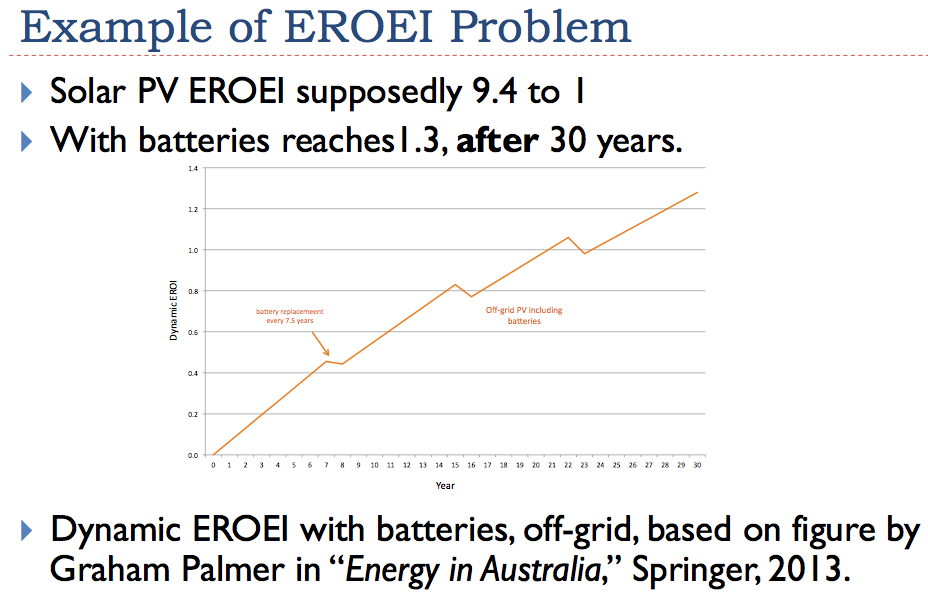
+++
The value of cheap energy can’t be put into more simpler terms….
Heinberg starts one of his presentations off explaining how many men it would take to push a car the equivalent distance of 1 gallon of gasoline….
Like I tried to warn a while ago. Nick is a government shill. He was getting beaten up here and now he has brought in reinforcements. These clowns are like whack-a-mole. They are paid to disrupt blog sites like this. When “The Oil Drum” was mentioned it had Nick’s (Madflower’s and others) signature all over it. The objective is to spam. They will render this site unreadable.
I don’t see any posts from these people…. does anyone see any posts from these people?
Ignoring them turns them into white noise…. which can be quite soothing actually….
Yes never reply to them directly. You will never see them denigrate either political party, they will not refer to a particular party or policy but will mention taxes if it suits the agenda. I am not a believer in medium to large conspiracies. These people are simple employees, their charter is to disrupt sites like this, that attempt to discuss the real economic situation.
They will blow right through logical refutations to submit outright lies, half truths, cherry picked statistics and links to propaganda. We all know what the result would be, if the general public was to begin understanding or believing the impending economic disaster was even a possibility.
The shills understand this. For them to acknowledge that there is any possibility of economic doom, would render every one of their solutions still born. That is why Gail is and has always been a direct target. The attacks will grow as this site receives more traffic and hits.
I saw those posts and they seemed patently to be trolling. Thanks for the heads up bandits.
Hey California Dreaming, Please Explain: Gail’s solution is to educate those without gross ideological impediments. As with all solutions, it doesn’t work for everyone. I’m not sure if you are being paid for your posts, but they very clearly indicate your deficits in information, comprehension and critical thinking. As indicated elsewhere (Fast Eddy, etc.), the first and foremost problem is overshoot. That will be “solved” by correction (a correction, btw, that is being referred to by many scientists as the Sixth Extinction). Gail tries to educate because it is all we have, knowledge and some level of predictive insight. Without that, we would all be as desperate and quickly expired as CL will be when the grid shuts off finally in his sunny California.
“They are paid to disrupt blog sites like this. When “The Oil Drum” was mentioned it had Nick’s (Madflower’s and others) signature all over it.”
I’m only getting paid when Fast Eddy comes up with the cashola.. He is about 200M USD short right now, and about 20M USD short of his first installment.
I am actually guessing you are the one getting paid, or else you wouldn’t try to discredit the facts, and instead resort to personal attacks.
I have what I hope is a simple question. You predict a permanent collapse of the economy because of low energy prices and run-away debt. I would expect excessive leveraging to result in bankruptcy, tightening lending standards, and greater risk aversion. That isn’t a permanent condition – and brings debt levels down. We have just seen this occur after the financial crisis of 2008. In the United States, the federal government has greatly reduced the size of its annual deficit. Why is the economic collapse you predict a permanent one? Previous historical economic collapses have been temporary.
The answers to all of these questions are here:
THE PERFECT STORM (see p. 58 onwards)
The economy is a surplus energy equation, not a monetary one, and growth in output (and in the global population) since the Industrial Revolution has resulted from the harnessing of ever-greater quantities of energy.
But the critical relationship between energy production and the energy cost of extraction is now deteriorating so rapidly that the economy as we have known it for more than two centuries is beginning to unravel.
http://ftalphaville.ft.com/files/2013/01/Perfect-Storm-LR.pdf
” the economy as we have known it for more than two centuries is beginning to unravel. ”
more like a century.. I would say early 1900s we had a major shift. We have a major industrial revolution going on, so yeah, it isn’t going to be the same.
Thank you for the reference. I’d like to read it fully, but it does seem quite a unique viewpoint, to value energy in the form of muscle power. No wonder economists discount that approach. I can see how it would be self consistent, because an economy entirely dependent upon muscle power would be incapable of much industry. The key assumption is that the ratio between emissions and economic production is a constant.
That’s not what this is saying at all…
Difficult to summarize a report of that length … but basically what the research states is:
– we are no longer finding new reserves of cheap to extract oil — most new oil found since shortly have the turn of the century needs a price of USD100 per barrel to break even
– oil at $100 (or anywhere close to that price) is a massive drag on growth — and was the cause of the 2008 crisis (oil hit $147 shortly before the global economy seized up)
– the central banks recognize that expensive oil destroys growth so they have been trying to offset this with stimulus — QE ZIRP etc…
– we need a new source of cheap to produce energy to replace oil — but there is nothing that can do that — nothing is cheaper (even if oil is $100+) — nothing we know of can do what oil does
– since there is no such thing as a perpetual economic motion machine — eventually the stimulus will fail — and we will enter a deflationary death spiral
I will update the situation: We are now entering the deflationary death spiral — commodity prices are the canary in the coal mine — they are collapsing across the board — this will result in bankruptcies and massive layoffs — which will result in further deflationary pressures — eventually the financial system will collapse under the weight of bad loan books — we will revisit the Lehman moment — but this time the damage will be exponentially larger — and the central banks will be powerless to do anything — because they are doing everything possible to delay that moment….
What does this mean to you? It means at some point your electricity will go off permanently — you will not be able to buy food because the shops will be emptied within hours — you will have no running water — no sewage disposal — no garbage pick up — no police — no medical care — you will be left in a world of disease — starvation — and violence.
Not exactly. I apologize for summarizing it wrongly. Like you said, there is a lot of material here. I can help you understand my situation a little better. I own an off-the-grid solar powered and heated home, have zero debt of any kind, and consume primarily local foods. We have independent electricity, water, sewer, heat and strong relationships with many local farmers. I would be one of the last people to go hungry. We are also a great distance from any city. This is our retirement home, and we’ll be retiring there soon. We moved here because we like it, not because we think the economy is going to collapse. Just for amusement, when do think the impending crisis will hit? 🙂
Makes sense…. I shifted to a low population area of New Zealand and am setting up a similar situation.
But — I still don’t like my chances.
Even though we are remote there are perhaps 70,000 people within an hour drive — I am certain the majority of them will be in want of food post collapse.
A tank of petrol will power a vehicle at least 500km — that means we are within driving distance of hundreds of thousands of people — many them recognize that this a warm area with lots of farms — and will no doubt head this way.
This area has loads of farms — orchards, vineyards etc…. however they rely on irrigation — and petro chemical fertilizers …. even people who have house gardens rely on pumped water…
So there is no way this region can support these refugees…. even though my neighbours grow much of their own food — we would struggle to stay alive without electricity and oil…
Then of course there is the problem of spent fuel ponds which will blow sky high and spew toxins into the atmosphere for decades
A typical 1 GWe PWR core contains about 80 t fuels. Each year about one third of the core fuel is discharged into the pool. A pool with 15 year storage capacity will hold about 400 t spent fuel.
To estimate the Cs-137 inventory in the pool, for example, we assume the Cs137 inventory at shutdown is about 0.1 MCi/tU with a burn-up of 50,000 MWt-day/tU, thus the pool with 400 t of ten year old SNF would hold about 33 MCi Cs-137. [7]
Assuming a 50-100% Cs137 release during a spent fuel fire, [8] the consequence of the Cs-137 exceed those of the Chernobyl accident 8-17 times (2MCi release from Chernobyl). Based on the wedge model, the contaminated land areas can be estimated. [9] For example, for a scenario of a 50% Cs-137 release from a 400 t SNF pool, about 95,000 km² (as far as 1,350 km) would be contaminated above 15 Ci/km² (as compared to 10,000 km² contaminated area above 15 Ci/km² at Chernobyl).
http://belfercenter.hks.harvard.edu/publication/364/radiological_terrorism.html
I used to think like you — that I was all set for the collapse — but then I started to question many of my assumptions… and realized no matter how much I prepare — the odds are … I perish with the other billions — and even if I don’t — life would be so brutal I’d wish I had perished…
I’d like to reply to your most recent comment, in which you mention re-examining your assumptions. Good for you that you did this! I think we all need to do this, more than once. I am presently trying to not make unnecessary assumptions, and keep my planning flexible. Although an off-the-grid solar house is more expensive, we saved enough on the land to pay for the difference. It cost less than a house in the city would, and I like living here. It might be handy in the future, but I don’t know that for sure. I urge you to not assume that you will be murdered by a starving mob. Things could turn out better than you think. There also might be more than one way to structure an economy. I’d prefer lego blocks as my mental model, instead of the sticks that are illustrated in the story which produced this interesting discussion. Lego blocks can be put together in more than one way, illustrating alternative ways to structure our economy, and the possibility of change.
Pingback: How our energy problem leads to a debt collapse problem | Enjeux énergies et environnement