
Economists, including Ben Bernanke, give all kinds of reasons for the Great Depression of the 1930s. But what if the real reason for the Great Depression was an energy crisis?
When I put together a chart of per capita energy consumption since 1820 for a post back in 2012, there was a strange “flat spot” in the period between 1920 and 1940. When we look at the underlying data, we see that coal production was starting to decline in some of the major coal producing parts of the world at that time. From the point of view of people living at the time, the situation might have looked very much like peak energy consumption, at least on a per capita basis.

Figure 1. World Energy Consumption by Source, based on Vaclav Smil estimates from Energy Transitions: History, Requirements and Prospects (Appendix) together with BP Statistical Data for 1965 and subsequent, divided by population estimates by Angus Maddison.
Even back in the 1820 to 1900 period, world per capita energy had gradually risen as an increasing amount of coal was used. We know that going back a very long time, the use of water and wind had never amounted to very much (Figure 2) compared to burned biomass and coal, in terms of energy produced. Humans and draft animals were also relatively low in energy production. Because of its great heat-producing ability, coal quickly became the dominant fuel.

Figure 2. Annual energy consumption per head (megajoules) in England and Wales during the period 1561-70 to 1850-9 and in Italy from 1861-70. Figure by Wrigley
In general, we know that energy products, including coal, are necessary to enable processes that contribute to economic growth. Heat is needed for almost all industrial processes. Transportation needs energy products of one kind or another. Building roads and homes requires energy products. It is not surprising that the Industrial Revolution began in Britain, with its use of coal.
We also know that there is a long-term correlation between world GDP growth and energy consumption.

Figure 3. X-Y graph of world energy consumption (from BP Statistical Review of World Energy, 2017) versus world GDP in 2010 US$, from World Bank.
The “flat period” in 1920-1940 in Figure 1 was likely problematic. The economy is a self-organized networked system; what was wrong could be expected to appear in many parts of the economy. Economic growth was likely far too low. The chance for conflict among nations was much higher because of stresses in the system–there was not really enough coal to go around. These stresses could extend to the period immediately before 1920 and after 1940, as well.
A Peak in Coal Production Hit the UK, United States, and Germany at Close to the Same Time
This is a coal supply chart for the UK. Its peak coal production (which was an all time peak) was in 1913. The UK was the largest coal producer in Europe at the time.

Figure 4. United Kingdom coal production since 1855, in a href=”http://www.davidstrahan.com/blog/?p=116″>figure by David Strahan. First published in New Scientist, 17 January 2008.
The United States hit a peak in its production only five years later, in 1918. This peak was only a “local” peak. There were also later peaks, in 1947 and 2008, after coal production was developed in new areas of the country.

Figure 5. US coal production, in Wikipedia exhibit by contributor Plazak.
By type, US coal production is as shown on Figure 6.

Figure 6. US coal production by type, in Wikipedia exhibit by contributor Plazak.
Evidently, the highest quality coal, Anthracite, reached a peak and began to decline about 1918. Bituminous coal hit a peak about the same time, and dropped way back in production during the 1930s. The poorer quality coals were added later, as the better-quality coals became less abundant.
The pattern for Germany’s hard coal shows a pattern somewhat in between the UK and the US pattern.

Figure 7. Source GBR.
Germany too had a peak during World War I, then dropped back for several years. It then had three later peaks, the highest one during World War II.
What Affects Coal Production?
If there is a shortage of coal, fixing it is not as simple as “inadequate coal supply leads to higher price,” quickly followed by “higher price leads to more production.” Clearly the amount of coal resource in the ground affects the amount of coal extraction, but other things do as well.
[1] The amount of built infrastructure for taking the coal out and delivering the coal. Usually, a country only adds a little coal extraction capacity at a time and leaves the rest in the ground. (This is how the US and Germany could have temporary coal peaks, which were later surpassed by higher peaks.) To add more extraction capacity, it is necessary to add (a) investment needed for getting the coal out of the ground as well as (b) infrastructure for delivering coal to potential users. This includes things like trains and tracks, and export terminals for coal transported by boats.
[2] Prices available in the marketplace for coal. These fluctuate widely. We will discuss this more in a later section. Clearly, the higher the price, the greater the quantity of coal that can be extracted and delivered to users.
[3] The cost of extraction, both in existing locations and in new locations. These costs can perhaps be reduced if it is possible to add new technology. At the same time, there is a tendency for costs within a given mine to increase over time, as it becomes necessary to access deeper, thinner seams. Also, mines tend to be built in the most convenient locations first, with best access to transportation. New mines very often will be higher cost, when these factors are considered.
[4] The cost and availability of capital (shares of stock and sale of debt) needed for building new infrastructure, and for building new devices made possible by new technology. These are affected by interest rates and tax levels.
[5] Time lags needed to implement changes. New infrastructure and new technology are likely to take several years to implement.
[6] The extent to which wages can be recycled into demand for energy products. An economy needs to have buyers for the products it makes. If a large share of the workers in an economy is very low-paid, this creates a problem.
If there is an energy shortage, many people think of the shortage as causing high prices. In fact, the shortage is at least equally likely to cause greater wage disparity. This might also be considered a shortage of jobs that pay well. Without jobs that pay well, would-be workers find it hard to purchase the many goods and services created by the economy (such as homes, cars, food, clothing, and advanced education). For example, young adults may live with their parents longer, and elderly people may move in with their children.
The lack of jobs that pay well tends to hold down “demand” for goods made with commodities, and thus tends to bring down commodity prices. This problem happened in the 1930s and is happening again today. The problem is an affordability problem, but it is sometimes referred to as “low demand.” Workers with inadequate wages cannot afford to buy the goods made by the economy. There may be a glut of a commodity (food, or oil, or coal), and commodity prices that fall far below what producers need to make a profit.

Figure 8. U.S. Income Shares of Top 10% and Top 1%, Wikipedia exhibit by Piketty and Saez.
The Fluctuating Nature of Commodity Prices
I have noted in the past that fossil fuel prices tend to move together. This is what we would expect, if affordability is a major issue, and affordability changes over time.

Figure 9. Price per ton of oil equivalent, based on comparative prices for oil, natural gas, and coal given in BP Statistical Review of World Energy. Not inflation adjusted.
We would expect metal prices to follow fossil fuel prices, because fossil fuels are used in the extraction of ores of all kinds. Investment strategist Jeremy Grantham (and his company GMO) noted this correlation among commodity prices, and put together an index of commodity prices back to 1900.

Figure 10. GMO Commodity Index 1900 to 2011, from GMO April 2011 Quarterly Letter. “The Great Paradigm Shift,” shown at the end is not really the correct explanation, something now admitted by Grantham. If the graph were extended beyond 2010, it would show high prices in 2010 to 2013. Prices would fall to a much lower level in 2014 to 2017.
Reason for the Spikes in Prices. As we will see in the next few paragraphs, the spikes in prices generally arise in situations in which everyday goods (food, homes, clothing, transportation) suddenly became more affordable to “non-elite” workers. These are workers who are not highly educated, and are not in supervisory positions. These spikes in prices don’t generally “come about” by themselves; instead, they are engineered by governments, trying to stimulate the economy.
In both the World War I and World War II price spikes, governments greatly raised their debt levels to fund the war efforts. Some of this debt likely went directly into demand for commodities, such as to make more bombs, and to operate tanks, and thus tended to raise commodity prices. In addition, quite a bit of the debt indirectly led to more employment during the period of the war. For example, women who were not in the workforce were hired to take jobs that had been previously handled by men who were now part of the war effort. (These women were new non-elite workers.) Their earnings helped raise demand for goods and services of all kinds, and thus commodity prices.
The 2008 price spike was caused (at least in part) by a US housing-related debt bubble. Interest rates were lowered in the early 2000s to stimulate the economy. Also, banks were encouraged to lend to people who did not seem to meet usual underwriting standards. The additional demand for houses raised prices. Homeowners, wishing to cash in on the new higher prices for their homes, could refinance their loans and withdraw the cash related to the new higher prices. They could use the funds withdrawn to buy goods such as a new car or a remodeled basement. These withdrawn funds indirectly supplemented the earnings of non-elite workers (as did the lower interest rate on new borrowing).
The 2011-2014 spike was caused by the extremely low interest rates made possible by Quantitative Easing. These low interest rates made the buying of homes and cars more affordable to all buyers, including non-elite workers. When the US discontinued its QE program in 2014, the US dollar rose relative to many other currencies, making oil and other fuels relatively more expensive to workers outside the US. These higher costs reduced the demand for fuels, and dropped fuel prices back down again.

Figure 11. Monthly Brent oil prices with dates of US beginning and ending QE.
The run-up in oil prices (and other commodity prices) in the 1970s is widely attributed to US oil production peaking, but I think that the rapid run-up in prices was enabled by the rapid wage run-up of the period (Figure 12 below).

Figure 12. Growth in US wages versus increase in CPI Urban. Wages are total “Wages and Salaries” from US Bureau of Economic Analysis. CPI-Urban is from US Bureau of Labor Statistics.
The Opposing Force: Energy prices need to fall, if the economy is to grow. All of these upward swings in prices can be at most temporary changes to the long-term downward trend in prices. Let’s think about why.
An economy needs to grow. To do so, it needs an increasing supply of commodities, particularly energy commodities. This can only happen if energy prices are trending lower. These lower prices enable the purchase of greater supply. We can see this in the results of some academic papers. For example, Roger Fouquet shows that it is not the cost of energy, per se, that drops over time. Rather, it is the cost of energy services that declines.

Figure 13. Total Cost of Energy and Energy Services, by Roger Fouquet, from Divergences in Long Run Trends in the Prices of Energy and Energy Services.
Energy services include changes in efficiency, besides energy costs themselves. Thus, Fouquet is looking at the cost of heating a home, or the cost of electrical services, or the cost of transportation services, in inflation-adjusted units.
Robert Ayres and Benjamin Warr show a similar result, related to electricity. They also show that usage tends to rise, as prices fall.

Figure 14. Ayres and Warr Electricity Prices and Electricity Demand, from “Accounting for growth: the role of physical work.”
Ultimately, we know that the growth in energy consumption tends to rise at close to the same rate as the growth in GDP. To keep energy consumption rising, it is helpful if the cost of energy services is falling.

Figure 15. World GDP growth compared to world energy consumption growth for selected time periods since 1820. World real GDP trends for 1975 to present are based on USDA real GDP data in 2010$ for 1975 and subsequent. (Estimated by author for 2015.) GDP estimates for prior to 1975 are based on Maddison project updates as of 2013. Growth in the use of energy products is based on a combination of data from Appendix A data from Vaclav Smil’s Energy Transitions: History, Requirements and Prospects together with BP Statistical Review of World Energy 2015 for 1965 and subsequent.
How the Economic Growth Pump Works
There seems to be a widespread belief, “We pay each other’s wages.” If this is all that there is to economic growth, all that is needed to make the economy grow faster is for each of us to sell more services to each other (cut each other’s hair more often, or give each other back rubs, and charge for them). I think this story is very incomplete.
The real story is that energy products can be used to leverage human labor. For example, it is inefficient for a human to walk to deliver goods to customers. If a human can drive a truck instead, it leverages his ability to deliver goods. The more leveraging that is available for human labor, the more goods and services that can be produced in total, and the higher inflation-adjusted wages can be. This increased leveraging of human labor allows inflation-adjusted wages to rise. Some might call this result, “a higher return on human labor.”
These higher wages need to go back to the non-elite workers, in order to keep the growth-pump operating. With higher-wages, these workers can afford to buy goods and services made with commodities, such as homes, cars, and food. They can also heat their homes and operate their vehicles. These wages help maintain the demand needed to keep commodity prices high enough to encourage more commodity production.
Raising wages for elite workers (such as managers and those with advanced education), or paying more in dividends to shareholders, doesn’t have the same effect. These individuals likely already have enough money to buy the necessities of life. They may use the extra income to buy shares of stock or bonds to save for retirement, or they may buy services (such as investment advice) that require little use of energy.
The belief, “We pay each other’s wages,” becomes increasingly false, if wages and wealth are concentrated in the hands of relatively few. For example, poor people become unable to afford doctors’ visits, even with insurance, if wage disparity becomes too great. It is only when wages are fairly equal that all can afford a wide range of services provided by others in the economy.
What Went Wrong in 1920 to 1940?
Very clearly, the first thing that went wrong was the peaking of UK coal production in 1913. Even before 1913, there were pressures coming from the higher cost of coal production, as mines became more depleted. In 1912, there was a 37-day national coal strike protesting the low wages of workers. Evidently, as extraction was becoming more difficult, coal prices were not able to rise sufficiently to cover all costs, and miners’ wages were suffering. The debt for World War I seems to have helped raise commodity prices to allow wages to be somewhat higher, even if coal production did not return to its previous level.
Suicide rates seem to behave inversely compared to earning power of non-elite workers. A study of suicide rates in England and Wales shows that these were increasing prior to World War I. This is what we would expect, if coal was becoming increasingly difficult to extract, and because of this, the returns for everyone, from owners to workers, was low.

Figure 16. Suicide rates in England and Wales 1861-2007 by Kyla Thomas and David Gunnell from International Journal of Epidemiology, 2010.
World War I, with its increased debt (which was in part used for more wages), helped the situation temporarily. But after World War I, the Great Depression set in, and with it, much higher suicide rates.
The Great Depression is the kind of result we would expect if the UK no longer had enough coal to make the goods and services it had made previously. The lower production of goods and services would likely be paired with fewer jobs that paid well. In such a situation, it is not surprising that suicide rates rose. Suicide rates decreased greatly with World War II, and with all of the associated borrowing.
Looking more at what happened in the 1920 to 1940 period, Ugo Bardi tells us that prior to World War I, the UK exported coal to Italy. With falling coal production, the UK could no longer maintain those exports after World War I. This worsened relations with Italy, because Italy needed coal imported from the UK to rebuild after the war. Ultimately, Italy aligned with Germany because Germany still had coal available to export. This set up the alliance for World War II.
Looking at the US, we see that World War I caused favorable conditions for exports, because with all of the fighting, Europe needed to import more goods (including food) from the United States. After the war ended in 1918, European demand was suddenly lower, and US commodity prices fell. American farmers found their incomes squeezed. As a result, they cut back on buying goods of many kinds, hurting the US economy.
One analysis of the economy of the 1920s tells us that from 1920 to 1921, farm prices fell at a catastrophic rate. “The price of wheat, the staple crop of the Great Plains, fell by almost half. The price of cotton, still the lifeblood of the South, fell by three-quarters. Farmers, many of whom had taken out loans to increase acreage and buy efficient new agricultural machines like tractors, suddenly couldn’t make their payments.”
In 1943, M. King Hubbert offered the view that all-time employment had peaked in 1920, except to the extent that it was jacked up by unusual means, such as war. In fact, some historical data shows that for four major industries combined (foundries, meat packing, paper, and printing), the employment index rose from 100 in 1914, to 157 in 1920. By September 1921, the employment index had fallen back to 89. The peak coal problem of the UK had been exported to the US as low commodity prices and low employment.
It was not until the huge amount of debt related to World War II that the world economy could be stimulated enough so that total energy production per capita could continue to rise. The use of oil especially became much greater starting after World War II. It was the availability of cheap oil that allowed the world economy to grow again.

Figure 17. Per capita energy consumption by fuel, separately for several energy sources, using the same data as in Figure 1.
The stimulus of all the debt-enabled spending for World War II seems to have been what finally encouraged the production of the oil needed to pull the world economy out of the problems it was having. GDP and Disposable Personal Income could again rise (Figure 18.)

Figure 18. Comparison of 3-year average change in disposable personal income with 3-year change average in GDP, based on US BEA Tables 1.1.5 and 2.1.
Furthermore, total per capita energy consumption began to rise, with growing oil consumption (Figure 1). This growth in energy consumption per capita seems to be what allows the world economy to grow.
I might note that there is one other exceptional period: 1980 to 2000. Space does not allow for an explanation of the situation here, but falling per capita energy consumption seems to have led to the collapse of the former Soviet Union in 1991. This was a different situation, caused by lower oil consumption related to efficiency gains. This was a situation of an oil producer being “squeezed out” because additional oil was not needed at that time. This is an example of a different type of economic disruption caused by flat per capita energy consumption.
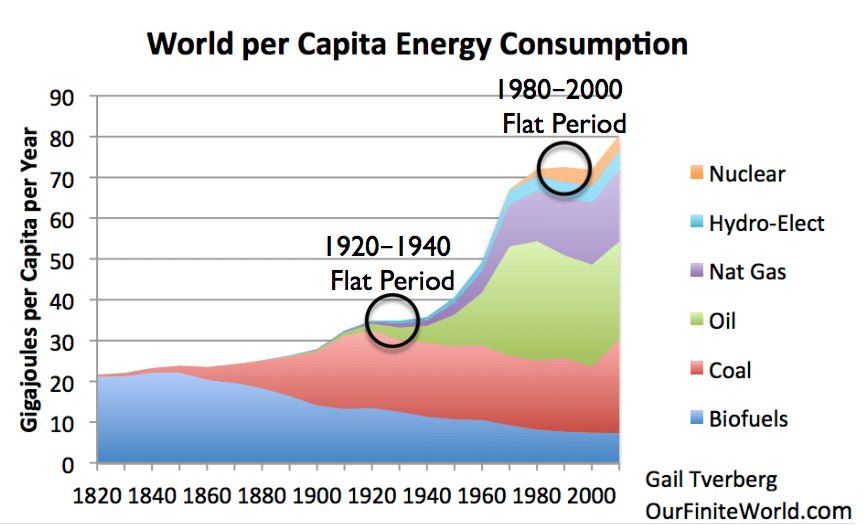
Figure 19. World per Capita Energy Consumption with two circles relating to flat consumption. World Energy Consumption by Source, based on Vaclav Smil estimates from Energy Transitions: History, Requirements and Prospects (Appendix) together with BP Statistical Data for 1965 and subsequent, divided by population estimates by Angus Maddison.
Conclusion
There have been many views put forth about what caused the Depression of the 1930s. To my knowledge, no one has put forth the explanation that the Depression was caused by Peak Coal in 1913 in the UK, and a lack of other energy supplies that were growing rapidly enough to make up for this loss. As the UK “exported” this problem around the world, it led to greater wage disparity. US farmers were especially affected; their incomes often dropped below the level needed for families to buy the necessities of life.
The issue, as I have discussed in previous posts, is a physics issue. Creating GDP requires energy; when not enough energy (often fossil fuels) is available, the economy tends to “freeze out” the most vulnerable. Often, it does this by increased wage disparity. The people at the top of the hierarchy still have plenty. It is the people at the bottom who find themselves purchasing less and less. Because there are so many people at the bottom of the hierarchy, their lower purchasing power tends to pull the system down.
In the past, the way to get around inadequate wages for those at the bottom of the hierarchy has been to issue more debt. Some of this debt helps add more wages for non-elite workers, so it helps fix the affordability problem.

Figure 20. Three-year average percent increase in debt compared to three year average percent increase in non-government wages, including proprietors’ income, which I call my wage base.
At this time, we seem to be reaching the point where, even with more debt, we are running out of cheap energy to add to the system. When this happens, the economic system seems more prone to fracture. Ugo Bardi calls the situation “reaching the inflection point in a Seneca Cliff.”

Figure 21. Seneca Cliff by Ugo Bardi
We were very close to the inflection point in the 1930s. We were very close to that point in 2008. We seem to be getting close to that point again now. The model of the 1930s gives us an indication regarding what to expect: apparent surpluses of commodities of all types; commodity prices that are too low; a lack of jobs, especially ones that pay an adequate wage; collapsing financial institutions. This is close to the opposite of what many people assume that peak oil will look like. But it may be a better representation of what we really should expect.


Bitcoin: Would you want to get paid in cryptocurrency?
“If an employee is receiving their salary in Bitcoin, they might as well be receiving lottery tickets”, said Massimo Massa, professor of finance at INSEAD.
Source: http://www.bbc.com/news/business-42435838
The evidence from what has happened between 2011 and 2016 is that there is now no possibility of an equilibrium oil price that would simultaneously keep large-scale shale production viable, allow sufficient market share for conventional oil producers, and allow western and emerging market economies to grow at the rates to which their governments aspire.
-Thompson, Helen. Oil and the Western Economic Crisis
Springer International Publishing.
At least equally importantly, the prices are too low for Middle Eastern oil producers. There is no price that is high enough for producers and low enough to maintain economic growth by consumers.
The Great Depression 1929-1940 Economic Growth GDP (1%)
https://en.wikipedia.org/wiki/Great_Depression
The Great Recession 2006-2017 Economic Growth GDP (1.5%)
https://www.statista.com/statistics/188165/annual-gdp-growth-of-the-united-states-since-1990/
The Great Recession 2006-2017 Economic Growth GDP Per Capita (0.4%)
https://data.worldbank.org/indicator/NY.GDP.PCAP.KD.ZG?locations=US
OCED Economic Growth GDP Per Capita 1970-2015 (0.5%)
https://imgur.com/a/HXBkr#Bv4I4AF
US Government Non Partisan CBO Office Projects Less Than 2% GDP Growth Through 2027
https://www.cbo.gov/publication/52801
*Note: 20% GDP Includes (FIRE) finance, insurance and real estate
https://i.redd.it/738d0itf2k701.jpg
An ancient government “jobs” program that used very high tech approaches for engineering these structures. These jobs may have been very sought after.
This is a strange modern view of why someone would work on such structures.
Maybe the cartoon is poking fun at poor American citizens who like to think of themselves as temporarily displaced millionaires………………..
1.8 Million Immigrants Likely Arrived in 2016, Matching Highest Level in U.S. History
https://cis.org/Report/18-Million-Immigrants-Likely-Arrived-2016-Matching-Highest-Level-US-History
Trump’s gonna build a wall, then Congress is going to let them in the front door!
sure, in Obama’s last year…
then in 2017:
http://www.breitbart.com/big-government/2018/01/01/data-trump-admin-reduces-refugee-admissions-by-70-percent-in-first-year/
of course, if the D’s take control of Congress after the November vote…
then yeah, 2019 could be very different.
JHK, also today:
“Concluding Thoughts
2018 will be a tumultuous year of shake-outs and loss. The watchword for the year should be “lean.” Individuals will be shoved into leaner modes of living. Companies will suffer despite the new lower tax. Financial rewards will be lean. Nations will have to seriously start planning to get by on less, to downscale, and jettison programs that don’t jibe with the mandates of reality. 2018 is the year that the world comes un-stuck from the past ten years of pretending that it’s possible to get something for nothing. For 2018, it’s full speed ahead into the long emergency.”
okay, this might be closer to what really happens…
but I would push this prediction out to 2019, at least.
There is no discrepancy between the failing monetary system of this civilization, and its failing oil industry. They are two sides of the same coin; neither can exist without the other. Like Siamese twins that share a heart, they can’t be separated. When one passes away the other will soon follow.
Who is saying this? You? Someone else?
I agree that energy and the economy are closely linked. But a failing coal industry is likely just as big a problem as a failing oil industry. The economy depends on a mixture of fuel types.
shortonoil said it over at peakoil.com forum
JHK has done it again!
“I expect the DJIA to move down sharply before the third quarter, rebound a little, and eventually bottom at 14,000 or lower by this time next year. I’ll call the S & P to settle in under 1,000. The NASDAQ may be the weakest, since its FAANG members — Facebook , Amazon, Apple, Netflix, Google (aka Alphabet)— are among the most mis-valued stocks, and the most based on vaporous products and services. Call NASDAQ to land at 2,700. Calling for a US dollar index (DXY) of 79 by December. Calling for gold $2,500 and silver $60 twelve months from now. There it is, like so much meat on the table.”
I bet he’s way off… hasn’t he always been way off on year ahead predictions?
but he writes oh so very well.
http://cdn.thedailybell.com//wp-content/uploads/2017/12/bitcoin.png
Here are sIx places where you can spend your Bitcoin fortune.
http://www.thedailybell.com/news-analysis/6-places-you-can-spend-your-bitcoin-fortune/
but but but…
Ripple XRP more than doubles in a week…
$2.33 today…
market cap $90 billion…
and believe me, that’s REAL money!
Bitcoin now $13,500…
trading sorta sideways for about 10 days…
what, low volatility?
wow, this is almost hard to believe…
even stranger than I thought…
Ripple XRP was up 20,000 percent in 2017…
https://finance.yahoo.com/news/ripple-xrp-everything-need-know-164535965.html
now there’s a scam if ever I’ve seen one.
that’s why i tried to explain bitcoin here—-whether I’m ultimately right I don’t know.
https://extranewsfeed.com/bitcoin-24b3efd58ec
Time will tell I guess.
“While it was trading at around $0.20 a few months ago, it’s now worth more than $2.25 per coin. Ripple is a little different than many other popular cryptocurrencies because it was created by a private, for-profit company that is still the biggest individual owner of the currency.”
bingo!
scam!
they created it at one hundredth of a cent per “coin”… $0.0001…
these are some clever dudes!
Ripple XRP $2.42 today…
market cap $94 billion!
so…
out of nothing, these dudes created the illusion of $94 billion…
real $ to them, IF they can cash out at the current level.
it hurts to try and think round it—when i get my nobel prize for economics maybe that will clarify things a bit.—or maybe i’ll stop caring and spend the prize money on slow horses and fast women
but money cannot exist in real terms without energy backup, so when 94bn is created out of thin air, there has to be a scam somewhere along the line
Stockman says “really stewpid speculators”…
https://www.cnbc.com/2017/12/29/bitcoin-fever-to-burn-out-in-spectacular-crash-david-stockman-warned.html
In an ironic twist to that imagery, alchohol may be more “real money” than even US Dollars.
If the ‘professional ladies’ of London take Bitcoin, from fat Arabs, I’ll eat my hat. 🙂
UK growth to slow to 1.5% in 2018, leading economists predict -FT
https://www.ft.com/content/7003f74e-eedc-11e7-ac08-07c3086a2625
According to the COT REPORT (Commitment Of Traders), there is a record Commercial Short Position against oil going back 23 years.
You will notice, right before oil fell from $100 in 2014, there was also a high amount of Commercial Short Positions. Today, that level is even higher.
https://imgur.com/a/VkPvq
There is a large amount of commercial short position now and in 2014, before oil price fell then, but there was not a lot of short position back in 2008. Simply puncturing the debt bubble was sufficient back then, to get the price to drop. Raising interest rates and or selling QE securities would seem to have the 2008 effect (causing a good sized drop in oil prices). Perhaps the short sellers are just looking to make money when the debt bubble is punctured.
I agree that there is more downward pressure on oil prices than there is support for high prices right now.
If the prices go down, production will fall.
Bitcoin investors are claiming Australia’s banks are freezing their accounts and transfers to cryptocurrency exchanges, with a viral tweet slamming the big four and an exchange platform putting a restriction on Australian deposits.
http://www.smh.com.au/business/bitcoin-tensions-rise-as-investors-claim-banks-freezing-their-accounts-20171229-p4yy3z.html
Don’t f789 with the el ders…. it will not end well.
http://www.campped.com/images/thejesus/3.jpg
New Year’s Message
“Don’t ask what the world needs. Ask what makes you come alive, and go and do it. Because what the world needs is people who come alive.”
Howard Thurman
and the people need cheap excess energy to “do it”…
otherwise, all those “people who come alive” are just stuck at home.
Don’t see my earlier response. I assume that, as we speak, we have more “cheap excess energy” than we’ll ever have. Maybe we could use it to better advantage, especially since its supply is so problematic long term.
people don’t need to use the remaining cheap excess energy to “come alive”…
it’s needed to stay alive.
You should read the Bible more: Man shall not live by bread alone, but, if (I remember vaguely) every word that comes out of the mouth of God. I take God to mean aliveness.
Our daily energy needs are still incredibly important. Jesus prayed, “Give us this day, our daily bread.” He is praying for a supply to our energy needs, at least for today. Without these needs supplied, we have a major problem.
“Our daily energy needs are still incredibly important.”
Great reminder.
2017:
https://www.seattletimes.com/seattle-news/homeless/deaths-rise-amid-growing-homelessness-crisis-in-king-county/
“Major cities across the West Coast are experiencing similar problems, with yearly increases in Portland, Los Angeles and San Diego.”
“For all the progress made toward the goal of making homelessness “rare, brief and one-time,” the reality on the streets remains stubbornly unchanged.”
No! not “unchanged”… worse… perhaps much worse.
Mattresses have appeared under overpasses in Austin…soon to be tent cities.
Notice anyone boiling or roasting rat yet?
The population collapse will be quite fast and sudden: the stimulation of the population by mortgages and loans has only one-time effect. All of sudden, there will be dispropotionately high numbers of deaths in comparison to births. Those who predict population growth are completely mistaken, the system is already imploding. There will be more and more those who will not be able repay the debts, as the system requires lower and lower wages or less human work…
I agree, we have to keep growing in every sector of the economy or it becomes unstable and susceptible to chaotic collapse.
U.S. averages nearly one mass shooting per day so far in 2017
https://www.cbsnews.com/news/report-u-s-averages-nearly-one-mass-shooting-per-day-so-far-in-2017/
zero so far in 2018!
Ralph Nader- “A Visionless Society” 2017
“The two major political parties lack a coherent vision. They are subservient to corporate power. They have abandoned the common good. They have turned politics into burlesque. They have rendered the citizenry impotent. The press, especially the electronic press, has transformed news into a grotesque reality show filled with trivia, gossip and conjecture. The elites in both parties, along with the rich and corporations, profit from a naked kleptocracy. Everything is for sale, from public lands to public education. And the juggernaut of corporate power impoverishes the people as it willfully destroys the facade of the hollowed-out democratic state.
“There is no democracy,” Nader said when I reached him by phone in Connecticut. “The only democracy left in this country is they don’t haul you to jail for speaking out. What’s left of democracy is a significant due process, habeas corpus, freedom of speech and probable cause, and that’s violated when there’s a terrorist attack and people are rounded up, like Muslim Americans.”
“The U.S. has developed a society with an almost indeterminate absorptive capacity for injustice, abuse and degradation,” Nader said. “There is no civic education in the schools. They don’t know what the Constitution is. They don’t know what the law of torts is. They don’t know where the town hall is. They’re living in virtual reality, swinging between big screen TV and their cellphones. They’re wallowing in text messages. To an extent, they’re excited by the workings of the minds symbolized by Wall Street and Silicon Valley. That’s the young generation. Great changes start with people in their 20s. But look what you’ve got now. You’ve got 10 years of internet connection, cellphones available to any child. That’s one. The second is 24/7 entertainment. The third is the abandonment by the elderly generation. They’ve sort of given up. They don’t know the gadgetry. They don’t know the language. They have their own economic insecurity. They’re not extending any kind of historical experience to the young which contains severe warnings. Watch out. You don’t think it can happen again, [but] it can happen again and again. There’s no verbal, oral tradition between the generations. Less and less. Then you have the political system, which is deep-sinking the society. How are people going to mobilize themselves? Is there a strong union, a labor movement? No. A strong consumer movement? No. They’re losing their privacy. They’re losing their ability to use legal tender. The corporate coercion is, to a degree, now getting rid of cash. Marx never believed that could happen. Why do they want to get rid of cash? They want to drive everybody into an incarcerated penitentiary that is surrounded by mobile payments, credit cards, credit scores, credit ratings, debit cards, constant debt, invasion of privacy, and the ability to assess penalties, charges and unwanted purchases because they control people’s money. That’s Wells Fargo. Wells Fargo got away with 3 million forced, unknown and unwanted credit card sales, auto insurance sales, repairing their ratings. Some people lost their cars and their homes. They’re flipped over into bankruptcy. Nobody has been prosecuted yet.”
https://www.truthdig.com/articles/the-visionless-society/
Well stated by Mr. Nader! However, I think we are at peak credit and debt.
If anyone has paid attention to my posts, I’ve written about this.
The dominant political group/ideology is ahistorical for political reasons.
The people who know the real history, have real knowledge and traditions have become villainized. It’s not that the elderly don’t want to share what they know–but they’re being told that they’re out of date, at best, and prejudiced at worst.
“The corporate coercion is, to a degree, now getting rid of cash. Marx never believed that could happen. Why do they want to get rid of cash?” Nader doesn’t understand how the society he wants to legislate works. The move to ban cash is related to the need to increase debt, so that The Economy can continue to grow. If the amount of debt stops increasing, that means the economy is not doing well.. If the economy is not doing well, it means people are using cash instead of credit. Eliminating cash will make it possible for the ruling classes to theoretically, prevent, on paper, an economic depression since people will have no option but to borrow money to meet their daily expenses.
Mr. Nader doesn’t understand the bicycle analogy above my post.
https://ourfiniteworld.com/2017/12/19/the-depression-of-the-1930s-was-an-energy-crisis/comment-page-29/#comment-158625
Human societies within industrial civilization will become increasingly coercive as economic growth becomes harder and harder to come buy.
http://www.bbc.com/future/story/20170418-how-western-civilisation-could-collapse
“The political economist Benjamin Friedman once compared modern Western society to a stable bicycle whose wheels are kept spinning by economic growth. Should that forward-propelling motion slow or cease, the pillars that define our society – democracy, individual liberties, social tolerance and more – would begin to teeter. Our world would become an increasingly ugly place, one defined by a scramble over limited resources and a rejection of anyone outside of our immediate group. Should we find no way to get the wheels back in motion, we’d eventually face total societal collapse.”
“Disaster comes when elites push society toward instability and eventual collapse by hoarding huge quantities of wealth and resources.”
“Eventually, Rome could no longer afford to prop up its heightened complexities.”
The bicycle analogy is a good one. It seems to take both real energy and promises of future energy to keep the bicycle operating. Front wheel is promises; rear wheel is actual energy.
https://imgur.com/a/pyC7M
“Front wheel is promises; rear wheel is actual energy.”
That’s a good analogy.
So much for slow collapse.
Decent article until the sunshine copout conclusion with zero justification:
“Western civilisation is not a lost cause, however. Using reason and science to guide decisions, paired with extraordinary leadership and exceptional goodwill, human society can progress to higher and higher levels of well-being and development, Homer-Dixon says.”
yes, it’s the horror movie with the happy ending…
childhood memory: some Godzilla movie where Tokyo (?) was largely destroyed…
but at the end, after Godzilla dies (?), the main characters are walking around and smiling as the happy music plays.
“… human society can progress to higher and higher levels of well-being and development…”
has he no clue about the decline of fossil fuels?
Why Few in the GOP Are Complaining About the Nation’s Soaring Debt
AP September 16, 2017
(WASHINGTON) — Republicans spooked world markets in their ardor to cut spending when Democrat Barack Obama occupied the White House. Now, with a GOP president pressing for politically popular tax cuts and billions more for the military, few in the GOP are complaining about the nation’s soaring debt.
Tax cuts in the works could add hundreds of billions of dollars to the debt while bipartisan pressure for more money for defense, infrastructure, and domestic agencies could add almost $100 billion in additional spending next year alone.
The bottom line is the $20 trillion national debt promises to spiral ever higher with Republicans controlling both Congress and the White House.
“Republicans gave up on caring about deficits long ago,” bemoaned Republican Sen. Rand Paul of Kentucky, who was elected in the 2010 tea party class.
Now, deficits are back with a vengeance. Medicare and Social Security are drawing closer to insolvency, and fiscal hawks and watchdogs like the Congressional Budget Office warn that spiraling debt is eventually going to drag the economy down.
But like Obama and Bush before him, President Donald Trump isn’t talking about deficits. Neither much are voters.
“Voters, frankly, after these huge deficits, are saying, ‘Well, how much do deficits really matter?’” said former Pennsylvania Sen. Rick Santorum, a two-time GOP presidential candidate. “We’re not Greece yet, right?”
http://fortune.com/2017/09/16/tax-cuts-gop-united-states-debt/
These morons are now basking in the knowledge that the USG has been printing money for some time now- AND NOTHING BAD HAS HAPPENED!
So they are planning on running the scam out as far as they can.
Why not? Works for Japan. More sushi!!!
isn’t the US debt to GDP ratio 110 or 120 percent?
why can’t it go to 300 or 400 or 500 percent?
it looks like “they” are going to try.
Yep – just because historically ….nations that breached the threshold were called out and punished….does not mean that is what will happen now — see Japan.
Rogoff and Reinhardt need to write a follow up …same title… This Time is Different … except that they explain how nobody is calling anybody out no matter what the debt level…. because to do so … would be to hammer a stake into the heart of BAU…. killing it… and killing us….
“Rogoff and Reinhardt need to write a follow up …same title… This Time is Different … except that they explain how nobody is calling anybody out no matter what the debt level…”
FE, you are aware that the US Congress has adopted a new improved set of 10 Commandments-
1. Don’t mess with somebody else’s scam
2. Don’t mess with somebody else’s scam
3. Don’t mess with somebody else’s scam
4. Don’t mess with somebody else’s scam
5. Don’t mess with somebody else’s scam
6. Don’t mess with somebody else’s scam
7. Don’t mess with somebody else’s scam
8. Don’t mess with somebody else’s scam
9. Don’t mess with somebody else’s scam
10. Keep yer mouth shut
Oh, and don’t be a rat.
In a NBER Working paper that Rogoff and Reinhardt wrote (not the book), they observe, “It is notable that the non-defaulters, by and large, are all hugely successful growth stories.” A growing economy keeps rolling along.
Kunstler says- ” Japan will be the first society to consciously opt out of being an advanced industrial economy. They have no other apparent choice really, having next-to-zero oil, gas, or coal reserves of their own, and having lost faith in nuclear power. They will be the first country to enter a world made by hand. They were very good at it before about 1850 and had a pre-industrial culture of high artistry and grace – though, granted, all the defects of human psychology. “
I remember Kunstler making that precise statement about Japan a few years ago. IIRC, it was up in Syracuse, NY, at one of Charlie Hall’s conferences.
Japan is very short of resources. Nuclear is not working well, and the solar that they are adding is too intermittent to be helpful.
i think he wrote it in the long emergency
The Japanese seem to come up with interesting ways of adapting to difficult situations. We will see what they come up with.
Battle Royale?
I presume you mean what’s left of the population when post IC brings famine and disease.
Japan farms using petro chemicals — so there will be no food — and they have a large number of spent fuel ponds across a small land mass
JK will be wrong on the country returning to a pre-industrial state. Japan will be a 100% dead zone … within a month of the end of BAU.
They’ll have no food, no energy, no toilet paper, and they’ll be bathed in deadly radiation, but they’ll have one thing. They’ll have the Yamato Spirit!
http://www.japaoemfoco.com/wp-content/uploads/2014/08/yamato-damashii-Esp%C3%ADrito-Japon%C3%AAs.jpg
you say toMAHto, I say toMAYto…
you say Yamato, I say Yamayto…
let’s call the whole thing off…
Japan does not produce a very high percentage of its calories consumed even now.
They do consume a lot of seafood…. post BAU (The Time of Radiation)
https://i2.wp.com/www.onegreenplanet.org/wp-content/uploads/2012/06/Radiation-fish.jpg
Different in name — same policies.
Both take their orders from the same people.
https://pp.vk.me/c836137/v836137222/13d83/dXKoGl3Caro.jpg
It’s a two prong strategy by the R’s. They get the tax cuts they needed to secure the wealthiest for future campaign donations and to reward for past one’s (step 1 done), then this year they attack social security, Medicare & Medicaid. Scuttle butt is people will have to turn 72 to get any of those. Will probably just keep being raised as needed to reduce outlay. I’m sure they’d like to increase retirement age to 90 and not have to pay a penny for most people, but meanwhile they’ll work the retirement age higher, absolutely 100% guaranteed, based on the idea it will save country hundreds of billions, which it will, but at the expense of people suffering and expiring themselves.
++++
I agree, the retirement age is heading up. Another thing I think will happen too is life expectancy will begin to decrease. The ability to retire is essentially coming to an end.
https://www.usda.gov/media/blog/2017/01/13/cost-raising-child
This is a year old. A new calculation for 2018 should be out in a week or two. The little mudpuppies used to be relatively cheap to raise. What do families do with rising health care costs, etc. ?
What we mostly have control over is behavior. We COULD organize the wide panoply of healing skill better than we do, greatly favoring the cheapest ones–acupuncture, oriental medicine, exercise, nutrition, constancy of care, etc. But then it’s very hard even to alter behavior toward such ends. Doing it on an individual level is quite doable, however. Gail seems to be doing this re exercise, healthy habits and good nutrition.
My father used hypnosis extensively back when he was a general practitioner doctor. He delivered babies after hypnotizing the mother. He sewed up quite a few auto accident victims using hypnosis. People spoke highly of how helpful his technique was.
This is good to know!
Did it work for hip surgeries?
Get it? Hyp-surgery
He had a good anesthesiologist he worked with when it came to surgeries. But delivering babies at night and doing surgeries the next morning was not a good way to get adequate sleep.
“What do families do with rising health care costs, etc.?”
Pay, work, pay, work, pay, go into debt, pay, get a 2nd job, work, 3rd job.
A lot of people are opting not to have kids and instead have dogs. No kidding. I know this guy in SF who is a dog watcher. He was going to study to become a Veternarian, but found out he could make more money watching people’s dogs. Let’s say they want to go somewhere on the weekend, like skiing or whatever, so they give them to him for get this, $400 a dog for the two days! No kidding. Last weekend he had 5 dogs = $2000 bucks for a weekend?! Oh, also the dogs have all been to obedience school, so it’s a breeze handling them. Some people just get plain lucky.
Someone should open a kennel for children…
Photos show renewable energy took a beating in Puerto Rico
http://www.washingtonexaminer.com/photos-show-renewable-energy-took-a-beating-in-puerto-rico/article/2644268
I wonder if these devices will renew themselves, as their names imply.
This is hilarious!!!
http://s3.amazonaws.com/content.washingtonexaminer.biz/web-producers/122617solar-destruct.jpg
http://s3.amazonaws.com/content.washingtonexaminer.biz/web-producers/122617wind%20snapped.jpg
modern day Roman ruins, except that they won’t preserve as well over time.
a colleague of mine installed a remotely-powered monitor station on the north shore of Oahu, Hawaii. he had solar panels on the equipment shack roof, plus small wind turbines and a back-up set of diesel powered generators. one day, a big wind came up, but not a hurricane. the wind did an interesting thing to the solar panels. the high wind speeds caused a Beronulli Effect on them, so that a vacuum resulted under the glass panes, causing them to implode. the small wind turbines could not be feathered, so the increased rotational speed caused the armatures to overheat, expand and explode. only the diesel generators survived, a little beat up from the flying debris.
“…only the diesel generators survived”
Hysterical.
HAPPY NEW YEAR!
LOSER DOOMERS!
My resolution for this upcoming year is to disagree with Fast on every topic he post under Keith.
Just to keep him HaPpy….🎅
I was wondering what the “Second Coming” moniker refers to?
I’ll let the late Great Sam Kinison answer that for ya!
Enjoy…hope it doesn’t offend….really…all in jest
No problem with Jesus. Maybe he can fix our peak oil problem?
Maybe he can, in the afterlife..
https://m.youtube.com/watch?v=8HqNe8hxFQk
Or maybe we won’t be needing much there
It could be.
You could just say your New Year’s resolution is to continue to be wrong about everything. You will be one of the few who actually is successful in carrying out a resolution in 2018
Thank you, as a matter of fact, I had a High School teacher that would issue a A+ to any student that got every multiple question test of 100 incorrect. He reasoned that for anyone to do that, one must know just about every answer!
Looking ahead to your endless repetition in the comment section. Alert us all on something original….🎅
Projection of World Fossil Fuels by Country (Mohr, 2015)
http://www.sciencedirect.com/science/article/pii/S0016236114010254
https://imgur.com/a/GFtXh
yes!
again, many signs are pointing to decline…
but then not until the mid 2020s…
yyyyyyyaaaaaaaaaaaaaaaaaa!!!!!!!!!!!!!!!!!!!!!!!!!!!
Kim Jong-un: North Korea’s nuclear arsenal is now complete
https://www.theguardian.com/world/2018/jan/01/kim-jong-un-north-korea-nuclear-arsenal
And what? He has got nuclear weapons, but no electricity from nuclear. What an idiot… There are various countries posessing nuclear weapons. It means nothing in the world with the depleting cheap energy, as there is nothing to fight about…
https://en.wikipedia.org/wiki/List_of_states_with_nuclear_weapons
All this demonstration of power is just a way how to give jobs to the people who would otherwise be unemployed…
https://en.wikipedia.org/wiki/Korean_People%27s_Army
Kim has a reality-based understanding that those who enter into treaties with the US Govt will likely end up dead.
He can cooperate with Russians, but when the Soviet Union collapsed, North Korea was among those who were hit the hardest.
many persons, including me, don’t think that he is “reality-based” at all.
http://johnquiggin.com/2017/12/13/a-barbarous-relic/
It takes about 210kWh of electricity to perform the computational work required for one Bitcoin transaction. Bitcoin wastes about 1/3 the electricity consumed by all the transactions that make up the global financial system. The energy wasted on gold production when gold played the role of “cryptocurrency” was of equivalent magnitude to what is wasted producing Bitcoin, relative to the value of the currency.
I wonder what correlation with economic upheavals can be made with the varying output of gold production in the era of the gold standard? What if some crises are set off by the cost of money itself being too high?
The intrinsic value of gold is zero in the same way as the intrinsic value of bitcoin: both of them need a lot of energy for processing. In fact, bitcoin is based on the same premise as gold: mining and processing using energy.
But without the energy, both of them are unsatisfactory. That is why cheaper metals and paper were used later and plastic money now, as the supply of currency is the most important thing: who cares for costly gold or bitcoin if majority can not afford it for everyday transactions and, morover, the transactions with bitcoin are not at all fast…
The lack of the wood for charcoal and lack of the high-content gold ore could be the main reasons why the empires in the past started to use cheaper alternatives. That why the gold and bitcoin serve nothing: gold is heavy, rare and energy-intensive and bitcoin technology dependent, rare and energy intensive.
When the economy faces lack of the currency due to the hoarding, then the system collapses. That is why issuing money from the side of the banks is the only way how to keep the system going and protect it from collapsing.
The limited supply of gold or bitcoins is a pro-collapse feature.
Gold takes no energy to store or transact (and has some real uses).
Problem with gold is the ruler can’t print it.
No, no. The ruler needs working system. The population can survive without the gold using barter, but the ruler of the system without the money can not… The money allows for more sophisticated system with bigger place and time extent, i.e. more surpluses for overhead, i.e. those with so-called noble birth etc.
What are the real uses of the gold in energy poor environment?
Moreover, gold is heavy and bulky (in comparison to paper), so it requires energy to store or transact. When you have a piece of paper, you can write a lot of money on it.
The more sophisticated system serves to those who have worse genetic predispositions, i.e. need more healthcare, social security etc.
Keeping old and sick alive is a function of prosperity, not fiat.
Fiat is for making rulers able to in theory keep promises they couldn’t keep.
The ruler demands currency as tax. After that the population becomes interested in selling stuff to get currency. And when everything is for sale the population become interested in hoarding currency.
Many times through history has rulers created fiat currencies and then invalidated years/decades later.
Same with land. Every couple if hundred years land becomes to concentrated the ruler confiscates land from someone out of favour and redistributes it.
And gold bulky? I suppose in theory you could get €500 bills, but more likely you have to settle for €50. 20 bills are the equivalent of a small one ounce gold coin.
If you do not have money or gold, nobody can take them from you. When the system implodes due to the energy shortages, the rulers disappear, as the position of the ruler is connected with the control of energy to control the system.
Hoarding money, gold or whatever stuuf has no meaning when the population declines.
If the system implodes bitcoin will disappear forever because they take energy to store, gold doesn’t.
Gold has good chances becoming money again once the new king is on the throne.
Don’t mistake me for a gold bug or fiat bug. I just didn’t agree that gold takes energy to store and transfer just like bitcoin and just like bitcoin has zero intrinsic value.
In the disintegrated world, gold is useless, see medieval ages and barter.
When there is no chance to find new gold ore with sufficient gold content, the amount of currency can not be increased. Instead, simple division of tasks and barter is more useful than exchanging things for gold with the people that can not provide you nothing…
“Instead, simple division of tasks and barter is more useful” more useful for who?
For a king collecting gold and silver for tax and then use this for buying stuff and paying wages is more useful.
Likely progression IF we don’t go extinct after IC collapses:
Farming
Bad guys visit farm, steal everything
Bad guys realize it is less risk and cost and more benefit and more sustainable to protect farm in exchange for stuff.
Sooner or later head honcho will be in command of several groups of bad guys.
Head honcho must be able to pay his soldiers and it will be a hassle paying them in stuff.
Possibly intermediary steps with sheep or bushels of wheat, “stuff as token for stuff”
Then money.
And here silver and gold could enter the scene again. Or bitcoins.
Not being able to increase gold shouldnt pose a problem. The rulers will solve that by going fiat and then reverting to gold standard. A global financial system won’t happen after IC dissappears.
Governments can take out debt, and promise to repay in gold “later,” whether or not they really have gold. This is the real benefit of any system that allows future promises of energy. They allow people to be paid now, based on future benefits that hopefully will be available. For example, soldiers can be paid based on the debt taken out by governments.
Of course they can refuse to honor their promises but that could cost them their heads. Better to promise dollars or pesos.
King Gustav III got shot in the back during a masquerade by a dude who had lost money because of the kings monetary system fraud.
When the real problems come, the confiscation of gold and money via currency reform is made, like after the WW2 in Czechoslovakia. The populations want their needs to be fulfilled, not those, who have money or gold hoarded somewhere.
That is why hoarding has no meaning when your neighbor is prepared to kill you if you do not give it to him…
The King Gustav III was the representant of the population, so I guess the poor population was not satisfied with his death.
You must be willing to hoard for generations. If you have a few fortunes you could hide away a fortune in gold and maybe use it in the future. Nothing for you and me.
Today, the pensioners confiscate the income of the younger generations via high taxes and debts of the states and enslaving the younger generations slaves via loans. Its the increasing unproductive parts of the society that contribute to the faster collapse due to the rising energy costs.
I agree. The useless eaters extort money through democracy. And regular productive people have nowhere to hide.
But there is no alternative.
“For example, soldiers can be paid based on the debt taken out by governments.”
Soldiers who are paid in worthless scrip will likely run off or just stay home when the next war rolls around.
We are all being paid with the same script right now. It has been working well enough for now, but adding more and more cannot continue to work. Nor can raising interest rates and reducing debt levels.
soldiers fall in behind whoever pays their wages
or go self employed
In late-18th-century America, something of minimal value was often described as being “not worth a continental,” which referred to the continental dollar, the American currency at the time of the revolution.
The continental was paper money. It had occurred to the colonists that, as their revolution was costing quite a bit to maintain, they could go into “temporary” debt to finance the war. Soon it became clear that the debt could not be repaid. Also, the printing of paper banknotes resulted in inflation. The solution? Print more of them. Further devaluation of the continental motivated the colonists to print more… then more… then still more. The continental became worthless, either for local trade or for repayment of debt.
http://www.internationalman.com/articles/not-worth-a-continental
Thousands or examples through history.
Both the limited supply of money and unlimited supply of money are problem: when there is lack of products, corruption is present and the official low prices are overcome by the unofficial prices using bribes etc.
So the main problem is lack of the products, not lack of the money, as they can change their value and accumulate in the hands of the few that have the limited supply of the products at their disposal.
“Nor can raising interest rates and reducing debt levels.”
This is the hardest thing for me to understand. We don’t want to drown ourselves in debt on one hand, and we don’t want to reduce debt on the other. It might be important to define who “we” is and what time and place have to do with it.
US closer to ‘nuclear war with North Korea’ than ever before: Former Joint Chiefs head
http://abcnews.go.com/Politics/us-closer-nuclear-war-north-korea-joint-chiefs/story?id=52058584
https://imgur.com/a/gXJvD
Caption: Big Mushroom = Bad Trip.
Mullen says:
“I don’t see the opportunities to solve this diplomatically at this particular point.”
so the only alternative is nuclear war?
that’s irrational.
Brian Wang writes:
“We are entering a new period of stronger productivity growth from energy cheaper than oil…”
“There will continue to be a downward spiral in energy costs. Lower energy costs enable new energy to be produced more cheaply.”
eureka!!!!!!!!!!!!!!!!!!!!!!!!!!!!!
IC will be saved!
lower energy costs means new energy will be cheaper energy!
wow!
brilliant…
2018 is going to rock!
refers to this, posted by Ed:
https://www.nextbigfuture.com/2017/12/a-multi-decade-economic-boom.html#more-140823
what a bunch of horse p-i-s-s.
The fool actually promised “electric planes”.
https://imgur.com/a/HXBkr
and we know that chart only tells half the story…
per capita growth about 1%…
means the upper class is plus 5 to 10%…
and the rest of us are minus a few percent…
oh, well…
15 minutes left to 2017…
BAU tonight, baby!
roses are red
violets are blue
2017 is dead
but not BAU
Kim Jong-un says ‘nuclear button is on my desk’, as he announces plan to deploy warheads
‘The entire United States is within range of our nuclear weapons … this is reality, not a threat’
http://www.scmp.com/news/asia/east-asia/article/2126339/kim-jong-un-says-nuclear-button-my-desk-he-announces-plan-deploy?utm_content=buffer6dc3b&utm_medium=social&utm_source=twitter.com&utm_campaign=buffer
the button on his desk:
https://www.staples.com/Staples-Easy-Button/product_606396
“this is reality” ha ha.
New Years present for FE.
https://www.nextbigfuture.com/2017/12/a-multi-decade-economic-boom.html#more-140823
go gettm’
Awesome! Age reversal. Tech stuff. Growth ! It’s happening right now! FE, just read it and live with it.
Brian Wang’s Next Big Future stuff needs to be taken with a large grain of salt.
I soon as I read about electric passenger planes, I exited the page.
Then mixed with dog sh it…. vomit…. and AIDS tainted rat urine…. and fed to DelusiSTANIS.
Mexico Oil Reserves Gone in 9 Years Without New Finds
https://www.bloomberg.com/news/articles/2017-03-31/down-10-mexico-oil-reserves-gone-in-9-years-without-new-finds
Between 2020 and 2035, the US and Mexico could experience unprecedented military tensions as the latter rapidly runs down its conventional oil reserves, which peaked in 2006. By 2020, Mexico’s oil exports will revert to zero, decimating Mexican state revenues and potentially provoking state failure shortly thereafter.
-Failing States, Collapsing Systems: BioPhysical Triggers of Political Violence
– Dr Nafeez Ahmed
Just think how many illegal migrants will be flooding the border if their state collapses!
If we go by proved reserves, Venezuela is in wonderful shape. It has more proven reserves than any other country.
Mexico admittedly shows a very steep downward trend in reserves. As recently as 1997, Mexico had more oil proven reserves than the United States. A person wonders what was going on.
Someone on reddit sent me this message
Mexican collapse observer here (actually Mexican living in Mexico).
If you guys are interested in my country and its imminent collapse I suggest you to watch us and pay close attention the next 6 months (until the election) .
Anything can happen now, the ruling piece of shit party pushed the infamous National Security Law, which is just a legalization of the Army in the streets, paving the way for the military to suppress protests of any kind.
Opposition, left leaning party Morena has the lead and no other party will be able to rightfully take over the top in preferences. I have been suspecting that the idiots in the government right now won’t let that happen and will use national security concerns as an excuse.
Overall, the country is failing. Violence is at its worst, economy is stagnant and if the oil predictions are true, holy crap. The NAFTA agreement renegotiations will hit us hard. There’s a recipe for disaster in the making right now.
Crude Oil Production in Mexico decreased to 1761 BBL/D/1K in September from 1999 BBL/D/1K in August of 2017. Crude Oil Production in Mexico averaged 2882.96 BBL/D/1K from 1994 until 2017, reaching an all time high of 3547 BBL/D/1K in December of 2003 and a record low of 1761 BBL/D/1K in September of 2017.
https://d3fy651gv2fhd3.cloudfront.net/charts/mexico-crude-oil-production.png?s=mexicocruoilpro&v=201712231020v
Doesn’t matter which way the ruling party leans…. there is no way to stop the economy from toppling…
If you will click that image link…. you can see that Mexico is trending quickly towards zero production….
“Just think how many illegal migrants will be flooding the border if their state collapses!”
gee, maybe the border needs a wall?
“By 2020, Mexico’s oil exports will revert to zero…”
again, the Export Land Model created by Jeff Brown.
“Between 2020 and 2035, the US and Mexico could experience unprecedented military tensions…”
yes, the 2020s may be all downhill…
and The Collapse by 2035?
sounds reasonable.
That is wildly optimistic…
See https://tradingeconomics.com/mexico/crude-oil-production
certainly looks like something nasty for the mid 2020s
Click on the 5 year or 10 year view. The recent trend is very much downward.
Where have we seen this before????
Ah yes… of course ……
http://2.bp.blogspot.com/-VK04KNf0nAQ/UyKEQWWwiRI/AAAAAAAABFs/aSwf91aT-v8/s1600/Seneca+Cliff.jpg
It’s…. Xanax Time!
Another year and no collapse. Who knows what year it may happen.
I wouldn’t get cocky JH,
Citigroup CEO Ed Morse warns of oil shortages coming as soon as 2018
https://www.bloomberg.com/news/articles/2017-09-25/citi-says-get-ready-for-an-oil-squeeze-than-an-opec-supply-surge
Is an Economic Oil Crash Around the Corner?
https://www.alternet.org/environment/economic-oil-crash-around-corner
And Ed Morse is nobody to scoff at..
no, JH, tonight is a night for you to get cocky…
tomorrow, who knows?
and let’s scoff at Ed Morse, at least tonight…
though he’s smart and could be right…
around the corner of the next decade, who knows?
Happy New Year! Try to imagine that energy- and ressource constraints don’t exit (sic!), only political, sosial and technological obstacles – just for the few minutes the reading takes https://medium.com/future-crunch/99-reasons-2017-was-a-good-year-d119d0c32d19
https://imgur.com/a/BiYsf
Looks like the standard population curve for Jackrabbits in Wyoming!
Sheesh. Don’t let FE see that. He’ll go back in the storage container and throw a fit.
And the 42 survivors lived happily ever after.
Actually you need at least 50 of a species to propagate naturally..Otherwise you would have to imbread and that causes major genetic defects and your infant mortality rate goes through the roof.
I believe the 42 reindeers 1966 were 41 female and a sterile male. I suppose the population is 0 now.
I bet he still died one happy (and tired) reindeer!
The list does read a lot like, “See how we managed to raise the population level, even more than it normally would have been raised.”
Macaulay Culkin
Homeless Alone?
https://imgur.com/a/krydP
http://extratv.com/2017/07/25/new-pic-macaulay-culkin-looks-so-good/
That link has a photo recently taken of the real MacCaulay Culkin. Not homeless.
much could be said about that homeless man…
if the economy gets worse in 2018, the homeless population will grow…
here’s hoping for a better economy next year.
https://imgur.com/a/W7fnA
Better? They want more for themselves and less for everybody else.
We are all to be congratulated. We arrived in one piece on the other side of this year. HMS BAU is clearly tougher than we all thought. She is at least as unsinkable as that famous transatlantic whose name does not occur to me now. How many more crossings will we have? Nobody knows, and it doesn’t really matter. A hurray to the commanders and engineers of this ship of BAU. Tonight I’ll drink a big glass of champagne in their honour.
Happy BAU to all OFW’s!
http://izquotes.com/quotes-pictures/quote-everything-tends-towards-catastrophe-and-collapse-i-am-interested-geared-up-and-happy-is-it-not-winston-churchill-219004.jpg
Happy new year!!! Now, let another year of relentless instant doomerism begin.
Happy New Year!
may the road rise to meet you
may the wind be at your back
may the sun shine warm upon your face
may BAU go on for 365 more days
I just saw that new movie about him…It was great!
You’re a poet. Brings me close to tears. Yes, Happy New Year to all!
roses are red
violets are blue
2017 is dead
but not BAU
Ahh, BAU+Me. Both dissapative structures. Here today….(but NOT tonight baby) 🙂
hope you are okay tonight…
where I am, BAU did not dissipate much at all in 2017, so…
BAU tonight, baby!
irony is this guy was involved in one of the greatest genocide of 20 century
Bengal famine of 1943
was a major famine in the Bengal province in British India during World War II. An estimated 2.1 million people died from starvation and diseases aggravated by malnutrition, population displacement, unsanitary conditions, and lack of health care. Millions were impoverished as the crisis overwhelmed large segments of the economy and social fabric.
Bengal’s economy was predominantly agrarian. For at least a decade before the crisis, between half and three quarters of those dependent on agriculture were already at near subsistence level.
https://en.wikipedia.org/wiki/Bengal_famine_of_1943
so this guy was mass murder just like Hitler
You can’t be a politician without being a bit of a psychopath. And when you add politics to aristocractic background (as Churchil) I would say sociopathy, at least, is guaranteed, and psychopathy is always possible.
Meanwhile, here 2018 started 15 minutes ago and so far so good, it looks as BAUish as possible. Nice!
2 more hours to go from where I am…
this is exciting!
will The Collapse happen in 2017?
well, perhaps…
but I don’t think so!
hey, one more time…
BAU tonight, baby!
“I must expect of you superhuman acts of inhumanity.” Heinrich Himmler to his top political SS staff in 1942, as he prepared to embark on “the Final Solution”.
Are you referring to the Holohoax? With the “gas chambers” that could never have functioned as they are claimed to have done? Or the impossible disappearance of the remains of millions (6.000,000?) corpses via incinerations. Or the ridiculous cost of running such an operation under a total blockade? It takes two hours to reduce a corpse to ashes in a modern crematorium. So how did they supposedly burn all of those bodies? What was the fuel? And why did the Soviets build a fake crematoririum tower at Auschwitz in 1948? Or what about the fact that no orders have ever been discovered showing that any such plan was either envisaged or put into operation? Or that “confessions” were obtained at Nuremburg under torture nd that no cross-examinations were ever allowed of the ludcrous and obviously contradictory and untruthful claims of the handful of people who ever testified?
Wake up to yourself.
Or are you referring to Bomber Harris and Churchill and the millions of civilians killed under their orders?
Happy New Year Doomers!
🙂
BAU tonite!
Happy New Year to all… Doomers and Cornucopians!
here’s a new year’s resolution…
I will be retiring my famous catchphrase:
BAU tonight, baby!
to my many fans, thank you, and I hope you are not too disappointed.
there should be many more catchphrases to come in a 2018 full of 365 days of BAU…
well, BAU at least in those places where we can read OFW.
A Happy BAU to you all!
Outstanding student debt right now is around 1.5 Trillion. Lehman Brother for example was worth around 600 billion and it almost collapsed our entire economy. Wouldn’t it be funny if the thing that brought BAU down was student debt defaults…LOL
http://www.businessinsider.com/student-loan-bubble-investment-is-private-abs-goldman-2017-12
The Next Financial Crisis Will Be Worse Than the Last One
https://www.alternet.org/economy/next-financial-crisis-will-be-worse-last-one?akid=16559.2689436.hSIA5o&rd=1&src=newsletter1087069&t=6
so Prins says…
does that make it true?
hint: no, not necessarily…
TPTB learned a lot in the last crisis.
could it be true?
of course, most likely in the 2020s…
could it happen in 2017?
ha!
Start practicing your koombayeah chords.
I have quit a job in finance to work as a brothel pianist. Avoiding the rush.
http://www.resilience.org/stories/2017-12-28/post-carbon-music/
This long article is a must read. Thanks, DJ.
he writes:
“The “standard run” scenario, in which policy makers continue to seek as much growth as possible, always shows a peak and decline in world industrial output around the end of the first quarter of this century, followed by declining food production, then declining population. And here we are, rapidly approaching the end of the first quarter of the century.”
so there it is again…
by the mid 2020s, the decline begins…
but hey, it’s still 2017…
BAU tonight, baby!
of course, at the end of his article, he goes all Cornucopian and touchy-feely the arts will save the day if only artists will join together and…
kumbaya…
Richar Heinberg without FF would not play music and write such beatiful words, but cursed like a sailor when trying to survive. Imagine him shouting all those F-words when the things fall apart…
He might concur that, without FFs, no one lives. What he does seem to be saying is that culture gets us out of more desperate corners than mainstream civilization understands. If it didn’t not understand, we wouldn’t be where we are.
A world no longer powered by fossil fuels, no matter what incarnation, is almost inconceivable and for many terrifying. . It is indeed traumatic for what it might (probably) mean not just for us but also for our love ones, children, grandchildren. Our hearts break. We want to fix it.
Agreed. If we are around, it won’t happen. But it won’t be the way it is now either.
Oh my Gawwwwd…..
Copied from surplus energy site comments
Anyone interested in the practicality of renewable energy technologies in the UK cannot do better than read what the late and great David MacKay FRS had to say on the matter. Available for free here:
http://bit.ly/2cLDqZi
or buy the book from Amazon.
UK peak power demand is about 51GW on a cold winter evening (down from 60GW as our intensive power using industries have closed – steel, paper, cement, chemicals, aluminium. The installed capacity of wind and solar PV in the UK in 2017 is about 30GW. The 13GW of solar provides zero output at peak demand (it is dark) and if there is an anticyclone sitting over the UK wind output can be less than 3GW for days on end. UK grid data can be found here:
http://bit.ly/1bsFCKc
If you want to see the future look at the situation in Germany. Peak demand is about 80GW (they still have industries producing stuff) and they have about 100GW of wind and solar installed. German grid data can be found here on the Agorameter (there are displays for 7 day, 31 day and 1 year time periods)
http://bit.ly/2lo8tOS
You will clearly see that there are period when renewable energy output is trivial and thermal power stations have to fired up to meet demand and then shut down. You may be aware that the German people are saddled with just about the highest electricity prices in the world and disconnections because of non-payment of bills is increasing. There is an increasing backlash in Germany against Mrs Merkel ‘energiewende’.
https://realclimatescience.com/wp-content/uploads/2017/12/DSUcMKAWAAAvdbr_shadow.png
Got to love the E car charging up at the side of the road. LOL!
My bumper sticker:
Say yes to Diesel.
And Burn More Coal!
BAU FOREVER!!!
A “cold winter evening” is not necessarily fatal without FF-based heating. Ultimately, the problem lies not in intermittent power per se but in the unsustainability of the larger energy economy that allows it to be useful. I’ve read parts of MacKay’s book before, and if I recall correctly he does not take that fact into consideration when proposing solutions.
”
A “cold winter evening” is not necessarily fatal without FF-based heating. ”
Unless, you’ve tested this statement and have gone to somewhere very cold and remote with only wind turbines and a telsa battery as your source of energy, I’d like to ask you to refrain from posting such nonsense.
I’ll do that if you tell me what the flip you’re talking about. Are you suggesting modern green tech is the only alternative to FF for heating?
The Eskimos are God’s frozen people. 🙂
http://1.bp.blogspot.com/-bRHsseR9SoY/URVBhjbHiDI/AAAAAAAAKeM/rZ9RZQP2Anw/s640/Eskimo+Indian+Family.jpg
Very prosperous, the Eskimos.
Even the kids have got fur coats.
It must really suck potty train an eskimo child.
And it must really suck spending six months of night with her.
If you can’t follow your own argument, it’s best that you avoid me on here.
“A “cold winter evening” is not necessarily fatal without FF-based heating. Ultimately, the problem lies not in intermittent power per se but in the unsustainability of the larger energy economy that allows it to be useful. ”
Unless, you’ve tested this statement and have gone to somewhere very cold and remote with only wind turbines and a telsa battery as your source of energy, I’d like to ask you to refrain from posting such nonsense.
If you can’t follow your own argument, it’s best that you avoid me on here.
“A “cold winter evening” is not necessarily fatal without FF-based heating. Ultimately, the problem lies not in intermittent power per se but in the unsustainability of the larger energy economy that allows it to be useful. ”
Unless, you’ve tested this statement and have gone to somewhere very cold and remote with only wind turbines and a telsa battery as your source of energy, I’d like to ask you to refrain from posting such nonsense.
If you can’t follow your own argument, it’s best that you avoid me on here.
I wasn’t arguing you dolt! It is a pretty ubiquitous fact that FFs are not the only way to heat enclosed spaces. Your rebuttal with the implication that “somewhere very cold” cannot be heated with wind turbines is a red herring.
You are not qualified to use the word dolt.
“A “cold winter evening” is not necessarily fatal without FF-based heating.
The adverb “necessarily” in this sentence is what’s known as “a weasel word”.
At best, it is putting a positive spin on the fact that cold winter evenings kill a lot of vulnerable people, not to mention furry and feathered animals.
Indeed, the issue of excess winter deaths is so serious that questions have been raised in the House!
Dan Jarvis (Barnsley Central) (Lab)
I am grateful to have secured this opportunity to raise the important subject of excess winter deaths again in this House. I first raised the issue with the Prime Minister some four years ago. Since then, tragically, 117,000 people have died unnecessarily because of the cold—43,000 in the winter of 2014-15 alone. I think we can all agree that it is simply unacceptable that each year tens of thousands of people are dying unnecessarily. I am not going to pretend that this is an easy problem to solve or that any one Government are to blame. Tonight I intend to outline where I believe the Government’s approach can be improved and, in a constructive manner, offer suggestions of steps that I believe should be taken to address this national scandal, because while today was a very warm day, now—during the summer months—is precisely the time when we should be preparing for the winter.
The majority of those who are dying are elderly. We know that the demographic group most affected by excess winter deaths is women aged over 85, yet we also know from the evidence across Europe that more people are dying unnecessarily here than is the case elsewhere. Scandinavian countries including Norway, Denmark, Finland and Sweden all have significantly lower rates of excess winter deaths than the UK, despite all of those countries being considerably colder. One of the reasons for that is that, in policy terms, Scandinavian countries tend to be better prepared.
https://hansard.parliament.uk/Commons/2016-06-06/debates/1606075000002/ExcessWinterDeaths
“The adverb “necessarily” in this sentence is what’s known as “a weasel word”.”
No it’s known as coherence and context, and it prevents debates with bored eristical idiots who think they are arbiters of objectivity. Anyway, to be clear, my point was that winter heating is one area where consumption can and will be reduced via anodyne lifestyle changes like smaller dwellings, better insulation, warm clothes etc.
As for people dying from cold: that neither elocutes nor refutes my point above.
BMC.
You were talking about intermittent power, and now you’re back-peddling, making a very silly attempt to make it appear you were talking about wood, when you, IN FACT, were talking about intermittent power, better known as electricity generated from intermittent sources, better known as energy from the sun and wind.
“You were talking about intermittent power, and now you’re back-peddling, making a very silly attempt to make it appear you were talking about wood”
No I was also talking about insulation, warm clothes etc. If my point was that wind and solar can replace FFs for winter heating then the second part of my original response – which you quoted in your response – makes no sense.
You are arguing with a position you yourself have created.
Nothing you post makes sense.
That’s understandable, because unlike you I’m not trying to rationalise my worldview with a collapse narrative.
Nah… it’s because your world is DelusiSTAN…. and mine is not
If a statement begins with ‘nah’, it is probably deluded.
https://i.redd.it/stiqwoi132701.jpg
The fate that awaits us all…but without the comfort of booze.
Life without power in Puerto Rico — and no end in sight
https://media2.s-nbcnews.com/j/newscms/2016_38/1720291/ss-160922-puerto-rico-blackout-mbe-1059p_2_11c91a25f575e2232cbe1f2b5536a5e1.1024;768;7;70;3.jpg
Puerto Rico’s apagón, or “super blackout,” is the longest and largest major power outage in modern U.S. history. Without electricity, there is no reliable source of clean water. School is out, indefinitely. Health care is fraught. Small businesses are faltering. The tasks of daily life are both exhausting and dangerous. There is nothing to do but wait, and no one can say when the lights will come back on.
Two powerful hurricanes devastated Puerto Rico in September. They created a humanitarian crisis for the island’s 3.4 million U.S. citizens that has persisted for three months. Power restoration is at a crawl because the grid collapsed, the utility is bankrupt and the logistics are daunting: Crews and supplies have to come from the mainland, then make their way into rugged interior areas like Utuado. Many roads remain impassable, and hundreds are still isolated.
Puerto Rico weather on this December day…
generally in the low 70s…
well, at least they’re warm.
This would be the perfect excuse to repair a lot of broken windows — and boost GDP….
The fact that it is not happening —- is a concern
In what economic state do you have to be in order to repair broken windows?
thank you for posting that very moving piece, psile.
we all may be living within a lot of infrastucture that cannot be repaired or replaced once damaged by oncoming natural disasters, hurricanes, floods, earthquakes, etc. Puerto Rico as the miner’s canary?
I think so too. We have to get to like messed up stuff. Modern art teaches us how to do that.
Wilderness always finds a way to reclaim its lost property.
If rich people don’t own property there, or want to, it’s not going to be rebuilt. New Orleans following Hurricane Katrina was rebuilt, if I recall correctly, to the dismay of its underclass, for the wealthy who can actually afford to live there. A lot of Louisiana is still waiting to be repaired. http://www.nola.com/politics/index.ssf/2017/12/federal_audit_to_probe_swb_spe.html
I’m not sure if the same pattern of gentrification is affecting the rebuilding after Hurricane Harvey. Harvey is one of those things the media couldn’t wait to stop discussing, like the Las Vegas shootings. There has been far more coverage on identity politics issues.
It definitely looks like Trump is willing to discard areas badly damaged by storms. The trouble with that strategy is it costs 10 times as much to fix if things remain unfixed too long (because do much more goes defunct), so it’s unlikely anything will be done with Houston or Puerto Rico if they are aren’t fixed soon. Should be fun to watch great swaths of US territory become obsolete, rat infested regions, which will swallow up other areas as well. I think the US should at least set up a refugee program to reassimilate people from PR to the mainland. Just abandon the island and give them jobs in Miami/Dade county.
How has the media coverage been on this?
Newspapers are closing around the country, and from what I’ve heard, it is newspapers that do a lot of the real journalism. Television newscasters and internet news sources often cite newspapers as sources.
What non-newspaper sources provide is a lot more editorial, or spin. I’m afraid to ask.
How much media coverage of Harvey has linked it to what supremacy or clitterchange?
Remember this one?
Houston mayor makes desperate plea for Hurricane Harvey recovery aid
https://media4.s-nbcnews.com/j/newscms/2017_35/2135856/170828-hurricane-harvey-sj-ac-926p_668608a930b2a774143068e98621258b.nbcnews-fp-1240-520.jpg
In a moving plea for help from the state and federal government, Houston Mayor Sylvester Turner was joined at a Thursday press conference by three of his constituents who remain displaced by Hurricane Harvey nearly four months after the storm made landfall.
“Literally, there are thousands of people living in homes that need to be remediated,” said Turner. “And there are thousands of people who are still living in hotels. And the question is, where do they go when FEMA says, ‘No more’?”
The push is part of Houston and Texas’s request for Congress to approve a bill for $61 billion in federal assistance. Thus far the state has received $11 billion in federal disaster aid — far less than the nearly $115 billion of federal assistance provided after Hurricane Katrina or the $56 billion after Hurricane Sandy.
Make that will never recover…
The Places That May Never Recover From the Recession
https://lh3.googleusercontent.com/-C7izf9nJ37c/Wke6mNX7rAI/AAAAAAAAm-Q/3m7q7-HSY1IGYCTTps9L-gHGdb01yjk0QCHMYCw/image%255B6%255D?imgmax=800
HEMET, California—Many cities across America are doing better today than they were before the recession. This is not one of them. A decade after the start of the Great Recession, it struggles with pervasive crime and poverty. “We’re still recovering—we were really hit hard on all levels,” Linda Krupa, the mayor of Hemet, told me. A fifth of the population lives below the poverty line, up from 13 percent in 2005.
Hemet is not alone in its troubles. A report released this year by the Economic Innovation Group, a research group started by Silicon Valley entrepreneurs, found that one in six Americans lives in what the group calls “economically distressed communities” that are “increasingly alienated from the benefits of the modern economy.” Such communities have high shares of poverty, many housing vacancies, a large proportion of adults without a high-school diploma, high joblessness, and a lower median income than the rest of the state in which they are located. They also lost jobs and businesses between 2011 and 2015.
Many of these distressed communities are located in Rust Belt states like Ohio, New York, and Michigan. They include Youngstown, Buffalo, and Flint. In the months after the 2016 election, there was a lot of conversation about how people living in these areas felt left behind by the changing economy and the prosperity in the rest of the country.
https://imgur.com/a/PPaX6
I understand that Japan has this problem too. There are few job opportunities in the country, so young people move out. https://www.tofugu.com/japan/japanese-countryside-emptying/ The people who are in the countryside tend to be elderly and the poorer young people.
If stores are closing in rural areas, this will make the situation even worse. Fewer jobs for people living in rural areas.
The small town where I live has a total population of 79,000 and falling, like most places in Japan. A few months ago I met one of our city assembly members who happened to be drinking in the same bar. I asked him what were the most pressing issues the town was facing and he said falling population and falling tax revenues. Did he have any solutions or strategies to deal with the situation? Basically, he told me that the plan was to try to “steal” residents from other surrounding small towns by encouraging them to move here.
This “tatemae” appears to be shared by most of the politicians and officials in rural areas up and down the country. Generally, they are in favor of encouraging higher birthrates and relocation of people from elsewhere in Japan to maintain the local population. However, they are not in favor of encouraging immigration from outside of Japan as that would create too many imponderables. And in any case, that would be a matter for the central government.
Meanwhile, our small town has a fair sprinkling of residents from all over Japan and from places further afield. The largest group of non-Japanese are the Filipinos, followed by the Chinese and Koreans.
Chicago’s new Apple Store building has developed a few glitches, it seems.
For all of its fancy engineering and architectural accolades earned since opening in October, Michigan Avenue’s glassy new Apple store is struggling with an apparently unexpected adversary: Chicago’s wintery climate.
According to a report by The Verge, frozen chunks of snow and icicles sliding off the riverfront building’s gutter-less, laptop-esque roof pose a serious threat to pedestrians. The dangerous condition forced Apple employees to close-off portions of Pioneer Court with caution tape and deploy signs reading “Watch for falling snow and ice.”
Falling ice wasn’t the only winter-related issue facing the Foster + Partners-designed flag ship store this week. According to pictures posted to the discussion forum at Skyscraperpage, Chicago’s recent cold snap caused at least one of the store’s glass panels to develop a crack.
Considering the structural glass is comprised of thin sheets laminated together like plywood, its replacement likely won’t come cheap. And while this week saw temps dip below zero, it was nowhere close to record lows for the city. It’s possible that even colder weather will cause other pieces to fracture.
https://chicago.curbed.com/2017/12/29/16830266/michigan-avenue-apple-store-winter-ice-cracked-windows
all good…
the repairs will create jobs and raise the GDP.
I went their this summer, great store…My Dad lives outside Chicago….Go Cubs Go!
I wonder if these people
http://c8.alamy.com/comp/B01ATW/santa-fe-trail-pioneers-around-a-campfire-on-their-way-west-B01ATW.jpg
http://www.campsilos.org/mod2/images/9_haypeople.jpg
Did this when they wanted to get away from the rat race
http://historyofeating.umwblogs.org/files/2011/11/buffalohunt2.jpg
Burn More Wood!
Capture more slaves!
These people did this when they wanted to have enough food to survive the coming winter & maybe a “starving spring”.
It just doesn’t let up. UBI Blockchain Internet, a Hong Kong outfit whose shares trade in the US [UBIA], filed with the SEC to sell an additional 72.3 million shares owned by its executives. In other words, it isn’t selling the shares to raise money for corporate purposes, but to allow its executives, including CEO Tony Liu, to bail out.
This is happening after the company – which sports zero revenues and a disconnected phone number in its SEC filings – managed to get its shares to spike briefly by over 1,100%, pushing its market capitalization to $8 billion.
UBI Blockchain didn’t do an IPO. Instead, in October 2016, it acquired a publicly traded shell company registered in Las Vegas, called “JA Energy.” It then changed the name and ticker symbol to what they’re now.
Over the six trading days starting on December 11, 2017, its shares soared over 1,100%, from $7.20 to $87 on December 18, as the word “blockchain” in its name and sufficient hype and speculator-idiocy took hold. By December 21, shares had plunged 67% to $29. They closed on Wednesday at $38.50. At this price, it still has a ludicrous market cap of $3.64 billion.
In its prospectus for the share sale, filed with the SEC on December 26, UBI explains the overcooked spaghetti of its dreamed-up activities:
UBI Blockchain Internet Ltd. business encompasses the research and application of blockchain technology with a focus on the Internet of things covering areas of food, drugs and healthcare. Management plans to focus its business in the integrated wellness industry, by providing procedures for safety and effectiveness in food and drugs, but also preventing counterfeit or fake food and drugs. With the advancement of the blockchain technology, the Company plans to trace a food or drug product from its original source within the context of the Internet of Things to the final consumer.
It explains that “management is uncertain that the Company can generate sufficient revenues in the next 12-months to sustain our operations. We shall need to seek additional funding to continue our operations and implement our plan of operations.”
It added that “due to the uncertainty of our ability to meet our financial obligations and to pay our liabilities as they become due,” the auditors in the financial statement for the year ended August 31, 2017, questioned “our ability to continue as a going concern.”
For the year, UBI had an operating loss of $1.83 million on zero revenues. It had $15,406 in cash, and: “In order to keep the company operational and fully reporting, management anticipates a burn rate of approximately $220,000 per month, pre and post-offering.”
Without any additional funding, the Company will be unable to operate. Therefore, if we are unable to generate sufficient revenues, we must raise additional capital in order to continue operations in order to implement our plan of operations.
Alas, all of the shares will be sold by existing shareholders. The company “will not receive any proceeds from the sale of the common stock by the selling stockholders.” So even after the sale of the shares, it will have no cash to operate on.
The selling shareholders are the CEO Tony Liu and five other “individuals.” Speculators who buy these shares will hand their money to those individuals – not the company. And the company still has nothing, no revenues, no business model, no cash….
This wasn’t the only outfit to leverage the word “blockchain” to create hype and extract billions from gullible speculators.
There’s Longfin [LFIN]. The company went public in the US on December 13, 2017. In its SEC filing, it said it had revenues of $298,786 in the year 2017 and was sitting on $75 in cash. What sent the stock soaring 2,700%, from $5 to $142.82 in a few days, and gave it briefly a market capitalization of over $7 billion, was the December 15 announcement – an elegant and apparently very effective mix of gobbledygook, hype, and silliness that started out like this:
Longfin Corp., a leading global FinTech company, announces the acquisition of Ziddu.com, a Blockchain-empowered solutions provider that offers Microfinance Lending against Collateralized Warehouse Receipts in the form of Ziddu Coins.
What actually happened, according to Longfin’s SEC filing: Longfin bought an asset called “Ziddu.com” from Meridian Enterprises, a Singapore corporation, 95% of which is owned by Longfin’s CEO and chairman.
On Wednesday, Longfin shares closed at $59.95, down 58% from its peak a few days ago.
This total insanity over outfits claiming to have a blockchain-related activity has been an ongoing movement over the past few weeks and months.
Shares of Digital Power Corp. [DPW], a dotcom-bust survivor, if barely, soared 880% from $0.56 on November 21 to $5.50 on December 18, though its shares have since plunged to $4.05. The company makes lowly power supplies for computers, but after it announced that it would aim its power supplies at cryptocurrency miners, its shares took off.
There is a gaggle of others with similar trajectories: Beverage-maker Long Island Iced Tea [LTEA] soared 280% within seconds after it announced that it would change its name to Long Blockchain; also Riot Blockchain, Seven Stars Cloud Group, Siebert Financial Corp, among others. They all have minuscule or no revenues, though their combined market capitalization is many billions.
That these companies get away with this, that in fact speculators fall for this crap, that they’re stupid enough to bet what are in aggregate many billions of dollars in a matter of seconds after “blockchain” flashes across their screens, is a sign of just how far the global flood of liquidity has befuddled the minds of these speculators and turned them into knee-jerk betting automatons.
This phenomenon happens only during the very late stages of a bubble. But going back over the last three bubbles and crashes, to 1987, I have never seen anything this crazy.
This is truly awe-inspiring.
More https://wolfstreet.com/2017/12/28/im-in-awe-of-how-far-the-scams-stupidity-around-blockchain-stocks-are-going/
This phenomenon happens only during the very late stages in the run up to the end of the world.
sure…
a few more very late stages like this, and then we should see the end of the world by 2030.
ANCIENT PREDICTION
(Entitled by Popular tradition ‘Mother Shipton’s Prophecy’)
Published in 1448, republished in 1641.
Carriages without horses shall go,
And accidents fill the world with woe.
Around the world thoughts shall fly
In the twinkling of an eye.
The world upside down shall be
And gold be found at the root of a tree.
Through hills man shall ride,
And no horse be at his side.
Under water men shall walk,
Shall ride, shall sleep, shall talk.
In the air men shall be seen,
In white, in black, in green;
Iron in the water shall float,
As easily as a wooden boat.
Gold shall be found and shown
In a land that’s now not known.
Fire and water shall wonders do,
England shall at last admit a foe.
The world to an end shall come,
In eighteen hundred and eighty one.
http://www.sacred-texts.com/pro/msi/msi01.htm
http://www.satiche.org.uk/oldhg/kshp014.jpg
Really strange goings on!
Well, if you ever wondered how disastrous situations occur with little or not attempt to do something to avoid them before they happen, here’s an eye opener:
“A 2016 report, Thinking the Unthinkable, based on interviews with top leaders around the world, found: “A proliferation of ‘unthinkable’ events… has revealed a new fragility at the highest levels of corporate and public service leaderships. Their ability to spot, identify and handle unexpected, non-normative events is… perilously inadequate at critical moments… Remarkably, there remains
a deep reluctance, or what might be called ‘executive myopia’, to see and contemplate even the possibility that ‘unthinkables’ might happen, let alone how to handle them.” (Gowing and Langdon 2016)”
https://docs.wixstatic.com/ugd/148cb0_8c0b021047fe406dbfa2851ea131a146.pdf
Peak Oil may keep Climate Change in Check – Scientific American
https://www.scientificamerican.com/article/peak-oil-may-keep-catastrophic-climate-change-in-check/
Projection of World Fossil Fuels by Country (Mohr, 2015)
http://www.sciencedirect.com/science/article/pii/S0016236114010254
https://imgur.com/a/6dEDt
short answer: human nature…
so I seriously doubt that this is a “new fragility”…
generally, humans discount the future, so most persons don’t think very far into that future…
on the other hand, those of us here at OFW could give ourselves a well deserved pat on the back…
we might not be able to do a darn thing to prevent the catastrophe ahead of us, but at least we see it coming!
Hi David in a few years, I agree that most of the people here see the bigger long term future for all of us.
I find the D Orlov slide set from earlier on, about the resilience of US to Russia comparison to the coming collapse most interesting. It was produced in 2006, yet here we are nigh on 12 years later still talking about imminent collapse.
I find the words of Dennis Meadows in a video ringing in my ears… “If you want to see collapse look around, this is what collapse looks like!”
In other words we are already in collapse, as standards of living are dropping, yet it appears to be in slow motion. We can all see the edges fraying, yet the media is full of all the new gadgets and numbers that defy what we see happening to us and our young.
We all see and fear the great sudden fall, like happened in 2008, yet for many in the mid east 2010-2011 would have been much worse.
We have survived 2017, without a greater collapse than we are already in, for ‘most’ people.
My take is that 2018 will be kind of like the previous years with collapse catching up with some, overall lower living standards for most, while there are lots of ‘Great White Hopes’ on the horizon to save us from higher energy prices and G W etc.
I expect higher oil prices, more emphasis on EVs, so some will make plenty of money as the masses get squeezed once again. Another large step down in the next 3 years as markets crash again, but again with commodities also crashing, another Central Bank ‘save’ with more money printed to steal from the future to keep BAU going again.
We have started the great collapse, but ‘many’ have been saved so far. Each further step down the Seneca Cliff will be larger and larger for the next 5-15 years, with a bit of luck.
So far the system has been more resilient than many of us thought possible a decade ago, and possibly will still be in a decades time.
Fast collapse will only come when there is no fuel for the giant tractors of farmers and miners, and for a country like Australia that imports 75% of our liquid fuels, it is a sudden ongoing disruption to supply that will cause chaos.
Happy New Year everyone, we survived 2017, and hopefully 2018 will be just as kind.
Happy New Year to all….
I find the words of Dennis Meadows in a video ringing in my ears… “If you want to see collapse look around, this is what collapse looks like!”
Those who are here at OFW are those who are “quite OK” or quite well to do. It is the same for all OFW readers from other countries. It is because we have spare time, we search and come to OFW. If we cannot make ends meet, we would not even have an internet connection and read these posts.
The people that we mix with all also of the same social strata, not higher or lower. Some of our friends may drop off this strata but many will continue to be at this level. Therefore, it is very very hard for anyone to notice any collapse. It has happened. It is not slow motion. It is just that we don’t see it happen.
If you are at the lower strata, you will see that your “fellow friends” who have the same predicament is growing larger and larger.
Those who are above our social strata will not see anything at all. This collapse starts at the bottom and goes up. At times slowly, at times fast like in “slowly at first and then suddenly”.
It is just not possible for those who are above your strata to understand what is below your strata because they don’t even mix with them. Even their house keeper may be a little arrogant because they are working in a large house and their salary may be even higher than normal house keepers.
Do these higher strata people care about political correctness, kind heartedness, politeness, and the general well being? No of course. Over the long period of time, they don’t want to know, don’t bother or just plain arrogant to acknowledge that anything bad will happen to them. It is just like “see you in Tokyo for breakfast” and in the afternoon, “shopping in France”. Therefore, it is apt to say that to them, it is like “slowly and then suddenly”.
Imagine that this is also happening exactly the same way during the Roman times.
Great post as always CTG. I would argue that there are exceptions. I’m 50, quite broke. I could make money by other means, but meh. I live in (relative) luxury in wealthy suburbia though, (proving your point) but have health issues that limit my physical work abilities. Blue collar my whole life, and I can confirm that there are those in the lower strata that understand our predicament. Not necessarily to the degree of OFW, but enough to get it. (low percentage though)
I was lucky and smart enough to make some symbiotic decisions, and it was in my 30’s that I started to question everything and become insatiably curious and started to march to the beat of my own drum.
Things are definitely collapsing exponentially. I was homeless 30 years ago, and now I couldn’t even imagine how much harder it must be. (even in the US)
So can anyone spare some Fentanyl for a fellow down on his luck?
CTG,
You are right. We tend not to see collapse happening to strata lower than we are in. We see a bit of it, in the problems our children are encountering in getting jobs that pay well. But we generally don’t cross paths very closely with those who are falling into greater and greater despair. There is collapse going on around us, but we tend not to see it.
“we might not be able to do a darn thing to prevent the catastrophe ahead of us, but at least we see it coming!”
Some of us do. Others repost/regurgitate amazing science facts about collapse to rationalise their nihilism and disdain for the concept of post BAU survival. There is a difference, however subtle, between the two mindsets.
I am thinking … that what you posted is….a pile of….
Russian pranksters fool Nikki Haley in call about fake country
https://nypost.com/2017/12/28/russian-pranksters-fool-nikki-haley-in-call-about-fake-country/?utm_campaign=SocialFlow&utm_source=NYPTwitter&utm_medium=SocialFlow
Russian pranksters fool Rick Perry into talking about pig manure
https://www.theguardian.com/us-news/2017/jul/26/us-energy-secretary-rick-perry-call-ukrainian-pm-pig-manure-prank
Russian pranksters fool Hillary Clinton into losing the presidential election…
it’s amazing how Americans keep giving Russians credit for being more clever.
https://imgur.com/a/vKm5K
correlation is not causation…
So what do you think would happen if when the markets open after the holiday — and the SEC and Fed announced a total ban on stock buy backs?
the markets would go up…
because that is the only direction they can go in this new normal.
They go up … because the companies buy back their stock….
Ever heard of logic?
one of a few reasons, I’m sure…
HFT, and CB manipulations are two others…
and isn’t logic that thing that tells us that the 9 year bull market could go to 10 or 11 or more?
hint: yes…
I like logic.
Not a damn thing. If I have a good business, whether someone values at at $1B or 10 cents it makes absolutely no difference. If I make a profit and can borrow money at a rate less than my profit, someone will loan me the money. Hell if it doesn’t work, bankrupt it, borrow again and maybe you too can become president. Failure is part of life, it is part of evolution, get beyond it until you die, there is a tomorrow.
Help wanted signs are out all over around here. Used cars are cheap, my parent’s car had no power steering, no power brakes, no air conditioning, no power windows, etc. It worked just fine. There are tremendous opportunities all over the place. I submit a two urls
https://www.youtube.com/watch?v=1r_pbgnCYKk&t=1s
https://www.youtube.com/watch?v=BajZSiuQto4
How do these guys compare to someone with immense college debt and no effective education? If the markets don’t open will these guys even notice? If the lettuce is not on the shelf, someone will notice. The stock market is great, but it seems to be a smaller and smaller group of people in it plus robots. It is a casino, not connected to reality, the underlying reality is the real assets.
It is my understanding that in the former Soviet Union when it collapsed people still went to work and it re organized, it was self organizing. If the banks closed and there is a buck to be made, how long to self organize a new system? What if all the deadwood were cleared, all the skimmers kicked to the curb, would it rise again? . History suggests the answer is yes. Systems may disappear, but the people remain and the order sometimes changes although history again suggests those that have get.
Hell, buy an old house, fix it up, learn, live in it for a few years, sell it tax free, rinse and repeat. Skip the fancy four wheel drive pickup and buy a used minivan as a business vehicle; dealers pay you to get these things off the lot. Meanwhile your friends are sweating it out at 40-70K per year trying to pay off after tax college loans. Who is the sucker? Does the price of the house matter? It is a roof, done right, it will be worth more due to inflation – inflation is necessary to pay off assets that have prematurely depreciated before estimated useful life. Rule of life: sell those assets before the rush. I see no deflation in my life and what I purchase. Everything is going up, up, up including wages necessary to attract the non elite worker. Those who have no skills are not employable. For those who work, you are going to work until you are so tired you can’t stand, it will be terrible; if you survive, the next time it will still be terrible, but you did it once so maybe again, the third or fourth time the attitude will be, damn not again, oh well this too shall pass. The fifth time if done right, you hire someone else to do the hard work.
Dennis L.
Let me guess…. your primary occupation is male stripper.
He has self-respect so, make that, ” Christian male stripper who owns his own home”.
Place special emphasis on the fact he owns his own home, which is clearly a better investment than getting a good job.
The world’s only Christian transgender stripper who owns its own home and drives a Prius.
The big league of doom (aka OFW … aka ‘The Show’) is unforgiving …. the slightest weakness in logic is quickly identified…. and mercilessly exploited…. one either quickly recognizes their wrongness …. and learns from the experience….(perhaps self-reincarnating by adopting a new handle)….
Or one drops down to the minor leagues (Peak Prosperity Wolf Street or other….) where one’s illogical koombayaist views… make one a star.
So long Dennis.
I’d like to say it’s been a blast… but I would be lying.
Siimple ad hominem comments are below you, FE. I enjoy your comments but often wonder why your changing other’s opinions is so very important.
How about an other guess, this one was not even close but it was entertaining.
Dennis L.
To Nope.avi.
Again hits on Christians, it is okay, we have survived a long time. Is there something about Christianiaty that really offends you?
Even physics does not make sense at small levels, perhaps life does not have to conform to pure logic as well.
Life is change, adapting and going forward until death is an alternative to nihilism. You guys are becoming too depressing, FE, call me what you will, I am taking a break from you for a bit; I do wish you well.
Exiting with
https://www.youtube.com/watch?v=5bLX06yR3wY
Peace,
Dennis L.
Once again … The World Champion … is victorious.
All hail Fast Eddy – World Champion on Logic and Facts.
Hail Fast Eddy. Hail Fast Eddy. Hail Fast Eddy.
Fast – can you make a comment on your latest victory?
Well…