
Economists, including Ben Bernanke, give all kinds of reasons for the Great Depression of the 1930s. But what if the real reason for the Great Depression was an energy crisis?
When I put together a chart of per capita energy consumption since 1820 for a post back in 2012, there was a strange “flat spot” in the period between 1920 and 1940. When we look at the underlying data, we see that coal production was starting to decline in some of the major coal producing parts of the world at that time. From the point of view of people living at the time, the situation might have looked very much like peak energy consumption, at least on a per capita basis.

Figure 1. World Energy Consumption by Source, based on Vaclav Smil estimates from Energy Transitions: History, Requirements and Prospects (Appendix) together with BP Statistical Data for 1965 and subsequent, divided by population estimates by Angus Maddison.
Even back in the 1820 to 1900 period, world per capita energy had gradually risen as an increasing amount of coal was used. We know that going back a very long time, the use of water and wind had never amounted to very much (Figure 2) compared to burned biomass and coal, in terms of energy produced. Humans and draft animals were also relatively low in energy production. Because of its great heat-producing ability, coal quickly became the dominant fuel.

Figure 2. Annual energy consumption per head (megajoules) in England and Wales during the period 1561-70 to 1850-9 and in Italy from 1861-70. Figure by Wrigley
In general, we know that energy products, including coal, are necessary to enable processes that contribute to economic growth. Heat is needed for almost all industrial processes. Transportation needs energy products of one kind or another. Building roads and homes requires energy products. It is not surprising that the Industrial Revolution began in Britain, with its use of coal.
We also know that there is a long-term correlation between world GDP growth and energy consumption.

Figure 3. X-Y graph of world energy consumption (from BP Statistical Review of World Energy, 2017) versus world GDP in 2010 US$, from World Bank.
The “flat period” in 1920-1940 in Figure 1 was likely problematic. The economy is a self-organized networked system; what was wrong could be expected to appear in many parts of the economy. Economic growth was likely far too low. The chance for conflict among nations was much higher because of stresses in the system–there was not really enough coal to go around. These stresses could extend to the period immediately before 1920 and after 1940, as well.
A Peak in Coal Production Hit the UK, United States, and Germany at Close to the Same Time
This is a coal supply chart for the UK. Its peak coal production (which was an all time peak) was in 1913. The UK was the largest coal producer in Europe at the time.

Figure 4. United Kingdom coal production since 1855, in a href=”http://www.davidstrahan.com/blog/?p=116″>figure by David Strahan. First published in New Scientist, 17 January 2008.
The United States hit a peak in its production only five years later, in 1918. This peak was only a “local” peak. There were also later peaks, in 1947 and 2008, after coal production was developed in new areas of the country.

Figure 5. US coal production, in Wikipedia exhibit by contributor Plazak.
By type, US coal production is as shown on Figure 6.

Figure 6. US coal production by type, in Wikipedia exhibit by contributor Plazak.
Evidently, the highest quality coal, Anthracite, reached a peak and began to decline about 1918. Bituminous coal hit a peak about the same time, and dropped way back in production during the 1930s. The poorer quality coals were added later, as the better-quality coals became less abundant.
The pattern for Germany’s hard coal shows a pattern somewhat in between the UK and the US pattern.

Figure 7. Source GBR.
Germany too had a peak during World War I, then dropped back for several years. It then had three later peaks, the highest one during World War II.
What Affects Coal Production?
If there is a shortage of coal, fixing it is not as simple as “inadequate coal supply leads to higher price,” quickly followed by “higher price leads to more production.” Clearly the amount of coal resource in the ground affects the amount of coal extraction, but other things do as well.
[1] The amount of built infrastructure for taking the coal out and delivering the coal. Usually, a country only adds a little coal extraction capacity at a time and leaves the rest in the ground. (This is how the US and Germany could have temporary coal peaks, which were later surpassed by higher peaks.) To add more extraction capacity, it is necessary to add (a) investment needed for getting the coal out of the ground as well as (b) infrastructure for delivering coal to potential users. This includes things like trains and tracks, and export terminals for coal transported by boats.
[2] Prices available in the marketplace for coal. These fluctuate widely. We will discuss this more in a later section. Clearly, the higher the price, the greater the quantity of coal that can be extracted and delivered to users.
[3] The cost of extraction, both in existing locations and in new locations. These costs can perhaps be reduced if it is possible to add new technology. At the same time, there is a tendency for costs within a given mine to increase over time, as it becomes necessary to access deeper, thinner seams. Also, mines tend to be built in the most convenient locations first, with best access to transportation. New mines very often will be higher cost, when these factors are considered.
[4] The cost and availability of capital (shares of stock and sale of debt) needed for building new infrastructure, and for building new devices made possible by new technology. These are affected by interest rates and tax levels.
[5] Time lags needed to implement changes. New infrastructure and new technology are likely to take several years to implement.
[6] The extent to which wages can be recycled into demand for energy products. An economy needs to have buyers for the products it makes. If a large share of the workers in an economy is very low-paid, this creates a problem.
If there is an energy shortage, many people think of the shortage as causing high prices. In fact, the shortage is at least equally likely to cause greater wage disparity. This might also be considered a shortage of jobs that pay well. Without jobs that pay well, would-be workers find it hard to purchase the many goods and services created by the economy (such as homes, cars, food, clothing, and advanced education). For example, young adults may live with their parents longer, and elderly people may move in with their children.
The lack of jobs that pay well tends to hold down “demand” for goods made with commodities, and thus tends to bring down commodity prices. This problem happened in the 1930s and is happening again today. The problem is an affordability problem, but it is sometimes referred to as “low demand.” Workers with inadequate wages cannot afford to buy the goods made by the economy. There may be a glut of a commodity (food, or oil, or coal), and commodity prices that fall far below what producers need to make a profit.

Figure 8. U.S. Income Shares of Top 10% and Top 1%, Wikipedia exhibit by Piketty and Saez.
The Fluctuating Nature of Commodity Prices
I have noted in the past that fossil fuel prices tend to move together. This is what we would expect, if affordability is a major issue, and affordability changes over time.

Figure 9. Price per ton of oil equivalent, based on comparative prices for oil, natural gas, and coal given in BP Statistical Review of World Energy. Not inflation adjusted.
We would expect metal prices to follow fossil fuel prices, because fossil fuels are used in the extraction of ores of all kinds. Investment strategist Jeremy Grantham (and his company GMO) noted this correlation among commodity prices, and put together an index of commodity prices back to 1900.

Figure 10. GMO Commodity Index 1900 to 2011, from GMO April 2011 Quarterly Letter. “The Great Paradigm Shift,” shown at the end is not really the correct explanation, something now admitted by Grantham. If the graph were extended beyond 2010, it would show high prices in 2010 to 2013. Prices would fall to a much lower level in 2014 to 2017.
Reason for the Spikes in Prices. As we will see in the next few paragraphs, the spikes in prices generally arise in situations in which everyday goods (food, homes, clothing, transportation) suddenly became more affordable to “non-elite” workers. These are workers who are not highly educated, and are not in supervisory positions. These spikes in prices don’t generally “come about” by themselves; instead, they are engineered by governments, trying to stimulate the economy.
In both the World War I and World War II price spikes, governments greatly raised their debt levels to fund the war efforts. Some of this debt likely went directly into demand for commodities, such as to make more bombs, and to operate tanks, and thus tended to raise commodity prices. In addition, quite a bit of the debt indirectly led to more employment during the period of the war. For example, women who were not in the workforce were hired to take jobs that had been previously handled by men who were now part of the war effort. (These women were new non-elite workers.) Their earnings helped raise demand for goods and services of all kinds, and thus commodity prices.
The 2008 price spike was caused (at least in part) by a US housing-related debt bubble. Interest rates were lowered in the early 2000s to stimulate the economy. Also, banks were encouraged to lend to people who did not seem to meet usual underwriting standards. The additional demand for houses raised prices. Homeowners, wishing to cash in on the new higher prices for their homes, could refinance their loans and withdraw the cash related to the new higher prices. They could use the funds withdrawn to buy goods such as a new car or a remodeled basement. These withdrawn funds indirectly supplemented the earnings of non-elite workers (as did the lower interest rate on new borrowing).
The 2011-2014 spike was caused by the extremely low interest rates made possible by Quantitative Easing. These low interest rates made the buying of homes and cars more affordable to all buyers, including non-elite workers. When the US discontinued its QE program in 2014, the US dollar rose relative to many other currencies, making oil and other fuels relatively more expensive to workers outside the US. These higher costs reduced the demand for fuels, and dropped fuel prices back down again.

Figure 11. Monthly Brent oil prices with dates of US beginning and ending QE.
The run-up in oil prices (and other commodity prices) in the 1970s is widely attributed to US oil production peaking, but I think that the rapid run-up in prices was enabled by the rapid wage run-up of the period (Figure 12 below).

Figure 12. Growth in US wages versus increase in CPI Urban. Wages are total “Wages and Salaries” from US Bureau of Economic Analysis. CPI-Urban is from US Bureau of Labor Statistics.
The Opposing Force: Energy prices need to fall, if the economy is to grow. All of these upward swings in prices can be at most temporary changes to the long-term downward trend in prices. Let’s think about why.
An economy needs to grow. To do so, it needs an increasing supply of commodities, particularly energy commodities. This can only happen if energy prices are trending lower. These lower prices enable the purchase of greater supply. We can see this in the results of some academic papers. For example, Roger Fouquet shows that it is not the cost of energy, per se, that drops over time. Rather, it is the cost of energy services that declines.

Figure 13. Total Cost of Energy and Energy Services, by Roger Fouquet, from Divergences in Long Run Trends in the Prices of Energy and Energy Services.
Energy services include changes in efficiency, besides energy costs themselves. Thus, Fouquet is looking at the cost of heating a home, or the cost of electrical services, or the cost of transportation services, in inflation-adjusted units.
Robert Ayres and Benjamin Warr show a similar result, related to electricity. They also show that usage tends to rise, as prices fall.

Figure 14. Ayres and Warr Electricity Prices and Electricity Demand, from “Accounting for growth: the role of physical work.”
Ultimately, we know that the growth in energy consumption tends to rise at close to the same rate as the growth in GDP. To keep energy consumption rising, it is helpful if the cost of energy services is falling.

Figure 15. World GDP growth compared to world energy consumption growth for selected time periods since 1820. World real GDP trends for 1975 to present are based on USDA real GDP data in 2010$ for 1975 and subsequent. (Estimated by author for 2015.) GDP estimates for prior to 1975 are based on Maddison project updates as of 2013. Growth in the use of energy products is based on a combination of data from Appendix A data from Vaclav Smil’s Energy Transitions: History, Requirements and Prospects together with BP Statistical Review of World Energy 2015 for 1965 and subsequent.
How the Economic Growth Pump Works
There seems to be a widespread belief, “We pay each other’s wages.” If this is all that there is to economic growth, all that is needed to make the economy grow faster is for each of us to sell more services to each other (cut each other’s hair more often, or give each other back rubs, and charge for them). I think this story is very incomplete.
The real story is that energy products can be used to leverage human labor. For example, it is inefficient for a human to walk to deliver goods to customers. If a human can drive a truck instead, it leverages his ability to deliver goods. The more leveraging that is available for human labor, the more goods and services that can be produced in total, and the higher inflation-adjusted wages can be. This increased leveraging of human labor allows inflation-adjusted wages to rise. Some might call this result, “a higher return on human labor.”
These higher wages need to go back to the non-elite workers, in order to keep the growth-pump operating. With higher-wages, these workers can afford to buy goods and services made with commodities, such as homes, cars, and food. They can also heat their homes and operate their vehicles. These wages help maintain the demand needed to keep commodity prices high enough to encourage more commodity production.
Raising wages for elite workers (such as managers and those with advanced education), or paying more in dividends to shareholders, doesn’t have the same effect. These individuals likely already have enough money to buy the necessities of life. They may use the extra income to buy shares of stock or bonds to save for retirement, or they may buy services (such as investment advice) that require little use of energy.
The belief, “We pay each other’s wages,” becomes increasingly false, if wages and wealth are concentrated in the hands of relatively few. For example, poor people become unable to afford doctors’ visits, even with insurance, if wage disparity becomes too great. It is only when wages are fairly equal that all can afford a wide range of services provided by others in the economy.
What Went Wrong in 1920 to 1940?
Very clearly, the first thing that went wrong was the peaking of UK coal production in 1913. Even before 1913, there were pressures coming from the higher cost of coal production, as mines became more depleted. In 1912, there was a 37-day national coal strike protesting the low wages of workers. Evidently, as extraction was becoming more difficult, coal prices were not able to rise sufficiently to cover all costs, and miners’ wages were suffering. The debt for World War I seems to have helped raise commodity prices to allow wages to be somewhat higher, even if coal production did not return to its previous level.
Suicide rates seem to behave inversely compared to earning power of non-elite workers. A study of suicide rates in England and Wales shows that these were increasing prior to World War I. This is what we would expect, if coal was becoming increasingly difficult to extract, and because of this, the returns for everyone, from owners to workers, was low.

Figure 16. Suicide rates in England and Wales 1861-2007 by Kyla Thomas and David Gunnell from International Journal of Epidemiology, 2010.
World War I, with its increased debt (which was in part used for more wages), helped the situation temporarily. But after World War I, the Great Depression set in, and with it, much higher suicide rates.
The Great Depression is the kind of result we would expect if the UK no longer had enough coal to make the goods and services it had made previously. The lower production of goods and services would likely be paired with fewer jobs that paid well. In such a situation, it is not surprising that suicide rates rose. Suicide rates decreased greatly with World War II, and with all of the associated borrowing.
Looking more at what happened in the 1920 to 1940 period, Ugo Bardi tells us that prior to World War I, the UK exported coal to Italy. With falling coal production, the UK could no longer maintain those exports after World War I. This worsened relations with Italy, because Italy needed coal imported from the UK to rebuild after the war. Ultimately, Italy aligned with Germany because Germany still had coal available to export. This set up the alliance for World War II.
Looking at the US, we see that World War I caused favorable conditions for exports, because with all of the fighting, Europe needed to import more goods (including food) from the United States. After the war ended in 1918, European demand was suddenly lower, and US commodity prices fell. American farmers found their incomes squeezed. As a result, they cut back on buying goods of many kinds, hurting the US economy.
One analysis of the economy of the 1920s tells us that from 1920 to 1921, farm prices fell at a catastrophic rate. “The price of wheat, the staple crop of the Great Plains, fell by almost half. The price of cotton, still the lifeblood of the South, fell by three-quarters. Farmers, many of whom had taken out loans to increase acreage and buy efficient new agricultural machines like tractors, suddenly couldn’t make their payments.”
In 1943, M. King Hubbert offered the view that all-time employment had peaked in 1920, except to the extent that it was jacked up by unusual means, such as war. In fact, some historical data shows that for four major industries combined (foundries, meat packing, paper, and printing), the employment index rose from 100 in 1914, to 157 in 1920. By September 1921, the employment index had fallen back to 89. The peak coal problem of the UK had been exported to the US as low commodity prices and low employment.
It was not until the huge amount of debt related to World War II that the world economy could be stimulated enough so that total energy production per capita could continue to rise. The use of oil especially became much greater starting after World War II. It was the availability of cheap oil that allowed the world economy to grow again.

Figure 17. Per capita energy consumption by fuel, separately for several energy sources, using the same data as in Figure 1.
The stimulus of all the debt-enabled spending for World War II seems to have been what finally encouraged the production of the oil needed to pull the world economy out of the problems it was having. GDP and Disposable Personal Income could again rise (Figure 18.)

Figure 18. Comparison of 3-year average change in disposable personal income with 3-year change average in GDP, based on US BEA Tables 1.1.5 and 2.1.
Furthermore, total per capita energy consumption began to rise, with growing oil consumption (Figure 1). This growth in energy consumption per capita seems to be what allows the world economy to grow.
I might note that there is one other exceptional period: 1980 to 2000. Space does not allow for an explanation of the situation here, but falling per capita energy consumption seems to have led to the collapse of the former Soviet Union in 1991. This was a different situation, caused by lower oil consumption related to efficiency gains. This was a situation of an oil producer being “squeezed out” because additional oil was not needed at that time. This is an example of a different type of economic disruption caused by flat per capita energy consumption.
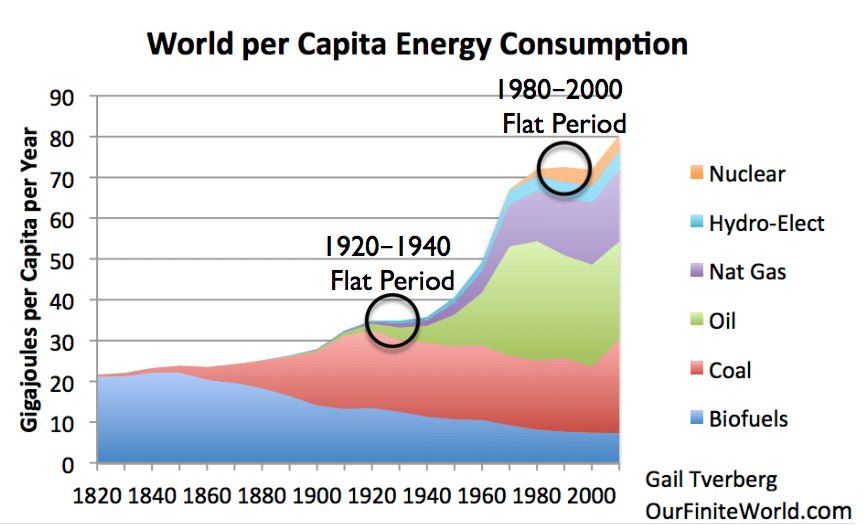
Figure 19. World per Capita Energy Consumption with two circles relating to flat consumption. World Energy Consumption by Source, based on Vaclav Smil estimates from Energy Transitions: History, Requirements and Prospects (Appendix) together with BP Statistical Data for 1965 and subsequent, divided by population estimates by Angus Maddison.
Conclusion
There have been many views put forth about what caused the Depression of the 1930s. To my knowledge, no one has put forth the explanation that the Depression was caused by Peak Coal in 1913 in the UK, and a lack of other energy supplies that were growing rapidly enough to make up for this loss. As the UK “exported” this problem around the world, it led to greater wage disparity. US farmers were especially affected; their incomes often dropped below the level needed for families to buy the necessities of life.
The issue, as I have discussed in previous posts, is a physics issue. Creating GDP requires energy; when not enough energy (often fossil fuels) is available, the economy tends to “freeze out” the most vulnerable. Often, it does this by increased wage disparity. The people at the top of the hierarchy still have plenty. It is the people at the bottom who find themselves purchasing less and less. Because there are so many people at the bottom of the hierarchy, their lower purchasing power tends to pull the system down.
In the past, the way to get around inadequate wages for those at the bottom of the hierarchy has been to issue more debt. Some of this debt helps add more wages for non-elite workers, so it helps fix the affordability problem.

Figure 20. Three-year average percent increase in debt compared to three year average percent increase in non-government wages, including proprietors’ income, which I call my wage base.
At this time, we seem to be reaching the point where, even with more debt, we are running out of cheap energy to add to the system. When this happens, the economic system seems more prone to fracture. Ugo Bardi calls the situation “reaching the inflection point in a Seneca Cliff.”

Figure 21. Seneca Cliff by Ugo Bardi
We were very close to the inflection point in the 1930s. We were very close to that point in 2008. We seem to be getting close to that point again now. The model of the 1930s gives us an indication regarding what to expect: apparent surpluses of commodities of all types; commodity prices that are too low; a lack of jobs, especially ones that pay an adequate wage; collapsing financial institutions. This is close to the opposite of what many people assume that peak oil will look like. But it may be a better representation of what we really should expect.


The indebted green Austria plans to cut child benefits abroad
https://af.reuters.com/article/worldNews/idAFKBN1ET1RZ
Austria is heading fast towards what Japan experiences without the imported workforce…
I think Austria has concluded they don’t need more immigrants.
I am really interested, who will care for their ageing population and who will be interested in working in Austria, when there is a deepening lack of workforce in Central Europe… This measure is an outright stimulus for the depopulation of Austria. Probably, they have no other choice…
What good do an immigrant do (“caring for the old”) who come to your country, hang around for a few years on welfare, and then goes home, continuing collecting welfare.
Japan will be SO much better off than western/northern europe thanks to social cohesion. Especially adjusted for their lack of resources.
Your view of the elderly care system in Austria is distorted.
I live in the country that is best in the world at not getting immigrants working, so yes, probably a little distorted.
Anyway, lots of immigrants works in health care here also, but most are not working.
It is a HUGE drain on the economy increasing population by 25% over 20 years when the new population in general don’t pay tax.
With the ageing populations, there is not much to choose from.
If they are not working and not paying taxes they are even more dead weight supported by a shrinking, ageing population.
They have short term been very good for a debt-driven increase in GDP.
Funny thing is. When the RE-Bubble implodes natives and assimilated immigrants will be sitting in condos and houses worth much less than then the debt (no jingle mail) while paying the worlds (second?) highest taxes that goes to welfare and rent for unassimilated immigrants living debt free.
Our extremely progressive tax system has only top 10% paying government tax, and paying 70+% margin tax on income raises.
Of the half of immigrants that are employed (or in work training or similar activity) after ten years virtually none qualifies for paying government tax.
Well, those living in the caravans and other nomads of today understand it better. But there is no escape also for them: they live and die with the functioning system.
The “caravan people” people are excluded, they are EU citizens. And they are very few, and popped up here around … I don’t know, maybe saw the first 2013, six months later outside every shop, a few months later outside some apartment buildings. Then leveled off, you can’t survive begging only from residents in ONE apartment building.
There may not be enough energy and resources in Austria for full employment at a living wage.
If Austria does not have reliable energy sources like coal and nuclear into the future, its population can not rise. That is true.
https://ichef-1.bbci.co.uk/news/660/cpsprodpb/DB17/production/_88578065_asylum_claims_per_capita_624gr.png
https://en.wikipedia.org/wiki/List_of_countries_by_energy_consumption_per_capita
Austria 4033 kgoe/a
Sweden 5468 kgoe/a
Refugees mainly from:
Syria 1063
Afghanistan 90(!!)
Somalia N/A (Eritrea 147)
So on a global level an enormous increase in resource consumption moving people from these countries to europe.
And in Sweden and Austria all this energy must be produced/bought, and infrastructure scaled up, apartments built, teachers, translators, nurses, dentists, social workers employed.
I am sure that these countries expect that somehow there will be jobs that pay well for all of these people with little training. Or that existing citizens will be able to get jobs, helping all of these new citizen.
It takes energy products to make more apartments, vehicles, clothes, and everything else these additional people will expect.
Yes, 87% of mandate is convinced it is just a question of policies, lowered minimum wage and welfare from the right, government providing training and paying part of the salary from left, and everything will work out fine.
I tried to explain it in on previous page.
So once again, Austria is comparatively a rich country, especially contrasting with their former provinces like CZ, SK, HU, Balkans, etc. where the wage and living standard just crawls to 1/3-1/5th..
Austria is obviously one big luxury holiday resort/wellness areal for the global elite and upper middle classes, while it lost some of its former glory of previous neutrality years, before joining EU, the tradition is still there, it’s still somewhat working like a partial tax heaven, banking hub, as well as an overall “n-th” hideout for the global rich. However, if you strip all that, there is also web of small biz, farming and so on performed by industrious people.
In summary, in such a position you can hire/lure workforce from neighboring poor countries, especially when the cultural difference are somewhat compatible, given the history of the region (Austro-Hungarian Empire).
When the new generations of workforce are of lower and lower quality also in the neighbouring countries, than there is a big problem.
Austria, except for Vienna, as a capital of the surrounding countries in the past, was a poor country. You can not mix Vienna with the rest of the Austria.
Austria continued to function only thanks to the rising debt levels and the workforce from other countries. Austrian Schilling was quite a weak currency. They functioned as a service provider for Germany and were saved by EU and euro. No big culture like Czechs. (Moreover, the Czechs populated Vienna in the past in big numbers, many of the Austrian surnames point to this fact.)
Austria was simply only Vienna, which was a hub of other countries for some time in the modern history. It s no more the truth now. When I want to see some historical cultural monuments, I go to Cracow or Prague. The majority of the historical buildings in Vienna is from the 18th-19th century.
I’d like to stay polite but your answer seems to fall somewhat on the non factual funny side..
Contemporary Austria is evidently richer in most of the criteria. It is also more cosmopolitan, global elite resides there in their second and third residences, and so on.
Inhabitants clearly enjoy higher quality of life (multiples in comparison to poor neighbors), even in the country side.
If they are so rich, why they are cutting benefits to the workers that keep their economy going on?
No, they have a problem… Similar to Britian who voted for Brexit and did not understand that their economy became dependent on the foreign workforce.
Also, my country, Slovakia, is undergoing this process: we need more and more foreign workers due to the ageing population.
Maybe Slovakia has work of a nature and wage level that better fits unskilled non-europeans than further west+north in europe?
Dear worldofhanumanotg, do not be affraid that you will not stay polite. The reality will make you polite…
Fast Eddy’s services for hire… highest bidder of course…
http://www.thought-horizon.com/wp-content/uploads/4df633_d4a3808e744844b298d1d9813c37b5b5.jpg
http://kgab.com/files/2015/06/GettyImages-697945-630×429.jpg
Slovakia is rejecting unskilled immigrants of today simply because it does not have resources for them. Its ageing population is kept alive by adding more robots and foreign workforce. That is all. There is also a big burden of unskilled Roma people in Slovakia which were another reason why Slovakia rejected immigrants while the still rich West accepted such workforce that was not usable.
Moreover, the wage levels and low benefits from the state in Slovakia does not attract immigrants at all…
MG,
I don’t really know what you disagree with.
Sweden, and I am sure Austria, has a lot of people visiting/immigrating here doing qualified work, and some unqualified.
We also have a huge “refugee” immigration, far exceeding 1% of the population every year, that is proven impossible to get into work. How you can’t see this is a long term economic drain I don’t understand.
For reference:
Minimum wage for adult uneducated, unexperienced food worker (think first day at McD) 22 312 kr
Employer has to pay 31.4% tax on top of that. 29 318 kr.
9.8kr/€
€2990/month for basically the most unqualified work possible. How does that compare to EXPERIENCED factory workers in Slovakia?
I may think of other words that are not well understood later.
There seems to be a continuing confusion between radioactive material and radiation going on here, for one thing.
True that!!
Ingesting radioactive material is not recommended.
http://ponziworld.blogspot.com/2018/01/global-synchronized-failure.html
Macy’s announces 5,000 job cuts, 7 new store closures
https://www.usatoday.com/story/money/2018/01/04/macys-announces-job-cuts-7-new-store-closures/1002886001/
U.S. Study Finds 10% Youth Experiences Some Form of Homelessness
https://www.alternet.org/economy/us-study-finds-1-10-youth-experience-some-form-homelessness?akid=16572.2689436.CCW8PV&rd=1&src=newsletter1087199&t=34
Taylor Swift’s ‘Reputation’ Tour Is a Flop: Half-Filled Stadiums, 0 Sellouts…
https://www.digitalmusicnews.com/2018/01/02/taylor-swift-reputation-tour-flop/
Parents can’t afford to take their teenage daughters to see Taylor Swift anymore!
The gaping availability suggests a serious miscalculation of what Swift fans were willing to pay.
should read:
The gaping availability suggests a serious miscalculation of what Swift fans were ABLE to pay.
The consumer is out of steam. The signs of this are everywhere now….
They need to give out more loans. Loans for everything! Let’s complete the drop!
http://www.silverdoctors.com/wp-content/uploads/2013/11/Bernanke.jpg
The Fed should buy up Taylor Swift tickets… NFL tickets… and any other failing entertainment acts… and drop them into the ghettos of America….
Kinda like how the PBOC buys up empty apartments in China and gives them to riff-raff and scum.
https://dereksdharma.files.wordpress.com/2011/06/mutants-for-nuclear-power-button-0016.jpg
Just noticed this:
“Chernobyl was not a big deal at all…. the reactors were entombed … and more importantly … the spent fuel ponds were not involved.”
Gather round children! Thus spake the Eddy that was Fast (approaching senility): the worst ever civil nuclear accident, caused by the worst set of circumstances coinciding to lead to that accident, is “not a big deal” compared to the many even worse nuclear accidents (presumably caused by similar yet amplified sets of worst circumstances) that will kill “everyone” after “everything” collapses due to negligence of proper burial rites. The spirits of the reactors and SPFs will get angry at aforesaid disrespect towards their memory and rise up, combusting spontaneously and spreading their deadly radiation to the far corners of the world.
I think Donald Rumsfeld could summarize the dangers of nuclear accidents: There are known knowns. These are things we know that we know. There are known unknowns. That is to say, there are things that we know we don’t know. But there are also unknown unknowns. There are things we don’t know we don’t know.
The klimate could be described the same way.
I think he was implying “not a big deal” as to compared to what we can expect with the loss of the industrial resource base, and the operations that keep nuclear installations safely under control.
If you were to read what I said earlier — it was not a big deal — compared to what will happen when the 4000+ spent fuel ponds are left without electricity – forever — when BAU collapses.
In fact Chernobyl would not even register as an event worth mentioning … relative to what is headed our way
To get your peanut-sized mind around this ….
Chernobyl would be like a brief hiccup …. whereas when 4000 spent fuel ponds boiling and burning … will be like genociding the entire human population.
See extinction.
Historically speaking there is no precedent for 4000+ spent fuel ponds catching fire. So, there is no way to know what would happen. However, I can’t imagine it would be good. In the words of Donald Rumsfeld these are known unknowns.
“4000+ spent fuel ponds are left without electricity – forever”
Oh Lawd…
Tell you what: if you can explain in your own words, and with appropriate references, how and why spent fuel can catch fire, I’ll stop commenting here – forever!
Are you serious? This has been covered many many times on OFW!
I would think that anything that’s is heated, or allowed to overheat, and that is capable of an oxidation reaction, can “catch fire” and burn.
Good luck burning cast iron.
Dam you are brilliant!
FE, dje has just annouunced the solution to the spent fuel pools problem.
Just encase the spent fuel in iron and we are all ok! It can never burn.
A breakthrough! We are saved!!!
yup
molten rock comes out of a volcano—and you can heat up rock until it burns and melts
teensy problem
it takes more heat input than the rock gives out
The problem is if the spent fuel gets too close, they will produce a fission reaction and explode with a force much larger than any fission bomb given the total amount of fuel on the site. All the fuel in all the reactors and all the storage pools at this site (1760 tons of Uranium per slide #4) would be consumed in such a mega-explosion. In comparison, Fat Man and Little Boy weapons dropped on Hiroshima and Nagasaki contained less than a hundred pounds each of fissile material
See more at: http://www.dcbureau.org/20110314781/natural-resources-news-service/fission-criticality-in-cooling-ponds-threaten-explosion-at-fukushima.html
Once the fuel is uncovered, it could become hot enough to cause the metal cladding encasing the uranium fuel to rupture and catch fire, which in turn could further heat up the fuel until it suffers damage. Such an event could release large amounts of radioactive substances, such as cesium-137, into the environment. This would start in more recently discharged spent fuel, which is hotter than fuel that has been in the pool for a longer time. A typical spent fuel pool in the United States holds several hundred tons of fuel, so if a fire were to propagate from the hotter to the colder fuel a radioactive release could be very large.
http://www.ucsusa.org/nuclear_power/making-nuclear-power-safer/handling-nuclear-waste/safer-storage-of-spent-fuel.html#.VUp3n5Om2J8
According to Dr. Kevin Crowley of the Nuclear and Radiation Studies Board, “successful terrorist attacks on spent fuel pools, though difficult, are possible. If an attack leads to a propagating zirconium cladding fire, it could result in the release of large amounts of radioactive material.”[12] The Nuclear Regulatory Commission after the September 11, 2001 attacks required American nuclear plants “to protect with high assurance” against specific threats involving certain numbers and capabilities of assailants. Plants were also required to “enhance the number of security officers” and to improve “access controls to the facilities”.
The committee judges that successful terrorist attacks on spent fuel pools, though difficult, are possible. If an attack leads to a propagating zirconium cladding fire, it could result in the release of large amounts of radioactive material. The committee concluded that attacks by knowledgeable terrorists with access to appropriate technical means are possible. The committee identified several terrorist attack scenarios that it believed could partially or completely drain a spent fuel pool and lead to zirconium cladding fires. Details are provided in the committee’s classified report. I cannot discuss the details here.
http://www.cfr.org/weapons-of-mass-destruction/nuclear-spent-fuel-pools-secure/p8967
“It’s worse than a meltdown,” said David A. Lochbaum, a nuclear engineer at the Union of Concerned Scientists who worked as an instructor on the kinds of General Electric reactors used in Japan. “The reactor is inside thick walls, and the spent fuel of Reactors 1 and 3 is out in the open.”
http://www.nytimes.com/2011/03/16/world/asia/16fuel.html
If you don’t cool the spent fuel, the temperature will rise and there may be a swift chain reaction that leads to spontaneous combustion–an explosion and fire of the spent fuel assemblies. Such a scenario would emit radioactive particles into the atmosphere.
Pick your poison. Fresh fuel is hotter and more radioactive, but is only one fuel assembly. A pool of spent fuel will have dozens of assemblies. One report from Sankei News said that there are over 700 fuel assemblies stored in one pool at Fukushima. If they all caught fire, radioactive particles—including those lasting for as long as a decade—would be released into the air and eventually contaminate the land or, worse, be inhaled by people. “To me, the spent fuel is scarier. All those spent fuel assemblies are still extremely radioactive,” Dalnoki-Veress says.
It has been known for more than two decades that, in case of a loss of water in the pool, convective air cooling would be relatively ineffective in such a “dense-packed” pool.
Spent fuel recently discharged from a reactor could heat up relatively rapidly to temperatures at which the zircaloy fuel cladding could catch fire and the fuel’s volatile fission product, including 30-year half-life Cs, would be released.
The fire could well spread to older spent fuel. The long-term land-contamination consequences of such an event could be significantly worse than those from Chernobyl.
http://science.time.com/2011/03/15/a-new-threat-in-japan-radioactive-spent-fuel/
Spent fuel can and does catch fire – explosively. If you drain the water from the pools, not only do they not get coolant but, just removing the water can make the fuel go critical. The water itself acts to stabilize the spent fuel by absorbing some of the neutron radiation. Without the water the neutrons bombard the unstable fuel breaking away more neutrons and causing a runaway nuclear chain reaction and heat up to tremendous temperatures and explode. This happened in Fukoshima. Even if you pack the spent fuel rods too close or removed them in the wrong order or spill the coolant you can cause a runaway nuclear reaction and explosion. It is a very dangerous balancing act to keep the pools stable. These pools are often packed tightly to the limit because there just is no where else to put the spent fuel. This aggravates the danger. There have been accidents where workers moving coolant contaminated with nuclear radioisotopes and the coolant itself went critical in the vessel because they used a vessel that was shaped wrong. So, they they dumped the fuel down a sewer drain and it got even worse, went super critical and released ionizing radiation killing the workers. This stuff is dangerous. And accidents happen when humans are involved.
I’ll bet that Chernobyl was a big deal to all the brave (or lied to)Soviet soldiers that lost their lives due to radiation poisoning while they successfully entombed the potential disaster.
If radiation from Chernobyl was not a big deal… then apparently the joke is on these men and their surviving families…. suckers!
Now one has to wonder what would have happened if Chernobyl had not been entombed…
And one wonders what would happen if the pumps that are cooling the Fukushima reactor cores were to stop pumping….
A google search turns up nothing.
Have a look at what happens when cholera is not treated — YEMEN:
The article says, “Caused by the Saudi Arabian war.” I would say, “Caused by inadequate oil production and too low prices for oil that is produced.” We basically have an energy problem. Rising death rates due to illnesses is a likely outcome.
https://gailtheactuary.files.wordpress.com/2013/09/yemen-oil-production-and-consumption.png
I agree Gail. That chart tells the story. By now that blue production line is likely well below Yemen’s desired consumption. I doubt they can afford to import oil. Too bad their populations nearly tripled.
Actually the population of Yemen has increase a lot more than I thought. Very unfortunate for them.
https://upload.wikimedia.org/wikipedia/commons/thumb/a/a5/Yemen-demography.png/550px-Yemen-demography.png
and Egypt’s pop is set to double in the next 30 years, with no oil and only one water source and nations busy building dams upstream.
you aint seen nothin yet
Do not worry the population will fall by a factor of three over the next 10 years.
Yemen population about 28 million…
46% under 15 years old!
I am sure that the people were used to having a large number of children, with most of them dying before adulthood.
As soon as the situation changed so most of them could live (antibiotics, more food), there was a huge population explosion. As long as oil could be sold to support the big population, there was no problem. The problem comes when the oil runs out.
T’ed up for later this evening
https://www.pbs.org/wgbh/frontline/film/inside-yemen/
There is good news …. Yemen has a lot of khat ….
http://content.time.com/time/world/article/0,8599,1917685,00.html
https://en.m.wikipedia.org/wiki/Demographic_transition
Demographic transition (DT) refers to the transition from high birth and death rates to lower birth and death rates as a country or region develops from a pre-industrial to an industrialized economic system. The theory was proposed in 1929 by the American demographer Warren Thompson,[1] who observed changes, or transitions, in birth and death rates in industrialized societies over the previous 200 years. Most developed countries have completed the demographic transition and have low birth rates; most developing countries are in the process of this transition.[2][3] The major (relative) exceptions are some poor countries, mainly in sub-Saharan Africa and some Middle Eastern countries, which are poor or affected by government policy or civil strife, notably, Pakistan, Palestinian territories, Yemen, and Afghanistan.[2]
The demographic transition model, in isolation, can be taken to predict that birth rates will continue to go down as societies grow increasingly wealthy; however, recent data contradicts this, suggesting that beyond a certain level of development birth rates increase again.[4] In addition, in the very long term, the demographic transition should be reversed via evolutionary pressure for higher fertility and higher mortality.[5]
…. z
Thanks! Population figures indicate that we are not doing very well at keeping world population from growing, regardless of what theories about better education of women might say. This is a population growth rate map from Wikipedia.
Population growth rates from sub-saharan Africa are very high, in the warmest, wettest countries. Also, in Saudi Arabia and Yemen. The next area in level of population growth seems to be Central and South America, Northern and Southern Africa, and the Middle East (over to India). The countries with the most success in controlling population are in the former Soviet Union and its Eastern European affiliates. Perhaps “collapse” is the best population control mechanism. (Cuba also has kept population down.)
https://epthinktank.eu/2015/03/20/eu-demographic-indicators-situation-trends-and-potential-challenges/demography_fig2/
Europe. Still increasing population despite sometimes very low fertility rate.
http://assets.pewresearch.org/wp-content/uploads/sites/2/2014/01/Aging-331.png
US. Still increasing population and expecting to increase much more.
And to complicate matters Erdogan is flexing his Turkish muscles southwards towards the Sudan, blathering on about the Ottoman legacy:
Yemen used to be part of the Ottoman empire.
https://www.al-monitor.com/pulse/originals/2018/01/turkey-sudan-cooperation-sparks-worry-in-gulf.html?utm_campaign=20180104&utm_source=sailthru&utm_medium=email&utm_term=Daily%20Newsletter
The critical factor about Turkey is they produce only 56000 bbl oil a day, and have a population of 83m, set to grow to 103m in 25 years, by which time their oil will have gone
Erdogan sees what’s happening in Syria and Yemen after oil production collapse
There’s going to be a fight for survival, and he thinks Sudan oil will save his neck
Jim Willie (Golden Jackass) thinks that the reason the Saudis are attacking Yemen is because they actually have oil reserves…since the Saudi reserves are playing out. He has been right on a number of things.
US Auto Sales Fall for 2nd Year at GM, Ford, Toyota, FCA, Hyundai, Kia, BMW and others
Total new-vehicle sales in the US fell 5.2% year-over-year in December to 1.6 million units. For all of 2017, sales declined by 320,000 vehicles, or 1.8%, to 17.23 million units. It was the first overall decline since the Financial Crisis.
GM -2.7%
Ford -1.1%
Fiat Chrysler (FCA) -8.6%
Toyota -2.6%
Hyundai -10.0%
Kia -5.8%
Daimler -1.4%
BMW -12.6%
Mazda -9.3%
https://wolfstreet.com/2018/01/03/us-auto-sales-fall-for-2nd-year-at-gm-ford-toyota-fca-hyundai-kia-bmw-and-others/
This in spite of record rebates….
https://imgur.com/a/9MaIe
https://www.zerohedge.com/news/2018-01-04/macys-announces-5000-job-cuts-closure-7-more-stores-stock-tumbles
Amazon does not sell cars nor restaurant food ….
The consumer is running out of steam
“Amazon does not sell cars nor restaurant food” – not yet. Don’t give them any ideas now FE.
The forecast of autos sold worldwide is definitely flattening.
https://www.statista.com/statistics/200002/international-car-sales-since-1990/
The forecast is for a 1.7% increase in automobile sales worldwide during 2017.
Global debt is the danger: beware the butterfly moment
The world economy is recovering but it is still panic stations for central banks. For them, global debt is like the sword of Damocles — an ever-present danger.
It stands at about 330 per cent of annual economic output, up from 225 per cent in 2008, according to the Bank for International Settlements.
After the 2008-09 financial crisis, the hope was that a combination of economic recovery, inflation and austerity would shrink the debt mountain. This, though, was too optimistic. Growth has been below par, inflation subdued and austerity self-defeating.
In two respects, the global economy is living on borrowed time.
First, global economic growth is so debt-addicted that no big economy can cope with a rapid tightening in monetary conditions. This means that substantive deleveraging, when it comes, will hurt growth.
Second, central banks need to reverse their policies, since continuing low rates and excessive leverage may well result in an explosive cocktail of multiple asset price bubbles. Reversal, however, means that central banks will be unable to control volatility and keep a floor under asset values — something they have relied on to promote excessive risk-taking.
What is less certain is whether the current level of debt can spark a 2008-style credit crunch caused by runaway debt in the financial and household sectors. Today, high leverage appears most evident in the corporate sector, especially in the US and China.
https://www.ft.com/content/5d6ca2d6-de81-11e7-a8a4-0a1e63a52f9c
In any event, spiralling global debt appears to be so out of control that the world will struggle to pay off the interest, let alone make a material dent in its size.
The global economy is vulnerable to the butterfly effect, the part of chaos theory that says small changes can lead to big outcomes. Rates will have to remain lower for longer, forcing investors seeking decent returns to move ever higher on the risk curve.
This is a very recent article. Quite a few of the links you post are several years old. To get the article without a subscription, a person needs to type in part of the title into Google, say, “Global debt is the danger: beware.”
Its subtitle is “If China suffers a hard landing, the fallout could be substantial.” No kidding!
Other quotes: “No one knows all the cracks into which excess liquidity has seeped–or what risks are being stored up.”
Another, “The origins of the current worries predate the 2008 crisis which was caused when lending standards went from responsible to reckless: the siphoning of money into dodgy ventures such as subprime mortgages, covenant light loans or sovereign lending based on creative accounting. Ironically, all of this happened in the two decades often described as the age of ‘great moderation.'”
According to Wikipedia, the Great Moderation started in 1985.
In my opinion, it is the period where growth comes from falling interest rates. Wage disparity became a greater and greater problem. Low oil prices were a major feature of this period, caused by using a lot of debt to switch to different more efficient energy approaches and away from oil. A major feature of this period was the collapse of the Soviet Union, because it could not afford to develop more oil production at the low prices. This has been of great benefit to us now, in later periods, because the oil was left in the ground, to be used now.
https://www.theregister.co.uk/2018/01/02/intel_cpu_design_flaw/
one more straw to the camel’s back
Imagine if Amazon, Google, Microsoft, etc needs to change all their CPUs due to performance hits… That is the straw
but won’t that make GDP go up?
Or, is this is a sign that we are at Peak complexity.
Caught this last week, I though it was good.
“Principles of Nuclear Chemistry is an introductory text in nuclear chemistry and radiochemistry, aimed at undergraduates with little or no knowledge of physics. It covers the key aspects of modern nuclear chemistry and includes worked solutions to end of chapter questions. The text begins with basic theories in contemporary physics and uses these to introduce some fundamental mathematical techniques. It relates nuclear phenomena to key divisions of chemistry such as atomic structure, spectroscopy, equilibria and kinetics. It also gives an introduction to f-block chemistry and the nuclear power industry. This book is essential reading for those taking a first course in nuclear chemistry and is a useful companion to other volumes in physical and analytical chemistry. It will also be of use to those new to working in nuclear chemistry or radiochemistry.”
https://smile.amazon.com/gp/product/1786340518/ref=b2b_gw_d_simh_a1_0_p/180-6933814-7582659?ie=UTF8&pd_rd_i=1786340518&pd_rd_r=0QS6W9TTM4ZJPF07ZGFC&pd_rd_w=FDWFl&pd_rd_wg=61spT&pf_rd_i=b2b-desktop&pf_rd_m=ATVPDKIKX0DER&pf_rd_r=0QS6W9TTM4ZJPF07ZGFC&pf_rd_t=ABGateway&refRID=0QS6W9TTM4ZJPF07ZGFC
For those of you that can read, and have the courage to look.
Actually, there are several. The one required for my class is sadly out of print.
Eddy 1
Pintada 1
yes, it’s a close match…
will one side pull ahead?
who will win?
stay tuned…
“Eddy 1
Pintada 1”
I have no doubt you actually believe this is the case. The reality is that the idea of radiation being ‘carried’ by air or water is nonsense, and for very obvious reasons. But it’s hard to show that, and other obvious reasons, to people who believe nihilism/fatalism=logic and are desperate to prove it whenever and however they can.
I’m sorry, I’m just a bit confused. And buzzed. What can I say, its Wednesday and BAU is still running. Cause for celebration.
How can your statement be reconciled by the large scale evacuations caused by nuclear accidents? Not trying to be sarcastic, genuinely curious.
jupiviv and pintada were obviously downwind from Chernobyl … and not evacuated.
‘Effects on brain function. Radiation can cause changes in the brain tissue. … The symptoms can be mild, moderate or severe, depending on how much radiation damage there is.’
That is why they are so stewpid.
If BAU is running, and a nuclear accident happens, the authorities act in the most conservative way possible because people generally have no clue what is happening, and they are therefore afraid.
On a logic scale of 1 -10 … with 1 being bad…. you just hit a – 100.
What about Chernobyl radiation evidently being carried by air(rain) 1000+km in two days?
Fake news?
Fake cancer?
Maybe fake news, but I was downwind from Chernobyl when it happened and not sufficiently brain damaged.
Of course Chernobyl was no big deal unless for a few unlucky, but you can’t say radiation doesn’t travel by air, which it obviously does, and quickly.
I wouldnt want to live in a world with a nuclear meltdown every month. Much less unhandled weekly meltdowns.
Chernobyl was not a big deal at all…. the reactors were entombed … and more importantly … the spent fuel ponds were not involved.
The problem with this discussion is that most participants are so clueless about the subject that they don’t realise that light and sound are forms of radiation. Can light and sound be “carried” by air and water? It is the particles that release radiation that spread via some transport mechanism. In Chernobyl, the fire carried such particles into the neighbouring regions, and the weather carried *some* of them even further away.
Re-tard-ation can spread over the internet —- please stay away from us
I think it is radioactive particles that are carried by wind and rain that are spreading radiation. Radiation itself cannot be spread by wind in the same way that light cannot be spread by wind. Radiation is just a very short wavelength of light.
jupiviv says:
January 4, 2018 at 12:49 am
” The reality is that the idea of radiation being ‘carried’ by air or water is nonsense, and for very obvious reasons. But it’s hard to show that, and other obvious reasons, to people who believe nihilism/fatalism=logic and are desperate to prove it whenever and however they can.”
http://i0.kym-cdn.com/entries/icons/mobile/000/000/554/picard-facepalm.jpg
My guess is that he’s trolling. He’s trying to get a rise out of people out here. Nobody can be this ignorant.
I have a question. How valid is the notion that a transition to nuclear in the 60s or 70s would solve or at least ameliorate our current predicament?
I know a guy who was a scientist at Dounreay. According to him, there is more thorium than we could ever want, and building a huge number of nuclear kettles is no problem, but the unrealistic demands of the public re waste containment makes all of that a non starter.
There are limits to growth.
We’ve dodged the limits so many times before that few among the crowd believe there are any.
what we’ve done is borrowed money to pay off our creditors so often that we’ve lost sight of who/what our original creditor is.
Mother Nature: one hell of a debt collector, when the time for warnings has passed…..
i fear eviction
Some have dodged limits. However, I wouldn’t say everyone has dodged the limits to growth. As time goes by more and more will be affected and at some point (that we do not know) so many systems will be affected that one critical link will break and the system falls apart. The effects are hidden by lies and misinformation spread by the governments and MSM.
I don’t think that the thorium approach has really been gotten to work adequately, either. Also, our problem is not an electricity problem; we need portable fuels.
Hence the Russian action plan under execution right now, nuclear backbone consisting of big VVERs as well as breeder reactors running of existing and future stockpile of spent fuel mixes. Individual and last mile cargo transport moved on natgas conversions, otherwise lot of light and heavy rail, metro lines, trolleys, maritime cargo etc.
It’s about leveraging the comparative advantage vs. the thin final line of collapse of your end customers, so if the German/EU and US “wealth” moves for while in direction to Russia at least in few %dozen, why not..
Is that bulletproof plan past ~2035? I don’t know, the chances for deep structural collapse for top OECD countries is quite high roughly around this horizon, +/- a decade.
“Also, our problem is not an electricity problem; we need portable fuels.”
Can’t disagree there, but only for the current global economy. For a smaller economy and population, with smaller fuel needs, a mix of nuclear generation + portable fuels an “action plan” like the one described by worldofhanumanotg is not unfeasible. Of course there is the question of how long such a system can be sustained in the midst of a tattered/defunct global economy, but it’s still an option.
I guess it’s unrealistic to not want to get cancer from nuclear waste. You must be one of those New Age people who self-identify as robots rather than humans, or even living beings that can get sick from nuclear waste.
China having trouble finding good investment opportunities:
https://www.cnbc.com/2018/01/03/china-is-building-a-giant-2-point-1-billion-ai-research-park.html
just wait until it’s completed in 5 years.
Pintada was non-responsive after his battle with The World Champion (aka Fast Eddy)…. so I called around the various hospitals… seems he’s sort of ok…. and hopes to be back for more beatings in 2018 as soon as possible.
https://i.pinimg.com/736x/01/53/a4/0153a4f363c9cbc0a647a920c5c3f696–novel-bank.jpg
https://www.bloomberg.com/energy
WTI up to 61.85 a barrel! The wheels are going to come off if that price keeps going up.
What happened to the supposed E T p mod el the H i l l ‘ s groupies, touting a price of 40 something a barrel? NGGGGGGGGGGGGGG, wrong, and what do we have for the losers? A lifetime sentence teaching typewriter maintenance at the Rocko school for the galactically challenged! LOL
$60 is a speed bump…
$70 is a tire low on air…
$80 is a flat tire…
$90 is a blowout…
$100 the car ends up in a ditch.
Musk Financing latest scheme by selling Hats
https://www.theguardian.com/technology/2017/dec/31/elon-musk-tesla-founder-mines-rich-marketing-seam-selling-boring-hats?CMP=fb_gu
Presumably his next product will be literal snake oil
50,000 x $20 = $1 million…
minus costs = peanuts…
I could say chump change, but that would insult Musk.
Well, Tesla Falls short:
https://www.cnbc.com/2018/01/03/tesla-q4-2017-production-and-delivery-numbers.html
well, what a surprise.
That’s about the limit of his capability as an entrepreneur.
Brick & Mortar Meltdown Reaches Movie Theaters
https://wolfstreet.com/2018/01/03/movie-theater-ticket-sales-2017-lowest-since-1995/
Retail Apocalypse, Movie Apocalypse, Restaurant Apocalypse!
https://imgur.com/a/FFR4X
The top ten movies in US ticket sales in 2017:
“The Last Jedi” (Walt Disney): $517 million
“The Beauty and Beast” (Walt Disney) $504 million
“Wonder Woman” (Warner Bros.) $413 million
“Guardians of the Galaxy” (Walt Disney) with $389 million
“Spider-Man: Homecoming” (Sony) $334 million
“It” (Warner Bros.) $327 million
“Thor: Ragnarok” (Walt Disney): $311 million
“Despicable Me 3” (Universal): $267 million
“Logan”(20th Century Fox): $226 million
“The Fate of the Furious” (Universal) $226 million
More evidence that humans are very stewpid …. and deserve starvation, violence, disease and radiation poisoning.
The time before the WW1 was really a time of the comming implosion of the coal. At that time, the Jews co-financed the building of the largest catholic church in the key coal region of Central Europe:
Cathedral of the Divine Saviour in Ostrava, Czech Republic
https://en.wikipedia.org/wiki/Cathedral_of_the_Divine_Saviour
“Contributions also flowed in from Jewish entrepreneurs, like Baron Rotschild and the Gutmannové brothers.”
The emepror Franz Joseph I of Austria visiting the ironworks of Rotschild and Gutmanns
in Witkowitz in 1906:
http://www.patriotmagazin.cz/wp-content/uploads/2016/08/cisar5.1.jpg
http://www.patriotmagazin.cz/wp-content/uploads/2016/08/cisar5.1.jpg
Source: http://www.patriotmagazin.cz/cisar-v-ostrave-privitani-barony-rothschildem-a-gutmannem-ve-vitkovicich/
” The chief coal mines and iron-works at Witkowitz, in Moravia were owned by the Austrian Rothschilds in partnership with the brothers Wilhelm and David von Gutmann.”
Source: https://www.globalsecurity.org/military/world/europe/at-kuk-witkowitz.htm
In early 1920s during the deepest hyperinflation slump and utter desperation of post WWI Austria, who would have sought they would be one of the richest regions in the world in just roughly half a century again..
In similar vein, S. America slowly decayed away and never picked up again.
India never matched China’s full spectrum rocket boom and so on..
Predicting future..
…and the region between Vienna and Ostrava is one of the key car making regions of the world today.
But the trend of the population decline in the given region and less and less suitable workforce confirms that we face the same fate as Japan…
The key artist of Ostrava region, a folk singer Jaroslav Nohavica, counted among the best paid musicians in Czech Republic, supported Tomio Okamura, the politician of the Japanese-Czech origin, in the last Czech parliamentary elections held in 2017:
https://t3.aimg.sk/magaziny/mmVog-NvTfWADO_hyQn5yQ~Jarom-r-Nohavica-a-Tomio-Okamura.jpg?t=LzgwMHg0NTAvc21hcnQ%3D&h=7LZJYChr0v2KChtgK5amlg&e=2145916800&v=2
https://www.aktuality.sk/clanok/508231/komentar-petra-bardyho-jaromir-nohavica-prerazil-dno/
Obviously, I meant Jaromir Nohavica… His songs are deeply rooted in his native coal region of Ostrava.
Jaromír Nohavica – 12 Když mě brali za vojáka – When I Was Drafted as a Soldier, from the concert in Ostrava, in one of the former industrial halls (English subtitles possible)
Legal cannabis to generate $40bln, 400,000 jobs: study
https://phys.org/news/2018-01-legal-cannabis-40bln-jobs.html
https://imgur.com/a/IfwTW
It seems like there would be an offset somewhere. People cut back on something else, to have enough funds to buy the cannabis. Or perhaps they can solve their pain problems themselves, without going to the doctor.
Last gasp efforts of a dying empire. They’re all so broke they’re giving up on the war on drugs! It’s amazing! lol. But they need the money and jobs…
Legalizing Cannabis is a partial solution to the Retail Apocalypse & Opiate overdose epidemic….And in Colorado they just gave their teachers a raise with tax revenue they received…And Pot heads are the most open and tolerant people we have.
Dave’s Not Here…
https://www.youtube.com/watch?v=rtDAK7Umk7A
man.
Well, what do you know, more money to add to GDP, and people said the economy wasn’t growing anymore. LOL. Of course when they call in sick to ‘load up’ it might have a detrimental effect on GDP or simply balance out. We’ll have to wait and see.
And people said the economy wasn’t growing anymore. LOL.
The Great Recession 2006-2017 US Economic Growth GDP Per Capita (0.4%)
https://data.worldbank.org/indicator/NY.GDP.PCAP.KD.ZG?locations=US
Non Partisan CBO Office Forecast Less Than 2% US Economic Growth GDP Through 2027
https://www.cbo.gov/publication/52801
*Note: 20% GDP Includes (FIRE) finance, insurance and real estate
A lot of it is just movement from black market economic activity to legal economic activity (and thus taxable).
JMG handing out his 2018 forecast:
https://www.ecosophia.net/a-dangerous-year/
A Dangerous Year? perhaps…
but most likely very similar to 2017…
well worth reading (if the klymitt stuff is ignored).
Thanks!
Ripple XRP today at $3.03…
the really insane part: market cap now $117 billion…
or, I should say, the illusion of $117 billion.
all 1,385 cryptocurrencies market cap $720 billion… insane!
Bitcoin dominance down from 37 to 35%.
$3.22…
$124 billion market cap…
total $730 billion market cap…
Bitcoin dominance down to 34%.
It is incredible that people buy in to this. As with all ponzi schemes, it will grow as long as fresh suckers can be lured to buy in. But when there are no more suckers to be found, it will fall like a rock.
It’s also a generational thing. Simply put, the zombies glued to their smartphones from childhood are coming into adulthood and entering the economic realm. And it will get much worse each day/year..
all crypto = $740 billion market cap.
heading for one trillion…
up up and away.
$3.43…
market cap $133 billion!
all crypto market cap $755 billion.
this is almost funny.
Wonder why the finished motor gasoline stocks/inventory is dropping? Doesn’t
look like much wiggle room to me:
https://beforethecollapse.files.wordpress.com/2017/03/chart-68.png
We are almost to oil independence according to the EIA only around 2.5 million barrels a day now are being imported.
For the month of October 2017, our net imports amounted to 2.5 million barrels per day. Our net imports from Canada amounted to 3.3 million barrels a day, so we exported 0.8 million barrels of crude oil and products, on average, to other countries.
The US net imports for October 2017 are peculiarly low. US net imports of oil and products averaged a little over 4 million barrels per day, for the period January-August 2017. There does seem to be a huge spurt in US oil production. Crude oil production in October 2017 is reported to be 9.6 million barrels per day; it was only 8.8 million barrels a day a year ago. Texas shows the biggest increase in oil production, with a 600,000 barrel increase over a year ago. Texas Railroad Commission data doesn’t show the same increase, as you have noted.
There are a lot of things a person can get worried about. My guess is that once laws changed to encourage blending ethanol with the gasoline, it no longer made sense to store the gasoline in its “finished” state. Instead, the ethanol had to be shipped by truck, and the “RBOB” to which it was blended could be shipped by pipeline at much lower shipping cost. So the chart you are seeing reflects a different situation. This is a different chart I found that most likely represents the total inventory. It does not have the same downward trend.
https://gailtheactuary.files.wordpress.com/2018/01/us-ending-stocks-of-total-gasoline-jan-2018.png
The Book That Incited a Worldwide Fear of Overpopulation
Population will fall, he says now, either when people choose to dramatically reduce birthrates or when there is a massive die-off because ecosystems can no longer support us. “The much more likely [outcome] is an increase in the death rate, I’m afraid.”
https://www.smithsonianmag.com/innovation/book-incited-worldwide-fear-overpopulation-
Here is Dr Ehrilich’s collapse study.
The Royal Society: Study, Now for the First Time A Global Collapse Appears Likely (Ehrlich, 2013)
http://rspb.royalsocietypublishing.org/content/280/1754/20122845
“Abstract
Environmental problems have contributed to numerous collapses of civilizations in the past. Now, for the first time, a global collapse appears likely. Overpopulation, overconsumption by the rich and poor choices of technologies are major drivers; dramatic cultural change provides the main hope of averting calamity.”
well, if our main hope is “dramatic cultural change”, then we’re toast.
He could’ve just been honest and said that divine intervention is the only hope of averting “calamity”.
https://imgur.com/a/TD2ZU
I can imagine that is the UN logo on the podium.
The problem is a physics problem. I would agree that if there is a way out, it is through “divine intervention.” Dramatic cultural change does very little. A change to a vegetarian lifestyle would be temporarily helpful, but would still lead to collapse, but at a higher population level.
the only sustainable system was the one where we (the mass of peasants) supported a tiny minority of aristos.
every so often the peasants revolted , knocked off the aristos, thought everything was going to be different—only to find that a new set of aristos had replaced the previous lot.
which leads one to think that is the only system that is stable.
The conclusion being—make sure you get born to rich parents
(and don’t lose your head)
The only stable system seems to be periods of growth punctuated by fairly frequent collapses (famines, peasants over-running those in charge, inadequate revenue to run government services).
We are now trying an experiment where we tie the entire world economy together in one economic system. We can temporarily produce an artificial period of growth. But how and when does it collapse?
there were undoubtedly ups and downs, but in broad terms, things held an equilibium until the heat engine appeared
after that, humankind went into terminal decline
problem is the deniers see it as permanent incline
this guy says it better than i’ve seen it anywhere—brilliant
https://un-denial.com/2016/01/30/why-we-want-growth-why-we-cant-have-it-and-what-this-means/
“The mathematics of this system requires growth to pay the interest on debt.”Isnt this only true if interest rates are positive?
i took that as read
I’m trying to connect some dots and would welcome help to correct flawed assumptions.
Once oil was discovered, it had to be used profitably. One way to do this was to use the leftover tar from oil production to build roads. The roads had to go somewhere, and the solution to that was to build suburbs as their destination. I’ve come to learn, OFW has taught me, that the extensive living spaces suburbanization enabled promoted single family living on an unprecedented scale, which increased population proportionately. Our economic system has been growing exponentially, along with this population.
But now we’ve hit a roadblock.
As easily obtainable supply has dwindled, oil has become increasingly hard and costly to produce. Since the entire networked economy runs on oil, the strain on producers has trickled through the rest of the economy, making it less able to afford oil at the high prices producers would need to survive. But that isn’t all, for the oil economy, starting with mass-scale suburbanization, has gobbled up critical supplies of land and other natural resources, so that they, too are in short supply. There is talk that if an extremely cheap source of energy that used the same infrastructure as oil could be found, civilization could hum right along. But that wouldn’t address the problems of more depletion and more pollution caused by the extravagance and complexity of the oil-based civilization our large population has come to depend on. Besides, no cheap alternative to oil has yet been discovered.
It would seem that discussions on this dire situation tends always to leave out the critical issue of land use. Global land use policy to fit the age of oil depends on sprawl. Sprawl is possible through cultural programming that devalues land as having any value other than for economic maximization–the highest and best use policy that planners talk about. So land is the battleground on which the civilization’s wars are fought. The momentum of the civilization is to develop every last piece of land as cheaply as it can, until no more land is to be found. That necessarily increases pollution, uses more oil, and produces more people.
We can say that with coal, there were mainly railways.
With oil, there is plenty roads everywhere, i.e. mobility was greatly increased.
The land without the artificial fertilizers produces next to zero food. Our problem is not the land, as with the cheap oil we could turn any land into food producing land.
Without the coal and oil, we have barren soil, not suitable for intensive food production. All of sudden, your house is surrounded by grass and tress and all food must be taken from somewhere else.
“The momentum of the civilization is to develop every last piece of land as cheaply as it can, until no more land is to be found.”
yes, by using fossil fuel.
as FF depletes, won’t the momentum reverse?
populated land that requires higher amounts of energy will be the first to be abandoned…
I’m thinking deserts… the Middle East especially, and the American southwest come to mind…
who could live in Arizona or New Mexico without FF?
nomads?
“as FF depletes, won’t the momentum reverse?”
This is where better explanations are needed. A decrease in FF use could or need not necessarily cause the civilization to collapse? If it isn’t to collapse, how do you keep the said-to-be-necessary growth going? And keep it going through consolidation of the core and abandoning more of the periphery? You could rework the core and make it denser and more efficient. What does that mean for growth?
here is Tim Morgan’s one page synopsis…
http://www.surplusenergyeconomics.com/
what do you think?
I appreciate this a lot. Here’s what the artist/philosopher mindset can begin to warm up to:
“For the most part, the financial economy has been an indispensible tool for the better management of the real one. Markets allow us to price assets, inputs, outputs, risk and return.”
For the first time ever, I get to see the financial system as something sophisticated that enables a creative and ambitious kind of ‘construction.’ We can shape civilization in interesting and visionary ways using money via these constructs. My point, though, is that when the real economy (as Gail implies) gets drained by the population density it must serve then it needs to throw off the top heavy aspects of the real economy ‘such as building a power-station, a school, a (paved) road or a (large) house.’
That takes into account the physical, material aspects of the civilization and less the imaginative parts, where what was formally deemed impossible (or even unthinkable) comes into being. And that supposedly impossible thing can emerge from looking at the same thing and seeing it in a completely new way. The ability to see in new ways might only be able to spring from a civilization of huge surplus energy. If so, timing to see things differently and act on it is key. It can’t wait till surplus energy is gone.
The author’s final sentences seem to support the above somewhat.
I agree with Artleads it has not been sufficiently explained why the real economy can’t shrink at all.
Tim Morgan writes we have two separate economies and then that the financial somehow still can make real claims that don’t exist.
If there were really two economies (which I believe), then the virtual one could be faked as long as there is nowhere to run.
At some point, probably NOT this year, the real economy will become a problem. Enough capitas personal real economy reach riot level.
“I agree with Artleads it has not been sufficiently explained why the real economy can’t shrink at all.”
The real economy can shrink as long as it is balanced by growth in the virtual finance economy that keeps people believing growth still exists, because much of the wealth on paper exists as future claims that are being forever deferred. As long as people have faith that tomorrow will be business as usual, then this can continue. The second a significant number of people wise up and withdraw their money from financial instruments to put it into real goods the gig is up, as you get bank runs etc. when things turn obviously downward. And then everyone realizes there are far more claims on real goods than actual goods.
Read this http://www.endofmore.com/?p=1464
And study this
https://i0.wp.com/www.fivestarsandamoon.com/wp-content/uploads/2016/01/Deflation-Downward-Spiral-Singapore.jpg
this i the best explanation of non growth i’ve read so far
https://un-denial.com/2016/01/30/why-we-want-growth-why-we-cant-have-it-and-what-this-means/
The thing that this article misses, as do most articles, is that growth is essential for any economy. This ultimately means that every economy is temporary, because growth can only be temporary.
We live in a world where all things cycle–lives of individual humans, plants, and animals, climate, amounts of fossil fuels we can extract, amount of energy coming from the sun. We delude ourselves by trying to fit “Straight lines” to the way the world works. There is no “straight line” or “no growth” economy. It is like a two wheeled bicycle that stands in one place. It just doesn’t work. It is growth that allows an economy to be stable. Intentionally slowing growth is an incredibly stupid thing to do. An economy is a mixture of growth and collapses; that is the only way it can take place. The question is whether this time we can collapse only part of the world economy.
‘Pain is on the horizon. It can’t be avoided. I think a proactive response of conservation, austerity, and population reduction measures might help by slowing us down in a more controlled manner, rather than our current high-speed trajectory towards a brick wall.’
https://now-here-this.timeout.com/wp-content/uploads/2013/07/Wrong-landscape.jpg
Dje, yes.
Of course most peoples entire “wealth” is their home and equities locked away in retirement accounts. (House prices here makes everyone believe they are millionaires)
And the really rich can’t really move their money into real goods.
I believe in your explanation but it won’t happen the coming handful years.
The productive will be at the same time motivated to work and heavily taxed.
You can’t really make a run on banks when your entire “fortune” is the net between home valuation and a debt several years salary high. AND cash is abolished.
We are stuck here making the virtual economy work as long as the real holds together.
FE,
the spiral is constructed as if there was only one economy, the virtual (price, cash flow) mixed with the real (goods).
Yes, we are guaranteed to see a deflationary spiral at least in the real economy.
But as long as They can keep the virtual economy rolling what can anyone do?
As someone wrote on Tims site: what could the elderly do? Shake their walking sticks and “demand” better health care? Those who are able is likely to keep working.
End of More is given, NTHE is not.
Virtual economy…. you mean like https://www.zynga.com/games/farmville
FE,
I mean an economy you couldn’t have imagined a few years ago, negative interest rates, cashless, nowhere to hide, tax havens reporting to EU governments, gold not sold without reporting to government, new tax schemes, money created and handed out as necessary to not break the system, maybe government controlled crypto currencies to keep people in line, taxed by self destructing currency, stimulates consumption also, everything backed by to big to fail.
Until the end.
Maybe we make it until 2030.
Ah yes… The New Normal! Or shall we say… Abnormal
Creative on nonsense?
Humans will keep the current system going, if there is a way to do it.
Were some way into the new abnormal. Why can’t we go a bit further?
People can’t imagine negative interest rates to home “owners”, why not? And why should the yearly salary adjustment always be upwards?
The economy has to grow, just as a two wheeled bicycle has to roll forward to stay upright. A two-wheeled bicycle cannot roll backward. Businesses cannot be made to operate on negative profit. The system does not work.
Of course the businesses needs profit or at least increasing stock valuations. Why else should they care?
Tim gets some things right, and some things wrong. He tends to follow Charlie Hall and his EROEI theory. Tim starts out by saying
I would say that we are dealing with a self-organized system economic system; it has many parts. Tim has identified some of them. The self-organized system grows under the laws of physics, as long as there are sufficient energy flows to feed the system.
He talks about the financial system as running parallel to the real economy. I disagree with this.
The economy, as designed, has only two directions: growth and collapse. In a finite world, a person expects constant cycling between economic growth and collapse.
The financial system is part of what leads the system toward growth, but there are many other things that lead the economy toward growth.
1. Humans have learned to use what some researchers call “extra-metabolic energy” (mostly fossil fuels in recent years) to give humans an advantage over other species. This means that human population tends to grow, even as the species are increasingly pushed out of the way by the growing domination of humans. Thus, to provide even the same amount of goods and services per capita, it is necessary for the economy to constantly grow.
2. The amount of resources from the earth is fixed, without greater and greater “complexity.” Complexity is closely related to specialization and economies of scale. In order for human population to grow, we need increased specialization, so that we can make better use of the resources available to us.
3. The financial system is the great enabler of specialization. It puts prices on things. It also allows promises of many kinds to be formalized. Instead of simply say, “If I hunt and you gather, at the end of the day we will get together and share the proceeds,” the financial system allows formal agreements. Debt and sale of shares of stock are very similar in function. So are formal government programs that people expect to continue (such as unemployment insurance, Social Security and Medicare), even though they do not lead to “debt,” per se.
4. The process of specialization and greater complexity in fact take part of the energy of the system. This works well if the returns on increased complexity are high enough. Then everyone can get an adequate return. Wages for even low-paid workers can be sufficient.
5. Growing energy per capita is needed to keep the economic system growing. (This can sometimes be hidden, by shifting manufacturing to other countries). Once energy per capita starts shrinking, the system tends toward collapse. This most often is reflected in growing wage disparity.
I think that Tim Morgan has listened a little too much to Charlie Hall and his views regarding EROEI and “net energy.” All energy is really energy used in one way or another; there is no meaningful “net energy,” as far as I can see. Charlie Hall’s method of measuring net energy does not work well. The important thing is that per capita energy keeps growing. This happens, only if energy production can be done cheaply. The temptation is to substitute more and more debt for cheap energy production. This debt can temporarily hide the problem, but it is not a permanent solution.
Perhaps we model the system as a bicycle, with debt and other promises pulling the system forward, and the back wheel being actual energy consumption, allowing the system to move forward without collapsing. Once the price of energy becomes un-affordably high for non-elite workers, or the price falls too far below the cost of energy production, the system collapses.
But when Dr T writes about net energy he means prosperity = discreationary spending after essentials.
I think he is correct the UK “net” economy per capita has peaked, but not the UK “total” economy. Maybe that is the creeping collapse, the years from when net economy peaked until the bike falls over.
The lack of food will wipe out all but those in the most remote places… the radiation will get those people though
Disease will play a part, also. Once the sanitation services stop, and the bodies pile up, expect to have epidemics and more bodies. That covers just about everyone except those in remote places.
Your last paragraph is the key. The future as being just near, through, and eventually leaving the collapse vortex will be mostly (almost elusively) about land in wider connotations.
That’s why contemporary owner’s and managers of the globe, already have (“corralled”) some, and hope to keep it by whatever means into the coming turbulences.
Futile in their focus or not, that’s what the other (so far unprivileged) group will eventually reorient all their efforts after initial chaos as well.
Hence it’s the correct realistic view,
as far as humanoid’s predictable behavior is concerned.
Correction-
“The momentum of the civilization is to develop every last piece of land as cheaply as it can, until no more land is to be found.”
to
“The momentum of the civilization is to develop every last resource as cheaply as it can, until no more resources are to be found.”
But at some point, the process must stop, because the level of resources extracted each year cannot keep up with population growth. Wage and wealth disparity becomes an increasing problem. Those at the bottom of the pyramid increasingly get left out. The whole system stops, for lack of buyers of the good and services produced by the economy.
But if we stop building single family houses we automatically decrease population. However, we could keep building jobs going if we increased “dormitory” type construction and shared-apartment complexes. The people hardest hit by housing unaffordability wouldn’t be able to resist that trend. You keep jobs going and you keep people off the streets? The very poor as the key to economic stimulus?
or humans could cram themselves into the existing (aging) housing…
more humans, no more houses…
interesting data… the average house in the USA has 3 persons living in it…
only 3…
don’t you think there’s room for more?
Mexican (undocumented) immigrants are happy with 10 or so. I wouldn’t care for it much, so vive la difference. The very poor, marginalized third world folks seem to offer ‘solutions.’
Our neighborhood of homes built in the 1980s seems to have a lot of people crammed into homes. People have fixed up basement apartments, and are renting them out. Quite a few homes are owned by parents of university students, and are occupied by several university students (since we live at the edge of a university). Quite a large number of homes have been bought up by a medical rehabilitation group (funded by health insurance dollars, I am sure), and are being used as half-way homes for groups of people trying to get off drugs. The rehab folks applied for zoning to allow eight people per home; this was turned down. I think the limit is four now.
So I think that more people per home is what we can expect to see.
all started with caves
the home cave got too crowded
then dad neanderthal said—go find your own xxxxxx cave
not nice when climate’s a-changin and there’s an ice age on
Your region seems to be ahead of the curve. The housing trend there sounds to be the fit for the immediate circumstances around the globe. I’m looking at 3 or 4 jurisdictions in different places. So far, CA, NM, Jamaica, and maybe soon, Liberia. Each of them could use the same housing formula as yours. The fact that they all are thinking in terms of the old style of development better suited to the age of more makes them ineffective and self destructive. If they all got it clear that “your” housing program was the only workable one for the circumstances, they could cooperate on speeding and scaling it up. But like I said, they’re all thinking something totally different.
Very long, and not a word about energy. But the protesters of gentrification are closer to OFW position re ‘inequality’ .
https://www.planetizen.com/blogs/96528-wrestling-growth-equity-and-sustainability
“Some spoke to the fact that what’s happening around town today is about class as well as race: poor white people are also suffering. Protest leaders seized on that fact to propose an inter-racial, city-wide coalition for change. There were calls for building community centers rather than coffee shops, creating more minority-owned businesses, and establishing community land trusts. But most importantly, the call was for voters to hold politicians accountable, and to take matters into their own hands in the next election cycle for mayor and city council.”
This makes me think of the medical insurance price increases we are now dealing with in the US. We are now being quoted $2,000.00/month with a $20,000 deductible. This is for a couple with a nearly perfect health history.
We are talking about critical medical services becoming unaffordable for citizens of the richest nation in the world.
2000USD per month? That is INSANE.
A person wonders if the purpose of the system is to employ as many people as possible in the health care field.
The highest cost coverage in Hong Kong – which I understand is second after the US in terms of expensive health care serviced….. for someone 50ish…. is USD6000 per year…. with no deductible…
I’m paying USD $965.00 per month for family of 4, with $6,400 individual / $12,800.00 Family deductible. All in good health, Adults in 30’s, Children under 10. It was only $450 five years ago. Even if BAU continues unabated, The health insurance system in the US is going to collapse.
so basically…
until $6,400 no one is insured.
in nature’s terms, you are supposed to stay fit and healthy long enough to bring your own children to reproductive maturity.
If you refer back to about a century ago, the average age of death for a man was under 50
beyond that you are surplus to requirements and taking up space. (as I am)
I think grandmothers can be helpful in raising children and running households as well. But that still doesn’t bring a need for humans of age greater than, say, 55 years old.
which may be why grandmothers tend to live a bit longer than grandfathers
The capitalist views any day where new personal wealth is created as a good day.
And any factor that advances his/her personal wealth/power is a welcome factor ie new lands, new types of energy, more of old types energy, more cheap labor, new cheap sources of building materials, etc
Anything that builds personal vs collective wealth.
Anything.
There will be that brief moment … as BAU is going down … and those who obsess in this manner… see their Schwaab accounts vapourizing…. their property and other holdings collapsing in value …. the realization that their ‘great acumen’ … has failed them…. and they are headed for the poor house….
And you get to smile…. considering this.
Did I mention I knew someone who’s daughter taught in a ‘prestigious’ private high school in the US… and when 2008 was unraveling — kids were coming in crying and requiring counseling — because their parents were wailing and moaning about how the world was ending and they’d end up with nothing (lots of banker kids)….
Oh boo hoo… booo f789ing hoo…..
Now do not forget…. at the moment just as the centre starts to spin out of control… that split second just before the power goes off….
To smile….
https://i.pinimg.com/236x/f2/73/e8/f273e887c8d75778a631b42b680b76dd–baby-smiles-happy-faces.jpg
You will be in good company
https://dicmortimer.files.wordpress.com/2016/11/broiler-chickens.jpg
http://www.animalequality.net/sites/default/files/imagesimages/ganaderiaimpacto2.jpg
Moving study: People continuing moving to west coast, leaving parts of Northeast
http://www.bostonglobe.com/news/nation/2018/01/02/moving-study-people-continuing-move-west-leaving-parts-northeast/roeSYZ5mLtOxee769J5CxN/story.html?camp=bg%3Abrief%3Arss%3Afeedly&rss_id=feedly_rss_brief&s_campaign=bostonglobe%3Asocialflow%3Atwitter
perhaps they have vague subconscious premonitions that homelessness will be better in the southwest than in the northeast.
Desperation … builds….
Police in the northern English city of Hull have shared a shocking example of the desperation of UK sex workers. One woman was back on the streets selling sex just 30 minutes after giving birth.
https://www.rt.com/uk/414836-prostitution-sex-workers-plight/
FE checking on airline tickets……………
Ouch!
Why are huge numbers of Americans preparing for doomsday?
https://www.msn.com/en-us/news/us/why-are-huge-numbers-of-americans-preparing-for-doomsday/ar-BBHNhW1?ocid=ob-tw-enus-677
Google Searches for “Prepping” are at an all time high as well!
because they haven’t a clue?
If anyone doubts the need to humiliate and destroy DelusiSTANIS…. just pop over to Surplus Energy … and you can see what happens if these pustules are allowed to fester….
All Tim’s good work over there is being slathered in AIDS infected diarrhea, urine and vomit…
Pinch your nose… hold your breath… and watch your step.
Tim’s conclusion to his 12/28 article:
“Essentially, it makes no sense to ignore potential for influencing government, business and finance at a time when all three need answers that conventional methods of interpretation are no longer able to supply.”
first, I’m mighty impressed with his delineation of the “two economies”…
yes, the real economy of energy is primary.
second, he asks for reader suggestions…
okay, look at that conclusion…
I would say that’s all rainbows and unicorns to think that the reality of Surplus Energy methods will be adopted by “government, business and finance”…
my suggestion: give up.
That would be the logical conclusion
“All Tim’s good work over there is being slathered in AIDS infected diarrhea, urine and vomit…”
Surely there are people besides you posting there?
This is a link to the post. https://surplusenergyeconomics.wordpress.com/2017/12/28/116-the-way-ahead/ I don’t think he has anything very profound to say.
He says:
I think we will all agree, but the situation is a lot worse than this. We need rising per capita energy consumption to keep the whole system operating. Also, the benefits of this rising energy consumption need to get back to the wages of individual workers. We cannot have the top 1% or 10% take it all. Otherwise the system tends to collapse.
Things that make you go hmmm…..
https://imgur.com/a/lHm2W
all signs of Creeping Collapse.
just noticed this:
market cap of all 1,385 cryptocurrencies now totals $680 billion…
https://coinmarketcap.com/currencies/ripple/
the data is on the top line…
Bitcoin still dominates at 37%.
Bitcoin 24 hour trading volume is 1,113,540.
is that an insane number?
Hark…..
Can you hear it?
The whirring noise of the computers churning out Bitcoin….
It is the perpetual economic motion machine that we have been praying for… once it spins quickly enough it will detach from the fossil fuel energy infrastructure … and it will churn independently … creating its own momentum…. propelling the planet into a new paradigm of endless prosperity…
There is a god!!!!
2018 is the dawning of the age of Aquarius!
Ripple XRP market cap just surpassed $100 billion…
now $2.64 per “coin”…
I wish I bought some.
I honestly thought when you referenced Ripple earlier and just now that you were referring to a wine. I was wondering how it could have such a large market cap.
wine is real…
that’s the difference.
Strong global demand and shale oil production that is falling far short of what the Energy Information keeps telling us it is. Reports from the Texas Railroad Commission is telling us that Texas shale oil production has been stagnant and not rising as the production decline rate year over year is taking its toll. Total oil stocks are down a whopping 135M barrels just since April even as U.S. oil production is supposedly at a record high.
https://www.investing.com/analysis/oil-and-iran-200277039
Looks like the EIA has some questions that need to answered!
It seems my burning of coal is futile…. it is not having the anticipated impact …. the planet is getting COLDER!!!!!
92% OF AMERICA BELOW FREEZING!
New Year’s Revelers gathered in New York City’s Times Square two days ago had to contend with the coldest weather in at least 55 years, with the temperature falling to just eight degrees, and -4 with the wind chill. Even so, temperatures were higher than expected. As President Donald Trump had reminded us, New Years was expected to be the coldest on record.
But the cold snap that ushered in the new year has only worsened, with temperatures dropping 15 to 25 degrees below average in vast areas of the US, breaking century-old records. The cold front has sent temperatures below freezing in more than 92% of the Continental US, according to RT.
Because of this, citizens and authorities are taking unusual measures to stay warm and to keep facilities running.
For example, the water tower in an Evansdale suburb in Iowa froze when temperatures fell to minus 20 degrees. Mayor Doug Faas is considering sending in thermal suited divers to help break up the ice.
The tower stores water for the town’s needs. Faas told the Waterloo Cedar Falls Courier that an ice cap which has formed inside the tower is making it impossible for the water to circulate in or out, and the city is exploring all options to find a solution.
Meanwhile, the National Weather Service has issued wind chill advisories and freeze warnings as temperatures plunged to a record low of 15 to 25 degrees for a vast area from South Texas to Canada, and from Montana through New England because of a high cold pressure front.
https://www.zerohedge.com/news/2018-01-02/locals-panic-temperature-92-us-plunges-below-freezing
I am eagerly awaiting Spring.
The bomb cyclone is on its way…
DANGEROUSLY cold temperatures across a wide swath of the US have been blamed for at last nine deaths so far, with records toppling and more freezing weather on the way.
The National Weather Service issued wind chill advisories and freeze warnings covering a vast area from South Texas to Canada and from Montana through New England.
The Washington Post reported that more severe weather is on its way, with a huge storm set to batter the east coast from Maine to as far south as Georgia.
“By Thursday, the exploding storm will, in many ways, resemble a winter hurricane, battering easternmost New England with potentially damaging winds in addition to blinding snow,” the Post reported.
“Forecasters are expecting the storm to become a so-called ‘bomb cyclone’ because its pressure is predicted to fall so fast, an indicator of explosive strengthening. The storm could rank as the most intense over the waters east of New England in decades at this time of year.
bombs away!
these nor’easters can be brutal, but I’m like 100 miles inland…
my snowblower is chock full of fossil fuel…
I’ve got the energy slaves to deal with this…
bring it on!
The Klimate Groopies are surely gagging on their own medicine over this one …. how does it taste Groopies?
Funny how the MSM does not mention GGG WWW when record freezing temps hit… BUT whenever the temperatures are abnormally warm – oh that’s of course GGGWWW happening!!!
Notice how when there is not a hurricane in the US for 142 months there is no mention of GGGG WWWW… but the minute one or two hit —- of course — GGGWWWW…
Duh……
And this latest burst of non warrrm wether is why the ‘experts’ changed the name from gobal werming to klimate ccchange.
It gave them the leeway to explain why the earth is not boiling….. oh – it’s not always getting warmer — sometimes it gets colder… it’s not always getting drier or wetter ….. that’s what happens when you release to much carbon into the atmosphere…. you get varied results…
BUT — in the long run — maybe 50 years – or 100 years — always in 50 or 100 years — the planet will DEFINITELY boil — we are sure of that — trust us.
Duh duh duh duh duh….
Hate to rain on your parade, but warmer waters in the North Atlantic could be influencing storm intensification.
And how does higher CO2 create warmer oceans but colder continental air? It doesn’t.
Climate change is the exact same phenomenon as the economy as Gail describes it: it is a dissipative structure. The climate’s stability relies on stable or increasing solar irradiance fueling the system as the major energy input. With the solar cycle heading toward a minimum, the TSI is dropping significantly which means the climate is no longer the stable structure it was.
If logic does not matter then one can believe anything …. and justify that belief.
This is one of the main symptoms of Stewpidity
I think that we lose site of the fact that nothing in a finite world is permanent. Everything acts in cycles, even weather and climate. There have been stories for a long time, saying that humans have been delaying the coming ice age. This one, on CNN says “Ice age delayed by humans . . .by 100,000 years.” http://www.cnn.com/2016/01/14/world/ice-age-postponed/index.html
Do you have references that you would suggest reading regarding the say the system really works?
P.S. CO2 has some effect on temperature, but in the overall systemic climate perspective it is incredibly minor. Pointing to CO2 as the “control mechanism of the climate” is like pointing to interest rates as the “control mechanism of the economy”.
Just as excessively low interest rates can create the climate for cheap debt and immense speculative bubbles, why wouldn’t excessive CO2 do the same to the atmosphere in a planetary closed system, resulting in extreme weather conditions? We’ve seen the latter play out numerous times in Earth’s geological history.
I am so confused.
Should I — or should I not — be Burning More Coal?
Are we facing more record freezing temperatures – or record hot temperatures?
https://pics.me.me/man-iam-so-confused-15145638.png
I think we’ve l o n g established that it doesn’t make any difference in the long run. Our goose is cooked.
http://media.immediate.co.uk/volatile/sites/2/2015/10/15377.jpg?quality=90&resize=620,413
BURN MORE COAL!
Burn all the fossil fuels we can—this is a unique opportunity to bring sequestered carbon back into the atmosphere to re-enter the carbon cycle. If humans had never burned fossil fuels, in another 1500 years or so (IIRC this is the number, it might be a bit off) the CO2 concentration would have gotten too low to support photosynthesis.
So humans was Gaias way to get the carbon free again? Once we have done our task …
increasingly seems that way to me
Could be. In a finite system, all things/beings are temporary.
In other words… burning fossil fuels is causing record freezing temperatures.
Therefore the Groopies will change the terminology again….
First we had gobbal wirming … but then that didn’t happen … so they changed to klllimate ccchange….. but then when record temperatures hit…. Don Draper was faced with circle = square conundrum….
He is now working on something that describes what is happening … but he cannot call it Gllllobbbball Freeeezing…. because the Groopies are stewpid MORE ons… but even a f789ing total re-tar d…. could not be made to fall for that lie — even if the MSM repeated it 10 trillion times….
What would happen — is because there is so much out there about GW and KC…. GF would collide inside their brains with this ….. and their brains would explode.
That is what happens when a Big Lie runs into a Big Lie — that contradicts the original Big Lie.
Good luck Don — I am sure you will come up with something – that’s why you get paid the big bucks!
https://assets3.thrillist.com/v1/image/1473107/size/tmg-facebook_social.jpg
Report finds Baltimore will go bankrupt if changes aren’t made
https://www.abc2news.com/news/region/baltimore-city/report-finds-baltimore-will-go-bankrupt-if-changes-arent-made
Pennsylvania Still Going Bankrupt Friday, Missed Payments Likely
https://www.nbcphiladelphia.com/news/local/Confirmed-Pennsylvania-Still-Going-Broke-Friday-as-State-Treasurer-Not-Satisfied-With-GOP-Funding-Plan-444458983.html
Dropping like flies!
Maybe 2018 will the year of municipal bankruptcy.
well, it is the Year of the Dog.
Solar’s Bright Future Is Further Away Than It Seems
https://www.bloomberg.com/view/articles/2018-01-02/solar-s-bright-future-is-further-away-than-it-seems
it’s 93 million miles away…
https://i.pinimg.com/originals/37/a1/d1/37a1d1b27188c9dbe8442a8597b75295.jpg
Have to keep the system going by any means possible, so we can keep our comfortable lifestyles.
can you explain what they are doing?
Not sure. I think they are scavenging for metal for scrap and anything else of value.
As long as the system continues, there is somebody to buy those things/scrap. When the system collapses, the ability to reprocess materials will be practically zero due to the lack of the energy.
Very true MG.
What got recycled pre-Oil?
Old clothes – sold on to the very poor , or turned into paper; timbers and tiles from ships and grand houses; and, of course, metals, glass.
I can’t think of much else, and all the above required modest energy, or none at all.
And stone from Roman buildings,
Interesting in this regard are those cultures of prehistoric Central Europe (and no doubt elsewhere) which burned down their towns every 80 years or so, and rebuilt them in wood, straw and reeds.
They lived within the extended solar cycle, and so had no need to recycle. The materials regrew.
Stone walls were recycled. I know that stones from the Great Wall of China were taken away by people who lived nearby, to be used in other building projects.
Former Treasury Secretary Lew Says Tax Cuts Will Leave the U.S. Broke
https://www.bloomberg.com/news/articles/2018-01-02/former-treasury-secretary-lew-says-tax-cuts-leaving-u-s-broke
Of course, we were broke before; it is simply more obvious that we are broke. It is a huge supply of cheap to extract energy that makes an economy rich. More debt perhaps pushes the day of reckoning off a bit.
Surely the reason debt has worked since 2008 is that people believe money is wealth. And that this money can still buy things of value. Which it can. For now. I just don’t know how much longer extractive industries can hold things together to keep producing the things money wants to buy.
I assume he means the current $20T of debt is not considered “broke”..
so why not $30T debt by the mid 2020s?
same difference?
we know there can be a “straw that breaks the camels back” situation in the future…
time will tell.
so why not $30T debt by the mid 2020s?
Why not 50 quadrillion by the 2090’s? Everybody gets anything and everything they want. Just QE it. I want this; https://www.mercedes-benz.com/en/mercedes-benz/design/mercedes-benz-design/concept-cars/vision-mercedes-maybach-6-cabriolet-ultimate-luxury-of-the-future/
Scroll down and look at all the pics of that Mercedes Maybach ultimate luxury sedan.
Sorry JH that is called getting something for nothing (Welfare)…And only Rich like Paul Ryan, Trump, Rand Paul, are allowed to do that because they call it “Inheritance”…
From that article, BD, is the following which is what I’ve been posting about numerous times on here. Paul Ryan is the lead politician on this;
“The next shoe to drop is going to be an attack on the most vulnerable in our society,” Lew said. “How are we going to pay for the deficit caused by the tax cut? We are going to see proposals to cut health insurance for poor people, to take basic food support away from poor people, to attack Medicare and Social Security. One could not have made up a more cynical strategy.”
Oh, and as a sideline, that word ‘vulnerable’ in the quoted text above is a word Trump has outlawed at the CDC. Can’t even be used. Why? Because if the vulnerable are acknowledged then something has to be done to help them. Eliminate the word and eliminate the need to help.
so the D’s likely win back control of Congress in the upcoming November elections…
then there could be a swing back to more funding for the “most vulnerable”…
and that’s where the $30T debt will be needed…
those programs will need much funding…
who would get any help without the massive debt?
We don’t like survival of the best adapted, or the strong. The other alternative is “spread out the energy products so everyone is treated equally.” The result of this approach is likely “everyone dies,” if there isn’t enough to go around.
Survival of the best adapted, or the strongest, is the approach nature uses. If there is not enough food to go around, the oldest, or weakest, or least well adapted are the ones left out. This way, at least some have a chance of surviving. Nature seems to consider this the best approach, preventing extinction of a species as long as possible. Nature isn’t trying to make everyone survive; it is trying to make the species survive, if at all possible.
Exactly, Gail, and this is where Doomsteaders go wrong: they think that they will be Mother Nature’s favoured children, and live to reproduce if they are tough enough – but that unit is too small.
Whereas, on the contrary,it is not the homestead, nor even the village, but the community of interconnected villages bound by a common culture and economy that is the unit of survival and which reproduces itself or dies out, depending on circumstances.
Or the nomad tribe.
Very often it is religious beliefs that hold such groups together. They may make no rational sense, but there needs to be some way that the group has a strong commitment to stay together. Dmitry Orlov makes the observation that if a group is persecuted (often for its religious beliefs), it helps the group stay together.
It doesn’t really work to elect a leader for a two year term, and follow his directives as long as things are going well. There really needs to be a strong leader who can order other members around.
I watched this film a long time ago, still stick in my mind though as an illustration of what happens when there is to little for to many: https://en.m.wikipedia.org/wiki/Seven_Waves_Away
Sometimes tough decisions are needed.
2018 will bring a disastrous geopolitical event that rivals the 2008 financial crisis, says foreign policy expert Ian Bremmer
The presidency of Donald Trump has left the world without clear leadership, raising geopolitical uncertainty, the risk consultancy says.
https://www.cnbc.com/2018/01/02/2018-may-bring-disastrous-geopolitical-event-says-eurasia-group.html
Well you can’t have leadership without energy for the “followers”.
or Bremmer could be flat out wrong…
time will tell.
Just Four Large Countries Have a Higher Debt Burden Than the U.S.
https://blogs.wsj.com/economics/2017/12/29/just-four-large-countries-have-a-higher-debt-burden-than-the-u-s/
https://imgur.com/a/OjILk
I wonder where Spain is on this chart? I thought Spain was pretty bad off with respect to debt.
I don’t think Greece and Portugal belong in the “large” category…
anyway, USA is a feeble 110%…
Japan is leading the way!
and showing how over 200% does not mean immediate collapse…
go, Japan, go…
300% this year?
come on, Japan, you can do it!
“come on, Japan, you can do it!”
Yeah, pile on the debt, go, go, go!!! Like Lee Iacocca said, “Lead, follow or get out of the way.” And Japan you’re leading us all on debt, so don’t let us down. Just keep on putting on a larger tab so we can too. Finance the future ad infinitum!
“Finance the future ad infinitum!”
well, at least until 2030!
Congrats to OFW’s commentariat as such move has been predicted here years ago. Similarly as recent VAT and other tax introduction-increases in Saudi Arabia and the wider Gulf area..
Some important players are evidently rearranging their action hero play toyz on the deck. It’s impossible by now to claim they just don’t know the score, we might dispute the depth of level of their analysis (strictly PO narrative vs. deeper OFW like insight), but by now it should be obvious the top players certainly know we are all heading into tunnel. So, why not use some “clever tricks” to postpone it and get these few extra quasiBAU like shiny days, weeks, month, perhaps even years..
—
Form Euan’s latest blowout:
“RT: Putin says Russia should ditch petrol in favor of natural gas
Russia should follow the lead of Gazprom and have more cars running on natural gas instead of traditional gasoline, according to President Vladimir Putin.“Gas fuel is, of course, more environmentally friendly. And we have great competitive advantages in this because we have enough of this fuel. More oil and petroleum products can be sold on the foreign market, as it is more profitable than gas sales,” Putin said on ThursdayPutin also pointed at Gazprom as an example of how gas fuel saves money. When the company switched to gas fuel, many of its drivers retired because they no longer had an opportunity to steal gasoline.”
you’re on the right track…
these “switches” will help to extend shiny BAU only for a while longer…
quasiBAU tonight, baby!
Mexico is a poster child for the present schizophrenia. On November 3rd the national oil company, Petróleos Mexicanos (Pemex), made headlines across the world: “Pemex makes México’s biggest onshore oil find in 15 years. ” México’s President, Enrique Peña Nieto personally made that announcement, standing shoulder-to-shoulder with his energy minister, Pemex’ chief executive, and a range of other government and union officials at the Tula refinery in Veracruz. He proudly announced that Pemex made its historic discovery by drilling its onshore Ixachi well near the municipality of Cosamaloapan, and that the overall field is believed to hold some 350 million barrels of proven, probable and possible reserves.
Pause for a second and consider that number. True, it is the biggest find in 15 years. Equally true it represents less than one year of the oil México produced at its peak, in 2003, and perhaps 18 months worth at present rates of production. In the United States, its largest trading partner, it would keep the lights on and the filling stations operating for all of 17 days, 18 hours and 20 minutes, unless it arrived at a holiday travel time.
But even the number 350 million is suspect. First, that number is “proven, probable and possible;” three very different categories. If it was all proven reserves, bankers would be lining up to lend capital to develop the find. Instead, México has had to go to Big Oil looking for venture partners, and dropped its expectations from a majority holding, to 49% and now 40% and still no takers.
Pemex spent US$6 billion in 2017 to arrest Cantarell’s decline at around 325,000 nitrogen-contaminated barrels per day but nothing can prevent eventual collapse of the field. The shortfall is having a negative effect on México’s annual government budget, its sovereign-credit rating, and the exchange rate of the peso (it dropped 25% just this week). México’s trade balance was 10.7 billion dollars in the red after the first 11 months of 2017, 50.6 percent of that from imported petroleum, which explains why the small discovery in Veracruz was so important to Peña Nieto. Earlier in the year an attempted auction of offshore leases — a political football punted away by every president prior to Peña Nieto — failed when no buyers showed up for the plays being offered. Another auction is scheduled for January.
https://medium.com/@albertbates/peak-mexico-6e34687817c2
Feeling a little nauseous?
The Houston Chronicle wrote a story last year saying “BP finds huge trove of oil in the gulf”..And it was enough oil to last the US a few months. And it was buried under salt. And CNN wrote a story a few years ago saying “Massive oil discovery in Alaska, largest oil discovery in 30 years”..And once again it was enough oil to last a few months. And when Mexico discovered this oil the Wall Street Journal was praising the success of private industry and free markets..LOL
MSM >>>> exists to control what the masses think.
And it is good that the masses do not think that we are almost out of oil.
The article I posted does not exist as far as the MSM goes.
Mexico Oil Reserves Gone in 9 Years Without New Finds
https://www.bloomberg.com/news/articles/2017-03-31/down-10-mexico-oil-reserves-gone-in-9-years-without-new-finds
Mexico’s oil production will be nearly zero … a lot sooner than that…. production is plunging …
One can imagine that they held the line for some years using the latest technology …. but now that is failing …. and as we can see… production is racing towards zero
https://tradingeconomics.com/mexico/crude-oil-production
The way I see it, Mexico and Norway basically funded the 1990’s economic growth engine. Now Mexico’s and Norway’s oil fields are tapped out. Now those 1990’s government budget surpluses have turned into trillions of dollars of debt.
The writing was on the wall around 2000 that Norway and Mexico were in or about to be in terminal decline. Then, China was invited to the party and it has been a coal fired attempt extend the 1990 boom era. That is coming to an end now. What do we do now?
duck
Right to the point!
Hello Greg! Interesting opinion, do you have some numbers and figures to prove that the oilsupply from the two non OPEC members had this crucial importance.
http://crudeoilpeak.info/latest-graphs
Russia, Iraq and shale?
After 2000 Norways oilproduction declined. Do you have figures for for the 90s?
I meant it to be a general trend not exact dates. I remember reading a lot of material around 2005 that was warning on Mexico and Norway being at or past peak. So, the peaking of Mexico and Norway was probably well understood by industry insiders around the year 2000. That knowledge may have played a role in getting China into the WTO in 2001 as China burns mostly coal for energy.
https://fractionalflow.files.wordpress.com/2014/04/fig-1-norway-actual-oil-production-2013-and-forecast-to-2040.png
https://wattsupwiththat.files.wordpress.com/2011/10/peak_oil_food_fig14.png
This is a good chart too. It shows how the US is importing less crude from Mexico since about 2005. Shale tried to make up for the loss from Mexico but it is expensive. Losing Mexico’s conventional fields is hurting us a lot. But, look at Nigeria and Venezuela too. They are historic sellers to the US. They are having problems as well. I think loosing all this cheap conventional oil from Mexico, Venezuela and Nigeria really hurt the US. The North Sea oil declines hurt Europe. Fortunately for us, Canada is a huge exporter to us. About 3x as much oil is imported by the US from Canada vs Saudi Arabia.
http://crudeoilpeak.info/wp-content/uploads/2016/01/US_crude_imports_by_country_1973-Oct2015.jpg
Diminishing returns in action.
Thanks Greg exellent charts!
US exports 20% more crude oil to Canada than imports.
Your statement, “US exports 20% more crude oil to Canada than imports,” is nonsense.
Net imports from Canada in 2016 were 2.845 million barrels per day. This was the single largest source of foreign imports. https://www.eia.gov/dnav/pet/pet_move_neti_a_ep00_IMN_mbblpd_a.htm Our second largest source of net foreign imports in 2016 was Saudi Arabia, with 1.102 million barrels a day of imports. Our third largest source of foreign imported oil was Venezuela, with 721,000 barrels per day of imported oil. Russia was fourth with 441,000 barrels per day of imported oil in 2016.
We actually exported 211,000 more barrels of oil to Mexico than we imported from Mexico in 2016.
If we look only at crude oil, you will find that the United States on a net basis imported 2.868 million barrels per day of crude oil from Canada in 2016. https://www.eia.gov/dnav/pet/pet_move_neti_a_epc0_IMN_mbblpd_a.htm For the year 2016, the United States exported 359,000 barrels per day of oil to Canada (presumably to act as dilutant for the bitumen). https://www.eia.gov/dnav/pet/pet_move_expc_a_EPC0_EEX_mbblpd_a.htm It imported 3.780 million barrels per day of crude oil from Canada. https://www.eia.gov/dnav/pet/pet_move_impcus_a2_nus_ep00_im0_mbblpd_a.htm
You are right. We need some engine of growth to keep the system going.
The Soviet Union sat on the sidelines during the 1990s; now it still has oil left. This has been very beneficial to world growth, but it can’t last forever.
Hubbert tells us what needs to be done in this interview whether or not this is our future we shall shortly see as collapse cannot be far away https://www.youtube.com/watch?v=j6vXHPZ0GQU
M. King Hubbert is a geologist. He doesn’t understand the world economy very well. He knows what he has observed to date, which is when the economy has more or less worked as planned–there has always been oil, natural gas, and coal operating the system. In such a situation, you do get nice rounded curves, but not in general.
You also need to match the type of energy to the use. Solar energy is not good substitute for oil, coal and natural gas. It definitely does not work well in our electrical system. The whole idea that solar energy can replace fossil fuels is wishful thinking. This is one recent article I wrote on the issue.
We remove all regulation on deep sea —- and send the rigs out — and pump.
But who will buy such expensive oil? Price goes up? >> Economic collapse. Supply goes up? >> Price crashes, producers go to the wall. Same sh*t, different flavour…
Producers will lose money on that oil – as they do on shale and tar sand oil ….. but the CBs will make sure they have funding .. so they can continue to pump the oil …
I am unclear as to how that works — but I suspect cheaper sources of conventional oil are somehow subsidizing the overall energy return… and keeping us in the black enough to allow BAU to grind on ….
Mexico’s plight scares me much more than North Korea. For one, I live in Texas. It isn’t a matter of if but, when Catterall collapses. If I may be frank, I believe the drug cartels in Mexico are winning. The jobs in Mexico enabled by oil revenue are fading fast. I believe we are seeing a transition in Mexico where oil revenue is being replaced by drug revenue.
The drug lords are taking over Mexico. If that happens, what will prevent the cartels from pushing northward into Texas, New Mexico, Arizona and California? To me this is a huge problem for the US. We will have refugees fleeing abject poverty in Mexico and drug lords invading the country. The drug lords don’t observe treaties, don’t respect boundaries and are very well armed. Not a pretty picture.
my thoughts exactly
nobody surrenders their income stream willingly
“… what will prevent the cartels from pushing northward into Texas, New Mexico, Arizona and California?”
a wall at the border?
Hollywood already made a movie about it: “No Country for Old Men”, an excellent piece of work.
The article is concerning.
Like too many others, it has a silly ending–close down the oil wells and go to solar. Not a solution!
Like you always say Gail, the story has to have a happy ending or no one will believe it or be able to sell it.
And it also states that the world cannot be run on alternative energy near the top…. perhaps the author is going out of his mind because of:
https://cdn-images-1.medium.com/max/1200/1*n-4ni0X6IITz3UQ80cvQOQ.gif
Paul Krugman: The U.S. Economy Is Far More Fragile Than It Looks
https://www.alternet.org/news-amp-politics/paul-krugman-us-economy-far-more-fragile-it-looks
Paul Krugman, age 64, is far more fragile than he looks…
i think you’re right about the lawlessness and the denial people will turn to drugs to seek an escape from the new reality they would be living in
People are already turning to drugs as an escape from our new reality.
a small subset of people has always turned to drugs as an escape from harsh Reality…
since when has Reality ever not been indifferent to humans?
North Korean defector claims Kim Jong-un has ordered biggest ICBM missile yet for nation’s 70th
http://www.telegraph.co.uk/news/2018/01/02/north-korean-defector-claims-kim-jong-un-has-ordered-biggest/
sure…
on September 9th, he’s going to push the “button” on his desk.
be afraid…
be very afraid.
but then, if Kim has already perfected his nuclear missiles, why another test later this year?
Autonomous Car Hype Is Way Ahead Of Reality
https://www.forbes.com/sites/neilwinton/2018/01/02/autonomous-car-hype-is-way-ahead-of-reality/#49efc912d234
Autonomous Car Hype Will Always Be Way Ahead Of Reality…
there, fixed it.
New Year’s thought experiment. Let’s assume the following: there is an ‘elite’ class with a clearly defined and established, and self-imposed, chain of command. They number, say, 100000. They understand the energy problem and know how to solve it if world energy consumption is reduced to that of the elite 100000’s net level. How sustainable would the lifestyles of those hypothetical 100000 people be? Keep in mind that I am also assuming they already have the NWO infrastructure figured out, for example relocating close to extant power, resource, manufacturing and agricultural hubs etc. and setting up supply/trade accordingly.
My view: on a numbers basis there is no reason such a system won’t work at least initially, but the problems lie mainly in the fragility of maintenance/repair and of the supply chain. If you include automation, that fragility would increase further.
Basically, I am trying to decide whether population reduction would really result in a sustainable elite BAU lifestyle. It seems that people who use a diverse mix of resources and products require all/most sources of those things to be exploited simultaneously even if they (as a group) don’t use it all. Otherwise the cost of transitioning between sources increases. Although, in fairness this can be ameliorated to an extent in the 100000’s plan by – for instance – keeping unused powerplants, farms, factories or mines running and maintained; but that may end up adding rather than reducing fragility.
The best solution would probably involve a much lower tier lifestyle for the elite than their current one, within a mostly pre-industrial economy with perhaps a few vital modern amenities. This is the same idea as that embraced by many doomers, but applied to the orchestrators of the largest holocaust in history instead of the lucky survivors of collapse. But again, this system may not be sustainable for decades or centuries.
Almost nothing that is required for modern standards of living, especially for someone that rich, can be done without economies and scale and human labor.
I agree djerek. Too easy to take things like silicone chips and semi-conductors for granted. Metal, cars, roads, trains, trucks, bridges, mining, energy – it all takes economies of scale to produce. Not gonna happen with 100,000 people.
The privileged in the past (excluding, of course, the luckiest Roman, Iranian, or Chinese Emperors) lived in a way that any of the ordinary people on the London Tube I saw today, however ‘disadvantaged’, would regard as unacceptably uncomfortable and a reason for revolution.
In the wealthy industrialised countries, we don’t know we have been born.
you have described a feudalistic society
where power was in the hands of an elite few, who used it in the absolute sense—check your history books for the unpleasant details.
they were supported by the peasant workforce who dutifully delivered the necessary energies to build castles and cathedrals (to keep god onside in it of course)
Ultimately all energy input must be provided by physical labour, because basic energy can only be extracted from the land we live on, and by muscle power.
right now we have machines to do that for us, but that is a temporary anomaly
a—— because machines cannot self replicate because that in itself requires consistent energy input
and b—because the land itself wears out if we just extract by mechanical means
so eventually we will slip back into a feudal society, with an elite convinced that their lifestyle and bau can go on forever, supported by peasantry (us)
This is happening right now—wealth is collecting in fewer and fewer hands as our current system approaches terminality
As the crash becomes mmore obvious, that elite will seek to consolidate their position by using force (ie martial law) as the condition of the lower orders worsens and we all get annoyed at the situation.
that scenario would only be viable if there were no spent fuel pools in the world once the grid goes down the world would turn radioactive in short order causing a mass extinction our only hope is if there is a plan b but i dont feel confident all evidence points to a ‘Dumb and Dumber’ view of the leaders of this world’
i agree
but my comment was about “describing a feudal society”—it couldn’t possibly work of course, because we have too much ”alternative knowledge” that everyone would be convinced that could be used to ”put things right” for bau to be there for everybody—forever.
My personal guess is that that certainty would remain for a century or more after collapse (ie 4 generations at least).
after that it might sink in that the oilparty really is over
if that happens it would be a good outcome but 4 generations is a long time i would hope that our leaders would see the light a lot sooner than that
dont think leaders would have much to do with it
our current system of government is energy funded and energy driven (fossil fuels that is)
previous regimes were powered by the amount of muscle they could command, and how far/fast they could move/sustain it.
(Think Roman armies, or even Napoleon)
The British empire came into being because we built iron ships and cannon first
remove that energy and any government is powerless—though they will not be able to accept that and will seek to impose laws that are intended to maintain the status quo against increasing lawlessness—but even insurrection needs energy, so until that runs out, and humankind gets the message that the oilparty really is over—there will be denial of reality.
Doesn’t matter how much ”information” is available, if the raw materials and heat are not there, it’s not possible to make anything in meaningful quantity or to sustain civilised existence as we know it.—-hence there will be very little to lead, except that which happens to be within walking distance.
might be more or less than 4 generations…hard to say. There has to be ”time” for old things to be forgotten and new things accepted as a different reality.
All the little hairy, smelly, kings of the Dark Ages in Europe were forever trying to resurrect the Roman Empire, and even called themselves ’emperors’ and paraded about with eagles on poles.
Quite funny, really.
It took them 1,000 years or so to approach the real power of Rome again.
those dark smelly persons were no different to us
all the experience they had was based on their immediate past—there was no way they could understand that it didnt work any more
They just didn’t have Scrotox…. https://au.askmen.com/grooming/appearance/what-is-scrotox.html
Spent fuel pools, if they burn, only contaminate an area <100 miles in diameter. Despite what you may have heard:
Detectible levels of radiation are not lethal, or even dangerous.
Radiation does not spread unless there is a mechanism of transport.
I find it amazing that otherwise intelligent people can simply ignore the facts.
The range of damage of all types of nuclear events are vastly exaggerated in the minds of most people; the same thing applies to nuclear weapons.
Can you provide evidence of this — or is this just a feeling you have?
I am pretty sure radioaktivity spreads by air. The nuclear plant Forsmark in Sweden detected heightened radiation levels before soviet confessed the meltdown of Chernobyl, that is – within days.
In big parts of Sweden wild game, mushrooms and berries had to high bequerell for quite dom time/years after.
If these levels really posed a risk is another question.
Pintada….
https://thumbs.dreamstime.com/b/man-s-mouth-red-lipstick-his-lips-brown-beard-51663286.jpg
>>>>>>
http://www.tonycreed.com/images/cross%20rings/1b.%20Kings%20Ring%20(detail%20carved%20in%20silver).jpg
Because you say so — that is a fact?
How about water? Most nuclear power plants (and spent fuel pools) are located on a coast. Once radioactivity gets in an ocean, it will soon spread to every ocean. At the levels of radioactivity contained in the spent fuel pools, after a spent fuel fire you wouldn’t want to be eating any seafood for the next few hundred years or so. That’s assuming anything larger than plankton survives in the oceans.
that’s okay by me…
seafood is way overrated.
‘mechanism of transport’
http://www.weatherforkids.org/images/wind-tree.jpg
https://upload.wikimedia.org/wikipedia/commons/9/9b/Corrientes-oceanicas.png
https://www.google.se/amp/s/www.thelocal.se/20070504/7200/amp
Took two days from meltdown until it rained down halfway over europe.
Nice find.
When reading this it is important to understand that Chernobyl is nowhere near a worst case scenario.
Spent fuel ponds were NOT involved. And the reactor cores were entombed in cement.
CHERNOBYL WAS A MINOR INCIDENT – COMPARED WHAT WE WILL BE EXPERIENCING WHEN BAU COLLAPSES – AND 4000+ SPENT FUEL PONDS ARE UNPLUGGED.
A radiation cloud had been carried by wind currents over the Baltic Sea and throughout Finland (which to this day has not revealed the results of its studies on this topic). It then swept across northern Sweden and Norway, dissipating in the Arctic part of the Norwegian Sea.
While the Chernobyl explosion recedes into history, for many people in parts of northern and central Sweden the effects are still being felt. Radiation from Chernobyl has been cited as a factor in more than 1,000 cancer deaths in Norrland between 1986 and 1999 – this in an area with a population of around one million. Experts warn that the worst is yet to come.
Swedish scientists at Linköping University have found that new types of malignancies were formed as an effect of the radiation cloud that hit areas around Gävle and Umeå the hardest in the mid-1980s.
According to Martin Tondel, the scientist leading the study, radiation in these areas is still regarded “much higher than normal levels”, while it drops drastically in Stockholm and southern areas.
“This is a follow up to our previous studies, which showed that out of 22,400 cases of cancer, 849 were directly related to radiation until 1996. We used different methodologies and studied different causes of cancer and still got similar results,” he tells The Local.
The majority of these cases were found in farming and herding societies in the north, since they eat mushrooms and berries growing in soil with high levels of radiation, fish from affected water, or deer and moose which have been grazing in the affected areas.
Several stretches of land in the countryside around Gävle were cordoned off in the eighties by the local authorities, and people who owned property in or around such areas incurred loses as they had to move out and could not sell their assets.
Hey Pintada …. check this out:
Distance Chernobyl → Gävle Sweden
Distance: 820.71 mi (1,320.81 km)
https://www.distance.to/Chernobyl/G%C3%A4vle
http://blog.zerodean.com/wp-content/uploads/2012/11/to-admit-that-you-were-wrong-is-to-declare-that-you-are-wiser-now-than-you-were-before.jpg
https://womenwhohope.files.wordpress.com/2016/09/admitwrong.jpg
https://i.pinimg.com/originals/db/a3/c8/dba3c85fd96a46a9346ab9537cf01a4c.jpg
http://www.tashachawner.com/wp-content/uploads/2014/08/Admitting-wrong-is-an-act-of-the-strong.-1.png
Be strong Pintada!
Let me help you…..
Fast Eddy – I apologize for disputing your facts and logic. For you are truly The Undisputed World Champion and I do not know what I was thinking. How dare I challenge your Greatness – your Omnipotence. I will Kiss your Ring and Polish your Leather Boots every day from now until eternity. You are my Master, I am your Slave. I humble myself and promise to be your loyal dog.
(sign here) _____________________ January 3, 2018
Pintada
does that mean i can have your share of the king crab and lobster?
yes, yes, have it all…
all I want is the melted butter.
Master Fast posted a picture of wind blowing palm trees. I didn’t see much dust.
I do not eat much sea food because:
1. It is high in heavy metals
2. It is high in organic carcinogens – dioxin etc.
3. I live inland, and it is expensive.
Detectible levels of radiation are not lethal, or even dangerous.
Radiation does not spread unless there is a mechanism of transport.
People can detect radionuclides at incredibly low levels. Detection does not equate to danger unless the person has a unreasonable fear. Cowardice has its dangers.
Ah…. I have drawn you out… sadly your brain has been damaged by The World Champion and you are veering further into lalaland….
Now pay attention … Chernobyl was controlled (with cement) and it did NOT involve spend fuel ponds. It was a MINOR accident. Yet…..
Let me repeat that for you….. Chernobyl was controlled (with cement) and it did NOT involve spend fuel ponds. It was a MINOR accident. Yet…..
Chernobyl was controlled (with cement) and it did NOT involve spend fuel ponds. It was a MINOR accident. Yet…..
Chernobyl was controlled (with cement) and it did NOT involve spend fuel ponds. It was a MINOR accident. Yet…..
Do you need me to use this to clear a path for you first? I am here to help
https://www.e-rigging.com/assets/images/pony16.jpg
No no no no no …. don’t do that!
http://3.bp.blogspot.com/-17ivzYJfi3s/VcnREbJP-_I/AAAAAAAAFig/CejzqJANDDA/s1600/idiot.jpg
No no no… don’t do that!
https://i01.fotocdn.net/s18/161/public_pin_m/338/2510246304.jpg
“wealth is collecting in fewer and fewer hands as our current system approaches terminality ” – Yes. And, if indeed that money is a promise on the availability of future energy and resource supplies then, that money won’t be worth anything because there will be no resources to exploit.
I agree we will fall back to a feudal society but, only after a very chaotic collapse back to a mere fraction of today’s population numbers.
I also doubt that the current elite will end up as the elite of a lower tech feudal society, at least in most areas. Surely a few of them who are amongst the smarter and more prepared will maintain control of some limited areas, but generally speaking the selection for leaders in that kind of society has many different pressures from modern society. Being a warlord is a very different thing from a slightly sociopathic bureaucrat.
dj
they are the same thing
if the sociopath doesn’t have control of an an army he relains a sociopath
give him an army and he becomes a warlord
just a matter of scale
To some extent, but Mark Zuckerberg, for example, doesn’t really cut the figure of a warlord.
It also takes a very different person to order harmful events from an office chair and to perform them firsthand or oversee them in person, etc.
Humanoid civilization collapses hilariously tend to mimic plots of bollywood B/C grade movies indeed, or is it vice versa?
Simply and understandably, the survivor what ever that means, will most likely come out of self made attitude, yet lower commanding rank, e.g. rescue workers, police/mil commandos specialists etc. People who know where is stuff located, where are located other people known to know operate x-y-z, other skills crafts etc.
And the top of the tops is probably reserved for such a guy described above but with particular fiance, where the future father in law is former securities fraudster-banker (newly in the role of king’s adviser) to complete the genesis of properly rejuvenated feudalistic lineage of crooks.
That’s how history usually rolls, just adjust the vocabulary, costumes and surroundings..
Exactly my thoughts! I remember reading this play during my adolescence, back in the late seventies: https://en.wikipedia.org/wiki/The_Admirable_Crichton
i agree
when the world last supported a feudal society—we had about 1 billion of us.
odd how the world’s best financial brains remain convinced that money will retain its value
Certainly human labor (slavery), food, prostitution, and drugs will retain their value. Once things reorganize, gold and silver may have value too. Today’s stores of “wealth” are a joke.
Gold and silver only acquire value in an economy where people have enough surplus to be able to afford to trade useful/necessary goods for them. In a situation with food scarcity, tool scarcity, weapon scarcity, etc. they will be mostly worthless. Stores of value that are enduring and compact only make sense when you have enough stockpiled and steady supply to not worry about your primary needs.
++++
No energy — no food — no people — no need for a store of value.
But when civilisation gets going again it is back to taxes and money.
we need optimists
again?
well gold went up about $25 over christmas
things is lookin up
I suppose the dollar lost to the other currencies 🙂
As economic complexity declines, as it must, so too will the complexity of financial instruments.
The answer is no in an uncontrolled collapse scenario. If we get the creeping collapse all the way down to say 2-4 billion, then yes we may get some sort of feudal civilization.
This would include mitigating spent fuel ponds to some extent, ideally letting peripheral countries go dark one at a time, avoid world wars and WMDs. It really all comes down to mitigating SFP really, everything else is “managable” if your baseline is extinction.
If spent fuel rods present a disaster in a peripheral country before collapse I maintain hope that international safety standards will change. I am a mechanical engineer and hosted a friend from college who works in nuclear safety. He couldn’t back up his claims with data (to be fair I did spring this on him out of the blue) but we had a good long talk about fuel pond risks.
Starvation is probably a bigger problem than the spent fuel ponds:
Soil that is farmed using petro-chemical inputs — will support no crop once the additives are stopped – without years of intensive rejuvenation involving organic inputs
Effect of Pesticides on soil fertility (beneficial soil microorganisms)
Heavy treatment of soil with pesticides can cause populations of beneficial soil microorganisms to decline. According to the soil scientist Dr. Elaine Ingham, “If we lose both bacteria and fungi, then the soil degrades. Overuse of chemical fertilizers and pesticides have effects on the soil organisms that are similar to human overuse of antibiotics.
Indiscriminate use of chemicals might work for a few years, but after awhile, there aren’t enough beneficial soil organisms to hold onto the nutrients” (Savonen, 1997). For example, plants depend on a variety of soil microorganisms to transform atmospheric nitrogen into nitrates, which plants can use. Common landscape herbicides disrupt this process: triclopyr inhibits soil bacteria that transform ammonia into nitrite (Pell et al., 1998); glyphosate reduces the growth and activity of free-living nitrogen-fixing bacteria in soil (Santos and Flores, 1995) and 2,4-D reduces nitrogen fixation by the bacteria that live on the roots of bean plants (Arias and Fabra, 1993; Fabra et al., 1997), reduces the growth and activity of nitrogen-fixing blue-green algae (Singh and Singh, 1989; Tözüm-Çalgan and Sivaci-Güner, 1993), and inhibits the transformation of ammonia into nitrates by soil bacteria (Frankenberger et al., 1991, Martens and Bremner, 1993).
Mycorrhizal fungi grow with the roots of many plants and aid in nutrient uptake. These fungi can also be damaged by herbicides in the soil. One study found that oryzalin and trifluralin both inhibited the growth of certain species of mycorrhizal fungi (Kelley and South, 1978). Roundup has been shown to be toxic to mycorrhizal fungi in laboratory studies, and some damaging effects were seen at concentrations lower than those found in soil following typical applications (Chakravarty and Sidhu, 1987; Estok et al., 1989). Triclopyr was also found to be toxic to several species of mycorrhizal fungi (Chakravarty and Sidhu, 1987) and oxadiazon reduced the number of mycorrhizal fungal spores (Moorman, 1989).
https://www.ncbi.nlm.nih.gov/pmc/articles/PMC2984095/
Organic inputs will be hard to come by considering nothing can be grown – and most if not all animals are killed and eaten.
Less than 1% of all farmland globally is farmed organically.
Get ready to starve. No matter where you are:
https://assets.weforum.org/wp-content/uploads/2015/08/agriculture3.png
https://www.weforum.org/agenda/2015/08/which-countries-have-the-most-organic-agricultural-land/ (note – most organic land in Australia is rubbish and supports sheep only)
upcoming superpower country intelligence
Solar freakin’ roadways opens in China
The idea of solar roads has been dismissed by many as being impractical. But that didn’t stop China from opening one for testing today, joining the ranks of France, Holland, and other countries giving it a shot.
In Jinan, the capital of the northeastern Shandong province, traffic is now rolling over a stretch of expressway that’s also generating electricity from the sun, according to state-run CCTV (link in Chinese). Extending for 1 km (0.6 miles), the stretch is made of three layers: transparent concrete on the top, photovoltaic panels in the middle, and insulation on the bottom. The area covered comes out to 5,875 square meters (63,200 sq ft).
https://qz.com/1166975/a-new-solar-highway-in-china-perfectly-captures-its-clean-energy-ambitions/
World’s first solar road opens in France: It’s ridiculously expensive
https://arstechnica.com/cars/2016/12/worlds-first-solar-road-opens-in-france/
Behind Korea, Iran & Russia Tensions: The Lurking Financial War
Alastair Crooke Strategic Culture Foundation 1/2/18
“The US has embarked on a project to restore America’s economic primacy through suppressing its main trade competitors (through quasi-protectionism), and in the military context to ensure America’s continued political dominance. The US ‘America First’ National Security Strategy made it plain: China and Russia are America’s ‘revisionist’ adversaries, and the US must and intends to win in this competition. The sub-text is that potential main rivals must be reminded of their ‘place’ in the global order. This part is clear and quite explicit, but what is left unsaid is that America is staking all on the dollar’s global, reserve currency status being maintained, for without it, President Trump’s aims are unlikely to be delivered. The dollar status is crucial – precisely because of what has occurred in the wake of the Great Financial crisis – the explosion of further debt.”
Trump’s Security Strategy – if prosecuted seriously – precisely risks an upset to the precarious balance to this ongoing, (and until now) slowly unfolding, financial war. Pursuing aggressive financial sanctions against any of these three states risks now precipitating a premature triggering of substantive monetary change in retaliation (and, a concomitant risk of financial chaos). It is possibly this latter outcome to which Herman Gref was hinting when he told the Financial Times that blocking international clearing for Russian banks would have such a devastating effect, that it would “make the Cold War look like child’s play”.
China, too, it would appear, shares Mr Hayden’s view that today’s conflicts primordially are geo-financial. In brief, the opinion of China’s strategic advisors is likely to be that America’s renewed desire to escalate military tensions – this time directed at North Korea, Syria and possibly Iran – is a front for America’s continual financial war, and that China needs to prepare its riposte. ”
The operational launch of the Chinese Yuan denominated oil futures option in time — depending how quickly contracts can be adjusted – holds the prospect for displacing the petro-dollar system, especially if Saudi Arabia agrees to sell crude to China in Yuan (perhaps as part of China buying a stake in the Aramco offering).
China has other options were the US to become more aggressive and attempt adversely to change the terms of trade against China. It might simply switch to trading goods exclusively in Yuan, thus displacing the dollar completely as the medium for transactions. China and Russia would almost certainly be joined by their major trading partner countries in the BRICS (Brazil, Russia, India, China, South Africa), as well as by their Eurasian partner countries of the Shanghai Cooperation Organization (SCO) — comprising a population of well over 3 billion people, some 42% of the entire world population.”
But because China still owns large quantities of US Treasuries and dollar reserves, for the moment she might prefer more time before executing such a coup de grace. But if pressed hard enough by the Trump team, execute it, she will: Hence Gref’s warning.”
So the bigger question, if Trump does pursue an economic ‘containment of China’ strategy – and China and allies respond – is what will be the effect on ‘risk free’ US Treasury values in the wake of a major segment of the global economy going its own way? And what too, will be the ability of the US government then to finance its debt at its current, and growing, levels?
https://www.zerohedge.com/news/2018-01-01/behind-korea-iran-russia-tensions-lurking-financial-war
U.S. Shale Can’t Offset Record-Low Oil Discoveries
https://oilprice.com/Energy/Energy-General/US-Shale-Cant-Offset-Record-Low-Oil-Discoveries.html
The lack of discoveries has little to nothing to do with the low oil price. Even when the price spiked in the 70’s,80’s,90’s, and 2000’s…They found jack crap.
https://imgur.com/a/6dEDt
talking about delusional…
https://www.navytimes.com/newsletters/daily-news-roundup/2017/12/18/darpa-hopes-to-swarm-drones-out-of-c-130s-in-2019-test/
Substitute materials for people. Sort of like using robots to fight your wars. Little wages involved. Cannot work.
Another everything is okay, the sky is not falling article written to assure the public that that technological progress is still proceeding as expected.
Here are some key sentences.
“Although the technology to project volleys of cheap, reusable drones was previously out of reach for defense contractors, the Gremlins program has gradually dialed in on the possibility. ”
What does the phrase ” dialed in on the possibility” mean? The technology is either viable or not viable. The technology is either feasible or not feasible.
Speaking of feasibility…
“The program’s first phase concluded in March, and showed the program was not just feasible, but “would require minimal modification to the host aircraft,”
So, this technology just isn’t possible on any level, but the good news is….it would not require too much modification to host aircraft.
DARPA has announced several initiatives like this in the recent past with little to show for it, as far as I know. Yet the money keeps coming…I can see why the green energy people want some of that research money.
“Research” always sounds like it will lead to some positive outcome.