
Usually, we don’t stop to think about how the whole economy works together. A major reason is that we have been lacking data to see long-term relationships. In this post, I show some longer-term time series relating to energy growth, GDP growth, and debt growth–going back to 1820 in some cases–that help us understand our situation better.
When examining these long-term time series, I come to the conclusion that what we are doing now is building debt to unsustainably high levels, thanks to today’s high cost of producing energy products. I doubt that this can be turned around. To do so would require immediate production of huge quantities of incredibly cheap energy products–that is oil at less than $20 per barrel in 2014$, and other energy products with comparably low cost structures.
Our goal would need to be to get back to the energy cost levels that we had prior to the run-up in costs in the 1970s. Growth in energy use would probably need to rise back to pre-1975 levels as well. Of course, such a low-price, high-growth scenario isn’t really sustainable in a finite world either. It would have adverse follow-on effects, too, including climate change.
In this post, I explain the reasoning that leads to this conclusion. Some back-up information is provided in the Appendix as well.
Insight 1. Economic growth tends to take place when a civilization can make goods and services more cheaply–that is, with less human labor, and often with smaller quantities of resources of other kinds as well.
When an economy learns how to make goods more cheaply, the group of people in that economy can make more goods and services in total because, on average, each worker can make more goods and services in his available work-time. We might say that members of that economy are becoming more productive. This additional productivity can be distributed among workers, supervisors, governments, and businesses, allowing what we think of as economic growth.
Insight 2. The way that increased productivity usually takes place is through leveraging of human labor with supplemental energy from other sources.
The reason why we would expect supplemental energy to be important is because the amount of energy an individual worker can provide is not very great without access to supplemental energy. Analysis shows that human mechanical power amounts to about 100 watts over a typical laboring day–about equal to the energy of a 100-watt light bulb.
Human energy can be leveraged with other energy in many other forms–the burning of wood (for example, for cooking); the use of animals such as dogs, oxen, and horses to supplement our human labor; the harnessing of water or wind energy; the burning of fossil fuels and the use of nuclear energy. The addition of increasingly large amounts of energy products tends to lead to greater productivity, and thus, greater economic growth.
As an example of one kind of leveraging, consider the use of oil for delivering goods in trucks. A business might still be able to deliver goods without this use of oil. In this case, the business might hire an employee to walk to the delivery location and carry the goods to be delivered in his hands.
A big change occurs when oil and other modern fuels become available. It is possible to manufacture trucks to deliver goods. (In fact, modern fuels are needed to make the metals used in building the truck.) Modern fuels also make it possible to build the roads on which the truck operates. Finally, oil products are used to operate the truck.
With the use of a truck, the worker can deliver goods more quickly, since he no longer has to walk to his delivery locations. Thus, the worker can deliver far more goods in a normal work-day. This is the way his productivity increases.
Insight 3. Growth in GDP has generally been less than 1.0% more than the growth in energy consumption. The only periods when this was not true were the periods 1975-1985 and 1985-1995.
This is an exhibit I prepared using data from the sources listed.

Figure 1. World GDP growth compared to world energy consumption growth for selected time periods since 1820. World real GDP trends for 1975 to present are based on USDA real GDP data in 2010$ for 1975 and subsequent. (Estimated by author for 2015.) GDP estimates for prior to 1975 are based on Maddison project updates as of 2013. Growth in the use of energy products is based on a combination of data from Appendix A data from Vaclav Smil’s Energy Transitions: History, Requirements and Prospects together with BP Statistical Review of World Energy 2015 for 1965 and subsequent.
The difference between energy growth and GDP growth is attributed to Efficiency and Technology. In fact, energy use and technology use work hand in hand. People don’t buy oil just to have oil; they buy oil for the services that devices using oil can provide. Efficiency is important too. If a device is cheaper to use, thanks to efficient use of energy, consumers find it more affordable (if the cost of the device itself is not too expensive). Thus, efficiency can lead to more use of energy.
The period between 1975 and 1985 was the period when the developed economies were making many changes including
- Changes to make automobiles smaller and more fuel efficient
- Replacement of oil-fired electricity generation with nuclear (which needed no fossil fuels for ongoing fuel) and with coal
- Replacement of home heating using oil with more modern heating units, not using oil
Some of this effort continued into the 1985-1995 period, as newer cars gradually replaced older cars, and modern furnaces gradually replaced oil-fired furnaces. Thus, we should not be surprised that the 1975-1985 and 1985-1995 periods were the ones with unusually high growth in Efficiency/Technology.
Insight 4. The value of energy to society is not the same as the cost of extracting it, refining it, and shipping it to the desired end location.
The value of energy to society reflects the additional goods and services that we as a society can produce, thanks to the benefits energy adds to the system as a whole. This value can be either higher or lower than the cost of extracting the energy from the ground, processing it, and delivering it so that it will work in our devices.
If the price of oil, or of other energy products, is low, we would expect the cost of production to be lower than its value to society. We can visualize the relationship to be as shown in Figure 2. It is the low price that provides the leveraging benefit of oil.

Figure 2. Illustration by author.
In the example given in Insight 2 of the worker driving a truck over a road to deliver goods, there are actually many “players” involved:
- The company extracting the oil
- The government of the company extracting the oil
- The business making the truck
- The government of the country building the road
- The business hiring the worker delivering the goods
- The worker himself
The benefit of the efficiency gain is shared among the different players listed above. How this sharing is done is based on relative price levels and government tax levels. Thus, there are many different types of entities (which I refer to on Figure 2 as “consumers”) all getting a benefit from the leveraging impact of the oil products at the same time.
The value to society of oil and of other energy products is pretty much fixed, based on the energy content (in Btus or whatever other unit a person desires). The value to society can change a little with energy efficiency, if we learn to pave roads with less use of energy products, and if we learn to manufacture trucks with less use of energy products, and if we can make the trucks that use it become more efficient per mile.
If the cost of producing oil or other energy product rises (in other words, the left bar in Figure 2 gets taller), then the “gap” between the cost of production and the value to society (right bar) may fall too low. The amount of money to distribute, resulting from the gain that comes from using energy to leverage human labor, falls. None of the entities involved can get an adequate distribution: There is less money to pay interest payments on debt; there is less money to pay dividend payments to stockholders; there is less money to give the workers raises. In fact, it reminds me of the situation described in my post Why We Have an Oversupply of Almost Everything (Oil, labor, capital, etc.)
If there is too little gap between the selling price of oil and its value to society, there gets to be pressure for the price of oil to fall. Partly, this comes from low wage increases (because wages are being squeezed). If workers cannot buy finished products such as homes and cars, the price of commodities such as steel and oil tends to drop. This seems to be the situation today. Partly this pressure come from the fact that society can live for a while with “squeezed margins. Eventually, some of the “pain” needs to go back to the oil producers (the difference between the left bar and the middle bar on Figure 2), instead of only being borne by the oil consumers (the difference between the middle bar and the right bar on Figure 2). This is why we should expect the kind of oil price drop experienced in the past year.
Insight 5. We would expect world economic growth to slow as oil prices rise, because of Insights (1) and (2).
According to (1), we need to make goods increasingly cheaply to support economic growth. Oil is the energy product with the highest use worldwide. If its cost rises, it takes a huge amount of savings elsewhere in the system to allow the combination to continue to produce goods increasingly cheaply.
According to (2), it is the energy content that needs to rise. With higher prices, consumers can afford less. As a result, they tend to consume less, in energy content. This lower energy consumption lowers the leveraging of human energy, so there tends to be less economic growth.

Figure 3. Historical World Energy Price in 2014$, from BP Statistical Review of World History 2015.
Figure 3 shows world oil prices. Given Insights (1) and (2), we would expect the rate of economic growth to slow during the 1975-1985 period and during the 2005-2015 period, and indeed they do, in Figure 1.
Insight 6. Increasing debt seems to be a major driver of demand growth, and thus energy consumption.
There are many reasons why we would expect debt to be hugely beneficial to economic growth:
Debt is used to “smooth” many kinds of transactions. For example, the payment of wages to an individual represents a kind of debt, since otherwise, the employer would need to pay the worker daily, using the type of goods produced by the business–something that would be very inconvenient.
Debt is also helpful in enabling big financial transactions, such as the purchase of a house or a factory or a car. With debt, the amount that needs to be saved up in advance is greatly reduced. Most of the cost can be paid in monthly installments over the life of the item purchased. If debt is used to pay for a factory, the output of the factory can be used to repay the debt.
An indirect impact of adding debt is that it helps raise the price of commodities, such as oil, steel, and electricity. This happens because with the use of debt, “demand” for expensive products like homes, factories, and cars is greater, because more people and businesses can afford to buy them, thanks to the availability of debt. These expensive products are made with commodities like steel, wood, oil, and coal. With more debt, the prices of these commodities tend to balance at a higher level than they would otherwise. For example, oil prices may balance at $100 per barrel, instead of $70 per barrel. At these higher price levels, production from higher-cost sources becomes profitable–for example, oil from deeper wells, water from desalination, and coal transported over longer distances.
Because of these benefits of debt use, it is hard for me to imagine that fossil fuel extraction could have occurred without the use of very large amounts of debt. I first discussed this issue in Why Malthus Got His Forecast Wrong.
Figure 4 shows an estimate of how world debt has grown, on an annual, inflation-adjusted basis, compared to inflation-adjusted GDP. (See the Appendix for additional information.)

Figure 4. Worldwide average inflation-adjusted annual growth rates in debt and GDP, for selected time periods. See Appendix for information regarding calculation.
Figure 4 indicates that the growth of debt spurted about 1950. One influence may have been John Maynard Keynes’ book, The General Theory of Employment, Interest and Money, written in 1936. This book advocated the use of additional debt to stimulate economies that were growing at below their full potential. We also know that governments with war debts needed to offset the repayment of these war debts with new “peace debts” (debt available to businesses and consumers) if they didn’t want their economies to shrink for lack of debt growth. See my post The United States’ 65-Year Debt Bubble.
Insight 7. Once inflation-adjusted oil prices passed $20 per barrel, a change took place. We started needing much more debt to generate a dollar of GDP.
This problem can be seen on Figure 4–the lines diverge, starting in the 1975-1985 period. Up until about 1975, the rise in debt levels was similar to GDP growth. In fact, if we look at Figure 1, energy growth also tended to grow with debt and GDP in the pre-1975 time period. After 1975, we started needing increasing amounts of debt to generate GDP growth.
We can understand the need for more debt by thinking about how leveraging really works. Leveraging works because of the energy content of the supplemental energy. To get the desired quantity of energy content, a larger dollar amount of investment is needed to produce the same quantity of energy, if the cost of producing the energy product is higher.
Most people look at debt growth as a percentage of GDP growth, but this misses an important dynamic: is our problem occurring because debt growth is high, or because GDP growth in response to the debt growth is low? When I look at Figure 4, my conclusion is that when energy costs were low–basically at pre-1975 levels of $20 a barrel for oil, and similarly cheap levels for nuclear and other fossil fuels–it was possible for debt growth to approximately match GDP growth. Once energy costs started to rise, more debt was needed. Some of this was additional debt related directly to the process of creating energy products; some of this debt related to international trade and to buyers’ need to finance higher-cost end products.
Based on Figure 4, even the drop back to the $30 to $40 per barrel range in the 1985 to 2000 period didn’t fix the rising debt to GDP ratio problem. To truly fix the situation, we need to get the cost of producing fuels to a low enough level that they can profitably be sold at the equivalent of less than $20 per barrel. With diminishing returns, this seems to be impossible.
Insight 8. Adding more energy efficiency may require more debt growth as well.
The biggest spurt of debt came in the 1975-1985 period. If we compare Figure 4 to Figure 1, and consider what was happening at that time, quite a bit of this additional debt may have related to changes associated with increased energy efficiency: new efficient nuclear electricity generation to replace oil generation of electricity; new more efficient home heating to replace old oil based heating units; and the building of new, more fuel-efficient cars.
Insight 9. The limit we are reaching can be viewed as a debt limit.
If demand really comes from additional debt, then what we need to keep GDP growth high is debt that grows sufficiently rapidly. (An alternative way of keeping demand high would be through rising wages of non-elite workers. Unfortunately, these wages tend to be depressed by diminishing returns–a problem I wasn’t able to cover in this post. See my post, How Economic Growth Fails.)
Many people believe that energy demand can rise endlessly. It seems to me that this belief is very close to the belief that the ratio of debt to GDP can rise endlessly.
Insight 10. Our debt system is very close to a Ponzi Scheme.
A Ponzi Scheme is a fraudulent investment program in which the operator promises a high rate of return to investors. Instead of obtaining these returns from true profits, the operator funds payouts to existing investors using ever-rising amounts of new investment. Eventually the plan fails, from lack of new investment dollars.
Our economic growth situation is not fraudulent, but otherwise it has uncomfortable similarities to a Ponzi Scheme. Instead of adding new investors each year, our economy needs to increase its amount of debt each year, in order to continue to grow GDP. GDP would not grow on its own, without additional investment funded by debt. To make matters worse, the required amount of additional debt rises, as the cost of producing additional energy products rises.
According to McKinsey Global Institute, global debt amounted to 286% of GDP in mid-2014. It had been “only” 246% of GDP in 2000. A person can see from Figure 4 that even with this rate of debt growth, both energy growth and GDP growth have been slowing in recent time periods. The answer would seem to be to add more debt growth. Unfortunately, adding more debt puts us in a position where debt repayments becomes too high relative to ongoing spending needs.
It is this debt problem that leads to my concern that we are headed for a near-term financial system crash. Even purposely slowing debt growth tends to make the economy slow, and thus lead to a crash. Because of the Ponzi nature of our arrangement, any kind of slowing of debt growth is likely to lead to a debt crash. There are several reasons to support this contention:
- With lower debt, commodity prices are likely to stay low, or fall further. Our economy’s long-term tendency toward inflation will shift toward deflation, making all existing debt harder to repay.
- Without a rapid rise in debt, the price of oil and other commodities will tend to stay low, leading to huge defaults in these sectors.
- Once debt defaults start, lenders are likely to require higher interest rates to compensate for rising level of defaults.
Appendix
Background on Long Term World GDP, Energy, and Debt Indications
Economic theories have grown up over roughly 200 years without the benefit of information regarding the relationship between economic growth, debt, and the use of energy products, on an aggregate basis. Long-term data are mostly compiled on an individual country basis. Many countries are missing from standard listings, especially for recent years and for distant past years, making unadjusted summations of the amounts shown misleading. Fluctuations in currency levels add to the confusion.
Because of these issues, it is quite possible for economists to develop theories, but never have good aggregate data to test them against. Aggregate data are very important to me, because we now live in a globalized world. It is hard to make sense of the world economy if the group of oil exporting nations shows one pattern, the group of newly industrialized countries shows another pattern, and the US, Europe, and Japan show a third pattern. Analyses limited to a handful of countries “like us” can provide very distorted indications.
Fortunately, there are some data sources that permit aggregation of data for the world as a whole. In particular, the USDA Economic Research Service conveniently “fills in the blanks” with reasonable estimates of GDP, making it possible to sum indications to a world total, at least for 1969 and subsequent. Another source of world GDP data is the “Maddison Project,” started by Angus Maddison and now updated by Bolt and van Zanden. Long-term world energy data are also available from BP for 1965 and subsequent years, and from Smil, for the years 1820 to 2008, but there are data differences that need to be bridged to combine them.
Figure 1A is a repeat of Figure 1 above, showing the long-term trend in world GDP, broken down between growth in energy use and other changes, primarily related to improvement in technology and greater efficiency.
Figure 1A. World GDP growth compared to world energy consumption growth for selected time periods since 1820. World real GDP trends for 1975 to present are based on USDA real GDP data in 2010$ for 1975 and subsequent. (Estimated by author for 2015.) GDP estimates for prior to 1975 are based on Maddison project updates as of 2013. Growth in the use of energy products is based on a combination of data from Appendix A data from Vaclav Smil’s Energy Transitions: History, Requirements and Prospects together with BP Statistical Review of World Energy 2015 for 1965 and subsequent.
Based on Figure 1A, growth of energy consumption ranged from 52% to 89% of GDP growth. Over the period 1965 to present, growth in energy consumption averaged 68% of GDP. Some academic research gives a similar result. Gael Giraud, who analyzes the results for 50 countries between 1970 and 2011, says that in the timeframe he studied, “The long-run output elasticity evolved between 60% and 70%.” Giraud’s results contrast with an economic theory that says that energy is only responsible for a share of economic growth proportional to its cost as a percentage of GDP–typically something like 8%.
If we look at the Efficiency/Technology piece separately, the only times it contributed more than 1% per year to economic growth were during the 1975-1985 and 1985-1995 timeframes, when GDP growth exceeded energy growth by 1.4% and 1.3% respectively. This was the time when major changes to the economy were being made in response to the price spikes of the 1970s. As indicated in Figure 4A, this was also the time when increases in debt were very high relative to GDP growth, suggesting that very high debt growth is needed to produce these higher efficiency gains.
Figure 2A shows another way of looking at the same data as in Figure 1A. The slope of the fitted line is .97, indicating that energy consumption and GDP have tended to grow at almost the same rate over the long term.

Figure 2A. Data in Figure 1, displayed in X-Y chart format.
Of course, the extraction of energy products is enabled by technology growth. Consumers want the use of end products (like refrigerators and cars), not the use of the fuel itself. Increased energy efficiency also enables growth in energy use, because it makes products cheaper for buyers, enabling economic growth. For example, Figure 3A shows the rapid growth in electricity usage in the 1900 to 1998 time period, as US electricity prices fell.

Figure 3A. Ayres and Warr Electricity Prices and Electricity Demand, from “Accounting for growth: the role of physical work.”
Another thing besides technology and energy efficiency that enables the extraction of fossil fuels is growth in debt. Here again, there is a problem with inadequate data, on a long-term worldwide basis. We have some information about recent global debt ratios to GDP based on a McKinsey study. In addition, Bawerk provides a graph showing a long-term rise in the ratio of US total credit market debt to GDP. Longer-term debt patterns related to US Federal debt by itself are also available. One thing that becomes clear is that there has been a strong upward trend in debt levels, relative to GDP, for the US and for the world, for a very long period.
If we use worldwide data to the extent it is available, and substitute US total debt ratios on early periods, it is possible to make a reasonable approximation as to how this growth in debt must have taken place. To correct for inflation, I have applied these debt to GDP ratios to the inflation-adjusted GDP amounts underlying Figure 1A. Once we have debt amounts on an inflation-adjusted basis, it is possible to calculate average annual growth rates in this inflation-adjusted debt. This is what I show in Figure 4A.
Figure 4A. Worldwide average inflation-adjusted annual growth rates in debt and GDP, for selected time periods.
Since 1975, energy has gradually been changing to require much more debt per unit of energy produced, for three reasons:
- The overall cost of production of these energy products rose starting in the mid-1970s. As a result, debt went “less far” when it came to producing additional barrels of oil or kilowatt-hours of electricity.
- The nature of energy production began shifting toward greater use of front-end investment compared to ongoing expense. This change led to a need for more debt, because front-end investment tends to be financed by debt, while ongoing expense does not. Examples requiring heavy front-end investment include oil sands, oil from shale, deep-sea oil projects, wind turbines, and solar PV.
- If investment costs are low, oil and gas companies can often use profits from prior projects to finance new projects, so there is no real need for borrowing. When profits are squeezed by rapidly rising extraction costs, as has been the case in recent years, oil companies begin to borrow to pay ordinary expenses, such as paying dividends. They are so cash-strapped that almost any expense needs to be accomplished using debt.
The rest of the economy has also experienced a greater need for debt as energy prices rise. For example, oil imported at a high price requires much more debt than oil imported at a low price. A house built using expensive oil and other energy products is more expensive to purchase, and so requires a higher mortgage. When automobiles are made to be more fuel efficient, this tends to raise their cost and thus, the amount of debt required by those purchasing those automobiles.
It is clear that this increase in debt ratios cannot continue endlessly, for reasons discussed in the main text. Perhaps those evaluating alternative energy sources should be computing estimated “energy return on debt investment” ratios for these new sources. The ideal new energy source will be very close to self-funding, with little build-up of debt.


And just as is happening in America where profits of corporations are plummeting … so too in Germany… in spite of a massive QE programme….
RWE plummeted 8.1%. The utility is among the largest electricity and gas producers in Europe with €48 billion in revenues in 2014. It’s also struggling with the EU’s “far-reaching structural changes,” as it calls them. Its shares have plummeted 56.4% since May and are down 88.7% since their peak in early 2008.
E.ON plunged 5.0%. The utility holding-company juggernaut too has been clobbered by these “far-reaching structural changes” in the EU. It’s a global company with €111.6 billion in revenues in 2014. It’s down 46.7% since May, and down 84% from its peak in early 2008.
Deutsche Bank, like banks in the US, plunged 4.4% today. It keeps lumbering from scandal to scandal that are now layered so thickly that most mortals have given up counting them. Its latest involves allegations over bribery in Russia, and it’s now shutting down most of its operations there. Shares are down 21% since early August and 76% off their all-time high in 2007.
Siemens dropped 4.3% today. The industrial giant with big operations in the US, among other countries, had its own share of scandals, including bribery, a new CEO to clean it up, and another new CEO to turn it around, but this time hopefully without bribery. Might be tough. Shares are down 23% since March, and down 32% from their all-time peak before the Financial Crisis.
Daimler also dropped 4.3% today. But its cars, unlike those of its competitors, are once again hot in China despite the turmoil. Nevertheless, it’s down 31.8% from its peak in March.
http://wolfstreet.com/2015/09/18/german-stocks-plunge-into-bear-market-despite-qe-dream-of-central-bank-omnipotence-pops/
“And just as is happening in America where profits of corporations are plummeting … so too in Germany…”
You forgot VW, they are down 5.3% today, and down like 60% since March. And they have a recall of 482k vehicles in the US, plus I am sure they will face a HUGE fine because they intentionally bypassed the EPA emissions test. The maximum Clean Air Act violation is $37,500 per vehicle, meaning Volkswagen’s fine could technically be as high as $18 billion.
I hope they levy the full amount against them. Then I hope they get hit with a civil suit. That is just crappy German engineering.
Thanks! Plunging utilities are particularly a problem. We need them if we are to have electricity.
There is tons of fat in the monopoly electric companies. One wooden electric pole costing $800 dollars is said by the monopolies to be $12,000 loaded cost. So with 9% return each year for 40 years that is $1080 profit per pole per year. At the end of 40 years when the poles, depreciates, are still fine the electric monopoly says they all need to be replaced and the PSC watch dog says OK.
True we can not provide electric and the sweet life for the leaches both but we can do the first.
Great Graphs in this article Gail. You may want to use some.
Syria peak oil weakened government’s finances ahead of Arab Spring in 2011
Also gang, don’t forget to cast your ballot in the Currency Collapse & Debt Implosion Survey.
Closes Monday.
RE
Great article many informative graphs. Syria is just screwed. It has all factors that can go wrong.
Thanks! I read Matt Mushalik’s article on his own web site earlier. He sometimes comments here.
This is a chart of mine showing data through 2012. It should be obvious that this can’t turn out well.
– Syria’s Climate-Fueled Conflict, In One Stunning Comic Strip:
http://www.motherjones.com/politics/2014/05/syria-climate-years-living-dangerously-symbolia
1. “I care not what puppet is placed on the throne of England to rule the Empire, … The man that controls Britain’s money supply controls the British Empire. And I control the money supply.” Nathan Rothschild
2. “Once a nation parts with the control of its currency and credit, it matters not who makes the nation’s laws. … Until the control of the issue of currency and credit is restored to government and recognized as its most sacred responsibility, all talk of the sovereignty of parliament and of democracy is idle and futile.” — Mackenzie King, Canadian Prime Minister 1935-1948.
3. Deep State America: Ordinary Americans frequently ask why politicians and government officials appear to be so obtuse, rarely recognizing what is actually occurring in the country. That is partly due to the fact that the political class lives in a bubble of its own creation, but it might also be because many of America’s leaders actually accept that there is an unelected, unappointed, and unaccountable presence within the system that actually manages what is taking place behind the scenes. That would be the American deep state. America’s deep state is completely corrupt: it exists to sell out the public interest, and includes both major political parties as well as government officials http://www.zerohedge.com/news/2015-09-18/deep-state-america
4. The Deep State Hiding in Plain Sight : Mike Lofgren, a congressional staff member for 28 years, joins Bill Moyers to talk about what he calls Washington’s “Deep State,” in which elected and unelected figures collude to protect and serve powerful vested interests. “It is how we had deregulation, financialization of the economy, the Wall Street bust, the erosion or our civil liberties and perpetual war,” Lofgren tells Moyers. https://www.youtube.com/watch?v=EYS647HTgks
In spite of the above — the sheeple will continue to get all worked up about Donald Trump… Hillarious Clinton …. and the presidential elections….
As if it matters who is elected.
“The Deep State Hiding in Plain Sight :”
It is called ALEC, you should look it up. It is -ALL- of the Republican congressman, senators, it includes the wealthy(oil companies, etc), university presidents, governors, and some a number of state congressman at the state level, and it also includes a few democrats, but not all of them. They actually write a lot of bills and edit them for people.
It is in plain site. But that is the collusion you are looking for..
By the looks of the recent polling, non-politician republicans have 52% of the vote after the last debate, led by Trump. So it sounds like the Republican base is getting sick of it too.
According to Wikipedia, ALEC is American Legislative Exchange Council. It says:
We certainly get the same effect on the liberal end, as well. I don’t know how it is organized, though. Each political party has its own corporate “sponsors”. No one looks out for the workers any more, and how much they can really afford. So we have two sets of lies being promulgated.
“We certainly get the same effect on the liberal end, as well. I don’t know how it is organized, though.”
There really -isn’t- a liberal competing organization. No one else is that big, has as much money, and is that powerful. Nor writes as much legislation.
You start adding in a few of the other right wing conservative groups, backed by like the Kochs, and you start to see the imbalance. Thus the reason, why people think there is a “conspiracy” and a “deep state”, etc.
I still don’t understand how the Democrats manage to favor a large number of liberal causes at the same time. The same phenomenon seems to be at work both places.
When you say “liberal causes” I believe you are referring to social policies, not economic policies. Abortion rights, universal marriage, decriminalized drug use, etc. The Democratic Party in US is largely neo-liberal, especially at higher levels. Liberal/left populist economic policies have largely been abandoned by the Ds. Bernie Sanders’ campaign resonates because many Democrats understand this dynamic at least intuitively. Sanders v. Trump (left/populist v right/populist) would reflect America’s current popular (i.e., of most people, not the oligarchs) political fault lines more accurately than Clinton v. Bush/Rubio (liberal neo-liberal v conservative neo-liberal). Remember, the older historical meaning of liberal was people’s liberty to tell monarchical government to “leave me alone” including “leave my money alone” that eventually transformed into corporatism.
I probably shouldn’t use the term “liberal.” There are all kinds of refinements today.
When it comes to the things that matter to the team — pillaging resources using intelligence, coercion, and violence — the left and the right are reading from exactly the same play book …
Because to do otherwise would invite a kick in the ass from the PTB… and rightly so
Dissent on the team weakens the team and the team risks losing the battle for its share of the Finite World
The deep state is not corrupt it serves its maters very well. Joe six pack is sadly mistaken to think the state or deep state or anybody serves him.
its masters very well
I would suggest that the deep state very much serves joe six pack’s interests… because the deep state ensures that joe six pack does not make the decisions (see democracy) … because if joe six pack made the decisions the US would end up in a shambles of populist destructive policies…
Joe Six Pack has up until now lived very very large because of the efforts of the deep state which has pillaged the world on his behalf…
Joe may be the water boy — but he is still on the winning team.
Let’s observe what life on the losing side looks like
http://static.guim.co.uk/sys-images/Guardian/Pix/pictures/2013/2/19/1361274852262/3d8a8ab2-d789-431a-8e0b-639779ee54b1-620×372.jpeg
Better to reign in hell than serve in heaven.
Great post, Gail. I understand a lot more when I read your writing. Now I have a suggestion for another post from you.
Could you please tell us what interventions central banks have at their disposal, how they work and why they won’t work this time? It seems like they just play make-believe and everyone thinks everything is fine.
Thanks for your suggestion.
When it comes to interventions by banks, it depends on what the problems are. The comment has been made that we are “always fighting the last war.” Part of the issue is that the problems this time are likely to be different, and because of this less amenable to solution. That might change the post a little, but I understand your point. Thanks again for your suggestion.
By the way, one of the big needs is to get the price of all commodities back up. I don’t think banks have the power to do this. QE plus the growth in Chinese debt was able to do this late in 2008, but we have run out of ammunition now.
The shape of things to come? Sectarian violence is already rife across the Islamic world. The trajectory appears to be toward the total annihilation of Christians in Muslim lands.
Please dont think that I highlight that for sectarian reasons, I am actually not a Christian. Nor for humanitarian reasons, I do not consider myself to be a humanist in the traditional sense.
Simply, this is what is happening and it is what is coming. As Gail recently commented, the goal is simply to see things as they are.
As a personal note, I can relate to the idea of ‘judgement day’. I generally see things in naturalistic terms, that Nature accepts no excuses and that people, generally have no one to blame but themselves.
I think that Western civilization blew it big time in WWII and that we have been headed for catastrophe ever since. I pretty much now expect Islamic State to wipe out the West when the collapse comes.
quote:
Every five minutes a Christian is martyred for their faith, an organisation for persecuted Christians has claimed. According to Christian Freedom International, more than 200 million followers around the world currently face persecution, making Christians the most persecuted faith group on the planet.
Christians currently face persecution in 105 of the world’s 196 countries in a geographic sweep which extends across northern and western Africa, across the Middle East, throughout Asia and down into Indonesia.
http://www.breitbart.com/london/2015/09/19/claim-every-five-minutes-christian-martyred-faith/
The leader of the Chaldean Catholic Church in Baghdad has warned that there is another side to the ongoing refugee crisis, which is that organizations that make it their mission to not only welcome but prioritize Christian refugees might lead to the entire Middle East being emptied of Christians.
As a personal note, I can relate to the idea of ‘judgement day’. I generally see things in naturalistic terms, that Nature accepts no excuses and that people, generally have no one to blame but themselves.
I think that Western civilization blew it big time in WWII and that we have been headed for catastrophe ever since. I pretty much now expect Islamic State to wipe out the West when the collapse comes.
Having accepted the premises you embrace in paragraph one, I find it pretty surprising that you embrace the conclusions you come to in paragraph two. I can only assume that you also assume a Christian/Islamic duopoly of power? Do you not see how that assumption is itself inherently limiting?
Europe has decided to become Muslim well OK. They are free to choose to do that. There are many nice Muslims.
Gail, this part sentence in Insight 8 seems a bit off:
“new efficient nuclear electricity generation to replace generation of oil with electricity;”
You are right. The phrase should read, “new efficient nuclear electricity generation to replace oil generation of electricity.” The cost of nuclear generation rose dramatically after the Three Mile Island Accident and Fukushima, so nuclear became a very high-priced options, for countries that were very concerned about safety. This is a chart from IEA World Energy Outlook 2014 that I was thinking about putting into the post, but left out to save on space/words. Some countries, including China and India, still make nuclear very cheaply.
Gail, are you supporting nuclear? French practical nuclear?
I would love to see the same cost numbers for coal, natural gas, wind turbine with hydro storage, pv with hydro storage, hydro, geothermal.
These are US numbers. Note some of the data is from 2013 for like Solar. and it isn’t in a historical graph. It is a good general ballpark if you haven’t seen the data before
http://www.eia.gov/forecasts/aeo/assumptions/pdf/table_8.2.pdf
Mad, so nat gas 640 $/KW, pv 3000 $/KW but sun only shines 6 hours per day brightly so multiple by 4 to cover whole day we have 12,000 $/KW but also need night time storage add 8,000 $/KW. So PV 20,000 $/KW nat gas 640 $/KW. Also, strangely missing, maintenance costs for PV and its attendant storage. Snow never needs to be swept off, glass never cracks, kids taking pot shoots never hole a panel, tree limbs never fall down, corrosion due to water, salt water if near ocean never have an effect?
What cost of capital are you using to calculate if this is a good idea?
I don’t know if I have posted this recently. It takes into account real-world costs of transmission and other necessary changes.
At one time, we thought it was the way to go. We didn’t realize what a problem it could become. If we could just stop where we are now, with no adverse consequences going forward (and overlook the Fukushima problems), it would be better than most of the alternatives. One of the problems is all of the spent fuel that needs ongoing electricity for cooling.
“Over 700 Fukushima waste bags swept away by torrential floods. Extensive and destructive floods across eastern Japan have swept more than 700 bags containing Fukushima-contaminated soil and grass into Japan’s rivers, with many still unaccounted for and some spilling their radioactive content into the water system.
Authorities in the small city of Nikko in Japan’s Tochigi Prefecture, some 175 km away from the Fukushima nuclear power plant, have said that at least 334 bags containing radioactive soil have been swept into a tributary of the Kinugawa river, The Asahi Shimbun reports.”
http://www.rt.com/news/315926-fukushima-radioactive-waste-bags/
Or nature sourced water. Place waste in ocean.
Solution to pollution is dilution.
France proposes under sea nuclear plants.
http://www.zdnet.com/article/frances-latest-green-idea-underwater-nuclear-reactors/
Chinese(?) student at Stanford proposes under sea nuke for Singapore.
http://large.stanford.edu/courses/2012/ph241/zheng1/
I am sure we will figure out everything that can go wrong in advance. (Sarcasm)
Gail
I have reviewed your charge that the study is just another geology study. I don’t find any evidence to support your claim. I have looked at both the published work and the speech in London and the TED talk in Moscow.
First, let’s try to agree that a financial panic can occur with little to no connection to resource limits. The South Seas Bubble was about the madness of crowds, not any lack of resources in the world. The study has little to say about purely financial and psychological panics. What the study does claim to do is link physical limits to sociological and economic stress.
On page 316:
The world is fast moving towards its limits. As presented in this Perspective, we see peak behaviour in most of the strategically important metals, materials and fossil fuels that are fundamental to running of our societies. The crisis we experienced in 2007-2009 in the western world was not only a financial crisis, but also a crisis that showed the first symptoms of resource-backed economic growth that cannot be sustained because of the physical limits of the world. In a world of limits, planning for further growth is a fool’s policy that will fail. There are still influential people stuck in denial of the finite nature of resources. A too large global population in a world of physical limits for resource extraction will most likely be a world of great poverty. When the resources continue to decline at the same time as the population rises, the situation will get worse. This is one of the largest challenges ever faced by mankind.
On page 315:
‘There are convincing examples where resource exhaustion is the cause for social crisis and potentially also war. For documented past examples, see for China: Zhang et al. (2007), for Easter Island: Bahn and Flenley (1992), but also more general considerations: Ehrlich (1968), Hardin (1968), Meadows et al. (1972, 1992, 2004), Tainter (1988, 1995, 1996), Ehrlich and Ehrlich (2013), Diamond (1997, 2005), Leslie (1998), Ash (2002, 2009), Haraldsson and Sverdrup (2004), Tilly (2003, 2007), Klein (2007), Lövin (2007), Greer (2008), Sachs (2008), Brown (2009b), Rockström et al. (2009), Fukuyama (2011). We conclude that lack of resources is a potentially dangerous situation globally. The solutions to our sustainability problems are as much in the social domain as any other domain, and engineering and economics interact with the social machinery. However, people and social processes control and shape behaviour. The sustainability challenge is thus a social challenge and the willingness to change people ́s and society ́s behaviour. The use of all resources available to us at maximum rate as we do now, creates a significant limitation for future generations, and such behaviour carries ethical consequences.’
The authors show examples of previous and current empires and the actual and projected collapse date for each (page 314). Please note that the authors expect both the Russian and the Indian empires to outlast the US empire. But perhaps the whole notion of national empires is obsolete. They project that the global society will collapse between 2060 and 2080. The predictions are based on their historical analysis of the relationship between resources, wealth, maintenance cost, and finally collapse.
In both the London talk and the Moscow talk they refer to the current practice of Wall Street trading non-existent assets (such as paper gold which far exceeds physical gold) and also future wealth which is quite unlikely to exist given events such as Peak Oil. These are clearly monetary issues. The authors do relate them to the cessation of growth in real assets, and the desire to keep the party going. They also allude to the probability that all the financial shenanigans are likely to make the decline more precipitous when the bubble finally bursts.
Finally, I would like to address the claim that they see commodity prices rising as depletion accelerates. I think their primary concern here is that the price of rapidly and predictably depleting assets are not properly priced by markets. Most obviously, markets heavily discount the future, while the authors ethical principles require that they preserve a livable planet for many generations into the future. The inability of markets to properly incentiveize recycling is a big deal for the authors.
My opinion has been heavily influenced by BW Hill’s model (I know you dislike it.) Hill’s model works analogously to Liebig”s Law. The economy will contract when some critical resource (e.g., oil) becomes uneconomic to extract. Hill believes, with some qualifications, that we are currently in that position for crude oil. Consequently, economic growth for the world is now peaking and income will begin to decline….because oil is an essential ingredient for growth. Two things happen: First, the oil companies who have committed capital to oil fields will be caught by the necessity to produce as much as possible to try to maximize cash flow and avoid bankruptcy. Second, as the economy shrinks, people will have less money with which to purchase oil products. Both events tend to keep the price of oil below what we might regard as a ‘reasonable’ price, given the cost of production.
I don’t see any evidence that the authors understand those two forces. But, then, very few people do.
Don Stewart
Elegant comment! Don
My reply is not too related to your comment but it remind me of something.
I was thinking on a “sling shot economic growth” for those resource exporting countries, as advanced economies increase their expenditure on those commodities that are already too expensive in their nation besides an increase in prices of those goods coming from the developing countries boosted with an increasing demmand on both types of economies of the same goods, possibly putting developing economies in a bouyant position for a while before being drag back by collapsing countries.
And those collapsing will try to scale back and try to make everything nation wide or locally trying to cut their reliance on foreign goods.
The US Federal Reserve would have been mad to raise interest rates in the middle of a panic over China and an emerging market storm, and doubly so to do it against express warnings from the International Monetary Fund and the World Bank.
The Fed is the world’s superpower central bank. Having flooded the international system with cheap dollar liquidity during the era of quantitative easing, it cannot lightly walk away from its global responsibilities – both as a duty to all those countries that were destabilized by dollar credit, and in its own enlightened self-interest.
Dollar debt outside the jurisdiction of the US has reached $9.6 trillion, on the latest data from the Bank for International Settlements. Dollar loans to emerging markets have doubled since the Lehman crisis to $3 trillion.
The world has never been so leveraged, and therefore so acutely sensitive any shift in monetary signals. Nor has the global financial system ever been so tightly inter-linked, and therefore so sensitive to the Fed.
The BIS says total debt in the rich countries has jumped by 36 percentage points to 265pc of GDP since the peak of the last cycle, and by 50 points to 167pc in developing Asia, Latin America, the Middle East, Eastern Europe, and Africa.
http://www.telegraph.co.uk/finance/economics/11874484/Fed-is-riding-the-tail-of-a-dangerous-global-tiger.html
The Bank of England may need to push its interest rates into negative territory to fight off the next recession, its chief economist has said.
Andy Haldane, one of the Bank’s nine interest rate setters, made the case for the “radical” option of supporting the economy with negative interest rates, and even suggested that cash could have to be abolished.
He said that the “the balance of risks to UK growth, and to UK inflation at the two-year horizon, is skewed squarely and significantly to the downside”.
As a result, “there could be a need to loosen rather than tighten the monetary reins as a next step to support UK growth and return inflation to target”.
http://www.telegraph.co.uk/finance/bank-of-england/11874061/Negative-interest-rates-could-be-necessary-to-protect-UK-economy-says-Bank-of-England-chief-economist.html
Reading that is kinda like sitting on a deck chair of the Titanic with a stiff drink …. and listening to the band play ….. the author makes all of this stuff just seem like its normal…. just move a few numbers and decimal places around and all will be well
Interesting mention of Bitcoin…
Eddy. Are you the world’s fastest writer, or do you have a gallery of items to cut and paste?
I have quite a few articles saved …. which I copy and paste —- I also have quite a few email alerts set up so am constantly being fed new material…
I also keep Larry David in a cage in the garage (hence no more Larry David Show seasons) and he feeds me the best stuff …. otherwise I don’t feed him….
You bitch! OK Eddy, all bets are off now. Release Larry right now or I’m declaring nuclear war immediately!
http://questioneverything.typepad.com/question_everything/2015/09/what-is-really-behind-the-refugee-crisis-in-europe.html
Great article on depleting resources & climate change effects on refugee migration.
Thanks.
“If you want to consider your own future, imagine yourself in the shoes of one of the MENA refugees right now. Many of the ones who are making the trip had some basic monetary resources to afford the passage. But look at what they were reduced to in doing so. Imagine yourself now in a situation where the local stores are no longer stocked with food and other necessaries. Imagine your electricity being intermittent, maybe only on ten percent of the day. Imagine transportation breakdowns, perhaps gas is no longer delivered to your gas station. Imagine communications breakdowns. No Internet. No telephones (cell or land lines). What will you do?”
Actually I don’t think electricity will be intermittent — at least not for long…. it will stop – completely. But otherwise this is dead on the money….
That stuff we all watch on the teevee — is coming — everywhere….
Thanks for the link, that was a good read.
Yes–that is a post by George Mobus. Immigrant and refugee problems can only get worse.
Hello Gail,
As you know, there is a dramatic situation developing in PNG,and nearby neighbouring countries which has had very little coverage by the news media, apart from ABC, Australia, and some church groups. Tragically, people are beginning to die of starvation, due to drought, crop failure from frosts, deteroriating infrastructure, unsafe water which has not been resolved in the current political climate. Many refugees have moved to find food, even though 80% is produced locally. the financial link seems to be the closure of ok Tedi, due to lack of water? Do you think this is a climate issue, as much as a financial one? Are large numbers of desperate refugees now the new normal?
http://www.abc.net.au/news/2015-09-21/at-least-ten-die-of-starvation-in-png-drought-disaster/6792858
http://www.abc.net.au/news/2015-08-29/drought-frost-in-png-causing-food-crisis-photos/6732740
http://www.abc.net.au/news/2015-08-19/frost-drought-wipes-out-subsistence-crops-in-png-solomon-islands/6707964
http://www.abc.net.au/news/2015-07-28/ok-tedi-mine-suspends-production-stands-down-workforce/6654806
Cheers Zac
I am afraid I haven’t been following this. When you get to low income countries, it seems like any step down leads to starvation or epidemics.
Zac,
Climate sounds like a good excuse…
PAPUA NEW GUINEA – ONE OF THE BIGGEST LAND GRABS IN MODERN HISTORY
https://www.globalwitness.org/campaigns/land-deals/papua-new-guinea-one-biggest-land-grabs-modern-history/
Modern Land Grabs Reversing Independence in Papua New Guinea
http://www.oaklandinstitute.org/our-land-modern-land-grabs-reversing-independence-papua-new-guinea
Why does this story sound familiar? We seem to be seeing the same things over and over again.
George Mobus, together with Gail and Ugo Bardi, are always worth following.
Toss in Foss and ilIargi.
I have met and corresponded with George Mobus (and of course, Ugo Bardi). They are nice folks.
What about the Archdruid?
I know JMG as well. He is very knowledgable about some things. I also know Dmitry Orlov.
Look 100% renewable.
http://www.energymatters.com.au/renewable-news/sunedison-columbia-solar-em5061/
Oh, let’s see. 75% wind credits and 25% solar PV net meter. OK, so 75% from the local coal fired plant but somewhere on the planet is a wind turbine farm making electric. It is not connected via a transmission line to this user. OK, 25% at night the coal fired plant or the natural gas plant provides electric but the cost is zero for the electric because they feed in during the day. They still need to pay the cost of the transmission and distribution and capital of the natural gas plant or coal plant but hey it is 100% renewable, sort of, details details.
“All these factors contribute to a maintenance of the status quo. The slow grind, the ever increasing dissipation and reduction of (previous) middle-class standards.”
Katherine Austin Fitts, likes to refer to it as the “slow burn” of modern society.
I hadn’t heard the “slow burn” description before.
She uses that expression a lot. Katherine Austin Fitts believes we won’t see a sudden collapse but rather a slow but progressive decline.
Your good Eddy. Very good. Have you ever thought of starting your own blog?
David Barnes , Sydney, Australia.
I am not even remotely capable of Gail-quality content — so quite happy to remain as a contributor here…
And here we go again with another round of idiocy:
Yellen May Emulate Taper Template and Raise Rates in December
http://www.bloomberg.com/news/articles/2015-09-17/yellen-may-emulate-taper-template-and-raise-rates-in-december
How many years have we been at ZIRP? How many times do we have to have this idiotic discussion?
Apparently forever.
It’s tricky isn’t it. 75% of what’s out there is BS but yet in order to live you have to remain a part of the system.
A solution that helped for me: I cut out all TV, read no newspapers/magazines, watch a few movies now and then, and get all my information from internet blogs and such.
And I’m better informed than ever.
Same.
I download a few series – madmen – game of thrones etc…
watch maybe 1 hollywood movie per year — prefer indy / foreign stuff
never read msm except for financial stuff —- sifting through it for the few kernels of knowledge hidden in the spew… (kinda like panning for gold)…
Finite World – Zero Hedge — Wolfstreet … and a range of newsletters are where most of the learning comes from
You manage to keep well informed! I try but I can’t absorb all the data. I have saved over a 1000 Blogs and articles and YouTube lectures etc. I write down a lot of notes as well on financial matters which helps my memory and comprehension and now I am IMO well up to speed there even though I’ll never get through it all. I could never have done it before I took part time retirement.
Yes, they want to find out what you want to see to serve you better (advertisments).
It is a short step from there, to their deciding what you ought not to see. Most people seem to be content with that. Either way you get profiled.
The whole rate hike fiasco is theatre. That is all it is. Just like there is a difference between Democrats and Republicans ( of which there is not). Like presidential debates actually discover magical solutions to all the problems our country faces (which they do not). How many years have presidential candidates moaned on endlessly how their strategy will reduce the deficit and year after year the national debt soared. And, how is that War On Drugs thing working out? Or, how about that No Child Left Behind fantasy. Or the never ending:War Against Terror (isn’t war itself terror? – So lets have a war against war)? Or my favorite: Energy Independence. It all a bunch of propaganda. I quit watch TV years ago because I see TV as a propaganda machine.
+++++
Pingback: How our energy problem leads to a debt collapse problem - MarketCapMarketCap
The mother of all capital is cheap energy, and it is the energy of sustaining humans, not fossil energy or electric energy, it is food. Long ago when humans where hunter-gatherers and you found another tribe that had a new sort of tool or beautifully crafted piece of jewelry that no one in your tribe could make, you simply killed the possessor and took the tool or piece of jewelry. But when the tool broke, you couldn’t make a new one, you didn’t have the skill. Finally you end up having to trade some of your surplus of food or a hide to get the wanted tool – capital has arisen.
The next step in the development of the civilised man was agriculture, which meant more effective supply of food, i.e. less work to feed one human – cheaper energy! When this surplus of energy is used for feeding someone who can get skilled in making better tools or finding new materials or new ideas in management, the capital is used to make the farming more efficient, which in turn makes even more surplus – even cheaper energy – more capital.
When man began to use fossil energy in the beginning of the industrial revolution, the efficiency of food making grew because of the iron got cheaper, you got iron tools in farming and even less people were working in agriculture to feed the population – the capital grew faster than before. Since we started to use oil instead of horses and oxen to power farming, the efficiency in food production rose dramatically and with it the amount of capital.
Now in the western world only one or two percent of the population is growing the food, the potential for reducing the percentage of people in agriculture is very low and as a consequence – the potential for growth of capital in the world is equally low.
Insight: It is only cheap energy that builds capital, everything else consumes capital or merely turns it around.
But if the cheap energy is used in a way that doesn’t make the food – energy for humans – cheaper, it is wasted. Large concentrations of people is not efficient use of cheap energy, to much is used for transport.
When the gold standard was abandoned, the point of maximum capital amount in the world was very close, agriculture couldn’t get much more efficient, there couldn’t be much less people growing food. The invention to keep the machine of western civilisation running, was to use debts without backup in capital, which indeed is a Ponzi scheme. The rise of efficiency in food growing in the less developed world is not enough to keep the machine running, the waste in the western world is too high, the debts are too high. And it is not the amount of people that creates capital, it is the decreasing percentage of people growing food that creates capital. The more people, the more resources are used, the more expensive the resources get as the economically available concentrations of resources decreases. At some time recycled material becomes the best economically available concentration – again.
As the cheap fossil fuel is not as cheap anymore, EROEI, you got to make more efficent use of it to withhold the amount of capital, but it is still but a downward slope for the civilisation we know of as the capital erodes – unless some new cheap energy source evolves that can withhold it.
Thanks! You have some good ideas there. It is striking how the percentage of workers in agriculture drops as energy consumption rises.
I am not sure whether I would call the surplus that occurs “capital”–it is more “available worker time”. Of course, this needs to be paired with available resources, to actually be able to make goods and services. And other people need to be able to afford to buy them. Debt is very helpful in making this whole cycle work.
You come to the same conclusion that I do that we require a new cheap energy source to keep things going.
1% USA? Wow, we are so screwed.
In some places, former farm houses have been taken down. Fences have been removed, since animals now mostly reside in buildings built for that purpose. (I visited one for pigs, quite a long time ago.) Roads are being turned back from asphalt to gravel, because there are no longer many using them.
Thanks! I have to admit I didn’t read your post before writing my own, I only scanned it, to see if it mentioned anything about what I intended to write about…
…so I now understand your remark about debt being helpful in economy.
I’ve been thinking hard to find a way to explain what I mean, when I write that surplus is capital, hopefully it will be clearer after this… …if it holds …(but I’m still only a farmer…)
If we make an equation that describes the energy condition for life, it will be something like:
(brackets means subscripts)
Energy(in) = Energy(to live) + Energy(surplus) [1]
This energy equation of life can be expressed in economical terms:
Revenue(energy) = Cost(energy) + Surplus(energy) [2)
This would be the economy equation of life and these two equations are valid for all life. The cost for sustaining your own life is easily detected (either your hungry or not) and any surplus is welcome, whether it’s fat on your body or storable food, it is saved capital for poorer days to come. The stored energy is cheap as it didn’t cost much energy to get it. EROEI is valid for all life.
Energysurplus = Surplusenergy = Energycheap = Capitalenergy
With the exception of mutualistic relationships, other life cannot trade its surplus, it’s individual capital and is, in smaller amounts, only transferable to a new generation. This is something that differentiates humans from other life, we can easily transfer our surplus to other individuals.
The civilised humans greatest invention is excessonomy (this is what’s commonly known as economy, but in my opinion it is a misnomer as it is all about the profit, the excess, and it also give room for excesses, therefore I’ve renamed it… ), which is described by:
Revenue(energy) – Cost(energy) = Surplus(energy)
but having taken this step, the energy is lost:
Revenue – Cost = Profit [3]
where:
Profit = Capital(profit)
When the cheap surplus energy consists of storable food, you can use it for barter, in gift economies or exchange for money, it becomes transferable capital;
Capital(energy) = Capital(profit) if Capital(energy) >0 [4]
The equality [4] is only valid when there is a capital of energy, as food, available. If there is no food, it doesn’t matter how rich you are! But the most important thing to understand, is that energy (and capital) is a continous flow being used, it cannot be stored in great amount, as in several years of energy consumtion, because much capital is consumed in the process – the profit is not big enough.
There’s a vast difference between eq. 2 and 3. In the equation of excessonomy your focus is to maximise the profit, in the economy-of-life equation your focus is to make the revenue big enough for continued life, whether it’s for getting you through the winter or to secure your offspring. As the surplus energy is stored in fat in animals, to much would reduce your chance to survive, it is of no use, therefore such excesses is humans only.
The equation of life governs even (fairly) civilised humans into our time. Where I live in the northern part of Sweden, people born 3-4 generations ago, in the 1920s, were poor and they were raised in this way of thinking and they had their children thinking in this way too. This thinking sometimes makes it harder for me to get the land I need for my sheep farming, some people have hard to let go the control of their land, because they instinctively, or by ancient knowledge, know, that if they let go of their land they won’t be able to feed themselves, and this despite the fact that they hardly have the know-how or the equipment to farm the land. My wifes uncle, who is a very succesful businessman, doesn’t understand this ”Why don’t they sell or let someone rent the land so they can earn some money on it?” But then he, as most urban living people, only understands excessonomy and out here the rational rules of excessonomy don’t always apply. But the rules of economy of life do!
Everything that we usually call capital is not capital in this sense, but it is used capital, used energy. When you make the transformation from surplus of energy to available worker time, you go from eq. 2 to eq. 3 and in the process loose the understanding for the equation of life and it’s influence on the equation of excessonomy. You loose the understanding of the primordial capital (of energy), the source of human available energy, food, becomes a commodity amongst others, This, I dare say, is a fundamental mistake, but a rather common one.
With this I hope I’ve shown that cheap energy is the mother of all capital. If so, it also clearly shows that if the energy becomes dearer, the first measure in trying to maintain the flow of capital is to use less energy, and that it is futile, as there is an equality [4] between energy and capital.
Having written this, I realise that abandoning the Gold Standard was a consequence of rising energy prices, as a mean to maintain the flow of capital.
It is all about energy.
Pheeew!
Excellent! Explained in a simple manner that all can understand. EROI governs all life, limits and negative EROI is death.
Göran,
not sure I understand the subtleties of Capital as you define it, but I bet you’ll agree with David Korowicz’s statement that “Our economy is a surplus economy, not a monetary one”.
You might like to read this interview: http://www.feasta.org/2014/03/17/how-to-be-trapped/
I agree with you that the primary driver is the energy available to us humans, i.e. food. As you say, “If there’s no food, it doesn’t matter how rich you are!”.
In rich countries we tend to take the food supply for granted and consider it’ll be there forever. It won’t!
In order to increase the yields (and the profits) we have highly industrialized and financialized the food production, thus making it just another branch of our economy, producing tradable global commodities, and prone to collapse.
Our lack of consideration for the resource availability (land surface, soil depletion, inputs and viability of the techniques), as well as uncontrolled production of waste and pollutions, is making us prey for several sorts of diminishing returns, for which there aren’t any workarounds.
Ultimately, what matters is the phytomass per capita, which is currently crashing because of our artificialization frenzy and the increase of our numbers.
I have gotten rather disillusioned with Energy In vs Energy Out explaining what it is intended to explain. The discussion works well enough for a fish or for a human, because in such a situation, the timing is more or less simulataneous. In fact, I think we should be looking at the return on human labor invested–and that is generally represented by wages of the worker, after mandatory payments have been deducted. The worker must get enough to live. If his wages are declining, that is a major problem. That is the true Energy Return on Energy Invested that falls too low. In fact, that is why early civilizations failed–their wages dropped too low, because the population/ arable land rose too high, and the amount a farmer could produce fell too low. See my post http://ourfiniteworld.com/2015/08/10/how-economic-growth-fails/
When we start building a civilization, we have all kinds of time delays built in. The user doesn’t buy energy, per se, the user buys a finished product. But to buy the finished product, the user needs debt, and the manufacturer needs debt. Sometimes the person producing the energy product requires debt as well. This debt is backed by promises that may or may not hold up. If energy is very cheap, relatively little of these promises are needed. If energy products are expensive, then debt builds up endlessly as it does today. This debt is just as essential to the process as energy is to the process. You can no longer explain the process in an energy in–energy out process, it is more a debt + energy in process, that seems to lead to ever more debt, or the Ponzi falls over.
Thus, we don’t really have
Energy(in) = Energy(to live) + Energy(surplus)
We have to put debt in somewhere along the line to make the whole system work. In fact, we have to add more and more debt. It is really the source of our borrowed “capital.”
The idea that we have accumulated capital is an illusion–it is really accumulated capital backed by an ever-larger amount of accumulated debt that we are dealing with. Once the system stops growing, the debt spiral falls over.
++++++++++++
?
I don’t see any problem in incorporating debt into the system of energy/capital. As I wrote in my last post ”This is something that differentiates humans from other life, we can easily transfer our surplus to other individuals”. It can be illustrated by the following passage from the entry Gift economy in Wikipedia:
“Daniel Everett, a linguist who studied a small tribe of hunter-gatherers in Brazil, reported that, while they are aware of food preservation using drying, salting, and so forth, they reserve the use of these techniques for items for barter outside of the tribe. Within the group, when someone has a successful hunt they immediately share the abundance by inviting others to enjoy a feast. Asked about this practice, one hunter laughed and replied, “I store meat in the belly of my brother.” “
Debt is a matter of trust between the borrower and the lender and trust is a social institution which probably have been practised since the beginning of humans, as trust is the foundation for continuous cooperation, which is a major part of the human species success. The well documented concept of reciprocity in non-market exchange of goods or labour, I think, is the precursor to debt in the market-based societies.
So the transferable surplus of energy, the trust of the lender that the borrower will fulfil its obligation and the societies condemnation of reciprocity not fulfilled, is ”all” that is needed to introduce debt into an economic system. Add a legal system by which the creditor legally can claim the debtors valuable belongings in case of default and you have a functional debt system.
The building of a civilisation demands an increasing flow of energy, decreasing enthalpy, as increasing number of buildings and artefacts is a measure of used energy. As the energy content, i.e. amount of work, in an item increases, the immediately available, including stored, surplus of energy is not enough to pay for the item, debt becomes a natural solution, given that the trust exists, i.e. that debtors foreseeable surplus of energy will suffice. As I said in my last post capital is to a certain extent accumulable, but what in economics usually is called capital is really energy(used) and it is only “valuable” if there’s a demand of the item that contains energy(used) and an expectance of a flow of energy that the buyer can use to pay.
On a more positive note. The future may look like the Bruderhof Communities.
http://www.bruderhof.com/
The own the means of production. They make their own clothes, much of their food, their buildings, their in community transportation, their schooling. No, they are no completely self sufficient but they are closer than most. They will need to scale up bulk food like potatoes, chickens, cloth manufacture, energy production. They have their own medical, their own architects, their own mechanical designers, their own software folks, their own accountants. Energy will be the hardest input to produce solely locally. They will need some electric to keep the tools running. They heat the greenhouses with wood. They can heat the housing and communities building with wood from their tax free woodlots (hey its a religion). They are short on falling water for electric and/or mechanical power. They are aware of the need to get off fossil fuels which is a big step ahead of most. Did I mention in house electricians, masons, security. They also cultivate a friendly relationship with the police and government officials.
Lots of planning, lots of hard work, high group cohesion, intelligence, modest living standard. I expect they will do better than most.
Do they have a lot of guns and ammo and an army to defend the community?
They so far are using friendly relations with the police and state police as their protection. Even after the fall relationships count.
That sounds like a recipe for disaster….
Interesting.
Do the Bruderhof people understand the key concept of carrying capacity? Do they use contraception, and are they prepared to employ infanticide and euthenasia?
Xabier, I did not say they had a structure for a 1000 year stable society. I did say they look well positioned to be here in 100 years and maintain elements of their culture.
Ed
They are clearly well-organised and cohesive, which is admirable: but I was just wondering how much they really understand?
Does a proper grasp of our situation lie behind their efforts, or is it merely tribalism (a good thing in many ways)?
The stable 1,000 year society is not a realistic aim given environmental degradation. It once was, no longer.
I have not talked with them in the past two years. They clearly had a feel for diminishing fossil fuels. Do they have a feel for how deep the fall can be? Most likely no. But they are willing to work hard, they have in house a broad spectrum of skills, tools, means of production.
Inputs they will have to replace or substitute: bulk food (potatoes), cloth, energy (horse, wind mill, water mill), lumber(?), nails, metals.
The photos show really nice locations, with nicely manicured lawns.
They bought a out of business Catskill Mountain resort and refurbished it. They bought a Catholic Monetarist with 200 acres on the Hudson River. It has 15 foot ceilings. It was build before antibiotics as a place for monks with TB. The excellent ventilation was deemed to be important. It is beautiful. It is now there high school with live-in staff and some far away live-in students. They built a raised (30 feet) balcony on a third property in the area with a breath taking view of the Catskills. Also used for dancing. It is amazing what a community can do if they are tax free and do all there own work and pay zero interest. They do beautiful things for themselves and they do a fair amount of work for the needy. They delivered medicine to Cuba for example (that was years ago).
…or you can join one of the Roma communities in Slovakia: there is quite a high number of them, THEIR POPULATION EXPLOSION IS ALREADY PAST ITS PEAK. Here is the map of their seggregated settlements throughout Slovakia:
http://i.sme.sk/cdata/5/69/6947495/romovia-web–2-.jpg
You can choose between city style:
http://www.charita.sk/img/news/Lunik_IX.PNG
or rural idyll:
http://www.malacky.sk/_images/_novinky/3100_g_Obr%C3%A1zok%20006.jpg
Welcome to the poorer future…
Why is their population explosion past its peak? Have they forgotten how?
As the data show, they have less children than in the past and their mortality is still higher than that of the majority population of Slovakia. There is a higher number of abortions by older women than in the past. Less and less state social benefits plus the fact that they can move freely again within Europe gives them opportunities of the nomadic life again. And living and moving with many children is not comfortable anyway. They were not agricultural people, tied to land, before they were forced to do that by the state, so they are just returning to their old ways of living. Or some of them adapt and mix with the majority population.
Something in Slovak about their population trends in Slovakia:
http://www.pluska.sk/spravy/z-domova/aky-vyvoj-populacie-predpovedaju-odbornici-do-roku-2030-kazde-piate-dieta-bude-rom.html
Where are the contrasting photos of the Hamptons, which is where all their money actually went? Your ability to sit in judgement of the poorest among us simply reflects your ignorance on where that ability came from in the first place. Make fun of all the poor “third world brown types” you want. Your ignorance will be revisited upon you tenfold in due time.
The problem is that when the population of the Roma in these settlements exploded, they started to invade private fields, gardens, properties of ordinary people. Murdering an old poor white pensioner is not an exception. It is the population explosion without the adequate resources that makes people become poor. As they did mostly manual jobs in the past, they were not prepared for the service based society. Having children in exchange for social benefits from the state became the way they earned the living. Usury is a widespread phenomenon in such settlements. Of course, Roma population is also stratified and there are also those who adapt and live like the majority state population.
Tax free = subsidized by the government
You are correct. They use the roads but do not pay for the roads. They use the police but do not pay for the police. They collect social security but do not pay into the trust fund.
Christ Ed, you do realize that’s just a freaking website, right?
I have visited with them. I have eaten dinner with them. I have gone to conference about the evils of globalization at the restored Catskill Mountain resort hotel beautiful view and highly defensible only one way in two side ridges third side cliff. I have walked through the “revolution museum” covering various social justice issues. I have attended concerts at the former monetary turned private high school. I have talked with the physics teacher about his bringing in the spectrometer they use to verify zero lead content in the paints for children’s toy in the high school physics classroom. Yes, I posted a website. If you would like they offer free dinner to all on Saturday nights as a way for people to get to know them. I had a interesting conversation on night with a fellow who works with the Microsoft software used in the furniture making business and the 18 process they worked through with Microsoft to back out a bad software release on Microsoft part. Tech savvy, industrious, frugal, well educated, disciplined, with a group culture and cohesion. I think they will do better than most.
18 hour process
Of course there is that guy Fast posted who has sex with many girls and has an expensive car maybe he will be the “winner”
How do you reckon these people will do (image copied from the web site)
http://www.bruderhof.com/~/media/images/bruderhof/home/122584.jpg?h=590&w=587&usecustomfunctions=1¢ercrop=1
When people like this show up?
http://i.ytimg.com/vi/Kb1yQQo9-Nw/maxresdefault.jpg
The people you show will not be at the UN next week. They will not be at the country club. They will not be anywhere desirable. They seems to be losers. Who exactly will kill them when the time comes? You and me and many others.
Losers will be the winners in the new normal…
In the blue corner ….Jamie Dimon and Lloyd Blankenfein
In the red corner : the tatoo’ed killers….
Take a look at the gangs in Mexico … who’s winning there….
But of course the real serious players will be the trained military men — they’ll have access to the weapons and ammo and petrol reserves… the criminal gangs will be a side show …
Organic farms will be the new banks … because that’s where the loot will be going forward …
Yes, your second to last paragraph. “real serious players will be trained military men”. Those gang members with their magical tattoos of warding do not have the organizational skills. To set scouts and sentries. To build defenses. To snipe attackers at 2000 yards …. When they do they will be the boss.
http://www.usatoday.com/story/money/2015/09/17/september-fed-meeting/32521713/
No Fed rate hike?! After all this build up? Must be a pretty weak economy!
Whether the Fed does or doesn’t raise rates at this point is meaningless. We could easily see another 5-10 years of low rates, or indefinitely….as in, forever, until the system winds down or crashes.
What B9K9 has said has given me more food for thought. Somehow you have to find a way to be on the receiving end of these transfers, while shedding responsibility, all the while remaining anonymous and in the background. The sponger view, if you will.
That is, if you accept the dynamics as he has laid them out. While I agree with the idea of the command government and economy being employed, there are too many moving parts of them for them to control everything. Here we are talking about natural disasters, climate, conflicts, psychology, and so forth. They are showing remarkable naivety, or perhaps purposeful malfeasance, in their attempts to turn the United States into a multicultural country and flooding Europe with ME and African migrants. The true command response would be extremely strict border and migrant controls. In the U.S. their attempts to control the black underclass with a militarized police force has invited violent blowback and increased fear amongst what remains of the dwindling white bourgeoisie who still attempt to work and run businesses in these areas. And their control over the internet has been tepid at best.
What they can control is the plantation…the allocation and distribution of the remaining limited resources. That, I agree, is under their control. But it won’t be enough.
Probably wise to continue to take a half sponger (one foot in) half prepper (one foot out) response. I don’t see any other way. The incorrect response, in my opinion, is working hard and increasing your stress in what is, essentially, a terminal system.
The other option is just to live your life as if you have been given a death sentence … that is almost certainly going to be carried out within a year — two at most
Rather than a death sentence, perhaps freedom from worrying about funding a long period of decline (health and otherwise) in the future.
I suppose that is contingent on one’s current age…. difficult for a 25 year old to see that silver lining….
I reckon that because of my awareness of this situation which started with the 2008 financial crisis (I knew something was very wrong but did not understand the disease as of yet) I have enjoyed the past 7 immensely — because this situation has motivated me to do a lot of things that I otherwise would have put off or not done at all.
I have enjoyed the time since 2005 a great deal. We have the privilege of living in the time of history with the most total fossil fuel use, and the most advanced technology.
sure is going to be a mess. most municipalities have only so much hospital and morgue facilities. this sounds like it will even overwhelm the military. so, a lot of unburied, unburned dead will give rise to cholera, plague epidemics, etc. a weakened, crowded mass will be susceptible to diease–think of contemporary homeless or refugee camps, but everywhere. IF you can survive that, there will be plenty of supplies left over to scavege. not going to be pleasant, but some will survive. the rodents will have a field day, then peak and collapse. feral cats and dogs might do something similar, with some time lag, like arctic lemming and fox ecological cycles.
it will be like that book “life without man”. crumbling skyscrapers, flooded subways, etc. another glimpse: “twilight of the modern world”, still out there on the internet.
Rats. That feed on the corpses….
Eating these could keep the survivors going for quite some time ….
All preppies should be stockpiling rat traps…. your life may depend on them … also these could be incredibly valuable for bartering….
“The other option is just to live your life as if you have been given a death sentence … that is almost certainly going to be carried out within a year — two at most.”
I could live with that, embrace it even, but it is a difficult time to have small children. I probably should have taken the time to read Gail’s blog before I started reproducing so carelessly.
I’d only add, we were in fact handed a “death sentence” the moment we were born. Perhaps that’s an even more liberating way at looking at it.
A great deal of stress is caused by anxiety at the likely failure or implausibility of the implicit ‘promises’ of the current system: pensions, healthcare, credit, etc.
Fretting and lying awake at night about whether one will have enough money in old age or incapacity, about whether any kind of pension will be paid, and so on.
Once one has accepted that these promises, entirely a product of the oil age, are in reality empty, the burden of anxiety lifts completely.
And the depression and debility that also attend that kind of anxiety disappear; it is in fact completely liberating.
Just as for our ancestors, in the long pre-historic period, every day that one has shelter, good food and a body in one piece is a great victory over the reality of a planet which is indifferent to our individual survival.
It is also perhaps best to avoid all day-dreams of positioning oneself perfectly for ‘security’: the goddess Fortune -as the ancients recognised – just laughs at that. Which is not to advocate doing nothing, of course.
As for security, one might end up, if successful, with such an unpleasant collection of people -sociopathic manipulators – that it would be better to be dead. There is such a thing as going down in good company rather than surviving with the worst dregs of humanity -however astute.
+++++++++++++++++
Way too soon to give up, but past time for prepping. I am fortune’s riddle.
+++++++++++++++++++++++++++
Love this post as well!
Dolph says “They are showing remarkable naivety, or perhaps purposeful malfeasance, in their attempts to turn the United States into a multicultural country and flooding Europe with ME and African migrants. The true command response would be extremely strict border and migrant controls.”
Actually, if you study the history of colonization, one of the guiding principles is “divide & conquer”. A strong, solid uni-culture is only effective when the PTB is combating external enemies – we can see that effect during both WWI & WWII when dissent was a criminal offense. But, when the enemy are the region’s own internal inhabitants, then the PTB resort to traditional insurgency techniques by playing off population segments, awarding winners and persecuting minorities.
So, the obvious solution when confronted with a uni-culture is what? Hence, what we see taking place in Sweden, UK, USA, etc. If anything, the wholesale promotion of unassimilated migration is one of the benchmark “tells” that is a red warning beacon to anyone paying attention.
But, we’re still only at the incipient stages; that is, the PTB are only right now introducing foreign populations. The next step is the obvious turmoil: pitting group against group. That’s why I keep saying make sure you’re located in the right social, economic, race, religious, etc group.
X’s description of the invading Roma is an excellent preview of what is to come. This isn’t going to get any better, only worse. But if you know what is occurring and are properly armed – both physically & mentally, then you might have a better chance of enjoying the journey. After all, how many billions of humans have come & gone, never to experience what our generation is going to witness firsthand?
I agree the illegal immigration “problem” in the USA at least is being allowed on purpose. It is part of a larger plan. I am sure it serves more than one useful purpose as well.
The fortune 500 companies profits are down on average 3.4% year on year…. what is needed is more stimulus… not an interest rate increase…
Yellen obviously knows that….
Waiting on QE4… and 5… and 6….
Perhaps Janet Yellen has been reading OFW.
They all read OFW! It has gone viral now (which means that soon it be irrelavant-unfortunately).
They all know the game is up. Disruptive information is forcing a game change. New bounds, same players, different goals? They are just waiting for the right signal from the masses…
FW is revealing at best the tip of the iceberg…. because Gail does not have access to most of the research done on this subject it is difficult to form a complete picture of what is happening…
The PTB have been studying and modeling this for decades…. they would have PHDs across many disciplines providing direction on which policies to introduce to keep the hamster running for as long as possible…
They would help decide who gets invaded in order to ensure a cheap supply of energy — fiscal and monetary policies would come out of these think tanks (QE ZIRP etc…) that respond to the toxic effects of $100+ oil… etc etc…
I doubt they would be reading FW — other than to marvel at how Gail has pieced things together quite accurately — on her own….
Perhaps FW is part of thrir plan too?
And Zero Hedge…. 🙂
Gail, I don’t mean to pester you again, but I feel like I don’t have a choice and I need help for moving forward with things, I know that by now people should be getting the most of what they have now, but I am having trouble doing so because this situation is troubling me and I can’t stand it so I wanted to ask if there was a reference point for where I could expect the world to suddenly turn into something that is akin to Cormac Mcarthy’s “The Road”, that way, at least there is a point for me to come to terms with what is coming, because after reading your blog, everything kind of hit me like a bag of bricks I know in your previous post you seem to give society a year, but comments here seem to challenge this assertion. Are we expected to hit rock bottom at any second now, or will it be more gradual, even with the failure of Quantitative Easing?
As an Irish person, I was expecting things to not be so bad and to be able to adapt to a more agriculture based world, but now it seems that it may not be worth living for it anymore…
Your answer would help my sanity
Liam
From the great explorer Sir Richard Burton, who endured some pretty nasty experiences:
‘Cease, Man, to weep, to mourn, to wail;
Enjoy the shining hour of sun!
We dance along Death’s icy brink;
But is the dance less full of fun?!’
Thinking about these things objectively does result in a kind of Dark Night of the Soul, not lest because of the false ideas we have been brought up on -security ‘from cradle to grave’, rising prosperity, materialism, – but one comes through it.
In some ways the shock and sadness have to be given time to work their way out, like any illness.
> now it seems that it may not be worth living for it anymore…
Nobody knows how things will turn out, and different analysts have different views. We can only analyse the broad outlines. We can’t predict the effects on the lives of individuals in their many different situations. We all have different lives. Only YOU can know whether YOUR life is worth living. But you are unsure: “seems”, “may not be”. So the answer can only be: keep on keeping on until you can no longer keep on. But you are a long way from that. You’ll surprise yourself by how much strength you find in difficult situations. The survival instinct is strong and tenacious, even in you.
Irish people have been used to adversity throughout their history. I’m English, but some of my ancestors were refugees from the Potato Famine. Others have suffered worse adversity and come through it. Look at the Jews who survived the concentration camps, by finding their little pleasures where they could. I’m not Jewish, but in 2010 I was astonished to discover that I have three degrees of separation from Anne Frank: she was the friend of a friend of a friend. She died of disease, but survivors who knew her said she had a strong spirit.
We all get afraid from time to time, but there’s more to live for than the trashy commercialism and gadget-obsessed nature of Western society. People enjoyed themselves long before the internet came along. If you’re unsure about the future, so are lots of us. But uncertainty still leaves room for hope. Only give up hope when you’re absolutely certain there is no room for hope, but we’re still a long way from that,
We don’t know anything 100% for certain, other than what it is like right now. I don’t think anyone should do anything rash.
There seems to be a distinct possibility that the world economic situation will turn downward in the next year. We can’t know exactly how this will work out–we haven’t been through it before, in this form. The most likely scenario would seem to involve banking and international trade disruptions, leading to a loss of jobs, energy products, and spare parts. Electricity will disappear in the same timeframe as oil, but not necessarily as soon as a year–it could take quite a while longer. This kind of thing is hard to prepare for, although some people will choose to try to prepare. If you choose to prepare, you need to understand what you are likely up against.
There is widespread belief in the “energy prices will just go higher, and if we use less of it, we will be fine” scenario. I think this view is not correct. This is not the way an integrated system can be expected to work. In fact, oil and commodity prices in general are low now. It is hard to see where all the funding would come for the expected big turn-around in prices. This is the scenario that allows for a not too difficult transition to a more agricultural-based world.
Stein’s Law: ” Things that can’t go on forever eventually stop”
Two lemmas ( mine — Interguru’s Lemmas )
1) They go on a lot longer than you think they can.
2) They stop suddenly without warning. Even those who see it coming have no idea when.
(repost)
Stein’s law and your two lemmas are worth repeating.
Interguru’s 3 Point Theory — otherwise referred to as: I3PT
+++++++++++
Sounds like Hemmingway’s description of Bankruptcy: gradually at first, then suddenly.
I give up: what’s OFW? I couldn’t find it here http://acronyms.thefreedictionary.com/OFW
Our Finite World?
Our Finite World
Gail, you talk about that we need cheap energy. We have recently passed the 14th. anniversary of 9/11. — Online there is a lot of talk about free energy, — free direct energy weapon, etc. ( Nicolas Tesla) — Dr. Judy Wood’s book: Where did the Towers go — Christopher Bollyn The 9/11 Planes — Ken O Keefe — Mossad, — Israel, CIA, did it. In Shanksville , –no parts of the plane found, no seats, no engine, no body parts. The same at the pentagon, — The 2 Towers. — 106 stories would normaly collapse to rumple 12 stories high, — didn’t happen, — mostly dust and unburned paper plus the alleged terrorist’s passport. –???
Mini-nukes can do that. Dimitri Khalezov makes a good case for it. There is no evidence of free energy. It’s a long video, but Dimitri believes 9/11 was the work of rogue Mossad officers. The planes hitting the towers were in fact missiles, and the US government had information that they were nuclear missiles and were liable to be detonated. If they had been detonated at that height, they would have taken out the whole of Manhattan. Therefore the US government had mini-nukes dispatched to the space under the buildings, which is always planned in very tall buildings for the purposes of their eventual demolition, and took them down. A necessary evil to avoid a worse one. They were then desperate to avoid this terrible truth reaching the public, but the cover story they invented was full of holes.
http://beetlecreative.com/wp-content/uploads/2014/06/13_Greatest_paintings_in_history_Salvador_dali.jpg
I once went to a demonstration where there was a section of 9/11 conspiracy theorists at separate tables, each promoting their own version. I would ask one why his theory was better than the guy besides them. They were tongue tied, They know how to defend themselves against the “official” story, but not against competing versions.
Footage from a petrol station camera near the pentagon — that ain’t no airplane …. https://www.youtube.com/watch?v=vwzT0QnwtTE
Also… https://www.youtube.com/watch?v=_wjOdhT3Yjg
https://www.youtube.com/watch?v=HTACbOVPaXA
Extraordinary 911 Truth Update! — Jan. 2015 — Ken O”Keefe, retired marine, war veteran.
Paranoid BS for towers; there’s video of both planes. Pentagon, sure, be skeptical, but nothing concrete has ever been produced. And fourth plane went down in a field in PA. Why are posting such garbage? What does it have to do with OFW?
The video’s of planes flying in to the buildings, — were fakes, — fed to all the TV Stations, –all owned by jewish, –many dual citizens, — ( my brother in-law is jewish ), –many jewish citizens of Israel, — do not believe in the official explanation, — The spend only $14 mil. on the investigation, — as compared to $ 60 mil, — looking in to Clinton & Monica. — Aluminum planes flying in to steel beams and concrete floors — would have had their wings ripped off, — Suspicion the planes were switched for guided missiles, – there was time enough, from start to end 1 1/2 hr., — Planes flew in circles, and crossed over air ports in Zionist control, – control of security, passenger lists, boarding etc. — Around the world, – skyscrapers have burned, many completely, — but steel beams and concrete floors always stood, — the buildings were refurbished, — and is standing to day! — Only the 3 WTC buildings,, — blew away. — Question: Why was Bush reading for the kids for more than 20 min. after he was told — 2 planes had flown in to the WTC, — He was the Commander in Chief??? It was announced 4 days in advance where he would be. — There was only 4 fighter planes available, and in 1 1/2 hr – not one of them, was able to shot down even 1 of the hijacked planes????
Can you tell truth from lies in mass media? RTD’s Miguel Francis-Santiago delves deep to try to understand the intricacies of information war. He meets media experts and puts together the Mosaic of Facts, showing how public opinion is manipulated, not just over the Ukrainian Crisis but throughout the world.
https://www.youtube.com/watch?v=bkD8VFOz4-8
For those who have not watched this — or if you have already — consider watching again — there are a number of subtle references to a ‘powerful force that no politician or business leader dare challenge’ …. the Rothschild name flashes across the screen at one point…
This documentary was not created by some tin-hat whack job…. it is coming from the official English language media of Russia — if such accusations are being made then without a doubt this is the official line – right to the top – to Putin himself…
Quiz Time: name a single presidential candidate or elected official that has taken an anti-Israel stance in America.
Note that recently students at various universities were suspended and threatened with expulsion for protesting against Israeli war crimes in Gaza….
Universities which are meant to be bastions of free speech…
Imagine the power to be able to do that ….
America is the new Germany —- and we all know how this ended the last time around ….
Fast, William Buckley pointed out to all of us in 1951 in his book “Man and God at Yale” that the trustees own the university and can do anything they choose with it. A university is only a bastion of free speech if they trustees choose to make it one. It is clear the owners of U.S. universities do not want their property used for free speech. Please stop whining about it. This is the freedom of the property owner. If one is a student who wants a free speech environment then pick a university that is committed to free speech. Buyer beware.
I just catch the subtitle of Buckley’s book The Superstitions of “Academic Freedom” So another one in the nothing new under the sun category.
That’s not my point.
My point – as is obvious — is how is it a group can shut down protest and get schools to expel students who participate in these protests?
Simple. They run the country. If they don’t like it it will not happen.
Just as this will never be seen on a TV screen in America
https://www.youtube.com/watch?v=c4ZfnpN4Dfc
Tail wags dog.
Judy Wood is 9/11’s Gail.
A government spokesman says a missile hit the Pentagon – then quickly corrects himself? A Freudian slip?
I have an open mind, (perhaps on the edge of continence?) but it was tough to hang on for the entire 2 hours. So, I doubt most here will view this. BUT, I am very glad I did. There are some very interesting observations and explanations brought to light. Thanks for sharing.
It is hard to know what to make of this in the end, despite how intriguing the implications. 911 was not a “controlled experiment”. Hard to fathom why, if a false flag, the test of a directed force (EM / field) weapon also had to be tested on innocents…Nor is it clear whether such a force, if generated, could unleash more energy than was consumed in its generation. Perhaps the conspirators have already done that experiment. Perhaps they lost control of the tech and the perverted Rumsfeld/Cheney cabal wanted to try the new toy out with the added bonus of a political coup.
Nonetheless, I see why you post this here. If indeed a limitless source of energy were on the cusp, TPTB would be circumspect about sharing that idea while there was still $ to be made on the existing suite of supplies. Or, perhaps people smarter than the rest of us reasoned that, as Gail perhaps indirectly implies, it would destroy the world economy to abandon the current energy infrastructure. In other words, cheap energy would completely upset the balance of power and BAU.
Interesting to speculate. And as a side note, also interesting how Flieschman and Pons work, which was reproducible but never consistently so, was nonetheless completely dismissed (the offical story?). hmmmm….
I recommend the other OFW citizens try to get through this presentation by Dr. judy Wood in Olsen’s post.
Re: 9/11- Anatomy of a Great Deception — At 52:00, – they talk about nanothermite and secret US military weapon — Susan Lindauer, former CIA Operative & 9/11 Whistleblower — at 103:00 — Steel beams turned In to moltern iron, — Concrete turned in to dust before hitting the ground at free fall speed, — the towers blew away!
On the one hand this is outside the interests of this blog. On the other hand I agree. It turned to dust. Almost zero debris in the pile left on the ground. Super strange, super unlikely to be jet fuel fire. Vice president keeps interceptor planes out of the air. The impossible goes on and on.
I know a thread is bust when it diverges into something like a 9/11 conspiracy theory.
Plenty of people think oil and 9/11 are connected. Plenty of people have shown that the official explanation (or theory) of what happened does not stand up. However, it’s a long time ago and will remain a mystery, but hopefully once some of the posters get it out of their system in some of the comments on THIS post, we can return to the present.
Dear Al,
“However, it’s a long time ago and will remain a mystery, but hopefully once some of the posters get it out of their system in some of the comments on THIS post, we can return to the present.”
Those that ignore history are doomed to repeat it (or have it repeated on them).
“Those that ignore history are doomed to repeat it (or have it repeated on them).”
Personally, I don’t ignore it, and I have also posted links that are sceptical of the official story. My comment was a response to Stilgar, who appeared to resent the sidetracking. My meaning: it’s an important subject and worth discussing, but it’s not the point of this blog. It’s important that commenters are allowed to get it off their chest via comments, but it’s also important that we now move on.
I suspect the US and Israeli Military might know about some secret energy source, — They won’t tell us.
“I suspect the US and Israeli Military might know about some secret energy source, — They won’t tell us.”
I seriously doubt that. The US military isn’t that good at keeping secrets. And the president(s) wouldn’t be sitting on it as a secret.
Parts of the planes were found at both sites.
Yes I always wondered how two guys who could’nt even fly a Cessna could fly a 767 directly into the ground floor of the Pentagon and no trace of a ground scar?
The thing is….
There is precedent:
Code named Operation Northwoods, the plans reportedly included the possible assassination of Cuban émigrés, sinking boats of Cuban refugees on the high seas, hijacking planes, blowing up a U.S. ship, and even orchestrating violent terrorism in U.S. cities.
The plans were developed as ways to trick the American public and the international community into supporting a war to oust Cuba’s then new leader, communist Fidel Castro.
America’s top military brass even contemplated causing U.S. military casualties, writing: “We could blow up a U.S. ship in Guantanamo Bay and blame Cuba,” and, “casualty lists in U.S. newspapers would cause a helpful wave of national indignation.”
http://abcnews.go.com/US/story?id=92662
911 never remotely threatened the country — not economically — not militarily … it was insignificant… a few thousand people died…
But look at the events that were put in play because of this…. in the bigger scheme of things 3000 dead is a small price to pay…
Moving on….
Now if I were a terrorist and I wanted to cause serious damage to the US economy what might I do….
Well… I could wait till the summer months and rent a motorbike and roam around tossing cigarette butts into the forests…. half the country would be in flames before anyone caught me … or better still get a few mates to join in …
Similarly a motivated group of people could rent apartments all over NY city — and day by day bring in petrol and then go from one to the next setting off enormous fires…. nobody would know which building is next….
But nobody does this … instead we get a guy with a firecracker in his shoe in an airliner… or a couple of guys with bombs in a backpack at the marathon …. so f&&&&& what…..
Something is wrong with the picture….
That said — if the team captain says we need to sacrifice a few thousand people for the greater good…. then we need to get on board… suck it up….
I agree. 911 is pulled out of the hat as an excuse for so many of our actions abroad. I am certain there have been many times more lives lost abroad in unethical wars than were lost in 911. And why Iraq and Afghanistan is most of the “terrorist hijackers” were Saudis? Couldn’t have anything to do with oil and oil pipelines could it?
I don’t have the answer on 9/11.
I do know that oil production has become increasingly more expensive, because we extracted the cheap-to-extract oil first. We have also had to move to lower quality coal, that requires more workers to extract and more energy to ship, because it is less energy dense. Costs of natural gas production have tended to rise as well. Our ability to pay for these fuels has not risen correspondingly. This has caused a huge mismatch, and much lower prices. The catch is that energy producers can’t get along with such low prices. Free energy is a myth.
For now it’s all about cash flow. Or just keeping the system moving until things get better. My father grew cabbage on his farm. One winter cabbage was selling for $.50 for a 50lb crate. The crate itself cost $.50. He lost money by paying his harvest crew to cut and pack the cabbage to give away. He was hoping prices would improve later and if he didn’t work his crew they would find other work. Now if prices don’t improve, well.
I talked to one Chinese oil company official who basically said, “Without my people, I don’t have anything. I have to keep my people as long as possible. We will lay off contractors, and perhaps cut pay levels a little. But we don’t want to fire people we will want to have on our staff later.
“Electricity will disappear in the same timeframe as oil, but not necessarily as soon as a year–it could take quite a while longer. ”
You can make electric a variety of ways. So It isn’t going to disappear completely. It might be reduced to on-site production and not utility supplied.
“There is widespread belief in the “energy prices will just go higher, and if we use less of it, we can will be fine” scenario. I think this view is not correct. ”
I agree
To the point of widespread acknowledgment ….
I do believe large numbers of people understand that something wicked this way comes… at least that is my impression when it comes to Hong Kong where I have a fair bit of interaction (keep in mind there are few blue-colour expats in Hong Kong – mainly professionals and businessmen)
I think this is a product of observing and realizing that the central banks have gone deep into desperation with their policies…
Only a total fool could look at what China is doing with respect to its stock market and believe that will end well.
Most are also now aware that the Fed hands cash to failing companies who buy back their stocks and pretend that this is normal and sustainable.
My take is that a lot of people understand the bug is going to hit the windshield — but they continue to dance because the music is playing — and they a) don’t know when it will stop and b) they do not know what to do to prepare for when it stops…
I would have to think that these hundreds of millions of people who have lost their jobs or are working part time — understand that something is very wrong.
But no doubt a lot of people who still have jobs believe the spin — that things are getting better.
The one thing that all these people share though is complete ignorance with respect to the true nature of the problem.
I have only spoken to one person who understands that the problem is related to the end of cheap to extract oil… If I even hint at this to anyone else — they dismiss this outright (we have plenty of oil … that’s why the price is under pressure).
That is too dark a thought — because if one accepts that this is all about oil — then all hope is lost… (most people understand that we cannot run the world on solar panels) —- and people do not like to live without hope….
Mr DNA has been driving his host to ensure his immortality by having children …. he does not like to be told that this is the end of the line for them…
For those of you with children and grandchildren — what’s your biggest concern when you acknowledge that BAU is about to end?
Is it that you are likely to die — or do you fret more about your offspring…..
My offspring. Of course.
It is not the end of the line. It is a probability thing. The more children the better the odds for Mr. DNA. True they will not all survive but that is OK with Mr. DNA. Mr. DNA is the house he/she always wins on the odds. 1 in one million live Mr. DNA wins. Never bet against the Fed, never bet against Mr. DNA.
http://www.artsci.wustl.edu/~anthro/articles/Commoner%20UNRAVELING%20THE%20DNA%20MYTH%20Feb02.htm
Crick’s central dogma has played a powerful role in creating both the Human Genome Project and the unregulated spread of genetically engineered food crops. Yet as evidence that contradicts this governing theory has accumulated, it has had no effect on the decisions that brought both of these monumental undertakings into being. It is true that most of the experimental results generated by the theory confirmed the concept that genetic information, in the form of DNA nucleotide sequences, is transmitted from DNA via RNA to protein. But other observations have contradicted the one-to-one correspondence of gene to protein and have broken the DNA gene’s exclusive franchise on the molecular explanation of heredity. In the ordinary course of science, such new facts would be woven into the theory, adding to its complexity, redefining its meaning, or, as necessary, challenging its basic premise. Scientific theories are meant to be falsifiable; this is precisely what makes them scientific theories. The central dogma has been immune to this process. Divergent evidence is duly reported and, often enough, generates intense research, but its clash with the governing theory is almost never noted.
Because of their commitment to an obsolete theory, most molecular biologists operate under the assumption that DNA is the secret of life, whereas the careful observation of the hierarchy of living processes strongly suggests that it is the other way around: DNA did not create life; life created DNA.41 When life was first formed on the earth, proteins must have appeared before DNA because, unlike DNA, proteins have the catalytic ability to generate the chemical energy needed to assemble small ambient molecules into larger ones such as DNA. DNA is a mechanism created by the cell to store information produced by the cell. Early life survived because it grew, building up its characteristic array of complex molecules. It must have been a sloppy kind of growth; what was newly made did not exactly replicate what was already there. But once produced by the primitive cell, DNA could become a stable place to store structural information about the cell’s chaotic chemistry, something like the minutes taken by a secretary at a noisy committee meeting. There can be no doubt that the emergence of DNA was a crucial stage in the development of life, but we must avoid the mistake of reducing life to a master molecule in order to satisfy our emotional need for unambiguous simplicity. The experimental data, shorn of dogmatic theories, points to the irreducibility of the living cell, the inherent complexity of which suggests that any artificially altered genetic system, given the magnitude of our ignorance, must sooner or later give rise to unintended, potentially disastrous, consequences. We must be willing to recognize how little we truly understand about the secrets of the cell, the fundamental unit of life.
DNA
did not create life;
life created DNA
Why, then, has the central dogma continued to stand? To some degree die theory has been protected from criticism by a device more common to religion than science: dissent, or merely the discovery of a discordant fact, is a punishable offense, a heresy that might easily lead to professional ostracism. Much of this bias can be attributed to institutional inertia, a failure of rigor, but there are other, more insidious, reasons why molecular geneticists might be satisfied with the status quo; the central dogma has given them such a satisfying, seductively simplistic explanation of heredity that it seemed sacrilegious to entertain doubts. The central dogma was simply too good not to be true.
” the irreducibility of the living cell, the inherent complexity” — Well said by @The_Truth
Saying that DNA is the complete description of life is like an alien civilization waving a newly discovered score of Beethoven’s 9th Symphony and claiming they now can understand the music. No they don’t!! Along with the score you need dozens of highly trained musicians and hundreds of skilled instrument makers. That is a whole surrounding ecosystem.
.
While working at the NIH National Genome Research Institute, just after the genome was sequenced, I said to one of the scientists: “I didn’t know the genome was so complex”. He replied “Neither did we”.
interguru,
Commoner nails it for me. It just feels right – like Fred Hoyle.
Several years ago I observed a bleeding edge microbiologist tying in evolutionary theory with behavior. It sounded great. I mentioned Commoner and received the response that perhaps he was senile.
The same person was adamant that the official JFK story was authentic after watching a TV documentary. Consistent I guess, but one is left with the conclusion that many if not most academics are highly trained parrots. Outside their curricula, they have no clue – and within it they are parrots.
There are a lot of homes around me with signs in their yards “Pray For America.” I think at a very fundamental level people know something is really really wrong. They don’t necessarily connect the dots as in a finite world meets infinite finance but, they do know something unfixable is headed our way that will need a higher power to overcome.
Liam,
You always have a choice. Within you is a place that no one, no thing, no event can assail.
Last year I was where you are now: desperately afraid and seeming unaware of how to calm my thoughts and carry on with my day to day. It helps a lot to focus on others rather than yourself. Try helping out someone or a group in your community. Seek out community even if just a beer with a stranger at a pub.
I do not happen to believe that all is lost. In fact I believe almost the opposite, that the coming challenges will bring out the best in most of us, and especially in those sensitive to the full implications of what is emerging, like yourself.
Consider too that the over-dramatization here is at times overwhelming. Probably a good idea to back off for a while. I did. and when I returned, it was after my son was diagnosed with Type 1 diabetes. A post collapse world for him would be exactly what you fear most, what you seem to consider an out. I know my family no longer thinks that way.
Life is precious. Xabier’s quote about danging on the edge captures the spirit. You have a core of strength within that will carry you as far as you need to go.
“As an Irish person, I was expecting things to not be so bad and to be able to adapt to a more agriculture based world, but now it seems that it may not be worth living for it anymore”
I used to think the same … and I continue to move in that direction … but in the past year or so I have recognized that this is likely to be futile — there are just too many people …
I have a lot of food in storage — my raised beds are so extensive the neighbours are asking if I am planning a commercial farm — I have massive spring fed water tanks up the hill — I am putting in a solar pump in the stream in the ravine next to us which will pump thousands of litres up to the tanks in a day…. I have hunting rifles and lots of bullets …. I have a garage full of shovels and hammers and big boxes of nails and screws and hand saws etc etc etc…
But there are tens of thousands of people within a tank of petrol of me …. what happens when they show up at the gate starving?
I know that there will be no turning them away — I will not fire warning shots — I will share. And I suspect I will starve and die (but maybe not….)
I’ll deal with that situation when it presents itself… in the meantime life goes on….
The only frustration I have with this situation we are in is when it comes to planning and discussing the future… and realizing there is no future.
There is a certain amount of emptiness there ….
Fortunately I do not have children …. that would make things far more difficult.
We are thinking different things here. The type of agricultural world that I foresee is one where multiple people are farming and sharing food which, in my opinion, is the best way to move forward because when people stick together and work as a team, then they can achieve a lot more than a person just working on their own.
My parents grow food in the back garden and we have a stock of firewood for winter and we should have power for a while because the town we live in has an offshore wind farm and there seems to be a strong community spirit in the town, a few years ago I was doing photography for my youth centre which was improving the back garden of a set of houses along with planting vegetables for growth, so to me, if multiple people are farming and are taking advantage of renewable energy sources on a small scale, then there is potential for their life to continue in, although worse than the cushy existence we lead now, a way that still allows them to survive and live in a fashion that they might deem as meaningful.
So I would encourage more teamwork than isolation as it achieves more and extends a group’s longevity. I thought I’d ask also because you seem to be very pessimistic, but also very insightful in a way that is similar to Gail, but do you foresee a similar scenario to what Gail poses or do you think that everything will go to hell overnight?
I am not working in isolation — I am living in an area where everyone grows food — most people hunt.
But it is rather difficult to go to the neighbours and say ‘hey guys — we need to have a community plan for the end of BAU’
So I do what I can … the big tanks up the hill and the solar pump — way more than I need — the overkill is for those down the hill — who don’t understand that they will need this.
The other issue is the overshoot — there are too many people …
It is a hell of a job trying to feed a family on what you produce in your garden – never mind the thousands who will be hungry….
I see the biggest issue being fresh water — most people rely on electric pumps to irrigate. There will be no electricity nor will their be diesel to power a generator…. therefore forget about irrigating.
How many farmers (large or small scale) do you know who do not irrigate?
A short period without rain means a crop failure — and you are dead. A late frost and you are dead. A pest infestation and you are dead…..
How many people have spring fed water filling up huge tanks — and a back up solar powered system ramming water up the hill?
I recognized that I was never going to collect a pension so I cashed it in and invested it into these rather expensive systems…. (fortunately I also have some businesses that continue to do reasonably well)
I have also ordered a large glass house with heavy duty glass which can handle hail…. I am also putting in high quality fencing that keeps varmints and sheep away from the gardens… I have also ordered in massive piles of compost which I am stockpiling….
Do you know anyone else who is doing these sorts of things? I don’t.
We do the best we can — and clearly the best way forward involves food production…
Farming without BAU has always been a precarious existence — even when there was not cataclysmic chaos occurring on a global scale….
I am not optimistic.
I agree with the challenges and I did not really take irrigation into consideration because I didn’t really see Ireland as a country that would suffer from issues where irrigation was necessary as it is a rather rainy country.
I used to live in the mountains of Bali — usually there was plenty of rain….
Yet we had weeks without rain during the dry season…. without our bore pump roaring the gardens would have died.
Check around — do people with house gardens ever put run the hose in the veg garden?
We have a rain collector here, but there was a time when a hose was used, otherwise, the water from the collector was poured into a watering can which would be used to pour water onto the plants in the garden.
I think that in communities that try to become more agriculture based, there is less likely to be a scenario where hell breaks loose, at least, not until a much later stage, perhaps in 2050, where Climate Change is turned up to 11. Otherwise, I think from before the end of 2016, we will face an economic downturn which will cause some countries to spiral into chaos while governments try to conserve as much oil as possible, and I’m not sure how long that will last, but I think maybe five years to a decade is not unreasonable with perhaps 1 to 5 years being the worst case scenario.
To your other point — I see a rapid collapse.
We can prop up the stock market — even if corporate profits are falling.
But that does not alter the reality — corporations with falling profits will slash expenses — and that means they slash capex (they don’t replace equipment or expand) —- they cull staff…
And that means even less demand for their goods and services — because laid off people don’t participate in the economy.
Central banks somehow have been able to fend off this death spiral for 7 years — but the gig is up — almost all US corporations are seeing declining profits http://wolfstreet.com/2015/09/07/us-corporate-revenue-recession-spreads-past-dollar-energy/
The same is happening across the globe…. see china http://davidstockmanscontracorner.com/chinas-monumental-ponzi-heres-how-it-unravels/ Japan, Australia, the EU, Canada etc… this is global….
Perhaps more QE can delay the day of reckoning a little longer but at some point it will have no impact…. and the death spiral will start …. and there will be no way to stop it…
When we hit that point (I am with Gail — before end 2016) —- the high tension wire that is under incredible pressure — will just snap…..
And all hell will break loose.
Sorry to be so negative — as you will know by now – FW is not a place where the pills are coated to make them easier to swallow…..
Thanks and no problem, of course I hope that you’re wrong, but then again, perhaps this kind of collapse will be better for planet earth in the long-term (I will say though, I was under the impression that you were going to give a much earlier date because your comments always implied something negative).
Personally though, I don’t think the collapse will be absolutely homogeneous, some countries will probably handle it better than others, perhaps the less industrialised the better.
Fast or slow collapse I don’t really think it matters. It will be a bitter pill either way as your turn comes to experience collapse. I don’t hold on to the view that I will be able to watch this from the sidelines as a slow grinding collapse. I feel like I will be loosing my job in the not too distant future and once that happens … to me … that is an overnight collapse.
I agree that we will see a fast collapse and I foresee it happening before the end of next year, but I’m not sure if every single country on earth will experience a homogeneous collapse as different countries have certain advantages that could slow their collapse, for example, Iceland has leverage from Geothermal heating, and other countries may be able to respond in a way that could delay the complete collapse by perhaps a few months, days or even by a decade if the response is good enough.
The thing is…
Because of the global supply chain where parts come from all over the world …. when collapse hits in any of the OECD countries…. the supply chain busts… so very soon the entire system breaks down — everywhere….
Some places might limp along for a few weeks or even a few months… but that’s about it….
A modern economy comprises literally millions of pieces to function — if just a few bust the whole thing unwinds…
I like the comparison with the high speed engine…. if even a tiny seemingly insignificant part goes bad the whole thing blows apart…
Would it not be possible for some countries to become self-sufficient in some way though, especially those that already have access to oil or can continue to trade with other countries?
At worst, lots of countries could turn into Greece where the economy mainly consists of bartering.
See globalization and the just in time global supply chain to understand why this is not possible.
I am aware that disruption to the global supply chain will cause problems, but not everywhere will have the same response as there are some aspects of certain countries that may allow some to become more resilient or for some societies to reform and change in certain areas, not everything has to turn into the Middle East if there are sufficient resources for countries to, let’s say, get on without the use of oil, according to the Doomstead Diner Collapse Cafe podcasts Cuba had to go without oil for a time.
Cuba used a lot of oil, even during its special period. If I remember correctly, the amount was down only about 20%.
I wrote about Cuba a few months ago. http://ourfiniteworld.com/2015/05/26/cuba-figuring-out-pieces-of-the-puzzle-full-text/
but not everywhere will have the same response as there are some aspects of certain countries that may allow some to become more resilient or for some societies to reform and change in certain areas
Can we get more details on this … perhaps a few examples.
Cuba adapted to supply obstructions through Permaculture, Gail talks about it in another article, although lack of oil will be a problem for that area in the future.
Hypothetically, Geothermal energy in Iceland could allow it to continue for a time, but once things start breaking, that country will start to see problems.
Those are the best I could come up with.
Cuba has never been unplugged from BAU — as Gail mentioned in an earlier comment they were still using oil — just 20% less…
Also Cuba still had electricity — therefore they would still have been able to use pumps to irrigate …
Collapse means total collapse — no oil – no electricity – no spare parts – no outside help.
That could be. But even Iceland needs spare parts. They don’t also grow all their food. They have some really big greenhouses that they operate with their geothermal for vegetables.
That’s what I meant, their Geothermal Energy is a tool that is useful, but the spare parts problem is something that they will have to find a solution to.
FWIW my view is that denial can continue for at least another 18 months. Capitualtion may take ten years. That is when things will get interesting.
Today, the majority of American farmland is dominated by industrial agriculture—the system of chemically intensive food production developed in the decades after World War II, featuring enormous single-crop farms and animal production facilities.
Back then, industrial agriculture was hailed as a technological triumph that would enable a skyrocketing world population to feed itself. Today, a growing chorus of agricultural experts—including farmers as well as scientists and policymakers—sees industrial agriculture as a dead end, a mistaken application to living systems of approaches better suited for making jet fighters and refrigerators.
The impacts of industrial agriculture on the environment, public health, and rural communities make it an unsustainable way to grow our food over the long term. And better, science-based methods are available.
At the core of industrial food production is monoculture—the practice of growing single crops intensively on a very large scale. Corn, wheat, soybeans, cotton and rice are all commonly grown this way in the United States.
Monoculture farming relies heavily on chemical inputs such as synthetic fertilizers and pesticides. The fertilizers are needed because growing the same plant (and nothing else) in the same place year after year quickly depletes the nutrients that the plant relies on, and these nutrients have to be replenished somehow. The pesticides are needed because monoculture fields are highly attractive to certain weeds and insect pests.
No matter what methods are used, agriculture always has some impact on the environment. But industrial agriculture is a special case: it damages the soil, water, and even the climate on an unprecedented scale.
Intensive monoculture depletes soil and leaves it vulnerable to erosion. Chemical fertilizer runoff and CAFO wastes add to global warming emissions and create oxygen-deprived “dead zones” at the mouths of major waterways. Herbicides and insecticides harm wildlife and can pose human health risks as well. Biodiversity in and near monoculture fields takes a hit, as populations of birds and beneficial insects decline.
http://www.ucsusa.org/our-work/food-agriculture/our-failing-food-system/industrial-agriculture#.VfsQU5fTST8
Let’s be clear on the food issue — you cannot grow anything on land that has been farmed using petrochemical fertilizers unless you add organic inputs over a minimum 3 year period.
Also keep in mind — a huge portion of agricultural land is farmed only because we have BAU pumps and BAU electricity that allows us to irrigate the land. This will not be possible post BAU.
Attention Permies: do you put water on your garden? Where does it come from? Is a pump involved? Is electricity involved? If so then you better prepare to starve…
People can thump the magic Koombaya drum all they like and believe all will be fine…. but that is bullshit.
A very small fraction of the world’s agricultural land will be able to produce food post BAU.
What will 7.3+B people eat when the shops close and they have to wait years before the large farmlands can be repaired.
Where will the organic inputs come from to repair these farms — because the first thing starving people are going to do is kill the cows and pigs and chickens and dogs and cats and deer and rabbits and fish and each other — and eat them. So forget about manure….
Just wanted to drop this here vis-à-vis industrial agriculture, monoculture and farming issues, this was the principle database I used when I was working on my Bachelor’s, you can sign up for a free trial and have access for a week I think:
https://www.ebscohost.com/academic/agricola
Unfortunately, the thing I am short of is time. It is not possible to research everything.
I would like to see carrying capacity for the various proposed solutions to over population.
industrial farming 10 billion until energy or phosphorus run out or dirt erodes away
permaculture 21 billion(? a wild guess, a population that would be exceeded in 200 years).
hunter gatherer 50 million
hydroponics ?? no guess with unlimited electric lights
hydroponics ?? with natural light and natural heat and no buildings no added energy
Industrial farming, both crops and animals, is a direct consequence of the industrial keeping of people in cities. Agricultural crops have always been farmed as monoculture, because it is rational. Without fertilizers you would hardly get any harvest after a few years, the harvest that is taken away depletes the soil of available nutrients, the natural dissolvement of nutrients in the soil is slow. Fertilizers make the necessary nutrients available for the plant, plant breeding makes the plant more efficent in seed production, pesticides makes the life easier for the plants as it kills competitve plants, bugs and fungi.
Except for water scarcity, there is no reason to think that farm land will be unusable post BAU, but it doesn’t necessarily have to be the same crop and it will definitely not be as high a harvest. After a decade or so of unharvested grass and herbs the soil will repolenish its content of nutrients an organic matter by natural processes.
Every lowering of intensity in farming will demand more farm land to feed the same amount of people. Without industrial farming, people would be farmers, not living in cities or suburbs.
Having said this, I don’t understand that US agriculture is always of best practice, but I’m a swedish organic sheep farmer, so I can only judge from what I read. We don’t have CAFO’s or GMO at all, for example. Monocropping isn’t really best practice, but what to do when the bankers are hunting you?
My track record is getting pretty good – the Fed not only fails to hike interest rates, but may actually implement negative rates. Can anyone say, ‘devaluation’?
Look, it’s really simple: it’s got nothing to do with the economy, to restore growth, to effect an equitable social balance, or any other hoary chestnut one may wish to conjure up to describe BAU.
Rather, it’s all about **continuity of government** by ensuring the twin institutions that support the state – finance & the MIC – are protected & preserved. Deflation destroys lending institutions, which then eliminates the ability to fund and operate the military. Therefore, any and all action that reverses/neutralizes deflation will be implemented.
Negative interest rates are merely the initial baby steps towards full flown devaluation. It’s where we’re are headed, because it’s the only viable alternative to preserve the state. But in order to effect this kind of policy, rationing & price controls will have to be utilized to prevent the kind of chaos & mayhem we’re seeing in E Europe.
The only way to pull of those levels of draconian measures are emergency powers, typically rationalized by war. Once we’re in a permanent emergency, then the PTB can ease everyone slowly into the notion of deprivation & reduced circumstances to reduce overall consumption.
For those that think there will be some kind of shock or sudden end to BAU, market based BAU (as was commonly understood) already died back in 2007. What we’ve been living under since then in our directed, command economy is the new BAU.
This BAU is the system by which control will be maintained as everyone slowly sinks into depression. Understand what is occurring, shed any emotional reactions, and just deal with what is actually happening.
The interest rates thing is like a soap opera — with the clowns on Wall Street glued to the tee vee … it can’t happen — it won’t happen….
Although I read something somewhere from a financial ‘expert’ that it will happen because the goal of the Fed is to blow up the system — no explanation for why they would want to do that…
In this brave new world where devaluation magically allows the PTB to remain the PTB — where will the food come from — what about the oil – will they still have oil and electricity? Will there be cars, computers, iphones, etc…
Do a small group of people get to enjoy all the trappings of BAU — while everyone else digs through their dumpsters looking for rotting left-overs?
You seem to be saying that BAU will continue for the few…..
Can you paint us a picture of what this world will look like?
“The future will look just like today; the gradual erosion in living standards will be so gradual no one will really notice the difference.”
I’m with you on this one B9. I just don’t see a fast collapse. We are experiencing and have been experiencing a slow drawn out collapse. It will be excruciatingly long. and boring, Not the exciting, Hollywood version FE is enthralled with.
Well, IMO the collapse began after 1971. Probably the successful moon shot was our civilization’s peak and it coincided with cheap oil peak. We also moved into environmental deficit at that time. and now we are needing 1.5 planets to support us [optimistic I would say]:
https://www.youtube.com/watch?v=BiswXRIK80k#t=29
It’s been imperceptible up to now, but this can’t last and as it gathers speed we cannot avoid seeing it more and more, and by the hoi polloi too. Then we hope some plan of management is ready[!]
Makes sense — around the time the US peaked…. the beginning of the end….
I would agree with your 1971 assessment regarding civilization’s peak.
Present bias anyone? Or should I say energy consumption bias?
Sure, The ‘peak” came during the “Summer of Love”, too bad it really came to just “dressing up”, as Keith Richard of the Rolling Stones pointed out.
https://m.youtube.com/watch?v=xDLQlzTf9Mw
Good points and great video!
Thanks John. I think that is probably the general wisdom at this point, especially considering Nixon, the Gold Standard, and all that. That’s also about the time that Catton wrote Overshoot, which I still consider to be the Gold standard of Gold standards. Somethings are simply inescapable, biological carrying capacity being one of them, and we’ve – unfortunately – long since surpassed it. All the rest that you’ll hear on comment boards like this and many others will simply be futile attempts to convince us that the normal rules of the universe don’t apply to us right now because […]. But they do. No more or less than they ever have, but they still do.
Dear Diss, sorry, I also greatly admire Catton’s “Overshoot” book, but it was published in 1980 (obviously written before that date). You may be thinking of the original “Limits to Growth” book, first published by the Club of Rome in 1972 (and written before that date).
LTG approaches overshoot from systems modeling of resource consumption. Catton’s “Overshoot” and later “Bottleneck” works are ecologically and sociologically based assessments of the human predicament. Catton was a sociologist that picked up on the ecological rammifications from informal discussions with his College of Forestry colleagues at the university where he taught.
Just because you would like the descent to be gradual — because that keeps you sane —- does not mean that is how it is going to play out.
Profits of virtually all of the largest companies in America are falling…. in spite of the massive amounts of stimulus that is being piled on http://wolfstreet.com/2015/09/07/us-corporate-revenue-recession-spreads-past-dollar-energy/
Unless this can somehow be reversed — then there are going to be mega bankruptcies — and mega layoffs… the financial system will topple…. and BAU will implode.
Once something like that gets going — as we saw with the minnow Lehman…. things more very quickly….
Can anyone explain how I am wrong here?
“Real life operates just as you see it today – the wealthy & powerful gain, while the middle & lower classes continue to lose ground.” At some point, in the tension between the two, the system ceases to function as a coherent whole IMO.
100% agree.
There is no way in hell the rich will maintain their positions — wealth is based on cheap energy — and there ain’t gonna be any energy when this collapse hits.
You cannot command oil to come out of the ground.
Some people just cannot grasp that — or don’t want to…..
You are really emotionally invested in your cataclysmic belief system. It’s a pity there are so few places where interested people can discuss the issues of the day without a barrage of constants complaints, or other voices allowing their judgment to be clouded by visions of apocalypse.
This type of whining & complaining is what has essentially rendered ZH unreadable. In its early years, it was similar to Gail’s blog today – there were actual discussions of policy decisions, with the chief dispute being whether or not Bernanke knew what he was doing. LOL. Now, ZH is just a constant chatter of idiotic one-liners, with no one seemingly clued into the true intentions behind the new headlines.
While you bring good insight and lots of referential information, your constant whining, your fervent belief in justice and some kind of mythical balancing of the cosmic books, threatens to render your input null. You should really just try and put the emotion away and look at what is happening logically.
The next stage is negative interest rates and eventual reduction in transactional cash. With credit, debit & EBT cards, we’re practically there anyway – at least in the USA. The goal is to continue financing government security operations, and maintain social stability by using transfer payments and other safety net programs to pacify the population.
Why this plain vanilla stuff is subject to some kind of dispute with you is curious. Why do you care? What does it matter? It is what it is – the smart operator simply views the facts of the matter and positions themselves accordingly. More inflation, leading eventually to devaluation. More people receiving public assistance. Less per capita energy use. More drug/alcohol use to drive reduced activity & more somnolence.
All these factors contribute to a maintenance of the status quo. The slow grind, the ever increasing dissipation and reduction of (previous) middle-class standards. Again, why do you care? Why not play it as it lies?
It would be useful to understand, evaluate and respond to your theory if you would paint us the picture I have been asking for of the post collapse world as you see it.
Will the elites have private jets, cars, oil, electricity, computers, champagne, caviar, holiday homes etc…
Be careful here — because if you say yes —- that implies that you believe BAU doesn’t end… it implies the electricity not only stays on in the homes of the elites… but it also stays on in the factories… that the supply chain remains functional…. that food production continues….
Or perhaps am I getting that wrong — do they live more like a king in a castle in say the 1600’s?
If I can’t get more detail then I’ll just have to refer to Charlie Sheen’s explanation of what ‘winning’ is
Charlie Sheen actually makes a whole lot more sense than anyone suggesting the rich will continue to have private jets and caviar — don’t you think?
Be careful what you wish for…Winning sometimes turns out to be losing
Here are just a few examples and there are many, many more
http://www.businessinsider.com/14-lottery-winners-who-blew-it-all-2012-3?op=1
14 Lottery Winners Who Blew It All
Today at church St Paul warned of the curse of so called ‘riches”
self aggrandizing, he says I have the most girls, I have the most expensive car, I have the most reporters asking for interviews. That sure ain’t charisma.
Wikipedia offers this
Meltdown
In the wake of the dismissal, Sheen had a highly publicized “meltdown” which was broadcast on television and the Internet. He made bizarre statements in television interviews, suggesting that he was a “warlock” with “tiger blood” and “Adonis DNA”, and that he was “winning”.[34] He also posted videos to YouTube showing himself smoking cigarettes through his nose, and cursing out his former employers.[35] He told one TV interviewer, “I’m tired of pretending I’m not special. I’m tired of pretending I’m not a total bitchin’ rock star from Mars.”[36] Psychologist Deborah Serani suggested Sheen had bipolar disorder.
What is with that bipolar bit? It seems like either it was a malady that was always there and was recently diagnosed, or it is a new one spreading like wildfire, but either way it is generating some of the strangest behavior ever witnessed. My wife the other day said The Donald seems like he is bipolar. I heard it was the result of messing with people’s brain chemistry too much, i.e. by greedy doctors giving more and more people anti-depressants, changing the brain into an imbalance et al bipolar. But alas we need those billions added to GDP by the pharmacological profit first corps, so let’s be patriotic and not say anything negative about bipolar. It’s one of our last emerging growth industries.
Agree, the slow grind will just continue, look at the merger of demographic data (non/consumption patterns) vs export land model for oil/natgas, so roughly we have got almost 20yrs more for the system to rebalance itself into some newish form, most likely some perverse hodge podge of lower level semi-techno slavery dictatorship. No doubt places like MENA will continue to descent into hell fast as we speak, but many northern countries would soldier on even under quite different conditions.
Most of the “early peakers” completely overlooked this dynamics, simply societies can rust and rot away slowly, new upcoming docile generations glued to synthethics low watt gadgets. Obviously this can not go for ever, but few more decades it may yet provide..
We all placed our bets and some of us made very bad mistakes (in timing and suggested profile of the descent), lets be plain fair to acknowledge this at least here.
Most of the “early peakers” completely overlooked this dynamics, simply societies can rust and rot away slowly, new upcoming docile generations glued to synthethics low watt gadgets. Obviously this can not go for ever, but few more decades it may yet provide
I think you overestimate the value of efficiency, which seems to be the trend today. All those supposed “low watt gadgets” have simply transferred the emphasis from a few using a lot, to many more using only slightly less, and that’s before you consider the R&D, manufacturing, mining, and disposal costs. Consider all that, and 2015 is likely not all that much different from 1955.
Drugs & alcohol are the ultimate “low watt gadgets”. The temperance movement gained momentum in the USA right before movies & radio became widely available. Prohibition was repealed because popular entertainment rendered drunkenness obsolete.
Paul, you clearly have some kind of deep seated animosity towards the wealthy. One of the great posters @ ZH – Trav777 ( who like many others was eventually banned for too much truthiness) had a great comment: “Kings kill the bankers.” What he meant was, at end of every cycle, the bankers are eventually sacrificed as a last, stop gap measure to save the state.
When I describe a picture of a grinding, slow decline, I am specifically referring to the kings retaining power. Whether some may want to call it the “deep state”, Free masons, the Vatican, or what have you, they’ve been able to maintain control through various bloodlines.
Of course those whose wealth is measured in phantom value will eventually be discarded. I apologize if I somehow inferred that your hated enemies would continue to parade around flaunting their riches.
The game is to align with the state. Choose your group – wisely – depending on race, social class, education, religion, region, etc, and be a friend & ally to the status quo. Don’t be an idiot and end up like Michael Hastings, et al who foolishly underestimated the seriousness of this game.
Drugs & alcohol are the ultimate “low watt gadgets”. The temperance movement gained momentum in the USA right before movies & radio became widely available. Prohibition was repealed because popular entertainment rendered drunkenness obsolete.
Interesting assertion. I’ve never heard that one before. Have to think on it awhile, but at first blush, I must admit, it sounds plausible. But I like the way you think, nonetheless.
“Paul, you clearly have some kind of deep seated animosity towards the wealthy”
Not at all – some of my best friends are extremely wealthy (and some are extremely unwealthy — I don’t differentiate)
In fact one friend recently sold his business for over $250 million USD …. couldn’t happen to a nicer guy….
Not sure where you are picking up this vibe from…
My only issue with respect to the wealthy is that there wealth will vapourize when BAU blows to pieces…
If the PTB were not so concerned about their positions then why drag this out — why desperately try to keep the Monopoly game going with all these tricks?
What is the purpose?
Why not just tip the table over —- and start again?
“If the PTB were not so concerned about their positions then why drag this out — why desperately try to keep the Monopoly game going with all these tricks?”
You’re right about that. The last thing the PTB want to do is start over while they are ruling the roost. Anything, and I mean absolutely anything whatsoever to keep kicking that can down the road even if it makes things a billion times worse when it does finally tip over.
My own admittedly dystopian viewpoint is will soon enter a time when the PTB will use drones to control the disenfranchised angry mobs that join in town squares to revolt against the PTB. It takes too much money and manpower to control mobs. Much easier to send out a billion insect drones to swarm and corral people, some of which will drug the most violent protestors into a lazy stupor.
Why bother with drones, just cut power to key major cities and the vast majority of unwanted people will just die. Then entice illegal aliens to join the side of the Elite and their army and turn against the Americans and they will be awarded great riches…then whomever is left standing…make them slaves. The Elite will rule because they and their army will control the last remaining reserves of bullets, guns and fuel. At least enough to get them through their lives in relative luxury.
We all placed our bets and some of us made very bad mistakes (in timing and suggested profile of the descent), lets be plain fair to acknowledge this at least here.
Mostly, probably. But most can probably better be ascribed to circumstance than mistake per se, given the fact that most of us are just fumbling our way through this world.
I do not feel that we have real inertia in our system. It is an illusion of inertia as long as the JIT delivery of goods and services works. I feel there is an inertia with respect to the normalcy bias we have rather than to the actual system of delivery or goods and services. A race car engine at 15000RPM has a hell of a lot of inertia but, if a connecting rod fails the whole engine blows itself to pieces in seconds. Contrast that with a very simple system of a steel spin-top spinning at 15000RPM and bumping into a wall. The simple spin-top system is robust and has inertia in and of itself…whereas the engine is a complex network of interconnected parts each doing a specific tasks to keep the engine running. This is why I feel that the collapse will be quick and not slow and grinding. A slow grinding collapse may be in the cards for places like India but, certainly not for the USA and Europe (or any other country heavily dependent on the network of global trade and energy).
Exactly…
A stick of dynamite has inertia as well….. right up until the point:
http://ak.picdn.net/shutterstock/videos/891751/preview/stock-footage-exploding-dynamite-sc.jpg
The fast doomers are living in an all or nothing view of the world which is incorrect. I think this comes from certain fears, which are real but we keep in the background: the fear of old age, of a certain lifestyle going away, of American imperial decline, of loosening moral standards, of radical Islam, of the brown and black masses proliferating, etc. etc.
Yes, all of these are real phenomena to a certain extent, but none of them portends the imminent crash of the entire system. If anything it’s very much like a drip, it just keeps going on and on.
Fast collapse is exciting and dramatic. The endless, repetitive nature of real life is too much to bear, so we in fact create fantasies of doom. We cannot bear the thought that the future will pass on to clueless young people taking nude selfies and posting it on the internet before they head off to Wally World to buy food with their EBT cards, but indeed it will! You think they are going to tend to us in our nursing homes as we tell them stories of the way things were and how the world is ending? Guess again. They are going to take over whether we like it or not.
You have to roll with it, to ride along. There’s nothing we can do, we’re obsolete. Nobody cares, the world has passed on to those who deal with unreality, with fantasy and the play of images. We’ve already entered the brave new world of the new dark ages, and financial manipulation and mass media is a part of that. Nobody who has their head screwed on right can deny that most of what we now do is BS. The endless production of BS.
Watch Falling Down, that old film from 1992. It’s quite prophetic and we are all condemned to be like that man.
You may pontificate all you like … however what you have just posted has not the slightest relevance to why I think collapse will eventually accelerate and BAU will blow sky high.
I deal in facts. Not wishful thinking. I certainly don’t wish for a quick collapse… I would LOVE a 30 year fuse….
I’ve posted this link many times http://wolfstreet.com/2015/09/07/us-corporate-revenue-recession-spreads-past-dollar-energy/
Virtually all of the largest US corporations are losing money.
CAT’s revenues have been dropping every month for nearly 3 years.
These are massive companies — with massive numbers of people employed directly and indirectly by them.
What happens when their revenues drop by say 50%? What happens when their revenues completely collapse and they declare bankruptcy?
That is most definitely what is going to happen — because the central banks are continuing to flood the global economy with stimulus…. and yet we are seeing across the board declines.
I fail to see how this ongoing collapse does not at some point just hit a critical mass where it explodes….
Please do not tell me you think I am wrong.
It would be far more useful if you could explain how my rationale is wrong.
FE, how do you think the Fed is flooding the economy with money? It cannot be QE as QE is an asset swap. Banks are not loaning to companies as there are not many useful projects to support and companies, seeing this, are spending on corporate share buybacks. That’s where money is going. And also, by the way, Government debt money is not spent. It is savings accounts.
So this flooding business we read about is a bit of a mystery.
The thing is…
You are misinformed… otherwise known as wrong:
Companies’ Borrowing Spree Darkens Stock Market Future
U.S. companies are borrowing money faster than they’re earning it — and they’re doing it at the quickest pace since the aftermath of the financial crisis.
nstead of deploying the debt to build factories, hire new workers or expand product lines, companies are funneling more of their money to shareholders or using it to fund deals. Stock buybacks reached an all-time high last year and the volume of global mergers and acquisitions announced so far this year would make it the second-busiest ever, according to data compiled by Bloomberg.
http://www.bloomberg.com/news/articles/2015-06-03/companies-borrowing-spree-darkens-stock-market-future
http://www.wsj.com/articles/beware-the-stock-buyback-craze-1434727038
The WSJ article says, “The last peak in buybacks was the third quarter of 2007, after which stocks fell into a truly wretched bear market.” We may be headed in a similar direction.
http://www.theburningplatform.com/2015/08/17/corporate-debt-road-to-oblivion-in-a-bear-market/
http://www.hussman.net/wmc/wmc150817a.jpg
You make my point. They are borrowing because money is cheap, not because the Fed is flooding the market, – for the reasons I mentioned
But your point was that nobody was borrowing money.
In fact that was exactly what you stated.
So you are changing your mind?
They are borrowing from the commercial banks. Your argument was the Fed was funding the spending. There is a small cross over where the Fed’s actions give the banks more space to lend, but the Fed itself never lends.
Do you get that?
I never said the Fed was lending directly to corporations…. the Fed lends to banks who then lend to corporations who then use that money to buy back shares….
I fail to see how it matters — it is QE that is making this possible — and the Fed pulls the trigger on that… the banks are just the intermediaries…
You just refuse to understand, don’t you?? I just said the Fed cannot lend. It has no mandate to lend. It buys. QE has not made it possible- apart from what I said last time, that it can improve the bank’s capital base. It is an asset swap. I already told you!
How many times does it take for you to understand? Do you enjoy being obtuse?
Yes, Fast Eddie, has a blind spot….seems fixated on his message
https://m.youtube.com/watch?v=jeOevu4zC5o
Poor Mrs. Eddie!
Threaded the needle: 8 houses burned to the ground at one end of our street, and 1 other at the other end and across the street the grass burned up to the back of those houses. So we were flanked on both sides and behind our house – fire coming in from 3 sides. But we survived and now the internet is back on which we didn’t think would come back online for another week.
Final tally on the Valley Fire: 1283 single family homes – total of 1910 structures gone.
3rd most destructive of proptery fires in CA ever! First was the 1906 Earthquake fire!
http://www.zerohedge.com/news/2015-09-23/here-we-go-citi-officially-calls-monetary-paradrops-government-literally-paying-itse
Here’s an interesting article by zero hedge: Weimer 2.0
It sounds like Citibank is thinking the way we are–we already have a huge Ponzi–we need to add more to it.
“I deal in facts. Not wishful thinking. …Virtually all of the largest US corporations are losing money.”
Cat posted a profit, JD, GM, Ford, Apple, Microsoft, Cisco, Google, Facebook etc all posted profits. The only one I am aware of is Tesla which didn’t post a profit, but they are in the midst of getting a new car out, which costs about a billion dollars, and building a battery factory, so it is kind of expected they are burning through some cash.
I don’t follow all the stocks, so can post which ones actually didn’t profit?
I was out visiting some of my larger customers yesterday with one of our Veep’s, I have a customer who told me that they have seen huge numbers of Chinese shipyards go bankrupt in the last year and many shipping companies have been left in a lurch as their half completed haulers sit in shuttered dockyards around coastal China. Another customer told me yesterday afternoon that in the last six months they have seen twenty-six manufacturers in their area close (and she named them all). From an economic standpoint this is looking exactly like 2008 looked, this time I don’t know what the governments and central banks of the world can do to stop the entire system from locking up hard. For the last year there have been more and more rumors of problems at Deutche Bank and things are coming to a head with them announcing 25% of their workforce being laid off, it looks like another Lehman moment is coming.
SymbolikGirl,
Just read Michael Snyder about Deutsche Bank, that actually seems to be a serious candidate:
40% drop of shares, plan to cut 25% of staff, huge fines, CEOs running away, downgraded ratings, and… $75 Trillions worth of exposure to derivatives.
There Are Indications That A Major Financial Event In Germany Could Be Imminent
By Michael Snyder, on September 21st, 2015
http://theeconomiccollapseblog.com/archives/there-are-indications-that-a-major-financial-event-in-germany-could-be-imminent
He refers to an earlier article:
Is Deutsche Bank the next Lehman?
by NotQuant on June 11, 2015
http://notquant.com/is-deutsche-bank-the-next-lehman/
Even if the authors have added some emphasis, the DB situation doesn’t seem good. And I wonder in what shape are all the other big banks…
Yep, he’s nicely laying out all of the news and factors in that piece, good find!
Thanks for the links.
Plenty of candidates for Lehman 2 out there…
Re quick collapse…. recall the Great Depression — that was a fairly quick collapse…. kinda like one day things were Roaring…. and then they were not…
Keep in mind it was not a complete collapse — because there was still plenty of cheap to extract energy available…. there was minimal globalization … most people still worked on farms and/or knew how to grow food …. we hadn’t poisoned the land petrochemicals … there were no spent fuel ponds…
We are facing an entirely different animal….
Thanks! This is concerning.
I did some looking around China, when I was there in March-April. The people who invited me wanted me to see how bad things were. The sector making electricity distribution equipment was having real difficulties. All around the world, buyers were having difficulty. They couldn’t sell very much.
Even if the companies are not losing money, their profit levels are dropping and are now below the “adequate” level.
Yes, but what is positioning oneself accordingly? How do you play this game?
It’s not that easy. Every possible step you take in today’s world has tremendous risk. Every decision on where to live, what to do, where to keep your money, whom to befriend, whom to marry, what to tell your kids and how to education them, etc. etc. is incredibly difficult because the old assumptions of infinite energy/growth/support no longer apply. Things are smooth on the upside, but they are always choppy on the downside.
I’ve noticed some here are getting the general outlines correct but the specifics are lacking, because, of course, the specifics are only available to a few privileged insiders running the big banks and corporations. The rest of us are just guessing.
1. Watch every season of Game of Thrones 10x
2. Get yourself some of these
http://vignette4.wikia.nocookie.net/gameofthrones/images/2/29/Dragon_Fire_Toasty.jpg/revision/latest?cb=20140512054543
I think the notion of “positioning one’s self” for collapse is itself an outdated remnant of capitalist economics. The reality is, everyone will be guessing and just like now, most will be guessing wrong. Embrace the fail say I, and celebrate your mortality! For was it not foretold from your very first moment of being that the only “guarantee” in this life is that one day it would end?
@ B9K9 that’s some powerful stuff right there! In effect this is civilization’s last century, particularly when you see the demographic implosion occurring already. The elites have created the conditions whereby fertility rates are falling in more and more nations, well under population replacement levels needed. Certainly as the decades advance if we haven’t experienced sudden collapse that everyone keeps talking about, we are now seeing the conditions for a brutal Darwinian future that could erupt as a result of collapse, or be the trigger. How and why was Hitler born?
Even using optimal depletion rates and starting with a very small number of elites, those elites eventually consume too much, resulting in a famine among “commoners” that eventually causes the collapse of society. It is important to note that this Type-L collapse is due to an inequality-induced famine that causes a loss of workers, rather than a collapse of nature. We’re going to face a global demographic collapse the likes of which mankind has never experienced before. We may hit absolute maximum population levels of 9-10 billion by 2050, but I’m not so sure that’s going to happen. I’m not so sure that super aggressive “survivial instincts” wont be triggered in Europeans before then, the same way they were triggered in Germany during the rise of Hitler. This 21st century Hitler will lead the US/UK/EU/Russia “the whites” against ALL those others that would threaten their very survival. Obama was simply a flash in the pan desperately attempting to hold the coming apocalypse off, it looks like he’s failed. Merkel is another holding back this enormous force I sense is awakening.
We are seeing an inverted pyramid where society rapidly ages and the working population shrinks which means less and less people to look after more and more of the edlerly until the whole thing collapses. Across the Western hemisphere, particularly Europe things are now set in motion as Europeans are starting to die out, we see neo-socialists and neo-liberals forcing the import of migrants, refugees on a dying European continent so that they can maintain growth. In doing so, they’re summoning the ancient European warrior demon.
My biggest fear is that “Survivalist Europeans”, those Darwinian Europeans will as they did during many of those early war filled centuries, seek to obliterate socialists, liberals unleashing ferocious neo-nationalism, neo-xenophobia, neo-racism (all tribal survival traits). “Survivalist Europeans” will reorganise society to “all or nothing” last ditch desperate defence of Western civilization systematically seeking to obliterate ALL those who threaten Western civilization itself. I’m saying another holocaust could be coming and this time we’ll see hundreds upon hundreds of millions of supposedly “inferior races” wiped out so European society can rebalance, reset. I’m already starting to see worrying signs. There is no force on earth capable of systematic destruction of other races than the Western world. Muslims, Africans, Asians don’t stand a chance when Western “morality” is lifted in this final century.
It’s funny because while some members of society might raise the alarm that the system is moving towards collapse as is the case here, whilst those advocate structural changes to society in order to avoid it, elites and their supporters opposed to making these changes, support doing absolutely nothing.
I believe the horrors during the “Hitler apocalypse” are going to be unleashed ferociously. I’m convinved Western society will systematically shift as soon as people finally understand their very survival is at threat.
The warrior demon is awakening…the most powerful of all impulses is the survival impulse. Men, society, civilization will go to insane lengths to survive at the expense of others.
Brutal vision I know but I see it coming and I wish I didn’t, I have nightmares about it.
Absolutely.
We are going to see what the human beast is truly capable of when the SHTF. When there are billions of us fighting over a few bones….
Desperation will bring out a whole new level of viciousness.
Insane lengths is a misleadig turn of phrase. People will use their skills and abilities to live.
The rich can not maintain their absolute position of wealth but they can maintain their relative position of wealth. Above the 99.99%
What is wealth?
It is assets…things such as stocks, bonds, gold, mines, airlines, oil fields, factories, train lines, small and large businesses…. etc etc etc…
Ownership of assets is what determines wealth.
Will we have any of the above post BAU? Nope.
Therefore I do not agree that the wealthy will be able to maintain their positions in any way shape or form.
I do not believe the vast majority of the wealthy are particularly well suited to establishing dominance in a post BAU world at all…. they do not necessarily have the skills…
Sure some of them are driven and smart and will be able to adapt…. but their former wealth gives them no advantages because it will be irrelevant — it will have no value….
My money is on the charismatic men who live by the sword — these will be the types to run the show going forward.
All those guys who get interviewed on CNBs and Bloomberg…. they will be lost in this new world… they are soft… they are pampered… they are in for a shocker of a time….
Out the list you provided, I think we won’t have airlines (at least, reduced dramatically) but we’ll continue to have expensive flights and private jets for some time. We won’t have bonds as we currently understand them; they will be much shorter duration and quite risky.
I think we’ll continue to have stocks, gold, mines, oil fields, factories, trains, and businesses for quite some time.
I’ve defended you in the past, Fast Eddy, but your posts are becoming increasingly detached from reality. There are still going to be elites for a long time, and many of them will do quite well. It’s just a question of stealing what’s left of the middle class wealth, and, when that’s gone, keeping the middle class alive with just enough subsidized food and shelter to get by, and when that no longer works, recruit them as a private security force and butlers.
Think like an elite rather than somebody on the street with a cup. They did not get to where they are by being soft, weak, and stupid. They got there by being ruthless.
“Out the list you provided, I think we won’t have airlines (at least, reduced dramatically) but we’ll continue to have expensive flights and private jets for some time”
Post BAU there is no way in hell there will be airlines – or automobiles — or computers — or the internet — or oil — or electricity etc etc etc…
Let’s take the private jet as an example:
– where will the spare parts from from to repair one of these?
– where will the jet fuel come from?
To supply spare parts that would mean factories — many factories that make very specialized parts that require computers…
Which means you need factories that make all the parts required in computers… Which means you would require mines…. which means you would require mining equipment… which means you would need factories to make the machines ….. which means you would also require electricity to smelt the metals and power the factories…. which means that you would need a source of electricity such as a coal fired power plant …. you’d need spare parts for that …. you’d need a functioning grid to get the power to the factories… you’d need a way to get the parts to the factories… you’d need a way to get the spare parts to the work shop where the private jet is parked…. you’d need oil to power the vehicles involved in all of this …. therefore you would need the machinery and computers required to extract that oil …. you’d need refineries and all the spare parts that would keep one of those operating …
And on and on and on ….. basically you would need BAU to continue.
That of course – is not possible.
People like you and B9 are the ones detached from reality.
Actually you are engaging in wishful thinking …. delusional thinking … extreme cognitive dissonance
You are in a dream world if you think that post collapse the rich will continue to have all of these modern technologies — this is beyond nonsense.
The rich will be fighting for their lives – like everyone else.
There stocks bonds gold and other sources of wealth will be worthless
Warren Buffet won’t be able to trade his entire company for a can of beans.
Bill Gates wouldn’t be able to swap Microsoft for a carrot.
The Google boys won’t get a chicken for their search engine
You’ll be an old and gray bitten geezer before that happens, LOL
https://m.youtube.com/watch?v=nuCz1-qvVSo
That would mean I would have to accelerate aging very quickly — as in the next year — because as Gail has suggested — the process of total collapse is likely to happen within the next year…
I agree.
There are the wishful thinkers that believe — without a shred of rationale — that this collapse will take many years.
Look at corporate profits — they are tanking — they will continue to slide because the central banks are running out of ways to offset the end of growth… the corporate death spiral and the connected deflationary collapse are starting…. once this gets wheels it will go quickly — watch for the bankruptcies to start….
See the Hemingway quote about how bankruptcy plays out… gradual — then rapid
Fast, you and Gail are channeling Richard Duncan now. He was way ahead in his predictions, but not as articulate as you both in spelling out the consequences and exactly why/how cheap oil depletion would trigger electrical grid failure and blackouts. We used to think it was for lack of lubricants, etc. in infrasturcture maintenance, and not financially triggered.
Still one has to wonder how long the process Will be, could.take a number of years, decades, months, or perhaps a few days
“Still one has to wonder how long the process Will be, could.take a number of years, decades, months, or perhaps a few days”
If it is economic, it will take a long time, and you will see it coming. Ireland would be far from the first country to have issues. Germany will go up in flames first.
How long does it take for derivatives to blow up?
At this point, there a quite a lot of people who can see the problem coming. Anyone who doesn’t think debt can rise endlessly, and who doubts that commodity prices can rise again should be pretty much aware of the problem.
My views on fast and slow collapse are mainly influenced by what I observed at the time of Lehman — as a senior bond banker told me afterwards:
‘the global economy basically completely stopped for about 3 days after Lehman went down — nobody trusted anyone — nobody knew who was solvent or not because exposures to this default set off the dominoes…. if the central banks had not acted the shops would have emptied shortly afterwards and the entire global economy would have unraveled’
A second influence is :
Trade Off: Financial system supply-chain cross contagion – a study in global systemic collapse
This new study by David Korowicz explores the implications of a major financial crisis for the supply-chains that feed us, keep production running and maintain our critical infrastructure. He uses a scenario involving the collapse of the Eurozone to show that increasing socio-economic complexity could rapidly spread irretrievable supply-chain failure across the world.
http://www.feasta.org/2012/06/17/trade-off-financial-system-supply-chain-cross-contagion-a-study-in-global-systemic-collapse/
I do not agree that ‘inertia’ in the system is relevant — as Gail has pointed out (and the tradeoff paper) — the complexity in the system is actually a bad thing — a simpler system would be far more robust…
If you remove one key hub — the entire system implodes…. see page 54 for a detailed explanation of what happens when a key hub goes….
The sparks are getting closer to the dynamite…
https://c2.staticflickr.com/6/5045/5283187510_66f63dd745_b.jpg
So you assuming that the PTB can’t provide some “patch” to the system again. That is a BIG assumption!
Slow grind downward.
You’ll end up saying “I told you all so….” hunched over with no teeth. LOL
https://m.youtube.com/watch?v=9Q55Gmey7wE
They are patching the system every single day — for instance — see plunge protection teams – all central banks are deploying such teams http://www.investopedia.com/terms/p/plunge-protection-team.asp
That is what stands between us and a total implosion of global stock markets…
Central banks will no doubt apply other patches would could include helicopter money …. they will do anything and everything to stop the crash…
What I am saying is that at some point the patches will stop working —- when that happens the slow fuse burn becomes a massive explosion.
If you want me to put a specific time on this that is not going to happen …. because that’s not possible…
Based on the fact that the central banks are running the presses red hot and the declining profits of corporations and the collapse in commodity prices…
The explosion is not far off….
What cannot continue — will stop. Abruptly
http://i4.mirror.co.uk/incoming/article1367157.ece/ALTERNATES/s1023/Harrow%20and%20Wealdstone%20Train%20Crash
Yep, they been going that ‘patching’ for DECADES, since at least the Great Depression.
You are mistaken, but keep repeating the same old chant, Fast Eddie, after all we are not at all tired reading it hundreds of times over. It’s like the fellow in the movie, “The Shining”
https://m.youtube.com/watch?v=NIqq9GusbSQ
I hope you treat Mrs. Eddie better!
So you are agreeing with me that at some point the patches will stop working and we get a rapid collapse?
Is the only contention one of timing? I will agree with you on that as well — it is difficult to predict that accurately….
But I do not believe we will see the end of 2016… because it looks to me like the patch kit is out of glue….
With regards to fast versus slow collapse I wanted to add something, probably something that has been said before. On my desk here at my office is a sample of an NTron 105TX hardened industrial Ethernet switch which is designed to go into a NEMA 4x enclosure in a Class I, Div 2 area (ie: explosive vapors like at a refinery). This is an incredibly basic piece of equipment and there are hundreds of thousands out there right now shunting signals between PLC’s, sensors, valves and relays on oil rigs, refineries, storage farms etc. I’ve been on a tour of the company that makes these and I know that for this switch to be built over sixty different suppliers are tapped, huge amounts of energy go into the production of the aluminum case, the RJ-45 connectors come from a company in California (and who knows how many parts they bring in), the power connector comes from New Jersey, the internal cabling comes from a company in Chicago, the circuit boards are made in China, the capacitors are made in India, the little din rail bracket comes from Taiwan. The point is the centralized production of years past is done, any company would be incredibly hard done by to source everything they need for a high-tech product locally and this is for just one part for a refinery.
Five years ago there was a shortage of Type J breakers for control systems, the reason was that there was an international shortage the bi-metal coils that trip the breaker, I had customers go down for days because of one small part, it got to the point where I had to go out and bypass their breakers with fuse assemblies to get them producing again.
The point I’m trying to make is that in the industrial world which is the world that holds BAU up we live day to day on a fine line of Just-in-Time deliveries, small, high-turnover inventories and widely-dispersed supplier networks which all need lots of fossil fuels to move things from A to B. If things internationally really begin to fall apart then there will definitely be shortages of parts which can and will close down operations locally. Engineers are a crafty lot but there are only so many work-arounds before things go down, if an IGBT block on a 400HP drive melts and there are no replacements then your line is down, your mine is down or the HVAC system on your building is down. I feel that this is why things will fall apart quickly once a collapse starts, parts and machinery shortages will cascade through the system with each failure causing shortages and failures of its own so while a collapse may not happen in a matter of days I could easily see it happening over just a couple of years and maybe even mere months if it’s sharp enough.
I’m not in engineering but I do know what you mean. Still, try to think like a generic human, like Joe Six Pack who goes to work and then plumps down in front of the television with a beer and doesn’t worry about these things other than “America good, foreigners bad” etc.
What does Joe do if the electricity goes out? He’ll get a lantern, flashlight, start a fire. What does Joe do if the TV doesn’t work? He’ll go the firing range or go fishing. What does Joe do if there are no new pickup trucks to buy? He’ll do some basic repairs on his 20 year old truck. What does Joe do if there are no jobs? He’ll join the military so he can go kill foreigners. What does Joe do if the banks don’t work? He’ll start bartering with his neighbors, etc. What does Joe do if the hvac doesn’t work? If he’s in the south, nothing, he’ll just sweat, if he’s in the north, he’ll go get a really nice parka. What does Joe do if there’s no fuel for his truck? Ok now he is really existentially screwed so he might kill himself, but if not he’ll get a bicycle or walk. Etc. etc.
In other words, humans on the ground are quite adaptable. They really can, and will, accept deprivation. You just need minimal shelter from the elements and some calories, that’s it.
The mistake that each of us makes is to assume, in our area of expertise, that if this breaks down, it cascades throughout the system causing an immediate systemic crash. Things take time to break down, and when they do, entire towns and cities will, and can, be abandoned, and others continue to function.
Dolph6, I agree people can be resourceful. As SymbolikGirl worked around bad breakers using fuses when it get worse she will work around with a wire. Sure when that fails it fails big but it delays. Use small wire just like fuse maybe even OK.
Where I live it comes down to food. Not a good growing season here. We do have apple trees so all the apples we can eat if we come up with something to barter for them. Potatoes would grow, hay for cows, sheep, and goats once we breed some cows, sheep and goats over 20 years and clear the fields that have overgrown in the past 80 years and fight off the 20 million people from New York City looking for a handout. But yes, people are resourceful, I hope to be one of the survivors. What will you trade me for a bushel of apples?
“As SymbolikGirl worked around bad breakers using fuses when it get worse she will work around with a wire”
Do you seriously think a complex piece of gear that was described in that post has a work around?
Do you think we can hold BAU together with duct tape and wires?
The comments on this site are getting more out of touch with reality by the day….
Well and this is the thing, right here. Are there workarounds, yes, but can you permanently build workarounds without the support of BAU…..no way, especially when it comes to parts like soft starts, Inverter drives, PLC systems and Solenoids.
I think of one of my customers who is a food processing company down the road, they make frozen ready-to-eat pastas and the like. Their entire operation is automated and their staff count is at a minimum. We rigged them up with a really ingenious system that allows multiple machines to be run by a single operator who controls everything from an I-Pad. This customer is very representative of the food processors in the area and most have cut labor to the bone and the labor that is there is mostly filling machines, packing boxes and moving stock around. In a collapse scenario their machines would start going down one at a time because most of these companies don’t keep any kind of spares on the floor (trust me, when a machine breaks or gets impaled by a forklift they are screaming at me for a fix at 7:00 in the morning). Even worse is that because most automation has gone the same way as other consumer products most isn’t designed to be fixed, just thrown out and replaced. Most limit switches these days are literally filled with resin so that you can’t get at the innards and the most common drives from companies like Lutze/AC TECH have insane conformal coatings that prevent replacing even a capacitor without destroying the board. Let’s go even deeper on this, for all of Southwestern Ontario (~4 million people) there are exactly three people who can repair AC motors over 50HP that I know to be reliable (there are probably more but I only count actual motor shops). So could you imagine the small handful of people who still have the knowledge trying to keep thousands of businesses running? Once the machines go down can you still produce? Well you could still produce low-tech things, maybe the food processing company can hire a ton of locals to cut and make by hand but would that work? Most of the food coming in from Flanagan or Sysco (food distributors) is going from Mexico and California to a terminal in the Southwest and then up to another terminal up here in Canadia and then into the distribution warehouse where it goes on another truck to the food processing plant. We already know that organized crime controls the lime business in Mexico (seriously, this is a thing), imagine if food becomes more scarce due to a lack of everything, do you think that the gangsters wouldn’t annex all of the food down there?
I used to be a believer in the slow crash, the long, drawn out emergency and truth be told we are in that part now but the system is so brittle (from my adventures in Engineering over the last decade I have seen it first hand) that if a single missed part delivery can literally stop a mine for days (and I literally had to fly that part from Philly to Northern Ontario on a Learjet and then hire a dude to drive it from Sudbury to the mine). The world is brittle, the system is far more brittle than we think and the problem with this system is that it will work more or less until it suddenly stops, and when it stops things will fall apart pretty quickly. I think that people will try for a time to make due and perform work-arounds and go to barter and try and convert fields to permaculture and they may see success in some areas but the world has so many people, many of whom can get pretty desperate, violent and cagey when hungry and I can just see things falling apart quickly. Are humans adaptable? Yes, absolutely but there will still be violence, a lot of hunger and despair and things I really don’t want to think about.
This is one hell of a Kumbaya buster of a post!
Uh no its not, it’s just saying that life won’t be bau, but it will probably be simpler.
Like I was saying… completely out of touch…
When the electricity goes off — it goes off permanently. The shops empty of food… permanently…
And you think Joe 6 Pack will just grab his rod and go down to the lake to fish…. and he’ll work it out….
Really???
One thing I agree with — Joe 6 pack and every other person with a gun in America — will definitely go hunting….
They will kill everything that moves — chickens, deer, moose, rabbits, cows, pigs, dogs, cats, rats — everything. And he’ll be roasting it over a fire fueled by furniture and plastic bags…
Then he will starve and die.
7.3B people are alive right now because fossil fuels make it possible to feed them. Fossil fuels will not be available post collapse.
Yes – you are going to die. Your kids will die. Everyone you know is probably going to die.
Deal with it.
That really puts things in perspective….
Of course we are not talking about one key item not being available post collapse — we are talking about just about everything that is required to allow BAU to function — not being available.
Some have suggested a command economy could make this work — it goes without saying that this is suggesting that the impossible is possible.
Korowicz nailed this in his Tradeoff paper — which I have posted — which people either refuse to read — or read yet disagree — just because they prefer not to accept the conclusions (cognitive dissonance is all powerful)
“because as Gail has suggested — the process of total collapse is likely to happen within the next year…”
Gail has said collapse will likely begin within a year, not take a year.
“There are the wishful thinkers that believe — without a shred of rationale — that this collapse will take many years.”
It’s not wishful thinking, nor is rational lacking. There is a lot of “inertia” in the system. For what reason would things that worked one year suddenly stop working the next? It makes no sense.
No one can possibly know what the future holds. However, collapse is certain, just no one knows how fast or how complete it will be. Often times when unexpected events happen there are unforeseen consequences, or unexpected feedback mechanisms that are not entirely predictable. For example, if a deadly disease were to break out during a critical system failure of some sort. A disease, that even in the best of circumstances, would be difficult to control. Or there was a black out in a major city for an extended period of time and a fire broke out and was unable to be contained due to a lack of fuel. Or if the government declared martial law and chaos and rioting erupted that couldn’t be contained.
If that is the case then I do not agree.
Youth unemployment is 25-50% in much of Europe … the US …. etc… and across the board the numbers are well into double digits
That is already a collapse.
Corporations are failing across the board… that means more layoffs – more bankruptcies … that means defaults.. that means Lehman on steroids at some point…
We are approaching the end of the Long Emergency — the acute phase is imminent…
Even if it does not hit in the next year — whenever it does — it will be fast… like the events post Lehman were fast…
If the central banks had not back-stopped the financial system at that time we would not be here right now discussing this …. we’d be dead.
The central banks won’t ride to the rescue this time —- their horse is dying…
That is already a collapse. I second that!
The question, I think, it how badly and quickly the financial/international trade/debt problems affect they system as a whole. We know that in Russia, after the fall of the former Soviet Union, some people continued to work without getting paid. Perhaps we can get this to happen elsewhere as well, at least for a time.
The things that are different about this collapse include:
(1) Its very international reach so we don’t have a “rest of the world” (except for perhaps the few hunter-gatherers) to fall back on;
(2) Our dependence on international trade for making computers, LED light bulbs, and everything high tech;
(3) Our dependence on electricity as well as oil;
(4) Our super specialization. Hardly any of us are farmers. Most were farmers in past collapses, and could go on farming, so that food was not a problem for most. Water and waste were handled by simple local systems as well, so that basic needs for most people could continue to be met;
(5) The extent of our population overshoot.
(6) Factory farms. A conveyor belt of pigs, chickens, cows and turkeys all jacked up on antibiotics raised in squalid conditions. (Humans and their animals make up something like 98% of the mega fauna of the planet now)
(7) The vast majority of the West so unhealthy (overweight, unhealthy diet, diabetes, heart disease) that they depend on modern medicine to survive.
(8) Super bugs from antibiotic overuse.
(9) Dangerous engineered viruses for warfare. If they were to get into the general population, even in the best of times would be lethal.
(10) Desertification, species die off, ocean acidification, pollution on a global scale.
(11) Unknown effects of nuclear reactor failures.
Yes, those all belong on the list as well.
Let’s hope I am wrong and things go a little more slowly. We still have a problem.
Shipping is the mode that really matters. It’s the glue for trade across the world. Plus fishing is robbing the oceans.Apart from say hagfish most species are over exploited today. How long can that continue. Not long I would say. Look what happened to Somalia when their fisheries were raided. they had no more income so began piracy. An example to ponder
Wealth is based on energy. Relative social position is based on relationships.
I agree however I think if rich people get prepared they can survivie the collapse… probably just to make the agony longer. just to be the last ones to die.
Unless they have a breakthough in energy generation and decide to keep it for themselves on a dying but unpopulated Earth. Who knows?
I have been to South America. They have the 1% living in compounds with 12 foot stone walls topped with barbed wire with gun towers on the corners. The other 99% live in slums.
You are on the verge of losing all credibility with these comments.
‘Can’t stand the thought of winners winning’
Reminds me of the comment you made some months ago about ‘how we underestimate America’
Captain America will swoop in to save the day?
I am still waiting on some detail of what this brave new world will look like.
Will the ‘winners’ have computers – iphones – teslas – toasters – electricity — gasoline?
If so that means BAU must continue — do you think that is possible?
I assume you consider yourself a ‘winner’?
I keep trying to tell folks here that this has less to do with the economy than Gail makes of it. The economy, at least the allegory for human apetites that we call the economy, is a bit of a ruse. I thought that we all could agree on that. But instead most here keep reloading their rhetorical guns with bigger caliber economic amunition anytime someone points out the inadequacy of economic calculus to explain our current predicament.
@Gail-I asked you earlier about the Leap Manifesto, not because I think it is a solution to our predicament. Forgive me for not stating that outright.
The arrival at this time of a group with substantial academic and popular credentials demanding that its national policy makers respond to the current predicament is a significant develoment. This occurs at the same time that the American election seems like it could be anybody’s game and the Socialists are on the rise in the UK.
I am asking you to weigh in on whether you think perhaps a paradigm shift is in the offing. Specifically, do you also see signs that widespread acknowledgement of the predicament you yourself describe in actuarial terms is at hand?
The next obvious question that you may or may not want to answer is: Do you think that widespread acknowledgement of national and international policy makers will make a difference in how the world deals with the Finite World Predicament?
And finally I ask you: Do you believe an economic solution if feasible? Or will the solutions in fact be meta-economic, for lack of a better word?
“I keep trying to tell folks here that this has less to do with the economy than Gail makes of it.”
The economy is what feeds you — and provides the energy for your cushy life.
It is the operating system… the spine…. of civilization.
And you are saying that we don’t need it?
That’s all fine but keep in mind that when the economy goes — billions die — and those that survive will need to live a very primitive existence.
Because without the ‘economy’ — there will be no energy — and energy is everything.
Many people seem to take for granted we can have energy — without BAU. Not possible. Oil not longer bubbles to the surface…..
“It is the operating system… the spine…. of civilization”
It is a system, granted. But your definition applies to a wide variety of distinct modes of making a living on the earth.
Please read what I say. I put as much thought into my posts as you do.
I am saying that our economic conventions only tell a part of the story, that like all systems there is a quotient of internal dependency. Not all systems are equal in their stability, in the quality and dependence of their internal consistency. It may be the difference between Linnux or Microsoft, between OS programmed in Basic, C or machine language. The results will vary not just with complexity but with basic user assumptions and interfaces. The functionality and efficiency of an industrial economy depends upon the chief beneficiaries: the industrialists. While we may all be industrialists now in some sense, by sharing the consequences of a decrepit system. The chief beneficiary are those the system keeps in power, as B9K9 also points out.
I’ll ask the same question that I have to B9 — what does this other system look like?
Does it have oil — electricity — the other comforts that BAU have provided — but only for a small elite?
If so — then I am unable to comprehend how this could happen.
I promise to get back to u with a vision
As promised…What an alternative to collapse might look like…
Well since the prognosis at OFW is based on current economic assumptions and inadequacies, lets start with economic alternatives that would be disruptive to the current reliance on a decadent financial sector. By disruptive to the financial sector I mean that the measures I suggest, while not strictly constituting either a solution or an alternative in themselves, will shift power from government subsidized financial interests to a more distributed and diverse array of interests. The shift would have to occur through government policy and enforcement so, the new measures could still be thought of as subsidizing local and public finance instead of private finance (private banking and investment). That said, the measures I am about to propose should not replace support for large scale projects that must depend upon large and broad scale finance. Rather, project support would no longer be based solely upon and dependent upon monte carlo models. If more pressing and compelling reasons for reordering development priorities, externalities, if you will, dictate financing, then the government’s expanded role in interest free debt creation would take precedence.
Obviously I am talking about the abolishment of interest based financing and debt repayment. Implementing this would be enormously disruptive. The way to implement would be to stagger economic sectors which the prohibition of interest would be applied. A bottom up approach would be the best method for both restoring purchasing power and re-inflating a deflated currency. Obvious as well, the government would need to monitor the operations carefully and with a strong hand. Less obvious and heighly speculative on my part, is my feeling that government is already reading OFW, waiting for the signal that the population of US is ready, and waiting for the deflationary signal to implement such policies and measures as I am suggesting here.
Another measure, actually preferable to a government intervention, but also more problematic, would be to re-inflate the currency by everyone spontaneously just being a little less productive. Working a few less hours, job sharing with someone that is unemployed – the kind of things that would only come about after years of slow economic decline coupled with hard won knowledge, having experienced this decline in the digital age of social media, that we really are all in this together. If the government just incentivized these kinds of changes through employer programs and business loans, it would help considerably. Of course, if the whole thing goes down by 2016 we won’t get there using this approach.
I think debt is pretty close to interest free right now, thanks to QE. There is not much more to be done. Banks are objecting, of course.
Our problem right now is that everyone is becoming less and less productive, thanks to all of our initiatives mandated by nature or by governments–deeper oil wells, more pollution controls on coal-fired power plants, more water using desalination plants. We produce the same goods we produced before, only with more workers and more expense of other kinds. We also have medical treatment that is much more expensive than in the past, but does very little more, and education that takes huge amount of income, but doesn’t really leave young people educated for jobs.
Do you really want to add to this nonsense? We really need to turn it around, but we don’t have other jobs for people.
“We really need to turn it around, but we don’t have other jobs for people.”
The new renewable energy sector creates jobs.There is lots of work to do! It is just trying to figure out how to pay for it without draining the economy and taking on massive debt.
The problem with renewable energy is that it creates way too many jobs. Workers in the field are not at all efficient in creating energy, which is why it is so expensive. I am sure you read that in the US, there are twice as many solar workers as coal miners. The amount of solar PV energy produced is about 1% that of coal. So there is a problem, even if the panels last a long time. http://fortune.com/2015/01/16/solar-jobs-report-2014/
Part 2
The next obvious remedy is to implement mass transit al all scales paid for by reducing all highway maintenance to no more than three lanes in any direction. (this will later be reduced to two lanes)
Lastly (for now – this is getting kind of long) a comprehensive program of reverse development (RD) needs to be planned and implemented. This is not as difficult as it sounds. Nor does it mean going back to hunter gathering (unless that is an appropriate measure in a given cirucmstance). The first principle is that, instead of mitigating for development with preservation of extant habitat, as most environmental impact requires now, all future land use conversions to hard urban uses must mitigate with reversal of lands left ecologically compromised by prior developmental over-reach. Second, change the standard of evidence for environmental impact analysis to permit an exponentially faster track for restoration projects than for projects that destroy environmental services. Alternatively, the cost and value of environmental services could be used to hold environmentally destructive projects accountable. But this approach typically runs up against the barrier of intrinsic worth in cost benefit analysis and may not be functional.
An important RD principle is that the pace of reverse development will grow exponentially as more land is reverse developed. As fewer cars travel the road, there will be less need for parking spaces. Parking lots are usually not prepped with deep road base and can be easily de-paved as they are doing in Oregon http://depave.org/ , and replaced with horticulture. Once these lands return to productivity, new distribution, processing and other business functions will replace the big box and strip malls these parking lots once serviced. Another benefit of de-paving is that the soils beneath the pavement are starved for carbon. That’s right. It has been underappreciated how much CO2 was contributed to atmosphere by paving the earth for Homo Industrius, as this study gets at http://www.nature.com/articles/srep00963#ref33 .
these are just economic countermeasures. does not really get at the “alternative” which is more synergistic and involves many minds harmonizing, something that a fast collapse will not allow…thus if we must assume that fast crash is unavoidable, none of what I see as having a probability of averting it will matter. The argument for that outcome is a perfectly internally consistent system. NOr do I do challenge the fast collapse scenarios on a probabilistic basis. Rather, I think the only sane and rational course for bloggers here or anywhere is to to say, lets assume disaster could be averted. How given the resource and operating system flaws, can collapse be averted. There are myriad trajectories, but the rules of averting disaster are pretty simple and fixed: Self control, visionary leaders, far sighted policy. So long as the bombs are not falling and the roof caving in, we all leave the classroom together in an orderly group, just like we learned in elementary school.
So I take you think we will still have cars and petrol? Since you think we can maintain a scaled down road system….
Will we have computers – and mobile phones?
Perhaps some parking lots can be turned to other uses. But we do have a long way to go.
I suspect that the scale down from ICE through electric to pedal/electric hybrid to wagons will take a generation or two. Granted there will be immediate effects such as fewer fatuous trips. but this trend is already apparent in older age for first license etc. Insurance rates already knocking a lot drivers off the road.
we will have computers and the like a while longer, though not for as long as cars. There will be computers around in libraries and government offices.
On a personal note, the user community of diabetics will commandeer the GMO yeast and there will be bootleg insulin produced. this will be sprayed on organic crystals harvested from simple reactions and filtered. the powder will be inhaled – a far superior delivery system pharmokinetically and pharmodynamically. a garage industry once freed from Big Pharma’s clutches. though I hope for a cure. A researcher with Iacoca money in Boston, Denise Faustman thinks that one of the world’s oldest vaccines, Bacillus Calmet- Guerin, an inert Bovine TB, may in fact be a sort of cure. She has doubters and supporters both. Intrigueing though that the cure could be something that has been around for 90 years.
Things that may save us are both more complex and simpler than we think.
Perhaps–or maybe it is wishful thinking.
“we will have computers and the like a while longer, though not for as long as cars. There will be computers around in libraries and government offices.”
I am in agreement — we will have computers — we will use them as door stops…
We will also have cars — they will ideal for storing things in given their water tight designs…
Let me rephrase the question — do you think we will have operating computers and cars?
If so where will the electricity come from to run the computers — and where will the gasoline, brake fluid, transmission fluid and various other necessary fluids come from to operate the cars?
@Gail
The kind of debt you are talking about is only worth mentioning in the context of the first recievers – exactly the sector bypassed by the measures I discuss. No one believes that zero interest debt given to big banks finds its way to the streets.
As for underproductive labor, do you mean the entire financial sector? Debt relief and productivity slack are only useful as applied to the bottom rung of society. How can anyone participate in an economy without a subsidy equal to that given the financial sector? A slightly more challenging proposition: What do you say, after repudiating lower class debt; should we next relieve all student debt that is not backed by a decent job? Has such debt any real meaning. Are unemployed students not deserving of debt repudiation as well?
Of course these repudiations and other measures will be disruptive. And this is a global depression. In order to maintain trade an international solution is required. From a report on the need for “sustainable economic growth” ( http://blogs.wsj.com/economics/2015/09/22/anemic-global-growth-may-undermine-efforts-to-lift-the-worlds-poorest-imf-chief-says/ ) “IMF economists say the world’s poorest countries should focus on three priorities to bring to fruition the U.N.’s ambitious goals: diversifying their economies, fostering more inclusive growth and ensuring that expansion is environmentally sustainable.” IMF and UN participation will be crucial if we are to maintain world trade stability.
It is different this time, but I think the discussion at OFW would be more useful if we recognized that this is not the first time everyone expected fast collapse. In the US during the Great Depression there were riots, there was starvation, mass migration. That was also a global depression. And it went on longer than anyone dared imagine it might. compare that downturn with this most recent dislocation. Perhaps it is just that the current downturn has not hit as hard or is not sensible as a great depression due to the different technological and sociological milieu. Perhaps that difference is enough to suggest that fast collapse is inevitable. Its not a bet I would make.
You have several different questions.
With respect to unproductive labor, what I am mostly talking about is increasingly inefficient processes. Some of it is built in because of diminishing returns–the need to build desalination plants if we want fresh water, in some places, for example. It is not that the workers are so inefficient, but the fact that we have to use an expensive work-around, when the cheap way won’t work as well. There are other examples of increasingly inefficient processes in the service sector. We have very expensive universities, with all kinds of amenities, and professors spending time writing academic papers instead of teaching. Many of the courses don’t even lead to jobs. These educational services are in a sense, unproductive. I don’t think I have mentioned financial services as unproductive, except that borrowing money for the purpose of speculating in the stock market, or companies using debt to buy back their own stock, is pretty unproductive.
Whether or not debt “needs to be repudiated” is not something I am involved with. The whole debt system is failing, especially long-term debt. Debt “goes away” because the system breaks, not because one class or another is given debt relief.
I am not sure why, “Debt relief and productivity slack are only useful as applied to the bottom rung of society.” At every level of society, including for governments, not-for-profit businesses, for-profit businesses, the wealthy, and the not so wealthy, debt is a problem. I agree that the system of giving student loans to young people who can never find jobs is a problem, and perhaps it needs fixes apart from what I am writing about.
International trade requires some kind of guarantees on long distance shipping, similar to what Lloyds of London sold years ago, providing a guarantee that promised goods would arrive. This comes in various forms today.
What difference does it make if, “This is not the first time everyone expected fast collapse?” What people expect is not the issue; it is what actually happens. If you don’t really understand what the problem is, it can look very far away. I think that is your problem. I will have to admit that some of the things I am writing about are somewhat difficult to understand. We have a debt problem, and a wage problem, and a higher-cost-of-making energy products and a whole lot of other things problem. Our economy is becoming increasingly inefficient, instead of increasingly efficient. This simply doesn’t work. The system can’t continue indefinitely.
Gail, Thank you for responding and elaborating on your perspective. My perspective is similar in that I am also concerned with efficiency. I do not think you actually believe fast collapse is inevitable either. We differ on where we put the emphasis in our analysis. I am less concerned about the flaws in the economic system because I do not see economic fixes as the means to solve our energy problem.
Yes we need a system, and yes an economic narrative is one means of discussing and analyzing resource functions and processes. But economics, as the term is currently used and as any biologist would tell you, is not the only way to narrate a story about our ecosystem. I think the difference in our analysis owes in part to the different language we speak.
“Not all systems are equal in their stability, in the quality and dependence of their internal consistency. ”
I realize you are only telling -part- of the story. A big part you are missing is the -evolution-, as the industries and technology evolve. There is a constant technology race to make the better, cheaper products to win customers.
Kodak was a blue chip stock for decades. Best in the world technology for camera film. In fact, I think they still sell film. The whole print film sector got ousted in favor of the digital camera. When they went bankrupt, the digital camera didn’t take very good pictures, but it was cheaper and a better format for sharing them and a faster turn around. They weren’t diversified enough to handle it.
Usually major corporations are diversified enough to handle it, but occasionally you see some fail, when a sector disappears, or there is some stiff competition from a competing technology. The computer industry is constantly evolving.
The Leap Manifesto is written without understanding the true nature of our problems. Renewable energy is not a perpetual motion machine that can power our economy; redistribution of wealth assumes that massive wealth tied up in stocks and other kinds of paper assets is in some sense “real” and available to redistribute. There is no non-polluting economy that can provide us with the food and energy products required for 7.3 billion of us to continue to live on this planet. The whole manifesto is represents the desire for a fairy tale that cannot possibly exist. It is based on a lack of understanding of the nature of our predicament.
The only way we could measurably improve the lives of the poor is by greatly ramping up debt, so that we can extract more and more fossil fuels and ores, thereby creating worse pollution. By ramping up fossil fuel energy extraction and ore use, the poor can have better food, better shelter, and more of the things that they associate with good living (toilet facilities in India, for example). Besides adding to our pollution problem, this approach adds to the debt problem. There is no “other way”. We cannot even take the expensive Porches of the rich, and change them into latrines for those in India. We really have to use the fossil fuel-debt approach that has so many difficulties.
I heard that Joan Baez is Naomi Klein’s auntie… any truth to that? 🙂
Maybe so. Different generations.
Dear Gail and Finite Worlders
A new ‘Limits to Growth’ Study has been published in Geochemical Perspectives. The study is similar to the approach of the 1970s Limits to Growth study, but takes full advantage of current computer power, plus all the available research and data from the last 40 years. One of the authors of the study is Kristin Vala Ragnarsdottir. You can hear her talk at this link, with relatively poor visuals:
http://www.resilience.org/stories/2015-09-15/food-fairness-and-permaculture-design
Her talk starts at about the 7 hour and 42 minute mark.
To get the PDF, which is free, search for Geochemical Perspectives, then scan down the page to the second article, with authors Sverdrup and Ragnarsdottir, and download the PDF.
You will note that the model predicts financial collapse within certain time frames as a result of reaching physical limits.
A few excerpts follow…Don Stewart
Figures 5.2-5.3 show that not only are we at peak phosphorus, but we are also at a time of peak tilled soils according to our Hubbert ́s analysis of soil data from FAO (2010, 2011) (Fig. 2.1). It is therefore imperative not only to study the peak production behaviour of phosphorus for food security in the future, but also to link that to the population carrying capacity of the Earth. Applying the Hubbert’s model to soil data, assumes that we are mining a resource where the mining rate exceeds the regeneration rate. The Hubbert’s model fits the data well, suggesting that we may view our soil resource to be undergoing mining through erosion. As is apparent from the curve (the peak soil figure shown in Fig. 2.1), the soil resource peaked in 2005. We should interpret this as a diagnostic indicator; that there is something very unsustainable in how we are at present managing soils as a resource. This could potentially be the single largest identified threat to the general survival of civilisation on the planet because soils form very slowly (of the order of 10 mm per 100 years; Brantley et al., 2007). Without soils there will be no way to feed the population. This augments the gravity of the situation created by peak phosphorus.
There is a 40-year delay between discovery peak and resource peak. The wealth peak is about 10 years after the resource peak. Costs start to become larger than wealth about 15 years after the wealth peak. Collapse occurs around 20 years after costs are larger than wealth. Possibly, modern society has more sophisticated means of postponing the ramifications of long-term sustainability (Roberts, 2013). Through derivatives, market distortions, corruption and money creation, extisting value can be better and more completely siphoned off to cover up for deficits, making the crash all the more disastrous and complete (Roberts, 2013).
Oil is peaking now, and coal will peak in the near future; peak oil production was passed in the period 2008-2010, the coal peak comes in the period 2015- 2020, peak energy will occur in 2015-2020 and thus may anticipate that wealth peak will arrive around 2017-2022. From then on global growth of GDP will be impossible without increased efficiencies, and a new economic paradigm for supply of life quality to the citizens must be in place (Costanza et al., 2014). There is a delay of 50 years between initial investment, and the cost of maintenance for infrastructural renewal was assumed to increase by 1.5% per year. The WORLD model, used to produce the model runs presented in this study is similar to the approach taken by Meadows et al. (1972, 1992, 2004) in their World3 model, presented in the Limits to Growth study. However, they considered energy and material resources all together, so missing the dynamics when they are coupled but separate, as shown here. Materials can be recycled very well, whereas much of energy use in its fundamental function is non-recyclable.
(My note: BW Hill’s model shows peak GDP in 2017.)
we must act now or never, and this is our final Perspectives message!
thanks don. here is a link for the pdf you sited
http://www.geochemicalperspectives.org/online/v3n2
this thing is like 300+ pgs. i just glanced at it and it is worth getting just for the charts – especially Table 7.1 listing observed and predicted collapse from the romans onward. whoa!
Here’s a YouTube talk by Harald Sverdrup;
Wait wait, how does he propose to recycle energy?
He doesn’t, not in that talk anyway. Maybe read the other link?
Its main problem is that it models the world based on the assumption that prices of commodities will nearly always stay high.
Hi Don,
Thanks for mentioning the report. This seems to be a link direct link to the Sverdrup and Ragnarsdottir PDF. http://www.geochemicalperspectives.org/wp-content/uploads/2015/09/v3n2.pdf It takes forever to pull up, though.
The model seems to assume that we will see high prices on the way to collapse. For example, on page 278: “Burn-off time estimates assume no feedbacks from prices and market dynamics, cannot readily account for dynamic effects of recycling and therefore wrongly estimate the time to scarcity. A limited resource does not end abruptly; as it gets scarcer, prices tend to go up and bring demand down.”
In the view of the modelers, the whole system stays together. There aren’t big debt defaults. The authors are to a significant extent interested when different materials peak and decline. It sounds a lot like the standard “peak oil” belief scenario, based on an engineering perspective.
The article also says on p. 290, “The model assessment shows that the price increase only comes when the resource has already become scarce, when too much of the resource has already been wasted, before more efficient practices can come into use. Relying on the market alone will not allow for the long-term sustainability with a resource we know soon will be scarce. The market price mechanism only measures the instant, and thus takes no account for any future. This suggests that market solutions do not provide the solution to the resource sustainability, unless backed up with governmental policies, legislation and different types of incentives.”
I don’t agree with the way they have modeled the situation. I don’t believe that demand keeps rising, and price keeps rising, until we have used almost everything. The word debt is used exactly four times in the document. It clearly does not constitute a major part of their thinking.
They
Gail
I wrote an extensive comment on the connection between energy and the rest of the economy. Tried to post it on Ron Patterson, but I don’t think they will entertain such nonsense. Then I posted it on Peak Oil. The gist of it is that there are two spheres. The inner sphere is primary energy…pure solar, photosynthesis, fossil fuels, etc. Each of those primary sources can support a larger sphere of activity. If the ‘quality’ of the inner sphere decreases for any reason (sun gets weaker, humans (or drought) destroy the photosynthetic capacity, fossil fuels deplete, etc.), then the outer sphere will of necessity shrink (other things being equal). The reason that Economics 101 supply and demand curves don’t have much explanatory power is because there is very limited substitution between the spheres. While we can substitute oil driven tractors for mules, we cannot substitute bankers for oil. We CAN decide whether we want to fund bankers or steel workers with our fossil fuels, Main Street or Wall Street. BUT, as fossil fuels decline, the outer sphere collapses and we can afford to spend less money on fossil fuels. (This is the gist of BW Hill’s argument for oil approaching zero in price….it’s really about the collapse of the age of oil.)
Whatever quibbles I have with this new study, I find that the convergence on the next 5 years as a time of significant shrinkage is thought provoking.
It doesn’t mean that I necessarily agree with all the doomerism. It is ironic that at the same time they identify the depletion of both phosphate rock and fertile soil as the primary threat to humans, Toby Hemenway has an article on Resilience.com showing exactly what needs to be done about those issues. (Of course, Toby’s article smacks of 50 million farmers, which is not what people want to hear.)
Don Stewart
Thanks for your ideas. Liebig’s Law of the Minimum is indeed important. If any necessary component is in short supply, it becomes a problem.
A long time ago I wrote a post called, How is an oil shortage like a missing cup of flour?
I made the point then that if any necessary ingredient was in short supply, the baker needed to “make a smaller batch.” This is why recessions that are ultimately caused by high oil prices lead to a reduction in electricity use. But the same issue relates to phosphate rock, unless another way is found around the problem.
Gail
See page 311:
The Roman Golden Age as defined by classical authors actually occurred during the period right after the resource peak, illustrating how peak wealth comes some decades (30-100 years) after peak resource outputs. This kind of collapse is not unique to the Roman Empire, but generic of many complex societies. This phenomenon is described by Tainter (Tainter, 1988, 1996 and is often referred to as “Tainter ́s principle” and describes the rise and fall of complex organisations). As shown on the causal loop diagram (Fig. 7.3) resource extraction leads to wealth and consumption. With wealth we tend to build physical and social infrastructures. The costs of maintaining these are significant, and thus if the growth slows down, stops or declines, such systems very often experience over- shot and subsequent contraction. This is what happened to the Roman Empire, British Empire, the PanAmerican Airlines (PANAM) or other large empires. Figure 7.4 describes the consequence of Tainter ́s principle. In times of growth infrastructures are built with a delay, financed with debts. This results in interest payments, morgage payments and the structures themselves have maintenance costs. When the growth slows and turns down, we cannot re-mortgage loans, start having problems with interest payments, and finally fail on maintenance. The system fails, and the system simplifies or disintegrates into smaller units. The Empire “falls.” Tainter himself refers to this as simplication from complex systems to more simple systems. Vala was relieved when reading Tainter, because then she saw in her mind a better and simpler world coming forth this century, after the vastly complex globalised system we have today will have crumbled. It would appear that the global financial, resource and ecological difficulties we are experiencing now may be indicating the initiation of the simplification process.’
Note the graphs (from Tainter) showing when debts can no longer be repaid.
I think that a very fundamental difference between you and Vala goes back to the discussion of the definition of ‘sustainable’. Vala wants an economy and society which can operate essentially forever…she isn’t overly concerned that that economy and society would need to operate with far less energy, and thus far less debt. I think you want an economy which continues pretty much BAU during your lifetime, and perhaps your children’s lifetime. You are quite willing to fail to recycle materials if it keeps the BAU economy functioning for a while longer. The authors, taking the long view on ‘sustainability’, want a very high degree of recycling.
Nobody can put everything into a model. Obama might start WWIII tomorrow, after all. If he does, all our lives will change, if we are still alive. What the authors have done is very similar to what BW Hill has done: laid out a best case considering physical limits. Nothing prevents humans from inventing very much worse cases. It’s also possible that their model incorrectly interprets the physical limits…maybe Toby Hemenway points us to the solution on the soil and phosphorus issue. Whether our society has the wisdom to implement the prescription, however, is doubtful.
Don Stewart
We actually have a work-around that covers the maintenance phase which didn’t apply in the past! It doesn’t remove the problem but it does put it off for a time. This contemporary phenomenon is one- way debt. That is, debt created ex-nihilo without any direct relationship to assets, There is none of the double entry system that applies to us mortals. It applies only to Sovereign Governments. The sovereign government, being the monopoly issuer of the currency can always pay for the maintenance costs of infrastructure [and pensions etc. too]. There are no interest payments and issuing debt is unnecessary as long as the government does it without banks involvement.
It still uses resources and that is the finite limit to the operation of the society.
John, we are really tired of hearing about your belief that government debt can rise to the sky. We have seen Japan follow this pattern, but it is not a model for every country in the world.
Perhaps that is the reason why the US does not attempt to best China in a massive infrastructure built out?
Yes. Infinite debt gets to be a problem with massive infrastructure build-out.
“Yes. Infinite debt gets to be a problem with massive infrastructure build-out.”
I agree.
China does not have a massive infrastructure. They are massive but the majority of their infrastructure is pieced together.
The US already has a massive infrastructure, most of what needs to be done is to just update and integrate changes which can be harder depending on the original design of the architecture, but in theory it should be more incremental changes then rather then one huge roll out of technology.
Come off it Gail. I never put out that debts can rise to the sky. What I say is that the constraints are not those usually used which is the Tax take. What I also say and which is just a plain fact is that as the monopoly issuer of the currency the government is not constrained in its ability to buy. Read this not as carte blanch, but as an invitation to understand that the usual limiting arguments are false.
Generally the limit is the value in the economy available up to the point where inflation becomes unsustainable. That is a great deal of free financial space, aka the output gap.
When I make a point I should be able to assume I don’t need to spell out the basics every time!!!
I have heard it said that so long as others are willing to continue lending a country money all will be well in the garden — they can continue to print large amounts of cash….
The problem — as was stated — occurs when those outside entities determine you have gone to far — and are unwilling to lend you more money…. that’s when the garden dies….
I’m sure there is a lot more to the story than that…. but I think this contains the main points
I understand that, but in the interests of brevity left it out. The “full faith and credit is a belief system that props up all governments. That does cross link them and helps make the world economy a single entity.
So if the Haitians and the Somalians just had more faith more belief … they could live like Americans…
I haven’t thought this completely through but I think there is a little more involved than just faith…
You’re thinking of the Tinkerbell belief phenomenon. No, this is Really what props up the national currencies since gold and silver is out since 1971. Faith, but subject to losing it, depends on how the economy is managed. When it comes to debt it’s a bit more complicated. Since most debt today is in ex-nihilo currency the moral imperative to repay goes out the window.
On this site, we are not talking about the usual limiting arguments. So there is no need to tell us poorly thought through rebuttals to the usual limiting arguments.
Otherwise, let every government everywhere build out their infrastructure like Dubai, on borrowed money. And build highways to nowhere, using more borrowed money, as Japan seems to have done with its borrowed money -Something that is being defended by this argument.
Take over everyone else’s debts, so they do not have to worry about pesky problems like not having funds to pay for the goods they would like to have.
You can even fund horribly expensive offshore wind that will needs subsidies as it is used, over its entire lifetime.
“You can even fund horribly expensive offshore wind that will needs subsidies as it is used, over its entire lifetime.”
We shouldn’t forget 60+ years of fossil fuel subsidies including things like bailing out the coal miners pension funds, etc. Wars, etc.
OffShore wind prices have dropped, and mainly right now we are testing newer lower cost technology. They just installed floating platforms, which if they hold up, should be far cheaper then the fixed platforms. But you probably won’t know for 20 years, thus it is very important to get the technology out in the field and tested to see what mistakes were made or any improvements that can be made.
“Poorly thought through” is a very accurate description of your rebuttals, Gail, Sorry. You just don’t get it! You did say you understood MMT, but reading your posts proves you don’t get it at all.
Your Dubai example is hogwash. Tell me where MMT sets up such a case? It does not.
You don’t even read what I have written, you must just scan it, enough to be misinformed.
I am perfectly well aware that this site goes further than just economic theory, yet it is unavoidable and there is clearly a very large percentage of blogs here that refer to economics. So you have to take it into account. You have to get understanding of economics, the basics most of all.
I recommend you take it seriously and stop regurgitating the false nostrums of mainstream economics! There are no answers there. It sets you up for silly examples like “borrowed money”. There is no borrowed money necessary by a central government. They control the money supply so why borrow your own money? Would you? Only political stupidity sees a CB borrow money. Japan can build its excess highways without using borrowed money. Remember too it’s massive Debt is owed to itself and can be paid of with a few keystrokes, as applies to all sovereign debts[ aka savings accounts] If you understood MMT saying this is just common sense.
Since banks have such leverage in the community, they often get to write the rules about lending, so for them it’s easy to get misinformed politicians to agree to loans they can earn fees from, while they load up society with debt. Can you not see that?
All the more reason to understand how macroeconomics REALLY works! It’s an antidote to banks predatory behaviour, so it is REALLY important.
Then you can then use it as a base to find the best way through the coming mess.
Governments keep making promises that they can’t keep, because of limits of a finite world. Isn’t this obvious? And MMT is all about overlooking additional government promises, whatever they are called. It doesn’t matter whether the money is “borrowed,” or the government just prints the money. It is exactly the same. It is a promise that governments have been able to keep in the past, but cannot possibly keep in the future. Thus, while it my represent one way of viewing favorably what has happened in the past (and in fact, overlooking up the build-up the Ponzi I write about), it is certainly false for the future.
Sorry, what promises? Governments say whatever they like, but their focus is always on the election cycle, 3 or 4 years max. Governments talk propaganda not promises that you or I would recognise. Re the future their heads are in the sand. They are not concerned with facts.
MMT is actually something of an antidote. Anyway there are NO theories ready to deal with the future crash event. Discussing one would really set a cat among the pigeons, so it has to be avoided. MMT at least offers a way forward, but if no one plans to use it it’s not MMT at fault.
MMT is indeed just about today and tomorrow. The future beyond is pure speculation even though we know it’s going to be bad. So what is a government to do? It can use MMT to make plans which will achieve some positive results, or it can try to use mainstream economics, in which case the plan will be extra faulty and useless, leaving us more vulnerable than ever.
Not every country can do the same as Japan. Greece is the example of how the country with the declining industrial production is doomed. The story of Japan is not only about governmental debt, but mainly about its production capacity that supports the value of the currency: using yen you can buy valuable products. The same story is euro: Greece will never give up euro, as you can buy valuable products with euro.
As regards the industrial production of Eurozone, many of its products are made in East European countries like Slovakia, Czech republic etc. Shifting the industrial production to the cheaper countries changed their importance. As ramping up the industrial production changed the position of China in the world. So the real core of the Eurozone are the countries that have industrial production and exporting capacity that supports the Eurozone. That is why the industrial production of East Europe is more important for Eurozone than one might think…
That is why the ability of the government to go into debt has this one important condition: the given state must have strong exports to be able to go deep into debt. This strong exporting capacity is a kind of collateral for the rest of the world, as thanks to these exports the world continues functioning…
So there was no problem for China to ramp up its debt…
The only reason Japan has been able to stay afloat so long is because it could continue to export to the rest of the world which has been relatively robust…
Now every country is Japan to a certain extent….
And as we are seeing — the limits of money printing are fast approaching
Dear MG, your idea is interesting but there are flaws. First off, Japan and Greece are fundamentally different. Japan created its currency, the Yen. Greece gave away its currency, the Drachma, and now is a user of Euros, which it cannot create. (that was Greece’s fundamental mistake, and the source of all its woes. It should have done what Britain did and not adopt the Euro)
Japan can spend it’s way out of trouble. It’s debts are denominated in Yen. It can wipe off its debts with a few keystrokes – simply by crediting the “debt” amounts back to the investors. Greece cannot do that so it has this huge burden, not entirely of its own making either, but a victim of predatory banking. Another story!
The ability of a state to go into debt depends largely on whether or not it has its own currency. Those that do will manage. Those that don’t; they have to budget just like you or I do. The success of manufacturing in a particular country depends on there being such a tradition ready to use. Eastern Europe qualifies, particularly the former Czechoslovakia, highly industrialised even pre WW2.
China has no problem going into debt. It has plenty of output gaps to fill before inflation becomes a problem. And same goes for any sovereign nation. The Eurozone has to work together as uin the United States. The states in Europe are not United, but disparate and that is the biggest block to prosperity for all its members, North and South, East and West.
“Japan can spend it’s way out of trouble.”
Just like Weimar Germany did?
“Japan can spend its way out of trouble.” If Japan had a huge amount of less than $20 barrel oil, plus other cheap resources to go with it, I might agree with you. But those days are long gone. Instead, all it can do is invest in ridiculous investments like everyone, with virtually no yield, or negative yield, like highways to nowhere. What possible good are these?
You say, “It [Japan] can wipe off its debts with a few keystrokes – simply by crediting the “debt” amounts back to the investors.” Let’s think about this. As I understand it, most of Japan’s debt is to its own people. It is bonds that people have purchased, to fund their retirement. Even when this is not the case, and Japan’s debt is in the world market, an awfully lot of it ends up in pension funds, because a huge share of what we are funding is “intergenerational debt”–our promise to take care of our elders. So what possibly do you mean by “simply crediting the debt back to the investors?” The investors expect to have their retirement funded. Are you saying, “We will simply renege on this promise. Let the seniors starve”?
The issue at hand is the fact that we have tremendous intergenerational debt. This is made worse, when the population of young people is small. All the food we have in a given year is the food we grow in that year. All of the clothing we have in a given year is the clothing we make in that years. If Japan’s subway system is going to work, it needs repairs in the particular year, and it needs electricity supplies in the year when the subway will run. But if that electricity is not there, Japan will be a heap of trouble. It cannot feed itself. Its cities will be impossible to keep up without electricity. It needs other countries to grow food for it, using their fossil fuel system, and it needs to have the international trade mechanism working.
Something is very wrong in real world terms relative to what you are talking about. Back in the pre 1970 days, when borrowing actually yielded enough to pay for itself, I could almost have agreed with you. But the story is very, very wrong today.
Well, Gail, It is certainly different since Nixon took the dollar off gold. Now the only backing is what is known as “Full faith and Credit” of the government. In other words only faith holds it all together! So far so Good. We all do still have faith in the US government right now.[It’s the one that matters!]
Going back to Japan, It is not constrained in its ability to spend. This freedom is not the same as saying they should spend like drunken sailors. It’s like we are free to drive a car, but not everywhere at any speed or through red lights. They are not constrained because the Japanese government created the Yen and so it can pass laws to let the yen be unconstrained or it can tie it down with regulations etc. In principle it is not constrained, but it can only be spent into the non government sector. It cannot be saved for a future cost. When that cost falls due, then the account is marked up by the requisite amount. Saving is unnecessary, It’s always PAYG.
The government has NO money of its own. It is all in the private sector. All government spending goes into the private sector. States and local governments are all in the private sector as users of the currency, like you and I.
So when a pension payment is due it gets paid, every time, at any time. There is no intergenerational debt. No saving up necessary. Our children will have their own debts, not ours
Like almost everyone else you can’t see that Japanese treasuries or bonds are not strictly debt. All sovereign government debts are the total of the T-bonds held in the Reserve bank [BoJ for Japan].
When the Treasury auctions T-bonds they are purchased by investors, banks etc . Why do they do that? Because the government guarantees its bonds. Banks don’t, so it’s a very secure place to store money [savings]. And interest is at a premium usually compared with bank lending.
Why does the Government sell bonds? Partly its because the government, mistakenly, [because they are ignorant as well], says the CB has to match any federal deficit with bond sales, but mostly it’s to draw capital away from the commercial banks. This is done to reduce the capital asset base banks use to lend money. [Banks don’t actually use these assets for loans which are entirely ex-nihilo]. But they lend less and thus the BoJ gets some control over the money supply circulating in the economy, along with other measures.
So what happens to the bonds? They simply sit in the Treasury’s savings account held in the Central Bank. The Government pays ex-nihilo interest to the investors’ cheque accounts as per the terms of the Bond. The bonds are not themselves used for spending, but as savings. This is why it’s not a debt as we understand debts – obligations to repay. The debt gets wiped out at maturity when the CB recredits the T-Bonds back to the investor’s cheque accounts, Hey presto! no more debt!
Your worries about intergenerational debt are unfounded, from the point of any debt. All spending by the BoJ pays for all its obligations and can always be paid, in yen. A sovereign government can never go broke in its own money. If it foolishly borrows dollars then it has no control over that debt. This what Argentina has done to its disadvantage, and Greece with Euros. Dollars are stored in banks but thats just for trade purposes., a private arrangement.
The final question is what does limit spending if it is unconstrained? The answer is the maximum inflation the government wants to bear. So whatever allows the economy to trade within set inflation limits will tell it how far it can go into deficit. Right now its not a problem because even with all the credit sloshing around in the economy inflation is very low, too low in fact, because low inflation hurts savers. and has other consequences.
We rely on inflation to make our mortgages worth the final cost of the loans, and that’s not happening. Selling will be at a loss in that sense.. Demographically the young are not spending as they are struggling and the boomer retirees [10,000 per day in the USA] are cutting down on spending as they don’t need to spend. This is why we have stagnant economies. It’s not due to too much money. Its due to TOO LITTLE money circulating in the economy.
The government needs to seriously spend to get the economies back on track. The full faith and credit is along way off being threatened. Of course everyone on OFW understands it cannot go on for long as BAU. But we are not there yet and we will push it till it really goes over the cliff. We are all passengers on the proverbial Titanic and cannot get off it. But I hope now you understand modern money mechanics. It really does matter while so ever we are in this phase. There is no need to make the 99% miserable because the prevailing nonsense is allowed to run the economy.
“There is no intergenerational debt. No saving up necessary. Our children will have their own debts, not ours.”
The debts are to the 70 and 80 years olds who are now alive, as well as to the 60 year olds who at some point expect to be retired. This is not our children’s debt, it is ours.
If you do not understand intergenerational debt, you need to stop posting on debt. You also need to stop making all of your absurd statements about the sustainability of this approach. We are sick and tired of hearing what amounts to utter and complete nonsense.
We need a similar take down of the similarly endless and pointless discussions of ‘renewable’ energy…
Alternatively I will just post this every time someone suggests solar energy will save us…. if anyone has other links to ad please do:
The German Solar Disaster: 21 Billion Euros Burned
http://www.thegwpf.com/german-solar-disaster-21-billion-euros-burned/
Spain’s disastrous attempt to replace fossil fuels with Solar Photovoltaics
http://energyskeptic.com/2013/tilting-at-windmills-spains-solar-pv/
High-Tech Solar Projects Fail to Deliver
http://www.wsj.com/articles/high-tech-solar-projects-fail-to-deliver-1434138485
Solar – After Hundreds of Billions of Dollars of Subsidies and R&D and this is what we get?
http://reneweconomy.com.au/wp-content/uploads/2014/04/bernstein-energy-supply.jpg
It is kinda like flying in a jet over a mountain range…. and the jet runs out of fuel …. and the passengers sit their calm as can be …. because they believe it doesn’t matter.
Fascinating!
Greece has only a research nuclear reactor, Japan has many nuclear reactors, although currently their operation is suspended, now they are restarting them:
http://www.nei.org/News-Media/News/Japan-Nuclear-Update
You cannot count on coal as a reliable source in power eneration when it is imported, its logistics is complicated, as we have seen in case of Ukraine and the supply interruptions of coal from Russia to its power plants.
I don’t profess to understand this argument about debt. But it seems to me Gail nails the matter when she observes, “Japan will be a heap of trouble. It cannot feed itself. Its cities will be impossible to keep up without electricity.” IOW, the biophysical reality is the monetary system will become irrelevant the day after other countries are no longer willing (or able) to sell/ship food and energy (oil) to Japan whether because of collapse of international trade due to lack of money flow or simply because the sellers prefer to keep the resources at home rather than starve/freeze. I don’t understand why this conclusion isn’t the primary consideration.
She is most certainly correct.
Otherwise Ethiopians would be living large….
It is just plain idiocy to believe that a country can remain prosperous simply because it prints its own currency.
A 7 year old could be made to understand how utterly ridiculous that notion is… ‘daddy – if that is all it takes then why don’t all the poor countries just print money and be rich like us?’
It seems like the bio-physical folks like to come up with, “And if the economy collapses from debt problems, we just come up with a new financial system, and everything is OK again. Then we transition to a new system requiring lower energy that will still work.” They miss the point that debt is intrinsic to the system, as is growth. The whole system comes as a unit. We can’t produce the energy without debt. And we have already pulled out the best resources.
You are right, we have to have our current system, it is a biophysical reality, or we won’t be able to provide basic services (food, water, sewer, transportation) to residents. But people don’t always understand that.
Perhaps the situation corresponding to a society reaching its peak after its resource peak is the situation of US continuing to live off the wealth of others after US oil resources peaked in 1971. Also Europe, with the North Sea oil peak.
I don’t think we really know about a world peak, using past history. Disintegrating into smaller units now has a very different meaning now than it did 500 or 100, to 2000 years ago. These smaller units could pretty much function on their own in the past; now we are much more interdependent.
Some of us call it “laissez faire cannibalism.”
Gail
see page 163
‘How large a population can we supply with food for 10,000 years with the available phosphorus resources?’
Don Stewart
Gail
A good example of the choices the model presents us in terms of recycling can be found on page 173, panel B.
With 90 percent recycling of phosphorus, the planet can sustain 6 billion people until the next ice age. With 10 percent recycling the population will drop like a rock to about 2 billion and decline to near zero by the next ice age. (You can read the report to find the assumptions).
I want to bring the recycling of phosphorus into a certain context. Elaine Ingham is perhaps the most aggressive exponent of replacing industrial agriculture with agriculture based on the soil food web. The soil food web is fed little if any mined phosphorus. Instead, it uses the phosphorus already in the soil. But the soil food web is easily destroyed with industrial agricultural practices. Adding phosphate rock to the soil is also damaging to the soil food web, and most of the phosphorus ends up in the ocean anyway.
So, to my mind, the choices laid out in Panel B are:
A. Adopt a soil food web strategy with millions of additional farmers tending the soil and a 90 percent recycling rate thanks to the microbes and compost.
B. Adopt some sort of industrial solution which might recapture some of the phosphorus pollution currently being generated.
C. Count on Big Ag to manufacture genetically new plants which will more efficiently use phosphorus
D. Use sensors and GPS to apply phosphorus with pinhead precision, thus reducing the need for phosphorus.
(B, C, and D generating recycling rates of 40 to 75 percent)
E. Business as usual, recycling rate 10 percent.
And I think that the reason Vala showed up at the Permaculture Conference in London was because she thinks that the A solution is the best one, or at least feasible. She said ‘we need you!’. I imagine her thinking about phosphorus and biological farming methods is also influenced by her understanding of the energy situation…energy is particularly important for the B, C, D, and E options. Energy is important to regenerate degraded land, but once restored, land can be farmed sustainably in the soil food web style described by Toby Hemenway or Elaine Ingham for a very long time.
Don Stewart
Anadromous fish, spawning and dying in river, are a net flux of nutrients from the ocean sink back to land. Strong selection pressure for anadromy due to the large pool of energy accessible in the oceans. Of course, poor management of both the on shore spawning habitat and biochemical change in oceans has not helped. But this does illustrate that phosphorous is naturally recycled. There is not a peak phosphorous as there is a peak oil. I take it you mean a peak for indsutrial farming uses only.
Interesting point!
It is this environmental degradation which will overwhelm all plans, and all governments however they might wish to endure: not only that, all attempts to transition to less complex structures as in previous civilizational collapses will be futile – in most places.
Isn’t this the Midas Touch on a vast scale: transformation of the environment to sterility (for the purposes of humans) through excessive desire?
Excessive desire, and the attendant lack of foresight as to the consequences of wish-fulfillment.
“The Midas Touch ”
Excellent, Xabier, you nail it!
Sterilize the world, isn’t that what our economy is all about?
Entropy can only increase, after all. We should have tried to slow down this process, instead of burn everything as fast as we can. I’m not convinced we had any choice, though, in aggregate and in the long run (greed and short-term view are symptoms, the root-cause being Odum’s Max Power Principle, imo).
But gold does not substitute for Life…
Even the making of Solar PV and Wind turbines is part of the degradation of natural systems, as we build more and more, to try to keep some version of business as usual going. They are also part of our desire to use nonrenewable resources (high concentration ores, coal) as quickly as we can.
And for our final act…. watch how the massive overshoot of 7B+ humans rip the guts out of what’s left of the planet
Everything that grows or moves — goes into the pot
Or some group could use bio-weapons to reduce the population by 99%.
World Wide Manifest by “el mar”.
Do you agree?
Our common sense
1. be friendly and in good spirits
2. be peaceful but fortified
3. think small, live small, slowdown
4. increase resilience
5. buy local, save resources
6. grow own food
7. learn some skilled manual work
8. cooperate with like-minded people, barter and help each other
9. reject ideology – hang on to your intuition, avoid pied pipers
10. avoid mass consumption and stimulus satiation
Do your best but don`t stress yourself!
Saludos
el mar
The thing is…
And I know this is counter- intuitive ….
If everyone followed the World Wide Manifest…..
We would immediately crash into a deflationary death spiral…. which would result in the death of billions from starvation, disease and violence.
If we consume less people lose their jobs — people without jobs consume less so even more people lose their jobs — etc etc…..
We must grow the economy — or we will have no economy. There is no middle ground.
Our common sense
1. be friendly and in good spirits
2. be peaceful but fortified
3. think large, live large, pile up as much debt as you can handle
4. increase resilience
5. go shopping, consume resources
6. grow own food but also buy as much food as you can afford
7. learn some skilled manual work
8. cooperate with like-minded people
9. reject ideology – hang on to your intuition, avoid pied pipers
10. seek mass consumption and stimulus satiation
Pretty crazy – huh?
el mar, yes. Low stress is good for ones health.
I don’t know if it will work. It is the best that most can think of. It is might be helpful to add, “Learn hunting-gathering skills” to your list. I think it is easy to assume too much of our current system will be available. It may not be.
http://www.boss-inc.com/course_hunter-gatherer_68.html
Those sound like quite the set of hunter-gatherer courses. I looked to see what the age requirement was in their signature Hunter-Gatherer course. It was “age 18 and over.” They did want people to have experience in some of their other courses first, and recommended being physically fit.
Reblogged this on River of Compassion.
Thanks!
Pingback: Gail Tverberg - How our energy problem leads to a debt collapse problem - Progressive Radio Network
Pingback: How Our Energy Problems Lead To A Debt Collapse ProblemTHE UNHIVED MIND III | THE UNHIVED MIND III
HSBC’s chief economist, Stephen King, argues such drastic measures may be our last resort in a “Titanic” world with few lifeboats left, if anything goes wrong. He is not alone in the City of London.
Jeremy Lawson, from Standard Life, gave his blessing to radical action this week, arguing central banks should be willing to fund fiscal stimulus directly, and even inject money “directly into household bank accounts” if need be.
http://www.telegraph.co.uk/finance/economics/11869701/Jeremy-Corbyns-QE-for-the-people-is-exactly-what-the-world-may-soon-need.html
Written as if this would make everything right …. if it were done carefully….
Prepping the sheeple to believe this is ‘normal’ — not desperation ….
But they want to believe — just like they believe printing trillions — buying up the stock market — changing mark to market — endless zirp —- is normal….
So maybe this will keep the hamster running a while longer….
I’ve been thinking recently on the concept of Economic and Social momentum, the idea that a system can be pulled along for a while by the fact that the vast majority of players in the world have a vested interest in BAU continuing and so will do everything possible, including the absurd to maintain the system ‘as-is’ for themselves (until of course the system is physically limited and stops). I’m reminded of the scene in ‘A Bridge Too Far’ where the old woman in Arnhem becomes sick of the Paratroopers fighting from her house; so she puts on her Sunday best, her overcoat and hat, walks out her front door into the ruins of the street, puts up her arm and yells ‘Taxi’! She is then promptly gunned down. I kind of see our BAU system and our society like this, the evidence is all around us that the status quo isn’t working very well, the foundations are cracking and everywhere the statistics show a world in decline yet the people of the world seemingly ignore these things and forge ahead doing the same things as always, until of course they can’t. I was arguing with a co-worker yesterday who is heavily invested in the stock market and he’s talking about how amazing the American recovery is and how the GDP will only go up and up and I looked at him and pointed out that the labor participation rate in the US is at 1977 levels, how can the GDP truly be growing if less and less people every day are able to fully participate in building and buying things? He just would not see it though and like the old woman in Arnhem they will keep being oblivious to the ruins of the city around them as they get ready to hail their taxi. I personally have a feeling that it will be the wave of energy-sector bankruptcies, bond defaults and declining production that will signal the next leg down, will it be the final leg down? I thought the last one was but who knows, there may be financial games that can be played to extend a pretend for a while longer.
There’s no final leg down, only various individual/government/business collapses, endlessly for, who knows, 50-100 years?
But I do see your point. Personally speaking I think the system is due for another crash from which “recovery” doesn’t occur.
But if this is the case, why doesn’t it happen? Any ideas Fast Eddy or anybody else who believes in the fast collapse? No more excuses. Tell me why it isn’t happening today, as you and I are writing this.
It hasn’t happened because the PTB are doing everything possible to stop it from happening… at some point no matter what they do … the system will fail…. it will fail quickly….
It’s like stretching a thick steel cable….. difficult to predict when it will snap … but you know it will eventually snap if you pull it hard enough ….
And you know that when that cable snaps you better be well out of the way …..
“It’s like stretching a thick steel cable….. ”
It might not be long. We are working on graphene production. Costs for that have also dropped considerably over the last 10 years. (graphene is 300x stronger then steel.)
Even as it will remain increasingly rare and thus, ultimately more expensive. Costs, alas, are not linear nor necessarily directional, especially when they’re entirely reliant on further technological development.
The answer lies in what Symbolikgirl said. The system runs on and is an artifact of belief, hope, credulity and credibility. It won’t truly collapse until hard limits finally crush credibiltiy and belief which, given the human capacity for self-delusion and denial, is impossible to predict. This is particularly true for the financial system, which as Gail is fond of saying is the world’s “operating system.” There is an enormous vested interest in pretending that all is and will be well and denying the evidence of one’s own lying eyes. It is not just a physical process and so the timing of the collapse cannot be predicted. It is a belief-system process, and it can drag on until actual physical constraints make it impossible for enough people to continue to pretend. We don’t live in a real world, we live in a virtual world inside our heads, and only recognize reality (if at all) when we are pretty much forced to deal with it. The system is in large part a “tinkerbell effect” – it continues to live and to escape death as long as the particpants keep saying, ever more desperately, “I do believe, I do believe!”
https://en.wikipedia.org/wiki/Tinkerbell_effect
Tagio, that is a good way of describing our situation.
‘We can ignore reality, but we cannot ignore the consequences of ignoring reality.’
We can pretend that a rising stock market indicates all is well and improving and ignore the signals that all is not well ….
But when the bankruptcies and layoffs reach compounding levels…. and the social safety net fails … and the food stamps stop arriving … and the electricity goes off …. and the grocery stores close…. we won’t be able to ignore that….
The amusing thing is how people begin to believe they are experts at investing … when really all they are doing is riding to the coat tails of the central banks who are bidding up the markets….
It would be interesting to see what your associate thinks of this — if he would still believe the US economy is in recovery mode:
Now that 495 of the S&P 500 companies have reported second quarter earnings, something has become abundantly clear: 2015 is going to be a nasty year for corporate revenues.
Blended revenue for the S&P 500 companies dropped 3.4% in Q2, according to FactSet. “Blended” because it includes estimates for the five companies that have not yet reported. This follows the first quarter, during which reported revenues also declined. The last time year-over-year revenues declined two quarters in a row was in Q2 and Q3 2009 during the Financial Crisis.
And analysts blamed energy companies whose revenues have totally collapsed. But company by company outside the energy sector reported declining, and in some cases plunging revenues, including in Big Tech and financial services.
Here is a sample of revenue losers:
Caterpillar (-13%), Dow Chemical (-13%), MetLife (-12%), Microsoft (-4%), Intel (-5%), International Paper (-21%), JPMorgan Chase (-3%), Johnson Controls (-11%), Oracle (-5%), PepsiCo (-6%), Pfizer (-7%), Procter & Gamble (-12%), Union Pacific (-10%)….
Then there’s former tech darling QUALCOMM (-14%), insurer ALFAC (-9%), and of course IBM, always, at least for longer than anyone can remember, well, for the thirteenth quarter in a row, strong dollar, weak dollar, hot China, cold China, nothing matters…. Its revenues decline through thick and thin, this time -15%.
Then there’s GM (-3.5%). It gets the vast majority of its revenues from its number one market, China, and its number two market, the US. Over that 12-month period through the end of June, the yuan lost less than 1% against the dollar. And GM sells practically nothing in Japan whose currency lost out against the dollar.
More http://wolfstreet.com/2015/09/07/us-corporate-revenue-recession-spreads-past-dollar-energy/
“Then there’s GM (-3.5%). It gets the vast majority of its revenues from its number one market, China, and its number two market, the US. ”
I hope we are exporting cars to China. For a long time, they couldn’t sell anything there, it was a closed market. So it is nice, american businesses can be successful in other countries.
Probably more than 3.5% of the components are first imported from China.
http://www.zerohedge.com/sites/default/files/images/user92183/imageroot/2015/09/PensionUnderfunded.png
That graph is utterly meaningless for government pensions. It might be relevant for private pensions.
Doesn’t matter what type of pension …. nobody will be collecting a dime when the collapse hits
But that’s the topic of this blog, so why else post to it? If you bother so can we. Remember in the end we are all dead, so lets mitigate the journey if we can. The journey is everything.
There are some government pensions, such as municipal and state pensions, that are sort of funded. I would expect them to be worse off than the general pension chart. They assume high rates of returning their actuarial valuations. The sometimes get bend on their funding as well..
When you get to big programs like Social Security and retirement programs of major government units, they have very little funding. Social Security theoretically has a buffer that is funded, but the funds in it already have been spent. (Those funds are a major part of the difference between the US total debt and US public debt figures that you sometimes see.)
Governments don’t usually guarantee their pensions, so they are not treated as debt. Instead, they plan to reduce them as needed, to match the funds that they actually have available. So John, you are right, government pensions are different. But don’t count on getting a big amount from them, either.
Thanks, Gail. Governments have sovereign and non sovereign components. The non sovereign components are state and local governments and these are treated the same as non government sectors. In other words, they have to balance their budgets and they can go broke.
The sovereign sector however is very different. They have no risk of going broke, [in their own currency] so they are not worried about the funding needs for pensions. PAYG says funding is always available, indefinitely. And of course the central government can top up local and state government funds if they run into problems. No cost, no interest costs
When the collapse hits there will be no electricity and food — I hardly think there will be any pension checks arriving in the mail….
We’ll have to wait and see how things unfold. I would agree there won’t be cheques in the mail.
It’s either electronic or nothing IMO.
There more definitely won’t be computers or the internet….
You’ve got a case of wishful thinking going on over there John….
Not really. You did see my proviso, didn’t you? I am like you very concerned, but unlike you I am testing to see if some way of mitigating the earliest stages of the crash can be controlled. Not too much to show for it so far though.
The pricking of the population excess will be horrendous but it HAS to be! Maybe we will have some down time before that really gets going?
I don’t fancy my beautiful grand daughters’ future, but I can say nothing.
I have no children — because I have expected a bad outcome for quite some time — but I can understand the resistance to reaching such horrible conclusions….
And the actuaries simply plan to cut pension amounts, if there is not enough to go around.
That depends on whether they know what they are doing, that they know differently from the prevailing mainstream nonsense.
John – it sounds like you are relying on a pension at some point (or now)….
Don’t fret — there won’t be any pensions, jobs, or any other means of supporting oneself post collapse….
So I wouldn’t lose any sleep over the pension thing.
As I have mentioned I have liquidated mine and sunk the cash into the garden…. because I am 100% I will never see a dime of it.
FE, that is one thing that WILL have to continue, until money and banking all fail. We can’t know just how any collapse will occur, but you can bet your last dollar any operating government will pay pensions to all. It will delay chaos, which is no bad thing, if of limited effectiveness.
The collapse is likely to be a cascade event affecting different parts of the world in different ways even if all heading in the same path downwards. It’ll be unique to each nation, depending on what survives longest. So Australia and New Zealand will feel the lack of oil and refineries early on, since shipping will be an early casualty. The Middle East will first run out of food and water. Oil wont help them also because of shipping. And so on.
It would make an interesting study, to see what lack will bite first.
Really, Scott and Helen Nearing wrote the same in their Mother Earth News column back in the 1970’s on why they didn’t have children. They called it a “social service”. So you are wrong again “Teacher’s Pet”
What are you talking about?
You have to stay flexible. We have no possible way to predict what type of measures and laws will be enacted, other than the conjecture that they will be done to ensure that the ruling class maintains control over its vast holdings of land, resources, and business equity.
So if you’re not a member of that class already, there’s not much you can do. Everything in this world is now completely accounted for and we are running out of time and space. If you don’t own it already, you are likely never to.
For small fry I basically see a few options, and each of them has its own risks, but then again life does generally. It depends on whether you want to settle down or be nomadic, more or less. Yes this is a simplification but at least it’s a framework. If you are propertied, hunkering down and preparing is a reasonable option, and if you are not propertied it may be better to remain nomadic, as this gives you more flexibility in escaping declining locales and disaster zones, without the burden of the psychology of previous investment.
Alternatively, you could map out, decide for yourself a “zone” of interest, so to say, in which you are comfortable moving to and from, working, etc., and pretty much ignoring the rest. As an example here in the U.S. you could say that you are interested in the west coast, or the midwest, and you will continually seek out opportunities within that zone, but basically not concern yourself with what happens elsewhere. Admittedly this too is psychological, but it does help.
Geography and demographics are of paramount importance and ignored at your own peril, in my opinion.
I’m not sure trying to figure out what the ruling class will do is a useful exercise. At least, it has not led me anywhere in particular. If anything it makes one fatalistic, because speculation on what they will do (capital controls, banning cash, limiting mobility, transfer payments to the poor, militarization, etc.) inevitably leads one to conclude that what they will do will make it that much harder on your ability to get yourself in a better position. For example, let’s say they start more wars. How does that help you? Should you join the military and risk getting your brains blown out? Of course not. Should you buy defense stocks? Only beneficial to a few insiders who know the timing of when to get in and out.
But if you guys have any better ideas on how to position oneself for this, I’m all ears. We are certainly a tiny minority here.
Dear Gail
I find your blog cover many aspects of our problems from an energy and limit resources point of view, may I ask what is the mission of your blog? to rise awarness perhaps?
it is true that thermodynamics rule the begining and end of the universe we know I think it is meant to be this way therefore there is nothing we can do with our current knowledge.
can we even become a 2nd type civilization according to the kardashev scale?
My mission has always been to understand exactly what is happening. We are told one story by the press; another by peak-oilers. The EROI folks have a story related to peak oil. I wanted to figure out exactly what was going on, starting from a background with some practical knowledge of how the economy worked plus knowledge of how to use a spreadsheet and Google.
I have learned as I have gone along. I keep looking up terms I don’t know, and buying books that might be relevant. I had to look up “2nd type civilization according to the kardashev scale” for example. Readers offer relevant references to read, or ask questions that are helpful for understanding what is going on.
In response of whether we can become a 2nd type civilization, this reference says we are right now a Type O civilization on the Kardshev Scale. I can’t imagine we are going up on the scale.
Thanks for your reply and honesty. I think I went too far mentioning the 2nd stage, I think many scientist envision that type of future for mankind which sadly is highly probable that we won’t be able to achieve it.
It was a great accomplishment that we came up with the concept.
Refugees Vs Riot Police: A Photo Album From The Frontlines Of Europe’s Migrant Crisis
More photos: http://www.zerohedge.com/news/2015-09-16/refugees-vs-riot-police-photo-album-frontlines-europes-migrant-crisis
This is what desperation looks like…
http://www.zerohedge.com/sites/default/files/images/user92183/imageroot/2015/09/Refugees1_0.png
http://www.zerohedge.com/sites/default/files/images/user92183/imageroot/2015/09/Refugees7_0.png
Now imagine there were not riot police to man the border gates…. or more importantly …. no police at all….
Now you preppers may think Fast is trying to SCARE you with all this stuff…. and you would be to a point correct…. but this is more of a Community Service Message — brought to you by Fast Eddy…
Consider it a wake up call…. best not to assume that your little corner of post collapse paradise will be a safe haven… you will be severely disappointed — because the hordes will indeed be coming …
Now what to do about that?
I haven’t worked that out for myself so I don’t have any good suggestions…
I have had a Eureka moment after posting ….
One word — moat….
http://www.exploring-castles.com/image-files/beaumaris_castle_autumn.jpg
The thing is… most people have spent the last 10 years facebooking and watching dancing with stars…. and stuffing their brains with 241 pizza, shite beer and soda…. so they have stupidified themselves….
If you have the foresight to build a moat you will be completely safe — because the Idiocracy will look at that and won’t know what it is — they will either ignore you — or they will just walk into it and either drown or be eaten by the crocs…
Best to build your moat in an area with people of the very lowest IQ scores….
That’s what Australia and New Zealand rely on. After the collapse there will be few motor ships to transport people and sailing ships hold only a few people.
And if that happens in the USA all that has to be done is to turn off the electric grid to that city and all those pesty rioters would perish. Very little energy expended to kill a lot of people.
The thing is…
The riots will only begin — after the economy has collapsed — and the electricity goes off permanently.
Then the chaos kicks off.
Chaos without electricity would be short lived.
Guns, knives, clubs, and fists don’t require electricity…. we humans are very innovative when it comes to violence…. we can do a lot with a stone …. or a piece of wood….
Maybe in NZ. But, have you seen the average American lately? They can’t even use a screwdriver much less do anything with a piece of wood or stone. Most Americans are like the Bubble Boy. They would die quickly without the artificial JIT delivery system we call BAU. The thugs would survive but, I don’t think they would be able to really feed themselves once the easy food is gone. No one knows really. Its all a guess.
The demand for such products made in Slovakia will go up:
http://www.bozena.eu/cms_images/image-181-l.jpg
http://www.bozena.eu/general-riot/
Meanwhile, the Czech protesters on the Austrian-Czech border shout “Allah go home, Jesus lives here.”
http://www.sme.sk/c/8004329/odporcovia-islamu-zablokovali-cesky-priechod-s-rakuskom.html
http://www.novinky.cz/domaci/380838-odpurci-islamu-blokovali-prechod-v-dolnim-dvoristi-volfova-pohrozila-tezkou-technikou.html
Well, Muslim terorists and Japanese kamikaze have one thing in common: both of them signal the end of the population expansion.
The dementic Western European leaders want to replace the shrinking population of their industrial countries with immigrants who have false image of the Europe in their minds, but Japan starts the new robot revolution fighting the decline in workforce:
http://www.bloomberg.com/news/articles/2015-05-28/japan-unleashes-a-robot-revolution
The postindustrial Cezch Republic and Slovakia know very well that this is and will be a big failure based on their experience with the integration of the Roma population:
https://vzdoruj.files.wordpress.com/2009/11/cigosi.jpg
https://hlavuhore.files.wordpress.com/2009/08/p232a28b8_romoviav1.jpg
http://rodobrana.org/wp-content/uploads/2014/12/2_cigani.jpg
MG
Is that a gypsy street protest, or are they just hanging out on Saturday night? There seems to be a certain lack of entertainment venues…..
Dear xabier,
it is the population explosion in the gypsy settlements in Slovakia. The “enertainment” begins when tens or hundreds of them in one such settlment start to fight between themslves and the police troops must come to bring order there.
Here is the life in one of such settlements in East Slovakia, where they live in the environment degraded by ore mining and processing activities:
There are many different ways of living. They don’t seem to be starving, and most of them have adequate clothing. I was trying to look at shoes, but couldn’t see too well. At least some of them had shoes on. They wouldn’t be my choice for neighbors, but in some sense they seem to be getting along with this lifestyle.
These Slovak Roma people living in these overcrowded settlements are dependent on the fossil fuel based food supply chain, as they do not grow food. Of course, there are a lot of Roma people in Slovakia who live like the white majority in big houses etc.:
http://img.badman.sk/stories/2013/ilustracne/kuriozity/romska-cast-obce-zamutov-domy-vystavba_tasr%20(2).jpg
The gypsies in Romanian mountains are a different story: they are quite self sufficient regarding the food production. Their way of living looks like they can survive without the grocery stores etc. I would say that is very close to what can be awaited from the future:
https://www.youtube.com/watch?v=uHfw09Bg41g
The whole problem with the Slovak Roma people was that the state provided them social benefits, they even received flats for free, although living in apartment houses was not their way of living.
All these filling the vacant postindustrial cities and places with the immigrants is a simmilar story that leads to misery due to the concentration of poverty without any means of growing food etc. Maybe when at least the self-sufficiency in growing food was a part of the integration of immigrants, then it could have some stabilizing effect on the society. Nobody needs aggresive people who trhow pieces of concrete on police forces and commit crimes…
Things can’t be that bad, seems a host of little ones running about.
We had a gypsy invasion in the neighbouring village here a month or so ago: they – well-organised Irish ‘travellers’ – simply drove into a field, set up camp, and then started a recce of the territory, walking into gardens, staring through windows at families inside, and generally announcing the gypsies are here and we are going to start stealing anything we fancy. Death and arson threats to anyone who spoke to them.
Without functioning law courts and bailiffs (the police weren’t interested, being rather scared of getting hurt), which did persuade them to go because they didn’t want their shopping tour of England interrupted, people would have been hunkered down in their locked houses praying that they wouldn’t be picked, or it would have needed a pitched battle to evict them by force from the field.
Their arrogance was eye-opening, and our vulnerability very evident. Given their numbers I think the village left to itself would have lost any fight: far too many retired people, not enough hard young males.
One farmer did get them to leave the first field they picked on: he turned up with several loaded, sawn-off shotguns in a bag and told them to go or he would start shooting their children. As he is an evident psychopath, they left his land…….
Interesting ….
Now let’s imagine the grocery stores were closed — not only the gypsies would show up — many thousands of other people would show up…. ravenous…. Mr DNA would be driving them with a horse whip insisting they feed him…. that they do anything to get food for him….
Now imagine the grocery stores closed in January….
7.3B+ people…. little or no food…. no way to grow food in most of the planet’s soils… every animal including cats and dogs consumed cooked over anything that will burn….
Let’s play gypsy — I am reading the cards — and I am seeing death — I am seeing The Apocalypse.
https://img0.etsystatic.com/000/0/5252131/il_fullxfull.83588186.jpg
Perhaps the PTB should just launch an all out nuclear war and save us from the misery that is coming…
Eddy, nukes are so last century. Bio-weapons, selective and effective and infrastructure remains intact. 99% no problem.
xabier, that is why we have guns in the US.
The ‘gypsies’ will also have guns in the US….
The oceans are “at the point of collapse”. The human population quantity and quality must be managed or the planet will die.
http://www.voanews.com/content/world-wildlife-fund-says-ocean-fish-numbers-on-brink-of-collapse/2966216.html
I keep you informed of reality. Yes I have my traumas but I am generally coping with them. So sad that you felt the need to delete all my very best posts. Dont expect me to repeat myself.
Pingback: Com el nostre problema energètic porta a un problema de col·lapse del deute | Les CIÈNCIES en BLOC
With traditional urbanism people didn’t have to walk so far with their products as in today’s scattered suburbs.
I agree. People built homes and businesses with the limitations of their economic system in mind. Cities were smaller then too.
Fast Eddy, I just read the Rothschilds are inviting us to a Kumbaya sing along called “inclusive capitalism”. It appears you were all wrong they love us and are altruistic.
Insight 10. Our debt system is very close to a Ponzi Scheme.
You’re too kind Gail. Actually our debt system is, and always has been a massive inter-generational Ponzi scheme, albeit one gussied in high-brow intellectual and legal terms to sanction it’s use by those who most benefit from it. That’s what made Bernie Madoff’s exposure after the 2008 meltdown so wonderfully ironic. The rich had no problem whatsoever in what he was doing, other than the fact that he got exposed and lost some of them a lot of money, but even more importantly, his exposure started us “hicks” asking real questions about how the entire system appeared to be constructed in exactly the same manner, which indeed it is. But the ruse of Madoff being a “lone-wolf bad actor” was successfully pulled off, as the masses are mostly too stupid and unsophisticated to give a shit anyway, and here we are again only 7 short years later. What kind of rabbit will they pull out of their hat this time? Remains to be seen, but I can’t wait to find out.
WAR! It is simple and it works ever time. Just needs to be big enough. NATO invades eastern Europe on the pretext that Russia invaded Poland(? always a favorite), Ukraine(safe one nobody even knows where it is), Georgia(tried that one didn’t work), Turkey(that’s a new one), those three little countries up north (Latvia, Lithuania, and ???).
Trillions for the war industry companies. Millions of excess unemployed US males killed. European competition destroyed. They will say the war will pay for itself by the theft of Russian natural resources.
If it wasn’t for the damn nukes, this would have occurred as early as 1955. Now, every nation is ham-fisted and hog tied.
Without the effects of large scale war, you can really begin to see the logic of culling the herd as well. Kunstler constantly rails against the slovenly pigs, but in eras past, these masses represented cannon fodder. Given enough food & resources, they don’t devote themselves to knowledge & the arts, but dissipate themselves on food, drugs and self-mutilation.
That’s why we need to collectively think – like a member in good standing of the PTB – through the facts of our situation and consider the logical implications. One, we can’t have a cleansing, large scale war, which means the undergrowth of the lower classes will continue to expand. Two, that also means we can’t destroy the debt.
So, we have huge masses of morbidly overweight sheep-people and a large, un-payable debt overhang. However, we still need to extract resources to fuel the military that protects our sorry asses and contributes to the continuity of the state from which we derive our power.
What to do, what to do? Well, watch what’s going down right here, right now, because that’s what they’re doing.
B9K9, spot on.
The problem is for war to “work,” it would have to be an order of magnitude greater than anything that has preceded. Per Wiki, WW2 produced the greatest number of casualties in history – 60 million which was about 3% of the then world population. Short of dropping atomic bombs all over the place, it’s going to be hard to kill our way to a “sustainable” population level. We are so far into overshoot, compared to our ability to obtain resources, that even 10x WW2 casualty levels wouldn’t save BAU. There will be war, as people fight to stay alive, but I don’t think it will be the prime driver of depopulation. Declining oil production and climate will do the job, imo.
Or it would need to be between nations that have huge populations.
If you look at scenarios of World War 3 that had a scenario in the 1980s when nuclear stockpiles were at peak, if there had been a war then DIRECT casualties (from blast/heat and fallout) would have been probably about what you stated above – about 10 times World War 2 levels. This was based on the fact that casualties would have occurred in the US, Europe and the Soviet Union. The scenarios I looked at didn’t look at bombs falling in neutral countries, the US and the Soviet Union targeting other countries outside NATO/the Warsaw Pact or expecting China to join in as well. The population of these three blocks was just over a billion in the 1980s.
This didn’t look at any long-term effects like climate change due to nuclear winter, etc.
Now if you had a war between China and India where they have nearly 3 billion between them then you could make a huge dent in world population numbers if a nuclear war occurred.
Could be that the US eventually attempts to start such a war to serve it’s own interests. At this point, I’m inclined to look at the US first and foremost always when asking cui bono with regard to such things. China, India, Pakistan, et al have no “natural” reason to lob nukes at each other. Indeed, the US is far and away the main terrorist government in the world today, nuclear and otherwise.
But as 9-11 and the GWOT have taught us so well, “war” itself has been transformed and redefined in the aftermath. Among other things, war is now perpetual, of low intensity but with periods of “punctuated equilibrium” (love that term!) for the most part, with effects far beyond the “official” casualties. War from here on out, once again among other things, will be used to kill humans en masse by destroying human habitats in whole regions, thus prompting mass migrations and associated human calamities, which can then be used to justify further draconian political measures, etc. Depopulation will thus be driven by a true “synergy” of calamities and causes, some “natural” and some man-made, but all with their roots in a massively unsustainable human population meeting the hard realities imposed by the end of the non-renewable fossil fuel based energy source that made it all possible in the first place. It’s gonna be a fun time to be alive and die!
Depleted Uranium the weapon that keeps on giving for many generations to come.
You gotta admit — this is one hell of an exciting period to be alive 🙂
Why is this happening at this point in history?
As the world explodes in violence, war, riots, and uprisings, it is challenging to step back and examine the bigger picture. With airliners being shot down over the Ukraine, missiles flying between Israel and Gaza, ongoing civil war in Syria, Iraq falling apart as ISIS gains ground, dictatorship crackdown in Egypt, Turkey on the verge of revolution, Iran gaining control of Iraq, Saudi Arabia fomenting violence, Africa dissolving into chaos, South America imploding and sending their children across our purposely porous southern border, Mexico under the control of drug lords, China experiencing a slow motion real estate collapse, Japan experiencing their third decade of Keynesian failure, facing a demographic nightmare scenario while being slowly poisoned by radiation, and Chinese-Japanese relations moving towards World War II levels, it is easy to get lost in the day to day minutia of history in the making.
http://www.theburningplatform.com/2014/07/28/our-totalitarian-future-part-one/
http://www.theburningplatform.com/2014/07/29/our-totalitarian-future-part-two/
The problem with war right now is what do you fight a war over? The resources have been pillaged for the most part. All that is left now are reserves of energy. If you control those reserves would you squander it in war with no spoils? Or, would you use your reserves to keep yourself comfortable and in control?
Slight problem with a global war in the era of JIT supply chains and globalization of the financial system…. http://www.feasta.org/2012/06/17/trade-off-financial-system-supply-chain-cross-contagion-a-study-in-global-systemic-collapse/
I probably am being too kind about the Ponzi Scheme issue. One of the things I didn’t mention is Social Security and Medicare (and similar programs in other countries). These are intergenerational programs that are not counted as debt, yet people depend on them, and expect them to continue. Government payments continue to rise, year after year, as a percentage of wages or as a percentage of any reasonable base.
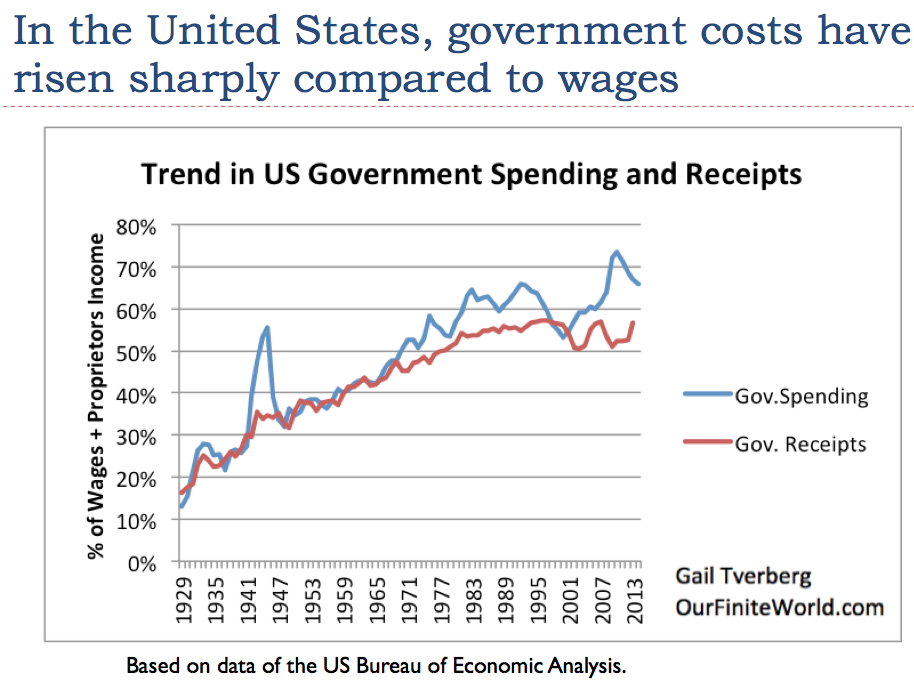
This is a reason why countries consider letting in immigrants, if their own population is not growing fast enough. They need young people to pay the way of the elders. There is no possible way to save up in advance.
Government can always pay its pensions, etc. It is not constrained, today nor into the future.
It’s a false argument to go with the current nostrum., that it will cost too much to afford. It won’t.
In fact it will be the saviour of the mass unemployment that will result from a crash, at least until banking goes down the gurgler, which might take a few years.
Read my last comment. All governments can buy is the goods and services that are available in the marketplace. If international trade crashes, or there is a big problem with the financial system, this amount may be very small. Whatever governments buy will not be available to others, including those who create those goods and services. If we are dealing with a very small amount in total, which is my expectation, then governments cannot get very much. You cannot print food or clothing.
“Actually our debt system is, and always has been a massive inter-generational Ponzi scheme”
Absolutely it is!!!!
The motto of every generation has been ‘apres moi, le deluge’
Or as the bankers are fond of saying when the do something that will make them a lot of money but which is likely to blow up the system — IBGYBG (I’ll be gone – you’ll be gone)
The global monetary system is based on debt which demands growth in order to pay the debt plus interest. This in itself is unsustainable as Fredrick Soddy proved in 1934. Indeed it is a Ponzi scheme and it is run by the privately owned banking system. The private issuing of money is the problem and the solution is public issuing of money. Private money is issued as debt for private gain whereas public money is issued as a public asset for public needs, debt free. We need a systems change to address the real problems caused by the debt money system. Every nation needs to reclaim their sovereign right to issue money, ban fractional reserve banking and issue debt free sovereign money. This mess will continue to worsen as long as we let expediency rule over sound economic policy. We are running out of oil, time to redesign beginning with the economic system meaning the money. We’ve been sold a lie that government should not be allowed to control the money when history proves otherwise, that it is the only way money should be done. We’ve known this since Aristotle and yet we continue to ignore this truth now at great peril.
“I care not what puppet is placed on the throne of England to rule the Empire, … The man that controls Britain’s money supply controls the British Empire. And I control the money supply.” Nathan Rothschild
“Once a nation parts with the control of its currency and credit, it matters not who makes the nation’s laws. … Until the control of the issue of currency and credit is restored to government and recognized as its most sacred responsibility, all talk of the sovereignty of parliament and of democracy is idle and futile.” — Mackenzie King, Canadian Prime Minister 1935-1948.
Our cost of borrowing is about as low as it can be. I don’t see that going to a government-owned system would be any better.
Our problem is greater than simply the interest issue. Our problem is that we need to keep borrowing more and more, in order to keep commodity prices up high enough so that the system can continue to operate. We can’t get away from that issue, regardless of the structure of the system.
Remember Sovereign governments never need to borrow [If they do it’s just going along with the banksters wishes] So they can buy anything they want or need. They do not pay interest, so that is not an issue. The only cost is the risk of inflation. Right now we are in deflation, so inflation would be desirable.
Sovereign governments can only buy what is available. What they buy is not available to the rest of the economy (except those with whom they choose to share it). If international trade becomes a problem, they can only by products that are made entirely locally, with local materials. This is likely less than 1% of todays goods and services.
“Our cost of borrowing is about as low as it can be. I don’t see that going to a government-owned system would be any better.”
Also, the level of distrust the people have in government right now may be a problem as well.
Another excellent article Gail. Thank you. I believe that the relationships between energy and economy will only be more widely appreciated during the post-mortem of the next financial crash.
If we view things in terms of the Laws of Thermodynamics, natural laws that have never been observed to have been broken in the history of our universe, then it becomes patently clear that the current system is entirely unsustainable. If money represents things of value, and things of value require effort & energy, then debt is simply the promise of future effort & energy. There’s a limit to what people can deliver in a lifetime and when supplemental forms of energy are dwindling or require more energy to access then it’s clear that the only way out of this hole would be to defy the First and Second Law of Thermodynamics.
Perhaps they could also promise effort and energy covering hundreds or thousands of years in the future. Since there is no timeframe associated with current promises, it is harder for people to see the ridiculousness of current promises.
Oh yes, there exists a timeframe “decarbonize until 2100” Im sure this will be started right tomorrow!
Oh we will de-carbonize all right. But, not in the way people think.
I would think that in a blog called “Our Finite World” we might begin to look at more radical alternatives to the reigning economic logic [sic], rather than merely debunking it. How about beginning with an alternative to the very first insight, which is that the goal of our economic systems should be endless growth, in a finite world? If we agree, with Gail, that this is not even theoretically tenable, how about pursuing a more radical program of alternatives to the tenets and goals of what passes for economic logic?
Gail is a great analyst – one of the best. But like all analysts, her strength lies in exploring & deconstructing available data, not in formulating new theories.
To that end, we need a real genius like Marx. He not only understood his current environment, but could describe what it represented along an arc of history, and then formulate logical extensions.
We have a good group of people here who could attempt to form a basic picture. I keep saying that BAU is not dead, but very much alive. But one first needs to understand by how I define BAU, and that is NOT traditional free market principles. Rather, it’s akin to a directed, command style wartime economy modeled on fascism.
In this context, debt is nothing but a useful accounting entry to offset printed “money”; it’s why Cheney said “deficits don’t matter”. Debt doesn’t represent a claim on future production, nor is it a representation of energy – these are traditional descriptors. Rather, debt is now simply a label to mask a mandate by the central state to order & organize economic activity (ie production, investment & consumption).
So, if we eliminate traditional concepts of the meaning of debt, money, etc, all we are really left with then is a state. The relative strength of the state then dictates outcomes. Since all states strive to ensure continuity of governance, we need to recognize this as their primary directive.
How activity is ordered and organized is the wild card. I keep saying we’ll have rationing, price controls, forced participation, restricted rights with respect to speech, assembly, travel, etc. I guess we can describe this kind of environment as an “economy” in that goods/services will still be produced, delivered and consumed.
But the real question is, once recognized as a new state of being, how does one then position themselves to
survive or prosper? Never forget the fact that we have a tremendous advantage over others – along with the PTB – of knowing exactly what is occurring and perhaps getting a jump on the first moves.
B9K9, I like your idea of sketching out the future path.
On debt, it is now just legal force to make the holder pay the interest. The interest is the only thing anyone now cares about. Principle is dead, irrelevant, unnecessary, just type in the needed numbers at the fed.
Yes and No. While money within the government ‘s books is just keystrokes, computer entries etc. [It explains why taxes are not used to pay for anything once they have their hands on your contribution] it does become money in the private, non federal government sector [local and state governments are in the private sector]. Debts therefore require real assets to repay them although, as you said, the principal is an ex-nihilo sum.
We have been snowed by banks getting away with the idea of debt obligations. We are morally bound to repay our debts, it is said. Yet they get the “money” they lend to us from thin air. And we have to use real earnings and sales to meet repayments. That is not a moral equivalent and it is starting to be assailed now. People are discussing debt jubilee options. This option will be exercised.
Debt default, almost certainly. I doubt anyone will be calling it a “jubilee,” as there will certainly be dire consequences.
Kinda like the collapse of Lehman Bros (which was basically a micro debt jubilee) …. except exponentially bigger … as in a drop of water vs the Pacific + Atlantic oceans bigger…
I am a septic (tank) when it comes to using a debt jubilee to keep BAU going …. but heh — if it were to buy us even a few days ….
I can see it now — Lagarde announces the jubilee — just as BAU is approaching the end of the line — BAU slows the train slightly and says ‘WTF is this???’ — thinks about it — realizes it is a bunny rabbit on the tracks —- throws the throttle full open, flattens the rabbit — then promptly cracks up against a mountainside…….
A few days is better than no days….
I’m not so sure. Debtors will be well served and since that is most of us in the West, it will be a boon there. The banks need only write down all the ex-nihilo loans [since they don’t actually lose any real money there], and derivative trading and any other forms of betting will be outlawed.
Without the ex-nihilo loans, the equity of the banks becomes negative. The regulators would close them down. They cannot continue to service our bank accounts, quite a bit of which is made possible by those ex-nihilo loans.
If the regulators let them stay open, the regulators would require them to reduce the amount of outstanding balances of depositors–instead substitute worthless stock of their bank.
No, Sorry. The ex-nihilo loans will leave the actual bank capital in place. It will be a big haircut but, more importantly the public debt levels will crash. Steve Keen’s idea is to pay off the ex-nihilo loans by funds injected from the CB, and to those who don’t owe anything to get a cash credit. But I don’t believe the CB needs to do that. The banks will survive but only in the interest of the community and not just for themselves, which distorts the world’s finances.
Yes, we must get past the notion that the regulators and the banks are on opposite sides with regard to our ponzi economy. In any debt jubilee type event, the “regulators” would be in lock step with the banksters. It would be a coreographed event, but just window dressing in terms of enforcement.
B9K9,
I think you are on to something with the command war-time economy analogy. If the Pharaohs could command slaves to build useless pyramids – a monumental undertaking – ha ha — a focused military style govt could certainly force continued pumping of oil and ration it in accordance with the “national interest.” It can work, as long as a lot of people are just left out in the (literal) cold or kept at bay with bare subsistence largely carbohydrate food deliveries.
As for positioning one’s self for this new world, the choices appear to be (I) of the ruling class, (ii) an apparatchik to the ruling class, (iii) just taking your chances as part of the surplus labor destined for a slow or quick death, hoping to outrun the others who are trying to outrun the bear, (iv) other? Is it possible to lie low below the radar in a relatively secure way?
Why did relatively self-sufficient monasteries form in the decline of the Western Roman empire? It had more to do than religious fervor. Why did, eventually, even wealthy families grant lands and endowments to some monasteries? Part of the answer is that the monasteries were virtually the sole repository of literacy and of administrative skills, which the ruling class needed to help run things. Part of the reason is that even the elites needed a safe place to house their children who would not be heirs to their lands or fortunes. The monasteries’ religious nature in a religious age provided them with a safe haven, neutral, non-threatening status.
“a focused military style govt could certainly force continued pumping of oil and ration it in accordance with the “national interest.”
Let’s look at this more closely – how would you go about ‘commanding’ people to extract and refine oil?
What is required to extract and refine oil?
Could you do with a shovel and a hand pump?
Of course not.
You need complex machinery — you need computers — you need electricity — you need oil — you need universities to train engineers — you need tools — you need vehicles — you need a way to transport the oil to where it is needed… and on and on and on…..
In short you need a sophisticated manufacturing industry — a supply chain — you need BAU….
Putting a gun to the head of an engineer and saying ‘make this thing work’ would be like locking the 100 greatest scientists in an empty room and saying ‘I will be back in an hour — I expect you to have made me a baloney sandwich and a glass of milk’
It is just plain nonsense to believe we will be able to run one of these post collapse.
http://uhuruspirit.org/images/oil-refinery.jpg
I think part of the problem is normalcy bias. We are so accustomed to growth and expansion we have lost sight of where we came from and the foundation we started with and built upon. Everything we do today we do in the constructs of an artificially created ecosystem. Principles of debt and money work in our artificial ecosystem. But, when taken out of that artificial environment, money and debt really don’t mean anything. $100.00 bills blowing in the wind is just trash. A high rise building is an eyesore. A rail-road track is a tripping hazard.
And rampant capitalism has given lie to the idea of a “command economy” occurring ever again. IMO people will quite willingly starve before participating in such a thing in any great numbers, assuming the government or whatever power remained standing could get their shit together enough to actually attempt to “command” anything in the first place. The sad fact is, as the money economy goes bankrupt and begins to dry up, the people paying allegiance to it will all begin to go their separate ways politically, economically, and every other way. And then the real fun begins, especially here in the US, as it not so gradually becomes apparent to everyone that we were always, first and foremost, a monetary union of widely disparate cultures and beliefs based on convenience and historical circumstance, rather than a truly unified culture of like-minded people of common purpose. Our many mostly twentieth century Hollywood inspired displays of faux “Patriotism” not withstanding.
“The sad fact is, as the money economy goes bankrupt and begins to dry up, the people paying allegiance to it will all begin to go their separate ways politically, economically, and every other way”
++++++++++++++
And as for the ‘melting pot’ that is America — that will quickly turn into a cauldron of hate and murder….
This is already happening in Eastern Europe … imagine if the police and military were not there to control the situation (they won’t be – at some point)
As thousands of refugees pour into Europe to escape the horrors of war, with many dying along the way, a different sort of tragedy has played out in many of the European Union’s newest member states. The states known collectively as “Eastern Europe,” including my native Poland, have revealed themselves to be intolerant, illiberal, xenophobic, and incapable of remembering the spirit of solidarity that carried them to freedom a quarter-century ago.
Read more at https://www.project-syndicate.org/commentary/eastern-europe-refugee-crisis-xenophobia-by-jan-gross-2015-09#HkzwlAmUkGD50c3g.99
Totally agree — most people’s normalcy bias means that a bad day is when the pizza delivery boy doesn’t have change for a 20….
My normalcy bias is based on spending time in Jakarta during the 97 Asian crisis — no cars on the road — beggers on every corner — the smell of utter desperation in the air…. that provided a whiff of what the beginning of collapse looks like…
Also a visit to post quake Haiti — Cairo during the mayhem a couple of years ago — Bahrain riots — slums of Manila, Cambodia, Mumbai, etc… resulted in a new and improved normalcy bias…
One brings a different perspective when one views things first-hand vs on the tee vee….
Excellent response and analysis Fast Eddy!
“You need complex machinery — you need computers — you need electricity — you need oil — you need universities to train engineers — you need tools — you need vehicles — you need a way to transport the oil to where it is needed… and on and on and on…..”
Making straight run gasoline and diesel is -easy- and you don’t need any sophisticated equipment. But a solar panels would help if you needed to pump oil.
So would spare parts for the pumping equipment, plus all of the high-tech equipment we need to get our oil out now. The easy to extract stuff is pretty much gone.
My point was making straight run gas and diesel, is not a complex process.
Ya it looks pretty simple…
http://scciclient.blob.core.windows.net/phxequipcom/multimedia/images/plant/original/refinery-low-sulfur-gasoline-408.jpg
It still requires the operation of our current economy, something that is not easy to accomplish.
This is exactly the problem that people generally do not see or understand. Everything we have (and are able to do today) is built upon layer upon layer of infrastructure (and assumptions) from the past up to now. You cannot just take one part of the system out and treat it as independent from the rest. Just like you cannot rip the foundation out from under a house.
“You cannot just take one part of the system out and treat it as independent from the rest. Just like you cannot rip the foundation out from under a house. ”
To rip the foundation out of the house, you just jack up the house, and rip it out, build a new foundation, and set it back down. Boom done!
You can take a part of the system and replace it with something better, or remove components of the system or add new ones. With alternatives we challenged the assumption that it couldn’t be made price competitive with FFs. FFs seem to be losing on a cost basis.
I don’t know what country you are from, but it happens quite a bit in the states.
I have never seen a house propped up, and a new foundation built underneath it. As often as not, there is something fundamentally wrong underneath, like a sinkhole underneath causing a major problem. We now have the equivalent of a 100 story tower economy, built upon a sinkhole. There is no way that we can prop up the economy, and substitute something else. The economy is too big, and the problem is much too severe.
Also, renewable energy solves only a very tiny portion of our energy problems. It may (or may not) help with pollution problems. But it really does not help with our other major problems, including (1) energy now costs too much, and (2) building an economy that can use the energy products requires too much debt (in part, because the energy products themselves require a lot of debt). Renewable energy doesn’t really solve these problems. Some of it badly adds to the cost and debt problems. It is not available in anywhere nearly enough quantity, and it also doesn’t operate in the vehicles that we have on the road today, so it doesn’t fix our problem.
The renewables story is one that has been given to the people of the world, to avoid having to face the predicament we are in. It is a “you can have your cake and eat it” story. We can continue to pull out huge amounts of coal and extract very polluting minerals, so as to make solar PV and wind turbines story. Unfortunately, it is simply not true.
“I have never seen a house propped up, and a new foundation built underneath it. ”
It is what they do. Or you can just move the whole house. Most of the time, you can get away with just jacking it up and tearing out the bad section of the foundation.
“energy now costs too much,”
What you are saying is the current system costs too much and it is not working. The next logical step is to find something new that can potentially deliver energy at a lower price.
“building an economy that can use the energy products requires too much debt”
That is true of any energy source.
The HUGE different with solar, is the barrier to entry cost is far lower then a 5B dollar coal facility. You don’t have to replace it all at once. You can replace chunks at a time depending on financing.
Also, coal is more expensive then Solar for new facilities, and you already know this. The modeled cost for solar in q2 2015 is 1490/kw. or 1800/kw if you use a single axis tracker.. which stacks up quite favorably against coal, and is pushing into NG range.
http://www.seia.org/research-resources/solar-market-insight-report-2015-q2
Instead of posting the EIA link for building a coal facility, this is an independent study from 2008, that says 3500/kw for coal. Just for building the facility. ..
“As recently as 2005, companies were saying that proposed coal-fired power plants would cost as little as $1,500/kW to $1,800/kW. However, the estimated construction costs of new coal plants have risen significantly since then. ”
In otherwords if the 2005 projections were correct, which they aren’t even prior to Obama. The cost of solar is competitive with those prices for installed cost with solar you don’t need to also buy coal.
No matter how much you want it, you won’t see anyone install a new coal facility in the US. It isn’t cost effective, therefore a bad investment.
A major part of the coal problem is the requirements being placed on the facilities today. If we were to look at facilities built 50 years ago, I expect that the cost levels would be a lot lower–and not just because of the change in what money buys.
“A major part of the coal problem is the requirements being placed on the facilities today. If we were to look at facilities built 50 years ago, I expect that the cost levels would be a lot lower–and not just because of the change in what money buys.”
First, emissions crackdowns started right about 50 years ago in the US so you are right on the cusp of how old this argument is.
The reason was the Mercury pollution, that cost billions of dollars to try and clean up. Along with the sulfur emissions, along with the NOx emissions. Then you have the ash disposal problem, which is probably going to cost billions more dollars. That doesn’t even get into the groundwater and other issues caused by mining, and billions more on researching the subject. Not to mention, the coal plants 50 years ago, aren’t even as efficient as the newer ones which no one wants to build. I won’t even get into how much freshwater they consume. It probably costs us trillions of dollars, if you start adding in health effects, probably trillions more.
You are an actuary, when do you make the recommendation to cut the more costly technology?
I agree–the old coal plants weren’t (and still aren’t) good for health, but they were quite a bit less expensive than what we have today. It is a diminishing returns problem. We don’t have good solutions that are also affordable. We mostly have shipped our manufacturing problem overseas, where someone else can deal with the pollution (or the cost).
“We don’t have good solutions that are also affordable.”
I don’t think we have a -complete- affordable solution yet. Wind and solar can play a part of a complete solution, but they are just pieces, and there will need to be other pieces to get to 100% renewable energy. We aren’t approaching grid saturation with these technologies in most places, and there are still a number of things we can do to increase the market penetration.when we start approaching the saturation limit.
I think over the long term renewable energy ends up winning the cost battle. A lot depends on the integration, and new technologies as well as the ability to scale manufacturing for those technologies. I am talking 30 years, nothing about this is an instant fix or a bandaid as we are so used to seeing from public policies.
“We mostly have shipped our manufacturing problem overseas, where someone else can deal with the pollution (or the cost
In part yes. The labor costs and inclusive parts like health insurance and retirements also figure heavily into those numbers. More to the point is there are a number of things we can do to take chunks out of the cost of manufacturing in the US without completely giving up on pollution. Keeping energy prices low and available is important too.
It’s the same dynamic at play with people who think solar panels are green energy ….. as if they sprout from solar panel trees….. they fail to acknowledge that solar panels are made by burning filthy brown coal….
Even when you point that out to such people they still believe solar is green…
http://www.chinacoalintl.com/upfiles/news/image/20140306/20140306143147_2375.jpg
They would have been green if we invested in them much sooner to allow for a way to create them in a sustainable manner.
Well… solar panels have been around for decades…. and hundreds of billions of dollars (if not trillions) have gone into R&D and subsidies…
And yet we are still left with using one of the cheapest sources of energy – coal – to make one of the more expensive forms of energy — solar…
Some things just cannot be done — no matter how much investment you throw at them….
Even if we had invested in them much sooner, we could not have created them in a sustainable manner. We have been sold a fairy tale; that is the problem.
” they fail to acknowledge that solar panels are made by burning filthy brown coal…. ”
They don’t -have- to be made from coal. The majority of the energy used is in the silicon refining process. That can be done with an electric arc furnace, and the addition of a carbon source like charcoal.
So yes, you are correct it is most likely done with coal right now, but you are incorrect that it will always have to be that way since it doesn’t have to be that way right now.
If you start using expensive energy on the front end, it very much raises the necessary price of what you are building.
I would like to see a plan for operating an electric arc furnace with solar panels (if there is any chance it can be done). How many are needed? What kind of battery backup do you use for this arrangement? How much would it cost to make a solar panel with this kind of set up?
“If you start using expensive energy on the front end, it very much raises the necessary price of what you are building. ”
You are correct. But I wouldn’t go as far as suggesting solar is more expensive. Solar + storage is more expensive at this point in time. Even then, whether it overall is a more expensive option depends on a lot of factors.
“I would like to see a plan for operating an electric arc furnace with solar panels (if there is any chance it can be done). ”
It -can- be done.
It would look like utility scale solar plus utility sized (most likely) flow batteries.
I will give you, that storage is expensive right now, but I also realize the prices will decline as production ramps up. Solar will also continue to decline in price.
In China solar is probably dirt cheap. They have the lowest cost panels, lowest cost of labor, and higher electric costs. And far fewer local regulations then we see in the US.
Solar is heavily subsidized in China. In fact, China is having trouble paying promised subsidies. If China ramps up taxes on other electric bills, it will cause further economic contraction in China. The myth doesn’t work in China any better than it works anywhere else.
“Solar is heavily subsidized in China. ”
True. Everything is. It is really hard to figure out what is actually going on because they aren’t a free market economy. I don’t like investing there because of that specific reason.
“China is having trouble paying promised subsidies. ”
True, but according to the article it is only like 30B(4.7B USD) -40B yuan behind. 100B USD I would be far more concerned. It is like 1/6th of one months trade surplus from the US.
“The myth doesn’t work in China any better than it works anywhere else.”
I don’t think it is a myth. But it does depend on circumstances at this point. Germany, Denmark, Australia, Japan, etc who all pay far more in electric have an easier time getting the numbers to work.
I am guessing you are in the southern US. Which has the lowest utility rates in the country and there are quite a few law barriers that have been erected in the path. . Even in NY and Cali, you can make it work far easier because of the higher rates, and fewer barriers due to local laws.
Perhaps high electric rates make high-priced alternatives seem more affordable, but the whole system of high prices for electricity works very poorly. Europe and Japan are not doing all that well economically, and high energy prices are part of the problem. If the world economy did not need to grow in order to prevent debt collapse, the lack of growth that tends to occur with high electricity prices would not be a problem. Part of the problem is reduced competitiveness with areas with lower electricity rates.
“Perhaps high electric rates make high-priced alternatives seem more affordable, but the whole system of high prices for electricity works very poorly.”
I agree. I just don’t agree that alternatives actually cost more since they produce electric at competitive prices. . In fact I don’t even think that is what you are saying. I think you are saying that the cost of management for electric becomes more expensive thus it raises prices. This is a grid management problem, not a cost of renewable energy problem.
In otherwords, the grid management company is blaming renewable energy for their own inefficiencies and mismanagement of grid resources. They then use renewable energy as an excuse to raise their prices.
This scenario happens a lot in business, not just energy. A competitor comes out with a popular competing product. The established business tries to discredit the new technology. Then it tries to out market it, and it tries to lower its prices to compete. It keeps floundering around, until it switches technology or it dies.
Kodak was totally vertically integrated from chemicals to paper, etc. They actually were actually involved in some of the early digital photography, and dropped it, in favor of their existing business model, because they couldn’t make as much money with it. They went bankrupt.
It is not fair to compare intermittent electric to dispatchable electricity. Intermittent electricity needs a support system to go with it, or it cannot work, including fossil fuels or hydroelectric that can be ramped up and down in response, and often more transmission support, because it comes from more distant locations. Intermittent electricity, in many applications, really replaces fuel, rather than electricity, because the rest of the system needs to stay in place. (There are some exceptions to this–if there is a major shortage of water, for example, of if the solar panels can allow less annual peak capacity to be built.)
In most applications, what we need now is really cheap electricity–probably comparable to what we are getting from natural gas, at today’s low natural gas prices, and from coal using fully depreciated plants. Otherwise the economy doesn’t work well–it needs too much debt to make the whole system work. When we add all of the costs together, the intermittent energy becomes too expensive. The economy does not adapt well to expensive energy, whatever its form.
So we need another energy source — a cheaper and cleaner — to make solar panels.
Do you realize the utter stupidity of what you are saying?
A War time command economy is definitely the only way to stop instant chaos. The government will have to control the supplies of essentials and ration them. It has to have a ready plan to do something within 3 hours of the alarm sounding. It only takes 3 hours to empty the shops. If the electric grid can be kept operating banking can still function and the central banks can deposit unencumbered funds to all those who will suddenly be unemployed and needing money to buy food, or ration coupons. All this requires a plan to be “shovel ready” as they say.
As Nate Hagens says, humans have never had to understand long term threats. They have adapted as the problem surfaces, short term events, immediate threats only.
Not a good omen for our survival.
At best, a command economy could fill the gap for a few days or weeks if the overarching economy could still be reconstructed. Absent that, it would be little more than a band aid on a missing limb. Even at that, it would be a stop-gap measure of limited value for a limited time.
But while we’re at it, we’ve been living with the modern-day equivalent of a “command economy” (albeit one where all the benefits went solely to the investor/bankster class) since 2008, albeit limited to the financial sphere, which is the only sphere TBTB have any actual “command” over these days. It’s quite amazing and admirable in a way that they’ve been able to pull off their subterfuge so well for this long, but no one but the most delusional Wall St idiot believes for a second that any of it is in anyway sustainable for much longer.
Yes, it’s not a long term solution. The aim can only be to avoid instant chaos and all the destruction that will accompanying it. It should be possible to string it along for some years
while our services and food production can survive. It’s certainly no sure bet!
It’s only going to work if the cards fall correctly. First the Government has to have a plan. [ It is conceivable, if unlikely some secret arrangement is under consideration right now – and no one outside would know]. Then the “Shovel ready” set up needs to be operative; then the collapse is slow enough to get the system up before the power goes out- so that it doesn’t and the government spokesperson says money will be in everyones account by such and such a date, and that coupons will be distributed for essentials [to arrest hoarding] etc etc. They have to take over the food production and distribution, and keep the police and medical services and maintenance crews in service etc. All pretty complex. You never know , we might just stave off chaos and set up a new system which works with deflation and resource decline. Or, it might just be a pipe dream descending into squabbling and chaos. If we don’t plan there will be no softer option to look forward to, just death and destruction.
“You never know , we might just stave off chaos and set up a new system which works with deflation and resource decline. ”
I don’t think it’s either/or. I think many places, esp smaller towns and rural communities, could pull it off. They aren’t as dependent on the government and have the capacity to grow food with human and animal labor. And they are more culturally unified. The larger and more complex (NYC, LA), much less likely.
“The government will have to control the supplies of essentials and ration them. It has to have a ready plan to do something within 3 hours of the alarm sounding. It only takes 3 hours to empty the shops. If the electric grid can be kept operating banking can still function and the central banks can deposit unencumbered funds to all those who will suddenly be unemployed and needing money to buy food, or ration coupons.”
But John…. the central banks are doing absolutely everything and anything to prevent the collapse from starting …. because they know that once it does there will be nothing they can do to stop it… because they will have done every single thing they could think of trying to stop it…
You are underestimating the situation that is imminent — when the lights go off — they go off for good — when the grocery stores are empty — they empty for good…
There will be no ration coupons …. there will be no food to ration
There will be death and suffering on a scale that has never been witnessed in the history of the world (although the dinosaurs might dispute this…)
Yes, The PTB will delay as long as possible. The CB’s respond to Treasury which answers to Government, so they do have to take charge. The very worst you can imagine will definitely happen if nothing is done. Nature will see to that!
It all depends on some forward planning, but as I just said above it is not a long term answer, and there will never be BAU as we know it.
As humans our record of forward planning is only to be seen when some nation or tribe invades. Otherwise it’s non existent. On balance your scenario is more likely, but only because we do nothing.
Part of the reason for pyramids and monasteries was (1) to put people to work, when there was no agricultural work to be done, and (2) to provide a place for the excess children, who could not take over the family farm.
They both filled a need. Wars hire a lot of otherwise unemployed young people.
Tagio
Yes, my family more or less ‘owned’ -as patrons – a beautiful small Cistercian monastery in the Pyrenees, enjoying the position of abbots and so on for several centuries -a nice place to lodge excess sons!
All the comforts, and a good deal for the boys as otherwise they had to serve as soldiers on the violent frontier with Spain, which was a short life-expectancy job role.
The monastic system was captured very quickly by the upper classes, and got lots of grants from them: but then, they had a lot of sins to atone for, all that killing………
Many monasteries had to employ their own soldier monks in the very bad centuries of anarchy after Charlemagne. They were often attacked and looted even by so-called Christians.
Anyone going to Catalonia in Spain before the End of the World, make sure to see Poblet, a perfect royal monastery-palace-fortress. Good wine, and nice walks in the hills, too. The monks got the land free in return for bringing it into agriculture. Beautiful place, Old Europe at its best.
Nice…
http://www.larutadelcister.info/en/sites/default/files/Fitxers/imagecache/gran/poblet_0.jpg
I’ve wondered about some of that. If we need finite resources to keep a system going, then one solution might be to ration them. If we need banks and computers, and a selected amount of large-scale food production they need to support banks and computers and food. That’s like building a higher bridge at certain key points.
But then there is an even more widespread need to lower the water in other places. So more people have to grow food, make clothing, heal themselves, and so on. And while some advocate for ruthless military coercion to enforce this order, that military force would be short on energy needed to do so. So the more voluntary the compliance with the new order, the more resilient it would be. Just trying to follow the thought…
And another important place for the higher bridge would be surrounding nuclear facilities…
If we can make some version of this work for a decade or two, we’d be doing well. I don’t see how anyone can plan far beyond that.
How do you ration computers?
You still need the full force of BAU to manufacture and service them – and to provide electricity to power them.
BAU either exists in its entirety — or not at all.
There are no half measures.
The “system” already rations goods available through lack of good-paying jobs. It works like magic. That is how we can have a lack of demand being the “cause” of peak oil.
Where does the food come from for this new state?
That is a dam good question. Unless the PTB have massive stockpiles and a plan to restart food production using slaves (probably illegal aliens or refugees enticed by the promise of food) and turning off the grid to the rest of the country and letting everyone else starve and die. Who knows.
With fall harvest about complete the US should have about 15 billion bu of grain stockpiled. Thats about 1000 Kg per person. Much of that would have been fed to livestock but but if we eat the 32 million cows and 62 million pigs first then we have enough food for over two years without growing any more.
Processing and transportation might be a problem but the food will be out there.
“Processing and transportation might be a problem”
Those activities require oil and electricity…. which will not be available — so most definitely a problem…
I might add that cooking would also be necessary… green trees do not burn … plenty of plastic to fuel cooking fires I suppose — bits and pieces of furniture… car tires…
http://www.thefoothillsfocus.com/site%20images/TireFire051612_Banner.jpg
It’s beginning to look a lot like Mad Max…. everywhere you go….
On the surface this seems plausible. But, the logistics of feeding and moving the cattle around (unless it is already centralized in some way) seems to be problematic. The grain needs ventilation to keep from spoiling. One needs some way to slaughter and refrigerate the meat. Then it has to be cooked. And that is just what I can think of. I am sure there are many unforeseen problems as well.
But the real question is, once recognized as a new state of being, how does one then position themselves to
survive or prosper?
Survive maybe. Prosper, no.
++++
Yes this is about survival. And for those at the top it is about trying to have the most comfortable survival possible at the expense of everyone else.
How about beginning with an alternative to the very first insight, which is that the goal of our economic systems should be endless growth, in a finite world? If we agree, with Gail, that this is not even theoretically tenable, how about pursuing a more radical program of alternatives to the tenets and goals of what passes for economic logic?
Honestly? And this is IMO only. Because there simply is no alternative where a remotely palatable number of 7B+ humans come out alive and even remotely happy following the mass die-off that is about to occur due to our extreme foolishness over the course of the last 150~200 years or so. Anyway you cut it, getting to 500M or possibly MUCH less over the course of a generation or two ain’t gonna be a piece of cake, but throw in the fact that we’re still stuck FIRMLY in the denial phase at that… But that’s just me.
+++++++++++++++++++
I’ve said it before, but probably worth repeating.
New Zealand had a PEAK population of less than 150,000 Maori before Europeans arrived 200 years ago. They were an advanced stone age, mixed hunter gather and low grade agriculture society.
New Zealand now has a population of approx. 4.5 million, in other words, 30 x the pre-Eurpean peak.
Post crash, you would expect to drop to below the previous long term carrying capacity – let’s say approx. one third of the previous peak say 45,000 to keep the numbers easy.
So, even though New Zealand is a relatively sparsely populated (by modern world standards) country – we can legitimately and reasonably expect a population drop to 1%, yes ONE PER CENT of the population of its present levels.
It seems reasonable to me that the world’s population by the end of this century to be less than 1% of the present 7.3 bn – let’s say 50 million – or less.
How we get there keeps me awake at nights.
NZ population was 1M in 1900 and about 2M around WW2….
https://upload.wikimedia.org/wikipedia/en/6/64/New_Zealand_population_graph,_past_and_projected.gif
I am not sure at which point industrial farming really kicked in (supporting larger populations) but I suspect the country could support more than the 150k referenced.
There are only 1M on the south island — so a better bet than the North….
That said — a lot of people will die….
Again, I generally agree with you – I would rather be in NZ than just about anywhere else – though I vary in some finer detail:
1. in population crash situations, the populations always go below carrying capacity before recovery. Thus my horribly rough suggestion of around 40,000 – 50,000.
2. long term, i believe that NZ could probably support 3 – 500,000 with smart simple agriculture etc etc – but that would probably be 200 years or more into the future.
3. I too find the South Island on population density numbers alone more appealing, especially as the initial threat to survival of me and mine is other people.
However, longer term, the greater propensity for earthquakes in the South Island (and the south of the North Island) gives me cause to pause.
Also, the winters are definitively colder in the South Island vs the North, implying a greater need for heating etc etc.
I am trying to take the approach of using the present resource availability to set something up with long term viability, therefore northern North Island is where i’m headed at the moment. Specifically; on or near one of the large harbours, which will.make water-borne trade between the surviving little communities easier.
4. Good luck to us all!
I agree, a very ugly mass die off (and very quickly IMO) is in the cards.
Our problem is very basic–humans at this point are biologically adapted to needing some cooked food. Also, to live in as wide an area as we live, we also need a lot of other things, including homes and clothing, and heat for homes. Because of our use of supplemental energy, we have been able to defeat natural selection, so human population continues to rise, and we continue to kill of more of the other species. We don’t really have a good way of getting away from this pattern.
We have also vastly overshot the amount of energy that renewable resources can provide. We also have already pulled out most of the easy to extract metals.
This doesn’t leave us with a lot of options. We can:
1. Continue to grow for a little while longer and then collapse, back to tiny population.
2. Collapse back to a tiny population now, instead of growing a little longer.
I am not sure that (2) gives any benefits at all over (1). Most of us just end up dead sooner.
Alternatives don’t get us anywhere at all. The only alternatives we really have are trees and other simple alternatives we can use without having a whole fossil fuel system in place. For example, small wind-powered boats would work. We can’t even make modern contraceptives without fossil fuels.
The amount of fish, seabirds, whales etc. has been reduced with 49% since 1970: http://ocean.panda.org/media/Living_Blue_Planet_Report_2015_Final_LR.pdf
Gail, less damaged to the planet and better chance for the survivors with crash now.
Spent fuel ponds…..
https://socioecohistory.files.wordpress.com/2013/08/lit-fuse-bomb.jpg
I think there are a lot of ticking time bombs out there in addition to nuclear problems. Humans have knocked Mother Nature to her knees and then bent her over backwards to give in to our whims. It took massive amounts of energy to beat back Mother Nature and get our way. When the energy runs out she will bounce back and there will be hell to pay. Disease, pestilence, plague, floods, drought, starvation. Imagine a typical American even trying to catch and kill something as mundane as a deer with their bare hands. Karma is a bitch.
“Imagine a typical American even trying to catch and kill something as mundane as a deer with their bare hands.”
We have lots of guns.
The bullet supply runs out quickly, and we do not have a way to make new bullets, even with solar panels. So then we very quickly get to a problem of needing to catch deer, without guns.
I suspect there are more than enough bullets in circulation in the US to kill every large animal in the country (as well as those in Canada too)… starving people will definitely be doing a lot of killing… and they will be ignoring the hunting quotas….
Definitely!
I don’t get why my comments aren’t posting.
Only “Fast Eddy” has that privilege of unlimited comment posts without “moderation”,LOL
I have Diplomatic Immunity….
No, I think you are the nephew of Gail’s back sheep of the family and she just wants peace in the family circle, LOL! This is just too funny, Eddie.
You don’t know how many of “Fast Eddy’s” comments have disappeared through moderation. There have been quite a few.
My immunity has apparently been revoked …
Time to change you avatar. Let me help you…
Scott Nearing Lives!
How about this….
Enough already!
Sometimes wordpress places them randomly. Check the RSS Comments in the upper right if it is recent.
Sometimes comments get caught in the automatic spam filter. I have to read them and let them out, before they will post.
Energy is money.
Which makes you winder why long shots like this don’t get funded: http://protonboron.com/portal/
Yes the odds are 10 to 1 against. But if we hit that 1 it is energy for the next 10,000 years. Not to mention Mars in two weeks. We can mine asteroids. A gold asteroid would do wonders for the Austrian school. Cheap gold. Then we get a true accounting. Iron is money. Copper is money. Tin is money. Wheat is money. Hemp is money (and in the early colonial days of America you could use it to pay taxes). Pure water is money.
And the best part? We get a yes/no in about 5 years for $1/2 a billion. Chump change.
We prefer to continue to waste hundreds of billions of dollars on solar energy…. because the Green Brigade demands that we keep pounding our heads against a brick wall rather than trying another direction….
What direction do you suggest Eddy?
The PTB have known for years that this day was coming…
And without a doubt they have been searching high and low for a solution — they’d have the brightest researchers tasked with figuring out what to do…. with unlimited budgets….
And they have obviously drawn a blank — their only response is to do absolutely anything to try to keep our fossil fueled system alive as long as possible …
If they haven’t been able to figure it out there is no way that any of us are going to be able to suggest a possible solution….
It’s kinda like trying to grow bananas in the snow — some things just cannot be done.
Any evidence for that? I’ve yet to see even a clue in that direction.
How about the hundreds of billions if not trillions wasted on Solar Jesus?
Hardly! Do you understand the question? You do go off on a tangent on occasion it seems.
Correct me if I am wrong but you asked for evidence of the PTB attempting to develop an alternative to oil….
And my answer was that the hundreds of billions if not trillions of subsidies and investments into solar energy (aka Solar Jesus) is an example of this.
Failed of course — but you can’t say the PTB have not tried to make that work…
Here’s another example:
Princeling Jiang Mianheng, son of former leader Jiang Zemin, is spearheading a project for China’s National Academy of Sciences with a start-up budget of $350m.
He has already recruited 140 PhD scientists, working full-time on thorium power at the Shanghai Institute of Nuclear and Applied Physics. He will have 750 staff by 2015.
http://www.telegraph.co.uk/finance/comment/ambroseevans_pritchard/9784044/China-blazes-trail-for-clean-nuclear-power-from-thorium.html
Nuclear power is another massively subsidized attempt at alternative energy …. trillions have gone into this technology… and governments have even agreed to foot the bill when one of these blows up….
If you insist on pressing me to make a suggestion —- there’s my sheep/solar panel breeding idea here in NZ — so far no go — I could use some funding …. how can I get the Green Groupies to lobby so I can set up my own version of Soyndra (and pay myself 5M per year with a private jet)
Of course there is also my other idea which involves shooting a titanium cable coated with teflon into the sun —- sucking energy back to earth — and powering massive boilers and producing enough electricity to melt Greenland’s ice cap…
Again — I need funding and lobbying — I’ve kinda burned my bridges with the Green Groupies… so difficult to get this off the ground.
Anyone have any other ideas? I can’t think of anything off the top of my head…. oil is kind of a unique thing…. difficult to replace it eh
No my question related to any plans the PTB might be formulating to manage or mitigate the collapse you and I and many others are saying will happen. As I said I had neve seen any evidence for a plan.
Neither have I….
Which is troubling…. it infers that the PTB expect a cataclysmic outcome … perhaps an extinction event…
I’ve have suggested a couple of things that they might have concluded:
1 – spent fuel ponds explode terminating all life
2 – 7.3B people – with virtually no food available — kill and eat everything bit of plant life and every animal on the planet — resulting in the termination of virtually all life (perhaps a few people hang on by the skin of their teeth in remote harsh places)
There could be something else they are seeing that leads them to conclude that resistance is futile. Who knows….
It’s not surprising I have seen nothing if you also haven’t seen anything. It would though be wise not to reveal such a plan. The reaction from the sheeple would be unpleasant to say the least and might actually trigger the collapse.
See if you can download https://en.wikipedia.org/wiki/Utopia_%28UK_TV_series%29
https://thepiratebay.vg/search/utopia/0/99/200
“Utopia” is also a satirical program on local and state governments shown on the ABC here in Oz.
Your second link didn’t open [bad gateway]
https://thepiratebay.la/ search Utopia – there are two seasons
“If they haven’t been able to figure it out there is no way that any of us are going to be able to suggest a possible solution….
“How about the hundreds of billions if not trillions wasted on Solar Jesus?”
Wait, so they came up with a solution, which might not be “the best” but it definitely can extend BAU since it is a multiplier on the input energy. But yet money spent on it, which now pays for itself, is money wasted? You are hilarious. We are like 5+ years ahead of any cost projections for solar, wind, storage.
I think you get the fact there are limited options, but I don’t think you quite get how long and how expensive it is to develop real solutions and make them cost effective. It is that diminishing returns thing Gail keeps talking about. But it took the Oil industry quite a bit of government money and a couple of decades to get rolling.
If you want to blame someone, blame Reagan/Bush, they gutted all the alternative technology funding to fund their banking scandal so they could get rich. We would be 15+ years ahead right now, had that not been done.
I notice you got away with insulting me over your reference to “drivel”. It didn’t appear for me to respond. I only saw it by accident. Rest assured If you ever insult me again you will know about it. You are a nuisance poster with little grasp of reality. I’m not the only one who says as much. This post here is yet another unhelpful useless piece.
“I notice you got away with insulting me over your reference to “drivel”.”
You still haven’t backed up your claim. You are just trying to bring me down to your level by accusing me of doing what you are doing (or in this case what you are unable to do). You are even baiting other users.
The fact you are unable to back up your statements, even with drivel, and merely resort to personal attacks is actually pathetic and an affirmation of my statement.
“The PTB have known for years that this day was coming…
And without a doubt they have been searching high and low for a solution — they’d have the brightest researchers tasked with figuring out what to do…. with unlimited budgets….”
Actually the 70s oil crisis was when everyone knew. Carter implemented a program to find alternatives. The Reagan/Bush killed it in favor of the FF companies. So in otherwords the US, while knowing this problem is looming, basically sat on their ass for 20 years, until we implemented a ethanol as a fuel additive (which started under Carter but was killed by the FF companies in favor of MTBE.).
Finally, Obama implemented a wholesale strategy, more akin to what Carter had. .
https://www.whitehouse.gov/energy/securing-american-energy
The better question is, what would we do with unlimited free energy if we found it? Breed another 7B, 14B, 28B, 56B… people to consume it? THE PROBLEM is ALWAYS, first and foremost, that humans bred on the wonders of exponential growth simply DO NOT GET THE CONCEPT OF LIMITS!!!
Energy is MUCH MORE than money. Energy is LIFE ITSELF and IT HAS LIMITS!!!
And by the way, NONE of those things you mentioned is money. Money is money, and money is an imaginary construct of stupid humans who’ve foolishly been led to beleive that they’re smart.
From time to time I bring this up with Green Groupies — imagine we had a free – clean energy source… unlimited…
Hurrah says the Groupie – that’s just what the doctor ordered!
Then I lay out the implications….
And this is how they usually respond:
https://media1.giphy.com/media/qfX4ktqBK13Ec/200_s.gif
Be careful what you wish for. If the USA keeps going in the direction it is going and had boundless energy sources to tap…we would all be living in a literal Matrix.
Energy is certainly essential to human life. That is a point many people miss.
And we do have a real population problem.
Money is a claim on energy that may or may not be there, when people go to claim it.
Here in the UK our refineries are quietly closing or seeking buyers:
http://www.telegraph.co.uk/finance/newsbysector/energy/oilandgas/11866733/Britain-faces-diesel-drought-following-refinery-closures.html
When the North Sea oil is decreasing in quantity, and more refineries are springing up in low labor cost countries like China and India, it is not surprising that Britain’s refineries are closing.
Why did Britain and other European countries favor diesel for automobiles in the first place? The problem when figuring out what kind of fuel automobiles use is dividing up a barrel of oil. Commercial uses tend to be mostly diesel. When Private passenger autos use diesel too, then there can quickly get to be a problem, because there is not a whole lot of diesel in a barrel of oil, especially light oil. A person might wonder if the diesel idea was thought up by someone looking at how far a liter of diesel could go, not how many liters of diesel there are in a barrel of oil.
“Why did Britain and other European countries favor diesel for automobiles in the first place?”
It was developed before the gas engine, and already had a hold of the market, before gasoline engines became popular. I don’t think it was until after WWII they even used gasoline in any major quantity in Europe. It wasn’t until the mid 50s Mercedes even built one.
Americans, didn’t really like the smell of diesel for their cars.
A number countries in Africa, you can’t get gas either.
Diesel is preferred over gasoline because of taxes. The effective tax for kilometer traveled is much less for diesel than for gasoline.
Pingback: Today’s News September 16, 2015 | Fiat Planet
Thanks you Gail for your efforts on this blog. I would like to make some insights considering a few of the concepts you talk about in your blog.
Starting with the concept of debt I would separate it into 2 categories, debt coming from savings ( I will call it loan) and debt coming from future productivity (credit). The first one is bound to existing goods or previous work, you can stockpile it but you can only spend what you own.
Credit in the other hand has no clear limits and whatever credit you use in the present will have to be paid in the future, therefore compromising your everyday income until you fully pay your debt.
As previously stated by another fellow on this blog, credit seems to be better used when it will increase productivity (investment for real assets not to directly create money) and the worst case when it is used for expenditure, due to the insidious nature of credit encouraging consumerism.
The strange thing about credit is that it transforms notes, plastic or a number in a screen into money with someone else’s work in the case of human labour, the planet resources which are there to be taken ready to give value to what was worthless money, and the energy required for free from the sun and the earth’s core.
I think Our problems started when we began overusing credit, it is a matter of intellect and human nature itself, I don’t think we were blind to, this I think we see it clearly and the greedy ones use it to their advantage. What we fail to see is the finite part of those resources and the availability of ready to use energy, it is hard to imagine how our everyday actions affect those parameters on a global scale but we are not unfamiliar to those limits, many ancient civilizations understood them and they knew the importance of things like the sun, the rain, the rivers etc. some fail to respect those limits and perished, many others seek to break them through expansion and war, few managed to survive for a long time, humanity managed to reborn by falling back into nature cycles and moving to different places accumulating knowledge in the process.
I think it was time for what we call the advanced economies to collapse in isolation since they repeated the same mistakes of our predecessors, but now everyone is tangled in this mess thanks to globalization, should it had been different less developed countries would have absorbed the collapsing ones opening our eyes to the imminent threat focusing on this predicament.
I would like to find information on how many persons can be sustained by an isolated ecosystem while leaving the others to regenerate. Ensure knowledge transfer to future generations. There is a question whether we can keep developing, enhancing and discovering new technologies in the most efficient manner to overcome limits and repeat the process or should we focus our minds on less materialistic endeavours?
It is hard to see how we can keep up the basic characteristics of our current economy as we go forward. We won’t have computers, or very many purified metal-mostly reused metals that we have today. Thus, keeping our technologies seems like a future effort.
I can see the difference between loans and credit.
Loans would seem to be on things like cars, or houses, or land, or a factory. The catch with loans is that value of the asset to which they are attached changes–it is not just the value that you originally paid for it; it is what the asset is worth today that matters. In general, the lower the interest rate, the higher the value seems to be. Also, the value depends on what the assets subject to the loan can be used for. If it becomes impossible to obtain spare parts because of international trade problems, the value of both cars and factories may go to zero (or scrap value). Similarly, houses depend on having working services, like electricity, water, and sewer, and jobs nearby. When these are no longer available, the value of the houses may be much lower. If the government giving ownership of the land collapses, then perhaps the owner no longer has title to the property.
All of these things are more tied together than a person might like.
In the absence of government registration of land titles and debt, land/house “title” will increasingly be based on occupancy.
It is hard to adequately summarise this and to comment adequately. It is what we both feared and expected, but at least there are some numbers now.
http://www.reuters.com/article/2015/09/15/us-oil-production-kemp-idUSKCN0RF2A720150915
“In a world where oil prices are expected to average just $50-$70 per barrel over the next few years, actual decline rates could easily reach 3 percent or even 4 percent per year. Under a range of plausible assumptions, decline rates could easily cut between 1.4 million and 3.6 million bpd from the output of existing fields in 2016 and again in 2017.”
Thanks! That is a good article. If the banks have problems, we could see decline rates higher than 3% or 4%.
I noticed that the article mentions Iraq, which is one of the countries that has been written about recently, as cutting back new investment.
It is hard to see that the outcome could be better than the article suggest. There is no way that oil prices are going to bounce up to, say $120 per barrel, and stay there, long enough that lenders would lend money based on the expectation that this new high price level would last.
Abenomics Explained (In 1 Chart & 4 Words)
“It Does Not Work”
http://www.zerohedge.com/sites/default/files/images/user3303/imageroot/2015/09/20150915_BOJ_0.jpg
Hmmmmm……
Moving the discussion to what we should actually do about all of this, a thought occurred to me.
It probably would behoove all of us to either move up the hierarchy or down the hierarchy. In other words, try to join the upper or lower class.
Think on it. The upper class are protected by their sheer amount of wealth and political and social connections. So when things fall apart, they can easily deflect blame, cash out on stock options, take on a consulting job even if they know nothing, etc. This comes to them because of their background and money. So, basically, don’t expect any help from the upper class, and in fact expect them to try to make their escape.
Now concerning the lower classes. Here we have to be careful about our analysis. Yes, obviously, things will continue to get worse for the lower classes. They will work and work for less money, jobs will go away, they will be surrounded by people losing themselves to drugs and alcohol, life will be risky indeed. But it is precisely because of this that the governments will step in to restore order, and part of this will indeed be endless payouts and welfare for the lower classes, even if in small amounts. They will, in short, be on the receiving end of transfer payments for a very long time, because their incomes will no longer support even basic items like rent. So if you make less money, you actually get something back in return.
Now onto the middle class, especially skilled middle class professionals. Yes, to a certain degree, many people aspire to this, and these jobs can produce good income and some degree of satisfaction no matter how small. But let’s be careful. You see, when TSHTF, when things really began to collapse, everybody will be looking for someone to blame. Surely somebody must be responsible for all of these failures? For the lower classes, many of them only have exposure to the middle class (their immediate supervisors) so they will shift the blame there. I have seen this in action myself. For the upper classes, blaming the middle classes will be easy. You engineers caused this! Why aren’t you doctors saving everyone! Why aren’t you farmers producing food! Etc. Etc.
So anyways, to summarize, I actually think being part of the responsible middle class might be a bad decision going forward. You will shoulder the blame when things begin to go wrong. In a collapse, you actually don’t want responsibility!
So I think part of the equation on how to prepare is how to shed responsibility. Get rid of it now, rather than taking the blame later.
“The upper class are protected by their sheer amount of wealth and political and social connections. So when things fall apart, they can easily deflect blame, cash out on stock options, take on a consulting job even if they know nothing, etc. ”
I suspect they will be more concerned about finding something to eat… because the end of BAU means the END OF BAU.
There won’t be stock markets… consulting jobs… electricity … oil …. food…. etc…
I am certainly not arguing that things will be perfect for them, I am merely arguing, who would you rather be.
I know for sure I don’t want to be the middle class slave who sucks it up, pushes the alarm clock, and dutifully trudges off to keep all of this together.
Do you? If you do, what are your arguments for this? If not, what do you suggest?
The thing is…
I do not believe there will be such a thing as a functioning alarm clock post collapse…. there will be no economy … no electricity … no jobs …. no need for an alarm clock…
No need to worry — this is likely an extinction event — so we’ll all be dead (and if any of us do make it through — we’ll call ourselves ‘the unlucky ones’)
We are all of us responsible for keeping “it” together. Whether we rise to that responsibility speaks to our individual capacity to maintain our human dignity in a crisis situation. I am often surprised to see how people respond to a traffic accident in a crowded intersection – the differing responses to fear of the physical and emotional specter of disaster. There are many cool heads, people with expereince and knowledge of what to do, how to calm themselves and others. Mirror, anybody?
After the civil war ended, many ex-slave masters were fed by their ex-slaves since that was the only way of life the ex-slaves knew about.
I am not sure there will be enough leisure time around to start blaming people. And I am not sure the rich can escape, beyond a few weeks. They cannot escape to where there is no food sources, or fresh water. Those places will be where everyone will want to be.
The real upper classes are accessed via bloodline only. No new members by other means are being accepted. The class just below them is barely accessible, but ultra competitive and bloodthirsty. You’d be better off and have better chances joining an honest to goodness criminal enterprise, which is far more honorable as well. I think a lot of people will eventually choose that second option. Any and every class below that is destined to be lower class soon enough, so I agree that that’s the place I’d rather be from the start. It’s by far the most honorable anyway – potentially at least – and it’s where my heart and soul have always been in any case. There will be a substantial criminal element there as well, which will simply be redefined as “doing what needs to be done to survive.” In the end, the law having been subverted by the rich and powerful to serve their interests for so long anyway, no one will much miss it when it’s gone.
The one place where I would disagree is with respect to transfer payments to the poor. They will likely be drastically reduced. Payments to the elderly, as well.
Oh definitely! But the wealthy and the young will find out the hard way there’s more than few nasty old curmudgeons out there who are more than willing and able to “make it real” the old fashioned way and take a few of them out with them when they go. Guns are a great equalizer in that regard. Might be the most genuinely fun part of the whole situation for many.
The Fed [any sovereign government ] can always pay the poor, not to mention free services of any kind. They have no constraint and highly likely in future no worries about even inflation.
The problem will be the electric grid, to run the banking world. If that fails, then all bets are off!
The Fed / any sovereign government can only confer boons that it actually possesses, which in the case of a thoroughly debased currency and/or bankrupt government won’t be much. And much is made of monetary sovereigns, but in a future world where there is either is no reserve currency (the petro-dollar, which is up for negotiation as we speak) or that currency is not the dollar, then as you say, all bets are truly off. Right now, that’s somehow still unthinkable for most people. I’d simply suggest that those days are likely soon over.
Sorry, quite wrong. The Fed possesses nothing. There is no money in the fed reserve. It is just a clearing house. There are myriad accounts held there but all the funds are privately owned, [not at all like in a commercial bank]. The Sovereign Government is a PAYG operation. And it can never go bankrupt in Dollars [or whatever is its currency]. The Reserve currency is just for trading between nations. Here the USA’s dollar is uniquely advantaged.
The chance of a hyperinflation event only can happen if the government itself fails in its operation to achieve Full faith and Credit because that is the ONLY backing any government relies on today.
This is exceedingly unlikely in the case of the USA. Not so for say Venezuela right now and eventually for Saudi Arabia and many other nations.
Someone’s not reading Gail’s articles thoroughly…..
Gail’s smart enough to say she doesn’t know.
John, paying the poor (or anyone else) depends on having physical goods and services available. These cannot be printed.
Not at all, Gail. The goods and services are always available in some measure. They will be spread more thinly if in short supply. This is anyway the future. But if there’s no money then only barter will be left. In the meantime government issued pensions will allow everyone to share what is available. If scarce the money may take the form of coupons, specifying what can be bought so that everyone can get a share. Nothing new about that. I remember coupons myself.
A few, not all of them.
Pingback: How Our Energy Problems Lead To A Debt Collapse Problem | QuestorSystems.com
Here’s a really bad sign of where we are economically around the globe. It seems CB’s in many countries have been unable to raise interest rates, and makes one wonder how the Fed raising rates will go.
http://www.wsj.com/articles/lesson-for-fed-higher-interest-rates-havent-been-sticking-1442167699
In the seven years since the world’s central banks responded to the financial crisis by slashing interest rates, more than a dozen banks in the advanced world have tried to raise them again. All have been forced to retreat.
That looms as a threat as Federal Reserve officials contemplate raising interest rates for the first time in nearly a decade at a policy meeting later this week.
Whether they move this week or later, Fed officials say they expect to move rates up gradually. Recent history suggests gradual in the Fed’s eyes might still not be gradual enough. The economy might not cooperate and rates could remain exceptionally low for a long time.
Central banks in the eurozone, Sweden, Israel, Canada, South Korea, Australia, Chile and beyond have tried to raise rates in recent years, only to reduce them again as their economies stumbled. . . .
Various factors are holding rates down now, many of them out of the control of central banks. Slowdowns in developing economies, particularly China, have weakened demand for commodities and pushed down prices. Banks in advanced economies have been slow to heal from the 2007-09 crisis, squeezing private-sector credit. Aging populations in advanced economies and low productivity growth have sapped the ability of economies to sustain the higher rates central banks sought. And governments focused on fiscal restraint have left it to central banks to provide stimulus.
Pingback: How Our Energy Problems Lead To A Debt Collapse Problem | Sandora RSS Feed Aggregator Portal