
Oil production can be confusing because there are various “pieces” that may or may not be included. In this analysis, I look at oil production of the United States broadly (including crude oil, natural gas plant liquids, and biofuels), because this is the way oil consumption is defined. I also provide some thoughts regarding the direction of future world oil prices.

Figure 1. US Liquid Fuels production by month based on EIA March 2016 Monthly Energy Review Reports.
US oil production clearly flattened out in 2015. If we look at changes relative to the same month, one-year prior, we see that as of December 2014, growth was very high, increasing by 18.0% relative to the prior year.

Figure 2. US Liquids Growth Over 12 Months Prior based on EIA’s March 2016 Monthly Energy Review.
By December 2015, growth over the prior year finally turned slightly negative, with production for the month down 0.2% relative to one year prior. It should be noted that in the above charts, amounts are on an “energy produced” or “British Thermal Units” (Btu) basis. Using this approach, ethanol and natural gas liquids get less credit than they would using a barrels-per-day approach. This reflects the fact that these products are less energy-dense.
Figure 3 shows the trend in month-by-month production.

Figure 3. US total liquids production since January 2013, based on EIA’s March 2016 Monthly Energy Review.
The high month for production was April 2015, and production has been down since then. The production of natural gas liquids and biofuels has tended to continue to rise, partially offsetting the fall in crude oil production. Production amounts for recent months include estimates, and actual amounts may differ from these estimates. As a result, updated EIA data may eventually show a somewhat different pattern.
Taking a longer view of US liquids production, this is what we see for the three categories separately:

Figure 4. US Liquid Fuel Production since 1949, based on EIA’s March 2016 Monthly Energy Review.
Growth in US liquid fuel production slowed in 2015. The increase in liquid fuels production in 2015 amounted to 1.96 quadrillion Btus (“quads”), or about 59% as much as the increase in production in 2014 of 3.34 quads. On a barrels-per-day (bpd) basis, this would equate to roughly a 1.0 million bpd increase in 2015, compared to a 1.68 million bpd increase in 2014.
The data in Figure 4 indicates that with all categories included, 2015 liquids exceeded the 1970 peak by 16%. Considering crude oil alone, 2015 production amounted to 98% of the 1970 peak.
Figure 5 shows an approximate breakdown of crude oil production since 1945 on a bpd basis. The big spike in production is from tight oil, which is another name for oil from shale.

Figure 5. Oil crude oil production separated into tight oil (from shale), oil from Alaska, and all other, based on EIA oil production data by state.
Here again, US crude oil production in 2015 appears to amount to 98% of the 1970 crude oil peak. Thus, on a crude oil basis alone, we have not yet hit the 1970 peak.
Prospects for an Oil Price Rise
Most recent analyses of oil prices have focused on the amount of mismatch between supply and demand, and the need to craft a temporary agreement to reduce oil production. The thing that is missing in this discussion is an analysis of buying power of consumers. Is the problem a temporary problem, or a permanent one?
In order for oil product demand to keep rising, the buying power of consumers needs to keep rising. In other words, some combination of consumer wages and debt levels of consumers needs to keep rising. (Rising debt is helpful because, with more debt, it is often possible to buy goods that would not otherwise be affordable.)
We know that in many countries, wages for lower-level workers have stagnated for a number of reasons, including competition with wages in lower-wage countries, computerization, and the use of automation (Figure 6). Thus, we know that low wages for a large share of consumers may be a problem.

Figure 6. Chart comparing US income gains by the top 10% to income gains by the bottom 90% by economist Emmanuel Saez. Based on an analysis IRS data, published in Forbes.
Figure 7 shows that world debt has been falling since June 30, 2014. This is precisely the time when world oil prices started falling.

Figure 7. Total non-financial world debt based on Bank for International Settlements data and average Brent oil price for the quarter, based on EIA data.
One reason for the fall in world debt, measured in US dollars, is the fact that the US dollar started rising relative to other currencies about this time. Oil is priced in dollars; if the US dollar rises relative to other currencies, it makes oil less affordable to those whose currencies have lower values. The big rise in the level of the dollar came when the US discontinued quantitative easing in 2014. World debt, as measured in US dollars, began to fall as the US dollar rose.

Figure 8. World Oil Supply (production including biofuels, natural gas liquids) and Brent monthly average spot prices, based on EIA data.
As long as the US dollar is high relative to other currencies, oil products remain less affordable, and demand tends to stay low.

Figure 9. Index of US dollar, relative to other currencies, compared to crude oil price.
Another issue that struck me in looking at world debt data is the way the growth in debt is distributed (Figure 10). Debt growth for households has been much lower than for businesses and governments.

Figure 10. World non-financial debt divided among debt of households, businesses, and governments, based on Bank for International Settlements data.
Since March 31, 2008, non-financial debt of households has been close to flat. In fact, between June 30, 2014 and September 30, 2015, it shrank by 6.3%. In contrast, non-financial debt of both businesses and governments has risen since March 31, 2008. Government debt has shrunk by 5.6% since June 30, 2014–almost as large a percentage drop as for household debt.
The issue that we need to be aware of is that consumers are the foundation of the economy. If their wages are not rising rapidly, and if their buying power (considering both debt and wages) is not rising by very much, they are not going to be buying very many new houses and cars–the big products that require oil consumption. Businesses may think that they can continue to grow without taking the consumer along, but very soon this growth proves to be a myth. Governments cannot grow without rising wages either, because the majority of their tax revenue comes from individuals, rather than corporations.
Today, there is a great deal of faith that oil prices will rise, if someone, somewhere, will reduce oil production. In fact, in order to bring oil demand back up to a level that commands a price over $100 per barrel, we need consumers who can afford to buy a growing quantity of goods made with oil products. To do this, we need to fix three related problems:
- Low wages of many consumers
- World debt that is no longer rising (especially for consumers)
- A high dollar relative to other currencies
These problems are likely to be difficult to fix, so we should expect low oil prices, more or less indefinitely. Lack of oil supply may bring a temporary spike in oil prices, but it cannot fix a permanent problem with consumer spending around the world.


World’s Worst Carry Trade Found in Brazil as 2016 Outlook Dims
http://www.bloomberg.com/news/articles/2015-12-30/world-s-worst-carry-trade-found-in-brazil-as-2016-outlook-dims
China’s devaluation is just the beginning of systemic risk
http://www.zerohedge.com/news/2016-01-20/chinas-devaluation-just-beginning-systemic-risk
The 9 trillion in dollar denominated debt held by the emerging markets has become a problem to service with crashed oil and commodity revenues after the collapse in oil and commodity prices after the Fed pulled the plug and ended the QE program.
For some reason, which I don’t know, only the Fed’s QE program lead to rising oil and commodity prices, while the ECB’s and BOJ’s QE’s haven’t had the same effect.
Abenomics and the ECB’s QE program and NIRP doesn’t seem to bring up the oil and commodity prices, they seem to have the opposite effect by strengthening the dollar, and since oil and commodities are traded in dollars, the strong dollar just depresses the oil and commodity prices.
“Faction A” of elitists just blinked, chief commissar Junckers apparently in shock of growing Brexit polls and immigration escapades just announced – accepted EU has over done it, that’s why people are rebelling against further (fast) integration..
“Faction B” of elitists gaining ground, Brexit seems now very likely, US team organizing “don’t leave” fear campaigns, central leftists very confused (extraordionare sheeps as always) see Guardian news media.. Latest leave campaign (real translation: lets front run the crash): https://www.youtube.com/watch?v=5NLc9i_O14Q
Tectonic plates are indeed moving, when vultures preposition themselves,
the blood is in the air, it’s getting closer each day/week..
Texas would not be allowed to secede and the UK wont be allowed either.
when the EU kicked off, it was to further to prosperity of trading nations, to mutual benefit. Was had always been fought over resources, so basing the EU on the trade of coal and iron seemed a good idea at the time.
But of course the status quo could not remain so, and no group has ever heard of the old adage: if it aint broke, don’t fix it.
So the fixing went on year after year, adding to the complexity and cost of the eu system, nation after nation joining and expecting equal pieces of pie, indulging in the fantasy that the pie itself was getting bigger every year, and that Greece was the economic equivalent of Germany because they shared the same currency
The pie was getting smaller of course.
No we are at the penultimate stage, where the cracks are showing, because there isn’t enough commercial energy flowing into the EU system to hold it together. The final stage must be break up, because there will not be enough energy in the system to hold it together as a cohesive unit.
That happens to all oversized states. And will eventually happen to the USA–because the USA will not have enough indigenous energy to hold itself together. There will no doubt be violent resistance to secession, but the end result is inevitable as the USA splits into 5 or 6 zones, which will, over time, become independent nations.
After that—I leave the guesswork to you
As an Englishman, my guess is that caution will carry the day. After, no man is an island, entire of itself. If we left the EU, we wouldn’t suddenly find ourselves with total freedom to do as we pleased. We’d still have neighbours with whom we’d need to get on, and that entails compromise. If we still wanted to sell to the EU, we’d have to adhere to their standards. Inside the EU, we do have some small influence in deciding what those standards should be.
I meant to write, “After all, no man is an island”.
Un/fortunately the issue at hand is different now, this is not EU exit of 2000s plebiscites pedigree, but about the naked brutal world situation after 2008 and post 2020s circumstances. The leaders (and background elite sponsors) for Brexit simply see dangers ahead and want to be protected and also profit from it, it is basically commando style attack operation.
Sorry, if the member of the cabinet as in the above linked video evidently opens the talk by comparing EU now with the shocking WW1 era of the Austro-Hungarian and the Romanov’s Russian empires violent brake ups, it can’t be clearer enough. This leave campaign is an open call for some sort of off shore independent merchant-financial center program for the UK’s future, which DOESN’T want to be part of the EU’s messy implosion chaos lurking ahead.
If the exit vote takes majority, the massive aftershock, would absolutely deny the EU any forte to act meaningfully as in counter launching trade/tariff war, it will be smooth sailing for Britain.
Apparently, this is very hard to understand and digest for people who are still inside the mass media induced trance of “for ever” normality bias. Disclaimer, the above analysis is sound, but I’m not impartial here, I hope this early Brexit eventually helps kill this new continental proto Reich v4.0, before it’s too late.
The consumers (population) will lack the energy for the ownership and operation of the products, so it will be very hard to stimulate the economy that produces things that require cheap energy inputs into the maintenance and operation of the products produced using the costly energy.
Periodically, I visit a region in Slovakia that remained quite untouched by the recent car industry boom. For me, it is a lesson in what happens when the deterioration of the economy continues. When visiting this region, I am noticing the changes in the population very clearly: some years ago, I started to visit a restaurant, combined with a patisserie and a cafe, located in the center of the central town of this region: firstly, the personell there (women) were of normal physique, later, the personell started to be girls with various tattoos and piercings. Nowadays, these women carrying the coffees, deserts and foods to the guests are emaciated (in fact anorectic) girls.
This is what is in front of us: the weak population that is not be able to face the harsh nature without the abundance of the cheap external energy.
The trend sounds terrible. There was a news article today saying that the US death rate is rising–more suicides and drug deaths. http://www.nytimes.com/2016/04/20/health/life-expectancy-decline-mortality.html?_r=0
Thanks, these are very good observations, which could be made elsewhere within the industrialized world, most notably on its inner periphery. It’s basic physics, sociology and rehash of history after all. At the peak of output/consumption the periphery could be still somewhat propped up and serviceable (schools, shops, other infrastructure), but as the system stagnates, people leave and move to the center, hollowing the periphery. Then at some point comes the grand finale of crumbling center, after that people again disperse into the wider periphery. Actually it’s good timing tool if not for collapse per se, at least very good for gauging major structural crisis ahead.
On the subject of collapse, peripheries and centres, a recent survey of students in Spain shed some interesting light.
The region in question was the former industrial power-house of the Basque Country, still really quite well-off on the surface and with a lower rate of unemployment than the south, but with high, and very persistent, youth unemployment and ever-lower salaries.
The students seem to have wised up to reality, as they understand that:
1/ Safe, well-paid, government jobs are a thing of the past, so far fewer aim to be bureaucrats and state employees (less than the historical 45% or so).
2/ That they will probably have to move to Madrid or Barcelona for work. The Spanish are very attached to their provinces, so this is significant. Under Franco and earlier, it was the people from the South who moved to this region.
3/ That a move abroad – London, Germany, US, Canada, etc, might well be on the cards.
At the same time, the countryside continues to empty out and die, with many villages populated mostly by the elderly, and most farmers are late middle-aged or older (when they kill themselves under their mini-tractors, they mostly seem to be 60 to 70). Younger people in the countryside drive into trees or ditches while drugged and drunk. (I love local provincial press!)
Around 75% of graduates get some kind of job, however poorly paid.
Unemployment among those with no qualifications is very high, following the collapse of construction(not recovered since 2008) and the factories that supplied it and new home-owners.
So, emigration, flight to the cities, and continued rural decline, until……?
Dear xabier,
until…? This was also my question for a long time. I thought that the past in my country was agricultural. No, it wasnt. The period, when the deforestation of my country was highest, were the medieval ages and the way of living was the shepherding.
So, mostly, we can not return to the agriculture, the agriculture is too much energy intensive. When we look back, e.g. into the Bible, we can see that the depleted agricultural lands could be used only for the shepherding. There are many areas that were turned into agricultural land only thanks to the fossil fuels, but the people do not remember that, as it was several generations ago.
This is hard to accept for many people, but we are heading in that direction: very little agricultural land will be cultivated, the fields without the artifiticial fertilizers will be barren and suitable only for growing the sheep or goats, maybe some cows, too.
Trying to preserve the agriculture in the places that were not used as arable land before the fossil fuels era is an energy sink. The various “green methods” of food growing will only last as long as energy from outside can be injected into the corresponding local systems.
That is why the pastoral life is the most probable way of living in the future, if there are some surviving populations.
Pingback: US 2015 Oil Production and Future Oil Prices | Doomstead Diner
The current wave of earthquakes in Japan and Asia could be just a warm up for a big one, some geologist say. Toyota already paused at some places, I’d definitely not order anything with manuf date from this period, the supply chain of parts is distributed, the quality/safety must have been affected at certain junctures, it will take weeks more likely month to clear out all the inventory from this period. Obviously the potential of big earthquake could evolve into a global market event as well.
I wonder if the US military-industrial complex has learned how to trigger earthquakes?
There has been recent volcano activity as well, with connection to earthquakes.
This article talks about the possibility of a big eruption near Mexico City. http://www.zerohedge.com/news/2016-04-20/shaking-continues-most-dangerous-volcano-mexico-has-erupted-spectacular-fashion
This is an article about Yellowstone activity, linked to in the same article. http://endoftheamericandream.com/archives/yellowstone-eruption-in-2016-shocking-new-video-shows-what-is-really-going-on-at-yellowstone
This is another yellowstone article. http://www.inquisitr.com/3011921/experts-raise-alarm-yellowstone-could-erupt-in-2016-mega-earthquakes-imminent-in-north-america-global-elite-prepare-for-the-apocalypse/
None of these are on main stream media–probably pushing the limit on what they can report.
And as if that isn’t bad enough, April 20 is Hitler’s birthday too.
Hundreds of supporters of a Pegida-allied anti-immigrant group were confronted by 3,000 counter-demonstrators, who aimed to disrupt a torchlit rally on Hitler’s birthday. Anti-fascists threw stones and fireworks at activists as police tried to intervene
https://www.rt.com/news/340448-thugida-hitler-birthday-clashes/
And another
“Unfortunately, this nearly model society was destroyed in 1945 by the international imperialist kabal called Allied Powers, with the capitalist United States at the head of it – all because of the same accusations in anti-Semitism that are being thrown at me right now,” Mr. Alexander said. “Granted, Hitler had some controversial racist policies, but they were a minor part of his otherwise superior social and economic platform – and this is the point of our seminar.”
“Look at it this way,” he argued. “Adolf Hitler pulled Germany out of the darkest and most disastrous financial crisis of the 20th century. He initiated the world’s first anti-smoking campaign to improve public health, he created the most successful social programs in history that put the majority of German citizens back to work, and created the first affordable and fuel-efficient People’s Car – Volkswagen. He even changed the way the world travels today, by creating the Autobahn that is the forerunner to our modern highway system. None of that would exist today if it were not for socialism and Hitler’s economic ideas. Once you get over the whole Holocaust thing, Hitler doesn’t seem to be the villain that the ruling classes want us to think he is.”
As the controversy quickly spread through Manhattan via social media, local supporters of socialist presidential candidate Bernie Sanders flocked to Columbia campus to stand with its students and support their socialist ideals. They were warmly met by the students and faculty, who invited a catering company to serve free vegetarian and gluten-free snacks to anyone wearing Sanders campaign insignia.
– See more at: http://thepeoplescube.com/peoples-blog/columbia-university-honors-hitler-for-his-economic-policies-t17874.html#.dpuf
We will see more of pro H as the world regresses.
‘They were warmly met by the students and faculty, who invited a catering company to serve free vegetarian and gluten-free snacks to anyone wearing Sanders campaign insignia’
I wasn’t aware that Tesla was making delivery vans …. 🙂
I imagine they all sang Koombaya a few times… We are the World… Imagine…. etc…. sounds like fun!
*Jesus wept*
“Adolf Hitler pulled Germany out of the darkest and most disastrous financial crisis of the 20th century”
He borrowed a lot of money, and then tried to use the newly built up military to loot gold to pay back the debts. Unfortunately for him, the gold kept getting moved just out of reach.
Why is debt always part of the story?
Although he didn’t know it, Hitler was running a Ponzi scheme too
he had to keep pushing outwards in order to drawn in stuff to feed the system at the bottom, to pay out loot for those at the top.
It he had won WW2–eventually he would have clashed with Japan in their out thrusting pozi scheme too—setting off WW3
“Why is debt always part of the story?”
I think it tends to be the center of most stories, as most people do not have the patience to save, then consume. They would rather consume, and then slowly repay the debt afterwards; or even better, roll it forward in perpetuity, servicing the interest only.
Trigger?
Only three months in, and 2016 will almost certainly be the hottest year on record.
The Earth is warming so fast that it’s surprising even the climate scientists who predicted this was coming.
Last month was the hottest March in 137 years of record keeping, according to data released Tuesday by the National Oceanic and Atmospheric Administration. It’s the 11th consecutive month to set a new record, and it puts 2016 on course to set a third straight annual record.
Now, it might seem premature to talk about setting a new yearly record after just three months of data, but these months have been such an extreme departure from the norm that Gavin Schmidt, who directs NASA’s Goddard Institute for Space Studies, has already made the call.
http://www.bloomberg.com/news/features/2016-04-19/earth-s-temperature-just-shattered-the-thermometer
“Only three months in, and 2016 will almost certainly be the hottest year on record”
So is that more than 90% certain?
All we need is some volcanic ash to cool things off.
Oh, and “The Earth is warming so fast” that should be quickly – fast is an adjective – modifies noun, quickly is an adverb.
Stick around, you will learn!
“Fast” is both an adjective AND an adverb – because the word “fastly” does not exist. The English language abounds with anomalies, and not all adverbs must end in -ly. “Better” is also an adverb, and we say “Nobody does it better” – not “Nobody does it betterly”.
There are still a few people like MEAT who think that “fast” can’t be an adverb – but they are FAST disappearing. ;.)
To which dictionary are you referring?
“Fast” is both an adjective AND an adverb – because the word “fastly” does not exist”
hmmmmmmmmmmmmmmmmm?
let’s hope Fast Eddy doesn’t reply to this stream
Why?
Worship
Come on Norm, snap out of it. You have been hypnotized by an expert, no disgrace.
Let us know you have found your feet.
Please stop. You’ve already posted 3+ replies to a single comment, and most of your comments are one word long. Just stop and spend a minute or two, and make sure you thought of all you want to say before you hit send. Also, maybe consider if it is the kind of reply you want to your comments, or whether it has any redeeming value at all. If not, just don’t hit Post.
It has been suspected that dimming, was holding back the worst effects of warming due to greenhouse gas emissions. Maybe the world wide industrial slowdown and economic depression has something to do with the dimming diminishing. If so we are in for a world of hurt, probably way beyond our worst imaginations.
Loss of global dimming in almost its entirety is going to be quite the experience on top of a populace freaking out as it is suddenly deprived of its utilities and supermarkets, to say nothing of the impossibility of safely decommissioning sewage treatment and chemical plants, path labs and nuclear power stations in the absence of functioning supply chains.
Those aerosols drop out of the sky almost overnight, so we will see a dramatic upward lurch in temperatures, potentially as much as doubling extant warming. Fun times.
Loss of global dimming will no doubt be an issue. People don’t really understand what they are wishing for.
Not to worry — this will fix everything https://www.earthhour.org/
Turn off the lights for an hour… and hum koombaya whilst thumping away on a tambourine (or use and an old pot if you don’t have a tambourine)
I am considering learning to play a tambourine – in new and I hope exciting ways – not for Koombaya, but for busking, my new Collapse Survival Strategy.
An old man stands in the market place here, ‘playing’ a rusty saw by hitting it with a stick, and singing in a most painful and incomprehensible way.
This pitiful, embarrassing, spectacle actually makes him money! Cash in the hat!
So, success, and income, are assured. I just have to be truly pathetic, which I think I can manage….. 🙂
It’s kinda like running a company these days…. the bigger the failure the greater your success…. because the central banks will loan you cash to buy your stock back — or if things are really bad the central banks will directly support you with buybacks http://www.zerohedge.com/news/2016-04-20/why-stocks-rebounded-overnight-goldman-expects-boj-double-its-equity-purchases-soon-
So make sure not to practice. Be the worst tambourine player you can be. And prosperity will follow
The central banks will do anything they can to keep things going.
May I join and play some unsustainably grating device?
If people get their teeth set on edge by our arty noise,
sure they will throw in big money!
my new business venture is making “The end is Nigh” placards
i hope to sell the business before the end actually arrives
Not only sell, Norman,
You should also get the -still valid- money and have enough time to spend it and enjoy your purchases!
Or maybe you’re glad with only paper in hand. Wisdom training. Useful for what’s ahead.
Kinda like Elon Musk is doing…
LOL!
Don’t forget to celebrate April 23:
Pingback: What Everyone Is Missing In The Oil Supply/Demand Conundrum | THE UNHIVED MIND III
Just a thought – I’ll try to write a longer piece later – teenagers and early 20’s are probably the most sensitive consumers regarding the retail price of transport fuels and I doubt they have much excess cash these days. Just another reason to doubt that fuel price rises will be welcomed.
Pingback: US 2015 Oil Production and Future Oil Prices | ...
Dear Gail
From a materialistic point of view if income for the common worker rises, so does expenditure hoping to repay debt however more expenditure means accelerating the inflationary spiral, If we expect to keep profits and elite workers income rising as well which this turns out to be unfeasible even in nowadays crazy economy. therefore my assumption is that rising salaries requires lowering profits and a more homogenous income for people participating in the economy.
this is no solution I only consider it to be a natural outcome should salaries go up… on the contrary I belive businesses would seek to keep their profits rising therefore making affordability worst than it is right now for the rest of us.
My humble opinion.
You are right, in that workers wages can’t go up without the profits of business going down. This is why we have a squeeze.
The crazy plans in Netherlands:
https://www.theguardian.com/technology/2016/apr/18/netherlands-parliament-electric-car-petrol-diesel-ban-by-2025
But what is the reality:
https://www.theguardian.com/technology/2016/apr/12/elon-musk-distracts-us-from-bad-news-with-psychedelic-cowbell-road-tesla-easter-egg-and-it-worked
If things turn out too badly, Netherlands can change its plans.
Pingback: What Everyone Is Missing In The Oil Supply/Demand Conundrum | Since 1998 Hitrust.net = Privacy and Protection
Look at this mess… they can’t even maintain the warning signs properly …. and some think we’ll be managing the spent fuel ponds when it won’t even be possible to purchase a tooth brush….
http://www.zerohedge.com/sites/default/files/images/user5/imageroot/2016/04/19/hanford%20sign_0.jpg
http://www.zerohedge.com/news/2016-04-19/catastrophic-thousands-gallons-radioactive-waste-leak-washington-nuclear-storage-sit
That ain’t nothing….look at these
Franz Ferdinand’s driver makes the wrong turn that starts World War I
This event was almost avoided entirely when the driver deflected a bomb away from the car during an earlier assassination attempt that day. Unfortunately, when the duke went to visit the victims of that bomb at the hospital, the driver made a wrong turn that took the car right into the path of one of the original (would-be) assassins, Gavrilo Princip. Princip took advantage of this second chance to shoot the duke and duchess, and the rest is history.
An open gate leads to the fall of Constantinople, marking the end of the Roman Empire
When the Ottoman Turks attacked Constantinople in 1453, they originally had little chance of taking the city. While the Byzantines were fewer in number, they had the tactical advantage provided by the highly secure walls surrounding the city. The Byzantines made one huge error, though: they forgot to close one of the gates. The Ottoman armies came into the city through the open gate, raised their flag, and quickly took control of Constantinople
The British outsource protection of the British Isles to their invaders
In the early 440s, leaders of the British Isles decided that in order to deal with their many invasions, they would outsource protection of the islands to Anglo-Saxon mercenaries. Unfortunately, when the Anglo-Saxons arrived to “protect” the islands, they quickly realized that the people were defenseless and attempted to take over the British Isles for themselves, resulting in years of violent conflict.
The Austrian army fights itself, losing 10,000 troops and allowing the Turkish soldiers to take the surrounding countryside
A miscommunication between a group of scouts and infantrymen speaking different languages, massive panic, and quite possibly a large amount of alcohol caused the Austrian army to fight itself at the Battle of Karansebes in 1788. The Austrian army was waiting for enemy Turkish troops to arrive but one night fell into a chaotic battle with itself caused by mass confusion. About two days later the real Turkish army arrived to find the Austrians already badly wounded, allowing them to take over parts of what is now Romania.
The Mars Climate Orbiter is lost due to the conflicting uses of both metric and English units of measurement
As part of the Mars Surveyor ’98 program, NASA launched the Mars Climate Orbiter, a robotic space probe, to study the Martian climate in December 1998. Unfortunately, the launch resulted in mission failure in 1999, when the spacecraft disintegrated in Mars’ upper atmosphere. The reason for the failure was a miscommunication between NASA and Lockheed Martin, the manufacturer: one used the metric units of newton-seconds, while the other used pound-seconds. The mission had cost more than $300 million.
Some of these #crew-ups can be attributed to miscalculations. Others were caused by pure stupidity or even simple bad luck. Still, every decade we experience a new screw-up that changes history forever
Post BAU will no doubt produce a host of them.
We will surprise ourselves silly
https://www.brainscape.com/blog/2014/11/8-colossal-screw-ups-history/
Seems that stopping doing stupid stuff, and doing simple things with rigorous care could go a long way.
Vince – this is actually what started WW1… amusing that we have to rely on a comedian to tell us the real story ….
Interesting!
It really doesnt matte whether a nuclear war occurs or not. We are cooked regardless. Drowning in our waste just like yeast.
Pray for
1.Evolution that displaces humans
2divine intervention
3alian intervention
I do
Pingback: What Everyone Is Missing In The Oil Supply/Demand Conundrum - U Do News
Pingback: What Everyone Is Missing In The Oil Supply/Demand Conundrum | Political American
Our problems are far greater than just problems with oil and debt, important as those problems are. For a start, counting all reasonably recoverable fossil fuels there is enough out there to scorch our climate with 6 degrees centigrade or more of global warming. That’s about 11 degrees Fahrenheit. Current estimates are that we must leave 3/4 of current recoverable fossil fuel reserves in the ground to avoid even 2 degrees centigrade of global warming. And remember these are averages. Some places, especially the Arctic, will heat up a lot more. If all the Greenland ice sheet melts then sea levels rise 6 meters. Then there is the Antarctic. Some models are now showing sea levels could rise 2 meters this century.
What are the chances that we will leave that 3/4 of accessible fossil fuel unused? They are very low. We should be reducing fossil fuel use by 4% to 5% per annum to be relatively safe from severe global warming. Solar energy can sustain a civilization. It did so for most of the 10,000 year history of the rise of civilization through agriculture, natural growth and forestry.Of course, this was primitive civilization. Modern solar panels do work, they do now have a reasonable EROEI and their energy payback time is workable. Whilst they don’t have the EROEI and payback of fossil fuels, a fully electrical economy is about 4 times more efficient at using energy as a fossil fuel economy. Therfore a 10:1 EROEI for solar is as useful as 40:1 EROEI from fossil fuel. The solar “fuel” is also free although the collection apparatus clearly is not free.
We should be switching to a solar and wind economy at a rate which retires fossil fuels at about 5% per annum to be on the safe side. Whatever real economy and real living standards this would confer are matters for debate. What is no longer a matter for debate except for climate science denialists is that if we burn all or most of the accessible fossil fuel we will destroy the climate as a livable climate for most humans. Only small pockets of people will survive. Therefore we must be prepared to accept whatever rigors a non-fossil fuel economy will enforce upon us. Otherwise, we destroy the benign holocene climate necessary for agriculture and human civilization.
There are many other dangers from modern industrial civilization: the mass extinction event under way, destruction of habitat, acidification and death of the oceans, industrial and pharmaceutical toxins in the environment and so on. We need to radically simplify our lifestyles and end the consumer society. Some industry must be retained or we cannot collect renewable energy and we cannot grow food for the cities. Virtually all industries except these vital ones will have to cease or be wound right back. The idea of owning a personal automobile, even an electric one, must be foregone. The idea of driving, cruising and flying holidays must be foregone. The idea of eating more than in-season local and near-regional foods must be foregone. The idea of having 23 toothpastes, 15 types of milk and so in the supermarket must be foregone. Plastic packaging must be foregone. Paper and cardboard must come from hemp not from trees and so on. We must go back at least to living like people did in perhaps the 1950s but with no cars and smaller houses.
Will the above transition happen peacefully and smoothly? I highly doubt it. Can it happen at all? Maybe, but I am not sure. One key point is that this transition cannot happen under capitalism. Capitalism is not geared to a non-growth, steady state economy. Capitalism is not geared to frugality, elimination of waste and careful use of scarce resources. Capitalism relies on endless growth, promotion of excess and wasteful consumption, and profligate use of finite resources. This crisis is proof that capitalism is the wrong system; a maladaptive system soon to be a failed system. The problem is capitalism is a (false) religion for most people. They simply cannot conceive it is the wrong system and antithetical to human and civilizational survival on a finite planet. Yet, the facts show capitalism is wrecking the biosphere and collapsing before our eyes.
Yes but the train left the station a long time ago. It only moves forward…ever forward, perhaps even off a cliff.
Capitalism + banking + war to expand empires, acquire resources of others, endless competition for more power and profits and growth…invented by the west, spread all over the world, and not a single person or country on the planet, no matter how well intentioned, has been able to resist or contain it.
Get off the train? Good luck with that!
Good post, Dolph. That’s how it works allright. Foot is always on the accelerator, come hell or high water. Mankind is relentless unless forces out of his control take over.
If global warming is true, and I believe it is, there is only one thing that will stop humans from dumping greenhouse gasses into the atmosphere, collapse.
+++++++++++
Industrial Civilization is a heat engine. It’s a physics problem. Or should I say Law. You can’t have one without the other.
Too many people have missed this point.
Yes Skram,
Some even call it Thermo-Industrial Civ., very rightly.
Indeed, everything we’re producing requires heat, somewhere in the process,
And it’s a huge waste to upgrade heat into a higher quality energy form (wether mechanical or electricity or chemical or..) because efficiencies are disastrous when you climb the quality-ladder of energy in that direction (whilst you can get 100% efficiency when transforming/degrading another form into heat).
In Nature, most of the processes are chemical, and the target energy form is generally storable (unlike the free, ie lost, form, that heat is).
In Nature, heat is mostly a waste. It can be used to -participate to- maintain a body temperature, for example, but it isn’t the primary goal of the ongoing processes.
I had the same mindset as Ikonclast before becoming a regular reader here at Gail’s FW and fully understanding the nature of our self organizing expansive structure. Grow or collapse. I’m afraid dolph911 is correct. Very sure our Fast Eddy will respond also.
My I suggest you review past articles of Gail and comment posts.
We are way too late to slow the train wreck.
“Modern solar panels do work, they do now have a reasonable EROEI and their energy payback time is workable. ”
You are deluded. Sharp sticks and long pork is workable.
Need to put him in a cage and let school children poke him with sharp sticks….
There is a big world besides the PV..
Thermal solar works nicely even north of the Alps, as I linked previously already proven working examples, you need something like ~15-20.000 liters capacity for hot water tanks (and few dozen m2 panels) to preheat single family sized house of western/northern persuasion. Which is very doable and not expensive for some, but not likely for everyone, everywhere, especially densely populated areas. Plus you would have to boost the heat during the coldest 3months somehow, boiler of some sorts, statistically some years are really crazy in terms of solar insolation y/y spikes.
“Modern solar panels do work, they do now have a reasonable EROEI and their energy payback time is workable. ”
FE do you still believe Spains PV report to be the best objective study of PV? What was that link?
There are plenty of links that demonstrate that both Spain and Germany have had disastrous results with solar and wind…
I recently posted an article that indicated that Germans are paying some of the highest electricity rates because of their foray into renewables…. and that some German manufacturers have left the building because of this folly.
My usual Solar Jesus barrage:
Replacement of oil by alternative sources
While oil has many other important uses (lubrication, plastics, roadways, roofing) this section considers only its use as an energy source. The CMO is a powerful means of understanding the difficulty of replacing oil energy by other sources. SRI International chemist Ripudaman Malhotra, working with Crane and colleague Ed Kinderman, used it to describe the looming energy crisis in sobering terms.[13] Malhotra illustrates the problem of producing one CMO energy that we currently derive from oil each year from five different alternative sources. Installing capacity to produce 1 CMO per year requires long and significant development.
Allowing fifty years to develop the requisite capacity, 1 CMO of energy per year could be produced by any one of these developments:
4 Three Gorges Dams,[14] developed each year for 50 years, or
52 nuclear power plants,[15] developed each year for 50 years, or
104 coal-fired power plants,[16] developed each year for 50 years, or
32,850 wind turbines,[17][18] developed each year for 50 years, or
91,250,000 rooftop solar photovoltaic panels[19] developed each year for 50 years
http://en.wikipedia.org/wiki/Cubic_mile_of_oil
https://i0.wp.com/www.theoildrum.com/files/ncmo01_0.gif
A partial list of products made from Petroleum (144 of 6000 items)
One 42-gallon barrel of oil creates 19.4 gallons of gasoline. The rest (over half) is used to make things like:
http://www.ranken-energy.com/products%20from%20petroleum.htm
Renewable energy ‘simply won’t work’: Top Google engineers
Two highly qualified Google engineers who have spent years studying and trying to improve renewable energy technology have stated quite bluntly that whatever the future holds, it is not a renewables-powered civilisation: such a thing is impossible.
Both men are Stanford PhDs, Ross Koningstein having trained in aerospace engineering and David Fork in applied physics. These aren’t guys who fiddle about with websites or data analytics or “technology” of that sort: they are real engineers who understand difficult maths and physics, and top-bracket even among that distinguished company.
Even if one were to electrify all of transport, industry, heating and so on, so much renewable generation and balancing/storage equipment would be needed to power it that astronomical new requirements for steel, concrete, copper, glass, carbon fibre, neodymium, shipping and haulage etc etc would appear.
All these things are made using mammoth amounts of energy: far from achieving massive energy savings, which most plans for a renewables future rely on implicitly, we would wind up needing far more energy, which would mean even more vast renewables farms – and even more materials and energy to make and maintain them and so on. The scale of the building would be like nothing ever attempted by the human race.
In reality, well before any such stage was reached, energy would become horrifyingly expensive – which means that everything would become horrifyingly expensive (even the present well-under-one-per-cent renewables level in the UK has pushed up utility bills very considerably).
http://www.theregister.co.uk/2014/11/21/renewable_energy_simply_wont_work_google_renewables_engineers/
http://techcrunch.com/2011/11/23/google-gives-up-on-green-tech-investment-initiative-rec/
Solar – After Hundreds of Billions of Dollars of Subsidies and R&D and this is what we get?
http://reneweconomy.com.au/wp-content/uploads/2014/04/bernstein-energy-supply.jpg
We need to hear from Ikonoclast if only to remind us of how many of us used to think when we were young, green, hopeful and idealistic. But we also need to hear from Fast Eddy who has obviously been there, done that and long since been disillusioned. FE does us a great service when we risk being carried away on a fantastic voyage into an imaginary future by bringing us back down to earth with a bump.
The cubic mile of oil concept, in particular, is sobering. Ponder the sheer amount of effort that has to go into extracting, processing and transporting that physical volume of fuel—mainly derived from hydrocarbon deposits hidden away below the surface of this finite world—every ten months or so. Ponder the impossibility—no, let’s say the difficulty—of obtaining an equivalent amount of reliable, affordable, convenient and non-capricious energy from other sources. And ponder the proposed solutions, especially the so-called “renewable” ones, on offer to lesson our current dependence on oil, gas and coal.
Some of these solutions may look attractive until we examine their downsides and their practicality, or until we do the math. What the math seems to be telling us is that none of these alternatives comes close to being able to deliver sufficient energy that is affordable enough to keep BAU going, while common sense tells us that none of them are feasible for very long in the absence of BAU.
The green anti-capitalist philosophy espoused by Ikonoclast necessitates progressively shutting down BAU in the hope of being able to establish some kind of BAU Lite. A lot of what we take for granted today would have to be given up. For instance:
“We need to radically simplify our lifestyles and end the consumer society. Some industry must be retained or we cannot collect renewable energy and we cannot grow food for the cities.”
In the absence of the consumer society, what would the cities be like? For instance, what would all the now unemployed people who used to work in PR, marketing, advertising, producing and selling consumer products be doing? With all that spare time on their hands, perhaps they’d be growing their own food in window-boxes armed with a copy of How to Grow More Vegetables Than You Ever Thought Possible on Less Land Than You Ever Thought Possible? As for some industry being retained in order to collect renewable energy, this is another lunge into fantasy that glosses over the fact that a full BAU system is needed in order to supply the R&D, technology, resource-mining, processing, manufacturing, transport, installation, maintenance and financing capabilities that have allowed “renewables” to be rolled out on even their present paltry scale.
“Virtually all industries except these vital ones will have to cease or be wound right back. The idea of owning a personal automobile, even an electric one, must be foregone. The idea of driving, cruising and flying holidays must be foregone.The idea of eating more than in-season local and near-regional foods must be foregone. The idea of having 23 toothpastes, 15 types of milk and so in the supermarket must be foregone. Plastic packaging must be foregone. Paper and cardboard must come from hemp not from trees and so on. We must go back at least to living like people did in perhaps the 1950s but with no cars and smaller houses.”
This scenario is much more like North Korea in the 2010s than it is to anywhere in the West in the 1950s. Westerners in the 1950s were allowed at least to aspire to exotic foods such as avocados or Mars bars, foreign holidays and car ownership even if most couldn’t afford it, and they were allowed to burn coal in their hearths or furnaces to keep warm in winter. Frankly, all this “must be forgone” business sounds starkly totalitarian and faintly Biblical, with distinct shades of “Thou shalt not…”
Incidentally, North Korea is an interesting case study of a nation living frugally and self-reliantly with very few varieties of milk in the supermarkets, while maintaining enough vital industries to manufacture a stock of nuclear weapons and the missiles to deliver them. And even the North Koreans are not totally independent of the rest of the world. Apparently, North Korea is the 126th largest export economy in the world, exporting $3.28B and importing $4.34B with of goods and services in 2013.
I too am imaging North Korea ….. but without any energy…. and without any trees (which will quickly be used up…)
We don’t think much about North Korea, but it is to some extent a model of a low energy society. This is a chart I put together a while back of North Korea’s oil consumption.
I don’t think that there total energy use is that how, however. They do have some coal, which they no doubt need for cooking and heating.
I quite like the “must be forgone” things. I spend most of my time thinking about things that must be foregone. My list is very much like his. 🙂
But I also see a source of local energy: Decomposition. Bacteria.
“Capitalism relies on endless growth, promotion of excess and wasteful consumption, and profligate use of finite resources. This crisis is proof that capitalism is the wrong system; a maladaptive system soon to be a failed system.”
A construct is diagnosed as the problem. Humans really like to do that. Blaming a construct means the possibility of a solution exists.
Good point!
Or it is the way we have set up our financial system. A different way would solve our problem.
Look, there is no way that the other 3/4’s of FF will be touched because of limits to growth in all things, including societal cohesion. It’s delusional to think otherwise considering we are at or very near the peak of all energy use anyway.
Pingback: What Everyone Is Missing In The Oil Supply/Demand Conundrum | StrikeEngine
Pingback: What Everyone Is Missing In The Oil Supply/Demand Conundrum | DailyDeceit
Pingback: What Everyone Is Missing In The Oil Supply/Demand Conundrum | Zero Hedge
Pingback: US 2015 Oil Production and Future Oil Prices - Deflation Market
Hey everyone, long time no see! I’ve just managed to crawl out from under my 1st quarter paperwork and I wanted to provide another update on the ‘on-the-ground’ industrial situation (at least in my neck of the woods). My branch has been very busy this year with some large projects keeping me going but things since the start of March have begun to change again and drastically. Since late February my customers other than the few doing large projects funded with government money have gone very quiet and since the start of April many of my industrial contractors have been laying off skilled trades (electricians, metalworkers and welders) while they try to survive on day-to-day business from the commercial and even residential sectors. I have also been told by several manufacturers that some of our competitors are going to 3-4 day work-weeks to try and cut costs. The slowdown in the last two months has been very pronounced and there is very little industrial activity going on (from a capex standpoint). The projects that are currently out there being bid on are wind-farms (provincial government), wastewater treatment plants (municipal government), military base upgrades (Federal government) and marina/port/canal upgrades (all layers of government) and there are so few being bid that the big players are all bidding at a loss to just keep their trucks on the road.
On top of this there is a massive global shortage of OS1 and OS2 single-mode fiber optic cable due to manufacturing constraints here and not enough capital/confidence for companies to invest in more capacity (However the same company that produces most of the world’s single mode fiber spent $1.34 Billion USD on stock buybacks last quarter).
I have noticed that my own company is drastically reducing stock levels which is making the JIT systems of my customers even more brittle as I have had several situations just this week where something has broken down and neither my warehouse nor my customer has the parts to enact a fix and down-times are lengthening because companies have to wait for parts to come in.
Seeing these issues just re-enforces my fear of a very rapid breakdown of civic infrastructure should the financial system grind to a halt, I mean if the lack of a 5KV splice kit can down an entire steel processing line for days then what will happen when critical infrastructure component goes down and replacements are a six to eight week lead time away because no-one wants to keep the stock on the shelves?
I don’t know where business is headed (I of course hope it is going up) but the last 60 days have shown a very quick and sharp slowdown in Industrial and commercial investment whose effects are still percolating outwards.
As always – very useful to read these on the ground insights.
No one on my daughter’s team at a tech company in San Francisco got raises on their annual reviews this spring.
Thanks for your update. Your perspective is somewhat worrying!
SymbolikGirl,
Good to se you back!
So I understand that what keeps your business alive is almost exclusively tax-money.
Plus that haunting threat of a shortage on some key-component, that puts the whole thing at risk.
Not a sign of good health…
Good to be back! I am currently finding the situation to be worrisome, to be clear there are some upgrade/expansion projects out there funded with private money but they have been slow to trickle in and currently amount to maybe 20% of all the work I’ve seen crossing my desk in the last few months, most of the jobs being bid now are all government-related (for which I am grateful). I think that from now until the end of May should be very telling as this is when our busy season begins but if the trend of the last couple months continues there may be some hard times coming. If I had to throw a guess out there into the interwebs I would say that it may only be a matter of a few more quarters before we start to see a lot of bankruptcies in the industrial engineering space.
Hi SG – that took me back to 1975 – a year after another oil crisis. We got instructed to cut our inventory of spare parts to the bare minimum, so all the items that hadn’t moved in about five years got sold off or scrapped, just so the company’s bottom line looked better.
I remember a spare screw for an extruder – the part that pushed the rubber out the barrel – got scrapped (this thing was over 2m long BTW) – but somebody lifted it out of the skip and hid it.
Goldman Sachs profits plunge amid market chaos
Profits at Goldman Sachs crashed in the first three months of the year, falling by 56pc as turmoil in financial markets crushed demand for the investment banking powerhouse’s services.
Revenues dived by 40pc to $6.3bn in the first quarter, dragging profits down to $1.2bn compared with $2.7bn a year ago.
Chief executive and chairman Lloyd Blankfein acknowledged it was a tough start to the year.
“The operating environment this quarter presented a broad range of challenges, resulting in headwinds across virtually every one of our businesses,” he said, promising to focus on good service and cost control.
The poor performance at Goldman follows similar crunches at its Wall Street rivals, with JP Morgan, Morgan Stanley and Bank of America also suffering.
http://www.telegraph.co.uk/business/2016/04/19/goldman-sachs-profits-plunge-amid-market-chaos/
http://www.zerohedge.com/sites/default/files/images/user5/imageroot/2016/04/19/GS%20Q1%20Revenue_0.jpg
But the stock market pays little attention. The stock market seems to be up at least a little, again today. The banks seemed to beat Wall Street expectations (however low), and that was all that mattered.
So it would seem
I wonder at what point this would unravel Could – for instance – Goldman or any other large company — start to experience not declines but losses…. could the stock still be pushed higher?
I suspect that might be possible — the key would be to hide all of this from the masses – they may be willing to believe just about anything — but if you see a loss-making corporation’s stock going up … that might be too much … CONfidence would blow up.
It’s ok that the investment professionals are aware of such a situation — they already know we have long ago passed the point of absurdity — they understand that there are no fundamentals — only central bank manipulation
Hello, just saw this Dave Stockman article on the web and not sure if it was already posted here…
http://www.newsmax.com/t/finance/article/724683
I cherry picked some out takes lines and pasted them here…suggest you read his whole article….the end is near….really I mean it this time…when the FED increases interest rates!
Every day there is more confirmation that the casino is an exceedingly dangerous place and that exposure to the stock, bond and related markets is to be avoided at all hazards.
In essence the whole shebang is based on institutionalized lying, meaning that pronouncements of central bankers, Wall Street brokers and big company executives are a tissue of misdirection, obfuscation and outright deceit.
the stock market is now valued at 24.2X—in the nosebleed section of history — at a time when the global growth cycle is reversing, the US business expansion at 82 months is long in the tooth and actual GAAP earnings that you don’t go to jail for reporting are down 18.5% from the September 2014 LTM peak, and heading lower
Over the weekend the money-printing lunatic who heads the ECB, Mario Draghi, pronounced that there are no bubbles in sight on his watch — notwithstanding the obvious fact that he has turned the European bond market into a monumental bubble.
Under the current deceptive procedure, adjusted or ex-items earnings are always higher — and frequently much higher — than GAAP profits. In fact, over 2007-2015, adjusted S&P 500 earnings were over-stated by more than $1.1 trillion
And then, to add insult to injury, it was the drastic post-crisis repression of interest rates under the ZIRP and NIRP regimes which ignited a massive scramble for yield among money managers and home gamers alike. This central bank caused deformation, in turn, encouraged E&P companies to borrow upwards of $400 billion on the junk bond and junk loan market to fund investments in shale and elsewhere which were never remotely economic
Finally, as to the mad money printer who runs the ECB, perhaps he should look at the 10-year bonds of his quasi-bankrupt native land. They closed today at a yield of 1.36%, and that means they are riding the mother of all bond bubbles
For crying out loud. Italy’s government is paralyzed, meaning that its fiscal vital signs just keep deteriorating. The spending share of GDP is off the deep end at 51.1% and the debt burden just keeps on rising.
Here’s the thing. Italy is fast turning into a socialist old age colony with a birth rate of only 1.3. On that path, the last Italian will disappear in the next century. But an economy which has been shrinking since 2007 will tumble into national bankruptcy long before.
When the last of the hedge fund front-runners have bought their fill and the Germans finally shutdown the printing presses in Frankfurt, there will indeed be a day of reckoning as the massive bubble under the Italian bond violently deflates.
They will surely christen it the Draghi Bubble — a fit of insanity every bit as calamitous as that of John Law, the French Revolution and 1929.
The title is “Institutionalized Lying: Why Central Bankers Never See Bubbles”. This is indeed a problem!
China’s building more stuff that is not needed… excellent!
http://www.bloomberg.com/news/articles/2016-04-19/iron-ore-powers-above-60-as-steel-rally-in-china-spurs-demand
Let’s go borrow some money and we can buy some things we don’t need!
There needs to be a law that requires everyone to max out the credit cards. Ban savings.
FE,
The article doesn’t tell what this surprising “demand” is made of.
If it’s for more ghost projects financed with more purposedly printed money, well, it just buys a little bit more time.
No we never get those details…. but it’s pretty obvious given the state of the global economy and the fact that they already have a massive oversupply of pretty much everything — that this is just more desperation piled on to the massive heap of desperation that has been created since 2008
Everybody seems to say that China is today exporting deflation around the world, but Gail’s chart seems to show that it is the dollar that is behind the deflation.
https://gailtheactuary.files.wordpress.com/2016/04/world-debt-vs-brent-oil-price.png?w=640&h=384
It looks as if 10 trillion disappeared from the global debt bubble in dollar terms after 2014 when the Fed ended QE.
It is as if the dollar created a parallel universe where the dollar universe (and currencies “pegged” to the dollar as the euro and the yuan) is experiencing deflation, while the real universe is experiencing inflation.
The oil price crashes in dollar terms, but is just as expensive as before in rubles since the ruble crashed with the oil price. The oil production in Russia is in rubles and since the ruble value has fallen 50 percent against the dollar, the oil production cost has been halved in dollar terms which gives America, Europe and China an opportunity to buy oil at rock bottom prices in dollars.
There seems to be a lot of carry trade, where borrowers borrow very cheaply in one currency, and lend somewhere else where the rate of return looks to be better. Changes in this make a big difference.
This article from early 2015 is titled, The $9 Trillion US dollar carry trade is blowing up. It talks about the high dollar being a problem. I considered writing about it in the post, but wasn’t certain regarding the background level of the readers.
I have also heard about unwinding of China’s carry trade. http://www.bloomberg.com/news/articles/2016-02-18/china-bears-say-outflow-just-starting-as-goldman-warns-of-shocks-iksgel2b
The big difference the drop in the value of the Ruble made is that wage costs suddenly became a lot lower, relative to the world market. As a result, Russian workers could afford to buy a lot less on the world market. As I understand the situation, quite a bit of the Russian oil companies’ debt was in US dollars, and of course that was not helped by the lower value of the ruble. A person almost has to look at the details of each situation.
Few days ago Putin said (for some reason) before Doha talks, their burn rate/debts could be serviced from fin reserves for next 4yrs, which is more or less on par with Saudis claims. One of them is cooking these numbers more aggressively and it’s likely not Russia given the structure of imports/exports..
Gail, wonderful stuff as ever. Putting my rose-tinted glasses on for a moment, two of the key downward pressures you identified as dragging down global aggregate demand and oil prices in 2014 have been somewhat alleviated, ie credit growth is once again speeding up in China and the dollar has weakened. It also looks like we might just escape maxed-out storage forcing oil prices even lower. And, hey, the Dow Jones burst through the 18,000 mark yesterday. Are you feeling any more optimistic about industrial civilization getting one more spin on the boom-bust carousel?
To nail my own colours to the mast, unnerving freight/trade and manufacturing data, falling corporate profits, rising defaults and the worsening destitution of commodity producing nations like Brazil, Venezuela and Angola give me enough cause to continue fearing the worst.
It is amazing how long things can go on, without a major break in the system. A commenter on Our Finite World, Interguru, (aka Joseph Davidson) quotes Stein’s Law: ” Things that can’t go on forever eventually stop”
He offers two lemmas, which I think are correct:
1) They go on a lot longer than you think they can.
2) They stop suddenly without warning. Even those who see it coming have no idea when.
About all we can do is keep on going, for as long as we can. Perhaps the “turkey graph” quoted earlier is the right model.
http://static3.businessinsider.com/image/5474a6536bb3f7b2528b4567-800-600/turkey%20taleb.png
The question is — what is the equivalent of our Thanksgiving Day…. I struggle to determine what ends this.
At some point control will be lost…. what would cause central bank impotence?
Loss of Faith.
I am not so sure about that.
Huge swathes of the masses have lost faith – 50 million in the US on food stamps for example.
The investment community has lost faith — you’d be hard pressed to find someone who did not believe the markets are completely manipulated by the central banks…. but they continue to go along with the game — they do not fold their cards — see the endless articles on ‘how to play the latest central banking moves’
Dance while the music plays — even if the album is Air Supply’s ‘Greatest’ Hits — and it is looping over and over and over.
Yet still the Beast continues to roar….
I suspect something physical needs to break — something that cannot be propped up by central bank largesse ….
I can’t see it being revolution — because that won’t be tolerated — live ammo will be used…
I suspect when it does break we are going to say — holy shit — it is so obvious…. how did we fail to predict that would be the trigger.
The central banks can keep the bond and stock markets from collapsing …. they can keep insolvent companies alive indefinitely….
Every time a potential game-ending crisis hits —- they meet and they beat it off….
What can they not do?
They cannot print cheap oil — although they seem to be able to compensate for expensive oil with stimulus…. they also are able to enable the extraction of expensive oil with gimmicks….
Identifying the trigger is elusive….
Loss of Faith = indeterminacy
There is no identifiable trigger so we will be ok forever.
FE,
“At some point control (by Central Banks) will be lost”
I’m not sure at all that their actions can be qualified as “control”.
IMHO, it’s bare crisis management, and they react the best they can at any new issue that shows up, trying not to raise too many new ones with their ‘fix’.
One day, maybe some discrete black swan may pass unnoticed…
Until we realize that this sucker has triggered something big and it’s too late for any efficient ‘fix’.
🙂
Just relabel it “oil production”
I’m afraid it follows a similar pattern.
I should like to record a vote of thanks for our host’s delightfully dry sense of humour. ‘Turkey Sense of Well-Being’ indeed……
Thank you for the topic, Gail…..interesting to look ahead
http://www.cbc.ca/beta/news/world/opec-doha-oil-prices-freeze-1.3541779
Its difficult to see what purpose the once-mighty OPEC serves following Sunday’s spectacular flop of much-anticipated talks to freeze oil production and drive up prices.
This was the first substantial effort in a decade and a half to co-ordinate both OPEC and non-OPEC countries in a freeze that would boost prices, yet it ended in only more confusion across energy markets.
Prices have been battered since late 2014 after OPEC rejected calls to rein in an oversupply of 1.3 million barrels a day — but they began rising sharply in recent weeks on rumours that top producers Saudi Arabia and non-OPEC Russia would push for the freeze
Without firm leadership, major oil-producing nations want others to cut production without doing so themselves, which tends to make meetings rancorous, directionless and ultimately incoherent.
Add to this the distrust factor. Because there is no central regulator of oil output, members can never be sure other countries, like Russia say, won’t cheat on any global agreement by simply falsifying production figures.
Still, the major cause for failure this time is the intense geopolitical rivalry pitting Saudi Arabia and its Gulf allies against Iran, a power showdown heightened by ancient religious rivalry that isn’t likely to fade anytime soon
Russia seems to have misread not only Iran, but failed to grasp how unpredictable Saudi Arabia has become under its younger and more divided leadership. The veteran oil minister wanted an agreement, but chief policy maker and Deputy Crown Prince Mohammed bin Salman scuppered the deal
t’s too soon to gauge how much Russia lost at Doha, but analysts with the energy market publication Oil and Company News predict it will have “a chilling effect on future Russia-OPEC cooperation and weaken regional perceptions of Russian influence.”
The more immediate effects of Doha, however, will be damage to OPEC’s own credibility as it can no longer be seen as the main and mighty driver of oil prices
But they are driving prices — lower! They are the only ones who can get it out of the ground this cheaply and allow BAU to continue for a few more years. As Gail has pointed out, if prices go higher, demand will collapse because the average worker cannot afford expensive oil.
the spectacle of the oil producers scrabbling to extract what they can while they can is a foretaste of the future for all of us.
they are driven to support their existing lifestyle, such as it is, for as long as possible.
if they turned the taps off, then the accustomed living standards of the Saudi people would fall, and there would be open revolution.
—in three/four generations, the saudis have come to think that garden fountains and gold plated rollers are normal in the barren desert, and will go on forever.
Of course, the same philosophy applies in any number of USA cities as well, and China, where oil has delivered water and life.
Broadly speaking–it bears out my thoughts on all this. Humankind is not conditioned to act in the common good, in any collective sense. Post BAU we will all be fighting for a share of what’s left.
It brings to mind that great scene in “Lawrence of Arabia” where Omar Sharif shoots somebody. He says “he (wrong tribe etc) was drinking at my well”—I think that sums things up very neatly
I am amazed at how gullible the media is in promoting the possibility of an agreement to a cut. Why would Saudi Arabia cut, if Iran is not?
I have discovered too that even when US companies go bankrupt, they continue to produce oil. And the IMF wants to step in to help ailing African companies that are not getting enough money for their oil.
It looks like the system will stop when it breaks–not a whole lot before.
Not gullible…. controlled…. by you know who…
If in doubt have a look at this:
These 6 Corporations Control 90% Of The Media In America
http://www.businessinsider.com.au/these-6-corporations-control-90-of-the-media-in-america-2012-6?r=US&IR=T
Seven Jewish Americans Control Most US Media
http://www.rense.com/general44/sevenjewishamericans.htm
Oh, not THOSE people again, don’t they ever learn?
Hello Gail
thank you for an informative article.
Oil co’s are struggling to maintain their reserves. Cutting Capex will compound this matter.
Rising demand may not raise prices, but but falling production will. Oil co’s are not here to save the world. Their function is to make shareholders a profit. For oil co’s to seek new fields the price must rise. I predict $50 a barrel this financial year & $100+ in 2017.
cheers
Gray
Gray Mewburn
Yes, the big question is how many years (or million barrels) can they realistically pump at these low prices adding no reserves and can they even afford to access reserves at these prices? In short, how much time is left before oil production is nationalized and oil use is rationed, and the wake up calls finally start?
I’m curious too. But isn’t it too hard to impose top down rationing? Isn’t this where bottom up (voluntary) rationing is needed? Can there be a murky mishmash top down system coexisting with a bottom up “revolution” of rationing? Rationing. Rational. Related concepts.
if you ration, then there will be fights over priorities (not saying there won’t be rationing, just pointing out the obvious)
Is Donald Trump’s jet worth more than your beat up 20 yr old truck?
Government officials will defintely need more than Joe Public
And so on
Our water coop raises rates over a set minimum. Maybe that’s one form of rationing.
Do you really expect oil production to be nationalized? It already is, in many countries, and it is a big money loser. This is the major reason that Brazil is having so many problems, and the reason that Kuwait found that it needed to cut wages, and as a result, has strikes on its hand. Mexico has recently been bailing out its oil company. And who gets the oil from the countries that extract it to the countries that can’t afford to buy it? Somehow, the story doesn’t make sense.
Oil should had never become a globalized good
I agree with you regarding, “For oil co’s to seek new fields the price must rise.” In my view, Limits to Growth are really price limits for fuels. The reason production will stop will be because prices don’t rise high enough–strange as that may seem.
The IEA assumes that oil prices can rise to $300 per barrel. Of course, wages will not rise correspondingly. Do you think that the economy can withstand $300 per barrel oil? The price has to stop at a lower limit. It may be that the limit is very low indeed.
Gail
As usual your on it. Your conclusions are indisputable. Good clean simple math. But your preaching to the clergy of blind deaf and dumb.
This post was an attempt to make it simpler. I will still try to write something more complicated for the clergy.
The way I rationalise it is this: If oil prices exceed certain prices then attempts will be made to move to biofuels. This will not work, but I’d guess at today’s prices it sets an upper limit of $100 per barrel or thereaboughts.
That answer just creates two other questions (aside from the value of the $) : how much oil will be consumed at that price; and how much investment will be attracted if it is known that oil prices cannot get much higher?
Ethanol is heavily dependent on transport by oil. It will stop at the same time as oil supply.
Ethanol prices seem to rise and fall with oil as well. http://www.nasdaq.com/markets/ethanol.aspx?timeframe=10y I don’t think it has ever been cheaper on an energy-content basis.
It’s the “invisible hand” at work. “The economics must simply catch up” is the mantra. Pure delusional claptrap.
$100 buck oil? Growth is strangled… even with oil at 40 bucks…
HIGH PRICED OIL DESTROYS GROWTH
According to the OECD Economics Department and the International Monetary Fund Research Department, a sustained $10 per barrel increase in oil prices from $25 to $35 would result in the OECD as a whole losing 0.4% of GDP in the first and second years of higher prices. http://www.iea.org/textbase/npsum/high_oil04sum.pdf
HOW HIGH OIL PRICES WILL PERMANENTLY CAP ECONOMIC GROWTH
For most of the last century, cheap oil powered global economic growth. But in the last decade, the price of oil production has quadrupled, and that shift will permanently shackle the growth potential of the world’s economies. http://www.bloomberg.com/news/articles/2012-09-23/how-high-oil-prices-will-permanently-cap-economic-growth
It would take a lengthy post to explain how this relates to, especially, US oil production. For now, I simply pont out that productivity = GDP growth – population growth.
http://www.zerohedge.com/news/2016-04-18/great-american-economic-growth-myth
“However, the issue is much greater than just what has gone wrong in recent months. Since 1999, the annual real economic growth rate has run at 1.86%, which is the lowest growth rate in history including the ‘Great Depression.’”
“The clearing process is going to be very substantial. The economy currently requires nearly $3.00 of debt to create $1 of real (inflation adjusted) economic growth. A reversion to a structurally manageable level of debt* would require in excess of $35 Trillion in debt reduction. The economic drag from such a reduction would be dramatic while the clearing process occurs.”
I calculated numbers on how much debt it seems to take to add $1 of GDP for China. Between 2002 and 2008, it took $1.93 of debt for each dollar of real GDP, which I thought was fairly respectable, in the whole scheme of things
Between 2009 and 2014, I calculated are ratio of $5.28 to produce $1 of real GDP for China. Wow! Did they start issuing debt to pay off loans a long time ago, or what is the problem? This ratio is terribly high.
“To do this, we need to fix three related problems:
Low wages of many consumers
World debt that is no longer rising (especially for consumers)
A high dollar relative to other currencies”-GT
What is “fixing world debt that is no longer rising”? Is it taking on new debt on top of debt that already can’t be serviced? Is it defaulting on old debt first and then starting a new go-round of debt creation? If the old debt is defaulted on, what happens to the banks which issued out that debt?
RE
Bonjour RE!
“What is “fixing world debt that is no longer rising”? Is it taking on new debt on top of debt that already can’t be serviced?”
Yes, I’d bet on that. We recently heard about something that would ressemble a “ghost debt” (my word, in ref to shadow banking).
This ghost debt could allow a new round of blind lending and can-kicking.
“Is it defaulting on old debt first and then starting a new go-round of debt creation?”
No, global debt is so interconnected and Risk so well spreaded, that any withdrawal, even small, would put the whole house of cards at serious risk.
Better let the mess untouched, and start a new one besides.
Agree with the proviso, everybody is on board, which seems to be the the observable reality, China’s entering the reserve status shortly. For the near term, besides making some debts disappear, perhaps they can put together hodge podge 3-5yrs span action plans of stopping competitive currency devaluations and so on. Simply, short time limited can kicking strategies, honor among thiefs deals. Although, this would only build up the energy for the grand finale.
Bonjour to you as well SF!
Sorry for being scarce around here lately, but I am working on a lot of other projects at the moment and of course the Diner keeps me bizzy as well. I do keep tabs here though and always cross post Gail’s blogs when she drops them on.
RE
The problem is that the system can’t be fixed. We added more and more debt, to get oil prices to rise, and we have exceeded the limit of what we could do by adding more debt.
Adding debt allows the system to “sort of” work for a while longer, but at some point, this type of bandage doesn’t really work. There is not really enough energy through-put to the system. Adding debt allows the system to promise more output from our energy-driven system than is really available. We keep adding promises upon promises, until the system can only fail.
The return on human labor (namely wages) is too low already. When a currency drops lower relative to the dollar, it makes the return on human labor worth even less, because the currency will buy less energy products.
In the article you close with these statements:
“To do this, we need to fix three related problems”
“These problems are likely to be difficult to fix”
Here you say:
“The problem is that the system can’t be fixed.”
This seems like a contradiction to me. If you don’t think the systems can be fixed, why would you say we need to fix them? “Difficult to fix” should read “impossible to fix”.
RE
I can fix this …
Gail has to tip toe around the issue of what is headed our way…. if she says what she really thinks then she will offend the koom baya krowd…
Hence the inconsistency in those statements…. kinda like trying not to say what you think … but it slips in anyway…
I on the other hand…. am quite happy to offend the koom baya krowd… … I take pleasure in demonstrating how their ideas are not….. sound….
IMHO, the flaw is in the term “fix”,
which doesn’t mean anything by itself.
If ever you define it more precisely and then implement what you have found as possible “solutions”, it gets worse.
Maybe you can temporarily alleviate nasty effects you wanted to erase, but doing that always creates new issues elsewhere. At some point it becomes unbearable, exactly like a Ponzi scheme. It’s our situation today.
Obviously there is no contradiction between needing to fix things and being unable to fix things. Not all needs can be satisfied. Not all things that need fixing can be fixed.
As for the apparent contradiction between “difficult to fix”, “impossible to fix” and “can’t be fixed”, while these concepts are different, they are not necessary mutually contradictory. It is extremely difficult to accomplish the impossible. It is common for people to say something would be difficult when they believe it impossible. Some things that are possible to fix can’t be fixed with the skills and resources that are available. Astute listeners or readers will be sensitive to the implications and undertones and appreciate that the speaker or writer who uses “difficult” is showing modesty in not claiming to be absolutely certain that something really is impossible. And don’t forget Gail’s qualifier “likely”. The extra uncertainty indicated by that adverb displays even more modesty.
Some people have a very hard time believing that we are really up against limits. I didn’t want to push them too hard.
Dear Gail and FW’s
Who owns all that global debt?
Niels,
“Who owns all that global debt?”
Everybody, I fear, since the risk is as evenly distributed as possible.
Note the yields, on the contrary, are highly concentrated.
That’s why such a -very astute- system has so big a success: profits for a handful, losses for the rest of us. They say it’s legal, let me laugh.
I think about half of it is owned by pension funds. I guess money market funds and bond funds own a substantial part of the rest, as I understand it banks usually hold some treasury bonds as capital requirement. Maybe someone else know more?
I found this article with respect to US debt (which is not distributed the same as other debt). http://www.factcheck.org/2013/11/who-holds-our-debt/ It shows this chart with respect to US debt.
The Social Security debt consists non-tradable securities that are a placeholder for funds that were collected in the past from workers, but were spent for some other purpose (for example, wars). The US government is on a “cash” basis, so spends whatever it gets, as soon as it gets it. I don’t think that the way the ownership of US debt is divided up is representative of other debt. Foreign countries often hold US debt, because it is “safe” and easily tradable. I don’t think that foreign governments pay tax on the interest, either, so the return is an after tax return to them.
With respect to debt in general, I have also heard that pensions hold something like 50% of debt. Pension plans tend to keep a lot of stock as well, especially with the low yields on bonds now.
Insurance companies (both life and property-casualty) own a lot of bonds. Bonds are considered safer than stocks, so I know that US property casualty companies are limited in the amount of stock they can own.
Banks own some bonds–I don’t know how much, but in the past, when a large bank looked like it would fail, a question would come up regarding which banks owned its bonds. Often it looked like other banks will be pulled under as well.
I would imagine that a lot of bonds are also in 401(k) plans of ordinary workers and in savings of wealthy individuals. Neither of these are technically pension plans.
Large companies often have some sort of “cash” holdings. I would expect that, in fact, quite a bit of this is debt of other companies.
Mutual funds often include a mix of stock and bond holdings. Hedge funds can also buy up debt, presumably using debt to try to increase their returns. Other investors then buy up these products that have debt embedded in them.
Debt held by banks (mortgages and other debt) is often securitized and resold. I don’t know who the buyers of these are–presumably the buyers are similar to bonds in general.
This is like putting $500 each month in a basket for child’s college education, then taking it out to spend immediately and replacing it with an IOU. At her 18th birthday she will have a basket of IOU’s whose worth is dependent on your ability to honor them.
Exactly. But the folks who talk about how fully funded Social Security is, treat these IOUs as if they will be worth something later.
this is what i keep trying to point out to the “it’ll be alright on the night” downsizing crowd and other assorted Heinberg worshippers
http://www.endofmore.com/?p=1464
Now that is absolutely superb….
Warning to Koombaya Brigaders … read that at your peril…. extreme despair ahead.
My guess is that banks will hoard on savings even when interest rates are negative trying to drain what is left of non fiat money just another symptom of collapse I suppose.
Low wages in the other hand will cause Inflation unless businesses and elite workers are willing to have a more homgenoues wealth distribution Imho.
Not only inequalities are a recurrent theme in presidential elections, it seems:
http://www.postcarbon.org/wp-content/uploads/2012/10/thermodynamics-cat-med.jpg
President Declares ‘War on Entropy’
Richard Heinberg, October 26, 2012
Enjoy this satirical look at the politics of energy by PCI Senior Fellow Richard Heinberg.
Washington, DC) At a hastily organized news conference, president Obama this morning called for a new national effort to restore America’s greatness by combating “entropy.” Mr. Obama described entropy as “a self-defeating ideology of failure” and called on Congress to replace the Law of Diminishing Returns with a new legislative agenda geared to reversing a range of trends in resource depletion and economic stagnation. “I have directed the Attorney General to identify loopholes in the Second Law of Thermodynamics,” the president said, “that would allow our nation’s prosperity to advance indefinitely.”
President Obama’s comments come in response to increasing public skepticism about the potential for further economic growth. Interviewed on last Thursday’s broadcast of Good Morning America, Caltech physicist Kelvin Vereisen observed that, “Unless they’re maintained by a steady stream of energy, systems gradually decline into disorder. We pour extraordinary amounts of energy into the global industrial system annually, but the cost of that energy is rising while its quality is declining. We should therefore expect to see an increase of entropy in civilization.” GMA was immediately overwhelmed by viewer calls and emails.
In recent months, a small west-coast think tank, Post Carbon Institute, has raised questions about the possibility of endless growth of population and consumption on a finite planet. “There are limits to growth, and humanity is colliding with them,” according to Executive Director Asher Miller. The organization alleges that high oil and food prices and extreme weather are all symptomatic of growth limits.
As if this weren’t enough, legendary Harvard economist Justin Haymaker announced last week the conclusions of a blue-ribbon panel set up to analyze the causes of the current global economic crisis. “We found that money is not a substitute for energy,” he said, “and that making debt grow faster than GDP in order to stimulate the economy just leads to a situation where nobody can afford to make payments and the whole financial system implodes.” Asked whether further infusions of cash by central banks could prevent that implosion, Haymaker replied, “Yeah, for a while maybe. But real growth? Forget it. That’s soooooo twentieth century.”
Republican presidential candidate Mitt Romney immediately criticized president Obama’s new policy offensive as being too weak. “If elected, I will make water flow uphill so that we can double our national hydroelectric capacity. With a Republican Congress, old oil wells will gush once again. And we will outlaw global warming. Everyone will be rich. Unimaginably rich! There’s no limit. Anywhere. To anything. We won’t just combat entropy, we will obliterate it!”
Washington, DC) At a hastily organized news conference, president Obama this morning called for a new national effort to restore America’s greatness by combating “entropy.” Mr. Obama described entropy as “a self-defeating ideology of failure” and called on Congress to replace the Law of Diminishing Returns with a new legislative agenda geared to reversing a range of trends in resource depletion and economic stagnation. “I have directed the Attorney General to identify loopholes in the Second Law of Thermodynamics,” the president said, “that would allow our nation’s prosperity to advance indefinitely.”
President Obama’s comments come in response to increasing public skepticism about the potential for further economic growth. Interviewed on last Thursday’s broadcast of Good Morning America, Caltech physicist Kelvin Vereisen observed that, “Unless they’re maintained by a steady stream of energy, systems gradually decline into disorder. We pour extraordinary amounts of energy into the global industrial system annually, but the cost of that energy is rising while its quality is declining. We should therefore expect to see an increase of entropy in civilization.” GMA was immediately overwhelmed by viewer calls and emails.
In recent months, a small west-coast think tank, Post Carbon Institute, has raised questions about the possibility of endless growth of population and consumption on a finite planet. “There are limits to growth, and humanity is colliding with them,” according to Executive Director Asher Miller. The organization alleges that high oil and food prices and extreme weather are all symptomatic of growth limits.
As if this weren’t enough, legendary Harvard economist Justin Haymaker announced last week the conclusions of a blue-ribbon panel set up to analyze the causes of the current global economic crisis. “We found that money is not a substitute for energy,” he said, “and that making debt grow faster than GDP in order to stimulate the economy just leads to a situation where nobody can afford to make payments and the whole financial system implodes.” Asked whether further infusions of cash by central banks could prevent that implosion, Haymaker replied, “Yeah, for a while maybe. But real growth? Forget it. That’s soooooo twentieth century.”
Republican presidential candidate Mitt Romney immediately criticized president Obama’s new policy offensive as being too weak. “If elected, I will make water flow uphill so that we can double our national hydroelectric capacity. With a Republican Congress, old oil wells will gush once again. And we will outlaw global warming. Everyone will be rich. Unimaginably rich! There’s no limit. Anywhere. To anything. We won’t just combat entropy, we will obliterate it!”
http://www.postcarbon.org/president-declares-war-on-entropy/
Perhaps Heinberg should write for the “Onion” (satirical paper).
Dmitry Orlov nearly dies…..
http://www.sportsnet.ca/hockey/nhl/bellemare-face-suspension-brutal-hit-behind-orlov/
Wrong Dmitry Orlov, fortunately.
Florence, Italy 😊 Even if collapse is coming, time to soak in some more incredibly amazing art and architecture. Really like Italy and the people are mostly very friendly. Great bread, pastry and pasta. They kept their antiquity instead of bulldozing it and slapping up something new.
We spent one day with a local we know from a recent project sculpting his famous father. He drove us to a museum outside of Rome and what he mentioned was quite interesting. He talked about his concern for the Italian economy and has a plan B to get his family out if necessary and join his brother in Austria.
So looks like Peak Oil will result from lack of demand, rather than supply.
Exactly! An interconnected system acts very strangely. We have been so focused on how we think it should act, that we have not stopped to observe how it really acts. Just because scarcity has one effect on prices doesn’t mean that there aren’t a whole list of other problems that are having a different set of impacts on prices.
Mark Twain said, “It ain’t what you don’t know that gets you into trouble. It’s what you know for sure that just ain’t so.”
Looking at that spike in shale oil in the US, it is obvious that Hubbert was wrong technically. He never anticipated this unconventional source. The problem with unconventional crude is the very low EROEI, which makes it expensive both in terms of energy and in dollars. Not to mention the huge environmental cost involved in extracting it. I think the key is SURPLUS energy we can get our hands on. With unconventional oil there is very little of that left over to run our large complex global civilization. So even if we could afford it, it is only in the short term.
FE,
Can’t reply directly to your last comment in previous article (https://ourfiniteworld.com/2016/03/29/why-we-have-a-wage-inequality-problem/comment-page-22/#comment-86759), so I do it here.
It’s just a little remark, as I see a little flaw in your reasoning.
You say: “are we fools for attacking the PTB when they attempt to throw out Putin and put in a stooge who will be willing to screw the Russian people so that we can continue to live large?”
I’d answer we aren’t fools, because it’s our last bastion against flat out totalitarianism.
Once “the last enemy” is screwed, our elites will certainly have full latitude to live as large as they wish, but this will be at the expense of the commoners, all of them, us included, as it/we would then be a unique global class, or considered as such.
As you say a little bit lower: “As the PTB run out of outsiders to whip and rob…. They turn on their own…. As we are seeing they have no problem with destroying the middle class because it means more for them… and when the weak rise against them they have no problem at all deploying the violent tactics that they have used against the weak across the world who have attempted to resist them.”
That’s right, and has already started to happen/worsen almost everywhere in the world, at different degrees of intensity.
Add in the mix all those attempts and projects aiming for a global governance (e.g. UN Agenda 2030) as well as those transnational but confidential treaties (TPP, TTIP, etc etc…) that Big Corp are eager to implement because they’ll be able to screw local authorities at will, plus all those “security laws” aiming to control our lives (under fake cover of fighting terrorism), and you see that everything is ready to switch overnight to a global command and control governance.
Except if some significant opposition manages to stay alive and operational, both inside, with a diversity of non-MSM structures and movements (call it alternative, whatever isn’t ‘yes-man’ attitude), and outside, namely and mostly Putin’s Russia, because they still have some resource left, and no debt.
To put it short, they treat us well only because Putin is still in place.
(yes I know, too short, but it’s worth the formula).
And yes, the output would likely be similar if ever the West falls apart politically and Putin or an ilk can take over. We’re still in a kinda cold-war equilibrium.
Of course, this totalitarian period would be short-lived, because of resource depletion, entropy increase and all sorts of diminishing returns, but I think we can -and we should- try and avoid it entirely. Collapse without purgatory.
If they had that intention then why would they have not already turned the US etc into totalitarian states?
The reason they don’t is because the El-Ders are very clever.
As I have stated previously …. the key pillars to maintaining empire are 1. control of the money supply 2. control of the MSM 3. democracy.
Totalitarian regimes become targets — the masses eventually bring them down.
With democracy the masses are appeased by voting out the leader who has pissed them off.
Essentially each election is a mini-revolution …. the anger is dissipated by ‘throwing those bastards out’ and bringing in fresh faces.
And you give the masses enough control of their lives by giving the elected reps decision making powers over the mundane decisions of the nation (i.e. those that do not involve real power)
Further… the current system is also set up to rewards those who play by the rules — anyone can (could…) become rich under this system…. a totalitarian nightmare generally rewards very few… such a system is not conducive to generating massive productivity….
This is the best system of control ever devised. Nothing touches it.
So why resort to totalitarian tactics — which historically have failed — when you can hide behind the curtain — run the show — pillage other countries — and live large?
This truly is brilliant — as evidenced by the deluge of comments that will follow accusing me of being a crackpot.
http://memesvault.com/wp-content/uploads/Hysterical-Laughing-Gif-15.gif
Actually not a crackpot at all, the above is one of your realistic comments.
People usually don’t bother to think through beyond the kindergarten story of how the uber rich supposedly just pop up as per various historically limited sector’s rise and fall (train tycoons, oil barons, mil-industrial, computers, etc..), while these are powerful players of their respective time epoch and demonstrably shaping some events, they certainly don’t and can’t own most of shares/voting rights of the system, because the financials predates them several centuries at least since the central banking formations of the late 17th century, or even earlier with the north Italian merchant city states and their internationally operating banking.
However, now this arrangement of control is probably near a phase shift as we are close to the end of the expansionary road, that’s why so much of the recent activity in the domain of enacting layers of openly authoritarian security legislation. Which is by the way not meant only as crackdown on “awaken” or destitute overpopulated people but perhaps even more so focused on protecting the critical infrastructure from the enraged masses..
Empires have come and gone … nothing new here…. the only difference with this one is that most people do not know or refuse to acknowledge that it exists in the first place….
Because of the structure of this empire it was likely to outlast all empires that came before it…
Unfortunately… the physics of the current situation will defy the empire … and bring it crashing down…. and there ain’t now way around that no matter how clever you are….
Great post. I think the situation will be much clearer by the mid 2020s, depletion curves would be revealed leaning one way or the other (or still stagnating – no the horrors!), also would the “big event” of debt-credit cleansing be still before or already behind us etc.
“Collapse without purgatory” is great noble and humanistic concept indeed, however it seems natural we won’t be able to escape some forms of purgatories though.
Gail,
I am bit confused about world debt figures you cited. I was under the impression that world debt has been rising forever. Last year, the following report argued that world debt is rising and you are saying that it is falling or stagnating.
This report indicates debt to GDP ratio is 286 percent.
http://www.mckinsey.com/global-themes/employment-and-growth/debt-and-not-much-deleveraging
This link indicates current debt/GDP ratio is 300 percent.
http://www.wsj.com/articles/rising-global-debt-and-the-deflation-threat-1457395327
What am I missing here? I do note that you excluded financial debt. Is that the only factor?
http://www.businessinsider.com.au/baml-global-debt-has-rise-by-50-trillion-since-the-financial-crisis-2015-10?r=UK&IR=T
This information seems to come from a different debt data base than I am using. The top graph seems to include financial debt. It ends about 6 months before my graph.
The bottom graph is on a basis more similar to what I am using, that is using non-financial debt only. It shows the same sharp downturn as of June 30, 2014. There still seem to be differences–the detail data goes back farther, and seems to put a larger share of debt into businesses than government. There are a lot of decisions that need to be made by those creating data bases. Is government debt on a “gross” or “net” basis? This makes a big difference for the United States. One number is $19.2 trillion as of 4/15/2016, while the other is $13.9 trillion. Also, do state and local government debt go with “government” or “business” debt?
The state of the art still seems to be evolving. Most country by country data has a lot of issues with “missing data.” How these problems are fixed are another issue.
I am still learning with respect to what data bases are available, and what problems they have. I used one that seemed to be fairly complete for the time period covered.
I am using the only world debt compilation that is available on a quarter by quarter basis. It excludes “financial debt,” which is a big exclusion. I suppose the theory is that debt that is “just” being used to purchase shares of stock, or to buy back existing stock, or to finance a hedge fund isn’t important. It doesn’t directly operate factories, however, or buy new houses or cars, so I can understand why those who put together this compilation chose to exclude it. I thought that non-financial debt would be a reasonable indicator, since it is more directly tied in with the economy.
As far as I know, the all-inclusive debt numbers have been developed at only a few points in time. This makes them hard to use. When they are only at a few points in time, the conclusion the investigator reaches is that debt is up from the previous evaluation, which is several years earlier. This is true, but what happened in between–we are left to guess.
In 1906, Alfred Henry Lewis stated, “There are only nine meals between mankind and anarchy.” Since then, his observation has been echoed by people as disparate as Robert Heinlein and Leon Trotsky.
The key here is that, unlike all other commodities, food is the one essential that cannot be postponed. If there were a shortage of, say, shoes, we could make do for months or even years. A shortage of gasoline would be worse, but we could survive it, through mass transport or even walking, if necessary.
But food is different. If there were an interruption in the supply of food, fear would set in immediately. And, if the resumption of the food supply were uncertain, the fear would become pronounced. After only nine missed meals, it’s not unlikely that we’d panic and be prepared to commit a crime to acquire food. If we were to see our neighbour with a loaf of bread, and we owned a gun, we might well say, “I’m sorry, you’re a good neighbour and we’ve been friends for years, but my children haven’t eaten today – I have to have that bread – even if I have to shoot you.”
But surely, there’s no need to speculate on this concern. There’s nothing on the evening news to suggest that such a problem even might be on the horizon. So, let’s have a closer look at the actual food distribution industry, compare it to the present direction of the economy, and see whether there might be reason for concern.
More http://www.internationalman.com/articles/nine-meals-from-anarchy
war is on the way….it seems like we will be there within 3years…at this pace
Here is an article on Bitcoin. Even if you are not interested in Bitcoin read the first half, which gives a great background on fiat currencies, It starts …..
and more …………………
http://www.lrb.co.uk/v38/n08/john-lanchester/when-bitcoin-grows-up
“Ten pounds of what?” I once read that ten pounds was originally ten pounds of silver.
Probably why it is called pound sterling. Sterling Silver; there is no such thing as sterling gold.
In Elizabethan England a laborer might make 5 pence a day, which is about ( in the old system ) 1/50th of a pound; In contrast the British Admiralty offered 10,000 pounds award for someone who could make a clock that kept accurate time on a pitching ship. This was so the ship could determine its longitude and avoid navigating aground — and sinking. For more see the book Longitude by Dava Sobol.
I seem to recall (no, I’m not _that_ old) that there were 240 pence to the pound. And a child’s pocket money for the week was a penny.
I seem to recall that the “pound sterling” was based on troy ounces, but was close to an imperial pound weight of silver.
I first worried about the growing US Debt in 1944. The Civics teacher at my local Junior High said “Don’t worry, we only owe it to ourselves.” I do note that I can no longer buy an ice cream cone for 5 cents. Mason Inman is getting good reviews for his biography of Hubbert.
The Oracle of Oil http://www.oracleofoil.com/
“We owe it to ourselves” is much the same arguement as “We cannot go bankrupt because we can always print more money”
Except that nowadays you don’t even have to count the cost of ink and paper.
Right. It is usually the elderly people who are the ultimate recipients of the bond payouts. They cannot live on printed money.
Major company posts -8.5% revenue growth. FE is that bad?
Minus 8.5%? About par for the course.
lol…….and the markets shot up .5% on that pleasing news.
I guess it beat expectations of -10% LOL. So, its a gain!!!
Not bad. Disastrous.
If this continues doesn’t matter if the stock market is manipulated upwards…. eventually a tipping point hits … and we see a situation as described by Korowicz in his collapse doc….
“it was in the eleventh millennium BC that huge numbers of large mammal species all around the world vanished into extinction. The list could continue: abrupt rises in sea level, hurricane-force winds, electrical storms, volcanic disturbances, and so on. Scientists expect the next reversal of the earth’s magnetic poles to occur around AD 2030. Is this an intimation of planetary disaster? After 12,500 years of the pendulum, is the hammer about to strike?”
Graham Hancock, “Fingerprints of the gods”.
———————————————————-
April 2016 – GEOLOGY – Seismic tension continues to mount in the volatile region of the planet known as the Ring of Fire, where more than 90% of the world’s earthquakes occur, and more than 81% of the largest magnitude earthquakes occur. The extraordinary and precipitous rise in the number of large magnitude earthquakes is both astounding and alarming. On average, only about fifteen 7+ magnitude earthquakes strike the planet each year. We’ve had 2 such earthquake in less than 72 hours.
This has continued to baffle many of the world’s leading geologists, who still attest the rise in the number of large earthquakes is merely a random natural occurrence. For instance, the number of large earthquakes doubled in 2014.
In the last 24 hours, moderate earthquakes have struck regions in the far Pacific like Fiji and Tonga, while smaller earthquakes have rattled portions of Japan, Ecuador, Guatemala, El Salvador, Chile, Alaska, California, Indonesia, Puerto Rico and the Virgin Islands, the Adriatic Sea, the Strait of Gibraltar, the Hawaiian Islands, and Greece. Ecuador was struck with a 7.8 magnitude earthquake. Ecuador’s antipodal point is the Sumatra region of Indonesia – which was struck with 5.0, 4.8, and 4.5 magnitude earthquakes in the last 24 hours. You might say the entire planet is now reeling from earthquakes from one end to the other. Where will the next big earthquake strike or how long will this current seismic episode last is anybody’s guess? About the only thing we can be certain of is there will be many more such events and they will increase in both severity and intensity. –Alvin Conway, TEP
https://theextinctionprotocol.wordpress.com/2016/04/17/why-is-the-planet-being-struck-by-so-many-large-earthquakes/
Sorry, everybody. We’re all doomed. 🙁
So, after peak oil, it’s peak earthquakes.
I remember seeing information on this trend at a meeting for insurance actuaries. I certainly don’t know what is happening. Perhaps stresses have built up along the “ring of fire,” and these are being relieved.
It’s inevitable but the timing is uncertain. The plates off Washington/Oregon lurch every few hundred years. The last “big one” was the night of January 25-26, 1700 (we know exact date from tree ring evidence coordinated with tsunami records in Japan, and the time of day from tribal histories all up and down the coast). We are due or overdue (depending on which geologist you listen to).
Yes, whoever planned and created the Earth made a bad job of it and should be sent to prison.
Whoever created the earth did a good job until humans came along and messed things up. We are, “Too smart for our own good.”
Just thinking – most of the predicted sea level rise is due to the expected rise in water temperature – could the increased volcanic activity be caused by the rocks getting warmer and expanding?
It would certainly sound like something reasonable to look at–expanding rocks would almost certainly take more space than rocks that stay the same temperature.
I doubt it. Surface heat does not go too deep, and deeper heat is set by the decay if radioactive elements which keeps the Earth ‘s center molten. Most earthquakes are deep.
Elsewhere, in Oklahoma disposal of waste-water from oil drilling has led to a spate of shallow earthquakes making the state more seismic than California. The cause and effect has become so blatant the the oil companies, and their fully owned subsidiary, the state government, have abandoned their tobacco-company-like denials.
http://www.wfaa.com/news/local/investigates/oklahoma-earthquakes/143828814
Someone in another discussion group posted a link to this article, Earthquake Energy Rise on Earth, talking about the rise in earthquakes. According to this article, excess solar energy is indeed the problem. After talking about why the result can’t be coming from rising interior planetary heating, he says:
It is a serious paper, but I find it hard to swallow. According to Google in the 8 years since publication no one has followed up on it, neither to extend or contradict , it which means others do not take it seriously.
Eventually, a rise of 1 degree on the surface will cause a rise of 1 degree on the interior. Since, as anyone who has been around a volcano can testify, interior temperatures are very high. 1 deg. more would be trivial.
“Since, as anyone who has been around a volcano can testify, interior temperatures are very high. 1 deg. more would be trivial.”
If you raise the temperature of 5.972 × 10^24 kg by 1 degree celsius, how much additional stored energy is that?
I mean, at first it sounds ridiculous. Then, you consider that the only major way the Earth loses heat is by radiating it into space. We can observe the amount of heat radiated out into space by satellite, and can account for the amount of energy coming from the Sun and from the Earth, so it seems pretty straightforward to calculate the net change.
Nearly 1 MW per KM^2 seems like an awful lot. At 510 million square kilometers of planet, that means a net gain of up to 510 TW. If my math is not massively wrong, that is a cubic mile of oil in added energy on Earth every 100 to 200 hours.
Let’s see 510 TW, that is ~ 5 x 10^14 watts / mass of the Earth, ~ 6 × 10^27 grams , gives about 10^-13 watts/g or 10^-13 joule/g-sec . The Earth is mostly iron with a specific heat of 0.450 J/g° C. This means the Earth is getting warmer by ,45 x 10^-13 ° C/sec, or about 10^-8 degrees in one year (~3×10^7 seconds ) or 1/100 of a degree in a million years. Someone please check my math — I’n very tired.
I haven’t checked the math, but if you are correct, that is a good point. Just because something is published doesn’t mean that it is right.
Humanity clearly became an agent for “terraforming” aka hard resetting the planet once again, so I’d not put it in the messed thing up category, it’s either evolutionary thing to unleash the stored fossil energy in order to make this phase shift possible into new cycle of different natural life forms, hierarchies etc.
However, the fact this process is going relatively ultra fast in geo historical time space, might be the argument for the other possible explanation, but it’s difficult to go there, as we are simply too small and primitive creatures, perhaps lacking wider time-space (mutli universe) perspective on things of what’s going on there..
Interesting idea, Worldof,
Terraforming…
So we’d be a mere team of cleaners, I assume because the designer realized he made some mistake or messed up some parameter of Evolution, and therefore wants to re-start from a lower level.
Hmm, Eukaryotes don’t lead anywhere, let’s try something else…
http://assets.inhabitat.com/wp-content/blogs.dir/1/files/2016/04/New-Tree-of-Life-Diagram.jpg
How do you think the designer will proceed to choose the new direction? Wet finger?
This might actually be Gail’s masterpiece. She might just have pointed out what was considered to be impossible: The Fed can actually print cheap oil.
“The problem with QE is that it works in practice but it doesn’t work in theory.” Bernanke
🙂
QE does pump up the price of oil, whether or not there is an energy profit, so when a person first thinks about this issue, QE makes oil prices higher.
More importantly, QE also produces artificially low interest rates. With these artificially low interest rates, a company can profitably extract oil at a lower price than it could in a market that fairly charges for interest. So in that sense, by using QE, the Fed can print artificially low-priced oil.
Right now, the market price is even below the price companies would need to produce oil with QE.
Taleb’s Thanksgiving Turkey is a good analogy for Gail’s opinion on the future purchasing power of the US dollar IMO.
http://static3.businessinsider.com/image/5474a6536bb3f7b2528b4567-800-600/turkey%20taleb.png
Nice chart!
Yes, yes – believe it or not I had the same image this morning. This is what Rob Kirby was saying: the Turkey curve is identical to Peak BS! – the purist technical term for which is Deep Poo! And Kirby is saying we are on the very cusp! The time-honored response to which will be “Oh Shit”!
The banks have already had their Wile E Coyote moment and are whistling through the air to the canyon floor. Like they say it is the sudden stop that does the damage not the fall. There is no accounting so there will be no warning. All according to Kirby – Que sera sera…etc.
`
Absolute nonsense. Gail is suggesting that the most precious commodity on earth, whose production is soon to peak and decline, is going to remain cheap in terms of an arbitrary currency unit which increases in quantity exponentially, and a yard stick which has shrunk in purchasing power by 99% over the last 100 years.
Gail simply does not understand the nature of the dollar, and the fact that is can be spent into existence by the USG in unlimited quantities via deficit spending. Focusing on the “shortage” of dollars amongst US wage earners is a waste of time when their government can and will produce dollars in unlimited quantities to try and bid dwindling resources away from foreign nations on their behalf.
If Gail’s view of the dollar perpetually increasing in purchasing power is accurate, then American citizens do not have to work ever again. The can all retire onto government entitlement programmes funded by freshly printed, perpetually appreciating, magic dollars. The rest of the world will remain happy to exchange their labour and resources for these magic dollars, and all Americans will live happily ever after.
The currency doesn’t increase in quantity exponentially. The amount of debt really determines the amount of demand. In a centrally planned economy such as China, debt can increase exponentially, before it too runs into problems. But in most economies, the amount of debt that an economy adds falls precipitously because businesses only add the debt that they think can be paid back with interest, and individuals only borrow the amount banks will allow them to borrow, considering their incomes.
As an example, this is a chart I put together for use in a future post, showing the growth in Japan’s debt in yen.
At some point, the return becomes too low. Businesses and individuals don’t add more debt. The government may add debt for ever-more-ridiculous projects, but this doesn’t really add to the output of the economy. It temporarily adds a few jobs.
Is this inflation adjusted?
No. My opinion after looking at the data is that the rate of increase in debt is a major contributor to inflation. In the years with the high debt growth rates, Japan had very high inflation rates, especially in home prices. By the time that the rate of growth in debt turned negative (apart from government spending), Japan was plagued with deflation. The Eurozone also has low debt growth rates and deflation in recent years.
Great article Gail, many thanks. It takes me a while to get my head around these things, so I’ll need to read it a couple more times.
I’ll point out though, that the word “inflation” initially referred to the growth of the money supply, ie debt, and its present use to mean price inflation is a mpdern development.
That is a good point the change in the meaning of inflation. There are clearly different kinds of inflation that can take place when the supply of debt/money goes up. In some cases, it is mostly asset prices, such as stock prices and prices of farms or homes. In others, it can be heavily commodity prices.
A a inflationist. Sure the dollar is kaput at some point but it is increasingly rare until it goes.
The dollar long ago ceased to be a real money instrument. The sub prime practice of creating debt out of bad loans then creating derivitives out of the caca was the last real way to insert $ into the economy.
Without a quasi legitimate insertion mechanism “arbitrary currency unit which increases in quantity exponentially,” Is no longer true. That is where we are.
Your two arguments contradict each other. On one hand you argue for a endless expanding dollar supply.
“the fact that is can be spent into existence by the USG in unlimited quantities via deficit spending”
On the other you argue that it can not continue
“can all retire onto government entitlement programmes funded by freshly printed, perpetually appreciating, magic dollars.”
Which is it?
I wouild argue your second argument is correct . In a finite world exp[ansion can not continue indefinatly. This means deflation. This is the path that has been chosen. The other path the print path that you describe has not been chosen for the exact reasons you describe. it would mean the end. a deflationary death spiral has been chosen. It means longer until collapse.
It has been deflation for the last 8 years. It will be deflation going forward. The argument that the dollar is hollow while sound in theory misses two important facts.
1; The dollar has been traded for commodities for all of our lives
2;Any concerted effort to thwart the dollar means war.
Will the bank do a helicopter drop so that minimum wage becomes $40.00 an hour and even the common laborer can pay off their oversized loans? Or will the bank continue to fund the select few while starving the citizens of jobs and wages so that the collateral can be repossessed? If you can sell a house ten times to ten different buyers, keep them paying mostly interest for several years, watch their little bit of equity get vaporized by deflation in house prices, repo on defaulted loan, sell it to another sucker. It’s like putting them in a yoke and collar and they’re never going to get the sucker paid off because they barely have their head above water now and wages and jobs just keep getting more scarce.
If the petro-dollar is dethroned with the petro/gold-SDR then the price of all imports go up and we have an inflationary environment, but at the same time wages and jobs in the U.S. collapse and deflation take hold for various asset classes like housing. A schism may open between the privately controlled Fed that wants to feed the banks and the Federal government that is feeling the heat from the impoverished populace.
1. Everything has to end/transform at some point.
2. The US cartel can’t project power towards systemic opponents via the war vehicle anymore, evidently even the limited proxy war tactics is not working today (sponsored Ukraine regime change did not result into overall land invasion by Russia declaring it global pariah, Syrian-pipeline hub not taken over by Gulfies proxy militias and the west). Also you can’t go level up, i.e. use carrier battle groups against China-Russia and their top clients because the odds are not there anymore, anti ship missiles are strong enough, long distance, and cheaper by several factors. And you can’t go level up from that to nuclear exchange unless you are truly suicidal, low probability.
Therefore it’s going to happen what must happen, the US cartel is going to compromise more, dilute its own shares of the system, share the keys with the “barbarians”. This whole dynamics might be punctuated by limited war efforts here and there, but it’s also entirely possible this stored energy of crumbling empire would dissipate internally, along the lines of second civil war or rather federal/global factions versus state factions.
The only powerful card they had left, direct occupation of the sand countries (oil and gas), was badly misapplied in the 2000s, it can’t be played twice.
Nice analysis. Hope your right.
New Nothingness: No Growth, No Reform, No Productivity, No Inflation (Supposedly)
Some excellent graphs here https://mishtalk.com/2016/04/18/new-nothingness-no-growth-no-reform-no-productivity-no-inflation-supposedly/
No problems!
And the markets continue to rise on bad news, because the bad news was not as bad as anticipated. All way beyond my comprehension. Collapse is coming, we all know/suspect that but for how long can the charade go on, that’s for now appears to be a major stumbling block to everyone’s theories.
Given that almost half of all debt issued in China this year went to failing companies who would default on existing loans without this cash infusion ….
And corporate profits have been collapsing in the US quarter on quarter for over a year now… but they stay alive by using ZIRP cash to buy back shares…
One has to wonder — is this the unicorn ii.e. the perpetual economic motion machine?
Can companies be viable without profits — and just keep borrowing from central banks forever?
If not …. what brings this down?
It is anathema to everything we know about doing business and economics without profits… and equally difficult to digest how central banks can keep them alive as they are doing ….
Hence I struggle to evaluate this.
I know it must end …. it should have already ended. If the central banks are willing to do ‘whatever it takes’ then what kills the Beast?
Numbers are being made up. Stats are cooked. The “collapse” is already here for millions of people around the world. The MSM just ignores the “failures” and highlights the cooked stats. The banks of the world are pushing many countries off the wagon. At some point a critical country will be pushed off the wagon and a cascade of failures will resonate through the system. I personally don’t think it is very far off. I do think globally we are passed/passing peak.
The evidence of that in America is the huge support for Trump…. he pushes the buttons of the desperate…
Dear Gail,
Thank you for your interesting graphs and article.
In terms of volume extracted, US oil production appears to have reached in 2015 the same level as the previous 1970 Peak. Furthermore, the US “liquid energy production” appears, in terms of BTU Energy units, to even have surpassed the 1970 peak.
The “Great Mandrake smoke screen” however blows away when one considers – both these graphs – in terms of net energy production, i.e. taking into consideration the continuing EROEI decline of the remaining US oil reserves. As for the current US corn ethanol production, one can rather easily argue that it is an energy losing process with a negative EROEI. In other words a politically motivated susbsidized process that does not contribute to the US net energy production.
I wonder why so many talented energy analysts fail to take these key factors into consideration ?
How can the economy grow if the amount of NET energy made available to society declines…
John
How can they not be aware of this …. after all… the reason we had Drill Baby Drill… was because oil prices were relentlessly rising due to supply issues … and the mechanism was put in place to drain the dregs of the milkshake cup…
That was always going to be a short-lived palliative …
The central banks are furiously trying to paper over the cratering economy but that looks to be failing (see the Mish article I just posted)….
And now that oil supplies are flattening they are again facing another front in the war to save BAU.
Two problems: 1. Do they have any other tricks up their sleeves that can increase production and 2. If so (I doubt it) how do they make a second revolution happen when the consumer is pretty much completely tapped out
The men and women tasked with keeping the Beast roaring along must be scrambling furiously now and sleeping very little as the end game approaches…. the super computers they are using to work out which policies might help the situation will be glowing red hot (and sucking in huge amounts of electricity of course)
I assume the analysts know what Gail has written — but they say nothing — and the MSM is never going to publish something like this — for obvious reasons.
Keep the sheeple calm…. don’t let them see the slaughterhouse….
The way the world economy grows is by adding increasing amounts of higher EROEI resources–namely coal. You may have seen my coal chart for China before.
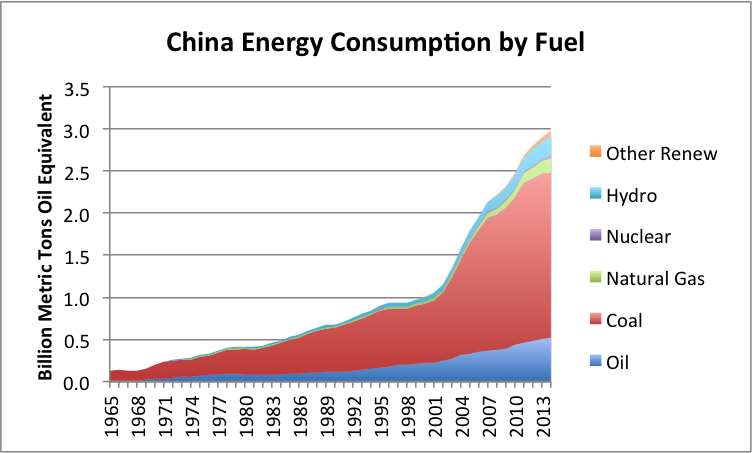
As a result, world per capita energy consumption continues to rise.
In my view, what is more important is the return on human labor (another form of EROEI). The fact that wages are lagging is a sign that this type of EROEI is falling.
Yes, all extremely important points.
Dear Gail,
Thank you for your interesting response.
I agree that the remaining planetary coal reserves have an average EROEI higher than the oil reserves. However, it should be notes that even the remaining technically and economically extractable coal reserves have a declining EROEI.
The key figure to look for is the average EROEI for all the energy sources currently used both at world scale and for individual countries.
Charles Hall says that the “doomsday” figure is an EROEI of about 11:1 because below that number there is simply not enough net energy available to sustain a complex society. Hence, it disintegrates… How it does so is another interesting subject…
How close are we globally from that critical 11:1 EROEI threshold and how close key countries having complex high tech societies to sustain ?
John
I look at things differently than Prof. Charles Hall. I think debt allows us to overshoot our EROEI limits, and that we are currently in overshoot range with respect to EROEI.
Also, based on my view of the situation, needed EROEI is not a constant number. It keeps rising as we approach limits, and need to use more and more energy products for producing water through desalination, mitigating pollution problems, and other needs.
Regarding where we are now with respect to EROEI, I know I was reading a recent post of Carey King’s. In his view, since 1995, the energy industry has produced about 14 to 15 units of energy for every unit of energy consumed by the energy industry. This tells me two things (a) overall EROEI isn’t changing much in 20 years–it is just the mix that is changing and (2) EROEI still seems to be at 14 to 15 to 1, using his definition of EROEI. So I wouldn’t hold my breath on getting to 11 to 1 anytime soon.
There are, however, differences in how different researchers calculate EROEI. A big source of energy used in oil production is natural gas which is co-produced with oil. The cost of this natural gas is close to zero. I doubt this natural gas ever makes it into most national energy statistics, since it is burned on site where it is extracted. But it makes a big difference in the EROEI calculation. We will never “run out” of this natural gas, since it is simply a cheap co-product of oil. I think Hall’s data includes this natural gas, among other things, so his EROEI estimates are probably at a lower level than 14 or 15 to 1 already.
It’s possible to make an inspired guess, but everything hangs on those ratios.
The reason or global industrial infrastructure is starting to creak now, is because we built it on cheap energy (oil at 100:1), but we are trying to keep it running on oil at 20:1, and that ratio is diminishing.
The problem isn’t the availabilty of energy (in whatever form), it’s the energy-cost of getting hold of it.
Unfortunately, the majority of people just look on oil as “oil” , without realising that we are in a closing vice between the cost of extraction, and our certainty that we can go on using it in profligate ways.
We have come to believe in a cornucopian infinity (let’s make America/China/Russia great again!) and cannot accept that we can no longer afford it. . Everybody wants more.
In simple terms there are too many people wanting a share of the hydrocarbon pie.
In brutal terms, they will fight to the death to get it, because their/our lives depend on it.
This universal attitude destroys the “steady state” theories of Heinberg et al.
Just like a house with a sub prime mortgage, we cannot earn enough to bail ourselves out, no matter how hard we work—because our income—oil, is getting less and less.
Using the same analogy: You’re struggling to keep a roof over your head, and somebody offers you a job—but it’s so far away and pays so little, you’d be worse off if you took it because it would drain your already depleted resources.
Where we are now is the world economy being carried on those 20:1 wells. Without that ratio, the Bakken and Athabasca could not function, because the overall world infrastructure couldn’t afford the rig production, transport, basic infrastructure necessary to keep them running on a return of only 6:1. We would need all that industrial output just to maintain a bare living standard, (hospitals, food supplies, roads and so on) and struggling to maintain even that.
And don’t forget to factor in the cost of military oil protection. It has been estimated that the true cost of petrol, including military intervention, could be anything up to $15 a gallon
http://www.treehugger.com/fossil-fuels/true-cost-gasoline-closer-15-gallon-video.html
. That comes out of taxation. Post BAU–that military protection will cease
So how long will our 20:1 oilwells last?
Given that our oil is balanced by Middle East factors, not very long, (Venezuela is already as basket case, and Russia isn’t far behind)
Saudi oil might last 20 years, but they are already selling bonds to finance debt. Not a good sign. They are forecast to become oil importers by 2030 (which fits that)
http://www.brookings.edu/blogs/markaz/posts/2015/07/02-saudi-energy-subsidies-hino
Exactly where those imports will come from is anybody’s guess.
That puts it 15 years from now—but of course the Middle east is already going up in flames, or playing beggar-my-neighbour. Can we expect Saudi/Iraq/Iran to hold together for 15 years? That’s where most of the 20:1 oilwells are. When they go down, we’re on 6:1, and screwed. And our Muslim friends know it.
Maybe we can give that region 5 years—7 at the outside (half of 15).
That puts our crossover point (lower than 12:1) into permanent oil deficit/collapse somewhere around 2022.
If we’re lucky.
Well—do ya feel lucky?????
I don’t feel lucky….
If we can make it anywhere near 2022 I would be overjoyed!
more pie for me then
thanks
Norman, that sums up my thought exactly. We are fighting diminishing returns and we are loosing and most people don’t know it. People really really do think of oil as just oil. People generally do not consider the energy that went into producing that oil. And then certainly not the energy that goes into refining it into finished products like motor gasoline or diesel fuel. And then you have all the embedded energy in all the oil producing equipment and machinery that has been built on 100:1 oil. These system are old and need replacing but again, we cannot afford it (in energy terms).
I sometimes offer the comment:
Look around you—now mentally remove anything with a constituent of oil coal or gas in it.
You are now sitting naked on bare earth, starving to death.
If you need life saving medication–you are already dead.
Yet that comment is regularly ridiculed.—I wonder why
I don’t take any medication life-saving or otherwise…. yet I operate under the assumption that I am already dead.
Because it will be impossible to survive once BAU is gone – and to be quite honest — even if I could survive — life would be such total drudgery — struggling to feed myself — no dentist no doctor — no coffee — no restaurants — no travel — basically hunkered down working out how to get enough calories into my body to live another day….
Excuse me for saying … but fook dat shit…. I hope that I die before it gets to that (but if I don’t Mr DNA will force me to live like a diseased dog… just as he forces me to stockpile tools…)
In the meantime — I am running the joy meter to the limit… it’s as if a doctor has told me you have around a year left to live….. you will feel very well right until the very end …
We all get to die sometime — but we are so fortunate — we are like a terminally ill cancer patient — who doesn’t have cancer!!!
Stilgar — have another bottle of wine today — stuff yourself with more superb Italian fare — indulge to the limit!!!!
Vive quasi cras moriturus
Disce quasi in perpetuum victurus
“Vive quasi cras moriturus
Disce quasi in perpetuum victurus”
“Learn As if You Were Going to Live Forever;
Live As if You Were Going to Die Tomorrow.”
Thanks FE!
Excellent! I think I’ll make it mine from now on.
It was already the case, but it’s good to put nice words on it.
Very good exercise, Norman.
You can also detail a little bit, by making 2 categories: with and without transportation (which requires diesel and therefore renders almost everything fuel-dependant).
You then realize that, even “transportation notwithstanding”, almost everything you’re considering as useful requires FF of some sort, wether for its production or use. Of course, FF is required for electricity production (even nuclear one).
Great summary, but the bashing of Russia is a bit off, they are still building new/replacing old nuclear reactors and storing up the pellet fuels for it, i.e. it’s paid for by already burned oil, gas and coal.. ps 2022 fits my several times announced window, so good stuff too
The oil price in dollars doesn’t really matter. The price of anything in dollar terms doesn’t really matter.
We currently live in a dollar world, but going forward that doesn’t need to be the case. To help visualize this, think of someone using inches and feet their entire lives, and now they have to switch to centimeters and meters. Difficult, but not impossible, especially if the system crashes and there are no more feet measuring tapes around, and then you are forced to use something different.
With the withdrawal of American empire, so will go the dollar. The two will go hand in hand.
We have to have a system that tells us what is of value and what is not.
Perhaps you can think of a different system, but the point remains that energy is a critical need for the economy. If the price is below the cost of production, that should be a tip-off to a major problem within the economy. Changing to a different system won’t fix this problem.
Then of the American empire may very well mean the end of the world economic system. It takes an interconnected world trade system to make things like computers and portable phones.
We are heading into sort of “glacial period” of ever stagnating and even contracting demand (incl. energy), new less populous generations don’t favor (and don’t have the money nor credit) as much as they used to for cars, flats, trinkets, therefore much slower capital movement as well.
It’s very doubtful the global dollar regime as we know it is going to survive even early phases of such development. So what’s next? Basically the pressure build up between deflation and gov attempted push for inflation would at some point crash the system.
Also the global elites would have to try front-load the developments, i.e. attempts made at carving fiefdoms for themselves, semi-isolation. So combination of chaos, fiefdoms, regional-local arrangements, .. , who needs stinking dollar, in few generations perhaps some enclaves would be using “follars” for very local agri commerce in a way of distant unrelated remnant of this financial vehicle.
The first two paragraphs are mundane reviews of what is happening now. The last paragraph though every person posting here, could write a spiel along those lines for a prediction on how events will/could unfold and probably every single one would be wrong. Maybe you have such high self regard that you expect readers to follow your postings as coming from indisputable authority. If that is not the case, then really you should preface your predictions with “IMO”, unless of course you have facts on which to base the opinions.
If you think it was high horse approach from me, certainly not intended to be so. The “evidence” was posted few days ago on previous threat aka the fourth turning thesis by Howe & Strauss as foreknowledge-correct predication so far.
Besides if you think debating the issue of capital freezing out belongs to a mundane review category, sorry you are into some nasty surprise near-mid term, because we literally just eat, drink and breath (health care) thanks to the CREDIT, which is a dominant mechanism transforming the general energy input for us from the environment. Now we are evidently already inside a period in which overcapacity will be cleaned out, not only in industrials, consumer goods-trinkets, but also food. After this process is finished, the capacity won’t be renewed, moreover the production capacity level would be undershoot. It’s beyond my pay-grade to guesstimate timelines precisely. But in sync with the 2008-2030 window discussed previously, people should “prepare mentally” for future of less.
Worldof,
even growth zero is unsustainable.
How can you envisage any kind of degrowth that wouldn’t crash the whole thing?
The only thing we can do is find some trick that would allow us to keep on digging our hole a little longer, with BAU under -one step more- reinforced palliative care.
If ever any start-over is possible again, post-collapse, it won’t be from a lower level of current BAU-setup, it’ll be from scratch, and in a very degraded environment and with very little resources and with solar budget only, as energy input, and with entropic issues that require huge amounts of time to improve…
IMHO…
“even growth zero is unsustainable”
Good point! This is a point I keep trying to make to the steady-state economy advocates, but they have a terrible time with it. They seem to think that explaining the truth would be too much–either that, or they don’t understand the truth.
The “degrowth period” here is meant to be only a fast paced history event inside the slow history of collapse envelope. They can still print (and suck up equities, bonds, junk bonds, helli cash, ..) and hide debts at the same time, while the people openly refuse consume as much, I guess it’s doable from their operational standpoint for the next 5-15yrs. And how to bridge the next overdue recession with such bad cards without complete meltdown would be master act indeed, possible, probable, who knows the odds. My argument was directed more towards the vision of 2030-40, when the overcapacity is gone forever incl., rusted out unused trucks, tractors, robots in factories, failing digital networks, silent airports, simply non replaceable end of the route, with some exception of small military oriented enclaves, which can keep up only fraction of the former complexity.
I don’t really know. The global elites would seem to be in a position to grab what they can for themselves. The catch is that a lot of what we need is perishable–food in particular. It is also impractical to store up huge amounts of water in advance. So even global elites will have to work with others.
You can’t store water but you can gain control of the supplies.
In fact you can “store water” very well.
For instance the Windsors can relocate to their castles in Scotland highlands (lakes, farms, ..) with some loyal army brigades and “start a new”. Also many billionaires already carved various pristine lands for themselves or would command the power and leverage over govmils to do so. It’s not bullet proof strategy (full scale nuclear war), but certainly better than doing nothing.. That’s a sensible projections for any hard/swift crash anyways.
I think whether or not the world system would end would depend somewhat – I think all else remaining equal, it would simply shift eastwards to China and similar, much as power and influence shifted from the British Empire to the American.
All else does not of course remain equal, there are other larger forces that stop that game from continuing indefinitely.
What really worries me is the financial system it mostly all electronic today. It requires computers and light speed communications to work. To produce the computers and systems to do this requires global cooperation and trade among hundreds if not thousands of disparate industries. If the supply chains for these critical financial system components break down then, it seems to me the financial system would break down along with the computer systems that power it. No Visa, no Master Card, no debit card, no record of your deposits/savings/retirement/debts. What is the work-around for this? Contingency plan?
Good point Greg,
Typical example of the technology trapp in which we find ourselves, and computers is probably the most representative one.
In the beginning, it brings a lot of advantages and allows to upgrade and speed-up the operations, thus dramatically increasing productivity and profits. At least for the first ones who have decided to invest in this new technological tool.
Then everybody has to invest to keep up with the new normal.
Eventually, the whole sector has made itself dependant of the technology (VERY dependant in the case of computers), and there’s no way back.
Now if you look at what exactly this technology is made of, you realize that it itself is very interlinked and interdependant, relies on unsecured supplies and requires a healthy BAU to run correctly:
– raw materials: rare earths, very polluting and some already depleting alarmingly. War-triggering as key-resource (see north-Kivu, for example),
– Supply-chain for production: very complex, widespread globally but with some strategic key-hubs (components or critical sub-components manufactured in one place only).
‘Special focus on microchips: most complex technology and supply-chain in the world, using most sophisticated machines.
‘Special mention of the diesel-fueled global transportation industry, backbone of this JIT globalized organization.
– Infrastructure for use: communication networks, energy-guzzling computer-farms, etc.. (Sorry I don’t use the proper terms)
– “App-culture” that renders the users dependant on good functioning of the whole construction underlying the easiness of simply having to click to get whatever they want, effortless.
Most of this being hidden, we tend to take it for granted ; but it’s not.
Pencils and Smartphones
“I, Pencil” (http://en.wikipedia.org/wiki/I%2C_Pencil) an essay by Leonard Read published in 1958, later popularized by Milton Friedman, showed that there was no person in the world with all the skill needed to make an ordinary pencil. No one who could refine all the ingredients and formulate the paint, let alone produce the brass ferrule from ore.
There is hilarious, serious TED talk (http://www.ted.com/talks/thomas_thwaites_how_i_built_a_toaster_from_scratch) by someone who attempted to make a simple toaster from scratch. As a side note he found contemporary metallurgy books useless, and had to go back to an 18th century one to learn how to smelt iron in his backyard.
In 1958 we carried pencils in our pockets. It was ( and still is ) possible to make a working pencil from local technology. Now our pockets contain smartphones. Need I say more?
We even find it hard to access material that is written on old floppy disks. Technology changes so quickly, it is hard to keep all of the various versions around.
https://s-media-cache-ak0.pinimg.com/736x/ea/3d/cf/ea3dcff8ed8e8939d98c96b81f747623.jpg
Needs more smirk.
just checking to see if this new piece clears my reply boxes—they stopped altogether on the last post.
this is an interesting obituary (David Mackay) If you haven’t read his book, do so. it’s free to download.
http://www.climatechangenews.com/2016/04/15/david-mackay-if-everyone-does-a-little-well-achieve-only-a-little/
Didn’t read neither Gail nor McKay yet, just to obtain notifications on this one (after being frustrated by early closure on previous one too).
WRT everyone should do a little, in France we have the Colibri movement. Nice leader, nice idea and nice story (legend of the colibri), but doesn’t work, at lest not at significant scale.
http://arc306.blogspot.fr/2009/10/terre-et-humanisme-earth-and-humanism.html
I assume McKay has a different take on the question.
The thing is…
Every year I understand that we add another 100 million or so nett consumers to the planet.
We are adding another Philippines to the planet every year (and that number increases every year…)
There is no point in reducing one’s footprint on the planet — it is beyond futile.
I make no effort to reduce my footprint –and to those who will fire stones at me — may I make a couple of suggestions 1. sell your car and take the bus everywhere you need to go or better still 2. walk.
I can read your thoughts Green Brigaders : ‘Oh but that is impossible – what a fooking asshole you are for even suggesting that’
I have done exactly what you describe “Fast Eddy” for the last two years and I aim to change my ways soon. Perhaps this will pick up consumption globally? A tiny bit?
I was going to write a longer piece about debt and the economy, but was afraid that some important points would be lost for some readers, so decided to write a shorter post first.