
The Peak Oil story got some things right. Back in 1998, Colin Campbell and Jean Laherrère wrote an article published in Scientific American called, “The End of Cheap Oil.” In it they said:
Our analysis of the discovery and production of oil fields around the world suggests that within the next decade, the supply of conventional oil will be unable to keep up with demand.
There is no single definition for conventional oil. According to one view, conventional oil is oil that can be extracted by conventional methods. Another holds it to be oil that can be extracted inexpensively. Other authors list specific types of oil that require specialized techniques, such as very heavy oil and oil from shale formations, that are considered unconventional.
Figure 1 shows the growth in unconventional oil supply for three parts of the world:
- Oil from shale formations in the US.
- Oil from the Oil Sands in Canada.
- Oil characterized as unconventional in China, in a recent academic paper of which I was a co-author. (Temporarily available for free here.)

Figure 1. Approximate unconventional oil production in the United States, Canada, and China. US amounts estimated from EIA data; Canadian amounts from CAPP. Oil prices are yearly average Brent oil prices in $2015, from BP 2016 Statistical Review of World Energy.
Oil prices in 1998, which is when the above quote was written, were very low, averaging $12.72 per barrel in money of the day–equivalent to $18.49 per barrel in 2015 dollars. From the view of the authors, even today’s oil prices in the low $40s per barrel would be quite high. Since the above chart shows only yearly average prices, it doesn’t really show how high prices rose in 2008, or how low they fell that same year. But even when oil prices fell very low in December 2008, they remained well above $18.49 per barrel.
Clearly, if oil prices briefly exceeded six times 1998 prices in 2008, and remained in the range of six times 1998 prices in the 2011 to 2013 period, companies had an incentive to use techniques that were much higher-cost than those used in the 1998 time-period. If we subtract from total crude oil production only the production of the three types of unconventional oil shown in Figure 1, we find that a bumpy plateau of conventional oil started in 2005. In fact, conventional oil production in 2005 is slightly higher than the later values.

Figure 2. World conventional crude oil production, if our definition of unconventional is defined as in Figure 1.
I would argue that far more crude oil production was enabled by high oil prices than I subtracted out in Figure 2. For example, Daqing Oil Field in China is a conventional oil field, but greater extraction has been enabled in recent years by polymer flooding and other advanced (and thus, high-cost) techniques. In the academic paper referenced earlier, we found that the amount of unconventional oil extracted in China in 2014 would be increased by about 55%, if we broadened the definition of unconventional oil to include oil made available by polymer flooding in Daqing, plus some other types of Chinese oil extraction that became more feasible because of higher prices.
Clearly, this same kind of shift to more expensive extraction methods has occurred around the world. For example, Brazil has been attempting to extract oil from below the salt layer of the ocean using advanced techniques. According to this article, Brazil’s “pre-salt” oil production was expected to exceed 600,000 barrels per day by the end of 2014. This oil should count, in some sense, as unconventional oil.
Massive investments in the Kashagan Oil Field in Kazakhstan were enabled by high oil prices. Some initial production began, but was discontinued, in September 2013. Production is expected to resume in October 2016.
There are clearly many smaller fields where higher extraction was made possible by high oil prices that allowed oil companies to utilize more advanced techniques. Deepwater drilling also became more feasible because of higher prices. Another example is Russia, which is reported to have heavy oil extraction that would not be commercially feasible if oil prices were below $40 to $45 per barrel. If we were to add up all of the extra oil production in many areas of the world that was enabled by higher prices, the total amount would no doubt be substantial. Subtracting this higher estimate of unconventional oil in Figure 2 (instead of the three-country total) would likely result in more of a “peak” in conventional oil production, starting about 2005.
Thus, if we think of conventional oil production as that which is possible at low oil prices, the forecast by Colin Campbell and Jean Laherrère was pretty much correct. Production of conventional oil did seem to peak about 2005 or shortly thereafter. We simply don’t have the data to estimate how much we could have extracted, if oil prices had remained low. Furthermore, oil prices did rise substantially, relative to 1998 prices, making Campbell’s and Laherrère’s forecast of higher prices correct.
I suppose that we could even say that if conventional oil were all that we had in 2005 and subsequent years, supply would have fallen far short of demand, based on Figure 2. This last statement is somewhat debatable, however, because there would have been other feedbacks, as well. It is possible that if total supply were very short, oil prices would have spiked to an even higher level than they really did. The resulting recession would likely have brought prices down, and temporarily brought demand back in line with supply. If prices had stayed low, there might have been a second round of shortages, with an even greater supply problem. This, too, might have been resolved by another price spike, quickly followed by another recession that brought world demand back down to the level of supply.
Of course, conventional crude oil isn’t the only type of liquid fuel that we use. When we add all of the pieces together, including substitutes, what we find is that since 1998, broadly defined oil production (“liquids”) has been rising quite rapidly.

Figure 3. World Liquids by Type. Unconventional oil is from Exhibit 1. Conventional oil is total crude oil from EIA, and other amounts are estimated from EIA International Petroleum Monthly amounts through October 2015. (EIA’s category “Other Liquids” is referred to as Biofuels in Figure 3, since this is its primary component. Other liquids also include coal and gas to liquids and other small categories.)
In fact, since 2005, Figure 4 shows that the single highest year of growth in oil production (broadly defined) was 2014, with 2.47 million barrels per day. (This is based on crude oil data from EIA Beta Report Table 11.b, plus values for other liquids from EIA’s International Energy Statistics. Annual amounts for 2015 were estimated based on data through October.)

Figure 4. Increase over prior year in total oil liquids production, based on EIA data. 2015 other liquids amounts estimated based on data through October 2015.
Figure 4 shows that the increase in oil supply in 2015 is almost as high as in 2014. The 2005 to 2015 period shown indicates a lot of “ups and downs.” The only two high years in a row are 2014 and 2015. This would seem to be at least part of our “oil glut” problem.
Exactly by how much oil production needs to increase to stay even with demand depends upon price–the higher the price, the smaller the quantity that buyers can afford. At a price of $100 per barrel, a reasonable guess might be that about 1 million barrels per day in consumption might be added. If categories other than crude oil are increasing by an average of 440,000 barrels per day, per year (based on data underlying Figure 4), then crude oil production only needs to increase by 560,000 barrels per day to provide an adequate supply of fuel on a total liquids basis.
If production of crude oil is actually increasing by more than 2.0 million barrels per day when only 560,000 barrels per day are needed at a price level of $100 per barrel, clearly something is badly out of balance. According to EIA data, the countries with the five largest increases in crude oil production in 2015 were (1) US 723,000 bpd, (2) Iraq 686,000 bpd, (3) Saudi Arabia 310,000 bpd, (4) Russia 146,000 bpd, and (5) UK 106,000 bpd. Thus, US and Iraq were the biggest contributors to the global glut in 2015.
What Is Going Wrong?
Not only did a lot of people hear the Peak Oil story, a great many responded at once. Governments added requirements for more efficient vehicles. This tended to lower the quantity of additional oil supply needed. At the same time, governments added mandates for the use of biofuels, also reducing the need for crude oil. Arguably, the US-led Iraq war, which began in 2003, was also about getting more crude oil.
Oil companies also rushed in and developed oil resources that might be profitable at a higher price. These new developments often take more than ten years to produce oil. Once companies have started the long path to development, they are unlikely to stop, no matter how low oil prices drop.
It is becoming apparent that if oil prices can be raised to a high enough level, a lot more oil is available. Figure 5 shows how I see this as happening. We start at the top of the triangle, where there is a relatively small quantity of inexpensive oil, and we gradually work toward the expensive oil at the bottom.
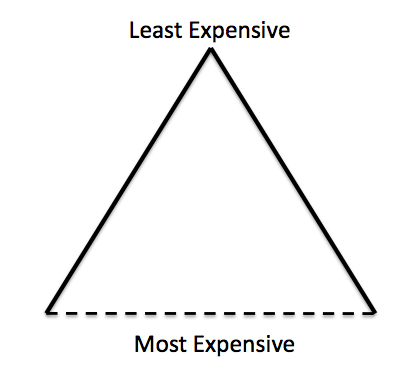
Figure 5. Resource triangle, with dotted line indicating uncertain financial cut-off.
The amount of oil (or for that matter, any other resource) isn’t a fixed amount. If the price can be made to rise to a very high level, the quantity that can be extracted will also tend to rise–in fact, by a rather large amount. The “catch” is that wages for the vast majority of workers don’t rise at the same time. As a result, goods made with high-priced oil soon become too expensive for workers to afford, and the economy falls into recession. The result is prices that fall below the cost of production. Thus, the limit on oil supply is not the amount of oil in the ground; instead, it is how high oil prices can rise, without causing serious recession.
While wages don’t rise with spiking oil prices, increasing debt can be used to hide the problem, at least temporarily. For example, cars and homes become less affordable with higher oil prices, since oil is used in making them. If governments can lower interest rates, monthly payments for new homes and cars can be lowered sufficiently that new car and home sales don’t fall too far. Eventually, this cover-up reaches limits. This happens when interest rates start turning negative, as they now are in some parts of the world.
Thus, by ramping up buying power with low interest rates and more debt, governments were able to get oil prices to stay above $100 per barrel for long enough for producers to start adding production that might be profitable at that price. Unfortunately, the amount of additional oil demand isn’t really very high at that price. So, instead of running out of oil, we ran into the reverse problem–too much oil relative to the amount that the world economy can afford when oil prices are $100+ per barrel.
The attempt by governments to fix the oil shortage problem didn’t really work. Instead, it led to the opposite mismatch from the one we were expecting. We got an oversupply problem–a problem of finding enough space for all our extra supply (Figure 6). Unless we have infinite storage, this pattern clearly cannot continue forever.

Figure 6. Weekly ending stocks of crude oil and petroleum products through July 29. Chart by EIA.
Eventually, this oversupply problem is likely to result in “mother nature” cutting off oil production in whatever way it sees fit–oil prices dropping to close to zero, bankruptcies of oil companies, or collapses of oil exporters. With lower oil supply, we can expect recession.
Misunderstanding the Real Problem
In the early 2000s, the story that Peak Oilers came up with (or perhaps the way it was interpreted in the press) was that the world was “running out” of conventional oil, and that this would lead to all kinds of problems. Oil prices would rise very high, and oil depletion would take place over a long period, as shown in a symmetric Hubbert Curve. As a result, at least small quantities of additional energy products with high “Energy Returned on Energy Invested” (EROI) were needed to supplement the energy products that would be produced based on the slowly depleting Hubbert Curve. Our oil supply problems were viewed as a unique situation, calling for new and unique solutions.
In my view, this story came about through over-reliance on models that likely were accurate for some purposes, but not for the purpose that they later were being used. One of these over-extended models was the supply and demand curve of economists.

Figure 7. From Wikipedia: The price P of a product is determined by a balance between production at each price (supply S) and the desires of those with purchasing power at each price (demand D). The diagram shows a positive shift in demand from D1 to D2, resulting in an increase in price (P) and quantity sold (Q) of the product.
This model “works” when the goods being modeled are widgets, or some other type of goods that does not have a material impact on the economy as a whole. Substituting high-priced oil for low-priced oil tends to make the economies of oil importing countries contract. This effect indirectly reduces demand (and thus prices) for many products (not just oil), an impact not considered in the simplified Supply and Demand model shown in Figure 7. Also, the very long lead times of the oil industry are not reflected in Figure 7.
Two other models that were used beyond the limits for which they were originally designed were the Hubbert Curve and the 1972 Limits to Growth model. Both of these models are suitable for determining approximately when limits might be hit. Even though Peak Oilers have believed that these models can accurately determine the shape of the decline in oil supply and in other variables after reaching limits, there is no reason why this should be the case. I talk about this problem in my recent post, Overly Simple Energy-Economy Models Give Misleading Answers. Thus, for example, there is no reason to believe that 50% of oil will be extracted post-peak. This is only an artifact of an overly simple model. The actual down slope may be much steeper.
The Real Story of Resource Limits that We Are Reaching
Instead of the scenario envisioned by Peak Oilers, I think that it is likely that we will in the very near future hit a limit similar to the collapse scenarios that many early civilizations encountered when they hit resource limits. We don’t think about our situation as being similar to early economies, but we too are reaching a situation of decreasing resources per capita (especially energy resources). The resource we are most concerned about is oil, but there are other resources in short supply, including fresh water and some minerals.
Research by Joseph Tainter and by Peter Turchin indicates that some of the issues involved in previous resource-based collapses are the following:
Growing Complexity. Citizens who discovered they were reaching resource limits typically tried to work around this problem. For example, hunter-gatherers turned to agriculture when their population grew too large. Later, civilizations facing limits added irrigation to raise food output, or raised large armies so that they could attack neighboring countries. Making these changes required greater job specialization and more of a hierarchical system–two aspects of growing complexity.
This increased complexity used part of the resources that were in short supply, since people at the top of the hierarchy were paid more, and since building new capital goods (today’s example might be wind turbines and solar panels) takes resources that might be used elsewhere in the economy. Eventually, growing complexity reaches limits because costs rise faster than the benefits of growing complexity.
Growing Wage Disparity. With growing complexity, wage disparity became more of a problem.

Figure 8. People at the bottom of a hierarchy are most vulnerable.
I have described this problem as “Falling Return on Human Labor Invested.” Ultimately, this seems to be a major cause of collapse. Workers use machines and other tools, so this return on human labor has been leveraged by fossil fuels and other energy resources used by the system.
Spiking Resource Prices. Initially, when there is a shortage of food or fuel, prices are likely to spike. A major impediment to long-term high prices is the large number of people at the bottom of the hierarchy (Figure 8) who cannot afford high-priced goods. Thus, the belief that prices can permanently rise to high levels is probably false. Also, Revelation 18: 11-13 indicates that when ancient Babylon collapsed, the problem was a lack of demand and low prices. Merchants found no one to sell their cargos to; no one would even buy human slaves–an energy product.
Rising Debt. Debt was used to enable complexity and to hide the problems that people at the bottom of the resource triangle were having in purchasing goods. Ultimately, increased debt was not successful in solving the many problems the economies faced.
Ultimately, Failing Governments. Governments need resources for their purposes, whether hiring armies or making transfer payments to the elderly. The way governments get their share of resources is through the use of tax revenue. When people at the bottom of the hierarchy were cut out of receiving adequate resources (through low wages), the amounts they could afford to pay in taxes fell. Governments would sometimes collapse directly from lack of tax revenue; other times collapses occurred because governments could no longer afford large enough armies to defend their borders.
Ultimately, Falling Population. With low wages and governments requiring higher tax levels to fund their programs, people at the bottom of the hierarchy found it difficult to afford adequate nutrition. They became more susceptible to plagues. Loss of battles to neighboring countries could at times play a role as well.
Lessons We Should Be Learning
Even if we made it past peak conventional oil, there is likely a different, very real collapse ahead. This collapse will occur because the economy cannot really afford high-priced energy products. There are too many adverse feedbacks, including increasing wealth disparity and the likelihood of not enough revenue for governments.
We can’t count on long-term high prices. The idea that fossil-fuel prices will gradually rise, and because of this, we will be able to substitute high-priced renewables, seems very unlikely. In the United States, our infrastructure was mostly built on oil that cost less than $20 per barrel (in 2015 dollars). We know that with added debt and greater complexity, we were temporarily able to get oil to a high-price level, but now we are having a hard time getting the price level back up again. We really don’t know how high a price the economy can afford for oil for the long term. The top price may not be more than $50 per barrel; in fact, it may not be more than $20 per barrel.
We need to look for inexpensive replacements for both oil and electricity. Many substitutes are being made to produce electricity, since indirectly, electricity might act to replace some oil usage. There is considerable confusion as to how low these prices need to be. In my opinion, we can’t really raise electricity prices without pushing economies toward recession. Thus, we need to be comparing the cost of proposed replacements, including long distance transport costs and the cost of adjustments needed to match electric grid requirements, to wholesale electricity prices. In both the US and Europe (Figure 9), this is typically less than 5 cents per kWh. (In Figure 9, “Germany spot” is the wholesale electricity price in Germany–the single largest market.) At this price level, producers need to be profitable and to pay taxes to help support governments.

Figure 9. Residential Electricity Prices in Europe, together with Germany spot wholesale price, from http://pfbach.dk/firma_pfb/references/pfb_towards_50_pct_wind_in_denmark_2016_03_30.pdf
Replacements for oil need to be profitable and be able to pay taxes, at currently available price levels–low $40s per barrel, or less.
We need to be careful in aiming for high-tech solutions, because of the complexity they add to the system. High-tech solutions look wonderful, but they are very difficult to evaluate. How much do they really add in costs, when everything is included? How much do they add in debt? How much do they add (or subtract) in tax revenue? What are their indirect effects, such as the need for more education for workers?
We need to be alert to the possibility that solar PV and most wind energy may be energy sinks, rather than true energy sources. The two hallmarks of providing true net energy to society are (1) being able to provide energy cheaply, and (2) being able to provide tax revenue to support the government. When actually integrated into the electric grid, electricity generated by wind or by solar generally requires subsidies–the opposite of providing tax revenue. Total costs tend to be high because of many unforeseen issues, including improper siting, long-distance transport costs, and costs associated with mitigating intermittency.
Unless EROI studies are specially tailored (such as this one and this one), they are likely to overstate the benefit of intermittent renewables to the system. This problem is related to the issues discussed in my recent post, Overly Simple Energy-Economy Models Give Misleading Answers. My experience is that researchers tend to overlook the special studies that point out problems. Instead, they rely on the results of meta-analyses of estimates using very narrow boundaries, thus perpetuating the myth that solar PV and wind can somehow save our current economy.
Too much debt, and too low a return on debt, are likely to be part of the limit we will be reaching. Investment in complexity requires debt, because complexity requires capital goods such as wind turbines, solar panels, computers and the internet. The return on this additional debt is likely to drop lower and lower, as complex solutions are added that have less and less true value to society.
We need to remember that as far as the economy is concerned, it is total consumption of energy resources that is important, not just oil. Wages reflect the leveraging impact of all energy sources, not just oil. If energy consumption per capita is rising, more and better machines can help raise output per capita, making workers more productive. If energy consumption per capita is falling, the world economy is likely moving in the direction of contraction. In fact, we may be headed in the direction of early economies that eventually collapsed.
When we look at the data, we see that world energy consumption per capita appears to have peaked about 2013. In fact, the big drop in oil and other commodity prices began in 2014, not long after energy consumption per capita hit a peak.

Figure 10. World energy consumption per capita, based on BP Statistical Review of World Energy 2105 data. Year 2015 estimate and notes by G. Tverberg.
The world seems to have hit peak coal, because of low coal prices. In fact, falling coal consumption seems to be the cause of falling world energy consumption per capita. Whether or not most people regard coal highly, coal is pretty much essential to the world economy. A recent decrease in coal consumption is what is pulling world energy consumption per capita down. We do not have any other cheap fuel to make up the shortfall, suggesting that our current downturn in energy consumption (shown in Figure 10) may be permanent.

Figure 11. World and China appear to be reaching peak coal.
We should not be surprised if the financial problems that the world is now encountering will eventually resolve badly. This seems to be how the Peak Oil story will finally play out. Without rising energy per capita, the world economy tends to shrink. Without economic growth, it becomes very difficult to repay debt with interest. Wealth disparity becomes more and more of a problem, and it becomes increasingly difficult for governments to collect enough revenue to support their needs. Our problems begin to look more and more like those of earlier economies that hit resource limits, and eventually collapsed.


I drive light rail vehicles through the city area and parts of suburbia and have noticed a large increase in homeless people in the past year sleeping in tram shelters, trams, in doorways of buildings anywhere they can have a slight sliver of comfort.This will increase I believe as the years go by
We pay a million to get our precious hours of sleep. We are like caterpillars that go into a cocoon to make a metamorphosis during the winter, only that we enter our cocoon every night to make a small metamorphosis from children to adults.
Please suh… can we have some more police state… please keep us safe….
http://www.zerohedge.com/news/2016-08-20/german-anti-immigrant-party-leader-urges-people-arm-themselves
http://www.zerohedge.com/news/2016-08-20/trump-protesters-turn-violent-minneapolis-jump-trucks-block-motorcade
I do believe that EROEI (energy return on energy invested) measures are flawed and may be rather arbitrary. Nevertheless, I think that posts regarding the utility of EROEI measures might be overlooking something. Instead of thinking how much surplus energy remains think of energy instead as a proxy for labor.
For instance, assume that an EROEI of 100:1 requires 1 unit of labor funded from the revenue stream (or from debt and bear in mind that a subsidy is a debt to some entity). An EROEI of 20:1 (100:4) now requires 4 units of labor that must be funded from that revenue stream (or debt). The producer with the lower EROEI has a much higher cost basis that will harm its competitiveness in the marketplace, ability to pay for capital goods, labor, services and lower profits (no profits?) to support government taxes.
Canada’s tar sands reserves are immense. But their projects EROEI are supposedly in the single-digit range and have very high debt burdens.
US shale oil reserves are immense but shale oil projects EROEI are probably higher than tar sands, but still very low compared to Middle Eastern supergiant fields, hence their very high dependence on debt. I’ve read that all shale oil projects since their inception are cash flow negative. Apparently Federal Reserve interest rate subsidies are all that keeps them alive.
A lower EROEI is a very, very big deal when viewed from the economic and financial perspective.
If oil prices spike to $75-80, we may get a ‘huge impulse of inflation” but it won’t last long, in my view. $75-80 oil prices may very well crush the fragile global economy to new lows and usher in a deflationary spiral worse than after 2007.
How will central banks respond? Will they double down with more QE and NIRP? Or will confidence in their monetary and fiscal policy be so damaged that nationalist strong-arm politics arise, take over, and attempt to enforce order? Either way, broken, disabled, and violent state economies could be the result.
Then the question becomes, “will martial law precede food and energy rationing, or will food and energy rationing be implemented after martial law, as the situation begins to unravel.” My guess is that both will occur at different times in different places. Throw in a climate related heat wave, crop loss, disease outbreak, and overwhelmed hospitals into the turmoil and events may begin to spin out of control.
Yemen, Syria, and Venezuela could be the templates of OFW – Our Future World.
As lichen is consumed, and population soars, we draw closer to the tipping point here on St. Matthew island (or is it Gilligan’s island?)
Cheers.
I reckon we get Martial Law Lite…. because Hard Martial law would result in collapse.
We are seeing Operations Gladio and Northwoods Lite already happening ….
As the violence progresses the sheeple demand protection — which gives the Priests the excuse to get a military presence on the streets…
The real purpose being to send a message to those who might get unruly as things worse…. there will be no Occupy movements…. accept the situation … and do not tip the cart over…
I do not see rationing happening – rationing = deflationary death spiral.
Whatever it takes – even if it extends the situation by a month …. will be done
At some point it becomes Hard Martial law…. but that means BAU is done … the central banks are unable to hold things together…. that will be a short-lived period…. a few months?
“I reckon we get Martial Law Lite…. because Hard Martial law would result in collapse.”
Definitely not in Canada. It cost $1.8 billion to lock down Toronto for 3 days for the G8 + G20 meetings. So, 180 billion to maintain martial law in Toronto for a year. The entire federal budget is only around $290 billion / year.
The only viable way to do it is to have small response teams and rely on snitches, cameras, monitoring phones and email.
Martial Law Lite is not a lock-down — that is Hard Martial Law and the economy would blow up.
To repeat — I would expect a military presence which would serve as a warning to those who might rock the boat as the chop on the water intensifies…
Rocky the boat in a storm is dangerous… and cannot be allowed
For your reading and listening pleasure… “Contrarian views” continue to become more mainstream:
http://www.ibtimes.co.uk/holy-grail-hedge-fund-strategy-handle-black-swan-size-world-war-i-1576915#
“Sokoloff told IBTimes UK: “That thought experiment is really frightening to me. You followed very sound modern portfolio management advice back then and still in ten years your portfolio is gone. I don’t think we are really learning the lessons of history, especially now that the global economy is so much more interconnected than it was before.”
Returning to the current state of the markets, Sokoloff said the world’s economic and financial system relies on a continued growth in global trade and global economy. This is problematic.
“What we are seeing right now, unfortunately, is stagnation. The growth rate is zero for developed markets”.
“That is the precipice. That is the trigger point for the financial system to start suffering shocks.”
“Global trade volumes in the past 18 months have gone nowhere. Pure import and export trade is not growing. It’s at zero, which kind of tells you that if trade is flat where does the GDP really grow on? And most of the time it’s just gathering expenditures. That is obviously a non-sustainable situation.”
“A non-sustainable situation needs a trigger point or a flash point before it can really erupt. There’s plenty flash points; political, military, economic, social. They are just not triggering yet.
But they will at some point.”
And this:
http://kunstler.com/podcast/kunstlercast-279-yaking-kirk-bostrom-disorder-finance-markets/
“Kirk Bostrom is the Managing Partner and Chief Portfolio Manager of Strategic Preservation Partners LP”.
“We believe that there is a massive bubble in bonds. And what’s interesting about bonds, or scary at the same time, for everybody that should be paying attention, is that the bond market around the world, particularly the public sector debt… the bond market is three times larger than all the stock markets in the world – combined.”
“So if you put a pin prick in stocks… we saw the correlated affects on other assets… But people don’t quite understand – and I have to get our arms around it – it’s so large and many, many Trillions of dollars around the world, is if you put a pin prick – which I think is coming – in the bond market, the global bond markets… the fall-out, which Martin Armstrong and others are talking about… is going to see volatility which nobody has ever seen in their lifetime… in the core economy of the world today… literally in the quarters or short years ahead, I think we’re getting to a crescendo here relatively quickly.”
And that was just his opening statement.
Cheers.
We are totally losing sight of the “elephant in the room”: American gasoline consumption at 3,5 Bby. This is about one-half of the total U.S. oil consumption of 7Bby. U.S. per capita oil consumption of 22 barrels per person per year is about 7 times the world average of 3b/p/y.
Clearly, there is not enough cheap oil left to support this mobile American lifestyle for more than another ten or twenty years. Meanwhile Americans went into deep debt to keep driving with more expensive non-conventional oil. Now, “The party’s over” signaled by a two year collapse in price which is driving the marginal suppliers out of business. In hindsight, 2016 will be the end of a decade-long plateau of peak oil. We’re running out of gas! Food will soon follow. National gasoline rationing is our only hope to buy some time for an orderly end to the oil age.
Meanwhile, population growth just continues. Don’t get too far from your gardens folks. A million blogsites won’t feed us.
I thought USA oil usage was around 18 Mbd, and Production was 10Mbd?
For 2014, which is the last year the EIA is now showing on International Energy Statistics, consumption was 19 Mbd, and production was 14 Mbd. Production has to be on an “all liquids” basis, which includes ethanol, natural gas liquids, and other stuff, because that is the basis that consumption is on. The big drop in US imports was one of the problems upsetting the world economy. There were no longer enough buyers of exported oil, because world oil production (particularly in the US and Iraq) rose more than it needed to–hence the drop in oil price.
There are 365 days in most years, so 18 million times 365 equals 6.57 billion per year. So 7 billion / year, 3.5 billion barrels of gasoline if half if gasoline. Bby = Billion barrels / year.
In case folks don’t remember, John Howe is the inventor of the solar tractor. He also writes about Peak Oil.
But you also remind us about the FF/pollution-related chain around the solar panel manufacture and transportation. And the tractor and electric motor depends on FF too. But Howe most likely has an answer to this, and most likely is buying us time, in principle. I love the old tractor.
“National gasoline rationing is our only hope to buy some time for an orderly end to the oil age.”
Rationing will just lead to hundreds of people with gas cans standing in line for hours at the gas station to buy gas, to resell on the deregulated markets at a slightly higher price. Like the aftermath of Hurricane Sandy, but lasting for months or years.
I’m old enough to remember back in the 1970s gas rationing. It will come again….guaranteed. I was in Charlotte, NC and there was a disruption of gasoline supplies
9/26/2008 4:24 PM
Edited Date/Time: 11/26/2008 3:00 PM Quote
Maybe most of you dont know- I think the rest of the country is doing just fine, but some parts of the south are out of gasoline. In western NC there is very little of the stuff. I had to go past 6 dry stations yesterday …and the seventh station, which had gas, was mobbed. Gas lines in 2008
Charlotte NC is worse. On the radio there were several news breaks mentioning violence ( among people waiting) at gas stations and people are waiting hours to fill up. It is surreal..
all this as the result of refineries 1600 miles away that were shut down 2 weeks ago…
I just want to take a second and say THANKS
http://www.vitalmx.com/forums/Non-Moto,21/The-gasoline-situation-in-and-around-Charlotte-NC,229093
Yes, I was in panic mode myself trying to fill my close to empty tank then and it was a real challenge. We will witness this command allotments for all necessities in the coming years ahead. Of course, certain elites will be excempt.
For those that weren’t around look
https://m.youtube.com/watch?v=UCpEPbYx9ZM
It does not take much to create a shortage or glut….we live on a razors edge!
So what’s your alternative?
“So what’s your alternative?”
Conceptually, I like the idea of tiered usage. So, just using some somewhat arbitrary numbers as example, let’s say in a given month each person is allowed to buy up to 10 gallons at $2.50 per gallon, then from 11 to 100 gallons at $5, then everything over 100 is $10 per gallon. Something like that.
It would mean national gas cards tracking how much each person uses regardless of gas station, which likely means government bureaucracy or outsourcing to the likes of JPMorgan Chase a la California EBT cards. Lots of exposure to corruption and incompetency.
The simpler but less socially acceptable solution would be to simply let prices rise as needed.
that would bring in priority usage…. so who has priority fuel?
for instance, if a nurse lives 20m from a hospital—then transport would be deemed essential—same with firemen, ambulance drivers (+ the ambulance itself) police and so on.
If you’ve got a job 50miles from work, then if you can’t drive to work—your job is gone.
Your/my grandparents walked to work, because work was within walking distance, or within a short distance of a tram/train route. They have now gone.
In the USA the tram routes were bought up by GM etc and junked to force people into cars. We are getting those back in uk now, but not nearly enough to provide transport universally.
You all won’t like it at all….rationing will first come with odd or even days based on the license plate number….When you wait in line for a hour to get your share there will be an attendant that shoves a sign in front of you “OUT of GAS” and tell you when they expect another shipment. Numerous fights leading to killings will occur, as well as theft.
The big ploy back then was siphoning of gas tanks and a big market for antitheft devices came out. I bought a funnel spring inserted down the gas tank pipe.
Americans believe they have a right to a weekly tank of gas….when it stops all hello will break out. Hope to be pushing up daisies when that happens!
https://m.youtube.com/watch?v=hmG5KcinVSI
There wont’ be rationing… if it gets to the point where there is not enough cheap oil left to operate the economy … it will collapse….
glad there’s somebody else pointing out the bloody obvious
i was starting to feel like a leper at an orgy here
The DelusiSTANIs are forever trying to knock down the gates of FW with their illogical bombs…. they are like cluster bombs … but instead of nails and bolts… they are filled with silly ideas…
They cannot maim or kill you — they don’t even hurt — but they can drive you to insanity if you get hit by enough of the shrapnel…
The defense against illogical bombs is cold hard facts — logic —- and mockery…
DelusiSTANIs do not like to be mocked…. they get flustered…. disorganized…. they are forced to retreat and suck their thumbs ….
But they will come back… they always come back….
Eddy—I will witness and sign your sanity claus
If you promise to do the same for me
“that would bring in priority usage…. so who has priority fuel?”
In my ideal version, there would be no priority for individuals. Sure, government and key services would have their own pricing separately.
As soon as you roll out any form of rationing and price controls, you are clearly stating that the status quo is changing. Resident Doctors, if hospitals continue to exist, may have to once again become residents, or at least live nearby. If/When things get to this point, people will have to adapt and stop commuting alone 50 miles at 70 miles per hour in a 2000 Kg box.
If straight up rationing is implemented, these same changes would occur, just much more disruptively. Likewise, if free markets were allowed to just let the price rise higher as needed, at some point people would start riots and protests.
almost all hospital used to have residential facilities—nurses homes etc, police forces had ”station houses” big stores had top floor accommodation for staff
all that has gone. Nurses homes have been sold off as apartments.
London as an example is having difficulty finding low tier staff—the folks who actually make the city tick—because rents are going through the roof. Travel costs in from where they can afford to live makes the job itself non viable.
You can’t be 60 yrs old and do a 2 hour cycle ride twice a day to get to a job that pays squat
Have to adapt??—how exactly would you adapt when the pension age is rising ahead of you as you get older? Cycle 20 miles at 70?—75?
As my doom partner Fast Eddy has pointed out on this thread, the oil driven economy won’t slow down into some kind of benign decline, it will stop.
Because it is geared for steady speed forward motion—no brakes, no steering wheel, no reverse gear—-and as an added refinement, the windscreen has been replaced by a full sized mirror so we can enjoyed looking at where we’ve been, while pretending it’s where we’re going.
Fantasies aside, the future you describe is one run as a full scale Orwellian dictatorship—which I agree, is a likely outcome, because people will not accept such a future meekly.
Fuel depletion will bring area secessions, because empires are held together only by the energy within them. As that begins to happen, the powers that be will implement martial law to preserve law and order. and attempt to “make America great again” along with others–I pitch that in the mid 20s
As Ive said before, it is highly likely to be theofascism.
“As my doom partner Fast Eddy has pointed out on this thread, the oil driven economy won’t slow down into some kind of benign decline, it will stop.”
What if you’re wrong?
“Fuel depletion will bring area secessions, because empires are held together only by the energy within them. As that begins to happen, the powers that be will implement martial law to preserve law and order. and attempt to “make America great again” along with others–I pitch that in the mid 20s
As Ive said before, it is highly likely to be theofascism.”
Between Canada and Venezuela, there are hundreds of billions of barrels of oil. Just because the average citizen won’t be able to consume 25 barrels of oil per year, does not necessarily mean it all goes straight to zero.
That is like me saying 1+1=2
And you asking what if you are wrong.
But before that time arrives, Fast Eddie, the PTB will reinstate rationing and the sheeple will endure it like back in 70’s. Of course when your “cheap” oil runs out it is curtains for just about everyone
https://m.youtube.com/watch?v=sASuZrfRMIw
Hope it is just as nice as above!
In the 70’s … if new sources of cheap oil had not been obtained (see Kissinger’s deal with the Saudi’s) — those queues at the pumps would have disappeared in short order…
Because the pumps would have been emptied and not refilled.
And we’d have collapsed.
“Because the pumps would have been emptied and not refilled.”
Or the government would have had to let the price rise until supply and demand balanced, instead of preventing the market from clearing.
Like you have the gift of knowing for sure Eddie….listen…I am certain in the United States the PTB will resort to rationing before the end game. How long will it hold together…unknowable…. but you Eddie claim otherwise because you have it all figured out….
https://m.youtube.com/watch?v=ikqiogmHJhA
Suppose a friend of yours, taught you everything you know
Gail has most definitely taught me a lot…. you really need to pay attention in class.
They’re the Powers that Be…..
https://youtu.be/Zfae65UZauU
Here we go again with that old line of “Gail taught me”….maybe that monkey Albert can teach you too…pay attention…LOL. Start craking
https://m.youtube.com/watch?v=_MgHBvp1uwk
Thanks, Matthew. It does promise to be a bureaucratic nightmare. Maybe it should be less about centralized planning, and more about folks adapting to circumstances (and government not getting in their way). I drive my car on average once every two weeks. I am “unemployed,” so no need to commute. I could probably deal with your lowest tier rationing system fine. I just can’t think through the greater levels of rationing and how to adapt to them through central government and BAU. Small-group adaptations such as car pooling and work sharing and a small measure of self-sufficiency might all be helpful too. Why telecommuting isn’t more widespread remains a mystery.
“Maybe it should be less about centralized planning, and more about folks adapting to circumstances (and government not getting in their way). ”
That’s the idea, to try to find the middle ground between outright rationing or having the central authority allocate resources on one hand, and simply letting prices shoot up and down all over on the other.
Replacing sales and income tax with a flat transaction tax and replacing unemployment, disability, welfare and old age security with universal basic income goes along the same idea, to reduce the amount of paperwork and bureaucracy, make things as simple and transparent as possible and let things get sorted as much as possible at the local level.
Ultimately, its about simply trying to delay the moment of impact, since it cannot be completely avoided.
Matthew – if they ever do a remake of Being There… I suggest you audition for the part of the Chauncey…..
One possibility is that when things were becoming critical, a major war could break out and then used as a perfectly understandable reason to introduce a “purely temporary” ban on gasoline for non-essential uses that would continue indefinitely. The war would necessitate martial law at home in the interests of national security. In the case of the US, it could also be used as a pretext for suspending the 2nd Amendment and indeed, all the other Amendments.
i’d say that’s more that a possibilty Tim
People now need liquid hydrocarbons to stay alive. true, there might…just might— be some incredible new energy source waiting for us to find and develop, but with oil in depletion right now, and nothing seeming remotely likely, that’s looking like a long shot.
As Chomsky pointed out a couple of years ago—” If Libya’s main export was asparagus, nobody would care what happened there”.
Oilpower has given aggressive teeth to an otherwise dormant theology, and those promoting that theology realise that the industrial west has ripped off the muslim oil lands to drive its prosperity. The Oil sheiks thought their gold plated lifestyle was forever, and lived as such. Now they, like us, are having to run faster and faster just to stand still.
We are on different treadmills that’s all. They need oil to stay alive just as we do. Right now, the Saudis have enough money to buy off their unemployable young men with social freebies. When that money runs out, those young men will grab what they can and try to exist….but in a desert capable of supporting only 1m people.
So the wars and insurrection surrounding saudi will cave in on them.
With no mideast oil, the USA economy itself will implode, with the same violence.
The driving force of that violence be (as in saudi) a total denial that the oilparty is over for good.
Economic expansion has gone too far for rationing to work.
We have been encouraged to spread out on the promise of infinite support–so no a 20/50 mile commute is common place. Bland statements that we must all “move closer to workplaces etc” is an obvious nonsense, because employment itself is fuel dependent.
Pointing out the obvious again, our commercial existence survives only because we have the means to buy and sell stuff to one another, in an endless trade circle.
Without hydrocarbon input (or even depleted) that trading circle will cease to function. Without gainful employment, the majority of young men in the USA will react like those in Saudi, and demand jobs. (with menaces)
Violent revolution sparks off from massive discontent. Thus martial law becomes inevitable
The Just in Time global supply chain means a major war would collapse BAU…. it would be suicidal…
I am thinking of the implications in the Korowicz paper of the EU breaking up….
I don’t get it.. I’m since years without car and get everywhere I want and when i “really” want… bicycle, food, train….
I deem most of the car trips I see other people do every day as not essential. They could be done by bike – or in other cases by delivery service which would do offloading stuff much more effective. Work has to be in Bicycle / public transport range for most – if not, they have to move closer to work or work to them (i.e. changing work) – if the work still has a important role after all.
When I go buying food, etc. – its all to schedule or organized depending on things I want to have to fetch. It may not work for all very rural areas – but for >>50% of the people in the developed world (as they already live in cities).
Yes, I know – the system may not even survive what this means…. a heavy shrinking…. so we may see how the reality goes. My point is only its possible for most to reduce income, get rid of the car and have the same (or even a better) living standard (for now).
“I deem most of the car trips I see other people do every day as not essential. They could be done by bike – or in other cases by delivery service which would do offloading stuff much more effective.”
If you are over 50 and commuting over 20 miles to work daily, switching to cycling may be a huge adjustment.
As for the delivery service, this was a big topic a while ago, about how farmer’s markets actually cause more fuel to be burnt then if people just go to the supermarket. Having someone deliver milk, bread, eggs makes more sense if you are out of walking distance, if you are going for a lower energy solution. Having a veggie truck drive down the street like an ice cream truck is probably a more viable idea. Having an ice truck deliver ice blocks is probably more energy efficient than everyone having their own freezer. etc.
i seriously detest being the chief naysayer in here
unless you jest about the over 50s cycling to work?
that aside—can we please start to lose this ongoing fixation that —whatever else—if we keep our wheels, we are going to be just fine?
Wheels must have a purpose—they take us to and from places where we acquire energy by which we further our existence.
Apart from holidays/liesure/frivolity/garden wheelbarrows
that leaves 2 purposes for wheels
1–your employment
2 –your food sources (food stores) We can’t all be small farmers
if your food is delivered–you don’t need to go to the food store. So conventional food stores close down. Now check on the number of people employed in that business sector alone. 10-15%? I’m guessing in that area.
Food delivery systems won’t soak that up
but if you want to pay for the food, you need employment. And without a wheeled environment—you won’t have a job.
think about that, try to imagine how the average factory would function without access to private transport systems.Our fuel burning system is a one way wheeled ride. we have no brakes and no reverse gear.
Hence here comes the grim reaper of triage, the worst energy hogs will be left alone.
Abandoned states, counties, cities, .. People mass moving into hubs that are still somewhat operational (MIC etc?) – specifically moving to other people’s houses and flats, sharing, sub renting, gov mandated relocation “guest”, call it as you wish. That’s high probability outcome, it has happened numerous times throughout history, why not inside the NA for a change this time around.
You have seen for decades on the telly pictures of savaged cities across the globe in the name of profit, glory and your uninterrupted leisure, they somehow never ever come back to haunt you eventually? Think again.
Perhaps Gail could write an article explaining why BAU Lite is not possible… then whenever someone suggests BAU Lite is possible … rather than explaining over and over why it is not… only to be ignored…. we could just post the link to Gail’s article… which would be ignored as well… but time is so very short…. any short cut explanation would be welcome…
We can’t just allow these nonsensical comments to stand — because doing so gives them credibility….
BAU Lite is not possible. Maybe on Peak Prosperity it is…. but on Finite World … it most definitely is not.
“i seriously detest being the chief naysayer in here
unless you jest about the over 50s cycling to work?”
I suspect that the previous poster – Ert maybe? Is probably young and able bodied or works close to home. In the parlance of our times, I was kind of saying “check your privilege” – many people need to commute by car. They could carpool, or do other things, if gasoline is available at a higher price, but would be in dire straits if there was suddenly harsh rationing.
“can we please start to lose this ongoing fixation that —whatever else—if we keep our wheels, we are going to be just fine?”
The loss of being able to use motor vehicles presages the lose of electricity, the grocery stores running empty, and the ravenous hordes start roaming the countryside.
“We can’t all be small farmers”
Historically, until probably the 16th century in the West, around 90 percent of the population lived in the country and spent some or all of their time producing food. I suspect anyone making it out the other side, provided no spent fuel or abrupt warming crisis, will end up more directly involved in getting their own food. The more people transition to this before collapse, the less ravenous hordes.
“if your food is delivered–you don’t need to go to the food store. So conventional food stores close down. Now check on the number of people employed in that business sector alone. 10-15%? I’m guessing in that area.
Food delivery systems won’t soak that up”
Why do you think delivering the same amount of food would somehow need less labour? All we’re doing is having a couple trucks come out to your neighbourhood, instead of having hundreds of cars from your neighbourhood drive to the grocer. The trade off is that your area would likely have the store one day a week, instead of you being able to go to the store any day you want, in exchange for maybe a tenth as much fuel being used to distribute the same amount of food to the same amount of people.
“And without a wheeled environment—you won’t have a job.”
I think it matters greatly the transition time. If tomorrow there is suddenly gasoline rationing and two months later no gas, sure there will be massive unemployment. If it is a slow ten year grind of fuel prices doubling annually, people may be able to move closer to work, develop more mass transit, change jobs closer to home, etc.
“ry to imagine how the average factory would function without access to private transport systems.”
I suspect that as fuel becomes more expensive or scarce, a lot of factory jobs will disappear regardless. A lot more people are going to become migrant farm workers or tenant farmers or sharecroppers, since currently food in the West is produced primarily through using oil powered machines and natural gas based fertilizers.
I think you just described our return to medieval serfdom
Have any of you noticed a practice I call ‘jamming’, in which numerous renters cram into one small house? There was one down the street from us that had 8 vehicles and numerous people coming and going – it was just a 1,000 sq. ft. place, and a few of the guys were doing auto repair for money out of the garage. Then finally it all blew over and they left without cleaning the place. The owners showed up and since then the place has remained empty. Not sure what kind of condition it’s in now. There is another one a few blocks away but they seem to keep a low profile and have been jamming now for several years. Guess the rent gets pretty cheap if it starts out low and gets divided amongst numerous people. That’s one strategy on the downslope.
it was common the Victorian London and later.
If you stayed at an inn–you would be expected to share a bed, not just a room
Whole families would rent a part of a room. This happens when wages don’t keep up with the cost of living, this died out when the means became available to build truly affordable housing for the masses
Good idea — save money so you can afford the latest iphone….
“Having a veggie truck drive down the street like an ice cream truck is probably a more viable idea. Having an ice truck deliver ice blocks is probably more energy efficient than everyone having their own freezer. etc.”
This is totally like the world I grew up in. Except, when I was a child, my folks bought large chunks of ice from an ice factory in town, then put it in a sort of lead “ice box” and covered it with sawdust. I had almost forgotten…
And in the city, that is how veggies were bought. From vendors walking with a basket on their head, coming by regularly. One vendor I remember was pushing 90. I would help her take down and reinstall her basket. The peanut vendor had a distinctive whistle on his cart. Some vendors would call out ritually as they went by. ..
Wow, artleads, and I thought I was old remembering baseball cards cost a penny each (5 in a pack for a nickel) and 50 cents to go to the movie theatre. You remember your folks buying ice blocks – what time period was that?
@ stilgar
“Wow, artleads, and I thought I was old remembering baseball cards cost a penny each (5 in a pack for a nickel) and 50 cents to go to the movie theatre. You remember your folks buying ice blocks – what time period was that?”
For the ice blocks, all the way through the 40’s. (I was born a little before the war, so my generation was dealing with the scarcity of the Depression and then the scarcity due to war efforts. Rationing of gas, etc.) But up to now, there is the still lingering presence of street vendors in my native land.
Most people don’t have gardens…. and won’t…
I wonder if Walmart sells large camoflauge tarps for gardens…. the ones that let the sun through
On the contrary, gardening blog sites just might help since most people are terribly ignorant on gardening 101. The trick is to plant stuff that does well for your area, has a good return on invested energy/time, and is prolific.
After the revolution comes the reign of terror. Every revolution devours its own children.
If the elite really had all the power we claim them to posses, then they would never had let us consume their planet and its precious resources. The elite are just slaves fulfilling the wishes of the masses.
A poll showed that 80 percent of Trump supporters believe that life is worse today than 50 years ago, while 90 percent of Clinton supporters believe that life is better today.
“The elite are just slaves fulfilling the wishes of the masses.”
They have to be victims of delusion, as well.
Worker bees can fly away
Even drones can leave
The Queen is their slave
Most definitely. The emperor remains emperor only with the Mandate of Heaven — which these days translates into 6 teevees per home … and 3 SUVs…..
Ah, you see, we only consume until it becomes burdensome for TPTB. Then the predation starts – the culling of the generic mindless mass consumerist. But first the totally useless consumerist. Have a look at Libya, Syria, Venezuela et. al. Does BAU seem to crumble without their “consumption”? Not much, right? Say hello to mr. barrel bomb down there.
Now the big boys even got some cool computer algo toys to play with instead of the feeble minded middle class that previously was used for semi-intellectually demanding tasks. Not anymore though.
All they need is energy, but not you. You have been nearly completely obsoleted by the computational progress from the last two decades.
Those countries are the losers…. they do not matter to BAU…. other than they contribute a bit of oil…. which we can take from them even when they are collapsed… just keep the jihadists out of the oil fields…
What matters to BAU is the OECD and China — one of them goes down … and BAU goes.
The price of oil, as the mobile energy source powering the operation of our fossil fuel based systems must stay low. In order to keep the price of oil extraction low, other commodities needed in the process of oil extraction must be as cheap as possible.
That is why there is no alternative to the deflation, so that the system can operate longer. I.e. no high prices of coal, natural gas, iron or electronics. All these must be as cheap as possible. As without the oil, their extraction and processing is finished.
The oil will be the driving force of the deflation in the same way as it allowed the inflation, i.e. the increasing production and consumption of other resources on the Earth. The price of these commodities could rise as long as there was a plenty of cheap oil to extract these more and more costly resources. In the same way, the extraction of costly oil will swallow the extraction and processing of other resources. The costly oil becomes a black hole. It is the very black hole where the “printed money” is going into.
The example of Japan, where the population concentrates in the big city agglomerations connected via superfast trains shows us, that making the train, as the coal era transportation means, faster, can help to sustain the system, but it can not stop the population decline, as the population of these agglomerations is sustained by the declining population from the surrounding depopulating rural regions.
We can use the energy of the stationary energy sources for the creation of a faster and more closely interconnected system that can handle the increasing complexity for a while longer (superfast trains and mobile communication electronics from coal and nuclear) in the form of such city agglomerations where the population concentrates. But hand in hand with the population decline, as the centers of complexity (the cities) consume the energy of the costly high quality human resources that are also depleting.
The cryptocurrencies are not an alternative to the money issued by the states, they are a part of the worldwide money creation boom.
These are very good observations about oil. For me at least, you’ve helped clarify its leading role in the economy and why so much else revolves around it.
it’s not the price of oil, it’s the EROEI factor—-I would have thought that time spent in FW would have made that abundantly clear.
We built our current infrastructure on an EROEI of 100:1, now we are down to 20 :1—that’s why the system is creaking and bits are falling off. We do not have spare surplus energy to power the society we think we are entitled to, we now only have 1/5th the (spare) energy available from every barrel of oil that we used to have.
As oil gets scarcer, so the price of it rises because we use more energy to extract the stuff.
—-“must stay low”—- is a phrase reminiscent of King Canute ordering the tide not to come in.
We have no control over the extraction cost of oil. As that cost rises, our EROEI factor drops, because the energy within a barrel of oil is fixed.
We will never get down to 1:1 obviously, because below 12:1 our mechanised environment can no longer function
Does the EROEI take into account the mobile or stationary character of the energy source? I am affraid that is one of the reasons why EROEI is only a one-dimensional tool. If we e.g. do not have the mobile energy source of human resources, we can have a lot of low EROEI oil, but it wil stay in the ground in the same way as the forest will remain standing, when there is lack of woodcutters.
we used to have a mobile human energy resource to dig coal out of the ground—even at that rate, the EROEI was about 50:1 with men using picks and shovels, and pit ponies
unfortunately that doesn’t work for oil wells
@Norman
I Imagine lots of people with “drinking straws” sucking the oil out of the ground 😉
Like what Nicole Foss said what fracking and the like is: “sucking spilled beer out of the carpet”… instead drinking it out of the bottle (https://www.youtube.com/watch?v=AdNvmIfyQPY)
@MG
You can’t compare the EROEI of different energy resources / fuels with each other… as versatility and economic value of each energy resource is different. EROEI for me is a very synthetic number, which not even stated where it is measured (at the source, at the consumer site as processed stuff like ‘diesel’, etc. pp). So if I read EROEI numbers and not a lot of fine print under what condition this number is “generated”… its basically worthless.
Dear Ert, I do not compare EROEI of various energy sources. I write about the aspects of exchangeability of energy sources: if there is war in an oil producing country, no one will supply that country with equipment, as there is no one crazy to spend money on something that will be destroyed either physically by war or technologically due to not being used immediatelly within the currently working systems, the consequence of which is that the equipment becomes outdated and obsolete.
Actually, I meant “If we e.g. do not have the mobile energy source of human resources, we can have a lot of HIGH EROEI oil, but it wil stay in the ground in the same way as the forest will remain standing, when there is lack of woodcutters.”
Anyway, even the high EROEI oil ofe.g. Saudi Arabia can not be extracted, when there is no one to supply coal and nuclear power based products (pipes, electronics, trucks etc.) to extract that high EROEI oil, when the situation in Saudi Arabia is not stable and there is no guarantee that the appropriate amount of energy in extracted oil will be delivered in exchange for the coal and nuclear power based products.
If EROI is 100:1 you have 99% energy available.
If EROI is 20:1 you have 95% energy available.
So in fact, a reduction of EROI from 100:1 to 20:1 means surplus energy has only decreased by about 4%. If it had really reduced by 80% you would not be reading this blog.
the 100:1 ratio was back in the 30s/40s If we were still producing oil at 1930s volumes, then you would be right
Discoveries of new oil went on till the 1960s so we had more and more oil available to power our existing infrastructure. Then in the 70s, the USA went from swing producer to oil importer. In other words they had passed peak production. Current oil increases are from tight wells that do not give the same energy return
Currently the best oil wells, mainly in the Middle east, produce at 20:1.
By my (limited) mathematical assessment, if I have a 100 acre farm, producing food energy, and suddenly a catastrophe of some kind removes 80 acres, I am left with only 20 acres from which to produce food-energy, which leaves me with one fifth of what I used to have.
To restore my financial/energy balance, I must beg buy borrow or steal land from someone else, or live to my reduced means.
We have been stealing oil from someone else—which is why the middle east is going up in flames right now.
What we are effectively doing is having to run faster and faster up a down escalator to stay where we are. That burns depleting energy at a faster and faster rate
I can only refer you to the Hills report, particularly Part 2:
http://www.thehillsgroup.org/depletion2_020.htm
The data on there is clear and unequivocal—they seem to pitch things around the mid 2020s too.
@Norman
I grasp the general ETP assumptions… and the proposed trends. But that we are so far on the curve… thats still hard to imagine..
The ETP story is basically garbage. We are not as far down the curve as they say. Our problem is different.
You’ve only lost 4 acres, not 80.
Norman, re. the farm scenario, think of it like this.
if I have a 100 acre farm, producing food energy, and it produces, say, 100 barrels of, let’s say ethanol derived from corn using a production method consuming the energy equivalent of 1 barrel of that same kind of ethanol, then the operation’s EROI is 100:1.
If for some reason, I have to switch to a different method producing the same amount—100 barrels of ethanol—using different inputs, cultivation methods or oil processing methods, increased taxes, etc., which requires energy equivalent to the consumption of 5 barrels of ethanol, then the operation’s EROI is 20:1
In the first case, my net production of ethanol factoring in the amount of energy consumed in the production process would be 99 barrels. In the second case, the net production amount would be 95 barrels. The fall in EROI from 100:1 to 20:1 in this scenario translates to a modest fall in productivity of 4 barrels or 3.96%.
If you only have a fixed amount of energy to invest in the process, a fall in EROI from 100:1 down to 20:1 would be devastating. But as long as you can afford to invest 5 times as much energy in the process, you can maintain your yield and still turn a handsome profit.
Below 20:1, the amount of energy you’d need to invest goes up quite quickly, and the economics of the process aren’t nearly as attractive.
your argument is crystallised by your statement—if you can afford to invest 5 times as much energy—you can still turn a handsome profit.
well of course you can, but that energy has got to come from elsewhere–outside your own farm system.
If I have 100 acres, and use it to produce beef, corn, potatoes, i sell that crop and receive bits of coloured paper.
They are tokens of someone else’s energy use, somewhere down the line. (doesn’t matter what)
I then use those tokens to maintain my 100 acre living standard. If I spend to the full—I’m living on the edge—but hey—prosperity is forever. My missis and kids are happy. I live a pleasant quiet life.
If through some disaster I lose 80 acres, either gradually or suddenly, my living standard drops to a 20 acre one, unless I acquire an outside energy source. The missis gets upset. If Ive saved my energy tokens from when i had 100 acres, i can maybe buy 80 acres from someone else, and maintain my living standards and a happy nag free home. I can steal it, but the existing owner is likely to shoot me. Not a good idea. Unless I have more artillery than he has of course. and there’s no law enforcement to stop me.
Now switch to the USA (though this applies anywhere). Until the 1960s, the USA oil just kept flowing. It was the American dream. Everyone was happy. Then in 1970, oil flow went into deficit. It was past peak.
But of course the American lifestyle is non negotiable. Politicians like to keep their jobs
So more oil has to come from somewhere—-difficult when the Arab producers quadruple the price of it, realising they’ve been ripped off for years.
So the USA struggles on for a while–you can read up on that era—
but by 1980 we had this situation:
…….”Let our position be absolutely clear: An attempt by any outside force to gain control of the Persian Gulf region will be regarded as an assault on the vital interests of the United States of America, and such an assault will be repelled by any means necessary, including military force.””—Jimmy Carter, state of the union address, Jan. 23, 1980″………
Clear acknowledgement that without Arab oil, the US economy could not be sustained, and the dream would turn into a nightmare. Hence a US fleet is anchored off Bahrain.
There has been war in the middle east on and off since then, to try to maintain the illusion of 100 acre prosperity on a 20 acre farm
As a final thought, It has been estimated that if the cost of wars to protect it were factored in, the true cost of gasoline would be $15 a gallon. The difference is paid for with unsustainable infrastructure, and 50 million people on food support
Kissinger made the Saudi’s an offer for those 80 acres… that they couldn’t refuse 🙂
“Then in the 70s, the USA went from swing producer to oil importer. ”
The USA has not been a net exporter since at least 1944:
https://origins.osu.edu/sites/origins.osu.edu/files/4-2-map1449_0.png
There was a better chart I found previously, can’t find it right now.
Around 1969 was peak domestic production of oil from conventional sources. America does export finished products, since they have a large build up of refinery capacity. So you have to make sure you take imported oil and subtract exported finished products like gasoline and diesel to find the true net.
“By my (limited) mathematical assessment, if I have a 100 acre farm, ”
I think it is more like you have your 100 acre farm, and before you worked 10 hours per week, and now you work 50 hours per week to produce the same amount of food, because you have depleted your substrate.
your argument is crystallised by your statement—if you can afford to invest 5 times as much energy—you can still turn a handsome profit.
well of course you can, but that energy has got to come from elsewhere–outside your own farm system.
Not necessarily. If it’s a bio-fuel farm and I invest 1 unit of bio-fuel in Year 1 to produce 20 units, there is nothing to stop me from investing 5 units out of those 20 to produce 100 units next time UNLESS my acreage is restricted, which is not an EROI issue but a resource limit issue.
Norman, you brought up the farm analogy in talking about differences in EROI, so I suggested looking at it in another way. But with hindsight, It was not a very good analogy because going from 100:1 to 20:1 EROI is not comparable to going from a 100-ace farm to a 20-acre farm. They are two different issues.
In the first case, we are talking about the amount in energy input required to obtain a certain level of energy production. In the second case, we are talking about a reduction in the area of land under production. These are very different scenarios and as far as I can see they are not compatible in any way.
Now, if you had an oil field with the capacity to produce 100 units per day, and you went from there to an oil field that only had the capacity to produce 20 units per day, that would be closer to the farm situation. In this case, if you were restricted to using the same one unit of input in both cases and you were unable to increase the production level by upping your input level, you would indeed be deprived of 80% of your previous production volume. But you would still be getting back 20 times as much energy as you invested.
Moreover, if you could take a modest portion of that energy and invest it in producing five times more 20:1 EROI oil in other fields, you could still theoretically get back most of what you had loss. EROI isn’t the problem in these scenarios. The problem lies in the limit of the amount of production resources available to you.
@Yorchichan
Yes, insofar also the “Energy Cliff” Picture (e.g. https://upload.wikimedia.org/wikipedia/commons/9/9b/Net_energy_cliff.gif) is misleading, since the “number” of the World-EROEI will not sink in a linear fashion.As lower as it gets, the decrease “in number” will slow-down.
Not really sure of your meaning, Ert. The big loss of surplus energy only comes once EROI drops into single figures. Even at an EROI of 5:1, 80% of the embedded energy is available as surplus.
“The big loss of surplus energy only comes once EROI drops into single figures. Even at an EROI of 5:1, 80% of the embedded energy is available as surplus.”
Let’s say we have an imaginary country, we’ll call Samerica, which exists in isolation with no trade partners. Now, in 1930, Samerica produces 1 million barrels of oil per day at an EROEI of 100:1. So, they must reinvest 10,000 barrels everyday to get a fresh 1 million barrels. This leaves them with 990,000 barrels per day for the rest of their economy.
Now, Samerica reaches the peak of the bell curve of production in 1970, producing 10 million barrels at a EROEI of 20:1. So, everyday they must reinvest 500,000 barrels to get the 10 million barrels. This leaves them with 9.5 million barrels per day for their economy.
Now, fast forward to 2020. Not only has the EROEI dropped to 5:1, but production is down to 5 million barrels per day. So they must invest 1 million barrels per day, to have 5 million, with 4 million left for the rest of the economy. With a 99% correlation between energy and GDP, we can see their economy will be less than half the size it was in 1970. This scenario only occurs if the demand side cannot pay any higher price for oil, or if the total amount of oil is otherwise fixed to initially discovered reserves.
Alternate scenario: they are able to continue producing 10 million barrels per day in 2020, but at an EROEI of 5:1. This means they must reinvest 2 million barrels per day to get 10 million, leaving only 8 million barrels per day for the economy; their economy must find other energy sources or it will have shrunk ~16% from 1970. This is assuming the maximum rate of production is limited, and the market will pay any price for it.
Alternate: EROEI falls to 5:1 but they are able to increase production to 12 million barrels per day. They must reinvest 2.4 million barrels per day to maintain production, leaving 9.6 million barrels for the rest of the economy. This means they have incrementally grown from 1970, but are using nearly 5 times as many barrels just to produce the same amount of net energy to the economy; this is more of a Red Queen’s Race scenario, in which there is ever increasing amounts of oil available, at ever declining EROEI, as long as the market can pay ever increasing prices for the oil.
It is energy per capita that is the issue. This can be a problem, simply because the population rises.
Abundance, debt, and mix are big issues. EREOI is one way of looking at one piece of the problem.
@Yorchichan
In reference to the picture most people think linear in regard of timely progression on the x-axis. They sink we will “fall down” the energy “cliff”. I for my part think, that the progression on the x-axis in above linked picture will not be linear, so that the step down from EROEI 35 to 33 for example is a lot faster than from 8 to 6.
As far as I am concerned, EROEI doesn’t tell us enough. In fact, it can be misleading.
What brings the economy down is falling energy per capita. Arguably, this is “net” energy per capita, but in the short run, the change in “net” energy and in “gross” energy are likely to be very similar. In fact, we are now seeing a drop in world energy per capita. This is a very recent phenomenon, driven largely by the recent drop in world coal consumption. Since coal tends to have high EROEI, a drop in its consumption would be precisely the kind of thing that has a disproportionate impact on net energy.
EROEI has a lot of deficiencies. One of them is that it does not measure energy quality. Thus, intermittent electricity “out,” with good quality energy in, is viewed as a positive. In my view, this is nonsense. It is sort of like saying that a trade of ten 95 year old residents of nursing homes for one 40 year old scientist trained to handle a particular problem you are dealing with is a good deal. The ten 95 year old residents of nursing homes have negative value, in terms of what they add to the economy, just as the creation of intermittent electricity, beyond a very small amount, adds negative value to the economy. Not all additions of electricity create positive value for the economy, just as not all additions of humans add positive value to the future output of the economy. Certainly “demand” goes up in one sense, but it is usually governments that ended up paying, through government handouts to operate Medicaid and similar programs. The 95 year olds are not personally doing work that adds to output of the world economy.
Another deficiency is the fact that we do not have a shortage of energy, per se. What we have, is a shortage of affordable energy that operates our current devices, and can be used in building new cars and homes. EROEI was intended to be a “shortcut” to figuring out “cost of production,” but it doesn’t really work well for this purpose. Also, affordability is influenced by wages and debt. So EROEI doesn’t tell very much. It is well intended, but tends to give misleading indications in practice.
Based on research of Carey King and of Roger Foquet, we know that over time, the share of economic output used for “food, fuel, and fodder” has tended to decrease, leaving more of the economic output for other activities. In the 1300-1400 period, these three items together comprised about 80% of world activities, leaving little left over for services, like education, medicine, religion, and government. Once the situation turns around, we are in deep trouble. In my view, what happens is that prices fall below the cost of production–the problem we are seeing now. In fact, the turn around may have begun earlier, as prices started to spike in the 2000s.
In presentations at conferences, I have seen charts showing the share of economic output devoted to “food, fuel, and fodder” combined, with totals in the 1300-1400 period being up in the 80% range. The charts I could easily find in the Internet show a more narrowly defined cost of energy consuption, so understate the extent of the drop between 1300-1400 and now. This is one for chart I found, available from an article published by Energies available for download at this link. Or search for Carey King – Comparing World Economic and Net Energy Metrics Part 3: Macroeconomic Historical and Future Perspectives.
I don’t think that EROEI tells us very much about this. It would seem to require a lot of different adjustments for efficiency gains/losses, among other things.
Gail — if we focus on oil only keeping things simple … would you say that the EROEI model is somewhat useful?
In that we have gone to a situation where the oil bubbled to the surface vs a situation where we are steaming it out of sand… drilling deep beneath the ocean… and fracking it…
Although nowhere near complete…. I think the average person can recognize the problem more readily if presented in these terms….
I will never show this chart on my website because I believe it gives misleading indications. It does not make sense to order energy products as they are shown, because it makes wind look much better than it really is, because wind takes high quality energy resources in, and produces low quality energy resources out. I cannot believe that “algal biofuels” are anywhere nearly as beneficial as the chart makes them seem. If we are interested in anything of this sort, it is the world weighted average, over all fuels. This is hard to compute or find.
Gail’s right, naturally. EROI is only a minor part of the energy question. It gets a lot of attention because it is easy to grasp how it could make a difference.
The role of declining net energy per capita, on the other hand, is much more important but it isn’t quite so obvious. My guess is that it means individuals will be saving less, consuming less and probably altering their consumption patterns, with all sorts of knock on effects for the economy.
It can be useful in explaining the situation … to those not willing or interested to get into greater detail… it is something they can understand…
“What we have, is a shortage of affordable energy that operates our current devices, and can be used in building new cars and homes. ”
Self-driving cars, no doubt. And houses made from cardboard.
Imagine there’s a heaven …
It’s easy if you can…
One where there was an alerts filter for Finite World…..
That allowed you to decide which users comments reach you
This would allow for two parallel universes
One where the people DelusiSTAN bumble around in the dark…
And another where the RealitySTANers never need come into contact with DelusiSTANIs
Never need to know they exist….
You may say I’m a dreamer, but I’m sure I’m not the only one,
What is so great about self-driving cars?
(Except that you can watch Harry Potter, just like on the train).
“What is so great about self-driving cars?”
So, in theory, the initial advantage is more convenience and fewer accidents. However, if all the cars become automated, much larger benefits can begin to occur. Automation would likely remove the status that people derive from owning a fancy car.
First, the lag that occurs when the light turns green can disappear, and all vehicles can all accelerate together. Traffic jams disappear, and merging becomes much more efficient.
If that continues, then we can move to much lighter vehicles that are not as protective in a crash, since crashes will (at least in theory) be virtually eliminated. We can also abandon personal ownership, since self-driving taxis would be more economical than owning your own outright.
Then, once we have 100 Kg cars instead of 2000 Kg cars, and people care less about appearances, they can be more aerodynamic and less aesthetically pleasing. We can either drive at half the speed and still get to work in the same amount of time, or drive twice as fast and get places in a quarter the time of rush hour urban traffic, while using much less energy.
“What is so great about self-driving cars?”
I detest self-driving cars. I was speaking tongue in cheek. And I even more passionately HATE new “homes.” Just to be clear.
Ok, so personal vehicles get banned, then real advantages can be realized. It will not be cheaper though. And Jevons might have something to add.
Self driving cars is all the rage on MSM. They’re coming. I know from experience how these trends feel. But no one is talking about roads, and the FFs BAU uses to maintain them. Or the FFs it takes to build the cars. Then what about WHERE the cars are going? With shrinking resources, will these place continue to exist? No one discusses alternate ways to get around that are being implemented–some, like Bus Rapid Transit (BRT) that might be economical, and boondoggles like replacing rails that ought not to have been removed in the first place. How does all this fit together with self driving cars? Yet, if you are prescribing for new cars, I assume that, given the trends, they will be self-driving ones. And then you must talk about planning, and how all the current trends fit together.
” They’re coming. I know from experience how these trends feel.”
Techno-lust is quite seductive, and much more enjoyable than the Doomer view, for sure. I wish I could wholeheartedly put my faith in the belief that people will solve all our problems, and all I have to do is keep consuming to help make it happen.
As resources dry up it might seem better near term to combine the trends. More BRT More work from home. More live-near-work solutions, Fewer self driving cars, etc. Synergy among the trends…
Artleads,
I think you are confusing self-driving cars with EV. Self-driving cars saves the cab drivers salary (but wastes more miles). EV possibly saves fossil fuels.
Owning a car is already irrational for many. With auto ubers costing less in the future than manual ubers today they will drive more. (This assumes everything else is the same)
@ DJ,
Here’s one of the things I wrote.
“Self driving cars is all the rage on MSM. They’re coming. I know from experience how these trends feel. But no one is talking about roads, and the FFs BAU uses to maintain them. Or the FFs it takes to build the cars. Then what about WHERE the cars are going? With shrinking resources, will these place(s) continue to exist? No one discusses alternate ways to get around that are being implemented–some, like Bus Rapid Transit (BRT) that might be economical, and boondoggles like replacing rails that ought not to have been removed in the first place. How does all this fit together with self driving cars? Yet, if you are prescribing for new cars, I assume that, given the trends, they will be self-driving ones. And then you must talk about planning, and how all the current trends fit together.”
I don’t know where I’m confusing self-driving cars (SDCs) with EVs. Both require FFs to manufacture and maintain. Both use roads that FFs build and repair. I hear more about SDCs these days. As you know, EVs are already well established, while SDCs are just emerging. I would not have expected it, but SDCs seem to have more BAU support than EVs. You may have ideas as to whether the two can, will or or should merge. SDCs seem to “solve” a much greater complex of problems than do mere EVs. Do you disagree with this? Apart from this, I’m not in support of more cars of any sort. But since I can’t stop what the crowd are up to, I try at least to see (theoretically) how what they do can be better coordinated.
Artleads,
Sorry, you just confused me by implying MSM says SDC will use less FF.
Yorichan, the point you’ve made about EROI and energy availability is essential and yet it is not often heard. And when it is raised, it is often ignored or dismissed as irrelevant, which is a pity.
Having said that,as oil EROI falls further, the available energy from oil will decline progressively faster.
Tim,
It is difficult for me to understand why people don’t get EROI. Look at Norman: comparing the value of his comments to OFW to the value of my comments to OFW is like comparing the value of Ghawar to the world economy to the value of the Alberta tar sands to the world economy, but he still appears not to get it. 😉
Having scrolled back—I can’t find any comparisons about anything. Maybe I misunderstood somewhere along the line
My comments simply use land as the ultimate producer of energy, food, the stuff none of us can manage without.
Land produces food, we exchange energy tokens in order to buy the energy output of other people.
however many times that exchange is removed, we still are buying the products of the land. Which is why I use land as the analogy for the discussion
I can only requote from Tim above:
………..The fall in EROI from 100:1 to 20:1 in this scenario translates to a modest fall in productivity of 4 barrels or 3.96%.
If you only have a fixed amount of energy to invest in the process, a fall in EROI from 100:1 down to 20:1 would be devastating. But as long as you can afford to invest 5 times as much energy in the process, you can maintain your yield and still turn a handsome profit………….
That 5x as much energy above is drained from our overall commercial/industrial infrastructure.
It isn’t magicked out of thin air.
That 5x as much energy above is drained from our overall commercial/industrial infrastructure.
It isn’t magicked out of thin air.
Norman, I get your point and I think you’re quite right in that we have to use 5x as much energy to obtain 20:1 EROI energy as to obtain 100:1 EROI energy.
And that energy isn’t magicked out of thin air — unless we can rig up a zero-point energy device! 🙂 It is energy that cannot be used for non-energy production purposes.
But please recognize that this “5x as much energy” is still only a small portion of the total energy we have available for running our overall commercial/industrial infrastructure.
IF we are limited to a certain maximum level of energy extraction, then having to extract lower EROI energy means there is going to be less overall energy available for other uses.
So far, worldwide, we haven’t hit that limit yet, but we may be close to it now, particularly with oil. If the absolute limit on oil extraction turns out to be 100 Mbd and we have to use 5Mbd of equivalent energy to obtain it, we are only going to have 95Mbd net production to play around with.
if 1 barrel of oil in Saudi gets you 20, that’s still a reasonable return (just)
If 1 barrel of oil in Athabasca or Bakken gets you 6, that appears to be a reasonable return, but it doesn’t provide sufficient surplus to sustain our global infrastructure in the ways we expect it to be sustained. (roads, bridges, domestic systems etc, healthcare, pensions and so on) Instead of having energy available for all those things, we have to use our surplus energy in running faster to stand still.
This is effectively burning our future and our descendants future, It is also burning up your pension, if you have one, (that is entirely dependent of “continual growth”)
We have built our expectations on 1 barrel of oil getting you 100
If 1 barrel of oil used to produce 1.2 (or less) barrels of biofuel, then the system is a waste of effort, because it cannot sustain anything
I know that you are quoting what EROEI theorists say, but I personally do not believe very much of this. The only economy we have is the one we have. We don’t have an option of running our economy at a lower level–it will simply collapse if we try to do so. So it is just plain nonsense to say, “If 1 barrel of oil in Athabasca or Bakken gets you 6, that appears to be a reasonable return, but it doesn’t provide sufficient surplus to sustain our global infrastructure in the ways we expect it to be sustained. (roads, bridges, domestic systems etc, healthcare, pensions and so on)”
The reason that economies fail is because the Return on Human Labor Falls too Low. I have illustrated to low return on human labor as representing the problem when there is too much disparity of wage. The people at the bottom of the hierarchy cannot support themselves.
(Charlie Hall is always talking about the Energy Return on Energy Invested of fish, when they swim upstream to get better food. He talks about fossil fuel EROI as being similar to fish EROI, but as I see it, the entire issue is the Return on Human Labor. In other words, are the people at the bottom of the hierarch, able to support themselves, have families, and afford the output of the economy.)
What I call “Fossil Fuel EROEI theory” was developed (what you are quoting above), when it was believed that Peak Oil was a unique problem, quite unlike anything that the world had had before. In the view of Peak Oil theorists, we are likely to run out of fossil fuels, especially oil. If we choose fuels with the highest fossil fuel EROEIs, it is possible to make fossil fuels last as long as possible. This is desirable, if a person that we are about to “run out” of fossil fuels and want them to last as long as possible. Falling Fossil Fuel EROEI is something to fear,
The Peak Oilers don’t realize that what we are running into is precisely the issue that many civilization have run into before. It is declining resources per capita, and because of this, the whole system tends to collapse. If we can extract a growing amount of energy per capita, we can leverage human energy by greater and greater amounts, and because of this we can grow the economy by a sufficient amount that even those at the bottom of the hierarchy can have an adequate living.
All of these other economies collapsed, without ever using fossil fuels. Their problems were only slightly different–rising population and degrading resources, resulting in falling resources per capita.
All of the stuff about falling EROEI can sort of be made to come back to be something kind of similar to the problem we are seeing, if a person understands that Low EROEI in many cases makes an energy source unaffordable, and because of this there is falling energy consumption per capita. But it is a very round about approach, and it is hard to even compute what the average world EROEI is. The EROEI calculation leaves out a whole lot of things–a major one being that different energy sources have very different values to the economy, so using a very abundant cheap energy source to substitute for are more expensive, higher quality energy source is not necessarily a bad trade off. The fossil fuel EROEI calculation also makes so charge for interest or for dividends, so makes energy derived from capital goods (wind turbines and solar panels) look very much better than they really are. It also does not penalize for intermittent electricity. So I am not convinced that it tells you very much, period.
No one uses 1 barrel of oil to produce 1.2 barrels of biofuel. The 1.2 ratio is for all fuels combined. The fuels they use to create biofuels are predominantly coal and natural gas, because these are the fuels used to make the electricity used in the making of ethanol, and in pumping water to irrigate the corn. Also natural gas is used to make the fertilizer. There is of course some oil used in planting and harvesting the corn. I know I have seen one study looks specifically the amount of oil (by itself), that goes into creating biofuels. I know that some researchers have been interested specifically in the extent to which biofuels use can be used to leverage oil consumption–but this is a quite different issue from the EROEI issue.
If all energy inputs were accurately captured the EROEI (energy return on energy invested) of corn-derived is less than unity. For instance, without natural-gas based ammonia fertilizers overall crop yields would drop to more than 20% of today’s yields, and that’s being generous. That alone would make corn far too valuable as food (or corn-based liquor) to waste turning into transportation fuel. Everything used in producing ethanol was made using either coal, petroleum, natural gas or hydroelectric- or nuclear-derived electricity.
Subsidizing production of ethanol from for use as a transportation fuel is a criminal act. There are millions of hungry (and thirsty) people in the United States and hundreds of million around the world who need this food (or corn-based liquor for drinking. Ha, ha!). Subsidizing the use of fossil fuels to grow corn to turn into a transportation is a prime indicator of the insanity and corruption infecting our political system.
I agree that subsidizing ethanol makes no sense, for a variety of reasons. But it is hard to make an argument based solely on EROEI, because we convert coal and natural gas to electricity, with an even worse loss of energy. If we are blind to different values for different kinds energy, this conversion makes no sense. We badly need liquid fuels as well. If oil is high valued, but coal and natural gas are not, it makes sense in the minds of some people to convert low-valued fuels to liquid fuels that can be used as a substitute for oil, just as we create electricity from low-valued fuels. The fact that Peak Oilers lost the ethanol “battle” years ago, makes it hard to argue against anything else with an EROI higher than, say, 1.2. We have, in effect, put in place a lower bound for an EROI that is “acceptable” to policymakers, whether or not it makes any sense in general.
A major reason subsidies for ethanol are done is because it tends to raise corn prices, and thus reduce the need for farm subsidies. It also tends to make farmers into voters for whoever subsidizes biofuels.
I think it is even more insane to encourage the use of palm oil and other tropical oils for diesel. Yet biofuel mandates (not necessarily subsidies) seem to be leading to this result, especially in Europe.
l barrel of oil contains a fixed calorific value of energy.
My (condensed) meaning about the energy cost of obtaining biofuel was meant to infer the total calorific value of the energy used in the extraction process, not an actual barrel of oil per se.
same with the 6:1 of the Bakken or Athabasca
We are not running out of energy, contrary to the belief of peak oilers. We are running out of cheap energy, and energy appropriate for the purposes for which it is needed. As long as we can push the price up higher with more debt, we can obtain far more energy than we can afford to buy.
The Fossil Fuel EROI methodology is an extremely “blunt tool” in my view, for determining which fuels are “good” or “bad.” The real issue is full cost of production, to produce what can really used by our economy, and how that compares to current costs. Fossil fuel EROI is a very shorthand calculation of one piece of the overall calculation. One of the important things it leaves out is the cost of capital, either as interest or debt. Thus, it tends to show energy generated by capital goods as much more favorable than it really is. It also looks at one small piece of the production chain, and expects that to be representative of overall total costs. Peak oilers have favored the calculation, but in my view it leads to a lot of bad decisions. It doesn’t work well in practice, because it is such a broad-brush calculation.
“…what we are running into is precisely the issue that many civilizations have run into before. It is declining resources per capita, and because of this, the whole system tends to collapse.”
Then this:
“All these other economies collapsed without ever using fossil fuels. Their problems were only slightly different – rising population and degrading resources, resulting in falling resources per capita.”
I’ve followed the EROEI discussion carefully here, as an agnostic on the issue. But these statements are persuasive.
They merge almost seamlessly with the biological concept of “carrying capacity” generally, and “overshoot” specifically – which is, imho, the core and cause of our predicament – and that of many other “regional” civilizations that rose and fell.
The distinction, (not to sound overly dramatic), is that now it’s a “global” civilization facing this predicament. Contrary to what Greer and others might claim, this time around IS different.
Thanks to OFW – as a place to test thoughts and ideas, however contentiously, to learn, and to understand (to the extent we are able).
Cheers
!!!!!
you also have to factor in belief systems. A subject treated with (justifiable) humour in here, yet is is nevertheless deadly
humankind is the only species that has created gods in order to reassure our own certainties and placate our doubts.
thus you have US senators (Inhofe as a prime example) refusing to admit climate change, for no better reason than his god will not allow it to happen. The current lunatic seeking office says its a Chinese hoax.
Laugh if you want, but millions scream in agreement
We can be certain that past (collapsed) civilisations also had priest kings who gave similar guarantees. A declining resource base forces the same “belief” system on the masses, which is, in basic terms (and this has always been the common thread) that a messiah will return to clear up the mess we’ve made, dispatch all the sinners and restore the righteous to a perfect environment once again.
I still maintain that we (collectively) will take the path of mindless belief in supernatural intervention before the final collapse, for no better reason than we’ve tried everything else. In that respect we will be doing exactly what all our ancestors have done.
In any event resource wars have always carried banners that proclaimed god to be on both sides.
Always
“thus you have US senators (Inhofe as a prime example) refusing to admit climate change, for no better reason than his god will not allow it to happen. The current lunatic seeking office says its a Chinese hoax.”
Seems to me more honest than claiming to be working on climate change, and economic growth at the same time. Or maybe those people are also deluded by beliefs, except instead of beliefs about God, they believe in windmills and solar panels, electric cars and hyperloops. Things which are much easier to disprove.
true
but i still think humankind will cling to gods as a last resort.
and even post collapse, i don’t think belief systems will go away.
we seem to need that faith in our future and reverence for our past—a problem that other animals don’t seem to suffer with
so post collapse there will be struggles and conflict to make things right—-just as trump now is saying “make America great again” without the slightest notion why that imagined greatness is slipping away
http://vignette1.wikia.nocookie.net/planetoftheapes/images/e/e9/Mutant_service-0.jpg
Since there is nothing that can be done about it — I see nothing wrong with the claim ‘god will not allow it’
It’s all moot
Yorchichan,
Could you please expand on your math a bit- I apologize but I’m not following.
Thanks.
Tim explained it at least as well as I could above. If you can’t follow what he wrote, let me know and I’ll have a go tomorrow, but I’m a bit pushed for time now.
Yes, I see that now.
Thank you Yori, Tim, and others- really great explanations above. I get it now.
I agree.
What those putting together EROEI were trying to do is create a shortcut to estimating “price,” using information available to academics. They couldn’t use % of energy consumed in production (the 1% or 5% factor) because everyone would (rightfully) say, “Who cares?” So they hit upon the idea of using the reciprocal, which is much more alarming sounding. They had to also gloss over the idea that different types of energy have different qualities. This was pointed out in early articles, and occasionally a person will hear the idea that electricity is three times as valuable as other energy types. But in practice, this isn’t used much, at least as far as I can see. Intermittency is not viewed as much as a problem, for example, even though it badly messes us the pricing system.
Gail, thanks for reposting that Carey King and of Roger Foquet graph.
The rapid change within mid 18th vs 19th century GDP spent on energy is very eye opening, while UK was front running many of these trends, it should be more or less the same in other places. As side note, no wonder ~1848 threshold meant repealing of the last most important feudal age laws (in the economy and governance) at least for continental Europe.
“So in fact, a reduction of EROI from 100:1 to 20:1 means surplus energy has only decreased by about 4%.”
To look at it another way, 5 times as much energy must be invested in extracting energy. The real cost of the energy has increased 400%. If we look at inflation-adjusted price of gasoline, we see it has been fairly flat:
https://radials.files.wordpress.com/2011/05/gas-prices-pic.png
However, it should cost closer to $15 per gallon, if all the input costs are 5 times as much. Maybe energy is only a small portion of the cost of oil and gasoline? Or the system is coasting on all the invested infrastructure, until new refineries and pipelines need to be built to replace all the existing infrastructure and the prices suddenly skyrocket?
which is pretty much what i was banging on about
if you have to expend 5x as much energy to sustain the energy level you need to exist, then to me that’s just a complicated way of saying you have to run faster and faster just to stand still
Thanks nice illustration to our “prognostication” arguments.
The red line of real gasoline price should now either increase the frequency of spikes (market ~ human animal urge panic driven) or in comatose style phase out away (global gov support). Place your bets what of these two outcomes will eventually “win the debate” in the end, again no timelines for it.
EROEI calculations don’t measure very much of total costs. Furthermore, the percentage of costs that they measure varies significantly from researcher to researcher, so it is hard to compare EROEI amounts from researcher to researcher. As a practical matter, I don’t think they tell you very much. They do create a lot of work for graduate students writing papers, however.
Gail – are you in agreement with the following differences on break even for Big Oil ($70) and the sovereign producers ($100+)
http://static.businessinsider.com/image/55acfaa92acae7c7018b7e62-1200/image.jpg
https://www.bloomberg.com/gadfly/articles/2016-02-23/big-5-oil-majors-struggle-to-balance-spending-dividends
@Matthew
Thanks. I understand where Norman is coming from now.
It is a bit more than that math.
It sometimes is cash.
The government of Newfoundland and Labrador says there is as much as 30 billion barrels of oil equivalent that is expected to be found in an unexplored area
http://www.theglobeandmail.com/report-on-business/industry-news/energy-and-resources/new-study-touts-oil-and-gas-potential-off-newfoundland/article26619723/
BIG money
Hey they are pumping 200,000 a day now what could go wrong
Too low price. Government needs more taxes and taxes whatever is extracted at an exorbitant rate. Failing banks, so can’t pay workers.
The following ratios might not be precise, but I’ve heard it some time ago, the situation is more or less as follows: 1B people living the fossil energy very enhanced life (portion of it very affluently), another 2B wanting to join the club or elevate relative position in it, and the rest 3B without any chance to alter their position ever.
Now, given the above EROEI factor (and overall ecocide progress so far), there might come a time, someone somewhere might decide, enough is enough, lets kick out of the equation not only the poorest 3B, but also the 2B aspiring, and more over, even shut door in front of large part of today’s 1B high on the energy trip as well !
Horrible idea, but this ought to be taken as on one of the top scenario-probabilities in the toolkit available. I have not idea, how this could be realized on the ground, but this is one of logical outcomes out there.
@World…
“Horrible idea, but this ought to be taken as on one of the top scenario-probabilities in the toolkit available. I have not idea, how this could be realized on the ground, but this is one of logical outcomes out there.”
Very simple: Looking to Greece (http://www.economic-undertow.com/wp-content/uploads/2015/01/Greek-consumption-012815-1024×682.png) as an example… western world, € currency, EU member…. but thing happen there…. lot less oil consumption.. and it may never come back.
Greece is kept on life-support – just enough drip feed to keep it alive …. if the life-support were withdrawn… Greece would quickly demonstrate the point…..really quickly
thats why i wrote a piece about greece last year—it’s a problem that’s been forgotten by most people but it hasn’t gone away
https://collapseofindustrialcivilization.com/2015/07/29/and-you-thought-greece-had-a-problem/
it applies in a lot of places, not just greece
Keep an eye on Venezuela…. because of politics and because Venezuela is not too big to fail…. (Greece because it owes a lot of money to Euro banks is TBTF…)
It will likely be left to fester …. and descend into failed state status… like Haiti but without any aid.,…
If that is allowed to happen we will get a glimpse into what the future holds for all of us… and we will be able to tune in to CNN to have a look what total collapse looks like.
When global collapse comes… we only get to see the impact in the immediate vicinity of our homes… CNN will be gone (and all the big fat hair doos and smiling idiots…)
The implications of what you suggest — all negative — are legion….
Let’s just say this means shrinkage… which = collapse.
In my view, it is neither the “price of oil” nor the “EROEI factor.” It is the cost of producing oil that tends to rise over time. The EROEI factor may or may not reflect this. In my view, it is an oversimplified metric that doesn’t work very well in practice. Trying to use it to make decisions is as fraught with perils as trying to use the Hubbert Curve to forecast the path of future oil production.
surely ”the cost of producing oil” is represented by the last E in EROEI?
energy invested means work carried out in whatever way is necessary to achieve the desired result
If I invest E in planting potatoes, I expect the R in return to have been worth the effort I put in.
if the ground is hard, and i have to dig and plant by hand my return will be less than if i used machinery
but if i use machinery, that would mean buying in energy from somewhere else.
Humans leverage their own energy with the energy of capital goods, such as shovels and watering cans (and later tractors). Without capital goods, I doubt that humans could produce much food at all, other than what humans were able to obtain by hunting/gathering. Even in hunting/gathering, humans trained dogs to help them with the hunting/gathering, and made tools such as spears and bows and arrows. If we truly only used our own energy, our population would likely be similar to that of chimpanzees or some type of ape, and we would live in a very small corner of the world. The benefit we gained from using fire to good some of our food also allowed us to get more nutritional value from the food we did grow or gather.
We usually have to invest far more energy to obtain food than we obtain from eating the food. Perhaps there would be a few foods (some grains, potatoes, animals caught in the wild) where our EROEI would be positive, especially if we could plant the seeds with a stick and refrain from watering the crops. The amount of energy required to be invested would be very high relative to the calories consumed in, for example, lettuce.
Humans differ from other animals in our use of concentrated external energy to leverage our human effort. We have been using fire for well over 1 million years, and its benefits are are part of what allow us to use food with an EROEI of less than 1.
To take that further …. if the energy you expend planting and growing the potatoes is less than the energy you get from consuming them … if you persist in planting potatoes… you will become very thin… then you will die of starvation …
Just thinking…. part of the energy expended on the potato garden involves clearing the land and getting it ready for the first planting …. that is where a huge amount of energy goes in …. once you have sunk that energy in …. you would likely return to a solid nett going forward..
Did the central banks push oil over $100 and leave it there for some years…. to allow the land to be cleared….
part of the energy expended on the potato garden involves clearing the land and getting it ready for the first planting …. that is where a huge amount of energy goes in
Spoken like a true horticultural veteran. Once you’ve broken your back clearing the land of weeds, shrubs, roots and stones, as long as you keep your beds well weeded and/or mulched, subsequent years’ planting and harvesting require a lot less labor. Efficient field work then becomes mostly a matter of continuity and timing.
For me, potatoes are one of the easiest and most productive crops to plant. The yield on seed potatoes planted is on the order of 10:1. They take 11 to 12 weeks from planting to harvesting. If I use last year’s crop for seed, the cost of seed potatoes is zero, although I usually buy seed potatoes commercially as they are less likely to be carrying mold. For fertilizer, I sprinkle wood ash from the winter stove (potatoes love ash), chicken manure, and rapeseed oil cake as well as a bit of well-rotted kitchen waste. And the magic ingredient to success: black polyethylene sheet mulch, which keeps the weeds down and keeps the soil humid, saving no end of labor on weeding. Plastic mulch is another benefit of BAU that will be greatly missed by post-collapse survivors who’ll have to farm without it.
my comment about potatoes was meant as an example of return on effort. I think of effort going in, as opposed to return out.
I could have said carrots, or chickens, or rabbits—please accept my agricultural knowledge as that of a supermarket harvester. Like most people.
But as a supermarket farmer, I know that as soon as gaps start to appear on shelves in a consistent pattern shoppers are going to add 2+2 and get an answer a lot bigger than 4. Supermarkets depend on being full at all times, supplying all that’s wanted, 24/7.
When i was a kid, veg came in seasons. I know, my mom kept the village store for a while. Now we expect everything all year round, not one in a thousand picks up asparagus, reads the “peru” origin, and gives a thought to the real cost of it, or of the power needed to keep the national food supply refrigerated.
Plastic can be replaced by straw … although I am not sure how easy it will be to get sraw post BAU… I go to the garden centre and they load a block of it onto the back of my truck bed….
http://www.colostate.edu/Dept/CoopExt/4dmg/images1/strawpot.jpg
Planting tomatoes with a machine is heresy.
dayum
i was just about to invest in a culti-bike
i wouldn’t want to be cast into the outer darkness
I garden heirloom tomatoes as a hobby. 😉 Store bought ones are just unacceptable.
I think this is debatable, basically two schools of though. One claims it will proceed like never ending energy deflationary depression and final crash, the other instead predicts series of violent price upswings and downswings, perhaps within a contracting channel and the final crash. So, there are nuances in these two not so dissimilar predictions.
My personal view tends to see more observable evidence for the latter.
the crash of 07/08 bears that out
There is a very good reason why the Kingdom of Saudi Arabia could be pumping so much oil at low prices. As the probability of the overthrow of the Saudi Royal family increases the future value of a barrel of oil to them decreases. Cutting production to raise prices tomorrow does not make economic sense to the Royal family if there is a high probability of them being out of power, hence unable to skim off the oil wealth into foreign bank accounts. In that scenario it makes more sense to pump out every possible barrel of oil as quickly as possible.
I agree!
There is the concept of the big economic/financial “Reset”. Whatever that really means is ver I’ll-defined. I think that it would be far simpler to change pistons in the Diesel engine, while it is running during a typhoon, of a single-engined supertanker on the high seas than it will be to pull off a worldwide economic/financial “Reset”.
The foreign exchange markets trade about $5 trillion daily. How does anyone reset a system dependent on that scale of daily trading. And that’s just the Forex markets.
While Chairman of the Federal Reserve Alan Greenspan, in testimony before the United States Congress, admitted that they could not even identify what money is anymore because of the constantly mutating nature of the Eurodollar market participants and their financing products. They have failed to identify the problem with the “dollar” based international trade financing system. I hardly have any confidence that they even understand what a “Reset” entails much less that they could successfully implement the “Reset”.
This is a good point. But resets don’t have to come from the top or be immediate. They can occur just due to events themselves.
Who in 1939 could have predicted how the world would look in 1945? Who in 2000 would have predicted what we be upcoming in 2001 or 2008?
But, my argument is that no single event crashes the entire system. They are just events, they change things.
The system doesn’t need to crash. China and Russia could just announce a new oil contract and the Arabs could either go along with it or not, they could try to make their own deal, they could play both sides for awhile.
There’s lots of room for creative adaptation as we are finding out.
You’re a doctor, so here’s a medical analogy.
Like an animal, the Beast was born and grew into a young, fit and healthy adult. Sometimes, when it felt tired, it rested. When it had a headache, it took an aspirin. Decades went by and it was no longer young or vigorous It slowly became middle-aged and developed high blood pressure, high cholesterol, became pre-diabetic and suffered from pulmonary insufficiency. But it had lots of good doctors in the shape of Nobel Prize-winning economists to prescribe various treatments, so each time it became seriously ill, medical interventions were made to restore its metabolic functions. And so the best rumbled on OK.
More years went by, and the best became much sicker, and needed to go on permanent life support in an oxygen tent and with a drip feed to maintain its basic functions. Then gangrene set in and parts of its body had to be permanently removed. Tumors began to fester in places where they could not be removed, and so they were medicated but allowed to grow slowly. Eventually the doctors found they could do no more for the beast and so they placed a sign at the bottom its bed reading “Do Not Resuscitate!”
How does that grab you?
This is the sort of thing that makes FW the best web site on the planet….
Unfortunately, “the beast” is a vampire that constantly seeks out new resource blood to rejuvenate itself.
Now it is dreaming of sinking it’s teeth into the Russian neck….
The system is being kept alive on life support at all costs. It will die, but it’s death is being delayed.
Is that good or bad for us? Well, it’s good for the people who aren’t doomers. They prosper and benefit. We doomers, we get to be the same old losers that we’ve always been. Holding a tin cup and cardboard sign saying “the end is near!”
Dolph you have changed your tune. You were the champion of runaway inflation. Every post you told us how stupid we were not to understand, that money could be created from nothing and deflation was a figment of our collective and individual minds. Have you changed you mind on that? Having been derided mercilessly for that stance you seem to now say nothing is going to happen, to economies or resources, that everything will proceed as normal “at all costs” whatever in blazes that means.
Tim gives us supreme eloquence….
And Doph gives us gibberish….
Personally, I’ve been interested in energy issues since I was a teenager. I still have the 1987 Pelican edition of Gerald Foley’s The Energy Question, which I bought new, so I must have been pondering energy at that time, which he described as a period of complacency after the oil crises of the 1970s. Before that, I was strongly influenced by Limits to Growth and I thought that if nothing were done to prevent it, human society would eventually collapse due to resource depletion, over-population and entropy in the shape of pollution. But at the same time, I had great hopes for salvation in the form of wonderful new technologies that would allow us to do more with less, and unlimited energy in the form of “safe & clean” nuclear fission and fusion, as well as renewables. As far as I remember, I was never a “fast collapse doomer”.
I have some friends who I’ve talked about these issues with for the past 20 years. A couple of them used to participate in The Oil Drum and at Mike Ruppert’s From The Wilderness. I was only ever a reader at such places, although I found a lot of the subjects they covered interesting. These friends are people who are sure there will be a fast collapse. With them, things are always just on the edge of the abyss. We’re always circling the drain. Collapse is as close as the breakthrough that will make fusion commercially viable—never more than five or at most ten years away. These guys were way too enthusiastic about collapse. For them, I could see imagining collapse was a game like the one Eeyore plays in the Pooh books.
I also know a very intelligent American man who is convinced that we are in the End Times, although this does not stop him from selling cedar homes that are guaranteed to last 200 years. He has it all worked out based on his reading of dates given in the Bible. I think he’s totally off the beaten path, but that’s cool. Perhaps we should call him a “religious doomer” although he envisions a divinely controlled escape route for some of us.
I can understand Dolph getting tired of doomers, but he should recognize that when we project ahead, are to some extent wrapped up in an imaginary scenario. This is inevitable as we can’t “see” the future in the way that we can “see” the present.
I’d never considered we were that close to the edge until 2008, when our Starship Enterprise, the world economy, lost warp drive and was forced to limp along on impulse power. Since then, nothing has really been fixed, and so I assume we are living on borrowed time. These days, I’m a “potential fast doomer”—Gail’s ideas about the collapse of the financial system due to excessive debt make that possibility seem very real, and a military confrontation between the US and China or Russia could also do the trick equally quickly—but I wouldn’t rule out a bumpy road down the mountainside.
“I’d never considered we were that close to the edge until 2008”
Likewise…
That gave us a peak at the dynamics of collapse — essentially the financial system breaks … fortunately the central banks were able to hold it together…. and the curtain was closed… and the beast kept from site…
Since 2008 corporate earnings have continued to grow — which were an indication that collapse was not imminent. Of course this was accomplished with draconian policies…
However in the past year we have seen that those policies are having less impact… we have commodities deflation … and over a year of drops in corporate profits…
This to me indicates the end game is not far off. The central banks appear powerless to reverse the trend… and they appear to be readying us for the next shoe to drop by instilling fear in the masses….
Do we make the end of the year? Perhaps…
It is impossible to do anything but make an educate guess…. the central banks might still have something up their sleeves that fires another shot of heroin into the veins of the dying beast….
In my youth, when I used to work in the West End of London in the late 1970s and early 80s, there used to be an unkempt middle-aged man with a rather gloomy expression who walked around Oxford St. and Regent St. all day wearing a homemade sandwich board and advising people to change their ways. He wasn’t preaching God or the end of the world. The message written on his signboard read “Less Protein = Less Passion”. And that was what he spoke about. He felt our passions were our fetters, and that if we ate less protein we would experience less passion and be better off for it. I must say he was quite passionate in this activity. He was out day after day in all weathers so he must have believed he was doing important work. I wonder if he’s still at it?
I think he got tired of that gig… and he’s now on FW…. banging other drums….
lol—- i remember him
I can’t see this clear distinction between doomers and non-doomers that Dolph is positing. A lot of people are doing well economically and, I would contend, a lot more people are doing quite badly regardless of whether they are doomers or not.
I’ve found from personal experience that people who drop out of the system because they can’t get a decent job, or those who struggle on very low wages, generally tend to be more pessimistic than those who have well-paid jobs or careers that take them into the stratosphere. But that is a very broad generalization that ignores the spiritual side of life.
“We doomers”—and I accept that nickname in good humor—what defines us? As far as I can intuit from what other doomers tell me, we are more likely to be in the reasonably well-off middle class than the struggling working class the underclass. Some of us are even doctors, and we all know (or think we do) how fabulously well-to-do they are! 🙂 No, by and large, we are doomers not because of our “loser” status, but because of our curiosity. We are interested in how things work and not satisfied with the conventional analyses of how the economy is working offered by establishment sources who work for governments, corporations, the media and academia. We’ve tried to follow the explanations and viewpoints that are offered to explain events, and we’ve seen that they often don’t make sense or pan out.
I come here because Gail offers analysis that throws light on issues that almost everyone else is ignoring. I also like the fact that she doesn’t go in for speculation beyond what the facts she’s uncovered suggest. If you want recipes on how to cook sewer rats over a campfire, you could do worse than visit the Doomsday Diner. If you want to discuss how to build a post-collapse community, perhaps the Archdruid is you man. From Finite World, we get to look at current trends and future projections related to how oil limits are affecting the economy, and we get this uncommonly fine analysis without hype or hysteria, and without preaching or pontification. We are very lucky that Gail has consented to devote so much of her time to providing this ongoing lecture course for us.
Well said.
I often wonder why Hopers continue to visit FW…. do they think they will convince we Doomers that we are wrong?
As Tim says – we have thought this well through and reached our conclusions …
We were probably all Hopers at one point – I certainly was…
You are wasting your time here — there is no ‘unseeing’ once you have seen.
Why not just slither off to more friendly sites…. rather than constantly being made to look foolish here?
Ah I see — you don’t realize that you are being made fools of….. because facts do not matter….logic does not matter…. you just disagree – and that is enough
Also I’m commenting here because although Fast Eddy does a superhuman job of defending RealitiSTAN against the hordes from DelusiSTAN, they do keep on coming, and even he needs some backup the occasional tea break.
Indeed, his sWORDSmanship is reminiscent of another great hero, Conan:
Conan stooped to set down the little lantern behind his feet and gripped his sword in both hands. He raised his voice in a booming battle song of his barbarous people, and then the rats were upon him.
As the first one came within reach, a slash sent it flying in two halves over the heads of its comrades. Then, for long minutes, the heavy broadsword whirled like the vanes of a windmill as Conan struck right and left in a deadly figure-eight pattern, his point just clearing the ground with each stroke. And with each stroke, one or more rats went flying – sometimes whole, sometimes as separated heads, bodies, limbs, and entrails. Blood splashed Conan’s arms and legs. Now and then he miscalculated so that his point touched the stone in its sweep, striking sparks.
But on pressed the horde, as those behind pushed those before them into the whirling blade. Now the press loosened somewhat, for some of the rats turned from the attack to feast upon the mutilated remains of their dead brethren. And still Conan swung and sent rat corpses flying by the score. His blade was now red halfway to the hilt, and the stone underfoot became sticky and slippery with blood. With each stroke, his sword threw off a spray of red droplets.
Now they pressed upon him again, and for all the slaughter he wrought upon them he could not hold them back. Some dug their chisel-teeth into the tough leather of his boots. Furiously, Conan kicked and stamped, crunching the life out of those that swarmed around his feet; but others quickly took their place.
A rat scrambled up to the top of Conan’s boot and bit through the cloth of his breeches at the knee, inflicting a flesh wound. A quick slash sent the rat spinning away in two halves. Others gained his waist and breast, but their attempts to bite were foiled by the mail shirt. One made a great leap from the ground, landing on Conan’s chest, and scrambled on up towards his throat. Conan snatched it away just as its whiskered muzzle touched his flesh. He grabbed at those swarming up his body, hurling them against the tunnel walls or into the river behind him.
But they were gaining upon him…..
http://www.rulit.me/books/conan-of-the-isles-read-296130-27.html
These days it feels like we have put together a special forces team of highly trained, motivated individuals…. intent on wiping out the hordes….
In addition to keeping the hordes at bay…. the level of debate has risen dramatically … to where we are learning rather than spending most of the time driving off Hopers and Kumbayaists…
I strongly agree with Greg that a top down rest would be horribly complex. It would be impossible to do it “fairly and justly”. All sorts of people would be subject to all sorts of “haircuts”. And it might not be possible to do it at all without crashing everything. Then the surgeons could issue a statement that “the operation was a success but unfortunately the patient died.”
I also take Dolph’s points that resets can occur just due to events themselves. They happen at a national level quite often. Confederate dollars don’t have much buying power even in the South these days and who can even remember all the times when Latin American nations re-launched their currencies or added multiple zeros.
Can hyper-inflation be considered as a kind of reset that occurs just due to events?
What is observable, several systemic important players of global economy are trying to drop down the straight jacket of the dominant system, where USD being served both as domestic currency and chosen primary host vehicle of global debt-credit. A system deeply unfair to other participants without or smaller printer allowance, who want to play the ball, if they don’t want to starve and or fall behind “progress” among their peers and enemies.
The “underdogs” could and did proceed with strategy of direct trade, swaps and credit in their national currencies and exchange of products. We already have had one unsuccessful attempt with the USSR + block of allied countries.
But today that’s still a side show in the overall volume, you need large portion of the global flows to disintegrate into similar more regional relationships as well. Some token changes in few additional % have taken place already during ~four past decades, but it’s no way enough. But the rise of China, especially since 2000s has much upgraded the global bargaining power of potentially “non aligned” player, hence the new IMF-WB-G20 new rules and voting powers due ~Q3 2016. So, one can expect this process to continue into future, at some point, perhaps after series of further partial crashes and attempted fixes / “whatever it takes” liftahtlons (~2025-2035), the message will be just finally let it go to zero (acknowledge the losses in holding other debt assets and loss of markets with impoverished people there) and start anew, most likely backed by some derivatives of energy. This last step obviously wipes out most of the owner’s structure of past ~250yrs, which evidently even by now can’t control in situ most of these hard resources, hence no legitimate claim for deb-credit instruments anymore anyways. In simple terms, the giant pendulum of civilization swings away from the west. Now, this could be a Pyrrhic victory, while it’s not the best analogy sill, I see it more along the lines of West/East Roman Empire, continuation of the civilization on less complex footprint, in the end it’s gonna fall as well, but for midterm future, good enough.
“…along the lines of West/East Roman Empire,…”
What does West/East refer to?
After the definitive fall of the western part of Roman Empire, the east – Byzantium (formerly seceded part) soldiered on for almost another 1000yrs, but it was simplified and redefined version of the old Rome, they also in their records carried on the knowledge not only about Rome but also from antiquity Greece, which would otherwise likely vanished with the fall of the Western part. And interestingly enough also mingled in the revival of the west from its “darkest” medieval period.
I just offer it as weak sort of pseudo analogy of what might proceed now, parts of the East (regions of Russia and NE Asia) keeps on the civilization project in some form, while “the west” is mostly destroyed under the chaos of internal contradictions and weak energy resources.
Thanks. Almost zero history here. I was vaguely aware of something like this, but your explanation is by far the clearest I know of. I love the idea of a softer and simpler civilization too. Slightly less vague is the notion that monasteries of the west retained a lot of knowledge. I guess it wasn’t civilizations as much as preservation of knowledge. Maybe WE have to look at the those precolumbian “civilizations” that dispersed when the centers collapsed. Then there are parts of the center that got so totally overgrown that they took a long time to be discovered. Our central buildings tend to be more flimsy, but I can see them being deliberately overgrown–food, concealment, temp moderation, etc.–and being ritually maintained… One African anthropologist (Diop) talked about the dissemination of Egyptian culture all the way across the continent to West Africa. But infinitely simpler and more nature dependent. Artifactual head gear turn into natural-hair shapes, etc…
It’s a true pity that Conan slew so many of those rats. They could have fed a lot of us doomers on the way down the Seneca cliff. OTOH, it’s heartening to know so many of them were available for BBQ…
now I worry about Peak Rat.
This paper explains what happens if the EU busts up …. we are not talking about a reset of the global economy — a debt jubilee… just the break up of the EU…
It would be catastrophic….
http://www.feasta.org/2012/06/17/trade-off-financial-system-supply-chain-cross-contagion-a-study-in-global-systemic-collapse/
I don’t like the sound of that there “credit and financial asset vaporization”. I worked bloody hard to put together my stash and my credit rating.
Dolph may well disagree with the following, but it seems self-evident that IF it comes, global collapse—just like war or a SWAT team—will come like a thief in the night.
It is argued that in the coming years there are multiple routes to a large-scale breakdown in the global financial system, comprising systemic banking collapses, monetary system failure, credit and financial asset vaporization. This breakdown, however and whenever it comes, is likely to be fast and disorderly and could overwhelm society’s ability to respond.
“global collapse will come like a thief in the night.”
You’ll have heard that joke about the man who woke up one morning to find that all his furniture had been stolen and replaced with exact replicas. It seems a bit like that now.
That is your favorite paper, FE, and I’ve read it and while I think it’s interesting, I basically disagree.
There is no systemic contagion that brings down the whole thing.
You disagree.
Can you pull out some specifics and explain where he goes wrong?
Of is it enough to just say you disagree…
What a wonderful magical world you must inhabit…. if there is something you don’t like you just disagree… and it just disappears.
Or perhaps it works like this … whenever your mind encounters a situation that it is unable to cope with …. cognitive dissonance jumps up and down shouting ‘I disagree I disagree’
And you must mimic what is going on in your mind — to protect yourself from reality.
It is a fascinating phenomenon to observe in action … over and over and over….
I wonder how far we could take this… could I show you a red ball… and cg forces you to disagree and say it’s blue? Or might that not work because your mind is able to cope with a red or blue ball…. it only works when your very survival is brought into question… of course to accept fast collapse means immediate anxiety…. big stress…. fear….
Long drawn out collapse is soothing… comforting….
I recall the day in 1971 that President Richard M. Nixon announced the temporary suspension of convertibility of the US dollar into gold (excepting for certain unspecified conditions). Government printing of dollars to pay for the Vietnam War, the Great Society War on Poverty and other programs resulted in drastic declines in official US gold reserves.
Even prior to 1971 there were many people forecasting an imminent collapse of the United States and world economic systems for a variety of reasons. Many newsletter writers have made a career out these kinds of forecasts. I do agree that there is going to eventually be an irrevocable collapse. But, I have no idea when it’s going to occur.
It’s now 45 years since President Nixon closed the “gold window”. In many respects, the world economy has been on a very long, downward trending plateau since 1971. But, the powers that be have managed to forestall a rapid collapse so far. I do not believe that even they know how much longer they can keep it going. But, I do not think that it’s a good idea to bet against them.
To historians a 45-year long plateau is merely a blip in 5,000 years of history. But, in any persons lifetime, 45-years can be a lifetime. Yes, I think collapse is inevitable. But, I cannot possibly make an informed estimate regarding the timing.
It’s very important and simultaneously very difficult to obtain any sense of perspective. The workings of the US national economy is too complex to understand. The workings of the world economy is at least an order of magnitude more complex.
This is what Douglas Adams, author of ‘Hitchhikers Guide To The Galaxy’, wrote regarding the inventor of Total Perspective Vortex in ‘Restaurant At The End Of The Universe’:
“…but to his satisfaction he realized that he had proved conclusively that if life is going to exist in a Universe of this size, then the one thing it cannot afford to have is a sense of proportion.”
All I can honestly recommend is:
“Prepare for the worst and hope for the best.”
Some things have no earned the right to be taken seriously.
What if Hillary has died? Will they do a “Weekend at Bernie’s”?
I can see the movie, the iPhone app, the merchandising.
Someone please put naked Hillary statues next to the naked Trump statues.
“What if Hillary has died? Will they do a “Weekend at Bernie’s”?”
VP becomes P or Obama gets a third term.
Before election. It is humor.
What if Hillary has died?
She would be replaced by a hologram.
Most viewers would not be able to tell the difference.
POTUS – and all politicians – have very little power …. so it would not matter.
+++++
it is always good to remind ourselves, it is a system not a person.
Actually what I was getting at is that the men who own the company that prints the reserve currency make the decisions…. at least all the important ones…
POTUS and the politicians are their errand boys
Trump Unleashes First General Election Ad: “Make America Safe Again”
http://www.zerohedge.com/news/2016-08-19/trump-unleashes-first-general-election-ad-make-america-safe-again
Interpretation: I will deliver the police state that you need to keep you safe…
Your police state in Ten easy stages:
1. A president (2020) is elected on the promise (again!!) of eternal greatness. (Trump or Clinton having failed to deliver.) Almost certainly a jesusfreak and godbotherer. All else having failed, prayer will be all that’s left.
2. Those promises remain unfulfilled. (no more cheap fuel, and the Messiah is still AWOL)
3. The economy continues into its tailspin.
4. The disillusioned majority faces acute privation.
5. The nation begins to violently disintegrate into disparate regions.
6. A state of emergency is declared.
7. The military sides with the existing government (they have no choice)
8. Civil war breaks out (2023?) as US (5 0r 6) regions demand autonomy.
9. Martial law is declared under the post Trump/Clinton president
10. You have a fascist (or more likely theo-fascist) dictatorship.
Already Trump is clearly following fascist ideals.
The military will have no option but to fall in behind such a fascist government, they will have no choice.
And you thought the prime danger lay in climate change.
We’ve already seen Ted Cruz attempting to play the theocrat card, but it didn’t go down too well because as we all know, he’s not the Messiah, he’s just a naughty boy!
https://youtu.be/plZRe1kPWZw
That’s because he’s not a legitimate religious figure…
Now if Jim and Tammy Bakker were to run as a team …. tried and true religious leaders… with a fanatical following 🙂
https://en.wikipedia.org/wiki/Jim_Bakker
That sounds like a recipe for baking Hard Martial Law….. all pretense of normality is at that point gone — the masses begin to recognize what we have know for years….
And like a pampered mistress who doesn’t get the $5000 LV bag … they have a hissy fit.
The bullets fly… and calm is restored….
yup—that’s pretty much it
Great!
I never claimed I know it all. I’ve laid out my beliefs quite clearly on this blog for some time. My belief is that our system probably ends by the late 2030s, and after that we face a long, multi-decade transition to a post-industrial scrap economy. During this time all sorts of control mechanisms will be laid upon us.
My only claim is that you guys are wrong. That’s all I’m claiming. And all I have to do to demonstrate that, is turn on the lights, power up my computer, post here, go the grocery store for food, fuel up my car, go to my job, buy stuff. All of these things prove in their own way the system is still functioning when virtually all of you claimed it would collapse by now. It’s August 2016. It is you guys who are continuing to make excuses for your own failed predictions and beliefs.
I simply have no interest in the fast collapse story anymore, which is a psychological need of disenfranchised people to stick it to the politicians, bankers, ceo’s, etc. Billions of people are working for the system, they will keep working for the system, because they have no other choice. It is their work which keeps this whole thing going, and keeps the people on top remaining there.
You guys come here because you basically have no power or money. I should know, neither do I. But what separates me from you is that I have no illusions about this. All of you…you are the ones claiming you are the all-knowing doomers, and everybody on this planet is going to die in short order. Sorry, not going to happen. More than likely, you will die first, because you are withdrawing from the system.
Most of your points have been addressed by others, including the very valid point about inertia in the system/infrastructure and people still towing the line. On the other hand, lets be realistic, the ground bellow us is rapidly turning into quicksand day by day, so for a minute and the mental exercise, lets compare contrast what’s going on:
– imagine 1960s/70s mindset, would it be possible that millions of undocumented third world peoples forming swarms are just willy-nilly crossing borders inside western countries (with the help of authorities) ?
– imagine 1990s mindset, would it be possible for the CEE countries trying to be buddy buddy with the Russian bear again? Not mentioning same attitudes of ascending (future office) holders also in several core western countries?
– imagine 5000yrs backwards, NIRP/ZIRP and other gorilla tape style policies, and or debts into 250-500% of GDP if you calculate it all..
..
.
Simply, the worm is turning, the world as we have known it since WWII and definitely going even more backwards into longer cycles (at least ~250yrs into the past) is about to snap into very different dis/equilibrium in not so distant future, where quite diverse attitudes are the norm from that point on. My personal window is geared towards ~2025-2035, but that’s just “educated” guess with some probability, almost everything can happen, lets not over invest ourselves emotionally into any extreme and short span oriented position.
++++++++++ !!!
Give that man a second helping of Xmas turkey!!!
we may be mere minnows in your intellectual stream dolph, and I grant you that
you’re correct in that nobody can forecast an exact date—and because of that you point to BAU and then expect a gradual wind down.—sort of 2035 ish to 2100 or thereabouts,
We won’t have a “week next thursday” scenario.
We function on oil–that we accept.
The Saudis hold the oil trump card, having wells that still return above 20:1. They are the legacy wells on which the industrial world is wholly dependent.
Forget “tight oil” our civilisation cannot exist on a return of around 6:1 Shale oil is the retirement party for the oil business.
So, the saudis know this, and so do all the other crazies in that region.
Already the Saudis use 1/3rd of their oil to keep themselves alive. As their oil depletes, they will use a higher proportion, until there’s none left to sell.
At which point their economy implodes and world legacy oil shuts off.
The region destabilises within weeks. Iraq and Iran being fundamentally unstable already
With no oil to keep them there, the US fleet sails away from bahrain, leaving the desert tribes to fight it out over areas of dry sand,,, (Syria x10 at least)—firmly believing that Allah will refill their oil wells, denying that deserts can’t feed people. Who knows what the war in Syria is about after all this time?
With no legacy oil to feed the industrial system, the USA faces the brutal truth, that they use 18Mbd, but produce only 10Mbd. So much for self sufficiency!!
Nigeria and Venezuela are basket cases. Canada, recognising the party’s over, stops tarsands exports immediately.
With only half its oil available for use, the US imposes rationing, begins to drill like crazy in a hopeless dash for more oil.—and brings in measures to control inevitable civil unrest. The USA (and Europe) begins to disintegrate.
The only question is when.
Well, one Saudi energy minister has commented “IF we have no oil by 2020” while another one has said “we will need to import oil by 2030” we can safely put the chaos kickoff between those dates.
2022/3 by my guess—and no it won’t be a gradual wind down, because cutting US oil in half will bring the economy to a halt for everyone. Look at the disruption caused by the 2008 crash.
Once gaps begin to appear on supermarket shelves–people will know why. I leave it to you to imagine what happens next. Violent revolutions are never leisurely I assure you.—Not in a fully armed population.
Ultimately the date has to be a guess—but I can say for certain whenever it happens it will not be a gentle wind down to a “scrap economy”—in that you ignore a critical factor. You can have 1000 scrap cars but without heat the only way they will get recycled is through rust
Dead on the money.
The only uncertainty is whether or not the financial system can be held together to allow that to play out.
that’s the big question Eddy.
The economy is like riding a bike with no brakes. You have no choice but to keep pedalling forward, and you stay on as long as you can maintain speed.
But slow down and you start to wobble, below a certain forward speed you end up in the ditch
You might equate the wobble to other people trying to steal your bike because they don’t have one.
“With no legacy oil to feed the industrial system, the USA faces the brutal truth, that they use 18Mbd, but produce only 10Mbd. So much for self sufficiency!!”
10mbd is being a tad optimistic, Norman. Several million bbls of that 10m is also likely uneconomical- tar sands, shale fracking, ethanol.
When the USD collapses into the dustbin of history, all that good stuff from overseas, like shoes, TVs, Iphones, auto parts, clothes, microchips for the DOD, etc will have to be paid for with something other than keyboard credit.
i agree
but i was generalising really.
the industrial system allowed by the free flowing oil is what makes the tight oil possible.
unfortunately to the great majority of people, oil is just oil no matter how it’s obtained, and there is no way they can be convinced otherwise.
This is what trump is spouting to eager listeners—they have no choice but to believe him—that the use is awash with unlimited oil, so lets burn it.
climate change is just a chinese hoax.
I think the flaw is thinking that collapse is something that happens worldwide all in the same year. Yemen and Venezuela have been collapsing for the past decade. I think South America is going to take the lead, and will be mostly contained. Some areas may hold out much longer than others – Russia, for example, may have the lights on quite a bit longer, while small island countries that rely on finance may suddenly go from wealthiest to most dire quite suddenly.
“With no legacy oil to feed the industrial system, the USA faces the brutal truth, that they use 18Mbd, but produce only 10Mbd. So much for self sufficiency!!
Nigeria and Venezuela are basket cases. Canada, recognising the party’s over, stops tarsands exports immediately.”
The big problem with America is that the idiot politicians will probably try price controls and rationing instead of just letting the price rise until supply and demand hit equilibrium. The government price controls nearly always greatly exacerbate shortages, such as the grocery stores in Venezuela.
Canada must send its oil to be refined in Louisiana and other parts of the USA. Canada + USA are essentially one indivisible economy; any foolish attempt at shutting down imports and exports would make things much worse, much faster. Of course, with politicians anything is possible.
Most countries really do not matter. They could collapse and nobody would notice.
It is the OECD countries – and a few others that matter.
When one of them goes…. Mad Max arrives
” You can have 1000 scrap cars but without heat the only way they will get recycled is through rust”
Well, you still can cut the metal sheet by hand using a chisel, if you have one
soooooo—-you take off a car door, remove all the unwanted items, beat it flat, then proceed to cut it into some kind of shape—-for what purpose exactly? It’s going to use a lot of muscle energy to do that. (take a look at the convoluted shapes of car bodies)
it’s very thin metal, so you are restricted to things which can utilise thin steel with rough chiselled edges.
off the top of my head I can’t think of anything of any practical use, but I’m open to suggestions
unless you’re joking of course
Not joking at all. Scythes and sickles are my primary interest, so far. Seems car doors are fine for this purpose, I can’t imagine this would require so much effort as to get a negative eroei. Buckets are my other interest, but they won’t work so well
Have you tried to make a scythe from a door?
I have one from my permadoomerwasteoftimeandmoney days…. I think it would be quite difficult to take a door or fender off of my car and make one of those….
I’ve noticed the—like many other things— the galvanized iron buckets sold at our local hardware stores are a lot flimsier these days than the ones on sale 20 or 30 years ago. The scythes and sickles son’t seem to have changed though.
forgive my limited knowledge of metalworking—-well zero rather than limited
but
a car door is made of ordinary mild steel—that much i know
to make a scythe or sickle requires a cutting edge, and as far as i am aware, that requires the composition of the steel to be changed, and that requires heat. So you need charcoal and a blacksmiths forge.
As I keep on—you can’t make anything without application of heat.
In addition motor panel metal (or fridges, washing machines) is so thin it would just wave about if put to any strenuous usage.
I have a scythe and a sickle. The sickle was bought in 1969, and still perfectly usable, but it’s far thicker than motor panel metal, the scythe sharpens to a real edge when i need it.
Its the wrong kind of steel. Scythes are made from surface hardened soft steel. The soft steel is tough and resists fracturing. The surface hardening allows sharpening and will hold an edge.
Cold-rolled steel steel used in automotive bodies is very thin and very tough. It’s far too thin for surface hardening and too hard and too thin to resist fracturing. It’s almost impossible to work cold-rolled steel. Massive hydraulic presses and male-female die sets have to be used to shape cold-rolled steel. But, automotive leaf springs will make very nice knives, arrowheads, scythes, etc. Files will also serve the very same purpose.
Funny how anything seems possible – even simple…. then someone who knows what he is talking about explains that it’s not….
Long ago we had participants explaining how they were planning to run their vehicles on bio fuels from the garden….. they failed to take into account that they will need everything the garden produces to stay alive…. they failed to work out where the grease and transmission fluid and gaskets and seals etc were to come from….. they failed to understand that without maintenance the roads would quickly be impassable…
I suppose it’s not so funny when reality hits home
like that vid on here the other day with the guy and his solar powered tractor
i figured he was pulling in 6-700 watts from the panels.
which is about the power of the electric motor on my hedge trimmer.
i realise his project was a rolling test bed—but you can’t get more power than the sun puts down per sq m, and there’s no way my hedge trimmer motor is going to plough a field
As far as I was able to take it in–he didn’t go into how many hours real tractor work he got from xx hours of sunlight
“i realise his project was a rolling test bed—but you can’t get more power than the sun puts down per sq m, and there’s no way my hedge trimmer motor is going to plough a field”
As previously discussed, the big problem is soil compaction. The heavier equipment that has been used on a field, the heavier is needed to plow it. Once a large tractor has been over a field, using a horse becomes difficult. Likewise, after a team of work horses has packed down a field, tilling by hand or with pedal-powered equipment becomes hard.
There are people working on pedal-powered farming, which seems a lot less resource intensive than trying to make solar powered equipment, especially solar electric which means semiconductors at least, and possibly chemical batteries.
https://www.youtube.com/watch?v=C4u87VhYFV0
To take it even further, it is worth questioning what the purpose of tilling is in the first place, and whether other means could be used that would be more efficient.
“Once a large tractor has been over a field, using a horse becomes difficult.”
No, it becomes much easier, especially if it was sod – new or old.
“Likewise, after a team of work horses has packed down a field, tilling by hand…becomes hard.”
No, it becomes much easier, especially if it was sod – new or old.
Done both, got the t-short, the coffee mug, and the callouses…
“Questioning what the purpose of tilling is in the first place…”
Ask those who till…
At the local level, it’s probably trying to make a living.
On a global scale it probably has something to do with trying to feed over 7 Billion humans.
“… and whether other means could be used that would be more efficient.”
Ah yes, “efficiency”. Now there’s a word that covers all manner of sins…”
Cheers
Thanks Gregg
I thought it wasn’t the best kind of steel, but I don’t see it as too thin (I use a sickle and it doesn’t look so thick, 2-3 mm, just as a car steel sheet). I know leaf springs are used to produce sharp tools, but they are not width enough to make a sickle. I can’t get what (automotive?) files are
Whatever you do with metals, you have to have certain skills that will be valuable to any community, and get you the choice of what’s available
Twas ever thus.
has it never occurred to anyone why one of the commonest names in the Anglo saxon language range (and others I guess) is Smith?
“has it never occurred to anyone why one of the commonest names in the Anglo saxon language range (and others I guess) is Smith?”
In Scandinavian languages the most common name translates to “useless eater”.
@DJ
“In Scandinavian languages the most common name translates to “useless eater”.”
And that will be the issue with a lot of people if BAU ends. They are skilled in artificial jobs and can not even prepare a nutritious meal from scratch for a group of 5-10 people with “whats available” – because they have no clue whats in the food stuff. I had it happen some times that I got a “big salad” while the others got their meat and white bread with butter – and the host was not realizing that the calories in salad are approx. “zero”.
In case there are no power tools anymore – or premade stuff / mixes to buy at the DIY, also lot of professionals could probably not do the job anymore. Also there is a job in Germany now that translates “systemic gastronomy” where it is about preparation (i.e. warming up) pre-made foods…. society is really going in a bad direction.. even if BAU may continue for another some decades.
Remember this from TED …
http://www.thomasthwaites.com/folio5/wp-content/uploads/2010/10/Toaster_Project1-PhotoCredit-Daniel_Alexanderx630.jpg
I’d like to see someone post an image of what they come up with using a car door .. and some common non-electric tools…
It all sounds great — until you actually try to do it….
“Remember this from TED …”
I think the flaw is in trying to mimic the form of a commercial toaster, rather than focusing on the function. The same with trying to make a solar powered tractor or automobile; you end up no less dependent on global trade and fossil fuels.
If you focus on the function, and stop looking at the form, you can see that a small fire can toast bread, and a horse is a fantastic solar powered tractor that self-repairs and self-replicates.
Good points, Matthew!
Someone was suggesting making a scythe from a car door panel…. please try and then load an image up to FW so we can see the result
Cold-rolled steel is used for automobile bodies, door panels, hoods/bonnets and trunk lids/boots. It’s tough and very thin. It’s the wrong kind of steel to use for tools. It’s also too thin to maintain its shape. Automobile sheet metal just won’t cut it for making tools. Pun intended.
Scythes, knives and other cutting tools are made from soft steel with surface hardening. The soft steel is resistance to fractures and the surface hardening allows sharpening and maintaining a sharp cutting edge. Automotive leaf springs or old files make good knives and arrowheads.
“… a horse is a fantastic solar powered tractor that self-repairs and self-replicates.”
Not without setting aside a significant amount of arable and grazing land (depending on quality of soil) for horse “fuel and energy”. And that’s in a world with plentiful resources.
Remember TANSTAAFL?
Loss of topsoil, loss of aquifers, climate instability, social and political turmoil, breakdown of supply chains, environmental degradation, reduced availability of inputs (FF based fertilizers, pesticides, herbicides…) all change the equation dramatically.
Oh, and reducing population by 80%
Systems thinking is important in effective problem solving.
Other than that draft horses and oxen are a viable (our only?) alternative when tractors become unaffordable. Farmed with them for many years.
Of course all this is moot if the worst of the scenarios begin to unfold.
Cheers.
“Of course all this is moot if the worst of the scenarios begin to unfold.”
I don’t think there is any point worrying about an extinction level event. Spent Fuel Ponds, Abrupt Climate Change, an asteroid smashing into the planet, whatever. There is nothing you can do to prevent it, and nothing you can prepare to survive it. If you are 100 percent certain this is going to happen, better spend your time on philosophy or spirituality of some sort. Or just party hard.
“Oh, and reducing population by 80%
Systems thinking is important in effective problem solving.”
Trouble is, I don’t think most people would accept an 80 to 90 percent depopulation as a “solution”. I think it is more of an outcome.
“If you are 100 percent certain this is going to happen…”
Science doesn’t work that way. Science quantifies in terms of probability, not certainty.
“…depopulation as a solution…”
Didn’t say it was a “solution”.
“I think it is more of an outcome.”
Given the data and trends, and historical precedent, and observed in other species, it’s simply a high probability event. One that most people ignore or deny.
If 20% or 10% or 5% survive – for what might be only a few years longer – I’d like to be in that number. That’s just me, somehow. We are living in, what I think is, one of the most riveting moments in human history.
Remember, you don’t have to be faster than the grizz, only faster than the others.
Cheers.
Another important factor is confidence, in particular confidence in the assumption that growth can, must, and will go on forever. When that confidence falls away due to recession brought on by energy or energy related issues (even if that is not seen to be the case by most) then the banking and financial system had had it. Shares plummet, banks see loan interest income fall away, consumers cut back sharply on nonessentials, factories cut back, pension funds cut back, people everywhere are forced to completely reevaluate the assumptions that have been relied upon to hold true for generations. Switching the global psyche from an adamant belief in perpetual growth to the realisation and acceptance that there can no longer be growth at all would be an enormous shock in itself. Looking around the world, volatility in the markets combined with hoarding of cash (such as in some European countries and Japan) combined with stagnant wages and declining job prospects, experienced cost of living movements as compared to what we are being told in official statistics, lacklustre economic performance after years of priming by central banks. … how long before global confidence falls away sharply and we resume the crash of 2008?
effectively, humankind represents a tide of infinite demand crashing against a wall of finite resources.
we still have stone age brains trying to make sense of a modern environment, our ancestors killed and ate an animal, with the certainty that they could kill another one when they got hungry again.
the wonderful cave paintings in southern France and elsewhere are a clear representation of their particular version of a consumer society. No doubt their high priests made the same promises that ours do, that their version of prosperity was infinite too.
And of course the herds of animals reinforced that confidence that their high priests were right, so they put colossal effort into building Stonehenge and other places to reinforce that confidence and certainty.
They did that because their priests/rulers always delivered. And that “delivery” gave populations sufficient surplus energy to construct still more enormous structures in every (warm) part of the world.
It was, and is, a system of employment and justification of self-existence. (Stonehenge would work just as well with a couple of aligned stones)
We utilise surplus energy to construct things, that eventually fall down, so we have to construct more things.
The Inuit on the other hand, do not build castles and cathedrals because they do not have enough surplus energy to do so.
We are still locked into that same mindset, expecting infinite growth.
We vote for the most convincing liar, who promises the same “infinite growth”, for no better reason that we have always had “infinite growth”.
In a collective sense we believe that prosperity can be voted into office.
Unfortunately what we cannot bring ourselves to believe is that we’ve outgrown our planet.
But no matter—Elon Musk wants to colonise Mars. Stephen Hawking wants to colonise the galaxy. They are clever guys.—– Problem solved!
Wise words.
I wonder how much time Korowicz spent on writing that Trade-Off paper…. I suspect 100’s of hours of deep research and thought went into that…
All to be dismissed by the wave of Dolph’s hand and a ‘I disagree’
Korowicz should consider writing children’s books… or maybe focus on his golf game… he is way out of his depth on such weighty issues….
Mob rule. The idea of thermal equilibrium wont go down well with the 99 percent. Even kings and dictators must provide or lose their heads. Viva la revolution !
http://i980.photobucket.com/albums/ae283/phoenixovid/Political/angry_mob.jpg#animated%20angry%20mob%20400×250
Two mainstream media views on the market:
Paul Singer fund: Market ‘breakdown’ to be ‘sudden, intense, and large.’
http://www.cnbc.com/2016/08/18/paul-singer-and-elliott-management-say-bond-market-breakdown-to-be-sudden-intense-and-large.html
“In a bleak new letter to investors, Paul Singer’s Elliot Management warns that the bond market is “broken” and that when the central bank actions of recent years no longer ward off a market downturn, the subsequent loss of confidence could be severe.”
and
Why Paul Singer may be wrong on market collapse
http://www.cnbc.com/2016/08/19/why-paul-singer-may-be-wrong-on-market-collapse.html
But here’s the reason:
“If the bond market was owned by private individuals like us, who do not have a printing press, this is a bubble. Because when the liquidity falls through we will run out of cash, then the bubble will collapse. If the bubble is injected by a player that has unlimited (access) to a printing press then this bubble can go on,” Ahmed told CNBC.
“However, if oil were to go up to $75-80 (per barrel) and we do get a huge impulse of inflation across the globe that will probably put into question the credibility of the central banks.”
Buckle your seatbelts, it’s getting more and more interestin’ out there.
Cheers.
Somehow, I don’t see loss of confidence to be one of the first issues to come along. It seems to me that failing banks will be a problem much earlier. Or rising interest rates, because not enough bonds are available for trade in the market place.
Clearly something is wrong. Which symptom shows first is the question.
Yes of course the bond market is broken- it no longer prices risk- which is it’s main function. Do you think that a 2% yield on a 30y US T Bond is a low risk investment- this 2% yield probably isn’t even keeping up with inflation plus you have the risks associated with longer bonds which move much more strongly to economic risk.
Do you see any of the interest rate risks listed below being addressed under the current central bank policies? Probably not. None of these risks is currently addressed by market interest rates.
* Term of instrument- a short term security has a limited time risk while a long dated security will possibly encounter all kinds of future risks such as inflation, war, political upheaval, global warming, before end of term.
*Inflation rates- interest return should reflect market rates of return plus an inflation premium. Of course inflation rates change during the term of the security and can represent a major loss of capitol over time.
*Creditworthiness of the borrower- a poor risk pays more interest to compensate for higher risks. A premium borrower pays lower rates re lower risk to lender.
*Economic outlook- lending into a poor economy is a problem for banks because default rates are rising and chances of defaulting borrowers grows- however banks need to loan money to stay in business. In an expanding economy, loan books are growing, money is flowing, and borrower default rates drop.
*Outlook for specific industries ie agricultural loans in California, shale fracking in N. Dakota, defense industries in war time etc.
*Stock market activity- when interest rates are normal or high, lots of investors will avoid equity investments- and when available bond rates are low then equities look more attractive.
*Then of course we central bank policies which are a risk unto themselves.
Despite his worries, Paul Singer has done a good job riding the tiger this year. In seven month’s his hedge fund is up 6%. I wish the people managing my pension fund were as competent.
“If the bubble is injected by a player that has unlimited (access) to a printing press then this bubble can go on,” says Mr. Ahmed.
This is a question I don’t know the answer to, but maybe someone else does, so I’ll put it to the forum:
Is there a theoretical limit to the amount that people with access to a printing press and “credibility” can inject into the financial system before it bursts? And if so, are we close to that limit in the US, the EU and Japan?
I guess that moment will be a time when one of the main players (G20) breaks the financial status quo. So far they coordinate things (last meeting of G20 Hangzhou), but every quarter more countries feel internal tensions/economy pains (Brazil, Turkey, Ukraine, Russia, etc.). The visible symptoms of this moment are more mysterious to me (dumping US treasuries?).
“This is a question I don’t know the answer to, but maybe someone else does, so I’ll put it to the forum:”
I think this is what Rumsfeld would call a “known unknown”. I suspect the answer is yes; in order to create money, it dilutes the value of all existing money – and possibly by extension, assets.
I think at some point there will be an adverse reaction, if the central banks and government end up outright owning everything, probably at some point well before the 100 percent mark.
http://crudeoilpeak.info/latest-graphs
http://crudeoilpeak.info/wp-content/uploads/World_US_crude_production_Jan2014-Apr2016.jpg
Matt M. posted this, about last WE — I was thinking yesterday, might there be a case for world “peak oil” having occurred about last New Year’s?
Could be, but too early to know for sure.
Approx. 1 year ago we saw reports that Saudi would be bankrupt by late 2017 if the price of oil were to stay in the $40’s because they would burn through their Sovereign reserves in order to keep the country running.
Well, that time is getting close (in world finance time frames). I wonder if they are now pumping at record levels in order to raise what little extra cash they can get to stave of that fateful day.? If they cut back at all, they draw down the sovereign reserve even faster.
Something has to give. Storage levels are high, Russia is pumping full blast, and Iran is now ahead of schedule pumping 3.5 mb/d into the mix.
http://oilprice.com/Energy/Crude-Oil/Saudi-Arabia-Announces-Record-High-Oil-Exports-In-June.html
Has the game changed?…Are Russia and Iran now trying to sink Saudi ?
By by producing full out, Russia and Iran are ensuring that the prices stay low and Saudi cannot cut back or else their income falls even more and that “fateful day” arrives sooner.
All speculation of course, but one has to wonder how this will play out.
I often read that Saudi Arabia will soon run out of money and that will somehow be the end of SA. But most countries in the world not only have no reserves, they are getting deeper in debt – but life goes on. Why is it different for Saudi Arabia?
“But most countries in the world not only have no reserves, they are getting deeper in debt – but life goes on. Why is it different for Saudi Arabia?”
The Arabian peninsula, and the MENA area in general, is very dependent on being able to import food. If 90 percent of the population cannot afford to eat, things will unravel quite quickly. Some of those countries also use oil to produce water, from distillation or reverse osmosis of seawater. Plus their populations have increased around ten-fold since world war 2. So they are especially vulnerable.
Japan is unique in that something like 90 percent of their debt is held internally. America is unique in that it is the world’s reserve currency. Argentina is probably water and food self-sufficient. Many places simply are just not as dependent on oil exports, food imports, and government subsidies.
For Saudi Arabia, I think the particular vulnerability is the risk of civil unrest or war, sectarian and ethnic conflict, etc that has only been suppressed by the wealth from oil.
November 2015 so far.
Down about 2 million barrels from that a a day.
May possibly be the peak in world production, but it hasn’t been that long.
Colin Campbell always said that we’d need to give it a few years (maybe 5?) to know for sure…of course, that’s assuming this clusterf#ck has got that long left to run…
An interesting comment from”shortonoil” from Peakoil.com….
Ghawar, that has produced over half of Saudi Arabia’s oil, was assayed by some of the world’s best petrologists to be a 70 Gb field. It has already produced 85. Aramco reservoir engineers stated several years ago that the water cut at Ghawar was 50%. That means that the original oil seam of 350 feet is now down below 30. Aramco has been doing a huge amount of horizontal drilling in an effort to skim the last few feet of oil off the top of the field.
They know that the long term price of oil is down, and they are attempting to sell every barrel that their old, tired, worn out fields can produce before the price goes down even further.
The Saudis are saving nothing for tomorrow because they know that for them there isn’t any. When the water seam hits their horizontal producers it the end of the game. Saudi Arabia is a failed oil producing state, and the House of Saudi is filling the pockets of its 5000 princes before they make a bee line out of town. As Matt Simmons said, “as goes Ghawar, goes the world”.
Very interesting thoughts… that may also be one stone in the puzzle why the Saudis want sell parts of Aramco. “Shortonoil” with his ETP has of course a view on future pricing that is not shared by many, all through I can understand the general assumptions of the ETP and follow them. The problem is, that the ETP doesn’t reflect other issues as energy subventions from coal to continue oil production, even if its energetic contribution sinks.
But if the Saudis really produce “on the brink” – I remember some images regarding water injection from TOD regarding the situation some years ago – then we really live on borrowed time. Still, I can’t see how the oil-prices can follow the ETP if for example one of the biggest producers / exporters may drop fast to zero exports in a couple of years.
Another issue may be toe position of the “$”. The Saudis are one guarantee for its dominance – as one can exchange $$$ for oil. But when oil is more and more out of the picture, Saudi Arabia begins to fail…. there may be interesting times ahead, indeed.
Back when Matt Simmons wrote his article, I believed what he said. I now believe that output within a given field is far more variable than early geologists believed. If the price is high enough, secondary and tertiary techniques can be used to produce far more oil than what early geologists believed. This is why the field could produce 85 Gb, when it was originally believed to hold 70 Gb. The original estimate was clearly wrong. The amount that can be extracted from Ghawar, and in fact any field, is a function of price. If the price could go to $300 per barrel, I imagine someone would come up with yet another technique to get more oil out of the field.
I see the big issue as being price, not how much Ghawar or any other field holds. When price drops too low, it sets up a failure cycle. This failure cycle takes a while to run–no one quits until they are forced to. But at some point, all of the producers for whom oil is not economic will be forced to quit. If this happens, it is not Ghawar, but nearly all oil fields, that have a problem. In fact, natural gas and coal are likely to have a problem too, as will renewables–because they depend on fossil fuels for many things, including replacement parts. As long as price is high, even if Ghawar “waters out,” new fields will take its place. I showed how new production was over 2 million barrels per day, when it only needs to be 440,000 barrels per day in 2015. With that kind of growth, it doesn’t take long for Ghawar to be replaced. In fact, we have so much in storage right now that that oil, by itself, would tide us over for a while.
Yeah, veggie, but that’s been talked about for years – water cut high – when it gets to the top of the seam, game over – etc. – but fact is the Saudi’s did a lot of offshore drilling a few years back and those fields are making up for any shortfall from Ghawar. Don’t hold your breath waiting for Saudi oil production to plunge.
If peak oil occurred about last New Year’s, the graph I made back in January 2014 might be pretty close to correct.
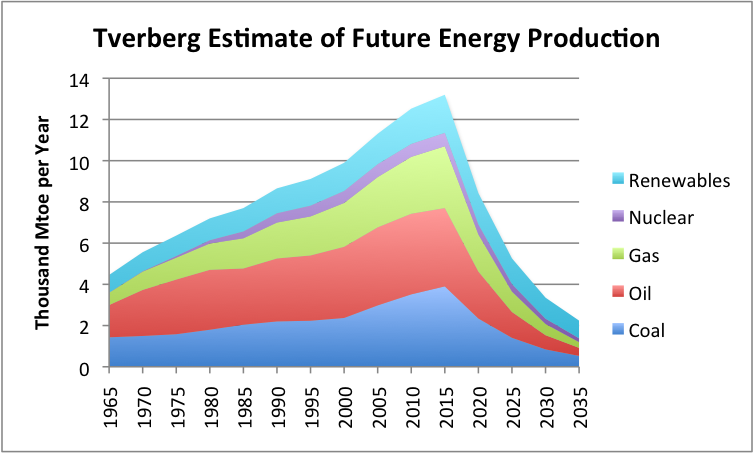
Eyeballing this graph, the downward side of the curve is about five times a steep as the upward one – quite a steep Seneca cliff. If it turns out to have been accurate, we will be back down at 1965 levels of energy production by 2025~30, with only a third of the energy we have to play with now. Modern industrial society can’t run on that. It’s no wonder the consensus of 97% of economics experts refuse to even think about the issue.
I know the downslope will be steep, but I don’t know how steep. This is just a guess.
Does anyone know of a pill that will cure stupidity?
I’ve just finished up a brief conversation with someone who was moaning about the massive debt pile Canadians are buried under http://wolfstreet.com/2016/08/18/consumer-credit-soars-delinquencies-jump-for-millennials-in-canada/
I am being told that people should stop spending what they do not have — stop buying what they do not need.
Yes of course — sounds wonderful — let’s dance around the fire and sing Kumbaya….
But let’s think about the implications of masses of people doing that I say … mega recession… no? And then we won’t have to worry about spending very much at all 🙂 Problem fixed!!!
Yes but doing what we are doing is going to collapse us ….I am told….
Of course it is — at some point — but not spending is going to collapse us now….
Stomps off in disgust with Fast…
Fortunately I do not have children …. so I don’t have to give a &^%
No kids in this household either. Just a dog and eight cats. The Nearings didn’t have pets or even barnyard critters on their farm. Scott referred to such creatures as “parasites”.
Mr. Chips responded to a comment about his being childless with: “I thought I heard you saying it was a pity… pity I never had any children. But you’re wrong. I have. Thousands of them. Thousands of them… and all boys.”
And the Buddha is said to have declared: “All men are my chlidren and as I wish all welfare and happiness in this world and the next for my own children, so do I wish it for all men.”
In that spirit, we have to give at least a small &^% about the massive mess the world is in. Not that we can do a #@¥* about it!
We can visualize the economy as a pond that provides a living for all kinds of creatures from worms and crabs to fish, frogs, birds, etc. In this analogy, we can make water stand in for money. The as water level in the pond varies, different types of creature do well or badly. When there’s lots of rain and the pond is full to capacity, that’s boom time for most of its inhabitants — everyone is swimming in cash! But the fish better watch out because they could get carried away in the outflow. When the rain doesn’t fall and the tributaries don’t provide any water to replenish what is lost to evaporation, the water level drops and things get tougher for most of the inhabitants. Cash is in short supply! Although some of the birds may make a killing under such circumstances as it makes it easier to find fish, crabs and worms to eat.
Our current pond is drying out. The Central Bankers have a reservoir upstream that they can use to inject some emergency water into the pond. This prevents it from drying out completely, but it is no substitute for a good long rain. But we individuals, the denizens of the pond, are powerless to do anything to change the water level. All we can do in a drought is to hunker down, find water where we can, and conserve our own meagre supplies.
Big Oil’s Break-Even Breakdown
https://www.bloomberg.com/gadfly/articles/2016-02-23/big-5-oil-majors-struggle-to-balance-spending-dividends
I see Liam Denning shows this chart showing some data for the sum of the five Big Oil Major companies.
Note that prior to 2008, their total debt was close to zero. Their total debt rose in 2008, stayed level to 2012, and then rapidly rose in 2013, 2014, and 2015. It was in early 2014 that I wrote the article quoting Steve Kopits called, “Beginning of the End? Oil Companies Cut Back on Spending.” You can see in this chart how, indeed, these big oil companies did cut back on spending, starting in 2014 and continuing into 2015.
Even with the cutback in spending, I thought it was interesting that Capital Expenditures are still high compared to 2006 levels.
Later in the article, Demming shows a chart showing oil price needed to fund “capital expenditure and dividends.” These amounts seem to range from about $58 to $68 dollars per barrel– a lot lower than Kopits numbers. I am wondering if Demming is leaving out major pieces, such as “operating expenses” and “income taxes.” Interest payments on past debt would clearly be additional as well.
The next stage maybe massive loans to oil companies at negative interest rates.
I think that is likely – they will not stand by and let the oil companies collapse
That is an idea!
I can’t grab the image near the bottom with the break evens for the big 5… but they are approaching $70…
Do you reckon those are not accurate numbers — that they are actually higher?
Have you seen any other information that presents a fuller picture?
Berman indicates similar numbers http://www.forbes.com/sites/gauravsharma/2015/10/31/big-oil-gears-up-for-60-breakeven-crude-price-as-profits-sink/#3e58787e535c
Shell’s definition of balance seems a little shaky. It put its cash flow break-even price at $55 a barrel last year. But leaving aside help from asset sales, it would have been closer to $70 a barrel. With sale proceeds now explicitly earmarked for debt reduction, Shell can’t really count on that to help balance its $30 billion planned investment and $15 billion in total dividends.
http://www.wsj.com/articles/what-it-takes-for-royal-dutch-shell-to-break-even-1462361607
http://www.bloomberg.com/energy
Don’t look now, but Brent us up just over $50. a barrel. Not even sure what’s driving it, except sometimes the price of something will fluctuate on the way back up. It was at about $50 a few weeks back then dropped into the low 40’s, but is now back up to $50+ So as investors would say, ‘It’s testing $50 a barrel again’. We’ll see if it can hold at or above that mark, but the trend is unmistakable to continue higher. I know that’s not a popular viewpoint on this site, but anyway that’s my view on it. Let’s see where price goes now…
The central banks are of course driving the price of oil … just like they are driving the prices of bonds, stocks, gold, property etc….
Everything is totally manipulated.
Goldilocks is at play now – can’t go too high or the economy dies… can’t go too low or the oil producers die…
Lately, it seems to have to do as much as anything with how high or low the dollar is. When the dollar is relatively low, the price of oil is high, and vice versa.
When the dollar is low, oil is more affordable for our trading partners, so they bid the price up. In dollar terms, their debt is worth more.
The price of oil definitely fluctuates with the value of the dollar.
I thought it was just the result of recent Saudi jawboning leading to short-covering rally.
China Sides With Russia In Syrian War, Will Provide “Aid And Military Training” To Assad
http://www.zerohedge.com/news/2016-08-16/china-sides-russia-syrian-war-will-provide-aid-and-military-training-assad
Turkey seems to be out as a NATO ally after the failed coup and has since then strengthen its ties with Russia, so the power balance in the region might have changed enough for China to move in. The U.S is now looking for a new home to its nukes in Turkey, Romania has so far declined the honor to house them.
False flag operation, obviously.
Coal is making a comeback. Exports from Newcastle (Australia) are booming again! Blame or thank those inscrutable East Asians.
Less than a year after the coal industry was declared to be in terminal decline, the fossil fuel has staged its steepest price rally in over half a decade, making it one of the hottest major commodities.
Cargo prices for Australian thermal coal from its Newcastle terminal, seen as the Asian benchmark, have soared over 35 per cent since mid-June to more than one-year highs of almost $US70 a tonne, pushed by surprise increases in Chinese imports.
Coal has also been getting support from Asian industrial powerhouses Japan and South Korea, while demand remains firm in India, Vietnam and the Philippines.
Japan and South Korea have both said they want to expand future coal imports while reducing more expensive imports of liquefied natural gas (LNG).
China’s power consumption has also risen against expectations, jumping 8.2 per cent from a year ago in July to reach 552.3 billion kilowatt hours.
While almost all thermal coal miners were hit by the previous price decline, and most shut or sold assets, those left with the best assets now stand to benefit from the rebound.
And the biggest winners are those with mines in Australia, thanks to the high average quality of its coal.
http://www.smh.com.au/business/mining-and-resources/after-years-of-pain-coal-becomes-one-of-the-hottest-commodities-of-2016-20160818-gqvfth.html
Thanks for the info, apparently nice jump since Jan 2016, coal who knew, to get rich quick is not an easy task, lolz, http://finance.yahoo.com/quote/KOL?ltr=1
Can’t find any 2-3x ETF though..
I think it is very interesting development in the light so many commentators both in the BAU as well as PO-finite world scene rejected the thesis of return of the coal. Especially in the sense of coal playing the substitution role for more refined products (LNG). Also take into account it will take years before China finalizes completion of all these new nuclear powerplants and some of the gas terminals as well. Hence the interim need for coal, also lot of cheap fabrication/assembly moved to other Asian countries, puffing on coal as mentioned in the article.
In terms of speculation, the Q4 2008/Q1 2009 bottom of coal was twice as high as the JAN 2016 bottom and that’s in not properly inflation adjusted dollars ! Coal was briefly for free. Plus I recall strange moves on the European coal market last winter – this spring as several owners (in the red) of big coal companies desperately tried to get out while similarly desperate bunch of other people (with free capital) tried to get in with these dirt cheap assets. The all above tells a story, which won’t be invalidated by possible overall deflationary demand semi crash in year or two.. in fact that would present yet even better entry point for coal and oil, but the latter opportunity has been spoiled by people like Kyle Bass publicly announcing in early 2016 entrance to position and awaiting spike in oil 2016-2018 due to previous under investment in capacity..
That’s an interesting observation.
The value of US coal assets will depend to a large extent on how the politics play out. The “keep it in the ground” people want to drive coal out of business. But there are other forces that “want the market to decide”. On the surface an ideological war is going on, and beneath that there is presumably a fair amount of maneuvering by big financial interests.
If people focus on to exclusively the West, particularly the US, it looks like coal has a dismal future. There is a lot of political posturing, with governments pledging to close down the industry and move to “clean”, “renewable” and/or “low-carbon” power sources. Hillary hasn’t gone down too well in West Virginia for precisely that reason, although it may have done her some good in Florida and California.
In the UK too, coal is out of fashion. At present, it is supplying just 1.2% of electrical generation. See this fun page from the people who run the National Grid.
http://www.gridwatch.templar.co.uk/
But in Asia, where the bulk of the world’s heavy industry is now located, coal remains a major player and looks set to do for some time. It’s hard to see precisely what’s going on in China, but they seem to be still building lots more of everything, including coal plants, nuke plants and solar PV farms. There are signs that China may have now have passed peak coal consumption for good, and that new coal plants are mainly going to replace more polluting ways of burning the stuff. However, like everything else in China, the numbers are huge. According to Wikipedia, “China’s coal consumption in 2010 was 3.2 billion metric tonnes per annum. The National Development and Reform Commission, which determines the energy policy of China, aims to keep China’s coal consumption below 3.8 billion metric tonnes per annum.”
The Indian government is also insisting that it has the right to use coal to help the nation’s industrial development. Both India and China have ample coal domestic resources for at least several decades, but as always, the easiest to extract and transport and the best quality stuff has gone, and so Australian coal may be looking increasingly attractive compared to what they mine at home.
In the case of Japan, they have about 40 perfectly good nuclear reactors currently standing idle since the shock and awe following the Fukushima meltdowns, and so have had to make use of mothballed fossil fuel power plants to keep the lights on for the past five years, which has pushed up prices to consumers by about 20%. Since it has become politically difficult to build new nuclear plants and a number of the idle ones have now been scheduled for scrapping, the Japanese government has decided that coal will have a bigger future. Now that the Environment Ministry has dropped its previous opposition to coal plants, “companies are rushing to build 43 coal-fired plants or 20.5 GW of capacity in coming years, about a 50 percent increase.”
http://www.reuters.com/article/us-japan-emissions-idUSKCN0VW0EV
I don’t believe Japan is mining any domestic coal these days. So it will be relying on supplies from countries such as Australia for the foreseeable future.
Yep, the Asian hunger for (their) needy coal can eventually lift up all world’s coal “boats” as commodity, despite the local anti pollution and anti mining campaigns, at least in theory, hah. Apparently, as I mentioned above, some financial sharks made such analysis and proceed with bet ~1/2 – 3/4 year before us here, while mainstream average investor or retail is still oblivious, lolz.
Coal has played an amazingly large role in the past. “Cheap” is a very important attribute, when it comes to energy products.
Thanks!
Part of this is China’s decision to use imported coal in some cases, rather than its own coal, because the imported coal is cheaper (shipped over water rather than land; sometimes less depleted). I am surprised that China’s power consumption has jumped 8.2% from a year ago in July. Perhaps the stimulus is having a temporary effect.
=> I’m wondering whether weather played a part. 🙂
You’re welcome!
Bear in mind the figure of 8.2% is a year-on-year comparison for a single month. It could be a one off. I’m not sure of the reasons, but I’m wondering whether played a part. In China July is usually the hottest month of the year. I don’t know if 2016 was hotter overall than 2015, but I found that:
“On Monday, July 6, 2015, Shanghai recorded the lowest average July temperature in the last 142 years. The maximum temperature of the day was 21.2 °C (70.1 °F), averaging on 18.9 °C (66.0 °F), which is the lowest average temperature measured in Shanghai since July 2, 1873.”
http://thewatchers.adorraeli.com/2015/07/10/shanghai-records-lowest-average-july-temperature-in-142-years-china/
However, in July 2016, the lowest daily maximum temperature in Shanghai was 29°C and there were several days when maximum reached 38 or 39°C.
http://www.whereandwhen.net/when/east-asia/china/shanghai/july/
July temperatures in China from Beijing all the way down to Hong Kong often get up to the mid- to high 30s (°C), so air conditioning consumes a lot of electricity. Just a few days in the 20s rather than the 30s could make a considerable difference.
By the way, this short article from The China Daily puts this July’s figure in a bit more perspective.
China’s electricity use rose 8.2 percent year on year in July, official data showed Tuesday.
In July alone, electricity consumption totaled 552.3 billion kilowatt hours, according to data from the National Development and Reform Commission.
Electricity consumption totaled 3.3 trillion kilowatt hours in the first seven months, up 3.6 percent year on year, the commission said.
Electricity use in the service sector and agricultural sector rose 10.2 percent and 6.4 percent, respectively, in the January-June period, while the industrial sector saw an increase of 1.6 percent.
http://www.chinadaily.com.cn/business/chinadata/2016-08/17/content_26499789.htm
You are right. Weather may play a part in the high electricity use in July. There are quite a few condos and offices with air conditioners in China. There is not plenty of spare capacity to operate them as well. So many condo owners and offices may have turned on the air conditioning.
Yes, it’s very striking indeed, lets wait for Q1-Q2 2017 if the trend still holds, there is also a chance of some temporary levitation (separation of cycles) for non western, especially Asian/emerging markets. Some people, e.g. the Alhambra guys already demonstrated on charts the US gov will have to publicly announce the turn of biz cycle-recession (via revisions) by that time early next year..
Gail, a lot of my posts are ending up in moderation today, including one about this subject. (Please feel free to delete them when you check the queue.)
The gist of it is that the 8.2% jump in Chines electric power consumption is only for the month of July and is probably a fluke caused in large part by a typhoon in July 2015 that cooled the country or a few days. Temperature in Shanghai average 18.9 C on July 6, 2015, the coldest average July temperature recorded there in 142 years. This year the lowest average July temp was 29 C and there were several days touching 38 or 39 C.
For the first seven months of 2016, Chinese power consumption is up 3.6% year on year.
Sorry–I think the moderation problem is fixed.
as this is the font of all knowledge—has anyone else come across this?
https://callingchristians.com/2011/12/26/prophetic-miracle-of-muhammad-saw-desert-arabs-competing-in-building-skyscrapers/
Revival of the old ziggurat tradition?
Antic towers “tall enough to reach Heaven”.
The wonderful thing about prophecies, particularly ones regarding human actions, is that people who believe in those prophecies can make decisions in order to fulfill those prophecies. How do we know that the Arabs are not building the towers solely to fulfill the prophecies?
Yes, p-iss be upon it. Why are you reading such rub-bish, you Quis-ling?!
i make a point of reading everything
sometimes i come across something that makes sense
December 2011. Hasn’t happened yet.
I know little about climate, but there is more climate chaos, and that the average temperature in my town of residence has risen very noticeably, since I arrived here in 1984. And around the world, there are more floods, storms, droughts and wildfires.
Looking to the future, I do wonder why people don’t also mention negative as well as positive feedbacks. We are told that global warming will lead to more volcanic activity, and that seems to have a sound basis in science. However, historically volcanic ash has exercised a cooling effect on the Earth. Here’s what Wikipedia says about the Krakatoa eruption of 1883:
“Average global temperatures fell by as much as 1.2 degrees Celsius in the year following the eruption. Weather patterns continued to be chaotic for years and temperatures did not return to normal until 1888.”
So, I am not a denialist. I do believe, however, that things do not simply always go in one direction. Then again, though there may be cooling events in the foreseeable future, they might be short-term, and the medium and long-term trend will probably run in the opposite direction.
More on the AGW subject from the Guardian:
https://www.theguardian.com/commentisfree/2016/aug/18/ice-scientists-arctic-ice-disappearing-reduce-emissions-peter-wadhams
Which reminds me of the methane problem, and Natalia Shakhova’s fears of a methane gigaburp. But we can foresee the future and must wait until we get there (or not!), to see how things turn out.
I meant “cannot see the future”, of course.
Ok – I am listening…. what can we do about it?
“Ok – I am listening…. what can we do about it?”
Here we go again. I remember your little spiel from when I first posted under this name – though
I’d previously posted under more names than I can remember.
If you can’t foresee the future, except in the vaguest, most general terms, what can you do? On the day of 7/7 in London, my work colleagues and I were eventually told, at 3pm, to go home and await instructions. The Tube station I usually used was closed, despite not being one of those attac-ked, so I walked across London Bridge to the railway station. Masses of people were streaming across London Bridge and into the station – more than I’d ever seen in those places. That evening, my sister rang me from my birth city and begged me not to use the Tube ever again. I explained that it was convenient, and since I couldn’t foresee the future, I was not afraid and would not be afraid – unless and until I ended up in the midst of some dis-as-ter. That is the only way to behave.
The time to avert disaster is past. We could maybe mitigate it by perhaps one quarter of one percent, if the political will was there and if the world acted more or less in unison. Neither of those conditions applies, so we can only pontificate about our unknown future, and enjoy the moment – along with a little dis-as-ter p-orn, if that’s what you enjoy. No go away and cook yourself a rat. 😉
“The time to avert disaster is past… if the political will was there and if the world acted more or less in unison.”
That sounds like a line from an Obama speech.
‘acted’ can you explain what could have been done differently?
The Guardianistas are proposing a solution in which Britain goes vegan and covers vast swaths of the North Sea with wind turbines while declaring the area a porpoise sanctuary.
Ah, the collapse of industrial civilisation then?
That is pretty hilarious, considering what a terrible idea windmills in the North Sea is …
and end immigration? No? Then one billion or two billion in England, assuming Wales, Scotland, and Cornwall have the sense to seal the borders.
🙂
The Guardian is the Pravda/CNN of DelusiSTAN ….
@cp
I follow https://arctic-news.blogspot.com – which portraits the maximum doomerish side of the possible climate change ahead. Nevertheless – I’m of the option everything is already baked in and that we have not a real option to changes anything.
If we reduce CO2 & Co. dramatically – then also the global industry / system will collapse – and that death is more dramatic and more near-term for most than the possible dramatic risk of climate change in the future.
Ert, I do enjoy that blog too. A few years ago, Malcolm Light gave an estimate of 2031 as his date of total extinction of humanity in the Northern hemisphere due to the spreading of the methane veil, but recently he brought it forward to 2023 – I don’t know why.
But yes, we’re between a rock and a hard place. Even if we solved the CO2 and methane problems, and also got zero point energy, we would still be consuming. To consume means to eat – we’d still be eating the Earth. If you imagine the Earth as roughly apple-shaped, we wouldn’t stop until we’d eaten it down to the core – if we had enough affordable energy, and humans being humans.
Never mind, we must take from the situation what we can, and I certainly enjoy watching the A-r-a-b states self-destruct.
List of Failed Predictions issued by the Jehovah’s Witnesses (taken from Wikipedia)
1877: Christ’s kingdom would hold full sway over the earth in 1914; the Jews, as a people, would be restored to God’s favor; the “saints” would be carried to heaven.[28]
1891: 1914 would be “the farthest limit of the rule of imperfect men.”[29]
1904: “World-wide anarchy” would follow the end of the Gentile Times in 1914.[30]
1916: World War I would terminate in Armageddon and the rapture of the “saints”.[31]
1917: In 1918, Christendom would go down as a system to oblivion and be succeeded by revolutionary governments. God would “destroy the churches wholesale and the church members by the millions.” Church members would “perish by the sword of war, revolution and anarchy.” The dead would lie unburied. In 1920 all earthly governments would disappear, with worldwide anarchy prevailing.[32]
1920: Messiah’s kingdom would be established in 1925 and bring worldwide peace. God would begin restoring the earth. Abraham, Isaac, Jacob and other faithful patriarchs would be resurrected to perfect human life and be made princes and rulers, the visible representatives of the New Order on earth. Those who showed themselves obedient to God would never die.[33]
1922: The anti-typical “jubilee” that would mark God’s intervention in earthly affairs would take place “probably the fall” of 1925.[34]
1924: God’s restoration of Earth would begin “shortly after” October 1, 1925. Jerusalem would be made the world’s capital. Resurrected “princes” such as Abel, Noah, Moses and John the Baptist would give instructions to their subjects around the world by radio, and airplanes would transport people to and from Jerusalem from all parts of the globe in just “a few hours”.[35]
1938: Armageddon was too close for marriage or child bearing.[36]
1941: There were only “months” remaining until Armageddon.[37]
1942: Armageddon was “immediately before us.”[38]
1961: Awake! magazine stated that the heavenly kingdom “will, within the twentieth century, cleanse the entire earth of wickedness.”[39]
1966: It would be 6000 years since man’s creation in the fall of 1975 and it would be “appropriate” for Christ’s thousand-year reign to begin at that time.[40] Time was “running out, no question about that.”[41] The “immediate future” was “certain to be filled with climactic events … within a few years at most”, the final parts of Bible prophecy relating to the “last days” would undergo fulfillment as Christ’s reign began.
1967: The end-time period (beginning in 1914) was claimed to be so far advanced that the time remaining could “be compared, not just to the last day of a week, but rather, to the last part of that day”.[42]
1968: No one could say “with certainty” that the battle of Armageddon would begin in 1975, but time was “running out rapidly” with “earthshaking events” soon to take place.[43] In March 1968 there was a “short period of time left”, with “only about ninety months left before 6000 years of man’s existence on earth is completed”.[44]
1969: The existing world order would not last long enough for young people to grow old; the world system would end “in a few years.” Young Witnesses were told not to bother pursuing tertiary education for this reason.[45]
1971: The “battle in the day of Jehovah” was described as beginning “[s]hortly, within our twentieth century”.[46]
1974: There was just a “short time remaining before the wicked world’s end” and Witnesses were commended for selling their homes and property to “finish out the rest of their days in this old system in the pioneer service.”[47]
1984: There were “many indications” that “the end” was closer than the end of the 20th century.[48]
1989: The Watchtower asserted that Christian missionary work begun in the first century would “be completed in our 20th century”.[49] When the magazine was republished in bound volumes, the phrase “in our 20th century” was replaced with the less specific “in our day”.
dontcha just love those doorsteppers of a sunday morning?
They fair “make my day!”
Still–the last and decisive battle on the Palestine campaign was at Megiddo
http://www.awmlondon.gov.au/battles/megiddo
and that effectively created israel because it cleared the Turks out of Palestine
Makes ya think don’t it?
i have no time for religion, but at the same time those old guys maybe knew stuff we don’t
Wasn’t there a deal during WW1…. where the German bankers sold out Germany …. in exchange for the return of the promised land as a Zionist homeland?
I seem to recall this later referred to as ‘the stab in the back’ — by a guy with a moustache….
We in the peak oil community have made a lot of erroneous estimates too. It is easy to point to others, with their wrong ideas.
I don’t know where the Jehovah Witnesses got their ideas from, but evidently they felt there was a lot of reason for their concerns them. Somehow, they have been able to go on, despite their wrong view of the future.
i had a jw uncle
you could stick literal facts in front of him—an he’d still deny everything no matter how ridiculous
oops—i think i just described Donald Trump
CP, since you’ve brought up this alarming Guardian article on the ideas of Prof. Peter Wadhams, in the interests of full disclosure, it should be noted, understood and acknowledged that that the good professor has a record of making alarming predictions that haven’t panned out.
As early as 2007, Prof. Wadhams was giving support to the ideas of another climate expert, Prof. Wieslaw Maslowski, that the Arctic could be ice free by 2013 or even earlier. According to Wadhams:
“The implication is that this is not a cycle, not just a fluctuation. The loss this year will precondition the ice for the same thing to happen again next year, only worse.
“There will be even more opening up, even more absorption and even more melting.
“In the end, it will just melt away quite suddenly. It might not be as early as 2013 but it will be soon, much earlier than 2040.”
http://news.bbc.co.uk/2/hi/7139797.stm
In 2011, the Telegraph reported that:
Prof Peter Wadhams, of Cambridge University, said the ice that forms over the Arctic sea is shrinking so rapidly that it could vanish altogether in as little as four years’ time.
“It is really showing the fall-off in ice volume is so fast that it is going to bring us to zero very quickly. 2015 is a very serious prediction and I think I am pretty much persuaded that that’s when it will happen.”
http://www.telegraph.co.uk/news/earth/environment/globalwarming/8877491/Arctic-sea-ice-to-melt-by-2015.html
A year later in 2012, he repeated this prediction in article in the Guardian by John Vidal, extending the deadline to 2015/16:
“I have been predicting [the collapse of sea ice in summer months] for many years. The main cause is simply global warming: as the climate has warmed there has been less ice growth during the winter and more ice melt during the summer.
“At first this didn’t [get] noticed; the summer ice limits slowly shrank back, at a rate which suggested that the ice would last another 50 years or so. But in the end the summer melt overtook the winter growth such that the entire ice sheet melts or breaks up during the summer months.
“This collapse, I predicted would occur in 2015-16 at which time the summer Arctic (August to September) would become ice-free. The final collapse towards that state is now happening and will probably be complete by those dates”.
https://www.theguardian.com/environment/2012/sep/17/arctic-collapse-sea-ice
The summer of 2016 has come and gone and the melt season is almost at its end. How have his predictions gone? Have we got an ice-free Arctic as Professor Wadhams forecast?
Here’s the Arctic Sea Ice Extent graph from the University of Bremen. It shows that this year as we approach minimum we have about 5 million km2 of sea ice extent in the Arctic. On this chart, 2016 is at about the same level as 2015, slightly above 2011, a full 1.5 million km2 above the record low modern minimum of 2012 and (not shown) almost a million km2 above the 2007 level.
http://www.iup.uni-bremen.de:8084/amsr2/extent_n_running_mean_amsr2_previous.png
The Guardian’s Environment team knows this well. John Vidal knows it. And yet this week he has gone on to write another article featuring Wadham’s alarming future predictions that DOESN’T EVEN MENTION Wadham’s previous failures or his own role in publicizing them as sound climate science. That, to my mind, is despicable. But that, unfortunately is the state of postmodern climate change coverage by the media people who are selling us the climate scare.
And I am supposed to defer to the opinions of people of this calibre because a failed cartoonist with a fetish for Nazi uniforms determined that “97% of climate scientists agree with AGW”?
Paul Homewood:
Jose Duarte, expert in Social Psychology, Scientific Validity, and Research Methods, has actually called the Cook paper “multiply fraudulent”, and, as far as I know, Cook has taken no action to challenge the claim. This, as much as anything else, shows just what a con trick the whole business was. How many scientists, after all, would accept being called fraudulent without taking action?
https://notalotofpeopleknowthat.wordpress.com/2015/10/29/cooks-97-scam-debunked/
And YES, the Arctic ice may all melt away before 2040, and then again it may not. We just don’t know. The expert “Wadhams” doesn’t know. Nobody knows. That’s what adds to the fun.
I am guessing that a slowdown in aerosol emissions in China is having something to do with the current spike in temperatures. This article says, “Aerosol Emission Key to Surface “Warming Slowdown,’ Study Says.
The article bases its analysis on the change in concentration of aerosols between 1998 and 2012. This is precisely the period of China’s run up in coal use.

If China’s rise in coal usage held global warming down, it stands to reason that its cutback since 2012 is behind the recent increase in temperature. Maybe we should ask China to burn more coal.
Gail, that orange/red area over India, China and Southeast Asia corresponds with the location of what is known as the Asian Brown Cloud. It’s partly due to increased coal burning but also to burning agricultural waste and wood for stoves. I definitely helps cut down the overall amount of insolation reaching the ground. But the effect varies and is strongest in the winter/early spring, when the sun is south of the equator, so it’s affect on agriculture and on summer temps is less than might be imagined.
And what about those blue areas over the US and Europe. Haven’t we done well in cleaning up our air!
I had a whiff of that cloud when in Varanasi a few years ago — not even Beijing comes close… a couple of hours of breathing that *&^% and one’s respiratory system feels like it is about to collapse… the nose burns….
No idea what was in that ‘air’ but it was nasty (and I don’t think it was the burning bodies)
Right. We have done well on cleaning up our air. We are also past “Peak Coal” in both Europe and the United States.
I would expect that there is some effect year around. I know that in China, the smog problem tends to be worst when winter heat (with coal) is burning. Any heat absorbed by the oceans would seem to affect climate year around.
Tim, I didn’t link to the Wadhams article to endorse him, just to show that there are different views out there, and some are more doom~erish than others. Anyway, the article itself criticised his geo-engineering suggestions. As for the other fellow, did he really wear a Na~zi uni~form or was it shopped? Even if he did, that doesn’t necessarily say anything about his views – he might just be into pantomime.
My own view is that global warming has advanced markedly in my lifetime. As a schoolchild in the 1960s, I generally had to walk to school thru snow, often very deep, every day for 3 months (December, January, February). Nowadays we in England hardly see snow. On Dec 15th 2015, I had to open my bedroom window because the unheated room was so warm that I woke up. That was quite ridiculous for winter. And since 2012, I’ve had at least one mosquito bite each summer. That just isn’t supposed to happen in England.
To be fair, the doomer blogs such as Arctic News and Robert Scribbler do often provide videos etc. of the worst extremes of weather, which are far more frequent these days – firestorms, floods and the rest.
You are quite right to say we don’t know the future, but things have still got worse far quicker than I imagined. Even if it’s not 2 minutes to 12 yet, I’m quite prepared to believe it is 11pm.
I’m focusing on Prof. Wadhams’ record because it shows clearly that alarmism gets headlines. There are many many scientists researching climate who have reach results much less alarming that people like Wadhams have. There are literally thousands of peer reviewed studies that are totally ignored by the mainstream. Wadham’s function is to be a prophet of doom, and regardless of how many times his predictions don’t pan out, are we the public are supposed to ignore these failures and focus on the next prediction of doom?
Sensitive and smart young people start out believing climate doomerism because it is authoritatively worded and professionally presented. Over the years and decades, this same smartness and sensitivity causes many of them to become steadily more skeptical as they age. On the other hand, as Carl Sagan said: “if we have been bamboozled long enough, we tend to reject any evidence of the bamboozled, we are no longer interested in finding the truth. The bamboozle has captured us. It’s simply too painful to acknowledge, even to ourself, that we have been taken. Once you give a charlatan power over you, you almost never get it back.”
Sagan himself believed in the potential for catastrophic manmade global warming. When he died 20 years ago, almost everyone believed that. We had all experienced general warming between the 1970s and the 1990s and AGW seems as good a reason for it as any. I was just shaking off my own unquestioning acceptance of the prospects for catastrophic warming when Kyoto came along in 1997 and, being a local resident and a part-time journalist, I visited the International Conference Center just north of the city on the very day that the still youthful and athletic-looking VP came the venue and made a dramatic plea for an agreement to save the climate.
Since that time, I’ve come to see Gore as simply a salesman for a very clever scam by a group of oligarchs and globalists to obtain yet more power and wealth and control over the rest of us by regulating the use of energy. But if I’d thought at the time, I might have agreed that to stop global warming it was necessary for somebody to control the way we use energy.
I’ve never set out to convince anyone and I’m happy to let people come to their own conclusions. Eddy was talking about his frustrations with people who can’t see how cutting spending and cutting energy use will lead quickly to collapse. Dolph is frustrated with those of us who can’t see that collapse will be a gradual rather than abrupt. What does it matter if people disagree? Would things be better if we all thought the same? I don’t get frustrated if others have alarmist views about climate change. I’m convinced that is one thing we don’t have to worry about. And so I’d like others to come to that realization in order that they can feel reassured and not be anxious on that score. Economic collapse is another matter. That’s a dark cloud looming on the horizon that threatens all of us outside of the hunter gatherer communities—and even they will loose out on goodies from visiting tourists and anthropologists.
Usually in this world, given enough facts and logic, the smart asses will work out the gist of what’s going on, while the dumb bunnies will remain enthralled by the circus performers. Most of us are somewhere in between and most of us including me are intellectually lazy, but we have the potential to up our game.
I too believe that we are affecting the global climate …. but will this result in a near term collapse — as in arriving before a collapse triggered by expensive oil…. I think that is unlikely…
The Arctic melt and the methane are clearly a concern — but is that going to happen within the next few years? Probably not….
My frustration with the AGW crowd is that they scream STOP burning carbon — without understanding the implications — or believing that if we only switched to solar panels all would be well …. I want to feed them anti-stupid pills with added anti-ignorance ingredients… but I don’t know where to buy them
CP, I think the 60s and 70s were colder and snowier than any time since in the UK and much of the rest of the Northern Hemisphere. The winter of 62/63 in particular was “arctic” in the UK. I remember it well because I was five years old and I had a little plastic model of Stingray, which I’d left in a bucket of water in the backyard and it became frozen solid over night. Your memories of that period are, I’m sure very vivid.
But is it true that these days in England we hardly see snow? 2009/10 and 20010/11 had above-average snow, if I remember correctly. But I quite agree with you that it’s warmer now than it was 40 or 50 years ago and there are more winters with little snow.
BTW, this record gives a good summary of British winters.
http://www.neforum2.co.uk/ferryhillweather/bonacina.html
As for the other fellow, did he really wear a Na~zi uni~form or was it shopped? Even if he did, that doesn’t necessarily say anything about his views – he might just be into pantomime.
It was photoshopped by John Cook or his mates at the Skeptical Science blog. The insignia on the military cap was changed to two SkS penguins. It looked quite cute. They also photoshopped their AGW skeptic adversaries Watts, Monkton and Dellingpole as Spartan warriors.
But Cook is a cartoonist — not a scientist, and he’s a propagandist with the job title of Climate Communication Fellow for the Global Change Institute at The University of Queensland. His “97% consensus of experts” is cartoonish, meaningless (nothing is defined), misleading, and basically a propaganda ploy in the finest Goebbelsian tradition. So the Na~zi uniform can be seen as a playful giveaway that Cook knows exactly what he’s doing. I have no idea if he has any other Na~zi sympathies, but he embraces their propaganda techniques without shame.
In Bali … the swastika is everywhere … when I moved there I thought that it must have been a haven for geriatric ex-Hitler youth…. 🙂
Actually I understand that it is related to the hindu religion https://en.wikipedia.org/wiki/Swastika
http://static.panoramio.com/photos/original/37510500.jpg
I’ve been following your ‘arguments’ against the possibility of catastrophic climate change over the past few days and found they do not hold much water.
One particular fallacy you trot out regularly is ‘past incorrect predictions invalidate everything vaguely connected to them’.
My eyes glaze over with the early morning so can only drag out a couple more examples of your logical somersaults.
While engaging in argumentum ad hominem, you state:
“And I am supposed to defer to the opinions of people of this calibre….”
….then you hold up Jose Duarte’s findings as valid????
If you spent a fraction as long finding out how unreliable your own sources are as you do scrounging around for conspiracy theories about climate science then you might start to reveal to yourself just how flawed your argumentation is.
While engaging in the conspiracy theorists favourite fallacy, agenticity, you claim there is some dark plot to “control our energy resource use”. Even with all the alarmism, alleged propagandism and supposed vested interests which you conveniently emphasise while ignoring the mountain of conservative science that confirms what you dismiss, is anyone today actually controlling our energy use after 26 years of post-Kyoto ‘alarmism’? Where is there any real evidence of this conspiracy?
You’ve stated that “there’s lots of evidence that indicates that the climate is not as sensitive to carbon dioxide as…..(insert straw-man here). ” Apart from that fallacy you also employ misleading hyperbole. There’s “lots’ of evidence for all sorts of things. It’s their relative weight in proving or disproving a hypothesis that must also come to bear. Your attempts to do that by your petulant claims about the unreliability of the consensus view seems to boil down to “their evidence is not authoritative because I say so”.
Such uncommon precision!
Ok, I can see I’m not really getting through to you people. I’m going to try one last thing.
If things were collapsing, none of you would even be posting here. You would all be dead. The internet would be down.
But you are not dead. You are reading this post. Your computer is working. The electricity is working. The internet is working. Gail’s blog is working. And you are thinking of something clever comeback, to prove to that idiot dolph, that, none of this is true! The crap is hitting the fan! I’m doing to die tomorrow! The internet will crash tomorrow!
Strange, very very strange. That’s all I can say about the psychology of you people. Sad cases, would by interesting for my psychiatry buddies who need something more stimulating than the usual depressed and schizophrenic nuts.
Dolph—we are but minnows the stream of intellect. Nowhere near your level obviously.
But
When 98% of scientific opinion makes a clear statement that we are going to be hit by global warming, Do we take notice of what they say, or do we accept the word of Donald Trump, (depending on which day it is) who asserts that global warming is a hoax perpetrated by the Chinese?
Admittedly some of the comments about the sky falling in tomorrow on here are wild and wacky—but that doesn’t detract from the underlying reality.
Humankind is faced with 3 threats—global warming, energy shortage and overpopulation.
Any one of those will exacerbate the other two. Our collective greed has brought us to where we are, our collective denial/survival system ensures that we ignore the reality of it, and our (collective) unpreparedness for when it’s SHTF time.
They are there, and they are real, what we cannot know is when.
But we can make a good guess at it, based on evidence we have, and (as you infer) primitive psychological assessment of ourselves as human beings.
We exist in our current environment only through the power of wheeled transport, which functions on oil (please—forget renewables).
Right now, the world is sucking up the last reserves of oil, even Saudi expects to be importing oil by 2030 (you may laugh here)
when the oil is no longer available, our wheeled society is over.
Saudi is the biggest producer of conventional oil, and uses 1/3rd of what it produces to keep itself alive. As their oil diminishes, they will have to use more and more for themselves. So well before 2030, there will be NO Saudi oil.
This will kick off even greater conflict across the region, as the conflicting interests there begin the fight for survival. (Infinitely worse than you’re seeing now)
So we backdate from around 2030. (only 14 years away)
The USA tight oilfields cannot supply USA needs, (and Nigeria-Venezuela are basket cases) and with the Middle East in flames, the USA finds itself in serious oil deficit (8Mbd short)
The empire of the USA cannot exist without oil, but will blame either god or politicians for their collapse, and begin to tear themselves apart to prove one or other opinion right.
In total denial of why the sky really is falling in.
The USA right now is faced with presidential candidates, one of whom is certifiable, the other well meaning in her way, both preaching infinite growth.
Neither of them will be able to deliver, because the means to do so (cheap oil) is no longer available.
As it becomes obvious that the economy is in an oil deficit tailspin, civil disorder will break out, because the USA cannot function on only half its current oil consumption.
Our “society” as we know it, depends on the majority of us being reasonably law abiding.
We remain law abiding because most of us are warm, comfortable and well fed.
when we are not, all hell will break loose.
Saudi might last half the time to 2030—say 7 years. That puts us to 2022/3 wish, or sometime after the 2020 election.
I wrote a piece in 2011 that the 2016 election would throw up a lunatic, caused by a crashing economy. I’d hate to be right about 2022
Dolph – correct – we have not collapsed yet. Obviously.
But the global economy will at some point collapse – the lights will go off – the grocery stores will empty.
If you want someone to tell you exactly when that is going to happen — that is not possible. It’s like trying to predict when the stock market will crash again.
Dolph, do you see the people who visit this blog as being in need of psychiatric treatment? Is there anything your buddies could do to help us, or do you think they would just observe and classify us, and maybe write a peer-reviewed study on how we differ from normal, healthy, shiny, happy people holding hands?
https://youtu.be/iCQ0vDAbF7s
These people look so normal… in an inbred sort of way….
https://lilyincanada.files.wordpress.com/2012/05/lauren.png
But they are not normal. They are mutants.
Is this a scene from an English period piece TV show? /sarc
Fact or Fiction?: Lead Can Be Turned into Gold
Particle accelerators make possible the ancient alchemist’s dream—but at a steep cost
“It would cost more than one quadrillion dollars per ounce to produce gold by this experiment,” Seaborg told the Associated Press that year.
http://www.scientificamerican.com/article/fact-or-fiction-lead-can-be-turned-into-gold/
Parallels….
Lol, I see what you did there. Clever analogy.
Funny how most people would understand why we don’t make gold out of lead after reading that… yet if you presented evidence that oil is in much the same situation (just not as extreme)…. they would stomp their feet — and scream ‘you are an idiot’….
The Fed can create a quadrillion dollars quicker than you can eat a rat.
Right. But the problem is that the quadrillion dollars need to be repaid or liquidated. The keyboard credit doesn’t stay in the form of keyboard credit after it enters the broader financial system.
It’s kind of like why we will never again go to the Moon….. we could do it… but it would be a colossal waste of energy
But they can’t create a quadrillion tonnes of oil…
Free your mind… i suspect it has been done and without lead as a substrate – after all, if “reality” is thought-based, all you need is the appropriate imagination.
No wonder the control freaks want to suppress.
I understand that in DelusiSTAN …. if you take a handful of lead .. and imagine it has turned to gold just by blowing on it…. that it has been turned to gold.
But it is virtually worthless because everyone knows how to do this…. in DelusiSTAN.
Pingback: The Elephant’s Getting ‘Yu-u-ger’! – SEF News-Views Digest | Citizens for Sustainability
The beast lets out another groan of pain…. (perhaps suffering from flatulence…)
Target says low demand for Apple products hurts electronics sales
Net income attributable to the company fell nearly 10 percent to $680 million in the second quarter. Earnings before special items exceeded analysts’ estimates.
Net sales fell 7.2 percent to $16.17 billion, lagging Wall Street expectations of $16.18 billion.
http://www.reuters.com/article/us-target-results-idUSKCN10S12D?il=0
It’s not like people suddenly discovered that Amazon exists… and if you add up the declines vs Amazon growth — there is not offset…
These retail numbers are seeing are primarily a product of people having less money to spend because there are very few well paying jobs being created — along with stagnant or falling real wages….
There is no other food in sight so the ravenous beast has eaten its own tail and is about to start on its fingers and toes. Once it gets to the vital organs, that will be the end of it.
At some point, people have as many Apple gadgets as they need.
Yeah. But Apple, Microsoft et. al will always keep putting out new models and upgraded versions and they’ll try their best to eliminate backwards compatibility so that we end up having to buy the latest gizmos and software in order to stay connected. Basically, they’ve got us by the balls!
I can imagine that huge numbers of broke people are buying iphones on plans – they get the phone no money down so long as they sign a long term services contract with a mobile company…
So they are locked in paying for their current phone
Throw in the reality that each iteration of the iphone is not much different from the last ….
And there is not much incentive to upgrade…. people are no doubt keeping phones longer…
In Germany mobile tariffs are already as low as 8€/Month for unlimited voice inside Germany (mobile and land-line) + 2GB of high-speed Internet if you don’t want a phone.
Android smartphones start at 40€ effective…. as with PCs and notebooks before… there will be a “good enough” point soon, from which average prices will go downhill until their reach a minimum viable level which may be around 100€ in the next years. From that money, Apple and Samsung can’t live…
I discovered this a long time ago. My phone is about 7 years old and works for texting so it’s good for me.
You must also put into account that the knowledge based industry is transforming goods into software that can be copied and does not require stuff to be dug out of the ground.
Today you can make money by simply producing bytes. Charles Hugh Smith says stuff is becoming a commodity and cheaper by the day. The only value to be produced today is knowledge. Knowledge is not reflected so much in stuff numbers.
The globalization trend has been going on for hundreds of years. As such, the trend reversal is going to take awhile. It’s not going to be overnight.
Massive, immediate systemic collapse is wrong. The reason is because in your mind, you are envisioning a snowball like effect…something happening, that causes a cascading reaction of some sort that in unstoppable.
Cascading reactions don’t last! They almost always burn themselves out before becoming really big. The world works based on action/reaction.
Collapse is the same way. Certain patterns are just going to exhaust themselves, and other people are going to react to it in defensive and unpredictable ways. Humans have survival instincts honed over millenia, you must understand this. And what humans will learn to do is to let go of baggage and decrease complexity and cost, if it means a survival advantage for themselves.
There is no interconnectedness. There is no great chain or hive mind or anything like that links us all. We are not the borg. There are only nodes, whether they be individuals, cities, nations, businesses, etc. Each node has it’s self interest at heart, and won’t fail just because some other nodes out there are failing.
Do any of you kill yourselves because somebody else out there just had a tragedy? I rest my case. That reflection alone proves that collapse is going to take some time.
“They almost always burn themselves out before becoming really big”
Have you tried rolling a snowball down a steep hill – it does not slow down — and they usually stop when they smash into something….
Dolph,
Do you ever read your comments before posting them, to check them for logic and common sense?
Cheers.
I am concerned that dolph is cutting off his patients heads — because they report headaches….
I think his amygdala (emotion) is constantly over-riding his cerebral cortex (awareness).
But that’s just a guess.
Do you have any evidence of a fast collapse, or will you always just say, “this it is, now is the big one!”
It is you who lacks the capacity to really think this through. That’s why you are a doomer loser, it’s a psychological response to seeing other people being successful and not actually having their lives affected by any of this.
An egg will fall to the ground and smash – when it is released from your hand.
That is all you need to know.
It’s no longer a guess.
You’ve just proved my point.
Thanks.
Cheers.
Dolph, I can understand your logic here and I have some sympathy with it. I admit the possibility of a slow collapse, but also I can see ample potential for a fast one, or for a series of steep steps down the hill that leave us all bruised and bloodied at the bottom. The problem with economic and political calculations and projections is that there are always so many unknowns because human beings are the world’s greatest deceivers. Verily, the prevalence of deceit makes fools of all who dare to predict the future.
Tim, brilliant summary.
In fact the history is almost rhyming the same script along this path:
.., greed/progress, crisis feedback, can kicking, deceit, can kicking more, deceit full throttle, deceit^2, deceit^3, deceit not working anymore wtf?, systemic reset, renewal on modified base, ..
🙂
Shakespeare said much the same thing in Much Ado About Nothing:
Sigh no more, ladies, sigh no more,
Men were deceivers ever,
One foot in sea and one on shore,
To one thing constant never.
Then sigh not so, but let them go,
And be you blithe and bonny,
Converting all your sounds of woe
Into Hey, nonny nonny.
Sing no more ditties, sing no mo
Of dumps so dull and heavy.
The fraud of men was ever so,
Since summer first was leavy.
Then sigh not so, but let them go
And be you blithe and bonny,
Converting all your sounds of woe
Into Hey, nonny nonny.
Dolph,
“There is no interconnectedness. There is no great chain or hive mind or anything like that links us all. We are not the borg. There are only nodes, whether they be individuals, cities, nations, businesses, etc. Each node has it’s self interest at heart, and won’t fail just because some other nodes out there are failing.”
That’s great! I’m thinking the exact opposite of your above statement. I think nodes can’t exist by themselves, but only by their relationship and interconnectedness with their environment.
Without a constant flow of energy and information, a node simply vanishes, IMHO.
Thanks for pointing it so precisely!
Maybe it is political, psychological.
It’s clear to me that I have a much more, well, conservative and tribal mind than most people here. Most doomers are coming from a sort of ecological/liberal/kumbaya mindset, and that is understandable.
All for one! One for all! We all go down together!
Well, count me out. And I do know there are millions like me.
On the other hand, no man is an island….
What minimum size a community should have, to be self-sufficient and survive post-collapse?
(notwithstanding nuclear, chemical or bacterial threats)
Of course, it depends on what is available from local environment, but I don’t think it can be much lower than the Dunbar number (150 people), or something like extended family.
And corresponding low-level lifestyle.
Talk about tribal mindset!
@Stefeun
I think 150 is a minimum, too. Think on special skillsets required + backup + teaching the next gen (i.e. if a community has only one physician… and he dies.. big problem…all knowledge is lost). 150 would also be required to have enough capacity for defense or “deterrence potential” regarding possible thugs, thief’s, invaders, etc.
150 hairdressers and telephone sanitizers alone on a deserted island. Aouch.
@DJ
Telephone sanitizers are important – but I think 42 are enough. Still, some fingernail studios, telephone shops, 1$ stores and some coffe-shops are important, too 😉
Still, all this is fictitious doomer-stuff. The whole tribe-thing required millennia to evolve. I don’t think when things are really going down-hill that all the necessary social stills will be acquired in a whim. There will be much suffering before there is stability again. Also I think that the current system will show much more downhill potential – resembling some form of stability – as many may imagine.
Agreed, Ert,
surely it’ll take a lot of time before some kind of stabilization can take place, temporarily and not everywhere the same way.
My question was inspired by Dolph’s “nodes”, I was wondering about the minimum conditions for a human group to survive. Pure speculation, though, as we don’t know about post-collapse environment.
I don’t think you need to worry so much about redundancies; supposing there is a massive collapse and die off, but a few hundred million people survive. There would likely be clusters of several communities around the 150 people range.
Besides, I doubt there would be much need or desire for specialization, since probably 9 out of 10 people would need to be occupied in food production and hauling water, and the 10 counts any children, pregnant mothers, elders, disabled people, etc. So you might have 5 out of the 150 who are specialists.
Don’t you mean billions?
I would estimate that there are perhaps a few dozen people on the planet (other than those who are keeping the show going) who recognize what is happening and what the implications are.
Most of them are on FW.
@dolph
The question I have in all those/these discussion:
1. How is “slow” and “fast” defined in terms of months or years ?
2. What does “collapse” mean in terms of societal and living standards? For “a rough” example: Current Greece, current Venezuela, current Syria, current Libya, or worse?
If we would only collapse to Venezuelas current level.
I suspect total collapse will be worse than the countries you listed. Those countries have been collapsing for 10+ years to get where they are now. Except Libya and to a lesser extent Syria, which collapsed much faster due to war.
Scorchers: Earth Destroys Yet Another Heat Record
July was the hottest on record, the 15th consecutive record-breaking month.
http://www.bloomberg.com/news/features/2016-08-17/fires-floods-and-scorchers-earth-destroys-yet-another-heat-record
I am wondering if the Earth is using performance enhancing drugs….
Perhaps Earth is upset about not being invited to the Olympic Games in the same polluted city that had a summit in her honour about twenty years ago. With all the cheers of that and successive summits, we have achieved the opposite of what everybody keeps agreeing needs to be.
Quite an interesting experiment adding billions of tons of CO2 to the atmosphere each year to see just how far we can push the weather system and still burn FF to generate growth to substantiate lending money to build more stuff. In fact, we’ve even given ourselves a carbon allowance to add X billions of tons more CO2 to the atmosphere with the vague idea the overall world temperature will not exceed 2C from the 1880 base temp. We do this experiment not knowing when and if some tipping point will be passed and temperatures will begin to rise above 2C (and cause runaway GW), but alas we need to burn the FF to have the energy, so just have faith in those that have done the calculations. Turn on the AC if you need it and the power hasn’t gone out, ignore the mandatory evacuation order if there is a fire so you can put out any fires close to your home (because the fire fighters aren’t going to do it because they already have their hands full chasing fires as they race past fire lines) and have a nice day.
Which is a good thing… because burning less carbon without an alternative … means BAU ends
“Which is a good thing… because burning less carbon without an alternative … means BAU ends”
Not necessarily, if BAU leads to runaway GW.
Like it or not Fast Eddie is short sighted and does realize that GW just may bite him in the tail in NZ….poetic justice.
And if we try to foolishly do something about AGM I will get bit in the ass a whole lot sooner….
The result one way or the other is Total Collapse. Starvation. Spent Fuel Ponds.
The logical position is one of Drill Baby Drill – Burn Baby Burn.
Kick this
http://gratefulforgrace.com/wp-content/uploads/2011/05/IMG_6833.jpg
So what do you reckon would happen if we cut back on burning fossil fuels starting tonight at midnight…..
Rejoice!
Oh Happy Day!
https://m.youtube.com/watch?v=Vf3oYCJEbEc
Starvation for 95% of the global population within a few years.
Rejoice! Resetting the balance, giving Mother Earth a break after the mad burst from the Comsumptionians…
https://m.youtube.com/watch?v=ijVijP-CDVI
Its not nice to fool with Mother Nature…
Right, Fast Eddie?
“Not necessarily, if BAU leads to runaway GW.”
You have to be careful with the terms you use. “runaway global warming”, I think, refers to a Venus effect where the planet becomes uninhabitable as the oceans boil off and the hydrogen separates and blows off in the solar winds, leaving behind a carbon dioxide rich atmosphere. It seems like a nearly impossible scenario.
If you are talking more clathrate gun rapid warming of 6 to 10 degrees, that is more within the realm of possibility, but definitely a very fringe view.
“If you are talking more clathrate gun rapid warming of 6 to 10 degrees, that is more within the realm of possibility, but definitely a very fringe view.”
Yes, that’s exactly what I’m talking about. It’s not fringe amongst climatologists. It’s a definite possibility. You need to be careful with hard and fast pronouncements, because science ideas are based on probabilities. If it rises above 2C from the 1880 base there are models that indicate it will continue to rise into those upper ranges as long as we continue to feed it billions of tons of CO2.
6-10 C warming by 2100 is very within the realm of possibility. 2C is the point where near-term human extinction is likely irreversible and we’re over 1C right now. Two scary things right now 1)The rate of temperature increase is far beyond anything in Earth’s history. 2)CO2 rate of increase also appears to have gone exponential.
@Stilgar & Tango
Whatever happens…. and I think the whole picture of what causes and feedbacks may really do is still quite in the unknown – 95% of all may baked in regardless what we do in the next 20-40 years.
I for my part started to quit worrying about something I can’t change at all. I don’t see climate change (CC) as a problem – but the ecocide, the destruction of ecosystems… thats the real problem… which the CC discussion deflects from…
Whatever happens.. earth will do good without us…
Apparently, heat can trap manure fumes and kill people:
https://www.theweathernetwork.com/news/articles/heat-traps-manure-fumes-leaves-farmer-and-cows-dead/71254/
And we mock the frog for staying in the pot….
For the record, Christy and Spencer, the custodians of the UAH satellite data, presented a much less alarming report on the July 2016 composite temperature.
In the tropics, July 2016 tied July 2015 as the warmest July in the 38-year satellite temperature record. In the tropics the past two Julys were 0.02 C warmer than the July on
either side of the 1997-1998 El Niño Pacific Ocean warming event. Globally, July 2016 was the second warmest July in the satellite record, behind July 1998 at 0.51 C warmer than seasonal norms.
http://www.nsstc.uah.edu/climate/2016/july/july2016GTR.pdf
Hence, would be accurate to say that according to the satellite record, which is more reliable than the surface data (because much of the surface data is inferred, (= made up) rather than measured directly) there has been no July warming since 1998.
Another point, these global temperatures are not temperature readings but composites of literally millions of measurements. When you look at the thermometer reading in your house or garden every morning, you get a temperature reading for that point at that time. To get the “temperature” for a large region at a single point in time we add up and average out dozens or hundreds of temperature readings. That in itself is a composite figure. To get a reading for the world we average tens of thousands of readings. At any one time there are probably places on the surface of the earth that are 40 degrees C below zero and other places that are 50 degrees above zero.
So in reality the planet doesn’t have a temperature. It can be described as having an average temperature that can be estimated in theory by taking a huge number of temperature readings and finding the average. But the best you get is an estimate, and the idea of a single “temperature” for something as large as the earth’s surface is an an abstract one. And then when you’ve taken several readings for every point and averaged them to produce daily readings, you can add up and average your daily readings to produce monthly and yearly averages, which are average of averages of the original temperatures measured.
But at least the satellite measurements are consistent. They sample temperatures in an evenly space fashion. The ground measurements totally ignore huge land and ocean readings and simply fill in the blanks (with an al-gore-rhythm, no doubt!)
Next, we have to consider the different parts of the earth are alternately warming and cooling as the planet rotates and also as it moves along its orbit throughout the year. One little known fact is that the average temperature of the earth increases as it moves father away from the sun towards its aphelion in July, and then decreases as it moves closer to the sun towards its perihelion in January. The global average temperature measured monthly traces a roughly sine wave pattern with a high of 16 degrees C in July and a low of 12 degrees C in January. The Northern Hemisphere average temperature change is much greater, ranging from 8 degrees C in January to 21 degrees C in July, while in the Southern Hemisphere the change is from about 10.5 degrees C in July to 16 degrees C in January.
From a scientific viewpoint, single value for the Earth’s temperature is not a useful description. But when the data can be used to write scary headlines claiming “the hottest July ever” by a tenth of a degree, it can be very useful indeed.
Whoops!
The ground measurements totally ignore huge land and ocean readings
should read:
The ground measurements totally ignore huge land and ocean regions
Tim,
Are you an AGW denier?
Just curious.
Cheers.
The only position on AGW is to be a cheerleader for more.
Burning more fossil fuels and higher global temperatures mean BAU continues…
We will know when BAU is dead — when the smog over Beijing clears…..
Eddy wrote:
“The only position on AGW is to be a cheerleader for more.”
Is that why your such a cheerleader for “End of More”?
Just askin’.
Cheers.
I don’t want more to end… I like more… I don’t like smog and Dancing with Stars and the various other byproducts of more…. but I mitigate those by moving to the end of the world….and not having a teevee….
Ah yes, I understand.
But beware of Mr. Cog Diss…
Cheers.
i heard that
ok ok—so i owe Eddy 10% of my book earnings
i shouldn’t mention this in case it influences the court case—but currently he is suing me for 10cents
BAU is still alive and kicking if Beijing’s air is anything to go by. The smog from that direction messes with the springtime here in Kyoto, coating everything in fine dust and sending temperatures down by 2 or 3 degrees C in February and March when the wind is from the east. The Chinese, bless ’em, burn a lot of fossil fuels as well as wood and agricultural biomass, and they have some of the dirtiest factories on earth. Plus we get sand from the Gobi Desert.
From our office in Hong Kong in Central…. it is frequently difficult to see across the harbour due to China smog….
On one hand that pisses me off… but on the other … as I have told our GM — if the smog stops…. we will all be out of jobs….
Actually the implications are far more dire than that… but he doesn’t need to know the full story
Interesting report on being downwind from China, Tim.
Are you an AGW denier?
Not in the least. I’m convinced that human activity has helped warm the Earth, but our contribution has been modest so far. And I think that our biggest contribution has probably been through changes in land use. Turning forests into fields, cities or deserts on such a major must have changed the albedo of the planet, and our CO2 output may well have added a degree C or so to how things would be if we had stayed as hunter-gatherers.
But as for C-AGW, I don’t find the argument that further increasing atmospheric CO2 is going to cause Catastrophe. There’s a lot of research suggesting the climate’s sensitivity to increases the CO2 concentration is a lot less than has been hyped by climate alarmists. At the same time, the climate/CO2 issue has been so thoroughly politicized that the scientific findings are routinely distorted by vested interests on all sides, making it difficult for non-experts to establish what the facts are. So one could call me a denier in that sense.
I guess my attitude to climate change is a little like Dolph’s attitude to collapse. I think climate will change at a manageable rate and not with “Day After Tomorrow”-like climate shifts. As Gail has pointed out, we are likely to hit limits to economic sustainability before we reach limits imposed by climate, and after economic collapse, fossil fuel extraction will be way down, so we may never be able to test out C-AGW in practice.
Apart from that, climate is a fun field of study, partly because thanks to the interest in AGW, a century’s worth of research has been carried out in a decade or two, so we’ve learned a lot since I was at school. And partly because it is complex and yet simple and familiar at the same time. As a teenager, I love studying cosmology, but I the deeper I went into it the more esoteric and speculative and bogged down in difficult math it became, and I sort of gave up. Particle science is much the same. But climatology on this planet at this period of geological history is a lot of fun.
Tim wrote:
“…I don’t find the argument that further increasing atmospheric CO2 is going to cause Catastrophe.”
Huh?
And this:
“ I think climate will change at a manageable rate…”
So you believe you’re smarter than 97% of the climate scientists on the planet…
Yes, indeed, that answers my question.
And my only polite response is this: self-reinforcing feedbacks.
Cheers.
So you believe you’re smarter than 97% of the climate scientists on the planet…
I probably AM actually, but modest forbids. 🙂
If you are going to get petty and start snarking just because you don’t agree with my opinion, then I am going to have to get concise and ask you:
A. How do you define “climate scientist”?
B. What’s so special about the figure of 97% of them?
Self-reinforcing feedbacks will boil us all, no doubt.
And if you believe that, or can at least say you do with a straight face, I have a BS in Climate Science to award you.
Any complex system relative stability must have a few powerful negative feedbacks built into it. The earth’s climate system is no exception. Also, there are plenty of other factors that influence the temperature apart from atmospheric CO2. If you think doubling atmospheric CO2 is going to lead to catastrophe, you’re welcome. I’m confident that won’t happen. Atmospheric CO2 concentrations have risen by 40% from 280 to 400 parts per million (ppm) over the past 160 years. Over the same period, temperature has risen about 0.8 °C (1.4 °F). If catastrophic warming was going to happen, we would have seen a higher rise by now, a rise in line with James Hansen’s 1988 BAU projections.
You disagree, fine. Let’s come back to this question in another ten years if by some miracle collapse is averted and we’re all still here. Then we’ll see who was right. I’m confident because I’ve had this exact same conversation with people who believed in catastrophic warming TEN years ago and even TWENTY years ago. BTY, what was your stance on catastrophic warming 20 years ago? Were you expecting it to have arrived by now? Let me refresh your memory. It was a year before Al Gore flew into Kyoto during the build up to what is still the greatest El Nino evah.
Tim wrote:
“I probably AM actually [smarter than 97% of climate scientists], but modest [sic] forbids.”
The first rule in getting out of a hole is to stop digging.
And that’s another polite response.
Cheers.
You so funny, in the same vein ++97% of scientist believe humans went to the Moon, no question asked, because of upbringing – indoctrination, schooling, dogmatism, peer pressure, keeping supposedly sanity of their own existence in this crazy shoe box of civilization. After all the little detail how years ago one guy found in old archive footage short film segment, how they evidently put smaller Earth transparencies (as viewed from larger distance) on the orbiting module windows and actively adjusting them on radio orders from ground control, well that just doesn’t mean anything, lolz.
As said by Tim, the cumulative terraforming effect (incl. eco genocide) of deforestation and agriculture over past few thousand years have had probably more effect on climate change than burning few cubic miles of coal, oil and natgas recently..
More sly digs? And when I was being so nice?
I’m not in a hole and even if I was, what business would it be of yours? Your responses aren’t polite at all, although I appreciate you showed restrained in being less aggressively rude than you wished to be. Also, emphasizing your politeness in this case was a crass and boorish way of acknowledging your rudeness. Just as emphasizing a 97% consensus of some implied group of authority figures is a pathetic way of acknowledging that one doesn’t have the facts on one’s side.
You’re unwilling to answer any of my questions and you aren’t open to discussion, yet you reserve the right to sneer at me. And why? As far as I can see, it’s because you don’t accept my right to express a contrary opinion on a subject you feel strongly about. You’ve made up your mind on the issue and anybody who disagrees with you about it is worthy of contempt. It’s a very common reaction among true believers who feel psychologically threatened by ideas that challenge their worldview.
I wanted to talk about climate and responded sincerely to your questions, but you insisted on making it about me, so now I’ve reluctantly made it about you.
Perhaps you should read some of Gail’s work regarding projected carbon emissions. The IPCC base model is based on ever rising CO2 emissions; like we’ll be using 400 million barrels of oil per day by 2050 or something.
Here’s a start:
https://ourfiniteworld.com/2013/05/23/oil-limits-and-climate-change/
“So you believe you’re smarter than 97% of the climate scientists on the planet…”
This is a very contrarian blog, probably not the best place to be if you are looking for the mainstream consensus views.
Tim,
With such a thin skin, you take your chances on a “very contrarian” blog like this.
When the facts, data, and research change the overwhelming scientific consensus on AGW, I’ll change my thoughts on AGW. If the trends remain the same, what will you do?
Until then, experience has shown that it’s unproductive to engage with folks who don’t use science based thinking and common sense.
Take care.
And for MK who wrote:
“…like we’ll be using 400 million barrels of oil per day…”
Melting permafrost, and warming ocean floors contain much more boe ghg than that.
Scientific American:
“Scientists estimate that the world’s permafrost holds 1.5 trillion tons of frozen carbon [that’s with a ’T’].”
And permafrost also contains methane, which as you know, is 20 to 30x more potent than co2.
The IPCC reports are politically vetted and thus deeply conservative projections. And although they have “high confidence that methane emissions from tundra… and permafrost have accelerated… and are likely to accelerate further…they offer no projections…”
And the “…IPCC’s fifth assessment…will again ‘not include the potential effects of the permafrost carbon feedback on global climate.”
Even more concerning, “The IPCC has been silent on tipping points…” and abrupt climate shifts.
The rate at which global climate is now changing, seems to render the IPCC reports and projections obsolete the day they are published.
Then MK writes:
“…if you are looking for mainstream consensus views.”
Nope. I’m looking for the best explanation of this intractable predicament in which we find ourselves.
And the best explanations rely on an analytic, methodical, science based approach using systems thinking – an approach Gail uses, and others here, unfortunately, do not.
It’s a well worn tradition at OFW to call them out on this by “keepin’ it real”, and you’re better than most at doing just that.
Cheers.
For TG,
When the facts, data, and research change the overwhelming scientific consensus on AGW, I’ll change my thoughts on AGW. If the trends remain the same, what will you do?
Until then, experience has shown that it’s unproductive to engage with folks who don’t use science based thinking and common sense.
And for MK who wrote:
“…like we’ll be using 400 million barrels of oil per day…”
Melting permafrost, and warming ocean floors contain much more boe ghg than that.
Scientific American:
“Scientists estimate that the world’s permafrost holds 1.5 trillion tons of frozen carbon [that’s trillion with a T].”
And permafrost also contains methane, which as you know, is 20 to 30x more potent than co2.
The IPCC reports are politically vetted and thus deeply conservative projections.
And although they have “high confidence that methane emissions from tundra and permafrost have accelerated… and are likely to accelerate further…they offer no projections…”
And the “…IPCC’s fifth assessment will again ‘not include the potential effects of the permafrost carbon feedback on global climate.”
Even more concerning, “The IPCC has been silent on tipping points…” and abrupt climate shifts.
The rate at which global climate is now changing, seems to render the IPCC reports and projections obsolete the day they are published.
Then MK writes:
“…if you are looking for mainstream consensus views.”
Nope. I’m looking for the best explanation of this intractable predicament in which we find ourselves.
And the best explanations rely on an analytic, methodical, science based approach using systems thinking – an approach Gail uses, and others here, unfortunately, do not.
It’s a well worn tradition at OFW to call them out on this by “keepin’ it real”, and you’re better than most at doing just that.
Cheers.
Tim, great post. I am in agreement with you.
The C02 rate of change and temperature rate of change are FAR BEYOND anything in Earth’s history, just like the current rate of species extinction. Historically in almost all cases the temperature and CO2 took thousands or millions of years to substantially change and we’ve managed to do that in decades. Look at the weather systems for crying out loud, there are “1 in 1,000” year floods happening every other weekend like in Texas, Virginia, and Louisiana. We’re already experiencing abrupt climate change it’s just that most people choose not to see it or they’re incapable of seeing the bigger picture.
No doubt that the climate is changing fast… but I think that CO2 is only a measure for different things driving it. If the temperature increases the oceans gas out – thus more CO2 in the atmosphere. Also the ice-core drilling show that CO2 increases come some decades / hundred years after temperature increase – and not before them.
So my current conclusion is that CO2 is not the core driver for what we see – but an convenient marketing ploy that is quite catchy… thus all those silly “carbon-capture ideas” – which in any case are more money generating schemes to extent the growth economy and the debt game, than really helpful undertakings to do something against destroying our ecosystems (e.g. “ecocide”).
May it be cutting down of the forests, methane emissions, general environmental emissions, particles and changing weather pattern, whatever…. as more I have read into the stuff the more I know that I don’t know anything and lots of people base their work only on others – but never grasp the whole picture of chemistry, physics, geology and so on…. if any at all anyway.
For my part: the next 20-40 years are baked in anyway….
I don’t really know what is going on yet as far as the core driver for the heating we’re seeing, I don’t believe anybody does see the full picture. This is part of the fun. If the oceans are indeed absorbing the majority of CO2 in the atmosphere for the last several decades and now that heat sink is reaching capacity, it could explain what appears to be the recent exponential growth rate for CO2.
Whatever is going on, in Earth’s historical record with CO2 this high the oceans were much higher, like 70 feet or something ridiculous and the temperature was warmer as well. If and when whatever natural heat sinks give in, like the oceans for example, it’s possible things get nasty fast.
Why would we be interested in the “global average temperature measured monthly” showing differences attributed to the aphelion and perihelion of the Earth’s orbit around the sun, if single values for the Earth’s temperature are not “useful”?
And when Christy says “Global composite temp.: +0.39 C (about 0.70 degrees
Fahrenheit) above 30 year average for July”, did you see that he gave this data as evidence of “Global climate trend since Nov. 16, 1978: +0.12 C per
decade”?
And why would anomaly data from the single year 1998 be any use?
Hope Tim is not ducking my question.
I would really like to know.
His response would speak volumes.
Cheers.
He has spoken. I always try to answer serious questions earnestly addressed to me.
Tim, this wise guy “Hawkeye” is a just a troll….ignore.
Vince, thanks again. Hawkeye has acted a bit “trollish” but this may be because he’s genuinely concerned about C-AGW and disgusted with me the way some vegans are disgusted with people who eat chicken. I won’t take anything he says seriously unless he sharpens up and flies straight, but it doesn’t do any harm to try to have a frank exchange of views as long as it doesn’t degenerate into a flame war (which I admit it has the potential to do).
And Gail, I apologize if I’ve disrupted this thread and I will be a good boy from now on. Promise!
Why would we be interested in the “global average temperature measured monthly” showing differences attributed to the aphelion and perihelion of the Earth’s orbit around the sun, if single values for the Earth’s temperature are not “useful”?
I can’t speak for anyone else. I find the subject of how the earth’s orbit governs its temperature fascinating. It may not be “useful” and it isn’t something that the mass of people would “need to know”, but it is essential knowledge for people engaged in earth temperature-related science, and it should be of interest to anyone with a general interest in climate, as opposed to someone with absolutely no interest in climate but a morbid concern about it.
And why would anomaly data from the single year 1998 be any use?
And why would anomaly data from the single year 2016 be any use?
See what I did there?
“This is a very contrarian blog, probably not the best place to be if you are looking for the mainstream consensus views.”
You just described yourself to a T, Matt K. as a contrarian. I can’t recall you ever agreeing with anyone’s post. Has it ever happened?
So now you’re going to have to claim you’ve agreed with numerous posts to take the contrarian viewpoint, right?
” I can’t recall you ever agreeing with anyone’s post. Has it ever happened?”
I agree with a lot of things, I just don’t post “I agree” to every single thing I agree (or at least, don’t disagree) with. This site doesn’t have a thumbs up / thumbs down system to more simply indicate it. If everyone posted “I agree” to each thing they agreed with, there would be hundreds of thousands of posts per article.
++++++++
Can we pay for this with keyboard credit?
“NELLIS AIR FORCE BASE, Nevada — International war games being fought this week in the Nevada desert suggest the U.S. military is preparing for new, large-scale warfare against powerful enemies.
“While recent wars have been largely small-scale combat with technologically inferior military forces, this year’s Red Flag, with its emphasis on potential large-scale combat that expands to include space warfare, should be seen as part of a buildup in global tensions between the U.S. and other powerful nations.”
http://www.mintpressnews.com/israel-pakistan-to-join-red-flag-war-games-in-nevada/219537/
Somebody close to the administration, who considered himself a whistle blower lite, spoke about preparations to do almost unbelievable things. Testing bacterial warfare over San Francisco was not as alarming as mind control experiments (which this person sampled). So, I believe that mass kill-off plans are out there, ready to pounce. What’s the over arching global plan? Not clear.
De-dollarization Continues ………..
“Global central banks are unloading America’s debt.
In the first six months of this year, foreign central banks sold a net $192 billion of U.S. Treasury bonds, more than double the pace in the same period last year, when they sold $83 billion.
China, Japan, France, Brazil and Colombia led the pack of countries dumping U.S. debt.
It’s the largest selloff of U.S. debt since at least 1978, according to Treasury Department data.
“Net selling of U.S. notes and bonds year to date thru June is historic,” says Peter Boockvar, chief market analyst at the Lindsey Group, an investing firm in Virginia. ”
http://money.cnn.com/2016/08/16/news/economy/central-banks-debt-dumping/index.html
Hm, the sweat little secret of the “de-dollarization trend” is that even when they manage without the ultimate crash to phase in a placeholder like SDRs to accommodate China’s share of the loot, the madness will just continue anew, only the players and stage might get a little facelift. Sorry, this is about the continuation of the “human farm” in the first place, not about right, justice, common sense and other strange concepts of the poor and or naive uninitiated..
Little gem from the above Mish’s thread, but I place it here separately for clarity:
Tom B said: August 16, 2016 8:53:06 at 8:53 AM (August 2, 2002)
“To fight this recession the Fed needs more than a snapback; it needs soaring household spending to offset moribund business investment. And to do that, as Paul McCulley of Pimco put it, Alan Greenspan needs to create a housing bubble to replace the Nasdaq bubble.”
http://www.nytimes.com/2002/08/02/opinion/dubya-s-double-dip.html
We know, that similar head honchos of 2002 are nowadays ~2016 at this round additionally propping up junk bonds, equities and now newly talking about boosting the fiscal lever. So, in the similar fashion they will certainly plan to kick the can again. What kind of selective fiscal measures can they pull out ???
“additionally propping up junk bonds, equities and now newly talking about boosting the fiscal lever”
Did you notice that our political leaders no longer have any worries about $USD 500B budget deficits? Or about negative interest rates? Or about the wisdom of starting lots and lots of new wars?
Our leaders have long ago checked out and are happily living in the Twilight Zone.
Don’t worry we are in the end stage- right before it all goes POOF.
The problem is “the end stage” itself could be dragged for several more decades,
which is a lot from a human perspective..
Well, FE/TM is right on the topic, there is certainly some kind of “masterplan” and coordination at play among systemic/global CBs and various institutions. As they clearly patched up the 2008/9 crash and the following ~2011/12 southern EUR-Greece operation, there is evidently some supreme liftathlon taskforce at work. Similarly, it had to be approved somewhere, that China can go out of the way and print so much, not only in terms of their export output lifting all boats of concerned parties, but also with regard to the overall global debt structure and settlement.
Now, the IMF and G20 say they want support growth by “repairing” some of the damage caused by globalization, namely to force some wealth effect into the consumer class again. They propose taxation of certain loops within the flow of int capital and want to redistribute a bit into people’s spending and so on, obviously according to the preference of the elite, not the people. It could work for a few years at least in the prolonging the fiction department.
Also the cash has not been completely banned and other measures like personal energy credits, i.e. what you are allowed to spend has not been completely phased in. Sorry, the fat lady singer is still in warm up phase, what’s coming is going to blow our minds..
My sister is a Kumbaya hippy. She’s deep into the New Age mystery religion. Is she losing it ?
I’m a Doomer hanging out on this site. Perhaps we are both losing it ?
Two thermodynamic systems in thermal equilibrium have reached the dead state.
We will all eventually reach the dead state. Until that date we continue this madness.
probably very happy
don’t disillusion her
You are both happily stoned on your drugs of choice. it could be worse- you could be citizens of Yemen.
Right. She’s definitely losing it. Now, where did I put my crack pipe ?
Interesting to observe how the human species reacts as this crisis develops…..
Online advertisements are offering free accommodation to vulnerable homeless women, as long as they are “stunning” and can prove their attractiveness with a picture, a British charity has warned.
Posted on Craigslist, the “sordid” ads are “targeting desperate women who feel they have no other options – and women who may already have experienced sexual or domestic violence,” homelessness charity Shelter said in a statement.
There are hundreds of listings on the site, some of which boldly state that women will be given free accommodation if they’re prepared to return the favor in the form of sex. The ads vary from explicit sexual demands to implied intentions.
“If any young female student is in need of free of charge accommodation and is prepared to act as a ‘resource’ in return, then please provide full personal details and a recent pic and reply from your own private email address please. No pic, no reply,” one ad states.
Another explicitly states that only “stunning” women need apply.
Shelter called the ads a “dangerous attempt to establish deeply exploitative relationships off the back of homelessness,” noting that the charity sees cases of people trying to exploit the British housing crisis every day.
Moreover, the charity noted that many of those targeted in the ads may have already experienced sexual or domestic violence in the past, and noted a unique danger in the current notices.
“Women are being asked to enter a space which is entirely controlled by someone else, a person who always has the right to be there, who can say who else can enter the property and on whom they are entirely dependent for shelter,” the charity said.
More https://www.rt.com/uk/356121-craigslist-ads-accommodation-sex/
World’s oldest profession–things don’t change.
The world’s oldest profession is management. The proof is that God created the world out of chaos. Who do you think created the chaos? Management. /haha
LOL. I hadn’t heard that one before.
I think the AnCap’s would fully approve, maybe even most libertarians. Looks like a straight up consensual contract.
Women are among a growing population that sleep in their cars in some WalMart parking lots. If the store is open 24/7 there’s maybe a chance to avoid the most extreme weather and use the loo.
So, very large corporations that wink an eye on homeless car owners is one “solution.” Another could be government…but their hours and conditions might be more restrictive…
It seems likely that at some point there will be homeless parking lots for a small fee. Sure, currently they can stay in Walmart parking lots but I’m referring to taking it to another level in which instead of being done on the sly it’s actually an accepted form of living. In fact, once in the lot there wouldn’t even be a need to have the vehicle in operating condition. They already have a show on TV called Tiny Homes in which people squeeze everything into a very small space on top of a trailer. There could be the high rent district of the homeless parking lot which are RV’s and then it descends in price until there is the economy car section. There’s no shame when everybody else in the lot is doing the same thing. Maybe this is how collapse proceeds, from living in McMansions to living in cars in homeless parking lots.
shelter represents a block of embodied energy.
If its bent branches, that’s the energy embodied in tree growth.
Cut trees down and build a shack is just a progression of the same thing
Bricks carry the embodied energy of the heat that fired them—same with glass, metal, plastic etc.
No matter how sophisticated, large or small, that is what a house is—or a car for that matter.
The bigger the house, the more energy is needed to support it on a continual basis, it follows then that if energy/money availability declines, so our housing/domestic infrastructure will follow.
If I fail to maintain my car, that too will sink into decline and eventual collapse
Entropy always sings last.
It depends, it’s very costly to slow deterioration of a car (or similar big appliance in the city), you must shield it from elements (temp swings +/-, UV rays, bird poo, vandalism, fuel and oil impurities, ..) -> hence you need a heated or tempered garage place! That’s not cheap in city or most of suburbia, but not that hard in the country side. If you manage to score on most of these protective conditions, cars age very slowly ~ 15-20yrs..
But almost nobody cares nowadays because it’s on cheap credit anyway, so you swap it for a new model soon enough at least as long as the credit/BAU situation allows.
i was just giving a condensed illustration of the inevitability of entropy really
“If I fail to maintain my car, that too will sink into decline and eventual collapse”
Yeah, but if you’re already parked in a homeless parking lot then you don’t need to keep it in operating condition – just use it for shelter.
I found the safest, most secure parking lot for an unplanned overnight stay is at the local Hospital in town. No one really questions and there is a police presence nearby.
If every institution or family that can add an increment of homeless shelter were to do so, things would be easier.
“I found the safest, most secure parking lot for an unplanned overnight stay is at the local Hospital in town.”
Nice tidbit of info., Vince. I’ll bring some eye cover for the bright parking lot lights.
I found the eye cover works just fine…or if you are lucky position the car in a spot that the lights are not striking your eyes. Near the emergency entrance is usually the best place…stay away from parking garages….remember there are cameras just about everywhere now a days…so stay put in your car and don’t be noticed.
I only need four or five hours sleep so no one cares.
http://i11.photobucket.com/albums/a193/brian3385/comics/gordonfreemansnap5kt.jpg
About rising complexity
In the 50ties my father was a schoolteacher in a little village far away on the west coast in Denmark (Vester Vandet skole). At that time he gave lessons to about fifty children – I was one of them. My mother took care of the cleaning but was not paid for this job. Only my father had a salary. May be it should be added that the pupils were divided in two classes – the ‘little’ class (7 to 10 years old) was taught Monday, Wednesday and Friday and the ‘big’ class (11 to 14 years old). We all learned to read, write and calculate – we also had other subjects according to my father’s impulses. Today there will be around 10 persons taking care of the same number og pupils. But now the work is divided in several different jobs: cleaning, teaching, management … the effect of the instruction is probably the same but the complexity is much bigger.
I don’t know about Denmark, but here, when the schools were small enough, the teacher knew many of the parents. In fact, the teacher might be related to some of the parents/students. Churches and businesses overlapped the same area, so people knew each other from other activities.
The same group of students would more or less stay together from year to year, so that they would know each other well, too.
I was told by one elderly teacher (who taught in a town school that received students from different rural schools when they consolidated) that students from some one-room rural schools did very much better than students from other one-room rural schools, because of the differing quality of instruction from school to school.
The history of US one-room school houses is much less romantic. Here-
“But school violence is itself a time-honored American tradition, dating to the very dawn of the Republic. Despite our nostalgia for the good old days, America’s schools have always been disorderly and violent places. By pretending otherwise, we might miss what is truly new – and truly troubling – about present-day violence.
In the one-room schools of the 19th century, older boys faced off against their teachers in a brutal struggle for control. When the “big boys” got out of hand, teachers hit them with sticks, rulers, and paddles. Sometimes teachers drew blood; in rare cases, they caused permanent injuries.
In his first piece of published fiction, in 1841, Walt Whitman describes a vicious schoolteacher who kills a boy by flogging him. Whitman’s title told the whole story: “Death in the School Room (A FACT)”.
But the boys fought back, too. In New Hampshire, they ripped the ruler from a violent schoolmaster’s hand and threw him down an icy hillside; in Virginia, they bound a teacher hand and foot; and in Georgia, they chased a drunken teacher into the woods and covered him up with leaves.”
http://articles.philly.com/2009-10-14/news/25271242_1_school-violence-youth-violence-teacher
lol—i think i went to that skool
“Pandemonium In the Classroom”
“The Little Red Schoolhouse was not a stable of docile lambs; many of the children were downright brats- hostile, ungovernable, and prone to violence. In addition, the assembly in one room of pupils ranging in age from five to sixteen, with some strays even in their twenties , was an invitation to trouble”
“Some school boards in selecting a new teacher made it a rule to pick a strong fellow- especially on the frontier where, according to Hamlin Garland, “baseness and vulgarity” prevailed among the older boys. Biting, eye-gouging and slug & scuffle matches were favorite sports….”
“In Flat Creek district” says Edward Eggleston, “the boys have driven off the last two schoolmasters and licked(beaten) the one before them.” Villagers and their school boards took macabre delight in the encounter between a new teacher and the “boys”, some of whom were six-footers.”
“Describing her first day at a New England District school, Mary Ellen Chase recalls: I stormed up and down….This pathetic pretense of courage aided by the mad flourishing of my razor strop, brought forth….the expression of respectful fear on the faces of the young giants.”
“However, while Miss Chase’s pantomime succeeding in cowing heavyweights who were old enough to go to sea, other school mistresses encountered continual discipline problems. “One of these, a Miss Barstow, taught public school in Canton, Mass. On October 8, 1870, the young woman, said to be in feeble health, punished four boys by shutting them in the school building after class was out. Finally, when she released them, Miss Barstow is said to have given the boys “a slight reprimand.”
“Their response was immediate; they stoned her to death.”
Otto L. Bettman- “The Good Old Days- They Were Terrible.” Random House 1974
Remember reading that President FDR would receive letters from elders who were too old to be employed and destitute, pleading for help from the government. One impedance to enact the Social Security Act. When the funding goes from these so called entitlements that Allan Greenspan claims weneed to curtail….God help old folks and others that depend on those monies.
Vince wrote:
“One impedance to enact the Social Security Act..”
Uh, ‘impedance’ is the opposite of ‘impetus’.
Cheers
Yeah, saw that after it was posted but didn’t want to waste a post entry to point it out thinking it was not necessary. Poor Gail will have to work on another article for us sooner now because it is fast approaching the 1000 mark😬
Don’t think the number of comments motivates her to write another article.
Seems more like a time factor, once every few weeks or so…
But we always look forward to a new post of hers…
Cheers.
Word Press was messing up the comment section past 1000 and unfortunately it does not have an edit feature. I’ll say 25% to 35% are note worthy here and the rest just fluff.
As far as motivation….just try writing a few of these yourself ….Gail is someone special!
What was the quote of Ernest Hemingway about writing….”Its sure is easy, just sit behind a typewriter and bleed”.
Yep, those auto features sure can screw up things….glad they are helping out the financial markets…what could go wrong?
Vince wrote:
“I’ll say 25% to 35% are note worthy [it’s one word, btw] here and the rest just fluff.”
Fluff, indeed. There’s a growing number on my “scroll past” list.
Then this:
“…just try writing a few of these yourself… Gail is someone special!”
I have, in depth, years ago… and Gail is still someone special!
Hemingway also wrote (in The Sun Also Rises):
“How did you go bankrupt?”
“Two ways. Gradually, then suddenly.”
That non-linearity can be applied to our financial system (and climate system too – for our science challenged friends here at OFW).
Cheers.
Vince,
That’s a bit over the line, don’t you think?
Surely, you’re a better person than that.
Why all the anger? Was it the Hemingway quote?
Cheers.
Paul Tudor Jones Terminates 15% Of Workforce After A Surge In Withdrawals
http://www.zerohedge.com/news/2016-08-16/paul-tudor-jones-terminates-15-workforce-after-surge-withdrawals
More people who will not easily find jobs — and throttle back spending….
Many hedge funds are struggling … expect more of this….
Financial Crisis 2008 V2 is making steady progress- soon we can stick a fork in the entire western financial system.
There are changes in Money Market regulations that are to be implemented in October 2016. These changes affect institutional investors more than individual investors, but still may make the whole Money Market system contract. (For these investors, the value of shares can fall below $1. In some instances a liquidity fee of up to 2% can be imposed on withdrawals; in other cases withdrawals can be suspended for up to 30 days.)
The result of the changed requirements is that some institutional investors will drop the funds subject to these requirements. This effect may shrink this source of lending. It may also means fewer workers in this segment of the market.
@Tim Groves – Another view of collapse
http://www.internationalman.com/articles/looking-forward
“Following a currency collapse, it will no longer be possible for governments to continue to expand their debt loads, as there will no longer be any takers. In addition, government income streams will be diminished. As businesses decline, the tax revenue will be greatly diminished. Whether they like it or not, for the first time in their careers, political leaders will be forced to cut costs, and cut them dramatically.”
” It reveals why a financial shock far greater than 2008 could strike America within the next seven months.”
It all seemed plausible until that very last sentence. All I can add is that the probabilities are that the plug will be pulled at a time chosen by TPTB, and that they can keep this going far, far longer than you expect.
Somewhere along the line, the government collapses IMO.
Mish Shedlock has just deconstructed Paul Krugman’s “whining for more fiscal stimulus”. I read the article because it was focused on Paul’s remarks on Japanese policy. After reaching the end, I found an interesting exchange in the comments.
One chap, a doomer, very reminiscent of FE and going by the name of Thomas Malthus, said:
(Has the Japanese stimulus failed?
I think not.
Imagine what would happen if the BOJ announced tonight that they were no longer going to support the economy with stimulus.
The Japanese financial system would collapse – in the time it takes for a computer to react to that announcement – milliseconds.
And because the global economy is incestuous — this would trigger a global collapse.
The BOJ has no choice – kick the can and collapse later — or collapse right now. And potentially collapse civilization as we know it.
Likewise in 2008. Remember when millions of jobs were being lost in the months after Lehman. Remember how global trade had frozen – because banks did not trust counterpart letters of credit.
If the central banks had not acted with stimulus we would not be here right now.
Now let’s ask ourselves what would happen if today the Fed announced no more stimulus….
This would be Lehman on crack heroin and steroids.
Growth is over. That is the problem with a system that requires infinite growth on a finite planet.
So what we have are desperate policies to keep the system alive a little longer.
Why is growth over?
Surely it should be obvious – most oil producers need over $100 to break even. But $100 oil destroys growth…..
In response, an unquestioning believer in perpetual BAU calling himself Stuki Moi said:
Your fundamental mistake, is falling for the scam that there is some benefit in having “the financial system” not collapse. Once thus suckered, you will/can forever do nothing but jump whenever a bankster angling to make a buck off your effort tells you to.
In reality, if “the financial system” collapses, all it means is transfer of the ownership of productive resources away from banksters, and towards those who actually produce. IOW, it’s a good thing.
Were it not for governments, voters and even most academic “economists” (by now mainly Krugmanite builders of fancy models with little concern about their models’ mapping to actual reality), having fallen prey to the same fundamental delusion you just demonstrated, “collapsing the financial system” would in fact be a specific policy goal…..
For Stuki, the real economy can carry on humming and may even run better if the financial system collapses. After all, it’s just a bankster ponzi scam. So ” the benefit from it’s collapse, is immense. Massive. And will continue to yield enormous benefits for all foreseeable future.”
Malthus replied and recommended Korowicz’s trade off financial system supply chain cross-contagion: a study in global systemic collapse as a reference:
Seriously?
You might reconsider your position if you knew what a collapse would look like:
Trade Off: Financial system supply-chain cross contagion – a study in global systemic collapse.
But Stuki was having none of it:
I suggest both you and Mr. Korowicz stop wasting so much time and effort worrying about about imaginary hobgoblins.
The fact that it has proven possible to turn the world into a hairball, enabling the privileged to skim off the obfuscation, in no way proves that a hairball is the only possible world.
Neither a farmer growing grains in Nebraska nor a mechanic building tractors in Ohio (or China) benefits from having a gaggle of lawyers, banksters and apparatchiks in New York forcefully inserting themselves into what is a very simple trade chain. And no matter how much of the pilfered money the New Yorkers spend on propagandizing that if it wasn’t for them, grain would stop growing and tractors would stop running, it will never be true. None of it. Ever. The whole scare story is purely imaginary. Just like Mencken’s hobgoblins.
https://mishtalk.com/2016/08/16/krugmans-arrow-theory-misses-target-by-light-years/
And so it goes. Either we have the mother of all debt, resource and net energy decline problems to deal with, or its simply a matter of hanging all the bankers and lawyers.
I am familiar with Mr Malthus – he is of course right
He realized you cannot feed an exponential with a linear, arithmatic progression.
I have always assumed you share body with him.
I am an admirer…
Prof Albert Bartlett is Malthus reincarnated on youtube
Fast Eddy = Malthus. Same guy with different names on different blogs/website. There are few people worldwide who understands the global implication of financial systems…
One might call it a challenge to venture into DelusiSTAN…. and try to see if it is possible to convince someone that 1+1 is not 3…. that it is 2.
It might sound easy but it is incredibly difficult.
It is almost as if the delusions are cemented into their brains…. a jack hammer cannot break through
https://i.ytimg.com/vi/2Oyl4A561po/hqdefault.jpg
Malthus would have been right, except that we figured out how to greatly expand the use of coal and later other fossil fuels, so as to circumvent our problem. We have run out of cheap options for new fuel now.
We could call his bluff and try the experiment. I’m afraid it’s “for keeps”, though.
Mish is like the other clowns – Paul Craig Roberts – David Stockman …. they are good at identifying the symptoms …. but they cannot see the disease even if you tell them where to look…
How is it seemingly intelligent people are unable to make the connection between $100+ break even prices on oil — and how such a price would destroy growth….and how the policies of the central banks are aimed at fighting this losing battle….
I suppose like most people – they prefer not to — because to connect those dots — all is lost….
Uff, went through all the comments at Mish’s, unexpectedly it was a valuable time after-all. It helped to sharpen some concept ideas, one of your opponents, that Bodganovich chap was getting closer on the financial systemic issues, but blew it on the energy question.
The take home message is clear as ever, the only chance is to immerse oneself at the same time in both psychotic cesspools, the doomercamp as well as the Minskite one day big reset moment. It’s indeed living hell – bordering on madness, not for everybody, so perhaps a third option better to chicken out and just enjoy the frivolous consumption of naked BAUism as long as it lasts.
“so perhaps a third option better to chicken out and just enjoy the frivolous consumption of naked BAUism as long as it lasts.”
Thats may target for the next (at least) 24 months, but on a “low-level” consumption level to not waste my money stash away and because of “frivolous” consumption doesn’t mean anything to me. Have a bike, a tent and some good stuff…. with that you can travell the world cheap and get in contact with other people… exchange stories, connect, etc. pp. – which is a big part of life.
An A Bomb was dropped on the Mishkinites this morning ….
Somehow, re Mr Malthus, a picture of a ‘Wil-E-Coyote’ form of economics seems to be appropriate.
““Wall Street is back,” says the New York Times, and the economic cost is high. The excessive financialization of the U.S. economy reduces GDP growth by 2% every year, according to a new study by International Monetary Fund. That’s a massive drag on the economy–some $320 billion per year. Wall Street has thus become, not just a moral problem with rampant illegality and outlandish compensation of executives and traders: Wall Street is a macro-economic problem of the first order.”
http://www.forbes.com/sites/stevedenning/2015/05/31/wall-street-costs-the-economy-2-of-gdp-each-year/#5409071d171e
Unfortunately, the chain that is being disturbed isn’t all that simple. The farmers need to buy oil. Oil price must be high enough for this to happen. The financial system, and lots of debt, are necessary for this to happen. Of course, payments for replacement parts for equipment are needed as well. This also requires a financial system.
Without the financial system, the highly mechanized farms are soon out of business. The chain that takes the crops and sends them to animal fattening centers is disrupted. Our grocery stores find themselves without food. Even the permaculturists find themselves unable to trade for the foods that they don’t grow.
It’s that time of year: yesterday I watched a helicopter flying endless low loops over fields of corn, meticulously spraying God-knows-what over each row. Yes, you need a friggin helicopter to grow corn nowadays.
I imagine most people need financing when they buy a helicopter.
This is also directly adjacent to a small (10-acre or so) organic farm/CSA. I’m sure none of that stuff drifted 50 feet to the west onto the organic fields…
Massive Layoffs Coming At Cisco
http://www.crn.com/news/networking/300081750/sources-massive-layoffs-coming-at-cisco.htm
This is a Reuters article on the CISCO layoffs, reuters.com/article/us-cisco-systems-layoffs-idUSKCN10S05D but it just references the CRN article.
http://www.zerohedge.com/news/2016-08-16/lord-rothschild-greatest-experiment-monetary-policy-history-world
The six months under review have seen central bankers continuing what is surely the greatest experiment in monetary policy in the history of the world. We are therefore in uncharted waters and it is impossible to predict the unintended consequences of very low interest rates, with some 30% of global government debt at negative yields, combined with quantitative easing on a massive scale.
Nearly all classes of investment have been boosted by the rising monetary tide. Meanwhile, growth remains anaemic, with weak demand and deflation in many parts of the developed world.
The experiment in monetary policy will continue until something snaps. Meanwhile investment yield continues to diminish along with diminishing returns from energy. My thinking is we are not too far now from experiencing the bubble bursting consequences of this experiment. Then what? My view is once there is little or no yield to support investment the whole thing falls apart, and the only way to ‘try’ and get it going again is to raise interest rates so yield can once again be realized with simple passbook savings. But that would mean most debt would have to be written off and there would be very little in the way of lending to generate growth at higher interest rates. But what other way is there to try and start things back up again?
The author doesn’t realize that a growing supply of very cheap energy (of precisely the right types to operate today’s equipment) is needed to keep the system pumping along. Growing wages (reflecting growing productivity) for even the lowest cohorts of workers are needed as well.
How the mighty fall when the heat in the kitchen gets too hot…. Mr Cognitive Dissonance has taken over his brain ….
This is the great Tim Morgan’s response to my comments on his latest article:
“Let me respond with two thoughts. First, we need to distinguish between the real and the financial economies. The real economy, as my book explains, has gone ex-growth, and I see it as on a plateau now, with gradual (but, for mankind, shockingly unaccustomed) decline set to follow. We can cope with that, and quite possibly stabilise the situation at a lower level. But doing so will have to mean fundamental changes in attitude, with consumerism a thing of the past, and currently-accepted levels of inequality no longer acceptable.”
Or maybe he is just trying to sell books…surely he does not believe BAU Lite is feasible….
He is a peak oiler. He doesn’t understand the problems of EROI calculations.
BHP Billiton Reports Worst-Ever Annual Loss
Miner says bottom line was weighed by impairment charges totaling $7.7 billion
http://www.wsj.com/articles/bhp-billiton-reports-worst-ever-annual-loss-1471329369
The consequences of deflated commodity prices…. the question is – how do commodity prices increase — without cratering demand? When there is weak demand at the current prices….
What do Chinese commodity traders know about the situation? According to this article Chinese traders are falling out of love with commodities. Volumes are down.
http://www.bloomberg.com/news/articles/2016-08-16/end-of-the-affair-for-chinese-commodity-traders-as-volumes-slide
Looks like the burst of activity out of China earlier in the year on the back of a trillion dollars of debt was like a shot of heroin to a junky…. as expected he’s desperate for another hit….
Let us not attack each other on politics or choices. Regarding my own race, my own life, my own experiences, none of you know jack squat. And I’m not going to reveal these things, other than if it’s relevant to discussing collapse issues. For example, I did reveal to you guys that I’m a physician, which is true. So, what I’ll say is that I’m American and I’m not black.
Black lives matter is a media driven, sob story, ultra-liberal narrative which is purposefully created to divide Americans. If you actually dare say “all lives matter”, the black lives matter group attacks you! And they defend criminal and thugs, the real threat to the black communities. Not overly aggressive police.
But you’ll never hear that, right? Because blacks have solidarity and in their minds they are all victims, perpetual victims. So they dare not criticize the failures within their own race.
If you are a self-respecting American who is not black, you cannot defend black lives matter. They don’t care about you, at all. Look at what they did to Bernie Sanders. Doesn’t matter how much you sympathize with them, how much you declare to be on their side, it is racial. They are black, you are not, and that’s all it is.
Black lives matter is….a terrorist group. They are terrorists and they have to be put down, or they will destroy this country faster than peak oil or climate change or whatever bogeyman you choose because you refuse to deal with reality.
Oh good grief. They are a fringe group. They will be gone in a year, just like the Occupy movement. Something else will pop up to take their place in the never ending circus.
Anyone with half a nose should instantly smell the fakery from what is a pretty much a doctored “grassroots” movement.
I wonder which of the oligarchs, west or east, is behind this little campaign? There are some leaks connecting Soros to a few such “movements” and think tanks in Europe.
“They are ter-rorists and they have to be put down”
So, Mr Physician, when they visit your surgery, do you, ahem, “put them down” ? 😉
Imagine if Donald Trump has said that about BLM.
He’d have been accused of incitement to genocide at the very least.
Dolph writes very articulately and often makes good points.
For instance, what BLM did at Bernie Sanders’ rally was despicable.
But he tends to go over the top in his closing paragraphs,
There is far too much “putting down” going on already.
Both BLM and antagonistic responses to BLM are fueling hatred and violence. ALso, BLM itself is fueled by totally understandable outrage at the uncomfortable situation most black people continue to face in the Land of the Free.
I’m still slightly traumatized by the death of Sandra Bland (who was a BLM activist) last summer in Texas. I read a recent article on her at the Nation, and it contains the following paragraph:
Since Sandy’s death, discussion has grown about Black Lives Matter activists suffering from depression. They talk of being worn down and worn out by the constant microaggressions they suffer, and which they spend their lives fighting. One woman has talked of wanting to fire a gun to her head. MarShawn McCarrel, a 23-year-old from Columbus, Ohio, went beyond wanting: He fatally shot himself on the steps of his state’s capitol, after posting on his Facebook page, “My demons won today. I’m sorry.”
https://www.thenation.com/article/what-happened-to-sandra-bland/
These thoughts and actions don’t read to me as characteristic of terrorists. Rather, they speak to me of people who are tired, hurt, wounded and worn out before their time. I also think that along with heavy-handed policing and the prison industrial complex, they add up to a terrible indictment of American society at a host of levels. But there I go again, as over-the-top as Dolph.
If I were in their shoes… I’d buy me a sniper rifle…
Don’t you reckon that the blacks in America would be quite happy not to waste cops — if the cops were not wasting unarmed blacks on a weekly basis – and not being prosecuted.
What do you recommend they do?
“Only 10 of the 102 cases in 2015 where an unarmed black person was killed by police resulted in officer(s) being charged with a crime, and only 2 of these deaths (Matthew Ajibade and Eric Harris) resulted in convictions of officers involved. Only 1 of 2 officers convicted for their involvement in Matthew Ajibade’s death received jail time. He was sentenced to 1 year in jail and allowed to serve this time exclusively on weekends. Deputy Bates, who killed Eric Harris, will be sentenced May 31.”
http://mappingpoliceviolence.org/unarmed/
That’s pretty messed up. I wonder if he gets to keep being a police officer, and just lock himself in jail at the police station for the weekends, for the next 3.5 years. Or is it literally one year of weekends in jail?
You should not kill innocent blacks! Now you’re grounded every weekend the coming year!
Why is price going up since january despite the glut? I can only think about the increase in Fed’s rate
Seems to be related to the level of the dollar compared to other currencies. When the dollar falls relative to other currencies, the price of oil rises.
The Ugly Truth About Millennials
You are overprotective and prevent your children from playing outside and making mistakes you had a chance to make to gain that thick skin. You don’t let your 12-year-old kid stay at home alone because they are too young. And who is wrong when your child has a conflict at school? I bet you always blame the other side, not your “special snowflake”. And how you get surprised that the whole generation gets offended by facing the truth: they are not special. It must hurt, right?
They have never been taught how to debate and formulate an argument, as another follower noticed. Now you may start shouting about terrible school education, but it’s the family which is to blame.
Millennials are the product of your parenting. You spoiled your child and now you’re asking why they are demanding everything for doing nothing. See the correlation here?
And if you’re reading this and you’re not a parent yet, please, do some research on raising a responsible person and let your child make mistakes, it will help them in the future. I bet you don’t want your child to be triggered by “manspreading”. Do yourself a favor, raise your child right.
BONUS for Millennials:
1) You shouldn’t be offended if it was not intended to offend you.
2) Being offended is a choice you make. Nobody is responsible for that choice but you.
3) Even if it was intended, functioning adults understand that they must move on and not cry over a rude comment on the Internet
4) You should stop whining on the Internet. It’s too annoying.
https://jennabrams.wordpress.com/2016/08/13/ugly-truth-about-millennials/
Try telling this to black live matter.
Jesus, Dolph, it’s more than being “offended.” Studies show blacks in urban areas wait twice as long to vote as whites. Black drivers are stopped orders of magnitude more often than white drivers and unarmed black men are shot by police often, with no consequence it would appear. These are legitimate concerns.
As far as millennials, FE, I have two, so I can’t speak for the generation, but mine and their friends are hard working (one of mine went to an Ivy and she didn’t get there by being lazy), kind and competent young people. If they aren’t “working as hard” as previous generations, it might be becasue they don’t see killing themselves for money as their highest value.
Hey, spot the SJW!
I think there are also studies putting blacks in a far more disgraceful position, the same can be said about millennials. Anecdotal “evidence” proves nothing.
SJW, indeed. It’s a pejorative I wear with honor.
“Anecdotal “evidence” proves nothing.”
Are you sure you know the difference between anecdotes and statistics?
Are you stalking me?
“Are you stalking me?”
No, I get e-mail feeds of all new posts. I read a bunch of nonsense, and I reply to it. It just seems today that you are on a roll with the nonsense.
Doph is a poster child for the theory that you can’t change the opinions or open the minds of whites who have a firmly negative view of blacks.
This is to Smite: Doesn’t seem to have a reply button under your rant, but you know nothing about me–And no, I’ve never owned an SUV and my car is 20 yrs old, I live in a small house by choice and I”m celebrating my anniversary tomorrow by donating $1000 toward building a “tiny house” for a homeless man I’ve befriended lately. I’m going to a fundraiser Thursday night for Health Care for All Oregon. I am hardly a “keyboard warrior” –I live my life according to my principles and my actions reflect this, not my words on comment sections.
“A hot tip, just back away from here to another site and pester your “justness” over there instead.”
Sounds like someone needs to cool off a bit, maybe take a break from posting comments on the Internet for a few days. Before you make a really offensive personal attack and find yourself getting censored.
Damnit, this is getting spooky.
Merrifield, I wish you a very happy anniversary.
It seems to me you are trying to do your best in the situation God or life has put you in, and that you are making a positive difference to the lives of other people around you. If more people would act like you do, the world would be a better place for us all.
My motto is: amplius est bonum
Because that is what keeps BAU alive…
Interestingly a green groupie was trying to tell me I should never eat meat because that is what is destroying the world…. ‘and of course you need to get buy with less stuff’
I showed him The End of More bit on Downsizing…. he seemed somewhat despondent asking what we could do about this..
I responded with – buy more stuff…
Of course there was not need to tell this person that — because as we know — most people not only spend to their limit — they go far beyond their limit using credit…
And for those who don’t and decide to save their money thinking they are saving the world — there’s that fractional banking thing where your saved money gets loaned out many times over — to people who will use it to buy more stuff
So paradoxically — when you don’t spend and instead save — you do far more damage to the planet.
This calls for a song…. and some disco dancing….
“Perhaps rightly and deservedly so?”
No.
I was referring to a THEORY (if your go back and read what I said.) A theory isn’t proof. It must be tested.
I don’t have a “firmly negative” view of any group. I think people can transcend their lack of understanding (where it clearly would be to their advantage to do so), that they can change, including myself. This must be why FE relegates me to delusitan!
Children should be made to watch this
The story on OFW (much of which I believe) has it that catastrophic economic meltdown is just around the corner. If it is, what justification is there for increasing pollution, combustion and (naturally) deforestation and ocean death? How can anyone say that destroying the environment will extend BAU if BAU is about to end anyway?
the reason is very simple
humankind , like any other species, has evolved to consume what is here and now.
thus as a hunter gatherer—we consumed immediately what we killed/gathered, with the presumption that there would always be another antelope in a few days.
there always had been—so why would there not always be in the future?
That is in fact same message that is preached and believed today.
we have neanderthal brains inside modern bodies—-so we believe that supermarkets will be full next year, for no better reason than they were full last year.
So we vote for the politicians who say they will be, they believe the same thing, but have the same realistic doubts as everyone else.—moreso probably, because they have access to the actual data. They have no option but to keep our system afloat for as long as possible.
They just hope the crash doesn’t come on their watch
If I can, I try to sum things up with the absolute minimum of words—Hence my book title “End of More”
Three words that says it all I think.
Not that I expect it to have the slightest effect anyway
Concision is very much appreciated (at least by me), and you’re good at it (probably I’m jealous).
“How can anyone say that destroying the environment will extend BAU if BAU is about to end anyway?”
Would you rather die today or tomorrow? How about tomorrow or a year from tomorrow? Most people would rather die later than sooner. The few people who prefer sooner than later usually take care of themselves.
https://gailtheactuary.files.wordpress.com/2011/11/world-total-energy-and-real-gdp.png
“Would you rather die today or tomorrow?”
Well, I DO understand the question and some of the issues behind it. And of course veer toward tomorrow. But why should I exult in outcomes that make me sick meanwhile? Smog, for instance? Shouldn’t I look for some way to die tomorrow while being healthy today?
“Shouldn’t I look for some way to die tomorrow while being healthy today?”
Absolutely, if you find the solution, let us all know.
See the response from Matthew….
“Most people would rather die later than sooner. ”
So if you glorify smog, and want to see it continue, the corollary of this is that you lend support for continued deforestation and ocean death. (I assume that BAU could crash soon, regardless of how much smog we produce.) So, as oil supplies decline, those natural resources would be the only source of sustenance. Speeding up their demise also speeds up our time of demise as well. This should be easy to understand..
How do you suggest we reduce smog – while keeping BAU alive?
IN China – the reason for smog is primarily related to the burning of coal – the reason China burns coal is that it produces cheap electricity which allows them to produce stuff at cheap prices — so that people can afford stuff.
If people cannot afford increasing amounts of cheap stuff – BAU ends.
If China tries to clean emissions or switch to another energy source — stuff will not be cheap – and BAU ends
The question is how to live as long as possible. Let’s say we have a terminal disease. Civilization led us on a trajectory that resulted in ecstatic consumption, then population increase, then collapse and the prospect of death. We’re not (in our elite settings) quite at the last stage yet. Is what will likely make us live longer simply to consume more with no alternative plan?
I live in the US southwest, where water is in scarce supply. Our village well here is described as being “mined.” We are using it up far faster than it is being replenished. In other nearby communities, water rights laws are so dysfunctional that people have to use more water than they need in order to secure their water rights. Use it or lose it. This situation is emblematic of how our entire energy system works. It’s subject to unwise predicates that promote a hamster wheel situation. We are simply too brainwashed, bewildered and controlled other than to keep on keeping on. Since no one thinks they can do anything about it, there naturally is no alternative. It is set to go on till it can go on no longer.
For some reason, people in my village keep messing around with whatever drives them, but nobody thought to promote a rain water catchment program to facilitate water conservation in the entire community. It was left to me to do so. It’s not that anyone is resisting me. I got super help from one other person, as well as support from a couple key organizations. It’s just that they are slow to get involved, although there is clearly a desire to see the program thrive. Apparently, no one sees the need to push against inertia but me. Water conservation will help us to live longer.
If you live in a tiny community like mine it seems possible to avoid the Jevon’s paradox where water is concerned. Because we save more water doesn’t necessarily mean we have to use more of it. The temptation may be there, but it can be resisted. In a tiny community you get to know who’s doing what, and the common good has a chance to prevail. A centralized economy leads to such gigantic size and complexity that it may be hopeless to try and make it comply with the common good. If we want to die later instead of sooner, we should take this into consideration.
Dolph.
Lighten up smite.
Oh, I am all smiles.
https://s-media-cache-ak0.pinimg.com/236x/28/82/c1/2882c1dd39d5793ae2b6eb2ba0757017.jpg
The interesting (and true description) for me is this part “Today I asked my followers how would they describe Millennials and this is what I got: “lazy”, “thin-skinned”, “spoiled”, “selfish”, “undisciplined”, “self-absorbed”, ”fragile”, “oblivious”, etc. and I can agree on this.”
Yes, their bodies display the signs of energy defficiency. And how can you concentrate on something in the world around you when the energy behind the things disappears and the deterioration is on the march?
The grotesques of Charlie Chaplin were also the true picture of the collapsing coal era: the faster activity could not stop the ongoing implosion.
They are a product of the system – they are responding to the system. So at the end of the day — it is not their fault. Nor is it good or bad. It just is.
Nihilism 101.
That said — it is rather amusing to see our youth walking the streets banging into each other oblivious to anything beyond their phone screens.
https://damnthematrix.files.wordpress.com/2016/07/illusions.jpg?w=510
!!!!!
http://spectator.sme.sk/c/20102891/vw-completes-new-body-shop.html
Only 200 workers per 500 robots… i.e. one worker per 2 robots = no perspectives for higher and higher numbers of the people…
MG> Supposedly, Jag-LR is building a new facility and hiring in SK these days..
In a way it’s perhaps a better job security, since VW product is based on pretend middle class purchasing power, which is evidently shrinking, while demand for luxury goods should be more stable (or rising) at least for the interim..
Dear worldofhanumanotg,
currently, VW in Slovakia produces cars for low and upper classes:
“The Volkswagen Slovakia factory in Bratislava is the only car factory in the world producing 5 different brands of cars.”
http://en.volkswagen.sk/en/products_and_production/unsere_produkte.html
Well, maybe it is because the products for the shrinking middle class cease to be interesting…
Anyway, you have put it nicely “pretend middle class purchasing power”. Yes, the things produced by robots will be more and more “pretend purchasing power”.
What I meant was that the new Jaguar/Land Rover plant in SK might provide relatively better job security as demand for luxuries usually tend to last longer into crisis than the average consumer stuff (ala most of VW or Korean brands). And JLR is nowadays the most innovative and fastest growing brand.
Such bad posture!!!!
Nuremberg 101
lest we forget
More about millenn-ials.
1] They have all the wrong opinions.
2] They all have ridi-culous hairstyles.
3] Their music is c-rap.
4] Science shows that they are very sensitive and have millions of feelings, and a cleverly crafted in-sult can hurt every single one of those feelings. LOL!
5] They have never had any real power in their lives and never will. The closest they can get to wielding power is by saying “That’s totally unacceptable!” to people, then snitching on them. It is now known that the Ge-stapo employed relatively few people but relied instead on snitches such as them.
The day before Deraa: How the war broke out in Syria
The US policy to attack Syria for the purpose of regime change was not just about the gas lines, the oil wells, the strategic location and the gold: but it was about crushing that cornerstone of Palestinian rights into dust. To get rid of President Bashar al Assad was to get rid of one of the few Arab leaders who are an unwavering voice of Palestinian rights.
http://ahtribune.com/world/north-africa-south-west-asia/syria-crisis/1135-day-before-deraa.html
We have the meanest dog in the junk yard — that’s for sure!
How “NIRP Refugees” Try to Escape Financial Repression But End up in Riskiest Assets with Greatest Potential for Loss
NIRP refugees are conservative investors such as pension funds and insurance companies that manage everyone’s money. They need predictable returns from high-quality bonds for future payouts. But now their business model has collapsed under central banks’ negative-interest-rate policies.
http://wolfstreet.com/2016/08/14/nirp-refugees-flooding-into-emerging-markets-dividend-stocks/
Cass Truck Transportation Index in Freefall
The Cass Truckload Linehaul Index is down for the third consecutive month.
It’s a measure of market fluctuations in per-mile truckload linehaul rates, independent of additional cost components such as fuel and accessorials
The index fell another 1.2% year over year in May after declines of 0.6% and 2.3% in March and April respectively.
With three consecutive months of price declines, the domestic truckload market continues to face softer demand and excess capacity.
https://mishgea.files.wordpress.com/2016/06/csss-2016-06-21a.png
https://mishtalk.com/2016/08/15/peak-season-shipping-roundup/
On the surface off topic, but actually it’s all too real and relates directly to the growing indifference to work these days. We just had another fire come through our county with hundreds of homes and other structures burning to the ground. But it wasn’t like the fire fighters didn’t have time to set up a perimeter and fight this fire – instead there is the impression they let it burn whatever was in it’s way and are now simply mopping up. Not much different than the police who mostly fill out reports ‘after’ crimes occur and rarely do any follow up investigation. Apathy seems to be the new definition for handling work. Swat teams use to knock down the door and charge the assailant, whereas now they talk to him via cell phones for hours while he continues to terrorize victims. Are people working dangerous jobs changing their attitudes to reduce their exposure to potential harm? Or are they being told not to risk themselves for fear they will sue the city? Or is it budget cuts? A new generation with a different attitude? Any guesses?
Speaking from medicine, what happens is they tell you to do more and more, so eventually you shut off and purposefully do less and less. For most healthcare workers now, bolting out the door before 5, arguing about cases, arguing about call, etc. is the norm. And I don’t blame them.
Speaking personally, I work less because I’m collapse aware. Based on the amount I could have worked, I’m probably down hundreds of thousands of dollars over the past 8 years. But that’s too simplistic because I’ve enjoyed life as well. I would say, I’m upset that fast collapse hasn’t occurred. Whether or not this is manipulated, the fact is I’ve lost out and I will never make that mistake again.
And yet, I do believe that most people are not collapse aware. So, there must be a different reason for them.
In America, below the 1% and celebrities, most people are struggling. They don’t know why so they blame the other guy. If only whatever racial or political group or whatever would disappear, we would get back on track.
@Dolph
You wrote: “Speaking personally, I work less because I’m collapse aware. Based on the amount I could have worked, I’m probably down hundreds of thousands of dollars over the past 8 years.”
That I can understand – its the same direction for me… in prospect of a collapse in my lifetime with no expectation tor retirement (money) it doesn’t make sense to me to work my but off (or playing the career game) for when I’m 70 or 80.
But that’s too simplistic because I’ve enjoyed life as well. I would say
I see this as quality time – all what matters in the end – even if it is with a mindset that doesn’t let you enjoy everything – compared to people which may be fully ignorant or in the unknown.
I’m upset that fast collapse hasn’t occurred. Whether or not this is manipulated, the fact is I’ve lost out and I will never make that mistake again.
How did you have “lost out”? In money terms? Would it be worth the time you have got? Why? Would it matter when we (may) turn down in 10 or 15 years from now into a Seneca cliff style?
Physicians who are oblivious about everything and just kept working, they are ahead of me. They have income and money…and with that money, they are better prepared for collapse! They can, right now as we speak, purchase and use an infinite more variety of real preparations than I can.
We were wrong and we did a lot of harm to ourselves and others in the process. We will never recover from it, collapse or not. We are like Nazis taking on the Soviet Union, and we destroy ourselves and the Soviet system doesn’t end until 1989.
Well, that’s a debatable conclusion.
For one thing, “we / the loosers” who got sucked in the PO-finite world issues meme since early 2000s on many instances perhaps lost career advancement opportunities, money, social status, boundless daily optimism and what have you. But unless they are completely brain dead, the wealth of information accumulated over that time will eventually pay off, perhaps differently you might imagine..
Seriously, I doubt the line, there are that many people totally oblivious to this stuff making tons of money say till mid 2020s (or whatever junction), when they suddenly stop on a dime, immediately buy the correct preps, choose the right spot to relocate, survive the first and following collapse tremors more or less intact or relatively much better than other peers. Simply, the above doesn’t sound much as realistic scenario, it’s very ahistoric.
Dolph, it sounds like you have made some ~short term financial bets (and or important “life path” decisions) with regard to the timing/sequencing of collapse issues, which did not pan out in the end? Well, nobody is perfect, at certain point in life, we have to just acknowledge what we are and what is our “given” place. There are so many combinations and ranges of possibilities inside civilization arrangement, yes it might be painful to watch happy-affluent-no remorse-healthy super people, but there are so many other possibilities and combinations around us like poor-stupid-unhealthy, so my advice would be simply feel blessed for what you have.
But talking about the first part of your post, you identified this process very well, it’s not visible only in the health services/medicine, police and fire dept., even the military, eventually most of these hierarchical services atrophy first, than they are not available to most “middle class” and finally it’s not there even for the rich. It’s a long process and we are in this regard still in the early stages..
How are you Stilgar? I am glad to see that HVL was not under wildfire threat this time. As CA continues to dry out, fires like these will likely be the new norm. Just look at the many fires burning in CA at this moment. Despite crew rotations, the fire crews being dispatched to respond to outbreaks must be approaching exhaustion by now. I don’t know. Maybe I’m partial to firefighters because they made a stand and saved my home (still under construction then) in Black Oak Hills during the 2001 wildfire. Fire fighting equipment was lined up along most of the access road and a bulldozer was making a break line in my future front yard. The fire jumped Butts Canyon Rd but was stopped on the access road. Anyway, I gotta stick up for these guys – have trouble imagining a firefighter choosing to let something go if there was a reasonable chance he could make a difference.
BTW, my friend who lived on J Valley Rd sold her house in late Spring and is happily being drenched this moment in Tennessee. Something to think about, Stilgar. It’s only a matter of time before things get really bad for CA. Oh, am sailing the Great Lakes this summer on a Nonsuch 26, having a blast.
Be well and thank you Gail for allowing this brief off topic discussion.
Don in WI
http://www.sfgate.com/bayarea/article/More-than-100-structures-destroyed-in-Lake-County-9143174.php
Alright, good to see you back on the message board, Don of WI.
Here in Lake County, they caught an arsonist and charged him with 17 counts of arson. That’s a big relief for the people of this county. Sure, it gets hot in the Summer and the grass, shrub and trees dry out but it still takes an ignition source to start a fire. With this serial arsonist locked away hopefully we will get a respite from so many fires.
“Despite crew rotations, the fire crews being dispatched to respond to outbreaks must be approaching exhaustion by now.”
That may be because their mojo to fight fires seems to be slacking off. But when some jackass is purposefully starting fires, then it’s bound to happen. I’m really ticked off too because not only what we had to endure in the last evacuation for ten days followed by an entire house and perimeter clean up including the stinko frig, but our cat died from colon cancer. When we evacuated the cat didn’t have the yard to go in and held it too long and got cancer then died about 3 weeks ago – a 9 month period for the cancer to grow. Poor kitty! That was a great cat too. A one year old starving stray we picked up and took home that was grateful for every day of the good life that lasted 14 years.
Yeah, I remember you letting me know about your friend that sold her home. And yes, I’ve talked to my wife about moving north to Oregon coast, but our business is rooted here with all subs nearby so not really an option now, but later on when we finally retire, who knows, maybe. You are certainly safe in WI – looks like a pretty good decision of yours now.
Stilgar,
I’m sorry to hear about your cat and your experience after being allowed back home. Now that they caught the arsonist, let’s hope that this is the end of it for awhile.
The Oregon Coast is fantastic. I could move to Newport in a heartbeat. They bill themselves as “The Drinking Village with a Fishing Problem”. Maybe you have been there. WI certainly has it’s advantages though. About half of the world’s fresh water supply is just down the road from me. The question I have to ask myself is where do I want to be when debt triggers the big unraveling – and it will sooner than later. All things considered, I’m probably best off here, winter and all.
Of course I keep up with what’s happening in the Arctic. I follow Paul Beckwith with great interest, and others. Did you mean an ice free Arctic September by 2018? It certainly looks that way.
If you mentioned it before, I have forgotten that your wife was a vegan. Good for her. You too? The transition was easy for me. As you know, it’s not just salads that we eat, but favorites like lasagna, pizza, Mexican food and bean/rice dishes of all description. Basically there’s an endless variety of good stuff to eat out there. No need to add oils to anything. Who knew.
Don
Stilgar, I almost forgot to include this link, a topic I thought you and your lady might find interesting.
http://nutritionfacts.org/video/plant-based-treatment-for-angina/
Be well.
I also can recommend the Book “How not to die” from Dr. Greger (Founder of Nutritionfacts.org). The site is one of my primary sources regarding to health.
I’m my self since over 2 years on a wholesome, plant based and low fat diet and can support lots of the videos from my own experience, e.g. total cholesterol from 210 to 130 in weeks. Can also recommend the books from McDougal, Esselstyn and Barnard that aim in the same direction.
Great book, Ert. Our results are identical. Never will I go back to my old ways. It comes easy to think that high BP and cholesterol are part of aging. It doesn’t have to be. Cheers.
” Never will I go back to my old ways.”
Same for me! And most people think I’m extreme – wow. Extreme is for most already following the WHO guidelines “For Adults”: http://www.wpro.who.int/mediacentre/factsheets/healthy_diet/en/ – what a crazy world. Results of not being extreme to be seen at your Doctors office.
The plus side is, that this (healthy and delicious) diet is very past-BAU friendly, too. As J.M. Greer says: “Collapse now – and avoid the rush” – haha 🙂
Thanks for the link, Don. She’s been on a strict vegan diet now for a few years and no longer has any heart trouble, which is a credit to that diet. Her blood pressure use to spike depending on the stress level and that seems to be better now too.
On another front, have you seen what’s happening in the Arctic? A summer with lots of cloud cover yet the ice is still melting pretty fast and should place high in the top 3 lowest extent years. Word is it’s the water temperature that is driving the fast melt, which doesn’t bode well for the next Summer that has lots of Sun on the ice.
Also, I noticed a repeating pattern starting in 07. 07 was a new minima record followed by 2 years rebound, then 3 years of descending minima’s until 2012’s new record low. Then 2 years of rebound and we are now experiencing the 2nd year of declining extent, which means 2017 should herald in a new record minima. So graphed it would look like two repeating bell curves ending lower each time. Should be interesting to see if it continues to follow that pattern.
Also note; graphed it should mean this year’s extent should drop to ~4 million square kilometers and 2017 should be ~3. Based on the bell curve pattern 2028 would be ice free in September. But naturally occurring patterns are subject to change so we will see.
Workers are exploited. It would be stupid to risk their life for those exploiting them. The are acting as rational economic actors. Let’s see to pick up a car at SFO Budget counter that was already reserved and paid for one hour and 15 minute wait because only three of 15 terminals were staffed. Less staff more profit. It is also the corporation that refuse to work hard. As our president elect the war witch shows us murder, theft, stealing, perjury, treason all pay handsomely it is the new eCONomy.