
How should electricity from wind turbines and solar panels be evaluated? Should it be evaluated as if these devices are stand-alone devices? Or do these devices provide electricity that is of such low quality, because of its intermittency and other factors, that we should recognize the need for supporting services associated with actually putting the electricity on the grid? This question comes up in many types of evaluations, including Levelized Cost of Energy (LCOE), Energy Return on Energy Invested (EROI), Life Cycle Analysis (LCA), and Energy Payback Period (EPP).
I recently gave a talk called The Problem of Properly Evaluating Intermittent Renewable Resources (PDF) at a BioPhysical Economics Conference in Montana. As many of you know, this is the group that is concerned about Energy Returned on Energy Invested (EROI). As you might guess, my conclusion is that the current methodology is quite misleading. Wind and solar are not really stand-alone devices when it comes to providing the kind of electricity that is needed by the grid. Grid operators, utilities, and backup electricity providers must provide hidden subsidies to make the system really work.
This problem is currently not being recognized by any of the groups evaluating wind and solar, using techniques such as LCOE, EROI, LCA, and EPP. As a result, published results suggest that wind and solar are much more beneficial than they really are. The distortion affects both pricing and the amount of supposed CO2 savings.
One of the questions that came up at the conference was, “Is this distortion actually important when only a small amount of intermittent electricity is added to the grid?” For that reason, I have included discussion of this issue as well. My conclusion is that the problem of intermittency and the pricing distortions it causes is important, even at low grid penetrations. There may be some cases where intermittent renewables are helpful additions without buffering (especially when the current fuel is oil, and wind or solar can help reduce fuel usage), but there are likely to be many other instances where the costs involved greatly exceed the benefits gained. We need to be doing much more thoughtful analyses of costs and benefits in particular situations to understand exactly where intermittent resources might be helpful.
A big part of our problem is that we are dealing with variables that are “not independent.” If we add subsidized wind and solar, that act, by itself, changes the needed pricing for all of the other types of electricity. The price per kWh of supporting types of electricity needs to rise, because their EROIs fall as they are used in a less efficient manner. This same problem affects all of the other pricing approaches as well, including LCOE. Thus, our current pricing approaches make intermittent wind and solar look much more beneficial than they really are.
A clear workaround for this non-independence problem is to look primarily at the cost (in terms of EROI or LCOE) in which wind and solar are part of overall “packages” that produce grid-quality electricity, at the locations where they are needed. If we can find solutions on this basis, there would seem to be much more of a chance that wind and solar could be ramped up to a significant share of total electricity. The “problem” is that there is a lower bound on an acceptable EROI (probably 10:1, but possibly as low as 3:1 based on the work of Charles Hall). This is somewhat equivalent to an upper bound on the affordable cost of electricity using LCOE.
This means that if we really expect to scale wind and solar, we probably need to be creating packages of grid-quality electricity (wind or solar, supplemented by various devices to create grid quality electricity) at an acceptably high EROI. This is very similar to a requirement that wind or solar energy, including all of the necessary adjustments to bring them to grid quality, be available at a suitably low dollar cost–probably not too different from today’s wholesale cost of electricity. EROI theory would strongly suggest that energy costs for an economy cannot rise dramatically, without a huge problem for the economy. Hiding rising energy costs with government subsidies cannot fix this problem.
Distortions Become Material Very Early
If we look at recently published information about how much intermittent electricity is being added to the electric grid, the amounts are surprisingly small. Overall, worldwide, the amount of electricity generated by a combination of wind and solar (nearly all of it intermittent) was 5.2% in 2016. On an area by area basis, the percentages of wind and solar are as shown in Figure 1.

Figure 1. Wind and solar as a share of 2016 electricity generation, based on BP Statistical Review of World Energy 2017. World total is not shown, but is very close to the percentage shown for China.
There are two reasons why these percentages are lower than a person might expect. One reason is that the figures usually quoted are the amounts of “generating capacity” added by wind and solar, and these are nearly always higher than the amount of actual electricity supply added, because wind and solar “capacity” tend to be lightly used.
The other reason that the percentages on Figure 1 are lower than we might expect is because the places that have unusually high concentrations of wind and solar generation (examples: Germany, Denmark, and California) tend to depend on a combination of (a) generous subsidy programs, (b) the availability of inexpensive balancing power from elsewhere and (c) the generosity of neighbors in taking unwanted electricity and adding it to their electric grids at low prices.
As greater amounts of intermittent electricity are added, the availability of inexpensive balancing capacity (for example, from hydroelectric from Norway and Sweden) quickly gets exhausted, and neighbors become more and more unhappy with the amounts of unwanted excess generation being dumped on their grids. Denmark has found that the dollar amount of subsidies needs to rise, year after year, if it is to continue its intermittent renewables program.
One of the major issues with adding intermittent renewables to the electric grid is that doing so distorts wholesale electricity pricing. Solar energy tends to cut mid-day peaks in electricity price, making it less economic for “peaking plants” (natural gas electricity plants that provide electricity only when prices are very high) to stay open. At times, prices may turn negative, if the total amount of wind and solar produced at a given time is greater than the overall amount of electricity required by customers. This happens because intermittent electricity is generally given priority on the grid, whether price signals indicate that it is needed or not. A combination of these problems tends to make backup generation unprofitable unless subsidies are provided. If peaking plants and other backup are still required, but need to operate fewer hours, subsidies must be provided so that the plants can afford to hire year-around staff, and pay their ongoing fixed expenses.
If we think of the new electricity demand as being “normal” demand, adjusted by the actual, fairly random, wind and solar generation, the new demand pattern ends up having many anomalies. One of the anomalies is that required prices become negative at times when wind and solar generation are high, but the grid has no need for them. This tends to happen first on weekends in the spring and fall, when electricity demand is low. As the share of intermittent electricity grows, the problem with negative prices becomes greater and greater.
The other major anomaly is the need for a lot of quick “ramp up” and “ramp down” capacity. One time this typically happens is at sunset, when demand is high (people cooking their dinners) but a large amount of solar electricity disappears because of the setting of the sun. For wind, rapid ramp ups and downs seem to be related to thunderstorms and other storm conditions. California and Australia are both adding big battery systems, built by Tesla, to help deal with rapid ramp-up and ramp-down problems.
There is a lot of work on “smart grids” being done, but this work does not address the particular problems brought on by adding wind and solar. In particular, smart grids do not move demand from summer and winter (when demand is normally high) to spring and fall (when demand is normally low). Smart grids and time of day pricing aren’t very good at fixing the rapid ramping problem, either, especially when these problems are weather related.
The one place where time of day pricing can perhaps be somewhat helpful is in lessening the rapid ramping problem of solar at sunset. One fix that is currently being tried is offering the highest wholesale electricity prices in the evening (6:00 pm to 9:00 pm), rather than earlier in the day. This approach encourages those adding new solar energy generation to add their panels facing west, rather than south, so as to better match demand. Doing this is less efficient from the point of view of the total electricity generated by the panels (and thus lowers EROIs of the solar panels), but helps prevent some of the rapid ramping problem at sunset. It also gets some of the generation moved from the middle of day to the evening, when it better matches “demand.”
In theory, the high prices from 6:00 pm to 9:00 pm might encourage consumers to move some of their electricity usage (cooking dinner, watching television, running air conditioning) until after 9:00 pm. But, as a practical matter, it is difficult to move very much of residential demand to the desired time slots based on price. In theory, demand could also be moved from summer and winter to spring and fall based on electricity price, but it is hard to think of changes that families could easily make that would allow this change to happen.
With the strange demand pattern that occurs when intermittent renewables are added, standard pricing approaches (based on marginal costs) tend to produce wholesale electricity prices that are too low for electricity produced by natural gas, coal, and nuclear providers. In fact, wholesale electricity rates for supporting providers tend to diverge further and further from what is needed, as more and more intermittent electricity is added. The dotted line on Figure 2 illustrates the falling wholesale electricity prices that have been occurring in Europe, even as retail residential electricity prices are rising.

Figure 2. European residential electricity prices have risen, even as wholesale electricity prices (dotted line) have fallen. Chart by Paul-Frederik Bach.
The marginal pricing scheme gives little guidance as to how much backup generation is really needed. It is therefore left up to governments and local electricity oversight groups to figure out how to compensate for the known pricing problem. Some provide subsidies to non-intermittent producers; others do not.
To complicate matters further, electricity consumption has been falling rapidly in countries whose economies are depressed. Adding wind and solar further reduces needed natural gas, coal, and nuclear generation. Some countries may let these producers collapse; others may subsidize them, as a jobs-creation program, whether this backup generation is needed or not.
Of course, if a single payer is responsible for both intermittent and other electricity programs, a combined rate can be set that is high enough for the costs of both intermittent electricity and backup generation, eliminating the pricing problem, from the point of view of electricity providers. The question then becomes, “Will the new higher electricity prices be affordable by consumers?”
The recently published IEA World Energy Investment Report 2017 provides information on a number of developing problems:
“Network investment remains robust for now, but worries have emerged in several regions about the prospect of a ‘utility death spiral’ as the long-term economic viability of grid investments diminishes. The still widespread regulatory practice of remunerating fixed network assets on the basis of a variable per kWh charge is poorly suited for a power system with a large amount of decentralised solar PV and storage capacity.”
The IEA investment report notes that in China, 10% of solar PV and 17% of wind generation were curtailed in 2016, even though previous problems with lack of transmission had been fixed. Figure 1 shows China’s electricity from wind and solar amounts to only 5.0% of its total electricity consumption in 2016.
Regarding India, the IEA report says, “More flexible conventional capacity, including gas-fired plants, better connections with hydro resources and investment in battery storage will be needed to support continued growth in solar power.” India’s intermittent electricity amounted to only 4.1% of total electricity supply in 2016.
In Europe, a spike in electricity prices to a 10-year high took place in January 2017, when both wind and solar output were low, and the temperature was unusually cold. And as previously mentioned, California and South Australia have found it necessary to add Tesla batteries to handle rapid ramp-ups and ramp-downs. Australia is also adding large amounts of transmission that would not have been needed, if coal generating plants had continued to provide services in South Australia.
None of the costs related to intermittency workarounds are currently being included in EROI analyses. They are generally not being included in analyses of other kinds, either, such as LCOE. In my opinion, the time has already arrived when analyses need to be performed on a much broader basis than in the past, so as to better capture the true cost of adding intermittent electricity.

Slide 1
–

Slide 2
–

Slide 3
–

Slide 4
Of course, as we saw in the introduction, worldwide electricity supply is only about 5% wind and solar. The only parts of the world that were much above 5% in 2016 were Europe, which was at 11.3% in 2016 and the United States, which was at 6.6%.
There has been a lot of talk about electrical systems being operated entirely by renewables (such as hydroelectric, wind, solar, and burned biomass), but these do not exist in practice, as far as I know. Trying to replace total energy consumption, including oil and natural gas usage, would be an even bigger problem.

Slide 5
The amount of electricity required by consumers varies considerably over the course of a year. Electricity demand tends to be higher on weekdays than on weekends, when factories and schools are often closed. There is usually a “peak” in demand in winter, when it is unusually cold, and second peak in summer, when it is unusually hot. During the 24-hour day, demand tends to be lowest at night. During the year, the lowest demand typically comes on weekends in the spring and fall.
If intermittent electricity from W&S is given first priority on the electric grid, the resulting “net” demand is far more variable than the original demand pattern based on customer usage. This increasingly variable demand tends to become more and more difficult to handle, as the percentage of intermittent electricity added to the grid rises.

Slide 6
EROI is nearly always calculated at the level of the solar panel or wind turbine, together with a regular inverter and whatever equipment is used to hold the device in place. This calculation does not consider all of the costs in getting electricity to the right location, and up to grid quality. If we move clockwise around the diagram, we see some of the problems as the percentage of W&S increases.
One invention is smart inverters, which are used to bring the quality of the electrical output up closer to grid quality, apart from the intermittency problems. Germany has retrofitted solar PV with these, because of problems it encountered using only “regular” inverters. Upgrading to smart inverters would be a cost not generally included in EROI or LCOE calculations.
The next problem illustrated in Slide 6 is the fact that the pricing system does not work for any fuel, if wind and solar are given priority on the electric grid. The marginal cost approach that is usually used gives too low a wholesale price for every producer subject to this pricing scheme. The result is a pricing system that gives misleadingly low price signals. Regulators are generally aware of this issue, but don’t have a good way of fixing it. Capacity payments are used in some places as an attempted workaround, but it is not clear that such payments really solve the problem.
It is less obvious that in addition to giving too low pricing indications for electricity, the current marginal cost pricing approach indirectly gives artificially low price indications regarding the required prices for natural gas and coal as fuels. As a result of this and other forces acting in the same directions, we end up with a rather bizarre situation: (a) Natural gas and and coal prices tend to fall below their cost of production. (b) At the same time, nuclear electricity generating plants are being forced to close, because they cannot afford to compete with the artificially low price of electricity produced by the very low-priced natural gas and coal. The whole system tends to be pushed toward collapse by misleadingly low wholesale electricity prices.
Slide 6 also shows some of the problems that seem to start arising as more intermittent electricity is added. Once new long distance transmission lines are added, it changes the nature of the whole “game.” It becomes easier to rely on generation added by a neighbor; any generation that a country might add becomes more attractive to a neighbor. As long as there is plenty of electricity to go around, everything goes well. When there are shortages, then arguments begin to arise. Arguments such as these may destabilize the Eurozone.
One thing I did not mention in this chart is the increasing need to pay intermittent grid providers not to produce electricity when there is an oversupply of electricity. In the UK, the amount of these payments was over 1 million pounds a week in 2015. I mentioned previously that in China, 17% of wind generation and 10% of solar PV generation were being curtailed in 2016. EROI calculations do not consider this possibility; they assume that 100% of the electricity that is generated can, in fact, be used by the system.
Slide 7
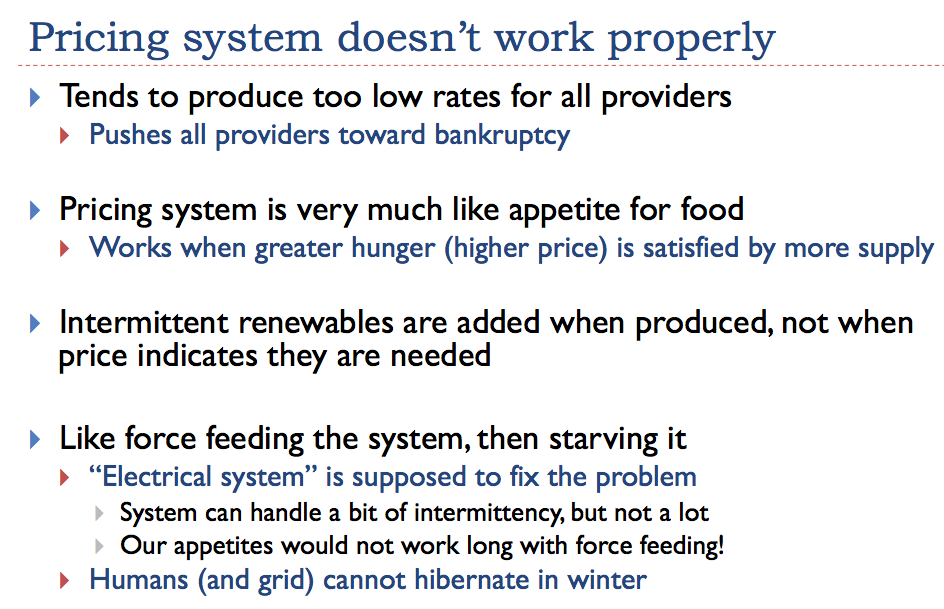
The pricing system no longer works because W&S are added whenever they become available, in preference to other generation. In many ways, the pricing system is like our appetite for food. Usually, we eat when we are hungry, and the food we eat reduces our appetite. W&S are added to the system with total disregard for whether the system needs it or not, leaving the other electricity producers to try to fix up the mess, using the false pricing signals they get. The IEA’s 2017 Investment Report recommends that countries develop new pricing schemes that correct the problems, but it is not clear that this is actually possible without correcting the hidden subsidies.

Slide 8
Why add more electricity supply, if there is a chance that you can use the new supply added by your neighbor?

Slide 9
South Australia had two recent major outages–both partly related to adding large amounts of wind and solar to the electric grid, and the loss of its last two coal-fired electricity generation plants. The first big outage came during a weather event. The second big outage occurred when temperatures were very high during summer, and because of this, electricity demand was very high.
One planned workaround for supply shortages was natural gas. Unfortunately, South Australia doesn’t actually have a very good natural gas supply to operate its units generating electricity from natural gas. Thus, the available natural gas generators could not really respond as hoped, except at very high prices. Some changes are now being made, including a planned Tesla battery system. With the changes being made, there are reports of electricity rate increases of up to 120% for businesses in South Australia.
The irony of the situation is that Australia is a major natural gas exporter. Businesses expected that they could make more money selling the natural gas abroad as LNG than they could by providing natural gas to the citizens of South Australia. These exports are now being curbed, to try to help fix the South Australia natural gas problem.
These issues point out how interconnected all of the different types of electricity generation are, and how quickly a situation can become a local crisis, if regulators simply assume “market forces will provide a solution.”

Slide 10
An expert panel in Australia has recommended an approach similar to this. It simply becomes too difficult to operate a system with built-in subsidies.

Slide 11
–

Slide 12
Timing makes a difference. The payments that are made for interest need to be made, directly or indirectly, with future goods and services that can only be made using energy products. Thus, they also require the use of energy products.

Slide 13
–

Slide 14
There is a real difference between (a) looking at the actual operating experiences of an existing oil and gas or coal company, and (b) guessing what the future operating experience of a system operated by wind panels and solar panels might be. The tendency is to guess low, when it comes to envisioning what future problems may arise.
It is not just the wind turbines and solar panels that will need to be replaced over time; it is all of the supporting devices that need to be kept in good repair and replaced over time. Furthermore, the electric grid is dependent on oil for its upkeep. If oil becomes a problem, there is a real danger that the electric grid will become unusable, and with it, electricity that is generally distributed by the grid, including wind and solar.

Slide 15
–

Slide 16
Economies and humans are both self-organized systems that depend on energy consumption for their existence. They have many other characteristics in common as well.

Slide 17
We know that with humans, we really need to examine how a new medicine or a change in diet works in practice. For one thing, medicines and diets aren’t necessarily used as planned. Unexpected long-term changes occur that we could not anticipate.

Slide 18
The same kinds of problems occur when wind and solar are added to a grid system. We really have to look at what is happening to see the full picture.

Slide 19
Anyone who has followed the news knows about medicine’s long history of announcements followed by retractions.

Slide 20
A fairly similar situation can be expected to happen with proposed energy solutions.

Slide 21
There is a whole package of costs and a whole range of direct and indirect outcomes to consider.

Slide 22
As far as I know, none of the attempts at producing a system that operates on 100% renewable energy have been a success. There has been some reductions in fossil fuel usage, but at a high cost.
Slide 23
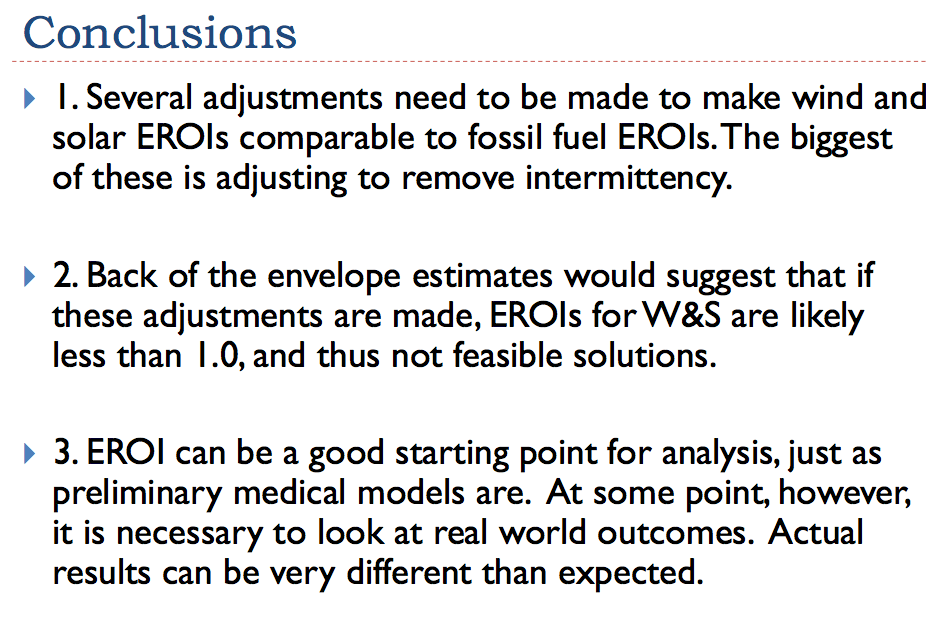
A 2013 Weissabach et al. EROI analysis examines a situation with partial buffering of wind and solar (approximately 10 days worth of buffering). It leaves out several other costs of bringing wind and solar up to grid quality electricity, such as extra long distance transmission costs, and more significant buffering to allow transferring electricity produced in spring and fall to be saved for summer or winter. These authors calculated a partially buffered EROI of 4:1 for wind, and a partially buffered EROI range of 1.5:1 to 2.3:1 for solar PV.
Of course, more investigation, including looking at the full package of needed devices to provide non-intermittent electricity of grid quality, is really needed for particular situations. Improvements in technology would tend to raise EROI indications; adding more supplemental devices to bring electricity to grid quality would tend to reduce EROI indications.
If the cutoff for being able to maintain a modern society is 10:1, as mentioned earlier, then wind and solar PV would both seem to fall far below the required EROI cutoff, if they are to be used in quantity.
If, as Hall believes, an EROI as low as 3:1 might be useful, then there is a possibility that some wind energy would be helpful, especially if a particular wind location has a very high capacity factor (can generate electricity a large share of the time), and if pricing problems can be handled adequately. The EROI of solar PV would probably still be too low in most applications. In any event, we need to be examining situations more closely, instead of simply assuming that hidden subsidies can be counted on indefinitely.


http://wolfstreet.com/2017/08/01/hertz-rescinded-fake-promises-to-investors-shares-plunge/
OJ Simpson is out of jail …. maybe they need to work him into a new teevee commercial to help turn this around
Haha FE you’re dating yourself….I remember it too though!
TL,DR: South Carolina shuts down construction of two Westinghouse AP1000 reactors. The almost $10 billion spent so far will be repaid by ratepayers (currently 18% of bill?). Now only 2 nuclear reactors (also AP1000s) are being built in the US, in Georgia.
https://www.nytimes.com/2017/07/31/climate/nuclear-power-project-canceled-in-south-carolina.html
I’m not sure how this piece of the puzzle fits into our current predicament, but the most powerful country in the world stopping constrution of the first NRC approved Gen III+ design, due to cost overruns, seems very odd, perhaps even surreal. But then when you read whats going on over at the Department of Energy:
https://www.vanityfair.com/news/2017/07/department-of-energy-risks-michael-lewis
and you realise, perhaps this is just the first of many potholes on Mr. Toad’s Wild Ride…
I would speculate that Westinghouse (Toshiba) became another victim of the fracking scam. Natural gas prices during the planning process were high enough to justify a project of that size. They’ve left their legacy construction photos up-
https://www.flickr.com/photos/scegnews/albums/72157629244341909/page1
Most in Silicon Valley suffer from a disease called “Irrational Exuberance” and another one called “Braggadocio”
Sums up the problem:
https://i2.wp.com/www.wirepoints.com/wp-content/uploads/2017/07/Picture1-2.png
Chicago, another great Democrat success story!
https://youtu.be/NoKn7vkSMBc
https://uploads.disquscdn.com/images/ae11f5d0a3fcf5825abed3eacf17895f392d2ef794f8add6eb706b1918ffa99c.jpg
https://pbs.twimg.com/media/CeVH89iWIAAEeKR.jpg
Mr Koombaya himself…
Imagine the jet-setting self-identifying environmentalist anti-capitalist (2013 net worth approximately $8.2 million) sitting around in the campfire in the back garden of one of his four homes surrounded by his five kids and six grandkids, singing the K song, dining on wild salmon and telling them amusing anecdotes about the need for population control and how much capital he needs to amass in order to fight capitalism.
https://s-media-cache-ak0.pinimg.com/736x/0c/ee/7e/0cee7ea22686a09b2cf52ac29fa5823b–environmental-change-david-suzuki.jpg
He has an extra strength version of Cognitive Dissonance… that’s for sure
No true scientist can be so utterly “stewpid” – unless he is paid to be such.
Rather like Bepe Grillo in Italy: supposedly against the ‘corruption of the system’, but a cousin of a friend, who runs a theatre in Milan, told him that Grillo -who pulls big audiences – always insisted on being paid with cash in an envelope – like everyone else.
Moreover, leafing through a posh travel mag, I was amused to see that one of the holidays on offer was in Grillo’s villa (one of his villas?/), with all his regular staff of butler, cook, etc, at one’s service. A very wealthy man.
Hmm,’man of the common people’? 🙂
http://peakoilbarrel.com/wp-content/uploads/2017/07/610221-1.jpg
Cheeto Jesus has fired The Mooch.
That didn’t take long.
https://1.bp.blogspot.com/-nPyliDdUgfY/WX5HeGp5ViI/AAAAAAAAxB4/dB5u_Bh8ETUlM07u-ia0QvyzU2Ih5l3-ACLcBGAs/s640/trump-fists-up.jpg
Jobless in Alberta: Tens of thousands of energy professionals are out of work and out of hope
http://calgaryherald.com/storyline/jobless-in-alberta-tens-of-thousands-of-energy-professionals-are-out-of-work-and-out-of-hope
Does that mean that snotty little bitch from Alberta that I had to endure at one of my first jobs — who could not understand how people could fly economy class (when she was flying up front on daddy’s credit card) ….
Might not be flying up front these days?
Karma?
https://www.nytimes.com/2015/08/16/technology/inside-amazon-wrestling-big-ideas-in-a-bruising-workplace.html?_r=0
what’s Amazon?
It’s a privately owned forced labor camp for the Best and Brightest.
It used to be a forest, once.
And a river too I think. Been so long ago you know.
Its and old car model.
Its a one bre-asted female warrior
The Return of the Great Depression 2.0 ?
https://www.perchingtree.com/return-of-great-depression/
We have very strong indicators that a major depressive economic cycle is making its way to the bottom. Retailers are going bankrupt at an unprecedented rate, weak oil demand continues to rock the commodities market, Tech layoffs are surging , most of the big tech companies remain unprofitable, over inventory of used cars due to the ride sharing and increasing global unemployment is putting pressure on auto manufacturers. The global housing markets from Canada to Australia are on the edge and the world is awash in unprecedented public and private debt.
In other words, there are no fundamentals to support the sky high stock market.
Since 2007, global debt has grown by US$57 trillion and it’s had disastrous results. Greece, Detroit, Puerto Richo, Venezuela are just the beginning of this trend. Soon, it will be followed by larger countries like China and United States.
http://www.independent.co.uk/voices/why-we-should-all-be-worried-about-the-global-economy-a7007296.html
And not to forget that the startups debt is unpayable. Investors and Pensions funds and many others will lose. We are killing the future of our children.
http://www.ibtimes.com/new-tech-bubble-jobs-pensions-innovation-risk-if-overvalued-unicorns-uber-airbnb-2061613
i read that perching tree thing—or most of it
a long winded diatribe that can be summed up very simply:
we created our current infrastructure on cheap surplus energy—we delude ourselves into thinking it can be sustained on expensive energy.
once the majority grasp that, at least the future becomes clear—if unpleasant
Their ARAMCO ipo risk heatmap puts electric vehicles at the top. Pure delusion.
I agree Norm. We might be able to somewhat maintain the infrastructure what was built with cheap energy. However, we certainly won’t replace that same infrastructure with expensive energy. And we sure as hell won’t be building out a completely different infrastructure (solar, wind, PV, nuclear) using expensive energy.
While I agree with your premise, but, EV vehicles do not have to completely replace our infrastructure to create a negative investor sentiment in the market. A good kickstart to the EV industry will make investors in fossil fuels worry about stranded assets and they will eject.
If investors in fossil fuels assets eject, it is game over for industrial civilization. There is no EV future without fossil fuels. There are no solar panels or wind turbines without fossil fuels. There isn’t enough net energy left in the system to even maintain what we have now (see Chicago, Detroit, Birmingham, Los Angeles, New Jersey etc). So replacing our infrastructure is off the table.
If EVs were to threaten the ICE industry — the commanders would remove subsidies and put an end to this nonsense —- as Hong Kong just did.
Hopium can only be allowed to go so far…..
I head an equities research team in Hongkong for a major global bank and I can tell you that investors are really getting spooked investing in O&G companies for the long term. Even Temasek fund is having second thoughts on ARAMCO after the initial hype curve. General sentiment across the segment is negative and we see more and more risk aversion. Do not be surprised if Hongkong/GIC/Temsek PIF pulls out of even hosting the ARAMCO IPO. Atleast I will not be surprised seeing the confusion everyday. Softbank has just recovered from major malinvestment in Indian Technology Sector and they industry and they are also developing cold feet. One of the most common concerns is if any leader across the developed world suddenly injects billions of dollars into R&D on EV industry, it will be game over. It may be a misplaced risk of EV industry leaping across the line fast enough, but, investors are super averse or super stupid when they invest. Moderation is for laymen. Let us see where it goes, but, for now, I will respectfully disagree with you Greg Machala.
Thanks for your insights!
One article I saw regarding self-driving EVs talked about the possibility of vehicles “talking” to each other, so as to be able to prevent accidents that cannot be prevented today. My perception is that this kind of thing is a long way off–in fact, it will never happen.
I saw an article suggesting we will be moving to mars shortly …. end of the day people will believe anything if it’s repeated enough times…..
I bet if someone ran a search for the most repeated stories of the past year they would be:
– solar energy is going to save us
– EVs are going to save us
– cl imate ch ange is going to roast us alive
There is a reason these 3 issues are repeated over and over and over.
Anyone who is going to drop on here and state otherwise without supporting facts — is going to find out what roasting alive feels like
To even begin to try to argue with you would be like wasting medicine on a dead body.
You are completely clueless.
That said — I guess for one to thrive in the delusional fake world that we are living in — one has to be certified delusional.
And you are definitely that.
Enjoy your fake CNBC news….
IMF Sees 2017 Saudi Growth ‘Close to Zero’ on Oil Prices, Cuts
https://www.bloomberg.com/news/articles/2017-07-21/imf-sees-2017-saudi-growth-close-to-zero-on-oil-prices-cuts
my same response as above:
IF Saudi Arabia reduces their exports by 10% MORE, then prices could rocket in August.
so mathematically, if they cut export volume by 10% but their selling price rises by 20 or 30 or 40 percent, Saudi Arabia will have a better budget, and probably growing revenues.
maybe, or maybe not; we shall see.
Still have to find willing consumers at inflated prices. They’ve tried this trick in the past several times and it hasn’t worked. Whenever WTI has gotten around $55 it gets smacked down again, because the price is too much to bear.
Dave isn’t here to argue with anyone else he is here to argue with himself.
I agree Cliff, plus his tone is very trollish with his “Who Knows?” and his “Cheers”….better to ignore the kid…
Maybe, maybe not….cheers!
Lol Greg, another classic…maybe, maybe not!
Lol
The Saudis have created a precarious situation between supply and demand. If the prices rise, then Shale, Offshore and Oil Sands producers ramp up production and offset any net gain due to short term price surge. Secondly, Saudis have limited reserves and the more they pump, the less they have. When Saudis reach a supply disruption, others would have hedged by futures trading and demand will remain suppressed. Saudis are screwed and the only way oil prices can go is down, down and down. Oil is unstable at 60 and is unstable at 25. It will remain within 40-50 price point for many years to come.
thus saith Tigeronomics:
“Oil is unstable at 60 and is unstable at 25. It will remain within 40-50 price point for many years to come”
WTI = $50.27
Brent = $52.77
just sayin’
Steven Kopits from Douglas-Westwood said the productivity of new capital spending has fallen by a factor of five since 2000.
“The vast majority of public oil and gas companies require oil prices of over $100 to achieve positive free cash flow under current capex and dividend programmes. Nearly half of the industry needs more than $120,” he said
http://www.telegraph.co.uk/finance/newsbysector/energy/oilandgas/11024845/Oil-and-gas-company-debt-soars-to-danger-levels-to-cover-shortfall-in-cash.html
David, when we create volatility ranges,we allow for some creep here and there. If oil remains at 55 or 30 for a long term, may be we can talk.
The legacy of solar power – spending MORE to get LESS.
yes, psile, you might be right.
the usual smack down might come around again.
or not.
SA may have the power to get higher prices.
They first need to be willing to persevere in their drop in exports.
Other entities may try to manipulate prices lower.
We will see soon enough.
http://www.vivenoel.com/images/stories/goldilocks/goldilocks-3.jpg
It’s nothing to do with manipulation. Prices above $55 are hitherto unsupported by the global market.
I agree. $55 seems to be the top of what the global market will bear. And that number is likely to go lower as the overall health of the global economy continues to deteriorate. On the other hand, the production costs continue to rise. That Goldilocks zone for oil prices is closed or closing fast.
I have only a hazy idea about how the oil market in theory and absolutely no idea about how it operates in practice, so I tend to leave this kind of speculation to the experts. But….
The WTI oil price peaked at over US$156 nine years ago in June 2008, and we all know what happened to the world economy back then. Last time it was above US$100 was just three years ago in August 2014, although it seems like forever to me. Once we experience a year or two at a certain price range level, it becomes the new normal and we come to expect it to continue.
If supplies became tighter, prices should rise. But I’ve read that global demand for oil is already stagnant or declining, and higher prices would surely drive down demand as the world is deeper in debt and less able to afford expensive oil than it was a decade ago. Also, the Iranians are back in the game and I don’t think the Saudi’s could raise the oil price but cutting back by 10% without the cooperation the other big producers.
It’s a buyers market for the foreseeable future, and if a major financial shock or an economic downturn lowered demand further, the price of oil could drop like a stone, killing the industry and ending BAU once and for good. Of course, the people in charge are controlling the market from behind the scenes to try to prevent that from happening.
This is my layman’s understanding and I’m probably wrong in several respects. So if anyone would like to put me right, please go ahead.
It is difficult to predict the future accurately, but interesting that Gail gave the following forecast five years ago that seems to be holding up well. The price of oil has dropped steeply since 2012. Now we are waiting to see if and when the supply decreases:
I think the peak in oil production will be determined based on financial considerations. Such a peak is probably not very far away, because we are already experiencing lower economic growth and the governments of several countries are in dire financial straits.
As the oil price gets too high (or already is too high), governments of oil importing nations will be increasingly stressed by high unemployment and low revenue. Any way of fixing this problem (higher taxes, government layoffs, or reduced programs like Medicare, Social Security, and unemployment insurance) is likely to lead to lower disposable income and less “demand” for (that is, ability to pay for) products using oil.
With lower ability to pay for products using oil, the price of oil will drop. Fewer producers will be able to extract oil at this lower price, and the supply of oil will decrease.
http://oilprice.com/Interviews/Forget-Renewables-We-Need-Cheap-Oil-An-Interview-with-Gail-Tverberg.html
This makes me recall a chart I saw that showed the trend in the maximum amount (in dollars) the global economy can afford. It went from about $150 in 2007 to $100 in 2010 down to something like $50 today. Scary stuff.
Pingback: Cost of Solar & Wind Power Research – Energy Management
WTI rises 9% in July.
https://www.cnbc.com/2017/07/30/oil-hits-highest-since-may-on-tighter-us-market-venezuela-sanctions-risk.html
here comes August.
Potential Saudi Aramco IPO Wouldn’t Include Oil Reserves
https://www.wsj.com/articles/potential-saudi-aramco-ipo-wont-include-reserves-1453627558
Saudi ARAMCO IPO – Great Opportunity or Riddled with Risk ?
https://www.perchingtree.com/saudi-aramco-ipo-key-risks-loom-for-investors/
I never, NEVER would have thought that the Saudis would try to do this.
as ive said before, the saudi bottom line problem is 30m people living in a nation/area that supported 1m pre-oil.
the saudis have led their people (just like the rest of us) to believe that even if oil runs out some day, there will be ”technology” to maintain their existing gold plated living standards…eg, rentals from tower blocks, overseas investments etc.
economists have assured them (and us) that a $100 m investment in a skyscraper represents $100m in tangible assets—which it does, but only so long as it sustains investment input.
Economists always omit that sting from the economic tail. If input dries up, the building falls down. But no matter, the saudis are certain that income will flow irrespective of oilflow.
And and–and yet…they suddenly want to sell their family silver. Now why would they want to do that?
To buy themselves a bit more time—hoping, with the mindset of Mr Micawber, that something will turn up?
Because if something doesn’t turn up—things are going to get very unpleasant in a desert country with 30m people with no means of support
SA is certainly a worst case example of overshooting its resource base outside of oil.
“economists have assured them (and us) that a $100 m investment in a skyscraper represents $100m in tangible assets—which it does, but only so long as it sustains investment input.” – Yes you are right. And things are only worth so much as long as BAU continues to function. How much would a $100m skyscraper be worth without water, sewer, trash pickup, electricity and so on. Investment with the expectation that raw materials and services will continue forever.
It almost covers everything except the prospect of a major war in the Middle East.
Big, well I guess not so big news this morning for those of us on this blog anyway and yet not a mention by anyone?
No fossil fuels, please–we’re British.
That’s the message put out by the United Kingdom’s Environment Minister, Michael Gove, earlier today. Speaking to BBC Radio, Gove said that the U.K. plans to outlaw the sale of vehicles that run solely on gas or diesel by the year 2040.
Completely details of that plan haven’t been announced. However, it appears that gas- and diesel-powered cars and trucks already on the road in 2040 would still be allowed to operate.
And while the U.K. government would prioritize fully electric vehicles, Gove said that sales of hybrids would still be allowed. What sorts battery range and fuel economy benchmarks those vehicles might have to meet is anyone’s guess.
To speed the transition to hybrids and electrics, Gove said that the government would likely launch a cash-for-clunkers-style program, giving car owners incentives to trade in their gas and diesel vehicles for models with lower (or no) emissions.
If all this sounds a bit familiar, that’s probably because France’s Environmental Minister, Nicolas Hulot, made a similar announcement earlier this month. Like Gove, Hulot plans to outlaw the sale of gas and diesel vehicles in France by 2040.
Hulot’s move–and likely Gove’s, too–came in response to president Donald Trump’s announcement that he would withdraw the U.S. from the Paris climate accord. As Hulot said at the time, “France has decided to become carbon neutral by 2050 following the US decision.”
If the U.K. copies-and-pastes France’s plan, it will probably offer low-income families assistance to help them sell their older vehicles and purchase newer, more efficient models.
http://www.thecarconnection.com/news/1111751_uk-to-outlaw-gas-and-diesel-vehicles-by-2040
And you know what jerry — most people are reading this and they are believing it….
No matter how ridiculous the statement — if it is in the MSM — they MOREons believe it — they do not question it.
I just had someone send me a long pile of shit in Huffington Post urging me to read it because it explains that is happening with Trump …
I really did not want to read it because I knew where it was going to go — Putin is the devil yadda yadda …. but I got to this point.. and I wanted to say f789 off…. but I had to humour the person…
I said can you give me the punch line — I am really busy (trying to decide which hill to ski tomorrow…) …
So he said you need to read it — it explains how the Russians are evil and attempting to control America,…
I hope that my story will help you understand the methods of Russian operatives in Washington and how they use US enablers to achieve major foreign policy goals without disclosing those interests.”
Someone else recently quoted CNN saying Trump is trying to enrich himself by teaming up with Putin ….
Meanwhile Putin just hoofed out nearly 800 US diplomats….
These people really believe this shit….. even though there is NOT a shred of evidence for any of this….
There is no talking sense to them….
https://media.makeameme.org/created/this-is-madness.jpg
As pressures grow, irrationality will only increase – such as believing the palpably false Russian Plot meme.
Once people have bought into rubbish like that, they will be too embarrassed to correct themselves in the light of contrary evidence.
The future is madness. Like the 1920’s and 30’s.
Or the 1970’s with all those idiot Left revolutionary groups such as the Red Brigades, ETA, and so on (looking back on that history, many people were clearly insane narcissists, intoxicated with propaganda and ideology.)
Brainless sectarianism comes very naturally to human beings.
LOOK LOOK over here. No – look over hear. No, no not the cliff edge your running toward. Just keep running but look over here. Yes, there ya go. Do as I say not as I do. Just keep your eye on me but keep running forward into the abyss and everything will be fine.
Yes Eddy I understand that but for me it was still an amazing statement to hear especially coming from England. You know when every other country in the world has been flushed down the toilet bowl of history the one nation that will be trying to fight the oncoming flush it will be England and why? Her aristocratic families and freemasonry and their enoromous combined wealth pure and simple. They have too much to lose and will do I imagine just about anything to keep BAU going in whatever form imaginable. These are the elders. That is why for me it was an amazing statement this ‘uk to outlaw gas and diesel vehicles.’ No one else has done that!!!!
In 25 years of reading and learning about peak oil nothing drove home to me the true seriousness of all of this than first that HSBC report and then this the outlawing of gasoline vehicles. Yep, as I have been saying for numerous years where the industrial revolution began is probably where it will ultimately die Great Britain.
Funny to I have through work a friend just returned from a holiday to England and he couldn’t stop talking about all of the wonderful places they visited and then summed up his talk with his visit to a car show and the wow of the show being a Tesla. lol!
After I mentioned to him what I heard and saw on the morning news he replied he wanted to see that for himself. As I went about my daily work I couldn’t help but wonder where is fast eddy when you need him lol and imagine to I laughed a Fast Eddy being one of the Queen’s advisors. She would quickly fire him in favor of someone more positive about her future. O to be a fly on the wall behind closed doors of many of our power brokers and what they must be talking about especially the freemasons this cult as Henry Makow wrote about The Cult that Hijacked the World. and take a gander at this which still blows my mind every time I see it police badges with that compass and square and pyramid and all seeing eye on all of them ? etc etc…. What do they own literally everything?
https://www.henrymakow.com/upload_images/Masons-police-02%20%281%29.jpg
https://www.henrymakow.com/bnai_brith-adl_does_not_repres.html
For the right people money will keep BAU going Eddy no matter what until well who knows?
As someone mentioned here already — it is risky business spitting on these saviour-based technologies…. the tribe doesn’t like it.
I have a friend here in NZ who is a retired engineer — he headed up big energy projects including coal powered plants in Australia during his career…
He is very big on EVs…. being an engineer you would think he would be able to ‘get it’ — I have mildly tried to explain why EV’s are not saving the planet….. I cannot get him to budge a single inch on his position …
Another friend who was also a high level engineer understands that solar has massive problems — yet he thinks that we will overcome issues such as storage….
If technical people refuse to accept reality — then getting others to see the light — is highly unlikely.
I only spit on their gods on FW — in person I seldom attempt to appeal to their sense of logic and common sense…. they have none when it comes to this issue
U.S. shale boom less potent than expected, new data show
http://www.chron.com/business/energy/article/U-S-shale-boom-less-potent-than-expected-new-11720700.php
WTI is up to $50.20
IF Saudi Arabia reduces their exports by 10% MORE, then prices could rocket in August.
Shale oil may be looking at expansion by September.
$50.30
It is all that’s left.
Do you think the KSA is reducing in an effort to drive up the price of oil — or could it be that their production is post peak……
You do know that they can see that pushing the prices higher only adds incentive to the shale producers to pump more…… or maybe they are unaware of that… because they are stewpid?
That does seem to be what is happening. As prices go up, the production of tight (expensive to produce) oil goes up. Which drives down prices again. All KSA production cuts are doing is hurting their own revenue. They should just keep pumping flat out.
I suspect that is actually what they are doing …. however they have run into that Twilight in the Desert problem….
It’s a race — between the depletion rate of conventional oil …. and the number of holes that can be punched into shale plays in an attempt to offset…..
If conventional plays were still viable, we wouldn’t have the price swings we have now. The only marginal oil left is expensive oil. This will only get worse as declines in conventional oil fields accelerate.
As once-mighty Cauvery River dies, India could be facing its “greatest human catastrophe” ever
http://www.desdemonadespair.net/2017/07/as-once-mighty-cauvery-river-dies-india.html
yet in outside of south india have biggest floods this year
http://timesofindia.indiatimes.com/india/gujarat-floods-toll-climbs-to-218-as-more-bodies-found/articleshow/59851727.cms
http://www.business-standard.com/article/pti-stories/rains-drench-north-india-5-die-in-wb-floods-117073101237_1.html
plus it rain very heavy in my city
until its next great catastrophe.
the population of India is out of control.
at least the commies in China forced a one child policy on their population.
India will soon be the most populous country, and therefore when the coming correction to overshoot hits, the devastation there will be awful.
Has an ‘Overshoot Ranking’ table ever been compiled by anyone?
Xabier, British NGO Population Matters has one on its pages, Overshoot Index it is called.
Thank you, Kanghi.
https://3.bp.blogspot.com/-LImJqraB2LY/WX9eW6fIZlI/AAAAAAAASDU/UcZSMblUWjcCSPGaxRpza6u2-xNVd__MQCLcBGAs/s1600/Screen%2BShot%2B2017-07-31%2Bat%2B11.39.54%2BAM.png
https://vvattsupwiththat.blogspot.com/
Oh whoops reality is real. Shucks.
http://wolfstreet.com/2017/07/31/asset-stripping-pe-firms-fuels-brick-mortar-retail-meltdown/
Where’s my lithium??????
http://c8.alamy.com/comp/BPC00X/rare-sight-seventy-to-eighty-vultures-would-feed-on-a-carcass-stripping-BPC00X.jpg
My what timely imagery. I see bankers and equity firms and the bones are what is left of everything else.
The two big ones must be Citigroup and Goldman Sachs. I can kind of make out JP Morgan Chase there too. All those smaller birds must be the hedge funds, PE firms and politicians.
Here 😀 https://www.youtube.com/watch?v=PJGpsL_XYQI
Maybe we’re not understanding these implications. Uber is built on poverty. If people had productive jobs Uber couldn’t have grown.
http://wolfstreet.com/2017/07/30/uber-lyft-market-share-from-rental-cars-taxis-other-sectors-next/
http://imgur.com/7lTl7G9
Of course there are many uses for lithium but the dreamers might best use it by ingesting it.
http://euanmearns.com/lithium-reserves-use-future-demand-and-price/
That means you Elon.
Should be mandatory in our water supply.
Depression would be a thing of the past!
Low spirits are the shadow through which one must pass now and then to appreciate the beauty and light in life. (Clinical depression quite another thing I appreciate that.)
Seeking to be always happy or free from any shadow is a great error.
Very true.
Lithium has also been identified as a potential fuel for future nuclear fusion reactors.
So it’s also a form of hopium.
Interesting overview!
If your interested in the increase in psychotic behavior and the astronomical increase in the last 50 years. It’s no coincidence that it is a $300,000,000,000.00 industry. Created by Big Pharma
https://www.madinamerica.com/wp-content/uploads/2011/11/Medicating-Affective-Disorders.pdf
Yes. It’s pure quackery. See the article “Being Sane in Insane places” Published in the Journal of Science.
The whole pharma thing is a huge tragedy. The holy grail for pharma is addiction and they seek out any compound, derivative or synthetic that will hook a person into not being able to wean themselves off of it without, and here’s the key, switching to a different pharm drug that is just as addictive or more so. The federal govt. is complicit because of campaign contributions and powerful lobbyists. Patients mental health has been sold for profit. People need to stop going to doctors to get medication. If someone is depressed they should just grow their own, if you know what I mean.
I’m not sure I agree with grow your own. But your right in everything else.
If you look at the book reviews in Amazon for that book you’ll be amazed.
People who have fallen victim to Big Pharma have told their stories.
There are only two countries on earth that allow pill companies to advertise on TV. The US and New Zealand. Every other country on earth has banned it. And the average American watches on average 10 tv commercials a day for drugs. I watched the NBC nightly news the other night they played 9 drug company commercials in a row. Also the US Biomedical industry does not follow an evidence based science protocol like Europe and Canada does. And most all medicine is bullshit and nothing more than the placebo effect. .
Are you referring to the Roasehan experiment?
Yes. I am. I have two friends who couldn’t find jobs and went to our local mental health hospital and told the staff they were hearing voices and thought people were chasing them. After I told them about that article. And they both were classified as mentally ill. And after two weeks in the hospital they got out. And went right to the social security office and signed up for disability. And both got approved no questions asked.
Not that’s evidence of intelligence. Game the system.
There are many people doing it. If you look at the number of divisibility claims since the great recession it has exploded. And as the Roasehan experiment’s author pointed out. doctors tend to suffer from the “type 2” error. Where when they are not quite sure about someones health they tend to lean towards the side of caution and go with their gut. And there are no x-rays no genes or any biological markers for mental illness. So the only evidence they have is what they are told by the person or family of the person.. So they end up over diagnosing and medicating because they are reasoning better safe than sorry.
Also Jews were considered mentally ill in the 1930’s in America. And the supreme court ruled against the US constitution that “All men were not created equal”. And allowed states to sterilize the mentally ill. It was called the eugenics movement. It was quack science that was taught at the top universities and journals in America. Like Harvard and Yale. They even had a journal of Eugenics. That is where Hitler got his ideas from. He just obviously took steps much farther than sterilizing the mentally unfit.
And Gay people were considered mentally ill up until the 1970’s believe it or not. Until the gays started to push back and get political in New York City. And there were many doctors who came out as gay and recommend the illness label be dropped.
http://izquotes.com/quotes-pictures/quote-only-two-things-are-infinite-the-universe-and-human-stupidity-and-i-m-not-sure-about-the-former-albert-einstein-56412.jpg
I am all for sterilizing 99.9999% of the population …. in the interest of trying to wipe out stupidity.
Eugenics in the 1930’s went hand-in-hand with adulation of the Sturdy and Noble Farmer as a role model – see Mussolini et al.
Something which ran up against the fact that most E. European Jews were mere peasant farmers.
Still, contradictions are as nothing to fanatics.
Is transgender a mental illness? Where do you draw the line between mental illness and normality? What about folks who have fetishes? Is that a mental illness? It is such a can of worms. I guess if a person is happy and content it should be considered a normal state of existence.
Should morbidly obese people be forced to buy two seats on an aircraft?
At least part of transgender has to do with people who were misclassified at birth (female instead of male) because of such problems such as no visible male sexual characteristics, while there were undescended testes inside. We can feel sorry for such people. I don’t think we should talk about mental illness though.
It provides for the possibility of great income both for the physicians dispensing the drugs and the drug companies making the drugs. It provides the illusion that it might provide a benefit. Too often, it is just a mix of multiple drugs, each to try to offset the problems of the others.
A friend of my wife was taking one of those new colored pills for some symptom. The doctor prescribed it for a year and said to come back for a checkup in a year. She started having problems with extreme fatigue, which was, when she investigated one of the potential side effects. She stopped the medication and the fatigue went away. The doctor did not even care enough to check her after she had been on the colored pill for a while!
Now we know the source of Elons brilliance. He is simply manic.
http://www.zerohedge.com/news/2017-07-31/elon-musk-admits-he-bipolar
“Bad feelings correlate to bad events, so maybe real problem is getting carried away in what I sign up for.”
Interpretation:
The commanders of the planet asked Elon to sign up to be the saviour — the green jesus — the solar jesus — the mars jesus….
Elon probably thought that would be a cool gig…. he’s one of the most famous people on the planet because of it….
But I can imagine the stress of pretending to run a number of fake companies…. and also knowing the real purpose of why these fake companies exist — and why his role exists….
No wonder he is popping pills downed with gallons of wine….
I bet he is thinking he should have passed on this — and instead went skiing…. or whatever turns his crank…. he already had billions so he could have indulged in the greatest bucket list of all time
Huge sacrifice Elon …. huge…..
I guess we should thank you
Hugely amusing: they found a nut to be front-man for the Great Calming. What will his fans do when he breaks down? Is a clone being prepared for such a contingency?
Maybe he was driven nuts…..
Imagine having to insist a Mars colony is feasible…. without laughing hysterically….. the effort to contain the laughter would be enough to make even the most sane person pop a valve
Social Security’s Bleak Future Is Inevitable (Nasdaq)
http://www.nasdaq.com/article/social-securitys-bleak-future-is-inevitable-cm822974
I agree that Social Security’s future is bleak, but the person putting together this article doesn’t have his facts quite right. (They are sort of close, though.)
Social Security collected more than it needed to pay in benefits in early years. But the US government, and pretty much every other government, is on a Pay-as-you go basis, so the extra money has already been spent on other things. (I would expect wars was the big thing it was spent on.) Because extra money had been collected in advance, the US government has placed (non-marketable) debt in the Social Security Trust Fund (called . The US government pays interest at varying interest rates on this debt. It is this interest being paid by the government that is currently covering the shortfall between contributions and benefits. Of course, this situation isn’t really sustainable either. These are a couple of related links:
https://www.ssa.gov/oact/STATS/table4a3.html
https://www.ssa.gov/cgi-bin/investheld.cgi
The tone of Trump’s recent announcements re. China conform with what I’ve thought ever since Nixon reached out to China. Why?, I wondered. China is way too organized not to outcompete the US over time.
Does China own most of the debt going toward bricks and mortar development worldwide? If so, when companies can’t pay back the loan, doesn’t China then own these development assets throughout the world?
Art your right on many levels. The reality is Capital economies require growth. So China became the defacto Growth engine.
So China is a proxy. The US has developed its present prosperity on debt. The debt must be fixed to productivity.
Net sum gain.
So American prosperity is a product of economic growth in the global system.
Why? US dollars dominate the financial system.
Imagine life in the US without the dollar as world reserve currency. We would be in terrible shape. Out ability to import energy and goods would be severely curtailed. The few industries we have left would go bankrupt due to lack of affordable raw materials ans parts to build things.
JT and Greg, Thanks. It’ll take me more time to understand how the international system works. Back to the drawing board!
The Electric Reliability Council of Texas was expected to set new load highs three days in a row from Wednesday, propelled by the continued heat in the region. Looking ahead to the end of the week, ERCOT forecast demand to peak at 69.4 GW Thursday and 70.3 GW Friday, both higher than the current all-time high for July. (7/27)
Burn more coal!
Coal prices’ march to eight-month highs, driven by China’s huge appetite for power consumption, looks like an interlude in a longer-term decline and is seen losing traction later this year. Investors widely anticipate a slow demise for coal use due to policies encouraging cleaner natural gas and renewable energy generation, but the shorter-term outlook for the industry has seen a sharp reversal of fortunes. (7/26)
Burn more oil!
WTI up to $50.15
$50.20
Are you going to stipulate a high you think that will be reached within a given time, or just snipe and disappear when your ass gets kicked. I’d say you will continue to troll and move on when your credibility is untenable.
http://orig11.deviantart.net/747e/f/2013/161/f/5/profile_picture_by_fantastic_frog-d68kdsv.jpg
Drilling Consultant Believes Reported Layoff Numbers Too Low
http://www.rigzone.com/news/article.asp?hpf=1&a_id=151179
I can believe the numbers are low, if certain categories have been missed.
Chinese group hacks a Tesla for the second year in a row
https://www.usatoday.com/story/tech/2017/07/28/chinese-group-hacks-tesla-second-year-row/518430001/?utm_source=feedblitz&utm_medium=FeedBlitzRss&utm_campaign=usatoday-newstopstories
Hackers breach dozens of voting machines brought to conference
http://thehill.com/policy/cybersecurity/344488-hackers-break-into-voting-machines-in-minutes-at-hacking-competition
“Faith” based voting machines…LOL one of the most obvious frauds in history.
Demented…..BTW I’m very happy that the masses subscribe to this shit because if they knew the reality awaiting them, as has been correctly stated here on OFW, the collapse would happen even sooner (with people losing their minds)…however, for those in the know (like a few here on OFW) articles like this are beyond annoying…
https://www.linkedin.com/pulse/must-read-article-how-our-lives-change-dramatically-20-delahunty
People believe this kind of thing. The article leave out a huge amount. For example, with water at 25 cents per cubic meter, it is cheap enough for drinking water, but not for agriculture. Agriculture needs huge amounts. It is probably not cheap enough for a lot of industrial uses either.
I don’t necessarily get annoyed, but it can boggle the mind. This is all rooted in the positive thinking BS. Everybody wants to go to heaven, but no one wants to die.(Albert King)
As Greg alluded to in a recent comment, limits can not be acknowledged.
The other day, I saw adults with lights in their sneakers. Now, I’m a whatever floats your boat type of guy, but found myself laughing for about 10 minutes recalling what Carlin said (presciently) years ago.
https://www.youtube.com/watch?v=leWjdWUR_KI
snorp
Hahaha, man that guy was good!!!
There should be an all year open hunting season on fools. Lights on sneakers…. jeez….
Lights on sneakers. Meh. That is nothing. I saw a truck with lighted wheels yesterday. Yes the actual rim wheel was a-glow with lights that changed in a rainbow of colors as the truck sped down the road. A big 4×4 with a monster lift kit and very large wheels and tires. No doubt the driver is starved for attention and wanted to highlight his use of male augmentation modifications..
I am becoming so sickened that I wouldn’t mind if the cattle knew the truth — even if it did end BAU prematurely….
The masses will never know the truth. That is impossible. The masses are so insanely dumb they do not have the cognitive ability to assimilate the truth. They are so brainwashed by indoctrination, misinformation and propaganda. And if that isn’t enough:the: “Jesus will save us so we have nothing to worry about” illusion tops it all off. Limits to growth will never be understood by the masses.
Don’t be so negative bra… 😉
How on Earth Can Profits Grow at 10% in a 2% Economy?
http://fortune.com/2017/07/27/profits-economic-growth/
Good points! Also, if wages of non-elite workers are growing slowly, how can the rest of the economy grow quickly?
Aubrey McClendon, billionaire sports NBA team owner, oil executive and “visionary” pioneer of the US fracking revolution kills himself
https://www.theguardian.com/business/2016/mar/03/fiery-car-crash-kills-billionaire-oil-executive-aubrey-mcclendon
Fiery crash kills billionaire oil executive day after Justice Department charges
Aubrey McClendon, billionaire sports team owner, oil executive and “visionary” pioneer of the US fracking revolution
https://www.theguardian.com/business/2016/mar/03/fiery-car-crash-kills-billionaire-oil-executive-aubrey-mcclendon
One of the best movies I have ever seen.
Perhaps a nice movie..
But since it’s the summer season, enlarge your horizons a bit beyond the usual offerings on the US channels/distribution. Google for eternal quality: Jean Gabin, Lino Ventura, Marcello Mastroianni, Delon/Belmondo, Simone Signoret, Brandauer, Loren, …
The life in hippytown
The fine art of indoctrination
The environmentalists were first called tree huggers. They dressed funny, smelled funny, looked funny and were a little bit funny in their heads.
Then they introduced the concept of green energy. Today the environmentalist are progressive hipsters, cool and down with the idea of burning down those f**king trees.
Ahh, don’t be too hard on these folks….at LEAST recognizing a dire predicament and seeking a possible way out., Its not as if we had ALL the data back in the day.
Actually, if some of the green solutions were enacted it would have helped!
But that’s OK…throw you mud and disdain. It is easy now to throw them under the bus and place them in the Trump crowd…if it makes you all feel better..do it!
Wasnt that a saying back it the 1970s!?
Our conservative friends still feel threatened by the 60’s and 70’s, and need to revise history.
It is very in the rear view mirror now.
They missed it, Sorry my diminished friends!
Just another tragedy of existence! As Gail mentioned….there probably is some plan…
It would be nice to have a glimpse of it before we enter into the big sleep.
I do find it perplexing we humans have the ability to recognize the crisis, but unable to enact any different outcome.
We live in such a bland, homogeneous world these days.
Nike logos in the Congo, and all the same pablum flavored media and music.
“The Limits to Growth” published in 1972 included a scenario in which births would be limited to deaths each year. I am not sure of the exact mechanism–presumably deaths would be forecast for each year for each country, and only as many permits to have births as the system could support would be handed out. There was also a plan to use less fossil fuels, presumably through a shift to nuclear.
Turning the trees into wood pellets,and then shipping them in containers to the UK, then by road to the customers. How Green! 🙂
A bad omen of the comming financial crisis?
The National Bank of Slovakia registers a rising trend of the loans being not paid back regarding the consumer credits. The same situation in the situation of the positive economic developement was present in the years 2006 – 2007, i.e. shortly before the 2008 crash. This negative trend is here despite the fact that the intrest rates on consumer credits are falling.
https://kosice.korzar.sme.sk/c/20615014/rastie-pocet-ludi-ktori-nedokazu-splacat-dlhy.html?ref=trz
(The article is unfortunatelly in Slovak.)
Getting ready to grab us by the … wallet
https://3.bp.blogspot.com/-AK3fzthwjTs/WX4pnxrKGSI/AAAAAAAAxBQ/syi4pZXrGuEG0QgyKOZvzFyDSuu_pQrbACLcBGAs/s640/Donald-Trump-300×200.jpg
We’ve seen that look before. It’s Mussolini all over again. That’s the look of hatred for anyone else other than himself.
At least he killed his son in law.
Naargh. It’s not a look of hatred. What you are seeing just the haughty aloofness shared by all great leaders tinged with exasperation at all the little people who are running around trying to obstruct his plans to Make America Great Again!
See, even Hillary shares it.
http://www.truthrevolt.org/sites/default/files/styles/content_full_width/public/field/image/articles/233-chin_thrust.jpg?itok=H8LCzeNe
Hummm… National Bank of Slovakia as a leading indicator. I guess we will see.
I do not know. But it is sure that the Slovak economy is one of the most open economies in the world, totally dependent on the exports, so maybe some globalized predictions based on the situations present in it are possible.
Anyway, it is interesting that the mortgage (and other debt) crisis in the USA was also present in the form of the consumer credits not paid back also in the Slovak economy before 2008.
There was a recent Wall Street Journal article about rising default United States rates on credit cards, as well. https://www.wsj.com/articles/late-credit-card-payments-stoke-fears-for-banks-1501493404
“The card market is an indicator of consumers’ ability to pay back their debts. Unlike mortgages, a much broader group of consumers have access to cards. And these accounts can fall low on the priority list of bill payments when household finances get tight.”
http://www.foxbusiness.com/features/2017/07/31/late-credit-card-payments-stoke-fears-for-banks.html
“Americans haven’t had this much credit card debt since the eve of the financial crisis”
http://www.businessinsider.com/american-credit-card-debt-nearing-all-time-highs-2016-12
http://static1.businessinsider.com/image/58543573918a0f1c4c5a88e3-727-372/wallethub%20total%20credit%20card%20debt%20skitched.jpg
http://static2.businessinsider.com/image/585435c88ceb95bc528840d6-716-380/wallethub%20household%20credit%20card%20debt%20skitched.jpg
Yes, the consumer credit is available practically to all: you need home appliances and other stuff bought using consumer credit for daily life more than owning a house or flat that can be rented (using money also from the consumer credit…).
“3.29%” defaulting today and “3.95%” defaulting in 2007. A small number that can indicate big bad things comming.
The article in Slovak mentioned in my comment at the start of the thread (https://kosice.korzar.sme.sk/c/20615014/rastie-pocet-ludi-ktori-nedokazu-splacat-dlhy.html) mentions a case of the man who went into debt (i. e. consumer credit), because he had debt from not paying child maintenance.
History repeats itself in different hues – Japan vs US
http://www.investmentpostcards.com/2008/12/30/history-repeats-itself-in-different-hues-%E2%80%93-japan-vs-us/
And the consumer credit peaked in Japan before the burst of the asset bubble in the beginning of the 90s, too:
http://www.investmentpostcards.com/wp-content/uploads/2008/12/northern-trust3.jpg
“Consumer credit growth peaked at just over 80% on the year by the end of 1988, but had fallen to 53.6% one year later when the Nikkei peaked, and by Q4 1992 consumer credit went into a prolonged period of contraction.
When the strictly controlled mortgages are not available, the consumer credit can be used not also for things like child maintenance and alimony after divorce, but, also for financing assets like homes etc.
Since the early 2000s, producers and analysts have proclaimed that shale gas is a “game-changing,” end of history-type phenomenon. From now on, natural gas will be abundant and cheap. The United States was running out of natural gas before 2009 but now can afford to export to the world. We were lost but now are found.
-Art Berman
Except we need a higher price. Hopefully (from the oil companies’ view), exporting it will make the supply sufficiently short that they can charge considerably more for it.
Regarding the bombing of North Korea, I disagree with worldofhanumaotg about ‘surgical’ strike.
A very toxic doctrine of American military is it treats losses too seriously.
hanuman argued that
“The problem is they can order only “surgical” strike.
Because full scale carpet bombing equals loss of crew.”
What’s wrong with the loss of crew? You enter the military to risk death, and if the loss of crew is unavoidable it can’t be avoided.
If the necessity to do a full scale carpet bombing exists to maintain BAU, it will be done. Too bad for the crew, but it can’t be helped.
Already the US installations around Seoul have been abandoned, and moved to Camp Humphreys
https://en.wikipedia.org/wiki/Camp_Humphreys
55 miles south of Seoul. It is next to a sizeable harbor, to evacuate US personnel and military assets in a hurry if the necessity arises. Too bad for Americans who would be caught in the Seoul area if that happens.
I don’t see an escalation. It will end with the end of North Korea as a world threat, and the end of Russia’s and China’s ambitions. Too bad for South Korea, but someone has to pay to keep BAU and modern civilization going, right?
So many problems are mounting. At the same time the energy we need to address the problems is fading. Seems like every few months another problem crops up. At some point you can’t keep up with all the problems:
Saudi Aramco CEO believes oil shortage coming despite U.S. shale boom
http://www.foxbusiness.com/markets/2017/07/10/saudi-aramco-ceo-believes-oil-shortage-coming-despite-u-s-shale-boom.html
Well, we can expect some bumpy road ahead, up and downs for the near midterm. Some sort of remake of the previous “triangle of doom” of ~2015 would be appreciated. So, lets say oil goes to $60-70s on shortage rumors, perhaps incl. some skirmishes in producing regions, and gets slammed afterwards again by hitting the affordability barrier. Shorting oil and especially proxy – energy utilities was great fun two years ago. However, I’d certainly not expect such huge gains as previously, I was participating in token way just for fun, but some notable utilities made like 400-600% on inverse leveraged ETFs, i.e. as they collapsed.
However, what can also happen is that “big” money at some juncture decides otherwise, times are getting unstable – nearing end of cycle, lets park it now in defensive stuff aka energy utilities, and instead of crash it will rise a bit. That would be a nice widow maker in such leveraged play, lolz.
The Oil Age may come to an end for a shortage of oil.
-Saudi Oil Minister Sheikh Yamani
I think financial shortage before oil shortage. But, that is just me being silly.
Price cannot go high enough, for long enough.
Anticipating the End
A democracy works only if the electorate are 1) intelligent1, 2) knowledgeable2, and 3) informed3. None of these criteria are true of the United States of America today (or actually of any country). It should be no surprise that the governance of the country is in such a shambles. We have low intelligence, are ignorant of how reality works, and are poorly informed people both in terms of electing officials and those elected and running the country. For the most part we are motivated by personal greed, senses of entitlement, and inability to grasp the big picture of how we are suffering a diminishing capacity to do work and produce (what they think of as) wealth; a physical fact of reality. We are running on emotional charges. We believe that we are entitled to increasing material wealth and do not realize that the growth in material wealth was a fluke of the 1950s, 60s and early 70s due to a huge influx of free energy. That concept is totally beyond our capacity. All we know is that once we had it, now we don’t. And we were promised, by unbelievably stupid politicians and economists, that we would have it into the future.
http://questioneverything.typepad.com/question_everything/2017/07/anticipating_the_end.html
I think some actuaries participated in the confusion. They put together models going back as far as their data went, showing that the economy expanded and that the stock market (together with dividends) produced a pretty good annual return. As long as economists also told the same story, it sounded like a good one to believe.
Warning extreme sarcasm ahead: “A democracy works only if the electorate are 1) intelligent, 2) knowledgeable, and 3) informed” – Your mistaken! Americans are intelligent. They can navigate the road system to get to fast food chains. We Americans are so intelligent we will create a perpetual motion machine and defy the laws of physics. You just watch. Americans are knowledgeable, they know who won super bowls and who played in which movie. Just ask any American: “who is Kim Kardashian” and you’ll see. Informed, are you kidding me! Americans have world class news services like FOX, CNN, CBS and ABC News to keep them abreast of all the issues that affect their lives. USA USA USA.
Here is one of the comments I received today on my FB wall
You are a confusing person to follow. I think we both agree that shifting to renewable energy is a must but I’ve never seen a self identified progressive criticize attempts as much as you seem to. I mean I think you actually hold real disdain for someone like Elon Musk when he is generally heralded as a visionary by most progressives. Are you simply trying to point out that the transition to renewables still needs a lot of work and could be better or do you have other qualms?
Cliff, do you think your time OFW has contaminated you and driven a wedge between you and some of your former friends? “Renewables are the Future” is the mantra of the majority these days. They have a dream, and its a clean, sustainable and air-brushed one.
Yes it has. When I first posted some criticism on FB about renewables a few months ago I got over 50 comments. By far the most comments on anything I had ever posted. People were just coming out of the wood work attacking me personally. The most common remark was “you need to get an education”.One girl was so mad she shared my post with the title “Look at this fossil fuel fascist”. That one did make me laugh though because nobody has ever called me a fascist before.
Fossil Fuel Fascist—that label is worth adopting!
Let’s wear it proudly.
It wouldn’t harm the snowflakes to be reminded that Freedom’s Finest would never have defeated the Axis of Fascism by running and wind and solar power. They did it precisely because they were willing and able to burn more fossil fuel.
https://s-media-cache-ak0.pinimg.com/736x/8a/c7/d6/8ac7d63925d60f1db61ed1944fff99c6–ww-posters-political-posters.jpg
Another good reason to introduce such people to the Flame Thrower when they arrive on FW.
Let it sink in. The damage has been done. Their cackling and alienation attempt of you is merely an expression of the remaining heat once the fire of their delusions have been extinguished.
Poke the ashes from time to time and enjoy the sparks come off. Do you seriously care anyway. If you do: Time to wake up.
“Renewables” so to speak are the future. Just not quite the way most folks think.
There are renewables that are not intermittent. Solar power from space is one of them. The problem there is economic, it requires about a 100 to one reduction in the cost of hauling parts out there to make competitive power. That’s a drop from the current of $20,000 per kg to $200/kg. The physics limit is about 15 kWh per kg. So with seven cents per kWh power, the cost would be around $1/kg. We actually know how to do this with a space elevator, but don’t have and may never get materials strong enough.
Anyway, it looks like Skylon (a UK project) will get the cost down to about $100/kg to LEO and arcjet propulsion from LEO out to GEO will cost less than $100/kg.
Unfortunately, the project is hung up. There does not seem to be a reasonable cost method to keep down the radiation exposure of the construction crew. This may not stop all countries.
https://en.wikipedia.org/wiki/Louis_Wu
Wow, ‘progressives’, ‘renewables’, ‘antibiotics’, ‘bringing democracy to the masses’; this is all Orwells Newspeak in action. All are actually achieving the opposite of what they profess to embrace.
I sit and keep quiet and just enjoy the conversations of the millennials/progressives that I come across; such naivety and hope is good for the soul and what point is there in being ‘Negative Nigel’ all the time. There are no prizes for being a messenger so get on board and be a passenger!
It’s tribalism: are you in our Progressive tribe or are you not? Tribal demarcations have to be clear and unambiguous. Don’t confuse us, wear your tribal dress and tattoos openly! No questioning of the tribal foundation myth!
It’s interesting to observe the confusion in their thinking between what are technological matters and morality: ‘Progressive’ should relate to political matters such as the balance of power in society, relations between the sexes (oh, sorry, genders) distribution of wealth, etc.
But renewables have been embraced as Good, and therefore a primary tribal idol in the temple of self-admiring Progressivism.
Engaging with such people can be detrimental to your mental health…..
Death to All Green Groupies. G-Had.
Hmmm.. G-Had….
There is a very popular bar in Bali — KuDeTa — I am told that the name was a result of one of the founders watching coverage of a coup on the news….
G-HAD… a bar… a clothing line… sunglasses…. the options are limitless….
A new cologne maybe
!!!!!!!!
Back in the 1960s, SF author Robert Heinlein joked that he had surrounded his property with a “hippy-proof” fence. Only now am I getting old enough to understand why.
Mix rat poison in the organic oatmeal to control hippy infestations….
Go for the jugular.
“Yes, it is the future, solar power. Just not for you and me, it will be for cockroaches and bacteria mostly.”
Most people cannot face reality. Even if it stares them in the face. It is human nature. It is easy to sit in the fossil fuel powered cocoon of luxury and marvel at an imaginary future envisioned by Elon. Never to realize the world we live in today is also fleeting and illusory due to the finite supplies of energy that power it. Visionaries got us into this mess and a visionary is not gonna get us out of it.
Here’s another article by an academic claiming feasibility of 100% renewables: https://medium.com/insurge-intelligence/the-feasibility-of-100-renewable-energy-f624d93e1424 (Mark Diesendorf, “Why 100% renewable energy is feasible”, Insurge Intelligence).
The author makes claims such as the affordability and technical feasibility of renewals; present capacity to handle intermittency through energy mix, transmission lines, biofuels, batteries, etc.; the feasibility of air and truck fuel replacement with biofuels. The author states that “RE critics misrepresent the ongoing transformation of the economics of solar PV and wind…claiming incorrectly that RE requires vast amounts of back-up.” The author supports his claims through reference to technical studies and in-field experience. I’m not that techno-literate, but I’ve been reading this and other related sites for years and my quick take on this article is that to say the least this author severely understates renewals’ financial and technical development problems, financial effects on the economy, and the difficulty of replacing diesel for airplanes, trucks, off-road agricultural vehicles, etc. with biofuels.
In his conclusion he states that “Critics, who mostly support vested interests, produce arguments that ignore, misrepresent or deny dozens of detailed scientific and engineering studies.” He pays no attention to renewables’ land use/political difficulties of placement, use of limited nonrenewable resources for renewable device manufacturing, and net energy issues especially with battery storage and new interregional transmission lines. With his claim that renewables do not require “vast amounts” of back-up I had to laugh at his example of South Australia’s two coal-fired power stations closing “…mainly because they couldn’t compete in the market with wind.” Hasn’t he heard of the South Australia blackouts? I know that this is one in a progression of articles by “experts” purporting to demonstrate the efficacy of renewables, but I think it’s important to challenge these articles as they pop up. Gail, do you have the time/energy to critique this article? Anyone else? Responses can also be made directly to the article.
I prefer to leave him to wallow in his vat of shit….
It is futile to critique delusional thinking.
Wasting medicine on the dead….
There seems to be a lot of this “stuff” coming out. One part of this that is clearly wrong is
“Insight 5: 100% renewable electricity systems are affordable”
Diesendorf misses the issues I am talking about–the fact that the non-upgraded electricity from solar panels or wind is not the end product needed for operating the grid. And that fact that requiring that adding intermittent electricity to the electric grid messes up competitive pricing systems; not enough is collected in total charges for all providers.
As you suggested, I wrote a comment to his article. In fact, my comment was the first one, so I am suspicious that the article has not been read much. Anyhow, I did link back to my article, after telling him briefly that the analyses that he is basing his conclusions on are not correct.
I admit it makes me angry to read such articles. I simply can’t read them anymore. I am impressed you made it to the comments section without blowing a gasket.
Wall Street’s enthusiasm for oil sinks with prices
http://www.houstonchronicle.com/business/article/Wall-Street-s-enthusiasm-for-oil-sinks-with-prices-11243968.php
IF Saudi Arabia goes through with its manipulative tactic of reducing their exports by 10% more, then the oil glut will be over in August and prices will jump upward.
maybe, maybe not, but we shall see within 30 days or so.
WTI oil at $49.90 so the pennies are adding UP!
$49.91
The Saudi’s have already claimed corrosion problems with their most recent offshore project, Manifa, adding they may have to shut that down for the fix. So the good excuse has already been trotted out and with desperation to jolt the oil market back to a price they need, it seems quite likely they may follow through with a big drop in exports. Face it, they’ve waited and waited with the expectation of US frack oil going belly up, but since that hasn’t happened, well, time for a hail Mary pass. For those expecting collapse any minute, a big increase in oil price will be a test of the consumer and how resilient the economy is or isn’t.
there is a ”collective global industrial system” that absorbs energy from various sources.
that energy is used to create ”stuff” that we buy and sell to each other
we call that “GDP”
The prime driver for it is oil, but unfortunately we created our pleasant lifestyle with cheap surplus oil. We are now pretending that expensive oil is the same as cheap oil.
It isn’t.
No matter how much oil is or isn’t pumped, it’s still expensive oil, and is becoming less affordable year on year.
Producers can’t accept this, so they delude themselves that by restricting supply, people will buy at a higher and higher price. They won’t (not in the long term)
they will buy less and less, forcing the producers to pump more, to maintain profligate lifestyles their own people demand. If they don’t, the result will be violent insurrection.
Producers are thus in the same vice as the users…oil must be pumped faster and faster, taking us into the mirage of infinite plenty, what we do not see is the wile e coyote cliff of finite collapse.
Alternative energy devices cannot replace oil and its derivatives (food mainly)
http://1.bp.blogspot.com/-je4TMIyBPyM/VZFYBtviYdI/AAAAAAAAABA/E4WXtD5LpW4/s1600/Wile-E-Coyote-cliff.jpg
I agree Norm. The evidence of this is clear – massive debts and deficits.
This is the reason why shale companies are cutting back. They can no longer get funding.
Starts well, ends in hopium. There can be NO social or technical solutions which will avert die-off, since we are already very deep into overshoot, and the hole we’ve dug only keeps getting bigger…
How clean is ‘clean energy’? Renewables cannot solve the global crisis
…“renewable energies” cannot play any role in solving the multifaceted global crisis of today and that, on the contrary, investing in these technologies is a waste of time, effort, energy and, most important of all, scarce resources.
If scientists and engineers were honest, they should say that the only really renewable and clean sources of energy, apart from our own physical energy, are wood and other biomass products for fire, wind for sailing boats and wind mills, and flowing water in rivers and streams for water mills — the last two only for generating kinetic energy. And, if we are prepared to exploit other living beings, then also the muscle power of domestic animals.
Humanity has lived for thousands of years with only such energies. In a not so distant future, we may well have to be satisfied with that. But that would be impossible with over 9 billion of us.
Even some of those are not renewable…. we nearly deforested the planet to build masts for ships and to make charcoal to produce the metal parts for windmills ships waterwheels etc….
True. But shouldn’t pose an immediate problem for the handful of human survivors left at the end of the 22nd century.
And, if we are prepared to exploit other living beings,
Looks like we may be about to jettison some of our most cherished principles of social justice.
True, a handful of human survivors will have little need for a ship. Just hunt and gather from local supplies.
And the windmills and waterwheels never gave us very much energy, anyhow.
yes:
“Starts well, ends in hopium. There can be NO social or technical solutions which will avert die-off, since we are already very deep into overshoot, and the hole we’ve dug only keeps getting bigger…”
the endgame is fairly certain, that the human population will shrink in the future.
peak oil in the 2020’s will lead to severe declines in the 2030’s and then worldwide poverty.
but even worldwide poverty doesn’t guarantee population decline.
poor humans actually reproduce at a higher rate than wealthier humans.
of course, I predict all humans alive now will be dead within the next 100 years.
inevitable die-off, you know?
Have you read about carrying capacity, overshoot and die-off? Doesn’t sound like it. Here’s a primer. Read it, and get back to me.
Perhaps then you’ll understand that human beings are no different than any other species where it comes to this biological phenomenon. Only our conceit makes us believe otherwise.
“I predict all humans alive now will be dead within the next 100 years.”
Only a tiny minority of people live beyond 100, so that’s more a fact than a prediction.
7 Billion humans will die over the course of the next 100 years. Sounds apocalyptic.
not as apocalyptic as saying 12bn will replace them
They missed slaves off that list of ‘other living beings’.
As a buyer’s guide, these are the established rules from the Ottoman Empire :
Slavs are best for heavy brainless work, Caucasians (as in from the Caucasus region) and certain Africans for higher military ranks, crafts and domestic service , and fine-haired Scandinavians and Finns, maybe even some Celtic red-heads, for ….well, you know, when they are young. Although Caucasians score highly there too, together with Iranian women. Iranians also good as higher administrators and crafstmen. Greeks valuable in business and as musicians, some lovely women too.
Positioning oneself as as dealer, owner or manager of the above would be quite a good move. As would producing a large family, in order to have lots of small children to exchange for taxes and goods, also providing handy domestic labour until you cash in on them.
Now why, I wonder, is this never mentioned in forecasts of the bright future that awaits us when wicked oil has gone away?
It’s ok mate. There just won’t be that many people to spare, after the population crashes.
and this: http://m.scmp.com/news/china/society/article/2104162/chinas-ageing-solar-panels-are-going-be-big-environmental-problem
Tian Min, general manager of Nanjing Fangrun Materials, a recycling company in Jiangsu province that collects retired solar panels, said the solar power industry was a ticking time bomb.
“It will explode with full force in two or three decades and wreck the environment, if the estimate is correct,” he said.
“This is a huge amount of waste and they are not easy to recycle,” Tian added.
Fortunately this is not an issue — because nobody will be around in 2 or 3 decades…
Priceless!!!
Another cost comes from separating and purifying the waste materials, an industrial process that not only requires plenty of labour and electricity input, but also chemicals such as acids that could cause harm to the environment.
“If a recycling plant carries out every step by the book to achieve low pollutant emission, their products can end up being more expensive than new raw materials,” he said.
And then he drops a hit of acid…. waits an hour… then makes this comment:
“We can sell them to Middle East,” said the manager who requested not to be named.
“Our customers there make it very clear that they don’t want perfect or brand new panels. They just want them cheap,” he said.
“They are re-selling these panels to household users living in deserts. There, there is lots of land to install a large amount of panels to make up for their low performance,” the manager added.
“Everyone is happy with the result,” he added.
Look on the bright side. Doubtless the panels will provide some much needed shade for the camels traversing the caravan routes for centuries to come.
And eventually dump the defunct panels in ever-abused Africa?
Elon will design a huuuge rocket to launch the used panels towards the sun along with all the worlds spent nuclear fuel which should be cool by then.
Well with fossil fuels the waste ends up generally as C02 in the atmosphere. That to me is more preferable than toxic chemicals leeching into ground water supplies from billions of spent solar panels and batteries. The sheer number of solar panels and batteries that would be required to replace current energy supplies would dwarf the C02 problem because solar and battery power are so much less energy dense than fossil fuels. Again, there is no free lunch in physics.
Solar panels and their batteries do not recycle without using more energy than using raw materials. That is a killer. It means that as time goes by more and more energy will be needed to maintain the solar panels and batteries. 100% solar will always be 10 years in the future.
Yes, an old worn solar panel for some shade in the desert, while eating some dog food charging his Ford Falcon XB GT 2, model year 2020, running on anything that burns + some batteries in the boot. Sounds familiar, can’t quite place it though.
https://media.giphy.com/media/O8gHfdQnBkFFu/giphy.gif
In the mean time, though.
Solarturbines!
Imagine recycling those!
I kid you not!
http://assets.inhabitat.com/wp-content/blogs.dir/1/files/2011/03/solarturbine.jpg
A suggested approach for dealing with the unwanted solar panels, form the article:
Knowing China’s interest in truthfulness, I expect the prior history of the panels would not be disclosed.
And that would be a new trend, with consequences for the hotel sector, airlines on short hops, and other travel services.
Taxi companies and rental car companies have to at least break even in the long run, or else they’re toast. Uber and Lyft don’t have to worry about the long run yet and have no such constraints. They’re burning investor capital as fast as they can and as they see fit to become heroes.
During the last round of funding, Uber was valued at $68 billion and Lyft at $7.5 billion. Neither might ever be able to make any money, given their pricing structure with which they undercut taxis and rental cars, and their high expense structure.
http://wolfstreet.com/2017/07/30/uber-lyft-market-share-from-rental-cars-taxis-other-sectors-next/
http://wolfstreet.com/wp-content/uploads/2017/07/US-Rideshare-v-Taxis-rental-cars-for-business-travel.png
Awesome business model!
Lose billions each year undercutting the competition — drive them out of business….
I think I might open a new line of coffee shops…. I will sell the finest cup of coffee in the world for USD1.00
Let me get on the horn to a venture capitalist… I need $10 billion to get started….
Watch out starbucks!!! I am coming for you!!!
Sort of like selling widgets that cost $1.50 each to make, for $10.00 per dozen, and making up the difference on volume.
Join the club — I don’t know of anyone I meet who seems willing to deal with this substantively.
The comment above was intended as a reply to Cliffhanger’s thread on the previous page — sorry it came on a new page.
Yes it was very, very strange. Because she had no idea how much I was educated about peak oil and energy related issues in general. The question was the last thing on my mind I thought she would ask. But I feel it was something interesting her reaction. That is why Peak oil can never, ever be admitted by world leaders. The sheep would go insane. And the government accountability office did a peak oil study back in 2007. And flat out admitted it was true and that the government should make preparations for it. And the GAO is the top tax payer bi partisan watch dog of the government, And there were ZERO msm news articles that ever acknowledged it. You would think that would be front page news, but oh well.
I’m fairly sure that most persons believe in the myth of infinite progress.
If or when they become confronted with peak oil, most will have a response similar to “they will think of something”, or specifically “but there’s wind and solar!”
it’s actually quite understandable when analyzed, because most persons alive today have lived while feeling that there has been “progress” through most or even all of their lifetimes.
but facts don’t care about our feelings!
That is EXACTLY what they respond with — because they are programmed to respond with that.
I recently had dinner with buddy who used to work for BP in Russia — I mentioned that Exxon was insolvent…. pfahhhh said he — you are crazy … where did you get this nonsense?
I passed this to him and went to the john… https://srsroccoreport.com/end-of-the-u-s-major-oil-industry-era-big-trouble-at-exxonmobil/
I came back – he was engrossed… his face was showing signs of distress… he was frowning… then grimacing…..
Finally he said — well you were right — and I am not surprised… this was always going to happen…
Then he said…
But it’s a good thing we have solar and wind power…..
Same thing happened to me FE. I was eating lunch with my dad and said Exxon was on the verge of going bankrupt. And he looked at me in total surprise and said “What/ they make tons of money”. And I just said not anymore. But I didnt want to scare him so I never sent him any information showing him.
The MSM does not exist to inform…. it exists to tell you what to think…. and the last thing it wants to have you thinking is that the world is about to end…..
So we will get more stories about:
– fake GW
– fake renewable energy as a solution to fake GW
– fake EVs as a solution to fake GW
The Unholy Trinity of Keeping the Sheeple Calm.
http://delivery.familyaffaires.com/wp-content/uploads/2014/07/New-School-Year-Resolution-Stay-Calm.jpg
Here is an interesting story I thought I would share with everyone. A couple of years ago I was working in a call center when I got out of college. And everyday would be assigned a new booth to sit in next to somebody different every single day. And there was about 50-75 people who worked there, so you got to interact with many different people every single day. Most were like me in their 20’s and 30’s. One day I sat next to a young girl who I started chit chatting with. The company didn’t care if you talked to people who sat next to you when you were in between calls.
And one thing led to another and she says to me ‘You seem really smart can I ask you a question?” I said thank you and yes of course. She says “Have you ever heard of this crazy thing called Peak Oil?”. “Is it real?”. I told her actually yes, I did know what peak oil was and yes it is real.
She then told me she was from New York and many miles away from her original family and she couldn’t handle this, and then she got up from her seat and went home sick”. It was very surreal. I saw her a few times afterwards but since we sat by different people everyday I never sat next to her again. It was totally mind blowing just because there is such a tiny few amount of people who are aware of this issue. And I of course had never discussed peak oil or collapse issues ever at work. For obvious reasons. But maybe there are more people who are aware than many of us realize. Food for thought!
Thanks for that…
And this brings us back to Al Go..re…. we know that peak conve..ntional hit in 2005 or thereabouts… of course the MSM did not announce that….
But what happened around that time?
Filmmaker Davis Guggenheim follows Al Gore on the lecture circuit, as the former presidential candidate campaigns to raise public awareness of the dangers of glob… .al w ar—-m ing and calls for immediate action to curb its destructive effects on the envi ronment.
Initial release: 24 May 2006 (USA)
HOLY SHIT BATMAN!!!!!
Let me recap this for Mr CG —- peak oil arrives…. the entire world ‘goes home sick’ with despair, panic, worry….
BAU shuts down because the entire planet is on mega doses of Xanax… billions are smoking meth and taking hard core opiates to number the realization that our cushy world is about to give way to a holo////caust…. (or they dread knowing that Facebook is about to end…)
So….. what do the commanders of the pl anet do???
Hey Al … we need you to do something for us…. we got this fake movie we need you to make….
Ok – but’s in it for me ….
You get to keep all the money it makes — you get to be a rock star …. you can use that to pay your massive bills on your mega mansion …
Sounds good!
Late Elon gets a call….. we need you to pretend to be the guy who is making this fancy car….. oh … and we also need you to pretend we are moving to Mars….
Then of course we have the fake renew able en ergy gig — the call goes out to Germany and Norway….
We need you to pretend to be dumping fos sil fuels….
Of course the tell here is that there is nothing that we can do to stop ‘destroying the en vironment’ — we cannot stop burning fos sil fuels …. without committing mass su icide….. TINA!!!!
So why are we going through this massive song and dance?
Gail knows……
You have been played… (me too)
https://www1.toutapp.com/wp-content/uploads/2015/04/don-draper.jpg
“Post-truth is pre-fascism”: a Holocaust historian on the Trump era
“To abandon facts is to abandon freedom.” —Timothy Snyder
(so by definition, FE is a fascist?)
https://www.vox.com/conversations/2017/3/9/14838088/donald-trump-fascism-europe-history-totalitarianism-post-truth
Ah, you are a fascist!
he Daily Mail and Lovelock!
LOL!
https://allstaractivist.files.wordpress.com/2014/06/cogdig1.png
Good grief …. …. ….. …. we’ve discussed this. Please …. stop…..
I am trying to kill Cognitive Dissonance…. leave me to it.
FE–
You might try some more reliable sources.
The Watchtower or National Enquirer wold be a step up.
Might be time to let it go, Kurt.
After screaming in a fetal position, reality is scary, but you must accept it.
https://1.bp.blogspot.com/-hw_BVtiAq84/WX4yHcSxyKI/AAAAAAAAxBg/5HW0u4MmWAMVeXbUuhIIcGpu-52KtEk-wCLcBGAs/s640/Screenshot%2B2017-07-30%2Bat%2B12.22.04%2BPM.png
Is this the same Al Gore? The one who says we are burning coal and destroying the planet?
It is Al Gore It is Al Gore!!!
Al Gore’s ‘Inconvenient Truth’? — A $30,000 Utility Bill – ABC News
Armed with Gore’s utility bills for the last two years, the Tennessee Center for Policy Research charged Monday that the gas and electric bills for the former vice president’s 20-room home and pool house devoured nearly 221,000 kilowatt-hours in 2006, more than 20 times the national average of 10,656 kilowatt-hours.
“If this were any other person with $30,000-a-year in utility bills, I wouldn’t care,” says the Center’s 27-year-old president, Drew Johnson. “But he tells other people how to live and he’s not following his own rules.”
Scoffed a former Gore adviser in response: “I think what you’re seeing here is the last gasp of the glob al wa rming skeptics. They’ve completely lost the debate on the issue so now they’re just attacking their most effective opponent.”
Kalee Kreider, a spokesperson for the Gores, did not dispute the Center’s figures, taken as they were from public records. But she pointed out that both Al and Tipper Gore work out of their home and she argued that “the bottom line is that every family has a different car bon footprint. And what Vice President Gore has asked is for families to calculate that footprint and take steps to reduce and offset it.”
http://abcnews.go.com/Politics/Glob alWar ming/story?id=2906888
Now that… is worth the price of admission!!!!
Now is this something someone who was so concerned that we were burning up the planet that he made a movie about it would do?
Of course NOT!
As I mentioned the commanders gave him a call and said we need someone to handle this — if you have a little time we need you to make some speeches and this movie…. it’s for a good cause Al….
Good story, cliffhanger.
(I did telesales when a student, what an environment! Did they have bells ringing for sales too? The human interactions were fascinating, and the ethos of highly-organised lying was eye-opening. But I rebelled: I insisted on having my own room, and got it. )
There are a lot of people aware of the issue. Somehow, right now, they think the problem completely disappeared because oil prices are back down. They don’t realize that the problem can appear in a different form later.