
How should electricity from wind turbines and solar panels be evaluated? Should it be evaluated as if these devices are stand-alone devices? Or do these devices provide electricity that is of such low quality, because of its intermittency and other factors, that we should recognize the need for supporting services associated with actually putting the electricity on the grid? This question comes up in many types of evaluations, including Levelized Cost of Energy (LCOE), Energy Return on Energy Invested (EROI), Life Cycle Analysis (LCA), and Energy Payback Period (EPP).
I recently gave a talk called The Problem of Properly Evaluating Intermittent Renewable Resources (PDF) at a BioPhysical Economics Conference in Montana. As many of you know, this is the group that is concerned about Energy Returned on Energy Invested (EROI). As you might guess, my conclusion is that the current methodology is quite misleading. Wind and solar are not really stand-alone devices when it comes to providing the kind of electricity that is needed by the grid. Grid operators, utilities, and backup electricity providers must provide hidden subsidies to make the system really work.
This problem is currently not being recognized by any of the groups evaluating wind and solar, using techniques such as LCOE, EROI, LCA, and EPP. As a result, published results suggest that wind and solar are much more beneficial than they really are. The distortion affects both pricing and the amount of supposed CO2 savings.
One of the questions that came up at the conference was, “Is this distortion actually important when only a small amount of intermittent electricity is added to the grid?” For that reason, I have included discussion of this issue as well. My conclusion is that the problem of intermittency and the pricing distortions it causes is important, even at low grid penetrations. There may be some cases where intermittent renewables are helpful additions without buffering (especially when the current fuel is oil, and wind or solar can help reduce fuel usage), but there are likely to be many other instances where the costs involved greatly exceed the benefits gained. We need to be doing much more thoughtful analyses of costs and benefits in particular situations to understand exactly where intermittent resources might be helpful.
A big part of our problem is that we are dealing with variables that are “not independent.” If we add subsidized wind and solar, that act, by itself, changes the needed pricing for all of the other types of electricity. The price per kWh of supporting types of electricity needs to rise, because their EROIs fall as they are used in a less efficient manner. This same problem affects all of the other pricing approaches as well, including LCOE. Thus, our current pricing approaches make intermittent wind and solar look much more beneficial than they really are.
A clear workaround for this non-independence problem is to look primarily at the cost (in terms of EROI or LCOE) in which wind and solar are part of overall “packages” that produce grid-quality electricity, at the locations where they are needed. If we can find solutions on this basis, there would seem to be much more of a chance that wind and solar could be ramped up to a significant share of total electricity. The “problem” is that there is a lower bound on an acceptable EROI (probably 10:1, but possibly as low as 3:1 based on the work of Charles Hall). This is somewhat equivalent to an upper bound on the affordable cost of electricity using LCOE.
This means that if we really expect to scale wind and solar, we probably need to be creating packages of grid-quality electricity (wind or solar, supplemented by various devices to create grid quality electricity) at an acceptably high EROI. This is very similar to a requirement that wind or solar energy, including all of the necessary adjustments to bring them to grid quality, be available at a suitably low dollar cost–probably not too different from today’s wholesale cost of electricity. EROI theory would strongly suggest that energy costs for an economy cannot rise dramatically, without a huge problem for the economy. Hiding rising energy costs with government subsidies cannot fix this problem.
Distortions Become Material Very Early
If we look at recently published information about how much intermittent electricity is being added to the electric grid, the amounts are surprisingly small. Overall, worldwide, the amount of electricity generated by a combination of wind and solar (nearly all of it intermittent) was 5.2% in 2016. On an area by area basis, the percentages of wind and solar are as shown in Figure 1.

Figure 1. Wind and solar as a share of 2016 electricity generation, based on BP Statistical Review of World Energy 2017. World total is not shown, but is very close to the percentage shown for China.
There are two reasons why these percentages are lower than a person might expect. One reason is that the figures usually quoted are the amounts of “generating capacity” added by wind and solar, and these are nearly always higher than the amount of actual electricity supply added, because wind and solar “capacity” tend to be lightly used.
The other reason that the percentages on Figure 1 are lower than we might expect is because the places that have unusually high concentrations of wind and solar generation (examples: Germany, Denmark, and California) tend to depend on a combination of (a) generous subsidy programs, (b) the availability of inexpensive balancing power from elsewhere and (c) the generosity of neighbors in taking unwanted electricity and adding it to their electric grids at low prices.
As greater amounts of intermittent electricity are added, the availability of inexpensive balancing capacity (for example, from hydroelectric from Norway and Sweden) quickly gets exhausted, and neighbors become more and more unhappy with the amounts of unwanted excess generation being dumped on their grids. Denmark has found that the dollar amount of subsidies needs to rise, year after year, if it is to continue its intermittent renewables program.
One of the major issues with adding intermittent renewables to the electric grid is that doing so distorts wholesale electricity pricing. Solar energy tends to cut mid-day peaks in electricity price, making it less economic for “peaking plants” (natural gas electricity plants that provide electricity only when prices are very high) to stay open. At times, prices may turn negative, if the total amount of wind and solar produced at a given time is greater than the overall amount of electricity required by customers. This happens because intermittent electricity is generally given priority on the grid, whether price signals indicate that it is needed or not. A combination of these problems tends to make backup generation unprofitable unless subsidies are provided. If peaking plants and other backup are still required, but need to operate fewer hours, subsidies must be provided so that the plants can afford to hire year-around staff, and pay their ongoing fixed expenses.
If we think of the new electricity demand as being “normal” demand, adjusted by the actual, fairly random, wind and solar generation, the new demand pattern ends up having many anomalies. One of the anomalies is that required prices become negative at times when wind and solar generation are high, but the grid has no need for them. This tends to happen first on weekends in the spring and fall, when electricity demand is low. As the share of intermittent electricity grows, the problem with negative prices becomes greater and greater.
The other major anomaly is the need for a lot of quick “ramp up” and “ramp down” capacity. One time this typically happens is at sunset, when demand is high (people cooking their dinners) but a large amount of solar electricity disappears because of the setting of the sun. For wind, rapid ramp ups and downs seem to be related to thunderstorms and other storm conditions. California and Australia are both adding big battery systems, built by Tesla, to help deal with rapid ramp-up and ramp-down problems.
There is a lot of work on “smart grids” being done, but this work does not address the particular problems brought on by adding wind and solar. In particular, smart grids do not move demand from summer and winter (when demand is normally high) to spring and fall (when demand is normally low). Smart grids and time of day pricing aren’t very good at fixing the rapid ramping problem, either, especially when these problems are weather related.
The one place where time of day pricing can perhaps be somewhat helpful is in lessening the rapid ramping problem of solar at sunset. One fix that is currently being tried is offering the highest wholesale electricity prices in the evening (6:00 pm to 9:00 pm), rather than earlier in the day. This approach encourages those adding new solar energy generation to add their panels facing west, rather than south, so as to better match demand. Doing this is less efficient from the point of view of the total electricity generated by the panels (and thus lowers EROIs of the solar panels), but helps prevent some of the rapid ramping problem at sunset. It also gets some of the generation moved from the middle of day to the evening, when it better matches “demand.”
In theory, the high prices from 6:00 pm to 9:00 pm might encourage consumers to move some of their electricity usage (cooking dinner, watching television, running air conditioning) until after 9:00 pm. But, as a practical matter, it is difficult to move very much of residential demand to the desired time slots based on price. In theory, demand could also be moved from summer and winter to spring and fall based on electricity price, but it is hard to think of changes that families could easily make that would allow this change to happen.
With the strange demand pattern that occurs when intermittent renewables are added, standard pricing approaches (based on marginal costs) tend to produce wholesale electricity prices that are too low for electricity produced by natural gas, coal, and nuclear providers. In fact, wholesale electricity rates for supporting providers tend to diverge further and further from what is needed, as more and more intermittent electricity is added. The dotted line on Figure 2 illustrates the falling wholesale electricity prices that have been occurring in Europe, even as retail residential electricity prices are rising.

Figure 2. European residential electricity prices have risen, even as wholesale electricity prices (dotted line) have fallen. Chart by Paul-Frederik Bach.
The marginal pricing scheme gives little guidance as to how much backup generation is really needed. It is therefore left up to governments and local electricity oversight groups to figure out how to compensate for the known pricing problem. Some provide subsidies to non-intermittent producers; others do not.
To complicate matters further, electricity consumption has been falling rapidly in countries whose economies are depressed. Adding wind and solar further reduces needed natural gas, coal, and nuclear generation. Some countries may let these producers collapse; others may subsidize them, as a jobs-creation program, whether this backup generation is needed or not.
Of course, if a single payer is responsible for both intermittent and other electricity programs, a combined rate can be set that is high enough for the costs of both intermittent electricity and backup generation, eliminating the pricing problem, from the point of view of electricity providers. The question then becomes, “Will the new higher electricity prices be affordable by consumers?”
The recently published IEA World Energy Investment Report 2017 provides information on a number of developing problems:
“Network investment remains robust for now, but worries have emerged in several regions about the prospect of a ‘utility death spiral’ as the long-term economic viability of grid investments diminishes. The still widespread regulatory practice of remunerating fixed network assets on the basis of a variable per kWh charge is poorly suited for a power system with a large amount of decentralised solar PV and storage capacity.”
The IEA investment report notes that in China, 10% of solar PV and 17% of wind generation were curtailed in 2016, even though previous problems with lack of transmission had been fixed. Figure 1 shows China’s electricity from wind and solar amounts to only 5.0% of its total electricity consumption in 2016.
Regarding India, the IEA report says, “More flexible conventional capacity, including gas-fired plants, better connections with hydro resources and investment in battery storage will be needed to support continued growth in solar power.” India’s intermittent electricity amounted to only 4.1% of total electricity supply in 2016.
In Europe, a spike in electricity prices to a 10-year high took place in January 2017, when both wind and solar output were low, and the temperature was unusually cold. And as previously mentioned, California and South Australia have found it necessary to add Tesla batteries to handle rapid ramp-ups and ramp-downs. Australia is also adding large amounts of transmission that would not have been needed, if coal generating plants had continued to provide services in South Australia.
None of the costs related to intermittency workarounds are currently being included in EROI analyses. They are generally not being included in analyses of other kinds, either, such as LCOE. In my opinion, the time has already arrived when analyses need to be performed on a much broader basis than in the past, so as to better capture the true cost of adding intermittent electricity.

Slide 1
–

Slide 2
–

Slide 3
–

Slide 4
Of course, as we saw in the introduction, worldwide electricity supply is only about 5% wind and solar. The only parts of the world that were much above 5% in 2016 were Europe, which was at 11.3% in 2016 and the United States, which was at 6.6%.
There has been a lot of talk about electrical systems being operated entirely by renewables (such as hydroelectric, wind, solar, and burned biomass), but these do not exist in practice, as far as I know. Trying to replace total energy consumption, including oil and natural gas usage, would be an even bigger problem.

Slide 5
The amount of electricity required by consumers varies considerably over the course of a year. Electricity demand tends to be higher on weekdays than on weekends, when factories and schools are often closed. There is usually a “peak” in demand in winter, when it is unusually cold, and second peak in summer, when it is unusually hot. During the 24-hour day, demand tends to be lowest at night. During the year, the lowest demand typically comes on weekends in the spring and fall.
If intermittent electricity from W&S is given first priority on the electric grid, the resulting “net” demand is far more variable than the original demand pattern based on customer usage. This increasingly variable demand tends to become more and more difficult to handle, as the percentage of intermittent electricity added to the grid rises.

Slide 6
EROI is nearly always calculated at the level of the solar panel or wind turbine, together with a regular inverter and whatever equipment is used to hold the device in place. This calculation does not consider all of the costs in getting electricity to the right location, and up to grid quality. If we move clockwise around the diagram, we see some of the problems as the percentage of W&S increases.
One invention is smart inverters, which are used to bring the quality of the electrical output up closer to grid quality, apart from the intermittency problems. Germany has retrofitted solar PV with these, because of problems it encountered using only “regular” inverters. Upgrading to smart inverters would be a cost not generally included in EROI or LCOE calculations.
The next problem illustrated in Slide 6 is the fact that the pricing system does not work for any fuel, if wind and solar are given priority on the electric grid. The marginal cost approach that is usually used gives too low a wholesale price for every producer subject to this pricing scheme. The result is a pricing system that gives misleadingly low price signals. Regulators are generally aware of this issue, but don’t have a good way of fixing it. Capacity payments are used in some places as an attempted workaround, but it is not clear that such payments really solve the problem.
It is less obvious that in addition to giving too low pricing indications for electricity, the current marginal cost pricing approach indirectly gives artificially low price indications regarding the required prices for natural gas and coal as fuels. As a result of this and other forces acting in the same directions, we end up with a rather bizarre situation: (a) Natural gas and and coal prices tend to fall below their cost of production. (b) At the same time, nuclear electricity generating plants are being forced to close, because they cannot afford to compete with the artificially low price of electricity produced by the very low-priced natural gas and coal. The whole system tends to be pushed toward collapse by misleadingly low wholesale electricity prices.
Slide 6 also shows some of the problems that seem to start arising as more intermittent electricity is added. Once new long distance transmission lines are added, it changes the nature of the whole “game.” It becomes easier to rely on generation added by a neighbor; any generation that a country might add becomes more attractive to a neighbor. As long as there is plenty of electricity to go around, everything goes well. When there are shortages, then arguments begin to arise. Arguments such as these may destabilize the Eurozone.
One thing I did not mention in this chart is the increasing need to pay intermittent grid providers not to produce electricity when there is an oversupply of electricity. In the UK, the amount of these payments was over 1 million pounds a week in 2015. I mentioned previously that in China, 17% of wind generation and 10% of solar PV generation were being curtailed in 2016. EROI calculations do not consider this possibility; they assume that 100% of the electricity that is generated can, in fact, be used by the system.
Slide 7
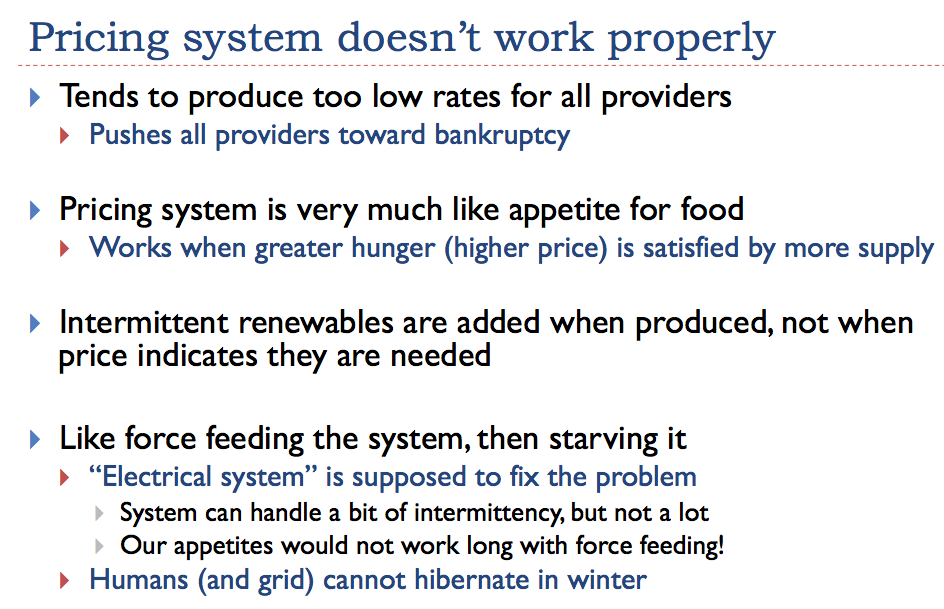
The pricing system no longer works because W&S are added whenever they become available, in preference to other generation. In many ways, the pricing system is like our appetite for food. Usually, we eat when we are hungry, and the food we eat reduces our appetite. W&S are added to the system with total disregard for whether the system needs it or not, leaving the other electricity producers to try to fix up the mess, using the false pricing signals they get. The IEA’s 2017 Investment Report recommends that countries develop new pricing schemes that correct the problems, but it is not clear that this is actually possible without correcting the hidden subsidies.

Slide 8
Why add more electricity supply, if there is a chance that you can use the new supply added by your neighbor?

Slide 9
South Australia had two recent major outages–both partly related to adding large amounts of wind and solar to the electric grid, and the loss of its last two coal-fired electricity generation plants. The first big outage came during a weather event. The second big outage occurred when temperatures were very high during summer, and because of this, electricity demand was very high.
One planned workaround for supply shortages was natural gas. Unfortunately, South Australia doesn’t actually have a very good natural gas supply to operate its units generating electricity from natural gas. Thus, the available natural gas generators could not really respond as hoped, except at very high prices. Some changes are now being made, including a planned Tesla battery system. With the changes being made, there are reports of electricity rate increases of up to 120% for businesses in South Australia.
The irony of the situation is that Australia is a major natural gas exporter. Businesses expected that they could make more money selling the natural gas abroad as LNG than they could by providing natural gas to the citizens of South Australia. These exports are now being curbed, to try to help fix the South Australia natural gas problem.
These issues point out how interconnected all of the different types of electricity generation are, and how quickly a situation can become a local crisis, if regulators simply assume “market forces will provide a solution.”

Slide 10
An expert panel in Australia has recommended an approach similar to this. It simply becomes too difficult to operate a system with built-in subsidies.

Slide 11
–

Slide 12
Timing makes a difference. The payments that are made for interest need to be made, directly or indirectly, with future goods and services that can only be made using energy products. Thus, they also require the use of energy products.

Slide 13
–

Slide 14
There is a real difference between (a) looking at the actual operating experiences of an existing oil and gas or coal company, and (b) guessing what the future operating experience of a system operated by wind panels and solar panels might be. The tendency is to guess low, when it comes to envisioning what future problems may arise.
It is not just the wind turbines and solar panels that will need to be replaced over time; it is all of the supporting devices that need to be kept in good repair and replaced over time. Furthermore, the electric grid is dependent on oil for its upkeep. If oil becomes a problem, there is a real danger that the electric grid will become unusable, and with it, electricity that is generally distributed by the grid, including wind and solar.

Slide 15
–

Slide 16
Economies and humans are both self-organized systems that depend on energy consumption for their existence. They have many other characteristics in common as well.

Slide 17
We know that with humans, we really need to examine how a new medicine or a change in diet works in practice. For one thing, medicines and diets aren’t necessarily used as planned. Unexpected long-term changes occur that we could not anticipate.

Slide 18
The same kinds of problems occur when wind and solar are added to a grid system. We really have to look at what is happening to see the full picture.

Slide 19
Anyone who has followed the news knows about medicine’s long history of announcements followed by retractions.

Slide 20
A fairly similar situation can be expected to happen with proposed energy solutions.

Slide 21
There is a whole package of costs and a whole range of direct and indirect outcomes to consider.

Slide 22
As far as I know, none of the attempts at producing a system that operates on 100% renewable energy have been a success. There has been some reductions in fossil fuel usage, but at a high cost.
Slide 23
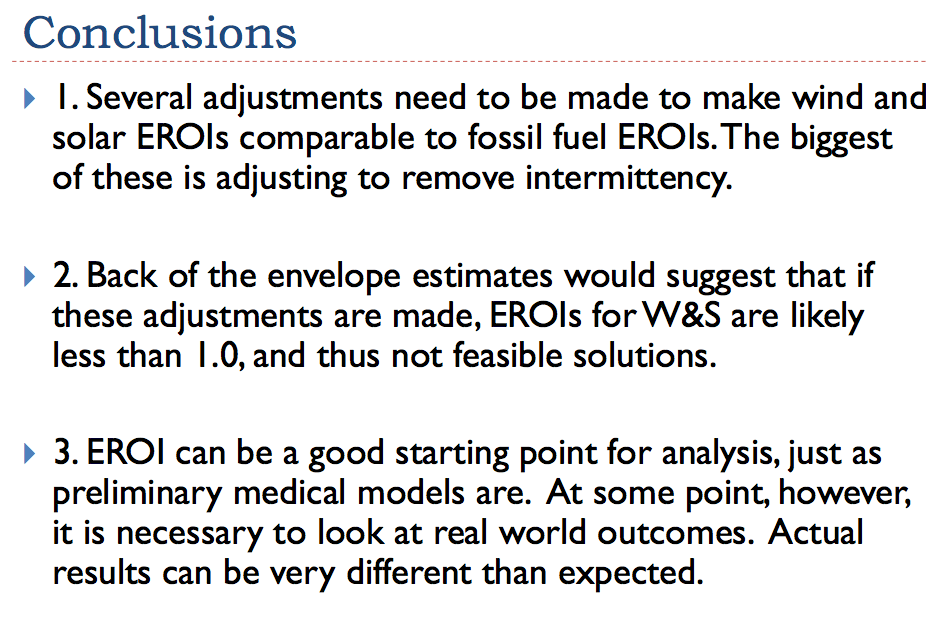
A 2013 Weissabach et al. EROI analysis examines a situation with partial buffering of wind and solar (approximately 10 days worth of buffering). It leaves out several other costs of bringing wind and solar up to grid quality electricity, such as extra long distance transmission costs, and more significant buffering to allow transferring electricity produced in spring and fall to be saved for summer or winter. These authors calculated a partially buffered EROI of 4:1 for wind, and a partially buffered EROI range of 1.5:1 to 2.3:1 for solar PV.
Of course, more investigation, including looking at the full package of needed devices to provide non-intermittent electricity of grid quality, is really needed for particular situations. Improvements in technology would tend to raise EROI indications; adding more supplemental devices to bring electricity to grid quality would tend to reduce EROI indications.
If the cutoff for being able to maintain a modern society is 10:1, as mentioned earlier, then wind and solar PV would both seem to fall far below the required EROI cutoff, if they are to be used in quantity.
If, as Hall believes, an EROI as low as 3:1 might be useful, then there is a possibility that some wind energy would be helpful, especially if a particular wind location has a very high capacity factor (can generate electricity a large share of the time), and if pricing problems can be handled adequately. The EROI of solar PV would probably still be too low in most applications. In any event, we need to be examining situations more closely, instead of simply assuming that hidden subsidies can be counted on indefinitely.


From the article:
“Let’s see … I think uranium that is affordable to extract would last about 50 years, something in that range. It might be 100. When you’ve used all that up, you go to thorium, and that would last you three times as long as uranium – so, shall we say, about 200 years?” The most sensible energy solution would be to cover 100 sq miles of the Sahara in solar panels. “It would supply the whole of Europe with all the energy they needed,” but it won’t happen “because it would be so easy for terrorists to go and bugger it up”. So for now, nuclear energy is the only viable option.
Of course, this is 100% true, which means the OFW “core” have got it completely wrong. After all, as others have noted on this comments thread, changing/reversing one’s position on a subject is in and of itself an indicator of a logical and astute mind which is simply following the facts as they are.
‘reversing one’s position on a subject’
I only change my position when the facts dictate…. if you want to 180 me…. give me the issue — and give me the facts.
I will compute… then I will let you know my decision
http://www.startrek.com/uploads/assets/db_articles/6ee08d45f7a94d4c6fda9ee84833054a687ddf77.jpg
The most sensible energy solution would be to cover 100 sq miles of the Sahara in solar panels. “It would supply the whole of Europe with all the energy they needed,”
If this is 100% true, why hasn’t the whole of Europe banded together to make it happen?
Why has Germany opted for wind turbines, coal, and Russian gas, when they could all the Saharan electricity they needed?
If terrorism was a major worry, why go all the way to the Sahara? Why not cover 100 sq. miles of the sunniest parts of Spain, Southern Italy and Greece with solar panels? That would have significant advantages over using the Sahara for several reasons.
• Cooler, which would increase the photovoltaic panels’ efficiency in converting sunlight into electricity
• Wetter, which would make it more practical to keep the panels clean and limi overheating.
• Less dusty, which would reduce the need for cleaning
• Less sunny, which would limit the degradation of and extend the working life of the panels.
• Closer to the market, which would reduce the cost of transmission line infrastructure and reduce electrical transmission losses.
Perhaps these are some of the reasons why those in charge of making these decisions have not decided that the most sensible energy solution is not to cover 100 sq miles of the Sahara in solar panels.
Another detail: Why wouldn’t people living in the Sahara expect a fairly good cut of the production? Normally energy production is taxed, especially if it is exported.
Why indeed, and amazingly, that was my point. Poe’s law is all too prevalent around here. Perhaps the ‘core’ should consider not treating every minor disagreement as a paradigm shift.
just finished reading this statement from Alan Greenspan he sounds extremely negative perhaps we are reaching that tipping point ; ” Equity bears hunting for excess in the stock market might be better off worrying about bond prices, Alan Greenspan says. That’s where the actual bubble is, and when it pops, it’ll be bad for everyone.
“By any measure, real long-term interest rates are much too low and therefore unsustainable,” the former Federal Reserve chairman, 91, said in an interview. “When they move higher they are likely to move reasonably fast. We are experiencing a bubble, not in stock prices but in bond prices. This is not discounted in the marketplace.”
This is a link to the article with a video of the presentation:
https://www.bloomberg.com/news/articles/2017-07-31/no-bubble-in-stocks-but-look-out-when-bonds-pop-greenspan-says
He seems to be arguing that stocks are now less inflated than bonds. According to the “Fed Model,” investors are justified in sticking with the less-inflated asset.
WOW that is bad news for pension funds.
Grand Wharlock acts:
http://www.catholiccourier.com/articles/vatican-shuts-down-fountains-as-rome-deals-with-drought
Geologists studying rainfall patterns in the Eastern Mediterranean believe that a long period of drought could have contributed to the decline of the Roman Empire
Working in a “dripping stalactite-filled cave outside of Jerusalem,” the geologists discovered “a gradual drying between about 100 and 700 A.D. , with sharp drops in rainfall at 100 A.D. and 400 A.D. Overall, annual rainfall fell 50 percent during those centuries, dropping from an average of more than 3 feet per year to 1.6 feet.”
http://www.ancientworldreview.com/2008/12/drought-and-the-fall-of-rome.html
Not only the Roman.
If you go back a bit further:
https://en.wikipedia.org/wiki/4.2_kiloyear_event
That’s the fascinating thing about the cl i mate … it’s always changing …. sometimes there are droughts… sometimes we get very dramatic changes that result in ice ages….
Same as it ever was…
We had been getting colder (and drier) for 4000 years.
(for not science literate, cold air contains less water vapor)
Then we carbonized the atmosphere.
Yep – and the past twenty years there has been almost no war ming of the planet — because as expected … mother earth released this excess carbon into space.
Let’s talk about a real threat shall we — spent fuel ponds.
Now that is most definitely an extinction issue
NPR”S Political coverage! ? No peak oil situation, no financial problems, etc.? Red herrings to confuse and distract the serfs until it is too late.
http://imgur.com/BT3QRNK
http://i.imgur.com/7QKMcFK.gifv
Is that a metaphor for IC?
If he is dead when he falls in the water, then yes….if he’s just crippled, then it’s a metaphor for the GFC 🙂
Cliff, were you hurt? 😉
https://gfycat.com/UncommonRelievedFishingcat
looks like a successful experiment to me!
This is basically how they faked the Apollo moonwalks.
Nope, although I salute you the open mind approach about that notorious scam, simply the tech analysis of the footage reveals it was more about tweaked speed-timing on the cameras, plus they were suspended as puppets with some degree of free movement on the stage to lift up large portion of the space suit weight they were wearing in Earth gravity conditions.
Precision jet packs or similar like in the video would have been impossible back then, and are expensive (and not much precise anyway) rarity even today..
You’ve got to hand it to NASA. They new that, as Nixon famously said, “The American people don’t believe anything’s real until they see it on television.” And yet, as we all know now, nothing shown on television is real. The best TV can do is to provide visual coverage of real events. But what TV does best of all is to provide coverage of staged events.
We all know that the Apollo missions were a program of “staged and scripted events”, and that the media coverage was also “staged” and “scripted”. BUT, how much what was shown was coverage of real events—even real staged events such as real people landing and walking around on the real moon—and how much was scenes shot in a studio or in low earth orbit and passed off as something else? Did they carry out six moon landings and then fake the footage because shooting fake footage in a studio on earth was more convenient or technically easier? Or did they fake the whole thing?
As I said earlier, if you start on the trail of questioning everything, it’s just matter of finding or being exposed to existing evidence. When I saw the reel how the US crew is fixing window transparencies inside their orbital module as to make the illusion of flying much farther distance from Earth, I have not study much further the other plethora of evidence, although there is plenty of it. Simply, that overall narrative self destructed like a sand castle, immediately.
Your are referencing interesting points as to whether what parts are real and what not. It’s indeed strange why other powers continued in automatic probes to the Moon since then and so on. I guess there is probably some intergov “treaty” of cross blackmailing on such subjects, and or the other governments are simply too gullible in believing there could be “honor among thieves”, it’s perhaps also culturally – socially determined, simply they see it as dishonor of the other side, so why capitalizing on it for small immediate gain, when in proper long term restrain, it will help to self destruct the opponent eventually, as cascading effect of their other rotten deeds.
Hi,
I would not be surprised to know that the landing was staged. But if this is true and as evident as you say, how come Russians and scientists all over the world did not report fraud? could you please provide some reliable links about that fakness of the moon landings?
Why don’t the Russians report it as a fraud?
I am no idea if it was a fraud or not — but consider this…. why don’t the Russians report a lot of things the Americans do that would be considered ‘evil’ by most Americans?
Surely they monitor a lot of top secret CIA activities including things like false flag ops….
They also have Snowden who no doubt has far more info than he has revealed.
I reckon the Russians don’t expose things because if they did that it would force the Americans to expose things that the Russians do…
The ‘Great Game’ takes place behind closed doors …. it is a world within a world….
And we are not privy to it — just as we are not privy to what is going behind the scenes with respect to the imminent collapse of BAU.
A made a reply, but it was blocked, maybe because I used the taboo word naine-elevan. Well, it doesn’t matter.
I suppose you are right about the russians, who didn’t want to spill the beans because everybody has its dirty secrets. But the silence in cientific community would be much more strange.
He was lucky. At least those lower branches broke his fall.
Tom Lewis has put up a good post on self-driving cars over at The Daily Impact:
http://www.dailyimpact.net/2017/08/03/the-self-driving-car-is-only-an-oxymoron/
“…Critical interventions, required to save lives and property, were counted separately; they occurred every 200 miles. Which makes your life expectancy, as a passenger in a truly autonomous car, approximately four hours.”
Music to my ears 😉
HAHA!! That article is going to crush techie junkies dreams of a brighter future!
The sentences before the one quoted are just as alarming:
In the first week of March, Uber’s 43 test cars in three states logged some 20,000 miles on public roads. Their drivers had to intervene and take control away from the software, an average of once every mile.
I was sure that the reports of 2 million miles of “autonomous” driving were bogus.
Every video I saw of these cars on real roads had a “driver” in the “driver’s seat”.
So that is bogus — yet the MSM reporting of GW is not bogus?
Yorchichan,
You’re not about to lose your job to this guy 😉
Can Johnny Cab help drunken female students get safely back in their rooms? 😉
Actually, I’ve never been concerned about self-driving cars. There are so many variables when driving that a totally autonomous car requires full AI. If we have full AI then we are not far from the Singularity, and then it’s not only taxi drivers needing to fear for their jobs.
I love this turn of phrase in the comments! “What a welcome vaccination against the full-spectrum bullshit that daily cluster-bombs our brains” I think FE ought to like that one!
+++++++++++
It’s hard to read the news headlines these days without wincing. Day after day I think surely we must have reached peak full-spectrum bullshit by now. But amazingly it continues to increase.
https://cdn8-blog.p2pfoundation.net/wp-content/uploads/guy.jpg
Fast Eddy is the Fake News Filter
FEFNF
Bit like being a junior officer in the trenches in 1917: how exciting!
People say they are tired of the predictable and pointless routine their lives, don’t they? Driverless cars can raw excitement some edge into life.
Although really it sounds like taking taxi in Turkey. Muslims will be cool with these cars -it’s all in the hands of Allah after all. Just say a prayer and hop in. 🙂
Should read: driverless cars can inject some raw excitement into life.’ Too much coffee this morning.
Tesla Self-Driving Cars ….. Russian Roulette on Wheels
Elon – if you are watching — you can borrow that tag line….
Self Driving Cars with bombs in the trunk…. bloody awesome….
And about those fires in western Canada … I heard on Radio CNN aka Radio New Zealand (CNN is the new Pravda) … 80 firefighters are being sent from here to help…
ISIS — are these fires your doing – if not have you been paying attention?
Here you go folks, Tesla’s solar roof is here! If you have deep pockets you too can own a Model 3 powered by Tesla’s solar roof and tens in thousands of tax credits! The taxpayer will happily subsidize 30% of the roof and help you line Elon’s pockets! Woohoo!
http://www.bloomberg.com/news/articles/2017-08-02/tesla-completes-its-first-solar-roof-installs
Amazon’s giant jobs fair sends troubling signal about the economy
http://www.msn.com/en-us/money/markets/amazons-giant-jobs-fair-sends-troubling-signal-about-the-economy/ar-AApmFkB?li=BBmkt5R&ocid=spartandhp
http://www.resilience.org/wp-content/uploads/2017/08/345569013_1abe8b764a_b_Capitalism-384×253.jpg
Looks more like Bolshevism or Anarchism to me, Duncan.
Capitalism would have the gun pointing at the owner’s own head (or foot).
Ricardo would agree.
And in Late Stage Capitalism, which we are in, Marx would definitely agree.
Looks like the sign on one of them newfangled transgender washrooms.
Look at those decline rates! Peak Shale is Now!
Another risk from the boom is that shale producers have been spending more than they make for a decade, aided by a flow of money from investors. But that has encouraged companies to focus on ramping up production at the expense of profitability, according to a report released last week by Wood Mackenzie Ltd
“At some point debt investors start to worry they will not get their capital back and cut lending to the industry,” Clark said. “Even a small reduction in capital would likely lead to a steep fall in U.S. production.”
http://imgur.com/5gl0MFw
Oil Has a Crisis of Faith
https://www.bloomberg.com/gadfly/articles/2017-08-03/andy-god-hall-quits-oil-falls-crisis-of-faith
Nice article. I liked this chart, showing falling prices of shares of stock, even as oil prices have risen in the past week.
https://gailtheactuary.files.wordpress.com/2017/08/lian-demming_-selloff-of-oil-shares-despite-rising-prices.png
Limits to growth are not predictions they are scientific models based on computer simulations. They are used in physics, astrophysics, climatology, chemistry, biology, economics, psychology, social science, and engineering.
This is a video of a panel discussion from 2012. Dennis Meadows is one of the speakers, speaking on the topic, “It is too late for sustainable development”. This is a link to a PDF explaining the program. https://www.si.edu/Content/consortia/limits-to-growth.pdf
I wish you would include some information about the information you post – a link to the source of the information, or at least the date. Otherwise it is hard to understand context.
This is a write-up related to the talk.
http://www.smithsonianmag.com/science-nature/is-it-too-late-for-sustainable-development-125411410/
https://www.youtube.com/watch?v=kZhUI9b1h80
An interesting discussion….
Best part: “you’re supposed to be managing risk yet you’ve completely discounted the biggest risk humanity will ever face?”
I found the link to this talk. It was published by the Institute and Faculty of Actuaries. https://www.youtube.com/watch?v=kZhUI9b1h80 The actual talk was an event sponsored by the Resource and Environment Group of the IFA in January 2013.
The Resource and Environment Group of the IFA is the same group I gave a talk to earlier this year, via Skype.
http://imgur.com/04sxw3O
USA GDP (PPP) per head 2016 $57,436 (IMF)
USA GDP (PPP) per head 2035 $24,000 (Federal Reserve)
Conclusion: The US middle class will be extinct by 2035
Not enough energy per capita.
I dunno.
$24k per person (right?) in today’s dollars (?) is an abundant amount.
distribution is a problem. if the upper 1% and even upper 10% continue to increase their share of the pie, then the 90+% are far below the “average”.
and what type of average? isn’t the median a more important figure?
Not really, GDP must rise every year or deflationary death spiral will ensue. Even a few quarter of contraction is dangerous and causes recession. A halving of GDP in 15 years would be catastrophic.
oh?
“A halving of GDP in 15 years would be catastrophic”
actually, a halving of GDP would leave us not with a catastrophe, but with… and here the drama builds…
and builds…
and builds even more…
in 15 years…
we are facing…
get this…
HALF of our current GDP.
now, that doesn’t sound to me like catastrophe.
sounds like poverty for the masses, but not catastrophic.
It means that our financial system is gone. Debt cannot be repaid. It becomes hard to grow enough food.
uh
a halving of GDP would leave us with
get this
HALF of our current GDP
poverty for more and more persons, but not a catastrophe.
“A halving of GDP in 15 years would be catastrophic.”
In the US it’s gone from 6-8% GDP in the 60’s & 70’s to 4-5% in the 80’s to 2-3% in the 90’s 2000’s to 1-2% to the current .5-1%, which is a series of halving events that did not lead to catastrophy. It appears even flatlining GDP doesn’t make much of a difference. It’s still beneficial to some and not others.
the main point isn’t about halving the growth rate of GDP.
the Fed projection says GDP per person will be about half in 2035.
the current .5-1% growth rate will go negative soon.
maybe before peak oil, and definitely after peak oil in the year 2025 or so.
by 2035, the accumulated negative yearly rates will bring a total decline of about 50%.
HALF.
not a catastrophic decline.
Geez! Not that kind of halving. Not going from 6% to 2%. Going from 18T to 9T in 15 years THAT would be catastrophic.
Debt cannot be serviced unless we get 2%.
If you get less for, say 5 quarters, the ponzi gets exposed.
And we don’t want that to happen, do we campers?
If you want to use evidence to see what it would look like just look to Mexico or Iraq. Were workers make on average 6 dollars a day and have two of the highest murder rates in the entire world. And this wouldn’t be catastrophic? Error 404 No Logic
https://en.wikipedia.org/wiki/List_of_countries_by_GDP_(PPP)_per_capita
The value of our GDP is not as important as its growth or decline rate. Telling someone who has lost half their income that they still have more than in Poland will not register with them. Historically economic stress was led to authoritarianism. See Europe in the 30s. We all know where that led,
Now again we see a worldwide rise in illiberal politics, Need I mention our president?
I do not wax optimistic.
Here is US GDP on a graph. This graph is a bit old. As of 2016 our US GDP stood at about $18 trillion. Imagine loosing GDP loosing more than half its value in 15 years to about $9T. You think that would be OK? Do you see any historic precedent for that? Look at the 2008 blip. That nearly killed us all. What do you think a halving would do?
https://static1.squarespace.com/static/52cdc300e4b012a81d31c03d/t/547c7603e4b0ab191e9da36f/1417442819582/
Uhhh, make Munchkin print $ 10,000,000,000,000?
I’ve sorta changed my mind.
Half GDP in 15 years is very soon and surely would be staggering and probably catastrophic.
That being said, half GDP in a few decades would be possible without the catastrophe.
A 1 or 2% decline per year would produce 50% decline in a few decades.
Not only COULD this happen, but I think it WILL happen.
Peak oil in the mid 2020’s almost guarantees it.
Cliff has a good reference to a GDP chart.
half of what the USA has now would be very much like Poland or Portugal.
and higher than Russia!
Don’t feed the troll…or is it the moron? Who knows? Maybe, maybe not? Cheers!
good point, ITEIEIO
and so eloquent!
maybe your next post will be better!
maybe, maybe not!
who knows?
Cheers!
I’ve sorta changed my mind.
I applaud your lack of consistency.
Probably not one commenter in ten of our locals is capable of this remarkable feat of cognitive dexterity.
You are thinking “on the fly” so it’s inevitable that some of your thinking will result in mistaken conclusions. But you have mastered the ability to recognize mistakes, to correct mistakes, and to admit mistakes. These are commendable qualities that are under appreciated by those who lack them, and of course they would disqualify you from ever being taken seriously as a politician.
As a token award — since I don’t give away Oscars — here’s a quotation for you:
When a man you like switches from what he said a year ago, or four years ago, he is a broad-minded person who has courage enough to change his mind with changing conditions. When a man you don’t like does it, he is a liar who has broken his promise.
—Franklin P. Adams (1881-1960).
https://en.wikipedia.org/wiki/Franklin_Pierce_Adams
It will not go well in the US.
Cops and Fire pension gone. Low IQ people rioting because system for food stamp card is down…People will shoot them and no one will pick up the bodies.
I remember riots were the Koreans were dropping them like flies…And those were the good old days.
Street thugs may have guns but do not squeeze 1000 rounds a month did I mention the low IQ and lack of origination.
Yep — the rabble is a dangerous thing….
https://en.wikipedia.org/wiki/1992_Los_Angeles_riots#Korean_Americans_during_the_riots
Funny how some people think democracy would be a good thing… there is no way the rabble can be relied upon to govern itself.
People are stewpid – people are dangerous.
I had on rabblista trying to explain to me the other day that NZ needs to preserve its culture — to stop immigration and grown organically — whatever the f789 means
Meanwhile he is speaking to an immigrant who pays a fair chunk of taxes and spends a fair bit of cash in this country….
I did mention that Japan has tried what he is suggesting … and now they have more sales of diapers to adults than to new parents….
Of course because humans are stewpid and will almost never change their minds — he continued to rant on about his aryan race theories…
What else is new under the sun
Now imagine what would happen if you actually allowed democracy to determine immigration policies….
Doh
FastEddy, you are a Moron with a Butt Plug on . Ensure you take your MEDS.
To the average American, all OFW’s are are morons that need to take meds. It is all relative. I believe that FE strives to be realistic. Is he always right, no, none of us are. For me trying to be as realistic as possible about our situation is the best way for me to deal with it. I suspect FE feels the same way.
What I care about is logic – facts – evidence. Being right is a by-product.
Just because a thousand scientists disagree — just because the entire MSM disagrees — that does not make it so.
In fact when the entire MSM disagrees with me — that is a very good ‘tell’ that they are lying — and that I am right.
When the MSM disagrees with me — and Gail agrees — then I KNOW I am right.
Is a ‘butt plug’ an alternative source of power?
depends if its renewable or not
Oh, I get it now! BAU stands for Buttplug As Usual.
beautiful
loved that one
as has been said:
beauty is in the eye of the beholder 🙂
genuine wit carries its own beauty
The methane released is a cheap fuel but it in this case it is intermittent and is also a greenhouse gas.
http://imgur.com/a/UYutj
so many persons have said that I have a touch of madness!
And so many persons have told me I have no great mind!
Yeah, but there’s been plenty of mad people that did not possess a great mind, e.g. FE.
correlation is not causation
How are things in DelusiSTAN?
Where up is down … where stewpidity is genius….
A Baby Jesus?
http://divine-interventions.com/religioustoys.php
+1
http://imgur.com/a/weRUH
this says 5.7% is the key.
so, as an example, if energy prices rise by 20%, then 5.7% energy expenditures would rise by 1.14% to 6.84%.
so yes, rising energy expenditures would produce small hits to the economy.
note that at the current $40+ price as seen on the far right of the graph, that equals about 3% of GDP.
a 20% rise in prices would bring that to 3.6%.
again, these are small hits to the economy.
and again, we are at about the 3% level now in 2017, well below 5.7%.
and
that 5.7% key level corresponds to about $90 per barrel of oil.
we are way below this key level!
We can get into trouble two different ways: Prices too high, or prices too low. Our current problem is prices too low for the producers to make enough money to reinvest in new wells. This means that the whole system will collapse from lack of investment, but not immediately. It is just as bad a problem, but it is a different problem.
another fake news from msm
Oil majors gushing in cash despite cheap crude
The prospect of crude remaining near the current USD 50 level is no longer a doomsday scenario for the world’s oil majors whose latest earnings announcements show that cost-cutting lets them turn a profit even at these price levels.
BP, Chevron, ExxonMobil, Shell and Total have all published results in recent days, showing they pocketed USD 23 billion in net profit in the first half of the year.
http://economictimes.indiatimes.com/news/international/business/oil-majors-gushing-in-cash-despite-cheap-crude/articleshow/59899487.cms
What they fail to say is that profit was actually deferred maintenance and investment. When companies are liquidating assets the short book actually looks great.
To me we are witnessing capitulation.
Seems like a very hard to solve problem when you have a product that is becoming more and more unaffordable. Much of transportation oil use is also used “for fun”. That makes it sensitive to contraction.
And oil shortages doesn’t make anyone richer (Steve from Virginia’s words)
The same seems to apply to nuclear power. It’s also unaffordable, and can only exist with subsidies in some shape or form.
That’s debatable point about the NPPs.
Where this industry felt apart or was left stagnating beyond certain threshold, and or local resource endowment (natgas, cheap coal) allows, yes it’s likely to expensive today in short term analysis..
However, there is a wide gamut of nuclear power to have, the cheapest variant graphite moderated reactors, no containment, passive and active security updates for post Chernobyl era, usually run for 1/4th of the cost of the more modern VVER type, which is that typical steel enclosed reactor vessel inside containment building and incl. much more active and passive safety futures.
The former was scaled up to even ~1.5GWe, nowadays all shut down inside the EU, while they still make ~half of the NPP fleet (with upgrades) in Russia scheduled to operate till early 2030s.
The later case of VVERs designs of the world be it EU/RU/Chinese or South Korean provenience are besides the different technical design vs. graphite, very much overbuild for safety, that’s where the costs spike, however this is now compensated by using bigger reactors with 60+yrs longevity, and modular design (repeated at every installation site), hence ~1.2-1.4GWe (+thermal output) per unit possible today as well for them..
I won’t repeat in detail the deal with already working spent fuel recycling – extending the horizon for the industry, which apparently drives some peoplez here nuts..
Right! They don’t realize that re-investment and maintenance are essential for fossil fuel companies. Even a switch from oil to gas isn’t necessarily good. We need cheap-to-produce liquid fuel.
Nice find TWP! Lets have a look at all these companies on Google finance
BP
https://www.google.com/finance?q=NYSE%3ABP&fstype=ii&ei=ukGDWeHZK8Wce8njiNgI
ExxonMobile
https://www.google.com/financeq=NYSE%3AXOM&fstype=ii&ei=akKDWfnjJcTEePSUhsgP
Shell
https://www.google.com/finance?q=NYSE%3ARDS.A&fstype=ii&ei=nkKDWeiPJ8e5e-y-s5AH
Chevron
https://www.google.com/finance?q=NYSE%3ACVX&fstype=ii&ei=0kKDWcigF8Ofef6csbAK
Total
https://www.google.com/financeq=NYSE%3ATOT&fstype=ii&ei=D0ODWZh1w495iMWfoA4
The bloodbath continues
Look them up on Google Finance none of them are reporting any free cash so far in 2017. I posted a link below but it went to moderation.
I am guessing the reason it went into aeration is “too many links.” I fixed it now.
https://1.bp.blogspot.com/-DkMDjtmilog/WYCjyOnhe7I/AAAAAAAAxEE/Yqjd_P9vWr096LxDEtC0Lx-XdB9wy2FzgCLcBGAs/s640/reg_634.bieber.mh.042712.jpg
Little Jared looks like a psychopath even while young.
Who is he?
Isn’t that Justin Bieber?
What with Duncan’s Trump Delusion Syndrome and his rich and eclectic sense of humor, and everyone under 40 looking the same to him, you can’t always trust his info.
http://www.eonline.com/news/justin_bieber
Justin Belieber, not Jared the Kushner…..
Fantastic article about mining copper in Ancient Britian!
http://www.bbc.com/earth/story/20160420-the-ancient-copper-mines-dug-by-bronze-age-children
Family groups likely worked the mines, Jowett says. “Children were probably scraping out these veins while their parents were nearby. It was a different time. There’s no school to go to. That’s just the way.”
As the miners dug deeper, they were in ever more risk of flooding. By the end, since the water levels changed seasonally, they probably would only have accessed the lowest levels in the summer. At 230 feet (70m) down, they hit the water table.
Children were probably scraping out these veins while their parents were nearby
Eventually the mine was abandoned completely. Within a few hundred years, Britain was once more getting nearly all of its bronze from the Continent, where miners were finding the veins even easier to exploit.
But in that few hundred years, the Orme had helped shape bronze networks across Europe
Very interesting, thanks.
No surprise about the children: my impression is that by the age of 4 kids can do something useful in agricultural communities.
The unfortunate side-effect was, of course, physical deformation, and premature ageing. Above all from plodding across muddy fields in poorly-fitting, heavy boots (when boots came into existence!).
This is a very interesting paper. I guess I did not truly realize how wildly optimistic the IP-CC economic projections are. It’s insane really.
Here are a few excerpts:
The future is described [by the SRES and IP-CC] as significantly wealthier than the current world in each of the four main narratives and their corresponding scenario families. 799.
In many ways, extreme [clim-ate] change projections are commonly built on the assumption that there will be essentially no issue at all with future supply of fossil energy. 801
In essence, IP-CC and SRES has chosen to disregard the issues of resource depletion and the concept of physical limits based on little more than economic beliefs 801
Currently, IP-CC and SRES (2000) seem far more optimistic about future oil production than the petroleum industry itself. This indeed is a peculiar standpoint. 804
The attenuation of the peak oil decline requires a sustained growth of more than 10% for unconventional oil production over at least the next 20 years (de Castro et al., 2009). Such sustained growth rates have not been seen for any of the global energy systems in history and are not expected by either of the dominat- ing forecasting agencies (804)
Oil exporting countries gained importance in the globalized economy, while importance of oil importing economies decreases. (805)
The current situation, where [cli-mate] models largely rely on emission scenarios detached from the reality of supply and its inherent problems is problematic. In fact, it may even mislead planners and politicians into making decisions that mitigate one problem but make the other one worse. 807
“In essence, IP-CC and SRES has chosen to disregard the issues of resource depletion and the concept of physical limits based on little more than economic beliefs 801”
IP-CC could easily find this information. There is a large amount of quality data about the extraction of fossil fuels.
based on this data, calculations show that peak oil will be in the 2020’s, perhaps about 2025, with a slight decline for a few years and then a severe decline in the 2030’s.
peak natural gas is calculated to be coming in the 2030’s also.
this is what the math is now saying.
Dear Homesteaders, Self-Reliance Is A Delusion
https://www.forbes.com/sites/modeledbehavior/2017/07/29/the-delusion-of-self-reliant-off-the-grid-living/amp/
Many off-the-grid folks like to fantasize that their personal fire arms collection and self-defense skills are actually why they are safe. But how far would this take them in a society without the rule of law, an effective government, and law enforcement? The homesteader who is confident their security is in their own hands should go live off-the-grid in Syria and find out how far self-protection takes them.
thats why i enjoy watching that tv series about people roughing it in the arctic
guy says—i’m gonna use my bulldozer to haul up my 60ft windturbine mast—then i can be completely self sufficient in energy.
or
i’m talking my skidoo out to inspect my trapline
erm……….
Yea, I watch my Hawaiian Homeland friends drive their 4X4’s, drink Bud, use outboard motors, monofiliment line, spam, etc.
They would last 3 days at the most.
we hardly ever use then in england—so i wouldn’t know
“snow machine” is the correct term.
We use skidoo in this neck of the woods but we also have this bar
http://www.timberlounge.ca/
Yeah there is this illusion that the use of fossil fuels can be temporary and upfront and somehow the deployed “technology” will forever exists after that. Self sufficiency from here on out. All I need to do is put up my wind turbine then after that no more fossil fuels – I promise!
Then, there is the other illusion of only looking at the output of solar PV and wind turbines and ignoring all the infrastructure and fossil fuel energy embedded in it. Ahh lookie, that solar panel just dropped out of thin air and daisies are blooming all around it. How green and lovely.
Umm, there are plants that absorb some of the CO2, then there is the ocean. Half of it goes there, that is why there is acidification-see coral bleaching, decrease in shell-forming organisms.
Please do some basic research before posting nonsense. Nowhere in that article does it say the CO2 goes into space. If that was the case, we would really have a problem, meaning the atmosphere would leach away into space shortly.
A small reading list for the ANThROPOGENIC C.LI.MA.TE DISRUPTION deniers:
https://en.wikipedia.org/wiki/Svante_Arrhenius#Greenhouse_effect
https://scripps.ucsd.edu/programs/keelingcurve/2013/07/03/how-much-co2-can-the-oceans-take-up/
https://www.pmel.noaa.gov/co2/story/Ocean+Carbon+Uptake
More to come.
ANThROPOGENIC C.LI.MA.TE DISRUPTION is an effect of industrial civilization and one of the causes of its collapse. It is slowly-but accelerating chipping away at the current living arrangements. It overlaps with all the other limitations we face on a finite world and denying it just because it doesn’t fit with one’s ideological prejudices is intellectually dishonest.
It has been treated as a side issue, but it is not, IMHO. It is a crucial part of understanding a finite world. Its effects are already here and accelerating the chaos.
The “economy” may be the most important issue for some, but the “economy” is just one part of the environment, not the other way around.
Does anyone else get the feeling that we are getting closer to the tipping point? The number of “news” and “research” articles are getting more and more blatant trying to promote the make believe worlds of the serfs? No peak oil situation, no climate change, no financial problems, etc.? Red herrings to confuse and distract them until it is too late. Opiates in visual form.
iagree we are at the tipping point of two outcomes ‘the end’ or as i strongly believe the next phase of ‘BAU’ a major overhaul of our current financial system
Why Did Miami Beach’s Multimillion-Dollar Anti-Flood Pumps Fail?
“Miami Beach has the second most properties threatened by rising seas in the world, so the city recently sank $500 million into a Sisyphean project to install up to 80 anti-flood pumps across the city. Though the system has helped suck away sunny-day tidal flooding, independent engineers have warned that the pumps likely won’t save the city during a major flood event: Last year, an engineer told New Times the pumps would probably fail during a hurricane because there are no backup generators if the city loses power.
Yesterday Miami Beach saw firsthand how the new anti-flood system works during a major storm. The tail end of Tropical Depression Emily (not even a tropical storm at this point) grazed Miami, and the amount of rain exceeded the pumps’ maximum capacity. Certain portions of the city ended up drowning under multiple feet of water. And according to city spokesperson Melissa Berthier, a brief power outage knocked two pump stations out in Sunset Harbour for 45 minutes.”
http://www.miaminewtimes.com/news/miami-beach-floods-from-tropical-storm-emily-overwhelm-sea-level-rise-pumps-9543575
As they say, “A picture is worth a thousand words.” There is nothing like testing a proposed approach in practice to see what goes wrong.
Man proposes (pumps) ; God disposes (of your houses) …… 🙂
Gail Tverberg, I could not find a reply link below your comment so commenting here regards the prospect of EV’s talking to each other. I can say with some conviction that the idea is not completely utopian, however if EV industry wants to implement the gold solution, the costs will outweigh the benefits. The bronze solution is cheaper and more practical. Let me try and explain.
Many boats have beacon transmitters which have advanced to the stage that they can openly transmit (open broadcast) certain characteristics about them i.e type of boat, class of boat, speed range, shape characteristics and even measurements. We can imagine a world where each EV vehicle will have a transponder (right now it is very expensive to do so) which will broadcast a range of information and other EV vehicles will use it to compute safe distance and safe speed in proximity of each other. We could also have static transponders in which as soon as the vehicle crosses a certain point, data is picked up. We can also program the transponders so that the data transmission occurs within a certain radius. Some of this technology is already used in RFID chips on toll roads. So, the communication that we are envisioning is more technical in nature and which will enable safe transportation. Such technology exists, is rather inexpensive, if rolled out on economies of scale. Hence, not a utopian idea at all. Some of us in the field call such data transfer as asynchronous data transfer method, where two nodes cannot keep communicating with each other but can do an open broadcast.
Now, the real challenge is to implement such a technology using a centralized system where a central controller can use all this data to reduce accidents. Such a concept is implementable, but very very expensive to roll out. You may be surprised to note how consumer GPS systems are able to create traffic density maps using a similar approach. To create accurate traffic density maps, most of the vehicles on the road need a switched on GPS and secondly the traffic data should be fed by another system into the central controller.
On a final note, investors with a lot of money i.e. institutional investors are gravitating towards automated transportation technologies and healthcare technologies. They know that governments worldwide will enable growth of both sectors as we progress.
Hope this clarifies to some extent.
What are you on about here?
EVs are ridiculous and would not exist without massive subsidies…
And they are filthy beasts…
Ask the HK government – they just removed subsidies and Tesla sales are ZERO…
Electric vehicles in Hong Kong could be adding “20 per cent more” carbon to the atmosphere than regular petrol ones over the same distance after factoring in the city’s coal-dominated energy mix and battery manufacture, a new research report found.
Investment research firm Bernstein also claimed that by subsidising electric vehicle purchases, the government was effectively “harming rather than helping the environment” at the expense of the taxpayer.
“The policy is to encourage drivers to be green, but they are actually subsidising vehicles that create more emissions of CO2 and particulates from power plants,” said Bernstein senior analyst Neil Beveridge.
http://www.scmp.com/news/hong-kong/health-environment/article/1935817/electric-shock-tesla-cars-hong-kong-more-polluting
http://www.scmp.com/sites/default/files/styles/486w/public/images/methode/2016/04/13/5c2c043e-0188-11e6-a9b2-800cbf78bba6_486x.jpg?itok=LTK5URG3
You are on the spot right now, but, we are looking into future. You mention Bernstein, but, remember that there are many big other investment advisories who have a different point of view. I am an Equity Researcher and have been in the field for the last 20 years.
I will not disagree on subsidies and the carbon footprint issue, but, note that massive R&D investment in the sector (as happened through DARPA in the 80’s) could enable better, cleaner and cheaper alternative. There is no guarantee but it is very probable.
Yadda yadda yadda — lots of things are profitable when interest rates are zero… but EVs are clearly not one of them …. they are a JOKE.
Hint: whenever you have to make something from plastic and metals and all that stuff — then haul it around on wheels — it ain’t never going to be green
Green is when you walk to where you want to get somewhere
So please don;t give me this horseshit about ‘green technology’ It makes me think you are MOREon.
As for ‘future’ how long have you been reading FW?
Stick around awhile — you will eventually come to the realization that you are in a funeral parlour… we are gathered here waiting for the body of BAU to be delivered….
When that happens all of your equity is going to vapourize…. the financial system is going to collapse permanently — and the lights will go off — and then you will starve and die.
In the meantime you can either waste your time ‘investing’ — or you can — as I do — invest in enjoying the time up until the big funeral… pissing away cash that is about to be useful only for lighting a fire fueled by sofa cushions.
I think you showed more restraint than usual on this one FE. What’s up?
FE is mellowing.
I am focusing my energy on dismantling the myth of GW…..
Everyone gets a first chance…. if they persist in ignoring facts and logic…. then the flame thrower pilot light gets turned on….
“Very probable ”
Based on what metrics.
Space travel? FF
SuperSonic flight? FF
Rare Earths? FF
Solar? FF
Wind? FF
Locomotive? FF
Etc. Etc. Etc.
Take the Fossil Fuels away then run your probability again.
Massive R&D investment in a parasitic,complex,intermittent energy capture device seems rather dumb. The smart money would go after sources of energy that are simple and cheap to access, scalable and always ready. Pity there aren’t any left. All this talk about better, cleaner and cheaper should have taken place (and did) 40 years ago. The result was there is no alternative to fossil fuels. Now that the finite nature of fossil fuels is beginning to bite, suddenly the tech desperados think solar pv and wind turbines have merit. They don’t. Just accept it, reject it, and steer what is left of fossil fuels toward extending what little time we have left.
thanks for your interesting posts equities research and i apologize for some of the name calling you were subjected too from our ‘resident thinkers’
I have “healthcare technologies” for all to use as well” Get outside, do some hiking (like Duncan), running, walking, or other exercise. Eat sensibly. That’s basically it – no charge.
grayfox: people even have to wear silly Made-in-China costumes to do those things…….
My dog chased a runner, and when he complained I told him that if he ran around a hill wearing silly day-glow clothes, what on earth could he expect?
“Now, the real challenge is to implement such a technology using a centralized system where a central controller can use all this data to reduce accidents.”
The real challenge is replacing 100% of current vehicles with self-driving EVs. I’m presuming you left out the self-driving part for the sake of brevity, since there is no other way this system can conceivably work. In contrast to boats, cars tend not to move in huge open spaces with little to no change in direction or speed.
Grid electricity is perhaps the hardest type of electricity to keep operating. I have a hard time imagining why anyone thinks that electric cars can possibly be sustainable. If we replace all cars with self-driving EVs, the grid goes down, all transportation will cease once the batteries in the EVs run down.
There is also a problem with the self-driving EVs being very “hackable.” https://www.usatoday.com/story/tech/2017/07/28/chinese-group-hacks-tesla-second-year-row/518430001/
We don’t want our cars connected to the internet for that reason. (Similar issue with connecting the electric grid to the internet.)
I agree 100% Gail, the complexity is just too great for us to manage.
Our complex computer systems and the devices they control are like a Walt Disney castle: with soaring towers and battlements and spires and pinnacles and moats and ditches and portcullises and……a little door marked ‘Walk In Right Here’ (and take the castle).
Or a wamprat sized exhaust vent.
ATT Doomy Preppers —- when BAU goes — this will be abandoned…
https://i.ytimg.com/vi/Z8IHW0EfhAg/maxresdefault.jpg
https://image.freepik.com/free-vector/hand-drawn-idea-concept_23-2147532419.jpg
Yep…
Yet the MSM tells us that entire countries including the UK will be ICE free within 20+ years.
Even though this is impossible.
Funny how people – including many on this site — in spite of being lied to over and over and over and over by the MSM…
Still swallow what the MSM presents to them — hook line and sinker.
https://pics.me.me/if-you-repeat-a-lie-often-enough-it-becomes-truth-13543935.png
https://www.ted.com/talks/ex_moonie_diane_benscoter_how_cults_think
Thanks! I am doubtful that this approach will really work, because at current wages, many drivers cannot afford automobiles at today’s prices. Adding all of this stuff on will make vehicles even more unaffordable.
Making a change to self-driving vehicles will also reduce wages available for driving the vehicles. It is hard to see what new jobs will become available for all of these jobless former workers. Thus, the system as a whole will be in even worse shape: (1) The wage situation of workers will be even worse than today. (2) The price of autos will be even higher than today.
Perhaps not as obvious, but the government’s ability to collect taxes will fall, because of falling wages. This will make it harder to pay compensation to people who want to work, but cannot find jobs that pay an adequate amount to cover the ever-higher transportation costs.
Exactly! Efficiency gains only help the wage scenario if the technology leverages the value of labor. The impact of reduced prices on GDP which increases demand will never offset the reduction in demand from the lost wages since the velocity of money for workers is higher than corporate profits.
And yet Australians just can’t get enough new cars
https://www.theguardian.com/australia-news/grogonomics/2017/aug/01/australians-still-love-buying-new-cars-even-when-wage-growth-is-low
think of it this way one vehicle will service the needs of a hundred users these users would not be able to afford the private ownership of one ev car but they will be able to afford to hire an ev vehicle ( driverless) to get them to where their going
Yes, but this is a deflationary substitution which is destructive to the overall economy. It would only be an improvement if the money which would have gone to buying a car now goes to something else on the consumer level – instead of disappearing form the wage class all together.
It’s a step toward consolidating capital, or said another way, increasing wealth inequality.
100?
If so many people are broke where exactly where would they be going? No need to go anywhere if you’re to broke to afford to do anything?
I am not Gail sorry.
Lets pretend what you say is true.
Did not one of the US topnotch navy war ships get broadsided aka ramed by a bunch of Philippines sailors
Hit the captains cabin as I recall.
That may of been a bobo What happens when it is the plan.
but isn’t that good that tesla is burning through all that cash
Tesla saves the world!
https://www.cnbc.com/2017/08/02/tesla-second-quarter-earnings-2017.html
no doubt about it!
the world’s economy now will grow for centuries!
BAU is here to stay!
IC is saved!
Strange that this is being spun positively considering….
Tesla Burns A Record $13 Million Per Day In Q2… And It’s About To Get Worse
Tesla continued to burn cash, and in the second quarter it outdid not only itself but Netflix too, with a record cash burn of -$1.16 billion – or roughly $13 million per day – almost double what it burned in Q1. In Q3, Tesla’s CapEx was $959 million, a number which is set to surge as the Model 3 launch continued well into into Q3: Tesla expects it will burn another $2 billion in CapEx in the second half.
http://www.zerohedge.com/news/2017-08-02/tesla-burns-record-13-million-day-q2-and-its-about-get-worse
http://www.zerohedge.com/sites/default/files/images/user5/imageroot/2017/07/20/tesla%20cash%20burn%20q2_0.jpg
Imagine what YOU could do on $13 million a day?
https://youtu.be/k8e86ovUGsM
“Shares surged roughly 8 percent in after market trading. Since the start of the year, Tesla shares have gained 52 percent, as investors anticipate the launch of its first car for a more mainstream consumer.”
Bi polar. Bwahahaha
I wonder how high the share price would rise if they actually sold 500k cars and lost 7 Billion Dollars.
https://media.makeameme.org/created/this-is-madness.jpg
LOL!
Maybe Elon Musk is on OFW, and he’s just LLL as you say, him and his whole company while it can.
Elon — if you are here — all is forgiven….
Would you mind organizing a private jet for my use…. just drop your contact info onto a post and I will be in touch ….
The 64 thousand dollar question…when to pull the short button
If you are loosing cash just beg the .gov But the point I look for is when .gov SAYS NO
PS not looking for an answer
The gov has created this mirage to calm the sheeple — so the only way I think they say no — is if it gets out of hand and it threatens to end BAU.
For example — they will allow a certain amount of penetration of ‘renewables’ because that creates the perception that we are progressing in weaning off fossil fuels….
But they obviously know that if they go too far with this — this will take down economies…. see Australia….
Likewise with EVs — if too many are sold — that jeopardizes the grid….
A little hopium feels good — too much … is fatal
Also amazing is that stock based compensation is a whopping 0.71 per share!!!
Think of all the investor cash those employees are getting.
https://www.nytimes.com/2017/07/25/world/asia/afghanistan-trump-mineral-deposits.html
the future is solar and rare minerals are everywhere in afghanistan that is why USA is there in the first place along with proximity to China
yes, the future is solar.
too bad that, in the next century, “solar” will be “sunshine” and no “panels”.
unless in the next century a new source of energy has been discovered to replace the ageing solar panels
perhaps a perpetual energy machine will have been built by then
yes, defying the laws of physics!
but why next century?
why not this year?
There are many rare earth metals to consider, not only for PVs, but also for asynchro generators, perm magnets, etc. That’s necessary for higher eff. wind power, hybrids-EVs, locos, ..
But you rightly so pointed the other aspect on which point I’d guess the proximity to lob missiles into China-Russia is probably ~50-70% behind the reasoning to be there anyway.
Holy Sh*t. He thinks we’re in Afghaispoppy for rare metals??? And we’ll bring democracy to the plebs?? And we want to be close to China in case they act up so we can slap them around?? Hoooooly Sh*t.
We sure did spend a ton of money in Afghaispoppy Wonder why…Cus we want to help…That must be it
“magic money tree”
perhaps the same kind of person who “believes” in infinite fossil fuels.
Norman will probably not want to go over it yet again, so I’m addressing this to no one in particular. Also, the discussion on Orwell must be yet another over-my-head issue. So, a general question or two:
There were two dominant forms of Industrial Civilization–US and USSR. 1) Capitalism and 2) state capitalism…or is it communism? To what extent, if any, were there attempts at a third? Is the cooperative model, as in Mondragon, Spain, significantly different from either? I suspect that the coop folks are dependent on markets mostly centered in the capitalist system, and they would go away if capitalism went away. But has there ever been an attempt at a cooperative system that controlled the entire loop of production? Would that even be possible?
https://www.youtube.com/watch?v=8ZoI0C1mPek
Oh, and does anarchism in Spain have anything to do with the popularity of the cooperative system in Mondragon?
Oh, and does anarchism in Spain have anything to do with the popularity of the cooperative system in Mondragon?
Catalonia has a strong anarchist tradition to this day, and cooperative economic systems are the basis of that view.
Capitalist extract wealth between the difference between user and exchange value, almost always labor.
When the labor is doing the actual work, and owns the means of production, this goes away as the exploration is eliminated, and ones work equals one’s value, and wealth is not extracted from labor..
I “see.” The local labor exploitation goes away, but there is still dependence on labor exploitation through trade with the global capitalist structure?
The Spanish anarchists might have developed a third way had they been allowed to continue their revolution, but within a few years they were crushed by the Falangists in the Civil War. However, successful people’s cooperative movements have a long tradition of being “co-opted” by the larger and more powerful hierarchal systems that surround them or else developing into hierarchies themselves.
Duncan may well be a member of REI, the recreational goods coop based in Kent, Washington. It looks like a coop and calls itself a coop, and we the members get a dividend when we buy stuff and a vote on who’s going to sit on the board. But it is hardly an anarchist organization. Visit their website and it is not radically different from that of traditional mail order retailers such as Lands End.
Which leads me to suspect that a third way might be all the ways put together–sort of like not separating or divorcing from anything. There seems to be nowhere to separate off to. All or nothing. 🙂
In fact, the Mondragon worker in Spain these days is in part the beneficiary of non-co-operative labour in other parts of the world.
Mondragon reflects not Anarchism as such but a particularly Basque view that social harmony is a desirable aim, but loves business and money-making. This is embodied in the ruling Basque National Party, which Leftists in Spain very inaccurately call ‘far-Right’ or ‘Fascist’, God help us.
In the 16th century, as a special privilege granted by the Spanish Crown, serfdom and feudal service were abolished for all Basques, making them all -in the terms of the law of that time – ‘noble’. These privileges were not finally abolished until the triumph of (capitalist) Liberalism in the late 19th century.
Anarchism is a very un-Basque mentality, as we deeply love private property, symbolised above all by the farmhouse (baserri)/family mansion (casa solar) owned outright ,with no landlord, no debt to a bank.
This is why a visitor will see so many houses in the Basque Country with heraldic arms over the door. The structure was different in the eastern part, Navarre, (my family origin) where the social structure was feudal since the 9th century in imitation of France, and there was a traditional distinction between peasants/slaves and a noble class of soldiers and administrators.
My best friend from school was of Basque heritage. Extended family had emigrated to Australia from Bilbao. Grandmother spoke Basque.
Like Greeks, we get everywhere. 🙂
Yes, Artleads, the Basque co-operative Mondragon is utterly phoney as an independent worker-led model. It’s like a Koombaya permaculture farm selling to people who get their money in BAU.
It now has a lot of production outside Spain and those workers are not part of the co-operative deal and can be hired and fired at a whim – so the Basque workers benefit from that flexibility which doesn’t touch them.
The workers in Spain thought that they had jobs for life, and were very shocked indeed when after 2008 significant parts of the co-operative had to lay people off.
Above all, Mondragon serviced the construction sector in Spain itself, -tiles, fittigs, washing machines, cookers heaters, etc, and when that crashed in 2008 (and has not really recovered) things got sticky for them.
It is part of BAU: nicer to work there than for a red in tooth and claw capitalist enterprise, but fully part of the global industrial system.
It is also said to be fairly corrupt, as it helps to have a relation working there if you want to get taken on, which is the case in many of the factories in Spain. The working class has always specialised in locking out other members of the working class with its own ‘old boys’ network.’
You have to take realistically into account, the global capitalism was always a dominant system, while industrialized-ising communists were making minor share of the pie, influential to a point yet still minor players. The Asians with the long term and leap frogging mentality came with some sort of mixed system of gov-capitalist structures in recent decades, Russia adopted it to an extent recently as well. Interestingly, by ~2006 US Agencies proclaimed that Russia on 1/25th of the budget closed the gap in most of the mil hardware capability. Nowadays the ratio is somewhat around 1/10th of the budget and in some capabilities are actually surpassing.
So, the point of redistribution priorities inside the system is very important. Also in terms of the permanent siege mentality, consumer goods were put aside, the defense and specific public infrastructure were prioritized.
For example, few hundreds of top Soviet scientist working on prioritized secret program lived in spacious “town-houses” like inner secluded part of secret-closed city, basically look a like of US upper cast suburbia. While a notch down, still premier scientists, engineers, industrial plant directors, and so on, lived in apartment buildings, and the top perks were perhaps a chauffeur, tiny wooden summer chalet in the country, flight-train tickets to domestic sea/ski resort vacations once-twice a year, few scientific congress visit trips to Western world per decade, public recognition on posters and medals, and that was it.. apart from inner satisfaction of innovating, planned goals matched.
Compare and contrast with the burn rate of personal consumption on the other side across the whole society.. Very different approaches and world views stemming from that all. Not claiming – arguing which is the best, only painting the picture..
I think few people appreciate how good it was to be in the elite of the Soviet bloc countries: student life was comparatively very pleasant for the elite on campus – this comes out in autobiographies of dissidents.
Of course, not nearly as pleasant as Oxford or Cambridge, given the ghastly architecture, but, for the Soviet Union, not to be sniffed at. And as you rightly say, their egos were flattered adroitly by the system.
In trying to keep up with the various threads on FW, including nuclear materials management, I had thought the USSR scenario you describe would make some sort of sense. There needs to be an elite (in perpetuity) to manage nuclear facilities, and they could be incentivised by the same preferential treatment. Similar preference could be given to energy workers. But I doubt that the clock can turn back to a past time/system like that. Something unprecedented is more likely, IMO.
On smaller scale in comparison to cold war era, yet there are still such closed gov secret cities today in operation inside Russia and China and few other places, usually focused on the most sensitive stuff, like nuclear war technologies, the more mundane conventional war tasks are done “in the open” across the nation in normal mil-industrial zones and bases, obviously some heightened security is obviously likely applied there as in any other country.
In terms of the closed cities, there are some difference today afterall though, novelty being acknowledged on the maps in proper names (not codes and such anymore) but as outsider you can’t enter them freely, trespass or anything, the pop living there is under some travel restriction-surveillance etc. Since these are smaller enclaves, say less than 20k pop, there is ~zero criminality, little noise and exhalations, usually inside nice surrounding nature..
how dare Canada destroy the Earth with their massive tar sands projects!
oh, right, they depend on it economically.
Humans discount the future, think heuristically rather than critically, and live by story and myth.
Burn more coal!
yes, one of my favorite sayings actually: “Humans discount the future”
I’m certainly against reckless pollution.
but I’ve never seen proof that CO2 at 4 parts per 10,000 is causing irreversible damage to our planet.
we disagree, my friend.
Humans discount the future, think heuristically rather than critically, and live by story and myth.
I think Duncan is introducing a false dichotomy here between heuristic and critical thinking. In practice, everybody uses the former most of the time and many of us are able to use the latter on occasion. Those of us who can’t think critically when required are what used to be known as dumb bunnies.
I’ve heard from supporters of these projects that the tar sands are the equivalent of a massive, massive natural oil spill and that the extraction of the oil and subsequent replacement with less oily topsoil is actually a massive, massive cleanup effort that will make the region’s natural environment better ….. eventually.
I admit I rolled my eyes at the sheer audacity of the claim, but have to admit it’s a point of view.
“… the tar sands are the equivalent of a massive, massive natural oil spill…”
so Nature polluted itself way back when?
huh.
who knew Nature could be so evil to the Environment?
and now humans are going to clean up the outrageous oil spill that Nature made!
record US gasoline demand
https://www.cnbc.com/2017/08/01/oil-prices-fall-on-surprise-rise-in-us-inventories-high-opec-output.html
happy motoring!
and Australia had record COLD temperatures last month.
it’s called weather.
North America is statistically one of the hottest places on Earth during the northern hemisphere summer.
CO2 was 3 parts per 10,000 and everything was fine.
now it’s 4 parts per 10,000 and OMG it’s the end of the world OMG!
correlation is not causation.
correlation is not causation.
Warming World -USA National Academy of Sciences
http://dels.nas.edu/resources/static-assets/materials-based-on reports/booklets/warming_world_final.pdf
Where’s the part where the gases escape into space like NASA indicates?
Which of course is the reason why temperatures have basely increased in two decades?
Do you see a trend my ideologically crippled friend?
How you manage to keep any friends at all with that attitude is beyond me, Duncan.
People who disagree with you may be ideologically crippled.
On the other hand, you may be employing psychological projection.
In the second case, how would you, as the ideologically crippled person, know?
http://www.demotivationalposters.org/image/demotivational-poster/1009/here-is-an-owl-in-a-hat-owl-hat-argument-invalid-demotivational-poster-1284335141.jpg
Ceci n’est pas une hat!
ha!
“You’re argument is invalid”
is the incorrect grammar part of the joke?
Je ne suis pas. I just like the cute little owl image. 🙂
But if you prefer, we can be grammatically ‘if not politically) correct.
https://s-media-cache-ak0.pinimg.com/originals/8c/91/ef/8c91ef2c9bc5437a1fe7db8d1a83e734.jpg
And you must realize 2017 was warmer than 2016.
How can Duncan possibly know this, when 2017 is barely half over?
http://cdn.meme.am/instances/500x/24404836.jpg
The MSM told me that …. therefore it must be so….
Even though the MSM is an industrial lie machine.
I know that most of this is going to fly way over Duncan’s head, but anyone still mouthing Al Gore’s talking points in 2017 while referring to other people as “science illiterates” is pretty much beyond redemption. But for the rest of you who may have an interest in cli-mate issues and are open to new information, here’s some you may not have heard of.
H2O is the dominant forcing agent in the atmosphere and apart from over deserts there is lots of it around at any temperature. Water on its own is a strongly positive forcing agent on a cold earth or even on a “snowball earth”, yet it is a strongly negative forcing agent above 24 C.
That’s why even tropical regions don’t generally get much above an average annual temperature 27 C regardless of what the the CO2 level happens to be. That is why the tropics were not appreciably warmer than today even when CO2 was 7000 ppm. All a warmer earth does is spreads the warmth and the water vapor farther afield, creating a more vibrant biosphere with more opportunities for plants and animals to exploit.
Water is the main coolant in the global air conditioner, and it does most of its work by evaporation/condensation.
What Duncan won’t tell you (and I doubt if he even knows this) is that the Green House Effect (GHE) is not a constant. It averages 33 C but it varies with the seasons between 31 C and 35 C —a 4 degree change—and it is at its highest in July when the CO2 level is at its lowest and when the Earth is at aphelion and therefore getting the least energy from the Sun. The GHE varies in synch with the seasons of the Northern Hemisphere, which means it cannot be dependent on the GH gases in the atmosphere.
The GHE is the difference between the temper-ature of the Earth with its atmosphere and the temper-ature it would have if it possessed almost no atmosphere like the moon. This averages 33 C over the course of a year. Of that 33 C, a full 22 C is caused by the water evaporation/convection cycle, 5 C is caused by convection of the atmosphere, 5 C by the water vapor GHE, and – wait for it! – 0.9 C by the CO2 GHE. Increasing CO2 is not going to result in runaway warm-ing or Thermageddon. These are, to the best of my limited layman’s knowledge, relevant facts.
That will be ignored.
Again…
The MSM is lying to us about the state of the global economy
The MSM is lying to us about the number of people who are unemployed
The MSM is lying to us about Syria – the Ukraine
The MSM is lying about 911
The MSM lied about WMD
The MSM is lying to us re the Trump relationship with Russia
The MSM is lying to us about solar power
The MSM is lying to us about wind power
The MSM is lying to us about Tesla
Day after day after day after day we are fed the same bulls,,,hit on all of the above….
BUT — the MSM is telling us the truth about g,l w,,,ar mi,,ng.
We have EVIDENCE from a whistle blower explaining in great DETAIL how his colleagues FAKED the data.
Je,,sus mother Fac,,,king C,hrist — this is like coming home from work early — you open your bedroom door — and your wife is getting down and dirty with 5 po,,,rn stars…. and the director says do you want to get in on this????
You close the door — run out for flowers — make her dinner — with wine — and tap on the door — and say honey — when you are done ironing the clothes let’s have a romantic evening!
http://gifrific.com/wp-content/uploads/2014/02/Mike-Ehrmantraut-Shakes-His-Head-Breaking-Bad.gif
Mika’s daddy, back in1972 when she was just five years old, explained very clearly:
https://pbs.twimg.com/media/C7Ksn8nVsAAHAir.jpg
Roll on 45 years to 2017, and Mika has clearly absorbed the message:
https://pbs.twimg.com/media/C5T4GONXAAEe6bC.jpg
Mr Equity is a perfect example…. a lemming to the end
“That’s why even tropical regions don’t generally get much above an average annual temperature 27 ” – Water has a very high heat capacity. And the tropics have a high water vapor content. So, that is why the tropics are more stable temperature wise and deserts have very large diurnal swings in temperature. Cities close to large bodies of water experience a similar effect as the water moderates the air temperature due to its very high heat capacity.
How do you know these are not faked and/or cherry-picked numbers?
Would you like me to post a series of data points that ‘prove’ that solar energy is soon going to mean fossil fuels are a thing of the past?
I could also post plenty of articles that state that ICE autos will be banned in entire countries by 2040? EVs are definitely going to take over shortly
Let me know… I will be happy to post fake news too.
http://peakoilbarrel.com/wp-content/uploads/2017/08/GOMMayPOB012.png
GoM is now past its peak oil production based on the latest projections.
this is another small step closer to world peak oil which is projected for the 2020’s based on all available data.
perhaps 2025 or so. Coming SOON!
Yep—
Thunder Horse, Tahiti, Jack2, etc will soon be in the history books.
At current prices, it doesn’t look like leases make sense any more.
Human domination of the biosphere: Rapid discharge of the earth-space battery foretells the future of humankind (Schramski 2017) USA National Academy of Sciences
http://www.pnas.org/content/112/31/9511.abstract
that’s a fascinating way to look at humanity.
“Earth is a chemical battery where, over evolutionary time with a trickle-charge of photosynthesis using solar energy, billions of tons of living biomass were stored in forests and other ecosystems and in vast reserves of fossil fuels. In just the last few hundred years, humans extracted exploitable energy from these living and fossilized biomass fuels to build the modern industrial-technological-informational economy, to grow our population to more than 7 billion, and to transform the biogeochemical cycles and biodiversity of the earth. This rapid discharge of the earth’s store of organic energy fuels the human domination of the biosphere”
we’re using up all the available fossil fuel resources and “discharging” the internal battery of the Earth.
though it is a very very very slow process, and the battery can never be recharged.
http://www.bentleymotors.com/content/dam/bentley/Master/Models/Hero/Mulsanne/Mulsanne%20EWB/Muls_my17_LOC_02_Fr34%201920%20x%20670.jpg/_jcr_content/renditions/original.image_file.1366.477.file/Muls_my17_LOC_02_Fr34%201920%20x%20670.jpg
My future car.
that’s one of my cars right now 😉
That’s not a car, it’s a tank!
FE, Google has made renewables work.
http://oilprice.com/Alternative-Energy/Renewable-Energy/Did-Google-Just-Tackle-The-Biggest-Problem-In-Energy.html
quote “Yet there is a catch with this price…”
isn’t that always the case?
That is of course fake news… what isn’t fake news?
99% of what I read is fake. I go into every article assuming it is fake. I am seldom disappointed
End of the day — the world does not run on electricity — if magically tonight we had a cheap storage device for solar energy that would not make one iota of difference to our situation
We need cheap to produce oil — we are out of that — this is game over.
Now if someone could find a mega field of cheap conventional oil that would be helpful….. but you can’t find what does not exist
It’s like I am dying from cancer — I have a touch of the flu — and the doctor says — hey Fast — there’s this miracle flu medicine – it wipes out the flu in minutes.
I agree – electricity is one small part of a much larger problem being the availabliity of cheap liquid fuels. Lubrication, earth moving, mining, heavy transport, plastics, fertilizers, tractors, roads and bridge building and maintenance, building construction.
Renewable energy ‘simply won’t work’: Top Google engineers
Two highly qualified Google engineers who have spent years studying and trying to improve renewable energy technology have stated quite bluntly that whatever the future holds, it is not a renewables-powered civilisation: such a thing is impossible.
Both men are Stanford PhDs, Ross Koningstein having trained in aerospace engineering and David Fork in applied physics. These aren’t guys who fiddle about with websites or data analytics or “technology” of that sort: they are real engineers who understand difficult maths and physics, and top-bracket even among that distinguished company.
Even if one were to electrify all of transport, industry, heating and so on, so much renewable generation and balancing/storage equipment would be needed to power it that astronomical new requirements for steel, concrete, copper, glass, carbon fibre, neodymium, shipping and haulage etc etc would appear.
All these things are made using mammoth amounts of energy: far from achieving massive energy savings, which most plans for a renewables future rely on implicitly, we would wind up needing far more energy, which would mean even more vast renewables farms – and even more materials and energy to make and maintain them and so on. The scale of the building would be like nothing ever attempted by the human race.
In reality, well before any such stage was reached, energy would become horrifyingly expensive – which means that everything would become horrifyingly expensive (even the present well-under-one-per-cent renewables level in the UK has pushed up utility bills very considerably).
http://www.theregister.co.uk/2014/11/21/renewable_energy_simply_wont_work_google_renewables_engineers/
http://techcrunch.com/2011/11/23/google-gives-up-on-green-tech-investment-initiative-rec/
“Miracle batteries” have been on the horizon for a while now. The high voltage capacitor concept “worked” in the lab one time, but materials problems led to breakdown and it has never been commercially realized. Of course, everyone wants to trumpet their solution. One thing for sure is that they will broadcast all the positives, and not the shortcomings or commercializations issues.
Elon has competition and England its savior?:
Sono motors unveils solar and battery-powered electric car
German electric car start-up sono motors has revealed the crowd funded prototype of its battery and solar-powered vehicle ‘sion’. At $18,000 USD plus the option to lease or pay another $5000 for a battery pack it seems to be great value.
However make no mistake, it can only travel for around 30 klms on solar power a day and up to nearly 200 klms using the larger battery pack option.
One of the selling points of the design is its lightweight structure, which means it requires less solar power to propel it further. additional features include a 10-inch center touchscreen and a bi-directional charging technology.
http://revolution-green.com/sono-motors-unveils-solar-battery-powered-electric-car/
30km is not an issue — as long as the organic hipster coffee shop is less than 15km each way….
I’ll buy one with a battery. Daily commute 110 miles. Perfect.
They do not seem U.S. friendly.
But don’t use the heater, the aircon, the wipers or the radio or your range will halve.
And about those holes in the floor: remember the Flintstones?!
A lot of these ‘cars’ will just be raincoats with wheels!
The Tesla 3 with 310 miles range and electronics package prices out at $49,000. Count me out. If they can cut another 40% we can talk.
Love to know the conditions under which that was achieved. Daylight hours, tail wind, downhill behind a semi-trailer with no use of any electric functions and a 50 kg naked driver carrying only a credit card.
PS: don’t expect to charge your iPhone or else you lose 20km!
http://www.nytimes.com/2013/02/10/automobiles/stalled-on-the-ev-highway.html
heating and aircon are rarely if ever mentioned in the blurb about EVs
Yeah that is what I have always wondered about as well. How do you heat and cool the interior? I supposed one just rolls down the windows. That is green no? LOL
Every even day bloomberg is telling me that EVs and renewable energy are awesome ….
Every odd day bloomberg tells me that GW is real….
Back and forth back and forth…..
http://energyskeptic.com/2017/nrc-accused-of-putting-millions-of-lives-and-trillions-of-dollars-at-risk/
The implications of fossil fuel supply constraints on climate change projections: A supply-side analysis.
http://www.sciencedirect.com/science/article/pii/S0301421512009275
It is concluded that the current set of emission scenarios used by the IPCC and others is perforated by optimistic expectations on future fossil fuel production that are improbable or even unrealistic.
I know both authors of this paper quite well. Michael Hook is at Uppsala University; Xu Tang is at China University of Petroleum, Beijing.
The abstract starts out:
Future scenarios with significant anthropogenic climate change also display large increases in world production of fossil fuels, the principal CO2 emission source. Meanwhile, fossil fuel depletion has also been identified as a future challenge. This chapter reviews the connection between these two issues and concludes that limits to availability of fossil fuels will set a limit for mankind’s ability to affect the climate. However, this limit is unclear as various studies have reached quite different conclusions regarding future atmospheric CO2 concentrations caused by fossil fuel limitations.
In the section you quotes, “perforated” strikes me as a strange word to use. The IPCC results are close to a foregone conclusion, given the huge amount of future fossil fuel extraction they assume. When a model crosses two fields (oil limits and climate modeling), it is hard for the scientists coming from a climate modeling point of view to have an understanding of what the issues are regarding fossil fuel limits.
This is a very interesting paper. I guess I did not truly realize how wildly optimistic the IPCC economic projections are. It’s insane really.
Here are a few excerpts:
The future is described [by the SRES and IPCC] as significantly wealthier than the current world in each of the four main narratives and their corresponding scenario families. 799.
In many ways, extreme [clim-ate] change projections are commonly built on the assumption that there will be essentially no issue at all with future supply of fossil energy. 801
In essence, IPCC and SRES has chosen to disregard the issues of resource depletion and the concept of physical limits based on little more than economic beliefs 801
Currently, IPCC and SRES (2000) seem far more optimistic about future oil production than the petroleum industry itself. This indeed is a peculiar standpoint. 804
The attenuation of the peak oil decline requires a sustained growth of more than 10% for unconventional oil production over at least the next 20 years (de Castro et al., 2009). Such sustained growth rates have not been seen for any of the global energy systems in history and are not expected by either of the dominat- ing forecasting agencies (804)
Oil exporting countries gained importance in the globalized economy, while importance of oil importing economies decreases. (805)
The current situation, where climate models largely rely on emission scenarios detached from the reality of supply and its inherent problems is problematic. In fact, it may even mislead planners and politicians into making decisions that mitigate one problem but make the other one worse. 807
This is a very interesting paper. I guess I did not truly realize how wildly optimistic the IP-CC economic projections are. It’s insane really.
Here are a few excerpts:
The future is described [by the SRES and IP-CC] as significantly wealthier than the current world in each of the four main narratives and their corresponding scenario families. 799.
In many ways, extreme [clim-ate] change projections are commonly built on the assumption that there will be essentially no issue at all with future supply of fossil energy. 801
In essence, IP-CC and SRES has chosen to disregard the issues of resource depletion and the concept of physical limits based on little more than economic beliefs 801
Currently, IP-CC and SRES (2000) seem far more optimistic about future oil production than the petroleum industry itself. This indeed is a peculiar standpoint. 804
The attenuation of the peak oil decline requires a sustained growth of more than 10% for unconventional oil production over at least the next 20 years (de Castro et al., 2009). Such sustained growth rates have not been seen for any of the global energy systems in history and are not expected by either of the dominat- ing forecasting agencies (804)
Oil exporting countries gained importance in the globalized economy, while importance of oil importing economies decreases. (805)
The current situation, where [cli-mate] models largely rely on emission scenarios detached from the reality of supply and its inherent problems is problematic. In fact, it may even mislead planners and politicians into making decisions that mitigate one problem but make the other one worse. 807
By the way Gail your banning of certain words is quite annoying and doesn’t really work. .
The real reason so many millennials still live with their parents
http://www.marketwatch.com/story/the-real-reason-so-many-millennials-still-live-with-their-parents-2017-07-31
“The job market is improving, wages are finally moving in the right direction (albeit slowly) and we’re still in the midst of a long-running bull market. And with decades left until retirement for even the oldest millennials, we’ve still got time to make up for all this lost ground.” – WOW
I know I thought the same exact thing as well. How delusional . I thought the rest of the summary was great though.
I posted this article on Reddit and everyone is commenting on the same exact last paragraph laughing.
https://www.scientificamerican.com/article/should-the-world-tap-undersea-methane-hydrates-for-energy/#
At what price?
Depends on the costs to make a commercially viable source of fuel from methane hydrates. Last I read about them, it was not economic. More hopeful than solar PV and wind turbines though since methane is a flammable gas. And non-toxic too, unlike solar panel and wind turbine production and waste.
Wasn’t Japan supposed to be energy independent by now from this concept? Must have been 5 years ago now that I was reading about that ….
hopium…..
$3 per thousand cubic feet, or less. That what it would need to compete with in the US. A little higher in Europe and Japan.
Everything is good. Dow has hit 22000.
Boy would I love to be in the kind of bubble where I could believe the Dow signals current and future prosperity!
I saw a headline yesterday — Greenspan says Stock Market not in Bubble
I didn’t click it…..
Yes. I saw that as well. Greenspan once said he used the metric of “Men’s underwear sales” as a way to determine if the economy is doing well.
Maybe not quite so silly s it might sound: in the 1930’s and 1940’s, very poor people went without any underwear. It’s something you can cut back on with no-one seeing.
https://grist.org/food/flash-drought-could-devastate-half-the-high-plains-wheat-harvest/
This is a much bigger problem than the electric cars or solar panels. We need to eat first.
A few years ago, prolonged wet weather devastated the crops here: as far as one could see, they were impossible to harvest and left to rot, grey and dead.
For decades now, oil has balanced out that kind of loss, so that local harvests are of no great importance to us – but without oil (and tarmaced roads, etc): famine.
Doesn’t food come from the supermarket and restaurants?
And electricity, from observation, comes from switching a tiny knob on the wall.
Don’t you know the truth!
The thought of electric cars is so completely irrational it’s laughable.
http://www.zerohedge.com/news/2017-08-02/electric-car-fever
Dunning Kruger strike again.
Exactly the cognitive awareness needed to understand why it won’t work they lack.
Excellent critique! thanks for sharing JT
This is the reporter behind all the rah rah Tesla articles trandall6@bloomberg.net
If you want to get the attention of a ‘journalist’ send an article to him with subject line — You are a Hack … .
They hate that — because it forces them to face the fact that they are whores…. errand boys…. definitely not journalists….
Then follow with:
Hey Tom – are you a shill for Tesla? How does this work — does Tesla pay a monthly retainer and in return they get x number of puff pieces from you?
If not then when are you going to be a journalist and provide some balanced reporting on this company?
Here’s another outstanding article on EVs https://www.ericpetersautdies…os.com/2017/08/01/electric-car-fever/
I am still waiting for Tom to look into the report that appeared in the SCMP indicating EVs are more polluting than ICE cars —- I suggested he get in touch the HK government to ask if this is why they cut subsidies….
Waiting …. and waiting…. and meanwhile Tom is working on more puff pieces….for his pimp.
Why pick on an errand boy?
Because I must always feed…. I must never stop moving….
https://www.thesun.co.uk/wp-content/uploads/2017/06/nintchdbpict0002407806071.jpg
And because shills like this are responsible for me having to endure MOREons who tell me that EVs and solar panels are going to save the world…
More like this! 🙂
https://d18l82el6cdm1i.cloudfront.net/solvable/220e1f730f.1bbf455923.91B9yC.jpg
No make the title to the email “Question”. And leave it at that. It’s a trick I learned while working a sales company once. people will always open it and read it because it will make them curious. Then make the email say ‘YOU ARE A HACk”
That no doubt would work as well.
Try…..
The comment right at the point is a beauty and sums up human delusion brilliantly.
“These problems are not difficult to overcome with a little thought and a lot of exponential technological advancement.”
In other words, “shoot first, ask questions later”. Meanwhile, the grifters make off with the loot, whilst joe-public ends up carrying the can. Head completely in toilet.
It has been discussed here and other places. Once we hit peak oil, and depending on the decline rate, there may be no need to produce more ICE cars. We have a fleet, and it will by and large decline at the same rate as the fuel supply. Some wealthy people will continue to buy cars for fun, and that just puts a little extra pressure on the low end segment to drop even faster.
We saw this in the new car sales report that came out a few days ago. SUVs did a little better than the small car segment.
I suspect that the decline of the car industry will be a major component in collapse – simpy because the industry with all supply chains is so massive.
talk of EVs pros and cons misses the point
its not the journey, it’s the journey-purpose that’s the problem
when oil is no longer available, there will no purpose for powered wheels. EV or IC—makes no difference
Without oil, employment in the sense that we currently know it will cease, and will revert to what employment used to be, that of food (and basic essentials) production.
Pre oil, most of these were produced within walking or cart distance.
This is why towns and cities had physical limits governed by what could be carted in from surrounding farmland
The reason we have distance-holidays now is because cheap fuel allows us to. I take seaside breaks and walk on sunny beaches because I do not have to worry about where my next meal is coming from. Pre oil, those beaches were empty tracts of nothing and nowhere.
The roads/flights that enable me to get there in 2 hours are a construct of fossil fuels. We have no other materials to allow that to happen
That’s a very valid long-term macro point view position.
But for the near-midterm the system and its components doesn’t like to die a premature death so far. The extenders are being utilized as we speak, e.g. an illustration just two ~9MW train cargo locomotives can haul ~200 full wagons of coal, lets make it ~20MW, although in reality it’s not on full power all the time. Lets add some further electricity capacity for the large mining operations, surface or deep mining, plus the overhead keeping the worker’s fed and home heated, .. Now, these locos are obviously already available besides diesel in more cumbersome CNG/LNG variants as well.. not everybody has got everything, people-countries tend to specialize according to their local conditions, resources, priorities, skills,..
In summary that’s all within the capacity of legacy infrastructure out there, few hundreds MWs to single GWs of power available even with the back against the wall, be it coal and nuclear sites, hydro installations. It will surely keep on fracturing along the lines of limited upkeep, lack of professionals, ever increasing complexity of higher eff. parts and their JIT supply, natural and man made disaster interventions, ..
However, it’s hard to predict the cascading – unraveling diagram for it as in time sequencing order. Most likely it won’t proceed in universal fashion globally, and the relatively advantaged countries-regions will continue to jockeying for the position for a while.
One thing is relatively certain though, the ~plateau of consumerism reached for the average folk since 1970s is ending, we are about to enter deeper oscillations and notable slump onwards. Where and what wheels are going to come off is highly speculative..
that was part of my point
the individual consumption of each of us contributes to the whole..
But that ”whole” is falling apart because we can no longer afford to consume because the products we consumed in the past. (say 1860ish to 1970ish) represented the output of cheap surplus fuels.
We no no longer have that cheap surplus, so those products are becoming too expensive.
So it doesn’t matter much if we continue to deliver ”fuels”, if those fuels are effectively too expensive to use as a means of employment (ie convert them to marketable goods and services)
Indeed, the Cheap FF enabled jobs program, with its accompanying consumerism and population explosion is coming to an end.
The capital that enabled consumerism will be abandoned, decommissioned and directed to the benefit of more carefully selected and small specialized pockets of hightech with access to energy, cheap or not.
As an example; capital has started to leave the epitome of consumerism – the FF industry. Instead the “smart” money is pushing electrification of entire vehicle fleets and end-of-the-line automation with cognitive systems enabled by software and semiconductors. “Humans Need Not Apply”.
The conveniences of modern life will not be compromised for the competent rulers, workers and warriors. It will be defended tooth and nail. For the useless plebs, though –
Well, there you go with your daily ration of rice and potatoes.
Yes, is that the process towards Techno-feudalism I see in my crystal ball?
automation may well go on for a while longer.
unfortunately those relying on automation run into an insoluble problem
machines don’t buy ”stuff” they just ”consume”.
Producing goods and expecting to sell them, when all your customers have no income is a concept too idiotic to deal with. Yet this is where manufacturers are headed, and there is nothing anyone can do about it, because no one can revert to the old way of doing things, because it is impossible to stay commercially solvent.
Few are willing to pay for a hand crafted product, because it is unaffordable…we want stuff produced by machine
So robots become ever more sophisticated, while humans lose the means by which they are employed.
Other than robot building. Then robots build themselves, and human beings become superfluous.
And unless I’ve missed some profound truth, the future becomes pointless
“And unless I’ve missed some profound truth, the future becomes pointless”
Not at all; the owners of the producing capital will end up in a Darwinian “survival of the fittest”.
For the regular joe, though, yes, it is irrelevance that awaits.
https://www.youtube.com/watch?v=sjH92Al0_WA
If you need a dose of doom & gloom, avoid watching this video, because it’s uplifting. The best line in the video is, “As production costs drop with more units made of solar PV and wind, fossil fuel resource extraction costs continue to increase, and if graphed the two are passing each other. Solar and wind are now cost competitive with burning natural gas, and in some locations electrical generation cost using solar/wind is lower. Economics is driving wind and solar installations worldwide. People actually never did what was right, but are making this switch because it’s economically advantageous.
My question is, when the coal and gas will be so expensive and will be abandoned, what source of energy will be used to manufacture new panels? I hope not the electricity generated by the old ones…
“Solar and wind are now cost competitive with burning natural gas” – maybe on a dollar basis they are but not on an energy basis they are not.
in this video say oman is pumping its heavy oil from ground via solar
Given the choice between watching this and a root canal procedure …. I would have to go with the latter….
Aw Fast up in Canada we have solar robots building solar panels and all the raw material comes from the solar powered mine.
You should come home for a visit.
With the shut down of the tar sands…We have decided to burn our boreal forest so bring your chainsaw.
“fossil fuel resource extraction costs continue to increase”
fossil fuels are getting more expensive to extract, but somehow the cost of extracting the resources need for a solar panel are not? Strange equation. Dispatchable energy like natural gas subsidizes renewables, never the other way around.
the problem with this ”future” is that the future for the rest of us is predicated not just on oil coal and gas—-but the products of oil coal and gas being bought and sold with in a commercial infrastructure–ad infinitum
if you buy a car or a house, it is not built with electricity, it is built with thousands of components that are constructed from basic elements that can only be obtained and processed using hydrocarbon based fuels.
if you have a pension, that pension is a call on an expected energy surplussed future, in 25 years say.
if that future isnt there, then your future will not materialise.
electricity of itself has no use until it is put to work, and it can only be made to work within a hydrocarbon based environment—there are no as yet ”unknown” product forms that can be processed entirely by input of electricity–you cannot build a road with electricity, and there are no compounds that can replace tarmacadam (concrete uses FF as well) You cannot build hovercars, because the energy input is too great. As yet no means of lifting heavy objects has been found, other than with chemical explosion.
Such a thing might be possible in the future, but development will require colossal industrial systems, which are themselves unsustainable in our current circumstances
oil and gas delivers our food. Electricity cannot do that
So while we might get a flood of electrical power, it might come just as the industry that supports it is fading from our grasp
Our economic system, at least in the industrialized world, has for decades been built largely on making the money go around. This has had a number of what I consider to be disadvantages. Like HRH the Prince of Wales, I abhor much of what passes for modern architecture, but I have a special dread of cheap-and-nasty new houses and big box sores built from “new materials” and clad in aluminum siding, Should be a law against that, I say.
I also share Xabier’s distaste for what he describes as “crappification”. High quality products, because they require large inputs of energy and human skill, are expensive to produce. And because most people are not very well off, they are averse to buying expensive products and they are easily tempted to go for low price over quality. I don’t really blame the manufacturers for this. They are mostly responding to consumer demand. They have to do whatever makes the money go around.
It’s the consumers with their preference for kitsch and tat and furniture filled with styrofoam that I’m disappointed in. Why can’t they have immaculate taste like I do? 🙂
Diminishing returns
In the end, the pair ended up with data going back decades for 25 globally important super-giant oilfields. Applying OPGEE to this group, the scientists found that for many of the super-giant oilfields, oil production declined with time as the wells were depleted, but the energy expended to capture the remaining oil went up.
“The more oil that is extracted, the more difficult it becomes to extract the oil that remains, so companies have to resort to increasingly energy-intensive recovery methods, such as water, steam or gas flooding,” Masnadi said.
Making matters worse, oil recovered through such methods has to undergo more intense surface processing to filter out the excess water and gas. In the latter case, this can result in an excess of carbon dioxide and methane gas that is typically eliminated through burning – a process called “flaring” – or venting into the atmosphere.
“We can show with these results that a typical large oilfield will have a doubling of emissions per barrel of oil over a 25-year operating period,” Brandt said.
http://news.stanford.edu/2017/07/17/climate-impacts-super-giant-oilfields-go-age/
Consider that the internal combustion engine was invented in 1876 and the solar panel in 1941. The solar panel has had about 76 years to prove its worth. In 76 years the internal combustion engine went from a running prototype to V8 form powering the 1955 Corvette with nearly 200HP. All without the advantage of computers and modern manufacturing. Solar panels have had the advantage of being raised in an era of high tech engineering, materials and computers and still are not capable of displacing fossil fuels.
Greg
Your absolutely right but people just can’t get their head around the fact that this way of life is a one time event. The only reason we have all this stuff is the incredibly dense energy in fossil fuels.
We talk a lot about oil. But if we think about it Oil is worthless without coal. If we didn’t have coal there would be no steel industry. No steel no consumption of oil. Maybe lighting that’s about it.
So it’s been an incredible mix of resources that created this modern system. And the mix had the right balance to get us to where we are. Take away any of the energy elements and it couldn’t have happened.
Yet all of this has been provided by a geologically and biologically active planet. And we can’t synthesize any of it.
Greg-
You had to be culturally backward to drive a Corvette.
The only thing more uncool was drinking, or going to Las Vegas.
Well for the well cultured there is always the 300HP 1950-1959 Aston Martin DB4 GT. It went 153MPH. It looks nice too:
http://cdntbs.astonmartin.com/sitefinity/heritage/db4gt_exterior.jpg
Or perhaps a 320HP 1930-39 Duesenberg Model SJ:
https://i0.wp.com/www.zmescience.com/wp-content/uploads/2015/08/Duesenberg_Convertible_SJ_LA_Grand_Dual-Cowl_Phaeton_1935.jpg
I have to say the Impala looks like an absolute turd in comparison the the Duesenberg. It is so incredible what was built back in the 30s with mostly handtools, human ingenuity and a while lot of cheap energy.
I had a Duesenberg model when I was a kid, so cool. Can’t forget the Terraplane too.
This is an incredible version by Roy
Now you are talking!
where did you get that photo of my Aston Martin?
ps: in front of my house!
http://g-ecx.images-amazon.com/images/G/01/shazam/1061649-events-otc-paidmedia-300×600-NC2bp._V519058588_.jpg
test
Solar vs Gas – there is no comparison. Pound for pound gasoline is just an incredibly powerful energy dense fuel. To use a less energy dense fuel is going backward.
In this corner weighing in at 520lbs (with driver). A one passenger $300,000 machine. Looking thin with a bubble for the driver’s head with a drag coefficient of 0.11 and 2.4HP on tap from the sun:
http://sunwindsolar.com/wp-content/uploads/2013/01/SOLARCAR.jpg
In this corner, weighing in at 3600lbs (unladen). A six passenger $28,000 machine.
Looking rather chunky in comparison with a drag coefficient of .33 and 305 HP on tap from a gas powered 3.6L V6:
http://buyersguide.caranddriver.com/media/assets/submodel/7673.jpg
Who needs/demands such 300hp/3.6L V6 monstrosity, especially as silly worthless sedan (I doubt it’s at least a liftback) .. ?
As many people are more than happy with sub 5L/100km diesel sipping ~1.6L/100hp van, which can carry twice the people or perhaps more than 5x the cargo at fraction of the fuel consumption in comparison to that Chevy..
this guy:
https://images.cdn.autocar.co.uk/sites/autocar.co.uk/files/styles/gallery_slide/public/189773725.jpg?itok=sCMjty6K
That isn’t the point. The point is gas is infinitely more energy dense than solar power. Fossil fuels are amazingly powerful fuels. Even with all the internal drag and inefficiencies of internal combustion engines, vehicle weight and drag, the ICE vehicles hands down will outperform solar cars.
There is no debate gas is infinitely more energy dense than electric solar power. But that is not the point, IMHO.
The point is people will buy what’s available and convenient today, in line with their cultural biases.
But you cannot power an industrial civilization on a less energy dense fuel. That is going backwards. We need more energy, not less. And we certainly can’t afford to pay more for less.
Could not agree more. I was just saying that things will go the way they are going until they can’t anymore. Some people realize this, most don’t, so they will act as if the current way of doing things will last forever. That’s all.
In the third corner: Used vehicles. Unbelievable competitive from a price perspective. From my local craigslist (there are other brands…): “volvo 740 sedan 1988 runs drives good
se pics 153 k miles runs good,4 cylinder auto” $1300
Volvo
I’m not sure a car will save the planet but you open an interesting discussion. Some here are determined that people will be forced to buy into new technology but fail to understand that as things get tighter they’ll like resurrect old technology.
If I’m running tight on cash why would I double down on debt. Instead wouldn’t I take some old car that I can get for free and drive it?
In the real world we see this all the time. Go to Mexico. The real Mexico not some garbage resort town. You’ll find a bunch of VWs being parted out on every corner.
No electric cars.
Reminded me of one of El Chapo’s escapes. The first car he jacked only went 3 blocks till it broke down. lol
http://www.cbsnews.com/news/60-minutes-el-chapo-bill-whitaker-2/
The last new car I bought gave me so much trouble, I spent so much money on it that I decided to exchange it for a reliable and cheap car, aware that it would probably be the last one I would drive. I did my research on the best engine ever, and the answer of dr. Google was Mercedes 190
https://s-media-cache-ak0.pinimg.com/600×315/9d/65/97/9d6597289bf7bcab70a69ec254fe093d.jpg
So I bought one with 500 000 km, for the ridiculous sum of 2 000 euros, and we have had a very happy relationship. It’s probably the ugliest car Mercedes ever made, but it gives me everything I expect from a car: that it drives me from point A to point B. I hope to drive it to the end of BAU.
Haha JMS funny you would say that…I bought a brand new VW CC in 2010, and in 2013, I told my brother this would be my last car (did not tell him it’s because I expect BAU to end before 2020 give or take a few years)…he had a perplexed look not understanding how it could be my last car…anyway still drive and still loving it, and unless anything major happens to it, I’m keeping it till the end 🙂
http://momentcar.com/images/volkswagen-cc-2010-3.jpg
BTW if you own a Tesla, it is really Tesla that owns you. The only thing user serviceable is the windshield wiper fluid, everything else has to be done under a maintenance contract with Tesla. Basically a subscription. F that.
The final stages of capitalism, Karl Marx predicted, would be marked by global capital being unable to expand and generate profits at former levels. Capitalists would begin to consume the government along with the physical and social structures that sustained them. Democracy, social welfare, electoral participation, the common good and investment in public transportation, roads, bridges, utilities, industry, education, ecosystem protection and health care would be sacrificed to feed the mania for short-term profit. These assaults would destroy the host. This is the stage of late capitalism that Donald Trump represents.
-Chris Hedges
Marx proved time travel.
(one can only get so many things right).
While promoting a economic system that overestimated the malleability of humans, his analysis of capitalism is astounding!
Chris got that wrong …. the final stages of capitalism involve expensive to extract resources and the inability of the consumer to afford goods and services… leading to a deflationary death spiral .. collapse of BAU — and the extinction of the human cancer from the magnificent planet that we have stabbed in the heart
According to the above quote, Hedges’s thinks Karl Marx (1818-1883) predicted ecosystem protection would be sacrificed under late-stage capitalism. Yet the world “ecosystem” was not coined until 1935 (by British ecologist A.G. Tansley). So what did Marx really have to say?
Well, I for one am not going to wade into Marx’s writing. Life’s too short and I haven’t finished Adam Smith yet. So instead I’ll rip-off what one of his fanboys has written about what Marx said about man and nature:
Marx’s ideas were the most developed of all the philosophies breaking with the religious past. Instead of the Earth never changing and being at the centre of everything, with mankind the centre of the Earth, Marxism in line with classic materialism regards the world as always changing, even mortal. Life was a product of Earth (nature) and not of a god. Humanity was one with nature, not outside. Likewise, Marx did not divide history into social or natural, but saw them as one. Dialectical laws apply in both nature and society, and their developments are interchanging, affecting each other. Marx used the term ‘metabolism’: a chain of processes linked to each other, as one body.
Marx showed that the increasing division between town and country was a breach of this metabolism, summarised in the term ‘metabolic rift’ by John Bellamy Foster, author of the useful book, Marx’s Ecology. In the third volume of Capital, published in 1894 after Marx’s death (1883), Marx describes capitalism as a break with the natural laws of life: “On the other hand, large landed property reduces the agricultural population to a constantly falling minimum, and confronts it with a constantly growing industrial population crowded together in large cities. It thereby creates conditions which cause an irreparable break in the coherence of social interchange prescribed by the natural laws of life”.
Based on a discussion about the long-term degradation of the soil following the use of chemical fertilisers in agriculture, Marx wrote that “all progress in capitalistic agriculture is a progress in the art, not only of robbing the labourer, but of robbing the soil; all progress in increasing the fertility of the soil for a given time, is a progress towards ruining the lasting sources of that fertility”.
He explained: “Capitalist production, by collecting the population in great centres… disturbs the circulation of matter between man and the soil, ie, prevents the return to the soil of its elements consumed by man in the form of food and clothing; it therefore violates the conditions necessary to lasting fertility of the soil”. And further: “Capitalist production, therefore, develops technology, and the combining together of various processes into a social whole, only by sapping the original sources of all wealth – the soil and the labourer”. (Capital, Volume I, 1867) In a farsighted prediction, Marx warned that capitalism’s constant modernisation would increase “this process of destruction”.
https://www.socialistalternative.org/2015/12/15/marxism-environment/
‘Furious’ US Complains of Russian ‘Lockout’ at Site
(Can you say Karma?)
http://news.antiwar.com/2017/07/31/furious-us-complains-of-russias-expulsion-of-diplomats/
A libertarian site, but often good analysis.
High cognitive libertarians are just anarchists on training wheels.
http://www.credoeconomics.com/approaching-a-global-deflationary-crisis/
This is a very good summary about the deflationary crisis!
Saludos
el mar
From the article:
“The development of unconventional oil and gas has been possible because quantitative easing has made a large amount of money to Wall Street at a low interest rate and they have been “searching for yield” – looking for somewhere to put this money to earn a high rate of interest. This funded the voracious capital expenditure needs of the industry with its high drilling intensity. However it pre-supposed that prices would remain high enough for long enough to cover costs and this has not happened. The problem is set to get a lot worse as depletion speeds up.”
Once again…. we are seeing The Plan…..
The commanders have killed many birds with the QE stone…… not only do the resultant low interest rates spur economic activity …. but they also have made it possible to ‘print oil’ ….
The shale revolution does not happen without QE…. and very obviously the commanders know that…
They have done a masterful job of buying us nearly 10 years of bonus life.
But unfortunately all good things must come to an end — when you run an engine on the red line for too long — bad things happen — and eventually your engine dies…. you can slam the pedal to the metal … you can crank the ignition …. but when she’s seized up and wrecked…. nothing happens.
The nothing happens moment is getting closer by the day….
It may be possible that new QE like CB interventions will keep BAU going for another ten years, the squeeze shows up elsewhere but still causing our quick step march towards collapse.
Let us pray to the QE god to deliver us to 2027!!!!