
Central bankers seem to think that adjusting interest rates is a nice little tool that they can easily handle. The problem is that higher interest rates affect the economy in many ways simultaneously. The lessons that seem to have been learned from past rate hikes may not be applicable today.
Furthermore, there can be quite a long time lag involved. Thus, by the time a central banker starts seeing an effect, it may be clear that the amount of the interest rate change is far too large.
A recent Zerohedge article seems to suggest that problems can arise with 10-year Treasury interest rates of less than 3%. We may be facing a period of declining acceptable interest rates.

Figure 1. Chart from The Scariest Chart in the Market.
Let’s look at a few of the issues involved:
[1] The standard reason for raising interest rates seems to be concern about inflationary impacts occurring as a result of rising food and energy prices. In practice, the impact of such an interest rate change can be quite severe and quite delayed.
Figure 2 is an illustration from the Bureau of Labor Statistics website showing one of today’s concerns: rising energy costs. Food prices are not yet rising. Normally, however, if oil prices rise, the cost of producing food will also rise. This happens because modern agricultural methods and transportation to markets both require the use of petroleum products.

Figure 2. Figure created by the US Bureau of Labor Statistics showing percentage change in the Consumer Price Index between January 2017 and January 2018, for selected categories.
In fact, raising short-term interest rates seems to have been associated with trying to bring down rising food and energy costs, as early as the 1970s and early 1980s.

Figure 3. US three-month treasury interest rates. Chart prepared by St. Louis Federal Reserve.
The reason why an increase in short-term interest rates is helpful is because it reliably induces a recession. A person can see the close connection between short-term interest rate increases and recessions (gray bars) in Figure 3. Recessions in turn damp down food and energy prices.
The reason why this damping down effect occurs is because when there is a recession, many people are laid off from work. These people purchase fewer goods and services. With people out of work, “demand” for goods and services falls. (Demand is very closely related to “amount affordable.”) We might think of demand for goods and services as helping to maintain the “production” of new homes, new cars, upscale food products, toys, and even consulting services.
When demand falls, fewer goods of practically every type are made. This indirectly leads to less need for commodities of many types, including oil, natural gas, metals, and food. Commodities have very long production cycles, and only modest storage facilities. When lower demand for a commodity such as oil occurs, prices tend to adjust sharply downward, in order to signal the need for lower production. Figure 4 shows that interest rate spikes corresponded to the 1973-1974 oil price spike, the 1979 oil price spike, the 2004-2008 price run-up, and perhaps to other shorter oil price spikes.

Figure 4. Annual averages of Brent oil prices (in 2016$) and 3-month average interest rates, based on data similar to that shown in Figure 3 from “FRED.”
The annual data in Figure 4 loses the detail of month-to-month variations. Because of this, it makes the impact of the Great Recession look much less severe than it really was. Figure 5, using monthly data for recent periods, shows more clearly the severe fall in oil prices following the run-up in short-term interest rates in the 2004-2007 period.

Figure 5. Three-month US Treasury interest rates and Brent oil prices, both on a monthly average basis. Graph by FRED.
If a person looks at the indirect impacts on the economy as a whole, it becomes clear that the rise in short-term interest rates was one of the proximate causes of the Great Recession of 2008-2009. I talk about this in Oil Supply Limits and the Continuing Financial Crisis. The minutes of the June 2004 Federal Reserve Open Market Committee indicate that the committee decided to start raising interest rates at a rate of 0.25% per quarter for the purpose of stopping the rise in energy and food prices.
The huge financial problems that indirectly resulted did not occur until four years later, in 2008. It is likely that most economists are unaware of the connection between the decision to raise rates back in 2004 and the Great Recession several years later.
[2] Higher energy prices squeeze a person’s “spendable income.” Higher interest rates have the same effect.
Economist James Hamilton showed that ten out of eleven recent recessions were associated with oil price shocks. We would argue that if an economy is subject to higher interest rates in addition to higher oil prices, the economy is doubly likely to go into recession. Figure 6 shows an illustration of the situation.

Figure 6. Image by author showing recessionary impact of rising energy costs and interest costs.
A wage earner’s pay does not normally increase as energy costs rise, or as interest costs rise. Even if energy and interest costs are well buried (in higher food costs, or in the higher cost of goods transported across the country, or in higher student loan payments) the amount of income that a person has available to spend on discretionary goods and services falls if energy and interest costs rise. Having both energy and interest costs take a bigger share of available income at the same time is especially a problem.
[3] Reduced interest rates can be used to conceal the adverse impact of rising energy prices.
This is another version of what we saw in Figure 6. If interest rates can be reduced, they can offset most of the bad impacts of higher energy prices. For example, if oil prices are higher, it helps if auto loans and mortgage loans are lower in cost.

Figure 7. Image by author showing that artificially low interest rates can mostly offset the impact of rising energy costs.
Of course, central bankers don’t necessarily think this through. To what extent is today’s economy really dependent on very low interest rates?
[4] Falling interest rates have an almost magical impact on the economy. Rising interest rates reverse these magical impacts, and replace them with very negative impacts.
We saw in Figure 6 how falling interest rates could more or less conceal a rise in energy prices. The following are a few of the additional magical things that falling interest rates can do:
(a) Falling interest can raise asset prices of many kinds, including homes, stock prices, resale prices of bonds, and the price of land.
(b) Falling interest rates can raise commodity prices, making it possible to extract more fossil fuels and metals. Resources that previously did not look economic to extract, suddenly become economic to extract. This change occurs because with lower interest rates, more people can afford to purchase goods that use oil, such as cars and motorcycles. This tends to raise demand for oil products, and thus prices.
(c) Because higher-priced energy extraction becomes feasible at lower interest rates, more advanced technology, at higher prices, suddenly becomes feasible. Jobs open up in research areas that would not previously have made sense at lower energy prices.
(d) Falling interest rates can make the balance sheets of companies holding stocks and bonds as assets look better, because of their rising prices.
(e) Rising asset prices “feed back” into spendable income. People with homes that have risen in value can refinance, and use the proceeds to fix up their home (add an additional room or an updated kitchen, for example). Individual citizens and companies can sell shares of stock that have risen in value and use those proceeds to augment other income.
If interest rates rise rather than fall, the impacts can be expected to be extremely recessionary. The stock market may crash. Homes are likely to lose value because of a lack of buyers that can afford them. Energy resources that seemed to be available can suddenly seem not to be feasible because of low prices.
[5] The economy was able to reasonably tolerate the run-up in interest rates in the 1950 – 1980 period because the economy was growing very rapidly.
A person can see the pattern of short-term interest rates in Figure 3, above. Long-term (10-year) interest rates follow a somewhat similar, but smoother, pattern (Figure 8).

Figure 8. Monthly average 10-year Treasury interest rates, through January 2018, in chart by FRED.
World per capita energy consumption was rising very rapidly in the 1950 to 1970 period. Even in the troubled 1970 to 1980 period, per capita energy consumption continued to rise, although not as quickly (Figure 9).

Figure 9. World per capita energy consumption, with 1950-1980 period of rapid growth highlighted. World Energy Consumption by Source, based on Vaclav Smil estimates from Energy Transitions: History, Requirements and Prospects (Appendix) together with BP Statistical Data for 1965 and subsequent, divided by population estimates by Angus Maddison.
When world per capita energy consumption is growing this rapidly, jobs tend to be plentiful and wages tend to rise faster than inflation. According to Figure 10, US wages rose more rapidly than inflation in the 1950 to 1970 period, without wage disparity becoming a problem. Even in the 1970 to 1980 period, when high oil prices were a problem, US wages were able to rise quickly enough to keep up with inflation. Rising wage disparity did not become a problem until after 1980.

Figure 10. Chart comparing income gains by the top 10% to income gains by the bottom 90% by economist Emmanuel Saez. Amounts are inflation adjusted. Based on an analysis of IRS data, published in Forbes.
The share of US citizens in the workforce also rose during the period up to 1980, as an increasing percentage of women joined the workforce (Figure 11).

Figure 11. Employment as a percentage of the population, aged 25-54. Chart from FRED, using OECD amounts.
The thing that made the 1950-1970 period unusual was the growing availability of inexpensive fossil fuels. With fossil fuels, it was possible to add expressways where they had never been before. This allowed more interstate trade and improved the productivity of truck drivers. Labor saving devices allowed women to join the workforce. Farming continued to become more productive, with all of its labor saving equipment. Even as energy prices rose in the 1970 to 1980 period, citizens were able to continue to buy energy products because their wages were rising enough to keep up with inflation.
The growth in productivity was so great that wages plus government benefits (as measured by “Disposable Personal Income”) rose almost too fast. This added inflationary pressures to the economy. It is my opinion that these inflationary pressures contributed greatly to the oil price run-up in the 1973-1974 and the 1979-1981 periods.

Figure 12. Three-year average growth in Disposable Personal Income compared to inflation as measured by CPI-Urban. DPI from US Bureau of Economic Analysis; CPI from Bureau of Labor Statistics. Per Capita Disposable Personal Income is calculated by dividing DPI by US population, also from the BEA.
The run-up in oil prices also to some extent reflected a scarcity problem; note the two spikes in CPI-Urban in the 1970s in Figure 12, which are higher than would be expected, if the problem were simply a problem caused by the very high per capita Disposable Personal Income growth.
A major problem of the 1970s was a decline in US crude oil production for the area outside Alaska.

Figure 13. US crude oil production by type, based on EIA data.
This scarcity problem was significantly mitigated by the development of oil fields in Alaska, Mexico, and the North Sea in the next few years.
One of the things that substantially helped fix the oil problems of the 1970s was the fact that the US, as well as other developed countries, was able to make changes that substantially reduced their oil consumption. These changes included:
- Moving to smaller, more fuel-efficient cars
- Finding fuel substitutes when oil was being burned to create electricity
- Changing oil-based home heating to approaches that used other fuels

Figure 14. Oil consumption by part of the world. Data from BP Statistical Report of World Energy 2017.
The combination of these approaches brought supply and demand more into balance. There was a small dip in consumption in the 1973-1975 period, and a larger dip in the 1979 to 1984 period. In comparison, the Great Recession of 2008-2009 hardly made a dent.
An indirect impact of these changes was the fact that the US economy needed to become more integrated into the world market. The US started importing smaller, more fuel-efficient vehicles from Japan, since Japan was already making these cars. Japan started making other kinds of goods as well to sell to the US and other markets. The US and other countries built nuclear electric generation to replace some of the oil-fired electricity generation. These plants were capital intensive and required growing debt.
Especially after 1981, changes started to take place in the US economy, reflecting its changed role in the world. US companies grew in size, as they began to add overseas markets to their local markets. Wage disparity became more of an issue, as high tech operations required more specialized high-wage workers and fewer of those with only a general education. Increased competition for jobs with workers from lower-wage countries also tended to hold down wages of those without advanced training.
[6] The situation is very different now, compared to the 1970s. It is doubtful that today’s economy could tolerate a spike in interest rates.
Today, we are not seeing rapid growth in per capita energy consumption, the way we were in the 1950 to 1980 period (Figure 9). In fact, world per capita energy consumption is almost flat (Figure 15), the way it was during the period of the Great Depression of the 1930s, and the way it was at the time of the collapse of the former Soviet Union in the 1990s (Figure 9).

Figure 15. World energy per capita and world oil price in 2016 US$. Energy amounts from BP Statistical Review of World Energy, 2017. Population estimates from UN 2017 Population data and Medium Estimates.
There are other similarities to the 1930s period. Short-term interest rates are back to the low level they were in the 1930s (Figure 3). Growth in Disposable Personal Income per capita is persistently low (Figure 12). Wage disparity is at the high level experienced back in the 1930s (Figure 16).

Figure 16. U. S. Income Shares of Top 1% and Top 0.1%, Wikipedia exhibit by Piketty and Saez.
It is probably because of this renewed wage disparity that we are having difficulty with oil gluts. Oil gluts were also experienced in the 1930s. People with inadequate wages cannot afford goods made with oil products. These gluts occur because of affordability problems–inadequate wages for part of the workforce.

Figure 17. US ending stock of crude oil, excluding the strategic petroleum reserve. Figure produced by EIA. Figure by EIA.
Despite the spike in oil prices that central bankers are concerned about, oil prices are currently too low for producers. Oil exporting countries, such as Venezuela, Saudi Arabia, and Nigeria, depend on high oil prices so that they can collect high tax revenue. These countries are especially hurt by today’s low oil prices.
An increase in interest rates could very easily create a recession and drop oil prices even lower than they are today. Of course, that is precisely the intent of the central bankers. Our problem is that the economy cannot operate without energy products, particularly oil. The cost of producing oil is rising because of diminishing returns. It simply is not possible to drop its price as low as oil-importing countries would like it to be.
[7] Economists and central bankers think that they have good models of how the economy operates, but they really do not.
The economy is a self-organized system that is able to create goods and services using energy products. In fact, it cannot continue its existence, without continued very substantial energy consumption. The economy gradually builds itself up, with new businesses, new consumers, newly invented products, and with transportation and financial systems. I envision the economy as looking something like a child’s toy that is built from many pieces. If one or more pieces are removed, the system could collapse.

Figure 18. Dome constructed using Leonardo Sticks
The economy has been built based on the laws of physics. It requires sufficient energy. It is in many ways like a hurricane that loses power if it is forced to go over land for any distance. A hurricane gets extra strength if it is able to pass over very warm water, which provides the energy it needs. Right now, the world economy is showing signs that it does not have sufficient energy; the standard of living of young people around the world is falling. The return on energy investment is far too low.
While it may be true that the US economy looks like it is at full employment, based on the number of people looking for jobs, the percentage of people aged 25-54 with jobs tells a different story (Figure 11). This percentage has fallen since 2000, at least partly because of globalization.
Unfortunately, the approach that economists are taking to model the economy cannot provide a good representation of how the economy really works. A self-organized system has many feedback loops that are difficult to understand and model. One change leads to other changes that are hard to see in advance. The problem with current models is that they are likely to produce misleading indications.
[8] Conclusion
We have heard the saying, “That which does not kill you makes you stronger.” The theory behind raising interest rates seems to follow a similar line of reasoning. If central bankers can raise interest rates, economies will be stronger.
The catch is that we are too close to the “edge” to be testing an increase in interest rates. Economies, below a certain “stall speed,” cannot repay debt with interest, and cannot hope to provide entrepreneurs with an adequate return on investment. Our low rate of growth is already close to this stall speed.
Given where we are today, it would be quite possible to accidentally “kill” the economy with rising interest rates. This would be especially the case if short-term and longer-term interest rates rise at the same time. A budget with large deficits could cause longer-term interest rates to rise. So could selling large amounts of QE debt.
Also, feedbacks don’t come quickly enough to make necessary course corrections. This makes raising interest rates way too much like playing with physics reactions we don’t fully understand. Interest rate increases (like fission reactions) start chain reactions. In an open environment such as the world economy, we have limited understanding of the outcome of these chain reactions.


Pingback: Gail Tverberg: “Raising Interest Rates Is Like Starting A Fission Chain Reaction” – The Conservative Insider
Pingback: Gail Tverberg: “Raising Interest Rates Is Like Starting A Fission Chain Reaction” – TCNN: The Constitutional News Network
This is hilarious…
I would probably do as badly as Bill Gates. I don’t buy any of those items except dental floss. I go for single ingredient products that I can identify. I do buy Tide, but not in the packets.
Your post is a very important contribution as interest rates have multiple and often competing functions.
The 2008 oil price shock – which caused the financial crisis – was the result of an additional Chinese oil demand of 800 kb/d for the Olympic Games as described in this historic post:
17/11/2010
Diesel shortages in China
http://crudeoilpeak.info/diesel-shortages-in-china
Thank you also for digging out this oildrum article:
Further Evidence of the Influence of Energy on the U.S. Economy – Part 2
23/4/2009
http://www.theoildrum.com/node/5326
This article describes the Federal Reserve’s response to increasing oil prices after 2003.
I doubt that Greenspan and Bernanke had really understood the 2005 (physical) crude oil peak which had been predicted by ASPO at the time.
My latest incremental graph is here:
http://crudeoilpeak.info/latest-graphs
I expect the next financial crisis to be triggered by another oil price shock – either because of US shale oil peaking or geopolitical events in the Middle East or Asia.
Governments are definitely NOT preparing for that
21/2/2018
Australian fuel imports from Asia are going sky high while non-compliance with IEA stock requirements continues (part 1)
http://crudeoilpeak.info/australian-fuel-imports-from-asia-are-going-sky-high-while-non-compliance-with-iea-stock-requirements-continues-part-1
Meanwhile, the Australian Treasurer tries to keep the economy alive by importing rich immigrants from China and India
http://www.afr.com/news/tony-abbotts-plan-to-cut-immigration-would-cost-5-billion-a-year-scott-morrison-20180220-h0webw
Thanks, Matt.
I was checking on the US situation. It has about 95 days coverage of its total petroleum consumption. It is planning to cut that by well over half, as a way of partly paying for the tax cuts.
Of course, what the IEA was concerned about was oil imports. “Net imports” amount to only about 13% of US consumption.
The issue though is if you seriously believe personalities like Greenspan and Bernanke were first tier decision makers or rather mere higher up bureaucrats following a script.
Because there was evidently a plan to go grab/deny access asap to some key resources +4yrs prior the date you mentioned..
just want to say thanks to i1 who posted this just before comments were cut off on the last post:
All Hail! King Kaku
https://www.youtube.com/watch?v=cjQs447hHbo
he’s amazing! he says many outrageous things… not always close to reality…
very entertaining and sometimes hilarious in an unintentional kind of way…
warning: if you watch this, you can never get those 17 minutes back.
Pingback: Gail Tverberg: "Raising Interest Rates Is Like Starting A Fission Chain Reaction" | StockTalk Journal
Pingback: Gail Tverberg: "Raising Interest Rates Is Like Starting A Fission Chain Reaction" - MaryPatriotNews
Pingback: Gail Tverberg: “Raising Interest Rates Is Like Starting A Fission Chain Reaction” | Real Patriot News
Pingback: Gail Tverberg: “Raising Interest Rates Is Like Starting A Fission Chain Reaction” – Wall Street Karma
Thanks for the new article Gail.
My own views are that the economists and CBs are playing with fire that they do not understand.
An analogy I can think of is how generals in armies always seem to use the tactics of the last war to fight the current one, despite changed conditions. Of particular not is how the generals in WW1 used infantry and cavalry charges that had worked in previous wars, yet with the other side having machine guns, were total failures, costing hundreds of thousands of lives. The old generals learned too slowly.
The world we have today with globalization has changed the rules of what/how will work with CBs using the simple Interest rate tool that worked in the past. If for example China and India keep interest rates low and add massive stimulus to their economies, then higher interest rates in the US probably will not drop oil prices or food prices very much at all. The other countries will keep their growth going at the expense of the standard of living in the US.
If oil and food prices don’t come down due to higher interest rates, because of depletion, scarcity and increased use elsewhere, then the old tool of interest rate rises will have to be reversed very quickly so that the economy is not sent into a depression.
Right.
Except that I am afraid that China and India will have to raise their interest rates, and that will cause their economies to crash.
The system is really impossible for us to model. There are any number of things that could go wrong in different ways and cause the system to go down.
Pingback: Gail Tverberg: “Raising Interest Rates Is Like Starting A Fission Chain Reaction” – TradingCheatSheet
Pingback: Gail Tverberg: “Raising Interest Rates Is Like Starting A Fission Chain Reaction” – Independent News Media
Pingback: Gail Tverberg: "Raising Interest Rates Is Like Starting A Fission Chain Reaction" - Telzilla
Pingback: Gail Tverberg: "Raising Interest Rates Is Like Starting A Fission Chain Reaction" - tradebuddy.online
Pingback: Gail Tverberg: “Raising Interest Rates Is Like Starting A Fission Chain Reaction” | Investing Daily News
Pingback: Gail Tverberg: “Raising Interest Rates Is Like Starting A Fission Chain Reaction” | Economic Crisis Report
Pingback: Gail Tverberg: “Raising Interest Rates Is Like Starting A Fission Chain Reaction” – ProTradingResearch
Pingback: Gail Tverberg: "Raising Interest Rates Is Like Starting A Fission Chain Reaction" - LILES FILES
Pingback: Gail Tverberg: "Raising Interest Rates Is Like Starting A Fission Chain Reaction" | Newzsentinel
Pingback: Gail Tverberg: "Raising Interest Rates Is Like Starting A Fission Chain Reaction" - Sell The News
Pingback: Gail Tverberg: "Raising Interest Rates Is Like Starting A Fission Chain Reaction" - Novus Vero
Pingback: Gail Tverberg: “Raising Interest Rates Is Like Starting A Fission Chain Reaction” – iftttwall
Pingback: Gail Tverberg: “Raising Interest Rates Is Like Starting A Fission Chain Reaction” – Earths Final Countdown
Great article, thanks Gail
excellent review of past and present debt issues… I learned a lot…
Gail, what about the future?
any guess about where rates will go?
if rates are moved back down, are you saying we will have potential problems with inflation?
otherwise, why not just lower rates again?
You can tell we are getting more and more desperate to keep the lights on. I was reading this ZH article and it’s discussing how Shale producers are needing a specific “frac sand” and it has to be brought in from Canada. So they are now resorting to using “brown sand” which is not as good. This is exactly what “Peak Oil” was all about, trying to get the super high hanging fruit that makes it even more expensive to get.
https://www.zerohedge.com/news/2018-02-21/frac-sand-shortage-threatens-shale-boom
Yes, instead of being hailed as a revolution in oil extraction, fracking, it’s shades of Taintor’s more complexity needed, and now gets more complicated and challenging by having to use inferior sand in the mix. Why people can’t see it is a testament to their rock solid capability to remain in denial or put another way, myopically focused insecurity of losing BAU.
Just as a side note, it’s ironic how much BAU has turned at least America into such a bunch of emotional softies. Lindsey Vaughn who won the Bronze medal in Downhill came unglued with an emotional salespitch to the American people last evening regarding every feeling she has had during her career and now won’t be coming back again (because of age). Of Michaela Schiffrin winning gold and falling to her knees and burying her head in her hands weaping. What the heck is going on? The best the US could do in figure skating was a bronze in dance, but every competitor was hugged and loved up one side and down the other by their coaches, whereas the Russian coaches only rewarded great performances with their affection, call it tough love. America has become a love first and results not even really cared about last. So what’s going to happen when all hell breaks loose from the coming economic apocalypse/collapse? For how long will all the hugging and kissing and loving go on before someone says, “Hey, I saw that food first! I’m feeding my family!!”
Interesting how it is referred to as the ‘shale-boom’. Its not like fortunes appear to be being made. Its similar to how we use the term ‘renewable energy’, ‘democracy’ and ‘Government’; we are often referring to desperation energy, plutocracy and ruling-regime respectively.
‘The common or popular usage boom-and-bust cycle refers to fluctuations in which the expansion is rapid and the contraction severe’.
‘https://en.wikipedia.org/wiki/Economic_boom
“Given where we are today, it would be quite possible to accidentally “kill” the economy with rising interest rates.”
That word “kill” I think is an apt word and is exactly what TPTB handling the financial side of things are obviously trying to avoid. Every metric seems to have been tweaked to keep the economy floating along just above stall speed. The trouble is it’s a game that can only be kept going for so long until it gets out of control like a car sliding on ice.
http://www.epsilontheory.com/the-silver-age-of-the-central-banker/
“Why the structural change in the Great Game of the 21st century? Because this is what ALWAYS happens during periods of massive global debt, as the existential imperatives of domestic politics eventually come to dominate the logic of international economic cooperation. Because this is what ALWAYS happens when global trade volumes roll over and global growth becomes structurally challenged.
Yes, that’s right, global trade volumes – not just values, but volumes, not just in one geography, but everywhere – peaked in Q3 or Q4 2014 and have been in decline since. That’s pretty much the most important fact I could tell you about this or any other period in global economic history, and yet it’s a fact that I’ve never seen in a WSJ or FT article, never heard mentioned on CNBC.”
«Yes, that’s right, global trade volumes – not just values, but volumes, not just in one geography, but everywhere – peaked in Q3 or Q4 2014 and have been in decline since.» A source reference please.
This is a chart I found put out by the World Trade Organization.https://www.wto.org/english/res_e/statis_e/wts2017_e/wts2017_e.pdf It is not that volumes are down, but that they are not growing as fast as world real GDP.
https://gailtheactuary.files.wordpress.com/2018/02/wto-ratio-of-merchandise-trade-volume-growth-to-world-real-gdp-growth.png
I can think of a couple of things:
1. World GDP growth is not really this high.
2. World GDP growth consists of goods and services. Now, the growth is more in services than in goods. (I haven’t really checked.) It is reasonable for the volume of goods traded to track the lower world growth rate of Goods, rather than the combination of Goods and Services.
The growth in volume certainly is below its peak. But the peak growth rate followed the big dip.
Thanks Gail,
It wouldn’t surprise me at all if the CBs accidentally(but predictably) kill us all.
This is the most well know song on the subject.
I’m a Cockburn fan—
I remember Bruce from the ’80s singing, “the trouble with normal is it always gets worse!”
I wonder what a 100 Basis points (1%) rise in interest rates does to (marginal) U.S. tight oil production? A 200 point increase?
Oil prices probably go down, AND financing costs go up, so a double whammy for producers.
I am too lazy to do the research and set up a discounted cash flow analysis, but I am thinking that there should be a back of the napkin calculation that could be made on a producers marginal cost changes.
Previously, and for now at least, credit has been extended to these tight oil producers from banks and investment firms, even though most tight oil producers are not profitable. I wonder, for how much longer?
I found a Columbia University analysis related to this issue from May 2017. http://energypolicy.columbia.edu/sites/default/files/Reserve_Base_Lending_Outlook_For_Shale_Oil_Gas_Finance_May2017.pdf
It says,
So this doesn’t really give a numerical answer. It more or less says that raising the interest rate by 2.0% would at the same time push up the spread above LIBOR for these small companies, perhaps by 1.5%. The combination of rate increases would move the market to the bigger oil companies, because they would not be as sensitive to the interest rate effects. (Also, they would not get the “above LIBOR” effect.) This analysis was done before the tax law change. I believe that this makes a difference as well.
Of course, a 2% increase in interest rates would also reduce demand for oil and therefore would reduce oil price. This would probably be more important that the higher interest cost.
Thanks for the new post. You explain the run-up in oil prices in the 70s by pointing to inflationary pressures and a scarcity problem (due to a decline in US crude oil production). Surley the political unrest in the Middle East, mentioned by James Hamilton, must have played a role to? Of are the oil embargo, the iranian revolution and the war between Irak and Iran just causing the spikes, the upward trend would have been there regardless of the political unrest?
I am saying that all the money pumped being pumped into the economy by growing wages and by growing government entitlement programs explains most of the increase in oil prices. The remaining piece, perhaps 25%, is explained by all of the other issues combined: scarcity, Middle East crisis, oil embargo, Iraq and Iran problems, etc. The inflationary trend made possible by all of the wage/government program growth (net of taxes) had to go somewhere. It ended up in oil prices.
Now, the reason why oil prices are persistently low is because wage growth/government benefit growth is way too low.
Thanks Gail, and this fits with the fact that – at least in Europe, but I guess also in the US – in the period after the turmoils of 68 the workers became more militant demanding higher wages and social reforms, which increased public spending.
Thanks for the new article!
Just a quickie for the Doomie Preppers —- remember that nice solar pump that broke after a month?
Well….. the intake has been destroyed by the massive flood that washed down the stream …. so I need to get a new intake pipe — screen etc… and mount it using bolts and power tools to large boulders in the stream again….
And…. the other gravity fed water system that provides us with redundancy — and is the sole water source for 10 other homes downhill from us (including a couple of doomie preppers)….. has been completely washed away …. lock stock and barrel….
Of course it is currently possible to repair/replace this mess…..
However post BAU…..
Fast Eddy’s Law applies….
No matter how well you prepare — you are dead meat.
FE,
“And…. the other gravity fed water system that provides us with redundancy — and is the sole water source for 10 other homes downhill from us (including a couple of doomie preppers)….. has been completely washed away …. lock stock and barrel….”
It just tells me that you have identified problems with your doomie-prep plans.
I have had a gravity feed water set-up work well for over 30 years. It is in a large dam uphill from the residence and gardens with underground pipes. No flood can (or ever has) damaged it.
The big weakness I can see with many doomie-preppers is they are getting older and unable to physically do the work needed come the destruction of BAU. I’ve been here for over 30 years, but the children have grown up, left home to go to work and live in the city.
Those crazy old doom preppers have been so wrong for so long. However I love living away from crowds.
It’s in large dam uphill from the residence, you say. The problem with that set up is that one day, long after you’re gone we all hope, a really big flood, earthquake, landslide, plague of dam-eating termites, or glacial action during the next super-ice-age, is going to take out that dam, and post BAU whoever lives on your doomstead is going to have problems. So whatever you do, you’re doomed!
I have a gravity-powered low-tech system for taking water from a steep mountain stream at a point where it forms a waterfall over some hard rock. It was built 60 years ago and I’ve made improvements. It consists of a concrete dam that encloses a volume the size of a large kitchen sink filled with charcoal and gravel, and a hole in the side of the wall from which a 7.5cm diameter thick black polyethylene pipe takes water about 150 meters to a two-ton reservoir built into the hillside about 30 meters above the ground level where the house stands. This drop gives enough pressure to run a good shower and flush the toilet. I think it’s end-of-BAU-proof in that in the event of major damage short of a devastating flood that washes everything away, it can be repaired after a fashion with manual labor and whatever materials are at hand.
Despite my best efforts to maintain meshes and filters at various points, the occasional worm, frog or leech makes it out of the end of a tap. But it’s comforting to think that after BAU, even while starving to death and fighting off the hordes, I’ll always be able to indulge in a cold shower.
The system you describe is similar to what was washed out ….
To clarify there is not a dam above us rather slips of mud rock and trees barreled down the steep hills… tearing up anything in their path …. then the mess got hung up at some point … creating a dam….. the water backed up big time…. then the whole lot let go and I am told by neighbours that a 15 foot wall of water, mud, trees and boulders let go and crashed down the stream…..
Alas… I hope to sign on the dotted line this week…. and then I will distribute stock piled tools and chicken feed and other useless rubbish to the neighbours…. and that will be the end of the doomie delusion.
Tally f789ing ho!!!
Living away from the crowds is the key to doomer survival. Move to low human density locations.
Yes and no. Far enough away to avoid the gangs or able to reasonably defend yourself but close enough to drive a car to the local Walmart or Lowe’s for parts about a month after everybody’s dead.
“Drive a car to a local Walmart or Lowe’s for parts about a month after everybody’s dead.”
I think you are missing something very basic. You will not be able to drive a car anywhere, after everyone is dead. There won’t be a local Walmart or Lowe’s. You need to be able to support yourself with what you yourself can make.
I can live very comfortably for a few years without much difficulty if I were to shut my gate and never visit a store again. I’m fully aware that I won’t be replacing broken components of my solar setup or my well pump, for example, when they break. I keep lots of supplies and vehicles on hand with fuel storage, a big garden, weapons, etc. To say I can defend my location reasonably well would be an understatement. It’s a single point of entry on a hill where I can see an approaching vehicle’s driver at 500 yards.
I have a detailed setup for plans for a variety of issues. The roads will still be in good working condition after the apocalypse, unless my area is nuked, and Walmart will still have some salvageable stuff as well. Will I still wind up dead like everybody else, probably a few months after society falls? Sure, but I’ll treat that part like a fun game where I get to try and outlast everyone else. Perspective is everything.
Perspective…
Let’s get a little mood music…
https://www.youtube.com/watch?v=ZvCI-gNK_y4
AHHHHHHH!!!!!!
http://www.energy-net.org/01NUKE/images/spentfuel.jpg
‘Drive a car’
https://nataliaantonova.files.wordpress.com/2013/12/cannot-handle-the-hysterical-laughter.gif
And yes I’ve considered others may have the same plans. But I like to keep in mind the vast majority of people have no plan.
You are aware that during the black out in New York a few decades ago… one of the first things the hordes did was engage in wide spread looting?
Starving mob beat cattle to death with rocks in desperate search for food and four people are killed during looting in Venezuela as country’s economic collapse continues
Read more: http://www.dailymail.co.uk/news/article-5262257/Starving-mob-beat-cattle-death-rocks-Venezuela.html#ixzz57rnQFHYc
Not far enough?
Maybe everyone else has the same plan – wait until everyone is dead and drive to Wal-Mart. Yes.
Wonderful. Someone hasn’t thought this through yet.
I still cannot believe someone would actually post that on FW….. that is ultra-Delusion…. I will give the benefit of the doubt… perhaps they had knocked off a bottle of whiskey and a big snort of Fenatyl and just weren’t thinking straight having just arrived on FW after a big run on Peak Prosperity
make a good living selling ”trespassers will be persecuted” signs
https://nataliaantonova.files.wordpress.com/2013/12/cannot-handle-the-hysterical-laughter.gif
http://static.boredpanda.com/blog/wp-content/uploads/2016/09/beware-Of-The-Dog-Signs-01-57ee6e39eca7d__605.jpg
During later half of creeping collapse being in a city is advantageous: food distribution, electricity, health care.
After collapse cities will be death traps.
Rural locations will be little better — as we are seeing in Venezuela… the violent hordes are attacking farms… killing and eating livestock…
If the hordes can find the rural locations … so will disease…
And of course radiation does not stop at the farm gate
Before collapse rural may be worse, see Puerto Rico and electricity, see Europe, Japan and probably US and lack of service out of cities.
After collapse cities will be death within days, how much time you get out in the bush depends.
https://gregkyle.files.wordpress.com/2012/02/google-north-pacific-2.jpg
http://www.veteranstoday.com/wp-content/uploads/2012/06/nuclear-japan-hall.jpg
A little cesium with that salmon sir?
Or, mercury, arsenic, lead. The list of toxins just keep getting longer.
Energy consumption -> growth -> pollution. Keep going until a limit in one is reached.
https://memeguy.com/photos/images/the-rat-race-74009.jpg
No … the weakness I identified when I abandoned my doomie prep delusion was when I realized that there were thousands of people within walking distance of my farm… and around 500,000 within half a tank of petrol ….
I realized that reliable water does not matter — the bigger problem — as the Venezuelan farmers are finding out….
Is that hungry people tend to be desperate — and violent … and when the neighbours and the hordes arrive at my gate — they will not be asking politely …. they will be over the fence — killing anything that moves — tearing through the garden — and leaving me with nothing.
What is it that you do not understand about this?
Are you mentally ill or something?
Isn’t it obvious that when there is no food in the shops— that the hordes will be headed your way?
Don’t you see what is happening in Venezuela? And the country has not even collapsed yet… the shops are NOT empty….
Sounds like you are having some unexplainable weather events.
Don’t trigger him.
Ya – there are never storms in NZ…. obviously this is proof of gerbel werrrming….
Oh btw did I mention the temperature was 19 the yesterday (it’s the middle of summer) … I had to put a sweater on…. guests from Canada were complaining about the cold weather ….
MORE on.
Oh well, remember from a comment post you replied that your location was immune to flood waters because of its location. Hence, my unexplainable weather events.
Sorry to hear you are retiring from doomerism. We will miss you.
We have virtually zero damage to our property …. a small slip on the side of the driveway that I cleared with a shovel…
The pump was in the creek — and any storm and major water flow could have busted the intake loose
I think that is the point — doomie prepping is futility.
We are closing in on getting the f789 out of this stuuuupidSTEAD… and shifting to the ski hills… sayof789ingnara twitch weed… solar pump….
Even if you have the solar pump problem fixed, it seems like some other past of your plans are subject to failure, if not today, 10 years from now. At best, the preparations “kick the can down the road” a ways.
Maybe collapse can be viewed like a cancer treatment? (or life).
Even if you are facing certain death, 10 years/months/days later is preferable to sooner.
And if the pain is too much…. Oxycontin…..
One main fact that will determine who will prepare, and so have some chance, and those that will simply lay down like a whipped animal is the level of character that person has.
A coward will become overwhelmed/paralyzed with fear and seek an easy way out.
A person with no imagination will simply run out of ideas.
The ignorant/stupid will not be able to implement the ideas they are given.
etc.
If anyone survives this coming population bottleneck, the human race will be much advanced genetically because, while luck will certainly be involved, the odds of survival will be greatly improved by preparation. And preparation, especially preparation in the face of steep odds, requires character.
Or… maybe it’s not character that is lacking rather it’s lack of profound stuuuupidity that is required to continue with futile prepping….
I want to be profoundly stuuuupid….. it would be so wonderful to be able to convince myself that hordes would not overrun my garden…. that disease will not rot my guts…. that someone will not put a bullet in my head for a can of beans…that spent fuel ponds could serve as back yard swimming pools post BAU….
Alas…. I was not born in DelusiSTAN…. so when I attempt profound stuuuupidity it is only half heartedly….
Logic is always lurking … and whenever hopium intrudes…. logic strikes… and facts and common sense overwhelm me….
And I return to my state of acceptance… that when BAU goes …. I die…. and my only hope is that the end comes fast … and without much pain and suffering….
Meanwhile — it’s a bright sunny day — tempertature mid 20’s (not 19 again….) … and guess what I will NOT be doing today….
Yep you got it — f789 that bull sh it garden…..
Let the hungry hordes eat weeds!
https://byronsmuse.files.wordpress.com/2013/11/1767-marie-antoinette.jpg
Enjoy your profound stuuupiity while it lasts…..
FE,
” the weakness I identified when I abandoned my doomie prep delusion was when I realized that there were thousands of people within walking distance of my farm”
I recognised that weakness many years ago, so where we are there is no more than a couple of hundred people within a 10 hour walk, mostly on large farms, plus the only road into here will easily be blocked 40km away, so no-one can drive here.
Hence why I laugh at the people that think NZ is a good place for doomie preps, you are always too close to a crowd.
The hardest part for most will be realizing when collapse has happened, and not be caught in the crowds. When the grid fails, the internet goes down etc, the lack of information about what is happening will confuse most. Is it a temporary glitch or the final collapse? None of us will know until the shops are empty and the crowds looting, but being anywhere near it will probably mean no possible escape.
Come on….we all,know that if we can believe I it….imagine it we can make it come true. If I can just write an app to make myself more efficient, than I’ll pocket a billion dollars. I have just hit on the next IPO idea, thanks to all here. An app that tells me what to do in a domesday scenario.
Thanks Gail! It is strange that they are raising rates. It beginning to really affect the housing market. Nobody does a refi at these rates. They will probably need to drop them by fall.
If the problem is overspending, it is not clear that they will really be able to drop them. If we need to sell bonds, and no one will buy them without a high rate, then we will have no choice but to raise interest rates.
If the issue is our decision to sell QE securities, a decision can be made to stop selling the securities. That would at least help that part of the problem.
Short term interest rates can drop, I would agree.
The housing market is mostly affected by long-term interest rates, and these are mostly set by the market.
Great article, thanks Gail!
I have a question on the charts for energy consumption in general. Are there similar charts that’s adjusted for the efficiency gains that we see every year? Things like improved gas milage due to more efficient IC engines, improvements in power efficiency of consumer electronics, energy consumption drop due to remote teleworking, etc.
Not exactly, or at least I don’t have information on them. I wrote a section related to efficiency for the post, but it did not fit in. I will see if I can copy it in here.
[9] The ideal situation for the economy is when the cost of “energy services” is falling, because then these services become increasingly affordable.
By energy services, we mean the cost of using energy, including both the cost of the energy product itself, plus any efficiency in its use. Thus, the cost of energy services might be the cost of heating a 100 square meter home, considering the cost of the fuel, the efficiency of the furnace, and the amount of insulation used. If this cost is falling, a worker whose wages are unchanged will have more funds left over, after paying for home heating, to buy other goods and services. Thus, his standard of living can rise. This is one of the things that drives GDP growth. (More and better tools for workers is also helpful.)
We can see need for a falling cost of energy services several ways. In Figure 3, Roger Fouquet shows that for the period 1700 to 2008 in the United Kingdom, the cost of energy services fell fairly consistently, even though the cost of energy (not considering efficiency changes) was often quite flat, or even rising. Of course, the Industrial Revolution took place during this period.
[caption id="attachment_42454" align="aligncenter" width="640"] Figure 10. Total Cost of Energy and Energy Services, by Roger Fouquet, from Divergences in Long Run Trends in the Prices of Energy and Energy Services.[/caption]
In Figure 11, Robert Ayres and Benjamin Warr show that the use of electricity in the US grew as the price of electricity fell, between the years 1900 and 1998.
[caption id="attachment_39968" align="aligncenter" width="635"]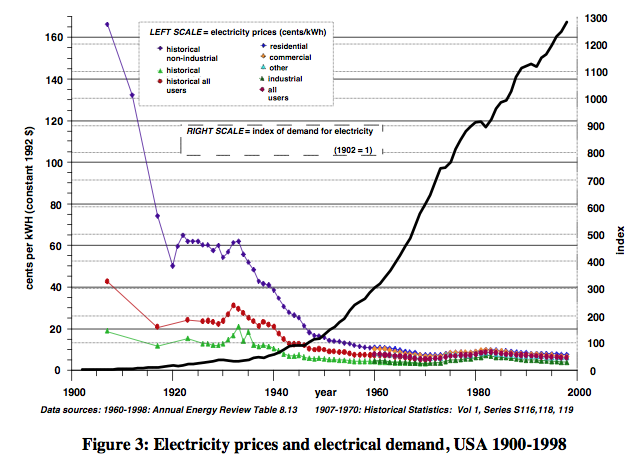 Figure 11. Ayres and Warr Electricity Prices and Electricity Demand, from “Accounting for growth: the role of physical work.”[/caption]
We can even see this in recent data of the United Nations. The portion of GDP spent on energy and energy products keeps falling over time, even as the quantity purchased keeps rising.
[caption id="attachment_41865" align="aligncenter" width="640"] Figure 12. Value added as a percentage of world GDP, based on a United Nations analysis.[/caption]
SPLC: Number of US hate groups rises 20 percent in three years
http://thehill.com/blogs/blog-briefing-room/news/374878-splc-number-of-us-hate-groups-rises-20-percent-in-three-years
I don’t trust the “Southern Poverty Law Center” statistics.
I truly believe the number of groups they hate has increased by 20%.
I joined the I Hate DelusiTANIs and Green Groopies Hate Groups in recent years… they throw excellent parties
They have little to do with the south or poverty and even less about the law. I go with BScenter Soros group
I always look forward to your well thought out articles. Because of its clarity and breadth of understanding, this is one your best.
Thanks!
Markets are ignoring ‘major risk’ of rising interest rates and end of QE, warns Citigroup
“There are clearly signs of late-cycle froth in financial markets, in everything from equities, to corporate credit, and real estate, especially in the US. There is the risk of an overdue correction,” said Willem Buiter, the bank’s chief economist and a leading theorist on monetary policy.
http://www.telegraph.co.uk/business/2018/01/08/markets-ignore-danger-central-banks-reverse-qe-warns-citigroup/
It always amazes me how little understanding many people have of the risk of rising interest rates. Rising rates are frightening.
Could the rise of interest rates mean a return of the debtor prisons? As more and more people are unable to pay up, I would seem that something would have to give. Some folks will have to “drop out” of the game. Debtor prisons may be one way to do that.
I don’t think it will be worse than you being cut off from credit, and having only basic health care, but still being allowed to stay in “your” home as long as the bank has noone to sell it to.
The employable will work their but off keeping credit flowing, having lower interest rates, keeping health care … and never retiring.
There will be fewer and fewer employable each year.
I wanted to share this video with Gail and everyone.
In my home state of Michigan. We have an Island up by the UP, called “Mackinac”…And there are no oil powered machines allowed on the Island..You take a ferry from shore to get to it. And you can bring your bicycle along for free..
They also have bikes you can rent on the Island..And they have some horse and buggy’s you can ride..There are a bunch of hotels, restaurants and beeches. And you can bike the entire island around….And you can just park your bike outside stores and shops and nobody will steal it.
Many people take their honey moons here. This would be the ideal place to live in post peak oil world, if it wasn’t for the winter time weather..
.https://www.youtube.com/watch?v=jwIQ2ZhXfYw&t=41s
I have visited Mackinac Island. (I grew up in Wisconsin.) The joke I heard then was, “What day will summer land on this year on Mackinac Island?” I remember that the flowers in bloom were spring flowers in the middle of the summer. It is hard to believe that you could grow very much, with its short growing season.
I live in the UP and have been to the Island. Nice place but without the boat loads of supplies shipped in it would be a tough life.
no oil powered machines?
i don’t know of course—but do the hotels cook on woodstoves and are they lit by candles?
the ferry itself doesnt appear to have sails
i could go on but you get my drift.
LOL Sorry Norm..I guess I should have said “No ICE vehicles on the island”
I was gonna say too that if there are no fossil fuel powered machines then there would be no refrigerators, microwaves, stoves, heaters, fans etc. You know the devil really is in the details isn’t it. Transportation isn’t everything (like Norm likes to point out) it is the destination that matters. And if that destination has no machines it will probably be pretty a boring and undesirable destination. At least for most people.
Look at all those wonderfully people with their children enjoying their holiday on their bicycles. So many wonderful people are going to have to die such horrible deaths. It is so depressing.
We don’t really know how this will turn out. Historically, plagues have been the cause of most deaths, as groups have approached limits. I suppose the opioid crisis is part of reaching limits. Each time is different.
I am pretty confident that I know how this turns out…. starvation violence disease radiation
Tom!
after their horrible deaths, their non-existence will leave them with no memories of their horrible deaths…
see?
Reality is a win-win. 😉
Depressing? Really?
This is depressing…
http://i.perezhilton.com/wp-content/uploads/2011/03/wenn1031646__oPt.jpg
The end of humans is something to celebrate.
Is the global economy facing a financial Armageddon?
An Australian economist is warning the recent turmoil on global stock markets is just a sign of things to come, and a massive crisis is on the cards.
John Adams sees the massive sell-off of global stocks in early February, which saw American markets plunge 10 percent from recent highs, as the harbinger of an economic death spiral, eventually bringing about soaring interest rates, a collapse in share and house prices, higher unemployment and widespread bankruptcies.
With global debt at a record high $US233-trillion and interest rates on the rise, Mr Botherway said a day of reckoning was due.
“Global debt (318 percent of global GDP) is unprecedented, and we don’t know where that will end up. But there is economic precedence that suggests that those scenarios could be very bad.”
https://www.radionz.co.nz/news/business/350776/is-the-global-economy-facing-a-financial-armageddon
A very clear outline – thanks Gail.
And that is mostly the USA? As America goes, how goes the world? There must be feedback.
I wonder about world food production – the USA provides significant primary production for international trade. I wonder if we have reached the point of diminishing returns of yield compared with inputs, as well as increases in real costs of transport and processing. This could be begining to effect affordability – the old 30s thing of gluts and need.
best
Phil
10 calories in, 1 calorie out—–
Anyone see a problem?
Nope, solar powered vertical farms when oil dries up.
Really?
Have you ever farmed?
It’s a nice delusion you would be able to grow ten layers of plants, around the clock, by pulling the sunlight through panels.
Like melting snow on roads with roads built of solar panels.
the sun delivers about 100w/sq.m of energy to us as an average—we have nothing else.
vertical farms, by their very nature, block out sunlight, so that light has to be brought in from elsewhere—together with pumped water and fertilisers etc
from where exactly?
I heard a dude is working on beaming down electricity from the sun.
Actually no, not very directly.
Most animals need at least a 10 to 1 return on gathering the food they eat, because their base metabolism and such activities as reproduction take much of the energy value that is available. Humans, if they were not in control of fire, would be similar. Putting the 10:1 problem you mention together with the normal 10:1 ratio would suggest that if humans were to make this system work without supplemental energy (which we can’t), we would need at least a 100:1 return on the today’s processed food we “gather.” This, I agree, would be a problem.
Since hunter-gatherer days, humans have supplemented energy from food with burned energy from biomass. This changes the balance for humans. Even back in hunter-gatherer day, humans could walk relatively farther than other animals for food, because cooking of food (with the energy from biomass) makes the food energy more available. Cellulose walls are broken by cooking, especially. Heating also killed micro-organisms, cutting back on the need for a hyperactive immune system. But most importantly, the supplemental energy does allow humans to eat foods with low energy return, and has since hunter-gatherer days. If humans expect to stay alive, we have to have supplemental energy. Only a tiny number of us could live on a raw foods diet (likely mostly fish, or perhaps vegetables put through a grinder to make them more digestible).
We shall see————-
I bet we go back to a 1-10 million population with reduced energy.
(And I’m a optimist). We have a devastated planet. You need resources to keep the game going.
here here
but who will be there to pay out on your bet
There are some who say that what first changed the balance for early humans was walking and running on 2 limbs instead of 4. This allowed humans to walk farther than other animals and more importantly outlast prey that are on the run by using a steady, economical running gait. Also sweat glands gave us the ability to keep cool while running.
Walking on two feet may have helped a bit. But the economy is a dissipative system, and we humans are dissipative systems. The energy piece plays a very important role. It walking on two feet plays a role, it would be because it would let us use our hands as “tools.” I don’t think we get any place more quickly. Monkeys use their hands as tools. I am afraid that I am still at a loss regarding how walking on two feet is more than marginally important.
What humans evolved that other primates lack that enables us to be a more effective dissipative system is our particular structure of blood vessels that is more like pigs. It allows us to operate at a much higher metabolic rate since we can cycle the heat out of our bodies more efficiently via blood flow to surface blood vessels that cool via evaporative means with perspiration. This also allows us to have much larger brains without them overheating.
Thanks! I can believe that. I can also believe greater endurance in running.
Its not so much the walking. The theory is that persistence / endurance / distance running made us who we are.
http://www.nature.com/news/2004/041115/full/news041115-9.html
the following scenario will have been played out over about 1 m years maybe—condensed here for easy reading——
primitive hominid bangs 2 stones together (opposing thumbs make that easy)
stones split—primitive hominid figures out that gives a sharp usable edge for killing each other and capturing energy sources
lots of primitive hominids catch on to the idea of stone bashing, and gradually get good at shaping the edges they want
then one PH figures out that it’s easier to do it with the stones resting on an animal fleece or dried grass
so they all start doing it that way.
then one PH strikes a spark from a stone and sets the dried grass/fleece on fire.
lightbulb goes on over head of PHt!!!
the human race begins its race for world domination at that moment—control of fire gives control of everything else.
It ultimately consumes the planet, but that’s another story.
The fire was more important than walking, as the fire allowed humans to protect themselves and later become predators. They did not have to escape anymore, either on four or two legs, it does not matter.
fire also gave us complex language
I’ve seen people crawl on all fours after too much drink….
This isn’t the group I get involved with.
I know that the problem today for food is prices that are below the cost of production. I haven’t looked at the situation enough to tell whether demand is failing to grow, or supply is rising faster than ever (or perhaps, year to year variability is on our side).
So I don’t know whether diminishing returns are an issue yet. There is such a wide variety of food, substitution can take place in many cases, making the situation less clear.
“So I don’t know whether diminishing returns are an issue yet.”
Might be best to take a look–
“The global industrial civilization that currently supplies us with everything that is necessary for life is coming apart—politically, socially, economically, and ecologically. Our leaders are incapable of acknowledging, much less reversing, industrial society’s progress toward oblivion.”
Bingo! We have a winner—–
I think there is an issue of the minor nutrients we need being missing from the soil. We are still getting food, but it is not as nourishing. And some of the pollinators not being available. And running short of water in many places.
Soil depletion of trace minerals is a massive issue.
That is a good reason to have a koombayah garden before collapse.
Assuming home grown has more nutrients per calorie.
Yes – it is important to be in good health — when BAU ends…
Yes, if a “forest garden” can close the loop, recycling all materials (yes, all of it) then it is possible to stop the loss of fertility and trace minerals from the soil.
If you don’t eat exclusively from your koombaya garden, more like 20% of calories, only 20%+ has to go back.
Also, if it is about health/taste and not “sustainability” then bringing in output from the outside is possible.
If you’re gonna close the loop 100% you have to use humanure and you would still lose nutrients.
So many people that I know – who have healthy diets – next to no rubbish food — have gastro issues…. and the doctors have no solutions other than to follow the lowfodmap…. I am wondering if this has something to do with GMO….
And to add insult to injury there are people trying to “profit” from this too. A buying or selling opportunity. It certainly has never been this crazy in the history of in-humanity.
another great article by gail
Wonderful post, Gail. Have forwarded it to a number of others. There is an astonishing clarity to your argument that even the least mathematical of my acquaintances seem able to grasp.
Thanks. There seems to be a “dose response” to energy consumption. The more energy the economy consumes, the better it functions. The less it consumes, the worse it functions. Unfortunately, this idea is a hard sell who think that we can get along on a tiny percentage of the energy we have today, provided by what are optimistically called “renewables.”
Also, the chain reaction issue that I mention. Working in the insurance industry, I have been able to see how interest rates function in practice. When interest rates rose in the 1970s, one insurance company employer I had went bankrupt (after I left, but I could see the problem coming), and another almost did. I then joined a consulting firm in Atlanta in 1981. This firm did a lot of work with small start-up companies. It was possible in 1981 for doctor and hospital groups to start their own companies, and use the very high interest rates on bonds to bring down their malpractice insurance rates. The big older insurance companies saw the value of their bonds and stocks drop precipitously because of the higher interest rates, pushing some into bankruptcy. Their bond portfolio didn’t “turn over” vary rapidly, so they were not able to get much of the benefit of the higher interest rates. The start ups were able to charge lower rates, because of the higher investment income. In many cases there was also a tax issue. A company domiciled in a suitable location (Caymans) was not subject to US income tax. This further helped the comparison.
Needless to say, an awfully lot of pension plans were started back in the 1960s and 1970s, when looking back, growth and investment income had been fabulous. I don’t work in this area, however.
I worry about pension plans they may be the straw that breaks the camels back. Markets down interest rates up…Bad news considering most are under funded.
pensions are paid out of current contribuions
money is itself only a token of energy availability—right now we have enough energy available to fund our economic system
in 25 years time, pensions will also be funded by current taxpayers, but if we do not have sufficient surplus energy to prop up the system, money will be worth nothing so pensions will not be paid
scary aint it?
https://www.zerohedge.com/news/2018-02-21/fed-president-sounds-panic-over-level-us-debt
A predicament as according to Gail the economy goes down without debt. Alternative view.
Medicare and SS are the two largest programs and both are negative cash flow at present. As I understand it, these programs are not a guaranteed payment to seniors in the sense of a contractual obligation. With Medicare, some procedures that prolong life could be made subject to in depth reviews which has the same effect as reascending benefits which would result in an increase in morbidity for these conditions which would result in a decrease in future obligations for SS.
This is where the money is, these are the most likely areas to be addressed as the composition of the voting public changes in favor of millennials who potentially are more productive and less expensive in healthcare cost to the economy. It would be a quiet revenge of the young against the old for both perceived and real economic injustices they face.
Downside would be to the locale in which I live which relies heavily on advanced medical procedures paid in large part by Medicare. In La Crosse where I no longer live, one local hospital/clinic had just under 50% of its income from Medicare.
No easy solutions, interesting times.
No easy solutions?
Cut the Military budget..
https://imgur.com/a/EetxQ
The military budget needs to be thought of as a “jobs” program. In fact, it starts a whole chain of jobs. If you eliminate the military, you need to start another, comparable jobs program. Perhaps we can look at the make work programs of the Chinese or Japanese.
Our problem is very much of the Whack-a-Mole type. https://en.oxforddictionaries.com/definition/us/whack-a-mole
I agree with the Whack-A-Mole analogy. We can’t significantly reduce Medicare spending without harming health care providers. We can’t cut military budgets without hurting their suppliers. It is all connected. And it is interconnected on a global scale. Knock one problem down and another one pops up.
Pingback: Raising Interest Rates Is Like Starting a Fission Chain Reaction – Enjeux énergies et environnement
Top Economist: America: the future looks broke
Professor Laurence Kotlikoff from the University of Boston is, according to The Economist, one of the 25 most influential economists in the world.
He says politicians in America have been running a type of intergenerational Ponzi scheme since the 1950s, and if future liabilities are accounted for on the nation’s books, it is effectively bankrupt.
The problem is the official debt is only the debts that politicians decide to put on to the books. Politicians are able and free to put whatever they want on to the books and keep other things off the books.”. What doesn’t get recorded is the value of all future government liabilities and the value of all future receipts, what he calls fiscal gap accounting.
Future liabilities would be social security benefits, pensions, health care benefits and defence. These liabilities minus future receipts gives the true picture, Kotlikoff says.
“For the US, the fiscal gap is not $US20 trillion, which is the size of the official debt, but it’s $US200 trillion, ten times larger.
“So we have a huge, massive insolvency problem in our country. It corresponds to 10 percent of GDP for ever. That’s what you would need to collect in additional receipts, or cut in spending every year into the future for ever, in order to come up with $US200 trillion in present value. So the country’s bankrupt.”
“Trump doesn’t know a thing about economics, he doesn’t understand long term fiscal problems, demographic problem. He doesn’t seem to care, he’s just trying to get himself re-elected – this is what you see in petty autocrats.”
https://www.radionz.co.nz/national/programmes/ninetonoon/audio/2018632011/america-the-future-looks-broke
So, Dave, this guy can play too. Don’t you think?
https://youtu.be/ZKbPPuaHnxw?t=1h2m13s
Pintada!
very enjoyable… thanks…
and E flat minor… interesting…
in my teens, maybe early twenties, all I remember about him was the seemingly endless streams of 32nd (or 64th) notes… I didn’t like it…
so it seems he has grown as an artist… I still think if he restrained himself and cut back on the amount of time spent where he’s still playing those long runs of 32nd (or 64th) notes, he could be an even better artist…
don’t you think the mind of a rock guitarist is as important as the speed?
again, thanks… a fun listen.
I agree. Its just like Albert King told Stevie Ray Vaughn in their studio recording. Something to the effect that there were plenty bluesmen that could play fast – which Stevie Ray could do in spades – but it is the really talented ones that can play with feeling.
The economy is not nearly as strong as the Fed Reserve thinks. They are definitely playing with fire. They are repeating the mistakes of raising rates in 1937 when the US was actually still in a secular depression but they thought it was over. http://gulfcoastcommentary.blogspot.com/2018/01/why-our-economy-is-in-depression-and.html).
I recently wrote (http://gulfcoastcommentary.blogspot.com/2018/02/ready-for-50-loss-of-your-wealth.html):
“On January 26 2018, the US reported that 4th quarter real GDP grew at a 2.6% rate — a rate that was disappointing relative to expectations. It was disappointing because there was a surge of post-disaster spending after the two hurricanes and massive wildfires during the fourth quarter. In fact, some people were asking “is that all we get??”
It was even worse than that. The savings rate fell from 3.3% to 2.6%. If it had stayed the same, real “personal consumption expenditures” would have been just 0.8% (annualized) instead of 3.8% and GDP would have been 0.6% instead of 2.6%. So, after all the disaster spending we “only” got 2.6% GDP growth. The underlying economic growth rate is actually closer to 0.6% since that disaster spending was a “one off.”
These people don’t know what they are doing. It seems no one (in govt) knows what they are doing. We are being led by fools.
Mac10 has been saying the same thing (if I read him correctly), especially since the tax cut. He doesn’t couch his criticism in such polite terms, and bases his conclusions on observations of the charts rather than on macroeconomic principles. I think his agreement greatly supports both arguments since you are using different sources of evidence to reach the same conclusion.
For example:
http://ponziworld.blogspot.com/2018/02/the-jobless-consumer-is-imploding.html
I have a huge soft-spot for Mac10 and his acid wit – he cuts through the deceit and delusion like a hot knife through butter. He’s even started tipping his hat to energy and resource constraints:
“These are all of the MASSIVE issues that are being denied right now…
Hubris: ‘exceptionalism’, denial, laziness, complacency
Moral decay: greed, materialism, gluttony, nihilism, hedonism, cynicism, narcissism
Lack of competitiveness: Recurring trade deficits, outsourcing, industrial arbitrage
Rent-seeking: excessive speculation, excessive laws, lawyers, regulations, lobbying
Complexity/sclerosis/stagnation: intractable bureaucracy, incompetence
Depletion of the treasury: borrowing for consumption versus investment
Currency debasement: Monetizing debt, printing money
Financial engineering: Derivatives and Ponzi Finance as substitute for real economy
Strategic overreach: Troops in 145 countries, war mongering, serial blunders
Resource/energy depletion: Buying oil from terror sponsors, fracking, environmental degradation
Consumption over investment: Consuming the future via stock buybacks and special dividends
Propaganda/spectacle: Faux News, reality TV”
http://ponziworld.blogspot.co.uk/2015/06/denialism-is-root-cause-of-collapse.html
Excellent
Pingback: Raising Interest Rates Is Like Starting a Fission Chain Reaction – Olduvai.ca
As always, great analysis Gail. As Joseph Tainter argues in The Collapse of Complex Societies, we are far more prone to ‘collapse’ when we have little to no ‘surpluses’ to counter stress surges (after years of diminishing marginal returns) when they occur. One has to wonder if central banks, in their attempts to control/influence exceedingly complex systems, will be the ones to push us over the edge. It seems we are experiencing a confluence of stressors as time passes…
Thanks! I think that, in a sense, a major concern in an economic “implosion,” rather than explosion.
It is all of the financial promises that hold the economy together. Raising interest rates makes these promises harder to keep. Promises are what tend to “move the economy forward.” See my post, https://ourfiniteworld.com/2016/12/07/what-has-gone-wrong-with-oil-prices-debt-and-gdp-growth/ The economy cannot live without promises.
Also, I have shown the economy as like a rocket, powered by energy. Energy inputs are already low. Raising interest rates tend to put reduce waste outputs as well, making certain that the economy will fail.
https://gailtheactuary.files.wordpress.com/2017/05/24-my-view-of-economy-as-a-dissipative-structure.jpg
Concise, clear, well thought out, thanks.