
Why have long-term interest rates generally fallen since 1981? Why have asset prices risen? Can these trends be expected to continue? The standard evaluation approach by actuaries and economists seems to be to look at past patterns and assume that they will be repeated.
The catch is that energy consumption growth plays a hugely important role in GDP growth. It also plays an important role in interest rates that businesses and governments can afford to pay. Energy consumption growth has been slowing; it is hard to see how growth in energy consumption can ramp back up materially in the future.
Slowing growth in energy consumption puts the world on track for a future like the 1930s, or even worse. It is hard to see how GDP growth, interest rates, and inflation rates can ramp up in the future. More likely, asset price bubbles will pop, leading to significant financial distress. Derivatives may be affected by rapid changes in prices and currency relativities, as asset bubbles pop.
The article that follows is a partial write-up of a long talk I gave to a group of life and annuity actuaries. (I am a casualty actuary myself, which is a slightly different specialty.) A PDF of my presentation can be found at this link: Reaching Limits of a Finite World

Slide 1
..
Slide 4
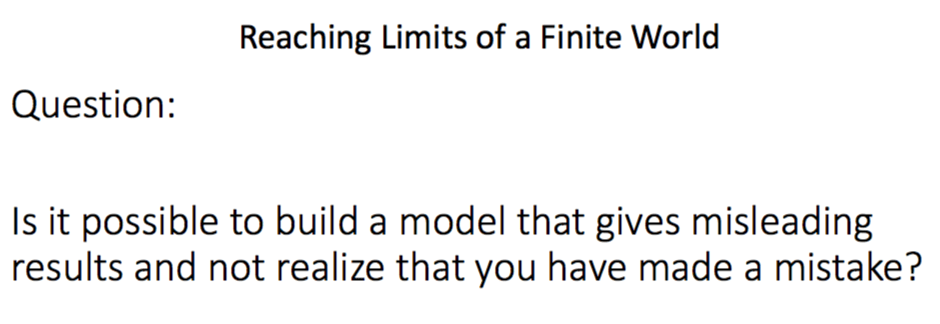
After the audience had a chance to answer this question (mostly with yes), I gave my answer: “Yes, indeed, it is possible to build a model that gives misleading results, and not understand the situation.” For example, a flat map works as a perfectly adequate model in some situations. But when longer distances are involved, a globe is needed. A two-dimensional model works for some purposes, but not for others.

Slide 5
The model in Slide 5 is the familiar Supply and Demand model used by economists. According to the model, if Demand increases from D1 to D2, then price will increase from P1 to P2. The rising price, in turn, will allow the quantity produced to rise from Q1 to Q2, based on the upward sloping supply curve S. This model is true in some cases, but it is not always true.
Supply and Demand Are Both Affected by Reaching Limits
As the economy approaches energy limits, lack of sufficient growth in energy consumption affects both Supply and Demand. Diminishing returns leads to high costs on the Supply side. Because of this, the cost of producing oil and other energy products tends to rise.
At the same time, businesses find that they cannot pass on these higher costs to their consumers because the wages of consumers don’t rise with rising energy costs. Diminishing returns acts like growing inefficiency; it takes more materials, more labor, more tax dollars, and more debt to produce the world’s overall mix of energy products, leaving a smaller amount of resources for producing end products (such as homes, cars, and bicycles) that consumers really want.
Persistent high energy costs lead businesses to try to find workarounds to reduce total costs. A major target for cost reduction is labor costs. If some labor costs can be replaced by lower-paid labor from overseas, or by robots, the company can perhaps make a reasonable profit, even with higher prices for oil and other energy products. The catch is new lower-cost labor force does not create as much Demand for goods and services as was available before jobs were replaced by robots or sent overseas. Workers in China and India will buy some goods and services, but the quantity will likely be lower than if the jobs remained in the US, Europe, and Japan.
We end up with a tug-of-war between the high prices that the producers of energy products need and the low prices that the many low-wage workers around the world can afford. Energy products are used in making pretty much everything, including food, homes, cars, and computers. As young people need to live with their parents longer, and as demand moves to lower-waged countries overseas, the lack of buying power tends to pull energy prices down below the cost of production. Energy prices below the cost of production are just as much a product of reaching energy limits as high energy prices!
Peak Oil is Another Two-Dimensional Model
Before we go on, I should probably offer some more explanation. Some of you may have thought that I would be talking about the Peak Oil story today. I consider the Peak Oil story to be another two-dimensional model. It gives some insights, but it really does not give a good explanation of what can be expected as we go ahead. Its emphases on oil and on high prices are both wrong, in my opinion.
Geologists coming up with the Peak Oil model relied on the incorrect Supply and Demand model of economists. They did not understand that both Demand and Supply are affected, as energy limits approach. They also never considered what the energy needs of the economy really are–total energy consumption needs to grow, if enough goods and services are to be produced for the growing world population. Rising energy consumption is also needed to keep commodity prices high enough to keep production from collapsing from low prices, due to inadequate Demand.
The Role of Added Energy
Many of you have heard the saying, “As you sow [seeds], so shall you reap.” In other words, the effort you put in can be expected to correspond to the end product that is produced. This saying is somewhat true if an economy uses only human labor to produce goods and services. For example, if a person digs a ditch for five hours, the result will correspond to effort put in. Increasing the hours of digging to six can perhaps add 20% to the length of ditch that can be dug. (There is the detail that it even takes energy products to make a shovel. Perhaps the example should be digging a ditch with a stick, and thus using only human labor!)
If a person really wants to dig a ditch quickly, he needs ditch-digging equipment and diesel fuel to operate the equipment. The ditch-digging equipment is made with energy products; it also uses energy products while it is operated. If energy consumption per capita is rising, then businesses, on average, can use increasing amounts of energy to increasingly leverage the labor of the workers they hire. This seems to be what leads to productivity growth.
This is why I talk so much about energy consumption per capita, and the importance of falling prices of energy services (including efficiency gains) to encourage the growth in energy consumption. One example of energy services (whose costs need to fall) would be the cost of heating a 1,000 square meter home (including efficiency gains in furnaces and insulation). Another example would be the cost of transporting 100 kilograms of grain 100 kilometers.

Slide 6
In fact, over time, the cost of energy services has been falling. The fall in costs more than offset the growing quantity of energy consumed. Thus, the cost of energy services is becoming a smaller and smaller share of world GDP. This falling share of energy products as a percentage of the world GDP seems to be necessary, if the remainder of the world economy is to grow. If the cost of energy products starts to rise, it will tend to crowd out some of the discretionary goods and services that the world economy has been able to add, as the world economy has grown.
Higher Energy Prices Are Damaging to the Economy; Lower Energy Prices Encourage GDP Growth
Energy needs to be consumed by the system, whether workers dig ditches with shovels or with ditch-digging equipment. If energy is very expensive, it is likely that all that employers can afford is the equivalent of shovels for workers to work with. If energy becomes less expensive to use (including efficiency gains), then it becomes possible to scale up the use of tools using energy, and the economy can expand. As a result, workers can become more efficient, businesses can make more profits, and the government can collect more taxes. The falling price of energy services seem to be the major force underlying GDP growth.
Conversely, if oil consumption growth is constricted by a spike in oil prices, we know (based on the work of Economist James Hamilton) that the US economy tends to go into recession. Higher prices make it difficult for both businesses and consumers to buy energy products. Falling energy consumption is damaging to the economy, because the creation of goods and services depends on the use of energy products.
High Correlation Between World GDP and Energy Consumption

Slide 7
Energy consumption is not mentioned at all on the economists’ supply and demand model (Slide 5), but it is clear that energy consumption is highly correlated with economic growth. There is a reason for this: it takes energy products to make both goods and services. It even takes energy to heat and light an office for workers, and to make and power computers.
Economists tend to miss the connection between energy and the economy because they tend to perform their analyses on an individual country basis. The connection between GDP growth and energy growth is less clear on a country-by-country basis because individual countries can reduce their energy consumption by shifting some of their manufacturing to less developed countries, confusing the analysis. The International Energy Agency has concluded that higher oil prices can be expected to have an adverse impact on the world economy as a whole.
The Economy Is a Self-Organized System Operated by Energy

Slide 8
The reason for the strange behavior of energy prices near limits is because the system is very interconnected. It is a self-organized system that gradually changes over time. New customers are added over time. These customers are often also wage-earners. They decide what to buy based on their own wages, and based on other considerations, such as the prices of competing products and whether inexpensive financing is available.
Businesses make decisions based on what they think customers might want. They also consider products offered by competitors. Governments play a role as well, both in regulation and taxation.
Physics indirectly helps determine prices, wages, and profits, because the economy uses energy to make goods and services. If a rapidly growing amount of cheap energy is available, it becomes easy for businesses to make a profit and raise wages. As businesses grow, economies of scale tend to increase profits. Higher energy prices tend to reverse these beneficial effects.
Oil Prices Are Now Too Low for Many Oil Producers

Slide 9
If you are not familiar with energy price trends, it probably would be worthwhile to take a minute to look at the strange price pattern shown on Slide 9. If you are coming from a financial background, you will probably be familiar with the financial disruptions of 2008, but not the high oil (and other energy) prices of the same period. The steep drop in prices corresponds to the time of major financial distress.
Most United States infrastructure, such as interstate highways, pipelines, and electricity transmission systems, were built in the pre-1970 period, when the inflation-adjusted price of oil was generally less than $20 per barrel. Thus, in a sense, most of the oil prices we are seeing in recent years on Slide 9 are high, relative to historical costs. The question becomes, “How high a price can the economy withstand?” It becomes very expensive to replace a worn-out pipeline built with $20 per barrel oil using $120 per barrel oil.
On Slide 9, prices required by oil exporting countries (such as Saudi Arabia, Venezuela, and Norway) seem to be well over $100 per barrel. Such a high price is needed if these countries are to be able to collect enough tax revenue and also have funds for investment in new fields to replace depleting fields.
On the other hand, the economies of the United States, Europe, and Japan do very much better if oil prices are low. They would prefer prices under $50 per barrel. This is the price mismatch mentioned on Slide 9.
Extended periods of low prices can be expected to lead to two adverse impacts over a period of several years:
- Falling growth in energy production. Investment in new fields to offset declining production from existing fields is likely to fall. The big drop in oil prices occurred in 2014, and it is now four years later. Many analysts expect growth in oil production to slow in the next few years, because of inadequate investment. Coal, natural gas, and uranium have somewhat similar problems, with falling prices discouraging reinvestment.
- Collapsing governments of oil exporting nations. Governments of countries that export oil are often very dependent on the high price of oil to collect adequate tax revenue. The central government of the Soviet Union collapsed in 1991, after several years of low oil prices. Lack of adequate tax revenue could cause a similar problem today. Venezuela is particularly at risk, but Saudi Arabia and many other countries could follow.
It is ironic that Venezuela reports the highest oil reserves in the world. These reserves can only be extracted if energy prices are much higher than today. This would seem to require higher wages of non-elite workers around the world. If wages were much higher in countries such as India and Nigeria, they could afford goods such as motorcycles and air conditioning, helping push up world demand for energy products.

Slide 10
It is clear that the growth rate of energy consumption simultaneously affects Supply and Demand.
An important point on Slide 10 is the fact that growing debt acts as a helper for energy consumption. It allows consumers to afford goods and services with their monthly wages, and it allows businesses to pay for new tools for workers over the lifetime of those tools. In a sense, debt is the promise of future goods and services made with energy products.
Money is a type of debt. We can print money, but we can’t print cheap-to-produce energy products. Thus, at some point, there can be a mismatch between promises of future goods and services and the quantity of affordable energy products available to create those goods and services. This is part of what is likely to cause debt defaults.

Slide 11
Slide 11 lists some of the things that seem likely as we reach the limits of cheap-to-produce energy supply. I will describe these issues more, later in this talk.

Slide 12
Slide 12 is an outline of the rest of the talk. This post primarily covers Points 1 and 2. Thus, this article relates primarily to GDP growth, interest rates, and asset prices. Slides are shown for Points 3 and 4 as well.

Slide 13
..

Slide 14
In recent years, it has become increasingly apparent that the ability of humans (and pre-humans) to cook part of our food supply has had a major impact on our ability to be different from other animals. We could eat a wider variety of foods, and we could get more energy value from those foods. Our bodies could evolve in a very different way. Our brains could become bigger, and our jaws and gut could be smaller.

Slide 15
Even back in hunter-gatherer days, humans were using more energy than similar animals. Now, in the industrial period, we are using 80 times as much energy (=8000/100) as a human-like animal would use, considering the various types of supplemental energy available to us. Some people have described the situation as having 80 energy-slaves for each person. This makes it possible to do tasks, such as farming and digging ditches, in a more efficient way than using sticks as tools.

Slide 16
Besides the usual tools, we have many related ways of using energy, with the goal of eventually providing more goods and services. Energy can be used to organize data on computers. Energy can be used to provide advanced education on topics helpful to growing the economy. If individuals or businesses are paid wages or interest payments, they can use those proceeds to buy energy products, such as a new car, or an overseas vacation. Thus, energy consumption growth affects every part of the economy.

Slide 17
Growing debt is extremely important in growing the world economy. I describe the situation more fully in this article: What has gone wrong with oil prices, debt, and GDP growth?
Technology is what most people focus on, as being the way to move the world economy forward. However, it takes energy products to make the new machines made possible by technology. Without a steady supply of energy products, we cannot maintain existing roads, or the electric grid, or the internet.

Slide 18
Anyone who has purchased a home knows that interest rates are very important in determining what price of home a particular buyer can afford. Here I show a range of monthly payments, for a 30-year, $300,000 mortgage at various interest rates. It is clear that a person can afford to buy a great deal more house at a low interest rate than a high interest rate. If interest only loans are available, costs are lower still.

Slide 19
Everyone who works with interest rates is aware of this pattern in 10-year US Treasury interest rates. The peak in interest rates was in 1981, and there has been a downward trend most of the time since that date.

Slide 20
The interest rates that regulators can easily adjust are short-term interest rates. When these interest rates are increased, they tend to induce recession. There may be a lag in timing. The increase in short-term interest rates in the 2004 to 2006 period seems to have been instrumental in popping the subprime debt bubble and bringing on the Great Recession of 2007-2009. This is my article relating to this issue: Oil Supply Limits and the Continuing Financial Crisis

Slide 21
When energy consumption is growing rapidly, and there are productive projects that can be added (interstate highway system, long distance electric grid, interstate pipelines, first-time telephone service for many people, growing number of trucks and airplanes), then it is possible for the economy to grow rapidly.
In this rapidly growing economy, the economy could easily ramp up long term interest rates without damaging the economy because the underlying growth rate was so high. In a sense, the higher interest rates were analogous to inflation affecting food and energy prices. There was so much growth in demand for goods and services that the economy could afford to pay rising interest rates during the period between World War II and 1981.

Slide 22
The period since 1981 is a period when investments have become much less productive, from a point of view of allowing more goods and services to be produced. Instead, growth is coming from selling more services to each other, and sending more manufacturing to lower-cost parts of the world.
Since 1981, we find ourselves with an increasing amount of old infrastructure that needs to be maintained. Fixing this infrastructure doesn’t really improve productivity. New investments simply keep productivity from falling.
One recent innovation has been the internet. It gives us more information, and it relieves us from the burden of having to use the phone book or go to the library. Thus, it makes us more productive. But in many ways, it is not as important as many earlier inventions, such as the internal combustion engine, the light bulb, and the telephone. There is a temptation to computerize all kinds of data and to expect data mining to solve all our problems. A person wonders what the true cost/benefit is.
Innovations in medicine now allow more 85-year-olds to live to be 86-year-olds and allow more cases of cancer to be cured. But the big changes, brought about by antibiotics and better sanitation, occurred before 1981.
Another growth area has been higher education. The payback is often wages that are barely high enough to live on. How are college graduates who cannot find high-paying jobs going to be able to repay their loans and still get married and have a family?
Admittedly, some investments have been productive. This is especially true when new factories, roads, and ports have been installed in emerging markets. But a large share of recent investments have been aimed at making vehicles more fuel efficient. Or trying to reduce CO2 emissions. These do not really have a payback in lower-cost goods and services.
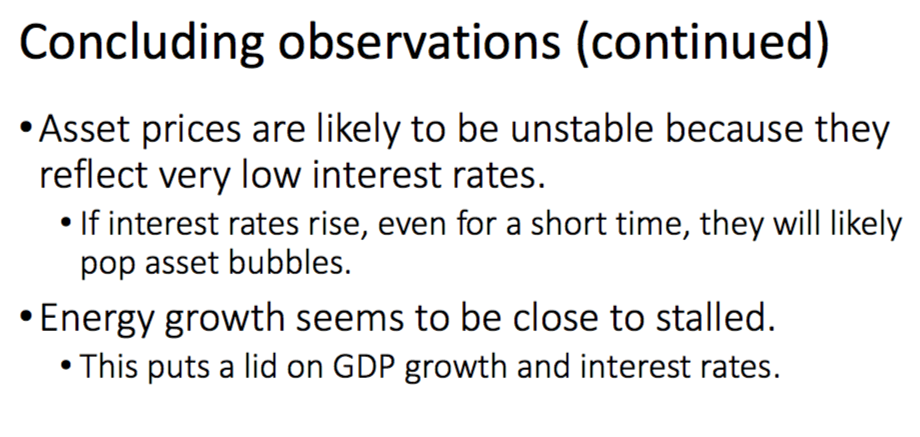
Interest on debt can only be paid if the economy is truly growing, and thus has a sufficient margin to pay interest with. This seems to be less and less possible outside of emerging markets. I would expect that this is why long-term interest rates are persistently low.

Slide 23
The decline in the ten-year interest rates should make homes more affordable. The long-term decline in shorter-interest rates should make vehicles more affordable. In spite of this boost to the economy, US GDP growth rates have persistently fallen. World GDP growth rates have fallen as well.

Slide 24
There is relatively little storage available for commodities of most types, including oil. As a result, even a small change in demand can lead to a major price shift.
I show in Oil Supply Limits and the Continuing Financial Crisis that the peak in oil prices corresponded to the peak in US debt in several categories, including credit cards and home mortgages. Once US debt stopped rising, the demand for oil fell, and prices dropped precipitously.
Quantitative Easing (QE) by the US Federal Reserve began near the end of 2008. It acted to lower interest rates, especially long-term interest rates. These lower interest rates helped get oil prices back up closer to the level required by producers. But once QE stopped in 2014, prices slid back down. As noted earlier, recent oil prices are far too low for most producers. But they do help stimulate the economies of oil importing countries.

Slide 25
If a business adds debt to expand a factory, this may lead to more wages. The chart indicates that growing non-financial debt does not always lead to higher wages. Sometimes it leads to asset bubbles.

Slide 26
Disposable personal income (DPI) is income that individuals receive, including payments such as Social Security and Unemployment Insurance. This amount is netted out for taxes paid. If we divide DPI by population, we get per capita DPI. This amount is not inflation adjusted; it gives us an estimate of how much incomes have been rising, including payments made to compensate for inflation.
Clearly, there have been huge changes in the growth of per capita DPI over time. Prior to 1981, per capita DPI was rising rapidly, as more women joined the workforce, and as companies gave cost of living raises, in an attempt to keep their employees. In several years, per capita DPI was rising at over 10%.
Families with rapidly rising incomes were looking for ways to spend their new-found wealth. This seems to be at least part of the reason for the high inflation rates of this period. Without this rapid run up in DPI, it is hard to see how the oil prices spikes of the 1970s could have occurred.
Now, the economy has slowed greatly. DPI per capita is sputtering along at less than 4% per year. With this low rate of increase in funds available for spending, it seems like the current economy will not be able to support a big spike in oil prices.

Slide 27
..

Slide 28
If the economy is not really growing, it is very difficult to pay interest. This is why a person would expect interest rates to roughly follow GDP growth. Back before 1981, GDP growth was significantly greater than 10-year Treasury yields. Since then, 10-year Treasuries have tended to yield a little more than GDP growth (including inflation). Very recently, the pattern seems to have returned to the pre-1981 pattern.

Slide 29
If interest rates are lower, more people can afford to buy a given house, or a piece of land, or shares of stock. The additional demand tends to bid up asset prices.

Slide 30
This should be clear from Slide 29.

Slide 31
Interest rate assumptions often were originally made when interest rates were higher.

Slide 32
Payments to individuals in a particular year act as a way of dividing up goods and services available in that year. If the share of goods and services going to those who are paid interest rises, it will mean fewer goods and services are available for others. History says that it is the non-elite workers that are most likely to be “shorted,” if there are not enough goods and services to go around.

Slide 33
..

Slide 34
..

Slide 35
..

Slide 36
..

Slide 37
..

Slide 38
..

Slide 39
..

Slide 40
..

Slide 41
..

Slide 42
..

Slide 43
..

Slide 44
..

Slide 45
..

Slide 46
Even a decline in coal consumption is a problem, if it causes total energy consumption per capita to fall! Wind and solar cannot possibly make up the shortfall. Also, their installed cost is high, if the cost of intermittency workarounds is included.
Many slides skipped!

Slide 62
..

Slide 63
..
Slide 64
..

Slide 65


The ideal subject of totalitarian rule is not the convinced Nazi or the dedicated communist, but people for whom the distinction between fact and fiction, true and false, no longer exists..
-Hannah Arendt
From the former minister of finance in Greece and one of the current poster-boys of the european left:
http://evonomics.com/why-economic-elite-believe-they-deserve-more/?utm_source=newsletter&utm_campaign=organic
Yanis Varoufakis is a player that drives Euro Capitalists crazy.
Maybe because of capitalism itself?
https://www.commondreams.org/views/2013/04/02/capitalism-psychosis-or-no-one-flew-over-cuckoos-nest
https://www.zerohedge.com/news/2018-05-26/brazilian-military-deployed-break-trucking-state-emergency-worsens
Supply chain – if it goes beyond a critical point, the country may not be able to feed itself and the whole country may just collapse
Brazilian Spring?
Perhaps when BAU is going bust… we can start a global strike and demand cheap petrol …
it will be hilariously if Brazil wins the football world cup
but people in brazil are too starve to celebrated
Only a society so completely abstracted from reality as to take money as the measure of all things and highest value could think that just in time delivery supply chains are effing brilliant. Just chuck the hard-learned lessons of the preceding 5,000 years, and then sit back, jaw agape with a who could have seen this coming look on your face, when your supplies run out after 3 – 7 days.
https://www.resilience.org/stories/2018-05-24/grains-of-truth-and-falsehood-about-grain-bean-and-veggie-storage/
Could be just in time delivery is the only way to feed so many people. You need people concentrated in mega cities so there is more land to produce the food. No room in a city to
store a months quantity of food.
Efficient systems always win out…
Any business that decides not to operate JIT …. would incur higher costs due to the inefficiency of their system … and be put out of business by competitors….
When BAU goes down … what does it matter if we have a day or a month of spare parts available?
Peak oil in Venezuela: El Furrial oil field
http://crudeoilpeak.info/peak-oil-in-venezuela-el-furrial-oil-field
The data shows that the El Furrial field is in terminal decline. Another one of the majors biting the dust.
Yes, we have peaked unless a miracle happens. The consequences aren’t immediate. It’s not like a bomb going off.
Miracle = higher prices
A single high month, when there is a contest to maximize production, is hardly peak.
It’s like a slow fuse burning …. if prices continue to climb higher…. the bomb will go off…
US tries to bully the world into attacking Iran
https://www.rt.com/op-ed/427541-iran-trump-war-sanctions/
This is an excellent article showing how much fake news western media spreads to manufacture consent for war..
Rapid shale oil supply likely to disappoint in coming years: oil industry veteran
US oil production from shale and unconventional sources will grow in the future, but the rate will likely be less than most widely accepted sources currently predict, a well-respected industry veteran said.
After more than 4 million b/d of oil production growth from 2010 to early 2015, US output growth “disappointed” in 2017 and will probably continue to do so near-term, Mark Papa, long-time CEO of big US shale producer EOG Resources and currently CEO of small-cap Centennial Resource Development, said in webcast remarks at the UBS 2018 Global Oil and Gas Conference in Austin, Texas.
The reason: lack of geologic top-tier acreage, Papa, who left EOG at the end of 2013, said.
https://www.hellenicshippingnews.com/rapid-shale-oil-supply-likely-to-disappoint-in-coming-years-oil-industry-veteran/
The United States faces a sixty-per-cent chance of civil war over the next ten to fifteen years
https://www.newyorker.com/news/news-desk/is-america-headed-for-a-new-kind-of-civil-war
The people who are agitating for this to happen, when the dust settles are going to wish they never agitated.
more like 61.37%
Full out war? Naw, no way someone shoots up Fort Sumter, maybe another Waffle House though
Oil could skyrocket to $100 as summer gets into full swing, RBC’s Helima Croft says
https://www.cnbc.com/2018/05/25/oil-could-skyrocket-to-100-as-summer-gets-into-full-swing-rbcs-helima-croft-says.html
Make sure to vote on the poll at the bottom..
will Brent get to $100 this summer?
no 57%
yes 43%
probably because it “plunged” to $76 on Friday…
https://imgur.com/a/wdJiA9j
Japan showed 5.3% growth in auto sales in 2017 over 2016, from 4,970,258 in 2016 to 5,234,166 in 2017. (This surprised me.) Jan-April 2018 is down by -1.3%, compared to a year age.
Sounds like we need another round of cash for clunkers…And approval of 600 credit scores..
Billionaire Bunkers: Exclusive Look Inside the World’s Largest Planned Doomsday Escape
https://www.forbes.com/sites/jimdobson/2015/06/12/billionaire-bunkers-exclusive-look-inside-the-worlds-largest-planned-doomsday-escape/#6111207d306f
Martenson is on drugs
We are still paying the price from 2008, when the central banks committed a massive error by not allowing the markets and their bad debts to actually clear. Yes, it would have been acutely painful; but we would have been through the worst within a year or two and in the process restored the system to a much healthier and sustainable state.
https://www.peakprosperity.com/blog/114062/end-stimulus-and-start-crash
I agree that Martenson is wrong on this one.Trying to let the market clear would have been a catastrophe. Using QE is what has allowed the economy to continue to today.
Henrik Zeberg Jensen a macro economists graph on the future of the WTI crude oil price.
Zero USD in 2022?
https://pbs.twimg.com/media/DeGxSgZW0AAQ7pD?format=jpg
I think not…
International Energy Agency: Oil price spike coming in 2020
https://www.usatoday.com/story/money/2017/09/19/iea-oil-price-spike-coming-2020/679584001/
If oil (or any energy source) turns into commodity that consumes more energy than it provides, then the value of all things (not only oil, but also based on oil) turn zero, as they will not be needed anymore, due to the lack of energy for powering them.
In theory. But if we had an energy source with high EROI like hydropower and used it as an energy source to produce oil?
Hydropower counts for 7% of the global energy mix. And 7% of the global population today is 500 million people.
Civilization will continue in a smaller scale?
And most of those 7% are living on $1.00/day.
In terms of net gain (births minus deaths), we are adding over 200,000 people to this planet every day, or over 140 people every minute .
That equals over 75 million more people every year, about the same as the combined populations of California and Canada.
http://www.worldpopulationbalance.org/faq
The last law of nature says: that any creature that despoils and outbreeds its natural habitat will be culled to bring its numbers under control and restore a stable environment.
http://worldpopulationhistory.org/carrying-capacity/
Dr.Paul Ehrlich: ‘Collapse of civilisation is a near certainty within decades’
https://www.theguardian.com/cities/2018/mar/22/collapse-civilisation-near-certain-decades-population-bomb-paul-ehrlich
How would we build & operate oil rigs with hydro-power?
Gack!
We can us A.I. nano bots to run the oil rigs…duh…./s
The economy is self organizing. Too complex for me to say how it will be organized.
The euro will fall to 0.9 USD by the end of this year? Europe is going to look like Argentina!
https://pbs.twimg.com/media/DeDBIucX4AATxi2?format=jpg
Lets hope!
Argentina has much better fly fishing, inexpensive good wine, massive peaks, and a small well educated population.
Still a few Nazi escapist left, but their numbers are almost nonexistent.
Russia, Canada, Argentina, and Chile are the survivable States, with possibly New Zealand.
Where is this from?
Henrik Zeberg Jensen on Twitter.
Hello Gail,
i have written down some calculations concerning the physics of oil production. Please take the time and read:
https://www.peak-oil.com/wp-content/uploads/2018/05/2018-05-23_etp_thermal_equilibrium.pdf
and:
https://www.peak-oil.com/wp-content/uploads/2018/05/etp_calc_example.ods
You will find new insight.
Best wishes, Berndt
Obama warns: if America stays so divided, our democracy and economy won’t survive
http://www.businessinsider.com/barack-obama-democracy-economy-wont-survive-america-divided-2018-5
How kind of the great divider to note this for us.
Question for Gail: have you ever encountered the argument that oil discoveries vs consumption has been so low lately because there isn’t really any need for the extra oil, and that if/when there is discoveries will rise? I was discussing energy crisis with a colleague/friend (who has a B.Tech in power engineering) when he raised this point. I asked him for a source and he told me to look up Michael Lynch. Google searched today and found this Forbes article:
https://www.forbes.com/sites/michaellynch/2016/09/13/low-oil-discoveries-are-not-a-big-deal/#1a64454da763
“the announced field sizes are virtually always inaccurate, in the sense that over time, more study of the discovery results in revisions, usually upwards, for the amount of oil in-place, while new investment and technical advances increase the recovery factor.”
“The announced discoveries by groups like IHS are not proved reserves but proved plus probable, and so size estimates do not grow as much as for U.S. fields. However, they still grow and often substantially, so that most years, there is more oil added to reserves from revisions than from discoveries. This is why, despite the harping of those like T. Boone Pickens that discoveries have only been a fraction of production for decades, global oil reserves have been stable or increasing. Even if reserves of extra-heavy oil in Canada, shale oil in the U.S., or supposedly spurious reserve increases in some OPEC countries, are all excluded, reserves have not declined.”
Thoughts?
I am not a fan of using “discoveries” to prove anything. We know about a huge amount of heavy oil that can be extracted, if the price rises high enough. We also know about some tight oil in shale that, if the price rises high enough, can be extracted.
Peak oilers are convinced that the only oil that counts is easily extracted liquid oil, similar to what has been extracted in the past. This oil, in theory, is cheaper to extract. But perhaps not. The discoveries relates to this.
And there is the issue that the initial amount is generally way too low, especially if the price rises.
The issue I see is that the price won’t rise high enough. This means that most of what we think can be extracted, will stay in the ground. The IEA in one of their forecasts assumed that prices of $300 per barrel were possible. At such a price, a huge amount of oil would be available. Their assumption that oil can reach $300 per barrel is what is wrong.
https://gailtheactuary.files.wordpress.com/2016/07/2015-iea-weo-figure-1-4.png
Michael Lynch is a fool..Here read this article..Who should you trust..the IEA, Saudi’s, HSBC, Citigroup, and former head of the EIA..
Sleepwalking Into The Next Oil Crisis
https://www.forbes.com/sites/rrapier/2018/03/23/is-the-world-sleepwalking-into-an-oil-crisis/#509edc8b44cf
besides homo sapiens other species also have civil war for resources
he Gombe Chimpanzee War (also known as the “Four-Year War” of Gombe), lasting from 1974 to 1978, was a violent conflict between two communities of chimpanzees in Gombe Stream National Park, in Tanzania. The belligerent groups were the Kasakela and the Kahama, which occupied territories in the northern and southern areas of the park, respectively.[1] The two had previously been a single, unified community, but by 1974 researcher Jane Goodall, who was observing the community, first noticed the chimps dividing themselves into northern and southern sub-groups.[2] Later computer-aided analysis of Goodall’s notes would reveal that the social rift between the two groups had been present as early as 1971.[3]
The Kahama group, in the south, consisted of six adult males (among them the chimpanzees known to Goodall as “Hugh”, “Charlie”, and “Goliath”), three adult females and their young, and an adolescent male (known as “Sniff”).[2] The larger Kasakela group, meanwhile, consisted of twelve adult females and their young, and eight adult males
https://en.wikipedia.org/wiki/Gombe_Chimpanzee_War
just look at this video and think still there are people in 21th century who say that we did
not evolve from these species who act just like us
https://youtu.be/dQn1-mLkIHw
It was part of Alien programming: to forget our origins….. 🙂
https://imgur.com/a/hKNOpkS
Killing over territory and females is one thing, there’s this though……
Humans,. wolves, and chimps kill other members of their own species for various reasons all the time..The only two animals that kill other species for fun are cats and whales..
Rivalry for territory is a common reason for killing other members of the same species, humans included.
Jane had a thing for male chimps… how bizarre.
maybe she thought chimps better at romance compared to homo sapiens
Been to the mall lately? Denizens of the rain forest are probably preferable to most of the primates there……
Crisis looming over global economy without free trade
https://www.rt.com/business/427833-spief-trade-protectionism-economy-crisis/
Christine Lagarde “clutches pearls” ..
The eurozone is slowing down, while the eurozone’s external debt is over $13T which is over 100% to GDP and the value of the euro is falling against the dollar.
On top of the external debt, eurozone nations are in debt to one another. The average external debt among eurozone nations seems to be over 200% to GDP all in all.
And there is of course the failing Deutsche Bank wbo is making losses, who’s stock is ever falling…and who has some $50T in derivatives on its books…which is over 300% of the eurozone’s GDP.
This Ponzi can’t go on forever…
It won’t go on forever, but I am sure governments are prepared to bail the banks out a couple of times.
The governments and the central banks will of course try to bail out the banks. But when the euro crisis reaches from the periphery to the core and the derivatives on the banks books blow up, then it might just turn out be too much and too chaotic to be solved by over indebted governments and central banks with trashed balance sheets?
Depends on how bad it is, whether it will work.
Does sound worrisome. I wonder which European country would be able to bail out the mess.
Luxembourg?
http://mecometer.com/topic/external-debt-percentage-of-gdp/
13 T? Thats minor play.
Just the US defense department:
$21 Trillion Missing from US Federal Budget
http://projectcensored.org/21-trillion-missing-us-federal-budget/
https://imgur.com/a/XnbrBod
I am not sure how helpful this really is. It doesn’t point out that wind and solar really replace oil and natural gas, not the end product, for example. So the benefit is lower.
It does show the biofuel going to the transportation industry. This, of course, is ethanol.
It is possible to spot quite a few of the subsidized industries and see how little they really do.
Pope Calls Derivatives Market a ‘Ticking Time Bomb’
https://www.bloomberg.com/news/articles/2018-05-17/pope-goes-off-on-cds-market-calls-derivatives-ticking-time-bomb
He is probably right.
If all investment is more and more gambling and the collapse is our fate, then it does not matter much if you bet on winning or failure: in both cases you are a gambler. (Or, when you are aware of our fate, you may be considering loosing money that way as a kind of charity.)
But if you bet on failure for profits, then you are not mentally o.k., as you bet on the destruction of the system and so also yourself. It is not morally o.k. to profit from somebody elses failure.
Nice of him to steal away from the alter boys to tell us this
Moody’s warns of ‘particularly large’ wave of junk bond defaults ahead
https://www.cnbc.com/2018/05/25/moodys-warns-of-particularly-large-wave-of-junk-bond-defaults.html
In November 2013, five years after the collapse of Lehman Brothers, the former World Bank chief economist and US Treasury Secretary Larry Summers gave a speech to the International Monetary Fund’s annual research conference which sent something of a shock wave through the
audience. He suggested that the slow growth rates and continuing uncertainties of the post-crisis years were not just temporary after-effects of the financial crisis itself. ‘The underlying problem may be there forever,’he said..
Source?
http://www.businessinsider.com/larry-summers-imf-speech-on-the-zero-lower-bound-2013-11
http://larrysummers.com/imf-fourteenth-annual-research-conference-in-honor-of-stanley-fischer/
Paul Krugman said something very similar in 2014 article for the NYT he titled “A permanent slump”…
Yes of course… because he knows that the cheap oil (and other resources) have been used… and that for growth to happen … we need cheap to produce resources.
He won’t spell that out though….
Just as Bernanke – who said those who hate him will understand at some point why he did what he did – and thank him…. will never spell out exactly what he meant by that..
These are insider jokes…
Now German ministry says, growth is very strong (is like under 2% for years).
In the 1970s, two psychologists proved, once and for all, that humans are not rational creatures. Daniel Kahneman and Amos Tversky discovered “cognitive biases,” showing that that humans systematically make choices that defy clear logic.
https://qz.com/922924/humans-werent-designed-to-be-rational-and-we-are-better-thinkers-for-it/
https://www.newyorker.com/magazine/2017/02/27/why-facts-dont-change-our-minds
If we had exercised rational though – somehow overriding Mr DNA …. and stopped competing … we would long ago have disappeared from the planet…
Rational thought – is actually not rational at all….
“Rational thought – is actually not rational at all….”
What a demented fool. Causes don’t really lead to effects, squares are not 4 sided etc. Why? Insert slideshow of monkey faeces, Goatse and starving children with endless loop of “Modern love”:
Causes don’t really lead to effects, squares are not 4 sided etc. Why?
Causes are often imagined or invented or marshaled in order to explain or account for observed effects. For instance, did Veronica drop that big painted wooden tray containing afternoon tea she had just made for the vicar and Major Bantry because she tripped an uneven paving stone, because her fingers were covered in butter from from making the cucumber sandwiches, because she was momentarily distracted by a passing bee, because she was mired in dark thoughts stemming from a traumatic event she witnessed the previous week in London, or because she was experiencing some early symptoms of multiple sclerosis? Or did the effect occur spontaneously like the bursting into flames in the early afternoon of 17 September 2017 in Tottenham, north London, of 70-year-old John Nolan from County Mayo in Ireland, who appeared to spontaneously burst into flames while walking in the street?
Conventional “rational thought” dictates that, if an event A is a cause of an effect B, then B cannot be a cause of A. However, theoretical physicists from the University of Vienna and the Université Libre de Bruxelles have shown that in quantum mechanics it is possible to conceive situations in which a single event can be both, a cause and an effect of another one. Are these physicists demented fools?
Squares are four sided by definition. Presumably because some chap long ago decided to define the common or garden regular quadrilateral as a “square”.
However, quite a lot of the squares that decorate towns and cities the world over are not true squares in the geometric sense. Were the architects who designed them demented fools?
“Causes are often imagined or invented or marshaled in order to explain or account for observed effects.”
So what? Not knowing all the causes of something doesn’t mean it isn’t caused.
“However, quite a lot of the squares that decorate towns and cities the world over are not true squares in the geometric sense. Were the architects who designed them demented fools?”
They weren’t calling square buildings circular to justify their nihilism, so your analogy makes no sense.
So what? Essentially, you are claiming that effects have causes.
But as Zeno Vendler explains in his epoch-making paradigm-breaking philosophical potboiler Linguistics in Philopsophy:
If it true that X is the effect of Y, then Y cannot be the cause of X. Effects are events or
processes, which are attributed to other events or processes in rerum natura (in the nature of things). On the other hand, causes are not events or processes, but rather factlike entities. At the same time, the things that are caused are events of processes and not factlike entities.
Effects, which are processes, are effects of other processes: effect chains are homogeneous. Causes, which are facts, cause processes: causal chains are
heterogeneous. Now, do effects have causes? The answer seems to be this: the kind of thing that can be an effect of something may be attributed to a cause, but it is not the
effect of that cause. In other words, the proposition “Some effects have causes” may be contingently true. Do all effects have causes? The question can be put in the following
form: is it true that for any relevant choice of X and Y, given the sentence Y is the effect of X, there will be a corresponding form X’ causes Y (where X’ is the imperfect nominal derived from the same matrix sentence as X)?
As for squares, they have constructed quite a few of them in London, for instance, that are rectangular rather than square, like Grosvenor Square.
https://i.pinimg.com/236x/85/de/f8/85def8a502e98735d0e3ddb086b5a21a–georgian-era-victorian-era.jpg
And some with less regular shapes that are difficult to describe, like Trafalgar Square.
http://www.musgroves.co.uk/images/1862%20map%20st%20martins.jpg
So your objection makes no sense, at least not to me.
What doesn’t make sense to me are the obvious semantic fallacies. Trolling? Demented foolishness? Either way, not interested.
http://uxmyths.com/post/2607991907/myth-29-people-are-rational
https://www.psychologytoday.com/us/blog/inside-the-consumer-mind/201603/the-myth-the-rational-consumer
People reach a conclusion and then find “evidence” to support that conclusion – NOT the other way around.
Why go to all the trouble of being rational when it’s so much easier and more satisfying to rationalize one’s prejudices, they argue, quite rationally.
Worldwide, three new humans are born every second. Every day, 225,000 more mouths are added to the global dinner table.
That adds up to 80 million new people per year — the population equivalent of the five largest cities in the world. That’s like a new Shanghai, a new Beijing, a new New Delhi, a new Lagos, and a new Tianjin being added every year.
https://www.zerohedge.com/news/2018-05-25/bill-ryerson-dealing-elephant-room-overpopulation
http://i.kinja-img.com/gawker-media/image/upload/s–YlVXVjhm–/17ivnwy9pnpu8jpg
And when you see a new baby, you find yourself saying ‘How lovely! How wonderful!’ to the happy parents of the future victim of starvation and inter-communal violence, who are already outlining their dreams for the child who is, of course, Unique.
Nuts, really.
But we do need “replacements” for the folks who are dying. That is the way the whole system works.
New births help keep up demand for new homes, baby clothes, and schools. They help keep commodity prices from sinking to too low prices.
It has always been a competition for limited resources. This is nothing new. What is odd and unusual is the last 200 years during which resources were less limited. Just a return to normal coming.
Prince William warns that there are too many people in the world
https://www.telegraph.co.uk/news/2017/11/02/prince-william-warns-many-people-world/
What of the wild life population of England? Way too many people way too little wild land. Time for a cull?
Start with eliminating the inbred population … strengthen the gene pool
Will probably not prevent them from procreating…
Of course not — they are just like everyone else — they get to have as many rats as they want — but others need to reduce
And himself got 3 children with his wife ?! What are those people, the royal families ? A symbol of a nation ? So the message is : do what I say, not what I do myself. Grotesque !
My paternal grandparents raised 17 children and my father was their 15th. I salute their courage, their strength, their indefatigability, and their Catholic faith, without which I would not be here today to lecture other people on the ethical, economic and ecological wisdom of stopping at two.
For someone with concerns about population … he sure is pumping the little rats out …
https://www.townandcountrymag.com/society/tradition/a19624937/royal-baby-3-title-prince-william-kate-middleton/
Keep on pumping Willy!
He has 3 kids himself!
Four in 10 can’t cover an emergency expense of $400, Fed survey finds
https://www.marketwatch.com/story/four-in-ten-cant-cover-an-emergency-expense-of-400-fed-survey-finds-2018-05-22?link=sfmw_tw
Mysterious ‘werewolf’ killed in Montana
https://nypost.com/2018/05/25/mysterious-werewolf-killed-in-montana/
Did the Werewolf come from London?
Opioid addicts turning to anti-diarrhea medication to get high
http://www.wric.com/health/opioid-addicts-turning-to-anti-diarrhea-medication-to-get-high/1197298191
50 million American households can’t afford basic living expenses
https://www.marketwatch.com/story/50-million-american-households-cant-afford-basic-living-expenses-2018-05-18?link=sfmw_tw
I struggle to understand how the US is not in recession — not collapses.
How are consumption numbers not negative?
1/6th of the population is pretty much broke all the time … tens of millions more are on food stamps or have completely dropped out of the economy altogether.
Millennials have shi tty jobs and massive student loans to pay …are not having kids — not buying homes — not buying cars ….
The Fed surely must be pulling strings that we cannot see to keep this house of cards standing
GE is shrinking its empire but not fixing its debt crisis
http://money.cnn.com/2018/05/24/news/companies/general-electric-debt-dividend/index.html
“They have returned Venezuelans to a primitive state where basic instincts govern each and every action of your life”
https://www.zerohedge.com/news/2018-05-25/20-years-socialist-utopia-venezuela-summed-20-disgusting-seconds
Mr DNA… runs the show … he can be tamed by fossil fuel availability… but when more ends… he awakens….
And when Mr DNA takes control of each and every one of us…. he will not be f789ing around… his survival is very serious business indeed… and he will have us do ‘whatever it takes’ to protect him…
Food will be his priority…
Venezuela is in the lead, but is someone catching up?
is it Argentina?
or…
perhaps Brazil?
https://www.theguardian.com/world/2018/may/25/brazil-protests-latest-temer-clears-trucks-highways-army
“… highways blockaded by striking truck drivers after a protest over soaring fuel prices entered its fifth day. The blockades have paralysed much of the country’s economy…”
“In São Paulo and Rio de Janeiro, supermarkets and restaurants are running low on supplies. Some factories have shut down, bus services been reduced…”
Coming soon to a country near you.
The 2020s Might Be The Worst Decade In U.S. History
https://www.forbes.com/sites/johnmauldin/2018/05/24/the-2020s-might-be-the-worst-decade-in-u-s-history/#4b6b0c9148d3
And this writer is totally unaware global oil production is peaked and we are headed for a massive oil price spike and global oil shortages around 2020 as well..
https://imgur.com/a/rBtIrfg
Mark my words..This world will burn..
I don’t think global oil production has peaked. It will peak when prices crash.
John Mauldin makes good points. Hopefully, TPTB will see the folly of discontinuing QE and raising interest rates. There is some possibility that our problems can be put off a bit with more QE, as he suggests. It takes QE to keep prices up.
I bet the 2020s will be better than the 1860s were…
but, maybe not by much…
I wouldn’t count on it.
Feel the POWER!
https://www.jpost.com/Diaspora/Antisemitism/Delegitimizing-Israel-soon-to-be-illegal-in-South-Carolina-533515
Could the last recession make those born in the 1980s a “lost generation”?
Fed research finds wealth levels 34% below what they would be if the last recession hadn’t occurred for those born in the ’80
The children born into Ronald Reagan’s “Morning in America” era could be on track to become the last recession’s “lost generation,” new research from the Federal Reserve Bank of St. Louis says.
Americans who entered the world in the 1980s “are at substantial risk of accumulating less wealth over their life spans than the members of previous generations,” the report’s authors say. “Not only is their wealth shortfall in 2016 very large in percentage terms, but the typical 1980s family actually lost ground in relative terms between 2010 and 2016, a period of rapidly rising asset values that buoyed the wealth of all older cohorts.”
The St. Louis Fed research finds that as of 2016, those born in the 1980s had wealth levels 34% below where they would be absent the financial crisis and its aftermath. In comparison, people born in the 1970s had wealth levels that were 18% under where they should have been, while folks from the 1960s were down 11%.
In contrast, older folks navigated the financial crisis pretty well. The report says the typical family headed by someone born between 1930 and 1959 was actually above where it would have been if the crisis hadn’t happened.
The financial crisis began in 2007 with a crash in what had been a rip-roaring housing market. That helped set in motion the worst economic downturn in the U.S. since the Great Depression, with the economy in recession between 2007 and 2009 and an unemployment rate that hit nearly 10% by the end of 2009.
The jobless rate now stands at a very low 3.9% and is expected to go lower. Financial markets have recovered, the Federal Reserve is raising interest rates, and the ongoing expansion that started after the crisis stands a chance of becoming the longest on record.
The travails of the the 1980s cohort comes down to bad timing. Most people start out with little wealth, build it through their working life, achieve a peak around retirement age, and then burn that wealth off as they continue to age.
The late 2000s recession threw up an obstacle in that dynamic for younger workers. People of the 1980s generation started their working lives in a time of troubled investment markets, high unemployment and persistently weak wage gains.
These households also were saddled with debt the St. Louis Fed said wasn’t “productive.” Instead of holding mortgages, which ideally lead to full homeownership, these households were saddled with student, auto and credit-card debt. While an investment in education is generally seen as wise, the same can’t be said of the other two types of credit.
The report did sound an optimistic note that all isn’t lost for the 1980s generation. The authors said that time and high education levels may mean “the income and wealth trajectories of this generation will be steeper than those of earlier generations, allowing many families to achieve their wealth goals in the end.”
https://blogs.wsj.com/economics/2018/05/21/crisis-hits-1980s-generation/?mod=e2twe
“The authors said that time and high education levels may mean “the income and wealth trajectories of this generation will be steeper than those of earlier generations, allowing many families to achieve their wealth goals in the end.”
the authors said… of course they are wrong…
but correct on one particular:
“… income and wealth trajectories of this generation will be steeper than those of earlier generations…”
yes, steeper downhill, not the authors intended meaning…
If someone is interested – a new and simpler (thermodynamic) approach to the ETP-Model than that of the HillsGroup – but with the same results: http://www.peak-oil.com/wp-content/uploads/2018/05/2018-05-23_etp_thermal_equilibrium.pdf (English slides)
The corresponding article is only in German: https://www.peak-oil.com/2018/05/etp-modell-nr-2-ein-anderer-und-einfacherer-ansatz-der-modellierung/
Thank you so much.
Interesting article and analysis, but my question is…do radiative heating and cooling processes that are always happening, partially cancel out the heat differential due to oil pumping.
Hello JesseJ,
you may best ask this question @peak-oil.com. No one there will have problems understanding your questions in english – even if it is a german forum.
I had a lot of questions myself and asked them Berndt. This issue is, as best I can formulate it, that a ‘natural’ grasp of the 2nd thermodynamic law is a thing I do not have. I had my issues with thermodynamics in my physics courses at the university… especially waves and more advanced thermodynamics.
Best
H.C.
Central Bankers Give Their Crisis Policies an Incomplete Grade
https://www.bloomberg.com/news/articles/2018-05-25/central-bankers-give-their-crisis-policies-an-incomplete-grade
From WSJ – Currenct WTI price $67.73
Oil Tumbles as Major Producers Near Agreement to Increase Output
Russia indicates willingness to discuss relaxing OPEC agreement that cut production
Think a lot of the recent upward movement has been driven by speculation.
Probably so. Many more futures contracts are traded than actual barrels of oil that change hands.
Can you afford to take a summer vacation this year? 24% of Americans say no
https://www.usatoday.com/story/money/nation-now/2018/05/25/summer-vacation-travel-spending/643871002/
Why Americans Aren’t Feeling Wage Gains
The consumer-price index rose 0.2% in April, as average hourly pay in the private sector remained flat.
The consumer-price index rose 0.2% in April, as average hourly pay in the private sector remained flat.
In 2015, hourly earnings had climbed 2.4% annually in April because falling gasoline prices were holding down consumer-price measures. Though real earnings started to gain some momentum in the first half of 2017, the rate of inflation rose in the latter half of the year, keeping real wages in check.
“If the average household is seeing prices at the pump, prices at the grocery store, prices for medical care…rising, but their wages aren’t following, then that becomes a constraint on consumer spending,” said Gregory Daco, chief U.S. economist at Oxford Economics.
Thursday’s Labor Department report offers signs that inflation’s acceleration is moderating, which could be good news for workers who have felt minimal gains from pay raises.
The consumer-price index, which measures what Americans pay for everything from salad dressing to eye care, rose 0.2% in April after falling a seasonally adjusted 0.1% in March. Core prices, which exclude the volatile food and energy categories, rose 0.1%, held down by prices for used cars and trucks, airline fares and recreation.
The increases were less than economists had expected and offered some new hints that inflation might be slowing down after picking up earlier this year. Over the past three months, core prices have risen at a 1.8% annual rate, a slowdown from an annual rate of 3.1% in the three months through February.
If wage growth continues to be lackluster as inflation rises, workers could see minimal or no gains in the purchasing power of their paychecks.
Miranda Wagner, age 45, said her landlord announced a $50 monthly apartment rent increase earlier this month, which makes for a total $250 rent increase within the past couple of years. Meanwhile, the South Florida resident hasn’t seen a pay raise in more than two years, compelling her to think of areas to cut costs.
”I’m trying to downsize my cable bill and lock down on my air conditioning to keep my electricity bills down, which isn’t going to be easy during the summer,” Ms. Wagner said.
Softness in real earnings might be associated with slow worker productivity. When productivity is rising, pay can increase without much inflation. But when productivity is soft, as it has been in recent years, real earnings tend to lag.
Fed policy makers are monitoring the inflation picture closely, looking for signs that a tightening labor market and continued economic growth are generating stronger wage and price increases after years of weak inflation. The Fed’s preferred inflation gauge, the price index for personal-consumption expenditures, was up 2% from a year earlier in March, the first time in more than a year it was at the Fed’s annual target, an earlier Commerce Department report said.
Thursday’s report follows the Labor Department’s April jobs report last week, which showed average hourly earnings for private-sector workers rose 2.6% in April from a year earlier, not adjusted for price changes. That was better than the 2% gains seen early in the recovery, though still a modest rise by historical standards, given low unemployment.
Write to Sarah Chaney at sarah.chaney@wsj.com
https://www.wsj.com/articles/u-s-consumer-prices-rose-0-2-in-april-1525955513?mod=e2twe
I’m going to email Sarah and connect her with Wolf… who will explain how this article is much ado about nothing… rising oil costs are good for America …
the music of industrial civilization is decline just like everything
start from Wolfgang Amadeus Mozart
https://youtu.be/HMjQygwPI1c
to this
https://youtu.be/JGwWNGJdvx8
Blasting Mozart to drive criminals away
https://www.washingtonpost.com/lifestyle/style/blasting-mozart-to-drive-criminals-away/2011/10/11/gIQAgDqPEQ_story.html?noredirect=on
Seems the thugs like trash in music– good classical drives them away.
Let’s lock ’em up and torture them with Mozart! No mercy!
I volunteer to be Chief Jailer: once – when I was very ill one winter – all the works of Mozart, every single one, were played on the radio end to end, and I just lay there loving every minute and being distracted.
Offend again, and it’s Eine Kleine Nachtmusik on perpetual loop!
Mozart’s too good for them. Put on the finale of Bruckner’s 8th and watch them squirm!
that 4th movement is fantastic…
https://www.youtube.com/watch?v=6K1WbgJnDSk
especially when played very loud…
and listen to this will make you a nazi
https://youtu.be/GGU1P6lBW6Q
I confess, I like Wagner’s compositions–
But you are correct.
“I just can’t listen to any more Wagner, you know…I’m starting to get the urge to conquer Poland.” – Woody Allen
Perhaps even Mozart was walking on the way of decadence, at least compared with this:
https://www.youtube.com/watch?v=eDV6dnAnKKg
This piece is, at least in my ears, a great symbol of the crazy inventiveness of the western civilization:
I already asked myself if the purpose of the creation of the universe wasn’t to enable J.S Bach to compose ?
“Bach’s music is the only argument proving the creation of the Universe cannot be regarded a complete failure.” E.M. Cioran
http://www.azquotes.com/picture-quotes/quote-if-there-is-anyone-who-owes-everything-to-bach-it-is-certainly-god-emile-m-cioran-65-77-30.jpg
“Many call a systemic crash an unthinkable scenario, but I believe that theoretically it is only a matter of time before it happens. The key question is: when? …Federal Reserve policy has encouraged the nation to take on debt levels that are now exceeding financial crisis levels in many different sectors, including subprime autos and housing.”
https://seekingalpha.com/article/4176830-market-will-definitely-crash-podcast
“Homes in the US haven’t been this valuable since before the financial crisis.”
http://uk.businessinsider.com/us-home-values-surging-at-fastest-pace-in-12-years-zillow-2018-5?r=US&IR=T
“According to new data from Fitch Ratings, customers are defaulting on their subprime auto loans at a higher rate than during the economic collapse. In March, the delinquency rate, which is more than 60 days past due, hit a 22-year high of 5.8% – the default rate in 2008 was just 5%. This comes as the Federal Reserve Bank of New York ignited widespread panic in February when it warned that more than six million borrowers were at least 90 days late on their repayments.”
https://www.libertynation.com/will-subprime-auto-loans-trigger-a-recession/
“27% of Americans have a family income of $25,000 or less.
40% of adults in the U.S. would either borrow, sell something, or not be able to pay at all if they were faced with a $400.00 emergency expense.
More than 20% of adults in the U.S. were not able to pay their bills in full.
More than 25% of U.S. adults skipped necessary medical care because they couldn’t afford the cost.
28% of those with at least one credit card (83% of all adults in the U.S.) only made the minimum payments at least some of the time.
More than 60% of non-retired American adults think their retirement savings plans are not on track.
Five percent of non-retirees borrowed money from their retirement accounts in 2017 to pay for expenses. Four percent have permanently taken funds from these accounts.”
https://www.lombardiletter.com/u-s-recession-nearing-40-americans-cant-cover-400-emergency-expense/28324/
In an awfully lot of the US, would-be workers have to have cars to drive to work, because public transportation is not available or takes literally hours.
Young people especially struggle to afford vehicles. I have run into a few workers who are able to get along with bicycles, but these tend to be few and far between. The weather tends to be too harsh (thunderstorms, freezing cold weather), and there are not a lot of safe places to use them.
So if workers want to work, they need to buy cars. They often are too expensive relative to what they are making. If the price of gasoline goes up at all, they get into difficulty quickly.
Same in the UK: buses run at the wrong times and if you live outside town often cut off at 7pm, which is not very useful.
Hence all the families in this village have 2-4 cars.
Cycling is often hellish in the wet winter, and not very good if you need to look nice on arrival at work.
We need to go back to workers living at work. GlobalFoundries has a chip manufacturing site in Fishhill, New York. They just built apartments and fast food places on site. The only thing lacking is a funeral home.
Fishkill
A friend of mine works at a place like that in Halifax it has .Drug store.Fast food.bar.Games room.gym.company doctor and dentist all on site.
You need to be 60 but they also have apartments.
It also has a walk score of 91.
It does pay about 10% less than other similar jobs but Health benefits and pension are better.
In Mumbai, India, I visited a recycling place where I was told that the workers slept on the concrete floor during the week. They had come from a distance to work there, because the pay was better. Work and home together!
Back in the mid-2000s, taking cash out of homes by refinancing homes was a “big deal” in the US. It helped push the economy forward. It was part of what helped send oil prices higher. (Also, rising demand from China and India) I don’t know to what extent rising home equity has been helping spending recently. I believe the new tax law that went into effect in 2018 makes this approach less advantageous from a tax point of view. Also, the new higher interest rates will start to put a crimp in this. So it shouldn’t be long before home prices start turning down.
“China is cutting off funds to financial companies and banks tied to regional governments in a crackdown on risky debt, rattling markets as institutions scramble for cash.”
https://asia.nikkei.com/Economy/China-debt-crackdown-leaves-regional-institutions-short-of-cash
“….this growing caution about taking on new debt, along with tighter profit margins and slowing revenue growth, could point to rising risks facing the world’s second largest economy amid fears of a slowing growth.”
https://economictimes.indiatimes.com/news/international/business/exclusive-china-inc-tightens-reins-on-debt-raises-spectre-of-slowdown/articleshow/64315132.cms
Ouch!
“The surging US dollar and this year’s spike in global borrowing costs threaten to cut off capital flows to emerging markets and engulf a lengthening list of heavily indebted economies.
“The Institute of International Finance warned that the twin currency crises in Turkey and Argentina may be just the opening drama of a much broader purge as unprecedented levels of dollar leverage come home to roost.
“Robin Brooks, the IIF’s chief economist, said the disturbing feature of the latest saga is that a rise in yields on 10-year US Treasuries this year of just 60 basis points has already caused such havoc…
“This is half the rise during the “taper tantrum” of 2013 yet the wild moves in the currency markets in Asia, Latin America, and parts of the Middle East have been comparable. “This leaves us worried how well the emerging market complex will digest higher global funding costs,” he said.
“Axel Weber, chairman of UBS and former president of the German Bundesbank, said there are already signs of a systemic squeeze as the US Federal Reserve raises interest rates and shrinks its balance sheet (reverse QE). “We are seeing some stress in the dollar funding markets,” he said…
“Both Argentina and Turkey borrowed heavily in US dollars and have been running large current account deficits, a toxic mix in a US tightening cycle. They were accidents waiting to happen. The concern is that the next tier of vulnerable states will be drawn ineluctably into the quagmire. “Indebtedness has grown massively in Asia,” said Mr Weber…
“The problem is the sheer scale of offshore dollar lending, often by European and Asian banks outside US control. The Bank for International Settlements says this has exploded to $11.4 trillion (£8.5 trillion) from $2 trillion in the early 2000s. A further $13 trillion of “equivalent” dollar loans are hidden in derivatives. This makes the world’s financial system acutely sensitive to even small moves in the dollar exchange rate and US funding costs…
“Nobel economist Paul Krugman said there is a risk of a “classic self-reinforcing crisis” along the lines of the East Asia drama in 1997 to 1998. The pattern is that currencies fall, causing corporate debt to “blow up”, further damaging the economy, leading to further currency falls. “Something slightly scary this way comes,” he tweeted.
“The Fed could halt the vicious circle at any moment by easing back from monetary tightening, as it did during the Chinese currency alarm of early 2016. This time it has less flexibility. It has to cope with the inflationary threat from Mr Trump’s stimulus. Relief may be a long time coming.”
https://www.telegraph.co.uk/business/2018/05/24/iif-fears-dollar-spike-will-set-emerging-market-contagion/
“With the lira sliding 4 per cent on Thursday, the question once more being asked is whether Turkey can prevent a full blown financial crisis. “It feels like the end of the game,” said a strategist at an international bank. “Now we have to see how the endgame plays out.””
https://www.ft.com/content/1814d726-5f5f-11e8-ad91-e01af256df68
“According to the IMF, Africa is most vulnerable to a debt crisis — 10 of the 13 countries that have moved into the “high risk” or “in debt distress” categories are in sub-Saharan Africa.”
https://www.businesslive.co.za/bd/opinion/2018-05-25-dj-vu-africa-faces-turbulence-if-it-continues-to-ignore-debt-crisis-alarm-bells/
“Leverage on buyout loans in Asia is climbing close to levels last seen before the global financial crisis as the region’s lenders stomach higher risk in their pursuit of yield.”
https://www.bloomberg.com/news/articles/2018-05-24/leverage-in-asian-buyout-loans-is-climbing-back-to-2007-levels
Without big investments in fossil fuels, it is hard to see how Sub Saharan Africa can repay debt with interest. This is a per capita energy consumption chart I put together earlier, comparing Africa’s trend in per capita energy consumption with Italy’s. Italy’s consumption is a lot higher, but it is headed downward–a bad situation.
https://gailtheactuary.files.wordpress.com/2018/04/per-capita-energy-consumption-italy-vs-africa1.png
Nice map of global forex reserves:
http://www.visualcapitalist.com/countries-most-foreign-currency-reserves/
Deutsche Bank reportedly set to lay off 10,000 workers
https://nypost.com/2018/05/23/deutsche-bank-reportedly-set-to-lay-off-10000-workers/
Two men blow up IED inside Indian restaurant in Canada, multiple injuries
https://www.rt.com/news/427723-canada-mississauga-explosion-injuries/
Let’s check in on our favourite Queenstown couple.
Nicely done big fella! Keep on feeding BAU … and your big ol unit.
http://spyimg.nzherald.co.nz//media/71766/spy.jpg
Do they use a system weights and pulleys?
https://www.audible.com/pd/Nonfiction/The-Rise-and-Fall-of-American-Growth-Audiobook/B01ITPUZ0W?ref=a_a_library_c4_libItem_1_B01ITPUZ0W&pf_rd_p=ae76b2bb-e63d-4a67-b357-dab3dee05ca1&pf_rd_r=7AM40XZY30R95X660WAB&
I am nearing the end… and many valid reasons are provided to explain why growth in the US has following off dramatically since 1970…
But so far no mention of the energy angle as the primary cause of the symptoms identified.
Still a very good book
I listened to the first few minutes of this. It seems to be good. I just wish that he would put what he says in writing, so it would be easier to scan it and refer to it later.