
Many people, including most Peak Oilers, expect that oil prices will rise endlessly. They expect rising oil prices because, over time, companies find it necessary to access more difficult-to-extract oil. Accessing such oil tends to be increasingly expensive because it tends to require the use of greater quantities of resources and more advanced technology. This issue is sometimes referred to as diminishing returns. Figure 1 shows how oil prices might be expected to rise, if the higher costs encountered as a result of diminishing returns can be fully recovered from the ultimate customers of this oil.

Figure 1. Chart showing expected long-term rise in oil prices as the full cost of oil production becomes increasingly expensive due to diminishing returns.
In my view, this analysis suggesting ever-rising prices is incomplete. After a point, prices can’t really keep up with rising costs because the wages of many workers lag behind the growing cost of extraction.
The economy is a networked system facing many pressures, including a growing level of debt and the rising use of technology. When these pressures are considered, my analysis indicates that oil prices may fall too low for producers, rather than rise too high for consumers. Oil companies may close down if prices remain too low. Because of this, low oil prices should be of just as much concern as high oil prices.
In recent years, we have heard a great deal about the possibility of Peak Oil, including high oil prices. If the issue we are facing is really prices that are too low for producers, then there seems to be the possibility of a different limits issue, called Collapse. Many early economies seem to have collapsed as they reached resource limits. Collapse seems to be characterized by growing wealth disparity, inadequate wages for non-elite workers, failing governments, debt defaults, resource wars, and epidemics. Eventually, population associated with collapsed economies may fall very low or completely disappear. As Collapse approaches, commodity prices seem to be low, rather than high.
The low oil prices we have been seeing recently fit in disturbingly well with the hypothesis that the world economy is reaching affordability limits for a wide range of commodities, nearly all of which are subject to diminishing returns. This is a different problem than most researchers have been concerned about. In this article, I explain this situation further.
One thing that is a little confusing is the relative roles of diminishing returns and efficiency. I see diminishing returns as being more or less the opposite of growing efficiency.

Figure 2.
The fact that inflation-adjusted oil prices are now much higher than they were in the 1940s to 1960s is a sign that for oil, the contest between diminishing returns and efficiency has basically been won by diminishing returns for over 40 years.

Figure 3.
Oil Prices Cannot Rise Endlessly
It makes no sense for oil prices to rise endlessly, for what is inherently growing inefficiency. Endlessly rising prices for oil would be similar to paying a human laborer more and more for building widgets, during a time that that laborer becomes increasingly disabled. If the number of widgets that the worker can produce in one hour decreases by 50%, logically that worker’s wages should fall by 50%, not rise to make up for his/her growing inefficiency.
The problem with paying higher prices for what is equivalent to growing inefficiency can be hidden for a while, if the economy is growing rapidly enough. The way that the growing inefficiency is hidden is by adding Debt and Complexity (Figure 4).
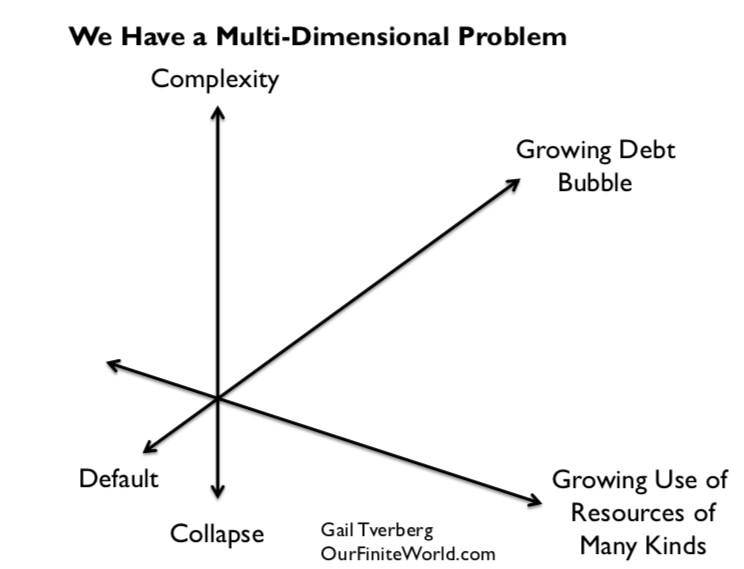
Figure 4.
Growing complexity is very closely related to “Technology will save us.” Growing complexity involves the use of more advanced machinery and ever-more specialized workers. Businesses become larger and more hierarchical. International trade becomes increasingly important. Financial products such as derivatives become common.
Growing debt goes hand in hand with growing complexity. Businesses need growing debt to support capital expenditures for their new technology. Consumers find growing debt helpful in affording major purchases, such as homes and vehicles. Governments make debt-like promises of pensions to citizen. Thanks to these promised pensions, families can have fewer children and devote fewer years to child care at home.
The problem with adding complexity and adding debt is that they, too, reach diminishing returns. The easiest (and cheapest) fixes tend to be added first. For example, irrigating a field in a dry area may be an easy and cheap way to fix a problem with inadequate food supply. There may be other approaches that could be used as well, such as breeding crops that do well with little rainfall, but the payback on this investment may be smaller and later.
A major drawback of adding complexity is that doing so tends to increase wage and wealth disparity. When an employer pays high wages to supervisory workers and highly skilled workers, this leaves fewer funds with which to pay less skilled workers. Furthermore, the huge amount of capital goods required in this more complex economy tends to disproportionately benefit workers who are already highly paid. This happens because the owners of shares of stock in companies tend to overlap with employees who are already highly paid. Low paid employees can’t afford such purchases.
The net result of greater wage and wealth disparity is that it becomes increasingly difficult to keep prices high enough for oil producers. The many workers with low wages find it difficult to afford homes and families of their own. Their low purchasing power tends to hold down prices of commodities of all kinds. The higher wages of the highly trained and supervisory staff don’t make up for the shortfall in commodity demand because these highly paid workers spend their wages differently. They tend to spend proportionately more on services rather than on commodity-intensive goods. For example, they may send their children to elite colleges and pay for tax avoidance services. These services use relatively little in the way of commodities.
Once the Economy Slows Too Much, the Whole System Tends to Implode
A growing economy can hide a multitude of problems. Paying back debt with interest is easy, if a worker finds his wages growing. In fact, it doesn’t matter if the growth that supports his growing wages comes from inflationary growth or “real” growth, since debt repayment is typically not adjusted for inflation.

Figure 5. Repaying loans is easy in a growing economy, but much more difficult in a shrinking economy.
Both real growth and inflationary growth help workers have enough funds left at the end of the period for other goods they need, despite repaying debt with interest.
Once the economy stops growing, the whole system tends to implode. Wage disparity becomes a huge problem. It becomes impossible to repay debt with interest. Young people find that their standards of living are lower than those of their parents. Investments do not appear to be worthwhile without government subsidies. Businesses find that economies of scale no longer work to their advantage. Pension promises become overwhelming, compared to the wages of young people.
The Real Situation with Oil Prices
The real situation with oil prices–and in fact with respect to commodity prices in general–is approximately like that shown in Figure 6.

Figure 6.
What tends to happen is that oil prices tend to fall farther and farther behind what producers require, if they are truly to make adequate reinvestment in new fields and also pay high taxes to their governments. This should not be too surprising because oil prices represent a compromise between what citizens can afford and what producers require.

Figure 7. Illustration indicating that the world has already reached a point where no oil price works for both oil suppliers and oil consumers.
In the years before diminishing returns became too much of a problem (back before 2005, for example), it was possible to find prices that were within an acceptable range for both sellers and buyers. As diminishing returns has become an increasing problem, the price that consumers can afford has tended to fall increasingly far below the price that producers require. This is why oil prices at first fall a little too low for producers, and eventually seem likely to fall far below what producers need to stay in business. The problem is that no price works for both producers and consumers.
Affordability Issues Affect All Commodity Prices, Not Just Oil
We are dealing with a situation in which a growing share of workers (and would be workers) find it difficult to afford a home and family, because of wage disparity issues. Some workers have been displaced from their jobs by robots or by globalization. Some spend many years in advanced schooling and are left with large amounts of debt, making it difficult to afford a home, a family, and other things that many in the older generation were able to take for granted. Many of today’s workers are in low-wage countries; they cannot afford very much of the output of the world economy.
At the same time, diminishing returns affect nearly all commodities, just as they affect oil. Mineral ores are affected by diminishing returns because the highest grade ores tend to be extracted first. Food production is also subject to diminishing returns because population keeps rising, but arable land does not. As a result, each year it is necessary to grow more food per arable acre, leading to a need for more complexity (more irrigation or more fertilizer, or better hybrid seed), often at higher cost.
When the problem of growing wage disparity is matched up with the problem of diminishing returns for the many different types of commodity production, the same problem occurs that occurs with oil. Prices of a wide range of commodities tend to fall below the cost of production–first by a little and, if the debt bubble pops, by a whole lot.
We hear people say, “Of course oil prices will rise. Oil is a necessity.” The thing that they don’t realize is that the problem affects a much bigger “package” of commodities than just oil prices. In fact, finished goods and services of all kinds made with these commodities are also affected, including new homes and vehicles. Thus, the pattern we see of low oil prices, relative to what is required for true profitability, is really an extremely widespread problem.
Interest Rate Policies Affect Affordability
Commodity prices bear surprisingly little relationship to the cost of production. Instead, they seem to depend more on interest rate policies of government agencies. If interest rates rise or fall, this tends to have a big impact on household budgets, because monthly auto payments and home payments depend on interest rates. For example, US interest rates spiked in 1981.

Figure 8. US short and long term interest rates. Graph by FRED.
This spike in interest rates led to a major cutback in energy consumption and in GDP growth.

Figure 9. World GDP Growth versus Energy Consumption Growth, based on data of 2018 BP Statistical Review of World Energy and GDP data in 2010$ amounts, from the World Bank.
Oil prices began to slide, with the higher interest rates.

Figure 10.
Figure 11 indicates that the popping of a debt bubble (mostly relating to US sub-prime housing) sent oil prices down in 2008. Once interest rates were lowered through the US adoption of Quantitative Easing (QE), oil prices rose again. They fell again, when the US discontinued QE.

Figure 11. Figure showing collapsing debt bubble at the time US oil prices peaked, and the use of Quantitative Easing (QE) to stimulate the economy, and thus bring prices back up again.
While these charts show oil prices, there is a tendency for a broad range of commodity prices to move more or less together. This happens because the commodity price issue seems to be driven to a significant extent by the affordability of finished goods and services, including homes, automobiles, and restaurant food.
If the collapse of a major debt bubble occurs again, the world seems likely to experience impacts somewhat similar to those in 2008, depending, of course, on the location(s) and size(s) of the debt bubble(s). A wide variety of commodity prices are likely to fall very low; asset prices may also be affected. This time, however, government organizations seem to have fewer tools for pulling the world economy out of a prolonged slump because interest rates are already very low. Thus, the issues are likely to look more like a widespread economic problem (including far too low commodity prices) than an oil problem.
Lack of Growth in Energy Consumption Per Capita Seems to Lead to Collapse Scenarios
When we look back, the good times from an economic viewpoint occurred when energy consumption per capita (top red parts on Figure 12) were rising rapidly.

Figure 12.
The bad times for the economy were the valleys in Figure 12. Separate labels for these valleys have been added in Figure 13. If energy consumption is not growing relative to the rising world population, collapse in at least a part of the world economy tends to occur.

Figure 13.
The laws of physics tell us that energy consumption is required for movement and for heat. These are the basic processes involved in GDP generation, and in electricity transmission. Thus, it is logical to believe that energy consumption is required for GDP growth. We can see in Figure 9 that growth in energy consumption tends to come before GDP growth, strongly suggesting that it is the cause of GDP growth. This further confirms what the laws of physics tell us.
The fact that partial collapses tend to occur when the growth in energy consumption per capita falls too low is further confirmation of the way the economics system really operates. The Panic of 1857 occurred when the asset price bubble enabled by the California Gold Rush collapsed. Home, farm, and commodity prices fell very low. The problems ultimately were finally resolved in the US Civil War (1861 to 1865).
Similarly, the Depression of the 1930s was preceded by a stock market crash in 1929. During the Great Depression, wage disparity was a major problem. Commodity prices fell very low, as did farm prices. The issues of the Depression were not fully resolved until World War II.
At this point, world growth in energy consumption per capita seems to be falling again. We are also starting to see evidence of some of the same problems associated with earlier collapses: growing wage disparity, growing debt bubbles, and increasingly war-like behavior by world leaders. We should be aware that today’s low oil prices, together with these other symptoms of economic distress, may be pointing to yet another collapse scenario on the horizon.
Oil’s Role in the Economy Is Different From What Many Have Assumed
We have heard for a long time that the world is running out of oil, and we need to find substitutes. The story should have been, “Affordability of all commodities is falling too low, because of diminishing returns and growing wage disparity. We need to find rapidly rising quantities of very, very cheap energy products. We need a cheap substitute for oil. We cannot afford to substitute high-cost energy products for low-cost energy products. High-cost energy products affect the economy too adversely.”
In fact, the whole “Peak Oil” story is not really right. Neither is the “Renewables will save us” story, especially if the renewables require subsidies and are not very scalable. Energy prices can never be expected to rise high enough for renewables to become economic.
The issues we should truly be concerned about are Collapse, as encountered by many economies previously. If Collapse occurs, it seems likely to cut off production of many commodities, including oil and much of the food supply, indirectly because of low prices.
Low oil prices and low prices of other commodities are signs that we truly should be concerned about. Too many people have missed this point. They have been taken in by the false models of economists and by the confusion of Peak Oilers. At this point, we should start considering the very real possibility that our next world problem is likely to be Collapse of at least a portion of the world economy.
Interesting times seem to be ahead.


r/politics is starting to wake up
https://i.redd.it/ylbcq0ency221.jpg
fresh new sale price on Bitcoin tonight…
about $3400…
I might buy some for stocking stuffers…
aren’t they small enough to drop into the stockings hanging on the fireplace mantle?
anyway…
I should wait until closer to Xmas…
should be way under $3000 by then…
chocolate money tastes nicer
I’m confused about collapse
When I think about collapse. I think of a market where the price is to low for the producer to be profitable and too high for the consumer to afford. When this happens the market stops. No transactions are made since an agreeable price no longer exists. Gail calls this an affordability problem.
Many markets depend on a cheap and productive energy environment to maintain an affordable price for buyer and seller. We have used up the cheap energy and we seem to be getting diminishing economic returns on the energy we are using. These are closely related problems but they are not the same. Or am I wrong?
As cheap productive energy is declining some markets will reach a point of collapse. All markets will collapse when they reach a point when the essential energy input falls below a critical level. No market exists where there is no energy. However, the world economy is comprised of many markets. And I’m not just speaking of national markets, but markets for individual products and services. Each market has its own cheap and productive energy requirements. The lemon market might collapse before the lime market. Or am I wrong about this also?
Now here is where I really get confused. When we talk about collapse we don’t often clarify what exactly we are talking about. Are we talking about one component of the world economy, like the U.S. auto market or French wine market? Or, are we talking about the economic system that all markets depend upon? These are important distinctions.
When a system collapses it totally fails. Partial collapse is like being partially pregnant. You either are of you aren’t. There is no partial collapse. If a system declines by half, and then stops declining it did not collapse.
Okay, my final point.
As energy resources become more expensive and less productive, those markets that are most vulnerable will collapse first. The collapse of individual products or business markets may not initially lead to a larger, broader systemic collapse of the economy. However, the continuing decrease of cheap and productive energy resources will continue to destroy individual markets, destroying those that are most vulnerable first. Eventually, the overall global economy which is dependent on cheap and productive energy will collapse under the weight of all the individual markets that have previously collapsed. Or am I wrong?
The timing of these events is beyond human calculation because it involves billions of future transactions and the unpredictable order of collapsing markets. However, the end result is inevitable. Our civilization will collapse. Or am I wrong about this also?
Any help would be greatly appreciated
good post… full of lots of doom…
a couple things I see:
one is that The Collapse is the obvious one where the electricity goes off worldwide and BAU ends totally…
other uses for the word “collapse” are somewhat misleading…
next, before looking to the future, look at the present and recent past…
Venezuela has been “collapsing” since about 2015…
Bitcoin has been “collapsing” this entire year…
this year, auto markets throughout the world are falling fast…
the Australian housing market is “collapsing”…
etc…
your “final point” paragraph seems about right…
every year, there is less surplus energy to maintain economic activity…
somehow and sometime and someway, there has to be less economic activity in the world…
I think the near future will be similar to the recent past…
smaller weaker countries will continue to fall…
in bigger stronger countries, middle class and lower class will continue to fall…
we’ll see more riots like in France…
otherwise, who can say if you will be right or wrong?
The Collapse could be preceded by a cascading failure of country by country…
or market by market, as you say…
suddenly, like in a day or a week…
or like I still think, drip by drip until about 2025 to 2030…
who knows?
thanks for the good doom…
The world economy is much more interconnected than in previous collapses. All previous collapses were local. The Great Recession of 2008-2009 was sort of a partial collapse of the world economy.
Every leader would like to make certain that his own economy is not on the leading edge of collapse. That is why world leaders are acting the way they are today.
When things get serious about who will survive or not, nationalism and great power politics beat liberalism (John J. Mearsheimer)
now this:
https://www.reuters.com/article/us-france-protests-macron/france-braces-for-trouble-macron-to-address-yellow-vest-anger-idUSKBN1O60I8
more entertainment tomorrow in France?
Gail, your link to US oil data shows this 20 year graph which shows US exports rising from about 1 million per day around the 2008/2009 “Great Recession” to about 9 million per day now…
https://www.eia.gov/dnav/pet/hist/LeafHandler.ashx?n=PET&s=WTTEXUS2&f=W
so is the US in such bad shape that it doesn’t need 8 million more barrels per day like we did pre-2008?
though US production is up since then, so that would enable increased exports…
I’m just surprised that the US seems to only need about 10 million per day for “internal” use…
I though we needed about 20 million per day last decade…
then, if it’s big news that the US is now a net exporter for the first time in 75 years…
that may not be good news at all…
it may mean the US economy has tanked to the point where it doesn’t need as much oil domestically…
you are correct the US economy only needs to import 5 million a day of oil barrels in 2017 but in 2005 it needed to import 13 million a day of oil barrels
it must be all the shale oil that the US cant use that it exports
If you can’t refine it, you need to ship it to someone who can–
At a discount, of course-
But we still import at least 5 million barrels a day.
but exports:
the data shows that the US has increased total exports from about 1 million per day in 2008 to about 9 million per day now…
and total imports and exports are almost exactly the same…
it says to me that the US economy is declining and is using less oil domestically…
way less than before 2008…
it says to me that the US economy is declining and is using less oil domestically…way less than before 2008…
https://media1.tenor.com/images/f33c7c1f1f8fa55e43129497e507bbd9/tenor.gif?itemid=3468348
if oil is unaffordable
then industry is unprofitable
wages are unpayable
food becomes unobtainable
and warfare inevitable
humankind unsustainable
and the planet unlivable
If you produce 11 million barrels, and use 20, you are not gaining that through exports.
Basic math is sometimes hard to understand.
lol
the times i’ve tried to explain that
The headline says: U.S weekly crude oil and petroleum product exports.
The U.S is a refinery super power as it takes in about 25 percent of the global crude oil production and then exports refined petroleum products to the world.
The oil refining industry is the most energy intensive industry in the U.S. The energy to refine all the crude is coming from the shale gas industry.
Brilliant research, but no dealing with the cost of centralized power generation. But can one single model of centralization be subdivided into smaller units of centralization?
Forgot the link.
https://www.democracynow.org/2018/12/7/winona_laduke_calls_for_indigenous_led
Winona LaDuke is “you know, I’m an economist by training…”
and she wants a “Green New Deal”?
I’m sure that she has no clue that FF = prosperity…
I hear you. The Indian communities of NM are being challenged as never before through Trump leases for drilling on land that affect them. Anglo Greenies where I live are up in righteous fury about the injustice of it all. Winona is the hero. I’m saying you don’t just wait till a day before the leases are sold to hold a rally and end up blocking traffic. You need to have a land plan in writing, and a legal team to back it up. I dare not say that they are dreaming as to the switch to “renewables” that they ALL jut rattle off the lips of their tongues…as though it were just the immorality of oil companies keeping it a bay. But I think everybody has it wrong. Forget renewable (the way it’s fantasized over), but you don’t want poisoned water either. Separate the issues. Poisoned water isn’t the inevitable outcome of FF use. It is more likely the result of “planning” (NOT) and real estate development, and every possible kind of misguided ideology imaginable. But how do you get that notion past the blind allegiance to renewables?
A news article from ABC (Australia)
https://www.abc.net.au/news/2018-12-07/reserve-bank-raises-prospect-of-rate-cuts-or-even-qe/10593562?section=business
So Australia is thinking about QE. If others aren’t doing it, will it sink the Australian dollar?
Lance Armstrong strikes it Rich
Sometimes being lucky is just as Good as being Good…
Texas native invested $100,000 with a venture capital firm in 2009, the bulk of which went to the ride-sharing app that he says was valued at just $3.7 million at the time.
Today, as the company prepares for its IPO, banks have valued it as high as $120 billion. That could make Armstrong’s shares worth more than $3 billion, but he declined to reveal the exact figure, simply telling CNBC the number is “too good to be true” and “it’s saved our family.”
Armstrong’s bonanza was a giant stroke of luck after he received a phone call from former Google employee and now billionaire investor Chris Sacca
“I’m thinking to myself, ‘This guy has a huge personality but he’s also very smart and very well connected.’ So I invested in Chris Sacca. I didn’t even know that he did Uber. I thought he was buying up a bunch of Twitter shares from employees or former employees, and the biggest investment in (the) Lowercase fund one was Uber.”
WOW…good for him…always admired the Guy…even though he’s a cheater….there are two kinds
That get caught and those that don’t….everyone cheats
https://nypost.com/2018/12/07/lance-armstrong-is-poised-to-become-billionaire-despite-doping-downfall/amp/
See folks one day is all doom and gloom…the next unicorns and rainbows.
Rex Tillerson on Trump: ‘Undisciplined,’ ‘doesn’t like to read’ and tries to do illegal things
https://www.sltrib.com/news/nation-world/2018/12/07/rex-tillerson-trump/
if you live in a rigged setup, what’s wrong with trying to break the rules? Tillerson = Establishment.
“Tillerson = Establishment.”
And Trump is obviously a black swan outsider right? Jesus it’s like a derangement round robin with you edgy nihilists.
Trump is what you get with late stage capitalism.
We are lucky he can read (possibly the case).
Lets face it- he is a failed real estate scammer (bankrupt 4 times), and tv host.
No one will touch his business, (loan him money) except the Russians.
Perfect President?
I sure am glad that Hillary and “made man” Obama could read, surely it helped that to create the Libya, Syria and Ukraine disasters.
These evil people would destroy the world….Trump has not done that. If only he could roll back the wars thendeep state has us mired in.
Actually, Trump and Hillary have very similar policy’s , as compared to someone like Sanders. On a macro level, it would be hard to tell.
In a conversation, you could tell Hillary could read.
You would know immediately not to do business with Trump, unless you were looking to throw some cash away.
Note: I never voted for Trump, Hillary, or Obama
Do you live in the US?
I believe you are correct. Trump is symptomatic of a late stage collapse similar to what happened in the Soviet Union. He is a reflection of the angst developing between classes, races, and genders as the pie gets smaller and smaller. We’re seeeing the same thing in Italy, France, Mexico, Brazil, India, etc.. we’re seeing radicalization of the leadership reflecting desperation and radicalization of the population. There is no fix for what’s wrong and unlike Japanese monocultural society most of the European and U.S. populations are culturally mixed. There are lots of subgroups to cannibalize which is what desperate societies have done since the beginning of time.
in a way, he IS a black swan, to the Washington establishment. Trump is no outsider to capitalism. he was the guy that must not win, hence all the pre-election “activity”, some of it criminal, to stop him and then curtail his ability to govern after he won. we still might get into a civil war over this, just in time for collision with a financial collapse, perhaps even triggering it. see some of JHK’s recent posts.
or perhaps you guys would prefer being subjected to WWIII? recall Hillary was just fine calling Putin a “Hit ler”. the Ukrainian/Syrian/Libyian adventures started under her watch as SOS under Obama. some of those crazies think we can invade or otherwise take down Russia and grab their hydrocarbon resources. not without a fight.
A factor—perhaps a major factor—in Hillary’s loss of the 2016 presidential election despite it having been rigged in her favor was her policy on coal.
https://i2.cdn.turner.com/money/dam/assets/160314152415-clinton-coal-quote-780×439.jpg
PS, she was also big on photovoltaics.
http://www.greenwichneighborsunited.com/wp-content/uploads/hillary-clinton-climate-solar-green-energy.jpg
https://oilprice.com/
Check out WTI & Brent increase in oil price today. Wow!
https://oilprice.com/Latest-Energy-News/World-News/Russia-May-Agree-To-200000-Bpd-Cut-In-OPEC-Oil-Deal.html
‘Russia May Agree To 200,000 Bpd Cut In OPEC+ Oil Deal’
Starting to look like OPEC & Russia are working in concert. It’s taken some time for that working relationship to come together, but we are now seeing how powerful that combo can be, because if you add the amount OPEC is reducing, 800,000 barrels a DAY and Russia, that’s a full 1 million barrels a day less supply. That will definitely force oil price higher. OUCH!
a baker with 10 kids must keep baking more loaves to support his family–especially if he keeps having more kids
bread is just another form of energy
he can’t reduce his bread output long term to improve another baker’s standard of living/output, or his own standard of living will fall
he can do it short term
but long term he must increase production again or his own business will collapse
Huh?
oil=energy=income
bread=energy=income
i thought the analogy was obvious, just a difference in scale
Hello
You write : “At this point, world growth in energy consumption per capita seems to be falling again.”
But the 2018 CO2 emissions are at a highest level ever : https://global-climat.com/2018/12/06/forte-croissance-des-emissions-mondiales-de-co2-en-2018/?fbclid=IwAR0CY68zCuJyj3FF7hK9wH9v3_ZN2mpvi83fQ5IoBER5UNbDJPszg8jlQA8
So how can you conclude that consumption per capita is falling ?
Maybe I need to look at this more closely, when year end energy data by type of fuel becomes available.
The chart shows that between 2010 And 2017, emissions rose by 1.0% per year. This is less than world population growth during this time. Thus, for this period, (which is long enough to cause a major problem), energy consumption per capita doesn’t seem to be up very much.
In order to prevent collapse, we need a higher increase in energy consumption. In fact, a 2.7% increase in emissions would be appropriate with such an increase. By historical standards, this is still pretty low. It may have kept us away from collapse this year.
Ok for this year. I’m afraid that it’s beginning in France : low wages, high taxes. No Growth. No more growth in the future but increase of population. As you write : next year, it’ll be interesting. Do I have to buy a gun ? Here a lot of people shout ‘Macron get out’. No democracy now. We are on the edge of a changing world. See Jared Diamond.
“No more growth in the future but increase of population.”
maybe your leadership made a big mistake by letting in so many immigrants?
“Do I have to buy a gun ?”
why? don’t all the people in France get along well with each other?
“Here a lot of people shout ‘Macron get out’.”
well, that won’t solve anything, but getting him out is much easier than getting most of the immigrants out…
viva la France!
it all comes back to energy depletion
when cheap surplus oil is available—everybody can have what they want, as much as they want.
this applies to all industrialised nations—not just France. The EU came together in a time of mutual prosperity—as that prosperity goes away–the EU will revert to more traditional methods of diplomacy.
French people were given handouts, just like the Greeks and Italians. And the rest of the EU. Very few people know where those handouts came from. They still want to retire at 55, get free med care and free everything else, but demand an end to taxation. great!!
they remain convinced that they were a fundamental, permanent right. As I’ve said before, people get violent when those rights are taken away—there remains that weird certainty that governments are there to deliver free money.
And changing governments will restore such ‘rights’
What we are seeing in France is what will happen in the USA as Trump’s promises fail to materialise and they vapourise. But on a vastly bigger scale of course. China is doing the same thing, maybe a bit differently.
of every barrel of oil, a proportion of that oil must be used to obtain more oil
that proportion cannot be used for any other purpose
if that proportion is 1%, that leaves 99% with which to ”produce” other stuff (productivity)
if that proportion increases to –say–10-%—then that leaves 90% to produce ”stuff” –ie create jobs and make things
so productivity per capita falls, and will continue to fall as that oil production % rises.
when we get towards 50/50—then our economic system will collapse because we will be using half our oil to get hold of the other half (we wont be able to afford oil at all)
we won’t get there, because denialists and conspiracy theorists will blame everyone and everything for chaos, unable/unwilling to comprehend the real reason.
it also explains why there are oilwars now, because that state of affairs is becoming obvious, and denial is kicking in
The catch is that the energy isn’t really oil, used to extract oil. It is generally, other, cheaper forms of energy. So the ratio tells you much less than you think it does. Increasingly, natural gas is being used to extract oil. Or electricity made from coal.
i realised that
perhaps what i should have said was ‘the collective energy available to us’
https://www.cnbc.com/2018/12/07/oil-markets-crude-supply-opec-russia-in-focus.html
‘Oil prices surge more than 4% as OPEC reaches deal to cut output’
“U.S. West Texas Intermediate crude futures were up $2.39, or 4.7 percent, at $53.89 per barrel at 9:43 a.m. ET. Brent crude, the international benchmark for oil prices, rose $3.42, or 5.8 percent, to $62.89 a barrel.”
“OPEC producers agreed to cut output by 800,000 barrels a day beginning in January, according to Iranian Energy Minister Bijan Zangeneh. Non-OPEC producers were proposing a 400,000 barrels a day cut, sources told Dow Jones.”
We’ve discussed how oil price faces downward pressure from financially strapped non-elite consumers, but not so much about a consortium like OPEC constricting supply to force a higher oil price, and they can since they provide approx. 34 mbd. That’s a sizable enough supply to effect great control on oil price. However, less volume sold is also less money, so rising price will only work if the consumer can pay it.
Allow me to clarify; Less volume sold is less money because it’s fewer barrels sold, but if a higher price can be sustained it could make more money overall, so there is a trade off between higher price and lower volume and we’ll see how much the non elite consumer can help OPEC sustain more money from sales, but we can see again how pressured these government run businesses are to bring in more loot.
The markets seem to like this, even though it is less than the 1.3m barrels p/d I was under the impression was considered desirable.
“OPEC finally broke an impasse over production curbs, agreeing on a larger-than-expected cut with allies after two days of fractious negotiations in Vienna.
“The cartel and its partners agreed to remove 1.2 million barrels a day from the market, with OPEC itself shouldering 800,000 barrels of the burden. Iran emerged as a winner from the contentious talks, saying it’s secured an exemption from cuts as it suffers the effects of U.S. sanctions.
“Crude surged as much as 5.4 percent in London, raising the risk that the deal could anger U.S. President Donald Trump, who had urged the group to keep the taps open and prices low.”
https://www.bloomberg.com/news/articles/2018-12-07/opec-said-to-agree-larger-than-expected-output-cut-with-allies
I didn’t see this comment, when I made my earlier remark to Duncan.
Lower production agreement could be the start of downturn in world oil supply, when coupled with low oil prices.
I hadn’t thought of it in those terms. Perhaps we are about to pass peak supply – a very sobering thought!
Possibly next year—-
But soon–
We shall see how the market responds.
OIL (BRENT) PRICE COMMODITY
62.79 USD +2.48 (4.11%)
Still low 60’s—–
WTI seems to be at $53.79.
Did it take this long for the big draw on US oil stocks to hit market prices?
I think the hit down was overdone–
There is some wiggle room.
WTI is a different game sometimes, being smaller and US centric.
Why are there so many destabilizing events going on now ?
https://thehill.com/opinion/white-house/420131-feds-received-whistleblower-evidence-in-2017-alleging-clinton-foundation
Perhaps because standards of behavior are not very high today. There really is a lot of impropriety going on, because normal “return on investment” is close to zero. It is only with impropriety that a person can support himself/herself.
“Wherever Mark Connors looks at markets, from stocks to currencies to oil, he sees signs of the unknown.
“Equity investors got whipsawed this week during two rough and volatile sessions, but Connors, global head of risk advisory at Credit Suisse, had seen worrying signs long before that. A key technical measure he tracks, the correlation between the price of stocks and currencies, had broken down starting in April. That, along with sharp drops in the price of oil, point to one thing, he says: Uncertainty about the future as central banks around the world unwind programs that bought trillions of dollars of assets.
““We’re seeing two of the biggest asset classes, stocks and currencies, exhibit a degree of uncertainty in their relationship in 2018 that we’ve never seen before,” Connors said. “Crude just exhibited something very unusual in the context of the last 40 years.”
“The unwinding of central banks’ programs a decade after the financial crisis brought economies to the brink is known as quantitative tightening. J.P. Morgan Chase CEO Jamie Dimon said in July that one of his biggest fears is around how markets would behave as central banks removed their unprecedented stimulus.
““If quantitative tightening continues, guess what’s going to happen? More of this,” Connor said, referring to unusually violent moves across markets…
““Uncertainty is here, and that means deleveraging into a market with reduced liquidity,” Connors said. “Expect more of these exacerbated moves.””
https://www.cnbc.com/2018/12/06/markets-are-going-haywire-heres-why-these-sudden-moves-are-here-to-stay.html
“As a longtime market observer, what I find most interesting about the latest correction in equities has the feeling of inevitability that it will turn into something worse. It wasn’t this way in late January, when everyone wanted to buy that dip. It certainly wasn’t this way in 2007, when the magnitude of the recession was grossly underestimated.
“Even the Federal Reserve is getting into the pessimism. Chairman Jerome Powell signaled last week that a pause in interest-rate hikes might be forthcoming.”
https://www.bloomberg.com/opinion/articles/2018-12-06/markets-in-turmoil-a-recession-seems-unavoidable
“Only a globally co-ordinated debt “bonfire” can save the world’s leading economies from depression now that monetary and fiscal armouries are exhausted, a leading economics consultancy has warned.
“Public and private debt levels are so high in the developed world and traditional policy levers are so overextended that the next recession will turn into a depression unless radical measures are taken, Erik Britton, managing director at Fathom Consulting, said.”
https://www.thetimes.co.uk/article/we-need-debt-bonfire-says-analyst-qqwpwdl22
Perhaps someone should look at history. A global co-ordinated debt “bonfire” is equivalent to a debt bubble collapse. It is what is the proximate cause of collapses. Of course, the underlying cost is too little energy consumption per capita. This, in turn, is related to too high cost (to low average EROEI) of energy products.
One person’s savings (pension etc) represent someone else’s debt obligation. Wiping the slate clean of debt also wipes clean the other side of the equation…
A lot of “value” doesn’t really have anyone on the other side. These aren’t really debt, but they act like debt.
The government promises (sort of) to pay you Social Security and Medicare (or retirement and health coverage in other countries). These aren’t guaranteed. They aren’t considered debt.
A company or person owns shares of stock. The person owning it thinks it can be sold, and the proceeds used to buy things of equivalent value. If debt defaults happen (even if not related to this particular stock), prices of stock will drop dramatically, making them impossible to sell for a reasonable amount.
A similar problem arises with the price of homes, and farmland, and mines. The prices will drop, and it will be impossible to get anything of value for them. This isn’t a debt default directly, but it happens when debts get wiped out by defaults. I don’t know of any other way to wipe out debts.
A person wonders what the buy-sell programs for stocks and bonds will do, when the program figures out that the world is headed into a major recession.
https://www.clearpoint.org/wp-content/uploads/Debt-Snowball-Method-Building-Momentum.jpg
“The Food and Agriculture Organization’s (FAO) food price index, which measures monthly changes for a basket of cereals, oilseeds, dairy products, meat and sugar, averaged 160.8 points last month, down from a revised 162.9 in October, and its lowest level since May 2016….
“The U.N. body’s Cereal Price Index averaged almost 164 points in November, down 1.1 percent from October. Vegetable oil prices fell for a 10th consecutive month, by 7.6 percent on the month and reaching a 12-year low.
“Cereal prices fell partly because new crops weighed on rice export quotations and export competition drove down maize, FAO said.
“Palm oil prices fell considerably “fueled by both persisting large inventories in leading exporting countries and the recent contraction in global mineral oil prices,” it said.”
https://uk.reuters.com/article/us-global-economy-food/world-food-prices-fall-in-november-to-lowest-in-more-than-two-years-idUKKBN1O50U9
A ‘blame it on the weather’ article with some interesting intel:
“Oil refiners’ profits in Asia have slumped to the lowest in more than four years… Oil inventories are building as new refineries in China and Vietnam are running at full tilt, adding to Asia’s supplies.
“Oil demand also slowed after global Brent crude prices jumped to more than $80 a barrel in September and as the global economic outlook turned gloomy…
“Factory activity and export orders weakened in November, prompting analysts to predict no quick rebound amid persistent trade tensions.
“The margins at a typical Singapore complex refinery, a reference for profits at refineries across Asia, fell to $2.49 a barrel on Thursday, the lowest since August 2014, Refinitiv Eikon data showed. DUB-SIN-REF
“The margins are also the lowest for this time of the year since 2008, the data showed.
““The glut in the market is in light oil,” Martijn Rats, Morgan Stanley’s global oil strategist said. “The gasoline crack has deteriorated an enormous amount and is very close to zero at the moment which is very unusual.”
“Refiners now face losses of more than $1 a barrel for every barrel of gasoline they produced.
“Several oil tankers are storing gasoil off Taiwan… KY Lin, a spokesman at Formosa Petrochemical Corp, one of the largest fuel exporters in Asia, is hopeful that the recent drop in oil prices could boost demand.
““Even though there’s an ongoing trade war, countries will still need to use oil,” he said.”
https://uk.reuters.com/article/asia-oil/asian-refiners-profits-slump-as-mild-weather-exacerbates-oil-products-glut-idUKL4N1YB3N1
Thanks very much for the link.
If the glut is in light oil, it could indirectly reduce that amount that refiners are willing to pay for US tight oil from shale (differential to Brent or WTI). This is what cuts back production from shale, as much as drop in WTI price.
I t takes at least 30 years to break even on new refinery production.
That is why the US has very little ability to refine this light stuff.
They can do the math.
All energy prices, including food, tend to move together.
https://oilprice.com/Latest-Energy-News/World-News/Maduro-Russia-Venezuela-Sign-5B-Deals-To-Boost-Venezuelan-Oil-Production.html
‘Maduro: Russia, Venezuela Sign $5B Deals To Boost Venezuelan Oil Production’
Beating a dead llama…
Russia instead of China. Interesting!
It has been Russia fo a long time——–
They are making the bet.
Maduro was to gone years ago, if you are reading Wester Media.
Obviously, somebody is getting bad media.
China got “burned” on their deals with Venezuela.
Yep, we shall see.
5 billion is not large of bet for Russia.
I read that Russia thinks that Venezuela will produce 10 million bbl per day in the coming future.
If so, anything approaching 10mbd is huge and would drive down oil price.
https://www.theautomaticearth.com/wp-content/uploads/2018/12/MacronLePew600.jpg
but his approval rating is now down to 18%… !
can he be ousted by a recall vote under French law?
viva la France!
otherwise…
I hear that Paris is a marvelously wonderful gem of a city to visit…
I see plane tickets for tomorrow for about 3,000 USD…
should I stay or should I go?
Despite Climate Impacts, Peak Oil Demand Nowhere in Sight
https://www.usnews.com/news/national-news/articles/2018-12-06/despite-climate-impacts-peak-oil-demand-nowhere-in-sight
Delusional reporting.
yes…
the author has no clue about oil demand…
it’s sort of amusing, since I actually do have peak oil demand “in sight”…
(I’m sure others do also…)
I see 2019 coming, and I see (as an estimate) a global recession coming then…
abracadabra…
oil demand drops next year and never again reaches this year’s level…
Just substitute “affordability” for “demand” in your statement, and you will have the story right:
“oil affordability drops next year and never again reaches this year’s level”
They need to look a little harder – limits are closer than they realize.
Hi,
Could you please do a post on how much oil and gas can be extracted with an EROI of 2, regardless of the price. BP reported 1.6 Trillion Barrels, which is around 50 years worth of usage, give or take a decade as a variance.
It depends on how much coal can be extracted with an EROEI of 50:1, at the same time. It is the average EROEI of all energy products combined that matters. It is not possible to add anything with an EROEI that is lower than what is being removed. This is one reason why renewables can’t substitute for higher EROEI products. Total energy consumption per capita needs to rise. For this to happen, price needs to fall in inflation and energy efficiency adjusted terms.
hi MC…
if it’s extracted with an EROI of 2, then it has to be shipped to refineries, refined, and shipped to end users…
so, what do YOU think the EROI then is? 1?
if so, then there is no energy surplus…
then…
it does the end users no good unless they have the machines to use it…
so there must be enough surplus energy at “extraction” in order to build these machines and get them to the end users…
so now…
what do YOU think is the minimum EROI necessary at extraction?
maybe 5?
then after refining it’s maybe 3…
then the surplus energy in that “3” can be used to make machinery that runs on those refined products…
now…
do you want to restate your question?
I am sure to maintain what we have the EROEI for energy products has to be much more and 2:1. Probably more that 10:1. To build a new infrastructure I would imagine would take 50:1 or more. We built our current infrastructure mostly with upwards of 100:1 returns on investment in the first half of the 20th century. So, it takes a lot to kick-start a new infrastructure. That is another reason why I am certain that solar and wind “renewable” infrastructure is an impossibility at this late stage.
And what about the availability of suitable workforce? With ageing and deteriorating populations, the energy of human resources goes down. (E.g. when you go mining coal instead of caring for the elderly and disabled, those who need help die and the overall consumption goes down.)
The wages (i.e. energy that can be bought with the earned money) becomes too low for hiring workforce that is becoming scarce. The energy becomes too costly (i.e. more and more out of the reach) for the weakening populations.
I guess those who are counting EROI do not understand the close relationship between the population and energy.
The EROI group is basically a peak oil group. They are worrying about “running out” of oil and high prices. The idea of population never crossed their minds, I don’t think. In fact, quantity is not a subject discussed at all. EROI is all about measuring costs “at the wellhead.” This is a job that keeps graduate students busy and provides lots of input for academic papers.
Schlumberger: A drop in US Shale activity
US production has surprised to the upside, partly in the Gulf of Mexico and partly from the US shale basins. There was a surge in hydraulic fracturing activity in the second quarter, especially in the Permian. This activity surge levelled off in the third quarter and is dropping in the fourth quarter, which will show up in the first half production numbers for 2019.
The record high production from the core part of OPEC and Russia is simply coming from activated spare capacity, aimed at dampening the accelerating upwards trajectory of the oil price in the third quarter and leaving the remaining OPEC spare capacity at a record low level.
https://www.slb.com/news/presentations/2018/2018_1204_schorn_cowen.aspx
Seems like discussing doom is all dandy if your life is comfortable. But when modern luxuries like water is shut off, life is a drudgery.
https://m.youtube.com/watch?v=75vxx53txiE
This is why the vast majority try to ignore collapse. Because they don’t want to end up 58 years old, living in a hovel with no water, broke, and selling Christmas Trees for $12.50/hr. Of course they we are all going to end up there or much worse but in the mean time you gotta go out and earn a decent living.
Surfing through his other vids tells me he is a pessimistic Green-topian, which isn’t exactly the same as predicting the end of BAU.
I would say that he is on the near term human extinction train. Problem is, “near term” may last a couple of decades. And McPherson et al. might not be correct in his predictions about runaway glowball worming. If so, we are in for the long haul, the creeping impoverishment of slow collapse for each individual.
I don’t like McPherson or his ideas. BAU will take a lot of us down with it, but the species will survive.
“Seems like discussing doom is all dandy if your life is comfortable. But when modern luxuries like water is shut off, life is a drudgery.”
yes, but more than that…
“life is comfortable” means plenty of surplus energy…
so we can do lots of stuff besides just trying to stay alive with bare minimums of shelter and food and drinkable water…
we can post on OFW and gamble and eat imported dark chocolate…
I can have some fun making comments about preppers who should be planning for storage of 200 or 300 years of supplies, because planning for 20 or 30 years is futile!
and poke here and there with my (probably correct!) predictions that we first world persons will be okay at least until 2030…
and of course…
“life is comfortable” enables me to write:
BAU tonight, baby!
The U.S. Just Became a Net Oil Exporter for the First Time in 75 Years
https://www.bloomberg.com/news/articles/2018-12-06/u-s-becomes-a-net-oil-exporter-for-the-first-time-in-75-years
The US has been heading more and more this direction. Weekly data isn’t terribly accurate. We will see whether the same pattern holds up in monthly data.
See the EIA numbers at this link:
https://www.eia.gov/dnav/pet/pet_sum_sndw_dcus_nus_w.htm
Well, it really is basic math.
If you use 20 million barrels a day, and you produce 11 million barrels a day–
What is your net worth in oil?
Are you a net exporter?
Inquiring minds want to know——
Duncan, you are absolutely correct…
the article is very fuzzy:
“… net imports of about 3 million barrels a day on average so far in 2018…”
and then later:
“The U.S. imports more than 7 million barrels a day of crude from all over the globe to help feed its refineries, which consume more than 17 million barrels each day.”
so “America turned into a net oil exporter last week…”
the weekly data must be absolutely wrong…
ive been trying to figure that one too
Just read the headlines please.
Look at the detail data I provided a link to before. It shows that for the latest week, net imports of crude oil were 4.0 million barrels. This breaks down to gross crude oil imports of 7.2 million barrels per day, and crude oil exports of 3.2 million barrels per day. These exports are up at a higher level than they have been recently, perhaps representing the sale of some of the oil that had been in the Strategic Petroleum Reserve.
On the products side, the report shows imports of 1.6 barrels a day (somewhat lower than recent numbers) and exports of 5.8 million barrels a day. The biggest category of product exports is distillate fuel oil (diesel), but there are many other types as well. Propane exports recently seem to be at a higher than usual level.
So the data certainly supports the statement “The U.S. imports more than 7 million barrels a day of crude from all over the globe to help feed its refineries.” Another report shows crude oil refinery input of 17.5 million barrels per day, and gross refinery inputs of 17.8 million barrels a day. A sub-report says that this includes 0.9 million barrels a day of fuel ethanol. US refineries are running at 95.5% of capacity, which is pretty much “all out.” Oil companies make money by refining imported oil and exporting the finished products, sometimes to the countries that send us the crude oil in the first place.
I am not sure that the weekly data is wrong. Our intuition regarding how the system works is wrong. US consumption of oil products was 20.5 million barrels per day. This includes “refinery expansion,” because cracking heavy oil using natural gas raises the volume of the output. The US, with its cheap natural gas, specializes in doing this. Europe couldn’t do this if it wanted to. It doesn’t have the heavy oil refineries, and it doesn’t have the cheap natural gas supply.
People always forget the state of Canada yea know the other snow state that is not Texas.
Bloomberg: “2019 die-off expected to lead to global over supply of oil”
*joke*
“2019 global recession expected to lead to global over supply of oil”
there… fixed it…
That is the way a self-organized system works!
Consumption of vehicles collapsed in the quarter following the front-loading of car sales in the previous quarter, ahead of changes in both Swedish tax rules and international emissions tests, it said.
https://www.bloomberg.com/news/articles/2018-11-29/swedish-economy-contracts-as-riksbank-prepares-to-hike-rates
University of California: Environmental Science & Technology (Malyshkina 2010)
1. It Will Take 131 Years to Replace Oil with Alternatives
2. World oil production will peak between 2010-2030
3. World proven oil reserves gone by 2041
https://www.scribd.com/document/394656677/Future-Sustainability-Forecasting-by-Exchange-Markets-Basic-Theory-and-an-Application-Malyshkina-2010
A global energy assessment (Jefferson 2015)
The World in the 21st Century is faced with huge challenges that go far beyond, but importantly include, energy challenges on the supply, access, and use sides. So severe are these challenges, mainly arising from the demands of a rapidly increasing human population on the Earth’s limited resources, that the future existence of large numbers of people may be threatened with
extinction. In that sense, we may be observing the twilight of the Anthropocene (Human) Age.
https://www.scribd.com/document/394043449/A-Global-Energy-Assessment-Jefferson-2015
Projection of world fossil fuels by country (Mohr, 2015) Fuel
Over 900 different regions and subfuel situations were modeled using three URR scenarios of Low, High, and Best Guess. All three scenarios indicate that the consistent strong growth in world fossil fuel production is likely to cease after 2025. The Low and Best Guess scenarios are projected to peak before 2025 and decline thereafter. The High scenario is anticipated to have a strong growth to 2025 before stagnating in production for 50 years and thereafter declining.
https://www.scribd.com/document/375110317/Projection-of-World-Fossil-Fuels-by-Country-Mohr-2015
IEA Chief warns of world oil shortages by 2020 as discoveries fall to record lows
https://www.wsj.com/articles/iea-says-global-oil-discoveries-at-record-low-in-2016-1493244000
Saudi Arabia’s Energy Minister Warns of World Oil Shortages Ahead
https://www.wsj.com/articles/saudi-minister-sees-end-of-oil-price-slump-1476870790
There will be an oil shortage in the 2020’s, Goldman Sachs says
https://www.cnbc.com/2018/11/09/goldman-sachs-there-will-be-an-oil-shortage-in-the-2020s.html
Wood Mackenzie warns of oil and gas supply crunch
https://www.ft.com/content/a1eb0e58-d7a4-11e8-ab8e-6be0dcf18713
Imminent peak oil could burst US, global economic bubble – study
https://www.theguardian.com/environment/earth-insight/2013/nov/19/peak-oil-economicgrowth
German Military (leaked) Peak Oil study: oil is used in the production of 95% of all industrial goods, so a shortage of oil would collapse the world economy & world governments
https://www.scribd.com/document/387459134/german
These guys are good: “1. It Will Take 131 Years to Replace Oil with Alternatives” The weatherman has difficulty with next week, they must see a linear system.
What was the world like 131 years ago? That was 1887, any predictions from that time for the year 2000?
Again quote: “German Military (leaked) Peak Oil study: oil is used in the production of 95% of all industrial goods, so a shortage of oil would collapse the world economy & world governments.” Well, they have some experience with this issue, seems they tried to borrow a bit from Russia in the 1940s and it didn’t go well, they did experience collapse.
Another quote: “There will be an oil shortage in the 2020’s, Goldman Sachs says” The real question is how are they hedging? Or, more simply, follow the money.
One thing ASPO got right was holding a meeting in Lisbon, beautiful city, wonderful boat ride on the Tagus with a good scotch on board as I recall.
If memory serves me right, many on this site were predicting doom in 2016, things don’t look that bad.
Kunstler has given up forecasting the stock market, he predicted a crash about 10,000 or so points ago.
That’s it, the world is going to end, I am going dancing, now before all the clocks stop and the super market shelves are barren leaving only snow covered grass upon which to dine.
It is cold here in MN, snow on the ground, Santa’s sleigh will have the advantage of reduced friction when departing from the roof tops in this area. Conservation is always good.
Things change, life is not guaranteed nor is it easy, but it is doable. Work hard enough at finding failure and it can be found, finding the antithesis is trick.
It is a beautiful world.
Dennis L.
It’s only doom if you expect the FF powered illusion that is BAU to continue forever, and the alternative unthinkable. I say its time the world, and humanity, moved on. I don’t know what that means, but I know it doesn’t mean some sick techno-disney utopia where everyone besides oneself is obsolete.
The headlines in 1887 screamed
“Our Cities are Choking on Horse Droppings and It Will Take 131 Years to Replace Hay with Alternatives”,
“Researchers Find Link Between London Fog and Coal Fires” and
“Gas Lighting Can’t Hold a Candle to the Real Thing.”
EIA
Crude: -7.323M
Cushing: 1.729M
Gasoline: 1.699M
Distillates: 3.811M
Back to normal again.
I didn’t see your post, and copied in a portion that said something similar.
This is actually a fairly large reversal of the filling crude reserves in recent weeks.
https://imgur.com/a/NwdobNs
The German GDP contracted in the last quarter, the stock market is down almost 20 percent and DB is falling ever lower.
With Brexit, populism in Italy and riots in France, Eurocrisis 2.0 will most likely hit the European core.
Meanwhile the stock markets in the U.S are falling again and are now negative for the year.
Things are not looking so good anymore. At least the WTI seems to be holding at USD 50.
Japan, Italy, Sweden and Switzerland also posted contractions, the last two surprising economists.
Corporate debt way too high in the US.
The US housing market is looking vulnerable. The Australian housing market is crashing 2008-style.
Car sales are down in many markets – Mexico, Canada, the UK, the US (although SUV sales are up there), China, notably.
China really struggling to maintain its growth rate, too. Credit growth weakening there and money supply sitting near record lows.
Factory and export orders hitting the skids around the world. Global trade on the brink of contraction.
And of course we have lots of problems in emerging markets like Turkey and Argentina, which will worsen if the Fed pushes ahead with another interest rate rise in December.
Switzerland opened(liberalized) in mid 1990s lot of its formerly protective domestic markets, they are nowadays much more vulnerable on these huge swings around the world. That being said it’s today and obviously continues to be much better unemployed within CH than in IT/FR/DE..
US ISM Non-Manufacturing Index rises in November to 60.7, from 60.3.
Second highest level in 13 years.
Business activity index jumps to 65.2, from 62.5, highest ina decade.
New orders sub-index rises to 62.5, from 61.5, second highest in 15 years..
The U.S is living in a parallel universe?
Until the sugar high of Trump’s tax cuts wears off. The stronger $ thanks to the Fed’s tightening is also sucking in wealth from the rest of the world.
Of course there are lots of weaknesses if you look closely enough – too much outstanding student debt, government debt, corporate debt, consumer debt… the shale industry.
And signs that all is not quite as rosy as official figures suggest: all the unemployed that have ‘dropped out’ of official data because they have stopped looking for work, the 40% of American adults who can’t afford a $400 emergency expense, the homeless in LA etc.
““When credit starts looking dicey, investors quickly pay attention and for good reason,” says Michael Mackenzie in the Financial Times. In 2008, US subprime mortgage loans triggered the financial crisis. Now, eyes are turning to record high corporate debt, with investors fearful that we are heading into a “typical late-cycle period where the excesses of corporate borrowing come home to roost”.
“Already, 2018 is proving to be the worst year for investors in both investment-grade and high-yield (“junk”) debt since 2008, with total returns negative for the year.”
https://moneyweek.com/499030/the-credit-boom-is-on-borrowed-time/
The fact that the US is very close to being a net energy exporter in oil, natural gas, and coal is helping as well.
China, in comparison, is now the world’s largest importer of oil, natural gas, and coal (unless this changes in 2018).
China is having a hard time keeping “peak coal” from dropping its coal production. Coal prices are not staying high enough for producers. It needs to keep out imports, to keep prices sufficiently high.
Economic Growth seems to be doing just fine
Analysis: Fossil-fuel Emissions in 2018 Increasing at Fastest Rate for Seven Years
Analysis: Fossil-fuel Emissions in 2018 Increasing at Fastest Rate for Seven Years thumbnail
Hopes that global CO2 emissions might be nearing a peak have been dashed by preliminary data showing that output from fossil fuels and industry will grow by around 2.7% in 2018, the largest increase in seven years
Hurray! This is what is keeping collapse away.
Gail, have you hardened your stance recently, or clarified your thinking on this issue?
How long is it since you became convinced that declining FF use was incompatible with maintaining the economic system?
A long time ago, I believe. Renewables don’t scale well at all. Our problem is a per capita energy problem. Renewables can never fill the void. I perhaps I didn’t have a way of expressing the problem before.
Once coal companies go broke, and natural gas companies go broke, we are “up a creek, without a paddle.”
Some of the trouble with growing the use of FFs seems to be based on optics–the delusional belief that all that’s required is an ethical conversion to make renewables work. This belief ties up a huge segment of the population that could be using their energies in better ways. Some of the trouble seems to be with conflating growth with the way growth happens now. It could be that some things just need to change. This extreme case should clarify why the concept of growth needs to change. Under the current assessment of growth, it is legitimate to pour oil into the sea so as to provide jobs cleaning it up. But many other “investment” not really much more inexpensive than throwing oil into the sea are not being made. Since the poor are so numerous and desperate, they won’t fuss too much at investments for their betterment that are at once rough, cheap, primitive, but wise. Those investments are not being made, just like FFs are being disparaged, because nobody knows how to plan around the obstacles in a systematic and logical way. We have an enormous number of obstacles in place that have nothing to do with physics, and everything to do with culture, miseducation and mindset.
This, unfortunately, seems to be how our self-organized system works. People need to believe that there is a solution. There are a huge number of jobs made possible by the belief that, eventually, high-priced solutions will work.
I am supposed to talk to an IEEE group next week. I expect if I bring up this issue, I will receive boos. The educational system and academic research areas depend on funding that support this belief system. I expect that this is part of the reason that college professors tend to be predominantly Democrats. I am married to a college professor, and my children all follow this same belief system. I am not sure that there is a whole lot a person can do to fix the situation.
So the problem isn’t physics.
Creating a civilized living arrangement for the poorest can be done without any money to speak of. If the desperately poor don’t mind living under an overpass, why would they mind living in a well appointed shed? There are many thousands of students in related fields who can work on such settings for free. The problem is the false notion by those with more power that it “looks bad” to house people in a shed. Better to turn a blind eye and let them live under an overpass. Then it’s somebody else’s problem. That is based on false standards nurtured by our cultural drivers. it also is bad for raising demand.
Huawei CFO arrested in Canada and extradited to US….. extra problem in these troubled waters…. kind of “oh sh*t” moment
Stock markets around the world not liking this development at all.
when the Chinese start taking hostages—I wonder if they’d have Donnie?
“when the Chinese start taking hostages—I wonder if they’d have Donnie?”
Kamikaze tactics are justified if the survival of BAU itself is at stake.
Chinese don’t posses this anglo-.. stem of sheer pirate mentality, hence they always loose to more aggressive dog out there eventually..
I checked the dow twice last hour and it’s in free-fall. Also, this via the ponziworld blog:
https://www.cnbc.com/2018/12/06/the-stock-selloff-started-with-a-mysterious-fall-in-the-futures.html
“The stock market sell-off on Thursday began with a mysterious overnight plunge in equity futures that caused the CME Group to halt trading in several intervals.
When futures opened for trading at 6 p.m. ET on Wednesday, the eMini S&P 500 futures fell as low as 1.8 percent in a sudden move on above average volume.
The CME Group said it had to intervene with multiple 10-second pauses to prevent a steeper decline in the equity futures.
A CME Group spokesperson offered the following statement to CNBC:
“Our equity index futures and options markets paused intermittently following this evening’s open due to volatility, which triggered more than 40 Velocity Logic events in the first six minutes of trading. All markets operated as designed throughout.”
This is what Mac10 (author of the ponziworld blog) has to say:
“In a nutshell, the trade war has expanded far beyond jobs and factories to the longer term “war” for global economic hegemony. Both sides are saying one thing and doing the exact opposite, which is why the truce had the shelf life of a phony handshake.
More importantly, and what goes assiduously unsaid, is that the Chinese and U.S. economies are now inextricably linked. China is a vital part of the U.S. supply chain to an extent that dwarfs the trade deficit between the two countries. While the trade deficit is measured in hundreds of billions, the U.S. mark-up on goods made in China is measured in the multi trillions.”
the U.S. mark-up on goods made in China is measured in the multi trillions. – True, it pays salaries of millions of Marketing and Sales plp
On Azerbaijan: What about natural gas? I understand that those reserves are larger. (As a fan of Armenia I wish Azerbaijan would just collapse already.)
“Global stocks fell on Wednesday, plagued by a flattening yield curve that sparked concerns about an economic slowdown in the United States and weakening expectations of a lasting US-China trade truce… US markets were closed to mark former President George H.W. Bush’s death, but the effect of Wall Street’s turmoil in the previous session, when New York-listed shares tumbled more than 3 percent, was felt in Asia and Europe.”
https://news.abs-cbn.com/business/12/06/18/global-stocks-battered-by-wall-street-fears-of-us-slowdown
“Not only is overall global trade growth slowing, but in many areas it is actively shrinking. “In ocean freight, measured by the live throughput of ports, the unit volume declined slightly in November,” down 0.3% month-over-month, Kuehne + Nagel said in the release.
“On top of that, every region of the globe saw its foreign trade growth drop in November.”
https://www.hellenicshippingnews.com/an-alarming-slowdown-in-global-trade-shows-trumps-tariff-war-is-having-a-devastating-impact/
“…the warning quotient has been rising in recent weeks. Should we be genuinely anxious, and begin battening down the hatches to prepare for a coming storm?
“It is hard to be sure, of course, but reasons to stay awake at night are multiplying.”
https://www.theguardian.com/business/2018/dec/06/central-bank-warnings-are-getting-louder-and-more-frequent-howard-davies
China seems to fear unemployment more than anything else:
“China’s leadership has prioritized employment as the country prepares to enter a period of prolonged economic difficulty. On Dec. 5, the country’s top economic planner, the State Council, unveiled a slew of policies designed to support employment in a paper that includes a plan to refund 50 percent of unemployment insurance premiums — which currently account for 2 percent of total payroll — to companies that forgo layoffs or keep them to a minimum.
“Other measures include offering subsidies and allowances to enterprises and individuals engaged in professional training, with a special focus on people aged 16 to 24. And to shore up confidence among private businesses, Beijing will work to increase access to government-guaranteed loans and subsidies for small businesses and entrepreneurs.”
https://worldview.stratfor.com/article/china-beijing-takes-preemptive-measures-avoid-job-losses-unemployment-trade-war
China is sensible. Without jobs, the economy collapses. This is a similar pattern to Japan. Japan uses its huge government debt to create jobs (doing close to make-work jobs) for the population. Lots of robots means more need for make-work jobs.
But it’s not really sensible to build cities where no one lives, right?
It does give jobs for people. And, depending how you count GDP, it adds to GDP. But it certainly is not a sustainable approach.
“They hope for a global economy poised for many years of growth, increasing personal wealth and prosperity, and political stability.
“Sadly, hope is never a strategy.
“Realists, on the other hand, fear that unstable and troubled bond and stock markets won’t abate anytime soon, and that the unintended consequences of solving the 2008 financial crisis could ensure that the next one is even worse…
“…new draconian capital rules have encouraged banks to exit high-risk lending, transferring risk from banks to non-banks – including pension funds, insurance companies, hedge funds, and other investors, where the skills and expertise to manage complex risks don’t necessarily reside.
“Risk has not gone away – it’s just no longer sitting with the banks.
“Then we come to quantitative easing (QE). The key policy of central banks post-2008 was to pump-prime economies through zero interest rates. The unintended consequences of these monetary experimentation policies has been to trigger enormous pricing distortions that are only now beginning to make themselves clear.
“As central banks hoovered up bond markets, savvy investors simply arbitraged their activities.
“Rather than zero-rates causing companies to build new factories and infrastructure to drive activity and create jobs, most simply borrowed more from bond markets and spent it buying back their own stock – pushing up the value to owners, while rewarding executives with higher bonuses as stock prices soared.
“Now that rates are rising again, corporates find themselves over-levered and less credit-worthy.
“Finally, there’s the politics element.
“Alongside QE came austerity, as countries were forced to bail out bankers, rescue failing lenders, and cut social spending. An immediate result was unemployment and recession. The long-term effect has been a voter shift towards populism, based on the perception that QE made the rich richer while austerity made the poor poorer.
“It is no surprise voters that across the developed world have sought someone to blame and embraced populist politicians promising better conditions as conventional politics failed.
“…risks are escalating in Europe too, as Italy squares off against the European Central Bank, Germany faces a populist right-wing revolt causing it to pull back on further integration, while Brexit has become a matter of “being seen to win” rather than doing the right thing on both sides of the divorce.
“You can’t fault voters for wanting better and falling for the appeal of populism. But the stakes are high.
“Markets are about politics and sentiment. And that is what the realists under stand, watching with concern to see how financial difficulties and declining sentiment (exacerbated by a trifecta of rising interest rates, declining stock markets, and political upheaval) could magnify into a serious financial crisis.”
http://www.cityam.com/270222/we-have-paved-way-next-financial-crisis
Interesting article. The problems haven’t gone away, they just get moved elsewhere.
“Macron is gassing his own people!”
https://youtu.be/SXpa4_tW3Ts
The subtitles render Macron as “McCrone”.
The fun part is what they are possibly going to do after prosperity falls bellow 20-30-xy% vs. just ~7% throughout the mellow period of 2000s – present..
Maybe they will sell their vests for food…
There is growing evidence that disruptions to the entire web of life are happening right now
This article in truthout is eye opening
https://truthout.org/articles/in-the-face-of-extinction-we-have-a-moral-obligation/
Highly worth a read.
https://oilprice.com/Energy/Crude-Oil/US-Oil-Majors-To-Break-The-Contract-Of-The-Century.html
U.S. Oil Majors To Break “The Contract Of The Century”
By Tsvetana Paraskova – Dec 05, 2018, 3:00 PM CST
“US oil companies are now looking to EXIT Azerbaijan, including the country’s biggest oil field and some pipeline infrastructure. This would mark the withdrawal of U.S. companies from the Azeri oil industry a full 25 years after western majors, including five U.S. firms, signed what is known as “the Contract of the Century” in the former Soviet republic.
The promise of possible new finds near the giant field NEVER MATERIALIZED, and Azerbaijan tightened its grip on energy assets via SOCAR.”
EIA information seems to show that oil production peaked about 2010, and has been on a downhill slope since then. With low oil prices as well, I can understand why oil companies would want to leave the country completely.
How much oil is left that can be extracted? Price doesn’t matter.
I have a 12 oz pepsi can in my fridge, it doesn’t matter if it cost $3 or $1. I have 12oz to drink in 7 days or one day. I plan my drinking 🙂
your pepsi will go flat in about 1 day or less.
I can still drink it and it will give me energy from the sugar.
Try to convince the soda- or oil company that price doesn’t matter. Just extract it so we can use it.
Price (or cost) here is a proxy for how much work is it to extract, refine and deliver the stuff to the consumer. You could mine gold in the ocean if the cost doesn’t matter.
Trump shrugs off future debt crisis: ‘I won’t be here’
https://www.washingtonexaminer.com/news/trump-shrugs-off-future-debt-crisis-i-wont-be-here
The debt crisis will be everywhere, and would be, regardless of Trump’s actions. More debt helps kick the can down the road a bit farther. We should be thankful for keeping the debt crisis away a bit longer.
The deficit is now back up to ~1T a fiscal year, adding to the 21.8+T debt. Per this website http://www.usdebtclock.org/ the debt per taxpayer is $178,702., so it’s pretty much beyond the scope of possible payback. Might as well our fuel on the fire at this point.
Even if the country tried to eliminate yearly deficits just to remain at the current level of debt, imagine where 1T would get cut out of. Taxes would have to be raised higher in conjunction with spending cuts, but hard to imagine either party having the guts to present that idea, let alone what it would do to the economy. God forbid raising taxes on the super wealthy, which would be a wholesale departure from trickle down, that still needs to be pushed even if it’s been proven false, because their campaign contributions are what moves the political needle.
Even if the deficits were erased and there was a plus of 100 billion a year, it would take 218 years to pay off 21.8T and that’s if there was no interest. So it’s a bit mind boggling to even consider the debt ever going back down to zero, especially as the population rises while infrastructure crumbles.
We should be thankful for massive tax cuts for the wealthy..
Classic Boomer..
We should be thankful to Chinese, Russians, Gulfies, Indians and many more.. They are all on subject to this system and won’t rock the boat prematurely. Yes, they are all engaged in some domestic projects parallel to their docile stance on global agendas. For example, Russia after that denied the South Stream natgas link just repackaged it as the more or less same Turkish Stream, but the connectors to Southern EU/Balkans will take years to finalize, as well their new Arctic shelf energy projects. Similarly, if we look at China they are now hastily revamping their nuclear sub fleet, again this will take almost a decade..
Now add on top of that various proxy skirmishes, suspended market cycle, agreed macro level stability activities (QEs etc) and simply nothing is going to happen before say at least ~2025-35..
I suppose they can tax whomever they like. As long as the system is a money = debt system, the deficit and world wide debt will increase. All credit or currency is created as a loan with interest attached. Compound interest is an exponential function.
Professor Albert Bartlett was right about exponential functions and rules of 72…rest his soul.
If Iran can’t export oil from Gulf, no other country can, Iran’s president says
Iranian President Hassan Rouhani made an apparent threat on Tuesday to disrupt other countries’ oil shipments through the Gulf if Washington presses ahead with efforts to halt Iranian oil exports.
https://www.reuters.com/article/us-oil-iran/us-will-not-stop-iran-exporting-oil-iranian-president-says-idUSKBN1O30MI
US and China risk full-fledged trade war as Trump sees he can win
Investing guru Jim Rogers draws parallels with 1930s collapse of world economy
“When the U.S. economy gets bad in the next year or two, Trump will come back with a real trade war,” Rogers predicted. “He thinks he can solve America’s problems with a trade war. He’s wrong.”
One possible scenario for a full-fledged trade war is that the U.S. imposes high tariffs on every single product. This could push the U.S. into a trade war with other countries as well, stoking the flames of protectionism worldwide.
“People stop buying as much, whether cars, refrigerators or anything. People stop building factories. People stop investing because they’re worried about their economy,” he said.
“Nobody has [ever] won a trade war. … Trump doesn’t know history, or doesn’t understand history.”
Rogers is raising the alarm over the possibility that history will repeat itself. “In the 1930s, we had a trade war, started by America, which led to economic collapse and a shooting war,” he said.
https://asia.nikkei.com/Editor-s-Picks/Interview/US-and-China-risk-full-fledged-trade-war-as-Trump-sees-he-can-win
Rogers doesn’t understand that what we have is a resources per capita problem and a wage disparity problem. Tariffs are symptoms of problems.
https://www.bbc.com/news/science-environment-46447459
I don’t put this on here for any other reason than to point out as the world economy grows emissions continue to rise. In 2018 they are projected to rise 2.7% over the previous year. That’s huge!!
“A booming global market for cars has helped drive CO2 emissions to an all-time high in 2018, say researchers. The main factor in the near 3% rise has been coal use in China, driven by government efforts to boost a flagging economy. But emissions from cars, truck and planes using fossil fuels continue to rise in all parts of the world. Renewables have also grown this year, but are not keeping pace with the CO2 rise. The research, carried out by the Global Carbon Project (GCP), says that this year’s “strong” rise is projected to be 2.7%.”
Unfortunately, the growing emissions go with the energy use that is needed to keep the world economy going. Stop using fossil fuels, and we have a huge problem. Look at the GDP growth of the countries with the shrinking emissions.
A lay assessment: Emissions are one thing. Not planning better what services were provided to produce them, or how better to design the flow of emissions, would be something different. I’m assuming that particulates in the air caused by emissions don’t, by themselves, lead to GDP growth.
Oh, I understand that completely. It’s just another unsustainable shocking metric. If you go to that link and see which countries are contributing, look at other. It’s huge and makes me wonder if that includes deforestation.
From the article:
Despite the gloomy picture on cars in 2018, the future is not so solid for the internal combustion engine.
While they were rare 10 years ago, there are now three million plug-in cars in use globally.
Norway will stop selling cars that are not electric in 2025. The UK, France, the Netherlands and India say they will stop before 2040.
Car manufacturers are responding to the fork in the road. Volkswagen says it will launch its last generation of petrol and diesel cars by 2026.
The move has been welcomed but many think it is not fast enough.
“We simply cannot wait nearly a quarter of a century to phase out the cars warming our climate and making our air toxic,” said Rosie Rogers from Greenpeace.
“People living in polluted cities and facing climate change-related disasters deserve better than that.”
«Where’s the good news here?
The overall growth in green energy has not been enough to keep pace with the rise in emissions – but that bald headline masks some significant progress, say experts.
The costs of renewables continue to plummet. Morocco, Mexico, Chile and Egypt are now producing solar energy for three US cents or less per kilowatt hour. That’s cheaper than natural gas.
More than 50% of new electricity generating capacity being installed right now is green. Wind and solar are doubling every four years. Coal is going backwards in most of the developed world.»
And the rise in renewables/complexity seems to be pushing the overall system toward collapse. That is the detail that people don’t think about.
Does this US pattern of fuel use for electricity generation look at all sustainable?
https://gailtheactuary.files.wordpress.com/2018/12/electric-power-sector-energy-consumption.png
Does the rise in renewables look like it is likely to make a big difference in the next 20 years? Is natural gas making a sustained push upward? What do the financial statements of the nuclear power plants look like? How many of the natural gas companies supporting this plan have junk-rated debt? How well is General Electric doing? How many coal companies have filed for bankruptcy?
Doesn’t the image look a whole lot like a system headed for “crash and burn”?
World Bank report warns that thin spare capacity could lead to extreme volatility in oil markets in 2019
https://oilprice.com/Energy/Energy-General/World-Bank-Warns-Of-Extreme-Volatility-In-Oil-Markets.html?utm_source=organic_post&utm_medium=opfb&utm_campaign=world
“Americans, by contrast, seem to passively accept their new status as world-class losers. You can deprive them of whatever is meaningful, whatever makes life worth living, and sell them depressing simulacra to replace those things, and they never notice. Even the revolts ongoing in this land only seek to make relations between us worse, for instance the new super-Puritanism that wants to criminalize the most elementary mating ceremonies, like asking for date, or even paying attention to someone of the opposite sex. This is what the Democratic Party, formerly the party of the working people, has dedicated itself to all year. That’s your “Resistance.” They’ve managed to ruin one of the few consolations for being on this planet.
Maybe you’all have had enough of that foolishness. Maybe when Christmas is over something will turn in that old proverbial widening gyre, and the anarchy loosened by that turn will not be “mere.””
-K
Kuntsler reminds me of “Make David Chapman”..The way he now rails every week against the democratic party..
Isn’t funny how sometimes the biggest fans can flip, and become the biggest detractors..
The Americans I work with are doing better in all areas except health care.
Huge Human Inequality Study Hints Revolution is in Store for U.S (Kohler 2017) Nature
https://www.scribd.com/document/395001018/Huge-Human-Inequality-Study-Hints-Revolution-is-in-Store-for-U-S-Kohler-2017-Nature
“Interestingly, it’s the people of France who are going apeshit at this moment in history and not the much more beaten-down Americans. For all the deformities of the EU, France still maintains a general quality-of-life so far above what is found in the US these days that we look like some left-behind evolutionary dead end here in this wilderness of strip-malls and muffler shops. They live in towns and cities that are designed to bring people together in public. They support small business in spite of the diktats of Brussels. They maintain an interest in doing things well for its own sake. The French are rioting these days not simply over the cost of diesel fuel but because they’ve had enough impingements on their traditional ways of life and seek to arrest the losses.”
-K
https://money.cnn.com/data/us_markets/
If you click on that link it will show yesterday’s stock market indices, but not today’s, because the market is closed today in mourning for GHB. But I don’t remember the stock market being closed before for any reason other than a holiday. I’m wondering if after that 800 DOW drop they wanted to cool the markets and used GHB as an excuse.
https://www.bbh.com/en-us/bicentennial/tradition/in-memoriam
https://www.rutherford.org/publications_resources/john_whiteheads_commentary/to_a_nation_of_snowflakes_christmas_has_become_another_trigger_word
Kind of looking forward to the extinction of homo sapiens
The war on Christmas, and the attempt to promote diversity everywhere. Why can’t we just have pluralism, rather than wipe out what we have?
I agree, Gail; it’s really a raw power-struggle and cultural replacement, masquerading as virtuous ‘diversity.’
I rather like Xmas: even though I’m not a Christian: in western Europe, a festival of eating, drinking, hospitality, and warmth in the middle of Winter has very old roots.
Although there is that little problem of realising you might like to kill most of your relations after a few hours of exposure to them, which I gather Americans occasionally experience at Thanksgiving….
Why can’t we just have pluralism, rather than wipe out what we have?
haha gail this was also said also by native americans
but Christopher Columbus did not listen
this was also said by Aboriginal Australians
but Captain James Cook did not listen
bacteria don’t have ears
they wiped out the native peoples, no one was aware what was happening
Germs killed a lot of them and then the white man finished them off.
In many cases the effect of disease was not immediate. The initial contact was often with remarkably healthy people. Go read Weston Price.
What happened, IMHO, is that once the indigenous peoples were dislodged from their foods, lands, beliefs, and began living in squalor and became malnourished by eating the poor foods they were introduced too, then the epidemics began.
The flu outbreak after WW1 was surely a direct result of poor health and compromised immunity. The disease was merely latent.
Why can’t we have some countries that specialize:
(1) Producers of energy products and minerals
(2) Producers of goods from those energy products and minerals
(3) Producers of high value services (education, medicine, financial products, government services) using goods produced by others
It doesn’t look to me as though it works that way. The system as a whole starts producing too little, and all of the parts of the system get squeezed. No one has enough exports to pay for their imports.
The US comes close to having some of all three.
Aboriginal population of the mainly English-speaking North American territories:
1492 Total USA + Canada 2~3 million
2017 USA 6.7 million, Canada 1.6 million, total 8.3 million
Aboriginal population of Australia:
1770 300,000~1 million (estimated)
2016 798 365
Again, the book “Blueprint” by Plomin.
If he is correct and my understanding of him is correct, DNA actually shapes much of the nuture that is around us, DNA is a self organizing process and its only goal is replication. Jung dealt this with his intrinsic vs extrinsic ideas an the intersection being what we call morality. However, if the extrinsic is a result of the intrinsic it is a circular argument and the nature which surrounds us is a necessary condition but not a sufficient condition. An example would be amerIndians, everything was in place, Europeans put it together, used it and the amerindians all but vanished.
Humans according to some on this sight have been around for 400K years, betting against them is probably not a good bet, we will go on and where and how is anyone’s guess.
It would be interesting to see how many of the ultimate doomers on this site have children. Those without children might be said to be lacking in self organizing genetic completeness. DNA looks for replication, non replication is a dead end literally and figuratively.
Is the idea of self determination a myth? We humans have constructed a number of them to make it through the day.
Dennis L.
Any species that so transforms its environment as to be uninhabitable by itself without having another friendly environment to move to can only be headed for extinction unless that transformative process is comprehensively reversed.
haha homo sapiens not going to get extinction
over war on Christmas
but through plastics/chemicals on bodies of homo sapiens
Anyone else here gasped as the coverage of just deceased President Bush was presented as a nice, kindly, old chap…all the reflections of his past helping others…creating a “kindler, gentler America’s.
Well, living during his term of office and public service, I know the other side that is NOT revealed in the press today.
So does Dimitry Orlov…
He writes in his latest entry….
“Which is not to say that this topic is worthy of too much discussion either; rather, it is simply irritating, like an itch that wants to be scratched, because no matter what sort of orb happens to be in command, their responsibilities remain the same. These include:
1. Making sure that the dollar-based wealth pump, which drains countries around the world of their savings and keeps them in perpetual debt peonage, keeps running
2. Attending to the care and feeding of the military-industrial complex, which always needs terrorist dictatorships to arm and new, undefended targets to bomb back to the stone age
3. Perpetuating a sham democracy which grants the wishes of business lobbies and oligarchs while doing its best to ignore everyone else
4. Catering to the needs of certain privileged ethnic groups—the Anglos and the Jews, essentially.
These, along with keeping the prisons full and making sure that the rich keep getting richer while the poor stay poor, are bipartisan concerns”.
From his website Club Orlov
Yes, indeed, not to say they are all evil through and through, but criminals, no less, in light of humanity.
The unfortunate aspect as a citizen of the United States, I benefit directly from their dirty deeds and am an accomplice to the fact.
It is what it is.
I will go out on a limb and say rooftop parties are A OK and rock throwing parties are cool
Every elderly politician who dies in the US is being used in the media as stick to beat Trump with, by people who wouldn’t know ‘patriotism and decency’ if it wacked them in the face.
“3. Perpetuating a sham democracy which grants the wishes of business lobbies and oligarchs while doing its best to ignore everyone else”
As Lilly Tomlin use to say on ‘Laugh In’ (1968-73 TV show), “And that’s the truth.”
The problem with Dmitry’s line of thinking is that he believes these dirtbags (rightfully so) are only synonymous with the USA. History has shown that for centuries these ruthless killers and war criminals can come from any parts of the world. Give any individual enough power and it can and will corrupt them.
I never liked any of the Bushes, but GWH was my least favorite. Mostly I think it came down to that ugly mouth. True, it’s wiked to bad-mouth people on account of their looks. But all the same, I can never look at George Snr. without wincing.
When you’re the POTUS, crimes against humanity go with the territory. When he signed off on that sort of thing, he was only doing the job he was selected to do.
September 11, 1991 was a defining moment for GWH Bush. It was the day he waxed Churchillian in defense of all those little premature Kuwaiti babies who’d been evicted from their incubators. Amid all the eulogies,the hagiographies and the hero worshiping, I’m surprised that on the lambebrain media they aren’t playing this nostalgic clip over and over.
https://youtu.be/byxeOG_pZ1o
Well in addition to make believe babies being ripped from incubators – He brought in a lot of cocaine then filled prisons with those who bought and sold it. He was a true psychopath and the apple didn’t fall far from the tree.
I just hope the only thing to eat in hell is brocoli.
Speaking of psychopaths I thought the tweet monster said all was good yesterday – looks like no one is buying.
Adonis may be right this time with his 12/18/18 call. I hope not but things are certainly getting wobbly.
Yea that was his job…The kid IMHO is just as guilty as him…she needs a cold floor
On the other hand, I reckon America dodged a bullet when it rejected Michael Dukasis.
https://youtu.be/HcWZYicKrlw
The estimated oil prices needed to balance domestic budgets of selected OPEC members in 2019
https://imgur.com/a/KEFMVft
I bet that the truly needed prices are quite a bit higher than this. The countries cannot admit how much they need, to keep BAU going as in the past.