
Many people, including most Peak Oilers, expect that oil prices will rise endlessly. They expect rising oil prices because, over time, companies find it necessary to access more difficult-to-extract oil. Accessing such oil tends to be increasingly expensive because it tends to require the use of greater quantities of resources and more advanced technology. This issue is sometimes referred to as diminishing returns. Figure 1 shows how oil prices might be expected to rise, if the higher costs encountered as a result of diminishing returns can be fully recovered from the ultimate customers of this oil.

Figure 1. Chart showing expected long-term rise in oil prices as the full cost of oil production becomes increasingly expensive due to diminishing returns.
In my view, this analysis suggesting ever-rising prices is incomplete. After a point, prices can’t really keep up with rising costs because the wages of many workers lag behind the growing cost of extraction.
The economy is a networked system facing many pressures, including a growing level of debt and the rising use of technology. When these pressures are considered, my analysis indicates that oil prices may fall too low for producers, rather than rise too high for consumers. Oil companies may close down if prices remain too low. Because of this, low oil prices should be of just as much concern as high oil prices.
In recent years, we have heard a great deal about the possibility of Peak Oil, including high oil prices. If the issue we are facing is really prices that are too low for producers, then there seems to be the possibility of a different limits issue, called Collapse. Many early economies seem to have collapsed as they reached resource limits. Collapse seems to be characterized by growing wealth disparity, inadequate wages for non-elite workers, failing governments, debt defaults, resource wars, and epidemics. Eventually, population associated with collapsed economies may fall very low or completely disappear. As Collapse approaches, commodity prices seem to be low, rather than high.
The low oil prices we have been seeing recently fit in disturbingly well with the hypothesis that the world economy is reaching affordability limits for a wide range of commodities, nearly all of which are subject to diminishing returns. This is a different problem than most researchers have been concerned about. In this article, I explain this situation further.
One thing that is a little confusing is the relative roles of diminishing returns and efficiency. I see diminishing returns as being more or less the opposite of growing efficiency.

Figure 2.
The fact that inflation-adjusted oil prices are now much higher than they were in the 1940s to 1960s is a sign that for oil, the contest between diminishing returns and efficiency has basically been won by diminishing returns for over 40 years.

Figure 3.
Oil Prices Cannot Rise Endlessly
It makes no sense for oil prices to rise endlessly, for what is inherently growing inefficiency. Endlessly rising prices for oil would be similar to paying a human laborer more and more for building widgets, during a time that that laborer becomes increasingly disabled. If the number of widgets that the worker can produce in one hour decreases by 50%, logically that worker’s wages should fall by 50%, not rise to make up for his/her growing inefficiency.
The problem with paying higher prices for what is equivalent to growing inefficiency can be hidden for a while, if the economy is growing rapidly enough. The way that the growing inefficiency is hidden is by adding Debt and Complexity (Figure 4).
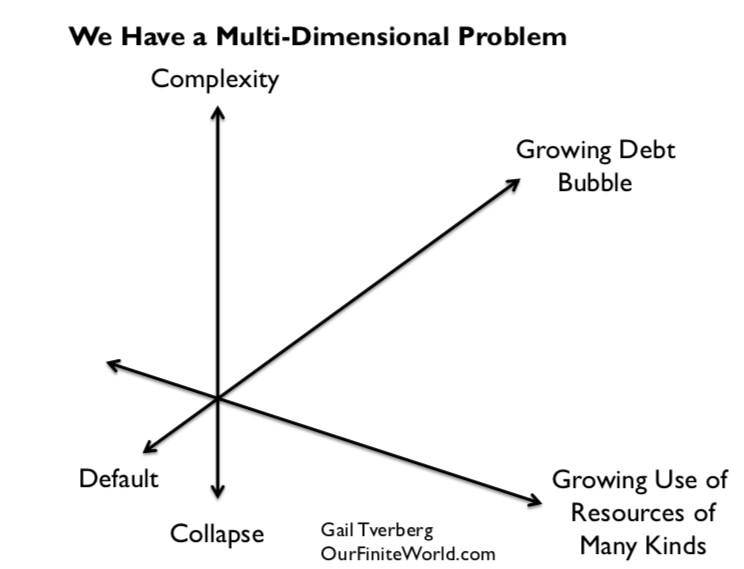
Figure 4.
Growing complexity is very closely related to “Technology will save us.” Growing complexity involves the use of more advanced machinery and ever-more specialized workers. Businesses become larger and more hierarchical. International trade becomes increasingly important. Financial products such as derivatives become common.
Growing debt goes hand in hand with growing complexity. Businesses need growing debt to support capital expenditures for their new technology. Consumers find growing debt helpful in affording major purchases, such as homes and vehicles. Governments make debt-like promises of pensions to citizen. Thanks to these promised pensions, families can have fewer children and devote fewer years to child care at home.
The problem with adding complexity and adding debt is that they, too, reach diminishing returns. The easiest (and cheapest) fixes tend to be added first. For example, irrigating a field in a dry area may be an easy and cheap way to fix a problem with inadequate food supply. There may be other approaches that could be used as well, such as breeding crops that do well with little rainfall, but the payback on this investment may be smaller and later.
A major drawback of adding complexity is that doing so tends to increase wage and wealth disparity. When an employer pays high wages to supervisory workers and highly skilled workers, this leaves fewer funds with which to pay less skilled workers. Furthermore, the huge amount of capital goods required in this more complex economy tends to disproportionately benefit workers who are already highly paid. This happens because the owners of shares of stock in companies tend to overlap with employees who are already highly paid. Low paid employees can’t afford such purchases.
The net result of greater wage and wealth disparity is that it becomes increasingly difficult to keep prices high enough for oil producers. The many workers with low wages find it difficult to afford homes and families of their own. Their low purchasing power tends to hold down prices of commodities of all kinds. The higher wages of the highly trained and supervisory staff don’t make up for the shortfall in commodity demand because these highly paid workers spend their wages differently. They tend to spend proportionately more on services rather than on commodity-intensive goods. For example, they may send their children to elite colleges and pay for tax avoidance services. These services use relatively little in the way of commodities.
Once the Economy Slows Too Much, the Whole System Tends to Implode
A growing economy can hide a multitude of problems. Paying back debt with interest is easy, if a worker finds his wages growing. In fact, it doesn’t matter if the growth that supports his growing wages comes from inflationary growth or “real” growth, since debt repayment is typically not adjusted for inflation.

Figure 5. Repaying loans is easy in a growing economy, but much more difficult in a shrinking economy.
Both real growth and inflationary growth help workers have enough funds left at the end of the period for other goods they need, despite repaying debt with interest.
Once the economy stops growing, the whole system tends to implode. Wage disparity becomes a huge problem. It becomes impossible to repay debt with interest. Young people find that their standards of living are lower than those of their parents. Investments do not appear to be worthwhile without government subsidies. Businesses find that economies of scale no longer work to their advantage. Pension promises become overwhelming, compared to the wages of young people.
The Real Situation with Oil Prices
The real situation with oil prices–and in fact with respect to commodity prices in general–is approximately like that shown in Figure 6.

Figure 6.
What tends to happen is that oil prices tend to fall farther and farther behind what producers require, if they are truly to make adequate reinvestment in new fields and also pay high taxes to their governments. This should not be too surprising because oil prices represent a compromise between what citizens can afford and what producers require.

Figure 7. Illustration indicating that the world has already reached a point where no oil price works for both oil suppliers and oil consumers.
In the years before diminishing returns became too much of a problem (back before 2005, for example), it was possible to find prices that were within an acceptable range for both sellers and buyers. As diminishing returns has become an increasing problem, the price that consumers can afford has tended to fall increasingly far below the price that producers require. This is why oil prices at first fall a little too low for producers, and eventually seem likely to fall far below what producers need to stay in business. The problem is that no price works for both producers and consumers.
Affordability Issues Affect All Commodity Prices, Not Just Oil
We are dealing with a situation in which a growing share of workers (and would be workers) find it difficult to afford a home and family, because of wage disparity issues. Some workers have been displaced from their jobs by robots or by globalization. Some spend many years in advanced schooling and are left with large amounts of debt, making it difficult to afford a home, a family, and other things that many in the older generation were able to take for granted. Many of today’s workers are in low-wage countries; they cannot afford very much of the output of the world economy.
At the same time, diminishing returns affect nearly all commodities, just as they affect oil. Mineral ores are affected by diminishing returns because the highest grade ores tend to be extracted first. Food production is also subject to diminishing returns because population keeps rising, but arable land does not. As a result, each year it is necessary to grow more food per arable acre, leading to a need for more complexity (more irrigation or more fertilizer, or better hybrid seed), often at higher cost.
When the problem of growing wage disparity is matched up with the problem of diminishing returns for the many different types of commodity production, the same problem occurs that occurs with oil. Prices of a wide range of commodities tend to fall below the cost of production–first by a little and, if the debt bubble pops, by a whole lot.
We hear people say, “Of course oil prices will rise. Oil is a necessity.” The thing that they don’t realize is that the problem affects a much bigger “package” of commodities than just oil prices. In fact, finished goods and services of all kinds made with these commodities are also affected, including new homes and vehicles. Thus, the pattern we see of low oil prices, relative to what is required for true profitability, is really an extremely widespread problem.
Interest Rate Policies Affect Affordability
Commodity prices bear surprisingly little relationship to the cost of production. Instead, they seem to depend more on interest rate policies of government agencies. If interest rates rise or fall, this tends to have a big impact on household budgets, because monthly auto payments and home payments depend on interest rates. For example, US interest rates spiked in 1981.

Figure 8. US short and long term interest rates. Graph by FRED.
This spike in interest rates led to a major cutback in energy consumption and in GDP growth.

Figure 9. World GDP Growth versus Energy Consumption Growth, based on data of 2018 BP Statistical Review of World Energy and GDP data in 2010$ amounts, from the World Bank.
Oil prices began to slide, with the higher interest rates.

Figure 10.
Figure 11 indicates that the popping of a debt bubble (mostly relating to US sub-prime housing) sent oil prices down in 2008. Once interest rates were lowered through the US adoption of Quantitative Easing (QE), oil prices rose again. They fell again, when the US discontinued QE.

Figure 11. Figure showing collapsing debt bubble at the time US oil prices peaked, and the use of Quantitative Easing (QE) to stimulate the economy, and thus bring prices back up again.
While these charts show oil prices, there is a tendency for a broad range of commodity prices to move more or less together. This happens because the commodity price issue seems to be driven to a significant extent by the affordability of finished goods and services, including homes, automobiles, and restaurant food.
If the collapse of a major debt bubble occurs again, the world seems likely to experience impacts somewhat similar to those in 2008, depending, of course, on the location(s) and size(s) of the debt bubble(s). A wide variety of commodity prices are likely to fall very low; asset prices may also be affected. This time, however, government organizations seem to have fewer tools for pulling the world economy out of a prolonged slump because interest rates are already very low. Thus, the issues are likely to look more like a widespread economic problem (including far too low commodity prices) than an oil problem.
Lack of Growth in Energy Consumption Per Capita Seems to Lead to Collapse Scenarios
When we look back, the good times from an economic viewpoint occurred when energy consumption per capita (top red parts on Figure 12) were rising rapidly.

Figure 12.
The bad times for the economy were the valleys in Figure 12. Separate labels for these valleys have been added in Figure 13. If energy consumption is not growing relative to the rising world population, collapse in at least a part of the world economy tends to occur.

Figure 13.
The laws of physics tell us that energy consumption is required for movement and for heat. These are the basic processes involved in GDP generation, and in electricity transmission. Thus, it is logical to believe that energy consumption is required for GDP growth. We can see in Figure 9 that growth in energy consumption tends to come before GDP growth, strongly suggesting that it is the cause of GDP growth. This further confirms what the laws of physics tell us.
The fact that partial collapses tend to occur when the growth in energy consumption per capita falls too low is further confirmation of the way the economics system really operates. The Panic of 1857 occurred when the asset price bubble enabled by the California Gold Rush collapsed. Home, farm, and commodity prices fell very low. The problems ultimately were finally resolved in the US Civil War (1861 to 1865).
Similarly, the Depression of the 1930s was preceded by a stock market crash in 1929. During the Great Depression, wage disparity was a major problem. Commodity prices fell very low, as did farm prices. The issues of the Depression were not fully resolved until World War II.
At this point, world growth in energy consumption per capita seems to be falling again. We are also starting to see evidence of some of the same problems associated with earlier collapses: growing wage disparity, growing debt bubbles, and increasingly war-like behavior by world leaders. We should be aware that today’s low oil prices, together with these other symptoms of economic distress, may be pointing to yet another collapse scenario on the horizon.
Oil’s Role in the Economy Is Different From What Many Have Assumed
We have heard for a long time that the world is running out of oil, and we need to find substitutes. The story should have been, “Affordability of all commodities is falling too low, because of diminishing returns and growing wage disparity. We need to find rapidly rising quantities of very, very cheap energy products. We need a cheap substitute for oil. We cannot afford to substitute high-cost energy products for low-cost energy products. High-cost energy products affect the economy too adversely.”
In fact, the whole “Peak Oil” story is not really right. Neither is the “Renewables will save us” story, especially if the renewables require subsidies and are not very scalable. Energy prices can never be expected to rise high enough for renewables to become economic.
The issues we should truly be concerned about are Collapse, as encountered by many economies previously. If Collapse occurs, it seems likely to cut off production of many commodities, including oil and much of the food supply, indirectly because of low prices.
Low oil prices and low prices of other commodities are signs that we truly should be concerned about. Too many people have missed this point. They have been taken in by the false models of economists and by the confusion of Peak Oilers. At this point, we should start considering the very real possibility that our next world problem is likely to be Collapse of at least a portion of the world economy.
Interesting times seem to be ahead.


“…the world economy may be facing grimmer prospects in 2019.
“In a fresh sign of mounting growth woes, Federal Reserve Chair Jerome Powell said last week that interest rates are “just below” neutral, a distinct change from his remarks in early October that the Fed was “a long way” from neutral.
“The change in phrasing by Powell, who has been under fire from US President Donald Trump about rate hikes, is considered a hint that Fed rate hikes may slow.
“The significant change in the Fed’s rate path apparently points to concerns that US economic growth might not hold up if the current monetary policy continues into the new year.
“The news follows General Motors’ recent announcement that it will lay off 14,000 workers and close five facilities in North America, which the car company said would prepare it for the future world of autonomous and electric vehicles. This move inevitably deepened global recession fears.
“Also, the recent slump in crude oil prices indicates slowing demand growth, a portent of sluggish global GDP expansion.”
http://www.globaltimes.cn/content/1130281.shtml
“Oil fell on Wednesday as a swelling supply glut and signs of an economic slowdown weighed on crude prices a day ahead of an OPEC meeting at which the producer club is expected to decide supply cuts.”
https://uk.finance.yahoo.com/news/u-oil-prices-slide-global-markets-economic-concerns-010646834–finance.html
Oil?
I’m wondering about the counter trend in spiking electricity pricing though, it’s either just VERY lagging indicator, so it will crash with delay after the oil crash – affordability/GFCII etc. scenario fully takes place.
Or it is indeed very different phenomena largely based on the peculiar situation in Europe – Germany which closed her fleet of NPPs, but over expanded on (spikey) wind, now continues to enlarge that natgas (Russian fuel sourced) driven baseload backbone as well as handy cheap imports from Austrian Hydro and Czech Nuclear, Polish coal among other things..
Shorting this epic Electric Mountain would be trade of the century, but given the above it might not eventually happen exactly in the same fashion as in other historic cases.. that’s why I put it to audience’s attention here..
“Since June energy prices in the UK and Europe have risen significantly leaving many energy managers with a large overspend on budget forecasts for winter 2018 and beyond.
“The wholesale gas cost for 2019 calendar year rose 46% between 1st April and 30th September, and wholesale electricity 36%. This has moved the energy content of a typical electricity bill from 43% to 48% even accounting for a 9% increase in non-energy elements.
“So what changed in the market to make such a dramatic impact in a few months?
“At the start of the summer there was a lot of nervousness about the volume of gas stocks not only in the UK where we had experienced the third coldest March in 37 years, but also in Europe.
“2018 was a year of high infrastructure maintenance, including the Russian pipelines, and consumers over the summer needed to compete with the gas storage system for production. This background issue was then compounded by two main factors:
“The EU agreed to limit the volume of carbon for auction to increase the price of coal generation.
“This formed part of the policy of geared towards hitting carbon reduction targets. The carbon price consequently rose from €7 to €21, the highest since 2008.
“This pushed up the price of coal generation in Europe, and it became more attractive to generate electricity from gas fired generators.
“Carbon price became a main driver of UK gas price over this time, and therefore also of electricity.”
https://www.openaccessgovernment.org/energy-prices-future-for-europe/55356/
Thanks, that’s understood.
But what this means into the future is the question at hand?
Namely, should the carbon pricing scheme remain more or less “intact”, the electricity price is not likely going to crash and burn hard during GFCII.. Also traditional natgas suppliers of the area (besides RU) meaning UK, Norway, Algeria, .. are exactly not likely to increase and or maintain their level of current production into the future.. hence again support crutch under the electricity pricing.. Plus both the US and Gulfies are eyeing world markets to dump their natgas (although pricier liquefied variety) as well.
In my eyes it all goes evidently back to slow /stair case / regionally diverse collapse scenarios..
What is going to crash and burn is the economy of Western Europe. Citizens cannot afford their current high prices of electricity. Economies of Western Europe have a hard time creating enough value with the energy products that they use, so that they can afford to buy oil and gas from the world market. As the price of electricity rises, whether because of the cost of the underlying product or because of carbon costs, it pushes Europe farther and farther down. Added to this is the high cost of all of renewable subsidies, if these don’t make it back into the pricing scheme, and instead are paid out of government coffers. (They may, in fact, get back into the pricing scheme in Europe, creating part of the problem.) Expect spreading riots, if this continues.
That is a very interesting article! Thanks for linking to it. It points to the folly of depending on renewables. It talks about the low wind problems and the cold winter problem. Also closing the Rough storage unit in UK.
The article is about the impact on businesses. No doubt, this is part of what is affecting the bad GDP growth. There is also an impact on consumers. It might be somewhat less, because much more of their energy costs are “fixed.”
I can see that the UK steel industry is up in arms about our particularly exorbitant electricity costs:
“British steelmakers pay twice as much for electricity as their French competitors and 50 percent more than their German rivals, an industry report showed on Wednesday, piling pressure on the sector as Britain prepares to leave the European Union.
“A study by the industry, The Energy Price Scandal: A Fair Power Deal for UK Steel, shows the average electricity price for steel producers in the UK this year is about £65 per megawatt hour (MWh).
“It is £31/MWh in France and £43/MWh in Germany.
“The energy cost difference between German and UK steelmakers has rocketed from £18/MWh in 2017-18 to £22/MWh in 2018-19; and between French and UK power prices from £17/MWh in 2017-18 to £34/MWh in 2018-19.
“A typical steel site could use more than half a million MWh each year.
“UK Steel director-general Gareth Stace said: “This is the third year we have analysed the disparity between the electricity prices faced by UK steelmakers and those of their EU competitors, and the third year it has increased.
““This price disparity can now add up to £17 to the cost of producing a tonne of steel.
““This can be the difference between winning and losing a supply contract.””
https://www.mirror.co.uk/news/politics/steel-bosses-demands-electricity-price-13684967
I can believe this.
This shows the folly of depending upon intermittent renewables, and trying to added carbon taxes on top. It is possible to kill your economy, when fluctuations work in the wrong direction.
I advise everybody to re-read latest article from Dr. Tim at Surplus, basically he presents the trend which I called years ago, that renewables start to make economic sense on their own just in the very latest (brief?) stage before larger collapse-reshuffle-reset..
It’s already the case in some countries with very high electricity costs, and it will be sheer no brainer with cheap used parts laying around from massive OEM industries (e.g. power electronics and large volume e-car batteries) as we are scaling up from hundred thousands to millions y/y production capacities.
Now, the problem will be further segregation of people depending on overpriced and increasingly fragile centralized networks (like the grid, sewage, food) and the elite strata with some over reach into parts of middle classes which would be able to run many of these systems on their own.
Obviously this is only temporary -brief- period as long as these parts last and or can be still sourced – exchanged, serviced as used, so no more than ~20-30yrs. Well again from zoomed out macro view that’s not worth the attention, yet from personal stance such incoming development drives attention.
You see it’s like the medieval times, you can escape the plague on your second, third place of residence or even through (paid for) complete foreign land relocation. But as poor feudal subject not so much..
This is a link. I sort of scanned it. He hasn’t figured out that he has an energy per capita problem, and it is the per capita part that kills him. He can back out the energy cost of energy, but I don’t think it gets him to the solution he needs.
Look at where the UK is now. We saw this article today.
The energy price hike and what it means for European businesses
“Activity in Germany’s services sector eased in November due to rising cost pressures and waning business optimism, slowing growth in the private sector of Europe’s largest economy to a near four-year low, a survey showed on Wednesday.”
https://www.euronews.com/2018/12/05/german-private-sector-growth-slows-to-near-four-year-low-pmi
“Japan’s economy is expected to have contracted more sharply initially estimated in the third quarter, with analysts in a Reuters poll forecasting a steep drop in capital spending in a sign of rising headwinds in 2019 as global demand ebbs. The poll of 16 economists predicted the world’s third-biggest economy to have shrunk an annualized 1.9 percent in July-September, worse than the preliminary reading of a 1.2 percent contraction.”
https://www.reuters.com/article/us-japan-economy-gdp/japans-third-quarter-economic-contraction-seen-deepening-as-businesses-cut-spending-reuters-poll-idUSKBN1O40L0
But PM Abe has a cunning plan! Japan is preparing for the Tokyo Olympics in 2020 and the Osaka Expo in 2025. This will keep a lot of people too occupied to notice the price of soy sauce going up.
Actually, I have my doubts as to whether the Osaka Expo will open. BAU might not last that long.
Boycotts are on for 2020 also
I bet that Eastern Europe is doing better than Western Europe. I haven’t seen the information yet, however.
Gail, you are quite right. Poland and Romania in particular are posting the best growth figures in the EU. You wonder how long that will last though, as they look to be quite reliant on manufacturing goods that are bought in the rest of the EU, which is starting to look shaky.
Poland and Romania (and other countries following a similar path) are likely the ones that are importing the diesel products that Western Europe is finding so scarce.
If we believe BP data, European diesel consumption has been rising more quickly than world diesel consumption since 2012. Since 2012, European diesel/gasoil consumption is reported to have increased by 8.3%, while world diesel/gasoil consumption has rising by 6.1%.
If we look at the broader category “Middle Distillates,” which includes jet fuel/kerosine as well as diesel/gasoil, the increase for Europe between 2012/2017 has been a total of 10.1%, versus 8.4% for the world as a whole.
I am suspicious that Eastern Europe is “eating the lunch” of Western Europe. The US is exporting increasing amounts of diesel, but they are not going to Western Europe. Eastern Europe seems to be the part of the world that can best compete with China and India. They have coal to support their operations, so they are not as dependent on wind turbines and solar panels. Their costs can be low, while Western Europe’s costs soar.
“The [US] housing market recession is coming. In recent months, we’ve seen shares of homebuilder stocks get hammered. Existing and new home sales have declined sharply. And the pace of home price appreciation has now declined for six straight months.
“The factors weighing on housing are not particularly new or novel — a lack of affordable housing supply and the rise in mortgage rates to seven-year highs are pressuring the market.”
https://finance.yahoo.com/news/housing-market-recession-coming-224827298.html
“Plunging automobile sales add to evidence that higher borrowing costs are beginning to eat into Canadian economic growth, possibly faster than the central bank expected.
“Light vehicle sales dropped 8.2 percent November from a year earlier, according to the Automotive News Data Center in Detroit. It was the largest decline since 2009…”
http://www.autonews.com/article/20181205/COPY01/312059996/interest-rate-hikes-hurting-car-sales-canadian-economy
“Australia’s economy slowed more than expected last quarter as consumers reacted to tepid wage growth by shutting their wallets, a disappointing outcome that sent the local dollar sliding as investors pushed out the chance of any rate hike.
“The news came as fears of a possible slowdown in the U.S. economy and the Sino-U.S. tariff slugged world shares and threatened future business investment.”
https://www.reuters.com/article/us-australia-economy-gdp/australias-economy-slows-debt-laden-consumers-a-deadweight-idUSKBN1O4044
None of these are good news!
Most people I know do not borrow for a car they use a TFSA and pay themselves back.
I Never talk to the sales sharks…finance department…Honda just called me to wish me happy birthday.
I have something they need CASH
They have something I want…a new car and floor mats and a generator.
TFSA…https://www.tangerine.ca/en/products/investing/tfsas/index.html?gclid=Cj0KCQiArqPgBRCRARIsAPwlHoX-Ddngrs8SdnIpEVaCCUo13XCqsSlT6M9E2hv4AlJjDfbKqeb3wooaAlLrEALw_wcB&gclsrc=aw.ds
I would ask myself, “Guaranteed by whom?” If we have debt defaults, all of these devices are likely to get into financial trouble. Can/will the government bail them all out? How are they different from pension fund promises?
Also, this approach would seem to be a little slower at getting people into new vehicles than just giving the people loans directly. (They have to save up at $5,500 per year for a car, for example.) Thus, it doesn’t stimulate the economy as much.
Ouch!
“Liquidity is like good health. You don’t really appreciate it until you lose it. Investors are starting to appreciate it. As volatility has surged, first in the stock market and now in credit markets, liquidity is starting to dry up across segments of the corporate bond markets.
“The ominous widening of spreads in the high-yield bond market — from 322 basis points on Oct. 2 to 422 points on Nov. 20 — could be a sign of trouble to come.”
https://www.cnbc.com/2018/12/03/investors-worry-liquidity-crisis-might-loom-on-fixed-income-horizon.html
“The sharp fall witnessed in the U.S. T-bond yields this week caused a yield curve inversion for the first time since the financial crisis presented by the yield on the 5-year note dropping below the yield on the 2-year note.
“Commenting on this development, Jeffrey Gundlach, chief executive officer of DoubleLine Capital, said that the yield curve inversion on short end maturities was a signal that the economy was poised to weaken.”
https://www.fxstreet.com/news/us-yield-curve-inversion-revives-concerns-over-economic-slowdown-201812041910
Yield curve inversion means banks will be less willing to lend, because they can’t make much money off the deal.
Look at this!
http://www.free-energy-info.com/indexOct2018.html
Now I won’t need to spend any money ever again.
B**S for the KKKlllliiimmaate cchhaaaaanggeee story. Today I had to scrape my wind shield. There you have it!
ICE!!!!
I had to swipe two wind shields!
What other explanation could there be?
Inquiring minds want to know—–
Better hope the globe warms. Good chance we’ll spend what remains of our history at temperatures equal to ambient – i.e. no indoor climate control…like most houses before the 20th century.
B**S = BUGS ?
Had to clean my wind shield too.
You need a remote car starter
DOW:
-799.36 (3.10%)
At least it wasn’t 800.
Not even close!
I found this regarding markets today:
API crude inventories
Crude Inventories :
Crude: +5.36M
Cushing: + 1.4M
Gasoline: + 3.6M
Distillates: +4.3M
Those numbers are just freaking crazy!
A little over half of what the US uses in a day.
gee, could rising inventories mean that there is falling demand?
and/or less affordability for oil byproducts by the average person?
inquiring minds need to know…
and…
could rising FF inventories be a sign of a global recession on the horizon?
like…
2019?
API estimates tend to be way off. Let’s wait for EIA numbers.
One issue I hadn’t noticed is that the US seems to be dumping oil from the SPR into the marketplace. 2.0 Million barrels in the week ended 11/23. Stupid move! It started dumping SPR reserves the first week in October. That is part of the crude oil stock fill. The total reduction since the beginning of October is 9.45 million barrels.
> the US seems to be dumping oil from the SPR into the marketplace … It started dumping SPR reserves the first week in October.
And the result has been a 34% fall in the price of WTI from $76.50 on 3 October to $50 on 24 November. Its remarkable what an average 1.5 Mbpd for 6-7 weeks can do.
This was probably to penalise MbS for the Khashoggi murder. Meanwhile the MSM keep telling us that he was a democratic freedom-lover, when in fact he was an islamist who fought with the Mujahadeen and befriended Usama bin Laden in Afghanistan against the Russians (strictly for “journalistic purposes” of course). https://thearabweekly.com/sites/default/files/styles/article_image_800x450_/public/2018-10/ill.jpg
All that is out at this point is the Summary. Bold added by me. It says:
U.S. commercial crude oil inventories (excluding those in the Strategic Petroleum Reserve) decreased by 7.3 million barrels from the previous week. At 443.2 million barrels, U.S. crude oil inventories are about 6% above the five year average for this time of year. Total motor gasoline inventories increased by 1.7 million barrels last week and are about 4% above the five year average for this time of year. Finished gasoline inventories decreased while blending components inventories increased last week. Distillate fuel inventories increased by 3.8 million barrels last week and are about 5% below the five year average for this time of year. Propane/propylene inventories decreased by 1.3 million barrels last week and are about 3% below the five year average for this time of year. Total commercial petroleum inventories decreased last week by 8.3 million barrels last week.
Total products supplied over the last four-week period averaged 21.2 million barrels per day, up by 7.6% from the same period last year.[Wow!] Over the past four weeks, motor gasoline product supplied averaged 9.1 million barrels per day, up by 0.2% from the same period last year. Distillate fuel product supplied averaged 4.1 million barrels per day over the past four weeks, up by 5.1% from the same period last year. Jet fuel product supplied was up 3.7% compared with the same four-week period last year.
Hello Gail,
thanks for your great work!!!
For me EROI follows the second law of thermodynamics:
https://i.redd.it/jigadvf0f3221.jpg
It’s like a ticket from El Azizija to Wostok Station.
Entropy of an isolated system can never decrease.
At the very beginning entropy was zero, at the end entopy will reach 99 percent.
Google translator tell you more about that:
http://www.dasgelbeforum.net/forum_entry.php?id=441986
Best regards,
soma2amos
the Sun blasts the Earth with a large amount of energy daily…
so then is the Earth really an “isolated system”?
Everything has an expiration date!”
The irreversible remaining life of the earth would be even without human intervention only about 400 million years.
Approximately every 62 million years has been due on the Earth a regulation.
The Homo sapiens is now on the planet for about 400,000 years and sends through its high reproductive rate to surpass the 3rd mass extinction on Earth 245 million years ago by Methanosarcina with a rate of extinction of 90% of all species in a matter of fact shorter time ,
From El Azizija to Wostok Station, we have made ourselves wide.
According to the Stefan-Boltzmann formula, the average radiated power of the sun acting on the earth is 174 petawatts, and it is easy for all species to live, except since the invention of the steam engine, the man of industrial times.
The world’s energy needs of humanity in 2010 was 140 PWh.
This represents an increase of about 49% compared to the 1990 PWh. More than 85% of global primary energy needs are currently covered by fossil fuels, such as oil and gas, and hard coal and lignite.
The front-runners in energy consumption in 2010 were the US with 87,216 kWh / a per capita, followed by Europe with 40,821 kWh / a per capita and China with 34,774 kWh / a per capita.
However, some people, as we know from experience, are still able to survive well today with just 5,000 kWh / a.
The world demand for electrical energy currently stands at around 17% of 140 PWh.
Electrical energy is about four times more valuable to humans than heat energy due to the flexible usable entropy stage. 10 kWh of electricity therefore always cost significantly more than 1 liter of oil, which you have to burn only lossy to generate electricity from it.
Entropy is the primary variable of thermodynamics that can be accounted for. Entropy can be stored, transported and produced. Bodies respond to an entropy supply with a temperature increase (sensible heat), a volume change, or a change in state (latent heat). The entropy is measured in Joules per Kelvin (J / K) or Watts per Kelvin.
Example: If an energy current of 1000 W flows into the pan from a cooking plate and the boundary layer between plate and pan is at a temperature of 127 ° C, the entropy current has a strength of 2.5 W / K.
This heat conduction is unfortunately completely irreversible, that is, it is irreversible.
If I operate this energy conversion for 60 minutes, it currently costs me in Germany about 0.25 €.
This is dirt cheap, because if I wanted to provide this energy from my own physical strength, I would have to pedal for ten hours vigorously in the pedals.
For a worker with a minimum wage of 8 euros, this cooking costs only 2 minutes of his life.
A Klaus Zumwinkel costs of course, this cooking process much less life.
It would be interesting to know how many seconds an American has to work minimum wages for a kWh currently? I suspect less than 60 seconds.
We are convinced that we will have to reduce our energy requirement to 5,000 kWh / a per capita for at least another 20 years, and we can not change anything for the time being. Humans always change their behavior, as Rousseau has already realized if there is no other way out.
Humans will need to move to warm, fairly wet areas of the earth, and live in a near hunter-gatherer lifestyle to get to 5,000 kWh / a per capita, I expect. Humans will still need fuel for cooking, no matter whatever else they get along without. If they want any metals at all, it sends the fuel requirement way up.
A friend recently clued me in about a way of cooking spaghetti using much less energy than if it7s boiled for 7, 9, 11 or however many minutes. Soak it in cold water for a few hours before cooking, then bring to the boil, and it’s done.
It works, and the product is edible, but I miss that al dente finish.
Similarly, brown rice can be cooked to perfection in a thermos pot (just pour on boiling water and screw down the lid!) if it’s roasted for about 15 minutes beforehand. You can roast enough in a frying pan for about ten pots full, which makes it an economic prospect both time and money-wise. The traditional alternatives are to boil brown rice for an hour or more at normal pressure or for half an hour in a pressure cooker.
Someone actually gets it!
Compared with insolation, the energy humans are currently deriving from fossil fuel burning is utterly trivia. Commenters suggesting that a transition to renewable energy is not humanly possible are drinking a very toxic soda indeed. We need to switch human industrial energy consumption from burning fossil fuels (prehistoric stored sunlight) to more contemporary solar-derived energy. How hard can it be?
“Solar and wind capturing devices are not alternative energy sources. They are extensions of the fossil fuel supply. There is an illusion of looking at the trees and not the forest in the “Renewable” energy world. Not seeing the systems, machineries, fossil fuel uses and environmental degradation that create the devices to capture the sun, wind and biofuels allows myopia and false claims.
“Energy Return on Energy Invested (ERoEI) is only a part of the the equation. There is a massive infrastructure of mining, processing, manufacturing, fabricating, installation, transportation and the associated environmental assaults. Each of these processes and machines may only add a miniscule amount of energy to the final component of solar or wind devices. There would be no devices with out this infrastructure…”
http://sunweber.blogspot.com/2011/12/machines-making-machines-making.html
Also, the article doesn’t mention it but nitrogen trifluoride (NF3) and sulfur hexafluoride (SF6) are byproducts of the manufacturing process of solar panels. They are extremely potent heat-trapping gases. NF3 has a g r een house gas potency that is 16,600 times greater than CO2; SF6 is 23,900 times more potent.
EROEI calculations have major problems. The idea that any energy source with an EREOI above some set level (5:1 or 2:1 or 1:1) is acceptable is just plain nonsense. To the extent that EROEI works as a proxy for energy cost, it is really the average EROEI for the whole system that matters. You cannot remove a high EROEI energy source and substitute a lower EROEI energy source without major problems.
Also, EROEI discussion diverts attention from the issue of quantity. Energy consumption per capita seems to need to rise. This can only happen if price is very low. This only happens with very high EROEI energy sources.
The problem is that the conversion of this solar energy to the energy we need, when we need it, if far higher than world systems can handle. It is also very demanding of resources of various types. It can only be built with the fossil fuel system. We cannot do it fast enough, and cheaply enough, to possibly work.
In a few years after the wave in that scenario the nature has solved the issue:
https://i.redd.it/0hfgqc4lmo021.jpg
Don’t know the english word for the feeling of a man who stops consumption of heroin.
In Germany we call it “he is on cold turkey”
We Want Trump!
Homo sapiens are on tract for a extinction.
Rather short for a species.
Macron called the protesters: Thugs!
So…will be open fire?
So… will he give in to the demands of the “thugs”?
https://www.usnews.com/news/politics/articles/2018-12-04/macron-delays-french-fuel-tax-hike-amid-violent-yellow-vest-protests
oh, look, he gave in…
which sets a personal precedent for himself…
now, French “thugs” will be looking to repeat their viollent protests whenever they want Macron to reverse course…
ah, Paris…
I hear that it once was a lovely city to visit…
In six months he restores half the increase and then in another six months he adds back 45% and then in another year he adds anything he wants to add.
https://www.youtube.com/watch?v=XlYOE2iprPg
Yes highway man
One Thing Leads to Another….another great tune from the 80’s by the FIXX
https://m.youtube.com/watch?v=JHYIGy1dyd8
In our 2012 interview with The Fixx lead singer/lyricist Cy Curnin, he explained the meaning of this song, which deals with malleable politicians. “If you’re going to be a liar, you’d better be a damn good liar and remember what you said, or the whole thing’s going to get pear shaped,” said Curnin. “That was 30 years ago, and look where the system is now. A lot of people stand on ballot boxes and say a lot of things and lie in order to get elected and do nothing. So those songs I’m pretty proud of
Yes, indeed, bulleye…we readily accept lies that lead ourselves to Extinction…bravo
“Homo sapiens are on tract for a extinction.
Rather short for a species.”
we have no data for the expected lifespan of a self-conscious so-called “intelligent” species…
throughout the universe, perhaps all self-conscious so-called “intelligent” species have come to extinction far sooner than the average species…
the evolution of a species to self-consciousness and intelligence may be followed by relatively quick extinction…
for homo sapiens, we can hope so!
because this will end all human suffering…
sounds wonderfully good to me…
+++++++
https://youtu.be/TiX-fs-BvX0
The U.S treasury yields have started to invert. The Fed’s rate hike party is over.
The oil price has collapsed from resent highs. The stock markets are neurotic. And the global debt bubble is starting to look shaky.
Meanwhile Paris is burning and the people are chanting: We Want Trump!
People are going nuts!
Trump is now the answer
to all our ills and woes
seen now as a saviour
as we slip into death’s throes
but unlike Captain Smith
(of wide Titanic fame)
he will not go down with ship
without licensing his name
I for one do not regard any man or woman as my leader or “saviour”. I’m sure Trump will make everyone’s suffering about himself. The biggest snowflake of them all. Give him credit he’s conned the world and I promise you he couldn’t give a damn about anyone or anything outside of himself.
i was trying to insert a little dark humour into the situation
please keep that dark humour coming, Norman.
The Darker, the better.
Regarding the inverting treasury yields, the WSJ says:
The inversion is important because banks make their money by “borrowing short and lending long.” If there is not enough spread between what they are paying for money, and what they are lending money out, they have a problem making loans.
Of course, it is not just the banks that then have a problem. The economy needs growing debt, but if the banks can’t make money making loans, they make many fewer loans, pushing the economy downward.
So, back to zero rates and QE?
Yes, yes….SAVED BY ZERO….the 80’s were the Fabulous….oh…if we only could go back
https://m.youtube.com/watch?v=JOiZP8FS5Ww
The FIXX…great tune to trott
Lyrically, “Saved by Zero” is a reference to the Buddhist mantra Śūnyatā. Fixx frontman Cy Curnin reflected on its meaning in a 2008 interview:
“It was about looking at your own life, not so much about amassing material things but about experiences that lend you to be blissful… The song was written from the point of view of the release you get when you have nothing left to lose. It’s sort of a meditation. It clears your head of all fears and panics and illusions and you get back to the basics, which is a Buddhist mantra, which I practiced back then, and which I still do.
Back to ZERO
Wonderful philosophy – on a full stomach and in good health……
I incline to Stoicism: you do feel fear, because there is much to fear, and pain is real, but you muster the courage to go on.
This is also the ethic of Old Germanic and Norse culture: you fight, even in defeat.
I was told a good story by a Greek businessman about Greek banks – with the encouragement of the government – faking business loans to make their books and the economy look good to Brussels.
Even presidents are not immune to the effects of diminishing returns.
Yes, we can! And on a global scale! The belief in the power of politics never seems to cease.
https://www.socialeurope.eu/the-migration-challenge-and-reform-capitalism-through-mutual-solidarity
But I want my CAKE and EAT it TOO
Dow tumbles nearly 800 points as Tuesday losses gain steam; 10-year yield hits 2.88%
Mark DeCambre
Mark DeCambre
MarketWatchDecember 4, 2018, 1:44 PM EST
The Dow Jones Industrial Average and the broader stock market on Tuesday skidded sharply lower, relinquishing all of Monday’s post-G-20 rally–and then some. The Dow was down 754 points, or 2.9%, at 25,076. The S&P 500 index was off 3% at 2,707, while the Nasdaq Composite Index retreated 3.4% at 7,190. A day ago, the stock market climbed with risk appetite as President Donald Trump and China’s leader Xi Jinping forged a momentary pause in trade hostilities at the sidelines of the Group of 20 summit in Argentina. However, investors have grown doubtful that a real deal in the long-run is possible. On top of that, the 10-year Treasury rate has extended a drop toward a three-month low at 2.88%, with that move also narrowing a closely watched spread between that benchmark government debt and the short-dated 2-year Treasury note . That spread is the tightest since 2007 at 10 basis points, with a tightening, or flattening, spread between the short-dated and longer-dated bonds, generally reflecting that bond investors harbor a downbeat economic outlook.
Wow, you go out for a little while, and the DOW:
-731.59 (2.83%)
Exxon strikes it BIG
https://finance.yahoo.com/news/exxonmobil-apos-massive-oil-discovery-134300324.html
YahooFINANCE
Judge threatens CVS-Aetna merger, UAW challenges GM, Netflix focuses on India
ExxonMobil’s Massive Oil Discovery Keeps Getting Bigger
Matthew DiLallo, The Motley Fool
Matthew DiLallo, The Motley Fool
Motley FoolDecember 4, 2018, 8:43 AM EST
ExxonMobil (NYSE: XOM) and its partners Hess (NYSE: HES) and China’s CNOOC have found a treasure trove of oil off the shore of Guyana over the past four years. The companies recently unveiled the 10th discovery on their jointly held acreage position, which they now believe contains more than 5 billion barrels of recoverable oil. That reinforces Exxon’s belief that the partnership can produce more than 750,000 barrels of oil per day (BPD) from the region by 2025.
It just keeps getting bigger
Exxon’s latest discovery at the Pluma-1 well, when combined with further evaluation of previous finds, led the company to boost its resource estimate from more than 4 billion barrels of oil equivalent (BOE) up to over 5 billion BOE. That’s enough resources to support at least five floating storage, production, and offloading (FSPO) vessels capable of producing more than 750,000 BPD.
Massive becomes smaller and smaller in recent years.
Greetings from Fast Eddy who is still alive.
Music from New Zealand:
alive!
Dear Gail,
I just read Antonio Turiel’s blog and Philippe Gauthier’one.
They express the same idea:
• Old quality field production (without sulfur) reduces.
• There is more and more poor quality heavy oil (like Alberta’s one that has a lot of sulfur).
• Shales are too light to produce diesel.
• Las but not least in 2020, ship’s heavy fuel with sulfur engines must disappear.
Refineries have 3 choices.
1. To use only good quality heavy oil that will increase prices.
2. To invest in new coking plant 1 billion $ each, and increase their prices and sell what is now garbage oil coke to power plants (so instead of having pollution on the sea we will have it in land).
3. To close
All the solutions imply an increase of prices.
But according to your model, the world cannot offer it. So the world will face a lack of diesel.
The issue is an affordability one. This happens here and everywhere else.
There are lots of fossil fuels available. In fact, there are a lot of alternatives available. The number (1), (2), and (3) problems is that none of them are affordable. The economy operates on a growing supply of affordable energy supplies.
IEA creates lots of scenarios, in denial of the reality of the physics of the situation. We cannot get along on either (a) a shrinking supply of energy or (b) high-priced energy. The issue we are up against is collapse, not peak oil.
Demand is a funny word. Could mean “want” or “can afford”. Which one does the IEA mean?
The new chart (forward projection of supply and demand) has no concept of price. Of course demand depends on price. An elasticity analysis would make more sense.
I think demand used to be a well defined economic phenomenon. Expecting increasing demand for energy products was reasonable – when energy was cheap. So, the word demand was well defined and understood. But the current economy is out of the bounds in which classical economics works. So, demand no longer means anything. I think we should discard classical economics at this point. Economics seems to be ridiculous assumptions with no basis in reality. We are now in the period where diminishing returns, deflation, un-affordability and collapse are no longer things that can be ignored. These are things that classical economics does not handle well or ignores outright.
Everyone seems to assume “demand” means “want.” It makes no sense, however, unless it means “can afford.” IEA hasn’t figured out that there is difference. Prices compared to wages of the non-elite workers are terribly important.
There are a few different mixtures for oil sands production. The recent preferred mixture seems to be dilbit using light tight oil or NGLs from the northern US. US refineries are set up for heavy oils. The dilbit generally goes to a refinery at Chicago. I recall seeing pictures of enormous piles of petcoke posted somewhere. Also, Canada has refineries to make syncrude and they have upgrading facilities using local natgas resources.
https://www.oilsandsmagazine.com/technical/product-streams
The US has benefited from refined products made from oil from the oil sands. With the way our refineries are set up, we can handle dilbit at not too high a cost. Cracking may be needed, but with cheap natural gas, it is not very expensive. We end up with not very expensive diesel and gasoline.
OIL (BRENT) PRICE COMMODITY
62.51 USD +0.61 (0.99%)
Still flat- up about 1
Healthcare automation:
At a visit yesterday for a routine eye examination at the main Mayo Clinic from check in to check out 30 minutes, no dilation. A machine scanned the retina , eyesight was measured by a machine both operated by a technician, all data automatically entered in an electronic health record, the physician came into exam room, confirmed the results, visually examined both eyes and it was over with approximately 5 minutes of physician time.
As I was checking in with a human at the desk I noticed kiosks with a slot for what appears to be a future cc type slot with various instructions implying it was a replacement for the receptionists at the front desk. Add a robot to escort you to the correct examining room and enormous costs are removed and quality of care improved. The electronic records are excellent and Mayo is now offering a general genetic test which could lead to treatments specifically tailored to the patient. Billing is automatic with the correct deductions and payments from insurance computed and only the balance appears on the statement.
As I mentioned in an earlier post, I was a dentist and at the end of my career ran a very large public health dental clinic, all records electronic; this stuff works when correctly integrated.
The computing power and effective use there of gets better and better.
Dennis L.
Or worse and worse. We need jobs that pay well for people, even without a lot of education and training. Robots add lots of debt, and lots of capital ownership for the already well-to-do. The whole set-up pushes the system toward collapse.
As a now forced into retirement orthopedic surgeon who has had to slog through many Electronic Medical Records (EMR) and Electronic Hospital Records (EHR) such as Nextgen, Medicus, and a host of others, I can get on my rant.
Electronics work well for some areas of medicine where the diagnoses ICD-10 are actually few in a specialty and the billing codes (CPT) also fairly straightforward. You may be right for opthalmology, but in orthopedics, the codes are myriad.
The simple fact is that most computer programmers cannot write decent software because they are computer “geeks,” not doctors or engineers. But is their simple failure to even recognize the logical need to merge the two disciplines confirms they are “geeks,” caught in their own microcosm belief that it’s all about computer code. (This is like economic theory that lives in its own word, failing to recognize the limit of resources, especially energy).
Thus the programs are doomed from start from lack of recognition of common sense required in recognizing the need to merge the two in order to write a successful, logical, expedient functional program which makes your task easier, not more difficult.
My three brothers, who are all mechanical engineers agree on this one.
In another twist my brother who worked at General Dynamics Electric Boat division In Groton Connecticut (nuclear submarines) left in disgust as the computer programs were so outdated, he couldn’t perform the necessary design requirements which he could accomplish with the Abacus? software.
On most programming now, especially in medical records, the program writers no longer follow the simple logical sequence:
The guy is a doctor. He goes to the hospital. He logs on to the computer, what do you think he wants to do? Maybe see his list of patients? He clicks on a patient. What do you think he wants to do? Maybe look at some lab or diagnostic tests? Instead, there is an orgy of extraneous information and distracting options, layer after layer. It’s due to what I call programmer anxiety. The programmer doesn’t know how a rational person in that profession logically thinks, and so the programmer throws every conceivable function and unrelated option on every window, just in case, so he doesn’t miss something.
Microsoft’s Windows and Word programs have been so complicated and buggy that it is a hassle sometimes to use. I accidentally hit a wrong key and the whole page spins off into some unrelated function, multiple inserts, or I get interrupted with a new message.
There should be two levels of functionality headlined on Word: basic and complex.
Gee, a guy wants to write a simple letter. Now, what could he possibly need in order to do that, 99% of the time?
Let’s see: Font, size, line spacing, margins.
Instead of having a simple binary option basic or detailed at the start, the user is confronted with a plethora of useless options which I have never used, but keep paying for with every new program with the Windows operating system. Windows 95, 98, 2000, Vista, Windows 7, and now whatever it is today which is buggier than 95. Useless and needless complexity as a vehicle to sell you something you already own, or really don’t want.
And all these troubleshooting options. Let’s just shorten that description to “trouble.” I don’t think I have ever successfully used one of those to solve a problem. Windows was unable to find a solution to your problem Pure fluff to make you think if that if the need arises, you have help at your fingertips. You don’t. You have more trouble. I have to email the company and hope that I’ll get a response.
You think I must be a dumb ass to make these complaints?
Remember, the simplest behavior science experiment is when the light goes on, the rat presses the lever to get the cheese. (positive reinforcement). This is essentially what is going on with computers and cell phones. You press a key to get a reward, or in a more complex variation, you learn the maze just like the rat, to locate the lever to press in order to get the cheese. No problem solving ability, critical thinking or higher level intellectual functioning required. Just the realization that we are all treated like rats in the maze, having to mindlessly learn the path to get our “reward.” This is exactly where the cell phone users and deep state masters want us. Blindly looking into our cell phones as we walk into traffic or wasting time on useless poorly designed EHR and EMRs.
You ought to try the current version of Excel. It will really drive you crazy!
Ok. Good rant. Kind of like the old days on finite world.
Love your rant, right up my alley. Technology for technology’s sake, making human life worse not better.
The Codecolypse is coming for YOU!
I have no solutions to the job issue, but thanks for reading my comment, your time is appreciated.
In the dental clinic we measured outcomes and our surfaces restored per patient declined, our extractions per patient declined and our percentage of patients getting regular routine care with a hygienist went from zero to over fifty percent in eight years. Our biggest problem was the income per encounter constantly declined which was great for the state as their costs declined, but made it a challenge to run a clinic. Without digital records, digital x-rays, and digital photos this would have been impossible. The capital costs were trivial compared to storage for physical records, physical records get misplaced. It can take an eight hour day to find a misplaced record if one is lucky. If there is a fire, they are gone, digital records are backed up at two distinct physical locations.
Much of many professions is becoming less and less an art and skill as optimal solutions are found. Even in the arts, dance for example, it is becoming difficult to improve technique as it has been studied to perfection. This is emotional.
Is it possible the reason capitalism works is pareto’s principle and the 80% really don’t have a way to add true value? How many even well intended procedures add value to the patient? There is no way to sort this out without digital records. Do you want targeted treatment based on statistical learning or best guess based on prejudice of the practitioner whose income is dependent on procedures? Something about a wallet getting between knowledge and belief as I recall. What if only the top 6 surgeons out of 100 can do the procedure well with good outcomes, do you want number 7? It is not that hard to measure anymore, the bottom 94 in this case are going to yell pretty loudly.
You are an actuary, you did the same thing all your working life, seat belts save insurers of automobiles money, they cost trauma surgeons income. What would you advise your company to support, belts or surgeons? Going to extremes, for the injured bed pans are a necessity, are those jobs of bed pan attendants worth not having seat belts? Before any of you start complaining about extremes, it is a simple, understandable example with extremes of income and talent between two groups, surgeons and the keepers of the bed pans.
Trivia: Television habits are heritable, not environmental to a first approximation. Genes are older than TV, go figure.
Dennis L.
.
You dont need digital records to conclude- dont smoke, wear a seat belt, dont get disgusting fat, the rest is mostly genes and luck.
Sounds like it works very well for the eye doctor and clinic, and the automation providers. Doubtful anyone else will really benefit. Savings will be pocketed by the elite. Your laundry list of greatness flowing down from automation is a typical…”high technology solution will improve everything argument”. What is not on your list are all the other unforeseen effects…usually negative for society, that always accompany the trotted out technology solution. Eventually there is no eye doctor anymore…just a robot. Eventually, when freely flowing money (energy) no longer supports the supply chain, and the automation breaks down, we go back to eye doctor.
Why are we so certain automation is going to break down? As for medicine, my eyesight is failing, one eye is no longer 20/15 but is now 20/20, both were 20/15 a few years ago, must be passing through my 72 birthday that did it. Without high technical cataract surgery some years previous to retirement my reply to Gail above would not have been possible, it was high technology measurement of the eye that made Rx of the lens possible, it is high tech materials that made the lens possible, I enjoy greatly not needing glasses, reading and seeing this beautiful world. It seems to me it was done for about $1K per eye, a bargain to me. What negative for society? I restored 56,000 surfaces in my last years of practice. I had the privilege of working until I was almost seventy, what a wonderful gift my eyesight gave me, I was useful.
Dennis L.
surfaces of what?
A tooth has five surfaces, top(occlusal), front(mesial),back(distal), outside(buccal or facial depending on tooth) and inside(lingual). One through five surfaces can be restored on each tooth. We could have calculated the number of teeth restored, we were more outcome based and wanted to see a decrease in surfaces per encounter over time. Part of this was a result of doing the teeth with the most decay first(population issue), part was the effect of patients being seen regularly and requiring less dental work over time. In our case the caries(decay) followed a form of a depletion curve, each year there was less and less work to be done even in patients not previously seen in the clinic. I also was determined to get all the decay removed in a relatively short period of time so the patients would not lose interest; if they showed for the typical maximum of four appointments, all their work was complete and they went to regular yearly checkups, there too the decay tapered off over time assuming they followed through which many did. This is an economic issue for dentistry and it does not have easy solutions if the population that can afford treatment is not increasing on a per capita dentist basis. The capita gets you every time.
Dennis L.
Automation will break down because it can’t work without the larger energy system, and it’s not possible for automation to be implemented identically in a very specific use case and also the rest of BAU.
My last MRI was all done by touch screens Scan your insurance card prompted to follow yellow line. Change and put stuff in locker 18 follow blue line to room 3 and take a seat.
Results available next day on net. Never talked to a doctor although she got the report.
Results on net are mandated by HIPA, we never did that in our clinic, it was coming. My biggest concern was security of the data, it was a huge responsibility which was taken very seriously. Here it seems to me that cloud computing is probably better but I am not a security expert. Complexity sometimes does make things easier and better.
Dennis L.
anything put out on the cloud is available for someone to hack and see.
True you cant hide we even have software that scans all nets for face pics and then digs.
My health insurance has everything about me on file I see a health professional about 2x a month I even have a Registered Dietitian raid my kitchen once a year.
It is not all bad but privacy is out the window.
Tomorrow I get a glass of wine and a full body rub…I just love the peppermint foot rub.
Having kids is free for all and you get paid for a year even if you adopt.
Canada btw..
PS never had a vaccination or flue shot so I am part of that study
No wonder US has twice the healthcare costs and half the results.
Monkey see, monkey do..
https://i.redd.it/rnt6nc32l6221.jpg
Wow that seems like an improvement compared to the usual shite that is on American media. Now can you just identify which one of the kids is gender fluid for me.
They all are gender fluid
So when they are older anyone can enjoy them
I am enjoying this tonight
https://www.amazon.com/Donald-Corkscrew-Humorous-Plastic-Stainless/dp/B07J1NWGBL
Incredibly genderist cartoon. The one who looks like a chick has a Barbie doll while the two little tikes have action figures. Sends entirely the wrong message
How about spending time focusing real problems instead of a jester like that?
Exclusive: Exxon seeks to sell its stake in giant Azeri oil field – sources
https://finance.yahoo.com/news/exclusive-exxon-seeks-sell-stake-105529394.html?bcmt=1
Exxon Mobil is seeking to sell its stake inAzerbaijan’s largest oil field, once dubbed the “contract of thecentury”, as the U.S. oil and gas giant re-focuses its globaloperations, industry and banking sources said.
Exxon is hoping to raise up to $2 billion from the sale ofits 6.8 percent in the Azeri-Chirag-Gunashli (ACG) field in theCaspian Sea, according to the sources.
Exxon spokeswoman Julie King declined to comment, saying”we don’t comment on market rumours or speculation.” Azerbaijan’s state oil company Socar was not immediately available to comment.
The sale would mark the end of a 25-year journey. Exxon was among five U.S. oil companies that helped create Azerbaijan’s current oil industry soon after the collapse of the Soviet Union, and signing the deal in 1994
The project received particular Western support due to hopes it would help cut Europe’s reliance on Russian energy, but those hopes faded as new large discoveries failed to materialise
Exxon has in recent years increasingly focused on developing shale fields in the United States, as well as astring of large oil discoveries in Guyana
The Fat Lady is getting ready to velt out a Song for us all… Title…The Time has Come
It is ironic (or telling) that Exxon is selling its stake in a major oil field for money when, at the same time, it is oil that gives money value.
with so little awareness of economic reality, they’re probably putting their money into bitcoin
If that is the case – beam me up Mr. Scott, there are no intelligent life forms on this planet.
Chevron selling it’s stake, also. I wonder how much those fields have been depleted over the last hundred years. Baku was the prize Germany was after in WWII. They’ve been pumping since 1900.
In autos there’s a term: “dry sump”. Maybe this is what it means?
KKKKKlimate conference in Katowice?
Do you think that it can be really wildly anti-fosil fuel, when the region of Upper Silesian basin is concerned? Poland is vitally dependent on coal…
“There are fears a sharp drop in house prices could result in an Australian retail slump as struggling homeowners slash spending. Economists have warned of a $800billion wipeout in consumer spending after Australian of Bureau of Statistics data released on Monday revealed retailers are struggling to shift stock…
“Sydney was hit the hardest, where the housing market is down 9.5 per cent and on track to eclipse the previous record peak-to-trough decline set during the last recession when values fell 9.6 per cent between 1989 and 1991.”
https://www.dailymail.co.uk/news/article-6455047/Experts-fear-real-estate-crash-hammer-retail-debt-riddled-homeowners-slash-spending.html
We don’t appreciate the benefit inflation gives to homeowners, when it happens. Then when the reverse happens, we do not expect how bad the impact will be.
Japan has been struggling ever since its inflation bubble popped.
https://gailtheactuary.files.wordpress.com/2016/04/japan-bust1a.jpg
Source: http://www.oftwominds.com/blogoct06/japan-bubble.html
Interesting that the way to ruin wasn’t more rapid. That’s otherwise usually the case.
“Stocks in Asia mostly slipped on Tuesday amid uncertainty about the future of U.S.-China trade relations.
“Japan’s Nikkei 225 fell by 2.39 percent to close at 22,036.05 while the Topix index shed 2.36 percent to 1,649.20 by the end of the trading day.”
https://www.cnbc.com/2018/12/04/asia-markets-us-china-trade-currencies-australia-in-focus.html
“Japan’s leaders have their work cut out for them as they attempt not only to lead their nation to a brighter future, but also to convince the public that better days are ahead, not behind, for Japan, say two Pew Research Center experts.
“…a majority of Japanese (55 per cent) still describe the current economic situation as bad. Moreover, there are doubts about whether everyone is better off: Only about a quarter of Japanese (26 per cent) believe that the financial situation of the average Japanese is better today than it was two decades ago.”
https://www.channelnewsasia.com/news/commentary/most-japanese-think-their-country-best-days-are-behind-them-10973036
“China’s economy is nothing short of the world’s biggest and scariest Pandora’s box, and there will be a moment of reckoning when we will all see, probably in horror, what sorts of surprises it has been hiding. The reckoning has been delayed for years, but it may not hold for much longer. All indicators are pointing to significant weakness in China, though little signs of worry, unsurprisingly, surfaces out of Chinese official reports or data.
“One recent important sign of weakness is the unexpected fall in China’s new loans. Commodities have also seen dramatic weakness in the past few months, particularly oil. Last time when commodity prices crashed, in 2014, was just before a serious slowdown in China became apparent, which required massive intervention by the state to stimulate the housing market, and lending in general.
“The oil price was a good indicator of troubles for China just a few of years ago. The Chinese managed to stage a quick recovery back then, also causing their already sky-high housing prices to go even higher. This time around, with a much tighter interest rate environment in the world and higher inflation, it is going to be a much more complicated matter to do the same without crashing their currency, the yuan.”
“Car sales in China have crashed. This can be considered another important sign of consumer health in a country which is still far from the levels of car ownership prevalent in Developed economies. Add to this the fact that a fifth of China’s homes are empty, bought for the purpose of preserving value and/or speculation, and you get a very toxic consumer environment that has only been kept going because of repeated and brutal government intervention, and not market forces. These empty homes have created a lot of economic activity, and contributed to a lot of debt accumulation, while offering no real economic benefit. And of course that is not the only wasteful investment encouraged and orchestrated by the Chinese authorities.”
https://seekingalpha.com/article/4225952-slowing-housing-slowing-world-economy-fed-rate-hike-will-rattle-markets
“Analysts at Standard Chartered note that China’s official manufacturing PMI registered the lowest reading since July 2016 in November, staying on the dividing line between expansion and contraction.”
https://www.fxstreet.com/news/china-worsening-sentiment-in-the-manufacturing-sector-standard-chartered-201812040441
“Premiums for imports of copper into China, the world’s biggest copper consumer, sank to an 18-month low on Monday in a sign that demand for physical metal is waning.”
https://www.kitco.com/news/2018-12-03/China-copper-premiums-slump-to-18-month-low-as-demand-wanes.html
Back to the falling price problem!
China is the biggest importer of most metals. Also, the biggest importer of oil, coal, and natural gas. If China is doing poorly, the world economy heads downward.
I agree. Few appreciate the importance of China’s economy, and where it is headed.
Vladimir Putin Planning To Create Fake Videos To Throw 2020 Election Into Chaos, Intelligence Experts Warn
https://www.inquisitr.com/5192575/vladimir-putin-fake-videos-2020-election/
https://www.godlikeproductions.com/sm/c3549d16.gif
This is too easy ….’The military has been keeping an eye on…sex tapes of famous actresses that have done the rounds, and have shown very convincing developments in those clips already.’…
……of course they have which is why everything they touch is a big fat fr#@k-up!
My thinking is there are a lot of actual tapes of nefarious activities that are primed for release…lets get ahead of the game and label them fake.
The era of cynicism is ramping up ‘Believe nothing you hear and now nothing you see’.
Then Mr Putin’s fake videos -so multi-talented isn’t he? – will fit just nicely into all the other fake news the MSM feeds us daily.
Who will play these fake videos to the American people? Americans should know by now that there is no real choice for a US President anyway. It doesn’t matter who is elected the same policies continue. Putin isn’t dumb, he knows that the US President is just a figure-head and the elections are just a farce. So, why would he waste his time with such a thing. The American people have been played by the Democrats and Republicans for many decades. The real power is un-electable and lies hidden deep in CIA.
Winners of 11th Poland Has Got Talent: https://www.youtube.com/watch?v=45xnpSayo3o
Beautiful
IT BEGINS… Rapidly Falling Oil Prices First Guts Tar Sands, Then Shale Oil
https://srsroccoreport.com/it-begins-rapidly-falling-oil-prices-first-guts-tar-sands-then-shale-oil/
Canada is history with current prices.
But, as we experience the first “oil shortage”, possibly next year, we will see how the market responds.
This is a new reality for us humans, for at least 200 years.
a global recession in 2019 very possibly could cause oil demand to drop more than oil supply..
in fact, it is possible that demand destruction will always be bigger than supply decline…
in which case, there will never be an experience of “oil shortages”…
never ever…
am I absolutely positive of that?
no… it’s just my best guess…
am I predicting that?
through the end of 2019, yes I am…
That is a tautology. Demand destruction is either a consequence of or identical to supply decline, and vice versa of course.
“If” we see an oil shortage. Affordable demand is very variable, especially when China is having difficulty.
Never before have I seen blind anger like this on the streets of Paris
https://www.theguardian.com/commentisfree/2018/dec/03/paris-streets-riots-violence?fbclid=IwAR1Xxgz676q8RJfp3p-WnqNL-0A4qEqIzBqEUhQrfuzsFSQJMFwYO7YTVLk
Oh, I would count rioting against high prices, high taxes and not enough bread as a French tradition with a long and established tradition, wouldn’t you? The main surprise is that these disturbances are happening so late in the year. Summer is the season of rioting in Paris.
Yesterday’s Guardian headline only called this the “worst unrest IN A DECADE”. Just wait till they start bringing out their guillotines.
The French are smart. They have rioted on an irregular basis for decades to shape the country to their liking. So this is nothing new for them.
“Ford Motor Co.’s $11 billion restructuring could cost 25,000 employees their jobs, exceeding the cutbacks General Motors Co. announced last week, according to Morgan Stanley.
Ford has yet to detail its job cuts, but Morgan Stanley analyst Adam Jonas predicts they could be larger than GM’s in a note to investors.”
https://www.bloomberg.com/news/articles/2018-12-03/morgan-stanley-predicts-ford-to-cut-25-000-jobs-in-restructuring
https://www.resilience.org/stories/2018-12-03/for-whom-is-peak-oil-coming-if-you-own-a-diesel-car-it-is-coming-for-you/
‘For Whom is Peak Oil Coming? If You Own a Diesel Car, it is Coming for You!’
“Here, Antonio Turiel writes a fascinating post telling us how the peak is coming “from below,” affecting first the heavy fraction of crude oil: diesel and fuel oil. That’s already causing enormous problems for the world’s transportation system, as well as for the owners of diesel cars, and the situation will become much more difficult in the near future. The light fraction, the one that produces gasoline, seems to be still immune from peaking, but that will come, too.”
“This last observation is quite relevant because if, as you can guess, the industry is cracking less heavy fuel oil to ensure that the production of diesel does not go down too much, the rapid fall of heavy fuel oil will quickly drag down the diesel production. In fact, the graph shows that, after falling in 2015 and 2016, in 2017, it was possible to stabilize the production of all fuel oils, but it is also seen that in recent months there was a quite rapid fall.”
We talked about this article earlier…
If you look at data from BP, this is what you see. It doesn’t show even slightly the pattern that Ugo Bardi shows.
https://gailtheactuary.files.wordpress.com/2018/12/world-oil-consumption-by-product-grouping-bp.png
The voluntary data base they are using is not suitable for the type of analysis they are attempting to do, in my opinion. Part of the problem is shifting consumption around the world. If JODI data doesn’t match this correctly, it may miss the change.
Morgan Stanley Predicts Ford to Cut 25,000 Jobs in Overhaul
https://www.bloomberg.com/news/articles/2018-12-03/morgan-stanley-predicts-ford-to-cut-25-000-jobs-in-restructuring
High prices for lithium and cobalt will hinder sales growth in battery-powered vehicles the next few years, according to HSBC
https://www.bloomberg.com/news/articles/2018-12-03/lithium-cobalt-costs-hinder-battery-powered-car-sales-hsbc
I wonder what John Bates would have to say about this … remember John?
KKKLIMATE DATA FAKED
by John Bates (leading kkklimate scientist)
In the following sections, I provide the details of how Mr. Karl failed to disclose critical information to NOAA, Science Magazine, and Chairman Smith regarding the datasets used in K15. I have extensive documentation that provides independent verification of the story below. I also provide my suggestions for how we might keep such a flagrant manipulation of scientific integrity guidelines and scientific publication standards from happening in the future. Finally, I provide some links to examples of what well documented CDRs look like that readers might contrast and compare with what Mr. Karl has provided.
https://judithcurry.com/2017/02/04/c limate-scientists-versus-c limate-data/
Judith A. Curry is the former chairman (2002 – 2014) and former professor at the School of Earth and Atmospheric Sciences at the Georgia Institute of Technology. Judith Curry resigned from her position at Georgia Tech on January 1, 2017, citing the “craziness” of climate science, and plans to focus on her private business, Climate Forecast Applications Network. Judith Curry continues to write and speak prolifically on the climate change issue and run the blog Climate Etc. [1], [42], [43]
Judith Curry has been invited by R epublicans to testify at climate change hearings regarding alleged uncertainties regarding man-made climate change. She has also participated in a variety of blogs in the skeptical science community including Climate Audit, the Air Vent , and others. [2], [3]
Curry has been criticized by climate scientists for her climate outreach in the blogosphere based on assertions not necessarily supported by the evidence: particularly that the “climate always changes.” [4]
Scientist Mark Serreze, director of the National Snow and Ice Data Center at the University of Colorado at Boulder, points out that “Climate doesn’t change all by itself for no good reason. Something has to force it.” [4]
Fossil Fuel Funding
When she was questioned about potential conflicts of interest, this was her response to the Scientific American: [5]
“I do receive some funding from the fossil fuel industry. My company…does [short-term] hurricane forecasting…for an oil company, since 2007. During this period I have been both a strong advocate for the IPCC, and more recently a critic of the IPCC, there is no correlation of this funding with my public statements
Uncle Bill, there’s still time to grow up, chill out, and join the reality community.
But if you leave it much longer all your nieces and nephews will consider you a laughing stock.
Judith Curry’s an honest and a competent scientist who has suffered greatly for her scruples. And as far as I know she doesn’t waste her time trying to trash talk people who disagree with her views. Which I find commendable.
She probably doesn’t even have a bad word to say about Mark Serreze, who while not in quite the same league as Guy McPherson, has an impressive record of making failed alarmist predictions and and reasonable-sounding idi-otic statements, such as the one you’ve just quoted.
“Clim-ate doesn’t change all by itself for no good reason. Something has to force it.”
The forcing agent is, obviously, weather. Because clim-ate doesn’t have a physical reality but exists simply as an abstraction of average weather over several decades. So when the weather (a real phenomenon) changes, clim-ate (a conceptualized imaginary phenomenon or “social construct” if you’re into Susan Sontag) follows accordingly). It ain’t, as they say in the biz, rocket science.
In 2008, Catherine Brahic for ABC News quoted Sereze as follows:
“There is this thin first-year ice even at the North Pole at the moment,” says Serreze. “This raises the spectre – the possibility that you could become ice free at the North Pole this year.”
Ten years later, where are we, no sign of an ice-free North Pole, much more multi-year ice than there was in 2008, and absolutely no evidence of the “death spiral” that Sereze predicts, so many polar bears that the Eskimos want to hunt them to thin the herds and sell the skins to make fireside rugs for people with more money than taste.
Anyone who still thinks Sereze’s idi-otic opinions on clim-ate are worth listening to is, at the very least, not paying attention.
The bear in front of my fireplace is extinct but sometimes it gets action.
They are more than a pest they eat people…they have smarts tho and tend not to eat hunters.
They have a fondness for tree hungers much like the Nova Scotia wild dog.
Judith Curry is a competent scientist, but not the ones that criticise her. You agree with Curry and not her critics. Holy frack the logic is unassailable!
Anomaly by decade
—————————
1880–1889 −0.274 °C
1890–1899 −0.254 °C
1900–1909 −0.259 °C
1910–1919 −0.276 °C
1920–1929 −0.175 °C
1930–1939 −0.043 °C
1940–1949 0.035 °C
1950–1959 −0.02 °C
1960–1969 −0.014 °C
1970–1979 −0.001 °C
1980–1989 0.176 °C
1990–1999 0.313 °C
2000–2009 0.513 °C
2010–2019 0.728 °C
missing FE?
Can’t live with them. Can’t live without them.
This week I could see the new fountain in my district town – dedicated to Marcus Aurelius who wrote some of his works on the territory of current Slovakia and whose death marked the end of Pax Romana:
https://trencin.sk/wp-content/uploads/2018/05/DSC_1872-2200×1467.jpg
“memento tamen, neminem aliam amittere vitam, quam ipsam eam, quam vivat, neque aliam vivere quam eam, quam amittat”
“remember that no man loses any other life than this which he now lives, nor lives any other than this which he now loses”
That was the prelude to the end of the Empire.
Enjoy this nice interpretion of an awsome song by Bill Withers I could find these days, too:
“remember that no man loses any other life than this which he now lives, nor lives any other than this which he now loses”
I don’t buy that. Elanor Roosevelt said, “It’s just as likely we live multiple lives as it is we just live one life.”
Keep in mind that when the Big Bang occurred, there is something known as The Dark Energy Term. If the Universe expanded just a tad faster, no stars would have formed. A tad slower and it would have collapsed. So how is an expansion that has to be that precisely accurate suppose to occur accidentally? Yeah, food for thought. I remember snippets from past lives. I’m telling you though this is the most decadent one so far and quite possibly there won’t be another like it again for a long time, so enjoy it while you can.
The snippets from past lives are just dreams about other lives. When you sleep and dream, it seems to you that you live(d) other lives. It is simple as that.
The fleeting nature of life corresponds to the true reality. The idea of multiple lives is so earthbred…
I read that 100,000 French protesters were blocking streets. That is a pretty major uprising. Not enough resources to go around I suppose. Wonder how many more citizens are on the fence ready to join in the protests. The French have a history of being outspoken.
The European Spring starts when the French bring out the giljotines.
I would say when they appear in the Rose Garden—–
a little ditty i wrote pour les froggy garcons
Macron tries to do what’s right
and cut global warming overnight
but the mob decide that they prefer
to help the planet overheat
and when they’ve destroyed what’s there
they’ll burn fossil fuels to put it right
Splendid stuff, Norman! Have you come across Benjamin the Donkey and his ‘Limericks of Doom’?
https://www.amazon.co.uk/Limericks-Doom-II-Benjamin-Donkey-ebook/dp/B076C2CDVT/ref=mp_s_a_1_1?ie=UTF8&qid=1543911950&sr=8-1&pi=AC_SX236_SY340_FMwebp_QL65&keywords=Benjamin+donkey+limericks&dpPl=1&dpID=317RAUytduL&ref=plSrch
Sir David Attenborough: collapse of civilization is on the horizon
https://www.theguardian.com/environment/2018/dec/03/david-attenborough-collapse-civilisation-on-horizon-un-climate-summit
Another article claiming that people have powers that they do not really have.
Exactly, they think we can flip the switch if we all agree AND DO SOMETHING before it’s too late. And these same people probably all flew in on commercial jets and consumed lots of energy with their lavish parties, so they can tell the world to MAGICALLY DO SOMETHING, ANYTHING to avert ecological disaster.
David just feels guilty for flying around the world for 60 years filming the animals that will go extinct thanks to him flying around the world. When you think about it he has contributed an extraordinary amount of CO2 into the atmosphere and here he is bitching about it. You lit the stove, time to cook in it.
So many things are being attributed to Cl Chge that are, in fact, mere resource depletion/pollution/degradation.
Desertification is often the result of tree removal and soil erosion; go ask what happened to north Africa under Roman exploitation.
Similarly storm events are having more impact because we are expanding into more marginal areas.
Droughts are often a result of environmental alterations, and it follows that famines result from excess demand and declining returns/soil erosion.
By blaming it all on ‘them people’ and ‘clim chge’ many can avoid taking any meaningful actions …you know, like planting trees, having fewer children/cars/toys/vacations.
In NZ, we promote our clean green image to attract overseas tourists….who burn colossal volumes of jet fuel to get here; go figure! I believe electric camper-vans are coming soon!
What a farce. Does anyone have a copy of Alice in Wonderland handy?
So many things are being attributed to Cl Chge that are, in fact, mere resource depletion/pollution/degradation.
It’s a great excuse for all kinds of exploiters of wildlife and and destroyers of habitat, allowing them rape, pillage and bulldoze nature into submission and blame it all on gobbledy wobbledy. But to be fair do David A, before he was on the cc bandwagon, he was for many decades a leading voice in favor of good old fashioned conservation. And I think he jumped on the bandwagon because it was made a condition of maintaining his continuing high profile media status.
Botanist David Bellamy refused to go along with cc and as a direct result was banned from the airwaves. A long list of academics have lost their positions and/or their funding for the same reason. As Carl Rove explained, “We’re an empire now, and when we act, we create our own reality.” And if you’re not part of the steamroller, you’re part of the road.
“if you’re not part of the steamroller, you’re part of the road.”
I like that quote. Describes the problem exactly.
1984 — India: Business As Usual? Union Carbide pesticide leak in Bhopal, sending a cloud of poisonous methyl isocyanate gas aloft. Up to 10,000 deaths, some 50,000 injuries. Devastating after effects for years to follow. US blocks extradition of Union Carbide officials facing criminal prosecution in India. Executive privilege?
Bhopal Gas Tragedy: 34 Years On, After-effects of Disaster Continue to Kill Locals as They Try to ‘Find Solace’ in Limited Ex-gratia
Thirty-four years after the Bhopal gas tragedy, survivors continue to demand proper rehabilitation and adequate compensation besides proper medical treatment for ailments caused by the toxic leak.
In what is termed as the world’s worst industrial disaster, over 15,000 people were killed after methyl isocyanate leaked on the intervening night of December 2-3, 1984 from the pesticide plant of Union Carbide India Limited (UCIL) in the city. More than five lakh people were affected due to the toxic leak.
https://www.news18.com/news/india/bhopal-gas-tragedy-34-years-after-leak-survivors-continue-to-fight-for-proper-rehabilitation-1957919.html
here some photos of the disaster
https://www.livelaw.in/cms/wp-content/uploads/2015/12/Bhopal-Gas-Tragedy-min.jpg
https://alexmasi.photoshelter.com/image/I000014r5xewJAX0
Yep—-
https://i0.wp.com/www.reasonbowl.com/wp-content/uploads/2018/11/Disobedience.png
Mayor pulls the plug on electric bus deal
The city of Albuquerque is pulling the plug on the Chinese manufacturer contracted to supply 60-foot electric buses for the much-maligned and delayed Albuquerque Rapid Transit project.
Mayor Tim Keller, meeting with Journal editors and reporters Monday, announced the city’s plans to reject and return all 15 of the electric buses manufactured by BYD, also known as Build Your Dreams. The buses are manufactured at the company’s California-based North American subsidiary
We’ll go with a version of clean diesel or gas, then we’ll look to phase in electric once the technology catches up.”
https://www.abqjournal.com/1246094/abq-rejecting-all-byd-art-buses-switching-to-non-electric.html
but ev bus/cars are gonna save the world
btw the real ev vehicle is this
https://thumb7.shutterstock.com/display_pic_with_logo/1652779/153081374/stock-photo-thailand-auto-rickshaw-three-wheeler-tuk-tuk-taxi-driver-on-white-background-153081374.jpg
That is a vehicle I like!
But doesn’t it need some extra power to get it up grades?
No, it’s risky in light of Peak Gail. it
IEA quietly flagging up the imminent short-fall in oil production (should we reach such a scenario):
https://c1cleantechnicacom-wpengine.netdna-ssl.com/files/2018/11/IEA-graph.jpg
Hello Harry,
Do you have a link for the IEA report?
Peter, it is behind a paywall, and I am too stingy to spring 120 Euros for it. I gather that the graph above appears on page 159, which perhaps suggests they are not wanting to give it great prominence.
https://www.iea.org/weo2018/
Actually, looking through the synopsis I can see the graph on the fuels page:
https://www.iea.org/weo2018/fuels/
Thanks..great info. Much appreciated.
This link has a lot of charts on it. I recommend looking at it (but not believing the nonsense it is trying to promote).
thank you Harry the iea report confirms my suspicions that there is a plan B in the pipeline meaning a planned collapse may be immenent perhaps on the 18th of DECEMBER . If that is true it means they are guiding the world towards a sustainable path which they naively believe will result in a growing fair world for all, based on renewable energy
The world will never collapse a week before christmas. People are to busy not being busy for having time collapsing.
Here is a summary
Peak Oil & Drastic Oil Shortages Imminent, Says IEA
https://cleantechnica.com/2018/11/22/peak-oil-drastic-oil-shortages-imminent-says-iea/
OIL (BRENT) PRICE COMMODITY
61.10 USD +2.42 (4.12%)
This was 85+ in October
WSJ says
This is what is raising prices.
Very interesting that they are now suddenly presenting such a dramatic picture, instead of just the usual growth projections. And what is this “new policies scenario”? Less environmental regulations? BAU tonight baby!
I will most heartily agree!
I think we have a very serious issue now. These guys are always always always rosy. When they say it is bad, that means they cannot cover it anymore. It might be just too obvious or glaring to be rosy and within months it turns bad
Qatar is pulling out of OPEC
The small, gas-rich state of Qatar said Monday that it will leave the oil cartel on January 1 after nearly 60 years of membership. The country’s state oil company, Qatar Petroleum, made the announcement in a series of tweets.
“The withdrawal decision reflects Qatar’s desire to focus its efforts on plans to develop and increase its natural gas production,” Saad Sherida Al-Kaabi, the country’s minister of state for energy affairs, was cited as saying in one of the tweets
Qatar is the world’s leading exporter of liquified natural gas, accounting for about 30% of global demand.
For a year and a half, Qatar has been under an economic embargo by some of its neighbors including OPEC’s de facto leader, Saudi Arabia. In response, Qatar increased its gas production, the mainstay of its economy, last year
It will be the first Middle Eastern country to pull out of OPEC, which only deals with crude oil production. Qatar’s contribution has been marginal compared to some of the cartel’s biggest producers like Saudi Arabia and Iraq. It pumps about 600,000 barrels a day of the almost 25 million barrels a day from all OPEC members
Tensions have been growing between in the region Saudi Arabia imposed a boycott in June 2017 over claims that Doha supports terrorism, which Doha denies. Bahrain, Egypt, and the United Arab Emirates quickly followed suit with their own boycotts.
Qatar’s natural gas deposits are so big they are to NG, as the Saudi’s are to oil.
“UK manufacturers are stockpiling goods ahead of March’s Brexit date as the prospect of queues at Britain’s ports grows more likely.
“Production remained strong across the manufacturing sector in recent months, with firms fearful that imports of raw materials will dry up in the event of a no-deal Brexit or go up in price should a deal go ahead. In response, they are making as many goods as possible and piling them up in storage, according to a quarterly survey from the EEF, the manufacturers’ trade body.”
https://www.theguardian.com/business/2018/dec/03/uk-manufacturers-stockpile-goods-ahead-of-brexit
“The Italian economy could tumble into recession in the fourth quarter of this year, the chief economist of the country’s powerful employers’ federation has said.
“Andrea Montanino, of Confindustria, issued the warning after statistics released last week showed that falling domestic demand resulted in Italy’s economy contracting for the first time in four years during the third quarter.”
https://www.thetimes.co.uk/article/italy-at-risk-of-slipping-into-recession-say-employers-vmgsxp6x2
“German Finance Minister Olaf Scholz on Saturday urged continued vigilance and increased transparency a decade after the global financial crisis, citing the risks posed by continued high government debt levels and steep unemployment in some countries. Scholz, speaking to reporters at the summit of the Group of 20 industrialized countries in Buenos Aires, noted that global economic growth was not as dynamic as in the past.”
https://uk.reuters.com/article/uk-g20-argentina-germany-debt/german-finance-minister-warns-of-continued-debt-risk-idUKKCN1O03TN
“The next meeting of the ECB governing council will most likely mark the end of quantitative easing as we know it. As of January, the ECB is expected to stop adding to the 2.6 trillion euros ($2.95 trillion) of assets bought since March 2015, and only reinvest the money from the bonds that come due.”
https://www.bloomberg.com/opinion/articles/2018-12-03/ecb-s-mario-draghi-goes-from-santa-claus-to-scrooge
Not a very smart idea, in my opinion.
I hope there is a chorizo iberico mountain in a warehouse, somewhere in Britain……
Alas it seems unlikely, Xabier. Apparently most of them are sitting empty, having been quietly snapped up by Amazon in preparation for their entry into the food market.
Isn’t this era hilarious? 😀
https://www.independent.co.uk/news/uk/politics/no-deal-brexit-latest-crisis-amazon-stockpile-food-warehouses-booked-a8654006.html
Harry McGibbs are you FE?
No, Chrome. As fond as I am of FE, we are far from peas in a pod.
“Economists said that the GDP deflator for agriculture [in India] is negative for the first time in many years. In other words, farmers are earning less than what they were before. Indeed, if the recent marches to New Delhi by thousands of farmers are any indication, the farm sector has already sent up emergency flares. What is notable is that even allied activities are growing slower. This doesn’t bode well for rural demand in the coming months.”
https://www.livemint.com/Money/qTyGharLfpnjuKbQ7SID0I/Agrarian-crisis-clear–present-danger-for-Indian-economy.html
“[Pakistan’s] capital market witnessed a bloodbath on Monday and plunged to its lowest level in five weeks after the central bank raised its policy rate by 1.5%, which was higher than what most analysts had expected… Market analysts say a higher than expected increase in the State Bank of Pakistan’s monetary policy rate and a bleak economic forecast dented investors’ sentiments and drove the index down.”
https://www.samaa.tv/news/2018/12/bloodbath-at-stock-market-as-central-bank-moves-to-slow-down-the-economy/
“On November 7, in response to ballooning public debt, the Egyptian government announced a new package of austerity measures, including liberalising the price of bread flour as of January 1, 2019, and raising the price of Cairo metro tickets as of December 2019 following a similar fare hike in May.
“This is the latest in a series of ineffectual policies that aim to tackle the growing debt crisis…”
https://www.herald.co.zw/fixing-egypts-debt-will-not-be-easy/
Austerity packages don’t really help. They operate in the wrong direction.
“Asia’s economic prospects looked gloomy as factory activity and export orders weakened across the region in November with analysts expecting no quick rebound amid simmering global trade frictions.
“Asian shares rallied on Monday after U.S. and Chinese leaders meeting at the G20 summit in Argentina agreed on a truce in their trade conflict… But analysts said the 90-day deadline the two sides agreed upon to reach a deal meant a conclusive resolution of the row remained distant.”
https://www.euronews.com/2018/12/03/asias-outlook-darkens-as-factory-activity-slips-new-orders-fall
“Moody’s Investors Service said on Monday its outlook for China’s regional and local governments is negative due to high debt levels of local state-owned enterprises…
“Beijing has pledged to expand investment in infrastructure such as railways, highways and airports to help shore up growth in the world’s second-largest economy. That places pressure on local governments to secure the funding that they need to launch infrastructure projects.”
https://www.reuters.com/article/china-economy-debt-soes/moodys-says-outlook-for-china-local-governments-negative-due-to-high-soe-debts-idUSL4N1Y81XY
“You rarely see [shipping] hog the headlines, but with something like 90% of global trade borne aboard the world’s fleets, it matters. And the fate of the Baltic Dry Index in recent months doesn’t paint a pretty picture at all. As a bellwether for the global economy, there are not many as reliable…
“…is it just a trade war issue? Or is there more to the slide in the BDI? Nordea’s chief analyst for Asia, Amy Zhuang, certainly sees it as more nuanced.
““The trade war reduces demand for shipping activity, so it explains at least partly the collapse of the BDI,” says Singapore-based Zhuang. “However, the general slowdown in global manufacturing is also highly correlated to the BDI, so the fall could indicate that the upturn in the global economy has come to an end this year.””
https://www.hellenicshippingnews.com/nordea-global-economy-looks-to-shipping-as-trade-war-reverberates/
Beijing has already overbuilt a lot of infrastructure. I know I saw almost unused roads and an airport with little business, when I visited. Japan has followed the route of adding unneeded infrastructure. China seems to already be headed this way. It is hard to see what benefit there is, except to help keep coal prices up.
“Only a few months ago, the world’s fortunes appeared increasingly robust. For the first time since the wealth-destroying agony of the global financial crisis, every major economy was growing in unison.
“So much for all that.
“The global economy is now palpably weakening, even as most countries are still grappling with the damage from that last downturn. Many nations are mired in stagnation or sliding that way. Oil prices are falling and factory orders are diminishing, reflecting slackening demand for goods. Companies are warning of disappointing profits, sending stock markets into a frenetic bout of selling that reinforces the slowdown.
“Germany and Japan have both contracted in recent months. China is slowing more than experts anticipated. Even the United States, the world’s largest economy, and oft-trumpeted standout performer, is expected to decelerate next year as the stimulative effects of President Trump’s $1.5 trillion tax cut wear off, leaving huge public debts.
“The reasons for this turn run from rising interest rates delivered by the Federal Reserve and other central banks to the unfolding trade war unleashed by the Trump administration. The likelihood that Britain’s torturous exit from the European Union will damage trade across the English Channel has discouraged investment.
“… in declaring that “the global expansion has peaked,” the brains at the O.E.C.D. effectively concluded that the current situation is as good as it gets before the next pause or downturn. If this is indeed the high-water mark of global prosperity, that is likely to come as a shock to the tens of millions of people who have yet to recover from the devastation of the Great Recession.”
https://www.nytimes.com/2018/12/01/business/global-economy-growth.html
More and more writers seem to be seeing what is becoming obvious.
Oil prices soar more than 4.5 percent after US, China suspend trade hostilities
WTI crude futures surged more than 5 percent following the weekend announcement of a 90-day pause on additional trade tariffs between China and the U.S.
Meanwhile, OPEC — along with non-OPEC member Russia — is expected to announce oil supply cuts at its upcoming meeting on Dec. 6.
https://www.cnbc.com/2018/12/03/oil-markets-us-china-trade-opec-meeting-in-focus.html
Up, up and away….MSM CNN …
Cheap oil is no longer a huge positive for the US economy
https://www.cnn.com/2018/12/02/investing/stocks-week-ahead-oil-opec/index.html
Lower oil prices threaten to wipe out jobs, set off cash crunches at overleveraged frackers and depress business spending. The 2014-2016 oil crash caused hundreds of thousands of job cuts and dozens of bankruptcies.
“The US now responds to lower oil prices like an OPEC member,” Pantheon Macroeconomics chief economist Ian Shepherdson wrote to clients last week. “When the president calls for lower oil prices, he’s ignoring the new reality.”
Trump should be reading OVW
WTI is now at $53.00. Brent seems to be about $62.37. The yield on 10-year treasuries seems to be 2.994%, which is a back down below 3%.
Gail,
It does not prove your hypothesis, but it is consistent.
https://www.zerohedge.com/news/2018-12-02/alberta-orders-unprecedented-oil-output-cut-combat-crashing-prices
Dennis L.
Shale Drillers May Cut Capex As Oil Falls To $50
https://oilprice.com/Energy/Crude-Oil/Shale-Drillers-May-Cut-Capex-As-Oil-Falls-To-50.html
I want a nation of workers, not thinkers..
-John D.Rockefeller
https://imgur.com/a/x49EEDg
This has worked pretty well for China and Japan. Uniformity helps make the system work better, in some sense.
There are a lot of non thinkers around.