
What is really wrong with our energy system, particularly as it relates to electricity and natural gas? Are there any mitigations available? I have been asked to give a talk at an Electricity/Natural Gas conference that includes both producers and industrial users of electricity and natural gas.
In this presentation, I suggest that the standard diagnosis of the problems facing the energy system is incomplete. While climate change may be a problem, there is another urgent problem that attendees at the conference should be aware of as well–affordability, and the severe near-term impact affordability can be expected to have on the system.
My written summary of this talk is fairly brief. I have not tried to repeat the information shown on the slides. This is a link to a copy of my presentation: Our Electricity Problem: Getting the Diagnosis Right

Slide 2
A finite world is one that is subject to limits. Its economy cannot grow forever for many reasons.

Slide 3
Let’s look at some examples (Slide 4) of how limits work in finite systems. Often there seems to be a change of direction.
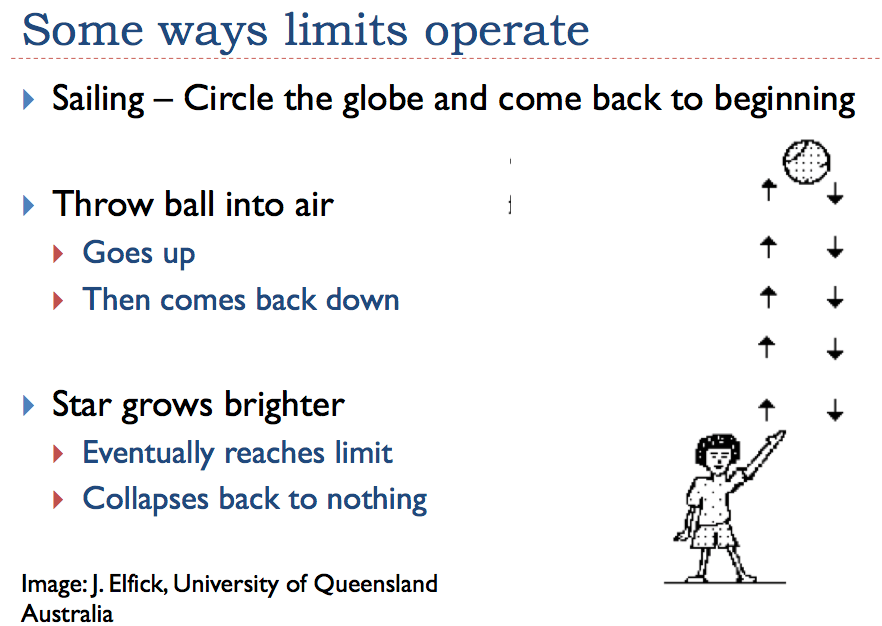
Slide 4
The standard story that we hear says that energy prices can rise and rise, indefinitely. But as I look at the data, this doesn’t seem to be true in practice. At some point, there is a problem with affordability, because wages don’t rise as the price of energy products grows.

Slide 5
In many ways, the problems that overtake the economy are similar to ailments that beset a human being. A person can have multiple ailments, some of which grow in severity over the years. The catch, of course, is that if an early ailment becomes severe, it may kill the patient, eliminating the need to fix the later ailments.
The way I see the economy, there are many hurdles that have the potential to inflict severe damage on the economy. Slide 6 shows a few of them. Some examples of other issues include lack of fresh water and erosion of topsoil.
In my view, we are right now reaching an affordability crisis. One way it manifests itself is as high commodity prices that fall and thus become low commodity prices. Falling commodity prices are likely to cause debt-related problems because of all of the debt incurred in their production. We may find financial problems, much worse than those experienced in 2008, back again.

Slide 6
Many others have focused on climate change. In their view, we can extract pretty much all of the fossil fuels that are in the ground, because prices will rise higher and higher, allowing this to be done.
If, in fact, prices fall after a point, then there is a good chance that we must leave most of them in the ground because of affordability issues. If this is the case, the situation may be very different: we may lose fossil fuel production in not many years because of disruptions caused by low prices.
We often think of affordability in terms of what a gallon of oil costs or in terms of how much a kilowatt-hour of electricity sells for. While these costs are one part of the problem, a big part of the affordability problem relates to big-ticket items, as listed in Slide 7. If customers cannot afford these big-ticket items, such as homes and cars, the economy loses both (a) the energy use that would be required to make these big-ticket items, and (b) the later energy use that these big items would require.

Slide 7
If we look at the data, we find that inflation-adjusted median income for families has been falling.

Slide 8
Part of this lower family income involves a smaller share of the population working.

Slide 9
When a person looks at the labor force growth split between men and women, there is a very different pattern. Men show a small downward trend over time; women increasingly joined the labor force, but this trend topped out in 1999, and became a decline since 2008.

Slide 10
Something we all are aware of:

Slide 11
Many fewer homes are now being built in the United States.

Slide 12
There has been a very different trend in auto purchases in the United States, Europe, and Japan compared to the rest of the world. In the developed areas, interest rates have been very low, and lenders have increasingly offered loans to subprime buyers. An increasing number of the loans are 7-year loans, and the loan to value ratio is often 125%. We seem to be creating a new subprime auto bubble. Based on our experience with subprime housing loans, this is not a sustainable pattern.

Slide 13
I am convinced that most economists have missed a basic principle regarding how economic growth takes place (Slide 14). I define efficiency in terms of what it takes in terms of human labor and resources to produce finished output, such as a barrel of oil or a kilowatt-hour of electricity. Are these finished goods becoming cheaper or more expensive in inflation-adjusted terms?
On Slide 18, note the change in the size of the output boxes, compared to the input boxes. Increased efficiency produces more output compared to the resources used; increased inefficiency produces less output compared to the resources used.
If an economy is becoming increasingly efficient, a given number of workers and a given amount of resources can produce more and more goods. This is good for economic growth. Growing inefficiency is a problem, because it quickly uses up both available worker-time and available resources. Many economists never seem to have gotten past the idea, “We pay each other’s wages.” Yes, we do, but if those wages are being used to encourage the use of increasingly inefficient processes, we go backwards in terms of economic growth.

Slide 14
If we look back historically, we can see a growing efficiency pattern with electricity, in the 1900 to 1998 period. As the price dropped, both consumers and businesses could afford more of it (illustrated with rising black “demand” curve). Part of the lower cost came from increased efficiency of electricity generation during this period.

Slide 15
If we look at the oil sector, since about 1999 we have had exactly the opposite pattern taking place. The cost of oil “exploration and production capital expenditures” has been rising at a rapid rate. This is an issue of diminishing returns. We have already extracted the easy-to-extract oil, and as a result, we need to move on to more difficult (and expensive) to extract oil. Thus we are becoming increasingly inefficient, in terms of the cost of producing the end product, oil.

Slide 16
As we move on to more expensive oil, the higher cost tends to squeeze budgets. The thing that is important is the fact that wages don’t rise sufficiently to cover the cost increase; in fact, the images I showed earlier seem to suggest that in the recent era of high prices, we have seen unusually slow growth in wages. The amount of wages is represented by the size of the circles in Figure 17. The wage circles don’t grow.
Slide 17 shows that as workers need to spend more for oil, and for the things that oil is used to make, such as food, the discretionary portion of their budgets (“everything else”) is squeezed. This shift in discretionary spending is what tends to lead to recession. The same principle works if consumers suddenly find themselves with higher electricity bills–discretionary spending is again squeezed.

Slide 17
The problem that squeezes all commodities at the same time is falling discretionary income. The amount of debt that can be borrowed also tends to fall as discretionary income falls. The combination leads to falling affordability for expensive goods, like new autos and new homes.
The price patterns for commodities of many types move together, reflecting a combination of rising cost of oil (because of higher extraction costs) and falling ability of consumers to afford the high prices of these goods. I have not included food on Figure 18, but many food prices have recently fallen as well.
Of course, the costs for producers creating these commodities have not fallen proportionately, and many have huge amounts of outstanding debt. Repayment of debt becomes difficult, as prices remain low.

Slide 18
Back at Slide 14, I talked about increased efficiency leading to economic growth, and increased inefficiency causing economic contraction. Because our leaders have not looked at things this way, they have encouraged increased inefficiency in many areas, as I describe on Slide 19. To some extent, this increased inefficiency is required. For example, as population grows in areas with low water supplies, the need for desalination grows. Also, pollution problems increase as we use lower qualities of coal and oil.

Slide 19
What are the expected impacts on the electricity industry and on natural gas? Are there any workarounds?
Let’s look at a few implications of the problems we now see.
In my view, low oil and natural gas prices are likely to be a huge problem for the natural gas industry, leading to the bankruptcy of many natural gas suppliers.
We cannot expect natural gas supply to grow. In fact, we cannot expect a coal to natural gas transition because the natural gas price won’t rise high enough, for long enough.

Slide 21
If we look at the history of US natural gas prices (using Henry Hub data), we see that prices have tended to stay low, after the 2008 spike. This was a great disappointment to those who built new natural gas extraction capability. They expected prices to rise, to justify their new higher costs. In my view, the continued low natural gas prices to some extent already reflect affordability issues.

Slide 22
The Marcellus Shale was perhaps the most successful of the new natural gas production, but it seems to now be topping out because of low prices (Slide 23).
Many producers will have their lending terms reevaluated using September 30, 2015 data. This reevaluation is likely to lead to bankruptcy of some producers, and cutbacks of production of other producers.

Slide 23
Coal use has been declining, as shown in Slide 24. Coal has some of the same problems as natural gas, as I will explain on Slide 25.

Slide 24
The basic issue is that coal prices are too low for most producers. Even if a particular producer has low extraction costs, this benefit is not enough to keep producers from bankruptcy. The problem that occurs is that coal companies are locked into high cost structures because of patterns that continue to persist from when prices were high. Lease costs are high; taxes and royalties are high; often debt was entered into, assuming that revenue would remain high in the future. Now revenue is lower, and there is no way to fix the “hole” that results from low prices. Production stays high, because each producer must produce as much as possible, to try to avoid bankruptcy for as long as possible.

Slide 25
Coal is in a sense ahead of natural gas, in terms of bankruptcies, with big bankruptcies already starting.
With prices as low as they are, there is little chance for a new producer to come in, buy the production facilities at a low price, and restart operations. A big issue is ongoing costs such as royalty payments that cannot be eliminated. Another is debt availability to support the new operations.

Slide 26
Bankruptcies are likely to interrupt supply chains as well. Part of the problem may simply be the excessively high cost of credit, for those members of the supply chain with poor credit ratings. Once a supply chain breaks, replacements parts may not be available. Other services that a company contracts for with outside suppliers may disappear as well.
As I note on Slide 27, customers may have financial difficulties. Those who remain in business will tend to buy less, so demand is likely to be lower, rather than higher. Companies producing electricity should not be misled by the rosy forecasts of the EIA and IEA regarding future demand amounts.

Slide 27
Slide 28 shows that industrial consumption of energy products has been falling since the 1970s, as industrial production has moved overseas. Now the dollar is high relative to other currencies, encouraging more of this trend. On a per capita basis, residential energy consumption is down, and commercial energy consumption is level. It is hard to see that this mix will provide very much of an upward trend in natural gas and electricity consumption in the future. (Note: Slide 28 shows energy of all types combined, including both electricity and fuels burned directly. This approach is used because there has been a shift over time to the use of electricity. This method shows the overall trend in energy use better than, say, an electricity-only analysis.)

Slide 28
The major ways subsidies for wind and solar PV are available are through greater government debt or through higher costs passed on to customers. There are now getting to be pushbacks in both of these areas.

Slide 29
In Europe, the cost of intermittent electricity tends to be passed on to consumers. Dr. Euan Mearns put together the chart shown in Slide 30 comparing price of electricity with the per capita wind and solar PV generation installed for European countries. There is a striking correlation. Countries with more installed wind and solar PV tend to have higher electricity prices for the consumer.

Slide 30
Given the problem with commodity producers not being able to collect high enough prices for their products, and the large number of resulting bankruptcies, a person comes to the rather startling conclusion that the ideal structure for electricity providers in today’s economy is that of a vertically integrated utility. In other words, an electric utility should directly own its suppliers, as well as transmission lines and everything else needed to produce and distribute electricity.
Utilities have traditionally had the ability to price on a cost-plus basis. With vertical integration, the utility can use its pricing ability to keep prices for fuel producers from falling too low, and thus sidestep the problem of bankruptcies. To the extent that the required price for electricity keeps rising, it will tend to pressure discretionary spending. (See Slide 17.) But at least grid electricity will be among the last to “go” under this structure.

Slide 31
Black Hills Corporation lists the many electricity-generating facilities it owns (coal and natural gas), and the places it has arrangements to sell this electricity as a utility. The Black Hills Corporation indicates it has had 45 years of dividend increases. This increase in dividends is in stark contrast to the many coal and natural gas producers that are currently near bankruptcy, as a result of low coal and natural gas prices.

Slide 32
How does one resolve the conflict between industrial companies wanting to generate their own electricity (for a variety of reasons) and the need to have an electric grid for everyone else? It seems to me that we have to keep in mind that having an operating electric grid for everyone else is absolutely essential. Without the electric grid, gasoline stations would stop pumping gasoline and diesel. Transportation would stop. Electric elevators would stop. Treatment of fresh water and sewage would stop. Companies everywhere would lose their consumers. The economy would quickly come to a halt.
With our current affordability problems, we are in danger of losing the electric grid. That is why it is essential that those who opt out not be given too large a credit for providing some or nearly all of their own electricity. The credit given to industrial companies should reflect the savings to the system, no more.

Slide 33
One concern is the bankruptcy of peaker plants, if their use is significantly reduced by, for example, the use of solar PV. If these peaker plants continue to be needed for balancing purposes, this may be a problem. Another concern is the rising cost of grid transmission for those who continue to get their electricity from the grid.

Slide 34
To sum up, the story we read from most sources is so climate-change focused, a person wonders if there aren’t other issues that are important as well. Most observers have overlooked the importance of low commodity prices, and the impact that they can have on coal and natural gas producers’ ability to produce the fuels that are needed by electric utilities.
Too much faith is being placed in natural gas, as the fuel of the future. And too much faith is being placed on intermittent renewables, without fully understanding their costs and limitations.
I haven’t tried to address the many indirect problems arising from many bankruptcies. These may be severe.
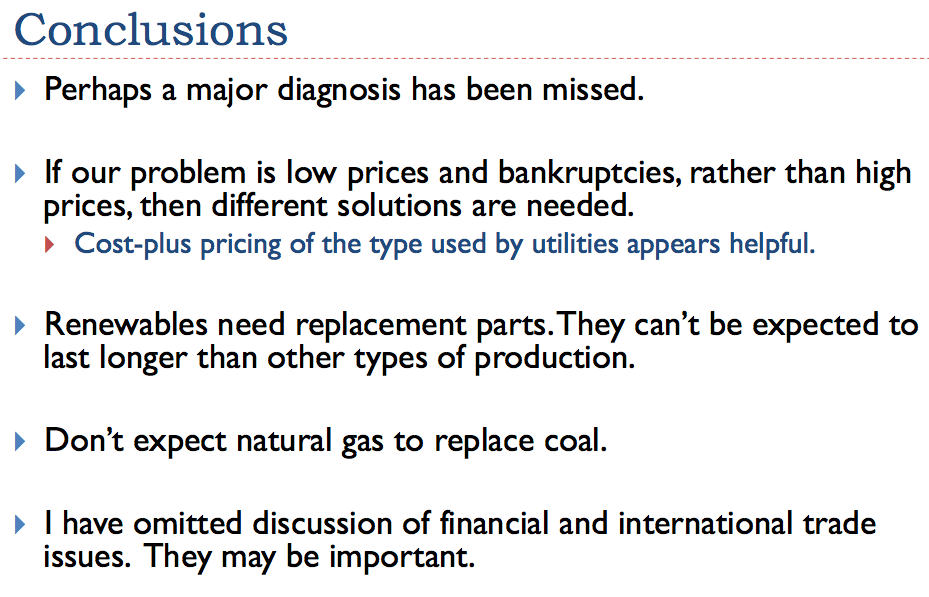
Slide 35


The extent of the capital market’s support for energy over the past half-decade is laid bare in energy companies’ financial figures. According to Chanos, cash flow from operations at some of the most prominent exploration and production companies has not covered capital expenditure since 2010, meaning that they have consistently outspent income. That trend is present even at the larger “big oil” companies such as Exxon, Chevron, and Royal Dutch Shell, Chanos claims, with cash flow following distributions to shareholders firmly in the red.
http://www.bloomberg.com/news/articles/2015-10-21/jim-chanos-nails-the-link-between-debt-and-energy
Exactly: “Return to growth cannot happen without cheap equity and debt, neither of which exist today.”
Growth is essentially over (“The End Of More”). So the way I see it then: housing for everyone is over, cars for everyone is over, medical care for everyone is over, food for everyone is over, water for everyone is over and on an on. Thus, the future is no longer brighter and something to look forward to. This has huge implications. Surely the psychological impact of a worsening future will also put even more downward pressure on growth. Those dang feedback loops again.
Now come the wars where it is decided who gets none and who gets some.
I am afraid you are right about wars of aggression over the remaining resources being essentially – a given. Especially if history is a guide. The two big questions in my mind is how long will the resources hold out to wage war? And second, what type of war will it be? (Nuclear?) Very uncertain and scary times we live in.
Just as likely–fighting with neighbors over local resources. Or migrants who think your area looks better than their own.
What you explain is really quite a simple concept to grasp — yet many people here seem unable to conceptualize what the end of growth means… what the end of fossil fuels means…
One thing I will give to those in the mainstream who do not accept that growth has ended… that the fossil fuel era is nearly over….
Is that if you ask them ‘what if you are wrong — and I am right on this — entertain me for a moment — what are the implications’
Most people I have put this question to respond with ‘well — if that is the case — then we are dead’
Perhaps it is because they understand the implications and the dire nature of what we are saying that they refuse ‘to go there’
Whereas those living in a Koombaya world have no problem with going there… because in their world there are all sorts of work-arounds — in their world we will still be able to grow food — the spent fuel rods get chucked into the ocean or cooled with garden hoses… we still get to have cars, and iphones…. humans settle down to their little organic gardens….
And for the first time in history we live together in peace and harmony… just as Joan Baez envisioned….
We will be living in peace and harmony all right. But not like Joan Baez envisioned. Perhaps living in “pieces” would be a more fitting description. Based on what I have seen of human nature, I am more compelled to believe the only way Humans will “live together in peace and harmony” is by going extinct.
“Whereas those living in a Koombaya world have no problem with going there… because in their world there are all sorts of work-arounds — …”
I think BOTH the doomers and the Koombaya’s have workarounds. They are essentially in the same camp, just different ends. The Doomers are saying there is nothing we can do, and doing prepping to get ready for it. The Koombaya’s are trying to leverage the existing societal infrastructure to avert the damage. Both take time, energy, research, knowledge, and money to develop the solution. You can’t do either overnight. I also don’t think most Doomers really want to see the world collapse, some I am sure do, but the majority of them don’t.
The best way to avert disaster is to go with renewable’s at worst it extends the life of the existing fossil fuel infrastructure until price points are matched.
Caterpillar Shares Tumble After Company Misses Across The Board, Revenues Plunge 19%, Guidance Cut
It never fails: a month ago, after showing CAT’s abysmal global retail sales, just three days later the company announced a historic business restructuring in which in addition to slashing its guidance, and confirming the China slowdown is now a recession if only in the manufacturing sector so far, it also announced it would fire 10,000, sending its stock crashing.
Then, yesterday, ahead of today’s earnings we again showed that when it comes to global demand for CAT products, there is simply no demand, and this particular dead cat refuses to bounce, with 34 consecutive months of declining revenues as well as 11 consecutive months of doubler digit sales declines.
We hoped this data would soften the blow from today’s CAT Q3 earnings which were clearly going to be ugly, and surely worse than consensus estimates.
Moments ago we got said earnings and as expected, they were indeed far worse than expected, with CAT reporting adjusted EPS of $0.75 ($0.62 GAAP), below consensus estimate of $0.77, while revenue of $11.0 billion also missed expectations of $11.33.This takes place even as CAT repurchased $1.5 billion in stock in Q3, or about 75% of the total $2.0 billion in buybacks it conducted in all of 2015 (compared to $8 billion in the past three years).
And the punchline: the company cut its 2015 EPS outlook from $5.00 to $4.60, even as it still keeps its full year revenue guidance at $48 billion adding that 2016 sales/rev is about 5% lower than 2015. It now sees 2016 revenues down 5% from 2015.
Some more highlights:
Q3 Revenue: $10.962 billion, down 19% Y/Y
Q3 Operating profit: $713 million, down nearly 50%
Q3 GAAP EPS: $0.62, down 72%
Q3 cash from operations: $4.9 billion, down over 20% Y/Y
Cash: $6 billion, down from $7.3 billion at the start of the year
From the report:
http://www.zerohedge.com/news/2015-10-22/caterpillar-shares-tumble-after-company-misses-across-board-revenues-plunge-19-guida
CAT death watch begins….
OH but look…. the markets are ambivalent to the a) crash in profits and b) forward guidance that says you should expect this to worsen…
Cool!
http://chart.finance.yahoo.com/t?s=CAT&lang=en-US®ion=US&width=300&height=180
Maybe this is the new “normal.”
Can someone explain? I understand that the financial economy is going to crash for the reasons Gail shows. But then there is still the physical economy. Everything that is currently producing oil, food, water. sewage treatment, electric be it buildings, labor, skills still exists. Yes, there will be many parties that are sad or angry as their promised payments from debt instruments are cancelled. Never the less the physical economy still exists and even if labor has lost trust and business to business has lost trust there is still the government with either “the full faith and credit” or with guns to motivate those two groups to keep producing.
Given the choice between working for government chits at the nationalized factory and receiving only enough food, transport housing to live versus killing my neighbor and eating him I will pick the former. Won’t you?
The government does not need to keep the whole economy running just the real parts food, transport of some kind, housing, water, sewage treatment. Everything else can go. Yes, many unemployed, either given minimum government welfare to stay alive or not. If not plenty of work for security forces (police, sheriff, state police, FBI, DHS, Army, etc…). Halliburton “work” camps.
How do you keep transport running? You need oil and gasoline and break fluid and spare parts and roads…. which require machinery to maintain ….
How do you keep the sewer and water systems in operation — they require pumps and electricity and machinery…
There is no such thing as BAU lite.
This truly is a silly conversation — again — parallel universe…
The facts don’t matter in the other universe of wishful thinking — if they do then please explain how we can overcome the problem of having no oil, gas, and spare parts for the transport system.
“The facts don’t matter in the other universe of wishful thinking — if they do then please explain how we can overcome the problem of having no oil, gas, and spare parts for the transport system.”
Well, there is the problem; you are talking about something totally different. America, for example, can probably produce a million barrels of oil per day for quite a few years, on a drastically reduced system. You’re talking about zero oil and people are looking at dramatically less, but still some, oil. At least that’s my take on it.
Plus, there is a lot of coal left in the ground – probably 60 to 70% of the starting amount. There will be quite a few people freed up from other jobs, to send down in the holes to dig out the coal by hand, if need be.
‘America can produce 1M barrels of oil – there is a lot of coal in the ground’
There indeed is — and that’s where it will all remain ….
It takes machinery to extract, refine and transport energy — BAU doesn’t offer a lite version — you either get the full fat version – or you get nothing.
Again — facts run into wishful thinking.
The Challenge
Coal is America’s most important source of power. It generates more than 43 percent of all electric utility and industrial power produced in the United States. In 2010, the country’s 1,400 coal mines produced more than one billion short tons of coal. Given that it can take 3,000 gallons of water to extract, process, transport, store and dispose of every ton of coal, safely and efficiently managing the industry’s process and wastewater streams plays an important role in the economics and environmental performance of coal production and use.
Water is a constant presence in and around a coal mine: sprayed water suppresses explosive coal dust; water seeps into mine tunnels; rain percolates through stockpiles of newly mined coal; trucks must be washed before they can be driven on highways. Submersible pumps are installed in many locations at a coal mine: within the mine itself to clear tunnels of accumulated spray water and seepage; in runoff ponds or reclaim tunnels that run under outdoor coal stockpiles; in sumps that collect material that falls off and is washed away from conveyor belts; and in truck-wash sumps.
In most every case, the pumps are required to handle muddy, acidic slurry of water, chunks of coal and coal fines, dust, dirt and rocks.
The debris is heavy to pump and quickly wears out standard submersible dewatering pumps. Large pieces of material that fall out of solution usually collect at the intake and will clog or destroy an inferior pump. Coal fines are extremely abrasive to the internal components of a pump and dramatically shorten the life of a traditional pump when used in such harsh conditions.
Coal extractors, processors, transporters and electricity generators have typically used submersible pumps built for sewage to manage water in their operations, usually with poor results. Even the most rugged of these pumps are usually not up to the job, requiring the manual removal of solids from sumps, wastewater pits and holding ponds.
Additionally, the failure rate of these pumps in the coal industry’s tough conditions has been consistently high, requiring frequent repair, rebuilding and replacement of pumps; unacceptable rates of downtime; high labor costs; unsafe working conditions and risks of regulatory noncompliance or environmentally destructive spills.
An Illinois coal-mining company was using a sewage-style submersible dewatering pump at the bottom of a 3,000-gallon runoff pond that collects thick slurry draining from several raw and clean coal piles. The water in the pond is so abrasive and acidic that the company was getting no more than six months of use out of each pump.
http://www.bjmpumps.com/products/case-studies/case-study-details/?tx_ttnews%5Btt_news%5D=13&cHash=c7007c2b402d8483f175d0cd81bc2239
Where will the pumps come from post collapse? What about all the machinery that is involved in mining coal…. the low hanging fruit is gone…. coal mining is high tech these days….
Let’s have a look into an old coal mine – notice all the BAU gear involved even then…. bonus song from Devo:
“Where will the pumps come from post collapse?”
You think that safety and environmental protection will be priority number one in a collapse? I doubt it. No one is going to worry about dirty trucks, water leeching through coal into rivers, or about making sure the coal dust doesn’t kill some workers. Coal mining will be more in line with Chinese practices then modern Western standards.
Flooding: Almost all working mines require pumps to remove water, with the exception of those being self-draining via deep drainage adits. Once a mine is abandoned, the pumps are usually turned off and the mine slowly fills with water until a level is reached where water can drain out.
https://en.wikipedia.org/wiki/Mine_exploration
The truth is probably somewhere between what the two of you are saying. To some extent, the water pumps are essential for getting at the coal. This coal will have to be left behind. Water is also used in later processing. Perhaps approaches closer to what I think of as Indian coal mining (miners carrying baskets of coal on their heads) will be used. But not very much coal can be obtained this way.
Good points! The amount of coal that is near the surface, that can easily be picked up and carried away for local use, is very low.
If America had oil for a reduced system, then the Great Depression wouldn’t have happened in the first place and our economy does not accommodate for drilling at all so once the economy goes, there will be absolutely no drilling, at best, places that have oil will be military checkpoints and people will be fighting to get to them.
Transportation of coal is a huge problem. This is what limited its use, back at the time of World War I. There will be no point in digging up more coal than can be used in the immediate local area. Most of the coal in good areas for transport by water has already been extracted. We do have a lot of coal left, but it tends to be in areas which are too cold for farming and have other deficiencies. I expect that complete local systems will not be able to be made in most of these areas.
Thank you! Diminishing returns is impossible to avoid. One has to go farther and farther out and deeper and deeper down to get the same amount of resource. This is impossible to get around on this planet we are on. There is no solution because there is no problem, it is a predicament.
Just to give you an idea at how serious the thought is of a global economic collapse. Back in 2008 Heny “Hank” Paulson told George W Bush that if the TBTF Banks were not bailed out the global economy would have collapsed and these are his words which were penned in his book, “Martial Law would have been enacted throughout the USA”. Everything would have come to a complete STOP.
Really interesting words.
You are basically right, Ed.
Let’s not jump too far into the future and then mistake that for the present day. What matters is the vision of the decline. This should give us the confidence to make our own decisions in the here and now. One must remain flexible shed unnecessary weight and responsibilities and forge one’s own path. It’s all going to go to pot. 100% guaranteed. Knowing that, what would you do?
Earlier this year I quit a six figure job with benefits, without having another job lined up. Why? Because everybody around me sucked and I could see where it was going…I would be the stoic fall guy for all of the mistakes. So I flew like a bat out of hell. I know what’s coming, thanks to Gail and many others.
Being too responsible is a mistake, because you never actually know what’s going to happen with the system, and the government will just bail out some sectors anyway, and inflation/war/taxes/confiscation and general chaos could ruin all of your plans. Sad to say but true. Being a resourceful ant is not always the good idea! Because in certain times you really are the sucker, and with the sheer amount of parasites in the world today, this is a time like that. Consider what happened to all those good, responsible, hard-working Germans in WW2. Consider what’s happening to the American middle class today. Don’t let it happen to you.
But you don’t want to be the grasshopper either. You could really find yourself in dire straits, with few options, in just a couple of years.
The independent road is the best. Carefully think about your options, diversify a bit, but make sure you absolutely understand what’s going on. If you don’t, forget about even pursuing it. That’s what makes self-knowledge, relocation etc. so essential. It’s going to be really painful to be stuck out of place. If we’re all going to be stuck, better to do so where you are comfortable. If you’re going to do it, do it now, without delay. If you sit around you’re at the mercy at whatever the local warlords and politicians, who are likely to be useless, want out of you. Make sure you absolutely understand what’s expected of you, and do just that, no more, no less. Make sure the people around you are solid, and always protect your reputation. If you find something good stick with it and hope for the best, if not, quit and move on, 10, 50 times if you have to.
“or with guns to motivate those two groups to keep producing”
Not possible on a very large scale — we have a system that relies on a global supply chain — you can’t command an entire supply chain — it’s too big and too complex
However what you can do is command slaves — the men with the guns will without a doubt use them to motivate others to keep producing…
Now who will they target first?
There will be very little if any food available post collapse.
The obvious targets will be the ‘islands’ where people are growing food…
https://www.radioislam.org/islam/english/jewishp/britain/Under_the_yoke.jpg
“or with guns to motivate those two groups to keep producing” –
You cannot force more net energy out of a system. Print money yes. Print net energy, not so much. I agree attempts will be made to keep some folks comfortable at a horrific costs to others. However, the costs will likely prove fatal to most folks. I think any attempt to maintain BAU-lite (for the elite) will be short lived. It may somewhat work after a massive die off takes place to bring the net energy equation back into balance.
Hahahaha, nope, not going to happen. Everyone will be dead by that stage. No BAU lite for anyone because they’ll either die by 2020 due to the radiation killing all the trees and animals, thus reducing oxygen, or by 2030 as a result of our seas belching hydrogen sulphide. Get over it, there’s nothing left to hope for.
I am sure there are some biological creatures that will live on whatever nature provides, whether it is hydrogen sulphide, too much CO2, or too much radiation. The earth will adapt; the question is whether humans will be among the surviving species. Of course, humans lived through ice ages before. Some humans may very well live through some very changed conditions–perhaps in the parts of the world that are least affected.
If there is no way to pay workers, what do businesses do? If there is no way to buy replacement parts, how does production of any kind continue? The physical economy has a very direct relationship to the financial economy. It is what pays our paychecks and allows us to buy goods from the store or on Amazon. Governments tend to collapse as well, as the financial institutions fail. You can’t count on governments to save you. They are part of the problem, not part of the solution. The exist only on debt.
” I understand that the financial economy is going to crash for the reasons Gail shows. But then there is still the physical economy. ” The financial economy depends on the physical resource base that underlies it. Today, the physical resource base also requires the financial economy to fund extractive processes. The two (finance and resources) are locked in fantastic dance with each other. Without the other both cease to function. What is left is subject to decay and scavenging. I think that energy and resource extraction must be profitable both in net energy terms and financial terms for anything approaching BAU to continue. Historically there has been no major collapse of an energy producer. Exxon, Mobil, BP, Koch, Shell have always been the envy of the world. They just don’t loose. What would happen if Exxon announced it is bankrupt and insolvent? It is one thing to print money but quite another to produce net energy from oil when there is no net energy left in oil extraction.
” They just don’t loose. What would happen if Exxon announced it is bankrupt and insolvent? It is one thing to print money but quite another to produce net energy from oil when there is no net energy left in oil extraction.”
Their assets would get sold in bankruptcy. The trick here is to have a way so BAU doesn’t collapse because they hit the wall with extraction.
You have two options:
A. Slowly build up an arsenal of tools using available technology and continuously improve it, as we slowly back away from the problem.
B. Wait until it actually happens, and crash hard, because you don’t have the technology, or resources to fix it when it does happen.
I think most people prefer A and that is what we are doing. But I know there are some crazy people who want mass genocide, and would go with B even though their odds of living are fairly slim.
Diminishing flow of energy sources of high energy density, cannot be exchanged less
>
>
The IBM unbeat goes on. Its sales plunged again for the 14th straight quarter while its net income was down by 14% from last year. Even management’s dodgy ex-items earnings guidance for 2015 was lowered by 6% with only one quarter to go…
http://www.zerohedge.com/sites/default/files/images/user5/imageroot/2015/10/IBM%20Q3%20revenue%20vhange.jpg
http://davidstockmanscontracorner.com/the-big-blue-canary-in-armonk/
The “big blue canary” that is soooo good.
Nyrstar NV, Europe’s largest refined-zinc producer, plunged the most since its shares began trading eight years ago after it said the mining business is being challenged by the rout in metals, raising the prospect of another share sale.
The stock slumped 27 percent, the most since listing in October 2007, to the lowest in six years. The company is evaluating debt and equity-market alternatives to address a 415 million-euro ($463 million) bond maturity in May 2016, while ruling out restructuring of the debt due next year, it said Thursday. The producer’s investment in smelting operations in Australia will cost more than previously forecast, it also said.
Nyrstar is among producers battling lower commodity prices with zinc down 20 percent this year on weakening demand from top consumer China. It plans to cut costs and capital spending in its mining business by 40 million euros a year and said it doesn’t rule out more suspensions beyond its Campo Morado and Myra Falls operations, according to a statement Thursday. Suspending additional mines may result in extra impairments by the end of the year, Chief Executive Officer Bill Scotting said on a conference call.
http://www.bloomberg.com/news/articles/2015-10-22/nyrstar-drops-the-most-on-record-as-port-pirie-costs-increase
Thanks! It seems like there is a lot of this going on.
Light bulbs going on recently on places..
Check these very good comments on deflation as affordability issue and more by id “Seer” and id “HardlyZero” bellow this linked article. It’s very short summary quite in line of the host of this blog.
http://www.zerohedge.com/news/2015-10-22/everything%E2%80%99s-deflating-and-nobody-seems-notice
ok for the lazy clickers one quote:
“I’d only add that it is illogical to believe that TPTB want to run the presses. That is, it is my belief that they are only doing so in order to prop up a global market that is wanting to collapse. While anything can be seen a success given a short enough time-frame, the fiat printing, as history tells us, is but a terminal condition (the long-term won’t deem it a success).
Over-saturation. Changing demographics. Growth as we’d known it, and predicated the future upon, won’t be back any time soon (and likely won’t ever).
Wait until economies of scale in reverse really start kicking in. THEN you’ll see real PRICE INFLATION (as a measure of “affordability”); this will be the final burn-out phase- a last-gasp effort to keep the large production machines cranking away, until, that is, there’s not enough buyers to support the operation of those machines: keep in mind the scale of raw materials extraction- without the scale of demand here the economies of scale will really go negative (thereby feeding price pressures on manufacturers- margin compression, big time).”
A bit more from that…..
And today we’re up to our necks in deflation, and nobody seems to notice, or call it that. Likely because they’re all waiting for CPI consumer prices to fall.
But when you see that Chinese producer prices are down 5.9%, in the 43rd straight month of declines, and Chinese imports are down 20% (with Japan imports off 11%), don’t you hear a bell ringing? What does it take?
If the dramatic fall in oil prices hasn’t done it either, how about steel? How about the tragedy British steel has been thrown in, how about the demise of Sinosteel even as China is dumping steel on world markets like there’s no tomorrow?
Credit Suisse’s latest global wealth outlook shows that dollar strength led to the first decline in total global wealth (which fell by $12.4 trillion to $250.1 trillion) since 2007-2008.
[..] from HSBC: “We are already in a global USD recession. Global trade is also declining at an alarming pace.
According to the latest data available in June the year on year change is -8.4%. To find periods of equivalent declines we only really find recessionary periods. This is an interesting point. On one metric we are already in a recession. [..] global GDP expressed in US dollars is already negative to the tune of $1,37 trillion or -3.4%.
How about companies like Walmart and Glencore, just two of the many large entities that have large troubles? These are not individual cases, they are part of a global trend: deflation. As evidence also by the increase in US corporate downgrades and defaults:
Moody’s issued 108 credit-rating downgrades for U.S. nonfinancial companies, compared with just 40 upgrades. That’s the most downgrades in a two-month period since May and June 2009, the tail end of the last U.S. recession. Standard & Poor’s downgraded U.S. companies 297 times in the first nine months of the year…
http://www.zerohedge.com/news/2015-10-22/everything%E2%80%99s-deflating-and-nobody-seems-notice
https://www.project-syndicate.org/commentary/china-debt-deflation-trap-by-andrew-sheng-and-xiao-geng-2015-09
We are going to get our 2008 moment but this time on steroids…. and the central banks will be powerless to do anything about it — because they have used up all their ammunition trying to prevent that moment.
I am waiting anxiously on the next magic trick…. if there is one it better come soon….
One major reason that the world economy cannot shrink is the problem of economies of scale going in reverse. We are already seeing it happen now in the third quarter financial results. If sales are off, there is an immediate need to sell assets and lay off workers. Ouch, especially if there is no longer a market for a particular type of assets.
“Pundits who insist that global collapse can still be avoided, must explain to us in detail just exactly how this can be achieved given our current circumstances. When challenged on specifics, those cornucopians paint vague unrealistic pictures of magical sudden worldwide cessation of industrial/agricultural emissions (which magically does not result in economic collapse, food shortage and dieoff), magical cessation of conflicts, voluntary population stabilisation then decline to a steady state, equitable global distribution of resources, discovery of unlimited unpolluting energy and free movement of all refugees, welcomed without restriction into all the richer countries. Furthermore the environment magically repairs itself despite having 10 billion people consuming tremendous global resources by mid century. Yeah, right.”
“The chance of a single particular improbable catastrophic global event occuring in the short term is low. However there are numerous low probability but high impact potential events, any one of which can cause a teetering complex system to crash suddenly and completely. Hence in aggregate, the likelihood that any one (of many as-yet unspecified improbable events) may occur is actually quite high.
A chain is only as strong as its weakest link. For our complex technological society to function, it is necessary that every one of the thousands of links holding our system together remain intact, however many of those links are now very weak indeed and are on the verge of breaking.”
These are excerps from a post by Geoffrey Chia, published on the Doomstead Diner:
http://www.doomsteaddiner.net/blog/2015/10/21/that-was-then-this-is-now-so-whats-next/
Thanks RE!
There’s another possibility that is even worse. Imagine no catastrophic event occurs, but rather the entire world ecosystem and our world economy slowly degrade into extinction and obsolescence. Maybe it’s not like a car in which something catastrophic occurs and it suddenly no longer works, but more like chalk that gets worn down to nothing but dust. That is the process occurring at present – no catastrophic conclusion, just using everything to the extent it helps make people wealthier. Of course some event could take place to speed the descent or even shake it into obsolescence faster, but what would that be? The trouble is humans are great at using whatever is available to the extent possible then moving on to somewhere else to get more stuff to do more resource consumption. Look at Easter Island. They used every single tree until catastrophe, but that was an island with limited resources. Now we are using the resources of the whole planet at breakneck speed. I’m not sure it collapses as much as it changes shape along with the rules as we whittle it down to the nubs.
The thing is…
Rusting cars don’t need to eat… don’t die of disease… don’t murder one another… and are immune to the effects of radiation poisoning….
Stilgar, yes, I think there are lots of numbers between 100% and 0%.
“Look at Easter Island. They used every single tree until catastrophe, but that was an island with limited resources. ”
That is probably a misunderstanding of the situation. The real problem is that either the polynesians brought rodents with them as a food source, or they were introduced by European sailors. The rats ate the nuts, preventing new trees from growing, leading to deforestation.
Then, Peruvian slavers invaded and sent everyone off to work the silver mines. Somewhere along the way there was a disease outbreak or two as well – from European illnesses I think, although possibly a spongiform from eating dead people.
My point may have gotten lost a bit (which has never happened on a thread – lol), but instead of an island of resources there is an entire planet and that instead of thinking of a possible catastrophe (like a financial crisis or any other) ending the human toll it’s taking on the planet and somehow stopping BAU, it instead means whatever resources are left after any possible debacle will simply be competed for by new rules in a fresh start.
Instead of being something that can break, it means it’s something that can flex into a new base from which the Monopoly game simply starts over. Albeit there may be fewer people and resources from earlier, but I think we’re going to find that people are always willing to partake in the game no matter how many times the rules change or what resources remain available. In this context the planet gets whittled down to a dust bowl with few remaining species.
That is unless new rules take into account the value of a sustained planet. So far we haven’t seen that but as catastrophe’s occur in the future, the density of mankind’s grey matter may actually get penetrated sufficiently enough to establish a more sustainable way of living for those remaining. I don’t know if that can happen because humans tend to think in terms of ‘what can I get for me?’, instead of ‘what’s best for all of us?’ in the long term, but it is possible after suffering the consequences of substantial earth bio-systems degradation in which the people can readily see that not only is their std. of living dropping, but it’s moving in the direction of being quite small, so the questions start to abound as to what can be done about it? In other words humankind as a whole needs to think completely differently. One can only wonder if that is possible.
That’s cute,sustainability is non existent on a nuclear wasteland, the.Spent fuel rods will kill everything so.nope, no such.thing as a new system, just one that’s on fire
Many people were certain that nuclear weapons would lead to an extinction event. It hasn’t so far due in part to MAD, mutually assured destruction. In fact, I know someone in my hometown I grew up with that did not pursue a career because he was so certain of an all out nuclear exchange. I told him one day when I bumped into him many years later, “I don’t think it’s going to happen”, and I could see the final acceptance of that in his eyes along with the regret of having presumed something that had an ill effect on his life of an incident that never came to pass.
In the case of nuclear power; why would people ignore something they know would lead to their mutually assured destruction? Even if there is a financial collapse and ensuing mayhem for a time, and a population reduction – even while all that is going on whatever effort needed to assure the plants shut down as needed would occur. Otherwise it would be futile to even till the soil to grow food locally or otherwise. It’s called prioritization. Everybody in a job knows the meaning, and as a species we certainly would not fail to prioritize safe shut down of nuclear power plants.
Obviously there is a point in time when the oil age ascent will transition into a descent, slow or fast. The population will drop. Globalization will veer into localization but not instantly and as it does priorities will still be set and reset.
Sustainability is a word we will have to accept sooner or later. Even if it takes the wholesale loss of billions of people, at some point human impact on the planet must be sustainable or there is no long term. And some will argue there is no long term, but after looking at this stuff since 05 it just seems like the idea of an end, is not realistic. It’s fantasy and the reason why is because there is more fluidity to our existence than we think. We just had a fire rage through our community; the Valley Fire. It seemed like the end of the world, but although near 2000 structures burned, things are already getting back to normal. It happened on Sept. 12th. That’s less than 2 months ago. So how long after a financial collapse would things resume? Even if it was 2 years it would still get going again for the survivors. Look at Dresden, Tokyo, Berlin, Stalingrad – they were rubble, but now they are flourishing cities.
Look at Rome, Italy 2,000 years ago. It collapsed, but people kept going. Now they make money selling pictures of phony gladiators posing with tourists.
“In the case of nuclear power; why would people ignore something they know would lead to their mutually assured destruction?”
Two things at play:
‘We can ignore reality, but we cannot ignore the consequences of ignoring reality.’
And
Hubris.
So we have a situation where we believed we could do anything — because we are the great species….
So what spent fuel ponds must have fossil fuels — or they extinct us — all we need to do is invent a new technology to replace fossil fuels — or invent a way to render use fuel rods inert.
Well — we’ve failed.
And the consequences of ignoring reality are about to be very very dire indeed.
In fact they are going to wipe us out and almost certainly destroy the planet.
And to think — humans were almost wiped out by climate change thousands of years ago (see Pandora’s Box)… it is estimated we were down to a couple of thousand … mother earth almost go rid of us…
It would appear that mother earth does not always bat last…. we get the last swing …. and we are about to hit the ball out of the park….
Stilgar, politician currently use sustainability to mean continued growth but no obvious environmental damage. When they finally mean no growth then we start.
I don’t see a reply after fast eddy or ed, so I’ll post a response here and it shows up wherever.
Ed, I realize what we are doing is not sustainable. My point was it must become sustainable somewhere along the line or there is no long term. We either do whatever is necessary to achieve sustainability or nature will hand us that card.
Fast Eddy, “And to think — humans were almost wiped out by climate change thousands of years ago (see Pandora’s Box)… it is estimated we were down to a couple of thousand … mother earth almost go rid of us…”
The Toga super volcano event – yes, that’s true. Well since then just like a virus we’ve gone to every corner of the planet. Look, I appreciate that you and many others see a sudden final end at some point. I was very dystopian in my many posts on this site, but lately I’ve just gotten into seeing things a bit different. We’ll see soon enough I suppose.
Stilgar, I was not disagreeing with you. I was just complaining about people, not you mostly politicians, who consciously misuse a perfectly good and honest word.
while MAD—Mutually assured destruction—-is literally mad—it has happened hundreds of times already.
just on a smaller scale.
The japanese started it with their Kamekaze planes, and were fully prepared to destroy themselves in the face of a land invasion in 1945.
Hitler ordered mass destruction in the face of advancing armies in 1945—luckily many of his generals simply ignored his orders.
Suicide bombers regularly engage in MAD—who knows what’s in their minds at the button pressing moment—but the willingness to do it is certainly there. As 9/11 clearly shows
Now put a nuke in the hands of one of those guys, seal it into the hull of a small cargo ship, sail it up the Hudson or the Thames—and 70 virgins stand ready and waiting while London or New York lie in smoking ruins
Networked systems fail in unanticipated ways. This is an example of what happens.
“Stilgar, I was not disagreeing with you.” No problem Ed. Sometimes things get lost in translation on a thread. I agree politicians misuse the word.
End of More – I can’t see kamikaze’s as an example of MAD, because only some perished as opposed to two entire countries which could occur in a big enough nuke exchange. And certainly the possibility of a MAD exchange is possible, but it hasn’t happened. Remember when Bush jr. was prez and India and Pakistan were exchanging angry comments and Bush said something to the effect of, “Everybody get out of the way of India and Pakistan. They may blow each other up.” A day or two passed and both countries made statements to the effect of, “We’re not going to do that”, meaning no nuke exchange. That’s the deterrent of Mad. Putin recently recited that idea as he admonished Western attempts to install anti ICBM missile launchers close to Russia. He said that would not eliminate the idea of the West avoiding a bad outcome in a nuke exchange. In other words MAD was still in effect.
i was making the point that the mindset is there, given the means.The Japanese ‘mindset’ had planes to carry it out, so did the 9/11 pilots and all the suicide bombers in between.
It’s just a matter of scale
I specifically didn’t say ‘nuke exchange’ I said seal a nuke into the hull of a small ship and sail it into the heart of a capital city.
Given access to nukes, you can be certain that this would happen
retaliation would be impossible—you wouldn’t know where it had come from
Electrochemical energy storage (i. e., lead-acid battery, lithium-ion battery, etc.) is greatly inferior to chemical energy storage (i. e., gasoline, diesel, gunpowder, etc.). As an example see the use of lead-acid batteries aboard US Navy Fleet submarines in WW2. Lead-acid batteries have been improved a little since WW2 but this still provides a good example of how much better chemical fuels are versus batteries.
• Each submarine had 2 batteries.
[Note 1: All ratings are the war-time ratings. In peace-time the ratings were lower to prolong battery life.
Note 2: Only battery cell weights are quoted below. No figures are given for wiring, controls and monitoring, structural installations, etc.]
• Each battery consisted of 126 individual cells
• cell mass: 750 kilograms
• cell dimensions: 137.16 X 38.1 X 53.34 cm
• cell volume: 278.7 liters
• nominal cell voltage: 2.1 VDC
• Battery voltage range: ~210-355 VDC
• Battery ratings:
• 1 hour: 5,000 Amps
• 3 hours: 2,500 Amps
• 10 hours: 1,000 Amps
• Battery energy capacity at the 1,000 Amps for 10 hours rating:
• 2 V X 1000 Amps X 126 cells X 10 hours = 2,520 kW-hours per battery
• Specific Energy = (2,520 KW-hours X 3600 seconds/hour) / (126 X 750 kg) = 0.096 MJ/kg
[Note: current references show lead-acid battery Energy Density as 0.15 MJ/kg, considering the sheer size of these submarine batteries this example is not too far from modern lead-acid batteries).
• Energy Density = (2,520 kW-hours X 3600 seconds/hour) / (126 X 278.7 liters) = .258 MJ/liter.
• The specific energy of diesel fuel is 45.3 MJ/kg.
The ratio of specific energies of diesel fuel to lead-acid battery is: 45.3/0.096 = 472. Or, put another way, the 94,500 kg mass of each battery provided the same energy as 200 kg of diesel fuel. The 189,000 kg of both batteries provided the same energy as 400 kg of diesel fuel.
In the past ten years the price of 99.97% pure lead has varied between $999 and $3,720 per metric ton. Assume that 90% of each cell is lead 675 kg). Then the raw material costs, for the lead alone, of 2 of these fleet submarine batteries would have been from $170,000 to $632,770 over the past 10 years. In September 2015 pure lead was $1,680 / metric ton, or $285,768 for two batteries.
Today the retail price of low-sulfur diesel fuel at the pump here in Florida is $2.47 gallon (~$0.805 per kg, assuming 3.07 kg / gallon). Or, $322 for 400 kg of diesel fuel, retail. Comparatively, the ratio in raw material costs, using the Sept 2015 cost of $1680/metric ton, equals $285,768/$322 = 887.
That should give a good example for why I am extremely skeptical about any solution to providing electricity from the grid that requires electrical storage. The cost in raw materials alone are staggering.
“That should give a good example for why I am extremely skeptical about any solution to providing electricity from the grid that requires electrical storage. The cost in raw materials alone are staggering.”
Everyone is skeptical. 97% of the Lead Acid batteries are recycled in the US. There is no reason why newer technologies, can’t approach that number. Which doesn’t help costs for the first generation, but it helps down the road. Second people are trying to get the most of common materials rather then exotic ones.
It is far less of an issue then you are making it out to be though, the average number of cycles for lead batteries is like 300, and lithium batteries is around 1000. Flow batteries are in the 10k cycle range, and don’t have issues with 100% draining of the power from them like Lead Acid, lion, NiMH, etc. You can beat the crap out of them, where as Lead Acid, lion, NiMH batteries, you have to be careful about both charge rates and discharge rates, and how much draining of the batteries you do.
Your point about power density is valid, however, part of that is made up from the more efficient use at the end point. Like a diesel engine is ~35% efficient, and an electric motor is 90+% efficient, so equivalent battery for the system would only need to be ~1/3 the density of diesel to get the same performance out of the drive train.
The OTHER place batteries really can pay for themselves is on the grid, where density isn’t really an issue. People are talking about compressed air storage, and pumped hydro storage which are the same or usually less efficiency then batteries, and don’t even come close to approaching the same density.
Nice work Gregg Armstrong! Your numbers indicate that fossil fuel energy stores are more dense than battery storage base on raw material costs. If that is indeed true that would imply that solar PV/Wind with battery storage would be even less affordable because one has to add in the raw material costs of the panels and turbines as well. This affordability issue seems to be occurring right now in Germany and Spain as they attempt to move to more solar PV and wind. If going to a less energy dense fuel is then undesirable, logically moving to an energy source that is more energy dense than fossil fuels is needed. What would be a more energy dense fuel source than fossil fuels and one that is available right now that works in our current system of transportation, manufacturing and industry?
“If going to a less energy dense fuel is then undesirable, logically moving to an energy source that is more energy dense than fossil fuels is needed.”
Only under the current situation where everyone is trying to compete, and production is easily capable of growing much faster than demand. Obviously, if one country makes electricity for $0.05 KwH and another for $0.25, the country with the expensive energy is not going to be able to compete very well at anything that uses energy.
“What would be a more energy dense fuel source than fossil fuels and one that is available right now that works in our current system of transportation, manufacturing and industry?”
The first part of your question has a few obvious answers – coal, nuclear. The “available right now” addition makes it more difficult, since there is no instant turn key solution.
Gregory Machala wrote:
“Nice work Gregg Armstrong! Your numbers indicate that fossil fuel energy stores are more dense than battery storage base on raw material costs. If that is indeed true that would imply that solar PV/Wind with battery storage would be even less affordable because one has to add in the raw material costs of the panels and turbines as well. This affordability issue seems to be occurring right now in Germany and Spain as they attempt to move to more solar PV and wind. If going to a less energy dense fuel is then undesirable, logically moving to an energy source that is more energy dense than fossil fuels is needed. What would be a more energy dense fuel source than fossil fuels and one that is available right now that works in our current system of transportation, manufacturing and industry?”
Thank you. I have been trying to answer that same question for many years. Unfortunately, the answer is that I have to date found nothing that even comes remotely close to fossil fuels for transportation purposes. The reason that we use fossil fuels for transportation, among a myriad of total uses, is that “everyone” collectively decided that they were and are many orders of magnitude better than any alternative. It was not the result of a conspiracy against electricity. It’s also why high real crude oil costs are so detrimental to the world economy and especially for large net importers of crude oil.
Bear in mind that there are no usable AND naturally occurring electrical energy reserves within or upon the Earth. There is lots of electrical energy in lightning. But, it’s unusable. Even if we eventually discover some way to tap lightning we will still face the massively expensive storage problem. In total there are enormous amounts of electrical energy in space, in the solar wind, in Intra-Galactic Space and inter-Galactic Space. But, it’s volumetric density is probably meaningful only in terms of charged particles per cubic meter. Excepting for that electrical energy derived from renewables all electrical energy sources are from heat engines. Even a nuclear power plant is a heat engine though the fuel or energy source is from nuclear fission.
Our civilization’s transportation fuel needs have been optimized for fossil fuels. If you think otherwise, calculate the cost of ethanol per gallon derived from, say, distilling 97.3% ethanol from really cheap 5% beer. At Wal-Mart a big case of beer sells for $0.75 per bottle or less. But, do your calculations assuming a wholesale cost of one-tenth of the retail cost or $0.075 per bottle. [Don’t forget that a significant fraction of the resultant ethanol has to be used in the distillation process. Also, realize that without the fossil fuel natural gas the food crop will be grown without using natural gas-derived ammonia fertilizer and harvested without fossil fueled farm equipment. That’s right. Crop yields crash by 80% or more to the pre-ammonia fertilizer yields of 1910 or before.]. That will give you an idea of the “replacement cost” of fossil fuels. I’ve performed that exercise and even at 7.5 cents per bottle it’s a “mind bending” cost. At the very least, it points out that turning foodstuffs into ethanol to burn as a transportation fuel is criminal. By the way, storing energy mechanically, as in a massive flywheel spinning in a vacuum, is similarly futile.
Just in case you have ever wondered why today’s American infantryman is not packing around a high-powered laser rifle: the specific energy contained in gunpowder is similarly orders of magnitude greater than electrochemical energy storage. Laser weapons rated at 30 kilowatt are already part of the weaponry aboard one US Navy warship. Soon there will be 50 kW, 100 kW or higher power lasers. But, they require their own dedicated diesel generator because they require more energy than today’s warships electrical power plants can quickly deliver on demand.
In summary, I am not at all optimistic regarding our collective future.
“Soon there will be 50 kW, 100 kW or higher power lasers. But, they require their own dedicated diesel generator because they require more energy than today’s warships electrical power plants can quickly deliver on demand.”
Interesting!
I think that’s the best summing up of our collective energy problems I’ve ever read.–Ive saved it for future reference if that’s OK Gregg?
Have you read prof David Mackay, Sustainable Energy without the hot air ?http://www.withouthotair.com/
Its free to download
as to your last line, it’s why I’m not optimistic about our future either
_Without Hot Air_ is excellent.
I have been in contact with David MacKay since shortly after he wrote that book. He recently commented on power satellites here: http://withouthotair.blogspot.co.uk/2014/09/solar-power-from-space.html
We should not get sidetracked with concerns regarding climate change with respect to “Our Electricity Problem”. That is because the Global Climate Models used by the UN IPCC and Anthropogenic Global Warming alarmists are faulty. They got the basic physics right but all of their model architecturally suffer from 3 major problems: 1) incorporating partial derivatives of Dependent variables (a basic no-no); 2) the models only consider feedbacks from surface temperature hence missing all other feedback effects; 3) all radiation imbalances are treated the same (or “The Sky is not the Ground”). If you want to know more and also discover details about the first “black box” climate model that shows that CO2 has a minor (~20%) effect on climate, see the work of David Evans at:
http://sciencespeak.com/climate-basic.html
And one should not forget or discount the effects of Geengineering and what it has done to the environment and climate system.
“That is because the Global Climate Models used by the UN IPCC and Anthropogenic Global Warming alarmists are faulty. ”
Even if the models are faulty, the trend is actually real.
It is like trying to describe a play by play account of a game, from a box score.
You know the final outcome, but getting all the details as to what actually happened in the game is a bit trickier. And maybe your only other data point is crowd noise from the stadium.
Suppose inefficiency increases in public services like health and education. This could actually lead to greater quality and value without a bigger waste of resources. This is because more teachers spending time teaching would benefit students. More nursing care for hospital patients could improve health care without a concurrent increase in resources. People rather than machines make a much bigger difference when it comes to services like education and healthcare.
Wouldn’t organic farming be more inefficient because it requires more labour, while permaculture would be even more inefficient because it limits the use of fossil fuels? But at the same time these forms of agriculture build soil, water retention, crop variation, bring together animal husbandry and composting and lead to more local knowledge. It’s more efficient to use big combines and tractors and flatten the fields, and monocrop as far as the eye can see, but the problem is that you have to keep replacing the lost soil, and the chemicals every year. Whereas organic techniques can build up and improve the quality of the soil over time which means less need of energy and resources to keep things going.
The problem with “inefficiency” is it is kind of a weasel concept. It’s a way of ignoring foresight quality and resilience.
Self sufficiency is more inefficient, it is more labour intensive than the hyperspecialization of the global free trade, but it uses less fossil fuels and leads to a better quality of life
You are right. Inefficiency has lots of nice characteristics, besides giving a lot of people jobs. Organic farming is inefficient–that is why more farming is not organic. Permaculture is inefficient compared to modern factory-farming.
What we need is a system that works. One system that works might be very simple homes, built with $20 barrel oil, a husband that works and a wife that stays home with the kinds, a car that doesn’t least very long, but is affordable.
As we reach diminishing returns, we figure out ways to work around the problems we have. The problem though is that while it looks like we can figure a way around the problem such as the solutions you suggest, in fact, it would take way too many workers, working for far too many hours, growing food, teaching school, and taking care of those who are ill. The system as a whole wouldn’t really work–there would not be enough food produced by such a system (because they are so inefficient). Many necessary functions, such as paving the roads wouldn’t happen, because there are so many workers working at teaching, health care, and growing food. As a result, healthcare and education workers couldn’t really get to work, and they wouldn’t find enough food to buy in the stores. Workers transferred to healthcare, education, and growing food using permaculture would find it impossible to pay of loans for property and automobiles. The system wouldn’t really work.
Glencore’s headed in the wrong direction – again….
http://wolfstreet.com/2015/10/21/glencore-the-canary-in-the-coalmine/
http://www.otterwoodcapital.com/wp-content/uploads/2015/10/Glen.png
– Fusion energy could be the future: https://www.dur.ac.uk/research/news/item/?itemno=25499
“Fusion energy offers the tantalising possibility of clean, sustainable and almost limitless energy. But can it be an economically viable option?
Research led by Durham University, in collaboration with the Culham Centre for Fusion Energy, has looked in-depth at the economics of fusion energy.
The team calculated the cost of building, running and decommissioning a fusion power station and how this compares to current fission nuclear power plants.
They concluded that a fusion power plant could generate electricity at a similar price to a fission plant.
Professor Damian Hampshire, of the Centre for Materials Physics at Durham University, who led the study, explains: “Obviously we have had to make assumptions, but what we can say is that our predictions suggest that fusion won’t be vastly more expensive than fission.””
– Optimal design of a toroidal field magnet system and cost of electricity implications for a tokamak using high temperature superconductors: http://www.sciencedirect.com/science/article/pii/S0920379615301526
Unfortunately, we are having a hard time affording nuclear fission now, with its high cost structure. We need something cheaper.
“Unfortunately, we are having a hard time affording nuclear fission now, with its high cost structure. We need something cheaper.”
Only to maintain the present financial system. When the current financial system inevitably collapses, perhaps we can rebuild a new financial system and economy around energy that is ten times more costly. That might make a lot of alternatives viable.
An economy with energy that is ten times more costly wouldn’t support many people. It would be worse than going back to unleveraged human labor, its cost would be so high. I think we would probably find energy that is 10 times as expensive to be basically worthless.
Gail, I certainly agree with “more costly” but I am thinking it is more like 3x. 10x seems worse than it really is.
I’m still amazed TPTB tried to call it the Great Recession post 2008 instead of what it actually was a global depression.
“If Caterpillar’s Data Is Right, This Is A Global Industrial Depression”
http://www.zerohedge.com/news/2015-10-21/caterpillars-endless-pain-screams-global-depression
http://www.zerohedge.com/sites/default/files/images/user5/imageroot/2015/10/CAT%201_0.jpg
http://www.zerohedge.com/sites/default/files/images/user5/imageroot/2015/10/CAT%202_0.jpg
“would we be back in an ice age? ”
I don’t know. I don’t think it is worth trying to condone heavy fossil fuel use because it might have stalled an ice age, or even because it was easier to tax.
September Was the Most Extreme Month in 136 Years of Heat Records
It doesn’t get any hotter than this… yet.
Last month was the hottest September on record for planet Earth, according to data released Wednesday by the National Oceanic and Atmospheric Administration. Not only was it a record-breaking September, but it was the largest jump from what’s considered normal for any month ever measured.
In 136 years of global temperature data, we are in uncharted territory. This new milestone follows the hottest summer on record, the hottest start to a year on record, the hottest 12 months on record, the hottest calendar year on record (2014) and the hottest decade on record. And this year’s extremes are likely to continue as a very strong El Niño weather pattern in the Pacific Ocean continues to rip more heat into the atmosphere.
http://www.bloomberg.com/news/features/2015-10-21/september-was-the-most-extreme-month-in-136-years-of-heat-records
Ho hum….
I know — why don’t we solve this by making 5 million solar panels and covering the Gobi desert with them and connecting them to the factories in China…
First off —- we would need to order 50,000 shiploads of lignite coal (the dirtiest…) from Australia to provide the electricity to smelt the various metals that go into making solar panels….
Then….
Did someone say something? What’s that? Burning so much lignite will make the problem we are trying to solve worse?
I suppose you have a point —- so what is your solution then?
I know… let’s just stop burning fossil fuels — outlaw them!
What’s that…. our economy runs on fossil fuels so if we don’t burn them our economic system collapses?
I guess you also have a point….
What to do what to do….
“What to do what to do….”
The more panels you implement, the less coal you need to burn to run the arc furnace.
Or what we are currently doing is using less fossil fuels, but not in the same locale as the furnace.
So we are burning coal to make the electric for the furnace, but we are removing FF use elsewhere on the planet. It is primarily based on economic affordability right now.
It sounds kind of crappy, but I don’t see another way.
The other way is to never reduce FF use until we collapse because we are out. We end up burning even more FFs.
Actually, the more panels you implement, the higher the cost of the system, and the less electricity businesses use to leverage human labor. Economic growth slows even farther than it already has, pretty much leading to collapse. It is the collapse that brings an end to fossil fuel use (and the making of new solar panels). So indeed, solar panels can help bring an end to fossil fuel usage. The major problem is that the same process is likely to bring an end to most of us.
“The major problem is that the same process is likely to bring an end to most of us.”
Same thing I heard from secretaries with the advent of computers.
They eliminated secretaries, but created other jobs.
Ed & I think very much alike – the power down will be performed in stages, essentially a triage function.
What I suggest people do is to separate themselves from the constant flow of (dis)information and carefully consider the facts that are hiding in plain sight. We already have been experiencing a power-down ie Kunster’s ‘long decline’. What else are inner cities, other than segments that have already been sheared away from the main, perhaps just a step or two away from Ed’s staged shut downs?
If can see that the process is already underway, then it removes these concepts away from theory and into the realm of practical reality. This in turn can be studied & analyzed in order to determine how the next steps may proceed. The #BlackLivesMatter movement is a reaction to the state’s solutions being imposed – a push-back against the all too obvious way this is going to go down – with a heavy militarized police presence. You know, first they came for … then they came for me.
About this time, Paul will come in and ask how does the state continue to function ie how does it pay? And I will rejoin – as usual – that they will simply begin outright printing. This of course is the same solution to falling corporate profits & looming BK – nationalization via the printing press.
Outright printing leads to (hyper) inflation which begets wage/price controls, which results in shortages, hence rationing. The type of overt controls needed by the state to maintain control in this kind of environment will require emergency war time measures in order to preserve continuity of government.
War time measures usually require an, ahem, war (cough, cough). Gee, for some reason it seems like there are a handful of situations conveniently already in place that will provide the necessary casus belli. Does everyone see how straightforward this is? It’s the same tricks played on every generation.
Rather than fight, to protest against perceived “injustice”, just ride the flippin’ tiger. The market is poised to go at least 2x higher – minimum – from helicopter drops. The debt must be destroyed via devaluation/monetization – if you cannot see how this all links back to preservation of power aka the status quo, then you should spend some more time studying history and not finance/technology.
No …. I won’t come in and post anything on this …. because it is very difficult to win an argument with Cognitive Dissonance….
I am even beginning to realize that even when the biggest global companies collapse into bankruptcy and millions are laid off…. we will continue to slowly collapse…. it makes sense.
Again, staircase step down process and triage..
Lets say Caterpillar is not nationalized and folds down, so what? A chinese or other guy picks up core segment of the company and merges it with his global number #2 or #3. Repeat this cycle for all other sectors (cars, airliners, services) and visualize this in 5-15yrs timeframe. Resulting in curtailed consumption, pissed yet still docile sheople, can kicking – papering over virtual money leaks and disruptions as necessary, TPTB still in basic control and preping for next leg down, but global powershift to more balanced regional little empires system, etc. etc.
I’m not sure if FE was being sarcastic with his comment, but if companies start to fold we could see an overnight collapse.
I’m not so much worried about the manufacturing companies going down as you say someone will pick up the pieces for the right price. What worries me is when the banks start to go down and credit seizes up. I’m torn between Knustler’s long emergency and Eddy’s fast collapse. I’m beginning to think Eddy might be right.
The way I see it there are two possibilities. One, there will be shortages of key commodities that lead to panic and collapse. Or, two, debt defaults due to deflation and collapse. Either way, it will be a very big leg down. I really really believe (at least in the USA) everyone will be negatively affected by what is coming in just a matter of days or months now.
Again — manufacturers are collapsing because of lack of demand … the stimulus bazooka is out of bullets so demand is almost guaranteed to keep dropping….
Of course there will be some companies who will think they are stepping in and getting a deal — because there are very few CEO’s who buy into the end of growth story….
They are in for a very big surprise….
Let’s think this through….
Why is CAT going out of business (I just saw the horrific numbers on Zero Hedge)?
Is it because they are incompetently managed? Not that I am aware of.
They are going out of business because there is not enough demand for what they sell.
CAT is referred to as an economic bell weather for the global economy — as CAT goes generally so does the global economy.
If CAT is collapsing — the global economy is collapsing…. growth is collapsing … demand is collapsing ….
CAT is not alone — as I posted the MSCI Index – which tracks the biggest global companies — is showing – 7% on average profits…
They are all in the same boat as CAT to a certain degree.
The global economy either grows — or it collapses. It cannot stagnate (for very long) — it cannot slowly deflate.
It either grows — or it collapses.
If the central banks cannot pull another rabbit out of the hat and somehow push them numbers up with some sort of stimulus — then what is happening now is the beginning of the end.
The layoffs will start — the bankruptcies will start — and everything will just implode… like Lehman Brothers x 1,000,000
I reckon the central banks are out of bullets — the next stage will involve real bullets….
Caterpillar’s problems started a long time ago too–34 months of year on year decline in sales, going back to the end of 2012. That is about the time when commodity prices started sinking.
How about the commodity companies? They usually need loans to operate. They have many commitments, like royalty payments if they make extraction. I suppose new buyers might be able to negotiate lower lease prices. They will need to pay employees so they have continuing operating expense. I wonder if coal companies will end up closing quite a few mines. Many oil and gas companies may continue to extract oil from existing wells, but the new buyers will not be able to obtain the loans to allow them to create new wells (and frack them).
In many cases, production will just plain stop, because the new owners still cannot make the “numbers” work. Or even if they sort of could, banks won’t lend to them on cheap enough terms that they can extract the commodities profitably. With wages as low as they are, and many programs needing more tax money, it is hard to see that there will be enough wage money to get prices up again. Debt money is likely to be less available, without high commodity prices, for quite some time.
Scaling back — or closing down operations — means layoffs — which means even less consumption — which means even less demand for commodities — which means further scaling back and closing of operations…
Death spiral…
Remember this? It also depicts a type of death spiral:
Worldofhan,
You are exactly right. The collapse will be slow, stair step, uneven and at some points maybe even reversed, but with the trend ever downward. By militarizing society and using command economics, TPTB will be fighting the collapse all the way down, slowing the process, delivering what is needed to keep the elites and those who support them afloat while everyone else sinks.
A lot of children want things very badly — a new iphone — a new bike — a new game boy console….
Some even pray to a god for these things they want them so badly…
But wanting something very badly does not mean you will get it….
Gail you are brilliant but I want to hear solutions, I have been aware of these issues for years now. How do we educate people as to what they can do to take ownership of not just problems of the past but solutions for the future? If you could turn your knowledge into propositions for a political platform or legislation what would it be? It is much harder to turn words into action but we have to try so maybe its a holistic list of things we must do. If you need help putting together a list of action let us know, we can provide feedback. There are already many disparate movements around the world like open source ecology, people trying to develop super intelligent A.I. so the A.I. can take over and solve our problems, people that are advocating for thorium molten salt reactors. Where do we prioritize?
It is not possible to find solutions to what are really cycles of a finite world. We would like our world to work in a particular way–in a way without limits–but this is not possible. The climate has been changing, and will continue to change. In fact, human actions may have had some impact on how it is changing, but even if we didn’t, climate still would have changed. Perhaps we would be living in an ice age instead.
We don’t have a way of fixing the way a finite world “works.” Humans don’t live forever. Economies don’t exist forever. Species don’t exist forever. The climate doesn’t say the same forever. Unfortunately, that is simply the way it is.
Perhaps he was asking for what people can do for the long term following collapse in order to strengthen their own communities. I know you’re pessimistic about the current status quo, but perhaps a solution lies not within continuing BAU, but with changing one’s lifestyle altogether. Perhaps people could try to follow Nicole Foss’ solutions.
Nicole Foss = Koombaya.
The only real long-term solution that will work is model your life exactly to that of native tribes in Central America. Pity not everyone can do that because there are simply not enough natural resources and processes to support that with our present population levels. Enjoy BAU while it lasts!
If anyone survives I would expect they could scrounge around using the detritus of the collapsed civilization … a situation similar to what was depicted in ‘The Road’ (with food being a huge problem)
But stuff wears out fast — it breaks — and in a short period of time (single digit years?) I’d expect that the only people around will be those who were living like this before the collapse
http://www.roughguides.com/wp-content/uploads/2014/10/Final-West-Papua-Jungle-IndonesiaDF3D8M-1680×1050.jpg
Here’s an idea — set up shop like Kurtz did with a primitive tribe — get them to worship you — and do anything for you —- become a god to them……
http://ilarge.lisimg.com/image/1881030/1118full-apocalypse-now-screenshot.jpg
The thing is…
There are no solutions.
You’ve dropped by on our funeral – won’t you have some cake and a coffee?
hilarious, FE
Yes, in fact I’ll stay for a second piece, as you create as you’ve created the perfect ambiance with the depressing music/ narrative. Hearing of my wretched demise never gets old.
” How do we educate people as to what they can do to take ownership of not just problems of the past but solutions for the future? ”
The second step(after admitting you have a problem) is taking ownership of the problem, and we call the people who think they have done no wrong, and have no solutions “doomers”. The “doomers” call people who can fix the problem “koombayas”, at least from what I have gathered.
Just a warning, FE will insult you multiple times to get you to leave, if you read any posts here.
The solution is to work at it. There is going to be no single solution. It will always be a multitude of solutions. Our energy supply has never been a single source.
At this point, it is do what you can, that makes economic sense to you.
“Let me start with that the world is more complex than you believe.”
I don’t believe in anything – rather I rely/act on facts. I scored 220 on this test:
http://www.checkmyprivilege.com/quiz
The reason I scored so high is because I’ve governed my life according to the way it actually works. In that manner, I’m considered quite comfortable since I simply take positions that are based on reality. I guess many would be envious of constant travel, both home & abroad, lack of stress and financial security. But it’s available to all who can throw off the shackles of their (purposeful) training.
Almost everyone is possessed by a genetic predisposition to believe – I call it the “belief gene”. It’s most obviously expressed in religious manifestations, but belief in secular institutions also infects large segments of population.
However, if you are mentally able to divorce yourself from the conflicting messages constantly being broadcast, clear your mind, and settle down to really investigate what is actually occurring, then you too will come to the same exact conclusions as Gail, Paul, myself & others.
In a nutshell, easy to access & economically available fossil fuels allowed the almost simultaneous creation of both a practical steam engine (1712) and central banking (1694). Central banking was & is, a purposeful deceit only made possible by continuing economic growth, which is based on industrial production which in turn is based on fossil fuels.
No fossil fuels, no industry, no industry, no central banking. It was always known by even the most minor PTB that the name of the game was constant growth. This is what drove the necessity of colonial empires, which in turn necessitated the church to develop plausible explanations of why dominance was ‘good’, not evil.
Now that we’ve crested over the peak of economically available fossil fuels, we are first witnessing the decline of industry, but the smart money is focused on central banking. CBs are private institutions owned and operated by the PTB. They, more than anyone else, know their 325 year old jig is up. Compared across the arc of history, it’s a minor, temporary blip, and yet it is the most dominant feature of our current time.
With the coming unrest, the most dangerous threat to their continued control is a unified population; it’s merely a matter of us vs them. You either get this or you don’t. If you either cannot comprehend or refuse the facts at hand, then you will only have yourself to blame for any financial hardship, political loss of control or overall unhappiness you may experience.
Or, you can wake up, get with the program, and play the game as it’s meant to be played. It offers a rewarding experience, especially the satisfaction of being “right” and the associated benefits that accrue to those who have a clue.
B9 — are you trying to convince us to join Scientology? 🙂
S&P Earnings Expectations Tumble 15 Days In A Row – Longest Streak Since Financial Crisis
While stocks surge ingloriously on the back of a credibility-less Fed (and hope that PBOC, ECB, BoJ will unleash QE-moar), S&P 500 forward earnings expectations are down 15 days in a row – that is the longest losing streak since the financial crisis. In fact, S&P 500 earnings expectations are down over 2% year-over-year.
The last time earnings growth expectation swung from positive to this negative was August 2008.
http://www.zerohedge.com/news/2015-10-20/sp-earnings-expectations-tumble-15-days-row-longest-streak-financial-crisis
And the central banks are out of ammo …. ZIRP and QE are in play …. and no longer propping the dead horse up….
Europe is still somewhat growing on the drugs applied recently, especially in frivolous spending segments, aka stupid waste, namely cars and some service sectors.
On of the options on the table is that ECB would continue in carrying the batton with several more installments of global QE issuance and deeper NIRPism, simply it’s their turn after FED/BOJ rounds. And after few years FED can continue anew.. Remember the FED pumped trillions in the EU/ECB circuit in 2008/9 to support the system. The central bankers of the world have united way before the peoples and proletariats hah.
‘Bankers of the World Unite! You have nothing to lose but your integrity!’
“Ingenuity, greed, and perseverance will prevail.” Not for 7B people it won’t. There are limits to ingenuity, greed and perseverance. You do not seem to be accounting for feedback loops or, unforeseen consequences? 7B people is an awfully large chance for massive disease outbreak. I think there are just too many breaking points all reaching a head at the same time: climate change, drought, floods, huge debts, commodity collapse, deflation, distrust in politicians, tensions in the oil exporting countries, oil fields peaking globally, runaway healthcare costs, Fukoshima, pollution, MRSA, GMO, pesticide run off, ocean acidification, loss of biodiversity, bees dying off, extinction rates off the charts, factory farming, antibiotic resistance, ageing population, retirement benefits drying up, work force participation rate at all time lows, moral values being lost, police abuse, drug abuse, pervasive corruption. All of these issues hide any number of unforeseen consequences and feedback loops. I don’t see the logic in assuming a positive long-term view at all. We are simple at the limits to growth.
Excellent post Greg.
There is a tune that summarizes what you are up against when you post facts… it is the theme song of Mr Cognitive Dissonance and Ms Wishful Thinking….
Since where I posted anything remotely bordering on “positive long-term view” please?!?
I’m simply in different time-scale and collapse sequencing order camp than you.
Triage simply means that someone gets shaved more.
Globally there are billions of people now after few decades of cheap credit bubble aspiring to some sort of lower middle class status, there are hundred thousands of them in the west/north as well, which even do think in terms of already securing such status. But triage means capacity to trim and trim some more of these illusions away in many direct and indirect ways, in summary you can squeeze some 5-15yrs at the minimum of can kicking out of this situation. I’m not promising this outcome, just seems more probable at the moment given what we have learned/know about TPTB, psychology of the sheoples, resources available etc.
oops obviously meant hundred millions..
Wow! August 2008 was right after the oil price collapse in July. The peak spot price occurred on July 14, 2008. http://www.eia.gov/dnav/pet/hist/LeafHandler.ashx?n=PET&s=RWTC&f=D
The big debt collapse started not long afterward. AIG’s problems became apparent about August. According to http://www.propublica.org/article/article-aigs-downward-spiral-1114 ,
Lehman Brothers filed for bankruptcy on September 15, 2008.
The tide is going out again — and a lot of people are about to be exposed as naked…
Or is it the tidal wave is about to crash into the shore — and a lot of people are laying about sun tanning — oblivious to the danger —- and they will be drowned by the thousands….
Declining corporate profitability means de-growth …. and de-flation …. if there is not way to reverse this…. then we have officially entered the extreme danger zone…
MSCI down -7%…. the claxon is sounding
So you see, we are already in collapse, and its not coming all at once. Instead, its coming in on successive tides (to use your metaphor) of collapse with each wave reaching higher until the tide is all the way in. How you ride the waves will be all that matters. At full tide, that will be the End.
My favourite analogy is a man pushing an egg up Mount Everest …..
Once he reaches the top he pushes the egg over the precipice and it hurtles thousands of feet through the air – smashing into pieces on the rocks below.
At this moment the man and the egg are somewhere near the Second Step — perhaps a little beyond that point….
http://gripped.com/wp-content/uploads/2014/05/ev2.jpg
What we are experiencing in the global economy right now is – by definition – not a collapse — you really should not use that word… because doing so means you are in the Fast collapse camp….
collapse
verb col·lapse \kə-ˈlaps\
: to break apart and fall down suddenly
Collapse begins when the mass bankruptcies start — the financial system crashes — and the electricity stops….
Unfortunately when that happens I will not be here to explain to you that collapse has occurred… because FW will go black…
But then … I am sure you won’t need me around to provide play by play….
Steel crisis ‘strikes to heart of UK manufacturing’
Fears for tens of thousands of jobs in manufacturing as steel crisis sends shockwaves through British industry
The crisis is sending shockwaves through the UK’s manufacturing sector, with fears that it could have a knock-on effect on the wider economy.
Industry experts have warned the country’s resurgent automotive sector could suffer a major blow as a result of the crisis, with other companies that rely on steel or service the industry also coming under pressure.
In Britain’s manufacturing heartland of the Midlands, 12,500 companies employing 260,000 staff are either solely or partly dependent on steel, according to data from the West Midlands Economic Forum.
http://www.telegraph.co.uk/finance/newsbysector/industry/11944254/Steel-crisis-strikes-to-heart-of-UK-manufacturing.html
https://p21chong.files.wordpress.com/2010/03/financial-dominoes.jpg (redux coming…)
Bath of blood…
http://wolfstreet.com/2015/10/20/who-on-wall-street-is-eating-losses-on-oil-gas-debt/
There are too many commodities affected. Even if banks can avoid oil-gas, there are other commodities causing problems.
It is really amazing the number of alarm bells ringing right now.
If what was happening now in terms of corporate profits — were happening at any other time — the markets would implode….
Not only are the numbers horrible — they have come in spite of massive stimulus — so if as an investor you put this quarter behind you and look forward —- all you would see is more darkness….
What more can the central banks do that they have not already done? This would normally be the mother of all short opportunities… but nope – the markets climb higher…
The plunge protection teams must be working double shifts trying to hold this together….
Many people I am in touch with in Hong Kong – quite a few in the financial sphere — no longer argue that recovery is coming — they have capitulated — they recognize that the stimulus is not working — and they see the absurdity of markets going up when earnings are falling…
Mr Cognitive Dissonance – in this case — is actually losing the battle…. the facts are his enemy… and the facts are now overwhelming….
And this is how we will cooperate post collapse… (Koombaya Krowd might want to look away…)
http://www.zerohedge.com/sites/default/files/images/user92183/imageroot/2015/10/Pegida2_0.png
http://www.zerohedge.com/sites/default/files/images/user92183/imageroot/2015/10/Pegida3_0.png
http://www.zerohedge.com/news/2015-10-20/furious-germans-stage-massive-anti-islam-protest-concentration-camps-are-unfortunate
I think this is how an even lesser form of BAU will be preserved, by way of dictatorship. Life won’t be great, there will be censorship, militarisation and the state will fight against the public, keeping them down as slaves until a breaking point is reached. Oil reserves will be kept perhaps for those in power, while the rest are left with little or nothing. I understand that with businesses going down the toilet, oil will not be supplied, but the kicker here is that oil producing countries or places with oil reserves will probably be able to instil dictatorships where those who are able to round up technicians and allow for oil to continue to be refined until spare parts become an issue. Basically, it’s not a great way to live on the way down, and with Climate Change coming into the game, we will hit the final collapse.
Please note that this is nothing more than opinion as the Powers that Be, to me because I have a great love for them ya know (/sarcasm), will not just keel over and let themselves die, some will retreat to their bunkers, while others will attempt to assert power over the masses. Whether or not this will be successful will depend on how they can keep supplies going in a more localised world, which in itself will depend on how localised that production will become, for example, if there is still trade between European Countries, then issues related to spare parts might be less of an issue for a time.
Also, I’ve had this thought for a while, but it seems that the Arctic Sea Ice is poised to melt all the way in the summer of 2016 and as far as I am aware, it is possible for oil to be situated in that area and despite the recent failure for oil to be found in the Arctic recently, an Ice Free Arctic Summer could act as justification for a new drilling operation in the area, possibly extending the life of BAU, especially with TPP which would probably allow the government to tell the public to shut up and get on with it, and the public will either collapse the system themselves because they’ve had enough, or they will just obey the government, possibly 1984 style, because what’s the alternative (personally, collapsing the system would be better because this shit-show has to end).
To conclude my long winded monologue, there will definitely be places where a dictatorship will be put in place to keep the public in line, for example, we have Syria and Iraq where a war is taking place and the population hasn’t dropped, but that won’t last long because that will become uninhabitable desert after a time in which time, ISIS will be non-existent because ideology means nothing when everyone in your group is starving to death and there’s no food. Dictatorships in other places will probably be more successful if they can force their public to farm organically and be left to starve until a violent uprising comes about either from Climate Change or the public’s anger reaching a breaking point.
That actually looks pretty organized for a mob, I kind of expect things to look more like this when we all ‘co-operate’:
http://static.guim.co.uk/sys-images/Guardian/Pix/pictures/2013/2/19/1361284007750/Buildings-destroyed-by-ai-008.jpg
I for one intend to relax and drink my emergency whiskey….after that, well I guess I’ll have to make it up as I go.
SymbolikGirl, I have retreated to an island off the coast of Scotland in the hope of better weathering the coming storm. The vast stores of whisky were a major attraction, I must confess.
I like that plan!
Now you’re talking. Small population, large quantity of good whisky.
A shot from ‘The Road’
http://sprudge.com/wp-content/uploads/2014/02/the-road.jpg
I am with you on the emergency whiskey — I need to remember to pick up a few more cases of the good stuff….
Might need to get a few bottles of that Abilify stuff as well…. might need a “Heath Ledger’ cocktail at some point…. I wonder if it can be purchased OTC….
Dictatorship may well be attempted but look at those images. The sheer number of people will overwhelm nearly any police or military force. The most reasonable thing I can think of doing it I were in a position of power would be to seek a bunker stocked with food and a very thick door and wait for the people to die off to a more manageable level before attempting some kind of dictatorial control of those that remain.
Agree — the mayhem will be on an unthinkable scale….
I’ve often thought about parking a barge in a remote location here in NZ… stocking it with massive amounts of food and water…. then floating off at the last minute and anchoring … and waiting for the herd to finish culling itself….
I suppose another option would be to purchase a cabin in the very remote woods…
At the end of the day — I am probably dead no matter what I do — and I am of the opinion that if anyone does survive this … they will wish they hadn’t.
If anyone reading this is still around post collapse — remember Fast when that first tooth comes out with the plyers…
I so love my darling BAU…. she has been very good to me…. I will miss her so….
I agree — a lot of the fun is taken out of the bucket list when every morning you wake up knowing you won’t live to see anything resembling old age…. and for those who are fortunate enough to already be at that point in life…. there is the despair of knowing your children and grand kids have a death sentence hanging over them…
Unfortunately there is no way of ‘unknowing’ what you know…. perhaps the blue pill is the better option…
What kind of problem is the spent fuel rod problem anyway, an overnight one or one that spans several years?
Both.
The immediate release of toxins would be enormous — and long term — because these things would keep billowing toxins for decades… that’s the problem with nuclear energy — it’s the gift that never stops giving… and giving … and giving….
Containing radiation equivalent to 14,000 times the amount released in the atomic bomb attack on Hiroshima 68 years ago, more than 1,300 used fuel rod assemblies packed tightly together need to be removed from a building that is vulnerable to collapse, should another large earthquake hit the area. http://www.reuters.com/article/2013/08/14/us-japan-fukushima-insight-idUSBRE97D00M20130814
The problem is if the spent fuel gets too close, they will produce a fission reaction and explode with a force much larger than any fission bomb given the total amount of fuel on the site. All the fuel in all the reactors and all the storage pools at this site (1760 tons of Uranium per slide #4) would be consumed in such a mega-explosion.
In comparison, Fat Man and Little Boy weapons dropped on Hiroshima and Nagasaki contained less than a hundred pounds each of fissile material – See more at: http://www.dcbureau.org/20110314781/natural-resources-news-service/fission-criticality-in-cooling-ponds-threaten-explosion-at-fukushima.html
What about other nuclear power plants that are not situated on vulnerable areas.
I would have thought that all are vulnerable — all active plants with fresh fuel in them — and all spend fuel ponds.
Because when the electricity goes off we will not be able to cool the rods…
The spent fuel ponds are far more of a problem because they contain huge amounts of dangerous materials…
They only need to be cooled for a certain time though and the backup generators should allow for that.
I understand that fuel out of the reactor needs to be cooled for roughly a decade….
Let’s say the power goes off tonight …. where will the fuel for the generators to cool and operate all of these large installations come from? Where will all the spare parts come from?
Even now with the full force of BAU in play …. we are barely able to maintain nuclear facilities:
Leaks hit three-quarters of U.S. nuclear plants
http://usatoday30.usatoday.com/money/industries/energy/2011-06-27-nuclear-plant-leaks_n.htm
Hmm, that’s problematic, but the fuel should come from the backup generators that contain diesel . After that I’m not sure, but it seems that you expect all the nuclear power plants to go off at the same time, I don’t know how anyone could even say that people living in isolated places will keep to themselves when the world turns into a nuclear holocaust wasteland, or am I exaggerating and amounts globally will mainly affect large mammals or something?
“They only need to be cooled for a certain time though and the backup generators should allow for that.”
Quite seriously, all reactors and spent fuel pools should be equipped with windmills to supply water to the cooling system, good old-fashioned machines like the Dutch used for centuries to keep pumping water from the lowlands into the sea. Pre-industrial-revolution technology should be able to handle that problem. The local carpenters should be able to keep them in good repair. That will one less problem to worry about after the end of BAU.
Gail keeps reminding us that you can’t change one thing in isolation. You have to consider the entire support “infrastructure” that makes that one thing work. I use the word infrastructure in the broadest way, to include behavioral and cultural “infrastructure” too.
To make wooden windmills, you need to identify all the issues involved: Who knows how to make them anymore? How will they be compensated? How do you get public and political support to make wooden windmills? (You can’t find two people today who are on the same page about anything.) What about other aspects of maintaining the plants, as well as the windmills? Where do food and water for workers come from? I can think of other similar questions.
Thanks, Stefeun, for this really great comment. I agree: we need to change the culture. For one thing, we need to think of the entire planet in the same light as our own backyards. It’s all one thing/one place now. Only the large corporations seem to understand that, however.
“Gail keeps reminding us that you can’t change one thing in isolation. ”
No, and at least the US policy is far more inclusive.
“To make wooden windmills, you need to identify all the issues involved”
The old dutch windmills aren’t very efficient. Neither are the old american water pump style.
These are very complex installations – I have linked to an operating manual previously — you need computers and all sorts of other complex gear that cannot be replaced nor operated using windmills.
You need electricity — you need BAU.
At least the report says, “While most leaks have been found within plant boundaries, some have migrated offsite. But none is known to have reached public water supplies.” Of course, the issue is “yet”.
“They only need to be cooled for a certain time though and the backup generators should allow for that.”
Yeah, only ten years of constant diesel fuel consumption. So you just need the roads, oil wells and refineries to keep going for at least 10 years.
Then, someone will have to dry cask and bury it all, or else it will eventually spring a leak and trickle into the waterways:
http://www.mirror.co.uk/news/uk-news/pictures-sellafields-crumbling-tanks-radioactive-4539565
Right!
Irreversible climate change has already happened, and will continue to happen at least 40 years after your predictions come true, Gail. I hope with all my being that you are right about 2016 being the end for the existing economy. One of the things that will push economic collapse along is AGW and I really think that it is not correct to ignore AGW just because your expertise lies elsewhere. (BTW: I am equally miffed when I see people that know climatology ignore the economy as if both things do not happen on the closed system.)
For two examples of the effects of irreversible climate change that has already occurred see these reports:
http://www.monbiot.com/2015/10/30/nothing-to-see-here/
http://www.wunderground.com/blog/JeffMasters/2nd-strongest-storm-in-arabian-sea-history-extraordinary-chapala-hits
Thanks Pintada,
especially for the article by Monbiot about the huge fires in Indonesia, that are mostly due to palm-oil culture (ie corporate money fueled), and ignored by the MSM.
In that case, as in many other situations, climate change adds to the damaging effects, but is not the primary cause.
This silence in MSM reminds me of the almost untold conflict that’s been going on in Kivu (DR Congo) for the last 20 years, causing 6 million deaths (some say 9m) of which many many children, and instaured an endemic “rape culture” in the region. All that for coltan (used in smartphones), diamonds and a couple of other valuable resources.
Monbiot has also written about that, but the article is 10 years old:
A Deadly Reversal – 14th December 2004 – Why does no one care that the world’s worst conflict has broken out again?
http://www.monbiot.com/2004/12/14/a-deadly-reversal/
One can google for more recent ones; for example:
“‘We Have to Break the Culture’: Meet the Women Fighting Congo’s Rape Epidemic” – 30 Oct.2015
https://news.vice.com/article/we-have-to-break-the-culture-meet-the-women-fighting-congos-rape-epidemic
They claim that now war has “almost ended”, but it’s very unclear ; maybe it’s just lowered in intensity because of lowered prices and demand of commodities.
Concerning nuclear power plants I was under the impression that they produce electricity. While their output will diminish as time passes it will be many years before it drops to zero. I would think some of this power could be use pump water to the cooling ponds.
Spent fuel ponds are high tech installations — they are not swimming pools…. — they require computers — they have many thousands of parts…
Here’s a technical spec http://www.nrc.gov/waste/spent-fuel-storage/pools.html
I’ve already posted an article about the sorry state of plants — even with BAU fully functioning we are unable to maintain them in very good condition ….
Here are some photos: http://www.mirror.co.uk/news/uk-news/pictures-sellafields-crumbling-tanks-radioactive-4539565
If we can’t maintain them now then we aren’t going to keep them operational post collapse…
And forget about the 10 years then off to dry casking … even if you could keep the ponds functional — how do you lift radioactive material out of a spent fuel pond and put it into a cask without robotic machinery?
The operation, beginning this November at the plant’s Reactor No. 4, is fraught with danger, including the possibility of a large release of radiation if a fuel assembly breaks, gets stuck or gets too close to an adjacent bundle, said Gundersen and other nuclear experts.
That could lead to a worse disaster than the March 2011 nuclear crisis at the Fukushima plant, the world’s most serious since Chernobyl in 1986.
See http://www.reuters.com/article/2013/08/15/us-japan-fukushima-insight-idUSBRE97D00M20130815
So if we can’t cask them even if we can cool them that means we have to keep the ponds operational for many decades.
Not gonna happen
“So if we can’t cask them even if we can cool them that means we have to keep the ponds operational for many decades.
Not gonna happen”
And yet, the Sellafield article is about spent fuel and fuel reprocessing storage ponds that were abandoned for ~45 years with zero maintenance. Would be nice to see how radioactive the waste is there now, after so much time cooling off and decaying away.
“The problem is if the spent fuel gets too close, they will produce a fission reaction and explode with a force much larger than any fission bomb given the total amount of fuel on the site.”
I wish to disagee with the above statment and the quoted article. When the bomb was developd, one of the biggest problems was how to keep the critical mass together long enough to explode. If you just pushed the fuel together, the incipent fission will heat it and blow it apart before most of the fuel reacts. You will get a fizzle. The solution is to use conventional explosives to implode the fuel and hold it together long enough to produce a large explosion. This cannot not happen in a spent fuel pool
I do not deny that the fuel may have a “small’ explosion or fire and make an unholy mess. Still the thriving wildlife around Chernoble shows that you can have a healthy ecosystem composed of sickly individuals.
http://hassam.hubpages.com/hub/How-Does-A-Nuclear-Bomb-Work
” Still the thriving wildlife around Chernoble shows that you can have a healthy ecosystem composed of sickly individuals.”
I would not call it a healthy ecosystem. Some of the trees do not rot. The spiders make increasingly bizarre, non-symmetrical webs. Each generation of every species accumulates more radiation and more mutations. Keep in mind, this was a relatively successful containment of a disaster, using vast amounts of manpower and machinery.
Chernobyl was a reactor accident — reactors don’t have much fuel in them compared to a spent fuel pond.
It’s like comparing an apple to an apple orchard.
This is not an atomic bomb – it is simply a fire and an explosion (recall the Fukushima and Chernobyl video … no nuclear bomb like mushroom clouds….) — that’s what happens when fuel rods are not cooled….
I was unable to find research on what happens if a spent fuel were to permanently boil off its cooling water — because obviously this is unthinkable … however Harvard was commissioned to do a study of what would happen if the water was boiled off due to a terrorist attack….
Here are some excerpts — well worth reading the entire report:
About the Author: http://belfercenter.hks.harvard.edu/experts/13/hui_zhang.html?back_url=%2Fpublication%2F364%2Fradiological_terrorism.html&back_text=Back%20to%20publication
A typical 1 GWe PWR core contains about 80 t fuels. Each year about one third of the core fuel is discharged into the pool. A pool with 15 year storage capacity will hold about 400 t spent fuel.
To estimate the Cs-137 inventory in the pool, for example, we assume the Cs137 inventory at shutdown is about 0.1 MCi/tU with a burn-up of 50,000 MWt-day/tU, thus the pool with 400 t of ten year old SNF would hold about 33 MCi Cs-137. [7]
Assuming a 50-100% Cs137 release during a spent fuel fire, [8] the consequence of the Cs-137 exceed those of the Chernobyl accident 8-17 times (2MCi release from Chernobyl). Based on the wedge model, the contaminated land areas can be estimated. [9] For example, for a scenario of a 50% Cs-137 release from a 400 t SNF pool, about 95,000 km² (as far as 1,350 km) would be contaminated above 15 Ci/km² (as compared to 10,000 km² contaminated area above 15 Ci/km² at Chernobyl).
Risk of Spent Fuel Pools at Reprocessing Plants
Another risk is from the spent fuel pools at reprocessing plants.
A reprocessing plant has even greater pool storage capacity than that of a reactor pool. Before reprocessing, the received spent fuels are stored in wet pools at the reprocessing plants.
The buildings that house the pools could be even weaker than those pools at reactor sites. In particular, the roof of the building could be more vulnerable. Most of the sabotage scenarios conceivable for reactor pools could be applied to these pools at reprocessing plants.
Even though this would not ignite a spent fuel fire, a significant fraction of Cs-137 in the rods could be released into the atmosphere. For example, a pool with 2,000 t ten-year-old SNF would hold about 170 MCi Cs-137. If 3% of this Cs-137 inventory were released, [17] about 5 MCi Cs-137 would be released, which is two times more than the 1986 Chernobyl accident. Furthermore, terrorists could pour fuel in the pool and start a fire that would cause ignition of the zircaloy cladding and lead to a greater release of the Cs-137 inventory.
Recent results from France indicate that heating at 1,500 °C of high-burnup spent fuel for one hour caused the release of 26% of the Cs inventory. [18]
Thus it would release about 44 MCi of Cs-137 into the environment, which would be twenty times more than the 1986 Chernobyl accident.
Some experts are already concerned about the possible consequence of a terrorist attack on the La Hague nuclear reprocessing facilities.
As a COGEMA-La Hague spokesman declared after September 11, as far as the design basis is concerned, the facilities are no more protected against an airliner crash than any other nuclear power station. [20]
The World Information Service on Energy, Wise-Paris, estimated the potential impact of a major accident in La Hague’s pools. [21] The calculation was made for the case of an explosion and/or fire in the spent fuel storage pool D (the smallest one), assuming that it is filled up to half of its normal capacity of 3,490 t, supposing a release of up to 100% of Cs-137.
Based solely on the stock of Cs-137 in pool D, it is shown that a major accident in this pool could have an impact up to 67 times that of the Chernobyl accident.
Moreover, the total Cs-137 inventory in the pools of La Hague reprocessing facilities is about 7,500 kg, 280 times as much as the Cs-137 amount released from the 1986 Chernobyl accident.
Fast Eddy’s NOTE: this is ONE pond…. there are THOUSANDS of them
http://belfercenter.hks.harvard.edu/publication/364/radiological_terrorism.html
Unless there is a way to keep these facilities managed for decades after the collapse of BAU — then an extinction event on the way….
The Elders will know this — and I am making the assumption that this is why they are not doing anything to prepare for a post BAU world — they are desperately trying to keep BAU going for as long as possible — because they would know that when it ends…. we end.
One might argue that we are playing god — in that we are about to wipe ourselves out by our own hand….
Wouldn’t there be a more noticeable push to get rid of nuclear facilities and not build new ones if the powers that be were confident that these things would cause our extinction? How long ago did they figure this out, if it was during the 2008 crisis, then they would have pushed further to not build these plants in the first place.
What would be the effect of these things going off in the first place be anyway; rising cancer levels or something, perhaps it’s something humans can deal with, especially in areas where nuclear power plants haven’t been built.
Right, interguru. It is estimated that only 4% of Fat Man’s material reacted, and of course this was the result of will and effort
Guess this explains why Bill Gates is investing in walk away safe nuclear power plants.
No such thing, spent fuel rods will burn up and kill every single living thing, that’s just the way it is, accept it and have some cyanide ready for when the collapse occurs.
” seek a bunker stocked with food and a very thick door and wait for the people to die off to a more manageable level before attempting some kind of dictatorial control of those that remain.”
Except if you leave the situation unmanaged topside, the spent fuel ponds and reactors could be toast. The oil must flow, the grid must stay up and supply lines must continue, for at least 10 years after the last reactor is shutdown, for the fuel to cool enough to remove from the reactor and put into the spent fuel pond, then cool enough to be dry casked. Then just hope it all stays safe for at least 400 years.
All of the measures we are suggesting are temporary — they are all predicated on the return of some sort of ‘normalcy’
I reckon we our perceptions are formed by observing what happened after major disasters — wars – hurricanes – tsunamis – earthquakes — famines – economic depressions
The thing is…
This disaster will be worse than all of the above combined…. there will be no unaffected countries to reach out to help….. there will be no reset — there can be no reset — because we’ll have no energy to rebuild with…
This collapse will be permanent (well – perhaps in a billion years if there is anyone around still — humans will rediscover oil bubbling to the surface….)
When one recognizes that the collapse will be permanent (a ‘new normal’ aka hell on earth) — the situation catastrophically bad (‘putrid’) … to restate something that has been said many times….. the really only good option is to enjoy the final months and days as best one can …
What the hell… might as well open a bottle of wine…
Why do you claim that humans will discover oil in a billion years when nuclear radiation will kill everything, every animal, every tree. There will be no oxygen when that happens, the waters will be poisoned and will turn into a carnfield ocean.
Is your response related to Germany or wider doom discussions?
Because the state borders of Germany have been breached by influx of illegal immigrants, it’s invasion, Germans are being kicked out of their tenant agreements just to house this incomming wave. And what have you in reaction? A few dozen thousands protestors in such a big country is bordering pathetic. Moreover this very prostesting crowd is located in former eastern part of the country, most of the protesting folk are middle/older generations on pensions or some sort of state wellfare, while the youngs left for the jobs in west or are too brainwashed to stage any opposing view at all!
Again, is it going to get worse?
Quite likely yes, but on the scale of years and decades, not in immediate timeframe.
People here clearly lack some historical perspectives, read up at least some brief summaries of analogue situation in the loooooonnnnngggg fall of west roman empire by Bardi on his cassandralegacy blog..
The Roman analogy is increasingly attractive: just look at the situation in the US of student debtors who – it seems uniquely among debtors – are effectively unable to declare bankruptcy and escape their debts.
Very similar to the late-Roman masses, who became so indebted as a result of the demands of the failing and over-complex state system that those born free became slaves.
Exactly, the process is conceptually very similar analogue.
National republicanism giving way to mil-industrial-banking dictatorship and pauperization of the people, cretinization in art and culture on purpose via TPTB policies and for the quick buck as default option. Sourcing energy abroad, protecting those supply routes at all costs, incl. hairbrain geopolitics going with it etc. We can go on and on …
Now we are entering either the period of shock from realization of wide open borders after which consolidation phase of +2centuries took place in their time or we are at the later stage where they dismantled border checkpoints/forts for good and immigrants just took over the core gradually, mixing up with the society.
As everything is now time compressed due to the fossil energy leverage it could be speculated that one roman century equals 2-3? decades in our time space.
Paul/Fast Freddie will tell you that “this time it really is different!” which is bunkum. Its never different, its always the same. History doesn’t repeat but it does rhyme. Rome is a good analogue, so is the Mayan/Aztec situation. It won’t take us as long as Rome to fall, and due to FF, the severity and length of the fall will be more steep. In the beginning stages (we are in it now) will not be recognized as collapse.
Did the Romans and Aztecs have 7.4 billion people who grew all of their food using chemical inputs?
Did the Romans and Aztecs have 4000 ponds filled with tonnes of fuel rods that require high tech facilities supplied by electricity and thousands of spare parts for decades?
Obviously not.
This time is different.
A 7 year old could be made to understand this.
This time is different though. We are heading into a period where society collapses. After that, we get av1 degree rise in temperature and then methane joins the game and probably brings the temperature up by 6 degrees in a matter of months,.then extinction.
Where will the methane come from?
>
>
Methane will come from the Arctic and from the earth’s sea floor.
You mean the clathrates? I seem to remember that not even IPCC think that’s likely to happen.
>
>
That’s cause they’re conservative as fuck, and there are other feedbacks not being taken into account like what happens when Gail’s hypothesis on first world nations finally unfolds. Basically we lose our shield of aerosol produced by China’s dirty coal plans, what happens then? Well then we get a huge temperature spike in addition to the current El Nino which, according to Guy McPherson, will take temperatures way above 1C. These temperature spikes will trigger methane burps and that will probably lead to a 10C temperature spike overnight, killing humanity within months.
How can a 2 Celsius temperature rise cause a methane burp, when in the past temperatures were something like 6 degrees warmer, yet no methane burp occurred? How come the planet did not turn into Venus at warmer temperatures in the past?
Also, why can’t we just light the burps on fire?
I think this sudden doomsday from methane hypothesis is unlikely. The good news is, we’ll probably find out soon.
I have read that we may have passed the tipping point on warming and that the massive areas of muskeg in the north are already thawing — and that no matter what we do now that process will not stop….
The amount of methane trapped in those frozen swamps is apparently enough to wreak havoc with the climate…
No idea if that is true or not — but BAU collapsing will not affect that one way or the other
If they’re thawing, they will also start to grow, which means more carbon absorbing areas. Remember the muskeg has been formed since the last ice age, they’re part of a natural temperature balancing system, that I’ve not seen anything about in science articles.
> 29 okt. 2015 kl. 06:14 skrev Our Finite World :
>
>
>
And what will grow will die, putting more carbon or methane into the atmosphere.
That depends on which water temperature the clathrates will gasify. Increasing temperature on these high latitudes, will produce more water vapour and clouds, added with the increased clouding from decreasing sun activity, I wouldn’t bet onMcPhersons theory.
Winter is coming…
> 29 okt. 2015 kl. 01:18 skrev Our Finite World :
>
>
>
They stop the sun’s heat coming in, but the clouds also prevent heat from escaping, so no, winter is not coming, it will never come. All you’ll get is an extremely hot world. The trees will die, the soil will become unproductive because of bad weather, and everyone will starve to death, eat each other, eat their children, eat parts of their own body perhaps, and then finally starve to death themselves as there is no food left.
“They stop the sun’s heat coming in, but the clouds also prevent heat from escaping, ”
Most of the heat comes from the Sun, so if it was cloudy all the time I’m pretty confident it would get colder and colder.
The big issue is what time of day is it cloudy? If it is cloudy at night and sunny in the day, it will get warmer. If it is cloudy during the day and clear at night, it gets colder.
To accurately model what is going to happen, you should accurately predict cloud cover by time of day.
The important thing is, there is nothing we can do if Guy McPherson is correct, and it is just a waste of time if he is wrong; it is not actionable information, it has no value. Like worrying about a giant meteor coming and smashing the planet.
Where will the heat raising temperature on earth come from?
>
>
Methane is the one greenhouse gas we could cope with if it were to become a problem. The US corn crop more or less filters the whole atmosphere every year. We can genetically modify the corn with 5 genes from methane eaters and clear methane out in a year or two.
It’s not my idea, Dr. Stuart Strand came up with it.
But as you say, even the IPCC doesn’t rate this as much of a risk.
Where does this big methane burp come from? Exactly how much methane is there, and where? If we can locate the plumes, we can light them on fire and save us all a lot of headache.
https://www.youtube.com/watch?v=kx1Jxk6kjbQ
50GT could be emitted from the Arctic Sea.
Ed – the other thing…. you’ll get more points towards your residency if you secure employment outside of Auckland… https://www.immigration.govt.nz/pointsindicator/
Thanks Fast.
In truth, Wall Street has become so intellectually addled from its addiction to central bank enabled gambling that it no longer has a clue about what really matters. That’s why the next crash will come as an even greater surprise than the Lehman meltdown, and will be far more brutal and uncontainable, as well.
Yet the evidence that a China-led crash is on its way is hiding in plain sight. And what is being blithely ignored is not merely the blatant inconsistencies in its economic numbers—–such as the fact that electricity consumption has grown at only a 1.3% rate over the past year——or that its commerce with the outside world has shrunk drastically, with imports down by 23% and exports off by 3-6% in recent months.
Instead, the evidence that China is a slow-motion trainwreck lies in the very consistency of its Beijing-cooked numbers. Apparently, no one has told its credit-happy rulers that printing precise amounts of new GDP quarter after quarter by issuing credit at double the rate of nominal income growth will eventually result in the mother of all deflationary collapses.
http://davidstockmanscontracorner.com/red-swan-descending/
Hm, something important is missing in that “china supercrash” picture. China has been sucking all the possible technological know-how for couple of past decades, in fact not much has been left in the “west” to copy anymore. In addition to chips, electronics, high end rail transportation, one of the latest and largest project underway is ungoing complete copy/transfer knowhow for production of big airliners (from the US)..
I don’t see inside the chinese heads what their priroties currently are as they still stick to petrodollar for the moment, but it’s much better to have crashed economy with industrial base in place, including the workers and egineers, not mentiong ready trading partners and energy suppliers then having a crashed economy with nothing.. Basically, that former has been their overall bet strategy since the 1970s.
Windscreen waiting for bug…
China is the greatest construction boom and credit bubble in recorded history. An entire nation of 1.3 billion has gone mad building, borrowing, speculating, scheming, cheating, lying and stealing. The source of this demented outbreak is not a flaw in Chinese culture or character—nor even the kind of raw greed and gluttony that afflicts all peoples in the late stages of a financial bubble.
Instead, the cause is monetary madness with a red accent. Chairman Mao was not entirely mistaken when he proclaimed that political power flows from the end of a gun barrel-–he did subjugate a nation of one billion people based on that principle. But it was Mr. Deng’s discovery that saved Mao’s tyrannical communist party regime from the calamity of his foolish post-revolution economic experiments.
Just in the nick of time, as China reeled from the Great Leap Forward, the famine death of 40 million and the mass psychosis of the Cultural Revolution, Mr. Deng learned that power could be maintained and extended from the end of a printing press. And that’s the heart of the so-called China economic miracle. Its not about capitalism with a red accent, as the Wall Street and London gamblers have been braying for nearly two decades; its a monumental case of monetary and credit inflation that has no parallel.
At the turn of the century credit market debt outstanding in the US was about $27 trillion, and we’ve not been slouches attempting to borrow our way to prosperity. Total credit market debt is now $59 trillion—-so America has been burying itself in debt at nearly a 7% annual rate.
But move over America! As the 21st century dawned, China had about $1 trillion of credit market debt outstanding, but after a blistering pace of “borrow and build” for 14 years it now carries nearly $25 trillion. But here’s the thing: this stupendous 25X growth of debt occurred in the context of an economic system designed and run by elderly party apparatchiks who had learned their economics from Mao’s Little Red Book!
That means there was no legitimate banking system in China—just giant state bureaus which were run by party operatives and a modus operandi of parceling out quotas for national credit growth from the top, and then water-falling them down a vast chain of command to the counties, townships and villages. There have never been any legitimate financial prices in China—all interest rates and FX rates have been pegged and regulated to the decimal point; nor has there ever been any honest accounting either—-loans have been perpetual options to extend and pretend.
More http://davidstockmanscontracorner.com/chinas-monumental-ponzi-heres-how-it-unravels/
Yup, China is just basically a copy and paste from what the West did decades ago. The big difference was that when the West aka USA was pushing the levers the world was at least growing economically back in the 50-80’s. Now the global economic engine has run out of gas and the only thing keeping the hamster running faster in the cage are Bankster tricks and gimmicks.
If Apple were to stop selling iPad’s and iPhone’s, Foxconn would go out of business and you’d have other suppliers as well in the supply chain. Most recently in the US there was an Apple supplier who defaulted that was supposed to provide Apple with sapphire components.
Talk about China all you want FE. Show me the money! Of course you won’t bet. Theory is great, but it’s just theory until you back it up with cold hard cash.
On spent nuclear fuel we could do what Taiwan used to do with its spent waste. Put it in 55 gallon drums drive it out to sea and throw it overboard. The water never runs out.
Out of sight out of mind, right? Much like the 7-8 million tonnes of plastics, garbage and toxic chemicals we dump in the ocean floor each year. This is why I stopped eating seafood a long, long time ago.
Imagine what would happen to marine life if we heaved the spent fuel rods from 4000+ ponds into the ocean…
Not only would our croplands be sterile because of the chemicals we have poured on them — we’d also sterilize the oceans to the point where they too would provide us with no food.
The thing is…. these would keep churning out toxic waste for decades…..
Oh and btw — I was speaking to an organic farming researcher yesterday here in NZ … he has been involved directly in researching the impact of chemical fertilizers on the soil….
A couple of comments:
– chemical fertilizers kill all soil organisms — see those orchards and vineyards down the valley — the soil itself serves only to physically support the roots — nothing could grow in that soil if the chemical fertilizers were not applied
– it would take 3-5 years of intensive organic inputs to revive soils that have been farmed with chemical fertilizers (which is exactly what I was told by a trainer at an Organic Institute in Canada)
So yes, let’s heave the spent fuel rods into the ocean — that would assure the complete suicide of our species….
I am all for it.
If we are stupid enough to do that (as we were stupid enough to kill our soils) then we deserve extinction.
“The water never runs out.”
And the barrels never rust!
touché!
Of course the barrels rot quickly in salt water heated internally by the radioactive decay.
The electric grid is like the economy. The economy has debt that can not be paid in a contracting economy. The gird has guaranteed profit makers that can not be paid by ever diminishing customers. Sooner or later the government will have triage the losers. You on social security are not going to be paid, you own of electrical generator #3, 8 and 12 are not going to be paid. The rest of you carry on. Like those still receiving government pension if that is triaged as a higher priority and those who own electric generators that are still needed.
TPTB see electric shortages coming and are desperate to install the smart gird that will allow them to turn off load as TPTB see fit. No clothes washing or drying for you this week it has been a cloudy week and the PV are no producing much. More triage but strictly at the control of the PTB.
That’s indeed possible. However, I have repeatedly mentioned there are places with semi-vertically integrated grid and “full cycle” domestic industrial chain including resources, which can hum the grid for decades in terms of keeping the current system operating in some +/- fashion, namely Russia, France, some of the CEE countries, perhaps India and China at least partly in fall back fashion as regional grids in there.
Perhaps this is possible. I know India uses a lot of human labor, where we would use fossil fuels. That may help as well.
There are only two long term sources of energy 1) sunlight (PV, wind, hydroelectric, wave) and 2) nuclear. Yes, humankind had a brief fling with stored sunlight in coal, oil and natural gas.
How expensive these two sources are is unknown. How technological progress can change the price is unknown.
I expect the transition will be largely un-managed (the four horse-persons).
After the transition I would start with land based wind in ideal locations with near by vertical drops for pumped hydro storage. These would be islands of industry. Next uranium based fission moving on to thorium fission. While working on lowering the cost of PV and storage.
How many people this can support I do not know. How high a level of technology this can support I do not know.
“After the transition I would start with land based wind in ideal locations with near by vertical drops for pumped hydro storage. These would be islands of industry.”
Pumped hydro storage is about 75% efficient, you can get the same efficiency, and use far less space by using flow batteries. Plus flow batteries aren’t limited by geography and don’t require like 5 years lead time. They are also dropping wildly in price as the industry scales, and the technology improves. They also don’t require massive investment in one lump sum. Nor do they need a huge potential investment in power line infrastructure to get it connected.
At this point, pumped hydro is a non-starter. 5 years ago, I wouldn’t have come to the same conclusion.
The problem with Thorium is that, while there is a lot more of it than Uranium, most of it is in very low ore grades.
While not so much is needed per year, the total rolling inventory needed is in the millions of tonnes.
http://energyfromthorium.com/2006/07/07/how-to-throw-away-eight-years-worth-of-electricity/
As a start 3200 tons refined and sealed in drums placed in cargo containers waiting to be used.
“The thorium from Curtis Bay alone (2700 tonnes) would produce all the electricity the US needs for eight years, if used in a liquid-fluoride reactor. My own comments are in paretheses and italics.”
So, if the Thorium was used in reactors that don’t exist, and the reactors were 100% efficient at converting Thorium into U-233, and all of the U-233 was used up in the five years, the fuel would have been enough to provide America’s energy needs for 5 years.
BTW, it is not “thrown away”, it is securely stored. It is much more retrievable now then when it was in the ground as raw ores.
“In the first phase of the project, conversion, disposal and long-term storage of the material were considered.”
So, they considered turning the Thorium into U-233, and decided against it.
“So, if the Thorium was used in reactors that don’t exist, and the reactors were 100% efficient at converting Thorium into U-233, and all of the U-233 was used up in the five years, the fuel would have been enough to provide America’s energy needs for 5 years.”
What is the efficiency of U-233 reactors these days? The first generation was like .5% efficient. I don’t think they are over 5% yet…
“What is the efficiency of U-233 reactors these days? The first generation was like .5% efficient. I don’t think they are over 5% yet…”
Efficient at what? Making Plutonium? Consuming the U-235? Based on what timeline?
It seems that 66% of the U-235 is used up, while the total amount of fissile material is increased nearly 10 percent (in the form of U-238 transmuted into Pu-239 and -240), over a 5 year cycle for a natural Uranium (99.29% U-238, 0.71% U-235) fuel rod:
https://en.wikipedia.org/wiki/Spent_nuclear_fuel
“Efficient at what? Making Plutonium? Consuming the U-235? Based on what timeline?”
conversion efficiency. The biggest reason to do it is to get electric. So how efficient are we at creating electric from the uranium reaction?
correction: 66% used up, but Plutonium is created equal to half of the U-235 that was consumed. So you still have 70% as much fuel as you started with, when you end. Not an increase in total fissile material. It seems that, under those circumstances, it is inevitable that on a long enough timeline (and not that long) all the fissile material would be used up.
100,000 tons of thorium
http://pubs.usgs.gov/circ/1336/pdf/C1336.pdf
2,000,000 tons
http://www.barc.gov.in/reactor/images/global_nfr_bar.gif
If it is 0.4% Thorium Oxide, so 1/400th Thorium, then you only need to move 800 million tonnes of earth, and filter it out. Of course, if lower grade ores are included, it gets into the many billions of tonnes quickly. China will have their test reactor going by 2035, and if it works, a production power plant in 2050. Better pray BAU holds out.
from wikipedia
Comparing the amount of thorium needed with coal, Nobel laureate Carlo Rubbia of CERN, (European Organization for Nuclear Research), estimates that one ton of thorium can produce as much energy as 200 tons of uranium, or 3,500,000 tons of coal.[25] Coal, makes up 42% of U.S. electrical power generation and 65% in China.[26]
Well, if we all make it to 2050 and BAU is still standing, maybe we’ll see if Thorium really is 200 times better than Uranium by weight.
Nice traveling wave nuclear video. Funding by Bill Gates.
http://www.theatlantic.com/video/index/410029/the-company-determined-to-fix-nuclear-energy/
Bill Gates says
http://www.theatlantic.com/magazine/archive/2015/11/we-need-an-energy-miracle/407881/
They have this statement that the cost of solar photovoltaic is the same as hydrocarbon’s. And that’s one of those misleadingly meaningless statements. What they mean is that at noon in Arizona, the cost of that kilowatt-hour is the same as a hydrocarbon kilowatt-hour. But it doesn’t come at night, it doesn’t come after the sun hasn’t shone, so the fact that in that one moment you reach parity, so what?
“But it doesn’t come at night, it doesn’t come after the sun hasn’t shone, so the fact that in that one moment you reach parity, so what?”
Oddly enough most of our use I would say about 2/3’s is during daylight hours.
Just eliminating that is a huge hunk of the problem.
Our problem is that we need a whole system that works. We are having a hard time coming up with a whole system that is cheap enough to keep the economy going.
Perhaps post-collapse communities can make use of solar?
Yes, energy from the sun growing crops and keeping people warm. Other types of solar will exist only as the whole necessary system exists.
They can make use of solar energy to get a tan as well….
Perhaps as the sun becomes the focal point in the lives (assuming anyone is alive) — we may see a resurgence of sun god worshiping…
Who knows — perhaps the Sun is the creator — the giver of light and warmth and food
http://planetxnews.com/wp-content/uploads/2013/12/sun-worship.jpg
“Our problem is that we need a whole system that works. We are having a hard time coming up with a whole system that is cheap enough to keep the economy going.”
We are actually very close. Once batteries catch on, which they will because of the significant cost savings to utilities, it will further reduce their price. Building batteries requires spending, which will help stimulate the economy. It just isn’t going to be money wasted on FFs. I expect within 5 years most if not all utilities will have storage for cost savings with their current business model. The side effect is it completely takes away the whole intermittent renewable argument.
EVs are about 6 years from being the same price as their gasoline equivalents and by golly, I just learned from this blog that is about when WTI, is also going to cross it’s line, so good timing.
We need cheaper cars than the current gasoline ones. They have become awfully expensive.
Not until there is machinery and tractors working without FF, you would be on the “safe” side. Unfortunately that is not going to happen, to many old tractors used by farmers, there isn’t enough capital to replace them, the profits ain’t big enough. Added to that, when cars move to EV, the advantages of size in oil industry diminishes, the fuel, fertilizers and food gets more expensive, their EROEI decreases.
>
>
>
“Not until there is machinery and tractors working without FF, you would be on the “safe” side. Unfortunately that is not going to happen, to many old tractors used by farmers, there isn’t enough capital to replace them, the profits ain’t big enough. Added to that, when cars move to EV, the advantages of size in oil industry diminishes, the fuel, fertilizers and food gets more expensive, their EROEI decreases.”
The oil industry can be half the size and still get the benefits of mass scalability.
Farming is only about 5% of the diesel fuel use in the US. Residential use is slightly more, every other use else is less, except the 64% is used for highway transportation.
I seem to remember that when making diesel, you also get petrol. What to do with the petrol making diesel?
>
>
“I seem to remember that when making diesel, you also get petrol. What to do with the petrol making diesel?”
http://www.eia.gov/tools/faqs/faq.cfm?id=23&t=10
In 2014, about 136.78 billion gallons (or 3.26 billion barrels) of gasoline were consumed in the United States.
—
I think that is a number you can easily cut in half without losing any scaling advantages too.
“Not until there is machinery and tractors working without FF, you would be on the “safe” side. Unfortunately that is not going to happen, to many old tractors used by farmers”
The problem may be too many newer tractors. You need the good old ones, that can run on wood gas. FEMA 1980s manual on adapting to an oil crisis:
http://www.nrel.gov/docs/legosti/old/3022.pdf
https://www.pssurvival.com/PS/Gasifiers/FEMA_Simplified_Wood_Gas_Generator-Mar_1989_With_Biomass_Energy_Foundation_2001.pdf
http://www.driveonwood.com/static/media/uploads/pdf/fema_plans.pdf
The drive on wood site has several tractors running on woodgas. All older, but most of it is because they price is low, and you don’t have to mess around with any electronics. 🙂
Gail, check out https://www.eliomotors.com/
$6800 new, mpg 84. They have been string us along for some years now but still it give an idea of what may be possible.
“They have been string us along for some years now but still it give an idea of what may be possible.”
Mahindrareva E2O is a pretty inexpensive car.
Here is a list of a few others, I’m not sure how up to date it is. The Renault Twizy isn’t coming to the states.
http://evobsession.com/cheapest-electric-car-is-complicated/
Skoda used to make a 1.2L Diesel car that would get close to 90 mpg. Now it has got a larger less efficient engine, maybe 1.6L since people want more power. Plus, of course, it doesn’t really meet emissions.
It would be much easier to get much better fuel economy if vehicles only went 30 miles per hour, since they could then weigh a lot less since crashes would be at much lower speeds, and friction and drag would be much lower at such low speeds. Of course, that doesn’t work with North American commuter car culture.
How do you make metals and transport them in this scenario? How do you keep up roads? The electric grid? How do you make pumped hydro storage and uranium based fission without fossil fuels?
“How do you make metals and transport them in this scenario? How do you keep up roads? The electric grid? How do you make pumped hydro storage and uranium based fission without fossil fuels?”
If you have abundant nuclear power, you can synthesize your fuels to make asphalt, power diesel equipment, make lubricants, etc.
The question is, can a new system organize around energy that is, say, four times as expensive? Can the current system only partially collapse, and then a new system grow from it? I guess we’ll find out, sooner or later.
“The question is, can a new system organize around energy that is, say, four times as expensive? Can the current system only partially collapse, and then a new system grow from it? I guess we’ll find out, sooner or later.”
I don’t think solar and wind are 4x as expensive even with storage. The goal is to drive them down into the same price range. It is a combination of scaling manufacturing as well as coming up with new technologies as we run into roadblocks. You have to work at something to improve it. We really just started to work at it.
I don’t think the entire existing system collapses for a while. At this point it is more what can we do to extend BAU, and improve technology to mitigate damages.
I don’t see another way out nor a complete solution that is cost effective at this point. So keep hammering at it. You will never achieve it, if you convince yourself it isn’t possible.
We don’t have abundant nuclear power, and given today’s cost structure, probably can’t have abundant nuclear power. And we don’t have time to make all of the changes.
I was fixing to ask the same questions. I am just not understanding how we will build and maintain any infrastructure without fossil fuels.
We are talking two different scales. There is the scale of today’s system and there is the scale of a new system built by hand and using scrape. The new system will start very small, very local. I think maybe around an existing small hydro dam and generator. Yes, parts will wear out. They will be replaced with parts made locally largely by hand often from scrape. Roads? Don’t need them for Juan’s burro, don’t need them for the workers they walk and live near by. I am not talking about an equal of the existing system I am just talking about the possibility of some technology existing over the long haul. Some electric, a telegraph, lines strung and maintained by hand and by burro. Will there be enough scrape metal to wind electric motors or will we use water wheels (wood) and axle (wood) and leather belts? Don’t know but water will still fall, wind will still blow, wood will still burn.
“They will be replaced with parts made locally largely by hand often from scrap”
Hmmm… I wonder if a 19th century expert black smith would be able to maintain one of these …
https://www.youtube.com/watch?v=lJeyBMUaPik
I could see these working for awhile post collapse — but the moment a key component goes…. they’ll be left to rust to pieces….
Likewise with solar panels — I just dropped 5 onto our garage yesterday as we get ready to ignite the solar pump in the creek — one thing goes wrong on any of that down the road — and it will be goodbye to the irrigation water… I’ll be relying on the gravity fed spring water completely…. along with everyone else down hill from me)
At that point, people would have to learn to make new things. Current “renewables” will not last forever, the offshore wind farm here is not going to last long post collapse. In this case, people will have to make their own tools, possibly utilising stone age like skills. However I must note that people may be able to even ascend higher than that because so much knowledge is available today in libraries and so many people are literate. In my opinion, young people today need to start reading up on how to actually manufacture items from a 18th or 19th century setting, that way, they can possibly avoid having to deal with a stone age lifestyle, especially if they live in small towns on relatively isolated islands.
That makes sense — however try suggesting to a 14 yr old the next time their face is buried in their phone that they should instead be learning how to fashion a knife out of a piece of scrap metal….
The young want change and some parents want change, this sort of thing of teaching kids how to survive and collaborate with people within their community is a thing parents need to do since they have the most influence over their kids.
“Likewise with solar panels — I just dropped 5 onto our garage yesterday as we get ready to ignite the solar pump in the creek — one thing goes wrong on any of that down the road — and it will be goodbye to the irrigation water…”
If you are going for resilience, I don’t think solar PV would be the way to go. If you stockpile enough spare parts, the system can outlive you, however.
I need to get water up a 50m hill to storage tanks… solar was the best option …
At the end of the day who am I kidding — none of this is going make a bit of difference…. all it will do is possibly allow me to hang around a bit longer to observe history in the making…
The problem is — once the power goes off — I won’t know what’s happening except in my immediate vicinity…
Everything will get very local very quickly when the grid goes down….
https://encrypted-tbn3.gstatic.com/images?q=tbn:ANd9GcSa0hYg9xv0twYbRsaJ_eXbq28mQ1770Yfwrz7y4PCHuwUML2oq
Remember, it still takes a lot of wood to make charcoal to melt existing metals for reuse. We can’t do a whole lot, without deforestation.
“Remember, it still takes a lot of wood to make charcoal to melt existing metals for reuse. ”
You can use electric for melting existing metals. You can even use solar directly.
The problem, as I keep poking out, is the system breaking. If you don’t have electricity, then what do you do? I am not sure how you used solar directly–put the metal out in the sunlight? Take some mirrors from people’s homes, and use them to concentrate the sunlight a bit?
“The problem, as I keep poking out, is the system breaking. If you don’t have electricity, then what do you do? I am not sure how you used solar directly–put the metal out in the sunlight? Take some mirrors from people’s homes, and use them to concentrate the sunlight a bit?”
It isn’t breaking, it is -changing-. Since you want to build a concentrated solar collector, you can. Go for it:
http://www.builditsolar.com/Projects/Concentrating/concentrating.htm
It is far easier to contract solarPV out though.
“How do you make metals and transport them in this scenario? How do you keep up roads? The electric grid? How do you make pumped hydro storage and uranium based fission without fossil fuels?”
You do know you can synth everything fossil fuels are don’t you? It has been mentioned several times. It just isn’t cost effective at THIS point. Tomorrow might be a different story.
So yeah the world will keep moving with or without FFs, and most likely without.
We need really cheap and abundant substitutes for fossil fuels. I presume you mean we can synthesize fossil fuels, but not cheaply or in quantity.
“We need really cheap and abundant substitutes for fossil fuels.”
Yup, renewables are cheaper in some instances. It takes time to develop more complete solutions.
“I presume you mean we can synthesize fossil fuels, but not cheaply or in quantity.”
Sort of. You can do it in quantity. You can’t do it as cheaply yet.
It is all about having people work on it. If everyone gives up, no one works on it, and it will never get done. We would have no chance at all. I don’t think we end up using fossil fuel replacements for the most part anyway. You make your energy other ways, and just use those, rather then do a silly conversion to fossil fuels to match the existing infrastructure.
“It just isn’t cost effective at THIS point.” Anybody care to offer a number and a reference?
Hey Fast Eddy. Ya wanna bet real money that things are pretty much the same as they are now in 5 years?
It’s quite possible and it maybe even longer than that. Katherine Austin Fitts likes to refer to where we are now as the “Slow Burn”.
The Long Emergency is a a good title…
We have been in the Long Emergency since 2001 — when oil prices started to climb…
The Long Emergency will culminate in Apocalypse Now.
Speaking of The Long Emergency, I recorded a Podcast with Jim Kunstler yesterday. He said the editing should be finished in a week or so.
“The Long Emergency” was one of the first books I read about the oil problem.
Great news, thanks! Looking forward to it.
I’d really like to hear that podcast – please give us a heads up when it’s available at Kunstler cast
For everyone? In all countries. No way things can remain as they are. I am convinced that there will be some major steps down coming in the Middle East, China, Japan, Europe and the USA before the end of 2016.
“Ya wanna bet real money that things are pretty much the same as they are now in 5 years?”
Now, you’re really going to have to carefully explain what you mean by “pretty much the same”.
Kurt — that’s not a fair bet — I’d rather target ‘before the end of 2016’ to give you a fighting chance…
But the thing is….
You’ll probably be dead and so will I … and if we are not (i.e. we are just suffering and on the verge of starvation) — money will be of no use (other than to light a fire to roast a rat over) —– I guess we could bet a case of tuna … but then how would you get it to me?
What do you mean by “before the end of 2016”, do you mean, at any time within 2016, or are you referring to around the October November months.
It’s a guesstimate…
Corporate profits are shrinking…. commodities have collapsed …. the global economy either grows or it collapses… if this trend continues it will collapse soon ….
I fail to see how the trend does not continue given interest rates are already zero and tens of trillions of dollars of stimulus have been deployed in an attempt to keep the hamster running.
The hamster is tiring …. he is close to collapsing…
Perhaps the central banks will give him another shot of high octane EPRO, coke, heroin, speed and adrenaline to get him back on the wheel… delaying his collapse ….
But that is impossible to know. Based on the facts — the collapse is close.
I’m becoming convinced that the next shot will be direct monetary heroin/stimulus from the CB’s of the world, more infrastructure, maybe big tax breaks and other taxpayer ‘free money’ payments. I have no idea if it will work or what kind of time it will buy us but it seems like this, coupled with NIRP everywhere will be the final huzzah of the elites, will that get us another year or two of BAU (more or less) in the West? I have no idea.
There are so many other issues that are just piling up on that poor camel; massive instability in the MENA region, a very unstable Saudi Arabia, a shaky China, escalating natural disasters and droughts due to Climate Change, social unrest spreading in many places, millions of economic refugees on the move, European banks looking very shaky (ie Deutsche Bank) and falling economic indicators everywhere. The question is what will be the final straw that breaks the camel’s back and when will it fall?
In fact, will “real money” continue to exist in 5 years?
The problem is that there will be no way to collect on the bet.
Wow! You can’t be that stupid. It’s really very simple. You pay me five years from now if the major economic collapse has not occurred. Otherwise, if a collapse occurs before then, I pay you. Come on, take the bet!
You are right about most things, but you and fast eddy do not understand humans. Ingenuity, greed, and perseverance will prevail. Fast eddy needs to get out of his parents basement and change his attitude. Gail, you need to take long term view. Go to a city, go out to the country. Look at humans in action. Stop thinking that humans do not adjust because they always do.
Kurt — that’s so ‘out there’ that it’s actually funny!!!
You should change your username to Jester….
‘Adjustment’ only goes so far: when the Russian peasants hunkered down during the German invasion of WW2 they were well-set to survive and very tough people.
Unfortunately, the German soldiery took their houses and mattresses and thick duvets and kicked them out into the snow.
They didn’t adapt there, they died.
To say that ‘Humanity will adjust’ is so broad an assertion that it lacks meaning. Rather like asserting that ‘our future’ is to colonise the stars…….
How do you pay me if the major economic collapse occurs? Bags of rice and of nuts? Do you have these available to pay me with?
Everyone has something they value. Just name it. You won’t even do that because deep down, you are not sure that a collapse will occur within five years. Just admit it, nobody can predict the future as accurately as you and fast eddy claim. Too many variables and too many unknown rates of change.
Too many variables yes, but an overnight collapse seems most likely to occur, one supply chain break and boom, everyone’s eating each other.
I am doubtful of everyone eating each other. More likely, the number of people catching diseases and dying soaring, or dying from medical conditions that were formerly treatable (broken arms, childbirth, tooth aches, appendicitis). The very young and the elderly will be most susceptible to problems.
That was very surprising hearing that coming from you of all people 😉
Foodstuffs are likely to be the things survivors of the next five years will value most. That is why I suggested them. I particularly like nuts, but they don’t “keep” indefinitely, unless they are frozen. You need to be growing “new ones.” Also grain. The problem is keeping up the growing of new foodstuffs and shipping them to someone else, after systems have broken down.
Anglo American was the biggest casualty, down 49.8p, or 7.4pc to 625.5p, as USB also issued a note on the FTSE 100 miner ahead of its third-quarter production report on Thursday. The bank said the mining giant’s earnings may come under pressure from weak diamond prices, as they expect third-quarter revenue to fall by more than 50pc on soft demand for the gems. In the first half of the year, diamonds generated 40pc of Anglo’s underlying earnings.
“It is a concern that cut diamond prices are still falling and there has been a material inventory build,” a UBS analyst said.
Glencore was off by 5.2pc at 110p, Antofagasta slid 3.4pc to 559.5p, BHP Billiton was 3pc lower at £10.96, and Rio Tinto lost 2.1pc to close at £24.40.
http://www.telegraph.co.uk/finance/markets/marketreport/11941392/Fears-over-Chinas-slowing-growth-put-miners-in-the-pits.html
We have an awfully lot of different kinds of commodities that are caught up in low-price problems. It becomes impossible to avoid the build-upon problems.
Britain’s beleaguered steel industry has been dealt a “shattering” and “devastating hammer” blow after Caparo Industries went into administration, with doubts over the future of its 1,700 staff.
The global business, which has about 20 sites in the Midlands as well as operations sites in India and the US, filed for administration as pressure on the steel industry intensifies.
http://www.telegraph.co.uk/finance/newsbysector/industry/engineering/11941542/British-steel-industry-dealt-shattering-blow-as-Caparo-collapses.html
I think they will make an announcement within a week. I have faith in Sir Paul.
I found this article interesting and it makes a point about technology and how it’s become part of our lives that it’s impossible to move away from it.
Technosphere?
Peter Haff coined the term technosphere just last year. He defines the technosphere as “the global, energy consuming techno-social system that is comprised of humans, technological artifacts, and technological systems, together with the links, protocols and information that bind all these parts together.
http://www.theguardian.com/environment/radical-conservation/2015/oct/20/the-four-horsemen-of-the-sixth-mass-extinction
Scientists have been warning for decades that human actions are pushing life on our shared planet toward mass extinction. Such extinction events have occurred five times in the past, but a bold new paper finds that this time would be fundamentally different. Fortunately, there’s still time to stop it.
Rodster,
thanks for this rather good article, except -as usual- for the “solutions” part, which is total wishful thinking.
The Technosphere I use to call it “the Square Bubble”,
Square because most of our artificial environment (parasitic ersatz of an ecosystem) is made of straight lines, right angles and hard flat surfaces,
and Bubble because it’s been fueled with ever increasing flows of energy; we know what eventually happens to bubbles.
http://wolfstreet.com/2015/10/19/saudi-us-oil-inventories-hit-record-high-as-demand-fizzles/
I noticed this report too. The US still seems to have quite a bit of crude oil capacity. We are now entering the season where less refining is done because of maintenance (at least in the US), so it is likely that we will seem more addition to oil inventories.
http://marketrealist.com/2014/10/peak-refinery-maintenance-season-affects-crude-inventory/
http://marketrealist.com/analysis/stock-analysis/energy-power/downstream-oil-gas/charts/?featured_post=120229&featured_chart=120230
Oh my….
As for the GAAP bottom line, IBM’s income from cont ops of $3 billion was 14.3% lower than a year ago.
Yet nowhere was the collapse in IBM’s business more evident than in the top-line, where IBM’s revenues of $19.3 billion, which missed expectations by a whopping $300 million, were down a massive 13.9% from a year ago, worse than the 13.3% plunge recorded in the Lehman quarter…
http://www.zerohedge.com/news/2015-10-19/ibm-reports-terrible-q3-results-worst-revenue-2002-slashes-guidance
http://www.zerohedge.com/sites/default/files/images/user5/imageroot/2015/10/IBM%20Q3%20revenue%20vhange_0.jpg
Now for those believing that the collapse will continue to be slow…. at some point massive companies like IBM are going to be insolvent…
i.e. they will no longer be viable entities and will no longer exist…. millions upon millions of employees will be out of jobs…
Feel free to explain how – when this starts to happen — the collapse will not be fast.
‘We can ignore reality, but we cannot ignore the consequences of ignoring reality.’
Reality will hit you – like a diamond bullet between the eyes — when the mass bankruptcies kick off… and the banks are overwhelmed by bad loans… there is nothing the central banks will be able to do once that hits….
IBM is an excellent example of the PTB knowing what is happening. In 1992 IBM realized it could never pay the pension and retirement medical it had promised. So it cancelled both. IBM has been in liquidation ever since. The executives profit on the ride down. From their point of view that is what it is all about. IBM has sold off everything. Is deep in debt. Has no special product or service. That is only provides commodities like computers and accounting software. The CEO’s hype about cognitive-Watson is pure lie. IBM has not invented something better than AI, better than data mining, better than your staff of PhDs from Harvard and MIT.
The one special thing IBM has is relationship with the US federal government. That can keep it afloat for as long as the federal government stays afloat.
“IBM had 379,592 employees at the end of 2014”
Imagine a company of that size collapsing…
Then we have CAT — with nearly 3 years of continuous declines in profits…
“Caterpillar Inc Number of Employees 111.25 K”
Lots of high paying jobs down the tubes when these two blow sky high….
These companies use loads of contractors so this would be only the beginning…
This is how a deflationary death spiral happens — corporate profits shrink due to lower demand for their goods and services — more and more of their profits go to service debt —- that results in a downgrade which increases debt servicing costs — meaning more profits go towards the debts… meanwhile — demand continues to shrink because companies in this situation lay off staff…. eventually said companies crash into insolvency….. not a problem if we are only talking about a few companies…. but we are now talking about many thousands of companies facing the same fate….
FE how many of the 400K are in India? They sure are not in the US.
http://www.computerworld.com/article/2520399/it-outsourcing/ibm-stops-disclosing-u-s–headcount-data.html
IBM’s U.S. workforce, according to the latest data from last fall, which appeared in congressional testimony, is 105,000. In 2007, IBM employed 121,000 people in the U.S.
Doesn’t matter though — even the jobs in India and elsewhere are relatively high paying ones…. and IBM is not the only company headed for collapse…
This is going to break the world record for toppling dominoes…
In 2000, before the .com-fueled tech bubble burst, IBM maintained 153,587 workers in the U.S.
The company is close to a deal to sell its chip manufacturing business to GlobalFoundries, a semiconductor maker owned by the emirate of Abu Dhabi. That could see another 7,000 workers, mostly in Vermont and upstate New York, exit the company and would put IBM’s U.S. headcount closer to 70,000 if pro-union estimates are accurate.
As indicated… this is not just an IBM problem… it is a global problem affecting most large companies… some more than others….
In the macro — it doesn’t matter if IBM shaves off a few of its businesses…
Ouch!
I agree. I feel that globally we took a huge step down in 2008. There has been a slow burn collapse (due to massive debt build-up) since 2008. In my opinion, from the indicators that I see enumerated on this and other blogs, I feel the debt bubble has run its course. QE is and will no longer work. The financial system is on the verge of collapsing again. I feel that another big step down is coming within the next 1 to 14 months. Further, I think the next step down will at least match if not rival the 2008 collapse. QE and ZIRP will be cast aside in favor of outright government grab of individual 401K, TSP and pension funds. Civil forfeiture will also be ramped up to confiscate any and all cash that the people have.
That’s rather ambitious timeline, what’s the hurry?
I’d agree we are entering phase of profound global change for one important graph I’ve recently seen the oil consumption of OECD countries vs. the big 6 EME countries reached ~ 50/50 parity for the first time ever. So, from this relationship one easily concludes great reshuffle in politic and economic global order must emerge sooner or later. Question of timing again hah, however, given the current deflationary slowdown things have to ferment a bit more for any clear cut outcome.. As of now, it’s very unlikely the west/north is in any mood or favorable position to kick the table, similarly, the oponents have to firstly stabilize those recent agains. In summary can kicking festivities for ~5yrs most likely..
Hands up anyone who saw the 2008 collapse coming?
Although something did not feel right in the lead up — the crazy housing prices and $100 oil smelled fishy — I had no idea what was coming …..
Until someone sent me this — about a year before the SHTF — http://www.slideshare.net/guesta9d12e/subprime-primer-277484
I liquidated some assets and bought physical gold and land. That worked out well but the real money would have been in going short ….
But then — as a number of the players in The Big Short stated – including Kyle Bass stated — ‘the disaster was so big that the fear was that we were right — but would not be able to collect — because everything would be collapsed’
Anyway…. the point is…
This time the antennae are up …. and the signals are being picked up …. so it will be no surprise when this blows up…
But it is impossible to predict with much accuracy the exact timing… one day things will be ‘normal’ — and the next — all hell will start to break lose.
By all rights it should have blown up already — how can companies profits be collapsing as they are and the stock markets keep charging higher? Never in the history of the world has that happened.
The central banks will stop at nothing to delay this collapse for as long as possible.
But when it hits it will be rapid — and it will be exponentially bigger than the 2008 collapse …
I think it would be fascinating to sit down with Kyle Bass and ask him what he really thinks about this iteration of the collapse…
If he thought he was going to collect on his bet in 2008…. does he think he’ll collect this time?
I reckon he is stockpiling guns, ammo, gold and food…. that’s his hedge this time around…..
Good post.
I was more about to stress the point we are now in the crazy “no mans land” period, where all the big global player have no interest to prematurely contribute to the “final crash” so therefore good chance of some more can kicking for the very near term, say up to 5yrs.
I think people like Rubino, Turk, Schiff and others published clearly prior the housing crash and also recommended shorting the markets on that leg up. For many of those people it’s the x-th rodeo of their life already so they smell the blood in the streets. That’s how fortunes are made, to be more right than wrong for couple of decades in aggregate.
This is a link to my article foretelling the 2008 collapse. http://www.theoildrum.com/node/3382
This is a link to a later write-up/presentation I did, explaining what I saw, that others didn’t. http://www.theoildrum.com/node/6191
I of course had no idea as to the magnitude of what was coming, globally, but I did see that a deep recession was on the way for the US from about 2004: the decline in US orders started in 2003, became severe in 2004-5, and stopped altogether in 2006. Didn’t resume until 2009.
I now no longer deal directly with the US, but customers who still do tell me things have been on the slide from 2012, and badly so since early last year. This correlates with the macro-data from real-world economics, not the faked-up statistics the politicians and central bankers push on us.
“Hands up anyone who saw the 2008 collapse coming? ”
*hand up*
“Although something did not feel right in the lead up — the crazy housing prices and $100 oil smelled fishy — I had no idea what was coming ….. ”
Stocks were way overvalued as well.
It is why I think this is a market correction from disruptive technology rather then a full head on collapse.
The FF sector and related businesses are getting tanked dragging down the whole global market. We are also seeing is growth in the non-fossil fuel sector.
http://www.bp.com/content/dam/bp/pdf/energy-economics/statistical-review-2015/bp-statistical-review-of-world-energy-2015-full-report.pdf
“Renewable energy sources – in power generation as well as transport – continued to increase in 2014, reaching a record 3.0% of global energy consumption, up from 0.9% a decade ago. Renewable energy used in power generation grew by 12.0%. Although this increase was below its 10-year average, it meant that renewables accounted for a record 6.0% of global power generation. “
“QE and ZIRP will be cast aside in favor of outright government grab of individual 401K, TSP and pension funds. Civil forfeiture will also be ramped up to confiscate any and all cash that the people have.”
No doubt we’ll see total desperation like this — no pretense of green shoots next time around — this will be the last gasps for air before we drown…
I very much doubt any of these actions will kick the can very far — because they would all throw fuel onto the inferno of deflation…. they would destroy confidence in they system…
We might get a few more months — but no way we could get another 7 years as we have out of QE ZIRP.
The slow burn will give way to an explosion….
Don’t worry, when things get bad enough and people are suffering enough, they will support the government buying up all the bankrupt companies and nationalizing them. If things are bad enough, people will not be as critical of such actions as they were with AIG and GM.
The hardest part is to alter the minds of the masses to accept a much lower level of energy consumption.
I don’t see how that could work…
These companies are starting to collapse because of lack of demand …. this is the start of a total deflationary collapse … where layoffs and bankruptcies beget more of the same…
If the governments nationalize them I don’t see how that changes anything…
That would be like trying to solve the problem by paying laid off people their wages while they sat at home and did nothing (or showed up at the office and drank coffee and played cards all day).
There is no such thing as a perpetual motion machine.
I often hear from our CEE region friends, “you don’t understand what’s to live under openly nationalizing system” and “now we feel like falling into the same stuff again under EU/NATO” etc. There could be more than a sand grain of truth in that observation. Simply, the western public is intelectually lazy and unprepared enough so to swallow some early wave of nationalizing forced by PTB to prop up the spine of the system for can kicking purposes, it’s fairly likely indeed. Obviously it will end horribly shortly afterwards..
“If the governments nationalize them I don’t see how that changes anything…”
Suppose a company makes widgets. These widgets cost $1, of which $0.10 is labour and $0.10 is debt. The market demand for the widgets falls in half, the company is unable to raise the price due to competition, and goes bankrupt.
The government can nationalize the company by buying up the debt, equity and everything. They can employ the same amount of people to make half as many widgets. Now, the labour cost is $0.20 per widget, but the debt cost is $0, so the cost per widget remains $1.
The thing is…
We are not talking about one company — we are talking about all corporations — at some point they call will collapse because of lack of demand for their widgets…
You cannot Nationalize BAU …. and even if you could … that would change nothing ….
The business model demands cheap to extract energy — that is no longer available — nationalizing BAU even if you could would not fix the energy problem ….
People seem to have this great faith in the central banks and government — they believe that they are all powerful and can ultimately back stop things —- this time is different…. there is nothing they can do about the end of cheap resources….
That said…. the government has already stepped in and has to some extent nationalized all major corporations — they are not actually taking them over — but they are keeping them alive by making trillions of dollars available to them at ZIRP — which does keep them alive…
But this is running up against limits…
IBM is only one of many large corporations that has rapidly declining profits — and is having difficulty keeping its share price up because they have borrowed so much cash to buy back shares that they are at risk of being rated junk….. if that happens their debt servicing costs will rage higher…. and they will enter a death spiral….
This is it right here; the PTB have kept the illusion of slow-burn ‘normalcy’ up by making it possible for companies to remain solvent by borrowing at next to nothing and to hide their losses with mark to fantasy accounting. This is ending right now, it may take a few more quarters to really begin to unwind but once the momentum starts I really don’t see anyone being able to stop it. I could see some companies being saved through nationalization and another round of bailouts funded by our savings but just as FE has said it’s a problem of scale. 2008 wasn’t every company failing, only a few and these few almost took everything down (again when Hank Paulson admits in writing that we were mere hours away from a complete financial lockup then you know it was for real). Now there are far more companies in trouble, I am seeing it right now in my business (although interestingly things have been picking up a bit for me in the last few weeks) and now we are seeing the layoffs beginning and this is setting up a positive feedback loop where job losses lead to sales declines which lead to job losses and the world doesn’t have much in the way of ammunition to stop it. Could the government conceivably nationalize every company, declare a debt jubilee, take everyone’s savings, go door to door confiscating gold, silver, bullets, supplies, sheep et al and putting the world under martial law a-la Alex Jones’ wet dreams? Maybe but as FE says above (and I’m not just his cheerleader I promise) everything is based on cheap energy, everything, and this cheap energy is in short supply and even if the conspiracies are right and there is a giant master plan with an evil emperor behind the curtain pulling all the strings things will still end at some point soon because the energy to exert tight control over everything and everyone is disappearing and no amount of evil, hope, prayer, Scott Baio….etc will magically make more oil right below the surface that we can get by simply sticking a metal straw in the ground.
SymbolikGirl
Interesting comment. The “mark to fantasy accounting” you mentioned, do you have any examples on this?
Chris – google mark to market accounting — that this was and is done is common knowledge….
It is a way to cover up global insolvency….
Enron employees do a little skit making fun of Mark-To-Market with their new accounting system, Hypothetical Future Value. Starring Jeff Skilling as himself:
Extend and pretend is a common approach to loan problems in the commercial real estate business. If a business has an underwater loan that is up for renewal on a property, it is often extended, as if the sales value of the property were higher than it really is.
Pension plans have a different approach. They are supposed to be funded (by the business sponsoring them) according to a formula (which by itself is optimistic, because it assume that BAU continues forever). Instead of changing the value of the assets (or perhaps in addition to–I haven’t really checked), the funding formula is modified so that businesses don’t have to make up the shortfall that occurs. In recent years, there have been precedents for shortfalls in funding being made up by lower pension payouts. If things hold together, I expect these cuts to promised pension amounts will need to happen in many plans.
Absolutely: source https://en.wikipedia.org/wiki/Mark-to-market_accounting
“On March 16, 2009, FASB proposed allowing companies to use more leeway in valuing their assets under “mark-to-market” accounting. On April 2, 2009, after a 15-day public comment period and a contentious testimony before the U.S. House Financial Services subcommittee, FASB eased the mark-to-market rules through the release of three FASB Staff Positions (FSPs).[27] Financial institutions are still required by the rules to mark transactions to market prices but more so in a steady market and less so when the market is inactive. To proponents of the rules, this eliminates the unnecessary “positive feedback loop” that can result in a weakened economy.[28]
On April 9, 2009, FASB issued an official update to FAS 157[29] that eases the mark-to-market rules when the market is unsteady or inactive. Early adopters were allowed to apply the ruling as of March 15, 2009, and the rest as of June 15, 2009. It was anticipated that these changes could significantly increase banks’ statements of earnings and allow them to defer reporting losses.[30] The changes, however, affected accounting standards applicable to a broad range of derivatives, not just banks holding mortgage-backed securities.”
Thanks!
The mark to market practice concerns financial assets ( and maybe real estate ). Non-financial companies have a limited number of financial assets and should not be hit to hard by this problem in comparison to financial companies at least.
Do you you also mean that most non-financial companies are using creative accounting to hide losses?
Consider following Zero Hedge — they expose endless examples of ‘creative accounting’ practices
Bonds of non-financial companies (say a manufacturer issues bonds to finance a factory) are “financial assets.” If there are questions about the solvency of the company, and the bonds are trading for less than “par,” there is a question of how much those bonds should be valued for on the books of the companies owning the bonds.
In the case of insurance companies, in some cases the bonds can be carried at “amortized cost, as a way of not having to recognize market fluctuation in values.” There are other ways of avoiding “marking to market” as well, sometimes allowed by regulatory authorities.
Assuming the governments are still in operation, and the banking system is still in operation.
The hardest part is keeping the system together. The masses area already being persuaded to accept lower levels of energy consumption by the lack of good-paying jobs.
There is the problem of fixed and variable expenses. As soon as revenue starts to contract, fixed expenses start to cause huge problem. Instead of “economies of scale” the company is confronted with diseconomies of lack of scale. There isn’t a business anywhere that does will in contraction. The one possible exception is electricity utilities, protected by the ability of get rate increases. They can get rate increases to offset most of the savings that customers thought they were achieving by more efficient light bulbs and reduced electricity needs due to solar PV panels.
MG, I had thought your comment on Asian food did not apply to New York State but. I went to Columbia University today. It was lunch time, I was hungry. I figured a hot dog from a street vendor what could be more classic NYC. I walked out of the large iron gates of the university and yes there were six food vendors. Their fare was Asian, Asian, Asian, Asian, Asian, and yes Asian. I learned about the food of the day in NYC from a blogger in the Slovak Republic, what the heck! Yes, about half the students at Columbia are Asian but not all. I add this to my observation from two weeks ago that on a Saturday evening at the university library one see Asian students going to study. My hats off to the hard working Asian students the future of intellectual pursuits on planet earth.
Dear Ed, when you see around you more and more women with Asian look who are of European race, that is just the tip of the iceberg. The comming of the South Korean car makers into Slovakia and the Czech Republic was just another step of something that started years ago when the first Vietnamese started to come to Czechoslovakia since 1950 and mix with the domestic population. According to some estimations, there was around 100 000 Vietnamese in the Czech Republic in 2012.
In my opinion, this East Asian population present in Europe is significant as regards the shift toward the economies based on less energy: small bodies = high efficiency as regards intellectual work and work that does not require physical strength.
MG
Makes one think of the supposed loss of some brain-capacity and, above all, height when humans moved to settled agriculture.
I was looking at some 15th century suits of armour in the museum here: when one considers that they were the best-nourished and exercised males, and makes allowance for the leather padding they had to wear under the steel, they were not big at all.
I’ve noticed the strange, somehow sexless fashions being promoted among young males, effeminate hair, etc. Nothing about them says ‘I can fight, hunt, and mate’, in fact, quite the reverse. Sexless passive drones staring into glowing screens. The female student athletes here look as they could be more effective!
xabier,
look at this:
http://www.zoznamko.sk/search1.php?st=adv&f1%5B%5D=2&f2%5B%5D=1&f3_min=0&f3_max=0&f4_country=182&f4_state=0&f4_city=0&f4_zip=&f21=0&f7_min=0&f7_max=0&f9=0&f13=0&f14=0&wphoto=1
It is a Slovak Christian dating site. As the women care more about their look, browsing through these photos of them shows you persons that have clearly inceasingly Asian look.
As regards the man, you can do the similar search for men:
http://www.zoznamko.sk/search1.php?st=adv&f1%5B%5D=1&f2%5B%5D=2&f3_min=0&f3_max=0&f4_country=182&f4_state=0&f4_city=0&f4_zip=&f21=0&f7_min=0&f7_max=0&f9=0&f13=0&f14=0&wphoto=1
What you see are often those meek guys…
I’d probably better clear my browser history after clicking on those. Could lead to an awkward conversation with my better half lol.
Well, using increasing amounts of energy, the civilization created human beings that would not survive in the raw nature in order to save the human civilization.
That is why the collapse of the populations could be very fast, when the supply of the external energy is lost…
“As the women care more about their look, browsing through these photos of them shows you persons that have clearly inceasingly Asian look.”
I looked at quite a few, and didn’t see much asian influence.
It is hard NOT to care about your looks in an online dating site photo. You don’t want to post a bad photo of yourself, you are trying to -attract- people. Not scare them away. Girls in the states won’t post a bad photo of themselves -anywhere-.
Forbidden
You don’t have permission to access /search1.php on this server.
Hmmm… forbidden…. makes me even more curious!
Dear Fast Eddy,
the given search was made with the condition that only those users who have photo, i.e. simple browsing the users does the same…
Changes in nutrition have been huge. I have noticed that women who are younger than me are often taller than me. The changes in height have continued into more recent years.
Yup
Rock Music
“BAU lite is for the dreamers or those suffering from dissonance.”
If I recall… the person who posted that was some sort of engineer…. most engineers I know are fairly handy with machines….
And he is 100% correct — you can fix all the machines you want — but there will be no electricity or gas or transmission fluid or brake fluid or all the other things that are needed to run these machines.
BAU either exists in its entirety — or not at all.
Anyone who believes otherwise is ‘suffering from dissonance’ — extreme dissonance — extreme wishful thinking.
I have personally worked in a hospital even with a major hurricane approaching, having to evacuate all patients and 90% of staff. And the hospital still functioned.
After the hurricane, with the city largely abandoned, hospital still functioned and the city recovered to maybe 50% of its size/economy. This was helped by being close to a major metro area.
It wasn’t pretty, and I personally would never go back to such a situation. But it can be done.
My point is:
1) humans are capable of endurance, triage, making the best out of situations; you would be amazed what even dullards can accomplish when the chips are down and the stakes are high; they are of course also capable of malevolence and violence, greed, this too is part of the game
2) not all areas fall at the same time or at the same speed; it is not true that the global economy is one giant linked system that cannot survive the loss of components; the global economy is made up of several subsystems; heck America is already losing several industrial cities; right now, as we speak, the street lights are going out, the roads are deteriorating, strip mall after strip mall is being abandoned, and yet we move on
Perform the following thought experiment: suppose 1 billion people died in some great cataclysm over the next 5 years. This would be totally unprecedented in human history, and yet…6 billion people would be left! Back to where we were, what, 10, 15 years ago? And there would be more space, jobs, and resources left for those 6 billion.
After the Soviet Union collapsed, the people in Russia had it really bad for something like 10 years and then things turned around. Why? Because many had already died, and the system shed unnecessary components, and after inflation/debt defaults they returned to having something resembling a stable currency/economy, trade increased, they got better leadership, etc.
This is the reason why it’s not all or nothing. In many ways, after a collapse the system gets leaner, and a lot of dead weight is removed. We are like an obese person with cancer. At first, the cancer spreads and the patient loses weight. So there will be periods when the lost weight actually corrects metabolic abnormalities like diabetes, etc. And with appropriate treatment the growth of the cancer can be stalled. But eventually, yes, the cancer will win out and the patient will die.
Absolutely totally completely irrelevant.
Do you read Gail’s articles? If you do then obviously you completely disagree with them — which begs the question — why do you visit this site? Why don’t you find a site with articles that are more in line with your position.
Perhaps you are here to try to change Gail’s mind? As well as others who hold similar positions?
Good luck with that.
This is not a hospital getting hit by a storm — this is not the soviet union – this is not cuba.
We are talking about a world without electricity — without oil – without food.
Would it be ok if I post photo of a hammer with my comments?
http://vignette3.wikia.nocookie.net/zombiepanic/images/6/6d/2013-02-25_00010.jpg/revision/latest?cb=20130225224829
Not only have I read every single one of Gail’s articles but I’ve been studying doom every single day for 7 years, nonstop. I’ve been studying this closer than anything I studied in college or medical school.
I come here because I’m a doomer. I don’t have to justify myself to you. But, I’ll stop responding so much to your comments because obviously this doesn’t get anywhere.
A world without electricity, oil, or food? Are you kidding me? We are swimming in more electricity, oil, and food than in the entire history of industrial civilization. It’s not going away overnight.
But if you think so, you are welcome to give those things up yourself. Get a head start on everybody else!
You’re not the smartest person in the room, not by a long shot.
Dolph9, I believe there will be some stepping down. How fast and how far down I do not think anybody can predict. What do you conclude from your years of study? I would very much like to know.
Ed, Dolph9, others, There are just so many different ways this could go that no one can make a prediction that is worth a fart in a windstorm. Collapse, certainly, but how and when and how severe is open to much debate. Whether irreversible climate change comes before or after financial collapse, or whether collapse happens fast or slow or stepwise, the usefulness of this site is from the depth of Gail’s insight and the healthy debate of the participants.
Thanks, InAlaska. I see it very similarly. Except that I don’t see “irreversible climate change” as comparable in possible immediacy to financial mayhem. Just my hunch.
“A world without electricity, oil, or food? Are you kidding me? We are swimming in more electricity, oil, and food than in the entire history of industrial civilization. It’s not going away overnight.”
A reasonably intelligent 7 year old could be made to understand how that could go away overnight. One does not need to be the smartest person in the room to grasp the concept of fast collapse….
I’ll post this again. I suggest you read it in its entirety. If you fail to understand how a collapse can be rapid after reading that … then I cannot help you …. Koombaya is very strong … because it offers comfort… I offer only reality.
Most people prefer the blue pill…. fair enough.
http://www.feasta.org/2012/06/17/trade-off-financial-system-supply-chain-cross-contagion-a-study-in-global-systemic-collapse/
What we are observing in the world at the moment — is not the collapse — we are looking at an egg that that is balancing on the edge of a massive cliff…. all it takes is a small tremor … or a gust of wind…. and the egg will fall … and splatter on the rocks below….
Collapse of BAU – when it comes — will be rapid — and devastating.
Agreed. The aspirations of the so-called elites and the human capacity for ingenuity and triage will amount to very little in the face of systemic failure. Just as with the human body after a fatal heart-attack, the cells will die at different rates but they will die. A few hardy micro-organisms might thrive amidst the post-mortem decay but their quality of life will be …putrid.
‘putrid’
So…..
Yesterday I went to get my teeth cleaned…. and it was discovered that a filling was busted and needed to be replaced… will get that done in a couple of weeks…
I am relatively certain the dentist will have all the latest gadgets to drill out the rest of the filling … she’ll even have electricity to operate the drill — she’ll have the most modern filling material on hand…. if necessary she’ll also have a syringe and the means to deaden the area to eliminate any pain…
Post collapse…
When a filling breaks… or a cavity forms … there will be none of the above…
However I do have a selection of plyers in the tool shed… as the affected tooth decays… and the ache becomes too much to deal with …. the plyers will come in handy….
‘putrid’…. yes… very much so…
Tooth decay seems to have started when we moved to agriculture, from hunting-gathering. There are photos of ancient tools used in “dentistry” in the book Pandora’s Seed: The Unforeseen Cost of Civilization by Spenser Wells. I see he has another book, called Pandora’s Seed: Why the Hunter-Gatherer Holds the Key to Our Survival.
I don’t think novocaine was used in the procedures.
I didn’t say overnight, but it will go away, probably after huge problems with the financial system.
I completely disagree with your fast collapse position, I think cycles of demand and supply destruction are far more likely, but I still find this site useful. Gail’s analysis is sharp and hearing what she has to say is important for me. I don’t agree with everything she writes but healthy debate is… healthy.
No need to be so rude about people who disagree with you.
I am generally only rude to people who disagree with me who do not believe in using facts to argue their point — particularly those who respond to my request for facts with insults — or those who post illogical gibberish misrepresented as facts ….
Eventually I just stop responding at all… and hit delete…. I suppose that is the pinnacle of rude?
I didn’t notice any facts backing up your statement asserting the collapse will not be fast.
Perhaps you could start by tearing this down…
http://www.feasta.org/2012/06/17/trade-off-financial-system-supply-chain-cross-contagion-a-study-in-global-systemic-collapse/
In a hospital, there was someone in charge, deciding with of the 10% of staff to retain. I am sure that they were not doing elective surgery at that point, either. Maybe some childbirths and caring for accidents, but that was about all.
In your thought experiment, think about the electric grid going out. This cuts of water and sewer treatment plants. It also cuts off gasoline and diesel stations, because their pumps are electric. In not very long, it also cuts off banks. (Paying employees suddenly becomes difficult!) A few hospitals will have electric generators, to keep things going for a few days. But natural gas pipelines often require grid electricity, so a failure of electricity is likely to bring down “self generation” of electricity using natural gas, because the natural gas supplies are gone. Oil pipelines also use grid electricity, as do most refineries.
dolph9.
Yes, you are absolutely right. In my earlier post, I used the post-war Soviet Union merely as an example of how societies can go through terrible collapse and still come out the other side intact. It is not a perfect analog, but it gives you a sense of what is possible when human beings employ all the means at their disposal to create something. It won’t be BAU and it won’t be BAU-lite. It’ll be something completely different. Collapse may actually be a means, as you say, of getting “leaner” and shedding those unwanted pounds. It won’t be sunshine and roses for a very long time if ever, but it won’t be an extinction event either.
I dreamed about Russia and Alaska early this morning, as if they were just a few miles apart. There was a forbidden but glorious Russian ship that didn’t quite show up. And there was perhaps a female skipper of the ship who was very warm and simple. Then we were all inside a small building that seemed comprised of red adobe bricks. Everything was small and humble. Nice, simple people. I wasn’t sure if it was in Russia or Alaska. Of all the crazy dreams…
Zero Hedge – Stockman – Paul Craig Roberts etc…
As I read another good article that analyzes the symptoms — but gets the disease wrong… http://davidstockmanscontracorner.com/wall-streets-latest-bounce-ostrich-economics-at-work/
I was thinking …all of these sites get the disease wrong ….
Is that done on purpose?
I think back to post 2008 …. I recall railing at the PTB (I used to call them that… but now I call them The Elders…) — their stupidity — their venality — I marked Bernanke as public idiot number one….
But then — I had an epiphany …
I was the idiot…..
Is Bernanke a fool — is he stupid? Of course not.
Are the PTB corrupt? How can you be corrupt when you run the entire show — it’s like being able to print all the Monopoly money you want — and being bothered to cheat … what would be the point?
When you are already the king why do things that will surely destroy your kingdom?
Why?
And the journey began — and it ended with the understanding that the kingdom was already done for …. the Elders were and are just trying to keep the supply of champagne and caviar to the castle in place for a few more years….
I would note that sites like the ones mentioned above emerged post 2008 —- where were they in 2001 when all of this really kicked off? or 2005… or 2007…. nowhere….
Although Zero Hedge from time to time will publish an article that discusses the disease — the overwhelming theme is one of ‘these corrupt bankers and politicians are to blame for what is happening’
This is completely in keeping with the Elders Protocol re: media control …. mix in a few stories that are actual fact to create the impression of balance and credibility …. but keep those as voices in the wilderness…. the key message gets pounded home again and again and again…. that is how you get consensus….
These sites and commentators are still useful… because they expose the lies of the MSM …
But I suspect they are sanctioned by the Elders…. they are creations of ‘Donald Draper’
They serve the purpose of corralling the significant number of people who do not trust the MSM — and keeping them from going too far down the rabbit hole… and finding out that the real problem is that we are out of cheap energy…
It is of no use to the Elders — or to the masses — to have large numbers of people recognize the true nature of this situation.
In fact if the masses began to get wind of what’s coming this way…. the stampede into deflation would start… and it would be uncontrollable….
Better to leave them with hope — that this is something that has a fix…. that there can be a reset … just get rid of those corrupt people that are in control……
There are plenty of people who know something wicked this way comes — but the vast majority of them see the outcome as something akin to another Great Depression — a few tough years and we’ll be back to business.
They absolutely do not believe they will die — that their families will starve — that this is the end of days….
Very few acknowledge that.
Well done man behind the curtain…. the PR machine is both subtle and powerful….
Hm, my view is similar, however I’m often amused by your posts about Musk (previous page), while we all had the same basic level access and information available, I didn’t act upon it on my own stupidity and partly due to “sky is falling meme” of those years, while “Musk + Bernank” delivered to my former coworker ~700% on the last QE induced short squeeze since cca 2012-3. That guy took the money recently and bought very nice acreage out there, smart cookie, no he’s got a couple of more years to prep there. And people who played more leveraged plays scored in thousands of percent. Simply, there is a reason why there are many suckers, loosers and very few winners, limited amount of predators in society/nature vs. the general food chain triangle.
Many of those Elders made money in past centuries by very dubious schemes and often crime activites and they will try everything in the book of horrors to transfer at least part of this loot into the future, be it new feudal age or whatever.
Walk the line, do NOT question the dogma:
“Judges plan to outlaw climate change ‘denial’
A semi-secret, international conference of top judges proposed to make illegal any opinion that contradicted climate change”
http://www.telegraph.co.uk/comment/11924776/Judges-plan-to-outlaw-climate-change-denial.html
Only asking questions is becoming risky:
“French weatherman Philippe Verdier sparks anger over book questioning climate change
The book’s release comes just before a UN climate change conference is due to be held in Paris”
http://www.independent.co.uk/news/world/europe/french-weatherman-philippe-verdier-sparks-anger-over-book-questioning-climate-change-a6695726.html
Ah yes, this corporate conference with polluting sponsors:
“COP21 sponsors are not so climate friendly!”
http://corporateeurope.org/pressreleases/2015/05/cop21-sponsors-are-not-so-climate-friendly
There should be a special boot camp for climate change deniers in which huge multi-plex screens continually play documentaries on the subject by accredited scientists (not on the take from the FF industry) in their field of study presenting DATA, until they finally relent and are allowed to take a written and oral exam to determine if they understand the topic and the implications of further uncontrolled GHG emissions into the atmosphere, until each one passes both tests, and until doing so remain in denial custody. Once passed they can re-enter society but only with an ankle device that records everything said by the person and is automatically transmitted to a denial parole officer. Any comment confirming denial is grounds for sentencing back to the denial boot camp, however re-entering boot camp now costs the denier $1,000 dollars a week. 3rd re-enters pay $5,000 a week and are sent to a camp that is continually 115F (with no AC) in which the brain no longer works as well and passing both tests becomes much harder. 4th re-enters pay $10,000 a day and it is 125F until they expire and the ashes are used to form denier bricks used to build more denier boot camps.
Maybe so. But without fossil fuels and agriculture (lots of cows), would we be back in an ice age? Humans changed the climate, but perhaps was part of the time for the better?
Ah, yes, Climate Nazis, that’s what we need.
How about models that work, and that take into account things like sunspot activity?
Besides, what are people going to do, just switch to anarcho-primitivism?
Freeman Dyson will be one of the first student.
https://e360.yale.edu/digest/with-freeman-dyson-reluctant-global-warming-skeptic/1880/
I am all for data. Data before it is massaged, filtered, and radically changed to fit an ideology.
In all fairness I have to bring my own experience into this, my first degree is in Environmental Science and I spent a lot of my undergrad years helping prof’s gather field data and assist with the number crunching. I’m generally a skeptic by nature but I have personally collected and seen the number trends myself, there is most definitely a warming trend in both air and ocean temperatures and not only is it directly proportional to the % of CO2 and other greenhouse gasses in the atmosphere but the climate numbers we’ve seen since I finished that degree in 2001 match the models I was working on. Are there more factors involved that have not been modeled? Absolutely, but when I was personally out in the field taking real measurements with actual equipment I wasn’t making up data or trying to fit it with anyone’s agenda and again when you collect the data, run the numbers and see trends that can be tested (which is Science) then maybe it is indeed a real phenomenon we are seeing and causing. This does not say what the effects will be long term or what we should do about it but check it out yourself, run the raw numbers and see, here are some references to get you going:
https://www.ncdc.noaa.gov/monitoring-references/docs/peterson-vose-1997.pdf
and here is the raw data since 1880 for these stations:
http://data.giss.nasa.gov/gistemp/tabledata_v3/GLB.Ts+dSST.txt
http://data.giss.nasa.gov/gistemp/tabledata_v3/ZonAnn.Ts+dSST.txt
I’ve personally been involved in collecting some of this data so I can vouch for it.
I know what you mean SymbolikGirl. I have a BS in Geophysics from Caltech, an MS in Geophysics and Space Physics from UCLA, and a PhD in Seismology from the University of Colorado. I’ve worked with plenty of earth scientists and learned a little bit about atmospheric chemistry. Climate change models work pretty well, are well understood, have predictive power, and the motives of the people who constructed them are typical of scientists, motivated by a desire to impress their colleagues and curiosity about how the world works, not the profit motive. But I think it’s quite useless to attempt to convince people who have made opposition a fundamental part of their world view. They aren’t interested in facts. It’s become a matter of faith, not rationality.
I suppose common sense dictates that when you have many thousands of these belching 24/7…. you are going to cause a fair bit of harm to the planet…
http://www.eco-business.com/media/uploads/ebmedia/fileuploads/wp_uploads/2011/06/global-warming-pollution_news_featured.jpg
Someone once said “Let he who is without sin cast the first stone”. In this case climate change fundamentalist should eschew all benefits of fossil fuels. This means no utilization of medical treatments, medicines or vaccinations. They will all live without any use of factory manufactured objects. Some few will be allowed out to spread the message.
Stilgar,
I probably didn’t expose my point correctly.
Of course we have a big problem with climate change, and at least part of it is due to our messing up with the atmosphere, the soils, and the hydrology (rivers & oceans).
And I hate the trolls as well.
What I meant is that once any discussion is being prohibited by the PTB, we can no longer talk about science, but rather about Inquisition.
It’s also a symptom of the weakness of our institutions.
“In Sweden, were I live, politicians are very idealistic.”
Christopher, until you understand the dynamics behind what is occurring with respect to open borders, then you’ll continue to make confusing statements like the one above.
Look, it’s really, really simple: PTB vs everyone else. When the PTB are facing off across nations, they need a homogeneous population that shares core kinship instincts which can amplified though propaganda to form effective fighting units against *external* enemies.
But, with the advent of nuclear weapons and post-peak growth environments, the battle lines have moved to *internal* opposition contesting over ever reduced spoils ie the proverbial shrinking pie. Now, if you were a PTB, would you want your internal enemies unified as a single people (aligned as under previous wartime measures)?
Of course not, not in million years. What you would understand from PTB 101 (because, of course you would have been routed through the appropriate legacy channels to be educated on rule & power, not some silly commercial skill like medicine, engineering, etc) is “divide & conquer”. For internal conflicts, you would do your utmost to ensure dilution of kinship relationships & cohesive cultural reinforcements by emphasizing alternative policies that would provide you with a singular advantage.
Life itself is a war, and all interactions are battles. Nothing, nothing happens by chance.
You may be right on that … however there are places where this is not happening…
New Zealand is not being overwhelmed by immigration — Australia is making it very difficult to for would-be immigrants….
I also wonder…. if I was one of the Elders … and I invited millions of refugees into my backyard … with the purpose of dividing and conquering …. am I not playing a very dangerous game? Do I not risk having my house burned down?
I am still not certain as to why the EU is open the flood gates…. there is most definitely an agenda…. I am just no clear as to what it is….
I get emails almost daily from NZ immigration touting the rainbow of diversity that is NZ. Are you telling me they are exaggerating?
Except for the Maoris… it looks pretty white to me….
And emigrating is not easy….
Around 1/3 of NZ’s population of 4.5 million is in Auckland – the largest city in the country.Around 60% of Auckland’s population is european, the rest Polynesian, Maori and Asian. European predicted to become less than 50% in next 10 – 20 years (??)
Asians growing fastest.
One thread of the increase:
Indians and Chinese coming in on student visas, then using that to springboard into permanent residency, then in to citizenship, then using their own citizen status to enable other family members to come in.
Simon, so if I am looking for a job in NZ Auckland is a good place to start? My background is physics, electrical engineering, semiconductor chip design. Part of the adjustment I am needing to make is that with a population of 4.5 million there is zero semiconductor industry. It is to specialized. I am still hoping I my find a small fabless chip design house. Any suggestions are appreciated. Thanks.
See http://www.immigration.govt.nz/migrant/general/generalinformation/review.htm
http://skillshortages.immigration.govt.nz/ Try downloading the PDFs…
Engineering
Civil Engineering Draughtsperson (312211), Electrical Engineering Draughtsperson (312311), Mechanical Engineering Draughtsperson (312511)
One of the following qualifications in the relevant occupation speciality: – National Diploma in Engineering (NZQF Level 6) strand in Mechanical Engineering – National Diploma in Engineering (Electrotechnology) (NZQF Level 6) – National Diploma in Civil Engineering (Applied) (NZQF Level 6) – New Zealand Diploma in Engineering with specialities in Civil, Electrical or Mechanical (NZQF Level 6) – New Zealand Diploma in Engineering (Civil) (NZQF Level 6)
All regions
Engineering
Mechanical Engineering Technician (312512)
One of the following qualifications: – Bachelor’s degree in Engineering (NZQF Level 7) (Mechanical Engineering) – Bachelor’s degree in Engineering with Honours (NZQF Level 8) (Mechanical Engineering) AND a minimum of three years’ relevant post–qualification work experience
Canterbury/Upper South Island, Otago/Southland
Also worth speaking to a good immigration lawyer — they can a) inform you if your skills are in demand and b) they can ‘craft’ your application so that it has the highest chance of success….
Ultimately however — you will need to find someone willing to hire you
See https://www.newzealandnow.govt.nz/work-in-nz/nz-jobs-industries/engineering-jobs there are links to NZ job sites at the bottom
Replying to Ed below re semiconductor job in NZ. Off the top of my head, the nearest i can think of would be Rakon – not semiconductors per se, but Kiwi companies tend to look for capability as much as experience, so definitely worth a look see.
Good luck 🙂
http://www.rakon.com/corporate/careers/careers-nz
Also note — although I do not think it is possible to become a permanent resident if you come in after 50 — that does not prevent you from coming in and staying under a working visa — you would not qualify for free health care — but that doesn’t matter…. because all those entitlements will be gone when the collapse hits….
Best of luck
I reckon immigration will be closed off well before any of that happens… good to be on an island post collapse… particularly a big island with only about 1M people….
Inviting refugees: PTB needs somebody to be blamed for the inevitable collaps.
Interesting point! I hadn’t thought about that aspect.
I personally am just very skeptical of the idea of major PTB conspiracies, I have found in my experience that the majority of people are incompetent and have a hard enough time simply running their own lives, even the most intelligent people I know make mistakes and the larger the operation/conspiracy the more likely it is to be screwed up by idiocy of one sort or another. IMHO the people who are a part of the Elders or powers that be have no overarching agenda other than their own personal profit and survival and it just so happens that most of the time all of these priorities are more or less in step with each other but I have found that when organizations become bigger and more complicated they also become more inept and far less effective. There are so many factors that would have to be controlled effectively for an overarching PTB plan to be pulled off and too many things would have to happen just so for any of the massive conspiracy theories out there to work. I have personally in my 36 years seen incredibly intelligent people, many of whom are well educated and relatively powerful miss the obvious, forget important details and generally make the same mistakes as anyone else and in many cases the people at the top of many organizations tend to be less creative and intelligent because they seemingly make the best corporate schmuks who are able to squeeze out profit at every opportunity.
One would think… however if you control the money supply … and the media …. it is not really that difficult to force the narrative… you can buy just about anyone if you pay them 250k per year… you can make a circle a square if you control the media…
For a modern twist — imagine if you could record every single communication of any person who uses a telephone or the internet…. imagine if you could keep those recordings on file in a massive data centre…. then imagine if you wanted to control someone all you had to do was ask Google to create a search tool that allows you to pull up the file on anyone —- the leader of a foreign nation — a military general — a corporate titan — the pope — anyone….
Then when you find something embarrassing (maybe the wife called their husband and SOB in a chat with mom… maybe the politician shags call girls … Eliot Spitzer…. maybe someone is a closet homosexual….) – you use that to control that person ….
What do we have here… ah … it’s a massive NSA data centre:
https://regmedia.co.uk/2011/05/04/nsa-fort-meade-hq.jpg?x=648&y=348&crop=1
What the NSA is doing is a violation of the American Constitution …. it is engaging in illegal activities…. yet the politicians voted to allow these violations to continue….
Clearly somebody is above the law…. imagine the power you must have to be able to control the elected reps of the people… imagine the power you must have to be able to violate the Constitution (remember what happened to Clinton over a BJ … and yet nobody gets hauled out for these blatant criminal acts….)
Have a listen from this point 1: 34.40 (it’s the Protocol addressing how to control and use the media) https://www.youtube.com/watch?v=Ig5sTehZqZA
There is an extensive discussion of finance towards the end of the reading —- that too meshes pretty much exactly with the way things have played out….
The men who created this document either had a very accurate crystal ball — or they planned this and executed their plan to absolute perfection …..
I don’t do crystal balls…. so therefore ….
Background:
“I care not what puppet is placed on the throne of England to rule the Empire, … The man that controls Britain’s money supply controls the British Empire. And I control the money supply.” Nathan Rothschild
“Once a nation parts with the control of its currency and credit, it matters not who makes the nation’s laws. … Until the control of the issue of currency and credit is restored to government and recognized as its most sacred responsibility, all talk of the sovereignty of parliament and of democracy is idle and futile.” — Mackenzie King, Canadian Prime Minister 1935-1948.
“I am a most unhappy man. I have unwittingly ruined my country. A great industrial nation is controlled by its system of credit. Our system of credit is concentrated. The growth of the nation, therefore, and all our activities are in the hands of a few men. We have come to be one of the worst ruled, one of the most completely controlled and dominated Governments in the civilized world no longer a Government by free opinion, no longer a Government by conviction and the vote of the majority, but a Government by the opinion and duress of a small group of dominant men.” – Woodrow Wilson, after signing the Federal Reserve into existence
“Some of the biggest men in the United States, in the field of commerce and manufacture, are afraid of somebody, are afraid of something. They know that there is a power somewhere so organized, so subtle, so watchful, so interlocked, so complete, so pervasive that they had better not speak above their breath when they speak in condemnation of it.” ― Woodrow Wilson
Japan and Germany top the list of most aging populations globally, it’s googlable the German technocratic elites have been “advised” by some ECB cretins that mixing up the young refugee stock with older population would stabilized the situation somewhat in the near-mid term. One idiot spilled the beans in actuality, claiming the 15-65yrs age group majority of refugees could leverage some good credit and turn the wheels of the economy. Obviously he meant virtual ecomomy, because the real productivity – efficiency won’t be there with welfare queens..
The young Germans I know do not work, no do o to university. Their life is endless play. It is not clear where their money comes from Mon and Dad or Government or both. They are in for a rude awakening in 15 years when the hard working Syrians get tried of playing for their playtime.
paying
That is what has been done in Sweden, breaking the bonds between kin and generations via social welfare programs.
The interesting thing is that government allow kin immigration, once you been allowed to stay, and in “their” societys, the loyalty to kin is strong.
It might turn out it wasn’t such a good idea after all for the PTB.
>
>
Once a country has social welfare programs, couples see no need to have children, or more than one child. They see less need to stay together, also. Of course, the government can’t early keep all its promises. This is where the problem occurs.
In Sweden there is cheap (well fare paid) kindergartens as well as a broadly accepted possibilty to have parental leave for 1.5 years. Everyone stays home with their children for at least a year. Quite often it is shared equally between the man and the woman. This works fine and I guess it stimulates the birth rate. It’s 1.9 children/woman in Sweden much higher than other European countries except the other Scandinavian countries where things are very similar to Sweden. So welfare is not necessarilly equal to really low birth rate.
It depends on what a country uses its welfare for. If it doesn’t subsidize the post-birth period, and if living costs are very high based on after-tax costs, couples may choose to have only one child. Marriages may be quite easily broken.
Well, the purpose was not to break the bonds between kin and generations. This was a side effect. The purpose was to construct a “folkhem” = folk home, where the state cares for each individual. Consequently you are not very dependant on your family.
Later on some politicians went bored with this and wanted the become something more than just managers of the “folkhem”. They wanted to be a “world conscience”, that is help the world. The people of this political tradition is not really concerned much about realism, unfortunately. I think that this is is the root to the crazy immigration we have now.
If the state has infinite resources, this would work. In real life, it doesn’t. One of the consequences of a finite world.
B9K9
Let me start with that the world is more complex than you believe. I suppose you are positioned in the USA. In western europe at least there is in some countries a support for humanism and openness. It’s of course very idealistic and naive. They belive that we should save the world and make a difference because we are rich nations. The supporters are often very loud and it’s difficult to oppose or question these ideas. If you do you will be portrayed as a bad and a greedy person. Sweden is probably at least at the present the leading nation when it comes to this kind of “humanism”. The former prime minister wanted Sweden to become a “humanistic super power”. The present government is even more crazy. If you ever had a look at any of these guys or listened to them talking you would realize that you don’t have to be very intelligent to become a member of the swedish government. In fact they are making a mess almost every time thay say something. I’m not really very political but with the present government every limit of incompetence is breached. It’s a shame you don’t understand swedish then you could have a decent laugh at the government of this little land in the nothern outskirts of Europe. It’s harder for me to laugh since I’m in the middle of this.
I guess that the political system of USA is harder and fosters some degree of cynism. Eventhough your politicians may be as stupid as in Sweden they at least don’t have the same crazy ideas.
The present swedish policy will of course bring Sweden to an earlier and quicker collapse than necessary. The reason behind this is that people here are welfare broilers and this made them forget how society really works and how exclusive it has to be to continue working.
Your talk about PTB seems to be the usual conspiracy theoretical paranoia. The world is to complex for some limited number of people to control. Stupidity is a sufficient cause to bad decisions.
I used the wrong word: “exclusive” should be “excluding” in the second last paragraph
Meaning: A welfare state with high numbers of unemployment cannot be combined with high numbers of immigration.
This emphasizes how the “Global eCONomy” lives and breathes in an interconnected world !
“WalMart Suppliers Brace For The Coming Storm: “Now We Know Why They Have Been Pushing So Hard”
http://www.zerohedge.com/news/2015-10-19/walmart-suppliers-brace-coming-storm-now-we-know-why-they-have-been-pushing-so-hard
“WalMart Suppliers Brace For The Coming Storm: “Now We Know Why They Have Been Pushing So Hard”—
Walmat’s business contracts when the economy does better. They are a discount retail chain, therefore, when people have more money they tend to send their money elsewhere. When the economy tanks, they go to Walmart. See the other post about Walmart trying to target higher end clientele.
They are also facing pressure from Amazon Prime, and Google is also in the game. And CostCo is doing well, but tend to target a slightly more affluent group of people.
The online works for most of the staple goods. This leaves food and fresh produce retailers, but you can go to farmers markets, and grocery stores for those items. You have already saved a lot of time and work and most likely money by ordering online, during a normally unproductive times like a break at work, or during your halftime of your kids game, or waiting to pick them up from practice, or even during a commercial break of your favorite tv program.
Thanks for that.
Some people have asked — why can’t we just increase the real wages of people to deal with higher oil prices….
The situation with Walmart demonstrates why this seemingly simple solution — is no solution at all….
Commodification of the Commons
One more step towards Global Corporate Nightmare
“Earth Index is published in the financial sections of newspapers around the world to put nature on the stock exchange, with price for bees, fish and more”
http://www.theguardian.com/environment/2015/oct/08/coral-reefs-worth-four-times-as-much-as-uk-economy-earth-index-finds
Not only do they refuse to admit that our manmade economy is only a -maladjusted- part of Nature, now they consider Nature should be included in the economy!
It clearly means that for them, money is the ultimate Graal; in this case, money has to be edible and self-reproductive, to give them a chance to survive once everything else has disappeared.
Summum of dumb arrogance.
Academics have to have something to write about. There were related articles back at the time of the BP oil spill. They started from the point of value of the ecological services the area could produce. Then the reduced it by a huge amount (90% for 50 years or for forever??), and concluded that was the ecological damage that the oil spill had done. I would have to look back at it. I don’t think we ran the article on The Oil Drum. The assumptions were close to “never coming back,” and some of us thought they were being excessively pessimistic (assuming this kind of analysis makes any sense in the first place).
The term ‘ecological services’ is most amusing: I suppose people need to be able to conceptualize complexity at their own mental level, and we have been commercialized in the West for several centuries now, but Mother Nature is a ‘service provider’ one can’t switch in any circumstances…….
Some of our linguistic contortions are indeed amusing, as we attempt to conjure up narratives to paper over the ghastly truth, ie that there are several billion too many of us on the planet and that our way of life is hopelessly unsustainable. Arriving by plane at Gatwick I chuckled to hear the stewardess announce, “As part of British Airways’ ongoing commitment to the environment, we ask that you hand your used newspapers in to us as you leave the plane.” Talk about pissing in the wind…
Xabier,
your formula “Mother (Nature) as a ‘service provider'” reminds me of this:
“Women Are Selling Their Breast Milk for Incredible Sums of Money
TRENTON, N.J. (AP) — It could trade for 400 times more than the price of crude oil and 2,000 times more than iron ore. If sold off the shelf, it could cost more than 150 times the price of a gallon of cow’s milk and 15 times more than coffee.
Going for as much as $4 per ounce, breast milk is a hot commodity that is emerging as a surprisingly cutthroat industry, one that states are seeking to regulate amid a battle for control between nonprofit and for-profit banks that supply hospital neonatal units.(…)”
http://www.theblaze.com/stories/2015/07/07/women-are-selling-their-breast-milk-for-incredible-sums-of-money/
Will a mother soon have right to invoice her own babies for all ‘provided services’?
What next to be legally commodified? kidneys, skin, cornea…?
Britain’s steel industry is buckling under pressure from high electricity prices caused by green levies…
http://www.telegraph.co.uk/finance/newsbysector/industry/engineering/11939525/Steel-turmoil-places-Lord-Pauls-Caparo-Industries-in-danger.html
As revealed by The Telegraph on Friday, Tata Steel UK is this week expected to announce more than 1,000 job losses at its giant Scunthorpe plant and mills in Scotland as it feels the strain. Over the summer, Tata shed almost 1,000 jobs in Yorkshire and Wales as the crisis intensified.
Gareth Stace, director of trade body UK Steel, said after the summit: “I cannot emphasise enough that there is an urgency here and very little time before we start to see more job losses and companies facing intolerable pressure. This really is about saving Britain’s steel industry and time is of the essence.”
That is an interesting presentation, Gail.
Alas, there may be another factor that will hasten collapse of monetary systems.
As producers of goods go bankrupt and shortages of goods occur, I suggest the likelyhood of the rich (either individuals or corporations) will seek increase their income by squeezing more profits from existing products (either services, raw materials or finished products). The middle class will be able to afford less and less.
The Trans-Pacific Partnership is an example where patents on drugs are being extended, denying generics to poor people. This is something that the government of India has protested. Patents on inventions are also being extended. This will cause less innovation in many areas – areas where innovation might ease the pain of civilization’s collapse. For more examples go to techdirt.com and search “TPP”.
Thanks for the information about TPP. I know I have heard that this is an attempt to extend Western ways to the rest of the world. I presume it gives additional assurances to those selling patented seeds as well. It is about getting more profits for big companies–probably not about getting more jobs for the Western world.
Perhaps the TPP is just a means of providing cover for the minions of the Elders to meet to discuss the plan for post collapse…. otherwise why all the secrecy….
Who knows….
And now the award for Chart of the Year to date….
And the winner is:
http://www.zerohedge.com/sites/default/files/images/user5/imageroot/2015/10/Global%20debt%20to%20gdp%20citi.jpg
Holy Mother^%$#&^***&^^%$##@#@$^%^^
QE is failing.
There is a reason why it’s said that this time it’s different. It’s because every major and pretty much minor eCONomies are doing the exact same thing.
“QE is failing.”
Just print oil, problem solved.
You kid and yet the way 3D printing has advanced even at it’s infancy stage, who knows what’s possible with the technology in the future.
“You kid and yet the way 3D printing has advanced even at it’s infancy stage, who knows what’s possible with the technology in the future.”
There is a lot being done today, that just seems crazy. 3d printers are making car parts mainly for small runs or prototypes. They are being used for nanotech too.
All we need is the electric grid, our highway system, international trade, banks, and a few other things to allow this to happen.
We have on FW what is known as a parallel universe happening…
There are those who understand the nature of the crisis we are facing and are having logical discussions based on a facts and likely outcomes.
Then there is the Koombaya universe…. devoid of facts… based completely on wishful thinking… antagonistic (or at least ambivalent) towards anyone who presents facts.
Euro area has tended to do badly, partly because debt is not rising like the others.
Here’s what I think is a good article about oil from Zero Hedge, that delves into Gail’s views on oil price relative to the economy part way through. It does a good job of summarizing the forces acting on oil price and the risks of too low or too high an oil price on future supply. It is lengthy, but it’s all good so I didn’t think any of it deserved to be excised.
http://peakoil.com/consumption/goldilocks-and-the-three-prices-of-oil
‘Goldilocks and the three prices of oil”
We all know Goldilocks from the story of Goldilocks and the Three Bears in which the young maiden wanders into the home of the bears and samples some porridge that happens to be sitting on the dinner table. The first bowl is too hot, the second is too cold and the third is just right.
Like a corporate version of Goldilocks, the oil industry has been wandering into the world marketplace in recent years often finding an oil price that is either too high such as in 2008 and therefore puts the brakes on economic growth undermining demand and ultimately crashing the price as it did in 2009. Or it finds the price too low as it is today therefore making it impossible to earn profits necessary for exploiting the high-cost oil that remains to be extracted from the Earth’s crust. Oil that hovered around $100 per barrel from 2011 through much of 2014 seemed to be just right. But those prices are now long gone.
Violent swings in the price of oil in the last decade have made it difficult for the industry to plan long term to produce consistent supplies at moderate prices. This has important implications for future supplies which I will discuss later.
The great political power of the oil industry has led many to conclude erroneously that the industry must also somehow control the price of oil. If the industry has such power, it is doing a really lousy job of using it.
It is true that in times of robust demand, OPEC can maintain high prices by limiting oil production in member countries. But when demand softens, OPEC rarely exhibits the necessary discipline as a group to cut production. Typically, Saudi Arabia shoulders most of the burden of reduced production under such circumstances.
Which is why it was so shocking when, during this most recent swoon in the oil price, the desert kingdom responded with an emphatic “no.” No, Saudi Arabia will not curtail its production. And, since all the other OPEC members are unable to challenge Saudi Arabia’s power–which consists of the ability to add production to counter cuts by others–the price of oil has stayed low.
The stated reason for this move is that Saudi Arabia wants to undermine American tight oil production. And, low prices are doing just that. The U.S. oil rig count peaked in October last year at 1609. In the week just passed that number was 595.
The low-price strategy seems to be knocking the competition out of the game. And, it’s difficult to imagine investors in the future dumping great gobs of new money so freely into tight oil wells and the companies that drill them after having been thoroughly burned this time around. And, that’s probably true even if the price of oil recovers significantly. There will always be the fear that Saudi Arabia will flood the market with oil and crash the price. (This is not, in fact, what Saudi Arabia has done so far. In the most recent oil price rout, the Saudis simply refused to cut the kingdom’s then current production level–as it had regularly done in the past–even as demand softened and prices fell.)
Probably one of the best illustrations of the problematic future of oil supply is the recent abandonment of a multi-billion dollar arctic oil drilling project by Shell Oil Company, the American arm of the European-based Royal Dutch Shell PLC. Shell called its arctic discoveries “marginal” and indicated that it would cease drilling there for the “foreseeable future.”
This emphasizes that the remaining oil available for extraction is both difficult-to-get and high-cost. It turns out that the oil discovered by Shell’s arctic project comes in small packages instead of the giant reservoirs which have powered the oil industry and modern civilization up to now.
What this implies is that limitations on future supplies may result from the price of oil being too low. Contrary to the public perception that such limits would be accompanied by high prices, it is precisely high prices that make it possible to exploit the marginal deposits that are unprofitable today.
Writer Gail Tverberg has developed this thesis in detail on her blog Our Finite World, a thesis first advanced by energy analyst and consultant Steven Kopits. (A presentation by Kopits is available here.) Tverberg’s analysis is that high energy prices, particularly high oil prices, tend to suppress economic growth leading to recession and price declines. The lower incomes and lack of employment that accompany recessions make oil–despite its lower price–less affordable than is generally recognized. Lack of demand is partly the result of crimped living standards–which keep prices low, which, in turn, make it unprofitable to exploit high-cost oil.
Now, oil demand actually went up somewhat in the face of recent lower prices. But if Tverberg’s thesis is correct, then demand won’t hold up when the economy sinks into a recession or stalls close to zero growth. If the world economy shrinks or merely stalls, as it now appears to be doing, we may be in for a long stagnation for other reasons as the world works off debt built up previously in a long 30-year credit boom.
It seems only logical that if world oil production drops as a result of low demand and low prices, at some point shortages will appear and prices will rise even if the world economy remains in a slump. That may happen, but the big question will be this: Just how high can those prices rise before financially strapped consumers can’t afford to pay more?
If that price turns out to be somewhat less than $100 a barrel, very few deposits of unconventional oil such as arctic and deepwater oil, tight oil from deep shale deposits, and tar sands will be profitable to produce. And these unconventional sources have been virtually the only engines of oil production growth in recent years. The International Energy Agency, a consortium of 29 countries which tracks energy developments, is already on record saying that conventional oil production peaked in 2006.
With violent swings in oil prices continuing, it’s hard to imagine world markets delivering an oil price indefinitely above $100–which would encourage growth in unconventional oil production–but not above, say, $130, which could easily send the economy into recession and lower prices below the point of profitability for unconventional oil. It seems that either Tverberg’s stagnation scenario will limit production because of low prices or that a return to robust economic growth will be doomed to be short-lived because oil prices rise move above what the world economy can bear.
It’s always possible that some technological breakthrough will allow us to get out of this cycle. But we should not count on this soon. As I have pointed out, the most recently touted “new” technology, the technology that opened the deep shale deposits in the United States for oil drilling, has a 60-year history of development:
For those who point to hydraulic fracturing as a recent technological breakthrough, they need to do a little research. Hydraulic fracturing was first used in 1947. More than 30 years later in the early 1980s, building on government research, George Mitchell and his company Mitchell Energy and Development began pursuing natural gas in deep shale deposits. It took Mitchell 20 years of experimentation, government help and government incentives to perfect the type of hydraulic fracturing which is now used to release both natural gas and oil from deep shales. It took another 10 years for his methods to be widely deployed by the oil and gas industry.
For truly revolutionary technology to make an important contribution to the world’s oil supply over the next 20 years, that technology would have to be available today, but not yet widely deployed. The cycles of innovation in the oil industry do not move nearly as quickly as those in, say, the semiconductor industry. Major breakthroughs in oil extraction require long lead times, and there doesn’t seem to be anything but marginal improvements in some existing techniques in prospect for many years to come.
For now, we may be experiencing limits in oil production that are not absolute, but relative to what the world economy can afford. Of course, we could rework our infrastructure and daily practices to use less oil or even to begin to phase it out altogether. But, don’t look for that kind of dramatic move anytime soon, either.
A couple of comments: First, oil stocks, at least in the US, were moderately low when the price began to fall. That suggests that problems elsewhere in the economies and|or geopolitical issues, drove the change. In other words Gail’s affordability problem. I would also maybe point to excessive debt, though whether this ia a cause or a symption is open to question.
To hilight some issues with the financing, and not picking on JPM, as this is a broader feature of the oil sector of the economy:
http://www.zerohedge.com/news/2015-10-18/bankers-have-gone-through-they-know-how-it-ends-and-it%E2%80%99s-not-pretty
“This time, everyone is in on it, and if a TBTF bank fails, it will drag not only the Fed, but all central banks down with it, and everyone knows it, so why would or should Jamie Dimon bother telling the truth about his true energy exposure? It is not as if the regulators will make him tell the truth, even if they know he is lying: case in point – all those “unsavory” events that JPM has spent $35 billion in legal settlements “neither admitting nor denying” they happened.”
“When Whiting Petroleum needed cash earlier this year as oil prices plummeted, JPMorgan Chase, its lead lender, found investors willing to step in. The bank helped Whiting sell $3.1 billion in stocks and bonds in March. Whiting used almost all the money to repay the $2.9 billion it owed JPMorgan and its 25 other lenders. The proceeds also covered the $45 million in fees Whiting paid to get the deal done, regulatory filings show”
That is a good point about oil stocks being moderately low back when oil price began to fall. That makes the stock build even worse than it otherwise would be.
I was trying to figure out how EIA stock reports work. It looks like crude oil stocks are about where they were at March 31, when this report was done. http://www.eia.gov/petroleum/storagecapacity/storagecapacity.pdf So we still have a ways to go, given the seasonality of stocks. Stocks are normally low at this time of year.
The article you posted a link to is interesting. The WSJ had an article today about Hedge Funds thinking that they had the opportunity of a lifetime, when earlier this year they were able to buy stock of oil companies at a low price. Now, of course, the price is even lower, and they are not doing so well. For hedge funds, a can’t miss trade goes bust.
‘For hedge funds, a can’t miss trade goes bust.”
In order to even invest in a hedge fund, you need a million dollars to invest.
mutual funds cannot do the same risky investments as hedge funds.
‘For hedge funds, a can’t miss trade goes bust,” is the title of a WSJ article. Businesses like insurance companies and pensions can use the services of hedge funds. Common people can find themselves in bad shape, when their insurance policy or pension plan can’t pay. Of course, our problems are wider than just hedge fund problems.
“‘For hedge funds, a can’t miss trade goes bust,”
The article, doesn’t support your theory that insurance companies and pensions funds are at serious risk.
It just says Gas and Oil companies are overvalued, and starting to fail, and supposedly “good” hedge fund managers in the distressed/bargain sector aren’t able to cash in on the decline. They got caught with their pants down.
“Businesses like insurance companies and pensions can use the services of hedge funds.”
Insurance companies can use -some- hedge funds, but they are limited. They regulated to have as money to cover all of their payouts, but I think anything over that they are allowed to do whatever they want with. I don’t recall exactly what pension funds are allowed to invest in, they have less stringent regulations then 401ks which most people have had for the last 20 years.
“Of course, our problems are wider than just hedge fund problems.”
Maybe, but the hedge funds are the ones propping up failing businesses by buying junk bonds and credit default swaps.
I mean it does go kind of both ways, they are propping up bad businesses that otherwise would go out of business and create higher unemployment which would have created a collapse earlier.
I agree that insurance companies are limited in what they can invest in. Pension plans, I am not as certain about. Regulations vary from state to state and country to country, and change over time as well. Insurance companies in the US tend to be heavily invested in bonds; pension funds tend to have a lot if stocks and other classes of investments.
Good article, which is actually by Kurt Cobb (http://resourceinsights.blogspot.fr/2015/10/goldilocks-and-three-prices-of-oil.html).
However, I’ve been surprised by this sentence: “If the world economy shrinks or merely stalls, as it now appears to be doing, we may be in for a long stagnation for other reasons as the world works off debt built up previously in a long 30-year credit boom.”
“Long stagnation” is a strange conclusion, taking into account the arguments developed in the article and its conclusion, and is certainly not my understanding of Gail’s posts. (let alone working off the debt)
I feel like the global economy has been stagnating since 2008. The only thing keeping trade and commerce going is increasing debt. That seems to be reaching limits though as commodity prices are now falling across the board. At some point something has to give in the form of actual physical shortages or debt defaults. I think the stagnation phase is ending.
+++
“I feel like the global economy has been stagnating since 2008. The only thing keeping trade and commerce going is increasing debt. That seems to be reaching limits though as commodity prices are now falling across the board. At some point something has to give in the form of actual physical shortages or debt defaults. I think the stagnation phase is ending.”
That’s it Greg, at least in my opinion. The stagnation will lead to harsh consequences, tipping points, with the only question being when and what? It’s fascinating to watch because there sure have been a lot of fancy fiscal efforts to sidestep the inevitable next tipping point, mostly in the form of increasing debt in one form or another. That debt bubble got blown up just about as big as was possible, and when it couldn’t keep going up so fast, commodity prices dropped – what’s next?
My point in the initial posting for this thread’s article was an idea I’ve harped on and that is Too Low a Price and the security of future oil supply is at risk because of the obvious lack of exploration. So the world economy in a much slower growth state, and maybe described as stagnant, won’t support a Much Higher Price, so the clock ticks towards a descent from peak in which the usual machinations of the oil industry will not kick in like before to keep raising the flow and the march downward begins in earnest. Like hyperventilating while breathing from a respirator something has to give at some point.
Agreed!
I was also mystified by Kurt Cobb’s statement,
I clearly have been talking about low prices for a very long time. This is a link to an article talking about low prices from 2010. http://www.theoildrum.com/node/6226
Way back in early 2007, I was talking about oil limits leading to recession. In fact, I talk about oil limits leading to a collapse of the financial system. http://ourfiniteworld.com/2007/04/22/our-world-is-finite-is-this-a-problem/
Somehow, I am a “writer” and Steve Kopits is “energy analyst and consultant”.
Ironically…. if you were a trained economist with a phd…. you’d be considered a serious commentator….
Being right is more important than having the respect of these clowns…
Kurt Cobb did go back and changed the offensive statement on his post (but obviously not on copies of his post) after I wrote an email to him about it. He now says,
“Analyst Gail Tverberg has elaborated this thesis in considerable detail on her blog Our Finite World starting as far back as 2007. Similar ideas have also been advanced by energy analyst and consultant Steven Kopits. (A 2014 presentation by Kopits is available here.)”
I didn’t try to explain what was generally wrong about the post. I am hoping my e-mail will make him think a little more before making a similar statement again.
Beyond this obviously misogynous trait (he cannot ignore you that much!), I’m also disappointed because he used us to wiser insights.
Btw, Goldilocks isn’t a really good analogy, because there’s no longer such thing as a “just right temperature” for the price of oil (and this is actually one of our biggest problems!).
Generally speaking, it’s rather strange to notice that even clever people seem to have hard time to grasp Gail’s thesis in its entirety. Most often, they get only a part of it right, and that leads to mistaken conclusions, such as this “long stagnation” evoked by Cobb.
Cognitive dissonance kicks in when this topic comes up — turning the most brilliant person — into a blabbering idiot … a moron who falls back on the MSM claptrap of renewable energy … oceans of shale oil … fusion … thorium… nuclear ….
They’ll grasp at anything no matter how ludicrous … to protect their fragile sanity.
I am not sure what Kurt Cobb’s college major was. He mostly has worked in communications–newspaper reporter, communications consultant, author of a novel. http://preludethenovel.com/kurt-cobb-biography/ He doesn’t come from the analytical sciences.
Actually, the article is by Kurt Cobb, a person who is well known to may current or former “peak oilers”.
“Writer Gail Tverberg has developed this thesis in detail on her blog Our Finite World, a thesis first advanced by energy analyst and consultant Steven Kopits. ”
Oh wow. … I don’t know what to say. I didn’t realize what was apparent in the 70s, and later in the 2000s was actually someones current theory. The modifications to the 2003 US energy plan were conceived in 2007. It included, the fact that oil companies would hold prices artificially low to keep people from switching which is what is being said as going on. IE companies are selling at a loss, which is artificially low prices.
” but the big question will be this: Just how high can those prices rise before financially strapped consumers can’t afford to pay more?”
Correct, also from 2007, except written slightly different. How close is the nearest competition? In 2007 the price of ethanol, the closest competition was calculated at 130/barrel equivalent.
Today it is <80/barrel equivalent.
"It’s always possible that some technological breakthrough will allow us to get out of this cycle. But we should not count on this soon."
It is already here. Electric cars are easily < $2/gal equivalent. The problem with EVs is the cost of the batteries which is being addressed. You also have numerous new ways to generate energy that are extremely competitive with NG/Coal. And a few that are emerging technologies that have a ways to go.
The net effect is a price cap. So yeah it is over for Fossil Fuels. Once the price goes up, customers can't afford it, and will switch to a cheaper technology and won't look back.
I agree the problems were pretty obvious early on. I had my own theory regarding what was happening back as far as 2007. Steve Kopits then, and now, sees things differently than I do, although there is some overlap. Neither of us follow the standard “peak oil” theory, which is what Kurt Cobb is used to. So perhaps he is saying we both have weird ideas that he doesn’t really understand.
Technological solutions aren’t solutions unless we can actually produce the full system that uses those solutions. The cost isn’t the cost of the “solution,” it is the cost of the whole system–improved electric grid, road that continues to be maintained, high cost of the electric car and resulting high debt levels for buyers, for example. Our problem is that we cannot implement the whole system, partly because of timing, partly because of cost/resources involved.
” Our problem is that we cannot implement the whole system, partly because of timing, partly because of cost/resources involved.”
Correct. So you set your goal, and keep taking chunks out of it to make it easier to accomplish.
Bush tried to get utilities to connect their grids into regions and implement a market. Then the step after that is to connect the regions. It takes time and money. It takes a while. It is kind of like painting a big bridge. You start at one end, and by the time you get to the other end, it is time to start all over. That isn’t what has been happening in the energy sector at all. They built out a system, and did minimal maintenance, and never did much for improvements. It hasn’t been continuous improvements.
The problem is that enhancing the grid adds to the cost of the system, and thus raises the price of electricity for all users. When it raises the price of electricity, it tends to slow economic growth. This is a problem, because it make debt used to finance the enhancements impossible to repay.
If we want to transmit electricity long distance, at a minimum we need to be charging users for the privilege of using long distance power lines. Thus, California should be paying a surcharge for using, say, State of Washington’s hydroelectric. Otherwise, once there is a well-developed (but free) grid system, there is little incentive for creating and using one’s own electricity. It is cheaper to buy it from someone else, and leave the pollution problems to them.
Gail, it is my understanding that transmission lines are like every other part of the regulated monopoly electric system. There may be additional complication when crossing state and ISO regions. Basically the company is granted a guaranteed profit say 12%. So the KWHr that flow through the transmission line are charge a tariff that will produce the needed income to give the 12% profit based on the capital investment. This does have a perverse effect when usage is high the cost is low, when usage is low the cost is high. When usage is too low for the line to be sustained then governments, ISO, reliability counsels, FERC get creative and offer money just to be there in case you are needed. I truely believe there are no free riders in the electric system.
“I truely believe there are no free riders in the electric system.”
The RTOs were set up with a pricing scheme to go acrossed utilities. so utility A can buy from utility C, using B’s lines, and B collects a line usage fee known in advance.
The -only- exception I have heard was Texas and Ercot. The state gives a concession to the oil companies and doesn’t charge them for line use. Now the delivery utility in Houston isn’t collecting enough distribution fee to upgrade the lines.
It may have slipped in through with deregulation, where if you buy a contract, you don’t have to pay a line fee. The delivery company is supposed to collect it, but if you are like a big business, you can just buy the contracts directly, and no delivery utility is involved.
I will stand corrected if anyone actually knows for sure.
I notice pages 24 and 25 of this document offer four ways by which electric transmission costs can be charged on purchases of electricity. http://energy.gov/sites/prod/files/oeprod/DocumentsandMedia/primer.pdf
One of these approaches is a distance charge.
An issue I see is that the cost of building electric transmission lines would seem to be related to the price of oil, since oil is used in installing the lines and in akin the metals and other products used in the transmission equipment. A lot of our transmission lines are very old–built in the $20 barrel oil days. Replacing them will be more expensive. Line charges therefore need to be going up, probably quite a bit, in order to have enough money to handle the repairs and upgrades needed.
“An issue I see is that the cost of building electric transmission lines would seem to be related to the price of oil, since oil is used in installing the lines and in akin the metals and other products used in the transmission equipment.”
Very basic, but yes. I am glad you finally are finally understanding why all commodity prices dropped with the price of oil. However what screws up the formula’s is when they -aren’t- using the typical source of energy, or there is an improvement in technology so they use less energy. When you do that, you have a cost advantage over the rest of the market which ends up as profit.
I don’t know if “distance charges” need to go up or not. As I mentioned Houston is the only place that is having issues with it.
I think you see my point that if you add storage at one or both ends, you can eliminate the need to add additional lines by utilizing more of the current capacity of the lines during off-peak times, which saves costly line upgrades, as well as eliminates the extra costs associated with using the far more expensive peaker plant generation. As you can see, this is profitable before any renewable generation is even considered.
I will have to admit I don’t understand the details. When California bids for electricity from somewhere else, does the higher cost of transmitting the electricity to California actually end up in the price California pays for that electricity? If they buy hydroelectric from the State of Washington, for example, they should be paying more than local buyers pay. The method you describe seems to suggest it electricity transmission gets charged back in sort of a random way, to utilities that happen to be in the area, and others willing to chip in. My concern is that the high cost of transmission is charged back in a way that is irrelevant to California’s decision to buy electricity long distance–not that it doest get charged to someone, somewhere. This approach tends to encourage long-distance transmission of electricity, when we in fact cannot afford such long-distance transmission in quantity.
I do know that when there has been talk of adding major offshore electric transmission, both in the US and Europe, one of the issues has been high cost and low utilization.
On the other hand the cost of pollution is not charged to the end user or anyone. Hence we see in NY state the desire of NYC to close the nuke plant 30 miles north of NYC and shift to using electric over a new transmission line, through my town 🙁 , from the three up state nuke plants.
“Technological solutions aren’t solutions unless we can actually produce the full system that uses those solutions. The cost isn’t the cost of the “solution,” it is the cost of the whole system–improved electric grid, road that continues to be maintained, high cost of the electric car and resulting high debt levels for buyers, for example. Our problem is that we cannot implement the whole system, partly because of timing, partly because of cost/resources involved.”
I had previously gotten the gist of it, but this summary makes it much clearer still.
I guess it takes debt to run BAU. So when debt isn’t growing, BAU is crumbling. But meanwhile, infinite debt is unsustainable. A catch 22. BAU crashes, and we all crash with it. BAU continues and we crash later (more severely perhaps, hard to tell) rather than sooner. If this is the reality, I suggest that the catch 22 aspect of it be made consistently clear. Not one without the other.
“I guess it takes debt to run BAU. So when debt isn’t growing, BAU is crumbling. But meanwhile, infinite debt is unsustainable.”
You understand the basic problem we are up against. I can sympathize with the folks who would like to cap the US budget deficit, but at the same time, we need pretty much run-away debt to keep up a system that is running into as many diminishing returns as we are, running.
Glad it helped. A lot of academics don’t seem to understand the point.
Delhi toddler rape: India police arrest two people in connection with assault on 2-year-old
http://www.independent.co.uk/news/world/asia/police-arrest-two-people-in-connection-with-rape-of-toddler-in-indian-capital-a6698526.html
Angry crowds gathered Saturday in New Delhi to accuse police of failing to act over the rape of a toddler, with outrage mounting after the gang-rape of a five-year-old girl in a separate attack.
http://news.yahoo.com/indian-girls-aged-two-five-gang-raped-delhi-072911034.html
‘human’ity…. needs to be … exterminated… we are a cancer on the planet
The linked article also mentions acid attacks.
The hurdles image is very interesting to see and I agree those are the problems that we will face. I have to ask though, why are we so far away from the first hurdle, affordability, I thought we had already hit there. If we haven’t at what speed are we heading towards it, is it thing of hitting that first hurdle and falling over by perhaps this month or is it mainly a case of some point next year?
I probably should have drawn the first hurdle closer. A major issue was readability of the slide. We are indeed right on top of the affordability problem.
Are we likely to even get over that one to the next one, or is that where the race ends?
If we are tripped up badly enough, the race is over. It is like the patient dying of an aneurism, rather than the prostrate cancer the doctor is trying to treat.
Good summary. Sadly we don’t seem to be doing too well on this hurdle, is there a significant time where we should be most worried about this?
The big hurdle is debt related–debt of energy companies; student loans debt; auto loans; debt of commodity companies of various kinds; debt of emerging markets denominated in US dollars. Also the derivatives, directly and indirectly related to this debt. We are not very far away from seeing problems in these sectors. I noticed that Thomas Curry, Comptroller of the Currency, is already talking about some of these issues. http://www.occ.gov/news-issuances/speeches/2015/pub-speech-2015-141.pdf
Along with these debt defaults, I see a lot of bankruptcies. And of course a lot of bank problems, which the government doesn’t have as good a way to fix (other than make those with bank accounts fund the shortfall).
We are not far away from these things happening–a few months at most. If it happens in the past, there are initial rumblings, then things get louder and louder. I think we are already hearing the initial rumbling.
In a non expansionist society, (such as existed up to the late 1700s) 95% of the able bodied man/woman power provides the actual workforce. They (plus draught animals) supply the necessary muscle effort to keep the monarchy, aristocracy and clergy in idleness. In times of military threat, they might also sustain an army and navy for a short time.
It was an energy system that sustained itself over millennia, one way or another.
The aristocracy held their position usually by force of ancestral arms, from maybe 500 years previously. People ‘’accepted’’ this as divine intention—unchanging and unchangeable. The rich man in his castle, the poor man at his gate—etc etc. The poor man, slave, serf, peasant, (whatever), converted the energy output of the land into grain, meat, cloth, timber and minerals, and accepted a pittance for the privilege of doing so. It was just enough to keep him alive, Old age and ill health were unsustainable, so if you didn’t work you eventually died. The system didn’t provide enough surplus energy to sustain any other kind of infrastructure. No pensions, no healthcare, no child support. Apart from the odd revolution and head rolling, it was life as it was eternally pre-ordained to be.
Then some idiot went and lit a fire under a viable steam engine.
From that point on, the non-expansionist society changed to an expansionist one. How? Because more and more people could afford more and more of the products resulting from access to increasing volumes of hydrocarbon fuels. Instead of the cost of a bolt of cloth being fixed by the hours needed to make it by one individual on a hand loom, the steam engine powered hundreds of looms and cloth became cheap in real (ie energy defined) terms.
As did everything else.
Over the last 250 years expansionism has kicked off in every direction, and everything has become cheaper in real terms, but only so long as cheap energy has been available to pay for it. Over that period the effective cost of energy was always less than the goods that could be bought with it. Which is the only way an expansionist society can function and sustain itself.
In a non-expansionist society, the cost of energy is in equilibrium with the goods and services it helps to produce.
Which is where we are heading right now.
Our 250 years of expansionism is coming to and end, but few know it, and even fewer accept it. We expect to continue to burn fuel at a rate that buys us cheap goods, (or heat, light and aircon—same thing). We are now regressing back to non-expansion, where actual energy use balances work output.
So this is the ultimate problem with electricity supply: the cost of it is beginning to exceed the benefit we get from it. This is being felt by poorer people first, (as always) and as we regress back from our expansionist system, it will be felt by more and more people further up the ladder of prosperity as the average user gradually becomes aware that its affordability is slipping out of reach.
Which is what I’ve been banging on about in my Book—The End of More
http://www.amazon.co.uk/dp/B00D0ADPFY
Our fuel-burning infrastructure has been a hydrocarbon super-nova, a bright flash of light that lit up our world, to be followed by a return to darkness
End Of, sadly this is the way it has to be. Unless the density of humans is limited by something else.
which it will be
“So this is the ultimate problem with electricity supply: the cost of it is beginning to exceed the benefit we get from it. This is being felt by poorer people first, (as always) and as we regress back from our expansionist system, it will be felt by more and more people further up the ladder of prosperity as the average user gradually becomes aware that its affordability is slipping out of reach.”
It is felt by poorer people first, because the really poor people in Africa have to pay a a lot more for their electric if they have it available. This in part is due to using diesel generators for fuel which is all they have, in most cases it isn’t locally sourced. It is just like island countries tend to pay more for fuels.
Solar and wind beat those prices, but they are so poor, they can’t afford the technology.
Since it isn’t an integral part of their society, they can easily fall back to traditional methods.
I’d say the history was bit more nuanced..
At least speaking about Europe, in fact the late middle ages to early renaissance brought enough different sociocultural attitudes, technological change and effeciencies in harnessing general solar energies (water, wind, pastured animals including fish ponds,..), that even conditions of the lower classes was more than marginally improved upon the previous times. The social mobility increased dramatically, e.g. artists, craftsmans, scientist, inventors, soldiers, administrators entering “status” echelons of society as occasional signs of funactional meritocracy. The ratio of people vs. available resources was still somewhat semi stable after waves of expansions/wars/plagues.
After that, you are right that we entered the fossil energy bonanza of past ~250yrs a stimulating drug infusion – overdoze, an exponential psycho trip, from which is next to impossible to wake up and resume normal living arrangements now.
I agree–that the period following the renaissance did bring about marginal improvements. It is impossible to cover all the nuanced detail and still keep posts readable.
But without the industrial revolution this would have petered out
End of More, I just read your book. Good book, tragically sad topic. You are right it will be mother nature. Or bio-weapons that accelerate mother nature’s plague solution.
glad you liked it Ed—feedback is always much appreciated
“Our fuel-burning infrastructure has been a hydrocarbon super-nova, a bright flash of light that lit up our world, to be followed by a return to darkness”
🙂 🙂 🙂
three smiley faces!!!
made my day—thanks—lol
Also, our debt based financial system becomes a problem, when the economy stops growing as quickly and there are more defaults. The failure of the financial system could bring the whole system down.
Did we burn all the fossil energy for nothing afterall?
Lets attempt more macro zoom out look at the people so far.
According to Sagan-Karadashev scale metrics as of 2012 people reached almost 3/4 of Type I civilization status in terms of matching the yearly solar power output reaching the Earth, while the bigger boys (if they hang around at all) of Type II civilization command resources at the scale of one equivalent of the solar system or the entire galaxy power output for those Type III sort of big spenders.
So, we evidently had a good run and chance, but for some combinations of factors and choices of our own we didn’t manage to scale up in time to secure the Type I badge and run for the next milestones eventually.
As you might be gazing at the stars in the future with former civilization maxed at 72% Type I crumbling all around you, don’t be so hard on ya please. We tried, we screwed up.. lets see if any big brain mammals are to stay on this depleted planet for the long haul or not at all..
https://en.wikipedia.org/wiki/Kardashev_scale
https://en.wikipedia.org/wiki/KIC_8462852