
What is really wrong with our energy system, particularly as it relates to electricity and natural gas? Are there any mitigations available? I have been asked to give a talk at an Electricity/Natural Gas conference that includes both producers and industrial users of electricity and natural gas.
In this presentation, I suggest that the standard diagnosis of the problems facing the energy system is incomplete. While climate change may be a problem, there is another urgent problem that attendees at the conference should be aware of as well–affordability, and the severe near-term impact affordability can be expected to have on the system.
My written summary of this talk is fairly brief. I have not tried to repeat the information shown on the slides. This is a link to a copy of my presentation: Our Electricity Problem: Getting the Diagnosis Right

Slide 2
A finite world is one that is subject to limits. Its economy cannot grow forever for many reasons.

Slide 3
Let’s look at some examples (Slide 4) of how limits work in finite systems. Often there seems to be a change of direction.
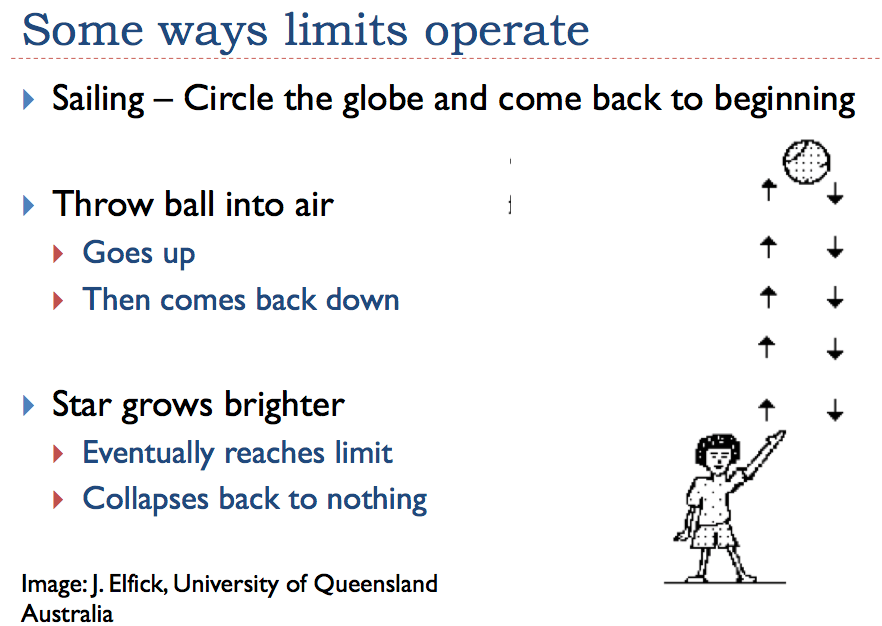
Slide 4
The standard story that we hear says that energy prices can rise and rise, indefinitely. But as I look at the data, this doesn’t seem to be true in practice. At some point, there is a problem with affordability, because wages don’t rise as the price of energy products grows.

Slide 5
In many ways, the problems that overtake the economy are similar to ailments that beset a human being. A person can have multiple ailments, some of which grow in severity over the years. The catch, of course, is that if an early ailment becomes severe, it may kill the patient, eliminating the need to fix the later ailments.
The way I see the economy, there are many hurdles that have the potential to inflict severe damage on the economy. Slide 6 shows a few of them. Some examples of other issues include lack of fresh water and erosion of topsoil.
In my view, we are right now reaching an affordability crisis. One way it manifests itself is as high commodity prices that fall and thus become low commodity prices. Falling commodity prices are likely to cause debt-related problems because of all of the debt incurred in their production. We may find financial problems, much worse than those experienced in 2008, back again.

Slide 6
Many others have focused on climate change. In their view, we can extract pretty much all of the fossil fuels that are in the ground, because prices will rise higher and higher, allowing this to be done.
If, in fact, prices fall after a point, then there is a good chance that we must leave most of them in the ground because of affordability issues. If this is the case, the situation may be very different: we may lose fossil fuel production in not many years because of disruptions caused by low prices.
We often think of affordability in terms of what a gallon of oil costs or in terms of how much a kilowatt-hour of electricity sells for. While these costs are one part of the problem, a big part of the affordability problem relates to big-ticket items, as listed in Slide 7. If customers cannot afford these big-ticket items, such as homes and cars, the economy loses both (a) the energy use that would be required to make these big-ticket items, and (b) the later energy use that these big items would require.

Slide 7
If we look at the data, we find that inflation-adjusted median income for families has been falling.

Slide 8
Part of this lower family income involves a smaller share of the population working.

Slide 9
When a person looks at the labor force growth split between men and women, there is a very different pattern. Men show a small downward trend over time; women increasingly joined the labor force, but this trend topped out in 1999, and became a decline since 2008.

Slide 10
Something we all are aware of:

Slide 11
Many fewer homes are now being built in the United States.

Slide 12
There has been a very different trend in auto purchases in the United States, Europe, and Japan compared to the rest of the world. In the developed areas, interest rates have been very low, and lenders have increasingly offered loans to subprime buyers. An increasing number of the loans are 7-year loans, and the loan to value ratio is often 125%. We seem to be creating a new subprime auto bubble. Based on our experience with subprime housing loans, this is not a sustainable pattern.

Slide 13
I am convinced that most economists have missed a basic principle regarding how economic growth takes place (Slide 14). I define efficiency in terms of what it takes in terms of human labor and resources to produce finished output, such as a barrel of oil or a kilowatt-hour of electricity. Are these finished goods becoming cheaper or more expensive in inflation-adjusted terms?
On Slide 18, note the change in the size of the output boxes, compared to the input boxes. Increased efficiency produces more output compared to the resources used; increased inefficiency produces less output compared to the resources used.
If an economy is becoming increasingly efficient, a given number of workers and a given amount of resources can produce more and more goods. This is good for economic growth. Growing inefficiency is a problem, because it quickly uses up both available worker-time and available resources. Many economists never seem to have gotten past the idea, “We pay each other’s wages.” Yes, we do, but if those wages are being used to encourage the use of increasingly inefficient processes, we go backwards in terms of economic growth.

Slide 14
If we look back historically, we can see a growing efficiency pattern with electricity, in the 1900 to 1998 period. As the price dropped, both consumers and businesses could afford more of it (illustrated with rising black “demand” curve). Part of the lower cost came from increased efficiency of electricity generation during this period.

Slide 15
If we look at the oil sector, since about 1999 we have had exactly the opposite pattern taking place. The cost of oil “exploration and production capital expenditures” has been rising at a rapid rate. This is an issue of diminishing returns. We have already extracted the easy-to-extract oil, and as a result, we need to move on to more difficult (and expensive) to extract oil. Thus we are becoming increasingly inefficient, in terms of the cost of producing the end product, oil.

Slide 16
As we move on to more expensive oil, the higher cost tends to squeeze budgets. The thing that is important is the fact that wages don’t rise sufficiently to cover the cost increase; in fact, the images I showed earlier seem to suggest that in the recent era of high prices, we have seen unusually slow growth in wages. The amount of wages is represented by the size of the circles in Figure 17. The wage circles don’t grow.
Slide 17 shows that as workers need to spend more for oil, and for the things that oil is used to make, such as food, the discretionary portion of their budgets (“everything else”) is squeezed. This shift in discretionary spending is what tends to lead to recession. The same principle works if consumers suddenly find themselves with higher electricity bills–discretionary spending is again squeezed.

Slide 17
The problem that squeezes all commodities at the same time is falling discretionary income. The amount of debt that can be borrowed also tends to fall as discretionary income falls. The combination leads to falling affordability for expensive goods, like new autos and new homes.
The price patterns for commodities of many types move together, reflecting a combination of rising cost of oil (because of higher extraction costs) and falling ability of consumers to afford the high prices of these goods. I have not included food on Figure 18, but many food prices have recently fallen as well.
Of course, the costs for producers creating these commodities have not fallen proportionately, and many have huge amounts of outstanding debt. Repayment of debt becomes difficult, as prices remain low.

Slide 18
Back at Slide 14, I talked about increased efficiency leading to economic growth, and increased inefficiency causing economic contraction. Because our leaders have not looked at things this way, they have encouraged increased inefficiency in many areas, as I describe on Slide 19. To some extent, this increased inefficiency is required. For example, as population grows in areas with low water supplies, the need for desalination grows. Also, pollution problems increase as we use lower qualities of coal and oil.

Slide 19
What are the expected impacts on the electricity industry and on natural gas? Are there any workarounds?
Let’s look at a few implications of the problems we now see.
In my view, low oil and natural gas prices are likely to be a huge problem for the natural gas industry, leading to the bankruptcy of many natural gas suppliers.
We cannot expect natural gas supply to grow. In fact, we cannot expect a coal to natural gas transition because the natural gas price won’t rise high enough, for long enough.

Slide 21
If we look at the history of US natural gas prices (using Henry Hub data), we see that prices have tended to stay low, after the 2008 spike. This was a great disappointment to those who built new natural gas extraction capability. They expected prices to rise, to justify their new higher costs. In my view, the continued low natural gas prices to some extent already reflect affordability issues.

Slide 22
The Marcellus Shale was perhaps the most successful of the new natural gas production, but it seems to now be topping out because of low prices (Slide 23).
Many producers will have their lending terms reevaluated using September 30, 2015 data. This reevaluation is likely to lead to bankruptcy of some producers, and cutbacks of production of other producers.

Slide 23
Coal use has been declining, as shown in Slide 24. Coal has some of the same problems as natural gas, as I will explain on Slide 25.

Slide 24
The basic issue is that coal prices are too low for most producers. Even if a particular producer has low extraction costs, this benefit is not enough to keep producers from bankruptcy. The problem that occurs is that coal companies are locked into high cost structures because of patterns that continue to persist from when prices were high. Lease costs are high; taxes and royalties are high; often debt was entered into, assuming that revenue would remain high in the future. Now revenue is lower, and there is no way to fix the “hole” that results from low prices. Production stays high, because each producer must produce as much as possible, to try to avoid bankruptcy for as long as possible.

Slide 25
Coal is in a sense ahead of natural gas, in terms of bankruptcies, with big bankruptcies already starting.
With prices as low as they are, there is little chance for a new producer to come in, buy the production facilities at a low price, and restart operations. A big issue is ongoing costs such as royalty payments that cannot be eliminated. Another is debt availability to support the new operations.

Slide 26
Bankruptcies are likely to interrupt supply chains as well. Part of the problem may simply be the excessively high cost of credit, for those members of the supply chain with poor credit ratings. Once a supply chain breaks, replacements parts may not be available. Other services that a company contracts for with outside suppliers may disappear as well.
As I note on Slide 27, customers may have financial difficulties. Those who remain in business will tend to buy less, so demand is likely to be lower, rather than higher. Companies producing electricity should not be misled by the rosy forecasts of the EIA and IEA regarding future demand amounts.

Slide 27
Slide 28 shows that industrial consumption of energy products has been falling since the 1970s, as industrial production has moved overseas. Now the dollar is high relative to other currencies, encouraging more of this trend. On a per capita basis, residential energy consumption is down, and commercial energy consumption is level. It is hard to see that this mix will provide very much of an upward trend in natural gas and electricity consumption in the future. (Note: Slide 28 shows energy of all types combined, including both electricity and fuels burned directly. This approach is used because there has been a shift over time to the use of electricity. This method shows the overall trend in energy use better than, say, an electricity-only analysis.)

Slide 28
The major ways subsidies for wind and solar PV are available are through greater government debt or through higher costs passed on to customers. There are now getting to be pushbacks in both of these areas.

Slide 29
In Europe, the cost of intermittent electricity tends to be passed on to consumers. Dr. Euan Mearns put together the chart shown in Slide 30 comparing price of electricity with the per capita wind and solar PV generation installed for European countries. There is a striking correlation. Countries with more installed wind and solar PV tend to have higher electricity prices for the consumer.

Slide 30
Given the problem with commodity producers not being able to collect high enough prices for their products, and the large number of resulting bankruptcies, a person comes to the rather startling conclusion that the ideal structure for electricity providers in today’s economy is that of a vertically integrated utility. In other words, an electric utility should directly own its suppliers, as well as transmission lines and everything else needed to produce and distribute electricity.
Utilities have traditionally had the ability to price on a cost-plus basis. With vertical integration, the utility can use its pricing ability to keep prices for fuel producers from falling too low, and thus sidestep the problem of bankruptcies. To the extent that the required price for electricity keeps rising, it will tend to pressure discretionary spending. (See Slide 17.) But at least grid electricity will be among the last to “go” under this structure.

Slide 31
Black Hills Corporation lists the many electricity-generating facilities it owns (coal and natural gas), and the places it has arrangements to sell this electricity as a utility. The Black Hills Corporation indicates it has had 45 years of dividend increases. This increase in dividends is in stark contrast to the many coal and natural gas producers that are currently near bankruptcy, as a result of low coal and natural gas prices.

Slide 32
How does one resolve the conflict between industrial companies wanting to generate their own electricity (for a variety of reasons) and the need to have an electric grid for everyone else? It seems to me that we have to keep in mind that having an operating electric grid for everyone else is absolutely essential. Without the electric grid, gasoline stations would stop pumping gasoline and diesel. Transportation would stop. Electric elevators would stop. Treatment of fresh water and sewage would stop. Companies everywhere would lose their consumers. The economy would quickly come to a halt.
With our current affordability problems, we are in danger of losing the electric grid. That is why it is essential that those who opt out not be given too large a credit for providing some or nearly all of their own electricity. The credit given to industrial companies should reflect the savings to the system, no more.

Slide 33
One concern is the bankruptcy of peaker plants, if their use is significantly reduced by, for example, the use of solar PV. If these peaker plants continue to be needed for balancing purposes, this may be a problem. Another concern is the rising cost of grid transmission for those who continue to get their electricity from the grid.

Slide 34
To sum up, the story we read from most sources is so climate-change focused, a person wonders if there aren’t other issues that are important as well. Most observers have overlooked the importance of low commodity prices, and the impact that they can have on coal and natural gas producers’ ability to produce the fuels that are needed by electric utilities.
Too much faith is being placed in natural gas, as the fuel of the future. And too much faith is being placed on intermittent renewables, without fully understanding their costs and limitations.
I haven’t tried to address the many indirect problems arising from many bankruptcies. These may be severe.
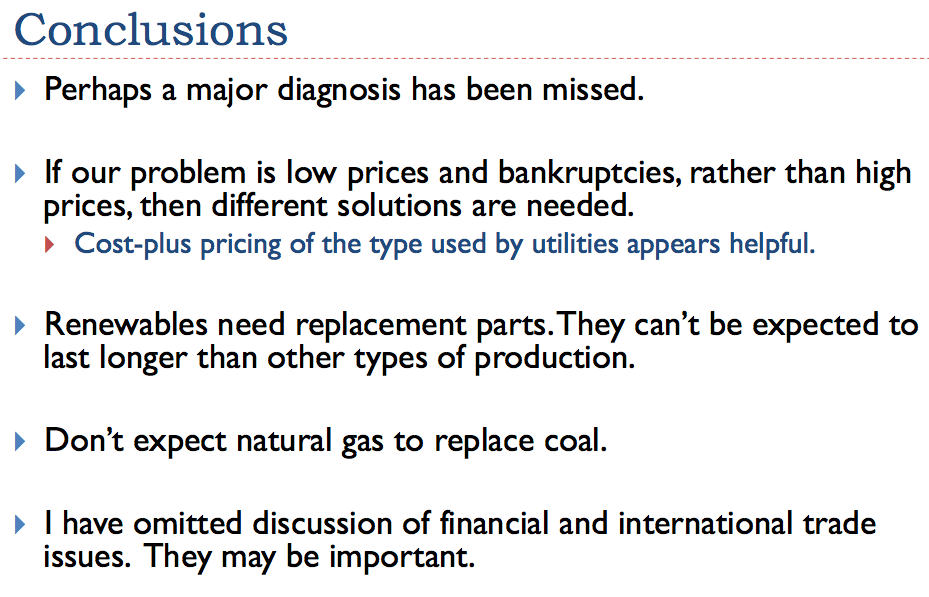
Slide 35


Elon Musk wants to put a MILLION people on Mars by 2100: SpaceX founder says we must colonise red planet or face extinction
http://www.dailymail.co.uk/sciencetech/article-2776270/Elon-Musk-wants-MILLION-people-Mars-2100-SpaceX-founder-says-colonise-red-planet-face-extinction.html
It seems that this guy wants the Earth to be the supplier of industrial products to Mars, as there is neither coal, nor oil on the Mars. Just give him money and he will secure that the world industrial production will not decline, as he has found a completely new market where the production can go.
He is more crazy than we thought…
The dust on Mars contains around 1 percent perchlorates (rocket fuel) so there is an abundant source of power, if you can safely burn them.
It seems impractical at this point, and I don’t see how a Mars colony could ever become self-sufficient. As soon as things on Earth went down, without continuous resupply, the Martians would probably die off shortly after.
Musk misses the point about the purpose of people, and equates Mars colonisation with say–colonisation of the Americas.
The first American colonists were able to support themselves, and ultimate multiply their numbers without external support–that was their ultimate purpose—the rights and wrongs of that are another matter entirely
But, martian colonisers will never be able to do that, no matter how many people are planted there.
we exist on earth through the amount of sunlight-energy delivered per sq metre….mars just doesn’t have that
We would have to start consuming Mars, just like weve consumed eath—where next after that?
Last I checked oxygen is a bit lacking on Mars and apparently in what Elon is breathing as well. Mars is a much smaller planet with drastically fewer resources and sunlight than the Earth The physical size and present resource state of Mars means that it would have a much lower carrying capacity than Earth. Perhaps Mars has the carrying capacity for microbes but, certainly not for humans (and definitely not modern humans). The only reason colonization of Mars is even discussed is to give the illusion that there is a future for humanity. That there is still a “new frontier” for us to conquer. Not to consider for a minute that humans may well be conquered.
Musk clearly knows it is absurd to suggest we can live on Mars….
But he is a tech idol….
And many/most people are aware of the fact that the Earth is on its last legs…. water problems… depletion of fish… over-population … etc….
Since most people are about as thoughtful as rats in a lab experiment…. in order to calm them … the PR men just need to come up with a catch phrase and have a qualified celebrity release a statement…
In our world of tech groupies Musk fits the bill…. if this comes from him the unthinking masses get a big hit of hopium…. of course it’s always good to add a helper to the mix:
http://sachtimes.com/en/images/14157922463291085.jpg
I’d like to know who came up with that name … surely this some sort of inside joke from the spin masters….
“Musk clearly knows it is absurd to suggest we can live on Mars….”
It isn’t absurd, it just isn’t possible with today’s technology.
In order to become a good leader and a billionaire, you actually have to have a vision of the future that is achievable.
It sounds insurmountable, and it might be, but it doesn’t mean it doesn’t inspire someone to try.
There are a lot of nifty new products you have to develop in order to reach that goal.
“Last I checked oxygen is a bit lacking on Mars”
The dust on Mars is rich in perchlorates, which can be an abundant source of energy and oxygen. The energy cost to keep a person living on Mars would be tremendous compared to Earth, though.
If we had our abundant new energy source already working and scaled up, it would be an interesting topic to discuss. With our present reality, it is just a wild pipedream.
Isn’t the gravity on Mars is quite a bit less than Earth and the atmosphere very thin? So, wouldn’t the oxygen that is created have to be pressurized inside of a building of some sort? Certainly a person couldn’t roam around the planet without some sort of suit? What kind of life would that be? Sound horrible to me LOL! Am I missing something?
I don’t think you are missing anything. Living on Mars would, besides being impractical and requiring a vast amount of energy and likely constant resupply from Earth, also be claustrophobic, boring, unhealthy and short.
Life on Mars….atmospheric pressure is about 10 Torr on a balmy day near the equator (1 atmosphere on Earth is 760 Torr). Air temperature is about -55°C during the day. Air content is mainly CO2 (96%), with minor N2 and Ar, and traces of CO and water. You’d probably have an easier time sucking on the exhaust pipe of your car, at least it would have some warm water vapor in it to sooth your dry throat.
This is ridiculous!
Mars is just like Earth there are only two forms of energy nuclear or sunlight. Pick you poison. Elon has picked sunlight. He is a smart person. Every calculation we have talked about he also knows about. He seems to hope for technology improvement over time, and perhaps a smaller population but we are not privy to his true thoughts.
Recently I read him say 10 cargo flights per each humans flight. This is the first time I have heard a reasonable number/thought to overhead by a Mars colony promoter. The EU one way flight folks give zero thought to overhead ( the many many needs of humans to live on Mars).
Send all the refugees pouring into the EU to Mars instead…. each settler gets 50 hectares of land for free — if there are any Martians there settlers get carte blanche to exterminate them….
Make Elon Musk the God of Mars.
Why not turning Sahara back into fertile/inhabitable land, if Elon Musk thinks he has enough energy to turn Mars into fertile/inhabitable land?
++++++
Too bad you can’t put that question directly to him 🙂
“Why not turning Sahara back into fertile/inhabitable land, if Elon Musk thinks he has enough energy to turn Mars into fertile/inhabitable land?”
You are misunderstanding the goal entirely. The problem is that one disaster or nuclear war could wipe out humanity and all significant life on Earth. The goal is to put the eggs in more than one basket.
Also, the Sahara is inhabited and owned by people. Short of rounding them up and taking their land by force, there is no way to secure that land, so the work could be taken at any time.
Western Imperialists invading and taking land from muslims would have bad optics and some serious blowback, and the muslims aren’t going to do it themselves (well Ghaddafi did to some extent, but then the West took him out).
How about the Antarctic?
Nobody lives there…. as far as I know — unlike Mars — there is oxygen there — and lots of fish — and water as well…..
Elon could have a pet:
https://www2.ucar.edu/sites/default/files/news/2012/Six_Emperor_Penguins.jpg
There is a large need for energy in the Antarctic, and a low supply. In fact, other than frozen water and nearly-frozen water, there is not much of anything there.
Besides, how would ten million people living in the Antarctic be any better able to survive if all the spent fuel ponds go up? It would fail to serve the purpose of increasing humanities odds of survival.
Tesla is on it!
http://www.ferrvor.com/blog/wp-content/uploads/2015/01/Snow-Crawler-Banner.jpg
Regarding China’s supposed change from an industrial economy to a consumption economy, Stockman says, “Consumption is the consequence of production and income, not its cause.” Our economists don’t understand how the economic pump works. A country needs to make goods ever-more-cheaply, for economic growth to occur (plus not run out of land for food and easily extractable resources, or find itself with too much pollution). Planning on consumption alone to drive an economy is absurd.
“Planning on consumption alone to drive an economy is absurd.”
That’s what western economies are realizing — particularly when the consumption is debt-driven….
But then what choice did they have — consumption is really ultimately driven by cheap to extract resources…. something had to step in to keep the hamster running
Good point!
Coincidentally while Gail was working on her blog on the electric question, I also was researching this problem from the historical end. I just published it, The Dimming Bulb 2: Peak Electricity
RE
Nice narraitve RE, it feels kinda rushed at the end though. And I’m pretty sure that the money systems collapse first, and second, and third, before the stuff gets real. Money just doesn’t do contraction well.
I was surprised how lighted up India is compared to Africa (among other things).
Once the fuel is uncovered, it could become hot enough to cause the metal cladding encasing the uranium fuel to rupture and catch fire, which in turn could further heat up the fuel until it suffers damage. Such an event could release large amounts of radioactive substances, such as cesium-137, into the environment. This would start in more recently discharged spent fuel, which is hotter than fuel that has been in the pool for a longer time. A typical spent fuel pool in the United States holds several hundred tons of fuel, so if a fire were to propagate from the hotter to the colder fuel a radioactive release could be very large.
http://www.ucsusa.org/nuclear_power/making-nuclear-power-safer/handling-nuclear-waste/safer-storage-of-spent-fuel.html#.VUp3n5Om2J8
According to Dr. Kevin Crowley of the Nuclear and Radiation Studies Board, “successful terrorist attacks on spent fuel pools, though difficult, are possible. If an attack leads to a propagating zirconium cladding fire, it could result in the release of large amounts of radioactive material.”[12] The Nuclear Regulatory Commission after the September 11, 2001 attacks required American nuclear plants “to protect with high assurance” against specific threats involving certain numbers and capabilities of assailants. Plants were also required to “enhance the number of security officers” and to improve “access controls to the facilities”.
The committee judges that successful terrorist attacks on spent fuel pools, though difficult, are possible. If an attack leads to a propagating zirconium cladding fire, it could result in the release of large amounts of radioactive material. The committee concluded that attacks by knowledgeable terrorists with access to appropriate technical means are possible. The committee identified several terrorist attack scenarios that it believed could partially or completely drain a spent fuel pool and lead to zirconium cladding fires. Details are provided in the committee’s classified report. I cannot discuss the details here.
http://www.cfr.org/weapons-of-mass-destruction/nuclear-spent-fuel-pools-secure/p8967
If any of the spent fuel rods in the pools do indeed catch fire, nuclear experts say, the high heat would loft the radiation in clouds that would spread the radioactivity.
“It’s worse than a meltdown,” said David A. Lochbaum, a nuclear engineer at the Union of Concerned Scientists who worked as an instructor on the kinds of General Electric reactors used in Japan. “The reactor is inside thick walls, and the spent fuel of Reactors 1 and 3 is out in the open.”
http://www.nytimes.com/2011/03/16/world/asia/16fuel.html
If you don’t cool the spent fuel, the temperature will rise and there may be a swift chain reaction that leads to spontaneous combustion–an explosion and fire of the spent fuel assemblies. Such a scenario would emit radioactive particles into the atmosphere.
Pick your poison. Fresh fuel is hotter and more radioactive, but is only one fuel assembly. A pool of spent fuel will have dozens of assemblies. One report from Sankei News said that there are over 700 fuel assemblies stored in one pool at Fukushima. If they all caught fire, radioactive particles—including those lasting for as long as a decade—would be released into the air and eventually contaminate the land or, worse, be inhaled by people. “To me, the spent fuel is scarier. All those spent fuel assemblies are still extremely radioactive,” Dalnoki-Veress says.
It has been known for more than two decades that, in case of a loss of water in the pool, convective air cooling would be relatively ineffective in such a “dense-packed” pool. Spent fuel recently discharged from a reactor could heat up relatively rapidly to temperatures at which the zircaloy fuel cladding could catch fire and the fuel’s volatile fission product, including 30-year half-life Cs, would be released. The fire could well spread to older spent fuel. The long-term land-contamination consequences of such an event could be significantly worse than those from Chernobyl.
http://science.time.com/2011/03/15/a-new-threat-in-japan-radioactive-spent-fuel/
I believe there are close to 4000 active spent fuel ponds across the planet.
Today there are 103 active nuclear power reactors in the U.S. They generate 2,000 metric tons of spent nuclear waste per year and to date have accumulated 71,862 tons of spent fuel, according to industry data.[vi] Of that total, 54,696 tons are stored in cooling pools and only 17,166 tons in the relatively safer dry cask storage.
http://www.psr.org/environment-and-health/environmental-health-policy-institute/responses/the-growing-problem-of-spent-nuclear-fuel.html
Wrap your feeble mind around those inconvenient facts…. LJR…. ta ta …
How many bananas will the environment after the fuel pond explosions be equivalent to?
https://www.youtube.com/watch?v=TRL7o2kPqw0
Radioactivity stirs a lot of emotions and terrifies people. Often it is not well founded as the film in the link above shows. I admit I don’t know that much about these spent fuel ponds. You seems to know more. The intersting thing is what will happen to the background radiation? Will it double, increase ten-fold or more?
The uranium Svornost mine in Jachymov, Czech Republic, where the Uranium was discovered – a place were a lot of political prisoners were forced to work. The false accusations was an easy way for the communist regime to get working force for such dangerous places…
There are basically two types of radiation hazards to animals, including humans, (1) external exposure; (2) internal exposure. External exposure, like chest or dental x-rays, can be hazardous if the source is concentrated or has a high activity. The dose is also cummulative, so a few x-rays (patient) has high benefit/risk ratio. A lot of exposure (x-ray technician) has low benefit/risk ratio, so they wear or stand behind shields. Another way to minimize exposure is distance, as the radiation dose follows a 1/r2 law, like gravity and magnetism. Stay as far away as possible unless there are good reasons to do otherwise.
Internal dose (2) is more incidious. Your dosimeter or survey meter may say all is well, and you can still get internal doses if you are breathing or ingesting radioactive material. To prevent this exposure in a suspect area, one has to wear appropriate gear (face masks, gloves, shoe covers) and measure the content of the foods and other materials (dust, soils, water) for possible comtamination. As a rule, ingestion is less of a hazard than inhalation. Transuranics (nuclear fuel) are especially incidious and hazardous types that usually require special equipment to monitor, like alpha and gamma-ray counters/spectometers.
Many of Ms. Tverberg’s essays have shown that US domestic crude oil production plateaued, peaked and began to decline in the 1969-1971 timeframe (crude oil production peaked in 1970 at 10.4 millions barrels of oil per day). It is NOT a coincidence that in 1971 President Richard M. Nixon reneged on the international convertibility of the US dollar into gold at $35 per Troy ounce. The US became a net crude oil importer after World War II. Dollars spent on domestically produced crude oil continue to recirculate in the US economy supporting further crude oil exploration & production, capital expenditures, wages, taxes, and the overall economy in general. But, dollars spent on imported crude oil are largely losses to the US economy. There were other factors besides spending on imported oil, such as the Vietnam War, the war on poverty and general across-the-board government spending, behind the transformation of the US dollar into a purely fiat currency. But, the role of declining domestic crude oil production is often overlooked.
What’s interesting is the petrodollar regime will probably soldier on “uncontested” at least to its 5th decade as of now/soon. One of the reasons behind this longevity is that the international capital resides way higher above the clouds, looking down at the ants, politicians, states and empires. The US has been reduced sometime along the way to a mere role of a supporting sidekick, still usefull anymore? Who knows, lets see in next 5-15yrs if we get more balanced-distributed world stage or abrupt change in the role of the hegemon.
British Empire peaked during WW1 and it took all the way until 1997 when Hong Kong was ceded back to China for it to finally be finished. Although to be fair most of the decline was in the 1940s to 1960s.
In America’s case I think it will start with the withdrawal from overseas commitments, the gradual replacement of the dollar as the world reserve currency. All of this will take place in the context of the limits to growth, peak fossil fuel, and peak population. In other words, America is the last global hegemon. There simply isn’t the energy for another to arise, we will just have regional powers.
There is no iron law that there must be a global hegemon, this is a very recent phenomenon. In fact, the idea is a bit absurd if you even stop to think of it…that one people or nation can control the affairs of the world. It’s an impossibility to begin with, which makes it a waste of time to pursue in the first place.
On a long enough timeline this will provoke an existential crisis in America, as Americans are power and money grubbing sociopaths. Without infinite money and power, America has no reason to exist as it has nothing to fall back on but endless racial and class conflict. I hope I live to see the next civil war in America, I really do.
I believe the USA has much better conditions to manage than for instance europe or china. The resource basis/capita is much better in north america. That’s the simple reason. Europe will collapse much before noth america. You should study us.
The problem with the USA is that it was built during the era of cheap coal and oil. So the USA is more or less in the same situation as Europe that had better geographical conditions for the rise of the civilizations. The distances (which need a lot of cheap energy for overcoming them) is the big problem of the USA (or e.g. Russia, too).
“The problem with the USA is that it was built during the era of cheap coal and oil. ”
Relative to the rest of the world, we still have cheap coal and oil. It is one of the reasons why people tend to gang up and attack renewable energy, rather then embrace it as a cost effective solution. However, it also tends to be regional. For instance in California, the cost is higher already, so they have been jumping in head first. In the southeast, they have far lower costs for energy, so they have been fighting it.
The government structures and social structures also vary between the southeast and southwest.
The southeast is usually the most conservative, and usually about 20 years behind, any technological or social trends. They end up costing the US government billions of extra dollars a year.
The cost problem is still relative to what our infrastructure was originally built for. We have built up a networked system over time. We can no longer replace what we built for the corresponding amount of depreciations.
There is also the problem with having to stop using electrical generating capacity before the end of its lifetime. Even a cutback in the extent to which a plant is used is a problem, because a coal or natural gas generating plant has fixed costs. These must continue to be covered, regardless of how little the plant is used. It is likely that the only savings is the pretty much the fuel savings. In fact, if the plant is ramped up and down more often, there may be more “wear and tear” on the plant.
Plants need to pay back their debt. If they can recover costs as a utility, they perhaps can keep increasing rates (and thus cause problems for consumers). But if they are merchant plants, they may fact bankruptcy, as they are used less. There are likely to be debt defaults, causing problems for banks. There is a question whether a new buyer can be found. If not, the plant represents wasted materials.
“There is also the problem with having to stop using electrical generating capacity before the end of its lifetime.”
The average life of a coal plant in the US is 41 years old. I believe the maximum depreciation is 50 years.
You do the math as to how many plants have already depreciated..
“Even a cutback in the extent to which a plant is used is a problem, because a coal or natural gas generating plant has fixed costs. ”
You can get rid of like 40% of the coal fleet, since they have already depreciated beyond 50 years. Which leaves a lot of room for renewables to fill in. By the time you fill that gap, then you will have a lot more plants that have fully depreciated.
“These must continue to be covered, regardless of how little the plant is used. It is likely that the only savings is the pretty much the fuel savings. ”
The -fuel- savings is the important part. The fuel is too costly, which is the whole catch-22.
“In fact, if the plant is ramped up and down more often, there may be more “wear and tear” on the plant.”
This is proven to be a false claim. The EIA studied it like 6 years ago.
If the price actually covered production costs, then I would agree, ” The fuel is too costly, which is the whole catch-22.” The catch – 22 is that suppliers go bankrupt and can’t be replaced.
“The catch – 22 is that suppliers go bankrupt and can’t be replaced.”
They will be replaced. There is demand for the product. The price might go higher, which is also a catch-22 because the cost of alternative to their product is a LOT closer to their price.
In other words, it is resulting in an industry shake out. It happens.
Demand is an affordability issue. It is an affordability issue for big-ticket items like houses, cars, schools and roads. This kind of demand problem is not easily solved, except temporarily with more debt. But we get to the end of the line on what debt can do.
“Demand is an affordability issue. It is an affordability issue for big-ticket items like houses, cars, schools and roads. This kind of demand problem is not easily solved, except temporarily with more debt. But we get to the end of the line on what debt can do.”
Correct. We can’t afford to try and keep borrowing money to bail ourselves out. We have to live within our means. Which might be meager.
We also can’t afford the expense of fossil fuels any longer.
You are living at the end of an era, and the beginning of a new era. It is time to let go of the old one.
I hope the next north south discussion will go better. We will agree that all are free to go their separate ways. The south can join Mexico in 1% owners of the land 99% peasant farmers of the land. The north can embrace nuclear power big time. Placed if need be in under sea halls 100 miles out. Not to mention we (north) gets the coal in Illinois and Wyoming.Think Spain versus Norway (I would have picked Sweden but with all the negative press it has been getting here it is down graded on my list).
The British Empire peaked when its coal energy supplies peaked, during ww1.—after that we coasted down the slope of denial, burning cheap middle east oil.
The USA empire peaked in 1970, the year the USA became a net importer of oil, and was no longer a swing producer.
Just like the British Empire, the USA is also on the downslope of denial with politicians promising growth and the revival of the American dream
“There were other factors besides spending on imported oil, such as the Vietnam War, the war on poverty and general across-the-board government spending, behind the transformation of the US dollar into a purely fiat currency. But, the role of declining domestic crude oil production is often overlooked.”
I agree. It is literally the lack of domestic crude production, that keep tanking our country economically and causing us expensive issues overseas as well. It is a 200-500B/yr loss to our economy now. Basically everytime we start to recover, the price of oil goes up and slows down our economy. It is like the world tax on our economy. Probably mostly controlled by the top european commodity traders who all trade in oil/gas/coal.
The trade deficit to China needs to get turned around as well, or we need to start exporting more then grains in significant amounts. but one problem at a time.
The solution seems clear. Invade and take KSA.
I agree that there may be a connection, but I am not sure whether there was a direct connection. I doubt very much was known about the decline in oil supply in 1971 when the change took place. Most people were not looking for the change, so i expect that it was not all that well known.
Dollars spent on domestically produced crude do recirculate in the US economy. It is important to note, however, that it is how efficiently that the oil is produced (how few workers are used, and how little resources are used) that is important. Otherwise, the greater spending on oil is simply drawing workers and resources from other sectors of the economy. It is ultimately the efficiency of the oil production that matters–thus, the cost per barrel of production.
Anybody have any GUESSES on what the results are on the ENERGY SURVEY questions on when Gas will become either unaffordable or unavailable at the pump and when the Blackouts & Brownouts will start in your neighborhood?
I have been monitoring the results as they come in, and it looks pretty statistically valid so far, since the mean is not changing much as more respondents drop in, the percentages are holding true reardless of the Sample Size.
I will compile the results off the spreadsheet on Monday and have the results up Tuesday next week, so this is the final few days to drop in your opinion and get counted this time. The survey will remain open though and I will do another count & review at the end of the year.
RE
http://wolfstreet.com/wp-content/uploads/2015/10/US-total-business-sales-2000_2015-08.png
http://wolfstreet.com/2015/10/16/moodys-recession-warning-jarring-drop-in-payrolls/
All part of the plan?
American Psycho: Has the United States lost its collective mind?
From Ferguson, Missouri to the deserts of Afghanistan the specter of US aggression is fueling the flames of civil strife and military conflict around an increasingly volatile planet. Much of the problem may be connected to the breakdown of the American psyche.
Before attempting to shed some light on America’s mental condition, let’s open with a pop quiz question: What is the top-selling prescription drug in the US? Nope, it’s not Viagra, not Prozac, forget the Percocet. If you don’t know, take a peek in the medicine cabinet because there’s a high chance it’s lurking in there, right behind that purple people eater. Yes, you got it.
The top-selling drug in the Land of the Free and Disturbed is an antipsychotic, happily named Abilify.
Once again: The top-selling drug in America is an antipsychotic. Now some might say that’s mental
“To be a top seller, a drug has to be expensive and also widely used,” Steven Reidbord M.D. wrote in Psychology Today. “Abilify is both. It’s the 14th most prescribed brand-name medication, and it retails for about $30 a pill. Annual sales are over $7 billion, nearly a billion more than the next runner-up.”
Let those numbers seep into your brain for a moment: $7.2 billion dollars. $30 per pill. Although that might make for some laugh-out-loud late-night comedy, these numbers are no laughing matter.
This on top of the latest statistic that shows prescription drug spending in the US exploded in 2014 to nearly $374 billion, a whopping 13.1 percent increase in growth, according to a new report from IMS Institute for Healthcare Informatics.
Aside from the fact that Americans are buying antipsychotic medication by the truckload, there’s another disturbing thing about Abilify: Nobody, not even the Food and Drug Administration (FDA), has any idea what makes it effective. According to the USPI label that accompanies each bottle: “The mechanism of action of aripiprazole… is unknown. However, the efficacy of aripiprazole could be mediated through a combination of partial agonist activity at D2 and 5-HT1A receptors and… etc, etc.”
In other words, millions of Americans are ingesting an antipsychotic drug that not even the scientific community can say exactly what makes it work. Is that not in itself the very definition of insanity?
So where is the uproar, the protest, the media hype over this battle for the great American brain? Behind the wall of silence, there have been a few courageous experts who have broken rank with their colleagues – not to mention the omnipotent pharmaceutical industry – to blow the whistle on the abuse of psychiatric drugs in America.
More https://www.rt.com/op-edge/318768-american-psycho-zombies-drugs/
From Wikipedia:
“Perhaps owing to its mechanism of action relating to dopamine receptors, there is some evidence to suggest that aripiprazole blocks cocaine-seeking behavior in animal models without significantly affecting other rewarding behaviors (such as food self-administration).[74] Aripiprazole may be counter-therapeutic as treatment for methamphetamine dependency because it increased methamphetamine’s stimulant and euphoric effects, and increased the baseline level of desire for methamphetamine.”
https://en.m.wikipedia.org/wiki/Aripiprazole#Research
‘Abilify’?
Next up:
‘Yeswecanify’
You see my friends, there is always Hope, dreams can come true and you can feel Really Great!
Here’s an interesting one to watch. The situation has been ratcheting up for some time, all the while China slowly but surely expands previously non-existent islands in the South China sea near Vietnam and the Philippines. They’ll probably end up with an island a thousand miles long with toll gates to get through – lol.
http://www.usatoday.com/story/news/politics/2015/05/13/china-warning-us-south-china-sea-islands/27229987/
China, U.S. head toward faceoff in South China Sea
WASHINGTON — The Chinese government gave a stern warning Wednesday that it will protect its sovereignty in the South China Sea after a cat-and-mouse pursuit of a U.S. warship by a Chinese frigate.
“The Chinese side will take resolute measures to safeguard national sovereignty and safety. We will keep an eye on the situation in relevant waters and airspace and respond to any violation of China’s sovereignty and threat to China’s national security,” said Hua Chunying, a spokeswoman for the Chinese Foreign Ministry.
Her warning came after an advanced Navy warship — the USS Fort Worth — sailed through the South China Sea on Monday near islands China is building in an effort to extend its territorial claims. The United States considers the area to be international waters, and the Philippine and Japanese navies have conducted exercises in the area in an attempt to counter the Chinese claims.
The Pentagon has chosen not to fly over or sail near the new islands on routine patrols, said a Defense department official on condition of anonymity because they were not authorized to speak publicly. Discussions are under way about whether to change that policy but there has been on written directive to do so, the official said.
Warren declined to offer details about how the military will treat the islands.
The Pentagon, he said, “is a planning organization and it is our job to provide our leadership with options. What I can say is that we have, and will continue to operate in a manner consistent with the rights, freedoms, and lawful uses of the air and sea, including preserving freedom of navigation around the globe and in the South China Sea.”
If the rules say that an island is part of a country, governments will make islands if doing so will get them oil and gas reserves.
Makes sense. Rather crafty in fact.
Snowball….
Up to a thousand job losses are feared at one of Britain’s biggest remaining steel plants as ministers and business chiefs hold a high-powered summit to discuss the in-crisis industry’s future.
It is understood that an announcement could come as soon as next week that Tata Steel will launch a restructuring focused on its plant in Scunthorpe, Lincolnshire, which employs a total of 3,000 staff, though more jobs could go elsewhere, potentially in Scotland.
News of the potential job losses comes in the week that the blast furnace and coke ovens at SSI’s steel plant in Redcar, Teesside, began to shut down after the company went into liquidation with the loss of more than 1,700 jobs, as first revealed by the Telegraph.
As well as the recently announced losses at SSI in Redcar, earlier this year Tata cut 720 jobs at its speciality steel plant in Stocksbridge, South Yorkshire, and a further 250 agency staff went as the company mothballed another mill in Llanwern, Wales.
Tata cited the “cripplingly high” cost of energy as a factor in the redundancies.
http://www.telegraph.co.uk/finance/newsbysector/industry/engineering/11934486/Fears-of-fresh-job-losses-at-Tata-Steel-as-industry-and-government-hold-crisis-summit.html
Here’s another solar company who couldn’t make it without Govt backing.
http://www.theguardian.com/environment/2015/oct/16/solar-firm-blames-subsidy-cuts-for-uk-exit
“Solar firm blames subsidy cuts for UK exit
Parent company says government does not support solar development, as Zep Solar UK becomes fourth UK solar business to close in a fortnightz”
Crippling high cost of energy when prices are as low as they are now? Not so good!
ok, maybe the key is not the low oil price but a debt squeeze for the emerging markets…
I have researched the topic “family house” applying google picture search for Slovakia, Poland and Czech Republic. As I personally know the situation and the energy background of these 3 countries and this search only confirmed my conclusions about higher energy needs required for living in the mountains:
When you compare these 3 searches for “family house” in the respective languages for Poland, Czech Republic and Slovakia, you can see a clear difference in case of Slovakia:
Poland (flat country):
https://www.google.sk/search?q=%22dom+jednorodzinny%22+site:pl&espv=2&biw=1280&bih=598&source=lnms&tbm=isch&sa=X&ved=0CAYQ_AUoAWoVChMIiNqIgb_HyAIViQ8sCh2tGgKN
Czech Republic (undulating country):
https://www.google.sk/search?q=hilly+country&espv=2&biw=1280&bih=598&source=lnms&tbm=isch&sa=X&ved=0CAYQ_AUoAWoVChMIqvTdv7_HyAIVAYssCh3fkQJ9#tbm=isch&q=%22rodinn%C3%BD+d%C5%AFm%22+site:cz
Slovakia (hilly country):
https://www.google.sk/search?q=hilly+country&espv=2&biw=1280&bih=598&source=lnms&tbm=isch&sa=X&ved=0CAYQ_AUoAWoVChMIqvTdv7_HyAIVAYssCh3fkQJ9#tbm=isch&q=%22rodinn%C3%BD+dom%22+site:sk
The search results for Slovakia show mostly ground floor houses, bungalows. When you cross the border from Slovakia to Poland you immediately notice the houses with multiple floors. This is surely due to the abundance and use of coal in Poland, besides its flat countriside.
I would say that these trends clearly indicate the levels of coming energy poverty. The electricity generation dependent on the nuclear power plants in case of Slovakia shows that the nuclear power plants can prevent energy poverty only partially in comparison to coal, as regards the private use of energy: when your wages are low, no matter how large is the capacity of the nuclear power plants, you can not afford much. Then, in case of Slovakia, this abundant nuclear power plants capacity is consumed by the industry (car manufacturing) or will be exported, when the new 2 reactor units will come online in the next years.
Well, I don’t know, there could be another set of reasoning behind these trends..
For one thing, the Poles are now living their “finally justified golden age” after centuries of oppression, they seemingly have it ALL NOW, int. guaranteed security and freedoms (US wants mil bases near Russia), money for infrustructure rail/highways (labor slaves for yet non robotized segments of EU/Germany industries). So, accordingly this event of few decades had to translate into high overconfidence and hence relatively oppulent living arrangements as well. Also as you say domestic coal availability plays huge role in it. Obviously, in summary it is very temporary and very stupid rush for quick fortunes as they will yet again overplay they cards and fall into some future geopolitical trap and loose most of it all.
In terms of Slovakia, actually, it makes more sense to build vertically in hilly country to save on valuable land. So there are perhpas budget reasons in Slovakia to go with bungalow type of dwellings for the moment?
MG and WorldofH.
It’s not only topography perhaps but the way of life (security)and mode of agriculture: in the rather narrow and steep valleys of the Pyrenees farmhouses are simply enormous, with huge high-ceilinged (but small-doored) rooms, and ground floors where farm carts could be driven in and the oxen and cows stalled, etc. This was useful in time of war, so everything could be locked up, and i winter the heat from the animals would rise to the rooms above, which is the energy aspect. Also, no need to build expensive out-buildings.
I suppose the opposite extreme would be the simple huts of the potato-growing Irish peasants, which when they died of starvation were just pulled down over their heads.
A step up from that would be the Dutch peasants eating by the fire while their cow looks over their shoulders, often painted in the 17th century.
The labour in the Pyrenees came from family members, most of whom were not permitted to marry or inherit but stayed on the farm to labour. Born into bondage. Better than ‘educated’ into debt……!
xabier,
“Born into bondage. Better than ‘educated’ into debt……!” – that is a very good observation…
As regards Slovakia, this increasing popularity of bungalows is surely caused by the declining energy from the natural gas for heating in the Carpathian Mountains of Slovakia. Recently, Germany and Russia annanounced its plan to build 2nd string of the Nord Stream pipeline from Russia to Germany
Now, the situation looks like this:
http://cdn.oilprice.com/uploads/AC1103.png
Source: http://oilprice.com/Energy/Energy-General/Merkel-Medvedev-Launch-Nord-Stream-Pipeline-Beneath-Baltic-Sea.html
After the construction of the 2nd string of the Nord Stream, the situation will be that the old pipeline via Central Europe will lose it importance and the old pipes will not be economical to maintain and replace. Morover, there will be huge loses for the countries that participate on the pipeline transport of natural gas to Western Europe via Central Europe.
https://www.rt.com/business/315019-yatsenyuk-ukraine-nord-stream-gas/
The Eastern Slovakia (where no nuclear power plant is built, although during the communist era it was planned to build several more nuclear power plants in arelatively small Czechoslovakia, including one in the Eastern Slovakia: http://www.maska95.estranky.cz/clanky/jaderna-energie/ceskoslovensky-jaderny-program.html) already faces strong depopulation (although not clearly visible in statistics), as younger generations work abroad or in the western part of Slovakia (car manufacturing etc.) and practically only retired people and children and women are present at home.
As regards eating habits and this energy decline, I have noticed one interesting thing: when I visit a fast food section in the shopping centers in Slovakia, where you can choose from various cuisines (Slovak/Central Europe traditional food, American food, Asian food), you see people gathered around the Asian food stands, very few buy the food of the first two groups. This is completely in line with the trend I call “japanization”: industrial decline via depopulation of energy-poor areas, change in the nourishment to Asian food, child-like look, behaviour, attitudes, bodies etc.
MG, how much are you influenced by Kunstler? Your part about “child-like look, behavior, attitudes, bodies etc.” is exactly the same as Kunstler referring to bottom 80% of citizens of up state New York. An area that is cold in the winter and has zero jobs other than government jobs of police, school teacher, prison guard. Much of the heating is from local wood the only affordable fuel source.
Dear Ed,
I am influenced only by my observations. I have not read anyhting from Kunstler regarding this. Slovakia seems to fit into the similar picture of government (EU funded) jobs, wood, cold winter etc.
The work in prison is one of the wanted jobs in the area where I live, as this is connected with stability and benefits. Here I found a nice photo of the one in my district town: first medieval castle, then monastery and finally prison…
http://static.panoramio.com/photos/large/102687050.jpg
MG probably meant the subculture or shall we say todays dominant mis-culture of “mall rats” – it’s all around the world now, including CEE region, I feel like my energy being sucked out of me by vampire only visiting these places few minutes in aggregate per year. However, there are people-zombies spending hours per week on voluntary basis inside these madhouses not only shopping but socializing.. it’s beyond disgusting..
Could the Asia food thing be food that has little meat in it? That is cheap food. Lots of rice a little meat for flavor. I thought American food was the same McDonald’s wheat bun, potato fries, a little meat for flavor (via advance meat recovery technology i.e. really crap meat).
“I thought American food was the same McDonald’s wheat bun, potato fries, a little meat for flavor”
McDonalds will alter their recipes due to local availability of products. Even the menu’s items change based on regional preferences in the US.
MG, good post you have me going. New York State above 50 north of NYC is declining in population. Due to poverty and high taxes and high heating costs. It is also old people. When I get on a plane in Albany NY (middle of the state on a north south line) it is all people over 50/60. When I get off in California their are kids and parents and jungle gyms. A completely different world.
Ed, that is interesting. Well, colder climate and declining energy seem to regulate the population growth…
As regards the Asian food, it seems more healthy than Central European schnitzel with potatoes or American food, i.e. less calories, too.
Dear worldofhanuman, well, “mall rats” of today are the former shopping people of the town centers: the centers of the towns are emptying, the new centers of the towns are shopping centers, where the process of contraction due to the declining energy continues…
The man who invented the mall originally intended for it to be a place of culture and social meeting, mixed with retail. He wanted art in the malls and everything. He was pretty horrified with the way they turned out.
MG, do your infantile adults have lots of tattoos?
Dear Ed,
exactly: so many tattoos that when they organized some kind of miss competition in the region of central Slovakia (which starts to depopulate), they had a problem to find one without it.
Or excessive make-up of women or hair-styling of man is present, too. Excessive amounts of bijouterie on various parts of the body, too.
I attribute this to the contraction of the population: the individual persons need to put on their bodies some items that create attraction, as the energy is declining. As they do not understand this overall trend, they attribute the lack of interest from other persons (or persons of opposite gender) to not being enough attractive…
The minimum wage in Germany too high for the refugees:
http://www.ibtimes.com/german-conservatives-want-relax-minimum-wage-refugees-poll-shows-support-cdu-slips-1-2118301
In Sweden 80% subvention for employing migrants
One of the debates that keeps coming up in the comments is slow vs fast collapse. Some are arguing that the financial system will not collapse because government is omnipotent and digital money is infinite. Even without financial collapse (of which I am doubtful we can avoid) I am still in the fast collapse camp for the US and most of Europe. Here is one reason why. A few months ago Gail showed a graphic of how many elements of the periodic table were used to manufacture computers. Computers are very complex and are now a crucial part of sustaining our civilization. If we are in a commodity collapse phase and begin to loose access to certain crucial elements of the periodic table then it would seem the system with the greatest exposure to the periodic table would be at greatest risk of failure. Computers control virtually every aspect of modern life. Today’s computers have very short lives (5-8 years here where I work) before they have hardware problems (unlike the hardy old IBM XT’s). I feel things would unravel incredibly fast after a few key computer failures. That is just one reason I believe fast collapse (in the US at least) is unavoidable because we are so over-leveraged now. I have more reasons but save that for later.
I try not to mistake wealth with survival. Americans are so wealthy they have forgotten what survival is. Thus, the apocalyptic fantasies of doom, as well as fringe prepper groups that ultimately fail.
America now has a critical mass of new arrivals (Latins and Asians) who believe in the system. They are the aspirational immigrants who come from poorer countries, and America is a wonderland to them. I’m not saying they are right, I’m talking about their perception. They will keep working for some time, and the elderly whites, jews, and blacks who drop out will be supported by them.
Moreover I never said government is omnipotent, but I do recognize what they have on their side (the application of force).
I worked in healthcare which is a terribly inefficient industry, but anyways we could get rid of computers and electronic records, every last one, and not only would healthcare continue, costs would go down and quality would increase as nurses and doctors would actually tend to patients rather than staring at screens.
But can the financial system function without computers? Can transportation function without computers? The electric grid?
How did these things function in the 1980s or 1990s, much less the 70s or 60s or 50s? Everything you list predates computers.
And what makes you think all computers are going away? Some will last, some won’t. Just scrap the ones that don’t last.
If anything, my slow collapse/decline vision of the future should terrify you more. A fast collapse would be exciting, and because it would be so complete, it would also increase understanding of our situation and thereby the remaining survivors could plan more effectively on how to allocate the remaining resources.
During a decline, nobody has answers and the process just continues, relentlessly, and we don’t understand what’s happening, and our history isn’t even written until 1000 years later, and even they probably won’t get it right.
I of course have completely given up on humanity, but not because we’re all going to die tomorrow, but because of the vision of what I see coming this century. Which is, of course, war, famine, poverty, disease, propaganda, police state, infantilization and cultural regression, monetary breakdown, racial/religious violence, paranoia and cults. Look around, it’s already happening.
You can’t just rewind back to 1950.
BAU requires computers — if you suddenly removed those from the equation you do not magically go back to ‘Happy Days’ — you go to total chaos…
You go to total collapse as in collapse in trade — a total collapse in energy supplies — a near total collapse in the food supply.
Like I stated before — the tech ‘solutions’ we have devised to extend BAU have walked us higher and higher up the cliff…. you can’t just walk back down …. you hurtle down and smash on the rocks below….
“You can’t just rewind back to 1950.
BAU requires computers — if you suddenly removed those from the equation you do not magically go back to ‘Happy Days’ — you go to total chaos…”
There were computers in the 1950s. In fact the transistor had already been invented, so we wouldn’t even need vacuum tubes.
1954 would include the silicon transistor and the integrated circuit, so we would be well on our way from that starting point.
Come on–lets get real. There were perhaps the beginnings of computers, but computer languages had not been well developed, and there were not today’s armies of computer programmers. We need a whole system, not the beginning of one piece of it.
“Come on–lets get real. There were perhaps the beginnings of computers, but computer languages had not been well developed, and there were not today’s armies of computer programmers. ”
You are right, but there were computers. 🙂 The first big leap was the silicon transistor that replaced tubes and relays.. The next big leap wasn’t until solid state memory in the 70s.
The silicon transistor is used today. They just shrunk the heck out of it. They do multilayers, etc.
I think he’s on the same page as you in terms of how we will collapse. Fast collapse will be complete with a period of chaos and then a period where nothing really happens and people try to make due with what they have.
Agreed, a quick regression to simpler, less energy intensive methods is just not in the cards in my mind:
Take this example please:
http://www.google.com/url?sa=i&rct=j&q=&esrc=s&source=images&cd=&cad=rja&uact=8&ved=0CAcQjRxqFQoTCLjX0sXWzsgCFQyLDQodIgoK8A&url=http%3A%2F%2Fwww.arunelectrical.co.uk%2F103%2Fradial-arm-drill%2F&bvm=bv.105454873,d.eXY&psig=AFQjCNF4dnwpgR5nSyVV2w9JtaWv2JXyQg&ust=1445348923819979
This is a very simply control panel for a single step in a factory, this would run a single stage of a production line, inside is a Siemens S7-1200 PLC (the brains), a Lenze/AC TECH AC inverter drive (which are probably the worst drives on the face of the planet IMHO), Relays, Motor Starter Protectors (MSP’S) and various auxiliaries and safety relays and a 10amp SITOP power supply in the top left to provide the control voltage. I help design and sell these for a living and I can tell you that retrofitting a machine with dead simple parts to take the place of this control cabinet is not a simple thing.
One of the major issues here is that this is just one of over a dozen cabinets on a single line and they are all networked together to choreograph the ballet that is modern automation. You would not be able to replace just one of these with some dumb relays and call it a day, reverting the controls on a single line would be months worth of work and you would need to get your hands on a lot of parts. Most of the relay’s and MSP’s in this box are made in China while the drive is made in the US with Korean and Chinese parts and the PLC is made in Germany but with parts from Vietnam, China, Korea and India. When BAU breaks down international trade will break down and procuring parts from far off places will be difficult and may become impossible. I just don’t see this as a practical solution, I could see manufacturing being broken down to a lot of steps without control integration and a lot of human labor but then the cost of what you are building is going to go up drastically. Suppose you take tier 1 automotive manufacturer, could they conceivably keep their lines running without high-tech spares? Probably for a time, you can slowly but surely redesign control systems with simple parts, cannibalize controls together and make due but the whole time you are losing productivity and needing to replace automated steps with human labor as parts fail and PLC systems are replaced by push buttons and relays like in the 50’s. Now the car part the factory makes has 10x the staff it had to run their lobotomized machinery and the car part they make quadruples in price. So the car is now costing 4-5 times more to build and you have a bunch of minimum wage staff running dumbed down machines and you are producing a car that was once 20K and it is now 100K, so who will buy these cars? The rich will already have their BMW’s and Audi’s and Ferrari’s so why would they pay 100K for a focus? So you can see that scaling down what we have is not quick or cheap prospect and you would have to do a ton of retooling to start making simpler parts and train a lot of people to make them and you would have to do this in an environment of social unrest, supply disruptions, fuel shortages…etc.
“Agreed, a quick regression to simpler, less energy intensive methods is just not in the cards in my mind:”
I agree with the premise. The move from electronic controls to more human labor is technically MORE energy intensive and less efficient as you have adequately demonstrated.
The question is how do you move from a finite resource like FFs to a less finite resource like wind and solar?
Obviously there are a quite a few steps in between all fossil fuels and all renewable sources.
Just as there were quite a few steps between auto manufacturing, and all hand built carriages to modern electronically controlled robotic assembly lines. It has been an evolution with continuous improvements over the last 100 years.
Gail’s premise is the economy will fail before we can create adapt the newer technology.
I am saying we have a market correction, caused by disruptive technology, which causes market adjustments.
Basically all we have done is taken existing technology, and applied it to the energy field. This is being applied across the board from production to end use.
The BAU that is crashing, is the BAU that exists for commodity traders and people who are trying to prop up existing economic models. Most of the big commodity traders are in the EU. So you have to assume, that when Gail refers to commodity price crashes and overextended credit lines, she is referring to the EU.
No, I don’t mean the EU. The commodity prices are already too low, worldwide. Overextended credit has pretty much happened worldwide. Traders are only on piece of the puzzle. A much bigger piece of the puzzle is all of the young people who can’t get jobs that pay enough money to support themselves and a family. Instead, they need to live with their parents indefinitely.
“A much bigger piece of the puzzle is all of the young people who can’t get jobs that pay enough money to support themselves and a family. Instead, they need to live with their parents indefinitely.”
It is sort of a problem.. They save money, but it isn’t that much different then say pre-1970s, before corporations shuffled families all over the place. Except now you have a lot more single or divorced parents in the mix.
Thanks for actual details on what goes wrong if we try to get along without the computerized controls we have today.
There is also the issue of the huge number of people who now make their living as programmers. Without computers, what do they do for a living?
” Without computers, what do they do for a living?”
Become accountants and actuaries or rebuild it from scratch.
Chances are it is the latter, while they could do the money work, they would find it immensely boring, and try to find ways to make it easier. oh wait…that is pretty much what they do..
Your are correct, a lot of what we do today we did without computers in the past. That is exactly the problem. We moved from physical currency to digital currency because making physical currency is costly and too unwieldy to cover the increasing flows of money. Now we are at a point where finance now depends on computers. We used to have cars that worked without computers. But, cars were growing in numbers and polluting too much so computer controls for the engine were created to manage emissions of cars. Now cars depend on computers to function (anti-lock brakes, traction control, anti skid control, to full electric cars and batteries) Because computers never sleep and make no mistakes they rapidly began to take over many mundane assembly processes of products we buy. This allowed for even more growth. Everything that used to be done by hand that could be computerized was computerized. Now the world depends on computers. I am a software engineer and I have seen this first hand starting in the 80’s to today. If computers go…finance stops, manufacturing stops, oil production stops the world stops. The world today is a lot more fragile than you think it is.
“How did these things function in the 1980s or 1990s, much less the 70s or 60s or 50s? Everything you list predates computers.”
Good luck in finding enough people who remember how to do long division, let alone run a complex logistical system by hand. This are lost skills,
I dunno about lost skills. If it all goes down, I’m pretty sure I can still work a slide rule. Most of the electronics age benefit is from communication, and of that perhaps 0.01% of internet traffic is useful. From what I see on television, it would be vastly cheaper to give a lobotomy to most of the population early in their life rather than progressively and expensively via the MSM.
LOL!
‘Slow decline’ nightmare: think……Pakistan. Nigeria. Greece. And so on.
Not a pretty sight. I’d rather experience the trenches of WW1.
Lolz, the situation in Greece is pretty rich now, “leftist” government of Tzipras pushing neo liberal reforms in the parliament he just opposed few months ago, soup/bread lines deployed on the main squares as we speak, was just on TV. Frankly, they had devilish choice, either wake up next morning “free” into failed state status with 95% cuts to everything and prospect of boiled over anarachy ending in peasant economy or the current alternative of can kicking extension pretending debts could be managed while EU club membership consumption status kept on more or less same levels. People will be always just people, count on it..
We build a system one way, then we gradually upgrade it, with computer controls and higher tech equipment. Soon it is not possible to go back. IF the computer is gone, the system crashes.
Another possibility is the systems controlled by computer are too complex and/or too time dependant to be done by people. An example would be to Imagine handling and tracking UPS shipments manually. Or, to have the ability to do electronic fund transfers.
“Soon it is not possible to go back. IF the computer is gone, the system crashes.”
We haven’t been able to go back for decades. The only companies that make tube transistors anymore, I think are the Chinese. They do knock offs for the audiophiles. The Russians used to use tubes for all their military operations, but I think they also switched. Maybe the chinese still do, I don’t know. I just know, it is -=hard=- to find good quality tubes anymore.
Agreed! We can never go back–even if computers were not the problem.
Right. The system doesn’t just simply grow bigger – it’s internal structure alters *as* it grows bigger, so shrinking back is not possible. David Korowicz puts it this way:
“Real economic growth is not just a change in quantity or scale, but a self-organizing change in structure. Complexity growth and the Maximum Power Principle mean new structures and inter-dependencies become established and dependent upon new and higher minimums of energy and material flows. Some of those established dependencies are critical and irreversible, as is the economy as a whole. All self-organizing systems are irreversible, except economists!”
Thanks! That is a good way of putting it. What is the page reference for that, if I want to refer to it?
I actually borrowed that quote from David’s Facebook page and the source isn’t referenced but I will find out and let you know!
Big picture… when the global supply chain breaks — the world will stop….. pretty much on a dime….
This is what the Elders are trying to prevent (delay) — because they know when they truly push a string ….. there is nothing more that can be done…
On a dime it will stop….
I realize there are slow and fast collapse scenarios, but I’m beginning to think it will be more of a checker-board squares type collapse in which areas here and there thrive while others descend into anarchy. The reason will simply be the result of resources available, wealth in various assets, etc., however these squares will get smaller and more numerous as the global economy contracts into regional then smaller areas, squares of influence. There could easily be an extremely wealthy square of influence that still maintains a high level of complexity in tech equipment and it will be powered by renewables. They may even make their own renewables. They will also have top of the line security to hold off the disenfranchised. I just don’t see the whole shebang collapsing in unison evenly across the board. There are too many vested interests, too many possible ways top dogs can connect and sequester squares during an overall decline. Like fish schooling together, it is likely the best off will school together.
Once the masses have been culled due to predation by the well armed starving, a smaller footprint human species can re-establish normalcy, albeit on a much smaller scale, much like a retreating army reorganizes for a counter offensive.
Annually we add 80 million to our number. To get to a theoretical world population that can eke out a living by managing what would remain of the degraded planet, would not occur overnight. If it did occur overnight, then the catastrophe would not allow a staged shutdown of the nuclear problem.
If we went into an annual pop. decline of say 10% YOY (which is huge, over 700M in the first year) it would take maybe ten years. That I would consider to be a catastrophe. So really what sort do dieoff are we expecting or consider “appropriate”? If it happens quickly enough to stop the burning, then we all die because of the nuclear problem and if it occurs slowly, then we continue to trash the planet, continue the burn and what is left won’t be worth living in anyway……..A problem turned into a predicament over fifty years ago.
I agree that some places will hang on longer than others. I also feel its safe to say the natives of Central America will hang on without MasterCard, Visa and BofA. When I say I feel the collapse will be quick…I am mainly speaking of where I live (USA). I feel of all the countries in the world the USA has the farthest to fall. And collapse here for most folks would be to loose FaceBook or their iPhone or Fooball games and TV.
“I agree that some places will hang on longer than others.”
Not much longer. For example, when things fall apart in Latin America, I expect many tens of millions of people to pour into America, hastening its collapse. With the way people think and the way the demographics are, there will be no means of halting the mass migration.
This is my concern, because the manufacturing of high-tech modern parts is so fragmented and supply chains for something as simple as a light switch are spread across a dozen countries requiring a lot of freight and a functioning international logistics system. It isn’t like back in 1950 when all the parts to build the toaster were all made within a hundred miles of each other, now if a country like China that is already looking pretty shaky falls there will be some pretty massive shortages of parts around the world and I’m sure there will be knock on effects in Finance that I can’t even begin to conceive of.
B9 – here we have another engineer…. with actual experience with the JIT supply chain…. with deep knowledge of how things work…. with practical experience of what happens when things break….
Feel free to explain how Symbolikgirl is wrong….
Time for a video:
How I Built a Toaster from Scratch:
https://www.ted.com/talks/thomas_thwaites_how_i_built_a_toaster_from_scratch?language=en
And stay tuned for How I Built an Oil Refinery from Scratch
http://www.arb.ca.gov/fuels/carefinery/crseam/images/refinery.jpg
Yeah that’s a great video! The toaster probably will not be getting the “UL listed” label.
Every factory uses computers. Even our automobiles, washing machines, and refrigerators seem to have some version of computers embedded in them. Once the computers become impossible to make, we will have a real problem.
Computer chips are made of silicon and usually aluminum.
Most industrial “computer chips” are microcontrollers. They are far looser specs and are considerably less intricate then your cell phone. Usually the chips don’t go bad. Sensors and other physical things are what goes bad.
“Once the computers become impossible to make, we will have a real problem.”
I forgot to mention. If you are that worried about it, you can in fact license the “source code” from ARM. There are a couple of other architectures like mips, ppc, etc that are used too, but if you have the ARM source, then you just need to build the factory. but since you have the design, you could probably figure out some way to do what you needed to do with just transistors, resistors and such.
Here is the washing machine we used on our PDC-course in Sweden: https://commons.wikimedia.org/wiki/File:Alfa_washing_machine.JPG
A washing machine like that would be hard to make without fossil fuels. Too much metal.
It may not be just the computers: there is a lot of stuff needed to put digital ICs onto multilayer PCBs, and below that level, there is mass production of all kinds of semiconductors. It is possible to do without a lot of stuff, but, for example, you may need a wardrobe sized cabinet to replace a single communication card in a PC.
Or will it be like oil? An affordability crisis? Perhaps driven by a lack of real returns? App economy is mostly about killing time perhaps.
The big issue right now looks like it will be bankruptcies, and mine closures, and oil and gas field cutoffs because of lack of profitability, even with new owners.
Ultimately, the problem is low after-tax wages for workers (caused by inadequate productivity, due to diminishing returns and all of our increasingly inefficient procedures (huge amount of education, incredible quantity of resources for medical care, increasingly large share of population that must be supported by Social Security and Medicare). With these low after-tax wages for workers, the demand for houses remains low. The demand for cars can only temporarily be propped up by low interest rate loans (often for more than the value of the car) to people who really cannot afford the cars. Without enough demand, commodity prices stay to low, and bring about debt defaults and problems for banks.
I was very happy to read the following by Tim Morgan.
I have tried to explain the same several times, but here it is – clear and
absolutely convincing.
I have to add that Tim Morgan in my opinion by no means contradicts Gail Tverbergs
theories!
THE SUBSERVIENT ROLE OF MONEY
Though economists, policymakers, investors and the general public customarily think in terms of
money, this conventional thinking is profoundly mistaken because, ultimately, the economy is a physical rather than a financial construct. Rather than being in any sense fundamental, money serves to tokenize output into a convenient form. After all, the world economy has survived the demise of an estimated 3,800 different paper currencies. The roles of money can be defined as a
medium of exchange, a unit of account and a store of value. The development of money paralleled the emergence of agriculture, the role of money being to tokenize the output of the economy
into a convenient form. Obviously, the creation of money was a secondary stage in the economic process, as there was no point in having money unless there were things that could
be purchased with it, and the physical economy formalized by money was, as we have seen, an energy dynamic of inputs and outputs.
It is important to note that, in the agrarian age, anything that could be purchased with money was the product of human (or animal) labour, be that labour past, present or future. Purchasing, say, a plough amounted to paying for a product of past labour. Employing someone to plant a field involved payment for current labour. Commissioning someone to build an item of furniture meant paying for future labour. As we have seen, however, the terms ‘labour’ and ‘energy’ are coterminous through the commonality of energy, so anything which could be purchased with money was the product of energy, past, present or future.
With the broader term ‘energy’ replacing ‘labour’, exactly the same relationship prevails in the industrial societies of today, except that exogenous energy inputs (overwhelmingly dominated by fossil fuels) now provide the vast majority of the energy used in the economy. So overwhelming is this preponderance that, in Britain today, human labour probably accounts for less than 0.5% of the aggregate human-plus-inputs energy used in the economy. In other words, all goods and services on which money can be spent are the products of energy inputs either past, present or future.
The appreciation of the true nature of money as a tokenization of energy also enables us to put debt into its proper context. Fundamentally, debt can be defined as ‘a claim on future money’. However, since we have seen that money is a tokenization of energy, it becomes apparent that debt really amounts to ‘a claim on future energy’. Our ability, or otherwise, to meet existing debt commitments depends upon whether the real (energy) economy of the future will be big enough to make this possible.
Therefore, the viability (or otherwise) of today’s massively-indebted economies depends upon the outlook for energy supply. If one chooses to believe that the exponential expansion in energy use that has powered the growth of the economy (and the global population) since the dawn of the
industrial age can continue into the future, debts may be serviceable and repayable out of the economic (for which read ‘energy’) enlargement of the future. If such enlargement cannot
be relied upon, however, then the debt burden can only be regarded as unsustainable.
It is even worse than that!
Here:
http://www.zerohedge.com/news/2015-09-10/competing-gas-pipelines-are-fueling-syrian-war-migrant-crisis
you can see Weley Clark speaking about carbon based energy. The total sum of these resources is estimated (by him) to be 170 Trillion Dollars. All these claims on that future energy have already been accounted for in some economic activity (mostly military or derivatives).
The key point is that it is cheaper to run a war in Afghanistan, Irak and Syria to secure the “right” pipline paths for years than to transition to renewables. And the fierce of these wars shows that these forces are magnitudes greater than “some people installing Home PV”.
And I bet the people doing the math (meaning calculating revenues vs losses) here know exactly what they are doing because they have access to the right data.
(Any news for the confidential Cheney oil reporrt 2003?)
This is the very best article on this issue so far by RE (Thank you!):
http://www.doomsteaddiner.net/blog/2014/12/30/of-heat-sinks-debt-sinks-a-thermodynamic-view-of-money/
“The key point is that it is cheaper to run a war in Afghanistan, Irak and Syria to secure the “right” pipline paths for years than to transition to renewables. ”
Right. The faster we switch to renewables, the more money we save. We don’t even need to get to 100%, we mainly just need to knock out the imports. And we have to get started now because not only did we not have the technology to get to the point of being cost effective, which takes a long time to create, it also takes a long time to deploy.
It takes forever to convince -REALLY- dumb people we are doing what is in everyone’s best interest.
It has been endless harassment. I mean even the Bush lightbulb thing, sparked a wave of controversy. Rush Limbaugh was taking jabs at it. Now we have awesome LED lightbulbs that people can’t even tell the difference and they have 20 year lifetimes. Kids today may have to google for a youtube video on how to change a lightbulb in 20 years.
I disagree. Money’s most useful attribute is as a method of communication. If you have just caught a fish you may want to decide whether to sell it in one port or another. If you have two prices, whether in money or not, you make a value judgement where to carry out the exchange.
The question then is, does the benefit of communication, ie best market price, outweigh the costs, ie the monopolistion of the issuance of money and the storage of wealth.
The debt burden turns into a ponzi, if diminishing returns becomes too great a problem.
That is what I see is happening now. I just don’t see any other reasonable explanation for what is happening to the global economy. Diminishing returns due to increasingly more difficult to extract resources. The only debatable questions I see left are when and how fast. I personally thing we (at least in the USA) are on the edge of major step down.
“That is what I see is happening now. I just don’t see any other reasonable explanation for what is happening to the global economy. ‘
I am still going with “disruptive technology”. While I was stumbling around the BP world report, trying to see what Gail was saying. I ran across the EU used 4.9% less energy last year.
The US increased slightly last year, but electric held basically even.
f the global economy slows down further and if revenues and earnings get dragged down with it, all of which are now part of the scenario, these highly leveraged balance sheets will further pressure already iffy earnings, and investors will get even colder feet, in a hail of credit down-grades, and demand even more compensation for taking on these risks. It starts a vicious circle, even in high-grade debt.
Alas, much of the debt wasn’t invested in productive assets that would generate income and make it easier to service the debt. Instead, companies plowed this money into dizzying amounts of share repurchases designed to prop up the company’s stock and nothing else, and they plowed it into grandiose mergers and acquisitions, and into other worthy financial engineering projects.
Now the money is gone. The debt remains. And the interest has to be paid. It’s the hangover after a long party. And even Wall Street is starting to fret, according to Bloomberg:
The borrowing has gotten so aggressive that for the first time in about five years, equity fund managers who said they’d prefer companies use cash flow to improve their balance sheets outnumbered those who said they’d rather have it returned to shareholders, according to a survey by Bank of America Merrill Lynch.
http://wolfstreet.com/2015/10/15/wrath-of-financial-engineering-eating-earnings-record-corporate-debt/
But it’s still not sinking in. Companies are still announcing share buybacks with breath-taking amounts, even as revenues and earnings are stuck in a quagmire. They want to prop up their shares in one last desperate effort. In the past, this sort of financial engineering worked. Every year since 2007, companies that bought back their own shares aggressively saw their shares outperform the S&P 500 index.
But it isn’t working anymore. Bloomberg found that since May, shares of companies that have plowed the most into share buybacks have fallen even further than the S&P 500. Wal-Mart is a prime example. Turns out, once financial engineering fails, all bets are off.
You mean there are limits to share buy-backs. Say it isn’t so. 😉
I offer the following engineering critiques of photovoltaic solar and wind turbines from a Systems Engineering perspective (based on years experience as an Aerospace Engineer on large military aircraft and missile, commercial aircraft, and commercial space projects):
• PV has several major disadvantages:
• peak power availability is when the sun is directly overhead, the skies are clear and the panels are spotless clean.
• But peak power demand in the winter in the US northern states might occur late at night or early morning.
• the best locations to site PV installations are far from where the power demand occurs (I.e., Arizona and New Mexico for PV installations but peak demand is in the Northeastern states during winter).
• installations will require significant transportation (fueled by what energy source?) for regular cleaning and maintenance, installation retirement and upgrades.
• PV installations have a life cycle today of maybe 20 years?
• Solar energy has a very low energy content per unit area, hence PV facilities require enormous footprints compared to natural gas or coal and also requires a mind boggling commitment of scarce resources PV silicon (high purity silicon, but less so than semiconductors require), copper, aluminum, steel, area between arrays to allow for maintenance, etc.
• The disadvantages with PV:
• requires massive power storage capability (Using what? Storage batteries?).
• requires grid be capable of wheeling massive amounts of power between non-contiguous US electrical grids.
• Wind turbine farms have major disadvantages:
• Wind turbine farms produce only about 22% of “nameplate” farm power capacity over the course of a year.
• Wind turbine will farms require significant transportation (fueled by what energy source?) for regular maintenance, installation retirement and upgrades.
• Wind turbine farms today have an approximate 15 year life cycle.
• On the basis of area required wind has a very low energy content, hence it requires far greater footprint compared to power plant fueled by natural far or coal and 78% of the resources used over the year are wasted.
• Wind farms are significant eyesores, noise pollutants and hazards to birds. The best locations may have the greatest public opposition.
• Disadvantages of Wind turbine farms require:
• significant non-local overcapacity build out required due to yearly 22% power availability (5 non-locally located farms required to get an uncertain supply of power of 1 farm?); or
• implies a need for either significant peaking demand plants (fueled by what fuel); and/or
• implies a need for significant power storage and conversion (using what? Storage batteries?).
• Power storage
• Due to the natural state of fossil fuels as found makes their storage relatively simple, cheap and easy (our civilizations entire existing infrastructure has been optimized for that characteristic!):
• I have 4 NATO jerry cans that each store 5 gallons/20 liters of diesel fuel that cost me, including tax and shipping, $50 each. I expect they’ll have a 20 year life minimum.
• no other equipment is required to use that fuel in my diesel powered Ford F-250.
• Gasoline and diesel fuel tanks are simple to make and cheap and generally last the life cycle of a typical motor vehicle.
• Natural gas pipelines feed regional natural gas storage facilities utilizing played out natural gas fields.
• Crude oil in the Strategic Petroleum Reserve is similarly stored in either salt domes or played out crude oil fields (often one-in-the-same).
• Refined crude oil products are also cheaply stored and ready for use in regional tank farms or at refineries as crude inventories.
• Storage of electricity is neither simple, cheap or easy, hence probably orders of magnitude more expensive.
• US WW II era diesel submarines used hundreds of single-cell lead-acid storage batteries arranged in several high-voltage DC (several hundred volts) serially connected banks for very limited power while submerged.
• Batteries must be serially connected for proper charging requiring high voltage AC-to-high voltage DC converters (parallel battery charging doesn’t work due to lack of current sharing between cells and batteries).
• Since the national electrical grid is high voltage 60-Hertz AC the storage facility would require high voltage DC-to-high voltage AC inverters.
• In constant use lead acid batteries have very limited lifespan plus requires frequent maintenance and ability to jumper around bad cells which requires downtime for that bank of batteries.
• Electricity storage consumes significant amounts of expensive resources and generates similar amounts of hazardous wastes that require reprocessing that is not economical in the US due to EPA pollution standards.
• Limitations of national electrical grid.
• 5 basic regional grids: Northwest, West, Texas, Southeast and Northeast.
• Very limited capability to wheel power between contiguous grids.
• Little to no capability to wheel power between non-contiguous grids.
• Each grid needs reliable power for peak demand periods during each season of the year. Excess power during non-peak demand times, unless stored somehow, is wasted capacity.
• Presently each grid’s frequency and voltage regulation control system can only accommodate a few generation plants not lots of facilities.
• Cost to upgrade the national electrical grid to wheel power from any region to any other region while maintaining frequency regulation and voltage regulation would be another monumental cost on top of the cost of PV or wind turbine facilities.
• Conclusion based on a limited Systems Engineering assessment of total life cycle costs:
• PV and wind will require massive subsidies and/or massive kW-hour cost increases due to “all-in” life cycle costs.
• Difficult to quantify the costs because the costs will rise non-linearly if PV and wind energy sources become a significant fraction of total yearly supply because neither is suited for base loads or peaking loads.
• PV and wind are non-starters without significant availability of transportation fuels for installations, maintenance and repair, retirement and system upgrades over the full plant life cycles (not to mention life cycle costs associated with the fuels for mining, refining, manufacturing, shipping, etc.).
• PV and wind might satisfy niche markets or local, non-grid connected users, but they can’t scale up to replace the existing power plants that supply the existing, reliable and on-demand “sort of national” power grid.
Even hydro-electric power plants, using rivers for their energy source, could have never been built without the availability of the fossil fuels required for metals mining, refining and manufacturing, shipping of manufactured components, transportation of materials and personnel to construction sites, making and pouring concrete on-site for dams, boring through rock for penstocks, etc. Hydropower is also too regional and too limited in overall capacity to provide more than single-digit percentage of overall US electricity demand (not to mention the environmental impact on riverine ecosystems).
Thanks – that is the best summary I have seen of why Solar Jesus is a false god… actually he is a clown … more like an evangelist jack ass …. or better still — a used god salesman…
The thing is…
The EV and solar groupies will start to read that excellent critique…. and Mr Cognitive Dissonance will rush forward and shut down their brains…
He will put on the soothing sounds of Joan Baez (Koombaya – possibly the most sickening song ever — right up there with YMCA – only in a different way) — he will have them swallow 6 Xanax xtra strength…
And they will go on believing Solar Jesus will save the day….
The capability of a human to believe bs even when faced with indisputable facts… is incredible
Gregg A
Valuable post, thanks!
I also read recently a study where the author calculated the area of solar panel arrays required to offset current electrical consumption in the US. It cam out to be more than half of the land are of the US. The reason being that more panels were needed to offset its intermittent nature and the angle of the sun. His study didn’t take into account storage or the problem of how to make solar panels with solar panels either.
Gregg, bravo great post.
I would add for wind we get 22% of the name plate on average. For PV with never of cloudy day we get 33% of the name plate on average. That is 12 hours a day it is night with zero sunlight and without expensive trackers there is only one moment at noon when the sunlight is 100% of the panel. At other times there is an angle reducing the energy captured.
You mention the southwest as the correct location for PV. YES YES YES! We need to embrace this obvious fact and move on. Installing PV in New York is an expensive way to make electric. Installing it in Nevada and building a continent spanning 20GW DC bipolar underground transmission line would be cheaper and produce more electric. Even considering the 100 million dollars per mile for the transmission line over 2000 miles for a total of 200 billion dollars. Just part of the cost of the new RE system. The whole question is cost to the consumer and if they can afford it.
I must confess I am not a fully committed doomer. I still hope that RE technology will improve and it will support at least elements of our easy living lifestyle. I still do not want to be a farmer. I am also less opposed to nuclear than most. How about we site the nuclear plants in Cuba (under control of some good German engineering company) and transmission line the electric back to the U.S.? Indian, Chinese, Russian, Iran, Ukraine, Slovak price line from Gail’s price of nuclear chart not the U.S./E.U. line.
The the capacity factor for wind from 2012,
solar PV — Minimum: 16%; Median: 21%; Maximum: 28%
offshore wind — Minimum: 27%; Median: 43%; Maximum: 54%
onshore wind — Minimum: 24%; Median: 40.35%; Maximum: 50.6%
http://cleantechnica.com/2012/07/27/wind-turbine-net-capacity-factor-50-the-new-normal/
—
Technology has improved for all the technologies, for wind they realized 10m higher gets you a higher capacity factor. In fact, they are claiming 65% capacity factor for the windfarm they want to put in I think Idaho.
—
Almost -all- utility solar is done with single axis trackers. which brings the cost of turnkey installation up to around 1.80/w vs 1.40/w, as well as improves efficiency. The last single axis tracker I looked at, you essentially just drop it on the ground, and it can withstand 150mph winds.
Solar city has 22% efficient panels now vs 20%, and thin film is up in efficiency as well. The cost per watt drops because of the increased efficiency especially with trackers, since you need fewer panels. It results in less rackspace needed.
—
I’m not saying you aren’t making some good points, I am just saying the gap is narrowing, because of the improvements in technology. For instance with a capacity factor 30%, and you figured you needed 250k turbines. You can do the same work with 166k turbines or 65% CF, you are talking 128k as well as being less intermittent.
When I look at BP Statistical Review of World Energy the figures I am getting for wind worldwide are about 23%, For 2012, the average capacity factor was 22.8%; for 2013, it was 24.2%, and for 2014, it was 23.2%. The US is better than the world average, with average capacity factors of 30.2%, 31.9%, and 32.9% in 2012, 2013, and 2014 respectively. The UK, with all of its offshore wind, is close to the US numbers. China is noticeably low, perhaps because not all of their wind capacity is actually hooked up with transmission to places where the electricity can be used.
For solar PV, the average capacity factor is about 13%, with sunnier locations doing better, and less sunny locations doing worse.
Perhaps technology is improving things, but there still seems to be a gap between claimed and real-world actual amounts.
As always…the devil is in the details.
” PV has several major disadvantages:
-peak power availability is when the sun is directly overhead, the skies are clear and the panels are spotless clean.”
They make automated robots to clean the panels for utility size installations.
“But peak power demand in the winter in the US northern states might occur late at night or early morning.”
Peak use also happens when it is sunny out. It can climb between 6-8pm. but the majority of peak time is in the afternoon. with a ton of solar you end up with a curve that looks more like: /U\ The point is, you can get a lot of it without storage.
“the best locations to site PV installations are far from where the power demand occurs (I.e., Arizona and New Mexico for PV installations but peak demand is in the Northeastern states during winter).”
Yes, but it becoming cost competitive in more areas of the country, most of the lower 48 has roughly 4.2 hours of sun per day vs 5 hours in the very small desert areas.
“installations will require significant transportation (fueled by what energy source?) for regular cleaning and maintenance, installation retirement and upgrades.”
You could actually use electric for transport, but probably is done with diesel right now. Relative to the amount of energy created, it is an insignificant amount. The regular cleaning and maintenance is done with electric robots. Upgrades, are typically replacement of panels on the racks, possibly with new wiring. I am not sure where you are going with this to be honest.
“PV installations have a life cycle today of maybe 20 years?”
Usually 30 before they reach a capacity of 80% of their nameplate capacity.
They degrade slowly over time.
” Solar energy has a very low energy content per unit area, hence PV facilities require enormous footprints compared to natural gas or coal and also requires a mind boggling commitment of scarce resources PV silicon (high purity silicon, but less so than semiconductors require), copper, aluminum, steel, area between arrays to allow for maintenance, etc.”
The avg solar radiation available is 100w per sq/ft. which is two dimensional. I am not sure how to stack that to compare that to a 3d space ng or coal use.
Silicon is purified sand, and sand is roughly 50% of the earths crust. Not exactly scarce.
The industry itself is moving away from metals for frames in favor of automobile grade plastic. The frames still have to be metal for strength of course. Steel is fairly cheap because Iron is a fairly common material. Copper is more expensive. But I am again not sure your point, because if you build a coal plant, you have massive amounts of steel, cements, copper, aluminum, etc too.
It might have an enormous footprint, that is why strictly environmentalists prefer rooftop solar. The space is already used, and there are plenty of rooftops.
“requires massive power storage capability (Using what? Storage batteries?).”
Most likely batteries. They apparently are projected to hit the 100/kwh price range in the next few years, and can easily be placed along the grid. Possibly longer term using hydrogen from electrolysis. The problem with this method is typically it is 50% energy efficient. You can get higher efficiencies with different materials, but they typically are like rare metals so not a good solution yet. However not a big deal, we aren’t even to the point where it is needed.
Storage on the otherhand can make electric production more efficient and cost effective today, without even taking into consideration the effects of alternatives.
“requires grid be capable of wheeling massive amounts of power between non-contiguous US electrical grids.”
The Interconnections between grid operators started under Bush to eliminate massive power outages. It also gives production utilities a bigger market. So the whole US is set up into various regions, and a lot of it is now interconnected within the region.
“Wind turbine farms have major disadvantages:”
“Wind turbine farms produce only about 22% of “nameplate” farm power capacity over the course of a year.”
That is a -really- old number it is up to 40% as of 2012 being dragged down mostly by the older wind installations. There have been some significant improvements and the wind warm in Idaho is planning on a 65% capacity factor.
http://cleantechnica.com/2012/07/27/wind-turbine-net-capacity-factor-50-the-new-normal/
“Wind turbine will farms require significant transportation (fueled by what energy source?) for regular maintenance, installation retirement and upgrades.”
Again it is fairly insignificant.
“Wind turbine farms today have an approximate 15 year life cycle.”
I think they are up to 20, but they might kill them after they pay for themselves in 15, and rebuild them with newer technology. Usually it is taller towers. They also will do a retrofit replacement of the genheads to provide more efficiency.
“On the basis of area required wind has a very low energy content, hence it requires far greater footprint compared to power plant fueled by natural far or coal and 78% of the resources used over the year are wasted.”
Only 50%, but i just went through that. They may have a greater footprint, they may not. Coal plants are usually on 100s of acres, the footprint of a windmill isn’t very big. You also haven’t included the footprint of the coal mine or the ash pits. In otherwords, you are just assuming, that a 5000 acre parcel of land a wind farm is on, can’t be used for something else like if a coal plant was on it. Iowa certainly farms around them.
“implies a need for either significant peaking demand plants (fueled by what fuel); and/or
• implies a need for significant power storage and conversion (using what? Storage batteries?)”
Not much different then solar in this regard.
As I noted elsewhere, according to BP, the average capacity factor for wind is 23.2% for 2014, according to BP Statistical Review of World Energy data. So while “22% of nameplate capacity” might be a really old number, it is fairly close to what the world is actually getting. Old turbines stay around for a while. There is also downtime for newer wind turbines. The United States does better than this, with an average capacity factor of 32.9% for wind for 2014. It is easy to think the whole world does this well, but it does not.
“As I noted elsewhere, according to BP, the average capacity factor for wind is 23.2% for 2014, according to BP Statistical Review of World Energy data.”
I couldn’t find the data. I know there are a couple “siting” issues, since they usually only do wind surveys for a short period of time. There are issues with actually not using the wind generated power. There are issues with the efficiency of the older style turbines. China has a LOT of the older, shorter style wind turbines, and a lot of capacity.
But overall the amount that was installed grew last year.
You have to calculate the capacity factor yourself from BP data using the wind generation data and the wind capacity data given. I average two years of wind capacity, to obtain estimated midyear capacity, then multiply by 24 hours and 365 or 366 days, depending on year.
“You have to calculate the capacity factor yourself from BP data using the wind generation data and the wind capacity data given.”
Thanks!
I would guess it is a frequency regulation problem, where grid operators are curbing the input from the wind farms. It would happen increasingly with more capacity, which is the trend you are pointing to.
Thus the reason why storage is so important, just to smooth out the generation to match the load, and make sure when you are generating, you do in fact have a need for the power, rather then just in case you might need the extra power.
Storage works without renewables, but intermittent renewables REALLY amplify the inefficiency in the grid design. (efficiency wasn’t a concern in the 1920s when it was designed.)
Oops! I double checked my numbers, and I made an error in the solar PV numbers I quoted earlier. Mostly the solar PV capacity factors vary by where they are located, not as much by year. The World Solar PV capacity factor has gradually inched up,from 12.3% in 2011, reaching 13.2% in 2014, according to BP data. Germany is at 10.7% in 2014; Italy at 14.8%; Spain (which I don’t quite believe) is at 29.2%, the US is at 13.9%. the UK is at 11.2%, China is at 14.5% and Japan is at 12.0%.
I know that Spain encouraged commercial installations, rather than rooftop installations. Such installations often have tracking devices to follow the sun, allowing greater efficiency. But it requires a lot of extras in the way of roads to the installations, land for the installations, commercial cleaning, fences, burglary insurance, etc. So the cost of putting in the commercial installations is quite a bit higher than the home installations.
“More honest reporting?”
Could be.. it also could be some of the systems were taken offline. I am interested where the numbers come from to be honest.
I think Spain had a couple of big projects they took offline because of the reduction in subsidies. I think Greece had a tax added for them so people removed them. In a number of cases, there were incidents of cheating. IE if you plug a generator into your solar box. You collect the money as solar production.
In Germany, the number of people doing microgrids and going off-grid is rising due to better technology and storage options available.
Goldman Sachs tanked. Third-quarter income fell 36% as the company’s trading revenues took a major hit from the turbulent global financial markets. The bank has struggled even more than rivals like JPMorgan and Bank of America.
When even the Learned Elders begin to shrivel… the end cannot be far off…
“When even the Learned Elders begin to shrivel… the end cannot be far off…”
I would like to shrivel with a +1.46B dollar income for a quarter.
So wasn’t The Vampire Squid bailed out in 08.
Pretty good when you know the taxpayer has your back huh.
All we need is a few big banks with problems.
Tim Morgan has just released another post, and it’s about oil:
https://surplusenergyeconomics.wordpress.com/
Tim wrote a pretty interesting article with good facts to back it up. Thanks for sharing!
This is a good article by Tim Morgan. It would seem to point to a big drop in oil prices, toward the end of the year and into the beginning of next years. But he won’t cover his expectation for prices until the next article.
If oil prices drop more toward the end of the year then, something eventually has to give. Major defaults in the energy sector have to surface at any time now. Another issue of concern is the European natural gas supplies. If Europe leans too heavily on Russian sourced natural gas this Winter would it not be the perfect time for Russia to price the gas outside of the US Dollar? What do you think the consequences of that would be?
“If oil prices drop more toward the end of the year then, something eventually has to give. Major defaults in the energy sector have to surface at any time now. ”
They have been going on for quite some time in the US.
http://fuelfix.com/blog/2015/08/03/moodys-more-oil-driller-defaults-coming-as-banks-restrict-lending/#34624101=0
“Oil producers in the second quarter accounted for seven of the nation’s 15 high-yield debt defaults, a three-year quarterly high. The credit ratings agency said its oil and gas liquidity stress index — a measure of corporate financial weakness in that sector — rose to 10.4 percent in June, up from 3.8 percent a year ago.
“We expect that the energy sector will continue to be a primary driver of defaults over the next year,” John Puchalla, a senior vice president at Moody’s, said in a written statement. Still, Moody’s stress index is well below the index’s peak of 26 percent during the 2009 financial crisis.”
A person never knows exactly when things will go wrong, or precisely why. Tim Garrett has an article about seasonality that seems to suggest that December-January-February is especially bad for low oil demand by refineries (which is what counts, in the demand equation). https://surplusenergyeconomics.wordpress.com/2015/10/15/61-oil-in-the-doldrums/
I haven’t thought about what could go wrong with natural gas from Russia. I am not sure what contracts are in place, for buying natural gas from Russia. I suppose Russia might ask for payment in rubles. That would seem to be at least a little helpful to Russia. If there is a real shortage, and some of the oil is not under contract, in theory Russia could ask a high price for the natural gas as well.
“I haven’t thought about what could go wrong with natural gas from Russia.”
You can start with… They can shut off the supply if they want to go to war with you.
Now do you see why the EU couldn’t really do much to help in Iraq or Syria? Or any economic sanctions against Russia for the Ukraine?
Their hands are tied politically. They are screwed without the supply of oil and NG from Russia.
I always folled Tim Morgan at Tullett Prebon—he wrote brilliant stuff on there too
“Leading solar entrepreneur to put business into liquidation”
http://www.theguardian.com/environment/2015/oct/14/leading-solar-entrepreneur-to-put-business-into-liquidation
“Energy secretary blames Lib Dem predecessor for solar industry crisis”
http://www.theguardian.com/environment/2015/oct/15/energy-secretary-blames-lib-dem-predecessor-for-solar-industry-crisis
It seems like everywhere it is put in, solar leads to a crisis after a few years. Now it is Britain.
“It seems like everywhere it is put in, solar leads to a crisis after a few years. Now it is Britain.”
Britain is another case of “If you fail to plan, you are planning to fail” — Ben Franklin. Our forefathers were pretty bright.
They still have some grid work and policy work to do. Their grid for the most part sucks and they are falling into the same trap the Germans did. Operators were running like 6+ peaker plants at less then half capacity at the same time which is costing them a lot of money.
That’s usually what happens when one invests many billions of dollars into ideas that make no sense to begin with.
Maybe if they sold the electricity at half the cost of making it, as happens with sales of natural gas in some places, they could carry on. What could go wrong?
Too many volts and not enough amps.
As surprising as it is to me I have to say New York State does grid connection for home PV right. First just to be an electric customer you pay about 1/3 of your bill say 60 per month regardless if you consume anything. So the grid is paid for by all. Then the feed in tariff is just one KWHr in gets you one KWHr out. As the home reclaim their deposits at night during off peak this works fine for the utilities. NYS grows apples, milk, and cheese. The only other produce is financial instruments. It does seem NYS has some sophistication when is comes to pricing things.
“Then the feed in tariff is just one KWHr in gets you one KWHr out.”
Do they require an extra meter? I was looking at a couple of places and they seemed to require an extra meter, that cost like 10 bucks a month.
The old school, analogue meters with the dials, actually just run backwards.
I see that Hawaii has stopped doing net metering of electricity. I expect its lead will spread elsewhere. The whole net metering idea is absurd based on what home solar really does.
http://blog.renewableenergyworld.com/ugc/blogs/2015/10/hawaii-just-ended-net-metering-for-solar-now-what.html?cmpid=renewable10212015
” see that Hawaii has stopped doing net metering of electricity.”
They are still paying, just a discounted rate. They really want to be 100% off FFs by like 2050.
It won’t surprise me to see more people defect from the grid there. Quite a few have left already.
One of there problems is they need to upgrade lines and substations. Setting new lines is really expensive, because you have to drill through rocks, and have the potential to cause a lava flow.
If they can convince people to go for batteries, they solved the problem.
I am sure the cost of new lines is high, however it is worked out, given that a lot of oil is needed in creating them and putting them, and later maintaining them. This extra cost should be charged back to the intermittent users that necessitate the need for these additional lines.
In Hawaii, they are still paying a relatively high price for locally generated electricity because of the high price of oil that they would otherwise have to burn. If solar PV is used to offset coal or natural gas, the benefit would be much lower. If it is used to offset hydro or nuclear, it is not clear that there should be a credit at all.
See the charts…
http://www.zerohedge.com/news/2015-10-15/ignore-media-bullsht-retail-implosion-proves-we-are-recession
Interest at ZIRP — trillions of QE out there —- and now we push the string…
http://www.air21.se/pictures/BRACE50.JPG
My favorite line in the article: “They continue to spew the drivel about a 5.1% unemployment rate as a reflection of a booming jobs market. If we really have a booming jobs market, we would have a booming retail sector. The stagnant retail market reveals the jobs data to be fraudulent. The 94 million people supposedly not in the job market can’t buy shit with their good looks.”
I think the 94 million people not working are mostly too old, too young, or too lazy, by which I mean they retired early or decided to stay home with the kids. Here’s somebody who agrees with that: http://www.politifact.com/truth-o-meter/statements/2013/jul/30/blog-posting/are-90-million-americans-not-working-or-looking-wo/
David Stockman, Paul Craig Roberts, Michael Pento, Peter Schiff and a slew of others whould disagree with that. Youth unemployment especially in Europe is a staggering 50% and higher and riots have broken out because people can’t find work, support or start a family.
How fun! I had no idea David Stockman was still making a living in economics. He thinks that the unemployment rate is 43%!!! Just shows how brilliant he is. That was based on the assumption that everybody from the age of 16 to 68 should be working full time. No students, no retirees, no disabled people, no mothers home taking care of their children. Sounds like slavery to me. I suppose that’s appropriate in some pre-industrial societies that have no need for skilled workers. I would rather live in the real world.
“Sounds like slavery to me.”
And what do you call it if one person has to work to support a grown, non-disabled adult, whether they want to or not? What about when it is 2 or 3 people that the one worker has to support? What happens when there are more people not working than working?
If only we had unlimited cheap oil, so the robots could do all the work.
The real world says that the job market stinks. I’m self employed and I see with my own eyes businesses opening and quickly going out of business in strip malls. Retail sales are way down and reflect a global economy that’s collapsing. A Chinese coal mining company recently layed off 100,000. Most jobs in the US are low wage jobs. John Williams who is widely respected says that current unemployment numbers if based on U6 data would be in the 23-26% range. Most jobs today even by the Governments own admission are low wage jobs such as food servers and bartenders.
I don’t see a lot of lazy people in that scenario but people who can’t support a family at minimum wage with 20-25 p/w.
http://cdn.theatlantic.com/assets/media/img/posts/2015/02/map2/c9394de45.jpg
Over Half a Million Drop Out of Labor Force, Participation Rate at Record Low
http://www.economicpopulist.org/content/over-half-million-drop-out-labor-force-participation-rate-record-low-5851
Apparently the unemployment rate is 5.1% — which is almost what would be considered full employment…
‘When it gets serious — you have to lie’
Rodster
Actually, there is something even worse in Spain: workers are putting up with irregular wages and frequent non-payment, because they are too scared to call the bosses out on it.
The hope that you might get paid is better than walking out and the near-certainty of never getting anything, from any employer ever again, so depressed is the economy.
In my view, the bosses who do this deserve lynching. But it would be rather hard to catch them, they are probably taking a luxury weekend break and I doubt they lose any sleep over it.
Many households in Spain are kept afloat by the state pension system. All indicators of basic prosperity for ordinary people are down, and jobs growth (it has occurred recently) for the young has been in the low-pay, no-hope sectors, not low-entry but with good prospects – the same pattern as throughout the advanced economies, and at very low wage levels.
Why no mass youth violence? Spanish police cells are not very nice places, the right to beat and torture survived the Dictatorship,a nd there is no point in drawing the attention of judges to any bruises, they will turn a blind eye. Resistance is futile. Police powers to fine without court hearings have been greatly increased -the ‘ Law of Citizen Safety’. One has to admire the cynical sense of humour in the titling of that legislation.
If you can’t afford a car on what a job would pay, and getting to most any job requires a car, you may very well end up at home.
That is another very important point. A car is now a necessity (in order to have a modern job). We come to rely on (and build upon) increasingly fragile (and energy intensive) gadgets. Similarly, computers (once a luxury) are now a necessity. Computers run the financial system. Today, even automobiles rely on computers. It seems to me we are getting more fragile with time instead or more robust.
Without computers, how will banks know how much is in your account? In fact, without electricity, how will banks know how much is in your account?
“Without computers, how will banks know how much is in your account? ”
Paper ledgers, probably. Maybe we’ll even use tally-sticks for account verification.
A better question …
Why would they care?
If you had cash in your account it would be worth nothing.
If you held any equities or bonds those would be worth nothing.
If you had any outstanding loans or mortgages those would be wiped out — who’s going to be bothered about trying to collect on a debt when civilization is collapsed… billions are dead…. and if anyone survived they could just set up shop in one of the hundreds of millions of empty houses….
How do we make good quality paper in the quantity needed, and ship it to the desired locations? What do we write on it with?
Clay tablets seemed to pretty well, 5,000 years ago, in David Graeber’s “5,000 years of debt”. But they are hard to store on. And you need a good supply of clay nearby.
Bicycle messengers. Pony Express, sail boat. International trade may require the use of gold and silver coins and bars, if there is no radio and telegraph.
The Chinese have made decent paper for, what, 1000 years? So, certainly pre-fossil fuels. The Egyptians had papyrus scrolls for, what, 4000 years?
Leather was also a pretty common material, and you only need urine or table salt to tan it, and since everyone urinates and needs sodium chloride to live, it must be available everywhere there are humans.
Ya — perhaps these things might make a come back in the decades or centuries post collapse….
But we are not going to suddenly step back into the 1700’s and live as they did…
There is the matter of 7.4 billion people — there is the matter of hungry people cutting down every trees that remains (a global Easter Island if you will) — there is the matter that the easy to extract resources are all used up — there is the matter that hardly anyone has the skills of the people who lived then —- and there is the slight problem of spent fuel ponds…
This time is different. History is no guide.
The odds are stacked in favour of extinction.
The population is high, but is widely dispersed across the globe. In some very overpopulated locations, the population is likely to drop rapidly as people fight for supplies, while other more isolated areas will probably have less of a die-off.
Extinction from economic collapse is just not possible, if there was a massive methane blowout that happened overnight, then yes, we’re boned, but right now, economic collapse will do very little to cause our extinction, the problem mostly lies with the spent fuel rod situation.
“Ya — perhaps these things might make a come back in the decades or centuries post collapse….”
“There is the matter of 7.4 billion people — there is the matter of hungry people cutting down every trees that remains ”
Do you know how hard and slow cutting down trees is by hand? Now, if those people are starving, their ability to chop down forests is probably going to slow down quite a bit, too. The cold places will probably reach equilibrium fastest, since ill-prepared starving people will be trying to cut down trees in sub-freezing temperatures.
I think if there is a fast collapse, the die-off will be quite fast; not taking decades.
To clarify — when I speak of decades I mean it will take at least that long for anything to come from the chaos that hits when BAU fails.
I agree — as soon as the electricity goes out — the shops empty — the cupboards go bare — and then the mass die-off starts…. most people will be dead within a month of the power going off.
I suspect the billowing radioactive clouds that spew into the atmosphere will exterminate the remaining people….
Right. We just need to set up the devices and supply chains to do this. Presumably, we need to double up–continue current investment, and add these new alternative approaches to them. This creates even higher costs than we have now–so likely we have to wait, and start building from scratch after the collapse.
Isn’t it amazing how many things we take for granted…. even a sheet of paper will be hard to come by soon after collapse….
I just finished up a book about the Balkans war …. people were burning their furniture and every scrap of paper to keep warm and cook food during the siege of Sarajevo…
There won’t be much paper around for very long post BAU….
The thing is… the moment the masses stop believing the drivel… the hunger games begin…
That said — it is quite irritating to read the spin — do they think people are stupid?
Um…. yep … most are as thoughtful as the rats in a lab experiment.
Correct, the entire system is based on FAITH and believing the LIES. When people start to question the system ( Govt, monetary, finance and banking) that’s when all hell usually breaks loose as it happened in 2008. If the Banks were not bailed out the system would have fully collapsed. And in the words of Hank Paulson, Martial Law would have been enacted in the US because everything would have come to a grinding halt.
Yes and gun control may well reach a fever pitch as the US gov’t will desperately want to disarm to the people in preparation for martial law. Otherwise, the gov’t may have to take even more drastic steps when the next financial shoe drops.
Or could it be the govt. is glad the people are well armed so they will knock each other off in the advent of collapse, taking away the problem of endless soup lines.
I’m with Stilgar on this one. The government has nothing to fear from 100 million unorganized, under equipped, rabble. The government with drones, infrared surveillance, cruise missiles, census department GPS coordinates of everyone’s front door, long range snipers, fuel/air bombs and missiles, orbiting B52s with 50 caliber machine guns, etc….
“And in the words of Hank Paulson, Martial Law would have been enacted in the US because everything would have come to a grinding halt.”
This time around, might be different. Because so few in the population are retail investors. What’s that phrase – “Suppose they thew a war and nobody came?”
Is that the basis for your theory on how civilisation collapses. Personally, I think it might be better then to tell people that it’s all a charade and that civilisation cannot last. If the belief system is strong enough, the current system could last a couple decades maybe before things collapse, but that will depend on government decisions.
Retail sales are not doing well!
It will be interesting to see how Black Friday sales do this year.
Good point.
Margaret just returned from the grocery in the hybrid gas/electric car with a shrink wrapped cucumber from Spain. Its peak oil, not post peak oil, at the moment.
-sarcasm on- Shipping is so last year. 3-D printing will solve the transportation and food production problem. We will print our food on a 3-D printer. -sarcasm off-
Who knows, if we can get a home counter-top kit to make plastics and rubber from potato starch, additive manufacturing could be a real game changer. The bigger issue is how the masses will end up with the land and water to grow their own food, once they cannot buy it at the grocer.
potato starch is edible!
You know Greg, that’s not too far fetched. I read an article a time back (sorry no link, but you could do a search) in which they said food comprised some very basic components that could be reassembled in a 3D printer for human consumption. I think it was oriented to space travel, but we may actually not be far away from a 3D printer that can make food. Maybe it would even serve it hot.
All you put in is food sticks, that are melted into conventional food.
https://kirkysturkeysdotcom.files.wordpress.com/2012/08/jetsons_food1.jpg
Let’s keep in mind gold is simply a combination of various atoms…. as is oil….. yet for some reason we are unable to make either from scratch….
“Let’s keep in mind gold is simply a combination of various atoms…. as is oil….. yet for some reason we are unable to make either from scratch…”
Houston, I see a problem!
Gold is a specific type of atom. Oil is a wide mix of long hydrocarbon chains.
We actually -can- synthesize oil, and have been since 1925.
To make gold, you have to add or subtract protons. Just a smudge.. well at least an order of magnitude harder.
“Let’s keep in mind gold is simply a combination of various atoms…”
Do you understand the difference between atoms and subatomic particles?
There is a huge difference between combining hydrogen, carbon and oxygen to make sugar, and breaking apart and recombining protons and neutrons to make gold out of other elements.
We can make gold through fission or fusion, it is simply nowhere near commercially viable. Much more valuable things, such as medical isotopes, can be and are.
If it is not commercially viable it is not gold.
Because if it was something that exactly mimics gold — it would be gold — and it would be commercially viable.
al·che·my
ˈalkəmē/
noun
noun: alchemy
the medieval forerunner of chemistry, based on the supposed transformation of matter. It was concerned particularly with attempts to convert base metals into gold or to find a universal elixir.
It never worked then … and it does not work now.
I’m saying it would be pure gold, but might cost, say, $100,000 per ounce to create, when its current market value is closer to $1000 per ounce.
Physical Chemistry: If we can already make diamonds, why can’t we make gold yet? Is it just a matter of time?
Because a diamond is a molecule and gold is an atom. That’s a HUGE difference.
Diamonds are made of carbon, plain, ordinary carbon like you’d find in any piece of charcoal.
Turning it into a diamond is a matter of creating the right conditions for it to crystallize. It takes some doing, but it’s fairly straightforward. We already have the carbon, we just need to rearrange it.
Gold, on the other hand is made of… gold. So what are you going to make the gold out of?
The answer is that we have to take other types of atoms and force them to undergo nuclear reactions. Now, to be clear, we actually do know how to do this, but it’s hugely complicated, expensive and dangerous, and produces gold only in extremely tiny quantities. If you wanted to make a hundred dollars worth of gold, it would probably cost millions or billions of dollars to do it, and would create a whole bunch of radioactive byproducts.
Will we someday be able to create gold practically and in large quantities?
Maybe, but it would be a long way away, and as far as I know, no one’s working on it seriously. Frankly, I wouldn’t hold my breath.
https://www.quora.com/Physical-Chemistry/If-we-can-already-make-diamonds-why-cant-we-make-gold-yet-Is-it-just-a-matter-of-time
Thanks for the great post, Gail. Here in Alaska, the gas is cheaper than it was 7 years ago. The seasons are long enough to grow beans and squash. The potato harvest was huge. All the mosquitos disappeared because of lack of rain for breeding ponds. Shell Oil pulled out of the Arctic after sinking 7 billion into an uneconomical well in the Chukchi Sea. People are leaving the state in droves because they lost their oil jobs and the state budget dropped from 7 billion to 3.5 billion. And the snow came late. Life in paradise.
I hope that you folks can balance your budget, without oil money. Also, I expect that citizens of Alaska will need to learn to pay taxes–something that hasn’t happened in the recent past. Won’t population start dropping, if oil becomes a smaller share of state revenues? If the oil well in the Chukchi Sea cost $7 billion, and $7 billion was also the state budget, it sounds like a pretty big cut in jobs is in order.
Joy in the hearts of the Inuit and Aleut… Except for the AGW impacts being left behind along with the almost empty TAP.
This from the electric industry, its blue skies, growth, and opportunity.
http://www.utilitydive.com/news/esna-2015-why-energy-storage-is-key-to-a-future-with-no-more-gas-turbines/407409/
In a world where most customers may have solar and storage in their houses, Avery said that new opportunities will open up in residential demand even with storage deployed. In particular, he pointed to the fact that California will likely need to electrify nearly its entire transportation fleet by 2050, and that could add more than 120,000 MW of new demand to the market.
“I don’t see this as any form of a death spiral,” he said. “I see this as an incredible opportunity.”
The author is blind. We are already tapping stored energy in the form of oil, coal, NG.
How is that working out? So how is this the key to our future? God people are crazy.
Kumbaya my Lord, kumbaya
Kumbaya my Lord, kumbaya
Kumbaya my Lord, kumbaya
Oh Lord, kumbaya
Someone’s singing Lord, kumbaya
Someone’s singing Lord, kumbaya
Someone’s singing Lord, kumbaya
Oh Lord, kumbayah
Someone’s laughing, Lord, kumbaya
Someone’s laughing, Lord, kumbaya
Someone’s laughing, Lord, kumbaya
Oh Lord, kumbaya
Someone’s crying, Lord, kumbaya
Someone’s crying, Lord, kumbaya
Someone’s crying, Lord, kumbaya
Oh Lord, kumbaya
Someone’s praying, Lord, kumbaya
Someone’s praying, Lord, kumbaya
Someone’s praying, Lord, kumbaya
Oh Lord, kumbaya
Someone’s sleeping, Lord, kumbaya
Someone’s sleeping, Lord, kumbaya
Someone’s sleeping, Lord, kumbaya
Oh Lord, kumbaya
Oh Lord, kumbaya
Ed, you’ve used that very same metaphor a thousand times over the years. I’m begging you, please try to come up with with a new idea, if you can. Please?
That song is the pinnacle of what I am trying to express… there is no improving on perfection….
I can understand how the Koombaya Krowd would tire of having me expose their delusional world… with facts… cold hard facts….
There are perhaps a dozen regular participants on this forum worth listening to.
How I wish there were a way to add the usernames of those with something useful to contribute to some sort of filter … as it is I am wearing out my Delete key…..
Yet get one good idea and now you want a life-time achievement award. I mean, FFS!
Certainly, repeating it over and over doesn’t improve on it. It also doesn’t improve the discussion here. If you want to rebut someone, fine, but using the kumbaya line is basically just name-calling.
+1
If it has the effect of driving off people who insist on pounding the silly drum on the topic ‘renewable’ energy — then it most definitely improves the discussion.
It really does become sickening reading the endless nonsense on this topic when it has been demonstrated to not be feasible in any way shape or form
It’s kinda like when those wackos come to the door selling this or that religion…. sometimes you just have to be a bit rude so that they know not to come back.
It also will save me having to replace my delete key because it is wearing out fast….
“sometimes you just have to be a bit rude so that they know not to come back.”
Many years ago, when I lived at the Druid Student Center, the policy was to invite them in for a Black Mass.
They didn’t take us up on the offer, and they didn’t come back. Don’t know what we would have done if one had taken our offer.
I generally resort to desperate measures to rebut people here — i.e. I try to use facts and analysis – I call in and reference experts from a wide range of fields – thanks to something known as g— oo— g—l–e (that’s google on the interweb for those who are unfamiliar and just spout the first thing that comes into their minds when posting… http://www.google.com)
It is only when I am met with a deluge of Sarah Palinesque diarrhea that I pull the song out….
Remember the Gong Show?
When someone was just so bad Chuck would bang on the gong and get rid of them so as not to force the audience to endure the horrific, worthless performance for a second longer…
Think of the The Song as a metaphor for the gong
http://media.salon.com/2001/03/chuck_barris.jpg
Replying to FE here because WordPress limits the nesting of comments.
If one gets so desperate that they let a conversation degenerate into name-calling or other just bickering, they’d best just move on to another another conversation. But my concern is for the level of debate here on OFW. What Colin, myself, and others are trying to tell you (Fast Eddy) is that, despite whatever justification you may have, the kumbaya posts are not helping. Frankly, I don’t agree with your evaluation of your contributions here. Most of your posts are actually ridiculing folk that disagree with you and don’t reference anything of relevance. Since your commenting is prolific (and not just here on OFW), so much so that I’ve wondered why you have the time, it has a real impact on the tone of discussion. And your recent name change has me wondering if you were banned under your original name.
At some point, faced with criticism coming from several different angles, one has to wonder if its time to tweak one’s behaviour. (Note that I’m using the word ‘tweak’ rather than something stronger.)
Ok – solar panels will save the world — solar panels are not made from coal — solar panels are not resulting in toxic cancer causing chemicals being dumped into the environment on an industrial scale — producing 91,250,000 every year for the next 50 years will not be a problem- we can do it!!!
I can pretend to worship Solar Jesus too….
Happy? Shall we join hands and sing a happy song? Let’s all go to Wholefoods and buy some organic beer and celebrate Fast’s conversion to the Koombaya World.
Not.
There are (I believe) some people who are on this site because we are sick and bloody tired of listening to this factless green bullshit that pollutes discussions forums the world over….
We are tired of attempting to have rationale discussions on these topics on other sites and being drowned out by the morons who will not listen to reason …. who refuse to deal in facts — who operate on a logic level barely approaching that of Sarah Palin.
So we come here — hoping we do not have to be harassed with this garbage….this utter utter dumb bullshit
But no — you can’t stay put on your greenie sites — you have to dump your loads of diarrhea here too.
If you are offended by my posts that is because I want you to be offended.
Because I am offended when I have to read the same old illogical comments about EVs and PVs and windmills and the other koombaya drivel that gets posted here day after day after day….
If you don’t like what I have to say then Chris Martenson will embrace you — he will even sell you some solar panels over there on Peak Prosperity… so please do us a favour and shift channels.
This is probably the only island in the vast internet universe where there are some truly thoughtful people — and it is being spoiled by people like you.
“At some point, faced with criticism coming from several different angles, one has to wonder if its time to tweak one’s behaviour.”
The criticisms come from the Koombaya Krowd — a group have total disdain for — white noise.
I suspect the many serious intellectuals who frequent this site are sitting back in the silent majority …. and quietly applauding the above comments ….
There is a diversity of opinion here on what happens going forward. I would divide it to those who see BAU gone in 5 years, 20 years, 60 years, and never due to a recovery using RE. How long it takes to go down varies depending on how brittle one thinks the system is. I would put myself in the 20 years to go down. I am not saying things will be pleasant during those 20 years.
I would love for RE to save us all or at least save many. I hope to someday see numbers that show this is possible. I believe there are interesting options to redesign society to not need 24/7/365 electric. Ventilators may become to expensive to feed with electricity. People who need them to live may die just as they have for millions of years before electricity. Police may not scream down the highways at 80 mph at 2am in large suburbans just for fun. We may return to zero police. No need for security lighting on streets just go to bed when it gets dark. No 24 hour factories, grocery stores, etc….
I would like to Save As Many As I Can!
Help me out by taking the ENERGY SURVEY!
RE
Hi RE, I’m a regular reader of your blog and forum. A lot of interesting materials and thoughts. Congratulations!
Would you be so kind and accept my registration as a member to be able to post replies, please?
Hey RE, I think we are still 15-20 years out from the BIG ONE here in the US. My reasoning: The dollar will be the last currency standing, we have a military apparatus that will guarantee that we get the last of the recoverable oil, we are surrounded on two sides by the ocean and the other two sides by weak neighbors. Relatively large amounts of natural resources. Its got an extensive road, rail and river network that allows for many forms of transportation. Plenty of arable farm land and relatively mild climates with rain and sun in equal measure (for now). Its people, although used to a soft life, are pretty tough on the inside and marvelously inventive. This will be one of the countries to be living in when the whole shitaree comes down.
Alaska maybe but not the lower 48!
We have to watch the global triage as it unfolds, that’s the key in terms of gauging any timelines. For example, now when the China soaked all the possible global industrial capacities, it doesn’t and can’t go anywhere in the near term. So one must continue looking around ehm elsewhere, e.g. parts of North Africa and ME can be trashed frivolously (as they are), Africa comes to mind as well, similarly countries like Brazil and partly India are of no systemic concern..
We can go on and on, simply the trend is moving towards the core countries from perifery, which is and will be discarded openly and otherwise depending on circumstances. Therefore it will be likely a stepwise fashion of collapse, US/EU not affected in serious manner (major BAU step down) for next 5-15yrs, generally speaking. That doesn’t mean that for instance staying now in Greece, Italy and Spain is the utmost stupidity, get out asap etc.
I agree with your 5 to 15 years time frame but disagree that there will be no significant pain in the US/EU until then. I think there is pain in lower levels of society now and it will creep up the social pyramid over those 15 years.
I would be ecstatic I the West gets another 5-15 years, I would be very happy to get a couple more years of more-or-less BAU.
“I would be ecstatic I the West gets another 5-15 years, I would be very happy to get a couple more years of more-or-less BAU.”
GM has batteries predicted for EVs at 100/kwh by 2022 which is 7 years away (currently 150) which is the price point needed for EVs to be equal to ice engine cars at the same sticker price.
This is starting to shape up into a nice battle.
All we need is roads made with electricity.
“All we need is roads made with electricity.”
That would be sweet for roads!! I’m not sure the system handles more then one vehicle at a time though, but it would eliminate a lot of friction. It is good to see you are finally getting it!
https://en.wikipedia.org/wiki/Maglev
“Made with” and “Powered By” are two very different things.
Hi Madflower69,
You can also add to that Toyota said that they will not be producing any Internal Combustion Engine vehicles by 2050.
(Ref: http://phys.org/news/2015-10-toyota-aims-gasoline-cars.html)
The big automakers are signaling that we’re now officially at the end of the ICE era and that the transition to a post-ICE world has begun.
Also that there are “breakthroughs” happening in the solar industry where a German company has been formed to make PV cells with less waste and using lower heat. In other words, the cost of panels keep coming down.
Ref: https://www.fraunhofer.de/en/press/research-news/2015/october/low-cost-wafers-for-solar-cells.html
A recent study by the utilities say they can management electrical generation with a mix of FF and renewables with renewables being up to 80% of the mix.
Ref: http://www.resilience.org/stories/2015-10-16/limits-on-the-grid
Also, it looks like GM’s prediction of 2022 needs to be updated:
http://www.evo.co.uk/volvo/16814/volvos-300-mile-electric-car-to-challenge-tesla-in-2019
There are several other companies that are announcing 2019 EVs with 300 mile ranges. But we will see.
I suspect that we will be on our way to becoming “energy independent” during the next decade and be “energy independent” sometime thereafter. If we import 6 million barrels of oil a day and each barrel produces 18 gallons of gasoline, then we burn approximately 128 million gallons a day. If a car gets an average of 25 miles per gallon and the car is driven 25 miles each day, that’s about 5 million cars that need to be replaced with EVs. Using 2014 EV sales figures of about 123K cars ( ref: http://insideevs.com/monthly-plug-in-sales-scorecard/), after 10 years, that would be 1.23 million EVs on the road. And that is with just static sales. It looks doable.
What I find interesting is that the 2015 sales figures, even with gasoline at $2.25 or so a gallon, have been surprisingly resilient. One might have expected them to fall more steeply.
Hi PeterEV,
“The big automakers are signaling that we’re now officially at the end of the ICE era and that the transition to a post-ICE world has begun.”
It has been going on for a while, the component costs are dropping, and the technology is improving for EVs. I don’t know if Toyota is going to be in this race, they are trying fuel cells, and I don’t think they can extend the infrastructure fast enough to compete with EVs. To add to that most hydrogen is made with NG, and those prices are expected to go up.
“Also that there are “breakthroughs” happening in the solar industry where a German company has been formed to make PV cells with less waste and using lower heat.
That is interesting what the Germans are doing. There are a couple of other companies that aren’t using silicon at all, but their efficiency is lower. They are doing flexible solar panels, and paint types of things with it, and it is light, so it gets rid some of the support requirements to hold the heavier panels.
“A recent study by the utilities say they can management electrical generation with a mix of FF and renewables with renewables being up to 80% of the mix.”
The podcast isn’t playing for me. It is most likely a problem on my end. I don’t see 80% as being a bad number. The new batteries coming onto the market, and their low cost is going to help considerably, and completely change the operation of the grid.
“There are several other companies that are announcing 2019 EVs with 300 mile ranges. But we will see.”
The 300 mile range is possible. Getting the -cost- at the price equivalent of gas car is actually the harder part. 🙂 Any new battery technology has to also get approved by the NHSA. Usually they have to be out in the field in other products first.
“I suspect that we will be on our way to becoming “energy independent” during the next decade and be “energy independent” sometime thereafter. ”
I think we will be energy independent in the next decade. We still have quite a bit of time in this decade yet. 🙂 The avg car is like 12k m/yr so around 32 miles a day. Your math is off a little with your assumption. When I ran through the numbers back in 2007ish i think it was around 10M, which is doable when you sell 10M+ cars a year. Better mileage and more oil production change the dynamics a bit too.
I also look at http://www.hybridcars.com/august-2015-dashboard/
I like how the numbers are broken out between hybrid/PHEV/EVs.
He doesn’t post the page until after Ford has reported, they are usually a day or two behind.
“What I find interesting is that the 2015 sales figures, even with gasoline at $2.25 or so a gallon, have been surprisingly resilient. One might have expected them to fall more steeply.”
Yes very incredible, sales have held up, and the Nissan Leaf and the Volt are both being replaced with new models which hurt sales considerably.
The 2016 Volt is out in limited states, it will be interesting to see how well it is sold this month. I know they a hiring an extra shift at that plant, but they also make several other cars.
Hi Madflower69,
You said: “To add to that most hydrogen is made with NG, and those prices are expected to go up. ”
To add to that, there is a bit of CO that gets through the process and along with other pollutants decreases the life of the fuel cell. The data was showing that the cells would last only “2000 hours” before the fuel cell “engine” had to be replaced. At 30 mph, that’s 60K miles. Also, the vehicle would need to have a battery or capacitor or ICE backup to help it accelerate. Not sure why Toyota is still pursuing H2/Fuel cells. It would make a lot more sense to use the NG to make PV and glass for solar thermal.
>>Your math is off a little with your assumption.<>Yes very incredible, sales have held up, and the Nissan Leaf and the Volt are both being replaced with new models which hurt sales considerably.<<
It's like the Personal Computer industry. Just wait a little bit and you can have a more powerful machine for less money. This is also a great time to buy a used EV. For around $10K you can pick up a 2 year old leaf. I have seriously thought about doing so with the idea that I can try it out. If gasoline prices go back up, I **might** be able to sell it without losing much money. Range anxiety is playing a part but where I go, I can plug in and recharge using 120V and 10A for an additional 30+ miles which is enough pad. Still, waiting a few years for a 200 mile range EV is tempting…
“Not sure why Toyota is still pursuing H2/Fuel cells. It would make a lot more sense to use the NG to make PV and glass for solar thermal.”
I am not sure why toyota did that either. I am guessing because it fits their current manufacturing infrastructure better. They still use NiMH batteries in their cars.
“This is also a great time to buy a used EV. For around $10K you can pick up a 2 year old leaf.”
I might get a Volt. The last time I checked the cheapest one I could find was about 20k, which I won’t pay. They are slightly more, and have half the electric range of the leaf, but that is enough mileage for most of my daily driving.
Two years would be a wonderful result…..
We are clearly looking at 2008 redux over the next year or two. Whether or not that causes the financial system to implode entirely depends on the central banks, who will have to mitigate a slew of defaults (especially relating to the energy/commodities sector and the emerging markets), magic up more wealth on Main Street to pump up demand for, thus prices of, commodities, and ease tightening lines of credit – all the while fending of a panic in the stock markets.
I would agree.
Good point and true observation.
Lower strata people of the West/North are getting fired up recently, however this action will take time, the inertia from comatouse sleep of past decades/centuries is enormous, it rolls slowly. Again, this dynamics could be sort of gauged as well, since in most countries these forces are attracting like #5, #3, and recently even #2 places in national and regional elections. As they move up to majority voice in key systemic countries, that’s it big bang moment. However TPTB are not stupid, at certain junction they will attempt to coopt these, similarly as they thought they can control the mustache guy on his way from Bavarian pub to Berlin (for a while) roughly 80yrs ago.
worldofh.
Well, you don’t even have to co-opt them: in Spain, the protest party Podemos (‘We Can’) was storming along and looked set to upset the apple cart for the established parties.
At first the response was to vilify them as ‘irresponsible, inexperienced, revolutionaries’ That didn’t work too well: unemployment was too high, the corruption scandals too obvious.
So, another strategy has been tried: the creation of a new ‘centre’ ‘Citizens’ party, critical of the more obvious abuses of the status quo, but essentially no threat to it.
It has won a lot of votes, and Podemos is -incredibly given the true state of Spain -sinking in the polls: they are even saying themselves that they can never win a majority, which is fatal for a party.
I think we also have to consider that rather elderly European societies will tend to have conservative voting tendencies, in the most general sense. Pensions, pensions……
Wait for the real crisis, the Catalan seem to have a good chance now to secede from Spain, and in the following crises “fake centrists” of the yet smaller Spain will be demolished like paper bricks. It’s on as history 101..
WorldofH
I think it comes down to:
1/ Can the national state system keep the mass of people housed, warm and fed? (even if not employed or properly so).
2/ Can it still arrest/fine people and parties who try to break away? (ie Catalonia, Basque country). Assassination is so yesterday: why kill when you can fine people, ruin their lives and add to state coffers? Another option is to outlaw a party for unconstitutional behaviour (the constitution does not permit secession.)
If so, we are just back with the old Latin ‘everything changes so nothing changes.’
Catalonia is certainly the deciding case in Spain.
Pingback: Our Electricity Problem: Getting the Diagnosis Correct - Deflation Market
There is a general principle that the real truth is only found in small groups of people. I think you are close to the real truth in the area of peak oil, economics and finance. However I don’t understand why you refer to solar power as a high-cost renewable. The cost of solar power has been dropping in cost dramatically over the last ten years or so, and in some places it’s cheaper than coal. It’s true that solar power distributed by the grid could fail with the grid, but energy storage is also emergency as an area of tremendous growth. Although QE doesn’t work, it may keep people from seeing the abyss we are standing on long enough to give solar and storage a real chance. Every year counts now.
Akiva, we need to know the cost of a system not just one piece of a system. What does it cost to 1) collect a KWHr of electric 2) store it 3) move it from collection to storage to user
Point #2 is a big one how long do you have to store for just 18 hours to account for night, 48 hours to account for one cloudy day, 30 days to account for the month of November here in New York State? This can of course be offset by looong transmission lines between various locations but if location B will supply location A+B for the month of November the it will need enough panels to power A+B more cost. Please please design a system that works at a defined level of service and cost it out. I truly want to know.
Also we have considered one person with the $/KWHr now we need to consider the whole of society. What will be the total cost in capital, labor, metals, concrete, despoiled viewscapes (transmission lines) for a system that feeds the whole country or whole world? How long will it take to deploy it?
If one is willing to give up 24/7/365 service and go for service when it is sunny it will clearly be cheaper. Food will rot when the frig does not run for a week but yeah.
What food?
> 15 okt 2015 kl. 17:45 skrev Our Finite World :
>
>
>
I was tempted to say the grocery store will not receive deliveries by electric truck and you will not be able to drive your electric car to the store when your frig is off for the week but I resisted. As to farmers planting and harvesting let’s hope it is sunny.
But to be fair it will be a mix of land based wind and PV. Even if it is not sunny it may be windy. Full sized wind system for when it is windy, full sized PV for when it is sunny, full sized pumped hydro storage for when it is neither windy nor sunny. Lots of ugly transmission lines to link it all together. Total system cost wind+PV+storage+transmission??? Completely unknown. By planned refusal to fund said research on the part of politicians.
Don’t worry, Elon Musk will sell the governments and utilities giant lithium battery packs, to store electricity. No need for backup systems.
If it all holds together, I expect cars to become a luxury item for the wealthy; I doubt we’ll see the majority commuting an hour each way alone in a two-tonne electric car.
Using the youth to hand-harvest crops solves a lot of problems. Why transport the food so far, when you can move the people closer to the food instead?
“Don’t worry, Elon Musk will sell the governments and utilities giant lithium battery packs, to store electricity. No need for backup systems.”
Lion could easy be overtaken by flow batteries in the near future especially at the utility scale. Flow batteries tend to have more infinite lifetime, as well as fewer issues with charge and dissipation rates. They are NOT as efficient as Lion (75vs90%). However, in the short term, Musk will sell batteries and lots of them, which will help drive down prices for his auto’s which is his main goal.
The competition is stiff, for instance there are 75 companies working on just flow batteries.
I can’t find some of my posts, where this might fit better. But here doesn’t seem too farfetched. The following is about development and demolishing infrastructure:
—————————–
Artleads • a day ago
More shenanigans.
http://www.planetizen.com/node…
I like the following comment.
twoterms
@GoofyGoober
It’s all a big house-of-cards. The greatest “pyramid scheme” our economy has ever seen. All facilitated by government keeping interest rates historically low, and the banks piling in as if there’s no risk. And we had the U.S. crash of 2008-09 to learn from, but we didn’t…
Jesse276 to Artleads • 9 hours ago
I don’t know where to start… why is US monetary policy relevant to Vancouver, Canada? Also, interest rates are historically low because of the relative oversupply of savings & under supply of qualified borrowers. Banks have been pitching every reason under the sun for the FOMC to raise the Fed Fund Rate. A low Fed Fund Rate squeezes banks’ spreads… meaning the difference between what they borrow at & what they lend at.
So go ahead, ignorantly support the big banks’ quest to make more money by charging borrowers more because derp.
Artleads to Jesse276 • 8 hours ago
Thanks, Jesse276,
I yield the floor to you. The quote was not my own, and was in response to some other comment that must have touched on banks. I only liked it because I think tearing down old infrastructure to make supposedly glowing new things is a most likely a financial scam. I certainly don’t think it is environmentally or culturally justified in most cases. (But I now see that I can’t be sure that comment was consistent with MY concern!)
I apologize if I came across as recommending anything about banking policy. I got that person’s quote by following several links–first the full story, where other links came up.
Pietro Gambadilegno to Artleads • 7 hours ago
Everyone agrees that removing freeways brought great economic benefits and was not a scam in Portland, San Francisco, Milwaukee, and Seoul.
Do you know of any case where it was a scam?
Artleads to Pietro Gambadilegno • 6 hours ago
Not everyone agrees. For instance, I wasn’t in favor of the SF Embarcadero transformation, although I wasn’t following the issue enough then to know if there were others like me. Such transformations appear to be based on an endless spiral of increasing debt. (I say appear because I rely on others to do the analytical work,) In general, I know that development is predicated on the idea of endless growth, which I am quite certain is unsustainable on a finite planet.
ourfiniteworld.com
Perhaps scam is the wrong word in many cases. Delusion might be better.
Wells to Artleads • 5 hours ago
Development of human environs is a basic necessity. The Embarcadero rebuild improved both human and natural environs, thus its market value predictably skyrocketed. The potential for such restorative development is immense when spread to the far corners of metropolitian areas, and would reduce exploitive market value while reducing costs of travel and transport. The centrally located Embarcadero would naturally be pricey, but redeveloped districts throughout metropolitan areas need not be so expensive.
Artleads to Wells
“The potential for such restorative development is immense when spread to the far corners of metropolitian areas, and would reduce exploitive market value while reducing costs of travel and transport.”
Hi Wells,
If we’re talking about business as usual (BAU) you might well be correct. I’m talking about something I consider more fundamental (and which seems yet to reach the planning community). The globalized economic model we’re talking about is faltering badly, and grossly unsustainable. It is based on endless growth (which could only be viable if you had several planets to grow endlessly on). Tearing down infrastructure might have its short term benefits for the fairy privileged, but does not address the underlying problems of resource and energy depletion or growing inequality. But I’m not *categorically* against development that doesn’t tear down infrastructure or that is relative equitable and environmentally and culturally thoughtful.
“The globalized economic model we’re talking about is faltering badly, and grossly unsustainable. It is based on endless growth (which could only be viable if you had several planets to grow endlessly on).”
I think the problem is that human civilizations, like hurricanes, appear to be dissipative structures, that require they grow or die. The only truly sustainable human cultures, such as the Sentinelese, do not even use fire.
All human civilizations – ones that actually use tools, such as fire and metal – inevitably collapse since infinite growth is not possible with finite resources.
The dilemma with our current situation is that the fall appears to be much further than before, and includes new challenges not faced during previous collapses – namely, the nuclear spent fuel and reactors, but also soil degradation in ways not seen before with the wiping out of the useful bacteria and fungi and contamination with toxins, and possibly AGW as well.
Matthew,
Right or wrong, I’m going to assume that use of fire doesn’t condemn a group to inevitable and speedy demise. I don’t know (and don’t plan on doing the research) about the history of fire usage by Australian aborigines. FWIW, here’s a relevant link:
http://www.jenolancaves.org.au/about/aboriginal-culture/aboriginal-use-of-fire/
Native Americans also used fire for thousands of years.
—————————
I still can’t see why it doesn’t matter what quality (as opposed to quantity) of growth takes place. It seems to me that some will kill us quicker than others.
“Native Americans also used fire for thousands of years.”
As have native people from India, and south America, and China, and Africa, and…
The first problem is an open fire causes quite a bit of air pollution. because an open fire is not a complete burn, and quite related is the fact an open fire is about 30% efficient versus a oxygen limited fire which is around 80-90% efficient. the 60% ends up in the air.
You compound that with several million people all doing it, it doesn’t make the world emissions better. In most cases, no one has tried to change rituals as much as tried to change the everyday use like cooking fires.
It has already been calculated. some high numbers, but yeah, could be done theoretically. All this will only work after one thing will be acomplished : cut down all cunsumtion to 25%.
Who starts the race down ? This would be even less accepted than the word socialism!
http://www.vox.com/2015/6/9/8748081/us-100-percent-renewable-energy
“All this will only work after one thing will be acomplished : cut down all cunsumtion to 25%.”
It was a good article, just to say it is possible. 🙂 I don’t think it will shape up like that but that was at the authors discretion.
The real trick as gail keeps mentioning is the cost, and what technologies drop far enough in price to become cost competitive.
I also don’t believe FFs are going to remain at these low prices for much longer either, which significantly reduces the cost gap in some of the technologies that aren’t currently cost effective.
I have a friend a county legislator who keeps talking about this study so I had to read it. It misses storage and transmission. He does add 1 penny per KWHr for transmission. That is the total extent of thinking about transmission. Is 1 penny that right number? No way to tell from this study. He basically says I am throwing so many RE sites at this I do not have to worry about intermittentcy or storage. So no cost for storage. No cost for synthetic fuel if we wish to fly.
All the “study” does it present an exercise in addition. If I add 10GW of x and 20GW of y and …. then I get all the energy I need. It is a ideologue academics fantasy. Where is FE? Queue the music.
“I have a friend a county legislator who keeps talking about this study so I had to read it. It misses storage and transmission. ”
No actually YOU missed it. It is mostly using thermal storage from concentrated solar. It isn’t using solarPV for everything.
I don’t think so. I would be willing to bet that they are not doing the calculation correctly. Even if they could find a number that worked today, because of diminishing returns (with respect to metals and other things used in making “renewables,” it would quickly decrease.
“I don’t think so. I would be willing to bet that they are not doing the calculation correctly. Even if they could find a number that worked today, because of diminishing returns (with respect to metals and other things used in making “renewables,” it would quickly decrease.”
Don’t count on it, half of it is CSP with storage, so basically mirrors(silicon and chromium(?), iron, water and a turbine and some salt.
Then iron, copper and aluminum for the wind turbines, and probably some cement.
Solar pv is sand, plastic, steel with a tiny smattering of todays flavor of goop to put on it and some copper.
And hydro is cement, iron, and copper. they may use aluminum for props.
Obviously you could improve it, but it is nice to see a model.
CSP hasn’t gotten very far, based on this story about the Ivanpah Solar Generating plant. http://www.psmag.com/nature-and-technology/the-solar-revolution-that-wasnt
“CSP hasn’t gotten very far, based on this story about the Ivanpah Solar Generating plant. ”
I don’t really consider Ivanpah anything close to an “ideal example” of CSP. Otherwise I agree.
It was the cheapest way up until about 7 years ago. Then PV dramatically dropped in price. It is cheaper to use silicone then it is to use mirrors. The trick with CSP is the ability to add molten storage, which Ivanpoh doesn’t even have.
I don’t think it will be viable even with storage in a couple of years. Energy Storage Systems, has a flow battery that is 70+% efficient(roundtrip), that uses table salt, and iron for it’s storage medium and it is instant on/off. (or as fast as the inverter can go from sleep to on.) It will be available in 2016. Vanadium is only like 75%,but vanadium costs more, but I think has a higher density for storage. lion is 90+, but it suffers from a few ill effects like overheating.
Ed, there are at least two solar projects that provide 24 hour power. The one I prefer is space based solar energy. Out in GEO, the sun shines about 99% of the time and the times when it does not have compensation modes. I make a case for it being cheap enough to make synthetic transport fuels for no more than $2 a gallon. But it’s a big ticket startup cost, perhaps as much as half a dozen big nuclear plants.
The other is StratoSolar. It puts the PV at 20 km, which is *way* above clouds. At that altitude the sun is utterly reliable. The platforms provide cheap energy storage as well, crank weights up during the day and lower them at night to generate power.
I have personally worked on both of these projects.
hkeith, I have been interested in solar power satellites since 1976 when I read about them in Physics Today. What $/MWHr at the rectenna do you calculate for a SPS?
Ed, I think to get enough market share to justify the startup expenses, the cost of power going into the grid has to be $30/MWh or less. That’s 25% less than the average cost of power from coal.
“Economics
The fact that electricity is a commodity forces power satellites to compete with coal. Coal has similar operational characteristics (base load). The price of electricity from coal, about four cents per kWh, sets the maximum price for electricity from space. The price of electricity from space should be enough lower than that from coal (say three cents per kWh) to capture a large market share. A large market share is required to justify the initial investments (and to get the Skylon costs down). A previous paper (Henson, 2014) discussed an approach to get the transport cost to GEO down to $200/kg (13). The allowable capital cost is $2400/kW for three cents per kWh. The current estimate for the cost of parts and the rectenna is $1100/kW leaving $1300/kW for transport to GEO. At $200/kW and $1300/kW, the maximum specific mass is 6.5 kg/kW or a five GW power satellite can mass no more than 32,500 tons if it is to deliver 3 cents per kWh electricity. After 47 years of study, we finally found one way to get the cost of power satellites down to where they make economic sense.”
spacejournal.ohio.edu/issue18/thermalpower.html
http://ieeexplore.ieee.org/xpl/articleDetails.jsp?tp=&arnumber=7046244
I agree. Low cost is necessary to keep our economy operating above “stall speed.”
hkeith, what is stopping StratoSolar from deploying? 3 pennies per KWHr is fine. Far cheaper than the wholesale price of electric in California. About equal to the wholesale price of electric in New York State.
Ed, I am not the person to ask. Will ask Ed Kelly to respond to you.
hkeith, great video lower video on this page
http://www.stratosolar.com/solve-for-x.html
http://www.stratosolar.com/uploads/5/6/7/1/5671050/___9150429_orig.png
look at the ground utilization numbers for PV 10% to 24%
yup, but panels aren’t the most expensive part of a solar installation anymore. They are only like 25% of the total cost and dropping. The rest of it is wiring, mounting brackets, design, permitting, inverters, labor and profit. At a utility scale, most of them are single axis tracking. It adds about 40c/w, but you get a 20+% boost in production.
If you are going to send a million+ dollar satellite up in the air, you are going to use the space grade panels, which can get into the 40+% efficient range, but they are far more expensive.
and you still have to get the energy back to earth. Wire isn’t cheap, and you will incur losses. If you do some sort of radio transmission, you will also incur losses.
What about the losses of double conversion?
Elon Musk is not a believer in space solar:
https://youtu.be/gVgM2BlMczY?t=42m28s
Elon is right about power satellites in the context of SpaceX. I think he will accomplish a remarkable ten to one reduction in the cost of getting cargo to GEO. But in the context of power satellites, that’s utterly useless. For less than a hundred to one, the cost of power is to expensive to find a market.
I wouldn’t trust Elon Musk’s judgement.
“I wouldn’t trust Elon Musk’s judgement.”
So, you believe that solar panels in space is a viable solution to our energy problems?
And if the solar satellite gets hacked or there is a glitch, the output could end up hitting a city. This was a concern over 40 years ago when the topic was first brought up.
Peter, you are showing a woeful lack of knowledge about power satellites. Try here:
https://en.wikipedia.org/wiki/Space-based_solar_power#Safety
especially the last paragraph.
I read your wiki reference and it does not change the dangers. For instance, from the article: >> “It is important for system efficiency that as much of the microwave radiation as possible be focused on the rectenna. Outside the rectenna, microwave intensities rapidly decrease, so nearby towns or other human activity should be completely unaffected.[83]”<<
What keeps the satellite stable so the beam hits the target? If a glitch happens, the satellite goes off course, the nearby town gets fried??? The glitch can be anything from a command and control breech, to electronics failure, to impacts, to unforseen programming errors, etc. There are plenty of examples where satellites develop problems from stuck thrusters to failed gyroscopic functions, to problems with partially unfurled PV arrays, etc.
The professors at my Alma Mater were tasked with looking at the environmental impacts from the effects of excess heat on the rectenna to the effects if a satellite lost positioning capability. They said back then and it still stands that there were rewards as well as risks in such schemes. In their opinions, the risks far outweighed the rewards. The risks of irradiating a town or even a city were far too great as in small percentage times number of inhabitants affected. That was the consensus that was told to me by one of the professors on the investigative team.
The risks may be smaller today, but the risks are still there.
Peter, you may have read, but I can’t see you understood. The only way to focus the microwave beam is to have a pilot beam coming up from the rectenna on the surface. To move the beam, someone would have to rip out the pilot beam hardware and drive it and the retrodirection antenna into a town. (The retro beam is encrypted, so you can’t just build another.) And if you did, and nobody noticed 5 GW of power going where it should not, what would happen? In the middle of the winter people would need take off a layer. In the summer, tin foil hats would deal with the problem. Remember, the rectenna intensity is low enough that birds are not hurt living in the beam all the time.
All the other problems you mention might cause the system to fail, but they don’t present any hazard of stray power beams. For example, there is no reason to have attitude gyros or thrusters. The power satellites would be gravity gradient stabilized except for roll which uses a magnetic field acting on the Earth’s field.
“Excess heat on the rectenna?” What do you mean by this comment?
Hi Keith,
The idea back then was to place satellites in orbit with large PV arrays and convert the solar to microwave radiation. The microwave beam would be sent to a receiving antenna (rectenna) on the ground. With no clouds and plenty of direct sunlight, the scheme was to provide “steady” power to nearby towns and cities.
With the conversion at the rectenna from microwave frequencies to AC (or even DC), there would be some inefficiencies producing heat. A cooling tower might have been needed to cool the equipment.
At the time, PV cells had been around for about 20 years and they had a good idea of their degradation over time.
Conceptually, it seemed like a good idea until you started to ask questions about what could go wrong.
Peter, I was there. http://en.wikipedia.org/wiki/L5_Society I know the Boeing people particularly Gordon Woodcock who led the early work on power satellites. The original effort was split about half and half between PV and thermal. Eric Drexler (of nanotech fame) and I wrote a paper on large radiators for space colonies and power plants.
http://www.nss.org/settlement/L5news/L5news/L5news7907.pdf
http://www.nss.org/settlement/L5news/L5news/L5news7908.pdf
The conversion efficiency of a rectenna is marginally better now, but even in those days it was 85%. To keep from hurting birds (and also for microwave loss reasons) the power level in the center of the beam was kept to 230 W/m^2. That gives a loss of about 35 W/m^2. Full sunlight on a black surface absorbs close to a kW/m^2. Rectennas didn’t need a cooling tower and I cannot remember anyone ever being concerned about the waste heat at a rectenna. I should add that at 15%, the waste heat is 1/3rd of the best FF fuel plants and 1/5th of a typical nuclear plant.
It wasn’t safety or technical issues that kept power satellite from being built, it was the high cost to haul parts out to GEO. And that’s what has changed in recent years.
Hi Keith,
I appreciate you filling in the blanks. Most of what I was saying was from remembrances of 40 years ago and just remembering the highlights.
The cooling tower was speculation back then. The way the system was described was an area receiving enough power to power a small town; not an insignificant amount of energy. With the inefficiencies of converting, microwaves to electricity, the system would likely need some form of cooling. But like you said, it depends upon the concentration. Sub stations are “air cooled”…
Peter, my understanding is that the beam is kept to a low enough intensity that even if if point to a city it will not kill.
Keith, do you know Seth Potter? He and I were physics students at Columbia together.
hkeith, my first pass back of the envelope calculation shows about 25 pennies per KWHr for StratoSolar. Their 3 pennies per KWHr must make some aggressive assumptions on costs.
Ed, what numbers are you using to convert from investment to cents per kWh? I usually use 1/80,000. I.e., $800 of capital expense gives one cent per kWh.
If you meant by your comment that those who can afford it, should among other things buy now large array of PV panels, battery storage, quality EV/plugin as long as it is still available, be my guest, that has been mentioned here numerous times already. It’s logical, it’s true, but it relates only to say upto 20% minority inside affluent countries, perhaps much less. Ordinary people should focus on very different areas in terms of their spending power $/effect ratio though..
We have been using stored energy in the form of oil, coal and NG for many years now. The difference between the stored energy we are using right now (coal, oil and NG) and solar/storage is the energy density of coal, oil and NG is many orders of magnitude greater than solar. And even that is not enough for us. So, how is solar going to ever going to stand on its own? Not to mention solar can only exist in a complex technologically advanced system (which takes a lot of energy in and of itself).
“how is solar going to ever going to stand on its own? ”
It doesn’t have to. You mentioned oil, NG, coal. Why only mention solar when talking about sustainable solutions?
Battery technology is improving and costs are falling. Now that we have companies working on it. It may never reach the density, but it also may not need to for most applications to continue.
“So,how is solar going to ever stand on it own? Not to mention solar can only exist in a complex technologically advanced system.”
Holy Shit, what planet am I on?
Sunshine is the only income we’ve got. Life existed on Earth on current solar income for a few billion years. Then a few hundred years ago we started digging up and burning stored solar energy. All that stored solar energy was so useful that it allowed us to increase the humanoid population ten or fifteen times. When we don’t have that stored solar energy any more we’ll be back to supporting the population on current solar income. We’ll have as much life as photosynthesis of sunlight can support.
Except in the cities of course where everyone will live on ipod sandwiches.
When people say Solar, they (unless clearly stated otherwise) generally mean electricity from photovoltaic cells.
When people mean sunlight, they’ll say wind and photosynthesis or wood or biofuels or some other term.
The problem is that downsizing to our sunlight budget is going to be very messy, and may involve some radiological incidents.
Yes, I should have been more specific. Solar Photovoltaic is what I meant.
Most people don’t know that you can walk into a forest with an axe and chop down trees, and eventually (though much hard labor is required) build a nuclear reactor along with a uranium mine and a fuel fabrication facility. That’s what’s going to save us!
Henrik Isben wrote a play “An Enemy of the People”, later made into a striking motion picture starring and produced by Steve McQueen that is surprising unknown and a sleeper. This was his project of love.
The main character is a Dr. Stockman and faces the truth the new resort spa complex the town built to attract tourist and visitors is deadly, due to the water being toxic by the tannery. There is denial and hostility directed at the Doctor and he lashes out “The majority is always Wrong!”
Great play and movie.
Believe it or not Ibsen wrote it with comic overtones!
When solar is installed, and used on the grid, it is still high cost. You can’t compare its intermittent costs to the retail cost of grid electricity (even though if the costs are the same, smoke people call this “grid parity.”.Solar more closely substitutes for fuel–something like 3 cents per kWh. Maybe there is a little extra benefit, but not a whole lot. The backup generation still needs to be there and the electric grid still needs to be there. The savings to the grid of your buying solar is not very high.
I agree. If people want to use solar power then let them. But don’t subsidise it using tax payer’s money. Solar power can be used on a small scale basis individually (if people can afford all the panels/batteries/inverters/etc) and it may seem a good investment for them. But converting it to supply gigawatts of power in central locations is just not feasible, economically or practical.
Unless of course, there is a major breakthrough in materials used/performance and the cost really does go down by an order of magnitude.
“Unless of course, there is a major breakthrough in materials used/performance and the cost really does go down by an order of magnitude.”
You and Gail are basing you arguments, on the fact the current grid, is a perfect design. That is the flaw in your whole argument because the fundamental built-in assumption from the 1920s is that it is cheaper to overproduce, and cost average the overage, then it is to be more efficient. With higher commodity prices, the argument is no longer true.
Overproduction is based on a “best guess” day ahead formula. We have known this model doesn’t work since the 70s oil crisis. 40 years later, the utilities still haven’t fixed the problem.
What we want to do is switch to a more real time model. It should result in billions of dollars in cost savings per year.
The only way to drive down prices is to subsidize, it to help stimulate the market. There are two reasons for it, the first is, you should get some incentive for being an early adopter because you are actually also helping identify problem with the technology. The second, is the major cost reductions come from scaling the technology.
Notice: I didn’t need to mention -solar- or -wind- to generate the billions of dollars in cost reductions. They solely just make the inefficiency in the system more -apparent-, they are NOT the actual cause of the problem.
Actually, my big concern is that we cannot maintain the electric grid adequately. The whole grid will go down. The reason might be that banks are closed, and we can’t pay the employees. Or it could be that oil supplies for keeping the roads fixed and the repair trucks operating are lacking. Or it could be that imported parts cannot be maintained. Whatever the reason, the things added to the electric grid will be of less use off the grid. Perhaps some will have the devices that use the solar panels, and the materials and expertise to set them up using the panels, but the Internet will be down, and cell phone towers will be down. Television will be off of the air. Road will no longer be repaired, and cars won’t operate because gasoline and diesel pumps need the electric grid.
Maybe the solar PV works for some people, in some places. I expect that to really work, it would be set up in advance, with batteries and an inverter. The owner would have some planned uses for it, beyond running his TV and charging his cell phone.
“cars won’t operate because gasoline and diesel pumps need the electric grid.” Maybe not in the quantities we’re using, but it is not difficult to hand pump and to transition to gravity feed above ground tanks. Or to use the vehicles’ electric systems (or small generators) to drive pumps (such as are used all the time to fill tires). Other parts of the chain might break, but getting the fuel into the vehicle tanks is not that difficult. If the energy dense stuff is around, people will find a way to use it.
“planned uses for [pv juice]” — Light at night!
How will you refine the gasoline? How will you pump it out of the ground?
What will you use for brake fluid? What about transmission fluid?
The electric grid is mostly a fixed cost operation, regardless of how much or how little electricity is used. Their big cost is the transmission and distribution. Also, all of the employees to run the operation of the facilities. Cutting back the amount of electricity dispensed does little to reduce their costs.
While you can sort of figure out a workaround for a few things (a hand pump to get gasoline out of the tank at the gas station??? or an electric generator operated by diesel), the fact remains that you need grid electricity to make the diesel fuel, and you also need diesel fuel to keep the electric grid operating. We do not have a way of “fixing” all of the holes to make the system work.
“Actually, my big concern is that we cannot maintain the electric grid adequately. The whole grid will go down.”
It is possible, but if the grid goes down the whole system breaks. So it is imperative to fortify the grid, as well as make it cheaper and easier to maintain.
The banks may have some issues, but I think they got a wake up call after Lehman, and even the commodity brokers are shoring up their bottomlines. We are seeing some bankruptcies from small oil companies but it isn’t massive or all at once.
“Maybe the solar PV works for some people, in some places. I expect that to really work, it would be set up in advance, with batteries and an inverter. ”
We will even help you do it! It is a great tax deduction! 🙂
“The owner would have some planned uses for it, beyond running his TV and charging his cell phone.”
Gotta keep the beer and frozen pizza’s cold -somehow-.
You don’t read what I write, or respond to the points I make (the prior exchange we had was far worse), so I am not inclined to engage with you. I appreciate your content posts, but your arrogance not at all.
Like I was saying…. parallel universe…. here we see the anger…
Gail’s positions are apparent…. and there are about a dozen or so people on here who are worth listening to and who are pretty much in line with Gail’s theories.
I have two suggestions for those who are offended when they get confronted by facts:
– I came here to learn — I have changed my positions on numerous occasions — I am wedded to none of them — if someone presents facts that destroy my position — I will relinquish that position and toss it in the rubble heap…. this is the best blog on the internet — make use of it to grow intellectually — reject cognitive dissonance and accept facts — then argue positions based on facts — we all benefit when that happens.
If that does not sound appealing — if you prefer to remain dogmatic and endlessly scream into the wind (you will never change our minds without involving facts) — then why not just visit the various sites where you will encounter articles and others with the same beliefs. There are plenty of them.
It is quite unfair to attack the author of the blog – from what I have seen she will not retaliate.
I will.
Because the last thing we want is for Gail to be offended to the point where she stops writing these incredibly insightful articles.
Hear, hear! > > >
I wrote a response to what you wrote. I didn’t agree with it, and maybe I didn’t explain it well enough. But it is hard with only 24 hours a day to answer everyone adequately.
FE: I am not attacking Gail. I am criticizing you for your obnoxious behavior. I agree this a most valuable site and Gail’s analyses and insights are remarkable. I even find some of your posts to be very informative. But you do not take well to the slightest challenge. You do not read carefully (e.g., you repeatedly misread my comments) and react with extreme sarcasm.
You say “I came here to learn — I have changed my positions on numerous occasions — I am wedded to none of them…” lol is my response. I would suggest that if you really want people to “come here to learn” that you tone down the attitude a notch or two; it drives people away.
Example: my point about hand pumps etc. was explicitly caveated with “If the energy dense stuff is around…” Both you and Gail responded as if I was challenging her point about grid failure leading to disruption of the overall flow of fuel; my point was that any fluid still in the ‘pipeline’ will be fairly easily used without the grid. I was not suggesting that a refinery is going to stay in operation with the use of hand pumps.
When someone posts an argument backed by facts — I will listen
If someone posts Koombaya nonsense over and over Mr Sarcastic eventually steps in … primarily because I want to remove the sand so the diamonds can shine brightly so I can more easily see them.
” primarily because I want to remove the sand so the diamonds can shine brightly so I can more easily see them.”
So treating other users like crap is okay because you have sand in your eyes?
BTW It isn’t sarcasm, it is just being an asshole, trying to get rid of people who have valid input because you disagree.
Where is my my first 10M USD installment, you going to pay me?
Fluid still in the pipeline is (relatively) a tiny quantity. It can’t keep the system going for even a few days. Someone has to go find the hand pumps, transport them to the appropriate areas, then, then take whatever product is available, and somehow process so it is usable. The processed products then must be transported to where they are used (how?) and sold to people who can use them (how?). The whole process is so cumbersome that it quickly falls apart.
I did not make any claims about “keeping the system going” with hand or generator pumps. I’m thinking about the availability of accessible sources of fuel under emergency situations. Like under martial law.
Moreover, my point is not so much about the specifics of being able to pull gas out of an UST (the stuff deteriorates anyway) as about the general refusal (mostly by FE, but sometimes by Gail) to refuse/fail to acknowledge that sometimes details have been “gotten wrong.” Like in a comment thread on a previous post about the inability of land to produce food after being poisoned by petrochemicals and artificial fertilizers. FE kept saying forever; I called him on that claim (including running the question by an expert on the subject of soil) and got nothing but treated like crap even after he basically changed his position to be in agreement that the diminished capacity of such lands is not permanent. It lasts a few years. And maybe access to stored gasoline to move some manure around will be the ticket to cutting a year off the transition.
Details are important.
“Like in a comment thread on a previous post about the inability of land to produce food after being poisoned by petrochemicals and artificial fertilizers. but treated like crap even after he basically changed his position to be in agreement that the diminished capacity of such lands is not permanent. It lasts a few years.”
wrong Wrong WRONG!
I have NEVER said this was permanent — I have for years been posting on FW that it takes a minimum of 3 years of intensive organic inputs to grow anything in soil that has been farmed using chemical inputs.
The thing is…. virtually all farmland on the planet is farmed industrially — chemical inputs — mechanical irrigation etc…
It does not matter if it takes 3 years or 3 months or 300 years to repair said soil.
Because when BAU seizes up:
– the chemicals won’t be available so there will be no crops grown on these lands for years
– the water pumps will go silent so irrigation will stop
– 7.4 Billion people will be very hungry — they will kill and eat animals that would provide the composting materials to repair the soil – they will also be burning and eating all vegetation that is edible (North Koreans eat bark and grass during times of famine) — so even less available for repairing soils
– anyone who is growing food on an organic plot will be targeted by the hungry hordes — try defending a farm against armed hordes who will tear everything out of the ground and kill all your farm animals
So you see – it doesn’t matter how long it takes to fix the soil we have destroyed…. it won’t be soon enough.
Take your pick — endless global total famine — or spent fuel ponds
This is an EXTINCTION event.
I await the Koombaya drums — who will be the first to try to drown out the facts.
Even if cost goes down by an order of magnitude, we are still going to be left with an electric grid that we can’t really keep up. Adding intermittent renewables to it simply makes the electric grid harder to keep up. It doesn’t make it last any longer. We are still left with the problem of an electric grid that can’t be maintained, with or without intermittent renewables.
“. Adding intermittent renewables to it simply makes the electric grid harder to keep up.”
Nope. It breaks the old system, so no more excuses, we have to move to a more efficient new system, which is far more reliable. The flow battery technology is 10k+ charge cycles with very little maintenance. Whether we use intermittent or not, we can pick up quite a bit of efficiency by load matching, rather then load “guessing”.
It also means you have some placement options when you need to do line work without incurring outages.
We do not have resources/money for the “more efficient new system,” no matter how much we may “need” it. It is just a “pie in the sky” idea that is made possible by a view that we can somehow bring commodity prices up to the level that is needed to keep BAU going, and besides that afford to use some of these additional commodities made possible by the higher prices to upgrade our electric grid system. The world economy is slowing, making it almost impossible to maintain even what we have.
” It is just a “pie in the sky” idea that is made possible by a view that we can somehow bring commodity prices up to the level that is needed to keep BAU going, and besides that afford to use some of these additional commodities made possible by the higher prices to upgrade our electric grid system. ”
No. Is the ideal, we can make a better system with the money we are already spending, and not use any of those commodities. Which does in fact drive the price down, because it creates gluts, which slows down the effort to change, because the financial incentive isn’t there.
If oil companies aren’t making profits and losing money, it won’t be long before a number of them go out of business, and the supply starts to tighten up.
Yes, we can all agree that in some sense eventually the supply starts to tighten up. The issue is whether the price can go up to a high enough price, of long enough, that cheap debt and cheap capital will again be available in sufficient quantity to restart the industry. If our financial and international trade systems crash before the restart happens, it is “game over” for the system.
“The issue is whether the price can go up to a high enough price, of long enough, that cheap debt and cheap capital will again be available in sufficient quantity to restart the industry. ”
That is like saying, “I pray to god for another big oil boom”.
Just not going to happen.
Our economy doesn’t “work” without oil, unfortunately.
“Our economy doesn’t “work” without oil, unfortunately.”
It -can- work without oil. There are places where it is harder to replace, but who wants to be held hostage to the oil companies or world politics for our economic health? We just can’t afford it. It is like your on a sinking ship, you know it is sinking, and yet you are fighting the people trying to get you on the rescue boat because it might not be able to handle a tsunami.
We are talking about a problem today in 2015. In the current timeframe, the economy can’t work without oil. We don’t have a way of postponing our problem to some time in the future.
“We are talking about a problem today in 2015. In the current timeframe, the economy can’t work without oil. We don’t have a way of postponing our problem to some time in the future.”
Well it wasn’t fixed by the baby boomers in the 70-80s either. They keep punting. Eventually someone has to do something. It is too bad they kicked the ball for so long, now it has become a serious problem with no fix according to the same people who let it go for so long.
When do you stop listening to a bunch of people who couldn’t bother to try to fix the problem the first several times?
Since there is some sort of limit on the depth of replies, I’m replying to Gail’s comment here.
“We are talking about a problem today in 2015. In the current timeframe, the economy can’t work without oil. We don’t have a way of postponing our problem to some time in the future.”
That time-frame is the reason we have apples and oranges in this discussion. Clearly, Gail feels that there is very little time for a transition. I would like to read why she feels that way. I’m going to have to do some reading on past negative economic events to try to get a feel for how things could go wrong in a devastating way.
Over the last couple of months my opinion on how long we have to adjust has changed from a couple of years to…more, at least a decade. Why? Because the recession of 2008 ended up buying us time. Another major downturn in the economy will buy us more time, like the title of John Michael Greer’s “Collapse Now and Avoid the Rush” suggests. At the same time, renewables are making major advances and beginning to make a significant impact on power supply, even in North America. Looking at Germany’s progress on the renewable front has made me realize that it is possible to transition away from fossil fuels. A global economic bull run would actually worry me at this point.
Don’t misunderstand me. All of us should be readying ourselves for a transition away from fossil fuels. I’m watching that transition happen in my local (whose economy is heavily weighted towards oil and gas). It’s just beginning, and the pain has manifested more slowly than I expected, but a transition is happening.
Blues for the Greenies: Now matter how many greenbacks the government throws at “green” energy, everyone ends up feeling blue.
Yesterday the Wall Street Journal updated the story we’ve been covering for a long time now about the dismal performance of the Brightsource solar energy array in the California desert:
High Tech Solar Projects Fail to Deliver – $2.2 Billion California Project Generates 40% of Expected Electricity
http://www.powerlineblog.com/archives/2015/06/more-blues-for-the-greens.php
The German Solar Disaster: 21 Billion Euros Burned
http://www.thegwpf.com/german-solar-disaster-21-billion-euros-burned/
Spain’s disastrous attempt to replace fossil fuels with Solar Photovoltaics
http://www.democraticunderground.com/112761540
It is hard to believe that we have as long as a decade or more, but things tend to play our more slowly than a person would think they would, based on logic. The situation looks like dominos falling, but they tend to fall very slowly. But we haven’t run into big debt problems yet, either.
FE, I agree that Germany probably paid too much for their move to solar because they moved to much and too early. A year ago, with energy prices still quite high, I saw their move as very prudent. On the other hand, I am ecstatic that Germany made that investment as it gives a model for other countries to move now that solar is so much cheaper.
As for the other links, I think you really have to ask yourself if you are cherry-picking. A two year old article referenced from a site called EnergySkeptic? Certainly, I tend to go for the negative articles as well, but I’m beginning to feel that I need to change that.
More links for you….
How do you rationalize your support of so-called ‘green energy’ in light of these facts?
I can hear the gears grinding and smell the clutch burning all the way down here in NZ…
How Green Are Those Solar Panels, Really?
As the industry grows, so does concern over the environmental impact.
Fabricating the panels requires caustic chemicals such as sodium hydroxide and hydrofluoric acid, and the process uses water as well as electricity, the production of which emits greenhouse gases.
It also creates waste. These problems could undercut solar’s ability to fight climate change and reduce environmental toxics.
The silicon used to make the vast majority of today’s photovoltaic cells is abundant, but a “silicon-based solar cell requires a lot of energy input in its manufacturing process,” said Northwestern’s You.
The source of that energy, which is often coal, he added, determines how large the cell’s carbon footprint is.
http://news.nationalgeographic.com/news/energy/2014/11/141111-solar-panel-manufacturing-sustainability-ranking/
The state records show the 17 companies, which had 44 manufacturing facilities in California, produced 46.5 million pounds of sludge and contaminated water from 2007 through the first half of 2011. Roughly 97 percent of it was taken to hazardous waste facilities throughout the state
http://news.yahoo.com/solar-industry-grapples-hazardous-wastes-184714679.html
Imagine the volumes in China…..
Replacement of oil by alternative sources
While oil has many other important uses (lubrication, plastics, roadways, roofing) this section considers only its use as an energy source. The CMO is a powerful means of understanding the difficulty of replacing oil energy by other sources. SRI International chemist Ripudaman Malhotra, working with Crane and colleague Ed Kinderman, used it to describe the looming energy crisis in sobering terms.[13] Malhotra illustrates the problem of producing one CMO energy that we currently derive from oil each year from five different alternative sources. Installing capacity to produce 1 CMO per year requires long and significant development.
Allowing fifty years to develop the requisite capacity, 1 CMO of energy per year could be produced by any one of these developments:
4 Three Gorges Dams,[14] developed each year for 50 years, or
52 nuclear power plants,[15] developed each year for 50 years, or
104 coal-fired power plants,[16] developed each year for 50 years, or
32,850 wind turbines,[17][18] developed each year for 50 years, or
91,250,000 rooftop solar photovoltaic panels[19] developed each year for 50 years
http://en.wikipedia.org/wiki/Cubic_mile_of_oil
“I agree that Germany probably paid too much for their move to solar because they moved to much and too early.”
Maybe. They were already paying quite a bit for electric. They just need a ton of cheap storage and the are home free.
What energy storage would that be?
Synthesised hydrocarbon fuel burnt in IC engines?
The real fact is that no energy storage solutions exist that will make an already uncompetitive and intermittent source of power (renewable energy) cheaper and more competitive by throwing expensive storage based on prionciples that dont exist in science yet, at it.
Its another chimera.
Read the real possibilities here
http://www.templar.co.uk/downloads/Beyond_Fossil_Fuels.pdf
One of those energy storage options would be fossil fuels, especially natural gas generation since it can be spun up and down quickly. We can get to 20% renewables with almost no investment and no loss of grid reliability. More than 20% requires investment and brings some problems. More than 40% requires a lot more investment, but is doable. Some parts of the US are at nearly 15% from renewables. Listen to the very first Energy Transitions podcast for more details. The rest of the episodes echo these figures and point out that Germany is having a lot of success in their transition.
Honestly, I’m beginning to feel that the renewables intermittancy problem is being promoted by the coal generation crowd. Since coal generation can’t easily be spun up and down, it is punished by renewables on the grid. Never mind that wind generation is often cheaper than coal generation now. And now that emissions from coal generation is being better regulated… It’s not a good time to be in the coal business.
Replacement of oil by alternative sources
While oil has many other important uses (lubrication, plastics, roadways, roofing) this section considers only its use as an energy source. The CMO is a powerful means of understanding the difficulty of replacing oil energy by other sources. SRI International chemist Ripudaman Malhotra, working with Crane and colleague Ed Kinderman, used it to describe the looming energy crisis in sobering terms.[13] Malhotra illustrates the problem of producing one CMO energy that we currently derive from oil each year from five different alternative sources. Installing capacity to produce 1 CMO per year requires long and significant development.
Allowing fifty years to develop the requisite capacity, 1 CMO of energy per year could be produced by any one of these developments:
4 Three Gorges Dams,[14] developed each year for 50 years, or
52 nuclear power plants,[15] developed each year for 50 years, or
104 coal-fired power plants,[16] developed each year for 50 years, or
32,850 wind turbines,[17][18] developed each year for 50 years, or
91,250,000 rooftop solar photovoltaic panels[19] developed each year for 50 years
http://en.wikipedia.org/wiki/Cubic_mile_of_oil
That is the 5th time you have posted that excerpt on this part of the blog, you posted it like 10 times on the two previous ones. . Unfortunately for you most lubricants are now synthesized because they are actually better, and it is a small market just like the rest of your excuses.
It is really getting old. *yawn*
To help put a cubic mile of oil into perspective; 1 cubic mile of oil is 1.1 trillion gallons.
42 gallons in a barrel of oil, 1.1 trillion divided by 42 is 26 billion barrels of oil.
The world consumes around 85 million barrels a day – multiply that by 365 ~ 34 billion barrels a year.
26 billion divided by 85 million(daily barrel consumption) equates to 305 days of oil
So 1 cubic mile of oil is close to a years supply.
There is nothing like oil.
“52 nuclear power plants,[15] developed each year for 50 years”
Well, if those ThorCon guys’ model is correct, they can make 100 reactors per year using a single South Korean shipyard. Just retool 5 shipyards to making reactors and BAM done in 5 years.
$0.03 per KwH, cheaper than coal (assuming the price of Thorium remains the same, once it becomes a valuable material instead of throw-away toxic waste)
Provided, of course, that Thorium (U233) molten salt reactors work as good in reality as in theory, and they get them rolled out in the next year or so.
MIT Technology Review: The Coming Nuclear Crisis
The world is running out of uranium and nobody seems to have noticed.
http://www.technologyreview.com/view/416325/the-coming-nuclear-crisis/
“The world is running out of uranium and nobody seems to have noticed.”
That has been going on for a decade, in fact that is yet another reason why renewable energy makes sense.
If you look back at M King Hubbert’s paper to the American Petroleum Institute in 1956, you can see that the plan all along was to make Plutonium. 99.3% of the Uranium is 238, and only 0.7% U235. America’s energy needs as of 1956 was about 600 tonnes of U-235 per year. You put in 1200 tonnes of U-235, you get your energy out, plus 400 tonnes of U-235 and 400 tonnes of Plutonium.
Since you need the fuel to cool off then be reprocessed, he figured they needed a stock of 410,000 tonnes of Uranium. It seems to me the amount would be much more; if using natural Uranium rather than enriched, there would need to be 172,000 tonnes in the reactors per year, and if the rods are on 5 year rotations, that would be about 850,000 tonnes in reactors at a time. If you add in ten years for cooling off before reprocessing, the United States would need about 2.5 million tonnes of Uranium / Plutonium stocks to meet the energy needs as of 1956.
If you wanted to continue the program indefinitely, you would also need a fresh input of probably 90,000 tonnes of Uranium per year, otherwise after a few decades you would run out.
However, the Plutonium is either sitting in spent fuel ponds or in government stockpiles since they don’t want civilians to have the ability to make nuclear bombs. There are millions of tonnes of Uranium in the system now; there must be tens of thousands of tonnes of Plutonium out there.
Michael Dittmar has been writing about the subject for years. I think the problem with uranium is that same as that with all of the other commodities–the price won’t rise high enough, to enable enough to be extracted, so most of what theoretically is available will stay in the ground. And of course if the financial system collapses, there won’t be a lot of need for uranium either. Electric utilities of all kinds need to pay their workers.
“Honestly, I’m beginning to feel that the renewables intermittancy problem is being promoted by the coal generation crowd. Since coal generation can’t easily be spun up and down, it is punished by renewables on the grid. ”
It is promoted both by the Coal workers labor union, and the utility. There is a real issue, and it has to do with frequency regulation. They need batteries and storage, and they can -easily- increase the amount of solar, and lower their overall cost of electric. Batteries eliminate the spinning reserves, which come from the expensive peaker plants. In fact, batteries would allow them to use coal more efficiently, and eliminate some of the NG/Diesel imports which is used in their peaker plants.
Don’t tell them that, they know what they are doing.
.
But it seems Walmart has been heading “up market” for some time. I don’t understand this article.
http://fortune.com/2015/10/14/walmart-affluent-consumers/
I understand it:
“Globally we know that growth will disproportionately come from middle- and upper-middle income households in the years ahead,” McMillon said. = There will be more poor people from middle- and upper-middle income households who will be shopping in our shops.
In Slovakia, we have Lidl, which is a Walmart-style retailer. Its sales are rising (http://www.finstat.sk/35793783, see “Tržby”), while the sales of Tesco, present in Slovakia as from 1996, are declining (http://www.finstat.sk/31321828, see “Tržby”).
‘The worst storm in retail history’ is heading straight for Walmart, Kroger, and Whole Foods
http://www.businessinsider.com/the-worst-storm-in-retail-history-2015-9
Correction: Walmart is similar to Tesco, not to Lidl.
http://wentworthmis.weebly.com/management-information-systems/tesco-vs-walmart-by-tanner-rebelo
“Globally we know that growth will disproportionately come from middle- and upper-middle income households in the years ahead,” But the drop outs (newly poor) from that demographic will shop at Walmart, welcoming up-scaled products they are used to.
I think I get it, MG. Thanks a lot!
But that trend appears to have been going on a long time for other brand name stores (since the 70s?). Macy’s for one. I remember Macy’s from the 50s, and it’s gone upscale a lot since then.
More shenanigans.
http://www.planetizen.com/node/81916/vancouver-votes-remove-downtown-viaducts-obstacles-remain
I like the following comment.
twoterms
@GoofyGoober
It’s all a big house-of-cards. The greatest “pyramid scheme” our economy has ever seen. All facilitated by government keeping interest rates historically low, and the banks piling in as if there’s no risk. And we had the U.S. crash of 2008-09 to learn from, but we didn’t…
With zero cost money every government in sight should be building non stop. Build anything empty cities it makes jobs and brings money to the local economy. Even better build PV and wind turbines. It will leave you with energy after the zero cost money dries up. It does not matter if it is a rational investment when you have zero cost money every investment is a good investment. OK, everyone that does not create actual direct immediate harm is a good investment.
” OK, everyone that does not create actual direct immediate harm is a good investment.”
Malinvestment is good investment! Wow you guys are on a roll for zingers today, almost as good as “when the crash happens, all life on Earth will die in 7 days from ultra fast global warming”.
“It will leave you with energy after the zero cost money dries up. ”
As to being left with energy (embedded energy?) when the money dries up, are you saying there is no distinction between tearing down something to build anew, or instead building anew adding on to the structure that is already there? One uses the embedded energy in the demolishes structure as landfill, while the other merely adds more embedded energy (wisely or not) onto what’s there already..
“And we had the U.S. crash of 2008-09 to learn from, but we didn’t”
This makes the assumption that there is a solution … all we have to do is learn….
Unfortunately that is not correct — the crash of 2008 was expected and intended — it was a toxic side-effect in the battle against the end of growth…
Fortunately it was not fatal — there was still ammo in the clip….
The next iteration of this is also expected — because the Elders have no choice in the matter — the only other option is immediate collapse — and no sane person would opt for that…
2008 will look like a spark compared to the coming explosion —- and The Elders are out of bullets
Look for some shoppers with more money to spend?
Pingback: Our Electricity Problem: Getting the Diagnosis Correct | Olduvai.caOlduvai.ca
Pingback: Our Electricity Problem: Getting the Diagnosis ...
In Slovakia, during the privatisation of the electricity sector shortly after 2000, the vertically integrated utility was divided into one company producing electricity (power plants), one company owning and managing transmission lines (this one remained in the ownership of the state), and 3 regional distribution companies. This was made due to the fact, that the original integrated utility was heavily indebted, as the prices were held low by the state (the ruling parties) during the 90s – energy prices were always the topic of the elections and everybody knew who wants to keep them low, so the large, already poorer groups of the society voted for them. (At that time, in case of natural gas, the profits from the transport of natural gas to Western Europe were used for lowering the prices of natural gas for households in Slovakia.)
The todays situation is that German, Italian and French investors, who bought the stakes in the company producing electricity and the distribution companies and the company selling and transporting natural gas (which was also partially privatised) sell their stakes and leave Slovakia…
So, it was exactly the vertically integrated utility that was more prone to bankruptcy than the divided chain of companies. In fact, the division was made in order to bring capital to these indebted state energy companies which faced defaults.
The integration into the vertically integrated utility in the private hands could be of some help. But, again, when the situation continues to worsen, due to the rising costs, the high prices and the ensuing decline in electricity and natural gas consumption is inevitable and can not be stopped.
There is one similar attempt in the integration of the food production and distribution made by the current Czech prime minister and entrepreneur Andrej Babis, who tries to own the whole food production and distribution chain, starting with artificial fertilizer plants. Who knows, how good and who long this can function…
That is an interesting situation. I know that transmission lines are often separated out. If they are the government’s responsibility, then the high cost, and the high resulting debt, can be hidden. If they are not transferred to the government, then there is a great deal of fighting about who gets charged with what share of transmission lines. The problem with allocating costs, plus NIMBY-ism, is what makes adding new transmission so difficult.
“If they are not transferred to the government, then there is a great deal of fighting about who gets charged with what share of transmission lines. ”
LOL it is true. It is the reason why when Bush created the “regional market” and interconnection scheme, he basically left it up to them to fight it out amongst themselves.
This needs to be put out of its misery….
Is the United States an “exceptional” nation?
Well, the facts show that we are, but not for the reasons that you may think. Now that it is election season, we have all sorts of politicians running around proclaiming that America is the greatest nation on the entire planet. And just this week, Warren Buffett stated that “America’s great now — it’s never been greater“. But is it actually true? Is the United States still a great nation? I would submit that the numbers suggest otherwise. I love America, and in my opinion there is not much hope for us until we are willing to admit to ourselves just how far we have fallen. The following are 36 facts that prove that the United States is an “exceptional” nation…
#1 According to a brand new report that was just released by the Organization for Economic Cooperation and Development, the United States has the fattest population in the entire industrialized world by a wide margin.
#2 That same report from the OECD also found that we are number one in child obesity. In fact, at 38 percent our rate of childhood obesity is even higher than our overall rate of obesity.
#3 According to USA Today, the obesity rate in the United States has more than doubled over the past 25 years.
#4 The Washington Post has reported that Americans spend an average of 293 minutes a day watching television, which is the most in the world by a wide margin. And as I have discussed previously, more than 90 percent of the “programming” that we absorb is created by just 6 enormously powerful media corporations.
#5 One study found that the average American spends more than 10 hours a day using some sort of electronic device.
#6 By the time an American child reaches the age of 18, that child will have seen approximately 40,000 murders on television.
#7 The average young American will spend 10,000 hours playing video games before the age of 21.
#8 Out of 22 countries studied by the Educational Testing Service, Americans were dead last in tech proficiency, dead last in numeracy and only two countries performed worse than us when it came to literacy proficiency.
#9 In more than half of all U.S. states, the highest paid public employee in the state is a football coach.
#10 The percentage of wealth owned by middle class adults is lower in North America than it is anywhere else in the world.
#11 Almost half of all Americans (47 percent) do not put a single penny out of their paychecks into savings.
#12 It turns out that Americans are very good at locking people away in prison. At 716 per 100,000 members of the population, the United States has the highest incarceration rate on the entire planet by a very wide margin.
#13 Approximately one-fourth of the entire global prison population is in the United States.
#14 In 2014, police in the United States killed 1,100 people. During that same year, police in Canada killed 14 people, police in China killed 12 people and police in Germany didn’t kill anyone at all.
#15 One recently published study found that one out of every six young Americans has stolen something during the past year.
#16 There are more car thefts in the United States than anywhere else in the world by far.
#17 According to Fox News, approximately 70 percent of married men in the United States admit to having cheated on their wives.
#18 Americans spend far more on health care than anyone else in the world, and yet we only rank 26th in life expectancy and our entire health care system has been transformed into a giant money making scam.
#19 According to a study conducted by the Mayo Clinic, nearly 70 percent of all Americans are on at least one prescription drug, and an astounding 20 percent of all Americans are on at least five prescription drugs.
#20 According to the U.S. Department of Agriculture, 31 percent of all food in the United States gets wasted. In case you were wondering, that amounts to approximately 133 billion pounds of food a year.
#21 In 2013, women earned 60 percent of all bachelor’s degrees that were awarded that year in the United States.
#22 A survey conducted by the Barna Group discovered that 77 percent of Christian men in America in the 18 to 30-year-old age bracket view pornography at least monthly.
#23 There are more than 4 million adult websites on the Internet, and they get more traffic than Netflix, Amazon and Twitter combined.
#24 70 percent of Americans do not “feel engaged or inspired at their jobs”.
#25 When LBJ’s “War on Poverty” began, less than 10 percent of all U.S. children were growing up in single parent households. Today, that number has skyrocketed to 33 percent.
#26 In 1950, less than 5 percent of all babies in America were born to unmarried parents. Today, that number is over 40 percent.
#27 According to the Centers for Disease Control and Prevention, there are 20 million new cases of sexually-transmitted disease in the United States each year.
#28 Today, the United States has the highest STD infection rate in the entire industrialized world.
#29 According to a survey that was just released within the last 30 days, only 29 percent of Americans want to cut off federal funding for Planned Parenthood even after all of the shocking undercover videos that were released this year.
#30 America has the highest rate of illegal drug use on the entire planet.
#31 Doctors in the United States write more than 250 million prescriptions for antidepressants each year.
#32 One survey of 50-year-old men in the U.S. found that only 12 percent of them said that they were “very happy”.
#33 Every single year, the United States has the largest trade deficit in the entire world by a very wide margin. But most Americans still don’t seem concerned that thousands of businesses and millions of good jobs have been leaving our country.
#34 As you read this article, there are 102.6 million working age Americans that do not have a job.
#35 We are supposed to have a government “of the people, by the people, for the people”, but only 25 percent of all Americans know how long U.S. Senators are elected for (6 years), and only 20 percent of all Americans know how many U.S. senators there are in total.
#36 On average, we have been stealing more than 100 million dollars from future generations of Americans every single hour of every single day since Barack Obama entered the White House.
http://endoftheamericandream.com/archives/america-1-36-facts-that-prove-that-the-united-states-is-an-exceptional-nation
Photo deleted by Gail
Dmitry Orlov just posted a 12 points list, worth reading too:
http://cluborlov.blogspot.fr/2015/10/shrinking-technosphere-part-ii.html
FE, I know the US is a failed gangster state. Why do you find this note worthy?
I found it quite amusing… thought I’d share….
38% of the youth of America is obese… a symptom of the end….
“38% of the youth of America is obese… a symptom of the end….”
Perhaps Mr DNA is prepping them for famine. The unconscious mind, working towards self-preservation, while the cognitive dissonance assures their conscious minds that all will be well.
Barring diabetes, a person can probably survive one day per pound of fat, provided they stay still and are in a warm environment. If you can stay alive an extra 30 days over the majority of the population, it could be quite the advantage.
Bad food: Recently, I have read a comment of a Slovak person that returned from he USA, where he stayed for a longer time. He complained about decayed teeth and health problems…
There was an amusing interview with a Basque athlete who went to the US. He started eating junk food and drinking Coke. He found it addictive at first, and he fitted in. Then he realised how dreadful he really felt, and longed for chorizo, garlic and red wine……
Normally I would agree with your assessment. However, I think obesity (at least in the USA) is due more to bad food than DNA.
Many items on that list have something to do with DNA and culture. Many of those numbers didn’t originate in the USA either but were shifted from one country’s column to the USA’s purposely. At this point in the experiment there isn’t another petri dish country in the world to give us an accurate comparison anyway.
Please FE, please. Have mercy, please. Don’t upload pictures like that. I won’t be able to read this site anymore if you do that. Please, for the love of life, please. 🙁 🙁
http://images.dailytech.com/nimage/Fat_Child_Flexing_Wide.jpg
Sorry …. I can’t help it….
His sponsor is Coka-Cola.
I deleted the offensive picture (I think it was the right one).
Are we talking about the photo of the obese child? That’s offensive?
I would have thought offensive photos would be stuff like the aftermath of a US bombing run in Syria… or perhaps a look at children smashed and burned by Israeli phosphorous shells in Gaza…
If a fat kid is offensive then people best stay locked indoors — because in America 4 out of 10 kids they see on the street are going to look like that kid….
No FE the coward cop killing the harmless and defenseless dog.
Oh that….
I wonder what reaction I’d get if I put up a few images of how our beef, pork and other meat is raised and slaughtered…
Even mentioning that deserves calls for censorship….
And if I posted an image of a child shredded by a drone — so that we can continue to live large on our pillaging of the world — tut tut — holler for the censors….
I’ll be sure to stick with milk, honey and butterfly imagery going forward… 🙂
https://manukahoneyusa.com/wp-content/uploads/2015/02/milk-and-honey.jpg
Dogs and kids hit closer to home though because we have built a closer relationship with the two, while pigs, cows, are just seen as food products, different people think in different ways. I will say it’s irrational, but then again, posting such pictures don’t really contribute to the conversation anyway unless there is a call for it.
Motherhood and apple pie work as well.
I took out the shooting the dog photo.
Thank you.
We’re #1! We’re #1! We’re #1!
It is quite an impressive series of accomplishments…. Beavis and Butthead now officially RULE!
That is a most depressing read. Granted it may well be factual, but still sobering. One has to wonder if the present state of the USA would be the same fate to befall any country that consumes ever increasing amounts of energy. At first things genuinely improve then, destructive growth begins to set in and this is the result.
38% of kids are obese….. wow.
When I was in Kindergarten there wasn’t one over weight kid. We were all so skinny all the way through High School. Looking at the year books everyone was skinny by today’s standards. Even the football player were small. This was only 30-40 years ago.
Fat Scooter People: the high point of evolution!
I vote for people who get up early every day to go to work to support “fat scooter people”. There is the apex of evolution.
It’s very interesting how the numbers in the US change as the lions share of the worlds immigrants come here. Perhaps there is something to be said for the claim that the rest of the world is simply shipping their problems off to the US.
Perhaps we need a more precise and varied yard stick to measure exceptionalism by or maybe measure our exceptionalism against another nation of the world that has the same diversity makeup? Oh wait….. there isn’t one.
A hater… you mean of mankind? That would be a misanthrope.
That I am …. the sooner the freak show — the aberration — gets wiped off the face of the earth — the better….
There are those who are calling for collapse asap — so that mankind has a chance to survive…
What a total load of horse shit — what we truly need — what the other species of the planet needs — in fact what the planet itself needs…. is for every last one of us to be exterminated…
WE ARE THE PROBLEM.
I would have thought that was obvious.
So how far into 2016 is this supposed to last again?
Well, it is civilised humanity that is a problem, to ourselves.
The rest are without blame.
>
>
>
When I was in Borneo I spoke to tattooed old men who were around during the final stages of the head hunting epoch…. apparently eating the innards of your enemy makes you powerful….
There is no such thing as a noble savage…. we have always competed for scarce resources — we have always banded together to fight against each other in order to survive.
That has always been the case, it is just that most civilised people don’t understand it, they think we live in paradise with no need to kill other beings.
I “blame” the advanced work division of our society for this, people are not able to the whole picture, it is hidden for them.
>
>
You got that right…. most people do not recognize that their cushy lives are made possible only by their country’s pillaging of other countries…. it’s a zero sum game …. always has been always will be … and as too many people chase too few resources… the violence is heating up….
Why is this happening at this point in history?
As the world explodes in violence, war, riots, and uprisings, it is challenging to step back and examine the bigger picture. With airliners being shot down over the Ukraine, missiles flying between Israel and Gaza, ongoing civil war in Syria, Iraq falling apart as ISIS gains ground, dictatorship crackdown in Egypt, Turkey on the verge of revolution, Iran gaining control of Iraq, Saudi Arabia fomenting violence, Africa dissolving into chaos, South America imploding and sending their children across our purposely porous southern border, Mexico under the control of drug lords, China experiencing a slow motion real estate collapse, Japan experiencing their third decade of Keynesian failure, facing a demographic nightmare scenario while being slowly poisoned by radiation, and Chinese-Japanese relations moving towards World War II levels, it is easy to get lost in the day to day minutia of history in the making.
http://www.theburningplatform.com/2014/07/28/our-totalitarian-future-part-one/
http://www.theburningplatform.com/2014/07/29/our-totalitarian-future-part-two/
Jack calls out the hypocrisy very well:
Thanks Gail!
This just in: Sweden closes 2 nuclear plants. (http://www.world-nuclear-news.org/C-Swedens-Oskarshamn-1-and-2-reactor-units-to-close-14101501.html)
One of them immediately if I understand the article right: Unit 2 won’t be restarted. Unit 1, the oldest 470MW will be. Basically this takes 1.1GW of power off the grid. That’s a pretty big deal, and if Sweden gets a cold winter again that will be interesting to watch.
I guess these are attempts at keeping the price up. The state takes the side of the corporations. Not the people. But it’s hard to understand. In Britain they are contemplating building two new reactors, and in Sweden they can’t even keep an old one running. How does that add up?
Perhaps a stealth attempt of patriots to remind “imigrants” the cold could be for real there..
/joke off albeit Sweden, Norway and Denmark are sadly no longer the countries of my youth several decades ago, those societies are in deep internal freefall due to freakish ideologues taking over, they had it nice for +century run, but past 20-30yrs it’s downhill..
Yeah, for an external viewer they have gone crazy. But since they did it to themselves I have no sympathy. Unfortunately, the same can be said of the U.S..
“How does that add up”
In the UK, the offer, as far as I understand is for guaranteed prices at twice the current market rate.
Also, nuclear power based electricity generation has much the same dynamics as crude oil – they have to keep going while gas powered plants can cuts costs more easily by temporarily shutting down.
J, Sweden has hydroelectric and trees. They plan to use those two sources of energy to provide 100% of their need. I do not know what cost that will produce. I think they actually have a plan. England on the other hand does not have much hydroelectric opportunity and few trees. England does not have a plan.
My impression is that wood for electricity works as long as the wood chips are left over products from saw mills and sources like that. It’s hard to grow forests for the specific purpose of generating heat and electricity and get this to be profitable. “Energiskog” in Swedish. If it was easy Sweden would perhaps not have embarked on a nuclear effort in the 70s.
It isn’t -hard- but it takes land, and you are right, it might not be totally cost effective. You typically plant like populars or birch that can be coppiced, and will regrow 4-5 times aftr being chopped down. Then do it it in specific cycles like the forestry (especially pulp paper) industry.
Here is a biomass harvester in action. You google search for them.
Lots of fossil fuels burned to harvest biomass. Interesting. Who would have thought?
“Lots of fossil fuels burned to harvest biomass”
You (they) could use wood gas to power their equipment, and generate electricity for power tools. Also, more human and animal labour in place of fossil fuels.
“You (they) could use wood gas to power their equipment, and generate electricity for power tools. ” They -could- but there are a number of companies in the US that can convert woody biomass to diesel. Red Rock biofuels is one.
If it is for home use, then CHP systems are a better choice. Since you get a lot of usable low-grade heat for winter heating or they even use it for industrial processes as well as electric generation.
This guys make industrial ones that can also use NG, or be used in conjunction with a methane digestor, or woodgas.
http://www.2g-energy.com/
These guys make smaller systems.
http://www.allpowerlabs.com/
http://www.vulcangasifier.com/gasifier-systems2.html
(I didn’t see a system that was listed specifically as CHP, but ask and they will do it. They are easy to work with.)
I agree that CHP is good power. It doesn’t fit in with the capitalist model quite as well as other power, because there is a need for use of the heat nearby, leading to the need for almost a monopoly to make it work if CHP is used for heating homes.
” leading to the need for almost a monopoly to make it work if CHP is used for heating homes.”
Most of the CHP is on-site. Either industrial or home use. The industrial, typically uses NG, or leftovers from the industrial process. Home use is usually wood chips or pellets.
Minneapolis went big on NG CHP in their skyscrapers, and such. You can get 90% overall efficiency from NG. They use the heat for their buildings and some or all of the electric. I -think- the utility has some control over those for load balancing and such.
Ninety percent overall efficiency would be quite an improvement over today’s situation.
In Russia and Sweden (and perhaps elsewhere) there is co-generation involving sharing the heat generated at a central electric power plant with buildings in the area. This theoretically could be done elsewhere as well.
“Ninety percent overall efficiency would be quite an improvement over today’s situation.”
Correct, except it drops demand for FFs 40%. 🙂 Which doesn’t go towards price support for those, however, it does eventually go to the businesses bottom line after it has paid off.
Sweden has no plan. We’re shutting down 40% of nuclear before 2020. And 10% of hydro. Meanwhile increasing population at a current pace of 6% per year. I believe the plan is to become really motivated scaling up RE.
Increasing population at 6% per year beats countries in Africa for growth rates. Maybe someone needs to shut the door a bit.
The political establishment has decided that we can not restrict the “volyme” of migration and the borders must be open. Both left and right oriented political parties agree on that the swedish welfare state should be open. They have actually convinced a big part of the population and if you oppose you are a “racist” and people get angry. It’s some kind of mass mania.
The only party opposing are the “sweden democrats”. Its hard to say what their present support is, maybe 25%.The problem is that they have grown from 1% suport to 25% in 10 years time.They need to find a lot of skilled people. But most clever people prefer not to get the social stigma of being a “racist” or being called a “nazi”. Consequently, they enlist a lot of people that got nothing else to lose.
In fact I fear that we don’t even have the capacity to close the borders. The police is in a weak shape and the military is almost non existant. Sweden is probably extreme in making society “lean” and “cost efficient” by reducing the resilience.
There’s no will to close the borders. Our hope rests with Hungary and Croatia.
I realize it’s happening very quickly now. The rate of unaccompanied children, by far the most expensive group costing $200-400/day, having increased 17x since last year. But where do the money come from? Is it all on credit?
“The political establishment has decided that we can not restrict the “volyme” of migration and the borders must be open.”
It is a tough spot politically. There was no motivation to help the war efforts to allow them to get from under the oppressive regime to help stabilize their country. Instead it was all Anti-American propaganda. Now they are forced to migrate.
Maybe we should all move to Sweden. Welfare for all sounds great! (at least until it becomes necessary to pay for it).
Gail, you forget these Swedes pay over 50% income tax rates to “enjoy” these bennies
Gail, et. al.
At the ongoing Milan Expo, US Secretary of State John Kerry said the migrant crisis in Europe, caused by Syrians and Africans fleeing conflict, would pale in comparison to the mass migration that intense drought, rising sea levels and other impacts of climate change were likely to bring.
He also stated that world stability hinges on whether the planet can provide food security. http://www.theguardian.com/us-news/2015/oct/17/john-kerry-urges-climate-change-deal-milan-expo
I can assure you that there is no plan whatsoever in Sweden at the moment. We probably have the weakest government ever. Not only when it comes to the parliamentary support but also when we count the skills of the people in the government. The government is made up of a mix of social democrats and the green party. The social democrats used to bring up at least some reasonable people but unfortunately not this time. The green party has proven to be fanatically idealistic on their favorite themes, that is nuclear power and immigration.
The nuclear plants are closing mainly because of hich taxation on nuclear power. This tax was increased by the present government but was already before quite high.
At the same time migration is extreme. For some reason its impossible to discuss “volumes” on migration. The effect has been entirely uncontrolled migration. The per capita migration at the moment to Sweden is much higher than to Germany. The unwillingness to discuss “volumes” is particularly defended by the green party. If you want to discuss volumes you are imediately classified as a rasist. The borders must be unconditionally open. At the same time the support for the “Sweden democrats” are raising quickly, they are the only party opposing immigration.
The migrants have no place to live, the schools where under severe pressure already before due to high immigration and there is no work for the immigrants. The unemployment is very high. All this is happening and the government has actually no plan. They only plan to schock increase the population, decrease the power production and they dont plan any particular measures for stimulate house building which is badly needed due to the quickly increasing population. The cost of migration seems to be sky rocketing and at the same time tax incomes are decreasing. The government will soon need to borrow a great deal of money. I would not recommend lending money to the swedish government. This will not work out. Sweden does an impressive spurt in the competition of becoming the first collapsing developed nation. Unfortunately. I am figuring on migration myself.
If I say I would love to have you immigrate to the US instead of some illiterate Guatemalan or Syrian teen I’m a racist. Somehow those who want to collapse the current power structure forget who built it and how we did it. No one is better at being nasty and brutish than Western Europeans.
Christopher, I stand corrected and disappointed. I welcome you to the US we have law and order but no jobs.
Well, as I have understood its hard to get a green card and a citizenship in the US also for europeans? The thought to move to north america has crossed my mind. But my wife wont listen to that so I guess I’m stuck in Sweden anyway. It’s unfortunate because I think north america will last much longer than europe as a non collapsed state.
Besides, It would be difficult without a job.
My friend from Yugoslavia (he has lived in the US for 30 years and is now a citizen along with his family) started by asking the US embassy for a visa they said no and do not come back for three years. He went across the street to the Mexican embassy and asked for a visa. They asked why? He said he wanted to go to the US. They said OK fine. He rode with his family across the border in a limo from Mexico to southern California. Being European they did not stop him as a Mexican LOL.
Excellent!
PM Blair said his plan was ‘Norway’. And, failing that, ‘Innovation!’
I heard this from a hedge fund owner the other day: ‘Oh, we’ll just find another cheap fuel’.
Translation ‘I don’t want to even think about reality’.
It seems like there are often cost issues in keeping old reactors working. They may need expensive refurbishments, for example. It does seem a little strange though, if they need the power.
It seems like I have heard that Sweden is adding both wind power and burning of wood–perhaps also cogeneration. Total electricity consumption is nearly flat for Sweden, as it is for Europe in general, and for the US. It is possible that they did not need the addition capacity as badly as you think.
Gail
You should not think there is any ingenious plan behind this. It’s ideology. The green party is in power with the social democrats. The green party hates nuclear power. The special taxation on nuclear power is quite heavy, it constitutes 1/5 of the production cost of nuclear power. Then of course as you point out there is some expensive renovation costs as well. But these plants where not outdated. Wind and solar are on the other hand heavliy subsidized. The wind fleet has increased and produces 6% of our electric power. Nuclear 40%, hydro 40%, the remaining production is cogeneration by burning wood and trash. The present low price on electric power has killed all new investments in wind. Solar is marginal in a country like Sweden. Also 10% of the hydro power capacity is closing now, in order to restore river biotopes.
I guess we end up buying german and polish coal power during the winters.
“The special taxation on nuclear power is quite heavy, it constitutes 1/5 of the production cost of nuclear power. Then of course as you point out there is some expensive renovation costs as well. But these plants where not outdated. ”
Most likely the heavy taxation on nuclear is the decommission cost. Or at least it should be. it costs like a billion dollars to decommission a nuclear plant, on top of covering the cost of spent fuel rods, and storage. Nuclear isn’t cheap. It always sounds cheap, but it really isn’t.
Above the mentioned tax there is also a decommision cost. It is lower than the tax.I dont remember how much. The tax is spent by the government but the decommision cost i saved to pay for the decommision.
In fact spent fuel rods can be easily be dumped at the bottom of a mine without much consequences on the soil level. Within a period of 100 000 years the local background radiation witin a radius 500 m around the mine should not more than double. This is totally harmless. The reason it gets expensive is that the fear of radioactivity makes regulators nervous. In Sweden the directive is that the background radiation on earth level should not increase more than 1% during 100 000 years.
This is according to a report I once saw from the people doing the decommision in Sweden.
“Above the mentioned tax there is also a decommision cost. It is lower than the tax.I dont remember how much. ”
We have decomissioning added to our bill too, but… the fund didn’t have enough money in it to decomssion it. So they rebuilt it and renewed the license probably with the decommission money…
“n fact spent fuel rods can be easily be dumped at the bottom of a mine without much consequences on the soil level.”
Do you understand how water works? This only works if the mine is watertight and dry. Otherwise, the water becomes contaminated and can migrate upwards, sideways or down and end up in other water bodies and contaminate them, eventually carrying the water to the surface or the oceans.
If it was so easy, do you think they would have worked so hard to find specific locations like Yucca Mountain, that meet stringent requirements?
There is an oversupply of electricity in Sweden. As a matter of fact Sweden will close 4 reactors for commercial reasons (although government policies influence the commercial conditions). And earlier two reactors were closed mainly for security/political reasons, Barsebäck 1 and 2. So we will go from 12 to 6.
Wow!
Who needs fuel diversity? It will rain uniformly forever and hydro will never lag. When ideology plan your society expect reality to interfere.
When ideologues plan
“Slide 28 shows that industrial consumption of energy products has been falling since the 1970s,”
Perhaps this is because we have exported our energy guzzling ( and pollution producing ) industrial production to China.
If we go back as far as 1970s, I think some of the exporting of industrial production was to Japan and Korea, rather than China. But the idea is the same.
As usual, Gail, you dismiss the importance of climate change, saying that other things might come to a head first. They might, but will they kill the planet?
The reason tackling climate change is considered an absolute priority and the most important issue of our day is because it is time-sensitive. If we don’t rein in greenhouse gas emissions now, immediately, reducing them to zero, then it’s bye-bye liveable planet, however long it takes to die. We don’t have the luxury of time on this one, Gail; the action needs to be taken now! It can’t wait.
In fact, most climate modellers say we are already too late to prevent a 2°C rise in average global temperatures, the target which the December climate talks in Paris have set as their goal. Too much fossil fuel has been burned already, and too many forests cut down or lost to wild fire, to allow us to stay on target.
Not only that, but climate scientists are also saying the 2°C limit is too high, and should be reduced to 1°C, because global warming is already melting the polar ice-sheets and the melting looks set to continue, even if we stop burning fossil fuels. The melting of all ice-sheets and glaciers will raise the sea-level by 100 metres or more, effectively drowning coastal cities everywhere and putting much of our dry land under water.
Given this dreadful scenario, it is clear that not only must we forego the use of most of the remaining oil, natural gas and coal deposits, but we must also avail of the 15% of remaining oil that climate modellers say (somewhat optimistically) we can still burn and stay safely within the 2°C limit, to build extractors that will remove carbon dioxide from the atmosphere, bringing concentrations back down to pre-industrial levels or about 240 parts per million (they are now just above 400 ppm).
Given that the amount of extractors necessary to restore the atmosphere to its former health would run into millions, and that every country on Earth would be required to build its fair share, based perhaps on GDP, it seems that most of our remaining fossil fuel budget, or the 15% of oil resources that we can still ‘safely’ burn, will have to be turned over to the construction of extractors, which would be like electricity pylons or transmission towers scattered all over the landscape.
So, it will not be enough for Paris to agree emissions cuts aimed at keeping average temperature rise below 2°C. It will need to aim for 1°C and agree to start extracting carbon dioxide from the atmosphere as soon as possible, and for decades to come.
So the premise of your piece, Gail, that a problem other than climate change will come to a head sooner, doesn’t take into account that if the climate change problem isn’t addressed comprehensively NOW, the planet will die anyway and all of us along with it.
Apparently it is a very difficult concept for people to understand that climate change does not matter if financial collapse comes first. Collapse will both “solve” our emissions problem in the most decisive manner imaginable and make the future climate irrelevant to humans because most of us won’t be around to enjoy it. Either climate change is a religious belief that people just can’t think rationally about, or they cling to the idea that humans are so powerful that collapse due to limits to growth doesn’t need to happen.
You are exactly right.
But the thing that really irritates me about people who moan and wail about climate change is —- how do we stop climate change? What are the solutions?
Usually when you ask them that they are left speechless… I suspect that what is happening in their heads is they hear Joan Baez singing Koombaya… they go into a trance-like state… their heart beat drops to 3 per minute….
Alternatively some of these strange cats will launch into a tirade about solar panels being the answer… but when you explain to them that solar panel packages a) generate little or no nett energy and b) the amount of coal – yes coal – that went into solar panels gives you at most an equivalent amount of energy over the life of the package as went in…
In kicks Joan Baez…
As you point out – climate change is soon to be stopped dead in its tracks.
Global Warming is real and it’s upon us. I realised long ago that the consequences of AGW are unstoppable. The very sad thing is that total economic collapse would be survivable for some humans and some flora and fauna. The double whammy though is not. The hairless apes may take themselves out by destroying the ecology of the Earth but they had no right to take everything else with them.
What I can’t stand, is the deniers, the ones that were around at the time we were able to do something.
Adam and Eve?
hahahahahahahah so snarky :^)
The only possible solution I see is seeding patches of ocean with iron filings and other nutrients to stimulate algae etc to bloom and sink to the bottom of the ocean, carrying trapped carbon with them.
In a very long time, there will even be new oil there.
Of course, there are naysayers who say a slight miscalculation leads to sucking out all the oxygen in a wide area and killing all sea life.
“But the thing that really irritates me about people who moan and wail about climate change is —- how do we stop climate change? What are the solutions?”
Guy McPherson is one of the leading proponents of AGW and CC. He asserts that nothing can be done while preaching his sermon of doom and has a link to “suicide prevention hotline” on his website naturebatslast.com
I don’t deny that we have borked the climate but geez everything that happens is explained as being AGW/CC related. My other problem is that the AGW/CC proponents keep moving the goalpost. First they say 1c above baseline is catastrophic for the environment, now it’s 2c above baseline. At first it was done cross 350 ppm of Co2 in the atmosphere, now it’s 450 ppm.
Then you have the other crowd which is Geoengineering and they claim that the Govt’s around the world have been actively engaged in “weather warfare and climate modification” for the past 4-5 decades. They also explain all the droughts and recent weather anomalies on Geoengineering.
What I find really amusing is the both sides dismiss each other as kooks. Guy McPherson calls Dane Wiggington of geoengineeringwatch.org a person not dealing with a full deck who’s chasing a “flying spaghetti monster” and Dane Wiggington claims McPherson is wrong. And yet McPherson references in his many lectures weather modification and him saying, don’t do that, don’t spray the skies to reduce planet temperatures.
I personally think it’s a combination of both. If geonengineering were not real, you could not explain “Operation Popeye” during the Vietnam war nor the Govt document issued by the Dept of Defense back in 1966 admitting the US Govt was actively pursuing “weather modification and weather warfare” as against it’s strategic enemies.
“My other problem is that the AGW/CC proponents keep moving the goalpost. First they say 1c above baseline is catastrophic for the environment, now it’s 2c above baseline. At first it was done cross 350 ppm of Co2 in the atmosphere, now it’s 450 ppm.”
There’s a really obvious difference between saying:
“The threshold is 350 ppm. No wait, my bad…it’s 450.”
and
“Well, the threshold was 350 ppm, but we blew that one. But we should really try to stick to 450 ppm.”
The latter is much closer to what was actually said.
Like, on the beach, drawing a line in the sand with a stick, and pretend it’ll contain the rising tide.
Soon you have to draw a new line a little bit higher.
Ed, and Eivind, – you are not ‘exactly right’ at all! You are assuming that financial collapse will come very soon and bring industrial civilisation to a standstill, thus wiping out most carbon emissions at a stroke. But as we have seen, the PTB are doing a very good job of keeping the financial world afloat, despite the fact that several planetary limits have already been breached and we are borrowing from the future to keep BAU going.
How long will the PTB manage to keep this show on the road? The chances are that it could be another ten years, and if that is the case then we will have passed the point of no return as far as climate change is concerned. There will be too much carbon dioxide in the atmosphere, and too much heat stored in the oceans, to make it possible to return to normal soon or even in the next thousand years. That is why, gentlemen, climate change is the number one priority. We must deal with it now, because the PTB don’t want to. They know that dealing with the climate change problem in a realistic way will bring an end to BAU, to the exploitation of the last remaining natural capital on Earth and to the massive profits of transnational corporations.
How we revert to a normal atmosphere is certainly a massive problem, and probably not possible now, but we still have to try, we can’t give up if we want to save the human race and the other species on Earth, on which we wholly depend.
Obviously, the key thing is to transition completely out of fossil fuels and use renewables only. Of course this will mean we can’t support the number of people now infesting the planet, so we must start population management programmes even as we cut back on fossil fuels. We must also develop permaculture forest gardens on all of our remaining arable land. These will support the maximum number of people possible on arable land anywhere, and will also be sustainable: if properly managed they will continue to provide food indefinitely.
People don’t realise that we are losing fertile soil every year; there is less of it left on Earth with each passing year to support the human population. The reason for this is the intensive agricultural model we follow today, made possible only by fossil fuels. This is how we are ‘borrowing from the future to support our present-day needs.’ It is only one of the planetary limits we are breaching, however. We are ‘borrowing’ (i.e. gradually destroying) from other vital natural resources as well, including freshwater, for example. We are taking so much fresh water from underground aquifer sources that they will never be replenished or ‘recharged’ in our lifetime, if ever. We are taking so much from overground rivers that some no longer reach the sea, as you all know.
And that is how we are breaching the planetary limits. We sacrifice a little bit more of our precious healthy soil and other natural resources every year so that we can avoid famines happening around the world. How long can this go on? How long are we going to allow it go on? We have to combat climate change, as a priority, reduce the world population, as a priority, and turn all agricultural research and enterprise to sorting out how to provide food for everyone without resorting to the use of fossil fuels, which must stay in the ground.
Best wishes,
Coilin MacLochlainn
“Of course this will mean we can’t support the number of people now infesting the planet, so we must start population management programmes even as we cut back on fossil fuels. We must also develop permaculture forest gardens on all of our remaining arable land. These will support the maximum number of people possible on arable land anywhere, and will also be sustainable: if properly managed they will continue to provide food indefinitely.”
Geoff Lawton (Mr. permaculture) says just the opposite about population…that we need all the people we can get to make those food forests you espouse. IMO, the persistent call to reduce population can only be a divisive issue, ensuring that your lovely vision never materializes. iF MOST (OR EVEN ALL) PEOPLE ON THE PLANET CAN’T AGREE ON WHAT TO DO (cap error) there is no point to what you are saying. Everyone must be on the same page, marching to the same beat, dancing to the same tune. I suggest that you focus on issues that are not divisive. There won’t be fossil fuels to do anything. A lot of hands will be needed to do all the work.
We don’t need that many people to produce the food, Artleads, even in the absence of fossil fuels. Only fossil fuels make it possible for there to be so many people now. The carrying capacity of the Earth is far lower when fossil fuels are not available. Geoff Lawton makes a good point, that much more human labour will be required to produce food in the absence of fossil fuels, and that this will provide secure employment for an awful lot of people who might otherwise be dependent on food stamps or other handouts, but I doubt he has done the math about supporting 7 billion people without fossil fuels.
You are right, it is a very divisive issue, but brushing it under the carpet won’t make it go away. Everything has to be on the table and discussed openly and frankly. Everything.
“We don’t need that many people to produce the food, Artleads, even in the absence of fossil fuels.”
Historically, before fossil fuels, about 90% of the population lived in rural areas and 10% in cities. Most of those people were in “primary” sector work, producing food, wood, stone and metals. How many people there are in the future, most of them will spend most of their lives just producing food.
Coilin I understand your anguish. Before the last population doubling maybe 50 or 60 years ago we maybe had a chance to do something by limiting population growth by some means or other. We did not and it’s human nature to not do anything.
Overpopulation is the basis for all of humanities woes, from civilization collapses, soil degradation, ocean acidification, species extinction and the rise of CO2 in the atmosphere. The economic systems we employ/d just makes those outrages on the planet more efficient. Everyone should read this book Sapiens: A Brief History of Humankind..http://www.amazon.com/gp/product/0062316095?keywords=sapiens&qid=1445118612&ref_=sr_1_1&s=books&sr=1-1
If we were to say that we can (in the future) do this or do that to prevent/eliminate the affects of damaging CO2, that is exactly where it will remain. I’ve been reading on these blogs for over ten years about “we can do this” type of solutions. Sure we can but we won’t and we haven’t even attempted anything in the slightest.
Examples of mitigation strategies are ALL, every single one, economic in nature. “Build this build that” no, stop doing this or eliminate that. What we need to do is everyone build the equivalent of the biggest pyramid, work without pay, sacrifice without reward and die without a tombstone, that’s what it will take from now on and it will not happen. I think humans know about the future but humans can’t grasp the importance of understanding, that we know about the future. So mostly we blunder on, having faith in TPTB and denying that there is anything but a rosy life ahead of us.
Coilin is optimistic. He thinks there’s a way to survive, if only… I’m not so sure. IMO, putting population foremost as the issue to tackle is like putting the cart before the horse.
Here are some random thoughts about population NOW:
– We might well need the population we have (and more) to create the food forests needed for global survival.
– Numbers mean power.
a) Poor people use their greater numbers as life insurance (old age protection).
b) Weak national groups gain some protection through large numbers (think Palestine or Mexico)
c) Weak entities will not agree to reducing their numbers, since numbers provide their only means of protection.
– An egalitarian global system might bring down population, for the reasons listed above,
but that would have to precede population reduction.
– Patriarchy, with its tendency to stifle women’s education, will not contribute to population reduction. But how do you alter patriarchy?
These are some quick thoughts on the issue. There are more, but duty calls.
Matthew and Madflower
I really appreciate your information. I followed Matthew’s lead and looked up what I wanted on Google…and came up with the hugekultur. I’d see it before, but only now understand that this is not only what i was looking for, but essentially what I do now.
“Obviously, the key thing is to transition completely out of fossil fuels and use renewables only” –
Wrong answer.
I can’t be bothered to destroy your total nonsense with a stream of facts — and in any event we had an engineer on here the other day who eviscerated the renewable energy Jesus…
But since I have this in my Destroy Solar Jesus File already — it will do:
Replacement of oil by alternative sources
While oil has many other important uses (lubrication, plastics, roadways, roofing) this section considers only its use as an energy source. The CMO is a powerful means of understanding the difficulty of replacing oil energy by other sources. SRI International chemist Ripudaman Malhotra, working with Crane and colleague Ed Kinderman, used it to describe the looming energy crisis in sobering terms.[13] Malhotra illustrates the problem of producing one CMO energy that we currently derive from oil each year from five different alternative sources. Installing capacity to produce 1 CMO per year requires long and significant development.
Allowing fifty years to develop the requisite capacity, 1 CMO of energy per year could be produced by any one of these developments:
4 Three Gorges Dams,[14] developed each year for 50 years, or
52 nuclear power plants,[15] developed each year for 50 years, or
104 coal-fired power plants,[16] developed each year for 50 years, or
32,850 wind turbines,[17][18] developed each year for 50 years, or
91,250,000 rooftop solar photovoltaic panels[19] developed each year for 50 years
http://en.wikipedia.org/wiki/Cubic_mile_of_oil
91,250,000 x 50 year…
Do these grow on trees?
Of course not — they are made using massive amounts of coal… dirty coal… because that’s mostly what’s left…
Can you explain to me how these are renewable — can you make a solar panel using a solar panel?
The amount of energy that goes into making a solar panel is roughly the same as what you get out of it over its life span….
I like the CMO concept. It helps people wrap their heads around the enormity of our energy usage. 1 cubic mile of oil per year! Replace that with what exactly???
We know that stuff already, Fast Eddy. You are able to undermine my argument only because I did not go the whole hog; I left something out as I was trying to spare the hurt and anguish it might cause. But you are making false statements, so in response I have to let people know the truth.
I said we should devote our remaining carbon budget of 15% of existing oil resources to developing renewable energy infrastructure. I believe we should do so, even if it is not something that can be sustained indefinitely. I know it is not the full answer, it is not something that can go on forever, but it buys us time. It is a stopgap measure, something to stave off the evil day when we can no longer maintain the renewable energies that are only made possible by fossil fuels.
I hope this will buy us some time to develop alternative sources of energy, in forests and in marine ecosystems, and to reverse the population growth that is currently leading us towards worldwide famine and near-total wipe-out.
As Gail Tverberg has explained over and over again, there will never be enough energy produced from renewable energies to make it possible to maintain our modern lifestyles or to maintain the most highly developed and most sophisticated renewable energy infrastructure known to man (as in solar panels, windfarms, etc).
Why not? Well, without the fossil fuels to mine the metals and other essential rare earth minerals, the whole renewable energy infrastructure of the modern era will collapse, once the raw materials for their maintenance run out – as they will when we can no longer mine them, because we won’t have the fossil fuels.
We will be thrown back to the renewable energies that sustained humanity for millennia, like wooden windmills and watermills, but in case anyone thinks that’s the answer, these will only support a worldwid population of about a tenth of our current size.
The human race is about to go through catastrophic decimation in the years ahead, through famines and wars. Very few will survive. That is why I was suggesting we start planning strategic population reductions now, everywhere on Earth, before it is left to Nature to make the deep cuts in an unplanned and truly horrific way.
Happy now, Fast Eddy? If there is some technological miracle, and of course this is what people always hope for and expect, we might get a very limited extension of the time we have under renewables. But ultimately, even technology will not save the day, because we have exceeded the capacity of the planet to support the current population and, one way or another, we are now looking for ways to get back to one tenth and still survive, if that is still going to be possible.
In due course, not very long after we abandon fossil fuels for good (in the next few years, going by what Gail says), renewable energies will collapse as well, because we won’t be able to mine and transport the necessary ingredients to maintain them.
So we will be forced to return to primitive circumstances, in terms of energy provision.
The climate change deniers always point out that this would mean a return to the Stone Age. They say, we must keep with the BAU model and disbelieve everything anyone else says, or we will all be forced back to the Stone Age. Which is another way of saying ‘Do nothing and let the entire world collapse,’ with the death of billions, indeed almost everyone on the planet.
What they don’t say is, if we want to survive, as a species, we are going to have to return to relying on natural ecosystems to support us, and that will have many similarities to the Stone Age, but if we do it carefully, we could eventually have a far more sophisticated and comfortable life than our Stone Age ancestors. Once our population size is a tenth of what it is now.
Best wishes
Coilin MacLochlainn
Don’t worry about offending me …
1. There is no such thing as renewable energy (except the energy that goes into growing food , getting a sun tan, or breeding more work animals)
Solar panels are made by burning coal and other fossil fuels. Try smelting minerals using solar panels. Try operating mining machinery using solar panels.
With a solar powered system – the amount of nett energy out is slightly higher than what you put in.
You would in all seriousness — be better off breeding camels — and growing food for them — and having them go round and round turning a turbine — that would get you more nett energy than a solar panel.
And it is actually more sustainable because camels can beget camels – solar panels cannot.
2. Replacement of oil by alternative sources
While oil has many other important uses (lubrication, plastics, roadways, roofing) this section considers only its use as an energy source. The CMO is a powerful means of understanding the difficulty of replacing oil energy by other sources. SRI International chemist Ripudaman Malhotra, working with Crane and colleague Ed Kinderman, used it to describe the looming energy crisis in sobering terms.[13] Malhotra illustrates the problem of producing one CMO energy that we currently derive from oil each year from five different alternative sources. Installing capacity to produce 1 CMO per year requires long and significant development.
Allowing fifty years to develop the requisite capacity, 1 CMO of energy per year could be produced by any one of these developments:
4 Three Gorges Dams,[14] developed each year for 50 years, or
52 nuclear power plants,[15] developed each year for 50 years, or
104 coal-fired power plants,[16] developed each year for 50 years, or
32,850 wind turbines,[17][18] developed each year for 50 years, or
91,250,000 rooftop solar photovoltaic panels[19] developed each year for 50 years
http://en.wikipedia.org/wiki/Cubic_mile_of_oil
3. Renewable energy ‘simply won’t work’: Top Google engineers
Two highly qualified Google engineers who have spent years studying and trying to improve renewable energy technology have stated quite bluntly that whatever the future holds, it is not a renewables-powered civilisation: such a thing is impossible.
Both men are Stanford PhDs, Ross Koningstein having trained in aerospace engineering and David Fork in applied physics. These aren’t guys who fiddle about with websites or data analytics or “technology” of that sort: they are real engineers who understand difficult maths and physics, and top-bracket even among that distinguished company.
Even if one were to electrify all of transport, industry, heating and so on, so much renewable generation and balancing/storage equipment would be needed to power it that astronomical new requirements for steel, concrete, copper, glass, carbon fibre, neodymium, shipping and haulage etc etc would appear.
All these things are made using mammoth amounts of energy: far from achieving massive energy savings, which most plans for a renewables future rely on implicitly, we would wind up needing far more energy, which would mean even more vast renewables farms – and even more materials and energy to make and maintain them and so on. The scale of the building would be like nothing ever attempted by the human race.
In reality, well before any such stage was reached, energy would become horrifyingly expensive – which means that everything would become horrifyingly expensive (even the present well-under-one-per-cent renewables level in the UK has pushed up utility bills very considerably).
http://www.theregister.co.uk/2014/11/21/renewable_energy_simply_wont_work_google_renewables_engineers/
http://techcrunch.com/2011/11/23/google-gives-up-on-green-tech-investment-initiative-rec/
Feel free to ignore all of this and pound your koombaya drum some more…. in fact — keep on pounding until right until the very end…. if it takes your mind off the fact that you are soon going to starve and die.
“Feel free to ignore all of this and pound your koombaya drum some more…. ”
We will. The information you have posted repeatedly once again, is 10 years old. The world has changed. The entire energy sector has changed.
Why do you think managed decimation of the human population is better than natures way? In what way would that be less horrific? The problem for modern civilisation is the lack of know-how for surviving post-oil, because of the advanced work division, computers and robots. The skill of the hand is lost. We’ve gone from being a generalist that thrives in all climates, to a specialist that only can survive in specially fitted environments, cities.
I can’t see that climate change or not, makes any difference, as the only way for humans to survive is to adapt, to once again become a generalist (which probably rules out all western-type civilisations. Our debt flooded economy of fiat money is crashing because of decreasing EROEI and population, whatever climate there is.
>
>
>
>
At stone age levels, our population would be less than one tenth of today’s level. It is only possible to get to 1/10 using a lot of agriculture.
Should add to the list, replacing one CMO would take 1000 5 GW power satellites. If we tooled up to launching a million Skylons a year that would build around 400 power satellites, so producing 1000 power satellites would take about 2.5 years. A million flights a year sounds like a lot until you realized that Skylon is mostly an aircraft and a million commercial aircraft take off every ten days.
Coilin, not saying it will be done, but we could get the entire current population through the end of fossil fuels if we started soon and poured a great deal of effort into building power satellites and plants to convert CO2 and water into transport fuels.
Personally, I expect the population to collapse when reversible uploading becomes possible and people move into more attractive virtual realities. As an alternative, people could just move off planet if we did build power satellites and start mining asteroids.
Not possible given the present financial climate though.
“Personally, I expect the population to collapse when reversible uploading becomes possible and people move into more attractive virtual realities. As an alternative, people could just move off planet if we did build power satellites and start mining asteroids.”
I am speechless (for once)
If you want to cope with big problems, you can’t think small.
“Obviously, the key thing is to transition completely out of fossil fuels and use renewables only. Of course this will mean we can’t support the number of people now infesting the planet, so we must start population management programmes even as we cut back on fossil fuels. ”
Bwah? What? Why can’t we sustain the sameamount of people with renewable energy?
“People don’t realise that we are losing fertile soil every year; there is less of it left on Earth with each passing year to support the human population.”
Huh?!? You don’t need soil to grow food.
“We must deal with it now, because the PTB don’t want to. They know that dealing with the climate change problem in a realistic way will bring an end to BAU, to the exploitation of the last remaining natural capital on Earth and to the massive profits of transnational corporations.”
The ones it is benefiting the most is the EU. Maybe they need to clean up their act. They have the biggest oil/gas/coal commodity traders.
Our big problem is that we cannot maintain our current system with renewables, certainly in the timeframe in which they are needed, which is now, in the next five years.
Let’s start with quantity. In the United States, according to the EIA, we used the equivalent of 5.1 quadrillion Btus of fossil fuel energy from renewable sources in creating electricity in 2014 (2.4 from hydro, 2.6 from “other renewables”). We also used 0.9 quads of wood in home heating, 0.1 quads of biomass in commercial heating, 2.3 quads of biomass energy in commercial heating (presumably burned sawdust and other waste) and 1.3 quads of biofuels in the transportation industry. Thus renewables amounted to 9.7 quads out of 98.5 quads of energy consumed in the United States in 2014, or about 9.8% of total energy consumed. Clearly, keeping our total system operating with this quantity wouldn’t work. Also, we don’t have vehicles that work with 100% ethanol, and they wouldn’t go very far, with the amount of ethanol we have. Many homes would go unheated.
We are lacking fuel to operate all of our diesel operated equipment, which includes nearly all of the equipment used to build roads, service pipelines and electricity transmission lines, and do commercial construction work. We are also lacking diesel to operate long-haul trucks, operate trains, and operate agricultural equipment. So even if we could grow food without fuel (a big if, considering the role farm machinery, fertilizer, and irrigation play), we could not get it to people, because we have no way of operating trucks or repairing the roads need to drive down. This is only the start of our problems. People would mostly be without jobs. They could not afford to buy the food, even if it were available.
“Our big problem is that we cannot maintain our current system with renewables, certainly in the timeframe in which they are needed, which is now, in the next five years. ”
We cannot maintain our current system. period. You, yourself, agree that it is a catch-22 situation. The currently the only way out is renewables and weaning ourselves off fossil fuels.
I don’t think we need to be 100% renewable to see a positive economic impact from them. In fact we have already gotten positive economic impact from renewables.
I agree it is a -HUGE- problem. It is hard to wrap your head around the whole thing. Very few people on the planet can do it. You need a much bigger imagination, and then you have to understand the technology, logistics and business behind the whole thing.
You forgot jetfuel. You also forgot about all the industrial chemical precursors. *yawn*
But no need to worry, it is already being addressed in multiple ways.
Just as an aside, we do already have engines that can run on 100% ethanol, and are as fuel efficient as their gasoline counterparts.
“. . . we do already have engines that can run on 100% ethanol, and are as fuel efficient as their gasoline counterparts.”
The problem is that they are not in actual cars on the road. We also do not have a system built for dispensing this fuel. Part of a system–and a future system at that–isn’t really enough.
“The problem is that they are not in actual cars on the road. We also do not have a system built for dispensing this fuel. Part of a system–and a future system at that–isn’t really enough.”
Chicken and egg problem.
There is also pressure from gas distributors. Some give a discount to gas retailers who don’t put E85 pumps in. So they can maintain their locked market.
See a problem?
EVs get around that problem, because everyone has electric at home, and all businesses use it.
I can charge at my favorite restaurant.
“Bwah? What? Why can’t we sustain the same amount of people with renewable energy?”
Ok, lets suppose we can use only renewables, and use renewables to make and maintain renewables. Lets say it only costs five times as much – $0.25 per KwH compared with $0.05 for coal.
“Huh?!? You don’t need soil to grow food.”
The capital expenses and materials needed to switch to vertical farming to feed 7 billion people is pretty extreme. Lets say the food only costs three times as much, since that is what the vertical farm in Japan near Fukushima is selling its lettuce for.
http://www.fastcompany.com/3039087/elasticity/vertical-farms-will-be-big-but-for-who
So now you have electricity that costs five times as much and food that costs three times as much. If a household currently spends $100 per month on electricity, that goes up to $500.
https://eyeonhousing.files.wordpress.com/2013/11/map6.png
While the food bill for a family of four goes from $800 to $2400 per month
http://www.thesimpledollar.com/whats-an-appropriate-home-food-budget-for-a-family-of-four/
So now you pay $2900 for food and electricity each month, for the average family of four. That’s $35K per year just for food and electricity. If the average family of four brings in $70K per year:
http://work.chron.com/average-yearly-income-middle-class-family-16547.html
That means 50% of their gross income has to go to food and electricity. Bit of an affordability problem there.
“Ok, lets suppose we can use only renewables, and use renewables to make and maintain renewables. Lets say it only costs five times as much – $0.25 per KwH compared with $0.05 for coal.”
You have two bad assumptions. The first is renewable electric is $0.25 (it lower now, and keeps going down and I think you included storage as part of that, and that is going to drop like the cost of solar did easily in the next 5 years. The cost of flow batteries adds 2c/kwh right now and that is going to dramatically drop as it scales.)
There isn’t much activity building new coal in the US, because no one thinks it will be the cheapest option in 50 years at the end of the depreciation schedule.
“The capital expenses and materials needed to switch to vertical farming to feed 7 billion people is pretty extreme. ”
yup, the point was it -can- be done. It might end up to be more efficient. I don’t know. I don’t know if you can make a profit on lettuce either. (You can with Marijuana…) Plants only use like 3% of the sun energy they receive. Solar panels are 22% efficient and climbing. The plants in the greenhouse are grown with specific wavelengths of light that they can use so they can utilize more of the light.
I’m not saying you are wrong especially at this point in time. but it does pose an interesting question.
Do you have a source for this claim that it only costs $0.02 per KwH to add storage to the electric grid?
So, you are proposing that, instead of using sunlight at 3% efficiency, we should use solar panels at 22% efficiency to produce artificial light the plants can absorb at a slightly higher efficiency? Let’s say it is 4 times as efficient, and the plants absorb 12% of the energy. So now you have 12% of 22% (that’s 2.64% efficient, less than 3%) of the sunlight energy going into the plants, and you have added solar panels, batteries, and grow lights.
The plants would need to be absorbing something like 20% of the bulb light for it to be a reasonable idea.
“Do you have a source for this claim that it only costs $0.02 per KwH to add storage to the electric grid?”
It is a cleantechnica article I posted before. but A lot of my posts never make it to the forum.
http://cleantechnica.com/2015/05/09/tesla-powerwall-powerblocks-per-kwh-lifetime-prices-vs-aquion-energy-eos-energy-imergy/
You have to look at the utility grade ones, which are towards the bottom.
“So, you are proposing that, instead of using sunlight at 3% efficiency, we should use solar panels at 22% efficiency to produce artificial light the plants can absorb at a slightly higher efficiency?”
I am just saying it poses an interesting question.
That does not mean it only costs $0.02 per KwH to use battery storage. It is a very convoluted thing the article is talking about, and is based on projected, not actual measured performance and real market prices.
http://cleantechnica.com/2015/05/09/tesla-powerwall-powerblocks-per-kwh-lifetime-prices-vs-aquion-energy-eos-energy-imergy/
“That does not mean it only costs $0.02 per KwH to use battery storage. It is a very convoluted thing the article is talking about, and is based on projected, not actual measured performance and real market prices.”
They are talking about the additional cost of electric based on the depreciation of the system.
All of those companies and numerous other companies are testing their technology out in the field right now. There are 70+ projects in the field right now being tested for flow batteries alone, and Tesla is powering the Amazon data center.
So yes in fact their projections are including some real world performance.
You can argue, they won’t hit their projections. But none of them have scaled their manufacturing so a price drop of 1/2 is fairly conservative. There are numerous other companies with products that will hit the street in 2016, there is ample healthy competition in that sector, and most of them even at their current prices and efficiency can hit the kerf between offpeak wholesale cost, and peaker plant generation contract costs.
There is also the question of the round-trip loss of electricity in the storage.
“There is also the question of the round-trip loss of electricity in the storage.”
roundtrips:
Lion is 90+%
pumped hydro is 75%
flow batteries are in the 70-75% range.
Lead acid off the top of my head is around 80%.
Compressed Air is like 50% they think they can get to 70%.
(inverters are around 97.5% efficient which helps a lot.)
There is no possibility of transitioning to renewables only, unless you mean cutting down all of the trees of the world, to make a larger version of Easter Island. I don’t think we really have options in this direction, even though people talk about the possibilities.
FE and Eivind,
Although you ignored it, I believe that Coilin just offered a solution toward reversing Climate Change by the construction of “extractors”. Regardless of its feasibility, it is also wise not to be so dismissive when someone at least attempts to cut the gordian knot on this most doomerish of blogs. There are no absolutes to the future and so at least trying to change the current course of events is only rational. It is the “trance-like state” of your absolutism that is more disturbing. Whether or not economic collapse comes first or not, many of us believe it is important to leave a habitable planet behind for whatever comes after the current global civilization. Please drop the “Joan Baez-Koombaya” drum for the rest of our sake. Its boring.
If we are powerless to keep BAU going much beyond this point, then we are certainly powerless to keep BAU going AND divert lots of resources into constructing “extractors” or whatever it takes to combat climate change. If there is any point to such a project, then that would mean Gail’s entire thesis about imminent deflationary collapse is wrong. Perhaps it is, but simply repeating the usual warnings from climate science does not convince me. If the climate scientists don’t bother investigating whether it is actually realistic to burn so much fossil fuels as they assume in their models, then why should we take their conclusions seriously?
Because their models show the consequences of burning fossil fuels. If we don’t, then the issue of Climate Change is reduced somewhat as we become dependent on stable climate conditions once society collapses.
Well, Eivind, – Gail’s thesis is essentially correct and it is unfolding, though more slowly than she predicted. How many times has she said ‘in the next two years’ now? I think she’s been saying that for a long time! But she writes a fantastic blog and is bringing to the world a crucially important message.
The problem is, Gail Tverberg is wilfully ignoring the bigger and more pressing problem of climate change, which is a direct result of business as usual (BAU).
Instead of calling for an end to BAU, or arguing for an economic system that is not driven solely by profit or is totally unsustainable, Gail Tverberg is merely pointing out that it’s all going to end badly.
She doesn’t take a moral stand or put forward a cohesive or intelligent solution. She seems to be afraid to point out that the continued burning of fossil fuels will spell the end for the Earth’s essential life-supporting ecosystems. She would rather stand by the conglomerates that continue to ransack and destroy the world’s remaining natural resources than to attack the system itself.
Gail has repeatedly spoken of God, or of some greater power, being in control of the situation and that even if we are reduced to a tiny fraction of our current population by human exploitation of natural resources, it will be ‘God’s plan.’ This is the viewpoint of someone who seemingly has no regard for the welfare and health of the Earth’s ecosystems and upon which we, and all life on Earth, depends.
It seems like Gail is saying:
“Hi there, yee-all,
It dudden really matter we all gonna die, cos we all gonna go to heaven. It’ll be mighty fun there, folks! Who gives a sheet about pola bayers annaway? Theya not gonna go to heaven, they be in’t happy hunting grounds, lucky critturs! The Lord is a gonna take good care of us alrighty. See you later alligator!
Gail”
It is obvious she is a slave to the powers that be, unable to break out and lead change.
But I think she’s great anyway!
Don’t let your existence anxiety rule your thinking. Burning FF doesn’t mean the of end of biosphere, only that it will keep changing, responding to disturbances, which it has been and will continue to do, until the end of the sun.
We are not depleting natural resources, only dispersing economically viable concentrations. We’ve managed to decrease natures turn-over time from 20 to 10 years, by reducing woodland and grassland to civilised land and arable land, but the turn-over time for debts are increasing.
>
>
>
>
Life on Earth has survived 5 mass extinctions, some much worst than the one we are creating now.
http://www.ranker.com/list/earth_s-big-five-mass-extinction-events/analise.dubner
The problem that recovery time is measured in millions or tens of millions of years
http://www.pbs.org/wgbh/evolution/library/03/2/l_032_03.html
Who’s problem is it?
>
>
>
56,000,000 Hiroshima bombs will trump all of those…
Last I heard, a dead ocean, signals a dead world for a dead ocean means no oxygen for living creatures.
“Last I heard, a dead ocean, signals a dead world for a dead ocean means no oxygen for living creatures.”
Only if you manage to exterminate 100% of all life. If any viruses or bacteria survive, and evolution really works, in a few million years the cycle will just start all over again.
More likely than not.
> 26 okt. 2015 kl. 19:39 skrev Our Finite World :
>
>
>
If I’m correct, the earth only has a few million years left, so, ocean acidification will be the death of all life besides bacteria.
High grade ores of metals are a one-time gift. Once we disburse them, it is essentially impossible to get them back. The energy required for recollecting them is huge.
In some sense, our gift of metal ores is just as much of a one-time gift as our gift of fossil fuels.
My recollection was that Gail put the two year time frame on this last year at some point…. and she’s recently said we’ll really start to unravel within another year…
Given that BAU (industrial level) has been around only about 150 years… if she is a year off her prediction ultimately that’s a pretty accurate forecast (the weatherman would be proud of that).
Based on the fact that most big companies are seeing big declines in profits — that bankruptcies and layoffs will result from that — on an epic scale ….
I’d be surprised if we make it until the end of next year…
What I do know — is at some point everything will seem normal — particularly for those of us who have not been impacted by what has essentially been a Great Depression for 7 years now —– and then all hell will break lose….
As for the God thing …. I have never ruled out that there could be a higher power at work …. however I have no evidence for it other than how did reality spring from nothing…
But that does not impact the articles nor the arguments related to this issue.
As for discussions of solutions — there are none.
I and others steamrolled the rubbish you have posted — yet like a good Koombayaist you just won’t quite — you will slam your head against the fact wall till your brains spill out…. you will scream your nonsense until your vocal cords shred and are left uselessly flapping in your throat…
If you want to discuss solutions with people who will not be so harsh when you post your illogical nonsense… you can go to:
http://thesurvivalmom.com/
http://www.peakprosperity.com/prepare
http://graywolfsurvival.com/best-prepper-resources-recommendations/
http://tipsforsurvivalists.com/top-20-websites-for-survivalists
http://www.world.org/weo/energy
http://www.environmentalsciencedegree.com/terrific-renewable-energy/
I hear you get a free glass kool aid with every visit on most of these!
https://images.rapgenius.com/6e5ffbb3067abe33865adea4e89225a5.600x500x1.jpg
(56,000,000 Hiroshima bombs)
Anyone looking to start or join a doomsday or kumbaya cult, The Fellowship of Intentional Communities is a great place to start:
http://www.ic.org/
That’s an impressive web site — perfect for the committed Koombayaist!
I particularly like the photo – how wonderful
http://cdn.ic.org/wp-content/uploads/2013/05/welcome-to-fic.jpg
I am glad you think I am great anyway. I see the Wall Street Journal is now saying, “US Firms Warn of Slowing Economy.” Another article is “Cash crunch clouds future for oil firms,” talking about the companies cash flow problems. According to the article,
I don’t see the current situation as sustainable. Cutting off investment in a product we need to live is a huge problem. The price can’t go up high enough. That is the problem.
“I don’t see the current situation as sustainable. Cutting off investment in a product we need to live is a huge problem. The price can’t go up high enough. That is the problem.”
There is the catch-22, oxymoron rearing it’s ugly head again.
You can’t sustain it. They want the price to rise so they can make copious amounts of money but no one can afford it then. There is no sense in investing in it, because it cannot possibly fulfill our future needs, thus it is an unsafe investment.
The only thing left is alternatives, better start pushing those so people can improve those and the cost drops, eh?
A lot of wood gets thrown into landfills. I don’t know if or how much wood decomposes in those landfills. But I was curious as to the issues of burying wood and other sources of carbon in such a way that it decomposes..
Chernobyl would be the place to stack wood, as it is not decomposing, keeping the carbon captured…
>
>
>
>
Brilliant! We can use the spent fuel ponds to irradiate carbon-rich materials so they never rot, and thus stop global warming!
Remember its origin, when you start making big bucks…
>
>
“Chernobyl would be the place to stack wood, as it is not decomposing, keeping the carbon captured…”
Thanks. OTOH, wouldn’t it be good for the soil to bury wood and have it decompose carbon into it?
“Thanks. OTOH, wouldn’t it be good for the soil to bury wood and have it decompose carbon into it?”
You can do it that way but you are releasing methane into the air most likely. A faster way is to make biochar/terra preta. It is a much faster process. It helps enrich the soil by holding nutrients and water in the root zone as well as sequester the carbon.
“Thanks. OTOH, wouldn’t it be good for the soil to bury wood and have it decompose carbon into it?
”
If you are going the permaculture route and trying to improve the soil, for sure turning the wood into charcoal and stuffing it into the ground would be a better use.
Besides, the problem with the Chernobyl trees is that when they catch fire, like a recent wildfire (this year i think) they re-release the radioactive particles into the air.
Good to learn about the methane risk. I once saw on a Geoff Lawton video a demonstration of making biochar. It involved big and expensive-looking machinery. Perhaps it needn’t be so technical. It may not be affordable in most scenarios anyway. So burying the wood 4 or more feet underground might be a plan, no? It needn’t be dug up again for decades, and the soil over it could simply revert to wilderness. Just wondering.
“I once saw on a Geoff Lawton video a demonstration of making biochar. It involved big and expensive-looking machinery. Perhaps it needn’t be so technical.”
Farming in the Amazon has used it for 1000s of years, called terra preta. Basically it is burning with very low oxygen content, which creates heat to drive off everything but the carbon. You burn what comes off to create more heat, and keep it from going into the atmosphere.
They basically started a fire, then covered it up with dirt and let it smolder for days or weeks. Most use a top lit up draft(TLUD) method, which is usually a 55 gallon drum. In Asian countries, they use more of an open fire called a cone kiln. The idea is to create a huge bed of char with very little smoke. So it is really cheap to do. I am sure, someone would sell you one for quite a bit of money. But you don’t need to spend that much money. There are other ways as well, but those are the most common.
Also, I wonder if piling onto the buried wood heaps of nasty sludge wouldn’t make the wood decompose better and more quickly?
Thanks a lot, Madflower. I wish I could see a super low-tech demonstration.
I wasn’t exactly trying to enrich the soil, except as a byproduct of a no-tech way to get carbon sequestered. I have not been able to discover whether extremely foul smelling (signifying abundant bacteria, I suppose), anaerobic “sludge” (rotten food, etc. stored without oxygen) wouldn’t serve a similar function as the fires. Compost can get very hot, given dense and rich amounts. If you pile that on the wood in a deep hole and bury it forever, what happens to the wood?
“Thanks a lot, Madflower. I wish I could see a super low-tech demonstration.”
Super low tech as you wished. They show the cone kiln, the pit method, and a combination of them.
https://www.youtube.com/watch?v=h9J7J4fQHpo
You can poke around a bit. Gary Gilmore’s stuff is usually has a good explanation.
http://www.bionutrient.org/biochar-workshop
He uses logs in his, so he gets chunk charcoal, a lot of people use wood chips if they are just adding it to the soil.
His simple fire gasifier is clever:
https://www.youtube.com/watch?v=yL79ci4TH7k
“I have not been able to discover whether extremely foul smelling (signifying abundant bacteria, I suppose), anaerobic “sludge” (rotten food, etc. stored without oxygen) wouldn’t serve a similar function as the fires.”
It is essentially a methane digester.
“Compost can get very hot, given dense and rich amounts. If you pile that on the wood in a deep hole and bury it forever, what happens to the wood?”
I’m guessing in 1M+ years it turns to coal with enough pressure. It will pick up heavy metals like arsenic, mercury and sulfer as water passes through before it gets compressed into a hard lump.
“Thanks a lot, Madflower. I wish I could see a super low-tech demonstration.”
https://www.youtube.com/watch?v=Wgf3vUIGpZM
Shows using tin foil and a terra cotta pot.
Notice they are wasting the wood gas that comes off; I think if you used a gasifier, you could use the off-gas to run a carbureted gasoline engine on the carbon monoxide and hydrogen gas that comes off, and then use the biochar in the soil afterwards.
Here is a video of Peruvians making a much larger quantity using pretty low-tech techniques:
https://www.youtube.com/watch?v=KNFDOGWozKU
All I did was google “villagers making biochar” to find these.
“Notice they are wasting the wood gas that comes off; I think if you used a gasifier, you could use the off-gas to run a carbureted gasoline engine on the carbon monoxide and hydrogen gas that comes off, and then use the biochar in the soil afterwards.”
You could but you wouldn’t have an engine that lasts very long. the stuff that comes off before burning the char that creates the Carbon monoxide, contains a really tarry sticky substance like pine tar.
Wood gas fueled cars and lorries where very common in Sweden during WWII.
>
>
“Wood gas fueled cars and lorries where very common in Sweden during WWII.”
Correct. As were charcoal and coal fueled vehicles, throughout Europe. The French had tanks that used it. The same concepts are used in the high efficiency pellet stoves and wood furnaces, on both consumer and utility scales. However, it doesn’t create as much power as gasoline or diesel, and you are still using a fairly inefficient ice engine, with no use for the the heat. It brings you all the way back to EVs and CHP systems.
I doubt that modern fuel injection engines can use wood gas.
>
>
As a side note, a coffee can with a tin foil lid inside a wood stove was what a buddy of mine used to make charcoal for making black powder. He just used fertilizer for the nitrates, I don’t know how one would go about extracting it from seaweed or raw potash, but if you could do both low tech, you can produce black powder for firearms and explosives post-collapse.
Hugekultur
http://www.richsoil.com/hugelkultur/
They say nothing of methane. Must look into that.
“Göran Rudbäck says:
October 29, 2015 at 8:53 am
Wood gas fueled cars and lorries where very common in Sweden during WWII.”
Good to know! I don’t see this (or any other technology) as a “solution” for a globalized industrial system, but at village scale, why not? As Gail points out, you’d have to cut down and burn all the trees to do this on a global scale. So doing this on a village scale would have to be sparing and minimal. And all this as deep fault lines emerge all over, many with unforeseeable consequences, separating one “village” from the next…
But how sweet (if temporary) is this globalized system for us fortunate westerners! Without it, we have insufferable hardship and chaos. I daresay that a dictator with godlike power and mercy would manipulate the global socioeconomic system in such a way as to motivate people to think and behave rationally. That would involve keeping the “beneficial” aspects of what we have now (of course I don’t know how!) while also splitting us up into villages. One would not rule out the other.
“extractors” — can you point me to a reference where one of these things is in operation.
From DOE. There are no extractors currently in operation but technically feasible and scaleable within decades. Investigating such opportunities to fix what we have wrought is far better than screaming “We’re all gonna die and be eaten by cannibals!!!” over and over and over again: https://www.netl.doe.gov/publications/proceedings/01/carbon_seq/7b1.pdf
Right….. I’ll file that along with thorium and fusion … under Pie in the Sky Nonsense that will Never Happen….
Developing extractors is not a problem beyond the capabilities of modern technology. I have read of examples already in blueprint. The only thing missing so far is the political will to devote the resources to rolling them out across the planet.
Give me a dingle when they figure this out ya…. then they can figure out the fusion energy thing next…
And once they figure that out perhaps they can work out how to get toothpaste back into the tube
The big problem with extracting CO2 from the air is energy. First you have to replace the energy we get out of making CO2, then you have to supply the energy to pull the CO2 out of the air and make it into something you can store. No problem if you have oceans of cheap energy.
M King Hubbert talked about perhaps reversing combustion and thus remaking fossil fuels with (he thought) cheap nuclear. It didn’t work out.
The chemistry (Fischer-Tropsch) has been around almost a hundred years. Liquid hydrocarbons are so useful as portable energy sources that we will make them as we run out, even if we have to use nuclear energy. The cost to make them is around $10/bbl capital and 20 MWh of power, whatever that costs. For $10/MWh (one cent per kWh) the cost for synthetic oil would be $30/bbl.
“The chemistry (Fischer-Tropsch) has been around almost a hundred years. ”
You also need the sabatier reaction and electrolysis both have which been around for over 100 years. Siemens actually put a process together using it, and then I think they did FT on top of it, but I think they stopped because it wasn’t cost effective for energy storage. They said it was cheaper(more efficient) to stop at hydrogen production even though it has a lower energy value then methane per cu/ft for electric storage. Once you get to methane from the sabatier reaction, you are pretty much in the reformulated gasoline ballpark, or the gas to liquids types of plants which use the FT process.
But Siemens is actually right, it makes little sense to do all that for gasoline production, or methane production. It is far more efficient and cheaper to stop at hydrogen, and just use that for general energy use. For specific products, like lubricants it might be worth it, but they are far from the majority of use of FFs, and a lot of those are synthesized now too.
Hydrogen is terribly to store and transport, compared to a liquid.
“Hydrogen is terribly to store and transport, compared to a liquid.”
I mostly agree..
If most of your transportation is via electric lines, to stations that fill fuel cells, it probably wouldn’t be too bad. But to just store hydrogen gas is about as big of pain as NG is… A lot of times it is liquified for transportation, and most of it is made with NG. Then you are still running it through ICE engines with 20-30% efficiency. I am not sure it saves any emissions or has any particular advantage.
If we can keep our act together well enough, I agree with you. If things fall apart too badly, then any industrial process won’t work.
Gail, agreed hydrogen is a poor transportation fuel. I like methanol.
Beyond Oil and Gas: The Methanol Economy 2nd, Updated and Enlarged Edition Edition
by George A. Olah (Author), Alain Goeppert (Author) and …
Keith at 20MWHr of electric at the whole sale price today of 25 $/MWHr that is $500 plus 10 = $510/barrel!!!
Keith, one barrel of oil has an energy content of 1.63MWHr of energy. No way it takes 20MWHr. At 1.63MWHr the cost at 25 $/MWHr would be $51 per barrel just fine. I think we need to nail this down will future transportation fuel cost $51 boe or $510 boe? I fully agree if it is $510 we are dead. But it seems unlikely that over 90% of input energy is lost in the process of making synthetic fuel.
Ed, thanks for catching that. It’s about 2 MWh/bbl or $20 per cent per kWh. So one cent power would make synthetic oil at $30/bbl, two cent $50/bbl, three cent $70/bbl. $25/MWh is 2.5 cents per kWh. and would make $60/bbl synthetic oil. Where can you get energy at that price? I have sweated rivets trying to get the price down to 3 cents per kWh from power satellites.
Moreover, if you watch the same top figureheads who only constantly lie, pillage, murder, steal everyday.. talking about climate change response as top priority it naturally makes you stop for a while and rethink it, what’s the agenda here? It’s apparent one of the working scenarios is an attempt to yoke people under the austerity claiming it’s was because of climate change prepardness, much easier than going after the real culprits of final world issues, incl. financial and gov. frauds, forced overconsumption etc.
worldofhanuman
Well, the same sort of people used – until very recently – to force the masses to go to church, or be fined, executed, tortured, etc. For their ‘own good’, of course.
They also attempted to enforce laws regulating dress so that each class of society was wearing something ‘appropriate’ to their standing (at one time, peasants were not even allowed to wear hoods – unlike in the movies – and had to make do with peasant hats and caps!)
Same types, same interest: hierarchical control and profit.
A cover for Austerity programmes? Quite possibly, but also as a way of enforcing less energy consumption per capita, as they know, in Europe at least, that it is running out, fast…… But charges and taxes will be higher, so they still profit and cream off a good living.
“talking about climate change response as top priority it naturally makes you stop for a while and rethink it, what’s the agenda here?”
When I turn on national radio and I hear this topic it makes me think that the agenda here is one of trying to distract me from the real agenda…
What is the point of endlessly discussing climate change when there is absolutely no way to stop it?
Why not just discuss earthquakes and how we need to work out a way to stop them….
Clearly The Learned Elders (PTB) are aware of the fact that the only way to stop climate change is to collapse BAU…. something nobody with any understanding of what that means — would want…
So why is this discussed so frequently without any discussion of a solution?
I suppose it all goes hand in hand with the Solar Jesus thing… it keeps the sheeple from feeling anxiety over the depletion of fossil fuels … it is the great hope… we can do it!
Throw in a few billion Xanax prescriptions and the cattle go peacefully to the abattoir….
Historically (20 years ago) I think the focus on climate change was done to give the general population an illusion that the nasties are well off into the future. This is more palatable than talking about financial or commodity collapse which is imminent. However, it seems that climate change is now converging with financial and commodity collapse. So, that just means the focus remains on climate change but it is arranged to make it appear that climate change is still way off. So, no need to worry folks. Nothing to see here. Move along now. You are Type-E you know a good investment when you see one … very good.
“What is the point of endlessly discussing climate change when there is absolutely no way to stop it?”
The best way to stop climate change is by trying stopping it, because renewable energy will take down our financial system faster. The more renewables we add, the faster industrial civilization will be gone, and the problem is fixed.
Replacement of oil by alternative sources
While oil has many other important uses (lubrication, plastics, roadways, roofing) this section considers only its use as an energy source. The CMO is a powerful means of understanding the difficulty of replacing oil energy by other sources. SRI International chemist Ripudaman Malhotra, working with Crane and colleague Ed Kinderman, used it to describe the looming energy crisis in sobering terms.[13] Malhotra illustrates the problem of producing one CMO energy that we currently derive from oil each year from five different alternative sources. Installing capacity to produce 1 CMO per year requires long and significant development.
Allowing fifty years to develop the requisite capacity, 1 CMO of energy per year could be produced by any one of these developments:
4 Three Gorges Dams,[14] developed each year for 50 years, or
52 nuclear power plants,[15] developed each year for 50 years, or
104 coal-fired power plants,[16] developed each year for 50 years, or
32,850 wind turbines,[17][18] developed each year for 50 years, or
91,250,000 rooftop solar photovoltaic panels[19] developed each year for 50 years
http://en.wikipedia.org/wiki/Cubic_mile_of_oil
How much coal do you reckon we’d need to burn to make 91,250,000 x 50 years?
All of the climate change discussion started when the other alternative was talking about “peak oil.” Peak oil was too frightening a topic; climate change seemed to have similar solutions.
“All of the climate change discussion started when the other alternative was talking about “peak oil.” Peak oil was too frightening a topic; climate change seemed to have similar solutions.”
Maybe. But it was talked about in the early 70s, and they wanted to limit CO2 emissions then when they added SOx, Mercury, Arsenic, etc. emissions. Were they talking about peak oil in the 70s?
“Were they talking about peak oil in the 70s?”
Are you for real?
M. King Hubbert wrote in the 1950s about it. The oil shock was in the early 1970s, when American production of light sweet crude from conventional wells within the 48 States peaked, exactly as predicted by Hubbert.
I am pretty sure the term peak oil wan not coined until well after the 1970s. Wikipedia says, “The term “peak oil” was popularized by Colin Campbell and Kjell Aleklett in 2002 when they helped form the Association for the Study of Peak Oil and Gas (ASPO).”
In the 1970s, there was definitely fear that there wouldn’t be enough oil. The decrease in US-lower 48 states supplies took oil companies by surprise, and they hadn’t made enough preparations for oil from other locations.
The book “Limits to Growth” came out in 1972, but it isn’t about peak oil, or oil in general. It is more about resources in general depleting and the problem of too much population.
Here is a great place to start, well worth the read: Hubbert’s paper from 1956 to the American Petroleum Institute.
http://www.hubbertpeak.com/hubbert/1956/1956.pdf
What I was saying is that I don’t think people used the term “peak oil” until later. I also don’t think Hubbert was really right, unless another very cheap, abundant fuel (nuclear in his example) comes in and takes over before fossil fuels ever run out. Hubbert’s view is not right in our situation, because we don’t have any other fuel taking over.
“I am pretty sure the term peak oil wan not coined until well after the 1970s.”
I will take your word for it. I wasn’t that old. 🙂 I do remember talking about being out of it in the 70s and vividly remember why it was important, to wean off oil.
The problem is though, Climate Change is a more severe crisis for both humanity and the entire earth. We are seeing the consequences of that now with declining Arctic Sea Ice, melting glaciers, more severe weather, wildfires and ocean acificiation.
I agree that things will be worse when the deflationary spiral hits overdrive, but it will probably be a fallout from what will happen if we continue with BAU for a couple decades and end up with a poisoned earth where every single creature is dead.
Some people, like a lot of people here, realise that renewable energy cannot be done at this stage because it is dependant on oil, so the best that can be done is for BAU to end and for people to try to fend for themselves. On an existential standpoint, that’s not great, but for the planet, it’s probably better than drilling until the oceans become a “carnfield ocean” by which case it’s game over till the sun becomes a Red Giant.
BAU is like smoking and it’s killing us, we need to quit and deal with the withdrawal symptoms.
“I agree that things will be worse when the deflationary spiral hits overdrive, but it will probably be a fallout from what will happen if we continue with BAU for a couple decades and end up with a poisoned earth where every single creature is dead.”
Are you referring to carbon dioxide when you say poisoned earth? Since living creatures have been on the Earth at higher CO2 levels, your claim of all living creatures dying seems quite hyperbolic.
On the other hand, without BAU, how will we keep the spent fuel rods safe for at least 300 years? There are many hundreds of thousands of tonnes of waste out there, that will contaminate the fresh waters near them, then on to the oceans. Whether it is enough to wipe things out, or just make a real mess, either way it is pretty serious.
Gail, – that is a meaningless argument, and you know it; it’s a non-sequitur. You might like to think that climate change only became a hot topic when people became frightened of ‘peak oil’ but there is no connection between the two.
The problem of climate change was first brought to the world’s attention by Irish-born scientist John Tyndall in 1859. He did some research at Oxford when he noticed that the industrial revolution, fuelled by coal, was adding enormous amounts of carbon dioxide to the atmosphere, with the emissions being seen as heavy smog over England’s industrial cities, just like today in Beijing.
Tyndall deduced that there would be a dangerous ‘greenhouse effect’ from these carbon emissions, with potentially huge impacts for climate on planet Earth and the survivability of people and habitats.
We are now there, Gail, with the impacts becoming noticeable to all, but what most people still fail to understand is that if we don’t rein it in within the next ten years it will go into runaway mode, with unbelievably horrific consequences for planet Earth.
I am not just talking about sea level rise, Gail. There will be such enormous increases in global temperatures in many parts of the world that nobody will be able to live in many places any more. We have already seen temperatures of 70°C in Iraq. Can you imagine places with temperatures in excess of that? Even if the highest temperatures occur only for a day or two in the year, they will render those areas uninhabitable and the people will be forced to move.
I am just touching on the problems here, Gail, but as you know the impacts of climate change will affect all areas of life: food production especially. Could you start using your talents to address these questions,or are you going to continue avoiding the issue? Because if you do, I have no doubt that your essays and dissertations, and your conclusions generally, will be viewed with increasing scepticism by the intelligentsia, even if you are completely right on some questions.
I know I have begun to question some of your arguments because you continue to ignore the very real and immediate problem of climate change. What else are you not taking into account? What other biases are affecting your analysis? I would be worried that you are not being totally objective and are less credible as a result. I think you write a great blog but, to paraphrase, ‘Houston, we have a problem: Gail Tverberg.’
Best wishes,
Coilin MacLochlainn
So Colin…. what is your plan to stop climate change? What should we be doing?
I’m confused, Gail addresses climate change, as a less immediate threat. What can we do about climate change that won’t collapse modern civilization? Modern civilization needs fossil fuels, no getting around it. The amount of added CO2 already in the atmosphere is phenomenal, we’re not just going to suck it back in. What’s the solution to AGW? Humans are going to belch out CO2 from FF for as long as possible, until the whole thing collapses. What to do about 7.3 billion people all needing energy? Again, what do we do about AGW that doesn’t break the system? What is feasible? I’ve yet to see an answer. We’ve already extracted well over half the CO2 we will ever manage to burn, so really what’s your point? The problem is so far gone.
I believe it would be value-added for Gail to discuss financial collapse and ecosystem collapse (climate change) as two connected and equal outcomes of continuous growth on a finite planet. The atmosphere can only absorb so much CO2 before destabilizing the planet just as the world economy can only absorb so much debt before destablizing the financial system. Two sides of the same coin and contributors to this blog site should not be ridiculed for bringing up a topic that is complex, multi-dimensional and connected. Financial collapse as being only two years away has been predicted on this site for many years now and it hasn’t happened yet, at least in part, because central bankers are very tricky and are pulling out all the stops, and yet, it hasn’t happened. Climate change on the other hand, appears to be happening right now, everywhere, and all at once and appears to be accelerating. It may, indeed, reach a point of no return (soon) and before the financial system fails. It is important for people to be able to connect these dots and talk about it constructively.
What’s to discuss?
Collapse of the financial system and the end of BAU will mean the end of fossil fuels which will send emissions off a cliff…
There will however be a short period of ongoing emissions related to the burning of plastic bags, furniture, car tires, fallen trees, bark, grass, etc… as people struggle to stay warm — and to roast their dinner which will be comprised of whatever pets and farm and wild animals they can kill (of course they won’t eat each other… that could never happen)
Climate change is a moot topic. The skies in Beijing will soon be brilliant blue …
I don’t see any way of fixing climate change, other than the collapse we seem to be headed for. We could perhaps sterilized 95% of females, but I don’t see that as being a popular solution. Renewables don’t work. What solutions are you proposing? If we are nearly all likely to be dead, do we really want to take draconian solutions like sterilizing many women?
“I believe it would be value-added for Gail to discuss financial collapse and ecosystem collapse (climate change) as two connected and equal outcomes of continuous growth on a finite planet.”
I don’t see anything wrong with connecting the two. They *are* connected, and it helps to acknowledge reality. However, I don’t see this connection making much physical difference. I gather it’s like standing against a tsunami. But I agree with you that we should work hard to come up with exceedingly innovative, no or low tech ideas, as well as more commonsense behavior models that do no harm now, and will perhaps do good if we get a lucky break.
There are different assumptions at work here about the timing of changes in energy affordability versus the impacts of climate change. See David Holmgren’s framework of “Future Scenarios” (www.futurescenarios.org) for a really neat exploration of the interactions of the different assumptions.
The scenario in which financial collapse happens early enough to prevent serious climate change is no longer possible. We passed the first financial crisis in 2008 and it didn’t prevent the “shale revolution”. It even encouraged it. The fossil fuels we have burned until now have probably already set us on the self-reinforcing path towards severe climate change.
It is most likely that we are in Holmgren’s “Brown Tech” scenario where energy will remain affordable (i.e. financial-energey system maintained) just long enough to allow us to burn the fossil fuels that will exacerbate severe climate change. Vertical integration of energy production and distribution and eventual complete merger between corporations and the state are the characteristics of that scenario.
This means that addressing climate change is not premature. But we should be focusing on the real problem of adapting to a climate-changed world with severe energy-economy problems. We will face both soon enough – are already facing them. It’s not one or the other.
I draw my (minimal) hope from the fact that the impacts of climate change and energy-economy collapse will be felt very differently in different parts of the world. While we may not be able to control the magnitude of the impacts, we can affect how resilient our community is in facing them. Collapse will be long and messy, not short, sweet and apocalyptic. There will be plenty of humans around to feel the effects of climate change.
I agree with you Joshua, that it’s not an either/or situation. We will have both climate change and difficult economic times ahead, and the pain will be quite unevenly distributed. I don’t know how quickly the changes will occur in either climate or the financial systems, but perhaps I am more comfortable with not knowing than most. I think there most be some special emotional gratification people get from the assumption that the adjustment will be a catastrophic one. Maybe it’s the drama of that story that is so appealing? The solution to excessive CO_2 in the atmosphere isn’t hard to grasp. Emit less CO_2 and absorb as much as you can, with biomass for example. Stop consuming grain-fed meats, stop using fuels for heat, buy less, recycle what you can, use more efficient forms of transportation, etc.. Although I am not certain we are going to get the full measure of sea-level rise that is currently forecast, I know enough to be certain that ocean-front real estate is a bad long term investment. I think our solar powered and heated home is an excellent investment, no matter what happens.
A lot of headwinds could converge simultaneously in some locations: Climate change (water shortages/floods), disease (Ebola), Financial collapse, fuel shortages, Very uncertain times.
“I think there must be some special emotional gratification people get from the assumption that the adjustment will be a catastrophic one.” This may well be true but it would be foolhardy to dismiss the possibility on that basis. The complexity of modern supply chains and financial arrangements makes them highly vulnerable.
Certainly here in the UK we came very close to systemic failure in 2008. Gordon Brown is quoted as saying:
“If the banks are shutting their doors, and the cash points aren’t working, and people go to Tesco and their cards aren’t being accepted, the whole thing will just explode. If you can’t buy food or petrol or medicine for your kids, people will just start breaking the windows and helping themselves. And as soon as people see that on TV, that’s the end, because everyone will think that’s OK now, that’s just what we all have to do. It’ll be anarchy. That’s what could happen tomorrow.”
http://www.bbc.co.uk/news/uk-politics-24184728
We have levers built on top of levers. Over-leveraged is an understatement. We now have a society in the developed world, completely dependant on computers (which themselves are highly leveraged and span nearly the entire periodic table). How can this not fly completely apart very quickly?
Harry G
Yes, we are very far away from the situation of the peasant in the 17th century during the English Civil War who asked (after no less than 2 years of fighting) ‘What, be them two (king and Parliament) fallen out then?’
It had touched his life not one bit.
Quite a different pace today……
Always get a kick out of your comment, Xabier.
I agree with you, Joshua, but unfortunately this point of view is being drowned out by FE and others who can only hysterically shout “we’re all going to die and be eaten by cannibals!!” This is a long road we are on, and the future although “messy” is still going to be worth living for those who care to live it.
I am keen to find out how you think we could stop climate change.
Humans will not and cannot stop climate change. Like putting a crack pipe in front of an addict and telling him not to smoke it or he will die.
“…or the 15% of oil resources that we can still ‘safely’ burn, will have to be turned over to the construction of extractors, which would be like electricity pylons or transmission towers scattered all over the landscape.
So, it will not be enough for Paris to agree emissions cuts aimed at keeping average temperature rise below 2°C. It will need to aim for 1°C and agree to start extracting carbon dioxide from the atmosphere as soon as possible, and for decades to come.”
This makes the prospects for Gaia quite good. Industrial civilization will be gone before we have managed to burn these 15% of oil, and then Gaia will start extracting CO2 from the atmosphere by reforestation. Europe will again be covered with oak forests.
Scientists need to integrate Gail’s models into their models.
Oyvind
One hopes so: my money-grabbing entrepreneurial cousins in Spain built a dreadful ‘up- market’ leisure development of villas and cabins in the Catalan mountains, which went wrong.
It gave me very great pleasure to see the trees pushing up through tarmac, and collapsing buildings, twenty years later.
Oyvind, You are probably correct and Europe may be covered in forests but likely not oak. Perhaps palm trees or mahogany and walnut!
Most climate modelers do not understand that the models they are running assume a ridiculous amount of CO2 from fossil fuels.
What possible change, beyond collapsing the economy (something that is already happening), do you possibility think would be useful? Forced sterilization of a large share of females?
Coilin, you’re talking about “the construction of (CO2) extractors, which would be like electricity pylons or transmission towers scattered all over the landscape.”
I have a suggestion for that: it’s called TREES “(Totally Renewable Energy, Emissions capture, and Storage) is, as the name suggests, completely renewable. Unlike conventional power plants, TREES devices use no fuel; and unlike most solar and wind technologies, TREES requires no non-renewable materials for the manufacture of panels or turbines.
Further, TREES devices are actually self-replicating, through a radical innovation known as SEEDS (Self-reproduction through Endo-Encrypted Data Simulation). Because each TREES device can make endless copies of itself without any mining or manufacturing cost, and because TREES captures abundant sunlight, this may be the first truly free energy source ever discovered by humanity.”
More (by Richard Heinberg) on http://www.postcarbon.org/amazing-new-energy-source-introducing-trees/
Stefeun
Think what would happen if governments worldwide mandated the planting of trees along all interstate highways just to start. By accelerating the planting of fast growing trees such as pine we could capture CO2 starting right now on into the future. The seeding and nursery business worldwide would take off and become a growth industry employing millions of people. Being an arborist might even be a high status job.
InAlaska,
planting trees is for sure a good idea, but unfortunately very insufficient to compensate the damage done.
Beyond the millions hectares deforested every year (see eg. http://www.unep.org/DOCUMENTS.MULTILINGUAL/default.asp?DocumentID=445&ArticleID=4844&I=en),
we have the growing problem of poisoned existing trees, due to warming temps and droughts, but also to various chemical substances carried by air or water (see eg. Tom Lewis’ latest post http://www.dailyimpact.net/2015/10/13/the-fall-of-the-colors/).
Moreover, it’s not only about trees, it’s about whole forest ecosystems (macro + micro, incl. soils!) that we have thrown off balance almost everywhere. That will take centuries to naturally restore, the longer where soils are depleted the most and the impact of the “poisons” long-lasting.
If I had a priority, it would be to stop soil erosion by all means, i.e. mainly change agricultural techniques everywhere, because no soil means no trees, no crops, etc…
And that’s expected to happen quite soon! (see http://www.scientificamerican.com/article/only-60-years-of-farming-left-if-soil-degradation-continues/).
Considering that we won’t change our behavior despite the obvious threat, as always, our best hope -but no warranty- in this matter is to crash our civilization ASAP.
I agree with you that just growing trees won’t compensate for the loss of forest ecosystems. I was merely suggesting that it is a relatively inexpensive and effective way of sequestering carbon. You are correct that we will probably not change our ways in time to avert a full or partial collapse of our civilization. The true concern should be what kind of planet we leave behind for the people who come after our civilization is gone.
Living in Florida we have the opposite problem. Our road departments spend millions cutting back trees threating to over grow the right of ways. Forty five years ago a few miles from my house ten thousand acres of pine forest was bull dozed flat for a development that never happened. Today if anyone wants to build on a lot there they have to call in a logging crew to clear it again.
Glad you remembered Richard Heinberg’s post!
We waste huge amounts of electricity. Think about all of the lights that are on through the night for no reason. Think about the growth in the industrial infrastructure…new homes, factories, businesses, strip malls etc. which all consume more.
Very little of this is needed, even if you want to keep the electricity on for a minimal amount of comfort and function.
Electricity consumption can be reduced 50%, no problem, and the remaining coal and gas will all be extracted, every last bit of it that we can get our hands in is going to come out of the ground. At some point the government steps in and subsidizes or just downright takes over the sector and guarantees production. The lights will be on, the grid will function for a hundred years, count on it.
All you have to do is triage, certain sectors can go off line permanently and who cares because after all these areas are just inhabited by down on their luck hoodrats, mexicans, and rednecks, and after all most of the stuff is made in the east anyway so you no longer even need to grow your industrial base. One thing you do have to do is make the televisions and monitors more efficient so people can remain hooked to their screens watching recycled entertainment and sports events. This is largely accomplished already.
Now what do you think (taking into account all your self proclaimed economic wisdom) would happen to utilities if “electricity consumption is reduced by 50%? What would happen if FF use was reduced by 50%? If it was as simple as all that it would have legislated.
The economic rowboat we are in has developed more holes than bailing can manage as it is. Slowing down the bailing allows the boat to fill and sink faster. We are committed to BAU for as long as possible. The pumps will be running at full capacity as water comes over the runnels.
The thing is …. as you correctly point out…. if the solutions were so simple…. we’d obviously have implemented them…
The use of fossil fuels is pretty much correlated with economic growth 1:1…
If we reduce consumption of fossil fuels — the economy shrinks — we get recession — then depression – then deflationary death spiral….
FE, why does it always have to be a “death spiral” with you? Instead, perhaps it will be a slow, long, protracted, multi-generational depression and deflationary world where many millions are eventually weeded out. Yes, that is possible. Perhaps there will be many little dictatorships some of which succor the seeds of our society so that we emerge at the other end, having maintained the more important parts of our knowledge and technology, wiser and armed with the necessary tools to re-start a civilization based on what we need rather than what we want (in fact, this will be required in a resource constrained new world).
FE has pointed out why the collapse will be fast; the system is too interconnected and unstable that if one of the important countries slip, the whole thing explodes. With this, a slow collapse just isn’t possible unless the powers that be are capable of actually keeping people faithful to Fossil Fuels, basically, keeping them tied to the drug, otherwise, we’re going full Mad Max.
That being said however, as Gail noted in another comment, some places will be able to handle the situation better than others, especially if they have a lot of resources of their own and are able to live or at least TRY to live without oil or renewables.
Alaska – Why does it always have to be a death spiral?
Why does 1+1 = 2?
Because that’s the way it is.
I am in agreement with Gail to the extent that I think some irrelevant countries will be the first to go — they will collapse into failed states…. this will involve countries that are not really that plugged into BAU to begin with …
That is already happening — see places like Haiti, Somalia, Afghanistan, most of Africa, etc…
The core will hold longer — I think 2016 will be the year the core goes — what will happen is major corporations will fail — too many to bail out — QE will not have the macro impact of propping the entire system up — growth will completely collapse — and the financial system will fail.
There will be no oases that hold up when this happens — it will not matter if a country is resource rich — they will not be able to extract and refine any of these resource for more than a very short period — the moment one key part in the system breaks — and it will be over.
It appears some people refuse to read the Trade Off document — or fail to understand it — because I cannot see how after reading that anyone would argue collapse could be slow — once the catalyst is triggered…
Here’s a readers digest version http://www.zerohedge.com/news/trade-study-global-systemic-collapse
The complexity of BAU is its weak spot — as Korowicz argues — as Gail argues — as Tainter argues… and as many contributors on this site have argued
Simply saying that you don’t believe it will be fast — but providing zero in the way of supporting facts = wishful thinking…
It smacks of ‘oh my god — if I accept that then I have a death sentence hanging over my head — I don’t want to go there… let’s come up with some happy thoughts… oh yes… slow step down… I can live with that…. maybe it means no vacation this year…. no new car for 5 years… not so bad… I can handle that… it’s better than a DEATH sentence’
1+1= 2. Always.
I don’t think the coming collapse is a death sentence. In a sense, being born in itself is a death sentence as we are condemned to death as soon as we are born, but an early death is not always guaranteed unless we have nuclear war, the fuel rod situation is not as localised as we hoped, or the oceans produce hydrogen sulphide.
Personally, I have only skim read your document and to me, it seems more like risk assessment, but it is very correct in its assertions, we are at risk of failing states causing the system to collapse very fast. However, this does not guarantee death for everyone, so long as they and the people around them are smart and potential invaders fuck off. Also, I think Alaska was more arguing against overdramatizing the collapse, sure if global temperatures jumped to six to eight degrees death is probably a guarantee (ever see the German Film “Hell”), but other than that, life will be shitty, people will have to hunt or produce their own food and try to use older knowledge to get by and hope for the best.
Things are volatile now and 1+1=2 may not be the best equation, perhaps it’s more complex like algebra and the equation goes a certain way to reach a certain outcome, we’ll just have to wait and see, right now, it’s a risk.
I see it more as an execution. Involving 7.4 billion people.
Man, don’t be like that, not everyone deserves to be executed or is likely to be executed, leave that to Mr.Methane (he sure is better than Mr.DNA)
Methane is no problem, as its lifetime in athmosphere is only 10 years and the decomposition capacity is flexible upwards.
>
>
We’re experiencing an increase in methane emissions which extends the lifetime of methane
“We’re experiencing an increase in methane emissions which extends the lifetime of methane”
I’m pretty sure that is not how reality works. Putting more methane into the air, does not make each molecule of methane last longer. Do you have a source for this claim?
Arctic Sea Ice Forum Topic:https://forum.arctic-sea-ice.net/index.php/topic,1419.0.html
These people have a lot of experience with looking at the current Climate, the notable quote in this case.
“Methane is said to be 34 times more powerful than CO2 but that is on a 100 years basis, expecting the global emissions declining at a rate of 100% in 15 years ? That is not what is happening, methane is increasing so even though there is some methane removal, globally the emissions are increasing, so we should calculate on an instantaneous value (130 I have heard).
So if I am correct the CO2e (instant) should be like that :
CO2e (I) = 400 + 1,85 x 130 + 0.3 x 300 + …
= 724 ppm”
Methane is nearly 2 ppm:
http://cdiac.ornl.gov/pns/current_ghg.html
And over 20 years has a Global Warming Potential of 86 times carbon dioxide, but is only up there for 12 years, so lets round it off to 100 times. So another 200 ppm of carbon dioxide equivalent.
Okay, that person’s numbers seem legit.
Well, methane is something like 1800 ppb and the level increases with something like 1,8 ppb a year, so the level of methane increases with 1/1000 a year and equally the lifetime will increase with 1/1000 of a year, which approximates to 9 hours.
>
>
>
“We’re experiencing an increase in methane emissions which extends the lifetime of methane”
The NG industry loses about 10% of its product due to leaks in it’s system.
I know the methane industry loses a lot. You don’t see that mentioned much mention of the problem. This is a paper called Methane Leaks from North American Natural Gas Systems. It says, “assessments using 100-year impact indicators show system-wide leakage is unlikely to be large enough to negate climate benefits of coal-to- NG substitution,” but probably quite a bit of the benefit is lost.
If we ever actually consider methane in the atmosphere a problem, there is way I heard about in a geoengineering conference in 2009. Stuart Strand (http://faculty.washington.edu/sstrand/) proposed adding a few genes from methane eaters to the US corn crop. It seems the US corn crop filters the whole atmosphere every year. The proposal was to take out the methane and grow a little more corn.
“I know the methane industry loses a lot. You don’t see that mentioned much mention of the problem.”
The -other- study did it over a shorter term like 25 years. It had a far bigger impact. I am guessing the overall impact isn’t linear. The industry loses around 2B/yr in lost NG. Some of their pipeline infrastructure is around 100 years old, but it doesn’t leak enough to replace it…
I think the simpler explanation is, when people suddenly lose their wealth / pension / home / job and get hungry, they start to burn and smash stuff. Or they pack up and move towards wherever there seems to be more. They don’t just sit there and reduce their population peacefully, and certainly the majority does not pre-emptively lower their living standards.
The idea of islands of prosperity or at least stability seems to me like it would only work, if they were very harsh at preventing mass migrations into their little islands from the massive sea of humanity around them.
“The idea of islands of prosperity or at least stability”
To add to that comment — I think there might be short lived islands of stability — as in martial law would be rolled out — people in cities would be prevented from leaving — and they would starved to death…
That is something I am counting on. Because if that does not happen — then anyone in the countryside will be overwhelmed….
Survival Idea of the Week!
No discussion of post SHTF would be complete without the discussion of guns and ammo — for protection — and for hunting down food.
Might I suggest a sustainable killing method —- a high quality cross bow — with plenty of hunting arrows.
http://www.ruralking.com/media/catalog/product/cache/1/image/9df78eab33525d08d6e5fb8d27136e95/0/2/025371111_1.jpg
People will band together as usual and become tribes and depending on the migration situation, some will be fine while others wont, the more remote, the better.
If people get sick or even badly dehydrated, I am not so sure that they will do very much. I agree that movement toward where there looks to be more will be a problem. I agree that people won’t preemptively lower their standards of living.
@FE The tradeoff document very specifically states no one can predict exactly how or *when* collapse will be initiated. The central banks can likely keep BAU going for much longer than you can tolerate. You might have to do something to bring about collapse more quickly by yourself.
I think that goes without saying ….. how can anyone possibly predict the exact timing of the collapse — or the actual trigger..
That said — there is an entire article that deals with the broad strokes of what will bring the system down — see Gail’s Deflation article earlier this month…
Low commodity prices if unchecked — will most definitely invite a financial calamity as large companies collapse and loans go unpaid….
Trying to pinpoint the specific company or country that triggers this is like trying to predict which ant is going to deliver the killing bite to the butterfly that just landed on the flower in the forest…..
And of course some other event such as a World War — or massive uncontrollable unrest in a key country — could put the ball in motion sooner….
But you have missed the point of Korowicz’ article — he is not concerned with the timing or the specific event — he uses the EU as an example only to explain how once one of the legs of the key components of BAU busts…. the whole things tears apart in very short order — as he states… if triage cannot address the problem within a week or two —- it’s game over.
FE,
There is collapse and there is COLLAPSE. It depends on the definition you use. Sure global trade might collapse and break up into component regions or even back to individual nations. But we are going immediately into the Mad Max scenario. There will be full collapse in some places, partial in others. There will be retrenchments and revolutions that will happen with different velocities. Nations and people will improvise. Just because you need a spare widget for your desalinator that comes from China, doesn’t mean that you wont find a way to work the problem. Nearly the entire continent of Africa has been in collapse mode for 75 years. I don’t argue the point that there will be a collapse because I think its baked into the cake. I do argue the severity and totality of said collapse. Things are never as black and white as they are portrayed in Hollywood. Some cooling ponds will go critical, others won’t, just as some people will choose to become animals and others won’t. Events will take place according to their own peculiar set of circumstances locally. Yes 1+1=2, I appreciate the math lesson. 1×1=1. Same numbers, different outcome.
We’ve had a couple of engineers post some very detailed commentary on the topic of widgets… which you have chosen to ignore/dismiss….
Of course — we will work out how to make all the stuff we need to keep things humming along — we’ll have no electricity or oil or any other energy — but not to worry — we are ingenious — we’ll figure out how to keep everything running….
I hear Peak Prosperity is giving away a water filter to anyone who refers in a new acolyte … can you mention Fast Eddy when you join up ….
Where will the spare parts come from to keep the grid up? Exactly how will the gov’t guarantee coal and gas production? Coal and gas extraction takes a lot of dedicated equipment and staff and spare parts. Who will pay for it? Taxpayers? Debt? If an army will be committed to enforce conscripted service to explore and extract gas and coal then that in and of itself would take massive amounts of energy dispersed over a wide swath of countryside. How would gov’t on top of all this maintain order in society to then transport all the coal and natural gas to the power plants? There has to be roads that would have to be maintained and guarded from attacks. Thousands of miles of roads. Is that plausible? Electronics are not manufactured here anymore that is all overseas. Who has the skill and equipment to build TV’s and the electronic equipment to produce a reception? These people all need food as well. Especially the armed forces that would be required to keep the people in line and keep the coal and natural gas flowing. How do you feed them? Clothing? Shelter? Medicine? We don’t produce a lot of those things here any more. I don’t see how or even why the gov’t would guarantee natural gas and coal delivery for the electric grid. I think it more likely the gov’t would let the people fend for themselves without power and head for the bunkers with all the power elite and watch us all die.
BAU lite is for the dreamers or those suffering from dissonance. There is no half measures, no half growth, not gentle decline, no switch to Alt E, no islands of plenty in a sea of want. When the consumer departs so go’s the coffe shops, the movie theatres, toy shops, abattoirs, paint factories, plumbers, delivery drivers and school teachers. That is why BAU and the consumer are intertwined . When BAU can longer be supported, I think we will all know it fairly quickly, in one way or another.
The world is interconnected, interdependent and smothered with 7.4B naked apes, all possessing an inate will to survive called self preservation. The natural response to collapse is rebellion and migration. When aid ceases and the masses are left with no hope, no prospects, a virtually destroyed ecology and nothing left to lose, all that is left is to move. Move to where there is a perception of a future. Millions upon millions of people on the move will be worse than any plague.
Exactly x 1000+++++
Americans should not be afraid to make things like TVs and other electronic gagets that they taught the Chinese how to make, mainly because the Chinese don’t mind using thier (and our) cheap, dirty coal for electricity, put up with the air/water/soil pollution and environmental degradation, and their lower classes are willing to live on miserly wages (which some say is an improvement over their farming income) compared to that won by the blood of the labor unions (see Labor Day) for the American working class.
This happens to enrich the upper class and depauper the middle and lower class in America. Bosses that used to only drive Buicks compared to their employees’ Chevys and Fords now drive Mercedes Benzs and BMWs and live in multi-million dollar homes in or out of the country to avoid tax. That’s what globaization is really all about, riches for the few at the expense of everyone else that took hold when the government was corrupted by “special interest groups” (see upper class) and ledgislated the way.
Gail’s recent theme is demand destruction and its consequences, among them lower commodity price. Well, it’s brought about by ignoring Henry Ford’s wisdom (see: Greed) and now we all reap what the corrupted government and upper classes have sown. They now are panicking because the brighter ones are beginning to realize that they just might not make it to Paraquay if the econmony rapidly tanks and the planes don’t fly. I don’t believe in God(s), but I do believe in consequences for human hubris and greed.
Much of the moving right now is in poorer parts of the world (Syria, Egypt, Iraq) to wealthier parts of the world (Germany, Hungary). I think one should also consider the possible reaction of people in the developed world (with no greener pastures to move to and a general selfish attitude). When these (well-off) folks loose everything and have nothing left to loose, they loose it (Gerald Celente). We have seen this played out in Greece and other parts of Europe already. I think there will be an initial huge step down and lot of riot and panic killing in the developed world. Others in poorer countries will try to move like you state. Any way you slice it I think there will be a very large step down coming and no BAU-lite.
You people are hopeless. And I thought I was the doomer! You people are thinking exactly, exactly like the typical American. Infinite growth or death! That is what you all believe in.
99.9% of people on this planet would consider me amongst the most cynical and negative people they have ever met. And yet here, at Gail’s blog, I’m apparently an incurable optimist.
You have to think of the response. Don’t just think of the “event”. Some “event” happens tomorrow and we all die. Think of the response to the event, expand your horizons a bit.
It’s all about the allocation of the remaining resources and conservation by whatever means possible…rationing, price controls, military state, war. Not everybody actually has to prosper or even live.
Anyways if you guys just want a giant circle jerk of doom instead of systematically thinking through these things, be my guest. 2008 all over again. As if the past seven years never happened. Quality of discussion is deteriorating rapidly here.
Project your own fears of individual death onto the system as a whole? That’s a no no, you must never do that, you will get everything wrong.
I suspect it’s just a form of entertainment, not a real belief in an impending crisis. People who really believe make real preparations.
What is coming cannot be prepared for. Where we are as a species is simply unprecedented in recorded history. We have nothing to compare this to. This will not be like the fall of Rome or the Myans. This is a global collapse on a scale never before seen in history.A collapse from immense energy consumption on a global scale. The only real preparations one can make is to understand what we face is limits to growth and mentally prepare oneself for a very rough life going forward. Storing food and ammo will only prolong the pain. At some point we have to draw our sustenance from the natural world at a rate that is not destructive. At some point a population becomes an infestation. That is reality.
That’s the thing…
We can store food — and fence in gardens — and plant fruit trees — and buy guns and ammo ….
But it’s not like this is a short-lived disaster we are facing — like the tsunami that rolled through Asia a decade back…
There will be no recovery — no reset — no return to anything remotely resembling civilization as we know it…
Once the hoard runs out …. months – maybe a year?
Then what?
Good comment. The permanent collapse we face will force us to farm in order to feed ourselves, at least, it’s better than nothing. I think counties with small populations on islands should.ride this easily enough to have some civilised life
So let me get this right —- someone posts logical, pertinent questions — and they get trampled on and mocked as being negative — a mega-doomer?
What is this – The Sarah Palin Hour?
Yes, people even post videos of pets being shot, somehow they think that advances the conversation. I think there has been very little evidence presented to support the assumption that the global economy will collapse completely and permanently. Of course we cannot have infinite growth until the end of time. But that does not mean the only other possibility is death. Why should energy supplies be immune to the usual laws of supply and demand? Energy prices vary by orders of magnitude across the world, and people still are able to work and live. Low prices produce shortages which raise prices, eventually.
So, we have survived a financial collapse in 2008 (by printing infinite money and setting interest rates to zero). Well we are hitting another roadblock now. Now we are up against a global commodity collapse. If the commodity collapse continues, at some point it will manifest as shortages of commodities or massive global debt defaults by commodity producers (or both). What will the global economy substitute for these commodities as these commodities are essential to sustain 7B people? Imagine a world without: oil, coal, NG, copper, iron, gold, silver and food. How do we sustain 7B people if these commodities collapse? If commodity prices do not recover these resources will stay in the ground. Without these resource 7B will die very very quickly. It is an artificial ecosystem that we have built. It is only sustained by massive inputs of energy. When the financial engine stops it will be like running out of gas in a car while driving through a a desert.
“When the financial engine stops it will be like running out of gas in a car while driving through a a desert.”
And without any drinking water….
“And without any drinking water….”
Because we used it all up to make something usable out of FFs.
Gasoline refineries, and coal/NG generators are the 2nd biggest use of freshwater.
If you want freshwater you best go solar.
I think the logical onus is very much on proponents of slow collapse to explain how it will happen rather than vice versa. How will international trade continue when letters of credit cannot be honoured and currency exchange rates agreed upon? How will companies continue to function when their payroll obligations cannot be met? I have yet to encounter a credible refutation of David Korowicz’s ‘Trade Off’ paper.
Good point Harry…. there are no facts given to back up the slow collapse position … no logic…. just wishful thinking…
At least in the past, low priced produced shortages which raised prices, eventually. If the problem a low prices of commodities of all sorts, caused by inadequate wages of most workers, and too much debt for other things, I wouldn’t count on it. A person cannot count on patterns staying the same near limits.
” Infinite growth or death! ”
Name one thing that can maintain a steady state for eternity. It seems the “steady state economy” is a mythical creature. All things must grow or die. There is lots of evidence of this, and no examples I am aware of to the contrary.
Jared Diamon’s book Collapse has some detailed discussion of what is required for a steady state economy. He talks about the New Guinea Highlands as a good example. A steady state requires sustainable land use and technology, and no population growth. He is a geographer specializing in forestry, so he tends to focus on trees instead of other measures of economic health, but it’s still a useful survey of history.
Books and theories are nice but so is a perpetual motion machine. Problem is no one has ever built a perpetual motion machine. Natives of Central America are going to be about as close to sustainable as we humans are ever going to get; they will be the survivors. Well, barring a nuclear holocaust or unforeseen radiation release event.
“He talks about the New Guinea Highlands as a good example”
I’ve been — well actually to Irian Jaya — 10 days in — to the most remote parts of the highlands…. at most a handful make it to the places we went each year — often nobody goes there…. up into the freezing cold — down into the malarial swamps… day after day after day….
Because I was keen to see what living without BAU is like (I have been to the Amazon as well but one is not permitted to approach the remote tribes there…. )
The people are definitely living in a steady state…
In the very remote villages there was virtually no evidence of BAU — a plastic bottle would be cherished….
The people were mostly under 5 ft tall… there was no joy there…. from what I could see life was a constant ordeal… a struggle…
That is what a steady state economy looks like.
Fast Eddy said ,
‘That is what a steady state economy looks like.’
Did they have any farming or draft animals?
Mansoor
They farmed yams on the slopes of their land… they had pigs… didn’t notice draft animals…
I noticed a post of 7.4 billion earlier — so we have added another 100m…. cool…
So 7.4B hungry people…. many with guns and ammo…. there won’t be any draft animal after the tsunami of hunger kills everything that moves…
I reckon if anyone is around slave labour will be where it is at….
I think Jared Diamond needs to read Dirt: The Erosion of Civilizations by David Mnntgomery. He makes the point that soil erosion causes civilizations to collapse. Thus, pretty much an agricultural use of land causes civilizations to collapse.
Perhaps if a hunter-gatherer civilization could kill off enough of its young to maintain a steady state, it might be able to maintain a steady state. Most civilizations have not succeeded in doing that.
Thanks FE,
very good talk by geologist David Montgomery, a fresh point of view on soil erosion and agricultural practices.
I agree. Look what happened in 2008. There were financial fat cats crying (literally) that the whole system is falling apart. That this is the end. It can happen very quickly. When the finance dries up everything will seize up. We were able to kick the can a little further by ramping up debt. But, now we are reaching other limits that are causing commodity prices to collapse. At some point there will be either shortages or debt defaults in the commodity sector. How will the Fed paper that over? How will essential commodities be extracted and produced? I am just observing what is happening right now. The commodity crash and impending debt default of commodity producers is happening right now. How is observing current affairs being doomerish. This is happening right now. What will reverse this trend?
Looking at what happened in 2008, I see that we had a recession. We’ve recovered from it. I see little evidence for a commodity crash. Oil prices have fallen on lower demand, which has lead to low inflation, but core inflation is near 1.8%, the federal budget deficit has fallen dramatically, people are paying more tax on more income and unemployment is lower than it has been in a long time. Interest rates will be rising soon. Spending hasn’t been increasing that much, because consumers have learned that they need to save for a rainy day. That is not a bad thing. I realize that certain highly leveraged cyclical businesses may go bankrupt and be re-organized. That means they will have dramatically less debt, suddenly, and their creditors will have lost money, only appropriate for people who made bad investments. This is a routine and normal thing. Many smaller oil exploration businesses will go under, because they depend on high prices. I realize that’s terrible news if you work for one of them, but it doesn’t have global implications.
You are really drinking a lot of kool-aid…. your post sounds like a summary of the past month of MSM spin….
I could tear that apart piece by piece —- but I have to wash my hair…. how about we just pull one leg of the chair out and send you back to dwell upon the rest…. (try reading Zero Hedge and Wolfstreet — they are the antidote for what you have)
http://www.hangthebankers.com/wp-content/uploads/2015/08/Bloomberg-commodity-index-chart.jpg
I am sorry–If you don’t see a commodity crash, you have not been looking very closely. Prices are down below the cost of production, even with interest rates at 0% and widely available credit for a wide variety of commodities. This is a major disaster, but those who do not look at all of the pieces, don’t understand the nature of the predicament we are in. The situation will pull the world into a much worse recession than 2008.
“This is a major disaster, but those who do not look at all of the pieces, don’t understand the nature of the predicament we are in.”
It -could- be a major disaster, but commodities and manufacturing tend to be cyclical.
What you are saying is -some- are overproducing commodities on credit, and not getting paid for cost of production. The price of oil may be too low for -some- producers- but not all producers to make a profit. Some producers maybe selling their product at a loss, I agree. They will either close shop, and wait for prices to go up, or they will go bankrupt.
In a finite world, all patterns are cyclical. For example, this is a model of an ecosystem with only cheetahs and baboons.
The problem is that cycles often get wider and wider, as diminishing returns sets in. We know that species, on average, only exist for 100,000 year. With that kind of timing, the human species is due for extinction.
We also know that economic cycles are a problem–they are getting wider and wider. We almost didn’t make it through the financial problems of 2008. In fact, the ultra-low interest rates that were put in place then are still in place. These low interest rates, and the wide availability of debt, are what seems to be holding the system together. We thus have very little margin when the next financial problem comes along.
We are now in a situation where we likely will have increasing debt defaults, due to what you call a cycle. In our networked financial system, it is not at all clear that we will make it through the next debt default cycle. The system we have built is too much like a Ponzi Scheme. Unless it can continue to grow, businesses everywhere will be unable to repay their debt. Laid off workers will not be able to repay their loans. We will have to start over with a new more localized system. Such a system will not have goods that require international trade, such as computers and cell phones. In fact, it is not clear that it will even include much in the way of metals (other than metals obtained from scrap, minimally processed). We certainly won’t be able to maintain roads or the electric grid.
“We also know that economic cycles are a problem–they are getting wider and wider. We almost didn’t make it through the financial problems of 2008. ”
I agree. The US recovered, but the rest of the world didn’t recover. We need to change something.. The trade deficit is the most apparent issue.
(@SueJGross)
It ain’t what you don’t know that gets you into trouble. It’s what you know for sure that just ain’t so.
Mark Twain
In all intents and purposes, you appear to be grossly misinformed. You might consider taking the time to go back and read a couple of Gail’s previous blogs. Perhaps, starting with the current post and working your way back through the Recent Posts list on the sidebar.
Or, you could just go on singing another round of Happy days are here again. . .
“In all intents and purposes, you appear to be grossly misinformed. ”
You may also be misinformed. The commodity traders tried to corner the FF/metals market. So new capacity was added when prices were too high from the spike. The extra production, extra efficiency, and the changing of fuel sources caused a glut that shot prices down. Now we may see a few bankruptcies, but they will mostly be scattered. There is still money in FF even with the lower prices. However, I am sure greed will kick in and commodity prices will rise again, and then we have the catch-22, because higher commodity prices kill the economy.
Oh wait, but I forgot to mention, we have a whole host of new technology that is increasing more competitive even at these lower commodity prices. Any movement up in the market means the new technologies are more cost effective.
Even Gail makes mistakes when she is claiming things like Oil, Coal, Natural gas, or mining are final products. They aren’t. They are called commodities for a reason. They are common materials used to create final products. You can use natural gas to heat your house. The final product end use is heat, which can be accomplished other ways. Some of it is used to create heat to produce electricity, and there is 100 ways to create electricity, etc. You can do that for most commodities, and while they are usually the lowest price building blocks for particular products, people switch materials all the time based on price and availability or workability. If you want to go back to Gail’s Toy example. In the 1800s they were made of wood, then metal, then plastic. Now a lot of them are just bits of data.
We cannot afford the commodities when prices are high–that is a major problem. For oil, coal, and natural gas, we really need those high prices to get enough production. I haven’t looked at metals. Maybe some of them represent situations where we could get along with a smaller amount of cheaper production.
You may be sure greed will kick in, and prices will be higher. I am not sure that even greed can overcome lack of wages. But you are right, if prices do rise again, they will kill the economy.
“We cannot afford the commodities when prices are high–that is a major problem. For oil, coal, and natural gas, we really need those high prices to get enough production. ”
Really, you aren’t serious are you? Wouldn’t that mean that any economy dependent on fossil fuels is a catch-22 for that economy?
Yes, it is a catch-22. Many economies have collapsed before us. It looks very much like our current fossil fuel dependent one will also.
“Yes, it is a catch-22. Many economies have collapsed before us. It looks very much like our current fossil fuel dependent one will also.”
I agree the FF dependent economy will go away. The FFs industry will probably collapse. I don’t think it will wipe out our whole economy. The new Renewable Economy will start to dominate.
There really aren’t that many kinks left.
You have got to be kidding me. The renewable economy collapses at essentially the same time as the fossil fuel economy. Where do it get its replacement parts from? How do roads get repaired? Without fossil fuels, there is no transportation of the type we have now. The electric grid doesn’t get repaired.
Perhaps you end up with some hunter-gatherers that never used the current system to begin with. For a while, maybe you get some who have set up their own solar panels, battery, and other systems to tray to grow food, plus some homesteaders who do this without solar panels, etc. But I doubt you are able to support a very large population in total. Maybe there is a world sported by renewables, but most of those renewables are wood and perhaps wind-powered sail boats. In some parts, draft animals may be used.
I would expect slavery to make a big comeback….
“The renewable economy collapses at essentially the same time as the fossil fuel economy.”
It depends on the penetration of renewable energy when. if itt actually collapses. The world is like 4.4% renewable energy right now. A long way to go, but not impossible.
I don’t see a total collapse coming. maybe a partial collapse, as some areas of the world may totally collapse.
You don’t understand the financial system. If you don’t repay your debt, it is a huge problem. Even if a relatively small percentage of businesses, governments, and students with college loans can’t repay their loans, it is a problem. The issue is not running out of fossil fuels, it is that the financial system runs into too many difficulties, as too many businesses go bankrupt from low energy prices. People who haven’t looked at the situation often can’t see the problem.
“You don’t understand the financial system. If you don’t repay your debt, it is a huge problem. Even if a relatively small percentage of businesses, governments, and students with college loans can’t repay their loans, it is a problem. ”
It is a problem, but it is also an investment risk. People default on loans whether we are in a good or bad economy. Moreso in a bad economy, but it is always an investment risk. Most are less risky then the stock market or some derivatives , but there is risk there.
Student loans actually can’t be forgiven like personal or business debt can be.
That is actually what is happening. Our economy is dependent on a higher EROEI energy source than is available. The flow of energy in our economy decreases, which ultimately means less humans can be sustained.
To understand this, the concept of EROEI is vital.
In other words, if the density of the energy source decreases, the density of the energy consumer has to decrease.
>
>
>
I don’t think I have seen the statement “if the density of the energy source decreases, the density of the energy consumer has to decrease.” The assumption is always made that somehow, we will collect enough of the low energy density sources.
Not to brag, but the comments I’ve made and make about money being a token of energy and the consequences of the concept of EROEI, are of my own thinking. I was very glad when FE pointed to “Perfect Storm” and I saw that others had come up with the same idea about money, because then my thinking wasn’t unique, only unusual. The reason I’m following this blog, is that there is a high level of thinking and understanding, which makes me thinking harder (which I like to do) and making comments clarifies my thinking to myself, and hopefully others. Now, enough of this boasting. As I’ve been implying in other comments, it’s the surplus made from a high human EROEI that creates the surplus for the consuming part of the population. With the lower EROEI of non-FF energy sources, the surplus decreases and as the population doesn’t decrease, wages has to decrease and then your into the deflationary spiral. This will affect the EROEI of humans negatively, there won’t be enough energy, or money, to farm and transport food to the consumers, so the consumers has to go where food is to survive. The density of consumers decrease, as will the number of consumers. Expressed in way of agriculture. When harvest decreases, because of lack of fertilizers and chemicals, the density of human energy decreases and the energy required, the cost, of collecting and transporting the food to consumers increases and eventually gets too high. If there’s anything governments should focus on, when the deflationary spiral becomes obvious, it is to maintain food production and transporting capability. And people will have to learn how to cook their own food from non-industrialized, storable ingredients. Vegans will have a tough time… So the assumption that cities can keep their population, is utterly wrong, there ain’t enough energy to feed all of them. The spiral downwards actually started when US conventional oil peaked and therefore had to abandon the gold standard, as the Saudis wanted a share of the good life, and debt created from the fiat money system (which has an inflationary effect on energy used, capital, but not on energy flow as it is of physical property), kicked in to keep the car running. Until then debt was financed with abundant energy flow, tokenized as savings. But the car has passed the cliff’s edge, when the surplus energy, money, no longer can sustain interest and society. The inflationary effect of fiat money debt, come to think of it, actually occured in Sweden in the mid 80’s, when house and apartment prizes, energy used, started to rise faster than before.
WordPress.com
Gail Tverberg commented: “I don’t think I have seen the statement “if the density of the energy source decreases, the density of the energy consumer has to decrease.” The assumption is always made that somehow, we will collect enough of the low energy density sources.”
Gail, you stated that “We know that species, on average, only exist for 100,000 year. With that kind of timing, the human species is due for extinction.”
That is not what the scientific consensus says: “The typical rate of extinction differs for different groups of organisms. Mammals, for instance, have an average species “lifespan” from origination to extinction of about 1 million years, although some species persist for as long as 10 million years.” http://www.pbs.org/wgbh/evolution/library/03/2/l_032_04.html
I saw the 100,000 year estimate recently, but don’t know how good a number it is. But even at 1,000,000 years, humans aren’t that far off in timing. Pre-humans started cooking their food over 1,000,000 years ago.
I think your comments are interesting to read. Cynicism is helpful to keep the mind clear from wishes and emotions.
I agree that the scenario of slow decline that you have presented is very likely for at least US. But I fail to see how you can be so dead sure. After all people with power can be very stupid. In a country like the US i guess the politicians can be stupid but they are at least forced to be somewhat cynical and to deal with the Bismarckian concept realpolitik.
In Sweden, were I live, politicians are very idealistic. Also the ones that are in power. Today we have an huge inflow of immigrants. Per capita around two times the German (maybe more, things are happening very quickly so I dont know exactly). At the same time the swedish gorvernment have decidede to close approximately 40% of our nuclear power capacity and 10% of the hydropower. In the end I guess it will be around 20% of our power production, maybe more. All this is sheer idealism. The government say we have to help everyone that comes here and give them swedish welfare and furthermore they hate nuclear power. Hydro power has to go in order to restore river biotopes. The cost on the welfare system increases rapidly and there is no apartments, houses or jobs for the immigrants. There is a terribly high degree of unemployment among immigrants that arrived during the last 15 years. The immigrant ghettos are increasingly unsafe.
I could go on and lament like this for a while. But I think you get the point. (I wrote more in a comment above) The US may have the capacity to follow the route you have sketched. Some European countries are doing to much stupid things to have this capacity. Sweden is probably the worst example. Compared to US Sweden has almost no military, the policeforce is very weak and we are very dependant on imports for food, clothing, and fuel. The society is in every aspect very unresilient.
My point is that some places may collapse and some places persist. Of course, there could be some spillover effect on the US if several developed nations in Europe collapses. The effects are difficult to foresee. I guess that even you have your moments of doubt?
How will they persist in a globalized world with a Just in Time supply chain — where parts for even the most mundane things come from multiple countries?
In a world where the spinal system – finance – is completely interconnected.
Remember Lehman… remember why Greece cannot be allowed to default…
Christopher
Let’s guess, Swedish politicians go into politics as students and never have real careers, living in and off the party structures?
There is a general problem too that in Northern Europe in general life has become so comfortable since the 1960’s that severe and permanent problems are impossible to envisage.
Waking up is going to most painful.
Xabier
Yes, you are right. Swedish poilticians are broilers.
The general swede is really spoilt and cannot envisage any serious problems to their way of life.
Oh, that cable from Germany mush be glowing in January. For Sweden, when SKF, Volvo, SAAB (mil), SAPA, Sandvik, Boliden and Ericsson close shop. That’s it. The Krona has to become cheaper to stay competitive. Never mind that Canada is looking forward to the increased biz that comes with the cheaper CAD. As is everyone else, except the US. It’s the race to the bottom.
I for one see your point Christopher and agree with you to a large extent. The collapse is already happening at different speeds and in different ways throughout the world. Many pockets and people will adapt. Humans have been adapting since day 1 and only recently have we actually had lifeguards watching over the gene pool in some sections. The end of the financial world and loss of just in time inventory, commodities etc. will be devastating to those areas which have to fully adapted to that type of life but there are plenty of areas that have never completely adapted or have not been allowed to or even will be forced to adapt back before the end hits everywhere.
Many here act like similar scenarios like this haven’t played out before. In truth this time is a bit different and will be more widespread but it is also happening so fast and that speed in the end works against it becoming an extinction level event. Dependency on the current system has created mega cities but it has also created the largest disparity in wealth the world has ever seen. This disparity will actually work as a buffer. Those above the line will die out as they are dependent, those below adapt.
It will flare up quickly and burn itself out before it reaches everywhere.
“Many here act like similar scenarios like this haven’t played out before”
Remind me of the time in history when we have 7.4 billion people who were kept fed by oil — and the oil stopped flowing.
One thing that has happened many times before is extinction of species…. we are about add at least one more to the rubble pile….
Or possible many more — those spent fuel ponds are nasty beasts…. there is no running from them when the blow … nowhere to hide
Similar does not mean an exact copy. It means similar in many respects however. Food is food no matter how it is grown. A shortage to 400K will be the same as a shortage for 7.4 billion just in many different locations. Without the fossil fuels there won’t be a global anything only thousands of local regions.
I am still waiting for you to come up with a collapse in history that totally annihilated 100% of the population it struck short of the Atlantis and Easter Island theory anyway.
As for the spent fuel rods and cooling ponds there was a solution and there might be so again. When you eliminate all those rods over 10 years old things are not as dismal as you portray them. It is something to get up in arms about and after Fukishima many are.
“I am still waiting for you to come up with a collapse in history that totally annihilated 100% of the population”
Actually — in a book recommended by Gail — Pandora’s Box…. there was a climate change event that scientists believe just about saved the planet from the scourge of humans many thousands of years ago…
We were apparently nearly extinct with only about 2000 of us remaining….
Damn — mother nature just about got rid of us!
Anyway — mother bats last…. and she’d jacked up on steroids …. ready to hit this sucker out of the park… and she’s batting against this:
http://www.ctvnews.ca/polopoly_fs/1.838821.1340043176!/httpImage/image.jpg_gen/derivatives/landscape_620/image.jpg
As for spent fuel rods — “There are currently 437 operable civil nuclear power nuclear reactors around the world, with a further 66 under construction” —- so there is a continuous stream of new spent fuel ponds that require 10 years before they can be casked….
There are more than enough hot fuel rods in casks and reactors to easily exterminate all life…
I can give you a long list of species that have reached extinction in the last 10,000 years. This is basically another kind of collapse.
There are four parties that have an inventory of all the worlds spent fuel rods. The militarys of China, Israel, Russia, U.S.. They make great targets when needed.
“There are four parties that have an inventory of all the worlds spent fuel rods. The militarys of China, Israel, Russia, U.S..”
I doubt Isreal does. You forgot all the EU countries and Canada too.
So your only example is a theoretical belief in a maybe possibility? Another words you’re reaching and even then it’s not a collapse but a natural event.
Now you are at 400 some odd nuke plants? What happened to the 4000 “Pods” you mention elsewhere? Yes spent fuel rods are a problem but a problem that is getting some attention. Germany already began shutting some of their plants down and even in my brainwashed local region people are waking up to the waste issue and not swallowing the “Perfectly safe” propaganda any longer.
You must have had one messed up childhood to think all mommy does is get fat and destroy. The Mother nature I know and see around my place is pretty resilient and always ready to promote life as long as you follow her rules.
“. The Mother nature I know and see around my place is pretty resilient and always ready to promote life as long as you follow her rules.”
Check out the insects in the Chernobyl Exclusion Zone. Notice the trees do not rot; there are little or no microbes and they cannot eat the wood. The amount of waste we are talking about is many times greater.
The spent fuel rods, even once cool, must be kept from corroding for hundreds of years. How will that be done without at least 1930s level industrialization and surplus energy and labour?
dolph9
Finally we agree on something. I, too, am used to being the biggest doomer on the block and then I come to this site and I find that I’m the optimist! The echo chamber of fear and death on this blog site is getting really loud and repetitive. There are so many steps on the way down from collapse that can take many forms. Action=Reaction. People don’t roll over passively and just give up. There will be many opportunities for Nations and Individuals to take positive steps to arrest or at least slow down the fall. The Soviet Union exited WWII completely wrecked with a destroyed industrial base and 20 million dead people (at least). That nation (without help from the outside world) dragged itself up to superpower status in 10 years, built nuclear weapons, a space program, etc. etc. and survived for 70 more years. It used repression, dictatorship, military power inside its own borders to rebuild itself. Manufactured its own spare parts. If the Soviets could do it from that starting point, we can do it again after collapse.
You are ignoring the key point… which is … Russia had massive amounts of resources… and the rest of the world was still functioning so they could extract and sell these resources…
When this collapse comes it will be caused by the end of cheap to extract resources….. therefore there the resources that are in the ground when the collapse hits — will remain in the ground.
You simply do not get it.
It is you who and others like you who are loud and repetitive…. repeating the same utter nonsense over and over and over — in spite of very strong fact-based arguments that demonstrate you are wrong.
This is not Cuba — it is not the Soviet Union — it is not Rome.
This is unique — it is the end of civilization — the permanent end of everything you know as ‘normal’
And it is quite likely an extinction event. No food. Massive radiation headed our way.
If you want to thump on about slow collapses and Koombaya scenarios and insult anyone who happens to prefer facts over wishful thinking —- then I suggest you check out Peak Prosperity, Survival Mom or many of the other Koombaya thumper web sites out there — this is very obviously the wrong platform for you.
“When this collapse comes it will be caused by the end of cheap to extract resources…..”
Or rather, the end of increasing production of cheap to extract resources, since the system requires endless growth. The world could still have 50 million barrels of oil per day at a $10 per barrel production cost, and still fall apart, since it now needs nearly 100 million barrels per day.
FE,
You are hopeless (literally) and are so entranced by your apocalyptic vision of the future, that you don’t see anything but collapse and death. I am not arguing that collapse won’t happen. It most certainly will. But believing in collapse is different from your belief that “it is the end of civilization — the permanent end of everything you know as ‘normal’And it is quite likely an extinction event. No food. Massive radiation headed our way.” Just keep repeating to yourself, “Collapse is only two years away.” You’ve been saying it now for years.
Why don’t address his point that Russia survived n cheap energy after collapse instead of preaching cognitive dissonance
The thing is…..
I have addressed this 8,878,541 x before….
Let me pull out my sledgehammer and drive this home….
Russia is irrelevant — because Russia still had loads of resources — and post collapse of the USSR the Russians could sell their resources to the world because the world was not collapsed…
When this collapse comes there will be global economy — there will be no energy — because the reason it is collapsing is because we have burned through all the cheap to extract energy…
There will be NO ENERGY. There will be NO OIL. There will be NO ELECTRICITY. There will be virtually NO FOOD. There will be 7.4 billion starving people
Who cares about what happened to Russia — that is NOT relevant.
And the Koombaya Krowd gets upset because I repeat myself….
Clearly I am battering against a wall of concrete here… a very thick wall reinforced by re-bar.
I was agreeing with you…
Russia was an example of how completely devastated societies can rebuild. Your argument rests entirely on the fact that you believe collapse will happen all at once, completely and every where at the same time. I disagree with that point of view and so do many people. That is not cognitive dissonance. That is me, and others, not willing to drink your apocalyptic Kool-Aid. What is your “proof” that collapse will be complete, global and simultaneous? You don’t have any. Your suppositions are just as vulnerable to scorn as that which you heap on anyone else with a differing, but educated opinion. Nearly everyone on this site agrees that collapse is inevitable but we differ on timing, severity and amplitude. Your voice is getting louder and smugger with each post and it is starting to sound like the days when your avatar was “Paul” and you were driven from this blog because you were strangling all other avenues for discussion.
“Russia was an example of how completely devastated societies can rebuild”
I do not recall Russia being devastated…
Did they still have electricity? Check
Did they still have petrol? Check
Did they still have a functioning economy? Check
Did they still trade with the rest of the world? Check
Did they still have a functioning financial system? Check
Did they still have a functioning government? Check
Did they still have a functioning military? Check
Was BAU still functioning? Check
Did they still have food and clean water? Check
Did they still have hospitals – medical care? Check
Russia experienced an economic depression….. don’t confuse their situation with what is coming.
As for why I left this blog for a period — you will recall my epic rant — what drove me from here was the endless commentary of idiocy that was flooding in … the sheer stupidity and illogical positions and comments of the Koombaya thumping clowns who were sticking their fingers in their ears and shouting ‘I don’t hear you — look — I am going to post the same stupid nonsense over and over and over — facts don’t matter’
Such people degrade this blog and they degrade the efforts of the author who spends her time trying to explain these issues in a manner that a layman should be able to understand — and still the rubbish pours in….
Ultimately — because there are some outstanding contributors to this site who I can learn from — and because no other site has contributors or articles anywhere near this caliber —- I decided to return and participate.
And since it is impossible to drive off the Koombaya Krowd — for the most part I ignore their drum thumping Solar Jesus posts …. generally when I read the deluge of irrational nonsense I hold my nose…. click the delete key —- and move on to the next comment — hoping to find a diamond… in a sea of sand….
For those who prefer not to deal in facts — for those who cannot help but type the first thought that comes into their head — regardless of if it makes sense…. check out http://www.sarahpalin.com
For Un-Enquiring minds….
Russia had lots of oil it could extract, when prices headed higher. It also had the rest of the world to get resources and technology from. This time is different.
Our Finite World / This Time is Different .com 🙂
“Russia had lots of oil it could extract, when prices headed higher. It also had the rest of the world to get resources and technology from. ”
They are still exporting a lot of oil. Their oil production has been going up. They are still exporting NG and other raw materials.
They don’t have very much government debt. It is like 5%.
I agree. It is Russian oil and gas companies that have a lot of debt, some of it in US$.
FE,
“I do not recall Russia being devastated…”
Really? I’m talking about Russia after WWII. Not Dmitri Orlov’s Russia when they had their mini-collapse in the 1990s after the Berlin wall fell. You should re-read my original post. After WWII:
Did they still have electricity? No.
Did they still have petrol? No, only for the Red Army.
Did they still have a functioning economy? No.
Did they still trade with the rest of the world? No. They had nothing to trade and they were a pariah state.
Did they still have a functioning financial system? No. The Ruble was worthless and nobody wanted it.
Did they still have a functioning government? Yes, a dictatorship and cult of personality.
Did they still have a functioning military? Yes, it was in Eastern Europe gobbling up smaller nations. But that is all they had. Nothing else of Soviety society was intact.
Was BAU still functioning? No. Milllions dead. No economy. No electricity. No fuel. No trade. Starvation.
Did they still have food and clean water? No food. They were eating wall-paper paste off the walls in Leningrad.
Did they still have hospitals – medical care? No.
“Russia experienced an economic depression….. don’t confuse their situation with what is coming.”
FE, I think you are the one who is confused about which Russia we are discussing. Post WWII Russia pulled itself from utter devastation. They did it by cannibalizing all of Eastern Europe and the Central Asian states. This would be a similar analog to what would happen after a collapse now. Perhaps you should read and understand before you immediately leap to the mantra “We are all going to die and be eaten by cannibals!” that is basically your only response to anything anybody else presents as a possible future.
I am not going to bother to google to find out if they had those things…. because it does not matter.
They may have not had those things for a short period — as Germany did not have those things when they were bombed to bits….
The point is they most definitely were able to have all of those things in short order….
For the 10 thousandth time — the collapse that is coming will be total — there will be no ‘recovery’ to anything resembling ‘normal’
The reason we are collapsing — for the 50 thousandth time — is because we are out of cheap to extract energy.
We’ve got the full force of BAU battling to get oil out of the ground — the machinery — the electricity — the supply chain….
And still — we are going to collapse.
And what – you think 7.4 billion people operating in the dark are somehow going to extract and refine oil post collapse? We are going to magically have some sort of BAU lite?
Are you out of your mind?
Comparing this to what happened to Russia or Germany or Haiti or Somalia is like comparing a spec of sand to the universe.
It is ridiculous — it is bordering on insanity.
When Cognitive Dissonance gets pounded too hard with facts — is that what causes insanity?
Perhaps what we have to understand about Russia during and after WW2 is the vastness of the Soviet Union and the total power of the state to exploit resources – which were ample -both human and energy.
The devastation only occurred in a comparatively marginal zone, not even touching the capital Moscow -so in a sense, a member was chopped off by the German barbarians, but the brain and other limbs still functioned. Moreover, didn’t the Russians take lots of industrial stuff from defeated Germany after victory (I vaguely recall this from the book ‘Berlin 1945’)?
The grandfather of a Russian friend of mine -party member, technician, but not high level – anticipated the German advance and moved his family to Siberia, nothing touched them there, not even one relative lost to the war (or the gulags). Soviet industry was also placed well out of reach of the invaders.
So, we can summarise: ample resources, indestructible command and control, large territory resistant to local impacts, and an economy largely independent of international trade and supply chain: where do we find this combination today?
Also, life was so simple and hard in the Soviet Union that disaster had a limited shock-effect. The middle-aged then had after all lived through WW1 and the Civil War, the purges, etc. We are a lot more comfortable and soft than that…
hello xavier,
Yes, yes, yes. But everyone is being far too literal here. I am suggesting that if the devastated post-war Soviet Union could do it, I also believe the US and China and perhaps even Europe could also. The US and China at least still have ample resources (at least enough to get going), solid command and control, large territories resistant to local impacts. I will grant you neither have an economy largely independent of international trade. But that doesn’t mean that such nations would not be able to become independent again. As soon as the lights are out, we won’t need international trade anyway, we’ll need basic things. We are simply talking about the survival of any form of civilization here. I do not doubt that these nations, and perhaps others such as Australia/New Zealand, perhaps parts of South America are going to be able to survive even a terrible collapse and rebuild at least a marginal civilization based on much lower energy demands and the resources remaining to them.
InAlaska, very well said! Well supported below too. I think the Soviet Union is a good example. Tough times are not identical to global extinction. There is a huge amount of territory in between, and each of us will have choices to make that influence what happens to our families and our neighborhoods in that range of possibility.
Yes, InAlaska I agree people are resourceful. There will be several steps before we get to the bottom.
You talk about, “We wast huge amounts of electricity.” Something that people do not realize is that it is annual peak load that is important, from a fixed cost point of view to electric utilities. We can add all of the LEDs we want, but they do virtually nothing for the annual peak load. Annual peak load comes in the winter in the North with heating, and in the summer in the South with air conditioning. The ratio of the annual peak to average consumption is rising over time, because of more and more efficiency efforts like LED lights and televisions, at the same time people keep adding central air and electric heating.
If people are concerned about “running out” of coal or natural gas, or about CO2 emissions, then indeed reducing the amount of fuel becomes important. But people should not assume that there will be anything like a proportional reduction in electricity costs, because the high fixed electricity costs will remain. Transmission is something like 60% of costs.
I don’t agree with you that is it possible to extract anything like all of the coal and natural gas. It is not possible to get the price up very high. Because of this, I expect use will decrease after a financial crash, in the not too distant future.
Lets say we all consumed only the minimum. We walk to the store. Buy food. Walk back home and cook it. No lights at night. Clearly this leads to 90+% unemployment.
I think Gail has a good point when she points out that even junk toys from China has a purpose. Someone made a living making them!
That’s the context when we say “There is a huge amount of electricity wasted”. Really? Someone was on call that night and brought home a pretty good paycheck for the overtime to keep the plant running. It wasn’t waste to him.
As they find out in Oskarshamn, where 2 reactors are closing. “We’ll adjust personnel accordingly – focusing on safety first of course”.
I often wonder how far in advance utility providers plan. The capacity at the peaking plant two miles from my home was doubled this year with a new set of high tension lines run north toward St. Augustine, Florida. The county plans on shutting down the 1200 MW coal plant located outside my town. I haven’t heard how they plan to replace the lost generating capacity.
At least in New York State it is a requirement if you want to shut a generator down you have to show where the replacement power will be coming from. I would guess this is also a FERC (federal energy regulatory commission) requirement.
As to how far ahead, it is up to the ISO. An independent system operator (ISO) is an organization formed at the direction or recommendation of the Federal Energy Regulatory Commission (FERC). They seem to work about five to ten years out. But they have never heard of peak oil, or unaffordable energy. They seem to favor the industry over the rate payers.
One of my customers builds gas turbines for power plants, their current lead is 18 months for delivery. Most of the projects I deal with are 3-5 years from beginning (planning) to completion depending on the scope.
Utilities try to plan years ahead. Often changes to the electric transmission lines take longer than anything else, because of the need for hearings and permitting. One of the issues is exactly how the cost of transmission is allocated. This allocation determines who must raise how much money to pay for the transmission lines.
The electric industry has been trying to put one modest transmission line through the Hudson valley for about 20 years. They have made several attempts that have failed. This current one we have delayed for three years so far. It seems clear the state and federal court cases and FERC cases will add at least another three years. We hope by then the economy tanks to the point where it is clearly a waste of money to build the line.
The desire of the politicians is to close the nuclear plant close to NYC and instead transmit power from the three up state nuclear power plants to NYC. A real hunger games solution. Protect the rich in the city and pollute the poor in the north country.
If they had just agreed to bury the line underground they would have had no resistance. But utility fear new technology to a degree that is both comical and alarming.
1. Would it be useful to consider Taleb’s concept of antifragile (antifragile as neither fragile nor robust)? i.e. in the sense that a vertically-integrated utility is more antifragile than a utility that lacks vertical integration. And how can corporates be incentivized, through regulation, to increase their antifragility, at the expense of short-term profits?
2. Aren’t all crises the consequence of a Taylorization (or deverticalization) of supply chains? Taylorization hides the increasing fragility of supply chains, and lulls supply chain participants, and policymakers, into presuming that ‘things are fine’ (the infamous “we’re still dancing” feeling).
Antifragility clearly had advantages, if we are moving toward a world that is trying to shrink, rather than grow. I haven’t given any thought about how corporates can be incentivized to increase their anti fragility, at the expense of short-term profits. If the first thing to break is the financial system, and the financial system is needed to pay employees, then no amount of anti-fragility fixing will do any good.
Taylorization (deverticalization) certainly removes the ability of the top of the chain to see the problems of the intermediate and lower parts of the chain. It does give a great deal more flexibility, though, and ability to use international resources.
I don’t think that there is any possibility of complete vertical integration, because of the need for spare parts and the need for the financial system. Also, even if complete vertical integration could be accomplished, we still would have the problem of diminishing returns. The pricing power of utilities allows prices to stay higher than they would otherwise be, but this still does not prevent the likely financial collapse if economic growth is too low to repay debt with interest. So, in response to Item 2, the answer is No, all crises aren’t the consequence of Taylorization of supply chains.
What if a new cheap energy source is discovered? What would be gained, and for how long?
It takes a very long time to scale up a cheap energy source–17 years is the usual estimate I have heard, relating to getting a new invention into widespread use. We are so close to the edge now, it is hard for me to believe that we have enough for a cheap new energy source to do very much.
Scaling up implies a global, homogeneous economic system. There’s rarely consideration of variations between groups and places.
Matthew and Madflower,
Thanks for the kind references to making biochar. It doesn’t look too hard to make. It seems that I’ve been instinctively pursuing hugekultur, with fairly good results: I really don’t think enough is being done to use nature and the soil to sequester carbon.
I know nothing about fungi (which are involved in hugekultur before the wood decomposes) and only slightly more about bacteria, which I believe figure more in humus which finally results. However, a great deal can be done with these without resorting to technology or financial expense.
The HugelCultur stuff looks interesting, I wonder if there is a reason they use whole wood instead of charcoal, or if it is simply easier.
I found the following much more rich and nuanced. Apparently, a great variety of wood types and states–some partially rotted–can be used. They explain about the the relative advantages re charcoal, but seem to think that mixing in charcoal to the hugekultur where possible would be good. I’m very hazy about science, but I think the decomposed wood produces carbon to enrich the soil at a quicker rate than biochar. I like “hugekultur” based on the gentleness and ease of the process. I love decay.
http://permaculturenews.org/2012/01/04/hugelkultur-composting-whole-trees-with-ease/
I don’t see my response to this. But here is a better link that explains what I think you want to know:
http://permaculturenews.org/2012/01/04/hugelkultur-composting-whole-trees-with-ease/
“The HugelCultur stuff looks interesting, I wonder if there is a reason they use whole wood instead of charcoal, or if it is simply easier.”
Simply easier and faster. You are just creating a raised landfill with yard waste. A lot of places have ordinances against using fire. One of the advantages of making charcoal is you don’t create as much smoke so you are less likely to get caught. It also isn’t an -open- fire if you use a retort thus not illegal.
“I really don’t think enough is being done to use nature and the soil to sequester carbon.”
This kind of explains it.
http://forsolutionsllc.com/aerobic-vs-anaerobic-digestion/
This is more technical. I didn’t read it quite all the way through..
http://whatcom.wsu.edu/ag/compost/fundamentals/biology_anaerobic.htm
You want -air- to increase the oxygen content to reduce the methane production. I flip compost piles to increase the oxygen.
But not much oxygen gets to the roots with a waste pile, it becomes like a landfill, and generates the associated gases.
17 years is -fast- when you are dealing with industrial scale equipment. I think we still have analogue phone switching in some parts of the country. Not to mention the the utilities don’t have to money, without significantly raising rates.
I agree that the money issue is an important one, when it comes to any kind of changeover. The cheapest way is to use the current equipment until it fails.
“I agree that the money issue is an important one, when it comes to any kind of changeover. The cheapest way is to use the current equipment until it fails.”
It depends, but in this case you are mostly right. Sometimes old tech becomes a detriment, before it is actually broken and can be more expensive to try to work around the shortcomings, then to just replace it. It happens all the time.
In this case leveraging the current grid infrastructure as much as possible is pretty important.
“What if a new cheap energy source is discovered? What would be gained, and for how long?”
It would have to be an order of magnitude more energy dense and more plentiful and cheaper than oil, coal and natural gas combined. If such an energy source was tapped and in 10 years time the global economy boomed to where 7 billion people on this planet lived like Americans…the remaining resources (iron, copper, rare earth elements, nickel etc) would be stripped bare and the pollution would be horrific. Energy is not the only hurdle we face as Gail showed in the chart above. There are many bottlenecks we are up against. There is just no getting around the limits to growth predicament that we are facing right now.
The only upside to this happening is that it would kick the can enough for us to not die of starvation… 30 more years of BAU and I’ll be content… I’ll even taken 20… 10 would work… at this point actually I’d be happy with 2 more years…
Don’t worry, Lockheed Martin will have cargo container fit portable fusion reactors within 10 years. Then, we can simply get more materials from meteors and asteroids.
http://www.lockheedmartin.ca/us/products/compact-fusion.html
Of course, they are also behind the F-35, so take it with a grain of salt.
WooHoo only 10 years away.
Free and limitless energy from a magic box!?!? I think I may have heard this one before 😉
The real problem is the presumption that smarter is better and that
intellectuality is the goal that will solve all problems.
Emotional states affect reality directly but this truth has been ruthlessly suppressed by the control freaks who are in charge. That mankind’s latent capabilities have been suppressed is really old.
Good response!
Hello Gail. Thank you for posting this. You say: “In my view, low oil and natural gas prices are likely to be a huge problem for the natural gas industry, leading to the bankruptcy of many natural gas suppliers.” In the Marcellus/Utica, we have seen costs decline dramatically over the past five years. F&D costs are tracking toward $0.75/mcf and double digit returns can be generated at $2.25/mcf gas. While natural gas costs are higher elsewhere in the country, are we missing the dramatic decrease in natural gas costs in these shale plays? Or do you think sub $2 gas is the long-term price for the commodity? Thank you again.
We have also seen companies establish their ownership rights by drilling a well. They then cap the well to wait for prices in line with the rest of the world. This would be the simplest example of low price no production.
There is a difference between cost of production and price that the marketplace will provide. It is hard to get a straight answer on what the full cost of production is, because there are so many ways of calculating the costs (often leaving out parts of the total). However, when the Marcellus starts cutting off production, as it seems to be now, it is pretty clear that the cost situation is pretty bad, compared to the market place price.
When it comes to price, I think that price will likely stay on the low side. It will bounce up and down as it always does. The price may very well be sub $2, at least some of the time. As oil companies go bankrupt, the natural gas piece will experience difficulties as well.
There may be some pieces of natural gas that stick around. As you know, oil companies usually make their money on oil. They are usually happy if someone can pay them a little, and take their natural gas away.
With these low prices, we are not going to see the growth in natural gas production that many people are hoping for. Also, the debt problems facing oil and coal companies are not far away. It doesn’t take all types of fuels to bring the financial system to a halt. Coal + oil, without natural gas, is sufficient. Once there are major problems in the financial system, it is hard to maintain international trade.
It seems logical to me that if our economy is indeed powered by cheap energy. And this same economy falls apart as energy costs rise. Then logically if a society wants to keep the economic engine running, there would naturally always be a downward pressure on the price of energy. Would not this downward pressure curtail investment and exploration for a known volatile energy source such as natural gas?
greg, I think you have nicely summarized what is going on.
The way this pressure seems to act is through bankruptcies and through banks cutting off lending.
Look at my summary today regarding what the representative from Southwestern Energy had to say at the conference. They cannot make money at $2.50/mcf. Their conference call said that they are planning as if prices will go up to $4.00/mcf. I am sure that even these assumptions assume very low interest rates for borrowing and wells that last for something like 40 years (even though the representative said that they had had only 10 years of experience).
“They cannot make money at $2.50/mcf. Their conference call said that they are planning as if prices will go up to $4.00/mcf.”
You don’t stay in business very long doing that. I do expect prices to go up. I just am not sure what the time frame is. Using the EIA assumption that 1mcf produces 99/kwh of electric. 2.5 NG is roughly 2.5c/kwh. For 4/mcf gas, the production cost is 4c/kwh. Which makes wind and solar fairly competitive. This doesn’t include profit, conversion plant/operational costs, etc.
It actually looks a little different if you move over to the west side of the country, where they can’t compete with the lower eastern prices for NG. They are using 6/mcf for long term estimates which is 6c/kwh.
I don’t know exactly where unsubsidized wind and solar fit in exactly, but you are looking at competitive priced contracts from wind and solar right now.
Where everything ends up, after NG prices rise to a profitable level, and how much improvement solar/wind can make over that period, ends up to be anyone’s guess. I am guessing they end up to be quite competitive with a good chance solar/wind will produce cheaper electric.
In some places, I can see wind costs getting down to close to the cost of fuel (4 to 6 cents), especially if the cost of fuel would rise so it would be profitable for producers. I am doubtful that solar prices will get that low. I am also doubtful that prices will rise to the desired level.
Also, I expect that more debt is generated when solar panels are created and sold to third parties, and wind turbines are created, and sold to third parties, than when coal is extracted. If the fuel is natural gas from shale, there is a huge amount of debt generated as well. It is as much the rapidly rising debt to GDP ratio as energy becomes more expensive that is causing a problem, as anything else.
“In some places, I can see wind costs getting down to close to the cost of fuel (4 to 6 cents), especially if the cost of fuel would rise so it would be profitable for producers. ”
Wind already sells for less then 4c. Solar is starting to sell for around 4c. Granted both of those most likely subsidized prices. But it is hard for even the NG industry to compete especially for long term given the rate of decline in the prices for wind and solar.
“Also, I expect that more debt is generated when solar panels are created and sold to third parties, and wind turbines are created, and sold to third parties, than when coal is extracted.”
Maybe, but once you have the system paid off, everything generated is free.
Once you pay off your coal plant, you still have to pay for coal.
(there are maintenance and other costs involved, for sure, but you get the point.)
There is a huge difference.
Now comparing a fully amortized coal plant to brand new solar system, isn’t -really- a fair comparison.
Gail, your presentations are a trance at a higher level of insight, very pleasant to survey. Blessed are the pure in heart but sadly industrial capitalism has damned us all.
The “affordability” issue is a plain and clear consequence of the now rapidly diminishing average EROEI of our high tech society’s primary energy source i.e. hydrocarbons.
As increasingly greater resources need to be invested to extract lower and lower EROEI hydrocarbon reserves, the result is simply that you have less remaining resources available to pay for everything else that is needed to make a complex society function.
This situation becomes worse if collectively you start to massively invest in low EROEI energy sources that are intermitent. Because then you need, in addition, to pay for the back-up energy sources that are essential to maintain “the grid”. This only compounds the overall “affordability” issue.
It is true that increasing efficiency can, to some extent, compensate for the declining EROEI of a complex society’s energy sources. For example, if we were able to “magically” shift instantaneouly all our transportation vehicles away from inefficient internal combustion engines to electric motors, we would significantly reduce the amount of energy that would be needed to power our complex society. The same would be true if, somehow, bureaucratic work could be reorganized in such a way that we could mostly work from our residence using only computer and communication devices, thereby eliminating the need to spend energy to essentially transport our “brains” to the office. This “work reorganization” would also eliminate the energy needed to build and maintain the high cost downtown office buildings.
However, if you want to keed a complex society functioning while going through those types of “higher efficiency” transitions, you will need to expend a considerable amount of additional energy and you will also need time. Building a new fleet of vehicles powered by very efficient electric is a huge collective investment that will require expending a significant part of our declining strategic resources, including hydrocarbons. And reorganizing work so that a significant number of people do not need to travel to work while getting rid or refurbishing “useless” office building will also require energy.
A combination of these two massive “transitions” might even eventually lead to considerably more efficient and less energy consuming high tech society. Needless to say that the associated reorganization “pains” would be considerable and, in the best case scenario, would only buy us some time to find a new high EROEI energy source to replace hydrocarbons as our primary energy source..
One should however realize that Nature will likely shortly proceed to its own “reorganization” if our complex society is not able and willing to reduce its overall energy use.
I agree that Nature will likely shortly proceed to its own “reorganization” if our complex society is not able and willing to reduce its overall energy use. We have also maxed out our debt level, and can’t keep growth going sufficiently rapidly to repay debt with interest. Thus, the Ponzi nature of our debt will become apparent.
Today’s update on financing :
http://www.zerohedge.com/news/2015-10-14/worlds-largest-leveraged-etf-halts-orders-citing-liquidity-constraints
“First The Bank of Japan destroyed the Japanese bond market, and then, back in May we warned that The Bank of Japan had ‘broken’ the stock market. Now, it appears the all too obvious consequences of being the sole provider of buying power in an antirely false market are coming home to roost as Nomura reports the “temporary suspension” of new orders for 3 leveraged ETFs – the largest in the world – citing “liquidity of the underlying Nikkei 225 futures market.””
“In closing, it’s important to note that no fund manager in the world will be able to line up enough emergency liquidity protection to avoid tapping the corporate credit market in the event of panic selling in the increasingly crowded market for bond funds. In other words, when the exodus comes, the illiquidity that’s been chasing markets for the better part of seven years will finally catch up, and at that point, all bets are officially off.”
“Comment : That is why there is so much daily material here, because that is how large, how massive, how absofuckinglutely insane all of this is!”
Interesting! The ETFs are a step or two away from the real thing. Somehow, this reminds me of breaking up a vertically integrated utility into pieces. Then the top part doesn’t know if the bottom part is getting into difficulty. Maybe it works for a while, but it is easy to see how it could get into trouble.
Hot off the ZeroHedage press:
http://www.zerohedge.com/news/2015-10-14/worlds-largest-leveraged-etf-halts-orders-citing-liquidity-constraints
“First The Bank of Japan destroyed the Japanese bond market, and then, back in May we warned that The Bank of Japan had ‘broken’ the stock market. Now, it appears the all too obvious consequences of being the sole provider of buying power in an antirely false market are coming home to roost as Nomura reports the “temporary suspension” of new orders for 3 leveraged ETFs – the largest in the world – citing “liquidity of the underlying Nikkei 225 futures market.””
“In closing, it’s important to note that no fund manager in the world will be able to line up enough emergency liquidity protection to avoid tapping the corporate credit market in the event of panic selling in the increasingly crowded market for bond funds. In other words, when the exodus comes, the illiquidity that’s been chasing markets for the better part of seven years will finally catch up, and at that point, all bets are officially off.”
A comment in the blog is to the effect that the reason so much material is being posted each day is because cognitive dissonance is everywhere in the financial systems and it is affecting everything else. (The author put it more succinctly).
I read somewhere that the EROEI on human labour only agriculture is (was) 5, that is 1 person could feed 5 other people. I’d say that this is valid for middle Europe or the south of Sweden. Where I live in northern part it, would rather be something like 1,5 – 2, considering the short growth period, 4 months.
What is important to understand, is that this EROEI of human and animal labour agriculture is actually the bottom limit for other energy sources. If they have a smaller EROEI, they are just a waste of higher EROEI energy.
That is a good point–the EROEI of substitutes can’t be lower than the EROEI of human labor.
In addition, everything I have seen says that substitutes require debt for their implementation, and that debt has to be paid back with interest. In fact, there are probably several “layers” of that debt–the layer of the organization originally extracting the energy, the layer of the organization transporting the energy, the layer of the organizations transforming the energy product into useful end product, and the debt for the government organizations adding roads, schools and other infrastructure. Thus, if there is a proper accounting of this debt, there is a lot of energy siphoned off. This energy has to be compensated for by economic growth. It is the fact that economic growth is not really sufficient when the price of energy is above the equivalent of about $20 barrel for oil means that the debt to GDP ratio must increase higher and higher.
In Sweden we have. (Drumbeat…..) Negative interest rates. (For some) Gone are all concerns about borrowing money and trying to find some return on it.
It is hard to see how negative interest rates will fund pension plans. An awfully lot of debt ends up in pension plans.
I would say that economic growth cannot compensate for the interest, because if you have fiat money, there’s no connection between money supply and debt, and energy flow. The limit to money supply and debt only becomes visible, when the energy flow cannot cover the interests anymore. Also, the use of money as a token for energy flow, disguises the difference between energy flow and energy used. A house is energy used, but can be bought with future energy flow via debt. On the other hand, money makes energy storable to a limit. The limit is defined by energy surplus available, no food available – no use of money. There are two categories of people that are productive in our economy, and therefore decides the size of economy. People occupied in farming and people keeping the share of farming people as low as possible, as in making the farming machinery, extracting external energy used in farming and for making extraction machinery and so on, i.e. the EROEI of humans.Everyone else are consumers of the energy for humans produced. The number, or share, of people keeping the farming share as low as possible, isn’t easily measured, as it gets mixed up with the consuming part of population. I would think the best proxy is to keep track of the share of people in farming and EROEI of external energy source. As long as the share of people farming decreases, i.e. the use of external energy increases, the economy grows. To compensate for decreasing EROEI of the external energy source, you have to make energy use in the chain more efficient to maintain or increase the human EROEI. Fiat money are useful when the population is increasing and the EROEI of people is steady or increasing and EROEI of external energy sources are decreasing, cause then you can squeeze the last juice out of the system, but at the cost of increasing debt which never can be repaid. The system works as long as the energy flow is sufficient to pay the interest. When the productive part, 15-65 years, of total population decreases, the system of fiat money eventually has to crash, because the energy flow decreases and there won’t be enough energy flow to pay interest. So there are two different, but not easily discernible, flows of energy to keep track of, the total consumption and the part that’s used productively, i.e. the EROEI of humans. The latter one is the one that decides the size of economy. The energy per capita consumption reflects the level of mechanization in agriculture, as society gets mechanized as well, but using energy consumption as a measure of economic health is devastating, as it doesn’t differ between energy used for productive work and for consumption. So it isn’t really the price of oil that is important, but the EROEI of oil, as the price only partly reflects the EROEI. The smaller EROEI, the smaller the consuming part of population.
Date: Fri, 16 Oct 2015 22:45:21 +0000 To: rudbaeck@hotmail.com
Every working people are also farmers, because everyone has to pay for the food. So when some person earns 2000 usd/month in office work, and spends 200 usd/month for food, then he is 10% farmer.
Interesting ktos. A lot of people would be more than 10% doctor or druggist, or sportsperson or…….In the end though everything leads back to the basics of food, shelter and clothing. Without a surplus of food, nothing would have been possible in regards to runaway human expansion. Keeping the silos filled, domestic herds fed and artificial shelters constructed and maintained allows for excess procreation. Oil was a bit of a boon to say the least.
I am not a fan of EROEI. In my view, it doesn’t measure enough. It sort of works for a fish, swimming upstream for food, or a human, getting paid wages for his labor.
But when it comes to fossil fuels and other supplemental energy, EROEI doesn’t work very well at all. For one thing, it does not measure the length of time between the investment and the return. It also doesn’t measure whether debt was required to fund the investment. It also doesn’t measure whether it was a cheap type of energy (coal or natural gas) or an expensive type of energy (oil). Generally, for fossil fuels, it is a cheap type of energy. It is less obvious for “renewables” whether a cheap type of energy is used. Transportation is generally expensive. Paying humans to install solar panels probably requires quite a bit of oil-based energy, but this is not measured in EROEI calculations.
When I talk about economic growth compensating for interest, I am talking about increased resource extraction compensating for interest. This is the only way that growth can really take place.
EROEI isn’t useful for measuring, but when comparing different energy sources’ EROEI, you get an understanding of the possible size of the economy, as the size of the economy is determined by the energy flow through the economy. The larger the EROEI of external energy sources, the larger the economy can become. This understanding of energy flow is actually the fundamental layer of economics. With this foundation you can move on to debt and systems of money, and I would say they once appeared in that order.
If we compare FF with renewables, we can see that their respective EROEI, decides how dense a population and large an economy they can sustain. As renewables has a smaller EROEI, the populations density and the size of economy has to shrink.
As a hunter-gatherer economy has a smaller EROEI than an agriculture economy, the population’s density is lower. EROEI is a measure of the energy source’s energy density, which is directly related to the density of the energy consumer.
The only way for resource extraction to increase, is to increase the flow of energy. The increase of energy can only be obtained by using more manpower. If you could increase the flow of energy without using more manpower, including external energy extraction, you would have a perpetuum mobile.
So, over time, the only way to increase extraction, is to increase the work force population. The only way to sustain an larger work force population, is to increase intensity in farming (given that all arable land is used), the density of the human energy source. Whether that is obtained via mechanization, increased intensity with fertilizers or both, the outcome is the same – the energy flow has increased, and also the EROEI of humans.
This is illustrated by the fact that between 1960-2010 the human population rose 125%, arable land only 10%.
The return on human labor is in my view best analyzed in terms of inflation adjusted median wages of workers. These have been falling in recent years (since about 2007), saying that return on human labor, as leveraged by various kinds of supplemental energy, is falling. This is a huge problem. So I don’t really agree that we continue to see an increase in what might be called the EROEI of humans.
There is also the issue that the growing EROEI of human labor was only accomplished by a rapid ramp-up of debt. This rapid ramp-up of debt is in fact an intrinsic characteristic of the system, because the energy products cannot be used without expanding debt. Back when oil was less than $20 barrel, we did not seem to need to greatly expand debt/GDP levels to support energy consumption growth, but with higher oil prices we seem to need to keep adding more debt. See my post http://ourfiniteworld.com/2015/09/14/how-our-energy-problem-leads-to-a-debt-collapse-problem/
It is the fact that once the system starts shrinking (due to lower earnings of workers, among other things), we cannot continue to maintain the fiction that we can repay the debt with interest that the system fails.
“This situation becomes worse if collectively you start to massively invest in low EROEI energy sources that are intermitent. ”
I don’t think of solar at 10-20x EROEI as “low”. Intermittent yes. We can integrate more into the system, which extends BAU.
The bigger question is how far can we chase down storage prices, and whether or not we can improve efficiency of products like flow batteries, which are starting to hit the market, and have a real shot at < $100/kwh in the next couple of years.
Storage has the potential to change the entire grid dynamics.
If the EROEI of only human labour agriculture is approx. 5, anything less is energy inefficient and society as we know it will cease to exist because of lack of energy. Human labour agriculture is the bottom line for all other sources of energy. As PV are of little use in agriculture and transportation of food to customers, they’re only useful if they by the electric consumer, are at least equally efficient as fossil electric plants including transmission losses.
If PV with energy storage have an EROEI less than fossil fuel , they’re just a waste of fossil energy.
> 16 okt 2015 kl. 14:18 skrev Our Finite World :
>
>
>
“If PV with energy storage have an EROEI less than fossil fuel , they’re just a waste of fossil energy.”
How so? If a PV system has an EROEI of 2:1, it lets you turn one barrel of oil worth of energy into 2 barrels of oil worth of energy. Burn one today, and have 2 over 25 years powering your home.
Even better, a lot of it is coal, and most of us cannot stockpile coal and have our own coal furnaces at home. Plus, we just trade pieces of paper to the Chinese in exchange for actual goods, which is great for us.
Even better even if it is 1:1 and you can do it for the same final cost as fossil fuels. You created a job, which means you started to fix unemployment problem. Arguably, it fixes the economic problem as well, but as Gail has pointed out numerous times it is a FF economy, which means economic models would also need to change to reflect the new technology.
“Even better even if it is 1:1 and you can do it for the same final cost as fossil fuels. ”
How can you burn $100 worth of fossil fuels to make a machine that makes $100 worth of electricity? That leaves $0 for all other inputs and costs.
“How can you burn $100 worth of fossil fuels to make a machine that makes $100 worth of electricity? That leaves $0 for all other inputs and costs.”
It was really an example. The idea being you put someone to work, and get out the same amount of work, and they found a way to make it profitable for them.
You MIGHT be able to do it, if you did it more efficiently. Like a gas engine is 20-30% efficient, so that leaves quite a bit of room for improvement.
Another way might be using something besides oil to create the $100 in electric. It might be energy from zero cost waste.
Another way is to find a way to replace the what the electric end use does.
There is pretty much nothing such as “zero cost waste” (except in relationship to other alternatives to do with waste). It always takes collection efforts, and these generally require oil. So collecting waste is not really sustainable. In fact, making waste is not really sustainable.
Countries that are trying to burn waste seem to need to import it. According to this 2012 article, Sweden is to import 800,000 tons of trash to burn for energy
Germany is also importing waste – WSJ Germany has a burning need for more garbage
Sorry, it should say:
If PV with energy storage have an EROEI less than fossil fuel electricity, they’re just a waste of fossil energy.
EROEI calculations do not measure anything like the total amount of energy consumed by society to produce the product. They are more like “tip of the iceberg” calculations. So a 2:1 ratio leaves you deep in the hole of using more energy than you produce. There are other issues as well, including the lack of attention to the amount of debt needed to produce this energy. It is this growing debt that really gets you into trouble.
I think you are right.
That is why I like the article by Gail a lot. It has the five walls to cross slide. I framed the tehno fix issue like this:
“If we want to break through the sonic wall, then lets break them all at once”
We already had this discussion on climate change above here.
We face virtually hundreds of ecolocical, economical and societal problems AT ONCE!
When youi read the newspapers they write an article about “this and that will solve this or that problem” or “this or that will work in this or that time” Yes, that might be possible if it were only this or that single issue. The very important point here is that we face a complex multitude of problems all at once and sad but true we are already in a situation where solving one problem here creates new problems there (RE etc.).
Gail uses the childs toy to show the situation of the networked economy, but the child toy also shows the bad side of life: all the sticks come down at once.
There is only on thing that can solve these issues all together, that is reduce every human activity to at max 25% for all humans But most important for the industrialised countries. Not building up more techno fantasies. Stop building anything at all!
John Drake, you talk about pains in a small sector of economy that is very humble, but these pains are thousandfold unfortunately and all has to be done at once and that very fast and that now. The pope said it already. hm,. looks like two more months lost.
let’s see, species extinction is 200 a day, so since the pope spoke we lost 12.000 species. Well, so when exactly do we want to start your project ?
“There is only on thing that can solve these issues all together, that is reduce every human activity to at max 25% for all humans”
That would cause a deflationary death spiral that would collapse civilization and result in the starvation of billions — quite likely an extinction event
The people ask: why did the easter islanders cut down the last tree ? The point is: Even if we see that we must destroy the planet, we must continue.
I was fighting environmental issues since I grew up in the 80s. I think after the limits to growth there were to solutions: grow and have new tech that will save us or transition that will be costly. At that time the politicians chose grow. To turn the ship now is impossible because the people would loose faith in anything at once. It can not be done. The mayan priests could not turn around the situation because this would include to admit that the previous divine teachings were wrong and so they would loose all credibility at once. They lost it anyway. It is very sad to see it right in front of my eyes. And it is not an issue of today on the OFW blog. We are on the wrong track for more than 40 years now. It is really astonishing that all the believe systems fail to adapt. John Greer says the people that have a strong religious belief are the most prone to survival. Maybe it is only because they do not question their own beliefs.
I liked the post cited here recently by chomsky: “intelligence is a lethal mutation”. That is intelligence to grow is good and intelligence to “grow up” was not implemented. Alas.-.-.-
“and have new tech”
The Green Revolution was new tech — it allowed us to feed far more people than was previously possible — it saved us from collapsing much earlier…
And now we have 7.4B people because if it….
‘new tech’ is the reason why we are facing an extinction event — all technology does is push the glass vase further up the mountainside… the higher it goes… the more pieces it shatters into when it comes tumbling down.
If is not just a 25% reduction–it needs to be something like 5%, as far as I can see.
Excellent presentation, Gail. I’m sure the audience will have many questions. I hope the discussion is lively.
You say:
“Many others have focused on climate change. In their view, we can extract pretty much all of the fossil fuels that are in the ground, because prices will rise higher and higher, allowing this to be done.”
I disagree. Those who focus on climate change do not believe we can extract all of the fossil fuels. Almost all believe that we absolutely must leave the majority of fossil fuels in the ground. They rather simplistically believe that we can build electric vehicles and solar panels and wind turbines while somehow not using fossil fuels to do so. This is why they are wrong.
The quicker industrial civilization collapses, the better the chances of survival of a few humans and a few other hardy species, clustered together at the poles trying to survive one more day.
Marine wildlife populations have dropped 49% since 1970: http://www.desdemonadespair.net/2015/10/marine-wildlife-populations-have.html
The climate change enhanced El Nino we are just beginning to experience this fall could leave 4 million people in the Pacific without food or drinkable water: http://www.desdemonadespair.net/2015/10/el-nino-could-leave-4-million-people-in.html
Populations of humans who are well adapted to their ecosystem and live a sustainable lifestyle are usually named as those who will survive the collapse of industrial civilization. Unfortunately, those populations are the most affected by climate change, which will make their homelands unlivable.
There are two meanings of the word “can”. I meant “can” in the sense that the way the economy is connected together, many believe it is possible to extract all of the fossil fuels from the ground. It is not possible. It is also not desirable. But they are different issues.
Ann
Not only are they vulnerable to climate change, but for as long as Global BAU continues, with its relentless drive to extract and process resources (ie the desecration and rendering infertile of the Earth), such resilient people will be marginalised, urbanised, industrialised and in many cases, simply murdered or pushed off their land or migration routes.
Horrible and depressing prospect.
A lot of that will depend on just how isolated or rural those people are. Obviously it takes more resources the further BAU’s enforcers push out. As things continue to decline it also takes more resources for BAU’s enforcers to contain urban areas leaving little for use at the edges.
A good example recently were the riots in Ferguson Missouri. When they were going on drivers in rural Missouri had a much easier time avoiding highway patrol speed traps. The lack of a presence was noticeable.
What we have to take into account is that we have not only reached peak resources we have also reached peak BAU enforcement. They simply cannot add anymore enforcement positions or infrastructure to make looting the outlying areas easier. It’s like drilling for expensive oil and doesn’t pay out enough. As they pull back from the edges that is where a new balance begins.
I agree that BAU has reached the limits of its reach. For the enforcers to expand their reach it will take exponentially more energy as one goes out in radii from a central location. This is something that is difficult to pull off even in the best of times. What would happen then if the enforcers were also faced with a uncertain future just as their victims? Would they abandon their duties and fend for themselves or stay the course enforcing austerity for the masses? I feel the most likely outcome after collapse is the elite head for bunkers and let the proletariat fend for themselves. I just don’t think (at least right away) there will be anyway to stop the mayhem until a sufficient portion of the population kills itself.
Certainly there will be mayhem, looting and tribal warfare/fighting. The cities will burn more than likely. I have said before though that a collapse like we are discussing will in fact spread more like an instantly deadly bacteria and simply burn itself out before it effects the entire world. Most who catch it in the hot spots will never make it to the rural areas and will pretty much feed on others in the hot spots. By the time the cities are finished there will be too few to venture out and infect the massive land area of rural N. America to any great extent.
“The quicker industrial civilization collapses, the better the chances of survival of a few humans and a few other hardy species, clustered together at the poles trying to survive one more day.”
Except for all the nuclear reactors and spent fuel ponds and stockpiles of plutonium …
And the loss of global dimming from industry that could theoretically double extant warming almost overnight…
Indeed. Unforeseen consequences. Global dimming is a real phenomenon. However, I don’t think anyone knows the true impact it is having. So, that could be another black swan.
And of course collapse of BAU would mean we kick off the age of The Endless Spewing of Epic Amounts of Radioactive Materials from 4000+ Spent Fuel Ponds Around the World.
aka – The Extinction Event
FE, I think we need to invent a world-saving spent fuel pond emergency device….we would make millions! Besides I need a world that isn’t irradiated to begin my rein as the skull queen, warlord of Southern Ontario.
The real problem with the spent fuel is the heat as they continue to break down and as I understand it (And I am No Expert) after about 10 years most of the spent rods can be safely stored underground in casks that will keep them contained. This was the plan until 09 when the Obummer administration put the nix on Yucca Mountain so all those spent fuel rods are still over crowding the 100 or so reactors we have in the US.
Personally I think it’s stupid to have enough spent rods around to destroy our planet with no viable way of disposing of them and calling the technology safe. No one seems to get up in arms enough about it to make the powers that be do something though.
I am not sure what the Learned Elders were thinking when they ok’ed nuclear energy…. their overall plan was so brilliant… but then most plans have flaws….
“I am not sure what the Learned Elders were thinking when they ok’ed nuclear energy…”
The objective was to make nuclear weapons from the plutonium produced in the reactors, to prevent war. Or at least, to prevent countries with nuclear arms from being invaded. Post WW2 was pretty good for the nuclear powers.
Right… but they could have created nuclear weapons without creating 4000+ spent fuel ponds…
What I am wondering … is how does one get appointed to be ‘A Learned Elder’ … sounds like a fun gig
Something like this? https://www.youtube.com/watch?v=wzJv2dCJ2xk
Hi Pioneer, 5-10 years is my understanding, if a worldwide system and SOP’s could be created to keep the ponds cooled at all costs in the event of collapse for at least 5 years then we could conceivably make it to the point where the fuel ponds wouldn’t burst into flames, explode and kill us all. FE has outlined the problem very well in that there are 4000+ of these things around the world. Having worked with the nuclear industry here in Canada for almost a decade I think that the West could probably pull something like that off if there was enough of a push for it (currently there is a bit of momentum but not nearly enough), however a lot of these fuel ponds are in places that are not so well regulated and these would cause problems even if the ponds in the West were somehow prevented from drying up. I personally see the fuel-pond situation as very dangerous but not insurmountable because you don’t need to cool the ponds indefinitely, just for 5-10 years depending on the age of the rods inside. I do know that up here there are SOP’s and emergency plans covering large scale natural disasters and with enough foresight and resources it is technically possible to extend these plans to cover a collapse of BAU for 5-10 years but the issue is that time appears to be short and there is little willingness by the PTB to face facts and make some plans beyond their own immediate profit.
Here in New York the dry cask storage of spent nuclear fuel in above ground in the open. The concrete cask sits on a concrete slab.
http://www.scientificamerican.com/sciam/cache/file/09E1F428-A1E2-483B-A41CD6D74D441EF5.jpg
Hi back Symbolikegirl
Not sure where the 4000 “pods” thing is coming from. The US only had something like 100 reactors total (a few have been closed recently) and that’s counting all the little university and other small reactors that are pumping out medications and fake diamonds. I can’t imagine there being 4000 spent fuel ponds world wide but I guess I could be wrong.
Still bringing that up is just quibbling as whatever the number there are enough to do some damage.
I know the nearest reactor to my location can be kept from flaring up indefinitely due to diverted river water that can be run in without much human input. What happens when there is zero human input though is a question no one seems to want to answer only wave off as an impossibility. Personally I would like to see an effort put into disposing of all the waste before anything else but most people just don’t seem to want to even think about it. The power companies propaganda about nuclear power being safe has been too ingrained into their thinking.
“And try and wrap your little brain around the notion that the longer the half life the lower the intensity.”
The stuff with the long life, plutonium, has the added benefits of being extremely toxic, as well as has a tendency to accumulate in bones.
The shorter lived stuff, caesium, strontium, iodine, also likes to accumulate inside the body, so a small amount can be absorbed and stay in your body until you die a slow and painful death. Short lived meaning that in 200 years, there is still ~3% left.
How localized can the radiation be, if the contaminants are near fresh water bodies that flow into the ocean?
I fear you underestimate the shear magnitude of the problem.
I’ll do this in multiple parts because the multiple links will get this post flagged…
Containing radiation equivalent to 14,000 times the amount released in the atomic bomb attack on Hiroshima 68 years ago, more than 1,300 used fuel rod assemblies packed tightly together need to be removed from a building that is vulnerable to collapse, should another large earthquake hit the area. http://www.reuters.com/article/2013/08/14/us-japan-fukushima-insight-idUSBRE97D00M20130814
The problem is if the spent fuel gets too close, they will produce a fission reaction and explode with a force much larger than any fission bomb given the total amount of fuel on the site. All the fuel in all the reactors and all the storage pools at this site (1760 tons of Uranium per slide #4) would be consumed in such a mega-explosion.
In comparison, Fat Man and Little Boy weapons dropped on Hiroshima and Nagasaki contained less than a hundred pounds each of fissile material – See more at: http://www.dcbureau.org/20110314781/natural-resources-news-service/fission-criticality-in-cooling-ponds-threaten-explosion-at-fukushima.html
A typical 1 GWe PWR core contains about 80 t fuels. Each year about one third of the core fuel is discharged into the pool. A pool with 15 year storage capacity will hold about 400 t spent fuel.
To estimate the Cs-137 inventory in the pool, for example, we assume the Cs137 inventory at shutdown is about 0.1 MCi/tU with a burn-up of 50,000 MWt-day/tU, thus the pool with 400 t of ten year old SNF would hold about 33 MCi Cs-137. [7]
Assuming a 50-100% Cs137 release during a spent fuel fire, [8] the consequence of the Cs-137 exceed those of the Chernobyl accident 8-17 times (2MCi release from Chernobyl). Based on the wedge model, the contaminated land areas can be estimated. [9] For example, for a scenario of a 50% Cs-137 release from a 400 t SNF pool, about 95,000 km² (as far as 1,350 km) would be contaminated above 15 Ci/km² (as compared to 10,000 km² contaminated area above 15 Ci/km² at Chernobyl).
http://belfercenter.hks.harvard.edu/publication/364/radiological_terrorism.html
Have a safe and enjoyable trip. I think your talk is quite thought-provoking and might elicit some very interesting questions. I hope you can tell us what they asked you, when you get the chance.
Pingback: Effetto risorse & collaterals | Pearltrees
I wish I could be in the room to see the faces of the audience. Hard hitting, excellent work.
Even an economist should be able to grasp this 🙂
https://gailtheactuary.files.wordpress.com/2015/10/4-some-ways-limits-operate.png?w=933&h=662
Thanks again for your time in pulling this together Gail.
WalMart Carnage: Stock Plummets Most In 17 Years After Slashing Earnings Guidance
http://www.zerohedge.com/news/2015-10-14/walmart-crashes-most-lehman-after-slashing-guidance-sees-12-eps-drop
Thanks! I hadn’t had a chance to look at the news today. Its September sales were up 0.1%, if I understood correctly.
The supply chain issues due to failing finance are becoming my largest concern. We’ve really painted ourselves into a corner.
People don’t think of supply chain issues. When I used to talk to Red Caveney on conference calls with the American Petroleum Institute, he would point out how dependent even the big oil companies are on smaller contractors who may not be able to get credit, in times when credit dries up. That is a point many people miss.
More like a supply network of chains these days. Something is going to snap in few weeks or months. The low commodity prices are putting the squeeze on supply side. Something has to give soon.
Gails, thanks for very good article again.
Slide #6 is very powerfull one, it very much helps visualize those incomming shockwaves almost like a sonic booms..
In terms of electricity generation and preferred model of vertical structure for the future it seems to hold true and from it we can extrapolate that places with such a culture like France, Finland, Czechs, Russia, .. can be expected to hang on to functional electric grid much longer than other “over liberalized market” places (including parts of the US). Obviously as always other “competing” factors at the same time do apply, such as possible race/civil war in France in few next decades etc.
I have noticed that the “liberalized market” part of the US is also the part of the US that does not generate enough electricity for itself. Thus, it needs to buy electricity elsewhere. California is a particularly a state without enough of its own generation. It can point to how green it is, and then buy electricity elsewhere.
Also, I am not sure that all of those sonic booms will take place. Some of them are just feared things that might happen. For example, we will have to leave most of the fuels in the ground. So the final “running out” can’t happen.
The US as a nation is an energy importer. Back in the 70s where you are saying prices should be for economic growth, our trade deficit was measured in millions not billion, a large part of that is energy.
How is California going to work it’s way to energy independence to help combat their high prices? They are out of oil now too, or almost. But they are still a net exporter of goods unlike most states so they are doing something right.
It is a surprise to me that the real time wholesale price of electric in California is three to four times more expensive than New York State. The finally delivered cost to an individual is roughly the same 15 versus 18 pennies with New York higher. For all their talk California is doing a poor job of energy delivery.
I am wondering if there is more to this than we see. I am also confused about what you are saying. I don’t have the links now and haven’t looked at the rates closely. If California is selling electricity cheaply, compared to their wholesale rates, they don’t seem to be charging much for all of their transmission infrastructure and other necessary costs. I don’t think a sample of price relativities for a few days, at one time of year, is enough to tell what the differences really are like for the long term.
“If California is selling electricity cheaply, compared to their wholesale rates, they don’t seem to be charging much for all of their transmission infrastructure and other necessary costs. ”
The wholesale cost reflects the transmission fee for the wholesale lines. Most of the line charges is in the monthly meter charge.
Edison International posted earnings last quarter of 689M vs 570M in 2014. Their largest subsidary is Southern California Edison which is essentially all of southern california where most of the solar is.
They have some storage online, and they have CAISO, the realtime market which covers almost all of California to help them out as well.
Thanks for sharing with us, Gail.
Can you tell us about the reactions from the audience during & after your presentation, the type of questions the attendees asked (if any)?
Thanks in advance.
The talk is tomorrow. I am leaving for the airport shortly.
Have a nice trip!
Looking forward to your feedback.
I look forward to hearing how your talk was received as well.
@Stefeun – that’s the first question I wanted to ask – what was the audience reaction.
Thanks Gail – some interesting graphs I can think about. As a comment, I’ll mention that IMHO malinvestment in the energy sector, for whatever reason, because of the way the incentives work has a lot to do with what is seen here.
One of the things I noticed is how much hydroelectric has dropped as a percentage of the US’ electricity supply. This is to some extent the result of the way incentives work or don’t work.
Let me give you a little context regarding the conference, sponsored by Indiana Industrial Energy Consumers, Inc., representing large volume users of energy.
The 200+ attendees (mostly in suits and ties) were a fairly diverse group, the biggest group being industrial users of energy, including electricity and natural gas. There were others from diverse backgrounds, including electric utilities, legislators, economic forecasters, and consumer advocates. The vast majority of the electricity generated in Indiana is from coal. Electricity costs have increased greatly there for industrial users, mostly because of past EPA mandates regarding better pollution control for coal fired electricity plants. Now, they are facing a situation where the huge amount of money recently spent for upgrades is not being deemed to be enough; the EPA has recently issued a Clean Power Plan. In fact, the headline for this year’s conference is “The Big Energy Shake-Up: Adapting to Change.” The big concern of users is what will happen to their rates, and what could go wrong in the process of this change. They are concerned that high electricity costs will send industrial production elsewhere.
The details of the EPA’s new Clean Power Plan are not yet available, but hopefully will be out this month. The general idea is lots more natural gas, and more renewables. There are a couple of options regarding how each state’s goal might be met–one is in terms of an absolute annual cap on CO2 emissions. The other is a cap on CO2 emissions per kWh of electricity generated. While the EPA is asking for plans very soon (September 2016, but perhaps they can get a 2-year extension), no one has done a proper evaluation of what the impact of the big changes would be on electricity transmission infrastructure, something that accounts for something like 60% of utilities’ costs. (FERC would need to do this.) Also, the EPA claims that a big shift to natural gas could be done, with practically no increase in pipelines, because of “slack” in existing pipelines, and the hope that existing pipelines are in the right places. Independent reviews have come up with much higher costs.
With all of this as background, there were speakers who talked about the great abundance of natural gas, and how wonderful it was. Someone talked about a 100 year supply, and mentioned the possibility of a 200 year supply. Then Jim Tramuto, from Southwestern Energy, talked about how wonderfully his company was doing in the extraction of natural gas–how it had grown its natural gas supply so it was now the third largest natural gas producer, and how this supply was likely to continue growing in the future. While Tramuto was giving this glowing report, I took out my phone, and Googled Southwest Energy. After Tramuto finished, I asked the first question, “I notice that the price of your stock is down by over 75% from its high point. I also notice that your reported earnings per share were 2 cents per share for the latest quarter, down from 59 cents per share a year ago. Could you comment?” His response was, “We cannot make money at the current price of $2.50 per Mcf. We need a price in the $3.00 to $4.00 range.” The audience was clearly very interested–if the current low electricity from natural gas prices were not sustainable, they wanted to know. It makes a difference, when comparing to other alternatives, including coal. Also, it also matters if suppliers are going to go bankrupt. I notice a Southwestern Energy teleconference indicates the assumption that the price is going to $4.00.
Several people wanted to talk to me later about the natural gas price problem. I mentioned that shale companies (perhaps more oil than natural gas, though) were seeing $4+ of expenditures for every $1 of income this year on a cash flow basis. This was a deterioration from $2 of outflows for every $1 of income. To finance this kind of cash flow situation, these companies needed more and more debt. Once September 30 financial statements become available, some of these companies may see the extra debt that they have been using to cover this shortfall cut back or eliminated. We are likely to see some bankruptcies. I also spoke at lunch time with some forecasters from Purdue.
I had dinner the evening before with the economist who spoke immediately before me. This is a link to her talk. She clearly had all of the standard indoctrination of economists. For example, debt: that can’t matter, it is just a transfer of funds from one person to another. Her presentation is reasonable though–it talks about pricing based on “capacity charges” and “fixed charges,” because so much of electricity costs are fixed, not variable. She somewhat set the stage for me, by pointing out the economy had been the big influence in the slowdown in electricity usage that had taken place. She did this both by asking for a show of hands of attendees rating four possible causes, and by pointing to the results of a survey given to others. In both cases, the highest rated cause for the slowdown in electricity consumption was economic conditions.
My actual talk was the last one of the day. The timing of the conference was running late; instead of starting at 4:15 pm, my talk started at 4:45 pm. My flight (the last direct flight back to Atlanta) was at 6:30 pm. Despite these issues, most of the audience stayed for my talk. I felt somewhat rushed in giving my talk, and there really wasn’t time for questions. The person who introduced me asked for questions. When there were none, he commented “Interesting!” Most of the other talks had not led to a lot of questions. In a way, I felt like I had too much for the audience to absorb. But I think my talk may have led to more questions about the natural gas and renewables will save us scenario that is being pushed by the EPA.
Thank you for the report, Gail. Poor Jim Tramuto lol. It sounds as if there wasn’t really time for the full ramifications of what you were saying to sink in, even if there had been some present with the necessary imagination and/or common-sense to digest it.
I guess that’s always the main point of intrigue for me now – how will this information be received? Will anyone cross this almost unbridgeable divide between those who anticipate potentially catastrophic problems resulting from the ‘increasing inefficiency’ problem you describe and those who, well, don’t?
I was not trying to make the point “the end of the world is at hand.” I figured that would be way too much for this group. Making a few points, which if they were smart enough would come to “the end of our economy looks to be not far away” seemed to be more than enough.
Gail, thanks for the update. Your surgical precision is wonderful. To paraphrase:
Gail: I see you are not making money. Could you comment?
Tramuto: We need to almost double the price to stay in business.
Yes, and it seems like the company spokes-person was assuming that $4.00/mcf is a certainty given his (apparently rosy) speech.
That is about it. Of course, he expressed the hope that this cycle, like all previous cycles would end, hopefully very shortly.
Thanks a lot for this summary.
A pity you were last one to talk and had to rush. People could definitely not have necessary attention and concentration to grasp your point, in this late afternoon.
Maybe you’ll get some questions afterwards via e-mail, if some re-read your presentation and try to better understand it..? (that should be a very small number, though, as most people prefer to stick to the -success- stories they’re told all day long)
My impression was that the folks there were looking for holes in the “Natural gas will save us” scenario. They were concerned that the EPA had not thought through transmission requirement changes for intermittent renewables. They were willing to see other ways of looking at the situation.
“They were concerned that the EPA had not thought through transmission requirement changes for intermittent renewables. ”
That isn’t the EPA’s job, it is actually the Dept of Interior’s.
But this probably won’t show up because apparently I am still moderated because I give more facts.
It may not be the EPA’s job, but the EPA gives directives, without figuring out whether the directive will, in fact, bankrupt a very necessary industry. This is a problem.
I know that there are legal challenges to EPA directive that can be made, but this is hardly a way of dealing with the problem.
The economist before you is from the Brattle Group. NYS PSC hired the Brattle Group. They reported last week that natural gas in New York will be 4.00 to 5.50 dollars/MMBtu in 2016 and smoothly ramp up to 5.10 to 8.00 dollars/MMBtu in 2024.
1.0 MMBtu = 0.9756Mcf
http://documents.dps.ny.gov/public/Common/ViewDoc.aspx?DocRefId={9F04C6DA-2AE6-4219-92B7-F8C1CC7B2A4B}
When there were none, he commented “Interesting!”
Stunned silence, or the common consensus that nobody asks questions after the last presentation?
Would it be fair to say that the audience had a 2-3 year horizion?
Were there any comments on “the 2008-2009 recession” eg. to suggest that things might get worse?
After thinking about it, I think what the moderator said was, “Fascinating!”
The lateness of the hour was becoming obvious to everyone. The conference was supposed to have been over about the time I started talking. Many people had scheduled flights with the end time of the conference in mind. Others were driving home, so were a little more flexible in timing. I was one of the people who needed to leave.
Pingback: Our Electricity Problem: Getting the Diagnosis Correct | Enjeux énergies et environnement