
Most people assume that oil prices, and for that matter other energy prices, will rise as we reach limits. This isn’t really the way the system works; oil prices can be expected to fall too low, as we reach limits. Thus, we should not be surprised if the OPEC/Russia agreement to limit oil extraction falls apart, and oil prices fall further. This is the way the “end” is reached, not through high prices.
I recently tried to explain how the energy-economy system works, including the strange way prices fall, rather than rise, as we reach limits, at a recent workshop in Brussels called “New Narratives of Energy and Sustainability.” The talk was part of an “Inspirational Workshop Series” sponsored by the Joint Research Centre of the European Commission.

Figure 1. Empty Schuman room of the Berlaymont European Commission building, shortly after we arrived. Photo shows Mario Giampietro and Vaclav Smil, who were the other speakers at the Inspirational Workshop. Attendees started arriving a few minutes later.
My talk was titled, “Elephants in the Room Regarding Energy and the Economy.” (PDF) In this post, I show my slides and give a bit of commentary.

Slide 2
The question, of course, is how this growth comes to an end.

Slide 3
I have been aided in my approach by the internet and by the insights of many commenters to my blog posts.

Slide 4
We all recognize that our way of visualizing distances must change, when we are dealing with a finite world.

Slide 5
I should note that not all economists have missed the fact that the pricing situation changes, as limits are reached. Aude Illig and Ian Schindler have recently published a paper that concludes, “We find that price feedback cycles which lead to increased production during the growth phase of oil extraction go into reverse in the contraction phase of oil extraction, speeding decline.”

Slide 6
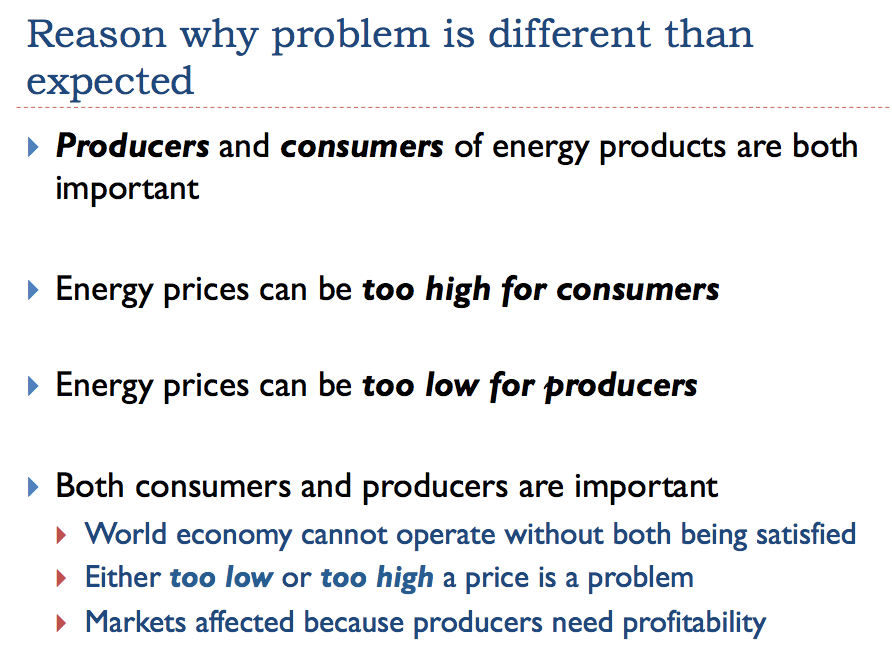
The comments shown in red on Slide 6 reflect a variety of discussions over the last several years. Oil prices in the $50 per barrel range are way too low for producers. They may be high enough to get “oil out of the ground,” but they are not high enough to encourage necessary reinvestment, and they are not high enough to provide the tax revenue that oil exporters depend on.
Slide 7
Most people don’t stop to think about the symmetric nature of the problem. They also don’t realize that the adverse impacts of low oil prices don’t necessarily appear immediately. They can temporarily be hidden by more debt.

Slide 8
There would be no problem if wages were to rise as oil prices rise. Or if there were an easily substitutable source of cheap energy. The problem becomes an affordability problem.

Slide 9
The economists’ choice of the word “demand” is confusing. A person cannot simply demand to buy a car, or demand to go on a vacation trip. The person needs some way to pay for these things.

Slide 10
If researchers don’t examine the situation closely, they miss the nuances.

Slide 11

Slide 12
Many people think that the increasing use of tools can save us, because of the possibility of increased productivity.

Slide 13
Using more tools leads to the need for an increasing amount of debt.

Slide 14
Read this chart from left to right. If we combine increasing quantities of resources, workers, and tools, the output is a growing quantity of goods and services.

Slide 15
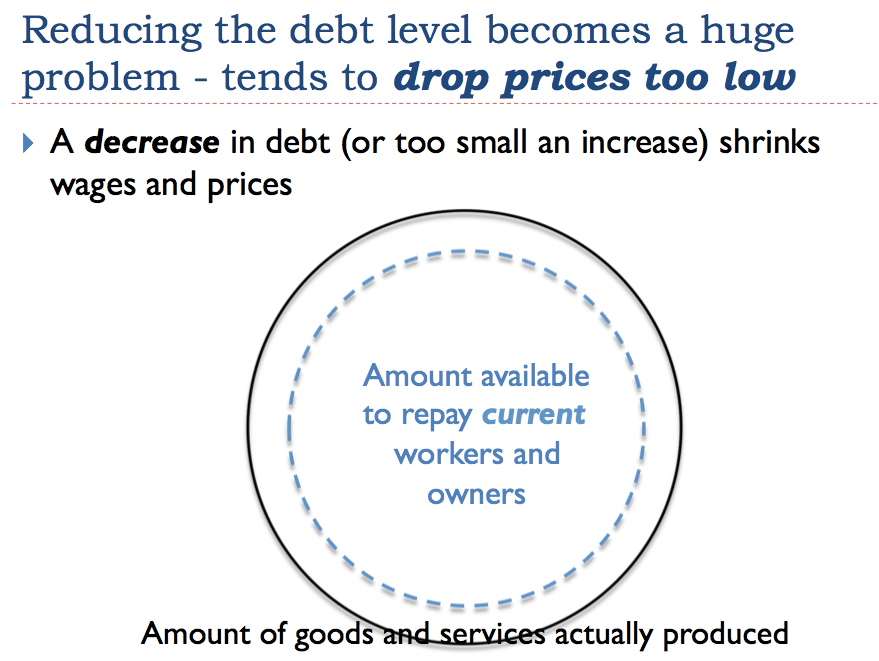
Read this chart from right to left. How do we divide up the goods and services produced, among those who produced the products? If we can only use previously produced goods to pay workers and other contributors to the system, we will never have enough. But with the benefit of debt, we can promise some participants “future goods and services,” and thus have enough goods and services to pay everyone.
Slide 16
If we decrease the amount of debt, we have a big problem. Instead of the debt adding to the amount of goods and services produced, the shrinkage acts to decrease the amount of goods and services available for distribution as pay. This is why moving from deficit spending to a balanced budget, or a budget that reduces debt, is so painful.

Slide 17
When I say (resources/population), I mean resources per capita. Falling resources per capita makes it harder to earn an adequate living. Think of farmers trying to subsist on ever-smaller farms. It would become increasingly difficult for them to earn a living, unless there were to be a big improvement in technology.
Or think of a miner who is extracting ore that is gradually dropping from 5% metal, to 2% metal, to 1% metal content, and so on, because the best quality ore is extracted first. The miner needs to work an increasing number of hours to produce the ore needed for 100 kilograms of the metal. The economy is becoming in some sense “worse off,” because the worker is becoming “inefficient” through no fault of his own. The resources needed to provide benefits simply are less available, due to diminishing returns. This problem is sometimes reported as “falling productivity per worker.”
Falling productivity per worker tends to lower wages. And lower wages put downward pressure on commodity prices, because of affordability problems.

Slide 18
The problems that prior civilizations reached before collapse sound in many ways like the problems we are seeing today. We are seeing increased specialization, and falling relative wages of non-elite workers.

Slide 19
We seem to have already gone through a long period of stagflation since the 1970s. The symptoms we are seeing today look as if we are approaching a steep downslope. If we are approaching a crisis stage, it may be much shorter than the 20 to 50 years observed historically. Earlier civilizations (from which these timeframes were observed), did not have electricity or the extensive international trade system we have today.

Slide 20
The period since 1998 seems especially flat for wages for US wage earners, in inflation-adjusted terms. This is the period since energy prices started rising, and since globalization started playing a greater role.

Slide 21
This is a list I made, showing that what looks to be beneficial–adding tools and technology–eventually leads to our downfall. The big problem that occurs is that non-elite workers become too poor to afford the output of the economy. Adding robots to replace workers looks efficient, but leaves many unemployed. Unemployment is even worse than low pay.

Slide 22
We can think of the economy as being a self-organized network of businesses, consumers, and governments. New products are gradually added, and ones that are no longer needed are eliminated. Government regulations change in response to changing business conditions. Debt is especially important for economic growth, because it makes goods affordable for customers, and it enables the use of “tools.” Prices are created almost magically by this networked system, through the interaction between supply and demand (reflecting affordability, among other things).

Slide 23
It is only in recent years that physicists have become increasingly aware of the fact that many types of structures form in the presence of flows of energy. We have known for a long time that plants and animals can grow when conditions are right. The networked economy illustrated on Slide 22 is one of the types of things that can grow and flourish in the presence of energy flows.

Slide 24
This is my view of how an economy, as a dissipative structure, works. “Tools and technology” are at the center. If a person doesn’t think too much about the issues involved, it is easy to assume that tools and technology will allow the economy to grow forever.
There is a potential for problems, both with respect to inputs and waste outputs. Early modelers missed many of these “issues.” M. King Hubbert created a model in which the quantity of energy supply and technology are the only issues of importance. He thus missed the impact of the Waste Output problems at the right. The Waste Outputs lead to falling prices as limited supply nears, and thus lead to a much steeper drop in production than Hubbert’s symmetric model would suggest.

Slide 25
Peak oilers recognized one important point: our use of oil products would at some point have to come to an end. But they did not understand how complex the situation is. Low prices, rather than high, would be the problem. We would see gluts rather than shortages, as we approach limits. Much of the oil that seems to be technologically extractable will really be left in the ground, because of low prices and other problems.

Slide 26
Here, I am getting back to the topic I was originally asked to talk about. What else, besides low energy prices and too much debt, are likely to be problems as we reach limits?

Slide 27
The easy way of modeling the use of wind turbines and solar turbines is to assume that the electricity produced by these devices is equivalent to electricity produced by fossil fuels, or by hydroelectric. Unfortunately, this is not the case.

Slide 28
Trying to integrate solar panels into an electric grid adds a whole new level of complexity to the electrical system. I have only illustrated some of the issues that arise in Slide 28.
The fact that the price system doesn’t work for any fuel is a major impediment to adding more than a very small percentage of intermittent renewables to the electric grid. Intermittent renewables can only be used on the electric grid if they have a 24/7/365 backup supply that can be ramped up and down as needed. Unfortunately, the pricing system does not provide nearly high enough rates for this service. We are now seeing how this works out in practice. South Australia lost its last two coal-fired electricity power plants due to inadequate wholesale electricity prices when it added wind and solar. Now it is experiencing problems with both high electricity prices and too-frequent outages.
Another problem is that new [long distance] transmission makes buying from neighbors optimal, over at the left of Slide 28. This is a new version of the tragedy of the commons. Once long distance lines are available, and a neighbor has a fairly inexpensive supply of electricity, the temptation is to simply buy the neighbor’s electricity, rather than build local electricity generating capacity. The greater demand, without additional supply, then raises electricity prices for all, including the neighbor who originally had the less expensive electricity generation.

Slide 29
It is easy to assume that EROEI (Energy Returned on Energy Invested) or some other popular metric tells us something useful about the cost of integrating intermittent renewables into the electric grid, but this really isn’t the case.

Slide 30
We are now beginning to see what happens in “real life,” as intermittent renewables are added. For example, we can now see the problems South Australia is having with high electricity prices and too many outages as well as the high electricity prices in Germany and Denmark (Slide 29).

Slide 31
Wind and solar are not very helpful as stand-alone devices. Yet this is the way they are modeled. Some researchers have included installation costs, but this still misses the many problems that these devices cause for the electrical system, especially as the share of electricity production by these devices rises.

Slide 33
A networked system works differently than a system that is “user controlled.” It builds itself, and it can collapse, if conditions aren’t right. I have shown the economy as hollow, because there is no way of going backward.

Slide 34
Many people miss the point that the economy must keep growing. In fact, I pointed this out in Slide 2 and gave an additional reason why it must keep growing on Slide 16. As the economy grows, we tend to need more energy. Growing efficiency can only slightly offset this. Thus, as a practical matter, energy per capita needs to stay at least level for an economy to grow.

Slide 35
If energy prices rise, this will tend to squeeze out discretionary spending on other goods and services. If we cannot obtain energy products sufficiently cheaply, the system of economic growth will stop.

Slide 36
The fact that energy prices can, and do, fall below the cost of production is something that has been missed by many modelers. Prices can go down, even when the cost of production plus taxes needed by governments rises!

Slide 37
Wind and solar are part of the category at the top called “renewables.” This category also includes energy from wood and from geothermal. Many people do not realize how small this category is. Hydroelectric is also considered a renewable, but it is not growing in supply in the United States or Europe.

Slide 38
It takes energy to have an intergovernmental organization, such as the European Union. In fact, it takes energy to operate any kind of government. When there is not enough surplus energy to go around, citizens decide that the benefits of belonging to such organizations are less than the costs involved. That is the reason for the Brexit vote, and the reason the question is coming up elsewhere.

Slide 39
The amount of taxes oil-producing countries can collect depends on how high the price of oil is. If the price isn’t high enough, oil-exporting countries generally have to cut back their budgets. Even Saudi Arabia is having difficulty with low oil prices. It has needed to borrow in order to maintain its programs.

Slide 40
Oil prices have been too low for producers since at least mid-2014. It is possible to hide a problem with low prices with increasing debt for a few years, but not indefinitely. The longer the low-price scenario continues, the more likely a collapse in production is. Also, the tendency of international organizations of government to collapse (Slide 38) takes a few years to manifest itself, as does the tendency for civil unrest within oil exporters (Slide 39).

Slide 41

Slide 42
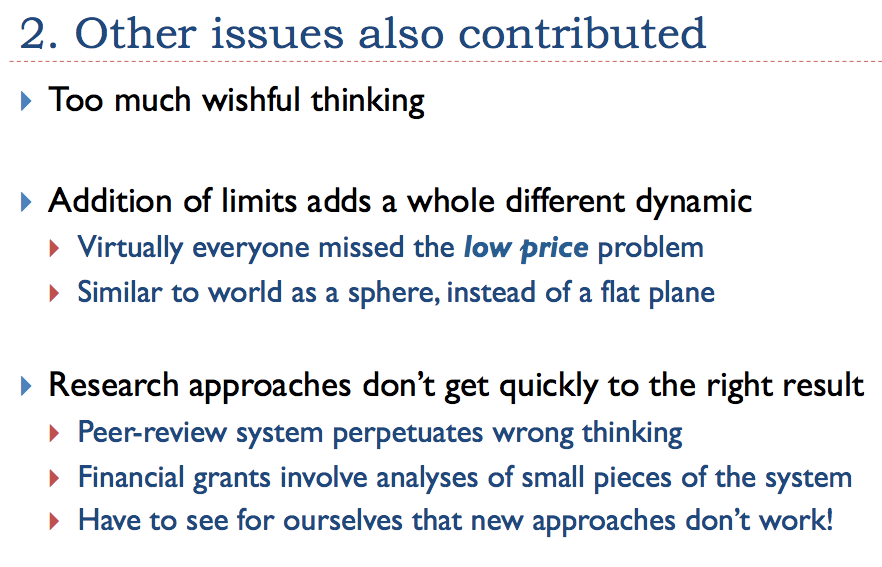
It is easy to miss the point that modeling a piece of the system doesn’t necessarily tell a person very much about the system as a whole.
Slide 43
Once an incorrect understanding of our energy problem becomes firmly entrenched, it becomes very difficult for leaders to understand the real problem.


Pingback: Why We Should Be Concerned About Low Oil Prices | Economic Crisis Report
Pingback: Why We Should Be Concerned About Low Oil Prices | It's Not The Tea Party
Pingback: Why We Should Be Concerned About Low Oil Prices – Independent News Media
Pingback: Why We Should Be Concerned About Low Oil Prices | Zero Hedge
Pingback: Why We Should Be Concerned About Low Oil Prices - BuzzFAQs
Neil deGrasse Tyson Warns: America ‘Is Already Kind Of Fading’
http://www.huffingtonpost.com/entry/neil-degrasse-tyson-america fading_us_590a8627e4b05c3976862241
http://www.huffingtonpost.com/entry/neil-degrasse-tyson-america-fading_us_590a8627e4b05c3976862241
Is it really ‘a growing rejection of science?’ Doug Casey makes a good argument it has more to do with a lack of capital:
“Let me re-emphasize something: in order for science and technology to advance you need capital. Where does capital come from? It comes from people producing more than they consume and saving the difference. Debt, on the other hand, means you’re living above your means. You’re either consuming the capital others have saved, or you’re mortgaging your future.”
http://www.caseyresearch.com/articles/doug-casey-on-the-end-of-western-civilization
How can anyone in lets say Detroit for example think about scientific matters when any capital one has is for the basic necessities of life?
Science though for all of the good it has given us has actually cost the world terribly. It gave us the nuclear bomb didn’t it which of course led J. Robert Oppenheimer {1904-1967} to lament:
“If the radiance of a thousand suns/Were to burst into the sky/That would be like the splendor of the Mighty One…/I have become death, the shatterer of worlds.” {www.quotationpage.com}
The more we learn the more trouble we get ourselves into!!!
It was actually the nuclear bomb which changed the world more than anything even beyond oil especially for bankers and banking. With convential warfare bankers are safe and can choose who the winners will be, but with the nuclear option that changed everything for not even the bankers are safe anymore. That has never occurred before in all of human history and that is really the chief reason as to why we have the desire for a one world government. Just look at them all:
Harold Urey:
“The only escape from total destruction of civilization will be a world government, or we will perish in a war of the atom.” Cantelon pg.97
Robert J. Oppenheimer:
“In the field of atomic energy, there must be set up a world power.” Cantelon pg. 97
Arthur Compton:
“World government has become inevitable.” Cantelon pg. 97
Dr. Ralph Barton Perry of Harvard:
“One world Government is in the making. Whether we like it or not, we are moving toward a one-world government.” Cantelon pg. 97
Professor Hocking:
“Therefore the alternative is that we rest all political power in one agency and resign that power ourselves.” Cantelon pg. 97
Raymond Swing to Albert Einstein:
“Either we will find a way to establish world government, or we will perish in a war of the atom.” Cantelon pg.132
Albert Einstein:
“The secret of the bomb should be committed to a world government, and the USA should immediately announce its readiness to give it to a world government.” Cantelon pg. 132
Professor Laski of Oxford, England:
“Sovereignty must go, that means also the interests which sovereignty protects must be recognized as outmoded in character and dangerous in operation.” Cantelon pg. 133
James Warburg, February 17, 1950 before the U.S. Senate said:
“We shall have a world government whether or not we like it. The only question is, whether world government will be achieved by conquest or consent.” Cantelon pg. 62
H. G. Wells:
“It is necessary to discover a head capable of directing it, endowed with an intelligence surpassing the most elevated human level.” Cantelon pg. 136
Paul Henry Spaak, first president of the Council of Europe, planner of the European Common Market, president of the United Nations General Assembly, and one time Secretary-General of NATO:
“Let that man be a military man or a layman, it matters not.” Cantelon pg. 133-134
Roswell Gilpatrick, Deputy Secretary of Defense:
“Strong, one-man civilian control of America’s giant military establishment is vital to the nation’s well being. The concentration of authority is inevitable.” Cantelon pg. 134
Thank you science for giving us the knowledge of the nuclear and what an interesting song/poem this is:
“Seven million years of progress handed down on silver wings
Of gossamer and protein still we haven’t learned a thing
Are we caught up in our anger, locked up in our rage
In the opera of selection on this our earthly stage
And Charlie’s laughing, laughing in his grave
Laughing at the prophecy the prophecy he gave
Can we spread our wings like angels, can we break out of the grind
Are we destined to be Darwin’s children this time
The ribbons of our cigarettes vanish in the air
In the glow of our great teacher we sit and blankly stare
And the sky could open up and what would we have to say
Something cute about burning out, better than fading away
On the wings of invention now we hurtle towards our fate
As sure as the sunset burns
Collective resignation, evolutionary fate
When will we ever learn?” {Edwin McCain from the album Misguided Roses}
Yep,
“On the wings of invention now we hurtle towards our fate”
Wow!
we will (maybe) have a world government when we have fought ourselves to a standstill and are left with no other option
By then, that ‘world’ may just be one island or mountain peak…..
Big Chief gets all the virgins AND the best cuts of wild pig meat. 🙂
i have already applied for—and by popular virgin vote—been accepted for that job
everybody else has been voted as sacrificial
sorry bout that
The Book of Enoch sums it all up:
‘Angels’ in rebellion against the Divine order teach men the Arts and Sciences.
This goes horribly wrong.
Loyal angels plead with the Divine being (presumably occupied hitherto with other more important matters ) to deal with the unfolding disaster, and restore the Divine harmony.
‘Angels are the faculties of the human mind.’
Next: ‘I was a pyramid architect in a former life!’ 🙂
xabier perfect! lol
To add I often wonder if Christ had been born today which would have resulted in scientists the world over scrambling to have an audience with him what would he have to say to them about there many questions?
More than likely, “What is that to you? You must follow me.
and NASA is now gambling with the solar system by sending out machines one in which they sent out to sun. Called Genesis of all things and costing in the neighborhood of some 300 hundred million dollars it was launched in August of 2001 and has travelled out some two million miles to a point in our solar system called the L1 Lagrangian Point which is where the gravitational and centrifugal forces of the earth and sun meet. Here the satellite thankfully stopped and has remained for 30 months where it has observed the sun and using specially designed tiles made from gold, sapphire, silicon and diamonds has it is hoped collected enough solar wind dust particles to determine what the sun is made of. Information that hopefully will provide insight into how our solar system developed along with an explanation and understanding of what is occurring in relation to climate change. Now excuse me but what would happen if something were to go wrong with that spacecraft and it were to continue on towards the sun especially if it were nuclear powered or explode right there where it is sitting? Or let’s consider what would happen if our scientists in studying those dust particles were to learn that our sun is dying? What are they going to do –try and play God by sending a team of astronauts out there to try and fix it? Or maybe given what some scientists are being led to believe these days {aliens from some planet Timbuktu} and maybe what they’ll end up doing is hooking up those huge radio telescopes to some extra juice of power in the hopes that their plea for immediate help will reach some aliens ears?
‘Angels’ in rebellion against the Divine order teach men the Arts and Sciences.
This goes horribly wrong.
Xabier, I won’t soon forget you or this amazing quote.
thank you!!!
My pleasure, Jerry.
Great great …………..great hGranddaddy is a freespirit for sure. I’m still trying to figure out where these angels are when we really need them. These bibleheads need to get with it and pray us up a miracle . We got can-i-bals and nuke ponds on one side and a miracle on the other so now is time for all these “men of god” to put their heavenly blessings where their mouth is.
Where’s Jim Jones when we need him…. the purple kool-aid could come in handy
The only war of invasion since the Second World War was Iraq and Kuwait. The world is more or less a single entity right now. Wars are too costly, the interdependence for economies, is just as crucial to governments as it is to the multinational corporations. IMO Border skirmishes and maybe some minor civil wars are expected but a protracted multi nation war, would in short time, (nuclear or not) put us back to the dark ages.
Think the big picture, who owes who, who depends on who, what the costs are, what is at stake. Of course mistakes happen and nutters abound and I don’t know what the future holds but I really doubt a deliberate war of conquest (is there another kind?) will take place……in the foreseeable or even not foreseeable future.
I agree. Financial issues definitely make a difference in starting wars.
At the same time, I don’t know how a country behaves that feels it has nothing to lose. North Korea is our chief example now, but if a country (Russia, China, or whoever), feels like its financial system is going over the edge, how do they react, if they have bombs that can be easily fired?
We keep hearing about Saudi ArabiA becoming less stable. Does that set off more Middle Eastern war?
Pingback: Why We Should Be Concerned About Low Oil Prices | ValuBit News
Here is a good example of people unable to read the symptoms to discern the cause. Evidently the collapse in oil prices is being caused by the surge in electric cars which is now at 0.2% and somehow is projected to reach 100 million by 2035. And that would be 10% without growth? At present extraction rates of lithium it would take 220 years to have enough for those cars but I guess no one has done the math. If it was possible lithium production would immediately need to reach 375,000 tons per year a 10 fold increase from current levels. Nothing has ever grown that fast not even the heady oil days. 1000 % production increase??? Even if you try to argue that it will grow to that level by 2035 we’re talking about growth rates of 35% or better for 20 years. Never happened never will.
http://calgaryherald.com/storyline/oil-price-collapse-is-permanent-analyst-says-fossil-fuel-has-had-its-day
I don’t think electric cars have any relevance here, except possibly as an industry stimulant, creating a growth sector, fuelled by climate change fear. Electricity is no energy source. It is an efficient point-to-point energy transport medium, less efficient as energy storage. In Norway the subsidized electric cars are running on hydropower, transported in batteries, we are even running car ferries on hydropower. This does not increase the hydropower production. In Europe there is no excess hydropower, and I think it is better transported in high-voltage lines and used stationary. Iceland is an exception, where other export media than electricity are needed, due to long distances; aluminium, or possibly hydrogen.
It’s kind of like the Mars project….
When someone mentions that it is not possible for humans to live on Mars due to cosmic radiation issues…. Elon just ignore them…
https://s3.amazonaws.com/lowres.cartoonstock.com/business-commerce-ignore-fact-business_strategy-strategy-hypocrite-dbrn475_low.jpg
http://imgur.com/TG7ZTgk
Hang the bankers!
http://imgur.com/akuqsve
i remember watch this video first time i forget about my future i thought it worthless to think even
https://youtu.be/VOMWzjrRiBg
It is remarkable how an “expert” can observe the same symptoms and draw the opposite conclusion. This article says the reason oil prices are low is because the economy is switching to renewable energy. I’m thinking this view is our inherited denial of reality putting a happy face on collapse.
http://calgaryherald.com/storyline/oil-price-collapse-is-permanent-analyst-says-fossil-fuel-has-had-its-day
Hahahaha another clueless human…add him to the other 7.5B…
Rob, I think that could be part of it, but I also think that when oil was over a 100 a barrel it caused the investment of billions of dollars to develop and process a whole lot of non-conventional oil. Once the infrastructure was paid for it still makes money even at today’s lower oil price. But i’ll tell you this, the oil industry better hope this electrification is a fad, because if it can continue to develop the charging stations and the raw materials are there to build millions of EV’s and bring down price, then less and less oil will be needed. Far less.
Welcome to the 7.5B club…
http://www.artberman.com/wp-content/uploads/45-Is-The-Right-Price-For-WTI-OPEC-Expectation-Premium-1024×744.jpg
https://www.nytimes.com/2017/04/12/business/venezuela-oil-debt-payment.html?_r=0
Venezuela has put off a reckoning on its tens of billions of dollars in debt, but its ability to avoid a disastrous default will probably require much higher oil prices than appear likely in the next year or two, financial experts say.
With its oil production and international reserves falling at an accelerating rate, the government is juggling as fast as it can to pay for imported food and medicines while meeting its short-term bond payments. Even as the country has slashed imports, its reserves have declined by half over the last two years, to $10.4 billion. Most of that sum is in gold and is pledged as security for many of the government’s creditors, which include international institutional investors and everyday Venezuelans.
“The probability of default is rising,” said Stuart Culverhouse, head of sovereign and credit research at Exotix Partners, a London-based investment bank that trades Venezuelan bonds on behalf of clients. “So far their willingness to pay has been pretty firm, surprisingly so given the political situation. But you have to ask how long that can continue when they are probably spending more on debt service than imports.”
AI and robots will take over.
It is about cooperation. The owners, AI, and robots work together to maintain the control they already have and will continue to have.
The under class needs too be thinned faster than simply feeding them sugar, alcohol, heroin, and nicotine.
Is the underclass thinning? Still growing a million every few days.
I feel like a boy in a Worldwide Bubble thats just about to pop…. and despite there being many miracles and wonder in this modern age, when I think of the world wide suffering as mankind is slowly crushed before the end. … I’m afraid I can’t help feel like crying.
The Boy In the Bubble
Paul Simon
It was a slow day
And the sun was beating
On the soldiers by the side of the road
There was a bright light
A shattering of shop windows
The bomb in the baby carriage
Was wired to the radio
These are the days of miracle and wonder
This is the long distance call
The way the camera follows us in slo-mo
The way we look to us all
The way we look to a distant constellation
That’s dying in a corner of the sky
These are the days of miracle and wonder
And don’t cry baby, don’t cry
Don’t cry
It was a dry wind
And it swept across the desert
And it curled into the circle of birth
And the dead sand
Falling on the children
The mothers and the fathers
And the automatic earth
These are the days of miracle and wonder
This is the long distance call
The way the camera follows us in slo-mo
The way we look to us all, oh yeah
The way we look to a distant constellation
That’s dying in a corner of the sky
These are the days of miracle and wonder
And don’t cry baby, don’t cry
Don’t cry
It’s a turn-around jump shot
It’s everybody jump start
It’s every generation throws a hero up the pop charts
Medicine is magical and magical is art
The boy in the bubble
And the baby with the baboon heart
And I believe
These are the days of lasers in the jungle
Lasers in the jungle somewhere
Staccato signals of constant information
A loose affiliation of millionaires
And billionaires and baby
These are the days of miracle and wonder
This is the long distance call
The way the camera follows us in slo-mo
The way we look to us all, oh yeah
The way we look to a distant constellation
That’s dying in a corner of the sky
These are the days of miracle and wonder
And don’t cry baby, don’t cry
Don’t cry, don’t cry
Still, there are things we don’t know. Our whole “open” system seems to have been created by some life-giving, energy-giving force. We don’t really know how it will all end.
America’s Top Scientists Confirm: U.S. Goal Now Is to Conquer Russia. “Disarming Enemies with a Surprise Nuclear First Strike”
http://www.globalresearch.ca/americas-top-scientists-confirm-u-s-goal-now-is-to-conquer-russia-disarming-enemies-with-a-surprise-nuclear-first-strike/5588524
After a while, a person starts to get cynical. Is one outcome worse than another?
Somehow, I find this hard to believe, but Trump sees, to have written that the country “needs a good shutdown in September” to fix a “mess,” namely the need for 60 votes in the senate to pass a budget. This is crazy too. http://www.cnbc.com/2017/05/02/trump-the-us-government-needs-a-good-shutdown-if-senate-rules-dont-change.html
Most Americans’ best days are behind them. Median household income peaked at least 15 years ago in 81 percent of U.S. counties. Use this interactive map to see when each county peaked.
https://www.washingtonpost.com/wp-stat/graphics/business/income/index.html
http://imgur.com/uebODoP
Or it could just be a case of laziness to write original articles.
http://imgur.com/kUBGCwf
It may be touch and go, but I suspect that the next ten years will see something come out of left field. One of the more likely is AIs. The world is simply going to be a different place when humans are no longer in charge. Many people are recognizing already that a high fraction of jobs (over 70%) can be replaced by AIs.
I ran into this after discovering that humans can’t build power satellites. The radiation level is too high if you go above low earth orbit. Because of the space junk, we can’t build them in low orbit. We can’t build them in higher orbits with humans. Robots directed by artificial intelligences can do the job. They are already directing mining machines deep underground.
However such a solution may turn out worse than FE’s worst nightmare. I mentioned my hope that the AIs would treat us kindly as their pets to friend of mine. She has a lot of experience with trap-neuter-release and immediately figured out that the AIs would control the human population this way.
Your comments sound like Charlie Brown’s teacher:
Keith is Certified Insane. He is quite harmless… you could even leave young children with him and no harm would come to them…. but he has very much …. lost the plot….
The rat race is based on faith:
Faith that technology always finds a way.
Faith that there is enough energy.
Faith that all growth is good.
Faith that evolution will make tomorrow better than today.
Faith that debt can always be extended.
Faith that the people behind our leaders really know what to do.
Most readers and posters on this site are doubters and sceptics of the rat race’s articles of faith.
At some point a tipping point of rats with a crisis of faith will occur. The next collapse crisis may be that point. If not then the collapse will be halted at a lower state that exists now. If its not halted then the collapse will be an implosion that results in chaos. Either way the survivors in the life of tomorrow will have to live at a lower energy level.
‘I mentioned my hope that the AIs would treat us kindly as their pets to friend of mine’
http://vignette1.wikia.nocookie.net/uncyclopedia/images/5/52/Insane_old_man.jpg
Where is the EVIDENCE for what you’re saying? The more we learn about the workings of the brain, the more we realise we know nothing. Then there’s the matter of consciousness, which can never be coded. Your beliefs are nothing more than the wishful extrapolation of current trends. The Transhumanism/Singulatariniasm that you aspire too is nothing more than a religious cult for geeks & technophiles.
Madame Fast and I picked up a hitch hiker a few months ago — she was 50ish….
When she hopped in I asked – where are you headed…. her response was – why does everyone ask me that…
If I were allowed to carry a hand gun in NZ I would have very slowly released the safety at this point…
She then regaled us with tales of how her phone is being monitored… by them … I asked if them was the NSA — no not them…. THEM!
That THEY would not allow her to see her children … because THEY said she was a drug addict with mental problems…
We don’t pick up hitch hikers anymore ….. well … I might make an exemption for…
https://previews.123rf.com/images/prometeus/prometeus1203/prometeus120300033/12521834-Pretty-young-woman-hitchhiking-along-a-road–Stock-Photo-woman-girl-hitchhiker.jpg
Somehow I doubt Keith looks anything like that….
So far Hal seems quite friendly.
It more than a small step from remote controlled machines working in dangerous environments to SkyNet.
For arguments sake: I imagine the AI will be like most zoo owners and prefer diversity, kill of 7.4B humans to make space for other species.
I agree HKeith. People don’t realize how much robotic work is already being done, and now there are drones and self driving vehicles. In one report it said truckers being replaced by self driving trucks would eliminate 3.5 million jobs. It’s so much more advantageous to a corporation to reduce the number of people working for them from a number of standpoints – they are more than eager to replace people and as AI tech gets further down the road more and more people will be out a job. The other tech development that will eliminate jobs is 3D printing as it gets even bigger and capable.
Timeline Mars colonization:
First nothing happens
Then nothing
Then more of nothing
And more of nothing
2024 Elon starts building his rocket
Takeoff spring 2025
Arrival Mars christmas 2025
And then 3D print everything we need
Mars col
i think you miss the point
global commerce exists through the medium of raw material extraction, then converting that into desirable things.
then selling those things TO EACH OTHER.
put in robots, and you remove the ‘each other’ part—so manufacturers keep down prices, agreed, but find there’s nobody to buy the stuff they’ve made
duh!!!!!!!!
“Don’t worry, the AI robot goon squads will keep us in check. We won’t be able to cause much trouble. The machines already have our money.”
Someone has been drinking from Elon’s troth again. How many times have we told you not to do that?
Keith,
I am afraid you are going off the deep end. Who is going to build these robots, if the financial system is down? Where will the materials come from?
if keith has gone off the deep end
can we all refrain from throwing him a lifebelt
“Who is going to build these robots, if the financial system is down?”
If we have an economy left, it will probably be the same companies who are now building the ones being used in very dangerous mines.
But that kind of misses the point.
https://www.technologyreview.com/s/604087/the-dark-secret-at-the-heart-of-ai/
It hard to say because nobody can predict the future. But in my opinion there are potential futures that are much worse than the financial system going down.
“Where will the materials come from?”
The amount of materials needed to make robots is much smaller than the amount they process.
Perhaps we should just be resigned to giving rise to our successors and going extinct or irrelevant. That certainly been the history of life on this planet.
Keith,
I am afraid your AI discussion is too much for us. Could you please discuss this topic in a different forum, that is more interested in such a possibility?
and Eddy has issued a prohibition notice to stop folks banging their heads on his wall
Sorry. I have been in a deep funk for a couple of months after realizing that humans can’t solve the energy problems with power satellites without developing robot/AI technology. If we do this, we can’t keep up with them and humans become irrelevant if not extinct. I appreciate that you can’t deal with problems even worst than FE’s nightmares.
Will unsubscribe.
http://www.smartdestinations.com/blog/wp-content/uploads/2011/12/fireworks.jpg
Clinic for Treating Delusional Disorders
https://my.clevelandclinic.org/departments/neurological/appointments-locations
Understand your position, Keith. I’m already contemplating taking a shotgun to the neighbor’s peeking drones, and if any of these AI robots show up at the door, well, things could get interesting if I find out who they are.
Also, if we get fusion going, we won’t need those stin-king power satellites.
Sounds steamy, mr doomphd…. Would you mind going into detail about what you’d do to those robots if you..uh… ‘find out who they are’?
https://i1.wp.com/www.tvfort.com/files/captures/south-park-4236fb/Screen-179656.jpg
Hahahaha Awesome-o, one of my all time fav SP episodes 🙂
I see. You traveled to the future, had a very intense affair with a space-based solar power satellite and found out that it would not love you because you are not mechanical enough. Keith, your situation is bleak but there is no need for despair. There is a slim chance that you can find another machine that will want you for who you are. The tastes of robot in human men is as varied as the numerous applications for 3D printing. To paraphrase a common idom among English-speaking humans, “There are plenty of (swimming) machines in the sea”.
https://i1.wp.com/www.tvfort.com/files/captures/south-park-4236fb/Screen-179656.jpg
Oh wow, Gail! How uncharacteristically mean! Is FE rubbing off on you?
it was a last resort
keith refused to sign the sanity claus
Mean? I thought that was handled very nicely.
Here’s mean:
Keith — you are a whack job — you are out of your mind — you are crraaaazzzzeeeee – you need help — you are touched — you are down a 1000 foot deep well of delusion … seek help.
Speak for yourself, human. I was looking forward to Keith…articulating the possibilities for human-robot copulation. He has a lot more experience with machines than I do and I was hoping he could teach me something about pleasuring them.
https://i1.wp.com/www.tvfort.com/files/captures/south-park-4236fb/Screen-179656.jpg
The Ai robots…will they be equal opportunity lovers or will they be pre-programmed to discriminate? I don’t wanna hear ” Sorry, I prefer Polish guys.” when I boot up to a striking piece of hardware.
http://www.tvfort.com/files/captures/south-park-4236fb/Screen-179656.jpg
I will spray them with water and watch them rust in place like the tin man. bonus points if I also hit the wicked witch, should she be standing nearby.
[Update] “The surface of the magnificent robots are thoroughly galvanized. All that the water manages to do is highlight their nuts and bolts…”
The wicked witch was exterminated for providing bad data. doomphd is forgiven for it did not know what it did but it is not given the honor of watching the robots…. display themselves. The next time doomphd attempts to interfere with the machines, it will not be as lucky . . .
https://i1.wp.com/www.tvfort.com/files/captures/south-park-4236fb/Screen-179656.jpg
Thank you Gail for writing these detailed articles…this one is another excellent addition!
Regarding your last sentence:
“Once an incorrect understanding of our energy problem becomes firmly entrenched, it becomes very difficult for leaders to understand the real problem.”
Even if they did understand the problem there is absolutely nothing to avoid the wall the train of Industrial Civilization is about to hit at 300 mph…actually it’s probably better that they do not understand because if they did, they might have implemented the wrong policies that would have sped up collapse even faster.
Regarding your sentence on the cycles of Turchin and Nefedov:
“If we are approaching a crisis stage, it may be much shorter than the 20 to 50 years observed historically.”
I could not agree more. Let’s face it, because we all depend on electricity now (and will not be able to function when grids fail across the world), because we are so inter-connected globally, because of JIT, when this baby blows in the very near future, I think it is safe to replace “20 to 50 years” by “20 to 50 days” 😉 It will certainly not go on for years after the Financial System collapses…probably a few months at best..
Exactly: this is what Tainter said – the possibility for the first time of global and very rapid collapse of complex structures, with no region left untouched.
Earlier civilisations, apart from inhabiting somewhat separate spheres – eg China and Rome, Rome and Persia, and so on, touching at points for trade and war, but mostly insulated – had their power source in animal and human muscle.
This power source, self-renewing through the desire to reproduce whatever the circumstances , could not be switched off overnight, and even disease and drought took a few years to take effect, at least two years of bad harvests or failure to get in a harvest due to lack of hands.
Recovery was perfectly possible even after a virulent plague taking out 50% of the humans, as happened where I am now in the 1340’s. Only a general massacre of a whole population, every age and sex, in war and the burning of all buildings could eliminate human activity in a city or region: William the Conqueror more or less destroyed large parts the North of England in the late 11th century for a generation or so until it was resettled.
Muscle power was distributed throughout the system and essential to every major process in agriculture and industry, as much as electricity, oil and gas are in everything now, but had an inherent resilience which we now so painfully lack.
And without them now, our muscle power is redundant.
yes—few can accept the fact that we only had muscle power until 200 years ago—now engine power is seen as normal and will go on forever.
It won’t of course.
Even most people in the construction industry, as hard as that work can sometimes be, don’t know the meaning of real muscle-powered work, using power tools for so much.
As for all the farming and forestry work on heavy land which was only made possible by oxen and horses……
a few years ago, i spotted an axe in a junkshop, now it is one of my most prized possessions, because it is hand forged by a blacksmith and you can clearly see all the marks he left on it and how the metal was hammered into shape.
I’ve no idea how old it is, but it was clearly meant for work in pre-machine times. When I use it, I always try to imagine the old guy who made it all those years ago
Being an axe aficionado -with some fine Swedish examples – I can only concur!
Many of the other tools I use in binding are 100 or even (a very few) 200 years old. Clearly, I shan’t be passing those on to the next generation.
Particularly beautiful are the wooden handles of old woodworking tools and hammers, perfectly shaped to the hand, better than any modern synthetic handle. My grandfather restored medieval stained glass, and his old hammer, chisel and screwdriver are still almost perfect despite being almost a century old.
I did buy a beautiful new large hammer made in America, quite as good as the old stuff and very well balanced, it certainly stood out at the hardware shop from the China-made tools.
Keep a strong arm Norman!
Gränfors bruk makes very nice axes.
Even if they are handmade the actual pounding is done by machine, the oldest bought in 1916 for ~$2000.
The company has restructed since then, gone bankrupt and done many changes, but the machine keeps pounding.
Somehow I don’t think it will shut down because of lack of spare parts from Indonesia.
Needs electricity of course, but not necessarily a grid.
Today Gränsfors largest splitting axe costs about a days salary, and the majority thinks this is too expensive and buy something cheaper.
If you relied on fire wood for cooking, or even staying alive in the worst winter months. How many days wages would you give for a great axe that can last a life time? 10? 100?
Your correct about only days. Think of the financial system as information rather than money. Once it cracks resources won’t know where to go.
I am afraid you are right. The only ones who will be able to escape will likely be hunter gatherers, who are not dependent on our current system. Even that may not be the case, if those in cities are able to disrupt the hunter-gatherers.
the advantage hunter gathers will have, is that they have the ability to retreat beyond the range of “industrialised” man, and sustain themselves in remote hostile regions until the self inflict holocaust is over
Unfortunately, like the shadow of Sauron, industrial civilization in its most destructive aspects seems to be reaching into the farthest corners in this last stage before collapse.
So many areas that provided asylum for the survivors of previous collapses have been depleted and poisoned.
we are all guessing as to what collapse will mean, on an individual basis or collectively.
that’s the main problem.
My take is that we can’t support 7.5bn now, not because we cant feed that number, but because conflict is already preventing it.
If we all calmed down and fed the hungry 1bn, they would double their numbers in 20 years, and so put us back to square one
As it is we are on track to have 10bn + by 2050, (ignoring my calculation above) which is an impossible number, so there will have to be some way by which we do not reach that figure
So you takes your choice about what it is going to be:
If mass conflict wiped out 1 billion, that isnt enough, but it might destroy the transport network that would feed most of the rest…..so another 3…4 bn might starve. that might take a while, hard to say. Desperate people start wars at every level.
Possible solution there.
Pestilence…we could probably deal with that—we have so far.
then there’s methane release, which might overheat the world in a decade, devastate food supplies and fix things that way. Hence people in remote places might survive.
Three possibilities—if there are any others feel free to add them.
No prizes offered.
Well, let’s not forget the high dosages of radiation we are all going to get after the untended nuclear power plants all melt down. That should be good for killing off another billion or so, give or take.
I think we can rule out hunting other than as a marginal activity. Maybe pastoralists?
I wonder what kind of chances some samis have. Very plugged into BAU with snowmobiles, GPS, selling reindeer meat to buy tacos. But they still have reindeer, those actually live in nature and they’re only a few generations into BAU.
Wolfs are spreading out but for some reason they keep out of sami territory.
Most hunter gatherers are not the way they were a hundred years ago. Samis are in many ways just as plugged in to BAU as the rest of us. But as long as there is some lichen that grows in northern scandinavia, there will be some reindeer and samis.
As of the remote regions. Samis are not that remote. A few million people can get there. But that is the same for all “remote regions” . People have sailing boats. There are no remote regions left..
Even Antarctica has 5000 or so people in research stations, living there
Because all places everywhere will have too many people. The main causes of population culling, would logically be related to the problem of there being just too many people around..
Too many people, sure.
Stockholm to lappland, 1000k road or sail+200k road. At least safe for random hordeing.
A sustainable way of living with only partial competition with farmers.
Gail why don’t you discuss the according to the HSBC oil report 80% of the worlds conventional oilfields were in permanent decline at an annual rate of 5%? Based on this fact we are going to except to see double trouble with low price forced production cuts and geological decline rates combining….
Double trouble is probably a financial crash. It won’t necessarily look like an oil shortage at all. There may be a short spike in prices, but there may never be “lines at the pump.” Instead, people won’t have jobs, the electricity may not work, and banks won’t be open. People may never connect our problems with energy problems.
And I am not convinced that the problem is particularly oil. Coal production has been crashing. This will bring down the world economy in the not too distant future, regardless of what oil does.
in 1973 when there was just a 3% US oil shortage there was the largest stock market crash
since the great depression. Now the IEA and Saudi Arabia are saying there will be
worldwide shortages by 2020. So expect ten times worse crash happening to all the world
markets….The world will burn…
https://en.wikipedia.org/wiki/1973_oil_crisis
Do not believe IEA and Saudi Arabia, regarding oil shortages. They don’t understand how the system operates.
The stock market will likely crash from the approaching financial problems. If banks close, it is hard to buy stocks, for example.
Interesting presentation and comment from JT Roberts.
I think that systems work on the way up (which you can also think of as the way “down”, as all of our activity ultimately is derived from energy and materials from the earth’s crust). Or perhaps, the system grows in all directions.
As we continue to dissipate what is left of these resources, all activity, even presumably productive activity, becomes parasitical in nature. Once again, this is a point that industry misses. Industry believes itself to be productive, but as long as it is using increasing debt to continue extraction without replacing reserves, then it is in fact parasitic.
If you focus only on consumption, you miss the point that production is parasitic itself if reserves are not replaced.
What this means is that for the system to be truly productive again, it has to fall and reset at a very low level, a level so low that few people today can even imagine it except in apocalypse movies.
Interesting time to be alive, isn’t it?
Industries that involve extraction are nearly always parasitic, whether or not they can “replace their reserves.” Look at all of the reserves Venezuela has, and the amount of good they are doing the country! The one exception I can think of is water, where the water table is not being drawn down, and water is constantly being replenished from above. Even forestry tends to be parasitic, because it destroys the ecosystems that existed, and replaces them with “planted trees,” which may eventually be somewhat helpful, but not the same thing.
Replacing reserves only has to do with “finding more natural resources to extract.” The new reserves are often of lower grade. Unless prices rise, this method does not work, because it becomes more and more expensive to extract these resources.
The oil problem started in 2005
Remember we wrote this article
Did Katrina Hide the Real Peak in World Oil Production? and Other Oil Supply Insights
9/10/2007
http://www.theoildrum.com/node/3052
Fig 1 shows the decline in crude oil production, including from Saudi Arabia and the North Sea. That caused high oil prices and the US recession end 2007 (Hamiltoon study) while the US had a precondition of accumulated petro-dollar debt. In mid 2008, China arrived on the oil market with an extra oil demand for the Olympic Games. Although Saudi Arabia had increased production by then, it also needed more oil for air-conditioning and the additional production was not enough, sending oil prices to $147. That was too much for car-dependent US suburbia. Plus an untimely mortgage reset which triggered the financial crisis.
The response of the system was low interest rates and then money printing.That fueled the shale oil boom. But oil prices did not come down as costs were too high. Traditional oil companies invested in many expensive projects in the conventional sector, for example offshore. They thought oil prices will always stay high.
But high oil prices weakened the global economy, dampening oil demand and causing an oil price drop in 2014. But why was it so sudden and steep?
In the first phase of the shale oil boom the US substituted imports of similarly light oil. Then US refineries started to accommodate more shale oil which is light and extra light, with a lot of condensate. Inventories started to fill up and were overflowing in 2014. Demands for lifting the US crude oil export ban got louder. At the same time, the Federal Reserve announced the end of QE3, signaling to the money markets a change is coming.
So the problem now is that the additional debt incurred during the high oil price period will limit oil demand.
In the meantime, the oil depletion clock is ticking and you mentioned the March 2017 IEA warning which is here:
HOUSTON – Global oil supply could struggle to keep pace with demand after 2020, risking a sharp increase in prices, unless new projects are approved soon, according to the latest five-year oil market forecast from the International Energy Agency.
https://www.iea.org/newsroom/news/2017/march/global-oil-supply-to-lag-demand-after-2020-unless-new-investments-are-approved-so.html
There are also geo-political events at play which are the indirect result of George Bush’s attempt to solve the then expected 2005 peak problem by invading Iraq. It has caused Iran to develop nuclear weapons and missiles to defend itself. That in turn is linked to the North Korean problem:
Pentagon eyes Iran-North Korea military connection
When Iran attempted to launch a cruise missile from a “midget” submarine earlier this week, Pentagon officials saw more evidence of North Korean influence in the Islamic Republic – with intelligence reports saying the submarine was based on a Pyongyang design, the same type that sank a South Korean warship in 2010.
According to U.S. defense officials, Iran was attempting to launch a Jask-2 cruise missile underwater for the first time, but the launch failed. Nonproliferation experts have long suspected North Korea and Iran are sharing expertise when it comes to their rogue missile programs.
http://www.foxnews.com/politics/2017/05/04/pentagon-eyes-iran-north-korea-military-connection.html
Video is here:
Experts suspect North Korea and Iran are working together
4/5/2017
https://www.youtube.com/watch?v=EAOQEgtqTEk
We were only one mouse click away from war:
3/5/2017
NORTH Korea’s failed missile was reportedly headed towards Russia, but
was detonated, prompting Vladimir Putin to put his country on high alert.
http://www.news.com.au/world/asia/failed-north-korean-missile-was-headed-for-russia-seoul-economy-daily-reports-but-was-detonated/news-story/ecd7c3406c537fb0d21f3a124938370d
This shows the likelihood of accidental war is very high.
I have done some calculations what might happen when oil tankers stop going to South Korea
29/4/2017
South Korea’s oil trade under threat
http://crudeoilpeak.info/south-koreas-oil-trade-under-threat
Apart from the next financial crisis and conventional oil decline I see military conflicts as the biggest danger. We can expect governments to pull all levers to continue business as usual until some physical events stop them.
My latest crude oil graphs are here:
http://crudeoilpeak.info/latest-graphs
My latest slide show to the Warren Centre of the Sydney University is in my downloads menu
http://crudeoilpeak.info/downloads
We may indeed see military conflicts, besides a financial crisis and a decline in conventional oil. Conventional oil is broken out different by differently by different people. For example, the “presalt” oil in Brazil would seem to me to be pretty unconventional. The oil that will depend on financial crises and where businesses can get funding.
2005 was about the time the Peak Oil movement was starting. It seems like TheOilDrum started in 2005.
Soon
Are world government seems to be preparing for a fast collapse, rather than a long descent?
https://www.reddit.com/r/collapse/comments/69i3n4/are_world_government_seems_to_be_preparing_for_a/
Governments can try to prepare for civil unrest. They can also try to keep out Mexicans, if they see that Mexican revenue is going in the same direction as Venezuela’s.
Daily consumption of 100 million barrels to countless countries. All of sudden being yanked away from many if not all. This world will burn…You’ll see!!
Gail what do you mean we can’t go back to using horses? Riding a horse to work would be dope AF!
Stop and think a little bit.
How many horses would we need for a world population of 7.5 billion (or a US population of 324 million)? How may horses are there now? How many years would it take to breed enough horses, for this to happen?
When we got rid of horses, a major problem was a horse disease that wiped out a large number horses. How do we set up a whole system to deal with horse diseases? Housing large numbers of horses in close quarters will no doubt lead to a lot more horse diseases.
Suppose everyone rode horses to work. Where would we park all of these horses? Who would clean up the big mess that all of these horses make on the street? This was becoming unmanageable back when horses where phased out.
We would now need to feed and graze all of these horses. This would adversely affect the amount of cropland available for other uses.
Less=Better
Horses could be a solution after human population stabilizes to a size less than 1 percent of what it is now. A challenge between now and when human population stabilizes is the prevention of horse extinction due to starving humans desperate for food. Wait. It gets worse. Low horse population could be a problem because a low horse population could lead to inbreeding which would cause severe genetic defects which would lead to extinction….come to think of it humans face the same risk. Founder’s effect may ultimately be what takes humans and horses out of the ecological picture, if their populations fall below a critical numbers…Noah’s Arc could never possibly work in a real collapse scenario…and cloning could never save any species since cloning does nothing to ensure sufficient genetic diversity.
if the human population stabilises to 1% of now, horses will be in the same status as they used to be, owned by the well off
Norman,
Completely off topic, but do you have any opinion on the likelihood of the British Monarchy surviving the collapse? Any chance they reassert themselves if government fails?
post complete collapse, the british monarchy would have no purpose, and in my own opinion, they (the royal family that is) would be glad to be rid of the whole monarchy business.
(though personally I support the monarchy as head of state for no better reason than to stop anyone else getting the job—which is why Canada–Australia NZ etc keep the monarchy too)
HM seems a genuine person too.
But if post collapse, the viable state was reduced to 10–20% of now, then the function of a monarchy would be reduced to that of the time when the UK population was at that level, say around the 18th c, maybe even earlier.We had a monarchy then that lived in great style, but of course their support came from the mass of people living in grinding poverty, with everyone forced to labour in awful conditions to support an aristocracy. That couldnt happen now.
The tiers of government that support the monarchy now, could not exist, because the nation would not be producing sufficient revenue to support them, or the monarchy itself. No one would tolerate the drain on resources that a monarch would entail, so the royal family would fade away—assuming they weren’t killed by whatever cause the crash in the first place.
The chaos of collapse would be much too great to allow continuation of any of our great institutions.
Of course, if post crash you got a dictator, (highly likely) then the trappings of some kind of royalty might continue, if only to give credence to trying to maintain some kind of governed system—but it will be the rule of absolutism, not constitutional monarchy
https://lemondazeblog.files.wordpress.com/2016/02/elon-musk-crown.jpg
Interesting. As an American, my understanding of an ethnic Englishmans affinity or lack thereof with respect to the aristocracy is purely theoretical. Intellectually, I understand they are essentially descendants from warlords and have often behaved badly. Hollywood has portrayed them in a much more romantic / forgiving light.
In a country as young, ethnically diverse, and obsessed with progress as mine, it seems a great shame that your comparatively ancient political institutions would not survive.
Ill also admit to an irrational belief (being of British colonial stock [and some german]) that if America ever went down in flames, the UK represents a fallback of sorts. The truth of course, is that britannia is grossly overpopulated, and post collapse none of us are going anywhere.
The queen will soon be eating boiled rat… grilled rat…. stir fried rat…. pickled rat…. deep fried rat
The importance of transportation would be different if human population was 1% of what it is now
Horses were used to transport a small amount of goods that were traded in pre-industrial, agrarian societies. Most people could not afford a horse or needed a horse to meet their need. Most people did not need a form of long-distance transportation to meet their needs.
Right now, most people need a form of long-distance transportation to meet a variety of needs because everything they need is far away from each other…their job is far away from their church…which is far away from their food…. Most people, on this planet, cannot afford a car. Even within wealthy countries, car ownership is beyond the reach of most low-wage workers, who make up the majority of workers, without low interest rates. The maintenance of infrastructure for cars is becoming harder to pay for with tax revenue. Maintaining vehicles for public transportation and infrastructure for public transportation is becoming harder to pay for with tax revenue.
I read recently that a too-small gene pool is severely hampering efforts to save rare working breeds of horse, and other livestock.
The best breeds of the 19th c in England – the most advanced agricultural region then –
took at least a century to breed, from a good starting point, by people with lots of time and money to devote to it.
The Poitou donkeys once used to breed mules are in very tight supply and very jealously-held.
New York, 1894
The great horse manure crisis.
Germany 1934?
FCC to ‘take appropriate action’ against Colbert following ‘Late Show’ Trump rant
http://www.sfgate.com/news/article/FCC-to-take-appropriate-action-against-Colbert-11125346.php
I used to like Colbert. Now he’s just another liberal asshole.
Colbert hasn’t been funny or relevant since he’s stopped being a fake Conservative. He’s like a nerdier John Steward in a crowded media landscape full of wanna-be John Stewards.
And then there is this f789ing piece of sh9t crying about 911– beffudled asking why ‘the terrorists’ would do such a thing…
I would have thought it was rather obvious why they would like to kill as many Americans as possible
https://www.youtube.com/watch?v=w_CzHImai0w
But as we know — 911 was a false flag so Jon Leibowitz might have invited one of the many engineers who support this premise onto his show…
Of course that was never going to happen because Jon is like the New York Times… a tool to control the thought processes of the liberals in America.
He is a joke… a jester… a clown…. white noise…
“They hate us for our freedoms!”
China forever? Standards vary greatly around the world.
When I see clips of the likes of Stuart, Saturday Night Live and Colbert… I am reminded why I do not have teevee….
Watching them turns one’s brain to mush.
Within the last 3 years I had started listening to NPR quite regularly…but realized early on that they are just as biased as Fox News…around the time the 2016 election cycle it became unbearable and I stopped completely… for example, a ‘typical’ newlywed couple seemed to be concerned more about assembling a petting zoo than paying their mortgage..Not even most educated professionals daydream about obtaining large animals…it’s too expensive! It was another sign that NPR’s content producers were members of the elite… doesn’t matter where one gets one’s news…the news is produced by the elite…who rally behind Progressive causes today because it protects the status quo of globalization….
I watch it about once a month just so I know what the sheep are feeding on.
Stuart says what he is told not what he thinks.
Thanks for the new article!
maybe the answer to a future lies in freemason fantasy land:
“Given the billions of barrels of oil and gas that have been discovered in the country, and its very low population of only 16 million, every Kazakhstani should be a millionaire by now. One look at Astana and you can see where much of the money has gone: everywhere it’s big, flashy signature buildings, all wearing their architects’ names like fashion labels, all competing for attention like a collection of spoiled teenagers insecurely shouting: “Look at me!”
https://www.theguardian.com/cities/2015/jul/28/astana-kazakhstan-strangest-capital-cities-on-earth
https://vigilantcitizen.com/sinistersites/sinister-sites-astana-khazakhstan/
https://www.theguardian.com/world/nursultan-nazarbayev
Wow! When there is oil wealth, it gets spent, by those who have the wealth to spend. I am sure that building those amazing buildings added some construction jobs for a while. On an ongoing basis, there will be some work for janitors, cooks, and a few others.
I don’t know how the situation works in Kazakhstan, but in Norway, I know that debt levels on housing went up at the same time as income from oil. People who had high incomes from the oil industry assumed that those high incomes would go on forever. They bought homes, based on the expectation of the continued high income. Of course, when they get laid off, or their salaries reduced because of low oil prices, this gradually becomes a problem. Norway also started big subsidy programs for electric vehicles, because they know that they have a lot of hydropower, which will continue. It is not as clear that their oil wealth will continue.
I see the points being made, Gail, and appreciate your analysis. At the same time I have to wonder if the 08-09 mortgage meltdown is still doing us a disfavor to this day, because the super heated economy of equity loans and lier loans etc. caused oil price to skyrocket and even after that debacle remain over a hundred bucks a barrel for quite a long time. Long enough for sources of non-conventional to be tapped and other exploration to take place that initiated a supply chain that to this day is still providing a glut of oil. Once many of those non-conventional sources had been tapped, the infrastructure for their production was such that even in a low oil price world economy, they still produce oil on top of the conventional sources.
In my opinion, we won’t know for certain how high oil price the consumer can afford until we see shortages and oil price attempts to break to higher levels. In other words, I’m not convinced low oil price is a consumer driven price but rather suggest it is a supply side problem. Now you may right, but to be certain where all this sits I think we need to wait and see if and when oil price rises, if it in fact can go higher without stalling the economy.
your test is open ended, as if the oil price never recovers up to collapse, you will not have the price rise to observe, and will instead be wondering about the whereabouts of your next meal.
HIGH PRICED OIL DESTROYS GROWTH
According to the OECD Economics Department and the International Monetary Fund Research Department, a sustained $10 per barrel increase in oil prices from $25 to $35 would result in the OECD as a whole losing 0.4% of GDP in the first and second years of higher prices.
http://www.iea.org/textbase/npsum/high_oil04sum.pdf
You still are exhibiting “backward thinking.” Lack of affordability shows up a gluts, not shortages. So waiting for shortages will mean a very long wait.
How high a price is needed is confusing because oil is a very highly taxed good. Part of the price of oil goes for taxes to keep government programs alive. (This is pretty much what having an “energy surplus” means. It means that oil can be highly taxed, to fund government programs.) Oil exporters in particular have a terrible time, when the price of oil falls. The price may still be plenty high to cover the cost of extraction, but it is not high enough for them to get the taxes they need. So the tendency, when oil prices drop, is to pump more oil, so as to get at least a little tax revenue. The market is still such that many oil exporters can borrow money to keep their programs going. But Venezuela is one that cannot borrow enough, and we keep hearing about the problems they have. This is the direction all oil exporters are going, if the price of oil does not go back up to the $100+ range.
Prices did try to break out, above $50 per barrel, but there is no way that they can get back to the $100+ range (really, they probably need to be in the $150 or more range) to keep the system going. The drop back in prices this last week, to below $50 per barrel, is one area of concern. Low interest rates are needed to keep prices from falling further (because higher interest rates act to reduce spendable income by consumers). The fact that the government is trying to raise interest rates indicates a complete lack of understanding of what the problem is.
You have to put on your “reverse thinking hat” to understand the problem. Also, you need to think about tax revenue being as important as revenue to get oil out of the ground. This is a subtlety than many have not understood. Governments collapse if they don’t get enough revenue. They really cannot shrink back. They are also dissipative structures.
A few footnotes acknowledging all the folks you derived this from would be nice.
RE
It would be hard to acknowledge even a small percentage of the total. I am learning from people all of the time–some of them comment on OFW, some comment on Facebook or Linked-In, some send me e-mails. I often learn from people who disagree with me.
I in many ways feel bad that I am criticizing the work of people who consider me to be their friend. It is only because I know the “ins and outs” that I can see what is going wrong with some of these techniques.
I feel that is rather unfair to Gail. It’s not a book!
The world is full enough of foot-noted academic junk.
Besides, she explicitly states how much she learns all the time from others and commenters on her presentations.
RE …. if Gail were to do that you would not be referenced.. if that is what you are concerned about
Nasty comment. Gail has frequently appeared on the Doomstead Diner.
And your point is?
I am assuming his comment is meant to imply that some of the ideas in Gail’s article are borrowed from him?
RE is a typical clueless DelusiSTANI… he adds nothing to the conversation of value.
There is nothing to be borrowed from him.
Pingback: Why We Should Be Concerned About Low Oil Prices – Olduvai.ca
Thanks for sharing, Gail. It’s amazing how often systems operate in a way diametrically opposed to the that which the consensus believes, suggesting how little we truly understand at times.
It is amazing how often the medical establishment makes a major announcement, and then comes back a few years later and says, “Oops!”
The studies that have been done on reproducibility of scientific papers show very poor results. I think people have way too much faith in the popular wisdom of the day.
Surpluses must be absorbed to maintain the core.
http://www.zerohedge.com/news/2017-05-05/what-will-apple-acquire-here-are-seven-most-likely-targets
Gail, you topic is on the minds of those doing the producing and selling
From Tsvetana Paraskova: A number of oil executives, analysts, and international agencies have been warning that the oil price crash and resulting slashed investments across the board would lead to a much tighter oil market within the next 4-5 years.
Now the head of Kuwait’s national oil company Kuwait Petroleum Corporation (KPC) is joining the ranks of those warning that by 2020, oil demand will be ‘enormous’ as the low global investments we’ve seen since 2014 begin to catch up with supply.
Nizar Al-Adsani, chief executive at KPC, expects ‘enormous demand’ for crude oil in 2019 and 2020, with oil prices likely in the US$70-80 range per barrel, the manager said at the Offshore Technology Conference in Houston, as quoted by Rigzone.
Al-Adsani reckons that “it’s a given” that we won’t see oil at US$100 per barrel anymore, and sees the sweet spot of prices in the US$50-60 range for all – producers, consumers, international oil companies and shale drillers.
https://etfdailynews.com/2017/05/04/kuwait-predicts-80-oil-by-2020/
The EU Commission recently conducted its usual survey of attitudes among young EU citizens, under 35yrs old: about 50% overall said they would join an ‘uprising against the elites’ in order to improve their economic prospects: as high as 70% or so in Greece and Spain I believe.
It would be interesting to see what % still felt that ‘revolution’ (sorry, REVOLUTION!!!) would be of any use after absorbing the contents and implications of this presentation.
Probably beyond most of them: and so they will continue to believe in political solutions and fairy tales of revolt and wind turbines.
Revolt against physics?
Perhaps, after his usual bottle of wine at lunch, and a few cognacs for his digestion, J.C.Juncker, the EU President, might feel himself up to challenging the laws of the universe? 🙂
A man has to know his limits.
there is an old english refrain
—as soon as this pub closes–the revolution starts
That’s obviously the best time to start one. 😎
Marx always had meetings in Pubs.
Seemed to work well.
“Revolt against physics?” – I agree. The time to revolt was 40 years ago when there was still some net energy left in the system to exploit. Its too late to revolt now due to physical limits.
“-possibly be traced to the failures of education in our time and its effects on the current crop of editors and news producers — people who grew up hearing that reality was just a constructed “narrative” and that one narrative was as good as another.”
News reporters always feel that they need to give a “balanced” account. It something is slightly a “downer” for news, there has to be someone who is quoted who can provide a “happily ever after” ending, for example.
‘Revolt against physics?’
They may as well scream STOP – at the waves…
https://i.ytimg.com/vi/icDwkh0kF0k/maxresdefault.jpg
I wonder what kind of uprising they are talking about. Disliking on social media, or even voting on another politican.
They can’t mean physical resistance.
Well, if you look Europe you will see that some people are quite good at burning refuse containers, tyres, and throwing Molotovs.
There is a certain eagerness for violence always present, and the capacity for it. Although in certain places it just becomes a ritual between police and anarchists, Barcelona for instance.
It would be unwise to underestimate, however, how brain-washed many young people in Europe are with the concept of ‘noble revolution’, and how ignorant of the real nature of he problem we face and lacking in the capacity for rational analysis rather than ideological views.
They could be easily led on by real revolutionaries seriously set on gaining power if things get worse -such as real food shortages and the massive working and middle-class unemployment predicted from technological change.
A fascinating overview of the problem . Too bad no one in a position of authority or hard influence is listening . If anything they all seem to have their heads firmly planted in the sand as they drag themselves and us even further down the ‘ Rabbit Hole ‘ of technology for technology’s sake , drilling for more when there’s already a glut , bigger is better and too much is never enough .
A book recommend if I may . More philosophical and historical than pure economics .. but a book that explains historically what era we’ve re-entered [ transitional ] as well as predicting back in 2002 many if not most of the things we’re dealing with and you’re trying your best to explain and get across to people . Suffice it to say I think its a book that will lend even further insights to your platform ;
” At the End of An Age ” by John Lukacs
By the way … isn’t it ironic that Jimmy Carter when he ran against Reagan … told the country what we needed to hear … rather than what we wanted to hear .. warning us of the very situation we now find ourselves in ? Ahh .. but the masses will alway listen to the voice that tickles their ear and encourages their fantasies .. rather than the one that presents the facts convicting them of the truth
it was carter who also said–that any attack on the oil interests of the middle east would be considered as an attack on the usa itself
That theory seems to go back awfully far.
And old Jimmy was the only he who also installed solar panels on the roof the White House. Reagan tore them off!
Well done Ronald.
And what could we have done differently had we heeded Carter’s warnings?
Whoa, I thought the el;ders were supposed to have always been in control. I mean (you claim) everything that has happened politically and economically can be predicted “in the past” after the event of course, to action by the el;ders.
Although I agree with you that most likely, the predicament we’re in now could not have been changed to any great degree (Heeding Carter) at the same time, I also disagree with you, that a group of so called el;ders, at any stage now or in the past, have had even the slightest modicum of “control”.
The big picture is simply too big, too many moving parts and too many countries, corporations, groups and individuals with their own agendas. As Gail says the whole show is a dissipative structure (a sort of mind of its own) and any so called el;ders belong to the system, they are not separate from it like a god or all powerful aliens.
I agree. This all has to do with the dissipative structure. The leaders who are chosen (by the people or otherwise) are the ones that fit in with rising energy consumption. The leaders often don’t have a good overview picture of what is happening. They just want more “prosperity,” especially for themselves and their friends, and maybe a little for others, if it helps them get reappointed/reelected. They can understand where prosperity comes from, for their group. It may mean fighting with other groups. Putting together an army can be viewed in various ways. One way, it is an opportunity to borrow more money and to put more young people to work. If there is some excuse to use the army, so much the better. As long as there is cheap energy available, there is a chance that the actions of the army will have a positive impact on the local economy.
As far as leadership goes, we only have to look at Britain to understand how little even an elite education would fit someone for understanding these issues.
It is fairly well-known – notorious – that most prime ministers, and also cabinet members and nearly all the senior civil service and judges are educated, whatever their social class, at the universities of Oxford and Cambridge and have been since the 16th century,
These universities prepare and select -in part -the visible ruling class.( Since 1945 admission has on the whole been on merit without preference for the rich, although that is changing with student loans.)
And what do they study there? Invariably, ‘History’, or, at Oxford, ‘Politics, Philosophy and Economics.’ Oh, and some lawyers.
Until recently, as far as I understand, the ‘economics’ element at Oxford was very general, but now more maths is required (gosh, it’s the 21st century alright!) Anyone taking that course would have the most basic assumptions of economics embedded in their minds, above all the supposed ‘inevitability’ of energy substitution – wood-oil- coal-gas-oil-fracked oil, nuclear – as often discussed here. ‘We’ll find something!’ is going to be their automatic assumption about these issues. Or take it, as in Iraq, and as the British Empire did for several centuries since resources started to run out in the late 16th century.
I can also assure you that the History courses do not come within a mile of touching on issues of resources and energy in the shaping of societies, still less the relation of human civilization to the eco-system: it’s all politics, religion and ideology, a very narrow traditional focus characteristic of history writing since Machiavelli and Gibbon. The collapse of civilizations is not something one can write clever and brilliant essays about, and the main purpose of a student is to write eight sparkling essays a month. ‘Antibiotics and industrial farming as the harbingers of Collapse?’ will never be set as an exam topic!
Boris Johnson is a typical, if particularly embarrassing, product of this kind of education.
This is of course excellent preparation for people being trained sit at the top of a functioning energy system in a stable society with apparently secure and abundant sources of cheap energy.
Outside that scope, on leaving their formative education they will be mentally at sea along with almost everyone else and have some very unrealistic expectations. All realistic information would come from extra-curricular reading: maybe picking up a copy of Jared Diamond, or chancing on this site……
you seem to get it Xabier, most don’t
that if a monkey was head of state, it wouldn’t matter in the slightest so long as the nation had sufficient energy to run its business
Sweden has sufficient resources 🙂
The other unfortunate fact about politics is that any politician who talks about a predicament (as opposed to a problem with a solution) cannot hope to be re-elected again. Therefore predicaments are entirely removed from our collective consciousness because our leaders simply can’t address them.
I agree with you, Sceadu!
t is important to grasp the point that nobody is in ultimate control
leaders foster the delusion that they are—and for a while the masses scream in unison that they are—hence you got Hit-ler’s 1000year reich—which turned out to be a ponzi scheme that lasted 12 years.
What he was in fact promising—without realising it, was 1000 years of energy consumption—which of course was perfectly feasible if he had managed to enslave the world tp germany’s benefit as was his intention.
the reality is that we are all swept along on the same tide, subject to available system-energy.
Hit-lers ponzi scheme ran out of gas, just as Madoff’s did.
we are all ”in charge” or ”out of control” depending on your point of view.—-apply that to the current political situation in the usa–and you’ll get my meaning. They are promising an ”infinity of prosperity”—meaning an ”infinity of fuel burning”, which is as much of a nonsense as Hit-ler’s was..
Nevertheless, we can see the same thought processes at work there, elevation of an elite to superior status, while downgrading everyone else.
Hence the removal of healthcare…those that can afford it, well and good, those who can’t—tough.
In the 1000 year reich, one cannot imagine healthcare being made available to just anyone.
Removal of “others” also fits that picture.
If anyone finds my assessment too crude—feel free to say so. But bear in mind that no nation can support the infirm forever, no matter how much we might wish to do so.
But the energy-tide still sweeps on, and we go with it. We all demand to consume the fuel that sustains what we are, thinking it is forever, just a Trump thinks he is forever. But the same forces apply equally, and no one is immune, and no one is in control.
We will burn stuff till our current ponzi scheme runs out of gas, then start the blame game over whose fault it was.
it was/is the fault of all of us.
Norman says: “it was/is the fault of all of us.”
We were all just patsies, all 107.5B humans that have ever existed/exist…I blame evolution which gave us consciousness and intelligence to be able to circumvent the “checks and balances” imposed on us by Mother Nature…when the Homo genus discovered how to control fire, and our branch of humans mastered it as well, it was the beginning of the hurricane which would consume and destroy everything in its path…the hurricane went into overdrive with FFs but it is quickly losing speed, and will die soon..No one could have stopped this (Carter wearing his cardigan to send a message that we have to conserve, in hindsight, is hilarious in its uselessness)..as you have very well said in the past Norman, even if a giant warning sign was plastered over FFs saying “Warning FFs kills planets”‘, we still would have proceeded to use everything we could..it was inevitable (I think even Aboriginals, Native-Americans, etc.. who lived more in symbiosis with nature vs Europeans and their offspring in the New World, had they developed the know-how, they would probably have fallen for FFs as well)..so it goes…
as i’ve pointed out before
1776 was the year the USA was founded. and the viable steam engine was patented
interesting coincidence
And petroleum production started in Titusville, PA in 1859…and slavery was abolished in 1865..again coincidence? 😉
absolutely not
i made that point in my book—ultimately fossil fuels removed the need for slaves—though coalminers were little more than slaves for 100 years. they were paid wages
The North definitely had energy from coal and flowing water. Using human energy seemed like a poor choice to them.
My question was not a question! I read your book back in June 2013 🙂
sorry if my tone came across wrongly
it wasn’t meant to be in agreement—always difficult to pick up on subtle shades of meaning on here
correction—it WAS meant to be in agreement
will now stop digging
LOL! I agree sometimes it’s difficult to interpret what the person means when commenting on the net..that’s the virtual world for you brought to you by none other than our great Industrial Civilization 🙂
I hope not build solar panels. They are worse than useless. Perhaps hand out family planning material.
I wouldn’t call it useless. This infrastructure will still produce electricity after the traditional FF production stops. Post-collapse solution – perfect.
Dear Gail I look now for your posts to maintain my sanity – stay healthy.
Thanks!
Good Post Gail
I’m sure that most find the thought of declining oil price as a result of limits very hard to accept because it’s counter intuitive. This is common for example if you ask the majority of people which is heavier moist wet air or dry air they’ll answer moist wet. However water vapor H2O is lighter then N2 and a good thing too because it is the water cycle that forms clouds. The point is once a wrong thought has been entrenched it is almost impossible to unwind.
People are convinced that supply and demand fix prices. Under this false notion prices will rise to meet demand. This creates a false sense of security. The reality is the cost of production creates markets and sets the price of production.
For example Apple introduced the IPhone there was no demand it created a market. It’s cost was fixed to production including future product development costs. Interestingly Apple finds itself in an odd position with $250 billion in the bank. The reason is they are past peak unable to create a new market so the cash is a reflection of failure in development. The same thing happened with Microsoft. So soon Apple will start buying to extend growth. This is a form of contraction.
From a macro view we start to get the sense that the global economic system is vastly interdependent and will resist any specific sector failure buy absorbing surpluses until we reach neutrality.
This is demonstrated by the high risk unconventional oil investment by pension systems. It is a subsidized industry to maintain BAU. The same as the Oil Majors stock buyback and debt growth. All surpluses will be consumed eventually all equity will be pure speculation. I.e. Tesla, Uber, Amazon etc.
We’re likely in full contraction now. For example retailers are announcing record store closures and their stock prices still rise. This illustrates a complete disconnect with fundamentals. Instead everyone is chasing stock value increases regardless of sales price ratios. The climate since 2000 has created an acceptance of losses as standard business models. Contraction is now being rewarded chasing speculative valuations. This is completely absurd from any rationale.
How long can it last? Likely until all equity is consumed at that point only debt will remain without leverage meaning there is no real valuations no security.
This is happening socially. A crises is forming from all the kids who moved back home living with their parents because of the inability to provide for themselves. As the parents die off the children are left with no means of life because the equity has been consumed. In a macro level this is happening globally.
Thank you for such a thoughtful reply. While at the same time incomes are falling for the middle class in developed economies, it is rising in underdeveloped economies. Problem is the fragility of the developing economies and effects of climate change on their over populated countries.
“People are convinced that supply and demand fix prices” – I think supply and demand works as long as we are far from limits. When we approach limits, the relationship between supply, demand and price breaks down.
Thanks for your very fine observations. People just don’t understand the predicament we are in. They don’t understand, either, that Apple could be past its peak, or that the pension system can’t possibly work.
There was a period when children almost always did better financially than their parents, but now we have reached the opposite–few children can do as well as their parents, and they are depressed. Or living at home with their parents.
The whole situation is unsustainable, but few have figured this out.
So the European Commission will come out this weekend with a loud and clear message the world economy is going to drop like a rock in the coming decade.
Thanks for this excellent summary Gail.
I think I see some sarcasm in your comment.
The question is, would we like a pro active, or a reactive collapse? I think i know the answer.
I think we would like to put it off as long as possible.
Put it off as long as possible? I can hear the Emperor cackling right now…
https://img.memesuper.com/a050f9be7bc8fef189d0f4a16534ee5b_good-good-meme-emperor_494-358.jpeg
Very good. Each new version improves on the last.
I am curious what Vaclav Smil thought of your presentation?
Vaclav Smil was running between meetings. He had to leave after his talk, but before my talk.
I talked to Vaclav Smil before the meeting. He is mostly tied into the academic world, and didn’t think that internet sites would have much of interest. He did remember “The Oil Drum,” however. He couldn’t imagine that prices had anything to do with long term production. He tended to talk non-stop about his views. I don’t remember him asking me anything at all. His presentation was very good, however. He emphasized how energy intensive the making of wind and solar are, and how little they are doing in terms of total energy supply.
Thanks. I’ve read quite a bit of Smil’s work. I was struck by how deep his knowledge of energy is, yet he seems to have some gaps in understanding such as the interplay with debt.
Charlie Hall cannot does not understand the role of debt, either. His costing method assumes that the financial system is unneeded. He has remarked that if the current system fails, we will simply start another one.
And “The Limits to Growth,” published in 1972, essentially uses the Hubbert model for decline. It effectively assumes that there is no debt in the system, and that whatever materials can be extracted, will be extracted, given the needs of the system for things like EROEI. I corresponded with Dennis Meadows about this issue, back when I first “met” him online, back in Oil Drum days.
Is this a typo: “He (Smil) couldn’t imagine that prices had anything to do with long term production” ? I would think price is crucial to long term production.
It really isn’t a typo. Smil seems to be a believer in “geology is all that is important.” I don’t think that he has ever considered the possibility that prices will do anything other than rise. For that matter, I imagine he thinks demand will always rise. He fairly clearly has never considered any of the ideas I talk about. He only thinks about peer reviewed literature, in his particular area of expertise.
WOW! Silos is right. That is just incredible.
viable availability is the factor critical to long term production
Perhaps a graph of this kind would only be misleading. A supply versus demand analysis assumes a steady state economy for a good or commodity who’s price has no effect upon total demand by the economy. Interesting analysis Gail.
The relationship between the total cost of production versus the demand for crude by the world at various price levels would help clarify this situation. That would be a difficult graph to accurately create to say the least. Perhaps Gail is up to the task? This would help to strengthen the argument that demand destruction due to higher prices exceeds the the supply reduction of world oil supply due to prior investment in production and the need for revenue to continue business as usual. Due to all the variables this may not actually be possible?
For demand, a person wants to know consumption. Consumption is something that is hard to figure out very accurately. By month, it is especially hard to estimate. Even if we know, for example, that China produced x amount of oil, and imported y amount of oil, we then need to know how much went into storage and how much was refined and exported as various kinds of products.
Production is somewhat better known, but it has problems as well. The EIA has various reports, but they are not necessarily consistent–there is a lot of estimation that occurs, and revision to estimation. Countries do not necessarily give out true estimates of their oil production.
Even the amount of inventories is somewhat uncertain, because oil can be stored on ships, or on tank farms.
There might be a little that can be done, for example for the United States by itself, or perhaps for the EU. Sometimes there is better data for these “pieces” of the total.
Gail, is your lecture available to view in its entirety?
I tried to link the PDF in this post.
My impression is that anything that is available will be at this link. https://ec.europa.eu/jrc/en/event/workshop/new-narratives-energy-and-sustainability
I know that for last year’s Inspirational Workshop, the PDF was available to everyone, but the video seems to be behind a wall.
thanks—it was the video i wanted to watch
might have to make do with the pdf
The arrangement for the presentation was strange. There was a little screen between every two people. The attendees look at their screens, not at the speaker. So there is no way to point out anything on a slide. The presenter is seated, and most people cannot see him or her very well. There is no real “front” to the room, either. So the dynamics are very different.
not like the doomstead diner show then–lol
Again, a great presentation. Thanks!
What was the reaction to your presentation?
Brussels is in the heart of “Renewables will save us,” land. There were a mixture of people there, but I am not sure that very many of them really wanted to hear something that went contrary to their views. And even if people did agree with what I was saying, they may have been afraid to mention that in front of the group.
I did have a few make favorable comments afterward. And I was told that one of the primary reasons for the talk was to be able to put up the talk on line afterward, for a wider audience, including those not at the meeting.
One reporter came up afterward and talked to me. She wrote an article about the workshop, highlighting my talk. She called it,”How low oil prices might be named elephant in the room.”
One commenter, earlier in the day, after Vaclav Smil had put up slides showing how little contribution wind and solar were really making, started talking about how prices for these devices were dropping, and everything would be better later. I didn’t hear that comment repeated after my talk, but I suspect that at least a few had that idea firmly in their minds.
One policymaker remarked, “We have known for a long time that prices of electricity are low for all producers, when intermittent renewables are added.” I didn’t really hear him suggesting that big changes to fix the problem were being made. Some areas add capacity charges to try to fix the problem, but my impression is that they are not really high enough to work.
Thanks for the last paragraph, nice piece of confirmation you got out of them..
Yes the big utilities and govs have been planning for some time already to force people into capacity charges in order to cover up this blow back effect from rushed intrusion of renewables into the grid, which destabilizes the whole system price-wise and stability-wise. Some countries still resist to adopt it, some not, .. but it’s an ongoing trend..
Capacity charges don’t necessarily do very much, even when they are added.
Usually , a little extra funding goes for building gas fired generating stations, without really checking to see that there is gas supply for those stations. Who would want to build extra gas pipelines, if the would only be used during the coldest days of the year? Or worry about the lack of needed storage? When this iffy gas capacity is added, coal and nuclear are closed.
Part of Australia’s problem is limited gas supplies, given the amount that is being exported. I haven’t checked on the use of capacity charges there.
It’s not only renewables. Suppose you forecast a 2GW supply shortage – there are plenty of examples – Do you build a 2GW power station? No – you pitch for a 4GW power station. But but but that might be uneconomic … not if you can get the govenment to sign up to a take or pay deal it isn’t. Hence the high cost of electricity, which favours renewables.
It actually might work out ok in the end. (Known as a self-adjusting balls-up) but they really ought to fix the system so it works.
Intermittent renewables have a very real pricing problem. Part of it is the fact that automatic supply and demand pricing only works one side (usually demand) is variable, and the other (supply) can be ramped up and down to match needs. Price can autmatically readjust supply in such a situation. A commenter recently explained this. I probably could look it up if I were working on my computer at home. (JT Roberts ?)
Regulators have to come up with some other system when wind or solar is added. This usually is marginal cost pricing, which produces way too low a rate for everyone. Whatever method is used, the combined variability of (demand + wind + solar) is a lot more than the variability of demand alone. A lot more rapid ramping must be done to offset this variability. Winter tends to be a problem because of its heat needs. Backup generation must be paid for these services, if they are to be available.
Pingback: Why We Should Be Concerned About Low Oil Prices – Enjeux énergies et environnement
The following post from Steve St. Angelo piggy backs what you are saying here as well. That as oil prices drop producers just leave it in the ground. https://srsroccoreport.com/future-world-economic-growth-in-big-trouble-as-oil-discoveries-fall-to-historic-lows/
Producers certainly don’t work very hard on new discoveries, when the price is low. If nothing else, they have little cash flow to use on determining precisely how they might go about extraction. Profit on the new extraction will likely be low or negative, as well.