
Most people assume that oil prices, and for that matter other energy prices, will rise as we reach limits. This isn’t really the way the system works; oil prices can be expected to fall too low, as we reach limits. Thus, we should not be surprised if the OPEC/Russia agreement to limit oil extraction falls apart, and oil prices fall further. This is the way the “end” is reached, not through high prices.
I recently tried to explain how the energy-economy system works, including the strange way prices fall, rather than rise, as we reach limits, at a recent workshop in Brussels called “New Narratives of Energy and Sustainability.” The talk was part of an “Inspirational Workshop Series” sponsored by the Joint Research Centre of the European Commission.

Figure 1. Empty Schuman room of the Berlaymont European Commission building, shortly after we arrived. Photo shows Mario Giampietro and Vaclav Smil, who were the other speakers at the Inspirational Workshop. Attendees started arriving a few minutes later.
My talk was titled, “Elephants in the Room Regarding Energy and the Economy.” (PDF) In this post, I show my slides and give a bit of commentary.

Slide 2
The question, of course, is how this growth comes to an end.

Slide 3
I have been aided in my approach by the internet and by the insights of many commenters to my blog posts.

Slide 4
We all recognize that our way of visualizing distances must change, when we are dealing with a finite world.

Slide 5
I should note that not all economists have missed the fact that the pricing situation changes, as limits are reached. Aude Illig and Ian Schindler have recently published a paper that concludes, “We find that price feedback cycles which lead to increased production during the growth phase of oil extraction go into reverse in the contraction phase of oil extraction, speeding decline.”

Slide 6
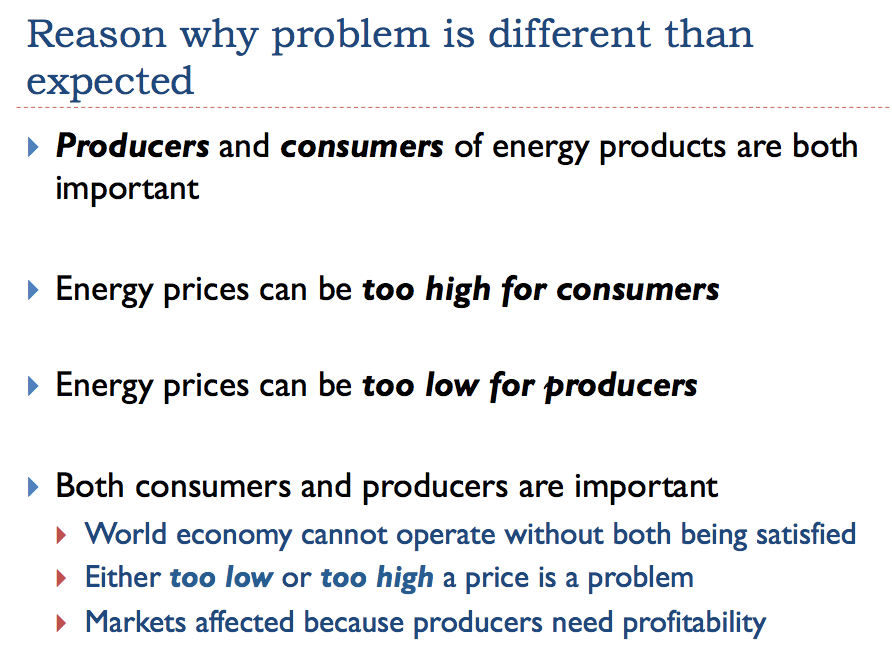
The comments shown in red on Slide 6 reflect a variety of discussions over the last several years. Oil prices in the $50 per barrel range are way too low for producers. They may be high enough to get “oil out of the ground,” but they are not high enough to encourage necessary reinvestment, and they are not high enough to provide the tax revenue that oil exporters depend on.
Slide 7
Most people don’t stop to think about the symmetric nature of the problem. They also don’t realize that the adverse impacts of low oil prices don’t necessarily appear immediately. They can temporarily be hidden by more debt.

Slide 8
There would be no problem if wages were to rise as oil prices rise. Or if there were an easily substitutable source of cheap energy. The problem becomes an affordability problem.

Slide 9
The economists’ choice of the word “demand” is confusing. A person cannot simply demand to buy a car, or demand to go on a vacation trip. The person needs some way to pay for these things.

Slide 10
If researchers don’t examine the situation closely, they miss the nuances.

Slide 11

Slide 12
Many people think that the increasing use of tools can save us, because of the possibility of increased productivity.

Slide 13
Using more tools leads to the need for an increasing amount of debt.

Slide 14
Read this chart from left to right. If we combine increasing quantities of resources, workers, and tools, the output is a growing quantity of goods and services.

Slide 15
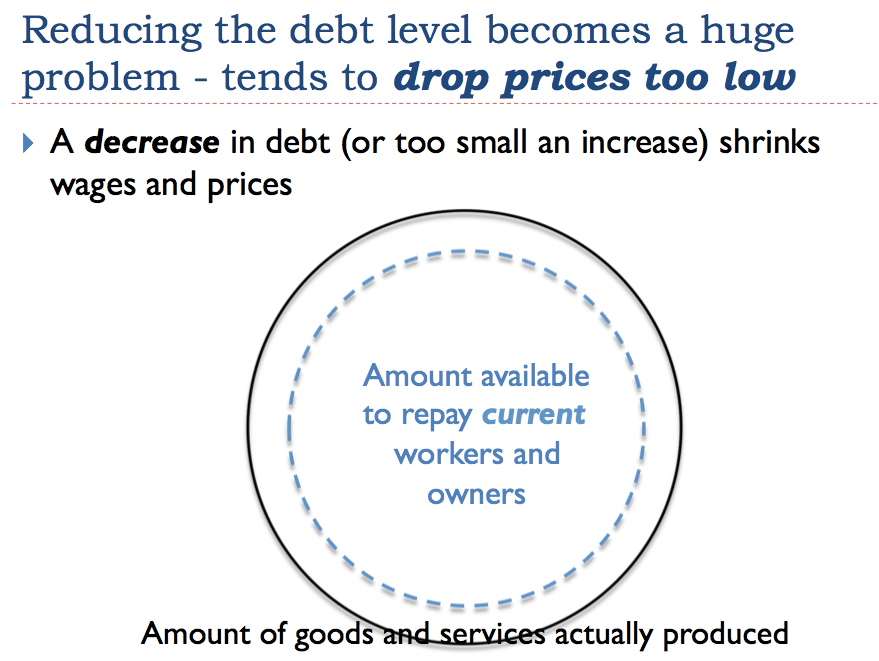
Read this chart from right to left. How do we divide up the goods and services produced, among those who produced the products? If we can only use previously produced goods to pay workers and other contributors to the system, we will never have enough. But with the benefit of debt, we can promise some participants “future goods and services,” and thus have enough goods and services to pay everyone.
Slide 16
If we decrease the amount of debt, we have a big problem. Instead of the debt adding to the amount of goods and services produced, the shrinkage acts to decrease the amount of goods and services available for distribution as pay. This is why moving from deficit spending to a balanced budget, or a budget that reduces debt, is so painful.

Slide 17
When I say (resources/population), I mean resources per capita. Falling resources per capita makes it harder to earn an adequate living. Think of farmers trying to subsist on ever-smaller farms. It would become increasingly difficult for them to earn a living, unless there were to be a big improvement in technology.
Or think of a miner who is extracting ore that is gradually dropping from 5% metal, to 2% metal, to 1% metal content, and so on, because the best quality ore is extracted first. The miner needs to work an increasing number of hours to produce the ore needed for 100 kilograms of the metal. The economy is becoming in some sense “worse off,” because the worker is becoming “inefficient” through no fault of his own. The resources needed to provide benefits simply are less available, due to diminishing returns. This problem is sometimes reported as “falling productivity per worker.”
Falling productivity per worker tends to lower wages. And lower wages put downward pressure on commodity prices, because of affordability problems.

Slide 18
The problems that prior civilizations reached before collapse sound in many ways like the problems we are seeing today. We are seeing increased specialization, and falling relative wages of non-elite workers.

Slide 19
We seem to have already gone through a long period of stagflation since the 1970s. The symptoms we are seeing today look as if we are approaching a steep downslope. If we are approaching a crisis stage, it may be much shorter than the 20 to 50 years observed historically. Earlier civilizations (from which these timeframes were observed), did not have electricity or the extensive international trade system we have today.

Slide 20
The period since 1998 seems especially flat for wages for US wage earners, in inflation-adjusted terms. This is the period since energy prices started rising, and since globalization started playing a greater role.

Slide 21
This is a list I made, showing that what looks to be beneficial–adding tools and technology–eventually leads to our downfall. The big problem that occurs is that non-elite workers become too poor to afford the output of the economy. Adding robots to replace workers looks efficient, but leaves many unemployed. Unemployment is even worse than low pay.

Slide 22
We can think of the economy as being a self-organized network of businesses, consumers, and governments. New products are gradually added, and ones that are no longer needed are eliminated. Government regulations change in response to changing business conditions. Debt is especially important for economic growth, because it makes goods affordable for customers, and it enables the use of “tools.” Prices are created almost magically by this networked system, through the interaction between supply and demand (reflecting affordability, among other things).

Slide 23
It is only in recent years that physicists have become increasingly aware of the fact that many types of structures form in the presence of flows of energy. We have known for a long time that plants and animals can grow when conditions are right. The networked economy illustrated on Slide 22 is one of the types of things that can grow and flourish in the presence of energy flows.

Slide 24
This is my view of how an economy, as a dissipative structure, works. “Tools and technology” are at the center. If a person doesn’t think too much about the issues involved, it is easy to assume that tools and technology will allow the economy to grow forever.
There is a potential for problems, both with respect to inputs and waste outputs. Early modelers missed many of these “issues.” M. King Hubbert created a model in which the quantity of energy supply and technology are the only issues of importance. He thus missed the impact of the Waste Output problems at the right. The Waste Outputs lead to falling prices as limited supply nears, and thus lead to a much steeper drop in production than Hubbert’s symmetric model would suggest.

Slide 25
Peak oilers recognized one important point: our use of oil products would at some point have to come to an end. But they did not understand how complex the situation is. Low prices, rather than high, would be the problem. We would see gluts rather than shortages, as we approach limits. Much of the oil that seems to be technologically extractable will really be left in the ground, because of low prices and other problems.

Slide 26
Here, I am getting back to the topic I was originally asked to talk about. What else, besides low energy prices and too much debt, are likely to be problems as we reach limits?

Slide 27
The easy way of modeling the use of wind turbines and solar turbines is to assume that the electricity produced by these devices is equivalent to electricity produced by fossil fuels, or by hydroelectric. Unfortunately, this is not the case.

Slide 28
Trying to integrate solar panels into an electric grid adds a whole new level of complexity to the electrical system. I have only illustrated some of the issues that arise in Slide 28.
The fact that the price system doesn’t work for any fuel is a major impediment to adding more than a very small percentage of intermittent renewables to the electric grid. Intermittent renewables can only be used on the electric grid if they have a 24/7/365 backup supply that can be ramped up and down as needed. Unfortunately, the pricing system does not provide nearly high enough rates for this service. We are now seeing how this works out in practice. South Australia lost its last two coal-fired electricity power plants due to inadequate wholesale electricity prices when it added wind and solar. Now it is experiencing problems with both high electricity prices and too-frequent outages.
Another problem is that new [long distance] transmission makes buying from neighbors optimal, over at the left of Slide 28. This is a new version of the tragedy of the commons. Once long distance lines are available, and a neighbor has a fairly inexpensive supply of electricity, the temptation is to simply buy the neighbor’s electricity, rather than build local electricity generating capacity. The greater demand, without additional supply, then raises electricity prices for all, including the neighbor who originally had the less expensive electricity generation.

Slide 29
It is easy to assume that EROEI (Energy Returned on Energy Invested) or some other popular metric tells us something useful about the cost of integrating intermittent renewables into the electric grid, but this really isn’t the case.

Slide 30
We are now beginning to see what happens in “real life,” as intermittent renewables are added. For example, we can now see the problems South Australia is having with high electricity prices and too many outages as well as the high electricity prices in Germany and Denmark (Slide 29).

Slide 31
Wind and solar are not very helpful as stand-alone devices. Yet this is the way they are modeled. Some researchers have included installation costs, but this still misses the many problems that these devices cause for the electrical system, especially as the share of electricity production by these devices rises.

Slide 33
A networked system works differently than a system that is “user controlled.” It builds itself, and it can collapse, if conditions aren’t right. I have shown the economy as hollow, because there is no way of going backward.

Slide 34
Many people miss the point that the economy must keep growing. In fact, I pointed this out in Slide 2 and gave an additional reason why it must keep growing on Slide 16. As the economy grows, we tend to need more energy. Growing efficiency can only slightly offset this. Thus, as a practical matter, energy per capita needs to stay at least level for an economy to grow.

Slide 35
If energy prices rise, this will tend to squeeze out discretionary spending on other goods and services. If we cannot obtain energy products sufficiently cheaply, the system of economic growth will stop.

Slide 36
The fact that energy prices can, and do, fall below the cost of production is something that has been missed by many modelers. Prices can go down, even when the cost of production plus taxes needed by governments rises!

Slide 37
Wind and solar are part of the category at the top called “renewables.” This category also includes energy from wood and from geothermal. Many people do not realize how small this category is. Hydroelectric is also considered a renewable, but it is not growing in supply in the United States or Europe.

Slide 38
It takes energy to have an intergovernmental organization, such as the European Union. In fact, it takes energy to operate any kind of government. When there is not enough surplus energy to go around, citizens decide that the benefits of belonging to such organizations are less than the costs involved. That is the reason for the Brexit vote, and the reason the question is coming up elsewhere.

Slide 39
The amount of taxes oil-producing countries can collect depends on how high the price of oil is. If the price isn’t high enough, oil-exporting countries generally have to cut back their budgets. Even Saudi Arabia is having difficulty with low oil prices. It has needed to borrow in order to maintain its programs.

Slide 40
Oil prices have been too low for producers since at least mid-2014. It is possible to hide a problem with low prices with increasing debt for a few years, but not indefinitely. The longer the low-price scenario continues, the more likely a collapse in production is. Also, the tendency of international organizations of government to collapse (Slide 38) takes a few years to manifest itself, as does the tendency for civil unrest within oil exporters (Slide 39).

Slide 41

Slide 42
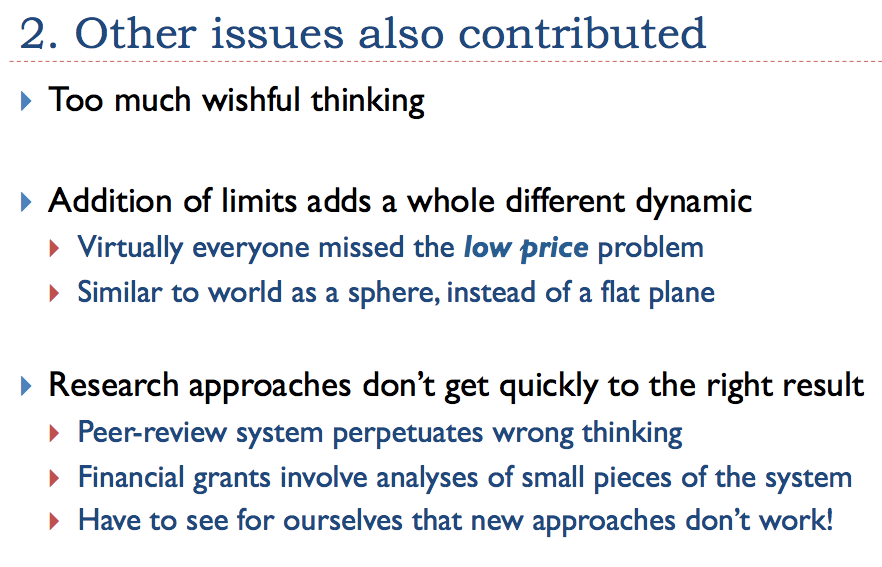
It is easy to miss the point that modeling a piece of the system doesn’t necessarily tell a person very much about the system as a whole.
Slide 43
Once an incorrect understanding of our energy problem becomes firmly entrenched, it becomes very difficult for leaders to understand the real problem.


Have you ever heard of a Behavioral Sink?
do you think our over crowded conditions might contribute to some of the social behaviors
we are seeing these days? Divorce rates huge due to horrible parenting, sexual deviance is
everywhere now (homosexuality/transgender)…all the tattoos people get now. And the love of
ultimate fighting. these are all signs of barbarism.
https://en.wikipedia.org/wiki/Behavioral_sink
Craig Dilworth in “Too Smart for our own Good” writes about how, in experiments, rats (or perhaps it was some other small animal–I don’t have the book available as I write this) can be given food, water, correct temperature, but if the population in the cage they are in starts getting too high, they stop developing normally. I forget the details now as to what happens. (Personality changes are part of it.) The net result is that the population drops back. I am wondering if this is part of it. We require more complexity for high density and at some point this gets to be a problem.
China and Japan have achieved high population densities, in part by encouraging very great uniformity. The USA, with its high energy level, has encouraged great diversity. At some point, the high energy level cannot really be achieved, and the young people can only continue to obtain diversity in deviant ways. Homosexuality acts to try to keep the population down.
John Calhoun’s Mouse Utopia
is FE a beautiful one?
In encouraging diversity, we may be harming the overall fitness of the working age population. Many of the ‘marginalized’ groups who we are told should be included in more aspects of society, are the least fit people in society, aside from the elderly. By least fit I refer to the sick, the lame and the invalid (in varying degrees. ). Since homosexuality and transgenders have always been with us they don’t raise flags, since their rise to prominence has more to do with the elite deciding they should protect minority rights since they themselves are minorities It seems like there is a secular ideology that is developing around ‘diversity’ given the fact it is becoming more difficult for society to support the social complexity required to keep the sick, the lame, and the invalid participating in society. A growing number of people find it that it worth their while to pretend that they are invalids or victims in order to secure resources rather than work very hard to earn in through the market economy.
Or perhaps there is not enough to go around, and some groups on the bottom rung of the ladder get left out.
we all now that we are gonna die so why not listen good songs
https://youtu.be/n4RjJKxsamQ
That is a classic song. Beautifully done musical art.
“The future’s in the air, I feel it everywhere, blowing with the wind of change.” Every time I hear that phrase I can’t help but think about post collapse with dust swirling between the sky scrapers of yesterday blowing with the wind of change. That song is prophetic.
https://outabouter.com/2017/04/09/historians-now-think-rome-collapsed-due-to-winning-so-much-they-got-sick-of-winning/
What I notice in this article is the statement about the growing gap between rich and the poor. The rich needed to show off. The poor were increasingly discontent. The situation isn’t too different today.
Not sure if you’re serious or not, but just in case this article comes from a satirical website similar to The Onion…
is it me that’s crazy?
https://motherboard.vice.com/en_us/article/the-robot-revolution-will-take-your-car-your-moms-car-and-all-the-oil-in-13-years?utm_source=mbtwitter
Didn’t the same reporter write a couple of months ago about the total collapse of just about everything in 2018. Guess he must have changed his mind.
in 2013 he said it about 2015
but check out his credentials—ive blown him out a coupl of times
@MickN
that article was here: https://medium.com/insurge-intelligence/brace-for-the-financial-crash-of-2018-b2f81f85686b
this was my reply to it
https://extranewsfeed.com/no-more-4d2f3658f51c
Thanks- well worth reading as were the replies to the comments. I notice you didn’t reply to the last particularly hopeful/delusional comment.
no i didnt there comes a point when there seems more important things to do
but you can see how he’s totally contradicting himself—unless I’ve missed something
You would be surprised at the number of people who buy into his argument. And, he is from Stanford!!! However, his cost projections are based on massive decreases in the price of lithium for the batteries. The self driving part seems to make sense. Culturally, will people give up their cars? I think that is where is totally off the mark. Folks love their cars.
in jan this year he said the entire system was going to crash by 2018
with no industrial system we can have no other form of industry developed from it.
How can guys like Nafeez and Bardi not understand that there is no chance in the world these will happen..I think that the number of people that understand the whole predicament we’re in must number 7500 (I am not even exaggerating)..that’s 0.0001% of the world’s population..how in the hell did the people on here (and that understand Gail’s writings, which is not a given judging by some of the delusional comments, I won’t name names) end up “getting it”???
I would have thought the total number of people (other than those tasked with keeping BAU alive) would be very few….
One has to assume that anyone understanding the issue in its entirety – would be on FW – because there is nowhere else…
Of the people participating on this site a great many do not understand the problem in its entirety…
When, through years of reading on the economy and energy matters, you finally piece the whole puzzle together and realize the full spectrum of the problem (scratch that I mean predicament since there is no solution) it feels a bit like Neo (fast forward to the 1 minute mark in the video). Like Neo in the movie, you finally can see how our world really works 🙂
I started out in the late 90s reading about the private for profit Federal Reserve Bank. I thought that was our only problem and that is was a huge conspiracy of government insiders colluding with private bankers to control money and the nations of the world. Then, after 9/11 I thought it was more conspiracy (I realize now that 9/11 had to happen to secure our petro-dollar dominance ).
Then, I read more and more into governement conspiracies and thought it was the collusion of lobbies t and corporations and government that was the root of our problems. Then I started reading The Oil Drum in 2005 or so when it first started after I read Matt Simmons book Twilight in the Desert. Light bulbs began to go off in my head that all these things fit together somehow. I concluded in about 2007 or so that the economy, energy, central banks and the military industrial complex (which I consider the deep state) all work together as a well oiled machine with the goal of driving global economic growth and wealth.
Then, after the market collapsed in 2008 I started to read a lot more about not just oil scarcity but, mining in general and the exponential function (Alber t Bartlett). More light bulbs started lighting up. I really started understanding why there is such a deep seated effort to control global resources (not just oil). To do that you must control the currency of the world. To do that takes military force. After The Oil Drum shut down in 2013 I was somewhat in a state of panic because it was my main source of information.
Then I discovered OFW, Art Berman and Energy Matters through some of the other links on The Oil Drum. I started realizing that the reason for all the insane efforts on the part of the MIC and the FED is to work around diminishing returns. And that leads me to where I am today. The simple fact that we cannot print our way or, fight our way or, build our way out of diminishing returns. It is a fate that will affect us all. The elite and the poor. We are all subject to diminishing returns That is the bottom line of why we will collapse.
+++++++++++++++
Everything is… as it needs to be… as it should be… as it must be….
That is true. Some of the comments are steaming right along then suddenly crack up with some half baked solutions. Almost invariably it involves technology and greater complexity. The gods of this system. The Aztecs were better prepared for their collapse.
The problem I see is a Jevons one. When I can simply click for a car whenever I want it and it costs less than a phone call to travel a mile, everybody will use these cars for every travel situation. There might be huge demand and even more traffic jams.
We shall see. What they are talking about is the US only. There exist 1 Billion ICE cars right now and there are to be expected 2 Bio in 2040. I doubt that self driving cars can really dampen the resource drain here… Hail the god of growth.
it is baloney. Where does the electricity come from? What fuel? Coal?
No way I want to share a car that people have vomited and not cleaned, had sex in and not cleaned, left their garbage in, spit in, pissed in, etc. I will keep my private car.
It is way too easy to build computer models showing all kind of future possibilities. As long as you are modeling only part of the system, you can imagine that all of the other pieces will be there when you need them.
One problem I see: People will want cars that drive as aggressively as they drive. If cars are built to go as fast as possible under all circumstances, and to get as much benefit from yellow lights as possible, there are likely to be a lot of accidents when conditions are even a little suboptimal.
I have a hard time seeing insurance companies insuring these cars, if they really could be built.
This article appeared on Newsweek website
South Africa’s state-run electricity company has threatened to pull the plug on its neighbor Zimbabwe if it fails to clear unpaid debts by the end of May.
The South African firm, Eskom, said that Zimbabwe’s government-run electricity distributor, ZESA Holdings, had failed to keep up with a payment plan agreed earlier in 2017, Zimbabwe’s state-run newspaper the Herald reported. The Zimbabwean firm owes Eskom 603 million rand ($44.5 million), 119 million rand of which is outstanding arrears ($9 million), according to the report.
Eskom supplies 300 megawatts (MW) of power a day to Zimbabwe, according to the Herald , around a fifth of its daily consumption. Zimbabwe currently produces around 1,051 MW of power per day and imports a further 350 MW to meet demand of 1,500 MW, Reuters reported.
Suppose it may mean back to hunting and gathering!!
And another debt basket case…
Puerto Rico continues to struggle financially. The U.S. commonwealth owes creditors and pension funds more than $120 billion. And last week, the island officially began the process of seeking a special form of protection from creditors called Title 3 which is similar to declaring bankruptcy.
On Friday, President Donald Trump signed a federal government spending bill that included $295 million in Medicaid funding for Puerto Rico’s struggling health care system. To talk more about how Puerto Rico’s leaders are getting their fiscal house in order, we spoke with Governor Ricardo Rossello Nevares earlier this week.
And, Governor Rossello is a Democrat who took office in January. And I began by asking him about an announcement on Friday to close some 180 public schools affecting about 27,000 students
NPR interview of the Governor
http://www.npr.org/2017/05/07/527303693/puerto-rico-government-looking-at-different-ways-to-reduce-120-billion-debt
Lot’s of problems, when there is not enough to go around. It is those at the bottom of the economic ladder that especially get squeezed out. Francois Roddier would say the situation is that those who are able to get the least energy supplies are frozen out, like ice. The wealthy reprise to the top, like steam.
Even the wealthy are having problems, which are clearly energy-related.
In Britain, it has long been traditional to buy a ‘nice house in the country’, meaning a 15th to 19th century house of substance with varying amounts of land but always lovely, large, garden, when one has reached a certain level of wealth.
The real estate agents who deal in such things have become quite candid in the last few years about admitting that prospective vendors are not very keen on large, labour-intensive gardens anymore, and are looking into the costs of heating these places with keen discernment – cutting these base costs as much as possible.
This market has been rather stagnant for years, and people are having trouble selling when they want to down-size: beautiful houses come up time and time again in the ads, even when fully refurbished and turn-key. Even large price reductions often don’t help -who wants all those fixed and steadily-rising costs?
This has been the case for a decade now. In many regions it has been dreadful for the real estate people. If you cut out the market dominated by international hot money, -mostly London – then one can see how the traditional wealthy segment in Britain are much less secure and happy to spend than before.
‘Suzanne / May 6, 2017
And here is the latest PIOMAS from Neven: http://neven1.typepad.com/blog/2017/05/piomas-may-2017.html#more
His concluding remarks:
If this year’s melt is equal to the average of the last 10 years, there will be around 2500 km3 left in September (mind you, the 2012 record low minimum is 3673 km3). If there’s as much melt as in 2010 or 2012, this year’s minimum will barely go above 1000 km3. I don’t want to know what the Arctic looks like if that should happen.
There’s nothing else to do but hope that PIOMAS has it completely wrong, or else pray for lots of cold and cloudy weather in the Arctic this summer.”
It’s possible that the entire sea ice in the Arctic could melt. Last year the sea ice was still melting in December. The jetstream is so unstable now and unpredictable that we could have a reversal of temperature in the Arctic. It is theoretically possible that the ice sheet on Greenland could flash melt by the summer of 2018-19
Finally deserving its name.
JT, more likely the Arctic SEA ice will disappear. I posted a link about it already recently.
Gail feels differently regarding the science of Climate Change and has stated they (models and projections) are wrong.; based on recent studies that were unnamed.
Since it is her blog, I’ll leave it at that and not “debate”, since it is something we humans are unable to deal with in any shape or form.
When it does say good by to temperature stability. Arctic sea ice is a thermal storage system stabilizing the northern hemisphere. The latent storage of ice is absolutely necessary to maintain weather cycles. No sea ice no crops.
It’s really that simple. I hope that Hawaii trip was worth it.
The question then is whether temperature goes up or down. Historically, we have had a lot of ice ages.
Gail, lot more to it than that!
Earth was actually getting colder for the last 4000 years.
Then we carbonized the atmosphere (can you say hockey stick? I know you can).
Humans, and almost all primates have never lived in a world we are currently inhabiting climate wise.
I’ll bet my money on temperatures going down:
“Zawiska et al. (2017) have found that the amplitudes of the warming and cooling periods — modulated by changes in solar activity and the North Atlantic Oscillation (NAO) — during the last 1,000 years far exceeded the temperature changes that have occurred since about 1950, or since anthropogenic CO2 emissions began rising at an accelerating pace. For example, these scientists point out that within a matter of 100 years (1050-1150 to 1150-1250), summer temperatures rose from 9.2°C during a low solar activity period (Oort Minimum) to 12.0°C in concert with the subsequent rise in solar activity.
Zawiska and colleagues also point out that the rise in modern era temperatures began around 1800, not the 20th century. In fact, they find that temperatures rose by 4.3°C (from 8.5°C to 12.8°C) within 75 years starting at the beginning of the 19th century (+0.57°C per decade), and this warming ‘correlates with the positive NAO index and increased solar activity.’ The authors further indicate that the warming in the 20th/21st centuries has been ‘less pronounced’ by comparison.
During the 19th century, of course, anthropogenic CO2 emissions rates were but a tiny fraction of what has been observed since the mid-20th century, strongly suggesting that temperature changes associated with natural variations in atmospheric/oceanic cycles (NAO) and solar activity far exceed the forcing strength of anthropogenic CO2 emissions.”
http://notrickszone.com/2017/01/12/scientists-find-climates-cause-of-causes-highest-solar-activity-in-4000-years-just-ended-cooling-begins-in-2025/
https://www.skepticalscience.com/solar-activity-sunspots-global-warming.htm
I’ll take that bet against you!
Deal! Given that I’m a gentleman I’ll let you in on something. I’m going to start a sun worshiping cult. We’re going to pray our way through the next grand solar minimum (on schedule to arrive between 2019 and 2020). If you decide to repent in the future I will accept you into our fold. We’ll be giving worshipers free sunbonnets to help ward off vitamin D deficiency:
http://images.oobject.com/thumbdir/thumbnails/3/5e/35e2995ca4bc16b9886ecc5dbed54d96-orig
It’s okay, my son. I’ll forgive you. 😎
https://static1.squarespace.com/static/56530521e4b0c307d59bbe97/t/58cff3fee4fcb591d4c042cd/1490023431861/?format=1000w
Gee, Guy, you post a graph and convinced you are correct… If it makes you feel better…good for you!
Hope you win some Noble boobbie Prize.
Latest is warming has never paused
“It is unfortunate that a major public and media discussion has revolved around an alleged significant and unexpected slowdown in the rate of global warming, for which there never was a statistical basis in the measured global surface temperature data.”
http://environmentalresearchweb.org/cws/article/news/68552
Claims of a ‘slowdown’ or ‘hiatus’ in rising global temperatures are not supported by an in-depth analysis of statistical evidence, a new study has shown.
The study, conducted by researchers from Germany and the USA, examined global-mean surface temperature (GMST) trends, in the light of a recent series of three record-breaking years in a row in most data sets.
Their results, which identified two important pitfalls in analysing GMST trends, are published today in the journal Environmental Research Letters.
Somethings are simply not worth addressing base load solar is one of them. The intermittency of solar and wind will never be efficiently resolved. Inverters will never work for base load.
I have several friends who lived through the Soviet collapse and to think this will be the same is foolish thinking. First of all post collapse in the former USSR didn’t happen in a vacuum. Western corporations rushed in to attempt to mop up resources and as a result brought hard currency to the table. The collapse really was halted by investment. This won’t happen in a global collapse. BAU-light is also impossible because the system is built on economies of scale that cannot function at lesser volumes. That’s why we’re not hearing so much about making America Great anymore. It is simply impossible to locally source the elements and manufactured assemblies to replace the essential parts of the current infrastructure as they break.
After reading the comments to Gail’s article on Zero Hedge you have to wonder how few actually have any clue what’s going on. Zero Hedge has an above average audience compared to MSM narrative junkies. This is important because without any unity of action the unwind will be swift and chaotic. Once the communication system fails, and it will be first to go as it is the most complex, people will be left with whatever belief system they have established. They will in this isolated state create their own explanations for present conditions.
The Russian’s did it. Central bankers are the problem. Aliens attacked. The Zionist planned it. Trump is a Rothschild. EMP attack. Etc.
Anyone who opposes the groups narrative will be classified as an enemy of humanity. They will then be justified in removing the threat.
Besides the cooling pond issue do we really believe a system can be reorganized around those conditions? Not likely.
Chris Martenson or Steve St Angelo would like to convince people that gold and silver will save them. More reasonable to conclude that anything eatable will eaten and by that I mean anything. No one will be trading gold for food. And there won’t be any electronic exchanges. Might as well have faith in a food replicating machine fueled by Mr Fusion.
“a clue what is going on?”
7.5 B people and only a few dozen of active contributors in 3 or 4 blogs worldwide talking about the big picture!
Unbeliveable!
7.5B people, and just a few dozen regulars on 3 or 4 blogs..
Thats kinda scary, yes. Even if the numbers were in the hundreds or even in the thousands, alltogether, it would still be scary. But if we consider Norm is right, that in the long run the changes will be from Fossil Fuel powered machines to everything done by muscle power and whatever people can find to burn.. then yes its really really scary. Because everything will change. Heating the home. The structure of the home. Food production. Food storage. Medicine. Health care. Defence and protection. It all will change. Not one single thing will remain the same. Everything will be different.
So when the lights go out. The grid falls. Not only will the people be bewildered on whats happening, but they will have zero, absolutely zero possibility of building a intergenerational lifestyle. (That would require food surpluses on annual basis..) Because everything they will think they know, will eventually change. And they will have absolutely no time to adapt and learn..
Instead of there being at least some consideration of “lets plan this thing, how we will have a small miniscule possibility of at least somebody surviving a century from now” instead we only have a few dozen regulars on 3-4 blogs..
If calculating odds right now, on the survival odds of our species. The odds wouldnt be that high..
Kinda makes one wonder how this silly species made it this far..
” “lets plan this thing, how we will have a small miniscule possibility of at least somebody surviving a century from now”
Isnt this blog about there is not even a small miniscule possibility of making it a small part of a century from now?
Billionaires are buying self sufficient estates in NZ. Moscow, London and a few other places have underground bunkers that can house thousands of people for more than a year. The US still has Fema camps and more ammo than they can possibly use. The looneytoon is still talking about his Mars colony.
My point?
The big picture looks grim. But without at least some sort of a roadmap, of the big picture. The challanges at each stage of development towards extinction. Why prep at all? Its just beyond me that people want a NZ bolthole, or a Vivos underground shelter, but they buy them without an actual plan of how to actually survive. Prepping without a big picture just seems kinda strange to me, thats all..
we are all faced with a sense of need to do ”something”
but what exactly?
very few can buy worthwhile boltholes, those that can are convinced that a billionaire in usa will still be a billionaire in NZ or wherever post crash—and because NZ’ers obey no trespassing signs now, they will continue to do so in our future.
we might say we need to take the bigger picture into account, but what is that exactly?
You see this “billionaire” stuff is mostly about keeping up appearances, and striving for being inside the club. For most cases, this bunker stuff it’s not all-in type of investment anyway, just another item on the list of fun luxuries to have. It’s like the Trump (lesser Trumps) niveau of people who throughout their life did not always own brand factory new jet, but they at all costs have to keep the facade of the club insiders. Yes it’s silly, very similar to employee guys buying second hand luxury carz.. trying to impress someone.. no one..
It’s a cultural and generational thing as well, similarly as first generations of Arab or Russian oligarchs buy .5B yachts a piece. While the guys in the family money of 100-300yrs rather enjoy subtle things and are more excited by whispering into the ears of CBs and govs, commanding fate of millions souls in various nations across the globe, economies, supporting or disrupting emerging trends, .. etc.
I suppose they are expecting that once the chaos clears that there will be a reset.
There will be no reset. Because there will be no energy.
Then there is the spent fuel pond issue…
I agree, Van Kent. But with the bigger picture in mind, it’s possible to foresee all kinds of unpleasant economic and social jolts, or effects of natural disaster, that some kind of prepping would make easier to endure.
Except, I wouldn’t really call it ‘prepping’ -with all the fantasies of end of the world survival that implies – just the sensible allowance for nasty contingencies, much as our forebears did until the advent of the Industrial Age.
In the Northern Hemisphere these are dry food stocks, food plot, fruit trees, water source if locked into one’s house by disorder, fuel stocks, and clothes and bedding that keep you warm even when fuel runs out and medicines. (And, of course, weapons, as far as the law permits).
The only madness is trying to provide for every possible contingency. My view is that when modest preparation as above fails, the game is up anyway, and one will either survive as a part of some state reorganisation on a communal model, or die.
It is possible that a few might make it for a while, or even quite a few years. After all, some humans lived though pretty rough times–ice ages, for exsmple–in the past.
I started this blog, trying to figure out what would happen.
That’s a good point, however from the zoom out perspective, there have been several waves of attempts how the species shot up on the complexity level through the ages.
As seen in that Gail’s graph, the most recent spike ~150-250yrs is just extension of the mega trend from ~15-16th century, which evidently allowed for betterment of the middle and lower classes as well. If we are at the end of these two cycles (or taken as one longish cycle), well chances are there will a very notable “pause” going forward after this crash, likely in many hundreds, perhaps thousands of years for another attempt, that’s the “optimistic scenario”. Or it’s the immediate end for ever, single point overshoot event theory occurring now, no lower peaks/plateaus possible even on the distant horizon (e.g. on the scraps and ~1/25th pop say year ~2500-3000AD), if the fasters are right..
I’m open and “keep working” with both options, although attaching probabilities is a subjective matter as we know here.
Right! Peat moss was used as a fuel and pushed the Netherlands forward, even before fossil fuels. Once there were a lot of sailing boats, it seems like colonization became important. A government could tax a new colony and collect desirable products like sugar. Also get slaves.
But we had oceans full of fish, and rich continents to plunder, and were just transitioning from real time energy to coal fuels.
We are currently in population overshoot, ecological collapse, runaway climate change, and living in a superstition based economic model.
I had an interesting thought. I wonder if the system of slave labor works only during periods of growth and expansion. In contraction and collapse slavery may not even work. So, the whole idea that we could have BAU-lite using slave labor coiuld well be just another nail in the coffin as to why BAU-lite is not possible.
There are still a few hunter gatherers, living by traditional means. These are the people with the best chance for survival.
Humans are as dumb as yeast in a jar.
I am afraid you are correct.
The reason I suggest that Gail address base load solar is that in not doing so, many people scoff saying obviously clueless as she hasn’t even heard of base load solar. And yes it is an oxymoron to be a renewable energy adopter but still realise that it’s not going to change anything. Life is one big paradox; the answer is yes, the answer is no.
The SA power outages were caused by relatively simple technical faults and wind power destruction, of towers not variability of supply.
‘And yes it is an oxymoron to be a renewable energy adopter but still realise that it’s not going to change anything.’
It is unusual for people to admit that they are delusional…. generally they appear not to be aware that they are delusional…
Fascinating.
You might be interested in this:
Germany’s Expensive Gamble on Renewable Energy : Germany’s electricity prices soar to more than double that of the USA because when the sun doesn’t shine and the wind does not blow they have to operate and pay for a completely separate back up system that is fueled by lignite coal http://www.wsj.com/articles/germanys-expensive-gamble-on-renewable-energy-1409106602
Why Germany’s nuclear phaseout is leading to more coal burning
Between 2011 and 2015 Germany will open 10.7 GW of new coal fired power stations. This is more new coal coal capacity than was constructed in the entire two decades after the fall of the Berlin Wall. The expected annual electricity production of these power stations will far exceed that of existing solar panels and will be approximately the same as that of Germany’s existing solar panels and wind turbines combined. Solar panels and wind turbines however have expected life spans of no more than 25 years. Coal power plants typically last 50 years or longer. At best you could call the recent developments in Germany’s electricity sector contradictory. https://carboncounter.wordpress.com/2015/06/06/why-germanys-nuclear-phaseout-is-leading-to-more-coal-burning/
Germany Runs Up Against the Limits of Renewables
Even as Germany adds lots of wind and solar power to the electric grid, the country’s carbon emissions are rising. Will the rest of the world learn from its lesson? After years of declines, Germany’s carbon emissions rose slightly in 2015, largely because the country produces much more electricity than it needs. That’s happening because even if there are times when renewables can supply nearly all of the electricity on the grid, the variability of those sources forces Germany to keep other power plants running. And in Germany, which is phasing out its nuclear plants, those other plants primarily burn dirty coal. https://www.technologyreview.com/s/601514/germany-runs-up-against-the-limits-of-renewables/
https://gailtheactuary.files.wordpress.com/2016/08/euan-mearns-europe-electric-price.png
The main reason consumer costs are so high in Germany is heavy energy users in industry get access to cheap energy when it’s available but don’t have to pay higher rates when it’s not. By being exempt from the taxes they are being subsidized (one reason why German exports have done so well). And if they were forced to pay some would leave (reducing base load and peak needs and therefore FF/nuke plants) and others would find ways to shift their demand and and improve efficiencies and therefore greatly improve grid stability. Also, one of the consumer taxes (~3c/kwh) is to reduce consumer consumption and goes directly to general revenue, not towards renewables.
Other reasons are that the residential solar program was a massive expense for little gain as was early wind systems but they effectively kicked off both industries (and are selling production equipment and engineering services worldwide) and the subsidies for these are going away (the grid will continue to get these early installs’ power for whatever the wholesale rate is at the current time, IOW most expensive producers will become the cheapest). Lastly, NIMBYs have kept any north-south transmission from being developed so massive amounts of energy must be exported (from the north) and then reimported to the south which is not only inefficient but requires very favorable pricing for your neighboring countries to play ball.
Thanks for writing. I think that there is even more to the transition than you list. For example, the real cost of adding renewables tends to rise over time, because its interference with the electrical system as a whole grows. This works in the opposite direction of the “high prices for early devices” issue you talk about.
Also, NIMBY results in a lot of buried long distance transmission. This is very expensive transmission, but it is a real cost of adding intermittent renewables that no one wants.
The fact that Germany is exporting unwanted intermittent electricity to neighboring countries becomes a greater and greater problem with time. This is why EU legislation is becoming less favorable to renewables.
“The SA power outages were caused by relatively simple technical faults and wind power destruction, of towers not variability of supply”
Here is the electricity supply of Australia two Saturdays ago. There was no wind and no sun at that time. The electricity came 100% from gas (i.e. fossil fuels). The amazing thing is that the politicians of South Australia are proposing to continue the disastrous policies which have already led to massive spikes in the wholesale price of electricity. Electricity in SA is way more expensive than in West Australia – let alone the USA or China.
http://qbusters.com.au/ida/sa1.jpg
Next summer (i.e. December onwards), Victoria will not be in a position to export electricity to South Australia via the interconnector – as they have been closing down FF power stations over here as well.
The oxymoron, ESL poster, is that solar has never been a baseload source of energy for an electrical grid because it is intermittent..
ON STOCK BUYBACKS
“When the time comes, and it could come reasonably soon … we have to re-examine what to do with funds that (can’t) be deployed well. It could be repurchases, it could be dividends.
http://www.zerohedge.com/news/2017-05-07/buffett-talks-markets-healthcare-ibm-and-self-driving-cars-key-quotes-berkshires-pil
If Berkshire resorts to this .. then the end is very close…
ON JOBS
“Our kids will live better than we do because America does get more productive … It’s essential to America that we become more productive.”
Always predict a happy ending … no matter what….
can you explain for me please? what are stock buy backs and such?
http://www.investopedia.com/terms/b/buyback.asp
It’s a defacto mass 401k bailout financed by the frbny.
Whenever I am feeling dejected by all the bad news I know that the financial news writers will always have something to make me feel better.
More productive= more production of= [?]
What are we producing again…? I thought we were consumers. If Buffet were saying this about China…it would mean more factories, more cities, and more consumer electronics.
What does the U.S. produce…? More luxury homes, ineffective medical services , and more ‘educated’ people…?
Believe it or not the US does make stuff for export and for the most part it is good stuff.
I try to buy it when I can…Canada
I was having a discussion with someone the other day about the Mars colony… and how completely ridiculous this is…
They looked at me without responding…
After an uncomfortable silence I said —- it is ridiculous — right?
They finally responded with … yes… obviously…
I left feeling I may have insulted them….
I attended a space radiation seminar at our astrobiology institute recently. The lady very matter of factly stated that you get about a 50% lifetime dose of radiation every year you stay up there in low-Earth orbit. So I reasoned that’s why NASA is so lukewarm about human Mars missions and colonies. Why go all the way to Mars to get fried like bacon in space, when all you have to do is keep orbiting in the space station? My guess is any colony on Mars would have to quickly dig in or find some caves for shelter. Back to the Stone Age.
Space—it’s a better place for Keith’s AI robots.
doomphd, right you are. There was a TV mini series on going to Mars recently which was quite good. In the hypothetical future trip to Mars, they locate an underground cavern to set up their base camp to avoid the radiation.
What did they do about food and water and air?
And why would they want to live in a cave on Mars when there are plenty of caves on earth?
Because the Earth is just a used-up dirt ball, and Mars is just so awesome?
Every time I see Mars propaganda, I feel that I am witnessing the culmination of human stupidity and delusion, in the last days of the species, in a supposedly rational and scientific age.
My modelling an idol out of clay, setting it up in a shrine and praying to it to bring me fertility, wealth and long-life could not be more ridiculous.
LOL!
Mars is what the Earth will look like when we are finished with it….
and, it would be a whole lot cheaper!
And the caves on Earth have air to breathe. A huge plus. And some caves even have water in them, another huge plus. And, the caves on Earth are much closer than Martian caves. Another plus. The whole idea of flying millions of miles to a desert planet to live in caves without food, water or AIR is beyond stupid.
Hands up those who want to live in a cave on earth.
Bill maher did a funny rant about Jeff Bezos, Elon Musk and Richard Branson’s enthusiasm for a mars mission. Bill explains that he loves to travel but every destination he travels to has to have all the basics – air being the main one and food. And Matt Damon’s shit potatoes don’t cut it for him. If you need a laugh about the stupidity of such a venture check it out on YouTube.. Richard Branson kite surfing with a naked Martian on his back is hilarious!
Love to live in a cave! Must have clean bed sheets, that’s all I ask!!
Cavemen must of been a lot happier, no mortgage, no home insurance, no heating/cooling bills, no electricity to worry about. Damm, wonder what or more likely WHO drove them out?
Let’s see, maybe this is the answer?
https://m.youtube.com/watch?v=foe_3TbL5xU
God bless their little hearts!!
I stayed in a cave once… in Cappadocia… not so bad….
https://backpackerslife.info/wp-content/uploads/2016/06/35401ad383aa045d4353f1bb08dd9258.jpg
You need faith…I will light the fire and then we can sing.
Good point.
highly informative post ; Another huge drag is healthcare expenditure as a percentage of GDP , in 1970 is was approximately 5 % and now is 17% !!!
I agree. We cannot possibly afford today’s healthcare costs. We need a much simpler system, that covers much less. Perhaps closer to a 1970’s system. Not many specialists.
Have you ever heard of a Behavioral Sink?
do you think our over crowded conditions might contribute to some of the social behaviors we are seeing these days? Divorce rates huge due to horrible parenting, sexual deviance is everywhere now (homosexuality/transgender)…all the tattoos people get now. And the love of ultimate fighting. these are all signs of barbarism.
https://en.wikipedia.org/wiki/Behavioral_sink
HI Gail
Thanks for the post. Overall I am clear on the problem with wind & solar but was slightly confused on the wording or point here re long distance / neighbours … i assume the point is that the neighbour can (now) sell his electricity across a greater area which drives up demand for his electricity? and/or undermines a wider market price?
“Once long distance lines are available, and a neighbor has a fairly inexpensive supply of electricity, the temptation is to simply buy the neighbor’s electricity, rather than build local electricity generating capacity. The greater demand, without additional supply, then raises electricity prices for all, including the neighbor who originally had the less expensive electricity generation.
Macron is gathering his anti-harem…
https://i2.wp.com/newsexplored.co.uk/wp-content/uploads/2017/04/emmanuel-macron-wife-brigitte-795769.jpg
Whats wrong with a son wanting to kiss his Mummy ?
https://www.youtube.com/watch?v=KNIZofPB8ZM
Now imagine what would happen if a male teacher were involved with a 16 yr old female student….
Trump … Macron… never mind the circus….the freak show has come to town
Hahaha FE…you’re right total double standard…The Police!!!!!! What a band!!! I think they might be the band I listen to as I prepare for my epic 30-storey jump 😉
Nice music on my way out of here!!! I might pick this one, I’ve always found it dark:
Ungallant, FE, ungallant.
But true.
Tough being a mere instrument of the Rothschilds……
Gail, I’ve followed your blog for years and having worked in oil and gas, chemicals and mining have seen first hand the amount of effort and money it takes to underpin our society. I’ve also been an early leader in Melbourne to devote capital to building a sustainable house to reap operating cost benefits in our later years.
However,I do find it disengenuous to use SAs power outages your arguments; one was caused by tornado winds, the other by being more profitable not to supply.
I agree that renewables can not power a future without oil to build and maintain them, but I think you need to recognise the existence of base load solar (refer BZE reports)
“I agree that renewables can not power a future without oil to build and maintain them, but I think you need to recognise the existence of base load solar (refer BZE reports)”
There’s an oxymoron and a contradiction in this sentence.
The contradiction is that you admit solar doesn’t work and won’t work in the future
but demand that Gail, at least, recognize the feasibility of a non-existant version of solar energy generation called “baseload solar” (BZE) . The oxymoron, is “baseload solar”.
” I’ve also been an early leader in Melbourne to devote capital to building a sustainable house to reap operating cost benefits in our later years.”
That sounds like a much more expensive home than normal homes. Even with “capital”, I imagine that these “sustainable homes” will be homes only the wealthy can afford. No one will “reap” anything. Buyers will be pay upfront the entire cost for an expensive home with a higher embodied energy in its construction.
I agree–baseload solar is pretty ridiculous. It is very far from baseload. Our big need is for heat in winter; solar produces power mostly in summer. That is a deal-killer on its own.
There is an interesting little blog, ‘Ferndale Farm’, which gives excellent first-hand accounts of what it is like to live on a permaculture farm in the Australian mountains, using off-grid solar as much as possible.
Summary: in winter it’s pretty feeble, and a rather vulnerable system that has to be very carefully managed indeed.
People who are developing models should to required to read about how the solar panels work in practice. The IEA has developed a way of modeling solar that assumes that all panels will last five years beyond the date that they are guaranteed by the manufacturer. Nothing goes wrong. No cost of battery backup is to be included.
Adding wind and solar makes the prices too low for any base load–nuclear in the areas that have it and coal are especially hard hit.
Solar is definitely not base load. Even adding battery backup doesn’t get it back to base load. It has a huge seasonality problem (needed for heat in winter, but provides its power in summer).
You need to read the investigative reports about SA.
My idea of impoverishing the 95%-99% of the world’s poorer people is the best way to solve the complexity problem.There is simply no way to continue today’s system for a long time. However, an ‘exit plan’ might, just might, work if it is planned well in advance.
The bottom 50% globally do not use significant resources so killing them does nothing but free up spots in the rice paddies for the next 40% to work. You have to impoverish the majority of the first world countries to extend the timeline. Which is exactly what has been happening in the US and a few other first world economies.
ah—the “plan”
so who will make the plan?
Korean Kim?—the Don? Merkel? a mad mullah from Iran? The pope?
Hit-ler had a grand plan too.
Before you make plans, it is necessary to get the planners round a table and get them to agree—then they have to go away and persuade 7.5 bn other people to agree
Ive youve ever watched the UN tower of babel proceedings, you’ll get my drift I think–arguing since 1945 and still no ”plan” for ultimate survival.
The plan will plan itself I’m afraid:….decimate our numbers and let the planet rebalance itself, which it will do irrespective of any plans we might make
A bug or a feature?
Trump Delay Stalls $50 Billion of Energy Investment Projects
“Until President Trump fills key vacancies at an energy regulator, Nexus and other sprawling energy projects are in limbo, unable to secure permits to begin construction. By the time Midwesterners fire up their furnaces this fall, the $2 billion Nexus pipeline is supposed to be pumping natural gas to heat homes from frosty Ohio to frostier Ontario. But six months out, the 255-mile pipeline exists only on paper. Until President Donald Trump fills key vacancies at an energy regulator, Nexus and other sprawling energy projects are in limbo, unable to secure permits to begin construction. For Nexus developers DTE Energy Co. and Spectra Energy Partners LP, each week that passes threatens the project’s ability to meet winter demands.
Nexus is just part of at least $50 billion worth of ventures slowed or stalled while the agency that approves them, the Federal Energy Regulatory Commission, awaits presidential appointments. For the first time in FERC’s 40-year-history, the agency doesn’t have enough commissioners for a quorum to vote on project applications. At least a half-dozen pipelines valued at $12 billion face imminent delays, while projects valued at $38 billion are slogging through an approval process that’s slow in the best of times. An additional $25 billion of proposed developments just beginning the application process also could be slowed if the situation persists late into the year.
Post-Inauguration Bottleneck – It’s a bottleneck that can be traced to the White House in the hectic days following the inauguration. Trump inherited a commission with three Democrats and two Republican vacancies and decided to shake things up. The president took the chairmanship from Norman Bay, an Obama appointee, and gave it on a temporary basis to Cheryl LaFleur, considered by Republicans to be a friend of the industry.
In February, Bay resigned. That left the commission with just two members, LaFleur and Commissioner Colette Honorable, whose term ends in June — one shy of the quorum needed to vote on projects. That meant no approvals for new gas pipelines. No decisions on contested utility mergers. No clearance for new liquid natural gas terminals.
Other regulatory agencies that lack enough staff to vote on issues include the Federal Trade Commission, Commodity Futures Trading Commission and the Export-Import Bank.
Stalled energy projects big and small include the $1 billion, 114-mile PennEast Pipeline, designed to run from Pennsylvania to New Jersey, TransCanada Corp.’s $850 million WB Express, and Chesapeake Utilities Corp.’s $100 million Eastern Shore expansion project, which expected approval in the first half of the year. Pipeline delays could hit consumers directly by driving up prices for the fuel. “You could see ongoing spikes in prices, in particular New England,” said Michael Kay, a Bloomberg Intelligence analyst.
Formal nomination is only the beginning of what could be a months-long process. The candidates still have to be confirmed by the Senate after approval from the Energy and Natural Resources Committee. The chairman of that committee, Senator Lisa Murkowski, said Thursday she would clear time for confirmation hearings as soon as Trump announces nominees.
It’s a political process that’ll take awhile, said Martin Edwards, head of government affairs at the Interstate Natural Gas Association of America. “How much time is really unknowable,” he said. Confirming the last commissioner to join the panel in 2014 took six months.
Isn’t there also a problem with getting enough money in the budget to do everything? Or maybe this takes precedence.
It is a feature, however, that it is very hard to get anything through the system.
We have reached peak complexity. Any additional attempts to increase complexity are fruitless ventures. One can not make America great again any more than one can raise the dead. The next two to three years are more about unwinding complexity than anything else. The spring is wound so tight it might break any day now.
I agree pretty much agree.
Here is a complete list of all Rothschild owned and controlled banks. The U.S. entries might surprise you.
Afghanistan: Bank of Afghanistan
Albania: Bank of Albania
Algeria: Bank of Algeria
Argentina: Central Bank of Argentina
Armenia: Central Bank of Armenia
Aruba: Central Bank of Aruba
Australia: Reserve Bank of Australia
Austria: Austrian National Bank
Azerbaijan: Central Bank of Azerbaijan Republic
Bahamas: Central Bank of The Bahamas
Bahrain: Central Bank of Bahrain
Bangladesh: Bangladesh Bank
Barbados: Central Bank of Barbados
Belarus: National Bank of the Republic of Belarus
Belgium: National Bank of Belgium
Belize: Central Bank of Belize
Benin: Central Bank of West African States (BCEAO)
Bermuda: Bermuda Monetary Authority
Bhutan: Royal Monetary Authority of Bhutan
Bolivia: Central Bank of Bolivia
Bosnia: Central Bank of Bosnia and Herzegovina
Botswana: Bank of Botswana
Brazil: Central Bank of Brazil
Bulgaria: Bulgarian National Bank
Burkina Faso: Central Bank of West African States (BCEAO)
Burundi: Bank of the Republic of Burundi
Cambodia: National Bank of Cambodia
Came Roon: Bank of Central African States
Canada: Bank of Canada – Banque du Canada
Cayman Islands: Cayman Islands Monetary Authority
Central African Republic: Bank of Central African States
Chad: Bank of Central African States
Chile: Central Bank of Chile
China: The People’s Bank of China
Colombia: Bank of the Republic
Comoros: Central Bank of Comoros
Congo: Bank of Central African States
Costa Rica: Central Bank of Costa Rica
Côte d’Ivoire: Central Bank of West African States (BCEAO)
Croatia: Croatian National Bank
Cuba: Central Bank of Cuba
Cyprus: Central Bank of Cyprus
Czech Republic: Czech National Bank
Denmark: National Bank of Denmark
Dominican Republic: Central Bank of the Dominican Republic
East Caribbean area: Eastern Caribbean Central Bank
Ecuador: Central Bank of Ecuador
Egypt: Central Bank of Egypt
El Salvador: Central Reserve Bank of El Salvador
Equatorial Guinea: Bank of Central African States
Estonia: Bank of Estonia
Ethiopia: National Bank of Ethiopia
European Union: European Central Bank
Fiji: Reserve Bank of Fiji
Finland: Bank of Finland
France: Bank of France
Gabon: Bank of Central African States
The Gambia: Central Bank of The Gambia
Georgia: National Bank of Georgia
Germany: Deutsche Bundesbank
Ghana: Bank of Ghana
Greece: Bank of Greece
Guatemala: Bank of Guatemala
Guinea Bissau: Central Bank of West African States (BCEAO)
Guyana: Bank of Guyana
Haiti: Central Bank of Haiti
Honduras: Central Bank of Honduras
Hong Kong: Hong Kong Monetary Authority
Hungary: Magyar Nemzeti Bank
Iceland: Central Bank of Iceland
India: Reserve Bank of India
Indonesia: Bank Indonesia
Iran: The Central Bank of the Islamic Republic of Iran
Iraq: Central Bank of Iraq
Ireland: Central Bank and Financial Services Authority of Ireland
Israel: Bank of Israel
Italy: Bank of Italy
Jamaica: Bank of Jamaica
Japan: Bank of Japan
Jordan: Central Bank of Jordan
Kazakhstan: National Bank of Kazakhstan
Kenya: Central Bank of Kenya
Korea: Bank of Korea
Kuwait: Central Bank of Kuwait
Kyrgyzstan: National Bank of the Kyrgyz Republic
Latvia: Bank of Latvia
Lebanon: Central Bank of Lebanon
Lesotho: Central Bank of Lesotho
Libya: Central Bank of Libya (Their most recent conquest)
Uruguay: Central Bank of Uruguay
Lithuania: Bank of Lithuania
Luxembourg: Central Bank of Luxembourg
Macao: Monetary Authority of Macao
Macedonia: National Bank of the Republic of Macedonia
Madagascar: Central Bank of Madagascar
Malawi: Reserve Bank of Malawi
Malaysia: Central Bank of Malaysia
Mali: Central Bank of West African States (BCEAO)
Malta: Central Bank of Malta
Mauritius: Bank of Mauritius
Mexico: Bank of Mexico
Moldova: National Bank of Moldova
Mongolia: Bank of Mongolia
Montenegro: Central Bank of Montenegro
Morocco: Bank of Morocco
Mozambique: Bank of Mozambique
Namibia: Bank of Namibia
Nepal: Central Bank of Nepal
Netherlands: Netherlands Bank
Netherlands Antilles: Bank of the Netherlands Antilles
New Zealand: Reserve Bank of New Zealand
Nicaragua: Central Bank of Nicaragua
Niger: Central Bank of West African States (BCEAO)
Nigeria: Central Bank of Nigeria
Norway: Central Bank of Norway
Oman: Central Bank of Oman
Pakistan: State Bank of Pakistan
Papua New Guinea: Bank of Papua New Guinea
Paraguay: Central Bank of Paraguay
Peru: Central Reserve Bank of Peru
Philip Pines: Bangko Sentral ng Pilipinas
Poland: National Bank of Poland
Portugal: Bank of Portugal
Qatar: Qatar Central Bank
Romania: National Bank of Romania
Rwanda: National Bank of Rwanda
San Marino: Central Bank of the Republic of San Marino
Samoa: Central Bank of Samoa
Saudi Arabia: Saudi Arabian Monetary Agency
Senegal: Central Bank of West African States (BCEAO)
Serbia: National Bank of Serbia
Seychelles: Central Bank of Seychelles
Sierra Leone: Bank of Sierra Leone
Singapore: Monetary Authority of Singapore
Slovakia: National Bank of Slovakia
Slovenia: Bank of Slovenia
Solomon Islands: Central Bank of Solomon Islands
South Africa: South African Reserve Bank
Spain: Bank of Spain
Sri Lanka: Central Bank of Sri Lanka
Sudan: Bank of Sudan
Surinam: Central Bank of Suriname
Swaziland: The Central Bank of Swaziland
Sweden: Sveriges Riksbank
Switzerland: Swiss National Bank
Tajikistan: National Bank of Tajikistan
Tanzania: Bank of Tanzania
Thailand: Bank of Thailand
Togo: Central Bank of West African States (BCEAO)
Tonga: National Reserve Bank of Tonga
Trinidad and Tobago: Central Bank of Trinidad and Tobago
Tunisia: Central Bank of Tunisia
Turkey: Central Bank of the Republic of Turkey
Uganda: Bank of Uganda
Ukraine: National Bank of Ukraine
United Arab Emirates: Central Bank of United Arab Emirates
United Kingdom: Bank of England
United States: Federal Reserve, Federal Reserve Bank of New York
Vanuatu: Reserve Bank of Vanuatu
Venezuela: Central Bank of Venezuela
Vietnam: The State Bank of Vietnam
Yemen: Central Bank of Yemen
Zambia: Bank of Zambia
Zimbabwe: Reserve Bank of Zimbabwe
http://www.anonews.co/rothschild-bank-lists/
Anymore question?
Here are some facts a parent might want to consider before sending their sons and daughters off to war with the noble assumption they are going to be fighting for freedom and democracy:
In the year of 2000, there were seven countries without a Rothschild-owned Central Bank. They were Afghanistan, Iraq, Sudan, Libya, Cuba, North Korea and Iran.
The only countries left in 2003 without a Central Bank owned by the Rothschild family were Sudan, Libya, Cuba, North Korea and Iran.
After 9/11, the only countries left without a Central Bank owned by the Rothschild Banking family are Cuba, North Korea and Iran.
Every country on the Rothschild defiance list, has been invaded by the United States or is about to be invaded.
Kind of gives another twist to this freedom and democracy thing, don’t ya think?
Christofferson lives in Hamar, N.D
http://www.inforum.com/opinion/letters/4259662-letter-i-encourage-people-research-rothschild-war-conspiracy
A Fast Eddy +++++++
After 9/11, the only countries left without a Central Bank owned by the Rothschild Banking family are Cuba, North Korea and Iran.
Every country on the Rothschild defiance list, has been invaded by the United States or is about to be invaded.
How interesting…..
Modern money is built totally on faith in the system. It is the Achilles heal of our world. Much will be done to protect it. All those central banks though have one thing in common–‘fake money’! When the faith in the system crisis hits the deplorable/useless eaters at the street level, the pyramid will collapse. At that point things will get real local, real personal, real quick.
Money/debt was backed by resources – that is starting to unwind fairly quickly now. The decoupling phase is apparent since so much debt is being created with little or no growth in the real economy. This is truly a period of fake money. Money without resources to back it up. We are truly floating in the air right now. Once the realization sets in that money is worthless, it will not buy you anything. No water, food, water, shelter….nothing zip nada. You are on your own buddy. The bankers and elites head for underground bunkers to live out their remaining few days and watch the entire system fall apart literally over night. With so much centralized attempts at control this can’t end well. Nor, can it be controlled once collapse begins. Chaos is the word that comes to mind.
I’m liking silver here.
Rothschilds one busy guy ! Crazy.
Are we sure all this is right? Perhaps small shareholder of each?
Look, these rothschilds! What are we all to know about them. The only interesting thing about the rothschilds is where they live. Why do we never see this information? anonymous? Cia psyops, thank you very much
Anymore question?
Yes, Jerry – I have a very crucial question!
Can you prove the ownership?:
There are two Megabanks that offer loans to all the countries around the planet, the World Bank and the IMF. The first one is jointly owned by the world’s top banking families, with the Rothschilds at the very top, while the second one is privately owned by the Rothschilds alone.
The Fed is the only CB that matters – because it prints the reserve currency. All other CBs are essentially franchises of the Fed.
The Fed is not owned by the Rothchilds rather is it owned by the various global investment banks.
Which are controlled by the Elders.
@jerry
See Conspiracy theories:
https://en.wikipedia.org/wiki/Rothschild_family
https://pbs.twimg.com/media/C_KEGqxUAAEWqFR.jpg
When society collapses how long until right wing death squads are formed?
There are many different variations of the stories what happens when the grid goes down. Lights are out. Tv is dead. Internet and cellphones dont work..
One bosnian war survivor told something like.. The city was quickly divided into communities along streets. Our street (15 to 20 homes) had patrols (five armed men) to watch for gangs and for bandits/enemies
Guess there will be lots of different strategies. Untill food resources run so low, that everywhere are just hordes of peoples panicking to get anything from anybody. Burning, pillaging and pretty much destroying everything as they go.
But how would anyone be able to go anywhere? Once their gas ran out they would be finished. No time to mobilize any protective forces?
Have you thought about joining a running club?
https://2.bp.blogspot.com/-cVlFkY4ppow/WQyruCDZa5I/AAAAAAAAtqA/sV_gihkutQMlT6wDR_JJ4B5CwDeS6vPsACLcB/s640/laughinggop.jpg
The other ‘wing’ can be pretty efficient as well!
Society has been collapsing for a couple of decades, some bits faster than others. Granted, the rate of fall is going to speed up in the not-too-distant future, but there isn’t going to be a date on a calendar that one can point to and say, “That’s when society collapsed.” There will be many events that force expectations for standard of living to ratchet down.
Besides, there are still a couple of ways that we can hold on for at least two or three more decades. One example being the redistribution of wealth from the top 5% to the rest of the population. It won’t change our fate, just delay the inevitable, especially if the lion’s share of the first world population isn’t willing to accept a drastically lowered standard of living.
That’s exactly backwards. If you redistributed wealth from the top 5% it would be used to increase consumption of the bottom 95% which would have us run out of resources much faster (prices of consumer products would jump while the currency crashes). It would also be very hard to achieve because much of that wealth would leave the country before & during confiscation. And by removing the wealthy, you would be throwing out the productive ones (who know how to grow capital legitimately) with the bathwater (those who manipulate the system or are lucky) and also reduce the drive to risk, succeed, and save (because your wealth may be confiscated next).
http://imgur.com/nDWhwoS
You’ll have to get behind the Chinese they apparently know something?
https://d1o50x50snmhul.cloudfront.net/wp-content/uploads/2016/07/04181357/abbvt284-1-800×533.jpg
https://www.newscientist.com/article/2096023-china-builds-worlds-largest-radio-telescope-to-hunt-for-aliens/
Do you mind not posting this
View post on imgur.com
Gail this latest article is causing heads to explode on reddit. Good job!
Amazing! Thanks for telling me!
If we view the financial system as an information system we see that it has all ready collapsed. The fundamental function of markets is price discovery to assign resources to the most productive endeavors. This is the function of free market capitalism. When price discovery is skewed by central banks freely buying assets resources are allocated incorrectly. Add the issue of contracting supplies and things unwind very quickly.
So what if the financial system never collapses because the banks just keep buying? Valuations keep soaring. Incomes keep shrinking but prices keep falling. Low interest borrowing keeps food and retail subsidized. Whenever the market dips the banks step in.
At some point a rash of bankruptcies occurs when debt service exceeds cash flow
Exactly JT! QE by CBs enabled tons of projects across the world that in “normal times” using metrics of the past would never have been rubber-stamped by management…these projects enabled jobs which enabled consumption (on a lower level, but still enough to kind of grow the economy in the last 8 years)..so without CBs, the party would have ended 8 years ago..instead we are still able to type on here on OFW..but next time around CBs will not be able to save the day..you cannot hide what is going on in the real world forever…
A view of the global financial system already collapsed, because Central Banks have bought trillions in stocks and bonds, sounds fair. When Central Banks print 10 billion every day the markets are open, to buy stocks and bonds. Day after day after day. That is no longer a free market capitalism.
So.. the global financial markets have already collapsed.. we no longer have a global free market, fair price discovery.. CBs will print as much as they need, as long as everything just keeps rolling, for one more day.. one mote day.. one more day..
Whats next? We can expect more wizardry and magic tricks.. but whats next?
Somehow banks and pensions liquidity crisis will have to be fixed by the CBs also. If there is a way for the CBs to print money in the trillions to prop up the banks and the pension, then they will obviously do it. Now all we need is a hedge fund manager who innovates a financial product that lets the CBs do just this.
And all it would require is for one sovereign pension fund to start it. To become a client, to invest a small amount of money in a financial instrument that invests in volatile bank bonds. And then open a door to the CBs to buy stocks of this enterprise. Once the stock prices go through the roof the pension fund sells the stocks (to CBs). Then just repeat and copy this model as many times as needed. Then the pension funds would get their profits. Banks would get their recapitalization and CBs would be happy that inflation targets are met, despite printing a few trillion to prop up the markets.
Just wondering why Goldman Sachs hasnt done such manuevers yet?
You are on the roll, great posts recently.
Regarding the subject matter, as the clues/evidence of continued propping up the markets seems to point out, we have entered some sort of command style economic paradigm (with allowed lower tier mixed feature allowing for the facade of capitalistic system).
Now, logic would tend to offer the next stop must be hitting real world limits of sorts, I’m leaning towards the early-mid 2020s frame, where the further deteriorating demographics would ask for even much larger printing effort. Hence increased probability for unraveling it all.
However, other sub scenarios are possible as well, namely, external shock from geo-politics, some players trying to front run the events at certain stage in drive to attempted “semi-autarky” (Russia, China, ..) , .. , natural disaster rocking the system, etc..
Everything is deflationary right now. Because there is no real growth. The central banks are loading up in equities for there own existence because they’ve loaded up in equities. This is allowing retirees to liquidate holdings without the penalty of no legitimate buyers. When you have the BoJ buying the dip your witnessing a drowning man grasping at straws. They have no choice.
The market really isn’t a market anymore. It is on a perpetual upward cycle until all the equities are owned by the financial sector. What happens then is a good question. When there is nothing left to buy what has been bought will be worthless because the pricing mechanism will be missing.
This all fits a contractive model.
JT, Get with the PROGRAM!
https://m.youtube.com/watch?v=StTqXEQ2l-Y
Maybe the whole planet is some sophisticated Lego set of a kid from another Dimension…if that’s the case he’s not treating his toys very well 🙂
“Everything is deflationary right now. Because there is no real growth.”
Here is how I think a layman sees it: ‘I thought deflation was the result of competition. Competition, supposedly, has resulted in lower prices for goods and services. Globalization is the solution to rising or high costs.
Every product or service that has been globalized has been subject to deflation.
Why is deflation a bad thing?
Everything that is not being globalized, such as real estate, healthcare, and education is expensive.
Maybe the solution is to globalize everything… it will most likely result in lower prices, which can be used to fuel growth.’
When I worked in insurance consulting, one project I worked on had to do with health care insurance that would send patients overseas for their expensive medical procedures and the recovery period afterword. Counties with very low costs of living were favored. The question I was asked was, “How much of a charge should be added to the rate to provide a guarantee that malpractice would not occur?”
So at least a few are thinking about globalizing healthcare.
You are right. People don’t understand the situation. I am sure that our schools have not been quick to teach the right answer, either.
I’m glad that we are now on the DESCENDING part of the cycle!
I had a brief scan of the comments on Gail’s latest article on ZH… one person was hoping for the price of oil to drop to the point where he could fill up his tank for 5 bucks.
Was that you?
http://wanna-joke.com/wp-content/uploads/2015/05/stupidity-test-machine-comics.jpg
http://swagct.com/uploads/2012/07/1_1341310602.jpg
No! Fortunately, I don’t live in the USofA 😉
My comment was made based on “Slide 19”!
There are other reason besides consumer affordability that the oil price is dropping.
Reblogged this on syndax vuzz.
Trump’s Commodities Rally Is Almost Gone
Commodity prices are sinking after a bullish start to 2017
Industrial metals from nickel to copper particularly hard hit
https://www.bloomberg.com/news/articles/2017-05-03/trump-s-commodities-rally-almost-gone-as-copper-sinks-with-crude
Copper, barometer of global economy, posts worst drop in 19 months on China growth worries
http://www.cnbc.com/2017/05/03/copper-posts-worst-drop-in-19-months-on-china-growth-worries.html
Two weeks ago Bank of America caused a stir when it calculated that central banks (mostly the ECB & BoJ) have bought $1 trillion of financial assets just in the first four months of 2017, which amounts to $3.6 trillion annualized, “the largest CB buying on record.”
BofA’s Michael Hartnett noted that supersized central bank intervention which he dubbed a “liquidity supernova” is “the best explanation why global stocks & bonds both annualizing double-digit gains YTD despite Trump, Le Pen, China, macro…”
To be sure, Hartnett’s “discovery” did not come as a surprise to regular readers: back in October 2014, Citi’s Matt King calculated that it costs central banks $200 billion per quarter to avoid a market crash, or as he put it:
For over a year now, central banks have quietly being reducing their support. As Figure 7 shows, much of this is down to the Fed, but the contraction in the ECB’s balance sheet has also been significant. Seen from this perspective, a negative reaction in markets was long overdue: very roughly, the charts suggest that zero stimulus would be consistent with 50bp widening in investment grade, or a little over a ten percent quarterly drop in equities. Put differently, it takes around $200bn per quarter just to keep markets from selling off.
On the surface, these sums appear vast; however in the latest weekly report by Deutsche’s Dominic Konstam, the credit strategist finds something even more troubling: $1 trillion in central bank liquidity YTD – or roughly $250 billion per month – is not enough:
More http://www.zerohedge.com/news/2017-05-06/problem-emerges-central-banks-injected-1-trillion-2017-its-not-enough
We are so seriously nearing the end of hiding our resource problems and global overshoot by simply papering over them…
I agree, there is nothing, not one thing that isn’t on the verge of collapse…except financialization. Education, retail stores, health care, resources, jobs, housing, cars, food and everywhere you look the real economy is in dire straits. All of these things make up the real economy and they are all stagnant or dead or on the verge of utter failure. There is nothing – nothing that has a future once financialization limits are reached. That is the only rabbit left in the hat. And now it looks like even that is reaching its limits. What happens when 1 trillion dollars injected every month is not enough. Is that even possible? The irrationality of the markets is a reflection of this decoupling between money and the real economy. Energy, money and the economy are all decoupling!
Exactly Greg…the physical world (resources available to maintain and grow the global economy) was ALWAYS going to win over the virtual world (our financial system which is simply a human construct created to facilitate the pillaging of resources to create our “economy”)…and it is about to K.O. the virtual world PERMANENTLY!!!
Good article and I think it’s quite spot on. Only problem I have is with falling prices. Falling in terms of what? In dollars maybe if the Fed doesn’t print and let debt deflation run its course.
But you’re actually describing rising prices in terms of labor and goods produced. That’s the reason oil production will go down. Oil will be to expensive for consumers. This is exactly what you describe with falling wages.
In my opinion it is not very clear to try to predict oil in dollar prices, because you assume that the value of the dollar will rise against oil. I don’t think so, central banks and governments will create inflation and destroy the value of the currency.
Could you explain why oil glut will happen? Currently it’s happening because production grew faster than demand because of cheap credit. When this ends, production will fall and the glut will disappear. At some point producers will go bankrupt. Then cheap energy will not be available and things will play out as you describe. Only like I think oil prices will rise dramatically in terms of labor and goods produced.
Massive Global Crop Losses Due To Ravages Of Climate Change
(Combined) With the massive losses of at least 32% of US Winter wheat over the first week of May 2017, there are other agriculture losses mounting in regional areas, that when seen combined will add to the overall larger picture. Doubling avocado prices, lemon shortages, massive fruit losses across Europe, vineyards up to 50% loss…
Whew, that was a close none, plise, all is fine
Potentially monstrous crop’
However, the market was in the “unusual situation” too of facing a “potentially monstrous Brazilian arabica” harvest from July 2018.
The 2018 harvest should anyway be relatively large – being an “on” year in the country’s cycle of alternate higher and lower producing years.
But the 2018 upswing may be particularly marked thanks to the number of plantations being rested for this year’s harvest, following a strong 2016 crop.
Exacerbated price impact’
The dynamics mean that “any weather effect” which may alter expectations for Brazil’s 2018 output “will have an exacerbated price impact.
“Futures will come under increasing pressure if there is no frost over the Brazilian winter and we see a good flowering in September/early October.”
And we worry about silly things like oil
Sure, let’s keep degrading the biosphere for profit until the very end. He would approve…
https://img.memesuper.com/a050f9be7bc8fef189d0f4a16534ee5b_good-good-meme-emperor_494-358.jpeg
Let’s be kind. Give TPTB enough time to figure out a way to create their marketing campaign for global cooling just like they did for global warming. “Mini Ice Age… now how can we monetize this?”
It’s not a mini Ice Age, but rather a jet stream that dips lower and higher than it use to due to climate change from increasing CO2 and other GHG’s. The long and skinny of it is there is less temperature variation between the poles and the equator due to much higher than normal temps for the arctic, so instead of the jet stream taking a only slightly meandering line it’s now going very high then very low, which is causing cold from the arctic to dip much lower than it use to and warmer air going up into the artic. Also storms getting stuck in one area dumping more rain than usual causing floods.
If people want to act like they don’t understand this then fine, I guess it just becomes another form of denial. I don’t care, but if you’re interested, then do a Google search on the changing jet stream.
Indeed, all that displaced cold air from the north has to go somewhere. It’s what the naive or deluded don’t understand.
Sure, collapse is too profitable not to monetise.
There is also this:
https://nextgrandminimum.wordpress.com/
“A new scientific paper authored by seven scientists affiliated with the Russian Academy of Sciences was just published in the scientific journal Bulletin of the Russian Academy of Sciences: Physics.
The scientists dismiss both ‘greenhouse gases’ and variations in the Sun’s irradiance as significant climate drivers, and instead embrace cloud cover variations — modulated by cosmic ray flux — as a dominant contributor to climate change.
A concise summary: As cosmic ray flux increases, more clouds are formed on a global scale. More global-scale cloud cover means more solar radiation is correspondingly blocked from reaching the Earth’s surface (oceans). With an increase in global cloud cover projected for the coming decades (using trend analysis), a global cooling is predicted.”
But consider this astounding fact: with knowledge of the cycles that govern Earth’s rotation, including its tilt and wobble, paleo-climatologists are able to predict with reasonable certainty that the next ice age is due in 50,000 years’ time. Yet because carbon dioxide persists in the atmosphere for millennia, global warming from human activity in the 20th and 21st centuries is expected to suppress that ice age and quite possibly the following one, expected in 130,000 years.
Human activity occurring over a century or two, irreversibly transforms the global climate for tens of thousands of years.. https://www.theguardian.com/environment/2017/may/05/the-great-climate-silence-we-are-on-the-edge-of-the-abyss-but-we-ignore-it
‘but-we-ignore-it’
I didn’t read past the link…. ignore it…. as we should … because there is nothing we can do about it even if we are causing it…
I assume the article goes on to discuss solar and wind energy…
“…because there is nothing we can do about it even if we are causing it…” I don’t know, FE. What about this guy?
So much wishful thinking. Either way, we’re f#cked.
Excellent writeup Gail.
I really enjoyed reading the ZeroHedge comments, it was like watching a bowling ball hitting skittles 🙂
It would be easier to convince them the Earth is flat.
I have been on Zerohedge since it started 8 years ago..the commenters there are the biggest idiots ever and they have not changed in those 8 years…they have not the slightest clue that they (and everyone one of us on earth) owe our lives to CBs..but it is entertaining reading their comments on Gail’s articles..their level of cluelessness comes out even more…
The people commenting on ZH are the Who’s Who of DelusiSTAN.
Thanks! It isn’t easy to understand.
It is a shame “climate change” has to be inserted into almost every interesting article about the economy – as some sort of offering to the powers who control our media so that the article passes their scrutiny.
The reality is that a cooling of the planet is a far greater threat to mankind than warming ever could be. Have a look at “The Little Ice Age” by Brian Fagan to see what I mean.
“Global Cooling and Wikipedia Fake News”
https://wattsupwiththat.com/2016/12/25/global-cooling-and-wikipedia-fake-news/
Pingback: Why We Should Be Concerned About Low Oil Prices - We Go Blog | Buzz
Congratulations. New level of economic illiteracy.
You may be right, but if you don’t tell us why you think this is the case, how can we ever decide?
Do your own research and reach your own conclusions about what lies ahead after the financial system collapses. How useful is a computer without software? How long does and engine hold together when it runs out of oil? How great is life and how worthwhile is it living where each day is a risk and there is no reward? The number of people who can survive that kind of hardship are few and far between.
Why people say economy can’t contract? It can. By significantly reducing consumption among the less wealthy of the world, which is about 90% of the world pop.
These pop are economically irrelevant, and reducing or eliminating their consumption will reduce the pressure to provide food and power to them, while hurting international financial markets very, very little.
Blackwater types of mercs will protect the vital resource extraction route from hungry raiders. The Chinese , having dealt with the hungry mobs since the beginning of its culture, know what to do with them.
Gail puts too many emphasis on paying the employees. After USSR collapsed, many employees were simply not paid. They survived whatever they could sell from their office. Still they went to work since they had nothing else to do and belonging to a job still gave some kind of security since their position in society was maintained. There are people with dedication who will do the work without adequate pay, since that’s the only way they know.
The elites can,and will, extract the workers till they drop.
If we need to do this to maintain Bau or bau-lite, it will be done.
https://beastrabban.files.wordpress.com/2014/01/barge-haulers-volga.jpg
Americans are simply not aware of how much humanity can take. Accounts of Russian serfs or Soviets during WW2, or Chinese coolies, in unbelievable conditions tell that no sacrifice will be great enough to maintain BAU, so it will be done to prevent Gail’s leonardo sticks collapsing once for all.
All you need is a few missing parts of a supply chain, and the supply chain doesn’t work.
The Former Soviet Union was an example of a partial collapse. We won’t get off that lightly.
Who supplies Apple?
http://www.chinafile.com/multimedia/infographics/who-supplies-apple-its-not-just-china-interactive-map
Of 748 total suppliers, 663–or about 89%–are in Asia, with 44% of the total in mainland China. North America is home to just over 10% of all Apple suppliers.
Now take your Fortune 500 companies. Their supplier networks. And then their supplier networks. I mean where the suppliers of the Fortune 500 companies, get their own raw materials or equipment. Then add all the services, that all of these purchase from their local serviceproviders.
What we end up with, is just like Gails leonardo sticks..
There will be no technology post collapse. Everything will be salvage from that point on. How many survivors will know how to build a sailing ship from wood? How many could build a shelter with their bare hands and possibly a hand saw and an axe? How many know how to can food? And even if you do these things, who will stop others from either destroying it or killing you and taking it away? There will be no law or order. Law and order take governments. Governments take energy. Energy takes a functioning financial system which we will not have.
After the initial killing and chaos pass, some kind of order will arise from the vacuum. The warlord might want to do some sailing, after all.
Apple phones might not be the most important thing to maintain. And people can live with older phones for quite a long time – they don’t ‘need’ a new phone every month.
Important nodes which must be maintained at all costs will be identified and all the efforts will be concentrated to maintain them. Sure, we won’t have fresh produce every day. But we might them once a week, and resourceful people will learn how to preserve them quickly while those who won’t change their ways won’t survive.
What happens is if the fortune 500 companies break down, their distributors ,etc improvise their way to quickly seize their local markets. Just like the Cubans.
The transmission system for phones will go very quickly, even if people still have the phones, and charge them with their own PV panels. It is the electric grid that goes down quickly. With that, all of the devices go down.
I agree the grid will go down fairly quickly, but still, it is possible to operate PV charged car batteries for a few years and use those to power some devices.
Notably :
1. Some lights
2. Water pumps
3. VHF / Radios
4. Intruder alerts
True enough if you survive that long there won’t be any way to get new batteries, but at that point the advantage may have lessened anyway, because most would have perished at this point anyway
What happens is if the parts are missing, people will do with the missing parts. The USSR was a master of that.
Some humans are quite resourceful. In the end it will be collapse, I agree, but the can can be kicked for quite a long time, longer than anyone can think.
Yes, if this doesn’t remind me of the docu on the Japanese work camps and what the prisoners went through building a road through the jungles. I’ll never forget one of the American survivors going back and looking at what they did and exclaiming in total disbelief and astonishment how they managed to build what they built.
It is true people are capable of a lot more than they think they can because they’ve become so spoiled by the conveniences (energy usage) of the oil age, but the bugaboo is the transition back to a more laborious life. Look at how knackered people looked during Katrina. I mean they were wilting like flowers in an oven. A lot of those people died of heart attacks. They drove their bodies like they hadn’t in X number of years. If and when there is a collapse, there will be a transition to a more laborious lifestyle in communes tilling the soil so to speak, but most likely the only one’s capable of doing that will be young people. One idea I have of post collapse, is commune’s will have a sign out front that states, “Only those born after 1990 and those less than 20 pounds over weight admitted. Be ready to work hard sunrise to sunset to earn rations! No complaining and no drugs.”
Millions would die if the financial system collapses. Billions probably. What your talking about is post collapse. There is no BAU-lite. Those who survive will be tough and life will be brutish and short. There simply will no be enough resources to allow much organization and control of vast numbers of people. it will essentially be every man for himself. If you expect work out of people you have to raise them, feed them, cloth them, provide shelter for them until they are of working age. How do you do that when there is chaos on a global scale?
Look at how many people have heart attacks when they clear snow from their driveways….
” Be ready to work hard sunrise to sunset to earn rations! No complaining and no drugs.”
That would disqualify most liberals, such as yourself. Working is abelist, not being able to complain is oppression, and a vocal number of liberals love to smoke pot.
” By significantly reducing consumption among the less wealthy of the world, which is about 90% of the world pop.” – that sounds like collapse no?
BAU-lite. Not complete breakdown. Just going back to how people lived around 1900. That’s all.
You are a leader in posting vapid comments
Yeah, dude, we can go back to an 1900s economy where energy was used much more inefficiently with a smaller resource base and no widespread knowledge of how to replicate 1900s technology. Totally doable.
Do you have some kind of learning disability?
I reckon Kulm is 12 yrs old.
I think the BAU-Liters on OFW are either:
A. Unable to process the information on this blog. They lack in critical thinking skills.
B. Are still in the Bargaining phase of accepting it’s BAU as we know it now or NOTHING!
Perhaps they badly are missing needed parts of background. The whole idea of financial system as being anything other than magic is hard for people to understand. It is part of the, “If I can’t touch it, it’s not there,” belief system. Somehow, the views of Hubbert seem very possible to them.
The model used in the 1972 “The Limits to Growth” missed the need for a financial system and debt. That is why the model shows a relatively slow decline.
Exactly Gail, and that’s why their call that BAU, if not altered (which was impossible anyway even in 1972 as the system was already geared to work with growth) would lead to collapse before 2070 was so off…they did not take into account the financial system..without the software (financial system) running, the hardware (our resources) is useless…I keep coming back to my example of a desktop…you buy a brand new desktop with top of the line hardware, if your OS crashes, that desktop is as useful as a rock…that is why, taking into account the Financial System, 2070 all of a sudden becomes 2020, give or take a tiny few years…
Excellent analogy!
What I have said is, “Overly simple models give misleading results.”
That was another of your excellent articles Gail 🙂
I really have learned a lot from reading your blog for the past 7 years and for that I am very grateful and thankful to you (even if the topic is not exactly the most pleasant but I prefer to know what’s happening than being part of the clueless masses!)
https://ourfiniteworld.com/2016/07/25/overly-simple-energy-economy-models-give-misleading-answers/
in 1900 coal was dug out of the ground by men using picks and shovels. It was hauled out by ponies, then delivered to the user by horse and cart, they then threw it on a fire and basked in its warmth, and we all choked in the smog it caused
food was produced by men walking behind horse ploughs–ditto much of above. (read up on food adulteration in that period)
I now intend to apply for life membership of the international federation of eyerollers and headbangers
Anyone who think there will be coal available post BAU needs to take a shovel and dig a hole 2 metres deep in their backyard….
Then watch it fill with water….
yup
theres an 8ft coal seam 60ft beneath where I’m sitting right now
shares in my back garden will on on sale later today
Ummm, I don’t see the average person being that tough. I mean really, hardship to most Americans is a day without Facebook. If the overweight crowds of WalMart are any indication, no manual labor will occur post collapse.
America has millions of people from countries where subhuman work conditions are the norm.
https://twocent2c2.files.wordpress.com/2015/08/capture-delusion-blog-08-15.png
America is not all of the world. There are quite a few countries which ‘might’ survive in a Bau-Lite situation for quite a while. Won’t be pretty but won’t be impossible.
http://peakoil.com/production/russia-announces-oil-production-milestone-above-arctic-circle
Not sure about the idea the oil industry is going down for the count. Check out the article with an amazing photo of a shipping lane carved out by an ice breaker. Those Ruskies!
https://s.w-x.co/wu/GettyImages-52030746.jpg
Raincheck?
https://www.reddit.com/r/DieOff/comments/69gqf9/the_oil_crisis_2020this_time_the_wolf_is_here/
http://imgur.com/sZhrv4e
Pingback: Why We Should Be Concerned About Low Oil Prices | StockTalk Journal
Pingback: Why We Should Be Concerned About Low Oil Prices | The Awakened Zombie
Pingback: Why We Should Be Concerned About Low Oil PricesSince 1998 Hitrust.net = Privacy and Protection | Since 1998 Hitrust.net = Privacy and Protection
At $50 oil the world producers are in crisis…cutting corners/borrowing money/slowpay-nopay their bills…trying to stay in business…next week/next month/next year the surplus oil will run out…when it does the world is in BIG TROUBLE…with no easy/quick fixes…
In a time not too far most societies will be in turmoil and people will naturally scapegoat their putative leaders. They (the elites) for the most part will need to hide. But as they say “you can run but you can’t hide”..
From The Verge:
Now’s your chance to help Elon Musk name his tunneling machine:
https://www.theverge.com/2017/5/5/15554568/elon-musk-name-tunneling-boring-machine
I vote to call it FE’s The DelusiSTANI 🙂
musk mole
http://imgur.com/uQqsKMj
Here’s an article about declining retail in Canada:
https://www.thestar.com/business/2017/05/06/how-neighbourhood-malls-are-struggling-to-survive.html
Here’s a specific bit to worry about:
Legions of pensioners are connected to those decisions: Cadillac Fairview is a wholly owned real estate subsidiary of the Ontario Teachers’ Pension Plan (OTPP), with 318,000 active and retired members. Oxford Properties owns and manages its portfolio on behalf of the Ontario Municipal Employees Retirement System, (OMERS), with 365,000 members and 900 participating employers. Ivanhoé Cambridge is a real estate subsidiary of the Caisse de dépôt et placement du Québec, a long-term institutional investor that manages funds primarily for public and parapublic pension and insurance plans.
I have no idea how much pension plans in other countries are invested in malls, but I’ll bet it’s significant.
Pingback: Why We Should Be Concerned About Low Oil Prices | US-China News