
Most of us are familiar with the Politically Correct (PC) World View. William Deresiewicz describes the view, which he calls the “religion of success,” as follows:
There is a right way to think and a right way to talk, and also a right set of things to think and talk about. Secularism is taken for granted. Environmentalism is a sacred cause. Issues of identity—principally the holy trinity of race, gender, and sexuality—occupy the center of concern.
There are other beliefs that go with this religion of success:
- Wind and solar will save us.
- Electric cars will make transportation possible indefinitely.
- Our world leaders are all powerful.
- Science has all of the answers.
To me, this story is pretty much equivalent to the article, “Earth Is Flat and Infinite, According to Paid Experts,” by Chris Hume in Funny Times. While the story is popular, it is just plain silly.
In this post, I explain why many popular understandings are just plain wrong. I cover many controversial topics, including environmentalism, peer-reviewed literature, climate change models, and religion. I expect that the analysis will surprise almost everyone.
Myth 1: If there is a problem with the lack of any resource, including oil, it will manifest itself with high prices.
As we reach limits of oil or any finite resource, the problem we encounter is an allocation problem.

Figure 1. Two views of future economic growth. Created by author.
As long as the quantity of resources we can extract from the ground keeps rising faster than population, there is no problem with limits. The tiny wedge that each person might get from these growing resources represents more of that resource, on average. Citizens can reasonably expect that future pension promises will be paid from the growing resources. They can also expect that, in the future, the shares of stock and the bonds that they own can be redeemed for actual goods and services.
If the quantity of resources starts to shrink, the problem we have is almost a “musical chairs” type of problem.

Figure 2. Circle of chairs arranged for game of musical chairs. Source
In each round of a musical chairs game, one chair is removed from the circle. The players in the game must walk around the outside of the circle. When the music stops, all of the players scramble for the remaining chairs. Someone gets left out.
The players in today’s economic system include
- High paid (or elite) workers
- Low paid (or non-elite) workers
- Businesses
- Governments
- Owners of assets (such as stocks, bonds, land, buildings) who want to sell them and exchange them for today’s goods and services
If there is a shortage of a resource, the standard belief is that prices will rise and either more of the resource will be found, or substitution will take place. Substitution only works in some cases: it is hard to think of a substitute for fresh water. It is often possible to substitute one energy product for another. Overall, however, there is no substitute for energy. If we want to heat a substance to produce a chemical reaction, we need energy. If we want to move an object from place to place, we need energy. If we want to desalinate water to produce more fresh water, this also takes energy.
The world economy is a self-organized networked system. The networked system includes businesses, governments, and workers, plus many types of energy, including human energy. Workers play a double role because they are also consumers. The way goods and services are allocated is determined by “market forces.” In fact, the way these market forces act is determined by the laws of physics. These market forces determine which of the players will get squeezed out if there is not enough to go around.
Non-elite workers play a pivotal role in this system because their number is so large. These people are the chief customers for goods, such as homes, food, clothing, and transportation services. They also play a major role in paying taxes, and in receiving government services.
History says that if there are not enough resources to go around, we can expect increasing wage and wealth disparity. This happens because increased use of technology and more specialization are workarounds for many kinds of problems. As an economy increasingly relies on technology, the owners and managers of the technology start receiving higher wages, leaving less for the workers without special skills. The owners and managers also tend to receive income from other sources, such as interest, dividends, capital gains, and rents.
When there are not enough resources to go around, the temptation is to use technology to replace workers, because this reduces costs. Of course, a robot does not need to buy food or a car. Such an approach tends to push commodity prices down, rather than up. This happens because fewer workers are employed; in total they can afford fewer goods. A similar downward push on commodity prices occurs if wages of non-elite workers stagnate or fall.
If wages of non-elite workers are lower, governments find themselves in increasing difficulty because they cannot collect enough taxes for all of the services that they are asked to provide. History shows that governments often collapse in such situations. Major defaults on debt are another likely outcome (Figure 3). Pension holders are another category of recipients who are likely to be “left out” when the game of musical chairs stops.

Figure 3 – Created by Author.
The laws of physics strongly suggest that if we are reaching limits of this type, the economy will collapse. We know that this happened to many early economies. More recently, we have witnessed partial collapses, such as the Depression of the 1930s. The Depression occurred when the price of food dropped because mechanization eliminated a significant share of human hand-labor. While this change reduced the price of food, it also had an adverse impact on the buying-power of those whose jobs were eliminated.
The collapse of the Soviet Union is another example of a partial collapse. This collapse occurred as a follow-on to the low oil prices of the 1980s. The Soviet Union was an oil exporter that was affected by low oil prices. It could continue to produce for a while, but eventually (1991) financial problems caught up with it, and the central government collapsed.

Figure 4. Oil consumption, production, and inflation-adjusted price, all from BP Statistical Review of World Energy, 2015.
Low prices are often a sign of lack of affordability. Today’s oil, coal, and natural gas prices tend to be too low for today’s producers. Low energy prices are deceptive because their initial impact on the economy seems to be favorable. The catch is that after a time, the shortfall in funds for reinvestment catches up, and production collapses. The resulting collapse of the economy may look like a financial collapse or a governmental collapse.
Oil prices have been low since late 2014. We do not know how long low prices can continue before collapse. The length of time since oil prices have collapsed is now three years; we should be concerned.
Myth 2. (Related to Myth 1) If we wait long enough, renewables will become affordable.
The fact that wage disparity grows as we approach limits means that prices can’t be expected to rise as we approach limits. Instead, prices tend to fall as an increasing number of would-be buyers are frozen out of the market. If in fact energy prices could rise much higher, there would be huge amounts of oil, coal and gas that could be extracted.

Figure 5. IEA Figure 1.4 from its World Energy Outlook 2015, showing how much oil can be produced at various price levels, according to IEA models.
There seems to be a maximum affordable price for any commodity. This maximum affordable price depends to a significant extent on the wages of non-elite workers. If the wages of non-elite workers fall (for example, because of mechanization or globalization), the maximum affordable price may even fall.
Myth 3. (Related to Myths 1 and 2) A glut of oil indicates that oil limits are far away.
A glut of oil means that too many people around the world are being “frozen out” of buying goods and services that depend on oil, because of low wages or a lack of job. It is a physics problem, related to ice being formed when the temperature is too cold. We know that this kind of thing regularly happens in collapses and partial collapses. During the Depression of the 1930s, food was being destroyed for lack of buyers. It is not an indication that limits are far away; it is an indication that limits are close at hand. The system can no longer balance itself correctly.
Myth 4: Wind and solar can save us.
The amount of energy (other than direct food intake) that humans require is vastly higher than most people suppose. Other animals and plants can live on the food that they eat or the energy that they produce using sunlight and water. Humans deviated from this simple pattern long ago–over 1 million years ago.
Unfortunately, our bodies are now adapted to the use of supplemental energy in addition to food. The use of fire allowed humans to develop differently than other primates. Using fire to cook some of our food helped in many ways. It freed up time that would otherwise be spent chewing, providing time that could be used for tool making and other crafts. It allowed teeth, jaws and digestive systems to be smaller. The reduced energy needed for maintaining the digestive system allowed the brain to become bigger. It allowed humans to live in parts of the world where they are not physically adapted to living.
In fact, back at the time of hunter-gatherers, humans already seemed to need three times as much energy total as a correspondingly sized primate, if we count burned biomass in addition to direct food energy.

Figure 6 – Created by author.
“Watts per Capita” is a measure of the rate at which energy is consumed. Even back in hunter-gatherer days, humans behaved differently than similar-sized primates would be expected to behave. Without considering supplemental energy, an animal-like human is like an always-on 100-watt bulb. With the use of supplemental energy from burned biomass and other sources, even in hunter-gatherer times, the energy used was equivalent to that of an always-on 300-watt bulb.
How does the amount of energy produced by today’s wind turbines and solar panels compare to the energy used by hunter-gatherers? Let’s compare today’s wind and solar output to the 200 watts of supplemental energy needed to maintain our human existence back in hunter-gatherer times (difference between 300 watts per capita and 100 watts per capita). This assumes that if we were to go back to hunting and gathering, we could somehow collect food for everyone, to cover the first 100 watts per capita. All we would need to do is provide enough supplemental energy for cooking, heating, and other very basic needs, so we would not have to deforest the land.
Conveniently, BP gives the production of wind and solar in “terawatt hours.” If we take today’s world population of 7.5 billion, and multiply it by 24 hours a day, 365.25 days per year, and 200 watts, we come to needed energy of 13,149 terawatt hours per year. In 2016, the output of wind was 959.5 terawatt hours; the output of solar was 333.1 terawatt hours, or a total of 1,293 terawatt hours. Comparing the actual provided energy (1,293 tWh) to the required energy of 13,149 tWh, today’s wind and solar would provide only 9.8% of the supplemental energy needed to maintain a hunter-gatherer level of existence for today’s population.
Of course, this is without considering how we would continue to create wind and solar electricity as hunter-gatherers, and how we would distribute such electricity. Needless to say, we would be nowhere near reproducing an agricultural level of existence for any large number of people, using only wind and solar. Even adding water power, the amount comes to only 40.4% of the added energy required for existence as hunter gatherers for today’s population.
Many people believe that wind and solar are ramping up rapidly. Starting from a base of zero, the annual percentage increases do appear to be large. But relative to the end point required to maintain any reasonable level of population, we are very far away. A recent lecture by Energy Professor Vaclav Smil is titled, “The Energy Revolution? More Like a Crawl.”
Myth 5. Evaluation methods such as “Energy Returned on Energy Invested” (EROI) and “Life Cycle Analyses (LCA)” indicate that wind and solar should be acceptable solutions.
These approaches are concerned about how the energy used in creating a given device compares to the output of the device. The problem with these analyses is that, while we can measure “energy out” fairly well, we have a hard time determining total “energy in.” A large share of energy use comes from indirect sources, such as roads that are shared by many different users.
A particular problem occurs with intermittent resources, such as wind and solar. The EROI analyses available for wind and solar are based on analyses of these devices as stand-alone units (perhaps powering a desalination plant, on an intermittent basis). On this basis, they appear to be reasonably good choices as transition devices away from fossil fuels.
EROI analyses don’t handle the situation well when there is a need to add expensive infrastructure to compensate for the intermittency of wind and solar. This situation tends to happen when electricity is added to the grid in more than small quantities. One workaround for intermittency is adding batteries; another is overbuilding the intermittent devices, and using only the portion of intermittent electricity that comes at the time of day and time of year when it is needed. Another approach involves paying fossil fuel providers for maintaining extra capacity (needed both for rapid ramping and for the times of year when intermittent resources are inadequate).
Any of these workarounds is expensive and becomes more expensive, the larger the percentage of intermittent electricity that is added. Euan Mearns recently estimated that for a particular offshore wind farm, the cost would be six times as high, if battery backup sufficient to even out wind fluctuations in a single month were added. If the goal were to even out longer term fluctuations, the cost would no doubt be higher. It is difficult to model what workarounds would be needed for a truly 100% renewable system. The cost would no doubt be astronomical.
When an analysis such as EROI is prepared, there is a tendency to leave out any cost that varies with the application, because such a cost is difficult to estimate. My background is in actuarial work. In such a setting, the emphasis is always on completeness because after the fact, it will become very clear if the analyst left out any important insurance-related cost. In EROI and similar analyses, there is much less of a tieback to the real world, so an omission may never be noticed. In theory, EROIs are for multiple purposes, including ones where intermittency is not a problem. The EROI modeler is not expected to consider all cases.
Another way of viewing the issue is as a “quality” issue. EROI theory generally treats all types of energy as equivalent (including coal, oil, natural gas, intermittent electricity, and grid-quality electricity). From this perspective, there is no need to correct for differences in types of energy output. Thus, it makes perfect sense to publish EROI and LCA analyses that seem to indicate that wind and solar are great solutions, without any explanation regarding the likely high real-world cost associated with using them on the electric grid.
Myth 6. Peer reviewed articles give correct findings.
The real story is that peer reviewed articles need to be reviewed carefully by those who use them. There is a very significant chance that errors may have crept in. This can happen because of misinterpretation of prior peer reviewed articles, or because prior peer reviewed articles were based on “thinking of the day,” which was not quite correct, given what has been learned since the article was written. Or, as indicated by the example in Myth 5, the results of peer reviewed articles may be confusing to those who read them, in part because they are not written for any particular audience.
The way university research is divided up, researchers usually have a high level of specialized knowledge about one particular subject area. The real world situation with the world economy, as I mentioned in my discussion of Myth 1, is that the economy is a self-organized networked system. Everything affects everything else. The researcher, with his narrow background, doesn’t understand these interconnections. For example, energy researchers don’t generally understand economic feedback loops, so they tend to leave them out. Peer reviewers, who are looking for errors within the paper itself, are likely to miss important feedback loops as well.
To make matters worse, the publication process tends to favor results that suggest that there is no energy problem ahead. This bias can come through the peer review process. One author explained to me that he left out a certain point from a paper because he expected that some of his peer reviewers would come from the Green Community; he didn’t want to say anything that might offend such a reviewer.
This bias can also come directly from the publisher of academic books and articles. The publisher is in the business of selling books and journal articles; it does not want to upset potential buyers of its products. One publisher made it clear to me that its organization did not want any mention of problems that seem to be without a solution. The reader should be left with the impression that while there may be issues ahead, solutions are likely to be found.
In my opinion, any published research needs to be looked at very carefully. It is very difficult for an author to move much beyond the general level of understanding of his audience and of likely reviewers. There are financial incentives for authors to produce PC reports, and for publishers to publish them. In many cases, articles from blogs may be better resources than academic articles because blog authors are under less pressure to write PC reports.
Myth 7. Climate models give a good estimate of what we can expect in the future.
There is no doubt that climate is changing. But is all of the hysteria about climate change really the correct story?
Our economy, and in fact the Earth and all of its ecosystems, are self-organized networked systems. We are reaching limits in many areas at once, including energy, fresh water, the number of fish that can be extracted each year from oceans, and metal ore extraction. Physical limits are likely to lead to financial problems, as indicated in Figure 3. The climate change modelers have chosen to leave all of these issues out of their models, instead assuming that the economy can continue to grow as usual until 2100. Leaving out these other issues clearly can be expected to overstate the impact of climate change.
The International Energy Agency is very influential with respect to which energy issues are considered. Between 1998 and 2000, it did a major flip-flop in the importance of energy limits. The IEA’s 1998 World Energy Outlook devotes many pages to discussing the possibility of inadequate oil supplies in the future. In fact, near the beginning, the report says,
Our analysis of the current evidence suggests that world oil production from conventional sources could peak during the period 2010 to 2020.
The same report also mentions Climate Change considerations, but devotes many fewer pages to these concerns. The Kyoto Conference had taken place in 1997, and the topic was becoming more widely discussed.
In 1999, the IEA did not publish World Energy Outlook. When the IEA published the World Energy Outlook for 2000, the report suddenly focused only on Climate Change, with no mention of Peak Oil. The USGS World Petroleum Assessment 2000 had recently been published. It could be used to justify at least somewhat higher future oil production.
I will be the first to admit that the “Peak Oil” story is not really right. It is a halfway story, based on a partial understanding of the role physics plays in energy limits. Oil supply does not “run out.” Peak Oilers also did not understand that physics governs how markets work–whether prices rise or fall, or oscillate. If there is not enough to go around, some of the would-be buyers will be frozen out. But Climate Change, as our sole problem, or even as our major problem, is not the right story, either. It is another halfway story.
One point that both Peak Oilers and the IEA missed is that the world economy doesn’t really have the ability to cut back on the use of fossil fuels significantly, without the world economy collapsing. Thus, the IEA’s recommendations regarding moving away from fossil fuels cannot work. (Shifting energy use among countries is fairly easy, however, making individual country CO2 reductions appear more beneficial than they really are.) The IEA would be better off talking about non-fuel changes that might reduce CO2, such as eating vegetarian food, eliminating flooded rice paddies, and having smaller families. Of course, these are not really issues that the International Energy Association is concerned about.
The unfortunate truth is that on any difficult, interdisciplinary subject, we really don’t have a way of making a leap from lack of knowledge of a subject, to full knowledge of a subject, without a number of separate, partially wrong, steps. The IPCC climate studies and EROI analyses both fall in this category, as do Peak Oil reports.
The progress I have made on figuring out the energy limits story would not have been possible without the work of many other people, including those doing work on studying Peak Oil and those studying EROI. I have also received a lot of “tips” from readers of OurFiniteWorld.com regarding additional topics I should investigate. Even with all of this help, I am sure that my version of the truth is not quite right. We all keep learning as we go along.
There may indeed be details of this particular climate model that are not correct, although this is out of my area of expertise. For example, the historical temperatures used by researchers seem to need a lot of adjustment to be usable. Some people argue that the historical record has been adjusted to make the historical record fit the particular model used.
There is also the issue of truing up the indications to where we are now. I mentioned the problem earlier of EROI indications not having any real world tie; climate model indications are not quite as bad, but they also seem not to be well tied to what is actually happening.
Myth 8. We don’t need religion; our leaders are all knowing and all powerful.
We are fighting a battle against the laws of physics. Expecting our leaders to win in the battle against the laws of physics is expecting a huge amount. Some of the actions of our leaders seem extraordinarily stupid. For example, if falling interest rates have postponed peak oil, then proposing to raise interest rates, when we have not fixed the underlying oil depletion problem, seems very ill-advised.
Everything I have seen indicates that there is a literal Higher Power governing our world economy. It is the Laws of Physics that govern the world economy. The Laws of Physics affect the world economy in many ways. The economy is a dissipative structure. Energy inputs allow the economy to remain in an “out of equilibrium state” (that is, in a growing state), for a very long period.
Eventually the ability of any economy to grow must come to an end. The problem is that it requires increasing amounts of energy to fight the growing “entropy” (higher energy cost of extraction, need for growing debt, and rising pollution levels) of the system. The economy must come to an end, just as the lives of individual plants and animals (which are also dissipative structures) must come to an end.
People throughout the ages have been in awe of how this system that provides growth works. We get energy from the sun. This solar energy helps grow our food. It allows the physical growth of humans. It allows the growth of ecosystems and of economies. Humans, ecosystems, and economies seem permanent, but eventually they all must collapse. In physics terms, they are all dissipative structures.
Humans have been in awe of the self-organizing property permitted by flows of energy for as long as humans have had the ability to think abstract thoughts. These flows allow a newly created whole to be greater than the sum of their parts. For example, babies start from a small beginning and mature into adults. Musical notes go together to form recognizable melodies. Physical movements go together to form dances. Awe for this phenomenon seems to be one of the origins of religion.
Another reason for religions is a need for hierarchical structure within an economy. We know that animal groups very often have “pecking orders.” Adding a god provides a convenient way of adding a “top level” to the pecking order. Of course, if leaders can convince members of the group that they are all knowing and that science can provide all of the answers, then the top level provided by religion is not needed.
A third reason for religions is to help align the thoughts of members in a particular way. Most of us are aware of the power of magnetized materials.
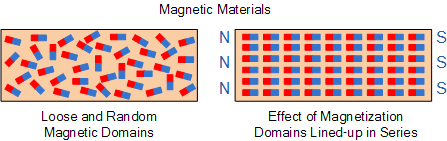
Figure 7. Source.
To some extent, the same power exists when the belief systems of groups of people can be aligned in the same direction. For example, teachers find it much easier to teach large groups of students, if parents have emphasized the importance of school and the need for respect for teachers. A military leader can attack another country, if soldiers follow orders. A group of generally uncivilized people can learn the benefit of working with others, if proper instruction is given.
What has been astounding to me, as I have looked into the situation, is that the scientific evidence seems to point in the direction of a literal Higher Power governing our Universe. It is not clear whether this higher power is the Laws of Physics, or whether it is some outside “God” that created the Laws of Physics.
In the past, many researchers assumed that the Universe was a closed energy system, irreversibly headed toward a cold, dark end. Recent research indicates that the Universe is ever-expanding, and in fact, seems to be expanding at an accelerating rate. While individual dissipative structures are constantly encountering more and more entropy, the universe as a whole is perhaps expanding rapidly enough to “outrun” growing entropy. Thus, it can behave as an always-open system. This always-open energy system allows many types of objects to self-organize and grow, at least for a time. These objects behave as dissipative structures, each having a beginning and an end.
We really don’t know whether the Universe had a beginning. Some research suggests that it did not. Others believe it began with a Big Bang.
Within the Universe, the earth seems extremely unusual. In fact, it is not clear that there is any other planet that has exactly the right conditions for complex life. A recent American Scientist article discusses this issue. The book Rare Earth: Why Complex Life Is Uncommon in the Universe points out the huge number of coincidences that were necessary for complex life to form and flourish.
Within the Earth, and perhaps within the Universe as a whole, human economies are the most energy-dense form of structure found.

Figure 8. Image similar to ones shown in Eric Chaisson’s 2001 book, Cosmic Evolution: The Rise of Complexity in Nature.
Thus, in some sense, we humans and our economies may, in some sense, represent the current upper bound on development in the Universe.
We humans live on Earth. It is easy for us to think that our primary purpose in life is to care for and protect the Earth. Unfortunately, with our need for supplemental energy, this is not possible. Even at an early date, our need for resources exceeded what was sustainable. Joshua (in Joshua 17:14-18 relating to the period around 1400 BCE) instructs the tribes of Joseph to clear the trees from the hill country to have enough land for his tribe. This practice was clearly unsustainable; it would lead to erosion of the soil on hilltops. Even at that early date, high population and the need for resources to provide for this high population was conflicting with earth’s sustainability.
If our God is either the Laws of Physics, or some force giving rise to the Laws of Physics, then our God is really the God of the Universe. The limitations of the current Earth are no problem. God (or the Laws of Physics) could create a new Earth, or 1 million new Earths, if He chose to. Thus, from God’s point of view, it is not clear that there is any point to today’s environmentalism. There is a need not to poison ourselves, but “saving the earth” for other species after humans, or for a new set of humans who somehow will use much less energy, doesn’t make much sense. Humans can’t use much less energy; even if we could, our energy use would always be on an upward slope, headed to precisely where we are now.
There are many things that we can’t know for certain. Does this God want/expect us to worship him? Does this God plan an afterlife for some or all of the humans on Earth today? Obviously, if God (or the Laws of Physics) could create the Earth, God could also create other structures as well–possibly a “Heaven.” It is not clear to me that any one of today’s religions has a monopoly on insights regarding what is expected. A person might argue that we need not worry about religion at all, except for the fellowship it provides and the insights it offers regarding how early people coped with their difficulties.
Myth 9. The texts of religious groups around the world are literally true.
The texts of religious groups are true in the same sense that peer reviewed scientific literature is true. They represent, more or less, the best thinking of the day on a particular subject. This certainly does not mean that they are literally true.
We need to read religious texts in the context that they were written. In the earliest days, religious texts represented stories that people passed down from one generation to the next. These stories represented insights that these early people had gained. No one at that time was too concerned about authorship. If a story says, “God said,” it could also mean, “We think that this is something that God might have said.”
Literary styles were very different, back in an era before people pretended to have scientific knowledge. People created stories illustrating some aspect of a particular phenomenon. These stories were not supposed to fully describe what happened. This is why Genesis features two different creation stories.
The Bible makes liberal use of hyperbole and exaggeration. It is hard for people who are not familiar with the original language to understand how stories were intended to be interpreted. Is the concept of Hell added, primarily to provide a contrast to Heaven? In the Old Testament, the number of words in the ancient Hebrew language is much smaller than in today’s languages. This, by itself, makes direct translation difficult.
The earliest religious stories explained how God was perceived at that time. As people became more settled, their views changed. People were getting more “civilized.” Population densities were rising. The best beliefs in an early period may not have had relevance for a later period. This is why most religions have had reformers. Sometimes new writings are added. At other times, the way the writings are interpreted changes. This is why there seems to be a bizarre progression of stories from the Old Testament to the New Testament; new stories needed to be added to supplement and replace old ways of thinking.
Some of the things that early people discovered have not been understood by environmentalists. Genesis 1:28 says,
God blessed them and said to them, “Be fruitful and increase in number; fill the earth and subdue it. Rule over the fish in the sea and the birds in the sky and over every living creature that moves on the ground.”
The early people had figured out that humans were indeed different from other animals and plants. Their use of supplemental energy gave them power over other creatures. Their numbers could (and indeed, did) increase. Early authors were documenting how the world really worked. We later humans have been too blind to see the real situation. It is more pleasant for us to think that somehow we are just like other animals, except perhaps smarter and more in control. With our greater knowledge, we could somehow have avoided an increase in our numbers, if we had only planned better. The laws of physics say this cannot happen; our higher energy use dictates who will win the battle for resources.
The early religious stories were not too different from Peak Oil and Climate Change. They were sort of right. They gave partial insight. They were the best the authors could do at the time.
The ancient religious documents could not tell the whole story at once. New groups would gradually add more insights to the developing story, providing a better understanding of what was truly important for people living in a later period.
Conclusion
In practice, people need a religion or a religion-substitute. People need a basic set of beliefs with which to order their lives.
Our leaders today have proposed the Religion of Success, with its belief in Science, and the power of today’s leaders, as the new religion. This religion has appeal, because it denies the limits we are up against. Life will continue, as if we lived on a flat earth with unlimited resources. This story is pleasant, but unfortunately not true.
Donald Trump, with his version of conservatism, presents another religion. This religion seems to be focused on justifying the allocation of wealth away from the poor, toward the rich, through tax breaks for corporations and the wealthy. This is part of the process of “freezing out” the poor people of the world, when there are not enough resources to go around.
It is hard for me to support Trumpism, even though I recognize that in the animal world, the expected outcome when there are not enough resources to go around is “survival of the best-adapted.” If our concern is leaving energy resources in the ground for future generations, transferring buying power from the poor to the rich is a way of collapsing the economy quickly, while considerable resources remain in the ground. The fact that wealthy people are favored ensures that at least some people will survive.
China and Japan both have what are close to state religions, created by their leaders. School children learn stories regarding what is important, based on what state leaders tell them. In Japan, school children visit religious sites, and learn the proper religious observances. They also learn rules about what is expected of them–always be polite; respect those in charge; don’t eat food on the street; never leave any food wrappers on the ground. In many ways, these religions are probably not too different from today’s Religion of Success.
I personally am not in favor of religions that originate from political groups. I would prefer the “old fashioned” religions based on ancient documents from one or another of the world’s religions. We are clearly facing a difficult time ahead. Perhaps early people had insights regarding how to deal with troubled times. Admittedly, we don’t know for certain that heaven can be in our future. But when things look bleak, it is helpful to see the possibility of a reasonable outcome.
Furthermore, religious groups offer the possibility of finding a group of like-minded individuals to make friends with. We need all of the support we can get as we go through troubled times.


Pingback: Why Political Correctness Fails (When What We Know “For Sure” Is Wrong) | ProTradingResearch
Pingback: Why Political Correctness Fails (When What We Know “For Sure” Is Wrong) – Earths Final Countdown
Pingback: Why Political Correctness Fails (When What We Know "For Sure" Is Wrong) | StockTalk Journal
Pingback: Why Political Correctness Fails (When What We Know "For Sure" Is Wrong) | Newzsentinel
Was not aware Freddy Krueger drove an Altima
http://www.shockmansion.com/wp-content/myimages/2017/09/rr1417.jpg
What about the fact that religions are fairy tales told to poor people? Is that germaine?
There seem to be an awfully lot of people who are upset with some aspect of what some religion did to them in the past. This sounds like where you are “coming from.”
This doesn’t really change my assessment that there is a literal Higher Power. Whether or not a particular church says the “correct” thing is a different issue. We don’t entirely know the correct thing.
Hunger Games reaches real life: 10 students will compete for 1 scholarship in front of thousands of people in a football arena
http://www.osubeavers.com/news/2017/9/25/football-wjn-tuition-for-a-year-saturday-at-reser.aspx
‘Why Don’t You Go Back to Mexico, Speak English’: Woman Records Man’s Racist Rant at Goodwill Store in Oklahoma
http://ktla.com/2017/09/07/lousy-speaking-immigrant-oklahoma-woman-records-racist-rant-at-goodwill/
I have to admit. Just that thumbnail alone is enough for me to believe it. You shouldn’t judge people on their looks, but that’s the face of a man with pickup truck and a confederate flag on the back.
“You shouldn’t judge people on their looks, but that’s the face of a man with pickup truck and a confederate flag on the back.”
Sad … but at least you know what he thinks – imagine all those thinking the same and acting as follows, sweet talking all the way …
During the Depression of the 1930s, food was being destroyed for lack of buyers. It is not an indication that limits are far away; it is an indication that limits are close at hand. The system can no longer balance itself correctly.
+++++++++++++++
‘The catch is that after a time, the shortfall in funds for reinvestment catches up, and production collapses. The resulting collapse of the economy may look like a financial collapse or a governmental collapse’
I am thinking that is the trigger…
The CBs seem to be able to keep the financial side of things ticking along doing whatever it takes… they may be able to hold out longer than our supply of affordable oil holds out…. they will shoot down any black swan that flies past…
HSBC and Citi are suggesting this production problem is imminent… as in one to two years away….
Difficult to say though — was conventional reserves are dropping every day….
Tick tock….
German Government (leaked) Peak Oil study concludes: oil is used directly or indirectly in the production of 90% of all manufactured products, so a shortage of oil would collapse the world economy & world governments,
https://www.permaculture.org.au/files/Peak%20Oil_Study%20EN.pdf
I haven’t read the study but I am having a hard time thinking of any manufactured product that does not indirectly use oil at some point, especially if you factor in the transportation of parts and materials and the metabolic requirements of the people assembling them.
In practical terms, there isn’t anything at all.
Yet you have the deniers that insist we can have ”renewables and alternatives”, that somehow ”they” will fix things,
and then there’s the certainty that technology will see us through, refusing to accept the energy delivers technology, technology doesnt deliver energy.
In the long run they are correct. We will be using “renewables” and alternatives just not at the scale that they think(hope) is possible. Most people can’t accept the concept of massive downsizing for everyone.
I would explain how you are so totally wrong… but time is short… and you will not get it anyway …
https://i.pinimg.com/736x/e3/7f/bc/e37fbc5e1392964feb6ef977874df7c2–poster-design-keep-calm.jpg
great article gail thank you
https://imgur.com/a/RgT1L
https://gailtheactuary.files.wordpress.com/2017/09/circle-of-chairs.jpg
If anyone tries to take your chair…. I recommend a hard right cross — to the gut…. don’t punch the head — the bones are thick and it ,may damage your hand…
Hit them hard in the gut — most people are weak… and flabby… that will drop them out of the game…
Yeah, but in the real world there’s always someone toucher than you so good luck …
Stick a knife in them when they are not looking?
Clinton: I’m not sure Trump knows Puerto Ricans are US citizens
http://thehill.com/latino/352417-clinton-im-not-sure-trump-knows-puerto-ricans-are-us-citizens
This is more sanctimonious talk from that crazy woman. PR is broke and so can’t raise more debt, and the U.S. has simply run out of money for further reconstruction, after Hurricanes Harvey and Irma devastated Florida and Texas.
https://www.youtube.com/watch?v=lJjHTeo6mVw
http://4.bp.blogspot.com/-ljivthWE-ww/VDtuJPskdLI/AAAAAAAAygc/690KCqYXDgs/s1600/HUCK%2BSHAKE%2B2.gif
Something is seriously wrong with HRC
These shape-shifting reptilians can only hold their human form for short periods.
And obviously drinking chai interferes with their ability to do this.
And now for something completely different.
https://youtu.be/IDhIs1YfXv4
Tranny, or not…
https://i.makeagif.com/media/6-07-2015/rReVyW.gif
“These shape-shifting reptilians can only hold their human form for short periods.”
And he segues from this paranormal legend to (alleged) transsexuals. The anxiety behind this is evident. Fear of transgender seems to be the modern version of the 1950s fear of “reds under the beds”. Strange that such modern, sophisticated and intelligent people exhibit this anxiety. Why is this?
I find some answers in George P Hansen’s book, “The Trickster and the Paranormal”. Invoking structuralism and anthropology, Hansen says that civilisations generally divide the world mentally into binary opposites: life / death, human / animal, etc. The paranormal, the supernatural, the unnatural, occupy the liminal space between these categories. Between life and death you find zombies, vampires, Frankenstein’s monster. These represent the paranormal and hence are associated with evil and unnatural powers. Heaven is associated with God, and Earth with humans. Between heaven and Earth you find (higher up) the angels; and lower down, UFOs (often believed to have a psychic or paranormal aspect).
In India you get eunuchs who have mutilated themselves and dress as women. They visit weddings, to collect money. Do people think the eunuchs bring them luck? No. Eunuchs are “betwixt and between” – between the sexes: they inhabit liminal space and are therefore commonly thought to have dark powers. People pay them money to go away and not curse them!
So the liminal space between the sexes is inhabited by gays, lesbians, transvestites, transgender people: long regarded by many cultures as unnatural, perverted, etc. Well, gays and lesbians and bisexuals have been increasingly normalised in the West. But this is an age of anxieties. Where can our anxiety now settle, deprived of the gay / lesbian outlet? Ah, yes: on the still liminal transgender people. Just as people in the 1950s might worry, “Could my neighbour be an unAmerican communist?”, now they might wonder, with unease, “Could the beautiful woman I’m dating really be a genetic MAN?!” Which reminds me of that film, “The Crying Game”.
Other developments have occupied liminal space: black men playing white instruments and bringing the jungle to civilisation, tempting our decent white girls with “the devil’s music” ! The Na”zi”s banned jazz music, of course. And transracial couples: surely “against nature!” many thought. A white woman married to a black man was pushing her son in his pram in London in the 1960s. An old white lady came up to admire it but, on seeing the colour, recoiled in horror. “Will it be able to speak English?” she asked the mother.
Anyway, I can well recommend Mr Hansen’s book. It’s deep: I needed to read it twice to see what he was getting at. He certainly believes in the paranormal and believes he has experienced it, while being aware that it also attracts hoaxers – and even that some psychics are natural showmen who throw in a few hoaxes too, to enhance their performance. Yet this is more of a structural analysis of the paranormal, rather than a lot of entertaining stories about the paranormal itself.
But at least now you know where your fear of transgender people is emanating from, guys!
Sounds like you’re seeing shapes in the clouds and mistaking them for real dragons and castles. And as far as I can see, you’ve always done this sort of thing. It’s part of your conversational MO.
When you go on at such length about other people’s fears and anxieties based on no evidence whatsoever, its a fair bet you have some fear, anxiety and projection issues yourself.
And when you post under a pseudonym that you change with considerable frequency, it’s also safe to assume you have some identity issues too.
If you think I give a tinker’s curse or lose a moment’s sleep about what gender a Hollywood celeb chooses to identify with this week, month or year as part of their lifestyle or career choice, or because they were forced to change gender from childhood, then you can go ahead and think that.
All the world’s a stage, and all the men and women merely players. They have their exits and their entrances. And one man in his time plays many parts. In a play on the stage at the theatre, the audience is aware that the actors are acting in the role of characters. Outside the theatre, in “everyday life” it is generally assumed that people are who they purport to be, and when they are not and it is discovered that they are not, their behavior is often perceived as deceptive or unethical. Of course, Hollywood celebs tend to get a free pass on this, as they are assumed to be always on the stage and never in the real world.
And now for something on Angelina Jolie, a personality I’ve never warmed to for reason’s I’ve never bothered to examine.
https://youtu.be/o5OgsdcWRVg
“Clinton: I’m not sure Trump knows Puerto Ricans are US citizens”
That’s the sad truth of it, because he didn’t know. Someone around him had to scream in his face to get his attention and then use a megaphone to yell louder than Trump to finally get the information into his ears and passed into his shrunken brain.
And how can this be? Remember when Trump called for a huge celebration when the House of Reps passed Obamacare repeal – he didn’t know the Senate also has to pass it? Think about that for a minute. A president of the USA didn’t know that procedure?! That boggles the mind, but then again people are less educated than they use to be as IQ scores decline and Trump is evidence of that fact. He’s a rumbling, bumbling, stumbling %^&$#@!(*&)&&%^%$^^$#@#$%^&*((*^&%$#@@!#%&*)()(
Trump on his IQ from a 2013 tweet:
“Sorry losers and haters, but my I.Q. is one of the highest -and you all know it!
Please don’t feel so stupid or insecure, it’s not your fault.”
Nuclear Plants Plus Hurricanes: Disasters Waiting to Happen
http://progressive.org/downloads/9090/download/Lucie%20Good.jpg?cb=b677f99d1457bbe41862ff8b3f98cc28&w=797&h=
St. Lucie Nuclear Power Plant at Port St. Lucie, Florida
Although the mainstream media said next to nothing about it, independent experts have made it clear that Hurricanes Harvey and Irma threatened six U.S. nuclear plants with major destruction, and therefore all of us with apocalyptic disaster. It is a danger that remains for the inevitable hurricanes, earthquakes, tsunamis and other natural disasters yet to come.
During Harvey and Irma, six holdovers from a dying reactor industry—two on the Gulf Coast at South Texas, two at Key Largo and two more north of Miami at Port St. Lucie—were under severe threat of catastrophic failure. All of them rely on off-site power systems that were extremely vulnerable throughout the storms. At St. Lucie Unit One, an NRC official reported a salt buildup on electrical equipment requiring a power downgrade in the midst of the storm.
I always look forward to your essays (lectures) yes we face perilous and uncertain times – I think all the time of my grandchildren and their futures
what futures? even a cursory analysis of this blog’s discussions indicates they will only have a short future, with a cruel end. hopefully, swift.
Don’t fret…. the outcome is assured…. it ain’t good
Wow Gail, a very different approach and focus from many of your other posts, but very thought provoking. I dont always agree 100% with you (maybe 98%), but I respect the hell out of your intellectual integrity. Thanks for not holding back and for calling things as you see them.
Stoicism provide a self-compatible system of beliefs – as far as I can tell. It works for Atheists, Agnostics and anyone else.
This is a definition of Stoicism I found:
“Stoicism is an ancient Greek philosophy (developed by Zeno of Citium around 300 B.C. as a refinement of Cynicism) which teaches the development of self-control and fortitude as a means of overcoming destructive emotions.”
Many different philosophies and religions have mixed together over the ages. This is part of the reason why there seem to be conflicting beliefs in the Bible, and I imagine in other religious documents. (Also, the reason why there is so much overlap among the older religions.)
At least one of the things I was taught growing up was Galatians 5:22-23
At least some of this seems to be related to stoicism.
Thanks for the new article!
my thanks, also.
an article with unexpected focus.
the wide scope of topics was the most unexpected, to me.
well worth reading.
I’ve said in the past that my posting here is “play”, but that in no way means to disrespect the hard work that surely has been put into these articles.
Gail, FE speaks for many of us who appreciate your hard work on these article posts.
Thank you.
This is a particularly good one!
Thanks for this new article. I am so grateful for your deep commitment to seeking and sharing truth. It is so rare to find someone willing to embrace both the truth contained within science and the truth contained within religion. Most people are trapped in an either or paradigm. Ignorance abounds on both sides.
I have been following an ancient religion for more than thirty years. I continue to discover new and life changing truths. The longer I live, the more I love the life I am living, and the more I love the one who gave it to me.
Gail you are a bright light in a dark world.
Keep fighting the good fight.
God bless you!
You may be right Gail, in stating that c…limate models are fallible for what they leave out.
However, their errors may contribute to an understatement of c…limate c….hange not the overstatement you presume.
For example, if c….limate models leave out global dimming (a result of less industrial-scale use of fossil fuels), positive feedback loops and the current disruptions to climate stabilisers like a regular oscillation in the Jet Sream then the forecast models are very wrong indeed.
Less industrial-scale use of fossil fuels? Isn’t that what every warm-ist model maker is advocating? Apart from the ones who are hoping for near-term human extinction as some kind of panacea for what ails Gaia?
We needn’t concern ourselves too much about maintaining post-collapse global dimming. Once people can’t get enough industrial ffs, they will burn anything that burns, stripping forests bare for fuel in the struggle to survive as they previously did on Easter Island and they continue to do today in Haiti.
If they still have access to food, more people will be cooking with dung or rice husks, or, if they’re well off, well-seasoned wood or charcoal. I would expect any of these methods to create a lot more global dimming than cooking the equivalent amount of food to feed X number of people with natural gas or electricity generated from coal.
After a few weeks… once the dogs and cats and barnyard animals are stewed… there won’t be much left to cook ….
Oh hang on …. succulent hunks of child meat will still be available….. and perhaps some rats
If cl..imate cha…ge is now a topic of mention by Gail why is it still a topic of moderation for commenters?
I can still let comments through.
Gail,
you have covered so many other topics I am interested in your perspective and opinions on what is likely to happen in a world where the governments have and continue to systematically devalue what we think of as money….by setting interest rates at zero or less and running up debts in the trillions of dollars (which can never be paid back), the value of money has been reset at nothing or next to nothing as well…
this is a consequence of the energy cost problems you discuss of course but how this is likely to unfold in a competitively priced world when the competition for what cheap energy is left is priced in essentially worthless currencies ?
Money is a way of trying to divide up the goods and services that we really have. In fact, the amount of long term debt, prices of shares of stock, and prices of land and buildings all seem to have value, in a common currency, which is the same currency we get paid in.
The catch is, of course, the musical chairs type problem I mentioned. Even before this happens, the devaluation of currency acts to reduce the share of current goods and services that the holders of debt will get. Thus, even though debt was to be repaid with interest, lenders often find themselves “behind,” when inflation is included. Owners of all kinds of assets discover that other types of assets have also inflated in price, so if, for instance, a person sells a home and wants to move to a new home, the new home will also cost more. The fundamental issue is that money–no matter how much there is–cannot really divide up more than is available. For a while, adding debt can “sort of” add more, because it indirectly raises the price of commodities (generally by the debt creating new jobs for non-elite workers, and their demand raising prices of commodities). But this can only go on so long. There has to be cheap energy to fuel the whole system.
Ecosystems do not collapse because they are dissipative structures. The dissipation of energy
is irrelevant as long as the sun continues to supply the energy that allows life and ecosystems
to exist. Ecosystems can certainly collapse due to changing conditions (Forests didn’t survive
long when an ice sheet covered them) or change ( A tragic current example is complex coral
reef ecosystems dying,to be replaced by simpler,less biodiverse algal-dominated systems). If the
energy from the sun ceased,the only ecosystems on Earth that would continue to exist are the
systems which have chemotrophs supplying the energy (mainly around deep ocean vents ).
No David. A key reason dissipative structures are prone to collapse because their growing complexity demands higher energy inputs than they can harness. So the fact that the sun continues to provide energy is irrelevant.
Natural ecosystems with great complexity,with large numbers of species within that system,tend to be more stable ,rather than less. That is why ecologists are so concerned
about the loss of biodiversity. Those ecosystems become more prone to various instabilities within the system,which can lead to a ‘collapse’ into a different ecosystem.
The coral reef system change I mentioned is one example,where an ecosystem of great
biodiversity changed to a different,simpler system. Another example is the oceans, where overharvesting ,ocean heating and pH change will probably change a complex,
very biodiverse system into a simple,jellyfish dominated ecosystem. ‘Stung’ by Lisa
Gershwin explains this in considerable detail.
Any claim that those changes are caused because’ ecosystems are dissipative structures’ is a gross simplification and incorrect.
David is correct.
I think David is correct here.
The natural and human worlds are replete with many kinds of dissipative structures and while some of them may exhibit growing complexity, many others do not. Their defining characteristics are that they must operate “out of thermodynamic equilibrium” and they must exhibit “a reproducible steady state”.
Simple examples would be a whirlpool, which requires a continuous flow of matter (water) and energy (kinetic) to maintain its form, and a candle flame, for which the the energy supplied by the continuous evaporation and burning of the candle wax.
Wikipedia has the following definitions:
A dissipative system is a thermodynamically open system which is operating out of, and often far from, thermodynamic equilibrium in an environment with which it exchanges energy and matter.
A dissipative structure is a dissipative system that has a dynamical régime that is in some sense in a reproducible steady state. This reproducible steady state may be reached by natural evolution of the system, by artifice, or by a combination of these two.
Gail has a slide on this theme.
https://gailtheactuary.files.wordpress.com/2017/05/23-our-economy-is-a-dissipative-structure.png?w=768&h=549
Ecosystems consisting of trees and other plants and animals undergo change, as the fertility of the soil changes. New animals wander in; new insects move into the area; the weather or climate gradually changes; local changes can occur, such as people cutting down trees of some desired type. When the disturbances become too great, an area is likely to become more susceptible to forest fires. There is really a natural “cycle.” The forest fire helps restore fertility. Initially specific types of plants grow that “work” well after a fire.
It is easy for us not to recognize how these changes take place, because they take place slowly. Also, man is today involved in creating an end to many ecosystems today.
Gail – Do you see any way forward that does not involve a radical reduction in the human population (this century) and a series of contractions and eventual major collapse of industrial civilization? If so, what do you think “modern” industrial societies and their citizens should do in preparation?
Ric,
I think you are right about radical reduction in the human population this century. In fact, probably not in too long a time period.
We can certainly appreciate what we have now. We can spend time with our families. If there are things we have always wanted to do, we can do them now.
But in terms of really preventing what is happening, it is hard to do very much. A person can diversify financial accounts. That protects if one type of investment fails, but not if all fail. Some people have invested some in silver or gold. These are only helpful if there is something to buy, and people will take the money in exchange. I personally would prefer silver (coins) to gold, because the denominations are more reasonable for trade.
Some people would like to try to support themselves in an agricultural setting. I think that this is too difficult and expensive for most people. If a person wants to try putting in a garden, it is a nice hobby. But you are likely to find that it would not be able to do well with this kind of activity without quite a bit of ongoing support. You will need tools. You will need some way to maintain fertility. Watering may be needed. All aspects would probably work better with modern products. It is hard to supply a very large percentage of your needed calories.
I think people are best off if they have the support of family and friends. In some cases, this will include people who belong to the same religious group. Moving or staying close to family is probably a good idea, especially if a person is older and retired.
Some people say, “Go pay down debt.” I am not a fan of this. If there is a major problem, no one else will be able to repay debt either. The one with the problem will be the one to whom the debt is owed.
For those younger people in the audience… now would be a great time to work on your disco moves…
http://bestanimations.com/Music/MirrorBalls/disco-dancing-animated-gif-5.gif
There are various types of debts.
And I would not recommend just the attitude forget about it ala The Crash will wash away it all, since we might get first few years of very bumpy plateau-stagnation sort of crisis, with unpredictable sequencing of chaos, in which the industry of getting debt payments out of people might get pretty nasty and personal..
Have you ever noticed those really dumb people who get hurt all the time. And they somehow end up doing way better than what the Doctors predicted they would do. Notice they always have to shove it in the Doctors faces. And they will say ‘The Doctors said I would never walk at all again.etc”….Religious people always are trying to one up scientists and intellectuals..Its sad.
i had very successful knee surgery last year
the downside was i will never play the violin again
Notice that you have never seen faith or prayer re grow an arm or a leg of an amputee solider? It’s always something that could have just been explained by nature. I mean a real miracle would be if faith or prayer re-grew someone’s arm or leg. That would truly be considered a miracle. And that has’t ever happened.
though it could be that newts believe in the one true god, and thus get legs growed back
ya never know
https://i.imgur.com/ZmZ7E6x.jpg
Right. For example if 1 person gets front row seating at a concert and thanks god, there is an understated belief there that god simply doesn’t give a crap about the 500 other people who were also hoping and praying for a front row seat, huh? They must not have prayed hard enough.
There is a market for books and stories about miracles. It is similar to a market for stories about Teslas and trips to Mars. In the stuff we see, this stuff “rises to the top.” In a way, it is part of a fake “religion will save you from all of your problems” story.
If you were closer to religious groups, I expect you would be hearing different kinds of stories. One of my cousins was “saved” from Stage 4 cancer, which as not expected to be cured. She wrote a book Hoping for More: Having Cancer, Talking Faith, and Accepting Grace. The book blurb says:
One theme at some family gatherings I attend is “God Is So Good to Me.” Various people tell stories about how various coincidences and the support of family and friends have gotten them through difficult times. The story is more about, “How I was able to handle the death of my wife and daughter in close succession” than it is about miracles. The story isn’t about avoiding all of the bad things that happen to people; it is about people working together and somehow continuing with their lives, in spite of the bad things that happen to good people.
I could probably tell a long story about how a long series of coincidences have made this blog possible. Quite a few of them seemed very bad at the time. The story is as much as anything about how a self-organized system works. If a person who is extremely concerned about getting ahead in the world, and putting himself first, that person may in fact come out ahead, if success is defined as high income. But if people are willing to see other outcomes as the desired end, such as “Search for the truth,” or “Care for my family,” then there can still be a desired end. A person can define success in very different terms than $$$$.
Part of the story is simply about reframing the way we view problems. In a sense, it is trying to move away from the “Religion of Success,” that seems to define a lot of people’s view of life.
Miracles do not have to have a religious basis. The placebo effect is well known – and it’s a real effect: mind over matter. Many minds working in unison can also have a powerful effect – this has been verified by various experiments (see Dean Radin or Rupert Sheldrake). So, faith healing can have an effect – but it isn’t little baby Jesus who is behind it, merely the astonishing effect of mind. Really it is faith in self that can achieve this.
All the same, strange things do sometimes happen – it would be a strange world in which
they didn’t. Reality can be very weird at the edges.
The Miracle of the Sun is a well documented event. It was witnessed by atheists and Christians alike – including very sceptical Christians. But what was it? A religious miracle – or perhaps a UFO event? Or are UFO events also religious events?
https://en.wikipedia.org/wiki/Miracle_of_the_Sun
http://www.patheos.com/blogs/wakeupcall/2016/10/the-miracle-of-fatima-was-it-the-virgin-mary-or-something-stranger
I agree. There are many things like hypnosis that work. And people who have something to live for are much more likely to live than people who can see no point to what is ahead.
I know a study I saw a while back said that the life expectancy of unmarried men was much shorter than for married men. (I don’t think this was true for women.) I think part of the problem was a selection effect: the men that women don’t want to marry may have problems. But there is some of the opposite as well: having a settled household seems to be good for men. It is good to have someone to talk things over with.
Married couples are more likely to nag one another to go to the doctor if one has an ailment. A single man will put it off, and postpone it, and prevaricate. A single woman enjoys talking about herself and receiving care, so will go to the doctor.
Couples also nag one another into activities. Single men might prefer to sit at home or visit the bar too often. Nonetheless, hundreds of thousands of women nag their husband to death every year but, being undetected, escape the chair. Instead, they laughingly inherit, then they visit the spouse’s grave once a year to dance on it and spit on it.
I’m writing a book — I Was Hoping for a Private Jet : How God Let Me Down!
How the Pentagon Paid for NFL Displays of Patriotism
https://www.truthdig.com/articles/pentagon-paid-nfl-displays-patriotism/
See how dump people are? The Pentagon has been paying the NFL to condition them with their own tax dollars.. And most are actually upset that people are protesting their Government brainwashing..
Saudi Arabia to allow women to drive
http://www.aljazeera.com/news/2017/09/saudi-arabia-women-drive-170926190857109.html
This is what they will blame the fuel shortages coming soon on.. LOL
yup
we had lots of oil till women started driving
They already said their IPO won’t include any oil reserves. And I wouldn’t touch that IPO with a ten foot Saudi Beheader Blade!
Wow. I knew the IPO was delayed but not that reserves were excluded. Perhaps they don’t want their reserves audited.
I wonder if any of the women who were punished for driving in the past will receive an apology. Oh wait.. It’s hard to apologize to someone after their head is chopped off.
Saudi Arabia, the good friend of “The Good Western Countries” including USA.
Sorry, “spearheaded by USA”.
Oh no, another country down the drain
I highly recommend the book, “Who Cut God’s Hair?” by Garrett Glass.
This is a review I found:https://www.smashwords.com/books/view/710829
Who Cut God’s Hair is like no other book you have read about God, religion, atheism, or questions regarding the creation of the universe. Author Garrett Glass isn’t fundamentally interested in whether God exists. He is interested in where God comes from, and the basic premise of this book is simple: we’ve all known God and we’ve all experienced heaven, in our infancy and early childhood years. It was our parents who appeared to us as God-like figures – all-powerful, all-knowing, all-loving, always-present creators. Glass uses newly-available research from a variety of fields – neuroscience, psychology, anthropology, evolutionary biology, and comparative mythology – to make his case that our infant and childhood experiences provide us an internal impetus for belief in God as adults. He then summarizes all this research by providing a unique and persuasive model describing how most people come to an adult belief in God.
This alone would make for an interesting and unusual book, but that is only the first part of Who Cut God’s Hair. As Glass points out, belief in God may be the default position for mankind, but it is not hard-wired in any of us, and so he spends the second and third parts of the book investigating religion, prayer, faith, and alternatives to belief in God and religion, such as humanism, agnosticism, and atheism. At all times, he is respectful of those who believe in God and practice religion, though he also shows us the psychological costs of God-belief.
If you want more than just the ordinary arguments about God’s existence; if you wish to understand how God-belief is generated; if you see value in God-belief and religion; if you acknowledge that the different paths of disbelief in God have equal value; and if you are curious how all of this affects you – Who Cut God’s Hair is a wonderful accompaniment on your own investigation into life’s biggest questions.
I am sure the Conquistadors believed strongly in their Christian religion and god.
However, this did not slow them down from attacking native populations by cutting, burning, amputating limbs, starving, working to death in silver mines, stealing, spreading disease drawing & quartering, shooting, slashing, etc etc.
This spiritual belief stuff can be used to support any kind of depraved or evil schemes. And is used as such by evil rulers and governments.
Religions are used to bind groups of people together. Political leaders are involved in this as well.
We have would like to have higher standards for religious groups, but I am not sure that that happens in practice.
For one thing, religions create “in groups” and “out groups.” Rules such as the Ten Commandments are often interpreted to apply to in-groups. In other words, “Thou shalt not murder a member of your in-group.” What happens to members of an opposing group seems to be determined by military leaders.
There are a lot of religions in the world. If one of them offends you, you can find a different one. I have a problem with any religion that interprets its scripture in a literal way.
Sorry, that’s kind of strange view of Conquistadors.
Since the bottom line is they were mostly pre-selected for the given task to succeed as much as possible, people of known pedigree (guaranteed) to get things done, especially in the first wave/s:
– overambitious lesser nobility – often times indebted and or already under prosecution
(not enough space/resources to strike it quickly in the old Europe)
– mercenaries and various odd characters of the worst sort
– religious zealots and fanatics (yep plus few idealists)
It seems to me that the only solution is to go back to agrarian roots, and do it right now. The longer that we have to build topsoil and find places to grow, the better our chances of success. I do not think the political axis of power wants this to occur because it will take away from the corporations and thus erode their power base. Perhaps I am extremely naive but I do think that gardening and permaculture is the answer to this and the concentration of people and wealth in the cities is an impediment as well as a huge lever of control by the political parties. The answer is devolution of the economy. Somehow people have to eat so there will be some economy be it barter or trade or even gift economy. There is enough “stuff” around to keep the country running at a limited level for quite a while. People need to find a way around the media and around the political realm to find like minded individuals and just start making this happen.
I also agree that a spiritual life is vital in moving forward. Perhaps that will be the glue that can help unite our increasingly fragmented world.
“Going back to our agrarian roots” is harder to do than you might think. In my post, I talked about cutting down trees on the hillside in an unsustainable way, about the year 1400 B.C.E.. First, it becomes very difficult to “get rid of” a huge amount of population that would not “fit,” if every families needed several acres for themselves and for their animals to eat, not to mention forests for the family to cut down for firewood.
There has been a popular belief among permaculturists that all we need to do is “use less” of different things, such as oil and electricity. There may be a short transition period where this is true, but I think we need to think about doing without grid electricity, and doing without replacement parts for machines of all types. The peak oil movement encouraged people to think that oil would go down in a pattern similar to when it rose. If the problem is affordability (in other words, no way to buy oil, such as banks closed), then this pattern will not hold.
It still works in countries that are well organized and have enough arable land to go around and enough xenophobia to keep their resources to themselves. A lot of dying is going to be concentrated in countries like Egypt, which already imports half its food, and is going to need to import even more.
Which countries are you thinking of that have enough arable land to go around? Russia? The United States? Cost will be a major hurdle for many people. Also, the ongoing need to pay taxes on the land. You will need fairly decent return to pay for taxes in addition to whatever crops you get.
True. The US is not well organized, and is heading towards a disaster. The US can’t even have a healthcare system that works or drinkable tap water despite being richer than God. The US looks like a hollow country where most people are simply out to get what they can from the state. Because of this it can’t maintain the complexity it needs to buy peace from the population.
Russia already produces about 40% of its food from local gardens, so they have the skills and resources to feed almost the entire population with small scale production. The Russian state is quite small and does not produce all that many services for the general population. Additionally, the recent Western threat has helped them develop some asabiyyah. I would say a lot of this also applies to Eastern European countries.
Finland, Sweden, and Norway look like they might do OK. Norway is short on farmland, but it has enough hydropower to potentially trade. They are highly complex, but well organized.
About Venezuela and the SU. Both places were caused by human actions. The failures of those societies were not resource limits, but collective decisions.
I’d be interested to know what % of that 40 relies on inputs that are not available without BAU….
Does irrigation water come from a tap?
Do they save seeds or buy from the shop?
Do they buy compost or make it?
And so on….
FE, finally you seem to get very close to the point.
You can easily answer your questions by looking why has been Russia in recent years so hell bent on domestic production in everything, be it also through joint ventures, licensing or directly buying stakes in companies of interest. They own and control the energy, raw resources (metals, water, land, ..), the people and their education, army to protect it all, now they are increasingly manufacturing domestic analogs of everything again from carz to drilling rigs and software etc. The only important stuff they still rely on imports is foreign CNC machines (to manufacture the machines, things already described), plus some microchip, some medicament, odd and specialized pieces of heavy equipment like cranes etc.
They are the country, region, entity with perhaps highest potential to temporarily succeed with running some sort of post crash autarky extension civ. Is it worth the effort and hassle, perhaps not, who is the judge..
Is that wining strategy? They evidently pursue this combined strategy of preparing semi autarky and trade as long as it could last. Unfortunately, wishing upon happy end is futile, since many of the western factions are very likely to push the button first in the ending stage in order to deny any advantage and force “equalizing” own mistakes onto others.
http://atlas.media.mit.edu/en/profile/country/rus/#Imports
Russia imported US$182.3 billion worth of goods from around the globe in 2016, up by 6.7% since 2009 but down by -0.3% from 2015 to 2016
Russia’s Top 10 Imports
Temperature-change machines: US$6.1 billion (up 390%)
Computers, optical readers: $3.8 billion (up 33.9%)
Taps, valves, similar appliances: $1.6 billion (up 44.4%)
Centrifuges, filters and purifiers: $1.3 billion (up 36.7%)
Miscellaneous machinery: $1.3 billion (up 20.4%)
Liquid pumps and elevators: $1.3 billion (up 28.2%)
Air or vacuum pumps: $1.3 billion (up 12.3%)
Piston engines: $913.4 million (up 61.5%)
Lifting/loading machinery: $838 million (down -8.5%)
Printing machinery: $815.3 million (down -35.9%)
http://www.worldstopexports.com/russias-top-10-imports/
http://capreform.eu/wp-content/uploads/2014/08/CNN-russia_sanctions.jpg
yup
unfortunately Eddy’s somewhat gloomy forecasts about human behaviour during extreme privation are proved correct by what happened in the Ukraine only 80 years ago
i seem to recall that pol pot had the same idea
Year Zero:
http://notevenpast.org/wp-content/uploads/imagecache/lg_/Screen%20shot%202012-06-28%20at%203.34.51%20PM.png
Gotta respect a guy that starts a new calendar and wants to cleanup the place.
“Pol Pot declared the year zero and began to “purify” society. In support of an extreme form of peasant communism, western influences such as capitalism and city life were expelled. Religion and all foreigners were to be extinguished.
Throughout Cambodia, deadly cleansings were performed to abolish all that was left of the “old society”.”
https://www.mtholyoke.edu/~amamendo/KhmerRouge.html
Soil that is farmed using petro-chemical inputs — will support no crop once the outputs are stopped – without years of intensive rejuvenation involving organic inputs.
Effect of Pesticides on soil fertility (beneficial soil microorganisms)
Heavy treatment of soil with pesticides can cause populations of beneficial soil microorganisms to decline. According to the soil scientist Dr. Elaine Ingham, “If we lose both bacteria and fungi, then the soil degrades. Overuse of chemical fertilizers and pesticides have effects on the soil organisms that are similar to human overuse of antibiotics.
Indiscriminate use of chemicals might work for a few years, but after awhile, there aren’t enough beneficial soil organisms to hold onto the nutrients” (Savonen, 1997). For example, plants depend on a variety of soil microorganisms to transform atmospheric nitrogen into nitrates, which plants can use. Common landscape herbicides disrupt this process: triclopyr inhibits soil bacteria that transform ammonia into nitrite (Pell et al., 1998); glyphosate reduces the growth and activity of free-living nitrogen-fixing bacteria in soil (Santos and Flores, 1995) and 2,4-D reduces nitrogen fixation by the bacteria that live on the roots of bean plants (Arias and Fabra, 1993; Fabra et al., 1997), reduces the growth and activity of nitrogen-fixing blue-green algae (Singh and Singh, 1989; Tözüm-Çalgan and Sivaci-Güner, 1993), and inhibits the transformation of ammonia into nitrates by soil bacteria (Frankenberger et al., 1991, Martens and Bremner, 1993).
Mycorrhizal fungi grow with the roots of many plants and aid in nutrient uptake. These fungi can also be damaged by herbicides in the soil. One study found that oryzalin and trifluralin both inhibited the growth of certain species of mycorrhizal fungi (Kelley and South, 1978). Roundup has been shown to be toxic to mycorrhizal fungi in laboratory studies, and some damaging effects were seen at concentrations lower than those found in soil following typical applications (Chakravarty and Sidhu, 1987; Estok et al., 1989). Triclopyr was also found to be toxic to several species of mycorrhizal fungi (Chakravarty and Sidhu, 1987) and oxadiazon reduced the number of mycorrhizal fungal spores (Moorman, 1989).
https://www.ncbi.nlm.nih.gov/pmc/articles/PMC2984095/
Organic inputs will be hard to come by considering nothing can be grown – and most if not all animals are killed and eaten.
Less than 1% of all farmland globally is farmed organically.
Get ready to starve. No matter where you are:
https://assets.weforum.org/wp-content/uploads/2015/08/agriculture3.png
https://www.weforum.org/agenda/2015/08/which-countries-have-the-most-organic-agricultural-land/ (note – most organic land in Australia is rubbish and supports sheep only)
Intensive organic is possible on a small scale. My father-in-law grew enough vegetables in His back yard to feed a neighborhood. A friend of mine just harvested 4000 tomatoes using raised bed gardening. You need good soil of course. And smarts and hard work.
Also things like organic soil amendments and fresh water. It takes energy to get these. Also to make the tools used in the process.
some people have an inherent skill in foodgrowing acquired over a lifetime.
this used to be a basic knowledge for everyone
the vast majority now do not have that, nor will they have the lifetime in which to learn it
Some will become hoarders.
Others will become hordes.
neatly put
How many organic farms are there out there that do not rely on the tap for water… that are completely self-sustaining from making all compost … to seed saving …
‘Less than 1% of all farmland globally is farmed organically’
If you factor in the above we are probably looking at 0.1% of the total farmland being able to produce food post BAU.
The hungry will over run these places — they will kill and eat the manure producers… and rip everything edible from the ground ….
The food situation is as grim as the spent fuel pond situation…
Nobody gets out alive.
Yes but…
Soil that is farmed using petro-chemical inputs — will support no crop once the outputs are stopped – without years of intensive rejuvenation involving organic inputs.
Effect of Pesticides on soil fertility (beneficial soil microorganisms)
Heavy treatment of soil with pesticides can cause populations of beneficial soil microorganisms to decline. According to the soil scientist Dr. Elaine Ingham, “If we lose both bacteria and fungi, then the soil degrades. Overuse of chemical fertilizers and pesticides have effects on the soil organisms that are similar to human overuse of antibiotics.
Indiscriminate use of chemicals might work for a few years, but after awhile, there aren’t enough beneficial soil organisms to hold onto the nutrients” (Savonen, 1997). For example, plants depend on a variety of soil microorganisms to transform atmospheric nitrogen into nitrates, which plants can use.
Common landscape herbicides disrupt this process: triclopyr inhibits soil bacteria that transform ammonia into nitrite (Pell et al., 1998); glyphosate reduces the growth and activity of free-living nitrogen-fixing bacteria in soil (Santos and Flores, 1995) and 2,4-D reduces nitrogen fixation by the bacteria that live on the roots of bean plants (Arias and Fabra, 1993; Fabra et al., 1997), reduces the growth and activity of nitrogen-fixing blue-green algae (Singh and Singh, 1989; Tözüm-Çalgan and Sivaci-Güner, 1993), and inhibits the transformation of ammonia into nitrates by soil bacteria (Frankenberger et al., 1991, Martens and Bremner, 1993).
Mycorrhizal fungi grow with the roots of many plants and aid in nutrient uptake. These fungi can also be damaged by herbicides in the soil. One study found that oryzalin and trifluralin both inhibited the growth of certain species of mycorrhizal fungi (Kelley and South, 1978).
Roundup has been shown to be toxic to mycorrhizal fungi in laboratory studies, and some damaging effects were seen at concentrations lower than those found in soil following typical applications (Chakravarty and Sidhu, 1987; Estok et al., 1989). Triclopyr was also found to be toxic to several species of mycorrhizal fungi (Chakravarty and Sidhu, 1987) and oxadiazon reduced the number of mycorrhizal fungal spores (Moorman, 1989).
https://www.ncbi.nlm.nih.gov/pmc/articles/PMC2984095/
Organic inputs will be hard to come by considering nothing can be grown – and most if not all animals are killed and eaten.
Less than 1% of all farmland globally is farmed organically.
Get ready to starve. No matter where you are:
https://assets.weforum.org/wp-content/uploads/2015/08/agriculture3.png
https://www.weforum.org/agenda/2015/08/which-countries-have-the-most-organic-agricultural-land/ (note – most organic land in Australia is rubbish and supports sheep only)
Yes things could be done if humans all acted in the best interest of our species and were planning for the long haul. Unfortunately that is not how most humans work.
A Boss in Heaven is the best excuse for a boss on earth, therefore If God did exist, he would have to be abolished.
– Mikhail Bakunin
I’ve also thought the climate change models were interesting but inaccurate because business as usual could not continue long enough to fulfill the modeled outcome. Climate change itself, disruptive weather, would force industrial society to cut back on emissions. Then population would decline, forests would regrow, and balance restored.
There have been a lot of population collapses in the past. These were often caused by population rising faster than available resources, so resources per capita fell. But there were other ways to get there. At times, there were changes in climate in a particular part of the world. Sometimes these were at least partly man-made in cause, for example, burning down all of the trees in an area.
These early collapses indeed did help bring population back better in line with resources. This was especially the case in the pre-fossil fuel days.
I am not entirely sure that in the future, we could really get to a “balance restored” situation. I will have to admit that a major population collapse would do that as well as anything.
You forgot the part where 7.5 billion people starve to death.
Pingback: Why political correctness fails – Why what we know ‘for sure’ is wrong | Our Finite World – Enjeux énergies et environnement
I love the graphics in your articles Gail. Fascinating and thought provoking article, although I thought the use of the concept of political correctness was unnecessary. One big concern of mine is that as economies begin to contract, disappointed expectations lead to the embrace of irrational solutions. We are seeing this with Trump supporters, who live in an alternate reality bubble, not seeming to care whether what Trump says corresponds to reality, nor that he is not delivering on any of his promises. What he is doing is making a lot of noise and stirring up controversy, which is what his base loves over everything else. Embracing a religion can have virtually the same effect. The problem here is that if people really do ignore reality they are likely to embrace wholly unrealistic solutions, including joining cults. One can see the Hitler’s Nazi Party in pre WW II Germany as such a cult – worshipping violence and believing in the alternate reality of anti-semitism. As you say, leaders like Trump are actually accelerating our economic system towards collapse, but there is also the greater danger of civilizations moral collapse through embracing an alternate reality..
There are many people playing alternate reality games for hours on end today. I suppose that is better than getting involved with fringe political parties.
We are dealing with an economy/civilization that self-organizes on its own. All of these very strange beliefs spring up, practically out of nowhere. If there were plenty of cheap to extract resources, there would be more jobs that pay well, and less wealth disparity. We wouldn’t have these issues.
I haven’t been using the concept of “political correctness” much my self, but some readers mentioned the point. It seems to describe one dominant way of viewing the world right now.
Hitler was exacting revenge for what was done to Germany in WW1…. he was not crazy…
I would describe him more like a rabid nationalist dog frothing at the mouth pissed off because his country was thrown under a bus.
So not an ideal example….
What utter BS. Trump is not accelerating our economic system toward collapse any more than any other politician is nowdays.
Nice Post, Gail. Thank you for your efforts and willingness to wade into these topics.
For those who whipsaw their heads around at the mention of religion, there are numerous 12 step programs that help individuals organize their thoughts around a particular philosophy or spiritual focus. Going forward, people will be better served by replacing the rampant consumerism that leaves us so hollow and unfulfilled, with a spiritual appreciation of life and those wonders that surround us. Nothing wrong with gratitude and giving thanks, either.
And no, ‘the person with the most toys’ does not win the game. A person who does not need a display of wealth is playing a different game, entirely.
regards
Pingback: Why political correctness fails – Why what we know ‘for sure’ is wrong – Olduvai.ca
Thanks Gail for another thought provoking essay. I have a different take on religion.
1) Why are humans the only species with religions?
2) Why did religions emerge simultaneous with the behaviorally modern human brain?
3) Why has every human group everywhere through all history had some form of religion?
4) Why does every one of the thousands of religions think it is the only (or most) true religion?
5) Why does every religion, including new religions like Scientology, have a life after death story?
6) Why do many atheists retain some form of spirituality which usually includes a belief in some form of life after death?
As Gail points out, many aspects of religion can be explained by their positive effect on group survival, but it is not easy to explain why every religion denies death with a life after death story. A few random religions with life after death stories might be reasonable, but not every religion, unless the need for a life after death story has a genetic basis.
The answer is that the behaviorally modern human brain evolved about 100,000 years ago from an improbable double mutation for an extended theory of mind plus denial of death. Each of these mutations on its own reduces reproductive fitness but together they dramatically increase reproductive fitness creating a brain capable of dominating the planet.
The mechanism evolution chose for implementing denial of death is broad in scope and was probably implemented by tweaking the fear suppression module present in every mammal brain. Humans therefore deny all forms of unpleasant reality, including death.
This also explains:
7) Why has no other species achieved our brain power despite common evolutionary forces and fitness advantages? Other advantageous inventions, like the eye, independently evolved several times, yet our brain, which is so advantageous it enabled us to take over the planet, has evolved only once.
8) Why did all 7 billion of us emerge from one small tribe in Africa? And why did that tribe replace the many other similar hominid species?
9) What genetic change occurred about 100,000 years ago that must be both modest in complexity and extreme in effect to explain the explosive emergence and dominance of behaviorally modern humans?
10) Why do most people deny the many obvious dimensions of human overshoot like over-population, climate change, sea level rise, peak oil, resource depletion, soil loss, aquifer depletion, nitrogen imbalance, species extinction, fisheries collapse, and ocean acidification?
11) Why do many people deny personal health realities like smoking, poor diet, lack of exercise, and obesity?
12) Why do many people deny scientific realities like evolution, climate change, thermodynamics, vaccine utility, and the improbability of UFOs?
13) Why do most people deny economic realities like the impossibility of infinite growth on a finite planet, unsustainable debt, and asset bubbles?
14) Why do many people choose to believe fake news?
15) Why do many people seek to avoid reality with mind altering drugs?
16) Why do democratic elections never discuss, or debate, or even whisper about, the issues associated with overshoot? What could be more important to vote on?
17) Why don’t environmental political parties, like the Green party, have overshoot policies in their platforms?
18) Why do experts commonly and aggressively ignore or deny the most important (and unpleasant) facts associated with their domain? Economics, climate change, renewable energy, and nutrition being notorious examples.
https://un-denial.com/2017/06/25/why-my-interest-in-denial/
The thing that makes people different from other animals is the controlled use of fire. I think this may answer at least a few of your beginning questions. It is not the evolutionary advantage alone that is important; it is the ongoing use of fire.
I think that a recent article by Steve Keen, titled “I predicted the last financial crisis–now soaring debt levels pose risk of another.
https://theconversation.com/i-predicted-the-last-financial-crisis-now-soaring-global-debt-levels-pose-risk-of-another-84136
He remarks, “There are none so blind as those who will not see,” and describes the dominant sect in Economics as that of the “willfully blind.” This is not on your list (I don’t think), but it is still an issue.
I agree fire is unique to humans and is a very important contributor to our success. As with the religion question we must ask why are humans the only species that use fire despite its clear reproductive fitness advantage? The answer to both questions is the uniquely powerful human brain. This then leads to the question, if a powerful brain is so advantageous why did it evolve only once in humans? To answer this we should look for a barrier that has blocked other intelligent social species like elephants, dolphins, chimpanzees, and crows from evolving a brain similar to humans. That barrier, as discovered by Varki and Brower, is awareness of mortality and its depressive effect on reproductive fitness. An improbable double mutation for both a more powerful brain and denial of reality is required to break through the barrier and this has occurred only once on this planet.
I too am an admirer of Steve Keen. I mentioned our collective denial of economic realities in point 13 above.
one can play the ”which came first” game forever and still not get an answer
i have a theory—entirely my own —that th first accidental firemaker would realise that he had a skill that made him pretty important in the tribe, and which other members of the tribe would ”pay” for.
but obviouslty he has to keep it secret—so he goes off to some private spot, does his flint thing, and returns with a blazing torch—which makes him a pretty amazing guy—able to pull down fire at will
the rest of the tribe realise they need him, and accede to his demands—one of which would be a private cave in which to do his fire thing, and to which everyone else must come to pay homage, leeave offerings etc.
the firemaker has a son, to whom he imparts the secret–who passes it on to his son
pretty soon you have something that looks suspiciously like a church
—
fire had to start somewhere
There are many unique human behaviors, in addition to fire, that need an explanation. They all have in common an extended theory of mind (which I loosely refer to as a powerful brain). So we should focus on the brain.
https://un-denial.com/denial-2/human-uniqueness/
Lightening started fires. Some people probably saved burning coals, and kept the fire alive until it was needed.
i agree that lightning started fires, and people saved it
but that wasn’t my point
the big game changer was when someone figured out how to create it at will.—that someone could keep fire in a pouch as ”non fire”—then have fire in minutes.
different thing altogether
True!
Yes fire was around long, long before humans learnt to make it at will. All the fire in the world is useless, unless there is a use for it. The first use, probably discovered by accident was either cooking or light. What drove our expansion was our ability to engineer. To find or develop means to exploit our discoveries. Maybe such as the hardening of spear tips with fire, tan leather, smoke food for preservation or use sinew to bind stone axes to a handle.
So what came first? Our big brain or the ability to cook, which expediated the growth of the brain. It doesn’t really matter but what has mattered is our engineering. Ultimately it will drive us to the edge of extinction. The vast majority of people these days though, assume we can engineer our way out of the predicament we engineered ourselves into.
Which came first the chicken or the egg? The Egg…Laid by a bird that wasn’t a chicken.
-Neil D Tyson
5) Why does every religion, including new religions like Scientology, have a life after death story?
I was going to start the “Church of everlasting death”, but I couldn’t get any members or raise any money 😉
I blame it on the fact that humans are very stewpid animals…. who think they are smart.
Here is an example of how Steeewpid people are…. we nearly ended the world in 2008… and this was blamed on corruption – stewpidity — venality …
Try to explain to someone like David Stockman or Paul Roberts or the ZH crowd that this was a result of fighting the impact of the end of cheap to extract oil…
Nope — it’s those f789ing greedy bankers!!!
And yet the same thing is happening again .. the same policies that almost ended the world…
Will any of these people stand back and re-evaluate and say hang on …. perhaps there is another reason for this?
Nope. Because they are stewpid
LENDERS LOOSEN MORTGAGE STANDARDS, AS DEMAND FALLS
https://wolfstreet.com/2017/09/25/lenders-loosen-mortgage-standards-as-demand-falls/
Ford has recently announced that they will now allow buyers without credit score to obtain auto credit.
http://www.foxbusiness.com/markets/2017/08/25/ford-to-look-beyond-credit-scores-in-sales-push.html
Auto manufacturers need sales from somewhere, even if people don’t seem to have the ability to pay for the cars. This is what happens. I am sure that they are getting a bit more in interest rates, to try to compensate for the lower credit scores.
Gail;
I’ll try again.
Your comments about Wind and Solar are very correct. My rule about wind and solar is that for every Joule per second of Wind and Solar Energy put on the grid there has to be a Watt of Hydro-electric power on that same grid (and there are three grids in NA).
That is because it takes at most 90 – 120 seconds to bring up a hydraulic turbine. A diesel can do it in 45 seconds, but that’s not many megawatts, a thermal power plant from cold takes 24 – 36 hours, so if you have too much Wind Solar on a grid you spend a lot of time just ‘boiling water’ so that when the sun goes down or the wind stops you have the power on hand.
Califonia has the Duck Curve power supply with a 20 GW increase in demand shortly before sunset! With the result that their thermal plants spend all day at near 50% load, and 10% efficiency (not the 35% Efficiency they’d have at 85% load).
Also your comments about the trustworthyness of documents is well made. Working in design I’m well familiar with changes in the Design Basis Memorandum (which says what is to be built). I fervently hope they are minimized by the time detailed design starts, but sometimes you are unlucky!
I’ve taken this for my Moral Philosophy “Das Nerda” as I have with most of your stuff!
Thanks,
Edward Buchan Wilson, P.Eng., M. Sc., P.E.
I suppose batteries are the other option besides hydro. Hydro gets used up awfully quickly. That seems to be the reason for the big interest in batteries recently. You may have seen this article “There’s Less to Tesla’s Big Australian Battery Deal Than Meets the Eye.”
I am having trouble translating “Das Nerda.” What language is this?
Hi Gail – always interesting, even more so with the explicit linking to religion at the end. Did you ever read my book?
You sent me a link to your book, “The Spiritual Side of the Resource Crisis,” which was in Dropbox at the time. As you might guess, I didn’t get around to reading it—an awfully lot of things come across my desk. It is not available there now.
If you can’t find a publisher, I suggest setting up your own web site and serializing it.
The scientific man does not aim at an immediate result. He does not expect that his advanced ideas will be readily taken up. His work is like that of the planter – for the future. His duty is to lay the foundation for those who are to come, and point the way.
-Nikola Tesla
Good quote!
I don’t think it’s a good quote at all. It consists of vague untestable generalisation assertions without any evidential support (or even possibility of evidential support). If it was any good it would not need the “- Famous genius’s name” bit at the end. And adding that gives no extra proof of anything except celebrity worship.
Gee, what a sour critical sod I am, haha.
Yes I take that back, it was a brilliant quote.
And 2+2 does indeed equal 5 when you apply curved space appropriately!
I think the fact that Tesla’s name is attached gives it much more weight. He was a genius. We have AC power because of him. I am very thankful. I respect him….but not you.
Your comment is troll like.
After a lifetime of indoctrination in physics and pure maths I’ve finally understood that religious faith is perhaps the highest expression of human reason.
I’ve finally understood that religious faith is perhaps the highest expression of human reason.
BWWWAAAAA!!!!!
It is interesting how some scientists/physicists will state that nature obeys the laws of physics. As if our simple observations of cause and effect elevate us to a point where nature obeys our laws of physics. I guess you would call that hubris. Nature and the universe will do what it will, we can only watch.
Our laws are observations of what happens in the real world.
Perhaps there is a minimum age for figuring this out.
maybe way beyond my intellectual paygrade, but i cannot grasp the concept of indoctrination when it comes to maths and physics or any science
that’s like saying—” i was indoctrinated into the belief that 2 + 2 = 4″
but now i know differently, because i have listened to a different form of arithmetic by a different teacher, who has opened my eyes to the truth that the real answer is 22
or
that gravity is just a hoax, or the earth isn’t a sphere and doesnt go round the sun
every scientist will confirm that his ultimate aim is to be proved wrong by the next greater intellect, but indoctrination isn’t a word that can be applied to scientific matters.
But it can certainly be applied to religious matters.
unless you jest of course—always a possibility.
I was indoctrinated into arithmetic at a very tender age. At least that’s the way I prefer to remember it. The entire class used to have to recite, parrot fashion, “one two is two; two twos are four; three twos are six; four twos are eight…” We went all the way up the times tables to “twelve twelves are a hundred and forty-four.” And you got the rap of a rule against your knuckles or a session in the corner wearing the dunce cap if you got it wrong. Served me well it did. Need a calculator to work out simple sums I do not.
The same parrot-fashion method can and is employed to get people to learn and recite by heart proverbs, poems, religious texts, political slogans and even scientific formulas and lists such as the periodic table of the elements. At what point does such rote learning constitute indoctrination?
Norman, what if I told you that nobody knows what gravity is? That the laws of gravity are not explanatory but merely descriptive. I strongly agree with Greg that “It is interesting how some scientists/physicists will state that nature obeys the laws of physics.” As Gail said above “Our laws are observations of what happens in the real world.” The “why” of gravity remains one of the great mysteries. The idea that hypothetical elementary particle s called gravitons mediate the force of gravitation in the framework of quantum field theory is purely speculative. It is no more firmly established as fact than are phlogiston or the number of angels that can dance on a pin.
But we’ve been taught rote style myths about Galileo dropping weights off the Leaning Tower of Pisa and Newton and the apple in our childhood, and we’ve been implicitly assured in tones of effortless superiority by academics themselves that, as Mr. Toad sang, “The wise old men of Oxford, know all that’s to be known”, so it’s understandable we believe in gravitons, black holes and Stephen Hawking’s remarkable ability to survive 50 years with ALS. But actually, those of us who assume, believe or claim that gravitons have been proven to exist and that therefore we understand the why of gravity—and I think this covers most people I’ve spoken to who pretend to knowledge of the subject—are victims of what can best be described as “scientific indoctrination”.
And what If I told you that the earth isn’t a sphere and that it doesn’t go around the sun? The current state of scientific knowledge, as far I’m aware of it, is that the earth is a rather crinkly oblate spheroid or oblate elipsoid. Again, Newton was ahead of the curve in being the first to describe it as such. Today even the Scientific American says it’s not round. And as for the orbit of the earth, the accepted modern scientific view is it doesn’t go around the sun; it goes around the solar system’s common center of gravity, or barycenter, which is a very different concept indeed. As Nasa explains here: https://spaceplace.nasa.gov/barycenter/en/
So we could say those of us who assume, believe or claim that the earth is round and that it goes around the sun are, once again, victims of what can best be described as “scientific indoctrination”.
I’m not trying to set myself up as any kind of authority here. I well know that my ignorance is profound and I am certain that much of my pretend knowledge consists of things that aren’t so in reality. I think that all of us, more or less, are victims or beneficiaries of indoctrination—religious, political, economic, social and scientific. Indoctrination is a process of stuffing people with ideas and knowledge of all kinds, some it useful to the recipient, some of it correct, and some of it grade A, B or C BS. When you think about it, indoctrination is remarkably efficient compared with people having to actually explore for themselves all the links in all the logical chains that underly all the established knowledge they are required to master and assume the validity of in order to function in whatever capacity they are working.
https://i.pinimg.com/736x/2e/fc/b9/2efcb91d20634f67a24d812f4c3a2db8–isaac-newton-free-bible.jpg
Magnificent Tim!
This is the sort of comment that makes FW the pinnacle of intellectual pursuit…. there is much to be learned from being here
Mr. Groves,
First, Newton never said that. The quote you posted was fabricated.
Second, no one can be indoctrinated by math as no one can be indoctrinated by facts.
Third, there are no heaven or hell. These were human creations.
Scientists are artists, meaning, they’re always exploring, trying new things. In religion you can not do that because you’ll run into a serious problem, peak of irrationality by having two conflicted theories in your head.
Now the problem with the scientific method is that we don’t have all the answers, and never will and, as you finite worlders know, science won’t lead humanity to great end.
However, religion does, by having all the answers and giving you eternal life.
Which one are you?
zakly
Mr. escravaisaurabr
First off, you may be correct about the quotation, and thanks for pointing it out. I would never claim Newton actually said it, just as I would never claim that Socrates, Lao Tzu, Jesus of Nazareth or Gautama Buddha said any of the things ascribed to them. And it doesn’t surprise me to read that Newton didn’t say those words. But it seems like something he very well could have said given that he was an enthusiastic student of the Bible and of theology.
Wikiquote says:
Anecdote reported by Dr. Robert Smith, late Master of Trinity College, to his student Richard Watson, as something that Newton expressed when he was writing his Commentary On Daniel. In Watson’s Apology for the Bible. London 8vo. (1806), p. 57
The reference is to the mathematician Dr. Robert Smith (1689-1768), a late Master of Newton’s alma mater Trinity College, a Lincolnshire man like Newton and an enthusiastic promoter of Newton’s ideas in Europe. The book referred to is Richard Watson’s epic 8-volume work An apology for the Bible, in a series of letters addressed to Thomas Paine, author of a book entitled, The age of reason, part the second, being an investigation of true and fabulous theology, published in 1806. The only problem is a Google search of a digitalized copy of that book comes up with nothing.
If you have any leads on who fabricated the quotation and why so many quote sites cite it as genuine, rather than as misattributed or disputed, I’d be interested to learn.
Second, here you’re attempting an artful dodge. Nobody is disputing that mathematics and facts do not indoctrinate anybody. People indoctrinate people. Indoctrination is the instilling of doctrine. It’s the process of teaching a person or group to accept a set of beliefs uncritically. Whether the beliefs are true or false is irrelevant.
Third, once again, I wouldn’t know. I’ve spent all my time so far either in Limbo or Purgatory. If you know that Heaven and Hell don’t exist then you have the advantage over me.
Scientists are artists, meaning, they’re always exploring, trying new things.
I fear you are romanticizing the working lives of both scientists and artists, and disagreeing with C.P. Snow into the bargain. Most “scientists”, according to Robert Heinlein, are bottle washers and button sorters. And from personal experience I’ve found this to be broadly true.
In religion you can not do that because you’ll run into a serious problem, peak of irrationality by having two conflicted theories in your head.
You personally might not be able to handle conflicting theories, but don’t attempt to speak for others. I know many people, including some artists, who cope wonderfully well with phenomenal levels of irrationality. And the line between genius and madness can be as thin as a sheet of single-ply toilet paper.
Now the problem with the scientific method is that we don’t have all the answers… However, religion does, by having all the answers and giving you eternal life.
You appear to have fallen for the cartoonish descriptions of science and religion that the likes of Richard Dawkins and Sam Harris like to drone on about. Not all scientists follow the scientific method consistently. Not all religions promise all the answers or eternal life and not all religious people, by any means, think that they have all the answers.
A more useful dichotomy is the one between dogmatic belief and doubt. A dogma is a principle or set of principles laid down by an authority as incontrovertibly true. Doubt is the refusal to accept dogma as self-evidently true. Believers in a dogma will often brand doubters as deniers or heretics. Doubters will often mock the believers in dogma as gullible fools, fanatics, zealots, or the faithful.
Me? I am a person of faith, but I’m not going to elaborate on what I have faith in just now because it would take too long. I tend to be agnostic on all issues that are not amenable to empirical evaluation, including such things as the existence of God, Heaven and Hell, the Big Bang and Bigfoot. And I try to avoid putting other people down simply on account of differences of opinion on matters of religion or politics we might have. What does annoy me is when other people insist that their views are correct and try to pressure me into sharing them.
I identify strongly with the sentiments expressed in this song:
https://youtu.be/VVgUsfIy6qs
A believer or a doubter?
Which one are you?
‘However, religion does, by having all the answers and giving you eternal life.’
That is hall-of-fame quality delusion.
lol—i was taught the same way—i can reel off anything up to 12×12 instantly. I don’t call that indoctrination….just a way of getting through thick heads—it worked, and my teachers knew it worked. I think of it as going into a workshop and being taught where all the tools are.
Fortunately my schools had progressed beyond the dunce cap era.
I was hopeless when it came to using mathematics though, other than in a practical need.
as to literature, we had an english teacher who drove the beauty of language into us, because he knew that the years 10-16 or so were the fertile ones, that would make what we were to become.
with most it didnt take root, with me it did, now I can make words flow where I want them to flow, and bathe myself in the great works of English literature, content that I will never be that good, but at least appreciate the greatness of what I am reading, never get bored with it, no matter how many times I read it. I am grateful to him for that.
My bro had precisely the same education, class for class. 10 years apart. We are like chalk and cheese
I had religious instruction. That didn’t work–though at least one of our group became a priest.
As to gravity–I said “gravity is a hoax”—I didn’t mention the laws of gravity. Same with the Earth as a sphere and rotating etc. I took that as read. I was condensing concepts to a word-minimum to make a simple point.
I didn’t think it necessary to go into Newtonian physics
My overall schooling taught me to think for myself, accept and use what i chose to, reject what I did not or could not.
That is the point, Indoctrination doesn’t allow the recipient to do that.
Indoctrination is when kids/adults learn stuff by rote that is blatantly untrue, and are mind-blinded to any other aspect of life/living that can be demonstrated to be true
Good answer, Norman. Thanks.
The verb “to indoctrinate” has changed its nuances over time. It originally meant “to teach”, “to instill doctrines (teachings)”, but in modern usage it usually means “to teach (a person or group) to accept a set of beliefs uncritically.”
As Collins dictionary has it, “If people are indoctrinated, they are taught a particular belief with the aim that they will reject other beliefs.”
Whether the beliefs being taught are blatantly untrue or not makes no difference in my opinion. It’s the method of teaching that makes it indoctrination. To clarify, “indoctrinate” is a verb; so it describes an activity; in this case, a method of instilling ideas that involves a certain degree of pressure, force or coercion. Whether these individual ideas are true or false is beside the point.
You are right; mathematics being a language of sorts, we don’t normally consider teaching of arithmetic to be indoctrination, although a well educated doer of sums will certainly reject adding up 2 + 2 = 5. Similarly we don’t speak of being indoctrinated into French grammar or German intonation, but when coming into contact with these things in the course of foreign language study, we are taught particular rules and phrases and spellings in the expectation that we should accept them uncritically and reject alternatives. Even though native speakers often break linguistic rules that foreigners are expected to adhere to.
For instance, Shakespeare used several different spellings when signing his own name, and at least half a dozen variations of the spelling appear on various printed publications of his plays during his lifetime. But today we are “indoctrinated” (I can’t think of a more apt word for it) to use a single standardized spelling and to reject all the other variations of the name as wrong. Spelling Stalinists follow the doctrine that a single spelling “Shakespeare” is preferable for the sake of consistency. But that’s just a doctrine they try to impose on the rest of us.
In the west, we take it for granted that our enemies in every conflict indoctrinate their populations while we more enlightened folk educate ours. For instance, we have effectively been indoctrinated to believe implicitly that the North Koreans, the Iranians, and more recently the Russians and the Chinese indoctrinate their citizens and their children whenever they teach a version of history or international relations that conflicts with the “Pravda” that our own schools and mass media teach us. The very pushiness with which news stories that place a negative slant on said countries are delivered is a clear indication that they are attempts at indoctrination.
T. van Varik: After a lifetime of indoctrination in physics and pure maths I’ve finally understood that religious faith is perhaps the highest expression of human reason.
Really? I guess you didn’t grow up in religion indoctrination like I did.
Also, I find it ironic that you’re saying that here, because it makes no sense, unless you believe that we too follow our own ‘scientific’ orthodoxy.
“If you wish to strive for peace of soul and happiness, then believe; if you wish to be a disciple of truth, then inquire.” Friedrich Nietzsche in a letter to his sister.
Great thoughts, Gail, as always. My decade of post-secondary education (what a way to spend the ’80s!) really opened my eyes with respect to Myth #6. The belief in the infallibility of science as represented by the peer-review process is certainly problematic. A couple of must reads in this area would be Thomas Kuhn’s The Structure of Scientific Revolutions, Stephen Jay Gould’s The Mismeasure of Man, and William Broad and Nicholas Wade’s Betrayers of the Truth: Fraud and Deceit in the Halls of Science (and I’m sure there are more recent and relevant texts out there now). Science is an activity performed by humans and as such is open to all the prejudices, biases, and imperfections that humans carry–to say little about the incentivization that accompanies the ‘publish or perish’ mentality that has infected academia for ages. To accept scientific conclusions, especially within the social sciences, without at least some degree of skepticism suggests that one really doesn’t understand what science is, the context within which it is practised, and how it is performed.
Thanks for the suggestions. I know that there have been several studies on the subject. One major medical journal snuck in major errors into papers that were sent for peer review. They reported that none of the reviewers found all of the errors. On average, the peer reviewers found 25% of the errors.
There is also the problem of authors not really understanding what previous papers said. The result is something like a big game of “telephone”–misreporting what the prior author said.
I had not been involved much with peer reviewed literature until the last 10 years or so. I suppose it is a little like seeing sausage being made–changes your opinion of the situation.
There is a comprehensive demolition of peer review in the opening pages (and subsequent chapters) of my book
Experts Catastrophe
which you can download for free from http://www.pseudoexpertise.com
I would be tempted to claim to be the world’s leading expert on leading expertise, except that being aware that that claim hasn’t been validated by peer-review……
The texts I suggested don’t actually deal with the peer review process but the human aspects of the scientific endeavour. Stephen Jay Gould’s in particular deals with the biases inherent in all of us and how it impacts our interpretation of ‘facts’.
Oil demand may exceed supply by up to 4 million bpd by 2019: Trafigura -Reuters
http://www.reuters.com/article/us-asia-oil-appec-trafigura/oil-demand-may-exceed-supply-by-up-to-4-million-bpd-by-2019-trafigura-idUSKCN1C10AM
It may, or it may not. We know how Reuters gets its numbers. Demand, in fact, reflects affordability. This is not something Reuters understands.
in the era that preceded agriculture, humankind behaved as all other biological species: We took our sustenance from the surrounding environment as we needed it.
If it was plentiful, we thrived, if it was in short supply, we ate each other, starved, and quite often died.. We enjoyed the advantages of fire and primitive weapons, but in all other respects, we were just another higher primate.
When the ”image of god in man” came about is impossible to say.
But eventually a clever nomad had the idea of enclosing land and growing food, instead of chasing it. We started the myth that the Earth was private property, and our life pattern changed forever.
because when you enclose land, you must pay people to look after it, defend it, pray over it, and acquire more of it to satisfy your growing tribe. If ”owners” of other lands worshipped a different god, taking it could be more easily justified.
In terms of ongoing ”logic” we are still locked into that mode of thinking, because our biological system cannot continue to function in a way that supports our existence, unless we cling to those beliefs.
to our ancient ancestors the world really was infinite, our mindset is still the same.
our planet filling antics, together with fire, created employment separate from energy (food) production. Now most of us have non-jobs, unconnected with our daily requirement of 2000 cal.
Nevertheless that employment has become an ever expanding monster that demands constant feeding.
but you cannot have employment without energy consumption, so your energy availability must increase at an infinite rate, in lockstep with a population that increases by 80m a year demanding to be employed, paid, fed, housed and so on.
it requires only a short leap of imagination to see where we are right now, 7.5 bn people mostly supported by energy-consuming employment. To simplify that, they sustain themselves by consuming and processing and marketing “STUFF”.
Think about that for a moment.
Without indispensable components of oil coal and gas, Your home, your job, your transport, your food, your healthcare (I could go on) would cease to be. They are the means by which they become a tangible, commercial concept. Our ‘employed’ existence in a viable commercial infrastructure depends on making and selling those millions of diverse objects, and we must consume fuel to do it. There is no other way.The slightest downturn in employment brings catastrophic civil disorder.
So we have no choice but to believe in god’s cornucopia.
Nothing else explains our situation—it has been the will of god.
This is why we believe that we can sustain our current lifestyle using electricity alone (100% renewables).
Can someone explain how we will all be employed, given the above reality that I have set out? Because if we are not employed, history is very clear on what happens next.
We’ve screwed ourselves with fossil fuels, but to expect solar panels to deliver a cornucopian future is to stretch the expertise of the wish-fairy beyond any known limit.
I could be wrong of course
I am afraid you are correct.
There are quite a few areas of the world that were settled, that did not ascribe land ownership to any one person. China has been that way. The farmland is government-owned. In recent years, municipal governments have made a lot of money by selling off parts of the farmland, leaving farmers very unhappy. I believe that Russia has had a somewhat similar system, although it may be partly gone now. So it may not be that a single family owns the land; it may be that the government owns the land, for the group in common. But the result is still the same. If population increases, the government needs to attack someone else to find more land.
I understand that barbed wire fence, invented in 1867, was a major force in eliminating free-ranging livestock.
I have often thought that “God made humans in his own image” may really mean, “Humans imagine God as being similar to themselves, because that is all that they can imagine.” We don’t really know.
many people of faith interpret the ”image” concept literally
as far a ”land ownership” was/is concerned, i meant fixed borders to territories forming nations and empires having cash value.
I agree Norm. Nearly every person in the US alive today has grown up to take (our foundation of) energy for granted. It is the 24/7 burning of fossil fuels that gives everything we know any value. When the fire slows or stops, everything we know, our very foundation will be gone. Cars, homes, land, money, and other material possessions will be rendered worthless.
Look at the loss of electricity on the island of Puerto Rico. A big “whoops.” The country could not afford electricity before the storms; now it has big difficulties.
that’s why I wrote this piece in Extranewsfeed on Medium
https://extranewsfeed.com/nature-wins-bcd4623e15a1
There is a collective refusal to accept that rebuilding takes energy, which is in ultimate decline. Structures are constructs of (limited) energy, while natural energy forces are unlimited.
The science and arithmetic of that statement are simple and easy to understand:
That eventually whatever nature knocks down is going to stay down. Nature does not own humankind a living, we just act as if she does.
That’s the bottom line in all this.
Hi Norm, I agree, but keep in mind that nature also has “disturbance and rest.” Humans either get in the way, or try to slow it down (like putting out forest fires). So the statement “That eventually whatever nature knocks down is going to stay down. ” is not always applicable. But I am being overly critical. 😉
putting out a forest fire drains energy resources at every level
either you must burn fuel to stop one, or let it burn itself out.
that can only be determined by available resources and the collective choice about expending them in fire suppression.
thus if a fire threatens a city, you bring in water air tankers etc.–colossal energy use.
if it threaten a single house, you let it burn and then rebuild it.
when fires get out of control in the post oil era, then there will be no fuel available to fight fires—so the city burns.
the same can be said about a desrt town reliant on pumped water to drink
nature knocks it down in both cases, though they actually appear different, they are not. As with a hurricane, they are nature’s unlimited forces, and can destroy what we build
Sorry, my intellectual skills are lacking. My point was fire destroys the forest, it grows back (vibrantly) Maria destroys the rain forests of Dominica, they will grow back. Humans, not so much unless we keep it simple. See lunatic farmer Joel Salatin for more on his take.
Norm, I very much enjoyed your recent article. I am wondering if you have (or are planning to) updated The End of More to encapsulate some of the current events which prove your thesis? Hurricanes, wildfires, the rise of nationalism world wide, etc. Thanks for your contribution.
thanks InAlaska
right now I don’t have any positive plans for an update, though I do think about it. I look at stuff going on, then think that comments about it all might put me in danger of repeating myself too much.
http://d2trtkcohkrm90.cloudfront.net/images/emoji/apple/ios-10/256/heavy-plus-sign.png
“With our greater knowledge, we could somehow have avoided an increase in our numbers, if we had only planned better.”
Our numbers keep growing overall world wide though. Sadly when some countries started to cut back on population growth their reward was open borders and immigration, possibly unwanted.
Hard to believe an increase in wealth disparity will solve much, if that’s some kind of plan to conserve resources, will see.
As far as faith based beliefs, climate change debate does seem to fit when observing the interaction between believers/deniers.
Thanks of the interesting new topic
Quite a few early religions had the practice of killing the first-born child in a marriage, or killing a certain number of baby girls, or killing the weaker of twin births. These practices, to a significant extent, were for the purpose of holding population down. In the West, these ideas seem bizarre.
Encouraging immigration from areas with overpopulation problems is a way of increasing world resource consumption. Even adopting babies from countries that don’t want them increases world resource consumption.
Yes! I do hope some day a few get the idea that a country beyond ts carrying capacity is condemning their children and grandchildren.
Attention Green Grooopies…. the path to true Green is to take a pillow and suffocate your child now.
No other act can do so much to save the planet.
Because natural selection is a foreign concept to today’s utopian dream world loving types.
Fantastic Post! One of your best.
Thanks Gail.
You are welcome.
Wow!
This is new territory for OFW.
Very thought-provoking. I’ll need to read it at least a couple more times.
Thanks!
I can see that that might be an issue with this article. Sort of like a detective story where a person misses some of the clues the first time a person reads it.
I’d like to see a new religion that appreciates the uniqueness of Earth and respects all life. (Glad to see you mention “Rare Earth”.)
Jainism.
Gail, You’ve always been courageous with your analysis, and I value you for that. This particular essay reaches out of your usual domain: I think you’re not writing as an “actuary” this time, but as a human being (and, if you don’t mind my saying so, as a human being now old enough to contemplate the end of her own lifespan). Your thoughts are challenging and enlightening as always.
Thanks!
You are welcome! I have known about many of these things for a long time. It was difficult trying to figure out how I might write about them, without simply upsetting people.
OH, you’ve upset some people 🙂
I personally liked/agree with the post. The irony is that opining in your OWN blog causes some to lose their minds. (reddit comments and passive aggressive comments here.)
I’m sure your used to it by now.
If I put enough disturbing topics together, perhaps I can get rid of the problem all at once!
Pingback: Why political correctness fails – Why what we know ‘for sure’ is wrong – Enjeux énergies et environnement