
Why have long-term interest rates generally fallen since 1981? Why have asset prices risen? Can these trends be expected to continue? The standard evaluation approach by actuaries and economists seems to be to look at past patterns and assume that they will be repeated.
The catch is that energy consumption growth plays a hugely important role in GDP growth. It also plays an important role in interest rates that businesses and governments can afford to pay. Energy consumption growth has been slowing; it is hard to see how growth in energy consumption can ramp back up materially in the future.
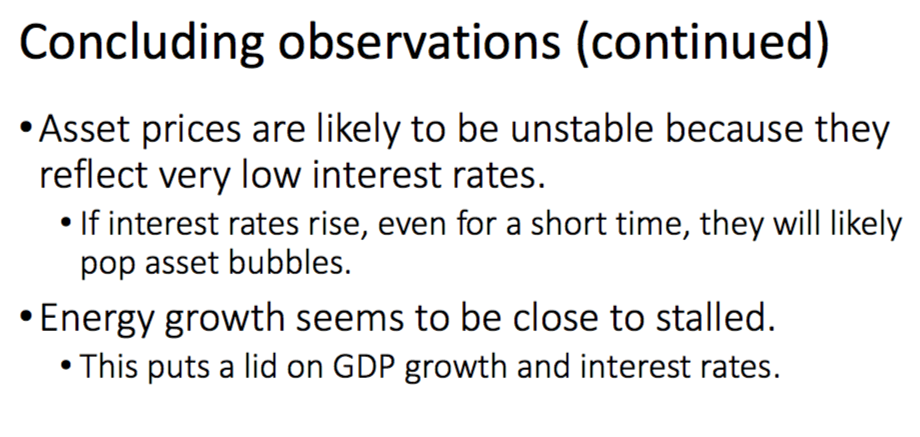
Slowing growth in energy consumption puts the world on track for a future like the 1930s, or even worse. It is hard to see how GDP growth, interest rates, and inflation rates can ramp up in the future. More likely, asset price bubbles will pop, leading to significant financial distress. Derivatives may be affected by rapid changes in prices and currency relativities, as asset bubbles pop.
The article that follows is a partial write-up of a long talk I gave to a group of life and annuity actuaries. (I am a casualty actuary myself, which is a slightly different specialty.) A PDF of my presentation can be found at this link: Reaching Limits of a Finite World

Slide 1
..
Slide 4
After the audience had a chance to answer this question (mostly with yes), I gave my answer: “Yes, indeed, it is possible to build a model that gives misleading results, and not understand the situation.” For example, a flat map works as a perfectly adequate model in some situations. But when longer distances are involved, a globe is needed. A two-dimensional model works for some purposes, but not for others.

Slide 5
The model in Slide 5 is the familiar Supply and Demand model used by economists. According to the model, if Demand increases from D1 to D2, then price will increase from P1 to P2. The rising price, in turn, will allow the quantity produced to rise from Q1 to Q2, based on the upward sloping supply curve S. This model is true in some cases, but it is not always true.
Supply and Demand Are Both Affected by Reaching Limits
As the economy approaches energy limits, lack of sufficient growth in energy consumption affects both Supply and Demand. Diminishing returns leads to high costs on the Supply side. Because of this, the cost of producing oil and other energy products tends to rise.
At the same time, businesses find that they cannot pass on these higher costs to their consumers because the wages of consumers don’t rise with rising energy costs. Diminishing returns acts like growing inefficiency; it takes more materials, more labor, more tax dollars, and more debt to produce the world’s overall mix of energy products, leaving a smaller amount of resources for producing end products (such as homes, cars, and bicycles) that consumers really want.
Persistent high energy costs lead businesses to try to find workarounds to reduce total costs. A major target for cost reduction is labor costs. If some labor costs can be replaced by lower-paid labor from overseas, or by robots, the company can perhaps make a reasonable profit, even with higher prices for oil and other energy products. The catch is new lower-cost labor force does not create as much Demand for goods and services as was available before jobs were replaced by robots or sent overseas. Workers in China and India will buy some goods and services, but the quantity will likely be lower than if the jobs remained in the US, Europe, and Japan.
We end up with a tug-of-war between the high prices that the producers of energy products need and the low prices that the many low-wage workers around the world can afford. Energy products are used in making pretty much everything, including food, homes, cars, and computers. As young people need to live with their parents longer, and as demand moves to lower-waged countries overseas, the lack of buying power tends to pull energy prices down below the cost of production. Energy prices below the cost of production are just as much a product of reaching energy limits as high energy prices!
Peak Oil is Another Two-Dimensional Model
Before we go on, I should probably offer some more explanation. Some of you may have thought that I would be talking about the Peak Oil story today. I consider the Peak Oil story to be another two-dimensional model. It gives some insights, but it really does not give a good explanation of what can be expected as we go ahead. Its emphases on oil and on high prices are both wrong, in my opinion.
Geologists coming up with the Peak Oil model relied on the incorrect Supply and Demand model of economists. They did not understand that both Demand and Supply are affected, as energy limits approach. They also never considered what the energy needs of the economy really are–total energy consumption needs to grow, if enough goods and services are to be produced for the growing world population. Rising energy consumption is also needed to keep commodity prices high enough to keep production from collapsing from low prices, due to inadequate Demand.
The Role of Added Energy
Many of you have heard the saying, “As you sow [seeds], so shall you reap.” In other words, the effort you put in can be expected to correspond to the end product that is produced. This saying is somewhat true if an economy uses only human labor to produce goods and services. For example, if a person digs a ditch for five hours, the result will correspond to effort put in. Increasing the hours of digging to six can perhaps add 20% to the length of ditch that can be dug. (There is the detail that it even takes energy products to make a shovel. Perhaps the example should be digging a ditch with a stick, and thus using only human labor!)
If a person really wants to dig a ditch quickly, he needs ditch-digging equipment and diesel fuel to operate the equipment. The ditch-digging equipment is made with energy products; it also uses energy products while it is operated. If energy consumption per capita is rising, then businesses, on average, can use increasing amounts of energy to increasingly leverage the labor of the workers they hire. This seems to be what leads to productivity growth.
This is why I talk so much about energy consumption per capita, and the importance of falling prices of energy services (including efficiency gains) to encourage the growth in energy consumption. One example of energy services (whose costs need to fall) would be the cost of heating a 1,000 square meter home (including efficiency gains in furnaces and insulation). Another example would be the cost of transporting 100 kilograms of grain 100 kilometers.

Slide 6
In fact, over time, the cost of energy services has been falling. The fall in costs more than offset the growing quantity of energy consumed. Thus, the cost of energy services is becoming a smaller and smaller share of world GDP. This falling share of energy products as a percentage of the world GDP seems to be necessary, if the remainder of the world economy is to grow. If the cost of energy products starts to rise, it will tend to crowd out some of the discretionary goods and services that the world economy has been able to add, as the world economy has grown.
Higher Energy Prices Are Damaging to the Economy; Lower Energy Prices Encourage GDP Growth
Energy needs to be consumed by the system, whether workers dig ditches with shovels or with ditch-digging equipment. If energy is very expensive, it is likely that all that employers can afford is the equivalent of shovels for workers to work with. If energy becomes less expensive to use (including efficiency gains), then it becomes possible to scale up the use of tools using energy, and the economy can expand. As a result, workers can become more efficient, businesses can make more profits, and the government can collect more taxes. The falling price of energy services seem to be the major force underlying GDP growth.
Conversely, if oil consumption growth is constricted by a spike in oil prices, we know (based on the work of Economist James Hamilton) that the US economy tends to go into recession. Higher prices make it difficult for both businesses and consumers to buy energy products. Falling energy consumption is damaging to the economy, because the creation of goods and services depends on the use of energy products.
High Correlation Between World GDP and Energy Consumption

Slide 7
Energy consumption is not mentioned at all on the economists’ supply and demand model (Slide 5), but it is clear that energy consumption is highly correlated with economic growth. There is a reason for this: it takes energy products to make both goods and services. It even takes energy to heat and light an office for workers, and to make and power computers.
Economists tend to miss the connection between energy and the economy because they tend to perform their analyses on an individual country basis. The connection between GDP growth and energy growth is less clear on a country-by-country basis because individual countries can reduce their energy consumption by shifting some of their manufacturing to less developed countries, confusing the analysis. The International Energy Agency has concluded that higher oil prices can be expected to have an adverse impact on the world economy as a whole.
The Economy Is a Self-Organized System Operated by Energy

Slide 8
The reason for the strange behavior of energy prices near limits is because the system is very interconnected. It is a self-organized system that gradually changes over time. New customers are added over time. These customers are often also wage-earners. They decide what to buy based on their own wages, and based on other considerations, such as the prices of competing products and whether inexpensive financing is available.
Businesses make decisions based on what they think customers might want. They also consider products offered by competitors. Governments play a role as well, both in regulation and taxation.
Physics indirectly helps determine prices, wages, and profits, because the economy uses energy to make goods and services. If a rapidly growing amount of cheap energy is available, it becomes easy for businesses to make a profit and raise wages. As businesses grow, economies of scale tend to increase profits. Higher energy prices tend to reverse these beneficial effects.
Oil Prices Are Now Too Low for Many Oil Producers

Slide 9
If you are not familiar with energy price trends, it probably would be worthwhile to take a minute to look at the strange price pattern shown on Slide 9. If you are coming from a financial background, you will probably be familiar with the financial disruptions of 2008, but not the high oil (and other energy) prices of the same period. The steep drop in prices corresponds to the time of major financial distress.
Most United States infrastructure, such as interstate highways, pipelines, and electricity transmission systems, were built in the pre-1970 period, when the inflation-adjusted price of oil was generally less than $20 per barrel. Thus, in a sense, most of the oil prices we are seeing in recent years on Slide 9 are high, relative to historical costs. The question becomes, “How high a price can the economy withstand?” It becomes very expensive to replace a worn-out pipeline built with $20 per barrel oil using $120 per barrel oil.
On Slide 9, prices required by oil exporting countries (such as Saudi Arabia, Venezuela, and Norway) seem to be well over $100 per barrel. Such a high price is needed if these countries are to be able to collect enough tax revenue and also have funds for investment in new fields to replace depleting fields.
On the other hand, the economies of the United States, Europe, and Japan do very much better if oil prices are low. They would prefer prices under $50 per barrel. This is the price mismatch mentioned on Slide 9.
Extended periods of low prices can be expected to lead to two adverse impacts over a period of several years:
- Falling growth in energy production. Investment in new fields to offset declining production from existing fields is likely to fall. The big drop in oil prices occurred in 2014, and it is now four years later. Many analysts expect growth in oil production to slow in the next few years, because of inadequate investment. Coal, natural gas, and uranium have somewhat similar problems, with falling prices discouraging reinvestment.
- Collapsing governments of oil exporting nations. Governments of countries that export oil are often very dependent on the high price of oil to collect adequate tax revenue. The central government of the Soviet Union collapsed in 1991, after several years of low oil prices. Lack of adequate tax revenue could cause a similar problem today. Venezuela is particularly at risk, but Saudi Arabia and many other countries could follow.
It is ironic that Venezuela reports the highest oil reserves in the world. These reserves can only be extracted if energy prices are much higher than today. This would seem to require higher wages of non-elite workers around the world. If wages were much higher in countries such as India and Nigeria, they could afford goods such as motorcycles and air conditioning, helping push up world demand for energy products.

Slide 10
It is clear that the growth rate of energy consumption simultaneously affects Supply and Demand.
An important point on Slide 10 is the fact that growing debt acts as a helper for energy consumption. It allows consumers to afford goods and services with their monthly wages, and it allows businesses to pay for new tools for workers over the lifetime of those tools. In a sense, debt is the promise of future goods and services made with energy products.
Money is a type of debt. We can print money, but we can’t print cheap-to-produce energy products. Thus, at some point, there can be a mismatch between promises of future goods and services and the quantity of affordable energy products available to create those goods and services. This is part of what is likely to cause debt defaults.

Slide 11
Slide 11 lists some of the things that seem likely as we reach the limits of cheap-to-produce energy supply. I will describe these issues more, later in this talk.

Slide 12
Slide 12 is an outline of the rest of the talk. This post primarily covers Points 1 and 2. Thus, this article relates primarily to GDP growth, interest rates, and asset prices. Slides are shown for Points 3 and 4 as well.

Slide 13
..

Slide 14
In recent years, it has become increasingly apparent that the ability of humans (and pre-humans) to cook part of our food supply has had a major impact on our ability to be different from other animals. We could eat a wider variety of foods, and we could get more energy value from those foods. Our bodies could evolve in a very different way. Our brains could become bigger, and our jaws and gut could be smaller.

Slide 15
Even back in hunter-gatherer days, humans were using more energy than similar animals. Now, in the industrial period, we are using 80 times as much energy (=8000/100) as a human-like animal would use, considering the various types of supplemental energy available to us. Some people have described the situation as having 80 energy-slaves for each person. This makes it possible to do tasks, such as farming and digging ditches, in a more efficient way than using sticks as tools.

Slide 16
Besides the usual tools, we have many related ways of using energy, with the goal of eventually providing more goods and services. Energy can be used to organize data on computers. Energy can be used to provide advanced education on topics helpful to growing the economy. If individuals or businesses are paid wages or interest payments, they can use those proceeds to buy energy products, such as a new car, or an overseas vacation. Thus, energy consumption growth affects every part of the economy.

Slide 17
Growing debt is extremely important in growing the world economy. I describe the situation more fully in this article: What has gone wrong with oil prices, debt, and GDP growth?
Technology is what most people focus on, as being the way to move the world economy forward. However, it takes energy products to make the new machines made possible by technology. Without a steady supply of energy products, we cannot maintain existing roads, or the electric grid, or the internet.

Slide 18
Anyone who has purchased a home knows that interest rates are very important in determining what price of home a particular buyer can afford. Here I show a range of monthly payments, for a 30-year, $300,000 mortgage at various interest rates. It is clear that a person can afford to buy a great deal more house at a low interest rate than a high interest rate. If interest only loans are available, costs are lower still.

Slide 19
Everyone who works with interest rates is aware of this pattern in 10-year US Treasury interest rates. The peak in interest rates was in 1981, and there has been a downward trend most of the time since that date.

Slide 20
The interest rates that regulators can easily adjust are short-term interest rates. When these interest rates are increased, they tend to induce recession. There may be a lag in timing. The increase in short-term interest rates in the 2004 to 2006 period seems to have been instrumental in popping the subprime debt bubble and bringing on the Great Recession of 2007-2009. This is my article relating to this issue: Oil Supply Limits and the Continuing Financial Crisis

Slide 21
When energy consumption is growing rapidly, and there are productive projects that can be added (interstate highway system, long distance electric grid, interstate pipelines, first-time telephone service for many people, growing number of trucks and airplanes), then it is possible for the economy to grow rapidly.
In this rapidly growing economy, the economy could easily ramp up long term interest rates without damaging the economy because the underlying growth rate was so high. In a sense, the higher interest rates were analogous to inflation affecting food and energy prices. There was so much growth in demand for goods and services that the economy could afford to pay rising interest rates during the period between World War II and 1981.

Slide 22
The period since 1981 is a period when investments have become much less productive, from a point of view of allowing more goods and services to be produced. Instead, growth is coming from selling more services to each other, and sending more manufacturing to lower-cost parts of the world.
Since 1981, we find ourselves with an increasing amount of old infrastructure that needs to be maintained. Fixing this infrastructure doesn’t really improve productivity. New investments simply keep productivity from falling.
One recent innovation has been the internet. It gives us more information, and it relieves us from the burden of having to use the phone book or go to the library. Thus, it makes us more productive. But in many ways, it is not as important as many earlier inventions, such as the internal combustion engine, the light bulb, and the telephone. There is a temptation to computerize all kinds of data and to expect data mining to solve all our problems. A person wonders what the true cost/benefit is.
Innovations in medicine now allow more 85-year-olds to live to be 86-year-olds and allow more cases of cancer to be cured. But the big changes, brought about by antibiotics and better sanitation, occurred before 1981.
Another growth area has been higher education. The payback is often wages that are barely high enough to live on. How are college graduates who cannot find high-paying jobs going to be able to repay their loans and still get married and have a family?
Admittedly, some investments have been productive. This is especially true when new factories, roads, and ports have been installed in emerging markets. But a large share of recent investments have been aimed at making vehicles more fuel efficient. Or trying to reduce CO2 emissions. These do not really have a payback in lower-cost goods and services.
Interest on debt can only be paid if the economy is truly growing, and thus has a sufficient margin to pay interest with. This seems to be less and less possible outside of emerging markets. I would expect that this is why long-term interest rates are persistently low.

Slide 23
The decline in the ten-year interest rates should make homes more affordable. The long-term decline in shorter-interest rates should make vehicles more affordable. In spite of this boost to the economy, US GDP growth rates have persistently fallen. World GDP growth rates have fallen as well.

Slide 24
There is relatively little storage available for commodities of most types, including oil. As a result, even a small change in demand can lead to a major price shift.
I show in Oil Supply Limits and the Continuing Financial Crisis that the peak in oil prices corresponded to the peak in US debt in several categories, including credit cards and home mortgages. Once US debt stopped rising, the demand for oil fell, and prices dropped precipitously.
Quantitative Easing (QE) by the US Federal Reserve began near the end of 2008. It acted to lower interest rates, especially long-term interest rates. These lower interest rates helped get oil prices back up closer to the level required by producers. But once QE stopped in 2014, prices slid back down. As noted earlier, recent oil prices are far too low for most producers. But they do help stimulate the economies of oil importing countries.

Slide 25
If a business adds debt to expand a factory, this may lead to more wages. The chart indicates that growing non-financial debt does not always lead to higher wages. Sometimes it leads to asset bubbles.

Slide 26
Disposable personal income (DPI) is income that individuals receive, including payments such as Social Security and Unemployment Insurance. This amount is netted out for taxes paid. If we divide DPI by population, we get per capita DPI. This amount is not inflation adjusted; it gives us an estimate of how much incomes have been rising, including payments made to compensate for inflation.
Clearly, there have been huge changes in the growth of per capita DPI over time. Prior to 1981, per capita DPI was rising rapidly, as more women joined the workforce, and as companies gave cost of living raises, in an attempt to keep their employees. In several years, per capita DPI was rising at over 10%.
Families with rapidly rising incomes were looking for ways to spend their new-found wealth. This seems to be at least part of the reason for the high inflation rates of this period. Without this rapid run up in DPI, it is hard to see how the oil prices spikes of the 1970s could have occurred.
Now, the economy has slowed greatly. DPI per capita is sputtering along at less than 4% per year. With this low rate of increase in funds available for spending, it seems like the current economy will not be able to support a big spike in oil prices.

Slide 27
..

Slide 28
If the economy is not really growing, it is very difficult to pay interest. This is why a person would expect interest rates to roughly follow GDP growth. Back before 1981, GDP growth was significantly greater than 10-year Treasury yields. Since then, 10-year Treasuries have tended to yield a little more than GDP growth (including inflation). Very recently, the pattern seems to have returned to the pre-1981 pattern.

Slide 29
If interest rates are lower, more people can afford to buy a given house, or a piece of land, or shares of stock. The additional demand tends to bid up asset prices.

Slide 30
This should be clear from Slide 29.

Slide 31
Interest rate assumptions often were originally made when interest rates were higher.

Slide 32
Payments to individuals in a particular year act as a way of dividing up goods and services available in that year. If the share of goods and services going to those who are paid interest rises, it will mean fewer goods and services are available for others. History says that it is the non-elite workers that are most likely to be “shorted,” if there are not enough goods and services to go around.

Slide 33
..

Slide 34
..

Slide 35
..

Slide 36
..

Slide 37
..

Slide 38
..

Slide 39
..

Slide 40
..

Slide 41
..

Slide 42
..

Slide 43
..

Slide 44
..

Slide 45
..

Slide 46
Even a decline in coal consumption is a problem, if it causes total energy consumption per capita to fall! Wind and solar cannot possibly make up the shortfall. Also, their installed cost is high, if the cost of intermittency workarounds is included.
Many slides skipped!

Slide 62
..

Slide 63
..
Slide 64
..

Slide 65


No, the U.S. Economy Isn’t Overheating
https://www.bloomberg.com/news/articles/2018-05-11/no-the-u-s-economy-isn-t-overheating
…but it may be cooling down step by step…
Oil prices: How high before Wall Street freaks out?
History shows that when crude spikes by more than 80% in a year, it can pose serious problems, according to Brad McMillan, chief investment officer for Commonwealth Financial Network. Crude was fetching about $47 a barrel a year ago. That suggests the price to watch is about $85 a barrel. That’s roughly 19% above current levels.
http://money.cnn.com/2018/05/13/investing/stocks-week-ahead-oil-prices/index.html
I know one guy … who told me he was positioned to make a fortune if oil went over $80…. not exactly sure what his trade was…
But I was thinking… if that happens … I would recommend spending that fortune very fast…. perhaps hire a private jet and immediately set out on a world tour….
The oil price downturn of 2014/5 was predicted, most notably at Economicundertow blog. Similarly, the following oil price rebound was easily identified, double/triple ETFs were recommended as the basic way how to play it, easy money..
What’s next have no clue, but someone somewhere certainly does..
Several notable guys here and over at Surplus blog voiced their opinion about the next near/mid term sequencing of events.
I especially liked the warning about one high probability scenario that first we might get the Japanese disease, i.e. naked monetization as recently performed by the Jap govs, now spreading everywhere. That will postpone more turbulent events by additional time (yrs) and produce couple of short selling (immediate doom aficionados) widows as well..
When you have thousands of people taking various positions … inevitably some will guess right….
The trick is consistency….
Well——-
Russia:
year production change
1992 7,632.00 NA
1993 6,730.00 -11.82 %
1994 6,135.00 -8.84 %
1995 5,995.00 -2.28 %
1996 5,850.00 -2.42 %
1997 5,920.00 1.20 %
1998 5,854.00 -1.11 %
1999 6,079.00 3.84 %
2000 6,479.00 6.58 %
2001 6,917.00 6.76 %
2002 7,408.00 7.10 %
2003 8,132.00 9.77 %
2004 8,805.00 8.28 %
2005 9,043.00 2.70 %
2006 9,247.00 2.26 %
2007 9,437.00 2.05 %
2008 9,357.00 -0.85 %
2009 9,495.00 1.47 %
2010 9,694.00 2.10 %
2011 9,774.00 0.83 %
2012 9,922.00 1.51 %
2013 10,054.00 1.33 %
2014 10,107.10 0.53 %
2015 10,252.90 1.44 %
BP shows older years:
1990 -6.6%
1991 -10.5%
1992 -13.7%
1993 – 11.0% (overlaps what is shown above)
These are amazingly large decline rates. They are not what “peak oil” people hypothesize, based on depletion. Mismanagement of the wells, or financial collapse, are behind them.
The useless jobs heaping up:
One of my friends told me that the desperation in their company reaches new level: instead of the guys from PWC who were hired to optimize the processes, the company now has got a lean manager, who is directly subordinated to the CEO. He meets with the workers and asks them what everybody knows, but he does not know, as he tries to find out how they could be exploited more and more, so that profits of the company are preserved.
This heaping up of useless jobs precedes nothing else than collapse…
Italy could blow up Europe as we know it
https://www.politico.eu/article/silvio-berlusconi-beppe-grillo-antonio-tajani-5stars-forza-italia-italy-euro-how-italy-could-blow-up-europe-as-we-know-it/
Pingback: How the Economy Works as It Reaches Energy Limits — An Introduction for Actuaries and Others – Olduvai.ca
I read that the politburo in Moscow ordered the state owned oil companies to increase production at some point…without having any expertise in oil production.
The oil companies had to just follow orders and tried to increase production by increasing pressure in the oil reservoirs by injecting more water. This caused damage to the oil reservoirs and led to a fall in production.
After the collapse of the USSR the new Russian government sold of the damaged oil fields to the newly created oligarchs who then brought in western technology and expertise to rework the oil fields.
As the oil production from the newly reworked oil fields started to increase and the oil price started to rise…the Russian government decided to confiscate the oil fields again.
Business as usual a la Russia. Viva Putin!
🙂
That could be. With inadequate funding/time to truly increase oil production, the workers attempted to increase production by a method that damaged the fields. The decrease in production is strange, otherwise.
I did get the PDFs of posts page updated, by the way. It can be found at this link:
https://ourfiniteworld.com/pdfs-of-posts/
Crude Oil Price Forecast: $100 per barrel by 2019
https://www.investopedia.com/news/crude-oil-price-forecast-100-barrel-2019/
These folks are selling something:
[Want to find a reliable broker to trade oil? Check out Investopedia’s stock broker reviews and forex broker reviews.]
Read OFW if you want to find out the real story.
Thanks
they could forecast oil at $200 per barrel by 2019…
doesn’t mean it’s going to happen…
Debt bubbles pop! The question is, “How high does the price have to be for the debt bubbles to pop?”
Please call it the “QE Bubble” to clearly lay the blame on the Fed
Our whole economy is a debt bubble. What you are thinking of is the tip of the bubble, which was enabled by QE. If it hadn’t been enabled by QE, the system would have collapsed in 2008 or 2009. So the blame is simply for keeping the system going a few more years.
10 more years and counting…. who would have thought it possible….
Thanks Ben… and the rest of the team — who have worked day and night to keep this alive … in complete secrecy and anonymity….
http://static3.businessinsider.com/image/4f609788eab8eaf81100003b/bernanke-the-hero.jpg
“10 more years and counting…. who would have thought it possible….”
[raises hand]
ooh, ooh, me…
pick me…
Blame?
You mean than the Fed… for giving you a decade + of extra life…. it’s kinda like a soccer game and being down a goal… and the ref giving us extra time at the end…. but unfortunately we are unable to score … so we will lose the game… but better to have that extra time than to not have it — no?
Oil at $100 Is a Possibility Next Year, Bank of America Says
https://www.bloomberg.com/news/articles/2018-05-10/oil-at-100-is-a-possibility-next-year-bank-of-america-says
This is a good way to keep investment pouring into shale… ‘not making any money now — but you don’t want to miss out — remember when oil went to 147… and have you not seen those articles about how we are not discovering much oil – we aren’t even looking very hard anymore — so a bottleneck is coming — that will drive prices up to $200 … maybe higher…. get on board punters — big money is to be made soon….’
And because humans are f789ing stewpid… they will be taking the hook — piling in …. not realizing that we are about to be sent to the gallows….
https://i.imgur.com/wKytOsJl.jpg
I wasn’t talking about countries under Russia’s sphere of influence, I was talking about Russia, Baby Doomer.
You see the peak? Why did their gas production increase during their collapse and their oil production decrease? That doesn’t make any logical sense, unless you have peaked.
https://imgur.com/a/5YfrW9w
I see the oil production peak in 1987, when I said it was. I can see that oil production started falling more steeply in 1989. But the government did not collapse until late 1991. It is the date of the governmental collapse that determines what happens to their natural gas production. Before that, they are like many countries that borrow more money when they get into difficulty. They try to keep the system operating with whatever pieces they can ramp up. If you look at their consumption charts, it is 1991 that is important. (I think that they did reduce some of their exports before then, however.)
https://gailtheactuary.files.wordpress.com/2018/01/fsu-and-three-satellite-nations-per-capita-energy-consumption.png
It is the date of the financial crash that matters–1991. Also the date when oil prices starting falling–1981. The date of peak production is 1987, and the date when oil production starts falling dramatically (1989) is yet another date in this whole scenario. Evidently, USSR/Russia had more oil in West Siberia. They waited until prices were higher to do the investment to extract it.
They didn’t collapse until 1991 because it takes a few years after you peak for an oil shortage to occur.
You still have this “oil shortage” mentality. It is really total energy consumption per capita within the FSU that is important for maintaining the economy. Total energy consumption per capita indeed did start slowing down right before the collapse of the USSR. The USSR’s highest energy consumption per capita was 1988, and their second highest was 1990. So they were definitely up against limits, when the government collapsed.
The FSU (also called USSR and CIS) was an oil exporter. The country was able to keep its own oil consumption up by reducing its oil exports (and thus, its oil revenue).
https://gailtheactuary.files.wordpress.com/2013/12/fsu-oil-production-and-consumption.png
The collapse came from a lack of export revenue, and debt that could not be repaid.
Are you legally blind?
The increasing natural gas exports of USSR went hand in hand with the ageing populations: the ageing populations need more and more natural gas – it is easy to transport and process. That is also why the coal mining goes down: the demand for increasingly costly coal goes down. The natural gas is quite a good substitute as regards home heating, production of plastics etc.
This role of ageing populations in natural gas consumption is visible on the graphs, where coal and oil consumption goes down, while the natural gas consumption goes up:
http://www.321energy.com/editorials/mearns/mearns121307r.png
http://www.energyinsights.net/cgi-script/csArticles/uploads/724/Russian%20Oil%20Production%20versus%20Consumption1.GIF
http://www.wrsc.org/attach_image/russian-coal-production-and-consumption-1992-2003
All that gas being sent to Europe to keep alive people who, before antibiotics, etc, would have died at 50-60.
And to warm the apartments and fuel the ovens of newly-imported migrant-consumers living on welfare.
Quite futile and a bizarre spectacle.
Just thinking …
It will be a sad day when FW goes off the air…. the isolation will be even worse without this outstanding community…
On the bright side that won’t last long…. terror will quickly dominate all thoughts… then soon after … hopefully .. a quick and painless death.
This really is .. an awful situation…
All eyes on the UK…
thanks for the article Gail
this article is dated May 11…
comments cut off after 20 days…
so…
adonis, are you thinking what I’m thinking?
I’m hoping for the next article on June 1st… 😉
Wage squeeze worst in modern history says TUC
The UK’s real wage squeeze will be the worst in modern history and the slowest for 200 years, according to union data.
http://www.bbc.com/news/business-44083386
“This means families are struggling to get by. Millions of kids are growing up in poverty despite having parents in work. Mums and dads are skipping meals and turning to dodgy lenders to make ends meet.”
http://www.delucchiplus.com/wp-content/uploads/2014/12/OnTheBrink1.jpg
The rise in the cost of living in the UK over the last decade has been staggering, and I really don’t know how low-wage working households could be expected to cope, even if they were financially competent and go at running a household which many are not.
Clothing is not so much of a problem due to places like Primark, but heating, electricity, gas, and above all decent food are quite another matter.
Nonetheless, it’s precisely these people – based on observation in the malls and streets – who always seem to have lots of children, while professionals I know fret over whether they can really afford a second child. Not making life easier for themselves…..
If This Consumer Spending Chart Doesn’t Change Direction, Look Out Retail Stocks
https://www.thestreet.com/investing/if-this-consumer-spending-chart-does-not-turnaround-lookout-retail-stocks-14587266
This is why high oil prices don’t last long.
My impression is that as we approach limits, all the lines in the standard supply-demand graph will move in the direction that leads to zero.Is this correct?
Reducing wages of non-elite workers, reduces demand. Demand from elite workers is insufficient to keep most economies functioning. Those who are think a small elite of people can do all the consuming, point to “third world countries” as proof that non-elite workers aren’t needed. What they don’t mention is all the remittances and foreign aid that keep non-elite workers in “third world countries” alive and support the elite there.
depends on what you mean by “approach limits”…
obviously most of the cheap FF is gone…
as the remainder dwindles, we will get recessions or depression or crash…
somewhere in there, supply and demand head towards zero…
but doesn’t that send “price” into hyperinflation territory?
at some point, it seems this stops being a mathematical science of economics…
and becomes a behavioral science…
isn’t hyperinflation a type of desperate human behavior?
https://www.nytimes.com/2018/05/08/us/california-heroin-opioid.html
EXCLUSIVE: MASSIVE MILITARY BASE BUILDUP SUGGESTS THE U.S. SHADOW WAR IN SOMALIA IS ONLY GETTING BIGGER
MOGADISHU, Somalia — The U.S. military is dramatically expanding its operations at a former Soviet air strip in Somalia, constructing more than 800 beds at the Baledogle base, VICE News has learned. The construction at the secretive base marks the latest example of America’s growing and controversial shadow war in Africa.
Baledogle’s expansion is one part of what appears to be a massive U.S. military infrastructure development project in the Horn of Africa country that will see at least six new U.S. outposts built this year, according to multiple defense contractors who spoke to VICE News.
The buildup coincides with an aggressive escalation by U.S. forces in their fight against al Qaida-linked al-Shabaab. U.S. Africa Command (known as AFRICOM) now has more than 500 U.S. military personnel in Somalia, according to a spokeswoman, a dramatic increase from 2016, when AFRICOM only acknowledged 50 American troops on the ground.
And since January 2017, U.S. forces have conducted at least 48 airstrikes in Somalia, compared to 14 in 2016 and 11 in 2015, according to the Bureau of Investigative Journalism, a London-based watchdog organization.
Access to Baledogle is highly restricted, but American contractors and Somali security officials with knowledge of the project told VICE News the construction work began last June, soon after Somalia officially declared war on the insurgency group al-Shabaab. AFRICOM wouldn’t comment on specific base sizes, but it confirmed that Somalia now has the third-largest concentration of U.S. DOD personnel on the continent, after Djibouti and Niger.
https://news.vice.com/en_us/article/xw7nw3/somalia-is-looking-like-another-full-blown-us-war
people say Somalia is the Afghanistan of the Africa
btw what resources does Somalia has that usa want to take it
whenever USA invaded any country
it always remind me of the scene in Apocalypse Now
https://youtu.be/TqtehtSB0LI
Great Movie!
But we lost that one, we got our — kicked.
Aside from defeating some ex CIA Employees in Grenada and Panama, WWII was our last victory.
al-Shabaab
It does have a nice ring to it… do waap … do waaap….
The British army is there, too. Tagging along behind the US, as ever……
WMD Old and New Primed for Next Financial Crisis
https://www.bloomberg.com/view/articles/2018-05-09/wmd-old-and-new-primed-for-a-market-meltdown
“What work needs to be done?” instead of “where are the jobs?”
Not something that any politician, banker, corporation, school, or, I dare say, the vast majority of people want to think about in a world constrained by our 40,000 km circumference and 10 km air source.
I think one economist’s answer was virtual reality.
I mentioned limits in another discussion group related to the arts , recently and :the word salad sentence fragment “de-physicalization of computer hardware.” was mentioned amid a torrent of technological saviors. That sounds close to virtual reality.
If our only tools are sharpened stones and sticks we pick up off the ground, our productivity is pretty low. There are jobs for everyone–just not much output.
but with less people, less output is required. Isn’t that right?
The prices of commodities drop below the prices producers require. They system tends to collapse. The output drops to zero.
The Soviet Union collapsed after the developed countries intentionally reduced their oil consumption (driving smaller, more fuel efficient cars, changing to other fuels to create electricity and to heat homes. This dropped oil prices way down. Russia and other oil-producing member nations were able to raise their production once oil prices rose. But the energy consumption of the Soviet Union never came back to its former level, leaving more for the rest of the world.
https://gailtheactuary.files.wordpress.com/2016/02/fsu-oil-consumption-production-and-price.png
FSU means Former Soviet Union.
Soviet Union Collapsed due to peak oil
It is easy to prove.
In 1989 three things happened.
1.) natural gas production increased. How was it able to increase if there was internal economic turmoil?
2) Oil production decreased. How can natural gas production, which uses similar engineering, capital and labor as oil production, go up while oil production goes down. The only way for that to happen is if there was no new oil reservoirs to exploit. The reason oil production went up again in 1996 was due to a new technology, not available in the 1980s, called tertiary oil production, also called enhanced oil production (EOR).
3) the Ruble devalued by a magnitude in 1989. What other possible reason could have caused the devaluation in that exact year.
The reason why the oil production of the Soviet Union collapsed is low oil prices. They had plenty of oil in unexploited fields. It just didn’t make economic sense to develop them at that time. If oil prices had been higher in the years up to that point, they would have raised production.
After the USSR collapsed in December 1991, the consumption of fuels other than oil collapsed as well.
https://gailtheactuary.files.wordpress.com/2011/08/figure-4-consumption-of-fuels-other-than-oil.png
If we combine the BP data for “CIS” (at the bottom of the sheet) and the USSR, we see that oil production for the combined entity peaked in 1987, four years before the collapse of the former Soviet Union. If we believe BP’s data, the peak year for oil production for the Russian Federation, by itself, was also 1987. So I have a difficult time seeing any huge connection of 1989 with “peak oil.” It is certainly not the date of the collapse of the USSR, which was 1991. (Different sources sometimes provide different numbers for “old years,” so perhaps you are looking at some different numbers.)
The reason that natural gas production could increase is the same reason that companies today “pump harder” when prices are too low. Oil prices, adjusted to today’s price level, hit their peak in 1980. It took more than a decade for the fall in oil prices to flow through to bring down the USSR. The situation in 1989 is like the situation today in oil exporting countries. The government needed more revenue. It could borrow, or it could get tax revenue from alternative sources. If natural gas production could be increased with a smaller amount of investment than oil, it would make sense to increase its production. Saudi Arabia has been increasing its natural gas production in recent years too. That doesn’t mean that it won’t collapse from low oil prices, as well. According to BP, natural gas production in CIS hit a peak in 1990, and began declining in 1991, the year of the collapse.
The year of the FSU central government collapse was 1991. That is when the system started being under extreme stress. That was 11 years after the previous peak in oil prices. Things move slowly, when the problem is lack of reinvestment, and when adding more debt is a possibility, in order to keep an economy operating. Admittedly, the lack of investment in new productive capacity contributed to Russia and the Soviet Union’s peak in oil supply, but that was related to the same problem we have today, which is too low oil prices.
You haven’t proved anything.
It is peak low-cost oil that is significant and nowhere in your …post…. do you put a date on when low-cost oil peaked.
Russian oil production did not increase in 1996. It increased after 2000.
The price wasn’t low. The post WW2-2000 average price of a barrel of oil was 19 dollars (inflation adjusted). The price of oil in 1990 was 23.19…..End of story.
https://imgur.com/a/5fk4nVk
Look at the chart you show. It shows twenty-year intervals. The inflation-adjusted price is the one you want. It reach a peak in 1980, and began to fall in 1981.
Russia had ramped up its production in response to high prices of the 1970s. It could not continue to ramp up production until prices rose again. It certainly did ramp up production, when prices rose.
https://gailtheactuary.files.wordpress.com/2016/02/fsu-oil-production-and-price-2014.png
Nope.avi
yes it did increase in 1996…The peak is clear…The oil price wasn’t low historically..
https://imgur.com/a/U5ehWVw
Close your eyes…. anb imagine if it was possible to live in a bubble post BAU — a doomie prepper where one magically is able to produce all one needs without external inputs… where you are left alone by the marauding hordes (or even the neighbours who want food) … where the radiation and disease stops at the fence….
So there you are … in that green magical bubble…. think about what your days are like…. endless drudgery … back-breaking work….bland food (not even salt…) … not even a cup of coffee or tea… no vacation .. no restaurants… no electricity… just barely existing… haning on by a thread … kind of like living on a small farm in India… only worse….
Why bother?
If the bubble were large enough to include a garden or plot of land, and if you could have a whole community of like-minded people living together with you, then I’d consider it very much worth bothering about.
Why no coffee and tea I can grow that at my place easily. Why bland food, i can grow most herbs and spices. You imagination is trumping reality FE. I like doing outdoor work on my 60 acres. It is not back braking if you take the time to learn brilliant new techniques and buy now and use well designed and ruggedly built hand tools. But I don’t think most would enjoy it.
Nettle tea, acorn coffee: mint tea is delicious, perhaps the best!
I think a cannabis patch would solve most of one’s post-BAU existential difficulties.
As far as I can tell. most ancient tribes were high on something for most of the time: what about hemp? 🙂
I’ll be on the west coast of NZ in a few days… I might just pick up a big packet of weed… the only downside is there won’t be much to munch on post BAU…
Most people today, with all of their television, portable phones, and computers would find the work boring.
Also, if they had to live with locally grown food, they would find that they were missing all of the highly processed, oil laden food that they are used to.
I am afraid you are close to right.
When I first started writing about energy problems, I went to see the organic community garden of one forward-thinking subdivision. I found the person in charge using a tractor and an irrigation system. He also used organic sprays to keep bugs away from at least some of the produce.
I then visited some people attempting to be self-sufficient in a couple of different sustainability groups. It sounded like the groups were funded by outside projects of the people in them (designing permaculture plans for people, or continuing some type of work-at-home employment after joining the group). They would need to drive a long way to a city on a fairly regular basis to buy the supplies they needed for the group.
In this make-believe village … Lord of the Flies would intrude….
“And if you could have a whole community of like-minded people living together with you” – That is funny. That is certainly not the mentality of people living in the US today. People hate each other. People don’t know their own neighbors. All it takes is one bad apple in the “community of like-minded people” to spoil the whole thing.
It will take a massive die-off to get people to cooperate. And you can bet your bottom dollar that after the first signs of success, there will be some turd that wants to stick it to the others in the group to get ahead. It is unfortunately human nature to want more than your fair share. Unless these bad apples are discovered early and expelled from the group, there is a high risk of the bad apples gaining control of the group.
Another fascinating installment. Thank you Gail.
You are welcome!
These are for my homies Fast Eddy and Baby Boomer.
https://www.youtube.com/watch?time_continue=30&v=C9SiRNibD14
https://pbs.twimg.com/media/Dczf00gUQAAIqS9.jpg
https://static.fjcdn.com/pictures/Computers_a1d0d5_513041.jpg
Stay woke…
https://imgur.com/a/xsTGefn
Perhaps the slogan should be, “Lack of cheap energy has caused a lot of problems in the world, but it has not solved any of them.” Falling energy per capita is especially a problem.
what about your white people saying earth is flat
https://youtu.be/x3vcSab13Sk
It’s the same phenomenon…these people are rejecting Modernism…same thing with political Islam….
You know that there are also white people with Down Syndrome? Does it prove that whites are dumb? Or does Obama prove that blacks are smart? Take 100 million of whites, and 100 million equator people, and then compare.
And you would be at the lower end of the hundred whites in terms of IQ.
How do I know that?
Because if you were at the top end of the skew…. you’d not be making these comments.
Why are less intelligent people more racist?
There seems to be evidence that dumb people are more explicitly racist than smarter people. Research on how political views correlate with intelligence normally finds the following things:
Less intelligent people are more likely to agree with explicitly racist statements like “Blacks tend to be unintelligent”, “Blacks tend to be lazy”, or “White people have a right to keep blacks out of their neighborhoods if they want to, and blacks should respect that right.”.
One paper found that 21%, 43%, and 29% of people in the bottom third of intelligence agree with those statements, while 14%, 33%, and 18% of people in the top third of intelligence do (Table 3, Wodtke 2016). So this effect isn’t totally overpowering, but is pretty strong.
Less intelligent people are more likely to endorse that flavor of comment about homosexuality, gender roles, and so on.
This effect is detected only in socially conservative attitudes, not other conservative attitudes–Republican voters are probably slightly smarter than Democrat voters on average (Carl 2014), as well as better informed about the world in general and current events. And dumb people are no more likely than smart people to support some racially redistributive policies like tax breaks for businesses in predominantly black areas.
More http://shlegeris.com/2017/03/13/racist
“Why are less intelligent people more racist?”
Taking your surveys at face value ( a dangerous habit) we could come to lots of different conclusions. For example, maybe less intelligent people have had less indoctrination, especially the type of high pressure indoctrination that one gets in tertiary education?
Maybe less intelligent whites have closer contact with blacks than do educated whites and therefore have more realistic ideas about their characters and behaviors?
Maybe less intellgent whites don’t have fancy jobs that they are afraid to lose if they say something politically incorrect?
For me, the most interesting thing about your comment is that you are certainly intelligent enough to have provided the answers just as I have here BUT YOU CHOSE NOT TO.
So maybe they should do a survey: “Are more intelligent whites more liable to self-lying and virtue signalling than less intelligent whites?”
TPTB certainly have done a good job of selling a story to the masses that is fundamentally not true. Everyone tries to fit in. No one really questions assumptions. As long as a happily every ending is available, it seems to be a story that is “pushed.”
We love a happy ending … like the one where kkk cchhh will be fixed by solar panels and windmills… and the never-mentioned reliance on oil will be ended….
We want that happy ending so bad… we can block out reality and facts
This explains why black are more racist.
There are behavioral differences between races as well. The Chinese had an opportunity to become a global empire but chose not to en-corporate non-Asians into its empire.
There’s also natural selection at play. Women, particularly black women, don’t value intelligence when selecting for a mate. In the U.S., they only value education because of the correlation of education to income. When a black woman says they want someone “educated” they really mean a high income man. A lot of black men involved in selling drugs are just trying to impress black women.
Studying hard to enter a profession where it is harder to get discriminated against because it is difficult, is alien to most native-born African Americans, and most people in general. It’s not social.
In other words, most people are gregarious and would prefer to brownose, lobby, and campaign to have members of their tribe receive special treatment than be judged on merit. This is not based on race because members of the same race that belong to different cultures can hate each other.
Entertainment hasn’t been a meritocracy for a generation or two. I’m not sure why posting images of white people who were already wealthy but became famous because of who they knew is suppose to prove. There are just as many black entertainers with questionable merit. No one rising to the top because of talent anymore.
“Fake News” CNN vs Fox, on the subject of robots.
https://imgur.com/a/6xbqiX7
Conservatives Big on Fear, Brain Study Finds
https://www.psychologytoday.com/us/blog/the-human-beast/201104/conservatives-big-fear-brain-study-finds
So we have false story of the world’s ability to make robots to handle everything (in spite of declining resources) being pitched in two different ways. Why is one worse than the other?
The A.I. scaremongering is just like the Y2K nonsense….
The delusion that A. I. will save the world is just as far off base.
Gail, as a long time fan of the oil drum and OFW I do not believe AI will allow 10 billion happy humans on our finite world. But. I do believe AI will be a useful tool for the center to hold against the masses as their numbers decline by two orders of magnitude.
I don’t think AI will work well without electricity. Electricity will fail early on.
My diagnosis: You are exhibiting delusional thinking.
Seek help urgently.
https://image.slidesharecdn.com/delusional-disorder-1225916615383717-8/95/delusional-disorder-2-728.jpg
“Growing debt is extremely important in growing the world economy.” If this is implying that we must have growing debt in order to grow the world economy, this appears to be a fundamental error in economic thinking. Debt based spending brings future consumption into the present. To then think that the optimal way to grow the economy long term is to continuously grow debt will build a ponzi-scheme like mountain of debt that will eventually cause devastating crashes.
If the goal is to reduce energy consumption and the impact on the environment, why wouldn’t debt reduction be part of that discussion?
I treat debt as equivalent to sale of shares of stock, because both require future payback to fund current revenue needs, such as paying wages. In a sense, both are promises of future goods and services made with energy products.
If someone want to make any kind of new capital good that will help an economy–say a road for an underdeveloped country, or a factory to make a new product, it is necessary to have some way of financing this. Simply taxing impoverished residents doesn’t work. Somehow, the benefit of the road or the factory has to be recognized in advance of the time it is installed. This takes debt or sale of shares of stock. The revenue from this sale can be used to hire workers and pay for commodities. The additional demand for commodities tends to bid the price of commodities up, and thus stimulate other companies to produce the needed commodities. The wages of the workers also act to stimulate the economy.
I can see no way around this process. Barter simply doesn’t work. Diminishing returns is too much of a problem. The world is also still struggling with rising population. This means that additional investment is constantly needed if food production per arable acre is to continue to rise. This generally takes more energy products. For example, more irrigation (requiring energy) can sometimes yelp crop yields.
If we try to reduce energy consumption and the impact on the environment, this will simply collapse the economy. This is likely to kill a large share (or all) of human population. I admit that this would lessen the impact on the environmental impact, but shouldn’t the impact on human population be pointed out to those suggesting this path is reasonable? How many want to be human sacrifices to the environment?
We have had policymakers who really don’t understand the likely consequences of their actions. The environmental movement is based on wishful thinking, as far as I can see.
As I mention, wind and solar are not solutions. We don’t really have any way of fixing the problem. The best we can do is delay the consequences as long as possible.
Isn’t the environment movement in many ways playing with the idea that we could somehow go back to a world before fossil fuels? Which for at least two reasons are wrong: we are 7.5 billions, and there is no longer a local resource base to sustain the largerly selfsustaining «Garden Cities of To-Morrow» (Albert Howard) they are dreaming of?
Exactly. The economy is too interconnected for this to work, besides the resource base problem you talk about. We pretty much need to build up from scratch, or a very low level, as far as I can see.
«We pretty much need to build up from scratch, or a very low level, as far as I can see.»
You mean after a collaps of «biblical proportion»?
I can’t see you buy-in on the “Transformation towards sustainable and resilient societies” 😉
https://sustainabledevelopment.un.org/hlpf/2018
Goal 6. Ensure availability and sustainable management of water and sanitation for all
Goal 7. Ensure access to affordable, reliable, sustainable and modern energy for all
Goal 11. Make cities and human settlements inclusive, safe, resilient and sustainable
Goal 12. Ensure sustainable consumption and production patterns
Goal 15. Protect, restore and promote sustainable use of terrestrial ecosystems, sustainably manage forests, combat desertification, and halt and reverse land degradation and halt biodiversity loss
I can picture it now… very serious … determined… people… flying to the meeting in jets… and driving about in cars made of metal and plastic and powered by fossil fuels .. and seriously discussing these goals… serious scientific papers being presented.. real and serious money being spent…
Recall Black Swan.. Taleb being in a room of bankers in their serious suits having serious discussions.. and wanting to burst out laughing…
Well this is even funnier… it is downright ridiculous… and if one were to point out just how ridiculous this charade is… you’d be escorted out by very serious security personal….
https://nataliaantonova.files.wordpress.com/2013/12/cannot-handle-the-hysterical-laughter.gif
It could be. As happened in Babylon, as described in the book of Revelation 18: 11-13.
I think it’s important to distinguish the difference between government spending and private debt. The latter is a temporary boost but is ultimately deflationary – as any system of interest bearing credit expansion will be once economies of scale are past and diminishing returns set in (decline in wages). But government spending (aka debt) is not deflationary. It may ultimately prove inflationary for a variety of reasons, but it is not deflationary. We need more government spending now and reform of the banking/finance sectors to follow.
There are a lot of countries that fail to pay their debts. Venezuela is one with difficulty right now. We know that when economies collapse, it is governments that are likely to collapse. The current MMT-sponsored fad is the belief that governments can finance themselves by endless money printing/debt/spending without tax revenue. This may sometimes work for a while, but I certainly wouldn’t count on it.
India Coal Power Is About To Crash: 65% Of Existing Coal Costs More Than New Wind And Solar
King Coal’s reign in India is about to come crashing down
Two-thirds of existing Indian coal generation is now more expensive than solar or wind generation
King Coal’s reign in India is about to come crashing down . Coal supplied 80% of India’s total power mix in 2016-2017, but economics have flipped the country’s energy equation – new renewable energy is now cheaper to build than running most existing coal-fired power plants.
Renewable energy costs have fallen 50% in two years, and are forecast to continue dropping apace. New wind and solar is now 20% cheaper than existing coal-fired generation’s average wholesale power price, and 65% of India’s coal power generation is being sold at higher rates than new renewable energy bids in competitive power auctions.
The tipping point may have been 2016-2017, when renewable energy installations surpassed coal for the first time, adding twice the capacity. Coal plants nationwide already only run around half of the time, nearly every Indian coal plant violates the country’s new air pollution standard, and India’s Central Electricity Authority (CEA) has proposed closing nearly 50 GW of coal capacity by 2027. Retrofitting the plants that remains open will each cost millions to achieve compliance, so running already uneconomic plants will get more expensive as plants run less often and generate less profit.
But while India’s power demand will double over the next decade, its draft National Electricity Plan (NEP) calls for rising demand to be met with 275 gigawatts (GW) total renewable energy capacity by 2027, without requiring new coal plants beyond those already under construction.
As ever-cheaper renewable energy comes online, increasingly expensive coal generation will fall further from profitability. So how can India’s power sector handle this looming coal crash?
New Wind And Solar Are 20% Cheaper Than India’s Existing Coal Power
Similar to the United States, it’s increasingly difficult for Indian coal generation to compete economically with fast-falling renewable energy costs, according to the Institute for Energy Economics and Financial Analysis (IEEFA).
IEEFA finds India’s wind and solar energy costs have fallen 50% to as low as $38 per megawatt hour (MWh) over the past two years, with renewable energy bids in new auctions costing 20% less than the cost of wholesale electricity from existing Indian coal generation, and 30-50% less than the required cost to justify new imported coal or liquefied natural gas capacity.
https://www.forbes.com/sites/energyinnovation/2018/01/30/india-coal-power-is-about-to-crash-65-of-existing-coal-costs-more-than-new-wind-and-solar/#3bd649964c0f
seriously there is something wrong with global economy when india coal industry is collapse
China is having problems with coal prices being too low as well. That is part of the reason its coal production has been collapsing. (I understand China’s coal production/consumption has risen somewhat in 2017, however.)
https://gailtheactuary.files.wordpress.com/2017/11/china-energy-production-to-2016-bp.png
The prices of wind and solar are deceptive. They do not operate on their own. They need expensive balancing, either from coal and gas plants that operate below capacity, or from batteries and similar storage. The total cost is much higher than the cost that is quoted by the wind and solar operators. This has been Europe’s cost experience.
https://gailtheactuary.files.wordpress.com/2016/08/euan-mearns-europe-electric-price.png
Collapse seems to come from low prices, not high. I talk in the post about low prices for oil. Low prices are a problem for all kind of energy products–coal, natural gas, and uranium, for example. The book of Revelation in the Bible seems to indicate that when Babylon collapsed, all prices dropped too low. Even the value of slaves (an energy product of that time) dropped. According to Revelation 11-13,
This passage seems to suggest that the end of the world will be similar to Babylon’s collapse.
Hmmmm…. I am not overly excited with having to drive 2.5 hours each way to fill up my yoot and trailer with coal…. I am really quite busy not pulling weeds or gardening…. so this really puts me off…
This might be an opportunity — a win-win for me and China….
I wonder how much it would cost for China to ship me a 20 foot container full of black gold?
They could solve my problem — I could do my part to improve demand and push the prices up….
Did I mention I Love Burning Coal? Can’t wait to finish off the Kai Point stuff and get into a sack of the higher quality Ohai …. that NZ40 buck scoop of KP has now lasted over two weeks….
Did I mention that someone mentioned that it would be better to burn wood because it is cleaner? Did I mention that I mentioned that they should tell that to someone who gives a f789? Well I was thinking to mention that … but instead I mentioned that we live in a big old drafty house and we’d never make it through the night on wood….
http://s18.postimg.org/poqb11fuh/coal_mining_meme.jpg
So it is more expensive to create a power source (coal) that can run 24/7 than an intermittent source like solar/wind!….Duh
Does India propose to have industry and cities powered only during daylight….part time?
do not worried we power our cities thru cow dung /s
Now that is really really funny
Over the last year, the media have published story after story after story about the declining price of solar panels and wind turbines.
People who read these stories are understandably left with the impression that the more solar and wind energy we produce, the lower electricity prices will become.
And yet that’s not what’s happening. In fact, it’s the opposite.
Between 2009 and 2017, the price of solar panels per watt declined by 75 percent while the price of wind turbines per watt declined by 50 percent.
And yet — during the same period — the price of electricity in places that deployed significant quantities of renewables increased dramatically.
Electricity prices increased by:
– 51 percent in Germany during its expansion of solar and wind energy from 2006 to 2016;
– 24 percent in California during its solar energy build-out from 2011 to 2017;
– over 100 percent in Denmark since 1995 when it began deploying renewables (mostly wind) in earnest.
What gives?
If solar panels and wind turbines became so much cheaper, why did the price of electricity rise instead of decline?
https://www.forbes.com/sites/michaelshellenberger/2018/04/23/if-solar-and-wind-are-so-cheap-why-are-they-making-electricity-more-expensive/#de7e33b1dc66
And THE ANSWER IS…………
The sun doesn’t shine when it rains or at night…. and the wind does not always blow….
Which means….. if you want electricity 24/7….. you need to operate a second electricity generation system… and that generally means coal….
And the thing with a coal-fired power plant…. you cannot just flip a switch and turn it on when the sun goes down (or the rain starts)… it needs to operate at a certain level all of the time.
Sooooo…. obviously when you have to operate two separate generation systems…. you get dramatically higher operating costs…. which translates into very high electricity costs…
And very high electricity costs are very bad for a country’s economy…. already German factories are shifting to cheaper coal-burning countries http://fortune.com/2017/03/14/germany-renewable-clean-energy-solar/
Why Germany’s nuclear phaseout is leading to more coal burning
Between 2011 and 2015 Germany will open 10.7 GW of new coal fired power stations. This is more new coal coal capacity than was constructed in the entire two decades after the fall of the Berlin Wall. The expected annual electricity production of these power stations will far exceed that of existing solar panels and will be approximately the same as that of Germany’s existing solar panels and wind turbines combined. Solar panels and wind turbines however have expected life spans of no more than 25 years. Coal power plants typically last 50 years or longer. At best you could call the recent developments in Germany’s electricity sector contradictory.
https://carboncounter.wordpress.com/2015/06/06/why-germanys-nuclear-phaseout-is-leading-to-more-coal-burning/
https://youtu.be/IUZEtVbJT5c
Burn More Coal UPDATE – Breaking News:
Today Fast Eddy hauled back another 42 40kg sacks on the back of his eco-4×4 Toyota and trailer (eco benchmark as defined by Leo’s concrete eco resort at sea level in Belize)….
Fast Eddy then stacked this along with the other 34 sacks hauled back earlier in the week and now has 3 tonnes of black gold ready to go up in smoke…
When asked about the impact of all of this on the environment Fast Eddy responded with ‘ask that of someone who gives a f789’ before repeatedly punching and kicking the reporter who asked the question.
Welcome to the Club of Quality Coal in Sack Haulers (“CQC-SH Proud Member” t-shirts available), although I sometimes mix it with wood, you have to find the right balance depending on the coal variety (low-hi sulfur content, size), wood moisture/size and overall compatibility of the installed burner, obviously most of today’s inferior setups can’t do that reliably..
No stinky and or visible smoke no nothing, just a bit of ash and translucent CO2..
Nowadays, we might feel like true pioneers, but this will be common sense, nothing unusual again in few years time, there is lot of near surface coal deposits for everybody, at least for the near-mid term, lets leave those km deep mine shafts for the power plants.
I’m going for the low sulphur high quality stuff… it’s more expensive but it burns longer I am told…
I’d be happy to go with the lignite and just shovel in more if I thought it would worm up the clymate… but apparently that is a ho ax…
So we’ll stick with this Ohai stuff for the time being
I like neo fast eddy. He has passed through the valley of despair and can now see the comedy.
The six stages, denial, anger, bargaining, depression, acceptance and turning it all into one big outrageous joke… are a part of the framework that makes up our learning to live with the one we lost. They are tools to help us frame and identify what we may be feeling. But they are not stops on some linear timeline in grief.
there are two ways the financial system can go the unplanned collapse[ within ten years] or the planned collapse[ 01.06.18 ] if we go down the path of unplanned collapse then were all dead thanks to all the technology that requires technology to keep from self-imploding ie spent nuclear fuel pools if we go down the path of the planned collapse then the planet will survive along with a portion of humanity[ survival of the fittest] lets hope a planned collapse is a reality
here’s another way the economy is now working:
https://www.cnbc.com/2018/05/06/this-cruise-ship-is-trying-to-beat-out-carnival-and-royal-caribbean.html
$1 billion cruise ship “with a racetrack”…
dozens more are being manufactured even as you read this…
“There are more than 80 new ships that are currently in development. 27 of those ships are expected to hit the seas this year.”
and this:
https://www.yahoo.com/finance/news/elon-musk-offer-free-rides-072900902.html
free rides!
comments were cut off on the last post before I could reply to this:
Gail Tverberg says:
May 9, 2018 at 8:35 am
“They put the talk in a relatively big room… etc…
I didn’t really talk about the economy collapsing, although I sort of hinted at it–much bigger stock market decline, for example. I mentioned the slowing bicycle analogy as well, and the fact that it would fall over if it went too slowly. I figured the audience was not really at the point where they could contemplate human extinction.”
now THAT would have made a great slide to show them…
https://imgur.com/a/lZUSREc
“It is difficult to get a man to understand something, when his sanity depends upon his not understanding it!” Fast Eddy TM
I doubt I would be invited to give another talk, however. My talk was sponsored by the Education and Research Section of the Society of Actuaries. The representative of that committee at the talk seemed to be happy with how my presentation went.
Did they fly you out in their private jet?
Not likely.
Well, well what have we here:
Researcher, Jake Morphonios, discovers that, when Donald Trump was in bankruptcy after the US real estate crash of the 1980s, just before he was about to lose everything, he was bailed out by Rothschild Inc. and, thereafter, became social and personal friends of the Rothschild family. Morphonios claims that Trump now is serving the financial interests of the Rothschild global enterprise, especially in the Middle East where the US engages in wars that, covertly, are waged to bring oil resources under the control of Rothschild oil companies. Wilbur Ross, a former senior managing director at Rothschild Inc., was appointed by President Trump to be the Director of the US Department of Commerce, a position that is a source of ‘suggestions’ for US policy in such matters.. [If Morphonios is correct, this would be reminiscent of the maneuver by which the Rothschilds, acting through the Bank of England, bailed out J.P. Morgan during the Wall Street Panic of 1857 and, thereafter, became the hidden controllers of the Morgan banking dynasty. For that story, see Creature from Jekyll Island, pp. 407-419.]
https://needtoknow.news/2018/05/president-trump-rothschilds-puppet-major-revelations/
If all that I’ve read of the Rothschilds so far is all true — mainly what they’ve been causing around the world since the early 19th century — then they frankly don’t deserve to be called human IMO.
Americans are more anxious than before
Americans are becoming more anxious about their safety, health, finances, politics and relationships, a new online poll from the American Psychiatric Association finds. Compared to the results of a similar poll a year earlier, 39 percent of adults in the U.S. are more anxious today than they were a year ago.
https://theconversation.com/americans-are-more-anxious-than-before-96318
Even the bewildered herd knows something is wrong.
Peak Anxiety is years away…
or June 1st… who knows?
Just wait till the oil crisis hits…Americans are already angry, divided, and armed to the teeth….Once that hits…….All bets are off…..
They will be busy protesting their loss of jobs and collapsing bank accounts. I wonder how many will see any connection to oil.
Unless the Ministry of Truth decides … just prior to the Apocalypse… to actually reveal the truth … because at that point it no longer matters…
Then nothing will change when BAU goes down .. there will be no ‘I told you so’ moment… the masses will go to their graves blaming the bankers – the socialists – the blacks – the poor — the rich – the lazy — Paris Hilton – the Deep State — choose a flavour….
The one thing nobody will blame — is the end of cheap to extract resources. Because to acknowledge that … is to understand that a reset is impossible… that what they are experiencing as BAU blows out…. is as good as it is going to get….
And that would be totally devastating.
The chickens can smell the wolves….
Meanwhile … the UK is … on the brink:
https://www.independent.co.uk/news/business/news/uk-economic-growth-latest-2018-q1-collapse-ons-office-national-statistics-figures-a8324906.html
The UK is TBTF…. something needs to be done
Me worry?
Currently lot of sale action takes place on products made or warehoused within the UK.. Rare – one time opportunity on various items.. as not everybody is buying by the shipping container bulk size lolz..
Oops!
It is generally believed that electric vehicles can replace petrol and diesel driven vehicles. But that is an untested assumption. Some number crunching for New South Wales (NSW) in Australia:
16/3/2018
NSW coal power maxed out in hot summer (part 2)
http://crudeoilpeak.info/nsw-coal-power-maxed-out-in-hot-summer-part-2
14/3/2018
NSW coal power maxed out in hot summer (part 1)
http://crudeoilpeak.info/nsw-coal-power-maxed-out-in-hot-summer-part-1
11/3/2018
Australia’s east coast solar generation is replacing coal by only 2% in late summer
http://crudeoilpeak.info/australias-east-coast-solar-generation-is-replacing-coal-by-only-2-in-late-summer
UC Davis Peer Reviewed Study: It Will Take 131 Years to Replace Oil with Alternatives
(Malyshkina, 2010)
http://pubs.acs.org/doi/abs/10.1021/es100730q
University of Chicago Peer Reviewed Study: predicts world economy unlikely to stop relying on fossil fuels (Covert, 2016)
https://www.aeaweb.org/articles?id=10.1257/jep.30.1.117
I was surprised in the third post at the high capacity factors for wind. I usually think of them as much lower, unless they are out at sea. Were the readings at an unusually windy time of the year? Or is the area pretty treeless? You can calculate wind generation as a % of capacity by country from the data BP gives.
They may be assuming that the larger turbines are more efficient. That has been found to be the case in actual practice, which I suspect is why they keep building larger and larger ones. Maybe the leverage of the longer blades, or just the area of the circle they can extract energy from as the diameter increases, is the reason.
Reliability, service costs over the lifetime of the units (per T/GWh) are often cited as large contributing factor for preferring the gargantuan size of latest gen wind turbines. That’s how the squeeze the most “profit” out of the subsidies per electricity generated..
This is a link to an article carried on The Oil Drum, back in 2010. http://www.theoildrum.com/node/6954 Small wind turbines do not work in practice. According to the article:
“If you double the rotor diameter of a wind turbine, the blades sweep an area that is four times as large. Material costs double, but the yield multiplies by four. The larger the rotor diameter, the more energy you get for your money, and for the energy invested. And the other way around, of course.”
There is the problem that the bigger wind turbines are higher and harder to service, and harder to install. They require wider roads for transport. If they are at sea, they likely need helicopters to fix problems. They are clearly not very sustainable, even if they are efficient.
Gail here a great source about wind. It takes 150 wind turbines to power one shopping mall. -Rutgers Physics
http://xray.rutgers.edu/~matilsky/windmills/shopping.html
Whatever the number of wind turbines, they also need some way of either storing the power until it is needed, or providing electricity when it is not needed. Whichever route is chosen, the result is expensive. Fossil fuel providers and nuclear need subsidies if they are to provide backup capacity. The lack of subsidies drives backup electricity producers out of business, so the electricity system is in worse shape than it was previously. The approach is crazy.
Notice how when a fact that is impossible to ignore e.g. the intermittency of wind and solar…. begins to break down cognitive dissonance in DelusiSTANIs….
Don Draper steps in — and deploys his tool — Elon Musk/TESLA — to save the day.
All it takes is for him to run a few stories in the MSM about how Elon is solving problems in places like Australia and Puerto Rico with battery storage….. then we never hear anything more about how these adventures turned out…
But the masses are left with the belief that intermittency is not a problem at all — we’ll just roll out battery storage on a massive scale at some point.
This is why Elon exists. It is why Tesla is not allowed to go bankrupt … it would crush hope…. somehow I suspect Tesla will continue to stagger on till the end of BAU…. it is TBTF in a different way than a major corporation or a key financial institution…
Elon no doubt understands all of this — as he would have volunteered for the job of ‘saviour’
It’s why he is mixing Ambien with red wine and who knows what else…. rich man’s Oxycontin…. he clearly understands the charade… and the purpose it serves….
And when you have so much to lose… the despair is magnified…..
Following on the comment above (that is stuck)…. let us recall what Bernanke said when he stepped away….
I know a lot of people hate me …. but when they some day understand why I did what I did … they will thank me….
He knows… ‘they’ know…..
Recall Bernanke and Yellen’s speeches… very robot-like… obviously they know they are lying about everything … but they cannot crack under the pressure … the weight of the world is on their shoulders… they must exude confidence…. meanwhile they know they are fighting for their lives… and our lives….
Yellen cracks…. (and various ridiculous excuses are made on her behalf – dehydrated… haha .. did she just come out of a trek in the Sahara???)
https://youtu.be/1YAEHJvNscs
So one windmill that stretches from LA to New York would be able to power the entire country…
Let’s Do It!
The electricity generation by type over the last 7 days and 24h per day for Australia’s East coast is here: https://opennem.org.au/#/all-regions
Gail great post. Slide 65 must have gone over like a lead balloon.
Slide 65 must have gone over like a lead balloon.
https://imgur.com/a/hbnRazV
I am sure that they would say, “Everyone else was doing the same thing.” “We just used past averages (including inflation); we didn’t think that that would be a problem.”
We are not in the least afraid of ruins. We are going to inherit the earth, there is not the slightest doubt about that. The bourgeoisie might blast and ruin its own world before it leaves the stage of history. We carry a new world, here, in our hearts. That world is growing this minute…
– Buenaventura Durruti
https://www.nytimes.com/2018/05/11/opinion/nuclear-doomsday-denial.html
The End of the Oil Age is Imminent!
Recently, the HSBC oil report stated that 80% of conventional oil fields were declining at a rate of 5-7% per year. This means that there will be an oil shortage of ~30 million barrels per day by 2030 and ~40 million barrels per day by 2040.
http://www.scribd.com/document/367688629/HSBC-Peak-Oil-Report-2017
What is mentioned far less often is that annual oil discoveries have lagged annual production since the 1980s.
https://imgur.com/a/6dEDt
Now, this problem has nothing to do with the recent decline in the oil price, which started in 2014. This has been an on-going problem for the past 30 years. Now, the IEA is predicting oil shortages by ~2020 due to declining exploration.
https://www.wsj.com/articles/iea-says-global-oil-discoveries-at-record-low-in-2016-1493244000
Here, the IEA blames this problem on the low oil price. But, this problem started in the 1980s. The problem is geological: we are running out of conventional cheap oil. Shale and tar sands are not the answer, either. Those resources are far too expensive, compared to conventional oil, because the global economy is based on cheap conventional oil. Expensive oil is not a replacement for cheap oil.
Based upon the HSBC report and the IEA, the End of Oil Age will start around ~2020: there will be a dramatic economic depression due to exhaustion of cheap oil. This will cause a global economic collapse….
Maybe a decade of living slowly before a collapse?
Financial catastrophe resulting from resource depletion and a debasement of value of fiat currencies. Then a 3-month window of tyranny and government lockdown on citizens, followed by a 3-month window of absolute carnage and death. Then, a period of about 6 months of slow die-off and that’s pretty much that. Oh, and starting sometime within the next 5 years or so…
Or slow overall impoverishment of non-elites and failing peripheral states and we will still be chatting doom on OFW in 2023…
Yep, China – Russia and others are evidently counting on some fallback attempted quasi autarky plan (viable or not), but no sense in rushing it sooner as the current predominant arrangement dissolves on its own weight.
So, lets wake up when it gets closer, e.g. Greece/Ireland jettisoned for good etc. And that’s clearly at least 2-5-10yrs away.. And only then in next step some of the core must drop out as well, e.g. France/Italy/Japan..
Debt is a proxy for energy, and as the US loses its ‘exorbitant privilege’ the end of oil may be preceded by the end of the financial system via a collapse in the petro-dollar system.
Hence the seven countries in seven years in the ME as the US clings to its most important weapon since hegemony began. The military may have invaded many countries (interference anyone), but the dollar has crushed many more. Sanctions=blackmail in the weaponisation of the dollar.
.
‘ But it’s the dollar’s “petro-prop” premium which alone enables the United States to issue massive amounts of debt – and seldom this can have been more significant than it is now, given America’s bizarre budgetary outlook.
It’s also at least arguable that only the “petro-prop” has allowed the Fed to run huge QE programmes, without either (a) risking severe currency depreciation, or (b) having to maintain interest rates at appreciably higher levels.
So, if you think that QE and ZIRP have underpinned the global financial system in a beneficial way since GFC I, then you have the “petro-prop” to thank for this outcome.’
https://surplusenergyeconomics.wordpress.com/2018/05/11/125-quantum-of-risk-part-two/
Tim Morgan says:
My impression has been that PPP adjustment mostly benefits the less developed countries. It doesn’t do much for Europe and Japan. With PPP adjustments, China has the highest GDP in the world and India is fourth largest, the last I looked. I am not convinced that what the calculation is showing is the “petro-prop”. It could be the “developed country prop,” or the “oil and gas using country prop.” I didn’t look at this in detail, and it was a few months ago. Or is there something I am missing?
Great articles and comments at Surplus in recent weeks..
Although the “petro-prop” should be looked as a functional tool, which has been utilized in this late stage by power structures above the US national politics, it’s basically the global financial elite and their aggregate wealth-power since at least 17-18th century.
Thanks for the new article! I would add to slide #8 that “Governments create currency, and introduce it into the economy through the banking system and direct spending” to capture government spending as part of aggregate demand.
why would she add that?
In the government intervention section, besides laws and tax laws, I think I could also add, Governments manipulate interest rates to encourage borrowing, both directly through setting low short-term interest rates and through QE to manipulate longer-term interest rates.
There is also the issue that governments can create what I would call “pseudo-GDP’ by using their ability to borrow (or spend without tax revenue) to fund jobs that are basically non-economic. They can hire people to build roads, bridges, and apartments buildings that are not needed or not affordable. They can fund armies that don’t have a whole lot of purpose. The can fund space exploration programs. The can fund research into ideas that would be boondoggles, if ever implemented.
At this point, there are a huge number of non-economic jobs in the world. Japan has been a champion in this area, but other countries are doing the same thing.
https://youtu.be/pZvCZQtFLlU
I listened to the first few minutes–will have to find time later for the rest. Does she ever connect energy prices to this collusion? Clearly, zero interest rates have been helpful in propping up oil prices and other commodity prices.
She doesn’t … and she mentions owning gold/silver… which is just nonsense.
The takeaway was her comment that collapse will come from the bottom up — when the consumer is unable to service debt… unable to continue to spend… basically a deflationary death spiral (although she does not mention that term).
She does not think the collapse comes due to CB policy fails…
There is a summary on Zero Hedge.
I saw the Zero Hedge summary. Not sure I will take time to listen to the rest.
Even though the average wages of an American increased 21% since 2009, the median new home price is 60% higher. Part of the reason for the higher new home price is demand but also is the higher cost. For example, the lumber price shut up 170% since the beginning of 2016. When the U.S. median new home price reached a high of $262,000 in 2006, the price of lumber was $330. Today, the lumber price isn’t quite double, but at $592, it’s pretty darn close:
https://d3hxt1wz4sk0za.cloudfront.net/wp-content/uploads/2018/05/Lumber-Price-May9-2018.png
You will also notice that the lumber price fell in mid-2014 to a low of $220 at the beginning of 2016. The falling lumber price was party due to the falling oil price. One of the significant costs for cutting and transporting lumber is energy. As the oil price fell in half by 2016, it impacted the price of lumber. However, the lumber price has increased a great deal more in percentage terms than the oil price and seems to be in a bubble or huge top formation.
https://srsroccoreport.com/the-3-stage-housing-bubble-collapse/
Part of the problem, too, is that roads, pipelines, and schools are all a lot more expensive for governments (since they require a lot of oil to be built), so governments often charge fees to builders building new homes, to reflect their cost of infrastructure. I understand that this is part of the reason small homes why are not being built–it is hard to hide the fees in the price of a smaller home. Also, there are more rich near-retirees than there are young people looking for new homes–too expensive for most young couples.
In Chicago the City now requires home-owners to install a new copper water service whenever a plumbing project (like a new bathroom) is undertaken. This is to replace the existing lead service and increase the size to account for reduced city pressure in existing leaky mains. The cost of this is typically $20,000. The city used to cover the cost of roadwork involved (cutting open the street, digging down, repaving) but now makes the homeowner pay that cost.
Ouch!
Chicago should also follow the lead of California and force solar into all new builds. And why not mandate gold plated taps in all washrooms.
We seem to have all kinds of health care requirements that seem to be similar. We seem to need CT scans, no matter how minor the fall. The fees help the hospitals pay off their machines.
Study: Conspiracy theorists are not necessarily paranoid
While paranoid people believe that almost everybody is out to get them, conspiracist believe that a few powerful people are out to get everybody.
http://www.psypost.org/2018/05/study-conspiracy-theorists-not-necessarily-paranoid-51216
I believe that all of the powerful people are out to get me…
It’s true. You should not have let them know your real name is David.
Thanks for the new post
Is Capitalism a Threat to Democracy?
https://www.newyorker.com/magazine/2018/05/14/is-capitalism-a-threat-to-democracy
nowhere near as much a threat as declining FF…
If capitalism needs an endlessly growing supply of cheap FF, then it leads inevitably to declining FF and in this way becomes a threat to democracy, as David says.
In Sept 2002, then-former PM Benjamin Netanyahu told US Congress that there was “no question whatsoever” that Saddam Hussein was developing nuclear weapons. He said: “I guarantee you” that toppling Saddam would have “enormous positive reverberations on the region.”
https://twitter.com/mickbk/status/993895303085547522
‘Largest supply shock ever’ could bring $300 oil, warns hedge-fund manager
https://www.marketwatch.com/story/largest-supply-shock-ever-could-bring-300-oil-warns-hedge-fund-manager-2018-04-30
The Mother of all oil shocks! 10 dollars a gallon gasoline….
Read my post today.
If the future economic outlook is poor won’t that make loans more risky causing banks to charge a higher interest rate while at the same time central banks will be trying to create economic growth by lowering interest rates.
The central banks (at least the US) are still in the “raising rates” made. I read this morning that people wanting student students will be charged higher interest rates on loans for the 2018-2019 year than for the current years. This will depress the financial situation of new graduates, even more than the current interest rates.
I don’t think banks really react until they see how badly their own book of loans is performing. Even then, the think about the need to keep adding new loans in order to stay in business. So they may not raise rates, until they see that their competition is raising rates.
Credit-financed money expansion like we have now is inherently deflationary. I think we need lots of government spending outside the banking sector and reform of finance. High interest rates would be good for savings and discourage asset bubbles in housing and stocks, but need to deal with private debt first. Raising rates now is insane! Ending FICA taxes would be one good idea. There is no need to “save” for such a program, as the government is completely free to simply money-finance such a program and the only barrier is inflation – which is by definition unlikely if unemployment is increasing. Silly program!
Just to add to the problems, following is Art Berman’s analysis of Texas oil prospects, and the reality of Canada’s energy prospects and problems from David Hughes. The “energy” part of Gail’s analysis seems to be the major element in our so-called ‘First World’ lifestyles. Debt can only save us for so long!! Many, many people, from the “deplorables” through millenials and their parents in the suburbs, have been part of the institution of ‘diminshing returns’ for quite a while now – at least since Reagan.
http://www.artberman.com/permian-basin-eagle-ford-shale-from-a-global-perspective/
https://www.parklandinstitute.ca/canadas_energy_outlook?utm_campaign=energy_outlook&utm_medium=email&utm_source=parklandinstitute
I would call the period since 1981 “the added complexity period.” We keep trying to create more and more jobs using more complexity. The complexity does, in fact, add a little energy. Its big addition came through globalization, and the use of China’s coal. But, as Joseph Tainter says, “There are diminishing returns to complexity.” We can put more and more stuff on the computer, and add more and more complex formulas to Excel, but the benefit of the later additions is not all that great, compared to the complexity added. I am not using the new version of Excel that I paid for, simply because it is too difficult to use. It kept crashing when I tried to do things I had done previously. I went back to the old version I had purchased earlier.
I think the diminishing returns of energy-using-capital is the real core issue, combined with the metabolic requirement of existing capital required to build new. This is part of the EROI problem – the actual energy invested is much higher than estimated since it really includes everything which came before. Growth is only possible when labor+capital+energy can produce more tomorrow than today. And it will take more next year because last years capital still needs energy if it is to remain productive!
We use energy-using capital all over the economy, but the EROI calculation is only done on a little part of the economy–the oil, or coal or gas extraction portion. Meanwhile, there are a huge number of pipelines, roads, electricity transmission systems, water and sewer systems that are constant need of repair or replacement.We also have to build new deeper wells and add desalination plants, because fresh water per capita is falling too low. A lot of investment in agricultural equipment and fertilizer is because population relative to land area is becoming too high (a different kind of resources per capita problem). We find ourselves using more and more complexity, to work around the problems.
It seems as though the economy is prone to getting into more and more boondoggles. For example, the fad has been to house university students in apartments, with each student having his/her own bedroom and bathroom. This is a much more expensive approach (requiring considerably more capital) than piling the young people into shared rooms holding two, three or four students, with a bath down the hall. After graduation, all of the fancy rooms just get to be more to repay debt on. It is also a fad that every faculty member, other than adjunct faculty, need to write lots of academic papers. This is mostly overhead expense, as far as I can see.
Fascinating you bring up student housing. I sometimes design housing as an engineer for higher education clients. They are switching to this model to be more competitive with other institutions. I see the same thing with hospitals which are now engaging in major construction programs because they had to compete with private hospitals to attract affordable care act customers.
Whenever you have a sector where government money flows without sufficient limits or bidding pressures (through student loans and insurance payments) you create a “boondoggle” (love that term!) as you called it.
I agree.
Someone told me a story about the amazing surgical work some specialist had done on a small grandchild. The child had had a cancer in one eye. The doctor was able to thread some type of device up through the groin to the eye, remove the cancer, and leave with child with partial sight in that eye. The other eye wasn’t affected.
I have a cousin who had a similar condition nearly 70 years ago. The doctor removed the eye with the cancer, and put in a glass eye. He has been cancer-free since.
I wondered what the difference in cost was, and what the difference in benefit was. Partial site in one eye is worth something, but not a huge amount. The system is nuts! The goal should be low costs, so lots of people can be treated–not fancy treatment for a few, with most left out. Also, researchers seem to think they need new, more expensive treatments for everything. Why would they have jobs, if they couldn’t keep creating new, fancier treatments?
Or … you can just do a deal with the devil as Soros and Adelson (and various others have done) .. and live forever.
At a certain point though… you really start to look like warmed over stale sh it.
http://media.breitbart.com/media/2015/12/ap_sheldon-adelson_ap-photo1-wi-640×400.jpg
His parting advice to the assembled was, “Conserve what you’ve got, learn to live with less, open your eyes and enjoy the rest of your day.”
https://www.godlikeproductions.com/sm/c3549d16.gif
Difficult to dispute anything Gail, but then I have been keeping track of you for years and World affairs for many decades. My only addition is to clarify that interest paid to private banking cartels, which issue and control the money supply (see Mayer Rothschild’s proclamation/prediction c. 1790) is really a private form of taxation levied on governments, businesses and individuals. Over time, as now, regular taxes collected by governments more and more go to just paying interest, which “disappears” into the 0.01% and is no longer available for usual government expenditure, e.g. infrastructure, nor anyone else outside the elite, e.g. workers wages.
The effect, as many have noted, is a giant Ponzi scheme which HAS to have growth (on this finite planet) of every kind, from manufacture to population. As the struggle between the Western, bankster-controlled system and the Eastern break-away Eurasian cooperative, sovereign nation alternate ramps up, the prospect of global war looms ever larger, as witnessed by current events in the ME. I don’t think this can end well. Nuclear World War the Last is pretty much self-explanatory, whilst the “better” option of total economic collapse hardly inspires optimism, except that our species will survive to try again centuries(?) hence, similar to after the end of the Roman Empire.
Anyway thanks Gail. I hope that you are waking a lot of people up.
I received another book publishing offer yesterday. Actually a couple of different ones this week–both academic publishers. But they hadn’t read this post.
Thought I’d share a vid with everyone here. Speaks volumes to me about our current predicament.
Someone has called money an “way of measuring usage” or a “way of allocating goods and services made with energy.”
Pingback: By Gail Tverberg: How the Economy Works as It Reaches Energy Limits — An Introduction for Actuaries and Others – un-Denial
“California will require solar panels on most new homes
“This might sound like a good idea, but it isn’t smart climate policy.
…“While additional distributed renewable electricity will be helpful, California’s climate elephant in the room remains the greenhouse gases from people driving cars,” said Costa Samaras, an assistant professor of environmental engineering at Carnegie Mellon University, in an e-mail. “Increasing the density of housing near employment centers and encouraging housing near transit, as well as the continued electrification of transportation, are essential to deep decarbonization in California.”
https://www.technologyreview.com/s/611110/californias-rooftop-solar-rule-is-a-pricey-path-to-emissions-reductions/?utm_source=newsletters&utm_medium=email&utm_content=2018_05_10&utm_campaign=the_download
And, of course, they don’t mention the “elephant in the room” of Gail’s post, above.
On the surface, it looks like a sobering look a tech fix, the kind MIT Tech Review used to provide but it isn’t.
The writer of the article doesn’t come to the conclusion that solar panels are useless as a replacement for fossil fuels but their cost could be used as an argument against “moving toward renewable energy.” in order to “fight climate change”. The goal is “fighting fighting climate change”, not providing a replacement for fossil fuels. The MIT Technology Review has turned into another clickbait site, which is strange given that it’s a nonprofit organization. The articles presented there are not different than what you’d find on Business Insider of Huffpost.
For the sake of comparison, here is a Huffpost article on renewables.
https://www.huffingtonpost.com/entry/sell-your-fossil-fuel-stocks_us_5960f371e4b0cf3c8e8d58fc
In the part of the post that I didn’t put up, I said that EROEI is another two-dimensional model in a multi-dimensional world. Furthermore, it doesn’t look at the total quantity of energy supplies, and their likely growth. I also said that the EREOI estimates give a misleading view of the benefit of wind and solar.
I didn’t really cover this slide to any extent in the talk. It was getting late, and I asked for a show of hands regarding whether anyone had heard of “Energy Returned on Energy Invested.” No one raised their hand.
Wow! Guess I’m in never never land.
The internet gains us nothing in productivity? What about all the people who work at home some of the time now, instead of commuting? That’s just one thought.
Do these people who work at home actually produce more finished goods and services?
Productivity is return on labor of humans, in some sense. Saving oil is not productivity. (If we had lots of cheap-to-produce oil, this would not be an issue at all.) Do these people work more hours in total, because they no longer have to commute?
I think the productivity gain is time savings in doing necessary work, if there is any. Can an actuary prepare a rate filing, do it more quickly with the help of the Internet? Or does the availability of more information on the Internet simply lead to fancier, more complex filings that don’t really save anyone any time at all. Do information available raise expectations as to what will be included in future rate filings, even if it doesn’t really add to how useful the result is?
Exactly Gail. The key is actual production and/or exchangeability of what is “produced”.
Pre the internet it was somewhat common to attempt a local cashless economy by effectively bartering skills. It did not work. As a practical all-rounder I could do pretty much anything from car to home maintenance, which cost me tools, materials and often extended time. Whereas a common exchange offering from women, particularly, would be child-minding, a reiki massage, or some such. No equivalence whatsoever. Now it might be an offer of computer maintenance, but it’s easy to do the basics oneself and real problems require a specialist, who might not need his car or house fixed right now.
Other than for maybe coming up with a popular blog people are willing to pay for with PayPal or Patreon, perhaps to do with economic or political analysis of a dubious nature, I cannot see what “working from home” can achieve, certainly not regular goods and services. It’s a fantasy, often exploited with ads promising $90 per hour “just” for spending a few hours on Google.
There are some people who do work from home part of the time, and travel much of the rest of the time. There are others who do programming on a part-time basis, for companies who do not need a full time programmer. I am sure that there are other examples as well, so working at home can work. I think mostly what it saves is building, heating and lighting office space (if the person has no desk in an office at all). Also commuting time and energy. But I am not certain that the person working at home can produce any more output than at the office.
It’s a tricky one. How much progress does any progress represent? Feed horses, and they will breed on their own. To produce cars, you need to send machines to far away mines and mine iron ore, transport it to factories, turn it into steel, prospect for oil to produce gas / petrol, provide all the little machine parts that a car needs, etc.
I would argue that the internet causes a decrease in productivity. There is always–and I mean always–a glitch in computers that requires somebody with the technical know-how to repair it. Example–went to the bank today for a beneficiary form and after a phone call and 10 minutes of searching, the teller couldn’t find it on the computer.
Think about the time spent reading Facebook and other posts on the Internet. I know that at The Oil Drum, we always found readership was much higher on M-F, than on Saturday and Sunday. This is also true of OFW.
Steve St. Angelo ( https://srsroccoreport.com ) in his latest blog mentioned that in 2016 Global oil consumption was 25.1 billion barrels vs 2.4 billion barrels in Global oil discoveries. The rest was made up by shale oil. Those numbers are not only alarming but should be frightening.
https://d3hxt1wz4sk0za.cloudfront.net/wp-content/uploads/2017/04/Global-Oil-Consumption-2016-vs-Discoveries-768×550.png?x65756
Muh, new technologies will be invented…Don’t be such a nervous Nellie…/s