
Why have long-term interest rates generally fallen since 1981? Why have asset prices risen? Can these trends be expected to continue? The standard evaluation approach by actuaries and economists seems to be to look at past patterns and assume that they will be repeated.
The catch is that energy consumption growth plays a hugely important role in GDP growth. It also plays an important role in interest rates that businesses and governments can afford to pay. Energy consumption growth has been slowing; it is hard to see how growth in energy consumption can ramp back up materially in the future.
Slowing growth in energy consumption puts the world on track for a future like the 1930s, or even worse. It is hard to see how GDP growth, interest rates, and inflation rates can ramp up in the future. More likely, asset price bubbles will pop, leading to significant financial distress. Derivatives may be affected by rapid changes in prices and currency relativities, as asset bubbles pop.
The article that follows is a partial write-up of a long talk I gave to a group of life and annuity actuaries. (I am a casualty actuary myself, which is a slightly different specialty.) A PDF of my presentation can be found at this link: Reaching Limits of a Finite World

Slide 1
..
Slide 4
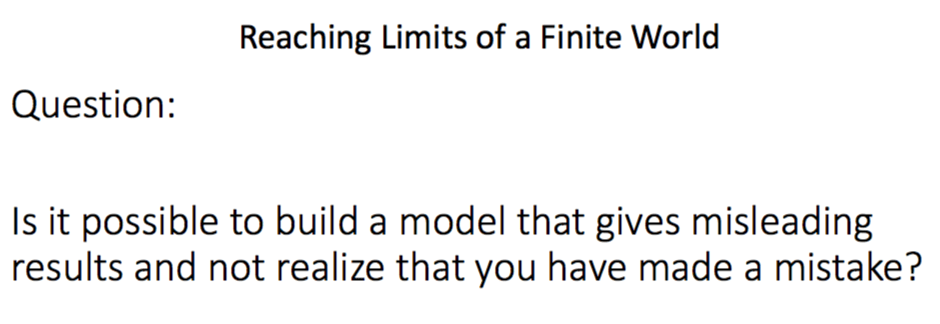
After the audience had a chance to answer this question (mostly with yes), I gave my answer: “Yes, indeed, it is possible to build a model that gives misleading results, and not understand the situation.” For example, a flat map works as a perfectly adequate model in some situations. But when longer distances are involved, a globe is needed. A two-dimensional model works for some purposes, but not for others.

Slide 5
The model in Slide 5 is the familiar Supply and Demand model used by economists. According to the model, if Demand increases from D1 to D2, then price will increase from P1 to P2. The rising price, in turn, will allow the quantity produced to rise from Q1 to Q2, based on the upward sloping supply curve S. This model is true in some cases, but it is not always true.
Supply and Demand Are Both Affected by Reaching Limits
As the economy approaches energy limits, lack of sufficient growth in energy consumption affects both Supply and Demand. Diminishing returns leads to high costs on the Supply side. Because of this, the cost of producing oil and other energy products tends to rise.
At the same time, businesses find that they cannot pass on these higher costs to their consumers because the wages of consumers don’t rise with rising energy costs. Diminishing returns acts like growing inefficiency; it takes more materials, more labor, more tax dollars, and more debt to produce the world’s overall mix of energy products, leaving a smaller amount of resources for producing end products (such as homes, cars, and bicycles) that consumers really want.
Persistent high energy costs lead businesses to try to find workarounds to reduce total costs. A major target for cost reduction is labor costs. If some labor costs can be replaced by lower-paid labor from overseas, or by robots, the company can perhaps make a reasonable profit, even with higher prices for oil and other energy products. The catch is new lower-cost labor force does not create as much Demand for goods and services as was available before jobs were replaced by robots or sent overseas. Workers in China and India will buy some goods and services, but the quantity will likely be lower than if the jobs remained in the US, Europe, and Japan.
We end up with a tug-of-war between the high prices that the producers of energy products need and the low prices that the many low-wage workers around the world can afford. Energy products are used in making pretty much everything, including food, homes, cars, and computers. As young people need to live with their parents longer, and as demand moves to lower-waged countries overseas, the lack of buying power tends to pull energy prices down below the cost of production. Energy prices below the cost of production are just as much a product of reaching energy limits as high energy prices!
Peak Oil is Another Two-Dimensional Model
Before we go on, I should probably offer some more explanation. Some of you may have thought that I would be talking about the Peak Oil story today. I consider the Peak Oil story to be another two-dimensional model. It gives some insights, but it really does not give a good explanation of what can be expected as we go ahead. Its emphases on oil and on high prices are both wrong, in my opinion.
Geologists coming up with the Peak Oil model relied on the incorrect Supply and Demand model of economists. They did not understand that both Demand and Supply are affected, as energy limits approach. They also never considered what the energy needs of the economy really are–total energy consumption needs to grow, if enough goods and services are to be produced for the growing world population. Rising energy consumption is also needed to keep commodity prices high enough to keep production from collapsing from low prices, due to inadequate Demand.
The Role of Added Energy
Many of you have heard the saying, “As you sow [seeds], so shall you reap.” In other words, the effort you put in can be expected to correspond to the end product that is produced. This saying is somewhat true if an economy uses only human labor to produce goods and services. For example, if a person digs a ditch for five hours, the result will correspond to effort put in. Increasing the hours of digging to six can perhaps add 20% to the length of ditch that can be dug. (There is the detail that it even takes energy products to make a shovel. Perhaps the example should be digging a ditch with a stick, and thus using only human labor!)
If a person really wants to dig a ditch quickly, he needs ditch-digging equipment and diesel fuel to operate the equipment. The ditch-digging equipment is made with energy products; it also uses energy products while it is operated. If energy consumption per capita is rising, then businesses, on average, can use increasing amounts of energy to increasingly leverage the labor of the workers they hire. This seems to be what leads to productivity growth.
This is why I talk so much about energy consumption per capita, and the importance of falling prices of energy services (including efficiency gains) to encourage the growth in energy consumption. One example of energy services (whose costs need to fall) would be the cost of heating a 1,000 square meter home (including efficiency gains in furnaces and insulation). Another example would be the cost of transporting 100 kilograms of grain 100 kilometers.

Slide 6
In fact, over time, the cost of energy services has been falling. The fall in costs more than offset the growing quantity of energy consumed. Thus, the cost of energy services is becoming a smaller and smaller share of world GDP. This falling share of energy products as a percentage of the world GDP seems to be necessary, if the remainder of the world economy is to grow. If the cost of energy products starts to rise, it will tend to crowd out some of the discretionary goods and services that the world economy has been able to add, as the world economy has grown.
Higher Energy Prices Are Damaging to the Economy; Lower Energy Prices Encourage GDP Growth
Energy needs to be consumed by the system, whether workers dig ditches with shovels or with ditch-digging equipment. If energy is very expensive, it is likely that all that employers can afford is the equivalent of shovels for workers to work with. If energy becomes less expensive to use (including efficiency gains), then it becomes possible to scale up the use of tools using energy, and the economy can expand. As a result, workers can become more efficient, businesses can make more profits, and the government can collect more taxes. The falling price of energy services seem to be the major force underlying GDP growth.
Conversely, if oil consumption growth is constricted by a spike in oil prices, we know (based on the work of Economist James Hamilton) that the US economy tends to go into recession. Higher prices make it difficult for both businesses and consumers to buy energy products. Falling energy consumption is damaging to the economy, because the creation of goods and services depends on the use of energy products.
High Correlation Between World GDP and Energy Consumption

Slide 7
Energy consumption is not mentioned at all on the economists’ supply and demand model (Slide 5), but it is clear that energy consumption is highly correlated with economic growth. There is a reason for this: it takes energy products to make both goods and services. It even takes energy to heat and light an office for workers, and to make and power computers.
Economists tend to miss the connection between energy and the economy because they tend to perform their analyses on an individual country basis. The connection between GDP growth and energy growth is less clear on a country-by-country basis because individual countries can reduce their energy consumption by shifting some of their manufacturing to less developed countries, confusing the analysis. The International Energy Agency has concluded that higher oil prices can be expected to have an adverse impact on the world economy as a whole.
The Economy Is a Self-Organized System Operated by Energy

Slide 8
The reason for the strange behavior of energy prices near limits is because the system is very interconnected. It is a self-organized system that gradually changes over time. New customers are added over time. These customers are often also wage-earners. They decide what to buy based on their own wages, and based on other considerations, such as the prices of competing products and whether inexpensive financing is available.
Businesses make decisions based on what they think customers might want. They also consider products offered by competitors. Governments play a role as well, both in regulation and taxation.
Physics indirectly helps determine prices, wages, and profits, because the economy uses energy to make goods and services. If a rapidly growing amount of cheap energy is available, it becomes easy for businesses to make a profit and raise wages. As businesses grow, economies of scale tend to increase profits. Higher energy prices tend to reverse these beneficial effects.
Oil Prices Are Now Too Low for Many Oil Producers

Slide 9
If you are not familiar with energy price trends, it probably would be worthwhile to take a minute to look at the strange price pattern shown on Slide 9. If you are coming from a financial background, you will probably be familiar with the financial disruptions of 2008, but not the high oil (and other energy) prices of the same period. The steep drop in prices corresponds to the time of major financial distress.
Most United States infrastructure, such as interstate highways, pipelines, and electricity transmission systems, were built in the pre-1970 period, when the inflation-adjusted price of oil was generally less than $20 per barrel. Thus, in a sense, most of the oil prices we are seeing in recent years on Slide 9 are high, relative to historical costs. The question becomes, “How high a price can the economy withstand?” It becomes very expensive to replace a worn-out pipeline built with $20 per barrel oil using $120 per barrel oil.
On Slide 9, prices required by oil exporting countries (such as Saudi Arabia, Venezuela, and Norway) seem to be well over $100 per barrel. Such a high price is needed if these countries are to be able to collect enough tax revenue and also have funds for investment in new fields to replace depleting fields.
On the other hand, the economies of the United States, Europe, and Japan do very much better if oil prices are low. They would prefer prices under $50 per barrel. This is the price mismatch mentioned on Slide 9.
Extended periods of low prices can be expected to lead to two adverse impacts over a period of several years:
- Falling growth in energy production. Investment in new fields to offset declining production from existing fields is likely to fall. The big drop in oil prices occurred in 2014, and it is now four years later. Many analysts expect growth in oil production to slow in the next few years, because of inadequate investment. Coal, natural gas, and uranium have somewhat similar problems, with falling prices discouraging reinvestment.
- Collapsing governments of oil exporting nations. Governments of countries that export oil are often very dependent on the high price of oil to collect adequate tax revenue. The central government of the Soviet Union collapsed in 1991, after several years of low oil prices. Lack of adequate tax revenue could cause a similar problem today. Venezuela is particularly at risk, but Saudi Arabia and many other countries could follow.
It is ironic that Venezuela reports the highest oil reserves in the world. These reserves can only be extracted if energy prices are much higher than today. This would seem to require higher wages of non-elite workers around the world. If wages were much higher in countries such as India and Nigeria, they could afford goods such as motorcycles and air conditioning, helping push up world demand for energy products.

Slide 10
It is clear that the growth rate of energy consumption simultaneously affects Supply and Demand.
An important point on Slide 10 is the fact that growing debt acts as a helper for energy consumption. It allows consumers to afford goods and services with their monthly wages, and it allows businesses to pay for new tools for workers over the lifetime of those tools. In a sense, debt is the promise of future goods and services made with energy products.
Money is a type of debt. We can print money, but we can’t print cheap-to-produce energy products. Thus, at some point, there can be a mismatch between promises of future goods and services and the quantity of affordable energy products available to create those goods and services. This is part of what is likely to cause debt defaults.

Slide 11
Slide 11 lists some of the things that seem likely as we reach the limits of cheap-to-produce energy supply. I will describe these issues more, later in this talk.

Slide 12
Slide 12 is an outline of the rest of the talk. This post primarily covers Points 1 and 2. Thus, this article relates primarily to GDP growth, interest rates, and asset prices. Slides are shown for Points 3 and 4 as well.

Slide 13
..

Slide 14
In recent years, it has become increasingly apparent that the ability of humans (and pre-humans) to cook part of our food supply has had a major impact on our ability to be different from other animals. We could eat a wider variety of foods, and we could get more energy value from those foods. Our bodies could evolve in a very different way. Our brains could become bigger, and our jaws and gut could be smaller.

Slide 15
Even back in hunter-gatherer days, humans were using more energy than similar animals. Now, in the industrial period, we are using 80 times as much energy (=8000/100) as a human-like animal would use, considering the various types of supplemental energy available to us. Some people have described the situation as having 80 energy-slaves for each person. This makes it possible to do tasks, such as farming and digging ditches, in a more efficient way than using sticks as tools.

Slide 16
Besides the usual tools, we have many related ways of using energy, with the goal of eventually providing more goods and services. Energy can be used to organize data on computers. Energy can be used to provide advanced education on topics helpful to growing the economy. If individuals or businesses are paid wages or interest payments, they can use those proceeds to buy energy products, such as a new car, or an overseas vacation. Thus, energy consumption growth affects every part of the economy.

Slide 17
Growing debt is extremely important in growing the world economy. I describe the situation more fully in this article: What has gone wrong with oil prices, debt, and GDP growth?
Technology is what most people focus on, as being the way to move the world economy forward. However, it takes energy products to make the new machines made possible by technology. Without a steady supply of energy products, we cannot maintain existing roads, or the electric grid, or the internet.

Slide 18
Anyone who has purchased a home knows that interest rates are very important in determining what price of home a particular buyer can afford. Here I show a range of monthly payments, for a 30-year, $300,000 mortgage at various interest rates. It is clear that a person can afford to buy a great deal more house at a low interest rate than a high interest rate. If interest only loans are available, costs are lower still.

Slide 19
Everyone who works with interest rates is aware of this pattern in 10-year US Treasury interest rates. The peak in interest rates was in 1981, and there has been a downward trend most of the time since that date.

Slide 20
The interest rates that regulators can easily adjust are short-term interest rates. When these interest rates are increased, they tend to induce recession. There may be a lag in timing. The increase in short-term interest rates in the 2004 to 2006 period seems to have been instrumental in popping the subprime debt bubble and bringing on the Great Recession of 2007-2009. This is my article relating to this issue: Oil Supply Limits and the Continuing Financial Crisis

Slide 21
When energy consumption is growing rapidly, and there are productive projects that can be added (interstate highway system, long distance electric grid, interstate pipelines, first-time telephone service for many people, growing number of trucks and airplanes), then it is possible for the economy to grow rapidly.
In this rapidly growing economy, the economy could easily ramp up long term interest rates without damaging the economy because the underlying growth rate was so high. In a sense, the higher interest rates were analogous to inflation affecting food and energy prices. There was so much growth in demand for goods and services that the economy could afford to pay rising interest rates during the period between World War II and 1981.

Slide 22
The period since 1981 is a period when investments have become much less productive, from a point of view of allowing more goods and services to be produced. Instead, growth is coming from selling more services to each other, and sending more manufacturing to lower-cost parts of the world.
Since 1981, we find ourselves with an increasing amount of old infrastructure that needs to be maintained. Fixing this infrastructure doesn’t really improve productivity. New investments simply keep productivity from falling.
One recent innovation has been the internet. It gives us more information, and it relieves us from the burden of having to use the phone book or go to the library. Thus, it makes us more productive. But in many ways, it is not as important as many earlier inventions, such as the internal combustion engine, the light bulb, and the telephone. There is a temptation to computerize all kinds of data and to expect data mining to solve all our problems. A person wonders what the true cost/benefit is.
Innovations in medicine now allow more 85-year-olds to live to be 86-year-olds and allow more cases of cancer to be cured. But the big changes, brought about by antibiotics and better sanitation, occurred before 1981.
Another growth area has been higher education. The payback is often wages that are barely high enough to live on. How are college graduates who cannot find high-paying jobs going to be able to repay their loans and still get married and have a family?
Admittedly, some investments have been productive. This is especially true when new factories, roads, and ports have been installed in emerging markets. But a large share of recent investments have been aimed at making vehicles more fuel efficient. Or trying to reduce CO2 emissions. These do not really have a payback in lower-cost goods and services.
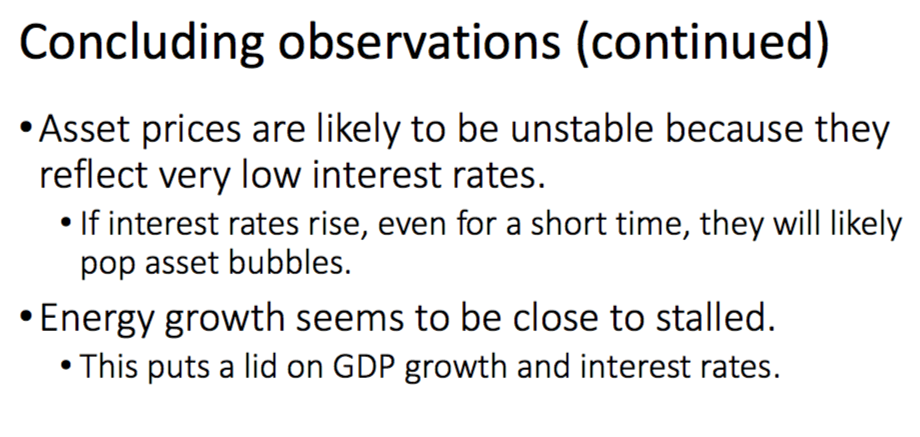
Interest on debt can only be paid if the economy is truly growing, and thus has a sufficient margin to pay interest with. This seems to be less and less possible outside of emerging markets. I would expect that this is why long-term interest rates are persistently low.

Slide 23
The decline in the ten-year interest rates should make homes more affordable. The long-term decline in shorter-interest rates should make vehicles more affordable. In spite of this boost to the economy, US GDP growth rates have persistently fallen. World GDP growth rates have fallen as well.

Slide 24
There is relatively little storage available for commodities of most types, including oil. As a result, even a small change in demand can lead to a major price shift.
I show in Oil Supply Limits and the Continuing Financial Crisis that the peak in oil prices corresponded to the peak in US debt in several categories, including credit cards and home mortgages. Once US debt stopped rising, the demand for oil fell, and prices dropped precipitously.
Quantitative Easing (QE) by the US Federal Reserve began near the end of 2008. It acted to lower interest rates, especially long-term interest rates. These lower interest rates helped get oil prices back up closer to the level required by producers. But once QE stopped in 2014, prices slid back down. As noted earlier, recent oil prices are far too low for most producers. But they do help stimulate the economies of oil importing countries.

Slide 25
If a business adds debt to expand a factory, this may lead to more wages. The chart indicates that growing non-financial debt does not always lead to higher wages. Sometimes it leads to asset bubbles.

Slide 26
Disposable personal income (DPI) is income that individuals receive, including payments such as Social Security and Unemployment Insurance. This amount is netted out for taxes paid. If we divide DPI by population, we get per capita DPI. This amount is not inflation adjusted; it gives us an estimate of how much incomes have been rising, including payments made to compensate for inflation.
Clearly, there have been huge changes in the growth of per capita DPI over time. Prior to 1981, per capita DPI was rising rapidly, as more women joined the workforce, and as companies gave cost of living raises, in an attempt to keep their employees. In several years, per capita DPI was rising at over 10%.
Families with rapidly rising incomes were looking for ways to spend their new-found wealth. This seems to be at least part of the reason for the high inflation rates of this period. Without this rapid run up in DPI, it is hard to see how the oil prices spikes of the 1970s could have occurred.
Now, the economy has slowed greatly. DPI per capita is sputtering along at less than 4% per year. With this low rate of increase in funds available for spending, it seems like the current economy will not be able to support a big spike in oil prices.

Slide 27
..

Slide 28
If the economy is not really growing, it is very difficult to pay interest. This is why a person would expect interest rates to roughly follow GDP growth. Back before 1981, GDP growth was significantly greater than 10-year Treasury yields. Since then, 10-year Treasuries have tended to yield a little more than GDP growth (including inflation). Very recently, the pattern seems to have returned to the pre-1981 pattern.

Slide 29
If interest rates are lower, more people can afford to buy a given house, or a piece of land, or shares of stock. The additional demand tends to bid up asset prices.

Slide 30
This should be clear from Slide 29.

Slide 31
Interest rate assumptions often were originally made when interest rates were higher.

Slide 32
Payments to individuals in a particular year act as a way of dividing up goods and services available in that year. If the share of goods and services going to those who are paid interest rises, it will mean fewer goods and services are available for others. History says that it is the non-elite workers that are most likely to be “shorted,” if there are not enough goods and services to go around.

Slide 33
..

Slide 34
..

Slide 35
..

Slide 36
..

Slide 37
..

Slide 38
..

Slide 39
..

Slide 40
..

Slide 41
..

Slide 42
..

Slide 43
..

Slide 44
..

Slide 45
..

Slide 46
Even a decline in coal consumption is a problem, if it causes total energy consumption per capita to fall! Wind and solar cannot possibly make up the shortfall. Also, their installed cost is high, if the cost of intermittency workarounds is included.
Many slides skipped!

Slide 62
..

Slide 63
..
Slide 64
..

Slide 65


Just 1% of investors expect the economy will be stronger a year from now
https://www.marketwatch.com/story/just-1-of-investors-expect-the-economy-will-be-stronger-a-year-from-now-2018-05-15
Something’s Amiss in the U.S. Jobs Market
https://www.bloomberg.com/view/articles/2018-05-15/u-s-labor-market-has-some-significant-weak-spots
here is the reality of organic foods farmers
https://youtu.be/YYwB63YslbA
fake food
fake money
fake economy
fake people
Organic food ‘not automatically better,’ study finds
https://www.theglobeandmail.com/life/health-and-fitness/health/organic-food-not-automatically-better-study-finds/article34266772/
Scott Nearing is turning in his grave this morning …. well maybe not – considering he was quite happy to use concrete, electricity (when it became available in his area), tools from factories, pumps for water, rubber hoses, shops, and of course there are those flights to warm places when he finally started to make some cash by selling books using the BAU distribution system….
http://salzmoto.com/wp-content/uploads/2015/02/MB_Feature.jpg
Lower yield. Also, I think that they may often have longer shipping distance. I know that some organic food is grown in the desert, to avoid insects. But this brings other challenges, like need to water.
The best lines I have every heard from ‘self-sufficient’ types…
We don’t use sprays… well – except in the areas outside of the vegetable beds.
We collect roof water and pump it onto the gardens during the hot dry periods. If everything goes to pieces we’d figure out how to get that done without electricity.
When the economy collapses (doomie prepper told me this) yes I am aware that there are tens of thousands of people who live nearby but we’ll just deal with them when it happens — (when asked how) — we don’t have guns or anything like that.
The solution for all would be to sing Koombaya … when it happens. Until then — just continue with the delusion.
The attack of microbes on you and the weeds on your garden is more than sure…
I got sly smiles from permies when I said I wasn’t going to spray at the doomstead…. they understand what is involved trying this without BAU…..
I guess if you have 12 hours on your hands in which to run a garden without spray then this will all work out…. the nett energy return would be big time negative I reckon … particularly if you have to haul water and wood from even a small distance….
I bought bird netting to put over my three blueberry bushes. I am sure I could buy my blueberry output for a couple of years with the cost of the netting.
I had to buy one last year, too. Also grapes need to be protected from brids and insects. Without the protective measures, other species eat our food and us very quickly…
At least the winter in the mild areas helps to fight other species… if there is enough wood…
Re wood… I think Norman has posted on this previously….
First you cut the wood near where you live…. then the next year you cut wood slightly further out… and so on….
Very soon you expend more energy and time hauling the wood back to where you live than it’s worth…. effectively you spend your entire day hauling wood.
This was a problem in the middle ages… forcing us to turn to coal.
Did I mention- I love coal?
i hope Mrs Fast doesnt object to black handprints everywhere??
She likes it.
Now here’s another problem … the coal is great… but the system is not functioning properly … we cannot get the room temp over 17 … the thermostat is working fine… but the thought is that a circulating pump is damaged…. (there are two)… And with winter arriving the repair people are beyond busy … repairing and servicing heating systems…. so we are having to wait … and wait…
And then there is the issue of keeping the entire system clean — you need someone to come in once a year minimum – or your insurance will not cover you if your house burns down due to a chimney fire…
Ya you can rattle a chain around there and loosen up the worst of it — but the goo builds up no matter what — and it will clog the chimney and catch fire…
If you burn wood — and it’s at all green … that makes the problem worse…
Doomie Preppies in colder kkkklimates will be aware of this …. and they will have taken courses in chimney sweeping — and purchased all the gear required… along with duplicates… because there ain’t no Wally’s World (or Amazon) post BAU…. it’s like being shot into space on a one way trip to Mars…. what you have with is all you get — forever.
can’t you recruit a small boy to climb up the chimney with a brush?
worked well enough in the old days
I knew children had to be good for something
yes YES YEEEEESSSSSS!!!!!
I have so many tales of permie doomie futility … here’s another:
I bought chickens…. many chickens (18 or so)…. around 30 bucks each…. and I fed them organic pellets (had to order an entire pallet of the stuff from the north island) — it was not cheap.
At first we had so many eggs we didn’t know what to do with them…. M Fast was conjuring meals made with eggs… scrambled for breakfast – omelets with veg…. boiled eggs… etc etc etc…. we became super-saturated with eggs…. no mas no mas!!!!
But then…. came winter…… apparently chickens don’t lay much in winter…. so we then had very few eggs… but them sun of a bi tch chickens were still ripping through the expensive organic pellets like no tomorrow….
And then as the two year mark approached… some of the chickens stopped laying completely… apparently that’s the shelf life…. they are – like the UK economy ‘menopausal’ …. but the bas tards still kept gobbling that the gold organic pellets… draining my coffers… but like Wolf said — that doesn’t matter — even if all my coffers (and everyone else’s) went to buying organic chicken feed that would have zero impact on the overall economy ….
Then one day I awoke and thought about this situation … my eyes glazed over…. I peaked out the door
https://loonylabs.files.wordpress.com/2015/08/shining01.gif
Went walked down to the coop…. with a shovel … and a I approached the chickens from behind … and one by one … I normaned them:
http://basementrejects.com/wp-content/uploads/2015/10/psycho-ii-1983-norman-bates-kills-mother-with-shovel-emma-spool-claudia-bryar-ending-anthony-perkins.jpg
M Fast was much chagrined when I informed her that we no longer had to buy more golden chicken pellets… because the chickens had been dispatched to chicken utopia….
The morals of the story:
1. I estimated that each precious egg pumped out of these chickens was costing about 2 bucks… at least…
Meanwhile… I could buy organic free range eggs for less than a buck in the Wally’s World…
2. If you don’t feed chickens a rounded diet — and just let them peck in the dirt for bugs and sh it… they lay just about f789 all…. and since Wally’s World will not be selling pellets – organic or otherwise…. when BAU ends…. the chickens won’t be laying very much….
3. When BAU ends …. the hordes will kill the non-laying chickens and eat them. 100% Guaranteed.
Doomie Prepping is a dead end street.
like that guy and his wife living ”independently” above the arctic circle—using dog sleds for transport etc
then has to FLY IN the dog food to feed them
and hauls up his wind turbine tower with a tractor
i must be missing something
Me now:
https://media.giphy.com/media/3oEdv0LJmhh8Yb7sti/giphy.gif
Oil price rise likely to hit consumers with $4 billion headache and absorb benefit of tax cuts
http://www.abc.net.au/news/2018-05-15/oil-price-rise-to-torch-tax-cuts/9762154
Major depression on the rise among everyone, new data shows
https://www.nbcnews.com/health/health-news/major-depression-rise-among-everyone-new-data-shows-n873146
that’s a very depressing story…
Wolf Richter believes that higher interest rates and oil prices will not decrease consumer spending. Wolf Richter believes that higher interest rates and oil prices will only change what money will be spent on; presumably interest and oil.
https://wolfstreet.com/2018/05/15/why-rising-gasoline-prices-wont-cut-into-consumer-spending/
Bright guy. He should run for office.
I’ve been following Wolf for many a year and more often than not he’s gotten it dead wrong … including in my as well as AAA etc – et al’s opinion the article you’re linking to . Fact is I’d lay odds Wolf has been wrong more often than he’s gotten it right due to his limited perspective and unwillingness to engage in cross disciplinary conversations . In as far as his running for office … no thanks .
Yes he gets a LOT wrong.
Like when he suggested that we need to control population – and that if global population growth could be halted … we could still have prosperity.
I suggested otherwise – he insulted me.
Then I posted a number of research papers that indicated that upwards of 30% of GDP is generated by increases in population.
He removed that — and banned me.
Of course I had early run-ins with him over EVs and Renewable Energy …. he refused to accept those facts as well and just removed them.
Wolf would make a great dictator. He is ‘always right’ — and he surrounds himself with yes men (oh sorry … yes people … as Justin would say)
He could be the next Hi tler?
In this latest episode of why Wolf Hit ler is wrong:
1. When oil spiked in the run up to GFC…. it was offset by the housing bubble — people could continue to consume stuff because they were ‘rich’ as they borrowed against massive bumps in equity in their homes.
2. So the low end consumer continues to spend every dollar – but with more of it going to direct energy cost + indirect costs… the end result – provided they cannot top up spending with more debt — is that they buy less stuff. The less stuff costs the same as what more stuff did – due to higher energy input costs — but when the masses buy less — corporations get sick… and they eventually die… because they must always be selling MORE stuff….
F798 you Wolf Hi tl er. You are wrong. Again.
And that is what makes you a MORE on…. actually a re tar ded more on. Even when a stake has been driven through your heart you will never admit you are wrong. You will dig your hole deeper. You will invoke The Censor. How very Soviet Russia of you….
Because of this arrogance… this mental defect…. this hubris…. you are incapable of learning anything of significance.
If Wolf is that bad, the contemporary mainland Chinese jingoist is worse. In his/her thoroughly CCP-indoctrinated mind everything about China must be good and nothing can be bad; vice versa for all of the rest of the world. I’ve encountered more than a few of these nutjobs at Youtube.
Guess they’re going to be in for a very unpleasant surprise when TSHTF.
Come on … someone needs to take him on here…. let’s see how he reacts!
If I even land on WS the bullets start to fly…. so someone else needs to do this
Sickofants…
phathalo
May 15, 2018 at 10:13 am
To paraphrase Wolf, I hope, higher gas prices have micro-economic but not macro-economic impact on consumer spending.
Relatively higher gas prices won’t cause a demand-side shock until it crosses some price level as Wolf notes.
Who’s gonna be the one to stir the pot?
https://wolfstreet.com/2018/05/15/why-rising-gasoline-prices-wont-cut-into-consumer-spending/
Rising interest rates at the same time won’t matter either, I suppose.
In Wolf’s World … probably not.
I am thinking… Wolf does post some good analysis from time to time… but his weakness is his inability to acknowledge the oil story…
His mate who contributes talks about Mexico and blames its woes on corruption and incompetence… but as I have pointed out to him — there is nothing new there…
What is new is that Mexico is running out of oil that is cheap to produce — therefore their production is collapsing … and the corrupt inefficient machine no longer has grease … just like Venezuela …
If oil could go to 100+ and stay there… both of these countries would stabilize very quickly… the UK would also see better days…. as would many other countries that rely on oil revenues….
But his mate will not acknowledge what is blindingly obvious….
Because to do so causes the peak oil story to intrude…. and that results in hope being crushed…
I think this latest WRONG by Wolf is tied into this …. if you acknowledge that higher oil prices do matter… that they do sap the general economy and eventually cause another crisis…
Then you destroy hope… you challenge everything you believe to be true about BAU….
And this can be devastating to most people — Wolf obviously cannot handle the truth.
So he resorts to making these ludicrous assertions.
He may not be a re tar de d more on afterall… this is just Mr Cognitive Dissonance taking over … and protecting his fragile psyche….
One simple way to describe the problem with Wolf’s analysis is that money spent on oil is literally burned, sacrificing money which may have been spent on durable capital. This is catabolic – deflationary as BAU starts to eat itself to survive.
You can stave this off with MMT policies – extend and pretend – with anything that gives purchasing power to the masses whether it is fancy funny-money or straight up socialism. But however you paint it 100% of the money represents 100% of our economic activity. If too much of our collective effort is spent on oil other sectors collapse and bring down the whole.
Taunt the wolf with that… I’ll ping him in the head with a 308 round if he comes at you… here wolfy… here wolfy…
https://wolfstreet.com/2018/05/15/why-rising-gasoline-prices-wont-cut-into-consumer-spending/
I am not sure that the UK would see better days with $100 per barrel oil. They were an oil exporter at one time, but now they are an oil importer.
https://gailtheactuary.files.wordpress.com/2018/01/uk-oil-production-and-consumption.png
Energy consumption per capita is falling rapidly.
https://gailtheactuary.files.wordpress.com/2018/01/uk-energy-consumption-per-capita.png
I am wondering if the energy mix is becoming horribly expensive. Coal has pretty much been phased out. Natural gas consumption is decreasing. They have added wind and solar, but I expect these are quite expensive.
Perhaps they’d return to exporting if a hundred bucks would revive the North Sea biz…
Alternatively they are really really f789ed no matter what…
All moot — a sustained price of 100 bucks a barrel —- would gut BAU
Wolf is a nutcase. Whaddya gonna do?
America After a Few Months of 4$ Gas Prices
https://youtu.be/uq7noaMwLfg
At least the Flintstones would have trained the dino to pull their ‘car’. Why carry a big reptile around when it can do work?
maybe now you understand why folks in the uk, with petrol at $7.50, only drive downhill
Central Otago petrol is well over 2 bucks now… diesel (subsidized) is over 1.60…. that’s 30 cents more than the price I paid in Invercargill when I picked up 2 tonnes of coal in the back of ma 4 bah 4 eco 4000lb eco truck….
At this rate I’ll bankwupt soon…. me and Elon under a bridge roasting rats…
I read somewhere a Rayburn can be fitted to burn diesel — I need to investigate…. I also need to work out which would be more environmentally unfriendly – diesel or coal….
Oh – and I spoke to the Rayburn lady and she recommended that at night putting coal into a plastic grocery bag… and just tossing that into the fire ‘for convenience’….
She was a bit sheepish saying burning plastic was a bit of a bad look…. but alas — she was not speaking to a Green Groopie …. I told her I was going to use two shopping bags each time … for added strength… + I have so many of these bags laying around because I always ask for double bagging and I put as few things into each bag as I can get away with …. you never know when you might need more plastic bags…. and when BAU goes… forget about restocking….
https://www.stuff.co.nz/business/industries/103833909/south-island-petrol-prices-climb-nearly-three-times-as-much-as-north-island-figures-show
Tesla’s Autopilot engaged during Utah crash
https://www.detroitnews.com/story/business/autos/mobility/2018/05/15/tesla-crash-utah/34938439/
Enron Musk,
The final verdict on those recent big art auctions at Christie’s and Sotheby’s is… ‘sleepy’.
The super-rich are certainly not throwing it around with abandon. The Rockefeller sale in particular was ‘disappointing’.
Some more staffing cuts will sort that out, I suppose.
Smart money do not get thrown into art which does not earn dividends. It was the Japanese investors during 1980s, not knowing the value of art, which created the art boom. Now, people are getting too sophisticated to shell out millions for a dead piece of canvas which does not earn any money and is hard to maintain and protect.
Correction . Smart money ‘ used to ‘ invest in art , antiques , classic cars , wine etc with absolute abandon right up until the end of 2016 … at which point they … including many celebrity collectors . knowing a whole lot more than the average individual does .. started dumping their collections .. initially at hight prices rapidly devolving into bargain basement deals ( relatively speaking ) converting their assets into cash .. rather than reinvesting in either the collector or the financial market .
That alone should have people thinking twice about depleting their cash reserves while the wealthy ( and the wise like myself ) increase and maintain our liquid ( read cash ) assets
Sorry, “smart money/wise wealthy” in the first place means you have already covered most of the necessities of life at such level of affluence, namely: both rural and city residences (usually also globally diversified), Swiss or other additional passport, money and collectibles warehoused at several place globally, stakes in various “recession proof” companies, land ownership with mineral/water rights, not mentioning viable contacts to both centrist political factions going out and populists going in..
And only then you can play additional games with your “excess cash money”..
Lolz
Think of the process as money laundering. Some people still need a discrete way of doing that.
Surprise, surprise !
“Retail Sales Growth Slows As Fuel Costs Rise”
https://www.zerohedge.com/news/2018-05-15/retail-sales-growth-slows-fuel-costs-rise
But growth still positive in the US, so many will not pay close attention to the problem yet.
https://www.zerohedge.com/news/2018-05-15/wsj-sounds-alarm-theres-no-getting-over-gas-4-gallon
I would think everyone here remembers what happened the last time gas went over $4. I also remember the early – mid 1970’s. My guess is the wheels are finally beginning to wobble and are getting ready to come off.
As a side note there was also an article saying the subprime defaults are now higher than the 08-09 financial crisis – looks like we’ll see how much worse they can get because they are going to get worse.
And this time is different… unlike the run up to 2007… the consumer is no longer able to use their home as a piggy bank to continue to grow consumption … and people are up to their ears in debt so cannot run up the cards much more…
I made a comment on the 1st page saying that Ford has put most of it’s eggs in the same basket. As of 2020, most of their new vehicles sold in the US will be trucks. The only passenger cars they will sell is the Ford Mustang and an SUV Crossover vehicle.
I remember back in ’08 when gas prices were around $4-4.50 and people were unloading their SUV’s and trucks for the Smart Cars.
Do us a favour and post that here
https://wolfstreet.com/2018/05/15/why-rising-gasoline-prices-wont-cut-into-consumer-spending/
Regarding the Venezuelan real estate, it is likely that Chinese and other people who have ready cash will buy these luxury properties with depressed prices. The owners will be only too eager to sell out.
And then, a regime friendly to property owners will take place, these prices appreciate 10X – 20X – 30X, and the poorer people who squatted there would be kicked out by mercenary types.
That story is not new. The whole article is an advertisement for those with cash to buy the luxury properties of Caracas when the price is still low.
This answer misses the energy connection to the story. Why will the prices appreciate by 10X – 20X -30X? Someone has to grow the food and transport it to where it is needed. Someone has to keep the electrical system operating. Someone has to keep roads passable. All of these things require low-wage workers. They are not tasks done by robots.
What if it is possible for a robot to do these jobs? How does this affect economics for those who “own” the robots?
robots need an energy ”system” in which to function, they cannot operate independently
i’ve tried to explain the ”dead end” of robot-thinking
https://extranewsfeed.com/robots-cannot-survive-automation-f45605a58ad7
Very good. The economy is about resource extraction, conversion and consumption. The way we consume is buying stuff with wages gained from having a job. Take away the consumers and the robots are producing stuff few can afford.
It’s very easy to see the madness of “robot-thinking” if one has the finite world perspective. If one thinks the earth is flat and infinite, then robots sound like a good idea, making infinite amounts of stuff, infinitely cheap for infinitely many humans laying on the couch living off welfare/UBI.
TINA
The heavy oil will be developed after Maduro & Co are gone, and a lot of money will be made for quite a while in that region. Classic disaster capitalism.
“China reported weaker-than-expected investment and retail sales in April and a drop in home sales, clouding its economic outlook even as policymakers try to navigate debt risks and defuse a heated trade row with the United States.”
http://www.scmp.com/news/china/economy/article/2146164/china-investment-retail-sales-weaken-hinting-economic-slowdown
“The financial risk facing China is far larger than official numbers suggest and Beijing must do more to prevent the situation becoming a crisis, a senior adviser to the government warned on Monday.”
https://www.businessinsider.com.au/chinas-economy-has-been-hijacked-by-property-beijing-adviser-warns-2018-5
“Tianjin Real Estate Group, a developer backed by the Tianjin government, could default on a 550 million yuan (US$86.7 million) trust product, in a sign that Beijing’s deleveraging campaign is affecting state-owned enterprises as well.”
http://www.scmp.com/business/companies/article/2146070/tianjin-government-backed-property-firm-may-default-chinas
China’s weakening growth (because of slower debt growth and slower growth in energy consumption) is a major worry. China was pulling the world economy forward. As it stops doing this, there is a major chance of a debt-default crash that spreads worldwide. It could start in China or in many other places.
“The risk of a US recession in the next 12 months has more than doubled in the last year.”
https://seekingalpha.com/article/4173681-risk-u-s-gdp-recession-rising
“Borrowers in the U.S. are defaulting on subprime auto loans at the highest rate since 1996, even exceeding that during the financial crisis, Bloomberg reports, citing Fitch Ratings.”
https://seekingalpha.com/news/3356471-bloomberg-subprime-auto-loan-delinquency-rate-highest-20-years
The credit waters are receding: tsunami on its way?
Yay! Free fish!
According to the article “-the number of auto loans and leases extended to subprime borrowers fell by almost 10% from a year earlier in January.”
Fewer loans translates to fewer auto sales. This is part of what pulls demand for autos down, both new and used.
According to the article, “The best timing estimate from the model puts the next US GDP recession 18 to 24 months out.”
Let’s hope the recession stays that far away.
“The true scale of global debts has been revealed in a study of borrowing around the world, showing a total burden of $243 trillion (£179 trillion).
“Governments rich and poor have piled up unprecedented mountains of borrowing, while companies and households have also been warned that they are dangerously indebted.
“The study from the International Monetary Fund has compiled what it believes to be the most comprehensive database of public and private debts with information going back to the Fifties.
“It shows debts have risen in an almost unbroken trend since the Second World War, as even when some parts of the world cut back a little, deleveraging barely made a dent in the loans built up in earlier years.
“And when the rich world cut borrowing after the financial crisis, emerging markets, and China in particular, ramped up borrowing…
“Running up debts now risks leaving the cupboard bare when a crisis strikes…
“Debt growth has spread far beyond governments, with families and small businesses in the US also a particular hazard.
““The bottom 50pc [of US households] have negative net worth, they are already in distress,” said Hung Tran, executive managing director at the IIF, describing families whose debts exceed their assets.
“He said small companies are also in distress. The median small-cap US firm has an interest coverage ratio of zero – which means its earnings only just cover its interest payments.
“That is a marked worsening in the past six years, and indicates half of small firms are struggling to service their debts even before interest rates rise back to more “normal” levels.”
https://www.telegraph.co.uk/business/2018/05/14/debt-alert-governments-firms-families-face-unprecedented-burdens/
“An expanding economy normally would help drive down the deficit, but that hasn’t been the case as government borrowing continues to grow.”
https://www.cnbc.com/2018/05/14/goldman-deficit-unemployment-rate-disconnect-could-fuel-higher-interest-rates.html
“The spread between the 2-year and 10-year bond yields is hovering above minor support at 43 basis points. That’s its lowest levels since 2007… If the yield curve flattens, or even inverts, expect to see additional selling pressure on the financial sector.”
https://www.cnbc.com/2018/05/14/the-bond-market-could-be-signaling-a-recession.html
Banks “borrow short” and “lend long.” They need a spread between short and long term interest rates to make money.
governments can do no other than what we all do pretty much
borrow against expected prosperity in the future……for no better reason than that is what has worked in the past
the only difference is in scale
we expect those we elect to public office to suddenly become intellectual superpersons who know more than the rest of us….they really really don’t
we mortgage the house in expectation of future income—they mortgage the country
The better-educated politicians usually begin as lawyers, or historians, and the worst just social workers, low-level teachers, union bureaucrats, or those with degrees in ‘political studies’: not the best body of people to try to direct an advanced economy in decline!
For example, my step-mother is an MP in Spain – a lovely person, a sincere ‘conviction politician’, not personally corrupt, but she knows nothing. Her grandfather was a Basque government minister in the 1930’s: as he ran a shipping line, he at least knew something about the world and finance.
“we mortgage the house in expectation of future income—they mortgage the country”
Good point! Also, politicians don’t know more than the rest of us.
Ouch!
Goldman Sachs: Something strange is happening with the US economy
https://www.cnbc.com/2018/05/14/goldman-deficit-unemployment-rate-disconnect-could-fuel-higher-interest-rates.html
Fake unemployment rate, from the Bureau of lies…
https://imgur.com/a/DtAQJui
There are way too many things causing debt problems around the world. The US tax cuts are one piece of them. The need to support an increasing number of retired people with Social Security and Medicare is another.
They have nothing to lose though and everything to gain in faking the unemployment data..I mean by the time the public figures out what the hell is going on..The economy will have totally collapsed and we will all have way more problems on our hands, then getting justice to those who mislead us about how bad things were..
There is no upside to telling people the unemployment rate is 20% (or higher)
If you kill hope…. you kill BAU
JHK today:
“What we’re witnessing is the slow-motion collapse of civilization at the margins. A corner of the world that was once emptier and quieter is on its way to being empty and quiet again, but not without a tragic convulsion of violence on the journey there. What’s happening on the margins these days will shortly move toward the center.”
he calls it the “center” and the “margins”…
here it’s the Core and the Periphery…
“will shortly move toward the center” is typical JHK…
his observations are almost always spot on…
his timing is almost always years too early…
Toys ‘R’ Us to sell Geoffrey the Giraffe, and sex-toys-r-us.com
https://www.reuters.com/article/us-toys-r-us-bankruptcy-domains/toys-r-us-to-sell-geoffrey-the-giraffe-and-sex-toys-r-us-com-idUSKCN1IF32C
Armageddon 101: The True History of the End of the World
https://www.haaretz.com/israel-news/.premium.MAGAZINE-armageddon-101-the-true-history-of-the-end-of-the-world-1.6079081
Trump Has No Plan Left on Iran Other Than War – Michael Klare
https://www.thenation.com/article/trump-has-no-plan-left-on-iran-other-than-war/
so why does Trump need a “plan” for another country?
At least 770 Palestinians shot today by Israeli snipers, 52 fatally, as US embassy opens in Jerusalem
https://www.haaretz.com/israel-news/u-s-embassy-gaza-protests-and-nakba-day-live-updates-1.6078190
“But it’s the only democracy in the middle east!”.
China really is to blame for millions of lost U.S. manufacturing jobs, new study finds
https://www.marketwatch.com/story/china-really-is-to-blame-for-millions-of-lost-us-manufacturing-jobs-new-study-finds-2018-05-14
Trump: Since China joined WTO, U.S. has lost 60,000 factories
http://www.politifact.com/truth-o-meter/statements/2017/mar/24/donald-trump/trump-china-joined-wto-us-has-lost-60000-factories/
Globalization has had no other purpose but to reduce the American working class to third world status, while the inheritance class reaps enormous profits from foreign slave labor, and our voracious and ignorant consumerism drives the transfer of that wealth and expedites the entire process.
Meanwhile, we are worried about black people using charcoal grills in the wrong section of the park.
Or perhaps globalization was to prevent the world economy from crashing. It first started in the 1970s, when US oil production failed to rise. Then it got a big push forward with the Kyoto Protocol and the World Trade Organization in the late 1990s. A country could improve their own reported CO2 emissions, by sending production of goods and services to countries with low wages and coal use! Wow! When China joined the WTO in 2001, its ability to ramp up coal production and ramp up debt really stimulated the world economy. Since 2008, we have needed QE as well to keep the system going.
Every major rich city should have a statue to the ‘Unknown Chinese Coal Miner’.
And the ‘Unknown Asian Sweat-shop Worker’.
Good way of putting it!
Gee, should I feel proud for being Asian? :rolleyes: 😉
The west already got statues of unknown coal miners and mining equipment.
https://upload.wikimedia.org/wikipedia/commons/8/86/Mining_Statue_-_geograph.org.uk_-_1532332.jpg
You guys in Asia are just a tad late to the coal and oil party.
No free drinks anymore! Get Back to Work!
😉
https://i.redd.it/7f2xrkkuqux01.jpg
Isaac Asimov (January 2, 1920 – April 6, 1992) was an American writer and professor of biochemistry at Boston University… ha ha…
his alma mater was Columbia University… ha ha ha…
“Most of his popular science books explain scientific concepts in a historical way…”
so many contradictions, and so little time…
https://imgur.com/a/b7xqeEQ
Isaac Asimov’s novel The Gods Themselves tells the story of how a special way of tapping into an apparently endless energy source, discovered and widely adopted in the 22nd century, turns out to threaten to destroy our sun unless abandoned. The heroes in the story try to convince those in power of the terrible truth, but none will listen.
Sounds like a pretty prophetic portrayal of our current predicament, if you ask me.
maybe the novel was written when he thought nuclear fusion will come true
https://imgur.com/a/56Bo9Ew
Sagely observation. And alas, an observation that, as usual, is ignored by the world as large.
Asimov comes across as one who’s seriously concerned about where the world’s headed, going by his works and words. A great soul.
Bloomberg commodity index
https://www.bloomberg.com/quote/BCOM:IND
If you look at the five-year time frame, the current value doesn’t look very high.
The previous (small) peak was on January 26, 2018. This is when Brent was last over $70.
US crude oil stocks hit a low point of 1.076 billion barrels on January 19, 2018. Since then, they have gradually increasing again. Prices seem to be too high for quite a few buyers now.
The production cut by Opec and Russia cleared the oil glut? As inventories decline the oil price rises.
The Fed has been talking about inflation expectations. Usually when oil prices rise, inflation rises as well…but not this time?
Without rising wages inflation can not really rise. People will just be forced to cut they consumption.
People can not take on more debt either if the wages don’t rise enough to service more debt.
The debt to GDP ratio is just too high now?
Is this where you energy per capita comes in?
Without increase in energy per capita, wages can not rise?
I think the answer is that we need increasing energy per capita because wages require productivity increase. This means labor+capital+energy. If energy use is falling it represents less new tools to be used by labor.
From what I have read over the years, it seems that for growth to continue, energy availability should increase and energy costs should go down. If this were the case, more energy per capita would be possible.
Increase in energy per capita –> increase in production per capita –> increase in wages per capita.
Right!
In EU 25% of the population is pensioners. They are consuming energy, but hardly producing anything.
Well…they are producing demands for higher pension so that they can consumer more.
EU is a deflation mode.
i’m pretty sure that if you were to ask a pensioner, they would tell you that their pension is a well-deserved payback for a life of hard work and savings for retirement. if anything, they would tell you that their pension is small compension for all the hard work and service they provided for multiple decades. please feel free to interview them.
Well…we should say thank you and then push them off a cliff.
Energy per capita includes oil, coal, natural gas, nuclear, hydro, and small amounts of other stuff. If energy per capita is not rising, it is very hard for median wages to rise. Perhaps some of the high wage people will see increases, but the less skilled workers will not.
High wage people generally represent a lot of capital below them. The surgeon may just use a scalpel – but he is in an operating room in a hospital which may cost $400/s.f. to build. This looks to me like diminishing returns on productivity from capital. Some new technology may take a lot more energy to have very few jobs because most of the energy goes into complicated technology (capital) to support the job.
That is a good point.
But the medical equipment is very expensive because the chain that created it took a lot of labour and energy.
And also lack of scale when creating maybe 100s machines like it world wide.
EM currencies crashed in 2014 with the crash of oil prices?
Today the oil price is rising and the EM currencies are crashing?
Even if the oil price is up 75% in a year, bloombergs commodity price index has been flat (not exactly sure what it measures though).
EM markets that are importing oil and exporting commodities must be in serious trouble? If they on top of this have dollar denominated debt to service as the dollar is rising and the Fed is rising rates which makes borrowing costs to rise as well, while their own currencies are crashing…well…it’s an accident in making.
Excellent analysis of the problem!
I expect that raising US interest rates is intended to raise the level of the US$.
How about this tidbit:
The city of Springfield, for example, now dedicates 98 percent of its city property taxes to pay for the pensions of police, firefighters and city workers.
From: https://www.illinoispolicy.org/5-things-to-know-about-illinois-unsustainable-municipal-pension-fund/
I read an interesting article last night on how the state of Illinois plans to cover its pension obligations. The “solution” proposed by the central bankers of Illinois is to raise the property tax 1% across the board. So, for example, folks with a $250,000 home would see their property tax go up $2500/yr. I would imagine the appraisal districts would collude with the central bankers and produce generously high home appraisals to boost revenue even more. How much more can the ordinary working class people take before they collapse under the strain of the privileged classes?
Illinois not in good shape:
https://www.ilnews.org/news/state_politics/report-illinois-needs-billion-annually-to-repair-infrastructure/article_5bf44592-4f03-11e8-a4ad-f7b7031d5faf.html
Chicago is one place that at one time had a fairly good public transportation system. The problem is that such a system constantly needs upgrades and replacements. If a city’s revenues are falling (I haven’t checked on Chicago’s), it cannot afford the system any longer. Or perhaps it just has too many other commitments.
The “solution” proposed by the central bankers of Illinois is to raise the property tax 1% across the board. So, for example, folks with a $250,000 home would see their property tax go up $2500/yr
People with a $250,000 home are members of the 1%?
Maybe in Illinois with their depressed wages, they are but everywhere else…they’d be lower middle class.
Interesting analysis.
Energy ( availability and cost ) drives economic growth. Has done so through history. Every revolution ( horse, water mill, wind mill, steam turbine ) meant a step-change in economic growth.
In the near future, renewable energy will be overabundant and cheap ( zero marginal cost ).
Still…
The deflationary trend shown owes much more to demographic evolution than to too expensive energy costs. That trend ( depopulation because of lack of births ) will not reverse, indeed it will speed up as the babyboomers gently die off. ( Japan, Russia are already shrinking, Germany starts in 2020, … )
“In the near future, renewable energy will be overabundant and cheap ( zero marginal cost ).”
Wind, solar, tide and the like do not have zero marginal cost. They run on replacement parts and on subsidies provided by governments and by other parts of the overall electricity system. These hidden subsidies are omitted from nearly all analyses. They allow the intermittent output of these devices to be converted to the dispatchable power that the grid electrical system requires. The hidden subsidies also allow the lifetimes of these devices to be far longer than they would be, if owners got rid of them when they stopped providing electricity in an economic manner. Furthermore, few analyses consider the end-of-lifetime cost of disposing of the toxic portions of these devices.
This recent article from Energy Policy talks about the need for “idle capacity” to provide services for intermittent renewables. Someone has to pay these providers (nuclear, coal, natural gas) for their services, or they will close. Batteries are increasingly used to partially work around this difficulty. This is a real cost to the system–one which tends to be overlooked.
Germany’s Wind Energy Mess: As Subsidies Expire, Thousands Of Turbines To Close.
According to the article, it is impossible to recycle the fiberglass composite materials used in wind turbine blades. “Burning the blades is extremely difficult, toxic, and energy-intensive.” And, as the title indicates, as subsidies expire, there is little economic motivation to keep them in use. Instead, owners would hope to ship them to a less developed country, and let them figure out what to do to dispose of them. If the less developed countries can get a few years use out of them, perhaps they will provide this services.
“In the near future, renewable energy will be overabundant and cheap ( zero marginal cost ).” – Ahhh it sounds so good though.
From this article Gail linked to: https://climatechangedispatch.com/germanys-wind-energy-mess-as-subsidies-expire-thousands-of-turbines-to-close/
I looked up the average life expectancy of a US coal fired power plant and found that is between 40 to 50 years. I also just read that about half of the current active coal fired power plants in the US were built before 1980. It takes about 1000 wind turbines (and a good windy day) to output the capacity of average coal fired power plant (3Mw vs 3000Mw). From the article it states that “a large number of Germany’s 29,000 total turbines nationwide are approaching 20-years-old and for the most part, they are outdated.” At 3000 tons of concrete per turbine, that is a lot of concrete. It is also a lot of iron, copper and composite materials. So, if the turnover rate for wind turbines is 20 years (at least half the life expectancy of a coal fired plant). And it takes 1000 wind turbines to produce the same electrical output as one coal fired power plant, then that means a wind turbine is a huge resource hog. Even before factoring in the intermittent wind issues, the resource costs alone are staggering when compared to a coal fired power plant. Wind turbines are not dispatch-able either. And they rely on the grid (which is built and maintained by fossil fuels) It seems like an uphill battle for wind turbines. Without subsidy they don’t seem to stand a chance.
I am wondering if the 3000 tons of concrete is typical. I am guessing it is not, but I could be wrong. There is a lot of CO2 associated with making the concrete as well.
This is a Brookings Study that concludes that Wind and Solar are not good buys. https://www.brookings.edu/wp-content/uploads/2016/06/Net-Benefits-Final.pdf
https://gailtheactuary.files.wordpress.com/2018/05/frank-net-benefits-per-year-per-mwh-displacement-of-coal-baseload-production.png
Why Germany’s nuclear phaseout is leading to more coal burning
Between 2011 and 2015 Germany will open 10.7 GW of new coal fired power stations. This is more new coal coal capacity than was constructed in the entire two decades after the fall of the Berlin Wall. The expected annual electricity production of these power stations will far exceed that of existing solar panels and will be approximately the same as that of Germany’s existing solar panels and wind turbines combined. Solar panels and wind turbines however have expected life spans of no more than 25 years. Coal power plants typically last 50 years or longer. At best you could call the recent developments in Germany’s electricity sector contradictory. https://carboncounter.wordpress.com/2015/06/06/why-germanys-nuclear-phaseout-is-leading-to-more-coal-burning/
Germany Runs Up Against the Limits of Renewables
Even as Germany adds lots of wind and solar power to the electric grid, the country’s carbon emissions are rising. Will the rest of the world learn from its lesson? After years of declines, Germany’s carbon emissions rose slightly in 2015, largely because the country produces much more electricity than it needs. That’s happening because even if there are times when renewables can supply nearly all of the electricity on the grid, the variability of those sources forces Germany to keep other power plants running. And in Germany, which is phasing out its nuclear plants, those other plants primarily burn dirty coal. https://www.technologyreview.com/s/601514/germany-runs-up-against-the-limits-of-renewables/
Oh look … a DelusiSTANI…. I thought we had exterminated all of your kind from FW….
“To provide most of our power through renewables would take hundreds of times the amount of rare earth metals that we are mining today,” according to Thomas Graedel at the Yale School of Forestry & Environmental Studies. So renewable energy resources like windmills and solar PV can not ever replace fossil fuels, there’s not enough of many essential minerals to scale this technology up. http://energyskeptic.com/2014/high-tech-cannot-last-rare-earth-metals/
Renewable energy ‘simply won’t work’: Top Google engineers
Two highly qualified Google engineers who have spent years studying and trying to improve renewable energy technology have stated quite bluntly that whatever the future holds, it is not a renewables-powered civilisation: such a thing is impossible.
Both men are Stanford PhDs, Ross Koningstein having trained in aerospace engineering and David Fork in applied physics. These aren’t guys who fiddle about with websites or data analytics or “technology” of that sort: they are real engineers who understand difficult maths and physics, and top-bracket even among that distinguished company.
Even if one were to electrify all of transport, industry, heating and so on, so much renewable generation and balancing/storage equipment would be needed to power it that astronomical new requirements for steel, concrete, copper, glass, carbon fibre, neodymium, shipping and haulage etc etc would appear.
All these things are made using mammoth amounts of energy: far from achieving massive energy savings, which most plans for a renewables future rely on implicitly, we would wind up needing far more energy, which would mean even more vast renewables farms – and even more materials and energy to make and maintain them and so on. The scale of the building would be like nothing ever attempted by the human race.
In reality, well before any such stage was reached, energy would become horrifyingly expensive – which means that everything would become horrifyingly expensive (even the present well-under-one-per-cent renewables level in the UK has pushed up utility bills very considerably).
http://www.theregister.co.uk/2014/11/21/renewable_energy_simply_wont_work_google_renewables_engineers/
Renewable Penetration https://gailtheactuary.files.wordpress.com/2017/12/iea-primary-energy-suppy-1973-and-2015.png
BOOM! That is the sound of a DelusiSTANI’s brain exploding
Replacement of oil by alternative sources
While oil has many other important uses (lubrication, plastics, roadways, roofing) this section considers only its use as an energy source. The CMO is a powerful means of understanding the difficulty of replacing oil energy by other sources. SRI International chemist Ripudaman Malhotra, working with Crane and colleague Ed Kinderman, used it to describe the looming energy crisis in sobering terms.[13] Malhotra illustrates the problem of producing one CMO energy that we currently derive from oil each year from five different alternative sources. Installing capacity to produce 1 CMO per year requires long and significant development.
Allowing fifty years to develop the requisite capacity, 1 CMO of energy per year could be produced by any one of these developments:
4 Three Gorges Dams,[14] developed each year for 50 years, or
52 nuclear power plants,[15] developed each year for 50 years, or
104 coal-fired power plants,[16] developed each year for 50 years, or
32,850 wind turbines,[17][18] developed each year for 50 years, or
91,250,000 rooftop solar photovoltaic panels[19] developed each year for 50 years
The world consumes approximately 3 CMO annually from all sources. The table [10] shows the small contribution from alternative energies in 2006.
http://en.wikipedia.org/wiki/Cubic_mile_of_oil
BOOM BOOM BOOM!!! DelusiSTANI brains splattered everywhere
http://files.gamebanana.com/img/ico/sprays/530-90_50326a50e0a54.jpg
http://3.bp.blogspot.com/-IdfTF07MEyw/UT-NgPpimYI/AAAAAAAAbdw/RsOa9iCmKzo/s1600/cabea_3.jpg
https://i.pinimg.com/originals/08/04/29/080429f0a1fc72a71e025c0e6bd3df43.gif
That’ll teach ya .. ya stinkin varmint DelusisTANI.
Gail – please leave that carcass out there as a treat for the maggots — and as a warning to other DelusiSTANIs….
Growing concern about the economic slowdown in the UK and an observation that the booming Art market is signalling growing inequality.
https://www.theguardian.com/business/2018/may/13/mark-carney-uk-interest-rate-rise
I wonder if Carney crying wolf on raising interest rates has not been so much foolish exuberance as an admittedly short-termist strategy designed to buoy up the struggling £ post-Brexit.
The booming Art market is about corruption and money-laundering as well as inequality:
“Artworks are particularly suitable vehicles for money launderers, experts said, because they transfer easily and store quietly, perhaps in a basement or in an offshore tax haven. Unlike the real estate market, where lightning escalations in price are rare, values in art can be suddenly boosted by intangibles such as fads and personal taste.”
https://www.nytimes.com/2017/02/19/arts/design/has-the-art-market-become-an-unwitting-partner-in-crime.html
Values can rocket very suddenly.
An example: a top London ‘contemporary’ gallery, buys a bunch of paintings – say 10 – from a nobody artist, for £10k cash.
Nobody says: ‘That’s not much, I put my Soul into that!’ Gallery: ‘Take it or leave it, this is your chance!’
They then market a few as ‘an artist to watch’, say £10-15k each. All profit on the initial purchases go to the gallery, no commission to the artist.
Leonardo di Caprio (who is a taste-maker) buys one – suddenly the remaining pictures go up in value, and when others learn that di Caprio has bought one, they decide to take a punt.
The gallery now has a waiting list – maybe 50-100 – for works by the Nobody, who is possibly becoming Somebody. Nobody now actually has some purpose in life, at least, and will get a contract from the gallery to satisfy those advance orders.
The ball is rolling, who will pick it up? The next step, ideally, is to reach the £50-100k level.
Anyone who has already bought a painting from the artist for £50 out of pity can now cash in at last. Or will they wait, to see how much their gambling chip might be worth?
Do they say it’s booming? But it’s not! In fact, huge problems at the moment – galleries failing, art fairs in trouble.
Auction houses have sacked lots of people over the last few years, and closed whole branches. The big headline sales – like the so-called Da Vinci (the best painting the ‘restorer’ ever did) – are not the whole story.
Attendance at the big London museums and galleries has also fallen quite a bit: now that is yet more evidence of the mass of people feeling the pinch and staying at home, doing cheaper things.
The last art show I went to in London, though, was simply packed with pensioners – the Guardian’s ‘new rich’. Same for the restaurant at another London gallery, was the youngest there by 20 years! Good luck to them, getting out and about before the Pakistani ‘care’ home sharks close in on their assets …..
My sales of art fell off a cliff a year and a half ago.
Yea, I noticed that also.
My sales have decreased —– it isn’t the 1990’s anymore.
Various mediums have focused on the demographic with “disposal income” which is often people middle aged and up. The music industry and film have focused on teenagers whose parents have disposable income.
There is a lot more nepotism than in the past. The people still paying seem to not notice declines in quality.
With the excepetion of video games, I don’t know a segment of the entertainment industry that isn’t dealing with financial problems related to a shrinking number of paying customers. The immediate response has been to raise prices to make up for lost volume.
Whereas in the past Carney has confidently predicted that the economy is robust and capable of absorbing increases in interest rates, only to find plausible excuses for not going ahead, this time he was unable to offer any coherent defence.
https://image.slidesharecdn.com/pnpkumar-110416174610-phpapp01/95/doublespeak-3-728.jpg
All of this was predicted… except for the energy story as the cause.
Applebee’s to close 163 locations in 15 states, blames millennials
http://journalstar.com/business/local/owner-of-lincoln-applebee-s-declares-bankruptcy-owns-locations-in/article_592961ab-6e74-5230-bae5-34de559d7c09.html
You think Millennials don’t like hamburgers? Sorry microwaving isn’t cooking..
Bad “food” at bad prices well…
Germans In Namibia: Apartheid Continued
Nambians want their land back from the descendants of German colonisers who were responsible for the first genocide of the 20th century
https://youtu.be/0U2g5K8JaJk
another case like south africa whites
What I can’t figure out is which black out of a million is rewarded with a white farmers land when it is consficated?
So the land is now owned by a black, with political connections….and all the remaining blacks are still just as poor….and even getting poorer as time goes on.
there seems an inevitable progression within the development of humankind, that there comes a tipping point where the ”haves” lose out to the ”have nots”
the revolution comes in many forms, each causing violent disruption to those involved, each with the delusion of ”improvement”
few recognise the real problem, that of ownership of the land we live on, and giving it a monetary value.
thus when the poor majority of namibia have killed their white oppressors,and the country is torn apart to redistribute its ‘wealth’ and move into their homes—they will look around, and find—-nothing.
except perhaps enough land to feed themselves at a basic level….if they live through to the 2nd harvest.
land is only as valuable as the energy it produces
the white farmer in the video has monetized 14k acres—but a couple of seasons of thoughtless neglect will turn it back to desrt scrub, producing nothing. Namibia has a population of 2.8m…in a country 25% bigger than Texas—meaning that it can’t support more people.
yet the ”money value” remains the fantasy of those grabbing it….. while the nation itself plunges into the abyss
**************
but all this is 6000m away…it’s their problem
Except that the USA has 44m people on food aid, and the predicament of the poor is set to worsen asbenefits are slashed to pay for benefits for the rich….it is effectively the same scenario, playing out in a different way but will have the same end result
“while the nation itself plunges into the abyss…”
sounds like another failed state on the way…
same end result for the UK and the USA and others in the core…
hopefully later rather than sooner…
but hey, I read on peakoilbarrel that UK oil production will be dropping 10% per year starting in 2019… ouch!
OFW has a bit of a sideshow going where Norman points out the worst of the USA and “we” point out the worst of the UK…
but all in good fun!
right, Norman?
i try to take care to make ”worse” an equal opportunities situation
though right now, trumpanomics seems to be making what was a laughing matter a year ago into a truly frightening reality now—-at least we dont have his equivalent in uk, just yet, though there are plenty who would go along with his totalitarian ideas.
he is your aspiring dictator, and as conditions worsen will turn the nation into a police state—-i wish i was the only one saying that, but it is glaringly obvious.
nations will fail at varying rates and in varying ways, in parallel with resource depletion.
none of it will be pleasant, because resource shortage has always led to resource grab by the stronger against the weaker,
dictators must have conflict to justify their existence…..the don is kicking off in that direction now, and his believers are cheering him on
the uk doesnt have sufficient energy to get involved in conflict any more—so we will crash in a different economic manner—though just as painful i fear
I don’t care what color, ethnicity, or nationality you are, things are going to get tribal after IC falls apart. Being a visible minority in your locale will be a serious liability. I think it was James Lovelock that said, “Man is not a peaceful gardener, but a tribal carnivore.”
Not too sure about the liability of being a ‘visible minority’. There is some evidence that skin color is not the most important qualification when it comes to acceptance by a group/tribe. See the Black Seminoles. https://www.britannica.com/topic/Black-Seminoles
I have been attacked a few times in the street by strangers when much younger:
1/ For being white (black area of London during riots); 2/ For wearing the uniform of a private school; and 3/ For speaking Spanish (thought I was Argentinian!).
In each case, something I did, said, or was wearing, made me stand out from the crowd and identified me as a suitable target.
When violence is in the air, it’s very simple: don’t stick out!
The last time someone threatened me, I bluffed and invited them to try their luck. They ran away, which was very gratifying – and a relief!
This is a major concern of mine during collapse here in America. I’m of German and British stock, and look like a random White guy. My wife is East Indian stock. The kids could probably “pass” for Italian, but my wife will stick out…..
Self-Organization seems to work on the basis of people needing to look and act like others. It is sort of like molecules in magnetized iron lining up straight. I can see that in times when there is not enough to go around, this is especially important.
“The massive clean-up of bad loans in India is turning out to be a prolonged battle for survival for the country’s banks.”
https://qz.com/1276803/dena-bank-isnt-alone-half-of-indias-government-owned-banks-are-in-trouble/
I don’t suppose that the people who are busy raising US interest rates pay any attention to conditions around the world.
If the dollar does rise higher relative to other currencies, because of these increases, defaults on US$ based loans will likely rise, even more than they otherwise would.
Also, interest rates in China and India could rise in response to US rate rises, in an attempt to keep their currencies from falling.
“The man in charge of resolving Russia’s largest ever banking failure has warned that the costs of saving top-10 lenders Otkritie and B&N may rise higher than the $27bn budgeted.”
https://www.ft.com/content/72cb0ec4-4489-11e8-803a-295c97e6fd0b
“Some Iranians had been cashing in their savings even before US President Donald Trump’s announcement he would pull out from the international nuclear deal with Iran, straining a banking system weighed down by bad loans and years of isolation.”
https://gulfnews.com/business/sectors/banking/iran-faces-banking-turmoil-after-us-nuclear-deal-exit-1.2220558
I expect that low oil and gas prices are part of Iran’s problems.
“South Korea’s manufacturing industry is struggling with the same kind of output drop it faced when the world economy was rocked by the 2008 financial crisis, official data showed Sunday.
“Findings by Statistics Korea showed auto, shipbuilding and steelmaking taking the brunt of the downturn, which could lead to problems for the country’s manufacturing sector as a whole and the job market that is critical for sustainable growth.
“Key sectors like autos and steel have been the mainstay of South Korea’s exports.
“Output for cars dropped 12.5 percent on-year in March, continuing negative growth that has been generally constant since October of last year. In the shipbuilding sector, production has been struggling since May 2013, with numbers contracting a sharp 24.6 percent in March compared with the year before…”
http://www.koreaherald.com/view.php?ud=20180513000104
“China’s private sector firms are facing a debt crisis amid falling profits and rising financing costs, with the value of bond defaults in the sector rising by more than a third in the first four months of the year, according to industry watchers.”
http://www.scmp.com/news/china/economy/article/2145934/chinas-private-firms-default-us2-billion-bond-repayments-beijings
I notice the article says,
We have been depending on China to pull the world economy forward. These defaults will ultimately affect the world economy, I expect.
“Visits to Britain’s shops saw an “unprecedented” decline in the last two months – worse even than at the height of the financial crisis – new figures show.
“Footfall was down by 3.3% in April compared with last year following a 6% drop in March, resulting in a slump of 4.8% over the two periods combined, says the report from the British Retail Consortium (BRC).
“That was worse than the 3.8% decline seen over March and April 2009, according to data company Springboard, which compiled the figures.
“Separate figures from Visa also painted a gloomy picture, showing overall consumer spending down 2% in April – failing to recover at all from its performance in March despite an upturn in pay growth and an improvement in the weather…”
https://news.sky.com/story/shopping-visits-see-unprecedented-decline-11372120
Deflationary Death Spiral approaches… brace brace brace…
Glad I don’t live in the UK!
Looking at the graph of Russian oil production…it looks as if most of the increase in oil production is coming from new oil fields in West Siberia. Those new oil fields became economic to develop when the oil price started to rise again?
Right. Also, there tends to be a “drill it as you need it” approach to oil, coal, and natural gas. As long as they did not need the additional deposits, they did not start them back in the early to mid-80s.
And now they are starting to develop their Arctic fields crude/gas/shipping route bonanza.. Doom postponed, yet again.
Every cause needs a star; can’t take it seriously otherwise!
The novichoks have gone; we have the ‘Harry and Megan’ show now.
Seriously???
http://cdn3.i-scmp.com/sites/default/files/images/methode/2017/04/13/0ebfe8cc-1e66-11e7-ba38-4217a96bb749_972x_123410.JPG
https://cdn1.i-scmp.com/sites/default/files/styles/landscape/public/images/methode/2017/04/13/9f748ef8-1e62-11e7-ba38-4217a96bb749_1280x720_123410.jpg
at least she is not in south Africa
https://youtu.be/BbPwQddTqw0
look like mad max
Actually, in terms of red grapes some prefer imports from South Africa over Chile..
FE, you know that they just have to be on the right side of things.
We must save those ravaged by aids, while ignoring the Somalia’s, Syrians, Yemenese, starving and being systematically bombed.
Plus they get their pictures published!
With this AIDS thing….
So for the most part you get this disease by being promiscuous and unprotected … sharing needles when shooting up….
And you KNOW that engaging in such activities exposes you to the risk of AIDS… yet you continue with the risky behaviours …
So then you contract AIDS…. and the PC position is to insist that everyone must get drugs to stay alive…
But doesn’t that result in potentially more of the same behaviours … (f789 I’ve already got it so may as well continue behaving badly)…. and the spread of the disease….
“US will be ‘very strong’ for next 15-20 years due to shale boom”…
https://www.cnbc.com/2018/05/13/us-shale-story-has-been-very-positive-for-borealis-ceo-says.html
“So we’ve actually got a large project with Total, we’re building a $3.2 billion complex near Houston. And we think that that’s going to be the future. The U.S. for the next 15-20 years looks very promising.”
they are betting $3.2 billion on it… to make petrochemicals from the “shale gas”…
so they are absolutely convinced that they are correct…
My prediction 2 year until sharp down turn of global economy if oil goes to $100/barrel, 1 year at $120, on 6 months at $140.
Ford bet the farm and went all in on Trucks. If oil hits $140 p/b Ford will go under because in 2020 the only passenger cars they will produce will be the Ford Mustang and an SUV Crossover, everything else will be trucks.
I think this whole truck mania phase is more evidence that we are near limits. People are struggling to “live large”. And the easiest way to convince themselves they are living the good life is to get a big truck. It is all an illusion of prosperity.
I think it is so incredibly dumb how there are $70K plus trucks out there driving around that are just show pieces. They never do truck duty because people are worried about damaging these expensive trucks. My cousin bought one and is out of work. He did it to cheer himself up. Insanity.
shoulda told him to come on ofw—-cheaper
You gotta love a pick up with low profile tires… (not)
Humans are Stuuupid Beasts
Hey when you are ignoring the possibility of an oil crisis..You might as well go all in..
more guessing on $100 oil:
https://www.cnbc.com/2018/05/13/oil-could-hit-100-a-barrel-tom-kloza-says.html
since it’s risen about $30 in the past year…
it’s easy to imagine that trend continuing for another year…
but most trends stop and/or reverse…
Trends continue, until they don’t. It is clear to me that the current price of oil is beyond the global economy’s ability to pay for it. If oil prices continue to go up, people, countries, businesses and governments will cease to buy or cut back on oil consumption. This does two things: it kills GDP growth and it causes a glut of oil. These two side-effects put downward pressure on oil prices.
Venezuela remains a paradise…
Let’s look at a real hell-hole… also partially caused by the end of more (as in no more oil)…
– 75% of Yemenis need some kind of humanitarian assistance to meet basic needs, about 8 million are at risk of starvation, cholera is becoming an epidemic, Riyadh is even preventing fresh bottled water from entering the country … the country meets every definition of a failed state.
https://www.zerohedge.com/news/2018-05-13/beginners-guide-conflict-yemen
And yet refugees from other countries are actually entering Yemen as a safer bet!
I’d like to send the Moaning Millenials on a tour, then they might realise how lucky they really are, instead of whining about their ‘ruined lives’:
Congo, Calcutta, Yemen, South Africa, Venezuela, Afghanistan; or maybe 6 months as an unemployed youth in Morocco – choices: ‘steal, sell drugs, sell your body to filthy old paedophile European tourists for $20 a night……
I’ve always thought the pampered should at some point do a month stint in one of these
http://www.mysexpedition.com/wp-content/uploads/2017/05/celebs-soapy-massage-chiang-mai-300×160.jpg
It would give them valuable perspective….
Yemen also has an oil depletion problem. This is a chart from a few years ago. Population was able to grow, due to the temporary oil revenue.
https://gailtheactuary.files.wordpress.com/2013/09/yemen-oil-production-and-consumption.png
American Beer Consumption Continues To Drop, Affecting Brewers
http://fortune.com/2018/05/10/american-beer-consumption-drops/
https://wolfstreet.com/2018/05/13/why-i-think-the-stock-market-cannot-crash-in-2018/
https://wolfstreet.com/wp-content/uploads/2018/05/US-share-buybacks-2018-Q1.png
Wow! Helps keep stock prices up.
From article:
Then the corporations may lend more money and send the cash back “overseas” again!
Trump could hit Europe with sanctions for doing business with Iran: Bolton
https://nypost.com/2018/05/13/trump-could-hit-europe-with-sanctions-for-doing-business-with-iran-bolton/
Pingback: How the Economy Works as It Reaches Energy Limits — An Introduction for Actuaries and Others - The Daily Coin
Sorry, I made it only 1/3 through, This article is at least 3 times as long as necessary.
One would think words and attention span are infinite.
Sorry!
Telling the story in a very piecemeal way doesn’t work very well either. It is a difficult story. If you are new to the subject, getting one-third of the way through is an accomplishment.
You might stick to monitoring the Twitter feeds of Bieber and Paris … short and to the point… and no doubt far more interesting to you….
The Lights Have Gone Out in Caracas
A once vibrant city has fallen into decay and depression amid hyperinflation, failing services and crime. ‘Everyone wants to leave.’
CARACAS, Venezuela—The young family bought their dream home six years ago, a five-bedroom triplex with marble floors in a luxurious building with a swimming pool in this city’s fashionable La Castellana district.
They paid $1.5 million, including renovations, for the penthouse apartment, according to the real-estate company that handled the deal, and got a 360-degree view over Caracas, for decades one of Latin America’s most expensive urban gems.
No more. This city is unraveling fast: Water doesn’t reach most homes, mass transit is grinding to a halt and businesses are closing in the face of hyperinflation expected to top 13,000% this year. Shotgun-toting troops wearing camouflage and balaclavas run checkpoints. Cash is so scarce people can’t pay for the smallest necessities like bus fare.
Last year, the family fled their apartment in La Castellana, sold it for a third of what they paid and moved to the U.S. Since then the exodus from this city has only accelerated, as Venezuelans escape an increasingly authoritarian government and an economy that has contracted by 40% in five years.
Few here see much hope for change as President Nicolás Maduro seeks reelection in a vote on Sunday, May 20, that the U.S. and other governments say will be rigged.
“There are an enormous number of properties [for sale] because everyone wants to leave,” said Aura Corzo, who was a real-estate agent here until fleeing to Colombia recently. “They’re desperate to go.”
Just 15 years ago, Caracas was one of Latin America’s most modern capitals, home to the region’s tallest skyscrapers, a sleek subway system and a university campus described by UNESCO as a “masterpiece of modern city planning.” Its museums displayed works by Pablo Picasso and Luciano Pavarotti performed at the renowned Teresa Carreño theater. Some Venezuelans dined here at world-class restaurants, sipped imported whiskey and flew to Paris on the Concorde to shop.
Now, the city’s lights are going off.
“Living in Caracas is hellish and inhumane,” said Ángel Luis Lecuna, 32, a lawyer who has seen 10 relatives flee Venezuela. “It’s so bad it makes you think the government is being negligent just to humiliate us.”
Most international flights have been canceled, leaving the airport’s runways nearly empty. The Teresa Carreño, now a theater in decay, is used for Socialist Party rallies. And the once bustling nightlife has gone quiet in a city with roving bands of kidnappers and one of the world’s highest murder rates.
In today’s Caracas, malnourished families rummage through garbage for food, and young men wade into a toxic open sewer searching for scraps of metal to sell. State employees, unable to get to their offices because of a dilapidated transportation system, are increasingly abandoning work; their salaries have been rendered all but worthless by inflation anyway.
Yulimar Toala, 26, says the lack of means to pay for the bus has left her unable for weeks to show up at work or take her two small boys to school.
“Oh, dear, this city isn’t the same,” she said. “I used to go out. I could give things to my kids. I could buy them shoes. Now, I can’t buy them anything.”
A dozen private schools in the city have recently shut their doors. The teachers in those still open increasingly suffer from anxiety, depression and panic attacks, said Abel Saraiba a psychologist with a children’s-rights group here.
“At the majority of schools, we’ve seen an important deterioration in the mental health of teachers,” said Mr. Saraiba. “It is related to the loss of hope.”
Particularly vexing to Caraqueños, as residents here are known, is the breakdown in services. Garbage piles up on streets. Streetlights are out, leaving many of the city’s byways in total darkness at night. The city’s decrepit waterworks has largely broken down, creating the cruel irony of a lack of water in a country replete with rain forests and raging rivers.
As Mr. Lecuna’s neighborhood enters its third month without water, he says he has to skip work so he can visit friends and relatives in other parts of the city to load plastic jugs with water. “It’s draining to live this way,” he said.
Those who say they can no longer withstand the hardship are selling homes at a fraction of what they paid, desperate for cash to start fresh elsewhere.
A 66-year-old therapist remembered falling in love with her three-bedroom apartment when she first walked into the hilltop building on a quiet, residential street more than 40 years ago. She recently turned down an offer of $150,000—less than what she paid for the place in 1975.
“The country I grew up in is no more,” she said. “It will take at least two generations to get the country back on its feet. I don’t think I’ll see it in my lifetime.”
In the exclusive Palos Grandes neighborhood, the owners of a 3,900-square-foot apartment once valued at $800,000 have been trying to sell for two years. They recently rejected an offer for $400,000, according to their real-estate agent. Like many other Caraqueños who can afford it, they ended up simply locking their doors and quietly moving abroad. That way they hope to ward off squatters or any effort by the Socialist government to expropriate unoccupied apartments.
The owner of a one-story house with a big lawn was willing to take $250,000 but scoffed at an offer for $100,000, a quarter of what he paid seven years ago. The prospective buyers “are looking to benefit from the desperation of people,” said the owner, who needs the money to move to the U.S.
Some agents and buyers see opportunity, believing that change could come to Venezuela and then result in a spike in value. Freddy Mijas, 50, recently bought an apartment for the equivalent of $45,000 that would have cost three times that much three years ago.
“It is an opportune moment to invest,” he said.
Real-estate agent Maria Camejo isn’t so sure. Last year, she sold just three properties. Her main income now comes from taking care of empty homes. She stops by to water the plants and turn on the lights for clients who have left Venezuela, having balked at selling at bargain-basement prices.
“I wouldn’t invest in a property,” she said, noting that some buildings are overrun by squatters encouraged by the government. “To me, that seems crazy.”
Write to Ryan Dube at ryan.dube@dowjones.com
https://www.wsj.com/articles/the-lights-have-gone-out-in-caracas-1526209201
Sounds like a picture of the beginning of collapse.
Deflation since no one is wanting to buy an apartment. The part of the economy that has hyperinflation relates to buying goods from abroad. The international market has less and less faith in Venezuela’s currency.
Something similar happened in Afghanistan after the USSR vacated… armed gangs took control of neighbourhoods… you had to pay money just to walk down the street…
It will get very nasty when there is no longer enough… don’t think that because we live in ‘civilized’ countries this will not happen… Venezuela was civilized…
When animals are not well fed… they turn vicious.
And people think a fast collapse won’t happen. This will spread. I am convinced that a point of no return will occur globally and it will happen fairly quickly.
It will be extremely quickly, very fast, within decades.
What a wonderful .. inspiring …. article… it’s filled with stories of misery … yet it has elements of humour in the comments of the people experiencing the beginning of the end of the world…. ‘invest’ hahahaha very very funny….
More importantly … it gives us a glimpse into what we can all expect at some point — although when this hits the Core … the current situation in Venezuela will look like paradise by comparison — because when the Core goes down — the electricity goes off — everywhere… and there will be nowhere to flee to… it will all happen so fast… within days we go from normal … to chaos….
“At the majority of schools, we’ve seen an important deterioration in the mental health of teachers,” said Mr. Saraiba. “It is related to the loss of hope.”
Hope is everything. Without hope … there is malaise… depression …
“The country I grew up in is no more,” she said. “It will take at least two generations to get the country back on its feet. I don’t think I’ll see it in my lifetime.”
https://nataliaantonova.files.wordpress.com/2013/12/cannot-handle-the-hysterical-laughter.gif
Uh… no…. this is as good as it gets…
Some agents and buyers see opportunity, believing that change could come to Venezuela and then result in a spike in value. Freddy Mijas, 50, recently bought an apartment for the equivalent of $45,000 that would have cost three times that much three years ago.
“It is an opportune moment to invest,” he said.
https://nataliaantonova.files.wordpress.com/2013/12/cannot-handle-the-hysterical-laughter.gif
Caracas is turning into Carcass…
+++++++++++++++++++
Sounds as though we can expect some nasty epidemics very soon in Venezuela: failure or water supply, wading in sewers…….
I know incidences of Malaria are skyrocketing there:
“”What we are now seeing is a massive increase, probably reaching close to half a million cases per year,” Pedro Alonso, director of WHO’s global malaria programme, told reporters on Tuesday.”
https://www.aljazeera.com/news/2018/04/venezuela-malaria-cases-jump-69-percent-180424172239443.html
Cholera cometh…
Yep. I agree. They are past the point of no return once these “eradicated” diseases come back with a vengeance. Population levels are at unsustainable levels and must drop precipitously. Unfortunately, it is usually disease that does the dirty work of population control
I see a bunch of interesting articles up on the WSJ today–probably will be in tomorrow’s print edition:
Gas Is Headed for $3 per gallon. What that means for the US economy
Recycling, Once Embraced by Businesses and Environmentalists, Now Under Siege
Local officials raise fees and send recyclables to landfills as economics erode
Chart shows recycling exports have been dropping since 2011. Price of mixed papers for recycling has gone to zero. Price of cardboard for recycling has dropped in half.
Tesla’s Fundraising Options Get Thornier
Model 3 setbacks and short sellers complicate the electric-vehicle giant’s options for raising cash
Union: Harley-Davidson will ship work to Thailand from closing U.S. plant
https://www.usatoday.com/story/money/cars/2018/05/11/union-harley-davidson-ship-work-thailand-closing-u-s-plant/601033002/
At the moment, as long as the US dollar and US yields continue to rise, emerging market jitters can be expected to grow. As British financial correspondent Neal Kimberley notes, markets often behave like predators, running down what they perceive as the weakest prey first — a role being filled, with usual aplomb, by Argentina.
https://wolfstreet.com/2018/05/12/whos-most-afraid-of-a-latin-american-debt-crisis-apart-from-latin-america/
Interesting how we will tear out our own heart…and celebrate it (with blood dripping down our chins) as capitalism at work (creative destruction)…. even though it will kill us… but then I suppose the vultures are not aware that taking the heart will kill us… they only do what they were programmed to do… consequences are not considered.
Death feels close now… the UK… Latin America… consumer spending running up against limits…
The gangrene is setting in… I can smell BAU’s rotting leg… the maggots are feasting… twisting … turning by the thousands…. an incestuous o.rgy… raping the festering meat….
I gaze outside my window… there is a hard frost this morning… the centre is in disarray ….over the wall the Beast will soon come…he can sense the growing weakness…the inability to respond….
Just in time for winter.
19How miserable those days will be for pregnant and nursing mothers! 20Pray that your flight will not occur in the winter or on the Sabbath. 21For at that time there will be great tribulation, unmatched from the beginning of the world until now, and never to be seen again.…
In the NC triangle, the pools just opened, and BAU and sprawl is growing like mad. Drive, shop, eat, repeat……
Winter… summer… not much difference… starvation … violence… disease… radiation … do not care about the weather.
it evolution of Homo sapiens 300,000 years
https://youtu.be/aDaOgu2CQtI
inflation rates:
https://tradingeconomics.com/country-list/inflation-rate
about 20 countries now have rates at 10+ percent…
Venezuela tops the list at 13,379 percent…
Argentina is up there at 25+ percent…
they have had about 2 years now at this rate…
too much longer at this rate = failed state…