
Many people, including most Peak Oilers, expect that oil prices will rise endlessly. They expect rising oil prices because, over time, companies find it necessary to access more difficult-to-extract oil. Accessing such oil tends to be increasingly expensive because it tends to require the use of greater quantities of resources and more advanced technology. This issue is sometimes referred to as diminishing returns. Figure 1 shows how oil prices might be expected to rise, if the higher costs encountered as a result of diminishing returns can be fully recovered from the ultimate customers of this oil.

Figure 1. Chart showing expected long-term rise in oil prices as the full cost of oil production becomes increasingly expensive due to diminishing returns.
In my view, this analysis suggesting ever-rising prices is incomplete. After a point, prices can’t really keep up with rising costs because the wages of many workers lag behind the growing cost of extraction.
The economy is a networked system facing many pressures, including a growing level of debt and the rising use of technology. When these pressures are considered, my analysis indicates that oil prices may fall too low for producers, rather than rise too high for consumers. Oil companies may close down if prices remain too low. Because of this, low oil prices should be of just as much concern as high oil prices.
In recent years, we have heard a great deal about the possibility of Peak Oil, including high oil prices. If the issue we are facing is really prices that are too low for producers, then there seems to be the possibility of a different limits issue, called Collapse. Many early economies seem to have collapsed as they reached resource limits. Collapse seems to be characterized by growing wealth disparity, inadequate wages for non-elite workers, failing governments, debt defaults, resource wars, and epidemics. Eventually, population associated with collapsed economies may fall very low or completely disappear. As Collapse approaches, commodity prices seem to be low, rather than high.
The low oil prices we have been seeing recently fit in disturbingly well with the hypothesis that the world economy is reaching affordability limits for a wide range of commodities, nearly all of which are subject to diminishing returns. This is a different problem than most researchers have been concerned about. In this article, I explain this situation further.
One thing that is a little confusing is the relative roles of diminishing returns and efficiency. I see diminishing returns as being more or less the opposite of growing efficiency.

Figure 2.
The fact that inflation-adjusted oil prices are now much higher than they were in the 1940s to 1960s is a sign that for oil, the contest between diminishing returns and efficiency has basically been won by diminishing returns for over 40 years.

Figure 3.
Oil Prices Cannot Rise Endlessly
It makes no sense for oil prices to rise endlessly, for what is inherently growing inefficiency. Endlessly rising prices for oil would be similar to paying a human laborer more and more for building widgets, during a time that that laborer becomes increasingly disabled. If the number of widgets that the worker can produce in one hour decreases by 50%, logically that worker’s wages should fall by 50%, not rise to make up for his/her growing inefficiency.
The problem with paying higher prices for what is equivalent to growing inefficiency can be hidden for a while, if the economy is growing rapidly enough. The way that the growing inefficiency is hidden is by adding Debt and Complexity (Figure 4).
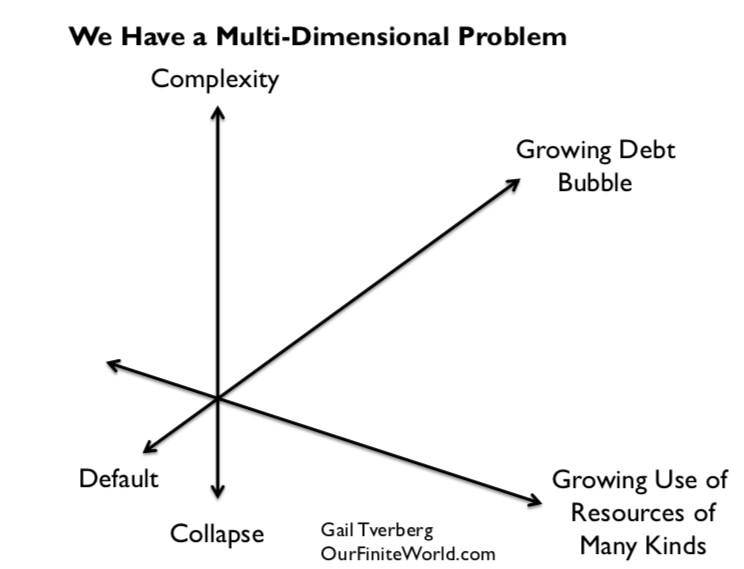
Figure 4.
Growing complexity is very closely related to “Technology will save us.” Growing complexity involves the use of more advanced machinery and ever-more specialized workers. Businesses become larger and more hierarchical. International trade becomes increasingly important. Financial products such as derivatives become common.
Growing debt goes hand in hand with growing complexity. Businesses need growing debt to support capital expenditures for their new technology. Consumers find growing debt helpful in affording major purchases, such as homes and vehicles. Governments make debt-like promises of pensions to citizen. Thanks to these promised pensions, families can have fewer children and devote fewer years to child care at home.
The problem with adding complexity and adding debt is that they, too, reach diminishing returns. The easiest (and cheapest) fixes tend to be added first. For example, irrigating a field in a dry area may be an easy and cheap way to fix a problem with inadequate food supply. There may be other approaches that could be used as well, such as breeding crops that do well with little rainfall, but the payback on this investment may be smaller and later.
A major drawback of adding complexity is that doing so tends to increase wage and wealth disparity. When an employer pays high wages to supervisory workers and highly skilled workers, this leaves fewer funds with which to pay less skilled workers. Furthermore, the huge amount of capital goods required in this more complex economy tends to disproportionately benefit workers who are already highly paid. This happens because the owners of shares of stock in companies tend to overlap with employees who are already highly paid. Low paid employees can’t afford such purchases.
The net result of greater wage and wealth disparity is that it becomes increasingly difficult to keep prices high enough for oil producers. The many workers with low wages find it difficult to afford homes and families of their own. Their low purchasing power tends to hold down prices of commodities of all kinds. The higher wages of the highly trained and supervisory staff don’t make up for the shortfall in commodity demand because these highly paid workers spend their wages differently. They tend to spend proportionately more on services rather than on commodity-intensive goods. For example, they may send their children to elite colleges and pay for tax avoidance services. These services use relatively little in the way of commodities.
Once the Economy Slows Too Much, the Whole System Tends to Implode
A growing economy can hide a multitude of problems. Paying back debt with interest is easy, if a worker finds his wages growing. In fact, it doesn’t matter if the growth that supports his growing wages comes from inflationary growth or “real” growth, since debt repayment is typically not adjusted for inflation.

Figure 5. Repaying loans is easy in a growing economy, but much more difficult in a shrinking economy.
Both real growth and inflationary growth help workers have enough funds left at the end of the period for other goods they need, despite repaying debt with interest.
Once the economy stops growing, the whole system tends to implode. Wage disparity becomes a huge problem. It becomes impossible to repay debt with interest. Young people find that their standards of living are lower than those of their parents. Investments do not appear to be worthwhile without government subsidies. Businesses find that economies of scale no longer work to their advantage. Pension promises become overwhelming, compared to the wages of young people.
The Real Situation with Oil Prices
The real situation with oil prices–and in fact with respect to commodity prices in general–is approximately like that shown in Figure 6.

Figure 6.
What tends to happen is that oil prices tend to fall farther and farther behind what producers require, if they are truly to make adequate reinvestment in new fields and also pay high taxes to their governments. This should not be too surprising because oil prices represent a compromise between what citizens can afford and what producers require.

Figure 7. Illustration indicating that the world has already reached a point where no oil price works for both oil suppliers and oil consumers.
In the years before diminishing returns became too much of a problem (back before 2005, for example), it was possible to find prices that were within an acceptable range for both sellers and buyers. As diminishing returns has become an increasing problem, the price that consumers can afford has tended to fall increasingly far below the price that producers require. This is why oil prices at first fall a little too low for producers, and eventually seem likely to fall far below what producers need to stay in business. The problem is that no price works for both producers and consumers.
Affordability Issues Affect All Commodity Prices, Not Just Oil
We are dealing with a situation in which a growing share of workers (and would be workers) find it difficult to afford a home and family, because of wage disparity issues. Some workers have been displaced from their jobs by robots or by globalization. Some spend many years in advanced schooling and are left with large amounts of debt, making it difficult to afford a home, a family, and other things that many in the older generation were able to take for granted. Many of today’s workers are in low-wage countries; they cannot afford very much of the output of the world economy.
At the same time, diminishing returns affect nearly all commodities, just as they affect oil. Mineral ores are affected by diminishing returns because the highest grade ores tend to be extracted first. Food production is also subject to diminishing returns because population keeps rising, but arable land does not. As a result, each year it is necessary to grow more food per arable acre, leading to a need for more complexity (more irrigation or more fertilizer, or better hybrid seed), often at higher cost.
When the problem of growing wage disparity is matched up with the problem of diminishing returns for the many different types of commodity production, the same problem occurs that occurs with oil. Prices of a wide range of commodities tend to fall below the cost of production–first by a little and, if the debt bubble pops, by a whole lot.
We hear people say, “Of course oil prices will rise. Oil is a necessity.” The thing that they don’t realize is that the problem affects a much bigger “package” of commodities than just oil prices. In fact, finished goods and services of all kinds made with these commodities are also affected, including new homes and vehicles. Thus, the pattern we see of low oil prices, relative to what is required for true profitability, is really an extremely widespread problem.
Interest Rate Policies Affect Affordability
Commodity prices bear surprisingly little relationship to the cost of production. Instead, they seem to depend more on interest rate policies of government agencies. If interest rates rise or fall, this tends to have a big impact on household budgets, because monthly auto payments and home payments depend on interest rates. For example, US interest rates spiked in 1981.

Figure 8. US short and long term interest rates. Graph by FRED.
This spike in interest rates led to a major cutback in energy consumption and in GDP growth.

Figure 9. World GDP Growth versus Energy Consumption Growth, based on data of 2018 BP Statistical Review of World Energy and GDP data in 2010$ amounts, from the World Bank.
Oil prices began to slide, with the higher interest rates.

Figure 10.
Figure 11 indicates that the popping of a debt bubble (mostly relating to US sub-prime housing) sent oil prices down in 2008. Once interest rates were lowered through the US adoption of Quantitative Easing (QE), oil prices rose again. They fell again, when the US discontinued QE.

Figure 11. Figure showing collapsing debt bubble at the time US oil prices peaked, and the use of Quantitative Easing (QE) to stimulate the economy, and thus bring prices back up again.
While these charts show oil prices, there is a tendency for a broad range of commodity prices to move more or less together. This happens because the commodity price issue seems to be driven to a significant extent by the affordability of finished goods and services, including homes, automobiles, and restaurant food.
If the collapse of a major debt bubble occurs again, the world seems likely to experience impacts somewhat similar to those in 2008, depending, of course, on the location(s) and size(s) of the debt bubble(s). A wide variety of commodity prices are likely to fall very low; asset prices may also be affected. This time, however, government organizations seem to have fewer tools for pulling the world economy out of a prolonged slump because interest rates are already very low. Thus, the issues are likely to look more like a widespread economic problem (including far too low commodity prices) than an oil problem.
Lack of Growth in Energy Consumption Per Capita Seems to Lead to Collapse Scenarios
When we look back, the good times from an economic viewpoint occurred when energy consumption per capita (top red parts on Figure 12) were rising rapidly.

Figure 12.
The bad times for the economy were the valleys in Figure 12. Separate labels for these valleys have been added in Figure 13. If energy consumption is not growing relative to the rising world population, collapse in at least a part of the world economy tends to occur.

Figure 13.
The laws of physics tell us that energy consumption is required for movement and for heat. These are the basic processes involved in GDP generation, and in electricity transmission. Thus, it is logical to believe that energy consumption is required for GDP growth. We can see in Figure 9 that growth in energy consumption tends to come before GDP growth, strongly suggesting that it is the cause of GDP growth. This further confirms what the laws of physics tell us.
The fact that partial collapses tend to occur when the growth in energy consumption per capita falls too low is further confirmation of the way the economics system really operates. The Panic of 1857 occurred when the asset price bubble enabled by the California Gold Rush collapsed. Home, farm, and commodity prices fell very low. The problems ultimately were finally resolved in the US Civil War (1861 to 1865).
Similarly, the Depression of the 1930s was preceded by a stock market crash in 1929. During the Great Depression, wage disparity was a major problem. Commodity prices fell very low, as did farm prices. The issues of the Depression were not fully resolved until World War II.
At this point, world growth in energy consumption per capita seems to be falling again. We are also starting to see evidence of some of the same problems associated with earlier collapses: growing wage disparity, growing debt bubbles, and increasingly war-like behavior by world leaders. We should be aware that today’s low oil prices, together with these other symptoms of economic distress, may be pointing to yet another collapse scenario on the horizon.
Oil’s Role in the Economy Is Different From What Many Have Assumed
We have heard for a long time that the world is running out of oil, and we need to find substitutes. The story should have been, “Affordability of all commodities is falling too low, because of diminishing returns and growing wage disparity. We need to find rapidly rising quantities of very, very cheap energy products. We need a cheap substitute for oil. We cannot afford to substitute high-cost energy products for low-cost energy products. High-cost energy products affect the economy too adversely.”
In fact, the whole “Peak Oil” story is not really right. Neither is the “Renewables will save us” story, especially if the renewables require subsidies and are not very scalable. Energy prices can never be expected to rise high enough for renewables to become economic.
The issues we should truly be concerned about are Collapse, as encountered by many economies previously. If Collapse occurs, it seems likely to cut off production of many commodities, including oil and much of the food supply, indirectly because of low prices.
Low oil prices and low prices of other commodities are signs that we truly should be concerned about. Too many people have missed this point. They have been taken in by the false models of economists and by the confusion of Peak Oilers. At this point, we should start considering the very real possibility that our next world problem is likely to be Collapse of at least a portion of the world economy.
Interesting times seem to be ahead.


Canada’s province of Alberta to cut crude production nearly 9% for next year
https://www.marketwatch.com/story/canadas-province-of-alberta-to-cut-crude-production-nearly-9-for-next-year-2018-12-02
IMF puts global debt at $180 trillion
https://www.vanguardngr.com/2018/12/imf-puts-global-debt-at-180trn-2/
Christine Lagarde “clutches pearls”
Some say that “she’s” a tranny
Ain’t no big thing but it’s always the deception that freaks me out..
No, she’s all woman, as well as being all orange.
A French fireman in front of burning cars, during the protests in Paris.
https://i.redd.it/90ep1a9oax121.jpg
I love the smell of burning cars in the morning…
Hmm the tax hikes were meant to reduce carbon emissions….
It struck me as ironic, and illustrative of how confused and confusing this era is, that at the same time Paris was paralysed by rioters protesting these eco-taxes, intended to ameliorate c c, London was paralysed by the ‘Extinction Rebellion’ protesters, demanding action on c c.
“…protest group Extinction Rebellion has launched a fourth day of action in London today by staging a demonstration in Parliament Square.
“The group, which brought the capital to a halt last Saturday, is protesting what it describes as a lack of action by the government on g w.
“We refuse to bequeath a dying planet to future generations by failing to act now,” the demonstrators posted on Twitter today.”
http://www.cityam.com/269639/climate-change-activists-extinction-rebellion-begin-fourth
It’s the Age of Unreason….
Macron tries to do what’s right
and cut global warming overnight
the mob decide that they prefer
to help the planet overheat
and when they’ve destroyed what’s there
they’ll burn fossil fuels to put it right
The savage violence in Paris was not a protest, it was an insurrection
https://www.thelocal.fr/20181202/analysis-the-savage-violence-in-paris-was-not-a-protest-it-was-insurrection
to perhaps paraphrase FE: entertainment!
“A pacifying dialogue may yet emerge. I fear, however, that the insurrectional thugs who laid waste to Paris on Saturday have no interest in dialogue. They simply want to vent their anger – and, yes, their hatred – on a “bourgeois”, successful Metropolitan France which has ignored them for decades.”
so the poor(er) people are rising up… no surprise!
this week must have been a wonderful time to be in Paris…
I’m sure love was in the air…
ah, yes…
I love Paris in the autumn…
tourists who were contemplating a visit should not delay, but right away make plans to go there…
if they don’t go this week, they might miss all the fun…
these uprisings don’t seem to last long…
eventually, the protesters run out of energy as they see that their efforts are futile…
though perhaps the new taxes will be rescinded…
alas, the protesters will soon find out that their economic misfortunes still remain…
and will these uprisings spread?
USA?
NZ?
who knows?
Like so so many they were sold a pup; you know elect me and I will change the world…ha ha bl**dy ha!
See you all on the way down!
https://www.nytimes.com/2018/11/30/business/tesla-factory-racism.html?smtyp=cur&smid=tw-nytimesbusiness
Lies, lies, and more lies.
Why is it whomever the media doesn’t like these days are suddenly accused of homophobia, sexual harassment and racism?
Purely a coincidence, yes?
I didn’t realize a California tech company harbored such dislike for women and minorities that they actually hired them.
“I didn’t realize a California tech company harbored such dislike for women and minorities that they actually hired them.”
to what, lower level positions?
these modern liberals who own giant CA tech companies surely intend to be “equal opportunity employers”…
but are they really?
these modern liberals also like their high incomes as much as modern conservatives do…
It’s not their fault if african americans in general don’t have the aptitudes to be good engineers. There are plenty of Asians and Arabs in Silicon Valley. Nice try trying to make it look like we’re back in the 1940s.
I’ve found that the people eager to stand up for minorities often come in very little contact with them and often think the ones the see at work and in the workplace represent the entire race. FE was lamenting how a blk guy felt left out of white cultural events–as if it were the white people’s fault to make him feel included and informed on white cultural events such as who is a popular white musician. In my experience, many blk people, often want to be around their own crowd and do not feel comfortable being a minority.
There are very few blk people who would like to go to a country music concert or would like to go into an Irish pub but can’t because they don’t feel invited.
the white guilt among liberals is ridiculous. You guys won’t do the voluntary poverty thing but push the narrative that all minorities are helpless victims of white cruelty to make themselves feel better about the fact that they enjoy a better standard of living than most people on the planet.
“The modern conservative is engaged in one of man’s oldest exercises in moral philosophy; that is, the search for a superior moral justification for selfishness.”
~ John Kenneth Galbraith
https://i.redd.it/uhjvpktt3y121.jpg
what if it’s truth, truth and more truth? Tesla seems like a boiler room operation to me
It’d be pretty stupid of them to do so, since they are at the mercy of government subsidies.
What the dip in US life expectancy is really about: inequality
https://www.vox.com/science-and-health/2018/1/9/16860994/life-expectancy-us-income-inequality
If you have either wealth, priveldge or power you’ve increased your odds of living well into your 80’s or even 90’s. George Bush was 94 when he died, Henry Kissinger is also in his 90’s, Queen Elizabeth is well into her 90’s, George Soros is well into his 80’s.
My impression was that even the wealthy are doing less well than the wealthy in say Japan or Europe, in terms of mortality. This analysis is only comparing rich and poor within the US. The US is doing miserably relative to other countries in terms of improving mortality rates.
All elite lifestyles are not beneficial to human health, some are very detrimental even to extraordinary individuals. The elites of society set the social tone which is much different today than it was in the fifties; however, even then the elites smoked on film and TV and set a tone. It seems to me that Turchin touched on this in his work.
Dennis L.
The Insect Apocalypse Is Here
What does it mean for the rest of life on Earth?
Sune Boye Riis was on a bike ride with his youngest son, enjoying the sun slanting over the fields and woodlands near their home north of Copenhagen, when it suddenly occurred to him that something about the experience was amiss. Specifically, something was missing.
It was summer. He was out in the country, moving fast. But strangely, he wasn’t eating any bugs.
https://www.nytimes.com/2018/11/27/magazine/insect-apocalypse.html
look like most insects are going with us on this planet forever
The number of Sophie the Giraffe toys sold in France in a single year is nine times the number of all the giraffes that still live in Africa.
omg
I’m skeptical
Me too!
Around where I live, a lot of people used to keep a cow or two and a flock of chickens. The cows for milk and to help plow the paddy fields, the hens for eggs and the cock as an alarm clock. These farm animals used to crap all over the place and the crap attracted insects like—for want of a better expression—like flies round a turd. Human waste was also decanted out of a septic tank and spread on the fields. I used to do this myself and I can still smell the pong. The insects and the plants alike loved all this free food source, and they were fruitful and multiplied accordingly.
Nowadays, with no free food from the local farmers, the eco-system has changed and there are less insects around. Industrialized farming with insecticides is obviously a big factor too. And quite a few country people hate moths and so they hang out bug zappers in summer, which devastate local moth populations as the moths are drawn to them like—let me think?, ah yes—like moths to a flame!
Less insects mean less birds, less pollination, less frogs, less mosquito bites, and an easier time for people who hate being bugged by bugs.
But less needn’t mean none. Insects are rather good at hanging on in nooks and crannies and then being fruitful and multiplying once conditions become favorable again.
ok but still
insects still are dieing where there is no intervention of humans
The study included data from the 1970s and from the early 2010s, when a tropical ecologist named Brad Lister returned to the rain forest where he had studied lizards — and, crucially, their prey — 40 years earlier. Lister set out sticky traps and swept nets across foliage in the same places he had in the 1970s, but this time he and his co-author, Andres Garcia, caught much, much less: 10 to 60 times less arthropod biomass than before. (It’s easy to read that number as 60 percent less, but it’s sixtyfold less: Where once he caught 473 milligrams of bugs, Lister was now catching just eight milligrams.) “It was, you know, devastating,
climate change ?
There is still massive numbers of insect here down under. Infact I killed some today.
Brutal!
But why did Brad Lister and Andres Garcia catch so much less arthropod biomass this time than before? Were the traps less sticky and the nets of a larger mess? Were the researchers doddering about more slowly these days and giving the the little buggers time to get away. Have the bugs evolved to avoid their attempts to catch them over the past 40 years? Could Brad and Andres be using a different aftershave that puts them off?
If not, could the decline be the result of some natural population cycle in which the forest gains insect population for several years or decades and then it crashes?
Or are the critters sensitive to cellphone radiation, acid rain, background levels of pesticides, micro plastics, or other pollutants that have wafted in, or to other changes in the ecosystem?
https://www.cnbc.com/2018/12/02/trump-hails-trade-deal-with-china-as-one-of-the-largest-ever-made.html
‘Trump hails trade deal with China as one of the largest ever made’
After meeting at the G-20 summit in Argentina, Trump and Chinese President Xi Jinping have agreed a temporary stop to their bilateral trade disagreement, striking a deal to hold off on any additional tariffs on each other’s goods after January 1.
“It’s an incredible deal. It goes down, certainly, if it happens, it goes down as one of the largest deals ever made,” Trump said while en route to Joint Base Andrews in Maryland.
Can someone talk me down here? Trump puts tariffs on China, then decides to hold off on any additional tariffs and China will not add on any more either, and that’s one of the largest trade deals ever made? For one the additional tariffs had never actually occurred, because they weren’t planned to go into effect until Jan. 1st, 2019.
This is like the guy who plans to put $85,000 into the restoration of a 60’s vette, but after his wife cries foul, he decides not to and says, “I just made the biggest financial agreement with my wife ever.”
“The very concept of objective truth
is fading out of the world.
Lies will pass into history.”
— George Orwell
I guess he lacked the STAMINA. If he had more STAMINA he would’ve stuck to his guns and countered CHINEE.
The Worst Internship Ever: Japan’s Labor Pains
Japan is facing a serious labor shortage, a problem that can be traced back to an aging population and a prevailing fear that immigrants will dilute the country’s pure gene pool. In order to keep the world’s third-largest economy afloat, the Japanese government offers an internship program that attracts foreign workers from China, Vietnam, and the Philippines. The program, which allows workers to stay for three years, is advertised as providing laborers with transferrable new skills for when they return home.
https://youtu.be/wt__lHCuH5g
funny thing is in this video even Japanese
government are using same slavery tactics like uae
We shall see if this is a negative.
Maybe constant growth is a negative.
I’ve been to Japan numerous times.
The point with the ageing populations is that you do not have enough means to support yourself. And trying to import workforce brings more negatives than positives. You usually can not pay them much and, furthemore, you have to provide them healthcare and pensions, that you need for yourself.
Robots add to the problem, because Japan still needs jobs for all of its people. It ends up adding make-work jobs to substitute for those lost by automation. Older people acting as traffic guards, for example. Extra people helping in banks.
The one issue with this article is you ignore energy efficiency. A 70 watt electric bulb previously took 70 watts of energy, now it takes 13 watts for the same light. Granted it doesn’t matter for my house but if an entire country does it the impact is huge. Ditto new washing machines, my used Bmw I 3 just replaced a 2000 sienna minivan. 125 mpge vs 19 on a good day. These changes even by a small group of the population will make a huge difference in demand.
Growing efficiency is a big part of what helps raise demand. More people can afford the product.
That’s Jevons paradox; the more efficient use of energy leads to greater energy usage.
It’s considered a paradox, because you’d think greater efficiency would lead to less energy used, but historically it’s led to the opposite.
LOL, someone else trying to throw shade on one of Gail’s articles get’s shade trhown their way.
Jevons paradox notwithstanding, growing energy efficiency is a good thing for the economy. More affordability is is good. And more energy consumption is good—although I admit it sounds sinful. These things are good because they keep the economy ticking over and postpone judgement day. But this doesn’t mean that improved efficiency will save the economy in the face of all the factors that are making things less affordable, particularly the rising cost of obtaining energy.
I replaced all my incandescent with LED’s a year ago. Many have already burned out. No better life expectancy than an incandescent and much more complex. The compact fluorescent are just as bad. Some of the LED’s barely lasted six months.
The activists from Greenpeace (https://spectator.sme.sk/c/20973269/greenpeace-activists-protest-coal-mining.html) remain in prison. They can get several years sentence of imprisonment.
https://slovensko.hnonline.sk/1852297-aktivisti-z-greenpeace-ostavaju-vo-vazbe-hrozi-im-niekolkorocne-vazenie
Put them in cell for just one winter, with a nice big fireplace on one wall to provide heating, and give them a nice jumbo-sized sack of coal and a supply of fire lighters, a sack of rice and a sack of potatoes they can boil on the fire or eat raw if they prefer, plus a stack of Gail’s articles and a copy of The End of More for entertainment. Then leave them alone until springtime to ponder their situation, and ours.
I am normally against the death penalty unless you are one day late on a student loan. I will now add those turkeys to my list and the people that put them up to it also.
Tim is soft on crime
It’s time for a hyper-crash, say multifractal analyses of the main stock market index
The near future of the global economy looks extremely bleak. This pessimistic forecast comes from advanced statistical analysis of the S&P 500 stock market index, recently published by scientists from the Institute of Nuclear Physics of the Polish Academy of Sciences in Cracow. Based on their analysis, the researchers explain why, in up to a dozen or so years, we can expect a financial meltdown such as never before
Black Monday, the bursting of the dot-com bubble, the bankruptcy of the Lehman Brothers. These events shook up the global economy. Soon, however, we may have to deal with such a gigantic collapse of financial markets that all previous crashes will appear as minor stumbling blocks in comparison.
https://www.eurekalert.org/pub_releases/2018-11/thni-itf112218.php
“Black Monday, the bursting of the dot-com bubble, the bankruptcy of the Lehman Brothers. These events shook up the global economy.”
TPTB learned a great deal from those events…
probably they learned enough to “save” BAU a few more times…
Charles Hugh Smith said as much, that there likely will be a few more “saves” along the way, before The Gigantic Collapse…
he also may or may not have said “BAU tonight, baby!”…
There are a lot of unknowns. If the next collapse affects access to energy and or food then rioting could become more widespread than even France. Once the mood shifts from complacency to riot I think it is hard to reverse that trend, it becomes contagious. When people lose everything and have nothing left to lose – they loose it – Gerald Celente.
Hi Gail,
With your experience on the insurance industry, maybe you can provide some information about the health of the industry. I tried to paste a graph taken from the Insurance Information Institute showing the evolution of the overall losses and insured losses since 1980, showing a substantial increase. Unfortunately I could not paste the graph, so I am providing the link below. The losses in 2017 were three times larger than the average of the period.
During the bail out of 2008, AIG was given first a $85 billion emergency loan and augmented with a $38 billion loan a couple of months afterwards.
The insurance companies provide long term loans, buy bonds from hundreds of companies and participate in swaps and other derivatives. Their losses might prevent them from borrowing, which might trigger the debt implosion you are so concerned.
https://www.iii.org/fact-statistic/facts-statistics-global-catastrophes
The Insurance Information Institute numbers that you have linked to are only slightly related to the health of the insurance industry.
The insurance industry writes a lot of different coverages. Certain types of events that can affect many different property lines of coverage are given a “Catastrophe code,” which all insurance companies are supposed to use. The information that you see on the III report have to do with events that were assigned Catastrophe Codes. They probably don’t make up more than a few percent of total insurance company claims (especially if you include life as well as property casualty, and include things like derivatives). Also, not all Catastrophe coverage ends up with the insurance industry. Some programs (such as federally insured flood coverage) would never appear on insurance company books. Some might appear on insurance company books, but then are “re-insured” elsewhere, around the world, with companies specializing in reinsurance, or through the use of “catastrophe bonds,” (which again, are not part of the insurance market place.)
The big reason why insured values tend to go up over time is that there tends to be a lot of building along coast lines, where hurricanes tend to damage building.
How companies are doing financially depends on a lot of things. Different lines of coverage are fairly different. How much premium is collected, compared to claims, is important. Investment income is also important. Companies who wrote long term care coverage got themselves into a lot of difficulty. Companies that provide pension type coverage are likely to get themselves into trouble. AIG was in a category by itself, writing derivatives, but there no doubt is some of this still going on. It is possible to get into difficult very quickly.
So it really depends. Generally, companies are well aware of their “catastrophe exposure,” and try to limit their risk through a combination of mechanisms. Reinsurance is one. Another is having a separate company to write insurance in for a particular location (say Florida, or California, or Puerto Rico). If the size of a particular event leads to too many claims, the insurer can let the separate company go bankrupt (say, California splits in two, and part lands in the Pacific Ocean), rather than take the whole insurer down.
University of California Study: (Malyshkina 2010)
1. It Will Take 131 Years to Replace Oil with Alternatives
2. World oil production will peak between 2010-2030
3. World proven oil reserves will be gone by 2041
https://www.scribd.com/document/394656677/Future-Sustainability-Forecasting-by-Exchange-Markets-Basic-Theory-and-an-Application-Malyshkina-2010
https://www.godlikeproductions.com/sm/52d222e9.gif
We are bumping up against it now. You can almost feel the desperation. Enjoy yourselves while you can.
in France, the desperation is quite visible…
“if a nation cannot produce sufficient energy from within its own borders, it must beg buy borrow or steal it from elsewhere, or sink back to a median level of existence”
France has just reached the point of running out of options.
They just don’t know it yet
” It Will Take 131 Years to Replace Oil with Alternatives” – Not if that alternative is a hunter-gatherer lifestyle. The “alternative” might be much closer than you think.
Except that very few of us could handle a hunter-gatherer lifestyle .
dead hunters don’t gather much
More than 75% of dedicated US shale oil companies are unprofitable
https://www.rystadenergy.com/newsevents/news/press-releases/Shale-companies-ready-to-show-they-can-grow-within-cash-flow/
Shale Patch Expected to Cut Budgets for First Time Since Last Crash
https://www.bloomberg.com/news/articles/2018-11-29/shale-patch-seen-cutting-budgets-for-first-time-since-last-crash?fbclid=IwAR1iZ7HFDhXO7Qx5GIcRHovsfTiQ7dH3rrtXJEJ5NCwwadNrt2oiwAnz3FM
unprofitable is okay… as long as they keep producing…
FF production is very much TBTF…
any and all government interventions must be used to keep the energy flow going…
helicopter money, tax breaks/cuts, bailouts, zirp, debt forgiveness, bankruptcy/reorganization, nationalization…
whatever it takes…
lack of profits should not be allowed to stop the energy flow…
It seems that coal was the least complex method of obtaining energy. Just dig it up, transport it by truck or rail to the coal burning power plant, and turn it into electricity, although maybe not on an efficient basis and the resultant pollution is a problem- as long as there was a convenient alternative.
Along comes oil, energy dense, easy to drill for and distribute and great for a dispersed system /suburban sprawl.
The question is, despite all the talk I hear about coal mines being shut down etc, is the creeping cost of finding, drilling and refining crude going to drive us back to more coal usage and a more urban and centralized living to keep the energy umbilical cord as short as possible through electric power lines?
In other words, at some point, the pollution and the less energy dense coal may be better than the oil based system we have, but we just can’t accept that- yet?
In the same way, I wonder if nuclear will make a comeback, as it incorporates the electrical grid, which although sadly in need of repair, will still be easier to maintain, from an energy cost perspective, than all the roads?
I also make the assumption that PV, wind etc will fall woefully short of making up the difference.
Some countries, like the Philippines, are having to come to grips with this by lowering their oil pollution standards. Will increased coal usage be next? It’s easy to wave your Greenpeace banner and hug every tree in sight, but when it really starts getting down to crunch time, they won’t give a damn about all that if they are sweltering in the heat without their AC or shivering in their homes during the winter without natural gas or home heating fuel oil.
OT, but it reminds of how women say they are going to have a natural childbirth and attend all the Lamaze classes but when it gets down to crunch time, they are begging for that epidural.
We need a source of energy that is cheap and not too complex. If all else fails, people will use an ax to cut down trees near where they live. Coal is more energy dense than wood.
Coal can also provide a lot of jobs for workers. This is part of what keeps the system going.
“Coal can also provide a lot of jobs for workers. This is part of what keeps the system going.”
The goes for the car industry and people quickly forget what the network and support systems the car industry has created. You have dealerships, quick lube oil change franchises, body repair shops, mechanical repairs, tires, auto parts, auto accessories, car wax, car soaps etc. Then let’s not forget banks making interest on the money you owe for that vehicle purchase.
Now for a moment lets eliminate gas powered vehicles and replace them with all electric driveless vehicles. Nice greenie thoughts on saving the planet, right? Now look at the tens of millions of jobs you just eliminated. A complex networked system is difficult if not impossible to replace once it’s established. Just look at Obamacare and all the Republican politicians who loathed Obama’s healthcare mandate. They championed the cause to eliminate it and when they had their chance those same Republicans chose not to eliminate it. Once a complex system is put in place it’s difficult if not impossible to go backwards.
Lesson for those greenies out there who think we can unravel industrial civilization and go back to Little House On The Prairie.
It will unravel– its just a question if you are going to have any influence on how it does.
Doing nothing, and the probable chaos might be a option, if you don’t want to think about it.
7.6 billion humans in a collapsing ecosystem is not going to fun.
The car industry is a good one. Easy to measure.
I wonder if there’s a point where cars cost too much in terms of the road upkeep and repair they entail. There are lots of costs accruing from inability to walk. And I think it’s overlooked how many jobs there are in building for walkability. I understand that, in recent decades, cars have been built so well that they simply won’t quit. If repairs weren’t getting to be such a racket, new industries for micro repairs could maintain cars affordably, maintain the jobs you have now. The problem I see is where to grow, and it seems that is in mitigation of the built environment to accommodate a lot of mixed uses and pedestrian traffic. And back of it all there must be coal. Getting coal back requires better ways of managing the emissions, and a massive global campaign to improve comprehension of how much land planning and design matters as a way to manage coal better.
Manage coal better? In the UK, all those luxury basements equipped with snooker tables and swimming pools are going to have to be turned back into coal cellars.
Make London Foggy Again!
yup
london coal hole covers are an artform in themselves
and dont forget they needed an army of skivvies to haul the coal upstairs in buckets to put on fires one lump at a time
I had in mind something more centralized and more like how we get electricity now. Nowhere near to how its centralized now, which is too complex. In my area of NM the coal was mined within 100 miles of Los Alamos and sent there in trucks. (So I guess our coal was behind the atom bomb.) Then come the oil takeover in the 50’s, the trains that coal used to run start running on diesel. The coal mine then closes, sells off whatever it could, loses all traces or records of the production process, and welcomes a brand new day. It’s stew p d t like this that I’m talking about.
But the coal is still underground. It powered the lights in my and other towns. Los Alamos probably had a big central processing center to make electricity (from the coal) that ran through power lines. I still haven’t heard anyone say you couldn’t run the exhaust conduits from the processing plants through long conduits covered with carbon consuming vegetation….making coal generation more acceptable to modern people with expectations for clean air.
I think how roads function depends a lot on location. In Norway, roads need to go through tunnels to get anywhere. This makes for an incredibly expensive road system. No wonder taxes are very high on gasoline. Electric cars also need these high-cost roads. If there is a lot of practically vacant, flat land, it has historically been not very expensive to build roads. Roads can’t really be built with electricity; they need fossil fuels. Asphalt roads have been built if oil is cheap. If oil is expensive or not very available, concrete roads are built. The fuel to make the concrete varies. In China, it is clearly coal. Other places use a mixture of relatively cheap things to burn, including used tires from cars.
in the collective wisdom of humankind, we, in the developed world that is, have built triangles, with homes, food supplies and workplaces at each point of the triangle—with the odd idea that we can travel continually between those points for no better reason nthat it we get a more pleasant lifestyle by doing so.
doesn’t really work though
I tend to think that, in theory, clean coal is doable. catalytic gasification could raise efficiency numbers substantially higher, but I guess it’s too disruptive normal operations in comparison to the burn&scrub setup in use today.
I’m gathering that we need to use the same infrastructure we now have, so keeping production simple would seem advisable. We tend to look to technology to solve too many problems, thereby abetting complexity and cost. We do very very little by way of planning, or of influencing behavior. Coal is what gives us the energy to make a simplified system work. It’s not an excuse to keep adding complexity that is beyond the means of coal to service. The trick is to produce the coal and make it acceptable for widespread use.
Rural Americans Are Now The Largest Slice Of Federal Food Aid Recipients
http://www.iowapublicradio.org/post/rural-americans-are-now-largest-slice-federal-food-aid-recipients#stream/0
Coal is still king in global power production
https://phys.org/news/2018-11-coal-king-global-power-production.html
Hurray!
But techno-optimist messageboard guy said solar would kill coal !
With the subsidies solar is giving, it will kill off everything else. But it won’t provide an adequate substitute. This is a huge problem.
today is celebrated day for the world except bush family
https://www.theguardian.com/us-news/2018/dec/01/george-hw-bush-former-us-president-dies-aged-94
Reblogged this on Por mis finanzas.
Well, I live in Alaska and so just got a chance to test my preps in a real grid down situation. Once we rescued our kid from the chaos of the school system, we sailed through, just ahead of several road blocks. Made it home to a house that was messed up but intact. But also learned some valuable lessons. One of which is you’ve got to have good neighbors or no neighbors. We have a few neighbors and they are good at being self sustaining. That will be a source of strength when things go bad. Get to know your neighbors.
did you have an earthquake?
Hmmmm. Maybe a good time to move to Alaska, now that it has been “decompressed” by this most recent earthquake, and even David DuByne of Adapt 2030 claims that during the Maunder and Dalton Minimums, Alaska actually got warmer.
I had fond memories of my trip to Alaska. Still remember the train that sits in the park in Anchorage. Kenai Penninsula, the bears, snagging salmon on the river, train ride from Anchorage to Fairbanks. Small plane flight around McKinley on an unusually clear day, and for even more incredible luck, on return flight by commercial airline, flew over the top -again on a perfectly clear day.
But agree that issue of climate change will be “self solving” with migration or demise of those who can not survive and adapt in a new low energy resource depleted situation.
In fact, it may be a better idea to start buying and storing things like Mukluks, Balaclavas, Merino wool clothes, and even wood stoves rather than watch my currency melt away through inflation.
In fact, I have read about government regulations/ restrictions against the use of wood stoves, going off-grid, collecting rainwater etc.
“In fact, I have read about government regulations/restrictions…”
don’t you think that “laws” will become less and less enforceable as energy depletes?
Yes, the utility companies need people to stay on the grid to stay in business. My relatives in Sweden were recently forced to connect their lakeside cabin to the public water/sewage system at a large cost.
The problem of the ageing populations is the falling number of users of the energy grids, so they maintenance and repair becomes uneconomical.
Most of the costs of utilities are fixed. Having a large share go off grid makes the system not work for the rest.
I updated my Peak oil reference list!
More sources than you can possibly imagine..
57 MSM articles, 23 Science papers, 7 Government reports.
https://imgur.com/a/qIPDgxu
Now all we need is a peak coal reference list. This seems to be at least as large a share of the problem.
Gail,
Projection of World Fossil Fuels by Country (Mohr, 2015) Fuel
Over 900 different regions and subfuel situations were modeled using three URR scenarios of Low, High, and Best Guess. All three scenarios indicate that the consistent strong growth in world fossil fuel ie coal, oil, gas production is likely to cease after 2025.
The Low and Best Guess scenarios are projected to peak before 2025 and decline thereafter. The High scenario is anticipated to have a strong growth to 2025 before stagnating in production for 50 years and thereafter declining.
https://www.scribd.com/document/375110317/Projection-of-World-Fossil-Fuels-by-Country-Mohr-2015
Bitcoin has lost 2k in 1 month. Also from 10/18/18 the bitcoin difficulty went down for the first time in history. Meaning that some people have shut down their energy hungry miners.
No more air to blow The Bubble ? We need to consume more energy, not less, no?
The game may be over–We shall see.
I check it daily.
Bitcoin $4135
so it’s up since the Black Friday sale price…
could some miners really be using $4000 in electricity to mine one coin?
well—in Dec 17 I wrote that bitcoin would crash in less than a year:
https://extranewsfeed.com/bitcoin-24b3efd58ec
You were dead right on that prediction, Norman. Although most of us here assumed bitcoin would crash like the tulip bulb bubble did. The only thing that surprises me is how bitcoin managed to boom in the first place. It seems that the world is running largely on pure hype these days. It should have its own place in the energy pie chart.
Pingback: Is the Real Threat Lower Oil Prices? – Tudor Place
Total Eclipse of the Heart
https://imgur.com/a/xDm5dBr
Gail, you’ve pointed out numerous times that our modern economies are networked systems, and one example here must surely be our modern suburbs and urbanisation – totally dependent on remote food production and fossil fuel inputs.
At the same time we are headed into climate change scenarios that are capable of pretty much ending all life on earth within a century.
Add to this a still growing population and completely unrepayable debt. Peak oil and peak everything is only about 12 years away, and we very likely don’t have 12 years to fix the climate – it’s already gone.
Our political solutions to all of this are grounded in magical thinking and populism that will just accelerate the decline. Nor will downscaling work….it’s a bit like eating the same amount of food you did as a two year old – and anyway, it’s only a possibility for the 1%.
So are we headed for a crash, or some sort of soft landing where we navigate a 4 to 5 degree hotter world with punishing droughts, no more oil, and millions of machines extracting co2 from the atmosphere, paid for by taxpayers who have no jobs? Not to mention how we manage the shutdown of thousands of nuclear power stations now abandoned due to climate change shifts in the distribution of the population.
It seems blindingly obvious. We crash.
We do crash. Of course, the climate models are all built on a continuation of BAU, so they are not really right. We won’t know what will happen after the crash, climate wise, and there will be very few of our children here to experience the changing climate. Pre-humans lived through several ice ages. I am not sure that climate change is as big an issue as everyone expects it to be. If humans don’t have businesses to protect, they just pick up and move to parts of the earth with a more advantageous climates. This happened before, and can happen again.
Gail—-
We are already in climate territory that no homo sapiens have ever encountered.
We shall see if humans survive– this is not some future event– it is now.
7.6 billion are defiantly not going to survive. We just about went extinct 70,000 years ago.
This is more serious conditions.
Indeed we have. But there are some fascinating differences this time around. The nuclear waste scenario is one of them as we abandon currently inhabited areas. The world most likely could not withstand multiple Chernobyls.
In a 4 degree world our current climate models anticipate that the only inhabitable areas will lie well within the arctic circle
I didn’t use to be concerned as much about nuclear power plants, figuring they’d be shut down systematically etc., however, even after being shut down those plants need ongoing attention to keep the fuel rods in circulating cool water. If we did indeed have widespread collapse with people running around starving, trying to get enough to eat, it seems likely many power plants would go unattended and would go into different degrees of meltdown. So some collapse could happen and we’d be ok, but if its a fairly quick global collapse, I’m thinking all hell will break loose at certain nuclear power plants and then that pretty much takes away our chances of survival as a species and most other species as well. It’s like we painted ourselves into a corner from which it’s not easy to back out.
This is why we should never staff nuclear power plants with hysterical libtards but instead rely on dedicated, responsible, well-trained, sober-headed, stiff-upper-lipped, tried-and-true, absolutely reliable, can-do engineers who know what they are doing and won’t panic at the first sign of a geiger counter going snap, crackle ‘n’ pop.
And a millenia from today, several strict laws have emerged,
– Avoid the seas, they are toxic. Swimming in the seas, or eating what remains from the seas, means slow poisoning
– When it is raining, do not go outside
– The only water pure enough for drinking and irrigation, comes from wells
– When living above ground, live within densly forested areas, preferably
– When women are pregnant they shouldnt go above ground at all
– Many tunnels remain through mountains, young breeding aged males and females should stay within those underground compounds as much as possible, before having their first children themselves
– Only eat wild game if it dosent migrate from the forbidden lands
– Never, ever, venture to the forbidden lands. If you do. You can not go back home.
I’ve been assured that breeding aged males and females are merely social constructs, and that anyone who says different is likely to be kicked off of Twitter. BUT I digress…
Granted, nuclear power could be “a bargain with the Devil” or at least terribly irresponsible given its potential ecological consequences. On the other hand, if done carefully, safely, and efficiently, it could save our collective bacon. There’s a lot of uranium and thorium in the rocks and there’s both of these plus a lot of tritium in the oceans.
Since most of us like comfortable living with lots of powered machinery and other devices to help take the drudgery out of life and to keep the economy, the agriculture system, the transport system, the supermarkets, the schools, hospitals, kidney machines, etc., humming along, if given the choice, we might opt for nuclear regardless of any fears we might have that it is a bargain with the Devil. Remember, those of us in the West, with the exception of the Greeks, haven’t experienced Third World levels of austerity, poverty and instability yet. We still imagine that we have the luxury of choice in energy matters.
Germany has decided to be an admirably Green nuclear-free nation, which is very commendable, based largely on the understanding that it can import cheap nuclear-derived electricity from France. But now I hear that the French government is pondering a phase out of half of its nuclear generating capacity. And what will the Germans do then, poor things?
I suspect that in the decades to come, some countries will be gung ho for nuclear and other will go nuclear-free, and that the ones that go nuclear-free will tend to go down the drain faster, until the point where nuclear becomes synonymous with relative affluence and stability and non-nuclear becomes synonymous with failed state.
On the other hand, tomorrow or on December 18 or sometime not long after, the lamps could go out in Europe and elsewhere and we may not see them lit again in our lifetimes, allowing the hordes to form and march and come over the horizon to rape and pillage us to distraction and share our toothbrushes and fancy French Cologne—in which case, death by radiation poisoning from the exploding spent fuel ponds may come as a relief and we may find ourselves doubly disappointed if it doesn’t happen and we have to wait for one of the conventional horsemen to do us in.
FORESTS: If you’re in a northern country with heavy forests and been well educated in their issues, they might serve in some way in a crisis. But most people in the world would have no clue what to do in them. As to eating wild animals, there are very few left, and those are dwindling fast. And since most people live in cities, foresting them densely might be a better alternative to moving to forests. 😉
Haven’t thought much about nuclear energy. Maybe it’s the next best thing to coal, though. You’d need a lot of coal nearby to service them in emergencies. I also contend that disposing of the waste in one big site is less preferable to burying small amounts of them a mile deep in millions of places around the world that use the energy.
i don’t think any model of civilised existence in the sense that we know it would be possible with 6 months of darkness
demand for light and heat would preclude that—and there are not enough energy-bearing animals to sustain humankind
watch those arctic living programmes on tv—many sq miles to support 1 person—and even then they use skidoos and chainsaws and planes to fly in fuel—that is arctic reality i’m afraid
fascinating stuff but complete fantasyland
except that 20k years ago the world was full of energy-resource animals, and what few people there were, didnt know what was happeneing to them, and it happened over 000s of years—any movement was slow and gradual
now the world is full of people who do know what is happening to them—and its likely to happen in less than 100 years
there’s your difference
May I suggest you google for Professor Valentia Zharkova? New data is always coming in, and I’d suggest you view the October 2018 youtube video.
Guardian article disagreeing:
https://www.theguardian.com/environment/climate-consensus-97-per-cent/2018/jan/09/the-imminent-mini-ice-age-myth-is-back-and-its-still-wrong
The Guardian – not my favourite news paper – from one of their referenced materials – quote :
“I hope global warning will be overridden by this effect, giving humankind and the Earth 30 years to sort out our pollution,” she said.
unquote
Never let the science get in the way of a good story, or a sensational headline.
The real problem here is that the increase in temperature since 1700 is coincident with both an increase in total solar irradiance (TSI) and to a greater or lesser extent, an increase in CO2 and other pollutants.
As the Professor says, we will know the real effect within 5-10 years.
I’ll put my head above the parapet here, and suggest a drop over ten years to the 14C baseline temperature.
MY FINAL GUESS FOR THE ALLEDGED PLANNED COLLAPSE TO BRING IN PLAN B
18th DECEMBER 2018
thanks for making this final…
on Wednesday 12/19, I will be reminding you…
but, first…
is this an honest promise?
or, do you secretly have your fingers crossed? (since, in my part of the world, that cancels the promise)…
YES, no more predictions after this one , I promise
That is a Tuesday so NO FE is on route in his new Tesla
Burn more coal now!
apparently fast eddie retreated to his bunker or is in mehico
100mph into a concrete embankment if I remember correctly
yes, I really think he is in the caravan at the Tijuana border crossing…
he should be careful about getting the HIV or TB that is being carried by some of them…
Is Fast Eddy on Holiday somewhere with no access to the internet?
the Bucket List must always be obeyed…
I thought he wrote of South America or Mexico as his destination…
I’m not stopping others from looking back and finding his comments about travel plans…
Maybe he is going for the fast eddy challenge…
Gail, from figure 9 do you see a rough average time preiod in your data of the lag between the red line and the blue line? Just to have a guess…
This is a very good article! Thank you.
I think that it is about two or three lines between the red line and the blue line in Figure 9.
The fact that energy growth is so low compared to GDP growth recently concerns me. I suspect that quite a bit of the “goods and services” created are things that no one can reasonably afford to buy. They likely are being counted as GDP based on the cost of creating them, plus a reasonable profit.
Tesla drunk driver falls asleep with auto pilot on!
https://miami.cbslocal.com/2018/11/30/tesla-driver-dui/
We have a law that covers that It is called care and control My brother puts his key in the mail box when he goes out to smoke in the car in the winter…Summer is the front step
“I think traditional economics is mostly a waste of time.” – I agree. We are out of the bounds where economic theory works. It worked when energy was cheap; becomes unstable when energy is costly to extract. It is like a differential equation where the boundary conditions have changed.
Gail, sometimes I see your website does not provide a “leave a reply.” Does that occur on a soon to be an old post just before a new post?
The oil price headlines see to go up and down like a dippy bird caught between too high for consumers and too low for producers. I would expect price swings to be a little more muted absent any catastrophic events of course.
https://www.youtube.com/watch?v=cTkx3cdO5rM
How much of these price swings can be attributed to day traders trying to manipulate the price to make money off the volatility/price action as opposed to the longer term trends of resource depletion, increasing debt, or overall consumption?
Is there a volatility index specifically for oil prices, and if so is there any insight that can be gained from it?
Is there a sort of volatility index for total debt which can be used to correlate with economic activity/GDP? The reason I ask this is because as debt pushes higher and higher, I would think any small increases in interest rates or principal would have increasingly more profound effects on the economy and interest rates themselves. I know this is a pretty obtuse question, but from what I can gather, it seems that traditional economics no longer applies, especially in the energy markets—- at least for now.
BTW, your blog was cited in ZH yesterday.
My website limits the “depth” of responses to 5, so as to keep the responses readable (not too narrow to make any sense for reading). This is especially an issue for people trying to read comments on a cell phone. If you want to respond to a comment that my site will not let you leave a response to, you can start over with an entirely new thread, explaining some of the situation. Or sometimes it makes sense to leave your comment in response to a different comment, a bit “higher up” in the thread.
I think we are now at a point, where no price works. In fact, that has been the case for quite a while. In many cases, prices can be both too high for consumers and too low for producers. My expectation is that “too low for producers” will ultimately collapse the system.
I have not been looking into volatility indexes. When it comes to debt, I am not even sure that we have a very good idea regarding what the total amount is. There are all kinds of guarantees that are very closely related to debt, but that are not actual debt. I consider the sale of shares of stock as being similar to debt in many regards. Leases have a lot of similarity to debt. Government guarantees of bank accounts are similar to debt. Government programs such as Social Security and Medicare have a lot of similarities to debt.
I think traditional economics is mostly a waste of time.
I think the Modern Monetary Theory (MMT) will have its golden age and the governments will try to “print” money while keeping inflation down. Thus the governments can keep up unprofitable extraction for some more time. It would be great if we could use this time for some preparations. If we did the pessimistic peak-energy theory would become official. That is not very likely. So we need another narrative. Maybe we can start to get interested into ancient technology to valuate the glory of our past? Gardening as a chic way to relax? On the other hand in those areas where the linear downturn has already arrived, like in eastern europe or afrika, people would love to have alternatives of self-sufficiency. At the moment they just migrate or suffer.
The problem in Africa is too many people, relative to jobs.
I know when I visited India, for a conference allegedly about sustainability, all the Indian speakers wanted to talk about was substituting fossil fuels for the animal dung and biomass that currently was being burned for cooking, in some places. They were also interested in more reliable electricity. The electricity was on and off quite a few times while I was at the conference in Mumbai. When I visited a village outside of Mumbai, the people didn’t have refrigerators because the electricity was off such a large share of the time.
No refrigerators? The most important home electricity need in my opinion is the frig. Food is perishable and expensive. As soon as power goes out pull a bag of ice out of the freezer and stick it in the frig. Buys some time, but ultimately you need that E. We recently tried to put in a Cummins RS20A, a 20KW back up generator. It was paid for and in transit when we found out the county will only allow 45db at night and 55db in the day, but the Cummins was 65db at 7m (meters distance), so we called the provider and cancelled the shipment, but then got a call from FedEx Freight two days later asking if we’d be in to receive the shipment! Finally we could cancel it with FedEx but that’s business today. You think you’ve cancelled something only to find out the company ignored your request in their own best interest to get it delivered and keep the money. There’s no moral backbone to business anymore.
If the electricity is on only intermittently during the week, there is no point in having a refrigerator. What we saw was a home with a television, and two or maybe three bare light bulbs for light. They probably charged a phone with electricity too. They didn’t have running water or a toilet (or outhouse). They may have shared some central toilet. Women carried water on the top of their heads from the central place where they could get water at a certain time of the day.
https://gailtheactuary.files.wordpress.com/2016/11/woman-carrying-two-pots-of-water-on-her-head.jpg
More than 40 percent of world coal plants are unprofitable: report
https://www.reuters.com/article/us-climatechange-coal/more-than-40-percent-of-world-coal-plants-are-unprofitable-report-idUSKCN1NZ00B
I wonder what percentage of solar panel makers are unprofitable, given that China has cut way back on buying for itself.
From all I have read over the years, I would say that without subsidies solar, wind and EV’s are all unprofitable. Heck even oil is unprofitable in most cases now. And look how energy dense that is. The tepid power production of wind and solar is nothing compared to the energy in fossil fuels.
so…
even if it’s unprofitable…
we should hope that our leadership would do whatever is necessary to continue and/or boost FF production…
subsidies, tax breaks, zirp loans, debt forgiveness, bankruptcy and new ownership, nationalization…
whatever it takes…
I am assuming that the folks in charge are thinking about energy not primarily in terms of its cost of production or its EROI but in terms of what it can do for the overall economy.
If a barrel of oil costing say US$50 to produce can be used to power economic activity worth US$1,000 to the economy, then it might make sense to the controllers to subsidize its production to the tune of even 100%.
I haven’t researched this idea in detail, but it seems reasonable in view of all the myriad things that are subsidized that produce nothing that anyone particularly wants to buy (even if they could afford to buy it) but are justified in the name of providing employment or supporting this or that “worthwhile” activity.
In practice, all these subsidies come at the cost of increasing debt, which is mushrooming, a can we have to keep trying to kick down the road, a ticking time bomb, a sword of Damocles hanging over our collective heads…..
From my perspective, we are like Evel Knievel attempting a stunt too far. I have a premonition that we’ll never make it, but I shall enjoy watching us try.
https://youtu.be/-toCdPlXd6I
“If a barrel of oil costing say US$50 to produce can be used to power economic activity worth US$1,000 to the economy, then it might make sense to the controllers to subsidize its production to the tune of even 100%.”
yes, it makes perfect sense… to me, ergo it should make perfect sense to The Controllers…
off the top of my (fuzzy) head, let’s say a landscaper/mower/lawn guy uses one $3 gallon of gas/diesel to get to a few houses in a neighborhood and do his work for a total charge of $300…
that’s the kind of economic activity that would be lost without FF…
IC is about half way across that canyon where the rocket is getting quite wobbly…
As someone who has followed Gail’s work for years now, and is currently an actor in enhancing community resilience – I find myself continually confronted with just how screwed we are (regardless of my work). What do you (Gail & commenting friends) do with these feelings?
Strangely, I am not very upset/worried about these feelings.
For one thing, I keep asking myself, “How did it ever come to happen that I am able to see all of these things, which other people cannot see?” I have always been a “big picture” thinker, but the current situation is clearly strange. I never set out to do what I am doing, yet all of the pieces for writing the story I am now seeing seem to have just fallen into place. I was in a financial position to be able to retire early, to look into some of these things. I had a lot of experiences in the insurance industry that gave me a background most others didn’t have. I didn’t (and still don’t) have grandchildren, so I didn’t have the distraction most women my age have. Many other things fell into place, including the huge number of people I have met over the years, and my experience at The Oil Drum. The Internet has been a great boon to sharing thoughts, and people asking me little questions that get me thinking about bigger questions.
I was raised in a religious setting. My father was born in Madagascar, the son of Lutheran missionaries there. I graduated from a Lutheran college (St. Olaf). I have numerous cousins who are pastors. I have a sister (Lois Tverberg) who writes religious books. Somehow, it appears to me that there must be a guiding hand behind all of the things that are happening. The world economy did not grow by chance. In fact, it took a lot of coincidences for the Earth to have advanced life forms on it. Read the book “Rare Earth: Why Complex Life Is Uncommon in the Universe.”
It seems to me that there must be a guiding hand behind all of this self-organization and growth. This guiding hand might be called God. I don’t know what else is planned, but I don’t think it is just random chance. I don’t know what this God has in store for any of us – quite likely not much more than what we have experienced to date – but I am willing to trust that things will work out in some way. Worrying about it does no good whatsoever. We may all die simultaneously in a nuclear bomb (or not). I think of Psalm 23.
Perhaps it helps that I am now older. I have many friends who are widows at this point. (Women marry older men, and men tend to have shorter life expectancies.) I can see that I don’t have a huge number of years ahead of me, regardless of what happens. My health seems to be great, however, so if everything goes well, I can expect to live another 20+ years.
I just make the best of every day that I have available to me. That is all that I can do.
+++++++
+1
Sounds pretty similar to Guy McPherson. I guess he is a little more “doomish”, but that’s splitting hairs.
https://guymcpherson.com/
The radio show is pretty good. Love you life now! Love yourself. Love everything.
Have you no decency, sir? Ranking Gail alongside Guy marks a new low for the comments section. To posit any likeness in their overall positions is to be guilty of monstrous mischaracterization. Some gentle readers are going to throw up their hands in despair at reading it. Others, with weaker stomachs, are simply going to throw up.
Fair enuf, and I’m sorry if it was an insult. But it is true that both suggest to live the life you have now!!
You and I have been in the blogosphere long enough to have heard the rumors and accusations regarding Guy. Also, I think commenters have been upset about the kinds of discussions that sometimes have been prevalent in the comments threads to his posts.
I have met Guy in person a couple of times. He comes across as quite personable. If a person has only been exposed to him on a limited basis, this is the side that likely comes to readers. Don’t be too hard on less-experienced commenters.
What’s your deal with guy? I know he predicts or at least predicted rapid climate disaster by 2020s, wiping out humanity
My personal list of complaints about G McP—if I chose to enumerate them, which I don’t—would be quite extensive. But regarding his serial predictions of near-term human extinction, here is a 2017 video in which Guy tells us seriously and confidently:
“At this point, I would say for almost all humans on earth, almost all of the 7.5 billion human beings on earth, have somewhere in the neighborhood of weeks or months remaining, Years? Decades? Forget about it.”
https://youtu.be/VTy-nZmNkuQ
Even if they were correct, such predictions would have about the same moral standing as shouting “Fire!” in a crowded theater with all the doors locked, as their end result is merely to increase the sense of fear, panic and insecurity among those who are already neurotic or anxious. When they are manifestly incorrect, as the passing of time has shown this one to have been, they have the same result among those vulnerable to their message, and they also have the natural result of attracting the derision and ridicule of normal, reasonable, emotionally healthy, well-adjusted people.
On many levels there is a huge gulf between what Gail does and what Guy does. Gail is attempting to analyze and sketch how the economy actually works, and particularly with regard to role of energy in driving and maintaining economic activity. She is very cautions about making predictions or proclamations and she is careful to not suggest that SHE KNOWS THE FUTURE.
By contrast, Guy appears to be trying to scare people by making stark predictions of imminent and inevitable doom in the hope of catching attention and gaining followers, or that’s the impression I get from what I’ve seen and read of him in his own words, which puts him firmly in the doomsday cult leader category in my opinion.
Also his death by green house gases ideas are pure gobbledegook with dash of sciency-sounding terminology thrown in. Even the alarmist community—another cult—have ostracized him, very probably for damaging the team’s already fraying credibility and stretching the credulity of the general public beyond breaking point.
If I’m mistaken—as I sometimes am—please feel free to enlighten me. I wouldn’t want to be guilty of mischaracterizing Guy.
I spent years on Guy’s blog. He steadily degenerated in the most tragic way. But, by some guiding miracle, that was where I was informed of OFW. One would have had to see the bombardment I got there to believe it. Seeing how all the attacks were unjustified, I’m strengthened toward sticking to my guns, despite not seeming to get through some kind of massive shield of disbelief that some things I say make sense.
Good can come out of almost anything!
Thanks
I remember reviewing one of his ‘sources’, and it was a poorly formatted blog with outrageous projections for climate.
I liked reading his blog, well, the comments on the blog for a while, but he then moderated it to death after some arguments transpired. He was invited on Jay Hanson’s now-dead
(at least the one I was a member of) Google group for a microsecond and had a really poor showing there, to say the least. Ultimately, many of the doom merchants and alt.political sites on the Internet are either trying to sell something or stoke their ego. I guess we all have our opinions, but some opinion-makers grate more than others.
This place doesn’t have such problems since a professional and legitimate (& graceful) data specialist operates it.
Predictions of near term collapse can of course be upsetting. I don’t think it matters if it’s climate collapse or economic. Of course I agree that the economic collapse is much more likely to happen first. But I do think that we’re living in an era of extinction. They have happened before and they don’t play out over 10 years.
LOL and can’t stop!
Thank you, as most of us seek affirmation as opposed to information I appreciate your affirmation. The friends and acquaintances are a great wealth in and of themselves.
Dennis L.
I am 60 years of age and agree completly:
Thank you very much Gail. All the best for you!
Saludos
el mar
“I find myself continually confronted with just how screwed we are (regardless of my work). What do you (Gail & commenting friends) do with these feelings?”
first, the (obvious) basics…
1 – we all will die soon no matter what and then enter the nothingness of eternal death…
2 – the human race faces inevitable extinction, probably measured in mere millions of years… or far less…
so, let’s place the imminent end of fossil fuel powered BAU and The Collapse of IC in that realist perspective…
I don’t see any big deal here… not much at all that would change my “feelings” when added to #1 and #2…
what to do with all those feelings?
get up every morning and do what you can, in spite of those feelings…
I agree!
Get up every morning and, whatever your feelings, have faith that you’ll feel at least a bit better by the evening.
Dale Carnegie said, “If you want to avoid worry, do what Sir William Osler did: Live in “day-tight compartments.” Don’t stew about the future. Just live each day until bedtime.”
https://quotlr.com/images/quotes/remember-today-is-the-tomorrow-you-worried-about-yesterday.jpg
That’s exactly how dogs live; day by day.
How great to wake up; how exciting to go hunting; wow, a food bowl; and now my bed -fantastic!
It’s not a bad mode of living. Tricky for us to manage though.
My dogs are eternal optimists. They never tire of sniffing their way across the yard in search of treasure.
I go with this
Most people just block out the possibility. They cannot stand even the thought of it. I often hear, when a crisis comes, I will kill myself or I wanna die. Or people want to discuss the revelation, which I think is completely different topic. Or people tell me the earth core is going to break up. A peak-energy discussion seems much more logical for me.
On the other hand I wonder if a somehow negative mindset or catastrophic expectation of myself could influence my point of view. Like a self-fulfilling prophecy. I had a near death experience in my 30s, maybe that has an influence too.
The difficult point is that one can hardly prepare: who finds a way of self-sufficiency would face attacks from persons who have nothing, who lives in the cities would face riots and evictions. Who lives in the wilderness would starve to death. Who keeps a stock of food or equipment would loose that or have no spare parts. Not only crop failure is a topic but a working self-sufficiency for the region a person is in. It is not so simple to grow all needings. How to care for the kids? How to school them and protect them from evil people? When communication breaks, do we have enough knowledge to cook soap, treat illnesses, extract teeth, build shelters?
Watching youtube videos, people try completely insufficient solutions like a wooden house covered with twigs of pines. A roof like that will never be waterproof. In the nordic countries people used birchbark, layed like shingles, 6 to 16 layers, and weighted it with two layers of lawn (one layer top down, so roots and earth point upwards, one layer like on the ground). There must be horizontal bars to prevent the living grass roof from slipping down. Such a roof will keep 30 years. We have too much rubbish in our minds to prepare for a shift into bronze age. Who has covered the roof with pinetwigs will probably not have the energy to search for birchbark. The kids believe there are snakes and bears waiting for them in the forest. If we want to survive in the long term we need company (at least to reproduce), which could be dangerous in the beginning.
I see a heavy crash as something very difficult. It will be much more difficult than the “crash” of the Soviet Union like Dmitry Orlov describes it. Maybe people just run from this hopelessness.
Thanks for sharing your thoughts!
Jan
Jan,
I know that you have been trying to grow food in a group setting in Canada. You have some very good points about what the difficulties are. The roof solution you give is a good one. If people lived in Africa, the main issue might have been keeping wild animals from eating a family while they were sleeping. Roofs could be patched as often as needed. New homes could be built with the help of friends/neighbors quite quickly.
When humans move to colder/drier climates, they take on a whole new set of responsibilities. They cannot count on food growing well, and being available for easy picking. They need more protection for themselves. These things add whole new layers of responsibility. Without very good sources of energy supplies, it is difficult to make any system work.
I am from Austria. I suppose I am another Jan. But I am doing similar stuff here. I have seen the degeneration of societies in Eastern Europe. A lot we are discussing about has already happened there. The houses created during the “good times” cannot be kept, the roofs break, the walls get wet, people move together in overcrowded flats. The governments justify this with a assumed ethnic culture. Ethnical based squeeze-out has a long tradition. Families send their young ones to Germany to send some money. During the last years you could hear the warning: There is no living there anymore. No food. And this is Europe!
I wanted to show with the sod roof example that we are not prepared. We would spend energy and time on pine twig roofs. If you live in one of those large American private homes there would hardly be enough birchbark for 16 layers to repair it. This is what Easter European people – and I suppose also Mexican people – face.
To move to the south is a big step, we have refugees from Syria in the neighborhood and the kids go to the same school as our kids. They are highly traumatized and will perhaps never have the opportunity to led an average life. It will not be easier to move southwards.
I am not afraid about myself. What will happen happens. For me it is intellectually unsatisfactory that we can discuss a highly probable hypothesis and are unable to draw consequences. My body and brain is not willing to black out the possibility of a crash. There is nearly no option to talk about that here. So thanks for the opportunities of your blog!
Jan, I enjoy your posts so keep them coming. I keep meaning to come over to your island for a visit.
You are welcome, but I live in the European Alps – which is something like living on an island too… 🙂
Vince when I thought I would have grandchildren I cared but now that it appears I will have noo grandchildren I do noot care.
I have been waiting for people like Gail to start talking about what to do once we go ahead and assume collapse is coming and sooner rather than later. I would like to see discussion about the different scenarios that could unfold in the process. So much depends on how fast or slow it takes place. Since everything seems so fragile and interdependent, cascading failures could mean a rapid die-off of most of the population, say within 3 years, which would pretty much put an end to the global civilization we now have going. No more emissions. So much depends on how fast it happens and on how much damage we do with nukes and bio-extinction in the meantime. Actually we can survive some nuke problems, if localized. Our richest treasure is biodiversity. What are the most important knowledge areas to try to preserve? In what scenarios would some knowledge survive to engender new human cultures? I think permaculture and regenerative agriculture knowledge is very critical. These methods know how to regenerate soil and hydrological cycles and jump-start abundant photosynthesis, the primary productivity of the planet.
I think world leaders, scientists, and many others have led us to believe that we humans have much more control over our lives, and over the conditions of the planet earth, than we really do. They have led us to believe that if we just put our efforts to changing things, we can change things for the better. The more a person understand about self-organizing systems, the less that that approach really seems to work. For example, we can quit our jobs, so that we will not add such a big footprint to the planet earth. But our employers will simply hire someone else in our place, and they will have an equally big footprint. And if we want to continue living, we need to figure out some way to buy land, pay taxes, purchase implements, and, at a minimum, grow our own food.
As a practical matter, it is almost impossible for a single person or a family to produce the range of food needed, plus the clothing needed, plus the storage for the food, plus pay taxes and do all of the other things necessary to sustain himself/herself without a whole lot of benefit from the fossil fuel economy.
I don’t think permaculture, by itself, will give a single individual or family a wide enough range of foods for their needs. Without a lot of grain in the mix, it is impossible to save up over multiple years, to protect against droughts. Getting firewood, and starting fires, is of course extremely important as well in the mix. If one person is injured or sick, there need to be one or more backups to provide the temporary labor. What is really needed is a whole culture that has built up over time that is adapted to the much lower energy availability. We cannot really go backward to create this culture.
I think we are kidding ourselves that we can really do anything about biodiversity. The self-organizing system decides a whole lot of things itself. We don’t need to sit around feeling guilty for what we haven’t done!
Very well put Gail. It seems like the “backup plans” people have come up with also depend on fossil fuels. Generators for example. Or, solar panels and pumps. It is unfortunate that all the backup and contingency programs that could potentially be put in place all depend on the continual flow of fossil fuel energy.
My strategy for years was to bunker down and simply get through the bottleneck. Outrun the the next person so to speak and let the bear get them. Then I realized humans ain’t gonna go down without a fight, we’ll thrash around in our death throws and take down and/or burn up everything with us, we could dig up the dead and kill it again, it will get that bad.
The gloves will be off and all pretence of civility between people, states and nations will be abandoned. My assumption now is that there will be very little or nothing liveable remaining to be able to survive into. Not even enough of a world to live a life of pre twelve thousand years BCE.
So we don’t want no stinkin’ collapse, no sirreee. The point of no return was passed at 5 billion humans ago. Unless there is a plan to reduce the vast majority of humans very quickly (a matter of weeks), then IMO it’s game over.
There’s an awful lot of talk now about bio-diversity, Green and Clean, sustainability, regeneration, etc.
But, when it comes down to it, our civilization, in its final, desperate, pre-collapse expansion, will always…….pour more concrete.
For instance, what’s a ‘sustainable development’ in the UK now?
Another re-inforced concrete bunker, with a few solar panels on the roof, some bicycle racks, and a handful of berry-bearing hedging plants.
A friend’s beautiful small-holding is just about to be obliterated by a two-lane concrete way for a ‘eco-bus’ – sums it all up.
I have no religious beliefs but find some consolation in my garden and building the most resilient doom stead I can. I have unlimited water and wood but only have a 15 years of solar power once SHTF as I won’t be able to replace charge controllers inverters etc. But I do have the means to double up and have redundancy.
With an extended family who are capable hunters, builders and farmers we’re certainly going to do our best to prepare for what’s coming.
That’s what grandchildren do to you!
You may well have a military trained heavily armed gang visiting you too. They may well thank you for your hard work with a bullet in the head.
Perhaps the way to avoid that is to align with those types now as a cooperative.
It is hard to predict whether staying put and farming will win out over roaming snipers though.
At least try and make long distance observation of your holding difficult with hedge rows or walls.
David Korowicz summarizes in “Tipping Point” a three-step path towards systemic collapse: 1. Linear Decline, 2. Oscillating Decline, 3. Systemic Collapse. To my horror he rejects the idea of de-growth or a powerdown. “There is much we can do. Not to prevent or defer a collapse, rather to prepare to some degree ourselves and communities for some of its impacts.” Dmitry Orlov (youtube) always points out that the Soviet Union had gained great benefits from the dacha system and the weekend houses allowing for gardening and 30% of the food supply.
Currently there are discussions in Germany wheather to apply real costs to private transport. From my point of view this bears the risk that a decline of individual transport, which counts for the majority of costs, the transport of goods could also be affected (at least because scaling effects would take place) – which then destroys our supply chains. See https://bit.ly/2KNztTK and https://bit.ly/2SmNvy9 and https://bit.ly/2KIpuik. On the other hand it might help to argue towards gardening and self-sufficiency. Who lives on the country side in Europe reports nevertheless, that the villages shut down due to insufficient infrastructure and people move to the cities.
I’d like to point out that all ideas for a substitution of energy or a de-growth are highly speculative. They are not developed enough for a secure public planning.
It seems possible that we could reduce the use of fossiles dramatically and induce a public economy providing regional produced foods and basic goods. But very likely that would be accepted after a crash only. The protectionism of Trump as much as the Brexit could be seen as moves towards more self-sufficiency without worrying the voters or the markets.
So we are in an extremely difficult situation. What can we do besides awareness creation and talks to our friends – and who would listen to such absurd and frightening ideas? The only point left is the large “when” question. I think we are already in the Oscillating Decline phase waiting for Systemic Collapse. When world economy will slow down in spring next year could be a difficult moment that has all chances to bring us closer to Systemic Collapse.
I dont think we are prepared for that.
———–
*David Korowicz: “Tipping Point. Near-Term Systemic Implications of a Peak in Global Oil Production. An Outline Review”, 2010, 56 pages feasta (The Foundation for the Economics of Sustainability), https://bit.ly/2SjmDPr
It is really difficult to make an economy work without quite a bit of growth. We need the inefficient pieces as well as the efficient pieces. We need the Internet supported by video game players as well as researchers, working on their projects. If we get rid of the video game players, the rest may not be able to support itself. The same with transportation systems. Roads degrade from freezing and thawing, whether or not anyone is driving on them.
I think you probably are right about now being in the Oscillating Decline phase. I had forgotten about his three-step path to decline.
David Korowicz is already working in the aftermath of our assured collapse: https://www.genevainitiative.com/
Thanks! I haven’t run into that group before. I wish them luck.
This group is a government sanctioned, complex system supporting pile of bunk. For example, they say “The refugee crisis itself was in part driven by changing local conditions (e.g. war in Syria influenced by increased demographic, water stress, declining oil production, droughts) and international conditions, such as high and volatile food prices (drought in Russia, side effects of U.S. quantitative easing, high international oil prices, biofuel production).”
This is truly laughable considering this group talks about being from France, which was one of the chief culprits in the destruction of Libya. I suspect if one digs deeper one will find government funding for this somewhere. This site is totally worthless in my view.
The interesting thing about preparing to survive collapse is….there is no systemic solution. All solutions and preparations at this point are completely individual and personal.
Why do people still insist on living in hellhole cities today, instead of getting their families to a rural location where they haave a chance to prepare better, ie. Grow food? Answer, because they are lazy and comfortable with the system as it is for them.
I think it is more than being lazy and comfortable with the system as it is. It is expensive to move to a new location. A person needs a whole network to be embedded in, to support a lower energy lifestyle. What type, of tools can be supported, for example. We know that in the stone age, they made tools by flaking off parts of a stone, to make them sharper. But what more advanced tools can the group support? Is the only hope in what few tools that can be stored up and used until they fall apart? What kind of footwear will be available? Will shoes be only those that people currently have, until they were out? What system is planned for making, distributing, and paying for this footwear? Or is the plan for everyone to go barefoot?
Most of the preppers have been upper middle class people and the wealthy, historically.
Advocates for simple living didn’t convince a large group of people, I.e., their extended family to abandon civilization and go live out in the wilderness.
They have always been comfortable people supported by resources and tools from civilization while claiming to be self-sufficient.
The last attempt to pull away from mainstream society and form alternative ways of life , in the 1960s and 1970s, failed, largely due to low morale among the people., in my opinion.
Some of people who lived in hippie communes, in the USA, interpreted a lower standard of living as form of hardship, poverty, and “trauma” that was unnecessary in an age of Progress.
https://crappychildhoodfairy.com/2016/11/28/growing-up-hippie-poor-vs-hillbilly-poor/
Today, the consensus among environmentalists is that that industrial civilization CAN be saved, a sentiment that began when hippie communes were abandoned in the 1970s and the inhabitants of hippie communes returned to mainstream society.
Steve Jobs is great example of this.
Today the sentiment is, why should anyone “suffer” when capitalists and other powerful groups accumulate what is often described by those who believe in wealth redistribution as
“Endless wealth”?
This sentiment also seems to be compatible with the reality that per capital consumption must increase or there will be collapse.
I don’t see any anti-capitalists advocating for material poverty anymore. Everyone is advocating for more comfort either through more social programs or automation and cheap labor.. The growth in social services serves the same goal as resource consumption with the added bonus that the resource component of social services is not immediately understood
Regarding the failure of communes, I have the impression that the difficulties of group living became apparent to this group. In a recent group that I met (as a speaker), I discovered that one issue is what to do if there are multiple children in the group. How can the group support sending all of them to college? Or do they give different support to different children?
Gail writes below “I discovered that one issue is what to do if there are multiple children in the group. How can the group support sending all of them to college? Or do they give different support to different children?” If they couldn’t allocate resources to the most able, because they still believed everyone and had equal potential, I can see why this doomed hippie communes. In poor countries, there is often only enough money to send one child to school or to emigrate to a wealthier country. It’s a hard decision and creates a bit of resentment between the person who has greater income opportunities and those who live on transfer payments from that person who has the job that requires formal education or lives in a wealthier country. The concept that there is ” Something Better ” beyond the horizon creates resentment and tears into social cohesion.
In true subsistence societies, those who had more opportunities or status were often better hunters, more fertile, etc. The issue of fairness never came about. I’m sure people in these societies would like more fairness but it wasn’t possible or even conceivable.
Why do people still insist on living in hellhole cities today, instead of getting their families to a rural location where they have a chance to prepare better, i.e. Grow food?
Correct answer: Because cities are where the jobs are.
Some people may be able to earn money by working from home, but the majority need to be in a city to support themselves and their families.
Most of the arable land has been covered with asphalt and concrete.
Whatever land that is suitable for agriculture is already owned by corporations.
There’s a reason why many indigenous people cannot live their traditional lifestyles anymore. It’s not possible because they do not have the land (environment) conducive to their traditional lifestyles.
Agreed!
Most of the arable land has been covered with asphalt and concrete.
Most is a little bit of an exaggeration:
The great myth of urban Britain
Only 2.27% of one of the most densely populated countries in the world (England) is covered, so you can bet for most countries this figure is a lot less than 1%.
“Some people may be able to earn money by working from home,”
https://upload.wikimedia.org/wikipedia/en/5/55/King-Size_Homer.png
Thanks for your new article, Gail.
I would like to understand one point about wage disparity. What is the link with the fact that economy stops growing ? Why it’s not just a wage decrease ? Why “they” (elites) choose to preserve or take all advantages of this economic contraction? That’s something i don’t understand.
Wage disparity is a sign of “not enough goods and services to go around.”
We expect that “not enough goods and services to go around” will be signaled by high prices, but it doesn’t really work that way. Instead, the interlinked economic system rearranges wages, prices, and currency relativities in such a way that an increasingly large share of the population cannot afford to purchase the goods and services that the economy produces. Some of these people are poor workers in India. Some of these people are young people in developed countries who need to go to school endlessly, and even then cannot get a job that pays well enough to support a family.
Ok, I understand better now. It’s interesting to see how the economic system rearranges itself. All decisions makers don’t even know why they choose that kind of politics and the deep “explanations”. So we could understand this actual “neoliberalism” with all these choices are directly linked to this energy problem. But they just don’t know exactly why. And this “low-cost price”, for example, flights, cheap. commodities from China, industries relocation in Asia, is it a way to preserve wealth in developped countries ?
This is what I see happened: If the developed countries were not growing fast enough to keep their own economies growing, they could create something bigger than their own economy, which would still be growing. They did this by making more of a world economy, which was growing. They did this by encouraging the growth of countries with lots of unexploited, inexpensive energy resources, particularly coal. Having a cheap labor force was helpful as well. This helped keep down the cost of finished goods and services for the world market.
So adding the undeveloped countries kept the whole system going. By doing that, it did keep the debt bubble holding up the developed countries from popping for a little longer. The problem is that the resources of these newly added countries deplete as well. China is having coal problems now. Prices tend to be too low for their mines.
Also, the way the economy works around “not enough goods and services,” at least initially, is by adding more complexity (specialization, advanced tools, and globalization). It takes debt to make all of these things possible.
It is the specialization that leads to the wage disparity, becomes some people receive special training, and others do not. Some people become supervisors at higher pay, and others do not. Some people’s jobs are replaced by robots, leaving them without. Also, globalization tends to reduce wages of some workers.
There are diminishing returns to this specialization and mechanization. For example, I read one article talking about the extent to which auto manufacturing can be mechanized. Some big pieces can be done by robots, but after a point, the cost of the machinery gets to be ridiculous, relative to the wages saved. Tesla seems to have tried to over mechanize at first.
Great, it’s clearer now. So adding more complexity is an answer to a “constrained” economic world ? I see how we are in a bad shape now. We need to add more complexity, more debt and more “use of ressrouces” or the collapse/default is on the way. But by doing more complexity, we tend to have more wage disparity, and more debt too, so this is an inevitable collapse because of lack of cheap energy. Thanks for your explations. It’s difficult to analyse this world around and being at the same time aware of how it works, our brain are polluted by “the reality of everyday” and we don’t see this big shadows which
determines a lot of contemporary problems. I’m from France and we have large problems today with wage disparities (Yellow jacket protest). It becomes unbearable for the middle classes here to support financial difficulties.
I agree, everything seems to have a sweet spot. This bring to mind a quote I head some years ago: “Where ideas are concerned, America can be counted on doing one of two things: take a good idea and run it completely into the ground, or take a bad idea and run it completely into the ground.” – George Carlin
Victor: Lets assume there are 4 classes of people, 1. upper middle-class, 2. lower middle-class, 3. poors 4. extremely poor (in 3rd world countries). Imagine now, that a bank has dealt in credits to the upper middle-class and the lower middle-class and the volume of the upper middle-class is substantially higher than that of the rest. Imagine that the banks can influence on governments. To whom would they burden the costs and to whom the benefits? They want to secure as much credits as possible! Who would have the income lowered?
If you look to the economy of Hitler before WW2 that could also be seen as a squeeze out. Also the politics of colonialism could be seen as a squeeze out. You need a wealthy upper class to maintain civilisation or in other words: capital accumulation. That is one of the reasons why de-growth seems impossible.
Tainter says before a crash the up classes experience a golden age. It is the members of the up classes then that start a crash to happen because they can accumulate less than they expect.
Recently, the top 1% have experienced pretty much of a golden age. Wages have been high, and growth in the value of assets has been high. If the prices of land, homes, and shares of stock crash, the 1% will be especially affected.
As long as you own everything why worry about valuations?
“Recalling the 2008 crisis, worriers say excessive leverage is building among U.S. firms, many of whom took advantage of low interest rates after the financial crisis to load up on cheap debt. But with the Federal Reserve still forecast to raise rates three times next year, according to central bank’s so-called dot-plot forecast, and the global economy showing signs of losing steam, there are fears the once-favorable forces propping up corporate balance sheets are now on the wane.”
https://www.marketwatch.com/story/these-5-charts-warn-that-the-us-corporate-debt-party-is-getting-out-of-hand-2018-11-29
“At some point global government debt grows so large that merely rolling it over becomes a problem. The government will hit a debt wall and probably drag private debt down, too. That will lead to what I think of as a worldwide debt default I call The Great Reset.
“I will admit that I have trouble imagining that whatever happens will be less than painful, no matter which theory you adhere to.
“Dealing with too much debt, even debt of the “merely” promised kind, always involves some kind of pain to someone, and more likely to everyone, leaving nobody happy.”
https://www.forbes.com/sites/johnmauldin/2018/11/29/a-worldwide-debt-default-is-coming/#3bc5bf5e153e
“If you thought that 2008 was a bad year for finance, that’s nothing compared to what’s coming next. A team of Polish researchers have performed a statistical analysis on the S&P 500 stock market index and their conclusions are – well – not good. They believe we’ve got about 12 years or so before a cataclysmic financial meltdown will crash all markets around the globe.”
[12 years sounds pretty good to me!].
https://metro.co.uk/2018/11/29/a-global-financial-crisis-of-unprecedented-scale-is-on-the-way-claim-mathematicians-8190859/
“[12 years sounds pretty good to me!].”
that sounds great to me…
too bad that this seems to be merely a computer model of some sort…
but it will happen when it happens…
there is too much complexity here for models…
there is a significant human element (political, social) that could accelerate the process…
obviously, humans are well known for making big mistakes…
This analysis doesn’t consider all of the uncounted debt, such as Social Security and Medicare. These aren’t debt, because they can be changed at any time. Government promises to guarantee all kinds of things (bank accounts, pension plans–up to certain limits, nuclear reactors, solar panel debt, etc.) are not considered debt, either.
When the economy starts having problems, the government will have problems in many areas at once, including failing derivatives tending to bring down banks. No one has ever put together a model of all of these interactions. The situation would look much worse than 2008.
Yes, I agree, when the economy starts having problems it will be in may areas at once. And then shortly will affect nearly everything. Everything is so interconnected and people in general are so unaware of it. That is why I am in favor of a seneca cliff collapse. Not the smooth Hubbert curve.
In favor of…? Or expecting…?
I’m expecting a financial meltdown but I’m not in favor of it. If I had a preference, it would be to let the good times role.
Or rather, let ’em roll.
“Oil fell on Thursday, bringing losses for the month so far to 23 per cent, marking its largest one-month fall since the depths of the financial crisis in 2008. A seemingly relentless rise in US crude supply, together with Saudi Arabia’s insistence that it will not cut output on its own to stabilise the market, wiped out overnight gains in oil futures.”
https://www.business-standard.com/article/international/oil-falls-suffers-biggest-monthly-slide-since-2008-financial-crisis-118112900759_1.html
“One of Saudi Arabia’s major contractors defaulted on almost $2 billion after a falling out among its owners and delays in payments from the government, according to people with knowledge of the matter… The defaults are largely the result of problems getting paid by the Ministry of Interior, the people said.”
https://www.arabianbusiness.com/construction/409004-saudi-contractor-said-to-default-on-almost-2bn
Delays in payments from the Saudi Arabian government don’t sound good at all.
This major default happened two months ago, and we are only now hearing about it! The publication that this article is from seems to have a lot of other articles about the horrible situation over there, as well.
It is getting interesting.
Rumours of an attempted coup in Saudi:
https://meaww.com/crown-prince-mohammad-bin-salman-moves-military-troops-to-riyadh-to-protect-him-from-possible-coup
I wonder if that is why khashoggi was killed? Maybe Saudi Arabia’s is in worse shape than the world thinks.
maybe most countries are in worse shape than the world thinks…
I wonder IF Khashogi was killed or IF he’s just pretending as part of a psy-op.
We are trained to believe the media as a default position, but experience should have told us by now that disbelieving the media “take” on any story with serious political implications, and especially with regard to the ME, is usually a smart move.
This could be due to liquidity problems but could also be a political maneuver to get rid of a player in the market.
“The man who led the UK’s post-financial crisis banking reform drive says that UK lenders, ten years after the crash, are still not safe enough. Sir John Vickers, who chaired the Independent Commission on Banking which reported in 2011, says the Bank of England is still being too lax on banks’ capital requirements, making lenders overly fragile in the event of another crisis.”
https://www.independent.co.uk/news/business/news/bank-of-england-financial-crisis-capital-lenders-mark-carney-sir-john-vickers-a8659521.htm
“Detailing a long list of risks in a regular stability review, the ECB warned that Italy’s high spending, the possible end of the U.S. growth cycle and signs of over-valuation in the euro zone’s property market were among its concerns. Critics have long warned the ECB itself has sown the seeds of a new crisis by driving down bond yields, inflating asset bubbles and giving banks cheap and nearly unlimited liquidity.”
https://uk.reuters.com/article/uk-ecb-policy-stability/ecb-warns-about-italian-contagion-risk-over-valued-property-idUKKCN1NY1ED
“Sweden’s economy contracted for the first time in half a decade in the last quarter, data published on Thursday showed. The 0.2 percent contraction in seasonally adjusted terms from the second quarter came as a surprise for analysts…”
https://www.thelocal.se/20181129/swedish-economy-shrinks-for-first-time-in-five-years
The Swiss economy unexpectedly shrank in the third quarter, blighted by a drop in exports and weak domestic demand. No economists surveyed by Bloomberg had forecast the contraction of 0.2 percent — the median prediction was for an expansion of 0.4 percent.”
https://www.bloombergquint.com/global-economics/swiss-economy-unexpectedly-contracts-hit-by-foreign-trade#gs.Xye=5xE
Ouch!
This is a problem!
“A [Trade War] ceasefire (or at least the indication that one could come) would no doubt buoy global markets and fortify Chinese equities and its currency, the renminbi. But whatever gains Chinese assets garner are likely to be shortlived. Undercutting a more sustained rally and the shoring up of the country’s slowing economy is the persistent weakening of credit growth in recent months.
“Despite a kitchen sink of stimulus this year, which has included four slashes to banks’ reserve requirements, tax cuts and increased construction spending, lending remains tight and money supply now sits near record lows.”
https://ftalphaville.ft.com/2018/11/30/1543565854000/A-trade-war-truce-won-t-save-China-s-economy/
“Growth in China’s vast manufacturing sector stalled for the first time in over two years in November as new orders shrank, adding pressure on Beijing ahead of high-stakes trade talks between presidents Xi Jinping and Donald Trump this weekend.”
https://www.cnbc.com/2018/11/30/china-pmi-november-official-purchasing-managers-index.html
China’s record year for bond defaults might feature one more superlative before the calendar turns: the first delinquency on an offshore security sold directly by a Chinese company…”
https://www.bloomberg.com/news/articles/2018-11-29/china-s-offshore-creditors-are-watching-for-new-kind-of-default
“the persistent weakening of credit growth in recent months.”
This is a sure path to collapse. Credit growth needs to keep rising.
“Global economic growth may be slowing more than forecast only a month ago, underscoring the urgency for countries to pull back from a damaging trade war, the International Monetary Fund warned.
“The IMF downgraded its forecast for world growth last month, and recent data suggest the outlook has gotten worse since then, the fund said Wednesday in report ahead of the Group of 20 leaders’ summit this week in Buenos Aires.
“Financial conditions have tightened, especially in emerging markets, while trade tensions have increased, said the Washington-based fund. Since the IMF’s latest World Economic Update on Oct. 9, global stocks have slumped on concerns that rising interest rates and the U.S.-China trade war could undermine growth.”
https://www.hellenicshippingnews.com/global-economy-may-be-slowing-more-than-expected-lagarde-says/
The article says:
If the world needs growth, higher interest rates and cutting spending don’t get there!
The deflationary death is everywhere.
Producers aren’t surprised by the figures given the state of the dairy industry.
“I’m surprised there’s not more (bankruptcies among farmers) to be honest,” Brian Forrest, a dairy producer from Stratford, Wis., told Farms.com. “When the cost of production is more than what the market price is, it’s difficult to keep going. Even if you’re super competitive now, you’re probably kidding yourself if think you’re making any money.”
People are starving in Venezuela, but they can’t afford to pay for imports due to wage deflation in Venezuela. Although there’s hyper inflation in terms of bolivar, there’s deflation in dollar terms. In dollar terms the wages in Venezuela are falling.
There’s a shortage of everything in Venezuela. The glut in West will disappear one day when the system breaks down. We are not there yet.
Good points!
The developed countries like the US and Europe have so much farther to fall than do countries like Venezuela. Think of our reliance on so many roadways, bridges, the networked infrastructure of electricity and communications, computers, planes, fancy cars and homes. My God we have a long way to fall when you stop and think about how far up fossil fuels have propped us up. If that old saying: the bigger they are the harder they fall -is true – we will have hell to pay.
This i why you should have gold…They got out
http://oil-price.net/, for the first time in many months, has recently shown both dub & Brent prices as down in all four measures of its graphs (including, for the past year).
Correct me if I’m wrong, but I suspect that the oil-price spike last early October was the beginning of “the big one”.
I am afraid you may be right, about this being the last spike of this magnitude. The price, and the quantity of production, may be headed downward, as demand keeps falling ahead of supply.
WTI was briely in the 40s yesterday and today…what a drop!
I’m a little confused – prices decline because of peoples’ inability to pay? So producers have to cut back because the ‘expensive’ oil isn’t profitable… which reduces supply and prices should increase.
So there’s a new equilibrium somewhere… I would guess it would be at a lower production point, meaning all of us peons would just have to live with less energy (and products, and food, etc.)?
Since the money the oil companies have to pay to extract the oil is going to people, I wonder if there’s a loop there somewhere… like the companies could produce the same quantity, but be forced to reduce the wages of their employees. As long as the work gets done, the same amount of oil can get pumped.
This is all assuming that the reduced EROEI isn’t already driving things into the pits.
I think it is the overall average cost of energy products that is important. If there is a lot of cheap coal to balance out a little bit of high priced oil, that combination works (think China, until about 2013). If an economy is basically oil driven (think of Greece, with its tourist industry, and its electricity based on oil because of its many islands), then that combination works.
Adding high priced renewables never works, expect if it directly replaces oil. Using high-priced renewables to replace coal or hydroelectric simply doesn’t work.
EROEI needs to be understood as “average EREOI for all fuels in an economy.” Average EROEI needs to be rising, rather than falling. Otherwise, the problem needs to be covered up with a growing debt bubble. This strategy doesn’t work for long.
An economy can only grow, if the average cost of energy production (inclusive of efficiency gains) is falling. This is the situation experienced since the beginning of the industrial revolution in the UK.
https://gailtheactuary.files.wordpress.com/2017/11/fouquet_average-price-of-energy-and-energy-services-in-the-uk-1700-2008.png
Source: http://www.lse.ac.uk/GranthamInstitute/wp-content/uploads/2014/06/LREnergyPricesREEP2011.pdf
Without growth, the system soon falters. There are too many diminishing returns to fight. This is why collapse is so common among economies.
If you believe there are too many people in the world, then it is good thing to discourage births, isn’t it? If oil becomes so high in price as to discourage industrial agriculture, resulting in widespread hunger and a massive dieoff of a large portion of humanity, isn’t that a good (in the long run) thing? Humanity could conceivably reduce its population voluntarily, but we won’t … so shortages are inevitable. We’re coming to the point where the productivity of a lot of us isn’t sufficient to keep us alive, so that we have to be subsidized (by welfare, or theft) by those who are more productive within the context of the existing industrial system, and this is an increasing social catabolic burden. As the industrial system breaks down the “have-nots” are going take what they need from the “haves” by violence, and receive violent retribution. I’m wondering how long it will be before some group of citizens undertake a local pogrom against the homeless in their area … an early exemplar of the conflicts to come.
There are three problems with declining population:
(1) Without rising population, there is no need for more homes, more vehicles, more roads, more teachers, more businesses, etc. Economies of scale have far less benefit. The big industries become renovation and tearing down old structures. It is hard to generate enough jobs that pay well in such a society.
(2) Population over a certain age (say 65) is a net drain on the economy. They are far more of a drain on the economy than small children, because small children don’t have huge health care issues, and they don’t expect separate accommodations. The economy must (a) get a lot more efficient to handle all of the elderly or (b) cut off benefits to the elderly or (c) import working-age people from elsewhere, and thus grow.
(3) Even with a smaller population, diminishing returns continues to be a problem. Soil continues to erode. Salt deposits still build up in the soil. Water tables continue to fall. The extraction of oil, natural gas, and coal continues to pull out the lowest-cost-to-extract resources first, leading to ever-increasing costs of production for almost everything. This increase in cost must be hidden by an increasing debt bubble. The debt bubble soon collapses, without growth.
Pingback: Low Oil Prices: An Indication Of Major Problems Ahead?Since 1998 Hitrust.net = Privacy and Protection | Since 1998 Hitrust.net = Privacy and Protection
German drugs giant Bayer to cut 12,000 jobs worldwide
https://www.independent.co.uk/news/business/news/bayer-job-cuts-monsanto-deal-pharma-dr-scholl-sale-business-a8659176.html?utm_term=Autofeed&utm_medium=Social&utm_source=Twitter#Echobox=1543525181
Pingback: Low Oil Prices: An Indication Of Major Problems Ahead? - InternetticA