
There are a huge number of people doing energy modeling. In my opinion, nearly all of them are going astray in their modeling because they don’t understand how the economy really operates.
The modeling that comes closest to being correct is that which underlies the 1972 book, The Limits to Growth by Donella Meadows and others. This modeling was based on physical quantities of resources, with no financial system whatsoever. The base model, shown here, indicates that limits would be reached a few years later than we actually seem to be reaching them. The dotted black line in Figure 1 indicates where I saw the world economy to be in January 2019, based on the limits we already seemed to be reaching at that time.

The authors of The Limits to Growth have said that their model cannot be expected to be correct after limits hit (which is about now), so even this model is less than perfect. Thus, this model cannot be relied upon to show that population will continue to rise until after 2050.
Many readers are familiar with Energy Return on Energy Invested (EROEI) calculations. These are favorites of many people following the Peak Oil problem. A high ratio of Energy Returned to Energy Invested is considered favorable, while a low ratio is considered unfavorable. Energy sources with similar EROEIs are supposedly equivalent. Even these similarities can be misleading. They make intermittent wind and solar appear far more helpful than they really are.
Other modeling, such as that by oil companies, is equally wrong. Their modeling tends to make future fossil fuel supplies look far more available than they really are.
This is all related to a talk I plan to give to energy researchers later in February. So far, all that is pinned down is the Summary, which I reproduce here as Section [1], below.
[1] Summary: The economy is approaching near-term collapse, not peak oil. The result is quite different.
The way a person views the world economy makes a huge difference in how one models it. A big issue is how connected the various parts of the economy are. Early researchers assumed that oil was the key energy product; if it were possible to find suitable substitutes for oil, the danger of exhaustion of oil resources could be delayed almost indefinitely.
In fact, the operation of the world economy is controlled by the laws of physics. All parts are tightly linked. The problem of diminishing returns affects far more than oil supply; it affects coal, natural gas, mineral extraction in general, fresh water production and food production. Based on the work of Joseph Tainter, we also know that added complexity is also subject to diminishing returns.
When a person models how the system works, it becomes apparent that as increasing complexity is added to the system, the portion of the economic output that can be returned to non-elite workers as goods and services drops dramatically. This leads to rising wage disparity as increasing complexity is added to the economy. As the economy approaches limits, rising wage disparity indirectly leads to a tendency toward low prices for oil and other commodities because a growing number of non-elite workers are unable to afford homes, cars and even proper nutrition.
A second effect of added complexity is growing use of long-lasting goods available through technology. Many of these long-lasting goods are only affordable with financial time-shifting devices such as loans or the sale of shares of stock. As non-elite workers become increasingly unable to afford the output of the economy, these time-shifting devices provide a way to raise demand (and thus prices) for commodities of all types, including oil. These time-shifting devices are subject to manipulation by central banks, within limits.
Standard calculations of Energy Returned on Energy Invested (EROEI) ignore the fact that added complexity tends to have a very detrimental impact on the economy because of the diminishing returns it produces. To correct for this, today’s EROEI calculations should only be used to compare energy systems with similar complexity. The least complex energy systems are based on burned biomass and power from animals. Fossil fuels represent a step upward in complexity, but they still can be stored until their use is required. Intermittent renewables are far ahead of fossil fuels in terms complexity: they require sophisticated systems of storage and distribution and therefore cannot be considered equivalent to oil or dispatchable electricity.
The lack of understanding of how the economy really works has led to the failure to understand several important points:
(i) Low oil prices rather than high are to be expected as the economy reaches limits,
(ii) Most fossil fuel reserves will be left in the ground because of low prices,
(iii) The economy is experiencing the historical phenomenon of collapse, rather than peak oil, and
(iv) If the economy is not to collapse, we need energy sources providing a larger quantity of net energy per capita to offset diminishing returns.
[2] The world’s energy problem, as commonly understood by researchers today
It is my observation that many researchers believe that we humans are in charge of what happens with future fossil fuel extraction, or with choosing to substitute intermittent renewables for fossil fuels. They generally do not see any problem with “running out” in the near future. If running out were imminent, the problem would likely be announced by spiking prices.
In the predominant view, the amount of future fossil fuels available depends upon the quantity of energy resources that can be extracted with available technology. Thus, a proper estimate of the resources that can be extracted is needed. Oil seems to be in shortest supply based on its reserve estimates and the vast benefits it provides to society. Thus, it is commonly believed that oil production will “peak” and begin to decline first, before coal and natural gas.
In this view, demand is something that we never need to worry about because energy, and especially oil, is a necessity. People will choose energy over other products because they will pay whatever is necessary to have adequate energy supplies. As a result, oil and other energy prices will rise almost endlessly, allowing much more to be extracted. These higher prices will also enable higher cost intermittent electricity to be substituted for today’s fossil fuels.
A huge amount of additional fossil fuels can be extracted, according to those who are primarily concerned about loss of biodiversity and climate change. Those who analyze EROEI tend to believe that falling EROEI will limit the quantity of future fossil fuels extracted to a smaller total extracted amount. Because of this, energy from additional sources, such as intermittent wind and solar, will be required to meet the total energy demand of society.
The focus of EROEI studies is on whether the EROEI of a given proposed substitution is, in some sense, high enough to add energy to the economy. The calculation of EROEI makes no distinction between energy available only through highly complex systems and energy available from less complex systems.
EROEI researchers, or perhaps those who rely on the indications of EROEI researchers, seem to believe that the energy needs of economies are flexible within a very wide range. Thus, an economy can shrink its energy consumption without a particularly dire impact.
[3] The real story seems to be that the adverse outcome we are reaching is collapse, not peak oil. The economy is a self-organizing system powered by energy. This makes it behave in very unexpected ways.
[3a] The economy is tightly connected by the laws of physics.
Energy consumption (dissipation) is necessary for every aspect of the economy. People often understand that making goods and services requires energy dissipation. What they don’t realize is that almost all of today’s jobs require energy dissipation, as well. Without supplemental energy, humans could only gather wild fruits and vegetables and hunt using the simplest of tools. Or, they could attempt simple horticulture by using a stick to dig a place in the ground to plant a seed.
In physics terms, the economy is a dissipative structure, which is a self-organizing structure that grows over time. Other examples of dissipative structures include hurricanes, plants and animals of all types, ecosystems, and star systems. Without a supply of energy to dissipate (that is, food to eat, in the case of humans), these dissipative structures would collapse.
We know that the human body has many different systems, such as a cardiovascular system, digestive system and nervous system. The economy has many different systems, too, and is just as tightly connected. For example, the economy cannot get along without a transportation system any more than a human can get along without a cardiovascular system.
This self-organizing system acts without our direction, just as our brain or circulatory system acts without our direction. In fact, we have very little control over these systems.
The self-organizing economy allows common belief systems to arise that seem to be right but are really based on models with many incorrect assumptions. People desperately need and want a “happily ever after” solution. The strong need for a desirable outcome favors the selection of models that lead to the conclusion that if there is a problem, it is many years away. Conflicting political views seem to be based on different, equally wrong, models of how world leaders can solve the energy predicament that the world is facing.
The real story is that the world’s self-organizing economy will determine for us what is ahead, and there is virtually nothing we can do to change the result. Strangely enough, if we look at the long term pattern, there almost seems to be a guiding hand behind the result. According to Peter Ward and Donald Brownlee in Rare Earth, there have been a huge number of seeming coincidences that have allowed life on Earth to take hold and flourish for four billion years. Perhaps this “luck” will continue.
[3b] As the economy reaches limits, commodities of many types reach diminishing returns simultaneously.
It is indeed true that the economy reaches diminishing returns in oil supply as it reaches limits. Oil is very valuable because it is energy dense and easily transported. The oil that can be extracted, refined, and delivered to needed markets using the least amount of resources (including human labor) tends to be extracted first. It is later that deeper wells are built that are farther from markets. Because of these issues, oil extraction does tend to reach diminishing returns, as more is extracted.
If this were the only aspect of the economy that was experiencing diminishing returns, then the models coming from a peak oil perspective would make sense. We could move away from oil, simply by transferring oil use to appropriately chosen substitutes.
It becomes clear when a person looks at the situation that commodities of all kinds reach diminishing returns. Fresh water reaches diminishing returns. We can add more by using desalination and pumping water to where it is required, but this approach is hugely expensive. As population and industrialization grows, the need for fresh water grows, making diminishing returns for fresh water a real issue.
Minerals of all kinds reach diminishing returns, including uranium, lithium, copper and phosphate rock (used for fertilizer). The reason this occurs is because we tend to extract these minerals faster than they are replaced by the weathering of rocks, including bedrock. In fact, useable topsoil tends to reach diminishing returns because of erosion. Also, with increasing population, the amount of food required keeps increasing, putting further pressure on farmland and making it harder to retain an acceptable level of topsoil.
[3c] Increased complexity leads to diminishing returns as well.
In his book, The Collapse of Complex Societies, Joseph Tainter points out that complexity reaches diminishing returns, just as commodities do.
As an example, it is easy to see that added spending on healthcare reaches diminishing returns. The discovery of antibiotics clearly had a huge impact on healthcare, at relatively little cost. Now, a recent article is entitled, The hunt for antibiotics grows harder as resistance builds. The dollar payback on other drugs tends to fall as well, as solutions to the most common diseases are found, and researchers must turn their attention to diseases affecting only, perhaps, 500 people globally.
Similarly, spending on advanced education reaches diminishing returns. Continuing the medical example above, educating an increasing number of researchers, all looking for new antibiotics, may eventually lead to success in discovering more antibiotics. But the payback with respect to the education of these researchers will not be nearly as great as the payback for educating the early researchers who found the first antibiotics.
[3d] Wages do not rise sufficiently so that all of the higher costs associated with the many types of diminishing returns can be recouped simultaneously.
The healthcare system (at least in the United States) tends to let its higher costs flow through to consumers. We can see this by looking at how much higher the Medical Care Consumer Price Index (CPI) rises compared to the All Items CPI in Figure 2.

The high (and rapidly rising) cost of advanced education is another cost that is being passed on to consumers–the students and their parents. In this case, loans are used to make the high cost look less problematic.
Of course, if consumers are burdened with higher medical and educational costs, it makes it difficult to afford the higher cost of energy products, as well. With these higher costs, young people tend to live with their parents longer, saving on the energy products needed to have their own homes and vehicles. Needless to say, the lower net income for many people, after healthcare costs and student loan repayments are deducted, acts to reduce the demand for oil and energy products, and thus contributes to the problem of continued low oil prices.
[3e] Added complexity tends to increase wage disparities. The reduced spending by lower income workers tends to hold down fossil fuel prices, similar to the impact identified in Section [3d].
As the economy becomes more complex, companies tend to become larger and more hierarchical. Elite workers (ones with more training or with more supervisory responsibility) earn more than non-elite workers. Globalization adds to this effect, as workers in high wage countries increasingly compete with workers in lower wage countries. Even computer programmers can encounter this difficulty, as programming is increasingly moved to China and India.
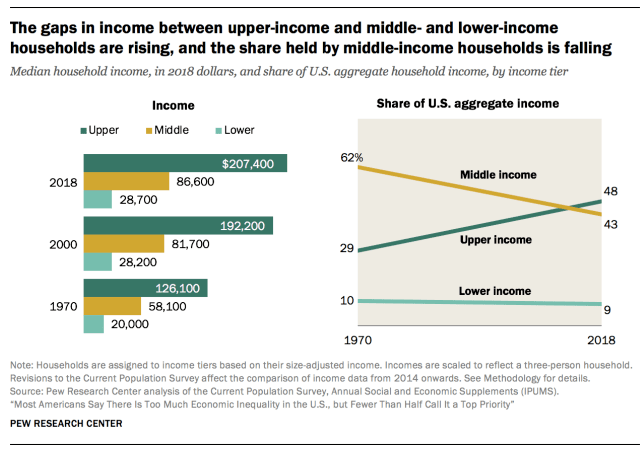
Individuals with low incomes spend a disproportionately large share of their incomes on commodities because everyone needs to eat approximately 2,000 calories of food per day. In addition, everyone needs some kind of shelter, clothing and basic transportation. All of these types of consumption are commodity intensive. People with very high incomes tend to buy disproportionately more goods and services that are not very resource intensive, such as education for their children at elite universities. They may also use part of their income to buy shares of stock, hoping their value will rise.
With a shift in the distribution of incomes toward those with high earnings, the demand for commodities of all types tends to stagnate or even fall. Fewer people are able to buy new cars, and fewer people can afford vacations involving travel. Thus, as more complexity is added, there tends to be downward pressure on the price of oil and other energy products.
[4] Oil prices have been falling behind those needed by oil producers since 2012.

Back in February 2014, Steven Kopits gave a presentation at Columbia University explaining the state of the oil industry. I wrote a post describing this presentation called, Beginning of the End? Oil Companies Cut Back on Spending. Oil companies were reporting that prices had been too low for them to make an adequate profit for reinvestment, back as early as 2012. In inflation-adjusted terms, this was when oil prices were about $120 per barrel.
Even Middle Eastern oil exporting countries need surprisingly high oil prices because their economies depend on the profits of oil companies to provide the vast majority of their tax revenue. If oil prices are too low, adequate taxes cannot be collected. Without funds for jobs programs and food subsidies, there are likely to be uprisings by unhappy citizens who cannot maintain an adequate standard of living.
Looking at Figure 4, we see that there has been very little time that Brent oil prices have been above $120 per barrel. Even with all of the recent central bank stimulus and deficit spending by economies around the world, Brent oil prices remain below $60 per barrel.
[5] Interest rates and the amount of debt make a huge difference in oil prices, too.
Based on Figure 4, oil prices are highly irregular. Much of this irregularity seems to be associated with interest rate and debt level changes. In fact, in July 2008, what I would call the debt bubble associated with subprime housing and credit cards collapsed, bringing oil prices down from their peak abruptly. In late 2008, Quantitative Easing (QE) (aimed at bringing interest rates down) was added just prior to an upturn on prices in 2009 and 2010. Prices fell again, when the United States discontinued QE in late 2014.
If we think about it, increased debt makes purchases such as cars, homes and new factories more affordable. In fact, the lower the interest rate, the more affordable these items become. The number of purchases of any of these items can be expected to rise with more debt and lower interest rates. Thus, we would expect oil prices to rise as debt is added and fall as it is taken away. Now, there are many questions: Why haven’t oil prices risen more, with all of the stimulus that has been added? Are we reaching the limits of stimulus? Are interest rates as low as they can go, and the amount of debt outstanding as high as it can go?
[6] The growing complexity of the economy is contributing to the huge amount of debt outstanding.
In a very complex economy, a huge number of durable goods and services are produced. Examples of durable goods would include machines used in factories and pipelines of all kinds. Durable goods would also include vehicles of all types, including both vehicles used for businesses and vehicles used by consumers for their own benefit. As broadly defined here, durable goods would include buildings of all types, including factories, schools, offices and homes. It would also include wind turbines and solar panels.
There would also be durable services produced. For example, a college degree would have lasting benefit, it is hoped. A computer program would have value after it is completed. Thus, a consulting service is able to sell its programs to prospective buyers.
Somehow, there is a need to pay for all of these durable goods. We can see this most easily for the consumer. A loan that allows durable goods to be paid for over their expected life will make these goods more affordable.
Similarly, a manufacturer needs to pay the many workers making all of the durable goods. Their labor is adding value to the finished products, but this value will not be realized until the finished products are put into operation.
Other financing approaches can also be used, including the sale of bonds or shares of stock. The underlying intent is to provide financial time-shifting services. Interest rates associated with these financial time-shifting services are now being manipulated downward by central banks to make these services more affordable. This is part of what keeps stock prices high and commodity prices from falling lower than their current levels.
These loans, bonds and shares of stock are providing a promise of future value. This value will exist only if there are enough fossil fuels and other resources to create physical goods and services to fulfill these promises. Central banks can print money, but they cannot print actual goods and services. If I am right about collapse being ahead, the whole debt system seems certain to collapse. Shares of stock seem certain to lose their value. This is concerning. The end point of all of the added complexity seems to be financial collapse, unless the system can truly add the promised goods and services.
[7] Intermittent electricity fits very poorly into just-in-time supply lines.
A complex economy requires long supply lines. Usually, these supply lines are operated on a just-in-time basis. If one part of a supply line encounters problems, then manufacturing needs to stop. For example, automobile manufacturers in many parts of the world are finding that they need to suspend production because it is impossible to source the necessary semiconductor chips. If electricity is temporarily unavailable, this is another way of disrupting the supply chain.
The standard way to work around temporary breaks in supply chains is to build greater inventory, but this is expensive. Additional inventory needs to be stored and watched over. It likely needs financing, as well.
[8] The world economy today seems to be near collapse.
The self-organizing economy is now pushing the economy in many strange ways that indirectly lead to less energy consumption and eventually collapse. Even prior to COVID-19, the world economy appeared to be reaching growth limits, as indicated in Figure 1, which was published in January 2019. For example, recycling of many renewables was no longer profitable at lower oil prices after 2014. This led China to discontinue most of its recycling efforts, effective January 1, 2018, even though this change resulted in the loss of jobs. China’s car sales fell in 2018, 2019, and 2020, a strange pattern for a supposedly rapidly growing country.
The response of world leaders to COVID-19 has pushed the world economy further in the direction of contraction. Businesses that were already weak are the ones having the most difficulty in being able to operate profitably.
Furthermore, debt problems are growing around the world. For example, it is unclear whether the world will require as many shopping malls or office buildings in the future. A person would logically expect the value of the unneeded buildings to drop, reducing the value of many of these properties below their outstanding debt level.
When these issues are combined, it looks likely that the world economy may not be far from collapse, which is one of my contentions from Section [1]. It also looks like my other contentions from Section [1] are true:
(i) Low oil prices rather than high are to be expected as the economy reaches limits,
(ii) Most fossil fuel reserves will be left in the ground because of low prices, and
(iv) If the economy is not to collapse, we need energy sources providing a larger quantity of net energy per capita to offset diminishing returns.
Regarding (iv), the available energy supply from wind and solar (net or otherwise) is tiny relative to the total energy required to operate the world economy. This issue, alone, would disqualify a Great Reset using wind and solar from truly being a solution for today’s problems. Instead, plans for a Great Reset tend to act as a temporary cover-up for collapse.


During the first phase of economic stabilization, the banking sector, in addition to offering standard debt vehicles, has largely acted as a conduit for the central banks’ guaranteed loan programmes for SMEs. However, bank lending has remained limp since the 2008 financial crisis as a result of uncertainty, regulation, and monetary policy, which means that they’re not the market’s panacea when it comes to smoothing the passage of loans, even if they’re backed by the government. That has provided an opening for the shadow banking industry – capital markets players, including private equity – to increase their direct private lending, either in the form of debt restructuring or bridge financing. In markets like the US, direct lending by institutional credit funds has become a powerful force in SME lending and in some recent time periods the majority of credit extended has come from these sources of capital.
In phase 2, fewer loans will be backed by the government, so the industry has to walk the tightrope of balancing relief with financial responsibility. That will be especially true when it comes to dealing with struggling sectors. This is when Banking and Capital Markets players will need to be extra vigilant of economic indicators to constantly re-assess the depth of the crisis and their capacity to extend new debt to borrowers who are teetering on the edge of medium-term viability.
Businesses in industries including travel, automotive and energy are currently seeking new lines of credit, and once the public and banking sectors have reached certain thresholds, we will see capital markets players step in to offer direct lending and other forms of debt. We are already seeing an expansion of full balance sheet solutions for some of these troubled industries with innovative sale and leaseback, or financial engineering solutions that allow struggling businesses to access their full capital base to generate much needed cashflow.
Roger Bieri, Head of Multinationals Clients at UBS, says: “The first thing that we focus on is trying to understand if a company is a designated survivor, i.e. has the company performed well before the crisis, and does it has a business model that is future-proof? If the answer is no, we help these companies, together with external advisors, to review their business model and potentially restructure the business and/or find new investors.”
Needed: creative equity solutions
For many businesses, getting to the other side of this pandemic will require more than credit. In the US so far this year, 45 businesses, each with over $1 billion in liabilities, have already gone bankrupt. That number could double by the end of the year. In the small and medium-sized business sector, 50% of companies now consider themselves under severe financial strain and millions have indicated they may have shut their doors for good. To help these struggling businesses, the banking and capital markets industry will need to find creative, versatile solutions in the equity phase. These solutions will need to smooth the transition from phase 2 to 3 and benefit a large segment of struggling entities, from large companies and developed nations, to smaller businesses and emerging markets.
To understand this article, a person needs to figure out that SME is “Small and Medium Enterprises.” The article is about providing financing for this group of companies, many of which seem to be failing at this time.
Wikipedia says regarding “SME Finance,”
I would call all of these “time-shifting devices” in one way or another. When the funding is provided by governments, the potential loss is shifted to the government, which will somehow need to figure out how to deal with the loss when it occurs. So it is still a time-shifting device, but it also shifts the problem to a different part of the economy.
I notice on the front page of the online version of the WSJ there is a new prominent article called “The SPAC Boom, Visualized.” Subtitle: See how the blank-check company craze has surpassed traditional IPOs over the past couple of years.
SPAC’s are “Special-Purpose Acquisition Companies. SPAC’s “have raised $38.3 billion since the start of 2021, compared with $19.8 billion by traditional IPOs,” according to the article. SPAC’s seem to first raise money similar to IPOs, and then find distressed companies to merge with, hoping to make money when the economy is doing better.
Here it is Gail, exactly what you have been talking about.
https://www.zerohedge.com/technology/achtung-baby-its-cold-outside-germanys-green-energy-fail-rescued-coal-and-gas
Thanks very much! It sounds like the story is still being kept from the German people however. They need to believe a fairy tale.
Thanks again to Mr. McGibbs updates and most appreciative 😊🌅
This one may be added
Biggest LNG Maker Hires Builders for $29 Billion Expansion
Verity Ratcliffe
Tue, February 9, 2021, 6:57 AM
(Bloomberg) — Qatar hired engineers for a planned $29 billion expansion of its capacity to produce liquefied natural gas, seeking to cement its position as the world’s biggest supplier of the fuel.
While Australia, the U.S. and other producers have been ramping up output, Qatar’s LNG capacity has stayed mostly flat for a decade. Gas, a cleaner-burning alternative to crude oil, is seen as an important fuel for bridging the global transition from petroleum to solar energy and other renewables.
State-run Qatar Petroleum selected Chiyoda Corp. of Japan and London-based TechnipFMC Plc to do construction work worth around $13 billion, Qatar’s energy minister and QP Chief Executive Officer Saad Al-Kaabi said at a signing ceremony in Doha on Monday.
“This was the main contract we were waiting to sign to finalize the costs of the project,” Kaabi said. QP will award an agreement to build storage tanks within the next two weeks and will sign almost all other project-related deals by the end of the year, he said.
The expansion is the world’s biggest LNG project under development and will lift Qatar’s annual output to 110 million tons per year from 77 million tons. LNG is a form of super-chilled natural gas that can be shipped worldwide without the need for costly pipelines.
Looks as if the Oil States in the ME may transition to “cleaner” natural gas now that CC is kicking in and peak oil is curtailing anymore expansion .
Hopefully, this will🤔🌈 kick the can down the road for us all for a few more years…🤞
PS Harry, Sir, remember you providing an email🙈 to someone to gain access to a website of yours. If it is still😊up and running, may I contact you? If so. Please give me the info again. Thank you!
No problem, Herbie – you can reach me at collapseharry at gmail dotcom
😊🎇👍
“LNG is a form of super-chilled natural gas that can be shipped worldwide without the need for costly pipelines.”
After taking into account evaporation losses, LNG can be shipped worldwide at about five times the cost of pipelines. Rather more than that if shipped from the tropics, for obvious reasons.
Yep, that was essentially all the Syrian job about.
The first act was lets storm over the little country with none or not committed friends for ground action. The second act was surprisingly committed friend and heaps of dead mercenaries from the Gulf and sadly also broad civilian destruction. The last act making a deal you pull out rest of the crazies and I will help you with OPEC(+) , moreover Chinese would perhaps buy some of the LNG as well.
What a patience..
Strange!
Qatar at least seems to be reasonably close to Europe.
The problem with LNG is keeping the cost low enough for buyers to afford the LNG. Pipeline natural gas is almost always cheaper.
The price for LNG bounces around. The US has a lot of LNG it would be willing to sell if the price were high enough. I suppose Qatar can develop the natural gas, and cross its fingers that the price will be high enough, when the time comes to actually try to export the gas. In the meantime, building the LNG capacity helps keep fossil fuel prices up.
“In 2019, global debt reached $197 trillion, up by $9 trillion from the previous year – before the COVID-19 pandemic had started.
“With economic activity collapsing and added governmental support during the pandemic, many countries are now facing a debt surge.”
https://www.weforum.org/agenda/2021/02/pre-pandemic-debt-covid-coronavirus-economics-imf/
The percentage increase in debt isn’t up very much in the last year, only about 4.8%.
If a person looks at the chart, the percentage increase in debt was a lot greater in the 2007-2009 period. Of course, the 2007-2009 period was one which got the economy growing again, this time, not so much.
Enough of those “great reset” guys; how many of you see Scam-19 as a cover operation/distraction from real problems with no solutions? You know: Limits to cheap oil, debt etc …
FT.com “The global economy was facing the worst collapse since the second world war as coronavirus began to strike in March, well before the height of the crisis, according to the latest Brookings-FT tracking index.
“The index comes as the IMF prepares to hold virtual spring meetings this week, when it will release forecasts showing the deepest contraction for the global economy since the 1930s great depression.
The New York Fed announced it is increasing its temporary overnight repo operations to $120 billion a day from the current $75 billion. In addition to the repo increase, term repo operations are rising to $45 billion, from $35 billion
The announcement came from the New York Fed, which did not elaborate on the reason for the increase. However, it comes a day after the Fed injected just shy of $100 billion into the system via an operation where it provides banks with cash in exchange for high-quality assets like government bonds.
https://www.cnbc.com/2019/10/23/fed-repo-overnight-operations-level-to-increase-to-120-billion.html
And suddenly… Covid….
““The global economy was facing the worst collapse since the second world war as coronavirus began to strike in March, well before the height of the crisis, according to the latest Brookings-FT tracking index.”
Scam-19, the biggest cover up/distraction since … since … I give up, since long!
As a politician when you don’t want to take the fall you wait to happily pass the baton. Bernanke did that with Yellen and then Powell.
The global eCONomy is being held together with “financial duct tape and super glue”. The puppet masters know full well eventually this all collapses.
This is EXACTLY why the “Build Back Better” movement took off and world leaders began to listen to Klaus Schwab. He told them the debt was unrepayable so they needed to default on everything and build it back better.
They won’t succeed but if you read his ideas at the World Economic Forum’s website he states that Covid 19 should be used as an excuse for the Great Reset.
“… high-quality assets like government bonds.” Another passenger on the Ship of Fools. We live in interesting times.
At Surplus people were discussing where to park and off load wealth into the new paradigm. In addition to the usual suspects like metals, cryptos, .. they also favorably mentioned Chinese cash as in RMB.
I’m afraid it will be all of them and non of them at the same time..
Depending on what kind of regime prevails over your particular locale (and upper chain of command alliances), so again another sheer lottery of life itself. Similarly, I’ve noticed one US foreign fin/econ correspondent talking about these mounting restrictions (lock-downs) also in the sense of long term barrier to effectively (or at all) manage the personal wealth – kind of strange for some reason negating the free digital access aspect of it – as to be invalidated perhaps..
In aggregate, it all smells like return to more direct hands on feudalism where the local lord is the arbiter of everything.
“In aggregate, it all smells like return to more direct hands on feudalism where the local lord is the arbiter of everything.”
… but that my friend will only happen if we let them …
That’s why pop density to natural resources is one of the strongest (co) determinants in the post fossil energy surplus world setting. No offense or pun intended, lets say in parts of NA or Scandinavia (if climate stays ~same) I’d not worry about it much (as ~anybody can get their ~5ha allotment / wildlife / and up) vs say the example of overcrowded England, and other densely populated (rust belted) areas of Europe.
In other words the worst places (guiding ratio explained above) will likely tend to draw the worst forms of government. Obviously with some exceptions.
Notice that this article is from October 2019, so it came well before the COVID problems.
We all see it. That doesn’t mean covid is not dangerous, this lab-made virus looks very sly. They are not dumb enough to release a benign virus.
The plan is working perfectly and humanity is prepared for the next step. What will it be? Expect more surprises!
Except that we won’t be at all surprised, having a fair idea as to what the plan might be – and an understanding of the wider context of an inevitable Collapse.
The shock-phase is over for us, although not for the rest of society.
It is to that extent a rather lonely kind of knowledge (like all unusual insights) , but it gives a measure of strength to face the horrors to come.
OFW = one step ahead into the realm of unknown.. (TM)
A self-organizing system uses a lot of strange pieces. COVID-19 is being used as a way to shrink the economy to match smaller energy supply. The growing wage disparity and many people who were very vulnerable to the illness allowed this to happen.
“Countries that have weathered the pandemic well face a lasting economic drag from the global collapse in skilled migration which will stunt the growth of their working-age population, economists have warned.
“The coronavirus crisis ended a decade’s steady growth in flows of migrants around the world, according to data collated by the OECD.”
https://www.ft.com/content/146fbb75-8a66-4b41-90a3-e986da2b6505
“Skilled migration into Australia will be reviewed in a quickfire government inquiry looking for fast solutions to help businesses get the staff they need and grow the economy after the number of migrants crashed during the coronavirus pandemic.”
https://www.smh.com.au/politics/federal/migration-rules-reviewed-as-government-looks-to-fix-skills-shortage-20210203-p56z6d.html
These countries need to let the migrants back in, along with all of the tourists, if they are to have half a chance of getting their economies back to where they were before. This won’t happen, I expect.
“A recovery in global trade is expected to slow again in the first quarter of 2021 as the coronavirus pandemic keeps disrupting the travel industry after world trade contracted 9% in 2020, a U.N. report said on Wednesday.”
https://www.reuters.com/article/us-trade-un-idUSKBN2AA0HC
“Germany’s exports and imports slumped by 9.3% and 7.1% respectively during 2020, concluded the federal statistics office Destatis on Tuesday.
“The figures are in comparison to data from 2019 [German exports were already stagnant in that year], showing the stark impact of the coronavirus pandemic on international trade.”
https://www.dw.com/en/germanys-2020-exports-slumped-93-as-pandemic-batters-trade/a-56506934
With the spike in COVID cases in Europe and the US in the first quarter, I can believe that global trade will slow again in the first quarter.
“Average cost of rent in Spain falls for the first time since financial crisis: Rental prices have dropped as a result of the coronavirus crisis which has pushed more tourist apartments onto the market, leading to a surplus of supply.”
https://english.elpais.com/economy_and_business/2021-02-10/average-cost-of-rent-falls-in-spain-for-the-first-time-since-financial-crisis.html
“Can Spanish tourism survive a second Covid summer?
““If we lose this summer, we would be talking about practically zero activity from October 2019, when [travel agent] Thomas Cook collapsed, to June of 2022,” Gabriel Escarrer, chief executive of Meliá Hotels International, said, noting that about half of Spanish tourism revenues normally come between June and September. “It would be devastating for the fabric of the tourist industry.””
https://www.ft.com/content/db3f8536-a6be-456e-816e-5879b5916ca2
“If things carry on the way they are going, we are going to have boarded-up shops, closed restaurants and inactive tourism businesses, and when tourists do finally come back, we are not going to have anything to sell them.
“We won’t have the people, we won’t have the businesses.”
“There was a sugar hit over Christmas and New Year but since the second week of January, it has simply died.
“Long weekends like the one we have just had certainly put a shot into it, but I’ve had a ring around a bunch of tourism operators and restaurateurs today and there are just no bookings at all placed.
“We are in for a very cold rest of 2021.”
https://www.odt.co.nz/regions/queenstown/fears-grow-queenstowns-survival
This prick of a mayor is asking for a taxpayer bailout again — and guess who gets the cash — none of the little guys — it all goes to his cronies like the Bungy owners who got 5M free dollars last year.
I took a spin through town today — it was very quiet — and this should be high season.
The swimming pool business owned by my Catalan cousins is currently booming – they live in a popular seaside town which throbs with Germans and locals from Barcelona in the summer – as people are giving up on being allowed to use the beach normally and are putting in pools and jacuzzis. All the money, though, is in pool maintenance. It’s an ill wind, etc……
Could you ask him what is the (most trendy) filtering medium of choice now? Basically, the sands were ~replaced one or two decades ago by special porous materials (a bit of trick used in hobby fish tanks already) – helps use less water among other benefits (stable Ph). While the more ~luxurious pools obviously use various bio filtration methods even using small critters eating algae etc. but this is horror to manage if the weather or water table (minerals shift) or people (cosmetics-oils) are not cooperating.. thanks
I will certainly ask, worldof, but he is a lunatic (runs in the family?) and absolutely hates swimming pools -he had to go into the family business – so he may not tell me much as he can barley stand the mention of them!
🙂
I know a woman who’s never been busier at work.. her company sells home exercise equipment.
Tourism will take a hit this year as well. People are afraid to book tours if countries still aren’t permitting visitors from abroad.
Or in the case of the UK, they might have to pay £1,750 / person to get back in.
We can book a cottage for a week almost anywhere in the UK for half that amount.
“The U.K. stands out as the sole Group-of-Seven economy where the OECD’s Composite Leading Indicators still point to a slowdown.”
https://www.bloomberg.com/news/articles/2021-02-09/u-k-stands-out-with-signals-of-slowdown-in-oecd-gauge-chart
“Rents have fallen in major cities across Britain after tenants swapped crowded urban locations for more space in the country and smaller towns, with London suffering the biggest rent falls since the financial crash.”
https://www.telegraph.co.uk/property/renting/city-centre-rents-suffer-biggest-collapse-since-financial-crisis/
Sounds like New York City.
The chart shown seems to show a country in light blue green as doing poorly. This country seems to be France, the way I am leading the chart.
The UK doesn’t seem to be a standout for doing badly. I am a little confused because the chart and text don’t seem to quite go together.
“…developing countries from Turkey to Nigeria… recorded double-digit jumps in food inflation [last year]. Major wheat and corn exporters such as Russia or Argentina have introduced curbs or taxes to preserve domestic stockpiles, exacerbating pressures elsewhere.
“United Nations data showed food prices hit six-year highs in January after rising for eight consecutive months. The unwelcome return of food price pressures has put policymakers and investors on high alert, worried what it means for inflation more broadly while economies are still reeling from the coronavirus crisis…”
https://www.reuters.com/article/emerging-markets-inflation/analysis-food-price-spikes-see-inflation-rear-its-head-in-emerging-markets-idUSL8N2KE2X3
“Soaring food prices hit Philippine consumers amid recession:
“President Rodrigo Duterte has slapped a 60-day price freeze on pork and chicken in a bid to rein in commodity price inflation burdening the Philippines as its economy struggles with the impact of one of the worst pandemic-induced recessions in Southeast Asia.”
https://asia.nikkei.com/Economy/Soaring-food-prices-hit-Philippine-consumers-amid-recession
““Covid-19 has highlighted the limits of the existing food systems all over the world…
““In fact, the world was falling behind on realising the right to food even before the pandemic – the number of hungry and undernourished people in the world had been rising since 2015.””
https://www.agriland.co.uk/farming-news/covid-19-has-not-just-caused-a-health-crisis-but-also-a-hunger-crisis/
The ‘Right to Food’?
Mother Nature laughs; and Bill Gates and Monsanto join in……
It highlights OVER POPULATION!
Right to food, hey let’s make AOC the world food czar.
We lose sight of how bad things used to be in the past. This is a chart from Tufts University.
https://sites.tufts.edu/wpf/files/2017/08/famine-mortality-banner.jpg
A peak 10-year period for famine seems to have been 1921-30, with over 20 million dying
The world population in that time period was around 2 billion, compared to a world population approaching 8 billion now. Thus, the equivalent number of deaths from famine would be around 80 million today. That is over a period of 10 years, so perhaps 8 million excess deaths per year.
The year 2015 may have marked the end of declining excess deaths from famine.
This is chiefly result of WWI and aftermath (civil wars) biased number.
As Gail remarked in an earlier comment: we can expect to see much more poverty in the near future. I suspect that will be closely followed by hunger/starvation. Some countries will see a larger uptick in suicides. The future is getting closer.
“President Joe Biden’s pick as budget director on Tuesday struck a critical tone against China, voicing concern about potential security threats posed by Chinese technology and accusing Beijing of failing to meet bilateral commitments…
““It is vital that we ensure that China change course,” Neera Tanden said. “It is important that we marshal allies to put pressure on China to ensure that they have a fair trading system where American companies can truly compete against China.”
https://www.reuters.com/article/us-usa-trade-china/bidens-omb-pick-cites-concern-about-chinas-adherence-to-trade-rules-idUKKBN2A92OY
“Two U.S. carriers conducted a military exercise in the South China Sea, signaling that U.S. President Joseph Biden and his administration are taking a strong stance to oppose China’s territorial claims in the disputed waters…
“The dual carrier operations come as Biden seeks to send a signal to both U.S. allies and China that the U.S. will continue to patrol the South China Sea, of which China claims more than 80%.”
https://www.bloomberg.com/news/articles/2021-02-09/u-s-aircraft-carriers-conduct-exercises-in-south-china-sea
“The Biden administration faced a double-dose of bad and not-so-bad news Tuesday on Iran: Iranian leaders hinted they are rethinking their vow to never seek a nuclear weapon, and new Israeli intelligence suggests they are at least two years away from producing one.”
https://www.nytimes.com/2021/02/09/world/middleeast/Iran-nuclear-threat.html
Biden can’t really deviate very far from the direction Trump took.
Dear Gail, I might have a suggestion for a new article.
In the course of time you have concretized your view of the progress of our energy crisis and those who have been following this for a long time are certainly very good at the topic.
For completely newbies (people who have never thought about a collapse of our civilization, about Peak Energy, etc.) all of this is probably an extremely high hurdle.
The thing is: I would like to try to sensitize my closest confidants to this topic, because it just seems that we have taken a big step further on our way to decline or collapse since 2019/2020.
But most of the time you still get a funny look if you have candles, a few gas cartridges and some supplies in the basement.
I find it very difficult to make people realize that we are facing a tremendous turning point because I can’t really get it to start at A (like Adam and Eve)
Perhaps it would be an idea to write a kind of “entry-level article” for this highly complex topic?
Best regards from very cold and snowy Germany.
You are right. Most people don’t have any idea that we could be encountering an energy problem or a collapse problem. Their eyes are 100% focused on whatever the television tells them and what the schools are teaching.
I think everyone now has figured out that supply lines can get messed up. Store shelves can be empty, for reasons we don’t fully understand. We now see that cars aren’t being produced, because not enough companies are making the cheap “chips” they depend upon; the factories seem to have moved on to making more expensive chips. Getting the cheap chips back becomes a problem.
I suppose pointing out the problem would need to start from such a direction. It could also explain the nature of what might be considered an accidental cover-up. Everyone with knowledge of what was happening wanted to protect others from seeing what could be ahead, so came up with what, in retrospect, looks like far-fetched solutions. But there was a need for careers in all of these directions. A move toward services doesn’t really work because of too much wage disparity. Recycling doesn’t really work beyond rather low limits. Smaller population makes the system collapse.
This is HILARIOUS!!! Hope all the CovIDIOTS are staying safe….
No Escape From Stalag Britain
Health Secretary Matt Hancock yesterday announced severe penalties for those not complying with the new border quarantine arrangements, including a 10 year prison term for lying about where you have travelled from. Kate Andrews in the Spectator has the details.
The cost to the traveller of the mandatory stay in the quarantine hotel will be £1,750 for 10 nights, making travel all but unaffordable save for determined business users and those with a few grand to spare. Oliver Smith in the Telegraph is not impressed, noting that “the vaccine was supposed to herald a return to the wonderful old normal”. As far as travel is concerned, “our Government is in the process of fencing us in”.
Some of the Government’s scientific advisers on SAGE have indicated that the emergence of mutant variants will lead to a need for on-off lockdowns continuing for several years. The Mail has the details.
Britain could be trapped in coronavirus lockdown cycles for “several years” as it’s forced to wrestle with new variants that could scupper vaccines, top scientists have warned.
Professor Sir Ian Boyd, an infectious disease expert at the University of St Andrews and member of SAGE, said the emergence of potentially jab-resistant strains means the UK could be stuck in a pattern of “control and release for a long time to come”.
https://lockdownsceptics.org/
“…the vaccine was supposed to herald a return to the wonderful old normal…”
If only that were true. This game is just getting started.
I wonder what happens when the vast majority of people find their strength, apply common sense, and face the reality that they’ve been scammed.
‘Zer vill be no return to ze so called ‘gut old days’: ze CUT haz been too great!’ (Expressive chopping movement of hand).
Klaus ‘Barbie’ Schwab.
I suspect that will happen in St. Never Day, the 31st of February,
Had common sense been as common as its name suggests, people would have discovered the scam as early as March 2020, when we saw political and health authorities fumigating streets and beaches with insecticide, strolling around disguised in hazmat suits (as if a flu-like virus was radioactive material) and following the Chinese example of confining healthy people.
Sheeple gonna be sheeple, since they don’t know better and never care about truth and only want to hear happy news. Therefore they will march happily to the cliff, singing “Two legs good, four legs bad”, but not without first trying to push the “covidiots” into the abyss.
Besides the moral comfort provided by denial of reality, intellectual pride prevents most people from recognizing they have been deceived. I suppose that was Mark Twain meant when he said “It’s easier to fool people than to convince them that they have been fooled.”
An academic nonentity, delighted to have raw POWER in his hands at last. Wasn’t the two-a-penny knighthood good enough for the old fart?
In the spirit of Gilbert and Sullivan, I suggest that all the SAGE ‘experts’ need ‘a short sharp shock with a cheap and chippy chopper; and they’d none of them be missed!’
My axes are far from cheap (Swedish) and not at all chippy, but I’ll do the job if someone would hold them down.
The Mikado, or the Town of Titipu: one of my favourite G&S operettas. Thank you.
South Korea January jobs fall at sharpest pace in more than two decades
https://www.reuters.com/article/us-southkorea-economy-unemployment/south-korea-january-jobs-fall-at-sharpest-pace-in-more-than-two-decades-idUSKBN2A934D?il=0
One reason for the fall was new COVID restrictions. South Korea has very few COVID cases, relative to its population. Its ratio is less than that of Japan.
This looked interesting….water crisis due to geopolitical conflicts between Russia and Ukraine over Russian taking of Cri💥mean Peninsula….
https://m.youtube.com/watch?v=Aqq8clIceys
Seems things are getting desperate….water rationing and cutbacks in agricultural lands.
From my Historical reading of WW II, the Russians paid a very heavy price in men and arms to keep the Germans from taking it completely over. AdolfH was afraid Stalin would use it as an aircraft carrier wonton speak…I can understand why the Russians want to hold onto it for thrmselves
With as much population and industry as we have today, lack of water seems to be becoming a bigger and bigger problem.
As alcohol abuse rises amid pandemic, hospitals see a wave of deadly liver disease
https://news.yahoo.com/alcohol-abuse-rises-amid-pandemic-130030403.html
According to the article,
“Specialists at hospitals affiliated with the University of Michigan, Northwestern University, Harvard University and Mount Sinai Health System in New York City said rates of admissions for alcoholic liver disease have leapt by up to 50% since March.”
If these same people are drinking and driving, their auto accidents will be up, as well.
The drinks industry is doing well out of c 19, drunkards not so much.
> UK distillery numbers hit record high in 2020
New HMRC figures show that a record number of distilleries were registered in the UK in 2020, growing by more than 100 in 12 months to surpass 560.
The latest data means that the number of UK distilleries grew by 124, up 28% on 2019, and has doubled in total over the past four years.
The number of distilleries in England has almost tripled since 2016 to top 300 for the first time, while Scotland has increased its number to 214 and Wales and Northern Ireland have also seen a rise.
The total number of distilleries registered in the UK is now at least 563, up from 441 in 2019 and the WSTA is calling on the Chancellor to cut duty and extend the hospitality VAT cut at the upcoming Budget on 3 March.
The WSTA is also asking the Chancellor to extend the current VAT reduction across hospitality venues, until at least March 2022, and to broaden the scheme to include alcoholic drinks.
“It’s heart warming to find a positive story from the gloom of 2020 – and our bold and growing band of distillers have delivered once again,” said Miles Beale, WSTA chief executive.
“With such a difficult 2020 behind us and a daunting challenge to recover in 2021, our distillers need the support of the Chancellor at the upcoming Budget….
https://drinksint.com/news/fullstory.php/aid/9386/UK_distillery_numbers_hit_record_high_in_2020.html
I saw a new bar opening up, in one of the strip malls with lots of vacancies. These do well, everywhere, it seems.
England has 57 million people and 300 distilleries. Scotland has 3.3 million people and 214 distilleries. Food for thought.
We’ll be up to eleven here soon vs. a population of around 3,000:
https://whiskycast.com/islays-11th-whisky-distillery-gets-the-green-light/
Your astute geopolitical antennae, scanning the globe, clearly found just the right place to settle down for Ragnarok, Sir Harry……
Xabier, if memory serves (and a recent episode of “Expedition Unknown”), the Vikings discovered America, but never discovered distillation. A serious miscalculation.
The scots/brits win by default when it comes to booze, tightly followed by the relentless craftsmanship of the japs. Old jap whiskeys are out of this world. However those ‘murican bourbons isn’t that shabby either when you want sweeter tones. Nowadays the Swedes can distill out some good single malts too.
Soon the sound of oars will again arrive on the shores of islay and reclaim what used to be theirs. 🤣👍
Why go against the “grain” of nature, let those yeasts do some work on the subject, distill and leave it the fsck alone for at least 10 years. Voila.
But I’m too old for that stuff anyway. Beetroot juice is the real deal. 🧃
Brits are the world’s worst drunkards – and the fattest in Europe.
> English and Scottish are world’s biggest drunks: Britons top global poll of how often people drink so much they lose their balance and slur their speech
https://www.dailymail.co.uk/news/article-9183427/English-Scottish-worlds-biggest-drunks-survey-says.html
Gasoline at the pump is spiking here in South Florida
From Miami Herald
The country’s economic recovery from the COVID-19 pandemic is also playing a role in prices you see at the pump. Patrick De Haan, an analyst for Gas Buddy, said it is “inaccurate” to blame President Joe Biden on gas prices, as the trends preceded him..
“The market is going up due to COVID. Oil’s plummet last year and the corresponding crash in demand that’s now recovering is the major factor,” De Haan said Sunday. “Not ‘regulations.’ And there are only supply concerns now because COVID decimated oil demand last year and that demand is coming back now.”
He said last week prices will likely continue to increase. But at what end?
Probably not a very high end in prices, before they come down again. Many economies (India, South Korea for example) get pushed into recession with higher prices.
South Korea? Why would you single them out? I think that the United States is very vulnerable to high energy prices
“He said last week prices will likely continue to increase. But at what end?”
what end? well, the Endgame end, so to speak.
prices on essentials must rise and continue to squeeze non-essentials out of the economy.
with decreasing net (surplus) energy, there will be decreasing products and services.
money, which is a claim on that energy, will continue to flow more and more towards essentials, and thus we will experience this as inflation in those essentials.
inflation will be the way that essentials continue to be produced, as MORE money is sent towards purchase of these essentials, and thus sending a signal to producers to continue to produce these essentials.
conversely, LESS money sent towards non-essentials will tell producers to make less of them.
so, IF gasoline is wanted in the near future, it is beneficial for its price to RISE.
I love gasoline.
Good luck with that!
Iraq Wants Oil At $80
Iraq needs crude oil to trade at $80 a barrel to be able to plug its budget holes, according to oil minister Ihsan Abdul Jabbar Ismail.
In an interview with Shafaq news agency, the top official said, “Iraq will export in 2021 about one billion and 100 million barrels of crude oil according to market data. The budget needs 140 trillion dinars ($96 billion). The price of $ 80 a barrel is the right price to make Iraq can pay the budget dues.”
https://oilprice.com/Energy/Crude-Oil/Iraq-Wants-Oil-At-80.html
I’ll bet that they would like an even higher price than $80 per barrel, if it were available. This price is just to keep collapse from happening.
Eternal lockdowns till we die of starvation.
Threat from variants means provinces must be ready to lock down again quickly: Tam
OTTAWA — With new and more contagious variants of COVID-19 escalating in Canada, provincial governments lifting lockdown restrictions need to be ready to slam them back in place at a moment’s notice, Canada’s chief public health doctor said Tuesday.
https://www.richmond-news.com/national-news/threat-from-variants-means-provinces-must-be-ready-to-lock-down-again-quickly-tam-3366325
new and more contagious variants
There are billions and billions of coronachans floating in the air.
One or two are bound to get up everybody’s nose from time to time.
So literally everybody is already infected by now.
How much contagious can it get?
I look at the new case counts, and they are coming down rapidly in the UK and South Africa, as well as the US.
Deaths are down in the UK and South Africa, but have been flat for a while in both the US and the EU.
These charts show several countries:
New Cases, relative to population:
https://ourfiniteworld.com/wp-content/uploads/2021/02/Several-countries-New-COVID-Cases-Feb.-8-1-1024×551.png
https://ourfiniteworld.com/wp-content/uploads/2021/02/Several-countries-New-COVID-deaths-Feb.-8-1024×589.png
These cases are positive PCR tests, or positive antibody tests, and the vast majority of them do not represent illnesses of any kind.
PCR test can be made to give either more or less positive results by adjusting the number of cycles.
Positive antibody tests unaccompanied by clinical symptoms usually mean the subject has been infected and defeated the infection and is therefor immune to the bug.
In the case of COVID, as in the case of HIV, this diagnostic interpretation is turned on its head. Interesting how Dr. Fauci has been deeply involved in coordinating the response to both these pandemics.
It’s all HUMBUG, I tell you, HUMBUG!
Tim G:
“These cases are positive PCR tests, or positive antibody tests, and the vast majority of them do not represent illnesses of any kind.”
And those that get ill or die might very well have contracted the good old cold or flue and NOT a hyped virus called Sars-Cov-2!
“In 2020 the population-adjusted excess death rate was the highest since 1940. Higher than any postwar pandemic and matched in peacetime only by 1929 (severe flu pandemic and economic crash) and 1847 (potato blight and famine in parts of N Europe).”
https://twitter.com/EdConwaySky/status/1348708757677760522?s=20
Gail- ever thought of changing the format of this site to be more friendly to threaded discussions? Everything posted here just seems to go into one giant stream of consciousness river and it is a major headache to find earlier posts.
It used to be that at least I could search on the comment threads in a lot of different ways, even if it was difficult for commenters. I also noticed that comments would sometimes come up with “regular” Google searches, as well. This would be a function available to commenters as well.
Before recent changes, I could look at comments from a particular individual user name, or from an individual IP address, or I could search for a particular term, like lithium batteries.
Now I can’t search on anything, except using my browser’s search function on a particular page of comments.
If someone knows a way around this problem, I would like to know it. I haven’t added Google Search to my site, but my impression is that it would still not get to the comments.
Brits so badly hit by fuel poverty during pandemic families are rationing heat
https://www.mirror.co.uk/news/uk-news/brits-badly-hit-fuel-poverty-23463794
We are today rationing health care through large deductibles and lack of facilities in rural areas.
At some point, we need to be cutting way back on high cost treatments for people who are almost certainly near death, with or without treatment. US healthcare cost are beyond absurd.
Do you have a cut off point in mind? How many years are needed with treatment vs without treatment?
Dennis L.
How about a dollar amount? $200,000 per life. You are of course free to spend as much of your own money as you want. After the limit all the pain killer you want.
I agree completely the cost of medical is absurd.
Ed, how about a lifetime amount of $0? “Take what you want, said God, and pay for it.”
There is a huge difference in how healthy different people are, at different ages. It seems as if a person’s remaining life expectancy is less than five years, with or without treatment for a given disease, we shouldn’t be willing to put too much effort/cost into the treatment. If people have many different comorbidities, we shouldn’t be putting a huge amount of effort in trying to cure one of their many problem areas.
I believe that the heath care system does has at least some idea of how long people are likely to live. I know life insurance companies do. (I just checked my life expectancy, using two different on-line calculators. One said I would live to be 97; another said I would live to be 101!)
If people are doing badly enough, we should mostly be doing palliative care. We shouldn’t be getting into long treatment plans for cancer on very elderly people, for example.
There are so many differences within and between age groups that I wonder how you get uniform standards like these adopted. I also wonder how a centralized health system circling the drain could come to any acceptable consensus on how to conduct health care. It’s almost as you have to watch to see what any given aspect of the system is willing to do, and take your pick. That wouldn’t seem to work well now, and I can’t foresee how it won’t work less well in the future.
I don’t see any way to improve a system so mad, in such flux and turmoil. Creating small alternative governance pods could be a better choice.
Programmes ceratinly exist to calculate that sort of thing.
A friend, who is a surgeon, told me they feed the vital bio-stats in, and the programme tells them whether it is worth operating on the individual concerned, all things considered, and allowing for the inherent risk of the procedure as well.
Hardly anyone, though, really wants to learn how many years or months they are likely to have, and that it can be calculated so ‘coldly’: all grasp at life.
If a procedure is very high risk, they also don’t wish to know, as long as there is a small chance of further life.
“A friend, who is a surgeon, told me they feed the vital bio-stats in, and the programme tells them whether it is worth operating on the individual concerned, all things considered, and allowing for the inherent risk of the procedure as well.”
I wouldn’t have much faith in modelling software like that, remember Dr Lockdown et al and their models …
Xabier, before my heart surgery, the surgeon explained the procedure in detail, even telling me which vein they would extract to replace the calcified arteries. She then said I had a “90% chance’,which was reassuring: had she said “99%” my trust would have vanished.
Anyway, as you can see, it worked. And by the way, I was a private patient, and paid cash on the nail.
I would pick 80 yrs of age…then cutoff from anything over a minor surgery…$30K max.
Communities Worry About Health Care Rationing
https://www.nbcconnecticut.com/news/local/communities-worry-about-health-care-rationing/2417872/
Government eyes price controls on pork wholesale traders
https://cnnphilippines.com/videos/2021/2/9/Government-eyes-price-controls-on-pork-wholesale-traders.html
If a country wants less pork, it is a good idea to put price controls on pork.
I am very curius about Next articol of gail ))!!
Perhaps I should find a cheerful topic to write about.
Gail, you always very sensibly encourage us to enjoy the present, as well provide excellent posts which stimulate lively discussion, which is in itself very cheering in this miserable situation. Collapse would be very much worse without you!
Having sane and civil discussion is very cheering, a good bit of happiness.
Absolutely!
Do an April 1 joke blogpost!
“I am very curius about Next articol of gail ))!!”
Next article: “Collapse: What happened?”
We can be well into collapse, without figuring out what happened!
> Italy’s next unelected prime minister will be…
The prospective appointment of Mario Draghi is another blow against democracy
Following the fall of Italy’s government on 13 January, Italy’s president Sergio Mattarella asked the former president of the European Central Bank, Mario Draghi, to become prime minister. Draghi is now in talks with Italy’s political parties in an attempt to gain sufficient backing from the lower and upper houses of parliament to form a government.
Draghi immediately received the backing of Forza Italia and former prime minister Matteo Renzi’s Italy Alive party – the party that triggered the fall of the last government when it withdrew its support.
Renzi’s support for Draghi is not a surprise. He has known him for many years, and only withdrew Italy Alive’s support from the previous government when he was convinced Draghi would step in, according to two unnamed officials.
Nevertheless, Draghi still faces significant challenges in his effort to form a stable government. This will be Italy’s 69th since the end of the Second World War – on average, that is one government every 13 months. To form a government, Draghi will need the support of at least one of the two larger parliamentary parties; namely, the League or the Five Star Movement.
Both initially indicated they would not join a government led by Draghi. But after talks on 6 February, both gave Draghi conditional backing. This is particularly striking in the case of the League, which has indicated its willingness to work with a staunchly pro-EU prime minister despite its own Eurosceptic leanings.
Other parties have also gone against their grain in supporting Draghi. For instance, the Democratic Party, the small Free and Equal group and, of course, the Five Star Movement, have all ignored their concerns about social justice in order to support a former banker responsible for instigating austerity in Italy….
https://www.spiked-online.com/2021/02/09/italys-next-unelected-prime-minister-will-be/
“So Draghi’s appointment as the first banker prime minister since Monti is worrying from an economic and financial perspective. But perhaps more importantly, it is also deeply undemocratic. Draghi is yet another unelected, non-party prime minister. Since the fall of the so-called First Republic in the 1990s, there have been so many non-elected prime ministers that they are starting to become the norm.
“The last leader of a party to become prime minister through the traditional democratic means of a General Election was Silvio Berlusconi in 2008-11. That was before his government was undermined through the intervention of EU leaders and Italy’s former president Giorgio Napolitano.”
All true
It is amazing that Italy’s economy has not collapsed long ago with zero productivity growth since 1990 and near zero GDP growth since goodness knows when. It is just an EU project now under technocratic control to pump in as much money as it takes to avoid collapse and push through reforms.
> ‘We expect Italy to do its homework’: Draghi and the EU recovery fund
…. The country is turning to Mario Draghi, the former European Central Bank president, to form a new government from the rubble of its latest political crisis. His programme involves harnessing a once-in-a-generation package of grants and loans underwritten by all 27 EU member states, while also pushing through often unpalatable reforms aimed at energising an economy that in real terms has failed to grow since the start of the millennium.
It is hard to overstate the stakes. Draghi’s success or failure in deploying the recovery fund and embarking on key reforms will be critical not only for Italy’s future, but also for the credibility of the EU’s most ambitious joint economic undertaking since the birth of the euro.
…. The EU has this time suspended its fiscal rules, allowing the Italian public debt to exceed 150 per cent of GDP, while putting the might of stronger treasuries, including Berlin’s, behind an unprecedented commission borrowing programme.
But that does not mean the new recovery fund riches come without strings attached.
Accessing the money will require a member state to sign up to a swath of regulatory and administrative reforms. These will need to be delivered according to timelines and milestones set in conjunction with the commission, led by president Ursula von der Leyen, as part of so-called recovery and resilience plans….
https://www.ft.com/content/7c2007d9-6ce9-4895-ac5c-cd17e3bf69b2
Even from the msm description it reads as very desperate mission.
Nevertheless, the posture of the formerly “anti systemic” parties signals they won’t rock the boat much this time around.. everybody is scared.
The clincher is obviously the pledge of “pristine” Berlin’s treasuries, .. , backed exactly by what, production of 40k EVs in perma lock-downed economy?
The EU are bribing Italy to sell even more of their sovereignty. For “reforms” that will be used to claw back the bribes, with interest, once Italy is no longer in a position to resist.
Italy’s peak energy consumption per capita was at 135.6 gigajoules per capita in 2004. It was down to 105.3 in 2019, according to BP. This is a decrease of 22%.
The UK’s peak year was one year later, 2005 at 161.8. In 2019, it was down to 116.1, or a decrease of 28%. UK is doing a little worse in energy consumption per capita.
Italy increased its population only by 4.5% between 2004 and 2019, while the UK increased its population by 12.8% in the same time period.
In a way, increasing population is not all bad. This is part of what drives economic growth, even if it does lead to wage disparity. Italy didn’t have much growth in population, and its energy consumption growth was instead fairly extreme shrinkage.
In Italia Energy Is very expensive. We have big tax on Energy. Today One l’iter of gasoline 1.50 euro
But Fiat 0.9L Turbo engines sip very little fuel.
While (some / many) Americans are still saddling 3-5L displacement (engine) ponies.
Well, world is not a fair place /sarc off.
Same price here in Germany this week
Allmost Norwegian price … and we’ve got quite a lot more to spend on average.
With the big tax, consumers don’t notice much whether the price of oil goes up of down. The tax is always there.
It is amazing that Italy’s economy has not collapsed long ago
Something that has been said for over 2000 years—
As documented in “De reditu suo”, by Rutilius Claudius Namatianus.
Ugo Bardi wrote a good post on that very topic a few years ago.
Thank you, Xabier. It was Ugo’s post that introduced me to that book. I then decided to read it. Heartbreaking, both for what he described and for his inability to realise what it meant. And without OFW and other thoughtful sites, I would have been just like him.
Oh yes, without Ugo, and Gail, I would also have been all at sea.
I found Gail via ‘Moraymint’, who used to comment on Daily Telegraph economics articles.
‘Our Finite World’ sounded intriguing, and then I was hooked…..
In Singapore are 4 fly every hour. Onecmy friend in Perù told there economi Is died. In Italia hospital are full because we have all mutation of virus. Collapse coming
Sad situation everywhere!
Thieves Nationwide Are Slithering Under Cars, Swiping Catalytic Converters
The pollution-control gadgets are full of precious metals like palladium, and prices are soaring as regulators try to tame emissions. Crooks with hacksaws have noticed.
https://www.nytimes.com/2021/02/09/climate/catalytic-converter-theft.html
It seems like when copper prices were high, thieves were doing whatever they could to get their hand on copper wiring.
What recovery? Clothes retailers cut orders while factories fight to survive
https://www.hellenicshippingnews.com/what-recovery-clothes-retailers-cut-orders-while-factories-fight-to-survive/
The article says, “Demand for pyjamas is at a life-time high.” People aren’t buying clothes to go to fancy places anymore. Fewer clothes are needed in total.
S Korea’s appetite for US crude continues to wane as costs rise, middle distillates demand tepid
https://www.hellenicshippingnews.com/analysis-s-koreas-appetite-for-us-crude-continues-to-wane-as-costs-rise-middle-distillates-demand-tepid/
Similar problem to India, I expect.
Middle distillates include kerosene, diesel, jet fuel, heating oil, and diesel fuel. Middle distillates are especially used by businesses, including airlines.
Gasoline would be lighter than middle distillates.
Looks like we have reached the limit for what consumers can pay for oil
India’s January fuel demand falls as oil prices tick up
https://www.reuters.com/article/india-fuel-sales/update-1-indias-january-fuel-demand-falls-as-oil-prices-tick-up-idUSL1N2KF1N1
We shouldn’t be surprised if increasing oil prices leads to decreasing consumption and recession. That is the normal feedback loop.
Well done Michelle Roberts, Health Correspondent for the British bs Company (BBC), whose ‘analysis’ is to the usual level expected from BBC correspondents:
“It was unlikely that the [WHO] expert group, in its politically-charged mission, would be able to pinpoint the source of the pandemic in China a year after it began. But, after visiting the Wuhan Institute of Virology, they have closed the lid on a controversial theory that coronavirus came from a lab leak or was made by scientists…”
Covid: WHO team says ‘extremely unlikely’ virus leaked from lab
https://www.bbc.co.uk/news/world-asia-china-55996728
“closed the lid” – now trot off and get your ‘vaccine’.
The same WHO which is sponsored by China? You don’t say…
But right now, contrary to the beginning, where people were asking whether the Coronavirus was a China blunder/operation or an American one, today and right now, nothing can convince me against saying that it was all planned, with US bureaucrats and elites colluding with Chinese ones to release this virus on purpose on the planet.
I don’t blame them, though. The world must collapse, and what they’re trying to do is make this collapse a long and steady one, instead of a Seneca Cliff scenario. And it is THEIR task as world leader to do that.
That doesn’t mean I sympathize with them so much, because they had a very wild ride so far, making war, stealing, lying and destroying everything that is good and sane.
Very good summary, btw that BBC quote is the show & tell where they see the priority in controlling the narrative, the desperation is dripping from it.
Again, and more importantly we are not privy to the upper echelons of power, perhaps Chinese and other govs really have dossiers of their R&D teams on the table reassuring that “fusion” needs just mere 17yrs and 5months to completion, hah. So, the orders are just wait for the miracle out of the jail card in the future while for now attempting to glide the economy into de-growth and or qBAU schemes..
Remember way back in the beginning of 2020 there was an article that claimed the lab director of Wuhan sent a memo to staff saying “destroy all the samples of the virus.” The report claimed to be penned by one person formerly of Los Alamos National Labs and one from the NSA. It seems clear the virus was made in Wuhan paid for by Fauci using US tax dollars. As to whose plan it was to make the virus is unclear, joint China/US? China/Uber Elite of the West? Uber Elites of China and West? Mad scientists of East and West without permission of the global ruling class? It is odd that the senior Rothschild died of a heart attack at 57(?).
You saw the link I posted yesterday (or recently)
https://humansarefree.com/2021/02/scientists-more-virulent-and-lethal-versions-of-sars-cov-2.html
One section is called “Investigative Committees Are Severely Compromised
”
. . .while the WHO has assembled a committee to investigate, China was granted veto power to decide who would be on that committee, and the primary investigation is to be carried out by Chinese representatives. The WHO’s committee will then simply review their findings.
Another section is “Daszak Is The Fox Guarding The Hen House”
. . . Daszak played a central role in the plot to obscure the lab origin of SARS-CoV-2 from the very beginning by crafting a scientific statement condemning such inquiries as “conspiracy theory.” This manufactured
“consensus” was then relied on by the media to counter anyone presenting theories and evidence to the contrary.
Another section is “Fauci, Daszak And The WIV [Wuhan Institute of Virology] Appear To Be Key Culprits”
When the US changed the law on gain-of-function research, Fauci didn’t drop it. He contracted it out to the EcoHealthAlliance, where Daszak was the project leader. Daszak, in turn, subcontracted out a key piece of the research — the gain-of-function part — to the WIV.
Ed, yes there are several possible combinations (stakeholders and their coalitions) how this could happen, already posted here:
https://ourfiniteworld.com/2021/02/03/where-energy-modeling-goes-wrong/comment-page-16/#comment-279548
The bottom line remains, I guess the most important is the timing, are they in a hurry to phase in “the future” or not. Perhaps we were overdue for r-e-s-e-t since late mid 2010s, so this is all about mad dash to complete the agreed upon project timelines on the charts before ~2025.
Yes, they were apparently there for a whole three hours!
Today’s state propaganda headlines from the DM. (No links really needed.)
> Travellers who lie about whether they have been to mutant Covid hotspots face up to TEN YEARS in prison as Hancock unveils brutal border curbs with all arrivals needing to take THREE tests – and thousands of hotel rooms ready for quarantine from Monday
> Government adviser says people who ‘society values most’ could be first in line for Covid vaccines when over-50s are jabbed amid calls for teachers and police officers to be bumped up the queue
> Britain could be trapped in lockdown cycles for YEARS in fight with Covid variants – but tougher measures for longer now will prevent new vaccine-resistant strains, SAGE scientists warn
— Covid is going on forever, some of you are more ‘valuable’ to society than others and we will lock you for however long we like!
UK is getting totalitarian really fast. I am just glad that I never voted TP or it would be massive egg on my face. UK is back to a two party system, so TP can do whatever it wants now – of course Farage could make things even worse again by helping TP to go even further far right.
I think Labour would have done the same. And the SNP in Scotland are as draconian as anyone else.
So what is to be done?
Watch Patrick McGoohan in the Prisoner and note how many times they brought him back to the village, jabbed him with chemicals, and set Rover on him. But he didn’t give up, did he? No. He eventually escaped along with No.2 and the butler to groovy funky 1960s London. As a man who maintained his individuality in the face of extreme coercion to assimilate and become part of a homogenized glob, he should be an inspiration to us all.
Mass civil disobedience. Do exactly the opposite of what you’re told to do. It really gets their panties in a twist.
When that fails…
I’m sure you can guess the rest.
Mirror, effective methods are illegal methods and so can not be discussed in public (i.e. on the internet). So, keep singing Kumbaya and die.
Someone has an opinion.
Line up, line up!
Teachers; police; traffic wardens; COVID marshalls; environmental crime, planning, equality, diversity and community support officers, bailiffs – oh yes, let’s jab ’em all up!
May we add lawyers, too,and property developers, and the whole of the BBC?
All the public and private sector parasites and sponges.
Let’s show them our love by putting them first in line, may the light of Vax Hope shine upon them!
May they walk in the ways of Uncle Bill and Aunty Mel for ever and ever.
Amen
in case anyone doubts the infection rate, danger, (or even the existence) of conspiratitis:
https://www.alternet.org/2021/02/qanon-cult/
Sorry to say, Norman,but this Norman gentleman below has very bad news for you.
Watch the interview and cry.
https://www.youtube.com/watch?v=YUYCBfmIcHM
A transcription here:
http://www.preparingyou.com/wiki/Norman_Dodd
50 mins is a bit long to sit through, but I got the gist of it—thanks.
warning signals always flash, when the intro starts—( in sombre voice) ”what you are about to see.”–but I gave it a go.
We have 7.5 billion people, most of whom have been at each other’s throats since the leverage of the spear and the sword was figured out.
they stay in communal harmony only while mutual prosperity makes it worthwhile. When that falls away, they slip into conflict for as long as resources last to enable warfare to persist.
That effectively seems to have formed a cycle of events that has permeated world history.
I don’t think we need to worry unduly about humankind coming under some kind of universal dictatorship.
Why not?
Because any form of ruling domination requires consistent availability of surplus energy. (see above ‘cycle of events’
Without that, the ruler(s) must retire to a bunker and issue orders from there, under the delusion that they are being obeyed.
We might of course confuse intention of world domination with the intention of turning the planet into a cash cow. That might look similar but it is entirely different.
It will also fail, because that too requires infinite surplus energy
“the ruler(s) must retire to a bunker and issue orders from there”
At least for now, it seems that the bunkerized are we-the-sheeple. As for the orders of the rulers, they are being followed and obeyed with a discipline that would make chairman Mao red with envy.
Another gentleman with bad news for you:
I suppose it would be too much to ask, to find a young lady with good news for me for a change?
You asked for it old perv 🙂
my gf’s words exactly
but I think I should have been more description-specific
ouch—scary doesn’t do it for me. I want someone who I can beat at arm rasslin.
maybe something further over the halfway line between m and f? towards f of course
At least he is not attracted to kid’s hymns!
my
you are desperate to create something fill vacant spaces with
aren’t you
seems my comment in my previous comment is confirmed in this one, re money
>>>>We might of course confuse intention of world domination with the intention of turning the planet into a cash cow. That might look similar but it is entirely different.<<<<<
thanks again for that JMS, have listened in depth now—confirms my thinking about turning the planet into cash and profit
absolutely fascinating stuff
this is what’s still going on
Very true, JMS: they have indeed put US in the bunkers, while they roam – and fly – free.
I’ve just ordered a large reel of barbed wire, to add an appropriate feel to my lock-down experience.
I suspect that certain people could have their noses thrust into the wire and still not understand what is happening – and what awaits them.
Each country has become a Jonestown, and we are now the prisoners of a malign cult…..
Each country has become a Jonestown, and we are now the prisoners of a malign cult…..
This metaphor is much too close to the actual situation for comfort. I’m just hoping against hope that I can avoid being forced to imbibe the pharmaceutical Kool-Aid.
I have a friend who has basically lost his career to the travel industry shutdown but in his latest email, he wrote: “Regarding Covid, I feel it is a real existential threat long-term and we are in a race between viral mutability and vaccine distribution.”
This sounds almost sensible, if you go along with all the government/mass media talking points.
I can’t talk sincerely with most family, friends and acquaintances any more. Too many hot buttons, red lines and non-overlapping realities.
I have to go along with Mrs. Dashwood’s advice: “If you can’t think of anything appropriate to say you will please restrict your remarks to the weather.”
Hello Gail you are referring to a blackout in Nigeria.
Here is why.
Electricity problem of Nigeria
Having worked on several projects in Nigeria, I have always been interested in this rapidly growing African country. It is the second largest economy in Africa and it is important that the electricity supply is in good order. On the contrary, it is a big mess. This makes it a huge obstacle for small entrepreneurs to grow. Here is an overview.
1. A significant portion of economic activities depends on the supply of electricity. According to the Nigerian Bureau of Statistics (NBS), 5.7 million households, 51,000 industries and over 770,000 commercial enterprises were electricity consumers in Nigeria in 2018. This is not to say that you will therefore have a reliable power supply. On the contrary, there are always power cuts, which actually force a small business to buy a generator. This is very expensive, even so expensive that in many cases the energy costs do not outweigh the earnings of a small business.
2.According to the World Bank, the economic cost of power shortages in Nigeria is estimated at about $29 billion. This amount is equivalent to two percent of the gross domestic product. About 47% of Nigerians do not have access to the electricity grid and those who do have access face regular power outages.
3.Last summer, PricewaterhouseCoopers (PwC) released a report showing that electricity is the biggest cost for many small and medium enterprises.
The report, titled “PwC’s MSME Survey 2020 – Building to last,” states that Nigeria’s electricity sector is “beset by a myriad of challenges ranging from operational inefficiencies to infrastructure deficiencies.” PwC states that “about 1 in every 7 companies” is leaving the Nigerian economy because of power concerns.
4.According to the United Nations, Nigeria’s energy needs for its population of about 200 million is 170,000MW. However, data from the websites of the Ministry of Energy and the Nigerian Electricity Supply Industry (NESI) show that the country currently has only 7,500 megawatts (MW) of available electricity generation, with an installed capacity of about 13,000MW. Transmission capacity is estimated at about 5000MW, but due to technical limitations, distribution to homes and businesses is less than 4000MW.
5. The World Bank, has now approved the Power Sector Recovery Operation (PSRO) of $750 million in International Development Association (IDA) credits. The initiative is designed to improve the reliability of electricity supply. To give hands on effect to this, an agreement has been signed with Siemens to modernize the country’s decaying electricity infrastructure. It is expected that the collaboration with Siemens will lead to the expansion of power grids across the country until Nigeria can produce and distribute 25,000 megawatts.
6. However, Nigeria has a poor track record with plans and their implementation.
In 2006, the Olusegun Obasanjo government said under Vision 20:2020 that Nigeria would generate 10,000 megawatts of electricity by 2007 and 35,000 megawatts by 2020
In 2009, the Umaru Yar’Adua government changed the projections and set a growth in installed capacity from 6 000 megawatts to 20 000 megawatts by 2015.
In 2013 during Goodluck Jonathan’s tenure, a privatization operation took place The PHCN was unbundled and split into six generation companies (GenCos) and 11 distribution companies (DisCos), placed with private investors. The Nigerian government takes charge of transmission. All to no avail, quite the contrary.
According to a June PwC report, the liquidity crisis is the biggest problem for the electricity sector. Too little revenue is being generated. There are large distribution losses. The biggest problem is that the Discos (distribution companies) are not meeting their payment obligations to the Nigerian Bulk Electricity Trading Company (NBET). Other problems include lack of cost-oriented real tariffs, poor transmission, energy theft, estimated billing, and meter reading problems.
7 The Nigerian Electricity Regulatory Commission (NERC) is supposed to oversee cost-oriented billing and meter installation. In practice, due to official corruption, it fails to do so at all. More than half of all users do not have a meter and have to pay “estimated” amounts. The Discos are corrupt and thwart consumers from getting meters installed. Many small and medium sized businesses are now at the mercy of the DISCOs who subject them to outrageous estimated bills.
A quarterly report for the third quarter of 2018 showed that of a total of 8, 310, 408 registered active electricity customers, only 3, 704, 302 (44.6 percent) have a meter.
This means that about 55.4 percent of consumers are still on estimated billing. And the DisCos remain reluctant to deploy meters to continue extorting consumers.
8. The Pwc report states that by 2025, annual per capita consumption must increase by about 6.5 times to ensure economic growth for small and medium-sized businesses.
They recommend the expansion of generation capacity on the grid by improving gas supply, replacing aging equipment in power plants to restore unavailable capacity. Plans are patient and the chances of anything coming of them must be seriously doubted.
9. The same type of problems actually occur in very many African countries. It is therefore difficult to see how the electricity supply there can ever be set up.
Thanks for the information about Nigeria. I can believe this.
Having someone come around a read meters is expensive. If Nigeria is only selling a small amount of electricity per person, it cannot possibly make economic sense to pay for meter readers to go around from house to house.
In the US, a few years ago, quite a few places installed devices that are connected to the grid which automatically send information back to the distribution center. I think the intent behind them was often “time of day” metering, although I don’t think this feature is very often used. I expect that these would also be expensive for Nigeria.
I think that it is really impossible to upgrade the electricity in an area, without upgrading the area in many other ways as well. There need to be paved roads if the electricity lines are to be kept in repair. Citizens need to have jobs that pay well, so that they can afford modern appliances that use electricity, so that they use more electricity than one light bulb, one television, and recharging the battery on a cell phone.
There are an awfully lot of fixed costs in an electrical system. The way to get the cost per kWh down is (1) cheap fuel and (2) lots of usage to spread the fixed costs over.
It is hard to see this ever happening in Central Africa.
Hello Gail you are referring to “smart meters
1. In Europe several countries including France and the Netherlands have introduced a ‘smart digital meter’. In France even actually mandatory because the network operator charges extra if you don’t have a ‘digital meter’. Although there have been many discussions about ‘privacy’ and the sharing of energy data I am not an opponent of it. It links in some countries like the Netherlands different energy systems gas/electricity together in terms of data collection.
We have been using it for several years now without any problems.
2. Remote meter readings are read by the energy supplier and the grid operator. You no longer have to pass on your meter readings to your energy supplier and/or a meter reader no longer has to visit you. As a user you receive a monthly update. Very useful if you move house, for example. You can also link this meter to certain apps, ‘energy consumption managers’, which give you insight into your consumption for each device in your home. It makes consumers more aware of their energy consumption.
3.Thanks to the data from the smart meter, the grid managers can also work more efficiently. The anonymized data shows, for example, which districts are leading the way in the purchase of electric cars. Instead of immediately laying thicker cables over a large area, the necessary reinforcement of the network can then take place at a much more local level. The aim is to save costs and prepare for a ‘network based on renewables’!
4. The supply of electricity will fluctuate more as more and more solar and wind energy come on stream. These smart meters can match ‘supply and demand’.
For example, you can give them ‘permission’ to run your washing machine when there is a lot of power supply or to heat up your Jakuzzi 🙂 . Or you can choose an energy contract where the price depends on the supply at that time of day.
Despite the tension strategy and all the fear inducement, it’s being difficult to convince all the people to take the covid “vaccines”.
“Health authorities have already sent 1677 written messages (SMS) with a call for vaccination against Covid-19, Health Minister Marta Temido revealed this Monday. Of this total, only 902 people answered ‘Yes’, which corresponds to 53.8%. This means that the remaining 46.2% – almost half – either did not answer, or answered that they did not.”
https://www.cmjornal.pt/sociedade/detalhe/so-metade-respondeu-sim-a-sms-da-vacinacao-contra-a-covid?ref=HP_OutrasNoticias3
It sounds like this article is one about Portugal. The target population was:
“health services have already identified 957,000 people – elderly people over 80 and people between 50 and 79 with at least one risk disease – to vaccinate against Covid-19.”
Short summary of Saudi Arabia
The economy is in bad shape:
”Saudi Arabia projected its 2020 budget deficit will soar to around $79 billion,…
Riyadh has posted a budget deficit every year since the last oil price rout in 2014, prompting the petro-state to borrow heavily and draw from its reserves to plug the shortfall.”
https://www.france24.com/en/live-news/20201215-saudi-says-2020-budget-deficit-will-surge-to-79-bn-amid-pandemic
Oil rig count is falling fast:
https://pbs.twimg.com/media/EsmaAwkXEAg91D7?format=jpg&name=large
Saudi crude stocks fell to 143 mb in November 2020 (17-year low) from over 300 mb in 2015:
https://www.hellenicshippingnews.com/rising-saudi-crude-exports-leaves-domestic-stocks-at-17-year-low/
The few drilling rigs is (probably) located in Ghawar:
”Further work programs on fields such as Khursaniyah, and legacy assets like Khurais and Abqaiq that need workovers and rehabilitation, are being delayed, the source said, whereas at Aramco’s low-cost giant fields such as Ghawar — the world’s largest — production is increasing.
“There isn’t a place in Ghawar that doesn’t have a drill, it is very dense. They’re beating the hell out of it.””
And contractors are not being paid in time:
”Aramco’s tighter spending has resulted in several international contractor companies working on pipeline and offshore projects not getting paid for several months, three sources told S&P Global Platts. The payments are set to be delayed further, with Aramco not intending to make any payments to these companies until 2021, a source added.”
https://www.hellenicshippingnews.com/feature-saudi-aramco-faces-tough-2021-as-rivals-race-for-oil-capacity/
Oil production was cut by 1 mb/d this month and is currently just over 8 mb/d, not far from Euan Mearns forecast in 2007:
http://theoildrum.com/node/9321#comment-904645
Population has grown from 20 million in 2000 to 35 million in 2021:
https://www.worldometers.info/world-population/saudi-arabia-population/
Groundwater is falling fast:
”One Saudi groundwater expert at King Faisal University predicted in 2016 that the kingdom only had another 13 years’ worth of groundwater reserves left. “Groundwater resources of Saudi Arabia are being depleted at a very fast rate,” declared the UN Food and Agriculture Organisation as far back as 2008. Saudi Arabia leads the world in the volume of desalinated water it produces, and now operates 31 desalination plants.
https://www.theguardian.com/cities/2019/aug/06/oil-built-saudi-arabia-will-a-lack-of-water-destroy-it
So, what is the money spent on?
”According to Bin Salman, who is also the chairman of the Neom company board of directors, construction of The Line will start in the first quarter of 2021.
The 100-mile-long (170 kilometres) mega-city will consist of connected communities – which it calls “city modules” – and link the Red Sea coast with the north-west of Saudi Arabia.
In a statement, The Line’s developers said its communities will be “cognitive” and powered by AI, which will “continuously be learning predictive ways to make life easier”.”
https://www.dezeen.com/2021/01/13/line-saudi-arabia-170-kilometres-long-city-neom/
What could possibly go wrong?
The situation is not better in Kuwait:
Economy is in bad shape:
“Source says government has transferred the last of its performing assets to wealth fund in exchange for cash.
“It’s a very immediate crisis now, not a long-term one like it was before,” said Nawaf Alabduljader, a business management professor at Kuwait University.”
https://www.arabianbusiness.com/politics-economics/458217-kuwait-facing-immediate-crisis-as-it-seeks-cash-to-plug-deficit
And oil projects are getting canceled:
”KOC’s Board of Directors has decided to cancel the heavy crude project that involves 11 oil wells although it has been awarded recently,” the report said without naming the company that had won that contract.
It said KOC and other local oil firms intend to freeze more projects in line with instructions by the Kuwait Petroleum Corporation to slash capital expenditure…”
https://www.hellenicshippingnews.com/projects-kuwait-scraps-400mln-oil-project-report/
we seem to be reaching that stage where oil is no longer affordable in world terms.
Exactly what the Saudis will do in the long term is too scary to think about, we we are no better off—we too have built our towers, thinking they represent wealth when what they actually do is drain resources
The Saudis will die. SA with 100,000 dotted along the coast fishing could be quite nice. England with two million, the US with twenty million both lovely.
The US will be like Deliverance from coast to coast. England will be like Monty Python and the Holy Grail. And SA will be like One Thousand and One Nights. There will always be enough petroleum to light a few magic lamps there.
I am afraid that the entire Middle East is in terrible shape. Not to mention Venezuela, Nigeria, and many other oil producers.
These countries need much higher oil prices!
From a meeting in the Ministry of Defence, these many years ago. A General was discussing the idea of having military strategy decided by a computer: “We program the computer to *maximise our chance of winning the next war*. The computer reasons thus: ‘If there is no next war, our chances of winning are zero. There is an obvious way to improve that situation …'”
He probably remembered that Alfred von Schlieffen had made the same disastrous calculation, many decades earlier. To paraphrase: “My plan will allow us to win a two front war. Bur if we face a war on only one front, my plan will nor work. There is an obvious way to improve that situation …”
Generals really should be restricted to moving counters on a board, attached to nothing in the real world, like Adolf in his Berlin bunker in 1945.
Well of course, the best wars are those fought inside a computer. Zero casualties, some bruised egos however.
I particularly enjoy watching young lads play Starcraft II on YouTube. Mine finite resources and go to war (sounds familiar?) with your armies while disrupting the adversary’s supply lines, staling the opponents resources (😉).
The best games are those that is clutch, skin of the teeth, and decided by some minor mistake making it spiral out of control. Everybody cheers for both players.
It’s not about winning, it’s about enjoying the game.
For a good, no holds barred game that can be played in under an hour, I like “Galactic Conquest”. Only 24 planets, so a small galaxy.
For a longer and much more thoughtful game, there is “Strategic Conquest”.
Thanks for all of the terrible sounding information. I had heard some of it before. It doesn’t look like a country we should be counting on for the long-term. I will make note of these things.
How do Okinawans live longer than anyone else?
https://youtu.be/vwd-Y4z05AE
I would say the clmt has a big contribution to this. As Okinawa has got little seasonal variation in its mild temperature.
https://www.nippon.com/en/features/jg00059/
https://www.nippon.com/en/ncommon/contents/features/53678/53678.png
6a Nansei shotō Warm with little seasonal variation in temperature. Low rainfall.
All of the places with longest living people have stable mild temperatures:
https://time.com/5160475/blue-zones-healthy-long-lives/
Sardinia, Italy
Okinawa, Japan
Nicoya, Costa Rica
Loma Linda, California
Ikaria, Greece
https://www.accuweather.com/en/weather-news/these-places-on-earth-are-home-to-the-worlds-oldest-healthiest-people/346768
As the thermoregulation of the ageing humans deteriorates, it is the mild temperature stability of the environment that offsets the declining flexibility of the blood vessels.
It is interesting that Iceland is among the top countries:
“Icelandic people have a life expectancy of 83.1 years, which could largely be due to their fish-heavy diet containing omega-3 fatty acids that are beneficial to heart health, according to experts. Some believe genetic factors also play a role.”
Yes, the diet is important. But they have cheap and abundant heating from geothermal energy…
I believe that there were many horrific episodes of starvation/plague in pre-modern Iceland – as in all such harsh and barren places.
Only the most desperate of the Old Norse, and those with something to get away from, made it to the Icelandic colonies.
The – mostly Irish – slave girls they took there as wives had no choice in the matter.
Modernity has built a comfortable bubble for them, and the tourists they used to attract. Good luck to them!
These areas do not eat a lot of red meat, either. Lomo Linda is known for its Seventh Day Adventist population, which tends to be vegetarian. They are near oceans, so their “meat” is likely mostly fish, which seems to be much better for people than land grown meat.
The Okinawans eat a lot of fish, but they often put their long lives down to eating pork—not the stuff that comes out of American factory farms, but the meat of the aagu, the native pigs of Okinawa, consumed in modest portions.
Rafute is a slowly simmered pork dish bringing together three of Okinawa’s favorite things – pork, black sugar and awamori liquor. Eat this regularly and you’ll survive to a hundred and five.
But going back down to earth, I expect the climate is the biggest factor. In the summer, Okinawa is not much warmer and is sometimes cooler than Honshu. The ocean prevents the place heating up too much. So we are talking 30 to 35 degrees celsius and sea breezes, which is very comfortable for old people.
Looking at this morning’s newspaper, today’s forecast is for about 20 degrees in Okinawa, 10 degrees across much of Honshu, and 0 decrees in Sapporo up in Hokkaido—and that’s warm for Sapporo in February. All of those places will reach 30 degrees in summer, although Sapporo will be mostly in the 20s. While in the winter, when most of the excess deaths occur, the Okinawans will still be lounging on the beach while the northerners will be hibernating as best they can.
A lot of excess winter deaths in Japan are from strokes. it often happens when a cold old person gets into a hot bath. The sudden change of temperature is too much for them. There are also winter colds and flu, which also tend to strike the old. Another cause of winter deaths is falling off the roof while shoveling snow. In Okinawa, you can avoid these things, lay on the beach and pig out on rafute. No wonder the US military is so fond of the place.
The constant mild temperature is really an ideal living place for humans who need to adapt with their vascular system to the temperature fluctuations, as they have no feathers or fur.
That is also why humans started to sleep covered with feathers or furrs.
When I was growing up, they used to go on and on about Siberians. It could have been paid news placement by the yogurt companies, since yogurt consumption seemed to be one of the explanations.
Speaking of German power, I saw that a power plant in Nuremburg is on fire. Few news reports of it, though, and just this one still picture:
This recent news story says:
https://phys.org/news/2021-02-bitter-cold-chaos-germany.html
The southern city of Nuremberg declared a state of emergency after a fire in a power station left homes, businesses, schools, care homes and a hospital with limited access to heating.
Issues like to be exaggerated. Yes there has been a fire at a power plant in Nuremberg.
In Nuremberg, 15,000 people can now only heat their homes to a limited extent and the consumption of hot water must be reduced. The heat supply is stable, the city administration announced .
According to Josef Hasler, CEO of N-Ergie, as a result of the outage there is a shortage of about 15 to 18 megawatts of power that must be supplemented. Several large companies have agreed to cede five megawatts. The gap of ten to 13 megawatts will be filled by mobile heating systems. Priority is given to heating a clinic in the affected neighborhoods, two retirement homes and nursing homes. Residential units followed in third place. In 13 flats, N-Ergie has already reduced the district heating to 15 degrees. Heating power was also reduced in business parks and shopping centers.
An appeal was made to all affected people to use “limited” hot water. Hasler stated that it would take some time before the plant would be fully operational again. The goal now, he said, is to compensate for the missing power with the mobile heating station.
They will surely succeed 🙂 Don’t panic. This falls under the category ‘shit happens’
All life is will to power….
To whom the wise Siddhārtha Gautama simply would ask; what is it that you mean with ‘will’ and ‘power’?
But the Buddha does not care about the long, flawed and rather pointless answer, rather takes some interest in you instead. Indeed, it is closer to the truth than any smoke and mirrors in text and voice ever can hope to be.
A very good comment. The only power worth having is power over ones own fate. And the only effective use of that power is to will the necessary. Because the Fates lead the willing.
Yes, and the will is determined by its origins. Whatever that might be doesn’t really matter, rather to accept as is. The fate inevitably follows with (minor) corrections as stipulated by circumstances.
‘Will’ is at base the organic drives of the bodies that we are; and ‘power’ in this case is the energy from power plants.
‘Will to power’ is at base just the effort of the organism to satisfy its drives, to consume, exploit, survive, grow, expand and multiply; the drives express themselves in humans through complexified primate shenanigans but it is ultimately aimed at the basics.
‘Will to power’ is just another phrase for ‘will to life’ and all that entails in the ‘real’ human world with all of the vanity, status, poses, claims and illusions. Strategies vary but the aim is at base the same, survival, consumption and expansion, the basic drives.
Even Buddhist monks get their ‘fair share’ from the local communities in return for their postures and dress up – just another privileged caste at base like all priesthoods.
Communities tend to impose celibacy on them as the easy, posey life has to have some consequences or everyone would do it. “Hey look, I am really holy and ‘wise’, I have the postures and the dress up, give me all that I need to live.”
“Power” takes many forms and it often dresses itself up as something else, and often it is raw – all life is will to power and life has many strategies of expressing its drives, especially when it comes to humans. The opposite to power is death.
Power feeds on fear. That ‘s why every state tries, depending on time and season, to select the most convenient fear to control and exploit its flock: hunger, thee enemy, communism, “isl@mic-terr0rism”.
And now, with da virus, they get the ultimate control tool: the enemy is your neighbour, your grandson, your friend, yourself. It’s brilliant in a devilish way. It gives a new twist to the phrase “we have met the enemy and it is us” 🙂
I suppose it would be difficult to design a more efficient controlled demolition plan: we’ll die by our own fear and credulity, the blame is all on us us since we gladly allow them to dehumanize us. We fully deserve to be treated like despicable sheep. 2020 demonstrated once and for all that humankind is a sad lot of greedy coward shitheads, with the honourable exception of course of OFW author and readers!
So, TPTB has us exactly where it wants us now: isolated, fearful, defenseless, compliant. It’s obviously checkmate for we-the-middle-class-sheep, and game over for “democracy”, “human rights”, etc Fascist rule ensues.
And the worst of all is that we should still be grateful! since the alternative would be the fast and uncontrolled systemic collapse we have been fearing here at OFW for years. So all is good and jolly. Rejoice (while you can).
A brilliant video i found at Megacancer, about politics and management of fear, starring Aldous Huxley:
“So, TPTB has us exactly where it wants us now: isolated, fearful, defenseless, compliant.”
isolated: not me.
fearful: a little, but not any more than in most of my life.
defenseless: ditto.
compliant: ditto.
welcome o life!
I go to encounter for the millionth time the reality of experience…
and/or, QBAU tonight, baby!
The video is interesting. The temptation to use authority may prove irresistible to leaders.
I notice that it was put up on YouTube just seven days ago, and on Bitchute, two days ago. It made it to Reditt as well, I see. The YT version has 415,000 views. Perhaps it will get a few people thinking.
To take our minds off of our present troubles, let’s go back 400 years to the weird weather in Bristol during the Grindelwald Fluctuation (1560–1630).
that was very good, thanks.
any significant manmade addition to worming, though doubtful, would actually be insurance against the inevitable next major volcanic explosion(s) which would threaten the world with this same kind of disastrous coooling.
on a side note, in the last minute of the video, the next minimum which we are now entering has been named the Eddy Minimum.
what the?
that might just become the most inside of all possible OFW inside jokes.
Well a situation where y/y growing season (veg&crops) shrinks into ~100days in traditional agriculture surplus (export) providing regions would result in severe consequences globally. However, there would be likely also “positive” offsetting effects like more lush pastures, “free” pest/parasite control, .. , so one could expect shifting food production-consumption habits.
You British are lucky, where I grew up the fjords were frozen til midsummer etc …
this guy was struggling a bit (or a lot) I found it hard to believe that anyone could take him seriously
the Bristol flood of 1607 is well documented. How he got that meshed in with climate fluctuation beats me. It was a one-off Tsunami event
https://www.burnham-on-sea.com/history/1607-flood/
The flood is recorded right across the Severn estuary/south west region, which faces directly out into the Atlantic itself, where the wave originated. And he couldn’t pronounce ‘Severn’ right either.
but this guy pictured ‘floods and waterfalls’–did that not arouse suspicions? Just what was he going on about? His narration was painful to listen to.
Linking that to his rambling on about global warming/cooling destroys any shred of credibility. (and was he rambling, much better at it than me)
The mini ice-age 1300?-1800 is also well documented. Numerous reasons are offered for it, volcanoes, orbit fluctuations and so on. Nothing seems definitive.
But in some weird way this guy takes the ‘fact’ of the mini ice age, (which lasted several centuries) and uses it to undermine the science of global warming (which itself must obviously have questions and variables), which is showing its effects in less than one century
I dunno. I was mainly watching it for the pictures.
The article you link to was struggling too. Just a few lines in, says “The major flooding occurred around 9am on the 20th January 1606, although in the modern calendar this is the 30th January 1607.” That’s a rather inauspicious start. Cromwell only lopped ten days off the calendar, not a year and ten days.
As to whether the Bristol Flood of January 1607 was a tsunami, the answer is that it was more likely to have been a storm surge, A well-written Wikipedia article informs us:
“There are similarities to descriptions of the 1953 floods in East Anglia which were caused by a storm surge. A 2006 paper by Horsburgh and Horritt demonstrated that the tide and probable weather at the time were capable of generating a surge consistent with the observed inundation. They point to an exceptionally high spring tide in the Bristol Channel on 30 January 1607 of 7.86m, a severe south-westerly gale with peak winds measured at Barnstaple from 3am to noon, and coastal flooding in East Anglia at night on the 30th consistent with a storm tracking eastward.”
“… in attributing the flood to a storm surge in their 2006 paper, Horsburgh and Horritt show that those proposing a tsunami hypothesis underestimate the volume of water and coastal damage involved in storm surges, and failed to account both for flooding on the opposite side of the country on the same day. There is also a lack of evidence for the event impacting West Wales, Cornwall or southern Ireland. Their tsunami modelling showed that it would not be possible for a tsunami not to affect these areas and cause flooding elsewhere in the country. Contemporary sources also indicate the flooding proceeded for a period of five hours, which is consistent with a storm surge rather than a tsunami.”
I-MASK+ Prophylaxis & Early Outpatient Treatment Protocol for COVID-19
https://covid19criticalcare.com/i-mask-prophylaxis-treatment-protocol/i-mask-protocol-translations/
This is an article by Dr. Joseph Mercola dated February 5, 2021 on Humans are Free.
https://humansarefree.com/2021/02/scientists-more-virulent-and-lethal-versions-of-sars-cov-2.html
Scientists Just Created A More Virulent And Lethal Version Of SARS-CoV-2 — It Escapes Antibodies And Jumps Species
There are a lot of different topics covered in the article. One is a twitter feed, claiming Italian virologists have made a more dangerous SARS3. https://twitter.com/ydeigin/status/1352674201526788097
One section is called “Investigative Committees Are Severely Compromised”
Another section is “Daszak Is The Fox Guarding The Hen House”
Another section is “Fauci, Daszak And The WIV [Wuhan Institute of Virology] Appear To Be Key Culprits”
When the US changed the law on gain-of-function research, Fauci didn’t drop it. He contracted it out to the EcoHealthAlliance, where Daszak was the project leader. Daszak, in turn, subcontracted out a key piece of the research — the gain-of-function part — to the WIV.
Steve Hilton has been investigating the situation. He says,
“Fauci Must Step Aside Until We Get To The Bottom Of His Role In Creating — Unintentionally, Of Course — This Catastrophic Global Pandemic.”
Steve Hilton is also the host of a video shown on this post.
Fauci was voted the sexiest man in the USA and appeared on SNL thus granting him knighthood and imortal cool guy status. That status can not be revoked by even gandalf himself.
Unless he was to endorse trumpism. There are limits and they are well comunicated.
Besides that pretty much everthing goes. Under the current indoctrination standard quo people know snoop dogs favorite food but gain of function research…
Huh?
That this came from the wuhan lab was as obvious as a pie in a cow pasture. Even now that its confirmed by every legitimate viroligist who has any integrity it remains in that no mans land where we know its best not to tread. This is the point whereit gets really wonky where every one knows the truth but its still not brought forth in the media. This may be there favorite part as the cognitive dissonance is replaced with unadulterated pavlov dog responses.
Because this simply must not be allowed to be contemplated. Not that people are even capable of that. If fauci is revealed as the advocator and financier of the virus creation it might even get people thinking about why we are losing all our freedoms and what is happening to our society. Why we have been put at each others throats neighbor against neighbor.
Thats why fauci was granted imortal cool guy status. To question imortal cool guy status is to risk being put you know… with those people. Granting him imortal cool guy status showed the seriousness of their proactive communication about what is not allowed.
Every single avenue into the true origins of the virus has been communicated to be taboo. To have consequences. T ( no longer allowed to speak voldemorts name) made inferences about the viruses origin but those were classified as racist.
Your not a racist are you? Well then the virus came from wallabies that sniffed bat butts. Yup. Everyone knows that.
There is something in T s partial disclosure is curious. The China Virus? Au Contraire. Gain of function research is as china as straight out of Compton. If voldemort really had a set he would have told the whole truth but hed probably step out into daley plaza. That along with operation warp speed smells like a diaper bin that got left over summer vacation. Pshaw voldemort good riddance. Pretender. At least what is isnt hidden now. Unless you dont look down in a cow pasture.
Is it factually certain that the US outsourcing GoF to Chinese lab really happened?
Because if true then logic dictates the following set of top scenarios / probabilities:
#0 natural happenstance – very likely not true
—
#1 the lab scre@ed up on whatever type of project and the bug got out
(China and WHO / int community denies that)
—
#2 as per #1 but the leak-sabotage was intentional for political agenda by some entity
(partly confirmed by Dr. Fausti earlier playing Don like a fiddle up to a point he lashed back out on him – could be even the showcase of crudely putting lid on internal war among agencies – more broad coup in the making)
(partly confirmed by Don lashing at China as the ~only world politician blaming them directly for the outbrake – not likely boorish behavior only)
—
#3 some nuanced ver_ of #1 and #2 but limited, for example a political nutter from the broader Chinese universe (HK, Taiwan, religious, ..) got inside the lab and the result is just covering up not to fully embarrass Chinese govs
—
..
.
From our uninformed and limited vantage point as of this date I’m afraid we can’t deduce much more than roughly the list of options presented above.. Perhaps it will be crystal clear in a year, decade or never..
That 12 monkeys flick is proving uncannily accurate. The virus becomes the basis of all that is. To eradicate the virus becomes tantamount to heresy. The peoples taste for fear porn is cultivated and they forget the taste of calm relaxed energy the energy of peace.
Every outing is a excursion into danger! A invisible skeezix will devour you if you take the wrong turn in the briar patch! Choose your tools carefully. Its of vital importance. That new mask on the shopping channel. Perhaps positive pressure SCBA hoods for those in the know? How long will your tank last?
The deadly skeezix waits for those who let it run out.
Dont walk down that path my friend. It forks. On one side the tar patch. You become a heretic. Actual beliefs and actions dont matter. On the other the deadly skeezix. Only game masters can advise you now. You must not question the game masters now. The skills we taught you become the most important thing. Were trying to help.
Do not despair if your skills fail you! The jab of justice awaits bright! You too can become a genetically modified organism subject to ownership. Never mind that the jab doesn’t actually prevent you from dieing or entering a ICU during the two months of reduced possibility of a positive PCR positive testing it may or may not provide. The jab of justice does protect you 100% from something.
It protects you from becoming a heretic. You can belong! You can join! Its so simple! So beautiful!
Risk VS reward analysis the cornerstone of medical integrity is discarded. The great experiment is rolled out with even the risk not communicated in fact not even communicated to the doctors themselves even if they should be so bold as to fulfill their sworn oath. Analyzing drug trials data was the mainstay of the medical profession. It was what the profession was for it was the means to differentiate between administering something harmful vs something of benefit. Do no harm. THe data is just withheld. Solves that silly oath dilema.
All things that were valued in the past are superseded by the threat of the deadly skeezix. Critical thinking? bye Religion? bye Constitution and rights? bye Oaths? bye.
All of these are superseded by the threat of the deadly skeezix. All discussions are discussions of the deadly skeezix. All decisions are decisions of the deadly skeezix. It is all there is. All there ever was. to question the deadly skeezix is to question everything
Humans are fast learners when all they are taught is a specific type of learning. That type of learning becomes their means of success all that they know. The keys? Trust the game masters. Place your attention on emotions in ways that comply.
Chose the wrong path? So sad. but thats the breaks. The game is everything. Everyone knows that.
From “31 Reasons Why I Won’t Take the Vaccine, ” by Israeli rabbi Chananya Weissman:
1. It’s not a vaccine. A vaccine by definition provides immunity to a disease. This does not provide immunity to anything. In a best-case scenario, it merely reduces the chance of getting a severe case of a virus if one catches it. Hence, it is a medical treatment, not a vaccine. I do not want to take a medical treatment for an illness I do not have.
2. The drug companies, politicians, medical establishment, and media have joined forces to universally refer to this as a vaccine when it is not one, with the intention of manipulating people into feeling safer about undergoing a medical treatment. Because they are being deceitful, I do not trust them, and want nothing to do with their medical treatment.
3. The presumed benefits of this medical treatment are minimal and would not last long in any case. The establishment acknowledges this, and is already talking about additional shots and ever-increasing numbers of new “vaccines” that would be required on a regular basis. I refuse to turn myself into a chronic patient who receives injections of new pharmaceutical products on a regular basis simply to reduce my chances of getting a severe case of a virus that these injections do not even prevent.
https://gatesofvienna.net/2021/02/31-reasons-why-i-wont-take-the-vaccine/
Hi Gail. I have been reading your articles for many years and will continue to do so as your site seems to have an element of calm and common sense that is increasingly rare as ‘doomer porn’ gains traction.
I have become increasingly frustrated with politicians, MSM, academics and economists pushing the mantra of ‘net zero emissions by 2050’, but not one of them will give a detailed account of what the path to this goal will actually look like, and what sort of lives we will be living in this zero carbon world. I have an engineering background and am fully aware of what is and isn’t achievable from a practical point of view, but politics and a good story get far more media time than reality.
Would it be possible for you to examine this aspirational transition to zero carbon in more detail in an article (series of articles) so that we can get a better understanding of what would really be required to get there by 2050, what may be possible in reality, and what our world would look like in 2050 with those scenarios?
I understand that you may be reluctant to project too far forward with your thoughts and predictions but surely this projection is just a natural outcome of what your work has been up to this point. If we are at the ‘point of no return’ (and I agree we are) – then what?
I have two daughters in their late teens and I have been reluctant to tell them what I truly believe will be their place in a world we here at OFW imagine as our collective future (they get enough gloom and doom just watching the tv news). Your clear and concise writings on what the coming decades might hold for us would be of immense value and would help me to broach this subject with them.
Kind regards.
Thanks for the suggestion. I did put up a couple of charts, showing what the path might look like, back in this post.
Energy Is the Economy; Shrinkage in Energy Supply Leads to Conflict
I am always afraid to put in too specific predictions of what might happen, partly because I don’t really know. I would never have thought about this “shutdown” idea, and the willingness of quite a lot of people to go along with it.
Partly, too, is the fact that I am not sure readers, especially young readers, are ready for this kind of thing. The issue is not that most people will be poor; it is that the vast majority will be dead. I would expect epidemics, poor diet, lack of antibiotics, and war to play a role in the high death rate.
We will have the things that we currently have for a little while, but these things will break and will not be able to be replaced. Solar panels without the rest of the economy are of limited value. We may be able to keep our cell phones charged, but we really need transmission towers and new cell phones when the old ones wear out. Solar panels are of little value in providing food and water.
Ultimately, I am afraid the few remaining people may not end up at much higher a level than the hunter-gatherers. Perhaps, it is best just not to think about these things. Perhaps I am wrong, and one (or more) of the religions is right.
Thank you Gail. For your honesty and for your tempered pessimism. For being someone a father might look to for guidance. This is such a valuable forum.
I want to add my thanks for Gail.
I knew about Gail and read a bit of her posts long time on theoildrum but I refused to believe anything she said. At that time, the idea of apocalypse was much more emotionally acceptable than the reality of stepwise collapse.
In the past years I have started to accept the reality of death (both at a personal level and at a societal level) so the soft spoken slow moving doom that Gail presents does not sound so scary.
Add to that the fact that the reality proved her right over and over again and she created a community here where I can hear ideas I would have never heard otherwise – so thank you Gail!
And for what it’s worth, as a father of two young kids, I prefer to know the future.
What is also interesting is – role of government in modern civilization. What functions and at what cost it should provide. As I see it modern government is insanely complex system what eats huge amount of energy itself. It regulates everything but the cost is too high. Maybe in future world can’t handle that type of structure and huge countries will collapse to smaller, more compact structures.
My view – and the view of many here over the years – is that when the tipping point is reached everything will move incredibly quickly toward total collapse.
Much like breaking point on an elastic band.
It may not appear that quick on a personal level – although I believe more people are starting to sense the quickening – but within a matter of years industrial civilisation could be abandoned and left in ruins just like all the ancient cities.
The infrastructure, the buildings, the pipelines, the roads, the airports, the tunnels, and even the giant ships sitting anchorered offshore will still be there.
But no one will be using them and they will all have begun a long process of decay.
Not the whole world at the same time. But almost. As entire industries, technologies, services, transportation networks shut down systematically until the last employee leaves the building.
I think a lot of people forget that underlying all these incredibly complex systems are individual people and individual people will not continue to turn up to jobs that don’t pay, continue to maintain industries and services that have no customers.
Supply chains will fail. Truckers will stop trucking. Electricity will go dark. People will cut back on non-essential goods and services. Businesses will shut down.
Favelas and Shanty towns will grow.
At some point, we will collectively admit that the global enterprise is bankrupt and it’s time to walk away from the ruins.
And then the preppers with their smallholdings will be on the menu.
I don’t believe ‘all at once’ story. Some regions (countries) are self sufficient (energy, raw materials, food), some regions are heavily dependent on import. Collapse will start with poorest regions probably, with not enough food & energy, people will leave these territories.
I don’t expect people will be paid for their work with money, most probably only with food. And to survive people will take any work. To build entire USSR Empire (even high-tech cosmos rockets) government used prisoners. If they needed any kind of specialist for free they put him in jail and used him for free. It is well documented, and I learned this theme for 10+ years, so I know what I am talking about.
Some regions with adequate people density, sufficient resources, will maintain kind-of ‘normal’ level for many years to come. Unless world climate drastically changes or some global war.
I feel you’re right Sergey. Russians are going to have a much smoother and longer descent than countries that import 90% of the energy they consume, like the Iberian nations at the other end of Europe.
I suppose a Russian passport is one of the most coveted itens in the world now. What a pity that the Russian government does not freely offer it to anyone who can prove their deep love for Russian literature… I would apply and surely win!
Sounds pessimistic! TPTB will try to maintain a stable core that will suck the remaining resources. That might allow a small portion of the world to keep electricity running. This is the most important to keep developing crowd control, cryptos, IA, … Maybe we could go along for a century or at least a few decades more.
If they don’t succeed, then we will be back to 1750. The problem is that we’ve lost all competencies to survive without FF, but the amish could teach us, perhaps!
We? Who’s this we?
You mean the few million in The Core?
Or the many billions outside The Core – The Outer Worlders – who will perish during the Great Reset?
Cryptos, the Internet, even electricity would be extremely difficult to uphold in this scenario. Chip manufacturers underly much of what goes on now and the supply chains involved just to make a microchip are ridiculously complex.
In fact, the supply chains and transportation involved for any modern product are so fragile that it’s incredble how things are able to keep going.
None of these things can realistically function without economies of scale. And for that you need to maintain billions of people buying products they don’t really need. That purchasing power can go away in the blink of an eye.
The Amish and people living in the rainforest are relics that are allowed to exist by the rest of us like some kind of living museum exhibit.
The minute city folk fall on hard tiimes, they will devour everything in their path – including the Amish – until there is nothing left and then they will starve because they don’t know how to farm.
“The minute city folk fall on hard tiimes, they will devour everything in their path – including the Amish – until there is nothing left”
I believe most city folks will die quietly at home like timid beetles, without any strenght or stamina to fight for the last dogfood can in the stores.
And five days without food is enough to put anyone helplessly immobilized. Even somewhat fit peolple become then too weak to walk 50 km to the next farm. So I would say smallholders have to worry a lot more about their close neighbors, within a radius of twenty kilometers. Which is concern enough, to say the least.
I don’t really know, that was just a speculation. There is a great battle to keep the system alive at least in some areas but who can tell what is going to happen? What they are doing (I guess, again), is a desperate attempt to simplify the economy and keep running what they need. Only time will tell.
“Perhaps I am wrong, and one (or more) of the religions is right.”
This strikes me as a very odd set of alternatives. What religious teaching is this meant to invoke? Are you thinking of supernatural intervention by God and/or Gaia? I assume you don’t expect Jesus to appear in the sky alongside choirs of angels, to announce the Millennium.
Buddhism assumes the existence of vast cosmic cycles in which civilization / dharma alternately flourishes and devolves, but I would be reluctant to see this as anything other than a traditional belief. Buddhists often pray to Buddhas and bodhisattvas for help, and occasionally report having received their assistance, but the prevailing tendency in Buddhist doctrine has been to discourage such hopes–not even an enlightened being can save us from the consequences of our own actions. There is also much emphasis on the suffering of samsara, including the inevitability of death, and the need to think carefully about what really matters in light of this. This strikes me as the aspect of Buddhism most likely to be helpful, whether collapse occurs soon or not.
Agreed. The Four Noble Truths (‘Chatvari-arya-satyani’) are still I think the best guide ever given us to navigate our way through ‘samsara’.
Suffering (‘duhkha’)
Its origin (‘samudaya’)
Its cessation (‘nirodha’)
The Path (‘marga’)
This is very like many Pagan teachings, which I do not find surprising.
Buddhism is the sole biggest winner in the Inteligent Religions World Cup.That’s a well-known and indisputed Fact. It’s clearly the team that prides most international titles, followed by Taoism and Hinduism, and leaving at a great distance the monotheistic teams. If I remember correctly, the score at this moment is:
Mahayana Buddhism: 1356 titles
Taoism: 1331 titles
Hinduism: 1329 titles
…………
Christianity: 4 pitiful titles.
Islamism: 3 pathetic titles
Judaism: 3 sad titles.
🙂
Religions worldcup? didn’t hear about it!
As a taoist I’m surprised buddhism is first, and a little bit disappointed! Gonna meditate about it…
The path to a zero carbon future involves near term, total, permanent collapse of civilization which will extinct all humans.
4000 spent fuel ponds will burn out of control for centuries which is likely to end all life on Earth.
Fortunately our masters are using Covid to kill us off so that most of us can avoid the worst of the epic suffering that is certain.
I’d probably not tell this to your daughters.
Being so close to the cliff edge and realizing it leads to despondency.
Yes but i not see so much close. Fast part Will be fast ok but some years se still have
The suffering to come is no worse than living with chronic disease for decades of one’s life as millions do today.
In fact, being macheted to death and then cooked and devoured by your betters could turn out to be a blessing compared to ten years of chemo or a lifetime of being abused or some other form of drawn out torture.
Even if your betters choose to cook you alive the suffering would be rather temporary compared to a lifetime of painful disease.
On the Covid thing….
You are aware that the virus has not been isolated or purified in any meaningful way by any lab in the world, right?
What you have is a computer model, a construct made up of parts selected from a library of genes by a computer program.
This is then bandied about by big pharma operatives as proof that the virus has been isolated.
The toxic soup that supposedly contains the virus is then shown to damage monkey kidney cells and somehow that is proof that the virus is a threat to humans when the damage is done by the toxins.
The PCR is fraud. Background common particles amplified on demand. Nuff said.
So no proof of virus according to independent microbiologists and no valid test to detect a virus anyway.
What exactly are people talking about when they say Covid?
Do you mean the symptoms that pop up every single year in the form of pneumonia and emphysema?
That are mostly caused by pollution and smoking?
The only way your betters are culling the herd is through the administration of experimental genetic modification products that cause autoimmune disease and sterilisation.
That and good old starvation which will then lead to real disease caused by malnutrition.
I am aware of all of this… basically I was told by one of the epidemiologists involved in Great Barrington way back in April… that this is basically a flu…. with similar death rates…
Note that flu cases in the US are non-existent this year…. easily done if you just relabel flu infections ‘Covid’….
People really are dumb as stumps…. you can show them that data… and still they will cower in fear and beg for more lockdowns.
Pekoe,
Here is Princeton’s recent “Net-Zero America: Potential Pathways, Infrastructure, and Impacts” report. It is a Green Tech solution which provides some information for you as an engineer, but does not conform to a Post-Growth or collapse future.
https://environmenthalfcentury.princeton.edu/sites/g/files/toruqf331/files/2020-12/Princeton_NZA_Interim_Report_15_Dec_2020_FINAL.pdf
Enjoy!
It does mention money and land as needed inputs. It does not talk about materials needed metal, composites, rare earths, cement, …
For the 20s the US needs 2.5 trillion more investment and MMT does not work when one needs real physical objects.
For your Daughters you might want to consider this:
http://energyskeptic.com/2020/telling-others-about-peak-oil/
Thanks for the link.
I expect more people would see it if you started a new thread about it. This thread was started on Feb. 9, and it is now six days later.
MM – very few people ‘know’….
However even fewer understand that this is just a complete load of bunk:
Fitzgerald concludes with “This severely limits the ability of the masses to understand our folly, as William Rees wrote in “Is Humanity Fatally Successful ?” or as Albert Bartlett says, “to understand the exponential function.” This shows the impossibility of achieving a “critical mass” of public understanding in time to accomplish all but the most minuscule attempts at population control, resource sustenance and biosphere caring necessary for our continued (sustainable) survival. Some, of course, will squeeze through the resource constraint bottleneck, but most will not. The survivors will live in a resource-depleted world. It’s too bad our understanding, en masse, could not evolve as quickly as our numbers.”
Folly? What folly?
The only time there was a choice was when hunter gatherers harnessed fire and set us on the path to where we are now — at the edge of the cliff…
And even they had no choice — just as a dog has no choice when he has the option of remaining in a blizzard or curling up in front of a warm fire….
If humans were to do as the author suggests and tried to scale back or stop our pillage… we would have collapsed back into a very primitive existence… huge numbers of humans would have died…
We reached the point of no return when we began to grow food industrially — the resulting overshoot is breathtaking…
Compounding the problem we have the issue of spent fuel ponds….if anyone were to survive the end of industrial farming … they’d be consumed by the epic plumes of radiation that will circle the planet when the oil stops….
No folly at all here….. TINA.
The U.S. government made matters worse by only issuing emergency use authorization for in-hospital use and not for outpatient settings. Meanwhile, HCQ has been used for about 60 years in people with chronic conditions such as lupus and rheumatoid arthritis.
“So, the hypocrisy, the loss of common sense, the outright indoctrination killed a lot of people,” Zelenko says.
“The root cause of it is the way we educate people. It used to be that higher education was about teaching critical thought and deductive reasoning, analytical analysis.
“Now we indoctrinate people into responding to stimuli like dogs, like automatons, like robots. Common sense no longer matters. That’s my critique of higher education and why I think many physicians fell into the trap. Also, this country was traumatized. Even if a doctor was willing to give it, patients were afraid to take it.”
https://humans are free. com/2021/02/ ny-doctor-claims-near-100-success-rate-treating-covid-19.html
“Meanwhile, HCQ has been used for about 60 years in people with chronic conditions such as lupus and rheumatoid arthritis.”
But, you see, the people in charge aren’t interested in the results of HCQ. They’re running a massive experiment on the global population and want to try out their new plaything – mRNA technology.
The price of food increases the price of raw materials will surely start the problems in poor countries at the beginning.
Hello Marco,
How is the situation in Italy today?
In Italy Everything is quite calm, we have the Brazilian English variant, we have 13000 contacts a day there quite light lockdown throughout Italy 1 red zone only things are going quite well, but the data are not true, I think there is a lot of unemployment the layoffs are blocked until March 31 and maybe even later.
Governments will try to keep things going as best they can, by blocking layoffs from jobs and evictions from apartments. Businesses owing rent or mortgage payments may be allowed to skip payments.
No Italian variants then? All these scary variants from foreign countries, same as it ever was eh?
There will be variants of the variants and variants of those variants forever and ever amen.
And you will be injected with our products every three months for the rest of your life. Or else.
signed
Big Pharma
The economies of poor countries in Africa and Europe and South America will begin to collapse and collapse and as millions of refugees lend the western economies North America and Europe. So what happens will our economies in Europe and North America collapse as well?
We can not “build back better” until we have a collapse. I have not seen food nor electric fail yet in the U.S..
Starting now in Nigeria. Algeria. Tunisia.
can you give us more details?
I read the news of Harry. About Nigeria i had read in Harry news are bolo haram and bands in North of country. North Nigeria Is out of control
Marco, it’s Boko Haram”. The first word (first vowel long, as ‘booko), is simply the English word “book”, borrowed into Hausa. The second is Arabic, and means evil, impure, forbidden. In other words, Western knowledge is evil and must be erased.
In Islam, everything is either ‘halal’, permitted, or ‘haram’, forbidden. Just as in Orthodox Judaism everything is ‘kosher’ or ‘treyf’. A common feature of totalitarian ideologies.
Boko Haram are winning because they are perceived as honest, in contrast to the rather corrupt and rather incompetent government. Whether the locals will enjoy having traded King Log for King Stork is quite another matter.
From your friend who grew up in Nigeria.
This is from November 20, 2020.
https://energy.economictimes.indiatimes.com/news/power/electricity-grid-collapses-in-nigeria-africas-largest-economy/79484019
Electricity grid collapses in Nigeria, Africa’s largest economy
Power outages in Nigeria, the most-populous nation in Africa, are common, but a system collapse is unusual
Yes, they will. In the long run, an economy cannot consume ore than it produces. Countries that import “refugees” are importing people who will consume and not produce. The inevitable result is collapse.
I agree. Look Libano….there was a lot of refugees from Syria. 2 milions
Hello Gail. You were referring to the near “blackout” in Austria on January 8.
Here’s what was going on in detail.
1. In Austria, electricity generation from renewables such as water and solar reduces in winter. This is offset by imports of electricity from coal and nuclear power.
In addition, national hydropower production leaves much to be desired.
Solar power is effectively “non existent” in the winter months and at the beginning and end of fall and spring. The approximately 1.3 gigawatts of solar panels installed in Austria are then effectively on winter vacation.
2. Things really get more problematic when the wind fails. For example, the wind turbines in Austria, with a total capacity of more than 3.1 gigawatts, contributed to electricity production on only about 10 December days. And in January it wasn’t much better. Most of the time, wind power was low or absent.
3. Wind also played a role in the European near-blackout on January 8. At wind energy champion Germany, renewable energy generation fell by a whopping 7.8 gigawatts in the four hours leading up to the massive drop in grid frequency. That matches the average total demand in Austria.
4. The big problem, however, was the low rainfall since November. And December and January were not much better. So Austria’s hydropower plants – with a possible peak capacity of eight gigawatts, provided little electricity. The domestic green power balance stands and falls with the hydropower plants. The turbines in the dams could generate at least barely a quarter and at most not even half of the maximum power.
5.So what is left to keep the power grid functioning properly is Import!
Except for a few days, Austria has been a net electricity importer since November. Sometimes up to a third of its electricity demand has to be met from foreign sources, especially from Germany, the Czech Republic, Hungary and Slovenia. In total, up to three gigawatts of power flowed in that period, And it came mainly from coal and nuclear power plants from abroad. Austria has no coal-fired power plants itself. The last one was closed in April 2020.
6.The imported “gray power” is hedged with the purchase of green power certificates Thus, on paper, the green power is from somewhere and someday is ours – and the “gray power” for those who do not buy certificates for it.
7. The last day so far that Austria produced an electricity surplus was (as of January 28) December 8. Since then, about 30 to 70 gigawatt hours of energy have been imported per day. For comparison, the Czech nuclear power plant Temelín generates about 48 GWh per day.
8.The aforementioned January 8 was an interesting day, the day of the near-crash on the grid: at 10:00 a.m., Germany produced a total of 81.2 gigawatts and exported 8.5 GW of it. Austria produced 7.2 GW and imported 2.5 GW. At 2 p.m., German power generation was down to 75.3 and there were only 4.7 left for export – so within four hours, ‘renewables’ dropped from 32.4 to 24.6 gigawatts of power output.
The ‘mega deficit’ was only partially offset by pumping 1 GW of coal and 0.5 GW of natural gas into the grid. At that time, Austria was producing 6.4 GW and importing 2.8 GW at 2 p.m.
Will Austria build more natural gas peaker plants?
The Eu is going for a 0% CO2 bij 2050… 🙂
I would hope if 400 million people are making plans for drastic change they will put down in writing the details. How much money year by year for the next 30 years, how much human labor, how much cement, copper, rare earth materials, glass, miles of transmission lines, etc….
Why iis nothing in writing?
Then what’s that brand spanking new gas pipeline from Russia good for? 😉
Exactly how will Stuttgart busy itself? Perhaps produce bicycles out of exactly what? Bicycles typically doesn’t wear out like a car. They don’t get obsolete either. Just a frame, two wheels, a seat, steerer, cranks and chain. The carbon ones doesn’t rust either. I’ll bet my carbon fiber bicycle will last a lifetime if properly cared for. The frames are repairable if they get damaged. Once everyone got a couple of bicycles, that’s all she wrote.
It’s timeless stuff. Like a proper electrified loco. The engine of those two vehicle types keeps on huffing and puffing close to a century.
Nah, it’s a crazy idea and they got absolutely no idea what to do, how to sequence it, all while cheap FF’s are depleting at an alarming rate. And the idea that electric cars won’t require FF’s to manufacture is absurd. The roads and rail for sure require FF’s, with rail requiring much less of it. Mostly coal and some concrete.
And now, oh yes, there’s no semiconductors to make either of them functional. The rather stringent EU regulations on emissions makes advanced engine control units a complicated affair. The same for just about anything inside a computerized vehicle.
Sure, those could be removed and carburetors installed, but then again, emissions would skyrocket as catalytic converters won’t work well without a rather exact fuel to air mixture. That would fuck up the zero emissions goal. And good luck manufacturing an electric car without computers.
It is a predicament. That’s how shit goes down when primates get herded around for nothing. It is total and utter chaos that awaits. But I got nothing against chaos as long as despotic/tyrannical guvmints/herds are not formed coming for my princess ass. If that would happen, well, I got some remedy for myself.
This is how I come to a chart like this:
https://ourfiniteworld.com/wp-content/uploads/2020/11/world-energy-consumption-to-2050-with-caption-1.png
0% CO2? So the Eurocrats will stop breathing? Please, Gaia, make it so.
Yep, it was occasionally mentioned here over the years already. The neighboring countries with base load generation based grid are fed up to be always on the receiving edge:
– when the solar is in over supply it’s rushing across borders (and crashing spot prices)
– when it’s overcast and winds are down they demand imports (at barely sound pricing)
The predictive weather modelling is not always correct or helping in sort of cascading problem situation when there are other issues, maintenance schedule, .. etc.
Therefor the craziness continues and some of the countries are now building up large installations to block incoming current / voltage spikes on the borders – hence increasing chance of forced-localized blackout in Austria (or parts of Germany in that situation).
Perhaps it will be all just “solved” in upcoming econ depression for undershooting demand beyond existing grid capacity.
PS If I’m not mistaken AT is able to receive natgas from Russia via CZ/SK/HU? on that old link via Ukraine (but that’s obviously very questionable backup now), or from Germany (new undersea connectors from Russia and likely the older NL & Norway network), or perhaps there is even some connector to ClubMed ports via Italy. So, AT should build up more peak demand natgas power-stations at home.. which they are not eager to do, because they have got enough idiots or vassals around them to keep working it as now on the cheap..
The energy situation in Europe is complex.
By the way, the good news is that there was no blackout.
Houdini also did his trick for years until he overestimated himself. Europe has an interesting energy history. They have been shaping world history for five centuries…. based on energy and a few other skills.
Thanks for your detailed explanation of what went wrong in Austria.
Each time, what goes wrong is a little different. As there gets to be an increased share of intermittent electricity, the chances of a widespread outrage increase.
Freudian slip, Gail?
Didn’t you mean to say “widespread outage”?
The chances of a widespread outrage are increasing day by day!
Alberta Conservative premier Jason Kenney says interesting things in an article at humansarefree dot com. I have tried three times to post but it just disappears.
Kenney said he would describe Schwab’s “great reset” plan as a “grab bag of left-wing ideas for less freedom and more government, for more government intervention, for policies that would, I think, create massive poverty, particularly [regarding] energy policies that he is advocating.”
The premier called Schwab’s annual Davos summit the “biggest gathering of global hypocrites in history.”
“biggest gathering of global hypocrites in history“
++++++++++++++++ -> ♾
🤣👍
Aren’t we all more or less hypocrites, however, that jolly bunch of musca domestica surely must be the fattest flies on top of the rapidly decomposing IC turd.
🤔
If history had been a little different, c-theorists might be pointing to Burning Man instead of Davos as the center of the c.
I am suspicious that WordPress is deleting some things. I get a few things marked as spam that are really things that Facebook would likely reject. I expect some things are never shown to me, they are deleted by WordPress first.
I replied to Ed with his link attached.
I think my reply is imprisoned in moderation because the link contains the word con.spir.acy. 😉
I have had one post “disappeared” twice. I suspect mentioning a specific social media company related to a worldwide effort related to clemate was the reason.
Ed yes I see your links back one page of comments:
https://humansarefree.com/2021/02/alberta-canada-premier-great-reset-not-a-conspiracy-theory-has-no-place-in-our-province.html
good fight in that man.
just because some TPTB blowwhards are spouting their GR nonnsense, doesn’t mean govs must bow down to their somewhat laffable ideas.
thanks for the link.
Reaction of Human Monoclonal Antibodies to SARS-CoV-2 Proteins With Tissue Antigens: Implications for Autoimmune Diseases
https://www.frontiersin.org/articles/10.3389/fimmu.2020.617089/full
A section from the discussion section:
But the article moves toward the conclusion where it says,
So we should move ahead with vaccines, despite these concerns.
Not quite: they must conclude by dismissing these concerns so as to prevent autoimmune destruction of their grant application.