
There are a huge number of people doing energy modeling. In my opinion, nearly all of them are going astray in their modeling because they don’t understand how the economy really operates.
The modeling that comes closest to being correct is that which underlies the 1972 book, The Limits to Growth by Donella Meadows and others. This modeling was based on physical quantities of resources, with no financial system whatsoever. The base model, shown here, indicates that limits would be reached a few years later than we actually seem to be reaching them. The dotted black line in Figure 1 indicates where I saw the world economy to be in January 2019, based on the limits we already seemed to be reaching at that time.

The authors of The Limits to Growth have said that their model cannot be expected to be correct after limits hit (which is about now), so even this model is less than perfect. Thus, this model cannot be relied upon to show that population will continue to rise until after 2050.
Many readers are familiar with Energy Return on Energy Invested (EROEI) calculations. These are favorites of many people following the Peak Oil problem. A high ratio of Energy Returned to Energy Invested is considered favorable, while a low ratio is considered unfavorable. Energy sources with similar EROEIs are supposedly equivalent. Even these similarities can be misleading. They make intermittent wind and solar appear far more helpful than they really are.
Other modeling, such as that by oil companies, is equally wrong. Their modeling tends to make future fossil fuel supplies look far more available than they really are.
This is all related to a talk I plan to give to energy researchers later in February. So far, all that is pinned down is the Summary, which I reproduce here as Section [1], below.
[1] Summary: The economy is approaching near-term collapse, not peak oil. The result is quite different.
The way a person views the world economy makes a huge difference in how one models it. A big issue is how connected the various parts of the economy are. Early researchers assumed that oil was the key energy product; if it were possible to find suitable substitutes for oil, the danger of exhaustion of oil resources could be delayed almost indefinitely.
In fact, the operation of the world economy is controlled by the laws of physics. All parts are tightly linked. The problem of diminishing returns affects far more than oil supply; it affects coal, natural gas, mineral extraction in general, fresh water production and food production. Based on the work of Joseph Tainter, we also know that added complexity is also subject to diminishing returns.
When a person models how the system works, it becomes apparent that as increasing complexity is added to the system, the portion of the economic output that can be returned to non-elite workers as goods and services drops dramatically. This leads to rising wage disparity as increasing complexity is added to the economy. As the economy approaches limits, rising wage disparity indirectly leads to a tendency toward low prices for oil and other commodities because a growing number of non-elite workers are unable to afford homes, cars and even proper nutrition.
A second effect of added complexity is growing use of long-lasting goods available through technology. Many of these long-lasting goods are only affordable with financial time-shifting devices such as loans or the sale of shares of stock. As non-elite workers become increasingly unable to afford the output of the economy, these time-shifting devices provide a way to raise demand (and thus prices) for commodities of all types, including oil. These time-shifting devices are subject to manipulation by central banks, within limits.
Standard calculations of Energy Returned on Energy Invested (EROEI) ignore the fact that added complexity tends to have a very detrimental impact on the economy because of the diminishing returns it produces. To correct for this, today’s EROEI calculations should only be used to compare energy systems with similar complexity. The least complex energy systems are based on burned biomass and power from animals. Fossil fuels represent a step upward in complexity, but they still can be stored until their use is required. Intermittent renewables are far ahead of fossil fuels in terms complexity: they require sophisticated systems of storage and distribution and therefore cannot be considered equivalent to oil or dispatchable electricity.
The lack of understanding of how the economy really works has led to the failure to understand several important points:
(i) Low oil prices rather than high are to be expected as the economy reaches limits,
(ii) Most fossil fuel reserves will be left in the ground because of low prices,
(iii) The economy is experiencing the historical phenomenon of collapse, rather than peak oil, and
(iv) If the economy is not to collapse, we need energy sources providing a larger quantity of net energy per capita to offset diminishing returns.
[2] The world’s energy problem, as commonly understood by researchers today
It is my observation that many researchers believe that we humans are in charge of what happens with future fossil fuel extraction, or with choosing to substitute intermittent renewables for fossil fuels. They generally do not see any problem with “running out” in the near future. If running out were imminent, the problem would likely be announced by spiking prices.
In the predominant view, the amount of future fossil fuels available depends upon the quantity of energy resources that can be extracted with available technology. Thus, a proper estimate of the resources that can be extracted is needed. Oil seems to be in shortest supply based on its reserve estimates and the vast benefits it provides to society. Thus, it is commonly believed that oil production will “peak” and begin to decline first, before coal and natural gas.
In this view, demand is something that we never need to worry about because energy, and especially oil, is a necessity. People will choose energy over other products because they will pay whatever is necessary to have adequate energy supplies. As a result, oil and other energy prices will rise almost endlessly, allowing much more to be extracted. These higher prices will also enable higher cost intermittent electricity to be substituted for today’s fossil fuels.
A huge amount of additional fossil fuels can be extracted, according to those who are primarily concerned about loss of biodiversity and climate change. Those who analyze EROEI tend to believe that falling EROEI will limit the quantity of future fossil fuels extracted to a smaller total extracted amount. Because of this, energy from additional sources, such as intermittent wind and solar, will be required to meet the total energy demand of society.
The focus of EROEI studies is on whether the EROEI of a given proposed substitution is, in some sense, high enough to add energy to the economy. The calculation of EROEI makes no distinction between energy available only through highly complex systems and energy available from less complex systems.
EROEI researchers, or perhaps those who rely on the indications of EROEI researchers, seem to believe that the energy needs of economies are flexible within a very wide range. Thus, an economy can shrink its energy consumption without a particularly dire impact.
[3] The real story seems to be that the adverse outcome we are reaching is collapse, not peak oil. The economy is a self-organizing system powered by energy. This makes it behave in very unexpected ways.
[3a] The economy is tightly connected by the laws of physics.
Energy consumption (dissipation) is necessary for every aspect of the economy. People often understand that making goods and services requires energy dissipation. What they don’t realize is that almost all of today’s jobs require energy dissipation, as well. Without supplemental energy, humans could only gather wild fruits and vegetables and hunt using the simplest of tools. Or, they could attempt simple horticulture by using a stick to dig a place in the ground to plant a seed.
In physics terms, the economy is a dissipative structure, which is a self-organizing structure that grows over time. Other examples of dissipative structures include hurricanes, plants and animals of all types, ecosystems, and star systems. Without a supply of energy to dissipate (that is, food to eat, in the case of humans), these dissipative structures would collapse.
We know that the human body has many different systems, such as a cardiovascular system, digestive system and nervous system. The economy has many different systems, too, and is just as tightly connected. For example, the economy cannot get along without a transportation system any more than a human can get along without a cardiovascular system.
This self-organizing system acts without our direction, just as our brain or circulatory system acts without our direction. In fact, we have very little control over these systems.
The self-organizing economy allows common belief systems to arise that seem to be right but are really based on models with many incorrect assumptions. People desperately need and want a “happily ever after” solution. The strong need for a desirable outcome favors the selection of models that lead to the conclusion that if there is a problem, it is many years away. Conflicting political views seem to be based on different, equally wrong, models of how world leaders can solve the energy predicament that the world is facing.
The real story is that the world’s self-organizing economy will determine for us what is ahead, and there is virtually nothing we can do to change the result. Strangely enough, if we look at the long term pattern, there almost seems to be a guiding hand behind the result. According to Peter Ward and Donald Brownlee in Rare Earth, there have been a huge number of seeming coincidences that have allowed life on Earth to take hold and flourish for four billion years. Perhaps this “luck” will continue.
[3b] As the economy reaches limits, commodities of many types reach diminishing returns simultaneously.
It is indeed true that the economy reaches diminishing returns in oil supply as it reaches limits. Oil is very valuable because it is energy dense and easily transported. The oil that can be extracted, refined, and delivered to needed markets using the least amount of resources (including human labor) tends to be extracted first. It is later that deeper wells are built that are farther from markets. Because of these issues, oil extraction does tend to reach diminishing returns, as more is extracted.
If this were the only aspect of the economy that was experiencing diminishing returns, then the models coming from a peak oil perspective would make sense. We could move away from oil, simply by transferring oil use to appropriately chosen substitutes.
It becomes clear when a person looks at the situation that commodities of all kinds reach diminishing returns. Fresh water reaches diminishing returns. We can add more by using desalination and pumping water to where it is required, but this approach is hugely expensive. As population and industrialization grows, the need for fresh water grows, making diminishing returns for fresh water a real issue.
Minerals of all kinds reach diminishing returns, including uranium, lithium, copper and phosphate rock (used for fertilizer). The reason this occurs is because we tend to extract these minerals faster than they are replaced by the weathering of rocks, including bedrock. In fact, useable topsoil tends to reach diminishing returns because of erosion. Also, with increasing population, the amount of food required keeps increasing, putting further pressure on farmland and making it harder to retain an acceptable level of topsoil.
[3c] Increased complexity leads to diminishing returns as well.
In his book, The Collapse of Complex Societies, Joseph Tainter points out that complexity reaches diminishing returns, just as commodities do.
As an example, it is easy to see that added spending on healthcare reaches diminishing returns. The discovery of antibiotics clearly had a huge impact on healthcare, at relatively little cost. Now, a recent article is entitled, The hunt for antibiotics grows harder as resistance builds. The dollar payback on other drugs tends to fall as well, as solutions to the most common diseases are found, and researchers must turn their attention to diseases affecting only, perhaps, 500 people globally.
Similarly, spending on advanced education reaches diminishing returns. Continuing the medical example above, educating an increasing number of researchers, all looking for new antibiotics, may eventually lead to success in discovering more antibiotics. But the payback with respect to the education of these researchers will not be nearly as great as the payback for educating the early researchers who found the first antibiotics.
[3d] Wages do not rise sufficiently so that all of the higher costs associated with the many types of diminishing returns can be recouped simultaneously.
The healthcare system (at least in the United States) tends to let its higher costs flow through to consumers. We can see this by looking at how much higher the Medical Care Consumer Price Index (CPI) rises compared to the All Items CPI in Figure 2.

The high (and rapidly rising) cost of advanced education is another cost that is being passed on to consumers–the students and their parents. In this case, loans are used to make the high cost look less problematic.
Of course, if consumers are burdened with higher medical and educational costs, it makes it difficult to afford the higher cost of energy products, as well. With these higher costs, young people tend to live with their parents longer, saving on the energy products needed to have their own homes and vehicles. Needless to say, the lower net income for many people, after healthcare costs and student loan repayments are deducted, acts to reduce the demand for oil and energy products, and thus contributes to the problem of continued low oil prices.
[3e] Added complexity tends to increase wage disparities. The reduced spending by lower income workers tends to hold down fossil fuel prices, similar to the impact identified in Section [3d].
As the economy becomes more complex, companies tend to become larger and more hierarchical. Elite workers (ones with more training or with more supervisory responsibility) earn more than non-elite workers. Globalization adds to this effect, as workers in high wage countries increasingly compete with workers in lower wage countries. Even computer programmers can encounter this difficulty, as programming is increasingly moved to China and India.
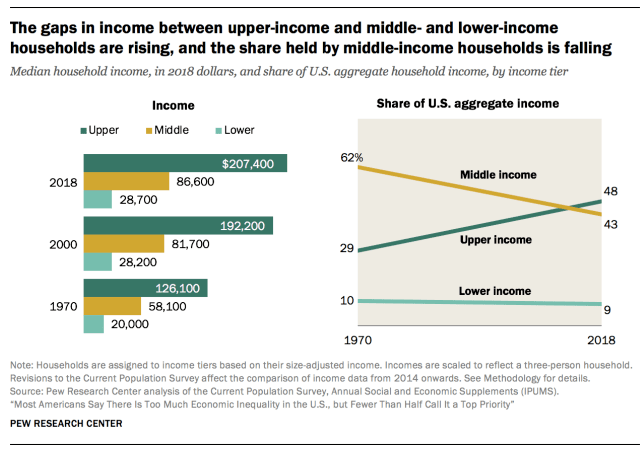
Individuals with low incomes spend a disproportionately large share of their incomes on commodities because everyone needs to eat approximately 2,000 calories of food per day. In addition, everyone needs some kind of shelter, clothing and basic transportation. All of these types of consumption are commodity intensive. People with very high incomes tend to buy disproportionately more goods and services that are not very resource intensive, such as education for their children at elite universities. They may also use part of their income to buy shares of stock, hoping their value will rise.
With a shift in the distribution of incomes toward those with high earnings, the demand for commodities of all types tends to stagnate or even fall. Fewer people are able to buy new cars, and fewer people can afford vacations involving travel. Thus, as more complexity is added, there tends to be downward pressure on the price of oil and other energy products.
[4] Oil prices have been falling behind those needed by oil producers since 2012.

Back in February 2014, Steven Kopits gave a presentation at Columbia University explaining the state of the oil industry. I wrote a post describing this presentation called, Beginning of the End? Oil Companies Cut Back on Spending. Oil companies were reporting that prices had been too low for them to make an adequate profit for reinvestment, back as early as 2012. In inflation-adjusted terms, this was when oil prices were about $120 per barrel.
Even Middle Eastern oil exporting countries need surprisingly high oil prices because their economies depend on the profits of oil companies to provide the vast majority of their tax revenue. If oil prices are too low, adequate taxes cannot be collected. Without funds for jobs programs and food subsidies, there are likely to be uprisings by unhappy citizens who cannot maintain an adequate standard of living.
Looking at Figure 4, we see that there has been very little time that Brent oil prices have been above $120 per barrel. Even with all of the recent central bank stimulus and deficit spending by economies around the world, Brent oil prices remain below $60 per barrel.
[5] Interest rates and the amount of debt make a huge difference in oil prices, too.
Based on Figure 4, oil prices are highly irregular. Much of this irregularity seems to be associated with interest rate and debt level changes. In fact, in July 2008, what I would call the debt bubble associated with subprime housing and credit cards collapsed, bringing oil prices down from their peak abruptly. In late 2008, Quantitative Easing (QE) (aimed at bringing interest rates down) was added just prior to an upturn on prices in 2009 and 2010. Prices fell again, when the United States discontinued QE in late 2014.
If we think about it, increased debt makes purchases such as cars, homes and new factories more affordable. In fact, the lower the interest rate, the more affordable these items become. The number of purchases of any of these items can be expected to rise with more debt and lower interest rates. Thus, we would expect oil prices to rise as debt is added and fall as it is taken away. Now, there are many questions: Why haven’t oil prices risen more, with all of the stimulus that has been added? Are we reaching the limits of stimulus? Are interest rates as low as they can go, and the amount of debt outstanding as high as it can go?
[6] The growing complexity of the economy is contributing to the huge amount of debt outstanding.
In a very complex economy, a huge number of durable goods and services are produced. Examples of durable goods would include machines used in factories and pipelines of all kinds. Durable goods would also include vehicles of all types, including both vehicles used for businesses and vehicles used by consumers for their own benefit. As broadly defined here, durable goods would include buildings of all types, including factories, schools, offices and homes. It would also include wind turbines and solar panels.
There would also be durable services produced. For example, a college degree would have lasting benefit, it is hoped. A computer program would have value after it is completed. Thus, a consulting service is able to sell its programs to prospective buyers.
Somehow, there is a need to pay for all of these durable goods. We can see this most easily for the consumer. A loan that allows durable goods to be paid for over their expected life will make these goods more affordable.
Similarly, a manufacturer needs to pay the many workers making all of the durable goods. Their labor is adding value to the finished products, but this value will not be realized until the finished products are put into operation.
Other financing approaches can also be used, including the sale of bonds or shares of stock. The underlying intent is to provide financial time-shifting services. Interest rates associated with these financial time-shifting services are now being manipulated downward by central banks to make these services more affordable. This is part of what keeps stock prices high and commodity prices from falling lower than their current levels.
These loans, bonds and shares of stock are providing a promise of future value. This value will exist only if there are enough fossil fuels and other resources to create physical goods and services to fulfill these promises. Central banks can print money, but they cannot print actual goods and services. If I am right about collapse being ahead, the whole debt system seems certain to collapse. Shares of stock seem certain to lose their value. This is concerning. The end point of all of the added complexity seems to be financial collapse, unless the system can truly add the promised goods and services.
[7] Intermittent electricity fits very poorly into just-in-time supply lines.
A complex economy requires long supply lines. Usually, these supply lines are operated on a just-in-time basis. If one part of a supply line encounters problems, then manufacturing needs to stop. For example, automobile manufacturers in many parts of the world are finding that they need to suspend production because it is impossible to source the necessary semiconductor chips. If electricity is temporarily unavailable, this is another way of disrupting the supply chain.
The standard way to work around temporary breaks in supply chains is to build greater inventory, but this is expensive. Additional inventory needs to be stored and watched over. It likely needs financing, as well.
[8] The world economy today seems to be near collapse.
The self-organizing economy is now pushing the economy in many strange ways that indirectly lead to less energy consumption and eventually collapse. Even prior to COVID-19, the world economy appeared to be reaching growth limits, as indicated in Figure 1, which was published in January 2019. For example, recycling of many renewables was no longer profitable at lower oil prices after 2014. This led China to discontinue most of its recycling efforts, effective January 1, 2018, even though this change resulted in the loss of jobs. China’s car sales fell in 2018, 2019, and 2020, a strange pattern for a supposedly rapidly growing country.
The response of world leaders to COVID-19 has pushed the world economy further in the direction of contraction. Businesses that were already weak are the ones having the most difficulty in being able to operate profitably.
Furthermore, debt problems are growing around the world. For example, it is unclear whether the world will require as many shopping malls or office buildings in the future. A person would logically expect the value of the unneeded buildings to drop, reducing the value of many of these properties below their outstanding debt level.
When these issues are combined, it looks likely that the world economy may not be far from collapse, which is one of my contentions from Section [1]. It also looks like my other contentions from Section [1] are true:
(i) Low oil prices rather than high are to be expected as the economy reaches limits,
(ii) Most fossil fuel reserves will be left in the ground because of low prices, and
(iv) If the economy is not to collapse, we need energy sources providing a larger quantity of net energy per capita to offset diminishing returns.
Regarding (iv), the available energy supply from wind and solar (net or otherwise) is tiny relative to the total energy required to operate the world economy. This issue, alone, would disqualify a Great Reset using wind and solar from truly being a solution for today’s problems. Instead, plans for a Great Reset tend to act as a temporary cover-up for collapse.


Oil’s Rebound Is Draining Storage Tanks Across the Americas
https://financialpost.com/pmn/business-pmn/oils-rebound-is-draining-storage-tanks-across-the-americas
The markets don’t expect prices to stay this high, so it is a good idea to sell from storage, not add to it.
Girl, 8, found brother’s body when he hanged himself as lockdown left him feeling lonely
A 12-year-old boy was found hanged in his bedroom by his little sister after Covid lockdown measures made him feel ‘sad and lonely’. Hayden Hunstable, from Aledo, Texas, tragically took his own life in April 2020, just three days before his thirteenth birthday, because he didn’t know how to deal with feeling isolated and depressed when Covid caused a nationwide shutdown. He ‘would still be alive today’ if it wasn’t for Covid, according to his heartbroken father, Brad, 42, who is speaking out about his son’s sad death to help prevent future youth suicides.
https://metro.co.uk/2021/02/10/boy-12-was-found-hanged-by-his-little-sister-after-covid-lockdown-made-him-sad-14054728/
Suicides of all ages are becoming a bigger problem. Also accidental drug overdoses.
He ‘would still be alive today’ if it wasn’t for Covid, according to his heartbroken father,
So, that’s another death we can put down to the virus then.
Tim, I’ll be blunt: I do not believe that quote. The boy was killed by the lockdown, and I strongly suspect the newspaper fabricated the quote to conceal that fact.
The new gold. on Shell, INEOS plastic and shale gas.
1. In Pennsylvania, on the banks of the Ohio River, Shell is building a huge cracker. A mega-investment of some ten billion dollars. It employs five thousand construction workers and will account for six thousand permanent jobs. This ‘cracker’ will produce one million tons of plastic pellets annually starting in 2020 – the basis for all kinds of plastic products.
2. Shell is not alone. In the port of Antwerp, the British petrochemical giant INEOS is building two similar cracking plants. An investment of three billion euros; the largest in the European chemical sector for twenty years. The installations should turn the tide of ‘decline’ in the petrochemical sector, INEOS says on its website. Exxon Mobile, Dow Chemical, Chevron and other oil and gas companies also see plastic as the new gold. Falling oil and gas prices, an unstable oil market and growing attention to the switch from fossil to clean energy are important factors in this.
3. The fact that these companies are investing billions in a new generation of plastic factories is also related to the explosive growth of shale gas extraction. Fracking also releases other gases such as ethane and propane, gases with which people did not initially know what to do, until it was discovered that they could be used to make plastics.” The cracking plants of Shell and INEOS, among others, crack ethane into ethylene and turn it into plastic pellets.Packaging producers use them for all kinds of plastics such as PET and polyethylene, the material for bags, foils and bottles.
4. Banks and insurers are investing heavily in companies that extract shale gas and produce plastics, according to the Plastic Finance report published this summer. ING is the largest funder, followed by ABN Amro. Aegon and Allianz are the largest investors.
In total, the banks lent $5.3 billion to the shale gas and plastic companies studied between 2010 and this year. Four billion dollars was invested in them, through stocks and bonds, among other things. Together with other foreign investors, the Dutch thus account for about 68 percent of the investments in those plants. Shell, which produces both shale gas and plastics, is the main recipient, with over one and a half billion dollars in issued shares.
5. This is a very interesting development for gas miners. They would normally have to pay to get rid of this by-product, but now they can earn a lot from it. Moreover, shale gas ethane is much cheaper than naphtha, the petroleum by-product from which plastics are usually made. That makes the production of shale gas even more interesting
6. The growing interest in ethane is shown by the number of dollars invested in the expansion of ethane-plastic production since 2010 in the United States alone: 204 billion dollars, spread over three hundred projects. The producers are all established petrochemical companies that already own mainstream plastic companies. Shale gas is another step in the race to the bottom. The contribution of plastic production to climate change is slowly becoming clear. In 2019 alone, it will account for 850 million tons of greenhouse gas emissions, comparable to the emissions of 150 coal-fired power plants/source( Centre for International Environmental Law (CIEL). Even before plastic granules are used as raw materials, much of it ends up in oceans and on beaches due to losses during transport.
7.The companies themselves mainly emphasize how much fun all this new plastic is for consumers. Steve Russell, vice president of plastics for the American Chemical Council sketches a future of lighter cars, new medical equipment, less food waste, windmills and solar panels made of plastic. Plastics products also make a good show of helping to clean up plastic: the ‘Alliance to end plastic waste’ – a collaboration of some forty companies, including the largest plastics producers including Shell and INEOS – is making $1.5 billion available in the coming years to tackle plastic pollution. A pittance compared to the billions they are investing in new plastic production.
I read elsewhere that this past year was a great year for growth in the use of plastics in the US, now that people are being encouraged to buy takeout food from restaurants and being discouraged from using recyclable bags.
Shale producers have a lot of gasses that they can’t use. They would like to simply burn them off, but local officials never like this idea.
I didn’t realize that cracking wasn’t necessary for some, to get them into the right form needed for making plastics.
I wonder what goes into the CO2 calculation for the plastics. Certainly the energy that goes into making the plastics. But how about at the end of their lives. The CO2 calculation looks much better, if the plastics are simply dumped in the ocean. A better choice might be to incinerate them, perhaps using the heat for a useful purpose. But that would raise CO2 emissions.
So far, I don’t see a better idea for plastic disposal than to bury it, without treatment, in construction. One problem there, however, is that construction is even more deadly than plastic.
COVID-19: Some restrictions should last until all adults have been vaccinated, senior health official says
Dr Susan Hopkins told Sky News some measures may have to stay in place beyond that, until more is known about COVID-19 transmission, so “we can release everything and get back to life as it was”.
https://news.sky.com/story/covid-19-restrictions-could-be-in-place-until-all-adults-are-vaccinated-expert-warns-12215570
This is a UK story, but I suppose officials elsewhere are having similar thoughts.
“SHOW ME YOUR PAPERS”
It may sound like a science fiction movie, but vaccine passports are being discussed and developed for citizens across the free world, aimed at tracking #Covid19 vaccination status, and possibly barring people in the future from travel, concerts, even being allowed in private businesses. Washington Times Opinion Editor, Cheryl Chumley, takes a deep dive into the likelihood of this happening and the constitutional freedoms this technology would infringe upon.
https://www.bitchute.com/video/M2qGdOcU88wT/
I am already resolved to the possibility that it is very unlikely that I will be traveling abroad again. What irks is that I cannot travel within Scotland (unless something urgent) and I am beginning to wonder if this is permanent too. The UK govt this week warned people not to book any holidays for this year. And should you manage to get out for some reason, and get confused with your destination on the way back in, you are looking at a 10 year jail sentence.
“Efforts by governments around the world to forge a green recovery from the coronavirus pandemic are so far failing even to reach the levels of green spending seen in the stimulus that followed the 2008 financial crisis, new analysis has shown.
“Only about 12% of the spending on economic rescue packages around the world is going towards low-carbon projects… That compares with about 16% of stimulus spending that was devoted to green and low-carbon ends after the financial crisis of 2008…”
https://www.theguardian.com/environment/2021/feb/12/global-green-recovery-plans-fail-to-match-2008-stimulus-report-shows
Using the figures in the article, the total amount of stimulus spending will be something like 4.5 times as much now as in 2008. (in fact, more, if Biden is able to add to the US package of spending.) Some of this increase is due to inflation, but it truly is a whole lot higher. The world is a lot worse off this time, and there are fewer hopes for fixes.
“YPF bonds rallied on Thursday after the Argentine state energy giant said it had received support from holders of almost 60% of its bond maturing next month to restructure the debt, helping defuse near-term default fears.
“The company, which leads development of the huge Vaca Muerta shale formation in the South American nation, said the result meant it had received support from the central bank to get access to the dollars it needed to pay off its obligations.”
https://www.reuters.com/article/ypf-debt/update-3-argentinas-ypf-swerves-default-with-partial-debt-swap-idUSL1N2KH1DM
“The Oil Price Slump Crippled Colombia’s Economic Recovery:
“Colombia’s economic growth and currency are closely correlated to crude oil prices. The prolonged oil price slump which began in August 2014 has hit Colombia hard.”
https://oilprice.com/Energy/Crude-Oil/The-Oil-Price-Slump-Crippled-Colombias-Economic-Recovery.html
A long as people believe that surely oil prices will recover sometime, they will support restructuring. There seems to be a chance of getting the money they need.
“Europe’s Banks Had Their Worst Year in a Decade Amid Pandemic:
“Profit at the 19 major EU lenders that have published results dropped below 10 billion euros for the first since Bloomberg Intelligence started collecting the data in 2010.”
https://www.bloomberg.com/news/articles/2021-02-10/battered-european-banks-signal-worst-of-pandemic-woes-are-past
“Europe’s debt cancellation would mean recognition of insolvency…
“Direct monetization of all and any government spending Argentina-style [ignores that the] euro is the only global reserve currency with redenomination risk and that its credibility is maintained only because of the widespread confidence in the euro area’s commitment to repay its debts.”
https://www.bbntimes.com/global-economy/europe-s-debt-cancellation-would-mean-recognition-of-insolvency
“Calls for the European Central Bank to forgive the sovereign debt on its balance sheet may seem harmless, given that most countries are not expected to ever pay off the debt. But such a move would set a dangerous precedent and damage confidence in the international monetary system.”
https://www.globalcapital.com/article/b1qj5rzx7y93qw/ecb-debt-forgiveness-would-unleash-chaos
If a debt cannot be repaid, honest accounting requires that you admit the fact, write it off, and eat the resulting loss. The ECB is fooling nobody except themselves, not even the oligarchs to whom they are beholden.
Honest accounting?! God save us all from honest accounting.
For you, Bei Dawei, with my sincere thanks:
http://www.kiplingsociety.co.uk/poems_copybook.htm
I read in a local newspaper that the shopping mall closest to where I live has defaulted on its debt, which is held by Deutsche Bank. They tied to auction the mall off, but there were no bidders. I wonder how many other similar properties have debt in the EU.
https://wolfstreet.com/2021/02/04/deutsche-bank-got-jingle-mail-from-1-us-mall-reit-simon-property-group-foreclosed-on-mall-got-no-bids/
Deutsche Bank this week foreclosed on a $177.5 million mall mortgage. The mortgage had been securitized and spread over two commercial mortgage-backed securities (CMBS) in 2012. The collateral is 560,000 square feet of retail space at the 1.2 million square-foot Town Center at Cobb, in Kennesaw, Cobb County, Georgia. The regional mall has over 170 stores, including a Macy’s, a JCPenney, and a Belk (just filed for bankruptcy).
The mall was owned by Simon Property Group, the largest mall landlord and mall REIT [SPG] in America, which, in one of its acts of jingle mail, had returned the mall to the lenders.
“Jingle mail” was engraved into the American lexicon during the housing bust, when homeowners voluntarily turned their homes over to lenders, presumably by mailing them the house keys. Most home mortgages are recourse loans, and banks can drag the homeowner to court over any deficiency after the foreclosure sale – except in the 12 “non-recourse” states. But commercial real estate mortgages are non-recourse; all the lender gets is the collateral, and the owner walks away.
Simon Property the biggest mall operator in US got credit downgraded by Moody’s, S&P, Fitch.
https://www.marketwatch.com/story/simon-property-gives-up-on-four-struggling-malls-why-more-could-follow-11605362409
More good news
Unibail-Rodamco-Westfield (URW), which, in addition to many properties in Europe, owns 27 malls in the the US, including the upscale Westfield San Francisco Center, reported a loss of €7.6 billion for 2020, after large write-downs. Its net rental income dropped by 28%.
The company, Europe’s biggest property REIT, is heavily leveraged and is in all the wrong markets at the wrong time. Besides its exposure to the ravaged brick-and-mortar retail sector, URW has a portfolio of airport shopping centers, office towers, hotels and conference halls, all of which were hammered by lockdowns, closures, travel restrictions, and cancellations.
The company’s shares responded to the news by sliding 12% on Thursday, to €57 a piece. They are now down 55% year over year and 78% from a peak of €257 in February 2015.
https://wolfstreet.com/2021/02/12/owner-of-westfield-buckling-under-32-billion-in-debt-plans-to-dump-its-us-malls-after-huge-losses/
Headed for 0….
Thank you, Gail, wis.dom, and Eddy.
Real estate looked like a very good investment 10 to 15 years ago, in a time of rising population, rising disposable income, and a rising service sector. As indeed it was. But the idea had a major flaw: there is no Plan B. If the economy turns down, as it always does, real estate ceases to become an air balloon, and becomes a millstone.
If you can spot the trend, and get out in time, well and good. But very few investors are psychologically equipped to do this, so they cling to their white elephants and hope “something” will turn up. This time around, I fear it won’t. This is more than a matter of energy: people are beginning to learn that they did not really need that plethora of “service” industries.
That whipped cream mocha latte with cocoanut meringue pie is never coming back. Nor the blow dried perfumed diCaprio wave hairstyle. Nor the architect designed office boardroom with etched mirror walls.
I know people who are in the Bitcoin Cult… I suspect at least one has made millions on… he was urging me to buy a couple of months ago at 17k….. I suspect those in the cult believe it will continue to run higher forever (he’s urging me to buy at 40k+)….
My response – why bother investing when we are likely to be gone in 6 months or so…. or the Great Reset says the govt will seize all assets….
A little King Midas at play here… they’ll be drowning in gold … just prior to hunting for rats.
And what’s the use of making easy millions — when there is not really much you can spend it on … and there is no future to spend it on.
But hey — these are the same people who cannot understand why I have been bucket listing for 10+ years now…
I bought an even faster car a couple of months ago — told a mate that this is the final item in the bucket list… he says — but what if you have 40 more years to live? I passed him The Leak + the headline from the National Post re: Covid21 …. and said — martial law is Q2… so I don’t need to remain solvent for anywhere near 40 years — no response.
Some people rejoice about Russia having a low debt to GDP:
https://tradingeconomics.com/russia/government-debt-to-gdp
The sad news is that the debt is accumulating by those, who buy Russian oil or natural gas.
I believe that the companies extracting the oil and gas are also incurring debt.
“The coronavirus crisis meant the UK economy endured its deepest annual slump last year since the Great Frost of 1709, according to official figures.
“The Office for National Statistics (ONS) said early estimates, subject to revision, showed that gross domestic product (GDP) tumbled by 9.9% in 2020.”
https://news.sky.com/story/covid-19-economy-in-deepest-annual-slump-since-1709-great-frost-12215651
“The number of people in the UK with ‘low financial resilience’ grew by a third in 2020, from 10.7 million to 14.2 million.”
https://www.forbes.com/uk/advisor/personal-finance/2021/02/11/covid-crisis-pushes-millions-more-brits-into-financial-peril/
“More than half a million UK businesses are at risk of collapse by the spring unless the government extends Covid business support…
“The 600,000 businesses at risk of collapse without more support together employ approximately 9m people, “whose jobs could be lost” said the Institute for Public Policy Research (IPPR) in its latest report.”
https://smallbusiness.co.uk/half-a-million-businesses-at-risk-of-collapse-without-more-support-2552099/
Somehow, all of the big financial problems in the UK are not a surprise.
Victoria plunged into five-day lockdown as Holiday Inn cases grow
Victorians will only be allowed to leave their homes for the following reasons: essential supplies, care and caregiving and exercise and essential work.
Exercise and shopping will be limited to 5km from Victorians’ homes.
Exercise is allowed for two hours a day with household members, your partner, or one other person who is not from your household.
Masks will need to be worn everywhere except in your own homes and no visitors are allowed in homes.
Public gatherings are not permitted.
Mr Andrews said that if you can work from home, then you must work from home.
Schools will close but will remain available over three days — Monday, Tuesday, and Wednesday — for vulnerable children.
Child care and early childhood centres will remain open.
Places of worship are closed. Religious gatherings and ceremonies are not permitted. Funerals can involve no more than 10 people for both indoor or outdoor settings. Weddings are not permitted unless on compassionate grounds.
https://www.news.com.au/lifestyle/health/health-problems/authorities-planning-for-a-third-lockdown-as-melbourne-holiday-inn-cases-grow/news-story/65c965de86efa7f93f07d2772c4c1219
This round of new cases seems to have started with an infected person in one of the hotels used for quarantines using a nebulizer. I think of a nebulizer as a device people with asthma use to get albuterol medication to their lungs. The device turns liquid medicine into a fine mist, so it goes down in people’s lungs.
https://www.singlecare.com/blog/what-is-a-nebulizer-machine/
According to article:
https://www.livemint.com/science/news/new-australia-covid-outbreak-linked-to-a-nebulizer-at-a-melbourne-hotel-11613030323512.html
I imagine if nebulizers work this way, to spread viruses in hotels, they likely work in a similar way in rooms of cruise ships and in apartments connected by hallways.
“US federal debt to exceed size of economy even before Biden stimulus is approved, CBO says.
“CBO’s deficit projections comes the day after the Federal Reserve chairman warned of the dangers of high unemployment.”
https://www.washingtonpost.com/us-policy/2021/02/11/cbo-deficit-debt-stimulus/
“It is no surprise that an increase in debt levels for world governments will necessarily mean larger repayments. However, a 100bps rise in the yield curve will mean a debt interest payment that is over 4% of the US’s GDP. A 200bps rise will equate to around 6%.
“So, this is why the Fed does not want to repeat the taper tantrum of 2013 and would like to keep rates as low as possible, for as long as possible.”
https://www.fxstreet.com/analysis/three-different-scenarios-for-us-debt-202102100818
It is not just for the US government that the Fed wants to keep interest rates low. It is for investors and speculators everywhere. If interest rates aren’t low, and money policies very loose, there is a danger that the current bubble will collapse.
The bubble will invariably collapse. Kill it before it gets bigger. It will always be “too big to fail.” Waiting doesn’t make things better.
“The US and world economy is debt-dependent. The excessive valuations showing in financial asset prices are a result of an abundance of cheap credit…
“Economic activity is funded primarily by cheap credit; whether it be mortgages, business activity, even retail consumption. Without the access to unlimited amounts of credit the world economy would come to a standstill. The situation is precarious.
“The economy is not in a bubble, but it is very fragile and could collapse at any time.”
https://www.fxempire.com/forecasts/article/bubblicious-asset-prices-debt-dependency-economic-collapse-699731
“As the coronavirus pandemic stokes fears of deflation, the Bank of Japan is facing changes in its board that could tip the balance in favour of aggressive monetary easing and test the limits of its already stretched policy tool-kit.
“Parliament approved on Wednesday the government’s nominee Asahi Noguchi, an academic known as a vocal advocate of heavy money printing, to join the BOJ’s nine-member board in April.”
https://www.hellenicshippingnews.com/analysis-as-deflation-looms-boj-reshuffle-gives-more-voice-to-advocates-of-big-stimulus/
Interesting, thanks.
The bubblicious asset price article ends:
“The Next Great Depression will be worse and last longer.”
This is not really a shock.
US militaries have a problem with financial power and production capacity. The lack of competition and concentration among supplier threatens the security of the US
https://mattstoller.substack.com/p/the-pentagon-turns-on-wall-street
a few quotes:
“the defense industrial base is breaking down due to monopolization and financial corruption.”
“There have always been serious problems with the defense base, but the inability of America to competently produce weaponry is a new problem”
“Some consequences of the Last Supper and the Clinton era policy choices on procurement included higher prices for military supplies, the mass roll-up of defense subcontractors by private equity firms, as well as Wall Street bankers aiding the Chinese government in building its missile program with U.S. technology (a missile program it is now using to threaten American interests.) Perhaps the most noticeable outcome was how the resulting merger mania effectively ruined Boeing and paved the way for the 737 Max fiasco”
“t becomes increasingly obvious that the way we’ve structured our commerce is setting up the U.S. to lose a major war”
and so on…
another part of the article is about facebook making 2.9 billion from Qanon in 2020. Really?
Isn’t the issue really too much complexity for the military as well?
Back in World War I or World War II days, individual planes were not terribly expensive (or high tech). Neither were other devices. They could be put together in house, by people without a huge amount nor knowledge.
Now devices become so expensive and require so much detailed knowledge and technology it is necessary to outsource the construction of these devices. I would imagine that most of these require transistor chips; these chip probably are made in Taiwan, if they are complex.
These devices are so expensive that the government can’t have very many of them. If some of them become obsolete (aircraft carriers that could be hit by drones, for example), it is impossible to pivot and do something else.
Yawn. The US military brought this upon themselves. The F35 fiasco effectively ceded US air superiority to the enemy; the failure to create a defence against hypersonic missiles turned the fleet of aircraft carriers into sitting ducks, and all because the generals were obsessed with technology rather than combat effectiveness, and defence contractors fed this folly with grandiose impossibilities.
Decisions about where the military money is spent became just another corrupt money game like wall street. The military career path is retire early then become a consultant for a contractor. There are people in the military that do nothing but analyze how it should spend its money. They work very hard at trying to see where it should best be spent and many of them are quite brilliant. Their analysis is never implemented because the swamp and the contractors lobbyist make those decisions. If your a politician and contractor x is in your state contractor xs product is the best choice. Like a lot of things it was just a little waste at first. It became a lot of waste but hey we just print more so who cares. Finally it reaches a point where no matter how much is created and spent the USA is not competitive. There comes a point where money doesn’t motivate the best talent. Why innovate if the decisions are just going to be made on swamp politics? So who are the people attracted to this game and what motivates them? $$$$$$$$. Real world resources and talent are limited regardless of money creation. Decisions made on profit and political considerations made on constituents jobs rather than decisions where science and resources would create tactically competitive weapons systems. Do this for a decade or three and you get to where we are now. Very tough learning curve ahead. We still seem to believe steaming carrier strike groups about projects power. Now a carrier strike group is indeed a very nice piece of hardware but show horses dont pull plows Finding multiple bits that have a innovative edge and use that edge rather than throwing tech money at a few show horses seems to reflect a strategy of winning better with the way technology has evolved The USA system of military purchase is simply not capable of that. It seems to have developed a inherant dislike of work horses. Look at the A10…Its not that tech isn’t vital in military hardware decisions its that the type of tech that has come forth changes things. If you have a system that is 5x better than competitors it doesn’t how many they have. If its only 1.25 x better not so much. Slow adopters are known as losers in war.
Thank you, jj, for a compelling and emotionally gripping analysis. And, having worked for the US Ministry of Defense, I respectfully agree.
Necessity is the mother of invention.
Mother is not invention is necessary.
However I seriously doubt much of the allocated money went to the F35 project itself. I mean, what are we talking about here; a rather traditional aircraft with some stealth whiz bang and electronic and computational gadgetry. What can be that expensive, really? Perhaps most of the money didn’t go to that project at all is my suspicion.
If shitty Sweden can produce half decent military multi role jets (Gripen) it would have been strange if the US weren’t capable of doing the same for that obscene amount of money.
Here’s an idea, how about licensing the gripens, tweak ‘em up with hooks, and “Zerg Rush” them on the battlefield. Shove in AI’s in the cockpit and cut the human out of the loop. Mass produce. Couple with smaller, simpler carriers instead of these behemoth single points of failure that the “Gotland” class Stirling subs can sneak upon and poke holes in. Yup, the Swedes did it again – being obnoxious.
But hey, what do I know.
Thank you, Kowalainen. As it happens, I do know a little. The main money sink is exactly those stealth whiz bang gadgets, which simply do not work. Of course, the decision to build one “all purpose” plane, when the UA Air Force, Navy, and Marines wanted three different planes, doomed the project on Day One.
The key innovation was to allow all the planes in a squadron to share data, and then for a massive AI to synthesis the data into a heads up display visible to all the pilots. It has never worked; and indeed its main effect has been to reduce the pilot’s ability to simply “eyeball” the battlefield. One result is that the plane has to be flown so close to the enemy that it can be shot down before getting close enough for computerised target acquisition.
Oh yes, and the helmet needed for that display is heavy enough to break the pilot’s neck should he have to perform an emergency evasive manoeuvre. So technology “wins”, and combat effectiveness loses.
The F-35 is such an ugly plane. It looks like a brick. I imagine its fuel economy is strikingly low.
The wolf pack/Viking raider/desert fox strategy never gets old. Individual actors/smaller packs on the battlefield spreading chaos and destruction for sure must be more effective than some behemoth battle computer/ships (aka single point of failure). For sure some in the swarm are bound to get shot down, but at least they do so swinging.
What is this disease of centralization originating from? After all, the US, for practical intents and purposes invented the goddamn Internet for its distributed resiliency and then suddenly ignores that and plough copious amounts of money in single points of failure. Of course stealth tech eventually would be circumvented. The F35 already looks dated, at least compared with the older Gripen and the ferocious looking forward swept wing Grumman X-29. What an awesome piece of machinery.
The aircraft should fit and respond to the pilot (or aircraft instanced AI) like a pair of comfy old and worn sneakers. Too much useless crap going on at the same time is for sure going to be problematic. Just reliable time synchronized data streams of radar data must be an intractable problem. I’m working with some simpler ultrasonic arrays and that is already a challenge, and compare that with an electronically scanned array.
Here’s was an interesting warrior maverick with a disdain for pomp and regalia. Rather went about honing his battle craft with his trusted buddies.
https://youtu.be/pU-kFUJoJEU
Thank you, Kowalainen, a great dose of sanity. Incidentally, a professor working for the UK Ministry of Defence broke the “stealth” technology in a little less than two years. I helped one of the young lady interns with the programming, and a colleague designed a draftsman program that could draw a blueprint for a new radar antenna in five minutes, (previously the prof used a human draftsman who took two weeks). Good fun all round.
How amusing; a few rather smart lads vs. a behemoth budget producing an obscene amount of PowerPoint decks, testosterone and cookie hole flap. Guess who wins? 🤔
I’m quite sure the Russkies, Swedes and French had it figured out when they went on to develop the Rafale and Gripen (which is Rafale light DIY made by IKEA).
Of course there is a possibility to jam the bejeebus out of the enemy if you decide to go for the “swarm” approach.
First nothing, then a few blips, and suddenly *boom* 5000 aircraft on the screen. Oh yes, those phased arrays and ECM’s for sure can be used for so much trolling, yes, only the sky is the limit.
It wouldn’t surprise me if the most advanced radars/jammers/ECM suites can feign (in multiplicity) most stuff that is capable of flying.
If that is so, what and where exactly are you going to deploy your ultra expensive single points of failure, specially if they are visible clear as day on the screens of the adversaries?
For example, would you press on with the mission when the adversary can fake 10:1 in disadvantage for you? Of course you’d turn back home runnin’ “wet” in the rear end.
I like the Russian approach to tech learned in the rigors of the eastern front in the 1940s: tech should be simple and rugged.
Speaking of simple, I remember several years back the US was conducting some war games and the general who was role playing the opposition kept running rings around our advanced technology with simple, low tech tricks. I wish I remembered his name.
Kowalainen, another true (slightly sanitised) story. It was an informal conversation with an IT techie about the “Star Wars” program.
He was part of a team designing a complicated AI system that would integrate the defending anti missiles so that they would all choose different targets. Given that the enemy missiles could execute evasive manoeuvres, this was proving somewhat intractable.
So I asked him how much all this would cost, and was duly shocked. Then I replied “why not build three times as many dumb missiles and have each one choose a target at random until none are left?” I’m afraid he was rather offended.
Playing the underdog for sure must be the most entertaining and rewarding.
Zooming in from nowhere and laying down some simulated chaos and destruction.
I read somewhere that the Gripen wolf packs, Red Flag -08 I think it was, performed well.
@robert&jj, I agree these other points you guys bring up is part of the problem, but the excessive industrial concentration and monopoly capitalism is certainly a problem too, and not only in military related industries but in the economy generally. This book is a good summary of the problem:
https://www.amazon.com/Cornered-Monopoly-Capitalism-Economics-Destruction/dp/0470928565
Cornered: The New Monopoly Capitalism and the Economics of Destruction
by Barry C. Lynn (Author)
According to the book summary,
Ah ha… YT removed this…. but I found it on Bitchute…. this is something every Green Groupie needs to see… it will Rock Your World!
Why did it get removed? Because the Elders and their minions have invested decades into creating Green Hopium…. to keep the sheeple calm … and if too many of them were to watch this … the Delusion would implode… and we can’t have that (btw – I agree with the Elders — this should not be promulgated)
https://www.bitchute.com/video/MNKvjl5Rdu9P/
Nice fresh good quality blu-ray rip here.
https://yts.mx/movies/planet-of-the-humans-2019
As I wrote not so long ago, it’s still on YT:
https://www.youtube.com/watch?v=5x7UgKfSug0
Could be blocked in NZ, I suppose.
Works in Gretaland.
Just a matter of time before that copy is pulled
They yanked it citing a technicality, namely some greenie who didn’t like it complained that they had inserted a few seconds of his own documentary into theirs–fair use I would think, but YT yanked it immediately. But Moore got it restored after they edited out the problematic clip. The greenies really hated that film and pushed back hard, even though it was made and distributed by two guys whom they had previously regarded as politically reliable.
Elders … Ha !
Always the Elders.
No, it got taken down from YT because publishing it there broke copyright laws.
Get your story right.
Can’t deny the influence the Elders are playing in the grand scheme of things, though
And leprechauns. Can’t deny the influence of leprechauns.
the Elderly Leprechauns in particular.
most of TPLTB (The Powerful Leprechauns That Be) are elderly, and that just adds to the mystery of why “They” are con.spiring to preserve remaining FF for themselves when they won’t be here much longer anyway.
read The Protocols of the Elders of Leprechauns for all the info.
Stay warm under your blanket of denial while you can. Ha. Ha. Ha.
Thanks for that but you are wrong. Michael Moore released this documentary onto Youtube … so there is no infringement…
Do your research before you hit submit Pete… here’s Moore and the director explaining why Youtube pulled it (Vimeo has done the same)…. and if anyone tries to re-upload it… they’ll continue to rip it down….
https://youtu.be/7-UvTTF05OU
The teensy copyright violation, which one could probably argue was fair use, was just the pretext. The reason was ideological opposition. However, it was not the Elders this time, but the greenies/watermelons. They are often political allies, but they have different priorities. I don’t think the Elders really had a problem with the content of this film. It’s not one of their big issues.
MICHAEL MOORE PRESENTS- PLANET OF THE HUMANS
The scenes of mining and the scale of the environmental destruction that this movie shows—all in order to create the Green Energy infrastructure—leave an uncomfortable feeling in the stomach. Those poor Joshua trees being smashed and shredded to make way for the world’s biggest bird vaporizer, championed fittingly by Arnold Schwarzenegger, are a really pitiful sight.
No wonder the Green-gestapo was not amused. This is a must-see movie.
If they try to scale Green energy up, it will be HUGELY destructive. There is no such thing as clean energy.
No kidding!
Unpaid rent is piling up. Landlords can’t hold on forever
https://www.cnn.com/2021/02/09/success/eviction-moratorium-landlord-plans/index.html
I am sure lenders are running into a similar problem, if people cannot make their mortgage payments. Article dated Feb. 9, 2021.
https://www.bankrate.com/mortgages/what-to-do-if-your-mortgage-forbearance-is-ending/
FHFA extends mortgage forbearance protection again. Here’s how forbearance works
The payments aren’t forgiven… so imagine having to come up with a year’s rent all at once. That is not going to happen for people who have been put out of work. The US doesn’t have a generous furlough scheme like the UK.
I agree that the UK furlough scheme is very generous – 80% of your regular earnings, not bad for doing nothing for a year or two. But there are at least a few who don’t meet the criteria and who get nothing. Not sure how many.
Gail, I thought about something I would like to share.
You mentioned that you didn’t predict the plandemic. Neither did I – in fact I was in shock for months and I am still trying to understand how could a conspiracy or hysteria could occur at this global scale.
That being said, I think it could have been possible to predict what’s happened in 2020.
We know that the US empire and its clients stopped running a free market economy for a while.
There was govt intervention before (like building highways and forcing suburbanization) but recently the system became centrally planned and controlled. All the QE money going to the “right” people for example. The fact that the oil shale lost ~200 billion dollars but it never collapsed like a bubble strongly suggest govt intervention (idk how).
Now here is the thing – we knew that this could not go on forever. All the exponentially increasing curves (debt, healthcare costs, college cost, housing cost etc) had to stop somewhere.
So the thing was to find the right historical example. Dmitry Orlov was on the right path comparing US with the USSR. Think about it – everything is getting more centralized and propaganda is getting worse.
So a good example I think is East Berlin. It’s small and easy to understand. East Berlin was supposed to be a showcase of the power of socialism. They were living much better than most people behind the Iron Curtain. And yet, all the investments and the propaganda were not enough. People were escaping. At some point they had to build the fence and later the wall. And they had to resort to deadly force to stop everyone trying to escape – because one person could infect a hundred with wrongthink.
Same thing happened with us – QE reached the limit and the propaganda was being ignored while populists were being elected.
So just like the East Germans, they had to come down hard on us. Forget about the old freedoms – we are moving from “Brave New World” to “1984”.
Do you think the model above could be useful? One conclusion that I draw is that even after the system becomes highly abusive, it will take decades to collapse. In fact it will only collapse when the center cannot hold anymore. Maybe in our case the center is FB/Google etc.
Perhaps, we are moving from “Brave New World” to “1984.” Maybe there is a reason for this. With less energy, the economy really cannot withstand the disruption that exists when people from dissimilar backgrounds are mixed.
In a sense, a society is less complex if there is less variability allowed among the members. For example, China has stressed a lot of rote memorization in its schools. There is a great deal of respect for authority. People are expected to move up through the ranks based on seniority. Standing out from the crowd is not encouraged.
Classes in schools are easier to teach if children are well behaved and listens to what is taught. China (and Japan) have aimed for this approach. A great deal of emphasis is given on proper behavior.
Schools in the US have gone downhill, as teachers are forced to deal with a mix of students from widely different backgrounds. Some children come to school who have been badly neglected by parents who are drug addicts, for example. They tend to have very poor diets at home. The school helps out somewhat by giving the children breakfast and lunch, but the children are still often missing meals at home.
This is related to the wage disparity problem in the US. China has a wage disparity problem, too, but the low wages are especially among migrant workers. These children are kept out of city schools. They stay with grandparents and attend schools with other very poor children. Husbands and wives tend to stay married to each other, and there is not a huge drug problem that I am aware of.
If stratification can be kept in place, it does make the society “work better,” using less energy. I imaging this is the reason for castes in India, and segregated learning in the US. Now, we are going back, toward pods for children of wealthy, and very little learning for children of the poor.
Thanks Gail,
I agree this is about simplification and reduction of energy. I still cannot believe that this is the way we are going about it – but it does seem to work.
I think the US schooling system is horrible and moving to a system where only the wealthy will learn is even worse – but that is par for the course for the culture here.
Many countries in the world have managed to educate children cheaply without dehumanizing them. But yes, all of them require strict rules of behaviour and integration – everybody speaks the same language and behave respectfully.
Every school system in the world could be improved. US system gets overly maligned. Once you adjust for racial composition, US system is among the best. Our Asian perform better on international PISA tests than students in any Asian country. Our Latino students score higher than those in any Latin American country. If African students were taking the test, no one doubts our African-American population would outscore their cousins in any African country. Our white population scores on a par with Finland, which is the highest performing country in Europe. Our per student funding is also similar to Finland’s, which has the highest per pupil spending in Europe. And there is widespread agreement that our universities are the best in the world. The US system if far from “horrible,” but many of our students are not as innately talented as those in other advanced countries. We have students in low performing groups, but those groups are low performing everywhere in the world, not just in the US. People, especially Americans, need to come to grips with this instead of acting as those all human beings were interchangeable parts born with blank slates for brains and nervous systems.
I hadn’t heard those statistics before.
I do know that the mix of students within a given classroom is more diverse than it was years ago. This makes a given class more difficult to teach, because of the different backgrounds. Also, there is not as much respect for authority. The parents are not willing to support the teachers in conflicts with parents.
It was all over the internet in January, and the ChiComs were clearly letting infected people fly to other countries, and continued to do so even after they shut down incoming flights. Anyone who paid attention to it could see it coming. I was surprised the markets didn’t react until March. Later, I learned that the military started warning the White House before the end of November, with more warnings in December. The first documented case was November 6.
QE does not go to “people.” It goes to banks for their internal use. It is not part of the money supply. Don’t listen to the idiots who tell you it is “money printing.” It is not. Even Powell admitted on camera last year that it’s not money printing when he was put on the spot. It also has been an utter failure in terms of what the Fed and other central banks hoped it would do: stimulate bank lending.
I don’t know how fast things will unwind, but the critical point will be when the total energy available to the economy begins to decline, not because of low demand, but because supply can no longer keep up with demand. I don’t think that day is very far away, but I would love to be wrong.
U of T researchers help lay groundwork for Bank of Canada-backed “digital loonie”
How much longer will Canadians want – or be able – to use physical cash? Could a digital currency such as Facebook’s Diem Coin or Bitcoin make the Canadian dollar obsolete?
The Bank of Canada recently announced it was designing a contingency plan for a Central Bank Digital Currency (CBDC), which sparked speculation about a “digital loonie.”
https://www.utoronto.ca/news/u-t-researchers-help-lay-groundwork-bank-canada-backed-digital-loonie
Central banks everywhere are afraid their currencies will fail. They need an alternative. The big questions I see are
1. Will other countries accept these digital currencies in buying goods?
2. Will it be possible to take out loans in these currencies? For example, can you agree to pay a mortgage in digital currency, or a car loan in digital currency?
If you can’t use digital currencies in these two ways, it doesn’t seem like they are very helpful. They would be more like the local currencies that the sustainability groups have been trying to put together.
With digital currency central bank can handle all money operations itself and all other banks becoming obsolete. How many well-paid jobs will be lost?
The loss of good jobs is another good point.
We’re pretty much doing that now. When you write a check to make a house or car payment, little if any of this money gets handed out as cash by the bank the check is drawn on. If is effectively all digital. People are getting used to digital money, but what do you do if the power goes out? One day the grid will fail and not come up again. I hope it happens gradually, but it could certainly happen abruptly several different ways. All we know for sure is that the grid WILL fail one day, not for a few hours or even a few days, but indefinitely and probably forever. What we don’t know is when and how fast. Since our governments show no interest in preparing us for the inevitable, it would behoove some of the more farsighted among us to disconnect themselves from the larger economy as much as possible, but that is a very difficult thing to do as a practical matter. Even when preppers and survivalists think they have done it, they usually have not, unless one’s only goal is to avoid starvation and frostbite regardless of how low one’s cultural, educational, and technological milieu falls.
You are definitely right: “the grid WILL fail one day.” It is already happening in Texas and California.
Ballooning coal use sees China’s energy agency face harsh criticism from the top
https://www.chemistryworld.com/news/ballooning-coal-use-sees-chinas-energy-agency-face-harsh-criticism-from-the-top/4013215.article
I looked at the Chinese document with Google Translate. I only understood part of it.
One of the concerns was the need to use more natural gas, instead of coal, to cut down on pollution.
Another concern is that local provinces are building too many coal mines (often together with newly added electricity generation plants), more than the country really needs. (I think I read about something like this somewhere else, as being part of an effort to create jobs for people. This is a good excuse for debt.)
Another concern is the need to fix the air pollution problem with existing coal generation. Not enough is being done.
Also, there was an earlier effort to close old, inefficient coal mines. The document mentions that this hasn’t been done in some cases.
One section reads,
“Filling mining is of great significance to increase resource extraction rate and reduce ecological damage and environmental pollution. . . The newly added coal gangue produced in the past three years is about 650 million tons, and only about 3% is used for underground filling.”
This sounds to me as though they want to miners to put the leftover material after mining back into the mines, perhaps so it won’t blow around all over and so that the depleted mines won’t subside, but this isn’t being done.
The topic of “green development” does come up, with three mentions, in the document. But mostly the document seems to be about coal mining itself.
China-Australia relations: allowing coal ships to dock on humanitarian grounds not seen as softening of import ban
https://www.scmp.com/economy/china-economy/article/3121430/china-australia-relations-allowing-coal-ships-dock
Some ships have been docked for more than six months, hoping to get in on China’s relatively high price for coal (compared to Australia’s low price). I am sure they need food, water, and perhaps medical treatment for some workers.
Waste Management wants to shift Kansas City metro to every other week recycling pickup
Many people like the convenience of getting their recycling picked up every week, and they don’t want that to change. But Waste Management said it’s too expensive right now to keep picking it up every week. They stated they may have to quit offering service to some cities if things don’t change.
“The processing costs for recycling have gone up dramatically based on some unprecedented changes that of happened in the market,” Waste Management recycling manager John Blessing said.
Two years ago, China pulled out of the international recycling market. Their plants were overwhelmed, so the National Sword policy banned importing recycled material. Now, the value of all the recyclable material is 50% lower than it was a few years ago.
https://fox4kc.com/news/waste-management-wants-to-shift-kansas-city-metro-to-every-other-week-recycling-pickup/
I am surprised that the value of mixed waste for recycling is greater than zero.
Or perhaps the fees customers pay for recycling help offset some of the costs involved, so looking at only part of the cost chain, the “value is 50% lower than it was a few years ago.”
Recycling made sense economically when it was well sorted and when the price of oil was over $100 per barrel. At low oil prices, and when all types of things to be recycled are mixed together, recycling tends not to be worth much.
Scrap plastic exports from the U.S. decreased last year, but shipments to certain countries grew sharply, according to newly released figures from the federal government.
The U.S. Census Bureau, part of the U.S. Department of Commerce, on Feb. 5 released trade data for December 2020, allowing for a full-year analysis of recovered commodity exports.
The figures indicate U.S. exporters shipped 1.37 billion pounds of scrap plastic in 2020, down from 1.46 billion pounds the previous year. The 2020 figure is the lowest scrap plastic export weight since at least 2002, when records begin.
Canada was the largest importer, bringing in 349 million pounds throughout the year, or 26% of all exported U.S. scrap plastic in 2020.
https://resource-recycling.com/plastics/2021/02/10/exports-continued-downward-trend-in-2020/
Environmental Defense Canada says:
https://environmentaldefence.ca/plasticsdeclaration/
I presume that the plastics that the US sends to Canada mostly get incinerated. There likely is some organization subsidizing the exports of plastic waste, otherwise we could incinerate them ourselves. Burning plastics (mixed with other things) adds to pollution. Perhaps Canada is more lenient with the pollution.
I expect that pretty much the only real plastic recycling that gets done is when people drop their used bags off in “clean used plastic bag” containers, and the contents of these containers is used to make more plastic bags. Otherwise, most of it ends up in the ocean, or (if we are lucky) incinerated.
California pledged to achieve 100% clean energy. That was the easy part
https://www.latimes.com/environment/newsletter/2021-02-11/california-pledge-clean-energy-boiling-point
This fellow seems to think that more solar panels, offshore wind, and some batteries might fix the problem, but that it would be difficult.
I think that the situation is a lot worse than that. It is basically unfixable with renewables only, even if geothermal is in the mix. The fact that California wants to run vehicles off electricity, too, makes the situation even worse.
The article cited, and indeed much of Californla’s establishment, seems to believe that they can simultaneously increase electricity consumption while decreasing electricity production. The simple mental arithmetic my mother taught me when I was three years old tells me that this is unlikely to work.
That could of course work if you start with an abundance of readily available electrical energy.
However, objective reality simply denies those claims. Nope.
A good news story for a change. What happens when we disappear. I don’t understand why the wildlife is doing so well if the radioactivity is that bad?
Wildlife Takeover: How Animals Reclaimed Chernobyl
I think that is feel-good propaganda. I’ve come across other stuff about mangy, ill, foxes and deformed insects.
What you have to understand about ionizing radiation is that it keeps creating mutations over and over continuously in real time, from the gametes to the newborns to the succeeding generation.. it’s not a “one and done” thing.
Perhaps the Earth needs more mutations, to deal with an ever-changing climate. This is something we don’t understand. As a practical matter, at this late date, we will not be able to do much of anything about our many nuclear power plants around the world. Also, the many spent fuel pools, and other forms of stored used fuel.
Earth has had an ever-changing climate for 4 billion years. There is nothing unique or even particularly rapid or extreme about climate changes going on now. Visit some sites where geologists post. They will clarify matters for you.
Creatures around Chernobyl are experiencing accelerated mutations, which often show up as odd but not necessarily fatal physical deformities. Presumably the offspring with more severe defects get weeded out fast and generally go unseen by man. We can tolerate this in some of the wildlife, but we would not want it to happen in our children.
The rule of thumb I have read is that if you remain 50 miles away or more from a nuclear power plant, you are likely to be fine in the event of a total meltdown. But it is a shame so much territory may have to be abandoned some day. In the post peak world, will society even have enough energy to decommission these plants as their useful lives expire?
At first sight it seems contradictory. I saw research that shows that most animals and even plants are sick and dying due to radiation – even lots of trees are dying.
But then there are plenty of studies that shows that the ecosystem are doing ok with boars and most other animals returning and flourishing.
I think the answer it’s very simple – the human impact on Earth is worse than a radioactive disaster.
The radiation might kill half or more of each litter of pups for a wolf but we kill them all and kill their prey too, plus we destroy their habitat.
That is why some people seriously suggested to drop radioactive waste on top of the Amazon as a last resort to preserve it a bit longer. It would probably work too.
I know it’s hard for people to accept this but we are an incredible destructive species. People destroyed most forests in Europe just using axes and know we have giant machinery.
Any time I read about ecology I am depressed about how bad we really are for every ecosystem we move in.
I think the situation is that some species seem to be pretty resistant to high radiation. They seem to do well. Or even if some species mutate, there are some of the mutated offspring that do fine. The self-organizing ecosystem fills up every part of suitable land (having suitable sun and water) with some species that will do well. (Odum’s Maximum Power Principle) The members of the ecosystem may not be exactly the ones that were there before, but that is the way ecosystems work.
We humans don’t need to worry about permanently damaging the environment because it is designed to be self-healing. There are even bacteria that get their nutrition from oil in oil spills.
On the bright side… we are on the precipice of self-extinction. Smile. Be Happy.
Lydia, the phenomenon behind the video is called ‘hormesis”, and it has been known for many decades:
http://sureshrattan.com/wp-content/uploads/2009/05/HormesisDrawing.jpg
A small dose of a “poison” can strengthen the body’s response, even as a larger dose weakens it. With humans the process can be deliberate, and is called “mithridating”, after Mithridates Eupator, King of Pontus, who deliberately took small and then increasing doses of poison to acquire immunity. It worked; indeed,it worked so well that when he later tried to commit suicide, nothing he took could kill him, and he had to ask his guards to dispatch him with a sword.
People who live with higher levels of natural radiation, for instance at higher altitude or on soils with a granite substrate, are often healthier and show more resistance to radiation. If these animals colonised Chernobyl from the outside, gradually working there way in, they would experience the same effect. And it seems they have.
Besides the reactor vessel, there is the on site spent fuel temporary storage; and the off site centralized depot (FE) of spent fuel from several NPPs. So, the ratio of exactly what (different levels of danger) was where at Chernobyl should be googlable..
Dr. Andrew Wakefield interview
https://www.bitchute.com/video/nYF0Rta8hu80/
This is summary is not complete. You really should listen to the video.
Dr. Andy Wakeful explains that the mRNA vaccines haven’t been tested enough. Dr. Fauci has decided for us, that it is OK to do so, even though he was really behind the escape of the virus in the first place.
Dr. Wakefield also talks about the over-reaction of the immune system that seemed to happen when vaccines were made for earlier SARS events, and also for Dengue Fever. So we should be careful.
Antibiotics were one time a miracle. But through inappropriate use, there has been the development of resistance.
Flattening the curve, as was done with COVID-19, encourages the virus to mutate more, so that we have more of a chance to encounter resistance. We soon we have more transmissible strains to deal with. It was an incredibly poor approach to use.
Also, using the vaccine allows resistant forms of the viruses to grow in numbers, and to transfer their resistance genes with other viruses. The vaccines only stops some forms of the virus, as it mutates. Vaccine makers see this as an opportunity. But what has been done, can’t be undone.
The second half of the program is about mandating the use of vaccines. I didn’t listen to that.
And … he says the vaccines have been deemed safe for pregnant women … even though there have been on tests carried out on this demographic… they have zero idea of what the long term effects might be…
Well … actually they do know there are no long term effects… because there won’t be any long term? aka — the jab ensures you die the next time you contract any sort of virus including a common cold?
The FDA classifies these vaccines as “experimental,” but allows them any way figuring they will probably kill fewer people than the covid. Basically, if you get one of these vaccines, you are a human guinea pig, a test subject. If you are young and very healthy, it might be worth the risk, but it is a risk. They have rushed these vaccines to market without the complete testing regime that new vaccines usually undergo. The media are making it sound perfectly safe, or very nearly so, but the reporting is being done by scientifically illiterate journalists, so I would not trust any of it. Journalists are too dumb to report on scientific subjects (or many other subjects for that well).
When presenting Shell’s future scenario, it is important to bring out the points that the company itself makes. Oil.com is quite excited about the ‘peakoil’ element.
But this is what CEO van Beurden said in summary.
1. Shell says it wants to be CO2 neutral by 2050, but that does not mean that the group will fully commit to cleaner energy sources and fuels in the coming years. From an investment budget of around 20 billion dollars, by far the most goes to fossil activities such as oil, chemicals and gas. In the coming years, 2 to 3 billion euros will be allocated to renewable energy sources and “energy solutions” such as hydrogen. Another 3 billion will be invested in a branch of the company that includes charging stations, additional filling stations but also the sale of lubricating oils, for example.
Transformation in thirty years
2.In a period of thirty years the company will be transformed, says top executive Ben van Beurden. Shell has four key objectives. Firstly, to create value for shareholders and secondly, the extraction of oil and gas must continue to generate profits beyond 2030 so that dividends and the necessary investments can be paid. The peak of oil production was in 2019, Shell says. Annually, production will decline by 1 to 2 percent.
3. Thirdly, van Beurden mentions the objective of net zero CO2 emissions by 2050. Shell is targeting customers in industry, aviation and heavy transport in particular. These are the sectors where most emissions occur and technologies to reduce them are not yet used on a large scale.
4. But electricity for households and businesses is also on Shell’s list. The company is expanding the number of charging points for electric cars to half a million. Now there are 60,000.
5. The group wants to compensate for CO2 emissions that will still be occurring by 2050 by storing the CO2 underground or planting trees. The company is already involved in three major CO2 storage projects. Shell also wants to pay attention to biodiversity. Shell will pay extra attention to waste and recycling.
So perhaps some of the savings will come from some type of CO2 offset, rather than a reduction in oil and gas drilling.
As long as the subsidy streams are in the ‘renwables’ and especially hydrogen that the EU is betting heavily on, those are certainly a profitable option for Shell in the EU. They are investing quite widely. In the Netherlands they are doing this together with Gasunie, until recently one of the largest gas suppliers in Europe. That’s over now because of depletion and problems with land subsidence in certain parts of Groningen.
So ‘everyone’ is embracing the new hydrogen vision. To give you an idea here is one of their ambitious projects.
Shell and Gasunie aim for largest hydrogen project in Europe
Shell, Gasunie and Groningen Seaports want to build Europe’s largest green hydrogen plant at Eemshaven in Groningen. They want to get the electricity needed for the hydrogen production from an immense wind farm at sea. “This has to be the largest renewable energy project in the world.”
CEO Marjan van Loon, top woman of Shell Netherlands. As far as she is concerned, the first offshore wind turbines can already be operating at full capacity in 2027. Three years later they could supply 3 to 4 gigawatts of power and by 2040 even 10 gigawatts. To give you an idea: this is substantially more than the total electricity consumption of all Dutch households combined.
We’ll see…..
“storing the CO2 underground or planting trees.” — Oh, please plant trees! Sequestering CO2 is a total waste. It does nothing positively good for society, and deprives us of the benefits of CO2 in the environment; just a total waste of resources. Whatever they do, I’ll bet they want some kind of taxpayer subsidy, which I think is detestable. Carbon is wonderful, and the ideal level of CO2 for plants (for greening the earth!) is at least 1300 ppmv, which we will never be able to get to through human efforts.
https://oilprice.com/Energy/Crude-Oil/Shell-Says-Its-Oil-Production-Has-Peaked.html
Anglo-Dutch supermajor Shell has reaffirmed its commitment to becoming a net-zero company by 2050, saying that its oil production peaked in 2019 and is set for a continual decline over the next three decades………..
The company has set itself new, stricter emission-reduction targets, seeking to curb its CO2 footprint by 6 to 8 percent by 2023 from 2016 levels, then further by 20 percent from 2016 levels by 2030, and by 45 percent from 2016 levels by 2035 before hitting the 100-percent emissions target by 2050. These targets, the company said, include all of the emissions associated with its business operations as well as emissions generated from the use of its products by customers.
Taking CO2 to mean Oil sold, then Shell expect a 25% cut from 2016 levels in two years? I think I’m reading.
I think it is more like “oil and gas,” rather than just oil, with gas getting a lower weighting than oil. I don’t have information on what Shell’s production was by year. I expect it can be found in filings somewhere.
Shell’s high year for production was 2019, so production was already down in 2020. By 2023, Shell will have had four “down” years since 2019, so it is reasonable that it would be somewhat below 2016. Production was likely not rising very rapidly before it started falling, either, so production of 6% to 8% below the 2016 level is possible, especially if the decline is more than the “1% to 2% per year” claimed in an article posted above.
It’s official, Peak Oil is here according to one of the Majors.
https://earther.gizmodo.com/shell-says-it-has-reached-peak-oil-production-1846248229/amp
“In a Thursday statement, the fossil fuel giant said its “oil production peaked in 2019,” and that we can now expect it to decline gradually by 1 or 2% per year.”
Finally we are inching closer to the truth.
Basically, the price isn’t high enough to extract more. If the price could rise much higher, more oil could be extracted.
Fascinating admission of oil depletion. So this rate applies to Shell, not the industry in general? Is that decline inclusive of projected new discoveries? Estimated oil field decline rates I’ve seen are much higher, around 4-6% per year. Is there any data out there about an overall global depletion rate?
Northeast Ohio school district cancels class over COVID-19 vaccine reactions
https://fox8.com/news/coronavirus/fairless-local-schools-cancels-class-over-covid-19-vaccine-reactions/
It doesn’t sound like they are having trouble with terrible side effects. Some school districts are doing the immunizations on Saturday, so that faculty have Sunday to recover from side effects.
The following link has been removed, but the person who saw the clip explains that it featured a meeting with world leaders and Bill Gates about culling the people on the African content. “FB takes these videos down because they’re afraid people will start to put two and two together.”
https://www.facebook.com/10000015…/posts/4131442226870793/
Take a listen.
Control mechanisms take energy. With less available even core systems may not be achievable. A rapid implementation of a control system is being implemented. It can not exist without excess energy like many things. A large control system is being implemented only to transition to a core system. Whether you are in proximity to that core system will have advantages and disadvantages both for elite and commoners just like everything. Some think being close to that core system will be advantageous. Some think being far from that core system will be advantageous. The truth is usually a compromise but not necessarily so.
Perhaps if you post the title of the clip, someone can find the video somewhere (bit chute?)
Gail, I don’t understand this at all. The first speaker seemed to be conjecturing what somebody else meant. Then there aren’t three billion people even in the entire African Diaspora. The three billion must be a global estimate. Many on OFW keep saying the same kind of thing, as if there’s some sort of central fix for our world to be calculated reasonably. Probably the wrong way to go about it.
https://www.facebook.com/nichola.dickson/posts/10158210020077183
In this video, an African speaker presents a video clip from an unidentified conference, with an unidentified speaker. The African speaker doesn’t fully understand what the video clip he is showing is saying.
The African speaker says that the video clip is saying that this group is (World Economic Forum??) wants to eliminate 3 billion Africans, but if you listen to the clip, that is not really what it really says. What it does say is fairly alarming, anyhow.
The video clip starts with a speaker who claims to be quoting Bill Gates, saying that the world population needs to be reduced by at least 3 billion (out of 7.8 billion). He then goes on to say, “We’ll start in Africa. We will eliminate most of the Africans, because they are deplorable.” (Africa seems to have a population of about 1.4 billion.) He also says Africa isn’t really part of the global economy, so Africans can be experimented on.
I am uncertain what conference this video clip is from, or who the main speaker at the conference is. Maybe someone else will recognize who is involved and what they are saying.
These do-gooder social engineers can be real bastards. They should leave Africa alone and let the Africans deal with their own problems as best they can. Ditto for everyone else. Unfortunately, people in positions of power and influence can be extraordinarily callous. I remember a couple who were activists about hardening the grid against failure talked about when they first understood this danger and how 90% of the population might die in the wake of a grid collapse, their first thought was, “We have to tell the government!” When they finally got an audience with a high level bureaucrat, his response was something like, “Oh, yeah, we’ve known about this for years.” He seemed to have his own plan B and wasn’t worried about his countrymen.
This one is for all you permaculture fans out there. Dr. Joseph Mercola (once again) and Dr. August Dunning discuss soil remineralization. Apparently, adding ground or pulverized granite is an excellent way to restore a favorable mineral balance to garden and farmland soils. And an excellent way to grind granite naturally is to let a glacier do the work.
You don’t have to go to a glacier, but Dr. Dunning’s advice is to grow your own healthy veggies rather than relying on Walmart to supply you with lackluster ones. You can get the seeds or seedlings from a garden center such as those run by Walmart, and you can remineralize your soil by adding ground rock that you should be able to purchase in bags from a garden center such those run by Walmart. Ah, Walmart, what would we do without them?
https://www.bitchute.com/video/R4ALoxQHMEoa/
@Tim, thanks for the link. I am a big fan of permaculture and “victory gardens”.
I think anyone should get some books from the library and start trying to figure out what you can do. Even some herbs in pots in the city can help a lot.
As a quick example – in my experience viola tricolor is an edible pretty flower that helps a lot with allergies.
As a critical note about permaculture – be careful of some american authors! Like a lot of good things, the americans corrupted it completely. Anybody with $5000 can get a weekend class and become a permaculture teacher.
Instead look for successful examples (most of them share info for free online) and traditional agriculture.
Look, too, at the quantity of calories you will need. The permaculture I have seen omits grains, assuming “someone else will grow them.” The majority of the world’s calories come from grains. This gets to be a problem.
Yes, that’s more or less correct observation.
Very few are doing the whole spectrum (veggies, grains, poultry, dairy, o. animals, fruits & nuts, ..). Although it largely depends on the region-terrain and climate, often times it’s hard – impossible cover it all, hence the dependence on exchange-trade in agri commodities, specialization.
Not mentioning it all works on off site sourced flow of fuel and precision spare parts..
In tropics and subtropics, tubers are an excellent alternative.
Potatoes for cooler climates?
True, but right now you can buy bulk grains fairly cheaply, so it might make sense to buy grains in bulk and focus on growing other things. If you want to grow a staple food, potatoes are an excellent choice, and they yield well. Although low in protein, the staple food on many Pacific islands, including Okinawa, was traditionally sweet potatoes. Here is a very interesting page:
https://www.quora.com/What-crop-including-tree-crops-produces-the-most-calories-per-acre
From the Washington Post
Corn = 15 million calories per acre
Potatoes = 15 million calories per acre
Rice = 11 million calories per acre
Soybeans = 6 million calories per acre
Wheat = 4 million calories per acre
Another poster claims that jackfruit (which grows on trees) and produce an astounding 38 million calories per acre, and provides the calculations.
If you use fast-maturing sweet potatoes and a system of seedling transplants, in a sub-tropical climate without winters and with (great) soil management techniques, you could triple crop and gain three harvests per unit of land over a 300+ day growing season. An average sweet potato yield is 14 metric tons per hectare, or 34.6 metric tons per acre (yields up to 6 times that or more are reported). Sweet potatoes average about 900 Calories (kcal) per kilogram. One harvest therefore produces 34.6 tons/acre * 1000 kg/ton * 900 Calories/kg or about 31 million Calories/acre. By triple cropping you would therefore yield a total of 93 million Calories per acre per year.
If triple cropping seems unrealistic, new varieties and intensive farming methods have reported yields of 50+ tons/ha (123 tons/acre) — or 111 million Calories per acre in one harvest, with time to double crop the same land with a green vegetable or a legume for more calories.
Sweet potatoes spoil easily, though, and would have to be processed (dried is the cheapest) or else the actual realized yield after losses would be much less. Still there’s no doubt that it has the highest caloric yield per unit of land.
Bananas (I assume similar numbers would apply to plantains):
In Ecuador, the average yield in banana plantations in 2017 was roughly 1900 boxes/hectare/year*. That is 785 boxes/acre/year.
Banana boxes contain roughly 18.14 kg of bananas. So, that gives you 14,240 kg of bananas. Considering only 90% of harvested bananas are being counted here (the other 10% goes to industries and local markets), I assume roughly 15,800 kg of bananas/acre/year were produced on average.
The edible part of the banana is roughly the 75% of the weight, so we have 11,850 kg of banana pulp (11,850,000 grams).
Since 100 grams of bananas have roughly 90 calories, then we have 11,850,000*90/100= 10,665,000 calories/acre/year.
YELLOWHORN TREES/SHRUBS are something I never heard of before, but evidently they are high yielders:
yellowhorn yields (Xanthoceras). According to the yellowhorn industry data, yields can be 8 tons/acre of fruit, which is about half by weight of seed. Each 100g of seed is 693 Calories, assuming 4 calories per gram of protein and sugar, and 9 calories per gram of fat. This means that roughly 25million Calories can be produced in an acre of yellowhorn. I expect the yield data is over exaggerated [but maybe not, who knows?]. Doing similar calculations for hazelnut [for comparison], at 800 to 2,000 lbs per acre yield, we get 2.2million to 5.6million calories per acre
https://www.gardeningknowhow.com/ornamental/trees/yellowhorn/yellowhorn-tree-information.htm
So why are yellowthorn trees so much more than just rare specimens? The leaves, flowers and seeds are all edible. Apparently, the seeds are said to taste much akin to macadamia nuts with a slightly waxier texture.
Also, here is an interesting page from the FAO (UN Food and Agriculture Organization):
http://www.fao.org/3/t0207e/T0207E04.htm
Interesting! I don’t see sugar cane on the list. I am sure that it is up high on the list for calories, likely above corn.
I was surprised at how many more calories per acre that rice provides, compared to wheat. This is part of what makes it a world favorite.
Go to the works of originators Bill Mollison and David Holmgren. To understand the core principles.
From my reading of the Big Black Book many years ago, Mollison did not seem to be imagining a complete and utter disconnect from the larger system. Lawton, the main heir to this philosophy, still seems to incorporate into his designs solar panels and some other fiddly tech that relies upon industrial materials. Most of permaculture still seems to envision engagement with BAU, from what I can see.
Importantly, one of the three original main ethics—Earth Care, People Care, and SETTING LIMITS TO POPULATION AND CONSUMPTION—got hi-jacked into “Return of Surplus” and then into “Fair Share”, turning the movement’s focus from clever energetical and materials management under constraints into run-of-the-mill hippie cornucopian collectivism/”abundance” mentality that has a hard time rubbing up against the real world. Just like in BAU we can’t all be selling each other lattes and doing each other’s nails, in permaculture we can’t all be selling each other microgreens and repurposed-glass-bottle wind chimes at the farmers’ market.
“Setting Limits to Population … ” in particular is something today’s permaculturists seem to regard as distastefully racist. Mr. Lawton himself went on to have a third child with a new, younger, Muslim wife. Biology will have its way.
Unfortunately most permies are just as blind to the reality of overshoot as everyone else. That said there are some fantastic ideas in its design strategies that make gardening/farming more productive.
Does anyone have Bill’s mailing address? I’d like to send him a 10kg sack of coal dust from my Rayburn oven….. just for fun.
I have been chucking it onto the ground out back of the house and nothing — and I mean nothing – grows there.
It sure is getting hard to pillage with this Covid scam in circulation… I suspect it’s conspiracy to shut me down.
Are you serious or trolling?
But it was funny must concede..
He recommended biomas charcoal as fertilizer (nature does the very same thing) not coal dust!
And a bonus sack of spent uranium?
He could use that as fertilizer and win the biggest pumpkin contest…
FE, it might be the toxic metals in the coal dust. Coal has a lot of vanadium, for example, also volatile metals like mercury, but the latter was probably blown up your furnace smoke stack. Charcoal seems to be OK for soils, and it retains water and provides some nutrients for the plants. best not to apply it too fine, though.
Heaven, died in 2016.
Sounds like you should use it to make pathways, or inbetween those pavement cracks where weeds always spring up.
To get it to burn, I might try forming into firestarters, with some kind of suet or wax.
2 books: “How to Grow More Vegetables Than You Thought Possible on Less Land Than You Can Imagine”
AND
“Square Foot Gardening”
The approaches are somewhat different so pick the one you like best. Also, anything by the late Ruth Stout is good.
I guess you need like ~7x macro ingredients for soil regen (compost, this pulv granite, …) so there’s way more to it..
My wood stove produces lots of high quality ash, and some of it goes into the vegetable plots and some into the rice paddy. But I’m afraid to use it all so I have quite a supply piling up in old cat food bags.
Ash makes the soil more alkaline and this is great for potatoes and many other vegetable crops. But it will sicken your blueberries, azaleas and camellias. How much I can dump on the rice paddy I’m not sure, but I always shake out a few bags there just to get rid of it.
Thanks. I agree, and blueberries like slow decomposition bark (dark brown variety) around them (and full light – counter intuitively)..
An Italian lady told me how her mother would pour boiling water over a fabric strainer of wood ash into a big laundry pot to clean sheets and other linens.
In my area, it would be used instead of sand on icy walkways.
You can find lots of other uses for it on the Internet: dry shampoo, dessicant, etc.
Ground gravel dust plus ground charcoal plus organic matter, I hear it’s like magic.
I wonder sometimes if the right hand knows what the left hand is doing?
Thu, February 11, 2021, 6:50 AM
LONDON (Reuters) – Royal Dutch Shell set out plans on Thursday to boost the use of nature-based carbon offsets and carbon capture and storage (CCS) technology, two climate solutions in their infancy but seen crucial to controlling global warming.
Both technologies can mitigate the greenhouse gas emissions Shell and its customers cannot eliminate on the path to the group’s 2050 net zero carbon target.
Shell wants to ramp up its use of nature-based carbon offsets, which include forestation projects, to 120 million tonnes a year by 2030, a big jump given the entire voluntary carbon offset market reached 104 million tonnes in 2019, Ecosystem Marketplace.
Offset? Isn’t that the name of the cheating hubby of Cardi B?
Good PR kicking in now that CC is kicking in….remember what we see now is from the emissions from decades ago due to the delayed response of the fast c system….
Just think of all of these things as indirect subsidies for something that clearly won’t work.
Al Gore bought a multimillion dollar waterfront property that (according to his propaganda would be swallowed by the sea within 10 years. Now Shell are promising to plant trees that will be killed by global warming within 10 years, if they are not killed by adventitious pests within 5 years. When will this global orgy of useless virtue signalling meet reality?
“When will this global orgy of useless virtue signalling meet reality?”
Lovely statement Robert. 🥰
The stoic is laying down the siege. The perpetual virtue signaling and sanctimonious hypocrisy is taking a toll even on the most patient.
Inching closer to the truth.
ECB’s Panetta Says Digital Euro May Come With a Penalty Clause
(Bloomberg) — European Central Bank Executive Board member Fabio Panetta said a digital euro might be the innovation that sees negative interest rates passed directly to consumers.
Speaking at an event on Wednesday, Panetta said officials keen to prevent bank runs could make the hoarding of digital central bank money unattractive by “penalizing remuneration” of holdings in excess of 3,000 euros.
https://www.bnnbloomberg.ca/ecb-s-panetta-says-digital-euro-may-come-with-a-penalty-clause-1.1561910
Lovely!
You won’t buy a car or new home for 3,000 euros.
Right, millionaires won’t by into the digital euro then.
The digital euro will be used just for the proletariat (useless eaters) for basic lifesupport
Basal survival UBI wallet (rent, junkfood, ordinary services – robotaxi) in the works folks..
While owning stuff or big(er) ticket items ala real estate, land, carz, airplane tickets, vacations, .. only for the elite.
And that’s the “REAL REASON” for digital currencies. It’s not about transmitting diseases with paper money or eliminating drug dealers. It’s all about “CONTROL”. Once on a digital currency they can control your spending habits. If you are not purchasing enough they can prod you like cattle to spend more. If you decide you don’t want to spend more they start taking money out of your savings, i.e. “use it or lose”.
I don’t believe digital currencies are meant to encourage discretionary spending. I believe continued consumerism and ownership are the last policies that interest the Agenda 2030 reseters, whose goals are very clear and involve reducing energy and other natural resources consumption (and thus human population),
But as a mean of mass control, digital currencies will be very useful indeed. A perfect tool for herd managing: without good beahviour no digi-coin, without digi-coin no digi-ration. Beautifully simple.
You comment reminds me of the feeling of exhaustion I used to experience while struggling through a game of Monopoly when one other player was absolutely dominating the board.
“Come on, guys, let’s keep playing. Don’t ruin the game for everyone. We’re having fun, right?”
Actually, no, we’re not having fun. You’re having fun because you’re winning and the rest of us are merely serving to aggrandize you. The realization that we’ll never get ahead in this game has set in and we’ve grown weary of playing. We would much rather abandon the game and engage in activities which are more conducive to building camaraderie.
I’d rather not play the Digital Currency Monopoly game.
The official Monopoly™® rules apparently say,
“The Bank never ‘goes broke.’ If the Bank runs out of money, the Banker may issue as much more as may be needed by writing on any ordinary paper.”
LOL! Real banks seem to be following the same rules.
After the Great Train Robbery in England, Ronnie Briggs and his fellow thieves celebrated by playing Monopoly with real money. Which encouraged me to open the family monopoly set and count. Total capitalisation: 15,700 pounds. And for that you could buy the whole of London!
Monopoly was also innovative in giving the players a Universal Basic Income: 200 pounds every time you “passed GO”, ie went once around the board. It also introduced the interest free mortgage: you could borrow half the book value at zero cost, but had to pay 10% when you finally redeemed the mortgage.
I wonder how much of Modern Monetary Theory was inspired by this old game. And how much of the modern world.
Control, and smoothly implementing negative interest..
Wow, my heAd is spinning….Bitcoin uses more electricity than Argentina!??
Really…that should be no problem, once we get all those windmills and solar panels up and running under President Biden s Green energy initiative!
What are these folks thinking?
From the BBC News website
The University of Cambridge tool models the economic lifetime of the world’s Bitcoin miners and assumes that all the Bitcoin mining machines worldwide are working with various efficiencies.
Using an average electricity price per kilowatt hour ($0.05) and the energy demands of the Bitcoin network, it is then possible to estimate how much electricity is being consumed at any one time.
Environmental conundrum
“Bitcoin is literally anti-efficient,” David Gerard, author of Attack of the 50 Foot Blockchain, explained. “So more efficient mining hardware won’t help – it’ll just be competing against other efficient mining hardware.
“This means that Bitcoin’s energy use, and hence its CO2 production, only spirals outwards.
“It’s very bad that all this energy is being literally wasted in a lottery.”
The price of Bitcoin rose rapidly on Monday after Tesla announced its investment.
But commentators say the investment clashes with the electric car firm’s previous environmental stance.
“Elon Musk has thrown away a lot of Tesla’s good work promoting energy transition,” Mr Gerard said. “This is very bad… I don’t know how he can walk this back effectively.
“Tesla got $1.5bn in environmental subsidies in 2020, funded by the taxpayer.
“It turned around and spent $1.5bn on Bitcoin, which is mostly mined with electricity from coal. Their subsidy needs to be examined.”
A carbon tax on cryptocurrencies could be introduced to balance out some of the negative consumption, Mr Gerard suggested.
Mining (new) and energy needed for just operating / trading e-coins are two different things. Meanwhile various Wall St. analysts confirmed the possibility of my scenario posted just yesterday here that Bitcoin could achieve near-mid term valuation $10T.. when more big MNCs start to allocate / pivot funds there.. and this can spiral out way bigger into dozens $T easily..
So, again yet another attempted doom delay loop, clever Schwabulians at work..
Perhaps they will manage some authoritarian corralled de-growth even well beyond ~2035, and will be left here with giant egg on our faces. Well likely censored out already by that time, but you get my drift.
Bitcoin makes no sense at all, with its energy consumption.
If there is a new currency that doesn’t depend on electricity except to store the quantity of who has what, it likely would do better.
I respectfully disagree. Bitcoin is obviously a major component of the Reset. The need for energy will be satisfied by cutting the supply in at least half of the world. This might be the plan.
On the other hand, I’m not sure if we estimate correctly the energy consumed by mining bitcoin.
It seems to be that way, unfortunately we did not figure it *sooner, not merely in terms of missed gains on the trend, but it also changes the whole collapse sequencing game rather noticeably at least on the order of decade or two – perhaps even more.
Basically, this newly perceived “wealth” will enable the triage function in overall de-growth plan with smaller pool of participants to continue – there will be maintained perverse trust cohesion of the system as the little individual guy now being stakeholder on the level as in the big corporate world.
If we trivialize it – the preceding QE trick was amateurish and potentially destabilizing. Now with crypto they can side step a lot of legal and existing fin system infrastructure.
—
* although I suspected from the start the whole story about authors of Bitcoin / crypto technology to be supposedly anonymous heroes as complete BS..
Great Reset. hahahahahahahhaha….
So how does that work – will Bitcoin refill the oil fields?
People will believe just about anything if you repeat it enough.
Gail, be of good cheer. My new digital currency scam extracts money from the Mandelbrot Set. It can extract an infinite amount at very low cost. The world is saved!
Obligatory reference: Arthur C Clarke, “The Ghost of the Grand Banks”.
Maximum Power Principle…
Think of Bitcoin as using up all the energy that we’ve been otherwise constrained from using. Push down on the balloon in one spot and it expands somewhere else..
No?
Perhaps bitcoin will help add some “demand” for electricity and get fossil fuel prices up.
I think that is the energy for initial “mining” of the bitcoins.
Once the energy for mining the bitcoins is “dissipated,” a bitcoin would seem to have no value whatsoever. That energy is gone!
I don’t think anyone here needs convincing that mRNA ‘vaccines’ are a bad idea. In this article, Joseph Mercola details the recent history of big Pharma trying to use mRNA technology for medical purposes, and how / why it has always failed.
How Safe Are the Nanoparticles in Moderna’s Vaccine?
https://articles.mercola.com/sites/articles/archive/2021/02/10/nanoparticles-in-moderna-vaccine.aspx?ui=0c8e03cd7e4b49aa73f60287e44402019fabaefbd269b7bb91f335f97c8de7a4&sd=20201111&cid_source=dnl&cid_medium=email&cid_content=art1ReadMore&cid=20210210&mid=DM800894&rid=1080831521
There is also this little nugget:
“It’s also worth noting that Moderna has no legal rights to a key patent for its vaccine delivery system, and company executives are among those who have dumped their stock. Both Moderna and the NIH are essentially engaged in patent infringement, as a core part of the technology — the LNP technology that is part of the vaccine delivery system — belongs to a small Canadian biotech company called Arbutus.”
Latest Newsletter https://lockdownsceptics.org/
https://youtu.be/TeDfgUvyKHk
Do you have facebook?
I enjoyed the poetry corner.
12 year-old Evelyn Croall wrote this and sent it in at the encouragement of her mother.
Hands, face, space
Hands, face, space
Wreck your hands by washing them,
Strip them of all oil
End up with zombie skin
Turn water up to boil.
Cover your face – let’s suffocate
From the lack of air
Smell your breath wherever you go,
As if cloth will stop a virus!
Keep away from people
Possible? Nah
We all are on the same Earth;
Same air
The virus isn’t picky
Distance – doesn’t care!
Art is art but..
We have to differentiate here, yes wearing a disposable mask continuously for hours, even if we allowed for the latest 3-4th layered type, is likely not very healthy especially combined w. physical activity. But lets say for the first ~30-90min ad-hoc exposure it works [biggly] against larger aerosolized droplets floating around (with viruses as passenger). Hence it helps against the severest forms of contagion in this context. The price per item is in fractional $ingle.
If more physical activity and or longer time exposure is needed, you have to step up towards (disposable) respiratory mask, which are introducing tighter seal on the face surface and obviously better and thicker nano woven material filters. You can also exhale in this stuff.. The price is around $3 per piece.
And the third basic category going to be the realm of professional full masks and filters etc.
–
Obviously, manipulating with any kind of mask put on/off procedures, not clearing nostrils / throat-mouth for hours, negates much of the potential benefits.
Even-though most IC *societies failed to popularize these trivial basics (partly by negligence partly for nefarious agendas), not mentioning the need for building up immunity in the first place by various means already discussed previously.
—
*for some reason more “antsy” high density pop societies of Asia learned and internalized these procedures well enough
The Asians initially became fond of masks because they help stop pollen, dust and other airborne particulates. Hay-fever and other allergies are widespread here in Japan, and non-medical masks can cut out quite a bit of pollen.
When and where they got the idea that masks would stop viruses I do not know. It became a point of etiquette to wear a mask if you had the sniffles to make fellow commuters a bit less uneasy. Then I guess it just snowballed.
Yes, thanks but the effect on ordinary influenza spread was (is) realistic vs mere etiquette thing. Similarly, as tried to allude above if some larger volume dude coughs (forcefully) into your face at short distance in subway train, well wearing a mask stops the worst impact (overloading) on your immune system.
Lungs – blood system different systems – but it’s a bit like having full body bruised up, still slightly bleeding and then going directly swimming into a septic tank vs jumping into this tank with these bruises potion treated. The impact on immune system in both cases is NOT the same therefore..
Obviously, the “face diaper” single layer porous (low density fabric) cotton masks (also recommended earlier in 2020) are joke or perhaps even bigger hazard – I don’t dispute that all.
Most importantly, lets watch these players, Dr. vonFausti himself was often wearing mask or respirator + surfing on his daily 10 000% vitamin intake dosage..
Partly a propaganda posture but I believe also because of the above (sort of double protection).
I am still a novice at studying medicine from a skeptical standpoint. There are so many facts that I accepted unconditionally in the past, but in the light of how Covid is being handled, I feel I have to put question marks against them.
There is no doubt that the fabric “face diaper” — which is still the mask of choice here, in competition with the homemade cloth mask — will stop a lot of viral particles riding on large blobs of liquid from getting in and out, but that doesn’t matter because it won’t stop enough viral particles to matter.
I came to this conclusion when I discovered recently that medical opinion has it that as few as 10 influenza viral particles can give you the flu. Some doctors have said just one could do it.
This is the thing about the immune system. If yours is deficient, then breathing in as few as ten viral particles will give you the flu. but if yours is in tip-top condition, then breathing in a million viral particles will not cause the flu. Indeed, influenza vaccines trade on their potential to boost immunity so that you can take in more viral particles without getting sick.
We should bear in mind that an awful lot of people have immune systems that are in terribly poor condition. This is a much bigger factor in making them ill than whether or not they are wearing a mask.
Back in the good old days, people across Asia liked nothing more than squeezing themselves into morning commuter trains like sardines in a can. There was no social distancing back then and no masks either. And besides seasonal influenza, there were endemic diseases far more dangerous than Covid-19 waiting to strike. In fact, the exposure to so many other people’s germs via inhalation on a daily basis was one of the things that kept their immune systems performing well.
Your analogy with a bruised body jumping into a septic tank is certainly colorful. But that brings us to another interesting issue. Why are germs that enter the body through wounds or punctures usually so much more devastating than those that enter via the airways?
The tonsils are part of the body’s immune system. One hypothesis is that anything breathed in or swallowed gets sampled by the tonsils, which report to somewhere in the brain so that an immune response can be quickly mounted. By contrast, anything that enters through the skin doesn’t get sampled by the tonsils so it has more time to get established in the body before the immune system gears up to fight it. And before you know it, gangrene!
What a smaller initial dose pays is time for your immune system to mount a defense due to the effect of exponential growth starting slowly and escalating. If your immune defense is in piss poor condition due to garbage lifestyle, advanced age and disease, that is indeed even more critical.
1,2,4,8,16,32
vs,
1000,2000,4000,8000,16000,32000
It is about time to put aside if masks work or not, they do, but rather how effective they are. That of course depends on the mask itself, how it is applied and the circumstances the mask users find themselves in.
Furthermore virus particles stick to various forms of dust and air borne particulate. If those particulate are filtered out by a proper HEPA filtration system, that problem would cease to be.
If you are going to wear a mask, buy a proper N9X FFP2/3 mask instead of fooling around with flimsy cloth and surgical “masks”.
The simple rule is to limit your exposure with hazardous substances. Viruses, dusts, carcinogens, chemicals. What have you.
Tim> thanks for discussing ideas and developing the understanding more. I’m simply in the category which assumes lungs to be so severely compromised by all the toxic stuff around already (household+outside+mass transit+ ..) that limiting severity of random viral attack from other humanoids is worth the “denied” sampling rate of the immune system ala “fully opened spigot” ..
Perhaps this concept is wrong but served me well in the context of other precautionary action as mentioned in the initial post.
Tim re. tonsils.. I was born during that time when it was fashionable for most children to have their tonsils removed at some point, so I am tonsil-less.
Just goes to show how even “modern” medicine mistakes the symptom for the malady.
I have been practicing my face freedom skills. Displaying my face in public does not come easy to a meek creature like myself. It amazing to me how quickly I became self conscious of displaying my face. I of course dont go naked all the time. At times I even cherish the anonymity of the mask.
Wearing the mask is like living in a big city. Humanity flows everywhere is dense but you contact none of it.
I would have an easier time going maskless in the city. In my small town, people at the grocery store or wherever are well-intentioned acquaintances, so it is difficult to present oneself as wanting to kill them (which is what they seem to think).
The excuses for the lockdowns keep getting added to.
The EU appears to have already told the UK to get stuffed ahead of today’s meeting on the NI Protocol and to get on with implementing the agreement that it signed up to with no more mucking about, dragging of feet or excuses. ‘No.’ All nonsense must end now and UK must comply with the Protocol in its entirety. A massive tear tantrum is expected later today.
https://twitter.com/tconnellyRTE/status/1359590841619275776
The NI Protocol o longer exists. The EU unilaterally broke it when they tried to erect a hard border in Southern Ireland. The EU no longer accepts the principle “pacta sunt servanda”, and therefore all agreements with them are now null and void.
It would be so funny if the UK government took that stance and got cut off from any trade with EU.
Financial services are flooding out of London. It seems to be in the interest of EU countries not to allow the UK to operate those services within its market. ‘If you left then you left, so cope with it – and thanks for all the fish.’
> Brexit: Barnier stands firm on financial services as Amsterdam claims win over City
Michel Barnier has signalled Brussels will not climb down from its demands of the UK if a post-Brexit financial services deal is to be secured, as figures show a business hit already for the City of London.
Brussels is keen to expand its own financial services sector, that had been dominated by London throughout the UK’s membership of the EU.
Statistics first reported by the Financial Times confirmed that London had last month lost its crown as Europe’s largest share trading centre to Amsterdam.
Data from Euronext Amsterdam and the Dutch arms of CBOE Europe and Turquoise showed a fourfold increase in average daily trades there compared to the previous month when the Brexit transition period neared its end.
Separate figures from IHS Markit showed that London’s share of euro-denominated interest rate swaps had fallen to just over 10% from 40% – with platforms in Amsterdam, Paris and New York netting the business.
Any recovery of the work for London may depend on any equivalence deal – with talks seemingly stumbling and commentary around them becoming more fractious.
“I can just repeat that the equivalence decisions are and will remain unilateral of each party and are not subject to negotiation.”
https://news.sky.com/story/brexit-barnier-stands-firm-on-financial-services-as-amsterdam-claims-win-over-city-12214959
Oh dear, the UK government is cosying up to ‘genocidal commies’ now for a quick buck. Parliament was denied a vote on whether to ban trade with China; the HOL will have a third try. Biden is not going to be pleased with this.
> UK works to open doors for financial services in China
UK Treasury finance director cites cooperation with Beijing on liberalizing finance, despite tensions over Hong Kong and human rights.
LONDON — Britain wants its financial industry to continue profiting from China’s economic development despite political hostility in the U.K. towards Beijing.
Katharine Braddick, the U.K. Treasury’s director general for financial services, said Wednesday that officials on both sides are cooperating on measures to open up China’s finance sector to foreign investment.
Financial links between the U.K. and China are strong. The largest U.K. bank, HSBC, is a market leader in Hong Kong, and it was recently criticized by politicians for its unapologetic enforcement of a Chinese crackdown on democracy activists in the ex-colony.
https://www.politico.eu/article/uk-working-closely-with-china-on-financial-services-hmt-treasury-official-katharine-braddick/
> Rebel MPs vow to fight on after UK government thwarts ‘genocide’ trade law
The UK government was accused of using ‘arcane procedural games’ to see off the rebel bid.
Iain Duncan Smith, the former Conservative leader who co-chairs the Inter-Parliamentary Alliance on China, accused the government of using “arcane procedural games,” a move he described as “beneath them.”
https://www.politico.eu/article/rebel-mps-vow-to-fight-on-after-uk-government-scuppers-uighur-genocide-amendment/
If derivatives are not far from “blowing up” and debt is not far from collapsing, perhaps the UK is better off without the big financial empire. Let someone else deal with the fallout.
If the UK really does want business, it needs a “better product” to sell others. Even a better financial product would help the UK, it would seem.
This is the FT article that was mentioned in the article.
> Amsterdam ousts London as Europe’s top share trading hub
UK’s departure from the EU prompts shift in dealing of stocks and derivatives
An average €9.2bn shares a day were traded on Euronext Amsterdam and the Dutch arms of CBOE Europe and Turquoise in January, a more than fourfold increase from December. The surge came as volumes in London fell sharply to €8.6bn, dislodging the UK from its historic position as the main hub for the European market, according to data from CBOE Europe.
https://www.ft.com/content/3dad4ef3-59e8-437e-8f63-f629a5b7d0aa
‘Hands down, eyes front, untwist those knickers, lads – no bunched panties on parade.’
> Scottish independence: 21st consecutive poll records Yes majority
The Savanta ComRes research, commissioned by the Scotsman, is the 21st consecutive survey to put Yes in the lead. Some 47% of respondents said Scotland should be an independent country, with 42% opposed. When don’t knows are excluded, 53% backed Yes, while 47% backed No.
The SNP are forecast to win 54% of votes on the constituency ballot, with 43% of Scots backing the party in the regional list. Such a performance would see the SNP return 71 MSPs (+10) and sit with a majority of 13. The pro-Yes Greens, meanwhile, are on course to win 10% on the list vote, which would see them return a record high 11 MSPs, up five from 2016.
https://www.thenational.scot/news/19082200.scottish-independence-21st-consecutive-poll-records-yes-majority/
WHY THE ELDERLY?
https://www.facebook.com/watch/?v=132945065347412¬if_id=1613010892072876¬if_t=watch_follower_video&ref=notif
This video doesn’t talk about the elderly, particularly.
It is by a black man who is both a Clergy member and a Physician. He says not to give approval to receiving mRNA vaccines, because they are really still an experiment. Black people and Jews were experimented upon in the past. He views the world as still very racist.
At around 4:02 he starts talking (for a short time) about the choice of the elderly.
I am afraid I didn’t listen to all of it.
While the rich get their kicks with their affluent antics
Mr. Black sits and ponders their fate
He just sits in the gloom of his dimly-lit room
Waiting for them to swallow the bait
While the rich run their rackets he sits in his attic
And casually clocks their defeat
While the politicians cover up mistakes that they’ve made
And all the promises, the lies and deceits
A military coup has been long overdue
Now there’s fighting and panic in the streets
Amid the mass disillusion, disorder and confusion
He will rise now his plan is complete
But me, I’m only standing here
Watching it all go on,
And I’m watching it all go wrong
And it’s painfully clear that the battle is near
And I wish I could just disappear
While Flash and his men drink champagne in their den
And debase life with dreary ostentation
The poor cry for more, but they’re reaching the point
Where the people can’t stand anymore
Such fine acute lyrics would surely deserve a much better song!
(Sorry, I couldn’t resist. I confess though I’m irremediably allergic to all 60’s pop music except the incomparable and inspirational and formidable The Velvet Underground!)
Well, it appears American rapper Pitbull knows what’s up:
“Pitbull Is REAL “WOKE”: Warning Of Communism & How This Smells Exactly Like It!”
Mr. 305, welcome aboard. We need more like you. Today, I was denied my doctor’s visit because I came down with the common cold. The receptionist gave me the bad news to which I responded: “this whole Covid 19 is a bunch of bullsh*t”. To which she responded, I hear you man.
Little by little people are starting to wake up. I hope it’s not too late.
Well “American rapper Pitbull” (lolz) probably *needs a little bit more reading and listening to do in order to deprogram himself from silly propaganda out there..
For one thing as far I know it’s definitely not communists owning the global ca$ino (and army-policing networks) enabling and guarding the default operating system on this planet.
If he meant it like the Chinese politburo is trying with their hybrid econ model to eventually topple western capitalist (incl. “left” green / identity politics poodles) with their own tools, well that’s a viable scenario with decent probability. But that would be perhaps a bit too complex subject matter for the guy.
—
* in case he is not a paid poser shill to begin with..
Communism is not collectivism.
In the End there is a “central productive sphere”
The people manage themselves by social control
Gail, every time I log on to OFW I scroll past your first chart and wonder why in 2050 with deaths escalating almost straight up – I’m confused why births are escalating almost straight up with deaths? Wouldn’t birth rates be plunging?
I don’t really know what went into the model. I can only guess.
One thought is that with infectious diseases becoming a rapidly increasing problem, parents would decide to have several children so that one or more children would have a chance to live to maturity. There would no longer be pension plans, so people would need children to support them. Also, there would be no birth control available. Another issue, there would be little entertainment, other than sex.
It’s not so much people deciding to have children. But as mortality salience grows men and women will couple more together and get more libido for some reason.
So births will increase.
Limited access to effective contraception and to abortion in a post-BAU world might also play a role in rising birth rates.
The human fertility model is quite complex in the world3 model.
https://insightmaker.com/insight/1954/The-World3-Model-Classic-World-Simulation
Ownership:
Fauci says: We will have to vax 7 Billion humans.
Well, I can have to put my chicken in the barn tonite becaue I OWN them.
What he says implies “owning” 7 Billion humans.
That’s the core of “taking ownership” or better “stakeholder capitalism”.
We are being treated as property and later we will become property.
I expect it would not be possible to vaccinate all of those people before whatever immunity the earliest ones got from the vaccine wears off.
We also know we are battling polio, influenza, and tuberculosis long after vaccines became available.
MM> Yes, but today it’s more or less de-masking and de-cloaking act to preexisting reality as of lately.
When exalted no boundary consumerism was still full throttle it meant less chance – incentive to step aside and question the whole human squirrel running in a drum narrative. The quasi enslavement conditions already existed through forcing life style and living arrangements beyond the means (on credit and slaves elsewhere off the sight).
Gail,
I just read your 2009 Paper, “Expected Impact of Oil Limitations on the Property Casualty Insurance Industry”. Back then you were looking at Peak Oil=>Debt unwind=>less demand=>lower prices=>lower profits=>less oil production=>lower GDP. Has Covid and actual events over the last 12 years caused you to think differently about “Peak Oil?”. In this months post, in [1] you say, The Economy is approaching near-term collapse, not peak oil.
Yes, I have learned some things over the years.
If I look back at the paper
https://www.casact.org/pubs/forum/10fforumpt2/Tverberg.pdf
I see this figure as Figure 8:
https://ourfiniteworld.com/wp-content/uploads/2010/12/unconstrained-demand.png
There is a top line labeled “Demand not constrained by lack of credit or high price.”
What I have learned since 2009 is that demand can also be constrained by wage disparity, related to excessive specialization, globalization, and excessive dependence on complexity.
Furthermore, demand can be severely restrained by issues associated with COVID-19. Partly these issues have to do with the strange response of governments to COVID-19, by closing down the economy, in response to an illness that by historical standards is not terribly severe. Partly it relates to the continued fearfulness of citizens, after they are bombarded with this story night and day.
When I wrote the article in 2009, we had heard only of excessive demand, after the run up in prices, as the Chinese grew their economy, along with the rest of the world. Since then, I have learned more about collapse. Collapse is characterized by prices too low for producers. Now I am convinced I am seeing collapse being acted out in real life.
“Collapse is characterized by prices too low for producers.” — When oil prices sunk to 11 dollars a barrel in the late 1990s, that was too low for producers and many small wells were being shuttered, while no new ones were being sunk or explored for. Yet that was not collapse. 10 years later oil was selling for $147 a barrel. This happens all the time in the commodities industry, not just with oil but with ag products and minerals too. I remember years when ranchers were killing cattle in their fields because it was financially better than either keeping them or selling them. That’s why they say in these industries, “The cure for low prices is low prices.” Because the market is structured–there are poorer buyers and richer buyers–the market can bear much higher prices if necessary. (And of course not every producer has the same cost structure either.) Prices will rebound again for oil. It is logical and inevitable. It will be a long time yet before *no one* , not even the Pentagon, can afford to buy the products of a barrel of oil any more.
And is the price really too high for the consumer and too low for the producer? Certainly too low for some producers and too low to sink new wells, but it is still worthwhile for many producers to keep producing from their existing wells, and many consumers can pay more. Last month I took a 900 mile road trip. I thought the cost of gasoline was quite affordable. Not dirt cheap, but not outrageous. Adjusted for inflation, it is probably similar to 40 years ago. A majority of consumers can afford to pay more. The price is low because of years of overproduction plus a weak economy, the latter because of bad demographics plus the after effects of the financial crisis in 2009 plus the enormous load of debt globally which has to be serviced. When there is no longer enough oil on the market for every buyer who wants some, the price will rise. Right now, we are (says the IEA) on track for a huge oil shortfall by 2025. When that happens, or maybe before, I promise you that prices will rise sharply, even if some consumers cannot afford it.
You are right. There is more to the problem than too low prices for commodity producers. Low prices are only part of a constellation of problems: Businesses in general are not profitable enough. Governments can’t collect enough taxes. Young people can’t earn high enough wages. This is all part of a trend toward too much complexity, and an emphasis on cost-savings over resiliency.
What tends to happen is that it takes many years of cutting corners before the system collapses. For example, pipelines not being replaced, and electricity transmission lines not being kept in good repair. This can go on for 50 years, but it can’t go on for 100 years. We start getting the situations like the Enbridge Pipeline problem in Michigan and the interruptions to electricity problems in Texas and California.
Also, cutting down brush reaches limits. It takes more and more energy to keep wildfires fires down. Australia and California have both been experiencing these issues.
There are lots of things that go together to cause collapse.
Hello Gail
1. A rethink on the ‘future of renewables’ and the role of China and other mining interested parties in Africa.
Zimbabwe’s energy crisis. I outline below a situation in the Hwange district. I know the district very well and have myself! driven as a ‘machinist’ (believe it or not) on the largest steam locomotives ever built. The Garrats that run daily from the Victoriafalls to South Africa.
Hwange is one of the traditionally large coal mining areas in Southern Africa. It is close to the Victoriafalls one of the major tourist attractions and at the same time one of the largest hydroelectric power plants, the Karibadam of Africa. The situation I outline here applies to very many mining and industrial projects in Africa. It outlines a new ‘colonial’ energy strategy mainly driven by the Africa expansion policy of China. It is a ‘renewable model’ that is currently widely adopted in many African countries. Perhaps this is one of the benefits and patterns of ‘renewables’ in a new ‘resource and energy’ era.
2. Zimbabwean mining companies are considering going off-grid to avoid crippling interruptions in production as the country remains mired in an unstable power supply. In 2019, Zimbabwe’s electricity supply was interrupted for an average of 18 hours a day. At its lowest point, power outages escalated to 24 hours for the national power utility, Zesa! The irregular power supply is the reason why gold production in Zimbabwe fell by 20% to 27.6 tons in 2019 – down from 33.2 tons in 2018 – and remained below the target of 40 tons.
3. Zimbabwe is facing crippling power shortages after its Kariba dam hydropower source significantly reduced power production as water levels fall, reaching a 23-year low. (Climate change?) The other major power source, the Hwange thermal coal-fired power plant, is no longer reliable as the plants continually fail due to age and lack of adequate maintenance. The two power plants (hydro and fossil) are therefore not expected to produce at full capacity any time soon. The Kariba dam is dependent on the Zambezi River.
Renovations at the Hwange coal-fired power plants are not expected to come on stream until 2022/23.
4. Zimbabwe needs about 1 800MW at peak times! (Compare that to an average city in the US!) , but production lags far behind this level. One of the country’s largest gold producers, RioZim, last week applied to the Zimbabwe Energy Regulatory Authority (ZERA) for a permit to build four solar power plants for each of its four mining operations, with a combined output of 214MW. RioZim, has signed an agreement worth USD 200 million with the Chinese company China Gezhouba Group International Engineering Corporation (CGGC) for the construction of three solar power plants at its mines.
5.China Industrial and Commercial Bank (ICBC) will provide 85% of the financing, while Standard Bank will also contribute 15%. The Caledonia Mining Corporation, listed on the Toronto Stock Exchange, has announced plans to build a 20 MW power plant at its Blanket mine near Gwanda. CEO Steve Curtis of Caledonia in an interview with Proactive expressed interest in developing a hybrid system that will integrate solar, grid and diesel power to improve the performance of the mine while achieving “sustainability. “During the day (it will be a) photovoltaic power plant. We will then use technology to create a hybrid system and we will save on diesel and on the U.S. dollars we spend on local grid power,” Curtis stated.
6. The consequence for Zimbabwe’s energy system will be clear.
The large users and industries choose the retreat and develop a combi the ‘rest’ small and medium enterprises, will never be able to establish a full and collapsing power grid.
I think this will be the new pattern for now Africa/South America. Renewables play a critical role in this because they are suitable for deferral to provide relatively small-scale plants (compounds?) with an interesting energy mix.
Perhaps a reason to re-evaluate ‘renewables’ 🙂 China is in the process of becoming world leader in terms of all the raw materials that are still available worldwide! available is my firm belief.
And don’t blame them. That’s what Europe and the US have done for centuries.
The thing I would point out is how poorly mixing renewables with oil backup has gone, when it has been tried on a few islands. The cost tends to be exorbitant. I suppose that if there is a chance of grid electricity, part of the time, that might help as well. One question I would have is, “Would using this approach destabilize the grid further?” Having to work around intermittent electricity supply tends to be a problem. The grid has fixed costs it needs to cover, for one thing.
Euan Means and his assistant Roger Andrews used to write about these issue. Roger died and Euan needs to earn a living, so they have discontinued this project. But there are a lot of good articles on this site about attempts to use solar energy, and what went wrong. This is a link that will get you directly to some of the solar energy articles. http://euanmearns.com/?s=solar+energy
I would point out a couple of other things. One is that it is not possible to count on much solar energy in winter. If electric heating is used much, this is likely to be a time of high demand for electricity. Also, hooking together three systems makes the system more complex. There are more things that can go wrong. The systems need people trained in all of these issues, available regularly. It is the complexity that may be the system’s undoing.
Gail thanks for your reply.
Of course it will destroy the general electricity network in Zimbabwe.
But you should ask yourself in whose interest is it to maintain a general utility in countries like Zimbabwe etc…?
Global Industries and mining companies don’t care about this. They are working with relatively short term goals. They benefit from a cheap power mix for their own purposes, especially
mining of raw materials. Renewables fit perfectly within this concept. To their advantage, ‘we’ help them with enormous know-how and technology.
The energy calculations for these types of projects do not go beyond the ‘mining’ takes.
Renewables have the advantage that they have a low cost if you calculate it over a period of 10/20 years. I can give you several examples especially in ‘poor countries’.
Renewables are let’s put it this way ‘locust energy’.
You recently referred to ‘compounds’ of large industries I think somewhere in the US.
That is an old model by the way, once introduced among others by the great capitalist friend of Karl Marx….Engels.
We build compounds for let’s say 10/20 years….with everything from schools to brothels:) and then it’s over.
So, ultimately it is an oil/ solar grid system. I am guessing that the oil part of the system won’t last 10/20 years.
But you did confirm my fear that this approach will destroy the general electricity network in Zimbabwe. Every company seems to look out for itself, alone.
Miners build their own electric supply in these poor countries because the local power supply is either not available where they are mining, or because it is unreliable. Few if any companies can afford to build out a national electric network any more than a national road system. These are pubic goods and the government needs to get involved to make sure they are provided.
Governments are limited by the taxes that they can impose and the amount of debt they can run up. Ultimately, they are limited by energy supplies available. There are very few governments today that can afford to build and maintain an electrical grid system. The ability is going downhill, not increasing.
Great Reset YES! Let’s use the fear to throw off the hereditary leaches. Time to end all monarchies. While we are at it we can throw off all people and groups with more than 100 million dollars net worth. 100% tax above 100 million. Let us draw together and use the peaceful ballot box to change the world, to reset the world.
Klaus, you will not own that luxury jet to take you to Davos you will have to rent. Lagarde you will not own that string of pearls you will have to rent them for your photo op.
This is how stupid most people are.
I have pointed the following out to some ‘smart’ individuals:
The Great Barrington scientists advise ‘focused protection’ — you focus on protecting those at risk of severe illness and death from Covid — everyone else goes on with life (as they do in Sweden) — herd immunity soon arrives — the at-risk can resume normal life. Locking down everyone actually increases the risk to the at-risk because every month the virus circulates you add a bullet to the gun chamber….
Mike Yeadon – former chief scientist respiratory disease at Pfizer asks why governments are insisting that everyone get jabbed with an experimental vaccine — if you must use this vaccine then surely you jab ONLY the at risk? (I would add — also allow young healthy CovIDIOTS who want the jab to take it…). What is the upside of jabbing billions of healthy people for whom Covid would be like a bad cold? Zero. The downside is that there are brutal long term side effects… perhaps death….
Every single person I have tried to explain this to …. insists on more lockdowns… more masks….more vaccines
Seeing as only death cures stupidity…. is it not amusing that these same people cannot wait to be vaccinated… they believe the vaccine is the cure…. and they are probably right 🙂
You are advising the mRNA ‘vaccine’ presumably?
Yes FE, the US also has gone mad. The only solution is die-off and restart.
“only death cures stupidity”.
True in many cases
Not true in all cases.
I was stoopid before I met Gail 🙂
Very succinctly and flamboyantly explained, Eddy. Your genius with words and logic has not deserted you!
I am itching to copy your comment in its entirety and email it off to anyone who writes to me about how Covid-19 vaccination is going to be our savior. Better still, I shall memorize it and deliver it as a soliloquy with all the Shakespearean gravitas I can muster to anyone ringing my doorbell or approaching me on the street to enquire whether I prefer being jabbed in the left or the right arm.
Perhaps that would be cruel. And perhaps it would end a few acquaintances. But it would certainly clear a few cobwebs away, and it might even scare off some Branch Covidians.
I’ve may have blown up at least one friendship by passing that along…
If you really want to antagonize… include a link to https://gbdeclaration.org/ and this https://coronavirus.jhu.edu/data/mortality and ask the question — if lockdowns work then why is Sweden – no lockdown – no masks — not in the top 20 deaths for capita? Better still – they were 5th – then they adopted the GBD focused protection recommendations … and now….
After their brains explode and the dog licks the slop off the floor — if their speech cortex is still intact they will hurl abuse at you….
One person — when confronted with these explosive truths — muttered ‘my mother is a GP and has been awarded the Order of Canada …. so I am going with her opinion on covid…’
To which I responded — that’s impressive — but is she an epidemiologist???…. no reply …. I am going with the opinion of these experts on a virus…(along with one of the top epidemiologists in NZ who I communicate with regularly):
Dr. Martin Kulldorff, professor of medicine at Harvard University, a biostatistician, and epidemiologist with expertise in detecting and monitoring infectious disease outbreaks and vaccine safety evaluations.
Dr. Sunetra Gupta, professor at Oxford University, an epidemiologist with expertise in immunology, vaccine development, and mathematical modeling of infectious diseases.
Dr. Jay Bhattacharya, professor at Stanford University Medical School, a physician, epidemiologist, health economist, and public health policy expert focusing on infectious diseases and vulnerable populations.
At that point the plot was lost …. so I left it with … well….enjoy the never-ending lockdowns and hunting for rats when the economy collapses… that was in November… he is in Quebec… which has been in curfew and total lockdown mostly since hahahaha… dark, cold and locked in hahaha…
Time is way to short to not confront idiocy regardless of the consequences…. (even if one is aware that what the Elders are doing … is the right thing).
Human intelligence is said to have evolve through natural selection.
Those smart enough to avoid or overcome dangers and hazards or to negotiate their way through difficult situations by exercising the old grey matter were more likely to have left descendants and passed on sizable chunks of their DNA, or so the story goes.
Those who were not smart enough were more likely to have won Darwin Awards.
However, over the last three or four generations, even potential Darwin Award winners have been surviving in droves and their presence has been degrading the gene pool. Mr. DNA is not amused.
But with the commencement of the Covid Olympics, he now has at disposal an excellent sieve to filter off a lot of that second-class DNA that makes its owners smart enough not to stick their fingers into light sockets or go bungee jumping with an ordinary length of rope, but not quite smart enough to be wary of accepting experimental gene therapy that is unnecessary and will do them no good at all, and has an enormous potential downside.
The big question for us humans at the moment: Is it stoopid to take the shots along with all their potential benefits and liabilities, or or is it stoopid to avoid them?
I’ve been doing a fair bit of reading on Mr DNA recently…. this was interesting https://en.wikipedia.org/wiki/Who_We_Are_and_How_We_Got_Here
Funny – if someone has DNA that results in black skin colour — they are called all sorts of names… but if someone has DNA that results in black hair instead of blond…. it’s no big deal… crazy huh!
Stumbled across this on CBC — you need a VPN as it is available only in Canada… seems ‘dood’ DNA is not much of a guarantee of success…
https://www.facebook.com/watch/?v=10158975546546950
If I recall Malcolm Gladwell mentioned in one of his books the man with the highest IQ on the planet… he was a complete failure…
Mr DNA is a fascinating topic.
What, are you really suggesting that the slightly genetically different humanoid cloner herd of rapacious primates rummaging and destroying Mother Earth is basically one and the same? How absurd.
I want my pale rear end aryan eliteness to be imposed on others, because the hallucinations inside my skull dictates that I am oh so special. 😎👍
Personal anecdote time: My soon to be cohabitee is of East Asian origins, black hair, brown eyes and “yellow” skin, well, you know the drill. As for genetics and origins, she is probably quite far (relatively and absolutely) from the Swedish bikini team.
However, make absolutely no mistake that she definitely share ALL traits of female as far as I am aware of after being frustrated trough a decent number of females of various origins. And boy, are they all ridiculously alike. As we all are. The cloner herd of unfounded pretenses.
Fscking skin, hair and eye color, how many coding sequences (genes) could that possibly be?
No, the only way to change anything is to be grounded in the objective reality as stipulated by Mother Earth and physics. Leave the mosaic of life to Her and stop with those obnoxious thoughts of personal eugenics projects. Want kids; sure, make no pretenses about it being anything particular superior or inferior. Just as is, because we all are unique to a certain degree and that’s all good. It is the mark of evolution. Make shit slightly different and test it out in objective reality. Iterate. Accept. Learn. Move on.
Ultimately we’ll all be extinct by the merits of this process. But it’s nothing wrong with that, existence is way overrated compared with the mindless process itself.
Not sure how you are going to do that..
For that to materialize you need either gigantic natural event or human agency say in terms of “4th turning” discontinuity. On both fronts not much happening now or in the near mid term future, perhaps on the former there is the squeeze on surplus of energy (as consumed in specific patterns now – but could be tweaked to different lower consumption mode as per phasing in de-growth now). And on the latter people storming empty gov bldgs, walking out protests in the streets, elections parliamentary / pres change essentially nothing etc. So, that changes zilch.
The human farm continues.
One can not escape the feeling this is truly a prize-on planet.
And then a Stalin puts you in a mass grave.
Pick your poison, but as numbers show the Adolf Boyz Ethnic Cleansing Inc. achieved way higher score.. both in human toll and perhaps more importantly money made (for someone) on stock exchanges and private equity (pre-during-post) war..
@worldofhanumanotg, Check your numbers. Stalin’s gang racked up much larger kill numbers of innocent people than the Adolf Boyz did, but of course the loser in most wars gets the worst publicity.
Dion Rabouin
Tue, February 9, 2021, 7:41 AM
Large and respected institutions, including a $1 trillion company run by the richest person on earth are starting to worry about the world’s institutions, most notably the stock market and fiat currencies, and they are taking steps to hedge the risks.
Why it matters: Tesla’s announcement that it will invest its reserves in bitcoin and gold as well as dollars makes the company part of a growing movement away from the greenback — which has long been the world’s primary and most trusted store of value — and the largest and most high-profile company to do so.
The $1.5 billion bitcoin investment accounts for nearly 8% of Tesla’s cash assets.
What we’re hearing: As central banks continue to push trillions of dollars a month into markets more firms are starting to see holding dollars as a risk, Axel Merk, president and portfolio manager at Merk Hard Currency Fund, tells Axios.
“The world doesn’t move on facts, it moves on perception,” Merk says.
“Do you think there’s a risk that the dollar is going to decline, going to debase? If you think it’s a risk that’s noteworthy, what are you going to do about it? These things become more of a self-fulfilling prophecy if more and more people endorse their view.”
The big picture: Tesla is the latest and largest to announce an investment in bitcoin, but not the first.
Insurance giant MassMutual, in business since 1851, purchased $100 million of bitcoin for its general investment fund and acquired a $5 million minority equity stake in institutional crypto manager NYDIG.
Square, PayPal and Visa all announced investments and ventures allowing bitcoin payments on their platforms.
Business intelligence firm MicroStrategy said in December it had purchased a sum total of 40,824 bitcoins, current value $1.7 billion, and had sold bonds to raise the capital to do so.
From Axios
Seems to me a major shift in underway in the Money Game🤑.
Was at the Doggie park today and met up with someone that’s connected with Tiffany’s at the Aventura Mall in North Miami…says there is a Three hour wait to shop at high end retailers like Louie Vuitton. Also, sales of nice homes are flying off as soon as listed by buyers from California and New York….Florida is a no income tax state and Football Tom Brady the Great One says he will never go back to the cold….
The caveat though, I was shopping myself in a store at the check out line a store clerk chatting with a young mother of two small children from New York last year. He asked her how she liked it here and flat out, “I miss New York terribly every day…..”
Many find out they don’t like it and try the Carolinas…. affectionately labeled “Half Backs”.
P.S. Florida will suffer greatly when the band aids come off by the Federal Government.
Right now everything is being held together by tape and hope
https://www.youtube.com/watch?v=a1bUOCfsy1I
We have entered another stage of crazy aka “rational bubble” ..
A CNBC video about Tesla’s $1.5 billion bitcoin investment. This sends an endorsement for bitcoin both as a method of payment and as an investment. It helped drive up both the price of bitcoin and Tesla stock. Prior to Tesla’s investment, investment in bitcoin had been a way to diversify a portfolio away from currencies that are being debased by money printing, but this adds another reason to buy.
Mohamed El-Erian (the person speaking), says not to discount the US going forward. It is certainly doing better than Europe, and the developing world has a huge number of problems as well.
Moreover, another ytube channel explains there is an additional benefit to a stock exchange listed company putting cryptos on its books (~boost of income and capturing volatility of cryptos..). So, expecting this move ought to be soon replicated by an avalanche of many other companies. If we allow for growth of this e-coin by another ~500% and participation of largest 500x global companies this would secure at least low dozens of $T before ~2025..
Again, this could be all just organic development supercharged by maverick investors – younger gen entrepreneurs and or a neat way how to get some more time by increasing the pool of available funds for the qBAU.
We need some excuse for rising stock prices.
cryptos need infrastructure. A lot of.
Cash always works!
I’m afraid we can’t count on cash always working. Too much inflation in printed dollars, for example. Or too much fear of COVID or disease of the year. Or currency relates to a government that has been replaced or simply fallen.
The rich man in his castle, the poor man at his gate
God made them high and lowly and ordered their estate
The UK monarchy gets to vet all government bills and to delete bits that impinge on their inherited private interests.
The ‘royal family’ owns land across Scotland worth 1/4 billion and the ‘queen’ acted against the constitution to intervene in the first Scottish independence referendum in 2014.
> Prince Charles vetted laws that stop his tenants buying their homes
Royals used secretive procedure to approve laws that gave special exemptions to Duchy of Cornwall
The royal family has used a secretive procedure to vet three parliamentary acts that have prevented residents on Prince Charles’ estate from buying their own homes for decades, the Guardian can reveal.
His £1bn Duchy of Cornwall estate was later given special exemptions in the acts that denied residents the legal right to buy their own homes outright.
Under the opaque procedure, the Queen and Prince of Wales were allowed to vet the contents of the bills by government ministers and approve them before they were passed by parliament.
The exemptions have left residents living in homes that have diminishing or no financial value. The residents say they cannot borrow against their homes to pay, for example, for social care fees for themselves and loved ones.
Jane Giddins, who lives in one of the prince’s houses in a Somerset village, said a “feudal and anachronistic” system had unfairly favoured Charles, to her family’s detriment. “When we die, our kids will be left with a property that is very difficult to sell,” she said.
The exemptions enable the prince to preserve the financial value of his estate and brings in income as the tenants have to pay rent to him each year. The residents say they have been unable to find out why and how the heir to the throne was able to secure preferential treatment from the government.
The prince declined to comment when asked whether he or his family had lobbied the government for the exemptions in the three acts.
However, the Guardian has established that Prince Charles and his mother were allowed to approve the contents of the three acts under an arcane parliamentary process known as Queen’s consent.
Through this mechanism, the monarch has vetted more than 1,000 parliamentary bills during her reign to check whether any of them affect the crown or her private interests.
https://www.theguardian.com/uk-news/2021/feb/09/prince-charles-vetted-laws-that-stop-his-tenants-buying-their-homes
A secretive process has been exposed in UK whereby the ‘queen’ has intervened in over 1000 government bills on all sort of matters. That is totally against the constitution. We have been kept in the dark by all governments about constant, proceduralised, violations of the constitution. The UK monarchy has been acting like a mafia with the consent of governments. The political ‘neutrality’ of the monarchy is fake and we have all been hoodwinked by the British state.
> How the Queen lobbied for changes in the law to hide her wealth
Government memos discovered in the National Archives reveal that the Queen lobbied ministers to alter proposed legislation. The Guardian’s David Pegg follows the trail and explains its implications for a monarchy which is supposed to stay out of politics
The Queen’s role in British politics is supposed to be one of studied neutrality. By convention, she doesn’t vote in elections nor make statements that could be construed as party political. As head of state she conducts the ceremonial opening of parliament as well as other symbolic roles, but in theory at least, she plays no role in government decision-making or the setting of policy.
However, documents discovered by the Guardian in the National Archives tell a different story. The Guardian’s David Pegg tells Anushka Asthana about a paper trail that shows how more than 1,000 laws have been vetted by the Queen or Prince Charles through a secretive procedure before they were approved by parliament. These laws include everything from social security, pensions, race relations and food policy through to obscure rules on car parking charges and hovercraft. But they also include draft laws that affected the Queen’s personal property such as her private estates in Balmoral and Sandringham – and anything involving the nature of her wealth, estimated to run into the hundreds of millions of pounds.
The secretive process of “Queen’s consent” has no formal basis in law, but still exists today as a parliamentary convention. And revelations of the extent of its use have left constitutional experts calling for urgent reform.
https://www.theguardian.com/news/audio/2021/feb/10/how-the-queen-lobbied-for-changes-in-the-law-to-hide-her-wealth-podcast
It sounds like this part of the UK is already following the WEF’s plan, “You will own nothing.” We also have seen Bill Gates buying up of Minnesota farmland.
The rich seem to have always had privileges. Good luck on getting rid of this type of privilege. With the UK in as poor condition as it seems to be, it likely needs quite a lot of the land wealth of the monarchy to grow food, but people won’t think about that.
You have really turned into a pro-English, pro-monarchist in the last few months
Did Stalin and Mao not have privileges? When I lived in Italy, the Communists wore €2000 handmade shoes and owned yachts.
Exactly, I also know one such perfidious commie guy, he works nightly manual job shifts and couple of hours extra daily in another job. I really do suspect that shiny RR seen gliding across the neighborhood once was his car indeed.. what a bastard
/sarc off
Oh please.. I meant the communist political leaders…
Oh Dear, we are all subjects of the monarchy in the UK. Whoever told you anything different has been lying? It’s you that has been fooled not us. And by the way you should also be aware that we don’t actually have a constitution.
You may be at base a peasant who has a willing relationship of inferiority to your ‘betters’ but I am not. How you personally see yourself is of no real concern to me and I am sure that you are right. I have no ‘monarch’. If you see yourself as a ‘subject’ then I suppose that is what you still are deep down. : )
Mirror on the wall
Legally you are a subject. Just like Australians and NZs. A good reason to get rid of them.
So the Queen and Prince Charles have been able to protect their wealth from the government. Good for them! I keep my wealth in an offshore account for the same reason. I wish all my fellow countrymen could do the same. Her Majesty has served her people loyally for over 70 years. How many of our lying, scheming, cheating politicians can say the same? Precious few.
Unless the offshore account is in a jurisdiction outside of the Commonwealth, it won’t be safe
A person needs to worry about the offshore account collapsing as well.
“Her Majesty has served her people loyally for over 70 years.”
Served?! Haha, Robert the Comedian.
That was a good one!
Princess Elizabeth made her first public broadcast in October 1940 at the age of 14, to offer comfort and sympathy to the evacuees from Dunkirk, and to the children threatened by the Blitz. She later became the first woman royal to join the British Army, as a trained driver and auto mechanic in the Auxiliary Territorial Service, herself maintaining the very vehicles she drove.
After her coronation, Queen Elizabeth travelled all over the world, representing Britain and, above all, British industry. She brought back contracts worth millions, and later billions, from overseas buyers. Her visits in the Royal Yacht Britannia kept most of our shipbuilding industry afloat in the 1960s and 1970s.
At home, she was always ready to remind us of our heritage, and of the courage of our forefathers, and to urge us to preserve and protect that heritage. Even today, she attends every year the Armistice Day commemorations at the Cenotaph, and at 90 years, still stands to honour the dead of the World Wars.
At her insistence, four of the royal Princes have served with our armed forces, including patrols in the Royal Navy and tours of duty in Afghanistan.
When you have done one tenth of the good she has done, perhaps you will be entitled to scoff. Until then, i spit on your shadow.
This was sent to me by the descendent of slaves in the US last week…
Please watch — then afterwards — ask yourself — should the Queen and her entire family … be hooked by chains and dragged behind a pick up truck until there is nothing left of them?
I say no — because they were just doing what humans do … so we all should be chained to the truck… (or even better injected with The Trojan vaxx… and put down … )
https://youtu.be/d8Km1Mqu3jA
“totally against the constitution” — LOL! UK doesn’t even have a written constitution. It makes it up as it goes along. If the Queen has been doing this for a while, it becomes de facto part of the British constitution. The British constitution is “how the government works,” not a prescription of how it should work.
> The Constitution of the United Kingdom or British constitution is the system of rules that decides the political governance of the United Kingdom of Great Britain and Northern Ireland. Unlike in most countries, such as the US, it is not codified into a single document. Thus, it is known as an uncodified constitution. This enables the constitution to be easily amended as rules are not entrenched. However, the Supreme Court of the United Kingdom recognises that there are constitutional principles, including parliamentary sovereignty, the rule of law, democracy and upholding international law.
…. Most litigation over the British constitution takes place in judicial review applications, to decide whether public bodies [including central government] have complied with the law. Every public body must also follow the law, as set down in Acts of Parliament, and subject to that also statutory instruments made by the executive.
https://en.wikipedia.org/wiki/Constitution_of_the_United_Kingdom
The Brexit trade deal (which has seen UK exports to the EU fall by 70% so far) has still not been approved by the EU and it is in only provisional effect. EU member states have asked for an extension to the two month period that was originally agreed in which to consider the Brexit deal before it is voted on. It remains possible that any EU member could veto the Brexit deal.
> European parliament agrees to add British overseas territories to post-Brexit tax haven blacklist
MEPs have voted to add British overseas territories such as the British Virgin Islands, Guernsey, and Jersey to its post-Brexit tax havens blacklist.
The resolution passed through the European parliament with a majority of 537 and saw territories with 0% tax regimes automatically added to the list.
Britain’s membership of the European Union had afforded it some protection, and allowed it to protect its overseas territories from scrutiny.
The text of the vote explicitly mentioned the Brexit deal – suggesting that the UK’s departure from the EU was based on “mutual values and geared towards common prosperity, which automatically excludes aggressive tax competition”.
Robert Palmer, the director of the Tax Justice UK campaign group, told the Guardian: “Post-Brexit the UK tax havens have lost their protector within the corridors of Brussels. I’d expect to see the EU ramp up pressure on places like Jersey to clean up their act.
“The UK itself has been warned that if the government tries a Singapore-on-Thames approach, with a bonfire of regulations and taxes, then the EU will act swiftly.”
https://www.theneweuropean.co.uk/brexit-news/westminster-news/eu-blacklists-british-overseas-territories-7069508
The UK government is going to meet with the EU tomorrow to request an extension to the short ‘period of grace’ regarding the imposition of the Irish sea border, which is unlikely. The TP is generally in denial about what it signed up to with the Brexit deal, which is yet to be approved by the EU, and it is still trying to pretend to Brits that the obstacles to exports are temporary ‘teething problems’.
> The Guardian view on the Brexit aftermath: the price of dishonesty
Editorial
…. Across the UK, firms and consumers are discovering costs of Brexit that Mr Johnson denied. That denial was born of a failure to understand the trade-off between regulatory autonomy and market access. The prime minister swapped seamless trade for notional sovereignty and passed the cost on to unsuspecting businesses. Naturally, he wants to blame the EU for any pain. These are not teething troubles in implementation of the deal. They are the deal.
Alongside the economic adjustment, there needs to be political adjustment to the new relationship. The commission’s vaccine blunder has not helped. But the greater obstacle is British ministers’ unwillingness to accept that the rules they now find so objectionable are the same ones they so recently cheered as a triumph. Either they failed to understand the deal, or had no intention of keeping their word. Neither explanation reflects well on the prime minister or the Brexit he mis-sold to the country.
https://www.theguardian.com/commentisfree/2021/feb/10/the-guardian-view-on-the-brexit-aftermath-the-price-of-dishonesty
The Guardian complaining about dishonesty? Well, they should know; they are the experts.
The Guardian is extremely partisan and hostile to the party currently in power, so take its spin with a grain of salt. They could at least have pointed out that the EU has not dealt in good faith from the beginning. As one of the eurocrats said publicly shortly after the vote, they would have to punish the UK and make an example of them. You are allowed to leave the EU–but you better not!
What makes you think that ‘good faith’ involves the EU doing what suits the UK instead of what suits itself? They are now competing economies and EU does not need to give UK any access to its markets in order to act in ‘good faith’ and certainly no more than it has.
The Guardian is pointing out that the obstacles to UK exports to EU are due to the implementation of the deal that TP has agreed. Otherwise why are you criticising the EU? You cannot have it both ways. Either the deal suits you or it does not.
If the deal suits you then why are you accusing the EU of acting in bad faith? If the deal does not suit you then why are criticising the Guardian for pointing out that was what TP signed up to? As the Guardian points out, honesty is important in politics and partisan spin does not cut it.
I fancy that one can foresee how this is liable to end. UK insists, ‘Its not fair, we want access to EU for our financial services without accepting EU regulations. We are better off trading with the rest of the world anyway!’ EU says, ‘No.’
Financial services to the EU make up 1/3 of all UK ‘exports’. It is doubtful that UK will get access for its financial services to USA and China. UK wants to join China’s pan-Pacific trading block, which would upset USA and seems doubtful.
Parliament is to reconsider the ban on trade with countries deemed to be engaged in genocide, only a few votes are needed to swing it and that would scupper trade with China. Biden does not seem interested in any UK deal.
It will be very interesting to see how this one ends at the end of June. If the deal on trade in goods is anything to go by, it will be a disaster.
> Bank of England governor warns EU demands for City are ‘unrealistic’
Andrew Bailey uses Mansion House speech to back government’s hardline stance for next round of Brexit talks
The governor of the Bank of England has called EU demands for City banks to comply with Brussels regulations unacceptable, in a combative speech backing the government’s hardline stance in the next round of Brexit talks.
Andrew Bailey said the UK should refuse to allow Brussels to restrict how the UK industry develops and look instead to global financial regulators as the main rule makers.
Calling the EU insistence on an equivalence regime out of line with all other deals signed by Brussels, the central bank head lined up with Boris Johnson as the UK embarks on what are expected to be difficult talks over the next few months.
During last year’s Brexit negotiations, the EU granted the UK’s financial services industry a six-month extension to the transition deal, which ended on 31 December.
City bosses are braced for ministers to reject a deal should the EU maintain its demand that the UK should not change its rules independently.
Bailey’s comments will bolster Boris Johnson’s position in talks to seal a longer term agreement, when the prime minister is expected to argue that Brussels is behaving unreasonably when it demands a commitment to amend City regulations in line with changes to EU rules.
https://www.theguardian.com/business/2021/feb/10/bank-of-england-governor-warns-eu-demands-for-city-are-unrealistic
Seems reasonable to expect the big boyz are not going to rock the boat (further major escalation on the fin markets) before the end of June deadline arrives as this question (future role) of City of London (& offshores) must be pretty important piece for the global stability. But we never know..
That does not seem to be the way that things are turning out. Financial services are flooding out of London to EU and USA – as recent news confirms.
In the old days the Prince’s men would have taken Jane Giddens and just beheaded her at the spot
🐒 Monkey see Monkey do..🐵
Quartz
Poorer countries copied America’s money-printing spree—and are paying the price
Roya Wolverson
Wed, February 10, 2021, 6:00 AM
The Federal Reserve and other powerful central banks have viewed a curiously long bout of low inflation as proof that stimulating the economy through unconventional money-printing measures can ease the pain of downturns. As the pandemic spread, a slew of central banks from India to Turkey to South Africa for the first time delved head-long into their own unconventional monetary policy, so-called “quantitative easing”, buying up government debt and corporate bonds to stabilize their currencies and boost their recoveries. Prioritizing economic support over inflation risk seemed like the right move: Many emerging market central banks initially offset the impact of fleeing foreign investors and rising borrowing costs, while helping to lift their stock prices.
……Declining currency values can in turn be damaging to emerging markets reliant on foreign imports of basic goods like food and fuel. Countries like Turkey, Brazil, and Nigeria are now wrestling with the sting of food inflation, a major contributor to overall inflation for many emerging markets.
But it should work in the Developed 🤓 Societies MMT More Money Today is a great method to pay down debt after you blow it out to the outermost limits
This would seem to be proof that MMT doesn’t work, except perhaps for an occasional privileged country, temporarily.
What is missing is adequate demand for goods from the large number of people with low wages. This money instead goes into inflating stock prices. The value of currencies falls, making imports of food, oil and oil expensive.
that is a misunderstanding of MMT. Under orthodox MMT theory, inflation is a constraint for fiscal expenditures:
“1. The government shall maintain a reasonable level of demand at all times. If there is too little spending and, thus, excessive unemployment, the government shall reduce taxes or increase its own spending. If there is too much spending, the government shall prevent inflation by reducing its own expenditures or by increasing taxes.”
http://bilbo.economicoutlook.net/blog/?p=5762
To make jobs that pay well, energy of the right type is needed. In fact, it needs to be inexpensive to produce. Reducing taxes or increasing its own spending doesn’t necessarily make jobs that pay reasonably well. Look at Venezuela.
In fact, any of the poorer countries that prints money can expect to see its own currency sink, causing inflation in the price of whatever goods it needs to import. If the country needs to import fossil fuels, their price will rise, making the cost of goods and services produced with those energy products rise. Companies selling the goods cannot make a profit using the inflated currency. They will fire the workers and quit.
Suppose Jerome Powell and Company either were asleep or skipped that section of the text
Italy is also going in this direction with Mario Draghi. Movimento cinque stelle party want MMT too
MMT Is it’s really a great topic i was looking for information on this fact because all states are heading in this direction i don’t understand how it will end of not hyperinflaction
MMT is all well and good when you can print your own money but since Italy is on the Euro….. good luck with that.
Halfvard> you probably missed the links on this topic from recent days as Germany clearly pledged their debt instruments on the altar of revamping the EU, incl. this specific daring Italian mission ft. Draghi. Something that has been DENIED the last crisis around.
In short Germany agreed to measured MMT dosage in order to preserve the burning building for a while longer.
Thank you. The fallacy is right there in the first sentence. It is impossible to create a “reasonable level of demand” without a preexisting reasonable level of supply. Jean Baptiste Say got that right in 1803, and he is again being proven right as we speak.
“without a preexisting reasonable level of supply”
That is a good way of putting it.
I guarantee you, prominent MMTists will increase government spending (not cut taxes) to decrease unemployment, and the absolutely will hike taxes (not cut government spending) to fight inflation, with the result that the low productivity government sector will grow while the high productivity private sector shrinks. They have absolutely no intention of increasing employment by cutting taxes and fighting inflation by cutting government spending. Just listen in on their internet chatter.
Some of these costs, such as food, are going up because of supply chain problems, QE or no QE. QE does not directly affect currency values. It does not directly increase the money supply. Bank reserves are not used for money. It’s purpose is to encourage banks to lend more. If that happens, the private lending increases both money supply and economic production, but paying the loan back will reduce money supply again. Nor is this an example of MMT. MMT is not a strategy for increasing bank reserves. Of course, the question might arise whether all these countries are doing QE, or whether some of them are instead engaging in money printing, which is NOT the same thing. Most journalists are such idiots that you never know whether they are reporting the story accurately or not, but it is certainly conceivable that conditions in many developing countries are such that QE effectively induces large increases in bank lending, the way targeting lower interest rates used to do in the US 50 years ago.
Doctors Link Pfizer, Moderna Vaccines to Life-Threatening Blood Disorder
A second New York Times article quotes doctors who say the mRNA technology used in COVID vaccines may cause immune thrombocytopenia, a blood disorder that last month led to the death of a Florida doctor after his first dose of the Pfizer vaccine.
https://childrenshealthdefense.org/defender/pfizer-moderna-vaccines-life-threatening-blood-disorder/
This seems to be a common occurrence with vaccines.
“The vaccine most often implicated in ITP is the measles-mumps-rubella (MMR) vaccine, where the disease occurs in approximately 1 in every 25,000 to 40,000 doses of the vaccine, Redwood said.”
I suppose the questions are: “How often does this occur? Is this something we can live with, as we do with other vaccines? Do the benefits of the vaccine outweigh its risks?
The answer to this third question might vary by age. For the oldest, sickest people, the benefits could be quite high relative to the risk. For young people in good health, perhaps not.
I mostly hear about old people dying though. If you’re old and you value your life, it would be foolish to be vaccinated.
“If you value your life, it would be foolish to be vaccinated”.
There fixed it for you. These vaccines have Boeing 737 Max written all over it.
No one knows the risk. It has only been tested on a relatively small number of young adults in excellent health. FDA still classifies it as “experimental.” Also, recipients who die often have comorbidities and their deaths are blamed on the comorbidities even though they would probably be alive without the vaccine. That makes the vaccine look safer than it is. They are doing the same thing with the vaccine that the covid-danger-deniers did when they wanted to attribute as many covid deaths as possible to the comorbidities rather than the disease. It’s totally dishonest.
Hint:
Children’s Health Defense is an American 501c3 nonprofit advocacy organization, known for its anti-vaccine activism. Much of the material put forth by the organization involves misinformation on vaccines and anti-vaccine propaganda. It was founded and is chaired by Robert F. Kennedy Jr.
” Much of the material put forth by the organization involves misinformation ”
Is that so? Can you give examples?
Hint:
Duncan Idaho is a fictional character lone line of gholas (artificially created humans, who are replicated from a dead individual) bearing the same name who appear in the Dune series.
“In the original and early gholas, his character had been dominated by impulsiveness. Quick to hate, quick to give loyalty. Later Idaho-gholas tempered this with cynicism but the underlying impulsiveness remained. The Tyrant had called it to action many times. Bellonda recognized a pattern. He can be goaded by pride. His long service to the Tyrant fascinated her. Not only had he been a Mentat several times but there was evidence he had been a Truthsayer in more than one incarnation.”
https://en.wikipedia.org/wiki/Duncan_Idaho
People choose their screen names in strange ways.
I am pretty sure that the reason the organisation was created was because of the number of children (in the USA) that died or suffered serious consequences after they were given a vaccine. I read somewhere there are thousands of successful law suits against Big Pharma as a result of bad side effects of vaccines given to children. Or at least there used to be, I am not sure that Big Pharma are still liable. Is this not so Duncan?
Robert F. Kennedy Jr. seems to be a very impressive speaker.
RFK Jr. suffers from spasmodic dysphonia, also known as laryngeal dystonia, a disorder in which the muscles that generate a person’s voice go into periods of spasm. This disorder, which he developed at the age of 40, is part of what gives RFK Jr’s voice such a passionate emotional sound.