
Does it make a difference if our models of energy and the economy are overly simple? I would argue that it depends on what we plan to use the models for. If all we want to do is determine approximately how many years in the future energy supplies will turn down, then a simple model is perfectly sufficient. But if we want to determine how we might change the current economy to make it hold up better against the forces it is facing, we need a more complex model that explains the economy’s real problems as we reach limits. We need a model that tells the correct shape of the curve, as well as the approximate timing. I suggest reading my recent post regarding complexity and its effects as background for this post.
The common lay interpretation of simple models is that running out of energy supplies can be expected to be our overwhelming problem in the future. A more complete model suggests that our problems as we approach limits are likely to be quite different: growing wealth disparity, inability to maintain complex infrastructure, and growing debt problems. Energy supplies that look easy to extract will not, in fact, be available because prices will not rise high enough. These problems can be expected to change the shape of the curve of future energy consumption to one with a fairly fast decline, such as the Seneca Cliff.

Figure 1. Seneca Cliff by Ugo Bardi. This curve is based on writings in the 1st century C.E. by Lucius Anneaus Seneca, “It would be of some consolation for the feebleness of our selves and our works if all things should perish as slowly as they come into being; but as it is, increases are of sluggish growth, but the way to ruin is rapid.”
It is not intuitive, but complexity-related issues create a situation in which economies need to grow, or they will collapse. See my post, The Physics of Energy and the Economy. The popular idea that we extract 50% of a resource before peak, and 50% after peak will be found not to be true–much of the second 50% will stay in the ground.
Some readers may be interested in a new article that I assisted in writing, relating to the role that price plays in the quantity of oil extracted. The article is called, “An oil production forecast for China considering economic limits.” This article has been published by the academic journal Energy, and is available as a free download for 50 days.
A Simple Model Works If All We Are Trying to Do Is Make a Rough Estimate of the Date of the Downturn
Are we like the team that Dennis Meadows headed up in the early 1970s, simply trying to make a ballpark estimate of when natural resource limits are going to become a severe problem? (This analysis is the basis of the 1972 book, Limits to Growth.) Or are we like M. King Hubbert, back in 1956, trying to warn citizens about energy problems in the fairly distant future? In the case of Hubbert and Meadows, all that was needed was a fairly simple model, telling roughly when the problem might hit, but not necessarily in what way.
I have criticized Hubbert’s model for being deficient in some major respects: leaving out complexity, leaving out entropy, and assuming a nearly unlimited supply of an alternate fuel. Perhaps these issues were not important, however, if all he was trying to do was warn people of a distant future issue.

Figure 2. Slide 29 from my complexity presentation at the 2016 Biophysical Economics Conference. Hubbert’s model omitted complexity, entropy.
The model underlying the 1972 book, Limits to Growth, was also quite simple. Ugo Bardi has used this image by Magne Myrtveit to represent how the 1972 Limits to Growth model worked. It does not include a financial system or debt.
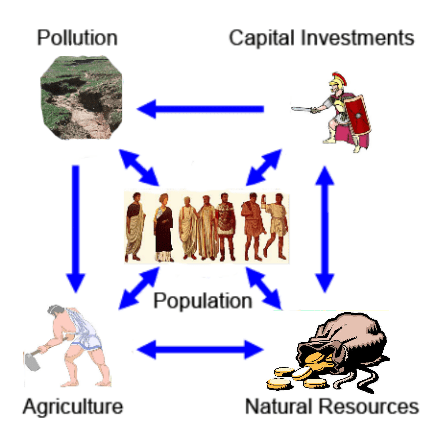
Figure 3. Image by Magne Myrtveit to summarize the main elements of the world model for Limits to Growth.
As such, this model does not reflect the major elements of complexity, which I summarized as follows in a recent post:
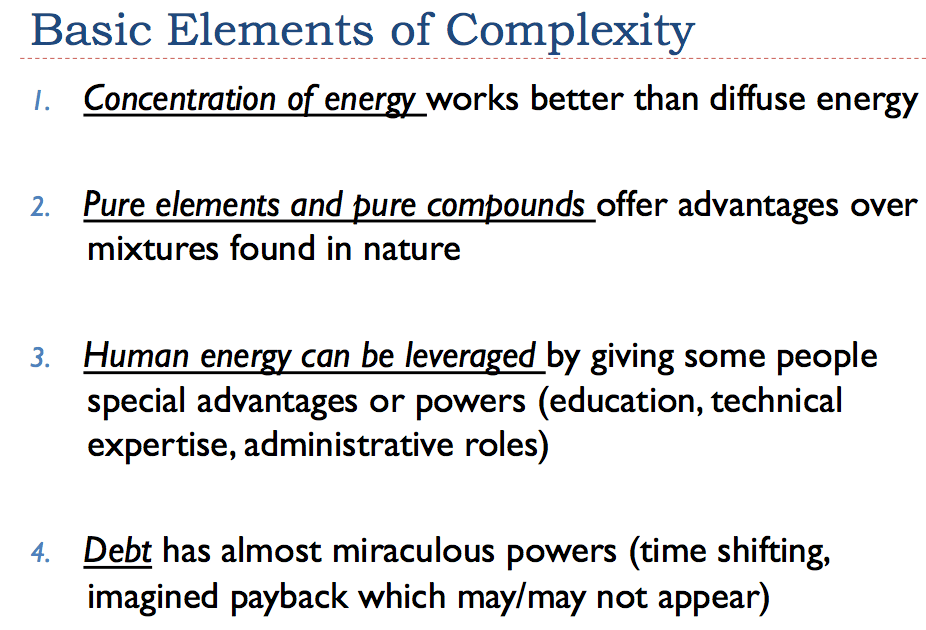
Figure 4. Slide 7 from my recent complexity presentation. Basic Elements of Complexity
Thus, the model does not forecast the problems that can be expected to occur with increasingly hierarchical behavior, including the problems that people who are at the bottom of the hierarchy can be expected to have getting enough resources for basic functions of life. These issues are important, because people at the bottom of the hierarchy are very numerous. They need to be fed, clothed, housed, and have transportation to work. All of these things take natural resources, including energy products. If the benefit of available natural resources doesn’t make it all of the way down to the bottom of the hierarchy, death rates spike. This is one of the forces that can be expected to change the shape of the curve.

Figure 5. Slide 17 from my complexity presentation. People at the bottom of a hierarchy are most vulnerable.
Dennis Meadows does not claim that the model that his group put together will show anything useful about the “shape” of the collapse. In fact, in an article about a year ago, I cut off part of the well-known Limits to Growth forecast to eliminate the part that is likely not particularly helpful–it just shows what their simple model indicates.

Figure 6. Limits to Growth forecast, truncated shortly after production turns down, since modeled amounts are unreliable after that date.
Anthropologist Joseph Tainter’s View of Collapse
If we read what anthropologist Joseph Tainter says in his book, the Collapse of Complex Societies, we find that he doesn’t consider “running out” to be the cause of collapse. Instead, he sees growing complexity to be what leads an economy to collapse. These are two of the points Tainter makes regarding complexity:
- Increased complexity carries with it increased energy costs per capita. In other words, increased complexity is itself a user of energy, and thus tends to drain away energy availability from other uses. Thus, in my opinion, complexity will make the system fail more quickly than the Hubbert model would suggest–the complexity part of the system will use part of the energy that the Hubbert model assumes will be available to fund the slow down slope of the economy.
- Increased investment in complexity tends to reach declining marginal returns. For example, the first expressway added to a highway system adds more value than the 1000th one. Eventually, if countries are trying to create economic growth where little exists, governments may use debt to fund the building of expressways with practically no expected users, simply to add job opportunities.
Ugo Bardi quotes Joseph Tainter as saying,
“In ancient societies that I studied, for example the Roman Empire, the great problem that these economies faced was that they eventually would incur very high costs just to maintain the status quo. They would need to invest very high amounts to solve problems that didn’t yield a net positive return; instead these investments simply allowed the economies to maintain the level that they were at. This increasing cost of maintaining the status quo decreased the net benefit of being a complex society.”
View of Collapse Based on a Modeling Approach
In the book Secular Cycles, Peter Turchin and Surgey Nefedov approach the problem of what causes civilizations to collapse using a modeling approach. According to their analysis, the kinds of things that caused civilizations to collapse very much corresponded to the symptoms of increasing complexity:
- Problems tended to develop when the population in an area outgrew its resource base–either the population rose too high, or the resources become degraded, or both. The leaders would adopt a plan, which we might consider adding “complexity,” to solve the problems. Such a plan might include raising taxes to be able to afford a bigger army, and using that army to invade another territory. Or it might involve a plan to build irrigation, so that the current land becomes more productive. A modern approach might be to increase tourism, so that the wealth obtained from tourists can be traded for needed resources such as food.
- According to Turchin and Nefedov, one problem that arises with the adoption of the new plan is increased wealth disparity. More leaders are needed for the new complex solutions. At the same time, it becomes more difficult for those at the bottom of the hierarchy (such as new workers) to obtain adequate wages. Part of the problem is the underlying problem of too many people for the resources. Thus, for example, there is little need for new farmers, because there are already as many farmers as the land can accommodate. Another part of the problem is that an increasing share of the output of the economy is taken by people in the upper levels of the hierarchy, leaving little for low-ranking workers.
- Food and other commodity prices may temporarily spike, but there is a limit to what workers can pay. Workers can only afford more, if they take on more debt.
- Debt levels tend to rise, both because of the failing ability of workers to pay for their basic needs, and because governments need funding for their major projects.
- Systems tend to collapse because governments cannot tax the workers sufficiently to meet their expanded needs. Also, low-ranking workers become susceptible to epidemics because they cannot obtain adequate nutrition with low wages and high taxes.
How Do We Fix an Overly Simple Model?
The image shown in Figure 3 in some sense shows only one “layer” of our problem. There is also a financial layer to the system, which includes both debt levels and price levels. There are also some refinements needed to the system regarding who gets the benefit of energy products: Is it the elite of the system, or is it the non-elite workers? If the economy is not growing very quickly, one major problem is that the workers at the bottom of the hierarchy tend to get squeezed out.

Figure 7. Author’s depiction of changes to non-elite workers’ share of the output of economy, as costs for other portions of the economy keep rising. The relative sizes of the various elements may not be correct; the purpose of this chart is to show a general idea, not actual amounts.
Briefly, we have several dynamics at work, pushing the economy toward collapse, rather than the resources simply “running out”:
- Debt tends to rise much faster than GDP, especially as increasing quantities of capital goods are added. Added debt tends to reach diminishing returns. As a result, it becomes increasingly difficult to repay debt with interest, creating a major problem for the financial system.
- The cost of resource extraction tends to rise because of diminishing returns. Wages, especially of non-elite workers, do not rise nearly as quickly. These workers cannot afford to buy nearly as many homes, cars, motorcycles, and other consumer goods. Without this demand for consumer goods made with natural resources, prices of many commodities are likely to fall below the cost of production. Or prices may rise, and then fall back, causing serious debt default problems for commodity producers.
- Because of growing complexity of the system, the “overhead” of the system (including educational costs, medical costs, the wages of managers, the cost of government programs, and the cost of resource extraction) tends to increase, leaving less for wages for the many non-elite workers of the world. With lower wages, the non-elite workers can afford less. This dynamic tends to push the system toward collapse as well.
The following is a list of variables that might be added to the overly simple model.
- Debt. As capital goods are added to work around resource shortages, debt levels will tend to rise quickly, because workers need to be paid before the benefit of capital goods can be obtained. Debt levels also rise for other reasons, such as government spending without corresponding tax revenue, and funding of purchases deemed to have lasting value, such as college educations and investments in research and development.
- Interest rates are the major approach that politicians have at their disposal to try to influence debt levels. In general, the lower the interest rate, the cheaper it is to buy cars, homes, and factories on credit. Thus, the amount of debt can be expected to rise as politicians lower interest rates.
- Wages of non-elite workers. Non-elite workers play a dual role: (a) they are the primary creators of the goods and services of the system, and (b) they are the primary buyers of the goods that are made using commodities, such as food, clothing, homes, and transportation services. Thus, their wages tend to determine whether the economy can grow. In general, we would expect wages of workers to rise, if their wages are being supplemented by more and more fossil fuel energy in the form of bigger and better machinery to help the workers produce more goods and services. If the wages of non-elite workers fall too low, we would expect the economy to slow, and commodity prices to fall. To some extent, rising debt (through manipulation of interest rates, or through government spending in excess of tax revenue) can be used to supplement the wages of non-elite workers to allow the economy to continue to grow, even if wages are stagnating.
- The affordable price level for commodities in the aggregate depends primarily on the wage level of non-elite workers and debt levels. A particular commodity may increase in price, but in the aggregate, the total “package” of costs represented by commodity prices must remain affordable, considering wage and debt levels of workers. If wage levels of non-elite workers are rising, the overall affordable price level of commodities will tend to rise. But if wage levels of non-elite workers are falling, or if debt levels are falling, affordable price levels are likely to fall.
- The required price level for commodity production in the aggregate to continue to grow at the previous rate. This required price level will depend on many considerations, including: (a) the rising cost of extraction, considering the impacts of depletion, (b) wage levels, (c) tax requirements, and (d) other needs, including payment of interest and dividends, and required funding for new development. Clearly, if the affordable price level falls below the required price level for very long, we can eventually expect total commodity production to start falling, and the economy to contract.
- The energy needs of the “overhead” of the system. Increasing complexity tends to make the overhead of the system grow much faster than the system as a whole. Energy products of various kinds are needed to support this growing overhead, leaving less for other purposes, such as to increasingly leverage the labor of human workers. Some examples of growing overhead of the system include energy needed (a) to maintain the electric grid, internet, roads, and pipeline systems; (b) to fight growing pollution problems; (c) to support education, healthcare, and financial systems needed to maintain an increasingly complex society; (d) to meet government promises for pensions and unemployment insurance; and (e) to cover the rising energy cost of extracting energy products, water, and metals.
- Available energy supply based on momentum and previous price levels. A few examples explain this issue. If a large oil project was started ten years ago, it likely will be completed, whether or not the oil is needed now. Oil exporters will continue to pump oil, as long as the price available in the marketplace is above their cost of production, because their governments need at least some tax revenue to keep their economies from collapsing. Wind turbines and solar panels that have been built will continue to produce electricity at irregular intervals, whether or not the electric grid actually needs this electricity. Renewable energy mandates will continue to add more wind turbines and solar panels to the electric grid, whether or not this electricity is needed.
- Energy that can actually be added to the system, based on what workers can afford, considering wages and debt levels [demand based energy]. Because matching of supply and demand takes place on a short-term basis (minute by minute for electricity), in theory we need a matrix of quantities of commodities of various types that can be purchased at various price levels for short time-periods, given actual wage and debt levels. For example, if more electricity is dumped on the electric grid than is needed, how much impact will a drop in prices have on the quantity of electricity that consumers are willing to buy? The intersections of supply and demand “curves” will determine both the price and quantity of energy added to the system.
The output of the model would be three different estimates of whether we are reaching collapse:
- An analysis of whether repayment of debt with interest is reaching limits.
- An analysis of whether affordable commodity prices are falling below the level needed for commodity consumption to grow, likely leading to falling future commodity production.
- An analysis of whether net energy per capita is falling. This would reflect a calculation of the following amount over time:
 If net energy per capita is falling, the ability to leverage human labor is falling as well. Thus productivity of human workers is likely to stop growing, or perhaps decline. The total amount of goods and services produced is likely to plateau or fall, leading to stagnating or declining economic growth.

The important thing about the added pieces to this model is that they emphasize the one-way nature of the system. The economy needs to grow, or it collapses. The price of energy products cannot rise much at all, because wages of workers don’t rise correspondingly. This means that any energy substitute must be very cheap. The system needs to keep adding debt, especially when capital goods are added. The benefit of this debt reaches diminishing returns. The combination of these diminishing returns with respect to investments made with debt, and the interest that needs to be paid on debt, means that it is very difficult for energy products based on capital goods to “save” the system.
Complexity Adds Unforeseen Problems
One issue that people working solely in the energy sector may not notice is that our current system for setting market-based electricity prices is not working very well, with the addition of feed-in tariffs and other subsidy programs. There is evidence that subsidizing renewable electricity tends to lead to falling wholesale electricity prices. In a sense, if we subsidize electricity prices for one type of electricity producer, we find it also necessary to subsidize electricity prices for other types of electricity producers. (Also in California.)

Figure 8. Residential Electricity Prices in Europe, together with Germany spot wholesale price, from http://pfbach.dk/firma_pfb/references/pfb_towards_50_pct_wind_in_denmark_2016_03_30.pdf
Inadequate prices for electricity producers and a need for ever-rising subsidies for electricity production could, by themselves, cause the system to fail. In a sense, this pricing problem is a complexity-related outcome that economists have overlooked. Their models are also too simple!
Conclusion
It is easy to rely on too-simple models. Perhaps the biggest issue that is missed is that energy prices can’t rise endlessly. Because of this, a large share of natural resources, including oil and other energy products, will be left in the ground. Furthermore, because prices do not rise very high, energy products that are expensive to produce can’t be expected to work, either, no matter how they are disguised. Substitutes that cannot be inexpensively integrated into the electric grid are not likely to work either.
I talked about low-ranking workers being a vulnerable part of the system. It is clear from Joseph Tainter’s comments that another vulnerable part of our current system is the various “connectors” that allow us to have our modern economy. These include the electric grid, roads and bridges, the pipeline systems, the water and sewer systems, the internet, the financial system, and the international trade system. Even government organizations such as the Eurozone might be considered vulnerable connecting systems. The energy cost of maintaining these systems can be expected to continue to rise. Rising costs for these systems are part of what makes it difficult to maintain our current economic system.
The focus on “running out” has led to a focus on finding ways to extend our energy supply with small quantities of high-priced alternatives. This approach doesn’t really get us very far. What we need to keep the economy from collapsing is a growing supply of cheap-to-produce energy and other natural resources. Ideally, these new resources should require little debt, and not cause pollution problems. These requirements are exceedingly difficult to meet in a finite world.


“CIA chief Brennan not optimistic about Syria’s future as one country”.
Have they started to give up on failed nations and declare them as non existent ?
Breaking up Syria has been part of the that the Neocons successfully sold Bush II — Seven countries in five years.
https://youtu.be/nUCwCgthp_E
Yes, the Project for the New American Century (PNAC). Afghanistan, Iraq, Syria, Sudan and Libya have descended into religious, sectarian, ethnic and tribal wars. Iran, Turkey and Saudi Arabia have been drawn into the war.
The ultimate goal is to drag down the entire Islamic world into an all out war and brake it down into small fractions of tribes that continue to kill one another ?
Israel likes a situation where it’s enemies have been balkanized.
A Clean Break: A New Strategy for Securing the Realm
http://www.informationclearinghouse.info/article1438.htm
The Middle East is a hornets nest.
Thanks for the article, and comments and links.
On this full economy-planet, rates of supply of essentials of energy and materials cannot be grown exponentially any more. Population and production economy wants to grow exponentially, but declining non-renewable resources are distributed in a power – law pyramid. We suck resources through a limited number of “straws”, of limited cross-section area, set by resources required for extraction. There exists a maximum supply rate of essential economic resources. Resource supply cost inevitably rises, and delivered resource quality / concentration / net energy falls. Model this as increase in resistance to sucking, which gives a maximum volume flow. This limits growth in supply rate, and later on the decline of supply rate. The global milkshake slurp-plus suddenly ends, and now we need to find a new planet or economy dies.
Thanks for your observations. For those not familiar with the term, the power law applies in many types of distributions, including wealth distributions and sizes of cities. The power law is also known as the Pareto distribution or the 80-20 law. Also Zipf’s law.
https://www.theautomaticearth.com/2016/07/debt-rattle-july-30-2016/
• US GDP Grew a Disappointing 1.2% in Q2 As Q1 Revised Down to 0.8% (WSJ)
I tried to copy-paste in a graph showing how much US GDP has declined over the past decades, but it didn’t come through. However, I highly suggest going to link above and clicking on the latest article, then scrolling down to view that chart. A really clear picture presents itself, clearly indicating declining net energy over time.
There has been low growth since 2014-Q4, with the revised GDP data. This more or less corresponds to the end of QE, and the time when oil prices dropped.
Interesting point, Gail regarding the drop in GDP coinciding with the end of QE.
What I’m referring to in particular and I think is noteworthy as it relates to declining net energy over time, is the decline in GDP over past decades. Below I’ve taken the information from the graph and posted it below:
1949-53 7.6%
1954-57 4.0
1958-60 5.6
1961-69 4.9
1970-73 5.1
1975-80 4.3
1980-81 4.4
1982-90 4.3
1991-01 3.6
1901-07 2.8
2009-16 2.1
2nd Qtr. of 2016 1.2%
Just let your eyes follow the percentages as they go up and down slightly but the overall trend is definitely down, and keep in mind the govt. has redefined inputs to GDP to skew the numbers higher over time. For example a few years ago they decided to add an estimated amount of billions of dollars of illegal street drugs to GDP. Not that it applies to the numbers above, but Italy now adds to their GDP not only an estimated euro amount for street drugs but also prostitution. There is also a move to add an amount for under the counter Pokeman cards traded – ok, that last one I made up – lol, but you get the idea. We’re in a period of desperate fiscal follies by the CB’s to keep the appearance of growth and redefinitions of GDP help people imagine things are better than they really are even though the final GDP percentages are still dropping sharply.
Stilgar,
I have been watching the same data.
Now apply your (above) GDP data to the EROEI charts in this article.
https://www.semanticscholar.org/paper/EROI-of-different-fuels-and-the-implications-for-Hall-Lambert/4b7811d0e70d3a385e7492400dc325679590cee5/pdf
The declining excess available energy wealth ( or dropping EROEI ratio) over the years is showing up as systemic breakdown. The politicians and business leaders can’t put their finger on it, but GDP and profitability keep sliding. Excess money (energy wealth) to build roads, schools, and medicare systems is drying up.
I think you need the average world EROIs, and those are hard to come by. Also, the mix has been changing more to coal–at least until coal consumption started dropping in 2015. I would expect that the average EROI of the weighted fossil fuel mix is more level than the EROIs of individual fuels.
I also don’t think that EROIs of intermittent renewables can reasonably be compared to EROIs of other fuels, for a number of reasons. This is related to the overly
-simple model that is being used for the calculation.
Sorry for getting back late for this response, but I agree 100%, Veggie. There has to be an underlying fundamental reason for the decline and it can be put either by declining net energy or declining EROEI, as you noted, which are one in the same. That’s the one thing that cannot be financed away – it can’t be bargained with – rejected – or ignored. It simply means there is less left over to pay for everything, which is especially a problem when things are based on growth. It is showing up as “systemic breakdown”.
Stilgar, world EROEI is very difficult to calculate because we lack sufficient information. In my opinion theoretically it is possible to feel across the costs of production and processing of the primary energy in vectors (“carriers”) usable for the economy (petrols, electricity, etc) but, are all those these? According to Carlos of Castro, teacher of physics of the University of Valladolid (Spain) the energetic world metabolic EROEI it was never very superior to 10, and he thinks that the available energy for not energetic uses is falling down in the last years, represented in graphical this one where TRE is EROEI:
http://www.eis.uva.es/energiasostenible/wp-content/uploads/2016/01/figu-2.jpg
Carlos de Castro thinks that the collapse is inevitable and is nearby in the time.
Energy consumption was rising much faster back in those early periods–this is why GDP growth was a lot higher.
If you go back even farther than 1949, both energy growth and GDP growth were lower.
“Energy consumption was rising much faster back in those early periods–this is why GDP growth was a lot higher.”
Sure Gail, and that fits with a higher EROEI back then, as surplus energy translated into faster growth/expansion. Nice graphs.
Think of EROI as a shorthand calculation for “cost of production.” (This shorthand calculation works better in some situations than others, but that is another story.) What “high EROI back years ago” means is that the cost of production of energy products was lower. The connection of higher EROI with higher growth is an indirect one–because the cost of energy products was lower, people could afford more, and therefore energy consumption rose more rapidly.
The actual direct energy used in extraction is quite small. The way statements about EROI are made, it is easy to think that the big issue is the energy “subtracted” in the net energy calculation made a big difference. I don’t see this as the major issue–whether 2% or 3% of energy needed to be “netted out” as EROI went from 50:1 to 33:1 didn’t matter a whole lot. The issue was that affordability went down. As a result, the growth in the amount of energy consumed fell, as EROI went down.
Stefeun
A little more on Lane and why I think that following his arguments is a good thing for a human to do at this stage in our crisis.
On page 207 Lane considers the problem of ‘introns’, the ‘junk DNA’ which is abundant in we eukaryotes but scarce in bacteria and archaea:
‘The second reason for an early intron proliferation is the low strength of selection acting against it. In part, this is precisely because a small population of sickly cells is less competitive than a heaving population of healthy cells. But the first eukaryotes should also have had an unprecedented tolerance for intron invasion. After all, their source was the endosymbiont, the future mitochondria, which are an energetic boon as well as a genetic cost. Introns are a cost to bacteria because they are an energetic and genetic burden; small cells with less DNA replicate faster than large cells with more DNA than they need. Bacteria streamline their genomes to a minimum compatible with survival. In contrast, eukaryotes exhibit extreme genomic asymmetry: they are free to expand their nuclear genomes precisely because their endosymbiont genomes shrink. Nothing is planned about the expansion of the host cell genome; it is simply that increased genome size is not penalised by selection in the same way as it is in bacteria. This limited penalty enables eukaryotes to accumulate thousands more genes, through all kinds of duplications and recombination, but also to tolerate a far heavier load of genetic parasites. The two must inevitably go hand in hand. Eukaryotic genomes became overrun with introns because, from an energetic point of view, they could be.’
Exercise for the student. Write a paper describing the parallels between the early evolution of the eurkaryotes and the first couple of hundred years of the evolution of Fossil Energy Man. Also describe what you think is likely to happen to Fossil Energy Man as fossil energy experiences a Seneca Cliff.
On page 213, Lane considers sex:
‘Sex was considered the ‘queen’ of biological problems in the 20th century, but we now have a good appreciation of why it helps, at least in relation to strict asexual reproduction (cloning). Sex breaks up rigid combinations of genes, allowing natural selection to ‘see’ individual genes, to parse all our qualities one by one. That helps in fending off debilitating parasites, as well as adapting to changing environments, and maintaining necessary variation in a population.’
Lane points out that asexual populations tend to become extinct.
‘the benefits of sex are greatest when the mutation rate is high, selection pressure is strong, and there is a lot of variation in a population…the only way to ensure that a genome has all the genes it needs, in full working order, is to retain all of them, and to recombine them regularly across the entire genome. That can’t be achieved by lateral gene transfer–it needs sex, ‘total sex’, involving recombination across the whole genome…Only sex could accumulate genes that worked and be rid of those that didn’t. This tendency to pick up new genes and DNA by sex and recombinations easily accounts for the swelling of early eukaryotic genomes. Accumulating genes in this way must have solved the problems of genetic instability, while the energetic advantages of having mitochondria meant that, unlike bacteria, there was no energetic penalty.’
Exercise for the student. Write a paper describing how Fossil Energy Man invented an economy which began with promiscuous sexual recombination but morphed into a rigid system variously described as Globalization or Obama’s Unipolar World or Maggie Thatcher’s There Is No Alternative. Describe whether you agree with David Stockman and Charles Hugh Smith that the accumulation of parasites in the economy parallels the proliferation of parasites in the eukaryotic genome, with particular attention to the role of energy in shielding the parasites from natural selection. Conclude your paper with recommendations, covering at least the spectrum from the anarchism of Dmitry Orlov and Toby Hemenway to the ‘BAU at any cost’ of Obama and Gail Tverberg and the IMF and the World Bank and the Central Banks.
Don Stewart
Some human RNA like to be born, party in the protoplasm and let the hard-working, well-educated drones take care of the details. If everyone worked hard at growing the neoplasm, things would just come to an end that much faster.
Another Model…Another Depletion….Water
Kansas lost about $1.1 billion between 1996 and 2005 in the value of its High Plains groundwater aquifer, a Yale-led research team determined in a study published this year.
The team, led by Eli Fenichel, assistant professor at the Yale School of Forestry and Environment Studies, used the Kansas aquifer as an example in a study looking at setting dollar amounts on “natural capital,” or natural resources such as water, fish and forests.
The purpose, Fenichel said, fits with an international movement by the World Bank, the United Nations and other major economic players to include the natural environment, as well as such things as health and education, in assessing wealth.
http://m.cjonline.com/news/business/2016-07-23/kansas-lost-11-bn-aquifer-depletion#gsc.tab=0
The demand curve and use of Kansas’ aquifer also was impacted by events outside of the water use itself. Fenichel said the effect of water-efficient drop nozzles, used in drip irrigation, was one change that occurred during the period his research explored.
As the number of people using drop nozzles increased from 20 percent to 80 percent, the water aquifer decreased, he said.
The state offered subsidies for irrigation during this time period.
In addition, research has found that drip irrigation actually increases water use, “inducing farmers to irrigate a greater proportion of their acreage and plant more water-intensive crops,” the study said
Being more efficient allows us all just to use moar!
Unfortunately, that seems to be the way things work, too often. With less water use, it becomes profitable to irrigate, so everyone does it, and the aquifer level falls.
Vince,
Reg, “Environmental Accounting”,
Many say there’s ni other way to preserve “Natural Capital”, but I maintain it’s utterly stupid or hypocritical, and doesn’t work for the simple reason that Nature is not a part of the economy, it’s the other way round!
Stefeun
I am going to try to very succinctly square a few circles:
*Dan Palmer, from Christopher Alexander…divide up a space versus assemble parts
*Nick Lane, quoting the Bible…Narrow is the way, and straight is the path
*Arnoux…the world is awash in energy (also many other biologists)
*Toby Hemenway….we are headed for a horticultural society, as a best case
*Gail Tverberg…the collapse of money means all hope is lost
*Arnoux…the fossil energy required to pay debts will never be produced
Lane argues that there may be only one way for a planet to evolve to produce morphologically complex life. And that way is improbable. Therefore, we may be alone in the universe. The universe did not ‘expect us’. I continue to read probability based projections of how many intelligent creatures there must be in the universe. But Lane provides a pretty convincing story for me. It’s a little like Jesus’ parable of the rich man trying to get into heaven…a camel going through the eye of a needle. If we can imagine the utter improbability of morphologically complex eukaryotes ever evolving, and if we understand the absolutely critical role of energy in that evolution, then I think we are psychologically better prepared to try to deal with the disappearance of fossil energy and its impact on humans.
We would probably reject Dan Palmer’s notion of a blank sheet of paper waiting for its first line to carve out two different domains. Instead, we would be looking for clues to the ‘narrow way’. We would be looking at some way to use all that abundant energy that the biologists see, but we would recognize that the energy is only abundant so long as we are living like eukaryotes. If we try to continue to live like Fossil Energy Man, then energy is going to be very scarce. Which thought leads us to notions like Hemenway’s Horticultural Society, or to Marshall Sahlin’s Original Affluent Society.
Both Arnoux and Tverberg and Hill all agree that there is never going to be enough fossil energy to repay all the debts. But Tverberg concludes that things are therefore hopeless. Arnoux and Hill will hatch schemes to use some ‘Fossil Energy Light’, which will ease transitions and perhaps avoid precipitous collapses. Hemenway probably hopes that Arnoux and Hill can come up with something, but will be promoting groups of 150 horticulturalists as the lifeboats to the future. Toby, being of a pretty strong anarchist bent, wants repressive social and political and economic structures to collapse quickly so that the new order of society can be born. Toby can look with some sense of perspective on the deaths of 6.8 billion people. He doubtless hopes that humans will display some sapience, but he may agree with George Mobus that we have displayed very little of that scarcest resource to date.
Don Stewart
PS My apologies to the authorities I cite for all the gross misrepresentations.
“Arnoux and Hill will hatch schemes to use some ‘Fossil Energy Light’, which will ease transitions and perhaps avoid precipitous collapses. Hemenway probably hopes that Arnoux and Hill can come up with something, but will be promoting groups of 150 horticulturalists as the lifeboats to the future. Toby, being of a pretty strong anarchist bent, wants repressive social and political and economic structures to collapse quickly so that the new order of society can be born. ”
I think there’s a need to square some of these seeming contradictions. Maybe there’s something to the theory of natural law. I actually listened to more than 5 hrs from Mark Passio’s exposition on natural law, forming no conclusions but sensing there was something to it.
There is a natural way for humans to be. Maybe when the Tao talks about “the way<" there is something of natural law implied (or maybe not).
I say the above to emphasize the need to be inclusive of seeming contradictions, for they could perhaps comprise a natural-law way–like a body with its various organs that are perfectly calibrated to the whole–in which nature wants to work.
"Fossil Energy Light" is not contradictory to "groups of 150 horticulturalists as the lifeboats to the future." It takes one to make the other one work. Without them both working, we get nowhere. (Proposing the quick die-off of most people seems crazy, since that would perpetuate such disease and disorder as to seal the fate of any hopeful survivor. We save everybody or we lose everybody. Simple,)
There is also no contradiction between western civilization and third-world/indigenous "civilization," (for want of a better word). Given the dearth of fossil energy, the third world standard of ff use seems far more realistic than that of the first world. But it is also needlessly disordered and harsh…which is where adroit touches of the west will be so useful. But what is needed is more the systems thinking of the west rather than the materialist consumption. Poor analogy: The "Third World" is like the ice cream, while the west is like the cherry on the top. Right now, the world has it backward.
@Artleads
Found the 5h presentation of Passio also very abstract. The side I take the thing on is that one has to realize what a “person” is and that a “(human) continuous being” is. A “person” is a fictious legal entity created by a “Law’s” and a piece of paper.
The (legal) system can only deal with “persons” – if you show someone you ID, Passport – whatever – which links to the or “your” birth certificate, then you (the human continuous being) take responsibility (trustee) for that fictions person created by the birth certificate with the same “name”.
Its a pity that we “operate” in a system that has rules which we do not understand and which basically are never lectured to anyone “normal”. This is how it works: https://www.youtube.com/watch?v=Z2yH1XMZKT0. Notice what the judge does at the end… it is very important!
The judge abandoned the court? I lost the ability (temporarily, I hope) to turn up my volume, so I couldn’t hear the defendant at all. Good thing he wasn’t black. He’d most likely have been target practice.
@Artleads
Yes case closed….. its important that you hear the defendant which never claimed to be the “Person” with the name “Keith Thompson” – he was only “Keith” and the ministrator of the person “Keith Thompson”. When “Keith Thompson” was called – he handed over that person -> a birth certificate of the “person” with the “name” of “Keith Thompson”.
Since the “person” with the “name” was present at court all was good. And a piece of paper can’t answer questions, pay money, go to jail, whatsoever…. case closed.
Important was the “bow” of the judge in front of the sovereign -> “Keith” at the end!
Don,
I expect the premature death of 7 billion people to make some waves.
Stefeun
Toby made that speech several years ago. At that time, he expected a steady decline in standard of living but not a Seneca Cliff. He calculated that a world-wide single child policy would steadily decrease global population, more or less in line with the ability of a shift to a horticultural society to feed people. He thought a horticultural society could feed somewhere between 500 million and 2 billion people. By his reckoning, getting down to 2 billion didn’t necessarily need to involve massive visits by the Four Horsemen. Of course, in the intervening years, we have done nothing at all. We have not moved toward either a horticultural society nor toward a single child policy.
Toby has a background in biology. So, he is able to look with a clear eye at the repercussions. That doesn’t mean he likes it, or thinks that humans are being very wise.
To me, the obstacles to graceful adoption of a horticultural society are explicated pretty well in the Nick Lane book…when he talks about how selection worked among early eukaryotes. There are very few people who are willing to face up to the ‘selection’ issue…even in private. Lane’s evidence that all living eukaryotes descended from a very small population of the successful among what may have been a much larger population of those who were on an evolutionary dead end may be more indicative of our future. Some very small population of humans will find the ‘narrow path’ and they will be the survivors who may repopulate the Earth.
Don Stewart
Agreed.
The instandoomers oversimplify the impact of ~500 nuclear reactors and other industrial site hazards, the number of warheads decreased as well. We have got hard data from Chernobyl and other places, in few decades the nature just re-wilds the 3D space there in a big way, high radioactive accumulation in bones of certain species is eventually covered by layers of soil/mud, i.e. out of the loop etc. This is certainly not going to be a world for +8B and global exchange, but for small local communities specialized for particular niche climate – biotop. Am I the lucky/prepared one for it, most likely not, but I roughly know the sort of candidates and what kind of approach takes it with high chances to swim through the bottleneck rather gracefully.. for most part it’s not about money but about upbringing and attitudes..
“.. for most part it’s not about money but about upbringing and attitudes..”
100% agreement!
Life won’t be pretty compared to now – but two generations ahead the baseline of comparison will be different, too. People will die with 25-30 – and no one cares about long-term cancer. Its the same with lots of illnesses now – long term dietary effects (e.g. heavy meat and/or dairy consumption) don’t matter when you don’t grow older than 30 and starve for every calorie.
I’d say the most important factors are:
A. Location of domicile as far away from other people as possible.
B. Enough food, water and other needed products to stay out of the fray for a year or longer.
C. Enough silver coins to make up for the hyperinflated worthless currency that occurs when there is a collapse, when you do finally have to risk being around other people to buy stuff you need.
D. A naturally healthy body that does not require prescription medication.
Why would a hermit want silver. Coins?
Don’t forget this along with a lifetime supply of replacement filters:
http://www.nato.int/pictures/2003/031007/b031007aq.jpg
I am wearing out my keyboard repeating this stuff…
Once again – do NOT look at Chernobyl as your test case… Chernobyl was CONTROLLED. It was entombed by helicopters that dropped cement onto the reactor.
You cannot do that with spent fuel ponds. They are not in a reactor.
A spent fuel pond is an exponentially worse problem because it has many times more fuel :
Pick your poison. Fresh fuel is hotter and more radioactive, but is only one fuel assembly. A pool of spent fuel will have dozens of assemblies. One report from Sankei News said that there are over 700 fuel assemblies stored in one pool at Fukushima. If they all caught fire, radioactive particles—including those lasting for as long as a decade—would be released into the air and eventually contaminate the land or, worse, be inhaled by people. “To me, the spent fuel is scarier. All those spent fuel assemblies are still extremely radioactive,” Dalnoki-Veress says.
http://www.miis.edu/academics/faculty/node/23025
http://www.biomilchpreise.de/
Interesting factoid (from above graph), virtually no price drop on milk prices in “Bio-quality” as opposed to the massacre at industrial big dairy (silage) front..
Obviously, the chief reason it’s still a niche market even in .de, perhaps with more penetration in .at, so the bio clientele’s purchasing power has not been so far damaged to the extent cutting on quality food expenditures. However, I’d say partly correct answer and explanation is the local domestic market vs. global commoditized junk market play. Can’t properly dissect the particular weight of these two driver forces though..
ps not suggesting anything about dairy prospects, given todays regulation the point of entry is crazy and you get shiitty product, also without gov subsidies and rich patrons even the bio is not much of a plan for the future..
The milk-game is anyway strange. The fall of the quota in Germany has produced a domestic overproduction. NZ has only produced for the global market, i.e. China.
And the Chinese consume milk / dairy in part of the embedded IGF-1 – the cow’s growth factor… its cancer promoting – but who cares, since basically no one reads the research about milk and milk products in regard to human health and nutrition.
There are several factors, especially on the input side, which can drastically deteriorate the quality of fodder going into the cow, as well as the living conditions of that animal, not mentioning nowadays the twisted genetics of 10k litres milk per year, instead of sensible sub 5k litres cow. On both, fodder and the cow, the industrial approach, which is horrible, just enhances the risk factors, otherwise how would be possible well known examples of people/communities living literally on milk, butter and cheese into their +90yrs (and hard working say into late 70s or much later) without cancer or other issues?
Chinese generally don’t consume milk/dairy. I thought they were mostly lactose intolerant.
They should be – but you can remove the lactose from the milk – in Finland this is standard procedure as many Finns are lactose intolerant.
Thing is, Chinese parents hope to get their children a “growth spurt”. From a paper: ” I argue that milk has been able to succeed in India and China by being positioned as a food with special qualities that enhance physical growth, which in turn serves as a powerful metaphor for individual and national power and wealth”: https://www.researchgate.net/publication/241711325_Milk_for_Growth_Global_and_Local_Meanings_of_Milk_Consumption_in_China_India_and_the_United_States
Milk is unsustainable anyhow, in addition to being carcinogenic. We don’t have the resources to be using 1,000 gallons of water to make 1 gallon of milk so people can pretend they’re calves.
We just need to stop using enormous amounts of water to grow grains to feed the animals. Cows/sheep/goat(/reindeers) should browse from land not suitable from crops, fallow land or forests.
I assume current order is rational/optimal only because we have cheap oil and lots of water.
I understand the existence of drip irrigation increases water use. The fact that little water is used in an individual field means that crops raised using drip irrigation are profitable to sell. Because the use of drip irrigation is profitable, many adopt its use, causing water tables drop because if growing overuse.
Water is quickly becoming a problem in most areas of the planet. Factory farming, in all forms, is an unsustainable abomination. There’s just too many people to live off of the land in any sustainable manner; the population would have to go down at least 7 billion people and they would have to be spread very sparsely. In other words, we’re screwed.
Yes. But water is currently priced like it is infinite.
Sure and oil is probably priced at a a few hundred dollars less than its actual value per barrel but that’s not stopping the transactions.
@Tango
Finally someone who does also states here that milk is carcinogenic 🙂 The same as processed meat (WHO statement for that) and red meat (highest cancer suspicion category of the WHO). In addition non-crops like sugar cane or sugar beets serve no good purpose (refine sugar is extremely bad). Lots of corn products are also quite bad and Soy is mostly farmed because it serves as animal food for the meat industry.
The whole agricultural and industrial food system and its core products (sugar, highly processed grain products, meat, dairy, eggs) is absurd – from an sustainable, natural and nutritional viewpoint.
I think eating 5-10% of your calories in meat is okay health-wise but it’s unsustainable, as are most forms of farming. Dairy is wholly unnatural; it is intended for baby cows or goats, not humans. Sugar is obviously bad, in all forms.
I can’t believe what the saamis are doing isnt sustainable. Same with alp cows.
If you use pure pasture land and keep the cows outside – that may work to a certain degree. But when you begin to plant food for the cows or irrigate the pasture land (like in NZ) to have enough food for the cows & co – than it gets crazy!
But even pasture land was something different before and reduces the bio-diversity… its man made…. forests or other stuff cut down…. etc. pp.
There is evidence that humans were living unsustainably before agriculture. It is highly doubtful that ANY farming or agriculture seen to date is sustainable.
Mammoths.
My examples are of populations that doesn’t modify the land for the animals.
Of course, killing of all predators increases cow/reindeer numbers.
@Tango
Yeah, more than 10% meat calories and the statistical evidence of ill effects gets significant (China Study). Dairy is a whole other game… lots of immune reactions in addition… root cause for lots of allergies, colds, etc. pp.
90% Reduction of all of those would help reduce ill effects and the burden on the health care system and in addition on the environment. If one goes into the numbers of pig, cows and chicken per year slaughtered in the US or Germany… its unbelievable. And hey need approx. 10 times the food calories they provide…. nuts.
I think the China Study was casein in particular, studied done on rats, and it was 5% or less was no tumors/20% or more and tumors almost instantly started forming.
The China Study is a book by T. Colin Campbell, Jacob Gould Schurman Professor Emeritus of Nutritional Biochemistry at Cornell University, and his son Thomas M. Campbell II, a physician. It was first published in the United States in January 2005 and had sold over one million copies as of October 2013, making it one of America’s best-selling books about nutrition.[2]
The China Study examines the relationship between the consumption of animal products (including dairy) and chronic illnesses such as coronary heart disease, diabetes, breast cancer, prostate cancer and bowel cancer.[3] The authors conclude that people who eat a whole-food, plant-based/vegan diet—avoiding all animal products, including beef, pork, poultry, fish, eggs, cheese and milk, and reducing their intake of processed foods and refined carbohydrates—will escape, reduce or reverse the development of numerous diseases. They write that “eating foods that contain any cholesterol above 0 mg is unhealthy.”[4]
The book recommends sunshine exposure or dietary supplements to maintain adequate levels of vitamin D, and supplements of vitamin B12 in case of complete avoidance of animal products.[5] It criticizes low-carb diets, such as the Atkins diet, which include restrictions on the percentage of calories derived from carbohydrates[6] The authors are critical of reductionist approaches to the study of nutrition, whereby certain nutrients are blamed for disease, as opposed to studying patterns of nutrition and the interactions between nutrients.[7]
The book is loosely based on the China-Cornell-Oxford Project, a 20-year study – described by The New York Times as “the Grand Prix of epidemiology” – conducted by the Chinese Academy of Preventive Medicine, Cornell University and the University of Oxford. T. Colin Campbell was one of the study’s directors.[8] It looked at mortality rates from cancer and other chronic diseases from 1973–75 in 65 counties in China; the data was correlated with 1983–84 dietary surveys and blood work from 100 people in each county. The research was conducted in those counties because they had genetically similar populations that tended, over generations, to live and eat in the same way in the same place. The study concluded that counties with a high consumption of animal-based foods in 1983–84 were more likely to have had higher death rates from “Western” diseases as of 1973–75, while the opposite was true for counties that ate more plant foods.[9]
https://en.wikipedia.org/wiki/The_China_Study
Monte Paschi Capital Wiped Out in European Bank Stress Test
http://www.bloomberg.com/news/articles/2016-07-29/monte-paschi-capital-wiped-out-in-european-bank-stress-test
Warren Buffett: Derivatives Are Still Weapons Of Mass Destruction And Are Likely To Cause Big Trouble.
http://etfdailynews.com/2015/06/22/warren-buffett-derivatives-are-still-weapons-of-mass-destruction-and-are-likely-to-cause-big-trouble/
But everything is sort of under control for now. Let’s keep our fingers crossed for the future.
🙂
Oil Giants Find There’s Nowhere to Hide From Doomsday Market
http://www.msn.com/en-us/money/markets/oil-giants-find-there%E2%80%99s-nowhere-to-hide-from-doomsday-market/ar-BBv1MLc?li=BBmkt5R&ocid=spartandhp
http://wolfstreet.com/2016/07/29/autonation-ford-sales-decline-auto-loan-bubble-us-gdp-growth/
It is hard to find enough bubbles to inflate. Eventually, the possible buyers get tapped out for buying the ever-more-expensive cars.
Australia heading for recession
http://www.abc.net.au/news/2016-07-29/australia-headed-for-recession-next-year,-professor-keen-says/7674154?section=business
I can believe that! Resource exporter with lots of debt!
Let me say once again why inflation is permanent. The reason why inflation is permanent, is because inflation doesn’t have to occur at a specific rate.
Let’s say that the price of a gallon of milk was 2 dollars, then next year it is 4 dollars. That’s inflation of 100%, or double the price, over the course of a year. But inflation doesn’t need to do that. It can be a very slow rate, spread over many years. The price can increase by 20 cents, for example, over 10 years, which would accomplish the same thing…at the end of 10 years, the gallon of milk would be 4 dollars. In fact, the rate of inflation slows down, but the gallon of milk never again goes back to 2 dollars.
Inflation is now a permanent condition of the global economic system. It is, simply, an increase in money supply meeting against a decreasing amount of per capita goods and services. This will continue until our system is reset, which likely won’t happen for awhile.
There is not a single thing in this world…not one! which you guys can point to and say deflation. I challenge any of you to come up with any instance of deflation, and, going back far enough, I can show you that indeed the price has risen.
The central banks will do absolutely anything to stop deflation — because once it starts – if it cannot be reversed — the system implodes.
So OF COURSE there is no deflation — if there was – and it could not be reversed – we would not be here typing.
The issue at hand is can the central banks hold off deflation forever.
Of course they cannot – the cracks are appearing.
Telephones, Computer, TV-Sets, and the like….
Buildings in Detroit and other more remote locations with a collapsing economy (you will find that also in Germany a lot).
Sorry, I don’t think you have it right at all..
There is massive inflation in services like health care (dental), insurance, indirect taxation, and especially quality craftsmanship – price levels there are more than doubling per each decade etc.
On the other hand massproduction (and its tools) has been so commoditized and deflationary you can get brand new ~quasi quality compact car (meaning it will work ~15yrs/.5M km) for todays value of ~EUR6000, which would be simply unthinkable generations ago.. The same for selected other segments of mass production based merchandise, machinery, ..
It’s a mixed picture, you have to look at cross section through the whole society.
@Worldof…
Thats what I also wanted to stress with my reply. Technological (mass) products are inherently deflationary…. necessary (qualified) services inflate big time. All kinds of mandatory taxes, fees, charges also inflate – as there is only one supplier with regulatory power which is “himself” under ever more stress.
But once the deflationary forces are to much… even quality craftsmanship may be required less than there are offerings… and then even that will be deflationary or only be available for “cash” since staying in business makes no sense anymore (as of heavy taxation and regulation). In that regard I see the tendencies of ever more regulation and pressure on cash as money…. since the system doesn’t like this kind of parallel economy.
Tv’s, computers, phones.
“I can show you that indeed the price has risen”.
The oil price.
Dolph, just off the top of my head, when I first came to Japan in the early 1980s, a box of 200 tissues cost 258 yen. These days you can by a pack of five boxes of 200 tissues for the same price.
A 350mm can of beer that would have cost 250 yen a decade ago can now be bought for 200 yen.
Aluminum pear glass windows today in Japan cost less than aluminum single pane glass windows of the same size did 20 years ago.
On the other hand, the value of the yen vs. the dollar has risen massively over the past 30 or 40 years, so if you were paying for these things in dollars, you might very well conclude there had been no deflation.
David Hackett Fischer’s The Great Wave – Price Revolutions and the Rhythm of History, which others have mentioned on this blog, brings a broad perspective on this issue. In it, you’ll find lots of information on how there have been long periods of inflation interspersed with long periods of deflation. The work mainly analyzes Europe since the dark ages and America since the colonial period, where extensive records exist.
https://www.amazon.com/Great-Wave-Revolutions-Rhythm-History/dp/019512121X
“There is not a single thing in this world…not one! which you guys can point to and say deflation”
How about oil, gas, & coal? How about the zero percent interest rates that cannot even squeak out a 0.25% rise w/o cratering the global economy?
You should have a long talk w Dr. Copper- he will tell you all about deflation…
I made my first (and probably last) comment in the Guardian… And according to the reactions… Argentineans are far more intelligent, or Clarín doesn’t bother trollying its commenters
Edit: doesn’t bother to troll
The folks at Guardian will never engage in debate with doomers. We’re anathema to them, mainly because they believe they have all the “solutions” to the world’s most pressing problems and we have a nasty habit of picking holes in those solutions. These days, most of them are true believers in an ecotopian future fueled by endless rows of wind turbines and fields of solar panels that will produce electricity that’s too cheap to meter and is threatened only by the specter of horrendous climate change that can be averted if, and only if, we close down all the oil wells and coal mines while joining hands and singing Kumbaya. Like any kind of magic, the conjuring of this vision into reality can’t work without the same kind of collective mental effort on the part of the audience such as occurs at pantomime performances of Peter Pan to save Tinker Bell.
I read a Guradian article saying “Clean Energy Won’t Save Us; only a new economic system can”
The author got half the story right–clean energy can’t save us. But there is no way that a new economic system is going to save us. We need much better returns than is really possible from intermittent energy, and a new economic system won’t fix that.
What would even a new economic system mean?
No money = no taxes = no salary for slavedrivers.
Build a new economic system. Yeah OK, and I’ll just go walk out into the woods and build a Ferrari Enzo. Easy enough no?
In Spain a relative importance has the idea of the economy of the decrease to solve the problems. It is totally absurd to believe that the enormous reached complexity could simplify without problems. They proclaim a minor consumption, local markets, cities in transition etc. They never speak about complexity, overpopulation, increase of the costs of production, debt, geopolitics etc etc. But it does not import the truth to the people, but the stories and the fables that support his narratives.
When they begin the big difficulties, we will blame some ours others: the capitalism, the socialism, the USA, Russia, right, left side, Islam… In Spain they remain opened the wounds of our horrible civil war for the wait of reviving ghosts of the past, hatreds concealed by the energetic prosperity.
Articles like that of “The Guardian” are irresponsible.
https://www.washingtonpost.com/news/to-your-health/wp/2016/07/29/florida-announces-zika-is-likely-spreading-by-mosquitoes-in-the-continental-u-s-2/
Remember all those articles I posted a while back on Zika Virus, and how bad I thought it could get? Well, guess what, drum roll, it’s being spread in Florida by MOSQUITOS! Now how the heck did those little blood suckers get from Brazil to Florida? I wonder if someone had Zika from travelling, then got jabbed by a mosquito in Florida and then that mosquito spread it to other mosquitos in FL. In any case, it’s here in the US now!
So it goes…
May deal for a part with the population issue…. face it or go north to where RE lives 😉
What a nice culling method of humanity, offspring with defective heads..
Btw, the western media reported dead people (+toxic&sewage garbage) on the very coast area for the Olympics in Brazil, distance swimming/yachting/rowing areas..
@worldof…
Not offspring with defective heads.. no offspring in the first place! The predicament of the ones born now is anyway quite bad. I don’t want to be part of “that” coming culling….
Yeah… the toxic water in the Olympics coastal area, Zika and general chaos in brazil… I think they should from the games there… anyway only commercial on lots of doping. Stopped to even read about whats going on lots of years ago.
That Zika Virus seems to be a real threat to humanity. How the hell do we stop mosquitos ?
“How the hell do we stop mosquitos?”
Funny you should ask that Y, because it’s near impossible. In Florida when local authorities first heard about cases that suggested transmission by mosquitos, they went on a mosquito abatement effort by spraying certain areas, but obviously it didn’t work. This is the tip of what will be a massive problem to add to all the other problems. Just as our world economy is on life support via CB fiscal desperate acts, and 2016 looks to be the hottest year to surpass even 2015 we get Zika virus (that can cause neurological disease including microencepholy in offspring) via a natural syringe capable insect. Everybody having fun?!
Perhaps amphibians and birds would alleviate the problem with insects, but for that you need pristine non polluted ecosystem. Hah, seems like another natural remedy has been killed before we need it most..
Having Olympic Games in Zikatown just shows how clever we are.
A long time ago I spent years and years reacting to the latest dangerous contagious disease scares as if they were real. Nowadays I simply ponder why Americans are so afraid of Zika when a combination of SARS, bird flu, swine flu, BSE/mad cow disease, AIDS/HIV, ebola and millions of people walking around who’ve never been vaccinated against measles or the mumps should have killed them all off by now.
I sincerely believe that these disease scares serve the purposes of strengthening the big pharma/big medicine complex, creating gripping stories for the mass media to attract audiences, and taking our attention away from of the pressing if depressing issue of the ongoing economic, social and political trainwreck.
and “medical mistakes” kill 250.000 americans a year, but that’s OK. Doctors are doing a whole lot better fixing the overpopulation problem than these scary germs.
http://hub.jhu.edu/2016/05/03/medical-errors-third-leading-cause-of-death/
Our problem isn’t peak debt or peak oil or peak water or peak soil. It is peak sanity.
How nuts do you have to be to worry about the latest virus that has killed no one when the medical/pharmo dudes are killing 600 americans a day?
The Donald isn’t scary. He’s the symptom of what’s scary.
I know when an earlier study was done, the numbers were also high, but not this high. Elderly people seemed to be particularly at risk. When there are many doctors attempting to treat multiple things that are “wrong,” there would seem to be a lot of chance for bad reactions/oversights/infections that are hard to treat.
Commodities are collapsing against Gold… and still… Gold is collapsing against the Dollar.
http://www.gold-eagle.com/sites/default/files/images/macleod010716-3.jpg
FMQ = Fiat Money Quantity
I wouldn’t pay much attention to the pricing of these markets, especially gold. The manipulation of these markets is so blatant that the price discovery functions of the market are trashed.
I am talking about manipulation mainly since 2008. Or more realistically since Bill Clinton joined with the Republicans to unleash the banking sector in the 1990s.
The CFTC was also denied the power to regulate derivatives during that period- a power grab for the financial sector.
The Derivatives Bubble Has Started To Deflate.
“The rapid expansion of central bank balance sheets since the Lehman crisis is the ultimate phase of a process that can be traced back to at least the 1980s. Starting in London, US and European banks at that time took control of securities markets. Since then, they have increasingly directed bank credit at the expansion of those securities markets, principally through the development of over-the-counter (OTC) derivatives, but also by dominating bond and equity markets, and regulated derivatives.”
“The expansion of bank credit aimed towards financial activities has had the triple effect of inflating financial assets, suppressing commodity prices below where they would otherwise be, and enhancing international demand for the US dollar as the main pricing currency. The result has been an unprecedented peace-time expansion of global debt, while confidence in the reserve currency has been maintained. However, there are indications that this period of expansion is now at an end. According to the Bank for International Settlements’ statistical releases, the gross value of bank-held derivatives has been contracting since 2013. Notional amounts of outstanding OTC contracts peaked at end-2013 at $711 trillion, and by June 2015 had declined to $553 trillion.”
“This is an important point, because an unseen bubble at the heart of the financial system is deflating with unknown consequences. When bubbles deflate, and here we are talking about one in the hundreds of trillions, bad debts are usually exposed. Even though much of the reduction in outstanding OTC derivatives is due to consolidation of positions following the Frank Dodd Act, much of it is not.”
“When free markets reassert themselves, and they always do, the disruption promises to be substantial. We appear to be in the early stages of this event.”
Your quote seems to be from this article. https://www.goldmoney.com/research/goldmoney-insights/gold-in-2016
I was just interested in the derivatives part. Perhaps I should have posted the link as well.
What’s going on in the derivatives market ? That market is just too obscure for me to understand. As I understand it they trade the future. Is the future imploding ? 🙂
“What’s going on in the derivatives market ? That market is just too obscure for me to understand.”
I am not a derivatives expert but have some basic understanding of the risks here.
Derivatives are complicated- derivative contracts can be the size of telephone books. The 2008 AIG meltdown was a derivative event when the firm could not pay up as holder of $200b of derivative contracts. Derivative contracts have seniority over most other classes of security- including brokerage accounts, commodity accounts, and bank deposits- so in a crash, derivative obligations settle first. Central banks are involved with these securities as tools of market control.
Probably BIG problems with an kind of bond market dislocations.
Thanks !
The derivatives markets, in effect, guarantees that certain chosen relationships will hold–what the price of oil will be 6 months or two years from now; what interest rates of a certain type will be at a certain future date; what relativities among currencies will be; whether company X will be able to pay its debts; and probably a lot of other things. The fees paid for these guarantees are not very high, and the program doesn’t work like an insurance policy, where some company is setting aside money to pay out funds, in the event the guarantee goes badly. Instead, the system works on two-way balances–the idea that guarantees on one side of the bets will offset guarantees on the other side. This assumption won’t hold if some of the “players” become bankrupt because of big moves, for example.
My impression is that the system has been very profitable for some big banks, because they were able to sell municipal governments guarantees that interest rates on their debt wouldn’t rise. In fact, with interest rates falling for many years, banks have been able to make money on this guarantee. Municipalities paid in a lot of money for the guarantees, but they did not get much payback out of the program.
But some bets can go very badly wrong, especially when there are quick shifts in interest rates, currency relativities, or prices. It was derivatives that brought down AIG in 2008. http://www.businessinsider.com/the-trades-that-brought-down-aig-2012-10
I have read somewhere that 80 percent of the derivatives are linked to currencies and interest rates. I guess that makes sense since the banks prefer to deal with the most noble commodity of them all: money.
Low interest rates seems to be a safe future bet… until it isn’t.
I was surprised that the collapse of emerging markets currencies didn’t cause a derivatives event. But then an unexpected devaluation of the Chinese yuan almost crashed the system. I guess that some currencies are more noble than others.
Derivatives (CDO’s – Collateralised Debt Obligations) as entertainment:
Yosh, you can always put your posts together in an email, so you can also get the link into your post.
1 – Copy and paste the parts of the article into an email.
2 – Copy & paste the link at top of article into the same email.
3 – Then copy the whole email and paste it into the reply box on this website.
This has nothing to do with emailing – it just provides a collection area to put all the parts of what you want to post together including the link. You can also separate quotes from an article by putting before and after to italicize information or quote, so other posters know it isn’t coming from you but instead directly from the article.
The info. on how to italicize didn’t show up on the post. You can probably find out in a google search.
See above.
In The Good Old Days
http://www.davegranlund.com/cartoons/wp-content/uploads/arc781.jpg
This comic needs to be updated to reflect today’s negative cash flow.
You’ll be telling us Monsanto is evil next.
In case you missed this:
“A new review of scientific literature is linking one of the most well known and notorious herbicides in the United States to a variety of diseases as a result of a mechanism that modifies the function of human DNA.”
http://www.blacklistednews.com/Groundbreaking_Review_Shows_How_Glyphosate_Alters_DNA_Toward_Chronic_Illness/52882/0/38/38/Y/M.html
We are using way too many chemicals that are very similar to the chemicals that our own bodies make. It shouldn’t be surprising that we are having a lot of problems with them getting into our bodies and making them work in ways differently from they way that were intended.
Monsanto isn’t “evil,” they’re a corporation. As such, they owe their allegiance to shareholders and increasing profits. Almost all of the scientific research points to GMO foods being fairly benign for humans, at least first generation ones. That said, when you tinker with DNA or genetics you’re going to have unforeseen and unpredictable consequences.
Food safety is a red herring. It is not whether GMOs are safe to eat. They may or may not be, but the worst case scenario is that some (probably very few) people eating them will suffer some harm. The much bigger problem is their environmental safety and their potnetial impact on food security. Herbicide-tolerant weeds are a clear result of GMOs, are a very big problems and they developed very fast. Now they are going after them with even more herbicides and new (stacked) GMOs, but I think it is just a matter of time. It is very similar to antibiotic-tolerance in bacteria. On top of this come all the social impacts (the legal restrictions on use and the increasing dependence of food production on an increasingly limited number of seed supliers.
The sad thing is that GMOs pose these very significant risks without much to show for it in terms of benefits. The big breakthroughs promised (significantlz increased yields, drought tolerance, etc.) are nowhere in sight, but the impacts are already measurable…
AD,
Here’s an interesting piece by Mary Odum,
“Arguments against GMOs”:
http://prosperouswaydown.com/arguments-gmos/
The “russian roulette gene gun” is not part of the essay (Mary explains why). You have to scroll down and develop a little bit the comments until mine, that contains also a link about that. Maybe faster to use this link, as I first made this comment here on OFW:
https://ourfiniteworld.com/2015/05/06/why-we-have-an-oversupply-of-almost-everything-oil-labor-capital-etc/comment-page-15/#comment-58004
Thanks! This is indeed a very good article by Mary Odum. For those who don’t know Mary, she is the daughter of the late H. T. Odum. She teaches nursing as her “day job.” H. T. Odum is the person behind “emergy” calculations and “transformities.” Charlie Hall was a student of H. T. Odum, but went off in the EROI direction instead. Emergy is still studied by many researchers. I think of the University of Florida in Gainsville as headquarters.
Anyhow, in the comments Mary says something to the effect that high tech solutions are high in “transformity.” Transformity is, in a way, a measure of complexity and concentration. For example, a college education has high transformity as well. The transformity calculations are hard to work with, but perhaps they include something that got lost in the switch to EROI calculations. I don’t think transformities are used to deal with debt, but haven’t researched the issue.
No even that… mosts “tests” are short-term and not long-term or inter-generational. The Montanan-Internal studies which some on got out of the FDA (freedom of information act) indicate all that and even much more harmful implications (Gyphosat and the like).
Also effects to the microbiom (gut flora) are only have begun to be looked at – and the picture doesn’t look pretty.
The problem seems to be a patent that doesn’t work as described. I haven’t read the patent, so feel free to correct any assumptions. The “idea” is that there is a benefit from modifying the DNA of crops to make them resistant to a specific weedkiller, thus reducing maintenance costs and increasing yields by reducing competition in the farmed acerage. Anyone with half a brain would guess that weeds would develop resistance to the specific weedkiller, the soil ecology would change in unpredictable ways, and that within a few years, the technology would become a liability. But in the meantime, the Patent would boost profits for the patenter.
A 30-year study reported by permaculture suggests that organic farming is better and cheaper – see a recent post – but, hey, it’s old technology.
Skip to the 1:08 …. I was aware of this… it is the smoking gun that the CIA was behind the gassing of 1700 women and children in Syria…..
Obama your hero? You are getting very obvious.
Obama is just a patsy.
Really?
I re-watched the little speech he gave about those poor children who were gassed to death… and I was thinking …. he knows the CIA was behind that atrocity attempting to pin it on Assad… and he can stand there without flinching … and make that speech.
Here are some of the documents released from the hack:
https://www.google.com/search?q=dave+goulding+britam&client=firefox-a&hs=tUi&rls=org.mozilla:en-US:official&source=lnms&tbm=isch&sa=X&ei=60IfUszVEs7irAfLqIHwCg&ved=0CAcQ_AUoAQ&biw=1366&bih=594
https://www.google.com/search?q=david+goulding+britam+ukraine+passports&rls=org.mozilla:en-US:official&source=lnms&tbm=isch&sa=X&ei=VkUfUtbXD8XGrAerq4Bg&ved=0CAcQ_AUoAQ&biw=1366&bih=594
https://in.news.yahoo.com/us-backed-plan-launch-chemical-weapon-attack-syria-045648224.html
That is what our cushy lives are built on. Be sure to toss the spare change in the Unicef box at the check out this weekend….
From our “you can’t make this up” correspondent :
Hinkley Point nuclear power station – “Hours after EDF’s board voted to approve the £18bn power plant on Thursday, the government launched a further review of the project.
This stunning new development came all the way from the top of government and the timing seemed calculated to cause maximum impact.”
http://www.bbc.co.uk/news/business-36903904
Just tucking into this as the weekend arrives…. we are on the same side as these fellows… they are gunning for Mr Assad….
I still for the life of me cannot understand why we are gunning for Assad….
If these fockwitts can’t get the job done for us then maybe we need to ring the devil directly and join forces with him to get that sumbitch….
Living With ISIS – Documentary 2016
I’d guess you know the answer..
Syria is a hub for landbased natgas pipeline from Iran to ClubMed ports (and or undersea pipelines) for wider distribution from that point on. That leverages influence of Russia, China and Iran at the same time, while it’s disadvantaging Gulfies with their expensive LNG tankers + Suez only..
There are also naval and air/space command strategic priorities there, but it’s mostly about the energy question.
FE knows very well, he lifted Delusistan from Pipelineistan.
To make people follow in an emotively powerful way is psychic vampirism.
Does the shoe fit?
dolph and those people you refer too will be dumbstruck when the system goes down we just dont know when it will go down better to be in the know then not because when it happens you will have the only mental clarity available at the time is that a curse or a blessing only time will tell
Kissinger once suggested that the US treat Russia AS THOUGH it was still a super power. There’s probably a formula for the US being at once the global hegemon/leader, while at the same time making other powers feel powerful, independent, respected, and good about themselves. Quite a challenge.
The US was THE petroleum nation- even had our own domestic supply. They say that WW2 was fueled from Texas (and Wyoming) oilfields.
Then, at some point, it all just went off the tracks…..
We have been importers of oil for a very long time, even with our own domestic supply. This is a chart showing oil imports back to 1910. http://www.eia.gov/dnav/pet/hist/LeafHandler.ashx?n=pet&s=mcrimus1&f=m
This is the corresponding chart of US monthly crude oil production, for anyone who is interested. http://www.eia.gov/dnav/pet/hist/LeafHandler.ashx?n=PET&s=MCRFPUS2&f=M
One chart seems somewhat the inverse of the other.
What we consume stays pretty much the same. If our production goes down, our imports go up, and vice versa.
Now isn’t this interesting … Putin is at war with the Eld.ers… no doubt about that…
A rather dangerous game if you are The Donald…..
Puppet Theory: Is Trump Putin’s Puppet?
Slate writer Franklin Foer says “Vladimir Putin has a plan for destroying the West—and that plan looks a lot like Donald Trump. If the Russian president could design a candidate to undermine American interests—and advance his own—he’d look a lot like Donald Trump.” Foer went as far as to directly label Trump as Putin’s Puppet.
https://mishtalk.com/2016/07/28/puppet-theory-is-trump-putins-puppet/
More BAU psyops. As you can tell from a cursory look at the stories that are made up in the press about Putin:
Brexit – Why Putin Is Meddling in Britain’s Brexit Vote – Daily Beast
The British left – Is Jeremy Corbyn Putin’s latest ‘useful idiot’ in Europe? – International Business Times
The British right – Britain’s fascist party backs Putin in Syria – Now
The Greek left – Putin Meets With Alexis Tsipras of Greece, Raising Eyebrows in Europe – NYT
The Greek right – Greece´s new nationalism: Europe versus Russia – Academia
The French right – French far-right signs up to take Putin’s shilling – London Times
All far right in Europe – Putin Has Far-Right Admirers All Over Europe – New Republic
All far left in Europe – Russia and the European Far Left – Political Capital Institute
European Jews – Putin calls on European Jews to take refuge in Russia – Jerusalem Post
Soccer fans – Whitehall fears Russian football hooligans had Kremlin links – Guardian
The Italian PM Renzi – Renzi in ‘pact with the devil’ as he visits Putin? – CNBC
The Czech PM Zeman – On Kremlin visit, Czech president is among friends
The Hungarian PM Orban – Vladimir Putin receives a warm welcome from Hungarian PM Viktor Orban – Telegraph
The British FM Johnson – Johnson Accused Of Being ‘Putin Apologist’ – Sky News
The German FM Steinmeier Germany’s Foreign Minister: Playing Putin’s Tune – National Review
The U.S. Secretary of State Kerry – Putin’s Spell Over John Kerry – American Interest
Wikileaks – Putin Slams West for Wikileaks’ Assange Arrest – ABC News
And of course he’s also behind Donald Trump!
LOL!
I suggested some months ago that Putin was at war with the Eld.ers and that perhaps Trump was their boy designated to run their American outpost once they win…. hence my posting of this article….
Really though – I have no idea ….
A look at history suggests that life doesn’t just always “muddle along.” Life muddles along until it doesn’t anymore and then there is widespread suffering.
Nor is doom the point of articles like this. The point is to try to discern the conditions and trends under which we live and to try to make intelligent long-term decisions in light thereof.
Yes, you are right. In the short term — and perhaps even in the medium term in the case of resource depletion — life just goes on and people do what they can to live life to the fullest. And indeed they should. But we’re going to be bequeathing this earth and the systems we’ve built to our children and grandchildren, and I think it’s incumbent on us to at least try to hand it over to them in at least as good a shape as it was handed to us. If we’re not willing to wrestle with the issues presented in this article, I think there’s no chance of us doing that.
You cannot hand the earth and the systems we’ve built over to your children and grandchildren like your parents did to you. You and your parents were born on the upside of Hubbert’s peak. If you have children or grandchildren almost by definition they will experience the downside, as we are just past the global all-liquids peak. As rough as it seems now, it’s going to get a whole lot rougher. Don’t despair or feel guilty about it, that’s just how the timing worked out. But don’t candy coat it for them, either. They’ll think less of you if you knew and didn’t warn them about it. They may choose to ignore your warnings, or not. The truth is never easy to accept. Also, you are not their only source of information.
Atomspheric CO2 will probably be around 450 PPM by the time my kids are ready to leave the house. Looking at just that one thing, it is unlikely there will be much left for them.
Oil smuggling brings environmental disaster to Venezuela’s economic ruin
July 26, 2016 at 6:25 PM EDT
The economic disaster in Venezuela caused by tumbling petrol prices — oil production is the main industry — is also behind an environmental one. Lake Maracaibo, which sustains the Añu indigenous group, is being contaminated by oil spills and the leaky drilling infrastructure, all made worse by rampant gas smuggling.
Video and transcript:
http://www.pbs.org/newshour/bb/oil-smuggling-brings-environmental-disaster-venezuelas-economic-ruin/
This is what the end of oil will look like…. even if people want to keep the wells producing and the refineries operational… things just fall apart….
No BAU > no Oil.
Gold is high against everything… or is everything collapsing against gold ?
http://www.acting-man.com/blog/media/2016/02/8-gold-commodities.png
Gold explodes when derivatives implode.
Look at the massive Asian gold imports.
Go with the winner, son.
Am I just being controversial? Maybe.
But I’m telling you, I lost so much time to doom. I believed you guys when I started to look into this myself, and it turned out you guys were wrong. And I’ve watched, with my own eyes, countless people doing well, going about their lives, working, earning, eating, having fun, having kids, etc.
They have homes, they have jobs, they have millions of dollars. You guys, the doomers, lost, and you are sore losers because of it. Who cares if they die tomorrow? They got all of those years of enjoyment, and you got all of those years of “preparing” for the end that never comes.
I know, it’s really difficult to accept that things aren’t going to fall apart. Who doesn’t dream about that every now and then? Immediate catharsis, you get to watch all of your enemies blow each other up, you get to watch the politicians and bankers and corporate shills and empty celebrities destroy each other as they lose it all. You finally get your revenge on “all those other people” who are occupying the space and living the life that you, the all knowing doomer, deserves!
Never going to happen. You will be wallowing here now, 5 years from now, 10 years from now, forever. You will wallow and wallow as long as this blog persists, and as long as you can maintain an internet connection to come here and post. Because wallowing here is the only thing that gives you guys any meaning anymore.
You guys have been wrong about everything for 8 years. That’s a long enough time to say that you guys are wrong, just as the optimists before you were wrong in their own way. You are the mirror, the flipside, to the cornucopians. You are both wrong. Let that sink in.
Life isn’t that way. Life just muddles along, repetition, day after day. Not very exciting, is it.
It’s a 100% mathematical fact that eventually whenever that time may be in the future will arrive. There is history on the side who predict this will all go “Boom”. It happened to great civilizations in the past who in their day were just as advanced as we are today.
Just look at the state of the world regarding pollution and dwindling resources, then there’s the environment. Look at all the civil unrest throughout world and that’s with BAU still functioning. I do however agree with you that it’s best to enjoy life now because whether you are a prepper or not we have a finite amount of days each of us has on this planet. So it’s best to enjoy the time we have, regardless of when that day arrives. But to say or think that this flawed system created by the Banksters can go on forever is plain wrong.
“Life just muddles along, repetition, day after day. Not very exciting, is it.
”
No not very exciting- 90F in Arctic, Trump, Germany Under Martial Law, US provoking Russia, Venezuela collapsing in weeks, oil crash, Isis, etc etc ecological disaster at Great Barrier Reef, methane releases in Siberia?s
Sugr, this “Germany Under Martial Law” that you include in your list of ongoing events. Do you have a reputable, repeat, reputable source for that?
Not quite martial yet…
“Point four of the nine-point plan that Angela Merkel presented on Thursday to deal with potential terrorism suggested that Germany had crossed a significant psychological threshold. From now on, the chancellor said, the German military would operate on German soil in the event of a major terrorist attack – in cooperation with the police.”
http://www.dw.com/en/joint-police-and-military-anti-terror-exercises-planned-in-germany/a-19437553
Further confirmation for the reason the borders were opened to refugees…
Big Picture — if Martial Law Lite is what we get just prior to the collapse of BAU …. it would seem that we are very close to the end game
Well, there will be no turkey for you sir. Waiting for fast eddy … One … Two … Three …
Who around here’s not enjoying life, I know I am and Fast Eddie looks like he is also.
But then I hold three different plans for the future in my mind, I’m 59 now and want to make it to 75 so, plan
A. BAU goes on for the rest of my life, I’m living large and having a good time.
B. Sometime in the future the energy stops flowing, no lights, car or etc, fast/medium collapse. I have a plan and the stuff to take my family through the first two winters. It’s just a small investment of time and money every year.
C. You can’t win a bet on the End of the World, so I don’t even try.
if things are still going BAU on my 75th birthday I’m going to start giving everything away to some younger family because I’m just going to have a great party.
I like your plan and your philosophy. I’m a generation younger than you and my goal age is 60. At that point I’d have gotten my kids to adulthood and would welcome the great beyond with gratitude and a sense of accomplishment.
It’s getting from here to there that will be the challenge!
I’m the same age as you and my expectation is that we work very hard up until the collapse and then have the collapse of the civilization to deal with in our old age. Not a great future. My parents, who are in there mid 80s will have a very rough time if they live into the true collapse of society. I don’t trust pensions so I’m not retiring before I have to.
I’m currently expecting what we would call the true collapse, (Venezuela style) to occur in the early to mid 2020s. I would expect that about the mid point of that decade we will have to start looking for land to move to. For the fortunate maybe cooperative agricultural enterprises will be set up. By the mid point of the 2030s the die off will have to begin. Dorothy, your not in Kansas any more.
Also, the problem is that as the writing on wall becomes more readable for others, most of the good deals for semi-detached land will be over. Also it’s very beneficial to have at least 10-15yrs of head start: landscaping, trees, bldgs etc. Not mentioning the dilemmas how to keep some income flowing out there..
So far, the trend for moving back to land for “security reasons” has been practiced mostly by the very wealthy and fraction of the upper middle class, unfortunately there are signs this is starting to pickup progressive speeds into lower strata as well, I’m talking about the affluent west, in Southern Amerika, Russia and others parts it was more widespread culture (or plan B) way before. Anyway, at certain point it will be just avalanche with city real estate prices in the gutter and suitable farm land locked by early buyers.
OMG what a hilarious comment…do you seriously think that most of us “Doomers” have stopped living. I still get up every morning to work, take trips and enjoy my life. HOWEVER, vs all the morons around me who think that’s how it will be till they are old and decrepit, I know that we are living on borrowed time and savour every day BAU is in place. Speaking for myself, and I am sure many others are the same, I am not at all depressed and if anything enjoy myself even more that the ignorant masses because I know time is not on our side….sore losers, paleaaase, cry me a river!!! And BTW if you have not noticed how worse off we are economy, energy and environment wise just in the last 8 years, dude you are sleeping at the wheel!!!
++++++++++++++
That bitterness is understandable: it’s what happens when you make bets on a future that -by definition- never happens as planned, instead of enjoying your present time.
That’s what happens when you forget that you live in the present.
“Life is what happens while you’re busy with something else.”
Noah prepared, the rest of the world did not.
Don’t even try! The hordes will take your ark.
You are obviously right in your little rant, as long as reaching the unknowable threshold moment you aren’t.
This reminds me of the situation at the moment and right after the fall of western roman empire as the factions of the invading tribes started to fight each other, some of the ring leaders ended up in smaller groups with their carts literally overflowing full of roman treasure and luxury items loot, desperately wandering through the whole Club Med looking for the “ideal” calm place to finally settle down, with not much luck in the end..
Another thing to ponder, looking back, my family within just few past generations went through several world and cold wars, numerous regime changes and ruling ideologies, various upswings and downswing of individual prosperity. And that all, my goodness, on the backdrop through general period of ~7-10x per capita energy increases! So please don’t lecture me about “doing well, going about their lives” – that’s technicolor propaganda nonsense available only to very tiny minority anyway. So, one small advice for your sanity: watch less commercials about frivolous consumption stuff, and occasionally ask people who indulge in this high healed lifestyles, if that’s all just on credit or not..
Now you are lost in that black deep mirror. It’s all smoke and mirrors now.
In the end we are all just space and matter… dreaming in cosmos… waiting for nothing.
Millions of people have lost their job in recent years. I’ve had friends that have come close, but only one who dropped out and now lives in an unheated barn (in Sweden). “Last winter was tough…” he says.
I have personally lost a lot also, but because I was such an optimist. And, no, life doesn’t always just muddle along. Sometimes it does, but the moment you have a “hard” conversation with your manager it’s exactly the opposite.
One way it could just muddle along is if you have > 2 million dollars in the bank. That should last you a while if you conserve I guess.
Just to clarify — you are on the Finite World site… not Doomsday Diner… or Peak Prosperity….
This is the site of no solutions…. of resignation … this is the funeral pyre of civilization …
I don’t think anyone on FW is wallowing…. there is no gnashing of teeth … no despondency…
For the most part FW is a clinical discussion of death of the beast.
That is why I am here.
You need to re-evaluate why you are here.
If you are looking for a daily puff of hopium FW will be bad for your mental health.
I’m hoping for another 20 years of BAU. Please…This will see my kids to adulthood. I can’t promise them salvation at that point, but none of us is getting off planet Earth alive anyway.
My children are 20, 23 and 24 years of age. Before they were born we estimated that they could have good lifes for approx a quater of a century- It was a difficult decision.
Here we are! Now they are old enough to make their own decisions.
We did it right!
As someone into both human and geological history, I feel extremely fortunate to see and experience the final events of the human saga and, hey, don’t bogart that joint my friend.
Many scholars of antiquity had paid to be in this historical period … the twilight of homo habilis ( no sapiens ), the great constructor and great destructor , “Götterdämmerung” …
“But I’m telling you, I lost so much time to doom. I believed you guys when I started to look into this myself, and it turned out you guys were wrong.”
If you open the box of the Pandora – you can’t make it un-happen. And I don’t think that the general direction and conclusions are wrong – but timing may be a “bi*ch”.
“And I’ve watched, with my own eyes, countless people doing well, going about their lives, working, earning, eating, having fun, having kids, etc.”
There is the saying “Ignorance is bliss” – people are different, develop different goals and paths.
I for my part see lots of people living in ignorance. Putting all their time into work and the pursuit of status symbols. Work sometimes so much, that they don’t see their kids very much. And when everything finally may fail…. they have spend their (precious) time for what?
A different path can be to reduce working hours, have no kids – and be therefor more flexible in these times since less money is o.k. Values change… there are different paths… otherwise there would be no change, discussion or development. And development I don’t mean in a technological sense – but more a mental, spiritual one.
http://www.quotehd.com/imagequotes/authors76/baruch-spinoza-baruch-spinoza-i-have-made-a-ceaseless-effort-not-to.jpg
That would be great but the numbers just don’t add up. I wish i could imagine a great world for my children and grand children but these dam numbers just don’t add up. Wishing and hoping is great but physics and chemistry don’t work and wish and hope.
I know man it’s a bitch. Catch every sunrise. Catch every sunset.
you inherit an old house from an uncle you didn’t know you had.
One day–youre rooting round in the cellar, and you find an enormous stash of gold coins
you spend a few and life looks good—so you spend more and more, faster and faster, and llfe gets better and better. you buy a bigger house, and flash cars and a private jet
the gold stash seems infinite.
The neighbours believe your story that you are an economic genius and a billionaire.
You even begin to believe it yourself.
The gold is always there for the taking. There’s so much you can’t see an end to it–so you keep spending, even though common sense tells you it is finite.
The only thing you can’t figure out is when you’ll get to the end of your uncle’s stash
Pingback: Will Any Future POTUS Matter (Other Than Launching More Wars)? - U Do News
Pingback: Will Any Future POTUS Matter (Other Than Launching More Wars)?Alternative News Network | Alternative News Network
Pingback: Will Any Future POTUS Matter (Other Than Launching More Wars)? | Political American
http://www.zerohedge.com/news/2016-07-28/oil-industry-about-be-burned-again-fall-oil-prices
I cannot scroll down to read the article above – it freezes up for some reason on my computer, but others may not have that problem and it looks like a potentially interesting article.
Yep, some of the discussion bellow addresses the demand destruction at low prices.. so even the ZH crowd can learn slowly..
As the price roller coaster continues, one has to wonder how much longer can the marginal oil producers get loans?
The link seems to work OK for me. One good quote:
“It would take top tight oil rig operators an average of 10 years to pay off debt if all cash earned from oil and gas sales were exclusively for that purpose based on first quarter 2016 financial data–in other words, no drilling, no salaries, no nothing except debt payments (Figure 8). That’s way above standard tolerance for this critical measure of bank risk which is now about 4:1 but before 2012, it was closer to 2:1.”
Banks at some point have to stop making more loans for this purpose. And new companies can’t take over after bankruptcy, and continue drilling.
I would say that they will continue to keep the oil flowing. The financial community will continue to produce the oil wih out regard to financial common sense. It’s their way of keeping BAU operating and they cannot stop. Economic responsibility is not how the world is currently operating. I believe that when oil is 15 dollars to the barrel they will still keep pumping the oil. When the system breaks and that is still several years off, they have set up the laws to raid bank and pension accounts. Oil must flow at all accounts.
Interesting info. and stats from that article, Gail. I agree that at some point banks must stop making loans for such operations in the face of so many losses. The banks up till now probably thought oil price would rise and all the debt would get paid, but at some point they will need to reevaluate that position.
Tight oil companies spend 4 times more than they earn.
http://cdn.oilprice.com/images/tinymce/2016/Copy%20of%20ABM2707H.jpg
I saw that chart too on Art Bermans Blog: http://www.artberman.com/the-price-rally-is-over-capital-drives-the-oil-market-to-low-prices/ another good article.
If the burn rate is all that matters today then LTO is a goldmine.
So how are these operators doing financially?
Terribly, despite preposterous stories of technology gains, costs approaching zero, and single-well EURs of 1 million barrels of oil equivalent.
Figure 7 shows the main rig operators in the Permian, Bakken and Eagle Ford plays. These companies spent an average of 4 times as much as they earned in the first quarter of 2016. And it’s been going on for years. Imagine doing that yourself.
Among Permian operators, Parsley spent more than 10 times cash flow and Energen, more than 6. Pioneer and Chevron spent 5 times more than they earned. Anadarko had negative cash from operations meaning that it didn’t even earn enough to pay for well operations.
These guys are oil’s version of Tesla 🙂
Berman says it is capital that drives investment. I agree, if capital is defined as (stock sold during period) + (increase in debt during period). They both give the companies more funds to work with. Stock investors also expect an adequate return on their investment, in the form of appreciation and dividends.
The oil to gold ratio has historically been on average 20:1 or 20 barrels of oil to 1 ounce of gold.
http://www.marketcalls.in/wp-content/uploads/2016/01/Gold-Oil-Ratio.png
Today the ratio is 33:1 so oil has never been this cheap. Now is the time to sell gold and buy oil and store it in tankers off-shore or in coke bottles.
Or gold has never been this expensive. We live in a different world now. You have to have someone who accepts the gold as currency or otherwise as a means of trading it for things you need. I doubt subsistence farmers will trade food they grow for gold. More likely, they will want other food that they can eat.
Looks as if you are right. Gold is expensive.
https://staticseekingalpha.a.ssl.fastly.net/uploads/2016/1/8/2791131-14522789845340781-Teucrium_origin.jpg
The point is perhaps in the historical fact that subsistence farmers are not who is to decide this question, ratios and relationships in the first place.. There has been this macro and micro world for millenia, similarly as little kid can single handily smash a fly, systemic player(s) can smash and kill in an instant millions and turn the wheels of nations and turn point of history.
A barrel of oil can power a 3,000lb vehicle at 70mph from New York to Chicago. Beat that with an ounce of gold.
I think that oil is vastly underpriced relative to it’s contribution to industrial society.
Oil price is the crossover point of supply & demand, not any other metric, in spite of containing so much energy. But gold has an energy equivalent too. Just sell some and see how much oil you can buy.
Yes, gold has an embedded energy of production as reflected in the market value- ie an oz of gold can buy 40bbls of oil under the current market system. As long as the current market system holds out. holds out.
I meant to advance the idea that oil is the real stuff of industrial power, the real stuff of international status- not gold.
I predict gold goes higher and soon. Gold is historically insurance against government incompetence, and just in case you haven’t been paying attention, government incompetence has never been higher. India, China, myself and others that are paying attention are hedging their bets against the petro-dollar as well as government infallibility.
Not necessarily …. it is very easy to drive the price of gold down …
http://www.zerohedge.com/news/2015-11-04/there-are-now-293-ounces-paper-gold-every-ounce-physical-comex-registered-gold-hits-
Levered 293 paper ounces to 1 physical. When keeping it real, goes wrong…
the reason gold has become established as the universal base currency is that it is the only metal universally available that does not corrode no matter how long you leave it buried. It also represents energy used in getting hold of it. ie it has a scarcity value
despite that, it is ultimately a token of energy exchange—in extremis, (starvation) would i exchange the potential energy in my pound of beef for your ounce of gold?
If it was unlikely that I could buy more beef–or better still a whole cow–with your gold, then your gold would be worthless to me
It would be an interesting exercise to find out the price you would have paid for a good carthorse/ plough horse 500 years ago in gold.
My guess is that today’s gold price per ounce would buy you roughly the same “horsepower” now as it did then,
That is the only real measure of the value of gold I think
Pingback: Will Any Future POTUS Matter (Other Than Launching More Wars)? - Monetary Watch
Pingback: Will Any Future POTUS Matter (Other Than Launching More Wars)? | GEOECONOMIST
Pingback: Will Any Future POTUS Matter (Other Than Launching More Wars)? | Zero Hedge
Pingback: Will Any Future POTUS Matter (Other Than Launching More Wars)? - Xmarkets covering news from every major financial news portal
Pingback: Will Any Future POTUS Matter (Other Than Launching More Wars)? - BuzzFAQs
Pingback: Will Any Future POTUS Matter (Other Than Launching More Wars)? | Earths Final Countdown
Pingback: Will Any Future POTUS Matter (Other Than Launching More Wars)? | It's Not The Tea Party
Pingback: Will Any Future POTUS Matter (Other Than Launching More Wars)? | ValuBit
If you have been diligently following this website for a few years and still think it is possible that we can have a slow collapse (or catabolic collapse, tip of the hat to that know-it-all druid) or a reduced version of BAU (BAU Lite), I’m sorry you have really not understood Gail’s articles. A working Financial System is key to everything. It’s your OS! Even if all the rest is in place (infrastrucutre, resources), NOTHING WILL WORK. The Financial System is the equivalent of my Windows OS and my desktop is my infrastructure and resources…I received a new Dell recently…brand spanking new top of the line….but Windows 10 was not working at the beginning (Peak software development BTW, Windows 7 circa 2007 was better than this OS)…Result: I have the hardware in peak condition (my infrastructure and resources) but my OS is not working (my financial system)…so my desktop is just a nice to look at but of no use….and that is what will happen next time around when the Financial System collapses…the CBs will not be saving the day this time around, and things will go Mad Max pretty rapidly afterwards…any large city has about 3 days of food (JIT)…and when the 18-wheelers stop trucking in the food…bu-bye. EVERYTHING works with JIT. Here in my Province in Canada we have most of our electricity generated by Hydro-Power. The power stations are located over 1000 km from my city (the largest one of the Province)….who knows how many components (not made locally of course) are changed every day to keep the transmission line working..I venture if they stopped changing the components today, the transmission line fails quite quickly. I am just happy I have realized what is awaiting us in the next few years (I’m thinking 2020 TOPS, but I also think it could happen even earlier). I savour every day BAU is working and have come to terms with my mortality. I have many to thank for that, Gail being one. Another is Norman Pagett (who often comments here) with his excellent book End of More, and commenters like Fast Eddy (whom I understand his frustrated tone in some of his comments, but when you finally understand what is happening you lose patience with the BAU-Lite crowd and their ridiculous theories). Carpe Diem I say to all my fellow OFWorlders!!!
Gail may be correct, or she may be partially correct. Parts of the global economy can be cut off while the main body continues to function. Gail’s house of sticks may include some rubber bands. Anyway, strange analogies serve no purpose.
If you want to take a shot at a theory and be taken seriously … you need to explain why you disagree. Otherwise you have said nothing.
Maybe one section of the world hangs on for a little while longer. The problem is that spare parts are sourced with inputs from practically everywhere. Soon too many parts break to keep the system together.
As Wall Street goes… so goes the world.
We live in a virtual world with virtual money powered by finite resources. There is almost nothing in our modern world which could exists naturally in nature. When the virtual money becomes virtually extinct so will our virtual world.
Some are saying we can transition to a command economy. I feel that we have been in a command economy since 2001 when “W” said to go shopping to support your country. In addition to that, the patriot act really was the end of the USA as it was defined in the constitution. The militarization of the police after 9/11 is more evidence of the slow collapse we have been in for more than 10 years now.
Then, along came 2007/2008 and the “Great Recession”. The (insane and unprecedented but necessary) steps the Central Banks have taken since then clearly indicates to me that there is no free market any more (if there ever really was). If you will look at the graphs in Gail’s older posts you will see how much money/debt has been injected into the economy since 2008. We have been in uncharted territory now for the better part of 8 years now. We have been living the slow collapse on the embedded energy of our existing infrastructure and the faith in the USD. The years since the collapse of 2008 have been the slow collapse. Now, is when things start to get interesting and the Seneca cliff begins to steepen.
I am afraid you are right.
+++++++++++
Not just economic limits but biosphere limits as well. Something is going to give and it’s going to be very soon. We have crapped in our own habitat for far too long now. The longer the economy holds together, the more likely it is a category 7 hurricane comes along and wipes Louisiana off the map.
You should stop believing in book-keeping and start to learn thermodynamics.
The financial system can be altered in any imaginable way possible because it is only based on common belief. It is a Meme. Physics can not be altered.
Let me cite the automatic earth for a list of problems : finance will crash then resources than climate change.
That is definitively wrong: finance will be there as long as the internet is there and that will only end when the resources are very low. Currently we burn more FF than ever before and increasing. There is no sign at all for a financial problem. Resources constraints will come first. In this I disagree with Gail’s theory, well, she has been an Actuary. We must let go of book-keeping schemes. It is only based on belief. The belief will only fail when a product can not be dlivered because of resource constraints. 99.9% of the people in the world believe the system is working ok and they will do everything to keep the system going. That includes debt jubilees or mulitplying all debt by -1 or what have you. As long as everybody agrees to play these rules the financial system will go on for ever.
Let me give you an example: a van gogh picture is worth no more than 30 $ in paint and canvas. why do they sell it at millions ? because people believe in a value and that is only as high as all others believe as well. It is a mass psychology problem. That can only be altered with an altered reality. That will come when zero net energy is reached. It will even then take a long time before it will crawl through the world economy and then the final stage is reached when the system is declared defunct. That will be lonng long in the future.
I’ll disagree with that – vehemently — profusely.
Corporate profits are down 6 consecutive quarters now – with no prospects for a reversal — I am sure we have all seen the latest QE numbers – $180 billion per month…. China piled on a trillion of debt in Q1… how much more in Q2?
The financial system is roaring hot … the machinery cannot spin much faster… we are getting everything it’s got.
And yet corporate profits continue to fall.
Do you think this can go on forever? Of course it cannot.
There will be deflation — deflation will rip the guts out of the global economy if it cannot be checked.
The central banks will no doubt do something really radical to try to prevent that — at some point they will take some action that has the effect of accidentally dropping a wrench into a gear box…
Keep an eye on Japan….
The financial system is not the economy — oil is not the economy —- cheap oil is the economy.
We are out of that.
We can tweak the financial system to allow it to continue to operate — for a time … but as when you mix water into gasoline and put it into a car…
First the engine sputters and coughs… but it will start…. but eventually it just seizes up and the machinery is shot through.
Yet, MM’s point of view is interesting.
And not absurd, suffice to witness that the system holds on much longer than expected.
The financial system is the glue that bonds everything together, I think that today we cannot do without it.
What holds the financial system is a minimum degree of confidence: we all have to trust each other about certain core narratives, otherwise trades cannot happen and everything falls apart.
This degree of confidence is getting more and more altered, but i seems that we’re all keeping on paying the game, probably because we have no alternative (other than collapse, that is).
So my question is: is there a threshold in this highly psychological degree of confidence, under which the risk of triggering a global panic rises at very high level?
Any metrics to evaluate it?
This has definitely held together longer than most expected including me.
But I think it is important to note that up until recently the global economy was actually growing — commodity prices were strong — corporate profits were strong — the signals were positive…
Of course they were all built on the back of China ‘pouring more cement in a few years than America did in a century’….
If you ignore how China generated this growth you could be forgiven for thinking that things were not so bad…
But alas all good things must end… which it seems is where we are now…
And now it looks to me as if the high priests are setting us up for the next phase… the police state….
If that is correct I interpret that as – they are out of ideas — let’s get ready to rumble….
Oil is headed back down…. corporate profits are weakening quarter after quarter… and the central banks look to be powerless to reverse the trend.
As for confidence I don’t think that is so much the trigger… so long as most people remain employed they will remain to some extent hopeful….
What will cause them to lose hope is when the job market crashes… the job market crashes when corporate profits do not turn around…. that leads to a deflationary death spiral…
I am quite certain the death spiral is the trigger…. central banks can prop up the various asset markets till the bitter end…. but unless they can also stimulate demand for stuff — all is lost.
Some say we will get blatant helicopter money — hard to imagine that working for very long… I can imagine people recognizing that for what it is and hording… which would accelerate deflation
Thanks FE,
You say “hope”, but it can be interpreted as being the same as my “confidence” 😉
I understand that your feeling is that it’ll come from inequalities and deflation. Any idea when it’ll start to spiral out of control?
As for inequalities, they’re already faaar beyond any reasonable level. Still, it holds… So far.
Even the central bankers could not give you an answer to that… nobody knows….
It’s like two heavy weights going at it …. in our corner we have Lance Armstrong shooting our guy with everything under the sun to keep him going …. yet he is clearly weakening…
In the other corner is the opponent … more machine than beast… it does not tire… it does not weaken… it does not lose the will to fight – it does not relent — ever. It is probing our warrior with its razor sharp claws looking for a weak spot….every minute… every second … of every day….
It is unbeatable. It will at some point draw blood… and when it smells this blood it will intensify it’s attacks… surging towards our warrior in a frenzy… looking to strike the killing blow…
This comes to mind….
https://www.youtube.com/watch?v=NQ62frK74u0
And then….. there will be nothing holding back the hordes…. they will come pouring over the walls…. and the nightmare will begin…. the apocalypse will be upon us.
Deflation is going to do it. When making stuff is more expensive than something can be sold for, the basic business model is broken and all major corporations will go bankrupt; we are headed there right now with oil declining. The world cannot function without Exxon Mobil, Microsoft, Apple, GE, Boeing, Halliburton, Citibank, and others. No parts, no energy, no economy. The entire thing will come crashing down in days at that point.
Stefeun, interesting comment.
The debt is the information of the system. It is a human convention but also it sinks his roots in the physical reality. The debt has remained without collateral (endorsement). We live of given. The possibility of a black swan increases exponencialmente. This is impossible to predict. Some event will make us react with the behavior of a shoal: a perspicacious fish reacts and all the rest later it follows it. The black swans do not depend on our will. They are like the inevitable spark that inflames the forest when this one is too dry. In my opinion, this event will come before that the final beak of the debt, in the same way that the economic beak is before that the geological beak of the oil.
I am sorry about the translation, do not speak Englishman but I would like to be able to take part in FW. Thank you for your patience.
Thanks for trying.
Debt is what pulls forward a future benefit to the present. For example, this benefit might be the benefit that we hope to get from goods like factories, cars, and homes. We make the goods now, and we need to pay workers now, but the benefit doesn’t come until later. We need debt to pay the workers now, before the benefit is available.
You are right–debt is the information of the system. This debt gives false information, if the goods that are built do not really give the hoped-for benefit.
Crates,
Please keep on posting, your English is not so bad (compared with mine) and what you have to say is interesting (so far ;-))
the inevitable spark that inflames the forest
++++++++++++++++++++++
“This debt gives false information…”
… I had never seen that. The system is accumulating errors because your information system is dysfunctional. We it can state in the current evolution of the oil price, in the quantity of people who pays a few hipotécas for his houses that do not cost it, in the bad investments with big losses etc etc.
Very interesting point of view!
Thank you, Stefeun.
But my Englishman’s level is 0.
My level is a type:
I am Crates.
You are Stefeun.
He is Fast Eddy.
She is Gail Tverbeg.
…
Exclusively translator of google. Sorry 🙂
Bravo …. encore!
“who knows how many components (not made locally of course) are changed every day to keep the transmission line working”
That stuff is supposed to be checked and serviced once a year. That service doesn’t always happen because of the hassle it causes. One area I checked up on hadn’t been serviced for 22 years, before I got it fixed (and it was important).
Worry more about squirrels, critters, and tree overgrowth. High voltage electricity will blast the feathers off a bird – instant “oven-ready” if you’re not too squeamish.
Thanks for your comment. Your “operating system for the computer” analogy is a good one. Without it, the computer won’t do anything. Seize the day!
Also, I know that helicopters are used to fix electric power lines that are down. (Also, in some places, broken wind turbines.) I wonder how long that system will work.
You should see the interior of Alaska Gail, they’ve ran some crazy schemes for years there in order to keep BAU going. I used to work out at Bethel airport in Alaska as an air traffic controller. We would fly in several large aircraft per day followed by hundreds of little planes going tundra hopping to 70+ villages, flying in Pepsi and diapers all day long. After a couple days of bad weather the grocery store would begin to dry up; I can’t imagine what those rural villages with 300 people were going through. It was as close to a third world country that I’ve experienced. I knew a helicopter pilot out there and he was paid around $1,200 an hour back in 2005 to fly into those villages and bring parts or what not. Unsustainable doesn’t even begin to describe some of the things I’ve seen.
far northern/southern latitudes are just not meant to support complex living communities—just basic hunter gathering.
within 23 degrees North and South is where civilisations grew, the further outside that zone you go, the more energy is required to survive. Right now, that energy has to be brought in from outside. When it stops, extreme northern communities will cease to exist at their current scale
Climate change may change the game this time.
not by enough, and not quickly enough.
The northern cities of Canada for example, or Siberia, require heat and food, and lots of it.
Climate change will disrupt systems in ways we cannot possibly foresee. Food production is going to be affected, as is transport.
Large northern cities will be unsustainable, a 5C temp rise at those latitudes will not make more food available, or affect the overall heat requirement
Thanks for your example.
Quite a few of our medical procedures seem to assume that keeping a person alive a few more days or months is worth many thousands of dollars. At some point, the cost of medical care becomes way too high for the bottom 50% of the population to afford.
the same applies in many directions
When the TV series MASH was first screened–we accepted that helicopters would always be freely available for “unlimited” use—as in those opening shots of ‘incoming wounded”
back then–oil was virtually free, now we watch re runs and realise that is as unsustainable as many other medical procedures, sustaining 1 lb babies, or “lifesaving” surgery on 95 yr olds, or even maintaining the complexity of hospitals themselves
We depend on the helicopters now to replace parts in wind turbines, especially offshore, and to replace some parts when electric grids have failures away from roads.
But surely the public doesn’t see the unsustainability yet? They only see up-up-up!
Still 2 lbs babies are saved and terminal cancer patients treated.
of course they are—and this will go on for a few years yet.
we have no choice about that, because we are all locked in the forever cornucopia fantasy
Only people llike Hitler or Pol Pot, both psychopaths would try to inflict anything else.
unfortunately it will inflict itself
Well said, Canuck. I also appreciate the wisdom of Gail, Norman and Eddy, as well as several others among the Doominati here. Gather ye rosebuds while ye may!
WTI crude is $41.09 right now. Will WTI fall below $40 today ? Place your bets. Who’s long and who’s short ?
It won’t happen today. But I think by the end of summer we will be at around 35.
As the price oil goes down so eventually will the stock market and then jobs. I think that will be what we will see in the next several years. It’s really getting very predictable.
Repeat after me – the stock market will not go down. It is merely a casino with an endless amount of fresh chips being supplied by the central banks. They cannot allow it to go down and it is a very simple thing to keep it propped up. This frustrates the idiotic zero hedgers to no end. You think they would just grow up and adjust to the obvious.
Agreed on that.
I can imagine on the last day of BAU the shills on CNBC cheering a record close… dismissing gigantic riots on the streets as tempests in teapots….
No, it will not go down. It is just a casino being supplied with an endless amount of free chips from the central banks.
WTI crude is up to $41.39 now. The short seller are getting burned. Still 13 hours to go.
Maybe not today, but I see the direction as down.
Pingback: Will Any Future POTUS Matter (Other Than Launching More Wars)? – The Daily Coin
The poice state cometh — and it will be welcomed…
http://www.zerohedge.com/news/2016-07-27/germany-admits-islamist-terror-has-arrived-it-prepares-deploy-army-crisis-situations
This is all happening so quickly…. getting ready for something big.
“Police raid Hildesheim mosque. Overnight in the northern German city of Hildesheim, police raided a mosque and flats belonging to people close to it.” DW
It’s almost comical…. stabbing women and children doesn’t seem to have created the necessary backlash the authorities want… a few rapes here and there not enough… let’s get someone to stab a priest and see what happens
http://www.thetimes.co.uk/article/france-at-war-with-isis-after-priest-stabbed-in-church-8qlqrp2s8
Meanwhile in the US let’s see what the latest effort to provoke mayhem looks like http://www.baltimoresun.com/news/maryland/freddie-gray/bs-md-ci-miller-pretrial-motions-20160727-story.html
Take that MOFOs! What you gonna do about it????
Stir the pot. Bring war to the streets…. anarchy…. chaos…
Then save the day by announcing ‘The Police State – Keeping citizens safe’
Trump would be a great spokesperson for this…..
In relation to the recent series of attacks, few minutes ago, Angela reappeared from the bunker for the first time, featuring quite desperate facial/eye posture and properties on the TV to say the least.
The German nomenclatura is against the wall on numerous fronts again.
As the national-populists advance in polls, the risk of any future gov revealing the sober truth that the country was since WWII not a democracy, but US protectorate is increasing, that’s the so-called “The Kanzler-Akt” confirmed by various top German establishment figures and even by the Russians, saying they let the Austrians go freely after WWII, unlike the Germans-US.. On another front the fracturing of the EU pushes Germany into nasty political decisions as the debts piled up on them via EUR, any sooner or later forced jump to clean and hard DM currency would be brutal deflation depression squared. On the other hand they have to keep some priorities alive like the biz contacts and energy import deals with Russia. Also as the wealth accumulation and redistribution engine in Europe crumbles, the sky high entitlements and living standard for Germans have one of the largest propensity to fall to the mean and beyond comparatively. In all not very funny prospects.., but in the end it’s her very own stupidity and false grandeur to actively participate in it, so enjoy it..
BERLIN—”Germany made it official this week: Syrians and Iraqis fleeing war, the Islamic State and their shattered lives back home are welcome here”. Thu., Sept. 3, 2015
MOSCOW-“Russia launched air strikes in Syria on Wednesday in its biggest Middle East intervention in decades, plunging the four-year-old civil war into a volatile new phase as President Vladimir Putin moved forcefully to stake out influence in the unstable region”. Wed Sep 30, 2015
The order to open Germany’s borders to Muslim refugees obviously was made somewhere else (Washington) before the Russian bombing campaign in Syria started.
Russia was invited by someone (Washington) to take part in the war in the Middle East.
What do they have in mind for Germany in the future ?
Gail, thanks for this. You may be inerested in a paper by Stuart A. Kauffman in Scientific American, August 1991, pp 78-84. “Antichaos and Adaptation”
It’s basically looking at gene interaction through the lens of random boolean networks.
One of the outcomes of the research was that a system with 200 elements and 2200 states would have only about 74 different patterns of behaviour. (Basins of Attraction)
To cut to the chase, so to speak:
The “final” outcome of a collapse is not pre-determined, in the usual sense anyway. Amid all the chaos that ensues, we can make choices for our Basins of Attraction.
Trump didn’t cause the existential predicament which the world faces today.
“The final outcome of a collapse is not pre-determined, in the usual sense anyway. Amid all the chaos that ensues, we can make choices for our Basins of Attraction.”
Although I don’t know the related literature, what you say has always been consistent with my empirical experience.
Empirical is good, but expensive. The theory is interesting in that the links between closely coupled networks are of crucial importance. Once you know the theory, you can look at the practical elements more easily.
One for example, if you cut down an ancient forest, you might expect that the land, left to itself, would regrow the forest. The chances are that someting else will happen. Either scrub, of a mix of grass coppice. And maybe the ancient forest was always man-managed anyway, in all recorded history.
I should have made clear that I didn’t know what “Basins of Attraction” was. Will look it up before saying more. I was really only responding about the ability/need to make choices at every turn. But I didn’t read up on the specific issue you’re citing. Sorry about that.
Sorry, I kinda assumed that the meaning would be inferred from the text. Think of “basins of attraction” as the cities that get formed at crossroads. A bunch of people with a skill, say rugmaking, flee a country and need somewhere to settle. As soon as they find somewhere which has safety, shelter, food, customers, they settle down. And they link into other groups and start to communicate. Eventually they self-organise enough to have all their needs supplied. That becomes a closed community, somewhat like a basin of attraction. (The reference was to a group of digital switches that did not communicate outside a limited set of connections.)
I hope that explains what I meant.
Thanks Richard. That explains it well. I looked up the term and saw that it was a mathematical term. So maybe I don’t understand it all that well, but surely there are many who do.
What the term made me wonder was what made me do the things I do where I do them. There are a host of conjoined attractors that I just stumbled onto. How they operate is not clear. I chose one or two, and a number of others just showed themselves. It’s as though, from a couple of attractors, one can generally find other unforeseen glommed-on ones.
Since my attractors are integrated, I feel like doing some things while not doing others. Presumably, my unconscious knows what is consistent with my basin of attractors and what is not. So I do things while feeling that I’m not doing anything. I chose while feeling that I’m not making choices. Very interesting.
@Artleads – Just to add: Once the stable pattern of the Digital Net is disturbed, the basins of attraction do not necessarily reform as before. The City analogy: Many cities form just above the tidal pool at a river mouth, but not every large river has a city. So, if for example climate change devastated much on the UK and London got submerged, the city would not necessarily be rebuilt on that site.
We can close down banks quickly, for example, and make sure that that direction of collapse happens. Or we can cut down our all our forests for biofuels, and test that outcome.
Maybe we can figure out some “good” approaches as well.
I think the knowledge that things can be changed is a good starting point. Time is important. It takes time to plant trees and most projects that will make a difference are likely to share that kind of lead-in time.
As to what and when, the very definition of chaos is that things that can’t happen will be happening. Maybe Mike Tyson will be proven right “everybody has a plan ’til they get punched in the face”
They need a shutdown parameter for nuclear facilities, for starters. Maybe coming out and admitting to everyone that Keynesian economics under an infinite growth paradigm is rubbish. Redesign the education system to teach children gardening, hunting, compost building, and other applicable things. Have the government encourage everyone to start home gardens and teach them.
Education may be key. Looking back, handing over my children to the secondary education system was a watershed. It’s only now, when they are thinking of having children of their own, that they pay me any attention, and even then they never think to ask. Google would be their first choice.
http://www.bloomberg.com/news/articles/2016-07-27/fed-says-risks-have-diminished-as-it-leaves-main-rate-unchanged
The FED (Yellen) says risks have diminished YET leaves rates UNCHANGED. How many ways can they parse their words? We get it Yellen – ‘the FED can’t raise rates for fear of too many loans defaulting’. It’s ok, you can just say the words.
It’s like the Twilight Zone…
Anyone who knows knows that the Fed will never significantly raise rates… yet they still hang on every word she says…
I guess if you are in the game of finance you actually have to pretend this is real because most people still believe this silliness… and you have to base your decisions not on reality … but on the reactions the vast majority who still subscribe to this dummfukkery.
Now it is apparently the turn of ECB + BOJ to print to the tune of several trillions per year. And that’s within only this one open support channel, plus there are many more visible and less visible avenues how they go about propping up the rotten circus, so in aggregate it’s at least several trillions per year, perhaps a dozen or so at this point.
So the support is there for the meantime, no real crash or panic allowed.
What I have found puzzling is the dying out effort to support shale oil/gas, while supporting stock markets, financials, auto and other selected industries. Evidently done for some reason, which is yet unclear, perhaps they seek “stabilization phase” buying time first before nuking/EMP the MENA or another command economy scheme like tighter martial law, energy consumption credits, etc.
You lend out a Billion at 0% for 1000 years on the strike of a computer keyboard. If ONE bank does it, the others will shy away from it (Lehman) but if ALL banks do it ? WTF
Actually Using More Fossil Fuels Than Ever
Renewable forms of energy are growing far faster than anyone expected. But so is the use of oil, coal, and natural gas.
By Michael T. Klare
https://www.thenation.com/article/bad-news-were-actually-using-more-fossil-fuels-than-ever/
Keep in mind that total energy consumption is expected to be much greater in 2040 than at present. At that time, humanity will be using an estimated 815 quadrillion BTUs (compared to approximately 600 quadrillion today). In other words, though fossil fuels will lose some of their market share to renewables, they will still experience striking growth in absolute terms. Oil consumption, for example, is expected to increase by 34 percent from 90 million to 121 million barrels per day by 2040. Despite all the negative publicity it’s been getting lately, coal, too, should experience substantial growth, rising from 153 to 180 quadrillion BTUs in “delivered energy” over this period. And natural gas will be the fossil-fuel champ, with global demand for it jumping by 70 percent. Put it all together and the consumption of fossil fuels is projected to increase by 177 quadrillion BTUs, or 38 percent, over the period the report surveys.
Boy, Mr. Depletion, Mister Law of Diminishing Returns, Mrs. I.O.U, and Doctor Nuc may just have a different forecast.
What planet are these folks living on? Please let me move there!
I’m not surprised, Vince. I had written at one time that due to Jevon’s Paradox, any increase in renewables will simply lead to it being used as another energy source and not necessarily reduce the usage of FF. And he we are years later and that’s exactly the case.
Humans cannot stop themselves from taking advantage of every incremental increase in energy & resource usage to simply use more. What do we want as a species? MORE, and that’s why Jevon’s Paradox always raises it’s ugly head. It’s like humans have a big sign up that reads, bring us your new energy sources, bring us your new resource operations, we love to use everything and anything we can get our hands on to generate a profit to buy more stuff and expand into new territories. Bring us your huddled masses to erect these new panels because we want more energy. More of everything even though secretly we know it will ultimately lead to collapse (because the exponential function says endless growth is impossible and resources are finite), but we just can’t help ourselves. Sure, that’s us, pedal to the metal or bust, homo collosus.
But that we want more in MATERIAL terms rather than spiritual terms is a result of our materialist culture, isn’t it?
I also wonder if the much used term, service economy, doesn’t denote a de-emphasis on making MORE and increased emphasis on the HOW things are made and done?
No service economy is mostly paying someone else for what you did yourself earlier. Like pouring a beer or doing homework with your kids.
True, a typical villager with ~19kids (at one point) had very little demand for services and manuf goods. It was all done by hands from renewables inhouse, draft power, plus obviously some metal bits here and there. They were ~99% autark and we are going to return into this direction again, no matter what the instadoomers claim with their silly “BAUlite” stickers, it’s not about that at all.. And the planet will eventually heal and regrow cover all the industrial age waste and hazardous material sites as well..
Just wondering…
Are you aware that in the 1800’s… those ‘simple villagers’ your reference — were on track to completely deforest Europe in their efforts to scrape a few metal tools (and weapons) together?
Cutting down a tree that was not yours was a big no-no….
Are you aware that if fossil fuels had not been harnessed they most definitely would have Eastern Islanded the entire continent.
Just wait till the power goes off… the hundreds of millions of cold and hungry Europeans will have the continent looking like Easter Island in no time….
I suppose you were not. Well now you are.
Do you still think we can go back? Actually – do you still think the good ol days were really the good ol days? Or are you just living in a romance novel….
DJ,
Good point. My reasoning included the following: From what I understand, much of what fuels BAU as oil slides is embedded energy in various kinds of infrastructure. So, instead of more hard-to-get FFs to power society, we can also do a better job of preserving the infrastructure that provides us a sort of passive energy. I was wondering how to label the work to preserve and restore that infrastructure. If service economy is a misleading term, I’d be happy to find a better one.
What kind of infrastructure do you have in mind?
I think we are still in planned obsolence mode, buy cheap, throw away soon.
DJ,
I didn’t really understand Artleads’ question and description above, as for me a “service economy” consists in an hypertrophied tertiary sector aiming to enhance the distribution (= sales) of the outputs of production ; this happens when production approaches overproduction.
At that stage, everything is made so that “buying” is as easy as possible for the customer; just one click and you get the financial service, delivery and all the rest (if you don’t realize you’re spending money it’s even better!). Advertising brings gullible ones (= all of us, to a certain extent) to want stuff they don’t even need (see Veblen’s “conspicuous consumption” for that).
One of us said it was to have things you used to do by yourself made by a third person, with invoicing and taxes, of course. That makes perfect sense, as it adds to GDP.
Then your remark about planned obsolescence made me think that a “real” service economy should have been oriented towards the service provided by the products. That means robust products, easy to fix, that are used by several people along their needs. That comes close to a “sharing economy”, that I don’t see fitting well with growth requirements.
There are attempts in this direction, such as -allegedly successfull- hire fleets of bikes, scooters and small cars in Paris and elsewhere (see https://www.theguardian.com/world/2016/jun/21/after-velib-bikes-and-autolib-cars-paris-adds-cityscoot-mopeds-to-capitals-hire-fleet), but I’ve hard time to imagine such a pattern to be scalable to bigger parts of the economy.
I understand that when bikes are rented, usually they tend to migrate toward the lowest return points. Someone has to bring them back up to the stations at high elevations (usually with a truck), if you want them rented again.
Yes Gail,
There’s a pretty big infrastructure behind, so that it runs correctly.
That’s partly why I don’t see this system scalable, or relevant to other parts of the economy.
Stefuen,
I would love to able to shop quality. Even if this means I would pay three times as much for things lasting only three times longer, I wouldnt have saved money, but time, and the depression from throwing stuff.
But I usually can’t shop quality, I would just as likely just pay three times as much for the same cheap crap.
Stefuen,
Artleads is in the furthest upper-right corner of the Doomsters Cube.
Axis being: collapse now/never, dieoff 100%/0%, standard of living much lower/higher.
Fast Eddy, of course, is foremost left-lower corner of the same cube.
DJ/Stefeun,
Late for an outing, so this is only a preliminary response.
“Then your remark about planned obsolescence made me think that a ‘real’ service economy should have been oriented towards the service provided by the products. That means robust products, easy to fix, that are used by several people along their needs. That comes close to a ‘sharing economy’, that I don’t see fitting well with growth requirements.”
– I suspect that a shared economy is in the cards, since it is far preferable to death. And it’s moreover (IMO) a survivable economy.
– As to the throwaway economy, I think disparagement of those flimsy (yet miraculous) items is a mistake. In my own research, all plastic items can be reused to the extent commensurate to their toxicity, reaction to environment, durability, applicability, etc. Where they don’t measure up, they can be reinforced with other cheap-enough commercial (and even natural) materials. It’s a creative dance, which required imagination and dedication. The flimsy stuff is often more manageable for the novice, and is closer to what the novice can make themself with minimum use of tools.
– I come by these opinions through experience (and my experiences seem to be more unusual than I’ve tended to believe!). But I can’t get into those experiences just now. Hope to soon, however. Thanks for listening!
The subject is too big for me right now, given some problems I face. But one small illustration.: I’ve previously been a workshop provider for elementary-school kids. More than once I’ve brought in large garbage bags full of used plastic and aluminum containers, throwing them all on a table. The children are then invited to touch and squeeze them, and even bang them on the table to appreciate their sound. It’s a sensory experience involving all the senses. The children go wild with delight. They have not yet been conditioned to disparage and mentally “disappear” throwaway items. We have created quite impressive costumes and models with such items, but not remotely enough. If these materials were used in the general school curriculum, I’m sure society would be different.
Artleads,
I can’t follow, from service economy to preserving infrastructure to reusing garbage.
Are you suggesting this will stop a large die off past fossil fuels.
@ DJ
As I said earlier, I use the term “service economy” ONLY toward discovering a proper term for something that is very light on ff dependency. Something not dependent on mining new materials, and CERTAINLY is not part of a globalized growth economy. (I acknowledge that Gail T is exclusively concerned with the latter.)
I’m thinking more in terms of “repurposing,” (art jargon), reusing, re-evaluating all artifacts–buildings, roads, sidewalks, bottles, cans, plastic, wood, cars, RVs, factories, etc.–in ways that require EDUCATION and system, but virtually NO FFs. In other words, a (preferably rapid) shift in values and culture rather than technique (for which there is no FF source of energy, and which, moreover, is environmentally suicidal).
I’m proposing that the embedded energy in existing artifacts is unimaginably large, which might explain why society can’t get its collective mind around it. But what needs to GROW is our intellectual and imaginational ability to understand and deploy this vast source of energy. It is not about making more stuff. It is not about a centralized economic order.
People tend to dismiss notions of the future as fairies floating on air, and I dismiss such notions too. I go to the exact opposite end of the spectrum. The future depends on the hyper preservation of what is here now. Until we learn to love the rusty doorknob or the wire on the trail we are unquestionably bound for extinction. There is no FF energy to make new things. I’m not proposing a shiny, brave new world, but rather at tattered, stained, patina-ed old world that is RE-SEEN.
But I also admit that to even last a day, we also need some version of BAU to work. We need glue, tape, utility knives, medicine. But we don’t need it as part of a globalized profit system, and we don’t need money. So other rewards must be given so as to procure the BAU chain of minimal supply. And we need to figure out where that supply must be distributed and how to make it sustainable as it adapts to unforeseeable changes over time. Much of this exceeds what we in the here and now are responsible for. We be doing well enough to stop tearing down things and putting them in landfills…
It takes a surprising amount of energy just to repurpose things. Perhaps used aluminum pans can be used as a toy, but if you want to make another aluminum product, then the aluminum needs to be sent to a factory, melted down, and shipped again. All of this takes energy.
Artleads,
I would prefer your future over Fast Eddys.
… but … I can’t see us breaking free from consumption as long as it is far cheaper than repair/recycle.
And I can’t see communism work. Ever.
I’m not thinking about a networked, global, industrial economy. And probably not about any kind of economic system whatever. It’s more like what falls between the cracks of economic systems. More akin to what cockroaches and spiders do. They are not concerned whether they’re in deep forest or under the porch. They make a home anywhere they can. Children can relate to this. So can mad people, artist, and many third world people. But it’s very hard to deal with for adults trained to successfully maneuver western society. Being an artist who was born and raised in the third world, and who has been accused of childishness (if not also madness!), I seem to find it easy to think outside the boxes constructed by the west. I’d like to know what’s a better alternative.
True. the ease of consumption today precludes widespread change to simplicity. But all the more need for pioneers (who don’t want to over consume) to try and figure out some soft-ish place to land post collapse. Or maybe to avoid 100% collapse entirely (which would also be the best of bad choices for TPTB). There is no justification for doing this other than interest and belief. It’s not for everyone.
My closest model is the third world shanty town, even though I’m no expert on them. Basic assumptions include their dependence on city dumps for materials, lack of money, scarce energy beside what is pirated from main lines.
In one shanty town that I visited, a trained architect was working with a small group of dwellers, using the same materials and energy sources they used, but with an enormous superiority in design and system. I therefore see the shanty town as the post-collapse means for shelter. These places operate outside of the market economy and don’t pay much (if any) taxes. But they could be done better, with more thought given to humanure composting, basic sanitation, food production, etc, all of which can be built-in to the design. Supporting such places is not what central governments do, but that is at their own peril.
Wise central governments (an oxymoron, no doubt) could do well with employing a minescule fraction of what they provide in services for overbuilt, over-consuming communities on providing the merest educational program to the public so as to ensure largely self-sufficient shanty town living for those who want it. Such communities would be therefore off the government payroll.
But I agree; it’s hard to get the government formula right.
Having just posted about shanty towns, I want to admit to confusion about the subject. I work by “vision.” If I can “visualize” something clearly, I know from experience that I’m likely to be on to something. But what I’m seeing re shanty towns is far from clear.
I like and believe in shanty towns, but can’t quite see how they grow or don’t grow in the future. There’s a collapse continuum that I hardly understand. A great deal of money is still being thrown around. What if a small fraction of that money were thrown at shanty towns? I find it painful to recognize that new, vast, “unaffordable” building developments go up everyday. Gail talks about the big-picture economic system that operates behind such developments, but I suspect that such grand schemes are at once environmentally and economically suicidal.
So back to shantytowns.
(I posted a link to shanty towns that’s very simple and easy to read. If it doesn’t post here, it–a BBC “Bitesize” article on shanty towns–might come up on top in a Google search as it did for me.
.
I guess a lot, and I’m guessing that shanty towns are the new global norm for affordable habitat, but only not recognized as such by the dominant culture. (I would guess that shanty towns are relatively affordable in terms of money, energy and environmental wealth. They are not awash in power tools, cars, clean water, or high-end amenities. While out of sight, out of mind for the dominant culture, they provide a means to live for millions of poor people. These poor people might increasingly include members of the dominant culture as collapse endues. Shanty towns might be the key to a version of a “soft landing.”
But I’m not sure whether I’m talking about recognized shanty towns that occupy specific sites, or whether I’m looking at how the essential “affordability” of shanty towns, and their applicability to the poor might be transferable to the mainstream built environment. What if the shanty town “methodology” (if not the actual visual conglomeration known as shanty towns) were to be integrated into the general built environment?
I think historically, most homes have been made by a few workers, in a few days, using local building materials. (Or if they haven’t, perhaps they have been built in parts, with each segment built in a few days with local building materials.) This is about the only way affordable housing really can be built. It does not require much debt. Often, someone living in a simply built “home” can reciprocate in helping someone else build, a simply-built home. These homes would not normally have indoor plumbing, lighting, or heating.
As a practical matter, laws prevent building this shanty-towns in quite a few countries, including the US and China. I expect that as people find it necessary to move in the future, after collapse, we are likely see more and more shanty towns. Where possible, people will reuse existing buildings. But if people want to farm in areas where all of the homes have been torn down, they will likely need to build something equivalent to shanty towns to keep costs reasonable.
I think of shanty-towns now as being close to big cities. I don’t think that this will be the case in the future. It will be too hard to maintain services to big cities.
shanty towns of whatever size cannot come into being unless there are sufficient resources (incoming and outgoing) to keep it viable for the number of people who make a home there.
Such resources have to be energy based
When the garbage trucks stop rolling… the shanty towns collapse.
” I expect that as people find it necessary to move in the future, after collapse, we are likely see more and more shanty towns.”
I’m none too clear about the need to move. The Israelis restored desert to arable land, just as one example. But this is one of many areas where over-optimism perhaps gets the better of me. There will be more impossible living situations–like relocation after massive flooding–than I tend to believe.
“Where possible, people will reuse existing buildings. But if people want to farm in areas where all of the homes have been torn down, they will likely need to build something equivalent to shanty towns to keep costs reasonable.”
Well, I’m “working” on movable (modular) houses. Just propelled by instinct. It’s important to see possible hard-headed and practical uses for it.
“I think of shanty-towns now as being close to big cities. I don’t think that this will be the case in the future. It will be too hard to maintain services to big cities.”
Why will it be especially hard to maintain services in cities?
I’m not up on the “correct” definitions. But what I perceive from the terms is something like this:
REUSE = Like taking a Coke bottle back to the store for them to wash out and use again for Coke.
REPUROSE = Without chemically altering a product, using it for something other than its original purpose. An old bathtub could be repurposed to grow food in.
RECYCLE = Using heat, etc., to alter the chemistry of a product, and making raw materials for a new, possibly unrelated, product.
——————
“I think historically, most homes have been made by a few workers, in a few days, using local building materials. (Or if they haven’t, perhaps they have been built in parts, with each segment built in a few days with local building materials.) This is about the only way affordable housing really can be built.”
Agreed. But I get the feeling that those “local materials” aren’t in plentiful supply anymore, and have to be imported. If so, they’d cost too much.
“Often, someone living in a simply built “home” can reciprocate in helping someone else build, a simply-built home. These homes would not normally have indoor plumbing, lighting, or heating.”
I’ve heard of this but can’t currently recall the groups I’ve heard about doing this…save for the Amish. Generally speaking, the Amish don’t use electricity or modern machinery.
“As a practical matter, laws prevent building this shanty-towns in quite a few countries, including the US and China.”
A shame. A lot of young Americans care about these issues, and are able to travel and help out where shanty towns already exist. The Little House movement in America is really booming. They can cost as little as 30K. If the cost can be brought way down, small units for poor people that pass code might be conceivable along the collapse route?
There is also a planning mechanism known as Transfer of Development Rights (TDR). Generally speaking, this is used to keep development away from one area (sender) by transferring the owner’s rights to profit from development to another property (receiver), which then is allowed to develop more densely than zoned. The trouble is that the receiver sites tend to be overbuilt and massive, the antithesis of shanty towns. I hope this can be changed.
“I expect that as people find it necessary to move in the future, after collapse, we are likely see more and more shanty towns.”
Let’s hope so. But I’m not clear (naively, perhaps) why moving has to be such a priority. Maybe it’s naive to think that poor soil can be restored quickly, and that soil can even be made away from the land. Deserts have been restored for food production.
—————–
“When the garbage trucks stop rolling… the shanty towns collapse.”
I believe that shanties near water deliver the garbage there. Worst case. There is poor to no garbage pick up in shanty towns. Best case…oh well, what’s the use?
Recommended Google search.: “shanty towns + BBC Bitesize” I just tried it and the BBC Bitesize article came up on top. Quick, easy read.
http://search.aol.com/aol/search?s_chn=prt_bon&q=shanty+towns+%2B+BBC+Bitesize&s_it=comsearch
Artleads,
Can’t you see the need of moving food, clean water and waste over long distances in all large cities?
If we are to move billions of people to “large rivers” (drink upstreams, piss downstreams?), why move them to shanty towns and not villages?
Regarding building standards, those are all the time rising in Sweden, possibly(?) in the whole developed world. Adapted for people with movement disabilities, mandatory connection to municipal water, waste, electricity. Correct height of kitchen sink, energy efficient, approved heating etc.
@ DJ,
“Artleads,
Can’t you see the need of moving food, clean water and waste over long distances in all large cities?”
Not entirely. But it’s hard to predict what could be required in such unfamiliar circumstances. I believe you are thinking that the collapse future will run on the same regs as the past. OUR past is first world, rich, eurocentric industrial. The future that *I* envisage is third world and make shift (a little of this, a little of that, poor, whatever works, whatever is “affordable”). There would perhaps be a central group trying to help the various groups within a region. But such a group would be running on fumes. There would be no mechanism for providing garbage pickup or more than basic-survival water supply. Communities would be organized in small pods. The pods (150 more or less) would be informal, carved out of whatever the current lay of the land might be.
What those pods do to support themselves is based on what I have done myself, or am currently proposing to have done more broadly. Chief among my requirements is rainwater catchment. I have a decent amount of catchment, but absolutely depend on the town well too. We will need both in my town. Where a well is not feasible in a city, water would have to be transported in. So different places have different needs, even within cities as a whole. We handle such diversity through planning.
I suppose you and Gail are thinking that, rather than transport water to urban places that lack it, better would be moving people, en masse, closer to where water is available. Which would necessitate abandonment of existing shelter and creation of new shelter. Very expensive, I should think. It would seem cheaper to reconfigure the urban setting in question to collect more rainwater. Bearing in mind that many urban places can support deep wells. You can’t get your head around all this complexity unless you have a good mapping program that tells you where resource gaps and needs are located. We don’t have planning now. What passes as planning is abject failure to understand scarcity, economic downturn, or environmental catastrophe. Of all professions in society, the planning profession is the most severely disappointing.
“If we are to move billions of people to “large rivers” (drink upstreams, piss downstreams?), why move them to shanty towns and not villages?”
This is not what I was suggesting. I was merely stating what I think is happening now, due largely to the conceptual failures of BAU. I favor people staying where they are–villages, towns, cities, megacities, etc. You can carve out small pods even in mega apartments with thousands of residents. You can always subdivide, and by subdivide. I am more speaking of behavioral and conceptual subdivisions than physical ones.
“Regarding building standards, those are all the time rising in Sweden, possibly(?) in the whole developed world. Adapted for people with movement disabilities, mandatory connection to municipal water, waste, electricity. Correct height of kitchen sink, energy efficient, approved heating etc.”
I don’t want to speak in absolutes. I find that almost anything, however misguided, has a good side. But, by and large, modern, first world building standards are going in exactly the wrong direction for a world about to run out of oil. Here again, planning has failed us. We need to foster kindness, compassion, creativity within the large society, and let people figure out the details for themselves. We need a shanty town world with the right kind of cheap central intervention to create a decent world.
Part of our problem is thinking in “one-size-fits-all” terms. If we find one thing that works (sort of) we than discount the million other ways that work or could work too. This is a product of globalistic, centralizing thinking. Most people on blogs are too young to have experiences a more flexible and diversified world. That is a misfortune.
pre-fossil fuels, villages were shanty towns, towns were mostly shanty towns
only the lord of the manor and a few fairly well off people had anything like a proper house. You made a home where you could
Mind you, some hovels could be truly spectacular, like this one near where I live
http://www.dailymail.co.uk/news/article-3404888/The-terraced-house-secret-humble-home-hides-secret-CAVE-vaulted-ceiling-created-eccentric-artist-sale-200-000.htm
Mad Max is a movie… it’s not real.
Artleads,
Good we could agree on not moving billions from current cities to new shanty towns.
Collecting rain water could work if about 5-10 floors high houses and not to crowded. And poo in designated places in the street, no problem if were drinking rain water.
But if all roofs are for collecting drinking water and some hygiene, where should you grow your food? And where to find water for it?
Just lost a very long response to Norm and DJ. Can’t replicate it. The main point is the need for planning, and, unfortunately, the planning professionals everywhere (except our own Froggman!) are totally HOPELESS.
+++++++++++
Actually, dumping unneeded intermittent electricity on the grid tends to make wholesale electricity prices go down. As a result, it becomes harder for all producers of electricity to succeed–nuclear, coal, and natural gas especially. The amount of necessary subsidies goes up and up. Even fuels that are not “renewable” require subsidies, to continue. The price to the consumer does go down by a bit, relative to what it otherwise would have been. But the general direction is way up, much faster than wages rise.
Wholesale electricity price (Germany) vs retail electricity prices for several European countries.
obviously trumpvoters
Thanks guys…I forgot to include The Donald “I Dig Coal” Trump…who claims the climate is always changing…..
This is the kind of stuff people want to read. His book costs $48 on Amazon. You could buy a barrel of oil at less cost.
The current story of Satoshi Uematsu, a 26-year old Japanese man, who proposed to the Japanese parliament to kill disabled people and killed 19 of them in the name of the world peace (he said in the letter that “My reasoning is that I may be able to revitalize the world economy and I thought it may be possible to prevent World War III”) is not a story of an illogical maniac.
““He was a normal person back then but one day suddenly he started displaying discriminatory behavior towards the disabled,” the facility’s director said.
A neighbor, 73-year old Akihiro Hasegawa, recalled Uematsu as “a nice and polite person” who frequently entertained guests and could be heard laughing with friends.
But his behavior seemed to veer in another direction on Valentine’s Day, when he attempted to deliver a three-page letter to Japan Parliament Lower House Speaker Tadamori Oshima’s residence in Chiyoda-ku, Tokyo. The letter reportedly described his wishes for Japan to legalize euthanasia for disabled people. It also included his name and address.””
Source: http://www.latimes.com/world/la-fg-letter-foretold-japan-stabbing-20160726-snap-story.html
It is no wonder that the word “robot” originated in a spa town, i.e. the town where the human ailments are treated. As I wrote before, in comments to another blog on this site, it was in the Slovak spa town Trencianske Teplice where the musculoskeletal diseases are treated (http://www.kupele-teplice.sk/en/relax_and_procedures/what_is_being_treated/).
The story of the word “robot” is described here:
http://virtuallab.kar.elf.stuba.sk/robowiki/index.php?title=Historia
Today, on the place, where this word originated, is the building of the hotel named PAX (from latin “peace”).
http://europespa.eu/uploads/tx_espa/Pax3_01.jpg
The idea of replacing the degenerating abilities of the humans by robots in the work of the writer Karel Capek, the originator of the word robot, handles the same problem as Satoshi Uematsu: the acummulation of genetic mutations in the population.
Karel Capek, in the time between WW I and WW II, invented the robots that should replace the humans. And Japan became the country where the robots play the most important role (https://en.wikipedia.org/wiki/Japanese_robotics). The robots should have brought peace to Japan, but the problem of the acummulation of the human beings with various genetic mutations remains, as the story of Satoshi Uematsu shows. The accumulation of genetic mutations can also be the decisive reason why wars exist: the role of the wars in the human history seems to be to remove the genetic mutations from the populations and thus revitalize them. And euthanasia seems to be just a more peaceful way of doing it.
Our current need of replacing humans with robots is caused not only by the fact that humans with disabilities accumulate, that we loose the cheap energy that leveraged human work, but also by the fact that the overall energy of the population, i.e. the power of muscles and brain, goes down.
The collapse of the complex societies is surely accelerated by the accumulation of the genetic mutations that cause rising incompatibilities and the loss of productivity within the human society and its economy.
For any bottleneck event coming the human race is best equipped with maximum genetic variability. Who do you think you are that can claim viable genes from detrimental. Think of Steven Hawking. The point that comes in disguise is “is a person economically valuable” vs “is a person as a human valuable”. I bet that in most cases we talk about “costs” in a system that can not value humans per se. If you are a human with good qualities it makes long time no money. Proposing euthanasia is just plain stupid before we do not have a society where every human has its value and gets his place.
We do not at all know anything about genetics so we do not at all know what to “filter”. Please stop this thinking fast.
Dear MM,
maybe there are thousands of similar people like Stephen Hawking but they were not born in the right country in the right time and simply died. The murder commited by Satoshi Uematsu is the collapse itself.
It is interesting that the countries with the highest number of robots per capita are Japan, Germany and South Korea – the countries that were the epicenters of the most serious war conflicts (collapse) in the middle of the 20th century, before the rise of oil and natural gas consumption, the countries with low or declining energy resources of the old industrial era, i.e. the era of coal.
http://www.businessinsider.com/countries-with-greatest-number-of-robots-2016-3
http://www.wonderslist.com/10-countries-robot-density/
When the population is getting older, the demand for cars can further rise, despite the rising price of the oil, as the ability of the people to move deteriorates with the age. Also there was a steep rise of hip and knee replacements recently:
“The number of hip and knee replacements has increased rapidly since 2000 in most OECD countries (Figures 6.20 and 6.21). On average, the rate of hip replacement increased by about 35% between 2000 and 2013 and the rate of knee replacement nearly doubled. In France, the growth rate for both interventions was slightly lower, but still the hip replacement rate increased by about 15% while the knee replacement rate rose by nearly 90% between 2000 and 2013. In Germany, these surgical activity rates appear to have stabilised in recent years and even come down slightly in 2013.”
Source:
http://www.oecd-ilibrary.org/sites/health_glance-2015-en/06/07/index.html?itemId=/content/chapter/health_glance-2015-36-en&mimeType=text/html
The clients from the Arab countries that have revenues from oil (like Kuwait, Bahrain, UAE, Dubai, Oman) became an integral part of various spa towns treating the diseases of the locomotive organs in the former Czechoslovakia.
https://www.zpiestan.sk/spravy/cyklistov-na-pesej-zone-policajti-napominaju-pikniky-nie-su-zakazane/
The official visits of the state representatives from the given countries regarding the treatment of the given diseases in the given spas are also present:
http://www.trnavskyhlas.sk/c/10308-kupele-piestany-navstivil-kuvajtsky-minister-zdravotnictva.htm (The article about the visit of the Kuwait Minister of Health in the Slovak spa town Piestany in 2013.)
I hadn’t thought about it that way.
I actually do understand how the financial system works. Do any of you?
I’ll simplify, at the risk of going against the premise of this article.
Big banks create money out of thin air. They loan that money to big governments and big corporations at low interest, and the rest of us at higher interest. All us pay back the loans when we work, spend money, and pay taxes.
It doesn’t matter whether you or I can afford any particular product, including oil. It only matters if big banks are continuing to make the loans to producers. If enough people stop burning oil, it takes longer to pay back the loans, or the loans go into default. If the loans go into default, they disappear along with the banks that made them, or are absorbed into government debt, in which case we pay for the oil anyway, through taxation or inflation (the reduced value of the money which is created to absorb the bad loans).
On way or another, each of you reading this post is going to pay back the loans that the big banks give to energy producers. I guarantee it. I also guarantee that every last energy source is going to tapped and depleted. Nothing will be left in the ground, if we have the technological means to get to it
“All us pay back the loans when we work, spend money, and pay taxes.”
All us pay back when we do things that make energy to be extracted from the environment, and be dessipated.
“On way or another, each of you reading this post is going to pay back the loans that the big banks give to energy producers. I guarantee it. ”
We have already paid it. If we hadn’t , energy producers wouldn’t be able to do what they did.
When they don’t pay back debt, it makes that NEW energy won’t be extracted, and dessipated. But without new energy (replacing exhausted ones), there won’t be any.
“I also guarantee that every last energy source is going to tapped and depleted. Nothing will be left in the ground, if we have the technological means to get to it”
It is technological possible to give all citizens of USA (325 millions) a Lamborghini Gallardo, and 500 m2 house, but I don’t thing that world economy would stand it.
dessipated = dissipated. Soo many words in english with weird spelling 🙂
Sounds simple enough to me. If takes 2 dollars to dig up a barrel of oil, then we just print those 2 dollars. But what do we do when it takes 2 barrels of oil to dig up a barrel of oil ?
Isn’t that where we are with Corn ethanol? Amazingly it happens anyway, although I suspect that in recent months is makes even less sense than it did 2 years ago. Basically it’s a scam that benefits the farmers as it creates demand for corn.
life would be even easier if money was printed on rolls and hung in bathrooms
Send that idea to Yellen — ‘helicopter’ money can take the form of family-sized rolls of legal tender $100 bills delivered to every person in America 🙂
The difference with corn ethanol is that oil is the actual source of energy used to subsidize the process of making the ethanol. Oil is the source of energy used to get more oil.
There is some oil used to plant and harvest the corn, and bring it to the refinery. There is a lot of electricity made with coal or natural gas used as well, depending on where the corn is located. If the corn is irritated, that likely operas off electricity as well.
Corn ethanol is a “coal to liquids” or a “natural gas to liquids” conversion process. Both coal and natural gas are generally a whole lot cheaper than oil.
We do something similar, when we burn coal or natural gas (but virtually never oil) to create electricity. Electricity is a lot easier to use than coal or natural gas, so it makes economic sense to burn coal and natural gas to make electricity. Most fossil fuel comparisons to electricity are to the fossil fuels that it would take to make the electricity, not the energy of the electricity that is output.
Everything becomes more complicated, because some energy products are inherently more valuable. It is a lot easier to put a liquid into our cars than a solid or gas.
This is completely wrong.
We need a certain amount of nett energy for BAU to operate.
When that threshold is breached then BAU collapses. We are fast approaching that threshold.
If you do not accept this then pray tell why we are experiencing these dire economic conditions?
Why are interest rates at zero or negative? Why are central banks printing trillions of dollars?
Have you not seen what is happening to the oil industry with oil at these prices? Do you not see the tens of billions of dollars of quarterly losses — the bankruptcies?
What do you think will happen when the price of oil drops below $30 … and keeps dropping?
I find it difficult to put myself in your position — how is it possible to ignore reality?
I wonder if it is like being a 4 year old — mamma says Fast don’t touch the fire box — it’s hot – bad – dangerous – burns… I understand that….
But for some reason I don’t believe her — because I have only ever burned my finger touching the stove element. The fire box is different – I have no experience of this
So in my mind I think — nah – this is just big box with a glass window…. and colourful dancing fairies inside….
It can’t hurt me. Mamma is a fool.
http://i.dailymail.co.uk/i/pix/2012/10/16/article-2218447-15870E04000005DC-859_306x447.jpg
I am close to understanding where you are coming from?
“We need a certain amount of nett energy for BAU to operate.
When that threshold is breached then BAU collapses. We are fast approaching that threshold.”
We only need a small amount of net energy. The rest is computer generated graphics, manipulation of words and images, psychology. You don’t need to build spaceships anymore. You just need a graphics designer, a computer and some programmers, some electricity, and now you can create a million spaceships, all of them going to every corner of the galaxy. You need some actors as well, and young women willing to take their clothes off for the viewing pleasure of the working male serfs.
And net energy doesn’t go to zero or cross any threshold. It’s a curve that goes down, but never reaches zero by definition. When past civilizations collapsed, the net energy never went down to zero.
The net energy from fossil fuels will decline, lots of people will die, but we will also along the way learn new techniques in a scrap/recycle/alternative energy economy. Again, I’m not talking about some Renaissance or adding any meaningful energy source. I’m talking about adaptation to decline.
Our timeline is 15-20 years. The timeline for the general decline, once our system ends, is probably 50-100 years.
Round and round we go…
Gail spends a lot of time on her articles… she doesn’t get paid… maybe you should read them…
If you fail to understand you might instead ask questions.
As she has pointed out we need enormous amounts of energy to operate a functional society/economy.
You can’t just say oh we need just a little energy to operate a computer.
Do you know what a computer is made of? Try opening one up — there are wires and transistors and all sorts of interesting stuff inside…. where do you think wires come from…. come on .. guess…
If you said they come from mines you would be right! Giant machines drill and blast the ore from the mine …. then it goes to the smelter where it is heated and processed … and then it goes to the rolling mill… where more machinery turns into wire… then it gets coated with plastic made at another factory … then it needs to be transported to the computer factory… and then it needs to be transported to you …
The little bit of electricity used to run the computer requires a system to generate it — a grid to deliver it….
Surely you can see that this process requires a fair bit of energy….
How is it you cannot understand this after it has been explained so many times over so many years?
It happens to me the same thing in Spanish forums. They are all abductees by J.M. Greer . It is maddening .
I take this opportunity to thank Gail for their great work .
( Answer courtesy of google translator )
I sense a little bit of humility on the part of the instadoomers would be needed.
If you have not noticed yet, even the gurus of rapid “energy deflation” like Steve Ludlum now predicts authoritarian and command style economy forwards. That’s what I’ve been preaching here as a viable scenario for years, at least as the midterm most probable outlook. There is enough triage potential (impoverishment) and legacy infrastructure to run less complex but still sort of industrial or mixed civilization at least till ~2035..
we are all nuts to varying degrees, but i have an inbuilt suspicion of anyone calling himself an arch druid
‘gurus’
I acknowledge only one guru. All others are pretenders.
fair enough, lolz
“There is enough triage potential (impoverishment) and legacy infrastructure to run less complex but still sort of industrial or mixed civilization at least till ~2035..”
2015, 2020 … 2035… is not important date if the result is the same.
Do not you think?
Norman, I agree with your comment.
It depends on your indiv personality traits and circumstances.
But for the most part, the timing and sequencing is of the essence if you would like to protect your family, alleviate unnecessary pain and so on..
Otherwise, what the flying .uck !
Let’s all die horribly and the last decades prior that spend like hunted rats.
Sorry that’s not very good advice/planning on your part..
“Sorry that’s not very good advice/planning on your part..”
The storm is too large. It is impossible to make a “safe haven” as tough . Psychological preparation is my recommendation . I am sorry…
“I acknowledge only one guru. All others are pretenders.”
… and his name is ” thermodynamics ” .
Nope… the author of FW
You are welcome! De nada!
“Nope… the author of FW”
Ok , I knew .
Gail uses science : thermodynamics , complexity, physical economy , etc.
That is why it is a truth seeker … and honest .
Heard recently that a normal laptop requires that around 300 kg of raw matter are “moved” and refined.
That’s only the matter used to build it, doesn’t take into account the transports, nor of course the rest of the infrastructure necessary to run it.
Apart from many elements of the periodic table, which extraction only is profitable as by-product of the mining industry.
Someone sent me a link to a report titled, By 2040, computers will need more electricity than the world can generate The report also talks about higher cost and the need to work around excessive heat build up, as transistors become more efficient.
Thanks Gail,
That’s concerning, but nevertheless more optimistic than what I found 2 years ago.
For instance a report (EMC Digital Universe) that said in 2013 the size of the digital world was 4.4 Zettabytes and represented 10% of the world electricity comsumption. This total size was supposed to reach 44 Zettabytes in 2020 (tenfold increase, thus consuming nearly 100% of the 2013 electricity production).
Maybe the efficiency (Joule/bit) was improved, maybe also that the “Internet of things” doesn’t develop as planned…
My old comment, containing a couple of links:
https://ourfiniteworld.com/2014/04/11/oil-limits-and-climate-change-how-they-fit-together/comment-page-10/#comment-31880
Thanks! This was you conclusion in that comment:
Thus, it acts like one of the pieces of complexity.
@Gail
I think that the new semiconductor roadmap and the economic limits that may end (or significantly slow down) the further shirking of the structures shows that all the “singularitarians” like Kurzweil, Diamandis, etc. have it wrong with their “exponential to mars” ideas of nanomachines, asteroid mining and solving humanity problems faster than they occur.
Its very worrying how much resources goes into the further computerization of everything (IoT, consumer electronics, vehicles, production and logistics systems) – and how fast everything becomes obsolete. What a wast of energy…..
Computerization of medical records brings with it the belief that computerizing all kinds of unneeded data is helpful. It just makes the process impossible for health care providers, and brings down record quality.
It is curious to verify since we are reaching all the limits at the same time. It is normal, with expensive oil of producing, the economy does not work, and all the limits are reached simultaneously. It was a useless work of classic analysts, to calculate the beak of the coal, of the gas, etc according to reservations. The same thing with everything else: technology, population, climate change, etc. Very good the links.
Gracias.
The modern semiconductor, microprocessor and other telecommunication devices are one of the most complex devices ever conceived. The complexity of an everyday device such as the iPhone is borderline magic. How does it even work – at all. Not is it only extremely complex but also the reliability, it is simply an amazing feat of human ingenuity. If it wasn’t for the degrading li-ion battery and buttons, they could probably last a decade with some care.
This is only possible through an extremely advanced and complex manufacturing process and on top of that layer upon layer of software complexity built upon decades of computer science and software engineering prowess.
The amount of monte-carlo processor hours being run to simulate all possible logic combinations and optimality criteria and dynamics in the development and manufacturing process and usage scenarios of the device is mind boggling.
Then there are all the man-hours thrown at the software used to engineer these devices, from the semiconductor tools, to the CAD/CAM and PCB’s.
Basically an engineer with a good skill in these tools can be the proverbial one-man army, displacing 10’s of lesser engineers. And soon with AI support, perhaps 100’s.
What we need is energy to keep all of the infrastructure operating–the electric grid, the roads, the water and sewer system, the pipeline systems for oil and gas, etc.
We also need energy to allow us to have jobs, unless you consider digging in the ground with a stick a “job”.
Basic income, simple social services, the police state, forced sterilization and video games to keep the plebs occupied.
There are no need for “jobs”, people at work does mostly nothing to add any value anyway. At least not according to my quite extensive experience. They are mostly employed due to other incentives than their productivity.
Some gloomy futurist inspiration below:
https://en.wikipedia.org/wiki/Blade_Runner
https://en.wikipedia.org/wiki/Neuromancer
Now where do I send the time and materials bill for my useful services? 😉
“I also guarantee that every last energy source is going to tapped and depleted. Nothing will be left in the ground, if we have the technological means to get to it”
That can’t possibly be correct, dolph. It’s not what technology can extract, it’s what’s economically viable to extract and that continues to become less as net energy declines. Also, how are we going to descend from peak oil and continue to have a functioning economy on less and less oil until we use it all up? It takes about 95 mbd of all oils to keep this world economy going. How are we going to keep it going on 60? It will collapse long before we get to 60 mbd and then the rest of those resources will be left in the ground or even in storage tanks and super tankers. There will probably be oil leaking into oceans for decades after collapse as oil tankers rust until the hull is breached.
I disagree, I think some semblance of a global industrial/scrap economy can continue with a population 1/6th of what we currently have, and energy production levels similarly lower.
Hitler was right, for his time and place. Now it’s gone global. You have to get rid of the riff raff, and then create a system where the remaining healthy bodies want to continue to work, so you need propaganda as well.
With those two things…the ability to make the hard decision to kill (or allow to die) and propaganda, you can move mountains.
Our problem is that we want to save everything. Let people die, let companies die, let cities and countries die, and I guarantee we solve the immediate problem.
My take on this (if the nuclear meltdown or war doesn’t do us all in) is that we will fall back sharply in global population levels in the 2030 to 2050 time frame to less than 500,000. The survivors will live mostly like the Indians did in the Americas. Everything will be derived locally with nearly no communication between tribes. Skirmishes will be common over remains of the industrial age tools. Diseases will keep most that reach adulthood from reaching 40. Infant mortality will be very high. Climate will be a mess. It would be a very hard life.
So, you want us to put an “A” before your name. 🙁
Awww man. I had envisioned him as a dolphin lover all this time. Now my mental picture is ruined… a porpoise with a silly mustache…
“I disagree, I think some semblance of a global industrial/scrap economy can continue with a population 1/6th of what we currently have, and energy production levels similarly lower.”
Interesting perspective, dolph. The problem with that is the highly specialized equipment needed to get at all the resources will no longer be available at 1/6th of what we currently have. For example, there are numerous small suppliers that manuf. specialized equipment that will be out of business in a smaller scale economy. But for those resources easily accessible, like surface coal deposits, the remaining population will probably use that resource. So it may be a combination of many resources remaining untapped, left underground, while others continue to be accessed on a small scale for centuries to come.
with 1 bn people or less left, the global system cannot function as it does now, because it is a system that functions on interchange.
it could theoretically function if 1 bn people sat on one continent, (Trumpistan) and farmed the rest for all they needed, but then i’m guessing that all those other folks might not be best pleased with that arrangement.
‘But for those resources easily accessible, like surface coal deposits, the remaining population will probably use that resource.’
Not possible. As I have posted previously my neighbour is a retired engineer who has built and operated dams and coal plants.
I asked him about surface coal – essentially open pit mines these days — and he said you must have pumps to carry away rainwater and ground water…
Try digging a 1 metre hole in the ground – come back a few hours later and see what’s in the bottom of it…
There will be no coal available post BAU. It will be submerged.
seig he- il dolph
unfortunatley—just like old adolf, you’ve got your EROEIs all wrong.—he thought they didn’t matter either, and look what happened to him. adolf’s soldiers went lacking in ability–they just ran out of gas.
if you want the make anything, you need heat, and in our future, that’s the one thing you won’t have, in any industrial sense.
as to bumping off all those you deem unworthy to exist—are you prepared to do it— I mean you personnally? If you have visions of a aryan race, then you must be prepared for this. in adolf’s grand scheme of things, he was never short of helpers to do his dirty work.
Or maybe your demise would be the first step in solving the global population problem? We might all benefit from that.
General IQ, specific skills, knowledge and physical fitness tests would suffice.
Test all earth’s population directly or indirectly through for example data mining the conscript records and other readily available information such as hospital records, grades, education, online traces, etc.. From which an “index” can be calculated.
Let’s keep it simple and optimal. 😉
Agree with Stilgar here. Oil extraction has to be economically viable to extract. The technology to extract oil will be the the first thing to go when the financial system implodes. It is impossible to deplete the oil reserves we will run out of everything else way before then.
If the system stops working, governments collapse. The electricity system turns off. You lose the ability to buy things, in part because the bank now has no electricity, and no idea how much money you used to have.
I don’t think this is what you had in mind.
I don’t think that looking at the current over supply of cheap oil that currently exists in the world can be explained with simple economic theory. A while back, I believe that Gail posited that the current price of oil at that time, (I don’t remember what it was) was too high too create a vibrant world economy. The current price, (about 42 dollars a barrel) must also be too high to create a vibrant world economy. I believe that in several years and maybe sooner we will be much closer to oil at the cost of zero. Funny how the cheaper oil gets the worse the world economic system looks. Traditional economics can not explain this. I wonder what could explain this? LOL.
“Funny how the cheaper oil gets the worse the world economic system looks. Traditional economics can not explain this.” I think it is the other way around: The worse the economy gets the cheaper the oil gets.
I agree, Greg,
Price is a result, not an input data.
“The worse the economy gets the cheaper the oil gets.”
Partly yes. The glut developed at an oil price north of $100. but then when the dollar went up and the price went down, the conventional wisdom was the world economy would robustly respond and drive down oil storage stocks to the point oil price would quickly rebound. The world economy is so weak in it’s ability to respond to cheaper inputs that every oil producer is driving hard to the hoop to sell as much as they can. A market share war driven by the need for every buck to toss at a black hole sucking all the money available including all the CB QE money that can be tossed at it, yet growth is dismal.
This is what the peak looks like. My wife and I had dinner with multi-millionaire’s the other evening and he was saying he thinks regular people are right on the edge of what they can do, and I agree. When people get pushed a little here (higher water bill) and a little there (higher utility bill) and for food (in the grocery stores) so on and so on with little in the way of wage hikes, then have one little tiny mishap of a child breaking a wrist skateboarding or some such activity, and whoops, there goes any savings and deepens long term debt. So many people are living on a thin edge that no longer are low oil prices initiating much growth. It’s like there is a balance now between the amount of oil hitting the market and price. The economy cannot muster enough growth to demand more, and all producers are desperate to sell theirs. It’s a bad situ.
Ordinary consumers do seem to be maxed out:
Westra said “we confidently believe” that a recent Stifel survey showing [US] restaurant-industry sales decelerating “simultaneously” across all categories “is a harbinger to a U.S. recession in 2017.”
http://www.marketwatch.com/story/coming-recession-could-be-worst-ever-for-restaurant-stocks-2016-07-26
“British retailers suffered their sharpest fall in sales in four years after last month’s vote to leave the European Union, raising doubts about the ability of consumers to stave off a Brexit recession.”
http://uk.reuters.com/article/uk-britain-economy-retail-idUKKCN10714C
I agree!
Sales price of oil is irrelevant. What is important is the cost of getting that oil to the market.
Well if the price is too low producers will not make a profit. And of all the companies in the world that must be profitable, resource extraction absolutely must be profitable or none will be extracted.
Greg Machala – sales price of oil will be too low for producers in the long term, only if cost of getting that oil will be too high.
The cost of extraction of almost all commodities is already too high. Oil extraction costs have been too high for about 10 years now. The only reason oil is being produced is because of the zero percent interest rate financial games the Central Banks are playing. Loaning money to the oil producers to stay afloat hoping oil prices go high enough for them to be profitable. All these unprecedented financial tricks the central banks around the world are playing are piling massive amounts of debt onto an already stressed global financial system. We never really recovered from the financial crisis of 2008. I am of the opinion that the financial system will fail before anything else really fails. And it will be the financial system failure that causes the other systems to seize up. The oil will remain in the ground after the financial system collapses. I frequent this blog because I agree with its author about on many of these issues.
++++++++++++++++++++++++++
Well summarized, Greg.
we stay economically afloat because we still have legacy oilfields producing at 20:1 together with a legacy infrastructure of roads, buildings and so on
The cost of extraction varies around the world. Also, some countries will keep production going for other reasons–to keep people employed, in the hope of getting some tax revenue, because they have derivatives that protect them, or loans that require continued extraction, regardless of price.
There are lots of debt defaults as the price of oil goes down.
Also, a growing debt bubble (buying new houses, cars, factories, government spending in excess of revenue) is what makes oil prices high. If the growing debt bubble deflates, the whole economy slows. All commodity prices tend to drop simultaneously. There are fewer jobs available, and they tend to pay less. We start getting deflation instead of deflation. This is how collapse occurs.