
Does it make a difference if our models of energy and the economy are overly simple? I would argue that it depends on what we plan to use the models for. If all we want to do is determine approximately how many years in the future energy supplies will turn down, then a simple model is perfectly sufficient. But if we want to determine how we might change the current economy to make it hold up better against the forces it is facing, we need a more complex model that explains the economy’s real problems as we reach limits. We need a model that tells the correct shape of the curve, as well as the approximate timing. I suggest reading my recent post regarding complexity and its effects as background for this post.
The common lay interpretation of simple models is that running out of energy supplies can be expected to be our overwhelming problem in the future. A more complete model suggests that our problems as we approach limits are likely to be quite different: growing wealth disparity, inability to maintain complex infrastructure, and growing debt problems. Energy supplies that look easy to extract will not, in fact, be available because prices will not rise high enough. These problems can be expected to change the shape of the curve of future energy consumption to one with a fairly fast decline, such as the Seneca Cliff.

Figure 1. Seneca Cliff by Ugo Bardi. This curve is based on writings in the 1st century C.E. by Lucius Anneaus Seneca, “It would be of some consolation for the feebleness of our selves and our works if all things should perish as slowly as they come into being; but as it is, increases are of sluggish growth, but the way to ruin is rapid.”
It is not intuitive, but complexity-related issues create a situation in which economies need to grow, or they will collapse. See my post, The Physics of Energy and the Economy. The popular idea that we extract 50% of a resource before peak, and 50% after peak will be found not to be true–much of the second 50% will stay in the ground.
Some readers may be interested in a new article that I assisted in writing, relating to the role that price plays in the quantity of oil extracted. The article is called, “An oil production forecast for China considering economic limits.” This article has been published by the academic journal Energy, and is available as a free download for 50 days.
A Simple Model Works If All We Are Trying to Do Is Make a Rough Estimate of the Date of the Downturn
Are we like the team that Dennis Meadows headed up in the early 1970s, simply trying to make a ballpark estimate of when natural resource limits are going to become a severe problem? (This analysis is the basis of the 1972 book, Limits to Growth.) Or are we like M. King Hubbert, back in 1956, trying to warn citizens about energy problems in the fairly distant future? In the case of Hubbert and Meadows, all that was needed was a fairly simple model, telling roughly when the problem might hit, but not necessarily in what way.
I have criticized Hubbert’s model for being deficient in some major respects: leaving out complexity, leaving out entropy, and assuming a nearly unlimited supply of an alternate fuel. Perhaps these issues were not important, however, if all he was trying to do was warn people of a distant future issue.

Figure 2. Slide 29 from my complexity presentation at the 2016 Biophysical Economics Conference. Hubbert’s model omitted complexity, entropy.
The model underlying the 1972 book, Limits to Growth, was also quite simple. Ugo Bardi has used this image by Magne Myrtveit to represent how the 1972 Limits to Growth model worked. It does not include a financial system or debt.
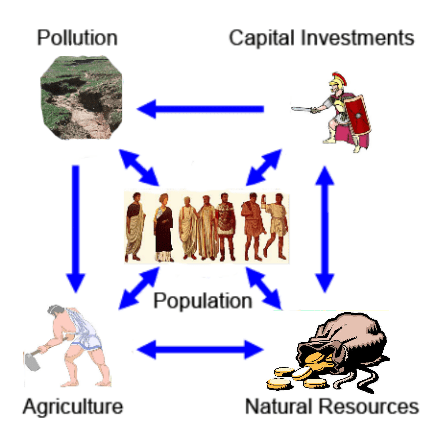
Figure 3. Image by Magne Myrtveit to summarize the main elements of the world model for Limits to Growth.
As such, this model does not reflect the major elements of complexity, which I summarized as follows in a recent post:
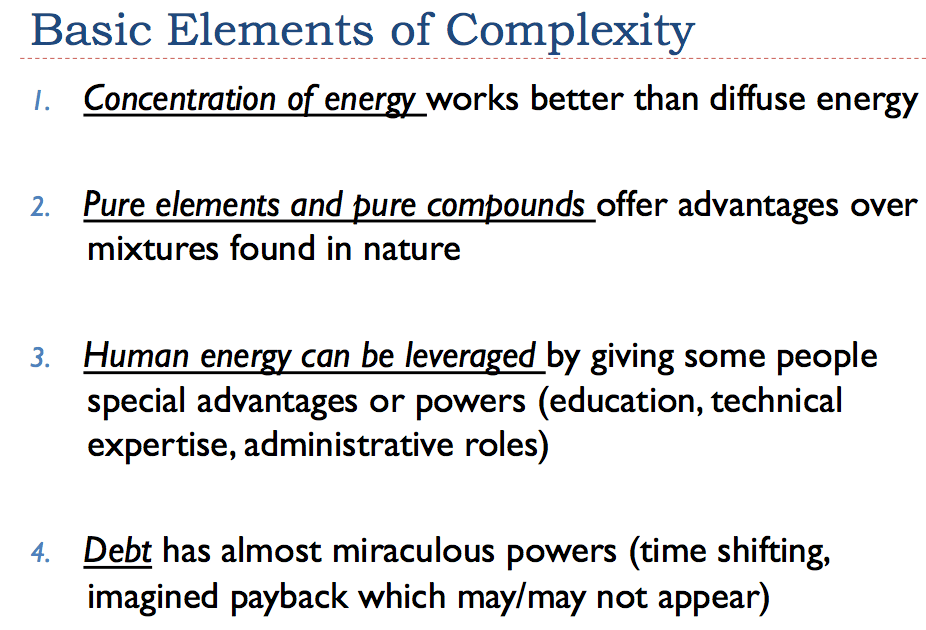
Figure 4. Slide 7 from my recent complexity presentation. Basic Elements of Complexity
Thus, the model does not forecast the problems that can be expected to occur with increasingly hierarchical behavior, including the problems that people who are at the bottom of the hierarchy can be expected to have getting enough resources for basic functions of life. These issues are important, because people at the bottom of the hierarchy are very numerous. They need to be fed, clothed, housed, and have transportation to work. All of these things take natural resources, including energy products. If the benefit of available natural resources doesn’t make it all of the way down to the bottom of the hierarchy, death rates spike. This is one of the forces that can be expected to change the shape of the curve.

Figure 5. Slide 17 from my complexity presentation. People at the bottom of a hierarchy are most vulnerable.
Dennis Meadows does not claim that the model that his group put together will show anything useful about the “shape” of the collapse. In fact, in an article about a year ago, I cut off part of the well-known Limits to Growth forecast to eliminate the part that is likely not particularly helpful–it just shows what their simple model indicates.

Figure 6. Limits to Growth forecast, truncated shortly after production turns down, since modeled amounts are unreliable after that date.
Anthropologist Joseph Tainter’s View of Collapse
If we read what anthropologist Joseph Tainter says in his book, the Collapse of Complex Societies, we find that he doesn’t consider “running out” to be the cause of collapse. Instead, he sees growing complexity to be what leads an economy to collapse. These are two of the points Tainter makes regarding complexity:
- Increased complexity carries with it increased energy costs per capita. In other words, increased complexity is itself a user of energy, and thus tends to drain away energy availability from other uses. Thus, in my opinion, complexity will make the system fail more quickly than the Hubbert model would suggest–the complexity part of the system will use part of the energy that the Hubbert model assumes will be available to fund the slow down slope of the economy.
- Increased investment in complexity tends to reach declining marginal returns. For example, the first expressway added to a highway system adds more value than the 1000th one. Eventually, if countries are trying to create economic growth where little exists, governments may use debt to fund the building of expressways with practically no expected users, simply to add job opportunities.
Ugo Bardi quotes Joseph Tainter as saying,
“In ancient societies that I studied, for example the Roman Empire, the great problem that these economies faced was that they eventually would incur very high costs just to maintain the status quo. They would need to invest very high amounts to solve problems that didn’t yield a net positive return; instead these investments simply allowed the economies to maintain the level that they were at. This increasing cost of maintaining the status quo decreased the net benefit of being a complex society.”
View of Collapse Based on a Modeling Approach
In the book Secular Cycles, Peter Turchin and Surgey Nefedov approach the problem of what causes civilizations to collapse using a modeling approach. According to their analysis, the kinds of things that caused civilizations to collapse very much corresponded to the symptoms of increasing complexity:
- Problems tended to develop when the population in an area outgrew its resource base–either the population rose too high, or the resources become degraded, or both. The leaders would adopt a plan, which we might consider adding “complexity,” to solve the problems. Such a plan might include raising taxes to be able to afford a bigger army, and using that army to invade another territory. Or it might involve a plan to build irrigation, so that the current land becomes more productive. A modern approach might be to increase tourism, so that the wealth obtained from tourists can be traded for needed resources such as food.
- According to Turchin and Nefedov, one problem that arises with the adoption of the new plan is increased wealth disparity. More leaders are needed for the new complex solutions. At the same time, it becomes more difficult for those at the bottom of the hierarchy (such as new workers) to obtain adequate wages. Part of the problem is the underlying problem of too many people for the resources. Thus, for example, there is little need for new farmers, because there are already as many farmers as the land can accommodate. Another part of the problem is that an increasing share of the output of the economy is taken by people in the upper levels of the hierarchy, leaving little for low-ranking workers.
- Food and other commodity prices may temporarily spike, but there is a limit to what workers can pay. Workers can only afford more, if they take on more debt.
- Debt levels tend to rise, both because of the failing ability of workers to pay for their basic needs, and because governments need funding for their major projects.
- Systems tend to collapse because governments cannot tax the workers sufficiently to meet their expanded needs. Also, low-ranking workers become susceptible to epidemics because they cannot obtain adequate nutrition with low wages and high taxes.
How Do We Fix an Overly Simple Model?
The image shown in Figure 3 in some sense shows only one “layer” of our problem. There is also a financial layer to the system, which includes both debt levels and price levels. There are also some refinements needed to the system regarding who gets the benefit of energy products: Is it the elite of the system, or is it the non-elite workers? If the economy is not growing very quickly, one major problem is that the workers at the bottom of the hierarchy tend to get squeezed out.

Figure 7. Author’s depiction of changes to non-elite workers’ share of the output of economy, as costs for other portions of the economy keep rising. The relative sizes of the various elements may not be correct; the purpose of this chart is to show a general idea, not actual amounts.
Briefly, we have several dynamics at work, pushing the economy toward collapse, rather than the resources simply “running out”:
- Debt tends to rise much faster than GDP, especially as increasing quantities of capital goods are added. Added debt tends to reach diminishing returns. As a result, it becomes increasingly difficult to repay debt with interest, creating a major problem for the financial system.
- The cost of resource extraction tends to rise because of diminishing returns. Wages, especially of non-elite workers, do not rise nearly as quickly. These workers cannot afford to buy nearly as many homes, cars, motorcycles, and other consumer goods. Without this demand for consumer goods made with natural resources, prices of many commodities are likely to fall below the cost of production. Or prices may rise, and then fall back, causing serious debt default problems for commodity producers.
- Because of growing complexity of the system, the “overhead” of the system (including educational costs, medical costs, the wages of managers, the cost of government programs, and the cost of resource extraction) tends to increase, leaving less for wages for the many non-elite workers of the world. With lower wages, the non-elite workers can afford less. This dynamic tends to push the system toward collapse as well.
The following is a list of variables that might be added to the overly simple model.
- Debt. As capital goods are added to work around resource shortages, debt levels will tend to rise quickly, because workers need to be paid before the benefit of capital goods can be obtained. Debt levels also rise for other reasons, such as government spending without corresponding tax revenue, and funding of purchases deemed to have lasting value, such as college educations and investments in research and development.
- Interest rates are the major approach that politicians have at their disposal to try to influence debt levels. In general, the lower the interest rate, the cheaper it is to buy cars, homes, and factories on credit. Thus, the amount of debt can be expected to rise as politicians lower interest rates.
- Wages of non-elite workers. Non-elite workers play a dual role: (a) they are the primary creators of the goods and services of the system, and (b) they are the primary buyers of the goods that are made using commodities, such as food, clothing, homes, and transportation services. Thus, their wages tend to determine whether the economy can grow. In general, we would expect wages of workers to rise, if their wages are being supplemented by more and more fossil fuel energy in the form of bigger and better machinery to help the workers produce more goods and services. If the wages of non-elite workers fall too low, we would expect the economy to slow, and commodity prices to fall. To some extent, rising debt (through manipulation of interest rates, or through government spending in excess of tax revenue) can be used to supplement the wages of non-elite workers to allow the economy to continue to grow, even if wages are stagnating.
- The affordable price level for commodities in the aggregate depends primarily on the wage level of non-elite workers and debt levels. A particular commodity may increase in price, but in the aggregate, the total “package” of costs represented by commodity prices must remain affordable, considering wage and debt levels of workers. If wage levels of non-elite workers are rising, the overall affordable price level of commodities will tend to rise. But if wage levels of non-elite workers are falling, or if debt levels are falling, affordable price levels are likely to fall.
- The required price level for commodity production in the aggregate to continue to grow at the previous rate. This required price level will depend on many considerations, including: (a) the rising cost of extraction, considering the impacts of depletion, (b) wage levels, (c) tax requirements, and (d) other needs, including payment of interest and dividends, and required funding for new development. Clearly, if the affordable price level falls below the required price level for very long, we can eventually expect total commodity production to start falling, and the economy to contract.
- The energy needs of the “overhead” of the system. Increasing complexity tends to make the overhead of the system grow much faster than the system as a whole. Energy products of various kinds are needed to support this growing overhead, leaving less for other purposes, such as to increasingly leverage the labor of human workers. Some examples of growing overhead of the system include energy needed (a) to maintain the electric grid, internet, roads, and pipeline systems; (b) to fight growing pollution problems; (c) to support education, healthcare, and financial systems needed to maintain an increasingly complex society; (d) to meet government promises for pensions and unemployment insurance; and (e) to cover the rising energy cost of extracting energy products, water, and metals.
- Available energy supply based on momentum and previous price levels. A few examples explain this issue. If a large oil project was started ten years ago, it likely will be completed, whether or not the oil is needed now. Oil exporters will continue to pump oil, as long as the price available in the marketplace is above their cost of production, because their governments need at least some tax revenue to keep their economies from collapsing. Wind turbines and solar panels that have been built will continue to produce electricity at irregular intervals, whether or not the electric grid actually needs this electricity. Renewable energy mandates will continue to add more wind turbines and solar panels to the electric grid, whether or not this electricity is needed.
- Energy that can actually be added to the system, based on what workers can afford, considering wages and debt levels [demand based energy]. Because matching of supply and demand takes place on a short-term basis (minute by minute for electricity), in theory we need a matrix of quantities of commodities of various types that can be purchased at various price levels for short time-periods, given actual wage and debt levels. For example, if more electricity is dumped on the electric grid than is needed, how much impact will a drop in prices have on the quantity of electricity that consumers are willing to buy? The intersections of supply and demand “curves” will determine both the price and quantity of energy added to the system.
The output of the model would be three different estimates of whether we are reaching collapse:
- An analysis of whether repayment of debt with interest is reaching limits.
- An analysis of whether affordable commodity prices are falling below the level needed for commodity consumption to grow, likely leading to falling future commodity production.
- An analysis of whether net energy per capita is falling. This would reflect a calculation of the following amount over time:
 If net energy per capita is falling, the ability to leverage human labor is falling as well. Thus productivity of human workers is likely to stop growing, or perhaps decline. The total amount of goods and services produced is likely to plateau or fall, leading to stagnating or declining economic growth.

The important thing about the added pieces to this model is that they emphasize the one-way nature of the system. The economy needs to grow, or it collapses. The price of energy products cannot rise much at all, because wages of workers don’t rise correspondingly. This means that any energy substitute must be very cheap. The system needs to keep adding debt, especially when capital goods are added. The benefit of this debt reaches diminishing returns. The combination of these diminishing returns with respect to investments made with debt, and the interest that needs to be paid on debt, means that it is very difficult for energy products based on capital goods to “save” the system.
Complexity Adds Unforeseen Problems
One issue that people working solely in the energy sector may not notice is that our current system for setting market-based electricity prices is not working very well, with the addition of feed-in tariffs and other subsidy programs. There is evidence that subsidizing renewable electricity tends to lead to falling wholesale electricity prices. In a sense, if we subsidize electricity prices for one type of electricity producer, we find it also necessary to subsidize electricity prices for other types of electricity producers. (Also in California.)

Figure 8. Residential Electricity Prices in Europe, together with Germany spot wholesale price, from http://pfbach.dk/firma_pfb/references/pfb_towards_50_pct_wind_in_denmark_2016_03_30.pdf
Inadequate prices for electricity producers and a need for ever-rising subsidies for electricity production could, by themselves, cause the system to fail. In a sense, this pricing problem is a complexity-related outcome that economists have overlooked. Their models are also too simple!
Conclusion
It is easy to rely on too-simple models. Perhaps the biggest issue that is missed is that energy prices can’t rise endlessly. Because of this, a large share of natural resources, including oil and other energy products, will be left in the ground. Furthermore, because prices do not rise very high, energy products that are expensive to produce can’t be expected to work, either, no matter how they are disguised. Substitutes that cannot be inexpensively integrated into the electric grid are not likely to work either.
I talked about low-ranking workers being a vulnerable part of the system. It is clear from Joseph Tainter’s comments that another vulnerable part of our current system is the various “connectors” that allow us to have our modern economy. These include the electric grid, roads and bridges, the pipeline systems, the water and sewer systems, the internet, the financial system, and the international trade system. Even government organizations such as the Eurozone might be considered vulnerable connecting systems. The energy cost of maintaining these systems can be expected to continue to rise. Rising costs for these systems are part of what makes it difficult to maintain our current economic system.
The focus on “running out” has led to a focus on finding ways to extend our energy supply with small quantities of high-priced alternatives. This approach doesn’t really get us very far. What we need to keep the economy from collapsing is a growing supply of cheap-to-produce energy and other natural resources. Ideally, these new resources should require little debt, and not cause pollution problems. These requirements are exceedingly difficult to meet in a finite world.


… meanwhile, in Norway:
https://www.ssb.no/en/priser-og-prisindekser/statistikker/bpi/kvartal/2016-07-13
I see that prices fell by 7.8% in Stavanger. That would be the area likely to be most affected by oil cutbacks. But overall, prices are holding up amazingly well.
Oslo: 2016 January – June average = NOK 62500 = $ 7376 pr m2 – what gives?
I was in Yemen just prior to this kicking off… had a coffee with a diplomat who told me ‘this country is just about out of oil – it has huge water issues – it has too many people – it will soon be f&^%$ (he used those words…)’
This is what happens when resources run out…
http://www.pbs.org/wgbh/frontline/film/yemen-under-siege/
What on Earth possessed you to visit such a place? Don’t you value your life? Wait 15 years or so – it’ll be coming to a place near you anyway.
Yemen – certainly worth a visit before it collapsed. I thing visiting the Olympic Games this year including a self-guided city-tour is more dangerous that visiting Yemen before it began collapsing!
As a side-note: The Olympic Games are a non-issue in Germany this time… really strange…
I like to watch.
“Climate change appears to be in full swing with the latest State Of The Climate report released by the National Oceanic and Atmospheric Administration (NOAA) showing that dozens of climate records were broken last year.”
http://eandt.theiet.org/news/2016/aug/climate-change-records-shattered-during-grim-2015.cfm
“Around 450 scientists from around the world helped write the report and in it the NOAA highlighted one of the lesser-known measurements: ocean heat content.
Around 93 per cent of the heat energy trapped by greenhouse gases, such as carbon dioxide from the burning of coal, oil and gas, goes directly into the ocean, which hit record heat levels both near the surface and deep below as a result.”
Ha ha … yes, perhaps it is over dramatising it all. Just my nature!
But, I think Richard Duncan comes to a similar conclusion to Guy McPherson but from a financial/ economic angle rather than an abrupt climate change angle.
You are just another sentimental old timer I can tell.
Born in the 40’s, lived the good (FF’ed) life and now.
Retired with plenty of time for some intense reflection.
Am i close?
No disrespect though. 😉
Perhaps resonating with Guy McPherson’s deep-life-enhancing conclusion, I think Gail has found again what she loves, and is doing it boldly, steadily, step by step as is her nature, coming out in all her glory, adding her voice to the Choir of Love.
Don Cupitt urges us to have our say, to find our voice, to enter the fray, to speak up, now for goodness sake while we are here: http://www.doncupitt.com/philosophylife/don-cupitt-philosophy-of-life-religion-of-ordinary-life.html
… “Any moment might be our last. Everything is more beautiful because we’re doomed. You will never be lovelier than you are now. We will never be here again.” Homer, The Iliad
It seems Homer’s and Shakespear’s only come along every few thousand years…
BTW, that’s not the same Richard Duncan of Olduvai Gorge fame? I think he was an Electrical Engineer or Systems Analyst, like Jay Hanson.
Interesting! I haven’t run across that before. In my opinion, a major purpose of religions is show us a better way for living life here and now. It is not “fire insurance.” For example, forgiveness is primarily for the benefit of the person doing the forgiving.
In a way, I think that is Gail’s deep-life-enhancing message … sort of sub text, a text of love underlying all her labours.
Let us not overdramatize. I would say it is mostly out of curiosity.
The only immediate solution to our current predicament is a drastic population reduction, given that, then this clunker can be kept going for the foreseeable future.
Not sure Gail is motivated by love. She certainly has a hardcore curiosity and a drive to figure out the big picture.
Yes … but that’s not quite the point I think.
The point is that we can rejoice … for we get a few more years before we all die in a cascading collapse. I think FE would agree.
I think Gail would agree with the old revered saying: “Now therefore, while we have time, let us do good to every person”.
The old, near forgotten ecstatic joy of eschatological urgency returns in a different form. We are reborn into this present moment … Now. The resurrection is not for the future (hopium thinking) … it is now we are resurrected, in the blink of an eye.
Ecstatic Immanence … the New Vision of Ordinary Everyday Life … http://www.doncupitt.com/philosophylife/don-cupitt-philosophy-of-life-energetic-spinozism.html
Perhaps you should get of the instadooomium pills before you take the final plunge into reality.
https://en.wikipedia.org/wiki/%C3%84ttestupa
Swedes of the past indeed developed a nice little hobby for the slightly senile and delusional old coots. Lets dust it off and apply it remorselessly here on OFW.
Nowadays ättestupa is replaced by 120 mph into sharp rock with airbags inactivated.
120 mph!!? The airbags won’t even arm at those speeds.
I just regurgitated something I heard somewhere.
You are right. I would agree with the saying, “Now therefore, while we have time, let us do good to every person”.
Here’s Richard Duncan’s take on it all: https://www.youtube.com/watch?v=10-pbUXkt54 . Also the follow up commentary: https://www.youtube.com/watch?v=E3yZ036QOUE.
So we get to have a boom for another few years due to the ability of some central banks to print trillions without inflation (due to wage destruction due to globalization), and then a fatal heart attack?
Richard thinks maybe another 8 years while the USA rebuilds all it’s infrastructure with the new money, which as Japan Inc. demonstrates actually reduces national debt. Also a great opportunity to invest in new technologies, genetic engineering breakthroughs, etc.
Stock market should soar … and real estate prices?. BTW, Richard ignores climate change, pollution, or any other limits to growth in his model(s)/ predictions.
I suspect it will not be much of that helicopter money which ends in the hands of the consumer.
It will further skew the gross output away from private consumption into businesses and government.
http://www.manzellareport.com/index.php/economy/872-gross-output-vs-gdp-which-measure-is-better
I.e, an increase in complexity, more organization, more structure, less tangible goods and services.
Growth in Gross Output seems to be a measure of growing complexity. I suspect it was added, because it has been growing faster than GDP. Once the economy starts to shrink, it would seem like complexity would decrease, and Gross Output would fall even faster than GDP. (That is a conjecture–both could fall pretty hard at the same time.)
My guess is that with GDP growing so slowing, the BEA was looking for something–anything–that they could put together in a report that was showing better results. I don’t think that they were thinking about helicopter money.
I agree that the consumer share of the GO will shrink as the complexity increases. Are there any other choice in our current situation than to aim the newly minted debt at the businesses and government since the consumer seem maxed out?
With helicopter drops of money (really additional government debt), I don’t think that there is any intent of payback, expect perhaps repayment of the government debt in the distant future if tax revenue should rise.
Instead, the idea is to give the money to consumers so that they can buy things. For example, I think we in the United States all received checks from the government during the 2008-2009 recession. The hope was that we would buy US goods, and thus stimulate the economy. I think people really bought goods from China, or used the funds to pay down their own debt. In a sense, it is like reducing the tax rate for the year.
The USA has some bridges in need of repair. Then, there’s all those ports that will need new and higher seawalls. Jobs, good.
I am having a hard time believing that the US can just continue buying up foreign resources and valuable imports with endless keyboard credit.
Granted, the nation that owns the global reserve currency just technically gets a 10-15% free boost of free stuff into it’s economy from that arrangement…. but the rest of the world now understands that this 10-15% boost to US is giving an undeserved boost to the US economy and living standards as well as financing global hegemony schemes.
Russia and China understand this and are not happy with the situation. However, neither Russia nor China is capable, or willing, to try and assume the burden of global reserve currency.
Still, paying for resources and tangible goods with keyboard money has a definite ending date and likely not far away.
@Sungr
Reserve currency will work as long there is “trust” then you can get rid of it in exchange of goods. When this is not anymore possible… then its over.
The guarantee that this is possible are 10 of these: https://en.wikipedia.org/wiki/Nimitz-class_aircraft_carrier – as long as they go….
And before those are on route, these organizations will be commandeered to look into the trust “issue”:
https://en.wikipedia.org/wiki/United_States_Department_of_Justice
https://en.wikipedia.org/wiki/U.S._Securities_and_Exchange_Commission
https://en.wikipedia.org/wiki/National_Security_Agency
https://en.wikipedia.org/wiki/Central_Intelligence_Agency
Who trusts the “dollar” any longer? Certainly not the Chinese- tho they may be using it for now.
Healthy approach is to look at the situation as follows, the US is just a host organism-entity, which took the baton over from UK, prior to WWI and was solidified into this position post WWII.
What is important, it’s not about the US only, similarly, there are powerful faction inside Russia, China, India or Europe aligned with the program, specifically the top owner class of central banking system and their commercial banks, they operate way above the national political class.
Globally speaking you can’t get off the system, it can only reform on it’s own volition or die out from natural causes. Sudden death option is not likely now and If they want to continue, they will have to “reform/adapt” – what does it mean for the little people is another question, most likely nothing exciting.
I think it depends on how pressing the energy/economy issues are for the system as a whole. I believe most of the decision making is being made algorithmically.
I wonder when the algos decide it’s time to “pull the plug” on the little people in the industrialized countries (OECD)? Will we have another 30 years of can kicking?
It is hard for me to find time to listen to videos. I agree that if anything is going to hide our current problem for a while longer it will be printing huge amounts of money. The real issue is lack of growth in per capita energy supply. This has already started to shrink. The peak year was 2013, and 2014 was a tiny bit lower. 2015 was a definite step down. It is the fall in per capita energy supply that is hard to hide. It shows up in falling wages for non-elite workers, and too low return on investments.
Jim Clifton, Chairman and CEO at Gallup, which incessantly surveys what consumers and companies are up to every moment of the day, nailed it when he lashed out at his fellow CEOs, for their way of doing business.
Their companies are “failing to grow organically,” he said in a blog post. Instead of investing in growth-producing activities, CEOs go out and buy other companies, particularly their competitors.
Buying competitors – effectively getting rid of competition – takes pressure off these companies to innovate and perform, and they’re all hoping to gain some pricing power with these strategies. This has worked miracles in healthcare, where prices have shot up as consolidation has become a pandemic strategy, no matter how large and unwieldy the company, or how concentrated and monopolistic the sector.
“Shockingly, boards of directors encourage this,” Clifton wrote, adding:
Acquisitions is the current growth strategy of Forbes Global 2000 companies. As a result, the number of publicly listed companies traded on U.S. exchanges has been cut in half in the past 20 years – from about 7,300 to 3,700.
According to the World Bank, the number of listed companies on all global exchanges – currently 44,000 – has flatlined since 2006, with a recent two-year decline.
The herd is getting pretty small. At some point, this acquisition strategy hits a wall. It makes you wonder how long we’ll need the New York Stock Exchange and Nasdaq.
In a perfect, growing world, the market would have doubled the number of big public companies instead of halving it.
So there’d be about 15,000 US-listed companies by now, not 3,700. They’d be smaller and nimbler. There’d be more competition too, more innovation, more emphasis on investment in productive activities and people to achieve organic growth.
And this organic growth is precisely what is missing in the US economy. Acquisitions contribute nothing to the overall economy. In fact, they’re often sold to investors on the pretext of “efficiencies” and “synergies” – so layoffs, shutdowns, product consolidations, and the rest of the Wall Street lexicon liberally used to twist these acquisitions into a positive light for investors.
But beyond huge compensation packages for the executives of the acquirer and the target – at least someone is getting more spending money even if they don’t spend it – acquisitions are a net negative for the economy.
The Microsoft-Nokia fiasco is a textbook example of an acquisition being a net negative for the economy that has now come full circle … After Losing $11 Billion on $9.4-billion Nokia Buy & Axing 27,650 Jobs, Microsoft Dumps Consumer Smartphones.
And despite the endless acquisitions, Microsoft’s sales and profits are shrinking. IBM and many other companies are in the same miserable category: they’re tech companies, and they’re supposed to be innovators. But with a razor-sharp and relentless focus on financial engineering, they’re binge-buying other companies and paying what Clifton calls “unrecoverably high prices for acquisitions.” And their total revenues continue to shrink.
Organic growth, however, is a net positive for the economy. But that’s hard to do. It’s a lot easier to connive with Wall Street and buy each other out.
So S&P 500 companies are now in the middle of reporting Q2 earnings in what is shaping up to be another quarter of earnings declines – the fifth in a row. And revenues have a chance of hitting a sixth quarterly decline in a row. Not only is there no organic growth. There is organic decline!
The acquisitions strategy simply doesn’t produce results, except for executive compensation packages, which get fatter and fatter, as are the compensation packages of board members. So maybe it’s not so “shocking” that “boards of directors encourage this.”
Every aspect of Corporate America has become financialized. Financial engineering – with everyone’s knowing consent and even encouragement, a phenomenon we’ve come to call “consensual hallucination” – is the top corporate strategy to support the top corporate goal: inflate the stock price at any and all costs. Nothing else matters. Not even sales and profits. Just the stock price.
That’s a perversion of a perversion.
So if companies aren’t tied up buying the shares of each other, they’re buying their own shares. In 2014 and 2015, US companies blew $1.1 trillion on share buybacks, according to FactSet data. In the first quarter this year, share buybacks amounted to $166 billion, up 15% from last year. And to finance these buybacks, even as revenues and earnings are declining, companies are issuing bonds and loading up on debt – without adding productive activity to deal with this debt.
That’s the genius of share repurchases: They drive up stock prices. And debt. Wall Street loves them – and makes money off fees coming and going.
More http://wolfstreet.com/2016/08/04/acquisitions-share-buybacks-financial-engineering-fail-to-produce-organic-economic-growth/
That’s what happens when the pie is shrinking….
I hadn’t read that article. Obviously, then the top 10 or 100 or whatever companies appear to be growing more than they really are, because they are buying up their competitors. Add to that fact that they are also buying back their own shares–it is anyone’s guess what “real” growth looks like.
The tech sector has been going wild with this sort of activity lately.
I am thinking about animals… my two dogs in particular…. the would sell me out if you offered them a ‘treat’ ….
Are humans really much different? Do we really think that the masses are capable of making decisions – i.e. democracy….
Or do we need masters (currently the El-ders… but throughout history there has always been a firm guiding hand)….
Before you answer… please take a moment to watch this
Eddie, you need to get different pet dogs….You can ad mouth human character, but you went over the line here. Recently, I watch this show on Animal Planet….now tell me dogs are sell outs
http://www.animalplanet.com/tv-shows/i-shouldnt-be-alive/videos/dog-saves-injured-owner/
and then she looked over at Taz.
Her dog. The “pure-bred mutt” she’d rescued as a puppy from the pound four years earlier and named Tasman since one of his more obvious breeds was Australian Shepherd.
Taz had come along for the run and he’d stuck with her ever since the fall. Occasionally he would wander off, but he never left her side for long. If she wasn’t leaving this canyon, neither was he.
Nellie called to him.
“You’ve got to go, Taz,” she said when he came close, playing the only card she had left. “You’ve got to go get help.”
She drifted away again, for how long she did not know. When she woke up, Taz was there, slurping the water behind her head. Despite her delirium, she sensed his demeanor had changed. His tail was wagging. He looked for all the world like he was ready to play.
A depressing thought came over her. Who was going to take care of Taz?
Then, around the corner came a four-wheeler.
That’s why Taz’s tail was going like a metronome. That’s what he was telling her. He’d brought help!
Through a series of fortuitous events involving Nellie’s neighbor Dorothy, her parents Gary and Peggy, and a Moab detective named Craig Shumway, Nellie’s truck had been found hours earlier parked just beyond the Amasa Back trailhead.
The search party was just getting organized when they saw the dog running out of the backcountry.
They tried to entice him with food, but he eluded their grasp and kept running in the direction of town.
Only when it appeared that the dog was confident he had everyone’s attention did he execute an abrupt U-turn and head back where he’d just come from.
The rescuers tried to follow, but Taz was too quick for them, so farther up the Amasa Back trail, a veteran search and rescue guy named Bego Gerhart was called on his radio. Watch for the dog! Bego saw Taz just as he made a hard left turn away from the main trail.
On his four-wheeler, Bego followed the dog’s tracks into the remote canyon.
It was as Nellie was looking at Taz, wondering who would take care of him, that Bego rounded the corner.
Within seconds, he had her covered in a down sleeping bag and big warm gloves; within an hour she was strapped into a helicopter that rushed her to the hospital in Grand Junction, Colo.
She’d have never survived another night; maybe not another hour
http://beta.deseretnews.com/article/765565160/Near-fatal-fall-on-Moab-trail-changes-runner-Danelle-Nellie-Ballengees-life.html?pg=all
This is one show not to miss…Dogs are indeed our best friends
Lassie stuff. I liked the one where the lone hiker was pinned in the rocks and cut his own arm off with a pocketknife to free himself and make it back out to civilization. He even calculated how much time he had to unconsciousness from the blood loss.
The difference is Lassie was make up, this was real and she thought about that fellow while lying there alone while her faithful dog went for help.
BTW…one story of hundreds about our dogs
http://www.dogguide.net/25-hero-dogs.php
http://theweek.com/articles/466829/7-inspiring-stories-stray-dogs-saving-perfect-strangers
7 inspiring stories of stray dogs saving perfect strangers
Dogs and dolphins. If they knew what we’re really capaable of doing, they’d run/swim away anytime one of us approached them. They’re trusting and altruistic, part of their evolution as pack/pod animals, I guess.
Are you aware of late Robert Stephen Briffault and his “law” regarding female and male interaction?
“The female, not the male, determines all the conditions of the animal family. Where the female can derive no benefit from association with the male, no such association takes place. — Robert Briffault, The Mothers, Vol. I, p. 191”
https://en.wikipedia.org/wiki/Robert_Briffault
Volunteering to scale back your carbon footprint will indeed be a hard sell to a female if you’d like to pass on your genes. Pretty much forget about it. If you are doing it, alone it will be.
Not only does the women of the industrialized nations give birth to totally redundant and environmentally disastrous offspring, they also contribute to some 80% of total consumer spending.
“Women drive 70-80% of all consumer purchasing, through a combination of their buying power and influence”
http://www.forbes.com/sites/bridgetbrennan/2015/01/21/top-10-things-everyone-should-know-about-women-consumers/#7ddb03102897
No wonder the elites are eager on pushing more feminism and “equality” down our throats. Female spending equals big business and BAU can kicking.
lolololol
you mean you’ve only just found that out????????
Watch any nature programme on any species—it’s the lady who does the choosing. Something you gotta learn to live with I’m afraid
Chill out man, or better, go bother someone else with your drivel.
Hi Norman,
Would much prefer your thoughtful analysis rather than these banal quips and cheap cuts.
Maybe you could instead work on getting us a hardcopy of End of More?
Cheers.
first off—my apologies if my comments offended anyone–that was unintentional
but
if you follow the thread back to the beginning, it was in response to ”boredom” in a certain respect.
i followed that through in an attempt to explain how and why we all got here, (all 7 Bn of us) the biological and genetic forces behind it, and how we have had little choice in the matter whether we find those forces offensive or not. (collectively speaking that is,–individuals can follow their own path, but cannot affect the ”collective” outcome)
They are what they are—I mistakenly expected them to accepted as such, because nature intends those forces to work the way they do—we as mere mortals just dress those forces up in our trappings of everyday life and living.
Women do drive most consumer spending—men on the other hand tend to agree to anything for a quiet life. I happen to be colour blind—so trust me on that one. Not that it would make much difference.
i tried to lace it with a little humour, (as is my way I’m afraid) to deflect from the standard doomerama we all faced with. Sometimes one has to find human behaviour amusing, we can’t be doom-mongering all the time.
————————————-
By contrast—I did not put on my “offended” hat at the following comment:
{{{{{{{{{{So let’s make an experiment: I propose that blacks and women in general have a lower General IQ than caucasian and asian men. Am I a racist and a misogynist in your mind(s) now?}}}}}}}
I assumed it was a comment tossed out for discussion—at least i hope it was. If it wasn’t, then I would find it most offensive.
————————————-
Appreciate the ongoing interest in End of More, I’m in the process of adding a few bits here and there to bring it up to date, things are moving so fast now in that respect.
“Women drive 70-80% of all consumer purchasing, through a combination of their buying power and influence”
Then we need more women — because if we don’t buy more stuff — we collapse.
Why even go so far as to consume the stuff we don’t need anyway, with the money we don’t have?
Simply just manufacture it using debt and dump the mostly useless garbage directly into the ocean. Problem solved, no people needed.
You tend to make stuff too complicated and involve too much drama and people.
We could as you suggest throw stuff directly into the rubbish as it came out the factory door… but why not get a bit of use out of it before we do that?
There is a black and white movie clip (can’t recall the name) in which a worker bemoans the fact that ‘stuff’ does not last very long …
The factory boss berates him explaining that if widgets lasted 20 years… he’d be out of a job as a widget maker…. he’s left to connect the dots on the implications of this.
Well, aren’t we hitting limits? Desperate times call for desperate measures. You see, people and woman in particular is a bit fickle. Torpedoes on the other hand – quite reliable “consumers” of mostly useless material goods.
http://img2.izismile.com/img/img3/20100826/640/accidents_with_container_640_32.jpg
Actually, we don’t even need to manufacture it prior to dumping it into the sea. Just as with debt, we can go “fabless” and run our virtual machinery with the Oculus Rift VR goggles strapped on. Let’s pretend all the way. Admittedly we are already pretty good at it.
Reality bits
https://www.theguardian.com/world/2016/aug/03/venezuela-sterilizations-soar-children-crisis-food-shortages-inflation
https://www.theguardian.com/lifeandstyle/2015/nov/14/babies-an-impossible-dream-the-millennials-priced-out-of-parenthood
Let me explain something. Each of you reading this has a certain “economic worth”. Remember, you are 1 in 7 billion. As you can see, each of us is likely not worth much.
Your economic worth is now algorithmically determined by banks and corporations from the top down. There is no bottom up free market economy anymore. This is why you can’t get rich working (if you haven’t figured it out already). While this has always been true, I just want to point how just how true it is today. Truly, I tell you that that the average condition for the working serf around the world might be 5 times worse than just 40 years ago.
You might think that you can be well off working, but it’s a trick. Because as you ascend the economic ladder, the costs increase as well. So…you are going to work hard and send your kids to college! So they can do even better! Well then face student loan debt and everything that entails. You want to work hard to have a safe, middle class life! Then you will pay more for housing, car to escape the ghetto. Etc.
It’s called the destruction of the income and savings of the working and middle class, and it’s happening to you right now. There’s no such thing as “getting ahead” anymore, there’s only connections which allow you to access cheap leverage to create an economy of scale. That’s it. Very few people get that now. That’s how this is going to go down, how it’s going to play out.
What’s my point? My point is…doom means getting poorer. That’s all collapse means, for most of us. Month by month, year by year, you get poorer.
Don’t hate me for letting you onto the way it works. If you want, you can escape into movies and entertainment.
ive just sold my body to medical science
🙂
today they returned it and asked for their money back
I’ve considered donating my body to science fiction.
nobody would believe it
Well, frankly you have to admit this is not that unique feature, living according to one’s means is thread woven throughout the entire history. Today we only experience the extreme leverage on that front.
Simply, there are people who are willing to jump the ship and end the rat race at age of 40-50s, accept supposedly “lower living standard” but in reality having more free/spare time for family, eating/breathing in better environment etc.
Obviously, this avenue is not open to everybody, and the peer pressure about “needs” in houses, carz, universities, vacations, gadgets and what have you is enormous.
Instadoomers like FE, would instead of nurturing real discussion as always rather put on silly strawmans, like goats/sheep have destroyed topsoil somewhere, reactor site won’t be powered down orderly, .. , so from it follows we all die from hunger and radiation next Friday. That was always a silly position..
That being said, this is not about “BAU-lite” – as we can observe, the first outposts of the west, usually on the periphery for now, are already in suspended collapse, namely Greece, Spain and Italy. It will take a decade or two before you see real starvation of %%part of the population in affluent places like Austria, Switzerland and Bavaria.
We can measure lot of “collapse precursors” – one of the best is the reliable flow of luxury items & services (as needs of poor people can be triaged off for very long time), and so far the JIT system for luxuries there hums along as clockwork as ever, when we see some disturbances appearing there, it’s getting serious for real. We are not there yet.
“Instadoomers like FE, would instead of nurturing real discussion as always rather put on silly strawmans, like goats/sheep have destroyed topsoil somewhere, reactor site won’t be powered down orderly, .. , so from it follows we all die from hunger and radiation next Friday. That was always a silly position..”
Hmmm…. how is the fact that nearly all farmland on the planet is farmed using petro chemicals — which destroy the soil – meaning when the chemicals no longer arrive…. we starve… a strawman?
This little bit of information blew your story sky high … and you have the balls to come back here and call me ‘silly’
You seriously need your head examined.
https://agenda.weforum.org/wp-content/uploads/2015/08/agriculture3.png
https://www.weforum.org/agenda/2015/08/which-countries-have-the-most-organic-agricultural-land/
How is the fact that we have 4000 spent fuel ponds that require electricity, spare parts, engineers, etc etc etc.,… or they explode and poison the planet — a strawman?
Assuming a 50-100% Cs137 release during a spent fuel fire, [8] the consequence of the Cs-137 exceed those of the Chernobyl accident 8-17 times (2MCi release from Chernobyl). Based on the wedge model, the contaminated land areas can be estimated. [9] For example, for a scenario of a 50% Cs-137 release from a 400 t SNF pool, about 95,000 km² (as far as 1,350 km) would be contaminated above 15 Ci/km² (as compared to 10,000 km² contaminated area above 15 Ci/km² at Chernobyl).
A typical 1 GWe PWR core contains about 80 t fuels. Each year about one third of the core fuel is discharged into the pool. A pool with 15 year storage capacity will hold about 400 t spent fuel. To estimate the Cs-137 inventory in the pool, for example, we assume the Cs137 inventory at shutdown is about 0.1 MCi/tU with a burn-up of 50,000 MWt-day/tU, thus the pool with 400 t of ten year old SNF would hold about 33 MCi Cs-137. [7]
http://belfercenter.hks.harvard.edu/publication/364/radiological_terrorism.html
I suppose if you turn up the Joan Baez CD loud enough…. you can drown out logic… you can drown out facts… you can drown out reality …. you can just dismiss reality and live in your bubble believing whatever you like.
I’m not sure why are you still placating this forum with the same excerpts all over again. It’s zero added value and actually negative for the crazy repetition. It’s a classic strawman, because I never advocated the sustainability of +8B population in the first place, hence expecting large density declines, and I dare to say most of the other contributors of this forum foresee much smaller populations in the future as well.. So, frankly, the only problem here are your unrealistic visions of instadoom, which don’t square with the concept of Elders. Simply, at some point the most hazardous facilities will be decommissioned no matter what, i.e. triaging-starving large parts of population to get the parts and expertise to do it. Will it work nicely 100% in every case?, no, will everything go up puff or radioactive smoke, no that’s just another extreme..
Yes, I agree with your rationale.
One only need to have a look at the heroism of the Fukushima 50 crowd and the inevitable age of AI and automation taking care of the slack left over by removing the excesses.
What OFW lurkers and posters need to understand is that: “The Elders/elite/rulers have no need for me anymore”.
Yep, decent – honest – innocent people thrown at the highest hours to solve/alleviate problems the elite helped to let overgrow in the first place. Typical historical narrative, repeating. Nevertheless, hard to explain as many other valid concepts to some extremists here, which I locked into pit of bitterness of their own making..
Innocent is a bit far-fetched. We have all played in this game with a vigor, including the Fukushima 50. They became a sacrifice which was called upon by the circumstances. Heroism is mostly just another word for the male disposability.
As for the instadoomers; yeah, it’s probably “fun” to entertain oneself with some doom, gloom, post claims and a course of events that lack refutability.
@worldofhanumanotg
++++
Same was also done in Russia… 500.000 “liquidators” prevented the worst in Chernobyl. I expect the systems / laws to tighten… follow the leader or be stripped of everything… kind of a martial law.
When the going gets though…
Excuse me … but I do recall you calling into question my post that well under 2% of all arable land on the planet was farmed using organic methods.
And I have subsequently demonstrated that you were wrong. The number is well under 2%.
Do you accept that you were wrong?
Furthermore — there are 7.4 billion people on the planet — and only a tiny bit of land that can produce food to feed them.
That amount of food will be further reduced:
– depending on when the petro chemicals stop and the shops empty – if this occurs outside of harvest season in a region – then there will be no food
– if collapse happens during harvest the hordes will be ripping up gardens and eating everything they can get their hands on (in North Korea they have been known to eat grass and bark during famines)
– additionally – there are billions of guns and loads of ammo in circulation around the world — the animals that provide the manure for organic gardens will be shot killed and eaten – as will every will animal that moves.
– diseases will roll over the planet — and there will be no way to stop them — think the black death — only far worse
– then we have the spent fuel ponds — spewing cancer and poison across the planet
– there will be no energy – no coal – no oil – no electricity — there will be only trees — and we will quickly burn those trying to keep warm
This is what we are facing. This is the end of days.
It is already happening.
Although, not in an instadoomium doped up fashion though. We might as well get used to a slow burn into oblivion. The algos and computers run this show these days, it is totally useless trying to “outsmart” them with elaborate and vivid doomerist scenarios.
Evidently, another Strawman, I was not discussing the ratio of organics under cultivation today at all, also even the 2% doesn’t automatically translates the rest, i.e. 98% must be dead soil everywhere!!! Sorry, you are putting up phantom schemes and demand reaction..
Example, the collectivist where destroying the topsoil of Ukraine for almost a century, it’s certainly not under organic management today, however there are still subregions of very rich soil no matter what. On the other hand you cite me some horrible yet publicly well known examples of overgrazing etc. So what? Sorry, this is still a big planet for 1/x of today’s population..
“i.e. 98% must be dead soil everywhere!!!”
Actually – more than 98% of the soil is dead almost everywhere….
I refer you again to Exhibit A…. these are the top 10 countries in terms of organically farmed land….
As we can see – only 4 of them have more than 2% of their farmland being worked organically… and as I have pointed out … a great deal of this organically land is scrub land… it cannot produce crops….
https://agenda.weforum.org/wp-content/uploads/2015/08/agriculture3.png
There are at present 196 countries in the world.
Which means that 192 of them have less than 2% of their ag land under organic cultivation.
In fact in 188 of the world’s countries over 99% of all soil is in fact dead….
Feel free to keep digging your hole deeper…. I can see that you don’t need any help but just the same…
http://cdn3.volusion.com/sqlbp.hrxnv/v/vspfiles/photos/ForestFireShovel-2.gif
It’s ok to admit you are wrong…. in fact you should rejoice in being wrong … because it means you have learned something today.
“There’s no such thing as “getting ahead” anymore, there’s only connections which allow you to access cheap leverage to create an economy of scale. That’s it. Very few people get that now. That’s how this is going to go down, how it’s going to play out.
What’s my point? My point is…doom means getting poorer. That’s all collapse means, for most of us. Month by month, year by year, you get poorer.”
Exactly! The existing system is all there is to work with, so as surplus energy left over from a barrel of oil continues to decline, the burden of that added cost is transferred to regular people working their butts off to ‘try’ and get ahead. Like I’ve stated before, it’s like a constrictor slowly but surely tightening down on people by squeezing their surplus money they need to get ahead. It’s called the Red Queen syndrome as the whole system spins faster and faster but the effect is very little movement forward – very little in the way of getting ahead. It’s really a crying shame to place a carrot on a stick in front of people and declare all they have to do is work hard enough to get the good stuff in life, but the fact is it gets harder and harder. Meanwhile more and more people become disenfranchised from their assets and live with friends or relatives or in their vehicles. No one except sites like this are there to explain to them why all their hard efforts are so poorly rewarded.
The pie is shrinking and the number of people wanting a slice grows every year…. therefore the slices get thinner… to get a disproportionately large piece is incredibly difficult….
All to be expected.
The trick to being content is not to feel the need to get a disproportionately large piece. A “winning strategy” for an individual these days might not be the same as it used to be a generation ago when Gordon Gekko’s “Greed is good” philosophy was hot.
https://youtu.be/VVxYOQS6ggk
I am a huge fan of living below one’s means…. it reduces stress levels dramatically….
F*&^ the Jone’s and their McMansion … boat … and cars — and their mega monthly bank payments….
I live below my means in order htat my wife can live above them. 🙂
🙂
Well us Men have to adhere to Briffault’s Law, i.e., play the Game if we want to enjoy female company. Though, I must admit, I find most of it rather mind-numbingly boring.
there’s only ever one reason why a woman is boring
It was mostly playing “the Game” I referred to as boring.
To be honest, I am quite fond of eating, not that food interests me beyond relieving me of the hunger.
A strong intellectual interest in a primal desire speaks volumes about the mind in which those impulses play out. Birds of a feather stick together.
guilty as charged
(blame the missis)
the absence of boredom is the secret of eternal youth
you should try it sometime
You misunderstand, the Game is boring, and having to listen to people harping on about all the trifles that comes with it.
There’s progressive impoverishment these days for sure. Young workers in the developed world staring out in their careers 40 years ago had much better prospects than either their grandparents or their grandchildren had or have. They came of age at a sweet spot when technological gains were handing out big dividends and primary energy was still reasonably cheap.
But just because we have progressive impoverishment and decline these days doesn’t mean we can avoid having an instant collapse up ahead. Prediction is always difficult, especially regarding the future. But FE’s scenario is plausible, even if it isn’t necessarily baked into the cake.
The main thing that keeps me from being convinced a sudden collapse will occur is those known unknowns and unknown unknowns—the things that we don’t know but we are aware that we don’t know them, and the things that we aren’t even aware that we don’t know. The Elders may have a few more tricks up their collective sleeves that they haven’t let on about yet because they believe we the public only need to know on a need-to-know basis.
True – by all rights based on what we have been taught about the financial system — BAU should have already collapsed.
That is why I turn to the ‘physics’ of the situation …. if corporate profits continue to decline … resulting in layoffs… resulting in deflation ….
And the central banks are unable to stop this trend….
Surely at some point we hit a tipping point…. and the economy implodes. It has to.
Herbert Stein — ‘If something cannot go on forever, it will stop.’
I firmly believe that axiom holds….
I think we are close — the police states are being put in place in anticipation of the end game.
I can’t see any flaws in your logic.
The trends are pretty clear and the writing is on the wall. The structure of the economic and financial system can no longer support itself, the load-bearing columns are visibly buckling, and the only things holding it up are periodic dumping of helicopter money and other forms of never-to-be-repaid debt, negative interest rates, and the continuing confidence of the great mass of people that everything will work out OK in the end.
At the same time, it’s possible that some smart and very powerful players are gaming the system on a truly humongous scale in order to benefit from the mother of all fire sales. But on the surface it looks like we have a system that could well collapse as suddenly, catastrophically, and irrevocably as a red giant turns into a supernova or Humpty Dumpty fell off that wall.
Gail points out how essential the financial system is to keeping everything running smoothly. Not being an expert but having a vivid imagination, I can imagine how the people playing with derivatives on a scale that dwarfs the size of the real economy might accidentally or on purpose set off a black swan event that capsizes the entire financial system. That in turn might be enough to send the real economy crashing. But even in the absence of that kind of meddling, I get the feeling we’ve already walked off the cliff and are about to experience a Wile E. Coyote moment. At heart, I think the human race is Wile E. Coyote. He’s a parody of us.
http://2.bp.blogspot.com/-LsJDQ1ig7SY/VRxRwKifxzI/AAAAAAAA-hM/iIgu23VWgW8/s1600/wile-e-coyote.jpg
Gails articles an FE´s comments are crystal-clear deductions. Compliment!
No wishful thinking. One of the best in the blogosphere, as far as I can see.
Exponetntial excesses and all kind of hockey-stick-develepoments ususally used to end in sudden deaths.
http://www.mathscareers.org.uk/wp-content/uploads/2012/07/predatorprey_graph.jpg
Not to forget Norman and some others!
Plenty of others…. the war against DelusiSTAN is being won.
What is actually being discussed here:
“The Lotka–Volterra equations, also known as the predator–prey equations, are a pair of first-order, non-linear, differential equations frequently used to describe the dynamics of biological systems in which two species interact, one as a predator and the other as prey.”
https://en.wikipedia.org/wiki/Lotka%E2%80%93Volterra_equations
https://en.wikipedia.org/wiki/Competitive_Lotka%E2%80%93Volterra_equations
https://en.wikipedia.org/wiki/Generalized_Lotka%E2%80%93Volterra_equation
Just a reminder, there are still both baboons and cheetah’s around. The only “extinction” going on is people trying to kill off both the predator and prey in this model.
Magnificent!
http://www.endofmore.com/?p=1464
Well, that’s an interesting idea, we indeed might get after the forthcoming end of current biz cycle (just another crash) from now and say before 2023, so in reaction getting another giant lift-athlon on the stock exchange and so on. However, the situation and relayed hints point rather towards direct large scale gov intervention next time, basically in the next cycle the west will resemble Russia a bit more, mix of state industries, tiny ring of trusted oligarchs, some semi-capitalist structures left for the consumable trinkets etc. No instadoom, sorry.. that’s very little probability before ~2035.
http://www.tradingeconomics.com/charts/og.png?url=/saudi-arabia/fiscal-expenditure
http://blogs-images.forbes.com/danielfisher/files/2015/01/eia-oil-price.jpg
http://www.zerohedge.com/sites/default/files/images/user3303/imageroot/2015/05/20150504_saudi.jpg
This looks frightening. The Saudis were not picking up nearly as many foreign reserves after 2007-2008 as they were at that time. Now What reserves they have are slipping away. Their population is much higher now, as well.
G20 total international merchandise trade. Seasonally adjusted, current prices and US$ billion.
http://www.oecd.org/media/oecdorg/directorates/statisticsdirectorate/G20-trade-500-12-2015.fw.png
Saudi Arabia’s balance of payments improving, says Capital Economics
http://www.argaam.com/en/article/articledetail/id/435129
Saudi Arabia posted a current account deficit of $18 billion in Q1 2016 (just under 12 percent of GDP), compared with a shortfall of $12 billion (7 percent of GDP) in the same period last year. The deterioration in the current account position was caused by a sharp narrowing in the goods trade surplus, as export receipts declined on the back of lower oil prices.
The Gross Domestic Product (GDP) in Saudi Arabia was worth 646 billion US dollars in 2015.
“speculation of a riyal devaluation is likely to fade”
Obviously the last bullet, along with loans and IMF s…t
Saudi Arabia Current Account
http://www.tradingeconomics.com/saudi-arabia/current-account
https://tse1.mm.bing.net/th?&id=OIP.M2c578e89f9971b3982e4673505837e5ao0&w=300&h=224&c=0&pid=1.9&rs=0&p=0&r=0
Pingback: Take America Back, or Forward? – SEF News-Views Digest | Citizens for Sustainability
As an illustration of complexity in contemporary society, consider the iPhone. There was an article in today’s Japanese-language Mainichi Shinbun on Japanese industry’s involvement in the iPhone business. We all know that iPhones are designed in California and built in China, but according to Apple Inc., the article says, during 2015 the company sourced components for their iPhones from 865 Japanese manufacturers. In total, they they paid these firms the equivalent of over 3 trillion yen for these parts and the business provided jobs in Japan for about 710,000 people.
Here comes the police state…
UK counter-terrorism cops are going on permanent standby amid fears of a Europe-style assault on targets across Britain.
Specialist armed police units will provide 24 hour coverage ready to respond to attacks like those in Nice in July if there is an attempt to replicate them on British streets.
London Police Chief Sir Bernard Hogan-Howe wrote in the Mail newspaper that his force was “training hundreds of extra officers so they are ready to supplement our numbers during an attack similar to that seen in Paris. This increases armed officers by 600 to 2,800.”
https://www.rt.com/uk/354325-uk-terror-eu-commission/
Well of course, complexity in the form of population control, etc, will increase until the energy capital (cheap FF’s) is depleted. Although, riots as a consequence of a peak-complexity and deteriorating BAU will be harder to control than a few pesky terrorists.
Yep.
Terrorism presents zero threat to BAU. It is like a pin prick to a whale…. Terrorism is a useful tool….it allows the high priests to roll out policies that would normally roil the sheeple…. best to have calm sheeple… their meat is more tender
Reserve Bank of Australia: RBA cuts the cash rate to all-time low of 1.5%
“The combination of low inflation and sluggish economy has forced the RBA’s hand.”
When the RBA speaks about “low inflation” they only imply one thing – property prices. Tomatoes are like $7 a kilo now, and rising…lol
The end is nigh for the epic Aussie property bubble…the fallout will be visible from space when it implodes…
The end is nigh for the epic Aussie property bubble…the fallout will be visible from space when it implodes.
I’ve heard people say “Ah, they’ve been saying that for years”
When it implodes they’ll be squealing like stuck pigs.
Aussies have had it good for so long that any little thing that goes wrong (like getting an under cooked sausage at a free BBQ) will set some of them off into the biggest cry baby tantrums imaginable.
I look forward to watching them whine over this one……………….
In Spain the bursting of the housing bubble after the ” Lehmann ” event was totally epic.
Here the consequences :
http://mazamascience.com/OilExport/output_es/Exports_BP_2016_oil_bbl_ES_MZM_NONE_auto_M.png
https://jesmarlo.files.wordpress.com/2015/03/tasa-de-paro-espac3b1a-ue-y-zona-euro-2002-2015.png
The politicians were repeating continuously: “the prices are never going to go down”.
Say that people are stupid , it is insufficient.
Warranty ECB delivered us from disaster. If Spain falls , EU fall… goodbye cruel world.
Sorry , the second chart shows unemployment trends .
And I know who they will blame: Steve Keen – haha 😉
I hope to be at least 500 km away when the thing craps out. 🙂
Me too, I’ve got a spot already far away from the Mad Hatters tea party freak show.
Have I touched a nerve with my question? It would appear so…..
Instead of getting all excited…. why don’t you try to answer the question.
What can we do to stop global warming?
Nothing , unless we advance the collapse of the economy. Just cross your fingers…
http://freeonlinepokies.me/wp-content/uploads/2013/02/jackpot.jpg
Well I think we’re just going to end up with both, given the latency effect of CO2 and the absence of the aerosol masking that industrial pollution provides. Ouch…collapse is going to be a bitch in so many ways…
Not just the lag effect of CO2 but gigantic methane releases from the previously frozen tundra and Arctic which aren’t even being factored into predictions. Worse yet, as economic activity slows down, global dimming will also start to dissolve some of the particulate shield around portions of the planet, heating us up even faster than predicted. We are in a very, very bad catch-22 right now.
“to stop global warming?”
Do you really want an answer?
Yes please!
Let’s take it one step at a time. How big is the current consumption of fossil fuels? (2 sig figures will do)
It’s pretty big, certainly. But your question is ambiguous.
What unit are you proposing we use to measure fossil fuel consumption?
“What unit ”
They all convert to the same thing, but TW is convenient.
I think this is going to take a while.
By “TW”, are you referring to terawatt, the unit of power equal to one trillion watts?
Or do you have something else in mind?
If you are proposing we use the terawatt, I can’t see how the consumption of fossil fuels can be measured in that unit. It’s a measure of power—the rate at which energy is generated or consumed. My understanding is that it is not a measure of the amount of energy used or of the amount of fossil fuel consumption.
“A CMO/yr is about 5.084 TW continuous”
https://en.wikipedia.org/wiki/Cubic_mile_of_oil
I see. Thanks Keith.
So has anybody accomplished your first step of calculating the current consumption of fossil fuels in terms of TW continuous?
It seems to me that it should be possible to do so roughly although there is a good deal of estimation and arbitrariness involved. Different fuels from different places have different calorific values. Figures from places like China, North Korea, ares controlled by the Islamic State and these days Venezuela would need to be accepted cautiously. We’d have to decide whether or not to include gas flared off at wellheads and coal seam fires under the rubric of “consumption”, etc.
And when we’ve got our total aggregate figure in TW continuous, what does that tell us about the original issue of “how to stop global warming”? In short, what’s step 2?
https://en.wikipedia.org/wiki/Cubic_mile_of_oil
About 80% of the current 15 TW is from fossil fuel. But let’s allow some growth and use 15 TW.
“In short, what’s step 2?”
Replace 15 TW with renewable solar power from space.
That’s my top choice. There are others that will also work, though I don’t think as well.
StratoSolar is my second choice
MS thorium reactors is 3rd
Ground solar and wind with very low cost storage systems.
And many more, including fusion, LENR (if they are real), etc.
Want the rest of the analysis?
Increase airline travel, coax more volcanoes to erupt into the stratosphere (a Lex Luther(TM) approach), or purposely add more particulates to the upper atmosphere, via cannons-rockets. Build a reflective space parasol in high Earth’s orbit ala Keith-NASA.
Probably can’t pull the greenhouse gases out of the atmosphere, as the ocean will just degas faster back into it. Dig up vast amounts of limestone, grind into powder to increase surface area, and dump into oceans, like a giant antacid dose. Of course, all these schemes need vast amounts of cheap energy we no longer have.
That would create many jobs 🙂
Since we are jumping about the crazy train … let me throw out a silly idea too!
What about building powerful gigantic fans and blowing the greenhouse emissions into outer space?
Or… remember Mars attacks… the scene where the Martian sucks up the nuclear bomb? Maybe we could ask him if he can do the same with carbon emissions….
The thing is… those Martians weren’t friendly…. you’d have to ask yourself —- would that be like inviting the wolf into the chicken coop?
Expel into space over 40,000 million tonnes per year must be very expensive. Sorry , not a good idea.
It’s all gone so negative here… where are the positive thinkers?
It must be the middle of the night in DelusiSTAN….
They are doing permaculture.
Toby Hemingway’s schedule indicates that he is in DelusiSTAN all this week giving hands-on lessons…. so I suspect you are right.
Chris is also there – apparently he’s selling his Survival Series…
Kunstler is lurking around mumbling epithets about Negros, people with tattoos, and the grossly overweight…
Tonight Joan Baez takes the stage
It’s a busy week in DelusiSTAN!
“What can we do to stop global warming?”
That is the wrong question, the one we really ask ourselves:
“What are we willing to do to stop global warming?”
The answer to that one is “pretend we care”
“What needs to be done to stop global warming”
Which is the right question and the answer to that one is, well, 😉
http://www.zastavki.com/pictures/originals/2013/Nature___Other_The_explosion_of_Napalm_bombs_047835_.jpg
That is very simple…end BAU for the minority of humans….the longer it is in place the less chance that the silent majority has to survive.
We all agree here BAU is on the verge of collapse anyway.
stop breathing
OK, but you first Norman. Are you implying that the end of BAU means the end of life on the planet? My point is the end of BAU gives life on the planet a better chance to the millions of life forms on the planet. That includes those humans now outside of BAU.
The constant cheer leading for BAU by others….do I need to name names?, overlooks the fact that it is a system
Indigenous and frontline communities suffer the disproportionate impacts to their health, livelihood and culture from the effects of global climate change and from destructive and invasive extractive industry mega-projects. From plantation expansion into rainforests to mountaintop removal coal mining; from illegal animal poaching to illegal land grabs; from massive water-source contamination to massive carbon pollution from profit-driven land management—these communities know these threats because they live with their environmental impact and their cost in human rights and species extinction.
http://www.ran.org/community_action_grants
Easy for us to punch on the key pad
“Stop Breathing”
i was offering a humourous solution to the problem
i wasn’t volunteering
I was laughing and it is an old “joke”. Fast Eddy takes care of that for us all.
he writes my scripts
and i refuse to pay him
Dear Fast Eddy;
You asked, “What can we do to stop global warming?”
Stop emitting CO2.
Your welcome,
Pintada
Yes of course… but I doubt anyone would want that to happen … if they understood the consequences…
Also – there are those who suggest that stopping now would not matter… that we are too late….
China’s economic conditions deteriorated across the board in the fourth quarter, according to a private survey from a New York-based research group that contrasted with recent official indicators that signaled some stabilization in the country’s slowdown.
National sales revenue, volumes, output, prices, profits, hiring, borrowing, and capital expenditure were all weaker than the prior three months, according to the fourth-quarter China Beige Book, published by CBB International. The indicator is modeled on the survey compiled by the Federal Reserve on the U.S. economy, and was first published in 2012.
http://www.bloomberg.com/news/articles/2015-12-17/china-beige-book-shows-disturbing-deterioration-on-all-fronts-iiaunzjp
This article is from December 2015. Is there a particular reason you are calling our attention to it now?
Wasn’t aware of that… it was referenced in a recent article on Wolf Street… http://wolfstreet.com/2016/08/02/chinas-property-bubble-echoes-subprime-crisis/
Drugs.
lol
https://i.ytimg.com/vi/U9FzgsF2T-s/hqdefault.jpg
Let’s get in the mood…
I wonder what the odds of that happening are…..
http://www.azquotes.com/picture-quotes/quote-frazier-s-got-two-chances-slim-and-none-and-slim-just-left-town-muhammad-ali-61-65-43.jpg
Mr Dj,
“ARBP,
You suggest the world could be saved topdown, I suggest it could be saved bottomup, or maybe not at all.”
I wrote that what people are being told is in able for technological progress to continue , people with highly specialized technical skills are needed.
“everyone could help by becoming an engineer, lawyer or physician and free up the true geniuses to get to work.”
Most people aren’t geniuses and only geniuses are capable of making breakthrough that will allow industrial society to kick the can down the road once more. Only geniuses are going to be supported because they are able to learn quickly. Learning quickly is important from a financial pov because it is still expensive to educate a human being.
” If not even that is possible they could be aware of peak whatever and not get to much in debt, not buy a house with high heating costs, long commute etc” There are policies that are make people consume less. Some well known ones are called austerity measures, and outsourcing. Any policy that makes people materially poorer can help if it allows us to kick the can down the road and if the economy can be reconfigured to function with very little demand. Unfortunately, there is no such thing.
Another problem with advocating lower consumption, within the context of industrial civilization, is that it makes it harder for a significant number of men to attract women. 50% of consumption and materialism is about display–signaling fitness.
Social stratification is often discussed as a way that a complex society deals with scarcity on OFW, but it is also relatively peaceful if elaborate way for men to compete for women–the social stratification route involves formal education, high incomes for entertainers.
Other methods, direct methods are more violent, since a man cannot prove his fitness by killing a wild animal anymore.
Mostly it is good if males fail to attract women.
How about this radical idea; outright reject woman.
Honestly, my experience shows that most women are quite dull to say the least. Of course there are exceptions, for example this blog is on the contrary run by a very interesting woman. But they tend to be a rare find. 🙂
awwwww—-c’mon
it takes two to tango
might be a wild ride on your personal rollercoaster, and you have to hang on for dear life, but one thing women are definetely not is dull.
Birds of a feather flock together. 😉
++++
I think I know where you’re coming from. There’s a difference between being sexually attracted to a person and being able to relate to them, or respect them. I can’t imagine any man i bringing up any of the topics on this blog and discussing them honestly , in conversation with any woman and expect any kind of respect, never mind get laid.
Women judge a man’s attractiveness or fitness by how much they believe in the BAU environment and how well they are doing in the BAU environment.
If a man doesn’t display fitness, and one very popular way as I’ve noted is to maximize income/resource consumption colloquially known as to “get a good job”, or “ambition” in the BAU environment, women just won’t be interested (in them) and won’t respect them. The man who is unable to display fitness may reject women , but I feel that this is a defense mechanism or an adaptation to female rejection. Swearing off women may be possible in modern industrial society but would be much more difficult in a let’s say–a hunter gathering society. Then again, a hunter gatherer society would have far fewer men who would not be getting laid.
i hoped this topic would go away, or die, or something.
now the “respect” word is coming into it.
Respect has to be earned, It cannot be demanded.
A woman has no choice about choosing a life partner. she must judge whether he will be able to provide for any offspring to maturity, even though she is unaware that she is doing it. She gambles on whether he is capable.
the female has a big investment in each child she produces. She wants healthy survivors, Men may not like it, but he has to be able to show he can provide.
Try to accept that our civilised lifestyle is just a veneer, our neothlithic brains have not had time to evolve out of the stone age.
Modern “wealth” is just the equivalent of the prehistoric ability to slay mammoths or sabre tooth tigers without getting killed, and to protect the female against all predators.
This is why you might see a 20 yr old bimbo on the arm of an 80yr old billionaire, the reality of that is she’s only trying to kill him with kindness. (quickly before his family catch up with his misdeeds). She may be an extreme example, but she is seeking to provide for future children he cannot give her.
The driving force in a woman is to reproduce herself, much stronger in a woman than a man.
This is also explains why more men are concerned about dooming than women–women are too concerned with survival in the here and now, men are genetically programmed to be concerned where the next antelope is coming from. They expect us to deliver.—no antelope, no getting laid.
It also explains our prolific population explosion. We are programmed to proliferate as individuals, and thus as a species, at the expense of all others. (as in “the selfish Gene” by Richard Dawkins).
We will go on doing that until stopped by a force greater than ourselves. That force will be starvation,—starving women do not ovulate.
Remember that the mothers of the next 2 billion of us are alive now….whether we get to 9Bn by 2050 is a matter of whether the food holds out and if we stop killing each other.
Treading lightly in this particular minefield—there really is only one reason why a man finds a woman dull. It’s up to him to figure that out for himself.
So you are saying that the male is a disposable utility for a woman and most females are willing to marry up?
https://en.wikipedia.org/wiki/Hypergamy
Do you believe that your partner “loves” you? 😉
crossing over into discussions about personal relationships is strictly a no go area—would lead to all kinds of unpleasant mayhem, totally out of place here.
however, i did point out that we have neolithic brains trying to make sense of a 21st c environment, and my comments on these subjects are meant in a collective sense, not individually specific, and with that in mind.
Having made that clear (hopefully), in that context yes the male is a disposable commodity, especially when he usually didn’t live beyond 50
If your hunter gatherer got eaten by what he was hunting, or by a member of a stronger tribe, then there was no time for grieving widowhood, she had to find another mate, and quickly. (Yes, the elderly and sick were cared for, but not in any disproportionate sense)
This situation held true right up to modern times. With no social security net, widows and their offspring in particular had the choice of remarrying quickly or starvation. This was my own grandmother’s situation, she brought 5 kids and had 4 more by her 2nd marriage. (in 1900) She had no real choice.
The social security net (pensions, healthcare etc) we now take for granted is entirely the product of our hydrocarbon infrastructure. When that collapses, we will have no security other than what we can carve out for ourselves on a local basis.
When pensions started (UK1908) 70yrs was the exception, nobody imagined the average age getting towards 90 or 100. Hence this adds to our unsustainability. old people are unaffordable. (and I put myself in that category)
So yes, in a broad sense women want to marry/pair up, but our current infrastructure has allowed them a choice. A woman can sustain herself alone, go to university, build an independent career and so on, have kids as a single parent if she wants to, without stigma, and the state will support her. Hence she can be more choosy about a life partner, and reject men who she knows will offer her little or nothing.
We are what evolution made us. That being said, I don’t have to like what we have become.
This gender dynamic has partly been responsible leading us to our current predicament, wouldn’t you agree?
I guess our ancestors and you in particular have been incredibly busy perpetrating this skulduggery.
Not that I have to, though, and it makes me morally superior, wouldn’t you agree?
guilty as charged—though I assure you I’m not an ancestor, or intend to be one for a while yet
it seemed a good idea at the time, but there was no internet-driven conscience back then to keep me on the straight and narrow
The Y cromosome is natures way of saying males are lottery tickets.
thats about it
You basically repeated what I said…any the only thing you added that was new you failed to elaborate on.
“treading lightly in this particular minefield—there really is only one reason why a man finds a woman dull. It’s up to him to figure that out for himself.”
It’s not a minefield. You have my permission to play pop psychologist.
Only one caveat: don’t make it personal.
I meant:
It is not optimal having geniuses working at Twitter developing a new app. Better if a somewhat talented programmer steps up and does that job.
“Another problem with advocating lower consumption, within the context of industrial civilization, is that it makes it harder for a significant number of men to attract women.
So as to do…what?
Go LTGB?
An old permaculture report from 2013:
http://permaculturenews.org/2011/10/13/the-rodale-institutes-30-year-farming-systems-trial-report/
“Facts from the 30-year study
Organic yields match conventional yields.
Organic outperforms conventional in years of drought.
Organic farming systems build rather than deplete soil organic matter, making it a more sustainable system.
Organic farming uses 45% less energy and is more efficient.
Conventional systems produce 40% more greenhouse gases.
Organic farming systems are more profitable than conventional.”
The last one seems dubious. Why isnt more doing organic farming then?
Because there’s no money in it…
You might make the assumption that an article in a publication of that name would be biased… devoid of facts…. kinda of like posting an article from this http://www.iccr.gr/en/home/ that indicates communism is awesome…
There are thousands upon thousands of research papers online that provide stats on green revolution crop increases…. dramatic increases…
Cereal production more than doubled in developing nations between the years 1961–1985.[32] Yields of rice, maize, and wheat increased steadily during that period.[32] The production increases can be attributed roughly equally to irrigation, fertilizer, and seed development, at least in the case of Asian rice.[32]
While agricultural output increased as a result of the Green Revolution, the energy input to produce a crop has increased faster,[33] so that the ratio of crops produced to energy input has decreased over time. Green Revolution techniques also heavily rely on chemical fertilizers, pesticides and herbicides and rely on machines, which as of 2014 rely on or are derived from crude oil, making agriculture increasingly reliant on crude oil extraction.[34] Proponents of the Peak Oil theory fear that a future decline in oil and gas production would lead to a decline in food production or even a Malthusian catastrophe.[35]
The effects of the Green Revolution on global food security are difficult to assess because of the complexities involved in food systems.
The world population has grown by about four billion since the beginning of the Green Revolution and many believe that, without the Revolution, there would have been greater famine and malnutrition. India saw annual wheat production rise from 10 million tons in the 1960s to 73 million in 2006.[36] The average person in the developing world consumes roughly 25% more calories per day now than before the Green Revolution.[32] Between 1950 and 1984, as the Green Revolution transformed agriculture around the globe, world grain production increased by about 160%.[37]
The production increases fostered by the Green Revolution are often credited with having helped to avoid widespread famine, and for feeding billions of people.[38]
https://en.wikipedia.org/wiki/Green_Revolution#Production_increases
FE, biggest reason for the change in production was not due pesticides and fertilizers, but due better planting technology innovations, witch optimized the planting densities of cereals etc. However organic does not really mean anything itself, there is good and bad “organic” agriculture. Some certified organic famers are little different from chemical farmers.
I have posted previously that I had a chat with an Amish farmer in southern Ontario a few years ago…
He chuckled when I asked him if he used industrial farming methods… he said that if he refused to apply pesticides to his crop banks would refuse to finance any land acquisitions…
That sounds like pesticides are rather important with respect to whether or not a crop is harvested… or lost to bugs and diseases….
With respect to fertilizers – since urea is essentially putting nitrogen into the soil … I assume the reason it has contributed to much higher crop yields is that unlike organic fertilizer which is limited… and takes a long time to make… urea can be pumped out in gargantuan amounts… which means dramatically more land under cultivation …
Irrigation is also hugely important… without massive electric pumps California would produce next to no food….
It was due to fossil fuels. Take them out, then explain how “better planting technologies” could have been invented and implemented.
I would LOVE to see how a factory farm would work without fossil fuel inputs. Let’s see, there’d be no harvesting combines, irrigation, tractors, or seeders. And then how would these farmers pick all of that food and get it to market before it spoils? You’re talking about a couple million ears of corn in some cases. So we’d have to hire on a couple of hundred workers for that but the farmer can’t afford that so this ends in tears/bankruptcy.
I would like to see a report by some group that is less biased than the “permaculture news”. My experience is that there is a range of different practices that are called organic. For example, irrigation seems to be used in organic farming. I have heard that organic produce is often raised in very dry areas, and then irrigated. That way, natural pests are less of a problem.
Gail, Study is ongoing study made by Rodale Institute.
http://rodaleinstitute.org/our-work/farming-systems-trial/
Right is the link to 30- years study report.
However organic itself is not enogh it needs to be truely renegerative. Here is a link to Geoff Lawtons video explaining organic gone bad.
https://www.facebook.com/geoff.lawton.12/videos/465094957010374/?comment_id=470033963183140&comment_tracking={%22tn%22%3A%22R9%22}
The video in this Article: http://permaculturenews.org/2014/12/06/when-organics-goes-bad/ ?
“Organic farming systems are more profitable than conventional.”
If at all – then only because the end-products are much more expensive for the customer. So somehow they have to be more expensive to produce.
As I see it, more human/manual labor is involved in organic. Thats not a problem in itself – but in regard of how our current economy functions.
Spoke with one organic farmer and he told me that for grains he needs more diesel, as the mechanical weed control needs extra drives over the soil. In addition he mostly has to use older (and smaller) farming equipment – aka more drive & machine hours to cover the same area.
As long as “organic” is powered by the same amount – or even more – of diesel or electrical power, large heated greenhouses…. the produce may be “organic” but the way to produce it is far away from “sustainable” and “ecologic”.
There is no such thing as sustainable farming, organic or otherwise. In fact, in almost all cases organic is MORE damaging to the environment. This is especially the case with organic animal products. Totally unsustainable. The cows have to live longer because they aren’t pumped full of GMO corn or growth hormones. This means more water, more time, more land being used, etc… Plus these animals are then eating organic plants themselves, which are already more unsustainable.
++++++++++++++++++++++++++++++++++++++ to infinity.
@Tango
What I don’t get is – why people want to die early, get older with lots of illnesses and pain, help destroy their environment, inflict additional suffering – once they know the facts? It must be the dopamine part in the human brain that overwhelms them (or us).
In this regard don’t watch: http://nutritionfacts.org/video/how-not-to-die/ – then if people life longer, we haven additional stresses on ressources and energy 😉
They simply don’t care. Many of them view eating as a sacred ritual. It’s a vice or drug just like anything else. Sugar and fat are powerfully addictive. Plus there’s tradition. People eat what they grew up with. Lastly, most Americans don’t even believe climate change is real; they assuredly don’t believe that steak and Oreos are killing them, regardless of how many peer-reviewed research journals (that they don’t know how to read) are illustrating this.
nobody wants to die with lots of illness and pain—we are conditioned to think stuff like that happens to other people. After all, one man can smoke and drink till he’s 95 and get shot by a jealous husband—while a celibate priest can die at 50 from lung cancer or cirrohsis.
Makes no sense, even though we all know the facts.
we deal with the here and now, and wish trouble on the other guy.
climate change will hit folks 6000miles away—somewhere in Africa, not we clever denialists here. We vote for politicos who say there’s no such thing, and so that makes it OK. The supermarkets are full, fuel pumps and lightswitches work and that’s all that matters.
nature is equally mindless and thoughtless
we are just one more species among many who have gone extinct.
if/when we drive ourselves to extinction, then nature will shrug us off and allow another species to rise to (imagined) dominance for a few million years. If they become a plague species as we have, then they too will be dispensed with, and another form will arise
All hail our future insect overlords. Bow down!
bacteria already got the job–theyve just been away for a few years mutating, they got very annoyed hearing that we thought evolution was a hoax
Oh and we’re not helping the situation any by spraying antibiotics all over the surface of the planet, in addition to all sorts of horrifying chemicals. Predicting the future rulers is like trying to play video games with your feet while drinking. You can see what you think is going to happen but then it all just goes horribly wrong.
yup—ive said all along it will be a sideswipe nobody was expecting
though bacteria have been the dominant species for 2 bn years.
if we vanished tomorrow, they wouldn’t notice.
if they vanished, we would all be dead in a week—you can see who’s running things on that basis.
My money is on mutant wood beetles that get so big they can rip large trees out of the ground with their pincers. They’ll be able to fly and shoot lasers out of their eyes in all directions.
then another species will evolve and use them as an energy resource
poison oak probably
The sheeple need to be encouraged to consume more soft drinks and processed foods… to watch more tee vee and do no exercise… to smoke … to drink more booze… try to get the average life span down to 50 or less… that would solve the problems that pension funds are facing … it would also help stretch what’s left of the world’s resources a little further….
Dear Finite Worlders;
Running into a nonsense post like this one from richard after everyone else has already corrected it has got to be a win. Hurrah!
You’ve all gotta love this exchange:
DJ says:
August 2, 2016 at 1:38 pm
The last one seems dubious. Why isnt more doing organic farming then?
psile says:
August 2, 2016 at 11:49 pm
Because there’s no money in it…
Intelligent commentary keeps me coming back!
Thanks,
Pintada
You’re most welcome!
An affluent green groupie in Hong Kong was telling me how everyone needs to only consume organic food…. how non-organic causes cancer and all sorts of other ailments (neglecting the fact that Hong Kong – where most people eat food grown in chemical baths in China — recently took the life span lead over Japan….)
I tried to explain what would happen if her dream were to come true….
The organic eggs that already cost twice what non-organic eggs cost (already beyond the reach of say 90% of the population of the world) would increase in cost many times over if the non-organic options were phased out…. which would result in a global famine…
The eyes glazed over… she began to speak in tongues… and her head went round and round like Linda Blair’s….
Agriculture and livestock is the mainstay of the economy. Cheapening thanks to fuel and improved production, made possible other economic sectors that have enabled the population increase. I think when we burn coal the first stone, we condemn. Was an inevitable path to reach this place, the gates of hell.
With 7400000 million people speak of healthy and sustainable food is a meaningless diatribe. We want it all and eternally health, fresh, healthy food, work, social justice, sustainability, ecology, protection of animal rights etc etc etc.
People live in magical thinking.
Please note that I am an organic farmer but my job is not my religion.
My clients crave a world …
http://www.sergicaballero.com/wp-content/uploads/2012/01/thouses.jpg
… But they are not aware that it would be so according to your criteria:
http://a.files.bbci.co.uk/worldservice/live/assets/images/2012/08/01/120801165424_asentamientos_america_latina_8_976x549_andygoldstein.jpg
What really horrifies me and shows how disconnected humans are with the planet and their food is that many do actually consider “Livestock to be the mainstay of the economy.” You’re talking about living, sentient beings that shouldn’t even exist, which we keep confined in torture cages for their miserably short lives in order to satisfy our culinary cravings.
been banging on about that for years
humankind used to a pryamid with the pointy bit at the top–with the food producers at the bottom
what we’ve done in turn it upside down, with the food producers and the pointy bit at the bottom
everybody is convinced that it will stay balanced like that
It is an economic fact. I do not enter moral or ethical considerations.
You probably like it more thus:
” Agriculture is the base of the economy. ”
Ok.
In any case we are omnivorous and the manure is indispensable for the agriculture traditional (organic).
Our sense of morals are so far away from reality that it no longer makes sense to pass judgment upon others. I’m merely pointing out that it’s not only cruel to enslave, cage, and torture 10 billion animals per years, it’s unsustainable. Those are facts, not my emotions.
Furthermore when it’s consumed in moderation/excess it leads to cancer, obesity, heart disease, and diabetes. Numerous peer-reviewed research papers are coming out demonstrating this.
Look at our bodies, they are almost entirely “designed” or evolved to consume plant matter. Look at our canines, they’re a mere afterthought compared to the dozens of flat, crushing teeth we possess. Ditto with our intestinal length compared to carnivores. And the weak nails we have as opposed to claws. We’re also slow, loud, and have incredibly poor reflexes/agility compared to a natural carnivore like a cat. f
A domestic cat, which is probably one of the most fascinatingly beautiful predators in the history of this planet, is capable of jumping 5 times its height vertically straight-up from a standstill. We have cougars out here in Oregon that roam the woods where I live. The big males can get 300 lbs. and are capable of jumping 40 feet horizontally through the air and landing on your neck from a crouching position. That’s a carnivore and a true meat eater. Humans can barely hunt for coupons in a magazine to get a discount on steak. Most humans also can’t stomach the sight of an animal being butchered, which is pretty unlikely if they were natural meat eaters.
Personally I eat meat but only at about 10% or less of my calories; I keep it to local grass fed beef, venison, and Alaskan fish I catch. I only do this for weight reasons as my metabolism is so high that I become anemic and lose lots of weight without doing this. I don’t consume dairy.
imagine a pyramid in the 1700s–or 1500s 0r 1300s
the folks sitting on the pointy bit at the top represent the aristocracy.
we, the grinding poor, are at the bottom.
our labour in the fields is supporting the few at the top, who took that to be their rightful place
now fast forward to the 20th/21st c–the pyramid has been inverted. The pointy part is now at the bottom, where few farmworkers still do their vital work, (using all their machinery of course) while we have all become aristos living in the broad part, which is now at the top.
We too think that that is our rightful place, and expect to stay there..
I think youll find that sums up our situation
One of many problems but it still amounts mostly to overpopulation and then activities becoming unsustainable.
Western society and culture essentially create marketing experiments out of youth. From a young age they are inundated with messages telling them that consumption equals success and contentment. And so virtually everyone aspires to get more money, to buy more stuff, to finally achieve this elusive idea of what constitutes happiness.
Why anyone would be letting the natgas artificially fertilized crops filter through a sentient animal before devouring the beast is beyond me. It is not only cruel, but also wasteful and unhealthy.
It suits to remember that the ranching is previous to the industrial production.
But they are old debates that already do not make sense for me … “at half an hour” of the collapse!
Be careful so you don’t step into a logical fallacy, for example by appealing to traditions, trying to motivate your eating habits.
This line of reasoning is not carrying any new rationale and I would refrain you from pursuing it any further.
Smite, a question, where in my comments have I appealed to my food habits?
Well, are you an “omnivore”?
Yes? No?
http://www.huffingtonpost.com/kathy-freston/shattering-the-meat-myth_b_214390.html
http://whale.to/c/10013268_676368449097110_1949968139_n.jpg
I sure am an omnivore. Just ate both meat and veggies.
From the article:
“Sure, most of us are “behavioral omnivores”—that is, we eat meat, so that defines us as omnivorous. But our evolution and physiology are herbivorous, and ample science proves that when we choose to eat meat, that causes problems, from decreased energy and a need for more sleep up to increased risk for obesity, diabetes, heart disease, and cancer.”
What kind of “*vore” is this man?:
https://www.youtube.com/watch?v=e49iVNXqiDI
Though, I wonder if bricks and gravel are healthy for humans?
What do you think?
The mammoths we just killed for fun.
Hungry enough, I would probably kill and eat you with ease.
Though, there are a few long term side-effect being a cannibal.
https://en.wikipedia.org/wiki/Creutzfeldt%E2%80%93Jakob_disease
Was that Godwins second law? 😉
So if I understood you correctly humans has been omnivores (or 100% meat eaters) through all evolution because of need, but thanks to the industrial revolution we can now live up to our true nature as vegans, is lacto-ovo allowed?
Just a bit of harsh rhetoric to spice up the unsustainable FF’ed veggie stew cooking here.
😉
You see, on an evolutionary timescale, the humanoid monkeys climbed down from the trees quite recently. Not much time, relatively speaking, have made our biology evolutionary adapted to eating an omnivore diet.
Sure, you can continue basing your diet on animal products. But then you have to accept the consequences, cruelty, resource waste and a deteriorating health.
There you go. 🙂
I am ok with being higher up the food chain than you 😉
I agree 90-95% vegetarianism would be more sustainable. In the way that we could get to 10B population before collapse and not 0.5B as hunter-gatherers.
Oh, you thought I am a Vegan/Vegetarian?
https://s-media-cache-ak0.pinimg.com/564x/53/f5/69/53f5697be2dc0abc42053541b2a06700.jpg
How about that 100% organic moose meat, have you ever tried it?
http://barfblog.com/wp-content/uploads/2013/10/moose-steaks.jpg
Yes, i much prefer my meat slightly lead enriched.
Lead in the bullets? You are so stuck in the 90’s.
http://accurateshooter.net/Blog/etipx175.jpg
Yes, lead in bullets, sometimes steel for shotgun.
Try sushi, lots of mercury there.
Devour it while playing some heavy metal on Spotify.
Makes it easier to digest.
https://open.spotify.com/album/7ueYOSzF3TQk1LdN3gqWYO
I knew what the response would be when I hit the “post” button.
Allow me some slack here when I point out that facts ie actual numbers, seem to be missing from the discussions that follow.
That doesn’t make them wrong, but it tends to support Hunt’s version of Gresham’s law :
“Gresham’s Law of Narrative: inauthentic speech drives authentic speech out of circulation, just like bad money drives good money out of circulation. If the function of public speech is to persuade rather than inform — and that’s precisely the function of forward guidance and every other status quo political statement of the past seven years — then it’s just comical for those same status quo institutions to complain now that their political opponents are “lying”. No, they’re just more effective persuaders. They’re just better liars.”
So let’s make an experiment:
I propose that blacks and women in general have a lower General IQ than caucasian and asian men.
Am I a racist and a misogynist in your mind(s) now?
just a stirrer, nobody wants to borrow your spoon
Hey, here’s some of my old rhetorical garbage for you to salvage:
“One never stirs in a can of crazy.”
Some of us might object. Maybe it takes more than general IQ to write posts.
My point being, in order to fully understand our predicament we can not stand shy of investigating human nature even if it happens to involve controversial “theories”.
And of course, what might hold true for a group in general might be completely wrong for the individual in particular.
Have you considered the possibility that a truly smart person perhaps would already have understood the underlying mechanisms and simply moved on to another intellectual endeavor?
A question, in case anybody has an answer: how is doing KSA reg. it’s treasury supplies?
Reserves of foreign exchange and gold:
$660.1 billion (31 December 2015 est.)
$732.4 billion (31 December 2014 est.)
country comparison to the world: 4
https://www.cia.gov/library/publications/the-world-factbook/geos/sa.html
CIA – The World Factbook
And exactly where is this SA gold located? Maybe New York City? Or London? If they are smart they would be moving it to Singapore and out of reach of the western banksters, eh?
Saoud familiy is what it is because of US army, don’t think having gold somewhere else may be relevant
SAUDI ARABIA Last Updated: April 28, 2016
International Reserves and Foreign Currency Liquidity
$602 billion (April 2016)
https://www.imf.org/external/np/sta/ir/IRProcessWeb/data/sau/eng/cursau.htm
IMF
They’re fine. Also:
http://www.tradingeconomics.com/saudi-arabia/government-debt-to-gdp
Saudi Arabia Balance of Trade
http://www.tradingeconomics.com/saudi-arabia/balance-of-trade
Saudi Arabia is not doing well!
A symptom:
“The Indian government donated 16,000 kg of food to their 10,000 starving nationals living in Saudi Arabia, Times of India reported on Monday morning.
According to the Indian consulate, the food was distributed to their nationals in front of their offices in the Saudi port city of Jeddeh.
These 10,000 Indian nationals were laid off over the last few months by the Saudi companies that hired them to work in the country.
With Saudi Arabia’s poor economic climate hindering job growth, the country has been forced to lay off a significant number of migrant workers, leaving many starving in the process.
Making matters worse, the Indian nationals were stranded inside of Saudi Arabia with no way of traveling back to India – their government has intervened after the Al-Saud regime refused.”
https://mobile.almasdarnews.com/article/india-feeds-10000-nationals-starving-saudi-arabia/
Looks like Human Rights Watch would have been late to react (I didn’t check)…
Another short article about same topic:
http://www.bbc.com/news/world-middle-east-36936666
i read that report
so much for the generosity advocated by the koran
A bit of a closet islamophobe, are you?
Who could have guessed? 😉
1.6 kg food per capita won’t last long even if it is peanut butter.
@DJ
++++
Probably in average 1,6kg rice… 100g rice = 370cal… 16 * 370 = 4320 cal = approx 2 days worth of calories… assume the double for peanut butter…
Saudi Arabia Exports
http://www.tradingeconomics.com/saudi-arabia/exports
Saudi Arabia Imports
http://www.tradingeconomics.com/saudi-arabia/imports
Of course the trend is bad, but they still have some O2. At current price and trends, can go on for a couple of years before really being in need of a new loan
Gwynne Dyer is a true old school journalist and one I take note of in the realm of politics.
However, he also has high level contacts in the military brass and noticed climate chance/global warming being discussed over a decade ago. He undertook research, which led him to publish the book “Climate Wars”. Needless to say, he developed relations with the science community in doing so. Recently he penned this essay and since it is related to models this brings up the topic of unexpected variance in projections.
http://www.thetelegram.com/Opinion/Columnists/2016-04-23/article-4504629/Gwynne-Dyer%3A-Climate-change%3A-you%26rsquo%3Bre-getting-warmer/1
“If you spend a lot of time talking to scientists about climate change, there’s one word you’ll hear time and time again, and yet it’s hardly ever mentioned in the public discussion of climate change. The word is “non-linear.”
Most people think of global warming as an incremental thing. It may be inexorable, but it’s also predictable. Alas, most people are wrong. The climate is a very complex system, and complex systems can change in non-linear ways.
In other words, you cannot count on the average global temperature rising steadily but slowly as we pump more and more greenhouse gases into the atmosphere. It may do that — but there may also be a sudden jump in the average global temperature that lands you in a world of hurt. That may be happening”
“We are moving into uncharted territory with frightening speed,” said Michel Jarraud, secretary-general of the World Meteorological Organization, last November. He was referring to the fact that the warming is now accelerating in an unprecedented way….
Obviously most scientists will not go this far in public, but they are very worried. As Prof. Stefan Rahmstorf of the Potsdam Institute of Climate Impact Research told The Guardian recently: “We are in a kind of climate emergency now.”
But March was not only hotter than February. It was hotter by an even wider margin than February was over January. Indeed, each of the past 11 months has beaten the highest previously recorded average temperature for that month.
Some people try to explain this all away by blaming it on El Niño, a periodical rise in the ocean surface temperature in the eastern Pacific that moves the rainfall patterns around worldwide, causing droughts here and floods there. But El Niño is a local rise in temperature. It does not normally affect the average global temperature much.
El Niño had not even begun when 2014 beat all the records for average global temperature. It was a powerful influence on weather patterns for all of 2015, but climate scientists estimate that it was responsible for only 10 per cent of the record warming in that year. 2015 would still have been hotter than 2014 even if you subtracted the El Niño effect.
And it was far hotter than the last big El Niño year, 1997
So, in another words, according to the Republican candidate for President its all a hoax.
Problem is El Niño, you see, Kids!
Kiddo, you don’t read that well!!!
From the above
“It was a powerful influence on weather patterns for all of 2015, but climate scientists estimate that it was responsible for only 10 per cent of the record warming in that year.”
Christian, stop listening to Trump
This was a joke, but it seems it’s difficult to get the english way of making jokes
I know that Christian…mine was too!
You never know about other readers here….
Lol!
Blaming el nino is a very trendy denialist defense while they ignore where the other 90% of the warming came from.
“…there may also be a sudden jump in the average global temperature that lands you in a world of hurt. That may be happening.” “We are moving into uncharted territory with frightening speed,” said Michel Jarraud.
Non-linear climate events have marked many points in Earth’s history. Influences tend to build until a tipping point is reached, then things change very fast. 2015 was .25F higher than the next hottest year since 1880. The reason scientists are very alarmed is because 2016 is even hotter than 2015 and not by a little, but by a lot! We’ll have to wait until the calendar year is over to find out how much, but if it’s a similar or larger temperature record jump on the order of .25F or more again, then we may be experiencing that non-linear event, having entered a period of runaway GW. If it jumps .33F then we are royally screwed because it’s gone exponential.
As a side note, and I realize this is just regional weather and no definitive conclusion can be arrived at to conclude GW from this information, however in our area of No. CA, we have always gotten about 6 hot nights a Summer. It’s always been a regular amount of hot nights, until this year. So far this year we’ve had 17 hot nights and Summer is far from over. Hotter nights is one of the indications predicted for a warming world. By hot, I mean you can’t go to sleep with just a fan blowing in from the window. Even a big box fan 2′ x 2′ on full bore is not enough to bring the temp. down enough to fall asleep, so we use the mini-split AC in the room to assist. I mean this year has been crazy for hot nights!
In north California? Wow…
Where I life AC is uncommon and even disregarded – since you get air-drafts from it, polluted air (maintenance problem) and colds. Its more convenience for badly designed (office) buildings with to much glass windowing to the south side, but basically never to be found in residential buildings. When I think on “mandatory” AC, then I think of regions which are not suited for human settlement.
Why not build houses with 60cm (2 feet) thick stones walls plus insulating layer – so a lot of dampening thermal mass? For the winter double or triple high insulating windows in high-insulating framing.
That ain’t going to save you when the climate temps spin out of control…..
Don’t count on replacing the double or triple high insulating windows, however. Also, you may need to move to somewhere else.
There is nothing that can be done about it without collapsing BAU.
So why all the fuss?
Most people have a hard time with that point.
My plan is to tax them so they can rid themselves of guilt.
Start small like 1 cent a year and then double it every year after.
They are the same people that have problems with math so I think it is a good plan.
I assume that your intention with this idea would be to discourage the burning of fossil fuels by driving up the costs of doing so.
I suspect you would be right. Higher energy costs will reduce consumption – that is a fact:
https://gailtheactuary.files.wordpress.com/2011/11/world-total-energy-and-real-gdp.png
Reduced consumption > recession > layoffs > further consumption reduction > more layoffs > further reduced consumption >>> bankruptcies >>>> more layoffs >>> more bankruptcies >>>> more layoffs >>>> collapse of the banking system >>>>> collapse of the economy >>>> starvation, spent fuel ponds explode, violence, death >>>>> extinction.
Are you sure about your recommended course of action?
It would end in this:
http://cdn.thewritepractice.com/wp-content/uploads/2015/01/Pyrrhic-victory.png
Self Centered Eddy…Have you considered the longer BAU continues, the less likely others have to survive that are outside of BAU.? I’m referring to the silent majority, that ones without a voice.
I have….
And I think this guy
http://ichef.bbci.co.uk/news/624/media/images/75009000/jpg/_75009404_dsc_0223.jpg
Would be with me if he understood that it would be up to him to manage this
https://coto2.files.wordpress.com/2011/03/3-spent-fuel-rods-in-pool1.jpg
If he did know about them spent fuel ponds he would certainly be wishing they would explode and wipe out those devils before they wipe him and his tribe out!
I was thinking about it tonight, and I realized something important.
Optimism cannot create energy, or materials of any kind. Optimism can only fashion existing materials into something else. But that catch is that people really don’t understand this, so in their mind, everything is the result of optimism. It’s a basic fallacy, and fallacy is of course the tragedy of the human species. Or, one could argue that optimism has been positively selected for through the ages.
To be fair, if one is pessimistic, they aren’t going to do anything. But optimism creates a very distorted view of what’s possible.
The world is ruled by America, and Americans are optimistic. “Optimistic global corporatism” is the system under which we all operate. All other systems have been obliterated or have failed. You have no choice, you are forced to participate on this hamster wheel.
Was Noah a pessimist?
A pessimist is a well-informed optimist 🙂
++++
I doubt it, I mean “positively selected for”. Until well into the Industrial Age life for the majority was a day to day affair. There were no “savings” banks, or monthly pay checks. Optimism never went beyond hoping. Saving was a beast killed and meat for a few days or grain stored for the next harvest, or enough wood for winter. Couples had large families because their optimism for their children to survive to adulthood was minimal.
Growth though, that’s another matter entirely, rampant runaway growth (relatively), enabled by easy, profligate energy and subsequently the population explosion and medical advances has allowed the past six or so generations to indulge in optimism. Sayings such as ‘nothing is impossible”, “you can be anything you want to be”, “there is no such thing as can’t” etc. it appears that the majority of sayings about hope and optimism are a product of the twentieth century.
I grow tired of the forced optimism I see many people parading about like a proud badge of honor. Optimism isn’t realism because there are no good, relatively speaking, ways that this ends well. The only way we could possibly continue some sort of BAU would be a massive, massive reduction in population, which would be perceived as very bad for all of those on the way out. Even that is not likely to save the species from climate change or from halting the 6th great extinction.
the genetic makeup of humankind has to be optimistic in fundamental terms (bad things will always happen to somebody else)
otherwise none of us would get born in the first place
This seems like a chicken and an egg situation.
Are children born because their parents are optimistic…
or does having children make people optimistic over time …because it’s extremely and unpleasant to realistically expect bad things to happen to one’s child on a regular basis.
children get born because their parents can’t keep their hands off each other—that’s how things are intended to work.
nature doesn’t expect people to stop and think, or the human race would go extinct in short order.
optimism follows on from that, as a general rule.
nature only cares if youre optimistic for the next 20 years or so, till the same thing happens again.
after that your job is done.
there are exceptions to the rule obviously, but that’s how things usually work out.
mine worked out ok—one can only be thankful for that.
I would do anything to proof the next generation against adversity, but I cant.
They seem happy and optimistic anyway
The hands? Are you sure?
Reminds me of a speech Trump gave a few weeks ago about his finger.
hands free can be difficult but not impossible i guess
Denial is another word for optimism.
we went to g-grand daughters christening on sunday, a lovely day, hot sunshine and a celebration garden party
i can only hope she will see 2100 safely.
For that day I didn’t allow myself to think otherwise
you know my thinking on all the crap that’s happening everywhere—what can one do but think optimistically?
Like I said, we are programmed to think bad stuff will always happen to somebody else.
Those I know believe peak oil, peak clean water, peak population or peak whatever can be solved by being optimistic (no action required, or even considering taking action is being pessimistic).
I consider their attitude analogous to ignoring the house is on fire. Sure, if we’re all gonna burn and die they will have a more pleasant experience until the very end, but if there were something to do about it their attitude prevents it.
“Those I know believe peak oil, peak clean water, peak population or peak whatever can be solved by being optimistic (no action required, or even considering taking action is being pessimistic)”
A belief that the future can be better can motivate some into making that future a reality. An optimistic outlook about the future fueled many of the early products of industrialization, when the world was on the left side of the Hubbert Curve, such as automobiles, television, and computers. There were more limits to growth before hand, that required a modest amount of effort to overcome. The future in, say 1927, was still something that can be shaped by the efforts of the average person.
Now, I think that, at least in the developed countries, that a better future is something left to specialists with graduate degrees and doctorates to create. The average person is sometimes told that the average person can help build that future if they aquire extensive formal education in a STEM field. Other than that people have a range of views on the future, with the most dominant one being that technological progress and economic growth will continue with or without them. The goal that most people have is to make sure that they all get their share either by pushing for redistribution policies or obtaining rare skills. In both cases, in developed countries,I think a better future is something people feel entitled to. That is why, DJ, considering taking action to shape the future is considered pessimistic to some people you’ve observed. Taking action, especially direct action, may means acknowledging that one is not in a developed country anymore where governments and businesses cater to them. That may be related to why the Occupy Movement and the Tea Party Movement fizzled out.To paraphrase a phrase H.G. Wells’. The Island of Doctor Moreau,
“Are we not Rich Men?”
(Original phrase: “Are we not Men”?)
Q: Are we not Men?
A: We are Devo
Still works decades later. Couldn’t resist.
https://youtu.be/CR3KTg3jhFk
ARBP,
You suggest the world could be saved topdown, I suggest it could be saved bottomup, or maybe not at all.
But even if it is topdown and must be done by doctorates, everyone could help by becoming an engineer, lawyer or physician and free up the true geniuses to get to work. If not even that is possible they could be aware of peak whatever and not get to much in debt, not buy a house with high heating costs, long commute etc
Matter is energy, we are not running out of matter, we are just running out of ideas.
Leonardo da vinci had lots of ideas
he had flight all figured out—but he had to wait 500 years for somebody to come up with the internal combustion engine and petrol to put in it.
Unfortunately we don’t have that much time
In his time, maybe there were 400m people on the planet, none of whom were interested in his crazy ideas
Now we have 7.4 Bn, all desperate for “new” technology to save us.
Most of them are convinced that “technology” will deliver infinite new energy forms, oblivious to the fact that energy allows technology to function—it doesn’t work the other way around.
Just like daVinci—he “knew” his machines could fly, but just couldn’t figure out why they didn’t.
Our return on the investment of human energy is too low. Our return on the investment of matter is too low. Too much of our investment is going into “intermediate goods” like pollution control equipment, deeper wells, and more additional costs associated with cars to make them more energy efficient over the long term. Investment into goods with slow payback, and high debt requirement also tend to make return too low, partly because too much of the return is absorbed by interest and dividend payments, and partly because of the very long period over which the return is paid back. We also have a hard time figuring out the true long-term costs with wide enough boundaries. Investment in wind and solar PV are part of what is making our returns so low. We are trying to be like squirrels, hiding away part of the output of our fossil fuel system for future use, but we are not counting the costs well at all.
Safety and keeping up with new regulations are also big costs for companies, in addition to the pollution control stuff. Car manufacturers take it on the chin in this regard, especially when they’re forced to recall a few million vehicles and fix them on their dime because of a faulty component. The entire system is bogged down by these additional expenses and probably others nobody even bothers to calculate.
I agree. All of the computer coding of medical records is a horrible sink for people’s time as well, with little to show for it. A lot of academic papers are a complete waste of resources as well.
What I find comical is that the government sector is regulating the private sector, which increases taxes/debt while simultaneously increasing the costs/debt of corporations. And we just happen to call this circle-jerking economic growth because both of these subsections just continue to get bigger.
The worst part is the consumer takes it from both ends via higher taxes and higher prices on final goods/services. Sort of like when the IRS sends out a few million unfounded tax audits in order to justify their jobs to the budgeting department. I remember in the Air Force we would purposely spend all of our allotted budget each quarter in order to ensure it was never shrunk, only enlarged; a few of us would be tasked with finding creative purposes for office supplies, lol.
Lock 10 optimists in an empty room and ask them to make a ham and cheese sandwich…
They will have a great time until they starve.
‘Caveman’ Spends 40 Years Not Caving to Modern Life
http://www.wsj.com/video/caveman-spends-40-years-not-caving-to-modern-life/6531F87A-C2D1-4246-B28C-C4029C00CB92.html?mod=trending_now_video_5
Harsh… but still plugged into BAU…..
The Final Frontiersman: Heimo Korth and His Family, Alone in Alaska’s Arctic Wilderness Paperback – September 13, 2005😮
https://www.amazon.com/Final-Frontiersman-Family-Alaskas-Wilderness/dp/074345314X
The inspiration for The Last Alaskans—the eight-part documentary series on Animal Planet! Called “[one of] the greatest life-or-death-tales ever told” (Esquire), James Campbell’s inimitable insider account of a family’s nomadic life in the unshaped Arctic wilderness “is an icily gripping, intimate profile that stands up well beside Krakauer’s classic [Into the Wild], and it stands too, as a kind of testament to the rough beauty of improbably wild dreams” (Men’s Journal).
Hundreds of hardy people have tried to carve a living in the Alaskan bush, but few have succeeded as consistently as Heimo Korth. Originally from Wisconsin, Heimo traveled to the Arctic wilderness in his feverous twenties. Now, more than three decades later, Heimo lives with his wife and two daughters approximately 200 miles from civilization—a sustainable, nomadic life bounded by the migrating caribou, the dangers of swollen rivers, and by the very exigencies of daily existence
Yes, Heimo is tied in to BAU….selling furs….in the book there is a section about others that tried no BAU…one fellow lived alone and went without modern tools or essentials…ended up killing himself.
Great book to read and will view the series…..
Thank you, I have 2-3 episodes left of the serie. Yes their plugged into BAU, but how plugged in can you be with 500 km to your neighbour (drop by and see if you can borrow two eggs?).
Pulling it down now…
http://www.audible.com/pd/Bios-Memoirs/The-Final-Frontiersman-Audiobook/B017S1Z1RK?ref_=a_mycart_ad_c2a_1_3
The Italian front seems to be rapidly jockeying for the spot of likely triggering some sub-collapse scenario, e.g. possible restructuring of the EU, euro system reshuffle etc..
More bailouts(more debts), less bailins(less instadoom):
http://wolfstreet.com/2016/07/30/portugal-spain-stability-pact-fines-italian-banks/
worldof…when my wife and I were in Rome this past April, we met a client, Alessandro, a well connected & educated civil attorney, in the know since there is only one very huge court house in Rome, with his finger on the pulse of Italy. He talked about his worry for the Italian banking system – in fact his brother moved to Austria to avoid what they think will happen, i.e. some type of banking dislocation-crash as debt defaults. He and his wife can’t move because of the schools their kids are in. But I could see he was very worried. So this story fits right in with that article.
Thanks for that, confirms my sources as well.
Now the question remains is it going to be papered over again (via printfest/debt issuance) on the European level.. ? Because in case of real crash – write downs, the opposition is worked up already, and Italy is out of EU/NATO before 2020. And can we allow that, nope?
TPTB will paper over, ease, and keep the printers going nonstop until the entire house of cards collapses. They know they can’t allow the truth to be revealed or the entire charade comes crashing down. This is why some economic indicators are worse than 2007/8 and the system is still magically holding together, as if some sort of divine Ben Bernanke is binding everything with holy duct tape.
Oil prices are on the verge of dropping below $40 per barrel.
Gasoline is still close to three dollars a gallon in California.
Another model that addresses climate change…not….are these folks serious?
http://www.nytimes.com/2016/07/26/us/politics/epa-airplane-pollution.html
A 4% reduction for fuel consumption of commercial aircraft from 2015 to 2028!
Hmmm…and their plans for growth of that industry?
Madness…
Kinda like the Austrians in 1913 arguing over who their next Hapsburg Ruler is going to be.
i.e., rearranging the deck chairs on the titanic…
Aircraft fuel consumption is something that has been worked on a lot. It’s not going to be easy to get a lot of improvement in the future.
In the long run we will all upload and go places by optical fiber, then download into a Hertz “Rent-a-Bod.”
I hope your joking. And if not I hope it is voluntary. But of course it won’t be.
Long term, the future is fundamentally unknowable. But BAU and continuing technical advances lead to some very strange possibilities. For example, the CO2 getting too low because people are mining the atmosphere to make diamond structures. Before you say “ridiculous” it’s worth looking up what life did to CO2 in the past.
https://en.wikipedia.org/wiki/Azolla_event
Re voluntary, consider cell phones. You don’t have to have one . . . .
Uploading, if we do figure out how to do it, has some predictable outcomes, given human status games. One way of being smarter than those around you is to think faster. Humans reaction times lead to an estimate that our brains run at something like 200 Hz. 200 MHz is not fast for hardware, implying that a speed up of a million fold is possible. However, if you do run that fast, speed of light limitations cause problems that to solve requires a “collapse of civilization” in the literal sense to 300 m diameter spheres sunk in the deep ocean to keep the computers from burning up.
More on the topic here:
https://web.archive.org/web/20121130232045/http://hplusmagazine.com/2012/04/12/transhumanism-and-the-human-expansion-into-space-a-conflict-with-physics/
“You don’t have to have one . . . .”
Only if you want to have a job.
But of course you don’t have to have on those either.
I have at least never bought a cell phone. But really bad comparison anyway.
Quote from JMG’s latest post:
“I’d like to suggest a thought experiment here, to show just how the costs and benefits offered by the climate change movement stacked up. Let’s imagine, for a moment, that there’s an industry in today’s industrial nations that churns out colossal amounts of greenhouse gases every single day. It doesn’t produce anything necessary for human life or well-being; it’s simply a convenience, and one that, not that many decades ago, most people in the industrial world did without and never thought they’d need. If it were to be shut down, sure, a certain number of people would lose their jobs, but most of the steps that have been urged by climate change activists would have that effect; other than that, and a certain amount of inconvenience for its current users, the only result would be a sharp decrease in the amount of carbon dioxide and certain other greenhouse gases being dumped into the atmosphere. That being the case, shouldn’t climate change activists get to work right now to shut down that industry, and shouldn’t they start off by boycotting it themselves?
The industry in question actually exists. It’s the commercial air travel industry.
You may have noticed, dear reader, that nobody in the climate change movement has been out there protesting commercial air travel, and precious few of them are even willing to cut back on their flying time, even though commercial air travel a massive contributor to the problems the movement claims to be fighting. I know of two scientists researching climate change who have pointed out that there’s something just a little bit hypocritical about flying all over the world on jetliners to attend conferences discussing how we all have to decrease our carbon footprint! Their colleagues, needless to say, haven’t listened. Neither has the rest of the climate change movement; like Al Gore, who might as well be their poster child, they keep on racking up their frequent flyer miles.
On the other hand, climate change activists are eager to shut down coal mining. What’s the most significant difference between coal mining and commercial air travel? Coal mining provides wages for the working poor; commercial air travel provides amenities for the affluent.”
http://thearchdruidreport.blogspot.fr/2016/07/climate-change-activism-post-mortem.html
Ask a climate change protestor how they got to the protest…. I bet a thousand bucks that the person did not walk there….
that’s always my point about mass protests and protestors
The “protesters” and “journalists” of today is yet another addition to the complexities. Usually the riffraff are hired by a think-tank to generate some fake drama and attention for the equally fake hacks to slap their name under a text already prepared by the same think-tank, usually algorithmic generated drivel skewed towards whatever the elite have in mind for the moment.
It is nothing but an orchestrated giant drama circus with smoke, mirrors and the occasional slice bread thrown in there for the plebs.
JMG makes an interesting point, but I am not sure that he is right about the possibility of shutting the air travel industry down, without dire results.
At this point, the world economy is adapted to needing the air travel industry. We have international businesses that depend on air travel both for their executive to travel around, and also to transport small parts and goods like fresh flowers. The air travel industry has to have enough other seats filled, to make it profitable to send these airplanes to their destinations. There are some cargo-only flights, but there is also some cargo that goes on passenger flights. Airplanes are now used by “normal” workers as well–for example, a truck driver to get back to his home location, after his goods are delivered. And of course, all of the attendance at meetings and seminars. Some of this could be cut back on, but quite a bit is essential, the way things are organized now.
These individuals could cut back on their air travel, but you don’t see it. They could, even better, cut back on the number of children they plan to have. I don’t know whether that happens or not. The younger generation is so broke that they can’t afford to marry and have children.
I agree because he would suppose the collapse of the industry of the tourism. For example, for my country it would suppose the most absolute ruin. I wonder, has Greer thought about this and about his consequences?
We seek responsible in others, but do not like to see ourselves reflected in mirrors.
I don’t think he was thinking at all when he wrote that.
Or perhaps he was high on acid and thought he was having an epiphany.
🙂
The Archdruid is a very articulate writer. He also produces an enormous amount of text, including both fiction and opinion. My feeling is that the quantity of text that he posts on his site often obscures its quality. He also has a legion of acolytes at the site who swoon over every word and give the place something of the atmosphere of a religious cult gathered around its guru with a just hint of a summer solstice dawn ritual at Stonehenge. There’s no point in disputing anything he writes because there’s an unstated consensus at the site that his word is holy writ and to question it amounts to heresy. So while he does say a lot of interesting things, the comments read like a Amen chorus of people writing stuff like “Congratulations, this is a great post. Even better than your previous one.”
Kiss the rings will be a future occupation .
Should exercise.
Uhhh he refers to himself as an Archdruid? Sounds like he’s probably high and plays too much World of Warcraft.
JMG is actually actively involved in the Druid religion, I understand. I think he has written a book or two, besides going to meetings.
I wasn’t aware that was an actual religion. My only personal experience with druids was in video games, board games, or books. Learn something new everyday I suppose.
you should see the wackos and nutcases at stonehenge every midsummer morning dawn
mass hysteria—modern druidism kickstarted itself in the 1960s—google it
Well it’s going to end sooner or later anyway (air travel and mass tourism), whether JMG is crackers or not.
OK. It is not necessary that we help thermodynamics to do their job.
Party on!
Indeed, manufacturing on demand require (fast) cheap flights with components from overseas warehouses and factories. Cut down on the air travel industry and it will most certainly have a big impact on the air cargo business due to the advantages of scale.
http://centreforaviation.com/images/stories/2014/Oct/18/CArgo4.JPG
Yes, let’s keep those jets flying.
we have convinced ourselves that we can go on defying heat cold and gravity forever.
we obviously can’t.
But to just say shut down all air traffic is Greer at his bonkers best.
what will happen is that all wheeled traffic will cease—at least wheels driven by hydrocarbon fuels.
that will cause a few years of violent mayhem while we are in denial of the inevitable, then those of us left will have to settle for walking, which is what we have legs for.
Greer might be an intellectual—but anyone assuming the title of arch druid is suspect in my book
The Archdruid title is his latest achievement in World of Warcraft and he likely thought it sounded neat to make an entire blog about it.
World of Warcraft, is that the game we all will play when the food is gone?
“Future Oil Industry: Turning Challenges into Opportunities”
Remarks by Khalid A. Al-Falih, President & CEO of Saudi Aramco
http://www.saudiaramco.com/en/home/news-media/speeches/Offshore-Northern-Seas-Conference.html
We are convinced that innovation and cutting edge technology are the key strategic enablers of our current success and future competitiveness, which is why we are tripling our R&D manpower and increasing our R&D funding fivefold. Our research agenda is targeting a leadership position in about a dozen technology domains. They include multiple technologies that will help us achieve our goal of increasing our oil recovery to 70 percent and allow us to add more than a hundred billion of barrels of oil resources to our already large portfolio. In addition, we are targeting major advancements in drilling, which constitutes 60 percent of our upstream budget and is vital to realizing our significant unconventional gas potential.
At Saudi Aramco, as we solidify our upstream leadership while also diversifying our business portfolio, our investments will exceed 40 billion dollars a year during the next decade. Although our investments will span the value chain, the bulk will be in upstream, and increasingly from offshore, with the aim of maintaining our maximum sustained oil production capacity at twelve million bpd, while also doubling our gas production.
Offshore Northern Seas Conference 2014
Fiscal break even after all this will end up at … $200?
I guess they have to make stuff up to drive the IPO….
http://i.cfr.org/content/Breakeven_figure_Saudi_Arabia.jpg
In 2015 when the average oil price was $55 Saudi Arabia received $130 billion on its oil exports and had to burn $100 of the foreign reserves to fill the budget gap.
The IMF estimate of $110 seems to be correct for 2015 while the trajectory line seems to point to $135 in 2016 when the average oil price is $40.
I’m sure the IPO will be the greatest thing to happen since the moon landing.
The only way for oil companies to make money now seems to be to sell equity and to borrow against the company to pay dividends to share owners ?
… had to burn $100 billion of the foreign reserves…
Off topic, but how can one reduce the number of notifications from this site? I am flooded…
Don’t you have an option to turn them off?
Fast Eddie Good.
Reverse Engineer Bad.
Bah bah
Summary
Roughly two-thirds of the companies in the S&P 500 Index have now reported their latest quarterly earnings.
The downward revisions in corporate earnings are even worse than what this stock market bear expected this quarter.
The readings for the latest week have almost assured that corporate earnings are going to fall short of the reasonable targets set at the beginning of the quarter.
Roughly two-thirds of the companies in the S&P 500 Index (NYSEARCA:SPY) have now reported their latest quarterly earnings. And while the headlines are filled with companies that continue to “beat” expectations, the reality is that the downward revisions in corporate earnings are even worse than what this stock market bear expected this quarter. And the readings for the latest week have almost assured that corporate earnings are going to fall short of the reasonable targets set at the beginning of the quarter.
Further Deterioration
Heading into the latest quarter earnings season, I laid out the following criteria of what I was hoping to see once the final official numbers were out. Not the beating expectations nonsense that gets discussed in the financial media, but instead real substantive signs of improvement into which investors could sink their teeth.
First, I was hoping to see 2016 Q2 as reported earnings come in at $86.44, which would mark a reversal of the six consecutive quarters of as reported earnings declines dating back to 2014 Q3.
Second, I was looking for annual projections for 2016 Q3 as reported earnings hold above at least $90.66 coming out of the quarter, which would keep it flat on a year-over-year basis versus 2015 Q3 in working to avoid a seventh consecutive quarter earnings declines.
Lastly, I was targeting 2016 Q4 projections to remain above $100 per share to provide some reassurance that at least some measurable earnings growth improvement may actually materialize before the year is out.
Analysts projections, according to S&P, heading into the quarter provided a healthy margin of error to clear these three bars. The following were projections for annual as reported earnings per share on the S&P 500 Index (SPY) as of June 30, 2016.
2016 Q2: $89.79
2016 Q3: $94.60
2016 Q4: $105.31
Unfortunately, just four weeks later and after two-thirds of companies in the S&P 500 Index have officially reported results, the margin of error is quickly fading away. The following are the latest projections for annual as reported earnings per share on the S&P 500 Index as of July 28, 2016.
2016 Q2: $87.73
2016 Q3: $92.03
2016 Q4: $102.39
The projection for 2016 Q2 has now come down by -2.29% since the start of the quarter. This includes a -0.90% drop from $88.53 just one week ago. At this rate, 2016 Q2 estimates will break below their $86.44 target in two weeks time and could continue further to the downside from there as the remaining numbers for the quarter roll in.
The reading for 2016 Q3 has fallen even more so by -2.71% since the start of the quarter. This includes a -1.05% drop over the past week. As a result, the projection for 2016 Q3 earnings is now for a +1.51% increase in annual earnings next quarter versus projections for a +4.35% rise at the start of the quarter. Once again, at this rate the projections for 2016 Q3 annual earnings growth will cross over into negative territory in two weeks time, thus working toward notching yet another quarter of earnings declines.
The measure for 2016 Q4 continues to offer the greatest cause for optimism, but a lot of time still exists between now and fourth quarter reporting season starting in January 2017. After all, 2016 Q3 earnings were projected to increase by more than 26% at the start of 2016, and it’s already down to just over +1% and falling fast. But at least for the moment, forecasts are still calling for annual earnings growth of +18.33%, but this number too is falling fast, having declined by another 1% in the past week.
More http://seekingalpha.com/article/3993536-even-worse-expected
What was behind all the Brexit hoopla? It was the excuse for another massive stimulus party…..
The details of the Japanese plan will be fleshed out next week. The infrastructure measures will include a push for the Maglev magnetic levitation train, which has already attained speeds of 600 km/h on a stretch rail beneath Mount Fuji.
Mr Abe’s plan amounts to 5.6pc of GDP, though the actual figure will be less once double counting is stripped out. This is far bigger than sums floated earlier by officials and would pack twice the punch of Japan’s stimulus after the Lehman crisis. He has already postponed plans for a rise in the consumption tax until 2019. All pretence at fiscal rectitude has been abandoned.
This “precautionary” stimulus has a loose parallel with the events of 1998 following the Asian financial crisis, when the US Federal Reserve and others slashed interest rates.
The global authorities overdid it – easy to say in hindsight – setting off the final explosive phase of the dotcom bubble on Wall Street, with similar excesses on Germany’s Neuer Markt. This time the policy mix is subtly different. Fiscal spending is the spearhead, backed by easy money.
Japan is taking advantage of the new global orthodoxy. The International Monetary Fund – once the voice of fiscal restraint – wants “growth-friendly” spending to soak up chronic slack in the world economy, mostly on infrastructure schemes with the highest multiplier effect. “There is an urgent need for G-20 countries to step up their efforts to turn growth around,” it said last week.
http://www.telegraph.co.uk/business/2016/07/27/brexit-has-been-an-excuse-for-the-world-to-throw-a-roaring-party/
Yes, there has been a crescendo of hints they now have to all move to some sort of global big bang fiscal stimulus this time around. However, the selection of feasible projects is going to be very poor..
Obviously, if anything the ideal approach would be for example to dust of the best plans from the highest points of the analogue industrial era like ~1930s draft power small scale farming implements and so on, which last in durability ~50yrs and other quality tools. But can you imagine anybody proposing that today ?!?
Instead what we will likely get from this new wave of “investments in the future” we will get stupidities like new faster Maglevs lines, new highways, soccer stadiums, air internet connection at public lavatories and what have you. Perhaps the only mildly interesting bridging thing would be subsidized production of batt storage, if they commoditize at least ~20 year long lifespan of these gadgets, I’m a buyer seriously..
Actually, Mr. Musk with his new factories targets ~ $100 per kWh of batt storage as soon as ~2020.. Not sure if this means incl. gov subsidies for end user sales.., most probably positive. Now, lets assume 10kWh batt pack, that’s roughly 7.5kWh of usable energy for deep cycling application, ~20yrs longevity, that all for roughly $1k, we have to further assume some power and diagnostic electronics inside (inverter), so let’s say entire gadget price level attacking $1.5k levels, that’s very affordable and “solves” some near terms scenarios, especially when in sync with some additional small PV array..
In practice, this enables many weeks of operation for your fridge and months/years for led lights, some shallow depth pumps, powertools, etc.. What’s not to like, putting on proverbial “BAU+ forever” hat for now..
https://www.theguardian.com/environment/2016/feb/05/welsh-home-installs-uks-first-tesla-powerwall-storage-battery
Today’s generation runs $3.5k per 7kWh tough, lolz.
So, expecting quite a price drop in few years time.
“expecting quite a price drop in few years time.”
You mean they will give up part of their enormous profits?
Lets put it more clearly, as posted above, Musk is trying to get more kWh per $ via building giant robotic batt asembly factories, so today’s price levels are roughly $350 per kWh (already less achievable if you DIY and buy from China), in larger production volume they hope to push it ~3x bellow that. So targeting cheaper home renewable energy storage batteries and EVs. In that fashion, the same entry level Powerwall unit is going to cost les, but likely there will be different (bigger) sizes available as well..
The matching inverter by SMA is 2.5kW (~3.5kW peak?), single and three phase,
retails for ~$1.2k, the Tesla Powerwall ver 2.0 seems scheduled for late 2016..
because whatever Musk develops in this respect, is entirely dependent on an existing infrastructure which was/is constructed on the back of hydrocarbon fuels.
our existence is interconnected and interdependent on and with everything else.
the industrial infrastructure will also require ongoing support , without that support, it will disintegrate and collapse. Batteries will not provide that support system
batteries will power your fridge, they will not manufacture it or repair it.
batteries may power your car, they will not provide the road system it runs on. (or the tyres for that matter, or any other component part)
batteries might conceivably power a hospital. Next time you’re in one, take a look around and decide which of the whirring whizzy bits could be produced using batteries.
It’s important to fully understand this before grasping the BAU straw
That’s all true but, not the point why I bring it up here, ..
we have to face the sad/cruel/ironic reality, that the very last decades of the techno civilization will be shaped by sort of a caste system where the rich and some proportion of the middle class (via debt) are able to temporarily protect/shield themselves from slowly falling general infrastructure via various contraptions be it the above mentioned home storage batt system, PV rooftop, and electric car, among other stuff. It might be very likely the last hurrah of the system, but you can bet your farm on this outcome, as it will obfuscate the systemic problems and enables can kicking the real crisis and acknowledgement for as long as possible.
The recent rant by Dolph has got a solid foundation, it has to be addressed, which I did and this just an is addendum. I do repeat, the worst is yet to come though, the flood gates of pretend, how the civilization is actually NOT COLLAPSING, will be pushed wide open. This will be emotionally very difficult to navigate for many, even here, especially if it has got some legs like 2-3x more decades before serious systemic malfunctions appear inside the core regions/countries..
obviously impossible to say how long the rich will last in shtf terms, but ultimately they/we must eat 2500c a day.
Take the Koch situation: on the Xxth floor in NYC or wherever.
If NYC looks like going down the pan, he’s living in a death trap—and knows it.
So he helicopters out from the roof. Flies to his private jet. Then what? If its shtf time in NYC, all the Koch assets will be worth zilch overnight, as will any loose change he might have in his pockets.
Chances are his private jet pilot took off without him anyway.
Suddenly the Koch $20bn ceases to exist, other than farmland somewhere, but that will be held as a fiefdom by somebody with sufficient firepower to keep it. Remember Koch, or whoever is boss only because he holds the purse strings backed by the rule of law.
Remove the law (shtf time) and the purse holds nothing.
Your lawmakers will have no choice but to join those (landholders) who offer the best chance of survival. Once assets become worthless, they offer no survival prospects
Again, I’m clearly trying to keep the discussion within realistic realm and timelines here.
However, instadoomers switch immediately to imaginary SHTFs bollywood scenes of the last minute action, which is rather useless..
OK, anyway so in line of your scenario, it is quite unrealistic to say it politely, that during such times of upheaval all the top owners of the system (and major parasites) are still somehow locked inside their skyscrapers ?! In reality much sooner, they will relocate and regroup into their bunkers and country estates, surrounded by already pre-selected factions of power over the remaining hierarchies, delegate various military and mercenary people to daily manage what is still manageable – salvageable on the ground either inside cities and or places of core infrastructure. But even before that happens the following must occur first: widespread domestic insurgencies, non delivery/sporadic of basic goods and services, simply visible failures of BAU/JIT systems on many fronts..
Do you understand what is discussed above at all?, namely several steps must proceed (perhaps still taking decades) to get to the grand finale moment, today the fat lady singer is just warming up!
i dont think we have decades
mayhem will commence as the wealthy attempt to use the forces of law and order to enforce BAU—for the simple reason that no other scenario can be envisaged.
the police/military personnel are in paid employment, and get fed, so will do the job they are required to do.
eventually their pay will stop.
at that point the breakup begins, because unpaid police/armies invariably go self employed, having the necessary hardware to enforce their point of view
My bets for the USA are for a theofascist dictatorship after Trump has proved himself incompetent.
(quote from Ugo Bardi–
………Mr. Trump is clearly not the kind of person who can position himself as a semi-divine emperor. However, his probable incompetence as president may very well lead to a military coup of the same kind that led Julius Caesar to become emperor in Roman Times………
http://cassandralegacy.blogspot.co.uk/2016/07/power-is-nothing-without-control.html)
Bardi has come to the same conclusion as I have.
What I understand is that when the central banks begin to push on a string the financial system collapses – and chaos will be the result.
Now it might take a decade until we get to that point (I doubt it – no way corporate profits can continue to decline for another decade….) but when we do reach that point things will happen very quickly.
Just like they did in 2008….
“Pushing on a string” means the banks are putting out the credit/stimulus but the real economy cannot/will not make use of that credit- so the stimulus is not effective.
There are a lot reasons that the real economy doesn’t want to indulge in a credit orgy, the top reason being that a slow economy doesn’t have enough opportunities to use the new credit in profitable ventures.
Not sure how this collapses everything immediately..?
Make all the farming tools you want – the reality is that we have killed the planet’s soils with petro chemical fertilizers…. there will be virtually no land left to till when the urea trucks stop….
You don’t need chem fertilizers / tilling, that’s well proven by now,
but the upcoming ag transformation certainly won’t support today’s 8B pop.
Rudimentary farming tools based on draft power ala situation prior WWII just would make it a bit more convenient, so not necessary to have own ~20kids (or real extra sourced slaves) on small ~10ha family farm. As mentioned above, unfortunately I don’t expect the necessary technology level and craftsmanship pool stabilizing at that “high level” anyways..
You miss the point.
You can till or not till soil that has been farmed using petro-chemicals…. nothing will grow in it without years of organic inputs.
I have posted info on this before – over 98% of all farmland involves soil destroying petro chemical fertilizers…
Of the 2% that has not been destroyed most of it is pastureland …. a tiny fraction of all arable soil on the planet is farmed organically.
My situation is a microcosm of the nightmare I have laid out – I can look down the valley and see massive farms…. everything from apples to grapes to sweet potatoes…
As the consultant who assisted with our small organic project said some months ago when we were discussing the impact of petro chemicals … ‘all of that soil is nothing more than fodder to hold the plants and vines up … it is dead… it will grow nothing if you take away the petro chemicals’
This is kinda like the fuel pond issue —- it is what it is — and just because you have decided otherwise…. does not change things.
These are FACTS.
Yep, facts about your particular micro location with no bearing on swaths of land globally which has not been destroyed.
Oh look — you are wrong.
https://agenda.weforum.org/wp-content/uploads/2015/08/agriculture3.png
You will want to note that a great deal of that organically farmed land involves pasture…. in Australia you have a lot of what are known as sheep…. they will eat just about anything…. the organic pastureland they graze on will grow little more than scrub…
https://www.agric.wa.gov.au/sites/gateway/files/sheep%20on%20dry%20pasture.jpg
Unless of course you had a source of water and huge electric pumps to drive it to the scrub land…
A great deal of the organic farms in those other countries will be heavily reliant on the water tap…. the water tap will run dry… when the power goes off….
I can imagine the waves of despair washing over you about now…. it must be quite a shock to be confronted by that image….
Alas… we have something to paralyze the senses… quickly… take two … and you will forget that when BAU goes we all starve… me… you… our wives… children for those that have them… grand kids…. everyone…
https://45ijagbx6du4albwj3e23cj1-wpengine.netdna-ssl.com/wp-content/uploads/abilify2.jpg
They give this stuff to nursing home patients when they get too rowdy. Something like $125 a pill.
Where did they got those figures? 10% of argentinean ag land is organically farmed? Hard to believe it’s true
Perhaps it means that they could not afford fertilizer or pesticides.
https://www.weforum.org/agenda/2015/08/which-countries-have-the-most-organic-agricultural-land/
Argentina would have huge areas of pastureland that are grazed by cattle…. these would be counted as organic just as land grazed by sheep in Australia would be…
I know that huge areas of land have been converted from sheep to cattle here in NZ…. no doubt much of the land being used is ‘organic’ however one can see the massive irrigation rigs that have been installed to water the grass….no pumps no grass no cattle.
They would not be suitable for crop production …. one would expect that 7.4B starving people would quickly eat all sheep and cattle that do not die from disease when drenches and other medicines are no longer available….
Thus – as I have stated previously — the total amount of land that could be used to grow crops post BAU is well under 1% of the total farmland on the planet.
As I have also noted — a huge proportion of organically farmed land is irrigated with electric pumps…. yields on such lands will be a fraction of what they are with BAU In play.
Of course these little pockets of food producing areas will be quickly overrun by the hungry — the crops ripped from the ground… the animals killed and eaten….
We are looking at comprehensive famine.
Who needs the spent fuel ponds…. this will be the extinction event.
Norman,
In case the US are to be ruled by a theocracy, somebody should start writing about how much the spent rods are cherished by God
we can hazard all kinds of guesses—but they are only that, guesses
the final reality will be a sideswipe that nobody saw coming.
I forecast a Trump-alike 5 years ago. (Noam Chomsky said the same thing, without consulting me though)
my thinking was based on the analysis of:
mass reactions to a collapsing jobs market/economy,
godbothering addiction to saviours,
belief in foolish promises/bronze age myths (46% Americans are “young earthers”)
a need to preserve/improve on the status quo,
denial of scientific facts, (climate change, energy etc)
a certainty that prosperity can be voted into office, forever.
the supremacy of white christianity.
Mix any combination of the above, and you will get someone like Donald Trump initially, not only that, you will get civil unrest when “nothing works” and poverty begins to bite hard at the very people Trump made his promises to
He will prove incompetent, and someone who is very competent will replace him. That person will be a theocrat, and the military will fall in behind him obediently, to make sure all you sinners start praying properly again. (armies need wages)
(Clinton, though well meaning, will also prove incompetent, for reasons beyond her control)
America is at present the most powerful nation on earth, and thus the most dangerous in the hands of a lunatic.
The rest of the world is in an equal or worse state of delusion.—but If the UK prime minister goes nuts we probably wont notice.
Have a candidate? The Archdruid perhaps?
“That person will be a theocrat, and the military will fall in behind him obediently, to make sure all you sinners start praying properly again. (armies need wages)
Don’t be fooled by the right-wing christians with all their charades- the real religion of the USA is- $$$$$$$$$$$$$$$$$$$$$$$$$$$$$$$$$$$$$$$$$$$$$$$$$$$$$$$$$$$$$$$$$.
And now AEP is at it again:
http://www.telegraph.co.uk/business/2016/08/01/surging-world-growth-makes-a-mockery-of-brexit-panic/
But if it’s true, how long will it last? The oil price would soon soar and put a stop to the party.
The history repeats itself: the falling external energy requires forced labor
Venezuela calls for mandatory labor in farm sector
http://www.cnbc.com/2016/07/29/venezuela-calls-for-mandatory-labor-in-farm-sector.html
Not very unexpected. No energy slaves, then human slaves.
Of course, according to others game plan they should have just laid down and died.
Yep, instadoomers failed again, lolz.
Ahem, here is your triage/command economy at work. Does it seem to be holding back a slide into even more chaos and collapse inducing pressures? If not then what gives you faith that it can elsewhere?
Triage/command economy at work, indeed.
But it depends where and who is at the wheel, apparently the “lefties” under Chavez and co. demonstrated far less success of survival under the yoke of the dominant global system/western hemisphere hegemonic power to say the least. It is very much probable a classic right wing south american junta would manage through the same period of increasingly expensive oil fields much better and got for interim better financing/debt deals/foreign aid/etc from their protectors.
Sorry, the world has always been and is what it is, e.g. crippled Russia/ascending China could not have yet stopped the slaughterhaus in Libya (before Serbia, etc.) But the recent events in Syria and Egypt, Turkey, seems the tides are turning slowly away from the recently dominant faction forces.
The sceneries/regions for the forces of triage fluctuate wildly as I predicted, and now it might turn to quite surprising (or not) parts of the world, form the western viewpoint.
each of us is driven by a force we know not of—still less acknowledge
thus politicos, godbotherers and economists foster the delusion that humankind will be better off doing this, or that, praying for this god, that god, or no god, when the underlying unstoppable force is that of genetic ascendency, putting self family and tribe in maximum survival mode in any situation of scarcity or privation.
If you fail to protect your own line, then you are one of nature’s losers in the absolute sense. Don’t feel bad about it—you will be one among billions.
Each of us capable of acts of selfless altruism, but not to the detriment of our ongoing genetic line. Nature will not allow that. We must fight to survive. If we fail in that task, then we will have demonstrated (to ourselves) that we are just another biological dead end.
Nature however, has no concept of care.
There is nothing out there to bear witness or care whether we hang in here, or go.
As I’ve pointed out before, the current era of humankind can be likened to a supernova, a 200 year flash of light and heat in the 2 million years of darkness that has been our hominid existence.
By the time that light-signal (possibly) reaches any other species able to understand its significance, it will have faded into the primeval darkness from whence it came
It’s a good thing the electricity is still on… diesel is still coming out of the pumps … and petro-chemical fertilizers and pesticides are still available….
@FE
You are in a good position. NZ is not in a networked grid as Europe states and the south island with approx 1 million people has no connection to the north island. Further the south of the south island has massive hydro… will all work some years on… even if other states fail. And once mobility is gone…. there are no big issues of “hordes” commig to you
Well, in true SHTF situation you can expect mass landings of bizjets and anchoring megayachts there, perhaps only few thousands of new arrivals in total, but with very bad attitudes and manners (via bodyguards and mercenaries).. There is no place to hide sorry.
Very interesting how this plays out. For there to be hordes it must be very quickly over. Venezuela has no hordes, I think many there is not affected at all, and most of the rest believe this is only temporary.
There are over 500,000 people within a tank of petrol of where I am.
There are 10,000 people within a day’s walk of where I am. Most of them do not produce food.
There are loads of farms where I am – nearly 100% of them require petro chemical fertilizers to produce anything – their soil is dead. They also require electricity to irrigate.
Quite a few of my neighbours grow organic food. But nowhere near enough to stay alive. And nowhere near enough to feed friends, relatives and the thousands of others who will be asking to be fed
Hydro plants need spare parts. They also are located quite far from where the power is needed. That means many km of infrastructure must be maintained – generally helicopters are required – and more spare parts.
These systems require complex computer infrastructure to balance loads and manage the overall grid.
A single simple part busts — and the entire system stops.
http://eblog.huawei.com/wp-content/uploads/2015/04/Electricity-Center.jpg
When the financial system collapses — the hydro electric system will follow within days….
Any news in their electricity? Still only three days per week? A refrigerator doesn’t seem useful if you can’t cool it every day most of the day.
When the power goes off in Venezuela and the petrol pumps are empty…. then you can observe what collapse looks like….
Nope, you will not be able to “observe” it.
There will be no practical nor any safe means to get information out of the country.
Today I got news that one of my “dear” colleges is expecting a child. I joked something about “yet another resource hog and environmental disaster to be born”. From which I got instantly snapped back with “oh no, not my kid, she will be environmentally aware”.
Indeed I pondered, the post BAU “environment” awareness will make a huge impact on her lifespan. Will she ever see her 30’s? I sincerely doubt it. Though, I wish it would be that way, simply for the sake of myself at old age.
Is it all to life, renovating crummy houses and spawning yet another mostly meaningless individual to this rapidly deteriorating finite planet, I thought for myself. Though, I should perhaps stop doing that and just zone out whenever these topics fly.
30? It will be lucky to be born…. well.. unlucky actually….
http://www.cwb.com.au/wp-content/uploads/2011/05/veal-primal-cuts.jpg
I think you might do well to find a different topic to talk about than, “yet another resource hog and environmental disaster to be born.”
Though, sometimes its fun watching them squirm in their chair of hopes and pretentious delusions. Every argument thrown back can easily be crushed by a simple rationale.
Silence ensues, and I much prefer that than to endure useless drivel.
You may want to share a video with your colleges that have kids.. its from the UK series Utopia:
https://www.youtube.com/watch?v=rcx-nf3kH_M
Its a really nice one… gets straight to the point of the CO2 & resource footprint of having kids in industrial countries. Its basically the most resource intensive stuff one can do…
Here’s the scene :
A good one, thanks for the share.
I’ll let em’ squirm to it. 😉
I can never get tired of watching that clip… in fact whenever I hear a green breeder bleat on and on about green this and green that…. I’d like to stuff that in their face and make them watch it over and over and over….
I’d like to watch Mr Cognitive Dissonance twist and gag as his head spins round and round….
https://www.youtube.com/watch?v=vg6pWv1B9L4
Of course that would be politically incorrect … but it is apparently ok for the breeders to express shock and dismay when they find out I am not a breeder…
When really they should be congratulating me on my green credentials….
We really do live in a word of idiots.
@smite
Wouldn’t do it if you still want to have a conversation. It’s even hard for me to see what people do with themselves (nutrition, sickness, cancer, obese, junk food, etc.) or their kids (having them, neglecting them, giving them junk food, going crazy about schooling – but don’t have an idea what John Taylor Gatto wrote 25 years ago….)…
Its hard to get out of those things if you are grown up and are conditioned to them…. but most people can’t even have an constructive, honest or insightful discussion about those topics…. confront heir inner feelings, their fears, their value and believe systems, etc. pp.
been saying that for years
when hydrocarbon energy dries up—all you have available to produce food is muscle power
inevitable
And what stimulated the population rise that preceded forced labor? The imported food, goods and services allowing for the improved food production, healthcare and social services. Once these imports vanish, the situation returns to the state when there were no such external inputs.
They need money for imported healthcare inputs, so they must produce more own food with less imported inputs for the agriculture.
http://www.tradingeconomics.com/venezuela/food-production-index-1999-2001–100-wb-data.html
But without the increased use of machinery, fertilizers and crop protection chemicals, there is no way they can produce the food cheaper or in greater quantities… The rising healthcare costs will cause that this attempt will not be successful. (Just try to imagine all those Venezuelan women with breast implants, thin bodies, long nails and make-up working in the fields…)
About 2 months ago, here in Slovakia, I have encountered a woman at the cash register in the supermarket with 5 cm long sharpened nails. I really wondered how many protective bags with food got punctured that passed her hands… And was keenly watching if all is o.k. with my packaged food that I am buying.
The situation with food in Venezuela looks very grim:
“Venezuela is the 13th-largest market for U.S. agricultural exports, with sales totaling $1.7 billion in calendar year 2012. It is one of the fastest growing U.S. markets, due to a widening gap between local supplies and rising demand.
…
Since 2003, the BRV has imposed price controls that affect a wide range of basic and processed food products. Stores are required to sell many foods at BRV-established prices. At MERCAL stores, subsidized food products are selling at even lower prices than the official controlled prices, sometimes at a 40-50 percent discount5. Producers and processors are not allowed to raise prices in step with growing production costs, which has squeezed margins and at times led to food shortages6. Domestic production has been stifled due to price controls, expropriation of land and agribusiness, lack of transportation, security concerns, lack of inputs, and growing labor force problems. As a result, Venezuela now relies on imports for 70 percent of its food consumption.”
Source: http://www.fas.usda.gov/data/venezuela-prospects-us-agricultural-exports
I wonder how much the sanctions from the US that are in place have an effect on their economy. Obama declared Venezuela a “threat to national security” and placed more sanctions in April. There were already some in place from the Chavez era I believe.
If they limited Venezuela’s access to dollars and the SWIFT clearing system, this could be the result. It sounds much like the problems in Iraq when sanctions were levied against them.
I would wager these sanctions are for regime change and eventual international access to their hydrocarbon reserves. The US really only sanctions countries that have resources they want access to.
Bingo we have a winner.
Similarly, as Chinese now have the newly dug out container ship canal in Central America, while it’s theoretically independent infrastructure, it still could be closed any day by the US navy forces, without retaliation, it’s their hemisphere. On the other hand Chinese could possibly sink a carrier strike group in the inner South China Sea without starting thermonuclear response from the US.
Price controls = long lines
As the article says, “Domestic production has been stifled due to price controls, . . .” Unfortunately, you need high prices to motivate production.
But surely women from that class must be exempt from the draft? Can’t work in the fields like a peasant.
Dear DJ,
you can be sure that such women will be exempt. In the end, there will be no one to care for them, as they are fake females.
This sounds to me as exactly the same thing as what Joseph Tainter has talked as occurring when he talked about collapses of prior civilizations. As return on human labor falls, it becomes necessary to mandate that workers work more, to produce more food and other products that are in short supply, or are unaffordable from prior sources.
And today Fast Eddy is going to take the class on a tour of a Refugee Factory
http://www.zerohedge.com/sites/default/files/images/user3303/imageroot/2016/07/31/20160731_ME2.jpg
Pingback: Overly Simple Energy-Economy Models Give Misleading Answers | duanetilden
The efficiency of the economy on the upward curve is also enhanced by the social institutions that provide care for the unproductive members of the society: nursery schools, nursing homes, care homes for the people with disabilities.
As the wages of the workers stagnate or go down, they can not afford these services. This is one of the major problems in Slovakia why the mobility of the workforce is low: with low wages, you can not afford to pay these institutions. The care for the unproductive members of the society requires the implementation of robots that work instead of the people.
Although the wages in Slovakia did not rise substantially, the introduction of robots brought increased revenues for the state that can buy these services for the population and afford to go deeper into debt, as the debt to gdp ratio with the rising gdp thanks to robots remains constant or rises only slightly, altough in real money, the government borrows increasing amounts of money with the population getting older and its rising costs of healthcare.
Definitely, the lacking affordability of the care institutions is what returns the society back into the times when the care for the unproductive parts of the society consumed a great part of the energy of the populations, thus leaving less for the growth of the populations.
The overproduction of food confirms this: we do not have problems with the food, the food production will go down not only due too low prices, but also due to the population decline.
The young populations with short life expectancy need a lot of food, but the older populations need a lot of care. That is why the wars in the past, when the populations were young, were mainly about the food. The older populations do not have surplus energy for wars, they are energy sinks, consuming the energy of younger generations. It is not in the interest of the elderly to start wars, as there will be no one to care for them.
Yes, I think this is right as well. In regards to elderly, they need less basic inputs and aren’t growing or maintaining a family anymore, but they need more care inputs when something goes wrong.
The care inputs do have the capacity to overwhelm the system, which is why I predict a rationing of healthcare, which is of course already happening in the United States, where the middle aged are being priced out.
So…if you are 50 and get cancer, screw you! But if you are 80 and get cancer…we’ll cover you with Medicare! You are so important to us! You’ve worked all your life, and we don’t want to upset the retirement lobbyists!
CIA Director Brennan says in Aspen that Putin is part of problem in Syria
http://www.aspentimes.com/news/23165798-113/cia-director-brennan-says-in-aspen-that-putin
The brutal bloodbath in Syria likely won’t stop until Vladimir Putin ends Russia’s misguided policy of propping up Bashar al-Assad, CIA Director John Brennan said in a presentation Friday at the Aspen Security Forum.
Brennan, in his first appearance in Aspen, had harsh words for the Russian president and his country’s role in prolonging the fight in Syria and allowing people to continue dying.
“I believe there’s going to be no end game even in sight as long as Bashar al-Assad stays in Damascus because he is the reason why so many Syrians are fighting,” Brennan said.
“There needs to be some sense that Al-Assad is on his way out,” he later added. “It needs to be clear he’s not part of Syria’s future.”
He noted that Syria was a country where Muslims, Christians and Jews once lived side by side. Now there’s been “so much blood spilled” that it seems impossible the country will ever return to the past.
Putin was so determined to stabilize Syria and stop the spread of terrorism toward Russia that he moved in with brutal force and backed al-Assad when he was on his heels, Brennan said. But he criticized Putin for acting without a long-term strategy and hoping that all chips fall into place.
Syria’s problems aren’t going to be resolved on the battlefield. A political solution needs to be negotiated as well, he said, and he wishes Russia would follow the United States’ path.
“I think the Russians need to come to terms that Assad has to go. We don’t want him to go overnight,” Brennan said, saying that would create too great of a vacuum too soon.
Brennan, a career CIA man who was appointed director in March 2013, said Syria is the most complex issue he’s encountered.
“I see Putin playing checkers here when it’s really a five-dimensional chess game,” Brennan said.
A big part of that chess game is addressing the presence of ISIL, which stands for Islamic State of Iraq and the Levant, the name that Brennan regularly used rather than ISIS, referring to the Middle Eastern terrorist group.
Moderator Dina Temple-Raston, a correspondent for NPR, asked Brennan if he sees ISIL competing with the terrorist organization al-Qaida.
Brennan responded that ISIL is more of a “global menace” then al-Qaida has ever been. ISIL members grew up in the digital age and have created a social-media presence that is difficult to attack.
“The world can be their playground,” he said.
Al-Qaida requires prospective members to apply, then it vets them and, if they pass, they join a secret society, he said. Whereas al-Qaida tends to spend more time planning large attacks, ISIL compresses the time required to hatch an idea and get a person in position to act. They prefer an “operational cadence” of actions to strike fear into the world, he said.
Brennan contended that ISIL leadership itself doesn’t know for sure if attacks carried out in the U.S. and other countries are really members of the terrorist group.
“They will take credit for a lot of things. This is part of their brand,” he said.
He said the two terrorist groups might be shooting at a common enemy in Syria and they are cooperating in Yemen, but he doesn’t see the groups merging. That means prolonged action against twin threats. He said he doubts Syria can be stabilized, rebuilt and restored to peace during his lifetime.
ISIL was a product of blowing the shit out of Iraq and creating a hornet’s nest…. I suppose he conveniently neglected to mention that.
I guess this is what is known as the NeoCON view? These folks don’t give up, do they?
In the interest of balance, some propaganda from the other side:
“-Many militants have laid down arms. They know their “caliphate” is doomed and they are at the end of their rope, unable to tie a knot and hold on. Quite the opposite, many people continue to receive medical treatment amid the ongoing violence from the liberation forces. What’s more, President Bashar Assad has offered an amnesty for rebels who surrender. The Syrian Army has dropped thousands of leaflets over the city, asking residents to cooperate with the military and calling on militants to surrender. This is not about “operation to kill” and “freely continue bombing;” this is about saving civilian AND militant lives – as humanely as possible.
-It is common knowledge that the offensive is being aided by Russian air power, Hezbollah and Palestinian forces, as well as Iranian military advisors. However, God didn’t send them into the battle to win it; he sent them to end it. These forces are there because their counter-terror alliance – unlike the US-led coalition of regime changers – sits morally, logically and legally well with International Law and International Humanitarian Law. For the alliance, it is inaction that is shameful. As maintained by many civilians who have fled the city, the allied forces are real life heroes.”
And Pontius Pilate, innocent of all blood, washed his hands…….
I’m BACK!
https://www.youtube.com/watch?v=rH-B6A04iK0
Follow-Up to last week’s screed on Nihilists & Misanthropes, in Part II we go Surfing the Negative Waves of the Collapse Blogosphere.
RE
Hi there, your post seems as more or less sensible approach to predicting about the distant future and the very low probabilities for the instadoomer scenarios.
However, the problem is forecasting about the near-mid term options ahead.
Here again, the often and justifiably so stressed importance of inertia and legacy infrastructure takes the first seat. The top people who fine tuned this human extraction machine at least in the form of past ~250yrs are not going quietly into the night just because of severe financial reset, uprising and revolts, NO! In the same vein, there is virtually no coherently voiced alternative in terms of organized switcheroo ready-replacement structures. So, the most probable near-mid term outlook is some mixed system of authoritarian rule trying to readjust on the scraps (triage + depopulation) unwillingly forced coexisting with outlier pockets of various autonomy seeking relatively smallish communities who jumped the ship. This coexistence is quite likely going to be punctuated by violence of diverse intensity and will be very regionally different. The above is the primary long time history cycle conforming basic framework for collapse.
Right, this is exactly correct.
Inertia, people, inertia. Things do not change immediately. They never have, never will.
I don’t have much disagreement with this analysis. It certainly is a possible scenario.
The main point of the article is not to define precisely which scenario will play out, but to demonstrate that many scenarios have a >0 probability here, so to declare quid pro quo that we are all going extinct in 20 years or less is like betting you will roll craps, which is the lowest odds possible with a dice roll.
IMHO, the highest probabilty is a large population knockdown event, retraction of the remaining population to high latitutdes and high elevations, and then a gradual rebound of the population of homo sap to a sustainable level, somewhere in the millions.
RE
On reading your argument against McPherson I had a similar thought about unrealistic conclusions with a low probability of accuracy.
Correct me if I misrepresent you but surviving a rise of 11 degrees in global average temperature when that guarantees habitat destruction of all our food sources… who’s the one peddling craps?
Please take discussions with RE over to his site. There are too many opportunities for tempers to flare.
I shall refrain from flaming FSA back.
As long as the discussion is of your article, I think it is better done at your site.
It does not matter to me where the discussion takes place. Basically all the collapse websites have the same readership base of Kollapsniks. However, each site does have its own set of “regulars”, which generally are different although some people will cross over between sites. The commentariat overall though gravitates to the spin they like on a given site. The commenter parks his/her butt on a given site, and that is where he/she has a Soapbox to pontificate from.
The important thing is that the discussion takes place SOMEWHERE. This is difficult to achieve if the commenters will only comment on their own “home” site.
RE
That is not correct.
FW is in a class of its own. And we are trying our best to keep it that way by driving off anyone who tries to drag FW down to the level of these other sites.
Why is FE being allowed to Flame me when you recommended that the posting be done on the Diner Gail? Why is he not being warned for his behavior?
I’ve been warned plenty of times
I also have a 00 tag… I am licensed to kill DelusiSTANI’s.
You continue to allow Taunting Posts from FE. Why is that Gail?
Hmmmm…. a theory for you…
Could there be a silent majority on this site believes that those who refuse to accept logic and facts…. who refuse to accept that they are wrong even when proved wrong … who continuously irritate and frustrate others who are here to gain additional understanding of the situation …. need to be driven off?
Could it be that this silent majority says very little — but 100% supports the character known as Fast Eddy … as he picks up his baseball bat … and charges through the crowd wrecking and smashing anyone who dares to ruin the intellectual integrity of FW.
If you find yourself at the receiving end of the baseball bat on a regular basis with nobody stepping in to defend you (including the moderator and other participants) — rather than questioning my behaviour — you might look in the mirror for the problem.
I am generally quite accommodating to new people with old (wrong) ideas — the problems arise when they insist on refusing to learn — when they insist that the the ‘core’ of this site… are wrong … are fools…
That causes a very big problem.
Still further taunting.
I refrain from replying to this Enforcement of Group Think on OFW.
He doesn’t operate another web site.
I expect a different standard from someone who expects to be a leader in the field.
It is sort of like trying to keep the Eurozone operating. It is an alliance that works, only if everyone follows the informal rules.
except for career cereal killers, humour solves most problems
do what i do
give up on thinking altogether
🙂
“Could it be that this silent majority says very little — but 100% supports the character known as Fast Eddy”
Yes support we do indeed, but almost none of us fathom the consequences of what FE implies; we are way too spoilt by BAU to fully grasp the implications of it gone.
Although the exact details on how the process of unravelling BAU will take place still leaves lots of room for discussion. Fast and Brutal vs Slow and Nasty, or perhaps something completely different according to the plan of the rulers, if there are any?
My guess is that there indeed is such a plan, and you and I dear reader isn’t a part of it. Unless roasting in a blaze of napalm counts, then, yes, we are all in the “plan”. 😉
http://www.monkeyinthecage.com/wp-content/uploads/2014/09/Useless-Drivel-is-on-Fire.jpg
I expect you to behave yourself.
Long as FE is Polite, I will be a Model Citizen. 🙂
RE
I mentioned in the article that betting on NTHE on a 20 year timeline or less is like betting you will roll Craps (1-1) on the Dice in Vegas. This actually has more in the metaphor.
Here are possible outcomes for NTHE and up from there based on Dice Rolls.
Dice Roll – Probability
2 – 2.78%- NTHE in 20 years
3 – 5.56%- NTHE in 50 years
4 – 8.33%- Extinction in 100 years or more
5 – 11.11%- .01% of the population survives past 100 years with stone age technology
6 – 13.89%- .1% of the population survives past 100 years with stone age technology
7 – 16.67% 1% of the population survives past 100 years with stone age technology
8 – 13.89% 1% of the population survives past 100 years with 1750s technology
9 – 11.11% 10% of the population survives past 100 years with 1750s technology
10 – 8.33% 10 % of the population survives past 100 years with Renewable Energy technology.
11 – 5.56% 20% of the population survives past 100 years with Renewable Energy technology.
12 – 2.78% Homo Sap develops Warp Drive and populates the entire universe in the Starship Enterprise.
I don’t go past 100 years because nobody currently alive will be alive past that whether we go extinct or not. After that who knows whether it will come then in 1000 years or 1,000,000 years? It will come at some point though, that is guaranteed and always has been, from even before the industrial revolution.
Obviously, this is not a scientific analysis, just a way to visualize the probabilities and possible outcomes from this roll of the Extinction Dice.
RE
Gail,
Excellent post. I work in a rather complex supra-national organisation and I often wonder how much energy it takes to keep it in operation, and in what sense that energy is “paid back” to society.
Having said that, I am not sure how you define “complexity”, and whether you can surely say that “complexity” is going up. I believe complexity is often being lost, rather than gained.I think what you may be referring to is increasing “interdependence” or “loss of autonomy”.
What I mean is that many human systems used to be more autonomous AND complex, and complexity lost at the micro level morphed into interdependence. E.g., farms used to be much more complex in that they were typically mixed, producing a range of crops and a range of animals and often involving some primary processing. Villages were often nearly autonomous and depended little on distant inputs (“only” a few key things that could not be produced locally). Complex recycling chains reduced losses to a minimum.
Farms have become specialised, simplified and totally dependent on distsnt markets and inputs. Same for communities: even rural settlements in agricultural heartlands don’t have the basics for autonmous existence: they only produce a few key commodities. They are more inderdependent, but not necessarily more complex, at least not on all scales. E.g., corn was grown, fed to the hog, which was turned into ham and sausage on the same farm. Now one farm produces only corn, the other only pigs, which are processed at still another facility, and they may all be in diferent countries. But the core process is the same (or even simpler – e.g., fewer products made from the pig).
I find this distinction important, as looking at ecological systems (like the forest on your homepage) higher complexity leads to higher efficiency, stability and resilience: the same available energy allows more creatures to survive. I do not belive that it should be any different for human society.
I do not therefore belive that “complexity” as such would increase energy demand or vulnerability. I think the problem is the type of “complexity” that developed in response to the availablity of ample, cheap energy,
Organization and specialization inside of organic bodies composed of cellular clones (same DNA) is good because they have a common identity. One for all and all for one. The same economies of scale organization happening in the global economy are more problematic because of the tribal/national identities in the geography of the “organism.” Economic globalization pulls together (economies of scale), but tribal discord pulls apart. Economies of scale actually makes more energy available for even more complexity. For instance, complex, computer-controlled habitats for densely aggregated livestock production. But once globalization and economies of scale with free-trade eliminates competition, giving one nation a monopoly on production, other nation’s supplies are vulnerable to international discord.
The most efficient use of resources is the globalized one employing economies of scale, but this may ignore at peril the differences that may arise between nations. Nations are being pulled together by economics but repelled by differences in language, religion, racism and so on. I suppose the West would like everyone to eat Kentucky Fried Chicken and McDonalds, think alike, be alike and live in never ending capitalist harmony. This will be impossible to accomplish with existing disparities in wealth, religious antagonism and falling net energy per capita.
“The most efficient use of resources is the globalized one employing economies of scale…”
“efficient” meaning what?
It may be “efficient in maximising profits in an economy running on cheap energy”, but it is not “energy efficient” in the sense of getting most use value out of available energy.
Would you mind commenting om this one, Gail: how does your perspective on complexity relatert to the Fundamental Concepts of Simplification, Standardization and Specialization?
Sven
You totally discount or ignore the complexity that allows “farms to become specialized”. An aircraft can be speialized and they are much easier to fly and navigate. Pilots have little clue as to what keeps them in the air, they can no longer crawl out on a wing with a wrench and fix a motor. The analogy applies to nearly everything you can think of, from an electric toaster to a fork to toast marshmallows.
In my previous post, I talked about the characteristics I consider important in complexity. https://ourfiniteworld.com/2016/07/06/energy-limits-why-we-see-rising-wealth-disparity-and-low-prices/ You probably should look at it. There are many ways of defining complexity–thousands of kinds of jobs, instead of just a few; thousands of kinds of goods, instead of just a few.
Joseph Tainter writes about the collapse of complex societies. He talks about complexity in some sense bringing about simplification. For example, each person becomes a specialist at one thing, rather than a jack of all trades. Each metal needs to be very pure, to serve its purpose.
In a way, this simplification is the opposite side of complexity. But that is how it works–it is really part of the definition.
These are links to a couple of Joseph Tainter videos.
https://youtu.be/G0R09YzyuCI
https://youtu.be/CE-UqWj1gec
Gail, thanks for replying to Advocatus Diaboli. I’ve been wrestling with whether complexity is increasing or not since The Oil Drum was in full swing. It was probably one of your (Gail’s) essays that triggered that internal debate. Your reply above got my thinking on the right track. The “types of jobs” metric is particularly useful.
For me, the issue is that we now have technologies at our disposal that greatly simplify certain things. But does this represent a system-wide simplification? For example, I have a 3D printer sitting on my desk that allow me to accomplish tasks that I simply couldn’t without it. (Honestly, I think 3D printing is a win, producing a net reduction in complexity.) Along with the 3D printer, solar panels, cheap computers (ie. the Raspberry Pi), and ultra-cheap microcontrollers have allowed me to do things on my own that would otherwise require more labour than I have to offer. Additionally, they allow for systems that consume much less fossil fuel and that can be built in a distributed fashion with less (I believe) dependence on large infrastructure.
My current interest area revolves around a modest greenhouse (a hoop-house). At first, the temperature control system was me, as I opened doors in the morning and closed them in the evening. Then I installed a couple of temperature responsive hydraulic cylinders to open and close windows. That addition reduced my daily greenhouse-related work-load by a third. Then I noticed that, even with the automatic ventilation, the daytime temperature was rising above what the plants could tolerate. To confirm and better understand, I installed an ordinary thermometer in the greenhouse and would check it many times over the day. This got old really fast, so I hooked up a couple of temperature probes to an old Raspberry Pi I had on my shelf, creating a temperature monitoring system complete with graphs delivered over a (very simple) web interface. This was run off a battery for a couple of days to get a clearer picture of what was going on. I was so impressed with the result that I installed a simple solar system to run the system indefinitely. Currently, I am setting up a heating/cooling system (which pushes air through holes augured about 12-feet into the subsoil beneath the greenhouse). The control system is a simple extension of the existing temperature monitoring system. All I had to do was add a fan/blower and a simple circuit (basically a transistor) to allow the Raspberry Pi to control the fan. When that system is complete, my focus turn to the automation of watering which is by far the most laborious chore at the moment.
So when I stand back and think about the complexity of the system. I started with some pipe (the hoops), some plastic film, and some pallet wood framing (end-walls and doors). Clearly, by adding the monitoring system, I added dependence on a large number of specialities to design and manufacture the solar module, charge controller, battery, and computer I’ve added to the system.
Worse, if the cooling/heating system is effective, I’m going to build a larger greenhouse next year. If the watering system works, I’ll add a second greenhouse the following year. At that point, if the technological systems couldn’t be maintained, I would need additional labour to keep everything going. (Realistically, I could ditch the environmental monitoring and just use a simple thermostat to run the cooling/heating system. Even without the control system, the watering system removes more than half of the labour.) With ready access to technology, the system can run on its own for about a week (before weeding and pruning become necessary). The tech should allow me to manage two large greenhouses in addition to my many other responsibilities. I can imagine growing the operation to the point where it becomes my full-time gig. To some extent my customers would become dependent on my product. If I suddenly couldn’t get replacement electronics and had to reduce my output to what I could handle on my own, or raise my prices to hire additional labour, they would feel it.
On the other hand, the energy needs of my (fictional, so far) greenhouse operation should be very modest compared to its conventional counterparts. The relationship between energy consumption and complexity is very interesting. The greenhouse itself gets me about two months of season extension, more than doubling my harvest window. The cooling/heating system will further increase this. The complexity of the system buys a large increase in production. Whether that increased production is worth the risk of the complexity remains to be seen.
All the fancy stuff you list, which you think makes you more self-reliant and “green” is the consequence of an ultra-complex manufacturing process. Consider the complexities to manufacture a $25 Raspberry Pi. The humongous amounts of energy, (petro)chemicals, electronics and machinery required. As an exercise, literally, take a tour in a modern semiconductor manufacturing plant. Now, how much is the “actual” cost in BTU’s and ultimately in entropy increase for your trinkets?
I would say, stick to driving your car instead of worsening the state of affairs by trying to sort out the BAU “problems” with more technology and wishful thinking.
Agree 100%!
In addition all the “self build” stuff with PI & Co. is not serviceable. One need the whole development environment to fix bugs and reprogram. That a very complex toolchain, needs massive amounts of time and education, trials and bug-fixes.
If somethings gets broken or doesn’t work – ones mother or the neighbor can’t fix anything nor understand it. Sometimes one may neither.
One should look for pure manual / mechanical solutions powered by gravity, thermal masses or run by other very basic physical effects. Everything else will not be sustainable in the long run. I am strongly educated in electrics, electronics and IT/programming – and I avoid all those things in my garden and reduce them in my private life.
I don’t disagree. Certainly, I understand that the complexity of the tool stack and the electronics I have employed is very large. The sheer size of the tool-chain (Linux, Apache, Python, etc.), and the fact that it works at all, always amazes me. However, with software and most electronics hardware, the development cost dominates. Once that cost has been paid, producing copies is relatively cheap. I have a hard time imagining how one would be put back to square one where all the complexity would have to be rebuilt/rediscovered from scratch.
And employing the complexity is so very tempting. Honestly, from start to finish, my project took two evenings, at most six hours, and cost $42 US. I made an almost identical system for a friends’ freezer truck a couple of weeks ago. The only difference being that it emails them a warning when the freezer compartment’s temperature rises above -10C. Since I had already made the investment in complexity, it took about half the time to complete. Better yet, after the system had been running for a couple of days, it became obvious that their cooling system has issues and that the problem was the thermostat. The discovery of that problem was well worth the trouble of setting up the monitoring system.
So the problem with complexity is the risk that part of the house of cards disappears and the whole thing falls down. If the Internet were to suddenly stop working, I would have a hard time rolling out another greenhouse monitoring system. On the other hand, if Raspberry Pis suddenly stopped being produced and the community somehow imploded, it would barely phase me. I’d just switch to one of the many other single-board computers (SBCs) being produced. The software stack I depend on already runs on at least two other SBCs. (I checked.) Avoiding single-supplier dependencies is second nature to me.
But I am reminded of a problem that has hit the tech world twice: Some components depend on a single-supplier. In the late 90s the facility that manufactured the resin used in the manufacture of almost all RAM memory burnt down. Prices sky-rocketed and availability became an issue. A similar issue happened around 2009 when the world’s largest hard drive manufacturing facility burnt down. However, in both cases, the result was hardly catastrophic.
Clearly, I find this subject fascinating. Gail has given me much to think about and a lot more reading to do.
Your obviously capable. And obviously you have added complexity.
You have turned a task you could learn my mother (don’t want to offend yours…) in a couple of minutes, if you need vacation, into something depending not only on you but 10+ corporations.
Had the same discussion with a tech-solution crazy friend… he now is in 3D printing… because it is cool… you can do wow stuff and the like.
I said to him: Now you engage in ultra complexity and can make tiny plastics toy models – in the time I will do much more versatile work with some basic tools, drills and saws using wood, plastic, stone and metals.
… and now he thinks you are a silly ludditite and a sore loser.
Well, it is fun with technology, but let’s not fool ourselves with its ramifications.
@DJ
I would think of it as distraction… 3D printing makes the involved technologies even more complex… the involved work abstract… and even more time has to be spend before the computer to now model the whole object and introduce even more complexity – “because we can”.
@Ert
Not necessarily. Some parts would need a much more complex manufacturing process than with the use of a 3D printer. There can also be significant raw materials and energy savings using additive manufacturing.
Complexity does not always increase with the addition of new manufacturing techniques. In most cases, yes, but not always.
@smite
I agree – my comment was more in relation to do it at “home” and “hobby” scale – than industrial.
For industrial use – and if the printer has a high percentage of usage there are lots of application with massive advantages (e.g. spare parts or aviation).
But I also see Jevons Paradox (rebound principle) looming at the horizon… or even already being in place. “Because we can” we now do additional stuff – so new tech gets translated into ever more…
AD,
You’re making interesting remarks, because Complexity is not as simple a concept as it could seem, and requires to be precise in its definition. As you say, some aspects could be interpreted as simplifications instead ; I think it depends on where you place the boundaries and what you take into account within the defined perimeter.
For example, in an old fashion farm everything was made locally, with a great diversity of products and activities in a small perimeter. If now you consider an ultra-modern farm (factory) that is dedicated to one purpose only, you could think it is simpler, but in fact to make it run you must enlarge the perimeter, since this farm is using machinery and products from all over the world, including chemicals and computers, which couldn’t be made and brought to it without a fully functional BAU (globalized economy as we have today). So in that sense it requires much more components, much more complexity.
Same pattern for refined components: a pure compound is obviously simpler than raw material, chemically-wise, but to have it refined you need an infrastructure that makes the whole more complex.
Here’s a -part of- definition of complexity by J. Tainter:
“Complexity is generally understood to refer to such things as the size of a society, the number and distinctiveness of its parts, the variety of specialized social roles that it incorporates, the number of distinct social personalities present, and the variety of mechanisms for organizing these into a coherent, functioning whole. Augmenting any of these dimensions increases the complexity of a society. Hunter-gatherer societies (by way of illustrating one contrast in complexity) contain no more than a few dozen distinct social personalities, while modern European censuses recognize 10,000 to 20,000 unique occupational roles, and industrial societies may contain overall more than 1,000,000 different kinds of social personalities (McGuire 1983; Tainter 1988).
(…)
More complex societies are costlier to maintain than simpler ones and require higher support levels per capita. A society that is more complex has more sub-groups and social roles, more networks among groups and individuals, more horizontal and vertical controls, higher flow of information, greater centralization of information, more specialization, and greater interdependence of parts. Increasing any of these dimensions requires biological, mechanical, or chemical energy. In the days before fossil fuel subsidies, increasing the complexity of a society usually meant that the majority of its population had to work harder.”
More: COMPLEXITY, PROBLEM SOLVING, AND SUSTAINABLE SOCIETIES, by Joseph A. Tainter, 1996
http://dieoff.org/page134.htm
This is also connected with what I call the “externalization process”, that you also evoke, which consists -for an individual- in abandoning some skills to the rest of the organization (group, society), in order to focus on a more specialized task and be more efficient in it. Our ancesters had to have a very extended knowledge to survive (and actully had a huge memory), while we moderns can take care of only one thing (or even none), and “purchase” all the good and services we need, that are provided by the organization. Each individual can be seen as “simpler”, but she/he depends of a complex organization.
The above describes complexity of societies, and explains how we must add layers of organization to deal with new problems arising (because of economic growth, mostly). So it’s man-made complexity only, and doesn’t take into account the way Nature is organized (which is in itself very complex).
This raises the (side) question about why “our” man-made complexity is negative, while in Nature the biodiversity is rather providing robustness to the ecosystems. My personal answer is it comes from the way energy is used: in man-made systems we have to increase the energy input every time we add something, while in Nature the energy input is fixed (the solar budget), so the goal is to make better use of each “drop” of energy, never waste it.
That leads to a complexity oriented towards the micro-scale (or starting from it), while an illimited supply of energy tends to increase the size of the structures and the complexity at a macro-scale (with each component becoming simpler but more dependant of the whole). My 2 cents.
I liked AD’s question too, but it seemed way arduous to think through it as you have done here. Bravo! Thanks to Gail and Bandit also.
Thanks Artleads,
but this question isn’t a new one.
Already discussed with Don Stewart some months ago, so it had time to mature a little bit.
Great explanation, thanks
You’re welcome, Worldof,
Thought in progress, if you -or anyone else- want(s) to participate.. 😉
some definitions I tend to use:
Simplex : What you see is what you get.
Complex : The outcome is not what an cursory examination would predict, eg some simple equations have no solution.
Complicated : The outcome takes a while to figure out, but is predictable.
Complexity : The outcome is the result of a transition from one stable state to another via emergence (or collapse.) The change is initiated by an increase (or decrease) in the number of interconnections within the system.
Thanks for your definitions.
Unfortunately, not everyone realizes that nature of the problems of they are trying to tackle. They assume a few straightforward calculations will give more information than they really do, for example.
Thanks for adding this discussion about complexity. I agree with what you are saying here.
Nature builds very different kinds of systems than we do, with quite a lot of redundancy. Also, they tend to cycle over time. First one plant or animal is dominant for a time, and then another one is dominant. The fact that one is dominant gives rises to forces that pushes the system back into balance.
The kind of systems that humans build are very much dependent on continued progress in one direction or another. For example, we build roads that are close to permanent, and an electric grid that is close to permanent. We build bridges that must last, and we build a system that is dependent on vehicles of some sort. They may use a different energy source, but ultimately their problem is that they require metals and debt to build. We cannot get away from a basically unsustainable system.
Thanks Gail,
I didn’t really think in terms of evolution along time, but that’s obviously very important.
You may be right in saying that our infrastructure is a brake for us to adapt to the -always moving- dynamic equilibria.
Instead of letting it die when obsolete or inadequate, we want to preserve it longer than necessary, thus adding patches of complexity that consume more energy. Eventually, though, we have to abandon the too old parts which then crumble and rust (and possibly pollute). The refined materials used for the construction, the area on which it’s built, are lost, unless new energy is spent for proper dismantling and recycling of what can be.
Looks like the unsustainability of our system is heavily connected with the lack of recyclability of the stuff we’re producing. Maybe I should even say “auto-recyclability”, because decaying structures should provide energy during their decomposition (as well as components that can be reused), and not require new energy for dismantling.
The best we do is burn some trash to get heat ; not very good.
Right! I understand concrete is a real problem. The rebar tends to rust and disintegrate. The concrete must then be replaced new construction.
“That leads to a complexity oriented towards the micro-scale (or starting from it), while an illimited supply of energy tends to increase the size of the structures and the complexity at a macro-scale (with each component becoming simpler but more dependant of the whole). My 2 cents.”
I would agree that the energy expenditure is always visible in nature. It takes an excursion of energy (calories) for the lion to catch it’s fleeing calories (prey). It places a lower bound of where evolution can take the organism in terms of energy expenditure. We are as complex as nature allows us to be from an energy balance perspective.
BAU and cheap FF’s have broken that energy transfer transparency. Even though the cars, airplanes and microprocessors we manufacture are more energy efficient, the process of manufacturing them, the system itself, uses more energy than ever before. We end up fooling ourselves thinking the latest “eco” power-efficient trinkets and electric cars are some sort of solution to the problems when they in fact in most cases are detrimental unless the whole energy chain are taken into consideration.
When reviewing hotels on Tripadvisor there is always a question — what are the environmentally friendly policies of this hotel?
I usually respond with – there is nothing environmentally friendly about a massive concrete and iron structure that is heated and cooled using fossil fuels….
world of hanuman
BW Hill on the end of the oil age as we have known it. He has previously established that energy equal to 56 percent of a barrel of oil is used to produce and distribute oil products. Which leaves 44 units of energy for the rest of the economy.
‘It will not be drilled because no one can afford to drill it:
http://www.zerohedge.com/news/2016-07-30/blood-continues-flow-us-oil-industry-precious-metals-rally
As we have been saying for the last few years, oil production will cease when oil producers can no longer make money producing oil. That time has come!
It has to be understood that petroleum production is an energy producing process. The amount of energy produced is determined by the process, not the quantity of oil produced. The overall efficiency of that process (extraction, refining, distribution, and consumption) has declined to a level that now makes most of it unusable. Simply put, we are no longer able to extract enough energy from oil to make its production profitable. The reduction in energy supplied reduces its value to the economy, and thus its price declines.
In essence, the process must be changed if we are to continue using oil as an energy source. The ability to use oil determines if our civilization will continue. There are possible alternatives, but those alternatives will result in the decentralization of energy production. They would also result in a dramatic decline in byproducts produced.
The decentralization is the stumbling block. Neither Big Business, or Big Government wants it, or will allow it. They are obviously loath to supporting something that will result in their own termination. Something that will result in the decline of their power, and prestige. We are now caught in a devise of our own design.’
Back to me. I am not exactly sure what alternative he has in mind, and I don’t exactly understand what Arnoux wants to do. I believe it can be characterized as ‘Stirling engine (external combustion) plus diversified source of heat, from unrefined oil to biomass to solar’. Rex Tillerson has made, as I remember, up to 30 million dollars a year at Exxon-Mobil. Why would he look with favor on the sort of ‘teapot’ revolution that Hill is talking about? Obama enjoys the notion that he is in control of this vast empire…why would he agree to dismantle it? And Hillary has lusted after control all her life, and Donald is under the illusion that he really does control it all. So we get the frustration that Hill and Arnoux feel.
IF they were successful, then the ratios that Hill starts out with might change to something like 40 and 60, which would extend the age of oil for some period of time…certainly not forever.
Don Stewart
I think I would say, “BW Hill thinks that he has established that energy equal to 56 percent of a barrel of oil is used to produce and distribute oil products.” His numbers are very much different from those of others, as I explained in this comment: http://ourfiniteworld.com/2016/07/25/overly-simple-energy-economy-models-give-misleading-answers/comment-page-4/#comment-95368
We do indeed have a problem with falling world per capita energy consumption, but this problem comes from falling coal consumption–not because the energy involved in oil extraction is extremely high.
I’m a little confused on which perspective is correct, Gail, because associated costs of producing/extracting a marginal barrel of non-conventional oil has been rising sharply for years. The overall 95 mbd of all oils comes at a cost of less energy left over after production vs. the super cheap conventional black gold that use to fill all our needs (without tapping into all that reduced leftover energy junk). Some of the non-conventional stuff is made from palm oil trees, tar sands, fracking, Orinoco heavy oil. Doesn’t that dynamic represent a net energy decline, and in turn economic feedback to a lower consumer affordability oil price? Couldn’t reduced coal consumption from reduced demand for manuf. of products, simply be a negative feedback from declining net energy inherent in an all oil’s barrel of oil?
Stilgar Wilcox,
You said:
“Couldn’t reduced coal consumption from reduced demand for manuf. of products, simply be a negative feedback from declining net energy inherent in an all oil’s barrel of oil?”
Of course that is exactly the right answer. As the energy return from a barrel of oil has declined, all sorts of effects can be felt everywhere in the economy. The beauty of a physics model, as opposed to some sort of economic model, is that a physics model will actually give you an answer as to the root cause of the economic woes. Declining net energy. The Etp model charts the rising entropy in the oil production process. It explains why, and by how much, net energy is declining.
Gail says:
“We do indeed have a problem with falling world per capita energy consumption, but this problem comes from falling coal consumption–not because the energy involved in oil extraction is extremely high.”
I don’t think that is a very satisfying answer at all. Gail is basically saying that falling world per capita energy consumption is caused by falling coal consumption. That is basically saying nothing.
The answer provided by the Etp model is much more satisfying. All of Gail’s explanations are themselves explained by falling net energy, and the Etp model explains why net energy is falling in the first place. Not only that, but the Etp model is actually predictive! It continues to accurately forecast the price trajectory of oil.
[img]http://i1064.photobucket.com/albums/u363/Futilitist/Etp%20UPDATE_zpso4do1et2.jpg[/img]
—Futilitist
How a better Middle East would look
By Ralph Peters
Armed Forces Journal – June 2006
http://www.oilempire.us/new-map.html
All wars are race wars, if you think about it.
What is a war other than nations battling it out over land and resources, and what is a nation other than one’s extended tribe?
You are probably right.
All wars are Bankster wars !
wars are about resources
anything else is an excuse for wars
+1