
The Peak Oil story got some things right. Back in 1998, Colin Campbell and Jean Laherrère wrote an article published in Scientific American called, “The End of Cheap Oil.” In it they said:
Our analysis of the discovery and production of oil fields around the world suggests that within the next decade, the supply of conventional oil will be unable to keep up with demand.
There is no single definition for conventional oil. According to one view, conventional oil is oil that can be extracted by conventional methods. Another holds it to be oil that can be extracted inexpensively. Other authors list specific types of oil that require specialized techniques, such as very heavy oil and oil from shale formations, that are considered unconventional.
Figure 1 shows the growth in unconventional oil supply for three parts of the world:
- Oil from shale formations in the US.
- Oil from the Oil Sands in Canada.
- Oil characterized as unconventional in China, in a recent academic paper of which I was a co-author. (Temporarily available for free here.)

Figure 1. Approximate unconventional oil production in the United States, Canada, and China. US amounts estimated from EIA data; Canadian amounts from CAPP. Oil prices are yearly average Brent oil prices in $2015, from BP 2016 Statistical Review of World Energy.
Oil prices in 1998, which is when the above quote was written, were very low, averaging $12.72 per barrel in money of the day–equivalent to $18.49 per barrel in 2015 dollars. From the view of the authors, even today’s oil prices in the low $40s per barrel would be quite high. Since the above chart shows only yearly average prices, it doesn’t really show how high prices rose in 2008, or how low they fell that same year. But even when oil prices fell very low in December 2008, they remained well above $18.49 per barrel.
Clearly, if oil prices briefly exceeded six times 1998 prices in 2008, and remained in the range of six times 1998 prices in the 2011 to 2013 period, companies had an incentive to use techniques that were much higher-cost than those used in the 1998 time-period. If we subtract from total crude oil production only the production of the three types of unconventional oil shown in Figure 1, we find that a bumpy plateau of conventional oil started in 2005. In fact, conventional oil production in 2005 is slightly higher than the later values.

Figure 2. World conventional crude oil production, if our definition of unconventional is defined as in Figure 1.
I would argue that far more crude oil production was enabled by high oil prices than I subtracted out in Figure 2. For example, Daqing Oil Field in China is a conventional oil field, but greater extraction has been enabled in recent years by polymer flooding and other advanced (and thus, high-cost) techniques. In the academic paper referenced earlier, we found that the amount of unconventional oil extracted in China in 2014 would be increased by about 55%, if we broadened the definition of unconventional oil to include oil made available by polymer flooding in Daqing, plus some other types of Chinese oil extraction that became more feasible because of higher prices.
Clearly, this same kind of shift to more expensive extraction methods has occurred around the world. For example, Brazil has been attempting to extract oil from below the salt layer of the ocean using advanced techniques. According to this article, Brazil’s “pre-salt” oil production was expected to exceed 600,000 barrels per day by the end of 2014. This oil should count, in some sense, as unconventional oil.
Massive investments in the Kashagan Oil Field in Kazakhstan were enabled by high oil prices. Some initial production began, but was discontinued, in September 2013. Production is expected to resume in October 2016.
There are clearly many smaller fields where higher extraction was made possible by high oil prices that allowed oil companies to utilize more advanced techniques. Deepwater drilling also became more feasible because of higher prices. Another example is Russia, which is reported to have heavy oil extraction that would not be commercially feasible if oil prices were below $40 to $45 per barrel. If we were to add up all of the extra oil production in many areas of the world that was enabled by higher prices, the total amount would no doubt be substantial. Subtracting this higher estimate of unconventional oil in Figure 2 (instead of the three-country total) would likely result in more of a “peak” in conventional oil production, starting about 2005.
Thus, if we think of conventional oil production as that which is possible at low oil prices, the forecast by Colin Campbell and Jean Laherrère was pretty much correct. Production of conventional oil did seem to peak about 2005 or shortly thereafter. We simply don’t have the data to estimate how much we could have extracted, if oil prices had remained low. Furthermore, oil prices did rise substantially, relative to 1998 prices, making Campbell’s and Laherrère’s forecast of higher prices correct.
I suppose that we could even say that if conventional oil were all that we had in 2005 and subsequent years, supply would have fallen far short of demand, based on Figure 2. This last statement is somewhat debatable, however, because there would have been other feedbacks, as well. It is possible that if total supply were very short, oil prices would have spiked to an even higher level than they really did. The resulting recession would likely have brought prices down, and temporarily brought demand back in line with supply. If prices had stayed low, there might have been a second round of shortages, with an even greater supply problem. This, too, might have been resolved by another price spike, quickly followed by another recession that brought world demand back down to the level of supply.
Of course, conventional crude oil isn’t the only type of liquid fuel that we use. When we add all of the pieces together, including substitutes, what we find is that since 1998, broadly defined oil production (“liquids”) has been rising quite rapidly.

Figure 3. World Liquids by Type. Unconventional oil is from Exhibit 1. Conventional oil is total crude oil from EIA, and other amounts are estimated from EIA International Petroleum Monthly amounts through October 2015. (EIA’s category “Other Liquids” is referred to as Biofuels in Figure 3, since this is its primary component. Other liquids also include coal and gas to liquids and other small categories.)
In fact, since 2005, Figure 4 shows that the single highest year of growth in oil production (broadly defined) was 2014, with 2.47 million barrels per day. (This is based on crude oil data from EIA Beta Report Table 11.b, plus values for other liquids from EIA’s International Energy Statistics. Annual amounts for 2015 were estimated based on data through October.)

Figure 4. Increase over prior year in total oil liquids production, based on EIA data. 2015 other liquids amounts estimated based on data through October 2015.
Figure 4 shows that the increase in oil supply in 2015 is almost as high as in 2014. The 2005 to 2015 period shown indicates a lot of “ups and downs.” The only two high years in a row are 2014 and 2015. This would seem to be at least part of our “oil glut” problem.
Exactly by how much oil production needs to increase to stay even with demand depends upon price–the higher the price, the smaller the quantity that buyers can afford. At a price of $100 per barrel, a reasonable guess might be that about 1 million barrels per day in consumption might be added. If categories other than crude oil are increasing by an average of 440,000 barrels per day, per year (based on data underlying Figure 4), then crude oil production only needs to increase by 560,000 barrels per day to provide an adequate supply of fuel on a total liquids basis.
If production of crude oil is actually increasing by more than 2.0 million barrels per day when only 560,000 barrels per day are needed at a price level of $100 per barrel, clearly something is badly out of balance. According to EIA data, the countries with the five largest increases in crude oil production in 2015 were (1) US 723,000 bpd, (2) Iraq 686,000 bpd, (3) Saudi Arabia 310,000 bpd, (4) Russia 146,000 bpd, and (5) UK 106,000 bpd. Thus, US and Iraq were the biggest contributors to the global glut in 2015.
What Is Going Wrong?
Not only did a lot of people hear the Peak Oil story, a great many responded at once. Governments added requirements for more efficient vehicles. This tended to lower the quantity of additional oil supply needed. At the same time, governments added mandates for the use of biofuels, also reducing the need for crude oil. Arguably, the US-led Iraq war, which began in 2003, was also about getting more crude oil.
Oil companies also rushed in and developed oil resources that might be profitable at a higher price. These new developments often take more than ten years to produce oil. Once companies have started the long path to development, they are unlikely to stop, no matter how low oil prices drop.
It is becoming apparent that if oil prices can be raised to a high enough level, a lot more oil is available. Figure 5 shows how I see this as happening. We start at the top of the triangle, where there is a relatively small quantity of inexpensive oil, and we gradually work toward the expensive oil at the bottom.
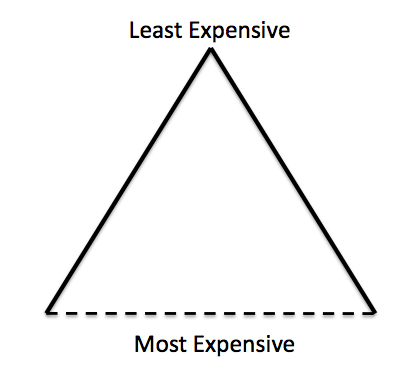
Figure 5. Resource triangle, with dotted line indicating uncertain financial cut-off.
The amount of oil (or for that matter, any other resource) isn’t a fixed amount. If the price can be made to rise to a very high level, the quantity that can be extracted will also tend to rise–in fact, by a rather large amount. The “catch” is that wages for the vast majority of workers don’t rise at the same time. As a result, goods made with high-priced oil soon become too expensive for workers to afford, and the economy falls into recession. The result is prices that fall below the cost of production. Thus, the limit on oil supply is not the amount of oil in the ground; instead, it is how high oil prices can rise, without causing serious recession.
While wages don’t rise with spiking oil prices, increasing debt can be used to hide the problem, at least temporarily. For example, cars and homes become less affordable with higher oil prices, since oil is used in making them. If governments can lower interest rates, monthly payments for new homes and cars can be lowered sufficiently that new car and home sales don’t fall too far. Eventually, this cover-up reaches limits. This happens when interest rates start turning negative, as they now are in some parts of the world.
Thus, by ramping up buying power with low interest rates and more debt, governments were able to get oil prices to stay above $100 per barrel for long enough for producers to start adding production that might be profitable at that price. Unfortunately, the amount of additional oil demand isn’t really very high at that price. So, instead of running out of oil, we ran into the reverse problem–too much oil relative to the amount that the world economy can afford when oil prices are $100+ per barrel.
The attempt by governments to fix the oil shortage problem didn’t really work. Instead, it led to the opposite mismatch from the one we were expecting. We got an oversupply problem–a problem of finding enough space for all our extra supply (Figure 6). Unless we have infinite storage, this pattern clearly cannot continue forever.

Figure 6. Weekly ending stocks of crude oil and petroleum products through July 29. Chart by EIA.
Eventually, this oversupply problem is likely to result in “mother nature” cutting off oil production in whatever way it sees fit–oil prices dropping to close to zero, bankruptcies of oil companies, or collapses of oil exporters. With lower oil supply, we can expect recession.
Misunderstanding the Real Problem
In the early 2000s, the story that Peak Oilers came up with (or perhaps the way it was interpreted in the press) was that the world was “running out” of conventional oil, and that this would lead to all kinds of problems. Oil prices would rise very high, and oil depletion would take place over a long period, as shown in a symmetric Hubbert Curve. As a result, at least small quantities of additional energy products with high “Energy Returned on Energy Invested” (EROI) were needed to supplement the energy products that would be produced based on the slowly depleting Hubbert Curve. Our oil supply problems were viewed as a unique situation, calling for new and unique solutions.
In my view, this story came about through over-reliance on models that likely were accurate for some purposes, but not for the purpose that they later were being used. One of these over-extended models was the supply and demand curve of economists.

Figure 7. From Wikipedia: The price P of a product is determined by a balance between production at each price (supply S) and the desires of those with purchasing power at each price (demand D). The diagram shows a positive shift in demand from D1 to D2, resulting in an increase in price (P) and quantity sold (Q) of the product.
This model “works” when the goods being modeled are widgets, or some other type of goods that does not have a material impact on the economy as a whole. Substituting high-priced oil for low-priced oil tends to make the economies of oil importing countries contract. This effect indirectly reduces demand (and thus prices) for many products (not just oil), an impact not considered in the simplified Supply and Demand model shown in Figure 7. Also, the very long lead times of the oil industry are not reflected in Figure 7.
Two other models that were used beyond the limits for which they were originally designed were the Hubbert Curve and the 1972 Limits to Growth model. Both of these models are suitable for determining approximately when limits might be hit. Even though Peak Oilers have believed that these models can accurately determine the shape of the decline in oil supply and in other variables after reaching limits, there is no reason why this should be the case. I talk about this problem in my recent post, Overly Simple Energy-Economy Models Give Misleading Answers. Thus, for example, there is no reason to believe that 50% of oil will be extracted post-peak. This is only an artifact of an overly simple model. The actual down slope may be much steeper.
The Real Story of Resource Limits that We Are Reaching
Instead of the scenario envisioned by Peak Oilers, I think that it is likely that we will in the very near future hit a limit similar to the collapse scenarios that many early civilizations encountered when they hit resource limits. We don’t think about our situation as being similar to early economies, but we too are reaching a situation of decreasing resources per capita (especially energy resources). The resource we are most concerned about is oil, but there are other resources in short supply, including fresh water and some minerals.
Research by Joseph Tainter and by Peter Turchin indicates that some of the issues involved in previous resource-based collapses are the following:
Growing Complexity. Citizens who discovered they were reaching resource limits typically tried to work around this problem. For example, hunter-gatherers turned to agriculture when their population grew too large. Later, civilizations facing limits added irrigation to raise food output, or raised large armies so that they could attack neighboring countries. Making these changes required greater job specialization and more of a hierarchical system–two aspects of growing complexity.
This increased complexity used part of the resources that were in short supply, since people at the top of the hierarchy were paid more, and since building new capital goods (today’s example might be wind turbines and solar panels) takes resources that might be used elsewhere in the economy. Eventually, growing complexity reaches limits because costs rise faster than the benefits of growing complexity.
Growing Wage Disparity. With growing complexity, wage disparity became more of a problem.

Figure 8. People at the bottom of a hierarchy are most vulnerable.
I have described this problem as “Falling Return on Human Labor Invested.” Ultimately, this seems to be a major cause of collapse. Workers use machines and other tools, so this return on human labor has been leveraged by fossil fuels and other energy resources used by the system.
Spiking Resource Prices. Initially, when there is a shortage of food or fuel, prices are likely to spike. A major impediment to long-term high prices is the large number of people at the bottom of the hierarchy (Figure 8) who cannot afford high-priced goods. Thus, the belief that prices can permanently rise to high levels is probably false. Also, Revelation 18: 11-13 indicates that when ancient Babylon collapsed, the problem was a lack of demand and low prices. Merchants found no one to sell their cargos to; no one would even buy human slaves–an energy product.
Rising Debt. Debt was used to enable complexity and to hide the problems that people at the bottom of the resource triangle were having in purchasing goods. Ultimately, increased debt was not successful in solving the many problems the economies faced.
Ultimately, Failing Governments. Governments need resources for their purposes, whether hiring armies or making transfer payments to the elderly. The way governments get their share of resources is through the use of tax revenue. When people at the bottom of the hierarchy were cut out of receiving adequate resources (through low wages), the amounts they could afford to pay in taxes fell. Governments would sometimes collapse directly from lack of tax revenue; other times collapses occurred because governments could no longer afford large enough armies to defend their borders.
Ultimately, Falling Population. With low wages and governments requiring higher tax levels to fund their programs, people at the bottom of the hierarchy found it difficult to afford adequate nutrition. They became more susceptible to plagues. Loss of battles to neighboring countries could at times play a role as well.
Lessons We Should Be Learning
Even if we made it past peak conventional oil, there is likely a different, very real collapse ahead. This collapse will occur because the economy cannot really afford high-priced energy products. There are too many adverse feedbacks, including increasing wealth disparity and the likelihood of not enough revenue for governments.
We can’t count on long-term high prices. The idea that fossil-fuel prices will gradually rise, and because of this, we will be able to substitute high-priced renewables, seems very unlikely. In the United States, our infrastructure was mostly built on oil that cost less than $20 per barrel (in 2015 dollars). We know that with added debt and greater complexity, we were temporarily able to get oil to a high-price level, but now we are having a hard time getting the price level back up again. We really don’t know how high a price the economy can afford for oil for the long term. The top price may not be more than $50 per barrel; in fact, it may not be more than $20 per barrel.
We need to look for inexpensive replacements for both oil and electricity. Many substitutes are being made to produce electricity, since indirectly, electricity might act to replace some oil usage. There is considerable confusion as to how low these prices need to be. In my opinion, we can’t really raise electricity prices without pushing economies toward recession. Thus, we need to be comparing the cost of proposed replacements, including long distance transport costs and the cost of adjustments needed to match electric grid requirements, to wholesale electricity prices. In both the US and Europe (Figure 9), this is typically less than 5 cents per kWh. (In Figure 9, “Germany spot” is the wholesale electricity price in Germany–the single largest market.) At this price level, producers need to be profitable and to pay taxes to help support governments.

Figure 9. Residential Electricity Prices in Europe, together with Germany spot wholesale price, from http://pfbach.dk/firma_pfb/references/pfb_towards_50_pct_wind_in_denmark_2016_03_30.pdf
Replacements for oil need to be profitable and be able to pay taxes, at currently available price levels–low $40s per barrel, or less.
We need to be careful in aiming for high-tech solutions, because of the complexity they add to the system. High-tech solutions look wonderful, but they are very difficult to evaluate. How much do they really add in costs, when everything is included? How much do they add in debt? How much do they add (or subtract) in tax revenue? What are their indirect effects, such as the need for more education for workers?
We need to be alert to the possibility that solar PV and most wind energy may be energy sinks, rather than true energy sources. The two hallmarks of providing true net energy to society are (1) being able to provide energy cheaply, and (2) being able to provide tax revenue to support the government. When actually integrated into the electric grid, electricity generated by wind or by solar generally requires subsidies–the opposite of providing tax revenue. Total costs tend to be high because of many unforeseen issues, including improper siting, long-distance transport costs, and costs associated with mitigating intermittency.
Unless EROI studies are specially tailored (such as this one and this one), they are likely to overstate the benefit of intermittent renewables to the system. This problem is related to the issues discussed in my recent post, Overly Simple Energy-Economy Models Give Misleading Answers. My experience is that researchers tend to overlook the special studies that point out problems. Instead, they rely on the results of meta-analyses of estimates using very narrow boundaries, thus perpetuating the myth that solar PV and wind can somehow save our current economy.
Too much debt, and too low a return on debt, are likely to be part of the limit we will be reaching. Investment in complexity requires debt, because complexity requires capital goods such as wind turbines, solar panels, computers and the internet. The return on this additional debt is likely to drop lower and lower, as complex solutions are added that have less and less true value to society.
We need to remember that as far as the economy is concerned, it is total consumption of energy resources that is important, not just oil. Wages reflect the leveraging impact of all energy sources, not just oil. If energy consumption per capita is rising, more and better machines can help raise output per capita, making workers more productive. If energy consumption per capita is falling, the world economy is likely moving in the direction of contraction. In fact, we may be headed in the direction of early economies that eventually collapsed.
When we look at the data, we see that world energy consumption per capita appears to have peaked about 2013. In fact, the big drop in oil and other commodity prices began in 2014, not long after energy consumption per capita hit a peak.

Figure 10. World energy consumption per capita, based on BP Statistical Review of World Energy 2105 data. Year 2015 estimate and notes by G. Tverberg.
The world seems to have hit peak coal, because of low coal prices. In fact, falling coal consumption seems to be the cause of falling world energy consumption per capita. Whether or not most people regard coal highly, coal is pretty much essential to the world economy. A recent decrease in coal consumption is what is pulling world energy consumption per capita down. We do not have any other cheap fuel to make up the shortfall, suggesting that our current downturn in energy consumption (shown in Figure 10) may be permanent.

Figure 11. World and China appear to be reaching peak coal.
We should not be surprised if the financial problems that the world is now encountering will eventually resolve badly. This seems to be how the Peak Oil story will finally play out. Without rising energy per capita, the world economy tends to shrink. Without economic growth, it becomes very difficult to repay debt with interest. Wealth disparity becomes more and more of a problem, and it becomes increasingly difficult for governments to collect enough revenue to support their needs. Our problems begin to look more and more like those of earlier economies that hit resource limits, and eventually collapsed.


Thanks Gail !
You wrote something like “Governments need to collect taxes. A government subsidy is the opposite of taxes”. I’m just wondering if the biggest subsidy right now isn’t the third worlds cheap oil export in dollars to the U.S and the EU ? The oil price collapsed in dollars… but not for example in rubles.
http://www.usfunds.com/media/images/investor-alert/_2015/2015-10-30/COMM-Russian-Ruble-Tracks-Oil-Prices-10302015-lg.png
Russia went on special arrangement few years ago, everything is by mandate internally priced in RUB, starting from the core gov budget and going downward through the hierarchy. They have virtually no debt (to foreigners) also thanks to prior defaults.
Seems they are intentionally preparing for some kind of global systemic reset.
That’s not to say people, especially in biz are constantly in their minds recalculating EUR/RUB or USD/RUB. But it is evident without that RUB system in place allowing for deep internal devaluation they would have not survived the ~2014 onslaught of energy deflation as a sovereign nation and kept the status of “regional power”. So good for them so far..
Most of the major oil producing nation currencies seem to follow a similar pattern as the Russian ruble. The only ones that seem to not follow the pattern are our friends Saudi and company, but they on the other hand are burning through their dollar reserves.
I don’t know if this is a natural pattern or if it is due to currency manipulation by the Fed and the ECB.
Russia has foreign debt held by state owned oil and gas companies. I believe they have some $500 billion in debt in total.
Isolation from the western financial tar pit is seen as a matter of national survival for Russia.
+10
The big change in currency values has indeed had a big impact. The people whose currencies have dropped are not getting the benefit of low oil prices. Their debt has lower value expressed in dollars. Their big currency drop is closely tied to the continuing low prices of many commodities.
The abandoned countryside in Central Europe is being filled with wild horses again:
Czech Republic: WILD HORSES return to central Europe after 1000 years
In the world I see you are stalking horse around the Petrin hill…
The posting of this video was inspired by one of my friends who is a biologist and is engaged in the countryside management.
It seems, that it is the missing big game, that needs to be returned to the countryside, so that the forest does not swallow everything.
You’ll wear leather clothes that will last you the rest of your life. You’ll climb the wrist-thick kudzu vines that wrap the City Tower. And when you look down, you’ll see tiny figures pounding corn, laying stripes of venison on the empty car pool lane of some abandoned superhighways.
I hope, one day, we apes, wil be able to return to our Eden:
http://www.livescience.com/19708-primates-build-sleeping-nests.html
“When they are ready to snuggle up at the tops of trees, great apes make themselves cozy “nests” in which to rest for the night. New studies of these one-night nests reveal their incredible complexity.
“They are almost as complex as a man-made shelter you might make,” study researcher A. Roland Ennos of the University of Manchester, in the United Kingdom, told LiveScience. “They know how the wood is going to break, and they have a feel for how strong they have to make it [the nest]. That shows the apes have intelligence and have a feel for the physics of their environment.””
From Mongolia to Czech Repubic, through…
Well, who will prevent various natural forces from disseminating radiation everywhere?
Yes, some dissemination is indeed unavoidable if we do nothing to prevent radiation escaping facilities
The solution, to pollution, is dilution.
And distribution, as the “rhyming motto” of the nuclear industry waste management is “dilute and distribute” 😉
No Matthew,
Dilution alone is not sufficient, and also depends on the quantity and nature of the product you dump.
The trick is to evacuate entropy, which means:
1) produce as little as possible: avoid refining, specializations, transports, …
2) take care that wastes, by-products, and all kinds of externalities are reintroduced, without further transformation, into natural or man-made cycles.
IOW, be part of local ecosystems.
The availability of huge quantities of cheap energy allowed us to take a very different way.
For a short while.
While what you are saying may be generally true, there is no way to un-produce the waste of Chernobyl. Also, it was a joking response to (I think MG’s?) comment about wild horses spreading radioactivity across Eurasia from Chernobyl.
No harm Matt,
I didn’t follow your joke, just took advantage of your remark to push ahead my own messy thinking.
Didn’t intend to cool down the ambiance, sorry guys!
Or to avoid contamination, better prevention
The solution to depletion is delusion.
Eventually, population outruns resource availability.
How do you come by this declaration?
“Eventually, population outruns resource availability.”
I was just thinking about what would happen if humans really made it to become a space-faring race. If 1 billion people were alive at the time, and population grew at an average 2 percent per year, in about 1000 years there would be about 1 Quintilian humans.
”space faring” is subject to same eroei laws as anything else.
this is why there are no moon colonies — there’s nothing there. Mars has the same problem
If there was anything to return a commercial profit—big business would have done it decades ago—that’s why they haven’t.
if you go somewhere and bring back photos and souvenirs—it’s called a vacation.
so far that fits space travel.. If the cost of getting there costs more than what is brought back, it’s ultimately pointless, other than to acquire new knowledge.
A fresh holiday destination does the same thing
This why NASA is a job creation scheme for PHd’s—space exploration can only be done using earth-energy, as that gets scarcer, space travel will cease.
(Unless of course they find an asteroid made of Hopium and Delusium)
That is an unfathomable number of people in such a short period of time. 1 billion people becomes an insane number of people very quickly. And thats “only” 2% growth! Your projecting Dr. Albert Bartlett (the biggest shortcoming of the human race is the failure to understand exponential function)..
“I was just thinking about what would happen if humans really made it to become a space-faring race.”
The quarrelsome apes would do the same to space as they have done to the earth- turn it into a vast wasteland of shopping malls, smoking debris, depleted resources, and endless war zones.
I wonder if using IMF’s sdr (which includes the ruble) instead of usd as a measure for international trade could allow a bit more can kicking.
Washington’s foreign policy is (absurdly) trying to transform russian ressource base in usd denominated debt. This is why I think that russian ressource base (but denominated in rubles as a part of SDR) should have a greater place in the financial world: it seems these are the sole ressources out of the debt system. But it won’t happen in behalf of the US, Russians will not allow this.
Trying to maintain things as they are could lead to a new devaluation of the dollar, which would imply a hike in commodity prices and thus hurt the importer/consumer side of the equation. So the price of commodities should be detached from existing debt, in order to allow both to grow more.
This would of course imply some fall in us consumption, but it could possibly be good for international trade and finances. Any thought?
OK that’s an interesting point. You are saying that the Ruble should be included in the SDR basket of currencies because of the immense size of Russian natural resources and it’s importance to the world? And maybe that the US would just love to commodify those resources and pull them into the western orbit and away from China/Iran?
SDR= “Special drawing rights (ISO 4217 currency code XDR,[1] also abbreviated SDR) are supplementary foreign exchange reserve assets defined and maintained by the International Monetary Fund (IMF). “- from IMF
I put it wrong, ruble is not in the sdr, which is a basket including the six major currencies representing the consumer side of the world financial equation (+ renminbi, which was recently added). As long as IMF only cares for the demand side of commodities, it is not surprising we end up with collapse starting on the exporter side.
Some say that Russia is preparing to quote its products in rubles -it seems russian authorities said so-. Don’t know if this is true or if they would able to do it, and I wonder what was the deal De Margerie was trying to set with them when he was (probably) murdered. However, I think it would be better to make peace and that the IMF accepts suppliers as well -not only Russia, KSA and Kuwait also perhaps-. This would provide the best attainable stability, imho
“And maybe that the US would just love to commodify those resources and pull them into the western orbit and away from China/Iran?”
The US is vainly trying to set regime change in Moscow since a few years in order to get the Russians to buy their debt. Thirld world debt denominated in USD is a tax, kinda “security payment” we are rather forced to do (in Argentina, this debt duplicated during the military gov. we got in the late 70s, to sustain the american way of life post US peak oil -this costed 10k dead people). Russians understand this very well, and don’t want it for them. The subsidy Yoshua is mentioning is, from the other side, a tax.
I bet China would do the same as Russia but they can’t because they are huge oil importers, and so they entered capitalism buying US debt and they can’t get out. Only Russia can do that, because (besides having atomic bombs and a lot of soldiers) it is a rather self-supply or circular economy: it can rely in itself for its major inputs, so it is somewhat operationally independent. Thats why it don’t needs very much dollars or trade to keep working its basic features.
China/Iran have not much to do here, excepting that China provides the trade Russia really needs. But in some sense it is not very different to all the swaps they do with so many countries.
“a basket including the six major currencies”
Wrong again: it’s the four major currencies (USD, british pound, euro and yen) + renminbi
I guess at some point something like this will be unavoidable
In other words, all world economic hubs currencies should participate in the price of oil, imho
Or, differently put: why is it that the Fed is not in an other round of QE? Because it would raise commodity prices in dollars but also hurt importers, especially Europe and Japan which wouldn’t benefit from Fed’s QE as much as the US. But if oil was not priced in usd (or not in usd alone, as would be the case with SDR), its price could go up without hurting importers, excepting the US. But under this scenario the US could in turn devaluate the dollar (print more money, QE or such) and thus avoid bankrupting its financial system because of the loss of petrodollar, without bankrupting other countries. This would probably generate inflation in the US while not helping its real economy, which would mean a loss of purchasing power of US citizens.
That’s it. I guess at some point US citizenry will have to loose its petrodollar derived benefits or the whole world will go bankrupt
This particular article I was long time wanting to share here, but was not finding it. Scholars were able to by reading the clay tablets reconstruct the ancient trade relations to Assur and realize, that the the systems then were as complicate as now, with debtinstuments etc.Would be facinating book to read.
http://www.nytimes.com/2015/08/30/magazine/the-vcs-of-bc.html?_r=0
Fascinating.
“It’s impossible not to see parallels with our own recent past. Over the 30 years covered by the archive, we see an economy built on trade in actual goods — silver, tin, textiles — transform into an economy built on financial speculation, fueling a bubble that then pops. After the financial collapse, there is a period of incessant lawsuits, as a central government in Assur desperately tries to come up with new regulations and ways of holding wrongdoers accountable (though there never seems to be agreement on who the wrongdoers are, exactly). The entire trading system enters a deep recession lasting more than a decade. The traders eventually adopt simpler, more stringent rules, and trade grows again.”
Thanks Khanghi!
That was 4000 years ago:
“The picture that emerged of economic life is staggeringly advanced. The traders of Kanesh used financial tools that were remarkably similar to checks, bonds and joint-stock companies. They had something like venture-capital firms that created diversified portfolios of risky trades. And they even had structured financial products: People would buy outstanding debt, sell it to others and use it as collateral to finance new businesses. The 30 years for which we have records appear to have been a time of remarkable financial innovation.”
And then speculation, leading to popping bubbles, followed by recession and then reinforced rules, etc.
Also discovered Tinbergen’s gravitational law, about trading between two countries.
Both make me think we have not spent our efforts towards the right places, ie we have tried to change universal “laws”, instead of rearrangeing what could be, at our level.
Very good!
Pingback: Misunderstanding The Real Problem: An Updated Version Of The "Peak Oil" Story - U Do News
Another goodwun Gail which, I will be sharing.
Your work is very much appreciated.
Cheers.
Thanks!
** Private Property, Externalities **
This topic is so rarely discussed, I couldn’t miss it.
By Feasta’s Brian Davey, also cross-posted on RE’s Doomstead Diner.
Not that it could change anything to our predicament, but it has to be understood. A few excerpts:
“The centrality of externalities to economic understanding
What economists call “externalities” are not unusual or a special case, they are ubiquitous. They are rooted in private property and the relationships of market society.
(…)
Private property means that a single owner has the right to do with a resource as s/he sees fit. However, what they decide about these “resources” affect communities of people and communities of species (eco- systems). Very often, the effects are not positive.
(…)
Economists have had to adjust their theories and have come up with the concept of “externalities”, that is, the benefits or costs of an allocation decision that arise for non-owners. In a later chapter I critically examine the idea that these externalities can be managed by those people affected by them coming to a deal with those causing them. This would involve finding “the right price” for the externality and then doing a trade. The purpose of this chapter is to look at the institutional and property relationship contexts in which these “externalities” arise, and thus, to show how and why, in some kinds of society, there are no “externalities”.
The word “externality”, conveys the impression that this is a footnote to economic theory, a sort of additional point. Actually, externalities are ubiquitous. There cannot be any kind of resource allocation decision involving matter or energy without externalities. “The economy” is embodied and embedded in physical and energetic processes in the physical world.
It involves “stuff” processed by energy conversions. This stuff, the matter, can neither be created nor destroyed, though it can change its form. Likewise, energy changes its form when used. It follows from this that what are used as “economic resources” must have come from somewhere originally where these resources had an original function and/or were part of some other system or structure. These resources must also go somewhere after they are embodied in products and/or where they are wholly or partly turned into wastes. Extracting resources from places has consequences and dumping wastes and pollution has consequences. Over several centuries, this extraction and dumping has usually been out of, and back, into the commons.
(…)
“Externalities” are therefore particularly the result of a breakdown of community management arrangements when private property displaces common property. As we saw earlier, private property arrangements tend to be associated with large scale specialist uses of land and resources which displace the diversity of community and species uses. The resulting resource use practice is sometimes described as “extractivist”.
(…)
The resulting “de-localisation” in this kind of world then also gives rise to pervasive “externalities” because they make it increasingly difficult to see dishonest, cruel and destructive practices which occur during the production of what you buy.
http://www.credoeconomics.com/the-centrality-of-externalities-to-economic-understanding/
Thanks! I agree that there are externalities all the time. If nothing else, if one person uses the resource, there is less for others to use. There are clearly other things as well, such as pollution, and often more noise. Using the resource may make the user richer, and that has effects as well.
“The word “externality”, conveys the impression that this is a footnote to economic theory, a sort of additional point. Actually, externalities are ubiquitous. There cannot be any kind of resource allocation decision involving matter or energy without externalities.”
This is such an important point and it is very difficult for people to understand. I use the example of poverty. The vast majority of “not poor” people perceive prosperity as the rule and poverty as an exception to the rule. In reality, poverty is just as much a direct outcome of our system as is prosperity. They are necessary to one another. It’s not just an unfortunate accident that there is crushing poverty in large parts of the world, slaves toiling away in Asia or people dying of hunger in Africa. Those things happen BECAUSE we have i-phones and air conditioning and modern medicine in other places. We live in a global factory whose 2 products are pleasure for some and suffering for many.
Like the ‘side-effects’ of a drug: ‘the treatment worked fine, but the side-effects killed the patient.’
“t’s not just an unfortunate accident that there is crushing poverty in large parts of the world, slaves toiling away in Asia or people dying of hunger in Africa. Those things happen BECAUSE we have i-phones”
I’m pretty confident the poverty is due to sudden rapid population increase, exceeding local resources. Us buying things did not make them have more children. The places with the factories are much better off than the places without, where people make a subsistence living.
Aren’t large families in poor places a hedge against old age destitution? And isn’t destroying the social equilibrium of Amerindia or West Africa not a means of impoverishing those entities while enriching the “destroyers”?
Or “we” got rich because we exploited fossil fuels, not because we exploited poor people (native americans and australians excluded).
For every action, there is an opposite reaction. No, they are not equal. Also our sense of ethics and our sense of self-importance are very far away from something that agrees with nature.
Debts are merely an accounting entry. This may not seem to be the case when we are all paying them, but when the system has a whole cannot pay them back, then it simply won’t. They will just default or be inflated away.
I’m a physician, I’m used to being there at the end. It’s like we have a 90 year old patient with dementia and pneumonia in the ICU, and everyone is obsessed with keeping him alive, because “he has debts to pay”. Well, I’m telling you, the patient is going to die, and the debts aren’t going to be paid.
Debts are what set value for commodities. They tell the market how much oil to extract and how much copper to mine. They may not look important, but they are terribly important. Without debt, values of commodities drop to very close to zero.
Name just one commodity that has dropped close to zero.
Name just one time when 100 percent of all debts were voided.
May I recommend Debt: The First 5000 Years ?
https://en.wikipedia.org/wiki/Debt:_The_First_5000_Years
It opens up doors you never knew existed.
“He proposes studying these practices and says that ‘The sociology of everyday communism is a potentially enormous field, but one which, owing to our peculiar ideological blinders, we have been unable to write about because we have been largely unable to see it.'”
Milk
Good one, Vince. Yeah, they poured that stuff out into the gutter in protest of prices that didn’t return a profit.
https://m.youtube.com/watch?v=C0B0UljVDoU
Most popular news at the dairy reporter:
http://www.dairyreporter.com/R-D/Scientists-to-trial-cockroach-milk-as-a-future-protein-supplement?nocount
Cockroaches need energy… sugar – whatever… do we produce sugar beets, refine the sugar and then feed it to the cockroaches?
Why not try Lentils, Chickpeas, Beans, Lupine, Broccoli and the like for protein? And by the way… 0.8g of protein per KG body weight are much enough…. thats all easily obtained through a fully plant based – non disgustin*g, but tasty – died (including enough of all the essential amino-acids / proteins).
“Cockroaches need energy…”
Look who did not read the article and thinks they actually plan to milk cockroaches …
TL;DR: They want to try to synthesize cockroach milk in large vats, if possible and economically viable.
Yes, I would prefer vegetables than this! But these people are in the milk industry, and I suppose this idea is odd enough to attract a bit of curiosity, not really a possible business
@Christian
The people in the Meat/Dairy industry don’t want people to realize that plants provide all the protein you need and that animal protein is indeed bad for you.
This since the breakdown of some of the aminoacids common in animals – produce a lot of byproducts that the organism has to get rid of ASAP. They even small bad, which is the reason that the body-odor on pure plant eating people is basically gone (when they are not sick). In effect I didn’t have used any “deo” and a very very minimal amount of soap for years!
Once you eliminate the root problem – lots of others go away….
@Matthew Krajcik
Yes, I didn’t read the article – the cockroaches “and the like” fad always comes up somewhere.
I wanted to stress the point, that one does not have to go the inefficient indirect way (from which other derive more money or “patent-able products”) – instead common staple plant provides all we need.
Ert,
Beans and anything (rice, wheat) and the essential fats are all we really need.
But do you really think this is a solution?
Wouldnt we just hit another limit a little bit later?
And if anything it seems the longer collapse is delayed the worse it gets. If delayed enough noone will survive.
Better getting really bad into debt, eat lots of brazilian beef and drive car just for fun.
@DJ
“And if anything it seems the longer collapse is delayed the worse it gets. If delayed enough noone will survive.”
If we would globally abandon 95% of all meat/dairy and NOT growth the human population, it would provide us with time and de-stress the ecosystems in direction of a possibility in direction of a “slower” collapse
I for my part certainly don’t want experience real-life collapse, as I like parts of BAU quite a lot. I think there is no incentive in experiencing or wishing a premature end of BAU… thats at least my current conclusion.
“If we would globally abandon 95% of all meat/dairy and NOT growth the human population,”
A few issues here:
1) Short of some sort of virus to mass sterilize people without their consent, I don’t see stopping population growth as a possibility short of war, famine, disease, etc.
2) Much of the pasture lands that livestock are grown on, are not suitable for growing soybeans or rice or bananas. The land is often poor, so livestock concentrate the food from a large area into a dense, usable form. If we all stopped using the animals, the total food supply would drop, not grow.
3) Stopping population growth likely leads to a rapid collapse of the economy, leading to riots, wars, famines, etc. All those government debts and pensions and healthcare obligations are all based on growing population and making the GDP number bigger.
@Matthew Krajcik
1) True enough – but I have still hope for the Zika virus 😉
2) That’s the 5% of meat/dairy I left open. I think up to 95% of the stuff is supported by unsustainable practices.
3) I think that growing the population now would lead faster to problems as letting it start to shrink. Some sort of economical collapse is build in anyway in the future… from my viewpoint.
Best,
Ert
As bau still goes on, meat and milk per capita will fall down, it’s already happening. As Ert says, it’s more costly than vegetables, but I like cows because (besides being a very important trait in national identity here), they provide leather and fats that can be useful to make candles and such. And as Matt says, there is a place for cows in marginal land not much suitable for ag., but at least in Argentina this is far to be the general situation.
In my particular case, no matter why nor how, I won’t ingest any cockroach stuff (while I don’t dislike roachs, if you know what I mean)
And cows provide bones, another traditionally important renewable material
Cow manure is also good to rebuild chemically spoiled soil (some say esencial). I definitely like cows, while they’re not doing well at the present moment
When looking at global food scarcity the math raises some interesting points. The entire human population could probably be fed if animal products were to be eliminated. Water usage estimates for beef vary from 1,500 to 2,500 gallons of water per pound of beef; corn by comparison is around 100 gallons of water for 1 pound. 100 grams of beef are approximately 250 calories; 100 grams of white corn are around 400 calories.
Considering that we feed more grains to cows than humans and the fact that so many resources would be conserved by stopping this, it would appear as if we could feed the entire world with less effort. This would have a more positive effect on the environment through a reduction in methane, nitrogen runoff, reduction in chemical usage, reduction in oil/water consumption, and a large reduction to healthcare consumption.
Bill Jevons might have something to say about that
“Considering that we feed more grains to cows than humans and the fact that so many resources would be conserved by stopping this, it would appear as if we could feed the entire world with less effort. ”
Except:
#1: Pasture razed cattle (not counting feedlots) the manure can help build up the soil, while industrial corn production depletes the soil. The depleted soil leeches out unused fertilizers into rivers and streams, and out to the ocean, creating massive dead zones.
#2: the consequence of your plan would be that human population would simply double one more time, making the inevitable collapse worse.
I’m aware of your points; I never said it wouldn’t make population worse and I also don’t think that it’s a “good,” relatively speaking, idea. Good and bad are human concepts as this is mostly idealistic human ethical desire that won’t ever see realization. All I’m pointing out is how stupid, wasteful, and unethical (relatively speaking) our economic activities are.
#1: The amount of meat and dairy produced from pasture razed cattle is for all intents and purposes ZERO compared to feedlots.
#2: Do you seriously think that the population in the EU and USA would double just because people stopped eating animal products? We in the west are by far the worst offenders of this form of resource waste.
“#2: Do you seriously think that the population in the EU and USA would double just because people stopped eating animal products? We in the west are by far the worst offenders of this form of resource waste.”
The Chinese eat more pork than America, so I think your broad generalization is somewhat flawed. That is per capita, BTW, not total, so with around five times as many people, that is a lot of feedlot pork:
http://www.pork.org/pork-quick-facts/home/stats/u-s-pork-exports/world-per-capita-pork-consumption-2/
As for the population, America takes in over 1 million people per year, and that may increase. Canada is expanding to take in 300,000 people per year. That’s nearly a 1 percent population increase per year from just that alone. The world increases by something like 85 million people per year; that is likely constrained due to hunger and disease in developing countries.
Do you suppose that if we stopped feeding corn to pigs and cows and fed more humans, that the lower food prices would magically only apply in the West?
Before we can make any change, we need to first take an audit of the situation. Your assumption that “We in the west are by far the worst offenders of this form of resource waste.” was easily disproved by facts. Feelings and intuition are not the foundation for good doctrine.
“Furthermore, just because the Chinese of recent times have begun to adopt the poor western dietary habits does not mean that we have to persist with them, or do you just like a good old excuse so devoid of any logic not even you really believe in it?”
I think you’re projecting or imagining things there. I did not claim that the way things are, are the way they “should be”, if we were describing our personal vision for an imaginary alternate reality where slightly different collective choices had been made.
Due to the general view that there isn’t enough time for any changes to make any difference, the whole thing seems kind of futile anyways. If you want to do thought experiments about a better future, it would be nice if you avoid hyperbole, absolute claims, and try to at least loosely base things on observed reality and objective facts.
Tango Oscar wrote:
“…it would appear as if we could feed the entire world…This would have a more positive effect on the environment…”
I’ll be as polite as I can: Before this kind of thinking is shown to be complete nonsense, it must be asked: Did you forget the ‘sarc’ tag?
How would one milk a cockroach? Would it be like making wine — you dump thousands of them into a vat and stomp on them?
Oil in the US Great Depression was 0.10/barrel.
“In 1932, U.S. heavy crude oil averaged 87 cents per barrel (about $12 today), and light crude averaged 82 cents. By spring 1933, heavy crude had fallen to 44 cents and light crude to 66 cents. Then the bottom fell out.
Texas oil companies led the price decrease, with some resorting to “dime-a-barrel” deals. Four gallons of crude cost a penny. ”
https://www.bloomberg.com/view/articles/2013-05-06/when-the-great-depression-hit-the-oil-industry
Deflation- coming soon to your town.
We’ll know when it arrives… because soon after we’ll be eating rats and murdering each other.
That’s why the elD-ers are doing everything they can to fend it off for as long as possible
you left the awkward part till the end
Doctors!!!!
(rolls eyes)
“Doctors!!!!”
Given his views, could we be watching another Harold Shipman in the making? 🙁
Shipman had his own ethical standards. For instance, he would never stoop so low as to murder a patient who was in debt. 🙂
“Shipman had his own ethical standards. For instance, he would never stoop so low as to murder a patient who was in debt.”
LOL! But that’s protecting the debtors more than the patient.
Pingback: Misunderstanding The Real Problem: An Updated Version Of The “Peak Oil” Story | StrikeEngine
Pingback: Misunderstanding The Real Problem: An Updated Version Of The "Peak Oil" Story - BuzzFAQs
Pingback: Misunderstanding The Real Problem: An Updated Version Of The “Peak Oil” Story | DailyDeceit
Pingback: Misunderstanding The Real Problem: An Updated Version Of The "Peak Oil" Story | ValuBit
Pingback: Misunderstanding The Real Problem: An Updated Version Of The "Peak Oil" Story | Earths Final Countdown
Pingback: Misunderstanding The Real Problem: An Updated Version Of The "Peak Oil" Story | Zero Hedge
Pingback: An Updated Version of the “Peak Oil&rdquo...
It will take me a while to work out what this means, as in what does a 9.6% profit margin mean in a world of zero interest rate policies?
http://www.zerohedge.com/news/2016-08-09/why-gaap-matters-real-profit-margins-tumble-10-year-lows
“Late-cycle rallies that last are supported by expanding profit margins. This was clear in 1988, 1998, and 2006. So where do profit margins go from here? We see 40bp of upside, but not much more than that and certainly not a new record. We expect margins will recover over the next two quarters because oil prices are now above $40 per barrel and that should alleviate operating distress and impairment charges from the energy sector. Our upside case envisions S&P 500 profit margins increasing from 8.8% back to 9.6% in a scenario of $55 oil.
But outside of the energy sector we see scant improvement forthcoming. It is true that economic conditions are stable and the fears of a recession that prevailed during the first few months of the year are gone. The dollar rally has stalled and even manufacturing data looks healthier. But there are a few convincing reasons to believe we are past the cyclical peak for profit margins. First, top-line growth is too slow. Second, wages are rising. Third, margins in the all-important tech sector are falling.”
Another item to add to the list of things that cannot happen, happening:
http://www.zerohedge.com/news/2016-08-09/bank-england-suffers-stunning-failure-second-day-qe-goodness-knows-what-happens-next
“Simply stated, the Bank of England encountered an offerless market.”
Or, stated otherwise, a limit to kicking the can down the road.
A replacement for electricity? How about the London Hydraulic Power Company:
https://en.wikipedia.org/wiki/London_Hydraulic_Power_Company
“The company was set up by an Act of Parliament (the London Hydraulic Power Company Act 1884), sponsored by railway engineer Sir James Allport,[1][a] to install a network of high-pressure cast iron water mains under London. It merged the Wharves and Warehouses Steam Power and Hydraulic Pressure Company, founded in 1871 by Edward B. Ellington, and the General Hydraulic Power Company, founded in 1882. The network gradually expanded to cover an area mostly north of the Thames from Hyde Park in the west to Docklands in the east.[3]
The system was used as a cleaner and more compact alternative to steam engines, to power workshop machinery, lifts, cranes, theatre machinery (including revolving stages at the London Palladium and the London Coliseum, safety curtains at the Theatre Royal, Drury Lane, the lifting mechanism for the cinema organ at the Leicester Square theatre and the complete Palm Court orchestra platform),[1] and the backup mechanism of Tower Bridge.[3] It was also used to supply fire hydrants, mostly those inside buildings. The water, pumped straight from the Thames, was heated in winter to prevent freezing.[1]”
Last use seems to have been about 1970. BTW I can still remember reading by gaslight, and my gran ironing with a gas iron.
I remember gaslight being used in boarding school. Maybe during emergencies. Very bright, I thought. The fact that they can (though they didn’t) explode is scary.
Challenged in all things mechanical, I don’t exactly understand the London hydraulic system. What is familiar, though, is the jettisoning of perfectly good technology in favor of the ever new, more profit driven alternatives since 1970.
“A replacement for electricity? How about the London Hydraulic Power Company:”
“The pressure was maintained at a nominal 800 pounds per square inch (5.5 MPa) by five hydraulic power stations, originally driven by coal-fired steam engines.[1] These were at:”
So, burn coal. Or natural gas, wood, whatever. All you’ve done is changed from turning the mechanical energy into electric current, to hydraulic pressure. You still have to use a concentrated form of stored energy to power the whole system.
It’s amazing how easy it is to overlook those essential little details.
When electricity goes bye-bye there will be a scramble to find work to keep the slaves occupied. I’ll point out that the population of the world has more than trebled during my lifetime. Maybe I’ll get to see a quadrupling before it all falls apart. Sometimes that scares me more than FE’s fuel pools.
Alternatively, there may be a scramble to find “slaves” to do some of the work that electrical machinery currently performs.
I remember a BBC comedy from the 1970s called It Ain’t Half Hot Mum. It was set on an army base in India at the end of the British Raj. The Brits employed a chaiwallah to make and serve the tea and a punkawallah to manually operate the fan.
Here’s a list of wallahs from Wikipedia: https://en.wikipedia.org/wiki/Wallah
“Alternatively, there may be a scramble to find “slaves” to do some of the work that electrical machinery currently performs.”
Only if you first get food to be produced by human and animal labor, at much higher rates of return on energy, than growing the food with fossil fuels. Otherwise, you are adding much more inefficiency.
Hard to imagine that slavery would not make a major comeback when the energy slaves are gone….
Slaves are tools, not energy producers.
Even if they have sort of an embodied battery, they won’t be working for very long time if you don’t refuel them (with food).
And required fuel might be scarce, quite soon…
Same problem for draft animals.
Because almost all land will produce no food post BAU…. the permaculture doomsdaypreppers will be to slavers what banks are to bank robbers….
It is very difficult to defend a farm….
Thank heaven for the spent fuel ponds.
I assume there will always be some donkey work and some grinding at the mill. In the absence of other arrangements, somebody’s going to have to do the donkey work and the grinding, and probably in exchange for room and board and not much else. Formalized slavery will not necessarily make an appearance, but there are plenty of ways of coercing people to perform menial labor that are as harsh or harsher than what was the norm for classical servitude.
richard said – “When electricity goes bye-bye there will be a scramble to find work to keep the slaves occupied.”
Not a probem to find work for the de-industrialized masses- agriculture, agriculture, gathering biomass for heat, agriculture, fixing thatched roof, more agriculture, and more agriculture.
Thanks Gail, though you seem to have rolled about six topics into one.
I’d like to pursue the financial side of oil a bit further. I saw a figure a while back suggesting that every barrel of recoverable oil still in the ground was worth $4.5. Maybe $5 today. And, absent any better criteria, I’d guess that oil reserves increase exponentially with price. Hence if the present proven reserves are about 1.75Tn barrels, that represents $8.75Tn in capital on a balance sheet somewhere.
I’ll point out that these figures work in both directions
If oil goes up in price, say from $50 to $100, the quantity of oil that can be recovered at a profit increases exponentially. The value of the oil in the ground increases a bit, but not as much because the oil costs more to extract, so, agin, a guess at the change, maybe an increase of $17Tn? – all of this creates a bubble in the financial markets. And the financial markets will do their level best to monetize the gain via derivatives and specialised paper. Hence when the price drops, as it did in 2008, and more recently, in 2015, someone finds they are holding an empty bag.
The thing that happens then is that years of fake profits are re-written as losses, and written off in bankruptcies. Since we are talking about very big numbers here, the resulting damage is proportionate.
“The value of the oil in the ground increases a bit, but not as much because the oil costs more to extract, so, agin, a guess at the change, maybe an increase of $17Tn?”
So, at let’s say $50 per barrel price, the 1.75 trillion barrels recoverable are worth $5, which means they cost $45 to extract and ship to the refinery. At $100 per barrel price, those 1.75T barrels are worth $55 each, and a bunch more oil becomes available as well, maybe another 1.75T barrels with an average value of $5.
I didn’t intend the figures to be taken that literally, but I’ll try to explain a bit further. Oil companies have a market capitalisation that should be the discounted value of future profits. The proven oil reserves of the companies are also known, so the valuation that the _market_ places on the oil still in the ground can be estimated. I’d guess that if oil were repriced to $100 per barrel the costs of exploration, development and extraction would climb rapidly, so a simple deduction cannot be made.
The point I was trying to make is that there are secondary effects to rises, and to falls in the price of oil. Further, my guess is that these effects are increased by the “sophistication” of the financial markets, though it may take some time before these are seen.
In fact, what happens when any commodity rises in value–everyone tries to take advantage of this. The oil in the ground needs to be extracted if it is to be sold. The owner may need debt financing to make this possible. Governments rush to get higher taxes on the more valuable resources. Land leases become more expensive. Even the cost of renting drilling rigs goes up.
When the price goes down, getting all these things back is nearly impossible. For example, the government has made plans to spend the revenue. So there is s big bubble that pops.
People think that the remaining oil in the ground will have value. It will disappear when the bubble pops.
Individuals do not have to mimic our Govt debt binges. Instead, people need to adjust their consumption levels and expectations to reflect their circumstances. To delay (using debt) is not the same as adapting to a lower consumption lifestyle. I too, fear that an eventual collapse is baked in the cake, and that a Seneca experience will lead to war and upheaval. I too worry about my children, now in their thirties. That is why for the past 10 years I have continually mentioned to them the evils of personal debt, and provide help and suggestions when asked. (Only when asked 🙂 I am pleased to report that while all kids are working and doing fine, they have resisted the impules to upgrade housing and lifestyle. As they have experienced the slow grinding process of hidden and unacknowledged inflation, they will be better able to weather our future storms and reductions. If that fails, they can settle in on a few acres set asside and help with the gardening. 🙂
That’s good approach overall, however, it seems this time debts will have to be erased rather expediently, although I’m not suggesting to go overboard it terms of personal indebtedness. Evidently, the gymnastics applied globally to gorilla tape the system is predominately a sign of large scale desperation. A desperate, resetting system can’t collect debts or protect the overall debt system infrastructure. If Gail is right, both in the sequencing of events and timing, one could perhaps use today’s debt for a little bit of near future head start. But if she is not correct, debts might wipe you out long before any collapse fireworks. As always life is a gamble, so anyway people should be mentally prepared to see the formerly “prudent ones” doing much much worse than debt over saturated speculators living relatively large post the next partial crash.
You don’t think if debts get wiped out ownership gets wiped out?
Not necessarily or lets put it this way, there are several flavors of debt as well as ownership and governance. For instance, are they going to repo your car or evict you from apartment when manufacturing/building in these sectors goes -75% in one year and banks close and or are nationalized (refer to historical war/revolution shifts)? On the other hand, the situation might be very different in case a loan was secured from local mobster.
However, we can’t be sure about the sequencing and timing of these events, on general note I’d not risk it say before ~2025 time horizon (as it appears from now), i.e. as long as the structure seem to hold itself.
You owe Alpha Bank 1 gazillion.
Alpha Bank gets in trouble.
Beta Bank buys your debt.
Now you owe Beta Bank 1 gazillion.
If you get in trouble and doesn’t pay interest I suppose evicted or interest accumulated depends on if the bank believe they can sell the house.
Hyperinflation feels like the best bet to lose the debts.
One guy’s forgiven debt is another guy’s loss of pension from 52 years of employment.
“One guy’s forgiven debt is another guy’s loss of pension from 52 years of employment.”
Exactly, Sungr. No free lunch here. Just like stocks, someone gains while someone loses. As defaults build, downward pressure is applied to the economy. Too many defaults risks the continuance of BAU.
In the end the whole pension portfolio will consist of bad loans that will never be repaid.
I expect that wiping out debts won’t generally wipe out ownership. But conditions may change so much, that ownership no longer makes sense–for example, move to an area with more water, or farther from nuclear reactors with problems.
I’m thinking about houses. There is where the biggest private debts are and where collateral could be seized (it is a little harder to repo student loans, consumer credit or even cars).
Are you saying mortgages will be forgiven (by who?) and you could own your house debt free?
That would be an enormous wealth transfer from renters “invested” in the welfare state to overindebted house “owners”.
Dear DJ,
the question is, whether the houses will have any value, when the systems of the energy production and distribution collapse.
The debt of the private persons is the promise to provide their human body energy for the future operation of the systems of the energy production and distribution.
The human body energy is traded for the external energy. Whether it is a physical energy of the muscles or the energy of the intellectual work.
The debt is not an arbitrary money distribution. When the system continues to work, then the debt is o.k. When the money distribution stops to work, i.e. bankruptcies and defaults come, then the collapse is here, i.e. there is implosion, not enough energy produced and distributed.
The role of the housing is to provide shelter for the human resources. If these resources are not productive as regards their energy contribution to the existence of the system, then we do not need more houses, or we need other types of shelters etc.
The ownership is possible only with the help of the excess energy for protection of the resources. As the energy declines, also the ownerhsip declines: there is either not much to protect or there is not enough energy for protection purposes.
The governments and the states represent such excess energy. When the energy declines, these institutions for collective protection stop to exist: the big empires and states crumble into smaller entities.
Dearest MG,
I think we are in full agreement.
Now = debt & ownership
Post-collapse = no debt & no ownership
World of H, if I understand him correctly, basically says “get in debt and buy a lot of stuff because debts will be forgiven”.
There is probably and optimal amount of debt where you can pay interest and prove collateral until collapse and thereby have ownership as long as possible.
If we get wage deflation and unemployment you don’t want to be the worst indebted.
Dear Gail,
Is the decrease in energy use per capita the result of a global decrease in net energy production (despite and increase in global volumes of extracted fossil fuels) ?
One must be realistic, the only way to stop the current global decline in the average EROEI of human civilization’ s Energy sources – 80% of which are fossil fuel energy sources – is to remplace these fossil fuel energy sources by electricity produced from high EROEI fusion energy reactors.
What is the current state of reseach in controlled thermonuclear fusion ?
John
As always, it’s 20 years until we have a working prototype. Basically smoke, mirrors and please send us a fat check and we’ll return some Hopium and a drawing of the next generation of obscenely expensive custom made prototype.
Much like those gravity waves that suddenly got “detected” when the funding was under threat of being cut. Gotta finance that lifestyle of mine – even though I might have to fudge some measurement data.
“Only 15-20 years away.”
“Is the decrease in energy use per capita the result of a global decrease in net energy production”
I think total energy is still slightly rising, but not as fast as population.
“What is the current state of reseach in controlled thermonuclear fusion ?”
ITER is supposed to start full testing in 2027:
https://en.wikipedia.org/wiki/ITER
Whereas Lockheed Martin thinks they’ll have a working prototype within 5 years:
http://www.lockheedmartin.ca/us/products/compact-fusion.html
ITER is unfortunately a very costly scientific “smoke screen” and a technological “dead end”…
As for Lockheed Martin, they have been saying the same for the past 5 years… So either they have not made any significant progress or the DOD has decided that this “progress” is not to be publicly reported.
In any case, the process of replacing with high EROEI fusion steam boilers the thousands of electricity producing power plants currently using declining EROEI fossil fuels (coal, gas or oil) has not begun… And we are increasingly feeling the economic consequences of an absence of transition to a high EROEI Energy source.
Therefore the societal train is getting every day closer to the “energy Cliff” that so many do not want to see…
If, as a result, the Financial system abruptly stops functionning, critical supply lines may be interrupted and if the lights, one unexpected day, go out, the “game could be Over permanently”…
Not taking care of the close to 500 existing fission nuclear reactors on the planet for more than a few weeks will produce a Fukushima / Chernobyl event X 500, which will likely wipe out survivors on a planetary scale within a year, with the help of trade winds… Add to that the loss of control of the +1000 currently existing dangerous nuclear waste cooling ponds/storage sites and even the roaches will have a hard time surviving…
So, if there is a time for some people In “high places” to wake up, it is now !
John
The “top” guys are sitting on a bunch of these trying to patch up BAU:
http://i.imgur.com/mFXqPW2.jpg
Guess who and what runs this show behind the scenes?
The top “guys” at DoE are probably running Limits to Growth type of simulations on a couple of these beasts trying to figure out how to keep the situation from deteriorating too fast.
http://www.anandtech.com/show/9151/intel-xeon-phi-cray-land-contracts-for-2-dept-of-energy-supercomputers
http://images.anandtech.com/doci/9151/Aurora-Aerial-Reflection-Floor_bw_678x452.jpg
The DoE scientists are probably running souped up LTG algos on one of these.
http://www.anandtech.com/show/9151/intel-xeon-phi-cray-land-contracts-for-2-dept-of-energy-supercomputers
http://images.anandtech.com/doci/9151/Aurora-Aerial-Reflection-Floor_bw_678x452.jpg
There will always be suckers who fall for this and pour money into this company based on the expectation that they will solve the energy crisis in 5 years….
Of course there will be no energy crisis in 5 years… because we will all be dead.
Tesla is the perfect example of this phenomenon….
Be careful with the doomsday predictions. Back in 2006-7 I thought we were goners, yet here we are typing about how we’re going to go extinct any moment now, nearly a decade later. Don’t be surprised if next year or the year after we’re still discussing these exact same things on this blog.
@Tango
“Don’t be surprised if next year or the year after we’re still discussing these exact same things on this blog.”
I hope for it – but I don’t necessarily anticipate that it will be that way.
Bernanke stated that his biggest fear was deflation …. we are knee deep in it now – in spite of the never ending stimulus….
Oil producers are all losing money at current prices.
Difficult to imagine 5 more years of this…. but we can hope.
I don’t think it’s gone totally out of control yet. Besides, stocks and “official” statistics can just be massaged to give favorable information, regardless of what is actually occurring. Oil companies can and will be bailed out.
No – not totally out of control yet….. we will know when that happens because whatever medicine the central banks dish up — will not stop the cascade…
And no doubt they will attempt to keep the oil flowing as long as possible by doing ‘whatever it takes’
The decrease in energy consumption per capita occurs because (1) population keeps rising, and total energy consumption is close to flat and (2) the reason total consumption is so flat is because coal consumption is down. There are many reasons behind this. On is the fact that debt growth is low. With low debt growth, fewer big buildings and vehicles are built, to smaller amounts of energy products are needed.
This will be a sort of philosophical investigation into some of the current issues facing humanity and civilization. Humans are, at the cellular level, eukaryotes. Evolution has provided us with everything we need to prosper at the cellular level. Eukaryotes have branched repeatedly to inhabit a wide array of possible morphological spaces, and we humans are on the branch of the great apes. We are a rather peculiar great ape, however, and we have evolved what we can label ‘civilization’ as a way of living in the world. Given all the complexity of biology and ecology and economics and sociology and so forth for all the sciences, there are an infinite number of questions one might ask about our condition, and seek to use science to find tentative answers.
I want to consider a fairly narrow set of questions. These will be, of necessity, dealt with here mostly as abstractions, but I want to start with something very concrete. Almost every Sunday morning, my wife and I go to the lawn in front of our food co-op. The co-op sponsors bands which play music. I want to focus on one particular group which comes to experience the music and the lawn and the sociology: parents and babies and toddlers and dogs. When the band begins to play, toddlers who can stand, but can’t yet walk, begin to move their bodies up and down in time to the music. If the toddler can propel themselves, they run, not walk, across this great expanse of lawn. Friendships are born and flourish and then dissolve. My wife and I admire the radiant magic parents with their beautiful magic babies. What we see every Sunday morning is, to me, part of the bedrock of value in this world. I, personally, wouldn’t be caught dead listening to a sermon, instead. I joke with my wife that ‘there is no problem that can’t be solved by a good hard run across a lawn’. And dancing to music solves whatever can’t be solved by running.
Adrian Bejan, discoverer of the Constructal Law, would understand completely, if he would drive the dozen miles from Duke University over to my co-op. Bejan describes life as free movement across the landscape with the potential for evolution toward easier movement. Erwin Schrodinger (of quantum physics fame), who wrote the book What Is Life in 1944, would understand. But Schrodinger noted that if he had been writing the book for physicists, he would have focused on Free Energy. He would note that no toddler who can run, ever walks…and would have nodded knowingly.
Now one can identify lots of other characteristics of those toddlers and parents and the economics and the sociology and the political and so forth and so on to talk about. One could spend a lifetime, for example, exploring the development of the fertilized egg into a newborn and then into an adult human. But I want to focus here on the Free Energy angle.
Nick Lane, in his book The Vital Question: Energy, Evolution, and the Origins of Complex Life, traces out how biology becomes a predictive science when we understand the symbiosis between two microbes in our eukaryotic cells, and the enormous gain in free energy per gene which that symbiosis bestowed upon us. Lane quotes a figure of 200,000 times more free energy per gene for the eukaryotic cells than for a bacteria or an archaea. The increased energy allows for the morphological diversity we see around us. But the symbiosis between two autonomous entities also creates complexity. You’ll have to read the book to understand, but imagine a human marriage. Things do not always run smoothly because two people never actually become one. Lane shows how, knowing about the increase in energy and the complexity of dealing with two autonomous entities, we can predict many of the characteristics of eukaryotes, including sex and death. Bacteria and archaea do not have sex and are, in principle, immortal.
So, I will suggest that we focus on Free Energy, Movement, and Complexity. Complexity defined as the friction from the action of autonomous agents, each pursuing their own goals but also part of a larger web of life. We can look at Civilization as the current form taken by humans who have a lot of Free Energy, freedom to Move, and few restrictions on Complexity.
Simply by virtue of being eukaryotes, humans have an enormous amount of Free Energy. We have enough Free Energy to live very well as Evolution prepared us to live. But humans also discovered Fossil Energy, and created a world that we did not evolve to live in. If we look closely, we will find analogs to the friction of Complexity that Nick Lane describes. For example, Evolution prepared us to go to sleep at sundown and to wake up at sunrise. But Fossil Energy allows us to aspire to a 24/7 lifestyle. As any doctor will tell you, the 24/7 lifestyle creates friction with our eukaryotic heritage, and disease is the result. So the Fossil Energy heritage is best seen not as some god-given gift, but as a double-edged sword.
So the situation we find ourselves in, early in the 21st century, is that billions of us are dependent on Fossil Energy, and we have indications that the Free Energy from Fossil Energy is actually in decline. We could, of course, choose to revert back to living simply as a great ape with eukaryotic cells, but there are enormous costs in going back. Looking at the lawn at my food co-op, for example, we will find that many of the people drove an automobile to get there. My wife and I live 8 miles away, and would not likely walk the 16 mile round trip very often. A person walking uses about 10 BTUs per day, while the average human on earth uses around 50,000 oil BTUs for transportation. So it is natural that we examine the possibilities for continuing with some semblance of our current Fossil Energy Civilization.
Two methods have been used to estimate the Free Energy available to us to use for transportation. The first method is bottoms up, and the second is top down. The bottom up methods have been studied by Charles Hall and others. (Link at bottom.) These are frequently called EROEI studies, but they have a broader use, which I will discuss later. The bottom up methods can be used to determine EROEIs with different boundaries: at the well head, at the pump, and what Hall calls ‘extended EROEI’, which is the energy boundary which is necessary to make the product minimally useful to society, such as having a truck to burn the diesel. The top down method is featured in The Hills Group’s thermodynamic model based on an analysis of time series data, the ETP model. The ETP model is featured in Louis Arnoux’s three articles on Ugo Bardi’s site (link at bottom). Both the bottom up and the top down approaches yield consistently pessimistic analyses of the prospects for continuation of our current approach to Fossil Energy Civilization. The top down model indicates that, doing business the way we do it today, we will have a continuously declining Free Energy from oil (which is the key transport fuel). And since transportation is a key to the functioning of the global economy, less oil means declining money incomes. A comparison of outstanding debt to expected production of Free Energy from oil indicates that most of the debt will never be repaid. Consequently, many people who perceive themselves to be rich because they have paper claims on the future, are actually quite poor. It is worthwhile to look at a paper dollar and see it labeled as a ‘Note’…a debt.
While the ETP model is based on time series data, there is also considerable data about components of interest, such as the energy cost of refining oil. The ETP model was constructed so that a conventional EROEI could be calculated. The bottom up methods also look at these components. So, for example, Charles Hall and collaborators looked at how the energy in a barrel of oil is spent:
Out of 100 units…10 for extraction, 27 for refining, 5 for distribution, 37.5 for infrastructure, leaving 20.5 for consumer use.
These data are generally consistent with the data collected by The Hill’s Group. One should also note that oil is generally used in an internal combustion engine, which is about 20 percent efficient, and vehicles are inefficient due to things like embodied energy, air drag and rolling resistance. So small amounts of the original energy in the oil are actually available to do useful work. The takeaway here is that if energy can be saved with less costly refining and more efficient engines, then perhaps it is possible to extend Fossil Energy Civilization for some additional years. Both Arnoux and The Hill’s Group are currently involved in exploring such avenues.
Other individuals and groups have looked at the same questions, and have arrived at much the same answers. The physicist Robert Ayres, for example, produced estimates of very low efficiency of transportation a decade or so ago. The Ellen MacArthur Foundation sponsored a study of personal automobile use in Europe which concluded that personal automobiles operate at very low efficiency, measured by payload delivered over distance:
‘The core challenge is the waste embedded in the transport system. The European car is parked (often on expensive inner-city land) 92 percent of the time. When the car is used, only 1.5 of its 5 seats are occupied. Although energy conversion cannot reach 100 percent due to the Carnot cycle, less than 20 percent of petrol propels the wheels. With a deadweight ratio around 12:1, only 1–2 percent of the energy moves people.’
Charles Hall states regarding bottom up EROEI studies that:
‘Societal EROI (EROISOC): Societal EROI is the overall EROI that might be derived for all of a nation’s or society’s fuels by summing all gains from fuels and all costs of obtaining them. To our knowledge this calculation has yet to be undertaken because it is difficult, if not impossible, to include all the variables necessary to generate an all-encompassing societal EROI value’
We may consider the work of The Hill’s Group as being a study of oil from a societal point of view, but the time series methodology is not that of a bottom up EROEI study. The Hill’s Group model also includes a role for debt and money, since it uses nominal rather than deflated dollars. It is interesting that Hall has asked The Hill’s Group to submit their study for publication in his Journal. It is my understanding that several PhDs are collaborating with The Hill’s Group for the published study.
The innovation efforts by The Hills Group, Louis Arnoux, and the Ellen MacArthur Foundation are all attempts to extend Fossil Energy Civilization. On the other side of the coin, some groups are working on simply adapting to lower Free Energy by reverting to the lifestyle that Evolution prepared us to lead: big brained primates. Transition Towns and Simplicity movements and New Agrarianism or Neo-Peasant movements all accept that we are just going to have to live with less Free Fossil Energy.
I hope that this survey clarifies some questions…Don Stewart
Disclaimer: I do not represent any of the people I have referred to. Errors are my own.
Links:
Charles Hall
EROI of different fuels and the implications for society
http://www.sciencedirect.com/science/article/pii/S0301421513003856
Ellen MacArthur Foundation download study of transportation:
https://www.ellenmacarthurfoundation.org/publications/growth-within-a-circular-economy-vision-for-a-competitive-europe
Louis Arnoux, building on The Hill’s Group
http://cassandralegacy.blogspot.com/2016/07/some-reflections-on-twilight-of-oil-age_88.html
(click links for 2 earlier installments)
I still do not agree with the study. I also don’t agree with 100% of what Chales Hall says. I am on the editorial board of Charles Hall’s journal of BioPhysical Ecenomics and Resource Quality. Obviously you of are of the view that you and Hill know more than others.
The group of people that are the former Oil Drum staff have discussed the model several times. The view is consistently that what it shows is nonsense.
Which “the study”? Which “the model”? It is not clear to me what you are saying is nonsense; I cannot sort out the various pieces in Don Stewart’s post and the linked lengthy references. Please explain at least a little more so I can follow the thread. Thanks.
OK, after reading some more it appears the model is this: http://peakoil.com/forums/the-etp-model-q-a-t70563.html devised in large part (?) by the Hill Group.
Now I’d like to know which of OD staff have discussed the model and if you/they have published specific criticisms of the Etp model. Have you directly addressed this issue in one of your posts? (I’m still working through the Arnoux posts.)
thanks
I have tried to explain in the comments a few times previously why the indications are absurd. The basic EROEI model that others are using is not really right in the first place–it is one of the “overly simple” models, that doesn’t work correctly in practice, so it starts out with one strike against it. Their implementation of the EROEI model produces results which are badly out of line with what other EROEI researchers are showing. This is what Oil Drum analysts have been concerned with. This is the second strike against it. And simply looking at the text of the report shows very sloppy workmanship in coming to results. This provides a third strike against the report.
I have wasted far more time talking about this report in the comments that I think the report justifies. I have no intention of writing about the report in an article. As they say, if you want to be famous, any kind of publicity–even bad publicity–is good. The less attention this analysis receives, the better.
Good article Gail but 2 factors missing
1) Improving energy efficiency at all levels – USA GDP can easily be doubled with no increase in energy consumption
2)Possibility of significant catastrophic fail – what happens when KSA supplies, especially Ghawar , water out? It could be soon
1) I would modify that to “Continuously improving energy efficiency on every level”
2) As Ghawar water out, so does the middle class.
“USA GDP can easily be doubled with no increase in energy consumption”
Is this the I pay you to mow my lawn you pay me to mow yours deal you think of? Don’t you have a tax system that prevents this in US?
In practice, energy efficiency doesn’t get us far, especially if it lowers total costs. We tend to spend the extra money/energy elsewhere.
Regarding Ghawar watering out, there are so many other new projects going on–if the price could go to $150 or more–we would hardly know the difference. Even Saudi Arsbis has added so now supply–Manifa I believe–to offset the slow decline that is taking place there. I would worry a lot more about low prices.
Ghawar watering out will be one of those milestones that marks a transition. Of course there will new oil wells elsewhere, but the chances of finding a new oil field of say 100 billion barrels is slim to nil. From now on the world looks over its shoulder and tries to measure what it can still achieve. I doubt the world has much more than one major project left in its resources.
‘USA GDP can easily be doubled with no increase in energy consumption’
I don’t think so….
https://gailtheactuary.files.wordpress.com/2011/11/world-total-energy-and-real-gdp.png
Thanks for the new article Gail. 🙂
Keep up the fine work.
As has been pointed out before, we’re in a perfect storm of resource depletion, unpayable debt, and utter ignorance of energy’s role in societal complexity. The UN has 17 Sustainable Development Goals which are all laudable aims but complete fantasy! The first goal is to “End poverty in all its forms everywhere”, which cannot happen without an increase in energy consumption by the poor. Few talk about who might use less, a LOT less, energy to allow this.
We live as we do now because of the energy from fossil fuels, especially conventional (cheap) oil. We waste as we do because we think we’re so smart that we can solve our problems with technology. The next breakthrough will be psychological, not technological, but I fear there’s just too much chatter to allow voices of reason, like Meadows et al in the 70s, like you Gail, to be heard. Keep going though as no one knows the future and maybe we will wake up. I doubt it but I don’t know (that’s as optimistic as I get!)
“The next breakthrough will be psychological, not technological,”
What will this psychological breakthrough look like?
It COULD look like people voluntarily accepting a lower standard of living than what is possible and having fewer than 2.1 children per family on average. That would indeed be a big change from the last half million years of human behavior.
A little bit of voluntary hardship and abstinence could hypothetically allow resource use to decline to a sustainable level over the course of decades. This is the only way I can see to prevent resource depletion from leading to a sudden collapse that causes billions of miserable deaths (the billions would die, but more slowly and hopefully not from starvation, war, and murder).
This would be such a huge deviation from the last half million years of human behavior that “psychological breakthrough” might be putting it too mildly.
Thanks. Can’t see much to disagree with here, although I don’t see using less as hardship; I see it as fun. I love a challenge that requires creativity to get around.
I bought in to that lie and only had 2 NOW they tell me that we need more brown people because I was not productive enough wtf.
I am sure that they will not stop so the population will go up as long as we feed them.
Canada has gone full retard with the amount of money that they will give you to have a kid.
Enhanced delusion caused by inhaling too much hopium?
I am not sure that there is a whole lot we can do. We are made to crave the goods and services that energy provides. If one of us gives up our job and goes lives like a hermit, someone else gets the job and spends the money the job provides. If we keep our job and find some great energy-saving approach, we will likely save money. But as likely as not, we will spend the money we save on something else that uses energy products–for example a vacation or a computer.
But if enough of us choose to push for economic policies that limit consumption and improve efficiencies we can drop our energy demands faster than the hubble curve. Similarly, if we choose to take on even more economic pain to invest in solar and wind in locations highly amenable to them we will be pushing what BTUs that would be wasted today into a new source that will produce for decades. It requires psychological change to realize we don’t need a 30mi (single person in gas car) commute to work in massive glass and concrete buildings. It requires psychological change to realize we can live without HVAC (I’ve done it in the deep south) and without 1000sq ft/person. It requires psychological change to realize that no one needs to fly in an airplane. All of these things will be realized by corporations and the general population very quickly if energy sources were 10x the current prices. That is not to say such an immediate change would be politically viable but if the energy and transportation sectors are monetarily forced to decarbonize along with a EU-style VAT we would see the same result over a longer period.
meliorismnow wrote:
“But if enough of us choose to push for economic policies that limit consumption…”
Limiting consumption crashes economies, causing oil prices to crash, causing oil companies to crash, causing deeper and deeper economic recession, causing social and political chaos.
“Similarly, if we choose to take on even more economic pain to invest in solar and wind…”
Economic pain indeed, but even more climate pain: massive amounts of coal and other fossil fuels are necessary to produce “wind and solar”. There is no free lunch and thermo laws never sleep.
“It requires psychological change…”
Well, you got that part of your sentence correct. But it has little to do with “30mi (single person in gas car) commute” or “HVAC” or “fly in an airplane”. The “psychological change” will come from understanding that the human species is in carrying capacity overshoot.
Any species in overshoot has only two options for correction:
Voluntarily decrease population and the size of the economy, or
Involuntarily decrease population and the size of the economy.
To believe in the first option – the necessary, rapid, and voluntary decrease in global population and economy – is to not understand history or present dynamics.
That leaves the second option, which is the central focus of Our Finite World. And it begins with involuntary financial collapse, followed by involuntary economic collapse, followed by involuntary social, political, and population collapse.
It’s always a pleasure to welcome new posters. But those who have not done their homework or have not read and understood Gail’s many fine articles would do well to show a little caution in their “But if enough of us” solutions.
Cheers.
I just now understood that developed countries choosing to have <2 babies per female does nothing for sustainability. It is a choice between 3+ kids and a simpler lifestyle or 0-2 kids and a more wasteful lifestyle.
Thanks.
DJ wrote:
“…choosing to have <2 babies per female does nothing for sustainability.”
Ah yes, “sustainability”. Now there’s a word that covers all manner of sins.
Spent many years advocating for “sustainability” – until ego nutbags like Karl Henrik Robert (“Economic growth can go on forever!!”) and hypocrites like Rob Hopkins (“Don’t ask me about my choice to have more and more children!!”) distorted and twisted the meaning so that it no longer means anything to anybody.
Dennis Meadows rightly said a few years ago that, “Sustainability is no longer possible”. Then he and Heinberg drank some kool-aid and began pushing “Resilience”, a newer and cooler version of “Sustainability”, I guess. It rhymes with “brilliance”, just rolls off the tongue, and people use it to appear smarter than they actually are. That word too, no longer means anything to anybody.
Good grief, and oh well.
I’m afraid we’re all just reindeer on a planet called St. Matthew Island. Now there’s a real life example of a Seneca cliff.
Cheers.
Here is a summary of how much damage a breeder can do by pumping out two human beasts:
@FE
I see you like that Utopia Intro i posted some time ago a lot – like me 🙂
I really makes a big point basically no one likes to hear or wants to hear and even less wants to act about (getting no more kids). That is the reason I have no hope for civilization, even if some humans may survive the coming onslaught.
What’s the difference between humans and rats?
Not much – other than that humans out number rats…..
My point being.
People with 0-2 kids work and earn just as much, probably more, than people with 3+ kids.
Money being a proxy for energy these few-kids people cause more destruction.
Having few/no kids is only sustainable if you also work less, otherwise you are only facilitating someone having more kids.
“Money being a proxy for energy these few-kids people cause more destruction.”
Maybe in the short-term, but in the long run, not so much.
“Having few/no kids is only sustainable if you also work less, otherwise you are only facilitating someone having more kids.”
I think you have this backwards. If you have a job and no kids, you are consuming the resources that would otherwise be used by a breeder. If you work less and consume less, you are freeing up resources to be consumed by a breeder.
That’s a tricky question, but I’m rather with you, Matt.
The variation of impact along time is a good insight.
@Matthew Krajcik
No kids, reduced work hours, reduced income, reduced spending – thats what I do. Wheres the point working for the destruction of the world – only to spend the money for additional destruction? Being in nature, reading, ride my bike, gardening, preparing food, etc. – are much less destructive activities.
But most people don’t see the underlying “OFW” believe and thought/value system that is and was the cause for parts of the transformation process…. and can’t understand it….
“No kids, reduced work hours, reduced income, reduced spending – thats what I do.”
That’s nice for you, but does it make a difference, or does it just allow lower oil prices so people elsewhere in the world can have more children and consume more?
If too many people consume less, the system collapses. Then things get really interesting.
@Matthew Krajcik
“If you work less and consume less, you are freeing up resources to be consumed by a breeder.”
Unfortunately true… but if everyone thinks this way and doesn’t act or succumb to illusions nothing will change. I am really interested how all the illusionista breeders will handle the deterioration of BAU emotionally…. or what for mass-psychotic, mass-depressive and mass-denial waves we will see in the future.
Ert,
You need to buy up enough land to be selfsustaining.
You don’t actually need to sustain yourself, it is even better if your land is fallow and you live in BAU.
@DJ
Done long time ago… but it is not very good land… but It is where I and my greater familiy lives… so it goes…
But self-sustainability is a myth… doesn’t work anymore. Still, my little garden provides me with some pleasure, connection to nature, piece of mind, good vegetables and fruit. “Enjoy it while it lasts” and “don’t over do it – keep things in (very much) moderation” are some of my motto’s.
++++
Not having kids makes you an evolutionary dead end. Your only reason for existing is to pass on your DNA. All of the self sacrificing “save the earth” types are deluding themselves. “Nature” and “beauty” only have meaning because humans exist to appreciate them. There could be a million other planets teeming with life in the universe and they wouldn’t matter one bit to you because you can’t appreciate them. I have kids, and barring nuclear meltdown, I’m doing my damnedist to push them through the bottleneck. If there is a future, I want my DNA sipping wine on the other side of it 200 years hence. The evolutionary dead ends will be erased by history.
Kids… hmmmm….
I have no kids because I do not want kids.
What it comes down to is that I actually cannot stand kids – particularly from the birth to say 5yr old mark – or the Simian stage…
It bothers me not the slightest that end of BAU or not – I am the end of the line for my DNA.
I have found a way to dance to my own tune – not that of Mr DNA.
And I could not be happier.
Oh and btw — if your kids do make it to the other side… they will be suffering horrifically … violence… hunger… disease … slavery … rape….
There is no way in hell they will be sipping wine…
You may want to follow the advice here as they will likely regret your efforts at coddling them through to the nightmare…
@Karl
” If there is a future, I want my DNA sipping wine on the other side of it 200 years hence.”
That concept is a little bit to abstract for me – and the way of thought thinking behind it (“I’m doing my damnedist to push them through the bottleneck.”) is for the way I think and see the whole issue a part of the problem/predicament we are in…. to much “my”… and “want”…. then end result may be a bad outcome for all humans.
@Matthew Krajcik
“or does it just allow lower oil prices so people elsewhere in the world can have more children and consume more?”
In the current mindset of the world someone else will hake over the consumption – but is that reason to not pursue that path?
“If too many people consume less, the system collapses. Then things get really interesting.”
Even if I consume less. The implicit consumption I have, because I live in an highly developed OECD nation is bigger that sustainable anyway. And if we do not consume less we hit other limits. The discussion how we transform the system, so it can wind down is more than overdue. And while transforming the systems lots of future promises and expectations will vanish – one way or the other.
Karl wrote:
“Not having kids makes you an evolutionary dead end.”
Having kids while in overshoot makes a species with our technology an evolutionary dead end.
Your post shows no knowledge of “carrying capacity”, or even “systems thinking.”
Then this:
“Your only reason for existing is to pass on your DNA.”
Let me correct that for you: “My only reason for existing is to pass on my DNA”. There, that makes your opinion and your attitude more clear. And again, passing on your DNA while your species is in population overshoot, sorry to say, makes you an evolutionary dead end.
“If there is a future…”
Well, of course there’s a future. It begins like this, “Behold, an ashen horse…”
Why so harsh ? Because too many people like you believe that the “only reason for existing is to pass on my DNA.”
Good grief man, do some homework and learn some effective thinking skills.
Oh, and this:
“The evolutionary dead ends will be erased by history.”
Do you know what “tautology” means?
Cheers..
Good post – downsizing needed to happen at least before we starting farming….
This is what downsizing looks like – and as Norman states – we will not like it:
You won’t like downsizing
Posted on February 17, 2016 by Norman
That we are entering a period of decline is not in any real doubt, at least not among those with the inclination to think about it. ‘Downsizing’ seems to be the commonly used term, but few really understand what it will really mean. No one will willingly accept downsizing if it means a meaningful drop in their standard of living. So it remains a vague notion that it might be somebody else’s problem, and nothing too drastic on a personal level.
There is a misplaced concept that we will drift into it gradually as oil decline eases us into another mode of living that will not be too far removed from the one that we enjoy now. We want the creature comforts that we have known for less than a century to remain a permanent feature of our imagined future.
Our most recent history shows that the slightest slowdown of our current economy by just a few percentage points brings an immediate chaos of unemployment and global destabilisation.
Yet somehow that won’t apply to a permanent ‘downsizing’; that seems to follow a different set of social rules, as if we can do it and still retain a civilised existence. And of course without downsizing wages too much.
We will still expect to eat, buy ‘stuff’ and carry on in employment and even retain our wheels, with the strange certainty that as long as we have wheels, we will have prosperity by involving ourselves in the exchanges of trade that will not differ much to what we have now.
In the face of imminent global chaos, from climate change, overpopulation and energy depletion, billions are being poured into development of alternative methods of transportation. Elon Musk, though producing a first class electric car, proposes it to be a vehicle for the ‘post oil’ age, which will inevitably mean a downsized environment.
He ignores the basic reality that no road vehicle in the context of modern usage can function without an infrastructure that is itself a construct of hydrocarbon. The notion is that we can all get into electric cars and continue to drive from home to work and back, and our comfortable lifestyle can carry on much as before. In other words, it is the vehicle itself that creates and supports our prosperity. If we use an electric car, we can still somehow move a lump of metal and plastic around as an integral part of our employment and leisure.
More http://www.endofmore.com/?p=1464
The psychological change you’re talking about will only happen well into a depopulation event, before which there’ll not be the time nor motivation to pontificate on the underlying reasons behind the event for the majority. Even then, I suspect many if not most survivors will stick to classist and/or racist tropes for the great reckoning.
In any case, I believe you’re wrong. If we currently use 10x the resources we need to sustain a somewhat modern, industrialized lifestyle surely we could theoretically pare it back sufficiently to last a couple more generations and have a shot at achieving sustainability. The EU instituted a VAT and has significantly higher prices on fuels and electricity (and airfare taxes in some cases) and these policies didn’t force them into deflationary Armageddon. Yes there will be a deflationary spiral but that’s what’s necessary to unwind bubbles and malinvestment in general. Continually blowing new ones just increases the damage to the real economy, the one based on sustainability. The government, central banks, and most importantly, the people need to focus on this transition. While I certainly have my doubts about people, especially those struggling, committing to this voluntarily, the government in the US has been pretty effective at reducing their SoL for environmental reasons (CAFE, coal plant certification, renewable and EV credits) so I think it’s even politically possible. I’m not big on climate change because even if the models/estimates are correct and you can somehow miraculously get the first world to drastically adjust you also have to keep the third world to reduce their growth (in the face of dropping prices and weakened competition) which would seemingly require the first world to pay them unseemly amounts of money which I doubt would be politically viable when first worlders would already be making large sacrifices. On a practical basis I feel we must choose to accept and adapt to whatever climate changes may come but on a political basis we should absolutely exploit climate change as a policy reason for reducing consumption.
I understand wind and solar currently use non-renewable resources but again, they are resources that will be burned anyway, whether to keep selfish first worlders at their ideal temperature or whisked great distances to a useless job or even to provide light or cellphone access for a hard working, mostly sustainable third worlder. Burning it now, especially when fossil fuels are at a glut, allows us first worlders to “lock in” a bit of our modern lifestyle going forward, for however long we manage to hold things together.
If we, globally, used 10x what we needed we wouldnt have any problem.
meliorismnow,
Sorry friend, your wishful thinking (“surely we could theoretically pare it back…” and, “the people need to focus on this transition…” and, “I think it’s even politically possible…” does not change the laws of physics or the principles of ecology.
Then this confusion:
“…the real economy, the one based on sustainability.”
What on earth are you talking about? You have a lot of reading to do. Suggest you start with LTG and its ten year updates.
Then this confession:
“I’m not big on climate change…”
So you’re a climate change denier? Your credibility is now down to zero.
Then this conclusion:
“Burning it now… allows us first worlders to “lock in” a bit of our modern lifestyle going forward…”
Your solipsism creates the very problems you rail against. Lock in? Wind and Solar are ultimately an energy sink, not a source. They are uneconomic, add complexity, require even more debt, and contribute to collapse (see Tainter and Turchin).
Wind and Solar treat symptoms not causes.
And you show a complete lack of awareness of the concept and consequences of carrying capacity overshoot.
Again, sorry to have to say it, but hopium is not a strategy, it’s intellectual dishonesty. And you would do well to use caution in asserting your “surely we could theoretically” solutions.
Cheers.
You have substituted hopium with mustard gas with this post
Breathe deep Delusi.STANis….
Germany Runs Up Against the Limits of Renewables
Even as Germany adds lots of wind and solar power to the electric grid, the country’s carbon emissions are rising. Will the rest of the world learn from its lesson?
After years of declines, Germany’s carbon emissions rose slightly in 2015, largely because the country produces much more electricity than it needs. That’s happening because even if there are times when renewables can supply nearly all of the electricity on the grid, the variability of those sources forces Germany to keep other power plants running. And in Germany, which is phasing out its nuclear plants, those other plants primarily burn dirty coal. https://www.technologyreview.com/s/601514/germany-runs-up-against-the-limits-of-renewables/
Germany’s Expensive Gamble on Renewable Energy : Germany’s electricity prices soar to more than double that of the USA because when the sun doesn’t shine and the wind does not blow they have to operate and pay for a completely separate back up system that is fueled by lignite coal http://www.wsj.com/articles/germanys-expensive-gamble-on-renewable-energy-1409106602
Blues for the Greenies: Now matter how many greenbacks the government throws at “green” energy, everyone ends up feeling blue. Yesterday the Wall Street Journal updated the story we’ve been covering for a long time now about the dismal performance of the Brightsource solar energy array in the California desert: High Tech Solar Projects Fail to Deliver – $2.2 Billion California Project Generates 40% of Expected Electricity http://www.powerlineblog.com/archives/2015/06/more-blues-for-the-greens.php
Pingback: Dystopia Today – 080916 – The Dystopian Reader
How does better energy management play into this analysis? For example, 27% of all energy produced goes into heating and cooling homes and commercial buildings. Of that it is estimated by the World Resource Institute that 40% is wasted due to poor weatherization and inefficient energy management.
Production costs and use must take into account inefficiency I would think. As more efficient use would require less production.
Gail has discussed efficiency improvements many times. Unfortunately, increased efficiency results in more consumption, not less. All it does is free up more energy for growth in other areas. This counter-intuitive effect has a name: Jevon’s Paradox.
Not necessarily.
If the rate of efficiency gains outpaces the growth of consumption. Thus we are increasingly outputting more economic activity, or work, per capita for each unit of energy consumed.
This of course in the limit implies a reduction of the population as a final “solution” to our energy woes. 😉
My understanding is that the population size can function a little like energy. (It is actually energy, IMO). Employed “appropriately,” the “rate of efficiency gains (could) outpaces the growth of consumption.” We are entering an era in which production must be done by hand instead of machines. That requires a lot of people. And how society organizes its spaces, consumption and movement (circulation) now has little relevance to how they need to in future.
“We are entering an era in which production must be done by hand instead of machines”
But we have a tax system that favours doing things by machines (and preferably far away).
Utterly impossible.
It is not feasible to maintain some semblance of our civilization by trying to replace the machinery with human labor. I would say it is not even a rationale which is tractable by any means. I would put that idea to the side ASAP. 😉
If human/animal labor would be the dominating forms of work, we’d be back into fiefdom and slavery. I shiver in terror at that prospect of the beginning of the “great adventure”.
Lets keep BAU cranking along and do whatever it takes to make it stick in our lives for the foreseeable future. The other option is suffering and painful death.
Smite,
I agree with you here 100%. Just that it’s hard to express oneself quickly and simply without saying something misleading. (I think DJ knows where I’m coming from.)
Where I disagree with you concerns population. When folks talk about population reduction as a condition for some sort of reasonable life, I take exception. They are abstracting what amounts to widespread horror to make the kinds of reductions they imply. Just as we both want BAU (of a sort) to hang on, part of that for me means keeping the population we have become accustomed to. This population can be reduced voluntarily in very few generations–if the world decides to reduce it. But for now, we have a super large population which I argue presents a form of needed energy. I don’t mean that this would replace “BAU,” but it implies a very great change in how we do things and organize society. At the end of the day, I see hybridization as the future…
Artleads,
Yes, poor countries will become even poorer, relatively speaking, for the foreseeable future. The energy will be beyond their affordability since there is no and will not be any industrial base to boot strap their wealth generation and purchasing power. The industrialized nations with our heavy energy usage have rendered that nothing but impossible.
So the heaviest users of nonrenewable resources counted per capita are the industrialized countries low and middle classes. As Ghawar waters out, so does the industrial base of the west and with that the middle class that used to enjoy the spoils of its energetic output.
The AI’s are denying the youth from getting even simpler jobs, even though if we’d not be in this peak cheap oil predicament. The owners/elite of this place don’t really need the lower and middle class to do anything at all, the computer and AI/statistical algos pretty much obsoleted it’s humanoid automatons except in some narrow and advanced fields.
Then what happens to all the redundant people. Well your guess is as good as mine, but I’m quite disillusioned about how much the elite care about us. It will probably end in something nasty down the line.
http://orig15.deviantart.net/dc3b/f/2014/270/e/b/george_orwell_on_the_cause_of_war_by_valendale-d80p3pu.jpg
++++++++++
I mention efficiency use leading to slower growth in the need for oil.
In fact, efficiency gains can go two ways. If the total cost decreases, the process may become more affodable. I was recently reading that drip irrigation is one of the reasons for falling aquifers. When irrigation becomes cheap, more farmers can afford it. When effiency results in a much more expensive car, fewer people can afford it, so use actually drops. (More young people live with their parents longer and get along without a car.)
Investing significant resources to improve building efficiencies often will be malinvestment because less than halfway through the effective life of these buildings HVAC systems will no longer be in use (or, if they are, less than 1% of their current use). Still a good idea to improve efficiency using low hanging fruit and build effectively without such systems (strategic placement buildings and shade trees), especially because (like with PV and wind) you’re investing abundantly wasted energy today for a scarce, valuable commodity a decade or two from now. But then, we have way too much built sq ft so perhaps any new construction is a malinvestment.
I remember James Kuntsler’s observation that we didn’t need to build more cars. We could just use the ones we have. I suppose this is a similar idea. Investing huge amounts of energy in things that can’t last is not as helpful as it looks.
From the environmental perspective a very good solution. It also would free a lot of people from commuting and consuming to much stuff.
Would also be nice for some “Roger an Me” followups in other areas of the world (Note: “Roger and Me” was first Movie of M. Moore about the downturn of GM production in Flint… quite interesting document – still my favorite M. Moore documentary movie)
The PBS follow up “Pets or Meat: The Return to Flint” then featured how people survive by eating pets and rats (as far as I remember). Flint only was ahead of its time…. 😉
Not really self-sufficiency, but possibly the most developed urban gardening in the US
http://detroitagriculture.net/
This trend is well under way with more people going carless (for economic and urbanization reasons). With uber, there’s less reason to pay a lot for a resource you only use occasionally (so either rent it out to pay for itself or rent it when you really want it). This will only get more affordable as uber cars turn electric, autonomous, and fleet owned (any combination of those, but ideally all 3). Unfortunately it doesn’t currently meet the elderly demographic needs (who generally don’t know how to operate smart phones and prefer interaction with people) but if some form of BAU is still here in 20 years it will be fine for them too.
Your heating bill is $2000 per year.
You insulate your home dropping the bill to $1000 per year.
You have $1000 in your pocket.
Do you burn it? Do you flush it down the toilet?
No.
You buy more stuff with that money.
Or maybe you put it in the bank. The bank will lend it out 8x over … to people who will use the loans to buy $8000 of more stuff.
I think we all need to put up a honest one to one fight against the machine.
Let’s all show the man who’s the boss and stone him back to the proverbial stone age.
Commence the bossfight.
*Grabs a rock*
It’s Rage Against the Machine… literally!
Hey you! Stop interfering with the excavator guy! He’s digging the basement for my brand new 4,000sf custom-designed survival mansion.
Complete with swimming pool and equestrian facilities.
Does nobody have tried to create a computer model with feedback loops with oil cost / oil price / wages / resources (with various amount depending on price) / population / etc… to see what happens ?
No academic publications on this ?
I greatly appreciate your reasoning Gail, really, but it lacks some modeling with real data to test your hypothesis. Correlation and graphs are not sufficient (too me at least).
LTG contains feedback loops and is a nonlinear dynamic system:
https://en.wikipedia.org/wiki/The_Limits_to_Growth
The conclusions drawn from the output of those computer simulations were quite depressing to say the least.
Mostly because noone listened to the authors.
Thus our current predicament. Indeed.
In fact, things seem to be even worse than the Limits to Growth model, because it leaves out the effects of debt and of growing complexity.
I have two different academic publications related to this. I am typing this comment on a phone, and am not sure I can give proper links. (I am traveling, and i can get my phone to work, but not the internet.) One of the academic articles is “Oil Supply Limit and the Continuing Financial Crisis,” which is available on OurFiniteWorld.com. The other (which talks about price being a limit) is the article about Chinese oil that I mention at the top of my most recent article. There is also a paper published by the IEA back in 2004 that models how much GDP will drop of oil price rises $10 per barrel. Fast Eddy has posted the link several times. There are also articles by James Hamilton linking oil price spikes to recessions, and showing that the 2007-2009 recession was likely caused by the spike in oil prices. If I were at a computer, I could give you links.
Gail, you maybe refer to Hamilton’s study: ” Causes and Consequences of the Oil Shock of 2007-08″
https: // http://www.brookings.edu/wp-content/uploads/2009/03/2009a_bpea_hamilton.pdf
Thank you very much for your new article. Only an observation for my part and it is the stagnation of the energy per capita of the decade of the nineties, having in it counts the good economic results of these years.
https://gailtheactuary.files.wordpress.com/2016/02/world-energy-consumption-per-capita-with-notes.png?w=640&h=384
It seems to be a bit strange…
The central banks would have teams of PHDs and super computers working round the clock trying to keep BAU alive….
For obvious reasons we don’t get a look….
The best we can do is grope in the dark with Gail leading us….
Yes, and hopefully the beast will still respond to the inputs they are giving. It’s starting to decompose, but there are still plenty of fight in that old monster.
Apparently the World/US elite is cracking down on the small time politico and corporate crooks. The easy fruits are picked first. Unleash the wikileaks, journos, DoJ, NSA and SEC on the corrupt halfwits and bring home the spoils. Swedes should take extra notice, the game is soon up for our corrupt and chintzy (stekare!) “elite”.
The big boys are coming for your loot. 😉
No more top-notch and ridiculously expensive debauchery services, access to the latest and obscenely priced reinvigorating anti-aging drugs and medical procedures for the Clintons where they’ll be going, oh no, those dimwits awoke the beast and now it’s coming for them.
http://www.telegraph.co.uk/science/2016/03/12/worlds-first-anti-ageing-drug-could-see-humans-live-to-120/
Let’s have a peek into memory lane for some future “inspiration” for the Clintons and the corrupt generic politico/corporate riffraff that took part in this little scam:
http://ww4.hdnux.com/photos/03/63/26/996779/3/920×920.jpg
Reblogged this on Swiss Coaching Partners.
I’m not sure about the world economy shrinking in response to lower per-capita energy use. If the population is growing quickly enough to keep total energy use increasing, won’t that increase economic activity, even if individuals are getting poorer? Of course, what is regarded as a recession may be low economic growth that can’t repay interest on debt. In that case, you may be right.
In your scenario of total energy rising while energy per capita falls, I think the outcome is a lot of unemployed people living in poverty. I suspect this results in more instability and a greater risk of uprisings, unless someone convinces them to become subsistence farmers and redistributes land, or something similar.
Quite possibly but more energy overall surely means growing economy unless the additional energy is going into areas not measured as part of the economy. Not saying that’s good or bad.
How does population growth could help increase total energy use? It is totally unrelated, or it is rather the other way round: population can increase because it has access to more energy
It depends on the per capita energy use. With this in mind population and energy use are not unrelated.
“If the population is growing quickly enough to keep total energy use increasing, won’t that increase economic activity, even if individuals are getting poorer? ”
Population growing to keep TOTAL energy increasing… What could this mean, please?
I’m not suggesting that we should encourage population growth to keep total energy growing. I was responding to a claim that Gail made about per-capita energy decline means economic contraction. It doesn’t necessarily mean that; if per capita energy use declines less than the population growth rate, then overall energy use would increase and that could mean continued economic growth even as people grew poorer on average.
Personally, I don’t want to see either population growth or energy growth.
Your estimates/examples of EROI for PV Solar are taken from earlier times, and more inappropriate usage end of the market. http://rameznaam.com/2015/06/04/whats-the-eroi-of-solar/. Production costs are still said to falling. I am not sure what is reliable “cost” metric, and the boundaries of EROI are fuzzy.
I am naturally pessimistic about the overall outlook for civilization. I see systematic underestimation of global warming, growing trends of all sorts of species extinction and ecosystem collapse, and failures of developed nations governments to plan to reduce energy demand and carbon emissions. It is good to see that energy per capita growth is stalling, but the most important figures are carbon emissions per capita, and total accumulated carbon emissions. As unconventional oil is more carbon intensive, per capita carbon emissions decline more slowly. So far, yearly additions to atmosphere CO2 are still growing. It will take a large permanent global economic decline to stop atmosphere CO2 rising. Please think of a way to make this decline happen faster.
Given our nonburnable carbon reserves, a global collapse of carbon fuel production and markets needs to happen soon, for our own good.
It is not enough to depend on these external market and system limits forces. If the global economy were a biological creature, faced with simultaneous overheating and resource starvation, it would slow its metabolism down to the lowest level, by avoiding unnecessary consumption of energy. System reconfiguration is an energy and time expensive option. Here in Sydney Australia, everybody is still driving their cars around, the lights are on in all the office buildings till late, and massive road tollways and tunnels are apparently the financial gods answer to transport problems. No serious indication that life is really going to different in the future yet. Numbers of homeless are slowly increasing, jobless are increasing, and cost of city living, and home prices are still rising. The system limits and declines are working their way through everywhere, except in politicians brains, but with lots of local time and space variation. Energy use collapse needs to happen faster than renewable energy infrastructure replacement, for CO2 and to have sufficient resources to build replacements.
Excellent comment. I fully support your opinion.
Spot on Micheal Rynn. I’m a Sydney sider and am appalled at the overpopulation and insane scramble for growth which is destroying the amenity of the town I remember from days of yore.
I’m reminded of Brian Czech and his book ‘ Shovelling Fuel For A Runaway Train’. An apt metaphor.
I often get to OFW too late to comment so I would like to take this chance to thank Gail and the commentariat here for a great resource. It’s a pity our ‘ leaders’ don’t get it so to speak.
Collapse is baked in regrettably. When and how? Ain’t that the question?
David Barnes, Sydney.
Collapse was baked when we realized that we could manipulate our environment to fend off the natural population checks that keep all other species at manageable levels…
One thing lead to another… and here we are.
I share to some extent your point of view but there are two other things to consider: a) starvation will prevent more overheating, we’re almost there; b) as M. Krajcik says below, unemployement and social instability are to be feared. This could only be overcomed -to some extent, or for a while- if existing jobs are shared among everybody, but who is willing to work and earn less?
“who is willing to work and earn less?”
I would. I know many who would, a few that does with less pay and many who work part time with full pay.
So go ahead, because I don’t see any other solution to relieve social stress
Not working 100% would mean changing job. And not easy finding an employer willing to take on part time. I will mail McDo though.
Ha, good look with McDo clown. Wonder if at some point societies will realize this
Do like everybody else; get a full time job, but only “work” 10% of the time you spend there.
Cute!
Christian, you realize Smite and you had the same solution? Even if Smites’ is not very honest.
We might be past peak honesty.
Oh, I’ve read it fast and thought it was you who were responding facetiously!
I disagree that the most pressing need is to reduce carbon emissions. That may be a desirable goal (although I can see several cogent and some would say convincing arguments against it), but the point is that it is not essential from the standpoint of keeping Civilization afloat and Business As Usual chugging along for a few more decades.
BAU is sputtering right now. It may be impossible to save. Suggestions on how to save it are always welcome of course. Once it’s gone, there will be no more need for anyone to worry about anthropogenic CO2 emissions being too high. People alarmed at the prospect of global warming will find overnight that they have other far more pressing things to worry themselves sick about.
For whatever reason, humanity has not escaped the need to burn fossil fuels in order to survive. Instead, we have become more dependent on burning them than ever, and thanks to their availability we have become more numerous than ever. The renewable dream is a seductive in its ways as the nuclear dream was half a century ago. And despite what it’s detractors say, I think nuclear power has been a net benefit to society, although it hasn’t come close to replacing fossil fuels as the wold’s main energy source. By contrast with nuclear, which delivers power, renewables have always been a joke, and as the amount of solar voltaic and wind turbine generation increases, we will probably find they are an increasingly sick joke. They will never replace what fossil fuels can do for us, although they may usher in this energy use collapse that some are hoping for a little faster than it would otherwise occur.
The coming energy collapse could quite literally kill billions of people, and the survivors would be very hard pressed to operate a “renewable energy” infrastructure involving electrical generation on a “sustainable” basis.
Hydro is not bad.
But I would not replace current fossil fuel with nuclear and we could not replace it with hydro.
“Given our nonburnable carbon reserves, a global collapse of carbon fuel production and markets needs to happen soon, for our own good.”
For our own GOOD you say?
It would be very bad if that happened. For much of the world’s population, staple foods are bought as commodities on the open market, and they get there through an incredibly carbon-intensive agricultural process.
One of the big things that happened in the 20th century is that the world became urbanized. But cities can only support large populations because of carbon-intensive infrastructure that allows large quantities of potable water and large quantities of foodstuffs to be transported into the cities.
Economic life depends on carbon-intensive transport systems.
A collapse of carbon fuel production means die-offs and relocations for billions of human beings.
And if it didn’t? If we were magically able to maintain the current population at a near-zero rate of carbon emissions (and please bear in mind that “magic” is the right word here — this is an incredibly implausible state of affairs)? The world would be quickly deforested as those billions switched to wood and charcoal to cook their food, boil their drinking water, and keep them warm. And without the ecosystem services provided by those trees, agriculture would likely become impossible and billions would die.
I suspect global warming will also involve billions dying, but it would probably be a great deal slower — allowing more time for mitigation and adaptation.
I hate to say it, but global warming is probably our best bet right now.
I’d take that further and suggest a collapse of carbon fuel production would lead to extinction …
Michael,
Nice post. I agree with much of what you stated and am simply dumbfounded at the number of people I know which either ignore or deny abrupt climate change, global warming, the 6th great extinction with hundreds lost daily, and biosphere collapse.I however laugh at the feeble “attempts” made by our “leaders” to just sort of ignore these situations for as long as possibly. None of them seem to understand the risks or care.
As far as I understand the global CO2 is not going down until upwards of a decade after human caused CO2 emissions cease because of a time lag that’s factored into the system. That would mean that right now we’re expericing CO2 increase in the atmosphere from human activity in 2006; it’s also horrifying to think that CO2 could increase at an exponential rate, as appears to happening with the rate of change right now.
I guess we’ll find out firsthand as this is all theory until the economy actually does shutdown (and we’ll have bigger problems at that point like food, water, security). We just hit another all time CO2 high in April of 409 PPM. I predict that it hits around 415 PPM by this coming April, essentially displaying exponential pattern.
Quite the paradox… we must burn baby burn or we die …. but if we burn baby burn we die….
I take door number two … it’s the better of two horrible options.
“Given our nonburnable carbon reserves, a global collapse of carbon fuel production and markets needs to happen soon, for our own good.”
Have you thought about what that would mean for you and your family?
Figure 9 is interesting. Denmark appears to be big on renewables and banned nuclear energy production in 1985. Their electricity rates are the highest in that chart. Compare that to France relying mostly on nuclear energy with low electricity rates. So it looks like nuclear might be the way to go for affordable electricity.
Over the last 10 years, neither economies are doing great, but France has a slightly better GDP growth rate according to chart on trading economics website.
France developed most of its nuclear capacity when fossil fuels were cheaper, and as a result their nuclear electricity is relatively cheap. If a country tried from scratch to emulate France, they would have to pay a lot more for their nuclear electricity. So it might not be very affordable. And some way must be found to get the decommissioning of retired plants done properly, safely and affordably. On the other hand, for stable electricity supplies, nuclear might still be the best deal going these days. But it’s arguable and the technology remains controversial.
Pingback: An Updated Version of the “Peak Oil” Story | Achaques e Remoques
Peak oil does seem to mean peak everything else. I don’t think it necessarily had to be this way, but the development of our systems has made it so.
If we “diversified” away from oil a long time ago (to use a word that is bandied about quite recklessly these days), then peak oil may not necessarily have had to mean peak system. Probably, but not necessarily. Here I am thinking if we decided to replace the internal combustion engine, or develop nuclear, or simply just triaged away parts of our infrastructure.
But we chose not to do that. We chose to go all in on oil, and not only that, but developed an electricity hogging IT infrastructure on top of that. All that the IT infrastructure allows us to do is substitute electricity and media driven images, an alternative universe, in favor of actual movement. If a person plays a video game at home piloting cars or airplanes or spaceships, then in his mind he is doing that thing, but actually he is just manipulating images on a screen, and not piloting anything.
The development of the IT infrastructure, far from actually informing people, actually just keeps them distracted and entertained while the real world slowly collapses.
+ 1
That’s the equivalent two DelusiSTANIs high-fiving….
Lollll, well said!!!
> replace the internal combustion engine
We should have tried HARD to improve the ICE. But the swindlers took over.
Instead we were brainwashed combustion is evil for the past 40 years. And we’re still going broke on useless crap like PV’s, windmills, nuclear fission/fusion, batteries.
This is wrong on so many levels I don’t even know where to begin attack it.
No, the swindlers didn’t take over, your convenient ass life style urges was suckered into the fossil fueled bonanza like a file to a bovine excrement.
The whole concept of suburbia and FF:ed cheap and lazy transportation should have been cut at the time of 70’s oil crisis and LTG report release.
“We” (actually scientists and engineers, mostly at auto makers) DID work hard to improve the ICE, and did so many times over. Modern ICEs are incredibly efficient, clean, and reliable compared to the ones being made in the 70’s.
But there’s a problem with this plan: increasing the efficiency of a technology is necessarily an asymptotic process. Getting 60% efficiency is more than twice as hard as getting 30% efficiency, and getting 90% efficiency may well be more expensive than the savings you get at 90% efficiency.
Not only is there a problem with diminishing returns in efficiency, though — there’s also diminishing returns in extraction. The economy is powered by the difference between the cost of extracting fossil fuels and the leverage those same fossil fuels give you to do useful work. If the cost of extraction per unit goes up, then the margin between the cost of extraction and the value derived gets squeezed.
Combine these two instances of diminishing returns and it’s inevitable that a fossil fuel-based economy is going to get squeezed from both ends and produce less and less surplus over time. That surplus is what allows both population growth and increased standard of living.
The upshot is that a fossil fuel-based economy will inevitably “wind down” as it runs into diminishing returns, and one or both of the following MUST happen: declining population, and/or declining standard of living.
It doesn’t matter how hard you try to improve the ICE. You can’t run an economy forever on a scarce resource and it’s really that simple.
That’s the first half of the case for renewables — realizing that scarce resources run out because that’s the definition of “scarce”. The second half — that you CAN run an economy forever on non-scarce resources like sunlight, wind, and running water — has a lot of problems, but it’s still more likely than the notion that just doubling down on ICEs and fossil fuels would be likely to yield good results.
Also, batteries are actually pretty useful if you need small amounts of electricity and you don’t want to run a generator. And people aren’t evil or brainwashed just because they have different opinions than you do.
Dear What You See Is Not What You Get;
Yup.
Sincerely,
Pintada
“The upshot is that a fossil fuel-based economy will inevitably “wind down” as it runs into diminishing returns, and one or both of the following MUST happen: declining population, and/or declining standard of living.”
You seem quite sure of yourself. Declining population is a quantitative issue. Anyone who can count can understand what a declining population means in terms of numbers. Standard of living, on the other hand, is subjective. If “high standard of living” means, for you, living in a brand new McMansion and having seven cars, someone else might prefer a tiny room with an ancient metal bed railing, white bedding and walls, and a single, well proportioned window, was a better deal.
Population is already declining in some areas (see Japan); when people lose faith in humanity they tend to not want to make kids anymore. Just wait until the killing begins over things like food and water.
Standard of living should be considered generalized. Ultra wealthy probably won’t notice much so long as BAU stays intact. I would assume however that mostly everyone in America/Europe/Canada will be taking on a severely diminished quality of life compared to what they have today. When the grid goes down however it’s lower quality of living for all, possibly leading to something like extinction.
“Population is already declining in some areas (see Japan); when people lose faith in humanity they tend to not want to make kids anymore.”
I suspect availability and affordability of housing is a bigger factor than “losing faith in humanity”. If people cannot afford a 3-bedroom home to raise a couple kids in comfortably, they won’t have kids, and possibly don’t even get married.
Gail previously mentioned something similar in Cuba, where there is available land, but if you wanted to build a new house, it would be in an undeveloped area with no electricity or running water, so the people have instead stayed comfortable and had fewer children.
Losing faith in humanity is pretty similar to what you’re saying. If their job doesn’t allow them to get goods they feel they deserve it will likely cause inner turmoil. Many of the recent generations feel they have been cheated and are bitter. These types would rather not have kids, which matches a lot of the anecdotal evidence I’m seeing as well.
“Losing faith in humanity is pretty similar to what you’re saying. ”
I don’t think many of the disenfranchised youth think they have lost faith in humanity. Instead, they seem to believe it is the current system that is failing them, and if we just had a lot more government or a lot less government or a different financial system, then everything would be fine.
I think maybe not just the youth, either. The youth (in general, the visible majority, whether or not actually majority) seem to think more socialism will solve their grievances, whereas if you go to places like Zerohedge, you see a lot of people, more middle-aged, who think that if only we had more liberty and less taxes and regulations, everything would be great.
Most people have not gone misanthrope and blame humanity for the problems. They still have hope if only someone would implement their ideology correctly, they could have what they feel is owed them.
Humanity, as in the ability of humans to make “progress” (subject to individual interpretation) within the confines of this socioeconomic reality. Humanity in the general sense too, like the poor health of our biosphere, the collapsing political establishments, and any sort of feelings of a positive future.
Many of our youth today have also woken up and smelled the coffee. I’ve run into several people recently who concur that humans are pretty much headed towards near-term extinction. It’s sort of becoming less of a taboo topic and something to actually discuss.
Lastly, I totally agree with this post. Almost everyone I know blames all of the world’s problems on one thing or another, while totally failing to take notice of the fragile, finite world right beneath their faces.
Cuba is in a lot better shape than Haiti, which is its nearest neighbor. There, population grew out of control.
@MK
“Most people have not gone misanthrope and blame humanity for the problems. They still have hope if only someone would implement their ideology correctly, they could have what they feel is owed them.”
I fully agree. Capturing and understanding the energy issue/picture as discusses here at OFW is out of the scope or realm of though of the most people. Following these arguments one can hardly blame a group of people, a party and the like. That doesn’t match the trait that someone “has to be responsible” and / or “has to take the blame” and that the whole think is “fixable” with a better future outcome / life.
Did it ever occur to you that if someone came up with replacement for the combustion engine … that the people who you suggest are so powerful that they could make that technology disappear….
Would be powerful enough to take the technology from the inventor — and keep it for themselves… earning hundreds of billions of dollars by deploying it?
Likewise… if Exxon is so powerful that it can quash anything that dares to replace oil…. why would they not just confiscate it?
Isn’t it fascinating what you can come up with when you think things through….
Harvard Communist University Past 40 Years…”We have to get rid of the industrial coal based capitalism because it is low value. We must do “finance capitalism” (communism) and get rid of all the jobs”. So now they make up all sorts of excuses (climate change, etc)
Will any of them go to prison? Nah…Banana republic.
“Figure 8. People at the bottom of a hierarchy are most vulnerable.”
Great post, Gail! The above graph is what caught my attention most. It’s not hard to see that things are still rolling along just fine for those with power and wealth, whereas those in the lowest socio economic rung are on a sharp financial edge to afford all their needs. The wealth divide may be more than a symptom of the predicament, it may be a natural reaction to declining net energy. Simply make adjustments as needed to support from the top down, however those disenfranchised masses will at some point rise up in defiance of the wealth divide. Revolutions occur for a reason. The Chinese have a saying and I’m paraphrasing; “When a few have most everything, it’s time for a revolution.” We see signs of this in my opinion with those favoring Trump. He’s obviously not someone we could trust to have such a powerful position with the codes to bomb, yet desperation leads people to support leaders that make outlandish promises supporting the idea of putting wealth back into their pockets. At some point they don’t care who the person is as long as it insures changing things as they are to maybe help them. That occurred in WWII Germany and those people didn’t seem to mind one bit that millions of others suffered for their benefit. We just have to wonder at what point will poor people rise up in defiance of the rule of law or find a leader to do their bidding.
After the revolution gains power, the plotters will face a net energy curve even further in the red than when the revolution began.
Yes, but they won’t need to be democratic, nor mimic it
Oh, I wasn’t suggesting a revolution would solve anything – I agree it would speed the decline. Maybe my point got lost – I meant if we continue on this path of allowing a wealth divide to continue to widen to continue BAU, the bottom rung will revolt. Hopefully that is more clear.
in other words the only way to grow the economy is to forget about all renewables forget about the global warming debate and just concentrate on 100% cheap coal economy that is the peoples only chance of suvival in a capitalist world
As I understand it, “renewables” are oil based. They also tend to get overly commodified, and misused. “Renewables” now are “big energy,” just like coal or oil. Their manufacture and deployment come with grave problems. And I don’t think that coal and oil (at a reduced level) are an insurmountable problem. But unless you think global warming is a hoax, please explain what your full-steam-ahead economy will do when sea levels rise to remove coastal economies.
Thanks for another excellent post, Gail.
While reading some parts of it, I couldn’t help but think of Lotka’s predator-prey curves, as an analogy to the moves of oil-price and its “demand”.
However, I don’t think it’s relevant, because of too many parameters and feedbacks, and anyhow would help only in this period between peak and real hard limit.
Very relevant, OTOH, is to consider the amounts “per capita”, instead of global volumes per se.
Per capita is definitely helpful. Having a lot more mouths to feed, and the need for more housing and transportation is what drives a lot of “growth.” Energy consumption is no longer keeping up, suggesting that we are getting poorer and poorer, on average.
Has this blog now reached peak rationalisations? I was being told that 2008 was THE (arggh) year. Then 2013. But another three years on, the Titanic of global capitalism continues on its course (albeit with quite a number of its lower class passengers now drowned down on the lower decks).
Well yes, we’ve been on the bumpy plateau for quite some time now. Are you feeling the consequences? Maybe not personally, but hey, the hull of the “Titanic” has been breached, as you’ve pointed out, people and whole countries are already “drowning”, whilst the upper decks party on, and there’s no rescue ship on the horizon. What do you think will eventually happen?
First a clarification about the actual Titanic. Having a breached hull would not have sufficed to make it sink. If it had crashed straight into the berg it would not have sunk. It’s bad luck was that they tried to steer it around, and consequently a larger number of compartments got breached (plus the rivets popping problem). Also it meant that the front was too heavy and caused the ship to break in two -which was what really finished it off. If the captain had instead ordered compartments all along to be flooded, then it would have just got lower in the water and only the lower orders would have got wet.
In the present case, governments have been arranging that latter scenario, with cuts and other measures driving the poorest people off the map. For instance disabled people being described as workshy cheats. And unemployed being subjected to stopping of benefits on knowingly deceitful grounds. The economy they “sinks” a bit but so does the population depending on it. The issue then becomes what ends that mere lowering/lightening process. Various things have been proposed by Gail et al, perhaps failure of the credit and debt systems. Or collapse of the oil industry in any sensible form. Economies of scale no longer maintainable. Or perhaps some critical occupation gets left to drown due to failure to recognise its importance. I doubt if hairdressing or toy-making will be one such. But the biggest questions are when and how. I’m still looking for some sensible suggestions answering those.
These tactics can delay entropy from arriving to the centre and the power-classes for a little while, but all the money-printing, war and anti-intellectualism is not going to put more cheap oil in the ground, or make for a habitable planet.
One has to also ask, if we can see the problem, then why is nothing being done? Why the refusal to deal with reality and husband the last of our resources, re-order our living arrangements and adapt?
Because we are selfish and stupid. No one wants to give up the good life, the expectation of more. After all we’ve been on this ride for a long time. Hell, billions more want to adopt the “American way”, and the billions yet unborn would expect to have the same.
So we’re just going to party like it’s 1999, going day to day, hoping someone else will “fix it”, until something big breaks. What happens next is anyone’s guess. But I can guarantee you, unlike the real Titanic, there will be few survivors.
The “expert” economists have been telling us that Japan would collapse for the past 20 years. An octopus could give better predictions.
Name “the experts”.
Some ‘experts’ tell us the stock market will rise x this month — and other ‘experts’ will tell us it will drop x this month.
Don’t trust the experts…. particularly with regards to timing
It is the “experts” or rather “false prophets” that hot us into this trouble anyway. The masses always believe in “experts”and they never put in any other extra thoughts to see if it is logical or real.
It’s like asking, when will my iPhone crash?
It depends on the competence of the people programming, testing and verifying the system.
Though, one thing is for sure, you will never beat your iPhone at playing chess or go. The hardware and software that run this show, and your iPhone for that matter, now are simply too amazing for any one person or group of people to fully understand.
Let’s call those “apps” the chess and go of the elite. I guess it all began back in the earnest day with the simulations of the LTG study and it took off from there.
Posting some semi-useless doomerist news, graphs, blogs just give no additional information. Too abstract economic meta-analysis also give no further clarification. It’s like asking what the ramifications of quantum mechanics are. Everybody and nobody knows, what is yours?
What is important in our current algorithmic controlled economy is that the statistical models can explain the experiments and what is observed. There are no need in asking what those models “mean” outside of this utility.
With respect to Japan, I think one fundamental difference today is most of the G20 countries are now in the same boat Japan has been in for many years now. If you look at things with a global perspective, even as Japan’s economy was in bad shape, China stepped up and took up the slack. When all the G20 countries are in debt like Japan, there is no one left to take up the slack any more. I think we are rapidly approaching the point where we are tapped out globally. And that is very different from past collapses that have been country by country. This will be a simultaneous global financial collapse, something that has never been experienced before. So, it is very difficult to predict how it will play out even though we do seem to know the end result (mostly).
Definitely. Japan has stayed afloat because their export markets were relatively strong… that is not the case now
I can beat a chess computer on level 7. 😉
The whole process is slower than most of us would have ever expected. That is good, for those who like living, and would just as soon push collapse as far into the future as possible. It will come soon enough as it is, I am afraid.
It seems like the economy still is controllable (by the elite). I.e. it responds to the inputs administered. Either new tricks (QE/ZIRP/etc..) must be developed in the current paradigm or the system must be optimized/reshaped/contracted by force (wars, famine, disease, extermination) into a more responsive and distributed and flat top-down model. Or so it seems to me.
https://en.wikipedia.org/wiki/Controllability
US New Home Sales hit an all time monthly high of 1,389,000 in 2005.
After the 2008 crash, new home sales collapsed and have slowly risen back only to 592,000 in June 2016- less than half of the pre-crash high.
So- the all important housing sales failed to return to even half of the 2005 numbers. And that’s with record stimulus from the “elites”.
The elites does not “gift” you a stimulus package. It is a mechanism for controlling the economy. As long as it responds we are still good to go.
Many aspects of the private consumption have moved into government and corporations. Specially the last sentence in the quote below is quite illuminating.
“Gross Output provides a more accurate picture of what drives the economy. Using GO as a more comprehensive measure of economic activity, spending by consumers turns out to represent around 40% of total yearly sales, not 70% as commonly reported. Spending by business (private investment plus intermediate inputs) is substantially bigger, representing over 50% of economic activity. That’s more consistent with economic growth theory, which emphasizes productive saving and investment in technology on the producer side as the drivers of economic growth. Consumer spending is largely the effect, not the cause, of prosperity.”
http://www.forbes.com/sites/realspin/2013/11/29/beyond-gdp-get-ready-for-a-new-way-to-measure-the-economy/#272616292a30
Shall I take this as a complaint?
If you want to get closer to the abyss … I’ll be happy to shout you a one-way ticket to Haiti… or Yemen… or Syria… or Libya….
Well done. Should Laherrere be spelled with a small H ?? (And with the accented e if available?)
I fixed the H to a small h. I put in an accented e, and it is showing up on my screen. Perhaps some browsers are different.
Comments by Tad Patzek, from his blog LifeItself
If one recognizes that the U.S. EIA’s “crude oil and lease condensate” curve lumps literally every natural hydrocarbon that is not natural gas plant liquids nor synthetic fuels or biofuels, one must conclude that the global production rate of natural hydrocarbons has stalled at the level seen already in 2004, or 8 years ago. Daniel Yergin and IHS CERA call this phenomenon an “undulating plateau of production rate” others call it an “oil peak.” The two sides enter into endless debates about whose interpretation is better, but the empirical fact remains: The global rate of liquid and solid hydrocarbon production has stopped growing since 2004. Call this empirical observation by whatever name that better suits your taste, but first please look at Figure 5.
http://2.bp.blogspot.com/-ZEge-4UIqzg/ULN_JBpUUcI/AAAAAAAAAZo/aMZu_BOmc0I/s400/WorldOil.jpg
Figure 5: I set up this model of global oil production probably in 1995, or so, and never changed its parameters. I have only updated the blue data curve, which is a superposition of the old historic data from a variety of sources and the EIA data. By a lucky coincidence, or the Central Limit Theorem, or both, the world production of crude oil and lease condensate has been quite predictable for the last 17 years or so. I want to point out that there will be future small Hubbert curves for the new Iraqi oil, GOM oil, the Arctic oil, etc., but the fundamentals will not change, just as they are unchanged for the Norwegian sector of the North Sea shown in my earlier post. At the time scale of this chart, the global oil production plateau surely looks like a peak
Fascinating…when you take a bird’s eye view of it all, how peakish it all still looks.
Sorry, link to the post is, http://patzek-lifeitself.blogspot.com.au/2012/11/a-gobal-oil-peak-or-plateau.html.
It is tempting to draw the rest of the Hubbert Peak on oil production, to make it look like it will follow a Hubbert Peak. But once the economy starts badly falling apart, production is likely to fall off much sooner.
Seneca style cliff, most likely. But even a small drop percentage-wise in available supply will cause all hell to break loose. Total liquids are/were still growing until recently and look at all the strife we’re in already.
[quote]I really have a problem with the paragraph reproduced below. I don’t presume that it is incorrect, more that I fail to understand? Nah, I presume … I presume.
“The world seems to have hit peak coal, because of low coal prices.[/quote]
It could be that it’s now costing close to or more energy to bring coal to market then can be extracted from said coal. But I can’t find anything to back up that statement besides the fact of lower prices.
While one ton of coal still has the same number of BTUs as before to the buyer/end user, in the whole it’s only worth the NET number of BTUs from getting it out of the ground to burning it.
And that’s why when it costs more to extract a resource it’s value may be reduce.
Coal actually varies a lot in the number Btus in a ton. Some coal is of low energy density, so it costs more to extract and ship.
I talked in this article about prices of oil, natural gas, and coal moving together, because demand is to a significant extent determined by the level of worldwide debt, and debt is what allows us to buy big capital goods that use commodities of all kinds, including coal. Coal prices have dropped a lot in the last few years, as the overall health of the world economy has gone downhill. Coal previously had risen in price, when oil and natural gas prices rose in price.
I was surprised to see coal having such a terrible time, as coal prices fell, until I realized that coal was like other fuels. Once the price went up, coal companies borrowed money to build big facilities for exporting coal to China, and to finance expansion of their mines. Governments added new taxes, so that they could recover what looked like excess profits as taxes. Lease arrangements were changed to give more money to land owners. When prices went down, there was a big squeeze, because no one wanted to give up what they already had. Owners had to declare bankruptcy. They have tried to reduce wages and pensions to get costs down.
Dear Ms Tverberg;
Another reason for the drop in coal usage concomitant with a drop in price could be the fact that natural gas is dirt cheap. So, power plants in the US are changing from coal to natural gas since the gas is cheaper even than the cheap coal. Add to that the fact that coal prices – as you say – are highly dependent on the distance that it has to be shipped.
I wonder if the new mines are farther away from the industrial centers than the old mines were. Intuitively, it seems obvious, but I don’t know how to prove it. If true, the scenario might play out something like this:
The price of all FF were up because China was going nuts making cement (etc.) that it didn’t really need. Every coal miner in the world borrowed low interest money to open new mines out in the boondocks (eg the outback of Australia). China stopped growing at 9% per year, and the price of all FF dropped. Now, that new coal mine would need to sell the coal at the mine for free (or less) because the freight costs are much more than the cost of natural gas at the industrial center where the coal was being used. We have entered an era of peak coal, not because there is no coal left, but because it is hard to ship, and the other fossil fuels happen to be more readily available where they are needed.
If that scenario did play out, when the price of FFs goes back up, the cost of coal at its point of use will go up faster than the others because the diesel needed to mine it and ship it will push the price up. (Im not sure this idea is supportable. How much of the cost of coal at its point of use is explained by the cost of the diesel fuel burned to get it there?)
Just a thought,
Pintada
Good insight Gail, thank you.
I know you don’t agree with the ETP model by The Hill Group but it does look like you both agree that the world can’t support oil prices above $60 this year (50 week MA) and an even lower dollar value in the future.
Just one more thing to think about.
Dear Ms Tverberg;
I really have a problem with the paragraph reproduced below. I don’t presume that it is incorrect, more that I fail to understand? Nah, I presume … I presume.
“The world seems to have hit peak coal, because of low coal prices. In fact, falling coal consumption seems to be the cause of falling world energy consumption per capita. Whether or not most people regard coal highly, coal is pretty much essential to the world economy. A recent decrease in coal consumption is what is pulling world energy consumption per capita down. We do not have any other cheap fuel to make up the shortfall, suggesting that our current downturn in energy consumption (shown in Figure 10) may be permanent.”
“The world seems to have hit peak coal, because of low coal prices.” Maybe the world is seeing peak coal, but it is not “because of” low prices. Maybe low prices are making it impossible to mine coal profitably, but why is the price of coal so low? Maybe high diesel prices are making it too expensive to mine coal. Maybe whatever … . But, low prices causing a peak in the use of coal – i.e. low prices causing the resource to be scarce? No.
And then you double down. “In fact, falling coal consumption seems to be the cause of falling world energy consumption per capita.” Imagine the consumer, especially a corporate consumer saying, “Yep, that power that comes from coal is just too cheap. Lets use something more expensive.” or perhaps that mythical consumer is saying, “Fine, if I can’t get my energy from coal, I don’t want any energy. Just shut my power off.”
“A recent decrease in coal consumption is what is pulling world energy consumption per capita down.” No, how about this: “The recent drop in per capita energy is being reflected in a recent decrease in coal consumption.”
I was intrigued when I saw your first mention of peak coal, and I agree that it means something. The paragraph in question does not explain your observation to me and it certainly does not help me understand the implications of the observation.
Respectfully yours,
Pintada
Australia feels peak coal the most. The Chinese economy is not doing well. There are also environmental limits to the use of coal: intolerable levels of pollution.
September 2014
http://www.uscnpm.org/blog/2014/09/18/the-biggest-coal-consumer-in-the-world-is-rethinking-its-energy-policy/
Pollution is definitely an issue in China. But I think that there is more than the pollution issue going on. The slowdown in the growth in coal started in 2012, before the change in leadership. Recently, the statement was made that 1000+ mines were being closed, because they were non-economic. I expect that some of both is going on.
I talked in my last post about intermittent energy messing up pricing of fuels for other suppliers. I am wondering if some of this is happening as well.
I will have to admit that the paragraph is not very explanatory. I wrote a post about peak coal in China, but I haven’t really looked too closely to what is causing all the problems with coal. Part of the problem is that resources in many countries are quite depleted. As a result, coal is of low energy density (brown coal), and often must be shipped long distances, making coal less economic than it used to be. Part of the problem is the regulations being added in the US and other countries that have the effect of making electricity production from coal more expensive.
Part of the problem is China’s overbuilding of homes and factories. It can’t continue churning out new buildings and new output as fast, because there are not enough buyers worldwide. If it could make goods really cheaply, and at the same time pay workers high wages, it might be able to generate some more demand for goods, but this doesn’t seem to be happening. So China needs to cut back on fuel use, and coal is its primary fuel.
I know that shipping costs get to be quite important with coal. Costs also rise as mines get depleted, because the easiest to extract coal is extracted first.
Interesting, thanks.
Pintada
Depletion is the prominent driver, or what miners call the stripping ratio. The deeper you dig the more non-coal you need to move so your EROEI plummets. For high quality coal, domestic shipping costs are minuscule in comparison, international trans-shipping less so. For low quality coal that will only be mined at shallow depths, the shipping costs are much more significant.
A couple of notes:
(1) Shell now acquired BG with Brazil’s sub-salt oil
http://www.reuters.com/article/us-shell-brazil-idUSKCN0VO1AA
(2) On the 10th anniversary I wrote this:
16/3/2013
Iraq war and its aftermath failed to stop the beginning of peak oil in 2005
http://crudeoilpeak.info/iraq-war-and-its-aftermath-failed-to-stop-the-beginning-of-peak-oil-in-2005
(3) The response of the “system” to the conventional peak was unconventional oil and low interest rates plus quantitative easing which helped the economy to afford high oil prices and which financed the US shale oil boom. QE had the side effect of asset bubbles eg in housing. This will unravel soon.
(4) Higher debt has created budget deficits Example in Australia:
28/6/2016
80% of Australian budget deficit comes from lower company tax revenue after GFC (part3)
http://crudeoilpeak.info/80-of-australian-budget-deficit-comes-from-lower-company-tax-after-gfc-part-3
(5) Losses of oil companies eg Exxon
https://assets.bwbx.io/images/users/iqjWHBFdfxIU/iXjq3NqoEBIg/v2/-1x-1.png
(6) The global oil industry is a big beast with a lot of inertia given by the lead times of developing oil fields, especially offshore. The period of high oil prices since 2007 brought the supply system into overshoot mode.
(7) The problem we face is to convince governments to stop doing business as usual
Sorry, but we’re going to keep partying like it’s 1999. Nobody wants to let go of the dream of more, forever more…You know how it ends.
Very grim. Humans won’t be top dog for much longer.
Move over rover, Bambi’s taking over.
Thanks for all of the links. I am sure that Shell is expecting oil prices to go up, to make the Brazilian oil profitable.
Thanks for the new article
Re Fig 2: Start of peaking oil production in 2005
Remember we wrote this article in the oildrum:
9/10/2007
Did Katrina hide the real peak in world oil production?
http://www.theoildrum.com/node/3052
Here is the graph showing decline
http://www.theoildrum.com/files/EIA_IncrementalBarrels2001_Jun2007.jpg
We saw (geological) decline in Saudi Arabia. Insofar Matthew Simmons was right about the “coming Saudi oil shock and the world economy” although his production forecast was way out.
3Q 2007 was the time when the US started to enter into a recession which contributed to the financial crisis as highlighted by James Hamilton
Causes and Consequences of
the Oil Shock of 2007–08
https://www.brookings.edu/wp-content/uploads/2016/07/2009a_bpea_hamilton-1.pdf
In 2008 we had an extra demand of oil from China for the Olympic games.
So we had a supply shock in 2007 and a demand shock in 2008. That alone damaged the financial system and the economy irreversibly (remaining debt and job losses)
Right! We were talking about peak oil being in 2005, back in 2007, but hidden by Katrina. I think The Oil Drum started in 2005.
QE started late in 2008, partly to get oil prices back up again.
Gail, A chart like this might be more interesting with the US on top as it would show, I think, that most of the growth in unconventional oil is from the US, right? https://gailtheactuary.files.wordpress.com/2016/08/unconventional-crude-oil-usa-canada-china.png?w=933&h=560 Thanks again for a great post, Andrew
I guess I didn’t think about that. I saw the US as the big one, even with the chart this way. This is an earlier chart I made of US oil production. with tight oil on the top.