
The energy problem behind Trump’s election is not the one people have been looking for. Instead, it is an energy problem that leads to low wages for many workers in the US, and high unemployment rates in the European Union. (The different outcomes reflect different minimum wage laws. Higher minimum wages tend to lead to higher unemployment rates; lower minimum wages tend to lead to higher employment, but unsatisfactory wage levels for many.) The energy problem is also reflected as low prices of oil and other commodities.
To try to solve the energy problem, we use approaches that involve increasing complexity, including new technology and globalization. As we add more and more complexity, these approaches tend to work less and less well. In fact, they can become a problem in themselves, because they tend to redistribute wealth toward the top of the employment hierarchy, and they increase “overhead” for the economy as a whole.
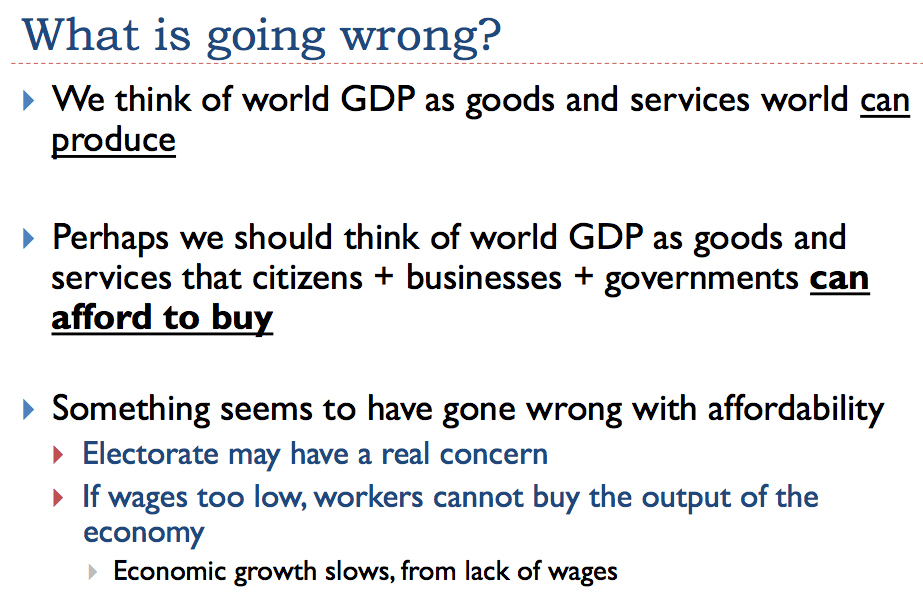
In this material, I explain how inadequate energy supplies can appear as either low wages or as high prices. Basically, if energy supplies are inadequate, workers tend to be less productive because they have fewer or less advanced tools to work with. Their lower wages reflect lower productivity (Slide 20). Slide 6 offers some additional insights.
Trump’s election seems to reflect the cooling effect that our energy problems are having on the economy as a whole. Citizens are increasingly unhappy with their wage situation, and want a major change. Trump’s election may at least temporarily have a beneficial effect, since it may work in the direction of reducing complexity.
Long term, however, it is hard to see that the policies of any elected official will be able to fix our underlying energy problems.
I wrote up my post as a presentation. It can be downloaded at this link: The Energy Problem Behind Trump’s Election. I thought this might be a way of putting together quite a bit of material into one place. I have displayed the images of the PDF below the fold, for those who would like to read them as a post.
I hope the large number of images does not cause viewing problems. Let me know if you have suggestions for making this material more accessible.
Slide 1
Slide 2
Section 1: Trump’s Election Reflects the Winds of Contraction

Slide 4

Slide 5
Slide 6

Slide 7

Slide 8

Slide 9
Section 2: The Surprising Role of Energy

Slide 11

Slide 12

Slide 13
Section 3: Humans’ Unusual Use of Energy

Slide 15

Slide 16

Slide 17

Slide 18

Slide 19

Slide 20
Section 4: The Role of Complexity

Slide 22
Slide 23

Slide 24

Slide 25

Slide 26
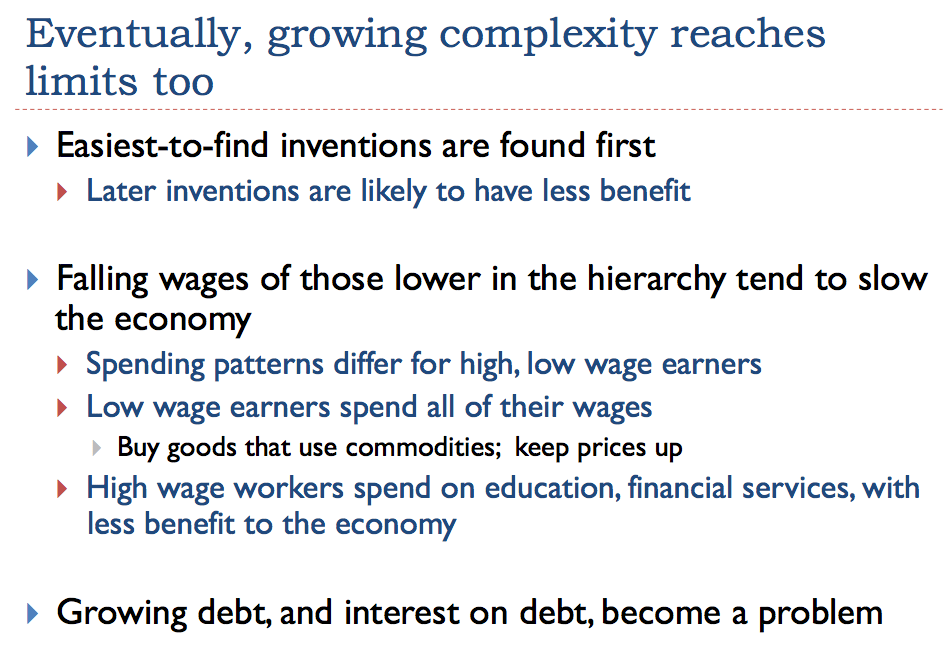
Slide 27

Slide 28

Slide 29

Slide 30

Slide 31

Slide 32

Slide 33

Slide 34

Slide 35
Section 5: Where we are now with respect to energy and the economy

Slide 37

Slide 38

Slide 39

Slide 40
Section 6: Trump’s Solution and Final Thoughts
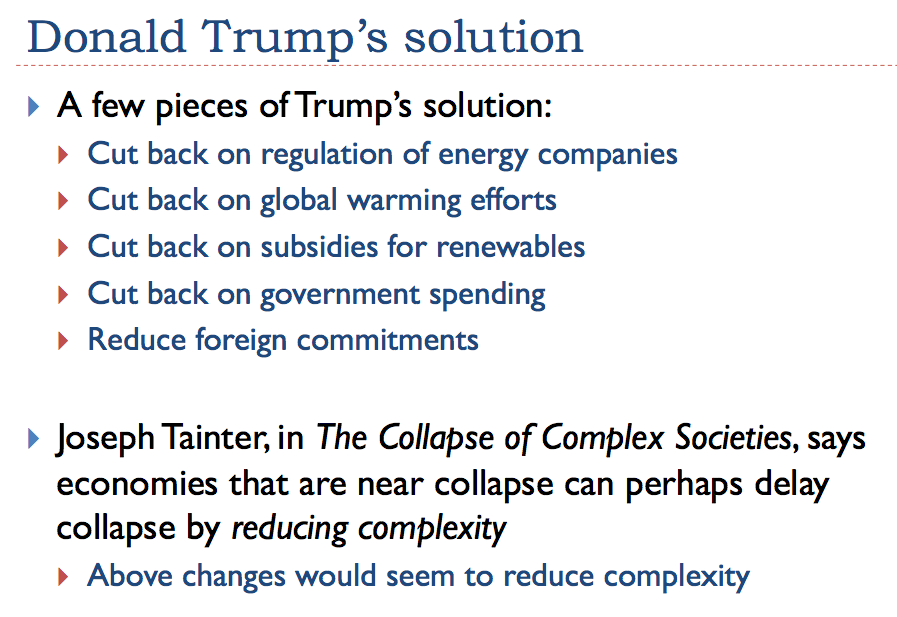
Slide 42

Slide 43
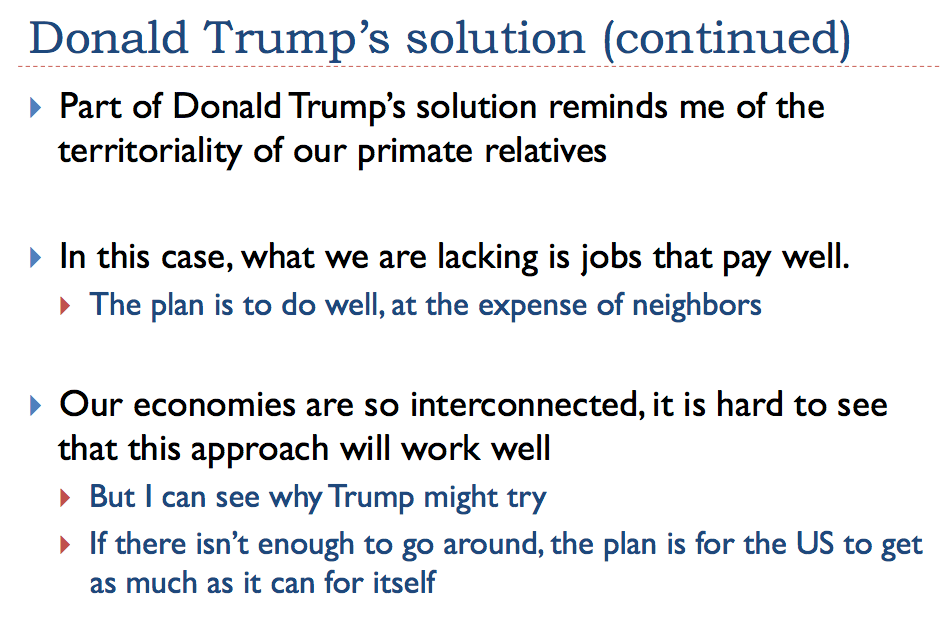
Slide 44
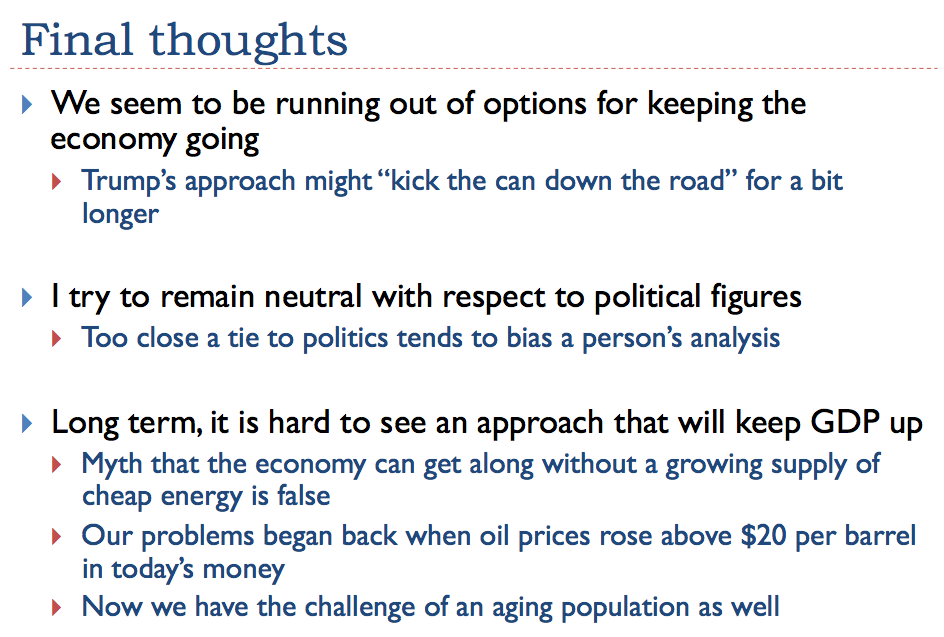
Slide 45


The Stone Age didn’t end because we ran out of stones. — Ahmed Zaki Yamani Saudi oil minister said in 1973 , warning against keeping oil prices high.
I suppose iron was better than stone. What is better than oil?
I don’t know if it is better but, nuclear is much more energy dense than oil. Nuclear does produce heat directly. But, it produces radioactivity and waste that is deadly to organic life. So nuclear is an indirect fuel – we harness the heat from nuclear reactions to make water boil to turn a turbine and produce electricity. And nuclear is expensive!
Electricity is great to have but, it is not the substitute (for oil) that the industrial world really needs. To replace oil products, the industrial word needs a liquid fuel replacement. I don’t know of any liquid on this planet that can be directly burned to produce heat that has the same or better energy density as oil. That is THE BIGGEST issue we face.
Just as we climbed the energy density ladder and standards of living improved, conversely, as we slide down the energy density ladder, industrialization will shed complexity (jobs, services, food, shelter, medicine, education). Energy precedes technology. As access to energy declines, technology declines as well. Energy and technology are connected at the hip. There is no technology that can create energy, technology can capture energy or burn it directly to do useful work. But it is a physical impossibilty for that same technology to produce net energy. To do so would be to create a perpetual motion machine, a violation of the laws of thermodynamics.
Since it is becoming painful obvious that oil has no replacement, our situation becomes a predicament. Predicaments do not have solutions.
++++++++++++++
I think nuclear is a nice complement (maybe), but not better than oil.
Can only be used for electricity, and even there not much better than oil.
Sorry to pierce this misconceptions, but nuclear waste heat is usually used via connectors to cities with space heating in northern climates, although some installations in remote areas just flare into the cooling towers. Besides that’s not “only” electricity, it’s a !baseload! electricity system, the highest form of energy at this scale known to humanoids at this point.
Not many bubbles burst here.
Swedens nuclear plants waste heat goes out in the Baltic sea … even if there’s discussion about doing something useful with it.
Is base load the “highest form” of energy? I would much prefer load following (hydro, coal, oil), everything else equal, but of course everything else is not equal.
Hydro sort of follows load requirements. The catch is that in a drought, it may not be available at all. And in the spring, there may be a super abundance. Natural gas is best for load following, if you have storage for a large amount of natural gas. Oil is load folloiwing, but it is way too expensive for most users. Coal ramps up and down slowly, so isn’t very good for load following.
Spotted from Ugo, an sceptic already shooting down the rising idol of Permian Basin. MSM journalist love to shoot out news with max. hopium content to keep us believing in tomorrow.
http://www.artberman.com/permian-giant-oil-field-would-lose-500-billion-at-todays-prices/
POTUS!
At last America has a leader who scalps his adversaries!
Donald Trump embraces the traditions of the land of the Americas.
https://en.wikipedia.org/wiki/Scalping#Scalping_in_the_Americas
That too. But up to now, presidents have usually been “above the fray”. The little people did the scalping.
Wait..you don’t think a $10,000 dollar car is possible? I see so much waste in the system and by that I mean waste in energy…..I probably waste about 30 percent of energy and I am on the low scale….how much is an electric bike? We will live on ….be it harder ? maybe….also how do you know where we are on the scale of invention? We might just be at the beginning of invention….maybe physics will be redrawn….I don’t believe to know everything or anything….shit for all I know there is an alien species that will destroy or show us the way….I am one of the original oil drum followers and frankly I am shocked we made it this far but I also keep seeing things differently and see the system more resilient than I thought it would be…..I also see some people so tied to an image or idea…belief that they can not let go….it becomes them….no I don’t see the current system going on much longer but I also don’t see complete annilation of the human species….
I think that there are really two groups that are tied to a story that isn’t true:
1. The BAU folks
2. The Peak Oil folks, who have a fixed idea of how the story will play out, with high prices, slowing declining supply, and a transition to renewables.
There is a third, correct, alternative:
3. People who see the story for what it really is. We are reaching limits to growth in a way that doesn’t give a good prospect for humans in the future. Maybe a small number will survive, but given humans’ need for supplemental energy, their group will follow the same upward trajectory, until their economy collapses again. Perhaps there is a religious ending to the story. We really don’t know.
“…but given humans’ need for supplemental energy, their group will follow the same upward trajectory, until their economy collapses again. ”
Not sure how this fits me. I was born trying to use less. At 12 or so, I picked up cigarette butts plentifully strewn around the yard. And I’d roll them into large spliff-like things and hand them out to the workers. How many died of cancer I was never able to ascertain, but this tendency to use waste has always been a central trait. If I come by a windfall of money, I don’t rest till I throw it away. So I have little use for money and I use the least I can of everything.
‘Not sure how this fits me’
You are an outlier…. a ‘freak’… abnormal… unusual…. different than most….
This has been talked a lot here from time to time already. For example, quality ebike-pedelec with 250-350W motor and battery good for dozens of miles, runs around $2-3k.., half that for Asian copy.
If particular urban society is able to prioritize on energy terms, such an ebike can be further leveraged by network of trolleybuses, trams and rail of various speeds, from urban-suburban destination (frequent service) to at least sporadic morning-evening schedule for the remote areas/villages. These service today take ~1-2kW per person/passenger in max output (good workload for baseload grid) and even less in consumption Wh per distance and time. So, as you can comparatively see now, the carz culture wasted gargantuan pools of energy for nothing, basically by order of at least 25-50x to 1 ..
In fact we have had something resembling the good choice attempt prior WWII in many parts of the world, with the exception there were fewer bikes (more walking to final destination from that already existing tram/trolley stations) and so on.
However, the post WWII, material and debt explosion craziness went instead into the direction of individual bubble spaces (+ sprawl) and consumerism, partly on their own volition-instincts, partly/largely maneuvered there by PR scams of big corp. selling crap and “freedom” of the highway congestion.
Several countries were able in recent decades to make some adjustments, i.e. at least tried pouring resources in both modes and infrastructure at the same time, individual carz and public transport. However, some countries (like US/NA) boxed themselves into a dark corner with fleet and culture of the worst gasguzzling variety of vehicles as well as not that much available short or long distance public transport. Now, it depends on the sequencing and profile of the complexity braking processes, some regions will be able to re-prioritize at least something for some time into the future, while for “unlucky” others it will be immediately one way street into no modern transportation availability for large majority of the people.
“Boxed into a dark corner” exactly! Working in the field of urban planning and transportation in the US, I’ve spent my entire adult life trying to push development patterns in the direction of something more sensible than what we have.
The optimists among us grossly underestimate the inertia in BAU. In theory it all seems ridiculously simple. Stop building roads, instead build paths and transit systems. Make car use expensive and inconvenient when compared to biking/walking/transit/ebikes. Don’t let developers build car-dependent neighborhoods on the urban fringes.
Optimists (generally without experience trying to actually make these things happen) don’t understand how easy it is to SAY these things- compared to actually doing them.
There’s a reason BAU is BAU. Because it’s what people want- and they’re willing to do anything to keep it. Actually implementing these types of changes is an impossibility, because the checks and balances of society prevent it. If you had a City Council that pushed this agenda, they’d be undone by the masses. If you had an environmentalist majority in the community that pushed for this, the business community would kill it. Even if you somehow managed to overcome local political, economic, and social obstacles, the state and federal funding system is heavily slanted towards money for car infrastructure. The Utopian community would be stuck with it’s own tax base trying to re-create itself, as they’d be getting little or no help with big dollars from the institutionalized federal funding sources.
I’m lucky to live and work in one of the most progressive areas in the whole country, backed by considerable local wealth and capital. And what have we accomplished? Nationally, 75% of commute trips are by single occupancy vehicle. Locally, it’s 70%. And that’s the BEST we can do. My life’s work, and the life’s work of many others- and this is what we’ve been able to get.
Maybe if we had 100 years to throw at this problem we could slowly and incrementally build our way out of it. But who here believes we have 100 years?
Ultimately this is how I arrived at my realization that we’re doomed. I hoped to change the system from within, but after decades inside the system, I see that this could never happen. Self-destruct has been engaged, and there’s no “off” button.
‘Make car use expensive and inconvenient when compared to biking/walking/transit/ebikes’
Bad idea…
2015 Jobs Report
By creating jobs, fueling innovation, driving exports, and connecting people, automakers are powering the American economy forward. Learn how Cars Move America in the 2015 Jobs Report.
Directly employing 1.55 million Americans and impacting a total of 7.25 million U.S. jobs.
Generating $500 billion in annual compensation.
Creating $205 billion in state and federal tax revenue each year.
Investing $46 billion in U.S. factories and facilities between 2010 and 2014.
http://www.autoalliance.org/auto-jobs-and-economics/2015-jobs-report
There would be many millions more people indirectly employed…. miners for the metals… people working at the smelters…. truckers… trains…. the oil industry…
Now imagine what would happen to the US economy if car production was slashed by say 20% … or 50%…
The auto industry is so important that shrinkage like this would no doubt collapse the entire economy….
And then we’d have no cars at all … or food.. or electricity .. or petrol….
I’m not disagreeing with you. Interconnection is the other problem. Even if we “fixed” transportation, you’re right, the car industry is too important to the economy and there would be severe repercussions. Just one more reason why the whole proposition is a catch-22.
Froggman, what you are saying makes a lot of sense to me. Public transport sinks or swims depending on population density. In the big cities it’s essential, but in smaller towns and rural areas it can’t compete with private transport in terms of convenience. So the mass of people outside the big cities opt for private cars if they can afford them, and they make them a major cornerstone of their lives. As a result, they want the planners to give them more and bigger roads so they can get from their homes to their workplace, the supermarket, the gym and the town center as quickly as conveniently as possible. Then they end up blaming the planners for all the congestion that results from all these cars clogging up the townscape and all the roadworks required to keep the system operable.
A market was required for the hydrocarbon, namely oil. It was just business mainly for the oil companies, vehicle and aircraft manufacturers, tourism and untold peripheries including suburbia and wanton consumerism. The USA, especially post WW2 was swimming in oil, export revenue was huge but domestic consumption was both required and encouraged. Trams and railroads were deliberately sacrificed in the name of growth and the almighty dollar.
“such an ebike can be further leveraged by network of trolleybuses, trams and rail of various speeds, from urban-suburban destination (frequent service) to at least sporadic morning-evening schedule for the remote areas/villages. ”
Like in europe?
European resource consumption is not sustainable.
Well, everything is not sustainable in the final analysis. I’m only underlying the shift occurring roughly between WWI and WWII at which the humankind have deviated and chosen “a wrong” way to develop*, namely the boom craze for carz and planes which waste just too much in comparison to what alternatives (or actually primary modes even at that time) have been known to work much better..
Obviously the reality of the kW-Wh numbers is a bit worse, since the public transport occupancy is not 100% @ 365/24, but even at average say 40-60% rate that is massive savings at least till the lifespan – longevity of the infrastructure gives in (tracks, vehicles and their service facilities, baseload grid), usually counted in decades, while carz fleet and their potholes infrastructure age much faster per person-distance moved.
*in fact some metro areas and early suburbias in the US/NA had at time much denser electrified public transport than Europe
“humankind have deviated and chosen “a wrong” way to develop*, namely the boom craze for carz and planes which waste just too much in comparison to what alternatives (or actually primary modes even at that time) have been known to work much better..”
What can I say to explain just how out of touch you are … that has not been said before…
Perhaps you lack the personal/family experience, young fellow, I do remember the exact sections of cities and suburbia, where public electrified transport was humming ~60yrs ago.. Now it’s a highway connected wasteland..
We can debate if the boom phase was unavoidable, as homoape animals seeking the pleasures from maximum energy wastage was non self controllable urge expression or indeed different arrangements where possible. And since there are many places in the world, which have at least opted to develop both modes public and also individual transportation, the preponderance of the evidence is more on “my side” , it was a failure and bad adaption culture to an energy availability spike, enough said.
Let’s revisit The Test:
Approach 100 people and offer them the following:
– a private jet with all expenses paid without limit
– ten 5 million dollar homes in locations of your choice – all related expenses paid
– USD20 million per year inflation adjusted until you die.
How many would say no?
E-bikes are nice, but they need a road to operate on, electricity for fuel (generally from a rechargeable battery that connects to the electric grid, and replacement parts. If any of those things is not available, the e-bike doesn’t operate. I expect that even at $2,000 or 3,300 most of them are bought on credit.
They need an operating fossil fuel system, international trade system, and financial system to actually work. There are a cheaper option now, but they are not a long-term solution.
I’ve already answered this to FE above, you are taking the argument from the end of the trajectory, we are standing just right now .. If you truly believe trolleys and rail are not a long (longer) term solution, sorry I can’t add anything more on that point, my arguments simply just fly around you, for some reason. Perhaps you are too much soaked inside the US/NA prevalent culture, despite the fact you seemed to be reasonably world traveled.
Kum bay ya, my Lord, kum bay ya;
Kum bay ya, my Lord, kum bay ya;
Kum bay ya, my Lord, kum bay ya,
O Lord, kum bay ya.
If everyone just bought an electric bike and visited the organic market we’d be saved!
I bought a steel-framed electric bicycle a couple of years ago from the local bike shop because he drove over out of the blue one day with a demonstration model and let us ride it around. At the time, I was flush with cash, and he was so eager to make a sale, that I decided, “why not make the man happy? It’s a small town and he’s been selling bikes and motor bikes to the locals all his life. I bought my mountain bike from him over 20 years ago and it still works well, although of the 17 original gears, only five still work.”
So I bought the electric bike and the wife loves it because we live 5km along a valley that slopes gently down to the main river —for some folks in the local dialect, going out to town is “going down” and coming home is “coming up”. So going out by bike is a breeze but peddling home can be tiring.
But the bike is heavy, something like three or four times the weight of my mountain bike. And if the battery runs out, it’s pretty tough to pedal uphill. I tested it on a 3km round course and I found that even with the motor running to help push up the hills, the electric bike was harder work than the conventional mountain bike, mainly due to the weight difference and also on account of the mountain bike’s larger wheels.
And I don’t believe 1+1=2….
I can’t explain why – but I believe that…
The thing is…
Believing or not believing something – without any basis — drops you down with the Grade One class in terms of your intellectual level…
I have stated that starvation will be absolute because 99% of all farmland is farmed using chemicals that destroy the soil.
I have stated that spent fuel ponds will release epic amounts of radioactivity when BAU goes down and the ponds are not managed.
I have supported both positions with a great deal of research references.
I have concluded that either on their own is an extinction event…. combined there is no question — we are finished. Everyone.
Now you can believe that I am wrong. And I will think of you as I would a Grade One student…
Of course you could try to demonstrate that I am wrong on both counts….
I am ready…
http://i.kinja-img.com/gawker-media/image/upload/s–4Ebg5lLx–/1389366647884326800.gif
Another great synthesis.
In the context of major transitions (Slide 28 et seq.) you could mention the Green Revolution seriously kicking the can down the road, leading to a much higher population to deal with the shrinking supply of affordable energy half a century later.
What is the ‘green revolution?’
That is a serious question….
“The initiatives, led by Norman Borlaug, the “Father of the Green Revolution,” who received the Nobel Peace Prize in 1970, credited with saving over a billion people from starvation, involved the development of high-yielding varieties of cereal grains, expansion of irrigation infrastructure, modernization of management techniques, distribution of hybridized seeds, synthetic fertilizers, and pesticides to farmers.”
He SAVED over a billion people from starvation.
Oh him…. I know him.
He’s the guy that is responsible for population hitting the 7.4 billion mark because of the technologies he kicked off that allow us to feed 7.4 billion people through the use of soil-destroying petrol chemical fertilizers…
He’s the guy I’ll be thinking of when I am starving to death when the petro chemical fertilizers are no longer available and there is no food.
I am printing this out and will tape it to the wall of my container and blast it with buckshot post BAU.
https://pbs.twimg.com/media/Cu5Uz2EWIAAm-B_.jpg
Norman Borlaug — the man who will be responsible for the extinction of humans….
Some might see him as a monster…. but if you look at the big picture and not worry about your own precious life… he is actually a hero….
He will rid the earth of cancer…
If you want an anti-hero … Ernie Rutherford is you man….. he’s the guy behind the spent fuel ponds that are going to exterminate all life….
https://youtu.be/hpiIWMWWVco
Old Norman never understood the signs in the park saying “Do not feed the birds”.
Dear Finite Worlders;
“the spent fuel ponds that are going to exterminate all life….”
That is just D-U-M-B – especially since this is the millionth time i have posted the actual truth.
First, an analysis from Sandia Laboratories
“These results should be considered in context with the fact that according to current practice, decay times as short as 30 days in reactor-sited pools and 11 year in away-from-reactor pools are possible.”
So, a significant proportion of the spent fuel rods have been used as much as possible in the reactor, and then have been stored safely for many years. The fuel that has been stored for more than five years can be dry casked. It doesn’t need water cooling at all. Since it can be stored in a dry cask, it can also be stored in the racks in the pool without overheating. Stated another way, that fuel is safe regardless of the existence of water in the pool. From the book:
“For most of the cases considered, a 3-year decay period is sufficient to keep the clad temperatures within safe limits even when there is no ventilation at all.”
The cases where fuel that has been stored for 3 years, and is unsafe, are due to tighter placement of the fuel, and smaller holes that restrict air circulation. The 3 year number is for spent fuel from a Pressurized water reactor (PWR) for fuel that was used in a Boiling Water Reactor (BWR) the time required is less. (There are more PWR reactors than BWR reactors.)
“… the amount of heatup occurring in the unventilated or underventilated away-from- reactor storage pool is considerably lower when the pool is filled with BWR fuel than when it is filled with PWR fuel.”
For spent fuel stored outside, or in a room with an open door and roof vent the study concluded that:
“1. Considering a complete pool drainage, the minimum allowable decay time for PWR spent fuel in a well-ventilated room varies from a best value of about 5 days, for open-frame storage configurations, to a worst value of about 700 days, for high-density closed-frame configurations with wall-to-wall spent fuel placement. Other storage configurations fall between these limits. The minimum allowable decay time is defined as the lower limit of safe decay times, such that shorter decay times would produce local clad failures due to rupture or melting.”
“2. The minimum allowable decay time for BWR spent fuel in a well-ventilated room varies from a best value of 5 days to a worst value of 150 days for the cases considered. A high-density storage rack design for BWRs would result in a somewhat higher value of the allowable decay time than presented here, but not as high as for PWR spent fuel.”
That is ALL fuel that has been stored for 700 days after BAU would be safe. Some fuel stored only 5 days would be safe. Interestingly, the author goes on to say that by making a few modifications to the racks, that 700 day number could be reduced to 80 days at no expense to the utility.
If the fuel is stored in a closed room with no ventilation, the spent fuel would need to be stored as long as 4 years before it was safe.
The author calculated that it would likely not be wise under any circumstances to stand at the edge of the pool after the water was gone. Just as obvious, the idea that all of the spent fuel known to exist would – as a matter of course – burn, melt, go critical and scatter radiation over vast areas is simply ridiculous, as I stated several days ago.
The second study from Brookhaven National Laboratory was charged with determining the damage that would be caused by the spent fuel that did overheat per the study at Sandia. In the “Consequence Evaluation” section of the Brookhaven study one finds:
“Because of several features in the health physics modeling in the CRAC2 code, the population dose results are not very sensitive to the estimated fission product release. A more sensitive measure of the accident severity appears to be the interdiction area (contaminated land area) which in the worst cases was about two hundred square miles. While the long-term health effects (i.e., person-rem) are potentially large, it is important to note that no “prompt fatalities” were predicted and the risk of injury was also negligible.”
In the later portions of the text, the author notes that the reason that there are no prompt fatalities, and the risk of injury was small is that the model used assumes what I would call BAU mitigation. So, yes their would be major health effects in the 200 square mile area if the fire happened post BAU.
Regarding their review and update of the Sandia work:
“Based on the previous results we have concluded that the modified SFUEL code (SFUELIW2) gives a reasonable estimate of the potential for propagation of self-sustaining clad oxidation from high power spent fuel to low power spent fuel. Under some conditions, propagation is predicted to occur for spent fuel that has been stored as long as 2 years. The investigation of the effect of insufficient ventilation in the fuel building indicated that oxygen depletion is a competing factor with heating of the building atmosphere and propagation is not predicted to occur for spent fuel that has been cooled for more than three years even without ventilation.”
Recall that under the worst conditions possible, the Sandia study found that spent fuel stored only 3 years might cause a large issue. The Brookhaven folks showed that fuel stored only 3 years might overheat, but would not create the worst fire possible.
Yup. The spent fuel will not be moved, it will not all be dry casked, it will be radioactive for centuries and dangerous for decades. It is entirely possible that every nuclear reactor that is in operation today will have a fire in the spent fuel pool(s) and it is entirely possible that the fire will be the worst possible. Assuming the worst happens at every facility, there will be roughly 1000 areas with a 15 mile radius that will be unsafe for the foreseeable future. If the population density in those 200 square mile area is high, millions will die or wish for death. Millions.
Spent fuel pools cannot:
1. Explode
2. Spread radiation uphill more that 20 – 30 miles
3. cause human extinction
Spent fuel pools will:
1. Contaminate surface and groundwater including the oceans
2. Make a terrible mess in the immediate area
Tell your tribe where the nukes are, and make sure the young ones know that it is crucial that their decedents never forget where those unsafe areas are. Do not live anywhere near one. No hysteria or histrionics are necessary, but FE lives for histrionics and hysteria, so please FE ignore the facts again. I will post this later.
Glowingly Yours,
Pintada
Pintada, thank you, thank you, thank you.
Meanwhile in Koombaya-ville…. the pumpkin heads refuse to understand that the Sandia report is decades old and none of the recommendations have been put in place …. i.e. they are theories… they have not been proved….
Can anyone show me the part of the report that indicates that any spent fuel pond installations have tried the theory… has it been tested? I’ll save you the time — no.
One of the key requirements for the theory to keep ponds cool is that the rods not be dense-packed…
Unfortunately — see the sentence below
“It has been known for more than two decades that, in case of a loss of water in the pool, convective air cooling would be relatively ineffective in such a “dense-packed” pool.
Spent fuel recently discharged from a reactor could heat up relatively rapidly to temperatures at which the zircaloy fuel cladding could catch fire and the fuel’s volatile fission product, including 30-year half-life Cs, would be released. The fire could well spread to older spent fuel. The long-term land-contamination consequences of such an event could be significantly worse than those from Chernobyl.”
http://science.time.com/2011/03/15/a-new-threat-in-japan-radioactive-spent-fuel/
Even though the Japanese government was preparing to evacuate Tokyo specifically because a spent fuel pond at Fukushima (nearly 300km away) had cracked and was in danger of collapsing …. the Koombayaists refuse to acknowledge the danger…
Strange…. if the spent fuel ponds are not dangerous … then one has to wonder why they had this plan in place…..
But then the Koomabayaists know that if a spent fuel pond boils …. if you gather enough Koombayaists and have them link hands and dance around the pond singing Koombaya….
Everything will be better….
The Pentagon prompted Obama to sign an order, so I assume they really mean to do something about the pondzis. We rather should track this particular bit of the real world
the borlaug problem is being constantly repeated
the skipper of a boat in the meditterranean looks over the side and sees 50 drowning people.
does he rescue them
or
does he say sorry—if i rescue you, there’ll be a thousand more tomorrow, of whom 750 will drown anyway—so by not rescuing you, I am saving them from drowning
The problem is not that Skipper rescues people. The problem is that he rescues them 2km off Africas coast while they still are in their boat and then ship them to Italy.
+++
thats irrelevant
if the migrants get rescued—another 1000 show up
if 1000 people get fed, they produce another 5000 people
that’s human nature
Class, you are the jury. What is your verdict?
We hear s story that Bill and Melinda’s foundation is funding vaccination for children in high-population-growth Third World countries. And we hear a variation of the story that these vaccines have been designed to render their recipients less fertile. Of course, we don’t necessarily believe this second story. But hypothetically, if it was true, would Bill and Melinda be doing something fundamentally good in reducing human fertility or would they be doing something evil in taking away people’s human right to procreate?
After looking at Democracy Now this morning, I get the sense that such considerations are moot. What we have in the US-dominated world is tantamount to a military takeover. Germany may or may not be the only OASIS in this takeover. No one will be able to act in the public/international space in ways other than as suits this military cabal. That includes Bill and Melinda. I see no role for civilian volition. The people behind the curtain have set things up nicely for the final showdown. The Democrat neocons lobbed the ball into the air for Trumpians to kill it over the net. Always merry and bright.
https://www.democracynow.org/2016/11/21/jeremy_scahill_mike_pence_has_militant
Check out Utopia…. pirate bay is offline but you should be able to download it somewhere…
They address exactly this question — a vaccine is being given to people to stop breeding …. and there is an epic battle between those who believe this is unethical — and others who believe it is necessary….
Fascinating…..
My ids die or their kid never get born? I pick their kids never get born. It has nothing to do with morality. It is survival.
Or alternatively, he allowed a billion more people to be added to world population. He is part of the reason behind the population inflection after 1950, I expect.
Don’t forget good ol Norm developed a wheat that sickens many of us to this day. Talk about the road to hell being paved with good intentions.
FW is where delusional thoughts come to die…
Good ol Norm — the hero of DelusiSTAN — has been exposed and destroyed… in the space of a few days….
For his exceptional work in pushing the limits by helping to increase food productivity, and thereby creating the conditions for the post WW2 population explosion, I hereby nominate Norm for a posthumous Finite World Laureate for Hubris. He fully deserves to be in the hall of fame alongside such luminaries as Jethro Tull (inventor of the seed drill), Fritz Haber (developer of an artificial nitrogen fixation process), and Helen and Scott Nearing (pioneers of The Good Life in the hills of Old Vermont).
Fathers of the Extinction — one and all.
I doubt that very much. Are you considering that the GR might have contributed to that shrinkage of energy due to “modernization” and billions of additional consumers of the California lifestyle coming on board?
You are right about the Green Revolution playing a role. This is what Wikipedia says about timing:
It greatly improved world food output. At the same time it reduced agricultural jobs. I would need to look at data on when the changes really affected the system. My impression is that it is part of the post WWII set of changes–growing debt allowed buying all of the new equipment and the building of new factories to make fertilizer. The big population spurt occurred after WWII.
There was an earlier transition from using farm workers to horses as the primary source of farm labor. This may have been to some extent behind the Depression, because it left so many without good paying jobs.
“I call it the Green Revolution, like our beloved USD which is so intertwinked with it”
The point is “The Green Revolution” could not have been possible without abundant, cheap and easy FF’s. Although after WWII discoveries of FF deposits exploded, a MARKET was required and created. One fed the the other, cheap FF’s — ICE and support network — Elec Power and grid — Food Production — population growth — Debt — GROWTH. Picture Gail’s pick-up-sticks.
Debt alone would not have worked without a cheap source of energy or a market for the energy. One needs the other. Take the growing population away and the market goes away along with debt, take the agriculture revolution away and population growth is seriously curtailed, take the ICE away and so go the suburbs of the Western World. You could go on linking adinfinitum but the central focus must be on energy. None of the huge events defining our current conundrum would have been possible without copious energy supplies.
Right now the human race is flailing around like a landed fish, trying to deal with decling cheap, easy FF’s. Our coping so far has been increasing debt, complexity (technology dependant on FF’s for their creation and maintenance) and globalisation.
Debt was not required when populations were growing slowly. Declining population and the demise of growth will see debt to the door, along with the world as we know it.
The main reason for the population growth spurt which started after WW11 (and is still continuing )was the development of the Haber-Bosch process,which removed the limitation of the natural nitrogen cycle on agricultural production. It is of more fundamental importance in supporting our current ‘Bubble’ population than Norman
Borlaug,who bred and selected grain cutlivars which were capable of producing high yields,but needed high soil nitrogen levels to produce those yields.
The importance of this process is well explained in Vaclav Smil’s ‘Enriching The Earth’.
Smil and others make informed estimates that without the H-B process supplying the
‘fixed’ nitrogen for industrial agriculture,the maximum human population that could be supported on the land area now being used for human food production is around
three billion.
Smil is a techno-optimist,and his book should really have been called ‘Devastating the
Earth’,because without the H-B process,not only would the maximum supportable
human population be much lower,but the Nitrogen Cycle would not have been severely altered. That alteration has had many terrible consequences,including (with phosphate)
the eutrophication of rivers,and ocean ‘dead zones’,plus nitrous oxides increasing anthropogenic climate disruption.
Thanks David – I had thought that Norman was the man behind urea….
In any event I completely agree — this process signed our death warrant by making 7.4+ billion people possible — and poisoning 99%+ of all farmland.
Throw in 56,000,000 Hiroshima’s worth of radiation from boiling spend fuel ponds…
And you could not dream of a more lethal extinction cocktail.
We’ve developed the perfect rat poison for ourselves
If memory serves weren’t the Haber Bosch people the developers of zyklon B? Eddy you should add them to you’re Norman Borlaug target.
That said Mr Haber and his lover Mr Bosch…. did delay The End of Days….. by ensuring there was enough food for me …
So I supposed I should be grateful….
Yes. If we set out to design a system that was guaranteed to collapse,with it;s main institutions based on an incorrect understanding of how the physical world works,we would be hard pressed to come up with a better system than our industrial civilisation. The only remaining questions are the timing and the sequence of events.
Exact, David,
Borlaugh and others have helped implement worldwide agriculture a set of artificial techniques, which was completed with the development of hybridized seeds (a whole topic in itself, but let’s stick to industrial fertilizers (especially nitrogen and ammonia), to which the development of pesticides is tightly connected, but that would lead to too long a comment).
IOW, since this set of techniques was -and still is- man-made, the green revolution certainly helped increase the yields (in the short run) but helped even more develop an industry to produce all those chemical inputs.
The Haber-Bosh process, developed in the early twentieth century, has actually been very important, as being the cheapest (and easiest to industrialize and scale up) way to extract nitrogen from the air, and -urgently- replace the guano imports from south-America (see https://en.m.wikipedia.org/wiki/History_of_the_Haber_process).
That was motivated, no doubt, by good sentiments and actually “saved” a lot of human lives, especially after WW1, but the very same researches also lead to improvements in the production of explosives and gunpowder, used during WW1 (Fritz Haber also helped production of lethal gasses used during that war).
But that was only a process, i.e. a (energy consuming) technological tool dedicated to industrially implement a theory that was previously initiated by no other than Justus Von Liebig, famously known for “his” “Law of the Minimum”, in the 1830’s. From Wikipedia:
“Liebig synthesized ideas about the mineral theory of plant nutrition and added his own conviction that inorganic materials could provide nutrients as effectively as organic sources.
In his theory of mineral nutrients, Liebig identified the chemical elements of nitrogen (N), phosphorus (P), and potassium (K) as essential to plant growth. He reported that plants acquire Carbon (C) and Hydrogen (H) from the atmosphere and from water (H2O). As well as emphasizing the importance of minerals in the soil, he argued that plants feed on nitrogen compounds derived from the air. This assertion was a source of contention for many years, and turned out to be true for legumes, but not for other plants.”
https://en.m.wikipedia.org/wiki/Justus_von_Liebig
Of course, biological nitrogen fixation pre-existed since a couple of years ago and was developed mostly by cyanobacteria (see https://en.m.wikipedia.org/wiki/Nitrogen_fixation).
It is recognized as being almost as important a reaction as photosynthesis, but unfortunately is also too complex for us naked apes to fully understand, let alone copy or even use for our profit. Better rely on the Technosphere, makes more profit anyway.
That being said, none of the above cited guys are really to blame, in my view, they were only parts of feedback loops that helped speed up technological developments (and by the way human population), that were seen as progress and therefore good for mankind, on the moment…
“Spain anger over ‘energy poverty’ deaths
“Spain’s economy may be recovering, but the recent deaths of a 12-year-old girl and an 81-year-old woman in house fires are reminders of the hardship that millions of households still face in the country’s deep-rooted crisis.”
http://www.bbc.com/news/world-europe-38024374
Expect MUCH more?
This news is truly delirious.
“Spain anger over ‘energy poverty’ deaths”
After the accident eighty people approached the Barcelona city council in protest of the fact. Eighty people do not seem to indicate “Spanish anger.”
Here the graphic proof that in Spain is “about to start a revolution”.
http://estaticos.elperiodico.com/resources/jpg/6/3/protesta-tras-muerta-anciana-fallecida-durante-incendio-1479298349636.jpg
The issue is that in Spain is paid a high bill among other things because of the absurd mega investments in “renewable” that were made and now we all pay. And the current government is little given to helping the poorest who may have difficulty paying the energy bill.
But they should not exaggerate. These accidents of this type are absolutely exceptional, but populist political parties know how to take advantage of this news.
Hard to believe that just 80 years ago, Spanish men and women of action were dragging fascists and elites (and priests) out into the streets and executing them.
http://3.bp.blogspot.com/-QGcTAfb8274/UqWzWFiZXzI/AAAAAAAAWK4/rGM6rl0HBY4/s1600/Spanish+Civil+War+(11).jpeg
Then you see the modern scene above, a few short generations later. This is what “opposition” looks like now. We have truly been tamed by our masters.
Yes, hard to imagine horde-ing, looting and violent protests against lacking health care.
Domestication of workers.
Before:
http://static.vix.com/es/sites/default/files/styles/full/public/btg/curiosidades.batanga.com/files/5-fascinantes-curiosidades-sobre-los-lobos.jpg
After:
http://animalcare.com.mx/wp-content/uploads/2015/04/perroto.jpg
Everything seems to indicate that it is a consequence of the increase in complexity 🙂
Picked this up in the airport … https://www.theguardian.com/books/2016/jan/20/this-is-london-by-ben-judah-review
Amusing how eastern European immigrants perceive native Londoners — lazy – pampered…. and they are puzzled as to why a govt can pay people anything if they don’t want to work….
It’s an outstanding read.
Domestication tends to make species smaller. Perhaps growing complexity uses part of the available energy. Brains are the most energy-intensive part of the animal. Any growth in the brain would seem to leave less for the rest.
Courtesy of David A Koch
http://www.pbs.org/wgbh/nova/earth/treasures-earth-power.html
BP Plc reported a 49 percent decline in third-quarter earnings after crude prices fell and refining margins shrank.
Profit adjusted for one-time items and inventory changes dropped to $933 million from $1.8 billion a year earlier, the London-based company said Tuesday in a statement. That beat the $719.2 million average estimate of 14 analysts surveyed by Bloomberg.
BP’s earnings have fallen year-on-year for nine consecutive quarters, piling pressure on Chief Executive Officer Bob Dudley to rein in spending and sell assets without jeopardizing future growth. The company will trim capital expenditure to about $16 billion this year, compared with a previous estimate of less than $17 billion.
BP’s downstream earnings fell to $1.4 billion in the quarter from $2.3 billion a year earlier. Global refining margins averaged $11.60 a barrel in the period, 42 percent lower than a year earlier, according to the company’s website.
While BP’s exploration and production business has struggled during the oil slump, the refining and marketing division helped buoy earnings over much of last year.
At the end of the third quarter, BP’s net borrowings totaled $32.4 billion, up from $25.6 billion a year earlier. Net debt to capital, also called gearing, was at 26 percent, compared with 20 percent previously, according to the statement. The company announced a quarterly dividend of 10 cents a share.
http://boereport.com/2016/11/01/bp-prof … estimates/
Doesn’t sound good, especially if there is no way to get the price permanently up to a higher level.
‘the refining and marketing division helped buoy earnings over much of last year’
Has anyone noticed that pump prices have remained high – in spite of big price per barrel drops….
I would imagine that this is a big reason why they are not massively in the red….
Oil companies that are vertically integrated have still the opportunity to transfer their costs to the end consumers… at least to some degree I would guess.
Gail,
there is no indication that Trump will not as Obama or Clinton cut the income of the lower classes, maintain wars and grant the banks large parts of the public budget. The big theatre show could be entertainment only to shorten the time citizens can afford on politics and swallow what they are served.
If we leave out theories connected to the stars and the bible, we find three serious approaches:
1. classism (a more or less conspirative plan to steal money of the lower classes) -> Chomsky
2. national economy (erroreous economic models that lead by chance to the fact that the rich get richer and the poors poorer) -> Krugman
3. peak oil (society creates less values and the rich try to compensate this by stealing the lower classes to maintain stability) -> Tverberg
We should try not to mix these up.
It is interesting to have more than one explanation for a complex situation. We should look for evidence. Paragraph 2 can be seen as a subnode of 1. It is it’s least conspirative version done with the lowest amount of purpose, trying to avoid class wars by calling on deeper insight. So in fact we have to decide if we face a problem of ethics or of natural science. If it is a problem of ethics we can state that the morality behind has not changed, already Adam Smith has complained about the ‘principal architects’ and the ‘masters of mankind’. So the question arises what change enabled the ‘principal architects’ to enlarge their powers? There are two candidates: The fall of the soviet union as a supporter of opposition like in the 60s and electronic communication services as the basis of modern banking and the global village.
On the account of the second (third) assumption is the fact that there are no technical measures to develop a western lifestyle without huge increase of energy consumption. If there were enough energy, third world countries could easily close their borders and start an industrial revolution like Great Britain in the 19th century or Russia in the 20st – even faster as the technologies are available. The fact that they dont try – or dont succeed in doing it, is an indicator of energy shortage. Obviously it is for the advantage of the developed countries that underdeveloped countries with huge amounts of energy resources never come to democratic stability and start a period of development but prefer to sell their resources on the world markets.
The complexity discussion going back to Tainter looks to me like a sidestep. Has globalisation reduced complexity (western standards worldwide) or enlarged complexity (what happens in Angola directly effects the US) to the world system? Are we looking at the world or just it’s national parts to call it “a system”? I can just think of this: A global crash would make people be dependend on their neighbours and local resources. It is perhaps the right time to strengthen local supply.
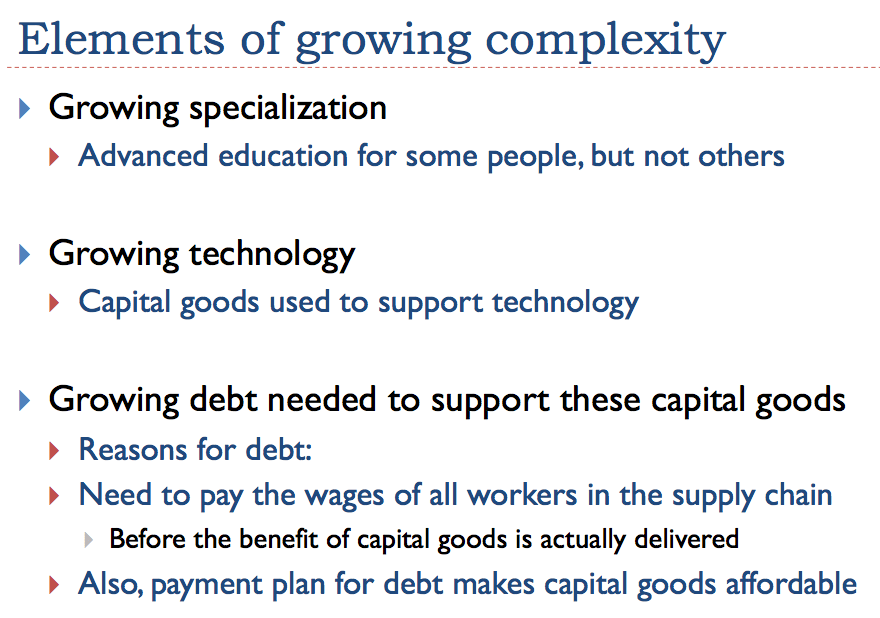
Complexity may sound like a sidestep to you, but I think it is the basic issue. (I stay away from talking about “peak oil”–that is someone else’s theory, that I don’t particularly agree with.) As we try to work around oil limits, we need systems that are ever more complex. They need inputs from around the world. They need to be refined to precise specifications. They require far more capital goods, which in turn require far more financing (debt or equity). They require globalization to get the inputs they need. The require global businesses and international supply lines.
In all of this, there are people who are winners and losers. The winners are at the top of the hierarchy, either in managing companies, or in various specializations that allow the new projects to go on. They may design computers, for example. Or they may know how to operate the complex equipment that go into finding and drilling oil wells.
I don’t see any aspects of “the rich try to compensate this by stealing the lower classes to maintain stability”. The big problem is, of course, that because of oil limits, the value of goods being made is not going up rapidly enough to compensate for (1) the growing population plus (2) the additional payments needed for workers at the top of the hierarchy plus (3) the payments for needed capital, which tend to accrue primarily to those who are already wealthy.
I don’t really follow economic theory. If this is the way it works out, I suppose other people could get to the same result a different way. I didn’t claim to have spotted an entirely new behavior.
Globalization is part of growing complexity. It is the way we indirectly use the cheap coal from China to compensate from the fact that our own energy supplies are getting more expensive to produce.
Perhaps we need to strengthen local supply. The only way we can do that is by reducing complexity–if we can do it at all. We need to be able to make goods like wheelbarrows and clothing locally, using only local materials. We need to somehow be able to make saws or axes, to cut down trees. We need to figure out a way to produce food using tools we can make locally. If we use draft animals, we need to be able to feed them as well, and we need to make at least metal tipped plows and other tools. We need schools to teach children the skills needed for this new way.
Our current ores are so depleted that it is hard to see how we can do this. We would also go through wood pretty quickly, if we wanted to use it again for smelting. So I think we are kidding ourselves, except for perhaps a few years (10 or perhaps even 20) where we can continue to reuse existing things for a while. This isn’t really providing local supply though. It is just holding on to the past a little longer.
Gail, I think this is an excellent presentation. It condenses your thinking on these issues beautifully.
In the case of Slide 5, for clarity, it might be a good idea to specify that the index for World GDP is in trillions of US dollars.
Reading through the post a second time, I was struck by the thought that so many of the things industrialized society pays for are insurances against disaster, illness, ill will or instability. Take defense/the military: If only we could all be friends we could cut that budget considerably. Likewise the police: If only everyone was honest and socially responsible enough never to commit crimes…… The fire service: If only people would be less careless with matches, log stoves and deep fat fryers….. Government bureaucrats: What do they actually do, anyway?…… Education: When one sees what comes out of the colleges these days, one fears for the future of the human race…. Healthcare: Between 10 and 20 percent of my income goes on mandatory health insurance and I only ever use it for dental checkups…..
Okay, the above paragraph was very much tongue in cheek. But it would be interesting to see how much we spend as a society for services that we may not actually use or obtain any tangible benefits from and to explore the degree of utility value vs. cost of each service. At present, we can afford to maintain a huge system of social, administrative, educational, medical, security and protection services BECAUSE of the surplus we obtain by using copious amounts of energy and complex technologies. It wasn’t always like this, and as net energy availability declines, even if we manage to avoid the steep “Seneca cliff” decline scenario, it is hard to see how current levels of spending on tertiary (non-agricultural, mining, manufacturing and transportation) industries can be maintained.
Thanks for that first paragraph, Tim. LMAO, then shared it with my wife and laughed some more. It makes the point too.
Once you start using insurance, however, it distorts the system. You have military in place, so you feel like you need to use them to justify their existence.
Once people have health insurance in place, they feel that they have a right to treatment for even the most minor problem (or maybe the health system forces that on them). If we can do a procedure, we do it, no matter how expensive it is, and how little benefit will really come from it.
Well, we can always dream about rational inclined societies, right?
Like 1,5-2kW per person trolleybuses, light and heavy metro tram/rail networks, 200W bottom bracket ebikes (even in foldable form factor) etc., instead of that individual combustion nonsense consuming 50-100x more energy.. Unfortunately and despite the fact these marvelous concepts and technologies already do exist here and there, they are not mass adopted universally, because of stupidity, greed, parochial interests of homo ape societies.
Simply, the human societies have developed much slower in contrast to current technological progress, and such disparity must be eventually periodically vented out during spike events like wars, market crashes, civilization collapses and so on.
“Simply, the human societies have developed much slower in contrast to current technological progress, and such disparity must be eventually periodically vented out during spike events like wars, market crashes, civilization collapses and so on.”
Or like a prospective Trump presidency.
I fixed Slide 5 last night. Thanks!
When I mention the “shantification” of existing urban places, I have something like this in mind. This is outside of the economic system, using scavenged materials. There are good ideas at work here, but people trained in architecture and design could work with such residents, using the same materials and budget, to build the same thing in a way that had more design system to it, and therefore make it more acceptable as a reasonable way to live. It shouldn’t bring the neighborhood “down” through unsystematic (inelegant, poorly coordinated coordinated, insufficiently sanitary) (non)design.
https://photos.smugmug.com/History/Redlining-America/i-5VbCRFk/0/L/Huts_and_unemployed_in_West_Houston_and_Mercer_St_by_Berenice_Abbott_in_Manhattan_in_1935-L.jpg
Artleads I suggest you get on over to Asia to study shantification. I suggest the outskirts of Mumbai but really any Asian city could do. The aroma factor has to be experienced in person. I really think your on to something here. You could start with Gary Indiana. And here is required study
http://www.vice.com/video/deportee-purgatory-video
Johannesburg perhaps? The possibilities are endless. I see a career in this.
Humble materials is one thing. Humble materials in coordination with visual sophistication is another. You appear not to know the difference.
Thats why you are the master of shantification and I just a dumb redneck.
Not sure if you’d call these guys redneck, but they have a cool house. 🙂
https://farm3.staticflickr.com/2252/1706654911_3d54725f17_o.jpg
Maybe you need to look around more.
http://media.treehugger.com/assets/images/2011/11/nigeria-plastic-bottle-house1.jpg.492x0_q85_crop-smart.jpg
http://cdn1-www.webecoist.momtastic.com/assets/uploads/2014/09/wenn21487673.jpg
These are examples from the third world, which people love to disparage.
I’ve often noted that wealth and taste in art are not correlated. You either have taste in art or you don’t. No amount of wealth can give it to you, but you can hire those that have taste to make it look like you do. Similar to musical ability, you can learn to play music, but what most do no have is an innate ability to play it, to be musically inclined or endowed.
There are lots of pre-industrial cultures where the standard of beauty is (to my mind) universally high–coiffure, clothing, architecture, etc. But there is generally a specialist, or a group of them, who do the sculptures.
I am not even sure you have to go to the outskirts of Mumbai. There are shanties not far from sort of nice areas.
So , trying to follow you, shanty towns reduce complexity? And detaching from networked economies…? They still depend on BAU.
They allow people to survive on very little. They are not very long-term solutions, though.
When I see a lot of people makeshifting shelter my first question is where is all the poop going. Usually if your makeshifting shelter you dont have a makeshift water source you are relying on somone elses watersource. If you are getting your own water then you start to get a little concerned where everbodys poop is going.
If theres no food theres no people. No people no poop. Right now all of our water infrastructure uses energy to extract it. That might be a teeny weeny bit of a problem. Food might be a teeny weeny bit of a problem. Shelter is not going to be a problem in the long run. We have shelter for a lot of people. There is going to be less.
If somone is living in a small well insulated space that doesnt burn all the children living in it when somone forgets about a candle, that composts the poop, they have my complete admiration.
Thanks. “They are not very long-term solutions, though.” I thought it was as close to HG living as you get in an urban setting within BAU. I don’t know of any long term solutions.
HG societies were largely nomadic, allowing any food source to replenish itself to feed a very small population. Shanty towns, as we see, allow people some extra time and take some pressure off of…something. Things like human waste probably get dumped into water ways or … Good question. I imagine there are plenty of pit toilets. Insome cases, perhaps few, the nearby municipality picks up the waste. Being as residents are generally uneducated, design is not optimal. But with coordination with design trained do gooders, that could be significantly resolved. Of course, human waste should be composted, with scientific concerns for doing it right and systematically. Do gooders again. According to “Ecology Action.” If all food waste and all human remains get returned to the land, it can retain its nutrients for longer than we have to worry about right now. Roof water catchment systems are yet another opportunity for do gooders. And serious water shortage in the grid is a problem for everyone, not just shanty towns.
Reblogged this on La Grajilla.
The Systems are Falling…and no one can see it…except us OFWorlders 😉
US peak coal took place in 1966.
http://www.eia.gov/state/seds/data.cfm?incfile=/state/seds/sep_use/tx/use_tx_US.html&sid=US
How is Trump going to industrialize America?
I think you are referring to the wrong analysis. I think your report has to do with coal used directly, as opposed to burned by electricity generating plants. Peak coal took place in 2008 in the United States. http://www.eia.gov/totalenergy/data/monthly/pdf/sec1_5.pdf
That data shows hydroelectric power peaking in 1995. Global warming??
Dams silt up, if you don’t keep dredging them. There is a lot of year to year variability as well I think that a few dams have been taken out because of environmental issues. The US pretty well reached a maximum number of dams, long ago.
Ok, thanks!
Gail,
the aspect “can produce” versus “can afford to buy” is the current discussion between classic economists (“state has to support monopolists and production of goods”) versus keynesianists (“state has to support buyers to consume products”). With the victory of globalisation, especially the unification of europe within the EU the classic point of view got european law – before the social democratic parties used to have a keynesian, the conservative parties a classic approach. In the european scientific world the keynesianists are all but dead though. I am convinced there will be a country within the next 10 years to try a keynesian approach. Then we will know more.
I think the slides are too complex for people not used to your thoughts.. 🙂
I think a lot of the dissatisfaction is due to the new media, nowadays every kid in africa or asia knows how a conveniant californian lifestyle looks like – and feels inferior. The same with several social classes in the US or EU. I am not convinced, if people REALLY lost economical opportunities or if they just FEEL they have lost chances – because they can compare better.
How much energy and economy is related, can easily be shown like this: all the lifestyle of the western world is based on industrial development and huge supply of fossile resources. With that consumption we are now past peak oil, though. If we grant Africa, Latinamerica and Asia the same development, there cannot be enough resources to achieve this – and to feed our lifestyle another decades.
That means we need a lifestyle which consumes much less energy. Still we dont do any kind of energy controlling or energy accounting on our products. We buy what is cheap and dont think of energy costs referring to production or transport.
Like capital energy means power. What will happen in the near future when Germany have to buy oil on the world markets while Rumania can drain it from its grounds? Will Rumania attack Germany by militar, having enough fuel to drive tanks, planes and missiles? But what will come after it, when the Rumanian fuel is gone – who will maintain power and control?
As I mentioned elsewhere in the comments, I agree that these slides are too complex for almost any audience. I would need to dilute the material out, and explain it over several sessions.
You are right in brining up the media. Now everyone can see what a California lifestyle would seem to look like. California can’t produce this on its own though–it is a heavy importer of energy resources. It would be interesting if it thinks it can secede and survive on its own.
Energy does mean power. How this works out in practice remains to be seen. Governments still need to tax citizens to get revenue–either that or raise debt levels, and have their currencies drop relative to the dollar. It may not work out as we expect.
“I think a lot of the dissatisfaction is due to the new media, nowadays every kid in africa or asia knows how a conveniant californian lifestyle looks like – and feels inferior. The same with several social classes in the US or EU. I am not convinced, if people REALLY lost economical opportunities or if they just FEEL they have lost chances – because they can compare better.”
I know all about this, coming from the third world and seeing how it works from experience.
My clarity on the issue peaked in 1990, when I wrote a magazine article about it. I knew less about energy dynamic than the little I know now, but still I got the basic drift of the matter: The planet cannot afford the western lifestyle, and in trying to go for that, it’s losing a lot of resilience and beauty. It is largely a question of aesthetics. Third world people get fed a Hollywood-style aesthetic But it is giving up much better aesthetics in the process. Aesthetics = status, and everyone wants status. So showing the superiority of third world aesthetics is a major task for the “cultural worker.”
IMO, the planet needs to adopt a third world approach to life. This would be the cake, and western systems and science would be the cherry on the top. Actually, it should be blended extensively into the cake, but it should play a very minor roll over all.
All of the “Third World” has serious population and environmental issues. The “First World” has to address a great deal more than energy and consumerism. Japan is struggling with slight population declines, exacerbated by their desperate attempts to maintain BAU. We both need and don’t need population growth……it’s an impasse or as in chess Zugzwang…..forced to move but there isn’t a good one, whatever move is made just makes things worse.
“All of the “Third World” has serious population and environmental issues. ”
True. I have not addressed that. Rural people have met up with limits (population growth, Gail says), and they flock to cities where they live largely in shanty towns. I suppose I’m trying to look at the nature and potential of those shanty towns, since they seem to be the best we can hope for. And I believe that the downsized middle class will be moving into them soon. We might as well not shy away from them.
“We both need and don’t need population growth……it’s an impasse or as in chess Zugzwang…..forced to move but there isn’t a good one, whatever move is made just makes things worse.”
That is largely my sense of it. More like that trying to reduce population creates something worse. No solutions, but stopping doing stupid stuff would be helpful. If food will only be produced by human power, I can’t readily refute the argument that we need all the hands we can get. Climate wise, we need a lot of people to reforest the deserts that comprise most of the planet’s surface.
Allan Savory killed off tens of thousands of African elephants, thinking that would slow deforestation. Now he calls that the worst mistake of his life; it made things worse.
‘And I believe that the downsized middle class will be moving into them soon. We might as well not shy away from them’
As soon as too many middle class people cannot afford to live ‘large’ …. the economy will completely collapse into a deflationary death spiral…. and starvation will begin … for everyone… not long after
The North Pole is an insane 36 degrees warmer than normal as winter descends
“This is the second year in a row that temperatures near the North Pole have risen to freakishly warm levels. During 2015’s final days, the temperature near the Pole spiked to the melting point thanks to a massive storm that pumped warm air into the region.
So what’s going on here?”
Hmm, I wonder? Humans aren’t to blame apparently. No sir, just some freakish weather events. Climate change doesn’t get a single mention. But what’s caused the shift to freakish weather events? No introspection. Flatland thinking at its very best. It’s what’s undoing us, 1000 cuts at a time.
Temperature Map of the Arctic
https://img.washingtonpost.com/wp-apps/imrs.php?src=https://img.washingtonpost.com/news/energy-environment/wp-content/uploads/sites/43/2016/11/GFS-025deg_NH-SAT1_T2_anom.png&w=1484
Am I wrong or does that presentation show the Siberian half of the arctic deviating from the mean at a equal but opposite direction ala much colder?
Not advocating but it might hold a vague possibility of explaining the data presented.
“The magnetic North Pole is migrating fast toward northern Russia.”
http://yournewswire.com/former-nasa-scientist-reveals-2016-pole-shift-dates/
Siberia is a land mass and with no sunlight is now getting very cold – nothing new there. But the Arctic is warmer than usual due to warmer waters from sunlight being absorbed due to a lack of ice cover during the melt season and warm water migrating from the Pacific and Atlantic side. The energy in the water must dissipate into the air before ice can freeze on the scale it normally does, which shouldn’t be too long from now. It just got a slow start. The question is; will that have an impact on the extent and volume of ice when the ice build up in Spring gives way to another melt season? It’s hard to know until that time comes. However, in 2007 & 2012 were melt season’s that set new records for September lows, with a repeating 5 year cycle, that so far leads to what should be a new September record low in 2017. 2013 thru 2016 all fit with that pattern, so it will be very interesting to see if 2017 follows suit or the cycle gets broken.
Ok. so water has much more thermal storage than dirt. It absorbs sunlight differently also. Dirt absorbs more quickly and dumps heat more quickly compared to water. The heat is still there it just gets transferred to the air.
https://www.reference.com/science/land-heat-cool-faster-water-f50e45b0f7cc417b#
In terms of heat on the surface of the planet are the oceans the main heat sink and therefore the greatest indicator of heat on the surface compared to soil or air? Whats the best metric to measure retained heat on the surface of the planet in your opinion?
Ironic that with the shortage of easy to use energy upon us it may well be a surplus of hard to use energy that cooks our goose.
Who was it that said energy sinks become problematic long before energy sources?
“Who was it that said energy sinks become problematic long before energy sources?”
Might have been Stefeun.
That was to paraphrase Jacopo Simonetta:
“As the industrial economy overruled and substituted all others, it became the only economy in the world, and so, necessarily, found more and more difficulties in dissipating energy outside itself. In practice, sinks become problematic before wells do. But remember that in order to implement its own complexity, a dissipative system needs a growing energy flow; that is, it needs cornucopian energy wells.
http://cassandralegacy.blogspot.fr/2016/03/the-other-side-of-global-crisis-entropy.html
Thanks for reminding us of that post again. Simonetta has a different post that talks about why redistributing wealth toward the bottom of the hierarchy would help for a short time, but soon collapse the system, if a system is based on non-renewable resources. http://cassandralegacy.blogspot.com/2016/06/social-equity-and-destruction-of-planet.html
It appears so
https://sites.google.com/site/arctischepinguin/home/sea-ice-extent-area/grf/nsidc_global_area_byyear_b.png
I tried understanding this graph by adding arctic and antarctic ice but it did not compute.
You’re probably adding up sea ice extent and looking at the graph I just posted, which is sea ice area. They are two different things. Sea ice area right now is 16 whereas sea ice extent is 22 (both units are 10^6 km squared). Extent is always the larger number because it is calculated by using data cells of 15% or more of that section being covered in ice. Area is a much more precise number giving what’s likely the closest approximate to how much of the Earth’s actual surface is covered in ice.
Either way, it’s the chart pattern that’s horrifying, not weather the number is 16 or 22. Even though records for see ice area/extent are only 35 years old, the pattern clearly shows that 2016 is scraping the absolute bottom and then completely dropping off into the abyss. Sea ice right now appears to be undergoing a state change but it should return to equilibrium here in the next few months.
Here is the Sea Ice Extent, which is almost as troubling. It appears we’re 15% or so below the 2012 lows, which is alarming to say the least. I believe the technical term is uncharted territory.
https://sites.google.com/site/arctischepinguin/home/sea-ice-extent-area/grf/nsidc_global_extent_byyear_b.png
Arctic is 3 sigma outlier, Antarctic 5 sigma outlier
“fellows its been nice to know you”
Yeah, pretty much. Combined to make an 8 sigma outlier, which is basically nonexistent. Hold onto your butts.
You should not combine Arctic and Antarctic sea ice in one single graph because the geography is completely different
As a comparison within its own metric it’s very interesting. Both the Arctic and Antarctic are at record lows for this time of year regardless, so the alarming trend is more or less corroborated anyhow. I didn’t make the graph I merely copied it from an area where climate science types hang out and study the ice data.
Thanks for clearing extent/area up. So arctic ice has been in slow and steady decline several years/decades, but now antarctic ice is way down compared to only two years ago?
The Arctic is gaining a record low amount of ice (less than the previous low in 2012) and simultaneously the Antarctic is losing ice at a record fast pace. Combined you get the charts I posted.
That said, these records are only 35 years of data and indicate short term trends. For example, in 2014 Antarctica set a record high for sea ice extent. All of this said, if a new record minimum is established in the next 3 months where we drop several million km below previous records it’s time to freak out a little bit.
TO,
Robert Scribblers maps looks like its a complete biosphere breakedown within just a few decades.
https://robertscribbler.com/2016/11/18/rates-of-hothouse-gas-accumulation-continue-to-spike-as-the-amazon-rainforest-bleeds-carbon/
And..
“The notion that we could somehow stop powering our cities and our global economy with fossil fuel overnight just defies common sense.” The energy transition is exciting, but it’s going to take “a generation or two as we ramp down to a lower carbon economy.” http://www.cbc.ca/beta/news/politics/canada-climate-change-plan-1.3858590
Impossible equation = ELE
VanKent,
I’m in full agreement with anyone who believes there will be no biosphere capable of supporting human life within 2 decades. That doesn’t seem unreasonable to me. The green-washed crowd is too uninformed to understand the bigger picture. Anyone thinking we NEED to abandon fossil fuels right away to save the planet is likely completely ignorant of the fact that doing so would hasten their own demise. A true catch-22.
Blog’s gone?
As the resident denier, I know I ought to be denying this. But I agree this metric is currently well below where we would expect it to be at this time of year. All I can think of is that this must be the climate is shuddering with fear at the election of Donald Trump.
On a related note, I just had an email from a colleague in Tokyo who said they woke up to a dusting of snow this morning. This might seem like no big deal, but it is the first time it’s happened since the autumn of 1962, which was the prelude to the mother of all winters in 1962/63.
http://www.japantimes.co.jp/news/2016/11/24/national/meteorological-agency-warns-overnight-snowfall-cause-transportation-delays/#.WDZOTCOGPpQ
It should be noted that (all other things being equal) open water in the Arctic this late in the year means more heat loss from the ocean due to radiative cooling as well as more snow falling on Canada and Siberia until the ocean surface freezes. So this phenomena make help make the coming winter that bit more severe.
I drew the connection to Trump as well, lol. Even if some really bad trends start to emerge I still don’t see any feasible way for climate change to get us before financial or nuclear armageddon.
If Trump follows though on his promise of pulling subsidies for ‘green’ energy … he should be hailed as a hero by the Green Groupies…
Because……
When we manufacture solar powered systems we effectively burn up more energy than we get over the life of the system.
This of course results in massive up front releases of carbon into the environment.
Trump says he will bring back coal as a direct power generation fuel. Which means we burn as we need it … so no massive up front carbon binges….
So perhaps we are about to get back to saner policies…. and this ‘renewable’ energy bullshit — will be dumped in the bin — where it belongs.
Hail Trump! Hail Trump! Hail Trump!
The greeny crowd is much too ignorant to think that Trump’s policies may buy us some time. Most of them believe in the infinite growth paradigm and that humans will reign over this planet forever. So to them we’re destroying the planet through climate change by electing Trump. The worst part is when we collapse and the internet/grid go down I won’t be able to get on Facebook to call them all idiots or say “I told ya so.”
Peak Sand!
Miami Beach has run out of sand.
https://cdn0.vox-cdn.com/thumbor/F1eAOfEzbME-E_Hkzkqp-FG2lvE=/2600×0/filters:no_upscale()/cdn0.vox-cdn.com/uploads/chorus_asset/file/7485431/JohnFPeters_SAND_FINALS13.0.jpeg
Sand seems like an infinite resource, but it isn’t. You can’t put just any kind of sand on a beach. Forget about the thousands of miles of dunes in the Sahara and Gobi — rounded by wind, those grains are too smooth. Sand made by crushing rock is too jagged. Stones worn down by rivers and waves over millennia is ideal, but even then, it has to be the right type. If the grains are too small, they wash away quickly; too large, and the beach becomes a steep bank. If they’re the wrong density or wrong shape — say, plate-like shards of broken shells — they’ll float in the water, causing clouds. If the sand is too dark it will trap heat, and can shift the gender of sea turtles born there. “You want to match the native sand as close as you can,” says Kevin Bodge, a coastal engineering consultant. “That sand was there for a reason.”
We’re overdependant on sand, and it’s an ecological disaster.
For example:
“Sand: The Abundant yet Scarce Natural Resource By Prableen Bajpai, CFA (ICFAI) | May 13, 2016
Many may find it surprising to learn that sand, a basic natural resource, is so much in demand that its supply isn’t able to match up. This has resulted in an exponential rise in its mining and even incited its smuggling. The high demand for sand comes from various sectors such as construction, land reclamation and fracking, as well as glass production, electronics, aeronautics and even daily products such as a toothpaste. So why is an abundantly available natural resource such as sand being smuggled or extracted? The catch lies in the fact that desert sand cannot be used for many purposes and thus even Dubai needs to import sand.”
More: http://www.investopedia.com/articles/markets/051316/sand-abundant-yet-scarce-natural-resource.asp
Many other articles and papers about that are easy to find.
Frightening.
Nice, thanks for the share
I have read about similar problems elsewhere recently.
Ok, thanks Gail
Thanks Gail!
The energy cost to produce a barrel of oil according to BP is about 13 percent.
http://www.bp.com/en/global/corporate/sustainability/environment/energy-use.html
Trump might perhaps team up with Russia and as the two largest nuclear powers extract resources around the world through will power.
Rockman at PO answered: yoshua – “Do the numbers they present the energy to run the machinery…”. I would say yes. Doesn’t include imbedded energy in drill rigs, refineries, pipelines, office buildings, etc. IOW direct energy inputs like diesel burned on a drill rig or NG used in a refinery used in the oil refining process.
I can’t address the downstream (refining etc) energy consumption…not my world. But you may have noticed my constant lecturing how relatively little energy is used to drill and produce oil/NG compared to what many “civilians” believe. Lately some truly absurd numbers for the cost to produce EXISTING WELLS. I’ve pointed out that spending $10/bbl to produce oil IS NOT a low cost operation. In the vast majority of cases that’s very expensive. And I’m talking $’s and not Btu’s. My LOE’s (Lease Operating Expenses) run $0.50 to $3 per bbl. And the $3/bbl is for a field I have to constantly pump it out with electricity and 85% of the production is water.
Other then that I would take any number BP puts out with a tad of skepticism. Lots of assumptions/number massagings are done to get to such answers.
We are not running out of energy; we are running out of cheap energy. The calculations don’t tell a person whether they are using oil to make intermittent electricity ( a very bad deal).
The calculations were put into place when the concern was running out of energy. I think cost is a whole lot more important.
Running out of low cost energy. At current oil prices oil companies can’t make profits upstream
Royal Dutch Shell’s upstream earnings peaked 2008, now in the red
http://crudeoilpeak.info/royal-dutch-shells-upstream-earnings-peaked-2008-now-in-the-red
We are running out of low cost to produce energy, not low sales price energy. Royal Dutch Shell hasn’t been doing well for a long time.
There is the initial cost of the well to add to those costs. If you assume exponential decay, and a 25% drop in the first year for a well initially producing 2000bbl/day of oil,
then for a well costing $15Mn the cost per barrel is ~ $5 per barrel for just less than 3 million barrels produced over an infinite time. I know that’s not how it works, but it’s a first approximation.
All you need to do is have your financial system hold together for the life of the well.
BP doesn’t make the 13% very obvious (unless I am missing something). They tell you that upstream energy use was 6.6% of total energy use, and then tell you that upstream was 51% of the total. By dividing, a person can figure out total energy use (the way they count it) is about 13%/
The thing that is important to me is, “Most of our energy is taken directly from our own hydrocarbon production.” This means it is very cheap energy, in terms of cost to the company–I would think. There is no danger of it being cut off by a foreign government. Clearly there is a loss in not being able to sell the energy, but this is definitely not 13% of the value. My experience is that the majority of it is natural gas (you can use natural gas directly, you can’t use the oil without it going through a refinery first), and natural gas sells for a much lower price than oil (per Btu), even at today’s low prices. As a percentage of the selling price of oil, the energy cost would a whole lot less than 13%.
Yes, you are right, this is a very complex issue with energy flows going in and out in many directions, energy with different price to BTU and different EROI to produce.
I just unlocked the e.t.p model and the energy half way point. It took me 6 months to do it… and that is still a fairly simple model… compared to the enormous complexity of energy and economy. But it now helps me to see into a fraction of the complexity.
It serves as a reference point, without it complexity becomes too much for me and just turns into chaos in my mind.
That’s much worse than I expected. the Tullet Prebon paper “perfect storm” predicted ERoEI of 11 by 2020. I thought they were optimistic, but numbers tend to stick.
I looked at the link included only upstream and downstream and that equated to eleven percent. That’s still bad. If ERoEI is anywhere close to 7 that’s my “Oh S**t” moment.
Even worse, the figures for 2014 and 2015 seem to be not that much better.
If one exclude flaring and venting, then the energy use upstream was about 5% of the energy content produced and since that was about half of the total energy use, then the total energy use was about 10% of the energy content produced.
Upstream ERoEI 20:1
Total EROI 10:1
But these numbers are just for the energy used to power the engines.
If one include the engines and workforce as energy use then the numbers become much worse.
This is why we need to use nuclear power to run oil extraction to keep the wheels of industry moving.
Gail,
Thank you very much for this insightful post/presentation.
I fully agree with you that behind Trump’s election lies an energy problem, or rather the extinction of economic growth that results from this energy problem. I actually believe that this end of growth was always going to trigger violent reactions in the U.S., which more than any other country has elevated economic growth to the pinnacle of its national mythology. In other words, something like Donald Trump was always meant to happen in America.
I also think that, as the Western world reaches the Limits to Growth, it might also be reaching the ‘Limits to Democracy’. Absent economic growth, democracy in fact loses its edge over other political regimes in terms of its capacity to peacefully arbitrate and mediate between conflicting or opposing interests or values, and thus tends to degenerate and break down. Trump’s election is the most important sign of this evolution so far, but far from the only one. I have tried to explain this in more details here:
https://paularbair.wordpress.com/2016/11/15/trump-and-the-autumn-of-democracy/
I don’t personally think that Trump’s victory will in any way make it possible to move towards solving the problems faced by America and the American people, or that they will benefit the working and middle classes he has pretended to champion during his campaign. On the contrary, I believe that his policies are likely to make these problems worse. You may however be right that they may temporarily ease some of these problems, probably at the expense of the rest of the world, by reducing complexity. The populist surge across the West in fact results, even beyond the end of economic growth, from a ‘crisis of complexity’, caused by rising biophysical constraints and characterized by diminishing returns of investments in societal complexity. Industrial societies might in fact have reached the point, identified and analyzed by anthropologist and historian Joseph Tainter, where our standard way of solving the problems we face – i.e. investing in organizational and technical complexity – is yielding diminishing returns. As a consequence, more and more of our complex economic, technical, political and social systems are showings signs of stress, or even early signs of failure. As our capacity to invest in further complexity continues to get eroded by energy-related and other biophysical constraints, we should expect more stress to develop across the board, potentially leading to some sort of systemic breakdown and forced simplification. The growing popular revolts against the elites, globalization, the EU, or multiculturalism are signs that Western societies are already struggling to uphold their level of complexity and are subject to strong forces that are pulling towards a break down to a lower complexity level (i.e. localized economies, national governance, homogeneous societies, etc.). I had tried to explain this in more details after the Brexit vote in the UK:
https://paularbair.wordpress.com/2016/07/05/brexit-the-populist-surge-and-the-crisis-of-complexity/
We are definitely living in interesting times and your work is helping a lot of us making sense of it. Thank you again for this.
Yes, we do live in interesting times. I think you are right–we are reaching the limits of democracy. Democracy is a very expensive system, especially with all of the promises and programs we have built into our system. It seems as if eventually it will end up going.
I notice you talk energy complexity spiral may start heading down, rather than up, in the second post you link. I agree with you on that. One the way up, there was a certain amount of efficiency gain that allowed the economy to grow a little faster than energy usage. On the way down, I am afraid this relationship will turn against us. We will no longer be building the new devices that give us some growth over and about energy usage. All we will be able to do is perhaps try to keep existing infrastructure from collapsing. This doesn’t bring any efficiency gain at all.
” Absent economic growth, democracy loses its edge over other political regimes in terms of its capacity to peacefully arbitrate and mediate between conflicting or opposing interests or values, and thus tends to degenerate and break down.”
Thanks. I don’t remember it being put this way before.
—————–
I don’t know if there are parallels between post-colonial UK and the USA today. The UK, post war, quickly gave up its colonies. It’s interesting, though, that strapped as they were economically, they still held on to the African and Caribbean colonies till the early 60’s. The British Commonwealth was another interesting way to hold on to influence till now. Is there something similar that America can do vis a vis neocolonialism? Maintain influence while cutting back on foreign infrastructure spending?
The UK had so many colonies, it had to phase their independence. Click on the “year” column in the link below, and you’ll see them going into the early 1980s:
https://en.wikipedia.org/wiki/List_of_countries_that_have_gained_independence_from_the_United_Kingdom
And it still omits Hong Kong, which was given back to China in 1997.
The British civil servants admitted they would have liked more time to prepare in some cases, citing Sudan as a disaster waiting to happen in that regard. India was hurried, which led to lots of deaths. Lord Mountbatten usually gets the blame for that.
And of course, we still have a few colonies left, although they are euphemistically known as overseas territories these days: Bermuda, Gibraltar, the Falklands, etc. Maybe we should sell them on ebay, while the going’s good. Perhaps Trump would even buy Scotland off us, given that he has some Scottish ancestry. That would solve the “independence” business.
and Scotland’s already got its own
WAAAAAAALLLLLLLLLLLLLLLLLLLLLLL
why didn’t I think of that before.
Except that some of it goes through Northumberland and Cumbria, if I remember rightly.
details details
Now that’s a thought. Why not fix and rebuild Hadrian’s Wall? I understand it has deteriorated some over the years. Think of the jobs for stone layers, new sentury posts.
Hadrian’s Wall is entirely in England. Although it does get as close as 1km to the Scottish border at the west end. The Scots have their own smaller and cheaper version, the Antonine Wall, further north.
actually—it occurred to me later—that if we squeezed to scots up behind the antonine wall it would leave more english-room
Excellent link. Thanks. The Brits did a wise and thoughtful job of transitioning away its colonies. The present US leadership regime would do nothing of the sort. Or that’s how it looks at this point.
at the start of ww1, there were about 12 colonial powers, in the period after ww2 only one was left.
that one kept, in large part, the english language and legal system, and to a great extent the parliamentary system—-because they work.
They all looked around the world at crazy political systems, and said no thanks to ultimate heads of state and kept the British crown, with no compulsion whatsoever to do so, as part of the commonwealth of nations, despite some horrendous episodes in the past.
We moan and complain about our lot here, but when a 90 year old woman, who has never made a law or issued an order stronger than how she wants her gardens laid out, is recognised as titular head of 52 states, and nearly a third of the world’s population, by no more force than a majority agreeing that she is so, then I think we Brits can look back on 300 years of Empire and think we might have ultimately created a force for good.
“We moan and complain about our lot here, but when a 90 year old woman, who has never made a law or issued an order stronger than how she wants her gardens laid out, is recognised as titular head of 52 states, and nearly a third of the world’s population, by no more force than a majority agreeing that she is so, then I think we Brits can look back on 300 years of Empire and think we might have ultimately created a force for good.”
Agreed. And, post-Brexit, this force was never so urgently needed. Someone suggested that, in a similarly titular way, the monarch owns all the land. And with borders relatively closed, this land could be organized to house people toward a fairly functional and self-sufficient UK. Not sure about any of this myself, but I liked the idea. You need the monarchy now.
True, but you have to admit it that having fossil fuels during the most of this period probably helped.
“…you have to admit it that having fossil fuels during the most of this period probably helped.”
True. You can’t do this without socialism. Coal. Aristocracy meets socialism. How about that?
France Germany and Belgium had coal and empires.
They screwed things up badly
Hard for me to see how bringing (or trying) to bring jobs back and trying to keep them from leaving will make things worse. And hard to see how semi-enforcing immigration will make things worse.
Now his love of fossil fuels and dislike of renewables could be seen as making things worse, but Gail Tverberg is down on renewables.
no renewable energy system can function outside a hydrocarbon based infrastructure.
the gullible masses are being fed a lie that it can
hence their expectations and certainties are going to come crashing down, particularly as the jobs being promised are all dependent on high-energy fuelburning plants. mines etc.
Yes—if the workers were prepared to work for $10 a day—those places would be viable. But they are not, nor could they.
But those same workers are being lied to, that no matter what the base energy cost, a job is a job as long as it pays ”wages”—thus miners believe that their coal is viable no matter what it costs in enengy terms to get hold of it.that as long as they go on delivering hydrocarbons fuel.
the energy it produces must have a value which must increase year on year. They are on the “More” treadmill just like everybody else.
my coalmining father wouldn’t have understood it either
“no renewable energy system can function outside a hydrocarbon based infrastructure”
I disagree. Not exactly sure what you are referring to, but I think that you can have electric trains, cars, trucks and construction equipment. With only planes requiring fuel from plants.
How do you keep the system operating? It takes replacement parts for these things–where do they come from? The tiny bit of electricity and little bit of ethanol does not go very far in keeping the whole system operating. We can’t make ethanol without fossil fuels either. All of the machines require lubrication–this comes from oil. We don’t have a way of making the lubrication either with electricity or with ethanol. Fuels are only a small part of the problem/
“making the lubrication either with electricity or with ethanol”
I don’t want to disagree, but actually, you can make lubricants from either. Organic chemistry can do amazing things. See https://en.wikipedia.org/wiki/Synthetic_oil and https://en.wikipedia.org/wiki/Fischer%E2%80%93Tropsch_process It would be relatively expensive.
At this point, our complex equipment expects specific lubricants. We can make new lubricants, and we can design new machines to use the new lubricants, but this is a much more expensive, time consuming project. We have a big investment that has already been made. Having to abandon it is a huge cost.
Why would replacement parts be available with fossil fuels providing energy but not with renewables providing energy?
If we convert to rewewables (with storage), which is admittedly, no small task, it wouldn’t be a tiny bit of energy. And the “tiny bit of ethanol” would only be needed for airplanes.
Why can’t we make ethanol without fossil fuels – which fossil fuels are required to make ethanol and for what purpose?
There will be enough oil in the world for lubrication until such time as we figure out how to make lubricants from plant material (if we haven’t already).
You are in the wrong place — see Peak Prosperity — you will be welcomed there…. and now I will delete all of your comments that are clogging up my inbox so that I do not have to waste my time reading such nonsense
post carbon institute are looking for recruits too—-I’m blacklisted there
I think post carbon is part of the peak prosperity network…. Koombayism is encouraged…
If we convert to renewables with storage, there is nothing left over for doing anything besides making renewables with storage.
This is chart showing a calculation made by Graham Palmer. In it, he takes the energy used to make solar panels, and adds to it the energy to make batteries. He does not include inverters, which would be needed as well. You can see that there is virtually no net energy out of the project. If he had included the inverters needed as well, it clearly would have been negative.
These calculations do not include the need to transfer part of the output to those providing capital to the project over the life of the project either. This could be either as debt or equity. Debt is generally cheaper.
The whole idea is nonsense.
The heart of the matter is that the “renewable energy” infrastructure is dependent for its existence on the fossil fuel economy.
For instance, it is not possible to manufacture and assemble a wind turbine, transport it to the site, construct a 100-meter-tall steel-reinforced concrete tower to house it, and to erect the turbine onto the tower without burning lots of fossil fuels at many different stages of the procedure, beginning with the mining of the minerals to make the materials to construct the various parts of the turbine assembly.
Anybody who thinks it is possible is welcome to demonstrate that by building a wind turbine from scratch and assembling it using fossil-fuel-free materials, equipment and techniques. The fact is, it has never been attempted, because half an hour’s thought would convince any competent engineer that it would be totally impractical to attempt it.
The same goes for manufacturing solar voltaic systems. A sola panel certified fossil-fuel-free has never been manufactured.
That’s the basis of the admittedly over-broad claim that “no renewable energy system can function outside a hydrocarbon based infrastructure”. Of course, water-wheel-powered and windmill-powered mechanical devices can function independently of the fossil fuel economy. But little or nothing that we plug into an electrical outlet in order to use or recharge is independent of the fossil fuel economy.
It is possible to make mining equipment that uses electricity. Trains can be electrified. Trucks might be harder in that they can be electrified, but refueling would be very time-consuming. But electric trains could be combined with trucks that are only used for “train depot to destination” travel. It may not be possible to power ships with batteries, or if sails could be used commercially.
If you are going to claim “can’t be made fossil fuel free” you need to point to things that can NEVER be done without fossil fuels, not things that are CURRENTLY done with fossil fuels.
You can’t make an mining machine that is run by electricity without fossil fuels.
You can’t make a solar panel without fossil fuels.
And on .. and on … and on ….
If you are going to claim “can’t be made fossil fuel free” you need to point to things that can NEVER be done without fossil fuels, not things that are CURRENTLY done with fossil fuels.
With respect, I don’t see how it is possible to prove that something can NEVER be done. So let me concede straight away that anything MIGHT be possible, Pigs MIGHT fly. The dead MIGHT be resurrected. West Ham MIGHT win the Premier League…..
In the same way, a fossil fuel free industrialized society that feeds 7 million people and gives us all cars, air conditioners, well-stocked supermarkets, iPhones and broadband internet MIGHT be possible.
However, to my knowledge nobody has yet come up with a single motor car, an air conditioner or an iPhone that was constructed without using fossil fuels, let alone a wind turbine or solar panel. Also, as far as I know, nobody has ever announced that they were planning to build any of those items of equipment or drawn any blueprints for any of these remarkable devices.
Moving onto mining equipment and trains that run on electricity, we run into problems with the cost and the amount of the electricity that would need to be generated in order to provide enough “renewable” power to run the factories that smelt the ores to make the metals to manufacture the components to assemble into the heavy machines that are going do the work of mining and transporting. Of course, initially we would be relying on our legacy equipment including mining equipment, factory machinery, etc., — which is largely at present dependent on fossil fuels or on electricity provided by fossil fuels. To move a fossil fuel free state, we would need to progressively use more “renewables” and less fossil fuels over time.
The idea that we can make this transition is at the heart of the renewable energy dream. Despite the hype, it remains at present, only a dream. It has not yet been made real. It is no more real than the Starship Enterprise or electricity from nuclear power that is too cheap to meter. I concede that it is possible that it MIGHT be made real some day, but I don’t see how it could be done practically.
Fossil fuels came into use and became popular because they were easy to extract and they provided extremely cheap energy in a world where energy had previously been very expensive. In the process, they shaped the modern world as we know it. “Renewables” are a spin-off of this fossil fuel-created and supported world. They are NEVER going to be extremely cheap because you can’t just dig them up or pump them up out of the ground. They have to be made in factories from myriad components using technically complex and energy-intensive processes. And to effect a transition, they would have to be rolled out on such a massive scale that their production would probably consume more fossil fuel energy than they would be replacing. Plus, if used on such a massive scale, their capricious unreliable nature would cause insurmountable problems in attempting to deliver energy when and where it was needed. Hence, they will NEVER replace the cheap-to-extract fossil fuels that nurtured the growth of the modern industrialized economic system, IMHO.
Also, don’t forget that technically produced non-FF lubricants and fuels have a greater cost to society than we are likely willing to pay. I recall the US military paid for a project to make an ethanol fueled jet. It didn’t work. The energy density was not high enough.
“Trains can be electrified. ” Trains are already “electrified” diesel engine drives generator- motor that provides mechanical energy is electric. Design questions. How much would the inverters weigh to change DC to the three phase needed by the electric engine motors? How many train cars would be necessary to carry the inverters and batteries needed expressed as a percentage of total payload?
Is not all of europes railway electrified? Sweden since 1931.
https://en.wikipedia.org/wiki/Railway_electrification_system
Electric railroads are a lot more expensive to build than diesel operated railroads. They are also dependent on the electric grid remaining operating–something that will be hard to keep up. If electricity is available, it most likely will be available off grid, or perhaps intermittently, on grid. Intermittent supply would be a problem for trains. A train might operate for two hours today; not at all tomorrow.
(which might be BAD news, since then there is not much to improve in that regard)
Traveling by train is ridiculously expensive in Sweden, does not seem very cheap in the rest of europe either. Can hardly compete on price with car for commuting or airtravel for longer trips.
If price is a proxy for resources and energy, then maybe train is not the solution, at least not for personal transport.
“A train might operate for two hours today; not at all tomorrow.”
This is already a reality. Unless the train only runs underground.
yup
all you got to do is build a charcoal furnace big enough to produce tram rails and you’re there.
Oh—and grow trees fast enough to feed it of course.
I don’t know why nobody’s thought of that before.
I am not aware of any renewable energy sources… can you explain what you mean by renewable energy
Yeah that is spot on. There is no such thing as renewable energy. The ultimate oxymoron. Once you use the energy it is gone forever. You can’t bring it back. It would be the equivalent of raising the dead.
What people mean is energy from the sun. The sun will last for many billions of years more. A better phrase would be sun sourced energy. But regardless of the name it will last as long as we can make wild mills and water wheels. Both can be made from timber and stone so no worries about declining ore quality.
I heard that the earth has around a billion years before the sun gets close enough to consume it. Haven’t researched it for myself. Are there any species that are a billion years old?
The above image shows annual energy consumption per head (megajoules) in England and Wales 1561-70 to 1850-9 and in Italy 1861-70. Figure by Wrigley
Wind and water driven energy, back when they were used to supplement energy from wood, were a tiny percentage of the total. Most of our energy use involves a need for heat. Wind and water provide mechanical energy, which is not generally what is needed.
I am glad that you didn’t mention solar panels….
“You can’t make an mining machine that is run by electricity without fossil fuels”
What is involved in the making of a mining machine that must be done with fossil fuels?
“You can’t make a solar panel without fossil fuels.”
What is involved in the making of solar panels that must be done with fossil fuels”?
Theoretically, you could use “renewable” electricity to power everything.
Just as, theoretically, you could make nuclear power-derived electricity too cheap to meter.
But the devil is in the details.
I was so impressed by this video, I wanted to call the makers up and ask them to sell me a solar voltaic system.
https://youtu.be/DxBJA0AOwgE
“But the devil is in the details.”
Or maybe the devil is in the scope. It would help if we were all on the same page, either due to Climate Change or Peak Oil, and were ready to go for a World War II level effort to build out renewables with storage.
“With respect, I don’t see how it is possible to prove that something can NEVER be done.”
You don’t have to prove that something can NEVER be done. Just show that there currently is no way in existence to replace fossil fuels in some process. Just asking for details on what is being referred to. Diesel mining equipment can be electrified. So can diesel construction equipment. And diesel trucks can be replaced with electric trains and local duty electric trucks. So those are current limitations only in the sense that we use oil where we could convert – with some pain – to electricity. For airplanes and ships I don’t know if electricity could ever be used, particularly with airplanes which big weight issues. But there is hope of making production jet fuel from ethanol, at least the military was experimenting with it a while back. I also don’t know if it would be possible to have a sail-powered modern cargo ship.
You don’t have to prove that something can NEVER be done. Just show that there currently is no way in existence to replace fossil fuels in some process.
When you put it that way, I can’t think off hand of any single industrial process vital to maintaining the business-as-usual economy and that is currently powered by fossil fuels that could not IN PRINCIPLE be powered by renewables. If you wanted to launch satellites, you could produce the satellites, the rockets and the propulsion system using ENOUGH renewable energy. If you wanted to make fertilizers you could mine the non fossil fuel ingredients and convert organic and inorganic materials into fertilizers using ENOUGH renewable energy. Heating, cooling, lighting, heavy industry, transportation… you could run them all if you used ENOUGH renewable energy. This is undoubtedly the case.
But IN PRACTICE, can you create a system that provides you with ENOUGH renewable energy? And if so, at what cost? Those are the big questions.
In theory I suppose we could cover the entire planet in solar panels…. 100 million panels per year…. that’s a lot of land….
Replacement of oil by alternative sources
While oil has many other important uses (lubrication, plastics, roadways, roofing) this section considers only its use as an energy source. The CMO is a powerful means of understanding the difficulty of replacing oil energy by other sources.
SRI International chemist Ripudaman Malhotra, working with Crane and colleague Ed Kinderman, used it to describe the looming energy crisis in sobering terms.[13] Malhotra illustrates the problem of producing one CMO energy that we currently derive from oil each year from five different alternative sources. Installing capacity to produce 1 CMO per year requires long and significant development.
Allowing fifty years to develop the requisite capacity, 1 CMO of energy per year could be produced by any one of these developments:
4 Three Gorges Dams,[14] developed each year for 50 years, or
52 nuclear power plants,[15] developed each year for 50 years, or
104 coal-fired power plants,[16] developed each year for 50 years, or
32,850 wind turbines,[17][18] developed each year for 50 years, or
91,250,000 rooftop solar photovoltaic panels[19] developed each year for 50 years
http://en.wikipedia.org/wiki/Cubic_mile_of_oil
“100 million panels per year…. that’s a lot of land….”
I read somewhere “we” are already installing half a million per day.
Only 40 years until we have one panel per person.
I think CTG worked out how much land would be required to host enough panels to power a single small metal refinery…. it was enormous…..
all the info on that stuff is in Prof David Mackay’s book “without the hot Air
https://www.withouthotair.com/
free to download
The planet will look like the Death Star when Elon is finished, solar panels and concrete everywhere.
The graph of England’s energy transition to 1860 underestimates the role of wind for transport by sailing ships
I suppose it might be an analysis of land-based resources. If sailing ships were included in the analysis, the energy sailing ships used would need to be assigned back to the country that the ships were registered to. I am not sure that England was a major place where ships were registered. I think of Netherlands, Greece, and perhaps Spain as being the major sources of sailing ships, but I haven’t studied the situation.
Artleads-
I’m Canadian, what can I say? We have greatly benefitted from our British heritage. I even
say this as a descendent of the Highland Scots who came for a better life.
“I believe that his policies are likely to make these problems worse.”
Without growth, the problems aren’t fixable. I’ll qualify that. The problems aren’t fixable with the financial structures we currently have in place. I could throw some math at it but that wouldn’t help. It’s kinda like saying everything you know is wrong. When the time comes, we will have to find new ways of doing things. Maybe the old, old ways.
As you know, the old ways work OK (but not great, by present standards) for a much smaller population not being challenged by climate change produced by our pollution. That is Kunstler’s “World Made by Hand”. It’s a fantasy land where about 6-7 billion people just disappear and the climate stops deteriorating. The future reality lies more along Cormac McCarthy’s “The Road”.
The idea that we would go back to “old ways” without any influence from the last 300 years of science and industrialization is absurd.
Even if we lose the fossil fuel infrastructure, we have a lot of advantages that they didn’t have a few hundred years ago:
-new varieties of crops, better techniques for breeding new ones; crops bred for pest and drought resistance can substitute somewhat for the use of petroleum-intensive pesticides and irrigation
-new low-labor, low-impact methods of gardening and farming; better knowledge about how fertilizers work and how to produce them using “sustainable” methods
-Gail mentioned ore quality decline and she or someone else mentioned the energy required to smelt; in reality, we have already smelted an incredible amount of metal. In some cases, recycling it will be prohibitively expensive, but there are probably myriad applications where only minor retooling would be necessary to make good use of existing infrastructure; e.g., when the gas runs out we can use the alternators for small-scale wind power
-we are currently devoting absurd amounts of resources to stuff we don’t need to survive (and in some cases is shaving off the time we still have left) — always-on internet and air travel come to mind, but locomotion by automobile, advertising ,making cheap plastic crap should probably also qualify. We get to write all this fossil fuel usage down because it is not used directly to produce what’s needed for survival. Or a better way to look at it, it’s possible to redirect these resource flows to producing food or other necessities once it becomes clear we’re trying to survive in the real world rather than Minecraft
-all the human ingenuity and effort currently expended on those non-survival-based activities I just mentioned? Those people don’t just disappear. This is a huge advantage as long as more work is put into producing food than stealing it.
I think JMG is probably right about the downward stair-step “catabolic collapse” model. As the process unfolds, some systems will become unworkable, but giving them up will free resource flows, ingenuity, and manpower to devote to systems that still somewhat function. I’m not denying that life expectancy will decrease, death rate will increase, and population will decline, but the difference between The Road and The World Made By Hand is a difference in the magnitude of the death rate, not the sign, and we still have some control over the magnitude.
(There is a whole infinity of possibilities between Musk-style endless progress to the stars and complete apocalypse. Just going by probabilities, the in-between space is probably where you want to go looking for what the future will actually be like.)
right-way-to-resist-trump
http://www.nytimes.com/2016/11/18/opinion/the-right-way-to-resist-trump.html?smid=fb-share
Hey, Art, you said before that the Democrats were the problem… We still don’t know if Trump will side with the Fed or with the people when the SHTF (FE would say “with the Fed”, but this is not so obvious at this particular point of history)
In fact, he’ll maintain gay marriage, won’t make a list of Muslims, will not deport more Mexicans than Obama… What you think?
Christian,
All that is beyond me. I think the Democrats, especially the Clintons, represent a very oppressive force. You may be interested in what Dmitry Orlov has to say about this in his late4st blog. His and my views overlap; they are not identical.
http://cluborlov.blogspot.com/2016/11/the-technosphere-hiccups.html#more
What I liked about the other article is that it’s about being calm and constructive. I also think the establishment Republicans are, as Jon Stewart put it, part of the swamp. A dangerous bunch. So I’ll go out on limb supporting Trump against them as well as against the Dems.
Thanks! Dmitry Orlov has some good articles.
That is a pay site I can’t read, but if you want to resist Trump, call for an open border with Mexico and support job export.
I’m not sure what you mean.
I mean, oppose his two main issues. Although to be honest, he has never spoken about punishing employers to the extent that they stop hiring illegal workers. And he wanted “touchback amnesty” for the illegal workers and I think that has now morphed into “amnesty”, so his views on illegal immigration are actually rather tepid.
I get the sense that Trump is in it for the endorphin highs, and has no very set policies. I don’t mind that, since it could be possible to show him places where he can get his highs while doing less damage than he otherwise might. It’s never been more true that, to predict the future, you need to invent it yourself. But everybody must hang together to do this.
But then, if “we” don’t have a compelling program for him, somebody else will surely supply one that we won’t like quite as much.
Why would you want to resist Trump?
Trump is always comparing himself to Lincoln so why not send him a theatre invite
There’s still plenty more space on that cliff at Mount Rushmore.
http://www.worldbeautifulplace.com/wp-content/uploads/2015/08/usa1.jpg
I’m always seeing faces in odd places (must be the poet in me)
But I can’t be to only one to have noticed the rather sad faces appearing in the untouched peaks to the right of the main panorama
Lamenting for what might have been perhaps?
Show me anything to do with politics or politicians and I’m against it.
https://search.aol.com/aol/video?q=groucho+marx+%22I%27m+against+it%22&s_it=video-ans&sfVid=true&videoId=4624100AA1C48FA848284624100AA1C48FA84828&v_t=webmail-hawaii1-basicaol
Thanks Gail.
You said this:
“Trump’s election may at least have a beneficial effect, since it may work in the direction of reducing complexity.”
It’s something I do not quite understand. I thought reducing complexity is not an option. The international financial system could be jeopardized.
Maybe you explain it in the images, but unfortunately for me I can not translate.
Tainter gives the example of a country eliminating its army, to reduce the overhead of the system brought on by complexity. Equivalent changes might include
–Eliminating expenditures made in the name of preventing CO2 emissions; leaving coal fired plants open that might be closed to prevent CO2 emissions
–Making it easier to start a business, eliminating the many regulations businesses must abide by, and reports that they must file.
–Reducing medical record keeping and other regulations for medical. Make it possible for individual physicians to have their own practices again.
–Eliminating academic research requirements at universities (especially in outside of science)
At best, Trump’s approach only “buys a little time.” Eventually, the international financial system fails, and we cannot keep our infrastructure operating.
Perhaps it could also be defined as an improvement or increase of economic efficiency.
But I agree with you.
Thank you very much for the clarification !
“It’s something I do not quite understand. I thought reducing complexity is not an option.”
Well, this supposedly “non negotiable” claim has been put in front of us upon of pedestal of fast doom scenarios for some time (past several years actually), the jury is still out obviously. But it is looking increasingly as very probable, that in terms of an individual or family life (few generations coexisting), all these transition phases of cascading down complexity will present a great deal of day to day challenges to continuously chew on and “adjust” as possible.
It’s not about denying the basics of Seneca Cliff effects (long way up, faster down), but the false theoretical approach saying we can simply end ~250+ yrs of global industrial cycle (standing on the shoulders of even longer western world civilization cycles) within some very short timeline collapse (months, years), which was quite unrealistic, low probability from the start anyways. By all measures, “slow death/pain” is usually much worse than sudden stroke, so that what’s on order..
Personally I bet on the approximate scenario of Gail’s chart.
https://www-15-15-15.org/webzine/wp-content/uploads/2016/01/tverberg-estimate-future-energy-production-h245.png
Here we do not describe a sudden and sudden death of the whole world economy, but a sharp decline from a point. To me it seems more realistic than the Fast Eddy scenario, but nevertheless this nobody can know, and it should not be discarded completely.
There has been a bug with the image.
It does not matter, it’s Gail’s future projection that everyone knows.
Is this the chart you are trying to find?
Gracias Gail 🙂
I use to comment on an aspect about the graphic that has always surprised me. It seems that a major role is seen in the range of “renewable” even with a tendency to increase in total energy decline. Why? That looks strange.
Let’s try this again…
There cannot be a slow decline. It is NOT possible
Because… when growth stops or reduces… that means recession….
Recession means jobs are shed (remember what was happening in 2009… hundreds of thousands of jobs were being lost in the US every month)…
https://econproph.files.wordpress.com/2012/02/blspayrollchangejan2012.jpg
If this situation had not been reversed by massive central bank stimulus… what would have happened is that the job losses would have accelerated… people without jobs buy very little… corporations with declining sales end up in bankruptcy….
Hundreds of thousands of job losses each month quickly becomes millions….
Picture a giant snowball rolling down a snow covered hill….
This is not a difficult concept.
Although the world GDP will stop growing, not all countries will do so at the same time.
The financial system will be destroyed along with the jobs but this is a process that will last a while in being completed. People, governments and central banks react !
However, as I said do not rule out the worst, but I am not in a position to ensure anything completely.
A decline of two decades is fulminant in historical terms.
If global GDP turns negative it is game over for every single country in a very short time — no country is an island.
In case you have not noticed – corporations are global — a global recession impacts all major companies from Caterpillar to Microsoft to Apple…. they will lay off huge numbers of people… the death spiral will get underway very quickly.
Banks are interconnected — one goes they all go —- Greece is the perfect example — the banks are not allowed to fail because that would mean the German and French banks that are exposed to Greek banks would collapse — US banks are exposed to German and French banks… so the whole financial system and global economy could collapse.
You really have not the slightest clue what you are talking about.
Let’s try this again …
… people, governments and central banks react … damn it !!!
This is not a difficult concept.
This is not a difficult concept.
It is indeed not a difficult concept once you’ve wrapped your head around it. Why most people don’t “get” it is that they’ve never attempted to wrap their head around it. They’ve never been introduced to it or encouraged to consider it by sources they regard as authoritative.
To switch metaphors, we are living today in the bowels of a “just in time” system. If the necessary signals and nutrients don’t move around the system in short order, the whole thing goes out of kilter. That massive central bank stimulus was like a series of shots of adrenalin into the heart of a patient suffering cardiac arrest. It saved the day but it didn’t cure the patient, who remains in danger of a fatal relapse at any time.
Tim, I do not worry too much about the speed of collapse because I know that my country will be dead at the beginning of the collapse. One reason is that we have no energy resources of our own or a powerful army. Without access to the financial system we will die very fast. But it does not seem realistic that all the countries of the world stop consuming energy completely and at the same time. What is being analyzed is the graph of Gail.
The funny thing is… that even if we explain this a thousand times…. some people still can’t get it…
I think it is more a matter of not wanting to get it….. because the slow decline sounds nice…. a slight reduction in one’s standard of living year after year….. as opposed to the catastrophic collapse that is imminent — where one week the power is on and there is food in the shops — and the next week starvation kicks in….
You have a clear problem of reading comprehension.
Who has spoken of a soft descent?
Have not you stopped to think that some powerful nations with their own resources and powerful armies can implement a war economy and continue to extract fossil resources for a while even if the rest of the world burns in flames? In fact that is what can be deduced from the graph of Gail. And a shutdown in two decades of an economy that began two centuries ago, is fulminating is not a smooth descent. You’re delirious!
And this can happen or not. Nobody knows. But I would swear I said that I expect a quick death becauseI live in a country that has no chance of being one of those who use energy in the downfall of Gail’s graphic. What is it that you do not understand of this that I say?
On the other hand, using the strategy of passing the dialectical opponent by fool, may function with some but with me you will not … estimated Eddy.
I actually had thought about that — then I realized that if we are unable to extract oil with the full force of BAU in play — that we certainly won’t be able to — on any basis – post BAU.
Oil extraction requires computers, and spare parts, and machinery and electricity, and factories to make the machines and parts… and refineries… a supply chain is necessary… a sophisticated financial system …
The days of oil just gushing out of the ground are long OVER.
Basically oil requires BAU. BAU is like an organism — you cannot cut off the head and tear out the heart and spinal cord … and expect the organism to function….
I realized — once BAU goes — we go primitive … very quickly…. we starve… disease and violence overwhelms us… and the spent fuel ponds spew The Radiation – everywhere
While your reasoning is better than the mainstream in my estimation, I also believe you are FAR too confident in your conclusions. As I mentioned elsewhere, the human imagination is a poor tool for modeling the future, and your model of the future is fueled almost entirely by your imagination.
Which is very interesting given the frequency with which you accuse others of forming their opinions based on what they WANT to believe. Is it at all possible that your “definitely fast crash, no way to talk me out of it, even if the last 50,000 predictions of fast crashes have proved erroneous” predictions are in some way based on a subconscious desire to see the world destroyed?
Job losses bad, yes. But there will still be stuff that needs to be produced and a lot less energy in play to do it with. That means a much higher demand for human muscle power. That means a lot more jobs. They’ll be producing food, water, clothing, a repurposing and recycling our current infrastructure rather than developing iOS apps. Even if the current industrial system can’t continue, that system is composed of people and the people don’t just disappear.
A nightmare world — a war of all against all — that is a real possibility. I am not denying it. But there is an infinity of possibilities between the nightmare world and the cornucopian dreams of the bright greens. I don’t see how you can eliminate the possibility of so many futures without even having considered the vast majority of them.
Let’s examine your hypotheses as far as is possible, based on what we know.
1 The future.
I was not the only soothsayer to forecast a “trump” character for 2016.
in 2011 I forecast an evangelical nutcase, —I wasn’t adrift very far on that—What we got was Trump (nutcase) and Pence (evangelical)—close enough to frighten me.
When the SHTF, as it must, the response to civil disorder is going to be military intervention. An evangelical nutcase government will have no option.
Already Trump has installed people who will see that this happens, eagerly and willingly.
You will then have a theocratic dictatorship. Trump will have gone, Pence will have taken over the reins of power.
My forecast has been all along: —-that Trump is not the danger, but the one who comes after him.
People doing god’s work have always been the most dangerous.
Trump will run out of money.
Righteousness comes from a bottomless pit—no end to it.
2 Employment
All our jobs are dependent on fuelburning, without exception.
What we call “work” in fact supports 7 billion people on the planet in a forward-racing process we currently call an ‘’industrial economy’
What we have before that, up to 1800s or so, was an “agricultural economy”.
That supported no more than 1 billion people.
You cannot overlay one on the other an expect them to function.
They will not.
Once a system has much more than 10% unemployment for an extended period, with food deprivation, it must collapse in on itself. (because the currency become unsupportable) That collapse can only be held off temporarily by force of arms
Try to absorb this: You cannot, repeat cannot, support 7 billion people on the muscle output of an agricultural economy.
You cannot recycle (or make) anything of any consequence without the use of heat input.
And heat input requires an industrial backup system.
You may have doctors with medical “knowledge” but doctors are merely the working tip of a healthcare factory system.
Without that industrial system, your doctor may know what ails you but have nothing with which to treat you.
I could go on—but you get my drift I think
3 People
At current growth rate, the world is on track to reach 10bn plus by mid century or so.
Common sense says this cannot happen, so by definition something is going to stop it happening.
Given that ww 1 and 2 knocked off 50m each and barely dented to population rise, it must be something bigger than that.
Exactly what/when we cannot know—that is the only guess I leave open.
But that’s only 30 years away at most.
@Norman
“Exactly what/when we cannot know—that is the only guess I leave open.
But that’s only 30 years away at most.”
Do you think we really see that? I mean that we will reach 10 billion or so?
I’m nearly through your book – amazingly written – covers really a lot, which even I loose out of focus or probably move away in my mind to function 😉
If I see that, what happens with the oil-price, the middle east, the mounting financial problems and the world economy – I can’t imagine anything BAU-like past 2025.
i was trying to make the point, as strongly as possible, that while the population growth % and graph points to 10 bn, by 2050—— instinct says we can’t carry that number.
If that is the case, then something we don’t yet know about is going to stop it.
2 world wars barely dented the growth rate, so it has to be something bigger….again we don’t know.
As we are entirely dependent on hydrocarbon fuel for survival in the most literal sense, and the Saudis are making noises that they are likely to run out by the 2030s latest, it follows then, or seems to me, that the Mid east producers are not just going to look down an empty oil spigot one day and quietly round up their goat and camel herds and wander back into the deserts whence they came.
Already the Saudis use a third of their oil to keep themselves alive. As their oil supplies diminish, more and more will be needed for life support for their fantasy towers.
Until, using the logic of their particular lunatic asylum, they will be pumping oil just to live, and then—-to compound the insanity,— eventually importing it.
http://oilprice.com/Latest-Energy-News/World-News/Saudi-Arabia-Could-Become-a-Net-Oil-Importer-by-2030.html
The Saudis themselves laugh at the above—then insist that there will be “alternative” revenue sources to replace the oil. One can only wish them well in that venture. (Office rentals in tower blocks no doubt)
Long before then, they are going to demand their rights as sons of the prophet, that their gold plated lifestyles should go on forever, somehow convinced that armed conflict will refill the wells.
think of Syria as a dress rehearsal.
And so as energy depletes civil unrest will kick in.
But they will be fighting over nothing, because without industrial consumption, oil has no value whatsoever.
With most oil gone, and desert economies unsustainable, the global industrial infrastructure must itself begin to fail, and with it our industrialised food supply system which we ship around at will.
If the USA (as an example) withdraws in on itself to safeguard its own food sources, then in order to produce food the nation will be forced to put centralised control on oilsupplies. This would mean a wartime level of rationing that would shut down almost all other business, leaving only food production as a viable entity. (for a while)
As I pointed out earlier, all employment is currently dependent on hydrocarbon fuelburning.
When that ceases, so does employment.
We cannot return to livelihoods of mending shoes and walking behind ploughs.—-any more that the Saudis will take up camel herding again.
So we in the west will do what the Saudis will do—fight each other to prove each other wrong.
Guessing at the mid 2020s, a figure others seem to have arrived at independently
Thank you for your kind words about the book Ert, always good to know the message is getting out there.
Hi Norman,
1. I said nothing about Trump either way. Utterly irrelevant to my comment.
2. OK, some of this is actually relevant, but you need to offer reasons to actually believe what you say or it’s just back and forth with nothing gained:
a. “You cannot overlay one on the other an expect them to function.
They will not.” In fact, I was not assuming they would. I am not talking about the continuation of an economic system but of a biological species.
b. “Once a system has much more than 10% unemployment for an extended period, with food deprivation, it must collapse in on itself.” You provide no evidence for this assertion, but again — I’m not talking about the continuation of an economic system (which I think is what you’re talking about collapsing in on itself). But let’s look at it critically anyway. The Great Depression featured a sharp reduction in food production and much greater than 10% unemployment, but the (still young) industrial system still limped along for a decade. We can pick nits, but I think that in itself is enough to problematize your claim to the point where you need to provide more serious reasons to believe it than your say-so. But back to my actual point: yes, there will be widespread unemployment coupled with a lack of food. Is it not obvious that each problem could be the solution to the other?
c. “You cannot, repeat cannot, support 7 billion people on the muscle output of an agricultural economy.” If you can support 1,000,000 people on the muscle output of an agricultural economy (and you can even with much less agricultural knowledge than we have accumulated, as proven by many thousands of years of human history) then, assuming such a system uses less than or equal to about one ten thousandth of the world’s arable land, then yes you obviously and incontrovertibly can.
d. “You cannot recycle (or make) anything of any consequence without the use of heat input.” That is completely true, and only marginally relevant. As I mentioned, much could be done through reuse directly. I didn’t go into all the possible details because there are too many and human imagination is (once again) not a good tool for modeling the future, but suppose the mills in Lowell MA were retrofitted back into hydropower from its current status as a museum. Then we generate electricity using hydro power, and then use the electricity to generate heat. Then we can recycle some amount of metal. This is just to give a flavor of the possibilities, it’s not supposed to be THE SOLUTION (I don’t believe in single, perfect solutions). “And heat input requires an industrial backup system.” I don’t see why we can’t have self-contained sources of electricity with adjoining manufacturing facilities where replacement parts are produced. How do you think industrial society got bootstrapped in the first place?
e. “Without that industrial system, your doctor may know what ails you but have nothing with which to treat you.” As I mentioned before, I don’t believe in perfect solutions. Yes, medical care will not be as snazzy or high-tech. Many ailments that are currently treated will be beyond the reach of future medical technology. That is just the new reality that people will have to adjust to. But just modern knowledge of hygiene, the germ theory of disease, some of the specific vectors we know (like mosquitos for malaria), and more will constitute a huge improvement in health care from the 19th century, even if it’s lower than the “local maximum” in late 20th early 21st centuries. Workable solutions are easier if you keep your expectations realistic.
3. Yes, death rate is going to have to increase. Population is going to have to decline. These are realities. The question is about the RATES. A net death rate of 50,000 a year is better than a net death rate of 50,000,000 in terms of human suffering, and its better if people are dying from age-related diseases rather than violence or starvation. We still have some control over the outcomes if we reset our expectations, and we should use that control even if we can’t use it to get everything we want.
Our differences of opinion seem to stem from the following:
1. You seem unwilling to accept any future that is not either BAU complete with modern medical care and iOS game apps or a fast crash collapse followed by total war. I am willing to accept a whole spectrum of futures including these, but many other possible futures as well.
2. You seem to believe that I am trying to offer hope of preserving the current economic system. I am not. I am suggesting that with some imagination, ingenuity, and hard work, human beings can reduce the amount of suffering that could result from the collapse of the industrial systems, and that it’s worth doing so.
3. You seem to think I am trying to concoct “silver bullet” solutions. I am not. I am observing the simple fact that with the collapse of one dissipative structure (our industrial economy), new ones will pop up to fill in the slack. When we talk about large-scale die-offs of the human population, we are talking about a massive energy flow of human biomass into undifferentiated decomposed biomass. ANY such flow will cause dissipative structures to emerge.
I could go on as well. We’re talking in comment boxes at the bottom of a blog post — not a great medium for getting in-depth on these questions. But at the least, we should try to understand each other’s positions. I get the impression that instead of trying to understand what I’m saying, you have pattern matched my argument to something it is not and are engaging in scorn and ridicule in an attempt to downplay ideas that threaten your worldview.
I couldn’t hit the delete button fast enough…
Hi Norman,
You seem to have badly misunderstood the points I am making. I’m not sure it’s very fruitful to talk to you since you’ve really jumped to a lot of conclusions about what I’ve written that aren’t supported by its actual content. Briefly:
1. I said nothing about Trump, so completely irrelevant to my comment.
2. “What we have before that, up to 1800s or so, was an “agricultural economy”.
That supported no more than 1 billion people.” With much less sophisticated agricultural techniques than we currently have, utilizing much less arable land than is actually available, using techniques that are much less efficient in both land and manpower than current sustainable/organic techniques. Before the green revolution, human population was increasing, albeit much more slowly. You have no reasons to conclude that the slow rate of growth could not have eventually led to a population of 7 billion in the long run. The fact that the green revolution happened when there were 1 billion instead is an accident of history, not a law of nature.
“You cannot, repeat cannot, support 7 billion people on the muscle output of an agricultural economy.” If you can use the output of 1 person working 1 acre to feed 1 person, then you can use the output of 7 billion people working 7 billion acres to feed 7 billion people.
“Without that industrial system, your doctor may know what ails you but have nothing with which to treat you.” I broke to a new paragraph because this is important: you seem to think I am trying to offer “silver bullets” to preserve our current industrial economy, or the benefits thereof. That is almost entirely the opposite of what I am doing.
You are experiencing a failure of imagination. On the one hand, you have BAU. On the other you have fast crash nightmare scenario. Your problem is that you imagine that because I am disagreeing with the fast crash nightmare scenario, that I am saying BAU can be preserved. NO. I am saying that reality of our future is probably NEITHER of these flawed models. There is a whole infinity of other possible futures you are simply not considering, and you do not understand what I am saying because I am talking about futures in this spectrum.
Doctors will not have all the treatments available that they do today. So what? The most expensive treatments are used to prolong the lives of hopeless cases for a few years. The greatest gains have to do with basic medical care — treating infections, hygiene and sterility, antiobiotics. We can have 80% of the benefits of modern medicine for 20% of the cost. Death rate will increase and human population will decline — inevitably. But is it not clear that 50,000 net deaths a year by age-related diseases is a better outcome than 50,000,000 net deaths a year by war and famine? And isn’t that huge difference worth working for?
it’s the easiest thing in the world to misunderstand what folks mean on here
Which explains the litter of brickbats lying around.
To touch on a few points—I brought in tTrump, because rogue politicians are inevitable in a scenario of energy-depletion and desperation. A Trump was bound to show up, you cant exclude politics from the mess we’re in right now
He was voted into office by millions of people convinced you can vote for prosperity—ignore that at your peril. Those same millions are going to be seriously annoyed when he doesnt deliver. (by 2020 latest)
No—the population could not have reached 7 billion, explained in a single word:
Excrement
People herd together, and make lots of it. We do not live in field where dung beetles dispose of it.
So we needed removal systems, and that meant pumps. (night soil men couldnt do the job—just too much)
We also require 2L of clean water each day, and folks living upstream have little thought for those downstream, and pass of very nasty diseases via water. The water you drink may have passed through a dozen folks already. Not a pleasant thought.
Without filtration systems you must boil all water in metal vessels, and they require furnaces to produce
Your are onto the somewhat middle ground among the extreme scenarios and positions, don’t despair from the prevailing hostility here. Most of the people answering you are simply over-invested into instadoom scenarios, while in reality we have no idea about the future sequencing of events and timeliness for the mid term (next decades) here.
For example, lets recall the very recent comment by a former top swiss banker (appeared at ZH), he basically predicts upto ~10yrs of BAU from now, then financial collapse, followed by wide sweep nationalization/command – planned economy rule where applicable. Obviously, some state-regional entities will far relatively much better than others, not only in the attempted autarky energy question, but also mastering the longevity of legacy infrastructure, also possibly patching the most pressing JIT problems via strategic alliances etc.
There are two options:
Join the Koombaya Kamp and lose all self-respect.
Join the RealitySTAN Camp — and be a member of the VIP club of FW.
Norman,
Thanks — I appreciate the dial-down on the snark and the more serious points. And I understand the dynamic behind your initial response– you guys see the same three or four narratives over and over again and so you end up pattern matching to those and responding accordingly. It’s a good heuristic to preserve mental energy that is better spent elsewhere.
Great points, very worthy of consideration.
Excrement: since the end 19th century and the advent of water-based waste disposal systems, we have developed techniques for turning manure into methane. Humanure is also a very effective fertilizer, though with the drawback of increasing the chances of food-borne illness. Also, IIUC, much of the excrement problems at the turn of the century were caused by draft animals, which I think humans would have to give up on if there’s going to be any kind of chance of feeding everyone. Safe management of human waste will be a huge problem for the future, though, and it’s not one I had done enough serious thinking about, so thanks for calling it out.
Water: Yes, this and deforestation are the two big issues I see with trying to prevent human suffering when industrial society collapses. It came into sharp relief for me this year as I bought property last year and tried to start gardening this year only to have my region hit by a fairly severe drought. I suspect there will be wars fought over water within the next few decades.
Trump: many people — smart, educated people as well as less-educated people with a lot of horse sense and life experience — honestly believe Trump is the less “rogue” of the two candidates — the more likely to change US society for the better and the less likely to incite a war (nuclear or otherwise). I didn’t really want to get into it because people seem to be projecting their own anxieties and hopes onto Trump instead of taking things as they come. But I think I’m with you on this — without access to fossil fuel driven technologies, we will have to rely heavily on SOCIAL technologies to coordinate human action in productive ways. People (especially bright greens) like to use the term “engineering problem” to suggest that the problem is solved and we just need to get everybody on board, but they never seem to realize that “getting people on board” IS part of the “engineering” problem, and without technology for getting them on board, the nifty concentrated solar project (or whatever) isn’t a complete solution.
worldofhanumanotg,
Thanks for the kind words and the perspective of the unnamed Swiss banker. I suspect he’s largely right about how things will go, but I also suspect there will be a drastic reduction in the size of effective political units as transportation becomes more difficult and expensive. As a result, I think a lot of people in the periphery are going to be basically excluded from the nationalized command economies, and I also suspect these command economies will be inefficient and patchy enough for robust “black” markets (the distinction between “black” and normal markets barely makes sense in such a world) to spring up even where the command economies are fairly strong. (This would be a situation like that in the USSR as described by Dmitry Orlov in his comparison of the collapse of the USSR to the prospective collapse of US society where people use garden agriculture and their own resourcefulness to provide the stuff that the larger economy is unable to provide.)
Like you say, no one really knows the timing or sequencing, although I think a few rough guesses can be made. Probably the safest assumption is that a financial crisis will start things off — a safe assumption because we’ve already experienced a few financial crises that seem to have this energy price crunch as a root cause and which we’ve only delayed via mass hypnosis and outright financial witchcraft. (OK, I’m being a little glib there.) I also think telephony and the internet in particular will be early casualties as they’re tying up huge capital and energy flows that will probably be needed more for clean water and sanitation than for playing Angry Birds on your iPhone.
4 paragraphs…. of nothingness….
DelusiSTANIS do have a role on FW…. they are like the mouse to the cat…. they are ‘play things’ that amuse us… we knock them around … we allow them to escape then quickly pounce on them again ….
Sometimes we kill them just because we can…. sometimes we let them go …. because we need our Village Idiots…. to provide entertainment… and to keep us in touch with the common people….
Where we are now:
http://peakoilbarrel.com/big-trouble-at-exxonmobil/
“At the end of 2015, the company reported a total of 24.7 billion barrels of oil equivalent. That figure includes oil, liquids and natural gas. However, if we just consider their oil and liquid reserves of only 14.7 billion barrels, a 4.6 billion barrel write down would amount to nearly one-third of their oil reserves”
“When Exxon reduces its oil and liquid reserves by 4.6 billion barrels, it will only have 12 years worth of reserves remaining, at current production levels.”
Also – see Reuters for a critique of Trump’s coal promises.
I doubt this is precicesly true, but, whatever:
http://www.npr.org/sections/thetwo-way/2016/11/16/502337471/usgs-announces-its-largest-oil-and-gas-discovery-ever
“ConocoPhillips, the world’s largest independent oil producer by market value, increased its estimate for the size of its Wolfcamp holdings on Nov. 10 to 1.8 billion barrels from 1 billion last year. A day earlier, Concho Resources CEO Timothy Leach told investors and analysts that two recent wells it drilled in the Wolfcamp were pumping an average of 2,000 barrels a day each.”
Exxon Mobil has indeed been writing down its reserves.
USGS has indeed announced the biggest oil and gas discovery every. These are “Technically recoverable resources”–no one is saying economically recoverable. If oil were $300 per barrel, it would be great news. With oil prices where they are now, probably not so much. Just adds to the amount that is too expensive to extract.
I suggest that the bigger picture is the reversal of cash flow into the oil majors. If there is any ongoing reliable source of wealth is the major oil companies. These resources are the sort of things wars get fought over. Then the cash flow pays into pension funds to pay pensioners.
What the article suggests is that cash is flowing out of pension funds and the like at a rate of, in exxon’s case, close to $60Bn annualised, for what? $12Bn in dividends?
I’m thinking this can’t happen, but it can’t not happen.
You are right–pensions depend very heavily on oil companies to support their programs. And the cash flow has pretty much dried up, forcing the companies to borrow to continue to pay dividends. The system can’t continue. But if the low oil prices we are seeing are all that the world can really afford, it seems like it has to work out this way.
If we are reading annoncements by major oil companies now, I doubt these borrowing plans are to extend the revenues and dividends paid decades into the future. It’s more like months to years, at best. There will be a lot of unhappy pensioners.
Art Berman has something about exactly that point:
http://www.artberman.com/permian-giant-oil-field-would-lose-500-billion-at-todays-prices/
Thanks! I saw Berman’s article, but didn’t have the link close at hand when I made my earlier comment.
Pingback: På tide vi setter oss ned | Debatt1
The nation has the capacity to lead a surprising energy revolution. It will cost less and therefore end the need for fossil fuels much faster than most can imagine.
New science makes 24/7 solar energy practical and cheap. Gen sets can be produced on table tops with 3-D printing. They will initially produce 2 kW of Alternating Current and air condition a home or office.
Easy for firms large and small to build. Systems are decentralized and can scale to large sizes. See aesopinstitute.org
Less certain are geomagnetic generators that, if they prove practical, can fit on a shelf and provide power in rentals and high rises.
Even more problematic is Ultra Cold Disruption, an alternative to any form of fission or fusion. It will be prototyped next year. If it proves practical it can replace power plants and propel vehicles including aircraft and spacecraft. There is a possibility it can open superluminal speeds in which case humans can explore the stars.
Second Incomes can provide the missing purchasing power in the global economy. Independent of jobs and savings, they offer an alternative compatible with increasing automation. See SECOND INCOMES under MORE at aesopinstitute.org
Innovation – including what has seemed until now impossible – can change the odds for humans to survive on a severely threatened planet.
Eddy
If no one is using your wall at the moment, is it OK if I use it for another spot of headbanging?
Save a place for me.
Gail, do you bring down the ban hammer on fraud?
https://physicsreviewboard.wordpress.com/2013/12/22/perpetual-flimflam-machine-mark-goldes-fraudulent-aesop-institute/
We have someone who is notorious commenting on our site. There are so many others with false views, that he almost fits in. Thanks for the tip.
don’t worry Gail
It’s important to give voice to lunatics if only to identify the sane.
Keith?
I looked at what this guy wrote, did a little google search and tipped Gail, asking if serial fraudsters should get the ban hammer. I don’t think he has been back.
He won’t be coming back here.
Get in line!
“Ultra Cold Disruption”??? Please define and provide a link?
Sounds like a new method for brewing beer!
i thought he meant a drafty bedroom
If “New science makes 24/7 solar energy practical and cheap,” why aren’t we seeing it everywhere.
I don’t know where you are getting your information from. Tell me where all these second jobs will come from. It takes affordable energy to have jobs. Something is wrong with you chain of thought.
Who said anything about jobs? SECOND INCOMES will be the ultimate free lunch, paid for by investing in things like Ultra Cold Disruption and 24/7 Solar Power. Jobs are for losers!
Eddy, is your wall free yet?
http://vignette2.wikia.nocookie.net/spongefan/images/2/23/Tulio_head_banging.gif/revision/latest?cb=20150612222916
I can imagine it’s sometimes rather like this:
headbanger.gif
Sorry, the link doesn’t seem to work…
haven’t heard much from Eddy lately
likely reasons I guess are:
a—-he’s repairing his wall cos of the headbangers
b—–abducted by aliens
c —–been offered a post in the Trump government
Eddy’s been penciled in as Secretary of Hope.
Gail’s been offered a choice between Energy Secretary or Auditor of the FED.
Meanwhile, Tim is spreading black dust across the Arctic, to show that he doesn’t care about global warming. 🙁
LOL!
I am alive and well… I decided to take a side trip to Scandinavia …. Copenhagen to be exact … as I have never been to that part of the world… and I will be dead soon so I figured it’s now or never….
One night in Zurich then back to Hong Kong to show my face for a week…
Meanwhile….
Remember how the MSM was all over WMD…. Couldn’t get more fake than that… http://www.zerohedge.com/news/2016-11-18/5-times-when-mainstream-media-created-fake-news-and-people-died-result
Notice how virtually all MSM have removed the comments sections on their sites — not good to allow the masses to dissent when the Ministry of Truth publishes an edict… destroys the advantage of control of the media…
And now … the coup de grace … this would appear to be aimed directly at zero hedge… it is really the only alternative .. I mean fake … news site that would be making significant cash … and most if not all of that would be coming from google ad banners…. Pretty much all of the other sites on the hit list are insignificant in terms of traffic …. ZH is the target…
How to kill a dissenting site? Don’t serve ads on it… http://fortune.com/2016/11/15/facebook-google-policy-ads-fake-news/
The El Ders are scratching and clawing …
most of us prefer a fast Eddy to a dead Eddy so we trust that your demise is not imminent
The DelusiSTANIS my wish otherwise… but I have on plans for demise…..
I hear your views quite often. The idea that solutions exist to finite resources and exponential growth is quite popular. I’m willing to hear new ideas. I have never had even a casual inquiry to the physics behind these ideas met with anything but anger. A question like “what is the binder in the printer” “do you believe in covalent bonds” places me in league with “the oppressors” and probably a trump supporter to boot. The first question i ask when someone presents this 3d garbage is “if we could have replicators like on star trek would it be to the benefit of the planet to do so” . I have never had anyone advocating this 3d (and 4 d and 5 d printers too) printer BS even wrap their head around that question. The idea of social justice always trumps planetary justice. Coming from a R&D background I expect any proposed project that i put forth to be critiqued by my peers. I consider that critique to be invaluable even if it should be taken with a grain of salt. How else can the knowledge and experience of a brilliant and talented community of peers be accessed? I think a logical next question is “do you believe in covalent bonds”. Avocation of rejection of peer review and avocation of 3d printers at least makes sense if one rejects scientific inquiry as we know it as a whole. The responses I have received lead me to believe that not one advocate of 3d printers ala replicators understands what covalent bonds are. My belief is this 3d printer BS demonstrates a willingness to adopt beliefs based solely on emotion even if the physical world completely negates said beliefs. This is the norm.
“I hear your views ”
A minute or so with Google will find more than you need to know about this dude.
I’m sorry, what is your point?
Dear natureboy;
Your analysis is spot on. Take it beyond 3D printing to the bogus dreamworld of “atomically precise manufacturing”, and you have trashed the entire singularitarian world.
Too true,
Pintada
Mark — that sounds like it came directly from the Ministry of Truth.
Let me guess — you worship Elon Musk.
As I have said in the past, the entire global economy won’t go down at once. The periphery will collapse first. Greece, Venezuela and Africa are gone. Brazil, Spain and the Ukraine are pretty much a mess. Italy is on the ropes. I predicted India to go next and, well, there you have it.
http://www.zerohedge.com/news/2016-11-17/indian-economy-grinds-halt-after-cash-ban-demonetisation-has-shaken-our-faith-moneta
Kurt, you can not compare the economic situation of Spain with that of Ukraine because they are totally different economies.
For example, GDP per capita in Spain is 23,200 euros in 2015, and that of Ukraine is 1,916 euros.
Another fact: Spain was one of the economies of the European Union that grew more in 2015, 3.2%.
After Brexit, Spain is the fourth economy of the European Union, after Germany, France and Italy.
And of course it is not comparable with Brazil either.
You are right–some countries will go first. Taking away the cash in India was a big mistake!
Why do you think the Indian government did that. They must have thought about the consequences.
They claimed it was to prevent corruption, such as bribes. But I think they also took away most poor people’s way of saving.
I don’t think that the government thought things through very well, before they took away currency.
It was decided quite suddenly, but won’t be implemented overnight…
India gas a very poor tax-recovery rate (heard about 1% only (!) for income tax), so they might want to increase it and, by the way, improve controls and push people to put their money in banks instead of under the mattress, with purpose to make them all become dependant (as we are) on the banking system, which no doubt will give strong help to the Indian govt in this enslaving process.
Right! Of course, without transportation, the use of banks is more difficult. They also take a slice out of the money one way or another. Banks no longer earn a decent return on their funds, so that they can use that return to fund the cost of all of these tiny individual accounts. When people don’t even have proper bathrooms, and women carry water jugs on their heads to get water from central locations once a day, it is hard to see paying banks more.
This is a photo I took in 2012 in India.
This has been always one of the TOP3-5 questions or concerns here..
If you throw some parts of the periphery (core/semi core eventually) under the proverbial BUS, and yet not destabilize the whole system too much, thinking that’s how to buy some little additional time for yourself, then what’s the specific longevity (boundary) of it? few months, years, decades? Impossible to guarantee, though I’m one of the very few “longer wavers” hanging around here in that respect..
It’s like when the hot air balloon is cooling off and going down, if you don’t have enough fuel to heat it back up, you can throw some ballast out of the basket as a temporary solution.
++++++++++++++
A Musical Interlude…
Ever Since The World Ended
http://search.aol.com/aol/video?q=%22ever+since+the+world+ended%22+by+Mose+Allison&s_it=video-ans&sfVid=true&videoId=E35A11ABF14416772587E35A11ABF14416772587&v_t=webmail-hawaii1-basicaol
Mose Allison was a true sage.
We used to call it soylent green, but it could be even greener…
http://www.forbes.com/sites/worldeconomicforum/2016/11/10/shopping-i-cant-really-remember-what-that-is-or-how-differently-well-live-in-2030/#580c63ae2954
Interestingly, her “biggest concern” is about those who don’t live in the city, but choose to live in the countryside. Obviously she is concerned that she’s missing something essential in her life, but she’s not able to understand what that would be.
The author being appointed young leader makes me wonder if she views her own utopia as a functioning dystopia, given that she’s concerned about those who live outside the city and her lack of privacy. Or is she just showing a politically correct acceptance for those who doesn’t share her own view of utopia?
In my view, her utopian world is indeed a dystopian world, as it lacks any meaning of life. Life is or should be a struggle, as it gives meaning to life. The instinct to live is shared with all life and in those life deciding moments it kicks in to give extra power to be able to come up on top. Without a perceived struggle (for life), humans can create an interest to focus on, to get a sense of meaning in life. Or use chemicals to deafen the mind.
I have never seen a more perfect example of John Michael Greer’s idea of “the religion of progress.” We even have heaven in the form of the futuristic urban techno-utopia for those who accept Progress as their Lord and savior (including a fear of the Lord in terms of privacy concerns) contrasted with the purgatory or hell for those lost souls who reject the progress god. It’s comical.
Good way of putting the situation!
It is worrying that this article was written ahead of the World Economic Forum. There are actually people who believe this kind of circular economy is possible–we can have incredibly low-cost energy, and somehow we can deliver all of these things and store them with little cost.
Well, this woman is not just an imaginative freaky, she is a former Denmark Environment Minister
We need to get environmental science moved to be a division of physics within universities.
This is an interesting video I saw posted on Facebook.
Nice clip
Perhaps Auken’s narrative is not that bad, she tries to preserve those who “live different kind of lives outside of the city”
Not sure I wouldn’t vote for her
Pingback: Essential Value -Impossible Challenge or Challenging adventure? | Keeping Ahead of the Oil Curve
The implosion in the banking sector in Europe: the more strict regulation, the competition of the financial technology, the negative interest rates and too high number of banks in Europe
A big drop of number of financial institutions in Italy is predicted for 2017.
http://ekonomika.sme.sk/c/20386295/banky-sa-snazia-prezit-pozrite-sa-co-to-prinesie-ludom.html
(I have not found the article in English about that prediction for Italy, so just the link for the article in Slovak.)
It is easy to believe banks are closing in Italy.
The implosion of the oil refinery industry
The new business of refineries in the declining demand for fuels is plastics (polyethylene, polypropylene). The chief of the Slovak rafinery Slovnaft talks about the new investments into plastics production and changing the gas stations into points where you can use other services besides the fuel filling and refreshment, like logistic courier services, ATMs of the banks etc.
The representatives of Slovnaft see the main reason for the declining consumption of gasoline and diesel in the rising mass transportation, lower weight of the gasoline and diesel cars and development of the new electronic cars. (No electric cars are mentioned!) They predict 15 % decline in the consumption of traditional fossil fules by 2030. And plan to increase their production of petrochemical products to 50 % of the processed oil.
http://spravy.pravda.sk/ekonomika/clanok/411082-slovnaft-presada-z-paliv-na-plasty/
(Article in Slovak.)
My experience: When I visit the gas stations here in Slovakia, when paying for the fuels, they always ask me for the discount cards of the corresponding fuel distributor, if I do not want to buy a chocolate bar, a toy or some other items. Sometimes it is quite annoying and I am tempted to shout them that I came here to buy fules! But when you know that the implosion attacks this business, you understand…
The margin the gas stations get is part of the price chain. I can imagine margins getting thin, if there are a lot of gas stations around, and buyers don’t have much money.
https://www.youtube.com/watch?v=c4ULa63HbNA&t=2626s
Control freaks, you know who you are, need not apply.
hahahahahahaaha
Silver is more tradable than gold. Didn’t watch the video, though.
Dear Gail Tverberg
hello
I allowed to translate your article into French on my site
https://rocbalie.wordpress.com/2016/11/18/deux-info-une-bonne-et-une-mauvaise/
merci
Thanks! That is a spectacular beginning you provided.
Pingback: deux info une bonne et une mauvaise ! | rocbalie
Thanks for the new post
But we do not have inadequate energy supplies. That’s why oil and gas prices are low. With advent of fracking there has been a persistent gas glut since 2008. I think fracking will keep gas prices low. Same for oil. No one seems to realize yet that oil will never go back up. This phase of the energy business is profound change from upstream to production transportation and efficiency to adapt to the new market.
No, no, no, no. We have inadequate supplies of CHEAP, EASY AND ABUNDANT energy. There is plenty of the alternative. So energy is for the most part being sold at an unsupportable price via increasing debt. The reason energy costs have fallen and stagnated is NOT due to oversupply, it is due to the collapsed demand for expensive energy. Energy companies are able to sell all the energy they want…….at a price, and that current price is too expensive to foster growth in anything but debt and ignorant leaders. Catch 22 or conundrum, whatever you prefer but it’s a lose, lose situation we find ourselves in.
https://ourfiniteworld.com/2016/10/11/why-energy-prices-are-ultimately-headed-lower-what-the-imf-missed/
What we have is a world population that is on average, too poor to buy the energy supplies that are being pumped out or mined. So, in fact, we have more energy products than we can afford to pay for.
The big problem is the workers with limited education who are competing for work in a globalized economy. They are also competing with robots being used to replace them. If these people were richer, we would not have a problem. It gets to be a complicated story, but we used the cheapest to produce energy products first. Now we are left with more expensive energy products, and they don’t allow our economy to operate properly. Today’s prices are far too low to cover the full cost of energy extraction, including taxes. The system collapses for a different reason than most people imagine.
Thanks Gail for a good summary.
Those who read your earlier articles could actually “hear” much more than what’s wriiten on the slides. Makes up for those who think it’s either “too much” or “not enough”.
Since it’s a presentation, do you already intend -or have bookings- to present it somewhere? 😉
In our finite world, it all boils down to the crossing of two exponential curves, one going up (our needs, and we may add our wastes) and the other going downwards (the resources).
We are already past the crossing point, and everything still holds together because of false promises, aka “the debt”.
You’ve explained very clearly he reason why debt is necessary (allows trading, affordability of capital goods, etc), but I’d have liked a bit more details about its nasty effects, mostly due to the delay in time between getting it and paying it back.
It’s become so important that we’re now living on “borrowed time” almost fully, and delegate the consequences -reimbursements (i.e. promises of energy supply) and liveable ecoystem (or carrying capacity)- to “the future”.
Moreover, we know perfectly well that we’ll never be able to pay back that huge debt (we no longer have the available or affordable energy anyway), which we need to keep on increasing in order to survive, whilst keeping our noses above the level of various wastes we’re producing and is growing even faster.
To “buy time” on exponentials is not an easy task, at some point.
I don’t think that this PDF would really “work” very well as a real life presentation. It would really need to be tailored to the audience. I expect that for most audiences, it would have so much material that it would go way over the heads of most. It couldn’t possibly sink in in the time frame it would need to be given in.
An audience of diligent Our Finite World readers might do better, but it would be hard to gather them into a room anywhere, and talk to them. It would probably work best broken into pieces, say three one hour pieces, (or even more) and expanded on a bit. As a framework for a one day session on the topic, for example.
Regarding debt, I agree that is a topic that needs to be explored more. I will keep it in mind for a future post.
Maybe not as a real life presentation, but I find this kind of large-covering article starts to look like the summary of a book, giving an overview on all topics and approaches, into which a reader could dig deeper if interested by one of them.
Newcomers need an entry point, to find the right door, depending on their background and interest of the moment, so I think it’s no so bad an idea to put all together. At least it doesn’t sound stupid to offer as many opportunities as possible to a new reader to catch on one of the topics and see by her/him-self that all is interlinked. Re-construction of the whole story is a -neverending- personal mental process, which imho requires such a bottom-up approach.
That doesn’t empeach you to write some more top-down articles, for specific or specialized topics, and for us who are always willing to add new pieces to the puzzle.
On a lighter mood, I don’t think Finite Worlders would need training sessions (what for??), and I’m not sure that all newcomers would be willing to get back home after a full day hearing and talking about our real story.
Right. Back in early 2015, I put together a series of videos explaining quite a few pieces of the story as I saw it then. There are in fact presentations for each of the videos that I made in China.
https://gailtheactuary.files.wordpress.com/2013/06/1-overview-of-energy-modeling-problem-v2-pptx.pdf
https://gailtheactuary.files.wordpress.com/2013/06/2-importance-of-energy-v2.pdf
https://gailtheactuary.files.wordpress.com/2013/06/3-overview-of-a-networked-economy.pdf
https://gailtheactuary.files.wordpress.com/2013/06/4-economic-growth-diminishing-returns-v2.pdf
https://gailtheactuary.files.wordpress.com/2013/06/5-government-costs-and-debt-pptx.pdf
https://gailtheactuary.files.wordpress.com/2013/06/6-competition-and-resource-exhaustion-pptx.pdf
https://gailtheactuary.files.wordpress.com/2013/06/7-twelve-principles-of-energy-and-the-economy-pptx.pdf
https://gailtheactuary.files.wordpress.com/2013/06/8-renewable-energy-pptx.pdf
In a way, this is sort of a first pass at coming up with a series of talks on how I see the story now.
Thanks for the reminder.
Always like reading your work. Ms. Tverberg. Thanks for taking the time and making the effort.
Another good, well-presented article Gail, thankyou. I’ll only add/expand that industrial civilization, especially now global, is an unrepeatable “once off”.
.
As I put it to someone in another blog and in the context of the US (but generalizable): Trump’s “make America great again” cannot happen, because there can never again be “go West young man”, never another Gold Rush and never again “oil gushers” providing nearly free energy to enable rapid industrialization AND Empire expansion.
.
The election of Donald Trump may have averted nuclear WW3 and potentially allow a peaceful transition to a post-industrial World, whatever that may comprise in any given country (not ruling out a linked multi-polar system).
” (not ruling out a linked multi-polar system)”
How would that work? Cede a large part of the Pacific to China? What about the ME? Russia does what?
I don’t know how it would work. I have some ideas, but they are mostly just speculation, so why would I bother to elaborate and, almost certainly, start a probably heated and pointless “discussion”.
.
The particular questions you ask are not answerable by anyone, though I can make a case that (barring nuclear war) Russia is the best-placed country for gradual transition, because it is HUGE, has a relatively small, historically well-integrated diverse population and plentiful resources. I’ll leave it at that – a point regarded as fact-based by a lot of informed people, both Russians and foreigners.
“a point regarded as fact-based by a lot of informed people, both Russians and foreigners” but you “leave it at that…”
It’s true many people foresee a somewhat better future for the bear than for the eagle, but I didn’t saw any thoughtful analysis. Not a single one.
Perhaps the starting point is not so complicated: the day the Fed run out of bullets it’s up to CBR to fill the gaps (btw, I’m not sure this would be a multipolar world, or rather a swing to another hegemon). Things only start to get complicated when you realize this would undermine russian exports, because they will tend to live more off credit rather than off their work/ressources; or at least that’s what History shows usually has happened. But may be this “law” works differently in a global energetic downslope context, or it is softened
Dunno Christian, but I can’t see much prospect for another hegemon: 1) It takes a lot of energy and other resources to project power globally – no longer really available. 2) Singly or combined, Russia, China, India and Iran have blocked the current Empire of Chaos … and none are interested in colonial expansion, only trade relationships.
.
I don’t see how that could change – short of a “black swan” – and as for (as you imply) the current economic ‘system’ continuing, it’s semi-obvious that it must change and is changing via Russian and Chinese initiatives, with the petro-dollar phasing out.
.
As for problems with Russian exports? Russia could be internally self-sustaining, though I doubt there’d be a deliberate “isolationism” and total import replacement/cessation of exports.
.
Anyhow that’s as far as I want to conjecture, except to posit that extant economic “laws” will be ditched – well none are really scientific and apply only to past assumptions of infinite growth. Different “laws” must apply to a non-growth, sustainable system IF such is possible.
Gerry, with “hegemon” I don’t mean an ever-expanding-empire, which I agree is not possible anymore (and the 30% cut in military expenditure Putin recently proposed to the Duma is a proof of that). I’m just saying that -from the financial point of view- the system seems to accept only one master, one dominant currency
With “law” I didn’t meant a regulation but an underlying regularity, kinda “physical law” we could say, or a mathematical one. I am not at all thinking about Russia standing alone; while this is not to exclude as a final stage, it is not what I am interested in, because I don’t live there. What I mean is that in case the ruble was to become the cornerstone of the financial system its value should go up fairly high, and so should do Russians purchasing power; in this context, they would be less prone to work and extract themselves, exporting their rubles rather than their oil
For instance, we can look at what is happening with renminbi now that it’s on the sdr basket: China is no longer an export economy
http://foro-crashoil.2321837.n4.nabble.com/file/n34606/China_balance_of_payments.jpg
This, except that another kind of system is put in place, but I can’t imagine which one
Like I keep saying Christian, I do not know the future, though a precedent may be the demise of the Roman Empire in Western Europe, which entered a “Dark Age” (which included feudalism) until the Enlightenment a thousand years later. Modern economic theories emerged only during the 18th Century mainly, e.g. Adam Smith and Ricardo, and/or during the early 19th Century, e.g. Marx, so actually very recently historically and are no guide to the future.
.
Of course there have “always” been capitalists and mercantilists (by any other name), though “always” only covers about the last 5-8000 years and only in civilizations, whilst most of the world remained tribal even until about 3-400 years ago … which then, I suppose, can be called our “natural state”, considering that that a tribal mode of existence persisted for ~ 250,000 years without significant environmental damage/resource depletion … after all the European colonists of the Americas, Africa, Australia, etc., had plenty to plunder before oil became the main focus within the last century … less actually, it wasn’t all that significant in 1916 and still did not dominate until after WW2 when major discoveries were made in the ME especially. What we’ve got SO used to has a very short history, e.g. Libyan oil reserves were not fully discovered until the 1950s and now look what has happened!!
.
Maybe – with a VERY much reduced population – we are “destined” to revert to the more natural order, if not as tribes-as-such, but in villages perhaps … well no large concentrations of people in cities have lasted vey long historically and ruins are plentiful around the World.
.
Considering Brexit and moves to independence within Britain, e.g. Scotland, and with noises being made about states seceding in the USA, not to mention the Euro-zone, maybe the wheel is in spin right now (and globalism is effectively dead?).
.
OK I’ve given in to speculation under pressure-of-sorts.
And beyond that… we should remember Putin said that the fall of communism was the worst political outcome of the XXth century… Not WW2, which killed 60 mn people, but the fall of the communist system. While he married one of his daughters to a banker, he is not a true capitalist, but he rather seems to believe time will come for communism to come back (I saw a video where he prompted some bankers to sign something… very instructing)
You have misquoted Putin and made accusations with no foundation in fact … at least I now know where you are coming from, perhaps you could get a job with the US State Department.
.
Sure (obviously) I’m an admirer of Putin, but if he’d said and done what you’ve claimed, then I’d be wondering.
.
Perhaps take a break from watching CNN and listen to what Putin has actually said, such as at the Valdai conferences.
Hey, Gerry, this is not an indictment against Putin… If he believes communism will come back again, he may very well to be right!
I suppose you are a US citizen (I don’t like to say American, because we are all americanos, won’t let the US to seize the name of the whole continent) and find communism inimaginable and intrinsically horrible, perhaps it’s you who watched too much CNN
I live in Australia (of English origin), Putin does NOT want the return of Communism (he’s said this) and I never watch CNN, nor BBC, ABC, etc., except as occasional checks to see what they are up to.
“Russia made its choice. Our priorities are further improving our democratic and open economy institutions, accelerated internal development, taking into account all the positive modern trends in the world, and consolidating society based on traditional values and patriotism.”
Open economy, of course, specially if usd is about to crash and the ruble could replace it. But I think Putin is even able to see beyond that and he knows at some point any form of capitalism will disappear. Not that he is particularly smart upon this, here we are talking about this topic all of the time
Christian, a planned and centralized economy (what you call communism) is tremendously inefficient.
If the planned economy were more efficient than the market economy, the world at this time would sing the International and not Lady Gaga’s latest nonsense 🙂
https://gailtheactuary.files.wordpress.com/2015/06/former-soviet-union-energy-consumption-by-fuel-2014.png
In a context where the best energy reserves have already been consumed, it does not make any sense or possibility to implement a planned economy. It would not work.
Neither Marx nor Adam Smith … Malthus was finally right!
I equate communism with the priesthood — both are unnatural states of being… that result in manifestations of extreme deviance…
If the natural state of man i.e. the innate desire for more … were to have been suppressed on a global level by violence torture and imprisonment… that would have resulted in the end of BAU many years ago … and far more oil would be left in the ground than will be when the system dies.
the problem has always been ”the economy” per se
the ”economy” of the feudal lord depended entirely on the land he owned—the more land (energy source) the more power, so it was always in his own interest to engage in territorial conquest.
If he acquired enough, then he might start calling himself king, bigger still —emperor.
After that, god. (and many did). All unnatural states
The point is, that such a medieval condition of living did result in steady state living and suppressed social movement—you existed in the lifestyle you were born to. That factor sustained BAU economy. No matter how nominally powerful your feudal lord, he couldn’t change the basic economic system because it was governed to the speed of hoof and sail
The Indian caste system also evolved to guarantee a steady state BAU economy
Similiar systems existed all over the world—you had to be content with your lot
(rich man in his castle—poor man at his gate—god ordered their estate etc etc)
And for attempting to escape that caste system you could be imprisoned and executed—depending on the society you lived in
It would have gone on that way forever if someone hadn’t gone and invented the internal combustion engine,
In may ways we are still imprisoned by our caste system
It was G B Shaw who said—One man has only to speak for another to condemn him
That may come to an end as hydrocarbons run out
That said… prior to the internal combustion engine… the world was experiencing big deforestation problems…
So might not this steady state have collapsed into a very primitive state if it were not for the harnessing of coal …
i think it would have died back to some natural level through disease.
The global dieback level seems to be at or under the 1 Bn mark (guesswork)
Europe was experiencing deforestation problems through increasing populations—initially by people needing wood for warmth and shelter and cropland and ore smelting.
This was self limiting by the rate of tree growth., and human survival rates. Our common construction systems involved the conversion of living objects into useful function—wool, leather, timber fibre etc.
We were at ”peak trees” because of the demand for bigger artefacts, (ships and charcoal/iron mainly) with which to go acquire more ”stuff” from other nations. (hence the British and european empires)
As I understand it—1000 tons of tree=100tons of charcoal=1 ton of iron. And thats before you stand to make objects with it. But it does sum up the peak tree problem.
Smelting iron with coke solved that problem and exploded the global population as well as debt to give forward focus to that growing population.
We stopped disease limiting our numbers by pumping fresh water in and sewage out (1800s) with steam engines
Hadn’t thought about that. Not necessarily the most welcoming to foreigners, though.
I agree with you that there can never be another global industrial civilization. Basically, our resources are too depleted. America cannot be great again, no matter how many would like that to happen.
“Peaceful transition to a post-industrial World” is a big question mark.
As to Gerry’s multi polar world, it feels as though we have three main powers–Russia, China, USA. Near term, it suits all three to divvy up the planet into three geographically coherent spheres: Commonsense would require that none of the powers would manage far-flung, hard to reach colonies. Sometimes their territories would come together and they’d have to cooperate.
I looked at a map and tried to see how such an arrangement might work–take a large power, center the compass on it, and draw a reasonable circle around that center. Then it gets very complicated. Control by the three powers doesn’t square with geographical formation. For instance, Australia and Indonesia group together. Eastern Russia and China are in conflict. (Russia is horizontal, while China is circular.) The Indian Ocean is circular, bringing India and East Africa together. Center the compass on the Caribbean, and you take in the US South and the north of South America…
https://images.search.yahoo.com/yhs/search?p=map+of+asia&fr=yhs-adk-adk_sbnt&hspart=adk&hsimp=yhs-adk_sbnt&imgurl=http%3A%2F%2Fwww.mappery.com%2Fmaps%2FSouthern-Asia-Map.jpg#id=1&iurl=http%3A%2F%2Fwww.mappery.com%2Fmaps%2FSouthern-Asia-Map.jpg&action=click
Gail,
Sweden has by far the worlds most productive population of moose, but only the worlds third biggest population. The reason for this is that the population is kept in the exponential part of the logistic function, half of the crop is from yearlings, the rest is about equally divided between male and female adults. The Swedish moose population exploded in the 1960-70’s as a response to the enourmous amount of new energy made available for them. The new forestry technique with large clear cuttings produced large areas with abundance of food and caused the increase of the moose population.
Between 1860-1920 1 million Swedes emigrated to the US and despite this decimation the population of Sweden increased rapidly.
Corresponding with the Swedish moose population, the human population of the industrialised world, was decimated in WWII and thereafter the implementation of the now cheap to use oil, which mechanized the production of food and freed the manpower to industry and education, caused the population to increase exponentially.
Unlike the Swedish moose population, the industrialised worlds population is not kept in the exponential part of the logistic function, but is now reaching the upper part where the size of the population is stabilized. What’s made this possible is the advances of the health care that decreased litter sizes and increased life expectancy. Actually, western countries core population are generally decreasing, but because of immigration from the non-industrialised world the populations are still increasing in some countries, like USA and Sweden.
Sweden’s and other western countries’ populations started the transition from a population in growth to stabilisation in the 20th century. In less developed areas the populations has not started this transistion, due to lack of adequate health care, and others has started but haven’t yet reached the point of decreasing litter sizes.
I would say that adequate health care is essential to stablize the world population, but as you point out, the size of world population is directly dependent of available external energy sources. Without them, the population will decrease – fast.
The inequality in wages is, I would suggest, a consequence of the fiat monetary system, as it is applied and those who constructed it and benefit from the system are to blame for their greed. But, the low wages in USA and high unemployment in Europe is also a consequence of the decreasing EROEI of oil, but mostly, the increasing complexity in western society.
Compexity increases as a consequence of the decreasing EROEI in external energy sources, an illusion of great wealth leading to misuse of money and as a consequence of internalising previously externalised costs, to solve health and environmental issues,
Is our advanced society just “our supernova” as Norman Pagget says above, without further purpose? Well, I would like to think of our fossil carbon burning society as natures way to extend the time of life on Earth, because, as Patrick Moore showed in “THE POSITIVE IMPACT OF HUMAN CO2 EMISSIONS ON THE SURVIVAL OF LIFE ON EARTH”, without more carbon in circulation, life on Earth would, sooner rather than later, perrish of lack of carbon dioxide.
World population has not really stabilized, and even the population of countries like Sweden keeps growing because leaders have figured out that if citizens have not had enough children of their own to support the people who are now reaching retirement age, they need to import young people from elsewhere. http://www.sciencealert.com/the-world-s-population-is-growing-faster-than-we-thought-new-report-finds
Read my article trying to explain at least a few of the issues with EROEI indications. https://ourfiniteworld.com/2016/10/27/how-researchers-could-miss-the-real-energy-story/
The time of the Peak is a function of price, the affordability of which Gail Tverberg has shown to be dependent on debt. Given that the cloud of charades, lies, obfuscations and other disinformation dished out by governments worldwide is impossible to penetrate, no one can tell the actual year of the Hump. Nonetheless, based on Gail’s work, it appears to be ominously close, if not even past. 2030 seems like an extreme, last possible, year. “Black Swan” events could make it at any time before then.
Of course, some unforeseen bonanza such as a new modification of the Fischer-Tropsch process could conceivably make affordable oil out of (cheap) coal (or the reverse, oil out of natgas) worldwidely; but that does not currently seem to be on the horizon. Barring some such miracle by unicorns, the only recourse civilization will have left is more smoke and mirrors (such as government subsidization) to separate the unaware (among them, the taxpayers) from their money. (Never mind the increasing biospheric degradation.) This will perhaps kick the can down the road for a few more months and give the economies-manipulating sanhedrin an extension on its power, but the forces of chaos will not grant it, say, decades.
The self-serving practice of Western rulers of bringing millions of non-White trash into our countries on the pretense of “compassion,” “Christian charity” or some other such brain embolism pushed by their political donors will greatly exacerbate White genosuicidism and substantially accelerate the end of civilization. Whether by war or exhaustion, the end will be the same. This, of course, is the whole aim of the nihilistic sludge now in power in the U.S., the seat of the death cult of Infinite Growth. The empire’s rulership knows perfectly well where we are ineluctably going as a result of its policies, but could not care less about the future.“ Trump’s election will perhaps give us a little more time, but the populace at large (cf. Hillary’s popular-vote numbers) demands that the cult continue at all costs.
Politics conquers rationality every time.
You seem to think that in making-western-civilization-great-again lies the salvation of the world. I wonder how you come to this conclusion.
Are you suggesting that you would prefer that growth stop?
Have a peak at what that looks like http://www.endofmore.com/?p=1464
Time is short for any new process. It takes a huge amount of investment and time to scale up.
Talking about Delusistanis, Elon Musk often gets a mention here. Given that he thinks we’re in the Matrix and he wants to escape it, here is a lucid rejoinder to his plan:
http://ieet.org/index.php/IEET/more/Edge20161030
Are we in the Matrix? It’s possible, but I don’t know. Do the creatures that live in my bloodstream know where they are? Probably not. I was intrigued, some years ago, by reading about somebody who’d taken ketamine and claimed he’d seen the “solid-state beings that run the universe”. Solid-state?! Well, the article has something to say about that sort of claim, and I believe even FE recently mentioned seeing through to the other side – when he himself was many years younger – and getting glimpses of that nature. But being in the Matrix (if true) could just mean we are created, and even the religious would then have no problem with the concept.
This is a little too weird for me.
If you want something else weird, the pastor at the church I attend preached on Malachi 4:1 – 2 last Sunday. This is at the very end of the Old Testament, in a section some Bibles refer to as, “The Great Day of the Lord.” It seems to be about end times. The bulletin had a large picture of the sun, with Malachi 4:2 (omitting Malachi 4:1) written next to it.
Malachi 4:1-2 says,
Notice that the promise is for a sun (not son) that will bestow energy so that we can “go out and frolic like well-fed calves.”
If we go back to Genesis 1:1, it starts out with a passage that sounds an awfully lot like, “Flows of energy allowed the earth and everything on it to self-organize,” if we take God to be “flows of energy” in an open system.
These are strange “bookends” to put on the Old Testament–the part of the Bible accepted by Jews, Christians, and Moslems.
The simplified view of the end of the world is that there will be explosions, fire etc. that will purify the world. These images reflect our desperate situation of losing the energy and approaching limits of our species. They should be viewed as that the energy is an (re)organizing element that (re)creates the world. In that way they reflect the belief that the end of the world will bring some kind of energy that will allow the return to original non-dissipated state of the cheap stored energy sources.
If we have cheaper and cheaper energy there would be e.g. no problem with landfills of various wastes which are uneconomical to reprocess due to the high energy costs. As we run out of the cheap energy, the world becomes more and more polluted, more and more landfills are needed, as we are losing our capacity to recycle wastes cheaply due to the more and more costly energy. We become immersed in the world that we are less and less able to change according to the needs of our species.
That is why we need energy that will purify the world.
Charts: What Your Trash Reveals About the World Economy
Current World Trash Generation (lbs./year) vs Projected World Trash Generation, 2025 (lbs./year)
http://www.motherjones.com/environment/2012/07/trash-charts-world-bank-report-economy
Thanks!
Thanks for your ideas.
I agree that the world becomes more and more polluted, if we find more cheap energy to use. Somehow, we need an entirely different world that operates on different principles.
Ditto to that! But I don’t see the world changing (if it ever does) in one fell sweep. Using all the existing sources (like existing mines/wells) of energy, including coal, could get consensus support behind it. Then more would have to be done to mitigate environmental problems–planting trees, using different building material, supporting walking and bikes–while also reducing fuel use…
So the work gets transferred from wasting fuel to infrastructure and other work to make us less dependent on fuel, and lessen its harm. That would be a first step. Then getting rid of greed-dominance would be the very hard follow-on. It’s a formula for a continuous, very strategic struggle.
Your analysis is what’s missing from the discussion, however.
Perhaps God was referring to fusion energy?
In Islam, it is the tradition (saying or hadith) of the prophet Mohammad that before Jesus returns there will be very small number of humans on earth left.
It is also the tradition (saying or hadith) of the prophet Mohammad a time will come where the earth will show all of its treasures (Oil?, Iron ore? etc)
The small number of people can be o.k., but that the Earth will show all of its treasures? If this means that the humankind makes use of all the chemical elements thanks to the available energy, then this can be what is meant under those words.
“the humankind makes use of all the chemical elements thanks to the available energy” .
Yes that is what I was implying.
We certainly have been doing a good job of finding all of the earth’s treasures. The think veins of ores and easy to extract oil were one-time gifts.
Maybe. Not moving quickly on it,though.
If you think of the matrix as a dream or another layer of reality, I would say that there’s evidence to support this claim. That article has some interesting thoughts. Drugs are not the only way out of the physical for a little trip. From my own personal experience I like to think of things in terms of vibrations rather than data like this article posits. This is what I’ve noticed seems to show some sort of pattern of evolution with the higher vibrational beings what we might think of as angels or super heroes.
Some think that the pineal gland is a tuner that allows us to tune into different realities / dimensions. I believe it produces melatonin, and depending on how much is produced, we go off to sleep. When we sleep, we dream, and then we are in a different reality frame, though at the time, we are convinced it is THE reality. Both Rick Strassman and Anthony Peake have mentioned the pineal gland in their books, as they seek to navigate the mysteries of consciousness.
Dreams have a few different functions and come in various categories. One of the weirdest I had was also the most realistic. The alarm went off and I got up as usual, and spent the next 45 minutes or so getting ready for work. I went to the front door to leave the house, and just as I put my hand up to open the door, my alarm went off again. That’s funny, I thought – I don’t remember resetting it. Next thing I knew, I was in bed again, waking up. I was furious, because so far as I was concerned, I’d already got ready for work, and now I had to go through the process all over again. Apparently that is known as a false awakening. Anthony Peake’s latest book mentions one person who complained about repeated false awakenings, in which he’d as far as the early afternoon before waking up properly. If dreams can seem so real, how can we be sure that life is not just a dream, as some think? 🙂
that used to happen to me all the time
then i discovered the cure for false awakening
i went self employed—-and i do not jest folks.
So in your case, it was just down to stress. You were experiencing the nightmare of the day in your sleep, as well as in real life. 🙁
nah
just a case of travelling twenty feet to work instead of twenty miles
best thing i ever did
Read Robert Monroe’s books if you want the real deal from an physics/engineer’s perspective . There are dreams, lucid dreams, and astral projection. Projection is more “real” than dreams, basically like an alternate reality. With practice you can refine portions of the brain/mind that recall and learn to categorize the different phenomena.
False awakenings are one thing, there are many others like feeling of falling out of your body or falling into your bed, and sleep paralysis. I don’t care to follow the physiology or energy vortex centers anymore. Nothing in science or religion can come close to explaining the types of things you can encounter. Only others who have had similar experiences have come close to connecting the dots for me.
I have indeed read one or two of Monroe’s books, and those of another fellow too, who writes along similar lines (and about remote viewing and such like). It’s all very weird, and I’ve never experienced such things before – it sounds like the so called “Imaginal realm” (imaginal, as opposed to imaginary), which would tie in with your idea of different densities of reality.
Some people think sleep paralysis, where you’re actually awake (or think you are), is a lucid dream. I woke up one morning, here in urban London, with my head under the covers, and could hear an eagle flapping about my bedroom – and I could see it in my mind’s eye. “How on Earth has an eagle got into my room?” I wondered, telling myself that I was certain I hadn’t left the window open. “Well, if it lands on me, I’ll punch it!” I said to myself. Sure enough, it did then land on my hand, and I could feel its sharp talons through the covers. Immediately I made to lift my hand and punch it off. To my shock, my hand wouldn’t move. It seemed weighed down by this bird. “My, this is a really heavy eagle”, I was thinking, and just at that point, my hand moved, the room became silent, and the image of the eagle in my mind also vanished. I realised then that there never had been an eagle in the room, and that it was an episode of sleep paralysis. Or did I just dream I was awake?
I’ve read several different sources on the topic but Monroe was always the most clearly laid out with a pretty easy to understand set of fundamentals. One of the authors I read had a simple technique that worked for me pretty well. Since then I managed to find others that work as well. Every time I lay down to fall asleep on my back I enter sleep paralysis. It’s quite annoying actually.
“When we sleep, we dream”
I know a military officer who has been involved with power satellites for ten years. In fact, I know several of them. But this one was sent to China a couple of weeks ago with the assigned task of talking to the Chinese about power satellites. The dream was that the military put him on long term detached duty to advise the Chinese on power satellites, and he asked me to move to China to help. Like dreams do, the rest of it dissolved into an endless hassle of packing till I woke up.
If we want to build power satellites before the automation gets good enough that people are not needed, then we need a construction crew of a few hundred in space to unjam the automation and repair the robots building power satellites. Through a friend who works for NASA, I got access to a program that calculates the radiation dose for various shielding configurations. The target was to get the radiation down low enough for children and pregnant women to live long term in the first space settlement–in a 6 hour orbit in the gap between the Van Allen belts.
The big problem is the galactic cosmic rays. We are protected by a minimum of ten tons of atmosphere per square meter on one side and thousands of km of planet on the other. My first cut was 5 meters of polyethylene. The radiation came out about twice the target of 6 mG per year. I was appalled because 5 meters is already around 40,000 tons for a 50 meter spherical habitat. But it turns out that one more meter of shielding was enough to cut the radiation dose inside the living quarters to 5 mG per year. That takes 60,000 tons of shielding which cost about $9 B in transport cost. (We can make it from old polyethylene milk jugs, so the cost to buy should be almost nothing, so save yer jugs!)
I don’t know if anything will come of these efforts, but from a 6 hour orbit, the earth is 44 degrees wide. The habitat rotates at 6 RPM to get one g, but the despun observation platform will have the most spectacular view in the solar system.
Why do you continue to post this stuff Keith?
Keith, any breakthrough in fusion energy, like in velocity-impact fusion, will relegate all space-based solar to the dust bin. In fact, OTEC (Ocean Thermal Energy Conversion), another heavy up-front infrastructure build to scale up, makes more sense that all that space hardware you’re advocating. Safer, too.
“any breakthrough in fusion energy,”
Dead on correct. *Any* cheap energy source that sells for less per kWh is a risk for investment in space based solar power. That’s a large part of why I have set the 2-3 cent per kWh target. The most optimistic base load solar proposal I know about comes from StratoSolar where they estimate 5 cents per kWh.
Incidentally, something like this happened to the Channel Tunnel. That project is smaller but within a factor of ten or so of setting up to build power satellites. The revenues have been considerably below expectation because of the discount airlines, something that did not exist when the Channel Tunnel studies were completed.
Good catch.
I for one am fascinated by your dream of orbital solar power, Keith. It’s my inner Arthur C. Clark fan that laps this stuff up. But rather than resorting to polyethylene foam, I would prefer to hijack a passing asteroid, maneuver it into a suitable orbit and hollow it out.
By the way, wouldn’t polyethylene foam disintegrate over time on exposure to all that solar UV and cosmic rays?
“prefer to hijack a passing asteroid”
There is a lot to be said for using asteroids, not just for the construction worker’s habitat, but for the much larger material demands of building the power satellites. Unfortunately, moving an asteroid of the size needed to a 6 hour equatorial orbit would take a long time and generate a lot of political objection.
The polyethylene is solid and behind metal. I don’t know how long it would take for the cosmic rays to cause it to disintegrate. I suspect it is up in the range of centuries, but it’s something that should be investigated.
when i find myself walking with a limp, i am left with a choice of conclusions:
1—I have injured my leg through overwork—-least likely
2….I have been walking with one foot in the gutter, after a night on the booze—quite likely
3…..I have been subjected to a prolonged bout of leg pulling—-most likely
Some people get carried away with what they think that they can model.
It’s a NASA radiation program. The design target was set by Al Globus who works for NASA and writes about space station radiation shielding. The level is below what is considered safe for children and pregnant women. The project will run more than a couple of decades so it is a settlement more than a construction outpost.
Speaking of models, NOAA has been working for the last two years on a model for the damage to the ozone done by the high rocket traffic needed to put a large number of power satellites in space. There is no point in solving the carbon and energy problem
with power satellites if the cost is a billion cases of skin cancer.
They put a lot of effort into modeling the problem, writing a paper and getting it through peer review. I really appreciate what they did.
The paper is now available online at
http://onlinelibrary.wiley.com/doi/10.1002/2016EF000399/full
Click on the PDF symbol next to the journal title.
Short answer: the damage to the ozone is not a showstopper for power satellites.
Showstoppers:
Drawbacks
The SBSP concept also has a number of problems:
The large cost of launching a satellite into space
Inaccessibility: Maintenance of an earth-based solar panel is relatively simple, but construction and maintenance on a solar panel in space would typically be done telerobotically. In addition to cost, astronauts working in GEO orbit are exposed to unacceptably high radiation dangers and risk and cost about one thousand times more than the same task done telerobotically.
The space environment is hostile; panels suffer about 8 times the degradation they would on Earth (except at orbits that are protected by the magnetosphere).[38]
Space debris is a major hazard to large objects in space, and all large structures such as SBSP systems have been mentioned as potential sources of orbital debris.[39]
The broadcast frequency of the microwave downlink (if used) would require isolating the SBSP systems away from other satellites. GEO space is already well used and it is considered unlikely the ITU would allow an SPS to be launched.[40]
The large size and corresponding cost of the receiving station on the ground.[citation needed]
Energy losses during several phases of conversion from “photon to electron to photon back to electron,” as Elon Musk has stated.[41]
“The SBSP concept also has a number of problems:”
No shit Sherlock.
“The large cost of launching a satellite into space”
For a 5 GW power sat that sells for $11 B, the transport cost to get it up to GEO is around $6 B. That’s what it takes to make 2-3 cents per kWh power.
“astronauts working in GEO orbit are exposed to unacceptably high radiation dangers and risk and cost about one thousand times more than the same task done telerobotically.” The current plan is to build them in a 6 hour orbit, about 10,400 km altitude. The trapped particle radiation there is low enough for people to spend 40 hrs a week in suits, but they are there only to back up the robots, automation and teleoperation when they get stuck. The radiation inside the habitat is low enough to meet the standard for children and pregnant women. It also cost close to $9 B.
“panels suffer about 8 times the degradation ”
No panels. Steam turbines.
“Space debris is a major hazard”
Not in GEO. Lower, yes. It’s part of the reason for the high construction site.
“considered unlikely the ITU would allow an SPS to be launched.[40]”
If the US did them, the US would just withdraw from the ITU the way we will shortly from the Trans Pacific treaty.
“Energy losses during several phases of conversion”
It cost, not efficiency that matters. Consider the sunlight to hydroelectricity efficiency yet hydro is the cheapest energy we have.
From the observation deck at the habitat, the Earth would be 44 degrees wide. Most spectacular view in the solar system.
“It cost, not efficiency that matters.” – I agree. Our cost system is the only way we have of bringing supply chains of many different types together. It is easy to say, “All we have to do is look at the efficiency of the system.” But that is not really the case. If taxes are your biggest cost, you can’t forget them, even if you don’t consider them as part of the efficiency equation.
Keith – let’s make a deal!
When the first space solar satellite goes up and is beaming back power ….. be sure to let us all know….
Meanwhile when I get the solar pipe drilled into the sun and I am generating power back here on earth — I will be sure to announce this first on FW.
Until then … let’s make a pact that we say no more on these issues on FW…..
Deal?
“Deal?”
Don’t be silly. You are invested in death, yours, mine, and everyone else. But that’s not the case for everyone who reads Gail’s blog and posts here. There are some who are interest in solutions, proposals that would make the future very desirable.
The NOAA article I just posted clears a major obstacle to moving energy production off earth. It’s particularly interesting since we have seen a star dim by 15% over the last century. It’s the same star that shows dips of as much as 22% that last for days. Jason Wright noted that whatever is making the big dips is not hotter than 65 K. Keith Lofstrom independently noted that AIs or uploaded natural intelligences would move out to 50 AU where the could get rid of waste heat at 60 K. The cold gets you the most computation for a given input of energy. The missing starlight would support a simulated population trillions of times as large as the Earth’s.
On the other hand, they have already (in our reference frame) drained at least 15%. In another few hundred years, they will have tapped out the star. So perhaps there is an unloaded version of Fast Eddy bemoaning their dire future in the constellation Cygnus 1480 light years from Earth.
Of course the scientists may come up with a natural explanation for the dimming and blinking star that isn’t nearly as much fun.
Keith — you forgot to include the part about how the first satellite is in space and beaming back electricity….
Would it be too much to ask for you to drop that onto a post
” first satellite is in space and beaming back electricity….”
For some value of “electricity” that happened decades ago. We use them for communications, not power, but there are certainly microwatts you can read on your satellite antenna.
Oh come on Keith….. we are talking about satellites that tap the sun and pipe electricity back to earth…
Not communications satellites…. we all know that communications satellites work… but I can’t run my toaster on power from a comm satellite.
Surely the day is not far away based on your comments… so we’ll be hearing from you again really soon!
As I understand it, energy can be stored as “information,” just as it can be stored in the more familiar forms.
Intermittent electricity tends to destroy “information,” in the form of needed prices. This is one of my big objections to intermittent electricity. It, in a sense, has negative value, because of its high entropy production.
If space solar could be needed to work, it would at least get around this problem with ground solar and wind electricity, because the intent is to have electricity 24/7. The only catch is that the total cost of production needs to be affordable as well.
” The only catch is that the total cost of production needs to be affordable as well.”
Exactly. This leads to the requirement that the lift cost to GEO needs to come down from today’s cost of about $20,000/kg to $200/kg. Advanced technology (Skylon) and vast economy of scale looks like it can be done. That doesn’t mean it will be done, but what other choices do we have?
What about the Tractor Beam?
http://i.telegraph.co.uk/multimedia/archive/02461/startrek_2461565b.jpg
Breaking News!
Fast Eddy Enterprises announced a revolutionary internet application today — Email Travel.
This revolutionary device allows you to take a photo of yourself (high res) and upload yourself to an email — which you can then send anywhere in the world in seconds — then someone downloads you from the email and there you are…
Not only will this revolutionize travel — it will also fix traffic problems as the app can be used to commute to and from work.
It will also put an end to broken long-distance relationships.
http://www.clipartkid.com/images/0/15-crazy-smiley-face-clip-art-free-cliparts-that-you-can-download-to-5FYRM7-clipart.jpeg
Sounds like another form of entropy.
It’s not entropy, but it could have been a showstopper for power satellites. That’s one of the things FE and the wikipedia article missed, the possibility of traffic into space ruining the ozone layer. Fortunately the world experts don’t think it will be a problem.
In a sea of insurmountable obstacles… what does another one matter…
I should mention that Gail is a major influence on me recognizing the importance of getting the cost of power from space down.
Dear Gail,
“America first” might very well mean less energy for the rest of the world and therefore be a major source of future international conflicts.
Such conflicts may contribute to reduce overall energy demand but … could also end life as we know it on the planet.
Donald said that the US Presidency represented for him the “ultimate call”.
Let us all hope that he will be a very creative, efficient and long-term thinking President. Otherwise, we may soon be experiencing a mixture of “Mad Max” & “On the Beach”.
John
Donald Trump seems to be pretty naive about a lot of things. Let’s hope he learns some things very quickly.
According to Wikipedia, Trump has an undergraduate degree in economics from the Wharton School of the University of Pennsylvania. Apparently, he was interested in it for its real estate program. He must be at least somewhat bright to have gotten where he is–learned how to use tax dodges, if nothing else.
It’s the On The Beach option that has me worried.
See what this man is hiding under his hat:
https://www.youtube.com/watch?v=wKrV6Y87pIE
I think that’s why Trump has a big haircut.
In a system with elected officials, you get whoever folks vote for. One of my sons was suggesting we should use a lottery to select officials.
It’s been a very serious proposal in France, that officials would be selected randomly, and with a high turnover rate. Unheard by “the professionals”, of course.
Leadership in some organizations gets passed around. In some universities, the person who is chairperson of the department. In the consulting firm I was with, the person who “Administrative Leader” for our unit got passed around. I was Administrative Leader part of the time. People who were traveling all the time, whose greatest skill was talking to clients and wining and dining them, didn’t necessarily get chosen for the job.
Indian pueblos in my county change governors (apparently) every year. I get the impression that the choice is not strictly based on merit and is relatively open.
I like the lottery approach. For president I would require that a person have 10,000 supporters to get into the lottery. That should weed out the complete nut cases.
I’d like to see the election modeled on the American Idol format…. with a series of debates … the sheeple deciding who wins each one…. there could be categories such as best dressed, best hair, most soothing voice, most attractive, and other extremely meaningful characteristics that are important when assuming the role of POTUS… i.e. talking head…
Quiz Time:
What’s the difference between POTUS and an MSM news presenter?
Nothing.
Trump is a clown. He was elected with around 25% of voting age population, and didn’t even win the popular vote. He won because enough white people in the Midwest have had enough of pretending that Democrats represent them or will do anything for them. They will soon re-learn the same is true of Republicans.
We are not yet at the Hitler stage. We will get there. Remember, the Hitler stage only happens after an initial severe collapse, which was of course WW1 in Europe. And even then, there is a lag, because the people who were affected and lost hope have to mature into leadership age, and the old leaders have to die off.
I predict this initial collapse in America to happen sometime in 2020-2025, and the Hitler stage to occur sometime in the 2030s, and by the end of the 2030s our system is over completely. By that time, American dominance will be over and the country itself may no longer itself. The great Eurasian mass (Europe/Russia/China) will take over leadership in a post industrial scarcity economy. That’s not that far from now.
Your timing seems to stretch a long time into the future. We could get a really wacky leader by the 2020 election, I would guess.
Yup
like i said before—-Trump’s ineptitude will lead tohis own demise, and the election of someone even crazier, but in the sense of being an out and out dictator next time
“Clown” really does seem to be the perfect word: it implies that all of politics is just a circus, one big entertainment event now hosted by an honest to God reality-star clown.
The day after the election my daughter was distraught (she’s elementary school age, and Hispanic, so her immediate reaction from what she had heard and understood was that Trump wanted to kill her. Ah, kids…).
I assured her that Donald Trump was not going to kill any of us, and that he was just a “stupid clown.”
She looks at me dead-serious and says “Well, I’m afraid of clowns, too.”
“She looks at me dead-serious and says “Well, I’m afraid of clowns, too.”
LOL 🙂
It is not of surprising. Certainly the clowns are terrifying !
i was a kid during the war
Hit=ler’s face was the easiest cartoon to draw in the dust on the back of cars.
In the UK it was funny.
he was the clown that millions voted for and cheered into office
In Europe it would have meant certain death for me and my family.
With the way things are headed, it’s maybe time to think seriously about the future
My grandfather was in the concentration camp at Mauthausen because of another great clown. In this case Iberian. He always reminded us of the great joy he had when the Americans arrived.
http://s25.postimg.org/ctgo0v01r/kzmauthausen.jpg
In the poster says: “Spanish antifascists greet the liberating forces.”
We’ll see what kind of new clowns our destiny holds, here in Europe.
glad somebody else doesn’t see the joke
Nothing to disagree with there Gail, it’s a fine expose if you will. DT was essentially elected by promising jobs and growth. Growth for business he assumes is as simple as just saying it and in turn “growth” will supply the jobs. If it was possible the US would be turning over Presidents as often as Japan was for 20 years after 1990. Growth is assumed to be a panacea but nowadays it creates more problems than are solved. Growth provides wealth and wealth encourages debt, childbirth and consumerism which of course greatly impacts resources of all stripe, it negatively impacts the environment, flora and fauna……..the very things that nowadays require conserving not exploitation.
DT appears to have no concept of actual energy requirements, the role they play in economic health and their finite attributes. As you say though he may in fact allow the can to be kicked along a little. I doubt it though, what is happening globally is unstoppable and like a fast filling dammed catchment, adding to the height of the dam wall, can only work if the growth stops and the dam holds. It will be very interesting to read what others have to say on this subject.
We are sort of “between a rock and a hand place,” now given that we have problems in so many directions at once.
I don’t know what Donald Trump knows about energy and the economy–not much, I expect. This is a link to a speech he gave out in North Dakota.
I am not sure whether it is better to be completely ignorant, or to think you know the whole story, but have the story all wrong. We are in a situation now where very few people have a clue as to what our problems are.
Your concerns seem to mirror my own. I see growth as a problem too. But likewise money and money competition. My alternative is to subdivide the vast human community into small, HG-size pods that try hard to be self-sufficient–all this outside the money economy and living on 90% less fuel. Then the pods would somehow be networked into national and super-national entities that work out problems that can’t be solved at the local level. IMO, Indian Tribes offer something of a model for that. It would clearly be the hardest thing ever to pull off.
Art, that of course would have worked (its as good a solution I’ve ever heard) but so would a great deal of other combined and universal actions beginning with a concerted effort to REDUCE populations, probably relatively. We needed to take draconian affirmative action on population control, prior to the green revolution sending the world into a tail spin and that was at least sixty years ago. The reason being that such actions now, would require actual inflicted misery. The world population is now growing by around 80 million annually and is literally out of control. IMO of course.
“We needed to take draconian affirmative action on population control, prior to the green revolution sending the world into a tail spin and that was at least sixty years ago. ”
The problem is the “cure” here could be worse than the disease. Population is so large because of the systemic feeding of its growth. I’m assuming that these trends will greatly reduce post collapse. They can also be reduced (IMO) by planning. There is a limit to the “we” argument. I see pods taking care of themselves and cooperating with each other at a fairly local scale. No responsibility for what happens all over the world (in one sense).
btw Art
In a previous posting I think you asked about how often I updated my book
Most of it is based on historical data and so on, I just update current material , current politics etc, about once a year.
I didn’t answer you before because comments closed
Not sure it was me Norm, but I like your work and read your comments with interest.
apologies Art—memory must be failing—i just recall somebody asking about updates thats all
ww 1 and 2 took out about 50 m apiece and barely dented population growth
what other kind of affirmative action dyou have in mind?
Thanks for new article Gail – nice summary.
I have been thinking about BAU lite and how it would have to function. Taken from a business perspective, businesses have increasingly had to follow an economies to scale model to survive. The exception is niche businesses that target “high end” consumers.
BAU lite is in effect trying to move the system to support viable niche businesses which target “low-end” consumers, given the wage issue above, A difficult proposition.
Sorry, I guess I haven’t thought about how BAU lite might actually work. Nearly every business needs economies of scale to work very well, especially if they have more than a small number of very rich customers.
Good article but the first sentence in the first two paragraphs I find to be sort of awkwardly worded. Maybe it’s just me but it doesn’t seem clear.
For slide 26 couldn’t you also add “healthcare” as an expanding portion of workers wages? The healthcare sector is expanding rapidly and as resources become more scarce it only makes sense for coverage to continue to increase in cost. You briefly mentioned healthcare on slide 38 at the bottom.
In slide 40 you mention that low energy prices and low wages are evidence that collapse cannot be too far off. I’d like to point out that the deflation in the food sector is also hurting other parts of the economy right now. Walmart just reported earnings and admitted that they took a hit on revenues because of falling food prices, specifically eggs. I find this to be fascinating, especially the economy of scale that has been ramped-up enough to pump out eggs with lean profits at around 9 cents each.
Interest thesis on slide 42. By reducing complexity it would allow gas corporations in a vice grip to pay less in taxes and maybe save on some cleanup or environmental costs. They’re still going to have to cut dividends to basically zero in the near term if most of them are to survive. And even then I can’t see that delaying bailouts by much more than another quarter or two. It will be interesting to watch this play out. If Trump’s policies do end up buying more time it will be quite ironic, to say the least.
I added one more “the” to the first sentence in the second paragraph. See if it reads better.
You are right–on Slide 26, I could include Healthcare as another area that keeps expanding. Educational requirements for jobs are another area that keep expanding, and employers don’t seem to think that they need to bear the cost. I was running out of room–but you get the point. The worker seems to get what is left over, which is not a whole lot.
On Slide 40, I agree that low food prices are part of the problem. I was having trouble with this presentation becoming way too overwhelming in the amount of information it provided. I suppose it depends on whether it is for an audience who is quite familiar with the subject, and wants everything covered, or with an audience who isn’t very familiar with the subject at all, and gets overwhelmed by very much information at all. The sites that carry my post vary–I really do not know who all copy it over. A site called Talk Markets is featuring it as an “Editor’s Choice, I have been told.” http://www.talkmarkets.com/editors-choice There is such a diverse audience, I have to assume that on average, the audience is not very knowledgeable, and is overwhelmed with a lot of information.
Regarding buying time, it may be that these policies only buy a quarter or two of time. Where we are now, even that is helpful.
That does look better. I get your gist about going too far into the complexity side of things and in general requirements for brevity on a rather overwhelming topic. Us nerds who have taken numerous college courses in economics or systems analysis sometimes tend to go off on tangents. Do you ever do other material that’s more specialized or goes into more detail? While the audience would be smaller it may lead to more interesting ideas, conversations, theories, etc…
I probably need to do an article on “What goes wrong with debt,” and “What really goes into productivity growth.” These would be more specialized. My article on what goes wrong with EROEI calculations was pretty specialized as well. So I do go back and forth–it is just not as obvious as you think.
There are a lot of people who haven’t heard the story at all. So I keep retelling it in different ways.
I just probably haven’t noticed. What with the election and all, my news feeds are so ridiculous now it’s becoming hard to keep up. Lots of different things going wrong in lots of different areas.
People who still haven’t noticed what’s going on around them have likely chosen ignorance intentionally at this point. I think the election and Brexit are starting to wake a lot of people up, however. I can’t help but think things get nastier as more become aware of the global plight. Coincidentally, that’s exactly what I’m starting to see with people’s behavior as things begin to breakdown to the micro scale.
“There is such a diverse audience, I have to assume that on average, the audience is not very knowledgeable, and is overwhelmed with a lot of information.”
I don’t think it’s only a question of more or less information. People who work in business may need detailed information, but most people want a kind of synthesis. Eric Kandell has a new book: “Reductionism in Art and Brain Science.”
https://cup.columbia.edu/book/reductionism-in-art-and-brain-science/9780231179621
For the lay world with no former familiarity with oil and money, there may need to be a reductionist version of your thesis. It would perhaps be closer to art–dealing with a pattern that can be felt, that is grasped somewhat like a poem or religious litany, etc.
For instance, Guy McPherson had not found this reductionist path, and ran into unnecessary trouble when particular factual “predictions” didn’t come true. He has been lambasted for being negative. Ironically, no one would label you that way, although you are pointing to a far more immediate catastrophe than McPherson ever did. I get the essence of this immediate threat without understanding the factual information you present. Maybe that’s because my intuition is very good. So it could be that you need a simple way to talk to those less reliant on intuition and who know no facts.
Or perhaps I need other people who take my work, and “translate” it into forms that are more easy to understand.
Sorry if I came off as critical when I didn’t mean to be. I just think this work is too important for everyone not to understand it. I refer to FW often on other sites.
Great set of slides! Is it a typo on Slide 17 “heat to live in WARMER areas”; shouldn’t it be COOLER areas?
I will fix that!
I have talked about the problem governments would have in trying to restrict CO2 being dumped into the atmosphere. Coming down hard on CO2 would raise the price of energy and that (as anyone who remembers 1974 knows) would crash the economy, leading to a change in governments and a return to burning fossil fuels.
For a big part of the US population, the economy already crashed, they work hard, but the low wages Gail speaks about seems to have brought about a change in the government.
The problems are not the sort that can be fixed at the political level. I am somewhat confident the low cost energy problem can be fixed with solar energy from space, but it’s far from obvious that will happen. If Norman’s “brief flash of light” is the case, it was glorious.
I agree–what we need is a lot of very cheap energy to fix our problems. Ideally, it would be of diverse types to match the many energy uses we have today–electricity, gasoline, diesel, coal, jet fuel, asphalt, etc. All of the changes we have to make to accommodate new fuels become a problem as well.
I was noticing that our energy problems started when we left $20 per barrel oil–that is a long time ago, and a very low price.
More energy supply would only send us even faster onto the wall, if we’re not able to get rid of the various forms of entropy that are produced by energy dissipation (which we can’t get rid of at sufficient pace, anyway).
I agree that this would be true over the long term. The question is whether, in the very short term, more energy supply would “buy us more time” than spending what energy supply we have on climate change efforts that at best will pay off in the very long run.
Changes made today would probably not manifest for a decade or more in measurable CO2 in the atmosphere. Ten years sounds like a lifetime longer for the financial and economic systems on the other hand. The choice is mostly clear, to prolong human civilization we need to make fossil fuels cheaper by any means necessary even if it means ignoring the unfolding climate situation. Longer term we’re still shafted however.
The scary part is if we do manage to keep things together for that much longer we’re likely to see a rapid increase in warming, provided humans are indeed responsible via CO2 emissions. The warming being experienced today could indeed be the cause of rising CO2 emissions in places like India and China from 2006 and on. It would also mean we’re absolutely in trouble; look at the growth in light vehicle auto sales in China from 2006 to 2013. A 300% increase, meaning more CO2 incoming rapidly even if we shutdown the entire economy tomorrow, in theory at least.
http://www.portal.euromonitor.com/medialibrary/Chart//14-06-20ChinaLVSalesvsHouseholds.gif
For CO2 I don’t know, but my impression is that we can no longer improve the system as a whole. Our activity requires more than 1 planet, then it’s a less-than-zero sum game.
If you take energy or resource to “grow” somewhere, it has to come from a -larger- area elsewhere. For example, Singapore’s imports of sand have already destroyed 24 Indonesian islands and many km’s of sea-shores in Viet-Nam etc.
I think temporary improvements can happen locally, at the expense of all-the-rest. Because of the multiple interdependances, such pattern should be short-lived, though.
If everyone on the planet lived like an American we would need 5 planet Earths in order to make that work, even temporarily. So obviously there’s a rather large limit to world growth in terms of America’s westernization expansion efforts and we’re seeing that now with China and India in their attempts to convert their societies as they hit walls.
It seems like our heat problems now could be a lack of dimming as well. China’s cut back in coal use could be leading to less dimming and more warming.
Agreed. The warming from dimming is supposed to be more rapid onset as well. And it’s likely most modeling doesn’t take it into account since the economy slowing down or collapsing isn’t something anyone can predict precisely.
Analysis: Only five years left before 1.5C carbon budget is blown
https://www.carbonbrief.org/analysis-only-five-years-left-before-one-point-five-c-budget-is-blown
“Ideally, it would be of diverse types”
*if* we can afford the conversion loss, which is to say the energy is cheap enough, then it’s possible to convert one kind of energy substance to another. The cost per bbl for synthetic oil is whatever 2 MW hours costs to make the hydrogen plus about ten dollars a bbl for the capital cost of the plant. $20/bbl oil would require the cost of electric power to get down to half a cent per kWh. That probably can’t be done until we are building power satellites from asteroids, but $30/bbl oil might be done with off peak power.
The only use for coal that can’t be replaced is making high carbon cast iron. Steel can be made from iron reduced using hydrogen and an induction furnace.
It’s possible (though hard to quantify) that another race ~1500 light years from the solar system solved their energy problem with solar in space. Something has dimmed Tabby’s star by 15% over the last century. We are most likely looking at that system edge on, so the dimming is unlikely to be the whole output of the star, but even so, that’s one heck of a energy budget, far more than a planet could radiate without evaporating. (Any you thought we have global warming problems.)
We have an awfully lot of things built that expect very precise energy inputs–for example, natural gas for heat for a lot of home. Converting them to run on electricity instead adds a different cost. It may adjust total electricity needs. And of course, oil is a problem of its own.
“And of course, oil is a problem of its own.”
In an era of all renewable energy, you need to think of carbon (or possibly nitrogen as ammonia) as a way to make hydrogen easy to move around.
Keith, I think the Tabbians may be building themselves a Dyson sphere.
https://youtu.be/jxSY1tsI1NA
one might sum this up in a few words:
That on our present course, the destiny of humankind is to be almost solely concerned with finding fresh energy sources, and that becoming our prime employment in itself.
As opposed to the situation we had in the 19th/20th c, where energy acquisition from various sources was incidental to our everyday lives.
Trump is not alone in regarding the mid 20th c as the American Dream. Millions look back and see that as some kind of infinity of normality. when in fact it was a once-only anomaly.
As I’ve called it before, it was our supernova, that brief flash of light and heat as we dug up 100m years worth of fossilised sunshine and set fire to it.
You cannot escape politics in these discussions, because those millions have an absolute certainty that it is possible to vote for a return to that past..
That also fits the existence we had pre-industrial revolution:
That the lives of 98% of us were solely concerned with acquiring sufficient energy (food) to stay alive.
The difference between us and them was that they didn’t know any different.
Unfortunately we do, and blindly vote for people like Trump to fix things.
(not that Clinton would have fared much better)
This is where civil unrest will kick off, when Trump fails to deliver, while grabbing what he can for himself. He is of course convinced that he will be exempt from the coming energy crunch.
I really doubt that Trump understands the situation very well. Dumping a lot more oil on the world market would hardly be helpful, if he could do it.
I suppose I could have talked about his deficiencies–but that might have doubled the length of the post.
Thanks for going to such lengths to be clear in your presentation. Sometimes I almost get it. There’s a PATTERN that, could it be reduced to a simple formula, gets obscured by statements such as that quoted here. Although you’ve explained it so many times, I lose the thread of connections in a statement like this:
“Dumping a lot more oil on the world market would hardly be helpful, if he could do it.”
———–
Someone said on the news that coal is no longer economic since it can’t compete pricewise with gas. But then I gather that coal is relatively cheap, available and dense, West Virginia coal country is desperate for mining to return. But the money system doesn’t seem to favor that. For some strange reason, I’m not as turned off of coal as most environmentalists are. I prefer it to fracking, which causes earthquakes and poisons and wastes water and releases methane. (And I’m overlooking the danger to water that coal can produce also).
Coal and natural gas are also both being sold below their cost of extraction–same problem as for oil. Natural gas prices are (or recently have been) exceptionally low. When these low prices are put together with environmental regulations, utilities tend to use electricity from gas. Production switches back and forth, depending on which one is cheaper.
I think the big difference with coal (compared to natural gas) is that it has been in decline for a long time in the US and Europe. Because of this decline, we have to find a substitute for it. It also doesn’t have advocates rooting for it.
Trump seems to be rooting for it, as are his supporter in coal country. I think you said something in favor of using the varied energy sources, including coal. I liked that, although I get what you say about unaffordability of most. But then, TPTB should at least be looking for a way to finance all of them in the most environmentally sensitive way possible. Environmental regulations can be reworked–Trump wants to get rid of them–to make compliance easier. A huge problem I see is that all the players are not sitting down together to find consensus. Pulling in different directions seem like a huge waste of energy in more than one sense of the word.
Arctic sea ice extent is unusually low for this time of the year
http://nsidc.org/arcticseaicenews/
Trump and the Paris agreement
http://www.realclimate.org/index.php/archives/2016/11/trump-carbon-and-the-paris-agreement/
Unfortunately, the things that the Paris Agreement talks about are not the things that would really help, if implemented.
One thing we can personally could do, to try to help the climate change problem, is eat a lot less meat. Another is have have fewer children, or grandchildren. Not adopting children from abroad is helpful as well, since children raised in countries with high standards of living use a lot more resources.
The things Trump is advocating–less foreign trade, and reduction in immigrants, would also help, because the real cause of climate change is rising standards of living in poorer countries, as well as rising populations in these poorer countries. Anything that discourages this (even cutting off the outlet for immigration to higher living standard countries) works in the direction of reducing CO2 emissions. Putting a tax on imports from other countries would tend to reduce world output, and thus reduce CO2 emissions as well. (It would probably lead to economic collapse as well, unfortunately.)
The whole idea that we can replace fossil fuels with wind and solar PV, or that we can revamp industries to use a whole lot less, is absurd. We end up with absurd debt and government subsidy requirements, even for such things as electric cars. We don’t have time to make the change, and people’s wages are at this point too low to keep fossil fuel prices up–not to mention the idea of even possibly supporting renewable prices. The people who come up with these ideas have no idea what role energy plays in the economy. The economy would collapse, before we could ever transition to an economy that uses a lot less energy.
@Gail
“we could ever transition to an economy that uses a lot less energy”
A mischievously remark: Is that the point? Or isn’t it the point to increase entropy as fast as possible in the universe (https://www.youtube.com/watch?v=HxTnqKuNygE)?
Other people (in a German Peak-oil related forum) propose that If we go into saving energy, someone else will use it for competitive reasons.
Its hard to see how we can escape a thing I would call ‘predicament’, especially in light of the research of Tainter & Co.
All I can positively see is that we extend the timeframe to collapse – in hope that we will find another technofix, that gives us another 5 or even 20 years…. an then hope for another fix….
What I said was, “The economy would collapse, before we could ever transition to an economy that uses a lot less energy.” We do have to keep growing our use of electricity, if we want to keep the economy from collapsing.
I would agree. If we don’t use energy–even if it is because we don’t have children, or don’t eat meat–then someone else will. It is a frustrating situation. We can’t really fix the problem, unless we can get every person in the world on board with the idea. This is why climate change treaties are such a frustration. There is no way that people can really comply, without hurting themselves and their families terribly.
It’s like attempting to disarm people. The last one holding a gun can take control of the situation.
All together (never happens), or nothing.
Premium to the cheaters.
Frustrating indeed.
Ert
“If we go into saving energy, someone else will use it for competitive reasons.”
What if we all got to inefficient to afford energy? Work less, spend less.
‘What if we all got to inefficient to afford energy? Work less, spend less.’
There would quickly be nothing to buy — because this would result in a deflationary death spiral.
And then we’d all be dead.
It is imperative that we continue to shop — George was right
@DJ
What if we all got to inefficient to afford energy? Work less, spend less.
Then the system goes down…. as it can’t keep up its current level of complexity….