
The energy problem behind Trump’s election is not the one people have been looking for. Instead, it is an energy problem that leads to low wages for many workers in the US, and high unemployment rates in the European Union. (The different outcomes reflect different minimum wage laws. Higher minimum wages tend to lead to higher unemployment rates; lower minimum wages tend to lead to higher employment, but unsatisfactory wage levels for many.) The energy problem is also reflected as low prices of oil and other commodities.
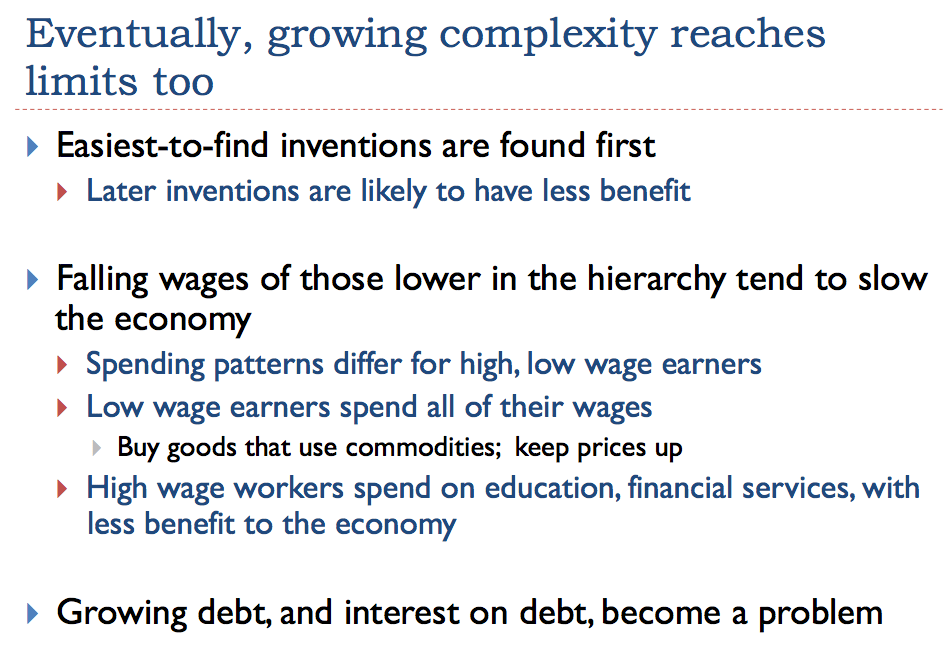
To try to solve the energy problem, we use approaches that involve increasing complexity, including new technology and globalization. As we add more and more complexity, these approaches tend to work less and less well. In fact, they can become a problem in themselves, because they tend to redistribute wealth toward the top of the employment hierarchy, and they increase “overhead” for the economy as a whole.
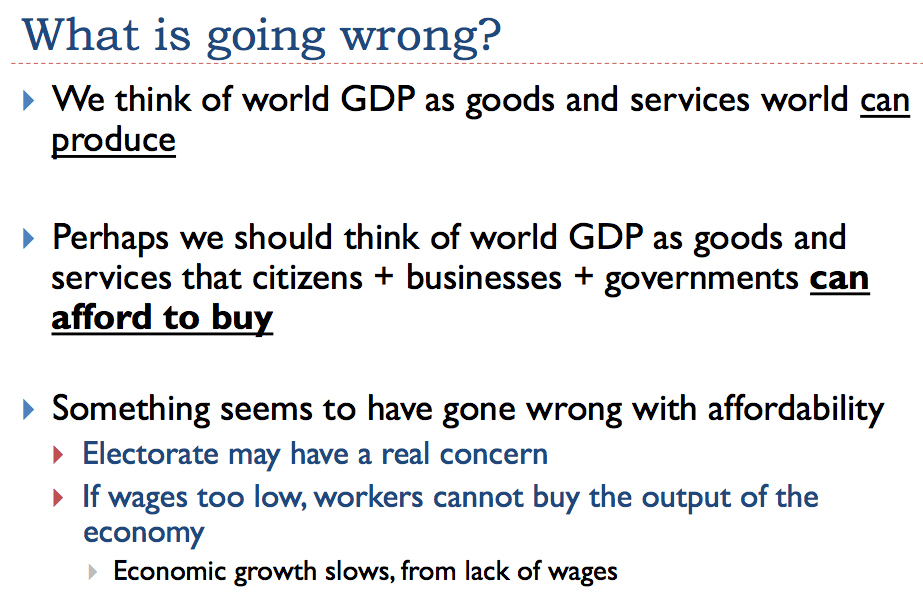
In this material, I explain how inadequate energy supplies can appear as either low wages or as high prices. Basically, if energy supplies are inadequate, workers tend to be less productive because they have fewer or less advanced tools to work with. Their lower wages reflect lower productivity (Slide 20). Slide 6 offers some additional insights.
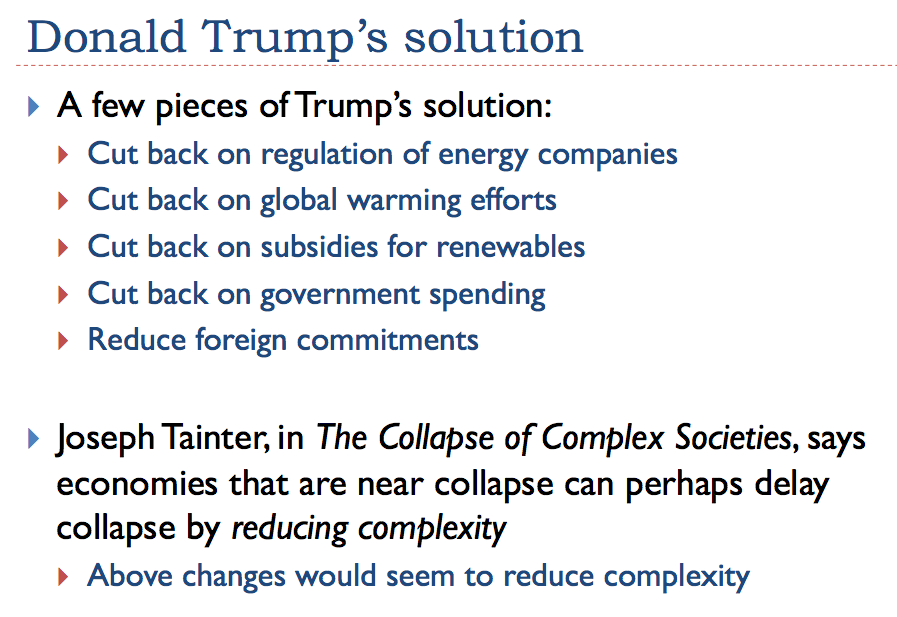
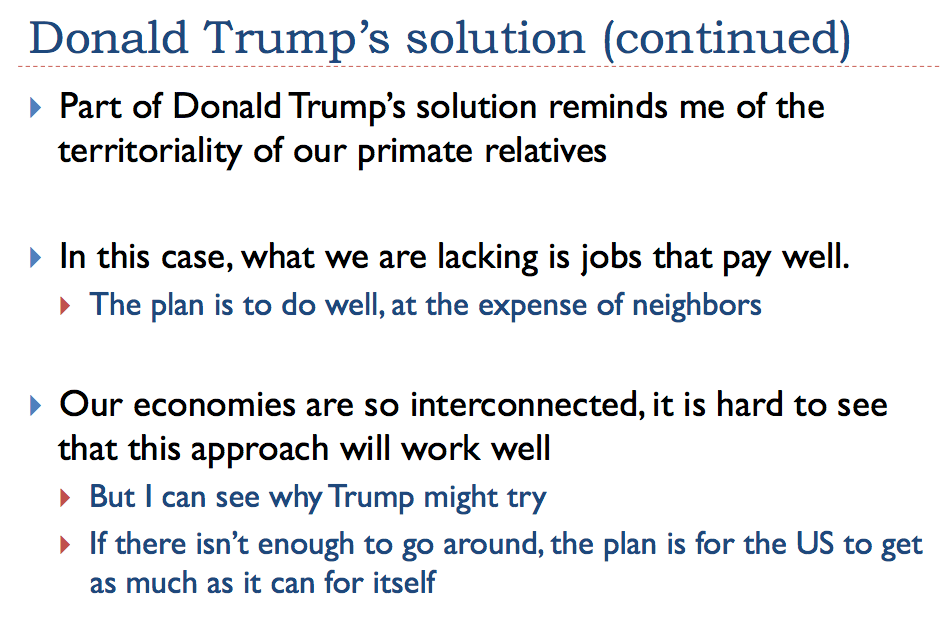
Trump’s election seems to reflect the cooling effect that our energy problems are having on the economy as a whole. Citizens are increasingly unhappy with their wage situation, and want a major change. Trump’s election may at least temporarily have a beneficial effect, since it may work in the direction of reducing complexity.
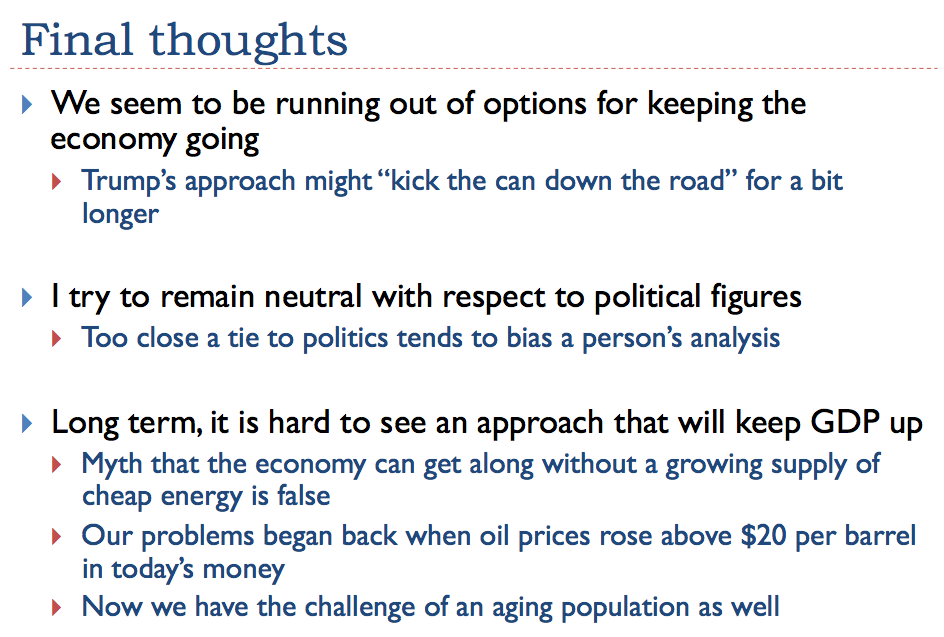
Long term, however, it is hard to see that the policies of any elected official will be able to fix our underlying energy problems.
I wrote up my post as a presentation. It can be downloaded at this link: The Energy Problem Behind Trump’s Election. I thought this might be a way of putting together quite a bit of material into one place. I have displayed the images of the PDF below the fold, for those who would like to read them as a post.
I hope the large number of images does not cause viewing problems. Let me know if you have suggestions for making this material more accessible.
Slide 1
Slide 2
Section 1: Trump’s Election Reflects the Winds of Contraction

Slide 4

Slide 5
Slide 6

Slide 7

Slide 8

Slide 9
Section 2: The Surprising Role of Energy

Slide 11

Slide 12

Slide 13
Section 3: Humans’ Unusual Use of Energy

Slide 15

Slide 16

Slide 17

Slide 18

Slide 19

Slide 20
Section 4: The Role of Complexity

Slide 22
Slide 23

Slide 24

Slide 25

Slide 26
Slide 27

Slide 28

Slide 29

Slide 30

Slide 31

Slide 32

Slide 33

Slide 34

Slide 35
Section 5: Where we are now with respect to energy and the economy

Slide 37

Slide 38

Slide 39

Slide 40
Section 6: Trump’s Solution and Final Thoughts
Slide 42

Slide 43
Slide 44
Slide 45


Au contraire… I have driven off quite a number of Koombayists who were polluting FW… I’ve also killed a few trolls. … that is an enormous contribution….
Also — I suspect that a lot of resident Koombayists hold back their delusional comments for fear of having them exposed by facts and logic….. they are aware that I have an extensive digital library of facts and logic that will put the sword to their nonsense…
All in a days work…
https://s-media-cache-ak0.pinimg.com/736x/c2/b3/0c/c2b30c7130350b70faf78bbdd0fb3129.jpg
I always pictured you taller.
Is that an extra ammo clip in your pocket, or are you just glad to see us?
http://i.dailymail.co.uk/i/pix/2009/01/30/article-1132342-0208F6ED00000578-427_468x366.jpg
Nice!
Already be who you are … I found you !!!
http://img.radio-canada.ca/2016/01/17/635×357/160117_c07h2_dostaler-edward-fast-eddy_sn635.jpg
Toxix Eddy Munster pats himself on the back for a job “well done”(?)…not realizing the mistress of Gloom and Doom watches his back and protects her baby.
https://m.youtube.com/watch?list=PL3G1pOOnWOORm9TqhfilN9fapNulFwCBd&v=Ywh-2dAhOOo
Now, that’s the real deal
Or perhaps the professor agrees with most of what I post…. and feels that I perform a useful role here….
I can imagine it must be hugely frustrating to write these excellent articles — then see the same pumpkins post the same endless streams of nonsense…. ignoring facts and logic — and bereft of all common sense…
There has to be the urge to scream profanities at the Koombaya Brigade (to which you belong).
Again – your views are not welcome here — posting them will only expose you as clueless — why do you bother?
Why? Don’t you know by now? Are you clueless? Yes….
Yanking your chain and you bursting and getting so passionate about it is comical!
Isn’t it obvious? My God, like permaculture really matters in the scheme of the outcome?
What percent of the population has even heard the word, never mind read anything about?
Slim to none…and those actually took a stab at it? Come on, Eddy, I’ve been on the scene since the late 1980s and not much mainstream penetration.
But if you want to make it your mission here to knock it out of the ring…
More fun for me!
https://m.youtube.com/watch?v=ns9jAN-OudU
If you want to engage me then you will need to make use of facts…
To summarize (a partial list):
– 99%+ of all ag land will not support a crop post BAU — agree?
– 7.4 billion people will be desperate for food – they will have cars and enough gasoline to reach you – agree?
– your family and friends will also be showing up wanting to be fed – agree?
– spent fuel pond will spew massive amounts of radiation across the planet – into the air and oceans – agree?
– there will be no energy source other than trees — and all the ones close to where it is possible to live will be quickly cleared out
If you do not agree then you must explain – using facts – why any or all of this is wrong.
Eddy, you are clueless…good for me!
Percent of the human population that is dying even with BAU because of lack of food @
10% …of which only 1% is grown organicly…of which only 1% is grown by permaculture!
So, if we take it post BAU…how many should make it past the bottleneck?
Now, put on your Fast Eddy Simpson thinking cap🚀.
You got a better chance of hitting the lottery🐸 today than surving in any kinda urban/city post BAU….living outside in a rural space….I’ll be generous to make it easy 10%🐒
And your concerned about Koombaya???
It DONT friggin MATTER🐩 because like Gail has shown here with her population growth J curve the corresponding crash in ANY living population is so steep you might as well kick back and say forgetaboutit!
https://m.youtube.com/watch?v=5sSZlMlCoCw
You keep on fighting tooth and nail about it….its the principle that is at stake…after all you are RIGHT, the world is WRONG..
More fun to come….
I live in a remote area – with a very mild climate. I can grow food year round. I have extensive gardens and a big orchard. Loads of water.
But I have neighbours – many grow nothing — there is a town 15 minutes drive away with 7000+ people – they could easily walk here. They will walk here. Many have hunting rifles.
Within a single tank of gasoline is Christchurch – 500k+ people.
Even if I were not overrun by people demanding to be fed — I would struggle to stay alive.
Hence my decision to no longer give a flying &^% at this futile permie nonsense… it is truly futile.
Throw in spent fuel ponds and we’ve got guaranteed extinction.
I instead spend my time enjoying what little time is left.
Good luck with your project. Feel free to continue ignoring the obvious and wasting what little time you have left on hopium
Have you tried the Fast Eddy Challenge?
BTW – there is a huge permie krowd over at Peak Prosperity — why not make the move?
I came to a similar conclusion, trying to grow a few things in a small garden here. The amount I am getting, net of what insects and rabbits get, is not very great. The garden clearly needs inputs that I could not provide post collapse, particularly water. (It is on top of a hill, not near my house, so any water needs to be brought in containers in a wheelbarrow.)
My success at saving sweet potatoes has varied; one year I had mold problems. (The quantity of sweet potatoes is certainly not large enough for our family to live on.) One thing that limits planting is bedrock within 6″ of the surface. A person needs to bring in topsoil to get any reasonable planting depth. I brought in a little topsoil early on (2006), so I could see whether a garden would really grow any reasonable amount for the effort. I also had to take down a tree, because I didn’t have any area that was not shaded most of the time.
I have a large number of neighbors who would need food too. Some of them live closer to the garden than I do. I could not build a high enough fence to keep them out. I have trees that I get a small number of peaches and figs on. The quantity is not large enough to need to store beyond what we eat during the season. I have a couple of hazelnut trees that have never given a single nut. I think that they are wrong for the climate here.
I managed to break my left wrist in 2007 and my right wrist in 2016, both times during planting seasons. I figured out that there is pretty much nothing that a person can do one-handed in a garden. My garden would have gone to zero in those years, if it hadn’t been for others who saw my problem and helped. (Fortunately, a person can write posts with one hand.)
I am not quite as negative on others trying the garden experiment as Fast Eddy is. Some may live in better-adapted areas, and be willing to try the project on a bigger scale than I did. But I would recommend that the gardening experiment be done as a group project, so that if one person has to drop out for a time, it does not result in total disaster.
My only suggestion to anyone who wants to head in this direction would be to have a go at it while unplugged from BAU.
Try farming for a week – or better still a month or two….
This serves two purposes:
1. You will get a better idea of what it will be like when BAU goes down permanently — and it will allow you to decide is this something you want to spent all your remaining time and money on while BAU is still in play — or would you conclude the drudgery of that life is not worth living (or that you will quickly die when BAU is gone) — and instead just focus on enjoying the time we have left with BAU
2. It will also give you an idea of the things that are most likely to go wrong – and help you plan ahead while BAU is available to help.
Dear Fast Eddy;
“99%+ of all ag land will not support a crop post BAU — agree?”
Ridiculous. I grow a very nice garden on former ag land, and know dozens of locals that do it too.
“7.4 billion people will be desperate for food – they will have cars and enough gasoline to reach you – agree?”
Absurd. Go ahead and try to drive from Dehli to NYC. Some can reach me, and nearly all of them will visit the more prosperous looking doomsteads first.
“spent fuel pond will spew massive amounts of radiation across the planet – into the air and oceans – agree?”
True-ish. The spent fuel ponds will make large local messes. (must I post it again??)
“there will be no energy source other than trees — and all the ones close to where it is possible to live will be quickly cleared out”
A gross generalization that is more or less true in some locations. If you are in the wilds of Alaska, the idea that they will be “quickly cleared out” is patently false.
Facts,
Pintada
Ridiculous. I grow a very nice garden on former ag land, and know dozens of locals that do it too.
Congratulations! You have proved me wrong … One question before I concede … how many million hectares is your garden? And your neighbours?
https://agenda.weforum.org/wp-content/uploads/2015/08/agriculture3.png (note – most organic land in Australia is rubbish and supports sheep only)
https://www.weforum.org/agenda/2015/08/which-countries-have-the-most-organic-agricultural-land/
“7.4 billion people will be desperate for food – they will have cars and enough gasoline to reach you – agree?”
Absurd. Go ahead and try to drive from Dehli to NYC. Some can reach me, and nearly all of them will visit the more prosperous looking doomsteads first.
How many people live within walking distance of you? How many live within a tank of petrol?
“spent fuel pond will spew massive amounts of radiation across the planet – into the air and oceans – agree?”
True-ish. The spent fuel ponds will make large local messes. (must I post it again??)
If you want to post the Sandia theories again – none of which have been put in play because as we know fuel ponds are all dense packed — you can do so — I know it makes you feel better… it calms your jangled nerves. But it is rubbish – total rubbish
“there will be no energy source other than trees — and all the ones close to where it is possible to live will be quickly cleared out”
A gross generalization that is more or less true in some locations. If you are in the wilds of Alaska, the idea that they will be “quickly cleared out” is patently false.
The forests will not be cleared in places like Alaska because the people there will have long starved to death.
As someone – I think Norman – has pointed out — people clear forests in concentric circles – eventually the trees are too far from your home to bother with
If anyone wants to live in the far north they might want to consider trying to live like an Inuit…. otherwise they are dead.
Of course in DelusiSTAN the facts don’t matter – if you wish hard enough — it can happen!
Dear Fast Eddy;
“Throw in spent fuel ponds and we’ve got guaranteed extinction.” Nope.
Dear Finite Worlders;
First, an analysis from Sandia Laboratories
“These results should be considered in context with the fact that according to current practice, decay times as short as 30 days in reactor-sited pools and 11 year in away-from-reactor pools are possible.”
So, a significant proportion of the spent fuel rods have been used as much as possible in the reactor, and then have been stored safely for many years. The fuel that has been stored for more than five years can be dry casked. It doesn’t need water cooling at all. Since it can be stored in a dry cask, it can also be stored in the racks in the pool without overheating. Stated another way, that fuel is safe regardless of the existence of water in the pool. From the book:
“For most of the cases considered, a 3-year decay period is sufficient to keep the clad temperatures within safe limits even when there is no ventilation at all.”
The cases where fuel that has been stored for 3 years, and is unsafe, are due to tighter placement of the fuel, and smaller holes that restrict air circulation. The 3 year number is for spent fuel from a Pressurized water reactor (PWR) for fuel that was used in a Boiling Water Reactor (BWR) the time required is less. (There are more PWR reactors than BWR reactors.)
“… the amount of heatup occurring in the unventilated or underventilated away-from- reactor storage pool is considerably lower when the pool is filled with BWR fuel than when it is filled with PWR fuel.”
For spent fuel stored outside, or in a room with an open door and roof vent the study concluded that:
“1. Considering a complete pool drainage, the minimum allowable decay time for PWR spent fuel in a well-ventilated room varies from a best value of about 5 days, for open-frame storage configurations, to a worst value of about 700 days, for high-density closed-frame configurations with wall-to-wall spent fuel placement. Other storage configurations fall between these limits. The minimum allowable decay time is defined as the lower limit of safe decay times, such that shorter decay times would produce local clad failures due to rupture or melting.”
“2. The minimum allowable decay time for BWR spent fuel in a well-ventilated room varies from a best value of 5 days to a worst value of 150 days for the cases considered. A high-density storage rack design for BWRs would result in a somewhat higher value of the allowable decay time than presented here, but not as high as for PWR spent fuel.”
That is ALL fuel that has been stored for 700 days after BAU would be safe. Some fuel stored only 5 days would be safe. Interestingly, the author goes on to say that by making a few modifications to the racks, that 700 day number could be reduced to 80 days at no expense to the utility.
If the fuel is stored in a closed room with no ventilation, the spent fuel would need to be stored as long as 4 years before it was safe.
The author calculated that it would likely not be wise under any circumstances to stand at the edge of the pool after the water was gone. Just as obvious, the idea that all of the spent fuel known to exist would – as a matter of course – burn, melt, go critical and scatter radiation over vast areas is simply ridiculous, as I stated several days ago.
The second study from Brookhaven National Laboratory was charged with determining the damage that would be caused by the spent fuel that did overheat per the study at Sandia. In the “Consequence Evaluation” section of the Brookhaven study one finds:
“Because of several features in the health physics modeling in the CRAC2 code, the population dose results are not very sensitive to the estimated fission product release. A more sensitive measure of the accident severity appears to be the interdiction area (contaminated land area) which in the worst cases was about two hundred square miles. While the long-term health effects (i.e., person-rem) are potentially large, it is important to note that no “prompt fatalities” were predicted and the risk of injury was also negligible.”
In the later portions of the text, the author notes that the reason that there are no prompt fatalities, and the risk of injury was small is that the model used assumes what I would call BAU mitigation. So, yes their would be major health effects in the 200 square mile area if the fire happened post BAU.
Regarding their review and update of the Sandia work:
“Based on the previous results we have concluded that the modified SFUEL code (SFUELIW2) gives a reasonable estimate of the potential for propagation of self-sustaining clad oxidation from high power spent fuel to low power spent fuel. Under some conditions, propagation is predicted to occur for spent fuel that has been stored as long as 2 years. The investigation of the effect of insufficient ventilation in the fuel building indicated that oxygen depletion is a competing factor with heating of the building atmosphere and propagation is not predicted to occur for spent fuel that has been cooled for more than three years even without ventilation.”
Recall that under the worst conditions possible, the Sandia study found that spent fuel stored only 3 years might cause a large issue. The Brookhaven folks showed that fuel stored only 3 years might overheat, but would not create the worst fire possible.
Yup. The spent fuel will not be moved, it will not all be dry casked, it will be radioactive for centuries and dangerous for decades. It is entirely possible that every nuclear reactor that is in operation today will have a fire in the spent fuel pool(s) and it is entirely possible that the fire will be the worst possible. Assuming the worst happens at every facility, there will be roughly 1000 areas with a 15 mile radius that will be unsafe for the foreseeable future. If the population density in those 200 square mile area is high, millions will die or wish for death. Millions.
Spent fuel pools cannot:
1. Explode
2. Spread radiation uphill more that 20 – 30 miles
3. cause human extinction
Spent fuel pools will:
1. Contaminate surface and groundwater including the oceans
2. Make a terrible mess in the immediate area
Tell your tribe where the nukes are, and make sure the young ones know that it is crucial that their decedents never forget where those unsafe areas are. Do not live anywhere near one. No hysteria or histrionics are necessary, but FE lives for histrionics and hysteria, so please FE ignore the facts again. I will post this later.
Glowingly Yours,
Pintada
U.S. Government; Nuclear Regulatory Commission (NRC) (2011-03-16). 2011 Nuclear Power Plant Sourcebook: Spent Nuclear Fuel and the Risks of Heatup After the Loss of Water – NRC Reports – Crisis at Japan’s TEPCO Fukushima Daiichi Power Plant (~200 pages). Progressive Management. Kindle Edition.
“It has been known for more than two decades that, in case of a loss of water in the pool, convective air cooling would be relatively ineffective in such a “dense-packed” pool”
http://science.time.com/2011/03/15/a-new-threat-in-japan-radioactive-spent-fuel/
And just like that … the entire Sandia theory — goes up in a puff of smoke (and radiation)
If it makes you feel better then keep on posting it…
Plenty of two legged food post collapse.Fuel not so much so sushi style will have to do.
The discussion is getting edgy here. This is to be expected, we are watching a pot that is taking forever to boil.
Broadly speaking, I would classify doomers into four types, and it has to do whether you think the collapse is slow or not, and whether you think we should prepare or not
Group 1: slow collapse, don’t prepare (I’m amongst this group and have always been clear about it)
Group 2: slow collapse, prepare and here’s how you do it – permaculture, alternative energy advocates, tend to be within this group
Group 3: fast collapse, don’t prepare – Fast Eddy seems to be here. though of course he has often said that he is indeed preparing in various ways
Group 4: fast collapse, prepare and here’s how you do it – extreme survivalists, hoarders, gun nuts etc. – they seem to think you are going to need large stores of food and arms to survive and fend off the zombies
I’ve always found group 4 to be curious. Why would you even want to live in that world? Better to be happy and then just die when your time comes. None of us get out of here alive.
Fast Eddy is hard to put into a group. On the one hand, he advises we have our dental fillings replaced (was it for the mercury, FE?), yet on the other hand his SUV is kept full with enough gas so that he and his wife can end it all by driving into a bridge abuctment.
I know what that feels like, FE. Do I just go down with the ship or do I fight back? With most of my years behind me, I find that I still want to extend my run – if only out of curiosity.
I too am curious to see how this plays out — but unfortunately when the electricity goes off — one’s view of the situation will be severely limited —- basically confined to what is happening outside one’s front door.
No tv – no internet – no newspaper.
I am afraid we will be very disappointed
Good post, dolph, and I too fit into group 1. The reason I’m in that group is because I think the situation is not rigid, i.e. it’s flexible enough to shape-shift as problems arise, even extreme situations. For example, look at what happened in 08/09. It seemed like it could lead to collapse, but what actually happened was a zero sum game in which many lost a lot, while vultures picked up super cheap property and held on to it long enough to make money and the overall system absorbed the losses and kept on going.
As defaults occur, as businesses go bankrupt the economic landscape alters rather than collapsing. Even as the overall value of the economic beast descends there are winners and losers, but not any scenario where all lose. We aren’t the most adaptable species for nothing – people are great at taking advantage of dire situations to their advantage. Even if a country has a currency that hyperinflates until it’s essentially worthless, something happens to start the game again for those energetic enough and willing to take part with the new currency, to take the initiative to grab what remains. Like musical chairs we will play this game for many decades to come. It won’t be pretty, in fact it will be downright distasteful at times, but then again watching a pride of lions battle hyena for what’s available during tough times is also hard to watch, but that doesn’t stop them anymore than it will stop people from doing whatever is necessary to get their needs met.
How many different careers do people now have vs. our grandparents? I’ve worked in construction, representative for a company with banks, commercial real estate, General contractor and now I’m in the Arts, so just on a personal level people are able to shape shift and society just does that on a much grander and broader scale.
How are you Stilgar? It’s me, HVL Don. I hope all is well with you. Lot’s of reconstruction going on I imagine. Whatever group we end up in, be well.
dolph,
I’m in the fast collapse what-ever-you-do-you’re-dead camp. But since it can become somewhat boring, just talking about doom, and I have put in some considerable hours thinking and learning about our predicament.. lets consider what preppers should be prepping..
here are some easy pointers about it http://www.bbc.com/future/story/20161124-how-to-cope-with-the-end-of-the-world
What surprises me about preppers in general is that they concentrate on food, guns, ammo, stockpiles and fortifying their premises. Their mindsets are about surviving untill everything reboots. But there will be no reboot..
Considering there will be no reboot, and anything you do will be to no avail, instead of hoarding stockpiles, I’d learn me some skills..
a. learn first aid. Any proficiency in first aid helps, really.
b. learn how to ferment foods. Without fridges, food storage is really difficult, root cellars only go that far, learn how foods can be fermented by various lactic acid bacteria.
c. learn natural herbs and natural vegetables. It’s surprising but natural herbs and natural vegetables grow everywhere. And I literally mean everywhere.. every-where.. To be a successfull “hunter gatherer” you’d just have to know where to look..
d. learn how to make biochar. The ideal, of the ideal, of the ideal in organic farming would be to have the urine and excrements separated. Urine goes in with the biochar, and excrements in to a composting toilet. The longer the biochar is soaked in urine, the more potent a fertilizer it becomes. Combine the urine soaked biochar with compost and soil, add some limestone or fish, and all crops will be about +50% crop yields first year, +100% the second year, compared to just about any other form of organic farming method.
e. learn how to use ginger, garlic, chayenne pepper as a natural antibacterial component in food preparation or fermenting
f. learn how to make cannons and explosives from common items found on a farm. It might be a bit difficult to reason with hordes of people, that you are usefull because you know the skills above. But a few cannons and some explosives just might give enough shock and awe to start a negotiations (and always have plenty of moonshine available..)
Just saying.. about prepping.. with skills like these, there just might be some fun in the years ahead.. and who knows.. with skills like these.. you’d probably have a fun prosperous time, inside BAU..
There seem to be very few peppers out there. I have yet to meet one unless they all wear a secret code ring or something. Most people I know continue day after day thinking that prosperity has just been voted into office. My point is that when collapse becomes so apparent, you probably won’t have much competition for very long. Like a bear chasing you and your buddy, just out running your buddy will be sufficient. There will be no marauding zombies. Most will likely die in place waiting for ‘they’ to do something. But then what. Prepping has only bought a little time at best. What group is that?
‘But there will be no reboot’
When the stockpiles run out … then the real deal begins. Because there will be no way to replenish.
Preppers don’t seem to get this — they expect a reboot. There will be no reboot.
My advise for anyone wanting to stay alive would be to learn how to live as a hunter gatherer.
Of course there are those spent fuel ponds…
Indulge us Koombaya-ists a little further, if you would Eddy. I’m sure that, prior to deciding the fuel ponds were an ELE, you spent considerable time contemplating survival. Give us a comprehensive rundown on the scuttled plan (North American version if it exists). I’ve only seen pieces and parts heretofore. I’d be interested in seeing what I’ve forgotten
Purchase 10 40ft containers and fill them with spare parts for everything you think you might need for as long as you think you will live
Purchase 10 more 40ft containers and fill those with food stuff for when the crop fails – throw in assorted rifles and crates of ammo
Purchase 500 cords of fire wood and store it properly.
Pretend that you will be left alone.
Hope that you don’t cut your finger and die of blood poisoning… or that a sore throat does not turn into a serious infection requiring antibiotics.
Good list. Worth cutting and pasting elsewhere.
Someone has suggested that lock picking might be a good skill. As long as the folks at the other end don’t have guns and ammunition.
gail have u seen the developements in india we are in the early stages of a huge change in monetary policy which will i believe keep bau alive or growing especially if the entire world’s nations adopt it links provided i think the elites are well aware of our predicament and have decided to begin the next financial wizardry to support world growth there is one way out of our predicament and the elites know full well what needs to be done. what everyone on this site should try to understand is that the elites are privy to OFW’s message and they have known this for many years that is why they have a plan to keep bau growing. http://www.bbc.com/news/world-asia-india-38048051
It strikes me as strange that India would wipe out the large notes commonly used in that country. I think the big change is going to bring about problems, because people won’t be able to buy high priced goods, without bank services. Some buyers will be cut out of the market because of this.
I don’t really believe that the elites know and have a plan. Plans are too expensive to implement. Perhaps they sort of know. If the know, they know the Peak Oil story (high oil prices as we reach limits; renewables will save us), which is basically wrong. The plans they have are for electric autos, and higher-mileage cars in most countries. Our problems are that workers are too poor. I don’t think that this approach will solve the poor worker problem.
The shape of things to come? Rising crude prices + falling pound since Brexit =
Thousands face uncertainty as low-cost supplier GB Energy Supply closes down
http://www.telegraph.co.uk/business/2016/11/26/low-cost-supplier-gb-energy-supply-closes/
Meanwhile rocketed national debt to sustain a usual 2% annual growth under an “austerity” regime
http://www.telegraph.co.uk/business/2016/11/23/britains-debt-mountain-set-hit-2-trillion-2020s/
Thanks! So far, there have been a lot of bankruptcies, but really very few left without electricity or oil. The ones who are left out are ones that we somehow expect to be left out. They are people who cannot afford a car, because cars are too expensive, and they cannot afford to buy one, with their meager wages. Or they cannot afford to buy a home. Young people especially live with relatives longer. This represents a reduction in oil or energy use, but we don’t notice it, because it was expected.
So far, there have not been people cut off because their electric company went bankrupt, like the one you mention in your link. This may be changing in the future.
In the second article, I thought it was interesting that the forecast said that in a couple of years, things would again look like things would somehow turn around on their own. The turn around seems to always be two years away.
If people what to point to what collapse might look like …. I would advise to look at places that do not have electricity or petrol… where people grow or gather every single thing they eat…
North Korea is a BAU consumer paradise by comparison
We know why the Permies don’t want to point to places that are completely unplugged from BAU— because they look like pretty grim living…. they know they could never survive in that sort of situation …
Hobbie Farming Permies who think they could make it without BAU (who won’t even try a week without electricity and petrol!!!) … I see them as no different than the guy who buys a Tesla and believes he is green…
Delusional.
http://uk.reuters.com/article/us-china-steel-restructuring-idUKKBN13J11T?type=companyNews
China will send inspection teams to investigate and severely punish illegal expansion by coal and steel firms as part of its efforts to slim down the two industries, the country’s cabinet said on Thursday.
With most of the country’s steel and coal enterprises making losses in 2015, China promised in February to slash 500 million tonnes of coal production capacity and 100 million to 150 million tonnes of crude steel capacity over the next three to five years in a bid to reduce price-sapping supply gluts.
The coal oversupply problem is just like the oil oversupply problem.
Natural gas has some of the same problem, too. US natural gas prices are way too low, and natural gas prices around the world are low.
The problem is really that wages are not rising fast enough to pay for the higher extraction and shipping costs for all of these fuels. All of them are suffering from diminishing returns, so they behave somewhat similarly.
Seems like collapse fatigue is setting in, here. People are getting cranky.
Not I! I am a Laughing Buddha – thanks to home brew! I recommend it. 🙂
I know my RIGHTS
https://m.youtube.com/watch?v=Fds_hupE2vQ
Back at Fast Eddy’s
X, you’re the most funny guy here, I’d be glad visiting you and sharing some pints of beer
Thank you: but if you saw me face to face, you would most certainly fall down laughing. 🙁
Seriously, I went through a terrible experience in 2005 to 2009 – impending bankruptcy, loss of property, mockery by relations, etc, – and that has somehow set me up to face anything, like an innoculation.
What did dear old Adolf say? ‘If it doesn’t kill you it makes you strong’? Correct!
I only despair sometimes, when I contemplate the worst aspects human nature. But then I just put it out of my mind. We (Anglo-)Basques are good at not thinking……..
Saludos
Wisdom of Freya Stark, the great traveller:
‘Once you realise that you are booked on a train to a destination that can’t be altered, you can just enjoy the view without further worry.’
She knew what she was talking about: the doctor assessing her for her first journey in Arabia told her that her health was so bad that he would forbid her to travel if she were a soldier or diplomat, but as a private individual what did she have to lose?
She lived another 50 years or so, often in great pain, and impressed many with her vitality. Her last trip in great old age is on Youtube somewhere. Whoever dared to called women the weaker sex?!!!
Humans …
https://ugc.kn3.net/i/origin/http://media1.fdncms.com/sacurrent/imager/u/slideshow/2504457/nosferatu.png
… It is advisable to take certain distances.
Well, I don’t know you look like the Hunchback of Notre-Dame but I’m not looking for a partner, especially not to have one a thousand miles away!
I lived an experience very much like yours in 2012-2015, and yes, like an innoculation following a very ugly revelation. But most of the worst people I encountered have lost something directly as a result of mocking me, even if I did almost nothing for it to happen… A bit of divine justice or such. Another interesting saying: Sit on your front porch and you will see your enemy’s body pass by. It reminds me of ahikido also
Saludos, che
https://tomfernandez28.com/2016/05/12/if-people-will-do-this-over-a-tv/
Imagine what they’d do over a carrot from a permie garden when the shops are empty….
Ever notice how some people get extremely irritable when a meal is late … and the hunger pangs kick in…..
According to the limits to growth model, which I am a broad subscriber to, we are at the beginning of the breakdown of our systems, but population keeps rising all the way to 2050 then begins to decline. I think it might happen earlier, I perhaps would date is to early 2040s. But the reason we last that long is basically lag in the system. People are fat (they have stores to last them through starvation), resources are available to triage in healthcare, etc. It’s not until later do we really have the combined effect of malnutrition and poor delivery of healthcare services which will result in starvation and epidemics, and, even then, it’s likely the older and middle aged who will go first.
50 kg fat will only last you six months of watching Netflix, it will melt away quickly if you intend to to any horde-ing.
It is often pointed out here that LTG is invalid past the peak. I have a hard time imagining people starting to have 4-8 kids again, 2 kids became the norm not because we attained a certain wealth, but because of urbanisation, welfare state and break up of family following that wealth. On the other hand I think we will fight hard against higher child mortality.
Affordability will increase death rate among older, maybe they still can eat a couple medications daily as some kind of multivitamin, but triple bypass and advanced cancer treatment? Only if you’re rich.
@DJ
D. Meadows said that himselg at the Age Of Limits 2014 – when the first curve reaches its peak – then its all new space for what happens then.
Also he said that the real problems arise before the “peak” of the curves – he called it “upward pressure” – and I think that is what we see now. I think that was at a Volkswagen Foundation symposium in 2012 (which sponsored the LtG study in the 70′).
What would the “real problems” be? Massive population decline through increased death rate would be the buggest problem. Especially for those who are doing the dying.
Impressed by the book and not surprised they realized the mechanics could change on the way down.
I definitely agree. Dennis Meadows himself has explained that the model is somewhat misleading. They really don’t know what happens after peak begins. And there are very definitely upward pressures (which may appear as downward price pressures) before the system crashes.
I think an awfully lot of people have been assuming that the models show more than they really do. I talked about this in my post https://ourfiniteworld.com/2016/07/25/overly-simple-energy-economy-models-give-misleading-answers/
High maternal mortality was reduced in the first half of the 18th century, due to better hygiene: doctors were proud of that at the time.
Child mortality, however, remained distressingly high due to infectious disease and tainted water/ milk. As late as the early 20th century we see even the children of the very rich dying of typhus and TB.
There will be no battle to fight without clean water, antibiotics and vaccines: without them, we lose.
“There will be no battle to fight without clean water, antibiotics and vaccines: without them, we lose.”
I very much agree with you. Our high priced medicine does relatively little compared to clean water, antibiotics, and vaccines. We are now “packed in” so tightly in the world that we are utterly dependent on grid electricity to run our sanitation system, plus many other systems that allow us to keep adding to antibiotics and vaccines. As hard as we are trying, I understand we are getting behind.
And as I just commented elsewhere, I think that the reason the death rate will rise will likely be the clean water, antibiotics, and vaccines issue, rather than starving to death.
Keeping hospital rooms clean would be helpful. I also hear that, indispensable as they are, antibiotics are greatly overused. The same may apply to vaccines. Proper sanitation and health planning to strengthen the immune system, plus better use of oriental medicine (as a complement to mainstream medicine) could reduce the over dependence on antibiotics and vaccines. What I see from personal experience and talking to people is that the money in the Medical Insurance industry causes many disincentives to provide adequate medical care. I also question whether proper nutrition, combined with the above mentioned health services is not a way to bring the cost of those services down. What about an “all of the above” approach?
I agree that proper nutrition would get rid of a huge amount of disease, and thus the need to ever see a doctor.
It seems to me that an awfully lot of doctors view medicine as a way to make money. They offer medicine and/or surgery for any slight ailment. Furthermore, many elderly patients are lonely. They see visiting a doctor as their social outing for the week. Thus, they go to the doctor for any little thing that might be wrong. The combination leads to an awfully lot of over treatment.
Gail,
“I think that the reason the death rate will rise will likely be the clean water, antibiotics, and vaccines issue, rather than starving to death.”
I really believe it will be all of the Horsemen combined together that will take us down: War, Famine, Pestilence…Once one part of the tapestry begins to unravel, the whole thing comes apart.
You are probably right.
InAlaska-
I really enjoy reading what you have to say. Keep it up. But being a gun guy, I think all the things you list can be kept at bay if I only have enough ammo stockpiled;-) I expect most men in Alaska don’t believe there is such a thing as too much ammo!
5th horseman – spent fuel ponds.
Thanks, JoeBanana. Those who survive will be the ones who live in the Far North, or the Far South in low human density situations, who have basic skills such as low-intensity agriculture, hunting and basic survival knowledge. I’m not a survivalist, though. Just someone who has spent a lifetime living as self-sufficiently as possible. I have lived unplugged for weeks. It sucks. But you can do it. The caveat being that we don’t cook the planet. Without agriculture/water its game over.
How many times does it have to be explained – if BAU stops growing — it will collapse and cease to exist – in its entirety.
There will be no rationing of health care – there will be no medicine – hospitals will be abandoned.
As for fat stores perhaps you are confusing humans with bears?
50 kg fat on a 130 kg person is not unresonable.
And watching Netflix is close to hibernation.
Unlike for the bears, spring will never come.
Why are these kind of views being posted on this site?
The contributors seem to have ignored or completely misunderstood the blog author’s key messages. Why, therefore, do they think this site is a home for them? It’s not as if they spend any time in fruitfully criticising Gail’s arguments. Skepticism, especially in the uninitiated, would be healthy. Unwanted and unwelcome however are these various pontifications which undeservedly grant themselves the status of ‘counter-arguments’ without first respectfully and thoroughly attempting to counter this blog’s core assumptions.
It’s as if a blog about sport fishing is attracting comments from tropical fish tank enthusiasts. Yes there is some connection, they are both about fish…but we catchers of marlin find you filter-cleaners out of your depth and disturbingly out of place.
@futuresystemsanalyst
I surly agree with you – and remember that Gail posted something in that regard towards FE, too.
The message FE has is one which he may promote at this own blog. I say promote, because there is no discussion for him and there is no hypothesis to his comments (at least as far as I understand him).
Its not that I differ much from FE views – but that is not the point. I still have hope that there is something in which we can extend and navigate the down-turning for the next round like in Asimov’s Foundation novels. I have still hope for myself to use my individual life time for something other than crying out loud here, e.g. enjoy my muesli tomorrow when the sun goes up.
We life only in the moment – and I think there is a certain social responsibility to don’t say or repeat everything about ones own opinion all the time. Also I think its a social responsibility to not open Pandora’s box of knowledge to all the people, especially when ones own opinion is that there is no solution to the presented problem.
If there would be maneuvering room, time to change or advert – then it may be o.k., but (for me) not when ones opinion is that there is “nothing we can do” as D. Meadows formulated it once. It is hard enough for me to cope which what I think the future will be.
Best
Ert
Interesting moral points: there is little point in scaring the horses.
Although I would suggest that when the news is bad enough, most people simply don’t listen at all!
I love the Churchill story: that after some very bad news, a general said ‘This is awful, I feel dreadful!’ Churchill: ‘It is indeed dreadful, and I feel wonderful!’
Of course, there was, as history proved, possibility of ultimate survival and victory.
V FOR VICTORY!
“I love the Churchill story: that after some very bad news, a general said ‘This is awful, I feel dreadful!’ Churchill: ‘It is indeed dreadful, and I feel wonderful!’”
I love the complete absence of “realism” in Churchill. It may have helped Britain.
Yes I would agree that FE repeats himself ad nauseam… but the rounds of hopium keep repeating themselves too so you can see his dilemma.
You have admitted the fundamental problem you have with FE. He doesn’t offer the hope you cherish. Actually the converse of that is true too. Some of us have a problem with the way hope finds its needly way into everything. We gave up on hope a long time ago and began living our lives without it yet we enjoy our breakfasts too.
It does get tiring having to repeat the same facts and logic to the same people over and over and over…
I would much rather move on from these ridiculous discussions… or ignore them…
But if we ignore them then the Koombaya Krowd will overwhelm FW with this rubbish and the site would be ruined…
If people are to reject facts and logic…. then a few bursts of the flame thrower are called for….
You know, I really have to object to FEs position that he alone has a fix on the future. He sounds a lot like Donald Trump by insisting that he sees the only course forward. His repetition and bullying really stifles anything else interesting that others here might have to say. All of us are hopeless doomers to one extent or another or we wouldn’t be here, but his repetitive metaphysical certitude gets in the way of thoughtful discussion and the examination of the “finite world predicament” from other angles. I find it interesting to talk with you all about the various ways the future will unfold without being drowned out by catcalls of “Koombaya.” I don’t eat mueseli for breakfast (just coffee and eggs), but I live on a homestead in the remotest part of Alaska and I spend a lot of time thinking about these issues. It feels pretty good to be as disconnected from the industrial machine as possible, even if in the end its not going to work out. We live very prepper/self-sufficient existence and it is nice to wake in the morning and read what others have to say about their own situations. Nobody has a clear view forward. In reality, FE has an opinion (certainly well informed, but always snarky and sarcastic) just like anybody else, but that is all it is: opinion. Of course, FE could be 100 percent right, but if he is nobody will know it because we’ll all be likely dead. However, almost always, those who predict the future with such utter certainty end up looking like fools.
‘hope’
Instead of sitting in this airport for 4 hours waiting on a connecting flight I hope that someone will give me the keys to a private jet.
Hope is just another word for Koombaya.
I – and I think a small group of others on FW – are not interesting in talking about hope — we are interested in facts – logic…
I am not enthusiastic about the fact that I am going suffer and die decades prematurely — I have searched desperately for a way out — I have wasted a lot of cash on this search…
I see no way out.
If someone has a way out and can demonstrate that it is feasible – I am all ears.
Hope is not a way out.
It is a cop out.
For those who are unable to accept reality.
Now where is that guy with the key…. I have been hoping he’d show up for over two hours now…
The only thing that *really* scares me is the radiation. My only hope is that enough people in power will understand the gravity of the situation and try deal with it. By dealing with it I mean letting whole countries and peoples to their own devices , starving to death if need be, to use whatever energy is available to secure the fuel ponds. It would be the equivalent of cutting off limbs to save the body.
‘Filter cleaners’ !!!!!!
https://s-media-cache-ak0.pinimg.com/originals/07/e2/82/07e2829f5f8ddca35df5728956542047.jpg
Eddy….why do you keep repeating lies? I just posted there will be medicines from medicinals plants….that is a fact. Just because you do not need to purchase them from Walmart in a bottle does not mean they do not exist. You are an odd fellow….ranting and raving its the end of the World when BAU collapses… NOT TRUE….
Its the end of YOUR world, a world that in reality that was built on a fantasy of limitless consumption, expansion on a finite world….
You were saying about leaving….please consider it yourself….
There are alternatives that you yourself can not adapt yourself to, that does not mean others are unwilling or unable. Doubt we ever really needed Air conditioning, automobiles, cloths dyers, and a million other senseless items that in the end kill us literally, both physically , spiritually, and socially.
But if you seem to feel it is necessary to cling to it…be my quest…
One thing I am sure, you are an lonely, unhappy person and are toxic.
I just posted there will be medicines from medicinals plants….
What? For 7.4bn people and growing? I seriously doubt it pal.
Plise, PLEASeeeee, get real….did I ever claim that we were going to exist with 7 billion plus homo comsumptionians without fossil fuels?
Come on now…actually the reset will occur and a shedding of the overshoot will happen.
So, “pal”, you yourself best get “real” and acquaint to a solar economy instead of whining with Eddy that your precious is nearing an end.
No, rather folks like yourself stay here and cry on each other shoulders and go out of this BAU with your 20 foot container….
🎑
You came in with nothing, and will depart this world with nothing. Everything in between is just a game.Thanks for playing.
I think you underestimate the effect that shedding 7 billion people will have upon those that survive. It may occur rapidly, and if you’re in a remote and isolated place, you may survive. Those folks can use herbal medicines to get by, I suppose. It will be back to the frontier days.
From my experience most very remote places are very remote because they are places that are not much good for anything — they have little or no arable land — often no water — too cold — too hot…. basically they would be places nobody wants to live in or can live in – even with BAU in play…
The ‘reset’
This is that magical balance between a chaos severe enough that billions will die and a transition smooth enough to allow the enlightened to survive.
To my reasoning it is a situation as unlikely as having a building collapse spare the rooftop garden just because that’s where all the ‘good stuff’ happens.
No Jeremy is right. Naysayers keep pounding the drum that 7 billion can’t survive and use that as an argument. Of course, they can’t. No one is arguing that. After the “reset” some people will survive at a greater or lesser degree of complexity. Many of us on this site have been here for years and the collapse of BAU is always being promoted as “just around the corner.” It hasn’t happened yet…so maybe we’re missing something. Its worth a consideration. Stop already with the rhetoric.
Some might survive – until the radiation gets them.
But these are not going to be people living in places like America which will be crawling with starving, gun toting millions who be loading up their cars and looking for places where there might be food.
And even if they were not gun toting millions — permies in America would die — because they do not know how to live without BAU.
Case in point – not a single permie has taken the Fast Eddy Challenge — not a one has agreed to turn off the power and use no petrol for a week. End of BAU Lite shall we call it?
Because they KNOW that if they did that their bubble of Hopium would blow sky high. They’d quickly realize that the way they envision the end of BAU is nothing like they expected. The minute they had to start washing clothes by hand… cutting and splitting a tree … not being able to reach into the fridge for food…. not having a coffee in the morning….
No no no no …. Fast Eddy’s Challenge will not be tried….
The people who will be alive when the power goes off are living in extremely remote locations – who are already living without BAU.
Places like Irian Jaya – the Amazon – they know how to live without electricity and the various accoutrements of BAU.
They know how to live this way – they know where to pick a worm out of a rotting stump and eat it — their neighbours know — their families know.
They will go on living the way they live now.
And the permies will be cowering in the corner waiting to die and thinking to themselves…
It’s Little House on the Prairie – it’s not Little House on the Prairie….
http://bangkobangko.com/wp-content/uploads/2015/10/local-indonesians05-500×320.jpg
Use of the word “reset” in any application other than a electronic devise is misleading. It implies a healthy infrastructure exists that just needs a reboot. Actually there may be a reset if the time frame is several million years but this is not the meaning of those that use the word, usually quite frequently.
There might be a reset — when new easy to reach oil is created — in a few million years 🙂
Jeremy, that is a good point: “Use of the word “reset” in any application other than a electronic devise is misleading.” Even the belief of “reversion to the mean” is wrong, if we are encountering diminishing returns. Too many wrong models.
Further on the medicinal plant thing…
If you were offered the options under current conditions of :
– growing plants to treat any maladies you might have
Or
– using modern pharma + medical services
What would you choose Jeremy?
You are aware that plants were used extensively to treat people per modern medicine…. you surely are aware that they have very limited uses….
Dear Jeremy;
You seem to have it perfectly right. Much of the disagreement with your ideas seem to be coming from the people who have no clue how the real world used to work.
A better site for someone who can’t put up with Fast Eddy is the Doomstead Diner. Reverse Engineer will welcome you and your ideas with open arms.
doomsteaddiner.net ,
Pintada
Pintada: I have spent time at both sites. I prefer OFW (I read every new post) because Gail’s analyses are incisive and concise. DD is too messy for my available study time. I read the comments here only sporadically because they are too long and are infested with a large dose of toxicity—not only FE but he’s a major piece of that pie. I wish it were otherwise because I have found gems from various contributors, including occasionally from FE himself.
urudi (below): I disagree; some people are more toxic than most and FE clearly relishes the role of provocateur and resident insulter of any he perceives as “non-believers.” Unless Gail sees fit to rein him in he’s just part of the furniture. I recommend to Gail InAlaska’s judgment below; a modest dose of moderation can do wonders for the quality of blog comment threads.
Pintada – do you not recall how I gutted the guy from Doomdiner on here a few months ago… he left with his entrails hanging out … his nose was broken … I still have scars on my knuckles that look just like the teeth I knocked out of him…
The reason for the mauling was that he was bombarding FW with Permie/Survivalist crap….
I don’t imagine I would be welcome for long on Doomdiner.
If anything Jeremy and the rest of the Koombaya Krowd should migrate to Doomdiner…. they have a hell of a lot more in common with that guy than they do Gail
In fact they have zero in common with Gail – absolutely ZERO.
Still waiting for one of the Permies to take the Fast Eddy Challenge…
How long ago did I introduce the Challenge – must be two years now — and not a single person has agreed to try it
BTW – I developed the Fast Eddy Challenge based on my personal experience attempting The Permie Lifestyle….
I started to think about all the things that would go wrong that would quickly put an end to my Dream.
A valve goes on the gravity water feed – and it’s game over. The mother board blows (as it has) on the solar water system – game over.
I also started to consider what it would be like to have to wash clothes by hand… cut and haul firewood without a chain saw, log splitter and truck…
I have a big garden – how do I make enough compost? Remember – no lawn mower to gather grass clippings…
People will want to eat my manure producers — I may want to eat my manure producers.
I soon began to realize how precarious such an existence would be — there would be no Wally’s World to drive to and pick up a spare part — a new tool — a roll of wire… NOTHING.
I worried about what would happen if collapse came in winter – when I produce very little food….
Then I started to think about all the other people nearby who grow no food – my wonderful neighbours — who will be dropping by asking me to share — when there is not even enough for the 4 or us… will I shoot them? Of course not….
Then there are the thousands who are nearby who I do not know — they will come — they will definitely come (see Black Friday…) — sure I can shoot them — but they will come in numbers — they will be armed — they will want food.
Maybe I can hold them off for a bit — but what do I do at night? When they pour over the fence and kill my chickens — the sheep — rip up my garden — grab my firewood to try to make a fire to keep warm…
I began to realize that Doomsday Prepping is pointless — it assumes a temporary collapse — a reset … there will be NO reset…. something will break — something will go wrong — and no matter how well prepared I was — I would die.
I recognized the futility of it.
And rather than feel depressed I felt the heavy weight of worrying lift if there was something I forgot to stockpile?
Alas then I did my homework on the fuel ponds — having been alerted to the nuclear problem by an Orlov article….
56,000,000 Hiroshimas of radiation …. that sealed the deal… the fifth horseman
Extinction.
I know you and others get upset by all of this — you wail and moan because your kids and grandkids have been given a death sentence…
You grasp for hope — where there is none — you beg Mr Cognitive Dissonance to keep you from utter despair — and a trip to the mad house…
Keep in mind — if you feel you Mr CG is letting you down — and reality starts to creep in … there is always Peak Prosperity or Doomdiner.
They will cheer you up!
I don’t always agree with FE but I enjoy his posts. No one on this board deserves to be called toxic or lonely. Please, no personal attacks.
By ‘helpful’ you mean ‘hopeful’. Because oh dear we can’t accept that things won’t turn out for the best can we?
Toxic…. as in poisonous?
I am pleased to see that the Koombaya Krowd are feeling unwell after a dose of my toxins… perhaps I need to increase the dose to kill them dead?
Personally, i love reading FE and his POV. He has the courage of his convictions and writes great prose. Yes, he repeats himself in various ways, a tactic which all great educators use, but he also brings us many interesting facts to supplement and extend Gail’s less frequent, but meaty posts.
I love when I am personally attacked — it makes me chuckle —- it exposes the opponent as either feeble of mind — or of holding a position that cannot be supported with facts or logic.
Essentially it means:
http://www.sociology.org/files/victory1.jpg
Thank you Jeremy – keep up the great work
FE, actually you are repetitive and boring and your endless bullying are what keeps this site from being really good. The Moderator would do well to use an FE Filter. Others attacking your POV doesn’t expose anything other than lots of people don’t see it your way. Sure, facts and logic are excellent tools, but facts endlessly strip mined from internet websites are at best only as good as the source which can never be proven. As Donald Trump has demonstrated: a lie told often enough and loudly enough also can become “a fact.” Facts and logic got us into this predicament in the first place. Maybe you don’t know as much as you think you do.
“Doubt we ever really needed Air conditioning, automobiles, cloths dyers, and a million other senseless items” like water supply, sanitation, a food supply, a transport infrastructure, good energy sources for billions.
It’s very nice that you are wise enough to realise that aspects of our civilisation have negative impacts on us but that does not change the fact that things will get ugly. What point are you trying to make really? That a catastrophic collapse won’t kill billions? You don’t seem to be saying that. That there will be some survivors who employ creative methods to feed themselves? OK that’s sensible but it must take into regard that one of those creative aspects will be taking that food forcefully from those who have it. What your protests against FEism seem to be about are that his insights indicate that you yourself might not survive.
Beg my pardon, but it sounds from the tone of your comments, futuresystemsanalyst,
your interpretation into my comment is to support your liking for FE. It is indeed nice to be a privledge individual, not on the fringe or outside of BAU, talking creative methods of feeding billions. We are already employing “creativity” with industrial agriculture…
Guess what? How you going to eat without those magic pellets?
BTW, you accuse me of protesting against FEism. ????
What are you talking about? Mind your own and tell these folks how great BAU is
Hunger Statistics
Every year, authors, journalists, teachers, researchers, schoolchildren and students ask us for statistics about hunger and malnutrition. To help answer these questions, we’ve compiled a list of useful facts and figures on world hunger.
Some 795 million people in the world do not have enough food to lead a healthy active life. That’s about one in nine people on earth.
The vast majority of the world’s hungry people live in developing countries, where 12.9 percent of the population is undernourished.
Asia is the continent with the most hungry people – two thirds of the total. The percentage in southern Asia has fallen in recent years but in western Asia it has increased slightly.
Sub-Saharan Africa is the region with the highest prevalence (percentage of population) of hunger. One person in four there is undernourished.
Poor nutrition causes nearly half (45%) of deaths in children under five – 3.1 million children each year.
One out of six children — roughly 100 million — in developing countries is underweight.
One in four of the world’s children are stunted. In developing countries the proportion can rise to one in three
Seems we are already in a crisis!
Oh, when the 20 foot container of goodies goes empty of Fast Eddies he best be in a group of those whining Permies….good bye!
We are enjoying misinterpreting each other aren’t we?
I am scoffing at your belief of a possibility of a rosy ending to this mess. That doesn’t mean I like the mess we are in. I rail emotionally against the silly and omnicidal set of living arrangements we have created for ourselves every day. But I don’t let that emotional cloud delude me into thinking that a fantastical improvement will rise out of the ashes as a ‘reset’. I’ve had enough direct experience of alternative lifestyles such as you seem to think are our saving grace to realise they are but as lichen on a rock – they’ll be gone once their host society is turned to sand.
You seem to have missed the point on why the end of BAU is lamentable. Not because it is inherently GOOD but because it is USEFUL in maintaining life for those who aren’t already staving. You complain that it’s dreadful because it allows some to starve but the obvious outcome of removing it would be for many many more to starve. You protest that civilisation is ‘killing us’ in your earnest way but seem to have nor regard that the end of civilisation does the same but on steroids.
What you are railing against is this: the collapse will not bring about the changes you hope for. Others here who have experienced that hope for a ‘reset’ but challenged its assumptions try to take the time to explain to you why you are deluding yourself. I know its challenging and emotionally upsetting but the ameliorative collapse is a fairy tale we have all told ourselves at some point. For example when we examine the inescapable consequences of removing the life support systems and cultural continuity of such a huge number of people all at once we must accept the idea that the sensible, stable conditions needed to implement peaceful, sedentary permaculture will be absent.
‘Some 795 million people in the world do not have enough food to lead a healthy active life. That’s about one in nine people on earth. The vast majority of the world’s hungry people live in developing countries, where 12.9 percent of the population is undernourished.’
And the end of BAU is going to fix that?
Historically – before we harnessed fossil fuels — there was a hell of a lot more hunger than there is now….
The famine to end all famines will arrive with the end of BAU…. there will be almost no food — and there will be billions of starving people wanting what is left — how can you not see that?
Are you one of those people who watches a nature programme — and when the lion chases down the baby gazelle — you feel sorry for the gazelle — and wished you could stop what you see as an ‘unfair’ situation?
You do understand that there would always be hunger no matter what system we adopted— because if there is enough food — humans… like all organisms… tend to increase in population ….. we are always pushing the limits…
Do you get all teary when you listen to this?
Feed the world!
Let them know its BAU!
https://youtu.be/cIxj7Ew_99w
!!!!!!!
I think that “futuresystemsanalyst” is actually just FE in disguise. He has been known to use alternate monikers in the past. He has had many other names over the years. In fact, under another name he was once driven from this website. He returned. Sigh. Perhaps another exorcism is needed.
You would be wrong.
I can imagine that the dozen or so others who I am in alignment with are also one person no doubt.
Breaking News — there is a small group of people who actually get what Gail is trying to convey… and there is a much larger group of people who have not the slightest clue – and never will.
I am still stuffing my guts back in after laughing so hard about that comment ‘prove that everything collapses if growth stops’
It’s too bad to be true that surely it has to be a troll…
Got your book in front of me Norman — it will be a wonderful escape from the Idiocracy.
Oh – and the guy with the key to the private plane never showed up — I was hoping right to the last minute!
http://www.sociology.org/files/victory1.jpg
How many times does it have to be explained – if BAU stops growing — it will collapse and cease to exist – in its entirety.
Was it Stefeun who posted a quote going something like “The only thing I’m sure about is I’m not sure about anything”? This certainly applies to my muddled thoughts.
So, it’s never been proven to my satisfaction that if BAU stops growing it collapses. Agreed, whenever GDP figures drop close to zero there are mass layoffs, but isn’t that because “real” GDP figures are always worse than the massaged figures released by governments?
I can well believe BAU needs a minimum energy throughput to continue, but grow or cease to exist is a stretch. The analogy to a living organism applies.
The end was “I doubt about everything”.
But that’s Frenglish, so I don’t know if it makes any difference.
As for speed of collapse, I think it won’t happen overnight, but, still, we’re on exponentials, i.e. slow (and/or local) in the beginning then picking up more and more speed, and once we realize what’s happening, it’s already too late and unstoppable.
I think we’re already past that tipping point.
I tend to agree: the stream of ‘collapse indicators’ – great and small – is steady and increasing in tempo.
But we cannot say just when the axe will fall on our own heads.
This kind of “uncertainty principle” is more developped at crashoil site (the name is in english but it runs in spanish). That’s perhaps why I like it more than OFW these days, and also it’s compartmentalized so it’s easier to make in deep discussions there.
There is no single day when doom is not spelled at crashoil, but there is no doom frenzy and any obsessive misanthrope would only get silence as an answer. That’s also a very good trait
It’s curious how people who can’t bring themselves to admit the full ramifications of collapse accuse ultradoomers’ of misanthropy. My opinion on the matter is that in this age of advanced narcissism, individualism and human conceitedness anyone who presents the idea that one’s life will soon be over is categorised as a hater of that which people love the most – their sacred personhood. This is because we are so fascinated by thoughts of ourselves that we assume that anything which confronts us must be motivated by the same fascination, albeit one turned from idolisation to revulsion.
FSA,
In one of Robert Monroe’s books, I think maybe the 3rd in his series, he encounters what we would understand to be advanced life forms, far more evolved than ourselves. Monroe asked one of them, some sort of non-physical, highly evolved centralized life form, maybe something not unlike the borg from star trek, and it was incredibly indifferent to our existence…like it wanted absolutely nothing to do with us or learning anything about us. Humans do indeed feel that their fantasy ethics based on our relatively short-lived fossil fuel orgy are to be some sort of universal code for morality. Ethnocentrism doesn’t even begin to describe it.
Well, it’s exactly the opposite…
Misanthropy was explicitly sustained by FE, he said many times humans are “a cancer”, that “he would kill the remnants” that could have survived collapse, and so on…
In fact, FE is the very best example of what I’m saying (while he’s not the only one):
When he was known by the name of Paul, he was a gardener in Bali’s mountain, a clever prepper beyond Koombaya. But when he realised Bali’s ag is on steroids, that it uses tons of fertilisers and that it’s not a very sustainable place, then he started endlessly talking about the nuclear ponds… So, it’s him who can’t accept his death, who equals his personal death to the extintion of the species
And I see many people just can see such an obvious fact. Because it is not my interpretation, it is a fact
It’s interesting Tango Oscar ends up talking about ethnocentrism, because (letting aside FE’s kind of cosmic egocentrism) this is the main point: accepting the end of a civilization, the only one one has really known, the one that is all about us
It’s also intersting TO refers it to an alien, non human form, because it sets the limit: those who are not like us are not humans, plain and simple. But it is just ethnocentrism, not humancentrism
1. Yes humans are a cancer on the planet – or perhaps a deadly virus — I have trouble deciding..but either way – we are destroying the planet — killing of species — enslaving and torturing animals…. . and yes the planet and all organisms on the planet would be far better off if we were exterminated.
Anyone disagree with the above?
2. As I have stated on numerous occasions I am very pleased to be proved wrong. I was 100% wrong about the belief that becoming a Permie would allow me to survive the coming apocalypse.
How foolish I was to believe this nonsense.
How foolish was I when I used to subscribe to the NYT (international edition) believing it published the truth.
How foolish was I when I believed some day EVs and solar panels would replace our oil and coal economy.
How foolish was I when I thought Monsanto was the devil.
The list goes on.
The difference between me — and those who will not let go of the myths… the delusions… the hopium… the Koombaya….
Is that I will change my position if the facts dictate.
“it’s never been proven to my satisfaction that if BAU stops growing it collapses. ”
I agree. And how is growth measured? It must be growth of global fossil fuel consumtion? That is where the limits are.
For how long or by how much can fossil fuel consumtion shrink without total collapse before you are proven wrong?
Also I don’t understand why everything must be more fantastic than ever until the very end.
DJ
Physical property of all dissipative structures: grow or die (albeit with some inertia, hysteresis).
Have you read this post:
https://ourfiniteworld.com/2016/02/08/the-physics-of-energy-and-the-economy/
A hurricane is a dissipative structure. A hurricane does not collapse and die the moment it starts to weaken; in fact, a hurricane can weaken and then strengthen again. So the statement Physical property of all dissipative structures: grow or die is plainly wrong.
I did mention hysteresis.
A hurricane can keep running on momentum for a while without energy input (eg. on earth), but if it doesn’t find a new energy source quickly enough, it rapidly stops.
May I suggest you provide a valid link for your assertions?
A hurricane moves over water that is hotter and then over cooler areas. There is some flexibility in its size. This is just as it is with the economy. The economy can go through recessions, as it did in 2007-2009. But there are very severe limits on how much of a reduction in energy supplies can be endured, for how long. If governments had not stepped in with a great deal of cheap debt to restart the economy, that could have been the end, right then and there.
This is the same situation as with a human. There are severe limits on what can happen to the food intake of humans. A person can stop eating for a few days, or a person can go on a low calorie diet for a bit longer. Most people find it very difficult to permanently lose weight without changing what they are eating. There is definitely a range, especially for the short term.
Each kind of dissipative structure is a little different. The sun is different from a hurricane, which is different from a human being and its economy. The economy has many requirements that make it hard to “slim down.” We were able to make the economy “slim down” quite a bit in the late 1970s and early 1980s, when we shifted to smaller, more energy efficient cars that were already being made in Japan. But we are having a terrible time now. Debt is an important part of the economy now. It looks like one part that is likely to reach limits very soon, if economic growth (fueled by cheap energy) is not sufficient.
Thanks Gail,
You’re much better than I am, at that game of explaining.
I’d like to add a little comment about why dissipative structures have to grow.
They are created by an energy flow, in order to maximize the energy dissipation through organized arrangements. While doing that, they generate entropy, which modifies their environment.
Dissipative structures therefore have to constantly adapt themselves, import information from their surroundings (iow, store energy in the form of increased complexity) and try to rearrange themselves in order to keep the max energy dissipation rate.
The problems occur when the environment changes so fast that the dissipative structure can’t import new info (and get rid of old one) at sufficient pace. Another way to say it is that the dissipative structure is no longer able to expel entropy out of itself, it then remains inside the structure (pollution, waste heat, all kinds of “externalities”) and is a brake to energy dissipation.
A temporary solution is then to reinforce the internal links of the structure (tight coupling), but it also makes it more brittle and less adaptive.
If the energy input rises again quickly enough AND the structure is still able to dissipate it (i.e. not clogged by internal entropy), then the structure holds and can keep on growing.
If the energy input stalls and/or internal entropy level is too high (it keeps increasing, in fact), the structure has no other solution than collapse, at a certain -unpredictable- threshold.
A loose coupling allows some parts to remain intact, but a tight coupling insures complete collapse.
Thanks for the explanation. Too rigid a system is not good.
Your rigidity explanation reminds me of the Basel rules for banks. They seem to demand that bank limits take certain precise forms. Of course, once those rules are set in place, they act as a new set of rigidity that causes the banks to fail sooner rather than later.
May I suggest you provide a valid link for your assertions?
No need. I just proved with a counter example the statement “Physical property of all dissipative structures: grow or die” is total bollox. Perhaps you’d like to replace it with “Physical property of all dissipative structures: growing, reducing or staying the same” ? It’s not a particularly helpful statement, but at least it’s true.
“No need” & “It’s true”, hmm, I see.
“Prigogine has called these systems dissipative systems, because they are formed and maintained by the dissipative processes which take place because of the exchange of energy between the system and its environment and because they disappear if that exchange ceases. They may be said to live in symbiosis with their environment.”
http://www.eoht.info/m/page/Dissipative+structure
Main reasons for mandatory growth: diminishing returns of energy inputs, competition with other systems, stay ahead of internal entropy production (I’m missing some others, for sure).
There are very definite limits to reducing, without collapsing. Your statement is not really true.
Stefeun,
Could that be summarised as global total fossile fuel use must increase?
Assuming that is correct – how does that guarantee everything gets more and more fantastic until the very end? Surely per capita standard will fall for many?
And how can we guarantee everyone will rapidly die?
If not collapse is very sudden for everyone at the same time precautions will be taken that limits the hordeing and ponding and searising.
DJ,
Could that be summarised as global total fossile fuel use must increase?
Global energy input, not necessarily FF. Moreover, the energy has to be more and more concentrated, and we mustn’t forget that entropy (waste heat, pollution, etc..) has to be evacuated out of the system (this is what we aren’t able to do, in fact).
Assuming that is correct – how does that guarantee everything gets more and more fantastic until the very end? Surely per capita standard will fall for many?
Not really, what we’re witnessing is a bipolarization, a growing gap between few riches and many poor (akin to condensation). In average, the energy per capita has been growing until very recently, then started to decrease. Slowly in the beginning, and should accelerate drastically as soon as a key-node of our interlinked global system is kaput (likely from the financial world).
As for the rest, I can’t tell the future, but since both our food and medical systems fully depend on BAU…
Hurricane Yorchi grows to a category 3, weakens to a category 2, then grows again to a category 3. During the stage where it is weakening is it:
a) Growing – No;
b) Dying – No (Except in the sense we are all dying from the moment we are conceived);
c) Neither – Correct. Go to the top of the class.
QED. If you accept that a hurricane is a dissipative structure then a dissipative structure does not need to either grow or die. If you wish to argue this fact please find the error in my logic above rather than trying to muddy the waters.
Yorchican,
Spreading confusion is certainly not my goal, I’m ony interested in understanding (and it’s quite difficult sometimes).
Your example is not contradictory with the inertia/momentum I evoked in a previous comment. If the hurricane hadn’t found a new source of energy, it wouldn’t had grown again and would have eventually stopped after a while.
My example contradicts the statement “All dissipative structures must grow or die”. Nevertheless, I’m confident I’ll continue to read it at frequent intervals on OFW.
Whether the particular example of a dissipative structure that is BAU must grow or die, I don’t know. I don’t believe this has been proven either way.
Yorchichan (sorry I missed the h last time),
It’s called the Red Queen effect (or syndrome): run ever faster to stay in the same place.
You can easily find plenty of literature about that, same pattern applies in many fields.
@Gail
“There are very definite limits to reducing, without collapsing. Your statement is not really true.”
Oh, but I didn’t say “A dissipative structure can carry on reducing forever without collapsing”. I said “It’s not true a dissipative structure must grow or collapse”. The two are not the same. I stand by my statement.
I tried to explain that the needs of dissipative systems vary somewhat, based on their particular form. The economy can shrink a bit, in a recession, but it is pretty rigid in terms of its overall needs. We know of many, many economies that have collapsed over the years, when energy per capita fell too low. It is hard to see why out economy would be any different.
Well, two senior people in the City of London have said to me, in almost the same words: ‘If growth stops…..BOOM!’
Hence the desperate attempts to keep things rolling with infrastructure ‘investment’ which we see being touted as the cure for all ills now in UK and the US.
“it’s never been proven to my satisfaction that if BAU stops growing it collapses”
I am trying to decide if that is the stoopidest, most ignorant, most ridiculous lacking in common sense comment ever made on FW…
If not it certainly ranks very high.
Surely it should be obvious that if growth stops BAU ends — abruptly. If anyone cannot work that out for themselves they really do not belong on FW.
Well then, if it is so “obvious” that if BAU stops growing it collapses, you should have no problem providing us with the proof…..
The thing is…
The evidence has been posted time and time again – by me – by others – by Gail.
Why don’t you buy Norman’s book — or just read this and tell us how Norman is wrong http://www.endofmore.com/?p=1464
There comes a point where you have to realize – you are just not able to understand the concept – no matter how simply it is put to you.
You just don’t have the mental horsepower.
And also what kind of growth.
Fossile fuel consumtion or only nominal currency growth.
I can certainly recommend Normans book. Read it a week ago and It makes a very good 360 degree case that that what is can’t continue – and the core problem, the growing population, isn’t even tackled.
I still wonder: They have these climate conferences… but why they don’t have population conferences? Why don’t world leaders discuss how to limit and shrink population? Why there are no activists? Where are the concerned people?
I have posted research that indicates 1/3 of GDP is generated by increasing populations….
So if populations were to stagnate never mind fall … growth would collapse and BAU would collapse.
We can see this with Japan … population is falling … the country is collapsing.
This is one country … if global population was falling … we’d implode.
If population is flat, you don’t need new infrastructure, all you need to do is replace old infrastructure. It is hard to get much growth from that.
The evidence has been posted time and time again – by me – by others – by Gail.
Why don’t you buy Norman’s book — or just read this and tell us how Norman is wrong http://www.endofmore.com/?p=1464
There comes a point where you have to realize – you are just not able to understand the concept – no matter how simply it is put to you.
You just don’t have the mental horsepower.
LOL. You offer nothing apart from your usual ad hominen attacks and an attempt to hide behind Gail and Norman. So predictable. How about a brief summary of the proof BAU must grow or die? This must surely be easy for a man of your towering intellect. If you can’t provide it, why don’t you STFU, otherwise I might go back a year ago and dig up some really stupid comments assuring us that we were all about to experience our last Christmas.
I have Norm’s book…. but I was away for two weeks and the weeds are back…. hope to start into it by the weekend.
I thought I stood shoulder to shoulder with Norman Gail and the short list of others than hold the wall against the DelusiSTANIS….
Why would I need to hide behind anyone?
I do like to point out that we are pretty much in aligned when someone questions my facts, logic and mental horsepower.
Because I find it amusing to hear you insult the host of the blog and many of the eminent contributors.
This is what awaits DelusiSTANIS
http://www.thoughtleadersllc.com/wp-content/uploads/2015/08/Dollarphotoclub_62914759-Compressed.jpg
i don’t think you can hold the wall and bang your head against it at the same time
Debt is the thing that keeps pulling the economy forward.
There are a huge number of obligations that keep growing over time:
–Obligation to pay the elderly their pensions and health care costs
–Obligation to keep repairing electricity transmission lines; water and sewer pipelines; oil and gas pipelines; roads and bridges. If we don’t keep repairing these, we cannot keep civilization together.
–Cost of extracting oil, coal, natural gas, metals, fresh water, because of rising diminishing returns
–World population, because we have not yet figured out how to keep population level
–Repayment of debt with interest
Growing debt is what keeps the economy going, hopefully fast enough so that the “real economy”,(that is, the total economy net of all of the required subtractions, outlined above) can more or less keep growing, or at least give some kind of living to the people on earth. What tends to happen is that the people at the bottom of the employment hierarchy get “frozen out” first. We keep needing a more complex economy. What rewards remain go to the business owners that profit from automation, not the individuals who lose their jobs from automation.
The economy collapses from low prices, because a large share of workers (and would-be workers) cannot afford the output of the economy.
@ Gail
I would be totally out of my depth if I tried to discuss debt and finance with you.
Fast Eddy believes it has been proven that if BAU stops growing (I’ll take this to mean if the amount of energy the world uses ceases to increase), the financial system will collapse, all trade will grind to a halt, electric grids will cease operating and supermarkets will be empty within a matter of weeks or months. I neither belief nor disbelieve it. I don’t know.
Do you believe this has been proven?
think of the global economy as riding a bike.
You can go fast, you can go slow, you can ride hands free, or feet free for a while if you have sufficient momentum. Getting off is not an option, we are all convinced that our wheels will carry us into cornucopian infinity.
However, if your forward speed slows past a critical point, and you lack sufficient energy to start pedalling again, you will fall into the ditch at the side of the road.
Nicely done.
I have a hard time seeing how the economy could stay connected together for more than a few months after collapse. Based on this observation, I tend to agree with Fast Eddy.
It is also possible that what we are encountering is some sort of religious event, which behaves in a way that we are totally unfamiliar with. We do not understand the force that is behind all of our energy flows. We humans seem to have had a very privileged position historically. In fact, we may be the only life form in the universe. https://www.amazon.com/Rare-Earth-Complex-Uncommon-Universe/dp/0387952896 Perhaps, a major change will occur that allows different kinds of energy flows to continue–something of a “new heaven and new earth,” for example.
The bicycle analogy is a good one, Norman. Unfortunately for Fast Eddy, it supports my position and not his because it allows for some slowing down before collapse,
recession: a period of temporary economic decline during which trade and industrial activity are reduced, generally identified by a fall in GDP in two successive quarters.
An economy can contract — obviously because it has many times – including in 2008 — but if the contraction is not addressed it turns into a deflationary death spiral.
Do you get it now? I can try to make it simpler if that helps.
When you stop pedaling a bycicle, you run on momentum for a while, but slowing down because of frictions, until your speed lowers to the point you fall aside, suddenly.
Now imagine that happening on a highwire 200m above a parking lot…
or the crocodile enclosure at the zoo
My many posts about models of previous collapses also indicate a “stagflation” period before collapse.
The US seems to have entered stagflation about 1970. We also know that humans tend to decline somewhat, as they age. Most people would not hire 85 year olds as garden workers at the same wage as 25 year olds.
In the case of the economy, the issue is slowing world economic growth. In some sense, there is an awfully lot of “growing overhead” (continually rising population, government promises of pensions to a growing army of elderly, interest to be paid on debt, and needed repairs on defining infrastructure) that needs to be covered, if the economy is to continue. Economic growth cannot go to zero, without collapse. In fact, the minimum seems to be perhaps 2% required annual world growth (or perhaps closer to 3%), to keep the system from collapsing.
With humans, and with other animals, growth in terms of height stops quite early. There may even be a little shrinkage. But economies are different, because of the way they are constructed. They have to continue to grow, or they collapse.
that date 1970 keeps cropping up
and the period of ‘stagflation” from then of 50-60 years does seem to drop us uncomfortably at around “now” or our very immediate future
I don’t know if you are all being deliberately dumb or not. The bicycle analogy to “grow or die” is the bicycle must continue to accelerate forever or else the rider will fall off.
My bicycle analogy was intended to imply that energy input is needed constantly, or the rider falls off.
I took it as read that there will be a period of slowing down before ”fall off”, unless the rider hits a pothole and goes headfirst over the handlebars. (nuclear war?) But as energy input declines, the slowdown becomes inevitable. We just don’t know how long momentum will last—nobody does, but we can make good guesses
The rider also denies it.
A direct reference to this lies in the current state of the USA economy.
Through a freak of geology providing global resources, the USA took over from the UK as world superpower after WW1. This state of affairs existed until 1970.
That was the year that the USA went from a state of oil credit into deficit—ie, they used more than they produced.
But the USA cyclist remains in collective denial. (what choice is there?) When the USA bike goes into the ditch, we all go.
1970 was the start of the slowdown, barely noticeable at first obviously, but it was there. It was the end of the American dream, the nightmare to which politicians have since aspired in order to win the votes of the gullible down the succeeding decades.
“Make America great again!”—so the unthinkers vote for prosperity, and wait—and wait. But they don’t have a choice either.
We are all swept along by the tide of events we ourselves created with the industrial revolution. (or maybe even farming 10k years ago.)
The last 50 years of slowdown is the blink of an eye in human history terms, so yes, we can say that the tip into the ditch is immediate, particularly from the point of view of some historian (assuming there are any) looking back from 500 years hence.
Living through the last 50 years though, the slowdown has been imperceptible and logically deniable.
The cyclist has run out of PEDS… and has not eaten in a couple of days…. he has stopped pedaling… and is coasting now…. he is approaching the Pyrenees
http://www.drivingforpleasure.co.uk/admin/resources/pyrenees1w750h375-w750h375.jpg
I don’t think I am dumb…. if I am then Norman, Gail, and a few others who have explained to you why you are wrong — must be dumb as well.
And I don’t think they are dumb.
Although maybe dumb = intelligent and intelligent = dumb?
Up is now down. And down up.
We are in the new normal. An age when idiocy is celebrated.
the other day i was trying to discuss this subject with someone who has a masters degree in geology
on global warming—i quote:
Well–if we (uk that is) warm up to Italy’s climate—where’s the problem?
that was why you heard banging on your wall Eddy
I didn’t word that terribly well. Try again. Saying that the economy must grow or die is the equivalent of saying a cyclist must continue to accelerate forever and the moment he stops accelerating he will fall off.
Yorchichan,
The bicycle analogy is OK for explaining why the energy input must be maintained, but not really why it must increase (your mandatory acceleration).
I tried to explain this very important point, the Red Queen Effect, in this comment above:
https://ourfiniteworld.com/2016/11/17/the-energy-problem-behind-trumps-election/comment-page-10/#comment-107498
Basically, dissipation of energy modifies the dissipative structure’s environment. The DS thus has to constantly adapt by increasing its complexity and importing more information (= growing energy consumption).
Bicyclely-wise ;-), it’s as if it was on a road having a steeper and steeper slope, requiring more and more effort to keep speed. At some point, the efficiency gets very low despite the huge energy input.
@Norman
Obviously without a constant energy input any dissipative structure will collapse in short order. The argument is not over whether the cumulative energy input needs to increase but rather whether the rate of energy input must continuously increase.
It has been repeated time after time on OFW (including by Fast Eddy on this thread) that the economy must grow or die. I take this to mean that if the economy cannot consume energy at an ever increasing rate then it will collapse. This may well be true, but I maintain it has not been proven. If it is true, it will be because the financial system requires growth and if the financial system collapses, trade ceases. However, individuals and nations will still attempt to trade with each other if the alternative is certain death. Whether they can succeed remains to be seen.
Despite the mutual respect between yourself and Fast Eddy, it appears to me that your two views on how quickly things will unravel are very different. Eddy thinks that if the energy available to the economy stops growing we will all be dead within weeks, whereas you believe things will fall apart much more slowly if I understand you correctly.
there might be said to be numerous threads on this—unravelling them is difficult because we dont know where they lead.
which is why i said that ”slowing” in the time frame of our lives might appear protracted—in 500 years looking back it will appear instantaneous. Just as the ”fuel burn” in the 250 years since the industrial revolution will appear instantaneous in historical terms, whereas to us, now, it seems like an era of infinite comfort and prosperity.
They are part of the same human phenomenon.
If you are living in a tent under a city flyover, your ”energy era” is over. You might think the ”good times” will return, but there’s no surplus energy in the system now to recreate that existence which depended on an excess of that surplus energy.
Your bicycle is already in the ditch, along with millions of others.
we also have the problem of 80 million additional people showing up each year, expecting energy input. By common definition our current 7.4 bn will be 9 or 10 by mid century.
this of course cannot happen, and if it can’t happen then something big is going to stop it happening. We just don’t know what.
But that annual 80million will demand energy input (constant pedalling)—so something will have to give, and that giving is likely to be sudden and catastrophic. Those 80m represent cumulative energy demand.
(remember that WW2 killed 50m, and barely dented the population rise)—-so its going to be bigger than that, and somewhere between now and 2050, sooner rather than later.
Eddy and I differ only on the timeframe a little I think
We depend on BAU to exist, and BAU means hydrocarbon fuel input. You cannot have “trade” without movement of goods over distance. Hydrocarbon fuels are unlikely to last longer than 15-20 years from now, and there are no real alternatives, so we are narrowing the date quite a bit. As hydrocarbon supplies become constrained, conflict is inevitable, both on a international and domestic level. This will make energy interchange even more difficult, and effective trade virtually impossible.
As conflict reduces hydrocarbon availability, it accellerates total collapse of our economic system.
Depending on the severity of that conflict, yes, collapse could happen within weeks, or a year. It could drag on, but once the tip starts it could be very rapid indeed.
Broadly speaking, the planet’s support level is for 1bn people, we have outstayed our welcome 7 times over
My understanding is that the only difference between my expectations and Norman’s is one of timing — we both expect that when the tipping point is reached things will unravel very quickly…
I think the end game is sooner than he does.
We are both guessing on the timing — it is impossible to do anything but.
Speed of the collapse when it does hit is not a guess. It is a certainty.
@Stefeun
RE The Red Queen Effect
https://www.youtube.com/watch?v=uMSV4OteqBE
Just call me Nigel
Yorchichan,
I don’t know about Nigel, probably because I’m French (or/and dumb).
I don’t really know either, how to say it with other words. Growing complexity is the engine of Evolution. We have an Energy problem, but more importantly, we have an increasing Entropy problem.
Also, Gail has written about why a Steady State Economy isn’t realistic ; just type it in the search engine on top of this page, to find the articles.
Nearly Steady State Living:
https://thumb1.shutterstock.com/display_pic_with_logo/637000/480739810/stock-photo-wild-jungle-irian-jaya-new-guinea-indonesia-june-fishing-papuan-women-of-the-480739810.jpg
Absolutely NOT steady state living:
http://www.motherearthnews.com/~/media/Images/MEN/Editorial/Articles/Magazine%20Articles/2003/10-01/Nearing%20Enough%20Simple%20Living%20Lessons/nearings-garden-stone-walls.jpg
@Stefeun
I’m only making fun of myself. The abstract concept that a dissipative structure must grow or die because of the entropy it adds to it’s environment is difficult for me to visualise.
Every structure in the universe must die due to entropy. The question is whether or not the death is fast enough to be termed a collapse.
Yorchichan,
Yes, speed of Collapse is an open question, a little bit subjective as well (depends on chosen timeframe, etc..).
However, there are 2 points that put me in the fast-camp:
– our degree of Overshoot at all levels,
– our degree of tight-coupled global interconnectedness, which makes the whole edifice really brittle.
@Gail
“Economic growth cannot go to zero, without collapse. In fact, the minimum seems to be perhaps 2% required annual world growth (or perhaps closer to 3%), to keep the system from collapsing.”
I’m glad you wrote that. The focus on zero as the number below which collapse becomes inevitable always seemed arbitrary to me.
Christian, and others. I kind of think that “Paul/Tolstoy/Fast Eddy” is really just a 25 year old kid living with pimples and greasy hair in his parent’s basement and playing at being a doomster. He has often claimed to be a Canadian, an organic farmer in Bali, now a New Zealand ex-pat. He jets off to various places around the globe, rubs elbows with the Fast Crowd, goes skiing, and then reports back on his analysis of our situation. Why would such a rich, jet-settin’ guy be hanging out with this crowd?
I have no desire to hang with Koombayists and DelusiSTANIS…
Haven’t you noticed?
Finite World is like a beautiful woman … infected with herpes.
Suddenly a raft of readers have started revealing they have not paid a scrap of attention to the last few years of Gail’s posts. Why are they here?
A lot of people, even if they do attempt to read my posts, don’t really understand them. Or they read someone else’s post later, and they start getting confused about who said what. How could I possibly have a different point of view than another writer?
Don’t take it as misunderstanding as much as a streak of denial. They know 2 + 2 = 4, but want to believe that the answer is really 5. Not too much you can do with that. It’s psychological.
The human body analogy is interesting. It grows for awhile, then stops. Well, it stops growth because the cellular DNA fights like the dickens to keep things stable. That process lasts for a great while, many decades, until some part of the body’s DNA is damaged beyond repair and the signal to grow again is made, only without control and the body’s vital functions are eventually overwhelmed. Obviously an oversimplification.
I prefer your blog to others I’ve encountered. I hope FW doesn’t get into the problems face by Guy McPherson which closed his comment section. You don’t come across as a know-it-all who has all the answers. Being an actuary requires painstaking tracking of real economic data, which puts your information on a solid footing.
An actuary’s job appears to be to track the economic/business world we live in with great detail. If so, I find that appealing, despite an inability (or unwillingness) to understand it very well. I’ve never thought that a financial system based on money could work in any enduring or satisfying way. I’ve felt this way for 50 years. My concern is therefore how to think about the world independently (but not exclusively) of how it works under industrial capitalism. That appears to infuriate some (I don’t know if that includes you), who perhaps believe there couldn’t possibly be an alternative way to think about what we have now.
The world today (I think you have agreed) is overly complex. My thoughts (or what passes for them) are very complicated, and strike me as helpful toward thinking about an overly complicated system. Others may not see it that way, and may think in too simple terms–black or white–about what I’m trying to say. But I use my artist’s proclivities to look at the world in as original a way as possible, BAU and all. First world. Third world (with which I have personal experience). And various permutations thereof. And I try to simplify things for myself through some sort of reductive means.
I look for your comments to others; they are often short and easy to understand. So I’m happy to stick around, unless you have a othert preference.I prefer your blog to others I’ve encountered. I hope FW doesn’t get into the problems face by Guy McPherson which closed his comment section. You don’t come across as a know-it-all who has all the answers. Being an actuary requires painstaking tracking of real economic data, which puts your information on a solid footing.
An actuary’s job appears to be to track the economic/business world we live in with great detail. If so, I find that appealing, despite an inability (or unwillingness) to understand it very well. I’ve never thought that a financial system based on money could work in any enduring or satisfying way. I’ve felt this way for 50 years. My concern is therefore how to think about the world independently (but not exclusively) of how it works under industrial capitalism. That appears to infuriate some (I don’t know if that includes you), who perhaps believe there couldn’t possibly be an alternative way to think about what we have now.
The world today (I think you have agreed) is overly complex. My thoughts (or what passes for them) are very complicated, and strike me as helpful toward thinking about an overly complicated system. Others may not see it that way, and may think in too simple terms–black or white–about what I’m trying to say. But I use my artist’s proclivities to look at the world in as original a way as possible, BAU and all. First world. Third world (with which I have personal experience). And various permutations thereof. And I try to simplify things for myself through some sort of reductive means.
I look for your comments to others; they are often short and easy to understand. So I’m happy to stick around, unless you have another preference.
But you disagree with just about everything Gail has written. Bizarre.
There are a lot of actuaries doing a lot of different things, so it is hard to generalize. For example, quite a number of actuaries are doing data mining to try to figure out how to optimally vary rates for different kinds of insureds. I happened to have a fair amount of exposure to the overview kinds of projects and long-term modeling (partly because I seemed to understand the overview things better, so those projects were sent my way). So my experience is somewhat different from that of “most actuaries.”
‘A lot of people, even if they do attempt to read my posts, don’t really understand them’
+++++++++
Great question.
The professor goes to great lengths to explain the situation — the students read the articles and nod yes as if they understand — they thank the author….
Then they continue to post the same old wrong answers …
Why stay here at all if one disagrees with everything?
The Koombayaists disagree with much of what the other students including me have to say — but when people disagree with us — remember this —- we were all to some extent Koombayists before we signed up for FW
Our positions are for the most part in align with that of the professor….. because it is the professor’s articles that have opened our minds…..so to disagree with us is to disagree with the professor…
Why not drop out — and pick up something easier…. or better still … switch schools altogether … go to where they can ace the exams…. Peak Prosperity aka Koombayaland would be a perfect fit….
Humans are generally resistant to disturbing information, but highly susceptible to propaganda and brain-washing.
Gail is a speculative thinker, dealing in theory, not false certainties, she is not a propagandist, and so……
Dear Finite Worlders;
Yorchichan made a very well structured and logical argument and made his point. Norman provided an excellent analogy that (inadvertently) supports his argument, and Gail added detail that did not refute Yorchichan’s basic thesis.
“if BAU stops growing it collapses” is a stupid statement.
As Gail has said throughout the time I have read her posts, “There is some flexibility in its size. This is just as it is with the economy. The economy can go through recessions, as it did in 2007-2009. But there are very severe limits on how much of a reduction in energy supplies can be endured, for how long.”
For those who don’t like the english language (apparently that includes Fast Eddy – an attorney?!?!?), I must apologize for its subtlety and power.
Keep it real,
Pintada
i just try to come up with logical thinking
then find words to fit that logic if i can
Thank you Norman.
Can you point me to a time where BAU stopped growing — and did not return to growth?
Of course growth can stop — for a relatively short period — we call that a recession.
But throughout history when recessions strike — governments act with big stimulus… they lower interest rates — they run up debt — they fund mega public work projects
Why don’t governments just stand by and let the market repair itself on its own?
Of course if they did that we would get a deflationary death spiral — layoffs would lead to more layoffs which would lead to less spending — more layoffs – bankruptcies — more layoffs …
A tipping point would be reached and the global economy would fall to pieces – see http://www.feasta.org/2012/06/17/trade-off-financial-system-supply-chain-cross-contagion-a-study-in-global-systemic-collapse/
Which part of this don’t you agree with?
I tried to explain why “if BAU stops growing it collapses” is true, another comment. Basically
In the case of the economy, simply the slowing world economic growth, causes a huge problem. In some sense, there is an awfully lot of “growing overhead” (continually rising population, government promises of pensions to a growing army of elderly, interest to be paid on debt, and needed repairs on defining infrastructure) that needs to be covered, if the economy is to continue. Economic growth cannot go to zero, without collapse. In fact, the minimum seems to be perhaps 2% required annual world growth (or perhaps closer to 3%), to keep the system from collapsing.
With humans, and with other animals, growth in terms of height stops quite early. There may even be a little shrinkage. But economies are different, because they are constructed differently.
https://www.blazingcatfur.ca/wp-content/uploads/2016/04/smug.jpg
Gail,
are you refering to the real economy or nominal currency economy?
I understand that the nominal economy must grow for the whole financial system to not collapse.
But I still think the real economy could contract (for a while).
I don’t think there is much leeway on either basis. Debt is denominated in some currency, often dollars. If there is deflation, there is likely to be a default. So I agree that a decline in the nominal currency will lead to collapse.
You suggest the possibility that the real economy could be contracting, while the nominal economy is increasing. This corresponds to the situation where we are dealing with severe inflation, despite an economy shrinking. I don’t think this can happen in practice, at least not now. In order to get severe inflation, we need too many dollars chasing the goods being made. These dollars need to either come from rising wages or rising debt. Right now, we are having problems getting either of these to rise enough.
This really is one of the most simple concepts that has been explained by Gail on numerous occasions — and by many of the other members participating on this site
If you cannot understand it then you are really out of your depth.
You add about as much value to the discussions here as I would to a brain surgeon’s convention.
Fast Eddy,
Question for you. So the bottom line is we must grow because if we don’t financial system collapses due to eventual hyperdeflation? Is this a correct statement?
Mansoor
That is only part of it. Even if the financial system didn’t demand growth, other parts of the system demand growth. In order for businesses to be profitable, they need to grow, because they have fixed costs, and because they are generally running into diminishing returns. Also, the number of humans on earth keeps growing, because humans have figured out how to supplement the energy we get from food with other energy. To feed these additional people, and give them housing and clothing, the economy needs to grow.
The debt system of course requires growth. Part of this is so that the system can support high enough prices to make it worthwhile to extract necessary commodities.
Absolutely.
See http://www.endofmore.com/?p=1464
I have not read the book yet but the reviews are stellar…. https://www.amazon.com/End-More-resources-humankind-unsustainable-ebook/dp/B00D0ADPFY
because we live in an economy that is defined by a monetary system, (like it or not) we have no option but to define BAU by the same system, (endless spending).
The vast majority believe this to be the path to infinite prosperity, and that political promises made (by Trump et al) will be somehow met.
But money, of itself, has no intrinsic value. So those who insist that BAU can be sustained by endless cash-passing are effectively asserting that our BAU future can be kept afloat on ”nothing”.
Which is of course can be seen as nonsense even by the most committed optimist or self-delusionist.
So how can actual BAU be defined if it is not by monetary value?
Money is merely the token by which energy-values are traded, so in order to sustain a viable BAU, we must produce ever increasing volumes of the hydrocarbon energy on which our society is based (oil coal and gas), in order to sustain monetary values.
The mess is easier to understand in personal terms: if you have a pension on which you expect to draw in 25 years time, the society in which you live has to carry that pension-value forward for 25 years. The only way that can be done is to sustain the value of the currency.
Your pension is therefore a collective debt on your/our society. (your 25 year mortgage is effectively the same thing).
But it is more than that, your pension is a bet that (surplus) hydrocarbon fuel will be available 25 years from now to support it.
Our society as we know it, is a universal gamble on hydrocarbon futures. And hydrocarbons are finite.
Is that a bet you are prepared to take?
Particularly when you know that oil cannot last beyond 2030/40?
This is why our (delusional) society has to run faster and faster in order to maintain the illusion of BAU, and keep up the pretence that in 25 years time, there will still be a viable industrial infrastructure with which to pay your pension.
To publically admit otherwise would bring about instant chaos.
So we must collectively pretend that we can produce hydrocarbon fuels with which to power the “economy” at a faster and faster rate over that time period, plus another 25 years that you might expect to live.
That’s 50 Years in total.
If we stop, or even slow down, our “future-debt” society is certain to collapse, because our money values will collapse.
No one can say for certain how or when the system will end itself, because the factors are infinitely variable.
However, we can be certain that the oilflow will cease, and with it, money value and our energy distribution system.
That will create conflict because most will be in denial. That conflict will worsen the situation as everyone begins to fight for survival
And no—solar panels and wind turbines will not replace oil coal and gas.
“It’s not until later do we really have the combined effect of malnutrition and poor delivery of healthcare services which will result in starvation and epidemics, and, even then, it’s likely the older and middle aged who will go first.”
link? or opinion? any research?
One of the reasons I did some research on famine was to see if the facts fitted the public “knowledge”. In one instance at least, public “knowledge” is misleading. I’ll go out on a limb here and say that for most purposes, people over the age of 40 tend to survive famines. That’s from an age of mum, dad, and ten children, so may not transfer well to today’s nuclear families.
Which famine? I think it somewhat depends on culture who gets rations first.
My OPINION is that “old” will go first. If you can’t go to the store with car/cab things will quickly get very hard.
On the other hand manys health could improve by forced diet and exercse and a break from medications. I just have a hard time imagining those who panic if they can’t park 30m from the door steal a bike and cycle 5 km to the store (in snow).
“people over the age of 40 tend to survive famines. That’s from an age of mum, dad, and ten children, so may not transfer well to today’s nuclear families.
10 seems a good foodstock to start with, especially if not too radioactive.
In the frontier provinces of Pakistan, the men feed themselves first, in preference to even male children let alone wives and female children, as without them the clan collapses in a violent world. They will eat full meals in front of their families, then distribute scraps in descending order of importance. Everyone knows the true score.
I can imagine where people who can’t fight or procreate and not even work very much ranks …
I’m reminded of an ancient fable where a man faced the choice of losing his land or placing his daughter intio slavery. His choice? “I can always grow another daughter, but once lost I can never replace the land.”
The older generation tends to own their land, perhaps marrying girls many years younger. The generation 20-30 will move elsewhere, perhaps where the competition is at its fiercest, while those 20 and below haven’t acquired immunity. Hence the tendency of the over 40’s to survive.
I think that historically, it has been diseases rather than famine that have dramatically reduced population. Famine may have weakened a population, especially if people are not getting a proper mix of nutrients, or enough calories. But it is disease we should be looking for to finish off populations.
Disease becomes a problem when countries can no longer keep up sanitation, and can no longer outsmart microbes with new and better antibiotics. We are already finding a problem in the US with increased alcoholism and liver diseases shortening life expectancies. These problems do hit the weakest first–often the oldest and youngest.
I’ve had a few hospital stays over the last few years. It was shocking how filthy the floors were. Somehow, this great big bureaucracy couldn’t manage proper sanitation. I believe that proper planning to fill in all the gaps for sanitation would be one important improvement. Also, my operation was botched by an exhausted surgeon. I know a hospital can have a bad day, but I’m aware of a hospital situations that appear to have caused unnecessary recent deaths of around 5 friends and relatives. One died in childbirth in her 20s.
The medical profession is the 6th leading cause of death in the US.
Check out nutritionfacts.org for more.
The people who die are often in poor health to begin with though. That is why they went for medical treatment in the first place. I know that early studies showed that a disproportionate share of deaths were among the very elderly.
Artleads,
Sorry for your relatives, sounds like a very high death rate.
Sanitation in hospitals is a neverending fight against high diminishing returns, ie growing costs that we can understand they might want to cut. Nosocomial infections (HAIs) are said to be responsible for 4,200 deaths per year in France and 48,000 in the US, but those numbers are probably rigged because of the difficulty to estimate indirect and induced cases (on top of direct ones, of course). Surgery seems to be the first responsible:
http://www.news-medical.net/news/20100223/Hospital-acquired-infections-increase-mortality-rate-and-healthcare-costs.aspx
As for antibiotics, we’re currently running out of them (mainly because of preventive use in livestock production. Colistin, (one of?) the last and most powerful one(s), is becoming inefficient:
“This shows that bacteria that are infecting people are collecting resistance genes both from farms and from hospitals.”
From: https://www.nrdc.org/experts/carmen-cordova/were-losing-antibiotics-last-resort-nrdcs-analysis-unveils-global-spread-drug
“To Stop the Spread, We Must Stop Overuse in Livestock Production
More than 70 percent of medically important antibiotics sold in the U.S. are sold for livestock– often for routine growth promotion and disease prevention in animals that are not sick. Leading medical experts, including the American Academy of Pediatrics and World Health Organization, warn that this practice causes bacteria to evolve and become resistant to the drugs we rely on them to treat them. And those drug-resistant superbugs can then spread to humans via the water we drink, the air we breathe, and the food we eat.”
The stupidity of it all!
Thinking of the health system as a whole ought to be possible. Since the Federal government finds that difficult, smaller groups have to do what they can instead. The large corporate medical institutions are probably too complicated and globally networked to change. Nonprofits (or non commercial) health programs on a small scale can try to get volunteers into hospitals, and set up local community programs of some sort. Oriental medicine costs a fraction of mainstream medicine (and favors natural antibiotics), so has to be used as much as feasible. I see the need to blend all health providing resources–mainstream medicine (dismal as it is), alternative medicine, prevention, nutrition, health-related planning… Because it’s difficult doesn’t mean it’s impossible.
Water could be a different matter. Water in my community comes from a well. It entails licensing by several agencies, including the State Environmental Dep, and maybe the Feds. Frequent tests and monitoring are required. I’m impressed by the lengths our excellent water manager goes to to ensure good quality water. Quite a struggle, though!
Without grid electricity, our clean water supply would disappear very quickly.
How about we just stop eating meat altogether. It’s not good for us anyway. The research is clear. I see that as the better choice compared to alternative ‘rhino horn’ oriental remedies from countries steeped in superstition. Just sayin.
I worked in Medical Malpractice insurance for a long time. One thing I learned is that there are an awfully lot of “iatrogenic” injuries–bad results of medical treatments. Some of these bad results are expected side effects of treatments; others result from some error on the part of the doctor. It is best if a person can keep him or herself well, so that there is no need to see a doctor.
Very few of these injuries result in paid malpractice claims. To be successful with a malpractice claim, you need to find a lawyer who thinks following up on a given claim will give a big enough payout to be worth his time to pursue it. An elderly person dying early will rarely lead to a malpractice award, because there are not enough damages to make the claim worthwhile. An injured young person with a serious (but not fatal) injury is much more likely to get a large award; these claims tend to attract lawyers willing to follow up on them.
Hi Gail,
Your comment about alcoholism shortening American lifespans made me smile. Of course, it is true, but have you lived in ‘bacon wrapped’, ‘chicken fried’ Georgia for so long that you don’t recognize the three biggest food borne illnesses Americans are dieing from are heart disease, many cancers and type II diabetes? ☺ Yes, I spent some time in Atlanta in my younger days. I did rather enjoy your boiled peanuts.
If we are going to give microbes a run for the money we need to begin by replacing meat purifying gut bacteria with a plant based diet and the resulting gut flora we were evolved to function best with, thereby strengthening our immune systems to peak performance.
JMHO
Regards,
Don
Overstuffed Americans, for all their caloric intake, are still malnutritioned. The only fiber most of us get is if there is some breading on a corn dog. Sufficient potassium?Fogetaboutit. Not even close. And what do we fret about? Getting enough protein. 😂
Don-
I think there is no question that our modern food system and meat production is terrible for the environment and a plant based diet is good for you but I tried the paleo diet last year and got in the best shape I’ve been in in years. I read a lot on material on Mark Sissons site and I find it hard to believe that eating meat from healthy animals is bad for you.
Joe,
There isn’t a problem consuming animal products when it comprises <5% of your daily caloric intake. As soon as it goes 20% or higher, like most typical American diets, it begins causing tumors. At least that's the case with casein, the primary dairy protein in rats. See The China Study for more. There also exists a plethora of research indicating processed meats and red meat shouldn't be consumed. At all. By anyone, ever.
"The World Health Organization has classified processed meats – including ham, salami, sausages and hot dogs – as a Group 1 carcinogen which means that there is strong evidence that processed meats cause cancer. Red meat, such as beef, lamb and pork has been classified as a 'probable' cause of cancer."
You may not have noticed my occasional comments, but I have been eating a mostly plant-based diet for about 20 years. I do eat some seafood as well. It becomes a little difficult at times in “chicken fried” Georgia.
Tango-
Thanks for the reply and while I’m not trying to be argumentative the first thing that came up when I did a search using the term “casein tumour” was thishttps://www.ncbi.nlm.nih.gov/pubmed/23047602 in which it says it reduces tumours!
The cancer rate has exploded in the last 40 years where I live and I do think it is almost completely related to diet but the people around here ate huge amounts of animal protein from animals they raised themselves before that and had much lower cancer rates.
I tend to think it is the pesticides and whatever else has made it into the food system that is the problem. I raise much of my own eggs and meat as possible and buy local grass feed beef. I do plan on trying out not consuming meat this winter though as I think it is a better choice. Darn hard to change the way a person eats isn’t it.
“I think that historically, it has been diseases rather than famine”
“The extreme weather events of 535–536 were the most severe and protracted short-term episodes of cooling in the Northern Hemisphere in the last 2000 years.[1] The event is thought to have been caused by an extensive atmospheric dust veil, possibly resulting from a large volcanic eruption in the tropics,[2] or debris from space impacting the Earth.[3] Its effects were widespread, causing unseasonal weather, crop failures and famines worldwide.[3]”
https://en.wikipedia.org/wiki/Extreme_weather_events_of_535%E2%80%93536
https://en.wikipedia.org/wiki/Great_Famine_of_1315%E2%80%9317
“The height of the famine was reached in 1317, as the wet weather continued. Finally, in that summer, the weather returned to its normal patterns. By then, however, people were so weakened by diseases such as pneumonia, bronchitis and tuberculosis, and so much of the seed stock had been eaten, that it was not until 1325 that the food supply returned to relatively normal conditions and that the population began to increase again.”
^^^^^^^
Famine and disease are intimately connected with a weakened population susceptible to disease. The famines themselves are often caused by weather upsets, often volcanic eruptions half way around the world. But ultimately, it is the good weather and crops that let a population grow to where it can’t be fed when there is a bad weather upset.
^^^^^^^
https://en.wikipedia.org/wiki/List_of_famines
“This is a selective list of known major famines, ordered by date.
“Between 108 BC and 1911 AD, there were no fewer than 1,828 major famines in China, or one nearly every year in one or another province; however, the famines varied greatly in severity.[1][2]
“There were 95 famines in Britain during the Middle Ages.[3][4]”
A great 14th century famine coincided with the invasion of Ireland by the ambitious brother of that thug Robert the Bruce, as he wanted a kingdom of his own.
They saw the Irish digging up newly buried corpses from churchyards so as to get a bite…..
The three problems that go together are famine, epidemics, and inability to fight off foreign invaders.
This is so much more interesting that the space solar stuff….
Keep in mind … 99%+ of all agricultural land was destroyed by petrochemical fertilizers… population was a fraction of what it is today.
And yet there were epic famines….
“99%+ of all agricultural land was destroyed by petrochemical fertilizers”
Utter nonsense. If this was the case a fallow field would not grow weeds. The crop yields would be lower and lower if you tried to continuously grow food without any fertilizer, but it not like the land would quit entirely. A lot of farmers rotate soybeans and corn with very little fertilizer.
Keith – I’ve had this discussion with far more qualified people than you … including a guy who is a consultant to NZ agriculture. I also spoke to one of the senior trainers at the BC Organic Institute.
I unlike you – do not make stuff up.
Let me throw in a little anecdote…
I was discussing this with a friend who’s family farms a massive station in Australia.
He was mentioning that they tried to convert a small part of their land that had had petro chemical fertilizer poured on it for some years… they wanted to grow organic vegetables for personal consumption
They mixed in large amounts of compost — for a number of years — and still nothing would grow. Nothing. Nodda. Zero.
As I have pointed out there are large areas of organic pastureland in places like Australia — these are marginal lands that are useful only for farming sheep. They are generally very arid areas with poor soils — and not suitable for growing crops. If crops are not grown on these lands with BAU in play — they are not going to be when BAU is gone.
You see this is where DelusiSTANI thinking runs into problems — it all sounds good in your mind— until you actually try it in the real world — and then you are smacking your fingers having roasted the neighbour’s children for dinner – with boiled rat as a side dish
“I unlike you – do not make stuff up.”
I don’t make stuff up. Three of my parents generation were farmers, and I spent considerable time on those farms when I was growing up. I have seen fields–that have been conventionally farmed–growing one heck of a crop of weeds when they are not planted or fertilized.
“They mixed in large amounts of compost — for a number of years — and still nothing would grow. Nothing. Nodda. Zero.”
Did it rain?
Dear Fast Eddy;
You are on a roll today! I have a little garden on soil that was once a factory farm. No problems. I was raised on a factory farm and we had a garden most years with no problem. I submit that claiming that it is universally impossible to do what I and thousands have done is pretty d-u-m-b.
Thanks for your input,
Pintada
You will note that I have never said that it is impossible to grow food on land that has formerly been farmed with urea.
It can be done – with organic inputs and lots of time.
When the grocery store closes — and we have 7.4 billion people — and virtually no land available that will support a crop.
Clearly you do not want to believe this — because it means extinction…. I can understand that.
I don’t want to believe it either.
But it is… what it is….
You have been pushing this position (“99%+ of all agricultural land was destroyed by petrochemical fertilizers”) and it is not based on credible scientific evidence. Your arguments are anecdotal. I too have talked with soils experts—remember our prior exchanges—and they disagree; most land can be restored to organic production in a few years (few = c. 3). Your insistent repetition of the same absurd position makes you sound like a religious zealot. OK your turn: Go ahead, spew your insults if it makes you feel better and “right.” Instead, why don’t you try posting some hard data and analysis supporting your statement?
No soil experts have posted on FW – in fact many of the Permies have posted that they agree with me
Because anyone with any knowledge of this subject knows that urea destroys soil organisms making it infertile…
You know I found this out?
I paid someone from the BC Organic Institute to inspect some pieces of land that I was considering buying in BC — I informed them that I intended to grow food organically on the land.
Guess what the first comment was from the person?
“Make sure you confirm with the owner of the property that it has never been farmed using petro chemical fertilizers because if it has it will take years of organic inputs to revive the soil”
Then when I purchased land in New Zealand I hired a consultant who is a commercial organic grower of 30 years or so – who also has done research for NZ Agriculture on organic growing… and he said exactly the same thing …. absolutely avoid land farmed withe petro chemicals.
I have never said you can never grow anything on this land — my concern would be — where will you get the organic inputs — and what would people eat while they wait?
https://agenda.weforum.org/wp-content/uploads/2015/08/agriculture3.png (note – most organic land in Australia is rubbish and supports sheep only)
https://www.weforum.org/agenda/2015/08/which-countries-have-the-most-organic-agricultural-land/
I do agree that land can get better. But I strongly suspect that some of the minerals that we use in small quantities have been removed, and we are going to have a terrible time getting them back. One of our nutrition problems today seems to be that we do not get some of the nutritional elements we need from the soil, for instance iodine. (Not sure how significant, though.) Crop rotation does not really fix this problem, unless the humanure all gets back in.
My understanding of the problem is that the chemicals kill the microorganisms that are required for soil to remain fertile… these are not easily nor quickly replaced.
” not easily nor quickly replaced.”
Little experiment for you to try. Make up a couple of flower pots. Stick one of them in the oven and heat it till the inside is over boiling. This will kill well in excess of 99% of the microorganisms. When it is cooled off, add a teaspoon of dirt that has not been cooked and plant a tomato or something in each of the pots. Some decades ago a friend of mine did this and the plants actually grew better in the cooked dirt.
Microorganisms have doubling times typically less than an hour.
It’s worth remembering that you *can* grow plants with no dirt at all. There are 40 year old pictures of plants growing without soil here http://htyp.org/File:SMF_1975_Closed_Ecosystems_Chapter.pdf
@Gail
It seems like vitamin-mineral supplements would help, if they include these minerals. But I don’t think that studies have shown that they are very helpful.
@Gail
Isolated supplements are a very mixed bag. If for vitamin supplements at all, then they should come from dried plant extracts or powders. Mineral supplements seem to work better. But still, you have to know about additives and the for of the mineral supplements (e.g. citrate, gluconate, picolinate, oxide, etc. for zinc).
Good nutrition should come from plant foods. If you want to boost the vitamins then sprout a part of them (e.g. seeds/grains, but also lentils, chickpeas, beans and the like).
Still vitamin supplements in for of D3 (actually a hormone), K2 and B12 maybe a good idea (I do them). Wakame for iodine, acerola powder (vitamin c) in your musli, a brasil nut a day (selenium) and zinc supplementation (150mg/day in 3 servings if you have a cold – as zinc-hidistin, zinc-picolinate or zinc-gluconate) can work wonders.
Thanks!
I will have to admit that there have been a lot of famines, in fact almost everywhere, before fossil fuels came into widespread use. If population rose a bit, then even a small change in the weather seemed to result in famine (or illness as well).
I know that in China the standard greeting is, “Have you eaten?” This seems to have grown out of the many famines there. Now, I understand it is taken to be an inquiry about the latest meal that has been served–have you eaten it yet?
That said – we weren’t eating oil in the past….
You gotta love it!
Hand me half a billion pounds and I’ll create 10,000 jobs …. I’ll hire people to dig a tunnel from Hong Kong to New York for the new subway line…
Jaguar Land Rover has challenged the government to invest £450m in Midlands infrastructure, saying it could create 10,000 jobs and build electric cars in the region in return.
https://www.ft.com/content/fa59957c-b2ae-11e6-a37c-f4a01f1b0fa1
Return is how much? Need for unending subsidies?
Attention all Permie Queens:
https://www.youtube.com/watch?v=LMPsLPlvmcg
Next stop post BAU and the organic garden….
It’s hard to exagerate the importance of being a part of a group, as large and organised as possible. Alexander the Great defeated the Persians even when he was outnumbered 30 to 1, so it shouldn’t be difficult to a 1000 “army” to deter 100.000 zombies. There are firearms, poisons, caltrops, barbed wire, night vision, lies, etc
We have to destroy in order to create, that’s entropy
History is no guide.
Historically we did not have 7.4 b people
Historically we did not use BAU irrigation methods to water crops.
Historically we did not destroy soil with petro chemicals.
I am not sure what it will take to convince people of this … but there ain’t going to be any food …
We can organize our tiny organic grower communities all we want — this is an exercise in futility…
Friends and family will quickly show up asking for food — women and children begging for food… people will be raiding the fields during the night…. then of course there will be the violent men with weapons TAKING food…
Let’s re-examine the problem:
Soil that is farmed using petro-chemical inputs — will support no crop once the outputs are stopped – without years of intensive rejuvenation involving organic inputs.
Organic inputs will be hard to come by considering nothing can be grown – and most if not all animals are killed and eaten.
Less than 1% of all farmland globally is farmed organically.
https://agenda.weforum.org/wp-content/uploads/2015/08/agriculture3.png (note – most organic land in Australia is rubbish and supports sheep only)
https://www.weforum.org/agenda/2015/08/which-countries-have-the-most-organic-agricultural-land/
There is no way out of this. To think otherwise is epic delusion.
Then of course you have the spent fuel ponds.
Understanding that when BAU goes down you are dead is no doubt troubling for many on this site — but actually once you accept the facts and become resigned to your fate — it is like a heavy weight being lifted from your shoulders…
There is no need to worry about the future – there is no future. There is no need to worry about what happens to loved ones —- they will be dead.
Acknowledging this is the first step to truly enjoying the time that is left.
I have not a care in the world. My heart beats no more than once per minute (except when DelusiSTANIS are in the room)….
I am in a state of total peace
https://d2v9y0dukr6mq2.cloudfront.net/video/thumbnail/yRF5c-O/silhouette-of-a-person-in-lotus-yoga-pose-achieving-nirwana-or-enlightenment_4kvkifcs__M0000.jpg
“Friends and family will quickly show up asking for food — women and children begging for food… people will be raiding the fields during the night…. then of course there will be the violent men with weapons TAKING food…”
This will be unlikely, since a) food thru BAU won’t go away without a transition to some other source of food (and BAU might find it preferable to figure out that transition itself), and b) every yard will produce food, and every community supply its residents in a cohesive manner, and c) no one would need to go it alone rather than be part of a community which is mutually protective of its residents, and d) each mutually protected community will have tolerable relations with the mutually protected neighboring communities around it. And, finally, you are hopelessly stuck on individualistic bullshit from a distant age.
I am pretty sure a & b has been proven false several times, currently in Syria and Venezuela, and this is with the whole world trying to distribute food, medicine and water to where it is needed most.
Do you have Alzheimers?
It has been discussed 5,689,098,987 times on this site how none of those countries has collapsed — they still have shops selling food – they still have electricity – they still have police and governments — there is still petrol available
North Korea is NOTHING like what the end of BAU is going to look like.
Haiti is NOTHING like what the end of BAU is going to look like.,
Cuba even in its worst days was NOTHING what BAU is going to look like.
What the *&*^% is wrong with you people????
Sorry having ruined your morning/evening 🙂
I wrote a & b was not true in Venezuela, Syria, Ethiopia, North Korea, Soviet, Cuba. Without help from the outside things would get very ugly.
Some poor countries get close to 100% of medicines from help organisations. That works when the poor are not too poor and the rich are rich enough.
What do you get when you mate Koombaya with Idiocracy?
The post above.
Seriously – why don’t and the rest of the Koombaya Klowns exit stage left and go to Peak Prosperity. You add nothing of value to FW — you reject all facts logic and common sense — and you spoil what is otherwise a great site.
I thought I’d get a reaction!
I agree with one thing: This is a great site.
But what does peak prosperity offer to a “freak” who throws away money? I have prayed all my life for a time when BAU collapses. This is the best of all times.
What facts do you need?
I know whereof I speak, and am in no way begging or pleading for anyone to get on board. That’s entirely their choice. How do I know? Us freaks have our methods. Take it or leave it.
“North Korea is NOTHING like what the end of BAU is going to look like.”
Prove it.
Don’t worry. You’re doing the right thing having a garden. Undoubtedly, your neighbors will follow suit…if they haven’t done so yet. Check with them. The only puzzling thing is why, at the end o the world, you’re concerned about the ROI for the water tank you mentioned some time back. That does not bespeak a true understanding of our situation.
As I have said – North Korea has electricity – and petrol – it trades with other countries – it has police — and a government — and shops with food …
Post BAU it will have none of the above.
If you disagree then you really are in the wrong place — because that would mean that you think Gail is an idiot. That she is completely wrong.
Oh … and Peak Prosperity promotes themes that are more in line with your views — I don’t understand why you don’t just depart for greener pastures.
You can read and comment without buying the survival plan.
Since you agree with virtually nothing posted here including the articles…. why do you bother?
I’ve been leafing through a collection of books on the history of Iran,brought to me for repair, and I was struck by a description of social decay under stress of war and famine which I found:
‘When the authority of the Shah failed, the Khans (regional rulers) took over; when they failed, it was tribe against tribe; when they lost their power it was clan against clan; and then just family against family.’ Until a new Shad was able to impose central authority again.
I would suggest that what was true of 18th century Iran indicates a likely general pattern as complexity fails.
Let’s be realistic: the Bible informs us that people ate their own children in times of famine.
The history of the Crusades tells us that the crusaders ate Arabs when they ran out of food in the First Crusade. No doubt they said Grace first.
In the Mani region of Greece, until comparatively recently, each family had a tower fortress-home, and used to take shots at neigbouring towers with cannon; men had to go armed to work in the fields, and ambushes were common. These communities survived, (Orlov’s ‘communities that endure’ nonsense) because the birth-rate was very high. And the soil/flocks fertile.
Let’s consider the disgusting violence and astonishing murder-rate of the slums of South Africa. Again, not cosy communities, but with high birth-rates and inputs of fuel and food continuing, so they go on.
Yes, humans can hang together remarkably well in crises: they also hang one another……
Gotta love those practical Greeks, each family with a tower to fire cannon at the neighbors. I guess those with the biggest cannon and accurate shooters did the best. In Argentina during their more recent economic problems, men wore rifles in the fields. Strangers were only allowed to approach so close, before being fired upon.
Xabier, are you suggesting Muslin immigration is not about cheap labor but cheap dinner?
Without a doubt we will be resorting to the same desperate behaviour when we are starving by the billions.
Permies should take note…. the hordes will not stop at raiding your garden…. watch out for your meaty parts!
Children will be the new veal….
In order that people may produce enough food to meet their own needs with what they can produce in their own backyards, the vast majority of those backyards will need to increase in size enormously. Of course, apartment dwellers will be entirely out of luck in that regard, and homeowners will need to claim the backyards of multiple neighbours who have left the cities in search of food, water, shelter, energy, and peace. There will need to be a reliable source of water to replace the no longer functioning municipal flow – even as global warming makes precipitation less reliable and, in many areas, more damaging when it does happen. The land will need to be fertilized with organic material from somewhere – no more trips to the garden store. In many locations global warming itself will raise the temperature to a point where the standard food crops will no longer be productive or even live anymore. People themselves will need to acquire fuel with which to cook the food. Also, as Fast Eddy has pointed out, it can be expected that at least some of the food will be claimed by desperate and hungry individuals and families who do not have such bountiful gardens.
It is perhaps underappreciated how well the Syrians were doing to meet the needs of the standard Syrian population as well as the many refugees pouring into Syria from Iraq and Lebanon. Something which they could no longer do when global warming gave then what is considered to have been the worst drought in modern times and possibly since they started practising agriculture there thousands of years ago.
Consider also the swamping of prime farmland with rising sea levels.
The only planning and preparation I see on the part of leaders here is for the past. Nothing is being done to encourage or support any kind of transition. At this point, therefore, considering all the points above (and more), if there is anything we might call a transition, it can be expected to involve chaos, desperation, confusion, and likely the deaths of most of the human population on Earth.
Given that it is also known to be the case that atmospheric oxygen levels are declining, and that the global thermohaline ocean circulation is at least slowing down and may be on the way to stopping completely, considering the increasing appearance of dead zones in the oceans and increasing preponderance in the oceans of organisms producing hydrogen sulphide, the future is at this stage looking very bleak indeed.
I like to think that we can still make it as a species, albeit in severely reduced numbers and very much more restricted in where and how we may live. As to whether this proves to be a rational observation of our adaptability or just wishful thinking remains to be seen. So far, given all the above, the latter is looking more likely to be the case. I still hope for the former, because I am human. Hope alone, however, is not enough.
This nonsense of living from ones own garden plot, comes from the USSR collapse and they having datshas from where they could compensate with small fields of potatoes etc.
In reality you need 500m x 500m of vegetable fields to get enough food for one person year round. In northern europe climate. BUT that is not enough.. one needs about 200kg of berries and mushrooms too. AND if the soil is going to be intergenerational, then also fish is required. Without fish phosphorous depletion sets in, the soil dies. AND you need some ways of storing foods year round.
So.. a family of four with some grandparents and something to trade with needs:
– 2000m x 2000m of vegetable gardens
– a ton of berries and mushrooms
– a few tons of fish
– a good root cellar
– woods to get fuel and building/ maintenance, raw materials
Now.. make a few calculations.
a. people, millions, living wihin 500km radius (two weeks of walking) ?
b. climate stability to get vegetables and berries and mushrooms ?
c. hectares of woods to be used as fuel and raw materials
d. fish availability
When I look at the numbers, I see roaming hordes of people pouring out of the cities, eating, pillaging and burning everything in their wake, like giant swarms of locusts swarming out of the big cities. And after the first swarms go by, then the next one will come. Too many people, and too little land, woods and fish..
Nicely laid out … I came to similar conclusions a year or so back … abandoning my ridiculous dream of living off the land post BAU…
In the movie Into the Forest — the girls try the farming option — give up and the end shows them returning to the forest to live as hunter gatherers…
“Too many people, and too little land, woods and fish..”
And clean water.
Right! The clear water limit is what causes illnesses to spread so quickly.
Right! You also need fiber for clothing, so that adds some more. Russia made a lot of bread available to people; what they grew in their gardens was fruits and vegetables to supplement. The same situation occurred in Cuba. Again, the gardens were for fruits and vegetables to supplement–they wouldn’t be enough for anyone to live on; not diverse enough. Also, in Cuba, to some extent they depended on depleting aquifers to water the plants. This is at best a temporary strategy.
I’m just entering into my last month of a 6 month shakeout of the doom stead. Not sure we’re this comment will end up but My experience differs from Van Kents land requirements. In a 50 by 36 foot test garden I was able to produce 600 to 700 pounds of 10 different vegetables, 3 chords of firewood, endless supply of clean water, and I catch 30 salmon which are smoked and canned. I could easily add deer and geese to that list giving me another 200 pounds of meat. I’m certain I could hang around for a few years post BAU. The family? Close by with an organic farm, the in laws have a bigger one. I’ve lost count of the guns etc. But enough to dissuade anyone from taking without asking plus My secret weapon is my zucchini soup, enough nutrition in it to move on and everyone hates it and never comes back for seconds.
I’m curious, I want to see how it all ends………
Try completely unplugging from BAU and doing this….
It’s amazing how when you try that you start to realize that it is a hell of a lot more difficult (impossible?) that you think…
For example – did you use a washing machine to save hours of drudgery.
Did you use a fridge? A chainsaw? Petrol? A vehicle? A gas or electric stove?
Did you visit a doctor?
Make a comprehensive check list….
Better still unplugging completely from BAU for a week….
I can imagine you will be disheartened rather quickly.
Good luck! Perhaps some people will make it through, for several years at least. A few things you will need to contend with:
Without fertilizer (or at least manure and organic material from other sources) I expect that the productivity of your land will drop pretty quickly. Also, insect that like the types of crops you are growing will discover your plot within a few years. And the mechanical tools you are using will need replacement parts or fuel. Even simple metal tools will wear out in time.
Variations in rain fall will make a big difference. Without irrigation (hard to maintain for the long term), it is hard to prevent big “ups” and “downs” in production.
Injuries are another interesting thing to deal with. If you break your leg or your arm, do you have a “Plan B”?
I hope your vegetables include a lot of vegetables with reasonable calorie amounts, such as potatoes. Also it would be helpful to include quite a lot of beans, both for their nutritional value and their value to the soil.
It is useful to make a list of activities on a permie farm that are dependent on BAU…
For instance are you using a washing machine to wash your clothes? If so – then work out how much time you would lose in food production to handle this task.
Did you use any mechanical means to chop and haul fire wood?
And so on….
When one starts to think about this one begins to understand why pre BAU farming was back-breaking…. even for a young healthy man….
And of course you didn’t so much have to worry about someone coming to steal your food or your animals… because there was police … a government… rules….
Good luck indeed.
One would also hope that Permies have a huge pantry of stored food in place now — just in case collapse hits when the crops are not ready to be harvested…. or for when the first crop failure comes….
If I were 20 years old the way I’d be prepping for this is learning bushcraft … I’d learn what can be eaten from the forest… I’d learn how to trap…. in terms of gear I would limit myself to a cross bow with a arrows…. a good sleeping bag… a plastic roof tarp… a few high grade knives… essentially I would be the ultimate hunter gatherer traveling lite
Farming is a dead end. For so many reasons….. including the fact that it makes you a stationary target….
It’s kinda of like sitting on a dark street corner in the ghetto with a large pile of USD next to you.
Curt Kurschus
I’m quite aware of the obstacles you present. You have stated them, as they exist, very accurately. One consideration, though, is that you can’t solve a problem using the same mindset that created it.
A networked, global, capitalist world order never had a long-term chance of working. As we see, it is this system that has caused the horrors you point to. Agonizing why you can’t do this or do that within a hopeless system is a questionable activity. It can’t work. I don’t expect it to work. Trying to do that is like beating a dead horse. Since I don’t intend to continue beating this dead horse, I naturally move on to something else.
By no means will backyards grow enough food to feed 7 BN people. Feeding all those people is not my concern. All I would say is that growing food in the backyard will help your community, even if people trade between each other. One of the old mindset handicaps that should be tossed is individualism. That is owing to the civilization we have, and is not appropriate for what’s to come. Practicality requires people, in whatever grouping works, to organize to meet their collective needs rather than their individual wants. That would, I expect, include food acquisition, whatever scale works under hard-to-pinpoint future conditions.
Another consideration–a very important one–is that the best way to predict the future is to create it. You can’t create it in a vacuum, but only in relation to what is going on around you. You and your conditions have to work together. This is why what Gail has to say is so important. She is describing what’s going on around us. I imagine the large movers and shakers of society will eventually find their way to her blog. I spare no effort in promoting it as widely as possible.
Jarvis,
Impressive catching that much salmon and felling such amount of firewood on 50′ x 36′.
Hunting will be non sustainable until population is way down, if game animals are not extinct by then.
Vegetables matches my even smaller scale attempt.
Every year something grows really well, and every year something is an utter failure. Best to have two or three varieties of potatoes, carrots, onions, turnip, garlic etc. etc. Then at least something succeeds.
After the water problem, the weather problem, the weeding problem, the bird, pest and disease problem, then comes the harvest.. ok.. now what? You have a few tons of produce that will go bad without a root cellar.. but even a root cellar can become infested with pests and rats.. and food goes bad, and is eaten by someone/something else, really, really easily..
It’s easy to say this or that is enough. Inside BAU. But with the real world coming knocking at the door, then a food surplus must be planned each year. If there is not enough food, then you and your family become weak and catch a disease..
Grains are great. Grains last for years.. but grains need mills to be of a wider use. Vegetables go bad pretty fast. Thats why fermenting or a skill like that is very valuable.
Oh.. almost forgot to mention.. did you remember to plan for the coming year ?? Or did you eat the seedlings too? Without seedlings the spring planting might become a tad difficult..
VK,
I’ll get back in June if this years seeds grew.
It’s not impossible to do what you just stated while using fossil fuel fertilizer inputs. That’s what allows people to get large crop yields in a small space. And here’s a protip for everyone planning on making a go of it while gardening as collapse continues. For about $200 you can buy 5 organic, generic liquid fertilizer gallons and sustain a giant garden for at least 5 years with minimal planning once you have the watering system and security established. Hide it with the liquor bottles under the house. 😉
It has been an eye opener and my biggest concern is firewood. I’ve got 5 years of chainsaw fuel (aviation fuel last 5 years) but the trees where I live are the fastest growing fir trees in North America. Maple trees can be harvested every 4 years and firs grow to a 10 foot circumference in 40 years so in year 5 I’ll drop a few years supply then it’s axe and buck saw time. To be clear I don’t take trees from my garden plot as my property is 65 by 600 feet on a lake in the mountains. Salmon spawn in a creek 100 feet away. My solar system was ok, when the sun shined but useless from October on. I got pressurized water for house and garden, washing machines and vacuum cleaners and all my power tools and of course internet. Living was easy in the summer but I’ve had to rethink living in winter. Snow is not an issue and I have a plan to harvest rainwater for domestic use and get a winter composting toilet.
Grains are not an option for me and my health and stamina has increased greatly since I eliminated them. I’ve found fermenting an interesting hobby as with canning (lids are an issue)
What is exceptional for my location is my soil fertility. Several years ago I started a clean up fire in February and unknowingly set an underground fire that burned for 6 months. In a very hot August day it surfaced and the local fire brigade quickly put it out. That is the same spot I chose for my garden. Turns out carbon is the building block of Soil microbes Tera Preta! As Don points out. It’s how the Mayans were able to support hundreds of thousands of people using jungle soils that are notoriously nutrient deficient .
I have the energy, the cash and I find this homesteading or what ever you want to call it very therapeutic but I’m not delusional, if there’s even a one in hundred chance why not give it a go?
I’m on 80 acres so we got more deadwood than I have time to cut up. I keep 4-5 cords dried and split. I have a splitter but I also keep several axes/mauls for doing it by hand. I use a chainsaw but keep 3 hand saws for felling trees. My garden consists of 15 raised beds and a hoop-house which I’m constantly feeding manure and organic fertilizer inputs. This last year my projects were tomatoes, zucchini, and cannabis. I have 2-1,500 gallon water tanks hooked up to the roof with spigots that feed houses in the garden.
I find it hard to believe that there can be much of a transition. We devote a lot of time and resources to BAU. Trying to build a parallel system for a very big group of people would require a similarly high amount of resources. The system needs to include such things as roads, and a means of transportation using those roads. It needs to include education regarding how to maintain both the new system and the old system. It seems to me to be virtually impossible to have enough resources to put together two systems simultaneously.
Re Backyard gardens….
– you would need a massive back yard to feed even one person
– where would you get compost from
– where would you get water to irrigate
– where would you get seed
– how would you keep the hordes from raiding the garden
– how would you keep rabbits and other pests out (here in NZ we had to install a every expensive fencing system to keep both large and small animals out of the garden)
It all sounds so Little House on the Prairie…. but without BAU back yard gardening is a pipe dream.
I have a full on system in place with both gravity fed water + a solar pumping system and 60,000 litres of capacity — and there is NO way in hell I could feed the 4 or us year round.
Experienced farmers in the 1800’s struggled with famine …. and there were a lot less people around then.
“Experienced farmers in the 1800’s struggled with famine”
Even today we get crop failures, but they are usually not so widespread that the surplus from one region can feed the people where the crop failure occurred. Better transport and improved farm production are what ended famine in the developed world. Remember not so many years ago when the USSR used to buy grain from the US to make up a shortfall?
A big enough weather glitch that lasted longer than the food storage would result in a world wide famine.
Still, a country with a fair amount of agricultural production could ride out a few years of crop failures without mass starvation. The animal population that we could not feed on grass would be killed and the really large amount of food they eat diverted to human consumption.
But take away transport, and lots of people would starve to death even without bad weather. You should be worrying about weather, fuel for agriculture and transport rather than fertilizer.
Incidentally, the only one of the big three, N, K, P that could be called petrochemical is nitrogen. It’s made from natural gas, look up Haber process. But that one can be avoided by growing soy or other beans since they fix nitrogen by biological means.
Hello… yoo hoo…..
Soil that is farmed using petro-chemical inputs — will support no crop once the outputs are stopped – without years of intensive rejuvenation involving organic inputs.
Organic inputs will be hard to come by considering nothing can be grown – and most if not all animals are killed and eaten.
Less than 1% of all farmland globally is farmed organically.
Get ready to starve.
https://agenda.weforum.org/wp-content/uploads/2015/08/agriculture3.png (note – most organic land in Australia is rubbish and supports sheep only)
https://www.weforum.org/agenda/2015/08/which-countries-have-the-most-organic-agricultural-land/
Jarvis, you are closer to correct on the numbers. Van Kent, your numbers are way too big. I can grow a year’s worth of potatoes and other root vegetables on a 300mx300m plot, supplemented with meat from salmon, moose and caribou and feed a family of four with lots to spare. Fast Eddy, your are right that its hard to unplug from BAU but it can be done if its that or die. Its okay to use all of the power tools and petrol and doctors you can until they are no longer available and then you adapt. Lots won’t make it. Some will. A two-man cross cut saw can take down most trees, you can scavenge and re-load ammo. There will be plenty of goods, tools, clothing, etc. to scavenge after 7 billion are gone. If you take prudent measures (including a good geographic choice) you can make it past the first year or two of collapse and then you have as good a chance to survive as is possible. Lots of things can go wrong, of course. Fractured bones, dental infections, accidental gunshot wounds, etc. etc. Be ready to migrate and adapt. Prepare for hardship. No use crying over spent fuel ponds. Either they’ll get you or they won’t. But trying and dying is better than just dying. Isn’t it better to take action and try then it is to just to lay down and die? Some are going to make it through. They might even be singing Koombaya on the other side of the bottleneck (just for you FE) Homo saps are incredibly tough.
Try unplugging for a week…. I think you will find you will be praying that BAU does not end anytime soon.
Permies are busy tending their garden, helping each other, while the Fast Eddy’s of the world claw/and tear each other apart. LOL
Yes, you can only live the moment. Even if being permy is fruitless regarding the global predicament – it can bring joy and happiness to the individual group of permies. And that’s what is all about – spending you life pursuing you individual goal while being and interacting with others in a hopefully peaceful way.
In the same regard I do see Gails efforts here. It is a way of intellectual pursuit and getting resonance back from the world. Sounds for me very good and suits the (I)NT* Types in regard to Meyers-Briggs (MBTI).
Have you ever lived with a bunch of permies?
Their whining over someone not pulling their weight in the garden…Their bickering disputes over how to invest their meager resources…their holier than thou delusions… their… there constant consternation at the outside world….
Yeah they really know how to enjoy the end times alright.
@future…
For my part: No… only done a permaculture course. But even If one pursues that way – he/she should know that this is no solution to our population problem and then even the most idealistic permie can’t live without BAU. Its only another part to personally cope with our predicament – at least I see it that way.
Sounds a lot like being in a Trappist monastery…Well, futuresystemsanalyst, that just proves one does not need to be a saint to practice permaculture!
Permies will be busy tending gardens for the violent men with guns who show up and yoke them — and take their women.
This will be you
http://www.thirteen.org/13pressroom/files/2014/02/Livingstone-0637.jpg
Meet your new masters
https://i.ytimg.com/vi/LdtnKf2n89E/hqdefault.jpg
https://3.bp.blogspot.com/-lbsx8DBq8Gs/T-3UIu2uBFI/AAAAAAAAAv4/qVzgoid3Z6A/s1600/64.2.rodriguez_fig01f.jpg
Gail – given your respect for your fellow actuaries I’m surprised you haven’t checked why they lik nuclear power. And given your due diligence why you haven’t looked at new types of reactors including high claimed efficiency, high temperature molten salt reactors. How about it Gail?
There are a lot of actuaries, with very many different views. I expect that they have a diverse set of options with respect to nuclear reactors.
I have been involved with new kinds of nuclear reactors. I helped a thorium article get published on The Oil Drum.
The Liquid Fluoride Thorium Paradigm January 20, 2009
I also helped get an article on Small Modular Nuclear Reactors get published there in 2010.
I have written a number of articles on the extent of use of nuclear energy, and on the supply of Uranium.
World use of nuclear energy hit a peak in 2006, with 2,806 terawatt hours of electricity production. It hit a recent low point of recent nuclear production, of 2,472 terawatt hours of electricity production in 2012 (the year after the Fukushima accident). In 2014, nuclear energy production was back up to 2,577 terawatt hours of electricity production. It is hard to see that nuclear power will ever surpass its 2006 peak. Uranium prices are very low, indicating that demand for the fuel is very low. https://www.uxc.com/p/prices/UxCPriceChart.aspx?chart=spot-u3o8-full The price problems remind a person of fossil fuel price problems, only perhaps worse.
Automobile Sales Falling, Inventories Up 7.8%, Interest Rates Rising: What can possibly go wrong? https://mishtalk.com/2016/11/25/what-can-possibly-go-wrong/
Could add to the debt problem, it would seem.
Dissent is not allowed https://mishtalk.com/2016/11/25/washington-post-mccarthy-style-smear/
@Norman
Since I have no other way to contact you: Great book (‘End of more’)! Have read it through and I’m impressed with how you make your case in a very readable style – going through history, (geo-)politics, fossil fuels and how they relate to our current state of affairs, wars and the problems of the ‘alternatives’.
Then having a focus on food, soil degradation, water accessibility and agriculture and food delivery (to cities) at whole. Also the population growth aspect – as the core problem – is taken well care of with lots of numbers and examples.
What I found very interesting was the aspect of sanitation in regard of London… getting rid of the shi* and what engineering effort that was. Without power all the (Mega-)cities goes down – they are absolutely unsustainable – and all the states and leaders propose then as solution – insanity!
Also the the chapter that focuses on believe systems, religion and politics I found very important. The only solution which may extend the game would begin with voluntary population reduction – and it doesn’t seem that humanity will go that road….
Can’t go into everything here – will do that in a German review on a “Peak” related site.
Whenever in doubt about our predicament – read Normans book. Its much deeper that the FE comments here 😉 and makes a very well formulated case, based on lots of history and current unsustainable trends and complexity.
Best
Ert
It is waiting for me when I get back to NZ….
Thanks for the kind words Ert, (and Eddy and others)—good to know it’s striking the right note out there.
(I’ve been away over a long weekend)
If you want to discuss any stuff in detail, my email is pagett.communications(at)blueyonder (dot)co.uk
I’m very open to feedback.
If you feel like adding a few comments on the Amazon site, that would be appreciated– it might help to spread the word about what I’m trying to say about what is going on.
Would appreciate a link to the German site as and when you add anything there
Thanks again guys
Thanks for all of your fine work, Norman!
Doctors see a new condition among immigrant children: fear of Trump
https://www.theguardian.com/us-news/2016/nov/25/donald-trump-immigration-deportation-children-doctors
Is that surprising? He wants to build a wall and throw them over to the wrong side.
Yes, higher amount of the external energy at the disposal vs lover amount of the external energy at the disposal. That is called depression, creates anxiety due to the smaller space for the life of an individual with the lower amounts of external energy.
Yes, you become unhappy when you does not get what you want. You could call it depressed if you’re very unhappy.
Palestinian Arab arsonists set much of Israel ablaze this week, which is sad, but alas, expected bad behavior.
http://www.jpost.com/Opinion/Radical-activists-are-threatening-to-burn-down-the-edifice-of-Israel-Diaspora-relations-473595
This is interesting…
I have for years wondered why terrorists would not use fire as a weapon…
For instance… if someone wanted to punish the US… why not jump on a motorcycle with a Bic lighter during a hot dry period… and set forest after forest ablaze….
Imagine how much damage a half a dozen terrorists could wreak doing this across California for instance…
And instead of planes into buildings…. wouldn’t it be simpler to just rent a flat on a lower floor.. and bring in explosives in small amounts over time…. and knock it down? Again… imagine multiple terrorists doing the same… It would be virtually impossible to stop them….
Ooops…. did I just drop that lighted cigarette into the dry leaves in the park? I am so bloody careless sometimes!
https://www.jihadwatch.org/wp-content/uploads/2016/11/Israelfires2.jpg
http://news.images.itv.com/image/file/1156622/image_update_img.jpg
http://cdn.timesofisrael.com/uploads/2016/11/Mideast-Israel-Fire_Horo-2-e1479991295306-635×357.jpg
I keep saying it over and over again. The stock market is a distraction. It can easily be manipulated up or down. Convincing people that it reflected the general health of the economy was one of the most amazing accomplishments ever. It is just a number on a screen.
True, I am afraid. At some point, however, stocks will become as valueless as bonds, though.
The new owner of the majority share in Slovenské elektrárne (the main electricity producer in Slovakia) plans austerity measures in the area of jobs, operational costs and investment. The reason are the low wholesale prices of electricity.
http://ekonomika.sme.sk/c/20392052/kretinsky-chysta-v-elektrarnach-prepustanie-chce-usetrit-miliony-eur.html?ref=trz
Low wholesale prices seem to be happening with a lot of electricity. Part of the problem is that people cannot afford high priced electricity; part of the problem is intermittent electricity that dumps power on the grid when prices aren’t asking for it.
Shipbuilding Collapses in Death Spiral of Orders
New orders received by Chinese shipyards – now infamous for undercutting competitors and sinking into bankruptcy – have plunged 58.5% so far this year through October, compared to last year, according to shipping industry data provider BIMCO, cited by the Nikkei. At South Korean shipyards, which include the three largest in the world, orders have plunged 84.2%; at Japanese shipyards, 90%.
They all focused on large dry-bulk vessels, tankers, and containerships. But this year, orders for tankers globally plunged 80% and for container ships 84%.
Global trade, which collapsed during the Financial Crisis but then recovered in a V-shaped manner, was expected to continue soaring. Instead, it has languished over the past few years.
Carriers that transport these goods in dry-bulk vessels, tankers, and container ships, face rampant overcapacity and crushed shipping rates. Smaller ones have sunk. In August, Hanjin, the sixth largest carrier and a formerly too-big-to-fail company in South Korea, was allowed to fail. And they all stopped ordering ships.
No industry can survive for long when orders collapse at these rates. But next year might be worse, according to Peter Sand, BIMCO’s chief shipping analyst. For the Asian shipbuilders concentrated in the container, dry-bulk or offshore segments, “there is a possibility for postponements and cancellations.”
Outright cancellations are bad enough. But “postponements can add a further headache to the shipyards’ liquidity, as the final payments in these cases may be delayed.”
Among the collapsed shipbuilders is South Korea’s STX Offshore & Shipbuilding, which filed for court protection in May. No country is more dependent on shipbuilding than South Korea: it accounted for 7.1% of manufacturing jobs in 2015.
Korea’s Big Three – Hyundai Heavy Industries, Daewoo Shipbuilding & Marine Engineering, and Samsung Heavy Industries – have been dumping noncore assets and shedding employees as part of prior creditor-led restructuring plans.
Even that wasn’t enough. At the end of October, the government announced a bailout plan: it would order 250 vessels through 2020, valued at $9.6 billion, but they’ll be smaller ships and boats, not the big, former money-makers that these shipyards really need.
That may not be enough either. On November 15, Hyundai Heavy announced it would sell its non-shipbuilding businesses, including utilities, construction equipment manufacturing, and robotics, to get out from under its suffocating load of debt. Samsung Heavy said it would lay off 30% to 40% of its 14,000 employees by 2018. Daewoo Shipbuilding said it would lay off 20% of its employees by 2020.
More http://wolfstreet.com/2016/11/24/shipbuilding-in-japan-korea-china-collapses-in-death-spiral-of-orders/
https://i.ytimg.com/vi/keWZk9-Z2gg/maxresdefault.jpg
Shipbuilding like all heavy industry is energy and labor intensive. What we are witnessing is the shedding of unnecessary energy consumption and labor utilization. Exactly as you would expect.
No collapse here. What we are witnessing is phases of de-industrialization affecting different parts of the world in different ways.
We are witnessing a toxic side effect of too much easy money surging through the global economy causing excess capacity combined with declining growth in demand – in spite of massive ongoing stimulus.
Put more simply – China could only build so many ‘ghost cities’ — but the ship builders expected they would never stop….
With blessings from the banks and the whole financial world.
It is hard to keep building boats, when the total amount of goods being shipped is shrinking.
Catholicism vs protestantism: the cult of the sun vs the cult of the stored energy?
The catholicism is the cult of the sun:
– the more important in the eucharist is the bread in the form of the sun, often used for adoration in monstrance:
http://cdn.aquinasandmore.com/images/items/contemporary-monstrance-4382xl.png
– during the catholic mass, the laity eats bread, the priest eats bread and wine (wine is given to laity only on special occasions)
– the dress code of the clergy hierarchy is in line with the colors of the sun: black (no sun), purple, scarlet, white (full sun); i.e. the lowest clergy is in black, the highest priest is in white.
http://www.shetlersites.com/clericaldress/
– the whole liturgy is very closely tied with the cycle of the sun in the Northern Hemisphere
The protestantism is the cult of the stored energy:
– the symbol of early protestants in Bohemia was chalice, as not only bread, but also wine was consumed by the laity as the part of the eucharist
https://en.wikipedia.org/wiki/Hussites
http://i.imgur.com/yhAR2mJ.png
http://i.imgur.com/WmN9eoV.png
– the wine represents the stored energy of the sun in the form of alcohol; the difference between the bread and the wine is that the bread represents the food and the alcohol represents the heat, i.e. minerals vs. energy.
My opinon is that the rise of protestantism was simply connected with the rising importance of the stored energy for the human civilization, namely in the form of fossil fuels, connected with the rising energy consumption, because more and more stored external energy was needed for humans to fight the depletion, to populate and survive in the less favourable locations on the Earth, to utilize the ores with lower content of metals, to produce food in the regions with worse climate etc.
The regalia of the Pope and bishops appear to be derived from the highest initiatory level of the ancient Cult of Mithras -‘Shepherd’ – much favoured by the Roman military. As well as from the High Priest of Republican and Imperial Rome.
Didn’t the Mithraists drink the blood of the bull ‘slain’ by Mithras from a shared chalice….?
The chalice is the reservoir, the blood is the energy.
The bread is like wood or coal, the wine is like oil. You can consume the bread thanks to mixing it with your saliva, but in case of the wine, which is liquid, you just pour it into your gastrointestinal tract.
The mouth is a place where the solid substances are mixed with water in order to be digestible.
The image of God from the radiating sun to the stored energy leads us to the very definition of God: God is the accumulation of energy that serves the existence of human species.
It is the accumulation of energy and the controlled use of this accumulated energy that define the human species.
It is the accumulation of energy that allowed the human species to create new human environments in those parts of the Earth that were otherwise not suitable for its existence.
The accumulation of energy is the key principle of creation: there must be some accumulated energy in the beginning that creates new worlds (dissipates in a way controlled by anoother energy), i.e. the radiating energy of the sun is controlled by the use of the stored energy of the sun.
I.e. the Earth is the place that allows the accumulation of the energy of the sun via organisms.
It also works with non-living.
The step ahead, with regard to biological world, is that information (stored energy) can be replicated, and groupings allow emergence of new functionalities, also replicable. It allows greater amounts of energy to be captured and dissipated, either by the number of individuals (r), or their size (K).
I think you are right. God and radiating energy are pretty much the same thing.
The energy accumulated by other organisms is the prerequisite of the existence of the human species.
The link between the energy of the sun and the human species is weaker than the link between the energy accumulated by other species and the human species.
This leads us to the basic distinction between the fossil fuels and nuclear energy: fossil fuels were created by other organisms, but the nuclear energy is directly connected with creation of the universe.
http://www.world-nuclear.org/information-library/nuclear-fuel-cycle/uranium-resources/the-cosmic-origins-of-uranium.aspx
We can not use the energy of uranium without the abundance of the stored energy of the fossil fuels.
This leads me to the conclusion that it is the accumulated (stored) energy by other organisms that plays the decisive role for the origin of the human species. And that we are not directly connected with the radiating energy of the sun, we needed other organisms before us to create our world where we consume the stored energy of fossil fuels (and later uranium).
We “exist on batteries”. We are operated by battery. That is why my definition of God is that it is an accumulation of energy, as “So God created mankind in his own image, in the image of God he created them”. God is not the sun, god is the accumulated energy, becaus this also explains why atheism is present in the lack of the stored energy. Atheism is the lack of the stored energy. The end of the human world. The humans need to kill other species to create their own world, i.e. need to discharge that battery. The desert is the place where only sun and minerals are present and where no human being can survive.
That is why God is not the sun, but it is that accumulated energy that is being discharged in the process of the creation of the human population.
Could God create the universe without the organisms? Who would feel the need for an external energy? No organism. All would be dead. It is the need for an external energy that defines organisms. And it is the human being that is so much dependent on the external energy, that s/he must consume also the stored energy. And s/he can live only on stored energy, if there is enough of it, as s/he can create devices for using this energy to imitate the sun, fire, perform chemical processes etc.
It is knowledge (the stored information) and the stored energy that defines the human being. So God is the stored information and energy. The process of the creation of the man continuing until the battery is completely discharged. Which means that as long there are other organisms that accumulate the energy that can be used by humans, the human race can survive.
Or maybe some new humans can originate from apes that learn to use fire and external energy when the human race is destroyed by the irreparable genetic mutations. Who knows?
Definitely, the human being was (is) created as the consumer of the stored energy. And other organisms create(d) this accumulated and stored energy. God is not the energy, but the guiding principle. If God is energy, than sun and other types of energy will secure our survival. But it is not so. It is the principle of accumulation of energy, called also “love”. God is truth, love. Not energy.
Can we say that God’s love is neverending? Yes. However, we can also say that God’s love is being “overdrawn”, when we discharge the battery that was accumulated for millions of years by other organisms.
MG,
God apart, do you remember this paper by Schramski et al.?
http://www.pnas.org/content/112/31/9511.full.pdf
“Human domination of the Biosphere: Rapid discharge of the Earth-Space battery foretells the future of Humankind”
Yes. In fact, I know the third author James H. Brown, fairly well. I also know John Schramski. I met him in May of this year, at the Biophysical Economics conference.
The big concern in this paper is that we humans are discharging the battery of chemical energy that the earth has. According to the abstract, “With the rapid depletion of this chemical energy, the earth is shifting back toward the inhospitable equilibrium of outer space with fundamental ramifications for the biosphere and humanity. Because there is no substitute or replacement energy for living biomass, the remaining distance from equilibrium that will be required to support human life is unknown.”
In the not too distant future, the world will be sufficiently lacking in energy to support human life. It would seem to me that before the battery depletes completely, it might be able to support other forms of life.
The earth and its biosphere is another dissipative structure. It will eventually collapse, just as all dissipative structures collapse.
If God is providing all of the energy flows, he could create “a new heaven and a new earth” or something similar.
I would argue that uranium, and (even more importantly) concentrated ores of uranium, were also created by energy flows, based on my reading of Chaisson’s work and the writing of other authors. The earliest atoms were the simplest ones.
Dear Stepheun,
yes, I have read something like that. The point is that the live or dead accumulated biological material that can be burned is turned into chemical elements or compounds (CO2 etc.), i.e. the Earth ceases to be a place suitable for complex organisms like humans etc. The complexity of the biosphere of the Earth is collapsing when humans increase the complexity of its species consuming the accumulated energy.
I agree, MG,
Also think that most complex structures fall first, in case of lowered energy input. Then the severity of the crisis determines the threshold down to which the destruction happens.
NB: I encourage everyone to read (again) the Schramski paper. The trend in global phytomass is frightening.
Martin Luther disputed the teaching of the Catholic Church in 1517, with his 95 thesis. That seems pretty early, compared to when stored energy in the form of fossil fuels began to be used.
It’s an interesting symbolic analogy, even if the timing is off. I think Martin Luther broke away from the Catholic Church because he disagreed with the “deals” the Chruch was making at that time with rich folks to buy a place in heaven, despite previous sins committed. Sorta like buying a “Get Out of Jail Free” card for sinners.
Yes, the timing seems to be a little bit off, but why the accumulated energy started to be felt more important? I think that the deforestation of the Late Middle Ages showed that the population is running out of the key source of the stored energy before the fossil fuels. The sun could not make up for this loss. Why should you whorship the sun if the sun does not give you enough energy? The stored energy is important for the functioning of the technology. That is why the product of the industry and agriculture (metal chalice with blood) shows to be a more important for the human race than the sun. The technology became the god, as the natural resources could not provide the populations enough external energy.
No natural deities, but the technology, the knowledege showed up to be more important for maintaining higher complexity. So the word (the Bible) became more important for the protestantism. The image (various ornaments, pictures in the church) was less important, when the survival was the biggest challenge when facing the depletion of the wood and the Little Ice Age.
Makes more sense to worship BAU … which is essentially the worship of the burning of fossil fuels and using the energy created by that process.
There was also the printing press and the ability of at least a few people to read. Without those, people could only look at images in churches, and listen to the stories told by priests.
So the ancient Egyptian’s worship of the sun god Ra was pretty much spot on. I’ve also appreciated the ancient Hindu religion’s explanation of the origin of the universe as a Big Bang event. Lucky guess?
I think that many of the religions have spotlighted the importance of energy and the sun. I quoted Malachi 4:2 recently, at the very end of the Old Testament, talking about “The Great Day of the Lord,” which seems to be similar to the second coming. It says,
But for you who revere my name, the sun of righteousness will rise with healing in its rays. And you will go out and frolic like well-fed calves.
The second half of the verse also has to do with renewed energy.
Off topic, but why don’t our new fiat IOU’s have the word “DOLLAR” on them any more?
Are SDR’s on the way?
Anybody know something about this change…? (NZ)
Extinction Almost… https://www.rt.com/news/367714-fukushima-reactor-cooling-earthquake/
Had this as an ad just besides the Tepco article: 😉
http://www.brinknews.com/are-u-s-green-buildings-really-saving-energy-the-facts-may-surprise-you/
I have seen similar articles over the years. LEED certification includes things like having bicycle racks outside the building. There is not necessarily any connection with how much energy the building itself uses. The building can be used for whatever purposes the owner chooses after it is built, so there is not necessarily any savings from that point.
To true, Gail!
In Britain, cycle racks and ‘wildlife hedges’ make a new-build ‘sustainable’.
An utterly corrupted concept, exploited to the full by developers.
5. Mexico
Production (1,000 b/d): 2,266.8
Proven reserves (millions of barrels): 9,711
Years of production left at current level: 11 years
2015 import of crude oil (1,000 b/d): –
2015 import of petroleum products (1,000 b/d): 712.9
Mexico’s oil production is in decline and the country produced 200,000 barrels per day less in 2015 than it did in 2011. The current level of 2.2 million barrels is a far cry from 2006’s 3.7 million barrels and status of world’s seventh largest oil producer. In order to maintain productivity in one of the largest oil fields in the world, Pemex has been injecting nitrogen into the giant Cantarell Field.
This massive operation was consuming half of the world’s nitrogen production at one point.
The results were impressive but short-lived. The decline in oil production is causing severe fiscal problems for the Mexican government, which will require some creative thinking to solve.
http://peakoil.com/geology/10-countries-that-are-running-out-of-oil
Some interesting comments on coal … then Heinberg fades into Koombaya mode which is where you will want to stop reading….
http://peakoil.com/generalideas/heinberg-an-order-of-chaos-please
Coal quickly becomes non-economic, if we have to restrict ourselves to poor quality coal that is distant from transportation. Overland transportation of coal quickly adds costs as well.
I cannot imagine that clean coal will ever be produced at a reasonable price.
As long as you remember that low oil production means low wages, not high prices, it makes sense to talk about “running out of oil.” Low wages also means low tax revenue. Governments run into difficulty, as well as individual citizens.
over on the peakoil.com site me and one other commenter believe the next big crash is within 12 weeks , does anyone else agree?
It could be–if something goes wrong with derivatives, for example. I think Interguru has it right, with his lemma.
Stein’s Law: ” Things that can’t go on forever eventually stop”
Two lemmas ( mine — Interguru’s Lemmas )
1) They go on a lot longer than you think they can.
2) They stop suddenly without warning. Even those who see it coming have no idea when.
Venezuela Currency Loses 45% This Month as Hyperinflation Escalates
https://mishtalk.com/2016/11/24/venezuela-currency-loses-45-this-month-as-hyperinflation-escalates/
https://courtneycherest.files.wordpress.com/2010/05/man-hanging.jpg
Why Egypt just let its currency crash by 48%
http://money.cnn.com/2016/11/03/news/economy/egypt-pound-devaluation-bailout/
Egypt is a former oil exporter. This is not a good status to have.
Thanksgiving marks a two year date where every body on this blog agreed we couldnt last two years without collapse. That takes nothing from Gails Brilliant work IMHO but it cant be denied. Its held together a long time. It might hold together in some morphed state a lot longer.
FE didnt you say that you would be so overjoyed if BAU lasted two years more that you would donate 10K in wallaby dollars (or whatever the local fiat is there) to a animal shelter? 🙂 I forget exactly- the nurses will be coming soon with my meds here at the doomsters assisted living facility. My favorite nurse is Julia. I tell her everyday- Julia its no longer than two years out!
“Thanksgiving marks a two year date where every body on this blog agreed we couldnt last two years without collapse.”
LMAO! You’re absolutely right, THC! I got interested in peak oil when I first heard about it through a relative in 2005. I started reading everything on the topic and posted regularly on The Oil Drum (which is now gone). There was Matt Simmons book Twilight in the Desert, The movie Collapse, and numerous charts and conjecture about an oil peak soon to be reached then a hard descent. By now Hawaii was suppose to be without fuel, left to their own devices as to how to survive post peak oil.
But then the days, months and years rolled on by and things seem much the same other than a brief hiccup in 08/09 due to the mortgage meltdown. Fuel is still for sale at the gas station. Propane is still delivered to our tank. The lights are still on.
I began to realize at some point there are two worlds – the theoretical world and the actual world. Theoretically it should no longer work, but in the actual world it keeps going without anything seeming much different. If a person only goes to zerohedge, this site and peak oil dot com, things seem like they should be unraveling and fast! The stock market should crash, loan defaults should go through the roof, deflation should nix any remaining momentum but instead the whole shebang just keeps on rolling. So I only come back here to this site very occasionally. I realized too much time was wasted thinking about collapse when there were plenty of other pursuits available. Since then I’ve accomplished a whole lot more and no longer think too much about the subject. I figure if all hell’s going to break loose, then go ahead, but meanwhile me and mine will live life to the fullest. Best to you a and glad you are observant of the dichotomy between what is projected and what actually is occurring. Now go enjoy Thanksgiving – Pass the gravy please.
Part of the problem was the fact that the Peak Oil group had the story pretty much wrong. They believed that we would see oil shortages and high prices. In fact, the signs of diminishing returns with respect to oil are oil surpluses and low prices.
I think we can see the direction things are going to fall apart now. Low prices will cause oil exporters to collapse. International organizations such as EU are going to fall apart. Coal, oil and natural gas are all going down at the same time. In fact, coal seems to be first fuel to see reduced production, with a reduction in 2015. Th financial system looks especially vulnerable. It seems as though we could hit a big break in the financial system simply by a big derivatives upset related to rising interest rates in response to Trump’s elections.
Isn’t it ironic that they guy who spent most of his time here making (inaccurate) predictions about oil prices in 2016 is now consternated at believing other people’s predictions for 2016!
Stein’s Law: ” Things that can’t go on forever eventually stop”
Two lemmas ( mine — Interguru’s Lemmas )
1) They go on a lot longer than you think they can.
2) They stop suddenly without warning. Even those who see it coming have no idea when.
(Reposted for the umpteenth time )
Thanks for reposting this for the umpteenth time. You have summarized the problem well.
This needs to be posted on a regular basis.
Does anyone remember the subprime crisis? One day all is well .. then… WHAM!! All hell breaks loose……far and panic are everywhere… the actors on CNBC and Bloomberg are ashen faced….
http://www.priceactionlab.com/Blog/wp-content/uploads/2012/02/SPX_DJUBS_20120224.jpg
http://www.sniper.at/crash-87/stock-market-crash-1987.GIF
I suppose electing Trump could be viewed as a major turning point along the way, still within the two year period. The same with Brexit. But you are right–a lot of us didn’t think things could hold together this longs. It is hard to see how long things can stay together, and what shape the unraveling will take.
When things look this bad, how could they possibly hold together very much longer. It is hard to tell.
Thank you for this valuable post.
Doomers are like people who tell you, “you are going to die”. Valuable information, to be sure, but it says nothing about when you are going to die, nor does it say anything about what you should do with your life.
In general, doomers offer the same old critique of systems that they have absolutely no power or control over. And if they did have power over them, they would keep them running as long as possible. It’s the psychology of the lumpenproletariat the world over but especially in America. “I have no power or money, so therefore things will collapse. And by the way, I’m the only one who sees this”
And you guys wonder why the entirety of Gail’s blog, as well as the entire collapse blogosphere, is followed by less people than watch a single popular song or movie.
You’ve got it all wrong.
Nobody can know when this is going to fall apart — we can make guesses based on what we are seeing but if anyone gets it right it is just a lucky guess…
Any fool can see the stock market is massively over-valued — the PE numbers are ridiculous…
But nobody has the slightest clue as to when this will roll over.
Of course there are ‘experts’ telling us all the time that the day is very close — time to exit or short or whatever…. so when you have thousands of ‘experts’ telling us this —- there are bound to be a handful who actually do get it right.
And these few will be hailed as geniuses — and their funds will see an influx of billions of dollars because the sheeple truly believe they have insights that others don’t — when in fact they were just lucky…. lottery-winner like luck…
See: http://www.zerohedge.com/news/2016-11-04/john-paulson-had-another-terrible-year-how-everyone-else-did
Yes you are going to die — and if you disagree then please explain to me how we are going to survive without any food — with epic disease and violence — and 56,000,000 Hiroshimas going off around us.
………………..
Yes of course — you are unable to take me on because there is no way to take me on. Because I am right.
So you just ignore the facts and dance around the koombaya kampfire pretending that all will be fine – that we’ll someone work this out.
As for what to do about the situation – it has been said a thousand times here — enjoy the time we have with our wonderful BAU …. there is not much more you can do. The death sentence on our species and possibly all life on earth — has been passed.
It is important to make the distinction between those of us who recognize what is coming — and would do ANYTHING to buy another day … or month .. or even year…
And those fools who can’t wait for the end of days…. because they believe it will be a great adventure….
They believe that it will put an end to our mad society — that what comes next will be better.
They would be wrong —- and I’d give anything to be able to observe their reaction when the power goes off — and it begins to sink in that this is NOT a game. This is NOT an adventure.
This is hell on earth.
All you great adventurers out there — when this moment arrives —- and you get what you wished for…. and you are cowering in fear — remember that we warned you…
You think Venezuela is bad… or Syria… of Libya….. you ain’t seen nothin yet….
Dolph
One of the richest men in the City of London is a ‘doomer’, I can assure you of that.
He lives as though the system will go on, but is making preparations while being intelligent enough not to trust in them very much.
Although he is rich, beyond most people’s dreams, he cannot really control anything in this hyper-complex world economy, and is quite as powerless as someone living in a trailer…….
Is that guy Sir Richard Branson? At least he has his own airline, private jet and island…. that’s quite an advantage in comparison to the average guy.
No, someone completely out of the media. A working class lad from Lancashire (old industrial region of England) who happened to be rather good at maths!
I think there is considerable confusion and contradiction between what we think and what we think. Call it cognitive dissonance, call it doublethink, or call it being in two or three minds about something. The point is that our thoughts are not necessarily written in stone. They are are like lodgers or artists in residence in our minds, coming and going as they please and not caring whether they are mutually consistent or contradictory.
This, some of us can be convinced or persuaded that the sudden end of BAU is immanent while we’re simultaneously behaving as if the present system will continue winding its way forward for many year to come. In fact, regardless of our opinion, few of us live our lives as if BAU (our world) was going to end tomorrow. Few of us – even preppers – are bracing ourselves for the end of more or embracing a post-BAU lifestyle in advance. Most of us are hanging onto the system for dear life as if we were convinced doing that could save us. That would be strange behavior if we were trying to be logically consistent. This doesn’t bother me in the least as I’ve always taken a Spock’s eye view of humans.
There are two basic games being played here: Sharades and Musical Chairs. Those in the know have their masks on and are dancing to the music. While the music continues to play BAU, some are eyeing some chairs that they intend to sit on ASAP when the music stops. No one knows for certain the outcomes, but in general it looks to be a wild scramble for a short while afterward. Decades away? Unlikely. Years off? Probably/perhaps. Only months away? Maybe.
Actually no…. I didn’t agree to do anything … except celebrate if we made it past 2016 with a turkey on the table.
The prediction was based on the fact that corporate earnings were tanking …. which indicates the beginning of a deflationary death spiral….
The continue to tank … they continue to falsify numbers using non-GAAP accounting…
Of course corporations are able to stay alive by borrowing hundreds of billions of dollars and buying back shares…
I am astounded that this has not unraveled.
It will unravel — unless we have invented a perpetual economic prosperity machine….
I do not know – nobody knows when the last day will be.
To be honest… we have 5 weeks left in 2016…. the last thing I want to have happen is … if the lights do go off before the end of the year….I make a final post on FW ‘I told you so’
Well it couldnt have been you FE you wernt posting yet two years ago. It was some other fellah i forget his name. Peter? Cant remember, rats how time flies. Julia wheres my ambian!
Multinationals are leaving Venezuela.
http://mobile.reuters.com/article/idUSKBN13A0HA
Thanks! I suppose that this is one way collapse may happen. International trade can’t happen when the citizens are too poor, so the international companies just leave.
Hi
Many thanks – very thought-provoking. Should there be complexity slides covering the impacts of the Industrial Revolutions? – I understand we are now in the Third, and the elements of the Fourth were put to G20 delegates at Davos (driverless electric vehicles, AI to replace mid-tier human roles, e.g. Accountancy, the Legal Profession, building of spaceports). While the latter example sounds the most outlandish, the UK government is investigating building one. Attendee government delegates were also advised (instructed?) on their contribution, i.e. funding the necessary infrastructure to allow profitable implementation, doing something with immense numbers of unskilled and skilled human resources with no jobs.
With respect to industrial revolutions, there is really a three-way need in order for the revolution to take place:
1. An idea (or really several ideas) of things that can be made with materials of various kinds and energy resources of various kinds.
2. A supply of cheap resources of various kinds (energy resources and others). Expensive resources don’t work.
3. A debt system that works sufficiently that it can be used to ramp up actual production of the goods. It needs to pay for factories, for new stores to sell the goods, and for the goods themselves.
My impression is that the first Industrial Revolution was that it was somewhat local in nature. It wasn’t until right after World War II that debt got ramped up enough to push the industrial revolution along.
If there was another industrial revolution, it seems to me to have occurred in 2001-2002, with the addition of China to the World Trade Organization. The Kyoto treaty helped enable this as well (because the signers of the treaty would no longer compete in producing goods, which could be made more cheaply with coal and local labor in China), as did all of the funds available for investment in China.

I wonder how much impact these other industrial revolutions you mentioned actually really had. The data in the charts needs to show the effects; not just someone’s idea of something that might be somewhat beneficial. The big bends in the charts start about 1950, and about 2002.
I think the idea of replacing more and more jobs tine AI is simply craziness. It is return on human labor that has to be high enough. The only way that the return on human labor can be high, in an AI economy, is if all of the AI services are taxed at a very high rate, so that somehow they can provide incomes and jobs (painting decorative murals on buildings?) for all of the people without jobs.
This should make the Green Groupies break down in tears
https://gailtheactuary.files.wordpress.com/2016/06/china-energy-consumption-by-fuel-to-2015-area1.png
This is what kept the world economy going.
Fast Eddy Enterprises(.com) launches a new property portal:
Beachfrontarticlandforsale.com Get in Early!
http://livingwitness.net/wp-content/uploads/2014/07/i-bPbCg7s-X2.jpg
Does the purchase include a free turkey? Only a month until Xmas. No one seems too worried about having turkey for dinner. Oh well, I guess it’s time to reset those clocks because collapse is always just 2 years away. I’m sticking with my call for the summer of 2020.
If you can keep collapse away until 2020, I won’t complain. I would rather be wrong than right. Timing is very difficult to figure out.
Seems as if some people will be disappointed if we make it to 2017….
I will not be one of them.
People are generally not worried prior to a collapse…. collapses tend to arrive unexpectedly.
Do you recall the 2007 collapse? Did you see it coming? What were you doing in the months preceding it? Were you hedging? Were you unloading over-priced property?
I recall cashing out of all stock market positions … and converting that cash and every scrap of extra cash I had lying around into gold at around $700 an ounce in 2007…
As always timing these things is a bitch … if I had worked that that train was headed for the wall a year earlier… I could have got in at $500….
I am not gloating…. I had no crystal ball …. if I did I would have bought City at .20 after Lehman…
My point is that collapse as in total collapse — is imminent — when you have corporations experiencing declining profits in spite of massive stimulus including 0/negative interest rates…. the writing is on the wall…
I am so certain of this that I am making no investments — taking no hedges — in fact I sold some gold a recently to buy a beach shack… not done as an investment rather all part of enjoying the final days of life on earth.
And what when the start of collapse is 5 days away, like now?
Global warming wins! Arctic 20C above normal going into winter.
Well…Duh
‘Extraordinarily hot’ Arctic temperatures alarm scientists
Danish and US researchers say warmer air and sea surface could lead to record lows of sea ice at north pole next year
“It’s been about 20C warmer than normal over most of the Arctic Ocean, along with cold anomalies of about the same magnitude over north-central Asia. This is unprecedented for November,” said research professor Jennifer Francis of Rutgers university.
Temperatures have been only a few degrees above freezing when -25C should be expected, according to Francis. “These temperatures are literally off the charts for where they should be at this time of year. It is pretty shocking. The Arctic has been breaking records all year. It is exciting but also scary,” she said.
https://www.theguardian.com/environment/2016/nov/22/extraordinarily-hot-arctic-temperatures-alarm-scientists
Exciting? Interesting way of describing this situation….
Kinda like ‘Hey look out the window — the engine just fell off the wing of the plane — and we are screaming towards the ground — isn’t this exciting!’
To a meteorologist, recording a 20 degree temperature anomaly is as exciting as the appearance of a nova or the discovery of another ring around Uranus. The idea that unusual weather foreshadows doom or catastrophe is merely the modern equivalent of the idea that the appearance of a comet foretells the death of kings or nations.
Incidentally, as a society we are not totally out of the astrological age yet. Our word “disaster”, for instance, comes from from the 16th century Italian disastro ‘ill-starred event’, from dis- (expressing negation) + astro ‘star’ (from Latin astrum )
We are also not free from the Christian tradition yet. Our beloved “doom” comes from the Old English for “judgement”, with a nod to doomsday = judgment day, when we will all be called to account by our maker.
Don’t mind me, I’m just rambling this evening.
In place of Doom let’s substitute something pagan like……Ragnarrok!
Oh dear, not much of an improvement……..
Ragnarök is supposed to be preceded by three fimbulwinters, which would be something quite opposite to global warming.
The worst known population drop in northern europe was due to the fimbulwinters in the sixth century, 50-55 % estimated dieoff, even worse than the black death where we had an estimated dieoff of only 35-40%.
https://en.wikipedia.org/wiki/Extreme_weather_events_of_535%E2%80%93536
In Persian mythology, when Yima the Shepherd can no longer increase the carrying capacity of Earth through his magic tricks, mankind -having been warned by the Gods – scurries underground to escape the terrible winters which descend….
I would beg to differ that the unusual weather is more of an indicator of abrupt climate change than doomsday but that’s what’s so wonderful about confirmation bias. One event, multiple different stories or explanations. And they’re not mutually exclusive either.
.When you start gasping for breath due to lack of oxygen, you will realise like many others your total irrelevance.
http://www.zimeye.net/no-drugs-as-zim-is-hit-by-typhoid-and-cholera-outbreak/
Post BAU … no drugs to treat any disease… no way to stop the spread of contagious diseases… no sewage or water systems….
Not if you listen to David Holgren….LOL
Which Herbs to Plant?
Think about what you want to use the herbs in your medicinal herb gardening project for and choose ones that will help you achieve your goal. Here is a short list of a few great herbs you can start with:
Garlic (Allium sativum): This famous culinary plant is also a powerful healing herb with natural anti-biotic and anti-fungal properties. It has immune-supporting qualities, and is excellent for colds and flus. This plant also helps repel many unwanted insect species from your herb garden.
Parsley (Petroselinum hortense): This incredibly nutritious herb contains many vitamins (A,B,C) and minerals (calcium, iron, phosphorous, potassium and magnesium). It is useful as a healing herb in issues with urinary and kidney problems, as well as with water retention.
Peppermint (Mentha piperita): This herb is great for adding flavor to foods, making teas and as an aromatic and beautiful addition to gardens. Medicinally, it is used for stimulating the appetite, as well as helping with indigestion, upset stomach, vomiting, flatulence and nausea. Be mindful to keep its roots in a controlled area, as it has a habit of spreading quickly and even out-competing other herbs.
Rosemary (Rosmarinus officinalis): Another good cooking herb. Medicinally, it stimulates the circulatory system, helps calm digestion, and has overall antidepressant qualities.
Comfrey (Symphytum officinale): All around excellent herb. It is very useful on wounds, sprains, bruises, burns and even broken bones. It also makes a great mulch.
Lemon balm (Melissa officinalis): An herb with a heavenly aroma. As a tea, this herb helps calm the nervous system and stimulates the heart. It is very relaxing and can even dispel headaches and migraines. Like peppermint, this plant needs to be carefully contained so that it does not spread all over your garden.
Chickweed (Stellaria media): A very common weed, this herb also happens to be good medicine. The entire above ground part of the plant is great in salads. It is also good as a poultice for burns, and for diaper rash.
Dandelion (Taraxacum officinale): Yes, dandelion is a healing herb! All parts of the plant can be eaten, though the young leaves and flowers are the tastiest parts. This herb is rich in potassium, and is also a great cleanser for kidneys and the liver.
Lavender (Lavendula officinalis): This famous, aromatic herb is useful for stress-based headaches, as a gentle nervous system tonic, and works well as an anti-depressant.
Chamomile (Matricaria chamomilla): Another well-known herb, this plant has many uses. Chamomile tea and infusion are calming, as well as a mild digestive aid. A warm bag of chamomile leaves can be placed on a wound or on the eyes to help with inflammations and infections
Most of our so called modern drugs are derived from plants!
Can you ask David what plant would be good to treat radiation sickness?
No, sorry, Eddy can’t , and bad news for you that it can’t cure ignoramus illness.
You may eat this
Top Iodine Rich Food
1) Dried seaweed. ¼ oz: 4500 mcg (over 100% DV)
See, ask and you shall receive.
Don’t eat seaweed collected from the Sendai coastal area of Japan. I think there’s still Iodine-151 being produced by those reactor cores, and the leaks continue into the Pacific. I-151 production is evidence the “corium” melts are still fissioning, BTW.
There are plenty of plants that can be sniffed and snorted that will cause delusional states… are you aware of any that will take you out of your delusional state?
Unfortunately, health care and sanitation are expensive, and microbes keep mutating, to avoid the benefit of the drugs we use. It is disease, rather than starvation, that has tended to reduce populations as civilizations collapse. We should expect this to be happening again. This seems to be evidence that the problem is already starting.
Best start getting that Permaculture medicinal herbal garden planted ASAP
Designing the Garden
Whatever space you have available, whether deck, small yard or several acres, medicinal herb gardening is possible and fun! Keyhole and spiral garden designs are two great permaculture techniques for maximizing limited space when making a medicinal herb garden.
Keyhole Beds: To create a keyhole garden bed, start with a circle of soil about 8 to 12 feet in diameter with a path coming into it on one side. Let the pathway end in the center of the circle, and leave yourself a circular space of 18 to 24 inches so that you can turn around. Make your beds 3 to 5 feet across. Plant the herbs in concentric rings in the beds. If you have the space, it is also possible to do multiple keyhole beds that branch off from a main pathway.
Herb Spiral: To start a small herb spiral, make a mound of good soil that is about 3 feet high and 5 feet across. Then, place fist-to-head sized rocks in a spiral pattern that winds from the bottom inward to the top. Leave around a foot of soil between the tiers of the rock spiral. Then, plant your herbs into the soil of the spiral. If you have more room, you can consider make more herb spirals or a much large spiral mound system for your plants. The spiral creates microclimates which can be used to aid the growth the plants in your medicinal herb gardening project. Plants like Rosemary, lavender and yarrow are sun loving species and might do best on the South side of the spiral. Meanwhile, plants that like cooler, moisture-rich environments such as parsley and peppermint can be placed in the North side of the spiral.
Bring it all Together
As you work on your medicinal herb gardening project, remember to think about what your goals are with the garden, what species of plants you would like and how you would like to design it to fit your needs. Enjoy getting your hands dirty and watching your garden grow! It is incredible what you can accomplish with a little bit of soil, some water and a little work!
For more information we recommend:
GAIA’S GARDEN: A Guide to Home-Scale Permaculture, by Toby Hemenway
Nice!
DJ…No Monsanto Roundup needed….NICE🌝
Jeremy,
I aspire to be a better gardener. But this summer I felt for the first time that I might be getting somewhere. I got two bumper crops, and had enough tomatoes and cucumber to give away. No weeds at all, no chemicals, and 5 minutes a day to water. But haven’t at all gotten into medicinal plants. You are an encouragement to do so, however.
Blessed with fairly decent health to begin with, I chug along with indifferent measures to better my health. However, I maintain a steady regime of visiting a DOM, and I feel that has helped me to withstand a couple recent operations. The DOM would prescribe more herbal remedies if I didn’t balk at paying for them at health food stores.
So I want to propose integrating growing your own herbs into an alternative medicine regime. I’d like to think we could integrate alternative medicine with mainstream medicine, but the latter is in a pretty dysfunctional state right now. We need an integrated home care regime, including all the above approaches, for old folks in my community.
Effects of Radiation on Plants
How Radiation Works
Fig. 1: Three irradiated plants (right three). [6] (Source: Wikimedia Commons).
Before I explain how radiation can affect plant-life, I must first explain what exactly radiation is, and how it is able to affect matter. Radiation comes from many places, from the Sun, to things man makes like cell phones and TV’s. Radiation is not always dangerous.
Radiation can become very dangerous depending on what kind of radiation it is, and how long something is exposed to it. Radiation has two types, non-ionizing, which is mostly harmless, and ionizing. This high-energy, ionizing radiation can lead to serious problems within an organism. Radiation energy is transferred by particles or waves . While non-ionizing radiation is relatively low-energy, ionizing radiation is so high in energy it can break chemical bonds.
This means it can change the charge of an atom that interacts with it. At high levels, this can even damage and destroy the nucleus of an atom, directly affecting an organism’s DNA. Once DNA is tampered with, an organism can develop dangerous mutations. [1]
How Plants Are Affected Directly
The effects of high levels of radiation on organisms include: [2]
chromosomal aberrations, defined as visually observable changes in chromosome structure.
DNA damage, defined as any damage to DNA molecules, including DNA sequence “inversion” (TCAG now GACT) as well as sections of sequences being “deleted”. [3]
growth reduction, defined as a reduction in the rate of growth of organisms.
reproduction effects, including sterility, reduction in reproduction rate, and occurrence of developmental abnormalities or reduction in viability of offspring.
reduced seed germination.
mortality, including both acute lethality and long-term reduction in life span.
direct burn damage to exposed tissue. [4]
The amount that a plant, or any organism, is affected by radiation is determined by how much radiation the organism receives, as well as long it is exposed.
Data from the Chernobyl incident lends some more precise numbers. “No deleterious effects of radiation could be observed in locations where radiological doses were less than or equal to 5 rad/year. Where doses between 5 and 400 rad/year were received, radiation effects were ‘ecologically masked,’ meaning that adverse effects on individual organisms were observed but no changes in populations or ecosystems occurred. Where doses were >400 rad/year, damaging effects on populations and communities occurred.” [2]
http://large.stanford.edu/courses/2015/ph241/miller1/
Wildlife makes a comeback after Chernobyl !
30 years after Chernobyl disaster, wildlife is flourishing in radioactive wasteland
http://www.telegraph.co.uk/news/2016/04/23/wildlife-returns-to-radioactive-wasteland-of-chernobyl/
“You could say that the overall affect was positive,” said Professor Nick Beresford, an expert on Chernobyl based at the centre for Ecology and hydrology in Lancaster. “Radiation is a matter of increased potential risk. But when humans are around, animals are simply shot or lose their habitat.”
Although the resurgence of wildlife in the “zone” is widely acknowledged, it is still little understood
The health of the wolves, horses and bison caught in the camera traps remains a mystery – though there is little doubt that they do suffer in some way.
“We’re not saying that radiation is not as dangerous as we thought. Rather it is possible that in the absence of humans, the stress of radioactive contamination is a manageable one for wildlife populations,” said Prof Wood.
You got it all wrong, Eddy, the REAL menance to other life on the planet is …well look in the mirror….and you are worried about dying….count it as a blessing, son,
PS best stock up on those iodine radiation pills in your Noah’s 20 ft ark containet ,
LOL…you are such a comic…
I would add a clip of Homer Simpson but Gail will delete my post. Oah!
FYI – Chernobyl was entombed in tonnes of cement … thereby limiting the damage it caused.
Apparently you are unable to grasp the meaning of the comments below …. let’s treat you like a 7 year old and/or a Koombayaist who is trapped in DelusiSTAN.
A reactor meltdown presents a relatively minor problem compared to what happens when a spent fuel pond is left to boil and catch fire…. because a reactor meltdown involves only a fraction of the fuel that is in a spent fuel pond.
Pick your poison. Fresh fuel is hotter and more radioactive, but is only one fuel assembly. A pool of spent fuel will have dozens of assemblies. One report from Sankei News said that there are over 700 fuel assemblies stored in one pool at Fukushima. If they all caught fire, radioactive particles—including those lasting for as long as a decade—would be released into the air and eventually contaminate the land or, worse, be inhaled by people. “To me, the spent fuel is scarier. All those spent fuel assemblies are still extremely radioactive,” Dalnoki-Veress says.
http://science.time.com/2011/03/15/a-new-threat-in-japan-radioactive-spent-fuel/
Dr. Ferenc Dalnoki-Veress is Scientist-in-Residence at CNS and holds an MSc and PhD in high energy physics from Carleton University, Canada, specializing in ultra-low radioactivity background detectors and has professional experience in the field of astroparticle physics, primarily neutrino physics.
He has been involved in several major discoveries in the field of neutrino physics and has worked on several international collaborations in Canada, Germany, Italy, and the United States (see below) including the Sudbury Neutrino Observatory (SNO), Double Chooz and Borexino experiments. He was a member of the SNO Collaboration that won the 2015 Nobel Prize in physics. He is also a laureate along with his team of the 2016 Breakthrough Prize in Physics.
He has contributed to more than 40 articles in refereed and non-refereed journals.
http://www.miis.edu/academics/faculty/FDalnokiVeress/node/23025
So I want to propose integrating growing your own herbs into an alternative medicine regime. I’d like to think we could integrate alternative medicine with mainstream medicine, but the latter is in a pretty dysfunctional state right now. We need an integrated home care regime, including all the above approaches, for old folks in my community. I think somehow that if you integrate herb gardening with other alternative health measures, you’ll get people more motivated, and perhaps bring down the cost for sanitation too. This could actually be part of a community plan for integrating water management with the over all health of the community. Synthesizing (word) all of this care would likely reduce costs.
Way to go Artleads, community gardening is one of the best ways to interact and create strong bonds with neighbors and community members. Never mind cross pollinating of ideas and strategies for mutual benefits. I have countless positive experiences in my life of doing so….
But … you can’t patent a herb and demand a ridiculous price for it and kick back part of that to prescribing doctors?
Enhanced oil recovery by injecting steam into the oil well will recover more oil from the oil fields.
Producing steam costs to much energy. So from where to receive free energy, or free heat to produce steam?
The answer: Spent fuel rods.
Just drop a rod into the oil well. The rod needs to be contained so that radiation doesn’t leak. When the molten uranium burns through the containment, then plug the well and let gravity suck the molten uranium into the earths magma.
You need to get in touch with Tim and his ‘Spend Fuel Rod Initiative’ project. All ideas are welcome
Yoshua, at the moment natural gas is being
Since the beginning of 2010, more than 31% of the natural gas in the Bakken region has been burned off or flared. It was worth an estimated $1.4 billion.
In the third quarter of 2014, 30.3 billion cubic feet of gas in the region was flared.
Over 150 billion cubic meters, or 5.3 trillion cubic feet, get flared annually worldwide, or around $16 billion lost.
The 1.2 trillion cubic feet flared in Africa alone equal half the continent’s gas consumption. 70% of people in sub-Saharan Africa do not have access to electricity and 80% still use open fires to cook and heat their homes.
But let’s not just pick on oil. Manure management generates 9% of methane emissions in the U.S. while landfills account for another 18%.
Flaring in Texas and North Dakota emit the equivalent amount of greenhouse gases as 500,000 cars.
Federal royalties lost due to flaring in 2013 in the U.S. came to around $30 million.
Permits to vent or flare gas on federal lands have risen 2400% in the last decade. (Royalties are not collected on gas considered “unavoidably lost” in the overall extraction process.)
EPA researchers estimated there were 195 manure/organics-based digesters in the U.S. but with the opportunity to erect 8,000. 500 plus landfills, meanwhile, flare gas. Like in solar, Germany is ahead of us in farm biogas
Seems there is no shortage of so called energy…is there?
http://www.forbes.com/sites/michaelkanellos/2015/01/29/the-mind-boggling-statistics-around-wasted-natural-gas/#6a79f8497e18
Future generations…if there are any able to think and write…will ask
“What on Earth were they doing?”
It is so apparent, it is unnoticed.
Could “flare” become a more general verb? I flare to a favorite barista every day, You flare to the big box for bottled water, they flare to the giant sports stadium. Maybe too abstract, but more efficient to flare at the source?
Whats your point? In the field of natural gas production it is very clear.
Natural Gas Flaring
In the early days of petroleum exploration, natural gas was not considered a useful product because of the difficulties in transporting it to markets. As a result, gas was simply burned off at the well or vented into the atmosphere.
Even today, flaring and venting continue in locations where local markets and gas transportation infrastructure are lacking, or where the gas itself is contaminated with other incombustible gases.
In 2011, the World Bank estimated that 5.3 trillion cubic feet of natural gas (25% of total U.S. consumption) is flared annually, mostly in developing countries that do not have gas processing infrastructure [1]. However, gas flaring has increased in the United States in recent years as oil production has expanded rapidly in places like the Bakken shale in North Dakota
http://www.ucsusa.org/clean-energy/coal-and-other-fossil-fuels/natural-gas-flaring-processing-transportation#.WDbo4HFOlJ8
There is a shortage of very cheap-to-use energy. Natural gas is very close to a waste product of oil production. You cannot use it without huge investments of coal (for steel pipe, and to make materials for power plants and transmission lines and devices) and oil (to dig trenches for pipes, to make roads so transmissions lines can be built and repaired). The people who are not using the natural gas are making a rational business decision. The price of the natural gas is not high enough to justify all of the investment ( and debt) that would be required. In North Dakota, we are talking about many pipelines to tiny individual wells.
The investment problem is especially a problem in underdeveloped countries. There is no logical way that pipelines to individual homes would make sense, simply for cooking food. The natural gas pretty much needs to be burned in electric power plants, there. If this happens, there needs to be power plants and an upgraded grid to handle all of this. All of this generally needs to be funded by debt. The debt can only be paid back with interest if the investment really provides enough economic growth to so that there are funds to pay back the investment. Most of these countries make their foreign exchange revenues by exporting raw materials at what are now very low prices. The hope would be that with electricity, these countries can be the next “China,” and ramp up their fuel use, to make exports for around the world. The whole idea seems iffy to me. The cost of the natural gas, plus all of the infrastructure, is probably too high for most countries to try to finance with debt.
“The hope would be that with electricity, these countries can be the next “China,” and ramp up their fuel use, to make exports for around the world. The whole idea seems iffy to me. ”
Iffy to me as well.
For those who think fewer cars would be a good thing…..
The auto industry is crucial to the US economy. It has large complex design, manufacturing, and supply-chain operations in the US. There is finance and insurance and service involved. Railroads, trucking, port installations, and many other sectors feed off it. The booming auto sector has been one of the most important props under the otherwise shaky economy.
http://wolfstreet.com/2016/11/22/strongest-pillar-of-the-shaky-us-economy-has-cracked/
If nothing else, we have more and more of the population moving into their retirement years, at the same time that young people are having difficulty affording cars. This is happening in Europe and Japan as well. It is hard to keep up auto sales if this happens.
If the government finds it necessary to cut retirement benefits, this will definitely hurt auto sales.
I understand that prices of used cars are down, indicating over-supply. This also means that a lot of loans are “under-water.” This also makes it difficult to afford a replacement car.
Cars? Pension? Salary?
Cars are paid cash!
(After you have taken out a larger mortgage)
I talked about this concept some time ago, never having heard about it before. Well it’s being put into practice now with Tesco. I envisioned it in a kinder and gentler way, but factory-built modular buildings wasn’t far from mind. Higher rise than is normal for London is, however, not a sympathetic idea.
http://www.telegraph.co.uk/business/2016/11/19/tesco-towers-supermarket-enters-the-fray-with-a-radical-new-solu/
So, is this an example of trying to work through BAU to make more resilience now while simultaneously creating something that could be more adaptive to its decline?
‘So, is this an example of trying to work through BAU to make more resilience now while simultaneously creating something that could be more adaptive to its decline?’
I fail to see how this would make any difference.
Isn’t it shoring up Tesco’s bottom line now?
Every company will fight and scratch and claw to stay alive for as long as possible… as they always do…. they will slash expenses… they will reduce head counts … they will sell assets….
I don’t see how this action from Tesco is of any importance in terms of the big picture… and I certainly do not see how this makes any difference to the post BAU scenario…
Funny. Some can see this as desperate scratching and clawing, while some can see it as a better use of space, matching residence to underused parking spaces and places to shop or work (not bad in declining economies where you might want to “clutch” and “claw.”). It’s like trying to ague that there is a God as opposed to there not being one. Pointless discussion.
Well… when one applies common sense… a little bit of experience in the business world….. the conclusion I reached is very likely to be the correct one
But then if one were to be corrupted by air-fairy feel-good DelusiSTANI thought processes…I can see how the interpretation might be different… and completely wrong
Is this not opposite? You build a module in eastern europe and then ship it to western europe for installation.
The only reason this is reasonable is because wages is insanely expensive in the west and commodities is really cheap.
The only scavenging improvisation I see is the Romas, and that only works because the law does not apply to them.
Trying to understand… Declining resources within BAU forces businesses to use what they have better or more creatively. It’s in no way a final solution to collapse (something various people speculate about and cannot be sure how it will manifest). It’s a response to having less, and businesses do it any which way they can. I see this (Tesco) response within BAU as a continuum with the logical culmination in a resource chain that is very local and Tesco going away or becoming something else I can’t foresee, or just becoming rubble. We seem to be in the middle of this continuum; not at one extreme or the other. There is still oil. It’s still more economic (within BAU) to import something from abroad. I assume that ability will come to an end not too distant hence.
Copying the Romas on the sly with scavenging–like the dumpster diving folks have been doing in the US for over 40 years–seems like a good idea for others. It’s up to them. No one can tell them what to do.
But building houses (and other stuff) far away is not a response to declining resources. It is taking advantage of lower wages and taxes.
And no, I could not just build a “house” somewhere central like the Romas and expect to stay there for months.
I mentioned how lower wages “work” in another comment. Lower taxes are equally important. It has to do with the benefits that governments provide. With low taxes, governments are low providers of benefits, so they are low energy users. Either one is very important in a low energy world.
I am still waiting for building rules to soften.
There is talk about it as a response to the housing crisis, but really everything gets tighten up (and more expensive). My house, not even ten years old, would not be permitted to be built today.
in our city, street people are already hard at work ignoring/upending building rules. they try every soft point: parks, interchange green areas, sidewalk medians, parkways, freeway underpasses, under bridges, along streams and flood control ditches, beach parks, under piers, etc. among the obvious problems are sanitation and clutter. we also have stiff winds that tend to blow the clutter all over. these people did not exist, or in the numbers they do now, prior to the 1990s. sign of the times.
Remember that wages are an important way of distributing energy products. Lower wages mean that those workers receive less energy products for their labor. The way that businesses respond to inadequate energy supplies is lower wage jobs, and jobs with fewer “benefits” — healthcare; pension plan; vacation time; sick time. More contract workers; more work shipped to low wage areas.
People don’t think of wages as what is cut, when energy supplies are low, but in fact, this is what tends to happen. It is especially a problem for people who are near the bottom of the hierarchy of workers. In fact, some would-be workers cannot find jobs at all.
Ok, wages is not high, employment costs US astronomic, wages moderate and post-tax wage miniscule. So workers, and non-employed, have to resort to buying homes prebuilt in Farawayuana.
More debt to fund a turn-around is a temporary way to keep collapse from happening. Of course, when the turn around doesn’t really happen, the company is worse off than before.
Pingback: Les problèmes énergétiques sous-jacents à l'élection de Trump - Gail Tverberg - Adrastia
Anyone wanna take a couple tokes from the hopium pipe with me…?
C’mon, it’ll be fun…
Likely a few of you have heard of Randell Mills?
Read the 20 or so Amazon reviews on the book “Randell Mills and the Search for Hydrino Energy” here:
https://www.amazon.com/product-reviews/0692760059/ref=cm_cr_dp_syn_footer?k=Randell%20Mills%20and%20the%20Search%20for%20Hydrino%20Energy&showViewpoints=1
Seems he and his company have built a working prototype (due for formal field-testing in 2017) which will generate practically limitless, clean and portable power for future generations…
http://brilliantlightpower.com/suncell/
He’s been at this for quite a while (since the late 90’s) and has failed to deliver on a number of promises forecasting commercial viability of his discoveries. Do a little digging and you can find many critics of his work. That said, he’s not asking for any money and some of the content in the ‘Videos’ section looks pretty convincing.
Anywho… I remain skeptical but what the hell, I’ll cross my fingers and hold my breath – could be something worth keeping an eye on.
Mills is a nut. If you want to see a possible cold fusion company look at
http://brillouinenergy.com/
Robert Godes’ company. He is a good guy.
comforting words artleads hopefully the world does go down that path at least then our chjldren will have some future to look forward too
Is it about gallon per people or people per gallon?
http://foro-crashoil.2321837.n4.nabble.com/file/n35207/2.jpg
Once I saw a woman on a bicicle: she had two kids on the rear “seat” and was holding a baby between her right arm and her chest; she drove the bicycle with her left hand and I just saw her while she was turning at a corner of the street, and meanwhile she was giving the bottle to the baby!
This happened 25 years ago, but it still is the must I’ve seen in transportation
in mid east countries 5 on a motorbike is commonplace
eldest kid sits on the tank, dad on the main seat, (steering) next kid behind him, mom on the carrier behind, (sitting sidesaddle obviously) holding baby
http://www.zerohedge.com/news/2016-11-22/trump-wont-pursue-charges-against-hillary-shes-been-through-enough
When will people ever learn that the time they spend voting could be used to take a nap….
“I care not what puppet is placed on the throne of England to rule the Empire, … The man that controls Britain’s money supply controls the British Empire. And I control the money supply.” Nathan Rothschild
“Once a nation parts with the control of its currency and credit, it matters not who makes the nation’s laws. … Until the control of the issue of currency and credit is restored to government and recognized as its most sacred responsibility, all talk of the sovereignty of parliament and of democracy is idle and futile.” — Mackenzie King, Canadian Prime Minister 1935-1948.
“I am a most unhappy man. I have unwittingly ruined my country. A great industrial nation is controlled by its system of credit. Our system of credit is concentrated. The growth of the nation, therefore, and all our activities are in the hands of a few men. We have come to be one of the worst ruled, one of the most completely controlled and dominated Governments in the civilized world no longer a Government by free opinion, no longer a Government by conviction and the vote of the majority, but a Government by the opinion and duress of a small group of dominant men.” – Woodrow Wilson, after signing the Federal Reserve into existence
“Some of the biggest men in the United States, in the field of commerce and manufacture, are afraid of somebody, are afraid of something. They know that there is a power somewhere so organized, so subtle, so watchful, so interlocked, so complete, so pervasive that they had better not speak above their breath when they speak in condemnation of it.” ― Woodrow Wilson
https://upload.wikimedia.org/wikipedia/commons/thumb/d/d8/Connect_the_dots_puzzle_(partially_solved).png/220px-Connect_the_dots_puzzle_(partially_solved).png
Well, we all know that, and it’s perhaps and old story. Rotschilds know their time has come as well as we do. I woudn’t be surprised whether in a not distant future (even a few months ahead) they surrender to another human force
good find artleads but agree with you the problem is the solution to will anything be sustainable if the whole world collapses not just part of it . the whole world human economic system has never collapsed ever so when it does we just dont know what if anything will be sustainable just think of the spent fuel pools the only way out is bau to continue which means world economic growth must come first before human welfare.
Thanks for taking a look. It was on the long side. I liked what he said about making proposals from “on high” (I see too much of that) and concentrating on slow, bottom up and diverse. He also explained how impossible it was to draw conclusions for other than our own generation, since the questions and answers, as each period loses energy, will be beyond our ability now to address.
I don’t see how the whole world collapses at one time short of nuclear holocaust. Holgren talks about how people in various crisis situations tend to cooperate and help each other at the local level. As with the blitz in London, as with the Great Depression. They don’t rely on a networked economy then, since that doesn’t work in a crisis. (We don’t know that there aren’t similar things going on in Greece or Venezuela that we don’t hear about.) The rich-people-concerned MSM shout holy hell when their networked economy goes down. The only news or POV we all know about comes from MSM. Nobody will tell you if there are some accommodations to crisis in some parts of Venezuela…
But you are certainly correct about fuel ponds. This is what’s so damnably confusing. The welfare of humans (as you imply) depends on getting out from under networked global civilization, and yet the fuel ponds demand BAU to manage. But does it? We have global civilization with the weak elements falling away, leaving a smaller (increasingly concentrated?) core that still keeps growing. FW points out that it can’t keep growing much longer. As the growth withers or explodes, will there be a borrowed short term alternative to manage nukes? A socialist order? The military mining its own energy and growing its own food? I hear all sorts of contrary, dismal projections instead. But it’s common sense. IF you decentralize into somewhat self-sufficient pods on a very broad scale, the “central core” don’t necessarily have to help you out. It can focus on the nukes. Whatever the outcome, it can’t be long term, it can’t come from on high, it can’t speak for everyone everywhere. It’s a matter of whether we can get to the next stage.
Then again, Holgren’s presentation was from 9 years ago, when the world situation might not have seemed quite as alarming. Still, I give him credit for somehow grasping a lot of the trend that FW discusses now. So his is a rather rosy scenario but (to my mind) not so far “wrong” that it can’t be reworked and still remain generally correct.
David Holmgren … hmmm… isn’t he an organic farmer…. in DelusiSTAN.
He should stick to what he knows…
Fast Eddy, same old response from you…odd, Gail hasnt deleted it like she has from others poking fun of you. Roll up in a fetal position in your 20 ft container and shut the door.
Why would Gail delete it – when she has demonstrated that she agrees with the comment based on her comments and articles over the years.
Same old logical response… to the same old nonsense….
David Holmgren is clueless.
I do enjoy the insults…. that’s the usual reaction from someone who has run into an insurmountable wall of facts and logic — anger, a desire to lash out…. to mock… to ridicule…
The thing is … when you know you are right…. the insults are amusing…. like the cat being amused by the suffering of the mouse….
“The only thing I’m sure of, is that I doubt about everything.”
(Pierre Desproges, and probably others before him, and myself after)
Holmgren. Sorry!
Exactly, Artleads, Fast Eddy ONLY contribution here is to ridicule and post it is all hopeless and there are no viable alternatives…..
Except, of course, to get a 20 foot storage container and stock it to the hilt with supplies like “Roundup”….
And we are suppose to take him seriously?
You are on the right track in terms of my role and contributions here….
But I’d like to take this opportunity to elaborate…. using this analogy….
My niche is very much that of cunning vicious predator…. let’s say the lion….
The lion looks for the weak in a herd — the lame, the defenseless, the deformed, the stupid, the brain dead…. and without pity drags them down by the throat and eats them….
The lion performs a value role by culling the weak…. he ensures that the fittest survive…. the herd becomes genetically stronger because of the lion….
FW is very much like the herd… there are many participants who are intelligent…. use logic and facts in their arguments… who recognize normalcy bias and cognitive dissonance and fight against them…. who seek truth… who welcome strong arguments and are willing to change their positions when the facts dictate….
Then there are the feeble-minded, the stupid, the ignorant, the hopium-sniffing addicts, the Green Groupies, Tech Groupies (special mention to Keith), the Koombayasists, the village idiots, the clowns, the buffoons, the DelusiSTANIS… (did I miss anyone? if anyone feels they should be included under a different category feel free….)
These weaklings MUST be culled from the herd …. now as the lion of FW I cannot leap upon throats and drag these members to the ground and rip them to pieces…
So other ‘methods’ must be used…. facts, logic, arguments…. if that does not work then yes – ridicule … subtle or not subtle mockery — ‘whatever it takes’
Because removing the feeble minded from the herd ensures that the strong become stronger because they do not have to spend half their time reading feeble rubbish … and trying to explain to the feeble minded why they are wrong….
If only we could kill off all the feeble minded then the level of discussion on FW would be taken to another level…. great truths would be discovered… and debated… where there is respect for the position of each member because the remaining members would have established intellectual credibility.
You will notice how when fittest in the herd engage in a debate there are seldom any cheap shots…. both sides use logic and facts and common sense to support their positions….
The weaklings do not belong – they do not deserve respect — the need to be eliminated….
If you still don’t get it think of it this way….
You decide to attend a walk on try out for the New England Patriots (this is possible btw)…. believing you can make the team….. but you are only 60kg, fat and slow…. and what happens is this — only much worse….
https://www.youtube.com/watch?v=v-1MQ0Cnbhs
http://s1.dmcdn.net/JCVLe/1280×720-b4B.jpg
Actually, we do need some commenters with different opinions. Having only Fast Eddie views is not the right result, either. There needs to be some middle ground.
I especially like commenters with feet-on-the-ground experience in fields such as electricity, manufacturing, and oil and gas. It is helpful to have some people with dissenting opinions, because answering them is one way I sharpen my own view of what is happening. There is of course a limit to the amount of dissenting opinions we can have. But some people do raise points that others think about. So there is a double benefit–I am answering others who are concerned about this issue as well, and I am sharpening my skills at providing an answer to such questions.
I suppose the weaklings and feeble of mind also serve a purpose…. without them the wolves would starve….
FE,
It’s not a purpose (there isn’t any ; or we’re not aware, which is the same).
Just an ecological niche, an opportunity.
If the prey changes in any way (numbers, health, …) then the predator has to change too, in order to remain “one step ahead”, or is likely replaced by another predator. That’s co-evolution, which explains why predators always had slightly bigger brains than their preys (and from tiny brains of wallabies, one can conclude they had no, or very few, predators).
I think there is some confusion here…
I was referring to the weak and feeble-minded here on FW….
Yes FE, I saw it afterwards.
That said, processes are the same, wether it’s about biological evolution, or cultural evolution. Only much faster!
Eddy, you are “off the wall” and “loose cannon”….never mind an opinionated ignoramus.
That is a fact….to label the likes of a David Hologram as just ” an organic farmer” and is “clueless” is evidence of such. You are the one that is clueless, a lost soul and just a comic figure that provides entertainment.
Why don’t you email David and invite him onto FW to do battle with me.
My money is on … me.
Tell you what – bring along Salatin and any other permaculture gods…. I’ll have a go at all of them….
They will crawl away with their entrails dragging behind him.
http://a5.files.maxim.com/image/upload/c_fit,cs_srgb,dpr_1.0,q_80,w_620/MTM1MTQzMzI3MDA4MDY4ODgy.jpg
FE, this picture only reminds me of the two times I’ve sent you out of OFW ring…
Eddy, Believe me, Mr. Holgren has more constructive use of his time than to engage in doom and gloom with your likes
here is no better way to learn how the household economy works than to take part in the whole day guided tour at Melliodora. Situated in the Victorian central highlands, Melliodora is one of the best examples of working cool-temperate climate permaculture in the country. At Mellidora you can see how permaculture can produce an abundance of food and other yields from a beautiful living environment.
The one hectare property has been transformed from the blackberry covered wasteland in 1985 into a model of small scale intensive permaculture. David Holmgren and his partner Su Dennett will show you how their passive solar house, mixed food gardens, orchards, dams and livestock, as well as creek revegetation, have been developed and maintained. The Melliodora garden farming model is most relevant to large town blocks and small rural allotments, but you don’t have to have a large block to gain a huge amount from the tour. All people will discover ways that they can apply the underlying principles and strategies to their own situation
https://holmgren.com.au/events/permaculture-tour-melliodora-5/?v=3a1ed7090bfa
Too bad your bucket list is all full
BTW….Australian educator, author and co-inventor of Permaculture, Bill Mollison, who died on Saturday aged 88, has been praised for his visionary work.
Mollison, who established the Permaculture Institute at Pumpenbil in the Tweed Valley in the 1980s, was one of the world’s most influential thinkers on community-led approaches to sustainable development.
The author, educator, academic, researcher and innovative thinker died peacefully in Hobart, Tasmania, on 24 September.
Mollison has been described as one of Tasmania’s leading intellectual exports.
A Permaculture Australia obituary says that Mollison, who was born in 1928 in the Bass Strait fishing village of Stanley,’ leaves behind a worldwide movement of remarkable resilience’.
‘From its humble beginnings in Hobart, Tasmania, the permaculture design system, which Bill co-created with David Holmgren, spread world-wide, inspiring individuals and communities to take initiatives in fields as diverse and food production, building design, community economics and community development,’ the Permaculture Australia
Sounds a lot more than just “farming”…
My bucket list does not include a visit to DelusiSTAN.
What is the use of trying to set up an oasis in the middle of starvation?
Did it ever cross your mind that when tens of millions of people go hungry in the UK…. that they are likely show up at the gate — demanding to be fed?
These concepts are futile — they are Koombaya bullshit…
Look at your history – farmers do NOT do well. Even in the best of times i.e. when there were not 7.4 billion people and when 99%+ of all land was ruined by petro chemical fertilizers.
These farms will be wiped out in short order — nobody is going to be asking ‘can I have sum moh – please suh’ they will be over the fence and into the gardens ripping and tearing at everything… raping the women…. slitting throats…
Guys like this
http://cdn.ebaumsworld.com/mediaFiles/picture/739373/80819025.jpg
No doubt you just ignore that outcome — or in your delusional state you deny it
Then of course there are the spent fuel ponds. Feel free to just ignore that as well.
Holmgren Salatin the whole lot are fools the same as people who believe in solar panels and Tesla cars are fools…. they all embrace their false gods — believing they offer salvation
There is no salvation… There is darkness – misery – disease – suffering – and thankfully … death.
Death is the only way out. I can see that you disagree but might I suggest you purchase a gun and enough rounds to finish the job when it all becomes a bit too much…
You will thank me for this suggestion.
This is about the best video I’ve come across in some time: The problem is the solution. Worth listening to all the way through.
PERMACULTURE AND PEAK OIL (This ought to come up on the left of the screen in its own window.)
https://video.search.yahoo.com/yhs/search?fr=yhs-adk-adk_sbnt&hsimp=yhs-adk_sbnt&hspart=adk&p=permaculture+and+peak+oil%3A+beyond+sustainability#id=1&vid=aacc584b1588555af6e557cec4253721&action=click
The US conventional oil peaked in 1970.
The US conventional nat gas peaked in 1970.
The US coal peaked in 2008.
Trump’s nationalistic ideas can hardly be fueled by domestic energy production.
I agree. If price could be made to go high enough, we could extract more. I expect that the reason that the peak in coal prices was 2008 is because all fossil fuel prices were high then. There is no conventional-unconventional split for coal, so it is price that sets the limit–just as it does for total oil and total natural gas.
Gail – a fight between depopulation on one side and EROI and conventional peak energy on the other.
http://econimica.blogspot.com/2016/11/keep-it-simple-stupidoil-commodity.html
There are really multiple problems going on at once.
1. Diminishing returns with respect to energy products and many other things (fresh water, metals, soil loss) (EROI is part of this.)
2. The slowdown in the growth rate of the 15-64 year old cohort.
3. All of the promises that have been made to the 65+ cohort, both income and medical care. These promises are necessarily funded on a pay as you go basis. Thus, the payments for these come from the earnings of the 15-64 year olds.
4. The problem of growing complexity, which even further transfers funds away from the working class.
5. All of the debt claims that are outstanding. We need to be able to repay debt with interest, or the whole batch falls down.
Any one of these things could bring the system down. Taken together, we have real problems.
Thanks for laying it out so clearly. It seems that 1. is in contradiction to 4. and 5. Trying to forge ahead in spite of such contradictions (or not facing the contradictions squarely) would be foolish, perhaps.
Exactly!
I enjoy his blog, but I think he has cause and effect mixed up.
Why has people stopped having kids if it was not because it is too expensive.
Have a lot of kids “now” and average down living standard, or don’t have kids and accept a lower living standard within 20-30 years after the demographics has gone bad.
Too expensive = difficult to get afford enough energy per child. Thus, the cause of fewer children was “already having difficulty with energy scarcity.” Energy supplies were going to “less developed countries,” with lower wages and lower taxes. Lower fuel costs — in other words more coal and hydro in the mix — helped as well.
Yoshua, clearly it will need to be zero pressure liquid fueled nuclear, built fast and cheap. 1000 plants spread across the country should do it.
We have all said every tree will be cropped down if that is all that is left. Well, before we crop the last tree massive nuclear because we all fear the end of BAU more than we fear nuclear.
To serve the same ends, have you considered whether there are lower hanging fruit than nuclear? Revegetating deserts even? Pollarding? Coppicing…?
Images for coppice trees:
https://images.search.yahoo.com/yhs/search?p=coppice&fr=yhs-adk-adk_sbnt&hspart=adk&hsimp=yhs-adk_sbnt&imgurl=http%3A%2F%2Fvergepermaculture.ca%2Fwp-content%2Fuploads%2FCoppice-trees-blog-front-photo1.jpg#id=0&iurl=http%3A%2F%2Fvergepermaculture.ca%2Fwp-content%2Fuploads%2FCoppice-trees-blog-front-photo1.jpg&action=click
here’s another article explaining the reasoning behind the elites’ plans for cash http://www.bbc.com/news/world-asia-india-37974423 once world GDP begins its march upwards collapse will be averted once again
here comes the cashless society the elites’ latest trick to control our money will this stave off collapse im betting it will http://www.bbc.com/news/world-asia-india-38000087
If negative interest rates and “cashless” can happen (which it is almost here now). That could buy some time. I fear though that each successive “trick” will be shorter lived than the previous trick.
What a fascinating piece of spin… from the ‘real’ news source…
http://www.bloomberg.com/news/articles/2016-11-22/the-tesla-shock-global-gasoline-consumption-has-all-but-peaked
I can imagine how this went down at Bloomberg…. hey Karen … we have not hit our allotment of Tesla is saving the world advertorial today… the bean counters won’t like it if we miss because Tesla pays us big bucks for this …
Ya Mark… I’m thinking of tying this dropping demand for petrol to Tesla….
Sounds like a plan…
The thing is … the story makes no sense because Tesla – and EV’s – are insignificant players in the global auto market…
Hmmm….. let’s get the play book out….
Ah… here we go … page 276 section 3c .. ‘When faced with data that does not support the spin — get someone to give you a quote projecting that the numbers will be dramatically higher at some point — ideally that person should be tied to the industry that you are trying to spin which means he will tell you whatever you want to hear’
Perfect! Roll the presses!!!!
“e Tesla – and EV’s – are insignificant players in the global auto market…” I made a case that EVs, and other alternatives to fossil fuels didn’t work on an NPR program, a month ago, discussing electric cars and the moderators closed the comments section in response. The last post was “we should give up then”…which reinforces my theory that people believe bad solutions are better than nothing from an emotional standpoint.
Usually the moderators would leave the comments section open for a few days, but they closed the comments section earlier than usual. They didn’t delete my initial post , where I calling the entire episode propaganda for EVs…where members of the Intelligensia were dumbfounded and outraged as to why more people aren’t make the large upfront payment for an electric car, even with “generous government subsidies”(my words)….they were blaming the lack of sales on “irrational fear” . They did a second show, the next day, where it was acknowledged that EVs don’t work very well in the winter. There were very few comments compared to the one where members of the Intelligensia were foaming at the mouth (one guest was clearly upset.) about “irrational fear” .
Remember https://en.wikipedia.org/wiki/Who_Killed_the_Electric_Car%3F
Well…. people can walk up to a range of dealers in any city and buy an EV…. but very few do
They aren’t buying the hype….
I guess not enough suckers are born every day….
Official new media outlets have lost the trust of the American people. I would hazard a guess that the MSM media outlets have an approval rating lower than congress. The new term is “fake news”. News used to be just facts given by stoic emotionless anchors. Today is the exact opposite of that.
Earlier post being held…
A shorter version….
Estimating the Potential Impact of Failure of the Fukushima Daiichi Unit 4 Spent Fuel Pool A Local Problem for Japan or a Global Mega Crisis?
Paul C. Gailey, Ph.D. ,
http://bellona.org/assets/sites/3/2015/06/fil_Holophi-Special-Report-on-Fukushima-SFP-4-r1.pdf
Release of 100% of the cesium, strontium, and other isotopes would scale the base case results by a factor of ten and would clearly present a dire situation for areas of Japan, marine life in the Pacific Ocean, and the global environment.
A release of 100% of the SFP 4 cesium and strontium from SFP 4 would represent a 30 – 100 times larger release than occurred in March 2011.
Loss of shielding provided by the pool water would also result in extremely high radiation levels in the immediate area.
Such extreme radiation levels can make it impossible for human workers or robots to enter the area and attempt cooling operations or other mitigation strategies.
Concerns have further been raised that high radiation levels from a SFP 4 failure may prevent access and maintenance to the nearby common fuel pool and the rest of the Daiichi nuclear plant. The total inventory of radioisotopes at the plant is roughly an order of magnitude greater than the SFP 4 inventory.
NOTE:
– When BAU goes we get a worst case scenario because the diesel to run the back up generators will not be available – extreme levels of radiation get released – for years
– One pond goes – they all go
– 4000 ponds around the world
How many ways can we say Extinction Event…
exstinctionem utriusque
vilupt hone ghatana
événement d’extinction
pagkalipol kaganapan
Mièjué shìjiàn
Extinktionsereignis
evento di estinzione
evento de extinción
evento de extinção
masseuddøen
umcimbi wokuqothulwa kwezilwane
End of Japan? Black swan event?
Fuel ponds will surely be bad, they may even be catastrophic. But maybe, just maybe, we are beyond the point to worry about any one event. There are a whole cascade of events that are sure to follow the collapse of the global financial system.
1. Disease. With starving people everywhere, and their excrements, super virulent strains are sure to get out and about. Even with all the antibiotics in the world, our modern super antigens, there is some difficulty to keep the strains from spreading, today. Pretty quickly after the first banks start to go bankrupt, there will be diseases everywhere. Within a few months, every single one of us here, will have a half a dozen autoimmune produced super antigens in our bodies. And when, or if, our bodies fail to produce the next super-super antigen, the we’ll be the bodies.
2. Roaming hordes. Today there are simply too many of us everywhere. And after the derivatives go “pop”, there will be simply too many roaming hordes everywhere.
3. Biosphere collapse. Because the ecosystem can not sustain 7.5b people, species are going extinct everywhere. Once the just-in-time economy doesn’t know how to truck everything back and forth (its called an global economy) There will be no fish. No deer. Nothing to fish and hunt, or gather. The biosphere is collapsing as we speak.
4. Drought and superstorms. Organic farming will become impossible. Farming requires water and some weather stability. Once the confidence game of pumping more money in to the global economy than ever before in world history. When everything goes down within weeks and months, everywhere. Then also the production of foods (farming) will be almost impossible everywhere.
5. Zero fuel. Too bad we don’t live in a warm place, where hot springs just spring out of the ground to provide us with ample cooking water. Because everywhere else, zero fuel, zero energy, will make life cold and leave us starving.
6. Acidifying oceans. After all the cubic miles of oil we have pumped in to the atmosphere, no wonder the oceans are dying. Too bad most food chains start with phytoplankton, that die, as the oceans die. So, after too many months of ZIRP and NIRP and not letting the banks any room to recapitalize. Then SHTF, and whomever survives the first years, in some distant land, cave, grotto, tropic island, or flotilla. Some decades after, it will become harder and harder to breathe. And after a while, after a couple of decades or a century, impossible to breathe. Because the oceans died.
So, just saying.. fuel ponds.. nice to know.. but after the first mouthshot.. and the second to the temple.. third between the eyes.. forth and the fifth.. sixth.. just saying.. maybe.. just maybe.. the seventh shot.. could be overdoing it just a little tiny bit??
Maybe, round and about the fourth and fifth shot, we are left with the certainty, that we need not worry about anything. We are free
Extinction is guaranteed a thousand times over — I don’t even bother to think about ‘how can I survive’ — the result is zero stress about the situation.
Agree with all apart from number 6. Phytoplankton as a whole will not be killed off by acidifying oceans, so we won’t be running out of O2 anytime soon.
Ocean acidification may cause dramatic changes to phytoplankton
Change does not equal dieoff.
Perhaps other forms of pollution could cause phytoplankton dieoff?
The declining numbers of phytoplankton species (which dropped by 40 percent from 1950 to 2010) noted in a study published July 29 in Nature was attributed to nutrient deprivation. Compounded by the effects of ocean warming and acidification, ocean oxygen decline is bound to worsen the negative impact on the ocean’s biogeochemical cycles and ecosystems (phytoplankton dieoff). http://www.climateemergencyinstitute.com/ocean_oxy_karen_vt.html
The point is irrelevant though, when this is happening, in an serious way, none of us will be here anymore.
Dear Van Kent;
Again thank you for a little rationality. To paraphrase – Why make up problems when there are so many real ones that will get us?
What about astroids,
Pintada
Dear Pintada,
Asteroids, WWIII, giant sun storms, supernovas, earth crust displacement, yellowstone supervolcano erupting, gamma rays from pulsars, earth magnetic field reversing (and alien invasions), are… of course.. hmm… possible…. But…
If there is a mathematical certainty that growth can not continue on a finite planet… why worry that much about things that are in any way uncertain…
I think it was Neil deGrasse Tyson (if not, then it was Carl Sagan) who said that the universe is not an friendly place ‘its out to get us’.
And when you read your Norman, Gail and other true thinkers of the 21st (and last) century, then at some point the realization sets in, thats precisely what is about to happen.
Sincerely yours in keeping it real,
Van Kent
following on my recent comments about what must inevitably happen as the Trump administration fails to deliver on the “make America great again” nonsense , doomsters on here would be well advised to watch this Chris Hedges youtube on what happens next
https://www.youtube.com/watch?v=-GU0JD7eKhY
Scroll to about 2 : 40,
he says what I’ve been blathering on about for a long time, that as the economy crashes, the government will have no choice but to use military force against violent dissenters.
They know this is going to happen.
The mechanism for that is already in situ (as Hedges clearly explains). That segment is 8 mins, there are 2 further segments of 30 mins, good to listen as and when you have the time.
This will serve to hasten the overall demise of the nation, and as he points out, the collapse of the USA is likely to take the rest of the world down with it.
When that happens we are once again at the mercy of the elements, because only the forces of hydrocarbons have been protecting us for the last century or so. Take those away and we’re well and truly screwed.
The Universe is out to get us was from Tyson.
But fair’s fair. Alan Guth said that “The Universe is the ultimate free lunch.”
While Werner Herzog clarified a major misconception that’s at the heart of much religion and wishful thinking: “The universe is monstrously indifferent to the presence of man.”
Good way of putting – Why make up problems, when there are so many real ones that will get us?
I thought TEPCO was trying to remove the rods in the precarious fuel pond in reactor 4 building, the one with the damaged and bulging walls. They were working on it a couple of years back. Wonder what’s the status of their project?
One pool done — the others are in limbo due to ‘sky-high radiation levels’
Tepco said Saturday it has finished removing all fuel rods from the spent-fuel pool in the shattered reactor 4 building at the Fukushima No. 1 nuclear plant, in a rare piece of positive news from the decommissioning process.
A total of 1,535 fuel rod assemblies, comprising 1,331 deemed at risk and 204 that were unused, have been transferred to other buildings following a yearlong process by Tokyo Electric Power Co., the beleaguered operator of the wrecked plant.
According to Tepco, this will reduce the risk of the spent fuel rods being exposed in the event of a new earthquake or a major accident.
“Completion of the removal work is a milestone and I feel deeply about it,” plant chief Akira Ono told reporters, while stressing that the decommissioning of Fukushima No. 1 remains an extremely lengthy process.
The overall cleanup and dismantling of the plant, an operation that is expected to take decades, has been delayed by a relentless on-site buildup of toxic radioactive water.
Reactor 4 avoided a core meltdown when the tsunami spawned by the March 11, 2011, earthquake ripped through the No. 1 plant, as the unit was offline for a regular inspection and all of its fuel was stored in the pool on the upper level of the building.
But the building was torn apart by a hydrogen explosion just days later as the enormity of the nuclear crisis was only just becoming apparent. The over 1,500 fuel rod assemblies that continued to be stored at the top of the devastated structure had remained a major source of concern, in Japan and overseas.
Tepco hopes to begin extracting the fuel from the reactor 3 spent-fuel pool in the next fiscal year beginning in April, and to begin the same operation at reactor 1 during fiscal 2017. But it is unknown whether the work will follow that schedule given the sky-high radiation levels that continue to plague reactors 1 through 3, which each suffered core meltdowns, and which put the levels clocked in reactor 4 in the shade.
http://www.japantimes.co.jp/news/2014/12/20/national/all-spent-fuel-removed-from-reactor-4-pool-at-fukushima-no-1-tepco-says/#.WDT9tH2gS2s
Tick tock….
https://media.giphy.com/media/SAzIaiYdnTU08/giphy.gif
Thanks for the update, FE.
“The overall cleanup and dismantling of the plant, an operation that is expected to take decades, has been delayed by a relentless on-site buildup of toxic radioactive water.”
Decades we don’t have, so the cleanup will likely not be finished.
One big quake …. the ponds collapse… and that’s the end of Japan … and since Japan is a key part of the JIT supply chain…. David Korowicz’ Trade Off comes into play … and the global economy ends…
We are living on borrowed time….
http://www.forbes.com/sites/michaellynch/2016/11/21/t-boone-pickens-was-wrong-about-peak-oil-non-expert-joe-kernen-was-right/2/#549eb6d31d91
“And ultimately, if the production of “conventional” oil has peaked, yet the industry is suffering a glut, doesn’t that suggest that the problem is only semantic and not operational? Claims that new production is “difficult” and that the energy return on energy investment is reaching dangerously low levels are not borne out by the data and will be addressed in a future post.
So, Mr. Pickens was never right about peak oil, and the “flat-earth economists” (in Campbell’s phraseology) like M. A. Adelman, Robert Bradley and yes, myself were correct in explaining that prices were elevated by short-term problems in some oil producing countries (such as the Arab Spring), that discoveries were not abnormally low, and that costs were cyclically high. Neo-Malthusian arguments about resource scarcity continue to fail because of the inability to admit that their model is simply incorrect.”
” Claims that new production is “difficult” and that the energy return on energy investment is reaching dangerously low levels are not borne out by the data and will be addressed in a future post. ”
is there any data out there to address this?
And what is the precise argument for that the oil price is low because of the recession? is there any data to point to here?
There is very little new oil being found in the world (or not enough to offset natural decline rates). Oil that is found tends to be the higher cost unconventional type.
IMHO we have a glut because the big players are simply sucking harder on the milkshake straw and depleting their reserves at a faster rate. It’s not because of new discoveries. The current situation is simply not sustainable.
I agree. The days of significant new discoveries of conventional oil are long over. We are running on fumes, momentum and faith right now. It is starting to look like our energy bonanza was for naught. Still millions starving, malnourished, uneducated and living in poverty. The energy was largely wasted on materialistic pursuits and even senseless wars and violence. No surprise really, it is just human nature on steroids. And there appears to be no alternative energy sources to continue this folly. A road to nowhere it would seem.
We know about a huge amount of oil that is too expensive to extract. In fact, there was a USGS report out a week ago on yet more that is “technically recoverable”. But it is too expensive to extract.
Our problem is a price problem, related to low wages. The peak oil version of the story is not right, imo.
The main problem now is debt which accumulated during 7 years of high oil prices. This debt threatens the financial system and weakens the global economy and therefore oil demand. And these high oil prices were caused between 2005-2008 by lack of crude production compared to demand and between 2010-2014 because of high cost (and limited use) of shale oil and tar sands which is sitting on top of a flat crude production outside the US and Canada since 2005.
http://crudeoilpeak.info/latest-graphs
I am correct here right? Most of the new oil discoveries are unconventional oil, that is why this article is wrong? unconventional oil is expensive to extract, and the new oil price would have to be higher for this – the higher oil price would collapse different economies worldwide even more..
Judging from the authors rebuttal of my comment he seems to think that it doesn’t matter how high the oil price is.
Here is the article:
http://www.forbes.com/sites/michaellynch/2016/11/21/t-boone-pickens-was-wrong-about-peak-oil-non-expert-joe-kernen-was-right/2/#549eb6d31d91
my comment:
The crown jewel of this pro-FF screed for me:
“For instance, in his infamous Playboy interview, he argued that discoveries haven’t been replacing production for many years, demonstrating that he didn’t know the global reserve situation (see below) or understand that discovery amounts were constantly being revised, mostly upwards.”
Ummm… pardon me, but discoveries have NOT equaled or exceeded production since at least the 1980s: http://www.testadepibou.com/figuresEN/ProductionEN.jpg
Yes, industry “reserves” estimates have been revised (mostly upward), some of it having to do with better drilling/fracking recovery methods, but mostly it’s industry B.S. and propaganda. And it does not change the fact that new oil discoveries have been lagging consumption for over 3 decades now.
So much for the reality based community. http://www.artberman.com/wp-content/uploads/Chart_Con-OPEC-Non-OPEC-Conv.jpg http://www.bloomberg.com/news/articles/2016-03-22/drillers-can-t-replace-lost-output-as-100-oil-inheritance-spent#media-2
The current glut is being drive more by demand depletion as the worlds economies are tanking. The debt fueled time bomb is about to go off just in time our new president, who’s promised to make “America Great Again”
authors counter-argument to mine:
Lewis and Sindre, you haven’t read my piece carefully enough. “Discoveries” haven’t kept up primarily because of the technical definition of ‘discovery’. We have continued to ‘find’ enough oil, just a lot of it in existing oil fields. Do you really care when you fill up your car’s gas tank whether the gasoline originated in a new field or from additional investment in an old field? Does your Whole Foods sell Virgin Unleaded?
————————————————————————————————
So what is the counter-argument to the author here? that the oil discoveries he cites are mostly unconventional and that peak oil is all about a peak in conventional oil?
This is worth reading
https://srsroccoreport.com/end-of-the-u-s-major-oil-industry-era-big-trouble-at-exxonmobil/
And
https://ourfiniteworld.com/2016/10/11/why-energy-prices-are-ultimately-headed-lower-what-the-imf-missed/
Thanks fast eddy, I posted this:
Yes we can always continue to find more oil – the question is can we get it out of the ground? Most oil companies need an oil price over 75 .dollars, but the problem is this destroys economies
I don’t see anything incorrect with my comment. With conventional oil the data shows it has peaked – the excess production has come from unconventional oil and low price has come from demand destruction, because of a previous too high price.
An oil price over 75 dollars is unsustainable because of increased prices of goods and services, while non-elite worker wages have not increased.
Underlying problem: Energy is necessary to make and transport goods If price of energi is higher, price of goods tend to rise. – oil and natural gas is used in producing food – oil used for transporting nearly all goods – energy prices affect the cost of houses, cars and factories
higher prices don’t come bak to workers as higher wages higher energy costs indicate extraction process is “less efficient” – more workers, more fuel to extract same quantity of energy products – energy workers are “less productive” – this is a major reason for lower productivity growth in recent years
Economy tends to produce fewer goods in total – reason why the economy shrinks.
argument source: https://ourfiniteworld.com/2016/10/11/why-energy-prices-are-ultimately-headed-lower-what-the-imf-missed/
The data shows oil companies are struggling with the oil price low and cost of extraction high, this is not sustainable: https://srsroccoreport.com/end-of-the-u-s-major-oil-industry-era-big-trouble-at-exxonmobil/
The basic argument is that the modern economy needs cheap energy to grow, and the new discoveries you cite are expensive energy.
Actually break even is $120… or more:
Steven Kopits from Douglas-Westwood said the productivity of new capital spending has fallen by a factor of five since 2000. “The vast majority of public oil and gas companies require oil prices of over $100 to achieve positive free cash flow under current capex and dividend programmes. Nearly half of the industry needs more than $120,” he said http://www.telegraph.co.uk/finance/newsbysector/energy/oilandgas/11024845/Oil-and-gas-company-debt-soars-to-danger-levels-to-cover-shortfall-in-cash.html
To produce a barrel of oil the oil industry must use some of the energy in the barrel and can then deliver the rest in the barrel to the economy.
The economy pays the oil industry’s production cost and can use the rest of the oil in the barrel for economic growth.
At the energy halfway point the oil industry consumes half of the oil in the barrel and delivers the other half to the economy.
The economy pays the oil industry’s production cost, half of the oil barrel and receives just as much as it pays for, the other half.
After that point the oil industry consumes more than half of the oil in the barrel and delivers the rest to the economy.
The economy now switches from paying the production cost to what it actually receives in the oil barrel, since energy is the economy and the economy can only produce goods and services equal the energy it receives.
After that point the oil industry is insolvent.
You are repeating the peak oil view. It is not my view.
The concept of “break even pricing” is a bit dated when CBs monetize bonds and equities of “the private”, and also sanitize deficit state budgets..
The overall indebtedness of the system can easily spike 10x more from today’s level.
Then reset, nationalization/command – planned economy for stabilizing at lower complexity, and “slowly privatize/feudalize” what’s not completely ruined by that time, i.e. parts of military, energy, land-food, legacy infrastructure and so on.. Actually, we have seen something ~like this throughout history numerous times already (speaking about the largest cycles). After all, this is not a planet for the weak minded.
Easily spike???
Debt spiking is certainly possible. But, I cannot understand how the debt can be reset without collapsing the financial system?
Under current dividend programs it is $120. What is it under zero dividends?
Don’t know. But I doubt it would come anywhere near close to allowing for break even at the current price per barrel.
Yes, I saw that. I once read somewhere that we will know when peak oil is upon us when Exxon/Mobile struggles to make a profit.
Japan earthquake: 7.3 magnitude quake strikes off Fukushima – tsunami warning issued: http://www.telegraph.co.uk/news/2016/11/21/japan-earthquake-73-magnitude-earthquake-strikes-fukushima/
Let us hope that the situation doesn’t deteriorate even more….
“Fukushima reactor cooling system fails following quake & tsunami”
https://www.rt.com/news/367714-fukushima-reactor-cooling-earthquake/
But don’t worry because Tepco says it won’t rise beyond dangerous levels! 😉 /sarcasm
Apparently there is a Sandia report from 1835 that indicates that spent fuel ponds pose no danger even if ponds crack and the rods crash into a pile on the ground…. all you need to do is gently fan them to keep them cool… then pick them up and put them back in a new pond…
Back to the easy listening music…
Imagine what would happen if the already cracked spent fuel ponds collapsed…
According to the report (available for download in PDF at lower right in blue box) released by Holophi CH, a Swiss-based industrial analytics think-tank, even a 10 percent release of the storage pool’s inventory of radioactive cesium and strontium would “represent 3 to 10 times the March 11, 2011 release amounts, substantially increasing risk levels in Japan and marine life.”
But water loss or collapse of the structure housing the spent fuel storage pool continues to pose a cataclysmic threat.
If cooling water for the pool is lost, said the report, “a major release of radioactive material could result,” adding that, “Given the large amounts of heat generated by the fuel rods, the temperature would rise quickly. These rods are surrounded by zirconium cladding and at high temperatures, this cladding catalyzes hydrogen production, can generate additional heat and even explode and burn.”
The report states there are many ways such a catastrophe could occur, from loss of water in the pool through cracks or evaporation due to the heat of the spent fuel elements, leading to a radiological fire, fuel melts, to a complete collapse of the pool, which would shed spent fuel assemblies and irradiated water in total disarray. Each fuel assembly contains approximately 50 to 70 rods of uranium fuel.
Removal of the waste in the spent fuel storage pool is hindered by debris, high radioactivity and the fact that the equipment for removing the assemblies was destroyed in the disaster.
“All of the reactors, including those that were devastated by the tsunami, haves spent fuel in them that must be put into safe storage and that will take decades,” he said.
The fuel assemblies must be kept at 33.3 degrees Celsius, and the weekend outage brought them to 42 degrees. A similar outage occurred on June 4, according to the paper.
Unlike reactor cores, spent fuel ponds are not protected from the atmosphere, meaning there is no second line of defense in the t of a leak, collapse or evaporation of the water holding the fuel elements.
The pool is perched 30 meters above the ground, and the No 4 building is reported to be leaning.
TEPCO confirmed this in a June report to regulators, saying that at least two of the walls of the No. 4 reactor building are bulging outward at various points and that the building is tilting.
TEPCO has installed steel pillars to help support the pool.
Many experts say that the building would not withstand another quake – and further quakes of at least a 7.0 magnitudes are predicted in the Holophi CH report.
“The waste inside these structures and the damaged fuel within the could trigger even larger catastrophes as time passes.”
“If a radiological fire occurs and further cooling is impossible, more than 10 percent of the radioactive material of the [spent fuel pond] cold be released,” read the report. “Release of 100 percent of the cesium, strontium and other isotopes would scale the base case results by a factor of 10 and would clearly present a dire situation for areas of Japan, marine life in the Pacific and the global environment.”
The report acknowledges that it is not fully comprehensive, saying that many modeling structures about what could happen should the spent fuel pool fail “have been developed by government, but appear to be classified.”
http://bellona.org/news/nuclear-issues/nuclear-meltdown-in-japan/2012-07-collapse-of-spent-fuel-storage-pool-at-fukushima-daiichi-could-be-worse-than-initial-accident-says-new-report
Estimating the Potential Impact of Failure of
the Fukushima Daiichi Unit 4 Spent Fuel Pool
A Local Problem for Japan or a Global Mega Crisis?
http://bellona.org/assets/sites/3/2015/06/fil_Holophi-Special-Report-on-Fukushima-SFP-4-r1.pdf
But the Sandia Report apparently indicates that spent fuel ponds are not dangerous…
So stop posting stories about earth quakes near Fukushima…. why would we care… big deal….
The morons need to take the rods out of the pool and put them into a new pool or into dry casks as appropriate. Lets make sure the new pool is a low density pool. If the US had a leader, the leader would privately explain to Japan what they must do. The affected neighbors might even chip in some money for the effort.
Did you notice the comments in the one article I posted that indicated that moving the rods is not possible because the radiation and heat is so intense that not even robots can function anywhere near the 1-3 ponds…
Did you ever consider that they might not be morons?
Tick tock…..
Dear Fast Eddy;
Note that the terms “catastrophic” and “dire” are relative. As in, “When I fell of the roof and broke my wrist, it was a catastrophe!” or “The chances of a bear attacking me and the dire effects of that attack became higher as I walked toward the river.”
I will never visit Fukushima Prefecture because I don’t have you kind of money, and the entire area glows in the dark. I have stopped eating sushi (one of my favorite cuisines), because of the mercury, the moral question of eating products from an overfished ocean, and yes the radioactivity.
Those reactors are making a nasty mess, but they will never, can never impact my health or the health of my loved ones in the slightest.
Keep it real,
Pintada
Fukushima is under control… the reactor cores are being cooled by pouring water onto them … for now …. so the impact on your health is likely negligible …
Although day after day the radiation is entering the ocean and circulating globally…and entering the food chain… so when someone gets cancer … who knows if it is Fukushima related….
But… once again ..the reactors are not the issue…. the reactor cores are not the big danger….
“Pick your poison. Fresh fuel is hotter and more radioactive, but is only one fuel assembly. A pool of spent fuel will have dozens of assemblies. One report from Sankei News said that there are over 700 fuel assemblies stored in one pool at Fukushima. If they all caught fire, radioactive particles—including those lasting for as long as a decade—would be released into the air and eventually contaminate the land or, worse, be inhaled by people. “To me, the spent fuel is scarier. All those spent fuel assemblies are still extremely radioactive,” Dalnoki-Veress says.
http://science.time.com/2011/03/15/a-new-threat-in-japan-radioactive-spent-fuel/
When BAU ends… the power goes off permanently …. these 700 assemblies in this single pond will have a direct bearing on whether you live or die…. because they are going to catch fire and bombard the world with massive doses of radiation…
Containing radiation equivalent to 14,000 times the amount released in the atomic bomb attack on Hiroshima 68 years ago, more than 1,300 used fuel rod assemblies packed tightly together need to be removed from a building that is vulnerable to collapse, should another large earthquake hit the area. http://www.reuters.com/article/2013/08/14/us-japan-fukushima-insight-idUSBRE97D00M20130814
There are around 4000 of these installations around the world…
4000 x 14,000 = 56,000,000
Our collective death warrant is signed sealed and delivered.
All efforts aimed at surviving — are futile.
Accept the inevitable — take a load off your shoulders.
Pool or a pond? Pond for you FE! 🙂
Has anyone else noticed that since July 1st the oil prices has been swinging between low 40’s to near 50 dollars per barrel on an interval of about every week or two. That is nearly a 10% swing in the price of oil every couple of weeks. That seems really volatile. Wonder what forces are behind these price swings?
It seems to be based on hopes and rumours of an OPEC agreement to limit crude production or a Saudi Russian agreement. Each time there is hope of an agreement the crude price reaches the $50-ish mark, then as disagreements emerge the price falls back again.
Today crude has again been rising on the back of hopes of an OPEC agreement once more.
And the other end of the rope are Yellen’s statements. As of today, almost all the financial equilibrium is set upon Putin’s and Yellen’s promises
Me thinks that the price of oil – like the price of gold and bonds and stocks — is where the central banks want it to be…
Me thinks that these stories about cutting/increasing production are all horsesh-t.
Oil if far too important in the Big Picture to allow the market to decide where it is priced.
The big drop from $120 down to $30, I reckon that was the actions of Saudi Arabia. At the time there was lots of speculation about whether they were acting with the US in an effort to pressurise Putin or if they wanted to target fracking in the US. Putting Putin and the fracking industry under pressure would have suited the sheiks down to the ground and they made noises about wanting to maintain market share.
I don’t think it all worked out as well as they’d hoped. I wouldn’t be at all surprised to find the central banks have been working to keep the oil price closer to $50 where the fracking industry is more comfortable.
Anyway, if OPEC do come to an agreement with the Russians and the oil production is cut and prices do begin to rise then that probably would be bad for the world economy. If there is no agreement and the price heads back towards $30 then that would be bad for the world economy too. There doesn’t appear to be an equilibrium where the oil price suits producers and consumers in order to generate the sought for economic growth. It appears the $40-50 mark allows both sides to cling on while things slowly deteriorate.
The high priests are playing goldilocks….
I suppose your right. Oil prices are probably manipulated as well. Would makes sense if they were manipulated that efforts would be made to keep the price of oil in the (rapidly closing in from both sides) “Goldilocks zone” (of affordability vs profitability).
Now you are getting it; I have been saying this for years this is not a transparent system….
We are all subjects in a massive Pavlovian experiment… and completely unaware of it.
We may as well all be avatars in a digital game…. perhaps we are….
The 10 Year Treasury rate has skyrocketed from 1.32% in July to 2.36% today. A 1% increase in rates across the yield curve will result in a 50% increase in interest on the national debt to $650 billion. Soc Gen’s Albert Edwards believes the current bond route could drive the 10 Year Treasury rate to 3.25%.
Obama has made it his mission to reach $20 trillion in debt before he departs. At the current rate of debt accumulation, he will reach his goal by mid-December. The Obama administration has increased the national debt by $324 billion in the first 48 days of the fiscal year. That’s a rate of $6.75 billion per day. The rate of accumulation last year was $3.3 billion per day.
The stock market bubble has been sustained by corporate CEOs borrowing to buy back their stock at all-time highs. Their corporate earnings have been falling for several quarters in a row and now the interest rates on their record levels of debt are going higher. In addition, the USD is now at a 13 year high, up 10% since May and 30% since mid-2014. This will further weaken the profits of our global conglomerates.
More at https://www.theburningplatform.com/2016/11/20/grey-champion-assumes-command-part-two/
Credit is a proxy for goods to be gained- or offered in the future. If there is less fuel in the future, credit is undermined as there is no point to it: goods or customers will be unavailable. We all live in- and make use of a physical, dimension-constrained world that ‘has or has not’. Managers can pretend otherwise but markets price reality: right now markets are pricing fuel scarcity. 2012
http://www.economic-undertow.com/2012/08/page/3/
Credit constrains would pretty much collapse everything instantly
Japan exports drop for 13th consecutive month http://www.marketwatch.com/story/japan-exports-drop-for-13th-consecutive-month-2016-11-20
Corporations too have gone on a borrowing binge. Unlike consumers, they have no intention of paying off their debts. http://wolfstreet.com/2016/11/21/online-lending-fiasco-credit-bubble-peak/
Former CEO Of UBS And Credit Suisse: “Central Banks Are Past The Point Of No Return, It Will All End In A Crash” http://www.zerohedge.com/news/2016-11-20/former-ceo-ubs-and-credit-suisse-central-banks-are-past-point-not-return-it-will-all
In 2008 the US had its financial crisis.
In 2011 the Eurozone crisis started.
In 2014 the emerging markets went into crisis.
In 2017 the next 3 year mark arrives… a global event? The multinationals start to default on their debt?
Gail, suggested in a previous blog entry concerning renewable energy that many energy companies, both fossil fuel based energy companies or renewable/ intermittent based energy companies may need permanent government subsidies in order to survive.
There’s Deutsche Bank….
There’s the very real possibility of another developing economy or resource-extraction based economy collapsing…
Many things can go wrong.Whatever it is, the political elite, and their acolytes in the Professional Class will claim no one ever saw it coming but will react predictably with the line ” we won’t tolerate any kind of bigotry or hate in any form”
There are times when “the markets” price exactly *nothing.
Many fear/predict we are actually entering global Japanese scenario, in which the private world is firstly keeping afloat by stocks and bonds liftathlons via the omnipotent hands of CBs, simply step by step the private sector is kept frozen out..
*anecdotal evidence from past rounds, e.g. many US multinationals worked and financed the Nazi war machine even years after the US entered the war action as well, but from some point a threshold has been reached, they had to finally back off..
I didn’t understand what you were saying at first. This is a Steve Ludlum quote from 2012. At that point, the high oil prices were pricing in scarcity. Now, of course, prices are much lower.
Yes, I should have made it clear that it was from his article and yes, its an old article.
Today the situation is different and the market prices in this new reality?