
The energy problem behind Trump’s election is not the one people have been looking for. Instead, it is an energy problem that leads to low wages for many workers in the US, and high unemployment rates in the European Union. (The different outcomes reflect different minimum wage laws. Higher minimum wages tend to lead to higher unemployment rates; lower minimum wages tend to lead to higher employment, but unsatisfactory wage levels for many.) The energy problem is also reflected as low prices of oil and other commodities.
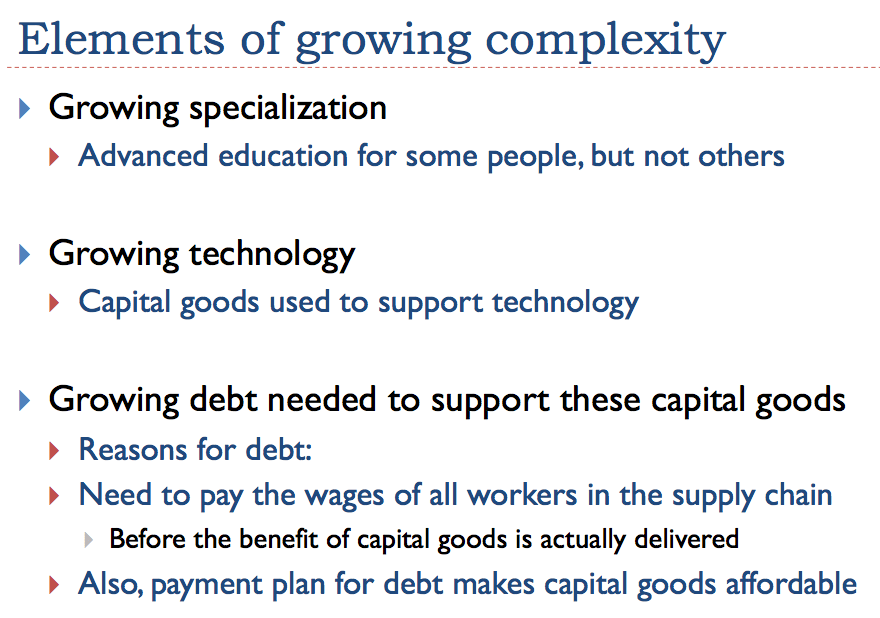
To try to solve the energy problem, we use approaches that involve increasing complexity, including new technology and globalization. As we add more and more complexity, these approaches tend to work less and less well. In fact, they can become a problem in themselves, because they tend to redistribute wealth toward the top of the employment hierarchy, and they increase “overhead” for the economy as a whole.
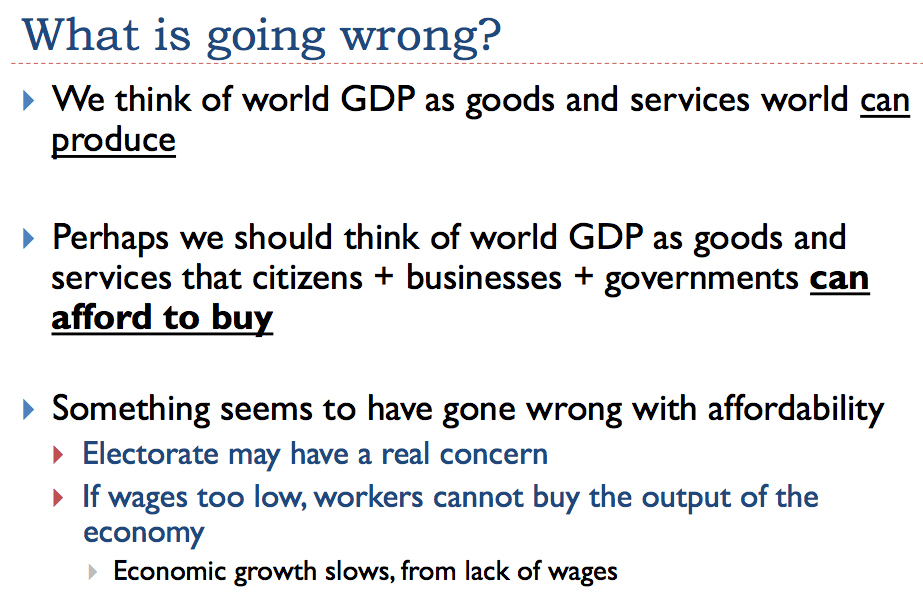
In this material, I explain how inadequate energy supplies can appear as either low wages or as high prices. Basically, if energy supplies are inadequate, workers tend to be less productive because they have fewer or less advanced tools to work with. Their lower wages reflect lower productivity (Slide 20). Slide 6 offers some additional insights.
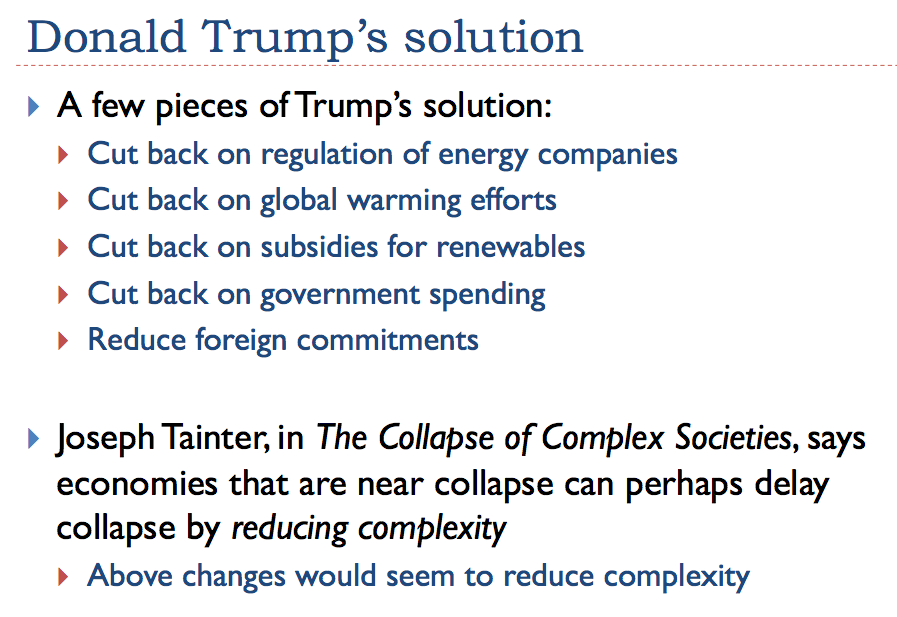
Trump’s election seems to reflect the cooling effect that our energy problems are having on the economy as a whole. Citizens are increasingly unhappy with their wage situation, and want a major change. Trump’s election may at least temporarily have a beneficial effect, since it may work in the direction of reducing complexity.
Long term, however, it is hard to see that the policies of any elected official will be able to fix our underlying energy problems.
I wrote up my post as a presentation. It can be downloaded at this link: The Energy Problem Behind Trump’s Election. I thought this might be a way of putting together quite a bit of material into one place. I have displayed the images of the PDF below the fold, for those who would like to read them as a post.
I hope the large number of images does not cause viewing problems. Let me know if you have suggestions for making this material more accessible.
Slide 1
Slide 2
Section 1: Trump’s Election Reflects the Winds of Contraction

Slide 4

Slide 5
Slide 6

Slide 7

Slide 8

Slide 9
Section 2: The Surprising Role of Energy

Slide 11

Slide 12

Slide 13
Section 3: Humans’ Unusual Use of Energy

Slide 15

Slide 16

Slide 17

Slide 18

Slide 19

Slide 20
Section 4: The Role of Complexity

Slide 22
Slide 23

Slide 24

Slide 25

Slide 26
Slide 27

Slide 28

Slide 29

Slide 30

Slide 31

Slide 32

Slide 33

Slide 34

Slide 35
Section 5: Where we are now with respect to energy and the economy

Slide 37

Slide 38

Slide 39

Slide 40
Section 6: Trump’s Solution and Final Thoughts
Slide 42

Slide 43
Slide 44
Slide 45


Trump reverses stance by turning to Goldman alumni for key roles
https://www.ft.com/content/395b6eee-b750-11e6-961e-a1acd97f622d
As expected….
And he won’t be firing Janet….
Remember hope and change?
Do what the employer says if you want to keep your job.
And your head…
Of course. Presidents don’t get fired like car mechanics.
https://www.sott.net/article/333965-Global-freezing-15-year-ice-age-predicted-to-hit-in-only-4-years-as-sun-prepares-to-hibernate
A 15-YEAR long mini ice age could be due to hit the Northern hemisphere in just FOUR years as the sun prepares for ‘hibernation’ – triggering a barrage of cataclysmic events.
A team of experts have warned that huge seismic events, including volcanic eruptions, plunging global temperatures and destabilization of the Earth’s crust will become more common after worrying changes to the surface of the Sun were recorded.
It could take up to 15 years for solar activity to return to normal with extreme weather and freezing temperatures continuing until 2035.
The warning will infuriate environmental campaigners who argue by 2030 the world faces increased sea levels and flooding due to glacial melt at the poles.
Solar activity, measured by the appearance of sun spots, has been declining at a greater rate than at any other time in history, it has emerged.
The Sun is now without spots for the first time in five years after 21 days of minimal activity were observed through the course of 2016.
Although spots reappeared sporadically during the summer, repeated slumps of no activity were recorded through the year.
The trend has prompted scientists to warn that the world is hurtling towards a historic solar minimum event with output potentially dropping to an all-time low.
The phenomena are thought to drive extreme cold weather in Europe, including Britain, Northern America and across the lower southern hemisphere affecting New Zealand and parts of South America.
They have also been linked to major earthquakes in tremor hotspots igniting fears that major cities including Tokyo and Los Angeles could be facing the next ‘big one’.
…
https://www.sott.net/article/333489-Ice-Age-Cometh-Scientists-concerned-approaching-solar-minimum-could-plunge-Earth-into-deep-freeze
Britain has been plunged into a cold snap over the past week as the country heads towards winter, but things were a lot chillier only a few hundred years ago.
The period from the mid-14th century to the 19th century in Europe was referred to as the ‘Little Ice Age’ due to the severity of the climate at the time.
Frost Fairs used to spring up on the River Thames in the latter part of this period, with the river freezing over at least 23 times since the 1300s – the last time in 1814.
The structure of Old London Bridge at the time made the river more likely to freeze over because ice chunks got caught between breakwaters which slowed its flow.
But some scientists believe we could now be heading for a ‘mini ice age’ following concerns that the sun is currently in its quietest period for more than a century.
Earlier this year in June, Vencore Weather claimed the sun had gone into ‘cueball mode’, with images from Nasa showing no large visible sunspots on its surface.
Astronomers said this was not unusual, with solar activity going up and down in 11-year cycles – with us currently being in Cycle 24, which began in 2008.
However, researchers warned that if the current trend continues, then the Earth could be heading for a ‘mini ice age’.
Activity remained low for around four days after June 4, which followed another period of inactivity in February when an image showed the sun in cueball mode.
Vencore Weather, which has worked with the US Air Force Weather Agency, said in June that the blank sun signalled that ‘the next solar minimum is approaching’.
The previous solar cycle, 23, peaked in 2000-2002 with many furious solar storms.
During a solar maximum, huge sunspots and intense solar flares are a daily occurrence, while the opposite occurs during a solar minimum.
Solar flares are almost non-existent while whole weeks go by without a sunspot to break the monotony of the blank sun – and this is what we are experiencing now.
The longest solar minimum on record, the Maunder Minimum of 1645 to 1715, lasted an incredible 70 years, with sunspots rarely observed during this period.
The period of quiet coincided with the Little Ice Age, a series of extraordinarily bitter winters in Earth’s northern hemisphere.
Many researchers believe low solar activity, acting in concert with increased volcanism and possible changes in ocean current patterns, played a role in this.
A study last year claimed to have cracked predicting solar cycles – and says that between 2020 and 2030 solar cycles will cancel each other out.
And this, say experts including Northumbria University’s Professor Valentina Zharkova, will lead to another Maunder Minimum.
I don’t know about these things. I know that the world has spent an awfully lot of years in ice ages. If we had not taken up farming, I expect we would have been back in an ice age by now. There has been an awfully lot of nonsense written that assumes climate is stable for the long term. It clearly is not.
Humans lived through previous ice ages (something that shocked me, when I figured it out). I suppose a few could live through future ice ages as well.
when humans ”lived through ice ages” what that means is they gradually moved ahead of advancing ice sheets.
if ice advance min to max took say—2000 years, then there would be no memory of ”what was before”—only that winters were maybe chillier this year than 10 years ago.
all species had to keep ahead of the ice, and with only a few hundred thousand humans, it didn’t matter much so long as there was enough game to hunt.
the inuit have shown that living on the ice edges can be done indefinitely.
There is even a theory that they crossed the Atlantic from europe during the ice age by that means, on a long gradual basis of movement,—seems perfectly logical to me, no reason why they couldnt have done that.
But does not the inuits, more than any other native americans, look asian?
I know a lot of Inuit people personally and lived in Kotzebue for 4 years. They definitely have a more Asian cast to their looks. The DNA bears it out. They are masterfully cold adapted and can live in the frozen world indefinitely, however, the relied on the marine mammals who live under the sea ice for everything.
Humans have lived through ice ages, but human civilizations have not. Civilizations are a phenomenon of the Holocene period (last 10,000 years). It will be back to bands of hunter-gatherers living near the equator, assuming no extinction event occurs prior due to our little global warming experiment. An amazing knowledge loss and reset. We are the Krull of Forbidden Planet.
There has already been an amazing loss of indigenous knowledge. We seem to keep losing things.
Good point! We needed the additional energy available from the warming planet to allow our civilization to take hold and flourish.
Perhaps we should first consider….
From the Stanford Solar Center
During the initial discovery period of global climate change, the magnitude of the influence of the Sun on Earth’s climate was not well understood. Since the early 1990s, however, extensive research was put into determining what role, if any, the Sun has in global warming or climate change.
A recent review paper, put together by both solar and climate scientists, details these studies: Solar Influences on Climate. Their bottom line: though the Sun may play some small role, “it is nevertheless much smaller than the estimated radiative forcing due to anthropogenic changes.” That is, human activities are the primary factor in global climate change.
Sunpsots, CO2 and Temperatures
http://solar-center.stanford.edu/images/600px-Temp-sunspot-co2.svg-sm.jpg
Also consider the author of the article Svanes posted…a Nathan Rao,
http://www.nathanrao.com
I have covered stories across the board from high-profile court cases and Government cabinet meetings to celebrity and politician interviews, consumer issues, health features, royal weddings and general news.
I have also written a bit about the weather – actually I racked up around 200 front pages on the subject while at the Express.
I became passionate about storms and blizzards, Spanish plumes, low pressure, high pressure, isobars, weather bombs, Azores highs – everything and anything meteorological.
Hardly one to take seriously about the weather, never mind climate science!
http://beforeitsnews.com/climategate/2011/05/uk-super-summer-to-last-months-by-nathan-rao-635140.html
Let’s see that in the measurements before we see conclude that this solar minimum will have a large effect. Right now temperature is exploding upwards.
http://www.columbia.edu/~mhs119/Temperature/
Thought I would share this interview of Noam Chomsky about elect President Trump
https://m.youtube.com/watch?v=jB54XxbgI0E
Not on CNN?
CNN only does fake news
Not only in the area of fuel consumption:
Real-world vehicle fuel consumption gap continues to widen in Europe
http://www.theicct.org/news/press-release-europe-real-world-vehicle-fuel-consumption-gap-continues-to-widen
But there is also the widening gap between the real-world abilities of the university graduates, as when you are not able pass the exams at one unversity, you simply go to another university that will accept your money and give you the university degree.
Or if one priest in the Church rejects to provide you the sacraments, you can go to another, who, with lowering the standards, will provide you the required services.
What is common to all these cases? It is the implosion, which caused by the falling energy available per capita and the resulting weakening demand, when more and more incentives (or bribes?) must be provided to keep the consumption of products and services going on…
Or the energy per capita may look like being the same, but when the extraction of (natural) resources, their processing, production and delivery of the products and services consume more energy, you are left with less products and services.
The link you provide above is interesting. It points out that less than half of the on-paper reductions in CO2 emissions since 2001 have been realized in practice in Europe. The article explains:
“About three quarters of the gap between laboratory test results and real-world driving is explained by vehicle manufacturers exploiting loopholes in the current regulation,” summarizes Dr. Peter Mock, Managing Director of ICCT Europe. For example, manufacturers can decide to specially prepare the vehicle’s tires for testing or to fully recharge the vehicle’s battery before testing—measures that are not forbidden by regulation, but at the same time are not representative of real-world driving. Another quarter of the gap is explained by the deployment of technologies that have a greater effect on fuel consumption during laboratory testing than under real-world driving conditions, such as stop-start technology, and by ensuring that options that tend to increase fuel consumption—such as running the vehicle’s air conditioning— are turned off during laboratory testing.
I know that in the US, in at least some calculations, auto manufacturers were charged for only the amount of “oil” a vehicle used, not “oil + ethanol.” This gave them an incentive to create a large number of “Flex Fuel” very large vehicles. If they could, in theory, run on 85% ethanol, they would be charged for only the 15% oil that the vehicles used in their miles per gallon charge that is incorporated in calculations showing whether the manufacturer is meeting fleet goals in fuel usage. Of course, there are so few E-85 gasoline stations and the fuel costs so much that very few use it.
WTI Oil Prices Surge as OPEC Agrees to Cut Output by 1.2 Million BPD
http://www.economiccalendar.com/2016/11/30/wti-oil-prices-surge-as-opec-agrees-to-cut-output-by-1-2-million-bpd/
The big surprise for OPEC will be the imploding consumption…
Be interesting to see if this price rise gains any traction or if it slips back into the 40s again. We have been on this roller coaster ride in oil price swings between $40 and $50 for quite some time now.
Exactly!
“The big surprise for OPEC will be the imploding consumption…”
What do you mean with that? They are expecting an 1.2 mbpd implosion. In fact, it’s an 1.8 mbpd implosion, as Russia and some other nopec are also supposed to participate in the cut
I meant that they will be surprised when they see that what they do is not just output cut, but also consumption cut, which brings the prices back to lower levels again.
Well, I am not so sure this will happen, not so quickly at least
Cut production. Price goes up. Demand goes down. Implosion.
I suppose that’s the demand side point of view. The offer one could be: Syriak and Libya are already a big mess and Venezuela is a bit ugly, so now it’s up to the demand side to suffer a bit
Perhaps Korowicz would say that implosion will last longer if pressure is more evenly distributed among the hubs
It’s the roller coaster. It’s rather like this:
Cut production. Price goes up. Demand goes down. Price goes down. Cut production. Price goes up. Demand goes down. Price goes down. Cut production. Price goes up. Demand goes down. Price goes down.
Rinse and repeat, and in the process the volume of oil, the amount of matter, shrinks
Somewhere along the line, governments of oil exporters collapse.
Wonder if this assumption matchs a specific financial arquitechture. Perhaps we can conclude that an SDR backed arrangement would be preferable to a single currency backed one, as it is today and as it would be if the ruble is let free to set the rules
We can say the “cut” (so called cut, because we’re not sure it will be respected) is just a response to the very high dollar value of today + the fact that the Fed says there is 100% chance of a rate hike in a couple of weeks
It’s the same thing we are already living but with stronger words and somewhat assuming peak oil has already been achieved last november. IEA has already talked about “peak demand”, so it’s not bizarre producers are talking about “cuts”
It may also be that Saudi Arabia and other Middle Eastern countries have cut back enough on investment that they can see that their production is going to drop. The agreement gives them “cover” when it actually does drop.
SDR will run smoother
“It may also be that Saudi Arabia and other Middle Eastern countries have cut back enough on investment that they can see that their production is going to drop. The agreement gives them “cover” when it actually does drop.”
You’re probably right. It’s the same with Trump’s “protectionism”, he knows world trade is starting to fade anyway
The art of politics,
Make believe you change things by voluntary action, while in fact you’re merely following uncontrollable trends.
It would be a nice story to tell investors when Aramco lists…
See – we have a lot of oil left — we have just decided to cut back — that will mean that down the road our reserves remain massive — and then you will reap the rewards of having jumped in bed with us now.
https://www.rt.com/business/368814-oil-prices-surge-opec-russia/
There the breakeven price to produce oil, and there’s the breakeven price when a nation needs to pay for its imports.
http://www.reuters.com/article/us-opec-meeting-usa-shale-idUSKBN13P0C8
“Dunn County’s cost is about the same as Iran’s, and a little higher than Iraq’s. Dunn County produces about 200,000 barrels of oil a day, about a fifth of daily production in the state.”
A lot of the cost of oil is the cost of taxes, to keep the economy going. The Middle Eastern economies very definitely need these high taxes. We need them in the US as well. A lot of what gets “shorted” when prices are too low is tax revenue. This is part of the reason the system behaves so bizarrely. The producers can make money at the low price, but the system as a whole cannot “work,” because the government doesn’t obtain enough taxes.
I have yet to see a renewables proposal that explains where all of the tax revenue will come from, if we switch to renewables. Taxes are terribly important, but they get overlooked!
“Taxes are terribly important, but they get overlooked!”
The US Inland Revenue and related IT systems are scouring the world for unpaid taxes, eg FACTA and other impositions. It’s somewhat like retirement – you may not have though about what you are going to do when you retire, but all your relatives have plans for you!
Regarding Iran, I’d read that they needed $100 oil to break even, but that was when they exported about one third their present rate of oil.
Here are the break-even oil prices for 13 of the world’s biggest producers
http://www.businessinsider.com.au/break-even-oil-prices-for-all-the-major-producers-in-the-world-2015-7?r=US&IR=T
There is no deflation in food, just like there is no deflation in anything. I pay close attention to this. If you look carefully, you will see smaller and smaller portions, sometimes embarassingly so. I will admit that food inflation is not outrageous yet in America, but it’s getting there.
All costs increase over time, it’s the way the industrial system works. Big banks issue enormous amounts of debts to governments and businesses, the costs are borne by all of us.
As long as they convince you that deflation is taking place, they can take your eyes off the inflation and get away with it. All fiat currencies globally are inflating, some faster than others, but the direction is always inflationary.
Oh, by the way, there is no way you can protect yourself from it. Because anything you choose to buy, will rust or go obsolete, and then when it’s time to buy more the price is inflated. Take food as an example, yet again. Do any of you really believe you will be living on food stores 5 years from now? No, which means 5 years from now, you will be buying food which will be more expensive.
Inflation eats through society, causing divisions between poor and rich, young and old. It makes a mockery of economic calculation, and rewards the worst behaviors and punishes prudence and saving. Inflation is the final endpoint of all human civilizations, and ours will be no different.
Without comment
http://www.economicgreenfield.com/wp-content/uploads/2016/01/EconomicGreenfield-1-27-16-BCOM.png
Best get another 20 foot container now, while there is a fire sale!
Basically I have always concluded that is how people would view the end of the oil age. A predicament created by someone. They would blame the FED for having interest rates to high, or too low. They would blame the politicians for not doing XYZ. They would blame the oil companies, the robots, the National Association of Dog Catchers; literally anything but the depletion of vital resources. The problem has to be something that humans are not doing right now; it can never be something that they have already done! It will never be irreparable!
Everyone knows that because we can develop and use technology, as dictated by the “command of God”, that our avenue to failure can only be paved by our own ineptitude. We have been given unlimited potential to overcome any obstacle. For some strange reason that ineptitude can always be found residing someplace else? The victim of it can never be the perpetrator. For an omnipotent creature depletion can only be an inconvenience. “They” will think of something! That will always be the case; right up until “They” don’t.
They will hang the politicians, shoot the dog catchers, and decry the FED’s evil intent. Never so much as an inch will they abandon their residence of central position. Not once will they admit that they have squandered Earth’s finite and limited resources. Humans where delivered a ton of ability to remake the world. Apparently not one ounce of wisdom was included.
Shortonoilposted this on another website.
Apparently, we are very clever without any intelligence…go, Eddy, go!
When belief in the gods fades (ie the gods of Destiny, Fate, Nature beyond out control) then it is logical to blame human agents for any disaster.
It was THEY humans and not ME humans
The Bloomberg commodity index is not quite as low now as it was at the beginning of 2016, which is when your chart seems to end. There definitely has been a long term trend down, however.
The cost of rice has fallen from a relatively stable $15 in 2012-2014 to just under $10 today. It feels like a petrodollar thing. Future – I have no idea. But right now people in India have (almost) NO MONEY. So little demand from those 1.3B people right now.
http://www.tradingeconomics.com/commodity/rice
Still rice price increases a percent or two or three every year. In the supermarket.
You can get a 50 pound bag of rice at Costco for $13. Think how long a person can live on 50 pounds of rice! Get a pallet. You’re good for years.
Bags are smaller and slightly more expensive in my country. But your argument holds.
A pound a day is mild starvation, an taxed hour at minimum wage buys 20-25 pounds.
Still I only have about 150 pounds. And not even a barrel to dig down.
Not good at all!
Dolph, I agree! The statisticians are hiding the inflation very cleverly!. Financial tricks, as well as , product production and packaging hides it. Suits the government and bankers to keep the system appearing all is well…while it is caving in.
Example, someone had a craving for ice cream sandwiches and came back from the store. Shocked because each one was at least a 1/3 lighter/smaller than last time bought.
Sorry, guys…you can hide it just so long.
Florida Power and Light had an ongoing commercial campaign in recent months about how everything has increased in price except for their electricity. Put a positive spin on how they contained costs by working hard to deliver!
Guess what…just the other day the regultary commission approved a BIG rate hike!!!
Like I didn’t see that coming…next stop hyperinflation.
FPL requested a $1.3 billion rate hike at the beginning of the year. But after the company cut that request to a still-massive $811 million, the Florida Public Service Commission unanimously approved the company’s request today.
According to the Miami Herald, FPL’s monthly charges will jump by $400 million this January, and then another $411 million over the following three years. For the average consumer using 1,000 kilowatt-hours of electricity per month, the bill will eventually jump by about $10 per month, or roughly $120 per year.
Cruelly, FPL isn’t asking for extra money because it’s struggling to make ends meet. By almost any account, the increase is motivated by corporate greed, and little else: FPL earned more than $1.6 billion in profits last year, and the rate increase will send that number even further skyward.
From what I see, everything is getting more expensive!
Food prices are also rising where I live. And the power company is raising rates in January as well. Looks like a conspiracy… 🙂
Looks like diminishing returns, among a host of other factors discussed here that is plaguing society…..hope it holds on for another decade…
https://m.youtube.com/watch?v=XC3MG63Jj10
BAU..love you so much, can’t let go
All fossil fuel prices are way too low. In addition, the credits given for wind and solar are absurdly high, when they are added to the grid. The utilities aren’t kidding when they say higher rates are needed. I am sure that even with these higher rates, they are paying only the depressed prices for coal and natural gas that the market is currently charging.
Inflation is a variable concept, hence, before you blame the statisticians, be very sure what you mean. The intended meaning of inflation was the effect of increasing the money supply, much like blowing a bubble. Most people use inflation to mean price inflation, and that ends to be subjective, like in the story of the supermarket checkout girl. The same people who complained about the price of potatoes during the day were buying double whiskys at night without a murmur.
But back to statisticians. They divide the cost of X goods by Y prices and get Z cost per unit. This gets compared with last year’s Z or the Z of a decade past. Simple. The thing that most people don’t get is the cause of inflation, and that it results from government spending money it shouldn’t have, but almost nobody wants to complain about that.
Well thank you for your Bernie Sanders-inspired-let’s-blame-the-banks-and-capitalism-for-everything-analysis.The problem is not loans, it is the inability of borrowers to pay it back.
” Inflation is the final endpoint of all human civilizations, and ours will be no different.”
That’s one way of putting it.
With no economic growth, it makes little sense for banks to loan out money…
In reality….
Without a sense of mutual gain, cooperation between large and diverse groups of people doesn’t make sense.
Banks should not try to squeeze blood out of stones by insisiting on bail-outs, bail-ins and banning cash and making student loans non-dischargable in order to create the illusion that growth is continuing….but that would cause industrial civilization to unravel.
Capitalism IS at fault. It is access to capital that allowed the first oil wells to be drilled which kick started the consumption machine. Capitalism on a finite planet is a flawed condition.
You are kidding… right? This is a joke? How many drinks have you had today?
………….
You are serious? Wow!
You are so lost in so many ways … where do I start?
A little history perhaps?
BAU – which you appear to despise — was kicked off when we worked out how to harness the power of coal — at a time when the world’s forests were being decimated.
If we had not worked out how to use coal — we would have burned up all the easy to access wood… and we would have had no source of energy whatsoever.
The age of metals would have been over and we would have been left digging in the dirt with sticks.
Fast Forward — do you like the fact that you do not live in a mud hut – do you like having tools and hunting rifles and fishing rods and a chainsaw — do you like being able to visit a doctor or dentist when you are ailing – do you like having vehicles – and roads – and schools and all the wonderful things that BAU has provided for you?
Don’t bite the hand that feeds you…
Some people on this web site could read the articles 100x over… and they still would not get it…
We could explain (and have) things to some people as if they were a 10 year old — and still they would not get it…
Which again begs the question – why are you here? Do you enjoy mockery? Do you enjoy being exposed as having the mental horsepower of a child? Do you like abuse?
Ya I know — I am a bully — a prick — an SOB…. let rip … let fly…. throw tomatoes…
the capital consumption machine started with the ultra cheap production of iron (1709)
that allowed production of viable steam engines in quantity
that allowed extraction of water from deep coalmines, and thus extraction of vast quantities of coal, which in turn allowed access to more and more mineral resources.
it became a system of ”forward debt” where each ton of iron or coal provided collateral for the next.
thus deep oil was accessed with steam power —this revved up the debt economy even faster, the same debt system applied to trade and shipping, railways, military hardware and so on—nations had to borrow money to fight wars, which is how the Rothschilds cleaned up—they held the collateral for everybody’s future—which worked fine until now.
the system is falling apart because the collateral level is falling away—in other words we burned all the cheap oil and coal in mortgaging our future.
Essentially the world is slipping into sub prime, and the Rothschilds (et al) will find themselves owning nothing.
but neither will anyone else
Right. This is Wrigley’s image of the growth of coal use in England, starting as early as 1561.
Civilization may fail from a lack of cheap energy, but it will be like a man dying of thirst in a downpour. We have hardly started to tap the energy of our star.
Though you might be amused because we can see a case where the locals seem to have tapped a substantial part of the output of their star, dimmed it by 15% over the last century.
https://en.wikipedia.org/wiki/KIC_8462852
Whatever is blocking the light in the big dips, they seem to be very far out and the area is in the same order of magnitude as the star–which is somewhat larger and hotter than the Sun. Is there any sensible reason for the large size of the objects and their low temperature (below 65 K)? It may be that energy is not as much of a problem as the waste heat from a very large population.
Real global warming comes when we are importing so much energy from space that the planet over heats. We can solve that (for a while) with sunshades, but the long term solution might be to move out to 60 AU.
i would like to enter into discussion with you on this thread
but if i did—i would end up banging my head against Eddys wall
An he has threatened to sue me if I cause any more damage to it
Economic growth can occur under any system.
Capitalism came after an unprecedented surge in population in Northern Europe following a series of technological innovations that allowed more food to be grown.
A good percentage of economic growth can be attributed to human population growth.
There’s a reason why true sustainability involves severe restriction of the use of technology to primitive tools.
@ Keith,
Acomb’s Razor says the star’s fluctuations have a natural cause. The negative SETI results support that conclusion.
As has been mentioned… ‘Scott Nearing’ is not the answer…. if anyone were to survive BAU
That would only lead to total deforestation as we burned up trees to continue our quest for progress… i.e. metal tools and weapons.
Fortunately that won’t happen…
https://2.bp.blogspot.com/-6rE1mLmbxfE/V0g55ofsutI/AAAAAAABDmM/7dvOF7sTvBA7tHtICZ5XLPlajs9CH-JZwCLcB/s1600/spent%2Bfuel%2Bpool%2Bradiation%2Bequal%2Bto%2Bnuclear%2Bwar.jpg
https://www.bloomberg.com/energy
Brent up over 4 bucks, to price over $50 a barrel on OPEC deal!
Yes the roller coaster oil price swings more than 10% in 24Hrs on the deal. But, $50 is outside of the goldilocks zone so something will probably beat it back down to $45 soon LOL.
Let’s see how long it lasts. I see that the interest rate on 10 year Treasuries is up as well. Neither of these are good for the economy.
Just a thought…
If all humans were like Koombaya loving DelusiSTANIS — in that they rejected all facts and logic — had no common sense….. and refused to change their minds on issues when facts and logic dictate a change…
We would not be in the position we are now…
We’d have never progressed to the point of learning how to use fire… the wheel… and so on…
http://www.zerohedge.com/news/2016-11-30/metals-traders-red-alert-chinese-commodity-bubble-20-just-imploded bubble just about to pop in china we are very close
I can imagine the PBOC stepping in and buying up commodities if necessary … ‘whatever it takes’
This really is crazy stuff… cuckoo’s nest crazy.
http://pixel.nymag.com/imgs/daily/vulture/2013/03/28/28-04-jack-nicholson-the-shinning.w529.h352.jpg
In spite of all of this I still come across plenty of people who insist things are improving.
Oh, dear!
Mapping Middle Class Decline
http://www.citylab.com/work/2016/11/the-geography-of-middle-class-decline/505769/?utm_source=eb
I am wondering if what is happening on the rich poor split of cities, has to do with home and rent costs. Along the East Coast, only the rich can live in the big cities. Others need to move elsewhere. The shift to higher income people matches with housing costs. Where economies have been doing less well, rents and housing costs are lower, a different group of people can live.
X, how do you say “las vueltas de la vida” in english?
Funny those myriad chinese bicicles morphed into cars, and those myriad europeans cars are morphing into bikes
https://www.theguardian.com/cities/2016/nov/30/cycling-revolution-bikes-outnumber-cars-first-time-copenhagen-denmark
Humorous! There is also the quote http://www.quotes.net/quote/58496
My grandfather rode a camel, my father rode a camel, I drive a Mercedes, my son drives a Land Rover, his son will drive a Land Rover, but his son will ride a camel.
I think there are too many generation in the camel quote by Rashid bin Saeed Al Maktoum.
saudi oil was discovered in the 1930s, and will be gone by the 2030s
there are 3 or 4 generations in a century—-that pins down the quote quite neatly
Problem is instead of 1m people wanting camels to ride on, there will be 40m
It’s the camels i feel sorry for
My grandfather rode a camel, my father rode a camel, I drive a Mercedes, my son drives a Land Rover, his son will drive a Land Rover, but his son will starve and die of radiation poisoning.
So cheery!
Good point about too many people.
The Saudis will be back to camels when they can no longer import enough food for their people, which may be before 2030.
I understand that generations are quite short in countries where girls marry young. You may be right.
But here it was grand father, father, sheik, son and sons son. Could easily be 200 years 🙂
THE RENT SQUEEZE
“A key point: higher rents may mean less demand for other things, hurting the consumer economy. “The rising share of income devoted to rent may be an important contributor to what economists dub secular stagnation, the inability of our economy to generate the robust demand required to sustain economic growth.” Weighed down by rents, especially in major cities, the economy has fewer chances to provide for income growth: a vicious cycle. ”
http://www.citylab.com/housing/2016/11/are-rising-rents-to-blame-for-economic-stagnation/506258/?utm_source=SFTwitter
Rising rents; rising health car; more need for education. Young people especially get squeezed.
I thought the rising rents was the results of economic policies to prevent deflation.
If so, can’t reasonable rents be voted into existence?
Someone must be benefiting from the higher cost of education. Additional amenities and services don’t explain higher tuition rates.
Higher real estate prices have been politically supported because it may be a covert tax on younger workers to support a growing elderly population. . .
DJ said,”peoples pension money is invested in mortgage bonds.
I’d go further and suggest “”peoples pension money is invested in the value of their property”.
Obamacare was more close to being a blatant tax increase on young workers to support the elderly. Of course, the people who appose it don’t realize that. People who appose Obamacare fall into two camps. They will blame rising healthcare insurance premiums on greedy drug companies and government corruption that gives certain companies monopolies.
If RE bubble pops the pension money vanishes but the debt remains. Unfortunately there is no longer possible to borrow against the house, and that is the only way maintainance is affordable.
Yes those born in the 40s have been able to cash in big time, and is spending this now keeping growth going for a while longer.
Regarding the higher cost of education: Part of the rising cost of higher education is the idiocy that says that the vast majority of faculty members must publish huge numbers of academic papers to retain their jobs. They must also apply for grants, to fund this research. All of this nonsense supports a whole layer of administration within colleges/universities. Also, the teaching loads of faculty members get reduced, to accommodate all of this research. Many new journals, mostly “pay to publish” journals, have sprung up, to meet the new demand for article publication. Actual teaching of the students increasingly gets pushed off to “adjunct faculty,” who have lesser credentials, and get paid (not very much) for each course they teach. If you are lucky, they are retired, and doing this to supplement retirement income. Or they may be trying to piece together an adequate income, by teaching a large number of courses for different universities.
You are right about higher real estate prices acting as a pension supplement for a large number of elderly. If they can sell their homes, they can use the extra funds to pay for alternative housing on a monthly basis.
I agree too, that Obamacare was more close to being a blatant tax increase on young workers to support the elderly. Government programs seem to be aimed at “social equity,” whatever that is deemed to be.
community of 200 tiny homes to help ease housing crunch
http://www.denverpost.com/2016/11/16/salida-community-tiny-homes-housing-crunch/
“La Junta-based Sprout Tiny Homes wants to build 200 rentals — ranging from 200 to 800 square feet — on 19 acres the company owns along the Arkansas River. Salida annexed the property in March. The homes will be on permanent foundations. The River View at Cleora neighborhood will include a community center with a catering kitchen, fitness center, community garden, storage units, 5 acres of parks and trails. Rents will run $750 to $1,400, which includes all utilities. About a third of the units will be available as short-term rentals, alleviating the pressure in Salida, where a little more than 100 homes are available for vacation rental.”
The puzzle is why it takes so long for such obvious measures to be enacted.
“The puzzle is why it takes so long for such obvious measures to be enacted.”
Ive got a tuff shed I mean tiny home for rent for $900 if your interested. But only because I believe in sustainability,
$750 for a 200 ft. “house”? That’s a good business… for the renter
Toilets are included in those 200 ft., or is it also about community toilets?
Ha ha, I’m not serious, or just a bit
The article mentions utilities that are paid by the renters. All commercially built tiny houses have toilets. I wondered how the owners swallow the costs of wasted water, gas or electricity. Maybe they pay a base price and over-users pay the rest?
You may not know about the vast burgeoning tiny house movement in America.
https://search.aol.com/aol/search?s_it=webmail-hawaii1-basicaol&q=%22tiny%20house%20nation%22
You’re right, I know almost nothing about it. But I’ve seen one note in a newspaper here, perhaps I can jump into this new business…
Of course there are many utilities and houses have toilets, so I was somewhat joking about the price.
I don’t get what do you mean by “to swallow the costs”. The usual procedure is that energy is metered and paid by the renters
The article stated that utilities were covered in the rent.
I presume that rents can be raised as needed. Also, once the electric grid stops functioning, there won’t be any utilities to buy. So these units are of temporary benefit, unless we can figure out a way around the many problems that not having water/sewer/heat/ventilation create. Disease would spread very easily, for example.
Oops
Affordable living would pop the RE bubble.
What would happen if it did?
That depends on the rules of respective country I suppose.
If you are stuck with the debt even if you leave the house then you will try to avoid moving. You will lower consumtion. If you are unemployed maybe you can’t move to get a job because you’re stuck in your house.
On the other side of the deal peoples pension money is invested in mortgage bonds.
A popped RE bubble would not be good.
Thanks. I guess a cost/benefit examination of burst v no burst it would help toward knowing what to recommend? I agree. Burst doesn’t sound good. But I need to know more.
See 2007 — x 1,000,000,000,000
General Motors Co. stands to lose as much as $9,000 on every Chevrolet Bolt that leaves a showroom once the all-electric subcompact starts rolling out. Sounds crazy, but the damage makes perfect business sense under the no pain, no gain policy driving the electric-vehicle boom in the U.S.
Can that really happen? “The idea that automakers will sell 40 percent of their vehicles at a loss in California is ludicrous,” said Eric Noble, president of the CarLab, a consulting company in Orange, California, who reckons most electric cars lose at least $10,000 per sale.
The industry’s willing to take the hit on a small scale now. Fiat Chrysler Automobiles NV’s battery-powered Fiat 500e is made for California alone, and Chief Executive Officer Sergio Marchionne said in 2014 that it was losing $14,000 per sale.
More https://www.bloomberg.com/news/articles/2016-11-30/gm-s-ready-to-lose-9-000-a-pop-and-chase-the-electric-car-boom
Who says you can’t get something for nothing!
Funny anecdote… I was in Hong Kong last week having some beers with a buddy who works for the vampire squid…
A Tesla drives by and I mention how they lose thousands per vehicle…. he says ya … what a scam that is…
Then I said … but they make up for those loses by selling larger volumes….
Silence…. silence… silence…
Then he says – how does that work?
You know — you lose money on something but if you sell more you make money….
A bit more silence…. then … I chuckle….
Ah…. I get he says — you are joking…. I thought one of us was going insane for a moment there…
For some reason, your story reminds me of of the state of the oil industry. But, rather than selling more they pump more LOL.
They’re doing the same thing with our food supply. See eggs.
Anyway … price of oil, electricity, interest rates, eggs, wheat can go to zero or negative, and still become more and more expensive for end consumer.
There is genius in that formula…. the circle is a square… 1+1 = 7.76 up = down
I was in Hong Kong a few years back. My wife and me were flying back through Tokyo and we were a little worried about the connection there. Started talking to a guy in the lobby of our hotel in HK. He said not to worry, we’d be fine and Tokyo airport was great for connections. He’d been going in and out of China for twenty years. We’d just spent six weeks there. I told him it seemed like the wealth disparity was pretty intense. He said, “there are two kinds of people in China, the filthy rich and the dirt poor. In a few more years, it will be the same thing in the U.S. “. I think he was right.
We need a system that produces more taxes for the government. Where do they come from, if we are no longer using gasoline? Perhaps we need to be taxing the cars as well.
I come across info that I should save but don’t. So I don’t have a good framework for the following. It’s just a notion that might relate to FW discussions about using embedded energy…
Tourism seems to be an economic engine that depends on the unique geography, economy and history of places. That might mean profiting through diversification rather than homogenization of places. If so, it points to an economic and fairly stable way to use embedded energy.
“Kurth also sees tourism as a way to help preserve small farms that are characteristic to Humboldt County.”
“One thing we can all agree on is we want to see small, family, sustainable farms,” he said. “I really see tourism as being a huge part of that because it allows you to diversify your income.”
Forgot to post the link
http://www.thecannifornian.com/cannabis-business/creating-northern-california-cannabis-tourism-market/
The answer, at least in my areas, to tax revenue and to jobs creation is more legalized gambling.
It doesn’t require spending a lot of money training people or a lot of commodities.
This is in proximity to a major tech hub in the U.S…The state has growing deficit despite its reputation as being home to a large number of highly educated, highly paid and highly skilled workers.
Why aren’t they investing in what has worked for (20%) of the economy for the last thirty years?
Never thought of that.
“The state has growing deficit despite its reputation as being home to a large number of highly educated, highly paid and highly skilled workers.”
They believe they will have a tax base in the future after the IT companies have become profitable?
When I say “tech” I’m not merely referring to Information technology. There are a lot of established high-tech companies located in my state. There are biotech companies located here…there are engineering firms. There is, in theory, a tax base base. The companies that exist in the high-tech hub don’t seem to be sucking at the government’s teat but I can’t verify how much in taxes they pay. I don’t know how profitable the high-tech sector is, in general. My guess is that the state deficit is probably widening because growing government services is outpacing any growth in business revenue. I also think Mitt Romney 47% comment–where many workers’ wages are too low to contribute to the tax base may be true.
I know that the consulting firm I worked for (now Willis Towers Watson) moved its headquarters to Ireland, with the addition of Willis, because Ireland has a lower tax rate than the US. This has happened a lot, with businesses that look like they are US domiciled, but figure out how to avoid taxes by moving their operations overseas. Also, consulting actuarial firms helped companies to set up “offshore” insurance companies, domiciled in locations such as the Cayman Islands or Barbados, more or less as tax avoidance schemes.
Chasing down businesses for taxes is a “fool’s errand.” The big ones, with most of the funds, are international in scope. Even the little ones figure out ways to move as much revenue offshore as possible. Taxes on fossil fuels have been a reliable way of getting revenue, because extraction companies cannot move their operations offshore. Taxation of personal income also works, but it is necessary to tax low income people as well as high income people, and even this doesn’t yield enough revenue, when government promises are as big as they are today. The other approach is to tax imports–something that was done in the past, but has been discouraged with globalization.
Taxation is really a way of moving some of the “surplus energy” from one part of the economy to the government. Governments need this surplus energy to fund all of their programs. If renewables really aren’t providing surplus energy–instead they are just drains on the economy–they cannot afford these taxes. This should be a strong indication that there is something seriously wrong with the ability of these devices to support the economy.
The information presented on this blog has influenced my religious beliefs. If all of the principles ala jJesus, Bhudha, Allah were in fact all knowing why was this finite planet exponential growth not addressed in their teachings.
It is widely acknowledged that post fossil fuels the first decade or two will be spent salvaging energy as it is stored in materials from when it is abundant.
Is not each of our bodies in fact a construct created by fossil fuels?
Could it be that what we have been taught as a metaphor “eat my body drink my blood” is in fact not intended as a metaphor?
Would it not make sense that the tribe elders ( of which I am one) would let their body be consumed if their was limited food so that the younger could live thus reducing population and allowing the innocents- children- to live?
Are we not being primed for this?
Zombies- what do they do- eat flesh.
The antagonists of the matrix film -harvested human energy.
Vampires ecetera ecetera. The theme is a recurring one and very popular.
Interesting thoughts. I think you’re right in your assertion that there is no omniscient “god” in the way religion teaches. Whoever our designer was it was definitely not all-knowing or our current physical form was accidental; I think it’s likely a bit of both.
All of us have these ideas in our head of what a BAU collapse will be like including what we’ve read, what media we’re exposed to, dreams even. But none of us actually know in what order what chaos will ensue or how it will all end. Yes we’ll probably all die, but we were going to anyways. Our fate was likely sealed upon birth.
Speaking of entertainment you bring up the Matrix. I had mono the last couple of months and watched it while bed-ridden for the first time in a decade. I’ve gained a lot of insight about the nonphysical world since then. I think some of the ideas central to The Matrix are much closer to reality than people think.
If there is a ‘god’ then I would imagine him/her to be a very vicious 5 year old…. like one of those children that the Khmer Rouge recruited to kill kill kill… or perhaps the Linda Blair character in the Exorcist…
He/she’s gotta be something truly malevolent to have created something as *&^%$ up as humans.
Yeah, similar to the old testament version of Yahweh. He always threw tantrums when he found out his people were worshiping a golden calf or some nonsense, lol.
I think the Old Testament is documentation of the beliefs of people at that time. It was a time when many people died of fighting, very often indirectly over resources. We see how God was viewed by these people at that time. God is viewed as having tantrums. The people are constantly trying to get God to make things work out they way they want–give them victory; get them out of a desert; give them enough resources for their people.
I see all religions as being self-organized, in more or less the same way. We view religions through the lens of the religion we grew up in. I suppose if we came from a religion that viewed golden calfs as the most important object, we might have that view as well. These other religions most likely had insights about our human predicament and the nature of the universe, incorporated in them as well.
I agree that they all share similar insights about humanity. Many of them also plagiarize one another. Like Horus the Egyptian sun god, for example.
As I have traveled, I have noticed the similarity among religions. I can believe plagiarism. Sunday is the first day of our week.
I am not as negative as you are on this situation. Humans are special in that they have learned to use supplemental energy, in the form of burned biomass or burned fossil fuels, or nuclear. Humans’ use of supplemental energy has allowed humans’ to develop bigger brains. It has also allowed human population to explode, as humans repeatedly outsmarted the competition.
Perhaps the rapid growth of human population is the way that God planned things to work out. In fact, it is possible that the entire universe was created for the benefit of humans. The existence of life on other planets seems to be very rare. The various religions document insights that various populations have gained, on how the system seems to work, and what actions seem to work best for humans to be satisfied in this life. The importance of energy and light comes up many places.
We all know that we cannot live forever on this world. This happens partly because of our limited life spans, but also because the economy here cannot last forever.
Even if we were like other plants and animals, and lived only within the budget of the solar energy that we share with other species (instead of supplementing it with stored energy from elsewhere, we would find that the ecosystems we lived in would not last forever. Climates would change. There would be other changes as well, for example in the number of top predators in the area of the world where these more limited humans might be able to live. These changes might very well eliminate our entire species at some point, or at least greatly diminish its numbers.
It is easy to think we humans have all the answers, but I am afraid we do not. We think we are in charge of the economy, but we really are not. We think that God must want to act in a particular way (making us like other animals, for example), but that is not necessarily the case. Maybe we were meant to be different. There are a lot of things we simply do not know for certain.
“We think that God must want to act in a particular way (making us like other animals, for example), but that is not necessarily the case. Maybe we were meant to be different. There are a lot of things we simply do not know for certain.”
I’ve listened to a lot of Terrence McKenna’s videos. (There’s a whole series of them that last over an hour each>) The sound on this clip isn’t good, but at least it’s short. What you both are suggesting doesn’t seem too much at variance.
http://search.aol.com/aol/video?q=terrence+mckenna+and+human+purpose&v_t=webmail-hawaii1-basicaol
Gail I would like to thank you for your tolerance. It is another one of your exceptional qualities.
“I am not as negative as you are on this situation.”
Im not sure what that means. Arnt you often called that adjective from people reacting to the facts you present?
“Perhaps the rapid growth of human population is the way that God planned things to work out.”
I see. So we should continue, More the merrier?
“In fact, it is possible that the entire universe was created for the benefit of humans. ”
I hear this trumpeted often when someone is reinforcing their entitlement to consume. I think this works against the qualities i would consider in touch with god- graciousness, kindness compassion, service, selflessness.
“These changes might very well eliminate our entire species at some point, or at least greatly diminish its numbers.”
Im really rather shocked Gail. The facts so eloquently presented on this blog are that not “living within our budget” will result in horrific events involving much suffering amongst our species (not even considering the other life forms we share the planet with) .Consider the title of your blog. Yet you are arguing against “living within our budget” with hypothetical scenarios very far detached from our situation, Contrast this with your usual level headed analysis based on what our actual situation is and your disdain for those presenting non realistic scenarios. I am disappointed. You are one of the only people if not the only person I have ever known who has the courage to confront our actions. I respect you as a great teacher.
If a individual is proceeding down a path that disrespects other people, life forms, and their selves i do not consider it a path of god. It is clear to me that as a species our path is similar. This is a personal belief and I suppose it could be considered negative. Is confronting self destructive behavior really more negative than continuing it? I say no.
I say confronting destructive behavior in peaceful logical manner is in fact the work of god, That is why i will always see you Gail as a worker for God.
No comment on the god stuff…
But I do know we need to consume ever more till the end of time — otherwise the global economy will collapse …
And we will be digging in the dirt with sticks….
Let me know if you disagree — or if you do not understand why increased consumption is necessary.
It’s hard to figure out what human life is about. We have SO much intelligence–while using only a fraction of it–that we don’t know how to use it. I’ve sometimes thought that truth for humans is paradoxical. So thinking that the universe is made for humans doesn’t necessarily mean disrespect or exploitation of anything. We can walk and chew gum at the same time. The bible tells us to dominate the earth and be stewards of it at the same time.
I don’t think we really have control over the things that we would like to have control over., such as population. We can reduce population through “bad” ways (war, atomic bombs, intentional release of pathogens, abortion, killing female infants), but trying to reduce it through “good” ways (birth control, education of women, programs to promote smaller families, such as used by China) don’t work very well. In fact, there is a question whether we should try to force our values on other cultures. Also, these approaches are energy intensive, so really don’t work long term.
We humans are dissipative structures, and most of the things that change on the earth are dissipative structures. As such, our function is to dissipate energy as efficiently as possible. One way of doing this is through having lots of children (as many as we can afford) and always wanting “more” and “better” goods and services. This was sort of a shock to me, since I was always brought up to not be too concerned about having the “best” house, or the “nicest” clothes. Mental health seems to come from keeping our “wants” at or below our ability to pay for goods and services–something that religions seem to teach. In a sense, our desire for a job that pays as well as possible, is another way we maximize our consumption of goods and services. (If a high-paying job is available, and we choose not to take it, someone else will take it, giving that person the opportunity to buy more goods and services.)
When it comes to dissipating energy, co-operation is a better strategy than competition, especially when there are more than enough resources to go around. From this point of view, the values of caring and compassion for other humans are part of this strategy. Religions often reinforce these patterns. Religions can often reinforce fighting, and reduction of population through war, because of differences in population. I would expect that very often this fighting comes when resources are scarce. It is part of the overall pattern of keeping population in balance with available resources. The same situation works for other animals. No matter how concerned we are for other humans, it is virtually impossible to carry this concern over to all living creatures. We cannot avoid stepping on insects, even if we can find ways to avoid eating meat.
I do not think that we humans really have a way of “living within our budget.” We are physically adapted to requiring external energy so that we can cook some of our food, and so that we can do all of the other things necessary to maintaining our population (making clothing, building homes, heating homes, creating businesses and governments so that we can do these things). There has been a great deal of mis-information spread about, saying that we humans are using “two earths” worth of resources, or some such thing. This is absurd. We are using stored solar energy in the form of fossil fuels, and irreplaceable good-quality ores of uranium and of many metals. There is no way that a person can value these irreplaceable items in terms of “number of earths.” Even aquifers that don’t replenish in any reasonable timeframe are irreplaceable.
Even if we were each to reduce our personal usage by 50%, it would make no sense in the long run. A dissipative structure is set up to maximize energy consumption. No matter how awful it may seem to us, our savings would be transferred to others, perhaps in Africa, so that they, too, could dissipate more energy. Perhaps they could have a higher standard of living. The effect would likely be pretty much the same in terns of depleting resources, causing global warming, and the other bad effects we see.
What is destructive behavior? This is something we will all differ on. My father grew up on the island of Madagascar, as a child of missionary parents. There, when twins were born, Medicine Men encouraged mothers to pick out the stronger of the two infants, and only nurse that one. Clearly, this was partly a way of keeping population down. It would tend to eliminate weak infants, who might not be as good contributors as adults. It also made certain that breast milk was adequate for the child who was nursed, and that the mother’s health was not taxed by trying to make milk for two children. Needless to say, missionaries stopped this practice. They also brought in more resources (health care, latrines, schooling), so that population rapidly rose (not necessarily good).
I know that in many places, (not necessarily Madagascar), it has been the practice to let infants and toddler die (take them to the edge of the city and abandon them), if they are clearly handicapped. At a time when the population was barely able to care for itself, much less raise handicapped children to adulthood, I can understand this practice. As resources have increased, and Christianity has spread, there has been a strong push to keep every child, no matter how handicapped, alive. Clearly this is not helpful from a natural selection point of view. There has also been a push to keep the very elderly alive, no matter how much it costs. If we don’t have enough resources, we most likely will have to make different decisions.
The second paragraph seems to promote having more children, and meanwhile the last paragraph (which I would have subscribed to) to do the opposite?
It all comes down to what a given civilization considers an appropriate way to hold down population. In recent times, with all of our energy, we have convinced ourselves that we must keep every human being alive, whether they have very low birth weight, or are suffering from a practically incurable disability, or are very elderly.
In fact, many civilizations have made different choices, based on their more limited resources. I think the right answer depends on the resource situation at the time. “Good” and “bad” vary depending on context.
Great post Gail. It is all a great mystery but I do not think we are so hardwired that we have no say in our actions. When I hear people say that I’m reminded of the the guy taking Dave’s order here https://www.youtube.com/watch?v=W8YAK8oMEKI
What’s a “negative equity”?
http://www.zerohedge.com/news/2016-11-29/negative-equity-rolled-new-car-purchases-reaches-record-4832
The car finance bubble is about to pop. Time for another round of cash-for-clunkers.
Trade in price of car less than remaining debt.
This is added to full price of new car.
Difference between “value of car for resale” and “amount still owed on loan,” when this amount is negative.
In a near future everything will be bought on credit (mortgage free if you are young) with close to no interest, paid with helicopter money.
just when you thought all insanity was safely in trump tower
http://www.theatlantic.com/business/archive/2016/06/netherlands-utrecht-universal-basic-income-experiment/487883/
You can’t do an authentic test that is limited in time, and you must enroll people who has jobs.
UBI is the future! (Until there is no more future.)
This is only a discussion in surplus-lala-land where people don’t grasp what the cause for prosperity is.
When external energy input diminishes people have to work more for less to keep the productivity up. Thats the reason behind people work longer hours in worse jobs for less money and still not making ends meet.
I really getting angry about all those ideas, including that renewable will save us all, from people who do not understand anything.
Last thing which poped up in my email was that my city wants to establish “climate neutral mobility” until 2050. Reducing emissions by 95% and use 50% less energy by providing the same or better mobility (and growth….). Do those people get anything? Like basic level physics and entropy?
As long as there is surplus AND unemployable people there must be a mechanism to transfer surplus to those unemployable.
A low bureaucracy system frees some, maybe employable, people from useless administrative tasks.
UBI does not make any sense at all with open borders or if full employment is a goal.
Very good points! And if you want to depress wages – like in Germany, where even unemployed with minimum existential benefits have to work for 1€/hour in some jobs that officially should not compete with real jobs, then this doesn’t make any sense at all.
Or if there is no surplus.
But there is a surplus (for now) otherwise everyone would not be fed, clothed and housed and more.
The big difference between UBI and what we have now is you don’t have to pretend to try to find work or to not being able to work.
And like Ert suggested minimum wage could be lowered to nothing when the wage is on top of UBI.
ubi has been mooted in several countries
none of their economic ”wizards” seem to grasp the problem with it.
that if people sit at home doing nothing, they still have a calorific demand for food intake, say 2500c a day.
this has to come from somewhere, and ultimately that ”somewhere” is mother earth. And getting food out of the ground and onto plates requires energy input.
At current usage, that input is10x what goes down our collective necks, so that’s 25000 c a day—per person.
If 250 people get UBI, then you can be sure everyone will demand UBI fairly quickly, so that means entire populations will expect 25000c a day to be magicked out of thin air.
But folks sitting at home are economically inactive—deadweight on their national economy. they produce nothing, so effectively the food producers (farmers etc.) will have to work to keep them well fed in idleness—because once UBI gets ingrained into any national system, it will be impossible to remove.
But the farmers will be paid for the food they produce—won’t they?
Of course they will, through the UBI payments handed out to citizens.
So where does that money come from?
Taxation of course. To sustain UBI the tax wealth of any nation must be diverted into UBI cash.
That taxation can only come from those who make and sell stuff—which, logically means that they too will be supporting UBI recipients. (along with the farmers)
Quickly the contagion will spread, so that fewer and fewer people will elect to work at all.
As I see it, work itself is to become an elective function.
Why should they work if UBI takes care of all their material needs. (roof, food, health and so on.)
when the nation collapses, the inclination to work will no longer be there….after all—prosperity can be voted into office, so just change the government and start over.
Working has costs involved. A person needs transportation to get to work. The hours may be irregular and interfere with normal activities Workers are often expected to dress in a certain way, necessitating new clothes. Many people have day care costs for either a child or an elderly parent to consider. The family’s tax bracket will be higher if a spouse works. All of these things mean that a job has to pay reasonably well, to make sense at all for most people.
If it is politically possible is another question.
Can it be accepterad without consensus that full employment is impossible?
If full employment IS impossible that raises question about why immigration and why educating people that never will work.
I think you could argue that Sweden has some form of UBI today. I think in principle that if you have nothing, and know how to apply, the government will find you an apartment and a little bit of money so you can scrape by. You can’t have any assets or a car or anything, but you may not have to starve. There is a word for this: Socialfall
Ha, this sounds like the types of goals we have where I work (City government). I’m one of the planners who (publicly) pushes for plans like this with dramatic GHG reductions, but I share your sentiment. It’s more than “a dollar short and a day late”, it’s trillions of dollars short and a hundred years too late…
At least they have the good sense to try the experiment on 250 people.
Until Industrial Civilization actually does collapse,…and no one knows that day or year, AI and machines continue to take the place of human labor. Is it impossible to imagine average human beings being somewhat the benefactors of this productivity? Or should the Corporatocracy take it all? And seeing that the machines require nothing in return, nor are they consumers, who, has the money to buy the stuff it produces?
I certainly don’t have a strong stance on the issue, but I think it is something we must consider while we wait for collapse.
“And seeing that the machines require nothing in return…”
Machines require care. If you mistreat them they don’t work as well.
I though about if I enter that game… if everything goes down anyway… why not?
The issue I decided against it: The rules change all the time now… and if you enter the system (i.e. the debt game) things can get pretty ugly fast. To retain maximal control and flexibility in and of my life I downsize and stay off debt. That makes me much more financially and geographically mobile.
It is so amazing the value that is placed on imaginary digital money. I just have this picture in my head of what money means to people: big smiles, air horns and unicorns flying overhead after winning the lottery. There is this completely unfounded (without precedent) belief that infinite money printing will lead to prosperity. As a society, how have we become so stupid?
If you don’t give out the money proportionally money printing redistributes resources. Inflation is an easier way to steal money than taxes.
We haven’t been able to produce inflation by printing money recently. The inflation produced seems to be asset price inflation. This makes it harder for working people to afford assets, like houses and farms.
The developped world has not produced inflation because they doesn’t want to. It is just a very, very big lie. Printing money for wall street will only inflate stocks and dividends. If you print the money and use it to raise wages, you’ll have general inflation just announcing you’ll do it
If you print money and use it for wages, your goods will not be competitive on the world market, unless your currency drops so low that the price of imports becomes a problem. I don’t think printing money really works for creating inflation. If it did, Japan would be in great shape.
Gail, you say:
“I don’t think printing money really works for creating inflation.”
Printing money doesn’t create real wealth, that’s for sure, but with respect to inflation, how else would you explain it, else than giving a higher price (arbitrary figure) to a given energy input?
Probably I missed something here, but at least, if money printing doesn’t create inflation (when used in real economy), it seems necessary for it to happen. Cause? Consequence?
Stefeun, there are two kinds of inflation (1) asset price inflation and (2) commodity price inflation.
Asset price inflation is fairly easy to create. Lowering interest rates tends to create asset price inflation. Making the rich wealthier, by making the economy more complex, also seems to work. Adding more debt–something that seems to come with lower interest rates–tends to work as well. So printing money will create asset price inflation.
Commodity price inflation comes from either (a) diminishing returns in commodity production, and non-elite workers having enough money to pay the higher costs reflected by diminishing returns. This can happen if many more workers are joining the work force, and if wages are rising quite rapidly. This happened in the pearly 1970s.
Alternatively, commodity price inflation can come from (b) growing demand from non-elite workers, coming from a combination of wages growth (or lack of growth) and debt growth. In theory, this debt growth can come from printed money. The problem is that printing money will tend to lower the value of a currency, relative to other currencies. So even if a country prints money, and gives the money as a bonus to its workers, the action may not really benefit its workers very much, because the value of the currency will drop relative to other currencies. Commodities from outside the country will thus become more expensive, making them less affordable for workers, despite the printed money. So it is really very difficult to do, unless the country is completely self-sufficient in commodity production. If this is the case, the drop in the value of their currency will not be a problem.
http://monthlyreview.org/wp-content/uploads/2013/02/2013-03_rom-chart-2.jpg
More complexity = more overhead for the economy, less left over for wages.
Thanks Gail for explaining the distinction between asset and commodity types of inflation.
It’s fairly complex ; I understand that for commodity-inflation there are quite a lot of feedback loops depending on the position and exchanges of the country vis à vis all the others,
And wrt asset-inflation, it erodes savings and reduces debt, but increases market-value of the capital goods. I guess there are quite complex feedback-loops here too.
Wonder if the inflation target of 2% is only artificial, i.e. only to keep the nominal figures growing.
I think they need the 2% inflation target to make debt reasonably repayable. With interest rates as low as they are, the 2% inflation target makes inflation-adjusted interest rates negative. With a negative “real” interest rate, almost any “investment” should be worthwhile.
You’re right, Gail.
What matters is not the inflation by itself (since it’s basically more money for the same thing), rather the gap between inflation and other parameters, such as interest rates, wages, foreign currencies, etc.., its evolution along time (governance + feedback loops) and its sign (+/-), which determines the volumes and direction of the money-pumping.
A complex system by itself, where each parameter has an impact on all others.
I’ll stop here to try and avoid too big a headache.
That’s the “Developped world problem” (I suppose Japan didn’t gave the money to the poeple neither). We never had this “problem”. I suppose also that it arises from the need/desire to protect a high currency value, which is very important for the capitalists and which is good, to some extent (at least when the volume of jobs is still somewhat enough) for the little people
“Inflation is an easier way to steal money than taxes.”
Yes and no, it depends. If you are a lender capitalist (i.e. you lend in strong currency, so you’re from the US, Europe or Japan) you can only use taxes because you need a strong currency. That’s why some people can imagine this:
http://www.zerohedge.com/news/2016-08-28/jackson-hole-post-mortem-it-may-take-massive-program-large-enough-shock-taxpayers
But if you’re a middleman capitalist (i.e. you take strong currency and lend soft currency, so you’re a third world capitalist) you can only use inflation because you don’t even really set the value of your currency.
Gail, I don’t really get your point with two different inflations, but I am not sure you get the whole picture here:
“Commodities from outside the country will thus become more expensive, making them less affordable for workers, despite the printed money. So it is really very difficult to do, unless the country is completely self-sufficient in commodity production. If this is the case, the drop in the value of their currency will not be a problem.”
It’s not only imported commodities that would become more expensive (in local currency), but everything that is imported, wathever. But you’re somewhat right when you say that a self-sufficient economy (but not only reg. commodities) is better suited to withstand currency fluctuation (as it is the russian case).
And I am not sure what do you mean with “problem”. Problems are relative to someone, i.e. some policy can benefit the 1 percent and not the rest.
You are right–it is everything that is imported that becomes a problem, not just the commodities. I was thinking that if the country was 100% self-sufficient in commodities, it could make everything it needed, so it wouldn’t need to import goods. Of course, that isn’t true; a country also needs factories and trained workers to be completely self-sufficient.
When I look at the charts of the various currencies relative to the US dollar, I am not convinced that we can any longer think of the Euro as a “strong” currency. At one point, it was almost up to $1.60 to the dollar (back in 2008, when oil prices were high); now it is down to a little over 1.06 to the dollar. Likewise, the Japanese yen was high back when oil prices were high in the 2011 period (.0132 to the dollar) when oil prices were much higher, but now are much lower now (.0088). The British pound was very high back in 2008 (over 2.00 part of the time). It is now 1.26. We really need to look at the US dollar as the only “strong” currency. Everyone else is forced to buy oil, priced in dollars.
It is the 99% of the population that has to benefit (not the 1%), if demand for commodities is going to rise. The US dollar is now so high that it is causing a problem. Raising US interest rates is likely to make the situation even worse. So will cutting rates elsewhere.
You are perhaps right about USD being the only truly strong currency right now, but the other two still are rather base currencies than middlemen ones
“It is the 99% of the population that has to benefit (not the 1%), if demand for commodities is going to rise. The US dollar is now so high that it is causing a problem. Raising US interest rates is likely to make the situation even worse. So will cutting rates elsewhere.”
Well, demand won’t rise, and even less given the planned cut, forget it. It’s true USD value es the biggest problem in the global financial system, and one can only wonder what the Fed is expecting will happen in case of a rate hike. But reg. rates elsewhere… our CB had to cut the rate immediately after the election and usd soaring
Besides, reg. problems the 99% is not homogeneous. People with jobs can prefer to be paid in strong currency, but people without it could prefer a devaluation that could bring on jobs because of cheap labor, while this almost only applies to manufacturing.
Plenty of corporations are now paying only the interest on their loans — at very low interest rates…
Plenty of them are also borrowing new cash to make those payments.
For those who thought the end of near was years ago and were burned…. what we are seeing now is not somebody crying wolf…
This cannot last much longer.
Dear Finite Worlders;
http://tpu.ru/en/news-events/987/
I have been waiting for this to be documented, hoping that I would see some sort of financial crash first. No such luck.
Sorry, the above is a little too cryptic. Professor Peter Wadhams became worried about methane clathrates several years ago. He had the (still controversial) idea that if you have ice frozen at the bottom of the ocean, and you warm the ocean up, the ice will melt. The mainstream guys say no, the ice will simply stay frozen forever regardless of the ocean temperature or the existence (or absence) of the Arctic Ice cap.
Come to find out, Wadhams is right! Ice will melt when warmed above its freezing point! A spot of genius there.
As a result, within the next 10 years someone will see a world 4C warmer than it is right now, and then a few years after that it will be all over for any mammal that weighs more than ~5lbs. With this news, in the race between financial collapse and environmental collapse, environmental collapse is definitely in the lead.
Even if the financial collapse did happen today, it would be too late for it to do any good. There is a person who posts as “Guy is Right” (or some such), well, he is right.
Guy just said recently that humans have less than a decade left. All it will technically take is a +2C above average rise to effectively cause our extinction. If we hit +4C in a decade or two, or possibly instantly due to a massive methane burp, it will likely turn our planet into Venus in very short order. In fact methane could already be releasing in large quantities right now, as +40 F above average temps in the Arctic are indicating something is very broken.
Enter Natalia Shakhova, who “leads the Russia-U.S. Methane Study at the International Arctic Research Center, at the University Alaska Fairbanks and the Pacific Oceanological Institute, Far Eastern Branch of Russian Academy of Sciences. Since 2004, she has been a leader in methane studies on the East Siberian Shelf, with a focus on climate-driven feedbacks. Over the last five years, she has published more than 20 papers including Science magazine (2010) and Nature (2012).”
http://www.iarc.uaf.edu/people/nshakhov
Here is a research paper she was an author of which shows the level of detail and description that goes into what these people are doing in the Arctic. It’s not for everyone.
http://rsta.royalsocietypublishing.org/content/373/2052/20140451
Here is a 2 year old Youtube video of her explaining very clearly (outside of her accent) what could happen and how it may impact the planet around the 10:00 mark. “If a 3.5% fraction of the methane that has accumulated in the seabed, and to our understanding it’s about 50 gigatons of methane. If it were released in a short period of time, this will effect the climate of our planet in the worst possible way because this might cause increasing temperature of more than 3 degrees celcius.”
Thanks Tango Oscar for filling in the details.
Np. Have you seen this yet? The sudden global ice drop-off seems to have stabilized for now. I think there’s a real chance we break through to a new record low in the next 2 months though, possibly down to 12 or 13 km^6 squared. Although these satellite records are only about 4 decades old, the 2016 trend appears somewhat alarming to me. https://sites.google.com/site/arctischepinguin/home/sea-ice-extent-area/grf/nsidc_global_area_byyear_b.png
It just get better:
http://news.yale.edu/2016/11/30/losses-soil-carbon-under-global-warming-might-equal-us-emissions
They didn’t say whats the quality / quantity of the methane releases…. its not the 50GT… so we will see… can’t change anything on that front anyway…. dammed if you do, dammed if you don’t.
Now this is progress!
Messages From Space Can Tell You Where to Fish
http://www.bloomberg.com/graphics/2016-asia-space-race/space-fishing.html
We have a problem with over fishing. How will this help the problem?
I’m guessing that FE was not promoting the idea. But then…
@Gail
When there are finally no fish anymore in the oceans – the problem with “overfishing” goes away, too 🙂
I recently watched a documentary about the Ross Sea — various Koombayaists were rallying the world to stop fishing in the last frontier…
As if that matters — we would not be fishing at the ends of the earth if we weren’t running out of fish in other areas….
And then celebrating how we use satellite technologies to make sure we don’t leave a single fish behind in the planet’s other oceans.
No Fish Left Behind!
We humans are so (*&&^%% clever!
Thank God the fish can’t attack us back, or we would need to send the US military in… For humanitarian reasons for sure…
“Benefits for fisheries
There is considerable research to show that marine sanctuaries can benefit fisheries. The benefits can include increased commercial and recreation catches along sanctuary boundaries, such as in South Africa and St Lucia, as well as fish and larval spillover underpinning the sustainability of surrounding fisheries in 12 of 14 sanctuaries analysed.”
http://saveourmarinelife.org.au/wp-content/uploads/2015/06/mpa-review.pdf
Oops… wrong link…
http://www.zerohedge.com/news/2016-11-29/philippine-president-dutertes-advance-motorcade-attacked-muslim-militants
FE, when the end is in sight can we all come and live with you?
I’ll bring the turkey!
Exactly the problem Permies will face when the end comes ….
Crazy old uncle with the big garden and the shed full of Doomsday Prepper Stuff …. will suddenly be not seem so crazy … and relatives and friends will show up asking for a spot in the oasis….
com’mon FE, what better way to go than surrrounded by family and friends, those with like mind, and bearing turkeys and other gifts? i’ll bring some single malt.
Well, Eddy, we don’t sweat what you see or don’t…like you once wrote to me, “I don’t care what you think”, likewise….rather be at something that MAY provide a means as a PARTIAL solution than whining and being all doom and gloom with your mistress here.
Funny how she protects her little one….
https://m.youtube.com/watch?v=L3ebYaa4b2M
You provide some good links…but for the most part just seeking attention.
How is Permie hobby farming a partial solution?
What part don’t you get?
No doubt Gail and others – are tired of listening to your endless Koombaya talk — and are on board with my efforts to drive you off to Doomdiner and PeakRipOff… the home of the Permie Hobby Farmer…
Here’s the thing…
Some of us are here to learn — we change our positions when another member – or a new article — presents an argument backed up with facts and logic — that dictate a change makes sense.
Then there are the likes of you — it has been demonstrated that Permie Hobby Farming will not save you.
You refuse to even test the waters by taking the Challenge.
You sit there on your hobby farm with your whipper snipper… your mower… you chain saw… your washing machine…. you electric lights — your car/truck…. your fridge … and endless other ‘conveniences’ that require BAU…
And you scream ‘LOOK AT ME! – I have self-sufficient – I have everything in place to be able to survive this’
Dear Fast Eddy;
When you are right, you are right! (Though I will not stop trying, its just who I am.)
For the near term, keep an eye on http://www.fao.org/worldfoodsituation/foodpricesindex/en/
Once the food price index hits 220 or so, the s-h-i-t will hit the fan in terms of civic turmoil. People do not like to be hungry.
http://blogs.umb.edu/paxblog/files/2013/01/denny-1cp4jrk.png
Terminally yours,
Pintada
This is looking at a few years’ ago’s problems. I expect that the problem will be low food prices that will greatly reduce food production, and people who are unemployed, and therefore unable to buy it, that will be the problem. Saudi Arabia is headed in a different direction now than during Arab Spring. Arab Spring came when energy prices were high. Our problems going forward are likely in the other direction, in other words, low prices.
Food prices have been deflating for awhile now. Interestingly used cars and trucks appear to be rapidly losing value as well. To me this signals market and debt saturation with a lack in consumer confidence.
http://www.bls.gov/news.release/cpi.nr0.htm
Wal-Mart just said that lower grocery prices hurt their bottom line. “Grocery prices are in a free-fall. Food prices have declined for nine straight months in the US, marking one of the longest stretches of food deflation in 50 years.”
http://www.businessinsider.com/walmart-grocery-prices-2016-9
All of the decreases in prices are connected together. The underlying problem is too few people with high enough wages to afford all of the things that their families need. When there is not enough “demand” for used cars, prices fall. When there is not enough demand for food, prices tend to drop as well. Over-production may be a problem as well, as people invest in new productive capacity, because interest rates are close to zero.
Wouldn’t natural gas flaring and food waste be signs pointing to over-production as well? I believe America currently sits at around 40% of food wasted or $165 Billion dollars annually.
Natural gas flaring seems to me to be a perfectly rational approach to dealing with natural gas which costs more to capture and transport using pipelines than it really is worth in the marketplace. The cost of stripping out undesirable gasses that are co-produced with the natural gas, and then building pipelines is simply too high relative to the value the natural gas gives to society.
With respect to food, I don’t know. Part of it is the fact that producers have found that they can sell unblemished, regular-shaped produce for more than irregularly shaped produce. Also, what “right” do we have to 100% of the produce that is grown? Don’t other species that feed on produce have a right to some of it as well?
There are other kinds of losses as well. I understand the losses are particularly high in underdeveloped countries that don’t have access to fast transportation and refrigeration. So the question is, “How much energy are we willing to spend, to get precisely what we want to the right place at the right time?” I expect that some of the issue is trade-offs with other costs. For example, the quantity of bread needed may vary over some range, and producers may somewhat overproduce to always have enough. There is some loss (that goes to non-human species). I am not convinced this is all bad.
I personally throw out very little food, but I don’t think the end consumer is necessarily the one involved in throwing out food.
I know that some food that is near its “last sale date” or is left over from big banquets is donated to groups that feed the poor. There is some concern in doing this that the food will “go bad,” or that it will reduce grocery store sales.
Dear Ms Tverberg;
A rare opportunity for me to disagree with you. This time, the price of oil will not correlate with the price of food. The last time, the correlation did not indicate causation either. The problem was that there was drought/flooding in all the worlds bread baskets at once. Then when the Russians stopped exporting wheat, (and didn’t the Thais stop exporting rice) the price of food went nuts.
This time, whether it is this summer or next, droughts in Africa, the western US and other places will drive up the price, and people will do anything to get money for whatever food is available. Match the droughts with exceptional flooding and bingo. So, deflation with other commodities including energy while the price of food goes up.
We’ll see,
Pintada
Agree — food will follow the same path as oil — production costs will rise — but point of sale prices cannot keep up because people cannot afford higher prices — prices will deflate below break even — and food producers end up like oil producers… insolvent – then bankrupt
Gail,
I can’t help but wonder… What’s your thoughts on the minimum wage argument here in the States? Do you think raising to $15 per hour is a good thing or bad?
And I am curious what others here at FW think as well?
It would shift the problem from “workers who are working, but not making enough to support themselves,” to “workers without a job at all.” What would happen is that some workers currently making less than $15 per hour would get big raises, but quite a few would lose their jobs.
Europe has a big problem with high unemployment rates, but it tends to have active unions and high minimum wages. The US has less active unions and lower minimum wages. The US would become more like Europe. I don’t think that either the US or Europe can really afford to pay high benefits to those who are not working, however.
So all in all, I am not sure that a $15 per hour minimum wage would fix things.
I think it’s bad. In order to cover the increased costs of higher wages many businesses will be forced to shed employees in order to make ends meet; this is doubly true for small businesses that cannot afford to just bump all of their employee’s wages up. Then the business goes bankrupt and has zero employees, making the problem even worse. Could a company like Wal-Mart afford to bump up their minimum pay? Probably. But when you consider they’re under attack in other areas, such as food price deflation hurting their margins, it would hurt their bottom line substantially enough where stockholders may begin to bail when they see declining profits (which might already be happening). In sum, raising the minimum wage would be bad for both big and small businesses.
wages represent the surplus between:
1 …..the cost of energy necessary to support a business and make it function—ie cost of bought in goods, and running costs of the establishment itself. Energy input etc.
and 2… The amount of money (which is also a token of energy availability on the part of the customer) which buyers of those goods/services will pay to buy them.
There is no other source of “wages”. They can only be a proportion of the difference between 1 and 2.
if 1 and 2 above get too close, then wages are constrained.
People probably get laid off.
If there is no gap at all between 1 and 2, there can be no wages because the business folds.
In the era of the so called “American Dream”, (up to 1970) the gap between 1 and 2 was large, so everybody had (relatively) high wages.
Why was the gap so large?
Because the cost of energy input (primarily oil coal and gas) into the manufacturing system was very low, buying momentum (collective debt) was very high.
Wages represented part of the surplus between buying and selling. Everybody was making and selling stuff to each other as fast as possible on the treadmill of infinity.
Very few realised (me included) that rising wages were effectively financed by our own rising debt. That debt was affordable as long as we had input of cheap energy.
Thus if a minimum wage of (say) $15 is established, then the employer has 5 main choices:
1…increase the price of goods
2…find cheaper goods to buy in, (which means finding cheaper energy sources back down the line)
3.. Lay off workers and spread higher wages among fewer employees who have to work harder to maintain output
4.. decrease the dividends paid to the owners of the company itself.
5 ..use robots, but robots don’t buy goods—so ultimately a dead end.
With those choices, any business is being pulled in different directions at once, all factions involved being in a state of denial that prosperity is dependent on cheap energy input, and that the era of cheap energy is over.
Shareholders in particular regard any business as a cashcow that can be milked as long as its buildings exist, workers seeing ongoing “employment” as an inalienable right—both of those concepts having existed for only the last 200 years or even less.
This is why our current system must collapse, because we have to burn fuel to create jobs, and energy input will become too expensive for that.
Good points! Economic output has to be shared between the payments for supplemental energy and payments for human energy. If supplemental energy is cheap; human energy can get more of the “pot.” If supplemental energy is expensive, then payments for human energy are constrained.
The only other alternative is that the entire higher cost of energy products falls through to the profit made by the company. The company needs to have a high enough return to continue its operation, so this cannot happen either.
Ultimately… the pie is shrinking…. there are no work-arounds that can give bigger pieces to anyone without taking from the share of someone else…
1 & 2 is already optimized. 4 is avoided at all costs, so 3 & 5 it is.
UBI would kick the can if the minimum wage is too low.
Minimum wage could be eliminated and in practice you could probably find people willing to work for a handful dollars per hour if this is added to UBI.
UBI would probably disincentivize automation.
Thats what my last employers does. Reduction of employees, especially in production and administration, massive automation and it is aimed to increase the regular working hours of the remaining workers again by 5 hours.
At the same time offices get cramped, privacy is removed, food in the canteen gets worse & they pack more tables/chairs in the same space of the canteen.
Pintada,
“Once the food price index hits 220 or so, the s-h-i-t will hit the fan in terms of civic turmoil.” What do you mean with that, your graph says we’re at 230…
This food price theme is very interesting, but I don’t see we grasp it… Some say retail prices are falling, some others that they are rising… Perhpas the situation is not the same in different places. And also perhaps retail prices are not evolving as bulk prices
And it’s not that everything goes the same path. As we can se there, most bulk prices augmented this year but cereals, the most important stuff have decrased:
http://www.fao.org/fileadmin/templates/worldfood/images/index_table.jpg
Gasoline at the pump (in Sweden) down 11% fro average of 2012. At the same time producer price down 65% or so.
I know market price of commodities and electricity but consumer price is up.
Interestingly mortgage rates are up .2-.3 from the bottom but market rates are flat or down, AND bank profits is still down.
Zombie rallies are somewhat booming in Argentina, but it’s the first time I see mass wedding
https://www.rt.com/in-motion/368588-argentina-dead-walk-wedding/
“Regular” weddings can be awfully expensive.
Lol !
World total energy production reached a plateau last year. Without energy growth there is no economic growth. Population growth won’t help since energy per capita would just fall. Infrastructure work won’t help since it would just take away energy from another part of the economy… the same thing with an industrialization program.
Energy efficiency would help by producing more goods and services with the same amount of energy.
Stealing energy from other nations might do the trick.
Trump and his team will probably be forced to make some tough decisions. Will they succeed or will they announce martial law within 100 days of his presidency?
Or will he just flip flop and declare war against global warming?
lets not jest about Trump and martial law
When he fails to deliver, and his deplorables figure out they’ve been conned, and there really is nothing out there for them
then civil unrest and violence becomes certain—as does martial law.
Yes. This gets back to my point that the U.S. Military will play a large role in coming events. What we need and what we want, we shall take. Although the “we” still seems vague to me.
I think this really depends on the nature of the collapse. Total collapse will mean loss of command, communication and control at all levels of state. Like JH Kunstler once quipped, after collapse the government will be lucky be able to answer the phones. A partial one will leave a hella-lot of domestic unrest to try and pacify. Either way, the U.S. as we know it will have ceased to exist.
Either way, I don’t think we have too many more years left to wait….
I wonder how much order the military could really impose on the US, especially if the JIT logistics fail in an area (or across the continent)? The US with maybe a few million soldiers (active, reserve and National Guard) and police trying to contain an urban population of over 300 million, many armed to the teeth. I forsee more of a triage taking place with fortified ‘Green Zones’ being set up in Washington, Manhattan and other wealthy and/or ‘critical’ places while other cities are left to the chaos. Maybe the military will be used to seize or ‘protect’ critical infrastructure and resources like grain silos and food processing plants. I don’t think this could last very long as the fuel and food feeding the soldiers and police runs out, I could see a lot of soldiers either not showing up to the call-up’s or going AWOL to find their families.
in every scenario in every age, the military falls in behind whoever is paying their wages
when wages cease, they go self employed
And then they go looking for food… because that will be all that matters.
1.6 Billion Rounds of Ammo…. ready and waiting….
Art Berman’s calculation.
http://www.artberman.com/permian-giant-oil-field-would-lose-500-billion-at-todays-prices/
Yes, I noticed his article. Too many people read the story about the Permian Giant Oil Field and assume it means we are “saved”. Not so, if our real problem is low oil prices, which cannot rise to the level needed to enable extraction.
I noticed an MSM article earlier about how ‘leaner meaner’ shale is an even greater threat to OPEC oil producers …
Given that break even remains 120+ for most producers — with shale at the high end of that….
These articles are a total joke….
The rats are being run around the maze.
Symptomatic of our situation?
https://www.linkedin.com/pulse/think-2016-crazy-wait-until-accountants-get-replaced-robots-mckissen?trk=eml-b2_content_ecosystem_digest-hero-22-null&midToken=AQH_zHpzty1eIw&fromEmail=fromEmail&ut=0HToa4fj5tvDw1
One of the links in the article:
“Automation will take jobs – but not mine!”
http://www.royalgazette.com/article/20160315/BUSINESS05/160319826
Symptomatic indeed!
Cobalt, Congo and socio-ecological costs.
Worth reading.
https://www.washingtonpost.com/graphics/business/batteries/congo-cobalt-mining-for-lithium-ion-battery/
Can you imagine how much things would cost if consumers had to pay the real costs of goods. If every worker along the entire supply chain was paid a true living wage for all the resources and labor (that go into say an automobile) the costs would be staggering. In that case I wonder if a typical electric car would cost nearly one million dollars?
“Wasn’t aware of it”, always the corporate excuse for misbehaving. The nature of corporations is the concept of “limited responsibility”, to stem prosecution and monetary losses.
As energy returns dissipate from fossil fuels, the return of human energy will be exploited.
What is happening there in the Congo has been done throughout history.
At on time, the running shoe brand “New Balance” prided itself as manufacturer located in the United States in areas where needed jobs were scarce…inner city….
Well, seems they are using Vietnam now for those needed jobs….
Suppose China is too expensive
Here’s what 5 of your favorite products would cost if they were made in the US
http://www.aol.com/article/2016/11/27/heres-what-5-of-your-favorite-products-would-cost-if-they-were/21614982/
A large percentage of footwear is made in Asian countries included in the TPP, and about 97 to 99% of sports footwear that’s sold in the US is made in other countries, according to the pro-trade group Footwear Distributors and Retailers of America.
The TPP would have reduced or eliminated tariffs for shoes imported from Vietnam and other countries, which might have reduced the overall cost of sneakers in the US. Companies like Adidas and Nike, which has 26 footwear factories in Vietnam, supported the trade partnership.
New Balance, however, opposed the deal. On its website, the company boasts that it makes or assembles 4 million pairs of athletic footwear per year in the USA. New Balance labels its domestically made pairs for consumers, which also makes apparent the difference in price between those shoes and the ones made offshore.
New Balance shoes range in price from $65 to $399, but the American-made pairs start at $165 and get as expensive as $399. (The most expensive pair on the New Balance website is indeed made in the US.) That means none of the lowest-priced pairs are manufactured domestically.
A similar contrast is also visible in Reebok’s shoes. The company makes a Postal Express line, which is made in the US and designed specifically to meet the needs of postal workers. But the shoes range from $167-$230, whereas Reebok’s regular athletic footwear costs between $80 and $165.
Its always about the money
Indirect proof of why automation works. In a western country the mining would involve a lot of machinery. But in Congo the wage is a dollar per hour, or day. So shovel and bucket is optimal.
EV = 900 X smartphone in cobalt.
And we are having problems with only smartphones and laptops.
Dear Stefeun;
Interesting article thanks.
Obviously, what is described by the Post will not last. Someone will consolidate a large area of real estate (bribe the people in charge to force the natives out) and put in a modern mine. Then, the suffering of the locals can really begin, because the little river will be diverted or damed to provide water for the mine, the people will starve or move to the “city” (wherever that is). The bureaucrats typically tell the locals that they will all get high paying, easy, safe jobs which is an obvious lie since none of the diggers are diesel mechanics, heavy equipment operators, electricians, etc.. The labor is brought in from abroad.
The miners complain now, but the Post article just makes it obvious that a huge opportunity for a modern miner is laying there waiting to be used for the good of western consumers. They would have been better served if the Post had not published.
Funny world,
Pintada
Pintada,
You’re right, the evolution you describe has been going on for decades, for gold, (blood-)diamonds, etc.. Especially in Africa, but not only (Guyana, ..)
As soon as a spot is promising, multinationals come in, and the natives must either move, or become clandestine (“illegal mining”) and victims of pollution due to heavy metals a.s.o.
Just an example among hundreds, gold pollution in Nigeria:
http://www.afrik-news.com/article17744.html
I posted the WP article to show the pattern remains the same with “new” minerals. I expect there are similar cases with Bolivian lithium, Chinese rare earths, etc..
Of course, the purchasers of raw minerals and the final users (us) are never informed about the origin of the products. Talk about voluntary blinders, but on the other hand, would we really have the possibility to escape?
Stefeun,
This is about the city–different subject. Couldn’t resist sharing it with you.
“But a city constructed for The Modern Order disrupts this sensual experience. Modernity and its prescriptions atomize us, into destinations, into cars, into consumers, into whatever we want to define as not the sensual experience. We close off our minds from the sensual, from wedding the crowd. The cold, rational use of urban space is a product of a certain economic ideology tied to efficiency and speed (the profit motive). In the arena of place, by taking a turtle for a walk, you disassemble the logic of the profit motive city—its imposition on your body and mind.”
http://www.planetizen.com/node/89951/argument-inefficient-city-starting-spatial-justice
Artleads,
Thanks, this seems to go along with my own labeling of the Technosphere, the “Square Bubble”.
“Square”, because most of what we have created is made of straight lines and right angles, hard and plane surfaces, that almost don’t exist in Nature.
“Bubble”, because unsustainable and will have to pop.
Petrochemical fertilizers and pesticides destroying farmlands
Petrochemical fertilizers and pesticides destroying farmlands
Traditional farming relied on the planting of diversified crops that attracted a range of insects, some of which are natural enemies of insect pests. Eliminating crop diversity in favor of monoculture crops left the fields without the beneficial insects, and crops became more vulnerable to insect pests, requiring a steady rise in the use of pesticides. Much of the sprayed pesticide runs off into the groundwater and becomes a major source of water pollution in every agricultural region of the world.
The pesticides also destroy the remaining soil.
The soil contains millions of microscopic bacteria, fungi, algae, and protozoa, as well as worms and anthropods. These organisms maintain the fertility and structure of the soil.
Pesticides destroy these organisms and their complex habitats, hastening the process of soil depletion and erosion.
American farms lose more than four billion tons of topsoil annually, much of it because of the high-tech farming practices introduced over the past half century. By the 1970s, the U.S. had lost more than one-third of its agricultural topsoil.
The depletion and erosion, in turn, have required the use of ever-increasing amounts of petrochemical fertilizers to maintain agricultural output. Marginal returns have set in. More and more energy inputs are required to produce smaller gains in net energy yield…
Moreover, high energy agriculture is now a major contributor to global warming. ..reliance on petrochemical fertilizers has increased the release of nitrous oxide, a potent global warming gas.
http://www.encognitive.com/node/2189
Disadvantages of Chemical Fertilizer
Chemical fertilizers destroy the friability of soil.
Chemical fertilizers contain acids, including sulfuric and hydrochloric acids. These acids dissolve “soil crumbs”, the material that holds rock particles together.
While the fertilizers help a plant to grow, they do not do much for the soil. They do not help to improve the health or structure of the soil. Hence, when chemical fertilizers are used for prolonged duration, the soil gets damaged as the trace nutrients are not replenished in the soil.
When these cementing materials are destroyed, the result is a compacted surface that prevents rain water from entering the soil.
Chemical fertilizers affect micro-organisms living in the soil.
The acidity of chemical fertilizers also adversely affects the soil ph, thereby changing the kinds of microorganisms that can live in the soil. Using chemical fertilizers for a prolonged period of time upsets the pH of the soil, causes an increase in pests and does away with the beneficial microbes present in the soil. These are beneficial microorganisms that provide plants with natural immunity to diseases.
Chemical fertilizers leach away into our ground water without fully benefiting the plant.
Highly soluble fertilizer dissolves into the soil quite rapidly. Since plants can only absorb a certain amount of nutrition at a time, much of the fertilizer simply leaches away.
Not only is this leaching detrimental to our ground water, these chemicals also seep into the subsoil. There they interact with clay, forming impermeable layers called “hardpan”.
Bottom line: Money is wasted, soil conditions are undermined, and plants are not nurtured.
http://www.agrotechnomarket.com/2014/07/disadvantages-of-chemical-fertilizer.html
Another anecdote…
I hired this organization to train me and our gardeners in Bali — two trainers were on site daily for 4 months showing us how to set up a large organic operation — everything from garden design to seed saving.
http://www.idepfoundation.org/en/
I recall a conversation with one of the trainers … he told me virtually all farming in bali involves chemical fertilizers and pesticides…
He indicated that some farmers were approaching them because the price of these fertilizers was skyrocketing as oil and gas prices had blasted off…
They initially began using these chemicals because they could grow an extra crop — but now the cost of the chemicals was more than the extra crop could fetch at the market.
How to go back to the original organic ways of farming they asked…
‘Years of organic imputs’ they were told…
The farmers were distraught – how could they go without a crop for years?
So I asked … what did they do?
The IDEP trainer said they suggested a compromise — reclaim the land for organic farming little by little — take 10-15% of the land and rejuvenate it with organic inputs…. while continuing to use chemicals on the rest….
IDEP was offering seminars to farmers who were caught in the chemical trap — and guess who sent thugs to bust up the seminars…
Monsanto….
Starvation. Extinction.
What a wonderful world it is…
Monsanto is neither good nor evil, nor are any corporations. They simply have access to debt financing, fictitious capital, whereas others do not. Farming in the modern world is not done for any environmental purpose like maintaining the quality of the soil. Nor is it done with any respect to plant or animal life, or quality of food. It is done to continually feed the global plantation of 7+ billion human workers, and to increase profit (but I repeat myself).
Oh, my bad. I didn’t realize you guys thought farming was about producing nutritious food in an environmentally conscious manner. Sorry, I have this habit of telling people how the matrix functions. I know, we are probably better left to delusions and feel good propaganda.
Yep everything is done for profit. That includes extractive industries. If extracting resources becomes uneconomic, other means will be used to offset the losses or bankruptcy will be declared.
https://www.youtube.com/watch?v=Ra-BES2h2Uc
lissen to Neil
We need cheap food to keep 7.4 people fed – and not rioting.
Monsanto products help ensure that harvests are plentiful and that food remains cheap.
Therefore Monsanto is a force for good.
Without the likes of Monsanto and the other contributors to the green revolution — collapse would have hit us long ago…
That said – if collapse had hit before the green revolution – and nuclear energy…
We could have returned to living as hunter gatherers…. we would not likely have faced extinction.
“We need cheap food to keep 7.4 people fed – and not rioting.”
If you close your borders to them, what do you care if they riot?
Yes I suppose you can just tell your own citizens to eat cake … and they’ll remain docile when a cabbage costs 20 bucks
“Yes I suppose you can just tell your own citizens to eat cake … and they’ll remain docile when a cabbage costs 20 bucks”
When you mentioned 7+ billion, my mind jumped overseas to places like Asia and Africa. But of course the number includes many in our (formerly liberal democratic) world as well. I can see the latter (we) concerning us personally. But if we close our borders to the other 5-6 billion, that would take a load off our minds?
What about the rioting hordes within your borders?
“What about the rioting hordes within your borders?”
The Fema camps that are said to already be in waiting are supposed to remove those people. But if they can’t operate, and things get really ugly, you still don’t need to be concerned about 7+ billion people rioting.
Just above 1M “refugees” caused a crisis in Europe in 2015. US accepts a similar amount of people.
This is enough to cause building of febces and walls.
Population increases 80M per year, mostly outside the wall.
I recently read something to the effect that ‘Now we know we have been destroying the soil in the UK, (for the last 60 years or so) we can do something about it!’
Didn’t know whether to laugh or cry.
I don’t think many people can face the magnitude of this problem.
I look out my window and commercial orchards and vegetable gardens and find it hard to believe that without chemicals the soil they grow in would be not much more useful than concrete…
How can it be?
When we were setting up our gardens … I remember asking the consultant about this as I wanted to see if the BC Organics person was exaggerating….
His response: the soil down there is dead – the microorganisms have been wiped out by chemicals — it is a sponge to hold more chemicals — and it serves as a base to hold up the plants — but remove the chemicals and it is useless.
We couldn’t have done a better job of guaranteeing our extinction if we had purposely set out to do so…. we’ve ruined our soils … and we’ve filled ponds with toxic materials that will poison us once BAU dies.
Aren’t we humans clever!
“Aren’t we humans clever!”..
That’s a huge part of the problem, now, and in any of the potential futures, I think. The GRAND narrative has been about humans learning technology and having “progress”.. it’s the why, in the why the zombies can’t see what’s happening.. it’s because of the GRAND narrative is the reality the zombies are living in.. humans are clever.. humans are the greatest.. humans have a linear constant progress historically.. humans are destined for the stars.. technology will solve everything.. energy will always be magically available.. humans are clever..
It takes courage to live outside the GRAND narrative.. it’s not easy.. to remove the veil and to really look at where we are.. and where we are going.. to look in to the void and to not to be afraid..
We killed a planet.. we consumed resources that will never-ever be available again.. we poisoned the oceans.. we caused a greater mass extinction then the dinosaur asteroid.. all the so called “solutions” are just more poison to kill a planet, even quicker.. we are on the brink of making our own species extinct..
When I look at the visions of the green futures, the green vertical farm skyscrapers.. in stainless steel and polycarbonate.. that’s STILL the GRAND narrative I’m looking at.. that’s still the big fat lie..
What Norman Borlaugs “green revolution” really should have looked like?? Not a quick fix.. to bring in a robust strain of wheat.. fix the problem with one thing.. no.. all the real solutions, and all the real narratives about the future would be intergenerational narratives..
The Romans built aqueducts that were intergenerational. The Sumerians built qanats and irrigation canals that were intergenerational. Any REAL narrative for the future would have to be a intergenerational plan of bawaris, qanats, artificial fish ponds and irrigation canals. Biochar, composting toilets and biogas digesters (or anaerobic digesters). Growing, and having a intergenerational plan for all kinds of fruit trees just about everywhere where it’s in any way possible. And to have herb gardens/ or walls, near the kitchens, or growing potatoes, or sweet potatoes, in boxes, near the kitchens. But an intergenerational narrative.. well.. that’s NOT the GRAND narrative.. all of the above have nothing to do with quick fixes.. stainless steel and polycarbonate.. an intergenerational narrative is something different.. it looks and it feels a while lot different from the GRAND narrative..
But anyone alive in 2100, the only way they could possibly be that.. they would have to have a very robust intergenerational narrative.. and if any of our species survive the century after that, they could not have a GRAND narrative in any way. The only survivors.. would be the ones with a very very strong intergenerational narrative..
The only narrative that I can see that would have made a difference would have been if we had continued living in a very primitive state – without fire.
The Egyptians had a 3000 year run. The Sumerians a 2000 year run.
If the Romans could build aqueducts and the Sumerians qanats, then building a intergenerational culture based on logic fact and realism, shouldn’t be utterly impossible.
Greece, Portugal, Spain, Rome, the Phoenicians, they destroyed their forests by building huge fleets of ships. Population density didn’t grow as large to cause deforestation by fuel use..
It’s just that we don’t know how to build an intergenerational culture..
Maybe we need a Fast Eddy who keeps repeating and repeating and repeating and repeating.. “Ceterum censeo Carthaginem esse delendam”
Oh no no no….. although I do believe a virtually no tech lifestyle would have been the only sustainable option ….
I am quite happy that we chose the high tech road…..
I much prefer my cushy life to one of living in a cave .. or a straw hut…. worrying about my next meal … and if someone from another tribe was going to cave my head in with a boulder…
I love BAU. I adore BAU. I will miss BAU
Take heart. In a few million years the Earth will be pristine again. The Earth abides until our variable star, the Sun, becomes a red giant about 500 million years from now.
The earth and its biosphere is a dissipative structure. It will be a cold, dead planet, long before the sun stops shining.
Should be good for one more glorious flourishing of life before that happens. Would love to come back in 5 million years time, just to see the splendour of it all.
https://www.bloomberg.com/features/2016-decapitate-and-chill/
Awesome, and it sounds so affordable. Just supply one advanced technological civilisation with the power to reanimate the dead and voila. Should be easy!
Tim — another application for the spent fuel rod project…. these freezers need a power supply otherwise the heads will rot….
Let’s make it happen! FW members get a 20% discount?
The only way an intergenerational plan works is if population is virtually level. If population is rising quickly, it quickly outgrows any solution.
maybe theirs something wrong with the grass
I tried the grass, it is just fiiine!
The increasing decay of our old milk cow continues. It eats more and more grass and produces less and less milk of decaying quality.
Dear Yoshua;
https://www.youtube.com/watch?v=lz0IT4Uk2xQ
Hamberger,
Pintada
Foreigners mocking foreigners now. Disgraceful. Collapse continues apace. Is it the fault of the French that they speak as though they have their tongue in two orifices at once?
Go to Scandinavia, where it gets very cold, and they always sound as if they’re trying to suppress a sneeze. Yet snow is almost extinct now, so why do they still speak like that?
Meanwhile in Norway:
1) Lot of talk about “grønt skifte” (green change), the transition to a sustainable society. Very few details of course, and if any, only totally unrealistic plans.
2) More talk and action regarding offshore oil production in the north. No mention of it being a hostile place both to humans and equipment – and very expensive.
We climbed high, the fall will hurt.
And the Saudi’s are going to transition away from an oil economy…
Obviously there is no transitioning away — they can’t even sell sand for cement because their sand is not suitable…
What is amusing is that the likes of the Bloomberg presstitutes pump out this rubbish — without even wondering what might happen if you unplug one of the top suppliers of oil from global production …
And nor does this occur to their readers because they are just like rats being run around a maze… they are unthinking drones….
The story that you guys are missing is that capitalism works both on the way up and the way down. We’ve already seen this to be the case. Capital just shifts from productive enterprises to waste enterprises, and finally scavenging, recycling, grift, corruption, middle man type stuff. It can do this because financial capital is purely fictitious, and as such can be generated in infinite amounts and transferred anywhere in the world at the click of a mouse button. The victory of financial capital is complete. There is no other industry whose zombie profits are never in doubt because they can be made whole just be digits on a screen.
Capitalism doesn’t work in a sustainable (relatively speaking) society that is neither growing nor shrinking. And yes, there are many examples in the past. As long as the empires and expansive impulse was checked, there are many civilizations which have lasted for hundreds of years.
Thereby, we can predict that we won’t see the end of the capital system for some time. The entire way down, the essential structures will remain intact. I’m telling you now that capitalism will even survive the breakup of the United States. What use do banks and corporations have for an ungovernable nation of rubes? None at all, particularly if global dollar reserves decline.
on the way ”up” the world was a series of fascist states of various sizes and unpleasantness.
Europe was a conglomerate of fiefdoms, where the lord had the power of life and death over his subjects on the merest whim
The term fascist hadn’t been invented, but that’s what they were—Armed thugs running states as a gangster economy, subverting a ”capitalist system” for their own ends,
Then we had the industrial revolution, and over a short period of time, prosperity (capital) was spread more evenly—that became our democracy.
As our prosperity leaves us the concept of democracy will also fade away, and the fascist system will rise again, to take over the declining economic system.
One might say this is happening right now. Civil disorder is inevitable as the crash hits, the fascist regime will use force to maintain order.
It might be called capitalism on the way up or down, but the real definition of it will be a fascist grab, and dictatorship.
Well I still think we shy away from calling capital what it is, because we fear how the alternatives were much worse.
But horrible as they were, how does it compare with the relentless waste of billions of years of accumulated resources, and the destruction of the biosphere? Capital is doing this. Not fascism or communism, which, in my opinion were clumsy attempts to restrain capital.
The problem is capitalism. It is a feature, not a bug, of capitalism to lay waste to everything in an attempt to make fictitious profits go to infinity. Because we haven’t found an alternative, it is axiomatic that capitalism will burn through everything and the system will finally collapse in environmental exhaustion and mass death of humans, until every last trace of our civilization is gone, leaving future hunter/gatherers to scratch their heads, huddled around campfires, wondering about the giants who built and then destroyed everything. Little will they be able to diagnose the problem as we are able to. “They wanted more dollars. Dollars were their God. And they were willing to sacrifice the planet, and every single human generation to come, for this God”
Our problem industrialization, not capitalism. Industrialization allowed more humans to consume more. IMO, it’s exponential human population growth that is threatening the biosphere. Frivolous consumption is part of the problem but is not the whole problem.
Any organism without checks on its population will self-replicate until there isn’t enough food anymore. Humans are not an exception.
industrialisation has been the direct product of capitalist mindset
The capitalist seeks to increase his capital. industry delivers that increase
“Any organism without checks on its population will self-replicate until there isn’t enough food anymore. Humans are not an exception.”
I think humans might be an exception. Beyond some level of “well off” and female education the average number of children per woman falls to less than two. That’s happened in Japan, most of Europe, and recently in Iran and Mexico. China is a special case.
Of course, it’s far from clear that there are enough resources left to bring the rest up to “well off,” also the reproductive response to wealth may not be the same for all human groups.
I can think of a category countries that are well off thanks too black goo that has not lowered fertility rate.
” well off thanks too black goo”
Right, but even Saudi Arabia has come down to replacement (2.1 children per woman)
https://www.cia.gov/library/publications/the-world-factbook/geos/sa.html
and Iran which is well below.
Which country are you thinking about?
That is what happens when you look at a somewhat dated wikipedia chart.
I admit that the large oil exporters that still have somewhat high birth rate are those that have avoided becoming well off.
I assume TFR can adjust to having children later in life.
It also helps keeping fertility down if women mostly have male babies.
https://populationpyramid.net/saudi-arabia/2016/
In the case of Saudi Arabia, I think that they mostly imported male adult workers into the country.
Overall though…
http://static.flickr.com/113/278110348_fb83f11f96.jpg
You are attempting to blame capitalism for behavior that precedes it is dumb.
Humans couldn’t ” the waste of billions of years of accumulated resources” contribute to ” the destruction of the biosphere” without fossil fuels.
My point is that there is no way industrialization could have happened without the laying “waste to billions of years of accumulated resources” and contributing to “the destruction of the biosphere”.
Restraining growth means restraining individual behavior. How successful have attempts at eugenics or voluntary poverty been throughout the world?
Funny how people criticize … then in their next breathe they are enjoying the fruits of all this ‘wasting of resources’… they have another cup of fresh brewed coffee (shipped to them using oil)…. they turn on the AC (waste of resources) …. they jump in their car to go to the mall (waste of resources) … they drive on a sealed road (waste of resources)… and on and on and on….
Dolph, yes, it will be “interesting” to see whether economic or ecological collapse does us in first.
when the first hunter gather decided to build a wall to enclose his sources of energy, he became a capitalist
since then, the differences have only been a matter of scale.
such arrangements were never on a ”communal” scale or intention, and asthey rolled up into states and kingdoms, fascist rule became inevitable—ie total rule by one man
that was the european feudal system, where peasants were literally part of his property.
but of course they didn’t have sufficient indigenous energy to seriously ‘waste’ the land very much.
all that changed when we found a way to use hydrocarbon fuel—then we had the lethal combination of capitalism harnessed to unlimited power.
That meant game over for the planet.
I’ve always hated money more than industry. I can find beauty and poetry in machines, but money is pure ugliness.
well—-if your money really is that ugly, i wouldn’t mind babysitting it for you until it grows up beautiful
Money could be representative of something beautiful… (if you have enough!)
http://www.alux.com/wp-content/uploads/2014/06/Ten-Most-Famous-Paintings-in-the-World-e1433771126968.jpg
http://site.privatejetdaily.com/wp-content/uploads/2013/01/Private-Jet1.jpg
Problem is older than money. The first human that claimed ownership of land (and the morons that respected that).
The beauty of machines, and of craft work with hand tools, etc, lies in transformation, a core human desire. Even splitting logs with a good axe satisfies this, and building a fire just right.
Capitalism, though, doesn’t really care about the job well done, except in so far as it affects the bottom line.
Mixing with the very wealthy, but not being rich (and not capable of becoming so) , I have often pondered the lure and fascination of great wealth.
It seems to me that capitalists get really excited about all the potential transformations that their money represents to their imaginations: it is the conquest of Death and the evading of limits as much as it is power over others.
The Soviet industrial system also excited and inspired the masses with the idea of material transformation: ‘Things Are Getting Better, Comrades!’), and Hitler -in part – sought an American-style society and consumer economy, but with permanent slaves selected by race (unlike the Romans who enslaved just about anyone they could regardless of race and allowed many of them to buy their freedom ).
It is also the most absorbing of games, another profound human impulse: how exciting to watch those zeros grow!
‘You can do so much with it!’ as one said to me. But he actually just sits and gloats over it mostly – so dull.
Sauron wanted to order things, and ended up creating only ever-expanding evil -ugliness and violence and a devastated Nature – and being corrupted by his desires and vanity: no fool old Tolkein……
Midas wanted everything to be gold, until he found he had nothing to eat.
Xabier,
I also regret “the love of work well done”.
Today only figures are considered, it’s the reign of quantity, no matter what the quality is.
The result is that workers aren’t invested anymore, and any task is quickly done, just to get rid of it. The users, or final customers, have to claim and struggle for everything, wether crappy stuff or bad service.
I once read something about what drives tycoons to want more…
It was not really money for the sake of money — such people have far more than they could ever spend …
It was more how one measures up against one’s peers….
One guy makes 500m per year — the other makes only 250m per year…. he feels inferior
There is also the tale of the wealthy man who buys a fairly sizable boat — feels really good about himself — then he pulls into marina with mega yachts — and he feels like sh–t.
Robert Graves…”There may be no money in poetry…but neither is their poetry in money”
The thing is, Norm, I have no money for you to babysit. 🙂
“Robert Graves…”There may be no money in poetry…but neither is their poetry in money”
Thanks, Jeremy. Always figured that.
and i thought you were going to become my new best friend
oh well
Neil Young and Leonard Cohen have done quite well with poetry.
Jim Morrison….add the beat to poetry…. the hard part is to say no to the money
Densmore said the rift started in 2003, when Cadillac offered the band a record-breaking $15 million deal. Krieger and Manzarek wanted the deal but Densmore balked, recalling a studio session in 1968 when Jim Morrison, the band’s enigmatic lead singer who died in 1971, discovered the band was considering taking $75,000 for a Buick ad. In that commercial, the car company would use the band’s hit “Light My Fire,” changing the lyrics from “Come on baby light my fire” to “Come on Buick light my fire.”
500 Greatest Albums of All Time: ‘The Doors’
“Jim told us he couldn’t trust us anymore,” Densmore tells Rolling Stone. “We had agreed that we would never use our music in any commercial, but the money Buick offered us had been hard to refuse. Jim accused us of making a deal with the devil and said he would smash a Buick with a sledgehammer onstage if we let them [change the lyrics].”
http://www.rollingstone.com/music/news/the-doors-john-densmore-talks-about-the-bands-ugly-six-year-feud-20130508
Cool. Light my Fire is my phone’s ringtone (:-)
I will always love and admire Neil Young for his buying of the Lionel Model Train Company, which saved them from bankruptcy so they could continue making great model train sets and accessories for kids of all ages. Great musician, also.
Dear Norman Pagget;
“when the first hunter gather decided to build a wall to enclose …”
Sorry, no. Hunter/gatherers do not build walls by definition. Once they build a wall they are a farmer or a herdsman.
Just a quibble,
Pintada
as you say—just a quibble.
but
tracing back 10k years or so, there had to be someone, almost certainly Eddy’s 1000x grandfather, who had the bright idea to build a wall or some kind of enclosure to claim his own patch of land, stop hunting and gathering etc and grow his own energy resources.
His significant other had probably been nagging at him to stay home more and stop wandering off so often.
no doubt all his hunter gatherer chums laffed at him, and said he was a doomster, and that being a capitalist was a dead end, no future in it, and carried on hunting and gathering while he built himself a mini empire.
But somebody had to be the first capitalist
just how bad will things get these words are fitting = Then the kings of the earth, the princes, the generals, the rich, the mighty, and everyone else, both slave and free, hid in caves and among the rocks of the mountains. 16 They called to the mountains and the rocks, “Fall on us and hide us[f] from the face of him who sits on the throne and from the wrath of the Lamb! 17 For the great day of their[g] wrath has come, and who can withstand it?”
There will certainly be much wrath. But I do not think it is God’s wrath it is entirely our own doing. We have know better for 300 years at least. Before effective contraceptive there may have been no good solutions but now it is low cost, low pain, socially possible but still we refuse to act. Entirely our own fault.
If we had controlled population (good luck with that!) then we would be living like primitive people do… we would not have any of the modern conveniences that we have.
The economy must grow or it collapses — one of the biggest drivers of growth (1/3 of it) is related to population growth.
Effectively, the other 2/3 parts are energy and debt. Well many fools in my country still do not understand !!!
I have doubts that all of this stuff is true–in the Bible or not.
What does Trump do? Stopping a few jobs from leaving is not growth. If he can stop the bottom half of the population from breeding that would be a step forward and then lots and lots of nuclear. The nuclear could be place in South America and shipped back as electric.
Or, massive coal extraction in the US hopefully Alaska and burned in Alaska shipped back as electric.
At some point uranium becomes a problem, unless it is reprocessed. Not to mention a few other problem, mentioned by FE. Right now, low uranium prices are a problem, just as low fossil fuel prices are a problem.
https://www.youtube.com/watch?v=zqIt93dDG1M —-
Just in case you get anxious about the futurehttps://www.youtube.com/watch?v=zqIt93dDG1M
….
—
Guy has some good advice.
Enjoy the little time that remains
Holy smoke…………..that took the wind out of the interviewers sails.
It would have been useful if he had explained how he reached his conclusions….
Who, Guy? Guy explains it. The temperature is going to be too high and we’re going to have no habitat (food) left. 2016 is on pace to be 1.2 C above baseline and when we reach 2 C that’s it. Game over very quickly after that. It’s at least one order of magnitude faster than the previous mass die-off. That same exponential rate of change is beginning to show up with melting ice, rising CO2, sea level rise, etc…
So many predicted limits to choose from – and all within the next 10…20 years…. it’s a feast for any collapsnics 😉
I meant in that video.. I was aware that he thinks climate change will do us in.
Yeah he didn’t go into all of the details in that video. I mean, there are several ways in which climate change could potentially eradicate us. He goes into much more detail in some of his previous videos and blogs. I think you’re in the know however about most of the ways that it could eradicate us.
The Arctic melt could be the black swan….
Catastrophic melt is definitely going to happen sooner than forecasted by many previous estimates – practically every few years I keep hearing a closer update on when the Arctic is going to be ice free in the summer. Antarctica appears to finally be warming up some but only within the last year. The Arctic on the other hand is clearly breaking down; it is not at all normal or some part of a “cycle” for any part of the planet to have weeks within a year of +40 Fahrenheit weather.
The temperature rise on the other hand appears to be very much out of control. If temperature starts rising faster than predicted, in a manner similar to CO2, things may be just starting to warm up.
Exponentially rising CO2, which is what’s happening right now, should outpace its logarithmic relationship with surface temperatures, hastening the warming process.
http://static.skepticalscience.com/images/CO2-Emissions-vs-Levels.gif
http://static.skepticalscience.com/pics/climatesensitivity.gif
If the rate of rise of temperature follows exponentially rising CO2, then we’ve screwed. You can see in that second chart that shows temperature anomaly that for 2016 we’re going to the upper bound blue line, indicating potentially an exponential increase in temperature too.
We should be able to beat Guy McPherson. I have heard him speak, but do not generally follow his writing.
@Gail
I think so, too.
GW or Climate change is an non-issue. We can’t scale down, cant reduce CO2 and GDP for 5% every year, etc. pp. – without collapsing, too. So whats the point of the whole climate discussion? The next 20 years are baked in… everyone says… so we will collapse on base of energy and economy before the climate gets to us. At least thats my conclusion…
Still, it’s nice to know that if the economy doesn’t collapse first, nature will broil us all within about 10 years! (just kidding, of course.)
i think full blown collapse with die-off is within 10 years you can see all the financial gimmicks by central banks and governments becoming more radical and uncompassionate to their citizens and it will hapen sooner not later than this timeframe my advise is too relax and just accept it
I think they’ll go for a massive helicopter money drop into the hands of ordinary people, before this happens. Who knows, it may buy a few more years. Zimbabwe was able to weather 10 years of hyperinflation, before it succumbed.
https://www.youtube.com/watch?v=fcZWZhUozr4
Justine or Claire!
Saludos
el mar
End Of Big Oil. Exxon-Mobil In Big Trouble
https://srsroccoreport.com/wp-content/uploads/2016/11/ExxonMobil-Oil-Production-vs-Captial-Expenditures.png
“The era of the mighty U.S. major oil industry is coming to an end as the country’s largest petroleum company is in big trouble. While ExxonMobil has been the most profitable U.S. oil company in the past, it suffered its worst year on record.
ExxonMobil’s free cash flow declined from $24.4 billion in 2011 to $1 billion for the first nine months of 2016. The reason for the rapidly falling free cash flow is due to skyrocketing capital expenditures and falling oil prices. But, this is only part of the picture.
… in 1997, Exxon spent $11.8 billion on capital expenditures while producing 2.5 million barrels per day (mbd) of oil. However, their capital expenditures nearly tripled to $34 billion in 2012 as total liquid production fell to 2.2 mbd. Basically, Exxon spent three times more money in 2012 to produce 300,000 barrels per day less than it did in 1997.
It seems as if Exxon realized early on that peak oil had finally arrived (privately, of course), so it decided to not waste too much money on future oil projects. Instead, the company spent a massive amount of money on stock repurchases over the past two decades… especially since 2005.
The lion’s share of their stock buybacks were between 2005 and 2014. In that ten-year period, Exxon purchased a staggering $220 billion of its own shares. Now compare that to the company’s total capex spending of $245 billion during the same time period.
As we can see, Exxon’s long-term debt has exploded from $6.9 billion in 2013 to $29.5 billion in the first half of 2016. Basically, the company is now borrowing money to repurchase shares or pay dividends.
Exxon Mobil Corp. (recently) warned that it may be forced to eliminate almost 20% of its future oil and gas prospects, yielding to the sharp decline in global energy prices.
The 100+ year era of the U.S. major oil industry is coming to an end… and fast. Unfortunately, Americans have no clue just how dire the situation has become as many probably still believe in the delusion of “U.S. Energy Independence.”
I would imagine by 2020, the U.S. (and the world) will be a much different place. Regrettably, most Americans (people) are not prepared.”
“Exxon’s long-term debt”
It is clear Exxon does not intend to repay this debt. If bankers were responsible, they would not be loaning more money to Exxon. But the motivations for bankers run counter to reasonable in such cases.
It is clear Exxon does not intend to repay this debt.
Probably a reasonably good idea to follow their example…
That is one of the best – and most disturbing pieces of analysis I have seen… it heralds the beginning of the end
It basically shows the same dynamic that Steve Kopits was talking about, back in this article from early 2014: https://ourfiniteworld.com/2014/02/25/beginning-of-the-end-oil-companies-cut-back-on-spending/
Yes – it’s just an updated version….
“Regrettably, most Americans are not prepared.” What does this mean? How would one become “prepared” for this? Get a horse? Store food? Does he mean become psychologically prepared? (I think all of us here qualify on that aspect!)
Incredibly there are things that could help, even at this late stage. We could try and ease our way down the precipice of doom. E.g. one-child policy, excess child taxes, raising interest rates to reverse growth, wealth & luxury taxes to redistribute shrinking wealth to bolster the decline.
Unfortunately almost all humans are in total denial of the predicament that faces us. We’re even in denial about denial! Thus, nature will be forced to throw us from the cliff’s edge. That’s life.
Raising interest rates is likely to lead to collapse. Having fewer children makes it hard for the economy to support as many non-working elders.
If BAU does not collapse (unlikely) and automation doesn’t bring utopia (…) then we will just have to work longer for demographic reasons.
Muddling along just does not stack up in the long run. Nature abhors both vacuums and steady states.
Some form of collapse is inevitable. At least if we were truly wise, we’d decide to attempt it on our terms.
I suspect that if we were to see a significant rise in interest rates – as we did in 2007 — it will be done with a purpose in mind…. (as in 07)….
The Fed knows full well what the result of a big bump in rates would do to an already very weak economy…. or to a strong economy for that matter…
“The Fed knows full well what the result of a big bump in rates would do to an already very weak economy…. or to a strong economy for that matter…”
The Fed pushed us into the 2008-2009 recession with its rise in interest rates. (The Fed was trying to stop rising food and oil prices. It succeeded in late 2008, but pretty much killed the economy at the same time.) They didn’t seem to understand.
Perhaps the Fed raised interest rates to trigger a controlled detonation to scare the sheeple into giving them carte blanche to do ‘whatever it takes’ to keep BAU alive.
This allowed them to open the flood gates of stimulus with literally trillions of dollars of QE and other stimulus …
I do not recall a single vote on any of this — I do not recall anyone questioning their right to do this…
The Fed had to know that a significant rise in rates would slam the brakes on the economy…. that’s something they would have learned in grade 9 economics class.
My take on the Fed is that the people who run the Fed are not a bunch of bumbling fools (as Stockman makes them out to be) … rather they are playing a high level chess match — every move is considered carefully (economic war games)… with the understanding that a wrong move ends up in check mate for BAU
Heh heh…. prepared means you buy gold and store it with the guy who runs that site…
I’ve posted a suggestion that gold will be worthless post BAU because there will be no need to store wealth because there will be no energy ….
Essentially if anyone were to work off the assumption that this is not an extinction event then at best we are returning to living like primitive savages — either we scratch out barely enough food to feed ourselves with little or no surpluses… or we return to hunting and gathering.
He of course does not buy into that because it blows up his gig of making cash off of the fools who buy into this flavour of hopium.
Personally I still hold gold — but I do that not because I think I will use it to buy up assets during a massive deflationary crash — I do it because I don’t know what will happen between now and my death post BAU — gold is likely to be the last man standing so might come in handy.
As for storing it with the guy behind that site that is a really silly idea — many banks sell gold — and if you decide to buy it the place you want it stored is somewhere you can quickly get at it
Exxon Mobil and everyone else need much higher prices.
Hi Gail,
Was just wondering – do you suspect nuclear has an EROEI of less than 1.0x if you include waste disposal and cleanup of meltdowns from accidents? If it has a high EROEI, wouldn’t we be switching much faster to nuclear power generation despite all of its long-term flaws (i.e. where/how to store waste, accidents et cetera).
Thank you!
Nuclear may very well have an EROEI of less than 1.0, if all costs are included (assuming that we really could clean up the mess after big problems occur–but I don’t think we really can).
Nuclear is another type of product (besides wind and solar) that benefits from the fact that EROI calculations do not consider timing differences between the date of investment and the output of the devices, and the need for debt with interest payments to bridge that timing difference. Part of the energy return must therefor go to payments to compensate for interest payments. So simply on that basis, the calculation is very much biased, compared to that of simple burning of fossil fuels.
Needless to say, the charges for take-down need to be included, as do long term storage of spent fuel. Also, there need to be charges for all of the things that can go wrong, and the energy costs of mitigating them. It does not make sense to leave out the Fukushimas and the Chernobyls of the world–the energy costs of trying to deal with these messes are already here. And, if there is a major chance that the spent fuel pools can have serious problems, these need to be taken into account as well. When EROEIs of fossil fuels are calculated, they are calculated based on what actually happens, with all of the problems actually in the energy calculations. When EROIs of wind, solar, and nuclear are calculated, they are based on how those building them hope they will work, without adjustment for all of the real world problems, over the life of the systems. This is a second source of bias. (Wind and solar have a third source of bias, namely all the intermittency that must be mitigated by someone else.)
The assessment of nuclear energy that I am familiar with was done by Dr. Manfred Lenzen, who is Professor of Sustainability Research at the University of Sydney. His analysis is a Life Cycle Analysis on an Energy Payback period basis. This gives information that is fairly equivalent to an EROI study, except that there is no measure of how long the nuclear power is supposed to last, worked into the calculation.
He comes up with a Baseline Energy Payback period of 6.3 years. If a nuclear power plant is supposed to last 40 years, this is more or less equivalent to an EROEI of 6.3 (= 40 /6.3). Lenzen prepared an earlier longer report that showed that 4% of the total energy required was attributed to “waste disposal” and 1% was attributed to “decommissioning.” This is clearly not a whole lot.
Don’t worry yer lil tush about it. Elon Musk is working on saving civilization. If nuclear radiation, or climate change becomes a problem in the next thirty years, we can quickly evacuate the planet by boarding Mr. Muskys Spacex spaceships and head for the SpaceX Colony on Mars. Over on Mars, a renewable energy powered industrial society will be waiting for us to help grow. Without Big Oil over there we will be free to work on the important things…like the cure for Death. But hold on there. I didn’t fergit about growth. There’s gonna be growth. Growth of which the likes you’ve never seen. Growth that only exists in our most private fantasies. Yuge growth. Staggering, mouth-watering growth. Growth…in… Spaaacccccccce…
and there will be no sexism, racism, homophobia, ableism, or Islamophobia.
And it’s gonna be a beautiful thang….
Elon Musk: Making humans great again.
i heard the currency on Mars is going to be the Musket … which in an ironic twist is what we use to trade with..
LOL!
World trade is collapsing.
http://data.worldbank.org/topic/trade
Elon Musk is rising. What you’re callin falllin trade is just Elon Musk is rising.
It’s a period of adjustment and re-adjust we will. Big Coal and Big Oil are being disrupted. But don’t you fret. Plenty of green products comin you way…the revolution will be televised on new environmentally friendly biodegradable flat-screens tee-vees 10 dollars each…Lemme tell you about those screens. Those screens are a wonder, I tell you what. They’ll help you count sheep if you can’t fall asleep for one thing…
Of course, it is collapsing in dollars, but that is what an awfully lot of debt is denominated in. We need price inflation.
I’m still struggling with the energy halfway point… so anything I say should be taken with a large pinch of salt.
Wierd stuff.
There must still be net energy in a barrel even after over half is consumed in the barrel to produce the less than half that is left? What remains must be the net energy?
Next barrel?
We must keep enough to maintain the oil production, and also have a surplus available for the economy, at each iteration.
At least, that’s how I understand it.
If it takes 60% of the oil in a full barrel to produce the next full barrel, then 60% must be returned to the oil production process and 40% of the barrel can be delivered to the economy.
The oil industry consumes then 60% of the oil barrel and the economy consumes 40% of the oil barrel.
Since energy is the economy, the economy can only afford to pay the 40% part of the oil in the barrel that it receives.
The oil industry production cost is the 60% part of the oil in the barrel, but receives only the 40% part which the economy can afford to pay.
Yoshua
Sounds just like the ETP model, with which I completely agree with. I might be shot for saying it but the ETP model and Gail’s work explain the same thing as I understand them. The beauty of it is that they start from completely different perspectives but arrive at the same predicament, essentially confirming each other. Steve Ludlum is another that looks at things from a third perspective that confirms ETP and Gail. Hope I am not insulting any of them by saying so as I have huge respect for them all.
I don’t agree with the ETP model, however. It vaguely goes in the right direction, but makes a lot of mistakes. A lot of black box nonsense.
Steve Ludlum I generally agree with.
@Joebanana
I agree with you view. From my point of view the E.T.P. modell’s and Gail’s arguments (or the direction they are coming from) are the same, especially if you have read the full ETP report and follow what conclusions and implications “shortonoil” (BW Hill) draws from the model.
I know Gail sees it different – but thats the way it is. My synthesis of both independent approaches however suggests that we will have incremental and acceleration problems before 2025. And even that date includes a lot of hope. That everything somehow will “long emergency along” until 2035 is wishful thinking from my current understanding – but I wish for that a lot!
I get very tired of hearing this story, because the way you have written the story it is pretty much wrong. In fact, I think that practically any way the story is written, it is wrong.
First of all, forget about the idea of using oil to make oil. We use a combination of different kinds of energy, to produce oil. Oil may be in the mix. Typically the energy used will be mostly natural gas which is co-produced with the oil, and thus is virtually free to the company that extracts the oil. Even if purchased on the open market, natural gas is very much cheaper than oil.
In oil EROI calculations, no one ever uses percentages near 60% either–perhaps 15% or 20%. But again, the energy use is mostly not oil. The energy used to produce oil tends to be something that is very much cheaper and more abundant than oil. Thus, the cost to the company is not anywhere close to proportional to the share of the barrel.
Try to remember, too, that economies have collapsed since the beginning of time. Most of them did not use fossil fuel or oil, at all. The reason that these economies collapsed is because the return on human labor fell too low. In other words, “wages,” or “goods produced that are equivalent to wages” fell too low. This relates to wages of common laborers, not the relative handful of supervisors and others. This return indirectly depends on the leveraging of all kinds of energy products combined.
The EROI calculation is an attempt to take the return on human labor calculation, and adapt it to fossil fuels and other energy products. I don’t really believe that the fossil fuel EROI calculation is very helpful, for a number of reasons. For one thing, it is not measuring the right thing. For another, it doesn’t have a time variable, which is terribly important. If you put money in a bank for 1 year or 100 years, you expect the return to be different, but EROI doesn’t consider this. For another, we are not running out of oil. We are running out of cheap-to-produce oil.
The EROI calculation is very popular, even if it is not nearly as meaningful as people would like it to be. The world energy mix rebalances away from high priced (low EROI) oil. That is why China has been able to be so successful in recent years. I tried to explain in a recent post some of the issues involved.
“This return indirectly depends on the leveraging of all kinds of energy products combined.”
Collapse of ancient economies had various causes. I’m tempted to say that energy was the least of their problems. The Byzantine Empire lasted a thousand years, and failed because their military was weak.
That said, this time will be different.
the strength/weakness of nations can be said to have numerous causes, but they all reduce to a fixed law:
if a nation does not produce sufficient energy from within its own borders to satisfy the aspirations of its people, then they must beg, buy, borrow or steal it from somewhere else, or revert to the level that their own energy resources will support.
A “military” of whatever size and strength, in any era, requires constant energy support. This takes two forms,: Metal hardware, and Food. Together with manpower itself of course.
If an opposing army has more of those commodities, they win.
They then absorb the unused resources of the losing side
when our oil based economy kicked off, back in the 30s, we used the energy contained in 1 barrel of oil to get hold of every 100 barrels of oil.
that single barrel of energy sucked it out of the ground, refined it, distributed it out to the point of use—ie the means by which we burned the 100 (surplus) barrels of oil and created our employment from it.
That was our ”industrial economy” It was the economics of surplus energy, and it was supposed to last forever.
Unfortunately it didn’t. We are now at the point where the best oilwells return about 1:20.
Tight oil returns only about 1:6.
The surplus part of our energy system is in a tailspin to oblivion.
We could sustain a civilised infrastructure on the 1:20 ratio, but not on the 1:6.
Simple reasoning says then that the 1:20 oilfields are subsidising the tarsands and the oilshales delivering 1:6.
It also explains the nonsense of “Saudi America”, and exposes the criminal irresponsibility of misinformation that offers infinite prosperity into a utopian future.
The blame for the violence that will break out when all those promises are not met over the next 4 years will be traced back to those absurd predictions.
As our oil-production economy races down towards the point where the energy- cost of extracting oil is greater than the energy return got from it, then it really is game over for all that we look on as normal existence here.
one aspect i’d like to add to Norman’s posts is we have a lot of infrastructure that was built on cheaper-to-extract oil. in so far as there is some useable lifetime, it adds a buffer to our growing energy deficit. we should be husbanding our remaining energy to maintain and, if possible, extend the life of this infrastructure. any new construction will just burn what little we have left, and add to the maintenance pool.
+++++++++++++
i agree we should be husbanding what’s left, but our ongoing employment requires energy consumption at a faster and faster rate—ever increasing job creation.—which of course brings us full circle to politics, and the certainty that prosperity can be voted into office.
Trump has promised millions of jobs, they are not going to materialise.
we are effectively freewheeling on the products of the last 70 years or so while denying that we are doing that, somehow expecting jobs to appear out of nowhere, endlessly hand bits of coloured paper and plastic to each other.
Would you say that putting people to work repairing infrastructure constitutes growth in any sense? Then again, what is referred to as infrastructure is not 100% clear.
some parts of ‘infrastructure’ can be repaired by men with picks and shovels, horses and carts.
Here in the UK the Romans left in 410 AD, their roads were kind of maintained that way until the turnpike acts of the 17/1800s, by which time they were little more than cart tracks.
Any infrastructures more complicated than that (aqueducts for instance) were beyond the capability of us peasants, so they quickly fell apart.
Without critical water supply, cities became unsustainable very rapidly
The same will apply to our electrical system as an example. We will know how to fix things but without industrial backup it will be impossible. A Pylon coming down in a gale for instance.
So yes we will put people to work doing superficial repairs in return for some kind of payment, because we run our system in that way.
The payment has to be in the form of food energy to sustain life itself.
The concept isnt new. All over the UK we have hundreds of “follies”; these were built by rich landowners to occupy unemployed labourers, ie—to work for money doing something ‘useful’—in previous times.
Even the ancient egyptians…creators of the ultimate pyramid schemes….. were paid in food stipends to build, not with money.
I understand that part of the reason for building pyramids and cathedrals was to keep extra laborers occupied doing something semi-useful. My guess as to what happened: As population rose, governments didn’t want citizens trying to subdivide plots of land and plant on them, even though in “good years,” such an approach would have provided enough food for all. The problem would come in bad years, leading to famine for all. The government needed to somehow build a margin in. By taxing everyone, and using the tax money for make-work for excess laborers, they could keep the agricultural population down, because net of taxes, the agricultural population would be poorer, and thus could afford fewer children. With this approach, they could also stockpile grain for years of poor harvests.
Norm,
I was asking a very limited question,. While we still have BAU based on growth, can infrastructure repair serve that growth need of BAU in any way. I’m not at all thinking past the end of of BAU. The methods of payment you mention are, however, good to be clear about in terms of a radically different world from what we have now. Actually, no, BAU has a way of innovating in surprising ways that are masterminded to seem like something different from what they are. But that is while the system continues to grow…
I posted a couple of your posts on oil elsewhere.
The only way we get growth is when we add leveraging to human labor–we somehow make the system more efficient at transporting goods. It is hard to believe that making repairs has anything to do with greater efficiency. The repairs only prevent falling efficiency.
” It is hard to believe that making repairs has anything to do with greater efficiency. The repairs only prevent falling efficiency.”
I would suspect that anything which provides smoother passage to goals could be deemed efficiency? So, say a goal is to travel more smoothly on a road which is slowed by pot holes, then isn’t infrastructure work to fill the potholes and take you more easily to destination not a measure of efficiency? And couldn’t such a simple principle be applies to anything within (especially) the built environment?
This seems to be very well laid out (and no doubt, all here are familiar with it). It appears to assume that industrial civiliziaton’s lifestyle is normal and ends up with a to do list that depends extremely heavily on BAU. I would want to see people think this through a little better. Using 90% less energy might be possible, but no one looks to have the slightest idea how to even think about achieving that. Too many issue, cultural and physical involved.
‘Using 90% less energy might be possible, but no one looks to have the slightest idea how to even think about achieving that.’
It might be possible for me to jump from a 15th story building and flap my arms in a certain way so that I can fly…. but I have not figured that out (yet).
I have flown in dreams in the past – does that count?
Very good.
For health reasons FE should stop at minute 32, where “the leap” happens.
We might be able to use 90% less energy if you get rid of 90% of the people.
“Will not prevent collapse, but improve your chances”. There is a lot of hand waiving there… after min 32 as you pointed out.
I agree. We should not be adding paved roads; we should be turning them back to gravel.
🙂
gravel roads are intended for horses hooves and cartwheels and human feet
Unfortunately our expectations will lie with tyres and tarmac for a lot of years. I fear there will be a rejection of anything else until it is forced upon us by circumstance beyond our control.
Also, gravel has to be produced, like any other commodity, and put in place,
too easy to say “turn roads back to gravel”
It’s worth googling a few places to study the construction of Roman roads, which were made by hand with rammed gravel.
If roads are to be returned to gravel, that involves affirmative action in destroying tarmac surfaces. Doing that will be a statement that powered vehicles are not going to come back.
I’d hate to be the politician who puts that into action
It’s not too clear from the link below how Roman roads foundations were different from regular old dirt roads all over the world–large stones covered and filled in with dirt/gravel/sand mix that gets rolled down in industrial society and tamped down in slave societies. It would take a LOT of research to be clear about any of this.
Mining the gravel, at least, can be a big problem, as it is in my county, requiring years of contentious public meetings, and very challenging in terms of noise, night lights, pollution, viewsheds, etc. Still, dirt roads don’t require all the technology associated with tarmac roads, and can be repaired at a community level–paying someone with a backhoe to dig up stuff, fill in pockets and roll it flat somehow. Dirt roads here tend to get heavily damaged by floods.
It seems that Roman roads might have shared a similar technique to our dirt roads, but benefited by “pavers neatly fitted together to cap off the construction and make it suitable for infantry.
“Later roads may have used Roman volcanic concrete to mix the entire mixture together making the whole structure more solid. The road surface was then laid down using large, tight fitting, flat stones that could be found and transported locally. These larger surface stones would be cut to fit when possible to make the surface as smooth and seamless as possible.”
http://www.unrv.com/culture/roman-road-construction.php
Tarmac roads here have huge embedded advantages: relative smoothness for rubber tires, relatively impervious surface–rain and flood damage seems mostly to come through penetration into fissures that eat away at the under layers of construction. If these fissures are nipped in the bud by proactive maintenance, tarmac roads might endure for as long as we today need to worry about. If you observe those squiggly black patterns on tarmac surfaces, you see that they are intended to fill small cracks before they become large cracks. It’s a very efficient process at scale and based on oil production and the host of industrial programs. But they soon become dry and brittle, cracking along the same fault lines they were intended to remedy. This is because they are layered on superficially and not consolidated into the depth of the fissures. An alternative that does penetrate into the fissures is the use of a paper-pulp admixture that is stuffed into the cracks and therefore held in place by the cracks’ walls. I’m doing this (VERY slowly) in the road by my house, and seeing how the traffic further rolls and compresses the pulp. I imagine it is a more durable process than the asphalt slurry squiggles.
So I’m trying to reconcile two contradictory impulse: 1) to take care of my portion of road as precedent for others doing likewise, and thus causing no interruption in traffic or undue expense for repair. And 2) slowing traffic that is now too fast due non adherence to slow signs, but also (mostly) since the road is engineered with only smooth sailing for autos in mind.
Norman, I’m trying to wrap my noodle around the numbers above, which represent the total production cost.
I can’t confirm that the numbers are correct, but they seem to reflect the real world today.
the EROEI figures are as follows
Natural gas: 10:1
Coal: 50:1
Oil (Ghawar supergiant field): 100:1
Oil (global average): 19:1
Tar sands: 5.2:1 to 5.8:1
Oil shale: 1.5:1 to 4:1
Wind: 18:1
Hydro: 11:1 to 267:1
Waves: 15:1
Tides: ~ 6:1
Geothermal power: 2:1 to 13:1
Solar photovoltaic power: 3.75:1 to 10:1
Solar thermal: 1.6:1
Nuclear power: 1.1:1 to 15:1
Biodiesel: 1.9:1 to 9:1
Ethanol: 0.5:1 to 8:1
This list comes from:
• Richard Heinberg, Searching for a Miracle: ‘Net Energy’ Limits & the Fate of Industrial Society.
************
Everything can be reduced to calorific values of energy, whether that’s a can of baked beans or a barrel of oil. You wouldn’t walk 10 miles to buy a can of beans, neither would you drill down 10 miles to extract a barrel of oil. The energy return would be negative in both cases.
Basically we figured out how to extract our energy needs from fossilised hydrocarbons in the early 1800s.
We then improved our efficiency levels for a century (up to 1930).
That was roughly when oilwells hit the 1:100 mark everywhere, giving us lots of surplus. Now only the Saudis have that return available.
That allowed us to become super-productive in our fuelburning transport systems (shifting stuff from A to B) Massive infrastructure projects date from around that period. Fuel consumption was irrelevant.
That incurred a constant forward debt that demanded constant forward servicing. The only way to do that was to burn even more fuel, as fast as possible.The fastest way to burn hydrocarbons is in warfare—which we duly did. And still are of course.
After the war we couldn’t slow down, so had to keep on the fuelburning train, producing peacetoys as well as wartoys. We needed employment for everyone.—that meant debt for everyone.
Fuelburning is the ultimate job creation scheme.
But it was “GDP”, nobody cared that it was finite
We were all supposed to get rich forever.
The critical number in the above listing is the global average of 1:19.
We built of infrastructure on 1:100, but expect to keep it going on one fifth of that. This is why economies are falling apart—a combination of physics and denial.
So we are faced with an energy system collapse during the next few years. Most seem to pitch it at 15 years—maybe far less.That is debatable.
however Richard Duncan, in his Olduvai theory
http://dieoff.org/page224.htm
Seems to be saying much the same thing—ie 100 years for our industrial system to burn itself out.
He admits he could be wrong, let’s hope he is.
unfortunately for all of us, Richard Duncan has it about right. he’s written some of the scariest articles on this subject i have ever read. the coming decade of the 2020’s will be “interesting”, hopefully as viewed far from the maddening crowd.
I think I met Richard Duncan once, several years ago. He was very elderly at the time. I wonder if he is still alive.
The calculations are similar to ones I have seen.
The wind EROI assumes that dumping intermittent electricity on the electric grid is not a problem that has any energy cost associated with it. In fact, many of the calculations are based on “model calculations” by manufacturers, based on their hopes for how much the wind turbines will produce in outstanding wind locations. I think the wind and solar PV calculations should both be taken with a grain of salt.
There are half a dozen ways to get new sources of energy that are 100 to 1. Some of them violate physics, like reactionless drives for “free” energy, some, like nanotech PV paint are well outside the current state of the art. Of the ones that are in reach, I prefer power satellites, StratoSolar and molten salt reactors in that order.
FE, can you stop with the nonsense about plants not growing on formerly farmed land?
The Olduvai theory has been called unthinkable, preposterous, absurd, dangerous, self-fulfilling, and self-defeating. I offer it, however, as an inductive theory based on world energy and population data and on what I’ve seen during the past 30 years in some 50 nations on all continents except Antarctica. It is also based on my experience in electrical engineering and energy management systems, my hobbies of anthropology and archaeology, and a lifetime of reading in various fields.
The theory is defined by the ratio of world energy production (use) and world population. The details are worked out. The theory is easy. It states that the life expectancy of Industrial Civilization is less than or equal to 100 years: 1930-2030.
World energy production per capita from 1945 to 1973 grew at a breakneck speed of 3.45 %/year. Next from 1973 to the all-time peak in 1979, it slowed to a sluggish 0.64 %/year. Then suddenly —and for the first time in history — energy production per capita took a long-term decline of 0.33 %/year from 1979 to 1999. The Olduvai theory explains the 1979 peak and the subsequent decline. More to the point, it says that energy production per capita will fall to its 1930 value by 2030, thus giving Industrial Civilization a lifetime of less than or equal to 100 years.
Should this occur, any number of factors could be cited as the ’causes’ of collapse. I believe, however, that the collapse will be strongly correlated with an ‘epidemic’ of permanent blackouts of high-voltage electric power networks — worldwide. Briefly explained: “When the electricity goes out, you are back in the Dark Age. And the Stone Age is just around the corner.”
The Olduvai theory, of course, may be proved wrong. But, as of now, it cannot be rejected by the historic world energy production and population data.
______
“When the electricity goes out, you are back in the Dark Age. And the Stone Age is just around the corner.”
++++++++++++++++++++++++++++++
http://www.legacy.com/obituaries/seattletimes/obituary.aspx?pid=179590824
It looks as if RIchard Duncan passed away earlier this year. Rest in peace.
Thanks!
I’d suggest forgetting about the energy halfway point. If you want to read about it, go to a Peak Oil site. It is part of the Peak Oil world view, where energy supply (at least on gross basis) follows a symmetric Hubbert Curve. The story isn’t really correct, except in the situation where BAU continues forever–something that we can is simply false.
As far as I can see, Hubbert wanted to sugar coat the truth, so he only told about a scenario in which humans managed to discover an extremely cheap, abundant substitute for fossil fuels, before problems with decline became an issue. Followers didn’t understand that what he was saying only held when a magical substitute appeared in advance, so they assumed that it would be true in all cases.
All models approach 0 at some point, except for the true hopiums that apparently never run out of anything due to ever increasing prices.
So it’s really all about timing. But timing is hard. If you’re unemployed in Greee or Spain, (or anywhere), you’re probably not buying fuel. So unless you have a chance to gain access to a revenue stream, collapse has come to you, unless you saved up lots of money.
So that makes it kind of difficult to define collapse for a nation. But we commonly throw around 2030 as a ‘best case’ on this site. That’s in 13.1 years.
Is that too optimistic Gail? You think it will collapse sooner here in the US?
It seems like collapse could be “right around the corner,” with all of the debt the world has, and with US plans to raise interest rates. Also all the debt problems around the world, and the falling currencies relative to the US dollar. But I could be wrong. It still could be a few years away. It is hard to imagine that things could “stay together” until 2030. We seem to have been living on borrowed time since 2008. How much longer can we really keep the financial system together? Can we get fossil fuel prices back up, without collapsing the rest of the economy? I don’t think so.
Since Don Stewart no longer posts here….another so called VICTORY claimed by FE…thought I would share a recent comment from another website that adds to mix of collapse…
Thank you Don Stewart and hope you don’t mind me sharing…
https://aeon.co/essays/innovation-is-ov … tters-more
and also the non-proprietary graphs at shadowstats.
“An enormous amount of the work of the world is trying to keep things running. Anyone who has ever tried to fund, or live through, a city sewer project knows that. John Michael Greer coined the term ‘catabolic collapse’ as a society eats itself trying to maintain itself. Somewhere recently I read about the catabolic collapse of the Roman Empire as the maintenance expenses destroyed them from the inside.
One of the common characteristics of maintenance is that it requires real work to be done…dirt has to be moved. Anytime heavy work must be done, we are likely to find oil involved. As a barrel of oil delivers less work, then maintenance is deferred and things fall apart.
How can shadowstats show persistently high inflation while the official rate of inflation is very low? For the same reason, I suspect, that ‘housing prices have never been less affordable’. Housing is both a maintenance intensive endeavor and also, even new housing is very work intensive.
I suspect that many people who cannot bring themselves to believe that we have a crisis of maintenance also cannot see the connection to declining useful work in a barrel of oil.
Don Stewart”
Yep, FE keep up chasing others away that don’t see things your way….
you are correct of course, though i don’t see a difference of opinion on what you state and that of a lot of commenters on here—-maybe I’m missing the point in some respect.
our civilisation and the infrastructure on which we support it is entirely a construct of surplus energy availability.–ie the energy left in every barrel of oil after the necessary calorific value has been extracted to suck it out of the ground, and distribute it to the point of use.
We are in general decline because there is less surplus available,
i often wonder whether our elected leaders know this, and are terrified to say so, or whether they are utterly ignorant of it.
But of course the hard reality of it is that while I could buy my own house in my 20s and raise 3 kids without too much financial hassle, my grandkids cant.
Not because they don’t work hard or aren’t clever, but because a house represents embodied energy—-which was cheap when I was young, (a house was 4x my income), now a similar house is 10x income.
The surplus is no longer in every barrel of oil to provide everyone with the ”dream” lifestyle.
What we are doing is using more and more energy in a vain effort to get hold of less and less energy in a surplus usable form, while believing the political lie that energy itself is fungible—ie that the electrical power output of a windmill can be directly equated with that of an I/C engine.
So the majority remain convinced that our future prosperity is guaranteed beyond the point where hydrocarbons are no longer available to us, and we will see little difference in our comforts and lifestyle.
This is made quite clear by the blurb offered with every solar and windfarm—“sufficient to power 000s of homes”—-the simple sum arrived at by dividing the average domestic consumption into the energy output of the farm itself.
Virtually nobody questions that…..yet the infrastructure in which our homes sit consumes maybe 30 or even 50 x as much power as the homes themselves. Unsupportable by any system of alternatives or renewables.
The housing cost problem moves easily onto the employment problem. Same thing.
All jobs burn fuel in one way or another, the employment for most of us depends on the availability of surplus energy contained in every barrel of oil.
I can sit here waffling on because food and warmth is cheap enough so that I don’t have to worry about where it comes from.
for those consigned to tent cities and dependence on foodbanks, the era of surplus energy is over.
Our future, despite promises of ”growth” does not contain sufficient surplus energy to restore any level of promised prosperity through any kind of meaningful long term employment. So the surplus energy gap grows wider every year.
And as a final clincher on these points, we now burn 10 barrels of oil for every one we discover. So our energy gap is going to widen , and we will have to run faster and faster to keep up.
Stay fit everybody.
I think you need to say “we now burn 10 barrels of oil for every barrel of conventional oil we discover.” In fact, we know about an incredible number of barrels of unconventional oil. They are all non-economic at current prices. The issue is one of not being able to get the oil price up to a high enough level. If we could get oil prices up to $300 or $400 per barrel, as much oil as we could ever want would be available. Of course, it would take too many resources (not necessarily oil–more likely natural gas and coal, plus human labor) to extract it, and the system could not operate that way.
that’s maybe a different way to put it
we’ve known about the Bakken since the 1950s. Athabasca for maybe longer than that
‘The issue is one of not being able to get the oil price up to a high enough”……..
Then the question must be why can’t we!
IMO opinion it is declining EROI. If energy, in particular hydrocarbons were plentiful and easy to obtain they would NATURALLY be cheap, exactly as they were 100 or so years ago. IF we could turn the clock back to the heady days of the past or, if energy could have been obtained relatively all the way down time to now, there of course would be no issue of debt.
BUT there IS resource depletion and there is declining EROI. it can’t be ignored and replaced by debt, EROI comes first THEN debt or the economic circumstances that were a consequence of declining EROI. Tremendous surplus was derived from the initial high EROI. As an anology the fat is being burnt, fat that was built up in the heady wasteful years. When the muscle begins to get burnt, time is very limited.
Declining EROI is a part of rising complexity. It is rising complexity that is causing our problems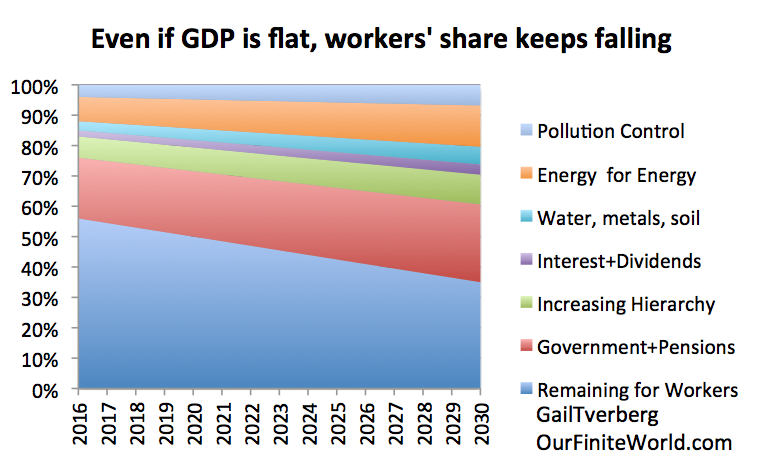 , because rising complexity adds all kinds of overhead to the system. Someone pointed out that I should also have included rising medical costs on this chart.
EROI only looks at “Energy to make energy,” something that is a small part of our overall problem. In fact, its definition is strange, leading to a misleading comparison between renewables and fossil fuels.
The reason why prices of all fossil fuels are low is because the wages of most workers are too low. They cannot buy big ticket items such as homes and cars, and international travel. If they could buy these items, it would pump up the demand for oil and in fact for all fossil fuels, and for commodities in general. This would raise prices. The issue, as I have said previously is return on human labor, which is wages. Researchers thought that they could transfer the same concept over to energy products, but in practice it doesn’t work. There are a great many academic papers written on the subject of fossil fuel EROI, by many well-meaning researchers. In fact, I am well-connected to this effort. I feel bad about needing to point this out, because many people working on this issue are (or perhaps used to be) my friends.
” The issue, as I have said previously is return on human labor”……….
Yes of course it is. It has always been so, humans need to eat, that is their energy input (speaking in the third person of course). The more people there are and/or the harder they work the more energy is required and the more waste is created, thus in turn creating another energy sink. It is also why stock and human slaves were used but those things have an obvious limit, they cannot grow exponentially and natural EROI limits were/would be reached.
But, but, but FF’s began to be used. FF’s do not require land to graze and husbandry, they allowed for the so called “energy slaves”. Machines were created to “work” and enable efficient waste disposal, a great return on human labour, high EROI. As the FF holes get deeper, further away, of lesser quality and more difficult to discover and exploit, the “energy slaves” either have to work smarter (complexity) and/or work harder (require more fuel) and begin to require a larger input for the same or even less work. (Larger and more plentiful machines use extra energy initially and on an ongoing basis).
As we were originally reaching limits for return on labour using human slaves and stock, we are now reaching those very same limits using FF’s and other non human energy sources. Except the ultra efficiency of the FF’s has allowed us to expand way, way into overshoot. There are now far more people and energy saving devices than can be supported without a cheap, abundant energy supply. The slaves require more input than they can profitably deliver. (by profitably, work and capital profit). This has been offset by complexity, globalisation and debt, entities that were created and enabled within the high EROI era.
My posts are heavily moderated (deservedly), so replies and conversations are quite difficult. I lose my train of thought and interest quickly).
According to the OECD Economics Department and the International Monetary Fund Research Department, a sustained $10 per barrel increase in oil prices from $25 to $35 would result in the OECD as a whole losing 0.4% of GDP in the first and second years of higher prices. http://www.iea.org/textbase/npsum/high_oil04sum.pdf
Oil cannot remain anywhere near the break-even of 120+ for very long — without collapsing the economy
Coal achieved its highest average btu content in the 90’s, oil to the end user about 2005. They have been supplemented with heavy, fracked and ethanol, for coal its brown lignite, wind, solar, gas etc. The alternatives are not cheap and are deliberately made less labour intensive because they have to be, to justify their exploitation and use. Less labour intensive of course must mean more energy use, thus declining EROI and the viscous circle of diminishing returns.
Thank you for your comments Norman.
I’m reading your book at the moment & it’s so clear & concise like your comments here.
You make sense for the common person yet even they can’t see what you say makes sense (such as my family) such is the power of denial……………..Perhaps the zombies are the lucky ones?
I wish i didn’t know what I do but there’s no way of unknowing…………………..
Brendon
I feel your pain most people can’t handle truth which includes some on this site. But what you feel isn’t new. Eccl 1:18 For an abundance of wisdom brings an abundance of frustration, So that whoever increases knowledge increases pain.
But there is an answer.
https://www.jw.org/en/jehovahs-witnesses/free-bible-study/video-why-study-the-bible/#?insight%5Bsearch_id%5D=40a7bbd9-d282-4bcb-9117-4874ab07d804&insight%5Bsearch_result_index%5D=0
i have a golden rule with jwitnesses
as a professional doomster, i feel it it my duty to engage them in conversation about what’s in store for us….that seems only fair as they offer me similar bounty of universal wisdom which i am supposed to accept unquestioningly. (such as was written down 3000 years ago by illiterate nomads)
with me it’s a point of honour never to shut the door—they always leave of their own volition after about 15 minutes.
they see me as beyond redemption. I try to save them too.
Don’t talk badly about nomads. I thought we agreed on nomads and hunter-gatherers not getting us into this mess.
“with me it’s a point of honour never to shut the door—they always leave of their own volition after about 15 minutes.
they see me as beyond redemption. I try to save them too”
Another reason I like your writing Norman. Clear, humourous & right on the button!
after my father retired, is was bored and never missed an opportunity to receive jwitnesses or mormons. he would always offer them a drink and then proceed to argue with them. i knew what he was up to when i returned from school to find the latest copies of the watch tower on the coffee table. i wondered if they marked our front door with lamb’s blood or similar.
“never missed an opportunity to receive jwitnesses or mormons”
When I was at the University of Arizona we lived at the Druid Student Center (sort of an anti-social fraternity) we used to invite the JWs in to celebrate Black Mass. They never took us up on it, and a good thing too since I have no idea of what we might have done.
On a really different subject, I think what we see at Tabby’s star has a simple explanation, and yes, it is aliens.
FE, humans might not get through the current crisis, but it’s becoming clear that an intelligent species can do it because we can see how they did it.
I hereby grant you a gold medal from the ‘Certified Insane Institute’
I am afraid this is a too far fetched for me. Even if aliens did manage to somehow harness the energy of their sun in such a way as to dim it, our problem is that we are out of time, when it comes to fighting our problem.
Our hope (assuming there is one) needs to come from a god-type source that is behind all of the energy flows that make up the universe, as opposed to our attempting to imitate aliens. A god-type approach could be immediately available.
Thanks for this.
I won’t be converting from this though…
I think most of Don’s problems were with me, not FE.
Another Koombayaist bites the dust… badda dum dum dum … another Koombayist bites the dust..
And another one gone and another gone .. another bites the dust….
Wonder how EV Pete is doing … he was most difficult to drive off…. he seemed to be waiting for someone to buy him a Tesla so he’d go out in style
You have to admire Don … he recognized that this was not his tribe… and he has found a home with a group of like-minded people…
I wish him joy and peace over there…. and endless Koombaya….
Surely this has to inspire others?
The only good Koombayaist… is one who has been driven off FW… to a better place… (Doomdiner? Peak Prosperity? Permie Queens.com?)
And BACK to REALITY
During the PETM, around 5 billion tons of CO2 was released into the atmosphere per year. The Earth warmed around 6°C (11°F) over 20,000 years, although some estimates are that the warming was more like 9°C (16°F). Using the low end of that estimated range, the globe warmed around 0.025°C every 100 years. Today, the globe is warming at least ten times as fast, anywhere from 1 to 4°C every 100 years. In 2010, our fossil fuel burning released 35 billion tons of CO2 into the atmosphere. By comparison, volcanoes release 0.2 billion tons of CO2 per year. How fast carbon enters the atmosphere translates to the how fast temperature increases, and the environmental and societal consequences of warming at such a break-neck speed could be devastating.
https://www.wunderground.com/c…
Increased crop yields are more closely correlated with increased irrigation and increased use of fertilizer and pesticides, which you have indicated are affecting water quality.
Indeed..factor in a new climatic period
This departure is so dramatic that it has instigated a new era. According to some studies, there is enough evidence to state that we have departed the Holocene and entered the Anthropocene. Simply put, based on the evidence, mankind has forced the Earth climate system to depart from it’s natural cycle forcing
Simply put FORGETABOUTIT
This is why it’s fruitless to think we can survive a collapse in the financial system or economy. Even if we manage to fix a problem here or a problem there, several larger and 100% unsolvable problems are lurking quietly in the background.
We are at peak mining for nearly EVERYTHING! Nuclear technology has become a ticking time bomb for the biosphere. Abrupt climate change is hastening with what appears to be runaway, exponentially rising CO2. There is an ongoing extinction event removing hundreds of species from the planet forever on a daily basis. The planet is completely removed from equilibrium with 7.5 Billion humans living on it. And the list goes on…
The natural cycle is leading to lower and lower co2 levels, a cooling of the planet, ice caps at the poles, ice ages and finally to a snowball planet and extinction.
It doesn’t really matter what the natural cycle is doing when the measurable CO2 in the atmosphere is going straight vertical on a geological timescale.
http://climate.nasa.gov/system/downloadable_items/194_co2-graph-021116.jpeg
Does the rising CO2 matter, if we really cannot fix it?
Yes and no. If we survive some sort of collapse-light scenario, however unlikely that may be, it would greatly behoove us to know precisely when we’re going to meet our biosphere expiration date. There’s also the possibility that many predictions about abrupt climate change don’t play out exactly as forecasted, meaning all of the research and science currently going into the topic won’t be a waste. Ultimately if we go extinct in the next few years the only thing we have left are our immediate and fleeting moments and possibly memories.
On the contrary – it is those that I deride — because they ignore facts and logic and common sense over and over — who are ruining the discussion.
Think of it this way — a group of aerospace engineers gather to discuss the latest wing designs for a new aircraft — and the janitor barges into the room and hollers ‘it’s all wrong – this is the way to do it’
The engineers are mostly polite and initially tell the engineer – thanks for the input but building a wing out of lead is not a great idea… that should be fairly obvious
tBut the engineer insists – he screams ‘ you can’t prove that!!! You can’t prove that!!!
At this point one of the engineers who is more assertive tells the janitor to shut up and piss off because he hasn’t the slightest clue…. the janitor continues to rant and rave … at which point the assertive engineer gives him a very hard kick in the ass and attempts to send him on his way.
As you try to clean up the mess, you’re planting the seeds for the direction you might want to go in. There’s an enormous amount of economic activity going on, some of which plants those seeds, and some of which don’t. And this activity might persist longer than we think.
Unfortunately, it is often engineers…not laymen, who are saying that building a wing out of lead is a great idea…Plug in any renewable energy topic into a search engine and websites like Cleantechnia dominate the search results…Cleantechnia is full of engineers who are screaming ” ‘ you can’t prove that!!! You can’t prove that!!! “
As many services (like hospitals) and road traffic (gridlock, etc.) decline, BAU seems to be scrambling to adapt. Some adaptations, like light rail, FW might deem unaffordable. This is easy to understand. Well, just about everything seems unaffodable to me. But some seem unaffordable while also precedent-setting for doing with less energy over time. Like ferries starting to return up and down the San Francisco Bay. The new ones are privately run, and surely are “too expensive” to finance and maintain. But they may put in new stations along the routes which could be used in a much lower maintenance and energy regime to get around by (e.g. with existing sailboats–as stages in a continuum of “decline”, and BAU trying to adapt to it). Likewise, Tesco in London is selling airspace over their stores. That brings residential and work space together, reducing the need for energy-squandering transportation. They are doing it in a savage and ugly way to shore up sagging income (the nature of the business world), but it might be adaptive to a future more low-energy regime.
http://www.telegraph.co.uk/business/2016/11/19/tesco-towers-supermarket-enters-the-fray-with-a-radical-new-solu/
Meanwhile, sprawl continues, along with gridlock and debt. I don’t know whether the downsides of that will promote steadily increased change that is potentially adaptive to a later stage of decline. Or… I’m wondering if there is some sort of feedback loop operating here. Apparently, the adaptive changes are not keeping pace with the habitual programs bringing the whole thing down.
Artlead’s posts can be summarized by one post.
https://englishcentralblog.files.wordpress.com/2013/08/energia-renovables-para-todos-en-2030.jpg
It CANNOT happen.
BAU cannot downsize – how many times does this have to be explained to you before you get it?????
But-but-but…green rooftops, and hydroponics! And my friend who works for the DOE swears they have come up with AI–the solution to all our problems!
Don’t be on the wrong side of history, Eddy! Join the side of Progress, not HATE!
I wanna believe — I really do! 🙂 🙂 🙂
But unfortunately I have this thing called a brain — and I try to use it — and it demands facts and logic if it is to buy in …
I suppose I could sniff Hopium like the others – and overcome the need for facts and logic…
How do we get the water up to the roofs? In fact, how do we get water to cities in the first place? I am afraid this is part of the “complexity” that seems to solve problems, but really introduces problems of its own, including increased wage disparity.
“The reset”
How fast?
How deep?
Will it be slow enough to allow mediation of the spent fuel pools?
Will it be deep enough to allow easy living for the survivors?
FE and all, at first many are shooting at you but after 95% of the people die only a few are shooting at you.
My guess it starts at the edges and works inward. Here next to NYC I give it 40 years to bottom out. Unfortunately, I do not think the first pass will be deep enough, only 80% removed, to allow survival for those left. Many a second pass in 150 years of slow decline to 95% removed or 99.5% removed.
http://wolfstreet.com/2016/11/26/hit-by-rising-global-risks-banks-in-spain-get-jittery-again/
Ad-hoc, though, is what Paul Oscar Hamilton, of Greenhearts Family Farm, prefers. He says he was inspired to become an organic farmer when he visited permaculture farms in New Zealand. But he farms like many organic farmers do, in “straight line row crops,” rather than following full permaculture design, because he says the incredible health of him soil allows him to.
Hamilton argues that permaculture is more difficult for many farmers to integrate than organic because “permaculture is slow and round.” The focus on perennials, for example, may take more time to get a production system going. In designing according to a farm site’s topography, permaculture might prefer on-contour planting to straight lines, which might make tractor work more challenging
http://civileats.com/2016/04/19/can-permaculture-make-a-dent-in-americas-farm-landscape/
The challenge, Wiig says, are the “constraints on professional farmers that exist beyond production techniques,” to which permaculture pays too little attention, like land access, food safety regulations, labor costs, global competition, and fickle markets.
Hamilton agrees that farmers practicing permaculture will likely have a harder time earning a consistent profit, especially as long as “the larger forces of corporate farming, mega landowners, and entrenched supply chains have too much momentum.” Still, he thinks permaculture could be a “reasonable niche approach” for “small-scale, urban farmers’ market gardeners.”
Aside from his misgivings, Wiig finds permaculture “full of potential” when it comes to inspiring a new generation of change agents. “If the current stewards of over two billion acres of American farmland were to adopt permaculture principles, our environment, food system, and society would experience a necessary shift towards resilience,” he says
Industrial farms dominate U.S. production value, thanks in part to the federal subsidies they receive. Large farms also benefit from economies of scale. The labor intensiveness of small farm production leads to higher prices, while the low prices of products from large industrial farms exclude the costs of negative environmental and social “externalities” caused in their production
any small, farms survive by earning a diversified income. The farmers Ferguson studied earned their income from a mix of “production, value adding, material services like machinery repair or custom grazing, cultural services like education and design, and off-farm employment.”
Ferguson insists “there are great examples of permaculture farms making it work on production alone.” But, he adds, “farms like that will always be exceptional until we change policy.”
For the foreseeable future, permaculture farms will likely continue to operate on the economic margins of our food system. And until these farms face a more level playing field, they’re unlikely to scale up.
http://greenheartsfamilyfarm.com
Calm down, Eddy….
FE is hilarious and pretty much the reason I come to this site. Fact is, the world is a complex system as Gail has pointed out. However, it is also chaotic. So, results can really vary depending on initial conditions making predictions nearly impossible. Too many variables!!! Hence, FE’s steadfast BAU argument is admirable in its consistency. Of course, it is also an example of elementary, linear, and delusional thinking. Oh wait, is FE actually from Delusistan? Time to warm up the turkey.
Exactly! He takes it so seriously…LOL…what a Super Trooper!
It so easy to push his buttons to get him off….Long live Scott Nearing, ha ha.🌊
Have you noticed that Gail has posted comments that imply agreement on most of what I have stated.
What is hilarious is that the Koobaya Krowd stays on FW even though their positions are completely out of line with the narrative of the articles published on the site.
What is even more hilarious is they are too stoopid to understand that this.
It’s as if Rush Limbaugh were to read the Huffington Post and think it was awesome…
Ah well – ever village needs an idiot or ten….
FR problem is he has a conscience. Hes wealthy and he cant stop spending. None of us can either hes just more wealthy. He adopts a philosophy that allows his continued consumption and allows him to look in the mirror. This is the same for most humans. FE is a little different in that his larger than usual conscience must be beat down by constantly reinforcing his consumption philosophy at all costs.
Ya but if everyone stopped or even slowed their levels of consumption …. what do you think would happen?
It’s going to have to go into reverse anyway. They could raise interest rates, redistribute wealth, ban more than one baby per couple and localise. The economy would crash, but at least it might be on better terms. But it ain’t going to happen. Nature will have to take its course.
Here’s a perfect example of doomer hyperbole that never comes to pass. In the following link/quote of Stockman, “Washington will be in chaos by June”, but what we will find out is June will come and go like any other month with the world not much different than it is now. Sure, a slow descent, but not any kind of sudden full on collapse into chaos.
https://www.theautomaticearth.com/2016/11/debt-rattle-november-27-2016/
“He further added that he expects “an unprecedented fiscal bloodbath” resulting from the $20 trillion worth of debt that the U.S. currently has on the books. “This isn’t Ronald Reagan with a clean $1 trillion balance sheet and with a fluke GOP and a Southern Democratic coalition that only materialized because he got shot,” Stockman said in reference to John Hinkley Jr. attempting to assassinate Reagan in Washington, D.C., in 1981. “Nor is it LBJ in 1965 with a thundering electoral mandate and a massive congressional majority for the Great Society.” On the contrary, Stockman, who initially predicted that Trump would win the election, added that Washington will be in chaos by June. This is because he anticipates ongoing disruptions from the tea party, which Stockman doesn’t foresee as allowing additional deficit increases.”
Because he supposedly ‘initially’ predicted Trump would win, all his future predictions must be true as well, right? Wrong, this guy has been touting economic collapse for years now and here we are just going on about the business of our regular daily routines.
I would agree that raising interest rates is a good way to make the economy fall apart quickly. Whether it is as quickly as June 2017 remains to be seen.
Notice that the CNBC article does not mention the June date, only “I see a recession coming down the pike in 2017. The stock market is going to go down and it’s going to stay down long and hard because, for the first time in 25 years, there’s nothing to bail it out.”
It is really worse than that, but Stockman doesn’t understand our energy problem. Stockman recommends gold and cash. Cash is still government debt. Perhaps he hasn’t looked at India recently.
How’s that 70 buck oil prediction working out?
FYI – finance people make predictions all the time — because when they are wrong they just assume most people will forget — but when they guess right — they are heralded as super stars and they get endless gigs on CNBC and billions pour into their funds….
https://www.youtube.com/watch?v=tt2AYafET68
It is possible — but it is not pleasant….
And she did not have to deal with radiation poisoning….
The collapse started in my opinion in 2000 when half of the conventional oil had been extracted and the oil price started to rise.
The next phase was peak conventional oil in 2005 when the oil production reached a plateau with a following oil price spike that led to a financial meltdown in 2008.
The next phase was the eurozone crisis and the arab spring in 2011.
In 2012 the energy halfway point was reached and when the oil prices then started to collapse in 2014 the crisis spread through out the emerging markets.
The next phase is probably just about to arrive.
I know that some will argue that we have so far only seen cracks in the foundation and that the collapse is when when the building comes down.
Next goes free speech, democracy, small business capitalism and the last remnants of the free markets. Some sort of government subsidies based rationing, in some weird way. The multinationals must have their profits, and next we’ll see helicopter money, with terms of payment.. or only in credit card form, to be used in multinationals owned malls.. and the other half forced in to sovereign debt.. free money for starting a business, but only if its a franchise in a multinational.. or somethings as weird like that..
One way to finance something like that is to ban cash.. confiscate cash, gold and real estate..
My bet is that during 2017 and 2018 the global political and economical system will twist and turn, transform in to something unthinkable, twist in to something unspeakable, as long as the profits keep on pumping to the multinationals.
In 2017 and 2018 everything else is negotiable, except multinationals profits.
Sounds reasonable in order of events, but I think the pace will be slower.
No “control and command”, no old school rationing, just working within current “free markets”.
We have a long way to go before real living standard will become problematic. Many/most could for a long time be fooled by new apps and EVs and statistics about renewable growth.
As long as people are fed and housed their revolts will be like Spain 2016 vs 1936 posted the other day.
In Spain in 2016, one of the slogans was ‘Bread for our children!’ No one in Western Europe is in that state yet, as you rightly point out, although food banks seem to be on the ise.
‘Crappified’ food and goods can go a long way yet, one imagines: paying more for ever lower quality.
“Bread for our children”
mighty close to
“We must secure the existence of our people and a future for [our] children.”
The energy halfway point is the zero net energy point. As long as the coal and nat gas prices where low and the oil price was high, the oil industry could still make a dollar profit by using coal and nat gas to produce oil. After the oil price collapsed that opportunity disappeared.
The oil industry is now an energy sink that is losing money.
I guess the only way to keep the oil industry alive now is through increasing debt, while the high cost producers are being shut down after their wells dry up.
No more E&D since there really isn’t anything left out there and no more expensive fields like Manifa and Kashagan.
It is really hard to say what happens next. I just can’t say. Perhaps the focus now will be on the multinationals and globalization… especially as nationalism is now politically on the mode.
“It is really hard to say what happens next.” I’ll suggest Peak Insanity, where the world keeps trying to do the things that worked when oil was affordable, and when that fails, tries harder.
Somewhat like a rerun of Rome 300-400AD without Constantinople.
++++ yes yes yes
With Trumps more roads for example. We here know more roads for more cars/trucks for more FF consumption will not solve the problem.
There is no solution — but anything that delays the end game would be a good thing no?
And I do mean anything.
1999 everything was bright and sunny. All curves pointing up. Equity and bond valuations were reasonable (excluding IT), debt was low, real estate could be bought to be paid off. Russians were friendly, arabs too. No one talked about climate, deforestation or overfishing.
That comment is a reflection of your own awareness,and nothing else. Many people have been aware of the Climate Disruption problem for many decades. James Hansen gave his
speech to the U.S. Senate in 1988,explaining it,and what it’s effects would be. Those effects are happening now,and will become increasingly severe. Ecologists have known about the detrimental effects of deforestation since ‘Ecology’ became a named science.
Plato knew about the effects of deforestation,and wrote about it in what we describe as
‘Poetic’ language, describing how the ‘softness ‘of the Earth disappeared as the
topsoil eroded after the forests were felled,and how the ‘bare bones’ of the Earth became
exposed. The same applies to overfishing. Ecologists have known about that for the
same time. Read ‘The Unnatural History of the Sea’ by Callum Roberts if you want to learn about overfishing and how many people have been aware of it for many decades.
My comment above was an observation,not a criticism. Industrial Civilisation is so complex and specialised that we all live in our own ‘Bubble of Awareness’now. No one person can
be up to date on every issue.
Personal? Yes, very.
There were some talk about ozone layer and desertification and recycling in school in the 80s. And of course there was war or starvation somewhere even in the 90s.
But generally the world was without worries (except the Y2K-bug …) which I interpret as we were not close to the limits yet.
Low energy prices (based on low energy costs) made everything go better. This is the time when the US debt to GDP ratio was falling, although the dollar amount increased a bit.
https://www.thebalance.com/national-debt-by-year-compared-to-gdp-and-major-events-3306287
I wonder if lack of debt growth was part of what led to the recession of 2001.
A large share of oil and other energy products will ultimately be left in the ground, mostly because of low prices. So I find statements such as, “In 2012 the energy halfway point was reached,” to be very strange. These statements only make sense for people who believe in Hubbert’s symmetric curves. It doesn’t really work that way, in my opinion.
I can believe that we do, in fact, hit different phases. Steve Kopits’ graphs showed that the cost of oil extraction beginning to rise, starting in 1999 (similar to your 2000).
But other things are even more important when it comes to total energy production, including rising globalization and China’s ability to add debt and coal production.
“1999”
It was very interesting reading the discussion on what is essential for a completely self sufficient lifestyle. Do you guys know of any books or blog posts that are completely realistic about this? it is interesting with the phosporus – how you can derive it from fish. Can you get it from other sources?
I might one day in the future have the opportunity to live wherever I want in Norway and the EU. I am guessing living somewhere hard to access in the mountains would be your choice of location? After the collapse of the Roman Empire most people felt secure in villages in the mountains right?
sindre,
The 500m x 500m comes from a guy in Finland who really, really tried to be fully self sufficient. To provide everything for his family by himself. There has been some books out in Norway, Sweden and in Finland about how to live in a self sufficient manner. BUT everyone still says their clothes and tools came from the supermarket. They were STILL pugged in to BAU.. so, no, I haven’t seen anywhere a blog about a successful complete separation of BAU
The soil needs nutrients, nitrates and phosphorus. Animal dung or a composting toilet goes pretty far, but still, phosphorus is needed. Today phosphous comes from different parts of the world where it is mined and shipped great distances https://www.americanscientist.org/issues/pub/does-peak-phosphorus-loom
Where to live ?
Hmm..
Nowhere is actually safe or without risks. There is no golden ticket to survive what is ahead. Russia beyond the urals, would be good, but hordes of Indians and Chinese should be flocking the great Russian rivers in the future.. To go to Fast Eddy to NZ would be a good idea, but that is an idea many other people have as well.. The souhern tip of Patagonia Argentina might be good, so might Alaska. Northern Norway, Sweden and northern Finland too. But there is a small problem. The weather patterns are chaotic. Anywhere in said regions, the weather might turn to impossible. What might be a pretty nice weather one year, might turn to a devastating catastrophe the next. Nowhere is safe smooth riding in the years ahead.
If you can choose.. then look for a mountain lake, filled with fish.. with miles and miles and miles of woods all around it.. build a log house with a Finnish Masonry Cookstove, heater, oven and cookstove. For efficient fuel use. Build a composting toilet and bring/plant arctic environment aclimated fruit trees, all kinds, everywhere. Bring a thousand jars for fermenting foods. Lots and lots of salt. Fishing nets and a fishing boat is required. And have two or three root cellars available. Build a greenhouse next to the log house for a earlier growing season start each spring. Those wont help much, but can’t make things worse either.. and while BAU lingers, you’ll have a nice view out the mountain lake.
“There has been some books out in Norway, Sweden and in Finland about how to live in a self sufficient manner. ”
Thanks for the comprehensive info, I am Norwegian myself. What books are you referring to? It would also be great for info on what Norwegians/swedes/finns did historically when it comes to being self sufficient.
One quite detailed account is given by these series of books which I recommend:
http://www.alternativ.nu/butik/b%C3%B6cker/levnadsskildringar/nybyggarliv-1.html
These books is about northern Sweden which is really pushing the limits of farming. Traditionally farming in northern Europe is about cattle, also in the south of Scandinavia where cereals actually do grow extremely well. Grass grows easily in the nothern european climate and cattle converts grass to milk and meat. Lactointolerance is camparably rare among scandinavians.
The finns, particularly in the eastern part of Finland (like Savolax), had a tradition of slash and burn farming. The forrests have now grown dense and high in many parts of Scandinavia over the last hundred years so the potential for slash and burn farming is good. I am not aware of any book describing this farming in any detail probably because it’s been off favour for some hundered (200-300) years. Slah and burn farming could definitely be an interesting short term strategy in a post BAU situation.
Thank you for the information!
The size of the plot varies a lot by the part of the world. Finland gives an example of a cold area of the world. It will require quite a bit larger plot than in India or Africa. In some parts of the world, it is possible to count on two crops a year, for example. Even a warm area along the western coast of Canada would be better.
The less productive locations already now have lower population density. Low population density = less hordeing and no running out of firewood or clean water.
Instead of wasting time Prepping why not let someone else do all of that while you get some military training and stock up on guns and ammo in a very big way…
Find a few like-minded individuals… stock up on food and diesel … hook a trailer up to the back of your truck to carry the food and weapons… then set out to where you know there are organic farms…
How many retired and active military people are there in the United States?
How many cops?
How many violent criminals are lurking — kept in check by the police but only while BAU lasts?
They will be coming. They will find you.
A farm is a very difficult place to defend You have to come out into the fields at some point to work…. you gotta go to the wood shed…
https://thumbs.dreamstime.com/z/sniper-rifle-sight-scope-13164771.jpg
<>
I suggest my own World Made By Hand series of novels.
–James Howard Kunstler
Mr Kunstler, I enjoyed those novels!
I will check them out
there is a tendency to separate food production, overall self sufficiency, politics and the unsustainable needs of the improvident and ”denialist” mob.
They cannot be separated out into isolated entities.
not with every commenter on here—obviously, but that mentality is nevertheless there, particulary on other sites of this particular genre—that if someone is lucky enough to ”own” five or ten acres, then somehow all problems will somehow pass by his gate and he will be allowed to get on with his self sufficiency and life in general no matter what goes on outside.
When the rednecks who voted for Trump (for instance) realise he’s not going to deliver anything, and things are going to get worse quite quickly, things are going to get very nasty indeed.
That’s going to bring politics, no matter how misguided, right up to your garden gate, it will remove any vestige of self sufficiency and any future food/ energy production.
And all at the hands of a mob still convinced that prosperity can be voted into office.
That’s why we need you Norman. There are a lot of concepts floating around that are new. The interconnectedness of this is new. The global scale of this is new. The magnitude of all of what is happening, what will happen next is new. Also the utter ruin that is to follow, is new.
We need skilled wordsmiths like you Norman, to make these concepts clear, or clearer.
We, and on other blogs, make constantly comparisons to the fall of Rome, collapse of USSR, Venezuela etc. But our words seem ineffective at times handling these concepts that operate in a new magnitude.. the sheer scale of malice, chaos and malevolence that are sure to follow, with reduced global energy, are hard to fathom.
+1
Isnt Keith the only regular who think things could turn out awesome? And even he has collapse as a possibility.
The rest of us optimists are only classified as optimists because we believe maybe someone could survive until 2030+.
I think things could turn out OK for 3% if a group took the situation into hand and purposely killed off 97% of the human population with biological means and/or robotic means. There wold also be enough people to deal with the spent fuel pools.
‘There wold also be enough people to deal with the spent fuel pools.’
Details please….
For further details, please refer to these people:
http://www.emptaskforcenhs.com/uncategorized/letter-to-president-barack-obama/
But please, be aware that your request could meet a classification wall.
“Isn’t Keith the only regular”
There are lots of ways things could go south, but also there are ways that things could turn out otherwise. Of course, none of them work with exponential growth. Even to whole solar system will fill up eventually.
More than ten years ago I wrote a story about chopping off growth (and death).
http://www.terasemjournals.org/GNJournal/GN0202/henson1.html
Suskulan is the name of the AI that runs a nanotech based clinic. The story is set in a tiny village (tata) in Africa. The speaker is a young girl (Zaba) who knows way too much. The “spirit world” is a simulation of the physical world into which the villagers have been uploaded.
“She remembered what Suskulan had said about staying awake and learning while being healed and how it would change her and the people of the tata.
“It certainly had!
“For better or for worse?
“For better in that nobody died of fevers, nasty parasites, or malnutrition since Suskulan had come into their lives. People didn’t even die of old age with a clinic to regress age for them and they aged in the spirit world only to the extent they wanted.
“For worse in that she could not have children unless she left the clinic for their gestation. Zaba had read the design notes that led up to the creation of the clinics and their spirits and had long understood the mathematics behind Suskulan’s limits. In the long run, births and deaths had to match. If you wanted no deaths, then there could be no births.
“Since fetal development was arrested while in the clinic, (but not post-birth growth) a number of families stuck it out until a child was born, then moved back into the more attractive spirit world tata to raise the child.
We may have seen a world where something like this happened a long time ago. Google Tabby’s star for background and if you ask, I will explain how we may find out something of great interest soon.
‘Tales from DelusiSTAN’
‘Tales from DelusiSTAN’
FE, at the end of the story, the human race is biologically extinct. What more could you ask for?
Recall those practical Greeks Xaiver brought up earlier in this thread. The land will continue to belong to those families with the tallest cannon towers, biggest cannon (recall Napoleon’s famous quote) and the most accurate cannoneers, to keep the noisy neighbors at bay.
I visited Guatemala City a few times. There is a big volcanic lake near there, with an island in it and a narrow isthmus. While we were sampling the lake, we kept hearing the sounds of automatic gunfire from that island. We guessed it was the guards target practicing/advertizing.
Or you could rent a copy of Kevin Costner’s “The Postman”.
James – Long Emergency was outstanding… it was one of the first resources that open my eyes to the energy issues.
I’ve looked at the summary for World By Hand and that is just pure Koombaya… I won’t be reading it.
I and others have explained ad nauseam why such a world is not possible.
There is the spent fuel issue … which will unleash 56,000,000 Hiroshimas of radiation …
There is also the fact that before coal was harnessed deforestation was a massive problem — imagine what 7.4B people will do to the forests when the lights go out.
And then there is this:
Soil that is farmed using petro-chemical inputs — will support no crop once the outputs are stopped – without years of intensive rejuvenation involving organic inputs.
Organic inputs will be hard to come by considering nothing can be grown – and most if not all animals are killed and eaten.
Less than 1% of all farmland globally is farmed organically.
Get ready to starve.
https://agenda.weforum.org/wp-content/uploads/2015/08/agriculture3.png (note – most organic land in Australia is rubbish and supports sheep only)
https://www.weforum.org/agenda/2015/08/which-countries-have-the-most-organic-agricultural-land/
If you are to convince people to buy your book you might want to address the above…
I am considering writing a book — How to Enjoy the Final Days of BAU to the Fullest because you and everyone you know will soon be Dead – or Wish you were Dead.
I am afraid you will not find a lot of publishers for your books, Fast Eddy.
Not defending FE viewpoint, but people are attracted to end of the world stories. Look at all the cults which have sprung up claiming the end is next year. That may be more important in the meme spread than the facts and models behind LTG.
BTW, Jay Forester, the guy who invented systems dynamics, died Nov 16. (At 98.)
Everyone wants a happy ending — as we can see from the comments from many of the people on FW… they cannot live without a daily puff of hopium.
There will be only misery and suffering and extinction
Thanks! I had heard that he had died.
James is no fool…. and he wants to sell books…. I bet he agrees on the extinction outcome … but prefers not to say it… bad for book sales.
If we recall The Road — it was as grim as it gets… but it did end on a positive note….
Thanks, Jim, for commenting. Sometimes, the best way of trying to understand the future is through novels. I am sure that different people would come up with different visions of the future.
When I first started reading about oil limits, one of the first things I read was The Long Emergency, published in March, 2006. I found it to be very helpful. It pointed out limits that most people miss–if houses are kept at a temperature below freezing, pipes will freeze up. We need roads, if we are to have cars. If only a few people have cars, it becomes too expensive for those driving the cars to pay for the upkeep of the roads.
These things are in many ways obvious, but they were completely missing from the work of Heinberg and others, writing at that time.
The long Emergency was the book that started my bookpile too
JHK has a lot to answer for
Norman – perhaps you could do a sequel to End of More …. Getting by On Less… how BAU Lite is assured. It would be a best seller in DelusiSTAN.
I know that Norway had a great deal of difficulty maintaining its population during the plagues. Its population was already living “on the edge.” I would expect the sea would provide the most productive way of earning a living. Like most countries, quite a bit of the population is located near the sea and near waterways.
In college, my father wrote a history of his father’s family in Norway, in the late 1800s and early 1900s. They could not make a living on a small plot in the mountains. They went heavily into debt, and earned part of their living from “moonshine.” My grandfather was the oldest son in a large family, and thus stood to inherit the farm. He decided to come to America and start over; he felt it would provide better prospects than the farm.
Dear Ms Tverberg;
“I would expect the sea would provide the most productive way of earning a living.”
Nah, not anymore. The corals are well on their way out because of bleaching that has continued unabated since 2014. Puffins are dying and are probably endangered because of starvation caused by warm seas that do not circulate like they should. And then there is FE’s favorite problem that I won’t mention. In fact, as the thermohaline circulation continues to slow, there is an excellent chance that the oceans will begin to emit toxic levels of hydrogen sulfide (known as the Canfield Ocean).
So, no. Don’t live near the ocean.
Pintada
I would summarize the problem as over-fishing, plus a few environmental problems.
There is still a viable fish population in Norway. What I am worried about is the pollution of the ocean. In a post collapse scenario a lot of the calories in Norway would come from fish, but fish contain substantial levels of heavy metals.
If I decide to live in nature I will probably just move to the mountains in Spain in matavenero.
https://www.google.no/search?q=matavenero+ecovillage&ie=utf-8&oe=utf-8&client=firefox-b&gfe_rd=cr&ei=R0c9WJ6bLoeA8QeWtJ2ACA
It is just way more enjoyable although there is probably less of a chance of surviving in Spain. Going full hardcore survivalist in Northern Norway just seems too difficult, and I would just get depressed by the long cold dark winters.