
The way the world economy is manipulated by world leaders is a little like a giant video game. The object of the game is to keep the world economy growing, without too many adverse consequences to particular members of the world economy. We represent this need for growth of the world economy as being similar to making a jet airplane fly at ever-higher altitudes.

Figure 1. Author’s view of the situation we are facing. World leaders look at their video screens and adjust their controllers to try to make the world economy fly at ever-higher levels.
World leaders look at their video game screens for indications regarding where the world economy is now. They also want to see whether there are specific parts of the economy that are doing badly.
The game controllers that the world leaders have are somewhat limited in the functions they can perform. Typical adjustments they can make include the following:
- Add or remove government programs aimed at providing jobs for would-be workers
- Add or remove government sponsored pension plans and payments to those without jobs
- Add or remove laws regulating efficiencies of new vehicles
- Change who or what is taxed, and the overall level of taxation
- Through the above mechanisms, change government debt levels
- Change interest rates
There are numerous problems with this approach. For one thing, the video game screen doesn’t give a very complete picture of what is happening. For another, the aspects of the economy that can be controlled are rather limited. Furthermore, the situation is very complex–there seem to be several “sides” of the economy that need to “win” at the same time, for the economy to continue to grow: (a) oil importers and oil exporters, (b) businesses and their would-be customers, (c) governments and their would-be taxpayers, and (d) asset holders and the would-be buyers of these assets, such as families needing new homes.
An even bigger problem is a physics problem that is hidden from the view of those operating the control mechanism. Jet airplanes in the real world cannot rise beyond a certain altitude (varying depending upon the plane), because the atmosphere becomes “too thin.” There is a parallel problem in the economic world. The atmosphere that allows an economy to grow is provided by a combination of (a) an increasing supply of cheap-to-produce energy, and (b) increased technology to put this growing energy supply to use. This atmosphere can become too thin for several reasons, including the higher cost of energy production, rising population, and growing wage disparity.
We know that in the real world, a jet airplane cannot rise ever-higher. Instead, at some point, the airplane hits what has been called its “coffin corner.”
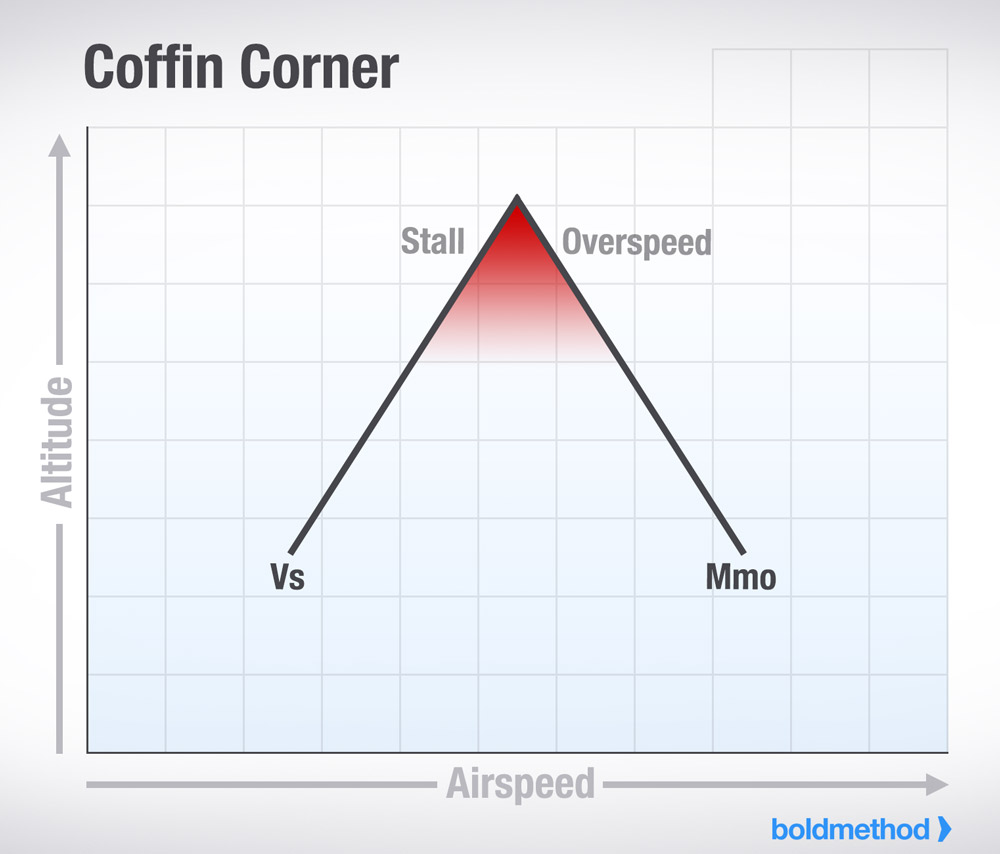
Figure 2. Diagram of Coffin Corner by Aleks Udris of Boldmethod. On the chart, Vs is the velocity; MMO is the Maximum Mach Number.
According to Aleks Udris, “The region is deadly. Get too slow, and you’ll stall the jet at high altitude. Get too fast, and you’ll exceed your critical mach number. The air over your wings will go supersonic, you’ll pitch down, the aircraft will accelerate, and your wings will fall off. Also bad.”
What Happens As Coffin Corner Limits Are Reached in the Economic World?
What do world leaders do, as the world economy hits limits? One temptation is for the world leaders in Figure 1 to take their foot off the throttle that is operated by low interest rates and more debt, because they don’t seem to be providing very much benefit anymore. The leaders fear that if more debt is added at low interest rates, it risks creating “asset bubbles” that are easily disturbed if any little bump to the economy occurs. If a big bubble pops, there is a significant risk that the economy could fall down to a much lower level. This is like stalling the jet at high altitude.
World leaders can also use approaches that create situations more like “making the wings come off” the economy. These approaches involve favoring one group over another. For example, a government can give big tax breaks to businesses, but raise taxes on individual citizens. Businesses will ultimately be harmed by this approach, because they depend on individual citizens for their sales. The result is like tearing the wings off the airplane.
Another approach that would tear the wings off the economy involves actions by a different group of world leaders than those shown in Figure 1, namely the leaders from OPEC and Russia. These leaders have different video game screens and different game controllers. They can manipulate the world economy by reducing the supply of oil they provide. With this approach, they hope to increase the price of oil, and thus obtain a larger share of the world’s goods and services through higher tax revenue.
Raising the oil price would benefit oil exporters, but would make goods and services more expensive for oil importing countries. Ultimately, this approach would lead to recession in oil importing nations. The result would likely be worse than the 2008-2009 recession–another way to make the wings come off the economy.
Let’s look in a little more detail at what is happening, and what goes wrong:
[1] Energy plays a huge role in this game, because a growing supply of cheap-to-produce energy allows greater worker productivity.
It takes energy of various types to make the economy grow, because energy is needed whenever we move something, or heat something, or use electricity to operate something. We use energy products to leverage our human labor. For example, we use a truck to deliver a package, rather than walking and carrying the item in our hands. If fresh water is in short supply, we use energy to operate a desalination plant, and thus produce the fresh water we need.
It is generally workers who produce goods and services. If energy supply is inexpensive and readily available, it is easy for governments or businesses to create “tools” to make these workers more productive. These tools include such things as roads, vehicles, machines of all types, and even computers. If the quantity and capability of these tools are increasing, the labor of these workers is increasingly leveraged by the availability of these tools. This is what allows economic growth.
[2] The extent of world economic growth seems to depend primarily on how quickly total energy consumption is growing.
If we look at historical economic growth, we see that the rate of growth of energy consumption seems to play a major role.

Figure 3. World GDP growth compared to world energy consumption growth for selected time periods since 1820. World real GDP trends for 1975 to present are based on USDA real GDP data in 2010$ for 1975 and subsequent. (Estimated by author for 2015.) GDP estimates for prior to 1975 are based on Maddison project updates as of 2013. Growth in the use of energy products is based on a combination of data from Appendix A data from Vaclav Smil’s Energy Transitions: History, Requirements and Prospects together with BP Statistical Review of World Energy 2015 for 1965 and subsequent.
The highest rates of world economic growth took place in the 1950-1965 period, and in the 1965-1975 period. These were both periods of very high growth in energy consumption. As we will see below, these were both periods when the price of oil was less than $20 per barrel, for almost the entire period.
If we look at economic growth over shorter periods, we also see a strong correlation between world economic growth and growth in energy consumption:

Figure 4. World growth in energy consumption vs. world GDP growth. Energy consumption from BP Statistical Review of World Energy, 2017. World GDP is GDP in US 2010$, as compiled by World Bank.
[3] On Figure 4 (above), the widening gap between GDP growth and energy consumption since 2013 could either represent (a) Much greater efficiency in using energy or (b) A problem in measuring true economic growth.
We can see true efficiency improvements in the 1975-1985 and the 1985-1995 periods shown on Figure 3. These were the periods when the world was truly trying to “get away from oil,” after a spike of high prices in the 1970s. Governments around the world were encouraging new smaller cars; electricity generation was being changed from oil to nuclear; home heating was being changed from oil to natural gas or electricity. The new furnaces installed were much more efficient than the old ones. Thus, during this period, efficiency/technology improvements were aiding economic growth to a greater extent than usual.
Now, in the period since 2013, much of the “low hanging fruit” has already been picked. We may still be finding some technology gains, but it seems likely that at least part of the problem is an “economic growth counting problem.” GDP looks like it is growing, but it is really very hollow economic growth. Governments invest in projects of essentially no value, and their investment is counted as GDP. For example, they invest in unneeded roads, in apartments that citizens cannot really afford, in educational institutions that do not produce graduates with wages that are sufficiently high to pay for education’s high cost, and in high-priced medical cures that are unaffordable by 99% of the population. Are these things truly contributions to GDP?
We also find businesses that look like they are growing, but in fact are taking on increasing amounts of debt as they sell off assets. This is not a sustainable model! We encounter energy companies that claim to be doing “sort of” alright, but their profits are so low that they need to cut back on new investment, and they need to borrow in order to have funds to pay dividends to shareholders. There is something seriously wrong with this growth!
[4] The economic “atmosphere” becomes thinner and thinner, when oil prices rise above an inflation-adjusted price of $20 per barrel.
Back in the time period prior to 1973, oil prices were generally below $20 per barrel, in inflation adjusted terms. Since then, prices have tended to be above this level.

Figure 5. Historical oil prices are Brent oil prices in 2016$ from BP Statistical Review of World Energy 2017; $20 per barrel is the maximum price level where oil is truly affordable; and $300 per barrel is the maximum price per barrel that the International Energy Agency seems to believe is possible for the world economy.
When oil (and other energy prices) were very low, companies could add tools to make workers more effective with little expenditure. As a result, the United States saw wages growing much more rapidly than inflation prior to 1968 (Figure 6).

Figure 6. Chart comparing income gains by the top 10% to income gains by the bottom 90% by economist Emmanuel Saez. Based on an analysis of IRS data, published in Forbes.
Once prices of oil started rising, prices of tools (broadly defined) rose. Governments and companies needed more debt to buy these tools. It became more of a burden to add capital goods of all kinds. Governments tried to raise GDP by adding debt, but to a significant extent they ended up with higher debt to GDP ratios rather than the rapid growth they were looking for (Figure 7).

Figure 7. Worldwide average inflation-adjusted annual growth rates in debt and GDP, for selected time periods. See post on debt for explanation of methodology.
The changes in the economy that allowed continued growth (more debt and more technology) tended to push the economy toward more wage disparity, in part because more technology required more training for some of the workers, but not for others. This allowed wages of the workers with special training to rise.
Furthermore, the need to repay debt with interest tended to funnel wealth toward the financial sector, and toward those within the economy who could afford to hold financial assets. These changes left less of the output of the economy for non-elite workers.
Economists never really understood what was happening. They had never thought through the important role that energy plays in the economy. Cheap energy is needed to create jobs. It is jobs, and the wages that those jobs pay, that tend to suffer when oil prices are too high (Figure 8). Thus, high-priced oil has a double impact on the economy:
- It makes goods of many kinds more expensive.
- It reduces job availability and wages.

Figure 8. Average wages in 2012$ compared to Brent oil price, also in 2012$. Average wages are total wages based on BEA data adjusted by the CPI-Urban, divided by total population. Thus, they reflect changes in the proportion of population employed as well as wage levels.
Logic would suggest that the economy cannot really operate on high-priced oil. Lower wages and higher prices do not peacefully coexist! We should expect high oil prices to be very unstable. Even if prices can reach a high level in response to a specific shortage or stimulus, we cannot expect these high prices to be maintained for a sustained period, without added stimulus. Unstable high prices are not likely to give rise to more oil production; they cannot be depended upon.
Economists have never understood this situation. Instead, they have made pronouncements that at some point in the future, they expect that oil would become scarce. Because of this scarcity, oil prices would rise. In their view, when oil prices rise, high-priced substitutes would suddenly become the best option available; somehow, the economy would become able to operate using these high-priced substitutes. (If energy products were not needed for labor productivity, this view might make some sense. In the real world, it does not.)
It never occurred to organizations such as the International Energy Association (IEA) that high oil prices might be a problem for the economy. The IEA has shown exhibits suggesting that oil prices could theoretically rise to $300 per barrel. Of course, at such an elevated price, there would be an almost unlimited amount of oil available to extract (Exhibit 9).

Figure 9. IEA Figure 1.4 from its World Energy Outlook 2015, showing how much oil can be produced at various price levels.
[5] The real enemies of continued economic growth are (a) diminishing returns with respect to oil and other energy production, (b) continued population growth, and (c) increasing wage and wealth disparity.
We seem to be playing a video game where the players don’t understand who the real enemies are.
Diminishing returns with respect to oil and other energy production have to do with the cost of energy extraction rising ever-higher, as more resources are extracted. There are a lot of resources that we can “see,” but that we cannot economically extract, unless prices rise to very high levels.

Figure 9. My version of the resource triangle for oil. Note that oil shale is not the same as tight oil, found in shale formations. Oil shale is kerogen that must be processed at very high temperatures in order to produce oil. This is rarely done, because of the high processing cost. Tight oil is not on this chart. Tight oil probably would be above “onshore heavy oil; oil sands.” It still would disappear, if oil prices permanently fell to $20 per barrel or less.
Continued population growth is a problem because it is really “energy per capita” that matters. Each individual needs food, transportation, and housing. All of these things take energy. Many years ago, when most of the workers were farmers, it was necessary to create ever-smaller farms, as population rose. This clearly would lead to lower food production per farmer, unless some sort of technological breakthrough was taking place at the same time. Today, we have a parallel issue.
Increasing wage disparity tends to be associated with the rising use of technology. When most labor is hand labor, workers truly do “pay each other’s wages.” All wages can be fairly equal. With increased technology, some workers have specialized training; others do not. Some workers are supervisors; others are laborers. Unless the overall output of the economy is rising very rapidly, non-elite workers find themselves increasingly unable to afford the output of the economy. It is this falling “demand” (really affordability) that tends to pull an economy downward.
[6] High oil prices can be temporarily tolerated by an economy, if interest rates are lowered to make this arrangement work.
Clearly, lower interest rates make capital goods of all kinds more affordable to both businesses and individual workers. If we look back at the period since 1981, we see a long period of falling interest rates, acting to stimulate the economy.
When oil prices exceeded $20 per barrel, the economy did not collapse immediately. In “normal” times, lowering interest rates was sufficient stimulus to keep the economy growing (Figure 4).

Figure 10. Ten-year treasuries through Nov. 17, 2017. Chart produced by FRED.
When there is a very big drop in oil prices (as in 2008, related to falling debt levels), then Quantitative Easing (QE) has been helpful (Figure 11). The US began its program of QE in late 2008, when oil prices were near their low point. There were three phases of the US’s QE. The US discontinued the third phase in late 2014, just as oil prices started to slide again.

Figure 11. Monthly Brent oil prices with dates of US beginning and ending QE.
[7] It is quite possible for a disconnect to occur between (a) the cost of oil extraction, and (b) the selling price of oil.
Oil that costs more than $20 per barrel is never very affordable by the economy. It really needs continual stimulus to keep prices at an elevated level. Once debt growth falls too low, the balance between the supply and demand for oil is settled in the direction of the amount of goods and services made with oil that non-elite workers can afford. Prices fall below the cost of production. This seems to be what has happened since 2014.
[8] In fact, since 2014, the selling prices of oil, natural gas, and coal have all fallen below the cost of extraction.

Figure 12. Price per ton of oil equivalent, based on comparative prices for oil, natural gas, and coal given in BP Statistical Review of World Energy. Not inflation adjusted.
It is popular to think that the reason why oil prices are too low is because of overproduction by the United States or Saudi Arabia. When a person stops to realize that essentially the same situation arises for all three fossil fuels, a person begins to understand that there likely is an affordability issue underlying the low prices for all three fuels. The affordability issue, of course, arises because energy supply is not rising quickly enough because (at over $20 per barrel), it is too expensive to be truly affordable. The “atmosphere is too thin” at today’s high cost of energy extraction.
9. Coal production seems to have “peaked” because at today’s low prices, few mines find the extraction of coal profitable.
It is popular in “Peak Oil” circles to believe as the economists do: oil and other energy prices can rise endlessly, because of growing “demand.” Economists have never stopped to think that at any given price, there is an affordability issue for customers. If prices drop too low, there is a profitability issue for those operating extraction facilities.
If we look at the situation with coal, we see a situation where peak production seems to have been reached because of low prices. China has closed down mines because falling prices have made mines that were previously profitable, unprofitable (Figure 13). Coal is the lowest-cost fuel; if it cannot be mined profitably, the world economy has a problem.

Figure 13. China’s energy production, based on data from BP Statistical Review of World Energy, 2017.
In fact, it appears as though we have reached peak coal on a worldwide basis, as a result of low prices (Figure 14). It is hard to see any major production area that can grow substantially in the future, without much higher prices.

Figure 14. World coal production, based on BP Statistical Review of World Energy Data. (For 1965-1980, consumption is substituted for production, because only consumption is given, and imports/exports are likely small.
[10] The world economy needs to be able to keep repaying debt with interest. If world economic growth slows too much, this will not be possible.
We may already be reaching a “too slow growth limit.” Below this growth limit, it becomes impossible to repay debt with interest, especially if interest rates rise. We may already be reaching this point, based on the lack of growth in energy consumption per capita shown in Figure 15. (Also, as noted in Item [3], it seems quite possible that recent GDP growth indications are overstated.)

Figure 15. Average energy prices (averaging oil, coal, and natural gas) versus the total quantity of energy products consumed per capita, based on BP energy consumption data and UN population data. (Prices have not been inflation adjusted.)
Figure 15 suggests that affordability and price go together. When the world economy is growing rapidly, energy prices tend to rise (as does energy consumption). When energy consumption per capita falls, it is a sign that the world economy is not doing well.
One of the things that confuses matters is the very different economic growth results for different parts of the world. If oil prices are low, this improves economic growth prospects from the point of oil importers, such as the United States and China. This is what our video game players are looking at, not the results for the world as a whole. It is oil exporters, such as Venezuela and Saudi Arabia, who are having problems.
If we look at world news, Venezuela may collapse because of low oil prices. Saudi Arabia has found it necessary to take on debt, and has undergone regime change, at least partly related to low oil prices. Norway is proposing that its oil and gas fund no longer invest in oil and gas companies, because it expects that there is a significant chance the oil price will not rise high enough to bring companies back to adequate profitability.
[11] The whole “game” has been confused by a lot of not-quite-correct pronouncements from academic circles.
A lot of well-meaning people have tried to solve our energy problems, but haven’t gotten the story right.
Economists have gotten the story pretty much 100% wrong. Energy is very important for the economy. Furthermore, energy prices don’t rise endlessly.
Peak Oilers have confused matters by talking about oil, coal and natural gas being determined by the amount of technically recoverable resources in the ground. This might be true if energy prices could rise endlessly, but clearly they cannot. By following the wrong views of economists, Peak Oilers have led world leaders to believe that far more resources are available to be extracted than really is the case.
People who call themselves Biophysical Economists haven’t really gotten the story correct either. The Biophysical Economists realized that there was a need for a measure for diminishing returns. They put together a measure which they called Energy Returned on Energy Invested. The measure, unfortunately, only “sort of” works. It gives a lot of wrong answers. It does not suggest that oil prices above $20 per barrel are a problem. It also does not suggest that substitutes for oil that are priced above $20 per barrel are a problem. It tends to give a lot of “false positives” when it comes to the question of whether renewables can be substituted for fossil fuels. It seems to suggest that a particular ratio is important, when it is really the total quantity of an energy product available at a very low price that is important.
I should not pick on the Biophysical Economists. There are many others with academic credentials who produce metrics that really aren’t very helpful. Energy payback time is not a very helpful metric, especially from the point of view of deciding whether or not to use a particular device. It is not the energy that the economy must pay back; it is the full cost of manufacturing the device that needs to be recovered, including human labor costs and taxes. In some applications, the cost of mitigating intermittency may also need to be considered.
Even the standard Levelized Cost of Energy calculations can give misleading indications, if they are used on intermittent renewables without taking into account the cost of mitigating the intermittency.
Conclusion
With all of these issues, it is not surprising that world leaders have difficulty playing the energy and economy game. In fact, it is hard to see any winning strategy.
One of the issues that makes the game impossible to win is the fact that all sides must win. A solution that cuts out the oil exporters is a problem for an economy dependent on oil. Any solution that cuts out the workers is a problem, partly because businesses need workers as consumers, and partly because governments need workers as taxpayers.
The reason I have not included any discussion of renewables is because at this point in time, we do not have any renewables that are sufficiently inexpensive and sufficiently scalable to represent a solution.


Eventually, no matter how well you play, the game over sign comes on the screen. The question is, do you have another quarter?
They used up most if not all of their quarters during the last financial collapse.
no quarter
Good point!
Good point!
Ugo Bardi has a post by Nate Hagens on his website which I think is one of the best summaries of our current situation. He talks about how we are being supported by the energy slaves of oil and how we cannot support our civilization or population with anything less. Also the futility and idiocy of the focus on growth, the failings of GDP, and the issue of population. Along with our competitive “keeping up with the Joneses” tendencies that we share with monkeys, and the questionable value of many jobs.
I found it interesting that Ugo Bardi published it on his website, given that Nate Hagens clearly does not share Bardi’s fervour for solar power.
http://cassandralegacy.blogspot.co.nz/?m=1
+++++++++++++++++
I didn’t really see anything in this post that would be offensive to Ugo. Nate is talking about happiness continuing, regardless of energy.
One point Nate makes is
This report does not give a calculation of this amount. I would presume that it is calculated by taking the ratio of $20 to $150, and calculating a ratio of 13.3%. If this ratio is multiplied by the 22,000 energy slaves per barrel, it comes out to something like 2,933 energy slaves per barrel of all. This is the number of affordable energy slaves at $150 per barrel. This is equivalent to the “low GDP amount” I calculated in an earlier comment I made regarding GDP changes with rising oil prices.
Gail: Did I miss any/all references to energy other than oil? It seems there’s still a lot of other energy that is not included in your calculations. Meanwhile electric vehicle populations keep growing, and electric trucks and planes are in development.
” Meanwhile electric vehicle populations keep growing, and electric trucks and planes are in development.” – Your thinking is misguided.. Electric planes and trucks will be in development until the system collapses as limits to growth are reached. Electric planes and trucks will never displace the real workhorses that are powered by liquid fuels. They offer nothing new and require much sacrifice (they cost more and haul less). Not the right combination to displace existing technology now is it.
People view the world as they see it. They see mostly passengers cars so they think if those can be changed to electric all our problems are solved. Not so easy. Try putting a big payload on an electric truck vs. a diesel truck and then send both up a steep grade. The diesel truck might not go too fast but it’s steady and assured it will make the grade. The electric truck will make it possibly to the top of the grade but at the expense of how much energy? Under heavy loads and resistance like there is farming equipment, electric just isn’t going to cut it. Neither is electric going to be a solution for jets or ships or cargo trains under heavy loads especially on slight grades.
Here’s a good example of what happens to electric under a heavier load. Take your cordless drill and instead of drilling pilot holes or driving in screws, try drilling through tile and push real hard. The power drains out super quick. That’s the problem with other heavy load situations.
electric vehicles cannot function outside a fossil fuel based environment
Agree 100% Norm. Electric vehicles cannot function without all the infrastructure supplied courtesy of fossil fuels (road, bridges, electric grid).
Fossil fuels make up 87% of total world energy requirements. Electricity is only 30% of energy use, and oil is the master resource. Without it, nothing works and the cheap stuff ain’t ever coming back. The share for renewables has actually decreased over the past 40 years from 15% to 13%. Solar and wind, despite massive subsidies, only account for 1% of total world energy use. Therefore, the few electric vehicles in service get their power from fossil fuels, plus are created and supported by a fossil fuels based infrastructure. Yep, looks like a total winner.
This is the IEA’s chart of Total Primary Energy Supply (TPES). Wind and solar are part of the thin grey line at the top called other. Hydro doesn’t count for much either, because of the way IEA counts it. (IEA assumes hydro is too undependable for a country to count on; the country really needs another type of electricity supply as well. Hydro only replaces the fuel for this other electricity supply. IEA uses the same counting methodology for wind and solar; they only replace fuel. Backup electricity supply is needed when they are not available.)
Thanks for the chart Gail! It just really puts into perspective how much new energy we would need to gain access to to replace the energy we get from fossil fuels. And we need it now, not in 10 or 20 or 30 years. The illusion of economic growth post 2008 cannot go on much longer before things completely fall apart. We need that cheap energy replacement now and solar PV and wind are still in the “other” irrelevant category. We are so toast.
Anyone who would stop and think about it would realize that wind and solar are just an irrelevant joke. But they do provide hope. And they tend to artificially lower the prices of electricity, pushing the prices of fuels that are used to make electricity (coal and natural gas) down. They also tend to make nuclear unprofitable, because they push wholesale prices of electricity negative or low much of the time. Nuclear has to continue operating, even with absurdly low prices; it can’t be turned off. So they allow the price of electricity to drop or stay closer to level, even as the real cost of production rises. Nice trick! But this is what we need, if it is the declining cost of energy services that allows economies to grow.
https://gailtheactuary.files.wordpress.com/2017/11/fouquet_average-price-of-energy-and-energy-services-in-the-uk-1700-2008.png
https://gailtheactuary.files.wordpress.com/2015/07/ayres-and-warr-electricity-prices-and-electricity-demand.png
Yet more examples of how almost all humans are just plain duuummb — and just how powerful the MSM is
If they see it in the MSM there is absolutely no way of convincing them that what they have read is just plain wrong — even something as outrageous as the Tesla semi truck is impossible to debunk… you can demonstrate how it is just not viable to power a truck with a battery…. that the battery takes up almost all of the weight reserved for cargo and costs nearly 1 million dollars….
Even very intelligent people will dismiss you and negative.
Aha! Electric planes! I knew they were coming soon!
Like the electric tractor trailer is about to replace diesel — not….
Sripad and V. Viswanathan (2017) at Carnegie Mellon University have published a paper in the peer-reviewed American Chemical Society Letters at the following link: Performance metrics required of next-generation batteries to make a practical electric semi truck. Below is my review of their paper along with some additional cited observations of my own.
Authors S. Sripad and V. Viswanathan felt compelled to write their paper because there are so many guesstimates of the likely cost and performance of an electric class 8 semi-truck in the media. But these hasty calculations don’t take into account critical factors like the specific energy density of the battery pack, vehicle weight, drag, rolling resistance, battery kwH to go a given distance, and weight of the batteries given current Li-ion battery technology.
The definition of class 8 trucks is their weight of 33,000 pounds or more. We can assume electric class 8 trucks would have the same basic truck weight, because building them with light-weight aluminum or carbon fiber is too expensive. And unlike cars, where the average income of an electric car buyer is $148,158 (NRC 2015), and the amount of aluminum needed to light-weight the car is a small fraction of what a truck would require, the trucking industry is a cut throat business with razor thin profits. Light-weighting them is out of the question.
The maximum weight of a truck allowed on the road is 80,000 pounds, so if the body weight of the truck is the minimum 33,000 pounds, then the maximum amount of cargo that can be carried is 47,000 pounds.
The authors found that a 900 mile range [to arrive at kms, just multiply by 1.6] is simply not possible with today’s batteries, because the weight of the battery pack required is 54,000 pounds plus 33,000 pounds truck weight, which is 87,000 pounds, well over the maximum road weight limit of 80,000 pounds. And this truck that can not haul cargo will set you back $500,000 to $650,000 dollars for the battery alone.
A 600 mile range isn’t commercial either. For starters, the battery pack would cost $320,000 to $420,000 dollars, and on top of that you’ll need add another $100,000 for the body of the truck. To move a truck 600 miles requires a 36,000 pound battery + 33,000 pound truck weight and the truck can only carry 11,000 pounds, which is 36,000 pounds less than a diesel truck can carry.
Musk claims the range of the truck can be as much as 500 miles. Based on the figures in Table 1, that means the battery would cost $267,000 to $350,000 (also add on $100,000 for the truck body), and the battery will weigh 30,000 pounds + 33,000 pound truck weight and be able to carry only 17,000 pounds of cargo, which is 30,000 fewer pounds than a diesel truck.
Even if the range is on the low end of 300 miles, the battery will still be very heavy, 18,000 pounds + 33,000 pounds truck weight and and only be able to carry 29,000 pounds of cargo, which is 18,000 pounds less than a diesel truck.
The bottom line according to the authors, is that a 600 to 900 mile range truck will use most or all of their battery power to move the battery itself, not the cargo. The cost of the battery is $160,000 to $210,000 plus $100,000 for the truck body, so overall $260,000 to $310,000, which is $140,00 to $190,000 more than a new $120,000 diesel truck — considerably more than used diesel class 8 truck, which can cost as little as $3,000.
Read More – it gets BETTER!!! https://damnthematrix.wordpress.com/2017/11/23/tesla-semis-and-the-laws-of-physics/
Electric razors tend to work quite well… I am not aware of diesel powered options….
Fast Eddy, that whole article is very flawed. It seems designed to make the electric semi look very bad.
The real numbers are like 7.9t for a pack of 1Mwh of capacity and a cost, using the price of LG Chem batteries to GM last year ($145/kwh) $145,000. Then there is the weight of the large diesel motor and gear box that must be removed.
It sounds like a diesel truck maker sponsored that study, very fake news!!
While I know that electric semis are going to be more expensive, and have shorter distances between re-fueling, when the price of diesel goes high enough, even for a year or so, many will jump to order Electric Semis, before the next crash.
“While I know that electric semis are going to be more expensive, and have shorter distances between re-fueling” – and you forgot that they take a long time to recharge and the batteries don’t last very long. Replacing a $50k battery pack every 5 to 7 years is not gonna work. So, where is the benefit? What does the EV semi tractor trailer have to offer over the diesel powered one? For a technology to displace an existing technology it has to show some improvements.
“when the price of diesel goes high enough, even for a year or so, many will jump to order Electric Semis” – again this is plain wrong. If the price of diesel goes high so too will the costs of electricity. Electricity is s product of fossil fuels. If energy prices rise so too will electric costs. Electricity prices are not going to stay as they are now if there is a doubling of demand for electricity (due to a massive EV build out). If diesel prices rise that much that EV semis are cheaper then I propose the whole economy would crash.
Hi Greg, hence why I put in the comment of “orders before the next crash”.
Given the extra use of Coal since the late 90’s in the overall mix of energy, plus despite an acknowledgement of GW by TPTB, we can assume that this trend might continue in a desperate attempt to keep BAU alive, no matter what the cost.
Here in Victoria Australia, there is over 430 BILLION tonnes of lignite coal resources that could be burnt to keep BAU alive for a bit longer.
http://earthresources.vic.gov.au/earth-resources/victorias-earth-resources/coal
Yes it is dirty and low calorific value, but it puts out a lot of cheap electricity.
That quantity is estimated to be 20% of total world resources, so over 2 Trillion tonnes of lignite still available.
What happens? We end civilization or burn the lot to keep going for a few decades longer?
Given mankind’s history, and the tendency to burn more coal since acknowledging GW, I think every effort will be made to just keep BAU going no matter what cost to the environment.
We will probably take this planet into much deeper overshoot than most thought possible, by any means possible. We still have a lot of cheap energy available to burn.
Coal is important… but it is not oil.
https://assets.bwbx.io/images/users/iqjWHBFdfxIU/icbkDFACM4iA/v2/800x-1.png
If you are going to use the lignite coal in a country other than Australia, it is necessary to transport the coal to the coast, transport it by ship, and then transport it inland where it is to be used. Most of this transport is done using oil. Because lignite is not very energy dense, it takes a relatively large amount of oil to transport the lignite. It is this problem that tends to put lignite out of reach of most potential purchasers. It is not easy to figure out what seeming sources of energy are “shut in” at various prices and locations, but this is something that someone needs to figure out. Obviously, it depends on the oil price as much as the lignite price.
Natural gas is horribly expensive to transport–I gave the example yesterday of natural gas that (sort of) costs $3 per Mcf to extract in the US, costs an additional $4 per Mcf to ship to Europe, making the total cost $7 per Mcf. Unfortunately, the selling prices is only $6 per Mcf in Europe.
The same problem occurs with coal, especially at low coal prices. This is why there are regional coal prices. There are a lot of out-of-the way places that have coal, but it costs too much to develop these resources and (including building roads or railroads and shipping terminals) and then transport it to where it needs to be used.
http://izquotes.com/quotes-pictures/quote-to-argue-with-a-person-who-has-renounced-the-use-of-reason-is-like-administering-medicine-to-the-thomas-paine-285410.jpg
You will have more success with injecting this body with the argument
https://www.kevinmd.com/blog/wp-content/uploads/shutterstock_222269452.jpg
The lignite can be burnt onsite of the mines, and electricity transported by HVDC cables very long distances. There are currently initial plans to take Solar and Wind electricity from the Pilbara to Java.
This is just the beginning of such schemes.
I personally think it is too little too late, but we (the world) will try a lot of last minute fix its.
Also the latest boom on the stockmarket, based on tax cuts for the rich, is a last minute attempt to make the numbers of the economy look better. To put more money in the hands of the poor would increase resource use. That is not the point of tax cuts to the rich!!
HVDC cables are expensive. If they are used for wind and solar, the cables are unused much of the time, making them extra expensive.
I still think that the use of the electricity would still be Australia, not the rest of the world. This would make the timing of the use very slow. Australia cannot take care of itself, if the rest of the world has problems. Australia no longer makes any autos. Making aluminum no longer makes much sense, with Australia’s high electricity costs.
“When the price of diesel goes high enough, even for a year or so.” We need to stay away from major debt defaults to have any reasonable chance of this happening. We have too many investments that have negative return today for this to happens. We may get a bounce in price, but I doubt that it will be high enough or long enough to get very many companies to order an untested truck.
I regret to inform you:
Cummins Inc., one of the world’s major truck engine developers and a giant in the heavy-duty diesel arena, is looking to electric power as it plans strategy for the future.
https://www.trucks.com/2017/08/30/cummins-unveils-electric-truck-prototype/
https://www.wired.com/story/teslas-electric-truck-is-comingand-so-are-everyone-elses/
Of course this is never going to happen — but it sounds nice to have an electric strategy — look at how many billions Tesla loses with their pretend business – yet investors keep on pouring in.
It’s Friday Night Wine Time …. we’ve got a nice bottle of Valli ready to go….. in the meantime … let’s have a big laugh…. get ready …….
‘The Port of Los Angeles explored the concept of using an all-electric battery drayage (short-haul) truck to transfer freight between the port and warehouses, but rejected these trucks because the 350 kWh battery weighed 7,700 pounds and reduced cargo payload too much. Nor was the 12 hours or more to recharge the battery acceptable. Ultra-fast 30 min recharging was considered too risky since this might reduce battery lifespan, and bearing the cost of replacing these expensive batteries was out of the question (Calstart 2013)’
http://www.resilience.org/stories/2016-09-20/just-16-000-catenary-trucks-would-use-all-of-california-s-electricity-with-only-2400-to-8300-miles-of-overhead-wires/
Quick questions for you …. do you dream of waking up in the arms of your hero Elon?
Do you have a photo of Elon on your wall? Do you print out and frame each Tesla press release?
Are you mentally re ta rd ed… or just stu….uuupiiid?
If it is the former I must apologize…. one cannot help it if one’s mother smoked crack daily and ate only Kraft Dinner with ketchup during her pregnancy.
Now where is that wine glass….
Wolf Richter writes about the latest Tesla problems
https://wolfstreet.com/2017/12/01/carmageddon-for-tesla/
Carmageddon for Tesla: This is where Hype Goes to Die.
Some excerpts:
The post does include exhibits on energy other than oil. Figure 12 shows how all oil, coal and natural gas all rise and fall together. Figures 13 and 14 are on coal. Figures 3 and 4 show economic growth compared to total energy consumption, not oil. Figure 15 also uses total energy consumption.
This is another chart I put together, showing that countries with a mix of fuels that favors coal have a very definite advantage in the world economy. I showed it in response to another comment. For example, China’s GDP growth has been much better than Greece’s, because China’s mix of fuels favors coal (a cheap fuel) and Greece’s favors oil (an expensive fuel).
https://gailtheactuary.files.wordpress.com/2017/11/average-fuel-prices-reflecting-fuel-mix-of-countries.png
The world economy could grow, if we truly had an abundance of cheap energy.
This is a chart of Euan Mearns, on what adding wind and solar does to electricity prices in Europe. (In the US, subsidies are hidden in the tax system, and not charged back to customers.)
https://gailtheactuary.files.wordpress.com/2016/08/euan-mearns-europe-electric-price.png
We cannot add wind and solar, without sending energy costs through the roof. Even if the output of wind turbines and solar panels looks cheap, the cost of integrating them into the system is huge.
“Even if the output of wind turbines and solar panels looks cheap, the cost of integrating them into the system is huge.” – agree 100%. Intermittent/variable is not the same as 24/7 dispatchable power. It is like trying to give a thirsty man alcohol to drink when he needs water.
Nice analogy!
I had some friends when I was younger who made a video game where your two options were to dig coal and hitch up your falling pants. The faster you dug coal, the skinnier you got from the work, and the more often you had to pull up your pants.
The harder it gets to dig coal, the more energy it takes to keep your pants from falling down. A fine illustration of BAU – you’ll get left in a dark coal mine with your cheeks flapping in the breeze.
🙂
So the other metrics of how much runway we have are too optimistic. I personally still think it’s valuable to know the peak oil estimated production curves, and knowing that that’s a best case – helicopter money – hyperinflation – scenario. When I first heard about the peak oil research I thought it was pretty gloomy…. But not gloomy enough!
In a sense, the curves that the Peak Oilers put together just aren’t right.
The amount of oil available depends very much on how high the price can rise. (Coal and gas are similar, except that shipping charges (based on oil prices) become very important as well for these fuels.)
M. King Hubbert looked at the special case where the only oil was onshore liquid oil that could be extracted at today’s price of under $20 per barrel. He was right, if the world were limited to onshore liquid oil that could be extracted for under $20 per barrel.
What tends to happen is that there are multiple estimates of the amount of oil, natural gas, and coal available. These estimates are not tied to price estimates. So there are all kinds of estimates of how much oil or natural gas or coal that can be extracted.
When Peak Oilers put together estimates, they do tend to put at least some kind of “reasonableness estimate” in the selection of which oil (or coal or natural gas) resources can be extracted (without thinking about the fact that this is really a price limit). So you are right, from that point of view. Their estimates do give some (sort of high) estimates of what can happen over the long term.
What happened, unfortunately, was the same “extraction of all that you can see, with a peak at 50%” methodology came into use by public agencies. They came to the conclusion that there was a virtually unlimited amount of oil, natural gas, and coal around, and that climate change was our primary problem. Perhaps climate change is a major problem, but we don’t have any way of fixing it.
I think that the cost limit is really a cost limit of our entire energy mix. This is why we had to shift back to coal (when China joined the WTO), to try to keep overall energy costs down. Once the world overall cost of energy rises too much, the whole system cannot operate.
Dear Gail
You reject with all right various eroie-calculations but what about Tim Morgan’s
Energy Cost on Energy (ECoE) based on his SEEDS (Surplus Energy Economic Dataset) – with a global energy balance falling from
20 to 13,3 from year 2001 to 2016?:
https://surplusenergyeconomics.wordpress.com/2017/11/20/113-death-of-a-high-fashion-model/
I am specially referring to the following statement:
“According to estimates generated on a multi-fuel basis by SEEDS, world ECoE averaged 4.0% in 2001, but had risen to 7.5% by 2016. What that really means is that, out of any given $100 of economic output, we now have to invest $7.50, instead of $4, in accessing energy. The resources that we can use for all other purposes are correspondingly reduced.”
I haven’t really looked at his calculation in detail.
The real story is that the total cost of energy services has been headed downward, for a very long time (hundreds of years) based on the work of Roger Fouquet. In fact, it is the downward cost of these energy services that allows the rest of the economy to grow.
Notice it is energy services (which includes efficiency gains in the way the energy is used) whose cost must go down. The price of energy remained relatively flat, before dropping, and more recently rising.
We can see a similar pattern in the work of Robert Ayers and Benjamin Warr, regarding the cost and utilization of electricity. The falling prices allowed growing use of electricity.
If we look at UN data regarding world GDP, we see that even in very recent periods, energy products (the bottom two sectors) have fallen relative to total world GDP.
The relative prices of different energy products are very important in determining how competitive one country’s energy mix is relative to another country’s energy mix. Generally, oil is high priced; natural gas is next highest; coal is lowest price. Renewables tend to be expensive. If a country (like China) uses a lot of coal in its energy mix, its overall energy cost tends to be lower than if it uses a lot of oil in its energy mix (like Greece). This is a chart I made of relative energy prices of different countries, using some average prices for oil, natural gas, and coal:
The relative cost of the fuel mixes make a huge difference in the competitiveness of the various countries. China has grown far more than Greece in recent years.
If indeed, the energy cost of energy (actually, the total production cost of energy would be a better measure, in my opinion, but I don’t think that it is available) is rising enough to offset efficiency gains, then we have a major problem. This is what Tim Morgan is saying.
The thing that helped the world economy in the 2002-2013 period was the shift toward a lot of coal use. This helped offset the rising cost of oil. If coal consumption is no longer growing, we are now at a disadvantage. I think that this is the reason why fossil fuel prices have fallen below the cost of production. Prices of fossil fuels have to be low, in order for the price of energy services to keep falling. This is what really needs to happen, for the world economy to grow.
Re Energy balance 20 vs 13,3
Tim Morgan actually finds the same effect as OFW:
Quote: “The resources that we can use for all other purposes are correspondingly reduced.”
Federal Reserve Chair Janet Yellen warns “America’s surging public debt should be keeping people awake at night”
https://www.ft.com/content/df0d30d8-d528-11e7-8c9a-d9c0a5c8d5c9
Yellen is probably an OFW lurker—gets all her info from doomsters like us
A rare cogent admission from the Fed….
If the consumer no longer has the means to continue to grow consumption …. the lights will go out soon after.
Can robots fix “America’s surging public debt”?
robots require energy input to produce stuff
conversely robots do not buy stuff
I hope that the deficit scenarios that the CBO (or other analytical organization) is putting together to evaluate the tax legislation take into account both the tax cut and the interest rate hikes. The interest rate hikes by themselves will increase the deficit, I expect.
I suppose at this late date Yellen is no longer worried about offending anyone. But her interest rate hikes will lead to more debt, I expect.
A wave of US hospitals and medical companies are likely to file for bankruptcy in the coming year
https://www.bloomberg.com/news/articles/2017-11-27/next-u-s-restructuring-epidemic-sick-health-care-companies
The growth rate of the health care system has been absurd. Some parts of it necessarily will go bankrupt, if it is not to bankrupt the rest of the system. Of course, the rural areas would really like to have a nearby hospital. Something has to give.
prolonged bull market across stocks, bonds and credit has left a measure of average valuation at the highest since 1900, a condition that at some point is going to translate into pain for investors, according to Goldman Sachs Group Inc.
“It has seldom been the case that equities, bonds and credit have been similarly expensive at the same time, only in the Roaring ’20s and the Golden ’50s,” Goldman Sachs International strategists including Christian Mueller-Glissman wrote in a note this week. “All good things must come to an end” and “there will be a bear market, eventually” they said.
As central banks cut back their quantitative easing, pushing up the premiums investors demand to hold longer-dated bonds, returns are “likely to be lower across assets” over the medium term, the analysts said. A second, less likely, scenario would involve “fast pain.” Stock and bond valuations would both get hit, with the mix depending on whether the trigger involved a negative growth shock, or a growth shock alongside an inflation pick-up.
https://www.bloomberg.com/amp/news/articles/2017-11-29/goldman-warns-highest-valuations-since-1900-mean-pain-is-coming
https://m.youtube.com/watch?v=0KDm7s0PhDI
If interest rates are higher, the result is likely a lot worse than “lower growth across asset classes.” – No doubt the reason for the video linked.
From the article: “Technology could replace up to 800mn jobs by 2030” –
https://www.rt.com/news/411322-robots-replacing-jobs-2030/
This would be worse than 800 million people just falling off the face of the Earth.
Why? Because these 800 million people need food, clothing and shelter. Without jobs they won’t have that or money to buy the goods and services provided by the robots. So, someone would have to subsidize these 800 million unemployed. Even if the 800 million workers just vanished into thin air that would be 800 million less consumers to buy the junk the robots make. So, the need for robots would decrease significantly.
I just don’t think this will happen.
It will happen. Re-read the history of the Irish famine. It will happen.
Smite was talking about ti for a long time. Re-read his posts here.
I have read Smite’s posts and I believe they are misguided. Increasing complexity (robots, computers and AI) cannot happen as diminishing returns really start to kick in over the next couple of years. To re-balance things, complexity will have to decrease, not increase. The bottom line is cheap energy is giving way to expensive energy so complexity must give way to simplification.
With a reduced pop, complexity declines. And, tech can overcome diminishing returns. Again the old laws no longer apply.
How is tech decreasing complexity? Your statement is wrong. Also…I am hearing the familiar refrain, “It’s different this time!”
“…the old laws no longer apply.”
Everyone, set your timers…apparently the laws of physics and human behaviour have been repealed. For the fourth time in 20 years.
http://www.lbvd.com/wp-content/uploads/2012/03/dynamite601.gif
“With a reduced pop, complexity declines. And, tech can overcome diminishing returns.” –
Your contradicting yourself. Tech is the embodiment of complexity. So, what you are saying is that population will decreases and complexity will increase. I assume for the sake of the robots only. Totally illogical.
https://i.ytimg.com/vi/X-TTyN5h_hc/hqdefault.jpg
The unemployed don’t drive, or eat at fancy restaurants. Robots don’t need mortgages or dream of holidays in Majorca.
https://media.giphy.com/media/cnp5B63gSse2c/giphy.gif
“The unemployed don’t drive, or eat at fancy restaurants. Robots don’t need mortgages or dream of holidays in Majorca.” – Exactly. That just implies then that there is no economy. Without an economy, there is no need (or ability) to build robots. Awesome. Love the unicorn gas propulsion.
You are right. This cannot happen. We need jobs for people. These jobs are already in short supply.
“So, someone would have to subsidize these 800 million unemployed.”
Not necessarily. All this trend of reduced employment for people due to robots taking those jobs is feedback not to procreate. Whether they do, or not procreate from the feedback is not really the concern of those with money and power. If they have to they will just deploy the police to bring order. I actually think this is already underway. Think about it. Why would the R’s be going out of their way to give big corporations and the top 1% a huge tax cut and little to nothing for the middle & lower classes (when it’s obvious the opposite is needed)? Because they are serving the same path they themselves want to be part of as the situation worsens. Why is there no regulation to restrict use of robots? What is happening is not just a wealth divide, it’s a Y in the road. The have’s go one way and the have not’s are going the other way. It’s a form of controlled collapse without coming right out and admitting it. People aren’t just fighting for economic livelihood they are in a fight to stay on the same path as the wealthy elite as a strategy for survival for themselves and their kids.
There is no complete and utter collapse, just a gradual process of demarcating lines by establishing an echelon of those that are making it, of those trying hard to and those failing to make the grade, but the stakes this time are much bigger. Fail to get on the elite side of the Y and suffer privation. Not starving, but not much in the way of luxuries or fine food. Just junk food, poor shelter, cheap cloths and nothing much left over when pay day finally arrives, if there is a pay day. Maybe scrounging around for the next meal. Essentially off the grid and really at the point of being of no consequence to those in power. All the movies and TV shows about Zombies was a vision of the future, just not exactly the way it has been depicted. Worse in this case because people still have to find food and shelter on the fringes of society and unfortunately quite coherent about it.
As long there is need for people doing actual work they has to get paid enough in excess of those not working to bother working.
This is true. I understand that churches that assume all work should be equally valued have a difficult time with paying the company president and his secretary the same amount. Needless to say, if the difference is between working and not working, there definitely has to be a differential.
Assuming the neo-liberal wet dream can continue for many more years, let alone decades, what of the 3 billion additional people yet to be born between now and 2050, most into complete poverty? Are they just going to sit back and accept “not ever making it”, just so a minority can keep living large?
I noticed an article in the WSJ today called, “Homeward Bound: Beijing Boots Migrant Workers to Trim Its Population.” There are actually multiple titles for the article, including “Beijing evictions of migrant workers sparks outrage.”
The article talks about one reason given for kicking out so many migrant workers (really people from farming communities in China, without proper paperwork to say in Beijing) being fire prevention. The article says, “Zhang Qinghua, a Peking University professor who studies urban developement, said local officials may be using this month’s fire as a pretext for the evictions. ‘They had long wanted to do it.'”
Apparently the people being targeted are called “low-end population.” This all sounds suspiciously like the view you are giving. Governments are figuring out that they really can no longer support those at the bottom of the socioeconomic ladder. Previously, they had allowed these workers to live in the city, without giving them access to schools and hospitals. Even that is proving to be too much, because these people add to the need for public transportation and other services, like police and fire. Migrant workers tend to leave their children with grandparents out in the villages, because they cannot go to school in Beijing.
The techno-utopians have a word for it – singularity. While the term is stolen, by the original guy, Ray Kurzweil stole it again and popularized it.
Well, the singularity is here (now I am reusing it). There are so many existential threats to humanity, one is at a loss to figure out which one will finally do us in. While I happen to favor peak affordable oil, there is always AGW, the problem with robots and all things IA as referred to by Greg, peak fresh water, peak food, and the population just keeps right on growing.
So sure, their might be an explosion of AI powered robots that crashes the economy and thus ends BAU. Or maybe it will be peak idiocracy that will end it on the 9th or soon thereafter.
You can rule out the GGG WWWW concern
Kkkklimate Kountdown: Half a trillion tonnes of car…bon left to burn
To avoid dangerous kkklimate chaaaange of 2C, the world can only burn another half a trillion tonnes of carrrrrbon, kkkkkklimate channnnge experts warn
https://www.theguardian.com/environment/2009/apr/29/fossil-fuels-trillion-tonnes-burned
I am not sure why people keep on mentioning this issue — if The Guardian says we are only half way to the danger zone —- then there is no concern whatsoever… We could keep burning more coal for decades without danger….
The Guardian is the bible of kkkkklimate ccchhhange hysteria… and even they are not concerned.
Can we just rule out GGG WWWW as a trigger?
FW…why do you keep bringing this topic up? Is it because you like to stir up reactions?
I’m not going to rant on about it here. With 7.5 BILLION people here because of fossil fuels that feeds them, what’s the point? Oh, we ARE way past the danger point, regardless what the Guardian claims in that article.
I bring it up because others continue to rant about GGG http://WWW…. and I am concerned that they are going to fall off the deep end over a non-issue.
I really care about these individuals … and I want to give them peace of mind… to let them know that there is nothing to worry about….
Consider these posts acts of kindness…
The big hurricanes that hit the US this year, arguably strengthened by climate change, are literally being subtracted from US GDP and you claim that climate change cannot trigger some kind of economic collapse? Are you high or off your medication?
If you knock over a lot of homes, and rebuild them, that adds to GDP. Or if cars are damaged by water, and need to be replaced, that adds to GDP. The quicker you can get rid of things we are using now, and replace them with new, the more GDP you have. It doesn’t matter whether the funds to pay for the new construction are from insurance companies or from adding debt, in GDP calculations, it is “all good.”
The only thing that reduces GDP is the cutback in spending by people who are temporarily laid off from work because of damage the storm does, and who don’t make up this loss of work with extra hours later. We are being told that US GDP in the third quarter was unusually high, at 3.3%. https://www.bloomberg.com/news/articles/2017-11-29/u-s-third-quarter-growth-revised-up-to-3-3-three-year-high
I don’t think you understand how GDP calculations work. Bring on more hurricanes and climate change!
Outside of gardening i don’t claim to be expert on anything anymore lol. I probably haven’t read a financial article in 2 years.
Devastating storm may ultimately boost US GDP
https://www.cnbc.com/2017/08/28/devastating-storm-may-actually-boost-us-gdp-and-push-inflation-higher.html
Hurricanes GOOD! Must have Moar Hurricanes!
Yeah I saw the numbers it boosted to make 3rd quarter GDP look pretty good at like 3.9%.
“Devastating storm may ultimately boost US GDP”
There is a term for this and it is called “the broken window fallacy ” by economists who don’t believe that rebuilding stuff cannot contribute to the economy. The term was coined at a time before cheap credit and long supply chains made for people to consume more resources after a disaster. Not only does capital pour into disaster zones but charity from nonprofit organizations, so there is no cutback in spending in other areas to offset spending on rebuilding.
Adding more debt is what stimulates the economy. As long as you can convince people (or governments) to take out more debt to fix broken windows, it stimulates the economy. Of course, it is short term stimulus. You return on your investment isn’t all that good. Someone has to pay back they loan with interest, and that may subtract from future spending. So that is where I would look for the cutback.
Imagine going to the local bank loan manager and saying ‘I need a loan for 50k’ — and what are you going to use that for? ‘I am going to smash all the windows in my house — and bash the frames to bits’ — why would you do that? — ‘because it helps the economy grow and I want to do my part’ — ok – well we will need someone with a good credit rating to co-sign because you do appear a little… shall we say… unreliable upstairs
Just the local bank loan manager that you hired an interior decorator who told you your windows are not stylish enough for your neighborhood. You need to change the windows and the decorating around them. You would be considered perfectly normal.
The church I attend is planning in part of the building to “upgrade the decorating” to match what is currently being put in fashionable homes. In fact, someone has given money for this purpose. We wouldn’t want people to walk into the bathrooms, and see older style wash basins and turquoise painted partitions, when they can be torn out and replaced with white partitions and granite countertops. The proposed restroom flooring to me looks to me like polished concrete, but I am told that that is what is now fashionable.
The woman in charge of this project is in real estate sales. She knows what are the “in” things today. I am sure a decorator was consulted as well.
Of course, putting these new things right next to the old (somewhat worn) carpet makes the old things look worse in contrast.
I am familiar with the term… but I am wondering if the broken window fallacy is not a fallacy at all…
It does not seem to matter how GDP is generated – as long as the oil keeps flowing — recall cash for clunkers… essentially we bulldozed massive numbers of vehicles into the ocean … to save the auto industry… create jobs… and keep the economy humming along
Maybe I should be trying to steal the term “singularity” in my posts as well. It does describe the predicament we are reaching.
I agree Pintada. There is an increasing number of existential threats to humanity. The risk of any single one causing a collapse is low. But, taken together, there is now a significant risk of catastrophe. It seems like the singularity is at the top of Gail’s “Coffin Corner” diagram. When we reach that point there is nothing we can do, we will be at peak everything, we will not be able to slow down or go faster. It is just a brilliant diagram. That point at the top of “Coffin Corner” is the singularity we are reaching. There is no solution, it is a predicament.
Existential threats by their nature are capable of causing collapse all by themselves. Otherwise we wouldn’t refer to them as existential.
But I get your drift. Whether singly, or added together they all seem to spell the same word.
D-I-E-O-F-F.
https://i0.wp.com/images.slideplayer.com/16/5025385/slides/slide_7.jpg
U.S. Oil Has One Fatal Weakness
Revealing article about the usefulness of LTO (i.e., shale oil)
https://oilprice.com/Energy/Crude-Oil/US-Oil-Has-One-Fatal-Weakness.html?utm_source=feedburner&utm_medium=feed&utm_campaign=Feed:+oilpricecom+(Oil+Price.com+Daily+News+Update)
Light tight oil doesn’t give as good a mix of end products–relatively little diesel and jet fuel, compared to naphtha and light products, I expect. I know that Way back at the beginning of extraction in North Dakota, there was discussion about building a refinery there in North Dakota. At the end, the decision was, “No, we can’t use the mix of products here in North Dakota.”
I suppose that that is sort of the problem everywhere. It is possible to make long chains shorter, but it is not possible to make short chains longer. Light tight oil has too many short chain molecules, and they tend to be very volatile. No one wants them in their gasoline tank, for example, especially in the summer. The price that those fractions sell for tends to drop very low. Some is burned as natural gas, when it theoretically has other uses.
I suppose, in time the market could rebalance. The light fractions might be good for cooking in India, for example.
The compensate for the weaknesses of light oil by blending it with heavy oil from places like Saudi Arabia–or Venezuela, if we were not boycotting the latter. That is why this idea that the Saudi’s are threatened by US shale production is way overblown.
I think the real issue is the mix of final products the world needs. The world does not need very much of the “light ends”. As more is added, they are valued very poorly in the market place.
If a person has heavy oil, it is always possible to “crack” the long molecules and get the length you want. But with short molecules, you are pretty much stuck. There is nothing you can reasonably do to fuse short molecules together. They are end up mostly as something like natural gas substitutes, which aren’t worth a lot.
Pingback: A Video Game Analogy to Our Energy Predicament – Olduvai.ca
As many as 9,000 retail stores could be shut down in the United States in 2018 – CNN
http://money.cnn.com/2017/11/23/news/companies/holiday-shopping-make-break-season/index.html?iid=hp-toplead-dom
Interesting that the central bank of Denmark is breaking rank with the ECB and issuing a warning:
“Denmark’s central bank said Wednesday that several indicators suggest risks are building up in the financial system, and a few of the country’s largest banks do not have sufficient capital to meet buffer requirements. The warning echoes similar concerns of some pundits, although the European Central Bank has been playing down worries that risks are building in the financial system.
“Denmark has had a negative interest on bank deposits for five years and currently keeps its key rate at minus 0.75 percent. It keeps its currency, the Danish crown, close to 7.46038 crowns per euro. EURDKK=D3
“Low interest rates combined with low risk perception during the current economic upswing has led to an increase in demand for advanced products with complex risk profiles in international markets, the central bank said.
“With house prices rising, the central bank warned against a repeat of what happened during the last financial crisis, when home owners raised new loans against home equity as collateral.”
https://uk.reuters.com/article/us-denmark-cenbank-banks/denmarks-central-bank-says-risks-are-building-up-in-the-financial-system-idUKKBN1DT0OX
And over in Sweden “a combination of low interest rates and rapidly rising house prices has been making the central bank nervous for years. House prices have increased by an average of 9% per year for the past three years, pushing up household indebtedness in lockstep.
“But now it seems cracks are appearing in Sweden’s housing market, after property prices fell 1.5% in September from the month before and a further 3% in October, some of the steepest declines in years…”
https://qz.com/1137615/swedens-cooling-housing-market-is-a-preview-for-others-with-low-rates-and-property-bubbles/
Apparently this is how it ends. FE recommends going long property in the Stockholm area still????
If you knew that the value of your house would fall 3-4% per year…. Ehhh.. The house wasn’t affordable before values started falling…. NOW – FORGET IT. You can not afford to live there. So falling house prices are not an option!
The CB needs to step in like the PBOC in China and right this ship…. nothing TBTF can be allowed to fail…. contagion is toxic
“Sweden’s central bank is trying to put a positive spin on it. This week, policymakers said the slowdown would lead to a more stable market and, most importantly, limit household indebtedness. “High and rising household indebtedness poses the greatest risk to the Swedish economy,””
Great fun for those that bought at the peak. Funny how they use this lingo “slowdown”. That actually sounds like it’s still going up, just not as fast… Or “more stable” (which is like less pregnant). And no – a falling market does not limit indebtedness.. The debt remains where it is – and you better find a job and make your payments…………
What happens to GDP if debts stop growing? They’ve been growing 5+% for a very long time.
Household debt growing 7-8% per year, on debts way above annual salaries. We are living about 15% in excess of our means.
If you personally try to get things under control by ensuring a good raise. It is taxed 70%+.
If debts stop growing, the amount of goods and services people can afford to buy goes down.
If nothing else, we have the problem of rising population. If debt stays level, the amount of debt per person goes down. We also have inflation. So at a minimum, debt has to increase by enough to cover both the increase in the population and the inflation rate. If debt per person starts falling, it is as if a person is paying of his credit card, and not able to take out a new loan. It makes his spendable income lower.
If total debt stops growing, I would expect home prices to fall. There are likely more homes this year than last year. The average loan per house must be lower. This means the average downpayment would need to be higher. Falling home prices would lead to more debt defaults and rising interest rates (to cover the cost of home defaults).
A similar problem would happen with cars. Used cars would fall in value. New cars would hold their value less long. Businesses would find it harder to add new factories.
Commodity prices would likely fall, because of falling home prices.
Good points!
Anyone who purposely goes out and punches debt bubbles with higher interest rates is testing fate.
House bubbles are no fun!
Variable rates in Sweden – 1.6% if you are in good standing. One or two good jobs and you can borrow $700K. No problem swinging 10K interest payments per year. No amortizations – that’s a given.
Oh, now it’s the Bundesbank flagging up similar risks:
““There is a danger that low interest rates and the favorable economic conditions in Germany might cause market participants to underestimate risks,” the German central bank said in a regular stability report.
““Risks have built up, in particular, during the prolonged period of low interest rates — the valuations of many investments are very high, and the share of low-interest investments on the balance sheets of banks and insurers has risen steadily.”
“…Residential property prices may be 15 to 30 percent overvalued and while risks stemming from housing loans still appear to be limited, a reversal in house prices could have a “huge” impact on banks, it said.”
https://www.reuters.com/article/us-germany-economy-bundesbank/dont-ignore-rising-risk-in-german-economy-bundesbank-warns-idUSKBN1DT0Y1
The ECB is mostly upbeat but they do say:
“Higher interest rates may trigger concerns about sovereigns’ debt-servicing capacity… and distrust in mainstream political parties continues to rise, leading to fragmentation of the political landscape away from the established consensus.”
https://www.bloomberg.com/news/articles/2017-11-29/ecb-says-low-interest-rates-aid-debt-resilience-but-risks-remain
I would think that higher interest rates would lead to higher taxes (or higher deficits). This will make the political parties who raise taxes unpopular.
There is no risk.
Crash is certain.
Let’s all go buy second homes in Sweden. What could go wrong? If prices drop, I am sure the lender will be willing to “extend and pretend” – keep the loan going, even without the equity behind it. It interest rates rise, the bank might give us another loan to pay the higher interest.
It’s only a problem if:
a) you have to sell, and are under water
b) you lose your job can can’t pay any more
c) the variable rate goes up and you can’t pay any more
It will be interesting to see if they bring rates down to 1.25%. That could keep it going for a while.
Recently the most leveraged has to pay off their loans (2% per year), and probably some (debt 450% of annual salary) will have to pay 3%, that is 33 year amortization.
I think it is preparations for even lower interest.
As long as the most indebted has so pay of 2-3-5% every year there is no obstacle for NEGATIVE INTEREST to households!
Sweden is on the forefront of that cashless sh*t. Any beggars with card readers DJ?
No idea.
But criminals has adopted phone to phone payment. Lucky them the police is impotent.
China Hits A Brick Wall: For First Time Ever, Record Chinese Credit Creation Fails To Stimulate Economy
Tyler Durden’s picture
by Tyler Durden
Nov 28, 2017 11:29 PM
16
SHARES
TwitterFacebookReddit
Submitted by Gordon Johnson of Axiom Capital
We believe that exhibit 1 says a lot: it shows that despite a record level of new credit issued by China’s PBoC YTD through Oct. 2017 (which stands in stark contrast to government authorities continued statements that China is de-levering), China’s economic backdrop is currently experiencing:
(a) monthly construction new start (commercial + residential + office) growth slowing Y/Y (Ex. 2),
(b) monthly fixed asset investment growth slowing Y/Y (Ex. 9),
(c) monthly cement output slowing Y/Y (Ex. 5),
(d) monthly electricity production slowing Y/Y (Ex. 6),
(e) monthly M2 money supply growth slowing Y/Y (Ex. 7),
(f) monthly household loan growth slowing Y/Y (Ex. 8),
(g) monthly private fixed asset investment growth slowing Y/Y (Ex. 10), and
(h) monthly home price growth slowing Y/Y (Ex. 12) – in fact, select data points have turned negative Y/Y.
Stated differently, while the lion’s share of our client base continues to tell us, with respect to our bearish views on China… “President Xi Jinping will simply stimulate more if/when things get bad”, we would highlight, again as detailed in Ex. 1 below, China stimulated at a record pace in 2017, yet it did not resonate in improved economic activity (in fact, the exact opposite appears to be unfolding – i.e., economic growth is slowing across a number of data points).
Furthermore, underpinning our view that China’s debt stimulus was targeted specifically at the months preceding the 19th Party Congress in Oct. 2017 (i.e., when President Xi Jinping consolidated power to become the strongest Chinese leader since Mao Zedong), implying we may see a phase of debt fatigue, we note that in the first 10 months of 2016, incremental credit issued in China on a month-over-month (“M/M”) basis was negative three times (i.e., May, July, and Oct.), and averaged $189 billion on a monthly basis; yet, in the first 10 months of 2017, incremental credit issued on a M/M basis was positive in each month outside of Oct., and averaged $429 billion on a monthly basis (in Oct. 2017, the month the 19th Party Congress concluded, new credit issued fell by $11.9 billion M/M).
WHAT DOES IT ALL MEAN? The broader point is… when you issue an unprecedented amount of credit targeted at a growing number of negative ROI projects multiple decades, at some point the law of diminishing marginal returns sets in (since 1/1/09, China’s credit has grown by CNY153.9 trillion while GDP has grown by a much more modest CNY 48.5 trillion, or a multiple of 3.17x, meaning a lot of bad investments have stacked up over the years) – keep in mind that China’s $3.6 trillion in credit issued in 2017 YTD through Oct. is more than the entire developed world combined. Put in the simplest of terms, at some point the incremental dollar in new credit created actually does more harm than good.
http://www.zerohedge.com/sites/default/files/images/user5/imageroot/2017/11/07/gj1_1.jpg
http://www.zerohedge.com/news/2017-11-28/china-hits-brick-wall-first-time-ever-record-chinese-credit-creation-fails-stimulate
A number of disturbing charts follow if you check out the full article
China printed more QE funny money than the USA did during the 2008 economic collapse. While the US central banks were injecting QE heroin into the markets and buying government debt and bailing out the TBTF banks, China was outdoing the US QE by a margin of 3.5 to 1.
So “new credit created” through October was more than double the corresponding number. In spite of this there is slowing growing in a lot of areas. Some things, like prices on Tier 1 homes are no longer showing year over year gains.
The one thing that does seem to continue growing is “retail sales” on Figure 3. It is hard to see how this continues to grow so rapidly, unless wages are really growing (probably not), or debt is growing (what seems to be happening).
Scarlet Fever Outbreak In England Leaves Researchers Confused: “We’re Concerned”
Scarlet fever cases are now at 50-year-high sparking concerns for researchers, as they are baffled as to how “Victorian-era” diseases are making a comeback.
Scarlet fever hit its highest level in England for 50 years, with more than 17,000 cases reported in 2016 according to research in the Lancet.
The infection is most common in children under the age of 10 and although highly contagious (being spread easily with a cough) is easily cured with a round of antibiotics. But that, in and of itself, raises concerns of the disease becoming resistant to antibiotics, creating a global pandemic.
http://www.zerohedge.com/news/2017-11-28/scarlet-fever-outbreak-england-leaves-researchers-confused-were-concerned
hahaha – you ain’t seen nothin yet….
Without antibiotics, a terrible disease. As are all the others which will return.
Ah, the Good Olde Days…hope everyone has a sense of humour…
A glimpse of the future/past with the boys of Monty Python…I’m not dead yet…yes, you are, you just don’t know it….
https://m.youtube.com/watch?v=Jdf5EXo6I68
Plague Doctor will be one of many new professions….
https://imgur.com/gallery/CgNXquz
I can’t imagine the life expectancy of a plague doctor would be very long.
+Sungr, you did an excellent job, although our HAZMAT apparel is better now, and less scary. Nostredamus was a plague doctor, a dangerous occupation, but clearly some of them survived repeated contact with sick patients. It gets especially bad when it mutates from bubonic to pneumonic. North America’s vast prairies provide a perfect habitat for the incubation of Yersenia pestis among ground dwelling rodents. Better make sure the ol’ doomstead is well stocked with cats and barn owls.
Feeding Frenzy Ahead…. bugs feasting on their human hosts…
http://www.cbc.ca/natureofthings/content/images/episodes/secretsinthebones_plague.jpg
Max Dog Brewing
7.5 billion people make a nice petri dish…. just wait till the antibiotic shackles are removed and the little devils are set free…. this is one horseman we greatly underestimate … because we are so conditioned not to fear these disease… because we just pop a few pills and we knock them back…
Normalcy bias is massive in this respect…. oh boy oh boy are we in for a massive surprise!
Q: How many people were killed?
A: In Europe in three or four years, 50 million people died. The population was reduced from some 80 million to 30 million. It killed at least 60 per cent of the population in rural and urban areas.
Some communities such as Quob in Hampshire were wiped out; many rural communities went into decline and were in time deserted. We know that some populations survived, but medieval people had no such knowledge – all they knew was that everyone would certainly die.
http://www.historyextra.com/feature/your-60-second-guide-facts-black-death-how-when-why
Attention Doomsday Preppers… your rural location will afford you zero protection from disease…. so not only will the hungry hordes be at the gate… these deadly organisms will be headed to your bolt hole…
It won’t be the bucolic Little House on the Prairie existence you were hoping for…. it will be a living hell…
But fortunately … the spent fuel ponds will cure whatever ails you… bugs and all
I understand Norway especially had trouble with plagues. It was so far north, and so mountainous, that it was harder to farm. Also, there was more of a need for heat for warmth. The population didn’t grow as fast in good times, and plagues tended to have more of an impact in bad times. It was only when fossil fuels started becoming available in the late 1800s that population rose greatly, and emigration to the United States and other areas became popular.
Pingback: A Video Game Analogy to Our Energy Predicament | Basic Rules of Life
thank you for this post.
I’m still new to these ideas, and not sure to clearly understand all of them.
May I ask more explanations about this phrase ?
(the “of course” is not so obvious to me ^^ )
“The affordability issue, of course, arises because energy supply is not rising quickly enough because (at over $20 per barrel), it is too expensive to be truly affordable.”
Our economy works at low energy prices like <$20/barrel. Anything high will cause a drag on the economy. We used debt to mask off the effects of higher prices and we are now looking at the positive effects of debt being greatly diminished due to the fact that way too many people are "not rich enough" to afford high oil prices (too much debt and out of job)
80 years ago, if a drill was put down in the right place, oil shot out of the ground.
that made it effectively a free energy source
unfortunately humankind added the word ”forever” onto free, and thus set the standard by which our future should be measured.
we burned it as fast as possible, because we coined the term GDP, which itself was dependent onrapid fuelburning.
thus we got ”growth” from ”nothing”, which contravenes the fundamental laws of physics.
but humankind is not subject to the laws of physics—we are a ”special species”.
but bringing our situation up to date, we can no longer extract ”free” oil, because we burned all that years ago. Right now we are trying to sustain a technological infrastructure (which was built using effectively free energy) using energy which is costing more and more to get hold of–ie expensive energy.
To most people, oil is just oil—so why can’t it be the price it was in 1950?
because we must expend the energy value of (For Bakken or Athabasca oil say) one barrel of oil to get 4 or 6 barrels of oil, instead of in the 1930s, expending 1 barrel of oil to get 100 barrels of oil. When we have to use that much oil to get oil, there’s less to spread around in the form of communal good works, payrises and so on.
This ratio is falling year on year. Soon we will get close to 1:1. When that happens, it’s game over for our industry-driven society.
But few can see that, or believe it. Our future is being promised by the measure of our past. That is the flaw in our system
Here is an early statement of the naive belief in the endless gift of oil, which I just stumbled upon:
‘The greatest gift the earth has to bestow, abundant, spontaneous, eternal, without bottom: oil!’ ‘Eternal’!!!!
(‘The Golden Butterfly, Besant and Rice, 1881)
That still seemed to be true in the 1950’s and 60’s, when our current model of economy and society became fully established – vast suburbs, commuting and touring by private car, welfare schemes and lavish pensions, the Big State, mass cheap tourism, houses as big as you can build them, full-house heating, etc.
yup
and only the doomsters in here know where all that came from
I agree. We built nearly all of our underlying infrastructure using cheap energy. Now, people have this illusion that ever aging infrastructure will last forever and build out solar, wind, EV’s, batteries and robots. People don’t realize the foundation of our modern world is rusting and decaying and in need of replacement and never ending maintenance. Problem is expensive energy cannot rebuild it. And without the legacy infrastructure we are toast. Could the electric grid be replaced? What about oil and gas pipelines? What about plumbing? Sewer lines? We have major problems ahead.
Of course it’s going to be very hard to get to 1:1, because first we have the military and police and all rich people that are go to have theirs. Only when they are satisfied will there be a drop for the rest of us. So it’s possible at 1:2 that there is nothing left for the mere mortals.
we will head towards 1 to 1–but never actually get there
society will break down long before that, doesnt matter who is ”taking it” because socity as a whole is networked into oil consumption
The system needs an energy mix that is very low cost = high EROEI. I don’t think 1:1 or 2:1 make any sense, at all. Charlie Hall sometimes talks about 10:1 being a minimum for a society. But I think that below an EROEI corresponding to $20 oil (which is probably something like 50:1), we cannot run our society, except temporarily with a lot of debt. Having the wrong “cut-off” for minimum EROEI has been one of the big mistakes of this theory.
If energy products are very inexpensive, they are very affordable.
1. Let’s think of the situation with early hunter-gatherers. They burned sticks and other biomass for many reasons: to cook their food, so that they did not have to spend literally hours chewing it; to keep warm; to scare off animals.
Inexpensive energy, for these early hunter-gatherers would have been sticks that were close at hand–say 20 meters away. They could easily pick them up, and bring them back. If they needed to take two trips, that wasn’t a problem either. There was plenty of time left over for hunting and gathering.
Expensive energy, for these early hunter-gatherers would have been sticks that required a long walk to get to–say a half-day’s walk away. A person would have to spend a whole day, walking to and from the sticks. The person would not be able to use as many sticks–perhaps half a load a day, so that some days could be spent on hunting and gathering food.
In some sense, with cheap energy, the “return on human labor” could be higher, because energy to leverage human labor was readily available.
– – – –
2. Some people talk about the energy we use today as being our energy slaves. These energy slaves multiply our human labor. For example, a semi-truck can carry much more weight, a much longer distance than we could in our hands. The question becomes: How much do we pay these energy slaves? If they are very cheap, it is only a small share of our wages. If they are expensive, we cannot afford to have very many of them, and the lack of energy slaves means we have a lower standard of living.
https://jancovici.com/en/energy-transition/energy-and-us/how-much-of-a-slave-master-am-i/
http://energyskeptic.com/2014/energy-slaves/
Jean-Marc Jancovici (first reference) concludes that each French person have the equivalent of 400 energy slaves (multiply human labor by 400). These energy slaves effectively leverage human labor, with tools such as tractors, trucks, and shovels, and provide goods such as homes and clothing. If these energy slaves can be paid very cheaply, we can afford to have many of them. If they are very expensive, we end up using mostly our own human labor. As a practical matter, most societies with few “energy slaves” find that most of their population must do subsistence level agriculture, because without many “energy slaves,” we humans are not very efficient at producing food. As energy slaves are added, it is possible to have more and more high paying jobs.
3. Back when oil was $20 per barrel, it was easy for our economy to afford many “energy slaves.” The pre 1973 period is when most of the interstate highways were put in place. It is when the long distance electric grid was put in place. We built much other infrastructure then as well–the pipelines for carrying water and for carrying oil. Young people could often afford cars, using the pay they earned from part time jobs.
Once the price of energy products went up, it became harder to even maintain what we had, let alone build new infrastructure. Tax rates for maintaining roads needed to be higher. (We could hardly afford the energy slaves we were committed to.) An increasing share of the population found their wages falling behind.
I think the “Energy Slave” analogy is the best way to make the wages point. Said this way the problem is that the cost of energy comes from the wages available to the “energy-slave” owners.
People’s difficulty in understanding this seems to be a sort of resistance to seeing that the reason we gather sticks, or drive trucks, or why Lions chase deer but not rats – is about energy. I think it challenges the sense of meaning of their lives to admit that everything we do with culture is an activity made possible only by surplus energy, for which we can’t fully take some kind of personal or collective moral credit.
People with large amounts of surplus energy in times past thought themselves “more than human” when compared to others. Western civ thought itself superior to indigenous tribes. Nobles thought themselves of a different existential class than peasants. And modern man thinks himself – well, special. Most importantly, of course, that all of this will go away. To think of seeing democracy, various freedoms, leisure and comfort going away is more challenging to many people will be worse to contemplate than death – for in times past many bravely died to help make these things possible…To be part of the generation which most assuredly not pass on a better life to their children, and also can’t hold on to or maintain that which we have received.
Much humility and gravitas will be in order if one is to face this with sobriety.
++++++++++
They are not stuuupid – they are scared… and Mr Cognitive Dissonance is protecting them from despair and potential insanity
Even more people died in the quest to steal other people’s riches
A related fresh thought – in times past people would thank God, or the gods, for a good harvest, or for the divine providence of discovering new resources. One could perhaps find it striking that so few people have uttered the sincere phrase “thank God for oil.” Perhaps someone will remember a lesson from this – since oil is the very thing which has made it possible to (1) believe their are no gods, and (2) believe we never needed them in the first place.
As things unwind perhaps we will see a whole movement coming to this conclusion and turning away from fossil fuels. Of course, in an all too human way, only after they can’t afford them anyway.
Turning away from fossil???? We’ve been over this 1000 times. There is no turning away.
Solar and wind are fuel savers – at best.
No – no, you see – it’s like a form of “bargaining” in AA speak. Once the writing is on the wall and the chickens are coming home to roost…I don’t proclaim this as a solution, more as a potential superstition. People may turn away, but there is nothing to meaningfully turn towards.
Precisely backwards. Solar and wind are energy sinks. You are putting immense energy into their creation, installation, maintenance, and repair. A solar panel is a bet that you will earn back the energy put into it’s creation over a given period. So far I haven’t seen any solar setups that are energy saving.
discovering and using up a finite resource such as oil is no reason to conclude that some people have used this resource to rationalize that there are no gods or a need for them. religious beliefs have been around long before fossil fuels were discovered, and appear to some to fulfill a need to rationalize their existence and actions in a mysterious cosmos. i think you need to keep your religious opinions to yourself.
Either that, or people will figure out that fossil fuels are what we need, and we need to thank God for what we have had.
A feeling of thankfulness is helpful to the human psyche, whether or not there is a god who is controlling what happens on earth. The whole system of self-organization is, in my view, miraculous as well. Somehow, we need to understand how miraculous it has been that humans have been able to populate the earth for so long.
Perhaps those who think there is no god behind crops, self-organizing systems, and oil can think up a new narrative behind what all has happened. I for one cannot see a way that this whole system could come into being without a literal Higher Power, who has purposely created a system in which humans can live.
I think the importance of gratitude is key, in comparison to the self-congratulatory sense of what Mr. Kunstler may call techno-narcissism.
I generally agree, my fellow dissipatave structure. 😉
Before science existed, humans could relate to the universe. It seems the question is, can that Higher Power break/change the laws of physics as we know them? (That’s rhetorical)
Gail, great post. Something different from what others would write. Coffin corner is exactly what is happening now for all countries and for all issues that we have . Too high an oil price (or any commodities), economy goes down. Too low a price, the producers cannot survive. Too much money printing can unleash hyperinflation. Too little, it is not good.
To me, the wheels are already off the cart. It is just that the government are trying to drag the cart further, those at the edges of the cart already fell off. The cart is now going to break. How it breaks? when it breaks? What is the trigger that causes it to break? No one knows but the strain is really huge. It does not matter as this happens to all countries.
This will majorly impact everyone on this planet when the wheels finally come off the cart.
Glad you liked the article. IIRC, you are in the financial industry.
I am in the engineering side but I have plenty of knowledge in the finance industry… Have a great weekend
The relationship between energy and work is easy to understand, because, as I presume we all learned in some physical science class when we were school kids, energy is, by definition, “the ability to do work.” If more goods and services are to be produced, more work must be done. This work used to be done almost entirely by human or animal muscle, which was fueled by consuming plants (or consuming animals who consumed plants). Nowadays, most of our work is done by machines, and they are usually fueled by electricity (most of which produced by long dead plants stored underground in the form of coal or gas) or by the internal combustion of liquid fuels (also produced from plants, mostly long dead plants buried underground in the form of oil).
So more goods and services are produced (GDP increased) by doing more work, and that almost always requires us to burn more energy. If less energy is available, less product can be produced. Conversely, if less product is produced, less energy is consumed. Why would less product be produced if energy is available? I can think of two reasons: one, as Gail mentions, is if the cost of energy rises (whether because of falling EROEI or other reasons), since this leaves less money in the pockets of consumers, while raising the cost of production. This is especially problematical if the “tax” is going to foreign exporters, and it is an even bigger drag on the economy if it is because of falling EROEI. (At least foreign exporters will use some of their profits to buy goods from or make investments in your country, but the “tax” of rising EROEI is lost to mankind.
A second way production may fall, reducing the demand for energy, is increased money going to debt repayment. This, too, acts like a tax on the debtors, leaving less money for consumption or investment, and right now global debt is at an all time record high.
(It just occurred to me that changing demographics can also decrease production, as can falling velocity of money, but I want to keep this short!)
But I think it is a bedrock reality that more energy is almost always necessary to do more work, and that most productive innovations are just more clever ways to utilize energy to do work. Work is fundamental to the production of goods and services, and energy is fundamental to work, because energy is–basic physics here–the ability to do work. I think even an economist could understand this.
Now the affordability issue. Economists actually have a good handle on this issue. They call it the elasticity of demand. How high do prices have to go before demand falls off (becomes elastic)? Below this price level, price is inelastic, meaning prices can vary within a range without affecting demand, or affecting it very little. Many years ago, a former oil industry exec told the oil companies experimented with gasoline prices in the 1970’s and discovered that, in those days, demand was inelastic until the price hit one dollar per gallon, and then people started getting thrift, so they kept prices as close as possible to 99 cents a gallon without going over for as long as they could.
Back when my native state of Texas was the swing producer, the Texas Railroad Commission kept oil prices in a fairly narrow, stable range for decades by dictating how much the oil companies in Texas were permitted to produce. After US production peaked, Saudi Arabia took over that role. Nowadays, the Saudi’s seem to have lost the ability to act as swing producer, so prices swings are much less predictable. No single producer is in effective control of prices any more.
However, I am not convinced that supply and demand have ceased to operate in the usual way. Right now, prices stay high, production of (higher cost) resources eventually goes up, but high prices also reduce demand. When supply starts to exceed demand, prices fall enough to sell off the excess supply, while new drilling stops,(although established wells may keep producing) until once again prices rise high enough for long enough to entice them to drill for some more of that high priced oil. Because prices are unstable without a swing producer, and production does not immediately stop when prices fall, and demand does not immediately fall off when prices stop rising because there is some elasticity in the demand, the result is that supply and demand lag the price signals creating bigger swings (more volatility) in prices. (You may recall that North American natural gas prices, when gas was becoming scarce before gas fracking got underway, also displayed this volatile behavior.) Think about trying to adjust the water temperature in a shower if there is a lag between the time you turn the hot water knob right or left, and the time that more or less hot water actually reaches the shower head. It makes it harder to adjust to the ideal temperature (the market clearing price) and you might experience some increased volatility in the water temperature while you try to adjust it to your liking (for most people, skin temperature, which is about 90 degrees F., jf anyone is curious). It is the same phenomenon, just a different context. Eventually, even at these higher than historically average prices, inventories will draw down, some marginal wells may be shut, the supply curve will cross down below the supply curve, causing prices to once again rocket up and entice drillers and investors back into action.
Post-peak, this dynamic will change, as the only way to keep supply and demand in balance with supply falling every year, will be for prices to rise enough to price the weak bidders out of the market (demand destruction). But sometimes the economy may contract so sharply that demand falls even faster than supply, so there will still be volatility in prices, but the secular trend will be up. Oil is so valuable as a fuel that some amount will continue to be purchased even at very high prices, perhaps for the transport of high priced goods (for high priced goods, even food if it is expensive enough–people will pay all they have for food if they must!), or to transport government officials or for use by the armed forces, since they can use other people’s money to pay for it, or for heating oil because sometimes it becomes a life or death matter in the winter.
I think oil can go very high indeed before it becomes worthwhile for *everyone*, even the armed forces, to switch entirely to other fuels to fund their essential activities. At what price does it become worthwhile to switch from trucks to horses or camels for overland transport? At what prices does it become worthwhile to dismantle the Air Force, replace air craft carriers with old fashioned battleships while switching the entire navy and coast guard over to nuclear power,and to replace tanks and armored personnel carriers and supply trucks with horses? And which major world power will want to make this downsizing move first? How costly must air travel become before the top 20% or 10% of earners resort to traveling to important meetings or expensive vacations by sail boats, or travel from east coast to west coast or vice versa by horse and carriage (until the railroads can be made all electric)? Oil prices can and will work much higher, with volatility, even as Joe Public gets increasingly priced out.. As Art Berman says, the next major rise in oil prices is likely to be a moonshot.
Your essay leads me to believe that you are missing the same point that the economists are missing.
Supply and demand are not independent for energy products. Once diminishing returns hits (higher cost of production), we have a two-way problem:
1. The cost of production rises, and
2. The wages of individual workers fall.
Thus, the demand decreases disproportionately to the rise in price.
Somehow demand must be added from other source, to make the system work “normally.” This extra demand normally comes from rising debt, made possible by falling interest rates. This is why we see the pattern we do.
Now let’s suppose the price of energy increases by a factor of 5 (or 10, or 100 –the more ridiculous the better, to see what happens).
Let’s suppose that before the price run-up, we start with an economy with the following characteristics
Energy cost – $1 trillion
Energy quantity – 100 quadrillion Btus
Total GDP – $20 trillion
Thus, the $1 trillion dollars of energy allows us to make $19 trillion dollars of other goods and services, using 100 quadrillion Btus of energy.
If the cost of the energy increases by a factor of 5, then we can at one extreme, buy only 20 quadrillion Btus of energy. This will give us only 1/5 as much other goods and services, for the system as a whole. Not a good outcome, assuming the output of the economy is proportional to the amount of energy consumed.
At the other extreme, we can buy the full 100 quadrillion Btus of energy, and we can still make the original amount of goods and services. But I would contend that wages will fall, to reflect the shortfall in the ability to actually pay for those goods and services.
The system will probably settle out a place in between these two extremes, say buying 50 quadrillion Btus of energy, and making half as much “other stuff” as made before. The fundamental problem is that high prices make an economy shrink, because it forces a cutback in the purchase of energy products that make work possible.
I know you talk about elasticity of demand for a particular product, but I think that what we as individual customers really buy is a slice of the overall economy. In other words, we don’t buy a gallon of gasoline, we buy a piece of an economy that includes a vehicle, roads, policemen, traffic lights, and gasoline. The quantity of good and services that a particular economy can make with a particular amount of energy is close to “fixed,” based on the structure of the economy. In my example, the economy could make $19 trillion of other goods and services with 100 quadrillion Btus of energy. With 50 Quadrillion Btus of energy, it could make half as much. A lot of people would be without jobs. This is why we reach recessions, whenever the price of oil rises.
Gail, I agree with everything you write in your reply to my reply–except for your conclusion. Let elaborate, briefly I hope. You write:
Supply and demand are not independent for energy products. Once diminishing returns hits (higher cost of production), we have a two-way problem:
1. The cost of production rises, and
2. The wages of individual workers fall.
Thus, the demand decreases disproportionately to the rise in price. [end quote]
I am completely with you here. But here is where my analysis diverges: *because* the demand decreases *disproportionately* to the rise in price, consumption will fall faster than production, creating a glut, such as we have now. (Consumption falls faster than production because, with the sunk costs already made, the marginal cost of each additional barrel is still at or below the sales price for most wells, although drilling and exploration will cease, and some very marginal wells will be shut in, so there is a lag before production falls to match lower demand.) Even a small glut normally produces a big fall in the price of a commodity, which eventually leads to increases in demand. Although price may never fall as low as it did when the resource was abundant and cheap to access, and GDP growth may never be as vigorous or may even cease altogether, consumption will still increase somewhat in response to cheaper supplies, and, even if consumption by some unprecedented miracle remained perfectly flat, it would still draw down the surplus supply as falling prices would eventually lead to cutbacks in production. When production falls to a level that is inadequate to meet whatever level of demand remains, prices will spike until they reach a level where the industry concludes that more production will be profitable.
The spike in demand occurs because, until new supply can be brought online (and there can be quite a time lag in the oil industry, since it is not like saying, ‘well, let’s just add another shift and pump out some more widgets’)–until new supply can be brought online, demand destruction (through higher prices) is the only way to keep supply and demand in balance. (The alternative to supply and demand is rationing, which the US govt. resorted to in the 1970’s, creating those long gas lines that made people so furious.) Low demand does not permanently kill prices if surplus supplies continue to be drawn down and new production cannot be brought instantly online before prices rise substantially. When the glut is finally gone, the weaker bidders *must* be priced out of the market to keep S&D in balance until production can ramp up again, which will take some time. Thus, future oil prices will be more volatile than in the past, not permanently “in between.” Demand does not even have to rise in order to draw down the surplus and send prices soaring again. Even permanently falling demand would eventually lead to a crisis of insufficient production and accelerated demand destruction through price spikes.
There are several issues involved, including the following:
1. “Even a small glut normally produces a big fall in the price of a commodity, which eventually leads to increases in demand.”
With energy products, especially oil, a big piece of the price of oil (often >50%) goes for tax revenue. This revenue is needed, but not as “urgently” as revenue is needed to pay workers, dividends, and reinvestment expense. If this tax revenue is not available, there will be a downward slide. We can see this downward slide in Venezuela now; the regime change in Saudi Arabia is also evidence of this downward slide. In order to mitigate this downward slide, oil exporters will often try to sell as much as they can. Or they will hold back production a little, as they are doing now. They really need to the revenue to keep the oil companies going. If they have to fire their employees, they have no chance of extracting the oil later. Other producers also need to keep at least some staff, so they will keep producing. The availability of derivatives and of increased debt and sale of more shares of stock (great opportunity–get in now while oil prices are low) all act to keep supply up, even when prices fall.
On the “demand” side, the energy “mix” of the economy is pretty well fixed. Businesses generally cannot switch among types of energy used on short notices, although over a very long period, they can perhaps use more of one fuel and less of another. Homeowners will heat their homes with whatever heating supply system their house is set up for. A “dial-up” in demand mostly comes from stimulating the whole economy of oil importing countries. There may be a few companies that consider moving production back to Europe or the US, but mostly the production is kept where it is. Instead, the US and Europe add more bartenders and more people teaching singing lessons (and maybe an astrologer or two). These people don’t add a whole lot of oil demand.
So “eventually” is likely a very long time in the future, for demand growth.
2. “When production falls to a level that is inadequate to meet whatever level of demand remains, prices will spike until they reach a level where the industry concludes that more production will be profitable.”
This is a faith-based statement. Remember, high oil prices cause wages to fall. You need wages for demand.
Also remember that there is a long lead-up time to higher production. Five years would be a reasonable expectation.
There is a big difference between a spike to $100 per barrel for a short time, and prices held up for a long enough, to a high enough level, that those making an investment will be convinced that they will go out and make a major long-term investment. If prices rise to say, $120 per barrel for five years, there will be a major drop in wages, and “demand” will dry up before the new production comes on line.
Inflation in general has tended to follow wages in the US:
Note that the increases in wages preceded the increases in inflation. Of course, commodity prices were the big source of inflation.
The one exception to wage increases triggering inflation was in the mid 2000s, when a lot of funds were added to the economy by lowering interest rates, and encouraging even unqualified buyers to buy homes. Price of homes appreciated substantially. Homeowners took these funds and bought other items, such as cars. Needless to say, all of this money also was available to run up (indirectly) oil prices.
Unless in the future we have some way to run up oil prices (say, lots more government debt at negative interest rates) it is hard to see future oil prices run up by very much, for very long. There is simply not enough “benefit” being returned to the economy from high-priced oil for it to stimulate the economy much. Instead, it adds an unreasonably large amount of debt that must be repaid with interest. This debt is prone to cause bubbles and collapse.
3. “Low demand does not permanently kill prices if surplus supplies continue to be drawn down and new production cannot be brought instantly online before prices rise substantially.”
We are dealing with an economy that needs to keep growing. Low prices don’t permanently kill, but look at Venezuela. Look at any of the oil exporters, such as Saudi Arabia. Look at any of the US companies that have been investing an inadequate amount to keep future production up. These energy producers will collapse from low prices, over a period of time.
If a debt bubble is pricked by raising interest rates, it is quite possible that demand will fall further, and the glut will get worse rather than better. We know that China has reached the limits on apartment buildings that it can build and sell in Beijing, for example. It is also reaching a limit on the amount of steel and aluminum it can export overseas. It is highly leveraged. Defaults on debt are likely to lead more stringent lending standards, and less use of commodities going forward. This could bring prices down further, and add to the glut.
4. (The alternative to supply and demand is rationing, which the US govt. resorted to in the 1970’s, creating those long gas lines that made people so furious.)
Our problem now is not too much demand; it is too little demand. Rationing has to do with too much demand. Rationing happened when wages were growing, and in fact, energy consumption was growing rapidly. Our problem is too many people with wages that are too low to buy a home or car. It is caused by too many young people living at home with their parents indefinitely, and by older men dropping out of the workforce, perhaps with an addiction problem.
What other fuels do you suggest “everyone switch to? You sound as if you are aware of the consequences of our finite resources and our utter dependency on oil in particular then you offer up horses and nuclear??? If oil gets to your “high” point it’s time to head out to the doomstead because this civilization is done!
+Jarvis, lol! Yes, in the 19th century, before liquid fuels, we relied on steam power and horses for transportation. Now it will be electricity and horses–unless, for some reason, the new era of nuclear power does not come to pass for some reason. Then it will just be horses (or Nike’s?) for land transport, and wind and oars for water. The big problem with nuclear is that we have waited very late to start the switch over (perhaps assuming there would not be enough uranium anyway, although that problem appears to be solved), and I don’t know whether we can build them fast enough or not when the gas and coal start depleting. I rather think we can’t. The worst case scenario, as I see it, is that we regress so far, so fast that nuclear power becomes a lost technology (man has lost technologies in the past, such as Greek fire, and Roman concrete that resisted decay in salt water, and others). Although some would be relieved at that prospect, it most likely would mean that the human race would once again lapse into pre-industrial poverty and ignorance, probably permanently.
Maybe I should go into the real estate development business. “Get your doomer cabin now, before you’re too broke to afford it and must beg some landowner to take you on as a surf!” Is that a winning sales pitch or what?
Great article again, Gail!
I have learned so much from your work and most of the comments in this blog.
Thank you all!
“Each individual needs food, transportation and housing.”
We should not forget that a main part of the actual economy is based on inmaterial, emotional statisfaction of needs, like self perception. All the abundand jobs, based on this kind of “needs” will disappear very fast, when the cheap oil shortage hits. Maybe 2020!
This fact and the “economies of scale” with their high levels of fixed costs that require mass consumption, make me believe in a fast collapse. The avalanche slips slowly and manageable by “funny money” in the first period (now) an than crashes fast at the stalling-moment.
Saludos
el mar
One major part of our system today is “jobs.” If the financial system (or the electrical system) disappears, these jobs will go away. Then it will be “every person/family for itself.” We don’t know whether or how this will happen. Trying to fend for ourselves will be a close to impossible job.
Industrial age man is like a species that is superbly adapted to one type of environment, and will soon have to adapt to an abrupt change in that environment. Although cultural adaptation is much faster than genetic adaptation, it still seems hard to see how most of the human race can muddle through the transition. Maybe I will be surprised, I certainly hope so, but complex systems are predisposed to rare but sudden collapses, and I think we have been tuning the dial of this system in ways that make it more fragile and less robust. The interconnectedness, the interdependence, the diversity (manifested, for example, as increased specialization) of our system’s agents have all been dialed up to extreme levels, whereas in robust systems these characteristics are found at intermediate or “goldilocks” levels. At the same time, we may be turning down the adaptiveness dial with a growing library of rules and regulations and other inflexibilities.
Our particular system is also characterized by networks (such as the internet and the power grid), and while single networks tend to be robust, networks of networks (same two examples apply!) are not. The money quote:
“Re-
cent theoretical investigation of two or more net-
works in which vertices in each network mutually depend
on vertices in other networks has shown that indeed small
initial failures can cascade back and forth through the
networks, leading to a discontinuous collapse of the whole
system.”
https://www.researchgate.net/publication/235389338_Avalanche_Collapse_of_Interdependent_Network
Complex adaptive systems also depend on increased energy flows to increase its complexity (since complex systems tend to either grow in complexity or collapse) and that will obviously be a challenge in the future.
“Complex systems operate under far from equilibrium conditions. There has to be a constant flow of energy to maintain the organization of the system”
https://en.wikipedia.org/wiki/Complex_adaptive_system
Here are some more interesting, sometimes scary, characteristics of complex, adaptive systems: https://www.futurelearn.com/courses/complexity-and-uncertainty/0/steps/1836
“Tipping points,” “limited predictability,” “large events,” oh my!
‘it still seems hard to see how most of the human race can muddle through the transition. Maybe I will be surprised, I certainly hope so’
I am curious… why do you hope so? Haven’t we done enough damage already?
Thanks! Those are good references.
You say, “Complex adaptive systems also depend on increased energy flows to increase its complexity (since complex systems tend to either grow in complexity or collapse) and that will obviously be a challenge in the future.” It seems to me that small temporary downward fluctuations in energy flows are possible. We know that hurricane can go over peninsulas and temporarily become less forceful. Once they get over warm water again, they can regain strength. And of course economies can undergo recessions, and use less energy.
Right now, the world economy’s energy consumption seems to be growing at about the same rate as the world population.
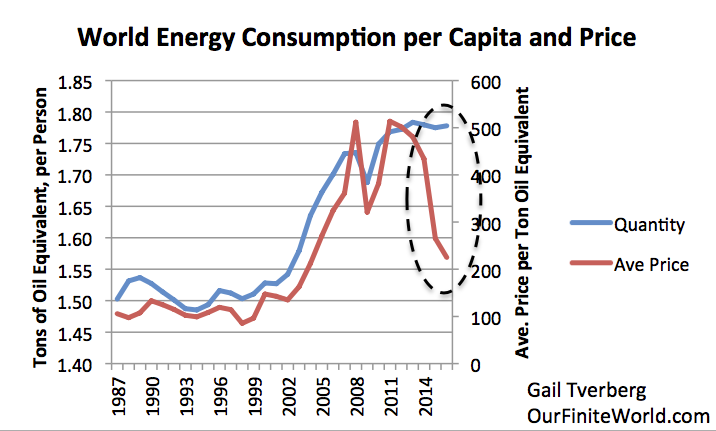
To me, this is not a stable situation. If one part of the world wants its energy consumption to grow faster than population (say India), that means other parts of the world must have energy consumption grow more slowly than population. Many individual people need to be using less. Unless we are truly becoming more efficient in producing end products from energy, this means that some parts of the world need to be moving toward lower complexity.
the reader of ofw what is your favorite video game ?
my favorite is fallout because it show what will happened after bau collapse
especially after leaked nuclear radiation
Chess…I was a state chess champion in high school…
the second one was far better. you visit cities and tribes with different political and religious systems. it shows nothing about what will happen but its a lof of fun.
Tic-tac-toe …
Paper rock scissors.
In the future they will play rock rock rock.
The Last of Us. Great story – also post-apocalyptic, Replace zombies with cannibals and you have our future – if only Fast Eddies spent fuel rods can be avoided.
Thankfully we have the ponds so that we avoid that fate…
I know people fear the ponds…
But when the electricity goes off … and we are cowering in the dark… when the hordes come to the prepper sanctuaries… the rapist and murderers are upon us… the festering diseases take hold… when the hunger gnaws at our guts….
Just remember… the silent executioner is making his way towards you … he will end the misery .. he will end the suffering… he will end the horror… the horror…the horror
He will be welcomed…and asked … what took you so long …
He will be embraced… he will be celebrated… with a whimper… of relief….
Diablo 3. Played Warcrack for 5 years too. I also spend a few hours a week at a chessboard.
great article gail
a recent interview of Jim Kunstler where he mentions Gail’s work as one of his resources, inspirations, among a few others. http://www.theamericanconservative.com/articles/an-interview-with-james-howard-kunstler/
Thanks for pointing this out. It was nice of Jim Kunstler to mention me. We have been friends for a long time. His book, “The Long Emergency” was one of the first books I read about the oil situation, and I liked it very much. The first time I remember talking to him in person was at an Association for the Study of Peak Oil meeting. He came up to me and invited me to an open house/party he was having in his suite that evening. We occasionally correspond, and he has interviewed me.
Last year, a total of 2,056 store locations were closed down, but this year more than 6,700 stores have been shut down so far.
That absolutely shatters the all-time record for store closings in a single year, and yet nobody seems that concerned about it. In 2008, an all-time record 6,163 retail stores were shuttered, and we have already surpassed that mark by a very wide margin.
We are facing an unprecedented retail apocalypse, and as you will see below, the number of retail store closings is actually supposed to be much higher next year.
http://theeconomiccollapseblog.com/archives/we-have-tripled-the-number-of-store-closings-from-last-year-and-20-major-retailers-have-closed-at-least-50-stores-in-2017
A Nation of Broke People Are Killing Retail More Than Amazon: Top Expert
https://www.thestreet.com/story/14277483/1/a-nation-of-broke-people-are-killing-retail-more-than-amazon-peter-schiff-says.html
Growth in US personal and business income tax collections is also at low levels.
https://www.theburningplatform.com/2017/11/27/a-critical-thinking-person-might-ask/
Personal income tax collections are barely rising.
https://pbs.twimg.com/media/DPpUxfMXkAA-KIe.jpg
This is also true of businesses.
https://pbs.twimg.com/media/DPpVKMkWkAAGxz6.jpg
Fracking For Fish
http://c1.thejournal.ie/media/2017/11/shutterstock_642620452-390×285.jpg
“The development of industrial electrocution of marine life is a further indicator of chronic overfishing of our waters, which requires ever more destructive modes of capture to target what’s left of fish and invertebrate populations for commercial exploitation.”
The time remaining before the human population crashes is getting short.
yes, the time is short.
by the 2020’s, things will get extreme.
Sounds like a refined version of dynamite fishing!
This is in the “Good Grief” category. According to the article,
Humans can become temporary “winners” in the contest with fish, but long term, both humans and fish must win, or humans don’t have fish to eat.
90% of all big-fish stocks have disappeared since the 1950’s.
That’s why when you go to the fish-monger’s what’s generally available are species that 20 years ago were considered rubbish and tossed back.
There are many other similar stories around. Both the size and number of fish have been falling rapidly, as the result of over-fishing the ocean.
The biologists who are studying species “loss” minimize this issue by counting any species as continuing to exist, as long as a mating pair exists.
A similar problem is happening with wild land animals, as humans take over an increasing share of earth’s surface for our farms, highways, and cities. Even highways across an area cause a problem, because it becomes more difficult for animals to move from area to area.
one more talking point from the article:
high oil prices MUST be temporary. (is that an accurate assessment?)
that is an idea that I don’t recall being spelled out so fully before.
I’m guessing higher oil prices in 2018.
but I see the argument for those higher prices not lasting very long.
Right. It is hard for high oil prices to last very long.
But we did see a several year run up in the prices that hit their peak in July 2008. So it is hard to say that the run-up in prices will last only a few months. If debt policies are sufficiently loose and interest rates trending downward, the run-up can last quite a while. If interest rates are trending upward, I expect the run-up will be much shorter.
that is a fun and informative post!
some quotes:
“World leaders look at their video game screens for indications regarding where the world economy is now.”
“There are numerous problems with this approach. For one thing, the video game screen doesn’t give a very complete picture of what is happening.”
“An even bigger problem is a physics problem that is hidden from the view of those operating the control mechanism.”
“Conclusion:
With all of these issues, it is not surprising that world leaders have difficulty playing the energy and economy game. In fact, it is hard to see any winning strategy.”
this might be the real world:
some game players, the world leaders, COULD KNOW what “we” know if they pursued the knowledge found on this blog (and elsewhere).
in fact, we are minor players in this game, and WE KNOW this stuff.
but the “world leaders” are like gamers with all the best power-ups.
they dictate how the game will go and we just play along.
and no one can win!
but at least WE KNOW that fact.
What is being done is exactly what should be done …. keep BAU alive … for as long as absolutely possible … doing whatever possible… no policy is too extreme … if it extends our survival.
Glad you liked the post!
https://imgur.com/a/k9lTJ
Everything Elon is Fake
Some recent Tesla articles:
https://www.reuters.com/article/us-tesla-quality-insight/build-fast-fix-later-speed-hurts-quality-at-tesla-some-workers-say-idUSKBN1DT0N3
https://seekingalpha.com/article/4128236-battery-production-tesla-nightmare
https://techcrunch.com/2017/11/26/in-praise-of-teslas-bankruptcy/
https://www.nytimes.com/interactive/2017/11/07/magazine/tech-design-future-autonomous-cars-factory-tesla-sustainability-gigafactory.html
Re; Self Organized Systems,,,this one in particular, The Potent Director’s Fallacy comes to mind.
http://www.acting-man.com/?p=243
Conclusion:
We should be just as skeptical about the current government and central bank directed efforts at influencing market prices as investors in the late 20’s and 30’s should have been regarding the efforts of the potent director’s of their time – first in the form of the banking consortium that vainly attempted to stop the crash, and later in the form of the government and the central bank, neither of which could stop the depression from playing out. Instead, their ministrations ended up making it worse. Not coincidentally, the liquidation in the stock market took a long time to play out, and prices eventually reached levels no-one would have considered remotely possible when the contraction began. This is why even now, one must resist the idea that an allegedly ‘cheap market’ is once again fit for long term investment. At the moment, it is a market for nimble traders at best, for as long as it takes for the contraction to play out. Notwithstanding all the hopeful incantations at Davos, we can not rely on the bureaucrats to pull our chestnuts out of the fire.
WRONG WRONG WRONG WRONG WRONG!!!
https://www.youtube.com/watch?v=S04WsLUjD7c
The CBs ARE the ENTIRE market. Without them there is no market.
The CBs will NOT stop supporting the market. They cannot allow a crash.
Because a crash now will end civilization. It will likely result in our extinction.
They are supporting the market because we are running out of cheap to produce energy. Their support of the market – and other gargantuan stimulus — are targeting the growth headwinds that result from expensive to produce energy.
The correct position is to ride the CBs coat tails – be long the market — be long property – absolutely do NOT sit on the sidelines.
Get on the god damn train and enjoy the ride — up until it slams into the mountain side.
Anyone with half a brain gets off the train from time to time …. and goes on a spending spree. Live it up.
Because when the train hits the wall…. we are done as a species.
People would like to believe that someone is in charge of markets, and will somehow keep them up. In China, it seems like there were stories about TPTB forbidding sales under certain circumstances for a while. And we have heard about a supposed Plunge Protection Team in the United States.
It seems like raising interest rates would take the froth out of the markets. Or there could be some other triggering event. Big bank failures overseas, for example.
Doesn’t matter who the board of directors are at this point…. they cannot walk on water… no more than they can conjure up more cheap to produce oil.
Good point!
Who needs cheap oil when the CB’s start handing out living allowances? I can also foresee oil companies becoming taken over by the state in order to “balance the checking account.” Just like they did with Freddy and Fanny. Who cares if the share price is $2.00? People get to keep their homes.
I’ve seen a few articles pretty much stating as fact that the central banks jumped in to push up the price of oil in January of 2016 when it was down under $30 p/b:
“…collapsing oil prices directly weighed on inflation measures and the inflation expectations. That was bad news for the central banks that had committed trillions of dollars to avert a deflationary spiral and promote a normalization of inflation. High inflation is bad. Deflation is worse. Once a deflationary mindset takes hold, it feeds into more deflation. Central banks can raise rates to kill inflation. They have few tools to fight deflation (especially after the financial crisis).
“So cheap oil became bad news for the fragile global economic recovery. With that, central banks stepped in early last year and responded with coordinated easing (which included direct asset purchases, which likely included outright oil and oil-related ETFs). Oil bottomed the day the Bank of Japan intervened in the currency market, and prices jumped 50% in a month as other major central banks followed with intervention.”
https://www.forbes.com/sites/bryanrich/2017/11/24/oil-prices-primed-for-melt-up-into-year-end/#60d5c09f160b
I can’t say that this surprises me….
Seems pretty obvious, seeing consumer demand for oil has continued to decline. I’m sure high prices will fix it, where low prices didn’t.
“The beatings will continue until morale improves”
Good way of putting it!
Thanks for mentioning this. I will make note of it.
Maybe central banks are a little more aware of the problem of low oil prices than they sometimes seem.
Why is Deflation a Central Bank’s Worst Nightmare?
https://www.investopedia.com/articles/investing/051315/what-deflation-and-how-do-central-banks-fight-it.asp
This article gives some reasons why falling price levels are a problem. Certainly they are a problem from the point of Central Banks. If wages are falling, it becomes virtually impossible to repay debt with interest.
Falling prices are also a problem from the point of would be entrepreneurs. A would-be-entrepreneur needs to either borrow money or sell shares or stock (or both) to finance purchase of buildings and equipments, and pay early salaries. This money cannot be paid back with interest, if prices tend to fall. Also, there is no reason for the value of the shares of stock to rise. The whole system stops functioning.
If added debt to keep energy prices up produces a temporary price rise, this becomes a big problem. When the world gets tired of adding more debt (or the new investment only produces negative returns), energy prices necessarily fall, and we have a big problem.
Oil is escaping from ‘purgatory,’ as supply fears shift from glut to shortage in 2018
In a range of notes out on Wednesday, analysts at Allianz Global Investors, Jefferies and RBC Capital Markets all expressed optimism that recent efforts to balance the market are working, which could mean the world will be short of oil in 2018.
https://www.marketwatch.com/story/how-oil-is-escaping-from-purgatory-as-supply-glut-turns-to-supply-concern-2017-10-25
this seems to be the course ahead.
so oil prices will be higher in 2018.
and as Gail has made the case in the new blog, higher oil prices are always temporary.
at some point in the 2020’s, prices will decline again.
or crash.
I’ve contended for a long time now that the next litmus test for the world economy is higher oil prices, because when it was relatively low (to what it had been, due to every oil producer going full tilt) the world economy could still move forward with some growth. But, once price goes up again everything in the economy will get tested, from consumers on their financial edge trying not to lose their assets, to big oil companies being tested because consumers could not afford those higher oil prices. If there is one word for what will happen when oil price goes up to that point the economy for oil importers hits stall speed is; TESTING, as it will test us like nothing before, and what kind of outrageous schemes CB’s come up with to stimulate economic activity can only be imagined at this point. Buckle up people – there’s turbulence ahead.
Hello 😉
I’m sorry, but there is a little mistake in the beginning of the text!
Those aren’t the “world leaders”! They are merely the “world puppets”!
It’s always funny to see that the World Leaders are never mentioned…
Perhaps the extent to which the people pictured lead is a little iffy. After all, we are dealing with a self-organized system.
A self-organizing system can still have leaders.
It is just that the real power of those leaders can be limited by the complexity of the system. Tomorrow, all the leaders can make all the wrong decisions and break the system but they don’t do that. In fact, they cannot do much of anything, without the risk of a systemic collapse. Maybe all this talk about automation…is them realizing how useless they are becoming. In the past, the system was more malleable, decisions made by leaders could have an impact. The system we have now, is much more inflexible.
Warren G. Bennis wrote
““The factory of the future will have only two employees, a man and a dog. The man will be there to feed the dog. The dog will be there to keep the man from touching the equipment.” That man might also be a representation of “the leaders” in addition to representing the average worker. A future without “jobs”, is also a future without leaders. Who or what will leaders lead if they are allowed to make fewer and fewer decisions?
Human systems have always been self-organizing.
At the beginning of any self-organizing system, leaders and workers feel as though they can shape how it develops. As the self-organizing system reaches limits, it becomes more rigid and both workers and leaders feel as if they cannot make any meaningful changes to it. All this talk about automation and AI, may be a manifestation of feelings that there is a loss of control–and that loss of control is for the best.
The cream will rise to the top….
The system is self-organizing and the faction that facilitates the most efficient system will always over turn the less efficient leaders.
Because the self-organized system – which is always in flux — will gravitate towards efficiency. Towards extraction and burning resources in the most efficient manner – towards achieving economic growth in the most efficient manner
Any attempt to thwart that will fail — see communism.
Any leadership faction that fails to respond to the changing situation — see British Empire – will fail.
I like to think of this much as I would a business within an industry. You can be the leader — remember Nokia? – but there are others trying to outdo you – always — and if you fail to adept and get better — you are replaced.
The el ders strive to maintain their dominance …. however they are not infallible — they are not omnipotent…. their system has been efficient and allowed them to run the world….
But the world they constructed is coming apart now — because it relies on cheap to produce energy…
If it were not for our massive overshoot and the starvation that will result when the energy is not available – and the spent fuel ponds…
Then without question the eld ers would be replaced by a system that is better adapted to what comes next. Definitely not global – definitely not fossil fuel based — perhaps local war lords…
But we do have 7.5b people and 4000 spent fuel ponds… so I cannot see how there will be anything but extinction when the el ders run ends.
You have some interesting thoughts.
I am not sure automation will, in fact, get very much farther. We are running into limits. But if automation could get farther, I suppose there could be the situation of the man and the dog.
I know that with some government systems, such as mandatory medical reporting requirements, some doctors and dentists are getting stressed out with all of the documentation required. They feel that they are forced to waste a whole lot of time with reporting requirements, taking away from time helping patients. Such changes make it hard to get work done.
“The factory of the future will have only two employees, a man and a dog. The man will be there to feed the dog. The dog will be there to keep the man from touching the equipment.”
Very funny.
Elders….of .. Z ion.
Oh, gee, Fast Eddy, you had to go there. Shhh! Don’t you remember that Congress passed a law several years back requiring the NSA to monitor unflattering remarks anywhere in the world regarding that particular faith’s adherents? Keep your head down!
I can fool them by adding …. between letters.
Anyway … I am have Russian… Putin has my back
it has always seemed to me that every world leader is determined to keep the system going—by whatever means—while they are actually in office.
they know it can’t go on forever—but if it holds together till after they are gone, the blame will attach to their successor.
‘I don’t care, just so long as it lasts my time’ was a saying in vogue just before WW1.
Perhaps we should now modify it to:
‘I can’t allow myself to care, as it clearly isn’t going to last my lifetime’ ?
With the rising stockmarkets, plus the ‘good news about the FED raising interest rates in December and 4 times next year, added to rising oil prices next year, most “fortune tellers” (economists) see good times ahead.
How clear should it be to all that we have a huge problem with this in a very short order as consumers just cannot afford these increased costs. It is so obvious that the levers that saved us last time (QE) will not work, as the vibrations of the economy become larger with each swing, both up and down.
To me it seems with all the information available, that Gail puts so eloquently, most cannot see the obvious. This being wild swings over a few years until the last swing down.
Instead of the wings falling off, what we have experienced in the last decade or so has been the stalling of the jet, but it has been restarted by QE etc, yet what is to come is more of the same, with wilder gyrations, both up and down, until the controllers don’t function.
My ‘fortune telling’ ability sees another crash dead ahead due to high oil prices and rising interest rates (plus a rise in prices of most commodities, due to high oil), consumers pulling spending, and growth rates going negative. This will of course be followed by another rescue attempt, that lasts a few years, then more wild gyrations, both up and down.
Will the next attempt at resurrection of the economy fail or work? No-one really knows, but at some point the pain on most will stop the whole shebang, that is what 99.9% of fortune telling economists cannot see.
Where we end up depends on the extent to which the rescue attempts work. I am less optimistic than you with respect to another rescue attempt can work, but I have been too pessimistic before.
A person wonders whether we just end up with gridlock. One hurdle that we are not really over in the US is getting a budget passed and the debt limit raised. I could imagine the US situation spiraling downward. But I can also image quite a few other situations spiraling downward.
Existing oil reserves are scheduled to begin a catastrophic crash within 1 to 3 years. When it hits the economic and social damage will be catastrophic. The end of Western Civilization, from China to Europe, to the US, will not occur when oil runs out. The economic and social chaos will occur when supplies are merely reduced sufficiently.
My favorite videogame analogy is that of Age of Empires. First you start off with one or two humans, they gather resources, you build houses, make more humans, they gather more resources until you run out of resources in the area. Then you expand and do the same thing until you again run out of resources. You repeat the process until you have to expand into another Empires territory, then take their stuff and expand some more and repeat that process until you defeat everyone and FINALLY run out of resources for good, your population begins to decline until there’s no more of your humans.
It seems our world leaders might want to play such a game to see that raping the Earth for consumerism ends badly for everyone in the end.
Good one! I used to play that with friends in the 90’s. We wound up always playing the ‘gold rush’ version. It was constant fighting lol.
Thanks for the new post Gail.
Yes, it’s a simulation game that’s uncomfortably real.
Donald Trump says he will ‘take care of it’ after North Korea fires ballistic missile
http://www.telegraph.co.uk/news/2017/11/28/north-korea-fires-ballistic-missile-reports-may-have-landed/
There was a news headline today that says North Korea is within days of striking the US. Sounds to me like the military industrial complex is prepping the public for part two of Saddam Heussein has weapons of mass destruction. It’s too bad the average dumb American is too stupid to figure out they are being played by their government.
https://medium.com/@caityjohnstone/only-morons-believe-what-the-us-government-says-about-north-korea-3d5a5157cea2
‘there is no depth to which the US war machine will not stoop in deceiving the public about the need to unload the military-industrial complex’s expensive inventory onto some third world country overseas, no limit to the evils that America’s unelected power establishment will commit in order to secure geopolitical dominance, and no end to the mass media propaganda machine’s willingness to report war propaganda as objective fact’
‘there is no depth to which the CHINESE war machine will not stoop in deceiving the public about the need to unload the military-industrial complex’s expensive inventory onto some third world country overseas, no limit to the evils that America’s unelected power establishment will commit in order to secure geopolitical dominance, and no end to the mass media propaganda machine’s willingness to report war propaganda as objective fact.’
‘there is no depth to which the RUSSIAN war machine will not stoop in deceiving the public about the need to unload the military-industrial complex’s expensive inventory onto some third world country overseas, no limit to the evils that America’s unelected power establishment will commit in order to secure geopolitical dominance, and no end to the mass media propaganda machine’s willingness to report war propaganda as objective fact.’
‘there is no depth to which the __________ war machine will not stoop in deceiving the public about the need to unload the military-industrial complex’s expensive inventory onto some third world country overseas, no limit to the evils that America’s unelected power establishment will commit in order to secure geopolitical dominance, and no end to the mass media propaganda machine’s willingness to report war propaganda as objective fact.’
The thing is… the US currently has the most lethal war machine…
The way the world works:
– The luckiest, fittest, smartest, with the capability for ruthlessness survive – always have – always will
– Resources are finite and therefore ownership is a zero sum game
– The strong always take from the weak – if they do not then that is a sign of weakness and a competitor will take from the weak and will usurp the formerly strong dropping them into weakling status
– Humans tend to group by clan or on a broader basis by nationality (strength in numbers bonded by culture) and they compete with others for resources
– Competition always exists (I want it all!) but it becomes fiercer when resources are not sufficient to support competing clans or nations
– Tribal societies understand these dynamics because they cannot go to the grocery store for their food – so they are intimately aware of the daily battle to feed themselves and the competition for scare land and resources
– Modern affluent societies do not recognize this dynamic because for them resources are not scarce – they have more than enough.
– One of the main reasons that resources are not scarce in affluent societies is because they won the battle of the fittest (I would argue that luck is the precursor to all other advantages – affluent societies did not get that way because they started out smarter — rather they were lucky – and they parlayed that luck into advances in technology… including better war machines)
– As we have observed throughout history the strong always trample the weak. Always. History has always been a battle to take more in the zero sum game. The goal is to take all if possible (if you end up in the gutter eating grass the response has been – better you than me – because I know you’d do the same to me)
– And history demonstrates that the weak – given the opportunity – would turn the tables on the strong in a heartbeat. If they could they would beat the strong into submission and leave them bleeding in the streets and starving. As we see empire after empire after empire gets overthrown and a new power takes over. Was the US happy to share with Russia and vice versa? What about France and England? Nope. They wanted it all.
– Many of us (including me) in the cushy western world appear not to understand what a villager in Somalia does – that our cushy lives are only possible because our leaders have recognized that the world is not a fair place — Koobaya Syndrome has no place in this world — Koombaya will get you a bullet in the back — or a one way trip to the slum.
– Religious movements have attempted to change the course of human nature — telling us to share and get along — they have failed 100% – as expected. By rights we should be living in communes — Jesus was a communist was he not? We all know that this would never work. Because we want more. We want it all.
– But in spite of our hypocrisy, we still have this mythical belief that mankind is capable of good – that we make mistakes along the way (a few genocides here, a few there… in order to steal the resources of an entire content so we can live the lives we live) — ultimately we believe we are flawed but decent. We are not. Absolutely not.
– But our leaders — who see through this matrix of bullshit — realize that our cushy lives are based on us getting as much of the zero sum game as possible. That if they gave in to this wishy washy Koombaya BS we would all be living like Somalians.
– Of course they cannot tell us what I am explaining here — that we must act ruthlessly because if we don’t someone else will — and that will be the end of our cushy lives. Because we are ‘moral’ — we believe we are decent – that if we could all get along and share and sing Koombaya the world would be wonderful. We do not accept their evil premises.
– So they must lie to us. They must use propaganda to get us onside when they commit their acts of ruthlessness.
– They cannot say: we are going to invade Iraq to ensure their oil is available so as to keep BAU operating (BAU which is our platform for global domination). The masses would rise against that making things difficult for the PTB who are only trying their best to ensure the hypocrites have their cushy lives and 3 buck gas (and of course so that the PTB continue to be able to afford their caviar and champagne) …. Because they know if the hypocrites had to pay more or took at lifestyle hit – they’d be seriously pissed off (and nobody wants to be a Somalian)
– Which raises the question — are we fools for attacking the PTB when they attempt to throw out Putin and put in a stooge who will be willing to screw the Russian people so that we can continue to live large? When we know full well that Putin would do the same to us — and if not him someone more ruthless would come along and we’d be Somalians.
– Should we be protesting and making it more difficult for our leaders to make sure we get to continue to lead our cushy lives? Or should we be following the example of the Spartans https://www.youtube.com/watch?v=eZeYVIWz99I
– In a nutshell are our interests as part of the western culture not completely in line with those of our leaders – i.e. if they fail we fail – if they succeed we succeed.
– Lee Kuan Yew is famous for saying ‘yes I will eat very well but if I do so will you’ Why bite the hand that whips the weak to make sure you eat well…. If you bite it too hard it cannot whip the weak — making you the weak — meaning you get to feel the whip….
– Nation… clan … individual…. The zero sum game plays out amongst nations first … but as resources become more scarce the battle comes closer to home with clans battling for what remains…. Eventually it is brother against brother ….
– As the PTB run out of outsiders to whip and rob…. They turn on their own…. As we are seeing they have no problem with destroying the middle class because it means more for them… and when the weak rise against them they have no problem at all deploying the violent tactics that they have used against the weak across the world who have attempted to resist them
– Eventually of course they will turn against each other…. Henry Kissinger and Maddy Albright bashing each other over the head with hammers fighting over a can of spam – how precious!
well said FE
your thoughts or quote?
My thoughts.
Fast Eddy wrote: By rights we should be living in communes — Jesus was a communist was he not? We all know that this would never work. –end quote
It seems to work pretty darned well for monasteries. And it has been working for the Hutterite colonies for 400 years now. We could learn something from them.
Families are sort of communes as well.
It is my understanding that African societies have tended to take care of extended relatives, and there is much more sharing of wealth than in the US.
In fact, “Gift societies,” where people give away wealth to gain status, and a culture is built around the expectation that all goods are shared, seems to be have been fairly widely used in various parts of the world, historically. It works best where communities are small enough so that everyone knows everyone else.
It does not compute that humans are evil when we’re simply following our DNA. Are lions also evil for murdering gazelles? What if Neanderthals discovered oil and the ICE and took all the resources before us, does that make them an evil race?
Evil – what is that? I also do not understand what is meant by the word good.
I do understand nihilism.
My favourite song is :
Your words, not mine. Reread your post.
People who think that humans are evil have been listening to too much Catholic theology, IMO. It is easy to come to the ideas of “right and wrong” and “sin.” These mostly have to fitting in with society’s norms.
I understand that the Japanese and Chinese are very strong on wanting all citizens to fit into society’s norms. Teachers “picking on” students with wrong answers seems to be common in these cultures. Thus, these societies enforce the need to stick with norms, without talking about “sin.”
Some approach is needed to make people fit in with the self-organized civilization. Religion is one way; societal norms are another way.
I agree and understand. The way FE uses evil though shows confusion. Humans aren’t bad or evil, we’re ignorant. We simply follow the herd of humanity and all it’s fossil fuel addiction, regardless of the clear imbalance with nature.
I don’t care for the term evil because it is a religious concept … good and evil … and I agree with Carlin in this … religion is b ull sh it.
My take on humans is that we are an aberration … a mistake… a freak show….
Mother Nature f789ed up… if not her then whatever is responsible for us seriously got it wrong…
There is nothing else like us in nature – nothing even remotely close.
We kill and torture not only to obtain more resources — but for fun – for enjoyment – both each other and other organisms.
And before someone says – oh but that is the few — I do not engage in such behaviour… well yes you do – we are all complicit in the global gulag…
https://cdn.80000hours.org/wp-content/uploads/2016/04/pigs-in-factory-farm.jpg
Unlike other organisms that are governed by limits we know no limits — we are not part of the natural system giving and taking … we are destroyers of the system…. pillagers… and our spent fuel ponds are likely to poison the system… potentially killing everything.
Oh please! Do not cats kill for fun? Are they evil? I’ve seen dogs do the same. It is closer to a perverted instinctual drive than evil or whatever you’re trying to imply here. And you don’t have any idea what’s out there in the universe that is or isn’t like humans. It’s around 1 in 10 Billlion odds we are alone in the universe and it expands limitlessly in all directions. Just given those 2 statements it is a logical impossibility for you to know that there are no other species like humans in the universe. You’re in for a very rude awakening when you remerge with your higher consciousness.
Religion (among other prods) keeps the masses from acting on their inner most desires… so in that respect is useful…
However the men who run the show understand that religious koombaya is a dangerous thing if allowed to go too far…
At the end of the day though shall not kill .. though shall not covet … though shall not hate….and all that other clap trap … if taken too far would be a threat to the very existence of a society … very dangerous direction in which to proceed.
We MUST kill – we MUST covet … we MUST hate… and so on…. because there is not enough for everyone.
And when it comes time to fight for our hunk of meat we quickly see all this religious bs tossed into the bin … our young men are taught to kill and covert and hate….
It is so very easy to turn a ‘civilized’ 18 year old into a blood thirsty killing machine… because that is what he was all along … these impulses are tempered – in most — through the socializing influences of religion, education, etc….
We can even use brutal force to keep the wild beast in line (see heavy-handed dictatorships) … much as we can keep ‘tame’ lions in line…
Conrad nailed it… civilization is a very thin veneer….
Watch what happens when the electricity goes out… the varnish will be stripped off in a matter of hours… and we will see the true nature of this beast.
Or we will see a lot of spread of disease.
Without a doubt… the Great Sickness… will quickly follow…
Imagine what would happen if the WHO did not exist…. if Big Pharma did not exist:
WHO provides 1.2 million antibiotics to fight plague in Madagascar
http://www.who.int/mediacentre/news/releases/2017/antibiotics-plague-madagascar/en/
Gail wrote: Some approach is needed to make people fit in with the self-organized civilization. Religion is one way; societal norms are another way.–end quote
It occurs to me that seemingly all non-Western societies (and in an earlier historical era, Western society as well) put a much stronger emphasis on social conformity than contemporary Western culture (especially what some anthropologists have taken to calling WEIRD culture–an acronym), and almost inevitably religion serves as one additional mechanism for promoting social conformity, rather than an alternative to social conformity. British historian Christopher Dawson would have said that this is because to a large degree every society’s dominant faith profoundly shapes its culture (which the late Samuel Huntington seemed to agree with in his last two books, _The Clash of Civilizations_ and _Who Are We?_). The way Dawson put it, culture derives from cult, and not just etymologically.
One could argue that the new cult (using that word non-pejoratively) that arose in the 18th century (the time of the early Industrial Revolution), namely, Deism, has provided an alternative perspective for evaluating and remaking the value system of the industrial age. Even most American Christians professed in one survey to have a conception of the divine that has more in common with Deism/Unitarianism/Freemasonry than with pre-industrial Christianity. I think this difference in outlook underlies the contemporary culture wars in America, Israel, and a few other “torn societies.” I also think the decay of the industrial age, especially as people are forced to look again to the extended family and close associates of the family (“kith and kin”) as a source of security in a new, no-growth age with less social and physical mobility, will eventually pull all countries in a more traditional, pre-industrial direction, because the old, agrarian age values will once again be more adaptive than the Industrial Age values on the other side of Hubbert’s pimple.
This especially poses a cognitively dissonant conundrum for committed environmentalists (I couldn’t resist the lure of alliteration), who typically dream of combining industrial age conceptions of virtue with a post industrial age of economic stagnation. In the long run, the two are probably not compatible.
There is a neat sci-fi short story by Theodore Sturgeon called “Twilight of the Gods.” On a planet in a solar system with two suns, a double eclipse would darken the planet only once every 10,000 years. Then everyone would go mad, tear down all they had incrementally built up over the last 10,000 years, and then have to start over from scratch with no historical memory. By the time the scientists figured it out, it was too late. Darkness was falling, and people were beginning to go mad as the twinkling stars they had never seen appeared for the first time in the night sky. One man was going through the streets telling people, “Repent, the end is near!” To me that is emblematic of how the old values will reassert themselves when conditions change. Individualism, self-fulfillment, and self-expression are highly cherished opportunities are constantly expanding and wealth and disposable income and the leisure to enjoy it are on a secular uptrend. When the trend ends, to say nothing of reversing, interdependence with other people (which some psychologists have found to be linked closely with adherence to traditional religions), social solidarity, and social conformity become the new functional values.
I think an economy needs abundant energy supplies to allow individuals to deviate from cultural norms. Otherwise, cultural norms (including religion) need to very much determine how people act.
The US has very high per capita energy consumption. This has allowed it to have considerable diversity in the way people behave. The divorce rate in the US is very high. I believe that this is tied to energy availability.
Confusing typo alert: Individualism, self-fulfillment, and self-expression are highly cherished opportunities are constantly expanding and
SHOULD READ: Individualism, self-fulfillment, and self-expression are highly cherished WHEN opportunities are constantly expanding and etc., etc.
The Virtue of War.
We are living on a planet that has a population that has exceeded the carrying capacity of the earth’s resources. The competition for remaining resources has reached a murderous level. To deprive an individual, family or country access to essential resources is condemning them to death. While the easily distracted masses are “busy” with their entertainments, the deadly game of resource domination is being fought on a global level.
The daily news provides a continuous update of the winners and losers. It’s too easy for me to provide a list of nations that are being pushed off the edge of civilization. If you can’t see it you are blind. Once you see the role of competition for resources in world conflicts, you never see the world the same way again.
Who’s in charge of the madness? Everyone and no one. This is a “Beast” system. It is a wild animal that devours all that it can. It is animated by the reckless passions of all the consumers clamoring for more. It is animated by the power hungry politicians who do what is necessary to stay in office. It is animated by the generals who are too good at what they do. It is animated by you and me.
The ugly truth is that once a planet exceeds its resource capacity the game turns extremely violent. It is no longer possible to have win-win transactions. In an environment of resource limits, if one person has more someone else has less. It’s a zero sum game. Each country frantically attempts to increase its GDP. Positive GDP growth in one country causes negative GDP decline in another. To put more food on your families table, you must take food off of someone elses. I hate writing these things. It’s not the way it should be. It’s the way it is.
Because essential resources can no longer provide for the needs of the world’s population we have entered a time of perpetual war. It is native to think that a war might start of a war might finish. Each conflict is “fueled” (pun intended) by the fundamental struggle to capture resources. Ideologies are irrelevant. The world needs to eliminate weaker nations, weaker populations, to free up and capture resources. If economics alone can not destroy the weak than military conflict becomes essential.
War becomes virtuous.
Naive not native.
A Facebook comment got me thinking: The lower commodity prices in the 1990s seems to have been the result of two different groups being “thrown under the bus.”
One was the collapse of the former Soviet Union, in 1991. This held down its demand for oil and other products.
The other was the Asian Financial Crisis of 1997. According to Wikipedia, all of the Southeast Asian countries affected suffered from a loss of demand. They raised interest rates to high levels, and were able to attract outside investors.
These both seem to be non-violent ways that the world economy self-organized, to the detriment to two particular groups.
Excellent article…
The IEA might not understand as that is perhaps not their mandate…
But these guys do… and they would be the ones pulling the levers to keep BAU alive….
According to the OECD Economics Department and the International Monetary Fund Research Department, a sustained $10 per barrel increase in oil prices from $25 to $35 would result in the OECD as a whole losing 0.4% of GDP in the first and second years of higher prices. http://www.iea.org/textbase/npsum/high_oil04sum.pdf
This is a far more thorough piece of research:
The Impact of Higher Oil Prices on the Global Economy
Tables
Impact of an Oil Price Increase of $5 per barrel on Oil Exporting and Oil Importing Countries
Permanent $5 per Barrel Increase in the Price of Oil: Baseline Scenario
Comparison of the Baseline Scenario with Outside Simulations
Permanent $5 per Barrel Increase in the Price of Oil: Alternative Scenario
Emerging Markets-Estimated Effects After 1 Year of a $5 Oil Price Hike
Selected HIPC and CIS Countries-Preliminary Estimates of First Round Effects of an Oil Price Increase and IMF Quotas
OPEC – Preliminary Estimates of First Round Effects of an Oil Price Increase and Global Slowdown Effect
Selected Oil-Exporting Developing and Transition Countries: First-Year Impact of a 20 Percent Increase in Oil Prices on Public Sector Revenues
http://www.imf.org/external/pubs/ft/oil/2000/
All the people with the power to pull various levers have discovered that the levers don’t do much anymore. It really is like the “coffin corner” of an airplane – the controls just don’t function as expected. This is as high and as fast as she can fly and she can’t slow down either. What a predicament.
It sort of amazes me that the IEA leaves their old study up on their website, even as they show projections at $300 per barrel today. I suppose it is related to the right and left hand not knowing what the other is doing.
EROEI studies don’t talk about costs or GDP, so the study of rising prices done by the IEA would not suggest any kind of problem to the EROEI researchers. As long as the cost of the additional inputs are “only” human labor, or taxes, or interest payments, or lease costs, it doesn’t count at all in EROEI calculation. If the additional input is “associated gas” that would otherwise be flared, the opposite situation results–it is treated as if it were valuable oil being lost, even though the cost to the company of using this natural gas is pretty close to zero. A lot of good information is lost, if researchers use methodology that is so different from other researchers that they cannot understand the implications of the other research.
Or maybe they need to state that oil can be priced at $300 per barrel …. to make people believe that is possible.
There is a lot of research available on this subject — it is not an epiphany to many to learn that higher oil prices are bad for the economy:
The Impact of Higher Oil Prices on the Global Economy
https://www.imf.org/en/Publications/Policy-Papers/Issues/2016/12/31/The-Impact-of-Higher-Oil-Prices-on-the-Global-Economy-PP77
FEDERAL RESERVE BANK OF SAN FRANCISCO: What are the possible causes and consequences of higher oil prices on the overall economy?
https://www.frbsf.org/education/publications/doctor-econ/2007/november/oil-prices-impact-economy/
Wide fluctuations in oil prices have played an important role in driving recessions and even regimes collapsing—which is why oil price movements are closely watched by economists, investors, and policymakers. The two recent cycles of historic highs and lows suggest that the world economy is in unchartered territory.
https://dupress.deloitte.com/dup-us-en/economy/global-economic-outlook/2016/q3-understanding-economic-impact-of-fluctuations-in-oil-prices.html
Oil prices and the New Zealand economy Felix Delbruck, Economics Department
This article looks at New Zealand’s oil consumption at a disaggregated level and discusses the consequences of movements in international oil prices for inflation, taking into account New Zealand’s industry structure as well as the tax treatment of different fuel types. Relative to the size of its economy, New Zealand uses a comparatively large amount of oil as transport fuel. The evidence suggests that the indirect (cost-push) effects of higher oil prices on consumer prices could
be quite large, substantially driven by higher transport services costs. How large they turn out to be, and whether they matter for medium-term inflation and monetary policy, will depend on factors such as the state of the economic cycle, the degree of competition in particular industries, and the extent to which inflation expectations are anchored.
https://www.rbnz.govt.nz/-/media/ReserveBank/Files/Publications/Bulletins/2005/2005dec68-4delbruck.pdf
As we see… high oil prices were identified as a huge problem in 2003….
JUNE 13, 2003 – There is increasing evidence that massive economic stimulus — monetary, courtesy of the Federal Reserve, and fiscal, thanks to the president and supply-side minded lawmakers — is taking hold. The magnitude of the policy turnaround, which caps a constructive, multi-year reflation process, should overwhelm the economic negatives — including the drag from expensive oil and poor finances at the state- and local-government levels.
Expensive oil and its impact on other energy costs remains a concern.
The current level of U.S. monetary stimulus is massive. Real interest rates have fallen 5.2 percent from December 2000 to March 2003, reaching -1.2 percent. A swing of this magnitude may be historical.
Read more at: http://www.nationalreview.com/article/207227/reversal-fortune-david-malpass
How Does the Changing Price of Oil Affect Economies around the World?
http://insights.som.yale.edu/insights/how-does-the-changing-price-of-oil-affect-economies-around-the-world
Causes and Consequences of the Oil Shock of 2007-08 (Hamilton, 2009)
https://www.brookings.edu/bpea-articles/causes-and-consequences-of-the-oil-shock-of-2007-08/
I am a co-author of an academic paper (published in Energy in October, 2016) that raises the issue of whether the limit on oil production is a limit on how high the price can go. This is a link to the paper: https://gailtheactuary.files.wordpress.com/2016/09/ke-wang-an-oil-production-forecast-for-china-considering-economic-limits.pdf
See Section 2 of the article for the price discussion. These are the highlights from the paper:
Highlights
1. China’s conventional oil reached a peak in 2010 and has begun to decline.
2. Unconventional oil production will be especially adversely affected by low prices.
3. Rising selling price of oil may lead to recession, bringing prices back down.
4. China’s total oil supply appears likely to peak about 2020.
5. Likely oil production is less than Technically Recoverable Resources.
This is the paper’s abstract:
In recent years, it has become apparent that oil prices may not rise endlessly. Unconventional oil is likely to be especially affected by low prices because it tends to be high-priced to extract. To estimate the impact prices might have on future Chinese oil production, we develop a model in which only future unconventional oil production is affected by price. We analyze three price scenarios: Stays Low, Best Estimate, and Ever-Rising Prices. In these scenarios, remaining Ultimate Recoverable Resources (URR) are estimated to be 10%, 50%, and 90% of remaining Technically Recoverable Resources, respectively. Since oil price can be expected to affect the shape of the extraction curve, we spread estimated URR to year using models that do not assume that future production will ultimately produce a symmetric Hubbert-type curve (Multi-Cycle Generalized Weng Model and Stochastic Resource-Constrained Growth Model). In the Best Estimate Scenario, China’s oil production is expected to reach a maximum of 226.79 million tons in 2020. In the Ever-Rising Prices Scenario, China’s maximum oil production occurs in 2023. In the Stays Low Scenario, maximum production has already been reached.
The “Stays Low” scenario was defined as “Oil prices stay at or below $50 per barrel, on an inflation adjusted basis”
Gail: The “Stays Low” scenario was defined as “Oil prices stay at or below $50 per barrel, on an inflation adjusted basis”
me: Brent was recently trading over $63, WTI just a few dollars behind.
The Medium scenario was defined based on prices similar to those before the drop in prices, so probably in the $110-$115 per barrel range. Even at $69 per barrel (for a short time) we are still closer to the “Stays Low” Scenario than the Medium scenario.
Queue more money printing to substitute zombie growth for the missing real growth.
You would think so. Maybe Powell will have more sense than Yellen.
This atmosphere can become too thin for several reasons, including the higher cost of energy production, rising population, and growing wage disparity.
!!!!!
I will have to admit that this is not something a lot of people sit and think about much.
I expect a number of new readers got that far and said, “What in the world is this lady talking about? It is not what I learned in Economics class.”
Life often makes us choose between being right or being popular.
Thanks for all the hard work you put into OFW Gail. Your an inspiration. Like most readers of this site, I can’t find people who even want to talk about the articles you write. You talk about causes instead of effects. People want to talk about current events. They just don’t want to think about the underlying causes of those events. It is unsettling to look behind the curtain of our main stream media narrative. Finding that our world isn’t infinite, and many of our deepest held assumptions about how the world works are simply wrong. Few have the courage to look boldly at our precarious existence without retreating back into fantasy. Keep fighting the good fight. I pray for your continued success.
.
It is hard trying to bridge the two worlds: Causes versus what is happening on the stock market, or job market, or price of copper. I find myself with a large stack of charts people have put together about current outcomes. I even have plans to use them. But then it becomes difficult to merge the two things together–the post becomes way too long.
People would like a 1,000 word (or less) article about the price of oil, or the likely result of the next election.
‘current events’ … yep…. have a friend who drops by from time to time… his latest thing is Kim Il Dong and the global threat he presents… he’s crazy and maybe Trump really does need to teach him a lesson … yadda yadda yadda….
One other insists on going on about how Bitcoin is going to put an end to CB domination of the world …. in spite of the fact that the NSA logs every Bitcoin trade done on any computer — and knows if you own any of it — and it could be made a serious crime to own Bitcoin … yadda yadda yadda
And yet another has regaled me with talk of long haul electric trucks saving the world yadda yadda yadda…
Current events…. I can’t begin to imagine what the grade 3 students spew when asked to summarize the latest ‘news’
http://www.azquotes.com/picture-quotes/quote-the-human-being-is-a-self-propelled-automaton-entirely-under-the-control-of-external-nikola-tesla-69-48-78.jpg
I refuse!!!!
Ms Tverberg said, “With all of these issues, it is not surprising that world leaders have difficulty playing the energy and economy game.”
I see, over and over, references to the “Elders” or the “PTB” on this site and on many others. As you prove brilliantly, there is no-one in control since the whole thing is beyond control. I have wondered why people think that there is someone or some group in actual control of this civilization. Why it took so long to figure it out, since I already knew the answer, I don’t know.
I say I knew the answer because it was given in a book entitled “Why God Won’t Go Away” my copy was published in 2002. The MDs that wrote the book go into excruciating detail about how the brain works, and what happens when a person is faced with a question without a ready answer.
“Essentially, all myths can be reduced to a simple framework. First, they focus upon a crucial existential concern – the creation of the world … [the continued existence of our civilization] … Next, they frame that concern as a pair of apparently irreconcilable opposites – heros and monsters, … [rising stock market and obvious economic weakness] … Finally, and most important, myths reconcile those opposites, often trough the actions of gods … [or the “Elders”] … in a way that relieves our existential concerns.”
I just thought some would be interested,
Pintada
You are right. The system acts like a self-organized system. For example, I talk about some of the researchers coming to answers that are not really correct. If they had not come to these answers, no one would have listened to them. Some other researchers, who got incorrect answers by a different approach would have been listened to. The system as a whole finds what it considers “reasonable” or “acceptable” answers.
I gave a list of actions that leaders could take, but there are very few of these actions that one person alone can take. In order to change laws–for example, get rid of a public pension plan–it takes the consensus of a lot of people that that is something they can live with. This pretty much cannot happen.
The people in charge can do a few (small) things with interest rates. The leaders of OPEC and Russia can meet and talk about oil supply. My guess is that with low investment over the past couple of years, the group needs to cut output, simply because they have not been making enough investments to keep production up. But of course they cannot say that. Instead, they save face by saying they are cutting output.
We saw the strange recent announcement that Saudi Arabia is cutting oil output in December. https://www.reuters.com/article/us-saudi-oil-exports/saudi-arabia-to-cut-crude-exports-by-120000-barrels-per-day-in-december-idUSKBN1D92KW What in the world is this about. We know that Saudi Arabia was working on a heavy oil (expensive!) project in the Neutral Zone, that has been delayed. http://www.petroleum-economist.com/articles/upstream/exploration-production/2017/kuwait-oil-on-troubled-waters Is Saudi Arabia so dependent on this heavy oil that it needs to reduce its exports?
The actions that are taken cannot really be planned by those in charge. There has to be a lot of consensus from others before an action is seen to fit in the right framework.
Gail wrote: “The system acts like a self-organized system.”
Have you read physicist Mark Buchanan’s book, _Ubiquity_? If not, I very highly recommend it. Very enlightening. His other book, _The Social Atom_, is also very good.
You are right that no one is in control. Complex systems cannot be “tweaked.” As you wrote, the authorities can pull a few blunt levers, but anything they do has multiple effects. Like a giant game of whack-a-mole, if I may greatly oversimplify, if you use, let us say, interest rates to address one problem, a new problem (or problems) will pop back up somewhere else. And I don’t think economists understand this very well. I think they view the economy like a complicated machine with lots of moving parts, but the individual parts do not themselves change or adapt. In reality, the parts are always changing, like the chemistry of a biological organism. If you give a sick organism a drug, it has more than one effect, so the dose must be just enough to get a sufficient level of the desired effect, but not enough to get very much of the undesired changes. And things can get even trickier if you administer two drugs at once, such as ZIRP and QE. A third drug would be fiscal “stimulus,” a fourth would be a new regulatory environment. And then administer some of these drugs in unprecedented doses. God only knows how this will work out. You might kill the patient!
If a group of men did not decide to back stop the financial system in 2008 – we would all be dead now.
This is not tweaking – this is acting. In a massive way – to delay the end of the world
Ubiquity sounds like a book I should read. Thanks!
The “whack a mole” problem explains why the world economy is so difficult to model. People with very good intentions put together models that are “too simple.” The results “look right,” but they really are not. This is extremely frustrating. This the EROEI model problem. I suspect that the climate models have some of the same problem.
You’re right about climate model predictions because of largely unmeasurable feedback loops compounding any given problem. That’s why there are so many estimates of how large sea level rise will be by 2100, for example.
The reason being is that the models are only as useful as the parameters they are built on. There is no scope in the BAU scenarios of most models for “unknown unknowns”.
Gail wrote: I suspect that the climate models have some of the same problem–unquote
I’m sure the climate does qualify as a complex system, and that makes modeling it challenging, to say the least. Some critics complain that the margin for error in the models is bigger than the projected climate changes. The IPCC is also highly secretive about its models, which ought to raise some red flags, since that is not how science is normally done. However, it is known that the models make some assumptions that are either unproved or flatly incorrect:
1. There is no solar variability, and even if there is, we can safely assume it has no effect
(I have read one report that a few of the modelers are finally starting to allow for some role for this factor, although they are so secretive that I don’t know whether they are taking into account all three effects whereby the sun can influence climate: changes in isolation–which the establishment view rejects but which is supported by some very reputable scientists; changes in EUV, which are much larger; and changes in the strength of the solar magnetic field. There are reasons to think that each of these three factors lead to complex feedbacks, and they change in unison).
2. There is no variability in cloud cover (although everyone concedes this could be a huge factor, they say they don’t know how to model it, so they just assume it is a constant–unlikely in a complex system).
3. CO2 is the primary driver of climate change rather than a minor feedback effect.
4. Increases in CO2 increase the atmosphere’s capacity to hold water vapor, which is the most important greenhouse gas (because of it quantity), even though we now have several decades of data showing the correlation between CO2 and water vapor is not there.
5. Changes on other planets and their lunar satellites: at first it was claimed that at any given tie about have the planets would be warming and half cooling, as more data came in, it became clear that all the available evidence pointed to warming in the late twentieth century throughout the solar system. There should be a common cause that also affects earth’s climate, but the current models do not predict this, and no one is trying to fix this deficiency, AFAIK.
6. Models cannot accurately “hindcast” the period prior to the period on which they are curve fitted, yet they are still assumed to be adequate to inform us about future changes. We need models that can accurately hindcast before we can trust their forecasts.
This last failure reminds me of the Fed’s very complex computer model of the economy that they rely on even though it never seems to correctly forecast recessions, although others can usually predict recessions with a few simple variables, such as the yield curve, housing starts, and changes in the oil price. Still, the majority opinion among economists never seems to see it coming.
Gee, I really should proof read before I hit send!
“at first it was claimed that at any given tie about have the planets would be warming and half cooling, as more data came in” SHOULD READ
“at first it was claimed that at any given tiMe about haLF the planets would be warming and half cooling, BUT as more” etc.
Orbital facing is definitely a thing. In fact as the ice from the poles continues to head for record lows it will exacerbate this issue pretty significantly. CO2 and increased water vapor can be seen all over the planet. I see rain records being shattered almost ever single day. This year we got an average year’s worth of rain by April.
Models don’t matter and none will be totally accurate because no one can predict the speed or intensity of the hundreds of feedback loops. We do know though that the last time CO2 was this high the seas were dozens if not 100 feet higher than they presently are. Half the global population is going to lose their homes when that happens. That by itself would create a refugee crises that makes what’s going on in Europe look like kindergarten. If humans are even around when that happens super hurricanes will ride warm waters into Kansas. All we’re waiting on to start the party is for 2 rapidly retreating glaciers in Antarctica to get the party started with an 11 foot rise in sea levels to start. And they’re going to collapse much sooner than most think.
I’m sitting on my balcony looking at the ocean which at high tide is about 30m away…. the waves are not coming onto the lawn.
https://images.gr-assets.com/books/1320539311l/11533442.jpg
Of course, there is also the issue of assuming that the economy will burn far more fossil fuels than we can really extract, given limitations on how high prices can rise (or some other way of expressing the limit). Even the IPCC’s low version (or whatever it is called) seems to assume the availability of a lot of fossil fuels.
Well they are in control of the stock market. Barely…
Who gives the orders that make QE happen?
Who gives the orders to bid up the stock market?
Who gives the orders to release $27 trillion of stimulus and counting?
Who gives the orders to make subprime loans?
The central banks. That makes central banks the most powerful entities in the world
Which CB is the master franchise holder?
The Federal Reserve of course — all others are essentially branch offices.
Who owns the Federal Reserve? It is a private company owned by the major investment banks.
Who is behind the major investment banks?
Those people would be the real power on the planet
“I care not what puppet is placed on the throne of England to rule the Empire, … The man that controls Britain’s money supply controls the British Empire. And I control the money supply.” Nathan Rothschild
“Once a nation parts with the control of its currency and credit, it matters not who makes the nation’s laws. … Until the control of the issue of currency and credit is restored to government and recognized as its most sacred responsibility, all talk of the sovereignty of parliament and of democracy is idle and futile.” — Mackenzie King, Canadian Prime Minister 1935-1948.
“I am a most unhappy man. I have unwittingly ruined my country. A great industrial nation is controlled by its system of credit. Our system of credit is concentrated. The growth of the nation, therefore, and all our activities are in the hands of a few men. We have come to be one of the worst ruled, one of the most completely controlled and dominated Governments in the civilized world no longer a Government by free opinion, no longer a Government by conviction and the vote of the majority, but a Government by the opinion and duress of a small group of dominant men.” – Woodrow Wilson, after signing the Federal Reserve into existence
“Some of the biggest men in the United States, in the field of commerce and manufacture, are afraid of somebody, are afraid of something. They know that there is a power somewhere so organized, so subtle, so watchful, so interlocked, so complete, so pervasive that they had better not speak above their breath when they speak in condemnation of it.” ― Woodrow Wilson
Thanks for the new article (which I shall read shortly)
http://ggc-mauldin-images.s3.amazonaws.com/uploads/editorial/Image_3_20171120_ME_OP_JM8.jpg
http://www.zerohedge.com/news/2017-11-28/mauldin-8-charts-show-how-insane-economy-today
http://ggc-mauldin-images.s3.amazonaws.com/uploads/editorial/Image_4_20171120_ME_OP_JM8.jpg
http://ggc-mauldin-images.s3.amazonaws.com/uploads/editorial/Image_6_20171120_ME_OP_JM8.jpg
Looking at that chart I would say that anyone that goes into debt to finance their college education is crazy.
I thought about including more things about the current economy in the article, but it was getting awfully long as it was. That seems to be my problem.
Thanks for the post, I think this one will be one of the classics that can be referenced until the end.
One potential correction, the chart “A huge amount of oil is available” does not include the oil and gas that will be available when we start extracting fuels from the oceans of Titan. ( https://www.nasa.gov/feature/jpl/cassini-explores-a-methane-sea-on-titan ) 😉
You are welcome. It took quite several iterations to get the final product. I am not good at seeing the final product in advance.
You are right about extracting methane from the oceans of Titan. If it were economically feasible, I am certain that someone would do it.
One of the things I figured out, but never found a place to use, is that fact that it if natural gas costs $3.00 per Mcf to extract, it costs an additional $4.00 per Mcf to ship the natural gas (as LNG) to Europe. Thus, the LNG cost with shipping is $7 per Mcf. The European price for natural gas is only about $6.00 per Mcf, so this is not a money-making proposition. http://www.hellenicshippingnews.com/us-lng-arrivals-in-northern-europe-not-a-signal-of-immediate-change/ Because of the huge shipping costs, an awfully lot of the world’s natural gas is “shut in.” The hope LNG exporters have is that the European price will rise more than $4 per Mcf higher than the US price. The cost of shipping LNG from the Eastern US to Japan would be very high, but perhaps shipping from Alaska to Japan wouldn’t be terribly expensive.
Based on these costs, shipping from Titan to the Earth would be outrageously expensive, I expect.
Gail wrote: if natural gas costs $3.00 per Mcf to extract,
One US industry insider said it was about $6 (“all in” cost, I’m sure), while the Russians think it costs us about $8, which is one reason they were not worried when Congress (mostly lawyers) threatened to undercut them with LNG exports. It has been selling below cost for years, thanks to ultra low borrowing costs and risk-taking investors. I think Minsky would call this “Ponzi finance,”
One thing that makes natural gas costs difficult to figure out is the fact that a lot of natural gas is a more or less a byproduct of oil production. Historically, businesses have made their money on selling the oil; natural gas was close to a give-away product. Thus, the companies that were primarily in oil production didn’t seem to care if the price was low. But I know that recent prices have been too low for natural gas producers.
In the United States, natural gas producers have been complaining for years that prices are too low. It is not “Build it and they will come.” Instead, it is, “Build it, and you will overfill storage. Then, prices will crash.” The plan has been to export sufficient natural gas to create a shortage in the US, and run up prices that way. With the high shipping costs, it is hard to see that the plan can work.
Hmmm—-
https://wolfstreet.com/wp-content/uploads/2017/11/US-California-median-home-price-2017-10.png
I’m surprised that no one has brought up one of the most highly regarded computer games,
SimCity. The goal of Simcity is to build a city and keep it growing forever, or at least, until the residents develop space travel leave the city for space colonies.
http://img.squakenet.com/snapshot/654/73727-SimCity2000.jpg
The game’s concept of renewables borders from realistic to the silly.
http://simcity.wikia.com/wiki/List_of_Power_Plants
A wind turbine costing $100 is silly.
Thanks! I hadn’t seen that list before.
What we need is a more realistic version of Sim City as a teaching tool.
You forgot the “Game Genie” that lets you win in any situation. In this case it would probably be central banks and there printers, allowing us to continue extracting fossil fuels way, way beyond the point of profitability. QE was just the beginning of their ponzi games. We haven’t even gotten into monthly living allowances for the 90% yet or many of the other tricks they will utilize to keep the economy running in place.
Experts say US economy not seeing ‘Trump bump’
http://www.mlive.com/business/index.ssf/2017/11/experts_say_us_economy_not_see.html
“GDP looks like it is growing, but it is really very hollow economic growth. Governments invest in projects of essentially no value, and their investment is counted as GDP. For example, they invest in unneeded roads, in apartments that citizens cannot really afford, in educational institutions that do not produce graduates with wages that are sufficiently high to pay for education’s high cost, and in high-priced medical cures that are unaffordable by 99% of the population. Are these things truly contributions to GDP?
“We also find businesses that look like they are growing, but in fact are taking on increasing amounts of debt as they sell off assets. This is not a sustainable model! We encounter energy companies that claim to be doing “sort of” alright, but their profits are so low that they need to cut back on new investment, and they need to borrow in order to have funds to pay dividends to shareholders.”
A great article, Gail, and the above is a nice summary of the surreal ‘extend and pretend’ phase we have been in these past few years. It put me tangentially in mind of this extract from the second of Douglas Adams’ ‘Hitchhiker’s Guide to the Galaxy’ books:
To set the scene, our hero, Arthur Dent, has found himself on prehistoric earth with the useless third of a race called the Golgafrinchans – the marketing agency reps, beauty salon stylists, telephone sanitizers and so forth – who were tricked into getting on a spaceship in order to solve their planet’s overpopulation problem and then crash-landed on earth. As it turns out they are the true ancestors of the human race. At one of the many tedious committee meetings Arthur is obliged to attend, he notices that the Golgrafrinchans’ tracksuits are all stuffed to bursting with leaves. He asks the Management Consultant chairing the meeting what is going on and it is explained to him that…
“Since we decided a few weeks ago to adopt the leaf as legal tender, we have, of course, all become immensely rich. […]
“But we have also,” continued the management consultant, “run into a small inflation problem on account of the high level of leaf availability, which means that, I gather, the current going rate has something like three deciduous forests buying on ship’s peanut.” […]
“So in order to obviate this problem,” he continued, “and effectively revalue the leaf, we are about to embark on a massive defoliation campaign, and…er, burn down all the forests. I think you’ll all agree that’s a sensible move under the circumstances.”
That is a great quote. People (including financial people) don’t understand what the problem is. Sometimes an analogy helps explain the problem.
By the way, I liked your link to the article about the rise in the number of fortune tellers now that the unemployment rate is up. http://www.scmp.com/news/asia/east-asia/article/2121912/south-korea-has-1-million-shamans-and-fortune-tellers If we all become fortunetellers in our spare time, we can greatly increase world GDP. I think “fortune telling” will be my new go-to occupation to use as an example of a service job that requires very little energy.
My sister hired a fortune teller for her wedding reception a few years ago. And this stupid person showed up two hours late…
Right, lol, even better than babysitter or backrubber!
Economists are fortune tellers.
No one seems to care if they are wrong.
Non-economist commercial fortune tellers have been with us for some time.
https://www.youtube.com/watch?v=oxopPDMq7rs
My gypsy cousin has been keeping her family going with Tarot readings. Not to be sniffed at as an extra source of income – great demand, and the worse things get, the more demand rises… 🙂
“you can only demand what you can afford”
Gail writes: If we all become fortunetellers in our spare time, we can greatly increase world GDP. I think “fortune telling” will be my new go-to occupation to use as an example of a service job that requires very little energy.–end quote
Is that why peak oil activist Matt Savinar moved to Los Angeles and became an astrologer?
I had forgotten about that. I understand John Michael Greer is at least somewhat involved with astrology as well. http://www.ecosophia.net/august-2017-open-post-plus-eclipse/
I am not good on understanding timing. Maybe I need to consult with one of them. I understand the eclipse this year was a bad sign, according to some people.
+Gail, I would be surprised if the self-proclaimed Archdruid were not interested in astrology. I find it about as credible as goat entrails or tea leaves, although admittedly much more interesting because of the complex symbolism from the Greek and Roman gods. If you have a half-decent memory for classical mythology, astrology is easy to understand, although chart interpretation is almost infinitely flexible, which may be why many professional astrologers claim you must be “intuitive” (psychic) to be an effective astrologer. And, yes, both solar and lunar eclipses are, in astrological lore, very bad omens, but especially solar. Hope Matt has a get-out-of-Dodge plan, just in case. Los Angeles. Shudder.
The Golgafrinchans remind me of the bureaucrats from Atlas Shrugged.
“educational institutions that do not produce graduates with wages that are sufficiently high to pay for education’s high cost” Even doctors are finding student loans burdensome. There is more to the high costs of education than insufficient
wages,which come partially from increasing the supply of degree holders of all sorts)
“I can’t give you a brain, but I can give you a diploma.”–the Wizard of Oz
I am wondering what the difference is between selling 100k cars because 100k were ruined by a hurricane… and selling 100k cars because 100k cars went to the junk yard because they were past their use by date….
I am thinking perhaps nothing.
Both activities keep the energy extraction treadmill going — and BAU growing and therefore alive.
And that is all that matters.
The new record levels of debts of the Slovak households: The indebtedness of the Slovak households rises without interrpution since 2005, Slovakia being the only country in EU with such uninterrupted growth. On the year-over-year basis, the indebtedness of the Slovak households rose by 13,6 precents for the period of the first quarters of this year. The Slovak central bank wants to take further measures that will prevent providing loans to risk clients: this year, it was for housing loans, next year, for consumer loans.
http://finweb.hnonline.sk/ekonomika/1070330-nbs-dviha-varovny-prst-zadlzenie-slovakov-dosiahlo-v-regione-rekordne-hodnoty
Of course, if the banks cut back on possibly risky loans, it will also cut back on the work that is made available through those loans. No wonders many countries have encouraged people to borrow, borrow, borrow, to keep the economy working.
https://1.bp.blogspot.com/-PFrxCqY_oN0/Whss7qkus1I/AAAAAAAAaAg/pEJG2dKa7HEYZtWVFwNlwdJc_Y9muqVfgCLcBGAs/s640/stone%2Bheads.PNG
Are you suggesting that there might be some similarities between the two things you pictured?
I believe those are Easter Island statues. There is a popular myth that the inhabitants of Easter Island drove themselves to extinction by cutting down trees in order to move those statues around, until ecological devastation destroyed their food sources. The actual evidence does not bear this out, and rather suggests that natural constraints in the environment caused the economy to no longer be able to support the statue builders, and the economy contracted to a smaller level. The original Rapa Nui people that lived there are still very much alive to this day.
Seems to me he is pointing out a parallel between uselessly building and moving statues and uselessly buying and moving televisions.
Thanks! I should have thought that through more. Of course, the Easter Islanders must have thought there was a reason for building and moving statues, or they wouldn’t have done it.
The population on the island grew to the limits of the island ecosystem, and as they hit the limits the people suffered a terrible decline even resorting to cannibalism.
The making of these statues is thought to be a sort of competition between the various territories on the island. As time went on the statues increased in size and some were adorned with a “headress” red stone.
It is my understanding that the statues were built to be used as hiding places for Easter eggs.
Niko, it was the rats the immigrants to Easter Is. brought with them (either accidentally or as a food source) from their previous homes. With no predators, they gnawed the young saplings to death. In the tropics, where these islanders and their rats came from, things grew back so fast it didn’t matter, but trees grow slower in the temperate zone, where Rapa Nu’i (Easter Island) is located, and eventually the forest was gone. I think it is a special case and not really a good analogy for the planet today.
I bet those screens won’t last many thousands of years.
“I bet those screens won’t last many thousands of years.” – No, but maybe the pollution will.
I think Trump is onto something wanting to spend the surplus on a wall.
“According to Aleks Udris, ‘The region is deadly. Get too slow, and you’ll stall the jet at high altitude. Get too fast, and you’ll exceed your critical mach number. The air over your wings will go supersonic, you’ll pitch down, the aircraft will accelerate, and your wings will fall off. Also bad.'”
Beautifully expressed!
Someone made a comment about the “coffin corner” a while back. I looked it up in google, and came across this reference.
We can try to make our current economy run faster or slower, but neither works well, either.
Gentle does it, I guess.
Pingback: A Video Game Analogy to Our Energy Predicament – Enjeux énergies et environnement