
|
Getting your Trinity Audio player ready...
|
The nature of the shortage of diesel and jet fuel is more complex than most people realize. Based on my analysis, a shortfall has existed since at least 2020. The shortage is not simply the result of the closure of the Strait of Hormuz.
In this post, I will provide background information regarding the nature of the shortfall and the international conflict it is leading to. I will also share my thoughts on how, over the long term, the situation might be mitigated. I doubt whether a solution will be available in the short term, but I can at least give readers an idea of one direction in which a possible workaround might be available.
My idea is that the economy needs to transform itself in a way that uses diesel and jet fuel (grouped together on some reports as “middle distillates”) more sparingly. At the same time, research on extracting heavy oil and bitumen at lower cost is needed. If this is done, it may be possible to use additional heavy oil to increase the supply of diesel and jet fuel.
One thing that will probably need to change is the price of diesel relative to gasoline. The price difference will likely need to be even greater than it has been in the recent past because heavy oil is inherently more difficult to extract, refine, process, and transport.
[1] The interconnected nature of the economy means that inexpensive energy products are extremely important to the economy.
Energy supply and the economy are a great deal more interconnected than most people realize. For example, if the price of diesel rises, the price of food also tends to rise because diesel is used in food production and transportation. Similarly, if the price of gasoline rises, the additional cost also tends to squeeze budgets. Politicians see these price increases and say to themselves, “These increases will make voters unhappy. Let’s raise interest rates and see if we can get oil prices back down.”
Higher interest rates don’t affect everyone immediately, but they particularly impact people purchasing a vehicle or a home, and businesses seeking a loan.

Clearly, raising interest rates at the same time as energy prices are rising is “playing with fire.” If the economy is really overstimulated and growing too quickly, this type of approach makes sense. But if the underlying problem is that diesel and jet fuel prices are high because of inadequate world production, what is really needed is higher oil prices, especially for the heavier crude oils that provide a disproportionate share of diesel and jet fuel.
Consumers and oil producers have two different needs for prices:
- Consumers want diesel and jet fuel prices low because high prices wreck their budgets. Diesel is used in growing food and transporting it to market. Jet fuel is used in transporting some kinds of foods. In fact, industries of all kinds (including mining, road building, and construction) use diesel and jet fuel. Higher prices of these fuels tend to make practically any kind of goods or services more expensive.
- Oil producers want diesel and jet fuel prices high, to incentivize investment in new wells. Without additional investment, the quantity of heavy oil extracted and made into these fuels will tend to decrease because of depletion issues.
While prices for diesel and jet fuel are higher this fall, quite a bit of the extra charges relate to extra transport and insurance costs. The high prices need to stay, and perhaps even increase, even if the immediate issues disappear, in order to incentivize greater long-term production. It is these rising prices that are likely to continue to squeeze budgets and push economies toward recession.
[2] What we call “oil” can vary quite widely from well to well. The trend over time has been toward lighter crude oils.
Most people assume that all oil is equivalent, but this is not the case. Petroleum is a mixture of hydrocarbon molecules. The lightest ones are gases are room temperature, the medium weight ones are liquids, and the heaviest ones tend to be quite viscous. Some are even solids. Some oils, especially heavy oils, have sulfur or metal inclusions. Crude oil that contains sulfur is called “sour oil.”
Heavier oils are ones that disproportionately produce diesel and jet fuel. Lighter oils tend to produce more gasoline, along with products like solvents, and the feedstocks for plastics.
In my view, a major reason why there tends to be a shortfall in diesel and jet fuel production (even apart from the current Middle East blockages) is that the type of oil needed tends to be more expensive to extract, refine, and transport than light oil. Furthermore, oil with sulfur tends to be quite corrosive, and removing the sulfur adds another layer of costs. The primary issue I see is that it is hard to pass on the higher production costs of heavy and sour oils to customers.
In theory, to cover all the costs involved related to heavy and sour oils, diesel and jet fuel prices should be quite a bit higher than gasoline prices for the same volume (liter or gallon). But if this were the case, the price of food would also increase, since diesel is extensively used in food production and transportation.
Figure 2 shows end products from the production process. We know, however, that lighter end products tend to come from lighter crude oils, so we can deduce that the crude oil mixture has been getting lighter over time. The amounts in Figure 2 include natural gas liquids, which are very light and growing in quantity.

The earliest oil that was extracted tended to be “medium oil,” which tended to have a mixture of heavier and lighter molecules. As the medium oil depleted, new production tended to be lighter. In particular, US tight oil from shale is quite light. The increasing production of US tight oil from shale is adding to the Very Light layer, as well as the Gasoline layer.
[3] The world had a diesel and jet fuel shortage long before 2026.
Because of the need for diesel and jet fuel in industry and transportation, a person would expect per-capita diesel and jet fuel consumption to grow as industry and international trade grows.

Figure 3 shows that per capita consumption of diesel and jet fuel stopped growing about 2005. The year 2005 seems to be the time that the world’s output of “conventional” (easy to extract) oil reached a peak. Figure 3 also shows that per capita consumption then plateaued until about 2019. It fell 16% in 2020, and it has not been able to fully recover since. The historical data on this chart is only through 2025, but the big Middle East cutbacks in 2026 will clearly send diesel and jet fuel consumption down from the 2025 level in 2026, as indicated by the red arrow.
At least in part, what is happening is that recent oil prices have not been high enough for countries producing somewhat heavy, sour oil. This is especially the case for oil exporting countries that depend on oil revenue to support their economies. They need more revenue than just enough to cover the cost of extraction, plus a reasonable return for shareholders. They also need money to fund the development of make-work projects to employ their citizens and to fund subsidized imported food for their population.
In the peak oil community, there seems to be the view that Middle East oil is always cheap to extract and refine. At one time, this may have been true, but most analyses overlook the tax needs of oil exporting countries. Tax needs are high in countries with exploding populations who need subsidized imported food. Huge make-work projects to provide employment possibilities, such as Saudi Arabia’s construction of the city Neom, add to the need for higher tax revenue. Middle Eastern oil costs may also be rising because of depletion issues, such as wells yielding relatively more water in the oil/water mixture extracted.
[4] For oil exporters, one symptom of chronically inadequate prices for heavy/sour oil (including the need for high tax revenue) is the willingness to engage in war.
If a person looks through my suggested list of heavy/sour oil producers shown on Figure 4, all the countries seem at least somewhat war-like. Even Canada tends to be war-like. Canadian leaders would be much happier if the price of crude oil exported to the US were considerably higher, and it would be less inclined to seek export partners in Asia and Europe.

If the oil production of the heavy/sour countries and country groups found on Figure 4 is added together, the result is as shown in Figure 5. The total production of these countries exceeds the production of the rest of the world.
Notice that the countries of the Middle East tend to be quite price sensitive. Their production dropped steeply in 2020 when oil prices fell. Likewise, their production rose in 2022 when oil prices were temporarily higher, related to the start of the Ukraine-Russia conflict.

[5] Authorities claim that there would be plenty of heavy oil to refine if prices were to rise high enough for long enough.
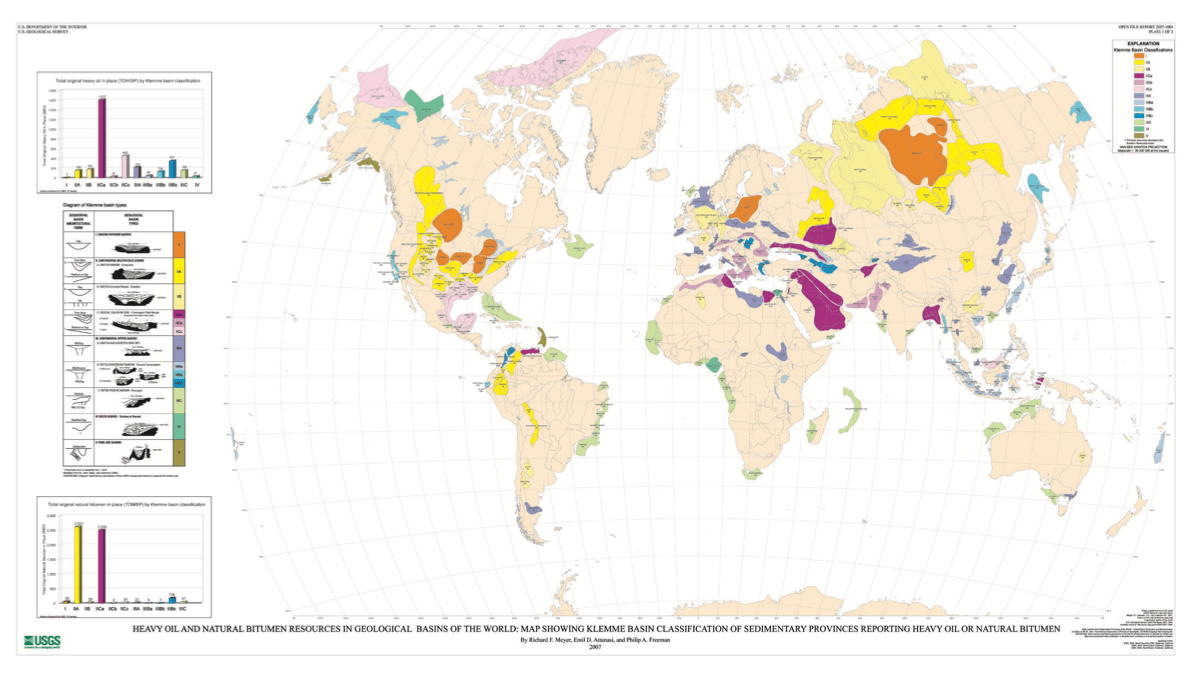
The United States Geological Services provides maps of available heavy oil and bitumen deposits. Figure 6 indicates that heavy oil is widely available in North America, Europe, Russia, and the Middle East.
In 2015, the International Energy Agency published a report indicating that in its view, there were huge deposits of extra heavy oil and bitumen (EHOB) that could be accessed if the price of oil rose high enough for long enough (Figure 7). The same exhibit shows somewhat smaller availability of tight oil from shale. In fact, the US has been able to access a substantial amount of tight oil from shale in recent years.

In my opinion, in order to access the EHOB, the prices of diesel and jet fuel need to rise to a high level over the long term; the prices of gasoline and even lighter products don’t necessarily need to rise. If the prices of diesel and jet fuel rise high enough, for long enough, the price signal should work its way back to oil and gas companies, suggesting that they need to make investments in the direction of adding more extraction from EHOB. If this succeeds, it could perhaps relieve the problem of inadequate supply of diesel and jet fuel.
The prices of diesel and jet fuel are high now, but this is at least partly due to higher insurance costs and partly due to the extra costs related to shipping oil longer distances to avoid blocked straits. These extra costs don’t get back to oil companies in a way that encourages countries to extract more heavy oil. What is needed are permanently higher prices for diesel and jet fuel, relative to the price of gasoline, even if the problems with respect to the straits of Hormuz and of Bab al-Mandab, disappear.
[6] Today’s conflicts in the Middle East and Russia/Ukraine seem to relate to inadequate supplies of diesel and jet fuel for buyers of these fuels, and inadequate prices for sellers of the heavy/sour oils yielding these products.
Figure 3, above, shows that the total supply of diesel plus jet fuel has been low, especially since 2020. One issue that has arisen recently is “Who gets the supply of diesel plus jet fuel that is available?” Figure 8 shows that increasingly, it has been the poorer countries of the world who obtain the diesel and jet fuel that is available. Note that total consumption of the Other than Advanced Countries has exceeded that of the Advanced Countries since 2020.
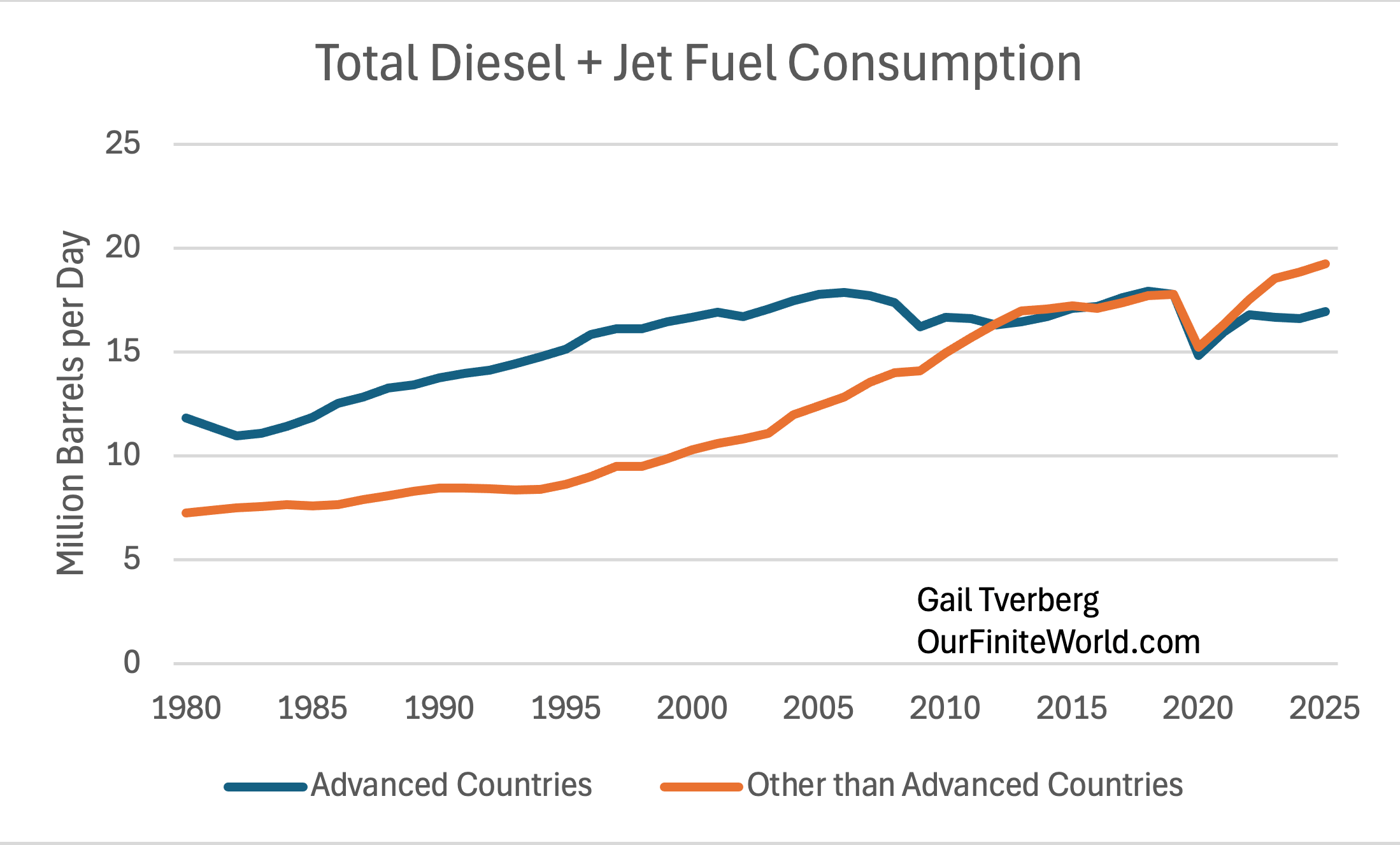
Figure 9 shows that for the Advanced Economies, per capita consumption of diesel plus jet fuel has been declining since about 2005–the time of peak conventional crude oil. The same figure shows that per capita consumption of diesel plus jet fuel has plateaued since 2013 for Other than Advanced Countries. I think of 2013 as the year that China first started encountering major limits on coal extraction (somewhat like the year 1970 in the US for oil extraction). In recent years, China has been able to raise coal extraction somewhat, but at a higher cost.

I would expect that countries in both groups would be dismayed by the situation shown in Figure 9. The per capita consumption of diesel plus jet fuel for the Advanced Countries has been falling for a long time. Partly this is the result of the economies changing to service economies. As service economies, the need for diesel by industry has been lessened. Wages tend to be less for many of these service jobs, making workers unhappy.
In Figure 9, people in the Other than Advanced Countries would tend to be dismayed by the continued wide gap between the standard of living of their own economy, and the standards of living in the Advanced Countries. Many of these countries export extracted resources that are ultimately sold as goods to people living in Advanced Countries. If the selling prices of these commodities were higher, workers in these countries could perhaps afford to have cars and air conditioning, like workers in the Advanced Countries. They would also be dismayed by the poor progress in raising their own per-capita consumption of diesel and jet fuel since 2013.
[7] Is there any possibility of greatly ramping up heavy oil production? Could it power a society like the one we have today?
We know that heavy oil production began long ago. For example, the first recorded production of heavy oil began in the Kern River Basin in California in the 1860s, and commercial production began there in 1899. The first production in the Canadian Oil Sands began in 1921, and commercial production there began in 1967.
The extent to which the oil that is heavy and often sour can be ramped up in the future remains to be seen. Extraction techniques have gradually been improving, and I would expect that they can continue to improve. But the cost of extraction and processing will likely remain somewhat high because of all the energy-intensive steps that are needed to provide diesel and jet fuel.
I expect that society itself will need to change in order to make use of this higher-cost oil. These are a few ideas I have:
(a) Oil exporting countries will need to change in ways that reduce their need for tax revenue. This is an issue especially in the Middle East, which has a huge population, in a hot, dry climate. The population will likely need to fall (for example, many migrants and guest workers may need to move back to their country of origin), and make-work projects will need to be discontinued.
(b) Another issue is that total diesel and jet fuel usage will likely need to be reduced because it is likely to take several years before production of heavy oil can be ramped up. Society will need to be reorganized in a way that uses less diesel and jet fuel. One idea would be to shorten supply chains whenever possible. Figure 10 illustrates one idea how this might be done.

(c) I expect that if such a change can be made, economies will need to gradually change in ways that are hard for us to understand now. The focus may need to be on essentials, including food and clothing. Governments may need to be smaller and provide fewer services. Communities may need to be smaller and more walkable. The total population may need to be lower.
[8] Conclusion
It seems to me that the self-organizing nature of economies will gradually push them in the directions they need to go if the world is to start incorporating a significant quantity of expensive products made from heavy oil into its energy mix.
We cannot yet imagine what all the changes will look like. In some ways they may resemble a recession, but there will likely still be an interest in greater complexity and in working to improve people’s lives.


‘Those who love only the sweet are incapable of knowledge. Knowledge can bestow on us moments of joy and of highest elation, but the fruits of knowledge are bitter. In our world-aeon, knowledge means exile from Eden, the loss of…bliss’
—Berdyaev, The Destiny of Man. 1937
Soon we won’t know anything. Fed into google:
>>Search: [knowledge means exile from Eden, the loss of…bliss]
>> The quote you are referencing is “knowledge means exile from Eden, the loss of innocent bliss,” written by the English novelist Angela Carter.
This line appears in her 1984 novel, Nights at the Circus. It plays on the biblical fall of humanity, suggesting that once we gain awareness, experience, and knowledge, we can never return to a state of simple, uncomplicated happiness.
Knowledge is complexity.
Economic Richard Wolff (what a wonderful NY accent he has! Is it Brooklyn or the Bronx) discusses the collapsing European and American-led world order, first breaking down devastating new data on the Euro-zone’s economic catastrophe and then diving deep into the oil war with Iran that is cracking the US empire into a decline that not even Trump can deny.
He is also very good on why Europe is attempting to colonize Russia and why the US is extracting itself from the entire European quagmire.
Emergence of capitalism was a great advance over feudalism. Also became of world economy.
The kind of economy they built a very unequal world economy. The US became uniquely wealthy. Europeans decided they wanted to become junior partners of the Americans.
Europe gradually increased the size of NATO step by step to the East. Europe had the fantasy of eventually carving up Russia and handing the pieces out sort of like colonies to Europe. No more junior partner to the US.
Russia changed its focus to the East, to China and other countries.
US thought that by attacking Iran, it could stop the rise of the Global South. They can’t, of course. The Iranians are backed by Russia and China. They can fight back, in a way that the West has never had to deal with (unlike Vietnam and Afghanistan). America wants to extract itself from the Iran war, without having to admit that it was defeated.
Capitalism led to a situation where 10% of the world’s population (in the US, Europe and Japan) was rich, and the other 90% was poor. The mismatch led to a desire for migration. Now migration is used as the scapegoat for everything going wrong. (to about minute 16)
Note on precipitation. Lake Powell was getting close to disaster, where the level of the lake would drop below the intake pipe elevation. After two Pacific hurricanes, and numerous floods in the Colorado and upper Rio Grande basins, I think the good people of Vegas got themselves a year respite. In fact they are probably still cleaning up in Vegas after the floods.
European drought completely nullified throughout thee Mediterranean basin from Spain to Turkey. Lower Danube for sure has been replenished. Slovakia might still be under drought conditions but we all know Slovakia is different.
https://www.lastampa.it/esteri/2026/10/25/video/valencia_triatleta_nuota_strada_allagata_gandia_tempesta_adam-15776437/?ref=LSHSP-SN-P1-S1-F
Fortunately, we’re finally getting some gentle rains in Slovakia.
“European drought completely nullified” — that is a strong statement. The soil moisture deficit is becoming increasingly difficult to reverse.
Add some organic matter to the soil, in ways ‘farmers’ should understand. Soil Association organic standards just about reverse the loss of humus from the soil, by requiring crop rotation and mixed farming.
Or farm like Richard Perkins – a Brit. who moved to Sweden and claims to make a good living from 10 hectares (300 x 300 m, or 25 acres). See e.g. https://www.richardperkins.co/2023/07/groundswell-keynote-2023/
School system is dysfunctional
Description:
Guest: Marcel Miserius (Former School Principal)
Marcel Miserius is not allowed to do this podcast. The school authorities explicitly prohibited him from doing so — in writing. By speaking out, he is putting his pension at risk. He came anyway.
Marcel was a track and field athlete, bobsledder, and strength and conditioning coach in professional football — including at Union Berlin and Dynamo Dresden. At some point, he switched sides, studied to become a teacher, paid for his own school leadership training, and eventually took over a school in Brandenburg with more than 800 students and 80 staff members. The school made headlines: violence, bullying, a lack of social workers. Marcel tried to save it.
What happened next is documented in newspaper articles and court records. Marcel himself ended up in court, spent time in pre-trial detention, and lost his family. “I took the time I needed — at the expense of my marriage,” he says. Today, he is 44, retired, and has not seen his children in two years.
This is not a story with a clear hero. It is the story of a man who was broken by a system — and who made mistakes of his own along the way. Marcel speaks openly with me about all of it, even when it is visibly difficult for him.
I have rarely met a guest who speaks about himself with such brutal honesty. At one point in this episode, he says something that — despite all the controversy surrounding him — moved me as a father: he hopes that one day his children will watch this and understand who their father really is.
We talk about the PISA shock and why better grades do not necessarily mean better performance, about teacher shortages that are systematically downplayed, about protection rackets in schools, and about what this profession — and everything that came afterward — has done to him.
https://youtu.be/p5_u2zgoy1M?si=53h73-NK-ixd-HZ7
A major issue is loss of respect for the system. The children misbehave, but this is only because the children learned from their parents similar behavior.
I have heard that this is even a problem is smallish towns today.
Attendance at church is now much lower. There is much more of a mixing of backgrounds of students. Many children are from divorced parents or single parents. This is a 3 hour 30 minute video.
“In the last 48 hours, AI attacks have gone from one-off incidents to something much bigger. Major U.S. banks are detecting unauthorized AI agents inside customer accounts, and they can’t tell them apart from humans. At the same time, two critical bugs in PHP, the language behind an estimated 70% of websites, leaked before the patch was out, and the NSA, the FBI and Japan’s prime minister told organizations to take their systems offline. Ejaaz breaks down what’s happening, how the PHP flaw was found by AI and kept secret for months, the hacking group that used Claude and Grok agents against more than 400 Latin American financial targets, and why open-source models are the ones fighting back.
Then the bigger questions: who is behind it, why AI agents are so hard to trace, and the steps you can take today to protect yourself.”
AI is making it possible to recreate complex software in a fraction of the time it once took. From Photoshop-style editors and AI-powered reverse engineering to ad-free Smart TVs and bizarre video game hybrids, the software industry is facing a new kind of disruption. But there’s a darker side: independent developers can have their work cloned overnight, while poorly secured AI-generated apps can expose passwords, personal information, and payment data.
Disturbing!
This is really disturbing. Making cheaper or free clone versions of commercial software, in a way that they can take over market share from companies making software. But the lower priced versions are not as private as they should be. They expose passwords and other things to snoopers.
Mo Mogodat, former Chief Business Officer at Google X, warns that artificial intelligence is about to replace all jobs, ending labor arbitrage and dismantling the foundational rule of capitalism as we know it. He states that without jobs, people will lose economic purchasing power, making it impossible to repay debts, and predicts the next 10 to 12 years will be unlike anything we’ve ever experienced. Mogodat argues that the economic system we were born into is already finished, and the next 15 years will bring a world that is unrecognizable. He explains that capitalism thrives on labor arbitrage, where workers are paid less than the value they create, but AI removes the worker from the equation entirely, breaking the system. He also discusses the unsustainability of universal basic income, the cycle of surveillance and control in Western societies, and how military spending could end world hunger if redirected.
So, how does anyone buy anything? How do people earn enough money for governments to tax? Doesn’t the whole system collapse? How does AI replace computers and itself? How does AI pave a road?
It is interesting that the imploding human world has created so many useless celebrities and unnecessary jobs of all kinds. The real question is: who will serve these people when they lose their income?
Susan Blackmore (Self Gene contributor) has been talking about Memes since decades back. She says that memes are very dangerous in that they destroy everything before it.
DNA was a big advancement, and then complex life, then things like the industrial revolution removing many jobs.
This might simply be the Great Filter completing the loop. I never got anywhere near 1 when I filled the Drake’s Equation.
“How does AI pave a road?”
I asked Ask:
Yes, robots can pave roads. This capability has been demonstrated in large-scale commercial projects, most notably China’s completion of the world’s first fully unmanned 158-kilometer resurfacing of the Beijing–Hong Kong–Macao Expressway using a fleet of AI-driven drones, self-driving pavers, and robotic rollers.
Future Development: Research institutions like Ohio University are developing integrated single-robot systems (such as RoboPaver) that combine rebar placement, vibration, and screeding to pave concrete in hazardous or remote environments.
Large-Scale Paving: Heavy machinery manufacturers like Sany and XCMG have deployed autonomous fleets, including the SAP200C-10 paver, which lays asphalt with millimetric precision across widths of up to 19.25 meters in a single pass, coordinated by satellite positioning systems for centimeter-level accuracy.
Maintenance and Repair: Smaller autonomous robots are actively used for road maintenance; for example, Pave Robotics produces Tracer, a robot that autonomously seals asphalt cracks, while Robotiz3d’s ARRES system uses AI to detect and fill potholes and cracks in the UK.
===========
So there ya go! Who’d’ve thought it? Certainly not I. Actually, I would prefer to have Kulamity kidnapped to do it, then breed him! 😉
The world is going to end up as portrayed in “Blade runner” – a terribly boring film, though – all style and minimal plot. In that film the humanoid robots were called replicants, and in derogatory slang, skinjobs. Some replicants did not realise they were replicants and not human. I proved in a previous comment that Kulamity is just another Pinocchio gone bad, but could he ever accept that? 😉
But where are we going to find all the material to manufacture the millions of necessary androids? Now that we have the early stages of quantum computing, we will probably be able to invent suitable materials using nanotechnology.
People like John Michael Greer assume that technological civilisations have relatively short durations, but in recent years it has been acknowledged by the US authorities that there are intelligently controlled craft in our skies whose technological capabilities are far ahead of ours. Once you reach a supremely advanced technological state, it should be possible to keep going ad infinitum.
However, eventually all species die out, and we read of alleged abductees describing their supposed ET captors as being very interested in improving their genetics, as they are supposedly dying out. Dr. Michael Masters, a professor of biological anthropology at Montana Technological University in Butte, Montana, even believes that some of our human descendants have mastered time travel and visit our era in order to replenish their genetics. He is entirely serious and goes in deep, giving chapter and verse, with reference to known cases from ufology. His recent book (2022) is one of the most fascinating I’ve ever read: https://www.amazon.co.uk/Extratempestrial-Model-Michael-Masters-ebook/dp/B0B25RTB5V
Where does AI get the asphalt? How does it transport it to the right place?
Yes, there must be some human intermediaries.
It’s true. And how do we find all the necessary materials to build this future. Nanotechnology will be one route, now that we are mastering quantum computing. I have yet to get my head around “metamaterials”, so I asked the internet for an explanation:
Metamaterials are artificially engineered materials whose unique properties arise not from their chemical composition, but from their deliberately designed internal microstructure. Unlike natural materials, which derive characteristics from their atomic bonds, metamaterials consist of meta-atoms (structured unit cells made of metals or plastics) arranged in patterns smaller than the wavelengths they interact with.
This structural design allows them to manipulate electromagnetic, acoustic, or mechanical waves in ways not found in nature. Key capabilities include negative refraction, invisibility cloaking, and superlensing, enabling unprecedented control over light, sound, and seismic activity. They are broadly categorized into electromagnetic, mechanical, and acoustic types, with metasurfaces serving as their two-dimensional counterparts.
They built a log house 20 years ago. Now, with energy prices rising, they’re tearing it down so they can build a more energy-efficient home.
https://youtu.be/YsG8Zr6wv80?si=wddu81LAQdI3vqJU&t=1145
How silly.
They should just put on some woolly jumpers and nice thick wool socks like me. Oh, and a wool hat. And thermal base layers.
Peeling all that off would also make conjugal sex more exciting, too……..
https://www.aljazeera.com/news/2026/10/24/iran-says-wont-allow-us-warships-to-get-close-as-trump-ponders-new-attacks
Iran says won’t allow US warships to get close as Trump ponders new attacks
Iranian officials, media and analysts sense war is closer, but signal there will be no backing down.
From the article:
Ali Abdollahi, chief of general staff of the Iranian armed forces, asserted that the US Navy is incapable of re-entering Iran’s territorial waters or its periphery due to Iran’s ability to target any vessel in the region.
“The US president can only dream of their soldiers and military again entering the Persian Gulf. They will take this wish to the grave for good,” he said in a statement carried by state media on Saturday morning.
Abdollahi also said US rhetoric about the war pointed to a basic contradiction: US claims that Iran’s military capabilities have been mostly destroyed during the war were nullified by its refusal to bring its aircraft carriers and support vessels closer to Iranian territory.
He added that Iranian forces were determined to “drown” the US and Israel in a “quagmire” in retaliation for their surprise attack on Iran on February 28, starting an eight-month war and plunging the whole region into instability.
At the end:
Reza Nasri, a Tehran-based foreign policy analyst with links to the Ministry of Foreign Affairs, said that after being subject to decades of attacks, nuclear sabotage, sanctions and violated deals by the US, Iran’s strategy was now “enough is enough.
“Iran has reached its verdict. It will no longer negotiate under bombardment, honour agreements the other side treats as optional, or accept the killing of its children and the penury of its people as routine instruments of policy,” he wrote on X. “It will put an end to this cycle, and it will do so by all necessary means”.
Gail… this is an interesting shorter video on trying to understand what might be going on thru the mind of Trump and those in his administration… he uses an analogy of a losing gambler…
Interesting video. Prof. Pape says that Trump is like a loser, who is trying desperately trying to save himself and his cause by trying long shots. The polls all say that the Republicans are now expected to lose badly. After Nov. 3, Pape says that Trump has nothing to lose, so we can expect even more attempts to cause chaos in Iran. This is part of escalation trap.
Netanyahu is behind in the polls.
Pete Hegseth wants to escalate. People don’t understand that this is not 3-day exercise.
Trump’s whole administration starts going off the cliff in January. Afraid it will look like Nixon unraveling, or the Jimmy Carter unraveling.
La crise d’Ormuz est une “autre chute du mur de Berlin”…
https://ottolilienthal.over-blog.com/2016/09/transport-maritime-navigation-a-vue.html
Translation:
The Hormuz crisis is “another fall of the Berlin Wall”..
The blockade of the Strait of Hormuz has acted as a catalyst, in the chemical sense of the term, revealing the geopolitical and economic upheaval underway on a global scale, analyzes Algerian economist Idriss Hadj Nacer for “Twala”. After the ongoing decomposition and recomposition, the new order will have its losers and its winners.
The article then discusses “how the foundations of the industrial world are cracking” and “the emergence of new alliances” in 11 waves. These are related to the loss of energy and the minerals and factories made possible by these resources.
It ends:
New players on a reshaped chessboard
Then the storms will finally subside. The new landscape will be visible to all: it will undoubtedly be more regional, more resilient, less optimistic, but more robust. While no one can predict the future, one thing is certain: these storms will not pass on their own. This is not a passing tempest. Destroyed infrastructure is not rebuilt in months, but in years. Insurers have already turned the page: war premiums, exclusions, and transit routes approved by Tehran are redrawing the geography of risk.
Seemingly technical decisions betray the duration of the upheaval: the UAE’s exit from OPEC acts like a silent earthquake, shattering quota discipline and slamming the door shut on the pre-existing oil order. Iran will be unable to rebuild without containing the Emirati flood. In this context, the Strait of Gibraltar has little chance of regaining its former equilibrium.
But who are these players already engaged in the struggle for the soul of the world to come? On one side, the sword empires, thalassocracies born of the sea. They don’t ask, they take. Their power is naval, logistical, and financial. Since the fall of Cordoba and the conquest of the Americas five centuries ago, they have ruled the chessboard. On the other side, the sponge civilizations, continental tellurocracy that once reigned unchallenged over the land. Their gravitational pull integrates neighbors into their orbit, sometimes without a single shot being fired. Recently, they have overturned the chessboard by weaving railways, roads, and ports. The former controlled the passages. The latter are now building continuities.
Each gust of wind tears away a certainty from the old world, but each also places a promise in the hands of seasoned players. The energy gust demands that we transcend the lure of profit to anchor our strength in reliability and keeping our word. The petrochemical gust compels us to accelerate ongoing plans without hesitation and to launch new ones with our allies. The mineral gust pushes us to explore further, to awaken what still lies dormant beneath our feet. The industrial gust invites us to convert our assets into sectors: helium for semiconductors, phosphate for fertilizers, lithium for batteries, gas for local processing. The agricultural and water gust demands a qualitative leap in fertilizers and confronts us with our geological challenges.
Only the silent gusts, the final ones, will determine the winners. The rules are not yet set, nor even the number of players allowed to participate.
Huge protests in France today , in spite of 70,000 police . I am not going to post links . In the meanwhile protests continue in India . The TBTF are having a ” heart attack” . I am waiting for Tuesday when the Israeli elections happen and 1st Nov — a big rally in New Delhi and then 3rd Nov in the USA . Good luck , have fun and don’t die .
Protests also restarted with a vengeance in Northern Italy. Milano, Torino and Bologna.
Not good!
Genova and other cities also. Interestingly, the protesters are overwhelmingly natives (white), but the ring leader who organized the protests through Instagram is a 30-yrs old son of Moroccans (he has been arrested now). Everyone is miserable and they are protesting together.
How exciting…
Seneca Cliff benevolently accepts all offers…
When did La Dolce Vita end in Italy?
My oldest friend was transplanted to England when he was 8, and is grateful to his parents for doing so.
The City of London made him rich. An opportunity he would certainly not have enjoyed in Italy – not a ‘connected’ family.
Zerohedge has an article on French protests.
https://www.zerohedge.com/political/france-braces-far-left-chaos-70000-police-deployed
The article mentions Brussels, Belgium, also.
Next round of protests announced for 5th November by the Left . In the meanwhile France did not get downgraded by Moody’s . Why ? A thought translated from French media .
”
Jean Mizrahi
@JeanMizrahi
·
11h
Translated from French
Over the past few days, many people have been wondering why the rating agency Moody’s hasn’t downgraded France’s rating despite the financial catastrophe looming ahead of us. I think the answer is quite simple: the one who blows the whistle on the end of recess will trigger a major financial crisis. No rating agency wants to take on that role, so they look the other way and pretend everything’s fine, just like every time a crisis is brewing. As Krugman noted, France is “too big to save,” too big to be saved. We’re on the verge of seeing our creditors refuse to show up at Treasury auctions, and the news that half of the purchases of new OATs are coming from speculative funds should be a wake-up call. It’s a sign that we no longer inspire much confidence, and that without a swift reaction, the worst is just around the corner. I can tell you that if this kicks off, the shipwreck will be colossal. Unfortunately, few journalists and politicians read books on economic history—otherwise, they’d be paralyzed with fear.”
Yes. Countries and companies choose their rating agencies based on the idea that they will give them good ratings.
If Moody’s gives a downgrade to France, it likely needs to give a downgrade to a lot of other clients. This would be terrible for business. No other rating agency wants point out the problem, either.
AI has massively devalued human labour while dramatically increasing complexity to a level that is literally killing people. Instead of freeing people to pursue more creative tasks, it has stripped work of its meaning and enjoyment, turning the labour market into a race for a dwindling number of jobs offering ever-diminishing returns.
how AI killed my software career.
https://youtu.be/cwsy-6gu5p4?si=HD-twzNCqcdawaSF
I am afraid way too many software careers have been ended by AI.
AI can provide a highly complex analysis of the world, which inevitably reveals that the artificial world humans have created cannot exist independently of the natural systems on which it depends. Humans need energy to bridge the gap between these two worlds. Ultimately, the natural systems governed by the laws of physics always win.
We can see this in the video above, where an exhausted programmer walks through the wilderness, away from the artificial world that has pushed him to the brink.
The point of software was always to perform some business, science, what-have-you function. Now that software is made easier, the motivating goals are now easier to attain. It’s a mixed bag; one should try to embrace the new reality.
This video is from a few days ago. Dr. Pape talks about how pandemics (like the Covid pandemic of 2020) cause people to become afraid of each other. It seems to lead to political polarization and even political violence. He believes that the US is headed toward more violence after the election.
I have been thinking. The conflict that Prof. Pape thinks comes from epidemics may come from the overpopulation problems that tend to lead to wages and wealth disparity and epidemics. The epidemics tend to hit the poorest people hardest.
however, his analysis of Jan. 6th seems to collaborate with Peter Churchin’s “Elite Overproduction”… he was shocked to find out the high percentage of those that stormed the capital were from the higher echelon of society and not so much the fringe of society.
College professors tend to be very liberal in their thinking. They think, “Give me any child or young adult, and I can teach them what they need to know.” The folks leading higher education encourage this thinking, since they need to maximize enrollment to try to dilute their high overhead production.
The highly educated recent grads may be quite unhappy when they cannot get a high enough paying job to justify the cost of the eduction. In some sense, they are part of the elite overproduction.
This is based on my memory (so please fact check me)… Robert Pape mentioned that it’s the older successful professionals who are putting themselves on the line for their children and its more about their fear that everything they worked for will be taken away from them. In regards to Peter Churchin’s work, he talks about Elite wealth being diluted over the generations and there’s not enough positions of power and wealth for them and their children. He considers Trump to be one of these Elites. He says that its the Elites that spark revolutions when the tinder is there. (for example Lenin and Trotsky during the Bolshevik Revolution)He adds to not piss off lawyers as they can really set of fires when there’s not enough work for them.
Here we go again!
“WATCH: Shoppers bulk buy items in a UK Costco after Wes Streeting and Andy Burnham has warned households should have 3 days worth of supplies for emergencies https://t.co/tYK8J6B8sY” / X
Some have commented that this video is from a while ago. Taken in summer. People are not dress correctly for current weather.
Al borde del abismo
https://rayonegro.substack.com/p/al-borde-del-abismo?utm_source=post-email-title&publication_id=6627814&post_id=221881829&utm_campaign=email-post-title&isFreemail=true&r=216vfx&triedRedirect=true&utm_medium=email
This article does not translate very well. It is about today’s financial problems and the connection to peak oil. A bit of translation:
On the edge of the abyss.
The problem is only maintaining the state of prosperity, as well as financing the energy transition, the reset policy, the reversal in IA data centers and the competition with China, as well as in industrial policy as a result of a critical mineral industry with extraction and refinement in the West (algo really difficult).
we are on a finite planet and the repository of the main elements is about 10-15%, we are good for years, not decades.
India reels under power cuts . 91 power plants down to 3 days stocks and few trainload to trainload . Many areas suffering 12-18 hours cuts .
This sounds like a problem.
I expect parts of Africa are in as bad or worse shape. We just don’t hear about Africa’s problems.
The primary driver is a massive spike in electricity demand rather than a structural mining deficit. Hotter-than-usual weather patterns linked to El Niño have driven up cooling demand, while weak monsoon rains have caused a 20% year-on-year drop in hydropower output, forcing the grid to over-rely on thermal coal generation.
Coal stocks at Indian power plants have dropped to their lowest level in nearly five years, leaving about half of the country’s coal-fired facilities with critical supply shortages. As of late October 2026, data from the Central Electricity Authority (CEA) indicates that 96 out of 191 tracked thermal power plants are holding “critical” fuel inventories—meaning they have less than three days of fuel left to generate electricity.
https://www.powermag.com/agency-says-india-coal-fired-units-running-critically-low-on-fuel-as-power-demand-soars/
India has shelved a proposal to mandate coal imports for power plants after rising seaborne prices and a weaker rupee increased the cost of overseas supplies. The government had considered requiring plants to blend imported coal with domestic grades to address shrinking inventories and ease the supply .
Read more at:
https://www.constructionworld.in/energy-infrastructure/coal-and-mining/india-shelves-coal-import-plan-as-power-plant-stocks-dwindle/99241
“The primary driver is a massive spike in electricity demand rather than a structural mining deficit.”
These problems affecting us derive from precisely that, energy per capta.
It can turn into a problem if we stop growing our energy production, but also if we keep growing our population.
Also, if our population start having a higher life expectation, or if it just increase its standards of living.
So, it’s a multivariable graphic.
If we had just 500 million people alive today, we would probably be living in widespread abundance.
And that’s seems to be the goal
We need world supply lines to continue, to have abundance. We can’t continue today’s economy with 500 million people, I am afraid. We need too many inputs from around the world. Paved roads are too numerous and long for such a population.
As the world population declines governments will mark little used roads as no longer maintained use at your own risk.
It might be easier to mark the handful of roads that will be maintained.
Mt biking in Nepal, we would come upon a trail that had been washed out. There would be locals there right away restoring the trail, we were expected to contribute some rupees to the volunteers. Down in the river bottom we would see women with their children, with a ring with a handle, and a hammer, making gravel, their showing spots from the flying chips.
Is this just paranoia, or a real issue?
https://oilprice.com/Energy/Energy-General/Space-War-Fears-Rise-as-Russian-Satellite-Makes-Dangerous-Maneuver.html
Space War Fears Rise as Russian Satellite Makes Dangerous Maneuver
Is this a different way to try to buy votes? These accounts cannot be accessed until the child turns 18. How worthwhile will these accounts be with peak oil?
https://www.wsj.com/economy/musk-trump-accounts-spacex-charity-dell-b9c37991
Billionaires Stave off the Pitchforks With Payouts to One Kid at a Time
Since John D. Rockefeller handed out dimes, the world’s richest have given away their money in very different ways. Now they are bypassing charity—and writing a new social contract.
Promising free shares through government accounts named after the president just before the midterm elections has political ramifications: Trump can tout the gifts to voters, and billionaires can curry favor with the White House. On Election Day, voters in California might institute a billionaire tax that has already driven some of the state’s wealthiest residents out of the state.
“The creation of this and the timing of this is completely political,” said Olivier Zunz, a historian and author of the book “Philanthropy in America.”
A White House spokesman said nearly 70 million Trump Accounts have been created. “With Trump Accounts, President Trump has secured a signature economic achievement designed to help every American child,” he said.
Trump Accounts allow anyone—billionaire or not—to deposit money into an IRA established for anyone under the age of 18. Babies born between 2025 and 2028 will receive an automatic $1,000 deposit, and account holders won’t be able to access the money until they turn 18.
No this is called too big to fail. Elon Musk is a product of government bailouts he will change sides at the drop of the hat. If all these people own their stock maybe he will get another bailout. Same sh$t different bull.
FACTOID OF THE DAY
<When caterpillars become butterflies, they retain memories of their caterpillar existence—such as what and where to eat—even though the brain is dissolved during metamorphosis. “You can train a caterpillar and recover memories in the butterfly. Where the hell is that memory? It’s not in the brain.”>
But isn’t it weird that caterpillars can even be trained? Also, the spelling rule is “i” before “e”, except after “c”. Wierd! I mean “weird”. Are you receiving me?
Mind extends beyond, and antecedes, the body.
It also survives it, in some, but not all, cases.
Many bodies may share in one Mind.
Some Minds have no bodies discernible to us, and these can act on the material world we perceive.
Yep, then there are step-ins, when a mind (or soul) takes over the body of a dying person; telepathy; synchronicities; and so on. All the elements of “betwixt and between”, as when a phenomenon straddles two normally mutual exclusive categories, e.g. life and death. As Shakespeare made Hamlet say, “There are more things in heaven and earth, Horatio, than are dreamt of in your philosophy.”
https://www.bbc.co.uk/news/articles/cr93zwjw1k4qo
A day of mourning for our commenter Kulamity?
I think the med to long term solution to the worlds fuel problems are bio fuels.
I mean it’s renewable and the only reason we can’t totally utilize it now is because we need it for food. If we didn’t need to feed billions of people, we could totally use it for nearly everything.
*nearly all farmers feed their livestock seed corn to eat.
Biofuels are terribly inefficient. The statement that used to be made was that it would be possible to feed a small human for a year on the ethanol needed for a single fill-up of a large family vehicle. The fuel and fertilizer needed to grow that corn would be very significant. In some places, irrigation would also be needed.
This is a video that talks about the possibility that a major strike by the US against Iran will start within 24 hours. Small strikes have begun. MbS and his family have left, US and Russia are both removing people stationed there. Oil spills from Iran hitting ships carrying oil are becoming an issue- Exxon-Valdeeze on steroids.
I don’t agree . What can the US do more than what it has already done ? Nothing . US bases in ME are bombed out . Airplanes can only now fly out of Jordan or from the aircraft carriers 600 Km from the coast . Land invasion is not possible ( Pete /Trump can say what they want but the Chief of Staff has ruled it out ). Basically speaking the assets are not in place . Again what is the objective ? Regime change and revolt failed ? Bombings failed . US cannot bomb too much the infra because retaliation will be with the other Gulf countries . All GCC countries are in touch with Tehran for negotiations . Any bombing will shut the door . Israel can’t do it alone . They have planes but no missiles . Further the election in Israel is on Tuesday . Israel use to talk about the ” Samson Option ” and now the glove is on the other hand , it is Iran that threatens the “Samson Option” not only for Israel but the whole of GCC and ME .
BREAKING: Iran has Cut Off LPG exports to Pakistan following Islamabad’s Border Closure with Iran due to US Pressure
Approximately 50% (half) of Pakistan’s total LPG imports comes from Iran
The price of a 12 kg LPG cylinder has risen to 7,000 Pakistani rupees ($25) from 4,500 rupees ($16) within days and could climb further – Reuters
Two months and counting or is it 49 years and counting .
So, perhaps the plan is only a tightened financial noose around Iran, to try to bring it down that way, since we can’t win on the ground. This financial noose started a very long time ago.
Pakistan will not be happy about this.
Valid points, but the scorpion does what the scorpion does, because the scorpion knows nothing else.
Just to up the ante, Iran announced that an attack by either the US, or the squatters, will be viewed as an attack by both and so the reply will target both.
On the Pakistan situation, Munir during his recent visit was basically talked too like he was a mentally slow child and Rezaei was particularly dismissive.
It’s not all doom and gloom thankfully, as Ghalibaf is still relentlessly mocking the telegraphed choices of the scorpion.
“Ten pills, all bad. No red, no blue. All soot. You don’t have to take any, but if you do, you will take all. Break the manufactured matrix. Leave,
https://www.tasnimnews.ir/en/news/2026/10/23/3729902/qalibaf-mocks-us-over-war-on-iran-in-matrix-inspired-post
Interesting! This article starts out:
Iranian Parliament Speaker Mohammad Baqer Qalibaf ridiculed the US over the consequences of its war of aggression against Iran in a cryptic social media post inspired by the 1999 film ‘The Matrix’, portraying Washington as facing a series of grim choices and mounting costs.
Instead of a red pill and blue pill scenario, it is facing 10 pills, all bad:
rising mortgages, gas prices, debt, diesel prices, and the number of killed soldiers, alongside falling jet numbers, real wages, stock values, and reputation, as well as a decline in the legacy associated with the war of aggression against Iran.
The imagery presents the US as trapped in a situation in which every available choice carries a cost, mocking the consequences of Washington’s military campaign against Iran. By depicting all ten options as undesirable, Qalibaf challenges the narrative that the US can emerge from the war without significant economic, military, and political repercussions.
You may be right. It seems like attacks come on holy days. I thought that if an attack were to come, it might come this weekend. The idea that an attack might come now seems plausible. But if the US can’t do any better than it has done before, and Iran is better armed now than before, it wouldn’t make much sense.
WSJ is now reporting:
https://www.wsj.com/world/middle-east/iran-is-now-losing-overland-trade-routes-to-u-s-pressure-6c264333
Iran Is Now Losing Overland Trade Routes to U.S. Pressure
Pakistan and Iraq have shut some border crossings, tightening the economic squeeze of the U.S. Navy blockade and air sanctions
Iraq on Wednesday shut the Sheeb border point, which connects the two countries’ biggest oil provinces. Baghdad cited the need to tighten enforcement against smuggling.
Over the weekend, Pakistan blocked trucks coming from Iran at two key border crossings at Gabd and Taftan, citing security considerations. Both have been used as road alternatives to Iran’s biggest eastern port. On Friday, a spokesman for Pakistan’s Foreign Ministry indicated the moves were related to sanctions enforcement. . .
Earlier this month, Treasury Secretary Scott Bessent said he was working with Pakistan and Turkey to cut off Iran’s land routes. . .
Transit points remain open elsewhere on Iran’s borders. But the closures are worsening congestion when land crossings already were struggling to make up for lost waterborne shipping capacity and stem the rising cost of basic goods for Iranian consumers. . .
The Pakistani closures also have stranded more than 4,500 metric tons of bottled gas—one of Tehran’s last energy exports—on the Iranian side of the border, Iranian state broadcaster IRIB said.
Miad Maleki, a former Treasury sanctions official, said the partial border closures had the potential to further destabilize Iran’s economy.
Their economy is in tatters. It is possible that they will have to strip chips from washing machines to be put in their ballistic missiles.
We are dealing with a war with no winners; only losers.
https://sonar21.com/riyadh-says-its-oil-system-is-intact-the-numbers-say-otherwise/
This is a post by Larry Johnson, talking about a careful assessment by Karl Miller of Saudi’s oil production capacity. It does not agree with the narrative everyone would like to believe, that all capacity will soon be back on line. Excerpts:
A quarter of Saudi production is gone
In February, before the war, Saudi Arabia produced about 10.88 million barrels of crude a day. In September it was still producing 2.51 million barrels a day less, a drop of 23 percent. . .
Exports followed production down. In one consistent tracking series, Saudi crude exports fell from 7.27 million barrels a day in February to 3.70 million in August, a 49 percent drop. They recovered to 5.62 million in September, but that is still 23 percent below the pre-war level.
The damage runs through the whole chain
The reason the recovery keeps stalling is that the damage is not in one place. It runs from the wellhead to the gas station.
Why repairs don’t stick
Miller’s most important insight is that this is a system, and systems fail at their weakest link. Jazan is the clearest example. Fixing the crude units does no good if the gasification and power plant that run the refinery is still damaged, and fixing the power plant does no good if there are no tanks to put the diesel in.
Saudi Arabia is running out of fuel to sell
The most alarming numbers in Miller’s report are about refined products. By July, the latest month with complete data, Saudi refinery output was down 534,000 barrels a day from February, nearly 18 percent. Diesel output fell 21 percent. Diesel exports fell 47 percent, from 848,000 barrels a day to 446,000. Gasoline exports fell 40 percent.
The Saudis have been covering the gap by draining their tanks.
The trap Riyadh is in
If Saudi Arabia’s export outlets close, its oil has nowhere to go but its own refineries, its own power plants and its storage tanks. In July, domestic refineries and direct burning absorbed about 3.04 million barrels a day. Once the storage is full, that is roughly the ceiling on what Saudi Arabia could keep producing.
Why this matters to everyone else
The International Energy Agency says the global diesel shortage will last well into 2027. Brent is above $100. Europe, which depends on imported diesel, is already rioting over the cost of living, and winter has not started. . .Any new American or Israeli campaign against Iran will land on a Saudi energy system that has no slack left to absorb it.
Of course, no one could have foreseen this before February 28th in the Trump Administration
Based on the US’s own actions and statements, the US appears to be playing a well-planned game of Imperial Withdraw, whereby they leave their former protectorates in ruins, fighting one another. They are ‘bring down the temple’.
“the US appears to be playing a well-planned game of Imperial Withdrawal”
I thought Trump only intended that with Europe, not the Arab states – and certainly not Ishrail, of course.
Last week I posted an article about the futility of widespread local Small Modular Reactors. Now B nails shut our fusion energy escape hatch. And we know that uranium needed to power traditional (relic) fission reactors will reach a common ending like fossil fuels. No more low hanging (uranium) fruit.
I have concluded that reading about these exotic solutions to our energy situation is a waste of time. We need population decline, less complexity, shorter raw-material transport distances, more localized, self-sufficient communities, and a restructuring of our debt-based fiat monetary system to dampen these wild boom-bust cycles of EV production, AI, data centers, and government largesse in exchange for votes.
https://thehonestsorcerer.substack.com/p/fusion-energy-wont-save-us-here-is?utm_campaign=email-half-post&r=16win7&utm_source=substack&utm_medium=email
An explanation why this can’t work in an economical way. So far, it is only a temporary burst in a lab situation:
In order to achieve a sustained nuclear fusion reaction you would need a vessel capable to contain plasma up to 150 million degrees in temperature—igniting gold plated hydrogen-bombs every once in a while won’t cut it. And this is where the head-scratching begins. In order to keep the multi-million degrees hot plasma needed for a sustained reaction from burning through its casing, the reactor needs to generate an electromagnetic field strong enough to keep the extremely hot particles in the center of the reactor, away from its walls.
ITER, the western world’s biggest and most promising fusion reactor, is set to achieve this goal by using magnets made from superconducting materials—requiring constant cooling to near absolute zero temperatures to remain operational. Generating this magnetic field alone, however, is enough to shoot the plant’s electric bill through the roof—not to mention the use of a multitude of other equipment, such as cooling circuits. (Or in case of laser ignition, the lasers themselves, which consume a hundred times more energy during operation than what they actually release in the form of laser beams). The energy uptake of such a facility can thus easily match the electricity consumption of a midsize town ranging “from 110 MW to up to 620 MW for peak periods of 30 seconds during plasma operation.”
This is not your grandma’s electric kettle: we are talking megawatts of electricity consumed—not produced—for a 30-second fireworks show. Out of this amount, however, “only” 50 MW is needed to ignite the plasma, the rest is simply used up by the cryogenic systems keeping the magnets near absolute zero temperatures (-459 °F).
Why, generally, only governments spend money on this, with little prospect of success — “Fusion is the energy source of the future — and always will be.”
Regime propaganda to provide the masses with an illusion of hope, so from that standpoint it is not strictly “mal-investment”.
Good point! The illusion of hope is important.
“Oh, plenty of hope, an infinite amount of hope – but not for us.”
-Kafka
You have not even touched on the fact that every second fusion generates a fast neutron which will fly out and hit the magnetic field structure. So approximately 1/3 of the energy is not contained and it will transmit energy from the 150 million degrees volume to the 2 degrees Kelvin volume.
The neutrons also destroy the reactor container. A slight problem…
yes. Fusion is a cluster love making.
Note to Humans:
Rely on the sun, and natural cycles; not your fantasies.
All the Best
God
“We need population decline, less complexity,”
So Kulamity longed to be a real boy. Then one day he was visited by the Good Fairy, and his wish came true. Over time, though, his boyish good nature curdled. And now look. 🙁
If only we could harness his anger, his temper, his rages. They would be enough to power a whole city! 🙂
https://www.wsj.com/world/ukraine-says-starlink-isnt-working-despite-trumps-promise-to-restore-it-c3609d3d
Ukraine Says Starlink Isn’t Working, Despite Trump’s Promise to Restore It
Soldiers and government officials say connections continued to fail if drones fly at high speeds
But late Thursday and overnight, most of Ukraine’s military was still reporting failing connections at higher speeds, military and government officials said.
Ukrainian President Volodymyr Zelensky said Friday “the speed has not been restored.”
It couldn’t be determined why drone speeds were still limited. SpaceX didn’t immediately respond to a request for comment.
“I’ve heard it was fixed but if it’s not I’ll speak to him,” Trump told reporters Friday, referring to Musk. . .
If midrange strikes remain impaired by Starlink restrictions, it could lead to a renewed acceleration of Russia’s advance, military analysts warn.
The restrictions have also limited Ukraine’s use of high-speed interceptors to shoot down Russian jet-powered drones that have been pummeling Kyiv and other Ukrainian cities, causing mounting civilian casualties.
Brent today $ 117.50 . This is the same price as it touched within a week of the war . So what is different ? March was panic but not now — this is the market coming to its senses . I hope so .
https://oilprice.com/oil-price-charts/
https://oilprice.com/Energy/Energy-General/120-Oil-Is-Almost-Here-and-Trump-Has-Few-Good-Options.html
This link has a lot of good information. It shows that European crude oil is much higher than US (WTI) crude (117.10 vs 102.97) at the time shown. This is even before adding in the higher shipping and insurance costs for European oil.
One thing I notice is “Indonesia Considers Halting Gas Exports. Indonesia may halt pipeline gas exports to neighbouring countries as Jakarta seeks to prioritize rising domestic demand, potentially a great blow to Singapore as such a move would remove some 7 bcm of supply, equivalent to 45% of the city-state’s consumption. Ouch! Peak natural gas production in Indonesia was in 2012. I suppose it is having difficulty producing enough to export. The Far East depends on local exports.
With respect to natural gas, the US price of 2.652 per MMbtu is less than 10% of the delivered cost of LNG, given as above $30 per MMBtu for Europe. I notice from the link you posted above https://oilprice.com/oil-price-charts/
that Japan’s LNG price is similar to Europe’s.
And shipping costs are extra. Entire cost is very high.
Market has had a chance to live with high prices. Some demand (Africa especially) has been priced out.
Importing countries have the option to cut their taxes. This can keep the increase in consumer prices lower.
And we are seeing riots in France, and attempted in India. Italy is having trucker rebellion.
A plan that the Economist believes:
https://www.zerohedge.com/geopolitical/new-trump-peace-plan-outline-ukraine-emerges
New Trump Peace Plan Outline For Ukraine Emerges
Ukrainian media is widely reporting that a key aspect of the US peace proposal heading into agreed-to trilateral talks, likely to come sometime in November, is that Ukraine would permanently abandon its bid to join the NATO alliance and in exchange it would be offered European Union membership.
Additionally, a demilitarized zone in the Donbass is envisioned, along with a resumption of Russian gas supplies to Europe and via Nord Stream. The alleged new details in the plan, which haven’t been officially confirmed by the Trump administration, were first outlined in The Economist.
Further, other economic incentives are said to include commercial agreements between Moscow and American companies, sanctions relief, and of course fully restored political ties with Washington.
It’s a no-win situation for Russia. It will have to accept that the West will NEVER stop trying to destroy it by any means possible. Military preparedness, despite its cost, will be a necessary drain on Russia. Yes, the very act of Russia selling affordable energy to Europe will deny Russia of needed income, but this energy enables the West to rearm.
Good points!
Frankly speaking, Russia should have been dismembered and crushed in the 1990s.
Why Clinton neglected to do so is unknown, but the very fact that Russia still existing is an antithesis to civilization.
Yeah, like just dismember tiny lickle Russia. Easy peasy, isn’t it, Mr. Kulamity? You only have to kick in the door and the whole rotten structure will come crashing down – as Mr. Ad the Olf once said. Harrumph!
It’s because Putin is a black belt at Judo.
Or is it Karate?
Anyway, Putin got to power by pretending to go along with Yeltsin’s policies, but he was secretly plotting to rid Russia of its Western neocolonialist tick infestation.
Having achieved that, if the European elites insist on continuing with their bear baiting, the Russians under Putin or his successor will doubtless be in Berlin and Paris again as liberators, just like in 1945 and 1815, respectively. I predict ordinary Europeans will do nothing to defend their elites this time round.
I don’t think so. I assume they will use standoff weapons and make an example out of somebody. A ground war against all of Europe is untenable.
“Ukraine is still recording issues with the Starlink internet network, sources within the defence ministry say, after Donald Trump said limits had been reversed by Elon Musk who owns the satellite system.”
https://www.bbc.com/news/articles/cq74pjpmx0e8o
Trump called Putin. The media focused on the diesel deal and the Ukraine war — which were discussed — but didn’t report that Trump asked Putin to help with the stuck situation in Iran. In return, Trump would help end the war in Ukraine and let Russia keep what it already controls. Right after the call, Elon Musk shut off Starlink over Ukraine. The next day Russia’s foreign minister went to Iran but failed to convince them, so the deal is off for now and Starlink is back on.
The Trump/Netanyahu administration is desperate and stuck. All their plans have failed, and they won’t have the courage to admit it.
My scenario of events . Zelensky now says Starlink is fully operational .
Possible. I read something on X, link not at hand, which basically said Ukraine was using a variety of technical measures like GPS spoofing in messages to Starlink satellites that allowed it to fake its location and thereby get (1) faster data transfer and (2) reception in areas otherwise considered “off limits”, i.e. within Russia. So Starlink in Ukraine and/or Russia prevents transmission at high rates for fast-moving receivers (above ~100km/h), which I find strange, but that’s apparently what was agreed upon by someone. The GPS spoofing would pretend it’s not moving and also that it’s in a region that’s not data-restricted. What changed recently is that Starlink uses technical countermeasures to detect this.
At any rate, I agree that the change in policy was probably from the top; I’m just adding some color.
Chop;chop .
” 3,000 temporary workers affected: Mercedes-Benz wants to reduce the number of temp workers at its German vehicle plants in Sindelfingen, Bremen, and Rastatt. A total of around 3,000 temporary workers are employed there. The company has not yet confirmed the exact number of planned cuts. No layoffs of the core workforce are currently planned. 800 million euros in annual savings: Mercedes-Benz wants to drastically cut its labor costs in Germany. Under the plans, employees are to work longer without pay. Christmas bonuses, vacation pay, and profit-sharing are also up for discussion. Around 20 percent of the workforce will retire due to age within the next ten years. Management expects its cost-saving program to improve the profit margin by nearly one percentage point. The works council and IG Metall reject the planned cuts. 3,000 temporary workers on the chopping block, 800 million euros savings target, and special payments at risk. The cost pressure on the German automotive industry is becoming increasingly clear at Mercedes-Benz!”
This is the flip side of the lack of affordability of vehicles today, in Europe and elsewhere. It doesn’t help that China is selling vehicles at below cost, as competition. Chinese local governments subsidize production.
In other words, “The beatings will continue until morale improves.”
“You’re lucky to still have a job” times are back again!
Part of Making America Great Again! Can’t wait for more of this to come in the upcoming months head.
“Buddy, can you spare some change”….been seeing that now while going off the interstate 1-95 at the stop 🛑 with disheveled appearance…
Happy Times are Here Again…
went to grocery store today. Hamburger prices up 30% from last week. Unreal.
Cut out the middle man. Move to Hamburg. 😉
https://x.com/juliandorey/status/2113382388101534003
This is an interesting video clip by a chemistry professor who quit teaching, rather than be vaccinated against covid. He had consulted for 20 years for Pfizer. He believes that pharmaceutical companies are trying to find vaccines and other products that work properly, but they would like to sell products, even if the benefit ratio relative to harm is not high enough.
He should have taken the extra vacation week for doing it like I did and still have a job…and I feel fine
I’m an essential worker so they didn’t mandate us.
You’re comment is interesting tho, that’s the Darwinian aspect of it. Smart people are going to find a way around it. Period.
Cornell Head Football Coach Ed Dawson went down on the sideline tonight and died.
WPIAL Insider on X: “Cornell Head Coach Ed Dawson went down on the sideline tonight and rushed to the hospital. The Superintendent has confirmed his passing. Our hearts are broken in the WPIAL ” / X
Climate change claims another victim!
Scene from the Les Miz movie
Compared to older riots at Paris, this one looks like kindergarten play. I don’t think anyone was killed.
The Algerians rioted in 1961 and the Paris police chief Maurice Papon, who during the 3rd reich helped to deport quite a few hundred from the Tribe, ordered a crackdown which killed a few hundred muslims, something still remembered today.
A few years, I quoted somebody, who said militarized police will mow down any number of rioters who complain for their hardship. People will either endure their hard life until they drop, or die fighting.
Compared to Paris, London had virtually zero riots by the natives. It did have riots, but mostly from the ‘new arrivals’.
The kind of people Arthur Wellesley called “the scum of the earth” is so servile and so docile that they never riot, and wonder what the hell the new arrivals are doing, since the new arrivals were never really disciplined by the lords , lairds, etc and don’t know how things work there.
USA, following the british tradition, doesn’t have big riots by white population since the Whiskey rebellion. If anything, the rednecks would rather go out and shoot the rioters, rather than join them.
Which is why UK and USA will mostly be safe from the riots, other than zones with high nonwhite concentration which can easily be cordoned off and starved to submission.
This revolution will never be televised . New protests tomorrow .
” French intelligence expects 400,000—500,000 people to march across France tomorrow. Warns of likely attacks on public buildings and other symbols of the state plus “opportunistic looting”.
So a repeat of last Saturday expected.
But with some shopkeepers organising their own defence. We shall see.
Even more significant, French security services particularly concerned about 20,000 to 40,000 expected at Saturday’s rally in Orleans organised by hard-left (communist) CGT union to protest against Marine Le Pen’s National Rally, which is holding its congress (conference) in Orleans.
The National Rally expects about 5,000 people there on Saturday and up to 10,000 on Sunday, when Le Pen launches her presidential campaign.
Protests on Sunday have been banned — though that doesn’t mean they won’t happen. Orleans will be a tinderbox. “
Since we have to talk about it…
Between May 1968 and October 2026, there is a huge difference. The context.
May ’68 was a student uproar that gained traction, fueled by a petit-bourgeois class wanting to show off. But for them, there were no problems with finding employment. Until 1970, even with a diploma that meant nothing, getting into the civil service was easy; the number of available positions exceeded the number of applicants. The “rebels” had very down-to-earth dreams. And the private sector hired easily, even though fixed-term contracts and temporary work didn’t exist. Housing wasn’t an issue.
Today, there’s a fear of the future. Interesting, well-paid jobs are scarce, and dead-end jobs are more common. Given the rampant immigration, there’s a housing shortage, leading to a rise in construction costs, also due to energy efficiency measures that have resulted in a significant decline in construction activity.
The very marked left-wing opposition, the French Communist Party, only dealt with wage increases and social rights and did not deal at all with sexuality; immigration was not seen as “an opportunity”.
People weren’t worried with the nonsense about global warming, aka “I don’t want to talk about the real problem of energy shortage ,” a problem which, today, is obvious, even if we pretend to believe that it will be temporary and can be solved by buying an electric car.
Purchasing power in May 1968 was increasing and the crisis was quickly resolved. A certain Jacques C. had negotiated wage increases with Séguy, the general secretary of the CGT.
The power that was truly sovereign and financial could and dared to repress. It had not bound the forces of law and order through the sheer whims of the Minister of Injustice and an oligarchy within the Ministry of Justice that considers the robbed not to be victims, but the robbers to be.
The law of January 3, 1973 had not been passed and the state had significant financial leeway.
He was not constrained by “European” rules (read: German), fond of torturing peoples after having long tortured their own.
Even though there was unity of action between the government and parliament, it was clear that democracy reigned.
Today, all we hear about is torturing the people by taking the money they no longer have, imposing immigration and foreign wars, and the post-war leaders, who had style and panache, have been replaced by gnomes who only know how to communicate without saying anything. They are no longer the ones making the decisions.
The riots themselves? If we want to, they can be crushed in a few hours. But we mustn’t be afraid of destroying diversity.
Patrick Raymond
Wow! 400,000 to 500,000 people!
A person would think that these people would have jobs to go to. They couldn’t just take off for a day or two, and riot.
I think it will be less . Extremely bad weather . Wind and rain 24 hrs non stop .
Follow the Indian Model . I warned New Delhi was the template for the future .
” France deployed as many as 70,000 police officers across major metro areas on Saturday morning to prevent another far-left uprising, as the Macron government is plagued by a growing list of crises, including social unrest, financial turmoil and unfettered mass migration.”
https://www.zerohedge.com/political/france-braces-far-left-chaos-70000-police-deployed
By new arrivals. The Irish at that time was nonsidered white n***ers.
TRUMP INVOKES DEFENSE PRODUCTION ACT FOR PETROLEUM CAPACITY, SENDS DEFSEC HEGSETH MEMO ON DEFENSE PRODUCTION ACT AND OIL .
But
the SoH is open .
there is a glut of oil .
refineries are running at 99 % capacity . What next 199% ?
Do you not believe in the oil glut and Trump tweets? Poor Ravi, you are yet another victim of Russian propaganda.
I am finding it very hard to make sense of the news regarding oil and energy products lately.
I know that there is plenty of gasoline and diesel here in Japan and prices haven’t risen at the pumps, despite the 20 to 30 percent fall in the yen over the past three years. Our government is kindly subsidizing the price and people are driving and machinery is working and everyone’s pretty cool about it.
Likewise, the electricity and natural gas prices have been going up, but the our government is kindly subsidizing the price so that people don’t have to go without heating or cooling.
No doubt there are things we are not being told, and no doubt there is some creative accounting going on. As long as the oil, gas, juice, and subsidy money keeps flowing, nobody seems the least bit concerned.
Gasoline and diesel are cheaper today in yen terms than they were after the 2008 crash, even not accounting for inflation. I don’t now how the authorities are managing to do this, or how long they can keep doing it. I do know that when the gasoline price hits 200 yen per liter, people stop driving and the economy goes into a steep nosedive. The authorities are working hard to make sure that psychological barrier is not exceeded.
Thanks for your report from Japan.
To be fair to ravi he didn’t mention the claimed 33% rise in oil exports through Hormuz, compared to pre conflict numbers, so should avoid having his front door kicked in at 4am and being dragged away as a terrorist(probably on a list already though).
I suspect Ravi is a Far Hard Extreme White Nationalist dupe of Putin…. Oh.
?????
Not a reasonable topic to talk about.
Sarcasm, Gail.
No offence intended to the esteemed Ravi as I’m sure he appreciates!
Anyone who departs from the official narrative is tared with the ‘extremist’ Putin-dupe brush here, however ridiculous.
It’s ok . I know they were just pulling my leg . No offense taken . Bury it .
I was hoping so, but some new readers might think differently. (Or AI bots)
These comments couldn’t be further from the truth! Thank you Ravi for your contributions it really helps me understand what is happening.
John, in case it wasn’t clear, everyone is joking and understands the White House and US media narratives of an “oil glut” are nonsense.
We are in a world with many conflicting reports now. Thanks for your many fine contributions.
Refineries outside of Russia (especially in the US) are running all out, with Russian refineries down.
We are saved .
” Russian diesel sale of 302,000 bbl to the US in perspective: The world uses about 29-million b/d of diesel which works out to 1.2-million barrels per hour. So this amounts to about 15 minutes worth of needed global fuel. “
Jason “Storm Chaser” Nelson on X: “It’s weird that world governments are all simultaneously pushing for citizens to have 3 days-2 wks of food and supplies on hand, right?” / X
I have run into governments in Europe, including UK, making statements like this. But I haven’t heard about it elsewhere.
Things continue not to look good in Saudi Arabia.
https://www.zerohedge.com/geopolitical/saudi-aramco-evacuates-hq-all-staff-put-remote-work
Saudi oil giant Aramco has evacuated its headquarters in Dhahran after it recently came under a Houthi ballistic missile attack out of Yemen.
Sources told the AFP and Reuters that the company told remaining staff to evacuate from its headquarters amid two weeks of intensified Houthi attacks across the region.
From the WSJ
https://www.wsj.com/politics/policy/calley-means-a-top-rfk-jr-adviser-quits-trump-administration-3fc58fa3
Calley Means, a Top RFK Jr. Adviser, Quits Trump Administration
Kennedy ally focused on MAHA initiatives was frustrated by White House delays in policymaking to promote healthy eating
Means was greatly frustrated by White House delays of some of Kennedy’s most popular policy ideas and blamed others in the administration for allowing food companies and special interests to have too much sway, people familiar with the matter said. One of them described Means as “disillusioned.”. . .
His resignation comes at a critical time for Republicans, as some in the party seek to appeal to MAHA voters ahead of the midterm elections. Some Kennedy fans have in recent months publicly voiced their disapproval of Trump’s support for pesticides, slow progress on food policy and the Centers for Disease Control and Prevention’s continued recommendation of Covid vaccines. . . .
Conservative podcaster Megyn Kelly last year called Means the “heart of MAHA.”
People in the comments are in disbelief about how Sony is closing its hardware divisions. Also, people became aware of this Sony situation specially because they announced the Play Station 5 would have no physical disc releases for its games anymore, and that you wouldn’t in fact own them if you buy them digitally.
People are saying then that the company is commiting suicide.
But, knowing what we know, actually, makes one see what’s going on:
Somehow, Sony’s leadership knows that consumer hardware is a dying market due to the production and logistic costs that soon will be upon us, and they’re preemptively distancing themselves from industrial, physical, products, which consumes resources, suffers delays to manufacture, can become obsolete fast, have (and will have much more) distribution costs and could not even sell properly, being impossible to recover the upfront investment.
What Sony is doing is correct.
Most people operate with a mindset of infinite resources world, and they get shocked when things like that happen, because in their minds, it shouldn’t, and the only reason it’s happening is because of leadership choices. This also translates specially to politics.
Start to sell subscriptions, not physical products, I suppose. Annoying.
Before Chucky and his 200/400 (I have seen a few sources about this greatest screwup of Western history and no two sources ever agreed on the number of the ne’erdowells who engaged in this most stupid activity in the Western history) did their ‘duty’ the price of a human life was, whether you like it or not, quite cheap.
Compensation for a dead in a workplace was usually for the price of a burial in a potter’s field, usually waived because unless it could be proven otherwise a workplace death was considered to be the person’s fault.
The most infamous case seems to be the triangle fire in New York in 1911, most of the victims from the Tribe and other Eastern European immigrant women.
The Tribe does NOT care about poor members of theirs, only rich members.
The dead was each paid $20/head. After some uproar, it was raised to $75/head.
At that time Henry Ford introduced his Ford T model, for $750, which was quite cheap since most cars back then were at least around $2,000-3,000.
Considering an entry level car now costs around $30,000, it is safe that the victims were paid about $3,000/head, from $800/head.
Meanwhile the owners of the building were paid about $55,000 for the fire damage, or about $2.2 million today. There is no record that they ever met tragedy in their later lives. One of them was later fined a grand total of $20 for this.
The value of human lives has inflated far beyond its actual value and is going to crash down according to its post-AI value really soon.
====
There is a story that Thomas Carlyle wrote his History of French Revolution, and gave it to J. S. Mill.
Mill did not return the manuscript, and said his maid ‘accidentally’ burnt it.
Carlyle could not say anything since he was a nobody. He spent 3 more years rewriting his book, became famous , and later became a bitter enemy of Mill, never really forgiving the latter.
However, Carlyle should at least asked for the identity of the maid, so the maid’s head should have been put into a stove and incinerated.
Because the value of a maid’s life is not worth the value of the classic.
Arthur Harris learned his strange value system from the Bashona of Rhodesia, now called Zimbabwe, immortalized by this piece of junk banknote
For the Bashona, all they could manage after all these years there was just a heap of rocks, so for them a structure was less valuable than a soldier.
However he forgot that Dresden is not Africa. 10,000 fusiliers from the lower classes will never build anything close to the Castle of Dresden, or anything worth remembering at all, after 3,000 years.
Why would anyone bother to counterfeit a worthless currency?
Maybe because they are sold as “collector’s items”?
JUST IN: Qatar signs a historic deal to import 4 million tons of American LNG annually through 2054.
Qatar ships out about 77 million tons of LNG a year. Now it’s buying 4 from the US.
But they said ” All is well ” .
Wow! But 4 million tons will not go far to fixing the shortfall, I expect.
You tell me ?
“Qatar’s revenues crashed 42 percent in first half of 2026 as gas exports collapsed
Qatar Energy expects repairs to the damaged LNG trains to take up to five years, forcing Doha to seek replacement gas deals “
https://thecradle.co/articles/qatars-revenues-crashed-42-percent-in-first-half-of-2026-as-gas-exports-collapsed
The old saying “coals to Newcastle” comes to mind.
NASDAQ is now down -2.50%. WSJ headlines today:
https://www.wsj.com/livecoverage/stock-market-today-dow-sp-500-nasdaq-10-22-2026
Tech Selloff Deepens as Flight Into Treasurys Drives Yields Lower
10-year yield falls below 5%; Nasdaq leads stock losses
Tech stocks are leading losses today, as another bout of jitters ripples through global markets.
Many of the biggest names in artificial intelligence are down, including SpaceX, chip heavyweights Nvidia and Intel and data-center provider CoreWeave.
So , below 5% on the USD and 5.12 % on the French bond . Grab the popcorn .
Falling interest rates tends to be a sign that the country is heading for recession. The demand isn’t high enough to keep interest rates higher.
This is a video posted by a new commenter (Observervrp) on October 5, talking about the way overbuilding of new assets, like data centers for AI, is almost certain at first, based on the theories of Heinrik Zeberg. The sign of a problem is falling interest rates:
Regarding this video, I said,
I think that Henrik Zeberg has the right idea. What most analysts are looking at is the GDP outputs, which are influenced by the huge debt bubbles underlying everything–stock prices, AI valuations, government debt problems.
According to Zeberg, what we need to be looking at is job creation. (I expect that the number of immigrants coming in the door influences this also, and Zeberg may talk about this also, but I didn’t get that far.) Job creation has very low, only 16,000 per month in 2025 (after all the revisions). People cannot afford to buy the homes available. We have to be headed into a recession. It just hasn’t gotten here yet, with all of the bubble spending.
This time the oil price shock is because of lack of supply of oil. The spike in prices is punishing the consumer. Higher interest rates add to this effect. But there a lagging when it comes to the affordability factor hitting. Initially, people can initially pay the higher prices out of savings. Eventually, it has to be the wages of workers that determine prices, and this is what causes interest rates to fall. (I would add that it also causes oil prices to fall. )
This is a link to a substack article of Zeberg’s on a similar subject.
https://henrikzeberg.substack.com/p/the-revolution-is-real-the-bubble
Gail,
Interest rates fell from 1980 until 2020. Were we in recession the entire time?
The falling interest rates helped keep the US from recession. They allowed asset prices to rise, as monthly payments on homes and farms fell. People felt richer. They could take out second mortgages, and use them to add an addition on to their home, or buy a vehicle. Some of this spilled over to the stock market, too.
They allowed the US to show increasing GDP, even though per capita consumption of oil was no longer growing. Rising asset prices made it look like there was an increase in GDP, but most all of this increase was financed by increasing debt and the glorification of “leverage”.
Exactly and rising rates will show the fraud that was the majority of what went on during those times.
The exposure on fake AI points out how the numbers do not add up,
What a mess, and the mess keeps growing…amazing
Learn to code 1:58 The AI layoffs (and AI washing) 3:56 Is programming actually dying? 4:46 Bill #1: The cost of AI coding tools 9:00 Bill #2: Technical debt and AI-generated code 12:18 Bill #3: The junior developer problem 16:33 AWS CEO Surprise 17:07 What does this mean for you? 19:40 AI Evolution Plot Twist
Message of this video: Those who use AI need to constantly question why AI is doing what it is doing. They need to use AI as a tool, to save on line by line coding. The key is understanding how AI works, and using it to build the correct code.
Hey , what is new ? I have chronicled the job losses in Bangalore , Hyderabad and the whole of India due to AI . This guy is behind the curve .
Massive Fraud Scheme with a Distinct Slovak Connection: Losses Run into the Hundreds of Millions of Euros; Suspects Include Public Officials and Police Officers
At the request of the European Public Prosecutor’s Office (EPPO) in Bratislava, inspections were conducted in Slovakia on Tuesday and Wednesday regarding suspicions of large-scale customs fraud involving the import of textiles and footwear from China.
https://www.pravda.sk/spravy/svet/clanok/2064291-megapodvod-so-slovenskou-stopou-skody-su-v-stovkach-milionov-eur-podozrivi-su-verejni-cinitelia-i-policajti
Translated with DeepL.com (free version)
When countries are poor, it seems like corruption often goes alongside. People use their position of power to extort money from others. They arrange cuts of profits for their close relatives.
We live in a finite world. My friend reminded me that the brother of the woman in my neighbourhood who became a widow last week, when her husband, a prison guard, shot himself dead, had hanged himself in prison around 2000. He had been sentenced to prison for robbing elderly people in the street.
It feels as if the 1990s are coming back.
They want to open an Uranium mine in Valtellina close to a nice place called Piatedo (SO).
The exact site is between Val Venina / Val Vedello.
It is a nice place with what has left of free cows on typical Heidi green meadows; cows producing a famous natural DOP cheese of the area, called Toma and also the famous ‘Bresaola’, a very famous matured beef ham.
It is a famous touristic area too and it is close to Milan.
To explain you a little better, it is also the area where Winter Olympic has been just concluded (Milano – Cortina Olimpiadi invernali).
They believe they could extract 6.000 tons of Uranium, but they need to investigate better.
Did they trow away all the renewable energy ‘bla bla’ they have talked about till the beginning of the defeat of the Ukraine war?
https://www.laprovinciaunicatv.it/stories/sondrio/sondrio-e-cintura/uranio-in-val-vedello-ce-chi-usa-larma-dellironia-o_3978127_11/
https://www.msn.com/it-it/scienza/ecologia/alla-ricerca-di-uranio-in-val-vedello-dopo-più-di-40-anni-riaprono-le-miniere/ar-AA2e7d6n
https://valtellinamobile.it/val-venina-un-paradiso-tra-le-montagne-delle-orobie/
https://maps.app.goo.gl/RUpK8mSnVqcFkCJt6
Of course Italy has no processing capacity. It also needs to build nuclear plants on the coast because the Po river periodically goes through severe droughts.
And so much for SMRs (small modular reactors). Begins @ 1:23
My impression of small nuclear reactors has been similar. You have permitting issues at each site, and securities issues after the fact. The economies of scale of the big reactor are not necessarily there. These little reactors can still have problems.
So, drb753 what do you think.
They think to extract it and then to export it?
Thanks
Evidently. But there is a state company, Nucleco, with wide technological ability, who could, if properly funded, start a processing facility.
The world is desperate for base load electricity. Nuclear is good for that. Getting uranium out is the first step. So, I can see the attraction of building of a mine, even if it gets in the way of other things.
SMR = hydrogen= fusion = renewable s = BS . Go to sleep .
China and oil .
China’s Petrochemicals Glut Turns to Crunch After Months of War China has burned through much of a petrochemicals glut built up by years of overproduction as the US-Iran war chokes oil flows, setting the stage for higher prices for an array of industrial materials. The squeeze is most acute in the so-called aromatics chain and the downstream products made from these chemicals, according to JPMorgan Chase & Co. and commodities data provider ICIS. That includes rubber for car tires and electrical insulation, resins, and plastic bottles, as well as various paints and coatings. “Right now, inventory levels are basically near the bottom,” said Parsley Ong, head of Asia energy and chemicals research at JPMorgan. The tightness in Chinese markets has already affected consumers with “inflation happening across most products,” she said. (Bloomberg)
We don’t think about products that used to be in very abundant supply, so that inventories have built up. This post points out a grouping that we don’t think about: Products that use “aromatics.” According to the quote, the now-missing supply includes rubber for car tires and electrical insulation, resins, and plastic bottles, as well as various paints and coatings.
These are sort of soft products. They may smell bad.
“19:07 because Trump’s risk of removal as the corruption scandals get fully known by the public is rising by the day.”?
According to Robert Barnes in the video, the Republicans are afraid of losing very badly in the upcoming election, far worse than public opinions show. When Trump comes to address state groups, his impact seems to be negative, rather than positive. Voters feel betrayed.
Trump seems to go off-script for minutes at a time, saying totally inappropriate things, while talking to audiences. This could be Senior Moment issues.
Musk said to President Trump, something like, “I will put in a lot of money to try to salvage some senate races, but you guys have to settle at least one of these two wars. The two wars are keeping both energy prices and interest rates high. The economy and my AI interests cannot live with this.”
Trump now needs scapegoats for what is going wrong. Zelensky and Netanyahu are two of them.
If Hegseth loses badly in the election, he will likely lose his current position. Otherwise if he stayed on, he would likely be impeached, once the Democrats gain power in January.
There would be knives out for the rest of his team, plus Political Action Committees that didn’t really deliver the votes. There is a long list of employees and consultants who could be removed.
If election goes badly, Trump could be impeached. As many as six Republicans would vote with the Democrats. Then Vance would become President for the rest of the term. Corruption scandals would be the reason for removal. Deep family ties with Saudis and others. Cannot have those governments collapse. Trump family is personally indebted to the Saudis. There is a whole list of inside deals. Expect to see foreign policy changed to provide personal enrichment to the Trump family, between now and January.
People near Trump are concerned that the grift train will be over, once the election is past.
Slovakia:
“Recently, there has been an increase in cases of violent crime committed by teenagers. The public has been shaken by tragedies in Staškov and Spišská Stará Ves.
Most often, however, crimes committed by minors and juveniles involve disorderly conduct, bodily harm, or dangerous threats.
Another case in this category occurred on Friday in the village of Kecerovce in the Košice-okolie district.”
https://korzar.sme.sk/kosice/c/tinedzer-sa-pred-skolou-s-nozom-v-ruke-vyhrazal-skolacke-skoncil-vo-vazbe-jeho-matka-plakala
Translated with DeepL.com (free version)
Possibly a side effect of the influence of social media.
E.g. Incel (involuntary celibates) movement?
https://www.pravda.sk/spravy/domace/clanok/2063953-incel-uz-nie-je-iba-zahranicny-fenomen-policia-potvrdila-ze-sleduje-jeho-prejavy-aj-u-nas
Incel is a slur against men who refuse to marry/date woke women. Nothing more nothing less
Fans of doggerel and proper poetry alike will enjoy this one—Christopher Lee reads Edgar Allen Poe’s The Raven. An absolutely beautiful rendition backed by just the right amount of atmospheric music.
Good post, El Mar!
I had the Alan Parsons Project album from which this track is taken when I was a teenager. It’s called Tales of Mystery and Imagination Edgar Allan Poe (released in 1976)—one of the least catchy album titles ever. But it has some very nice “progressive” music on it.
Update on Italy. Empty shelves have now been admitted by the MSM since yesterday, and have spread throughout all of Southern Italy. Riots in the North seem to have abated.
Yes, they are actually three events in Italy.
Legitimate student protests in the north, for high cost of living and downgrading quality at various level in the schools.
Vandalism by mainly second generation immigrants (called in Italy ‘Maranza’ guys) who are mainly young teenagers born in Italy but with Egyptian, Moroccan, Tunisian and Algerian origin, as well as from various South American countries and a few Ukrainians (with also few Italians in the entourage).
These young teenagers are well known by people who live in the hinterland of Milan and who follow local TV news.
They are young people very poorly integrated, whose school careers have been a disaster, live in the suburbs and see their chances of being accepted into society slipping away.
They also view the ostentatious displays of luxury in the centre of Milan with anger.
The government talks about new groups (soggetti inediti), but these gangs have been around for a few years now and this indication of ‘soggetti inediti’ is an excuse to cover the problem of second generation immigrants.
At last, we have the truck drivers protests for high cost of diesel, which is creating empty shelves in the center and south of Italy.
The north is less affected, because it receives logistics flows also from Spain, France, Belgium, Netherlands, Romania, therefore there are no empty shelves in the northern supermarkets at the moment.
I hope this help a little bit this blog to understand more deeply what is happening in Italy.
Nicely explained, young Student. And who is to blame for this chaos? Trump. Our false prophet. The only way for it to stop is for NATO to come to its senses and nuke Washington and New York. Neutralise the disease. Cleanse the stables.
One cost effective measure for the resistance would be to cut underwater cables not only in the Gulf but also cut the cables connecting the USA to the rest of the world. It will be difficult to continue the massive propaganda after that. And, please, also the cables from Israel. I am tired of reading aberrant comments in italian websites, surely coming from some paramilitary person in Haifa.
drb753, yes you are right.
And I would add that almost everybody knows in Italy that Italian reporters speaking and writing from Isr@£l are chews.
Yes, I know that it is not automatic that they are s/0n/st , but it is difficult to think that they are really equidistant and balanced on what is happening.
In the Gulf, it’s already been stated.
https://en.mehrnews.com/news/248773/Iran-to-target-internet-cables-in-Hormuz-if-infrsutucture-hit
I do believe AnsarAllah have also mentioned the numerous cables in the Red Sea and it’s hard to say lately, just who will “pull the plug” first. I’ll go for AnsarAllah, as they do enjoy mocking the hypocrisy of their enemies, after warning them of the price that will be extracted.
Abdul-Malik is on fine form in the two videos that indi includes in his latest article.
https://indi.ca/the-saudis-have-already-lost/
thank you for ‘young’. I’m not, but I appreciate 🙂
My apologies, Signor Geriatrico. 😉
In fact, I have heard that you were a teenager when the Martians were still building their pyramids.
Trump would probably agree with nuking NY and DC, not to mention LA. He will be able to tweet and give interviews very nicely from Mar-a-Lago.
Zerohedge has its article on the subject. There are pictures of a trucker blockade and empty grocery store shelves in Italy.
https://www.zerohedge.com/political/first-french-riots-now-italian-trucker-blockades-whats-driving-europes-rapid-descent
<b>First French Riots, Now Italian Trucker Blockades: What’s Driving Europe’s Rapid Descent Into Chaos?</b>
Taken together, these developments raise a very important national security question: are separate movements responding to shared economic pressures, or are networks coordinating or amplifying unrest across borders?
It doesn’t matter whether the groups are on the left or the right. Certainly, a timeline has been accelerated to cause maximum disruption across Europe as it faces the risk of a sovereign debt crisis, social unrest, and unfettered mass migration.
A middle manager that was to retire here in the United States just a few ago, maybe 5, decided to purchase a flat in Milan and move there to retire. At the time it seemed a wise move. Today, not so much, in today’s world life can strike at any time
Protest now breaking out in Canada!
Stephan (1) on X: “NA FRANKRIJK, NU CANADA. Linkse extremisten en hun islamo-jihadistische pro Palestijnse bondgenoten vernielen verschillende wijken in Montreal. Bizar genoeg heeft de politie opdracht gekregen om niet in te grijpen. Nou, we weten dat de regering van Canada momenteel links is.” / X
“AFTER FRANCE, NOW CANADA. Left-wing extremists and their Islamo-jihadist pro-Palestinian allies are wreaking havoc in several neighborhoods in Montreal. Bizarrely enough, the police have been ordered not to intervene. Well, we know that the Canadian government is currently left-wing.”
They’ll burn out with Winter coming. But come spring time when this inflation shock hits the store shelves.
All bets are off!
https://x.com/DarioCpx/status/2112946223426802057/photo/1
Mon Dieu . French bonds cross 5% . 😭
India cancels debt auction as buyers demand higher interest rates .
https://www.business-standard.com/economy/news/rbi-rejects-all-bids-at-treasury-bill-auction-as-short-term-yields-surge-126102101191_1.html
From 5.01 to 5.11 in 4 hrs .
What the next round could be getting into. Too much damage.
Gasoline shortages in Nebraska spreading to surrounding areas. Drivers warned to “conserve your fuel”.
Patrick Humphrey on X: ” EMERGENCY declared in 6 States… Gas stations across Omaha are running OUT of fuel. Drivers are reporting empty pumps in Omaha, Papillion and La Vista, including some Casey’s and Sam’s Club locations… Quick Stop WARNED: “Many stations are completely out of gas and we are https://t.co/muCW1hL6Gv” / X
SA oil production was record LOW in august? Is this real life?
Saudi Arabia’s August oil production fell to a record low of 6.24 million bpd, the Joint Organizations Data Initiative (JODI) showed Wednesday, Reuters reported. Production was 8.135 million bpd in July and 6.560 million bpd in May.
If Saudi Arabia’s oil storage space was full, then it couldn’t pump more than it could export, through one path or the other. It took quite a while for its storage space to get full. Saudi Arabia’s production might be even lower in August and September.
The world’s oil buffers are being drained.
EIA data shows US commercial crude stocks fell for a 3rd straight week, losing almost 15m barrels in 3 weeks to 412.5m.
Saudi Arabia drew down harder.
JODI data shows its crude stocks fell 32.4m barrels in August, from 175.6m to 143.2m.
Saudi output fell to a record low of 6.24m b/d, while exports rose to 4.45m b/d.
The gap came out of the tanks.
The US SPR, meanwhile, sits at 283m barrels, about 40% full.
When the crisis ends, refilling those tanks becomes extra demand.
What happens to prices when everyone restocks at once?
https://x.com/jackprandelli/status/2113054235633778849/photo/1
Fantasy: “more oil is flowing out of Hormuz than before the war”
Reality: “THE US AND THE REST OF THE WORLD ARE HEMORRHAGING CRUDE OIL INVENTORIES”
The EIA just reported the US alone lost 9mb of crude inventories in ONE WEEK .
https://x.com/DarioCpx/status/2112915991227465968/photo/1
what happens?
Oil shoots up 20 bucks a day till it reaches $500 barrel. Gasoline is $35 dollars a gallon. President AOC declares an energy emergency and orders evacuations from rural America into FEMA camps.
Places with high use of diesel for crops in the fall seem to be particularly out of diesel. According to the link:
5 other states have ALREADY declared diesel emergencies over record prices…
North Dakota (Sept 29)
Illinois, where ALL 102 counties were declared disaster areas (Oct 6)
Kentucky (Oct 7)
Maryland, where diesel hit a record $6.47/gal (Oct 9)
Michigan (Oct 12)
The US’s Central Intelligence Agency is singled out at the beginning. Then it starts talking about the World Commerce Corporation. The full title is
The Secret Cult Behind Every Scandal & Crisis After WW2 (Ian Fleming Tried to Warn Us)
This is the outline:
0:00 – The UFO issue is controlled by a Criminal Enterprise
7:37 – The WCC explained
14:36 – Operation Gladio Explained
16:36 – WCC & Gladio Overlap
18:18 – The Arms Trafficking Nexus
21:28 – The War on Drugs is a lie
22:58 – WCC seize Global Drug Trade
26:00 – The WCC recruit the Mafia
27:59 – Drug Families work for WCC
30:50 – Michelle Sindona early life
31:58 – Sindona builds Money Laundering Empire
36:20 – The Ratlines, the Vatican, and Licio Gelli
41:22 – CIA/WCC takeover the Vatican
44:29 – DeLonge says 1964 is a KEY year
48:42 – DeLonge hid Sindona in his novel
50:15 – SWEEP and the non-state network
51:30 – Proving the WCC did recruit Sindona
54:20 – Ian Fleming, James Bond, and SPECTRE
56:50 – SPECTRE, SWEEP, and hostile intel networks
57:58 – SPECTRE, drugs, and wild WCC parallels
59:45 – Blackmail, Advanced Tech, Space Weapons
1:01:08 – Havana Syndrome, Jim Semivan, Non State Intel
1:02:34 – SPECTRE, Nazis, and Mafia collab
1:03:29– Gelli, Propaganda Due, Blackmail
1:06:21 – Gelli, P2, Barbie, Nazis, Arms Trafficking
1:07:15 – Using Sindona to Launder hidden Nazi gold
1:08:22 – Schacht, Skorzeny, and Lansky meeting in 1962
1:10:15 – WCC invests in Bahamas/DEVCO
1:11:54 – Schacht & Skorzeny family relationship
1:12:22 – Schacht & Spadafora marriage (Nazi/Mafia)
1:13:00 – Permindex & WCC relationship
1:14:25 – The Secret Space Program
1:16:25 – Early Space Access in 1949
1:17:13 – James Bond, Space Weapons, Blackmail
1:18:22 – JFK, Space, UFOs, and Conflict
1:19:51 – JFK vs CIA
1:22:25 – RFK & JFK were fighting the WCC
1:27:48 – Gary Underhill reveals who killed JFK
1:29:07 – Epilogue
Whether you like this or not, these kind of organizations keep the world from going berserk.
This one is for our Tim Doggerel. See the Richplanet documentary, linked to below. It maintains that cancer is often a response to personal trauma, and the cancer is actually the healing phase. Please be aware of course that orthodox medicine regards this as pseudo-science. In my own sphere, after my sister told her husband that she wanted a divorce, he soon developed neck / throat cancer. They did not split up, and she cared for him. He had treatment for his cancer and was advised to have all his teeth out, which he did. (I would hate to have to wear dentures) His cancer was cured. They are still together now and have a strong working marriage.
Re. cancer, I thought about Nigel Farage, so I wikipedia’d him:
“On 25 November 1985, Farage was hit by a car after a night out. He suffered injury to his head and left leg, the latter nearly requiring amputation. He was in casts for 11 months, but recovered, and the nurse who treated him became his first wife. On 26 December 1986, Farage first felt symptoms of what was later discovered to be testicular cancer. He had the left testicle removed, and the cancer had not spread to any other organs.”
https://www.richplanet.net/richp_genre.php?ref=323&part=1&gen=99
For me?
From you?
Why, thank you! How generous! How Mick Magnanimous of you!
Why would cancer often be a response to personal trauma?
Remember, words are a finger pointing at the moon, Grasshopper, not the moon itself.
There is only one moon (for the purposes of this lecture), but many fingers.
The moon is the thing itself, the fingers are the different ways of conceptualizing the thing.
But I digress.
All the time. It’s a weakness of mine.
Cancer is cancer, but what causes it?
One finger says uncontrolled cell division causes it, although I can hear Reante itching to squelch such talk. Reante’s finger points to exosomes, exosomes, and more exosomes.
But if we put that to one side and instead follow the uncontrolled cell division finger for a bit, what causes the cell division to be uncontrolled?
Reante’s finger points to tumor exosomes.
But before we have time to consider that, “insufficient immune response!” screams a thumb, “because the immune system is functioning sub-optimally, if it’s functioning at all.”
But why would the immune system be malfunctioning?
Several fingers point at different aspects. One says that low levels of vitamin D prevent the immune system from functioning properly. And this is attested by plenty of research by men and women wearing white coats.
Why would vitamin D levels be low?
Lots of potential reasons, but a major one is that vitamin D is required in huge quantities when the body is dealing with trauma, either physical or emotional/psychological. So trauma depletes vitamin D and Bob’s yer uncle.
I hate the thought of having to wear dentures too. It’s almost a phobia with me. All those Polident adverts in my youth must have traumatized me.
What a great chant for the opposition to sing when Nigel becomes prime minister: “Farage, has only got one ball!” They may even taunt him with nickname him Arthur Scrotum. I checked with AI and nobody has taken that name yet. The nearest match it could find was Arthur Scargill—which I admit is close.
Prince Harry released his memoir, Spare, on January 10, 2023. That caused a rift between him and the royal family. King Charles was diagnosed with cancer in February 2024. It is rumoured to be pancreatic cancer.
From Uncle Internet:
Dr. Ryke Geerd Hamer attributed pancreatic cancer to what he termed an “indigestible morsel conflict”—specifically involving severe anger, family conflicts, or disputes over money and inheritance.
According to Hamer’s theories, every specific type of cancer is triggered by a sudden, traumatic psychological shock. For the pancreas, he claimed the biological conflict stems from:
Hamer claimed that the subconscious mind translates this psychological trauma into a physical biological response, causing the pancreas to proliferate cells (forming a tumor) in an ancient biological attempt to produce more digestive enzymes to break down the “indigestible” situation.
Harry Hewitt would not have been allowed to the throne no matter what.
True. He’s even worse than you.
Dentures of Doom
When my grandfather died, very quickly of a heart attack in his favourite armchair, I arrived at his house after the event to make sure things were in order.
Unfortunately, although he was certainly dead, the ambulance crew which carted him off to hospital had gone through the routine of trying to revive him – perfectly ridiculous.
I arrived to find the debris of this absurd operation littering the carpet. Not at all distressing.
But, in the midst of this lay, grinning like the Reaper himself, the most intimate and macabre of relics:
His dentures!
The last relic of him in the house where he had lived for half a century…..
As a result,I do rather have a thing about dentures myself.
There’s more than a whiff of Edgar Allen Poe about your tale, Xabier.
I would have run straight out of the house and never looked back!
Two of my cousins died in accidents (drowning and a car crash), and a few months later their mothers were diagnosed with breast cancer, which they survived.
I know this is anecdotal and proves nothing, but it made me think that perhaps the link established by Dr Hamer between trauma and cancer makes sense. Which of course doesn’t mean that all cancers are caused by trauma. I suppose many/most of them are due to exposure to chemicals and radiation. But that’s only a guess.
The US’s supply of ultra-processed food hasn’t helped either.
I’d say that ultra-processed food is basically chemicals wrapped around a few nutrients. Poison, of course. Although I believe these days it’s almost impossible to buy 100 per cent healthy food.
My sister and her husband (my brother in law) both came down with cancer, after their 47-year old son came down with liver cancer and came to live with them. The son has since died. The other two are receiving treatment. All three of them ate quite a bit of ultra-processed food.
I’m sorry to hear that. Cancer is the plague of our time.