
|
Getting your Trinity Audio player ready...
|
The nature of the shortage of diesel and jet fuel is more complex than most people realize. Based on my analysis, a shortfall has existed since at least 2020. The shortage is not simply the result of the closure of the Strait of Hormuz.
In this post, I will provide background information regarding the nature of the shortfall and the international conflict it is leading to. I will also share my thoughts on how, over the long term, the situation might be mitigated. I doubt whether a solution will be available in the short term, but I can at least give readers an idea of one direction in which a possible workaround might be available.
My idea is that the economy needs to transform itself in a way that uses diesel and jet fuel (grouped together on some reports as “middle distillates”) more sparingly. At the same time, research on extracting heavy oil and bitumen at lower cost is needed. If this is done, it may be possible to use additional heavy oil to increase the supply of diesel and jet fuel.
One thing that will probably need to change is the price of diesel relative to gasoline. The price difference will likely need to be even greater than it has been in the recent past because heavy oil is inherently more difficult to extract, refine, process, and transport.
[1] The interconnected nature of the economy means that inexpensive energy products are extremely important to the economy.
Energy supply and the economy are a great deal more interconnected than most people realize. For example, if the price of diesel rises, the price of food also tends to rise because diesel is used in food production and transportation. Similarly, if the price of gasoline rises, the additional cost also tends to squeeze budgets. Politicians see these price increases and say to themselves, “These increases will make voters unhappy. Let’s raise interest rates and see if we can get oil prices back down.”
Higher interest rates don’t affect everyone immediately, but they particularly impact people purchasing a vehicle or a home, and businesses seeking a loan.

Clearly, raising interest rates at the same time as energy prices are rising is “playing with fire.” If the economy is really overstimulated and growing too quickly, this type of approach makes sense. But if the underlying problem is that diesel and jet fuel prices are high because of inadequate world production, what is really needed is higher oil prices, especially for the heavier crude oils that provide a disproportionate share of diesel and jet fuel.
Consumers and oil producers have two different needs for prices:
- Consumers want diesel and jet fuel prices low because high prices wreck their budgets. Diesel is used in growing food and transporting it to market. Jet fuel is used in transporting some kinds of foods. In fact, industries of all kinds (including mining, road building, and construction) use diesel and jet fuel. Higher prices of these fuels tend to make practically any kind of goods or services more expensive.
- Oil producers want diesel and jet fuel prices high, to incentivize investment in new wells. Without additional investment, the quantity of heavy oil extracted and made into these fuels will tend to decrease because of depletion issues.
While prices for diesel and jet fuel are higher this fall, quite a bit of the extra charges relate to extra transport and insurance costs. The high prices need to stay, and perhaps even increase, even if the immediate issues disappear, in order to incentivize greater long-term production. It is these rising prices that are likely to continue to squeeze budgets and push economies toward recession.
[2] What we call “oil” can vary quite widely from well to well. The trend over time has been toward lighter crude oils.
Most people assume that all oil is equivalent, but this is not the case. Petroleum is a mixture of hydrocarbon molecules. The lightest ones are gases are room temperature, the medium weight ones are liquids, and the heaviest ones tend to be quite viscous. Some are even solids. Some oils, especially heavy oils, have sulfur or metal inclusions. Crude oil that contains sulfur is called “sour oil.”
Heavier oils are ones that disproportionately produce diesel and jet fuel. Lighter oils tend to produce more gasoline, along with products like solvents, and the feedstocks for plastics.
In my view, a major reason why there tends to be a shortfall in diesel and jet fuel production (even apart from the current Middle East blockages) is that the type of oil needed tends to be more expensive to extract, refine, and transport than light oil. Furthermore, oil with sulfur tends to be quite corrosive, and removing the sulfur adds another layer of costs. The primary issue I see is that it is hard to pass on the higher production costs of heavy and sour oils to customers.
In theory, to cover all the costs involved related to heavy and sour oils, diesel and jet fuel prices should be quite a bit higher than gasoline prices for the same volume (liter or gallon). But if this were the case, the price of food would also increase, since diesel is extensively used in food production and transportation.
Figure 2 shows end products from the production process. We know, however, that lighter end products tend to come from lighter crude oils, so we can deduce that the crude oil mixture has been getting lighter over time. The amounts in Figure 2 include natural gas liquids, which are very light and growing in quantity.

The earliest oil that was extracted tended to be “medium oil,” which tended to have a mixture of heavier and lighter molecules. As the medium oil depleted, new production tended to be lighter. In particular, US tight oil from shale is quite light. The increasing production of US tight oil from shale is adding to the Very Light layer, as well as the Gasoline layer.
[3] The world had a diesel and jet fuel shortage long before 2026.
Because of the need for diesel and jet fuel in industry and transportation, a person would expect per-capita diesel and jet fuel consumption to grow as industry and international trade grows.

Figure 3 shows that per capita consumption of diesel and jet fuel stopped growing about 2005. The year 2005 seems to be the time that the world’s output of “conventional” (easy to extract) oil reached a peak. Figure 3 also shows that per capita consumption then plateaued until about 2019. It fell 16% in 2020, and it has not been able to fully recover since. The historical data on this chart is only through 2025, but the big Middle East cutbacks in 2026 will clearly send diesel and jet fuel consumption down from the 2025 level in 2026, as indicated by the red arrow.
At least in part, what is happening is that recent oil prices have not been high enough for countries producing somewhat heavy, sour oil. This is especially the case for oil exporting countries that depend on oil revenue to support their economies. They need more revenue than just enough to cover the cost of extraction, plus a reasonable return for shareholders. They also need money to fund the development of make-work projects to employ their citizens and to fund subsidized imported food for their population.
In the peak oil community, there seems to be the view that Middle East oil is always cheap to extract and refine. At one time, this may have been true, but most analyses overlook the tax needs of oil exporting countries. Tax needs are high in countries with exploding populations who need subsidized imported food. Huge make-work projects to provide employment possibilities, such as Saudi Arabia’s construction of the city Neom, add to the need for higher tax revenue. Middle Eastern oil costs may also be rising because of depletion issues, such as wells yielding relatively more water in the oil/water mixture extracted.
[4] For oil exporters, one symptom of chronically inadequate prices for heavy/sour oil (including the need for high tax revenue) is the willingness to engage in war.
If a person looks through my suggested list of heavy/sour oil producers shown on Figure 4, all the countries seem at least somewhat war-like. Even Canada tends to be war-like. Canadian leaders would be much happier if the price of crude oil exported to the US were considerably higher, and it would be less inclined to seek export partners in Asia and Europe.

If the oil production of the heavy/sour countries and country groups found on Figure 4 is added together, the result is as shown in Figure 5. The total production of these countries exceeds the production of the rest of the world.
Notice that the countries of the Middle East tend to be quite price sensitive. Their production dropped steeply in 2020 when oil prices fell. Likewise, their production rose in 2022 when oil prices were temporarily higher, related to the start of the Ukraine-Russia conflict.

[5] Authorities claim that there would be plenty of heavy oil to refine if prices were to rise high enough for long enough.
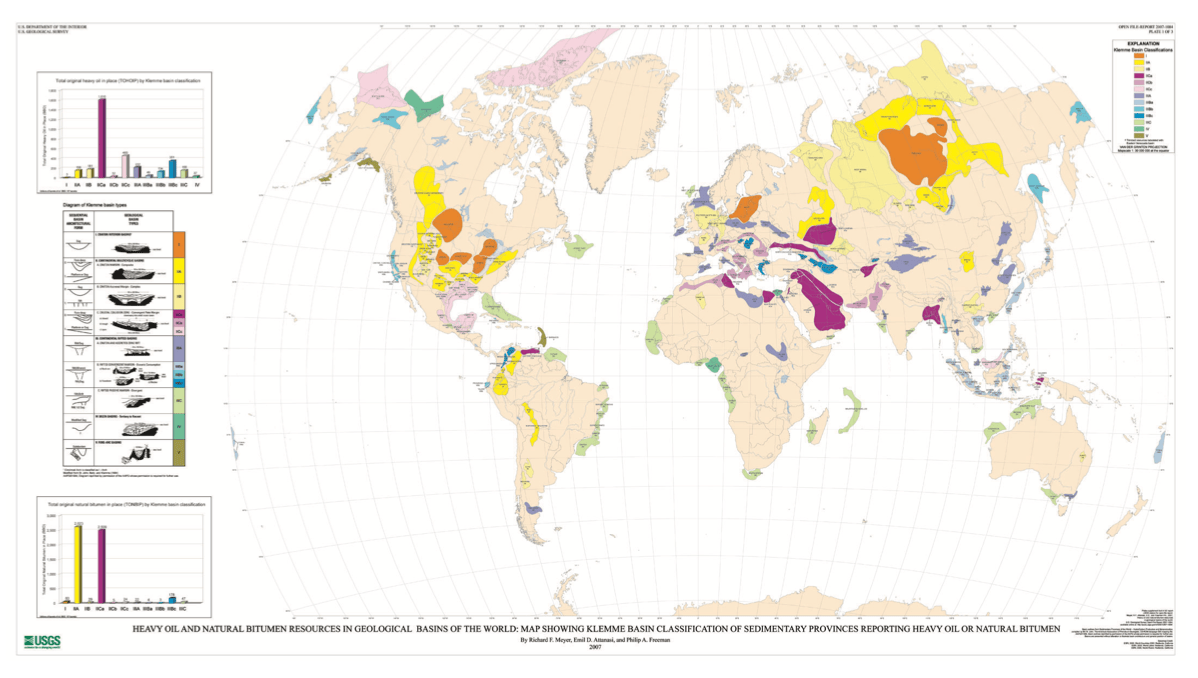
The United States Geological Services provides maps of available heavy oil and bitumen deposits. Figure 6 indicates that heavy oil is widely available in North America, Europe, Russia, and the Middle East.
In 2015, the International Energy Agency published a report indicating that in its view, there were huge deposits of extra heavy oil and bitumen (EHOB) that could be accessed if the price of oil rose high enough for long enough (Figure 7). The same exhibit shows somewhat smaller availability of tight oil from shale. In fact, the US has been able to access a substantial amount of tight oil from shale in recent years.

In my opinion, in order to access the EHOB, the prices of diesel and jet fuel need to rise to a high level over the long term; the prices of gasoline and even lighter products don’t necessarily need to rise. If the prices of diesel and jet fuel rise high enough, for long enough, the price signal should work its way back to oil and gas companies, suggesting that they need to make investments in the direction of adding more extraction from EHOB. If this succeeds, it could perhaps relieve the problem of inadequate supply of diesel and jet fuel.
The prices of diesel and jet fuel are high now, but this is at least partly due to higher insurance costs and partly due to the extra costs related to shipping oil longer distances to avoid blocked straits. These extra costs don’t get back to oil companies in a way that encourages countries to extract more heavy oil. What is needed are permanently higher prices for diesel and jet fuel, relative to the price of gasoline, even if the problems with respect to the straits of Hormuz and of Bab al-Mandab, disappear.
[6] Today’s conflicts in the Middle East and Russia/Ukraine seem to relate to inadequate supplies of diesel and jet fuel for buyers of these fuels, and inadequate prices for sellers of the heavy/sour oils yielding these products.
Figure 3, above, shows that the total supply of diesel plus jet fuel has been low, especially since 2020. One issue that has arisen recently is “Who gets the supply of diesel plus jet fuel that is available?” Figure 8 shows that increasingly, it has been the poorer countries of the world who obtain the diesel and jet fuel that is available. Note that total consumption of the Other than Advanced Countries has exceeded that of the Advanced Countries since 2020.
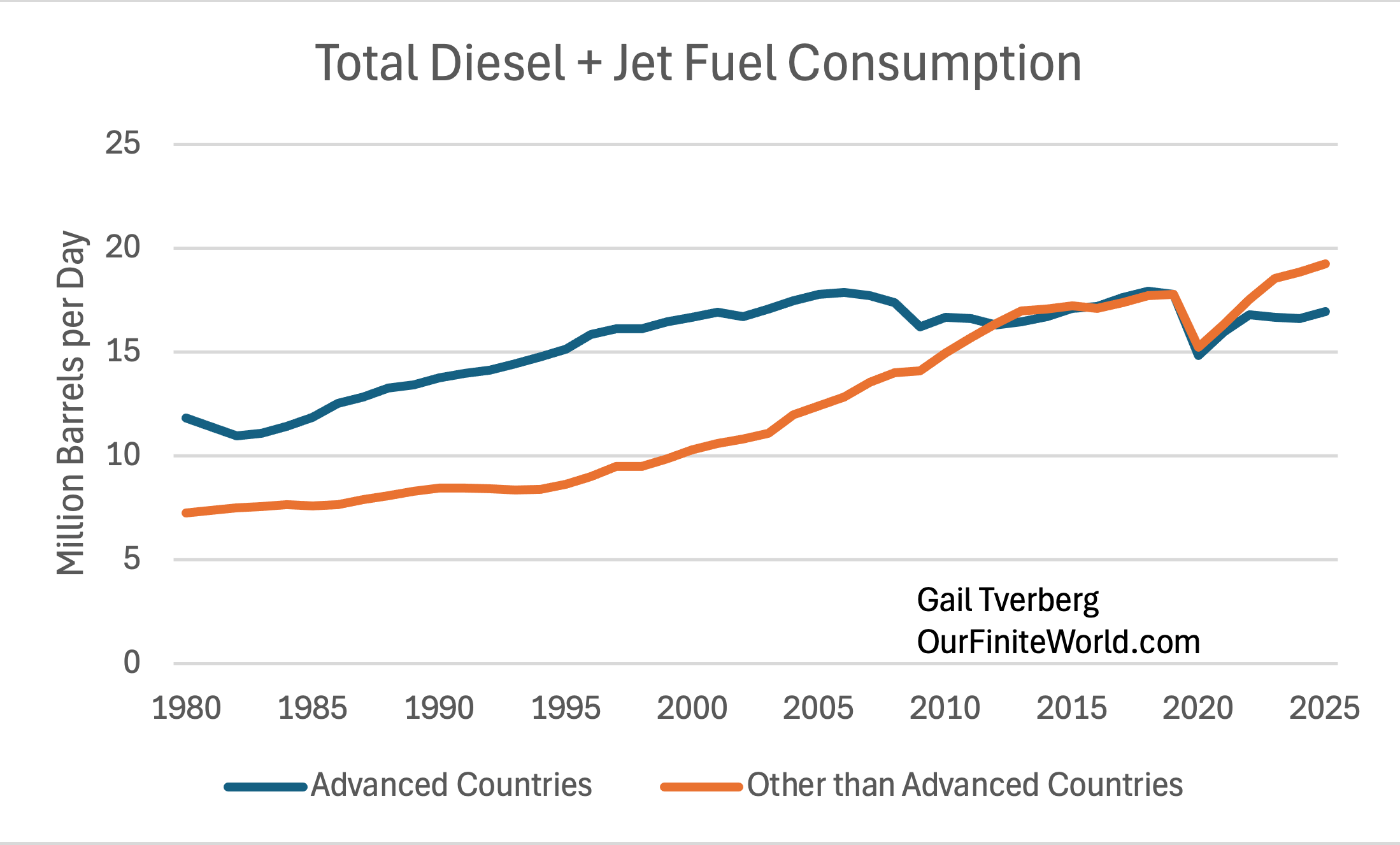
Figure 9 shows that for the Advanced Economies, per capita consumption of diesel plus jet fuel has been declining since about 2005–the time of peak conventional crude oil. The same figure shows that per capita consumption of diesel plus jet fuel has plateaued since 2013 for Other than Advanced Countries. I think of 2013 as the year that China first started encountering major limits on coal extraction (somewhat like the year 1970 in the US for oil extraction). In recent years, China has been able to raise coal extraction somewhat, but at a higher cost.

I would expect that countries in both groups would be dismayed by the situation shown in Figure 9. The per capita consumption of diesel plus jet fuel for the Advanced Countries has been falling for a long time. Partly this is the result of the economies changing to service economies. As service economies, the need for diesel by industry has been lessened. Wages tend to be less for many of these service jobs, making workers unhappy.
In Figure 9, people in the Other than Advanced Countries would tend to be dismayed by the continued wide gap between the standard of living of their own economy, and the standards of living in the Advanced Countries. Many of these countries export extracted resources that are ultimately sold as goods to people living in Advanced Countries. If the selling prices of these commodities were higher, workers in these countries could perhaps afford to have cars and air conditioning, like workers in the Advanced Countries. They would also be dismayed by the poor progress in raising their own per-capita consumption of diesel and jet fuel since 2013.
[7] Is there any possibility of greatly ramping up heavy oil production? Could it power a society like the one we have today?
We know that heavy oil production began long ago. For example, the first recorded production of heavy oil began in the Kern River Basin in California in the 1860s, and commercial production began there in 1899. The first production in the Canadian Oil Sands began in 1921, and commercial production there began in 1967.
The extent to which the oil that is heavy and often sour can be ramped up in the future remains to be seen. Extraction techniques have gradually been improving, and I would expect that they can continue to improve. But the cost of extraction and processing will likely remain somewhat high because of all the energy-intensive steps that are needed to provide diesel and jet fuel.
I expect that society itself will need to change in order to make use of this higher-cost oil. These are a few ideas I have:
(a) Oil exporting countries will need to change in ways that reduce their need for tax revenue. This is an issue especially in the Middle East, which has a huge population, in a hot, dry climate. The population will likely need to fall (for example, many migrants and guest workers may need to move back to their country of origin), and make-work projects will need to be discontinued.
(b) Another issue is that total diesel and jet fuel usage will likely need to be reduced because it is likely to take several years before production of heavy oil can be ramped up. Society will need to be reorganized in a way that uses less diesel and jet fuel. One idea would be to shorten supply chains whenever possible. Figure 10 illustrates one idea how this might be done.

(c) I expect that if such a change can be made, economies will need to gradually change in ways that are hard for us to understand now. The focus may need to be on essentials, including food and clothing. Governments may need to be smaller and provide fewer services. Communities may need to be smaller and more walkable. The total population may need to be lower.
[8] Conclusion
It seems to me that the self-organizing nature of economies will gradually push them in the directions they need to go if the world is to start incorporating a significant quantity of expensive products made from heavy oil into its energy mix.
We cannot yet imagine what all the changes will look like. In some ways they may resemble a recession, but there will likely still be an interest in greater complexity and in working to improve people’s lives.


https://www.zerohedge.com/commodities/us-warns-europe-release-emergency-diesel-supplies-or-face-export-ban
US Warns Europe: Release Emergency Diesel Supplies Or Face Export Ban
Speaking in the Oval Office on Wednesday, President Trump said he holds discussions “every day” about a potential diesel export ban, blaming Russia’s war in Ukraine for fueling the supply squeeze. His administration is now pressuring European governments to release emergency diesel inventories to contain further price surges and reduce the risk of an economic shock in the coming months.
Reuters reports that the Trump administration has asked Germany and France to release emergency diesel inventories to help create a buffer against the supply squeeze in the industrial fuel or face a potential US diesel export ban.
The total request calls for the release of 120 million barrels of diesel over the next six months, according to a source in a European capital cited by the outlet. That would be equivalent to about 660,000 barrels a day of additional supply.
Not surprising:
https://www.zerohedge.com/markets/16-us-trucking-companies-file-bankruptcy-less-month-diesel-prices-soar
16 U.S. Trucking Companies File For Bankruptcy In Less Than A Month As Diesel Prices Soar
. . . Prices have eased slightly from that peak, but the EIA’s latest weekly reading still puts diesel at $6.38 per gallon, compared with $5.60 at the end of August.
Now the financial damage is beginning to show up. Sixteen American trucking companies have entered bankruptcy proceedings in less than a month, affecting more than 250 jobs, according to FreightWaves and the Independent. Eight filed for Chapter 11 bankruptcy, allowing them to continue operating while restructuring their debts, while seven entered Chapter 7 and are liquidating their assets and shutting down.
There are quite a few truckers who own (with monthly payments) their own trucks. I expect that they are doing badly, also. Unless the companies that they work for are paying them more per mile, they have a major problem.
Off-topic
I’ve recently discovered that there is a wonderful channel on youtube called Mosfilm.
It is a channel where you can find a lot of beautiful and classic Russian movies, really well done.
There are classic ones, like beautiful ‘Karamazov brothers’ or other more recent which describe events of modern history looking things from another perspective, out of our propaganda, but in their propaganda (which is not necessarily the wrong side).
You will find them extremely European ! (in the good sense of the word)
I’m really enjoying them.
https://www.youtube.com/@Mosfilm_eng/videos
Anyone from France wants to add ?
Protests over teacher shortages, overcrowded classes, and poor facilities escalated into violence on October 1, 2026, with arson damaging school buildings in Nantes and Bordeaux, and a fire truck burned in Marseille. A school principal was doused with petrol in one incident, amid over 600 detentions from the nationwide wave that hit hundreds of schools and universities. Authorities blame external troublemakers for the destruction, while some students distanced themselves, insisting they protested peacefully. The government activated a crisis cell as investigations into the fires continue.
A ” Great Churning ” happening in India . I will keep you updated .
Chinese refiners have suspended exports of oil products to regions beyond Hong Kong and Macau until further notice from Beijing following the Golden Week holiday that runs until October 7, four people briefed on the matter said on Thursday.
As China looks to safeguard domestic supplies, state oil major PetroChina cancelled on Wednesday the majority of its gasoline and jet fuel shipmenets planned for October three of the sources said.
Reuters
https://www.hfir.com/p/china-cancels-product-exports-and
Washington is using its diesel as leverage.
The 🇺🇸US has told 🇫🇷France and 🇩🇪Germany to release their emergency diesel stocks or face a possible US export ban.
Reuters cites 3 sources.
-A European source says the ask is 120M barrels over six months, about 660k b/d.
-US officials say Paris and Berlin haven’t fully delivered on earlier pledges to release reserves.
“It is in Europe’s best interest to work with the United States,” one US official said.
– Energy Secretary Chris Wright: “We’ve lost some diesel exports from the Middle East, although we’re restoring those, and we’ve lost diesel exports from China.”
🇺🇸US diesel hit a record $6.53/gal last week, about five weeks before the midterms.
The White House is weighing a 90-day export ban, voluntary limits for refiners and other options.
🇫🇷Macron wants a G7 call and a coordinated release through the IEA instead.
this pressure is aimed at allies.
🇪🇺Europe replaced 🇷🇺Russian diesel with 🇺🇸American diesel and now its new supplier is setting conditions…
The squeeze is coming from every side.
🇨🇳China paused fuel exports today, 🇷🇺Russia has extended its diesel ban and Gulf product exports are low.
EU has as usual called a coordination committee to discuss this on 15th October . The blind men will meet to discuss nothing . Clueless as usual .
How exactly should Europe release all this Diesel in 6 months? Make the gas stations and airport storage bigger with a magic wand? Nevertheless, as I have been saying for months, the Diesel problem is not the refineries but shortage of specific crude oil used to make diesel.
Diesel stocks .
https://x.com/Kathleen_Tyson_/status/2105551584411140430/photo/1
I agree 100%
It is obvious that US is using the fear of diesel ban as leverage.
But it also obvious that US cannot put in place a ban, because it would be counterproductive for US itself, it has already been explained by various technical articles.
Furthermore the ban would let the US appear as the serial torturer of Europe.
So the best strategy would be:
are you threatening us with an export ban?
OK, go ahead.
Quark
3h
I already included the reference in the article. China used to import oil from Venezuela and Iran. Both of those imports are currently suspended. Until now. Iran was selling them oil offshore, and they probably have very little left, so China needs to change its strategy and secure new contracts with competitors. If they don’t want to do so at these prices, it makes sense that they’re suspending exports to protect their domestic market.
JPM says SoH is at 93 % of pre war capacity . So where is this oil going ?
https://rayonegro.substack.com/p/el-petroleo-fluye-de-nuevo-con-normalidad
Did people suddenly figure out Kepler has been selling propaganda all this time after China, the largest buyer of Middle Eastern crude oil (by far), implicitly confirmed it is not getting all that oil “flowing” out of Hormuz as if there is no tomorrow?
https://x.com/DarioCpx/status/2105561339943153712/photo/1
Kepler is getting hauled over coals for providing ” crappy data ” . So bad that oil is up 3 % even after the jawboning .
This is oil storage in EU . Not sure if this is crude or distillate . The question is how do you release it , to whom , price , logistics , refill etc . Dumb questions , I guess ?
• France: Holds ~120 million barrels (~88 days of cover)
• Germany: Holds ~110 million barrels (~92 days of cover)
• Italy: Holds ~76 million barrels in domestic and regional tanks
• Spain: Holds extensive reserves (~97 days of cover)
Western governements and thinktanks have been aware of the consequences of closure of the Starit of Hormuz for a long time. Oilprices would rise sharply.
And we have seen that the American attacks on Iran had exactly the predictable consequences.
Oilprices are now well above the breakeven-price for many oilproducers. Especially American producers can make a profit again at current prices (for oil and diesel)
So I am wondering… was the attack on Iran intended to raise the price of oil and diesel #conspiracytheory
But the oil producers need to be convinced that they can set aside quite a bit of this income to build new infrastructure to extract heavy oil. Money to be used in exploration and development of wells has been going down.
The system is not working well now. There is too much wage and wealth disparity. This started long before the closure of the Strait of Hormuz.
Many thanks Gail for your article. I’ve seen it has been also published on Oilprice.com.
I’m doing various thoughts about your article.
The first one is that producing diesel car is completely dumb.
It is also without any sense to produce heavy cars (in terms of weight and size).
We should save any stupid waste of diesel, but of any fuel in general too.
When I see in my city that many people move with incredibly heavy and big size private cars and often with diesel fuel, I think that it should be banned.
The problem I see is that they tried to ban them but taking the problem from an incomprehensible side for people, that is CO2.
With your article people should understand it more simply.
I hope so.
I noticed diesel was $6.79 per gallon at a nearby gas station driving around the other day. Insane.
In socal 8.30
$6.99 and $7.99 at two stations I passed driving today
The idea is that the diesel shortage is not a supply problem caused by Hormuz and Russia, but a demand problem in the sense that demand at real costs has collapsed so much that investments have been omitted and now there is no availability despite partially increased prices? Interesting thought!
The Iranians have been selling to the Chinese for years under the price. What they want is a Hormuz tax, which in fact not only makes their own exports more expensive, but also represents a taxation of neighboring countries.
I understand this as a desire for dominance, but it may be compensation for the lost payment of recent years.
In the EU, a very high tax is added to the energy price, which drives up the price of forced wind and solar expansion – funds that go to a large extent to China and the USA. As a result, industrial production has fallen by a fifth to a quarter. Since at the same time many hundreds of billions are being spent on the war in Ukraine and the standard of living is falling significantly, the Conservative Party (comparable to the Republicans) has collapsed in favor of the right-wing populists since the last elections and in some cases is no longer even represented in the state parliament. In addition, many people were dissatisfied with the corona policy and with the growing loss of freedom and fundamental rights due to the extensive control by the EU.
It is unclear to me whether this is an inevitable mechanism, in the sense that our industrial processes do not generate enough profit to sustain oil investments, or it is not the excesses of a completely irresponsible policy.
I agree. In our economy is currently structured, diesel and jet fuel are unaffordable. I keep writing about affordability being the issue. Notice my last post:
https://ourfiniteworld.com/2026/08/05/affordability-not-scarcity-is-the-real-energy-crisis/
The economy needs to substantially restructure in order for diesel and jet fuel to be affordable. Can that happen in the next five years? Probably not. Can it happen in 100 years, or in 500 years, I don’t know. The longer the gap, the more changes may take place.
Can we perhaps think of other things to supplement our energy supply? It could be, in a long enough time frame. There seem to be breakthroughs is batteries. There could be breakthroughs in other areas as well.
Getting the cost (including energy cost) of the extraction of the heavy oil down is essential. We clearly cannot use much diesel in the process. People have been working on that issue for a long time.
I think governments will have to collapse, and their replacements will be much smaller. Then they won’t need such high taxes on energy products. We are going to need to start working pretty much all of our lives, instead of starting at age 22 or so, and working until 60 or perhaps 65. Schools may be much more limited than now.
Or perhaps things will change in a different way. There is a lot we don’t know.
For the Australian readers:
On my website, the focus was on diesel for several months now. The latest:
29/9/2026
Australia to expect less petrol and jet fuel deliveries in next 4 weeks as diesel economy guzzles along
https://crudeoilpeak.info/australia-to-expect-less-petrol-and-jet-fuel-deliveries-in-next-4-weeks-as-diesel-economy-guzzles-along
28/9/2026
Australian diesel imports to July 2026
https://crudeoilpeak.info/australian-diesel-imports-to-july-2026
20/9/2026
Australian onshore diesel stock on 15 Sep 2026 very likely near or below MSO level
https://crudeoilpeak.info/australian-onshore-diesel-stock-on-15-sep-2026-very-likely-near-or-below-mso-level
It looks like the Australian economy has been able to have close to business as usual, since February. Stocks are down a little, and ships on the way are down, but nothing to scare the citizens too much, so far.
My impression is that the shortages so far are especially in the very poor countries. My sister Lois, who is writing a book with a lady from Uganda, reports that the school that my sister’s friend is in charge of has been dealing with a shortage of food. In fact, they tried to close and send children home, but about half of the parents reported they had no food either, so don’t send the children home. If I understood correctly, the school had corn available, but they were having real difficulties accessing beans. There is some other food that they grew as backup that they have available, but it is not a preferred food. There may be starvation issues in poor countries that we don’t hear about.
We also had the comment recently about the situation in Argentina. They seem to be seriously short of diesel. I will try to find a link to it.
This is a link to a translation of part of the article about the Argentina situation , that I posted.
https://ourfiniteworld.com/2026/08/05/affordability-not-scarcity-is-the-real-energy-crisis/comment-page-14/#comment-519549
This is a link to the full article, in Spanish.
https://juancarlosfurlan.blogspot.com/2026/09/gasoil-argentino-el-dia-despues-de.html
You are right about who is hit first. Is that an urban school in Uganda? The maize based Ugali is the staple food but you need of course veggies for vitamins. I worked in Tanzania and Malawi in the 70s and early 80s
I don’t know too many details. The school has large gardens for vegetables, I believe.
Thanks Matt . Do you have any info on your neighbour NZ ?
Not going to waste time but another event that has the hallmark of a failed false flag .
https://www.zerohedge.com/geopolitical/midair-horror-flydubai-pilot-reportedly-stabbed-israeli-news-says-incident-treated
* Muslim attacker, innocent Jewish victim; reinforce who the enemy is
* Russian and Ukrainian pilots save the day; it’s time to end Russia-Ukraine hostilities for the sake of peace and good (before total NATO humiliation and political repercussions)
Good point!
Crazed Muslim attacker, innocent probably Hindu victim, and a plane load of Jewish heroes led by this guy:
Israeli Hero Recounts Battle to Stop Flydubai Hijacking: ‘I Grabbed Him, Choked Him’
https://www.breitbart.com/politics/2026/09/30/israeli-hero-recounts-battle-to-stop-flydubai-hijacking-i-grabbed-him-choked-him/
Doubtless, Spielberg is obtaining the film rights and ordering the script as we speak.
I am afraid this is another “Chucky” moment.
In a utilitarian way it would have been better for this false flag attack to succeed so Israel would be galvanized enough to end the mess in the middle east.
It would have been bad for the passengers, but you need to break an egg to make an omelet.
It did succeed, Kulmy: it makes all the propaganda points they currently find desirable.
But really I don’t think the world is listening: Israelis as heroes? So what!
Propagandists end up just performing for themselves.
“Israel would be galvanized enough to end the mess in the middle east”
You believe that the squatters could be convinced to commit some form of group harakiri, or just move back where they came from?
A noble thought, but I don’t see those murderous scum seeing the obvious benifit for everyone else.
The fireworks will start up again soon enough and if the squatters stick their oar in again, there’s a strong possibility that Iran will wipe them out(it would be very easy for Iran) and that’s a certainty if nukes are involved, which the Iranians are prepared for.
“even if it reaches the point of an apocalyptic war”
https://english.almayadeen.net/news/politics/iran-open-to-talks–ready-to-withstand–apocalyptic-war—ar
Yeah, Larry Johnson (former three letters agency analyst) from timing 5 min. 7 s :
‘Staged Event’
with very interesting explanations.
Pingback: Diesel, Affordability and the Evolution of Localism | Chatting about Localism
It is magical that almost daily hits on ships do not affect oil exports from the Middle East.
Not to mention the cost of insurance, sky rocketing shipping costs, nobody caring if they die to not, the need to fly military planes and send navy ships for every barrel of oil… and selling it for a mere 90$/b.
Through time, people always like to believe in magic.
I agree.
Hello Gail, how’s it going. I just want to address one of the last points you made and go from there as there are myriad impacts of this situation. In regards to what all the changes will look like going forward, from a US centric point of view, this is how I view a quick snapshot of things.
Interest rates are rising at this time, and I believe the Federal Reserve is trying to slowly deflate the AI bubble without popping it. A precarious situation to say the least. It may appear that they’re trying to bring the price of oil down, and they may succeed in the medium term, but it will obviously bear no impact unless it crashes markets, housing, and then demand. I do not think they are trying to do this though, I think they’re trying to vacuum up some liquidity and remove some leverage to stabilize things as almost anyone can see that the US tech market is in a bubble.
The AI bubble is having numerous headwinds too such as communities pushing back on data centers, financing drying up, the hyper-scalers are now issuing debt and going cash flow negative, and there still is no way to turn AI into revenues, which is probably their largest problem. If the Fed can suck some of the froth out of the system things may be on more suitable footing to compete with China.
As for cost of living in the US, it is set to explode to all time highs going into 2027. October is the big harvesting money and diesel is sitting around $7 a gallon, fertilizer prices have exploded, transport costs have risen, insurance costs are ridiculous (especially for international shipping), plastics are moving higher in price, etc. All of this is going to translate into worse quality foods, shortages, shrinkflation, and famine (especially outside of the US). This will be exacerbated by things like food stamps being dramatically reduced and other essential bills going up higher in price like electricity, water use, insurance, etc.
I do not believe there is anything they can do about the cost of living either, which will likely see political violence in the coming midterms and 2028 election. Political violence according to recent surveys shows that 30% of Americans believe this is now acceptable, so we’re very close to the pitchforks stage of the cycle. 40% of Americans are now using credit cards to buy groceries. I don’t need to tell anyone this is unsustainable but it’s going to get worse.
One likely scenario I think will happen is the democrats will win the House and Senate in the midterms. This will then turn into a Russia gate 2.0 type of scenario where impeachment and endless scandals/charges are brought to light while almost nothing is done about the cost of living as the belligerent president and republicans try to shoot down anything the democrats put forth as a “solution.” This will also likely lead to even more of a buildup under the surface of political violence as disgruntled voters realize nothing will change. And this will come to a climax if a moderate democrat is put into office in 2028 and voters realize they’ll be just another version of robbing the cookie jar as the Titanic capsizes.
One of the things I thought about including in this post, but I couldn’t because it would make the post too long to be readable, was the issue of tapping on the brakes of the system, in such a way as to make the economy in general come down slowly. I think that this is where we are now.
We talk about the system being self-organizing, but I often think it is God organized. The issue now, is to slowly bring down bubbles, and to keep as much of the economy as possible operating as normally as possible, as long as possible. We need to stretch out any collapse long enough that we can catch ourselves with high cost diesel and jet fuel, and perhaps some local electricity, with lots of low cost batteries, if these become available.
On interest rates, we probably need slow taps, perhaps up and down.
With respect to the political situation, we probably need gridlock between the house and senate. Opposite parties would be best.
There is a love-hate relationship between countries. We need to trade with each other, but trade requires scarce diesel and jet fuel. Trump cannot take up President’s Xi’s proposal for stopping the war in Iran. But Trump can perhaps decide on his own to pull back troops from the Middle East. This would allow him to somewhat “save face.” A little like the US withdrawal in Vietnam and Afghanistan.
We know that economies, when they fail, often collapse over long periods of time. The time span indicated from the eight collapses examined in the book Secular Cycles seemed to be a range from 20 to 50 years. Perhaps we can stretch out the time even longer.
I probably need to talk more about these issues in a future post. Strangely enough, “TACO” = Trump always Chickens Out may be a reasonable strategy.
Gail …. “We know that economies, when they fail, often collapse over long periods of time. The time span indicated from the eight collapses examined in the book Secular Cycles seemed to be a range from 20 to 50 years.”
We know that applies to rurally based civilizations where 90%+ of the population is involved in subsistence agriculture and continue without input from the cities.
We certainly don’t know if that applies to civilizations where there is no subsistence farmers who always rely upon inputs from the rest of the civilization, and move food with inputs from the rest of civilization.
It’s pretty much a category error thinking our collapse will be anything like agrarian civilizations collapses.
Perhaps. We also know that there is a strong tendency of all ecosystems to use whatever energy is available. If one species dies off in an area, another species will tend to increase, to use whatever energy is available. We know that not all businesses fail at a time. There were businesses before there was electricity.
We need to keep our hopes up.
Totally correct, Hideaway.
The collapse of a predominantly agrarian society – with elements of hunting, fisheries, etc – cannot be a model in any way for our civilisation.
The area where I live was thoroughly Romanised, with sophisticated agriculture and forestry, and small industry (potteries, metal working, tile-making).
The town and its suburbs, the large villas, disappeared for a time, but the successors to the Romans established themselves successfully at a lower level of complexity which was just a little below the Roman level – no potteries, no larger-scale metal-working.
Moreover, at this lower level of complexity rather dramatic changes could take place while preserving basic structures: twice the Vikings moved in and slaughtered everyone, (perhaps keeping some as slaves) taking over their farms and the small English town which had eventually succeeded the Roman one.
In our travels to Istanbul, we frequently heard of places of worship for Christians being taken over and repurposed by Moslems. In fact, this seems to be a pattern we have run into elsewhere as well, sometimes with different religions involved.
The new culture reuses investments of the old culture, without the huge upfront costs that the old culture had. Stone walls are taken apart and used for building new structures. This saves on the need to mine the stones and carry them long distances.
Agreed about collapse, at least in America where there are hundreds of millions of guns. After a few days without electricity, running water, or food almost anyone with a firearm will be roaming the streets or invading neighbors looking for spare food or water. It will be much more like the zombie apocalypse sci-fi shows we’ve all grown so accustom to watching. This will be reinforced by the level of entitlement and general comforts of modern western society.
Gail as far as the economy being “God organized” what I were to infer that we are God. Like the specks of sand on a beach are how many numerous souls form into some sort of super ocean of consciousness. This is just one of our numerous failed experiments and we’re here temporarily occupying these bodies in a sort of theater to learn lessons in a dense physical environment. I think that we’ve managed to create something so complex that it’s impossible to know with certainty how it will unwind, we can just be sure that it is a stage of chaos and breakdown at the present time.
I believe Europe will give America a preview of what collapse looks like as they have taken in millions of refugees, shut down most of their refineries and electrical generation plants and are in debt up to their eyeballs. Now they appear to be trying to join in the war with Ukraine against Russia as a last ditch effort to point fingers for the incoming riots and famine. I believe the EU imports something like 70% of their diesel for example and has been petitioning Trump this last week or so to not impose a diesel ban is it will greatly impact them. Hopefully they built up a bunch of electric tanks so they can join the fray while being Net Zero compliant lol.
I am afraid you are right about Europe probably giving the US a preview of what collapse really looks like. I expect, however, that collapse will be somewhat different everywhere, depending upon the particulars of the area.
Draining America, first, before all other countries in the world with far, far more proven reserves, is the goal. Its a very personal goal.
Mike Shellman on this topic .
https://www.oilystuff.com/group/oil-natural-gas-refining-stuff/discussion/d5b10f34-220f-4fc6-9470-c95a9ef979b9
Russia, the world’s second-largest diesel exporter after the U.S., has extended its diesel export ban until October 31.
This comes when the global diesel market is already extremely tight, with Russian refinery disruptions adding further pressure.
One of the world’s biggest sources of diesel is now staying out of the export market for another month.
But we should remember that the causes leading to Russia’s diesel export ban tends to make more crude oil available to the world market. This helps refineries around the world (outside of Russia) to keep busier. It helps hide the lack of crude oil problem a bit. It probably keeps crude oil prices down a bit, even if it sends diesel and jet fuel prices up.
The hit to refineries does not mean that the oil is being exported . Ukraine has also hit loading facilities , so the oil is not getting out . Anyway China was importing 50% and India 37% of the total oil exported by Moscow . Not a lot to spare . India imported 1.75 mbpd this month — down from 2.1 mbpd the month earlier because of the new tariff threat . The 0.4 mbpd was snapped up by China but this only covers the loss of VZ oil . Hardly wets the mustache .
https://energyandcleanair.org/august-2026-monthly-analysis-of-russian-fossil-fuel-exports-and-sanctions/
https://swarajyamag.com/news-brief/indian-refiners-cut-russian-crude-imports-to-175-million-barrels-daily-amid-tightening-supplies-and-china-rivalry
Major explosions at an India Refinery responsible for ~5% of India’s crude processing.
They’ve immediately canceled exports of Diesel & Jet Fuel.
Another blow to already precarious fuel markets .
https://x.com/RhoRider/status/2105324360395558981/photo/1
Another problem!
Thanks for your thoughts. I am sure that some crude oil is not getting out of Russia. We live in a truly strange world.
Gail, Thanks for posting the new and timely article. Everything you say about adjusting to more expensive middle distillates is now apparent. You said at the end that it’s difficult to predict how governments will adapt. In the OECD countries there is a lot of potential to move to more energy efficiency. In the US in particular cars can be way more efficient than they are now. More electrification can further reduce the demand. I am concerned about how governments downsize without social unrest and war.
It is just too late a d people have no money to change cars
“More electrification can further reduce the demand.”
I’ve never understood that, because electricity is energy too that needs to be produced from somewhere. So I asked the internet:
Q: Does electrification reduce energy demand?
A: Yes, electrification reduces total final energy demand because electric technologies are significantly more efficient than their fossil fuel counterparts, thereby eliminating energy losses associated with combustion.
Efficiency Gains: Electric vehicles convert approximately 80-90% of energy into motion, compared to 20-25% for internal combustion engines, while heat pumps provide 3-4 times more heat energy than the electricity they consume, outperforming gas boilers.
Net Energy Reduction: Studies indicate that a fully electrified system can cut final energy consumption by 16% to 59% (or up to 40%) by 2050, even as electricity demand rises to meet these new end-uses.
Sectoral Impact: While electricity demand increases substantially (potentially by one-third by 2030), the overall total energy demand (fuels plus electricity) decreases because the efficiency savings outweigh the increased electrical load.
Dothk…”Electric vehicles convert approximately 80-90% of energy into motion” Wrong…That fake number was promulgated by fake news MSM. In reality, it is 20% min loss for propulsion efficiency and at least 10% loss in battery charging.
Still a respectable 70% Max efficiency. However, you are leaving out the unseen costs. Electricity production which relies on fossil fuels or maybe a small percentage generated by heavily subsidize “so called renewable”.
You are also leaving out the dirty, unsustainable mining and refining of EV battery components and EV motors. All unsustainable overall.
Keeping roads paved in the future is a major issue. And we don’t have away-from-home charging capability in any quantity, and probably never will. To keep costs down, there are no people guarding the electricity “pumps.” They tend to get stolen for the copper content. We need to think hub and short spoke for vehicles charged with electricity, and probably a lot fewer paved roads.
I’m in Upstate NY. On the NYISO real time dashboard I can see that most days, 20%+ of the generation powering the state’s entire grid is from hydropower. This is mostly from Niagara and the Moses dam on the St. Lawrence. This is a significant part of our grid and predates by decades the renewables subsidies I think you’re referring to.
Hydropower is important in some places. It can be quite seasonal. It tends to be highest when there is snow runoff in the spring. It needs to supplement other types of power.
Hydroelectric can be very inexpensive. But it often requires long transmission lines to where the electricity is used. If these are not well maintained (and even if they are), these can start fires in wind storms. California has had with transmission lines they try to bring in from Washington state, and probably local hydroelectric. But New York is a cooler, wetter area, so the fire aspect of this is not likely to be as much of an issue.
Crisis at the hoover dam currently if you haven’t heard about it.
https://www.msn.com/en-us/money/general/lake-powell-inflow-forecast-at-36-of-average-as-hoover-dam-power-risk-grows/ar-AA2dgdqM
Its funny that even people here refuse to talk about what deflation really is: less people
The world, the markets, the environment, want deflation. Who gets left without a chair, that is all this game is. We can talk stats till the cows come home but in the end we will have deflation. Might be the ground level entrance for deciding who doesn’t get a chair, because that day is coming soon.
Presumably the landing of the Pacific hurricane (tomorrow?) will mitigate that somewhat. I can see 4″+ over most of the Colorado basin.
OK, points taken – Mr. Fake Name. 😉
It is actually worse than 70%. Battery charging losses are not 10%…they are more like 15%. 85% of a kWh on the grid ends up in the battery. I guess this makes the EV efficiency lower…around 65%. Still good, but that is max.
Yeah, now add in cold weather performance for at least 40% of the US.
We are finding many bottlenecks to electrification, however.
–Adding enough electricity transmission lines is hugely difficult. Many parts need to come from China. Supply lines are years long.
–There are also materials bottlenecks for making electric vehicles–copper, nickel, many other things.
–Intermittent electricity can be made to work, if the percentage is moderately low, and if most of the intermittency is from wind. If solar is added, a whole lot of batteries need to be added, to mitigate the peaks, and to transfer morning electricity to the evening. But it doesn’t work very well, without enough balancing fuels, primarily natural gas.
–High priced natural gas for balancing (parts of the world using LNG) makes very expensive electricity.
–Uranium supply is restricted by low prices and lack of sulfur for sulfuric acid to use in mining. People who think we can ramp up nuclear in the West are very optimistic, in my view. Uranium production and upgrading are centered in the Far East. Russia, China, and countries in that area are likely to get available supplies.
That’s true. The electricity still has to get from source to consumer, and all the components involved in that have to be manufactured using energy of some sort. We can’t just go to the supermarket and buy a few containers of electricity. 😉
Sure Andrew….
Trump administration lowers fuel economy standards, critics say at a significant environmental cost
https://apnews.com/article/trump-gas-mileage-electric-vehicles-pollution-403742074c3f3140aaa1d10829daf35f
DETROIT (AP) — The Trump administration on Monday released new fuel economy standards that relax regulatory requirements for automakers to control pollution from gasoline-powered cars and light trucks. The new rules were released shortly after President Donald Trump rejected an Iranian proposal to open the Strait of Hormuz, sending oil prices soaring.
…..
Since taking office, Trump has also pulled back auto tailpipe emissions rules, repealed fines for automakers that do not meet federal mileage standards and terminated consumer credits of up to $7,500 for EV purchases.
You are correct, we could’ve doing better….it can’t get no worse, but probably will
Soon, so few people will be able to afford a car of any kind that emissions and fuel economy standards will become entirely moot/irrelevant.
They are still driving them in Cuba….I believe they can’t be more broke …but what do I know…
PS..Keep your old clunker, the old cars at least can be repaired, new ones, not so much
Yes, they are – but not in anywhere near sufficient numbers to have more than a minuscule environmental impact.
IMHO it will eventually (and sooner rather than later) be like that here, too.
You are probably right. We may be using bicycles and tricycles, some with electric power attachments. The lighter weight will keep roads from falling apart quite as fast.
We are already seeing that in the West/Central part of FL that I live in. Lots of younger people (who would have owned a car 10+ years ago) now riding bikes (some electric) and tiny electric scooters alongside the roads.
Gail opined, “We may be using bicycles and tricycles, some with electric power attachments.”
Daisy, Daisy.
https://www.youtube.com/watch?v=uerNtYhgzSw
Amazingly, the woman on the bike in the video looks just like Gail. 🙂
That’s true. The electricity still source to and all the components involved in that have to be
Fast Eddy says:
What do you do when you are burning far more oil than you discover — and your efforts to offset the impact of expensive to produce oil push you to the edge of the cliff? You can accept your fate and allow the beast to shove you into the abyss…. Or you can buy some photos of Hoolio from, that’s my dog. He’s almost as much as hero as I am.
Dothk says:
What happen my posts, they came out in wrong place
kulmthestatusquo says: says:
Despite of it all, AI will prescribe solutions for virtually all diseases, targeted to their genetics. A bad solution because I’m hating everybody but me.
Dothk says:
What h@ppen my place, they c0me out in wrong blog
Fast Eddy says:
The great Fast Eddy knows how to hack is why. Wanna buy a Hoolio photo?
Hi Gail, thanks for a great new article!
Sorry I have been so slow. I went on two family trips between my last post and this one. I also gave a presentation on Limits to Growth that I haven’t written up as a post. This is a link to it.
https://ourfiniteworld.com/wp-content/uploads/2026/09/Tverberg-Limits-to-growth-Sept-1-pm.pdf
Thanks for the reminder. LTG was mandatory reading at the time
You write “energy first, then GDP”. Exactly.
On your FSU oil consumption graph:
The Soviet Union collapsed because the West Siberian crude production peaked in the mid 80s as the Russians did not have the technology at the time to handle maturing oil fields.
A friend in ASPO Sydney met Gorbachev in 2012 at a climate change conference and he confirmed that they “were running short of oil”. All East block countries depended on it because they did not have foreign exchange to buy oil on the global market. That was also the time of the 1st tanker war.
4/10/2010
Russia’s oil peak and the German reunification
http://crudeoilpeak.info/russia%E2%80%99s-oil-peak-and-the-german-reunification
Thanks for offering a link to this old post of yours. It fills in quite a few parts of the story I wasn’t aware of. I have said that the collapse of the central government of the Soviet Union was oil related.
The US had forced interest rates up, pushing the world economy into recession. This brought oil demand way down.
Russia was the high-cost producer, I expect. It would have needed a great deal of investment in Western Siberian oil fields to keep production up. Of course, at low oil prices, this made no sense. A person could see that the Soviet Union’s oil production was having problems, long before 1991.
I had forgotten that the reunification of East and West Germany was a 1990 event. The collapse of the Soviet Union came near the end of 1991, related to debt issues, among other things.
You show a chart by Jeffrey J. Brown and Samuel Foucher. Russia’s actual oil production has, in fact, done far better than the production that this chart shows. As extraction of new fields begins, it changes curves. But now Russia’s crude oil production is declining. Production was at a high point in 2019, and has been slowly falling since. Russia is suffering the classic problems of being past peak oil again now.
In the LTG graph there is that all important resources curve. That is stock. What is more important is annual resource production and especially energy production by fuel
The original study lumped resources of many kinds together by weight. Energy products were not separated from other minerals.