
Once upon a time, we worried about oil and other energy. Now, a song from 1930 seems to be appropriate:
Today, we have a surplus of oil, which we are trying to use up. That never happened before, or did it? Well, actually, it did, back around 1930. As most of us remember, that was not a pleasant time. It was during the Great Depression.

Figure 1. US ending stocks of crude oil, excluding the Strategic Petroleum Reserve. Amounts will include crude oil in pipelines and in “tank farms,” awaiting processing. Businesses normally do not hold more crude oil than they need in the immediate future, because holding this excess inventory has a cost involved. Figure produced by EIA. Amounts through early 2016.
A surplus of a major energy commodity is a sign of economic illness; the economy is not balancing itself correctly. Energy supplies are available for use, but the economy is not adequately utilizing them. It is a sign that something is seriously wrong in the economy–perhaps too much income disparity.

Figure 2. U. S. Income Shares of Top 1% and Top 0.1%, Wikipedia exhibit by Piketty and Saez.
If incomes are relatively equal, it is possible for even the poorest citizens of the economy to be able to buy necessary goods and services. Things like food, homes, and transportation become affordable by all. It is easy for “Demand” and “Supply” to balance out, because a very large share of the population has incomes that are adequate to buy the goods and services created by the economy.
It is when we have too much income and wage disparity that we have gluts of oil and food supplies. Food gluts happened in the 1930s and are happening again now. We lose sight of the extent to which the economy can actually absorb rising quantities of commodities of many types, if they are inexpensive, compared to wages. The word “Demand” might better be replaced by the term “Quantity Affordable.” Top wage earners can always afford goods and services for their families; the question is whether earners lower in the wage hierarchy can. In today’s world, some of these low-wage earners are in India and Africa, or have no employment at all.
What is Going Right, As We Enter 2018?
[1] The stock market keeps rising.
The stock market keeps rising, month after month. Volatility is very low. In fact, the growth in the stock market looks rigged. A recent Seeking Alpha article notes that in 2017, the S&P 500 showed positive returns for all 12 months of the year, something that has never happened before in the last 90 years.
Very long runs of rising stock prices are not necessarily a good sign. According to the same article, the S&P 500 rose in 22 of 23 months between April 1935 and February 1937, in response to government spending aimed at jumpstarting the economy. By late 1937, the economy was again back in recession. The market experienced a severe correction that it would not fully recover from until after World War II.
The year 2006 was another notable year for stock market rise, with increases in 11 out of 12 months. According to the article,
Equity markets rallied amidst a volatility void in the lead-up to the Great Recession. Markets would make new all-time highs in late 2007 before collapsing in 2008, marking the worst annual returns (-37%) since the aforementioned infamous 1937 correction.
So while the stock market consistently rising looks like a good sign, it is not necessarily a good sign for market performance 6 to 24 months later. It could simply represent a bubble forming, which will later pop.
[2] Oil and other commodity prices are recently somewhat higher.
Recently, oil prices have been too low for most producers. Now, things are looking up. While prices still aren’t at an adequate level, they are somewhat higher. This gives producers (and lenders) hope that prices will eventually rise sufficiently that oil companies can make an adequate profit, and governments of oil exporters can collect adequate taxes to keep their economies operating.

Figure 3. Monthly average spot Brent oil prices, through December 2017, based on EIA data.
A major reason for the recent upward trend in commodity prices seems to be a shift in currency relativities for Emerging Markets.

Figure 4. Figure from Financial Times showing currency relativities based on the MSCI Emerging Market currency index.
While the currency relativities for emerging markets had fallen quite low when commodity prices first dropped, they have now made up most of their lost ground. This makes commodities more affordable in Emerging Market countries, and allows them to do more manufacturing, thus stimulating the world economy.
Of course, if China runs into debt problems, or if India runs into problems of some sort, or if oil prices rise further than they have to date, the run-up in currency relativities might run right back down again.
[3] US tax cuts create a bubble of wealth for corporations and the 1%.
With low commodity prices, returns have been far too low for many corporations involved with commodity production. “Fixing” the tax law will help these corporations continue to operate, even if commodity prices remain low, because taxes will be lower. These lower tax rates are important in helping commodity producers to avoid collapsing as a result of low commodity prices.
The problem that occurs is that the change in tax law opens up all kinds of opportunities for companies to improve their tax situation, either by changing the form of the corporation, or by merging with another company with a suitable tax situation, allowing the combined taxes to be minimized. See this recent Michael Hudson video for a discussion of some of the issues involved. This link is to a related Hudson video.
Groups evaluating the expected impact of the proposed tax law did their evaluations as if corporate structure would remain unchanged. We know that tax accountants will help companies quickly make changes to maximize the benefit of the new tax law. This is likely to mean that US governmental debt will need to rise much more than most forecasts have predicted.
In a way, this is a “good” impact, because more debt helps keep commodity prices and production to rise, and thus helps keep the economy from collapsing. But it does raise the question of how long, and by how much, governmental debt can rise. Will the addition of all of this new debt raise interest rates even above other planned interest rate increases?
[4] We have been experiencing artificially low oil prices since 2013. This helps the economic growth to be higher than it otherwise would be.
In February 2014, I published an article documenting that back in 2013, oil prices were too low for oil producers. If a person looks at Figure 3, oil prices were over $100 per barrel that year. Clearly, oil prices have been much too low for producers since that time.
Unfortunately, it looks like these artificially low oil prices may be coming to an end, simply because the “glut” of oil that developed is gradually being reduced. Figure 5 shows the timing of the recent glut of oil. It seems to have started early in 2014.

Figure 5. US Stocks of crude oil and petroleum products (including Strategic Petroleum Reserve), based on EIA data.
If we look at the combination of oil prices and amount of oil in storage, a person can make a rough estimate of how this glut of oil might disappear. Quite a bit of it may be gone by the end of 2018 (Figure 6).

Figure 6. Figure showing US oil stocks (crude plus oil products) together with the corresponding oil prices. Rough guess of how balance might disappear and future prices by author.
Of course, one of the big issues is that consumers cannot really afford high-priced oil products. If consumers could not afford $100+ prices back in 2013, how would it be possible for oil prices to rise to something like $97 per barrel by the end of 2018?
I am not certain that oil prices can really rise this high, or that they can stay at this level very long. Certainly, we cannot expect oil prices to rise to the level they did in July 2008, without recession causing oil prices to crash back down.
What the Economy Needs Is Rising Energy Per Capita
I have published energy per capita graphs in the past. Flat spots tend to represent problem periods.
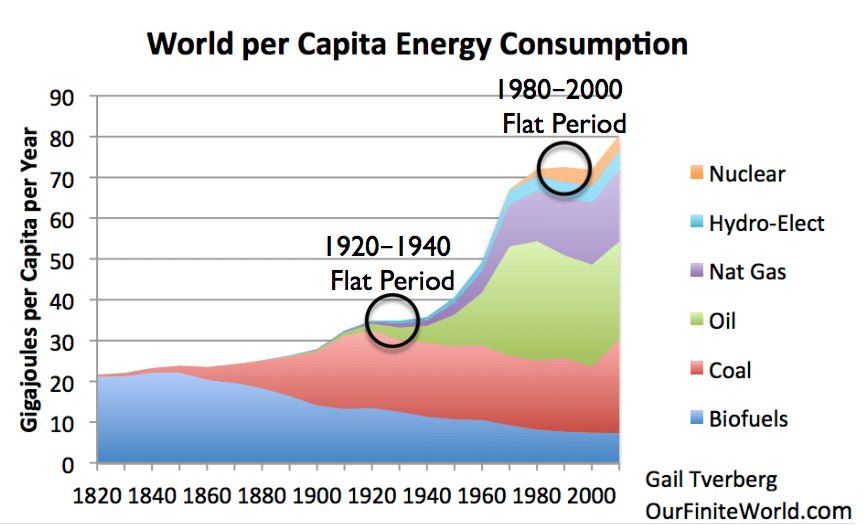
Figure 7. World per Capita Energy Consumption with two circles relating to flat consumption. World Energy Consumption by Source, based on Vaclav Smil estimates from Energy Transitions: History, Requirements and Prospects (Appendix) together with BP Statistical Data for 1965 and subsequent, divided by population estimates by Angus Maddison.
The 1920-1940 flat period came shortly after the United Kingdom reached Peak Coal in 1913.

Figure 8. United Kingdom coal production since 1855, in figure by David Strahan. First published in New Scientist, 17 January 2008.
In fact, the UK invaded Mesopotamia (Iraq) in 1914, to protect its oil interests. The UK wasn’t stupid; it knew that if it didn’t have sufficient coal, it would need oil, instead.
There were many other disturbing events during this period, including World War I, the 1918 flu pandemic, the Great Depression, and World War II. If there are not enough energy resources to go around, many things tend to go wrong: countries tend to fight for available resources; jobs that pay well become less available; deflation becomes more likely; population becomes weakened, and epidemics become more likely. I wrote about the 1920 to 1940 period in a recent post, The Depression of the 1930s Was an Energy Crisis.
The 1980-2000 flat period included the collapse of the Soviet Union, in 1991. The Soviet Union was an oil producer. The Soviet Union collapsed after prices had been low for a long time.

Figure 9. Former Soviet Union oil consumption, production, and inflation-adjusted price, all from BP Statistical Review of World Energy, 2015.
Even many years after the collapse of the Soviet Union, population growth in former Soviet Union countries and its affiliates was much lower than in the rest of the world.

Figure 10. World population growth rates between 2005 and 2010. Source: https://en.wikipedia.org/wiki/List_of_countries_by_population_growth_rate
Lower population (through falling birth rates, rising death rates, or rising emigration) are a major way that economies self-adjust because of falling energy per capita. Economies tend to fix the low-energy per capita problem by adjusting the population downward.
Recently, we have again been hitting flat periods in energy consumption per capita.

Figure 11. World per capita consumption of oil and of total energy, based on BP Statistical Review of World Energy data and UN 2017 population data.
The slowdown in world energy consumption per capita in 2008-2009 was clearly a major problem. Oil, coal and natural gas consumption fell simultaneously. Oil consumption per capita fell more than the overall mix, especially affecting countries heavily dependent on oil (Greece with its tourism, but also the US, Japan, and Europe).
The recent shift in political strategy to more isolationist stances also seems to be the result of flat energy consumption per capita. It is doubtful that Donald Trump would have been elected in the US, if world energy consumption per capita had been growing robustly, and if wage disparity had been less of a problem.
The primary cause of the 2013 to 2016 flat trend in world energy consumption per capita (Figure 11) is falling coal consumption (Figure 12). Many people think coal is unimportant, but it is the world’s second largest source of energy, after oil. We don’t have a good way of getting natural gas production to rise enough, to make up for loss of coal production.

Figure 12
Wind and solar simply do not work for solving our problem of flat or shrinking energy consumption per capita. After spending trillions of dollars on them, they make up only a tiny (1%) share of world energy supply, according to the International Energy Agency. They are part of the little gray “Other” sliver on Figure 13.

Figure 13. Figure prepared by IEA showing Total Primary Energy Supply by type from this IEA document.
Something Has to “Give” When There Is Not Enough Energy Consumption per Capita
The predicament we are facing is that energy consumption per capita seems to be reaching a maximum. This happens because of affordability issues. Over time, the price of energy products needs to rise to keep up with the rising cost of creating these energy products. But if energy prices do rise, workers earning low wages cannot afford to buy goods and services made with high-priced energy products, plus honor all of their other commitments (such as mortgages, auto loans, and student loans). This leads to debt defaults, as it did in the 2008-2009 recession.
At some point, the affordability problem can be expected to hold down energy consumption. This could happen in many ways. Spiking prices and affordability issues could lead to a worse rerun of the 2008-2009 recession. Or if oil prices stay fairly low, oil-exporting countries (such as Venezuela) may collapse because of low prices. Even if oil prices do rise, we may find that higher prices do not lead to sufficient additional supply because investment in new oil fields has been low for many years, because of past low prices.
As long as the world economy is expanding (Figure 14), individual citizens can expect to benefit. Jobs that pay well are likely to be available, and citizens can afford to buy goods with their growing wages. People who sell shares of stock and people who get pension benefits can all receive part of this growing economic output.

Figure 14. Author’s image of an expanding economy.
Once the economy starts to shrink (Figure 15), we start having problems with dividing up the goods and services that are available. How much should retirees get? Governments? Today’s workers? Holders of shares of stocks and bonds? Not all commitments can be honored, simultaneously.

Figure 15. Author’s image of declining economy.
One obvious problem in a shrinking economy is that loans become harder to repay. The problem is that there is less left over for other goods and services, after debt plus interest is subtracted, in a shrinking economy.

Figure 16. Figure by author.
Changing interest rates can to some extent help offset problems related to higher energy prices and shrinking supply. The danger is that interest rates can move in the wrong direction and make our problems worse. In the lead-up to the Great Recession of 2008-2009, the US raised short-term interest rates, helping to puncture the sub-prime mortgage debt bubble.

Figure 17. Figure comparing Case-Shiller Seasonally Adjusted Home Price Index and Federal Reserve End of Quarter Target Interest Rates. See Oil Supply Limits and the Continuing Financial Crisis for details.
We now hear a lot of talk about raising interest rates and selling QE securities (which would also tend to raise interest rates). If growth in energy consumption per capita is already flat, these changes could make the problems that the economy is facing even worse.
Our Economy Works Like a Bicycle
Have you ever wondered why a two-wheeled bicycle is able to stay upright? Research shows that a bicycle will stay upright, as long as its speed is greater than 2.3 meters (7.5 feet) per second. This is the result of the physics of the situation. A related academic article states, “This stability typically can occur at forward speeds v near to the square root of (gL), where g is gravity and L is a characteristic length (about 1 m for a modern bicycle).”
Thus, a bicycle will be able to continue in an upright manner, as long as it goes fast enough. If it slows down too much, it will fall down. Our economy is similar.
Gravity plays an important role in determining the speed of a bicycle. If the bicycle is going downhill, gravity gives an important boost to the speed of the bicycle. If the bicycle is going uphill, gravity very much pulls back on the bicycle.
I think of the situation of an economy having rising energy consumption per capita as being very much like riding on a bicycle, speeding down a hill. The person operating the bicycle would not need to provide much extra energy to keep the bicycle going.
If energy consumption per capita is flat, the person riding the bicycle must provide the energy to make it go fast enough, so it doesn’t fall over. This is somewhat of a problem. If energy consumption per capita actually falls, it is a true disaster. The bicyclist himself must provide the energy necessary to push the bicycle and rider uphill.
In fact, there are other ways that a speeding bicycle is analogous to the world economy.

Figure 18. Author’s view of analogies of speeding upright bicycle to speeding economy.
The economy needs a constant flow of outside energy. In the case of the bicycle, the human rider can provide the energy flow. In the case of the economy, the energy flow comes from a mixture of various fuel types, typically dominated by fossil fuels.
Growing debt (front wheel) is important as well. It tends to pull the economy along, because this debt can be used to pay wages and to buy materials to make additional goods and services. Thus, the effect of this increase in debt is indirect; it ultimately works through the bicyclist, the gears, and the back wheel.
In fact, the financial system as a whole is important for the “steering” of the economy. It tells investors which investments are likely to be profitable.
The gearing system of the bicycle plays a modest role in the system. Changing gears allows greater efficiency in the use of the energy that is available, under certain circumstances. But energy efficiency, by itself, cannot operate the system.
If the human rider does not provide sufficient energy for the bicycle to go rapidly enough, the bicycle glides for a while, and then falls over. The world economy seems to be similar. If the world economy does not obtain enough energy per capita, economic growth tends to slow and eventually collapses. The collapse can relate to the whole world economy, or to parts of the economy.
The Problem of Parts of the Economy Not Getting Enough Energy
We can think of the economy as being made up of many bicycles, operated by bicycle riders. At the beginning of the post, I talked about the problem of wage disparity. This issue occurred at the time of the 1930’s Great Depression and is occurring again now.
We might call wage disparity “too low a return on the labor of some workers.” In groups of animals in ecosystems, too low a return on the effort of these animals is what causes ecosystems to collapse. For example, if fish have to swim too far to obtain additional food, their population will collapse. It should not be surprising that economies tend to collapse, when the return on the efforts of part of their workers falls too low.
Wage disparity has to do with how well the operators of bicycles are doing. Are the operators of these bicycles receiving enough calories, so that they can keep pumping their bicycles fast enough so that the speed is high enough to remain upright?
If energy consumption per capita is growing, this greatly helps the operation of the economic system. If there is growing availability of inexpensive energy, machines of various types, including trucks, can be used to increasingly leverage the labor of workers. This increased leveraging helps each worker to become more “productive.” This growing productivity, thanks to growing energy consumption, allows more goods and services to be produced in total. It also allows the wages of the workers to stay high enough that they can afford to buy a reasonable share of the output of the economy. When this happens, “gluts” of unaffordable goods are less of a problem.
If energy consumption per capita is flat (or worse yet, falling), greater “complexity” is needed, to keep output of goods and services rising. Greater complexity involves more specialization and more training of individual members of the economy. Greater complexity leads to larger companies, more government services, and more wage disparity. Unfortunately, there are diminishing returns to complexity, according to Joseph Tainter in “The Collapse of Complex Societies.” Ultimately, increased complexity fails to provide an adequate number of high-paying jobs. Wage disparity becomes a problem that can cause an economy to collapse.
If there is not enough economic output, the physics of the economy tries to “freeze out” workers at the bottom of the hierarchy. Workers with low wages cannot afford homes and families. The incidence of depression rises. Debt levels of disadvantaged groups (such as young people in the US) may rise.

So the situation may not be that the whole world economy fails; it may be that parts of the economy collapse. In fact, we are already seeing evidence that this is taking place. For example, life expectancies for US men have been falling for two years, because of growing problems with drug overdoses.
Conclusions
In 2017, the world economy seemed to be gliding smoothly along because the economy has been able to get the benefit of artificially low energy prices and artificially low interest rates. These artificially low prices and interest rates have given a temporary boost to the world economy. Countries using large amounts of energy products, including the US, especially benefitted.
We cannot expect this temporary condition to continue, however. Low oil prices have already started to disappear, with Brent oil prices at nearly $69 per barrel at this writing. The trends in oil prices and oil stocks in Figure 6 are disturbing. If oil prices begin to rise toward the price needed by oil producers, they are likely to trigger a recession and a drop in world energy consumption, just as spiking prices did in 2008-2009. There is a significant chance of collapse in the next 12 to 24 months. It is hard to know how widespread such a collapse may be; it may primarily affect particular countries and population groups.
To make matters worse, our leaders do not seem to understand the situation. The world economy badly needs rising energy consumption per capita. Plans to raise interest rates and sell QE securities, when the economy is already “at the edge,” are playing with fire. If we are to keep the world economy operating, large quantities of additional energy supplies need to be found at very low cost. It is hard to be optimistic about this happening. High-cost energy supplies are worthless when it comes to operating the economy because they are unaffordable.
Many followers of the oil situation have had great faith in Energy Returned on Energy Invested (EROI) analysis telling us which kinds of energy supplies we should increase. Unfortunately, EROI doesn’t tell us enough. It doesn’t tell us if a particular product is scalable at reasonable cost. Wind and solar are great disappointments, when total costs, including the cost of mitigating intermittency on the grid, are considered. They do not appear to be solutions on any major scale.
Other researchers looking at the energy situation have not understood how “baked into the cake” the need for economic growth, rising per capita energy consumption, and rising debt levels really are. Rising debt is not an error in how the financial system is put together; a bicycle needs a front wheel, or it cannot operate at all (Figure 18). I have written other articles regarding why debt is needed to pull the economic system forward.
This economic growth cannot be “fake growth” either, where a debt Ponzi Scheme seems to allow purchases that real-life consumers cannot afford. Quite a bit of what is reported as world GDP today is of a very “iffy” nature. If China builds a huge number of apartments that citizens cannot afford without subsidies, should these be counted as true GDP growth? How about unneeded roads, built using the rising debt of the Japanese government? Or recycling performed around the world, because it makes people “feel good,” but really requires substantial subsidies?
At this point, it is hard for us to know where we really are, because every government wants to make GDP results look as favorable as possible. It is clear, however, that 2018 and 2019 can be expected to have more challenges than 2017. We have interesting times ahead!


why Bitcoin is stew pid:
“Meanwhile, data from Blockchain.info showed that, at the time of publishing, it takes an average of 51 minutes to confirm a bitcoin transaction.”
“According to industry site BitInfoCharts, in the last three months, the average bitcoin transaction fee was as high as $55. On Jan. 9, data showed the fee was about $31.”
https://www.cnbc.com/2018/01/10/bitcoin-conference-stops-accepting-cryptocurrency-payments.html
Bitcoin conference stops taking Bitcoin as payment… duh…
no wonder why it’s down to $13K… 30% down from its peak…
but somebody predicted $1 million per Bitcoin in 2018!
Crypto Crash:
Cryptocurrencies: 1401
Market Cap: $639,331,205,609
a few days ago, the market cap was over $800 billion.
an old saying: a fool and his money are soon parted.
The 2018 Oil Production Forecast Explained
In my recent post, Oil Price Scenario for 2018, my global supply forecast was seriously at odds with those presented by the International Energy Agency (IEA) and Rystad Energy, a respected Norwegian consulting firm. This post puts more flesh on my 2018 oil production view. The post could easily have been called “Oil Production Forecasting for Beginners” and explains things like decline rates and oilfield interventions in addition to presenting an overview of global production and rig count statistics. The second half of the post is effectively Oil Production Vital Statistics for December based on the Energy Matters Global Energy Graphed database.
Summing Up
In a July 2016 post called The Peak Oil Paradox I produced this graph (Figure 25) that is perhaps the best way for me to summarise the production data discussed above.
http://www.euanmearns.com/wp-content/uploads/2016/07/winnersandlosers.png
Figure 25 National changes in oil production according to BP between 2008 and 2015. Its plain to see the increases outweigh the decreases led mainly by the USA.
While it is a year out of date, the picture has changed little. The strong producers are on the left and the weak on the right. About one half lie in the middle. OPEC strong + Russia and the USA and Canada are to the left. These countries alone have the muscle to grow production and this production growth is essential to offset production declines in the weak. The oil price crash has made the weak weaker. And OPEC + Russia are exercisisng production constraint to get rid of the glut that resulted from momentum.
The course of oil production in 2018 lies in the hands of a handful of prodcers – the USA, Saudi Arabia and Russia. While it is possible that US production grows this year I see little evidence for that happening counter to the well-informed opinion of the IEA and Rystad Energy. If US production does grow then this will simply cancel declines elsewhere and OPEC + Russia will sit on their hands and the oil price will rise. If US production does not grow then come the Summer the OECD will be calling OPEC+Russia to serve the market to dampen a rampant oil price that will once again be a risk to global economic growth.
http://euanmearns.com/the-2018-oil-production-forecast-explained/
Lot’s of interesting info on that article:
Natural Oil Field Production Declines
A good way to summarise oil field operating dynamics is to begin with a spanking new oil field, recently discovered with 10 production wells drilled on it. Once the platform is installed, production begins and because of the high reservoir pressure the oil gushes out at an aggregate rate of 100,000 bpd (barrels per day). In fact, it wants to gush so fast that the wells are chocked back to control the flow. From day one, the reservoir pressure begins to decline. In the first year this has little impact, but eventually the rate of flow begins to decline and by the end of year 2 production may have fallen to 90,000 bpd. Our field has a natural decline rate of 10% and so by the end of year 3 production has fallen to 82,000 bpd and the operating company decides to intervene.
The first intervention is to drill 4 water injection wells. This increases reservoir pressure and flow rates begin to rise back towards 90,000 bpd by the end of year 4. In these early years our field is producing dry black oil. But at the beginning of year 5 the wells begin to produce water too that has broken through from the water injection wells, and oil production once again begins to fall.
Throughout the fields life, the operating company battles to maintain production while also wanting to ensure maximum recovery from the field. When production in the initial wells becomes 90% water and 10% oil the operating company decides to drill 5 new wells to target parts of the field where some dry oil may have been by-passed closing down 5 old wells. This boosts production but only for a while as water cut rises relentlessly in all the wells.
After 20 years, the company decides to hook up a couple of small satellite discoveries with one production well on each. This once again boosts production for a while until water once again breaks through in the satellite developments. After 25 years the cost of all these continual interventions exceeds the value of oil being produced and the decision is made to abandon the field.
There are two messages to take away from this. The first is that defining decline rate is not straight forward. What we see is the net decline after continual interventions to boost production have been made. The gross decline is always higher. The second is that all of this activity uses drilling rigs. Offshore, this may be the permanent derrick on the platform, but often mobile floating rigs are also used. The bottom line is that rig count is a measure of activity. Some of it directed at exploration, but a lot of it directed at combatting declines. If the oil industry gave up on this battle, production would go off a cliff edge, an oil shortage would follow together with a massive spike in price.
So what is the global decline rate? Nobody knows. But a 2008 study conducted by CERA pointed to 4.5% back then. This is the net decline rate after all of the above interventions have been made. So why has global production continued to rise? The answer is that new oil fields have been discovered and brought on line cancelling out declines in the global fleet of operational fields.
Global total liquids production stands at ~ 97 Mbpd, but a small proportion of that is biofuel and refinery gains that are not subject to decline in the same way. The C+C+NGL part ~92 Mbpd. If this is undergoing net decline of 4.5% then 4.2 Mbpd of new production must be brought on every year to just keep production steady. The $64,000 question this year is to what extent the decline of activity following the 2014 oil price crash has impaired the global industry’s ability to both bring on 4.2 Mbpd new production AND maintain interventions to keep decline at a steady 4.5%. If net decline has risen following the oil price crash to say 5.5%, then 5.1 Mbpd new production will be required to maintain the status quo.
Concluding Thoughts
M. King Hubbert’s forecast for US oil production and the methodology it was based on has been proven to be sound when applied to conventional oil pools in the USA. When decline takes hold in any basin or province, it is extremely difficult to reverse even with a period of sustained high price and the best seismic imaging and drilling technology in the world.
On this basis we can surmise that global conventional oil production will peak one day with unpredictable consequences for the global economy and humanity. It is just possible that the near term peak in production of 97.08 Mbpd in July 2015 may turn out to be the all-time high.
Economists who argued that scarcity would lead to higher price that in turn would lead to higher drilling activity and innovation have also been proven to be correct. Much will depend upon Man’s ability to continue to innovate and to reduce the cost of drilling for LTO in order to turn a profit at today’s price levels. If the shale industry is unable to turn a profit then it will surely perish without State intervention in the market.
But from 2008 to 2015, oil production actually fell in 27 of 54 countries despite record high price. Thus, while peak oil critics have been proven right in North America they have been proven wrong in half of the World’s producing countries.
Should the shale industry perish, then it becomes highly likely that Mankind will face severe liquid fuel shortages in the years ahead. The future will then depend upon substitution and our ability to innovate within other areas of the energy sector.
http://euanmearns.com/the-peak-oil-paradox/
As M. King Hubbert (1962) shows, Peak Oil is about discovering less oil, and eventually producing less oil due to lack of discovery.
https://imgur.com/a/6dEDt
IEA Chief warns of world oil shortages by 2020 as discoveries fall to record lows
https://www.wsj.com/articles/iea-says-global-oil-discoveries-at-record-low-in-2016-1493244000
Saudi Aramco CEO sees oil shortage coming as investments, oil discoveries drop
https://www.reuters.com/article/us-aramco-oil/aramco-ceo-sees-oil-supply-shortage-as-investments-discoveries-drop-idUSKBN19V0KR
Chevron CEO warns US shale oil alone cannot meet the world’s growing demand for crude
https://www.cnbc.com/2017/05/01/us-shale-cannot-meet-the-worlds-growing-oil-demand-chevron-ceo-warns.html
Projection of World Fossil Fuels by Country (Mohr, 2015)
http://www.sciencedirect.com/science/article/pii/S0016236114010254
German Military (leaked) Peak Oil study: oil is used in the production of 95% of all industrial goods, so a shortage of oil would collapse the world economy & world governments
https://www.permaculture.org.au/files/Peak%20Oil_Study%20EN.pdf
UC Davis Study: It Will Take 131 Years to Replace Oil with Alternatives (Malyshkina, 2010)
http://pubs.acs.org/doi/abs/10.1021/es100730q
Contrary to much rhetoric around it, shale is not a recent discovery. Shale has a significant history, and one that clearly demonstrate the material realities on which it rests. Indeed, encouraging shale production was one response to the oil price shocks of the 1970s. Wanting to reduce American dependence on foreign oil, the Carter administration initiated a programme to develop ‘synfuels’ that focused first and foremost on shale.
This shale project attracted significant investment from oil companies, and production began in the late 1970s in the Green River Formation, which straddles Colorado, Wyoming and Utah and contains the largest shale oil deposits in the world. But when the price of oil crashed in 1982 at a time of relatively high interest rates these projects were rendered unviable. (Hirsch et al. 2005) (Yergin 2012)
-Thompson, Helen. Oil and the Western Economic Crisis
“But from 2008 to 2015, oil production actually fell in 27 of 54 countries despite record high price. Thus, while peak oil critics have been proven right in North America they have been proven wrong in half of the World’s producing countries.”
and within a decade or two, those other 27 countries will have entered perpetual decline as well…
it’s only a matter of time before EVERY country is past its peak…
very soon, as I like to say.
BP 1.7 Trillion barrels proven oil reserves NOT so proven
http://crudeoilpeak.info/oil-reserves-and-resources-as-function-of-oil-price
Euan has a lot of interesting things to say. What I would add is that if oil price rises very much, his initial estimate of “demand” won’t hold up. Euan is using the forecast of 1.3% growth in demand over 2017, for 2018. With higher prices, I think that this demand estimate will be too high. Certainly, by 2019, demand will be starting to fall. But I expect it to start falling by late 2018.
I think we are likely hitting “peak oil,” but it may look like “peak demand.”
As long as prices are high and rising, I think the world will be getting more oil out. Countries will decide to cheat on their production commitments, or China will suddenly decide to extract more oil. But it won’t take many months of prices heading for $100 per barrel (or more) before demand falls back.
So production will fall, but I expect it will fall with low prices and debt defaults. How soon this happens is not obvious. The second half of 2018 would seem to be the earliest, but it could be the end of 2018.
I might add that the inventory number that Euan is looking at from the IEA report follow a fairly different pattern than the US EIA inventory numbers if a person looks at Euan’s post giving the forecast.http://euanmearns.com/oil-price-scenario-for-2018/ Euan’s data would suggest that inventories at the beginning of 2018 are quite high, and can stand to be taken down more; the EIA numbers I am looking at say that US inventories peaked in mid-2016. They have already been drawn way down. There is no way that the big draws could continue and even increase, without reducing inventories far below what they have been historically. Of course, some of this could happen. The Strategic Petroleum Reserve is for emergencies, for example.
The chart I show has inventory draws later in the 2018 becoming smaller, not bigger, as high prices become more of a problem.
High Oil Prices, the Return of $3 Gas a Threat to the Economy
https://finance.yahoo.com/news/high-oil-prices-return-3-113553124.html
Let’s be honest. In the olden days rising stocks were the product of rising industrial output, rising employment and rising wages. Today, we have none of that. Full-time jobs have been replaced by part time jobs, wages have fallen accordingly and cost cutting has become a primary source of corporate profit.
For those who remain in denial of these facts, just look at the Labor Force Participation Rate. In October of 2009, smack dab in the middle of the debt crisis, the unemployment rate peaked at 10%. At the same time, the Labor Force Participation Rate was 65%. Today our unemployment rate is said to be 5.5% yet our LFPR has fallen to just 62.8%. How does that work? How can the data show less employment and less unemployment at the same time?
A better question may be, why is the Dow 8,000 points higher today than it was in October of 2009 when we had more of our population working at higher wages than we have today? Go ahead! Try to deny that. Try to rationalize away the fact that the stock market is a super bubble blown up by artificial stimulus.
Once you accept that the market bubble has been blown up by artificial means, it is easy to see how that bubble could burst once the stimulus is removed.
https://imgur.com/a/Gl8nP
I don’t like chewing gum.
The stock market is a casino for rich people and various funds. Once you understand that, it all makes sense.
Loved the bicycle analogy.
I like the kitty in the snow too.
it doesn’t look very happy about it.
woman to Stravinsky: “I like the Firebird better.”
Stravinsky: “I like your hat.”
Glad you liked it. One of the commenters on OFW suggested it, and I expanded on it.
https://www.rt.com/news/415521-assange-ecuadorian-embassy/
We are told that Assange is dangerous man … a threat to the ‘Deep State’… etc etc etc…
This is the same Deep State the invented WMD to destroy Iraq… the same Deep State that shot down a commercial airliner in Ukraine… gassed women and children in Syria….
Yet they cannot convince Ecuador to hand over Assange.
The Matrix runs deep
You know how frustrating it is to try to explain an issue to a DelusiSTANI… even the use of facts and logic is futile.
Now imagine if you controlled the MSM….
http://www.tsd.state.tx.us/ourpages/auto/2012/8/24/50386443/Screen%20shot%202012-08-24%20at%2012_15_32%20PM.jpg
https://carmen4thepets.files.wordpress.com/2009/12/image1-1.jpg
see?
a NYC pigeon!
will he do More On Mayor de Blasio?
how many tons of snow were removed from NYC after the latest storm?
using FOSSIL FUEL powered trucks!
Nope. That’s a London A-Z it’s looking at. It’s no doubt looking for directions to Trafalgar Square, a major pigeon venue.
London?
bloody ‘ell, so it is!
rats!
Woody Allen: “A pigeon is a rat with wings.”
Canada is increasingly convinced that Trump will pull out of NAFTA: Reuters, citing sources
https://www.cnbc.com/2018/01/10/canada-is-increasingly-convinced-that-trump-will-pull-the-us-out-of-nafta-reuters-citing-sources.html
If the US backs of of the North American Free Trade Agreement, then expect prices of electronics to skyrocket.
My dad works in the food industry he says they love NAFTA because it allows them to sell food to Mexico and Canada. And lumber prices will sky rocket without Canada making home building more expensive!
It’s interesting, but I have the impression Trump either doesn’t consult with anyone or he simply is singular minded regardless of the expert advice. In either case he seems to just do whatever the heck he wants to do and if that means walking away from trade deals, whether they are advantageous to the US or not, he will. And if anyone criticizes that decision he will denigrate them from head to toe now and for decades to come.
Or could it be that he is just acting on orders from a higher power? (and I don’t mean a man in the sky)
The headlines seem to get more bizarre: New York City to sue oil companies.
https://www.theguardian.com/us-news/2018/jan/10/new-york-city-plans-to-divest-5bn-from-fossil-fuels-and-sue-oil-companies
“… and sue the world’s most powerful oil companies over their contribution to dangerous glowbull worming.”
okay, we’ve gone over this kind of issue before…
NYC was built almost entirely by the energy contained in FF…
NYC is now one of the world’s largest users of FF…
NYC would be AS COLD AS FREAKIN HADES right now if not for FF…
this is a giant flashing sign:
HYPOCRITES!
NYC, it’s time you put your money where your mouth is…
STOP using FF right NOW!
otherwise, you need to sue yourselves for using FF.
Uh, calm down big fella. I think 2018 will bop along just fine. All it takes is money and there is plenty of that floating around.
when you gotta rant, you gotta rant.
“I think 2018 will bop along just fine.”
me too…
I don’t see no Creeping Collapse…
(cleans his glasses)…
oh look, over there!
Ok, I’ll admit it was a good rant.
Yes, I was in the mood for a good rant and that certainly fit the bill. Hypocrites they certainly are in spades, squared then cubed.
Dear Davidin100millionbilliontrillionzillionyears;
I agree with everything you said,
BUT
I hate a F^&king lier and so I hope that CA gets on board and that they win big in court.
CA as a whole is probably the biggest FF user in the entire world…
irony?
On an energy per capita basis, California comes out near the bottom. https://www.eia.gov/state/rankings/
This has partly to do with California not having much heavy industry; it also has to do with California’s fairly mild climate.
When I look around the world, World Bank data of energy consumption by country for the latest year (2014 or 2015) gives the following top counties, and kilograms per person:
Iceland 17,478
Trinidad and Tobago 14,447
Curacao 12,651
Bahrain 10,593
Kuwait 8,957
Brunei 8,632
Canada 7,600
Saudi Arabia 6,937
United States 6,881
Luxembourg 6,548
Finland 5,925
Norway 5,818
Gibraltar 5,759
Australia 5,489
So. Korea 5,413
Sweden 5,102
Russia 4,943
Belgium 4,760
New Zealand 4,445
The top countries tend to be cold or countries processing oil. Iceland has a lot of cheap geothermal and hydroelectric power. It uses this power both for itself (lots of greenhouse grown vegetables) and to make electricity and goods (aluminum) for the world market.
Bangladesh with 222 kilograms per person seems to be at the bottom.
Ripple XRP update:
price per “coin” plunges to $2.01…
was over $3…
Cryptocurrencies: 1400
Market Cap: $731,603,277,251… insane!
that’s 15 NEW cryptocurrencies since I last looked… crazy!
Ethereum has rocketed above $1,300… nuts!
market cap $128 billion… number 2 behind Bitcoin…
madness!
real stuff:
WTI $63.35…
Brent went above $69.00.
My theory is that it will be about $70 that crashes the economy. Here is why: The first run up to $147 in 2007/2008 led to the financial collapse and oil prices dropped back severely. Then, they climbed back up to $100. Then , in 2014 they collapsed back again severely. That is about recovery of about 30% ($147 to $100). So it you take 30% of $100 you get about $70. That is about what I think oil prices will rebound to before collapsing back down. Way back down I think into the $20’s. Then, it may rise back up again to about $50.00. Each time the rebound in prices will be less and less. Diminishing returns are here in earnest.
“Each time the rebound in prices will be less and less. Diminishing returns are here in earnest.”
I agree, GM. That’s been my view for a long time.
excellent, Greg…
Reality doesn’t usually proceed in such elegant patterns…
but I agree, this one has a good shot at actually happening.
Nice analysis Greg.
Wow, that is a serious increase in oil price, David in a kazillion years. My guess is $90 dollars a barrel for 3 months or longer slips the US economy into a very harsh, deep, long, recession that is only gotten out of by oil price crashing into the $30-40’s for a minimum of a year, OR back to the well of QE but this time they try to get it out to more people than just the top .01 Maybe this time to the top 5%.
it’s dutch bulbs all over again
https://extranewsfeed.com/bitcoin-24b3efd58ec
At least tulips are real….
I get my seeds from Holland They know how to do it. (dude)
“I get my seeds from Holland They know how to do it. (dude)”
What strain?
excellent, Norman…
I see Bitcoin is $14,481 today…
so in the past few weeks, it has already stalled in the $15,000 area…
but hey…
somebody predicted $1 million Bitcoin for 2018!
$13,540.
“it’s dutch bulbs all over again”
Finally someone nails bitcoins. Thanks.
Corporations are just jumping on the wagon now too for stock boosts, see Kodakcoin.
Will the World Economy Continue to “Roll Along” in 2018?
Seems the answer is “if we’re fortunate”
Thanks for the new post and interview.
Roll Along?
absolutely! (though that’s merely opinion)…
but that’s only for the core countries – the bigger faster stronger ones…
energy per capita is on a plateau which should keep The Core on an economic plateau, at least for 2018…
Creeping Collapse likely will grab hold of some smaller weaker peripheral country this year or next.
You are welcome.
Estimated Age-adjusted Death Rates for Drug Poisoning by Country, US: 1999-2015
https://i.imgur.com/310dkQM.gif
Seems like it correlates with joblessness and hopelessness.
Sadly, I have to agree!
I live in one of those areas, and yup – “Seems like it correlates with joblessness and hopelessness.”
There are many levels of social collapse. Social Collapse can also happen to human families. If there is not enough to go around to support a family, families, as a social structure can disappear.
I see this as Darwinism.
Proof Armageddon Will Happen: https://penzu.com/p/5a59bb84
Who the False Christs Will Be: https://penzu.com/p/891fb818
The Chinese Dragon 666: https://penzu.com/p/ceb7d18e
Eastern 666s: https://youtu.be/zX-T2_Ajy6I
Western 666s: https://youtu.be/97HtPB610u8
There is proof you know that 666 is a series of even numbers and when turned upside down is a series of odd numbers, 999.
How odd.
how odd
that God
would choose
the Jooz
I have not looked at all of the material you have posted.
It seems to me that we have always had self-organizing economies. When self-organizing economies are reaching limits, the prior ways of doing things tend to fall apart. Men may not be able to afford wives and families, for example, so they look after whatever types of relationships they can find, for example. Or the incidence of theft and fighting may increase. Or debt problems may increase.
When writers of various religions around the world put together their documents, they wrote down their observations about how this tended to happen in the past. It had happened many times before; it could be expected to happen again. So the prophesies could apply to the fall of Rome, or to the final End Times, or to any number of collapses that have happened in the history of the earth. They were observing things that Peter Turchin and Sergey Nefedov write about in Secular Cycles.
I am unconvinced that we have much detail available on timing, however. Mark 13:31-32 says, “Heaven and earth will pass away, but My words will never pass away. But as for that day or hour, no one knows, not even the angels in heaven, nor the Son, but only the Father.”
Pingback: Will the World Economy Continue to “Roll Along” in 2018? - Deflation Market
Art Berman on the US Shale Industry
https://www.spreaker.com/user/ryanraysr/energy-week-9
What does Art have to say for 56 minutes? I don’t have time to listen, unless you can point to a particular place in the recording that is of interest.
Nothing much. I stopped listening half way through..Sorry I posted it before I listened figured it would be interesting but it wasn’t…Only thing funny was Art says at the start we are being blindsided by tons of propaganda about the shale industry by the media.
Good cut to the chase, Gail.
IMF found out that increasing the income share of the rich actually decreases GDP growth:
If the income share of the top 20 percent increases by 1 percentage point, GDP growth is actually 0.08 percentage point lower in the following five years, suggesting that the benefits do not trickle down. Instead, a similar increase in the income share of the bottom 20 percent (the poor) is associated with 0.38 percentage point higher growth.
https://www.imf.org/external/pubs/ft/sdn/2015/sdn1513.pdf
We could also look at this from a physics point of view. When there is not enough energy supplies (“income”) to go around, it tends to be increasing concentrated among the already well to do. Adding complexity also adds to this effect. Complexity is a work-around for low energy supplies. There is also the issue of economies of scale–if there is inadequate energy, the part of the economy that is most likely to benefit from economies of scale tends to get it. Low income people tend to get frozen out.
So we should expect indications such as the IMF is finding. Increased concentration of wealth among the rich indicates a problem. If we are not adding lots of cheap energy, we should expect the problem to get worse and worse. Thus, we should expect the allocation problem to get worse over time. The time when we had more equality of wages was back when energy supplies per capita were growing rapidly.
In theory, we could reallocate the wealth more equally, but this is not the way Nature handles the situation. Nature is more concerned about at least a few succeeding. If there are inadequate calories for a large group of people, making certain that some of them continue to get an adequate supply is the only way to make certain the species survives. It is not necessarily the “best” use of resources, but it makes followers of Bernie Sanders feel good. If everyone gets 1000 calories a day, in not long, the whole species will die off.
https://imgur.com/a/iftr5
Sounds like the symptoms of not enough energy to go around! The fix is more cheap energy products, not forcing the rich to do with less.
“The fix is more cheap energy products, not forcing the rich to do with less.”
I would say that the rich will be forced to with less one way or another if the ‘fix’ is unavailable. And so will everyone else, of course.
I think Adam Smith’s quote is the opposite of what the R politicians in DC want. I think they get a special sense of joy out of people getting poorer and more miserable.
Adam Smith says:
no society can be rich and happy when most of its members are poor and unhappy.
wow!
let me put that on my refrigerator.
Curiously, according to Primo Levi, the food distribution system among the inmates of the concentration camps self-organised along those lines, concentrating among those at the top of the prisoner structure. You gained admittance to the club by proving your worth as a scavenger.
Many prisoners lost heart very quickly when they realised, soon after arrival, that the other prisoners were their competitors and enemies, not just the German guards.
When the Germans left his camp, Primo Levi had to block the doors to his hut so that he could at least save the people already in there, rather than all of them dying after an equal but inadequate distribution of the food and fuel which he had scavenged.
And this is why there will be no Robin Hood Project….. it would defy the laws of nature…. the weak inherit nothing… the weak will be kicked overboard.
“If the income share of the top 20 percent increases by 1 percentage point, GDP growth is actually 0.08 percentage point lower in the following five years, suggesting that the benefits do not trickle down. Instead, a similar increase in the income share of the bottom 20 percent (the poor) is associated with 0.38 percentage point higher growth.”
That’s because there are more people in the bottom 20% pushing the money around than in the top 20%. More people moving it around helps more people.
Pingback: Will the World Economy Continue to “Roll Along” in 2018? – Olduvai.ca
Oh no, a new article but I’m too sleepy to read it. Eyes watering from sleepiness. Tomorrow, there’s always tomorrow, at least during BAU.
Seeing as how you are from the Prairie and all – the version you need uses the term ‘Dogie’ – and the exhortation “Git alon littl …..” Its 12.16 pm here, so you must be 6/7 hours behind? Snooze along! Cheers. BPW.
I don’t know what hour the clocks are set for on this site, but at the time it was 4 in the morning CST, central standard time (US). I had put in a long day training a quarter horse and it’s still slow as molasses, but maybe that’s because it’s winter with snow on the ground, covey of quail scurrying around, cat perched up high to avoid a barking dog, corncob pipe with cherry flavored tobac stoking away, coffee pot simmering in the midday steam rising out of a massive valley and all is well. Yee Haw!
Gail, in ref to Fig. 15 would I be correct to assume that energy consumption doubled between 1973 and 2014? That’s 41 years – which gives (rough estimate) a rate-of-growth [RoG] of 1.68% p/a? Now I presume that the RoG was greater early on but has been trending lower since? That’s not looking good!
Just as an aside: I notice from different news reports that two significant modern public services (education and healtcare) are ‘fraying’ and may require capital investments on scales that are not possible. Edging toward that Senaca Cliff are we?
I don’t know about healthcare…
but “higher education” now functions like a casino…
young adults make bets in many $10K amounts and hope that the payoff is a job/career that was worth the bet…
there are too many college students as it is… higher ed could easily shrink by 50% and would still educate the “better” students who would actually put their education to use…
otherwise, I’ve heard college described as babysitting with beer.
College is also a way of keeping a group of young people out of the workforce. (Of course, quite a few do work, at least part time.) If there aren’t enough jobs to go around, it hides this problem.
Having a large number of professors write academic papers is (as far as I can see), a major waste of effort. It takes these professors away from teaching. It leads to a whole layer of deans, who spend their time writing applications for grants. A large share of the papers are not worth much. If ten percent of the professors wrote papers, and if there were not the tie in to what others previously wrote (which often was wrong), it would lead to a better system, in my opinion.
which leads to this idea:
if there are 50% too many students, then there are 50% too many professors and administrators…
as energy per capita falls off of its current plateau, the fall of the education industry will follow.
Right. I think the percentage of administrators is probably high by more than 50%. And a whole lot of students are taught by “adjunct faculty,” making not much more than minimum wage.
University fundraising pays well, too: at least £100k pa at a major institution in the UK. Got to raise the cash for all those administrators…..
My neighbour is a retired engineering professor from the US — as he explains it — he worked on commercial engineering applications — I asked him who owned the IT — he said the US govt — because they provided the funding.
My understanding is that the most valued professors do not teach — they work with top graduate students on various funding driven projects
Exactly! The government has determined exactly where research should be done, and what they would like to prove. So all you have to do is put together is something that “proves” that under certain assumptions, some little piece of what they would like to see being true, seems to be true. You can avoid talking about pesky things like cost and scalability as well.
A key component of… The Matrix
Pay attention doomie glowballers
“otherwise, I’ve heard college described as babysitting with beer”
And who is typically a babysitter? A woman. Women are drawn towards fields where they can act out their maternal instincts, such as education and healthcare.
Education and healthcare are jobs programs for middle class women.
When the amount of dysfunction can’t justify why money continues to be shoveled into these money pits, employment seems like a reasonable justification.
Real estate and finance serve as taxes on working age people to provide income to retirees who tend to benefit the most from high property values and stock values.
College was originally set up to be about expanding the mind. Unions were set up to guarantee a living wage for a career.. But Boomers voted for the last thirty years to destroy the unions…So now college is the only game in town…..
We are dealing with a self-organized system. I am not convinced that what you are saying is right about unions. Unions are trying to compete with job competition from machines and with other countries. Unions have no point if they make wages non-competitive. This is what self-organization is all about. When the financial incentive goes away, there is no way to keep unions operating.
Unions attempted to violate the laws of nature ….. so as expected….. just as water seeks its level… so to do jobs wherever possible…. and manufacturing moved to where people were willing to work for less.
Voting had nothing to do with it….. if a political party would have tried to prevent this …. it would have happened anyway — wages would have been remained high (and increasing) — this would have lead recessionary pressures at some point …. and that would have crushed the economy … wiping out those high paying jobs…. and more
There are actually numbers on the chart that will give you the percentage growth involved. The increase is a little larger than you estimated; it comes out to be 1.9% per year increase in energy consumption per year, between 1973 and 2015. The increase in population during this period is 1.5% per year. So the increase in per capita energy consumption only averages 0.4% per year. In fact, nearly all of this increase has occurred in coal-using countries, including China and India, because of the ramp up in coal. No wonder talking about per capita energy consumption has gone out of fashion!
If you look at my exhibit of world per capita energy consumption since 1820 (Currently numbered 9, but will shortly be renumbered to 7 because I skipped numbers 2 and 5 in my numbering scheme), you will see that between 1980 and 2000 was a flat spot. Also, my exhibit showing per capita energy consumption since 2000 (Currently number 13, will shortly be renumbered to 11) indicates that nearly the whole time since 2010 has been flat on a per capita basis. The only periods with growth in per capita energy consumption were between 1973 and 1980 and between 2000 and 2010 (and even that period included the Great Recession). Both of these growth periods included spiking oil prices.
Thanks for the update. The per capita metric is meaningful since (I think) it captures the generality of the interface between energy use and economic activity. I use the metric of 2 litre of liquid fossil fuel per capita per day as the min amount of energy necessary to provide an-above subsistence standard of living perhaps somewhat similar to early 1900s. In respect of India and/or China if they do ramp-up their economic activity then they will suck up the entire export surplus of ‘oil’ leaving no slack for the developed economies who, if they attempt the same economic effort will experience a nasty increase in prices. Since economic Rates-of-Growth is an exponential function then doubling economic activity gives a doubling of energy needs. And after each doubling iteration of energy use the total energy consumed is greater than all the energy consumed in all prior iterations. This nasty piece of math has, I believe, caught up with us and we will not be able to extract and produce as much fossil fuels as we actually need to continue with an exponential trend line. I peg 2021 as a possible crisis year, but with slower Rates-of-Growth this date could be pushed out a decade. Interesting times.
“I peg 2021 as a possible crisis year, but with slower Rates-of-Growth this date could be pushed out a decade. Interesting times.”
a highly reasonable statement… excellent…
I actually expect those “slower Rates-of-Growth”… probably close to zero… a plateau…
thus I am guessing your “pushed out a decade” view will be close to what actually happens…
time will tell.
https://www.rt.com/in-motion/415382-tunisia-protest-teargas-police/
Coinciding with the larger protests in Iran, where protests about the state of the economy are already in full swing.
Shades of the Arab Spring again.
The Iran protests would likely be instigated by the CIA (again)
https://en.wikipedia.org/wiki/1953_Iranian_coup_d%27%C3%A9tat#Execution_of_Operation_Ajax
http://foreignpolicy.com/2017/06/20/64-years-later-cia-finally-releases-details-of-iranian-coup-iran-tehran-oil/
My opinion is that, besides the ageing populations, there will be more and more physics problems causing the delays of the infrastructure construction: i.e. low prices will cause that not enough workers will be available for performing the construction and repairs, or, due to the underestimated costs, there will be further hurdles that will need changes in techniques, construction, costs etc. And Tesla and similar large scale producers of electric vehicles will fail to meet their promises, too.
This all combined will make the GDP growth and energy consumption falter, as various promises will be more distant or will show to be completely beyond ones reach.
Infrastructure is thwarted now by both high costs and low availability of funds. Investing in infrastructure is a long term planning kind of thing, and increasingly governments are squeezed on budget and only hoping to pay tomorrow’s bills rather than building something for the next decade.
I think Tesla will go under but since it will come after companies like Mercedes and Porsche enter the EV fray it will be framed as not being able to compete rather than the complete unviability of EVs.
S&P, Moody’s Downgrade Illinois to Near Junk, Lowest Ever for a U.S. State
https://www.bloomberg.com/news/articles/2017-06-01/illinois-bonds-cut-to-one-step-above-junk-by-s-p-over-stalemate
Moody’s Investor Service warned on Wednesday that it will probably end up awarding Illinois with junk status despite the budget approval.
https://www.moodys.com/research/Moodys-Places-Illinois-GO-and-Related-Ratings-Under-Review-for–PR_904088987
That Illinois is junk status is not surprising at all. California and New Jersey can’t be too far behind. Then Michigan and Pennsylvania too.
https://imgur.com/a/yEWmJ
I should go back and reread Collapse, from a point of view of how self-organized systems worked in the past. The Norse leaders realized that if they didn’t make it through the short term, there would be no long term. The area occupied by the Norse was unfavorable from a climate point of view. Its natural energy from the sun was low, so agriculture could not support a very large population. Fishing needed to supplement what was available from the land. The area occupied by the Norse was very much “behind” areas farther south from a “development” point of view, based on the historical site I saw in Norway.
I am sure the standard second guessing of who was right and who was wrong misses a lot of important points. Nature always bats last.
Will the world economy continue to “roll along” in 2018? NOT A SNOWBALLS CHANCE IN YOU KNOW WHAT. U.S. crude oil inventories are being drained at a rate of about 20 million barrels a month, even with shale adding new production of about 167,000 barrels a day over the last month. Inventories are now in the low 400 million barrel range. At this rate we will be witnessing a severe shortage of crude oil in about 6 months time. As you can not use energy you don’t have, the federal reserve will be forced to raise interest rates faster and higher then anyone is expecting. Stock and Bond investors around the world are about to get a “learn the hard way” lesson in capital allocation.
When I first looked at this, I drained inventories a whole lot faster than what is shown on the chart. I, too, came to a big problem about the middle of the year. But then I realized that if price is rising rapidly, the rate as which the inventories are going to be drained will flatten quite a bit. So I scaled back what I showed, toward showing a problem by the end of the year.
One way or another, we definitely have a problem. How this whole self-organized system will “fix” it is not clear. Raising interest rates will drop the use of all fuels quickly, pushing the world economy into collapse. Prices will drop very low, quickly.
Citigroup CEO Ed Morse warns of oil shortages coming as soon as 2018
https://www.bloomberg.com/news/articles/2017-09-25/citi-says-get-ready-for-an-oil-squeeze-than-an-opec-supply-surge
Is an Economic Oil Crash Around the Corner?
https://www.alternet.org/environment/economic-oil-crash-around-corner
Thank god for Elon Musk … otherwise we might be facing a big problem
‘BP: Oil Prices Rebalancing on the Back of a Strong Global Economy’
Don Draper.
Ed Morse is one of the elders Eddy! Lifetime member of the CFR…And former head at Lehman Brothers…
Gail can you please post a link to the inventories data? Please and thank you!
There are two different sources:
Monthly stocks of crude and petroleum products, including SPR (that are “more correct”) https://www.eia.gov/dnav/pet/hist/LeafHandler.ashx?n=PET&s=MTTSTUS1&f=M
Weekly stocks of crude and petroleum products, including SPR https://www.eia.gov/dnav/pet/hist/LeafHandler.ashx?n=PET&s=WTTSTUS1&f=W
I used the last two months of weekly data to update the monthly data.
Storage has gone down drastically in the US. If circumstances don’t turn around soon, expect prices in the 70’s. Shale isn’t helping because it is too “light” for diesel distillation. Should get interesting by April.
https://imgur.com/a/RWPs1
Normally storage is building up at this time of year, in build up for Spring/Summer drawdown.
You might look at this chart of crude oil excluding SPR amounts. https://www.eia.gov/dnav/pet/hist/LeafHandler.ashx?n=PET&s=WCESTUS1&f=W
It does sort of look like it is dropping like a rock.
The five year averages used for comparison include more and more periods with more high storage amounts.
If oil prices rise too much, the truck/SUV sales will tank too. That is the only sector propping up the auto industry right now. Car sales are down right gloomy nearly across the board with huge incentive too. I don’t really see any other bright spots in the US economy right now outside of car sales and possibly medical services.
It’s my understanding that CB’s will print to infinity rather than go to deflationary spiral. Moot point I guess, by that time we’ll be in a real poop storm.
it might just be a Bomb Poop Cyclone.
tsunami advisory for Puerto Rico:
https://www.cnbc.com/2018/01/09/magnitude-7-point-8-earthquake-strikes-caribbean-tsunami-waves-possible-usgs.html
don’t worry, they will rebuild.
Fizzling out: World Bank says global economy is set for a decade of gloom
http://www.smh.com.au/business/world-business/fizzling-out-world-bank-says-global-economy-is-set-for-a-decade-of-gloom-20180109-h0fxra.html?utm_source=twitter&utm_medium=social&utm_campaign=nc&eid=socialn%3Atwi-13omn1677-edtrl-other%3Annn-17%2F02%2F2014-edtrs_socialshare-all-nnn-nnn-vars-o%26sa%3DD%26usg%3DALhdy28zsr6qiq
A decade of gloom combined with permanent world oil shortages and massive oi price spike! = END OF BAU
Massive perhaps, but temporary at best. Financial problems burst debt bubbles, brining oil prices right back down again.
The article talks about technological solutions and more complexity perhaps continuing to push the economy along. But that cannot really work–it ends up with more wage disparity, unless energy consumption per capita is really providing a boost to productivity.
https://www.nextbigfuture.com/2017/12/game-changing-nuclear-molten-salt-reactor-will-be-cheaper-than-natural-gas.html
Home heating at only 20% than nat gas. Molten salt heat only reactors do not require pressure vessels, do not require cooling both major cost reductions. Low waste due to 100% burn up, not 1% burn up as in current bomb material making reactors.
I’m going to the town board to see if we can get one installed in town. We can also use it too heat air for compressed air powered cars and to run our electric generators, we will be using the atmosphere as the cold side.
Ya I think I will drop by the local council and let them know about this breakthrough….
by the end of 2019!!!!!!!!!!!!!!!!!!!!!!!!!!!!
Oscar!!!!!!!!!!!!!!!!!!!!!!!!!!!!!!!!!!!!!!!!!!!!!
this is the long awaited technological miracle!
look, Oscar!
we’re saved!
Self driving cars. We can heat the roads in winter to melt the snow! Cheers from the empire state.
On this post, Brian Wang seems to be quoting someone else. http://www.terrestrialenergy.com/low-cost/
We really do need a breakthrough. It has been a series of breakthroughs that have kept the world economy going this far. If this really works, and can be scaled up, it could be a big step in preventing collapse. Of course, it only provides electricity, but at least they are smart enough to understand that dispatchable electricity is much more helpful than intermittent electricity.
In France there is Jean Marc Jancovici who’s got the same idea. To sum up, he tells about use the Nuclear power plants to moderate transition. He insists moderate not avoid.
But current power plants are old in the country, (average 40 years) and replace them is very expensive (if the technology works.). More, Areva seems to be broke.
But in fact is that just another “kick the can”? Troubles will be for my grandsons not my daughters.
I remember LTG scenarios, a breakthrough in energy supply push pollution rates higher, and the result, the collapsing population was the same wasn’t it?
Sorry for the mistakes English is not my native language.
Jean Marc Jancovici is very good. I like his Manicore site. But I don’t know whether this proposed solution will work.
To me It isn’t so much that it will work- it is the time factor that scares me. We just don’t have much time left to find and install a really effective, low-cost energy source to inject into our industrial engine.
Agreed. It is impossible to change types of fuels quickly, even if a new approach appears on the horizon. We are talking 30 to 50 years, with the depreciation of vehicles and other machines currently and operation, time to build new factories, and time to accumulate the new devices.
Unless you are in failing health and near death …. the troubles will almost certainly be yours.
Might need to lay of this sh*t Ed. They’ve been talking about thorium, molten salt and other stupid Gen V reactor ideas for decades now. All are big nothing burgers, whose only purpose is to manufacture false hope, newspaper and magazine fillers, seperate the gullible from their cash. And, most importantly, create well paid government welfare jobs for uni grads.
But these jobs are no worse than jobs that create medical “solutions” at prices that send health insurance costs through the roof. We need jobs for the huge number of STEM graduates going through school. Even if the chance of success is slim, it is sort of the way the system works.
There is an interview in Czech about this nuclear molten salt reactor and the given company from 2015:
https://technet.idnes.cz/reaktor-od-soukrome-firmy-098-/tec_technika.aspx?c=A150224_162141_tec_technika_mla
The discussion to the article mentions that the problem can be the material that can hold such molten salt for a long time, so nuclear molten salt reactor seems to be the same phantasy as nuclear fusion.
“Souhlas. Četl jsem před pár lety v Nature Materials review známého fyzika, že podle současného stavu našich znalostí takové materiály co by to dlohodobě vydržely neexistují.
Takže zatím je to podobné fantasírování jako třeba jaderná fůze ….”
https://technet.idnes.cz/diskuse.aspx?iddiskuse=A150224_162141_tec_technika_mla
Sounds great Ed! Let me know the part #, reliability history, price, and warranty so I can order one for my town.
If we all join forces to order one for all of our towns — could we get a bulk discount?
Does anyone know if the distribution rights to NZ are available? This sounds like the exciting business opportunity I have been waiting for and I need to act now.
FE, I am sure we can get a bulk discount.
JesseJames, no warranty but you get to keep warm when it is -10 degree in January. Entirely your choice wear boots and coat to bed or be warm. Root heating to extend the growing season when BAU stops and the Walmart is empty.
Awesome. I might install one in my greenhouse and grow food all winter long. What the hell… I will just buy some big heater fans and grow vegetables outside in the winter.
actually, I have the worldwide distribution rights!
ha ha!
so I will need deposits sent ASAP…
deposit is one Bitcoin…
http://www.moltensaltreactorrightsownedbyDavidinagodzillionyears.com...
but hurry! supplies are limited!
(get it, Ed? limited, like maybe less than ten, perhaps less than one)
But I have no bitcoin …
so I looked on Amazon…
“molten salt reactor” is available!
oh, sorry, just some books…
but…
I hear Angie’s List has rave reviews!
https://www.alibaba.com/showroom/molten-salt.html
Now you just need the reactor bit
I hope Ed takes these replies with a grain of molten salt.
Gail, while it is so that Britain invaded Iraq in 1914, the reason behind the invasion was not necessarily based upon their peak coal the year before (did they even realize it had peaked?) but more likely because the Royal Navy had recently (1908, I believe) been converted from coal to oil fuel. After the Germans had announced, prior to the war, they were planning to extend their railway from Constantinople to Iraq, thus imperiling British foreign oil supply, the Brits were faced with an real and present danger to their empire. Interestingly enough, when the coalition forces invaded Iraq again in 2003, Basra was again occupied and managed by the the British, just as it had been 89 years previously.
I think Britain realized it had problems with coal for quite a while. It was hard keeping wages up, because profits of coal companies were so low. In fact, when WWI started in 1914, many miners wanted to enlist, because the pay was better, and the risk of death was not necessarily higher. There were frequent problems with strikes and lockouts. The shift to oil for the Royal Navy may have recognized this back in 1908.
Also, oil was more energy dense, so it took less space to store. As a liquid, it had other advantages. It could be easily shifted from one place to another. In many ways, it was a better fuel, even if there was enough coal.
Why do you think the RN switched to oil?
Battleships running on IC engines were superior in speed and maneuverability to coal powered behemoths. Also less oil for the same energy density as coal could be stored on board and piped to the engines not needing to be shoveled into boilers like coal.
Another reason….
https://i.redd.it/5y7wosr6c9yy.jpg
Neat bicycle analogy. What would a partial collapse look like, being that 2017 was simply ridiculous with news headlines that almost seem fake due to their absurdity? Collapse seems to already be occurring. In the bigger scheme of things nobody would miss Greece or Cuba or even Venezuela maybe, but if a country like China or India goes down I think that would likely be game over. Like half of the stuff in every store in America has made in China labels. Could American teenagers survive a 50% drop in consumption? I know I wouldn’t survive the whining.
I’m of the opinion that there has to be at least three major things that have to happen soon in order to extend things out another few decades. A major population reduction in westernized countries, a forceful push towards veganism for all, as well as some sort of technological miracle. America simply uses too much energy and produces too much trash. Eventually, mathematically even, it is inevitable that the biggest super powers will obliterate one another, probably with very large hydrogen bombs or an electrical pulse attack that destroys the grid. America already lives a lifestyle as if there were 5 Earths to draw resources from.
A major population reduction in westernized countries
http://cdn9.whiskeyriff.com/wp-content/uploads/maths-equal-sign-wallpaper.jpg
http://preparingyourfamily.com/wp-content/uploads/2009/10/DeflationarySpiral-320×2311.jpg
FE, I’m getting blacked out boxes (2) in your post above. Censored?
=
Deflationary Death Spiral
“they” don’t want us to see and know.
OK, a giant “equals” sign, got it. Guess I’m getting paranoid.
Cute diagram. You forgot to insert one thing though, right between debt defaults and bankruptcies that says QE forever. This breaks the cycle until physical limits are hit. This whole economy thing is pretend and money does grow on trees, until gas physically stops coming to the pumps or the grid explodes, this game can be played until you drive yourself far beyond insane. If a casual observer were to read your comments, I think the case could be made that you’re already arrived.
Your right about QE and debt giving us access to resources that we would not otherwise have been able to use. However, I personally think QE is reaching limits and here is why:
1) Energy prices are too low for energy producers.
2) Resource prices are too low for profitable mining operations.
3) Exploration costs are soaring.
4) Wages not keeping up with inflation.
5) QE historically helps the well-off not the poor.
I think what is needed to keep the wheels on a bit longer is QE for the poor. That is coming up with some way of getting money into the hands of the poor and lower-middle income class. This might push up demand and prices for producers and get the economy to roll a few more feet to the cliff edge.
I concur that some sort of living expense is in the works. And it will greatly boost asset prices when it happens. Robots don’t buy stuff. From my perspective QE is just getting started. There are so many more ways to cook the books. See China.
“I’m of the opinion that there has to be at least three major things that have to happen soon in order to extend things out another few decades. A major population reduction in westernized countries, a forceful push towards veganism for all, as well as some sort of technological miracle.”
in other words, three miracles.
Depopulation, austerity and conservation. These things are not conducive with technological miracles. In fact, any such “miracle” would probably restart the fire of human expansion, given a biological predisposition to growth.
They wouldn’t all be happening in the same place, although that would be a miracle in and of itself. Ebola or some highly evolved swine or bird flu could shred a third of populations at the same time as a few world leaders become elected who make Trump look like Ghandi. Fear changes everything.
All this would be doing is possibly buying time, and yeah it would almost certainly lead to another population explosion. What really remains to be seen is if a world super power like China or the US can stay afloat through a partial global collapse of sorts. It’s already happening right now, just at a very slow pace. And I use words like miracle, god, problem, ethics, and solutions to merely relate to others. They are loaded words with a very different meaning to all. I know that all life here, on a star, is temporary. I dont really view any of this as a real problem with a solution, more of a situation or game really.
it is a game…
no one wins.
Yes because winning isn’t the point. And how do you define winning anyways. Dying in your sleep at 90, bored out of your mind? Sounds amazing!
sure…
so it’s a game that goes on for eternity…
where humans can’t score any points…
where we players can play for at most a bit over 100 years…
where there are no rules…
no judges or referees…
but everyone gets to watch!
Not a game in the sense of scoring points with clear winners or losers. You’re thinking too in the western box. There are all sorts of other “players” all around us, including plants and animals. The rules are subjective as are the ethics, depending on your location. Rules are also optional, again to preference. Consequences are not optional. Not everyone got to watch until the 20th century with the advent of screens. And any belief to the contrary is purely self-limiting in nature.
Yes.
Veganism for all is not a viable option, unless your intent is to kill everybody. Humans have evolved to be omnivores. At present, it is possible for a vegan to supplement his or her diet with tablets and injections to ward off the serious illness or death that may result from insufficient Vitamin B12 intake. That option disappears with the end of an economy that sees B12 produced in factories / laboratories in China and France and sold to people around the world. A human being who has previously consumed animal products can last a little while on a Vegan diet, but eventually the body’s natural stores are depleted and very serious health issues develop.
In addition to that, it is doubtful that we would be able to produce sufficient food to meet everybody’s needs on a strictly Vegan diet due to a lot of the world’s livestock being raised on land that is only good for raising grass (let alone the issue of a dramatic decline in food production that can be expected to be associated with the end of the application of enormous quantities of agrichemicals).
Veganism may sound nice in a supposedly be-nice-to-the-animals way, but it is biologically reckless and non-viable. Unless, as mentioned, the intent is for everybody to die of malnutrition.
Perhaps some great hallucinations would accompany the malnutrition – this might explain the Vegan tweets I get from family members…..
Let’s taunt the vegans — for the fun of it!
https://www.momontimeout.com/wp-content/uploads/2011/07/how-to-bake-bacon-done.jpg
I was proposing forced veganism to conserve resources and extend BAU. It’s a better idea than anyone here has come up with. But yeah, sure, talk about all the stupid nonsense with B12 and livestock some more. If we were forcing it we could force supplementation too. And I believe you’re wholly uninformed on the topic. My 7 year old has always been a vegan and he’s flawless other than the fact that he won’t stop tallking. And I really don’t care if people die, people are going to die anyways, it’s a mathematic certainty.
How would banning or dramatically reducing meat consumption extend BAU?
Gail says it herself. Why not go argue with teacher, simpleton. Lol.
With the timing involved, it is not clear that it really would extend BAU.
What reducing meat usage does is dramatically reduce the amount of land that needs to be farmed to provide feed for the animals. While we would need to be fed ourselves, eating meat is a very inefficient way of getting calories. The animal itself needs to eat something like 10 calories of food, for every calories that is available as meat. There is also a water requirement to produce meat; I know it is very high for beef.
Eating plant food directly is a much more “efficient” way of getting calories. This has been confirmed by the fact that populations of hunter-gatherers who at primarily plant food were much more dense than those that ate primarily meat.
To the extent that we can live on much less meat, farmland could be replanted in forests, and water supplies would be more abundant. This would thus give population more room to “grow” before it hits some types of limits.
The question is how this would fit in with financial and debt problems. Would the value of farms drop, and many farmers default on their loans? Would a lot of jobs be lost, in many areas (farming, food processing, food storage, herbicides and pesticides, even medicine (as people became healthier)? The combination might bring the system down, if too many jobs are lost.
“The animal itself needs to eat something like 10 calories of food, for every calories that is available as meat.”
Yes, but the animal can convert fiber to calories at a high rate with the remainder turning into fertilizer. Humans can only metabolize something like 5% of the calories in fiber and do not generate high quality fertilizer and the fertilizer they do generate needs extensive composting. No, it isn’t efficient to feed grain that people could eat to the cows but the vast majority of ungulate food is stuff that humans cannot eat anyway.
I wonder how many people the meat industry directly and indirectly employs….
It saves land, water (lots), fossil fuels, and the health of most people who engage in a mostly vegan diet. I don’t know either if it’s too late to change, it very well may be. That said, change is coming no matter what. Better to bring on a controlled demolition than just keep building and ignore the problem, imo. Start by cutting their subsidies and charging them accordingly for grazing on public lands and the problem will take care of itself.
The volume of resources required to bring about the “Green Techopia” really are truly staggering, yet folks still believe it will come true. Denial is one heap powerful medicine Kemosabe.
http://www.slate.com/content/dam/slate/blogs/browbeat/2013/06/26/kemosabe_meaning_origin_and_history_of_tonto_s_word_in_lone_ranger/lone%20ranger.jpg.CROP.rectangle3-large.jpg
a href=http://www.climatecentral.org/news/renewable-energy-needs-huge-mineral-supply-16682>Renewable Energy Needs Huge Mineral Supply
LONDON – Humankind could be about to exchange one kind of energy crisis for another. The switch from the finite store of fossil fuels to renewable sources could involve a huge additional demand for the world’s equally finite store of metals and minerals.
Three French CRNS scientists – Olivier Vidal and Nicholas Arndt of the University of Grenoble and Bruno Goffé of Aix-Marseille University – issue the warning in Nature Geoscience.
They say that to match the power generated by fossil fuels or nuclear power stations, the construction of solar energy farms and wind turbines will gobble up 15 times more concrete, 90 times more aluminum and 50 times more iron, copper and glass. Right now wind and solar energy meet only about 1 percent of global demand; hydroelectricity meets about 7 percent.
The trio argue that if the contribution from wind turbines and solar energy to global energy production is to rise from the current 400 terawatt hours to 12,000 terawatt hours in 2035, and 25,000 terawatt hours in 2050, that will require 3,200 million tons of steel, 310 million tons of aluminum and 40 million tons of copper to construct state-of-the-art generating systems.
This in turn would mean an annual increase in global production of these metals of from 5 percent to 18 percent for the next 40 years, and that would be in addition to the already accelerating demand for metals of all kinds in both the developed and the developing world.
Suppose we just want to build out Japan, England, and Australia?
Yeah, I’m sure that’ll work, in an interdependent world… /sarc
Somebody needs to pay for all of this stuff. Unless the system truly is cheap, it can’t work, anywhere.
Here is the bit where most do not understand the numbers….
“and 25,000 terawatt hours in 2050”
The world currently uses 175,000 terawatt hours of energy. This is 2017. Just the growth in energy between now and 2050 would be greater than 25,000 terawatt hours, in a BAU world predicted by most ‘economists’ ‘cornucopeans’ or whatever we want to call them.
Replacing all FF with renewables by 2050, means at least 100,000 terawatt hours of renewables in something like a world wide electricity grid.
This is a clear catch 22, as to build such a system, would require enormous amounts of energy (FF) just to get the lower grade minerals needed.
It can’t and wont work, but there will be an attempt to make it work (ie the current lithium and cobalt boom, to be shortly followed by a copper and nickel boom (in prices)).
With the minerals and oil going up in price, to do such a build out becomes much more expensive, yet every forecast shows lower renewable prices in the future. The prediction of most is clearly wrong!!
Every road leads to a dead end, but attempts to regain BAU will continue despite large steps down with every rising oil price induced ‘market correction’.
Basically the collapse has to continue, but will probably pick up momentum in the next few years. Our bicycle is still going up hill with slowing momentum, and every now an then there is a tap on the brakes by something in the world. The next one will probably be another severe market correction.
Tapping the brakes while going uphill is not a good idea, it is a huge hill and we will fall off when all momentum is lost.
The details of building and maintaining the system become impossible. People don’t realize that subsidizing a small system, and subsidizing a big system are very different. Also, the minerals needed don’t scale up. And the intermittency doesn’t go away.
Hi Gail, my post didn’t format properly. Are you able to fix the link? The tags are screwy. Cheers, and thanks for another great article.
They will keep trying to monetise it (the world, people, everything), until the inevitable collapse.
Math for the win. You’ve just clearly demonstrated why it won’t work, so long as the population stays stable or increases. We don’t even need to get into all the other problems with “renewable” energy, like that rare earths are mined in tandem and do not exist in sufficient quantities to continue the charade for much longer.
this sounds a lot like the dire warnings of too much horse manure piling up in the growing cities of the early 1900s. in fact, the article does have a faint smell of too much horse manure.
Red dunes turn white as record snowfall blankets desert near town of Aïn Séfra in Algeria
It snowed 16 inches in the Sahara Desert near the town Ain Sefra in Algeria after a storm hit on Sunday. This is the third time in 40 years that snow has fallen on the city.
http://www.independent.co.uk/news/world/africa/sahara-desert-snow-storm-climate-algeria-ain-sefra-africa-weather-latest-a8149226.html
http://strangesounds.org/wp-content/uploads/2018/01/sahara-snow-algeria-5.jpg
Quite difficult to spin this story to support the hoax known as gebbal webbal…
Let’s pop in to see how the Klimy Sci Experts are reacting to this – they must be fearing for their fat fees that require they come up with models that show record boiling…
https://i.ytimg.com/vi/-Qqxu4cdRMM/maxresdefault.jpg
https://www.zerohedge.com/news/2018-01-09/glo————–bal-wa————rming-sahara-desert-we-woke-see-snow
There are some splendid comments following the article
Extreme fluctuations happen on both sides of the spectrum. That is literally climate change. Everything travels back and forth, up and down, all the time. We are spinning on a rock right now hurling through space. The pendulum is swinging harder to the left and the right, and it changes in intensity. We are increasing the intensity of the swinging, not physically stopping it from swinging in one direction.
So if it very cold that is glll waaaarming.
If it is very hot that is glll waaaarming.
If it is very windy or very still that is glll waaaarming.
If there is a hurricane that is glll waaaarming.
If it is sunny or foggy or cloudy that is glll waaaarming.
Oh sorry kllimate chhange .. it used to be gllllbal waaarming but that had to be chhhnaged because the stuuuupid humans when faced with record cold would wake up and say hang on Al Gore…. If….
Yes I get it now. It’s a kind of magical thing right?
No. Jesus is kind of a magical thing. The climate is becoming more extreme through our recording instruments. And world governments, realizing that there’s a crises, have decided to not let it go to waste. So they use it to their benefit to promote some social justice warrior organization like the UN to call for all western countries to reduce consumption in order to spread equality. None of that has to be mutually exclusive. You’re allowing confirmation bias to blind you when you attack others for the same type of behaviors.
But hang on …. I thought carbon in the atmosphere was supposed to act like a blanket — keeping the heat in….. and that the burning of fossil fuels was creating an ever thicker insulating blanket…
So surely the planet should be getting increasingly warmer year after year after year….
But that is not happening.
Ever heard of logic?
Ever heard of seasons, genius?
Seasons? What are they?
Oh like winter. Right.
The blanket gets exponentially thicker year after year ….. so why would we experience record cold – ever?
Surely it should be getting dramatically hotter every single year because we are burning record amounts of carbon each year — and as the experts tell us — it is a cumulative thing.
When I look at this — if I were to believe the ggg www hoax was real….. we should be frying by now.
https://ourworldindata.org/wp-content/uploads/2017/04/Global-CO2-emissions-by-region-since-1751.png
First Week of 2018 Was the Coldest on Record in Dozens of Cities in the East
https://weather.com/storms/winter/news/2018-01-09-coldest-first-week-of-january-on-record-east-2018
Fake news?
A…l G…o…..re needs to rec.onsider….
Bur….ning a lot of fos.sss….sil fuu….uels act.ually resu.lts in mak.ing the p……la..net too C.OLD.
We really don’t want the pla..net to en.ter anot.her i.ce a.ge …. that wo.uld dev…asta..te our agric.ultu.ral pr..od.uction and cause ma.ss st..ar…vat..ion and the co.lla…pse of ci…vili…zation
So what we need to do is bu.rn l…es.s fos…sil fuels so that the p.lane.t stops get.ing CO.LD..ER.
So all he has to do is have the MO.T (m…ini.stry of trut.h) hire some c.om..munist era edit.ors from the U.S….SR…. and have them change the wor.d h.ot to col.d in all the gggg____ wwww_____ media…. and re-issue it.
Have the MSM repeat this new line a millio.n times in a m.onth and befor.e you know it the ma.sses will beli.eve it because they are s t…………uu.pi….d.
W.ar is p….ea.ce … fre.ed….om is sl…a..ve.ry ….. h.ot is c.old….
Lo.gic will have been res…tored.
FAKE DATA, FAKE DATA!!! Take the tinfoil hat off you whack job, lmfao.
Fossil fuel burning set to hit record high in 2017, scientists warn
https://www.theguardian.com/environment/2017/nov/13/fossil-fuel-burning-set-to-hit-record-high-in-2017-scientists-warn
=
https://cdn.extra.ie/wp-content/uploads/2018/01/04082531/America-Weather2.jpg
https://media3.s-nbcnews.com/j/msnbc/components/video/201801/nn_mra_bitter_cold_weather_180106_1920x1080.nbcnews-ux-1080-600.jpg
Fake Ice?
Real? Fake?
https://static01.nyt.com/images/2015/04/05/realestate/20150405COVER-slide-LZ8O/20150405COVER-slide-LZ8O-videoSixteenByNine1050-v2.jpg
Dear Cowardly Eddie;
Cowardly little Eddie said, “I thought carbon in the atmosphere was supposed to act like a blanket — keeping the heat in …”
The reason people become cowards is that they do not understand the world. They can’t tell what is really happening because they are ignorant.
Let me help.
Svante Arrhenius proved that co2 traps heat in the atmosphere in the late 19th century.
Thanks for that… we’ve been burning fossil fuels at a rapid clip for well over 100 years now …. so surely we should not be experiencing record cold temperatures
But we are
http://img.picturequotes.com/2/384/383909/i-find-your-lack-of-logic-disturbing-quote-1.jpg
Are you arguing that a snowstorm in one isolated part of the world means that average GLOBAL temperature has not been increasing as a result of greenhouse effect forcing resulting mainly from increases in the partial pressure of carbon dioxide in the atmosphere?
It’s pretty much inarguable that the partial pressure of carbon dioxide is increasing and has been for ~150 years as a result of industrial activity. It’s pretty much inarguable that average global temperature has increased dramatically over the last ~150 years. The theoretical basis for arguing that the former causes the latter is very sound indeed (though causality is always hard to prove).
It may be slightly counterintuitive that GLOBALLY higher temperatures might result in LOCALLY lower temperatures, but it’s not really hard to understand. E.g. the argument that the polar vortex phenomenon is caused by rising average temperatures causing the jet stream to stall, allowing arctic air to spill southwards of where it had been contained for the last several thousand years of anomalously stable climate.
I also don’t really understand the argument that climate scientists make a lot of money. They, uh…don’t really seem to make much money. People who want to make a lot of money — especially if they have some statistics chops as climate scientists usually do — tend to go into actuarial work, banking, accounting, or other business-related fields. Climate scientists make pretty middle-of-the-road middle class money.
Of course, I’m a pretty open-minded guy. I’d love to see your arguments against the reality of so-called “global warming”, specifically:
1) evidence that average global temperatures have not increased over the last 150 years
2) evidence that the partial pressure of atmospheric carbon dioxide has not increased over the last 150 years
3) arguments and/or evidence that increased partial pressure of atmospheric carbon dioxide does not or should not cause increased average temperature
and perhaps some evidence that climate scientists lie for the big bucks as opposed to engaging in and presenting scientific research for amounts of money typical of other non-medical scientific research.
I must admit … I did not read your post beyond the first sentence.
I will respond to that with — whenever there is a cold snap — a hurricane – a tsunami — heavy rain or any other extreme weather event…
I am told by the MSM that this is evidence of gggg wwww….
Therefore I am using the same logic — to dispute that GGGG wwww is a hoax.
And again — we are burning record amounts of carbon year after year — I am told that carbon creates an insulating blanket — if I wrap a heavy blanket around my body in winter — I stay warm – if I wrap a heavier blanket I stay warmer….
https://i.pinimg.com/736x/af/43/1b/af431bc888ee1e6cfbb5ec6c688af23a–keep-calm-meme-transformers-prime.jpg
Dear wysinwyg;
I am sorry that you wasted you time trying to explain the obvious to poor ignorant and cowardly Eddie.
The fact is that one should never try to teach a pig to sing (or think).
You will have to become as slimy and dirty as they are and while they enjoy it, you will simply end up feeling dirty through the association.
wysinwyg… you can join Pintada in the losers area….. that’s where MOREons who have been busted up on FW…. go to whine….
Meanwhile… back in the Big Time….. The Show…. The Main Event…. Fast Eddy and the FW Wrecking Crew….. await the next DelusisTANI’s arrival.
Who’s next?????
Figure 14 shows the slight decline in world usage of coal…
while other FF continues to rise…
so the obvious solution to keep up energy per capita…
Burn More Coal…
Oil glut of the wrong type of oil. The Oil and Gas Journal warned in December 2014 in an article titled “PROSPECTS FOR US CRUDE EXPORTS TO ASIA ARE LOOKING UP” that “US refining capacity becomes saturated with domestic production in 2015” which of course is extra light shale oil.
http://aemstatic-ww2.azureedge.net/content/dam/ogj/print-articles/volume-112/dec-01/z141201OGJptr01.jpg
When looking at US crude oil export statistics
https://www.eia.gov/dnav/pet/pet_move_expc_a_EPC0_EEX_mbblpd_m.htm
you see that exports go to many destinations in rather small quantities, suggesting it is used for blending rather than as a bulk feedstock. Only exceptions are Canada (for diluting bitumen), China (takes everything it can get hold of) and Europe (North Sea in trouble)
Unsaleable US shale oil has been filling up inventories,
8/10/2016
U.S. Storage Filling Up with Unaccounted-For Oil
http://crudeoilpeak.info/u-s-storage-filling-up-with-unaccounted-for-oil
thereby lowering oil prices and damaging the conventional oil sector including in the Middle East where it resulted in budget deficits and triggered un-expected events:
Saudi princes arrested for protest against paying utility bills
https://news.sky.com/story/saudi-princes-arrested-for-protest-against-paying-utility-bills-11200405
Saudi Arabian oil reserves are overstated by 40% – Wikileaks
https://www.theguardian.com/business/2011/feb/08/saudi-oil-reserves-overstated-wikileaks
The collapse of Saudi Arabia is inevitable
http://www.middleeasteye.net/columns/collapse-saudi-arabia-inevitable-1895380679
Council on Foreign Relations: Saudi Arabia’s Break-Even on Oil is Approaching $120 per barrel
November 30, 2015
http://www.cfr.org/oil/fiscal-breakeven-oil-prices-uses-abuses-opportunities-improvement/p37275?cid=ex-cgs-oil_breakeven_discussion-levi_use-113015
http://i.cfr.org/content/Breakeven_figure_Saudi_Arabia.jpg
2018… Keep On Rolling!
> To make matters worse, our leaders do not seem to understand the situation. The world economy badly needs rising energy consumption per capita.
Don’t be silly, of course they understand, they are probably a lot better informed than we are – it’s just a question of what should they do about it, that is, what are they trying to achieve with their political power? They are desperately trying to keep the Empire together, to keep exploiting other countries for their cheap natural resources and labour, which gives them their current economic advantage. No doubt they have costed both options – rising energy consumption by imperial control versus rising energy consumption via demilitarisation, and the imperial way is cheaper, for now.
none of us are able to navigate the future other than through the lessons of history
this is the one time when that isn’t going to work
Bingo!
We have a winner—–
They do seem to waste a lot of resources on intermittent wind and solar. Of course, if they distort electricity prices downward, that is (for the short term) a beneficial effect.
They also waste a lot of resources on the production of consumer goods that are not really necessary …. although this does keep the economy rolling along
End of the day our economy is based on burning ever increasing amounts of fossil fuels to keep the industrial conveyor belt rolling …. doesn’t much matter what comes off the belt…. solar panels … iphones… servers for running social media sites….
Solar does serve a purpose — it creates the impression that we are transitioning off of fossil fuels
And that is important
I read a recent article called, “Too much screening has misled us about the real cancer risk factors, experts say.” https://www.statnews.com/2018/01/01/cancer-screening-misled-risk-factors/
Staying away from the system, unless there are clear symptoms, is probably a good idea.
+++++
Stay away from doctors if you can and for as long as you can.
I agree – without a doubt they understand the cause of the situation — even though they will never admit it.
Just as they will never admit that they have fought just about every single war over resources — particularly oil.
Most people still think WW1 was caused because some obscure aristocrat took a bullet in the head…
They can NEVER admit wars are fought over oil — because that would cause the masses to recognize that oil – a finite resource — is the basis of our economic system (not money as most think)….
Can’t have that.
Better to lead the masses to believe that it is the evil bankers fault or some other scape goat … that is causing their standards of living to crash….
Never – absolutely NEVER blame it on oil. That would set off panic
And it works — as we know if you try to explain to someone that the end of cheap oil is the problem they will not listen —- they do not want to hear that – they will get angry if you persist.
Now imagine if the MSM were to admit this was the problem……
“Don’t be silly, of course they understand, … ”
Nope, they are no smarter, and no better informed, than the people here.
“They are desperately trying to keep the Empire together, … ”
Nope, they are trying desperately to get laid, and to make more money.
“No doubt they have costed both options – …”
Nope, they simply maneuver around trying to keep their money flowing in, while getting laid.
You are thinking of your mother. Yup, she came in and gave you your bottle when you cried and so you thought that she was a magical genius. Then, you reached puberty and observed that she really wasn’t supernatural at all. The only difference is that you don’t know any of the “great movers and shakers” with which you are so enamored. If you knew them, you wouldn’t make silly posts.
I think you are correct. Most of them are True Believers in the religion of Progress.
The small number who aren’t are the ones buying compounds in remote areas. But most are happy to party on and assume we’ll find new magical technology to keep the lights on and the good times flowing.
Pintada… it is so nice to have you join us again …. your psychiatrist has done a fantastic job of patching up your damaging psyche after the most recent pounding I gave you
Chin up eh
Global economic growth has peaked, says World Bank
https://www.ft.com/content/4b9e6190-f55e-11e7-88f7-5465a6ce1a00
Without growth the world economy will collapse.
This is just what the limits to growth models simulated in their industrial output.
https://imgur.com/a/KPZyI
The model works best when the rest of the world economy is operating. If the financial system, or international trade, stops working, we have a huge number of problems, and Population and other pieces will collapse much more quickly.
https://imgur.com/a/8jCLl
I didn’t notice the first time you posted this: per capita…
this is annual per capita GDP growth…
so GDP is growing slightly above and beyond population growth.
in light of today’s “Roll Along” article…
that implies that per capita energy is still growing slightly also (at least through 2015).
Per capita is also inflation adjusted
so there’s still growth even accounting for inflation?
now that is very surprising.
unless they use a fake (too low) inflation rate.
As I pointed out, a lot of iffy things are included in GDP growth. And of course, inflation is estimated at as low a rate as possible. The results show some growth, but a lot of this growth seems to come from borrowed money invested in very iffy projects.
Global Economic Growth GDP Per Capita (1.3%)
https://data.worldbank.org/indicator/NY.GDP.PCAP.KD.ZG
I did a little looking at the data. The linked data is weighted with US $2010 dollars. This is the only reasonable way to get a long time-series of data. It is the basis on which there is a long-term correlation between energy consumption and GDP growth.
A person can also calculate GDP per capita on the basis that World GDP is published. This approach gives more weight to developing countries (China, India, Indonesia, etc). It tends to raise GDP growth. For 2016, GDP growth per capita is 2.04% with the weighting used in published world GDP figures; it is only 1.30% with 2010$ weights.
https://gailtheactuary.files.wordpress.com/2018/01/world-per-capita-gdp-growth-on-two-bases.png
The chart doesn’t show oil prices, but it is interesting to think about the correlation. GDP growth per capita tends to be high when oil and other energy prices are high. It tends to be low when oil and other energy prices are low. We now don’t seem to be able to add enough debt to the world economy to keep energy prices (and consumption) up. This depresses world GDP per capita growth.
You have to type in title of the article into Google to get it with paying for it. It ends with
Productivity gains tend to be based on more energy consumption per capita. If that is going away, we are stuck without much growth. That wouldn’t matter if we didn’t need economic growth to keep our bicycles from falling over.
Global growth appears to have peaked, with demographics, a lack of investment, a slowing in productivity gains and tightening monetary policy placing limits on economic expansion, the World Bank said.
The world’s economic output grew 3 per cent last year as more than half of economies accelerated, thanks to a rebound in investment, manufacturing activity and trade, bank economists said. The global economy is expected to maintain that rough growth level through 2020.
But that may be as good as it gets, according to the bank’s annual report on the state of the global economy. The problem facing the world is that after years of recovery from the 2008 financial crisis, most advanced and developing economies have closed the output gap between actual and potential economic growth.
Moreover, it is hard to see that changing unless governments embrace the sort of reforms and investment drives that the bank and other institutions have been demanding for years.
“If you step out of the [current] snapshot [of strong growth] and look at . . . the historical progression . . . what you actually observe is that, while the growth is real and welcome, the potential growth of the global economy is going to be somewhat limited in the future,” Shantayanan Devarajan, the bank’s senior director for development economics, said on Tuesday.
As a group, advanced economies are expected to slow in the coming years as they run up against full employment and as central bankers raise rates to contain inflation, according to the World Bank. Already, the bank said, it expected growth in advanced economies to slow from 2.3 per cent last year to 2.2 per cent this year and 1.7 per cent by 2020.
But emerging and developing economies, which grew by 4.3 per cent as a group last year, are also likely to hit ceilings and contribute less to global growth.
In many of the major emerging economies that have for years fuelled global expansion the underlying potential growth has fallen considerably over the past decade. It is likely to continue doing so over the next 10 years, the bank said.
The weaponisation of the language of trade Has Donald Trump’s trade war with China already begun? A protectionist advance is far from inevitable That reality, the bank’s economists say, is the result mainly of long-term demographic changes. Countries such as China are seeing their labour forces shrink as populations age. That has coincided with slowing productivity growth.
Either could be addressed with investment and innovation and the case for encouraging both was now “absolutely critical”, Mr Devarajan said.
The concerns over the long-term future of the global economy also coincide with fears in the short term.
Ayhan Kose, one of the authors of the new report, said “downside risks continue to dominate” for the global economy this year.
Among those risks is a sudden rise in the now-low borrowing costs that have helped fuel much of the recovery in recent years, either from quicker than anticipated rate rises from the US Federal Reserve and other central banks, or because of growing concerns about soaring capital markets.
Protectionism and a resulting slowdown in global trade also remained a risk, especially as the 4.3 per cent increase in the volume of goods and services traded last year had been so important as an engine for broader growth.
Moreover, Mr Kose said the slowdown in the world’s potential growth had also made it more vulnerable to future shocks.
Short of an unexpected surge in productivity gains, the world economy looked as if it faced a “mediocre future”, he said. “This is the time to undertake responsible forward-looking policies.”
This is the Financial Times article.
While standard calculations show “actual economic growth” being up and with “potential economic growth,” this is only because potential economic growth is computed with below actual cost energy supplies. It is not something that is at all sustainable. It also includes a lot of phony economy growth, bought with growing government debt.
Economists also use PPP relativities to compute economic growth. This approach makes China the largest economy in the world. India and all of the other developing countries are also boosted greatly, in this calculation, while the US, Europe and Japan receive low weightings. These people need real resources to have cars, motorcycles, and air conditioned homes. I know that the IEA was talking about the great potential for selling air conditioning to India and Africa. This cannot happen without a lot more fossil fuels.
there was a surplus of oil in the 1860s/70s.
Rockefeller had to build a pipeline to ship it into chicago where people could get hold of it and basically burn it
Yes, indeed, a whole system needs to be in place for oil or any other energy product to be used. This is part of the reason why change to the system seem to take many years.
Gail, your essay has me thinking about interest rates again, I wonder, if low interest rates are not really “artificial” or at least only partly the result of central bank intervention. This is speculation, but here goes…
Perhaps low interest rates are also a sign of the last stages of the climb towards the energy use peak.
As anticipated growth slows from net energy decline, so interest rates decline, thereby lowering investment and consumer borrowing costs, fueling continued energy resource use, in a sort of feedback loop. As growth slows even more, interest rates fall even further, and borrowing costs decline further, fueling more growth, and so on.
Thus the late stages of resources depletion are actually reinforcing of continued depletion, but also unfortunately an eventual more rapid curve downward from the peak.
I remember Dr. Dennis Meadows saying in a talk something like, the greater the forces on a system to change its current state (to collapse), the greater the system will work to maintain its current state. This interest rate feedback might reflect such a system stabilizing feedback.
I think Dr. Meadows’ statement might also be in line with your essay summary of how past economic downturns played out in social and geopolitical terms,
“Lower population (through falling birth rates, rising death rates, or rising emigration) are a major way that economies self-adjust because of falling energy per capita. Economies tend to fix the low-energy per capita problem by adjusting the population downward.”
So “collapse” at least in the near term could look very different than some of us have anticipated. Many parts of the economic system may hold together for a few years longer, while social and geopolitical turmoil increase. I am now wondering if the timeline for this a real economic state change could be 5 or even 10 years out, more in line with the BAU scenario of LTG. At that point, there will be multiple resources constraints.
I would not rule out a 5-10 yr horizon …. I am surprised we have made it to 2018….
“Perhaps low interest rates are also a sign of the last stages of the climb towards the energy use peak.”
yes, I agree, but CBs may not know that energy problems are the cause and economic problems are the effect…
they just know that near zero rates are needed to keep the wheels from falling off the bicycle…
the energy per capita plateau is the penultimate stage…
perpetual decline, of course, will be the last stage.
” I am now wondering if the timeline for this a real economic state change could be 5 or even 10 years out…”
this is very highly reasonable…
that’s more or less the mid 2020s…
now, we already have serious “resource constraints”…
then, those constraints may be getting critical.
Those are interesting things to think about.
Interest rates are to a significant extent self-organized. If it is clear that investment returns are always low, then interest rates need to be low. Inflation rates seem to go with high economic growth and high growth in energy per capita. Actuaries, when they looked at the first data to set up pension plans, had a very unusual past period to look at, one of high growth and high inflation rates. Of course, pension plans assuming high returns looked wonderful, and everyone adopted them. It has taken a long time to back away from unrealistically high interest rate assumptions, at least somewhat.
The low and negative interest rates we have been seeing are about all the economy can afford, so they seem to represent a stabilizing influence.
The economy has held together better than I expected. One thing I discover back when I worked in the insurance world is that governments change rules, to try to make the system work better. If too many pension plans are failing under one set of accounting rules, they will provide new 10 or 15 or 20 year smoothing rules that will allow pension plans to report better results. The new US tax laws seems to be set up to help companies that cannot afford current tax levels. Problems keep getting pushed into the future.
Intermittent electricity produces electricity rates that are too low for other electricity providers. Trump tried to provide subsidies to nuclear power companies and to coal powered companies, so that they don’t go bankrupt, but I saw that got turned down 5-0 today. People really like low electricity rates, regardless of how unrealistic they are.
Many years ago, I had to memorize a poem about a one horse shay (carriage). It lasted 100 years to the day, then all fell apart at once. I wonder if the economy may not be similar. All the pieces act together to keep the system going. Then the system fails all at once.
Or perhaps there is some transforming event that comes from outside of the system. We aren’t in charge of what is happening now. We never have been. The energy system is what keeps the self-organized system going. If the energy system has different plans for the earth and its inhabitants, we may be surprised by what is ahead.
In the centres, Collapse might -as the cliff is neared – even look like some kind of boom: as with property prices here in England, and all the restaurants and coffee bars, fshion stores, etc, however mediocre or even disgusting, are brim-full….
If I didn’t keep up to date with things, I wouldn’t suspect our predicament at all: superficially, all is well.
Sometimes I feel rather nostalgic for the days of Energy Ignorance…….
‘There is the land of lost content, I see it shining plain/The happy highways where I went, and cannot come again…’ 🙁
Yep….
Great article. Liked the bicycle analogy. I just listened to your interview with Chris Martenson on this very topic and the last few minutes of the interview were very revealing. I was shocked to hear you say a plant based vegan diet would help with the landing. Can you imagine how many monopolistic industries/agencies would shut down if there was a majority of vegans on the planet? WOW! I get down right gleeful thinking of the ramifications.
Imagine all the money spent on the War against Cancer could be re-directed to something more benefic? Imagine all the money spent on diabetes, heart disease, and auto immune diseases no longer an expense? Productivity would have to increase. Medicare expenses would plummet. I’ve recently changed my diet to a vegan diet in the last five months; as a result my health has greatly improved and the (extremely) painful inflamation I suffered from has been reduced to an occasional low throbbing pain. I would love to see the country adopt a vegan diet. Has anyone run the numbers on the amount of money the country would save on medications and medical interventions spent on diseases of affluence?
I appreciated your comment to Chris of how the public likes happy endings and that to raise awareness people need to know what they can actually do about the problems/predicaments we are facing.
You may be aware of Cuba as an example of surviving the loss of fossil fuels after the USSR fell. The whole country was encouraged to grow food. All empty lots were commandeered into gardens. The country had to farm organically, so new industries replaced the old ones. Some farms became privatized. It took the country 4 years to recover and convert it’s industrialized, petroleum based agriculture to a de-centralized, organic based agriculture. The average Cuban lost 19 pounds during this time they call “The Special Period.”
After food, transportation was the next most pressing problem Cuba was facing. The solution was to break up 3 universities into 50 and create 5+/- mile radius communities (walkable) that provided access to all levels of education, health care facilities, commerce, entertainment, food/farms, etc.
Cuba also, cleverly, traded doctors for oil with other Latin American Countries.
I realize that Cuba has more going for it than the U. S. in that Cuba has a very homogenous population, it’s a small country, and they have a dictator who can just order everyone to grow food.
Nonetheless, Cuba is a good example of how a population can adapt, and pretty quickly, to living with less fossil fuels.
https://upload.wikimedia.org/wikipedia/commons/thumb/3/33/Cuba-oil-production.png/350px-Cuba-oil-production.png
https://gailtheactuary.files.wordpress.com/2015/05/cuba-energy-consumption-by-source.png
I understand that there are two very different sets of energy consumption data for Cuba. One is from the IEA. The other is what the EIA shows. My data is from the EIA, but I am not certain that it is correct. I am not in a place now where I can hunt around for IEA data, however.
Not necessary – unless it is showing that Cuba’s energy consumption dropped to zero when the USSR crashed… and Cuba went feral
If they lost 19 pounds from that small drop in oil, I wonder how much they would lose from going off oil.
This is exactly the problem!
Cuba also is a tiny island that is warm all year around. Unlike where most of the American public live on the north east coast. Cuba proves that Cuba could survive without oil it doesn’t prove that anywhere else would be the same.
Cubans would absolutely NOT survive without oil — nor did they face that situation when the USSR collapsed.
They were plugged in – they had oil and electricity and food.
cuba is a small—and importantly —warm, country, and it is an island
if you have a severe downturn where nations are adjacent to one another, conflict over resources is inevitable
as it was—cuba could be allowed to sink or swim, and rest of the world didnt care very much
To be clear Cuba was NEVER unplugged from BAU — they continued to have electricity to pump water to crops — they had diesel and petrol — and the lights were still on – they had police and govt and a military….
A good analogy would be a hobbie doomie prepper farmer — who pretends that he is living sustainably — ignoring the fact that he is still plugged into BAU to survive….
And who – when challenged on this – refuses to try even a day with zero help from BAU (e.g. turn off the power – use no petrol or diesel – eat only what he produces etc….)
Cuba during the 80’s is no indication of what is in store for the world post BAU.
There will be no electricity – no petro – no diesel – no police – no food – total chaos – extreme violence – wide spread disease — radiation from spent fuel ponds.
Cuba in the 80’s would be a paradise by comparison … North Korea would be utopia….
i think you more or less expanded on what i was trying to sayEddy
Ya that was meant as a response to the other post
Cuba is also an example of a population that has stayed very low–actually shrunk, looking at the color on the map. I think Cuba has benefited from low population as much as anything else. If its population had mushroomed like that of Haiti, it would not be able to support itself, whatever it did.
I was reading Robbie Burger’s article in Nature, “Extra-Metabolic energy use and the rise in human hyper-density,” before I talked to Chris Martenson.
Robbie Burger remarks in that article that the population of hunter-gatherer groups varies with the foods they choose. The groups that use mostly vegetarian food are the most dense. The groups that eat mostly animal products are least dense. I personally have followed a mostly vegetarian diet for many years. It seems to have significant health benefits.
Today, we have a surplus of oil, which we are trying to use up. That never happened before, or did it? Well, actually, it did, back around 1930. As most of us remember, that was not a pleasant time. It was during the Great Depression.
I personally have followed a mostly vegetarian diet for many years. It seems to have significant health benefits.
If you can remember the 1930s Gail, I may switch to a vegetarian diet myself!
I am afraid I am going on the remembrances of an older generation. The 1930s were before I was born.
[repost OT]
Just a thought. In the 1990s the Soviet Union collapsed. Suddenly Cuba lost it’s subsides, food shortages developed. A near famine ensued. Cuba switched to sustainable agriculture. Lo and Behold, with the combination of sustainable agriculture and (forced) dietary reduction, the population’s health improved.
more here http://newsfeed.time.com/2013/04/12/study-economic-crisis-improved-cubas-health/
in the future, the entire world will see a rapid decline in death rates from diabetes and coronary heart disease…
replaced by a rapid increase in the death rate from starvation.
https://cdn.shopify.com/s/files/1/2310/5237/products/324002.jpg
I pick meat.
Vegansim would be a major, massive efficiency gain for the entire planet. It would have to be forced however as most obese people are going to refuse to give up, bacon or prime rib for example. People have very perverted senses of rights and freedom these days.
A pound of beef versus a pound of beans or corn is no comparison. The resources put into factory farmed animals is obscene. Huge reduction in fresh water usage, land use, fossil fuel use, and lower Medicaid and health care costs as you point out. It is a straight up efficiency gain and would allow the entire planet to eat healthier and a higher quantity of food.
“It would have to be forced however…”
true… that would be fascism…
meat is very tasty and highly satisfying…
I’m all for adjusting laws such as apply to trade and taxation to enable more economic equality…
and, honestly, I don’t eat a lot… I’m normal weight (not average, which in the USA means quite overweight)…
how about forcing every overweight person to eat less?
I easily could go along with that.
How about putting obese persons into chain gangs. That will solve it….if that is your goal.
I was riffing on Oscar who seems serious about forcing veganism on the world…
I should have typed “sarc”…
I’m for the “senses of rights and freedom” that Oscar seems opposed to…
but hey…
let Oscar speak for himself.
Totally serious. I typed a longer and better reply but every time I do that WordPress simply refreshes the page and it doesn’t post. Your flavor buds on your tongue are not a reason to artificially inseminate and torture billions of sentient beings while simultaneously ramping damages. That’s not freedom it’s foolish.
Oscar, if I may propose to you an excellent blog http://corporealfantasy.com , which describes the human mind and why we act the way we do.
Then you will understand why these ideas of efficiency are not “pallatable”.
I don’t care if forced veganism is acceptable or not. If forcing everyone to eat celery extends BAU another decade or two, you better believe I 100% fully support it. I was in Qatar clearing thousands of F15’s for takeoff, knowing full well what I was doing to citizens in Iraq and Afghanistan. It meant more oil and more BAU, and lots of shiny medals on my chest for supporting operations Iraqi freedom and enduring freedom. I will personally put my boot to anyone’s head, and enjoy it too, if it’s means my 3 boys get a few more years of food.
Converting people to vegan would collapse the meat industry — and end BAU prematurely.
http://www.beefmagazine.com/blog/beef-industry-makes-colossal-contribution-us-economy
No, the most efficient system would be to ban humans from consuming greens like lettuce, kale, etc and feed them to ungulates to convert them into dairy and meat and mix those with staples like rice, grain, etc.
If my ancestors in the Pyrenees hadn’t eaten their fill – when they could – of cheese, milk, pork, pig fat, lamb, goat, fish,clothed themselves with fleeces, wool cloth and felts, and made shoes from the leather , they wouldn’t have survived on what they could grow and gather in that region, nor have had valuable foodstuffs and commodities to trade for food, etc. They had to cut down trees too – what barbarians! 🙂
Veganism is largely a fantasy of the Oil Age, for a few comfy urbanites. People who have, generally, never faced raw Nature and been cold and worked hard manually. Who have never been touched by famine or even dreamt of it.
They may not kill animals,but they just love oil-based clothing, glowing e-toys made from destructively-mined resources, and the oil-fuelled trucks that bring them their virtuous sprouts and vitamin supplements. And the gas which supplies the fertilizers for growing their greens.
In a vegan world without enslaved animals, what would bring the bulky grains, roots, tubers and fruits to market? Ah, panniers on the backs of bent humans, ground into old age by 40! Better make sure that you are an idle aristocrat in that scenario.
(PS I am disgusted by modern factory farming, just to make my own moral position clear.)
neatly summed up there xabier
A lot of Indian people live on a vegetarian diet (with milk and cheese). Some are even vegan. In the right climate, with a dense population, it seems to work.
https://www.k4health.org/sites/default/files/anemia-map_updated.png
I wonder if there is a major problem with the definition of anemia, especially if the US is the only country with “normal” anemia levels.
I know when I give blood, I tend to test borderline low on hemoglobin. I wonder if the “correct” level is being set too high–consistent with high levels of heart disease and diabetes.
Ultimately the same argument applies that you made elsewhere for calories—it doesn’t make sense to drag everyone down when nature’s solution would be for some # to survive by not sacrificing their health. Without meat it is basically impossible to not be deficient in at least Vitamin A, B12, and Iron amongst other common deficiencies without adding in expensive/rare supplements that completely defeat the purpose of it as an “efficient” diet.
Vitamin A is not a problem. Several years ago my dermatologist told me to stop taking multivitamins. I was turning yellow from too much Vitamin A.
Dairy products and eggs provide Vitamin B-12. Perhaps a reason for not being vegan.
Beta carotene is not the bioactive form of Vitamin A in humans, and while some humans have a high enzymatic activity to convert it to retinol (the active form) most do not.
Djerek you’ve been brainwashed by the food industry. My 7 year old has been a vegan his whole life and has had zero issues. Also B12 in animal products is a very low %. You should supplement regardless, ditto for D3 unless you like skin cancer.
Never? Wow…
https://img.aws.livestrongcdn.com/ls-article-image-673/ds-photo/getty/article/152/30/485900522.jpg
Lots of really large, baseless assumptions there. So because I largely eat vegan, I’ve never faced raw nature, the cold, or worked manually? Do you even know how impossibly hard it is to farm or garden acres of food? It’s nothing but hard work and I do both that and wood cutting as hobbies.
I’ve killed animals and I’ve participated in the genocide of Iraq on a large scale. I lived in Alaska for 7 years, including the interior in places like Bethel where we would be exposed to -70. I used to smoke cigarettes outside in that weather and it would get so cold the cigarette would go out several times. You can take your personal vegan stereotypes and flush them down the toilet unless you enjoy judging your world by definitions.
Veganism, and every other ism, is a total fail. I’m not suggesting that this would do anything other than extend BAU a decade or two. That’s it. It’s another’s can kicking maneuver. All of this is fantasy at this point, it doesn’t matter if it’s veganism, capitalism, or communism.
Try this from outside your fossil fuel bubble.
No petrol. No electricity.
Eddy stfu. Nothing I stated in there’s has anything to do with surviving post BAU. I’m well aware of our situation. Sometimes, on occasion, people talk about things other than near term human extinction. Crazy, I know.
http://www.koombyapermie.com/
If you grow your lettuce, spinach, parsley yourself it is very efficient. I dare you consume all leafy greens you can grow in two square meters.
Red kale, spinach, mustard greens, chard, onions, carrots, broccoli, cabbage, and some herbs like basil and cilantro. I garden all year round now. Summer is obviously more fun. And it’s super time efficient since they hardly need water in the cold months.
Leafy greens must be most bucks saved for the bang. Also herbs.
It is efficient if you don’t have to irrigate the plants. I understand that at least part of what Cuba did was install irrigation to tap groundwater stores under Havana. I would imagine that this is at most a temporary solution. At some point, there becomes a problem with drinking water being polluted with saline water.
Is your beef with animal products or certain animal products? Factory farmed, grassfed, dairy, wild game, eggs, farmed fish, wild fish, seafood.
For optimal land use some part (less than today) should be used to raise animals.
Cuba then, in effect, traded educated slaves (doctors – nurses too? ) for oil.
It suffered an energy shock, but did not ‘disconnect’ to any great extent.
Nor would I much care to live under a corrupt personality cult dictatorship, run by one family.
Holding on by the skin of one’s teeth, rather than an alternative model to be imitated?
I think one of the things that is different about Cuba and most Communist countries is that they made little use of debt (or, for that matter, sale of shares of stock, which are similar). Without debt, they could not pull the economies forward. The economies tended to grow too slowly, and because of this, “fall over.” There also tended to be little incentive to invest. The only way investment could be done was through government sponsored programs and taxes. This is yet another way to pull the economy forward, but it is hard to get sufficient “pull” from this approach. Without price and wage feedback signaling what is profitable, it is hard to make the system work.
Cuba has a separate issue of being an island nation. It is difficult to produce electricity at a reasonable price on an island, because both coal nuclear need large scale to work well. Natural gas needs nearby supply, or a way of shipping. Geothermal is only reasonably available over “hot” geological spots. Hydroelectric only works well in cold parts of the world. This means that oil often becomes the fall back choice for producing electricity (although Cuba does have some natural gas powered generation) is oil.
Wind and solar can (perhaps) work as extenders to oil-based electricity to some extent, because oil is so expensive. But wind and solar are easily damaged by storms, so their life expectancy is not long. It is easy to think that they are worth more than they are, because the whole cost of the system has not been worked out. Cuba will remain oil dependent, partly because it imports most of its food (it exports sugar, among other things), and partly because it will continue to need oil for part of its electricity. With rising oil prices, it is in a heap of trouble.
In the past, Cuba had the “outlet” of the US taking anyone who somehow made it to the US as a refugee. That outlet has gone away. (Puerto Rico also has a similar outlet. Its electrical system is also having problems.) Cuba is not in good shape, with rising oil prices and no outlet for people who want to leave.
Under Chavez (and still continuing?) Venezuela supplied Cuba and the Caribbean with highly subsidized oil. I don’t how durable is that relationship.
I understand that it has badly gone downhill. That is why Cuba has been “making nice” to the USA, hoping to get tourist dollars instead.
Not a word about it from any of the British Caribbean islands. They must live in a parallel universe. They pretty much give the megahotels a free hand, however.
I have nothing but bad things to say about my one week visit to Cuba a few years ago.
shhhittty hotels…. lots of reformed communists trying to bilk tourists at every opportunity….
I hope a massive hurricane hits and turns it into Puerto Rico — followed by an 8.8 earthquake taking the place back to the stone age….
Markets are ignoring ‘major risk’ of rising interest rates and end of QE, warns Citigroup
http://www.telegraph.co.uk/business/2018/01/08/markets-ignore-danger-central-banks-reverse-qe-warns-citigroup/?utm_campaign=Echobox&utm_medium=Social&utm_source=Twitter
Pingback: Will the World Economy Continue to “Roll Along” in 2018? – Enjeux énergies et environnement
“So the situation may not be that the whole world economy fails; it may be that parts of the economy collapse. In fact, we are already seeing evidence that this is taking place.”
true… if energy per capita decreases, we should not expect the decrease to be distributed equally throughout the world.
any clarity on energy per capita with recent data?
it seems to be staying on a plateau…
for now.
My guess is that energy consumption per capita in 2017 is level with or slightly higher than 2016. China and India seem to be increasing their coal consumption this year. China had had some big decreases in recent years. Oil and natural gas seem to be doing pretty well in 2017, as well. With the higher Emerging Market currency relativities, world factories seem to be operating at high levels, keeping demand high.
“If consumers could not afford $100+ prices back in 2013, how would it be possible for oil prices to rise to something like $97 per barrel by the end of 2018?
I am not certain that oil prices can really rise this high, or that they can stay at this level very long.”
okay, not your “2018 Predictions” but more of forecast.
a projected $97 sounds like trouble if it happens.
Right!
The bike is already wobbling in Venezuela
29/12/2917
Impact of oil production decline and low oil prices: Venezuela (part 1)
http://crudeoilpeak.info/impact-of-oil-production-decline-and-low-oil-prices-venezuela
Thanks for the link to your new post about Venezuela.
It is ironic that Venezuela has the highest oil reserves in the world. Of course, at today’s prices, Venezuela can’t get them out. What is the point of calling them reserves, in such a case?
Most of Venezuela’s “reserves” are extra heavy oil or bitumen (Orinoco belt) similar to Canadian tar sands. Conventional oil may be depleted by 70%. I am working on the details for my next post
do you have any late 2017 data?
is production plunging?
do they have anything left to export?
I am very curious to see what happens when Venezuela completely collapses — as in the financial system collapses — the power goes off — and trade with the country drops to 0.
I suspect that would not be allowed to happen — no doubt some basic support would be forthcoming … as it is with Haiti
Your Figure 8 makes me think that low oil prices lead to a glut and high prices lower inventories.
As the glut started after the prices started to fall and then started to drop as the price started rising again.
Not what you would think.
Great article, thanks
Low demand (affordability) leads to low prices and a glut; high demand (affordability) leads to higherprices and lower inventories. There seems to be a 6 month or so lag in the system, probably related to hedging.
It’s Not Just Freezing Classrooms in Baltimore. America’s Schools Are Physically Falling Apart.
http://www.motherjones.com/politics/2018/01/its-not-just-freezing-classrooms-in-baltimore-americas-schools-are-physically-falling-apart/
“Currently, the federal government spends little on improving school infrastructure, leaving the bulk of the financing to come from the state and local governments. ”
Here you have the heart of the problem. They are just money sponging guilds, designed to extract property tax money through their monopoly, without delivering true education.
So they are falling apart? I say….bulldoze them, and fire the bloated staffs that do not educate. Private, community sponsored education will do far better.
I’ll show org charts of public school systems to any that dispute this.
This is the true state of the American economy:
https://www.youtube.com/watch?v=Zdr4JT4fLuw
http://www.projectrepublictoday.com/wp-content/uploads/2017/12/Empty-Seats-800×420.jpg
https://gailtheactuary.files.wordpress.com/2018/01/bicycle-analogy.jpg
+++++++++++++++
Glad you liked this!
I very much like your writings. I always wonder, how much of it applies to my home in Germany. People here don’t have student loans (at least not very high ones) and many people own an appartment or a house. Which they already payed for. If they can’t have a car, they will use a bike or public transportation.
But still seems to be a bit of a dead end, since the government can’t decide in which direction to move.
You are right, I do tend to write articles for US audiences, because I know the situation best here. German families tend not to have mortgages or student loans. They tend to use public transportation more, because it is more available.
Each country has problems of different types. I know that Angela Merkel has not been able to form a governing coalition. This is related to some of the issues I talk about in the post. Germany has gotten involved with wind and solar, to a very significant extent. Germany’s neighbors are becoming very unhappy about the problems that this intermittent electricity is causing for the grid. At the same time, the cost of electricity for homeowners is very high.
I didn’t really talk about pensions, but these are a big problem when total goods and services being produced are falling. It becomes impossible for governments to have enough revenue to provide all of the pensions that have promised. The need for young people to pay for the pension for older people has led to Germany’s generous stance with respect to immigration. I understand immigration issues are part of the difficulty in forming a new government.
Governments everywhere have made far more promises than they can keep. It becomes impossible to go back to citizens and say, “Retirement will now be at age 75. We don’t have enough funds to cover earlier retirement.” Of course, the number of jobs don’t rise enough for all the older people to work either, so many problems are likely to occur.
Thanks for responding. You are right about pensions in Germany. Now everyone has to work until 67. Then you only get 40% of wages (if you worked for the government it will be much higher). People are told to save for later, even if there are no interests. At the same time, people are told to spend more to stimulate economy.
The problems in a nation like Germany will have more to do with government expenses since things like healthcare and pensions are socialized. It’s just a different barrier between public/private liabilities. Germany also has issues with depending on (semi-)controlled export markets to support its industry which will collapse if demand reduces significantly.
Thanks for the new article.
Sorry I was somewhat slow in getting it finished. In some ways, it relates to the audio recording I did with Chris Martenson that is now up. He called it “The Coming Energy Depression.”
https://www.peakprosperity.com/podcast/113631/gail-tverberg-coming-energy-depression
We are already in another Energy Depression And the Nazi’s are back just like during the first Depression..History repeats.
The Great Depression 1929-1940 US Economic Growth GDP (1%)
https://en.wikipedia.org/wiki/Great_Depression
The Great Recession 2006-2017 US Economic Growth GDP (1.5%)
https://www.statista.com/statistics/188165/annual-gdp-growth-of-the-united-states-since-1990/
Global Economic Growth GDP Per Capita (1.3%)
https://data.worldbank.org/indicator/NY.GDP.PCAP.KD.ZG