
Once upon a time, we worried about oil and other energy. Now, a song from 1930 seems to be appropriate:
Today, we have a surplus of oil, which we are trying to use up. That never happened before, or did it? Well, actually, it did, back around 1930. As most of us remember, that was not a pleasant time. It was during the Great Depression.

Figure 1. US ending stocks of crude oil, excluding the Strategic Petroleum Reserve. Amounts will include crude oil in pipelines and in “tank farms,” awaiting processing. Businesses normally do not hold more crude oil than they need in the immediate future, because holding this excess inventory has a cost involved. Figure produced by EIA. Amounts through early 2016.
A surplus of a major energy commodity is a sign of economic illness; the economy is not balancing itself correctly. Energy supplies are available for use, but the economy is not adequately utilizing them. It is a sign that something is seriously wrong in the economy–perhaps too much income disparity.

Figure 2. U. S. Income Shares of Top 1% and Top 0.1%, Wikipedia exhibit by Piketty and Saez.
If incomes are relatively equal, it is possible for even the poorest citizens of the economy to be able to buy necessary goods and services. Things like food, homes, and transportation become affordable by all. It is easy for “Demand” and “Supply” to balance out, because a very large share of the population has incomes that are adequate to buy the goods and services created by the economy.
It is when we have too much income and wage disparity that we have gluts of oil and food supplies. Food gluts happened in the 1930s and are happening again now. We lose sight of the extent to which the economy can actually absorb rising quantities of commodities of many types, if they are inexpensive, compared to wages. The word “Demand” might better be replaced by the term “Quantity Affordable.” Top wage earners can always afford goods and services for their families; the question is whether earners lower in the wage hierarchy can. In today’s world, some of these low-wage earners are in India and Africa, or have no employment at all.
What is Going Right, As We Enter 2018?
[1] The stock market keeps rising.
The stock market keeps rising, month after month. Volatility is very low. In fact, the growth in the stock market looks rigged. A recent Seeking Alpha article notes that in 2017, the S&P 500 showed positive returns for all 12 months of the year, something that has never happened before in the last 90 years.
Very long runs of rising stock prices are not necessarily a good sign. According to the same article, the S&P 500 rose in 22 of 23 months between April 1935 and February 1937, in response to government spending aimed at jumpstarting the economy. By late 1937, the economy was again back in recession. The market experienced a severe correction that it would not fully recover from until after World War II.
The year 2006 was another notable year for stock market rise, with increases in 11 out of 12 months. According to the article,
Equity markets rallied amidst a volatility void in the lead-up to the Great Recession. Markets would make new all-time highs in late 2007 before collapsing in 2008, marking the worst annual returns (-37%) since the aforementioned infamous 1937 correction.
So while the stock market consistently rising looks like a good sign, it is not necessarily a good sign for market performance 6 to 24 months later. It could simply represent a bubble forming, which will later pop.
[2] Oil and other commodity prices are recently somewhat higher.
Recently, oil prices have been too low for most producers. Now, things are looking up. While prices still aren’t at an adequate level, they are somewhat higher. This gives producers (and lenders) hope that prices will eventually rise sufficiently that oil companies can make an adequate profit, and governments of oil exporters can collect adequate taxes to keep their economies operating.

Figure 3. Monthly average spot Brent oil prices, through December 2017, based on EIA data.
A major reason for the recent upward trend in commodity prices seems to be a shift in currency relativities for Emerging Markets.

Figure 4. Figure from Financial Times showing currency relativities based on the MSCI Emerging Market currency index.
While the currency relativities for emerging markets had fallen quite low when commodity prices first dropped, they have now made up most of their lost ground. This makes commodities more affordable in Emerging Market countries, and allows them to do more manufacturing, thus stimulating the world economy.
Of course, if China runs into debt problems, or if India runs into problems of some sort, or if oil prices rise further than they have to date, the run-up in currency relativities might run right back down again.
[3] US tax cuts create a bubble of wealth for corporations and the 1%.
With low commodity prices, returns have been far too low for many corporations involved with commodity production. “Fixing” the tax law will help these corporations continue to operate, even if commodity prices remain low, because taxes will be lower. These lower tax rates are important in helping commodity producers to avoid collapsing as a result of low commodity prices.
The problem that occurs is that the change in tax law opens up all kinds of opportunities for companies to improve their tax situation, either by changing the form of the corporation, or by merging with another company with a suitable tax situation, allowing the combined taxes to be minimized. See this recent Michael Hudson video for a discussion of some of the issues involved. This link is to a related Hudson video.
Groups evaluating the expected impact of the proposed tax law did their evaluations as if corporate structure would remain unchanged. We know that tax accountants will help companies quickly make changes to maximize the benefit of the new tax law. This is likely to mean that US governmental debt will need to rise much more than most forecasts have predicted.
In a way, this is a “good” impact, because more debt helps keep commodity prices and production to rise, and thus helps keep the economy from collapsing. But it does raise the question of how long, and by how much, governmental debt can rise. Will the addition of all of this new debt raise interest rates even above other planned interest rate increases?
[4] We have been experiencing artificially low oil prices since 2013. This helps the economic growth to be higher than it otherwise would be.
In February 2014, I published an article documenting that back in 2013, oil prices were too low for oil producers. If a person looks at Figure 3, oil prices were over $100 per barrel that year. Clearly, oil prices have been much too low for producers since that time.
Unfortunately, it looks like these artificially low oil prices may be coming to an end, simply because the “glut” of oil that developed is gradually being reduced. Figure 5 shows the timing of the recent glut of oil. It seems to have started early in 2014.

Figure 5. US Stocks of crude oil and petroleum products (including Strategic Petroleum Reserve), based on EIA data.
If we look at the combination of oil prices and amount of oil in storage, a person can make a rough estimate of how this glut of oil might disappear. Quite a bit of it may be gone by the end of 2018 (Figure 6).

Figure 6. Figure showing US oil stocks (crude plus oil products) together with the corresponding oil prices. Rough guess of how balance might disappear and future prices by author.
Of course, one of the big issues is that consumers cannot really afford high-priced oil products. If consumers could not afford $100+ prices back in 2013, how would it be possible for oil prices to rise to something like $97 per barrel by the end of 2018?
I am not certain that oil prices can really rise this high, or that they can stay at this level very long. Certainly, we cannot expect oil prices to rise to the level they did in July 2008, without recession causing oil prices to crash back down.
What the Economy Needs Is Rising Energy Per Capita
I have published energy per capita graphs in the past. Flat spots tend to represent problem periods.
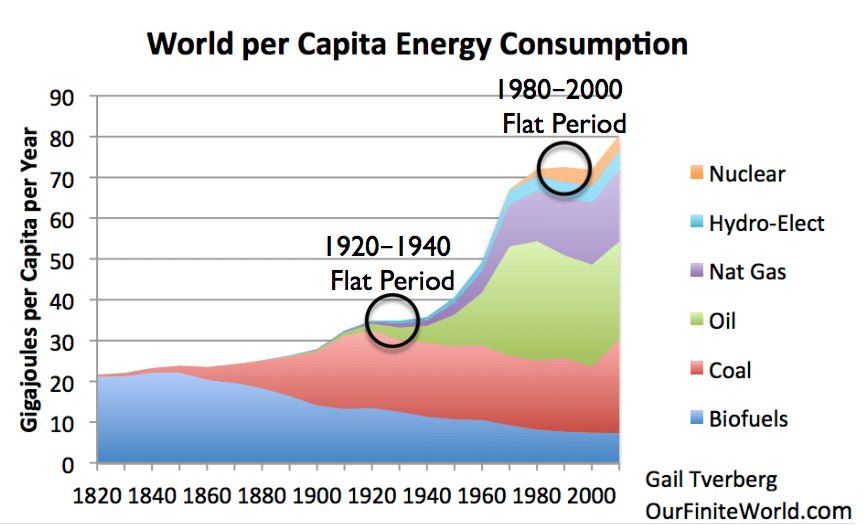
Figure 7. World per Capita Energy Consumption with two circles relating to flat consumption. World Energy Consumption by Source, based on Vaclav Smil estimates from Energy Transitions: History, Requirements and Prospects (Appendix) together with BP Statistical Data for 1965 and subsequent, divided by population estimates by Angus Maddison.
The 1920-1940 flat period came shortly after the United Kingdom reached Peak Coal in 1913.

Figure 8. United Kingdom coal production since 1855, in figure by David Strahan. First published in New Scientist, 17 January 2008.
In fact, the UK invaded Mesopotamia (Iraq) in 1914, to protect its oil interests. The UK wasn’t stupid; it knew that if it didn’t have sufficient coal, it would need oil, instead.
There were many other disturbing events during this period, including World War I, the 1918 flu pandemic, the Great Depression, and World War II. If there are not enough energy resources to go around, many things tend to go wrong: countries tend to fight for available resources; jobs that pay well become less available; deflation becomes more likely; population becomes weakened, and epidemics become more likely. I wrote about the 1920 to 1940 period in a recent post, The Depression of the 1930s Was an Energy Crisis.
The 1980-2000 flat period included the collapse of the Soviet Union, in 1991. The Soviet Union was an oil producer. The Soviet Union collapsed after prices had been low for a long time.

Figure 9. Former Soviet Union oil consumption, production, and inflation-adjusted price, all from BP Statistical Review of World Energy, 2015.
Even many years after the collapse of the Soviet Union, population growth in former Soviet Union countries and its affiliates was much lower than in the rest of the world.

Figure 10. World population growth rates between 2005 and 2010. Source: https://en.wikipedia.org/wiki/List_of_countries_by_population_growth_rate
Lower population (through falling birth rates, rising death rates, or rising emigration) are a major way that economies self-adjust because of falling energy per capita. Economies tend to fix the low-energy per capita problem by adjusting the population downward.
Recently, we have again been hitting flat periods in energy consumption per capita.

Figure 11. World per capita consumption of oil and of total energy, based on BP Statistical Review of World Energy data and UN 2017 population data.
The slowdown in world energy consumption per capita in 2008-2009 was clearly a major problem. Oil, coal and natural gas consumption fell simultaneously. Oil consumption per capita fell more than the overall mix, especially affecting countries heavily dependent on oil (Greece with its tourism, but also the US, Japan, and Europe).
The recent shift in political strategy to more isolationist stances also seems to be the result of flat energy consumption per capita. It is doubtful that Donald Trump would have been elected in the US, if world energy consumption per capita had been growing robustly, and if wage disparity had been less of a problem.
The primary cause of the 2013 to 2016 flat trend in world energy consumption per capita (Figure 11) is falling coal consumption (Figure 12). Many people think coal is unimportant, but it is the world’s second largest source of energy, after oil. We don’t have a good way of getting natural gas production to rise enough, to make up for loss of coal production.

Figure 12
Wind and solar simply do not work for solving our problem of flat or shrinking energy consumption per capita. After spending trillions of dollars on them, they make up only a tiny (1%) share of world energy supply, according to the International Energy Agency. They are part of the little gray “Other” sliver on Figure 13.

Figure 13. Figure prepared by IEA showing Total Primary Energy Supply by type from this IEA document.
Something Has to “Give” When There Is Not Enough Energy Consumption per Capita
The predicament we are facing is that energy consumption per capita seems to be reaching a maximum. This happens because of affordability issues. Over time, the price of energy products needs to rise to keep up with the rising cost of creating these energy products. But if energy prices do rise, workers earning low wages cannot afford to buy goods and services made with high-priced energy products, plus honor all of their other commitments (such as mortgages, auto loans, and student loans). This leads to debt defaults, as it did in the 2008-2009 recession.
At some point, the affordability problem can be expected to hold down energy consumption. This could happen in many ways. Spiking prices and affordability issues could lead to a worse rerun of the 2008-2009 recession. Or if oil prices stay fairly low, oil-exporting countries (such as Venezuela) may collapse because of low prices. Even if oil prices do rise, we may find that higher prices do not lead to sufficient additional supply because investment in new oil fields has been low for many years, because of past low prices.
As long as the world economy is expanding (Figure 14), individual citizens can expect to benefit. Jobs that pay well are likely to be available, and citizens can afford to buy goods with their growing wages. People who sell shares of stock and people who get pension benefits can all receive part of this growing economic output.

Figure 14. Author’s image of an expanding economy.
Once the economy starts to shrink (Figure 15), we start having problems with dividing up the goods and services that are available. How much should retirees get? Governments? Today’s workers? Holders of shares of stocks and bonds? Not all commitments can be honored, simultaneously.

Figure 15. Author’s image of declining economy.
One obvious problem in a shrinking economy is that loans become harder to repay. The problem is that there is less left over for other goods and services, after debt plus interest is subtracted, in a shrinking economy.

Figure 16. Figure by author.
Changing interest rates can to some extent help offset problems related to higher energy prices and shrinking supply. The danger is that interest rates can move in the wrong direction and make our problems worse. In the lead-up to the Great Recession of 2008-2009, the US raised short-term interest rates, helping to puncture the sub-prime mortgage debt bubble.

Figure 17. Figure comparing Case-Shiller Seasonally Adjusted Home Price Index and Federal Reserve End of Quarter Target Interest Rates. See Oil Supply Limits and the Continuing Financial Crisis for details.
We now hear a lot of talk about raising interest rates and selling QE securities (which would also tend to raise interest rates). If growth in energy consumption per capita is already flat, these changes could make the problems that the economy is facing even worse.
Our Economy Works Like a Bicycle
Have you ever wondered why a two-wheeled bicycle is able to stay upright? Research shows that a bicycle will stay upright, as long as its speed is greater than 2.3 meters (7.5 feet) per second. This is the result of the physics of the situation. A related academic article states, “This stability typically can occur at forward speeds v near to the square root of (gL), where g is gravity and L is a characteristic length (about 1 m for a modern bicycle).”
Thus, a bicycle will be able to continue in an upright manner, as long as it goes fast enough. If it slows down too much, it will fall down. Our economy is similar.
Gravity plays an important role in determining the speed of a bicycle. If the bicycle is going downhill, gravity gives an important boost to the speed of the bicycle. If the bicycle is going uphill, gravity very much pulls back on the bicycle.
I think of the situation of an economy having rising energy consumption per capita as being very much like riding on a bicycle, speeding down a hill. The person operating the bicycle would not need to provide much extra energy to keep the bicycle going.
If energy consumption per capita is flat, the person riding the bicycle must provide the energy to make it go fast enough, so it doesn’t fall over. This is somewhat of a problem. If energy consumption per capita actually falls, it is a true disaster. The bicyclist himself must provide the energy necessary to push the bicycle and rider uphill.
In fact, there are other ways that a speeding bicycle is analogous to the world economy.

Figure 18. Author’s view of analogies of speeding upright bicycle to speeding economy.
The economy needs a constant flow of outside energy. In the case of the bicycle, the human rider can provide the energy flow. In the case of the economy, the energy flow comes from a mixture of various fuel types, typically dominated by fossil fuels.
Growing debt (front wheel) is important as well. It tends to pull the economy along, because this debt can be used to pay wages and to buy materials to make additional goods and services. Thus, the effect of this increase in debt is indirect; it ultimately works through the bicyclist, the gears, and the back wheel.
In fact, the financial system as a whole is important for the “steering” of the economy. It tells investors which investments are likely to be profitable.
The gearing system of the bicycle plays a modest role in the system. Changing gears allows greater efficiency in the use of the energy that is available, under certain circumstances. But energy efficiency, by itself, cannot operate the system.
If the human rider does not provide sufficient energy for the bicycle to go rapidly enough, the bicycle glides for a while, and then falls over. The world economy seems to be similar. If the world economy does not obtain enough energy per capita, economic growth tends to slow and eventually collapses. The collapse can relate to the whole world economy, or to parts of the economy.
The Problem of Parts of the Economy Not Getting Enough Energy
We can think of the economy as being made up of many bicycles, operated by bicycle riders. At the beginning of the post, I talked about the problem of wage disparity. This issue occurred at the time of the 1930’s Great Depression and is occurring again now.
We might call wage disparity “too low a return on the labor of some workers.” In groups of animals in ecosystems, too low a return on the effort of these animals is what causes ecosystems to collapse. For example, if fish have to swim too far to obtain additional food, their population will collapse. It should not be surprising that economies tend to collapse, when the return on the efforts of part of their workers falls too low.
Wage disparity has to do with how well the operators of bicycles are doing. Are the operators of these bicycles receiving enough calories, so that they can keep pumping their bicycles fast enough so that the speed is high enough to remain upright?
If energy consumption per capita is growing, this greatly helps the operation of the economic system. If there is growing availability of inexpensive energy, machines of various types, including trucks, can be used to increasingly leverage the labor of workers. This increased leveraging helps each worker to become more “productive.” This growing productivity, thanks to growing energy consumption, allows more goods and services to be produced in total. It also allows the wages of the workers to stay high enough that they can afford to buy a reasonable share of the output of the economy. When this happens, “gluts” of unaffordable goods are less of a problem.
If energy consumption per capita is flat (or worse yet, falling), greater “complexity” is needed, to keep output of goods and services rising. Greater complexity involves more specialization and more training of individual members of the economy. Greater complexity leads to larger companies, more government services, and more wage disparity. Unfortunately, there are diminishing returns to complexity, according to Joseph Tainter in “The Collapse of Complex Societies.” Ultimately, increased complexity fails to provide an adequate number of high-paying jobs. Wage disparity becomes a problem that can cause an economy to collapse.
If there is not enough economic output, the physics of the economy tries to “freeze out” workers at the bottom of the hierarchy. Workers with low wages cannot afford homes and families. The incidence of depression rises. Debt levels of disadvantaged groups (such as young people in the US) may rise.

So the situation may not be that the whole world economy fails; it may be that parts of the economy collapse. In fact, we are already seeing evidence that this is taking place. For example, life expectancies for US men have been falling for two years, because of growing problems with drug overdoses.
Conclusions
In 2017, the world economy seemed to be gliding smoothly along because the economy has been able to get the benefit of artificially low energy prices and artificially low interest rates. These artificially low prices and interest rates have given a temporary boost to the world economy. Countries using large amounts of energy products, including the US, especially benefitted.
We cannot expect this temporary condition to continue, however. Low oil prices have already started to disappear, with Brent oil prices at nearly $69 per barrel at this writing. The trends in oil prices and oil stocks in Figure 6 are disturbing. If oil prices begin to rise toward the price needed by oil producers, they are likely to trigger a recession and a drop in world energy consumption, just as spiking prices did in 2008-2009. There is a significant chance of collapse in the next 12 to 24 months. It is hard to know how widespread such a collapse may be; it may primarily affect particular countries and population groups.
To make matters worse, our leaders do not seem to understand the situation. The world economy badly needs rising energy consumption per capita. Plans to raise interest rates and sell QE securities, when the economy is already “at the edge,” are playing with fire. If we are to keep the world economy operating, large quantities of additional energy supplies need to be found at very low cost. It is hard to be optimistic about this happening. High-cost energy supplies are worthless when it comes to operating the economy because they are unaffordable.
Many followers of the oil situation have had great faith in Energy Returned on Energy Invested (EROI) analysis telling us which kinds of energy supplies we should increase. Unfortunately, EROI doesn’t tell us enough. It doesn’t tell us if a particular product is scalable at reasonable cost. Wind and solar are great disappointments, when total costs, including the cost of mitigating intermittency on the grid, are considered. They do not appear to be solutions on any major scale.
Other researchers looking at the energy situation have not understood how “baked into the cake” the need for economic growth, rising per capita energy consumption, and rising debt levels really are. Rising debt is not an error in how the financial system is put together; a bicycle needs a front wheel, or it cannot operate at all (Figure 18). I have written other articles regarding why debt is needed to pull the economic system forward.
This economic growth cannot be “fake growth” either, where a debt Ponzi Scheme seems to allow purchases that real-life consumers cannot afford. Quite a bit of what is reported as world GDP today is of a very “iffy” nature. If China builds a huge number of apartments that citizens cannot afford without subsidies, should these be counted as true GDP growth? How about unneeded roads, built using the rising debt of the Japanese government? Or recycling performed around the world, because it makes people “feel good,” but really requires substantial subsidies?
At this point, it is hard for us to know where we really are, because every government wants to make GDP results look as favorable as possible. It is clear, however, that 2018 and 2019 can be expected to have more challenges than 2017. We have interesting times ahead!


Gail,
does the World Economic Forum reads your blog? The Global Risks Report 2018 says:
“But we are much less competent when it comes to dealing with complex risks in the interconnected systems that underpin our world, such as organizations, economies, societies and the environment. There are signs of strain in many of these systems: our accelerating pace of change is testing the absorptive capacities of institutions, communities and individuals. When risk cascades through a complex system, the danger is not of incremental damage but of “runaway collapse” or an abrupt transition to a new, suboptimal status quo.” (http://reports.weforum.org/global-risks-2018/executive-summary/)
Seems as if they have copied one of your articles!
Jan
https://www.euractiv.com/section/economy-jobs/news/imf-warns-of-harder-crisis-as-bullish-ceos-come-to-davos/
the International Monetary Fund (IMF) has warned that the next crisis will hit sooner and harder that we thought.
It is amazing how many people can avoid talking about energy when they mention the problems we are having.
I don’t think people avoid talking about energy as much as they assume that energy will always be available. Just like assuming water will always be available and free because we need it to survive. We were mostly all born into a world of abundant and cheap energy so we have that normalcy bias built in from childhood.
I have mentioned energy before in discussions with people about technology and the economy and they literally laugh at the mention that energy supplies such as coal, oil and natural gas may not be available in the near future. The reasoning is that there are 1000’s of years of fossil fuels left. It is those government regulations blocking access. I am not joking. That is what most people believe. To challenge this is akin to practicing witchcraft in the 15th century.
And long before they run out… we will have transitioned to clean renewable energy.
The MSM has done a great job of indoctrinating the goy….
http://www.cutenessoverflow.com/wp-content/uploads/2014/12/not-a-care-10.jpg
Tesla In Autopilot Mode Hits Fire Truck; No Injuries Reported
http://losangeles.cbslocal.com/2018/01/22/tesla-autopilot-fire-engine/
Tesla says you have to keep your hands on the wheel at all time…What the hell is the point of having an autonomous car if you have to do that? You might as well just drive the stupid thing. I thought the whole selling point of autonomous cars was supposed to be that you could yak on your phone or read a book and the computer would drive.
“What the hell is the point of having an autonomous car if you have to do that? ”
1. Tesla can say they sell autonomous electric vehicles.
2. Buyers can say they own an autonomous electric vehicle.
3. With the software update ‘carOS 2.2’, you are no longer required to keep your hands on the wheel.
Up is down
Down is up
Good is bad
Bad is good
War is peace
Peace is war
Autonomous means you must steer the car and push the pedals.
It all makes sense
Or send sms messages….. or play facebook….
I hate this shit, Tesla is releasing untested “beta cars” into production and its endangering everyones lives. You dont release a 80 mph traveling metal box unless you are sure it works flawlessly.
Telsa does not have a fully autonomous car.
Yes, they have implied through their supporters in the media that it has one or is workking on one… but it does not have one.
It’s not it’s fault that some of its wealthy and highly-educated buyers did not read the instruction manual.
“You dont release a 80 mph traveling metal box unless you are sure it works flawlessly.”
You lead a very sheltered life. That has never been the case with any machine. Ever.
Not all machines are equal my paranoid friend…
Where did I say it did? My point was that there is no machine available to the public that works flawlessly.
*Where did I say that they are made equal?
I don’t know what is worse, that or unleashing 60+ year old coots with their gas-guzzler SUV’s to freely roam the streets with their myopic and cataract blurred vision feeding their unreliable and stroke-prone alzheimers riddled brains with an extremely dim representation of the objective reality.
Crash at 65 miles per hour against a stopped fire truck and no injuries–that sounds unusual to me. Perhaps it barely scraped it.
So I take it that the issue of xxx xxxxx has been put to rest —- we are all agreed… it is a ho ax.
Excellent.
We’re all one big happy family now!
Atlanta’s homeless population triples as officials move them into the Airport
http://www.fox5ny.com/news/police-officers-at-atlantas-airport-speak-out-about-homeless-population
The recent cold weather has no doubt been a problem for the homeless.
What’s with all this ‘cold weather’… must be fake news
Immigration SS just snatched a Doctor by where I live who has been here for 40 years…
Doctor who came to US as child jailed by immigration agents
https://apnews.com/cce214ce28df402aa0aa3abac186ccd8?utm_campaign=SocialFlow&utm_source=Twitter&utm_medium=APCentralRegion
Wow, that is really sad and sick.
My local news interviewed a few doctors who worked at the hospital with him. And they were both viably shaken and disturbed…
Trump just imposed a 30% tariff on foreign solar panels and washing machines. I predict this just opened the floodgates and is the beginning of the end for the globalization experiment. Every country is going to start playing this game as we watch bankruptcies pick up en masse.
That’s called big government regulating on the free market…Protectionism.. And the final NAFTA meeting is this month. I bet he pulls out of it…
If we exclude computer technology, globalization has been a disaster.
For the jet-set, it has been great.
globalization has been a disaster
Not true…Since signing free trade agreements US exports to GDP have soared. And free trade has increased global GDP substantially …
https://imgur.com/a/mzR2Q
Like I said, the average person has not benefited from all this. Almost every single country that has become dependent on imports has performed worse economically. People who benefit from globalization do not represent the average person. The average person faces falling wages.
Africa is an area that has become much more dependent on imported food and imported medicines. Population has mushroomed, but it is hard to see that it has really has benefitted otherwise.
True, I don’t think globalism has any long term benefits.
Notice both the far righters of OFW come out against globalism…As long as Fox News and right wing politicians say something is bad then they will believe it…No evidence needed…
My post Twelve Reasons Why Globalization Is a Huge Problem is incredibly popular.
It has had 363,768 “views” on Our Finite World alone. It has been copied onto other websites as well.
Study: Most US manufacturing jobs lost to technology, not trade
https://www.ft.com/content/dec677c0-b7e6-11e6-ba85-95d1533d9a62
I notice when I look to find more information, I see “Refined oil is America’s top manufactured good.” That is true. America’s other top manufactured products are pharmaceuticals, airplanes and automobiles. Rounding out the top 10 are iron and steel, animal slaughtering, plastics, organic chemicals and petrochemicals. https://www.marketwatch.com/story/us-manufacturing-dead-output-has-doubled-in-three-decades-2016-03-28
This is the chart that the Financial Times shows regarding manufacturing output and employment.
I thought that it was interesting on this chart that employment stayed up near the 100 line until about the time China was added to the World Trade Organization (2001). Then employment dropped from something like 90% of the 1980 base to more like 60% of the 1980 base. Strange coincidence! Maybe all of the technology was added in the same time frame as globalization.
I don’t know if you’ve written about it before I started following your blog, but this is my question:
1971 U.S. President Richard Nixon decided to end international convertibility of the U.S. dollar to gold, just one year after the U.S. crude oil production peaked. A coincidence, or is it documented that in the administration there were strategist thinking about the petrodollarsystem, which enabled the U.S. to pay it’s own debt?
a
I don’t really know. This article from Resilience says,
Of course, Nixon may have known that US oil production had peaked in 1970. Hubbert’s prediction seems to have been widely known after 1957. The book “The Limits to Growth” was published in 1972. It must have been started in 1970 or 1971.
NAFTA has helped grow American agriculture for two decades
Among NAFTA’s many accomplishments, it has opened markets in Canada and Mexico to American farmers that would otherwise be closed completely or complicated by needless barriers.
In 2016 alone, this resulted in $43 billion worth of food and agricultural goods being exported to Mexico and Canada, making those countries the largest export markets for American agriculture.
The growth driven by NAFTA has been nothing short of amazing. Agricultural exports from the United States to these two countries have grown by 450 percent since 1994 and Mexico is now the top export destination for a long list of U.S.-grown products, including beef, rice, soybean meal, corn sweeteners and apples. With record yields being produced across the United States, we’ve needed access to export markets more than ever and NAFTA has met the challenge.
The benefits of NAFTA are seen across various sectors within the American economy, however. For example, post-NAFTA, the U.S. food and agriculture industries have flourished and now support more than 43 million jobs and economists say NAFTA has boosted the U.S. economy by $127 billion annually. The benefits are wide-ranging, extending down to American consumers who pay less at the store for everything from avocados to televisions thanks to this trade agreement.
http://thehill.com/opinion/energy-environment/370363-nafta-has-helped-grow-american-agriculture-for-two-decades
I can believe this story a whole lot more for Mexico than Canada. But now Mexico is running into problems. How will it even keep order, if is oil production is declining? And if Mexico still has avocados to sell, who is it going to sell them to? Canada can take only so many avocados. Once trees are planted, they are likely to continue to give fruit.
You’re an idiort. There are people on the Left who are against globalization because it grants much greater power to capitalists. Now, they mostly support it because they despise “Western Civilization” which they equate with “Old White Men”.
Who hates old white men?
Once again no evidence just extreme delusions and paranoia..
I think you’re projecting here.
A few months ago you and JH Wyoming were posting stuff about Russian hacking the presidential election…which has yet to be proved.
Every day we are bombarded with your sour grapes about Republicans cutting funds to an entitlement you think they don’t have to because the U.S. is swimming in cash and has unlimited resources to absorb more and more immigrants and provide expensive social programs. It’s like the concept of a “finite world” has gone over your head.
Far righters and far lefters are = abhorrent.
In fact left and right on any level are equally abhorrent.
Does that make you far left?
“I don’t think globalism has any long term benefits.”
Neither does industrialism. Without globalism, post-1971 industrial civilisation would have collapsed even sooner than it otherwise would.
Globalism was about a couple of things.1. Exporting jobs to cheaper countries so corporations could make more money.
2. Supposedly “lifting” the rest o the world to a “higher” standard of living.
3. The shadow purpose of one day having a world gov.
#1 definitely happened. I don’t think #2 really happened. I mean, 3rd world is not any better off these days. I look at peoples happiness. Much of the 3rd world in the old days was happy I think, not super consuming rich like Americans….but reasonably happy.
In other words, the western lifestyle does not equate to happiness.
#3 is still on the table.
I was in BC Canada a few years ago …. a shop had a BC-hand made corn broom for sale — if I recall the price was 70 bucks…. I bought the China made option for 20…
I recently replace a water pump on our shack at the ocean — the china made option was half the price of the other options…I went for the china made option
Of course at some point if you export all the decent jobs … you end up using a bucket to fetch your water… because none of the other options are affordable
Globalism was the last growth frontier. There is nowhere (and no room) left to grow. And certainly no cheap energy to do it.
Good point! It also helped that China had a huge amount of unused cheap-to-extract coal.
You might be right about starting a trade war.
This is an article about the tariffs. http://abcnews.go.com/Business/wireStory/trump-approves-tariffs-imported-solar-panels-washing-machines-52533536
Apparently not all solar panels and washing machines are affected:
As I understand the situation, the lower business tax rate was already hurting solar, to some extent, because those buying the solar were generally taking advantage of tax credits that businesses could not really use. Now those tax credits are less available, because of the recent reduction in tax rate.
I wonder why they start with washing machines? Why not dishwashers, TVs, smartphones?
Solar panels and washing machines were areas where they had received complaints.
I am sure that if other product manufacturers see that tariffs can be obtained through this route, the number of complaints of this type will increase. There are already other decisions on other products in the works. https://www.bloomberg.com/news/articles/2018-01-22/trump-makes-first-big-trade-move-with-tariffs-aimed-at-asia This Bloomberg article says
China is well-known for reverse engineering any product that they import, and building similar products. In some cases, they explicitly require companies to give details of how things that they are importing are built.
Gail, correct me if I am wrong but do you think it’s a coincidence that Trump is being allowed to impose tariffs at a time when many imports from China are not selling well at U.S, retail outlets like Wal-Mart anymore?
https://finance.yahoo.com/blogs/the-exchange/why-wal-mart-is-getting-too-expensive-for-the-middle-class-215417616.html
This just seems like symbolic move to make it appear the Trump administration is being productive and is addressing a problem.
I notice that this article about Walmart is about four years old. But it is interesting that it points out some things that happened in 2013 and early 2014:
This timing was close to when the price of oil and other fossil fuels dropped. It could have been a contributing factor, along with the rise in the level of the dollar at that time. The dollar/yuan relativity would make a big difference in the price of imports from China.
Of course, these things happened during the Obama administration. I would have to look at current Walmart information to see how it is doing now. I noticed that Walmart is raising its minimum wage to $11 per hour. That will be putting pressure on other retailers to raise pay as well.
There seem to be a lot of things going on simultaneously. The tariffs on some solar panels and clothes washers is part of it. But so are NAFTA negotiations. The recent changes in corporate tax rates is intended to make US producers more competitive compared to companies in other countries. There seem to be other tariffs being examined (aluminum and steel) and also Chinese treatment of intellectual property.
Sweden did the opposite (always does), last summer started taxing electronics sold in Sweden by the kg (“chemical tax”).
Do now you have to weigh money saved by buying from abroad against extra hassle if/when you return stuff or it breaks.
So the tax in Sweden is on locally made electronics, rather than imported electronics? This is truly strange. It does encourage reducing the local CO2 production, but it clearly has a lot of detrimental effect–loss of jobs in Sweden.
On locally SOLD. So the same computer factured in say Japan is cheaper bought online from a danish company than a swedish.
The ultimate blow in a real trade war would be for China to stop accepting the petrodollar.
I’ve heard that one of the reasons why Russia is being deemed an enemy by those in the U.S. intelligence community is because it’ s attempting to stop accepting U.S. dollars in exchange for energy products.
China is a buyer of energy products. In fact, it is the biggest importer of energy products in the world. It is part of what is driving up the prices of energy products for the world as a whole. It can admittedly negotiate a contract with Russia and buy energy products (probably based on the world market price for oil; natural gas would likely reflect the high cost of shipping) and make the exchange using gold, rubles, yuan, or whatever is preferred. But it won’t demand that goods it is trying to sell to the rest of the world is paid for in yuan or gold.
I am not sure it would make a difference. Not buying treasury bonds, or selling of existing treasuries, would seem to be a bigger issue.
Trump is going after solar because he wants the country to burn coal. The tax benefits for renewables took a hit in the latest tax code change as well. He also hates California (because of Brown) and CA has big plans to increase solar (which will now cost more).
The decision makers — not Trump – understand that the solar ho ax can only be taken so far without threatening BAU … so they are stopping it.
Most solar panels were made in China. Additionally, SolarWorld, the largest US manufacturer, owned by a German firm BTW, went into bankruptcy. There is an argument for protecting domestic industry from bottom of the barrel, possibly state subsidized panels made in China.
The ways of operating companies and taxation are so different from country to country that it becomes difficult to figure out what is going on. The links I gave in my recent China article said that China’s major motive for building solar panels was the export market. They found them too expensive for use at home. It was only when they were unable to sell them abroad that they started putting them in place in China (and the official who allowed to this to happen got fired for graft). With all of the state ownership of companies and unusual types of debt, it is hard to tell what the real costs are of making solar panels are.
I am sure the cost of making panels depends on the price of coal, since they are made using coal. The cost of coal has fluctuated in much the same pattern as oil–down, then up recently. I imagine it also depends on interest rates on debt. Given how little benefit they truly add to the system, adding tariffs doesn’t sound like a bad idea. If nothing else, if we are collecting less in taxes from our own companies, we need to make up the loss with more taxes on goods from other countries.
World finance now more dangerous than in 2008, warns top central bank veteran
Nine years of emergency money has had a string of perverse effects and lured emerging markets into debt dependency, without addressing the structural causes of the global disorder.
“All the market indicators right now look very similar to what we saw before the Lehman crisis, but the lesson has somehow been forgotten,” said William White, the Swiss-based head of the OECD’s review board and ex-chief economist for the Bank for International Settlements.
http://www.telegraph.co.uk/business/2018/01/22/world-finance-now-dangerous-2008-warns-central-bank-guru/
The crescendo this time will make Lehman folding look like the simple version, but what’s worse it leaves CB’s with no ammo to counter the next debacle, so it seems likely it will be disastrous in the extreme. It’s one thing to dig one’s self out of a ditch, but how to dig one’s self out of the Marianna Trench is what it’s going to be like. About all the CB’s could do under a dire, do something fast or face all out collapse is QE4 to the masses, but that insures hyper-inflation, leading to collapse of currency. Then if a few weeks pass without jolting the sucker back into coherence, every day infrastructure begins to fail. Once that ensues it’s incredibly difficult and expensive to get things going again. Why you’d need a whole lot of cheap energy and fracking ain’t gonna do it.
“Without addressing the structural causes of the global disorder.” – yes indeed the structural cause – diminishing returns. It takes more and more energy to get energy! That is the cause.
Recently, the HSBC oil report stated that 80% of conventional oil fields were declining at a rate of 5-7% per year. This means that there will be an oil shortage of ~30 million barrels per day by 2030 and ~40 million barrels per day by 2040.
http://www.scribd.com/document/367688629/HSBC-Peak-Oil-Report-2017
What is mentioned far less often is that annual oil discoveries have lagged annual production since the 1980s.
https://imgur.com/a/6dEDt
Now, this problem has nothing to do with the recent decline in the oil price, which started in 2014. This has been an on-going problem for the past 30 years. Now, the IEA is predicting oil shortages by ~2020 due to declining exploration.
https://www.wsj.com/articles/iea-says-global-oil-discoveries-at-record-low-in-2016-1493244000
Saudi
Here, the IEA blames this problem on the low oil price. But, this problem started in the 1980s. The problem is geological: we are running out of conventional cheap oil. Shale and tar sands are not the answer, either. Those resources are far too expensive, compared to conventional oil, because the global economy is based on cheap conventional oil. Expensive oil is not a replacement for cheap oil.
Based upon the HSBC report, the End of Oil Age will start around ~2020: there will be a dramatic economic depression due to exhaustion of cheap oil. Which will cause a global economic collapse.
How come there aren’t two distinct factions about that data? How come there aren’t people claiming the bars on the chart are actually getting taller or arguing reduced oil finds has nothing to do with people, i.e. not anth ropo genic. Versus the other people that look at the chart and are concerned about future oil supplies and accept the data and that it is people that drill for oil.
“This means that there will be an oil shortage of ~30 million barrels per day by 2030 and ~40 million barrels per day by 2040.”
more good news!
an oil shortage in 2030 means The Collapse will not have happened by then…
(after The Collapse, both oil supply and oil demand will be zero)…
based on this data, the 2020s are looking like a decade of decline, but not worldwide disaster…
the peripheral countries most likely will bear the highest burden from those shortages…
bummer for them.
“Expensive oil is not a replacement for cheap oil.”
Sure it is, you just have to print like mad – lol.
Show me one example of a government using the printing press to make something expensive cheap.
i just stuffed my petrol tank full of £10 notes—car runs just fine
where’s the problem?
The USA/Western world (government)?
Let everybody else pay so that we can live beyond our means?
At least for a little while.
Well it isn’t just that oil is more expensive in dollar terms to extract, it is alwo more energy intensive to extract. So more and more energy is used to get energy, leaving less to do the useful things like power commerce, jobs, transportation and economic growth.
I know that we hear this over and over from the EROEI folks, but the extent to which it is true is iffy. For example, it is not at all clear that tight oil from shale is more energy intensive to extract. There may be a general tendency that way, but particular type of oil extraction may not work in that direction. Unconventional oil may at times be less energy intensive than conventional oil.
Yes, the long awaited “tractor beam” could be on its way:
https://www.cnet.com/news/tractor-beam-acoustic-levitate-bristol-university-humans
That doesn’t help us grow more food or mine more metal, of course. It doesn’t magically increase our physical resources.
It’s likely that pre-ancient civilisations used sound to move great weights:
https://www.thoughtco.com/the-ancient-secrets-of-levitation-2593647
Until now, we didn’t know how they achieved these feats. It didn’t stop their civilisations dying out, of course.
The Buddhists don’t need machines to levitate:
https://www.youtube.com/watch?v=XzURrYQKbGs
Allegedly. 😉 Can anybody spot the trick?
My posts get routinely stopped and frisked while “f******” gets to post pseudoscience ?
I looked at some of this and it does look reasonable to post. A little strange, but maybe someone else knows more about it.
He must have wandered out of rehab into an internet cafe.
I saw this other video with this guy in India who has a bum leg, sits on the ground and spun a playing card in the air without touching it (to get hand outs). Then someone gave him a paper currency and he made it levitate and spin. There’s stuff we don’t understand about the universe as much as science claims there are just a few things they still need to figure out (although don’t ask them what caused the Big Bang).
^^^This is not a reasonable post.
We went to the Amazon about 10 years ago …. we meet this couple who were both professors in a US university…. we took the same boat back to Manaus and had lunch with them…
They appeared to be completely normal people…. then suddenly they started into a story about visiting India recently and seeing people levitate…
‘Really – they were levitating’
Nice ta meet ya!!!
This was my first encounter with what I later realized were DelusiSTANIs. I will always remember this moment.
Yes we know. You believe in magic.
A Real Black Pest wrote: “^^^This is not a reasonable post.” Without giving any reasons. Irony. If RBP were to place his hand against any of the black text on this screen, he would see that his hand (palm or back) is far lighter in colour, i.e. not black at all. John Michael Greer is a very grounded person, and he knows from experience that certain elements of “magic” do work.
“There’s stuff we don’t understand about the universe” – perfectly true, and lots of it.
Oh come on … there’s some show that reveals all the secrets of the magicians… there is no magic
I have not eaten any food for 10 years…
I can levitate cars and trucks…
I am faster than the fastest skyscraper…
I can leap over bullets in a single bound…
look, up in the sky!
it’s a bird!
no, it’s a plane!
no, it’s Davidinagodzillionyears!
“I can levitate cars and trucks”
Well, when this new beam is fully developed, maybe you will be able to. As they say, technology resembles magic in its effects. Maybe that fairy’s magic wand is just a technological device!
Wouldn’t it be a huge irony. If it was an Olympic games that brought about Nuclear world war that ended civilization..
http://www.bbc.com/news/blogs-news-from-elsewhere-42779898
Wages not fully paid are being made up for with bricks in China.
Interesting! In Cuba, workers we saw who were making the standard $20 per month in wages in a cigar factory received some cigars to sell in addition to tourists, to “top up” their wages.
Probably made more selling the cigars.
The workers had access to “bands” of high priced cigars. They could add the bands to the cheap cigars, and sell them at a fairly high price.
That’s a nice trick, until the consumer coughs and wonders why their special cigar isn’t so special, but I guess by then the sale has been consummated. I’m sure the workers have to barter a lot of hours for those special bands. Oh my, we do have it much better here in developed countries, at least until it doesn’t work anymore.
I expect most tourists don’t smoke Cuban cigars regularly. They have no idea what a “good” cigar (or perhaps any cigar) is supposed to taste like.
In the excellent book ‘In Siberia’, Colin Thubron met a man who was paid one day in sheets of plate glass. That was just after the Soviet collapse. He had no idea what to do with them, but that was all his boss had to offer.
The green groopies with their iphones ipads i this i that…. who rail against plastic bags….
Need to splurge and buy this
https://vimeo.com/ondemand/deathbydesign
Is it okay to rail against plastic bags if I’ve never owned a smart phone/cell phone of any kind? Plastic bags have to go. I think bringing a reusable bag to go shopping is a reasonable thing to ask of the public. I use a canvas bag which is maybe 20 years old and still good for another 10 years at least if I don’t lose it. Bring it with me to the store is not an inconvenience. Stop being a carbuncle on the butt of sensible movements.
What difference does it make?
(I bring an used plastic bag if I remember because they are so expensive.)
Sweden: plastic bag (actually 85% sugar cane), used a few times and then finally as a trash bag. Probably burned for energy.
(Not) developing world: plastic anything thrown straight into the ocean.
“What difference does it make?”
It will make a huge difference to the lives of sea life. Sea birds eat bits of plastic thinking its food, get sick and die.
Does it make a big difference to sea birds if my plastic (well 85% sugar cane) bag is burned or never manufactured?
My response was meant in regards to regular plastic.
Anyway, lets pretend regular 100% plastic bags existed. What difference does it make? It is burned anyway.
Pretend worst case a person buys five plastic bags each week, this is probably about 1% of all waste they throw. You buy and throw away more plastic as package.
And it doesn’t end up in the ocean.
Yep – the bags are made from petroleum … so burning the bags or burning oil directly …. what does it matter. Particularly if high heat incinerators are used (powered by gas of course!).
The green grooopies should run down the street chasing cars and scream at the drivers telling them to walk!
The futility of the situation is beyond epic.
most reusable bags are highly contaminated with bacteria…
I like paper AND plastic…
either way, they are reused as trash bags, so there’s a double use to each bag.
The thing is…
If you put a plastic bag into the garbage and you live in the first world — you are NOT causing this:
https://snopes.com/uploads/2015/07/garbage-patch.png
http://www.keepbaliclean.com/wp-content/uploads/2014/07/Unknown-4-1100×661.jpeg
Your plastic waste is NOT being dumped in the ocean.
When you see plastic in the ocean it is coming from the THIRD world.
So it does not matter if you bring your own bag. That does not reduce the amount of trash that ends up in the ocean.
If you want to do something the next time you vacation in a third world country hand out some reusable bags to the poor.
Pop-up Quiz.
What is this?
Why is it so funny?
https://static01.nyt.com/images/2015/04/05/realestate/20150405COVER-slide-LZ8O/20150405COVER-slide-LZ8O-videoSixteenByNine1050-v2.jpg
It would be a great place for an eco-resort.
Ding ding ding
https://precisioncrossfit.net/wp-content/uploads/2013/10/bingo-442587.jpg
It is a refuge from rapidly rising sea levels.
It’s a great place to go snorkeling, all day and all night.
NICE!!!
Maybe Leo could do a Titanic Two … and after the ship sinks he and Kate swim to that submerging island to wait for someone to rescue them….
To add some drama …. there could be scenes of Fast Eddy as the villain Burning More Coal…. and meanwhile every day the water rises an inch or two….
New article up on Steve Ludlum’s blog:
https://www.economic-undertow.com/2018/01/21/another-year/
“Having burned through a large percentage of our non-renewable resource base (wealth), asset price inflation is about all we have left. We Americans live for the bigger number. When our numbers shrink we can blow our brains out or get drunk. Or we go to the government and demand bigger numbers as our birthright.”
Unfortunately, finite resources is not a topic we can talk about. I am also not convinced that it is something that we can really do anything about. We can create metrics that make wind and solar look much better than they really are, and convince ourselves that we can substitute these for finite resources. But eventually, the whole story will come out. Right now, we are experiencing huge asset inflation that makes owners of these assets feel good. It is not really sustainable, however.
“We can create metrics that make wind and solar look much better than they really are, and convince ourselves that we can substitute these for finite resources.”
Even wind and solar energy need to be collected using finite resources. No matter how we look at it, the problem is one of shrinking numbers. 2018 is looking to me like the year when that fact gains wider acceptance.
Inequality gap widens as 42 people hold same wealth as 3.7bn poorest
https://www.theguardian.com/inequality/2018/jan/22/inequality-gap-widens-as-42-people-hold-same-wealth-as-37bn-poorest?utm_term=Autofeed&CMP=twt_b-gdnnews#link_time=1516595983
The inequality gap has to widen or the resource base would collapse. Imagine if all this “on paper” wealth was redistributed to the consuming middle and lower income classes. Well, they would spend it on “stuff”. The demand on resources would increase and we would quickly hit a wall in resource availability. We are in a predicament for sure.
The masses are quickly reaching a point in which their existence in such huge numbers is no longer needed for the few remaining owners. What happens now? Does this game hit reset or does the list of owners shrink even more? Is a world war started to cull the masses to the benefit of the owners? Something has to give.
Good point.
If we could realize our real estate and stock profits we could all buy a few EVs each, maybe even autonomous, and discover where the limits to lithium and cobalt and coal and everything are.
https://www.youtube.com/watch?v=phSmarVXCNE
The person being interviewed in that video link is a kick to listen to. He just tells it like it is and holds nothing back. Says the US stock market has continued to go up lately because other parts of the world don’t have any good investments. He says when that doesn’t work and all else fails they take you to war. Oh my. He may be right.
Globalism and free trade won’t allow another world war…
Gerald is one of the good guys.
Love Gerald Celente – “Whe people loose everything and have nothing left to loose, they loose it”….
Yeah, I noticed that line too. Great one.
Well, WWII really ended the Great Depression, so it’s logical to assume WWIII will end the Greater Depression, one way or another….
Exclusive: Philadelphia Energy Solutions to file for bankruptcy – memo
https://www.reuters.com/article/us-philadelphiaenergysolutions-bankruptc/exclusive-philadelphia-energy-solutions-to-file-for-bankruptcy-memo-idUSKBN1FA18P
(Reuters) – Philadelphia Energy Solutions LLC, the owner of the largest U.S. East Coast oil refining complex, announced to its employees on Sunday that it plans to file for Chapter 11 bankruptcy, according to an internal memo reviewed by Reuters.
This is a company owning two of the East Coast refineries that got into financial trouble before. According to the article:
It is not clear that there is any actual intent to discontinue operations. According to the article:
Looking for another bailout, I suppose.
Richest one percent made 82% of wealth created last year — report
Ahead of World Economic Forum in Davod, Oxfam findings show poorest half of the world received none of 2017’s financial bounty
https://www.timesofisrael.com/richest-one-percent-made-82-of-wealth-created-last-year-report/?utm_source=dlvr.it&utm_medium=twitter
This is what Dennis over at Peakoilbarrel posted
“Oil prices will increase and use of hybrids, plugin hybrids and EVs will increase as the cost of these newer technologies fall and the price of oil, natural gas and coal increase due to depletion.
In addition, coal and natural gas prices will increase while the cost of wind and solar continue to fall and much of the electricity produced by coal and natural gas may be replaced by wind and solar output, along with hydro, geothermal, pumped hydro, batteries, fuel cells, and vehicle to grid.
If these substitutes are adopted at the speed with which smartphone adoption occurred. We get a “fast” energy transition.”
All I can say about this is way too many “If’s”:….LOL
There are a lot of people who believe this stuff. You can’t add these at the rate of speed of the smart phones, because of the huge energy use required, which we don’t have. Also the cost, relative to wages. Intermittent electricity is very expensive, once a person includes the cost of getting rid of the intermittency. We need dispatchable electricity to operate our current system. Prices can’t rise very much, or the system collapses.
I used to believe in these things until one day i discovered the comment section of OFW….
Dennis even threw in fuel cells, as if they were a non-FF power source, LOL.
It would suck if one had the IQ of Dennis.
This car is completely worthless-
http://www.chevrolet.com/electric/volt-plug-in-hybrid
Dennis is probably quite happy in his fog of ignorance.
Whatever gets you through the day…
Funny… so is my dog…..
I wonder if Dennis would fetch a ball? Or a bone?
A smartphone costs €400 and is normally in use for 2-3 years.
An EV costs €40k+ and a car is normally in use for 20 years.
Even if BAU was not going down… I doubt anyone would be getting 20 years out of an EV…. the cost of replacing the battery would preclude that
But then again …. there are many many many very stooooopid hewmans on this planet…. and some of them might keep forking out big dollars because they are saving the planet by doing so
I meant when everyone had a dumbphone all it took was 2-3 years and a decision to part from €400 savings to “transit”.
ICE cars I believe lasts up to 20 years. So faster than 20 years takes a whole lot of people scrapping perfectly useful cars. If you have a 7 years old Toyota are you really a candidate for a new €70k (subsidies has to go if everyone goes EV) EV?
Another thing is. A smartphone was a big improvement over a dumbphone. An EV is still only a car.
Another big thing is only around 1/3 of all car owners in America have a garage..And even less in Asia..Most people who live in cities park in the streets….So you would have to build millions of charging stations..And people would have to drive to a charging station every single day and wait 30 mins (Assuming nobody else is charging) to fill up your car…People barely have the nerves to wait five mins at MacDonald for a cheeseburger. Let alone do that every day before work etc…
My friends have informed me this is no problem. You just pull right to the charge lane and charge as you drive. Simple!
Do you have a source for the 1/3 of car owners? I could believe 1/3 of households (eg excluding those who don’t own a car and those who park in multifamily garages). In any case, those who street park generally live in cities and have below average wealth/income. The latter isn’t a near term candidate for EVs (maybe a used one) and the former generally has a very short commute that would not require daily charging, even with a first gen EV. And in most US cities there are plenty of places to charge, including workplaces. I leased two LEAFs over a five year period (once in a large city, once in a small town) without home charging and had very few problems/hassles except for roadtrips (which were therefore curtailed).
Obviously there are people who EVs won’t work for and even more who would refuse any hassle but these groups are constantly getting smaller as options, technology, and affordability improve.
I think in europe 1/3 living in houses, max 1/2 is correct. And also well paid are living closest to the city core. Also car commuting to work is not the norm among the best paid 20%.
You can’t buy a car on the strategy of charging it while at the super market or kids soccer practice.
Charging will be a BIG obstacle getting over 50% in europe. Of course the plan was never to replace all cars with EV, just getting rid of ICE 😉
Well, it’s kind of stupid to own new car for a long haul without a proper garage in the first place! The temperature swings and weather impact tend to accelerate aging of everything from electronics to plastics..
People with homes where they can recharge buy new electric cars, so little public charging is needed. After a while, they want to resell the cars to others, and discover the demand is awful. Typical used car buyers don’t have garages. If they all did buy electric cars, we would likely have a big recharging problem.
We have at least as much problem with maintaining grid electricity production as oil production. Keeping up roads will be a problem if we are short of either. It is hard for me to understand the reason for the craze in the first place.
It’s the Tweet generation
“In addition, coal and natural gas prices will increase while the cost of wind and solar continue to fall” – This is contradictory. If coal and natural gas prices increase then the costs to build solar and wind power will increase. The only reason solar and wind turbine prices have come down is due to the slumping global economies and depressed resource and commodity prices.
Fear builds walls -Roger Waters
https://imgur.com/a/NeMtk
Good idea, when there is plenty of available energy materials for all.
A rather quaint, nostalgic idea – thinking a wall will keep any determined, resourceful persons out. Wild 4-legged creatures, like deer, antelope, jaguar, ocelot will be stopped though.
yeah, and it’ll never be the tourist attraction that the Great Wall in China or Hadrean’s Wall in England are now. maybe a backdrop for a new King Kong movie?
It works quite well at El Paso.
He says virtuous. Just as MLK said “judged by the character”. Neither wanted a free pass to the evil, the lazy, the stupid.
What economic growth since 2000 ?
https://imgur.com/a/gjkqV
that’s a really good chart, BD.
Yes I mean some of the decline is because we have outsourced many factories..But we are still the world second largest manufacture..So we should at least be on pace to double out energy consumption if our economy was really growing…
It depends on what we call manufacturing. We add a whole lot of cost to make a box of corn flakes out of corn, for example. But is that something we can really sell to others on the world market? Did you see Tim Morgan’s most recent article?
https://surplusenergyeconomics.wordpress.com/2018/01/17/117-candyfloss-economics/
This is his claimed components of the change in GDP since 2006:
https://gailtheactuary.files.wordpress.com/2018/01/tim-morgan-us-gmo-and-ics-2006-16.jpg
Every major monthly US government economic report – employment, GDP, inflation – is little more than a fraudulent propaganda tool used to distort reality for the dual purpose of supporting the political and monetary system – both of which are collapsing – and attempting to convince the public that the economy is in good shape.
I don’t think that the US is ahead of other countries in this regard. Every government wants its results to look as good as possible.
Everyone should know how US unemployment is measured, in recent years: Number of people actively looking for jobs/population. If the jobs available to a particular person don’t pay enough to cover the cost of transportation and other necessary expenses (childcare, eldercare, special clothing, higher taxes), that person likely won’t even look. Whether jobs are permanent and offer healthcare is important in this calculation–it is unlikely that a person can afford a car to get to a part-time job that is likely of short duration. Fortunately, the US government provides other measures of employment as well, including percentage of people of a given age group who are working. This is available for men and women separately. Some data is available by race.
https://fred.stlouisfed.org/series/LREM25MAUSA156S
https://fred.stlouisfed.org/series/LREM25FEUSA156N
https://fred.stlouisfed.org/series/LEU0253204300A
that’s a really great chart, BD…
look at the decline from the 101 peak in 2007…
it’s plunging!
is that called the Seneca Cliff?
I mean…
we can all see it with our own eyes…
down to 97…
wow!
how is it that all of us are still alive?
I miss Fast Eddy and Keith… and that PeterEV guy.
“Now, here, you see, it takes all the running you can do, to keep in the same place.”
– the Red Queen.
Awesome … we have decoupled energy and GDP…. technically energy use could half… and GDP would soar… technically…..
There was a feel-good book about this published 20 years ago. It was called Factor Four.
The future was gonna be amazing and the benefits enormous. And the authors gave themselves a neat get-out clause: if reality hasn’t quite lived up to the hype, blame your neighbor who still drives an SUV.
http://www.clubofrome.org/wp-content/uploads/2016/01/1997-Factor-four-211×300.jpg
Since the industrial revolution, progress has meant an increase in labour productivity. Factor Four describes a new form of progress, resource productivity, a form which meets the overriding imperative for the future (sustainability). It shows how at least four times as much wealth can be extracted from the resources we use. As the authors put it, the book is about doing more with less, but this is not the same as doing less, doing worse or doing without.
The book contains a wealth of examples of revolutionizing productivity, in the use of energy; from hypercars to low-energy beef; materials, from sub-surface drip irrigation to electronic books, transport, video conferencing to CyberTran, and demonstrating how much more could be generated from much less today. It explains how markets can be organized and taxes re-based to eliminate perverse incentives and reward efficiency, so wealth can grow while consumption does not.
The benefits are enormous: profits will increase, pollution and waste will decrease and the quality of life will improve. Moreover, the benefits will be shared: progress will no longer depend on making ever fewer people more productive. Instead, more people and fewer resources can be employed. While for many developing countries the efficiency revolution may offer the only realistic chance of prosperity within a reasonable time span. The practical promise held out in this book is huge, but the authors show how it is up to each of us, as well as to businesses and governments, to make it happen.
What a beautiful future! We can make it happen! By wishing on a star!
the geniuses who write this stuff ignore the basic fact that human beings need around 2500cal per day to live
this cannot be pulled from thin air—it has to be worked for–ie–an energy exchange.
for the entire existence of humankind, that exchange has been held in balance, we exchanged resources–muscle power– for food
in the last 200 years we’ve had a lifestyle where we’ve been cheating on the exchange bit—we’ve been taking, while expecting fossil fuels to do the giving for us.
we’ve deluded ourselves that that was ”profit”. and so thought we could ”monetize” our own existence.
but of course wealth cannot exist without energy backup—which illustrates the nonsense of that book title
it isnt possible to double wealth and halve resource use
Veganism is for knuckledraggers, try a zero calorie diet
https://www.independent.co.uk/life-style/health-and-families/breatharian-couple-food-free-lifestyle-diet-not-hungry-2008-camila-castello-akahi-ricardo-ecuador-a7792841.html
This sounds like a fraud.
It is in the news.
Actually, it sounds a little like the plan the Meadows had for making resources last until 2100 in the optimistic scenario in 1972 Limits to Growth. The optimistic scenario also involved draconian limits on new births. Back in the early 1970s, many people thought that nuclear was going to become hugely available and would be too cheap to meter. A transition to nuclear might allow saving many other resources. This allowed the scenario to be at least somewhat plausible.
there’s only one ”draconian” birth control method
it’s called starvation
“A transition to nuclear might allow saving many other resources. This allowed the scenario to be at least somewhat plausible.”
Isnt this pretty much the argument for solar today? It will become so cheap that every other problem could be solved by free electricity?
What the chart unfortunately points out is why CB’s keep rolling out wheel barrows filled with printed money. If you don’t have actual growth, it must be artificially injected to simulate growth. The patient, the economy has a drip bag, but like all patients one day the nurse will come by and say, “Sorry, no more bags. Time to pay the piper.”
what the chart also points out is that the second half of the 20th century was the best time to ever be alive.
yes?
Sex Drugs and Rock and Roll…..Woodstock was the peak USA!
Really good chart would love to see a per capita version of the chart.
14% down from 20 years ago on a per capita basis.
” Cooperation becomes impossible.”
Our issues started long before Trump.
The government shutdown and debt levels have been a problem since the 2008 recession.
The United States has been polarized since the 2000 presidential election.
The liberal coalition appears to be united until you realize that they various groups within it have goals that are odds with other groups.
Wage disparity occurred back in the 1930, then got better as availability of cheap energy resources grew.
The Budget Act of 1974 seems to have ushered in the recent series of government shutdowns. This shutdown is the 18th in a series:
https://gailtheactuary.files.wordpress.com/2018/01/us-government-shutdowns_business-insider.png
Our first modern government shutdown was under Jimmy Carter in 1977. He was a Democrat.
I am struck by the timing. The budget act of 1974 was back at the time of the first oil crisis. It has been in the oil era, with all of our problems, that we have had a more and more difficult time getting budget agreement.
I hope it stays shut down for a long time. In fact, let’s keep it closed until the Russian investigation is complete whenever that is – end of 2018 or whenever. All the lobbyists and politicians can go home and stay there. That way maybe they will stop giving away stuff to the super wealthy.
Unfortunately, there are an awfully lot of connections to other parts of the economy. Clearly, at some point, the government stops paying its debt. At some point, it stops paying the workers who are directly or indirectly involved in collecting taxes. At some point, the government stops paying Social Security and Medicare payments.
The biggest issue is perhaps the financial system. Without the Federal Government backing money, we would need someone else to be issuing money. Perhaps 50 state systems?
https://imgur.com/a/5sZxf
The big issue is how much taxes the governments of these countries require to keep their operations going. Needless to say, they are not at all proportional to the amount of CAPEX required.
Just looking at CAPEX can be quite misleading with respect to the needed price for oil.
US banks suffer 20% jump in credit card losses
Rising soured debts raise concerns about the financial health of middle America
The big four US retail banks sustained a near 20 per cent jump in losses from credit cards in 2017, raising doubts about the ability of consumers to fuel economic expansion.
https://www.ft.com/content/bafdd504-fd2c-11e7-a492-2c9be7f3120a
If anyone scans the headlines and news from a non-MSM sources now and 5 years ago, it looks that we are getting worse in every aspect. That is collapse in action but not felt but a large majority of those who are well to do. The political paralysis in US, Europe, the bad and getting worse economic data, the Middle East war, Korean, who are not getting better.
Another overlooked area that is getting worse is the business and professional services area. The intellectual output of industrial society has been getting worse.
Speaking of the Middle East:
https://robertscribbler.com/2018/01/20/how-climate-change-is-fueling-irans-political-instability
The title gets it right: “climate change”. However, that blog believes in “anthropogenic global warming”, which is not proven. But – I like to read lots of different things and abosrb anything that I find useful, in this case how climate change is affecting the political situation.
After all, who said that the climate had to stat the same anyway? In the 1930s the US had a dustbowl – now it doesn’t! And look at the very naughty Younger Dryas:
https://en.wikipedia.org/wiki/Younger_Dryas
These things happen. They come out of the blue.
climatic events happen over tens or thousands of years.
that’s not the point.
when the world wasn’t overcrowded, people just moved to where the climate was better, adapted, or died.—depending on circumstances.
the world adjusted and went on turning.
now there’s nowhere to move to, because we’ve put millions of people in cities on coasts.—as sea levels rise, the space isn’t available for them to go somewhere else, neither is the energy available to protect them.
7.5 bn people demand to be fed, by artificial means, mostly dependent on energy and climate stability.
even a few years of instability will kill off billions
we have ignored the obvious—climate change, population growth and energy depletion.
those three taken together spell the end of civilisation
The world has always been up against population limits, even in hunter-gatherer times. Each local ecosystem arranges itself in a way to maximize productivity, given available sunlight and water. Humans, with their use of fire to burn biomass, have tended to push out other species. While part of the fighting is against other species (including germs), part of the fighting is against other clans and other organized groups of humans.
Since World War II, the world has had a much above average growth in supplemental energy supply. This has allowed groups of people to somewhat slow down on fighting other groups of people, because in some sense we had enough, and could cooperate rather than fight. But as per capita energy consumption has plateaued, it has become harder to fund top-level government organizations. Also, it makes more sense to compete with neighbors, rather than cooperate. How the world economy “works” tends to change dramatically.
I think population growth and energy depletion together spell the end of civilization. Climate change is certain in a self-organized finite world; feedback loops assure constant change of one kind or another. Unfortunately, there is virtually nothing we can do about it. It is popular to overestimate our ability to fix all parts of our predicament.
I referenced a passage from a book I am reading about the history of Iraq….. archaeologists indicated that the kkklimate changed dramatically in that country over relatively short periods – decades.
Villages in areas that were clearly verdant at one point — were abandoned to the desert — then resettled again at later dates — they cite multiple examples that indicate an ebb and flow of the desert kkklimate.
Blame it on those damn Sumerians and their penchant for setting oil seepages on fire … just for the hell of it!
Now this is one of the reasons Fast Eddy is the World Champion. Anyone can search google…. but to be World Champion (of everything) …. you have to know what to search….
‘has the kkkklimate changed rapidly in the past’
It’s the small things that make one the World Champion.
By the 20th century, scientists had rejected old tales of world catastrophe, and were convinced that global kkkkklimate could c.hange only gradually over many tens of thousands of years.
But in the 1950s, a few scientists found evidence that some changes in the past had taken only a few thousand years.
During the 1960s and 1970s other data, supported by new theories and new attitudes about human influences, reduced the time a ch..ange might require to hundreds of years.
Many doubted that such a rapid shift could have befallen the planet as a whole.
The 1980s and 1990s brought proof (chiefly from studies of ancient ice) that the gl.obal kkkkkklimate could indeed shift, radically and catastrophically, within a century — perhaps even within a decade.
This essay covers large one-way jumps of klimate:
https://history.aip.org/KKKKKlimate/rapid.htm
Pintada and other Sub-80’s – I am sure you are struggling with that link… replace the KKKK with a single c.
Correct Ft, the climate never stays the same. Todays G W idiocy tries to imply that only man can and does cause the climate to change. Another interesting item on Syria. Throughout the Syrian desert are former Roman towns, each had its own “baths” and competition size swimming pools for athletic sport. In other words, in the Roman era, there was water EVERYWHERE, and lots of it. There is the possibility that desertification due to chopping forests down for energy may have contributed to the terrain gradually being denuded. This would be an example of resource exhaustion, leading to a change in the biomass. There is also the distinct possibility that the warming era that mankind is currently enjoying has been gradually changing for thousands of years, changing landmass biomass. I don’t have too many records of the temperature and annual rainfall amounts in Roman times but it is obvious that our resources, and our sun driven weather are not constant. It is changing as we speak.
” Todays G W idiocy tries to imply that only man can and does cause the climate to change. ”
What climate scientist or authority is stating or implying that only man can cause climate change?
Sources.
Pease give a list of other reasons given in the press for climate change. There seems to be a belief that not only are humans causing climate change, but that humans are perfectly capable of fixing it.
No one thought of the possibility that the same conditions that give rise to human population growth might also give rise to climate change. They could be correlated, without any causation involved. And fixing the problem is even more far removed from what we are capable of.
Cultural Evolution might work like biological evolution.
https://plato.stanford.edu/entries/evolution-cultural/
The cultural “genes” get passed down, and get complexified through group interaction. But one form of (over)simplification–what the cultural inheritance has bequeathed to us–is to say it all comes down to land. Without land there are no people. Land therefore is primary. Once land is seen as subservient rather than primary (sacred) nothing can go right. The most dangerous people to life are planners, developers, and those who benefit by their genocidal programs of land use.
There seems to be a lot of, “When in Rome do as the Romans do.” If some highly regarded person has a certain view, it becomes important to have the same view ones-self (especially if you are hoping for government funding to study the issue). This no doubt explains how the climate change stuff keeps getting passed along.
As I’ve come to learn here, single family houses add population. Single family houses also consume more land and other resources. Town houses and apartments also cater to nuclear families. Very inexpensive hostel-type domicile might suit an increasingly impoverished population better, while using fewer resources. “Tiny houses,” suited to singles, fall into a similar category. But there’s also been the suggestion to go beyond even this. Sharing existing housing–adapting basements and the like. This requires planners to put those ideas into their housing plans. However, the entire development industry resists any such change of direction. The ramifications for population and resources is probably quite high, especially when the resulting cultural meme is spread, through various kinds of dominance (IMF, World Bank, etc.), all around the world.
An awfully lot of jobs are involved with building homes and fixing them up. China has a very major industry of building new homes for residents, whether they can afford them or not.
There are also an awfully lot of “empty-nesters” with grown children who have left home. They still live in oversized homes. At some point, many people want to sell them. If they are divided up to provide more housing, we will likely not need to build new homes, whether “tiny homes” or other wise. Already built nearly always uses less resources.
The opportunities for building in new ways are endless. It could take more building activity than the world has ever seen. But this is the point where I duck for cover from the missiles thrown my way. I get told about the way building works now, accompanied by a sea of hard economic facts.
But I’m talking about something else. Nook and cranny building done the way insects and wild things build. This way of building has nothing to do with banks or debt or interest rates. Wild creatures create shelter with anything they can find. Most of the time. I’m not talking about building a house necessarily. It could be about digging a basement under a house, or compartmentalizing insides of existing houses or factories of malls. It could take making a village out of old RVs and still making the scene beautiful.
But in our system there is zoning and there are codes that restrict this sort of freedom. These formal restrictions are dry and overly rational, stifling creativity. But rationality and creativity are not necessarily opposed. Freedom to build like animals should take a lot of thought and system. You learn that thought and system with good art education. So we have a system that shuts out the artist, just when the artist is who we need to use materials that are found, free, unusual that entail endless work opportunity in a real economy.
A special need is to be able to build without wood. PVC poles that use petroleum byproducts can support the fossil fuel industry while acting as support to replace wood. I take it that we want to support the fossil fuel industries while most definitely not supporting the deforesting ones. However, our entire development emphasizes the use of wood. This is highly illogical and causes a false opposition to fossil fuels. It’s about the way our building world doesn’t work. This doesn’t have a necessary relationship to burning fossil fuels.
don’t confuse ”long term” climate change with short term (ie since industrial revolution) climate change
Deforestation
Learn about the man-made and natural causes of deforestation–and how it’s impacting our planet.
EFFECTS OF DEFORESTATION
Deforestation can have a negative impact on the environment. The most dramatic impact is a loss of habitat for millions of species. Eighty percent of Earth’s land animals and plants live in forests, and many cannot survive the deforestation that destroys their homes.
Deforestation also drives KKKKlimate CCChange. Forest soils are moist, but without protection from sun-blocking tree cover, they quickly dry out. Trees also help perpetuate the water cycle by returning water vapor to the atmosphere. Without trees to fill these roles, many former forest lands can quickly become barren deserts.
Removing trees deprives the forest of portions of its canopy, which blocks the sun’s rays during the day, and holds in heat at night. This disruption leads to more extreme temperature swings that can be harmful to plants and animals.
Trees also play a critical role in absorbing the gr…eenhouse gases that fuel xxx xxxxxx. Fewer forests means larger amounts of greenh…ouse gases entering the atmosphere—and increased speed and severity of xxx xxxx
https://www.nationalgeographic.com/environment/global-warming/deforestation/
Where are Al and Leo when there is a REAL problem?
Well said. Odd timing. I didn’t see this before posting something related.
Silence from Al and Leo…. I am going deaf from it
We have so many real environmental problems. There is of course no solution to these, but why distract with plastic bags and CO2 when the issue could just not be talked about?
Cape Town authorities are headed towards the abyss, with their eyes wide shut. Most other elites elites won’t know what hit them, when BAU ends. They probably won’t even have the luxury of wondering “what on earth happened?”. it will brush them aside that swiftly.
How will Day Zero work? Don’t ask the City of Cape Town
https://images.dailymaverick.co.za/images/resized_images/849x493q70chroicle-dayzero-MAIN.jpg
An example of a water distribution point where Cape Town residents will have to queue for a 25-litre daily allowance.
Day Zero is coming in Cape Town‚ mayor Patricia de Lille admitted this week‚ but her city council has no detailed plans for how it will work.
After spending the week repeatedly asking for more time to answer TimesLive questions‚ the council finally replied on Friday evening by saying nothing had been finalised.
On Thursday‚ after months of insisting “a well-run city does not run out of water”‚ De Lille said Day Zero — when most taps run dry — was now likely. The latest projected date is April 20‚ but many experts believe it will arrive much earlier.
De Lille said wasteful residents were to blame. “It is quite unbelievable that a majority of people do not seem to care and are sending all of us headlong towards Day Zero‚” she told a news conference.
On Monday‚ the Sunday Times asked Richard Bosman‚ the city council’s safety and security director‚ about arrangements for water collection points — the 200 sites across the city where residents will have to queue for a 25-litre daily allowance
These were his answers…
If I were a capetownian I would hoard water. And then take really long showers, it may take a while until next one.
Tragedy of the commons.
Or of needing to eat. Agriculture needs water as well.
comes down to 3m people who have no business being there
same will happen to the saudis
as i keep saying—collapse happens in different places at different rates and times
those it happens to are invariably in denial and blame politicians—no doubt the s. africans will vote themselves extra water
The capetownian might vote themselves extra water from rest of south africa.
It will be a drain on the whole country and it will suck being a capetownian, but not collapse. Yet.
oh—this crisis will be pushed back a few years, no doubt
but it doesnt alter the ultimate water crunch
Surfing through https://www.economic-undertow.com/2016/02/29/ben-franklins-revenge/ I found this:
In Debtonomics, purchasing power is the relationship between resources and the ‘work’ needed to make resources available. Because resources DO the work as well as being made available BY the work, consuming resources also consumes our purchasing power at the same time. This mirrors what is observable in the real world and explains why adding ‘money’ hasn’t accomplished anything, we keep getting poorer all the time.
Resources and purchasing power are not the same but they may as well be, their relationship is unitary. One obtains or ‘purchases’ the other by way of the application of energy to displace matter over time: ‘power’. Each fraction of purchasing power represents an equal proportion of capital — resources — available to us. As capital vanishes into our machines, our purchasing power is irretrievably extinguished. With the passage of time- plus industrialization there is less of it. In Debtonomics, money is a derivative claim against purchasing power; so are labor, infrastructure, industrial production even the industries themselves. Changes to the particulars of the different claims such as numbers on a spreadsheet, technology, worker productivity or interest cost are irrelevant; when we run down our resources we are ruined regardless of how much ‘money’, or other industrial bits and pieces we have.
–Nails down quite a few of the common issues discussed on OFW.
This is the writing of Steve Ludlum, a.k.a. “Steve from Virginia.”
Thinking about it, resources are generally what we get out of the ground. (Some people would like to imagine that we can add huge amounts of wind and solar as well, to greatly inflate the resource base.)
These resource amounts seem to go up and up, as technology and rising debt (which tends to raise prices) allow more and more of these commodities to be extracted from the ground to be extracted.
Ludlum equates these resources and purchasing power.
At some point, these resources get run down, and we have a big problem. This is when my growing circles change to shrinking circles.
“rising debt (which tends to raise prices) allow more and more of these commodities to be extracted from the ground to be extracted. ”
Acknowedge your point that debt helps bring demand forward ie resources extraction.
As an oil geologist and survivor of the 1982 Rocky Mt oil bust, I would make a point that the survivors of the bust (both individual, corporate, govt) were those who had the LEAST amount of debt going into the bust.
The companies and individuals who went into the bust with low debt levels were able to stay solvent and even to keep on drilling select projects. Costs were lower during the bust because oil service companies were forced to lower costs or go under. Those who were loaded with debt were lucky to survive.
We responded to the lessons bust by going 100% DEBT FREE. Everything paid off- house car everything. Few credit card usages. No cruises on the card. No home equity loans. Nothing. And so it is today over 30years later. And we are extremely happy with the flexibility and financial stability that resulted.
I will admit that I have followed that route myself.
But economy as a whole has to somehow make promises to pull itself forward. Some of these are government promises: I will pay you a pension, and take care of your old-age medical expense. That way you don’t need to have as many children. Instead you can work more now. Very little of this promise shows up on anyone’s balance sheet. Instead, it becomes future government funding problem, one we are increasingly struggling with now.
There are also business promises. Some of these business promises involve issuing shares of stock. There is no guarantee of dividends or of the stock price rising, but these shares of stock help enable the operation of companies. In many ways, they are just like debt, because with the proceeds from the sale of shares of stock, employees can be hired, and resources can be purchased with which to make goods and services.
Debt acts in the same way as stock. In fact, the two are close to interchangeable, depending on interest rates and businesses willingness to take on debt. Some people say that a big piece of the recent run-up in stock prices has to do with companies taking on more debt, and using the new debt to buy back shares of stock. With this approach, earnings per share seems to go up, even if the company’s actual earnings are flat.
Of course, debt can be used for almost anything–buying a home or car. Or governments can take on projects, no matter how ridiculous, with added debt (such as very rapid trains, unneeded roads, and unneeded apartment buildings). The way GDP seems to be calculated, the new debt helps GDP, even if there is very little actual benefit to the economy. The demand for commodities, as I mentioned before, is higher, because of all of the added debt.
In many cases there may be very little benefit, judging by what happens here.
The central government is funding infrastructure development here, as part of a scheme helping’ growth hub’ cities: it seems that the project is judged to be a success by the funders if the tax income from the town (business taxes, income tax, residence tax, etc) rises – no % specified.
Pretty loose criteria if you ask me! It assumes a causal link between the project and the tax take, and it is also not properly quantifiable,
The previous project, a concrete guided busway, along the route of an old railway line, just finished late and over-budget, cost £150m, and is already crumbling – meant to last 36 years! Repairs estimated to be £36m, and it may still not hold up. They are going to fill the cracks with bitumen……. Growth hub, UK-style.
As always, pensions are a numbers game. I you hjave a one child policy, somehow a single child has to support two parents and four grandparents at some point in time.
That is the reality of the way the numbers work, and will become progressively more visible as pension related bankruptcies increase in numbers.
This is the reason why Germany was willing to add so many immigrants to its labor force. It realized that its own people were not having enough children to support the growing population of elderly.
and neatly trapped themselves into having to burn more fuel to create more employment to create more jobs for those immigrants to do
and ultimately those immigrants and their dependents will need social support
effectively the Germans were ”borrowing” energy resources from elsewhere to prop up theit system
it is not possible to break free of the universal law of nations
… And then one worker has to support two parents, four grandparents, one somalian, one syrian and one afghan. And the syrians grandparents.
you forgot all their kids
I am an optimist.
Norman,
If a country with few resources (low per capita energy consumption) moves a significant part of their population to nations with high energy consumption.
How does that fit int your model?
Seems to me part begging part stealing, but it is (probably) not orchestrated by their home nations.
nation A is poor/weak
Nation B is rich/powerful
nation A has mineral deposits of, say iron ore, which nation B must have in order to stay solvent (Nation B is running out, but still has money)
Nation B must beg buy borrow or steal those resources to sustain economic progress. (there is no other option)
so Nation B BUYS iron ore
If Nation A SELLS those resources, they might gain short term economic advantage, but resources are a ”once only” benefit—when they’re gone, they’re gone. So Nation A eventually gets poorer
The same applies to manpower—if Nation B is short of human muscle power and gets it from poor Nation A, then it is human energy resource that is being traded—to the detriment of Nation A—who must have more babies to support their own economic system, or collapse further down the poverty ladder
Not every type of coal is the same, some is of salt water origin and some of fresh water origin.
https://www.seas.sk/data/gallery/128/images/eno125.jpg
https://www.seas.sk/elektrarne-novaky
I have found an article about the coal mined and burned in my region of Slovakia with the state subsidies: it is a lignite of fresh water origin and, unlike the coal of salt water origin, does not contain chlorine, fluorine, iron and often mercury that are containted in the sea water salts.
Moreover, every type of coal requires a special bolier for the pulverized coal of a given type. It is not possible to replace one type of coal with imports of the coal of other type, in my case e.g. from Poland, Germany or Czech Republic. Moreover, it would be uneconomical as regards the transportation.
The article is unfortunately in Slovak:
http://baneaenergia.blogspot.sk/2017/07/cudzie-uhlie-do-eno.html
One final important quote from the given article: “Či sa Vám to už páči, alebo nie, najistejšie a sezónne počasím neovplyvniteľné zdroje elektriny sú jadrové elektrárne a tie, ktoré ženú domáce fosílne palivá, nezávislé od importu a prepravy paliva.” (Translation: “Whether you like it or no, the most reliable sources of electricity, not influenced by the weather and season are the nuclear power plants and those that are run on the domestic fossil fuels, independent from import and transportation of the fuel.”)
There seem to be many different variables with respect to coal. One of them is the amount of ash contained. I have run across this issue before. There seems to be some ability to retrofit plants, just as some plants have been adapted to take wood pellets. But I doubt that these are cheap or easy retrofits.
Usually, the coal mine and the power plant are designed with minimum transportation in mind, such that the design life of the mine and of the consumption unit etc coincide.
As ever, things rarely work out as planned. Oil fired units can be adapted to to the higher grades of coal, or to gas, but a main reason for that is to provide resilience. The advantages of ~55% efficiency of CCGT units are hard to surpass.
Slovakia has about 5,5 millon inhabitants, but the courts are overburdened with the heap of 3.6 million outstanding distrainments.
https://spectator.sme.sk/c/20540159/voluntary-choice-of-distrainors-eliminated.html
“Today, the number of distraint proceedings in Slovakia significantly impacts pensioners who did not pay their debts during their working life and whose pensions replace their previous wages. While in 2014, roughly every 48th pensioner came into contact with an executor, in 2016 it was every 41st, the Pravda daily reported.”
Legally can the debts of the elderly be imposed on their families – I believe that is the case in Poland?
The Polish builder I employed was very unhappy at being blackmailed for ‘loans’ by his father-in-law: ‘Look, you don’t what me to run into debt do you?’
He was using the money for drink and his new much younger girlfriend…..
I do not know the situation in Poland, but when e.g. the owner of the house or flat where you live as his son-in-law runs into debt, you can have a problem.
If you refuse inheritance(?), debts of family members won’t fall on you.
Ed and JH Wyoming are right. We only need at most 100,000 smarter people to drive technology, or smaller than a small city.
Less than 50,000 citizens of Athens, not all of them interested upon Civilization, were needed to create the Ancient Greek civilization. Sparta contributed very little to it, and ditto to most other towns.
The elites are well taken care of by the AI , etc and won’t be worried.
“Ed and JH Wyoming are right. We only need at most 100,000 smarter people to drive technology, or smaller than a small city. ”
An obvious reason why this isn’t feasible: one small city is extremely unlikely to provide more than a minority fraction of the food/energy/resource/maintenance/replacement needs for a civilisation with robotics, however small it may be. Resource bases need to be distributed all over the world and a reliable transportation network between them needs to exist, since the resources themselves can only be extracted using technology and energy.
In sum, all this fake fear of “ZOMG AI and stuff!” is based on pseudo-science. Hell not even pseudo-science but 100% fake magic-science from Star Trek, like the replicator doing enough mass-energy conversion to wipe out all life on earth just to produce a cup of tea. Like Star Trek such ideas belongs in the realm of social science/philosophy centric scifi, and within that context they’re fine. Not so fine though when they are not only declared as a possibility but also embellished with affectations of ruthless realism/devotion to truth.
If the elites (whoever/however many they are) actually believe such things, then they definitely lack even the basic knowledge and skills required to run the kind of society you propose.
“Less than 50,000 citizens of Athens, not all of them interested upon Civilization, were needed to create the Ancient Greek civilization.”
I rest my case.
http://www.telegraph.co.uk/finance/financetopics/davos/12108569/World-faces-wave-of-epic-debt-defaults-fears-central-bank-veteran.html
‘World faces wave of epic debt defaults, fears central bank veteran’
“The situation is worse than it was in 2007. Our macroeconomic ammunition to fight downturns is essentially all used up,” said William White, the Swiss-based chairman of the OECD’s review committee and former chief economist of the Bank for International Settlements (BIS).
“The only question is whether we are able to look reality in the eye and face what is coming in an orderly fashion, or whether it will be disorderly. Debt jubilees have been going on for 5,000 years, as far back as the Sumerians.”
“The next task awaiting the global authorities is how to manage debt write-offs – and therefore a massive reordering of winners and losers in society – without setting off a political storm.”
Before you can get your debt forgiven you must first give up all your belongings.
Debt apologists seems to believe they could get rid of their debt, keep their house, their car and their pension.
And what is the problem anyway? With zero interest going negative and no one ever repaying the debt.
the problem is the money becomes worthless because none will have faith in the promises the currency represents. again, see Venezuela. they are the miner’s canary.
Yes, sooner or later money will become worthless because money is going to infinity and resources are going to zero.
But until then, because there is no alternative to todays big currencies, it will keep together. Unlike in Venezuela where those having stuff to sale accepts dollars but not bolivars.
If you did a naive debt default, everyone gets to keep what they are registred owner of, but the debt are written off. What does that do with the “faith”?
Like the owners of the world would do anything not to their advantage …
i doubt there will be a debt jubilee any time soon, for the reasons you state about the owners. a more serious threat to the dollar is other countries attempting to trade for oil in their currencies, like China and Russia. i doubt we can defend the petrodollar militarily, but we still do command the seaways, like old Brittania once did. it’s basically a protection racket.
@DJ – just to clarify one issue – your house. In many cases, the “value” of the land far outweighs the value of the house. Then I have to ask “If I, as government, improve your area and the value of your land increases, who should pay for the work?”
The answer to that question matters a great deal in China, in Hong Kong, and in Japan, where, I am informed, land is owned by government.
so, it is possible to keep your house while the government owns the land it sits on, and gains a rental income.
Around here the house owner almost always own the land. If a typical house costs 3M to build the land costs 0.25M-4M.
Then 99% has a debt to the bank with the property (land+house) as collateral.
Because banks are to big to fail you can’t reset those debts. And anyway with 1.2-1.4% interest, 30% of which you deduct from income tax, the interest is NO burden to speak of.
(Of course in some respect the nation owns ALL land and taxes the “owners”.)
Yes, owning the land brings more problems than benefits, especially when the soil is of poor quality or depleted: the government may want you to produce food for the population of the state, but you are not able to provide the amounts required by the state: this happened in Czechoslovakia after WWII, when those, who did not want to joint the big collective mass production farms, had to provide prescribed amounts of the crops to the state for the fixed prices, irrespective of the actual season etc. Those, who were not able to produce these amounts, often used their wages from the jobs in industry to buy the crops from others, so that they could meet the strict requirements of the state and avoid the harsh penalties…
Also land for housing is different from land for agriculture or forest.
You could easily pay €50k for 0.1ha in nowhere for building house. Next to it buy 5ha for the same price but not being allowed to build.
good points. political storm = revolution. maybe they can rob the pensioners, they are old and feeble. try taking away the food stamps though, and the starving people will riot. see Venezuela.
A neo-liberal think-tank in Britain came up with this solution: the argument was essentially that pensions could be cut, and the elderly would either have died or become seriously ill by the time that the next election came along, or would simply have forgotten which party made the cuts. Utter cynicism!
Welfare of all kinds can be cut and cut, until the young -the most likely to react violently – go hungry, that is the basic fact.
For a debt jubilee, pensions are a big problem.
In poorer countries, children are the parents pension. If people think that the State or the Pension Company will not be there to support them in their old age, their only real potion is to have children.
I see twentysomethings with no children (yet) who are coming to terms with pension realities. I doubt this will end well.
Or perhaps the governments of some of the countries with big debts will fail, because of internal dissension. The debts disappear, because the governments disappear, sort of like the government of the Soviet Union. Eventually, Russia paid the Soviet Union’s debt, but there is no reason for this to happen.
As we are most likely past the point where majority of pop slides under some type of debt yoke, the jubilee wave is inevitable and will have little consequences short/mid term, since the “honest” faction of the pop/economy already constitutes a minority of the system anyway, so their laud crying game won’t affect things much at all..
Sorry, we have to acknowledge the historical precedents, simply when pushed into corner, humanoids act as suddenly morals, philosophies, arguments, tend to change on a dime. If jubilees have the potential to kick the can further a bit, they will be unleashed eventually..
Around here, can’t imagine it is different in US or elsewhere the useless eaters live debt free, hand out to hand to mouth.
The working class, from part time janitor to CEO of company with 50 employees, are overwhelmed with debt.
Graeber and a jobless future is discussed elsewhere in the comments.
Here is Graeber on technological progress, or lack of it. Very releveant to OFW where we daily argue if progress is accelerating and we will have .1% living served by AI robots within a few years or if progress is decellerating.
https://thebaffler.com/salvos/of-flying-cars-and-the-declining-rate-of-profit
“Where, in short, are the flying cars? Where are the force fields, tractor beams, teleportation pods, antigravity sleds, tricorders, immortality drugs, colonies on Mars, and all the other technological wonders any child growing up in the mid-to-late twentieth century assumed would exist by now? Even those inventions that seemed ready to emerge—like cloning or cryogenics—ended up betraying their lofty promises. What happened to them?”
Very relevant indeed, an excellent article. It also discusses why science is not bringing about new discoveries (due to science is also an arena for competition, a business).
The whole AI future thing is just another chapter out of the science fiction book, together with limitless renewable energy and flying cars. People are wired to believe in this eternal “progress” because of our DNA and will-to-life. We enjoy it when we get “more”.
Wouldn’t you say that’s what our dominant culture teaches us?
From the link:
We sometimes miss the fact that a major change occurred around this point in time. It no doubt was energy related.
At the end of Trump’s first year, I pray for revolution
https://www.dallasnews.com/opinion/commentary/2018/01/20/year-one-trump-pray-revolution?utm_campaign=Echobox&utm_medium=Social&utm_source=Twitter
Now that is some serious fire and brimstone from a Baptist minister. He properly calls out Trump.
We live in a self-organized system. The fact that the “sides” are so far apart is what can ultimately bring down the system. The underlying issue is not that either “side” is really “wrong.” It is the fact that there really aren’t enough goods and services for everyone. Multiple strategies are chosen, but they are incompatible. Nearly all people choose one side or the other. Cooperation becomes impossible.
You’ve helped me to see better how the issues connect, and based on my small progress, I’d say that this disconnect is not an insurmountable problem. It also helps to understand that the problems of communication have less to do with people (who need firm guidance due their inability to think) than it is about the places where they live–water, jobs, food, schools, health, entertainment. But since people are so freaking nuts even dealing with places is difficult enough.
Why (And How) EVERYONE Should Make a Survival Shelter Plan (+ Printable Checklist)
By olduvai in Survival on January 15, 2018.
The false alarm in Hawaii yesterday should be an enormous wake-up call. It should inspire everyone, everywhere to make a survival shelter plan.
While people who panicked are busy pointing fingers at the person who allegedly “hit the wrong button” and sent out a message warning of an incoming missile and to seek immediate shelter, where should that finger really point?
Hardly anyone had a plan for where they would take shelter.
For 38 minutes, hysteria reigned supreme across the island state after Hawaiians awoke to this message on their cell phones
warning: sarc ahead…
yes, I think we all should spend a lot of time and energy trying to find a good shelter where we can survive a direct hit from a nuclear missile…
I know that’s right at the very top of my to-do list.
I refuse to make a fallout shelter.
like a nuke is ever going to be targeted for Wyoming?
“like a nuke is ever going to be targeted for Wyoming?”
That’s exactly why I’m not building one.
i am glad i have your attention the interesting thing that occurred in hawaii was pure panic based on a few words on peoples’ cellphones and that is why my fellow finite-worlders we will be one of the survivors when crisis hits people will be doing a lot of silly things when the crash comes and no solutions are forthcoming from the government people will go ‘nuts’ and will take to the streets
yes, the 2030s are going to be nuts…
note the pace of collapse. do you really think BAU can go on for another decade?
yes, I do… I clearly see the snail’s pace of decline…
after this “slowly at first”, there may or may not be an “then all at once”.
no matter how many facts we learn, it’s still all a guess…
time will tell.
it’s really too bad that when the grids go down, we’ll lose the internet and won’t be able to discuss collapse with each other any further. “the revolution will not be televised”.
When the grid and internet is down for good we have collapsed. I don’t think anyone here has disagreed with that.
We can now add Jamaica to the growing list of collapsing economies/nations.
From zerohedge….”Military Deployed As Jamaica Officials Declare State Of Emergency”
Soon no one will,dare go to Jamaica as the criminals and the desperate run them out. It is just a matter of time now.
My brother went to a wedding in Jamaica some years ago — someone got held up at knife point just outside the hotel gate … sounds like a ‘sh it hole’
how exactly does that make us survivors? one crazy with a loaded gun will end it for you.
I predict none of us will survive to the year 2100.
Good joke, but …
I have at least two friends who believe we, being around 40, will not have to die (unless we want to).
This because of accelerating progress and healthcare “becoming an information technology”.
These two persons are not considered ree tards, actually what passes for intelligent, one of them member in Mensa.
I know people who believe this sh it
Harari: On Homo Deus, immortality, Dataism and health, the ‘infinite market’
Has death been reduced to a mere “technical problem” by Silicon Valley? Can we overcome death? In his new book, “Homo Deus,” Professor Yuval Noah Harari says we will achieve immortality in increments.
http://www.dw.com/en/harari-on-homo-deus-immortality-dataism-and-health-the-infinite-market/a-19523293
Vampirism is a possible option………
They want to provoke North Korea into dropping a nuclear bomb on a major US city to cause chaos…The elites will hide safely away in their silos while the rest of the population suffers..Economic problems solved, angry US population neutralized.
1 calorie of food takes 10 calories of fossil fuels to produce and ship – is a public knowledge nowadays (well, let’s assume that).
What is not, is that those 10 calories of fossil fuels have been produced only when nature turned generations of that organic matter into fossil fuels adding colossal amount of energy for a very long time since the distant past.
And, all the solar energy that made the organic matters, in the first place, through the 1%-efficient photosynthesis processes of living plants, to be added, too!
One can safely assume that the real ratio is not 1 to 10 but 1 to >100000, conservative!
No, seriously, a fresh and novel look at Energy resources is inviting all brilliant minds to contribute and innovate not in technology only but in social sciences and philosophy – going into the future, rather than awaiting a ‘collapse’ that no one wishes to come (god forbid).
“Rather than cursing the darkness, light a candle”.
“No, seriously, a fresh and novel look at Energy resources is inviting all brilliant minds to contribute and innovate not in technology only but in social sciences and philosophy – going into the future, rather than awaiting a ‘collapse’ that no one wishes to come (god forbid).”
no one can “innovate” human nature…
what’s going to be so great, or even just better, as we are “going into the future”?
and is anyone (here) actually “awaiting a collapse”?
I think most of us are trying to have as good a day as we can, and then move on to tomorrow.
ps: persons sometimes burn down their houses after thinking it might be a good idea to “light a candle”…
electric lights tonight, baby!
Bravo, well said.
you too.
The folks who write “1 calorie of food takes 10 calories of fossil fuels to produce and ship” forget that that there is another step, and that is cooking part of the food. I am sure that the calories are even higher with the cooking involved. We humans have needed extra total calories since the hunter-gathering era, because of the need to cook part of our food. This is part of why we need supplemental energy.
https://www.utilitydive.com/news/how-much-energy-does-it-take-to-roast-a-turkey/409810/
8 kwh to roast a turkey.
Almost 7000 kcal.
So maybe 1 : 1 kcal for cooking : kcal in the food.
Roasting a turkey must be among the least efficient ways of cooking?
WARNING: Markets Reaching Extreme Leverage
The Commercial Banks Are Betting On Much Lower Oil Prices
Commercial banks have the highest net short positions in the oil market in over 20 years.
https://srsroccoreport.com/warning-markets-reaching-extreme-leverage/#comment-57070
Thanks for the link.
Gail ponders”Sure! (sarc) And who designs and makes the robots, from finding the ore to all the energy steps needed?” The elite are convinced that they can do it with a small fragment of the world’s population. I skimmed a recent Time magazine issue that was curated by Bill Gates and Warren Buffet where they patted themselves on the back about how they’re making the world a better place.
I thought the rich had always been curating content in Time magazine. I wonder why they were being so transparent about it in that issue.
“The elite are convinced that they can do it with a small fragment of the world’s population.”
where do you get this insider knowledge?
I mean, I can’t seem to get any Elite to talk to me…
even on the phone!
how do you do it?
once the next crash occurs which looks very close maybe some new system will be invented it may have to be based on sharing and helping each other there will most certainly be a cull in numbers but maybe a billion may survive
Our current system is based on that. It’s just that some people benefit from sharing and “helping” more than others.
I think what you meant to write is “some new system will be invented it may have to be based on regional self-sufficiency, and collectivism.
there’s almost zero % chance that there will be any kind of “new system”…
you really think that humans haven’t tried basically everything?
(hint: we have)…
numerous posters here have suggested the return of a warlord type system…
or feudalism…
those systems “worked” before with low energy resources…
they will undoubtedly work again…
perhaps by the 2030s or 2040s.
once the next crash occurs which looks very close maybe some new system will be invented it may have to be based on sharing and helping each other there will most certainly be a cull in numbers but maybe a billion may survive
https://www.youtube.com/watch?v=vo9AH4vG2wA
https://www.youtube.com/watch?v=VOgFZfRVaww
https://www.youtube.com/watch?v=1VM2eLhvsSM
Adonis is deeply indoctrinated
Gail stated earlier, in the comments sections to an earlier blog entry, that poor people are under pressure to work all the time to make ends meet. It seems to me like highly paid, high status salaried workers are also under a lot of pressure to work all the time. The fields of law, finance, and medicine are known for long hours. If lawyers, bankers, and doctors are so productive, why do they end up working so many hours??
As long as there are people who desire to rule over others there will be oppressive government. It does not matter what you call it or them.
True enough, because people seek power positions to have ‘power over’ people to feel superior and have the opportunity to put something in their own pocket (corruption-greed). Only the rare individual seeks power to actually help ‘The People’. It’s called oppressive because the longer a group of people in power remain in power, the more they collude (agree they all want to be greedier) to skim even more cream off for themselves, which is of course taken from ‘The People’. For this reason we can all be assured that it is not in our best interest to be ruled by people, because they cannot be trusted to do what is best for the people. Fact is we’d be better off being ruled by a computer program, but then who is it that would program the computer? If that person was in charge of that for long enough, he/she would start programming it to skim cream off the top for themselves. “Oh, I got 5% of all taxes deposited into my bank account because of a glitch in the program. It’s since been fixed, ha-ha.”
There is no way around this and will continue to be a problem as long as there are people that have power over the people.
This is a problem of civilization. Social stratification is less of an issue in societies with smaller populations.
As long as there are people who desire to be ruled there will be oppressive government.
I promised myself to stop blogging in 2018 because there are lots of repetitions, meaning the issues are well covered from every angle; however, psile commenting, especially the first paragraph, I found disturbing.
C’mon. Koreans are not going to war. Koreans tried to unify after WW2. Even the Russians supported their unification, because they didn’t want to see Americans there. US blocked it.
Koreans will be provoked into war.
So will be India and East European nations.
Any place that boarders Russia, China, and Iran as well as these nations’ offshore interests are susceptible to wars as a way to destabilize those nations.
The only war that won’t happen is in the US soil, because that will lead to a nuclear war.
Second, as long as there’s capitalism, there will be fascism. Look at Trump. The only social-order that you couldn’t find fascism is in anarchism. Even socialism is susceptible to fascism, because socialism has some embedded capitalism.
Third, US internal problems, such as government shutdown, won’t stop US neocons externally actions. It wouldn’t surprise me that the shutdown would help them by keeping the general population away from geopolitical issues/news.
“Second, as long as there’s capitalism, there will be fascism. Look at Trump.”
correction
“Second, as long as there’s socialism, there will be fascism. Look at the leftwing movement today in the US.”
As long as there are not enough resources (especially energy resources) to go around, there will be sharp divisions of belief on how to “fix” the system. All of these divisions will overlook the basic underlying energy per capita problem.
As long as there are not enough resources (especially energy resources) to go around, there will be sharp divisions of belief on how to “fix” the system.
Worth reading this article about post-work: the radical idea of a world without jobs. Here is American anthropologist David Graeber dreaming of a new and better world: “People will come up with stuff to do if you give them. I lived in a village in Madagascar once. There was this intricate sociability. People would hang around in cafes, gossiping, having affairs, using magic. It was a very complex drama – the kind that can only develop when you have enough time. They certainly weren’t bored!” In western countries too, he argues, the absence of work would produce a richer culture. “The postwar years, when people worked less and it was easier to be on the dole, produced beat poetry, avant garde theatre, 50-minute drum solos, and all Britain’s great pop music – art forms that take time to produce and consume.”
https://www.theguardian.com/news/2018/jan/19/post-work-the-radical-idea-of-a-world-without-jobs?utm_source=esp&utm_medium=Email&utm_campaign=The+Long+Read+-+Collections+2017&utm_term=261224&subid=23725399&CMP=longread_collection
Somehow, we need to provide basic goods and services to people, though, and our current system is mixed up with an unsustainable self-organized economic system. I don’t see how it can continue.
David grabber has an excellent book on the history of debt – Debt, the First Five Thousand Years. What he doesnt’t understand as an anarchist is the nature of energy resources and unequal distribution in terms of capital formation. Debt is worth a read, however.
I have the book and have read it.
Curious argument which the author proposes regarding a work-less society: equally, one might suggest that too much leisure with every need provided for would result in despairing, aimless, people taking refuge in drink and drugs, strange cults and perversions, desperate for stimulation or forgetfulness.
I would almost certainly go to pieces under the intense pressure of no-work, ever, even though I’m never at a loss as to what to do in leisure time.
“beat poetry, avant garde theatre, 50-minute drum solos” = “strange cults and perversions”
Britain desperately needs imported workforce. As many countries around the world. Such ideas like that we do not need human labor are phantasies that create furhter pressure on lowering tha wages of those who work and redistribution of the resources to those who are not productive.
All these things about jobless societies are pure nonsense… The limit to machines is the amount of service and maintenance personal, besides those who produce them. The machines, computers and robots are not created out of nothing, via self-propagation, they are produced by humans.
Very true, MG. British agriculture would certainly collapse without Eastern Europeans – they are tough.
The immigrants in the cities just don’t have the physical fitness or work ethic – totally urban and soft even when not dysfunctional. Nor do the snowflake whites.
Unfortunately, that is the segment of the population – urban, volatile, low-skilled and unassimilated – which is reproducing at the greatest rate throughout Western Europe. The snowflakes will just die out.
I’m a Graeber fan, but few on this board would know who he is.
The political and physical jump is beyond this board.
“The ruling class has figured out that a happy and productive population with free time on their hands is a mortal danger (think of what started to happen when this even began to be approximated in the ’60s).”
This sounds like somebody else behind the scene is responsible. It is not that way: the culprit is the cheap energy, including suitable cheap workforce, which is declining.
The word “energy” is not mentioned at all in the given article.
In that way, Graeber is one of those who do bullshit jobs writing bullshit… His views are very simplistic, not taking into account the dependence of the population on the cheap energy. With high complexity and the lack of cheap energy, the population implodes. It is not the debt that makes slaves from the people, but the system built on the cheap energy that runs into debt, once the cheap energy and workforce are gone.
The quotation was from this article: https://strikemag.org/bullshit-jobs/
Graeber like most leftist believe all humans must just wake up and change their values and behaviour and then everything will work out fine.
Nature seems to have a major distinction: Ingroups and outgroups.
Sharing with in-groups seems to be optimal, but sharing with out-groups doesn’t work well at all. The problem is one of not enough resource to go around. Graeber might be right, if he could keep his analysis to within particular groups. This is why, “Thou shalt not kill,” does not seem to apply to fighting wars with neighbors. It just applies to not killing off neighbors.
“The postwar years, when people worked less and it was easier to be on the dole, produced beat poetry, avant garde theatre, 50-minute drum solos, and all Britain’s great pop music – art forms that take time to produce and consume.”
The runaway naivety and refusal to face realities always leaves me feeling defeated.
It does not matter what arguments you make, how closely argued or logical they may be, how undeniable the premises or how closely the observed facts align with your arguments. If they don’t like it, if it doesn’t paint what they think is a pretty picture, it is just like you never said a word.
And yes, without a doubt, 50 minute drum solos take at least 50 minutes to produce and it is very difficult to consume them faster.That’s just a fact! When you think about it, my God, how right he is! And if we put out shoulders to the grindstone and get everyone on the dole, who knows what we might be able to achieve? 24 hour drum solos! We can dream!
Please Fast Eddie, keep posting.
Please Fast Eddie, keep posting.
Agreed. Whether right or wrong, Fast Eddy is always 100 times more entertaining than any article by JMG. The way he wears his heart on his sleeve is endearing also.
BTW, thanks Kim for the link you posted last September to Understanding Human History by Michael Hart. It was a good read.
I’ve been a bit light on the posts that past couple of days…
That’s because I am in Queenstown looking at ANTI-doomsteads… as I consider selling the pointless doomstead which is taking too much of my time to maintain (F789 THE WEEDS F789 THE WEEDS)…. and trading into a shack on the side of a mountain looking at a lake…. growing sweet f789 all….
Nothing with a garden… absolutely no solar panels …. all I ask is enough space to ram my 20footer in ….
Time to walk the walk … enough of this faux farm boy bullsh it….
How about a permaculture farm where all the food you’ll ever need grows all by itself with minimal maintenance required by you?
In case you were wondering, there should have been a “sarc” tag at the end of that.
You need a surplus or a low human population to resource ratio in order for people to have time for complex drama and art.
Madagascar has one of the most unusual racial mixes I’ve ever seen–asian and African (black). These groups usually don’t mix too much.
Left wingers are the most open and tolerant people in America. And you think they are marching us towards fascism? I bet Leo DiCaprio would make an evil dictator! LOL
“Left wingers are the most open and tolerant people in America.”
This is exactly what I taking about. There is absolutely no point in me making any factual observations about this to someone who could say such a thing. It would be like spitting on a tortoise. What would be the point?
Exactly, all totalitarian ideologies – Left or Right – are intolerant, corrupt and oppressive when push comes to shove.
Nothing worse than those who think that they alone are virtuous, a very common fault on the Left.
Fascism has different flavors. There are left fascism and right fascism.
Left fascism is more class oriented. Right is race oriented.
Another way to look at fascism: Hitler vs. Trump.
If you look at Hitler, Hitler was a POLITICAL FASCIST, meaning, Hitler cares about jobs so he spent heavily on Germany. Hitler wasn’t looking for profits, for the economic side. Hitler even created another currency to bypass the German Mark (private money). Hitler cared about the welfare of the German people, such as in job creation (military buildup, Volkswagen, autobahn), public healthcare, and public education. Even land had no rights. Land to be expropriate for public utilities.
Trump is the opposite. TRUMP IS AN ECONOMIC FASCIST.
Hitler did favor usury and government to benefit the state, meaning the German people.
Trump favors usury and privatization to benefit private power, meaning the wealth Americans.
That’s why I believe US economy will be worse off; it will crash faster under conservatism fascism than liberalism fascism.
Core of Socialism: The workers, the craftsmen, and the artists own their production, meaning, they are not hourly wage-slave of people with capital.
Core of Capitalism: You, and your government work for the owners of capital, the bankers/investors.
Core of Communism: Means of production and money issuance reside within the state, meaning, communism is super-capitalism.
Core of Religion: You don’t need proof (high faculty brain), you need faith.
Core of Fascism: When both capitalism and communism structures fail. Fascism has different flavors, but, basically, it boils down to nationalism and race.
Fascism is a by-product of power structures, it comes from the right. Fascism could never be implemented in a socialist/anarchist system because those don’t come with power structures —with bosses.
Socialism doesn’t’ exist in America but in ones brain.
America is state-capitalism, a system of private/centralized power run by ‘the smart’ class with lots of cronyism —welfare state.
The owning class and the AI class and no humans will be less harm to the planet. It is the future.
We only have to figure out how to substitute the ready and flexible access to resources and services provided by global human activity with countless robots designed for very specific tasks.
Giving rights to the robots may encourage them to take the initiative and repair/modify both the system and their own operation as and when (i.e. frequently) required.
Sure! (sarc) And who designs and makes the robots, from finding the ore to all the energy steps needed?
“The owning class and the AI class and no humans will be less harm to the planet. It is the future.”
I agree. We ‘The People’ have been targeted for termination via robot replacement. It’s not a hard leap to take either because people are demanding, use huge amounts of resources, unpredictable, will collude to riot, get sick, tired, moody, and age causing lots of medical, care & housing expenses. In a world with the wealthy getting super absolutely incredibly wealthier all the time, coupled with increasing AI capability, why should the ‘Job Creators’ have to put up with us? They aren’t and you’re right Ed.
Anyone that cannot see the writing on the wall, will have a rude awakening when they go to buy a TV and an AI salesperson walks up and starts a conversation about TV’s, then go to McDonald’s and it’s fully automated and an AI hands out the food and says “Have a nice day”, then leaving the parking lot an AI controlled McD’s truck will be leaving after making it’s automated delivery. At some threshold of that nature people will finally get it – that they’re being replaced. Huge parking lots of people living in cars will spring up, then one by one they will pass away and all that will be left will be as Ed stated is “…the owning class and the AI class.” The empty cars in the lot will be picked up by an AI and recycled by AI. It’s not even one possible future, it is the future, it’s a lock. It’s happening now.
And it’s obvious, because those people that are developing that technology always act like the only problem is the sci-fi concern that AI will turn on people and kill them. No, that is a false argument to distract from the real concern, which is they will replace the need for regular people.
The future is beatnik robots playing all-day drum solos while spewing out mountains of beat poetry. People of the world, our future is secure!
I now completely understand Fast Eddie’s method. The only answer is unrelenting sarcasm, even if only as a way to retain our own sanity.
It is the only way…
https://s2.favim.com/orig/28/gif-marvel-thor-Favim.com-231707.gif
As if the capital would care if the workers are made from flesh and bone, or plastic, silicon and metal. As long as the job gets done, and trust me, it will. Indeed, when the ‘cheap an’ nasty’ surplus energy inevitably will be used up, so will the utility evaporate for the large swaths of mostly nonproductive and irrelevant humans.
https://www.youtube.com/watch?v=_PupCVHZeBU
The dwellers who notoriously post sarcastic comments regarding the immense automation, AI and robotification push which the capital currently is heavily pursuing, are those who never worked in a productive trade or an advanced technical field and certainly never have experienced the profoundness of a fully ‘lights-out’ “robots making robots” manufacturing plant.
I use to think of those deprived minds as complexed ignorants, intellectual posers with no properly grounded clue about the whereabouts of the economic development trajectory due to a lack of scientific and engineering knowledge.
“a fully ‘lights-out’ “robots making robots” manufacturing plant.”
Which you presumably saw during a field trip for the ‘special gang’. Name any crucial aspect of automation that doesn’t require economies of scale. If it was a deliberate attempt at holocaust, the deployment would most certainly not occur in sectors that themselves depend upon economies of scale.
all robots have to do is make stuff to sell to each other
then all we humans have to do is sit back and cream off the profits.
took me a while to reply to this—access to a computer is strictly limited in this particular funny farm
“Name any crucial aspect of automation that doesn’t require economies of scale”
Software.
The complexities of IC moves ever faster into the realm of computation where it is no longer bound by the law of diminishing returns.
Software never wear out or require energy for its storage. It is only when it is being developed or executed, energy has to be provided.
Modern semiconductors which are executing the [software] programs is the backbone, besides energy, of basically all relevant economic activity, and for all intents and purposes, is indestructible and does neither wear down with time, provided they are kept working within spec.
So there you go, once we reach a certain level of advancement in technology, economies of scale becomes irrelevant as long as the complexity for its reinstatement can be upheld through time within the domain of computation.
I am not certain that software never wears out. If nothing else, the machines on which it is being used are constantly changing. It is constantly being stored in different places. I would expect that the number of software programs from 2007 that are still operating, without change, is fairly small. We discovered in 1999 that leaving only a two digit date field was not a good idea, for example.
Software do require energy for storage. Even something that a person writes by hand with a pen on paper requires energy for storage. This energy is involved in making the paper, the pen, the ink, and giving the human operator enough energy to store the program. Storing the software somewhere (local hard drive or cloud, perhaps) requires energy both to make the devices involved, and for the storage process. More energy is required for executing the program. Needless to say, these are part of much larger systems. If the electric grid is not working, computer program storage will not work, unless a suitable backup generator or battery is available.
When it comes to economies of scale, companies develop multipurpose software that can be used by many companies. One such program I am aware of is Salesforce software. It can be adapted for many purposes; I have heard you can even order your lunch to be delivered on it. It has applications designed to cover sales, service, marketing, commerce, teamwork, and cloud use. Its programers are considered “Salesforce engineers.” According to some, this is a step down from a full programmer. Another place where economies of scale are used is in developing database programs that can be adapted for use by many companies.
“Software never wear out or require energy for its storage.”
Hard drives require energy to run and produce. Databases (the basis of all modern software including AI/robotics) require more and more hard drives with time in order to carry out their function.
Besides, why the hell are we talking about software? Software can’t create resources or energy. At best, it can *facilitate* their creation or consumption, but still entirely within economies of scale.
“all robots have to do is make stuff to sell to each other“
They are only obliged to serve their owners.
In the words of late George Carlin:
“Forget the politicians. The politicians are put there to give you the idea you have freedom of choice. You don’t. You have no choice. You have owners. They own you”
So you see, just like the robots, you have owners. A human is merely a machine made from flesh and bone with some cognitive abilities, and you have the audacity to think that you somehow are special? A unique kind that deserves a chair at the banquet together with the wealthy once resource scarcity arrives in your neighborhood?
i was being mildly facetious
“i was being mildly facetious”
+1
It is interesting that you have changed your mind on the subject.
😉
“Software do require energy for storage.”
Not at all, once you have stored your data onto a hard/solid state drive, you can safely power off that drive, no more energy required. However, manufacturing data storage devices and other computer parts obviously requires energy and raw material inputs.
“I would expect that the number of software programs from 2007 that are still operating, without change, is fairly small.”
You would be surprised to know the reality.
One of the world’s largest software project – The Linux Kernel, started it’s development 1991 and that piece of software is more relevant than ever and is continuously being developed and improved upon by tens of thousands of developers.
And by software, I am not merely speaking about compiled programs that are executable on a computer, but rather source code with general implementations and algorithms such as for sorting, search, graph, maths. Many of which algorithms was discovered/invented already in the 40’s and put into source code which still lives on today just like any timeless piece of science and mathematics knowledge.
“Not at all, once you have stored your data onto a hard/solid state drive, you can safely power off that drive”
It would be useless then, so this point is a red herring. Actually, it fails even on its own terms, e.g. disk failure (hence backup).
I’m baffled you even picked software of all things as an example of something that *doesn’t* depend on economies of scale, since they have no inherent application or use *without* the current interwoven economies of scale we all live under. Software/IT jobs will be among the first to go in the next crash.
Can you say software doesn’t depend on scale when it runs on a computer, the computer has an OS, the source code is compiled by a compiler, most likely you use third party components, or at least reuse code, probably internet connections, maybe storing on the cloud and on and on.
“Can you say software doesn’t depend on scale when it runs on a computer, the computer has an OS, the source code is compiled by a compiler, most likely you use third party components, or at least reuse code, probably internet connections, maybe storing on the cloud and on and on.”
“economies of scale”, not scale.
Once the software is created, it can be copied without effort and with minimal energy and resource use.
Try that with any physical stuff and you quite fast hit a resource limit, but perhaps you’ll first run out of money manufacturing that “stuff”.
“Once the software is created, it can be copied without effort and with minimal energy and resource use.”
This again is a red herring because nothing is gained by merely copying software or code. It can only be useful within a non-software context. What’s the point of, say, G-code without processed materials? Or ArchiCAD without real estate demand?
How many programmers are there in the world? 10 millons? Add engineers, economists, statisticans etc that do some programming and you may be approaching 100 millions. That is scale.
Well, you wanted one crucial aspect of automation that does not demand economies of scale and I gave you one.
And as you already concluded. CNC machines, robots and other aspects of automation removes jobs. As a side benefit it makes production cheaper and more reliable since no humans are involved.
But don’t you for a second forget that once resource limits hit hard, the same computer generated G-code will only serve their owners and not the hoi-polio.
“And as you already concluded. CNC machines, robots and other aspects of automation removes jobs.”
That wasn’t my conclusion, so this is yet another red herring. I’ll just assume that you are either too dumb or too stubborn to understand my arguments, and leave it at that.
“How many programmers are there in the world? 10 millons?”
Why don’t you go find out? Is it even possible to know? There are more programmable computational devices, by orders of magnitude, than there are humans on earth. Just because they are so cheap, and increasingly more so, to produce with regards to both pricing and energy.
Software is indeed a huge industry, people play games, check Facebook , twitter and even entertain themselves by posting here, all on their computers and yet no physical items are being moved, we are immensely amused and entertained by the virtual, that it has spawned one of the largest and most profitable industries in the history of mankind.
Thus no goods are being manufactured and shipped by the creation and use of a computer program. It mostly reside outside of the realm of ‘economies of scale’.
Yet software is fundamental in the day to day operation for the economies of scale for BAU.
Just because a printing press is required for mass producing books does not mean that the words within the press plates and book itself require a printing press. Although, that book and press plates might as well contain drawings on how to manufacture said press, or poetry.
“Software/IT jobs will be among the first to go in the next crash.”
It’s the only jobs that will remain.
The rest of the fossil fueled fake jobs programs will burn and starve together with the hoi-polloi already rendered unemployable by their intellectual shortcomings.
Not without grid electricity. A bunch of programmers, each with their own solar panels and batteries, aren’t going to be able to do much.
AI?
Who cares. This is a temporary distraction mainly for the smart class. Actually, technology is working very well for them. Much better than I first though.
The President’s job is to make sure his or her nation is the last one standing. And Trump, conservatives, is a huge mistake, in my opinion.
Anyway, post collapse (2027/2032) these won’t matter. Only enterprise that will survive is religion and societies with low complexity, opposite of the American ‘middle class myth’ dream, such as in Australian aborigines.
Perhaps these tribes too will survive, because they know how to live with little……….and very little complexity:
https://www.youtube.com/watch?v=bQXIDmb99uY
There is no level of complexity that is immune to collapse.
Given enough scarcity, even the most basic of human social organizations,families can disintegrate.
Prepare for collapse: found a religion or cult, become a shaman or faith healer!
Post collapse western culture will go the way of the Neanderthals, meaning disappear faster than any other culture while taking many other cultures with.
Not that matter too much, because the end point of all evolutionary process is extinction.
So, enjoy as much as you can. Western culture will end in horror.
Matter of 15 years, if that.
I think you really mean “exploitive” fascism. I would lump the US government supported takeover of Indian lands in this category as it was state sponsored pillage.
I don’t buy that Trump being a businessman, a wheeler dealer, makes him a fascist. You obviously are part of our society that want to paint him that way but that does not make it true. If he builds a $10M dollar casino and takes tax credits, well, that is the law that congress created that he is following. They created that law with a purpose…to encourage private development in a disadvantaged area. Did they buy some families out of their homes in the process…probably. How do you have development in that area with out impacting someone?
If any leader of any society makes a decision that some people think is exploitive of something like the environment, does that make them a fascist? That is a ridiculous watering down of what fascism has been historically.
How do you say a socialist system doesn’t come with power structures? Are you delusional?
Every society has elites who make decisions for their own good…in any system. To call capitalists fascists is silly. Socialist states have elites who do the same thing…pad their pockets. Let’s look at examples of leftwing facsists….Hitler/Nazis, PolPot, Stalin, Maoists, the Red Guards. The problem with leftwing fascism is it historically becomes murderous in a genocidal way. People such as you that like to throw around the word fascism like to ignore history.
If you don’t like capitalism that is fine, but to equate it to fascism is silly. It is a meme that you want to propagate. No contest to the fact that the US system has been captured by corporate interests. I think the failings of our system and of men, allowing this to happen are the common failure of man…greed. The eternal quest of mankind to find a system of government that avoids this failing will never succeed.
Man is saddled with this contradiction. We do things that are not in humanities best interest. Our leaders mostly do this. This is part of what Gail refers to as the self organizing system.
Right! Whatever we accuse the wealthy of doing, non-rich people have been observed doing when given an opportunity. The wealthy do not have a monopoly on greed and selfishness.
JesseJamess:
US government supported takeover of Indian lands……Exactly. US was built on genocide, slave, and colonization over salty water. US is working exactly like it was planned by the founding fathers. Remarkable well, if I may say.
How do you say a socialist system doesn’t come with power structures? Are you delusional?
No, because socialism lost to capitalism. Also, socialism cannot compete with capitalism, because socialism is a local product, and money is issued locally. However, capitalism is a global product. Capital flows everywhere, because it’s private money issued by banks and corporations.
This should help, so we don’t talk in circles.
Is Russia a socialist nation? NO.
Are Norway, Sweden, Denmark, and many other socialist? NO.
But why are these nation called socialists?
Propaganda. These are all state capitalism structures, so is South Korea, Japan, Germany, France, Brazil…………
Italy, followed by Spain, tried to be socialists, but they were crashed by the capitalists and communists. Italy almost bankrupted the CIA from the end of WW2 through the 60’s. Spain tried in 34, but it last about 10 months. Vietnam tried, but they were destroyed. The only nation that succeeds was China in 49 but, by the 70’s they knew that they had to embrace capitalism or otherwise they will be invaded.
Socialist states have elites who do the same thing…pad their pockets. Correct, because, as I said before, socialism has some embedded capitalism.
Let’s look at examples of leftwing facsists….Hitler/Nazis, PolPot, Stalin, Maoists, the Red Guards…. Wrong. Hitler, politically speaking, is to the left of Trump. But, does it make Hitler a left? No. Because left are not nationalists. Nationalism is a right wing product so were Hitler and the Nazis.
Pol Pot inherited a destroyed nation. Second, there was lots of bad press such as that Pol Pot killed 2 million people, which was a fabrication. Pol Pot is not a good example.
Stalin left? Your history is really distorted. Stalin was a hatter of the peasants and working classes. Stalin dismantled most, if not all, organs of popular power while telling them that he was working for the common men. Stalin killed, pretty much, everyone from his left, even that these were right wingers.
How much of a dictator was Stalin?
Here’s one example. It’s by Republican Senator Jeff Flake:
“It bears noting that so fraught with malice was the phrase ’enemy of the people’ that even Nikita Khrushchev forbade its use, telling the Soviet Communist Party that the phrase had been introduced by Stalin for the purpose of ’annihilating such individuals’ who disagreed with the supreme leader,” Flake continued, Trump’s “repulsive” statements show he has it backward — “despotism is the enemy of the people.
If you don’t like capitalism that is fine, but to equate it to fascism is silly.
Ok. Let’s say that you’re right. So, if fascism is not a capitalism failure outcome, what then creates fascism? Does religion creates Fascism? Well, accordingly to Chris Hedges, the Christians right fascists will be as bad as the Muslin fascists when the economy tanks, which it will.
Anyway, what is the difference between fascism and capitalism?
Fascism arises when the money is not enough to keep the owners of the nation and its workers all parting.
Now, to be fare to the right spectrum ‘conservatives’ capitalism is a left creation. It must too. However, the fascism within capitalism comes from the right, because the right ‘conservatives’ can’t stand sharing, especially if there are minorities involved.
This is part of what Gail refers to as the self organizing system….Exactly, because industrialization and capitalism are complexes products so they must be organized. However, complexities don’t suit most societies, because complexities are left ‘liberal’ products.
I am a liberal, so I am very happy with industrialization and capitalism, but, under state supervision. Liberals don’t trust the private sector or believe in socialism. The first is dangerous. The second mediocre.
Peace to all. My “ideal” government would be socialist in that it would provide medical care, but leave our lives to ourselves with minimal intervention. It would provide basic regulatory protections to society (from corporations primarily) for pollution control, safety, etc. The problem with governments is they begin to exist for their own perpetuity and power. There is our problem.
the ultimate problem with any society is that it expands beyond the level of its own sustainability (unless you’re prepared to live in the stone age)
when that happens, then problem 2 kicks in—how to get hold of sufficient energy to support itself.
the business of government is finding that energy, and keeping it, and getting more—because people always demand more–and vote for those who promise more–even if it means stealing it from someone else.
universal contentment is a myth i’m afraid
There used to exist nations where cars and food and houses were produced by corporations but health care, the grid and the police was run by the state.
Nowadays health care, the grid and police is run by corporations and cars and foods and houses are built (or at least subsidied) by the state.
When hyperinflation calls…
In Venezuela, money has stopped working
http://bitcoinist.com/wp-content/uploads/2017/08/bbc-venezuela-cover.jpg
A friend recently sent me a photograph that tells a powerful story about the situation Venezuelans find themselves in now. It’s not a very good picture, really, just a blurry cellphone shot of trash: some wrapping material, an old CD — the detritus left behind after a store was looted last week in San Felix, a city in the country’s southeast.
And yet I can’t stop thinking about it, because strewn about in the trash are at least a dozen 20-bolivar bills, small-denomination currency now so worthless even looters didn’t think it was worth their time to stop and pick them up.
The photo stopped me dead in my tracks. In theory, according to the “official” exchange rate, which long ago lost even a hint of connection with reality, each of those bills is worth $2. In fact, as Venezuela sinks deeper and deeper into the first hyperinflation the Western Hemisphere has seen in a generation, bolivar banknotes have come to be worth basically nothing: Each bill is worth about $0.0001 at the current exchange rate, meaning you need to have 100 of them to equal one penny.
t’s easy to see why the thieves left them behind.
Hyperinflation is disorienting. Five or six years ago, the 500 bolivars on the floor would’ve bought you a meal for two with wine at the best restaurant in Caracas. As late as early last year, they would’ve bought you at least a cup of coffee. At the end of 2016, they still bought you a cup of café con leche, at least. Today, they buy you essentially nothing … well, except for 132 gallons of the world’s most extravagantly subsidized gasoline.…
The collapse is a stillstand. Any hurry for additional stuff allowing for an increased population, always ends up in collapse.
http://www.cnn.com/2018/01/19/politics/government-shutdown-trump-congress-latest/index.html
“Government shuts down as lawmakers still searching for a deal”
“The federal government shut down at midnight Friday as senators continued to scramble to reach a deal to fund the government.
This is the first modern government shutdown with Congress and the White House controlled by the same party, and it comes on the on-year anniversary of President Donald Trump’s inauguration.
Sixty votes were needed to advance the bill to keep the government open for four weeks. Republicans only control 51 seats, so GOP leaders needed Democratic votes to cross that threshold. As of midnight on the East Coast, the vote was still technically ongoing but enough senators had voted against the plan to prevent it from advancing.”
https://imgur.com/a/owqvg
You do realise that this is just Kabuki Theatre? That the printing presses will keep rolling, no matter what?
It can lead to govt. credit rating downgrades and other more serious consequences as govt. employees don’t get paid and contractors for the govt. don’t get paid either. I think Trump wanted this and intends to stretch this out as long as possible to build to a point in which the Russian investigation pales in comparison. Then he’ll demand the investigation be closed before restarting the govt. He’s a ‘Master Manipulator’ and this is the type of situation he will definitely play havoc with. I guarantee that right now he’s chuckling in between bites of the best chocolate cake in the world. Then he’ll start tweeting hateful stuff early in the morning to initiate another entertainment basket of loony accusations to generate another news cycle. It’s all reality TV drama for him and manipulations.
You need to stop absorbing so much mainstream news. Start by turning your telly into a relaxing screensaver instead…
Hmm, those fish make me think of going to the dentist when a kid, they always have those damn tanks.
Cute baby elephants might do the trick.
The printing presses will keep rolling for a while, anyhow.
We need our current system, however, and any transition to another system will be difficult at best.
At this point, only parts of the US federal government are shutting down. But if funding cannot be figured out, all of the Federal Government shuts down. US debt of any duration doesn’t get paid. Mail service stops running. No one is on staff to collect taxes, much less disburse payments related to Medicare and Social Security.
I am sure that there would be an attempt to form a new government–perhaps “Federated Union of States” with a new constitution. Or individual groupings of states could go together to form new governments. But doing this would take time, if it could happen at all. If we look back at why collapse took place in the past, inadequate funding of government seems to be high on the list of problems.
In this case doesn’t the president have line item authority in budget items? If memory serves me correctly, he can pick and chose which bills to pay or not pay. This should get someone’s attention, let’s say the ninth court of appeals doesn’t receive their checks.
I don’t think so. I think it would apply to removing an item from legislation that had otherwise passed. Our problem is that we cannot pass a budget. Instead, we have for quite some time (since the 2015 fiscal year?) simply passed “continuing resolutions,” that we would continue to spend as in the past.
We have a system that seems to require a 60-40 majority vote in the Senate (but only a simple majority in the House of Representatives) for a spending bill. The actual vote yesterday was 50-49. This was a simple majority, but not enough to pass the bill.
I don’t understand what it would take to change the Senate rules for passing spending bills. It would seem like this would be a place to start, in order to fix the problem. Getting 60-40 agreement (or 60-39 agreement, if one of the 100 senators is unable to vote) is almost impossible, if people are very divided on what kinds of major changes are needed to try to fix spending.
I agree with Psile. This looks like a farce to get the public (& markets) riled up. This fake reflation rally has bought on any/every piece of news since it began, so this time should be no different. At this point, only stark reality can temper our collective oiled up ego trip.
You think that the printing presses will keep going? I am not sure that this works. At some point the system “breaks,” but I don’t know in what way that it breaks.
Which big city will totally collapse first?
Drought-hit Cape Town at “point of no return”, tightens water targets
https://albertonrecord.co.za/wp-content/uploads/sites/35/2017/07/DE_qdgAXkAA_yVb.jpg
CAPE TOWN, Jan 18 (Reuters) – South Africa’s drought-stricken Cape Town told residents on Wednesday they would need to cut their daily water consumption by almost half from next month as authorities scramble to prevent the city running out of water as soon as in April.
Struggling to cope with its worst drought in a century, Cape Town, South Africa’s second-largest city and a major tourist hub, last cut water consumption targets in October but its mayor said on Wednesday that too few residents were paying them any heed.
From Feb. 1, the target for water consumption per person would be lowered to 50 litres (13 gallons) from 87 litres a day, and the collective consumption target to 450 million litres from 500 million litres a day, Mayor Patricia de Lille said.
According to an official, Cape Town as a whole consumed 618 million litres of water on Monday.
“We have reached a point of no return,” De Lille said in a statement. The new targets will remain in place for 150 days before the city reassesses the situation.
“Day Zero” – the day the taps run dry – is now expected on April 21, a day earlier than previously forecast, according to the statement.…
I wonder if anyone in the world will be smart enough to figure out what caused this?
And I mean the cause of the drought, not just the drought itself. That is the bigger Q here.
To many people. Easy.
Your problem is that you have no sense of nor interest in history. Before you can judge something as abnormal, you need to have a grasp of the bounds of what is normal.
Normal for South Africa is periodic drought. Find out what caused the droughts of more than a century ago and you’ll have your culprit!
Actually, the last South African drought of comparable severity to the one they are having now was occurred in the early 1930s, so that lets “black majority rule” off the hook.
https://stevengoddard.files.wordpress.com/2011/07/screenhunter_24-jul-15-06-44.gif?w=407
Back then, they were calling it “the worst outlook for 50 years”.
I haven’t looked up the detailed historical meteorological records for South Africa, but if we go back to 1802, we find the region of the Zulu was plagued by drought and accompanying famine which led to internal strife and social dislocation within the Zulu chiefdoms. The drought also produced thousands of internal refugees.
Then in 1842, severe drought hit in the eastern region including the Cape Colony. This led to cattle theft by both settlers and Xhosa. It marked the decline of the treaty system introduced by Stockenström in 1836 and set the scene for yet another war on the frontier.
Incidentally, the population of the regions now contained within the Republic of South Africa was less than 1.5 million in 1802 and less than 2 million in 1840. By comparison, it is about 55 million today.
I found some articles related to this earlier. The problem has been a long time building. It has been blamed on a lot of things, including political corruption that allocated too much water to agriculture. The city of Cape Town has been asking for help for a long time, but the higher levels of government have gotten it into the mess where it is today, at least in one view.
This is a link to the article on political problems related to Cape Town’s problems.
https://theconversation.com/cape-towns-water-crisis-driven-by-politics-more-than-drought-88191
I am sure rising population played a role as well.
30 years of drought + 30 years of population growth = 30 years of eventual regret.
This used to be one of the wettest parts of Southern Africa, now it’s becoming one of the driest. There’s only so much politics and human ingenuity can do to alleviate the consequences of a mega drought.
I understand that in the US, water allocations of the Colorado River were based on one of the wettest periods in history. Drought is terribly common, all over the world.
But every now and again we have prolonged periods of drought, or mega-droughts, which can rage for 50 years, or more. Cape Town has been in the grip of its drought for 30 already. I think one of the reasons Mayan civilisation succumbed was because of one of these 50 year mega-droughts, followed by incredible levels of flash flooding, once the dry cycle ended. Saddled with many other self-inflicted problems, it broke them.
It’s not difficult to imagine that in Cape Town’s case, the demise of BAU will be exacerbated by climatic extremes. Same can be said of other increasing vulnerable places, like southeastern Australia, which is also in the grip of the biggest housing bubble in human history.
What Changed The Green Sahara Into A Desert?
Most scientists believe the Sahara dried up due to a change in the Earth’s orbit, which affects solar insolation, or the amount of electromagnetic energy the Earth receives from the Sun. Or to use simpler words, insolation refers to the amount of sunlight shining down on a particular area at a certain time. It depends on factors such as the geographic location, time of day, season, landscape and local weather.
Climate scientist Gavin Schmidt, of NASA’s Goddard Institute for Space Studies, explained that around 8,000 years ago, the Earth’s orbit was slightly different to how it is today. The tilt changed from around 24.1 degrees to the present-day 23.5 degrees.
http://www.messagetoeagle.com/changed-green-sahara-desert/
The kkkklimate she is a chagin….
Funny how when confronted with evidence that the kkklimate has always been changin the green groopies ALWAYS respond with ‘but ya — those changes took thousands of years….
I know this — because I used to be a parrot as well — the MSM TOLD ME TO THINK THAT.
And I was too stooopid to think to challenge that ‘truth’
Well if you challenge it you will find that it is NOT a truth. The kkklimate has changed DRAMATICALLY in many places within very short periods of time … decades
Funny how these things happen… and have always happened… for billions of years.
Perhaps. Except this time, there’s a couple of million naked apes living there.
More people … require more water…
Cape Town Population 2018 (Demographics, Maps, Graphs)
worldpopulationreview.com/world-cities/cape-town-population/
Oct 20, 2017 – Cape Town grew 2.6% from 2001 to 2011, reaching a metro population of 3.75 million. In 2013, the Western Cape was one of 4 provinces in South Africa that showed significant growth, with the Western Cape’s population growing by nearly 1.5 million people over twelve years.
Roll back the population — and the problem would be solved
Cape Town Population Growth. Cape Town grew 2.6% from 2001 to 2011, reaching a metro population of 3.75 million. In 2013, the Western Cape was one of 4 provinces in South Africa that showed significant growth, with the Western Cape’s population growing by nearly 1.5 million people over twelve years
Nature may not have a brain, but it has a plan.
https://m.aceshowbiz.com/webimages/still/monsters_vs_aliens36.jpg
The US appears to be quietly preparing for nuclear war with North Korea
The US has quietly moved heavy firepower, like nuclear bombers and aircraft carriers, to the region.
http://www.businessinsider.com/us-appears-quietly-preparing-nuclear-war-north-korea-2018-1
There’ll be no war on the Korean peninsula, unless it’s one started by the Koreans themselves. China has stated, time and again, that it would come to the aid of its North Korean ally, if it were attacked. The Russians would also no doubt get involved, seeing they also share a border.
This is as much about Russia and China as North Korea. Note that the other day the nazi regime in Kiev voted to shelve the Minsk agreements, whereby a peaceful resolution to the Donbass issue could have been be made. These agreements were brokered and guaranteed by Russia, France and Germany, with Ukraine and the breakaway regions the parties to the arrangement.
Ukraine now intends to try and retake the territory by force, again. This could only be at Washington’s direction, since the fascists were first put into power there by a U.S. sponsored coup back in 2014.
If the US can’t keep its government open, how does it think it can attack North Korea?
I agree with psile. There will be no war on the Korean peninsula, unless it is one started by the Koreans themselves.
“If the US can’t keep its government open, how does it think it can attack North Korea?”
Very good point.
One perspective says that the US empire is past date and that all the current wars are just an attempt to play divide/conquer before the empire gas tank points to empty.
Empires are expensive
I am concerned about the threat of a possible United States government shutdown tonight at midnight. This has happened before. Each year, trying to produce a reasonable budget becomes more and more impossible. The current vote is not even on a budget for the coming year; it is simply a resolution to spend as we have in the past, for another month. At this point, there doesn’t seem to be any deal to avoid a shutdown.
https://www.nytimes.com/2018/01/19/us/politics/government-shutdown.html
I am concerned because the budget problems are major, and cannot really be fixed. We can perhaps push the problem down the road a bit, but we are then back to where we were before. Most of what the government spends is in entitlements. As the population ages, the amount of these entitlements grows. There is no politically palatable way of cutting back the spending entitlements, and there is no way to collect enough taxes for all of what is being spent.
This is a chart of US spending in the 2015 budget.
https://gailtheactuary.files.wordpress.com/2018/01/total_us_spending_pie__2015_enacted.png
I am concerned that eventually, this shutdown, or another shutdown, could eventually lead to the loss of the US Federal Government, in a way analogous to the loss of the Soviet Union government in 1991. Maybe this is a crazy idea, but it is something I think we should keep in mind. We would then have 50 states, each with their own money systems (or not), no Social Security system, and an interesting time regulating things such as airplane navigation and the Internet.
A perhaps smaller but more immediate concern is a likely loss of EIA data. I discovered during the 2013 shutdown that not only was the EIA data site down, but also none of the files I had downloaded in the past had data in them. Apparently, I was only getting an Internet version of these reports. I found this disconcerting. I expect this will happen again, if the government closes down.
Back to 2007, listening to Ron Paul messages over the Internet, two Iraqis, a blogger and photoshop expert, felt something is not quite right going on even in America, not only in their home country, and have mocked below image, where the proposed ‘Blood Line’ New Middle East map, produced by a war Academy belonging to the US Army in 2000, projected over the US map.
Gail’s concerns today were felt 10 years ago by two people who have not seen the US ever (one of them became a US citizen later, though!).
Social transformation programs take 15 years for each of their stages to accomplish, some ex intelligent service Soviet experts report. Without abundant fossil fuels energy, that process would take ages, owing to the maximum of how much humans can capture of solar energy a year, at 1% photosynthesis rates, similar to living plants.
https://cdn.shopify.com/s/files/1/2371/3107/t/1/assets/usa_is_turned_the_new_middle_east.jpg
Peters’ “Blood borders” map
I am concerned that it is not really possible to cut back major programs like Social Security and Medicaid. Governments may fail, because they have “over-promised” relative to what is available. This is really a “peak oil” impact, but it is not what peak oilers have been looking for. But collapse came about when governments were not able to fund needed programs. It is the top level government that is hardest to keep going.
So after politicians vote in a tax cut for the rich, they then cannot agree on a budget for the coming year, nor how much extra debt to create for another month. they have no idea how dumb they look from the other side of the world.
I can see how you could be correct with how the next large scale step down collapse happens one of these years/months when the Fed govt of the US closes down and for whatever reason does not reopen. Within weeks markets will be in full blown panic and banks will not know who to trust, effectively stifling international trade. Within months ‘spare parts’ in our Just In Time world will have rendered many industries across the world unable to continue because of some minor part unavailable.
Following this thought through further, it is easy to see how dumb total globalisation of everything, and JIT together for businesses has rendered us so vulnerable. Peak energy, peak net energy and the huge increases in debt everywhere to compensate for this, just exacerbates the problem, meaning one small nudge for huge consequences.
Yet US politicians seem to play this game of brinkmanship all the time.
Peak per capita energy is what is causing our problem. Population keeps rising, but energy consumption does not rise enough sufficiently to keep up growing population. There is too much wage disparity. Too much is spent on non-solutions, like wind and solar added to the electric grid. Debt is what we use to keep the whole system operating, but ultimately it will become un-payable.
Is it the old problem of too many snouts and not enough trough?
https://www.concentrate.co.nz/wp-content/uploads/2014/10/pigs.jpg
Simple cut the military budget in half and transfer it to social security…Problem solved.
Next you fix Medicare.
Cut the other half!.
Who would travel all the way to attack America, to keep the military? Everyone in the world are busy improving their homeland and fighting to stay above poverty line, seriously.
Tribes & Nations should be embraced by the UN as its successor.
Tribes & Nations acknowledges Social Darwinism in its doctrine, rather than masking it against powerless nations, decade-in decade-out.
Let the world be busy building the Sun Road and Earth carrying capacity II, instead of endless international wars (local wars are left to humans to sort them out, though!).
Here are another two problems solved in one shot, for you, Gail! 🙂 🙂 🙂
Death Panels. Would be a step forward
wat’s happend about : Shutdown ?
Shutdown still likely. I have been saving some EIA data under different file names, hoping to keep some recent data.
Switch to universal healthcare system..It would be half the cost and ten times better service. We pay currently the highest healthcare cost in the entire world for the 37th best healthcare system according to the World Health Organization.
Good luck on passing that! Part of our high health care cost relates to what we eat–way too much meat and sweets; too many calories in total. Also, too little exercise.
The website with the EIA data is still up! Hurray!
Responding to Davidetcetc’s comment earlier about Greer’s ‘stair step’ collapse: that sort of collapse scenario doesn’t make sense if the stairs go all the way down. At some point they have to run into a cliff edge. Also, not everything will decline in a stair step pattern.
That’s why I advocate a ‘stepwise’ collapse model, where every step is a point in the collapse where some aspect of BAU is sacrificed to keep some other aspect going, with consequences that affect the nearness and severity of the next step. Technically, there is no decline in the part of BAU that is sacrificed; it just isn’t there anymore. Whatever part isn’t sacrificed is then held to be the *real* BAU and therefore worth saving at any cost.
An example would be what is happening right now with the stock gains being used to prioritize handouts to the rich over the rest of the economy. Another would be pogroms against immigrants – based on race, religion or nationality. When enough native people in the developed countries cannot access the middle class standard of living, they will want to deprive the foreign hordes of their standard of living regardless of whether they earn it or not.
thanks for your reply…
your middle paragraph is especially good… what is most interesting to me is that it is a very close fit to Greer’s idea of catabolic collapse. I reread a bit of his blogs about this idea, and it fits your explanation like a glove.
too bad he took the Archdruid Report offline (he’s having it published as a 10 volume set to make some money, since after all, his income is as a writer)…
but you can search, like I did, for Archdruid Report catabolic collapse, and you should get the results you need, to see that your thinking is fairly closely aligned with his.
and… a brief summary of the whereabouts of JMG… FYI to anybody who cares…
like I said, his old blog is gone… 10 years of writing about energy resources and their economic and political consequences, and the inevitable demise of our modern IC, and many historical examples of the demise of past civilizations…
too bad that his new blog at ecosophiadotnet is different in a lesser way… perhaps he was burning out on “peak oil” and all of its related issues… or simply wanted to shift gears… midlife crisis(?)… who knows…
but there’s still a bit of value there… I prefer OFW now… in their own way, it seems that Gail does some great writing more about the mathematics of IC, while Greer is more about the history of IC…
it would be great to have both, but it seems Greer’s shipped may have sailed.
and… here’s another very interesting idea that Greer brought up many times over the years… (I hope I can relay it accurately)…
he often wrote about 2 types of feeble minded persons (he didn’t use the word feeble, but I think it works well enough)…
1… the type of person who believes in Progress, and that it must continue onward and upward, and if and when humanity runs into severe issues, then “somebody will think of something”…
2… the type of person who gains some knowledge of the fact that all civilizations come to inevitable demise, and then comes around to thinking that there soon must be a cataclysmic ending to this civilization, because things don’t look good, and as an escape from the monotony of reality, their minds conclude that the end is coming really really soon, and in an extreme way.
so these 2 types are very much opposites when they are thinking about the future of IC…
but Greer makes the point that both types fail to grasp the history of civilizations, and that their demise is pretty much ALWAYS a long drawn out decline…
then he brings up the idea that people will say “this time it’s different”… he would scoff at that, but I’m not so sure…
IC is unique to all other civilizations, and we of course can’t know the future, so IC could collapse suddenly, but his point is that it would be the first such sudden collapse.
so, sort of in conclusion…
we here at OFW almost universally scoff at those who are feeble minded enough to think that Progress must continue… or at least that BAU must continue indefinitely, because “they will think of something”…
but I think there should be some scoffing (maybe nice and in good fun!) at those who think that the demise of IC inevitably MUST be fast and extremely horrible to all 7 billion of us…
it’s one thing to state a case strongly for the reasons why a fast collapse MIGHT happen soon…
but it’s another thing to claim to know the future.
As a general rule I don’t listen to anything from archdruids, only warlocks.
“your middle paragraph is especially good… what is most interesting to me is that it is a very close fit to Greer’s idea of catabolic collapse.”
I admit I haven’t read much of his stuff, but I think the difference between my theory and his is that he believes the economy/ies of the world will simply scale down (in “stair steps”), i.e., less stuff online/accessible to everyone, but still more or less functioning as it did before. I also can’t agree that the collapse will be in “slow boil” mode for long. The argument is that the collapse has been occurring for a “long time”, but that is a case of equivocating two definitions of collapse – a broad, historical one and a narrow practical one.
Like I say, each “step” will be nearer and more severe than the last, due to stacking effects. If total collapse of industrial civilisation happens in – say – 2030, the IC of ’29 won’t resemble the IC of ’18 or ’19.
okay…
you might be close to what actually will happen…
who knows?
but…
you still could do a search for “archdruid report catabolic collapse” and find the reading material that you seem to be avoiding.
I’ll try reading more of his stuff. Frankly, the druid/hippy stuff kept me away.
I have visited with John Michael Greer quite a few times. He is a pleasant fellow to talk to.
I have read some of his work, and there are parts of his writing that are quite good. He has done a lot of research in quite a few different areas.
In his writings, one of the things he focuses on is what happened in past collapses. I am doubtful that this is necessarily the best model for what is ahead. Back hundreds of years ago, the majority of the population were farmers. They could align themselves with a neighboring group, and continue their work. Even craftsmen could do this. Today we have software developers and actuaries and all kinds of other specialized workers. If there is no electricity, or if the international trade system doesn’t work, our way of life is likely to collapse.
In the comparison of the collapse of the Roman economy and ours, I propose an illustration. The Roman economy was a pedaled bicycle. Our economy is a motorcycle. Even after collapse, the Roman bicycle can keep being pushed forward by human power, albeit, as food and wood energy becomes harder to acquire, it slows down and eventually falls over. When the fuel runs out, our economy stops and the motorcycle falls over (unless we keep it upright with our own energy, but it is no longer moving) and we have to resort to hand pushing the heavy motorcycle. No, the collapse scenarios are not even close to the same. Our collapse will be much more rapid and drastic with the gas runs out.
Good points!
Not only were there a lot of essentially inter-changeable farmers (they were imported into Western Europe, for example, from Eastern Europe after the Black Death to help make up losses – there are Polish surnames in Spain from that time); but all the small settlements had their carpenters and blacksmiths, every small town a full range of craftsmen: easy to see how such a dispersed model could recover after even a terrible disaster or war, so long as the soil produced crops. Specialization of trades was at a low enough level not to threaten resilience. What happened in such societies is therefore no real model for us.
This is how humans did it 80,000 years ago.
Back to the Future, I recall the movie.
the Economy seems to keep rolling along in Venezuela!
https://i.ytimg.com/vi/8XWieVWwPzE/hqdefault.jpg?sqp=-oaymwEXCPYBEIoBSFryq4qpAwkIARUAAIZCGAE=&rs=AOn4CLDelWRBeZ1SnhlGSqgpA1VUsCAh8Q