
Since the late 1990s, globalization has seemed to be the great hope for the future. Now this great hope seems to be dimming. Globalization sets up conflict in the area of jobs. Countries around the world compete for development and jobs. If there is not enough cheap-to-produce energy to go around, huge wage disparity is likely to result.
We know from physics and history that economies need to grow, or they collapse. The wage disparity that high-wage countries have been experiencing in recent years is evidence that the world economy is already reaching energy limits. There are no longer enough jobs that pay well to go around. Any drop in energy supply is likely to worsen the job situation.
Most observers miss this problem, because they expect high oil prices to signal energy limits. This time, the signal is low wages for a significant group of workers, rather than high oil prices. This situation is possible in a networked economy, but it is not what most people look for.
Unhappy citizens can be expected to react to the wage disparity problem by electing leaders who favor limits to globalization. This can only play out in terms of reduced globalization.
History and physics suggest that economies without adequate energy supply can be expected to collapse. We have several recent examples of partial collapses, including the Great Depression of the 1930s and the collapse of the Soviet Union. Such collapses, or even more extensive collapses, might occur again if we cannot find energy alternatives that can be quickly scaled up to replace oil and coal in the very near term. These replacements need to be cheap-to-produce, non-polluting, and available in huge quantities.
The story that the economy doesn’t really need a growing supply of very cheap-to-produce energy is simply a myth. Let’s look at some of the pieces of this story.
[1] The world economy needs to grow or it collapses. Once all of the nations of the world are included in the world economy, one obvious source of growth (incorporating nations that are not yet industrialized into the world economy) disappears.
The reason why the world economy needs to grow is because the economy is a self-organized system that operates under the laws of physics. In many ways it is like a two-wheeled bicycle. A bicycle needs to roll quickly enough, or it will fall over. An economy must grow quickly enough, or debt cannot be repaid with interest.
Also, government promises may be a problem with slow growth. Pensions for the elderly are typically paid out of tax revenue collected in that same year. It is easy for a mismatch to take place if the number of younger workers is shrinking or if their wages are lagging behind.

Figure 1. Author’s view of analogies of speeding upright bicycle to speeding economy.
I explain a little more about my bicycle analogy in Will the World Economy Continue to “Roll Along” in 2018?
Economies throughout the ages have collapsed. In some cases, entire civilizations have disappeared. In the past 100 years, partial collapses have included the Great Depression of the 1930s, the collapse of the central government of the Soviet Union in 1991, and the Great Recession of 2008-2009. Economic collapses are analogous to bicycles falling over.
[2] A growing supply of energy products is extraordinarily important for keeping the world economy operating.
We can see in Figure 1 that the energy of the person operating a bicycle is very important in allowing the operation of the bicycle to continue. In the world’s economy, the situation is similar, except that we are facing a problem of a world population that is continually growing. In a sense, the economic situation is more like a rapidly growing army of bicycles with riders. Each member of the economy needs goods and services such as food, homes, clothing, and transportation. The members of the economy can collapse individually (for example, growing suicide rate) or in much larger groups (collapsing government of a country).

Figure 2. World population according to the United Nations 2017 historical estimates and Medium forecast of population growth after 2017.
In an economy, we have a choice regarding how much energy to use. If more energy is used, workers can have many tools (such as trucks and computers) to leverage their productivity. If all goods are made with few energy inputs other than human labor, most workers find themselves working in subsistence agriculture. The total amount of goods and services produced in such an economy tends to be very small.
If supplemental energy is used, many more jobs that pay well can be added, and many more goods and services can be created. Workers will be rich enough that they can pay taxes to support representative government that supports many services. The whole economy will look more like that of a rich nation, rather than the economy of Somalia or Haiti.
Individual nations can grow their economies by using available energy supply to create jobs that pay well. Globalization sets up competition for available jobs.
If a given country has a lot of high paying jobs, this is likely to be reflected in high per capita energy consumption for that country. There are two reasons for this phenomenon: (1) it takes energy for an employer to create jobs, and (2) workers can use their wealth to buy goods and services. This wealth buys more goods and services made with energy products.
[3] One measure of how well the world economy is doing is world energy consumption per capita. On this basis, the world economy is already reaching limits.

Figure 3. World energy per capita and world oil price in 2016 US$. Energy amounts from BP Statistical Review of World Energy, 2017. Population estimates from UN 2017 Population data and Medium Estimates.
It is clear from Figure 3 that energy consumption tends to move in the same direction as oil price. If “demand” (which is related to wages) is high, both oil price and the amount of energy products sold will tend to be high. If demand is low, both oil price and the amount of energy products sold will tend to be low.
Since 2014, energy consumption has remained quite high, but oil prices have fallen very low. Today’s oil prices (even at $70 per barrel) are too low for oil producers to make adequate investment in the development of new fields and make other needed expenditures. If this situation does not change, the only direction that production of oil can go is down, rather than up. Prices may temporarily spike, prior to the time production falls.
Looking at energy consumption per capita on Figure 3 (above), we notice that this amount has been fairly flat since 2011. Normally, in a growing world economy, a person would expect energy consumption per capita to rise, as it has most of the time since 1820 (Figure 4).

Figure 4. World Energy Consumption by Source, based on Vaclav Smil estimates from Energy Transitions: History, Requirements and Prospects (Appendix) together with BP Statistical Data for 1965 and subsequent, divided by population estimates by Angus Maddison.
The fact that energy consumption per capita has been nearly flat since 2011 is worrying. It is a sign that the world economy may not be growing very rapidly, regardless of what government organizations are reporting to the World Bank. Some subsidized growth should not really be considered economic growth. For example, some Chinese cities have been buying off the country’s housing glut with borrowed money. A better accounting would likely show lower GDP growth for China and the world.
Looking more closely at Figure 3, we note that energy per capita hit a high point in 2013, just before world oil prices began sliding downward. Since then, world energy consumption per capita has been trending downward. This is part of the reason for gluts in supply. Producers had been planning as if normal growth in energy consumption would continue. In fact, something is seriously wrong with demand, so world energy consumption has not been rising as fast as in the past.
The point that is easy to miss is that (a) growing wage disparity plus oil gluts and (b) high oil prices are, in a sense, different ways of reflecting a similar problem, that of an inadequate supply of truly inexpensive-to-produce oil. High-cost-to-produce oil is not acceptable to the economy, because it doesn’t produce enough jobs that pay well, for each barrel produced. If oil prices today truly represented what oil producers (such as Saudi Arabia) need to maintain their production, including adequate tax revenue and funds to develop additional production, oil prices would be well over $100 per barrel.
We are dealing with a situation where no oil price works. Either prices are too high for a large number of consumers or they are too low for a large number of producers. When prices are low, relative to the cost of production, we tend to get wage disparity and gluts.
[4] The reason why energy demand is not growing is related to increased wage disparity. This is a problem for globalization, because globalization acts to increase wage disparity.
In the last section, I mentioned that demand is closely connected to wages. It is really wage disparity that becomes a problem. Goods and services become less affordable for the people most affected by wage disparity: the lower-paid workers. These people cut back on their purchases of goods such as homes and cars. Because there are so many lower-paid workers in the world, demand for energy products, such as oil and coal, fails to grow as rapidly as it otherwise would. This tends to depress prices for these commodities. It doesn’t necessarily reduce production immediately, however, because of the long-term nature of investments and because of the dependence of oil exporters on the revenue from oil.
Figure 5 shows that China and India’s energy consumption per capita has been rising, leaving less for everyone else.

Figure 5. Energy consumption per capita comparison, based on energy data from BP Statistical Review of World Energy 2017, and UN 2017 Population Estimates.
A major way that an economy (through the laws of physics) deals with “not enough goods and services to go around” is increased wage disparity. To some extent, this occurs because newly globalized countries can produce manufactured products more cheaply. Reasons for their advantage are varied, but include lower wages and less concern about pollution.
As a result, some jobs that previously would have been added in developed countries are replaced by jobs in newly globalized countries. It is probably not a coincidence that US labor force participation rates started falling about the time that China joined the World Trade Organization in 2001.

Figure 6. US Labor Force Participation Rate, as prepared by Federal Reserve Bank of St. Louis.
Lower wages for unskilled workers may also occur as the result of immigration, and the resulting greater competition for less skilled jobs. This has been a particular concern in the UK.
[5] Adding China, India, and other countries through globalization temporarily gives a boost to world energy production. This boost disappears as the energy resources of the newly added countries deplete.
Both China and India are primarily coal producers. They rapidly ramped up production since joining the World Trade Organization (in 1995 for India; in 2001 for China). Now China’s coal production is shrinking, falling 11% from 2013 to 2016. Both China and India are major importers of fossil fuels (difference between black line and their own production).

Figure 7. China’s total energy consumption compared to its energy production by type, based on BP Statistical Review of World Energy, 2017.

Figure 8. India’s total energy consumption compared to its energy production by type, based on BP Statistical Review of World Energy, 2017.
China and India’s big surge in coal production has had a major impact on world coal production. The fact that both countries have needed substantial imports has also added to the growth in coal production in the “Other” category in Figure 9.
Figure 9 also shows that with China’s coal production down since 2013, total world coal production is falling.

Figure 9. World coal production by part of the world, based on BP Statistical Review of World Energy, 2017.
Figure 10 shows that world GDP and world energy supply tend to rise and fall together. In fact, energy growth tends to precede GDP growth, strongly suggesting that energy growth is a cause of GDP growth.

Figure 10. World three-year average GDP growth compared to world three-year average energy consumption growth. GDP data is from the World Bank, based on 2010 US$ weights of GDP by country; energy consumption is from BP Statistical Review of World Energy, 2017.
If a growth in energy consumption is indeed a primary cause of world economic growth, the drop in world coal production shown in Figure 9 is worrying. Coal makes up a large share of world energy supply (28.1% according to Figure 12). If its supply shrinks, it seems likely to cause a decline in world GDP.
Figure 11 shows energy consumption growth on a basis comparable to the energy consumption growth shown on Figure 10, except for different groupings: for the world in total, the world excluding China, and for the combination of the US, EU, and Japan. We can see from Figure 11 that the addition of China and Japan has greatly propped up growth in world energy consumption since 2001, when China joined the World Trade Organization.

Figure 11. Three-year average growth in energy consumption, for the world total; the world less China and India; and for the sum of the United States, the European Union, and Japan. Energy data from BP Statistical Review of World Energy, 2017.
The amount of the “benefit” was greatest in the 2003-2007 period. If we look at Exhibit 10, we see that world economic growth was around 4% per year during that period. This was a recent record high. Now the benefit is rapidly disappearing, reducing the possibility that the world energy consumption can grow as rapidly as in the past.
If we want world energy consumption per capita to rise again, we need a new large rapidly growing source of cheap energy to replace the benefit we received from China and India’s rapidly growing coal extraction. We don’t have any candidates for a suitable replacement. Intermittent renewables (wind and solar) are not candidates at all. According to the IEA, they comprised only 1% of world energy supply in 2015, despite huge investment. They are part of the gray “Other” slice in Figure 11.

Figure 12. Figure prepared by IEA showing Total Primary Energy Supply by type from this IEA document
Academic studies regarding wind and solar have tended to focus on what they “might” do, without considering the cost of grid integration. They have also overlooked the fact that any energy solution, to be a true energy solution, needs to be a huge energy solution. It has been more pleasant to give people the impression that they can somehow operate a huge number of electric cars on a small amount of subsidized intermittent electricity.
[6] On a world basis, energy consumption per capita seems to need to be rising to maintain a healthy economy.
When energy consumption is growing on a per capita basis, the situation is similar to one in which the average worker has more and more “tools” (such as trucks) available at his/her disposal, and sufficient fuel to operate these tools. It is easy to imagine how such a pattern of growing energy consumption per capita might lead to greater productivity and therefore economic growth.
If we look at historical periods when energy consumption has been approximately flat, we see a world economy with major problems.
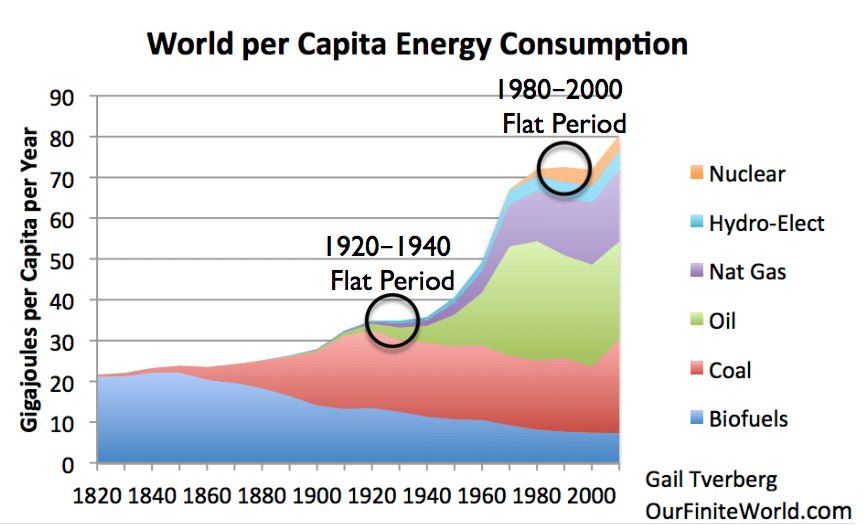
Figure 13. World per Capita Energy Consumption with two circles relating to flat consumption. World Energy Consumption by Source, based on Vaclav Smil estimates from Energy Transitions: History, Requirements and Prospects (Appendix) together with BP Statistical Data for 1965 and subsequent, divided by population estimates by Angus Maddison.
The flat period of 1920-1940 seems to have been caused by limits reached on coal production, particularly in the United Kingdom, but also elsewhere. World War I , the Great Depression of the 1930s, and World War II all took place around this time period. Charles Hall and Kent Klitgaard in Energy and the Wealth of Nations argue that resource shortages are frequently the underlying cause for wars, including World Wars I and II.
The Great Depression seems to have been a partial economic collapse, indirectly related to great wage disparity at that time. Farmers, in particular, had a difficult time earning adequate wages.
The major event that took place in the 1990 to 2000 period was the collapse of the Soviet Union in 1991. The central government collapsed, leaving the individual republics to operate independently. The Soviet Union also had strong trade relationships with a number of “satellite” countries, including Cuba, North Korea, and several Eastern European countries. In the next section, we will see that this collapse had a serious long-term impact on both the republics making up the Soviet Union and the satellite countries operating more independently.
[7] The example of the Soviet Union shows that collapses can and do happen in the real world. The effects can be long lasting, and can affect trade partners as well as republics making up the original organization.
In Figure 14, the flat period of the 1980-2000 period seems to be related to intentional efforts of the United States, Europe, and other developed countries to conserve oil, after the oil price spikes of the 1970s. For example, smaller, more fuel conserving vehicles were produced, and oil-based electricity generation was converted to other types of generation. Unfortunately, there was still a “backfire” effect related to the intentional cutback in oil consumption. Oil prices fell very low, for an extended period.
The Soviet Union was an oil exporter. The government of the Soviet Union collapsed in 1991, indirectly because with these low oil prices, the government could not support adequate new investment in oil and gas extraction. Businesses closed; people lost their jobs. None of the countries shown on the Figures 14 and 15 have as high energy consumption per capita in 2016 as they did back when the Soviet Union collapsed.

Figure 14. Per capita energy consumption for the Soviet Union and three of its satellite countries. Energy data from BP Statistical Review of World Energy, 2017. Population data from UN 2017 Population data and Middle Estimates.
The three satellite countries shown on Figure 14 (Bulgaria, Hungary, and Poland) seem to be almost as much affected as the republics that had been part of the Soviet Union (Figure 15). This suggests that loss of established trading patterns was very important in this collapse.

Figure 15. Per capita energy consumption for the three largest (by population) republics that made up the Soviet Union. Energy data from BP Statistical Review of World Energy, 2017. Population data from UN 2017 Population data and Middle Estimates.
Russia’s per capita energy consumption dropped 29% between peak and trough. It had significant fossil fuel resources, so when prices rose again, it was again able to invest in new oil fields.
Ukraine was a major industrial center. It was significantly impacted by the loss of oil and gas imports. It has never recovered.
The country that seemed to fare best was Uzbekistan. It had little industry before the collapse, so was less dependent on energy imports than most. Of all of the countries shown on Figures 14 and 15, Uzbekistan is the only one that did not lose population.
[8] Today, there seem to be many countries that are not far from collapse. Some of these countries are energy exporters; some are energy importers.
Many of us have read about the problems that Venezuela has been having recently. Ironically, Venezuela has the largest oil reserves in the world. Its problem is that at today’s prices, it cannot afford to develop those reserves. The Wikipedia article linked above is labeled 2014-2018 Venezuelan protests. Oil prices dropped to a level much lower than they had been in 2014. It should not be surprising that civil unrest and protests came at the same time.

Figure 16. Monthly average spot Brent oil prices, through December 2017, based on EIA data.
Other oil producers are struggling as well. Saudi Arabia has recently changed leaders, and it is in the process of trying to sell part of its oil company, Saudi Aramco, to investors. The new leader, Mohamed bin Salman, has been trying to get money from wealthy individuals within the country, using an approach that looks to outsiders like a shake-down. These things seem like very strange behaviors, suggesting that the country is experiencing serious financial difficulties. This is not surprising, given the low price of oil since 2014.
On the oil-importer side, Greece seems to frequently need support from the EU. The lower oil prices since 2014 have somewhat helped the country, but the basic shape of the energy consumption per capita chart makes it look like it is struggling to avoid collapse.

Figure 17. Greece energy per capita. Energy data from BP Statistical Review of World Energy, 2017; population estimates from UN 2017 Population data and Medium projections.
There are many other countries struggling with falling energy consumption per capita. Figure 18 shows a chart with four such countries.

Figure 18. Energy consumption per capita for Japan, UK, Italy, and Spain. Energy consumption from BP Statistical Review of World Energy; population from UN 2017 Population data and Medium Estimates.
In a sense, even though oil prices have been lower since 2014, prices haven’t been low enough to fix the economic problems these countries have been having.
China is in a different kind of situation that could also lead to its collapse. It built its economy on coal production and rapidly growing debt. Now its coal production is down, and it is difficult for imports and substitution of other fuels to completely compensate. If slowing growth in fuel consumption slows economic growth, debt will become much harder to repay. Major debt defaults could theoretically lead to collapse. If China were to collapse, it would seriously affect the rest of the world because of its extensive trading relationships.
[9] Leaders of countries with increasing wage disparity and unhappy electorates can be expected to make decisions that will move away from globalization.
Unhappy workers are likely to elect at least some leaders who recognize that globalization is at least a small part of their problems. This is what has happened in the US, with the election of President Trump.
The hope, of course, is that even though the rest of the world is becoming poorer and poorer (essentially because of inadequate growth of cheap-to-produce energy supplies), somehow a particular economy can “wall itself off” from this problem. President Donald Trump is trying to remake trading arrangements, based on this view. The UK Brexit vote was in a sense similar. These are the kinds of actions that can be expected to scale back globalization.
Conclusion
Having enough cheap energy for the world’s population has been a problem for a very long time. When there is enough cheap-to-produce energy to go around, the obvious choice is to co-operate. Thus the trend toward globalization makes sense. When there is not enough cheap-to-produce energy to go around, the obvious choice is to try reduce the effects of globalization and immigration. This is the major reason why globalization can’t last.
We now have problems with both coal and oil. With the decline in China’s coal supplies, we are reaching the point where there are no longer enough cheap energy supplies to go around. At first glance, it looks like there is enough, or perhaps even a superabundance. The problem is that no price works. Producers around the world need higher oil prices, to be compensated for their total cost, including the cost of extraction, developing new fields, and the tax levels governments of exporting countries need. Consumers around the world are already having trouble trying to afford $70 per barrel oil. This is what leads to gluts.
We have been told that adding wind and solar to the electric grid can solve our problems, but this solution is simply absurd. If the world is to go forward as before, it somehow needs a new very large, very cheap supply of energy, to offset our problems with both coal and oil. This new energy supply should not be polluting, either.
At this point, it is hard to see any solution to the energy problems that we are facing. The best we can try to do is “kick the can” down the road a little farther. Perhaps “globalization light” is the way to go.
We live in interesting times!


Economy to grow at 5.4% rate in first quarter, Atlanta Fed tracker shows
https://www.cnbc.com/2018/02/01/economy-to-grow-at-5-point-4-percent-rate-in-first-quarter-atlanta-fed-tracker-shows.html
I predicted this last month.I told one of my friends that Trump will have them BS the GDP numbers next year! LOL
https://imgur.com/a/BJcgo
If you give all the companies money in the way of a tax cut, I would expect there would be an increase in expenditures. I understand reduced withholding is going in very soon (Feb. 1?) for others as well. That gives another boost to spending. It is sort of like lots more debt, except the bonds to cover all the debt haven’t been sold yet.
The Big three have had declining car sales so far this year. And car sales make up 20 percent of GDP….This is total BS…The IMF, Federal Reserve, CBO office, Scholars at Michigan, The Economist, all projected 2.5 % growth. And now its 5.4 in the first quarter? What are the odds that all the experts missed by a mile or that Trump is having the government lie for political reasons?
I would expect the impact of the change to be more in February and March, than in January. I cannot imagine employers getting the reduction in tax withholding into citizens’ wages to take place as soon as January. It is not until people’s take-home pay is higher that they will start buying more goods, such as cars.
Also, I am not familiar with what “cars make up 20% of GDP” really means. I wonder if it is really “all vehicles, including their operating expenses,” that make up 20% of GDP. Admittedly, the sale of private passenger vehicles in one month goes into this amount, but so does the sale of commercial vehicles. Insurance costs, repair costs, and financing costs go on indefinitely.
I agree that it will be really difficult to get to 5.4%. The point, I suppose, is that the GDP in 2018 will be very much distorted by the new tax law. If interest rates start climbing quickly, that will create a downward push on the economy that Trump is likely overlooking.
https://www.usatoday.com/story/news/politics/2017/12/20/deficit-could-hit-1-trillion-2018-and-thats-before-full-impact-tax-cuts/969347001/
“Now budget experts outside government say the 2018 total could exceed $1 trillion because of series of bills being passed in quick succession, and decisions to scrap what were already weak limits on spending.”
The other side to possible GDP increases.
From that same article I linked:
“Those pay-as-you-go mandates can be waived by passing another law, and that is what Republican leaders in Congress are talking about doing. They mock Democrats’ complaints about the deficit as feigned, noting the deficit topped $1 trillion for several years when Democrat Barack Obama was president.”
It appears that if Obama deficits were so high, so can R deficits, but what happened to the Tea Partier’s? Where does the buck stop?
R + D = Same
Agreed. Question is how high the deficit can go.
The Tea partiers have been minimized by the Republican RINOS. They do have some power in that the RINOS need their votes. The Republican RINOS that run things are little different from Democrats when it comes to spending and “most” social programs. How do you think Obamacare passed? answer…with Republican RINO implicit support.
Why hasn’t a wall been built? The RINOS don’t want it.
Trump stated during his campaign that “we can always print money”. He is not afraid of running a deficit. Neither are the RINOS….they love deficits. They love to spend money we do not have.
You are probably right.
Really? To the last decimal point? http://msutoday.msu.edu/news/2017/msu-scholars-find-21-trillion-in-unauthorized-government-spending-defense-department-to-conduct/
“Subsequent to the publication of Dr. Skidmore’s report, the Office of the Inspector General at the Department of Defense (DOD) and the Department of Housing and Urban Development (HUD) took reports off line, consequently our primary links in the table below are to the same documents posted on our website. We have preserved the original DOD and HUD links in the footnotes – if they result in a 404 error or not found message, this indicates they were taken down or moved subsequent to publication. On October 5, 2017 we discovered that the link to the report “Army General Fund Adjustments Not Adequately Documented or Supported” had been disabled. Within a several days, the links to other OIG documents we identified in our search were also disabled. The sequential non-random nature of this disabling process suggests a purposeful decision on the part of OIG to make key documents unavailable to the public via the website, as opposed to website reorganization, etc. We also revisited the website intermittently to see whether the documents had been reposted under different URLs—until very recently they had not been reposted. On December 11, 2017, we learned that key documents had been reposted on the OIG website, but with different URLs. Documents now appear to be reposted on new URLs. As we find the new URLs we are adding them in the footnotes entitled “new link” next to the original link.”
I would be interested to see why actual funding seems to be trillions of dollars higher than budgeted funding.
One issue I see is the fact that entitlements are rolled into each years’ spending, even though they normally are not directly budgeted. In early years, the funds collected for entitlements (especially Social Security) were quite high, essentially because there were a lot of young wage earners, relative to the elderly population. Also, these young wage earners were earning fairly high wages. This overfunding was encouraged by actuaries, who believed that the funds could really be held in the system. In fact, the way it works is that they get spent. All that is held in the system in unmarketable debt. The extra funds tend to go to defense. I suppose HUD could get some too. But the amounts are not as high as $21 trillion, I don’t think.
It appears to cover defence and housing spending only. If I read the report correctly, the gist is that spending on Project A came from Project B, without any documentation to support it. Except that the errors, in at least one case, are three orders of magnitude greater than is occasionally found in balance sheets. And on one occasion the US Treasury transferred $800Bn to defence to balance the books.
My point was that when I read these figures, I do wonder whether China’s recorded GDP is more accurate than that of the USA. And people get excited about a 0.1% increase or decrease in quarterly GDP.
You are right. It is strange. In historical years, are funds from the Social Security overfunding being using to pump up GDP, for example?
And of course, now Social Security and other entitlements are going into a situation where they really need extra funding, rather than collecting excessive funds that can be put toward fighting wars that have not been budgeted for.
fortunately the technocracy will reshape our financial system and our population to embrace the end of easy oil if you believe like i do that the technocrats knew all along our collective predicament and prepared accordingly. There is a new financial system coming but first the old one has to die. I hope your preparations will see you through the tough times that are speedily approaching stock up on food and water small cash denominations and poor man’s gold (silver) ,stay calm and embrace your planned new life.
“… if you believe like i do…”
no, I don’t.
you are going to be severely disappointed on June 1st.
we shall see all my life ive been wrong about predictions from other people i believed in so if i’m wrong with this prediction a prediction that was soo hard to find then it will be on to the next prediction. But i’ll be honest with you, with this prediction it was like finding the proverbial needle in the haystack
Pingback: Nine Reasons Why Globalization Can’t Be Permanent | Achaques e Remoques
GM, Ford and Chrysler all missed sales estimates
http://www.atimes.com/article/auto-sales-miss-us/
The steeper the seneca cliff, the lesser the need for cars. It’s possible that the existing stock will be completely sufficient once decline really sets in… As in 0 need for new cars. Especially in the low end segment, as in the high end segment there seems to always be hunger for driving a new car.
Gail… what happens to the bike when it goes over the Seneca Cliff?
https://gailtheactuary.files.wordpress.com/2018/01/bicycle-analogy.jpg
It is hard to sleep on a broken bike. I think the rider looks for a junked car to sleep in.
L.A.’s homelessness surged 75% in six years. Here’s why the crisis has been decades in the making
http://www.latimes.com/local/lanow/la-me-homeless-how-we-got-here-20180201-story.html
From that linked article;
“People left behind by the economic recovery can’t compete with young professionals who have bid rents up to record levels. In another era, they might have found refuge in crumbling hotels and tenements. But many of those buildings were lost in the city’s post-recession spree of building, evictions and renovations.”
One has to wonder how many people will be added to the homeless stats during the next deep recession, keeping in mind how many people have borrowed to stay afloat and how many are now living paycheck to paycheck.
Certainly, someone living here who could 15 years ago have rented a whole house,(and sub-let a room to help with that rent) can now only rent a room in a shared house.
Any further decline in relative purchasing power would either see them on the street, or without any discretionary spending power.
The universal decline in the spending power of the mass, the majority, of ordinary consumers, is the single most important economic fact post-2000.
Before then, life was mostly quite liveable.
Once people start needing to live in cars or on the street, we have a major problem. Even before then, because demand for houses will start to drop, and prices will then drop. This will cause debt defaults.
There is one very simple principle that rarely fails – Subsidize something if you want more, tax it if you want less. It looks like LA has subsidized homelessness and has gotten the predictable “more”.
Another option would be to hand out Big Macs to the street people with a special sauce containing Fenatyl…..
US shale oil and the Seneca effect
What this all means is that the decline in production, whenever it comes, will not follow a symmetrical bell curve shape; because, in a sense we will have brought forward oil from the back side of the curve in our attempt to keep production growing. Instead, we can expect to fall over the edge of a Seneca cliff in which production falls suddenly, with potentially catastrophic consequences for economies still dependent upon fossil fuels.
http://consciousnessofsheep.co.uk/2018/02/01/us-shale-oil-and-the-seneca-effect/
“… will not follow a symmetrical bell curve shape…”
of course it won’t…
but I wouldn’t expect it to “fall over the edge of a Seneca cliff” either…
that is also a smooth uniform shape…
the real “shape” likely will be bumpy and erratic.
I just noticed a new Bitcoin graph…
looks like Bitcoin is rolling down a Seneca cliff…
b w a h a h a h a h a.
It will if the financial system collapses.
For Atlanta watchers. More of what can’t work, i would think.
https://atlanta.curbed.com/2018/1/30/16945328/marta-transit-oriented-developments-status-check
Thanks! I don’t live in the city of Atlanta, so I am not all that familiar with the particular developments. Jobs are scattered very widely over the Atlanta metropolitan area. MARTA covers only a very small portion of it. I expect the area MARTA covers is maybe 10% or 15% of the Atlanta metropolitan area.
These new developments seem to be connected by rail to the Five Points area in downtown Atlanta. One of my sons works at Five Points. (Lots of pan handlers there!) He takes an express bus twice a day. This is the only kind of transit available to the city from our suburb. He works in the building with the State of Georgia workers. (He is a subcontractor, not an employee). Marta does run quite a long distance North, but we don’t live North. I suppose if our son wanted to live in the city, this might be an option. But with a contract job, there is a question whether he would want to sign a lease for at least a year, when his contract will run out this summer.
I haven’t looked at the economics of these developments.
+++++++++++++
It’s relatively advanced when you can get to work by bus at all. There’s a free shuttle in my county (part of a regional shuttle service shared by northern NM and southern CO), but it arrives here at 11:30, long after commuters have gone to work. So they’re often near empty. They drop you off in the city at a mall where you can switch to a city bus to get to the city destination. But if you’re old or feeling poorly, you don’t want the hassle of asking all the drivers if they’re going your way. Somebody to advise you as you get off the shuttle would help. That person could be what I call a “synapse connector.”
The shuttle drops you off in the city at a somewhat sleepy mall that has no supermarket. Folks coming in from the county village with no major food supply are often heading for the supermarket. There is a supermarket across a very busy, fast, wide street from the mall, and even a young person is living dangerously trying to cross it on foot. A synapse connector could take you in another shuttle to that supermarket across the street and return you for your shuttle when ready. The trouble is that the next shuttle back to the county leaves at 4:15, four hours after you got to the mall. But fixing that with small (maybe station wagon size) shuttles that operated at slightly better times with slightly better frequency doesn’t seem like too high of an expectation.
Gail- this FoxNews style battering of a long established field of natural science is giving your site a bad name. A lot of folks come here and see this Leonardo and Al Gore drivel – and they say what a bunch of morons at OFW.
The long establish field of climate study was looking at natural cycles including sunspot cycles and Milankovitch cycles before it was subverted by political agendas. And that analysis is far more accurate, though even still it misses the overall dynamic of the climate as a complex system.
While Eddy can be obnoxious and rub people the wrong way, the credulity about the reductionist, simplified notion of CO2 as the “thermostat” for the earth’s climate is just as annoying, particularly because anyone who questions it is labeled somehow a partisan shill or a moron etc. since it is a “low status” belief to question the received dogma from the Institution.
The climate is a dissipative structure that has complexity and stability created by energy flux through the system, just as the economy is and as Gail does a great job of describing and illustrating. Just like the economy, the climate receives its energy input from the sun. CO2 and its effect on the greenhouse effect are just one tiny part of a giant interconnected complex system that dissipates solar energy creating a somewhat (though varyingly) stable climate which allows life to exist on earth. The sun’s Total Solar Irradiance (TSI) varies cyclically, though there are several overlapping cycles (~11 year sunspot cycle, ~400 year Milankovitch cycles, and others such as the 500 year one the Chinese scientists just discovered). When the sun’s TSI is increasing, the system remains stable. When the the TSI is decreasing (like now), the system is less stable as it loses some complexity and things like the stable course of the jet stream are disrupted.
Does CO2 concentration affect this system? Of course it does. But it is a minor factor and there is zero evidence for the notion that it has an overall positive feedback effect that will lead to runaway warming and apocalypse. This idea is just religious eschatology from the Scientific Institutions.
Your understanding is pretty consistent with what I have learned over the years.
Also, we have discovered in other fields (for example, Economics, Predicted benefit of Wind and Solar) that there is an awfully lot of incorrect analysis of the situation. Models predicting the future are especially difficult to do correctly. It is hard to believe that the situation would be much different with climate change.
This is made much worse by a system where professors need to get grants, and the grants are heavily skewed in the direction of “proving climate change” and “finding solutions to climate change.” People who had hoped to work in other areas find that funding analysis determines what types of research they want to do. I doubt that there is much funding for looking at the self-organizing features of the biosphere, for example.
It is hard to get reasonable discussion of the situation.
‘It is hard to get reasonable discussion of the situation’
It is….. and that is because there are so many MORE ons who are oblivious to facts and logic
A physics PhD friend has lived it.
His director wanted a result A,and the experiment showed B.
My friend concluded B and never worked in scientific research again. And it was not his will.
Either way, CO2 is rising rapidly and the global sea ice volume is the 2nd lowest in the last 40 years of satellite data. Even if you took just that data and compared it amongst itself, it is very clear that oceans are warming and ice shelves appear to be collapsing. And it is disturbingly large collapses on ice volume. I’m talking 20% drops over that 40 years of data.
While it’s probably true that economic collapse will do us in first, it is clear that the planet is undergoing somewhat extreme changes in precipitation and heat and cold records. Arguing about what’s causing it is a complete waste of time as we can’t do anything about it anyways. But denying it’s happening would be willful ignorance.
Seas are rising? Someone tell Leo!!!
https://static01.nyt.com/images/2015/04/05/realestate/20150405COVER-slide-LZ8O/20150405COVER-slide-LZ8O-videoSixteenByNine1050-v2.jpg
I keep calling his mobile but he doesn’t pick up ….
Come on Leo …. pick up … pick up…..
I need to warn you before you get any deeper into this boondoggle…. your multi-million dollar investment is going to be underwater within a few years… all that money wasted!!!
I can’t believe Al didn’t tell you about this…. isn’t he your buddy? You guys talk right?
Why wouldn’t Al warn you off this? Maybe he is NOT your friend after all… maybe he wants to see you fail… maybe he is envious because you get all the hot models and he gets ketchup….
Who knows…. but Fast Eddy is YOUR friend Leo — he wants to help you….
But you must pick up the phone if you want to be helped….
https://i.pinimg.com/originals/43/32/15/433215ed7d745b28634ea4bcd520615a.jpg
you are crazy !
i like this
I said CO2 is rapidly rising and global sea ice area is massively dropping. I didn’t say anything about sea levels. Your reading comprehension is on par with my black lab. He eats rocks by the way.
Hmmm….. I can imagine your dog would not be able to calculate 1+1…. but surely you can?
Record melting ice …. surely = rising sea levels?
At least that’s what Al Gore said in Inconvenient Truth — his EXPERTS said 7m by the early 2020’s…
Anyone want to bet that is not going to come true? I bet my life on it. I will hang myself from a tall tree if it happens – anyone want to take that bet?
If you took the time to actually look into Antarctica’s situation, or Greenland, or the Arctic, you’d see that most of what has melted thus far has been sea ice. Sea ice doesn’t add to overall ocean levels, however it is holding back all the land glaciers. And when those plop into the ocean, sea level will rise, dozens of feet. And those glaciers are receding fast. Weather CO2 has anything to do with it doesn’t matter. It’s happening. Sea level hasn’t risen substantially, yet.
Sea ice doesn’t add to overall ocean levels, however it is holding back all the land glaciers. And when those plop into the ocean, sea level will rise, dozens of feet.
This is just so wrong that it isn’t really worth trying to refute. So I’ll ask you a question instead. All the sea ice around Greenland and most of the sea ice around Antarctica melts in the summertime, so why don’t all the land glaciers simply plop into the ocean each summer?
Let me give you a tiny clue. It has something to do with the very low year-round temp-er-atures in the places where the vast bulk of those glaciers are and something to do with glaciers being composed of ice at such temp-era-tures and something to do with ice not being able to plop very much at such temp-era-tures due to the constraints of friction so that they are replenished by fresh snow at the top as fast as they plop at the bottom.
https://sites.google.com/site/arctischepinguin/home/global-sea-ice
That link doesn’t even begin to answer my question Tango.
I’ll take it as a nod that if you took the time to actually look into Antarctica’s situation, or Greenland, or the Arctic, you’d see that the great bulk the glacial mass is in locations well above sea level and well below the surface, where temp-eratures never rise much above -20, -30, -40 or even -50 degrees C—even though there are occasional gusts of warmer wind at the surface— and that such temp-eratures glaciers do not plop very much at those temps as the surface heat doesn’t penetrate tens or hundreds or thousands of meters below the surface.
Polar glaciers flow due to a combination of melting from below (geothermal heat) and the weight of fresh snow piled on top of them. Unless they are literally parked on an ice shelf, as the tips of some glaciers are, they won’t be affected at all by sea level rise.
Also, you seem to be implying that there’s already been a massive loss of polar ice and you claim that a massive loss of polar ice melts massive amounts of glacier ice and this leads to a massive rise in sea level—so where’s the massive rise in sea level?
This is all very basic and you are too intelligent not to get it. So what is making you cling with such religious zeal to these fantasies of polar meltdown? Were you a liberal arts graduate? I only ask as your imaginative use of exaggerated adjectives and adverbs to invoke an emotional response in the reader has all the hallmarks of an aspiring Stephen King who majored in creative literature.
One BTU is the amount of heat required to raise one pound of water one degree F. If you have a ton of ice at 32 degrees and you add 286,000 BTUs you will have a ton of water at 32 degrees. The 286,000 BTUs is now “stored” as latent heat in the ton of water. The energy density of the water has increased but there is no temperature rise. An article from NASA states that the Earth lost 4.3 trillion tons of ice from 2003 to 2010. Note that the article said that the Earth “lost” 4.3 trillion tons of ice. It doesn’t say that 4.3 trillion tons of ice melted. That much ice “melting” in seven years would require a heat input equal to burning 19.3 million tons of coal per day. Which is equivalent to about a thousand train loads of coal a day.
The truth of the situation was revealed recently when it was reported that the ice actually sunk to the bottom of the ocean. Normal healthy ice floats of course. What they discovered is that the ice is infected with a virus that introduces matter into the matrix of the ice crystal. That increases it’s density to a point grater than water and it sinks. Leo’s island is possibly going under but not from ice melting. There are several pharmaceutical companies currently developing a vaccine that will have to be inoculated into all the fish and marine mammals as they are the agents that spread the infection. This is all hush hush as it looks to be a big money maker. Leo may have some inside information on this vaccine that will stop this sea level rise “catastrophe” from taking his resort.
This report was in the Journal ASS (American Satirical Society).
Two thumbs up for using the word Martrix in your explanation.
This report was in the Journal ASS (American Satirical Society).
I think you are pulling our leg with respect to the virus making ice sink.
Leo is an insider….
“When the sun’s TSI is increasing, the system remains stable. When the the TSI is decreasing (like now), the system is less stable as it loses some complexity and things like the stable course of the jet stream are disrupted.”
This argument seems to contradict what you previously stated. You seem to be suggesting that a “complex system” like the climate is overwhelmingly influenced by a single, binary factor i.e. TSI. Besides TSI is moot since it is pretty well established that correlation between the sun and climate has been breaking down since the 70s.
No, that is how dissipative structures work: the complexity arises in the presence of increasing energy flux through the system. Unless you are suggesting that there is another major source of energy into the system, then your point is nonsensical.
I wasn’t talking about the sun as energy input. My point was that you were contradicting yourself by proposing a simplistic model of the sun’s effect on c-limate while disparaging the (strawmanned) model of C-O2’s effect as simplistic.
There is more going on that the suns TSI. Magnetic fields are changing, in fact there is evidence the sun is acting differently. There is much we do not understand about the sun. The type and quantity of charged particles that are thrown off by the sun is changed during the sun-spotless periods of spot minima. These charged particles have much to do with cloud formation. The geo-magnetic field the earth moves through which is heavily influenced by the sun affect earthquakes and volcanism. All of these factors can significantly affect the climate…indeed can offer explanations to the variability we are seeing today. Southern Morocco was just subjected to a heavy snowstorm, unheard of in 50 yrs.
Flooding in Paris that is currently happening has happened before. , has happened before.
From https://www.iceagenow.info/france-worst-rains-50-years-reminder-little-ice-age-floods/#more-24420
“Floodwaters along the rain-engorged Seine River are threatening towns downstream from Paris, said an article today from the AP.
The national weather service said that “January has seen nearly double normal rainfall nationwide, and that the rains in the past two months are the highest measured for the period in 50 years.
The article then went on to warn (of course) that France’s heaviest rains in 50 years have “raised concerns about climate change.”
Those floods raise my concerns, too. But not because of so-called “climate change.” Instead, they remind me of the Little Ice Age floods that wiped out the bridge in Avignon.
I visited the Pont d’Avignon a couple of years ago. Also known as the Pont Saint-Bénézet, the Pont d’Avignon is a famous medieval bridge in the town of Avignon, in southern France.
The bridge, built between 1177 and 1185, spanned the Rhône River between Avignon and Villeneuve-lès-Avignon. It boasted an original length of some 900 meters (980 yards) (More than half-a-mile.)
Unfortunately, Little-Ice-Age floods destroyed it.
According to a placard at the bridge, “In the 15th century, climate change occurred. (Yep, the placard actually used those words, ‘climate change.’)
“Europe entered the little ice age,” the words on the placard continued, “which significantly changed the hydrological conditions of the Rhône catchment area…”
Then, beginning in the early 1600s the arches were “regularly swept away” by flooding.
Finally a catastrophic flood in 1669 swept away much of the structure, says Wikipedia. Only four of the initial 22 arches remain, and the bridge has not been used after the 17th century.”
Yes, our climate is indeed changing and becoming more variable right now. It always changes. But we have historical evidence and records to tell us that a LIttle ice age may occur due to …drum roll….”THE SUN”.
Open your mind.
The sun plays a huge part in all of this … and as we can see from this example… the moon can throw around its weight too….
The West coast of NZ was hammered the other day
https://www.stuff.co.nz/national/101106341/sh6-smashed-up-as-concrete-thrown-across-the-road-in-punakaiki
Sea side homes were gutted….
Our place was untouched… because mother nature knows NOT to F789 with The World Champion (seriously….)
The cause was a perfect storm of the pull of a full moon – a king tide — and 150km winds….
Sh it happens.
https://resources.stuff.co.nz/content/dam/images/1/o/7/c/6/h/image.related.StuffLandscapeSixteenByNine.620×349.1o725h.png/1517553032387.jpg
Interesting remarks! Some books you would recommend us to read – also for us who are not very good educated in physics?
I’d recommend Dark Winter by John Casey, former NASA scientist.
Thanks!
I have to agree that the comment section is really starting to produce a lot of drivel. Perhaps a ban on CC talk would help as there is too much disagreement that leads to straight up puerile behaviour. I have sent people here to look at the site and after reading the comments section they laugh at your blog saying that it is a fringe lunatic gathering (mostly FE’s rants and rudeness).
That is a pity as they then dismiss your great content Gail.
While puerile behavior can be exasperating, banning CC talk only works if there is strict moderation, which is time consuming and causes as many problems as it solves. I for one wouldn’t be able to live with my conscience if I urged Gail to take on the responsibilities of supervising the antics of the junior high school kids that play hooky in these parts.
It really doesn’t matter if people come to this site and dismiss what Gail has to say for any reason related to what they see in the comments, because such people are only coming in order to find a reason for dismissing what Gail has to say, and any reason will do for them.
The only thing people need to do in order to assess Gail’s ideas is read what Gail writes and then do their own thinking and research. She could have her column housed on the Mad Magazine website or the University of Chicago website. She could be embraced by Oprah, The Wall Street Journal or Alex Jones and it wouldn’t make a damn of difference as long as she was speaking in her own words.
When people come here advocating censorship of views or modes of expression they don’t feel comfortable with, I’m like……
https://i.imgflip.com/12mkin.jpg
There are other ways to censor DelusiSTANIS…..
Sore loser.
Not taking FE’s side, but people who cannot transcend that sort of guilt/error by association mentality are probably better off not knowing much about collapse. I mean just look at FE!
I think people come to this blog to hear logic and rationality that FE presents. You and ilk like you such as Sungr, are social fascists who do not want what he says published. You always go to censorship because your religious belief system in liberal social causes and GW cannot be supported by facts and logic.
If Gail wants to limit posters who degrade the conversation, she would limit you for referring to others as having “puerile behaviour” and other GW adherents who regularly utilize derogatory statements about “deniers” and therefore “produce a lot of drivel”
Gail’s blog is about facts and our misinterpretation of them. She presents alternate, explanations.
If you don’t want the blog degraded, quit posting GW garbage that is not supported by scientific, statistical fact. GW has never been scientific. Quit labeling those who disagree with you with derogatory terms. GW has been a theory, badly modeled, badly supported by statistical fact and therefore utilizing political force to “make the science settled”.
I am afraid I have to agree with you. GW has been badly modeled to date. Calling people deniers is of no help. I have better things to do with my time than to moderate endless arguments about the issue. A major thing that needs to “go away” is anything that labels disagreement with the standard narrate as wrong.
Let’s think of the GGGWWW discussions as amusing distractions from talk of imminent Apocalypse….
https://78.media.tumblr.com/e9a51d3fba64881ac6ba408ad4130f2b/tumblr_mj417nh6J01qbxi45o1_500.gif
http://pngimg.com/uploads/exclamation_mark/exclamation_mark_PNG20.png
http://pngimg.com/uploads/exclamation_mark/exclamation_mark_PNG20.png
http://pngimg.com/uploads/exclamation_mark/exclamation_mark_PNG20.png
I need to stand way back .. to admire my work on that one….. truly epic
Fantastic!
And those are EXACTLY the type of people we do not want here. So hopefully they take a look at my Leo photo…. and they think who is that as s hol e posting this propaganda…
And they go crawl back under the peak prosperity rock
DelusiSTANIS hate truth. It’s like kryptonite to them
It’s alright I am not leaving.
DANGER AHEAD FOR U.S. GOVT: Unable To Service Debt As Interest Rates Surge
https://srsroccoreport.com/danger-ahead-u-s-govt-unable-service-debt-interest-rates-surge/
Unfortunately, when interest rates move back toward a more normal rate of 5%, the U.S. Government will have to fork out $1 trillion-plus a year, just to service its total debt.
so that’s a good reason to lower them again to near zero in the years ahead.
Humans…. extinction …. good!
In interviews, many attendees made a similar observation: Bitcoin’s creators set out after the 2008 financial crisis to replace a system they deemed corrupt. They built a new one with nobody in charge. Yet as more enthusiasts pour in, the scene has begun to mimic Wall Street’s worst behavior.
https://www.bloomberg.com/news/articles/2018-02-01/a-bitcoin-conference-rented-a-miami-strip-club-regrets-ensued
Nearly 43,000 apply for 7,000 Sacramento’s subsidized housing waiting list
http://www.sacbee.com/news/local/article197728399.html
The four big supermarket chains in the UK are all cutting staff levels as they come under intense pressure from the German discount chains, Aldi and Lidl. Marks and Spencer the mainstay of the British high street yesterday announced they are closing more stores across the country too.
It certainly looks like a race to the bottom in the grocery sector in the UK today.
https://www.theguardian.com/business/2018/feb/01/morrisons-to-cut-1500-management-roles#comment-111632239
If the customers are poor, and the farmers are often not getting high enough revenue for their work, I suppose changing to bare banes supermarkets is the thing that can be done to bring costs down even lower for the customers. The downward trend isn’t sustainable, though. Too many pieces are likely to go broke.
It all began in the wake of the 2008 financial crisis. Suddenly Aldi and Lidl went from being poverty stricken rubbish to keenly priced, reasonable quality produce that any sensible, thrifty middleclass family would be silly to ignore. There were Mercedes and Range Rovers in the Aldi carpark!
The fact is the quality of produce in those stores is generally not bad and an average shop can be as much as 30% cheaper, thanks to an ultra efficient business model that eschews choice, cutting the number of products the store holds drastically. Of course Aldi and Lidl have noticed this change in perception and have started targeting their new customer base, offering cut price lobster and such.
The big four, Tesco, Sainsbury, Morrison and Asda have been left floundering somewhat.
“Range Rovers in the Aldi carpark!”
I noticed a new (2015+) Range Rover parked outside of T.J. Maxx (a discount retailer in the US) the other day with amusement. There were also a few late model Mercedes.
As long as cut-price lobster is still available in the supermarket, BAU is alive and kicking.
U.S. Construction Spending Rose in 2017 by Least in Six Years
https://finance.yahoo.com/news/u-construction-spending-rose-2017-150002789.html?utm_content=buffer8b23e&utm_medium=social&utm_source=twitter.com&utm_campaign=buffer
Pingback: Nine Reasons Why Globalization Can’t Be Permanent – Olduvai.ca
The new records in debt of the Slovak individuals and households (in Slovak)
https://finweb.hnonline.sk/ekonomika/1684759-zivot-slovakov-na-dlh-pokoril-novy-rekord
surely bring the prices of the housing down (in Slovak):
https://ekonomika.sme.sk/c/20751127/slovaci-si-nemohli-dovolit-drahe-byvanie-byty-a-domy-pozvolne-zlacnuju.html?ref=trz
If prices drop very much, owners of homes will have trouble when they want to sell their homes. They will have very little equity left over to buy a new home. Or in the worst case, they will owe more than the home is worth.
Many people prefer cheap plots on the perifery for their new homes due to their tight budgets based on mortgages and low wages. With the continuing ageing population and the depopulation, the value of these homes will quickly be zero.
Thus, it will be more and more common that the new homes must be sold under the costs of their construction. The trend towards smaller and smaller houses further exacerbates the possibility of selling bigger houses built thanks to the cheap construction materials, as energy and labor costs go up…
Bigger houses need to be subdivided into smaller units. Condominium style?
I am affraid that there is not much people who understand that bigger houses should be subdivided. There is a lot of individualism now, resulting from the implosion of the population. You have to know what is going on regarding the energy and the ageing of the population to be able to accept the community style of living. Moreover, the people feel like others are exploiting them, they are exhausted from the interpersonal interactions. That is one of the reasons they are prone to get mortgages for their own home that secure them individual living, altough this does not solve nothing. You have to be kind of relegious, believe exactly in the comming of the end of the world to be able to live in such a community. I know people who can handle such living together, but they are mostly religious or rejecting the pseudoreality created by the religion of progress portrayed by the media etc. The green, eco, self-sustaining communities are surely not the ones: e.g. I know a man, who comes from a family where his father works in the information technology. The man became alienated from his father, went into such eco-community, then he left it and studied catholic theology and ethics at the university. There he met an atheist girl and they concieved a child. Then he married her. Not long after that he divorced and went to work in Ireland. There he discovered that he is a homosexual. Now he works there in the area of information technology. Did he get it? No…
Moreover, the energy prices force the people to use the new heat insulating materials for house construction and the ergonomy of the living space is more and more important, so the old houses are simply irreparable.
I expect that the situation is more that young people without good job opportunities will move back in with their parents, perhaps in their basements. Young mother’s without husbands will likely do the same. Parents who are getting older will choose to live with one of their children, rather than having a home of their own or paying for a separate “place.” They can better do childcare as well.
There are other arrangements as well. I know my daughter lived in an apartment for a while in a “rent by the bedroom” arrangement. They had a big living room that a person could reserve, using the chalk board in the kitchen. The chalk board also kept track of cleaning assignments. Storage in the kitchen was assigned by the shelf. When a room became available, they would advertise and interview various candidates. I understand that a lot of new apartments are being built with this arrangement as well. There was a zoning request (which was denied) for a large building of this type in my neighborhood.
If money is tight, two divorcees, each with a child or two, may decide to share a home. Or older people may decide to get together to rent an apartment, rather than live alone.
I am not sure that the outcome will be by actually physically changing the layout of these homes. The most likely way of making multiple units would seem to be by renting out the basement separately, or by renting out an unused bedroom.
I have also mentioned student groups and substance abuse rehab groups using homes in my neighborhood to house groups of individuals.
I am all for inviting some attractive female Millennials to live in our garage…. I would even build dormitory style bunks to create space for a dozen or so…..
M Fast does not support the idea…. she keeps accusing me of cloaking my harem initiative in some sort of twisted ‘do good’ story….
Yes, I agree with the options regarding the living arrangements of today in older bigger houses. But when we have these bungallows that are being built now using mortgages, there is not much additional space available, no basement. Some of them have crazy big windows, are built away from centers with shops and services…
This is very different in Germany. Normaly you are not in debt, once you are getting near retirement. People don’t want to sell their house, they just keep it, until they die. The kids then sell it ore use it. Price doesn’t matter, because, no debt! And still, you can always rent an appartment in town.
When you are working on low wages, you can ask an aid for paying the appartment.
As Germany is switching off its nuclear and using more brown coal, the situation will deteriorate faster.
“People don’t want to sell their house, they just keep it, until they die. ” – maybe there are no real buyers for the price required by the owners, or the house is simply unsaleable…
No, people want to stay there! Really. Where should they go?
What do you mean by “he situation will deteriorate faster”? Which situation? Germany is actually switching to gas and keeping lignite at the same level.
Germany has a big problem with not enough suitable workforce, as more and more countries around the world will have, too.
Natural gas is too costly.
Some time ago, before 2008, Germans liked to emigrate to the USA. Now, there is not much to choose from.
The difference is that in countries like Germany there is a state pension fund, whereas in the US and some other countries the value of the house is usually considered as part of the lump sum for retirement as it is sold off and the elderly move to some smaller accommodation.
Why do you think gas is to expensive? It comes in big pipelines from Russia, the power plants are new and effective. Resulting prices for electricity are not higher than with coal (not lignite).
Germans emigrated to the USA for good job opportunities. In universities and real big companies. They used to come back, once retired.
Germany’s problems are going to be:
A. too many migrants who are living off the state dole
B. an aging population that is less productive and also expecting state largess
C. markets for their relatively expensive products no longer growing and in fact starting to shrink
D. Ethnic conflict when the economy starts shrinking and the living standards start going downward.
Djerek,
Exactly. Not only in Germany.
Do you have data for C)?
The other points I must agree, we will see how it turns out.
“Do you have data for C)?”
Well, the softening market for autos comes to mind: https://www.reuters.com/article/uk-europe-autos/eu-car-sales-seen-slowing-in-2018-with-brexit-risk-acea-idUSKBN1FK2AE
Beyond that, there’s just the general fact that worldwide economic growth is pretty much dead at this point as Gail has well illustrated.
“The other points I must agree, we will see how it turns out.”
Viel Glück
Daimler and VW sold more cars then ever. UK is just a small part of the market, and is was just the last year.
I like the idea of worldwide slowdown, but I still can’t see it coming 🙂
Worldwide population is still rising, they all want to eat, to live somewhere, to have some fun. For me, environmental problems (drinking water) are far more threatening than economic slowdown.
China is the largest auto market in the world. Its increase in private passenger auto sales was only 1.4% for the year 2017 https://www.marklines.com/en/statistics/flash_sales/salesfig_china_2017, with November and December below this average. https://marketrealist.com/2018/01/analyzing-chinas-vehicle-sales-in-december-2017 Total vehicle sales were up 3.0%, because of a larger increase in commercial vehicles.
It seems that London after Brexit is going to be on the perifery of the continuing population decline:
“Uncertainty about U.K. immigration policy once the country leaves the European Union is hurting London’s prospects for attracting corporate investment, according to Jaap Tonckens, chief financial officer at Unibail-Rodamco SE, Europe’s biggest listed landlord.
For companies now deciding about where to invest in Europe, the cities of Paris, Frankfurt and Amsterdam have been “more appealing places” than London, Tonckens said in a conference call on Wednesday.
“Not because they don’t like London, but because they don’t know what the immigration policy is going to be,” Tonckens said. “There’s more stability in continental Europe.””
https://www.bloomberg.com/news/articles/2018-01-31/brexit-immigration-uncertainty-hurting-london-unibail-cfo-says
If we believe UN 2017 population estimates, there is a huge difference in population growth among countries. A big part of the different seems to be immigration. Without immigrants, population in many countries seems to decline. I checked some US figures, and even its birth rate is well below replacement level. So “developed” countries seem to need some immigration, if they are to have some reasonable number of young people to staff positions and to pay taxes to support the elderly.
“I checked some US figures, and even its birth rate is well below replacement level.”
Yet we are all suppose to pretend that ‘trickle down’ works, and the latest tax code changes to benefit the ‘job creators’ is best for America, yet at the same time the very people in power pushing that agenda bemoan and want to put up roadblocks to immigration. So although people are squeezed into ever tighter or budgets requiring borrowing to stay afloat, they are somehow suppose to overcome these directives to have big families? Trump said in his state of the union address that there has never been a better time to pursue the American dream. Never a better time? How about 1970.
But none of that really surprises me because it seems to be very human to pursue conflicting goals. Even Hollywood with the movie, Blade Runner 2049 plays it both ways with their star Gosling, first portraying him as a replicant to then convincing the viewer he’s a human, then switching to replicant, then back to human and finally at the end of the movie, a replicant that dies on his back on snowy cold stone stairs. Who decides that’s a good place? Oh, I guess that’s how a replicant dies – that makes sense, just like gaming the system for the super rich while expecting ‘The People’ to procreate so immigrations is not needed.
The most extreme example is Italy.
The Italian birth rate is now below 1.3 per woman, quite something in a supposedly good catholic country! Some small Italian towns are begging for people to,go and live in them, offering substantial incentives.
Immigration I imagine is quite high though, certainly a lot of boats from North Africa keep turning up. How many remain in Italy once they get there instead of heading off to the wealthy North I don’t know.
Estimates are often wrong. All of a sudden we have 2 Millionen of people “to much” in Germany. This creates a housing and education crisis. It gives us kind of “economic boom”, with all the construction work which has to be done, and all the social workers who try to include the immigrants. Its very weird.
The UK is still attracting in the region of a quarter of a million net migrants annually, mostly from beyond the EU. The Tory government says it has an ambition to lower the rate to a five figure number but after eight years in power it has never got close to this target. Since the leave vote there has been a fall in migration from the EU to the UK. I expect the government will continue to talk about its ambition while the immigration rate remains relatively unchanged.
This story looks like another of the continuing feed of alarmist stories emanating from the financial sector about the poor prospects for the City of London if the UK doesn’t remain in a member of the single market.
I know some people in the UK, and they didn’t want the Germans in charge of what the UK does, which they are, under the European Union. They don’t care if things are a bit worse, because knowing the UK is independent again is more important to them. At least that was one family’s opinion in York.
My parents felt the same way, they also live in Yorkshire. I think I’m right in saying that Yorkshire recorded the strongest leave vote in the country.
Generally the north was higher, if I recall correctly.
The people of the UK would not care whether or not Germans were in charge of them if they felt they were being governed in their own interests. It is the fact they feel that their own culture is being destroyed by mass immigration that made them vote to leave the European Union.
Even twenty years ago in York you could walk around the center of the city all afternoon and not see a non-white face. Not so now. The speed of the transformation is alarming and people do not like to feel they are being invaded/replaced.
I was talking to a native of York who attends Birmingham University this week. (For those who don’t know, Birmingham is the UK’s second largest city.) She told me to not let my daughter attend University in Birmingham. She said she cannot walk down the main street of Birmingham without a dozen men of a certain religious persuasion making lewd comments to her. (She was pretty hot.) She has been the victim of attempted abduction too. It’s only a matter of time before this happens everywhere. Except that collapse will almost certainly put a stop to it. Every cloud and all that.
Spot on about Britain, Yorchichan. It was a visiting Kurdish friend who said to me, after a trip to London, ‘It’s frightening, you are losing your country!’
Very fond memories of York in the old days by the way – know those medieval walls very well!
We ought to have built those walls up to keep the foreigners out – especially my wife 😉
Overheard in India in Amritsar in 1919…. ‘who are all these white men opening fire on us with machine guns… we need to close our borders’
The UKs navy has shrunk from 861,000 in 1945 to 29,280 in 2017. They even had to send a mine-hunting ship to intercept three Russian ships in the channel instead of a frigate. It is amazing how far they have fallen. In ten yrs they may not field a navy at all.
https://www.zerohedge.com/news/2018-01-31/visualizing-uks-shrinking-navy
Like the Dutch in the 18th century – fast vanishing away……
If the Tory government (or any other UK government) wanted to stop immigration to the UK, they could stop it pretty much overnight. Therefore the fact that net migration is a quarter of a million annually means the Tory government are lying when they say they want to lower immigration.
Ditto for governments of other countries.
They need immigrants for maintaining consumption, (even if on welfare in whole or part, they still consume) more than anything else: it is a policy that cannot be openly avowed for obvious reasons.
Hong Kong freezes as mercury dips below zero on high ground
The first day of February has been the coldest so far this winter in Hong Kong, with the mercury dipping to just 6.8 degrees Celsius (44 Fahrenheit) on Thursday morning, surpassing the Observatory’s forecast of 7 degrees.
A cold weather warning has been in force since Sunday – when the minimum temperature dropped below 12 degrees.
The cold drove many elderly residents to seek shelter at government centres. On Wednesday night 667 people checked in to 17 temporary locations operated by the Home Affairs Department. In the previous three nights that number was 524, 660 and 593.
A personal emergency link service provided by the Senior Citizen Home Safety Association received 1,942 calls on Wednesday. Some 120 of those seeking help – most for pain or after a fall – were sent to hospital.
The persistent cold spell may lead to more people falling sick amid the city’s winter flu season, which hospitals have been struggling to cope with since early January.
New Zealand Heatwave Sparks Health Alerts and Scramble for Fans
Jan 30, 2018
A week-long heatwave has floored New Zealand, breaking temperature records across the country and causing a nationwide shortage of fans.
Temperatures have soared above 37C (98.6F) in parts of the South Island, with records broken in Dunedin, Wanaka, Christchurch and many other cities and towns.
Temperatures are expected to peak on Tuesday or Wednesday around the high 30s or 40C mark – highs that are proving particularly challenging for school children as many New Zealand classrooms are equipped with heaters but not air conditioners.
Ben Noll, a meteorologist from the National Institute of Water and Atmospheric Research (Niwa), said unusually warm sea temperatures were the major factor contributing to the heatwave, as the mainland experienced a dramatic rise in land temperatures as soon as the sea rose above average. Niwa has recorded seas of 24C to 26C around Auckland, compared with 18C to 22C at the same time last year.
New Zealand was tracking towards its warmest January on record, Noll said, with high temperatures expected to continue into February.
He added: “In New Zealand its quite rare to get above 30C or even 35C, so New Zealanders are finding this tough because it’s not something they’re accustomed to.
“We have no fans left and air conditioning is much less prevalent than in many other countries.”
https://www.theguardian.com/world/2018/jan/30/new-zealand-heatwave-health-alerts-scramble-fans
Jan 31,2018
Today is gearing up to be the hottest day of the year with the east coast of the South Island sweltering in temperatures above 30C and inland areas expected to tip 40C.
As the heatwave sends the mercury rocketing for days on end across Central Otago the entire country remains under a super-charged heater with many parts of the North Island continuing to experience balmy days in what is likely the country’s hottest month ever.
By 2pm, Waiau Hamner in the Canterbury region were both already sitting at 36.4C.
Cheviot in the Hurunui District wasn’t far behind on 36.3C and Clyde in Central Otago was 36.2C.
The ballistic temperatures are set to continue with the only main centres in the South Island to miss out on 30C or higher will be Nelson, Westport, Hokitika, Oamaru and Invercargill.
http://www.nzherald.co.nz/nz/news/article.cfm?c_id=1&objectid=11984355
What is the term “ballistic temperatures” supposed to mean?
Do they go up quick and then come down just as quick, making them fleeting or transient compared to the weeks and months of mild, temperate, almost sedentary weather that NZ usually gets throughout the year? If you blinked, would you have missed the thermometer shooting up and down?
JHW cries “cherry picking” at Eddy’s Hong Kong news, but the fact is this January has been the coldest month for four decades across much of the Northern Hemisphere. Lots and lots of snow, including in places where snow seldom falls, and lots and lots of persistent low temp-er-atures. Niagara Falls frozen. The Hudson River at New York and the Ocean off the coast of New England frozen. Snow in Texas, Luisiana and Alabama. Frozen Alligators in frozen swamps and frozen Iguanas falling from the trees in Florida. The Global Elite buried under deep snow in Davos and tens of thousands of tourists without helicopter access trapped in the French, Swiss and Austrian Alps. Snow in the Sahara. Snow in Arabia. People dying of hypothermia in Pakistan, India and Bangladesh, Tokyo buried in deep snow for the first time in 40 years and much of Japan plunged into Hokkaido- or Korean winter-like conditions for the past three weeks.
The plain fact is that it can’t get this cold, for this long, across this wide an area of our planet’s surface without some major cooling “forcing” operating. The best candidate for explaining the current freeze is the current deeper than usual solar minimum and its effect on the cosmic ray flux at the top of the earth’s at-mo-sphere. I know it is terribly politically incorrect to suggest this, but the magic molecule isn’t the most important factor in regulating the planet’s temp-er-ature. The ancients were quite correct in assuming that our weath-er is literally under heaven’s control.
North Carolina Alligators Survive Surprise Freeze by Turning Their Noses Into Snorkels
For cold-blooded creatures that often spend hours basking in the sun to stay warm, alligators are impressive winter warriors when they need to be.
As the cities of the Carolinas shut down in the face of the recent “Bomb Cyclone,” the gators of The Swamp Park in Ocean Isle, North Carolina, just took a nap.
They turn their noses into snorkels, so they can keep breathing, even though the rest of their bodies are stuck underwater.
http://people.com/pets/alligator-frozen-in-ice-north-carolina/
https://i.ytimg.com/vi/cTw3x_dH-Lg/maxresdefault.jpg
If there were a caption contest with that photo — I would definitely win — because I deserve to win … my caption have the alligator saying:
‘XXX XXXX is a HO ax! – F789 you Leo — and you too Al’
https://vignette.wikia.nocookie.net/inciclopedia/images/4/4b/Angus-Young-Guitar-Solo.gif
http://cci-reanalyzer.org/wx/DailySummary/#t2
must be a heat snap.
New Zealand’s 10 hottest temperatures ever recorded
New Zealand’s current hottest temperatures on record:
1. 42.4° in Rangiora, 7 Feb 1973 🔥
2. 42.3° in Jordan (Marlborough), 7 Feb 1973 🌡
3. 41.6° in Christchurch (Gardens), 7 Feb 1973 ☀
There were a few ties that meant some of those temperatures from February 7, 1973 were matched in other years.
At fourth-hottest, Timaru on February 6, 2011 tied with Ashburton on February 7, 1973 at 41.3C.
At eighth, Timaru Botanic Gardens on February 22, 1908 matched Christchurch Airport on February 7, 1973 at 40C.
In ninth place, Timaru airport and Ashley Forest were equal on February 7, 1973 at 39.8C.
Finally, at tenth equal, Darfield and Temuka both reached 39.4C on February 7, 1973.
https://www.stuff.co.nz/national/100944546/new-zealands-10-hottest-temperatures-ever-recorded
Of course this is irrelevant …. because with fo.ols… logic does not matter… facts do not matter…
The F789ING MSM says it is HOT — and this heat has been caused by man burning coal and oil and other sh it…
And that is bloody well good enough for a F789ing fo.ol.
This is not up for debate.
If these were not sold out http://money.cnn.com/2018/02/01/technology/flamethrower-elon-musk-boring-company-sold-out/index.html
I’d order half a dozen of them …. you DelusiSTANIS want man-made XXX XXXX …
I’d give you EXACTLY what you are looking for….
https://hypb.imgix.net/image/2018/01/elon-musk-boring-company-flamethrower-1.jpg
Meanwhile I thought cryptocurrencies were Twilight Zone…. wtf is this?
Why would anyone want a flame thrower? Why is anyone allowed to sell a flame thrower?
And um … isn’t Elon supposed to be the green guy? How does this fit in????
Ah … now I get it….. Idi..ocracy meet Zoolander…. meet Beavis and Butt Head… meet Homer Simpson…. meet Millennials…..
It all makes sense — as we circle the toilet like 7.8 billion pieces of feces….
Thanks for the info. I wasn’t aware that NZ was having record heat during the 1970s.
This was a time when the world was going through the Globaley Coolerey scare and lots of places were experiencing record cold.
Leonard Nimoy narrates (1978) (8 minute video).
https://youtu.be/ei-_SXLMMfo
“Hong Kong freezes as mercury dips below zero on high ground”
Cherry picking.
How about whenever there is a hot spell anywhere in the world …. it is automatically attributed to xx xxx …. which is a ho ax?
Take your medicine muther f89ers.
That said — we are adding billions of tonnes of carbon to the atmosphere every year — there is NO way in hell we should EVER be seeing RECORD COLD weather. Never.
Oh look – Leo has some concrete buildings on his eco island now…. wow — tantalizingly close to sea level!!! It’s almost as if Leo is taunting the xxx xxx gods ‘f789 you xxx xxxxx … I defy you! I will build one inch above the sea!!!’
Perhaps he is ultra-confident that before the sea rises and inch we will have defeated the XXX xxxx gods with solar panels, wind and EVs. YES! That must be it — he is 100% sure of that (even though we burn record amounts of fossil fuels year after year after year….. )
Leo … Leo … Leo….. what are you doing??????
http://www.celebdigs.com/dicaprio-belize-1pic-cd-040615.jpg
The 104-acre oasis will be turned into a luxury destination with villas over the water, artificial reefs, and a place to grow marine grass for manatees. It is expected to open in 2018.
“The main focus is to do something that will change the world. I couldn’t have gone to Belize and built on an island and done something like this, if it weren’t for the idea that it could be groundbreaking in the environmental movement,” the A-list actor told The New York Times.
The Hollywood hunk has enlisted spiritual guru Deepak Chopra to develop a health and wellness program for the sanctuary.
This sounds like a compound to house all his model girlfriends! We kid… good for you Leo, keep saving our planet one swanky idea at a time!
http://www.celebdigs.com/celebrities/leonardo_dicaprio/leonardo_dicaprio_plans_eco_friendly_resort_private_island_belize_real_estate_photos_040615.php
Green Groopie XXX XXXXXers — YOU ARE BEING PLAYED.
You are the butt of a big fat joke — you are being mocked — ridiculed — and you don’t even realize it
Are you not embarrassed by your stuuuupidity????
Shame. Shame. Shame.
“The main focus is to do something that will change the world. I couldn’t have gone to Belize and built on an island and done something like this, if it weren’t for the idea that it could be groundbreaking in the environmental movement,” the A-list actor told The New York Times.
https://nataliaantonova.files.wordpress.com/2013/12/cannot-handle-the-hysterical-laughter.gif
ECO!!!!
http://static5.businessinsider.com/image/582a085b691e882a4e8b5d15-2000/estate%20b.jpg
No doubt Leo flies to the island on … a Private Jet. Because he is so concerned about xx xxxxx and the environment
Hey Leo — um…. this is eco…. think of all the money you could save on construction …. you could rent these suckers out for $1000 a night… a real eco experience… (no AC though)
http://robotics.stanford.edu/~latombe/mountain/photo/irian-jaya-94/irian-jaya-94_files/image089.jpg
http://gifimage.net/wp-content/uploads/2017/08/you-played-yourself-gif.gif
https://i2.wp.com/24.media.tumblr.com/tumblr_m9wcgleEhz1qarpjuo1_500.gif
https://img.buzzfeed.com/buzzfeed-static/static/enhanced/terminal01/2011/2/17/12/enhanced-buzz-13739-1297964765-22.jpg
FE, I don’t know why you keep bringing up the topic of Gerbil Worming. You don’t believe, others do (myself included, based on evidence), but in the whole scheme of our predicament, it is an irrelevancy.
The Climate has always been changing, in fact the last 10,000 years has been one of the most stable in millions of years. There is no doubt in my mind the stability will not last. Hot records, cold records, all irrelevant, just something to take peoples mind off the big picture.
The big picture is that Fossil Fuel constraints, oil in particular are heading us into collapse, something most here agree on. The level and magnitude of collapse varies with differing opinions, that is what we are here to discuss.
I keep bringing it up because mockery is my hobby.
And it is so easy to mock the feeble-minded xxx xxxxwers…
My modus operandi …. in case you have not noticed… is I look for weakness … I sniff around for lack of logic in the water… as a great white shark would locate a wounded seal by sensing blood in the ocean…
Then…
https://i.pinimg.com/originals/91/ac/b2/91acb2987cf5f22551e8695375e55eef.jpg
It is great fun!
Did you know … that if Fast Eddy stops mocking and attacking ….he will suffocate and die?
http://i.quoteaddicts.com/media/q1/468054.png
The credulity of these folks is the real issue more so than stupidity per se.
https://images.gr-assets.com/books/1182399135l/1271254.jpg
Oh- Professor Michael Mann. Is he also a liar and scam artist? Did he help make all the climate science up for a few bucks?
Maybe you would like to accuse him of lying and being a scam artist on a public forum?
No, but the world is filled with researchers who didn’t get the story right. The story is very complex, and there are a lot of things to go wrong. If the economists got the economics story wrong, how could we expect climate scientist to do any better? In both cases, we are dealing with the physics of self-organizing systems. I don’t think either economists or climate scientists understands the physics of self-organizing systems. It is easy for a group of researchers to think that they know more than they really do.
I am not sure it is helpful to have any comments on climate on OFW.
I know that Euan Means is having a discussion of some climate related issues on his site. http://euanmearns.com/the-geological-society-of-londons-statement-on-climate-change/ If you have reasonable material to contribute, you might want to try commenting over there. I doubt Euan would consider linking to a talk by James Hansen or by Michael Mann helpful. He is looking for knowledgeable people, not people who are insistent that some professor must be correct.
Oh I am sure some of these ‘scientists’ truly believe their own bull sh it.
Just like plenty of ‘experts’ believe that solar panels and EVs are a great idea.
See Intelligent Ignorance.
Nice article Gail, and it complements Bardi’s recent article about Trump as the new Hadrian (in terms of policy, not competence).
Globalisation, as other commenters have averred, was crucial to the continuance of BAU since the 90s. The end of globalisation is bound to be the end of prosperity as we know it, and eventually the end of BAU. Anti-globalists usually believe the opposite . Only the reasons vary, respective of weltanschauung.
This is a link to the Bardi article you mention. http://cassandralegacy.blogspot.com/2018/01/donald-trump-wise-emperor-or-damnatio.html
As you note, he talks about Trump doing what Hadrian did earlier. Hadrian had stopped wars of expansion and began consolidating the Empire within its borders, and Trump is taking a similar approach.
He says the current approach was a plan for a US led world empire, laid out in Project for the New American Century in 1996: https://en.wikipedia.org/wiki/Project_for_the_New_American_Century
It included regime change in Iraq and “rebuilding America’s defenses.”
Bardi also points out an article on the Automatic Earth by a “Dr. D” claiming that the plan behind Trump’s tax cuts is as follows (including Dr. D’s expected outcome):
He then adds:
Of course, Bardi doesn’t quote all of this. He points out that of course empires follow a Seneca curve. Infinite expansion is not possible. Hadrian was vilified, and Trump likely will be too.
There isn’t much sign of a rising US dollar yet.
Yes, and 20T debt is headed much higher.
$30T by the mid 2020s…
wild guesstimate, but we’ll see.
I’ll take a stab at this.
1. The US$ has fallen, though the effects of inflation from this and from the related increase in oil prices have yet to make a marked impact on reported US CPI.
2. The Fed is anxious to get ahead of the curve and has raised and expects to raise the cost of the US$ via interest rates.
3. The higher cost of US debt will cause problems for “growth” stocks, and both the stock market and the bond market will begin to sell off. This will be offset in the short run by tax cuts.
4. Overseas holding of US$ and debt, particularly by China and by Russia will continue to fall, with a consequent inflow to the USA of US$, tending to push up asset prices, though the efect will be uneven across all asset classes.
5. The big unknown here is whether and when US wages will increase. Logic would suggest that these should have already risen, but it’s not happening. Hyperinflation, indeed even modest increases in the headline inflation rate cannot happen until US wages rise. Something broke back around 2005 and it doesn’t look like it gets fixed anytime soon.
6. An Inflationary depression would seem to be an oxymoron, but that doesn’t mean it can’t happen. The incentives to restore Main Street just aren’t there – why do it when boosting share prices and management compensation by debt-funded buybacks are so much easier – ’til it isn’t.
1) China has no debt to other countries. If the government want to change things, they will change it by order. In China there will be no civil unrest. China buys large amounts og gas from Russia, so no problems for the next 10 years to come.
2) In developing the whole of Africa, China will include lots of people and ressources. So, the game is going on.
3) As an european, I don’t really understand, whats going on in the US. How will people react? Whats happening in all the south american continent?
4) My conclusion: Globalization is going on, but without the US.
3) As an european, I don’t really understand, whats going on in the US. How will people react? Whats happening in all the south american continent?
What is going on in the US? The entire country is going absolutely nuts.
The US is a nation that only works when the empire is joyously expanding and kicking back lots of cash and goodies for the economy and it’s citizens.
When the US system starts to contract, the country doesn’t work. The whole country goes into maniacal system breakdown and citizens start to load their weapons and identify enemies among their own population. And the US govt too loads it’s weapons and seeks out foreign enemies to attack.
Just look at the leaders the US citizens are putting into office.
Be scared.
I live in the US and agree 100% sungr.
Oh, not good.
When you see the tank is nearly empty…. and you are in the middle of nowhere…. you panic…
China needs to keep building many more apartments and moving people into them, to keep people satisfied (keeping the job mill working, in particular). Unfortunately, there are not nearly enough jobs that pay enough so that citizens can actually afford these apartments. This is one of the issues facing the country. With coal depleting, and other more expensive resource replacing them, the whole project gets to be less and less feasible. Imported natural gas is expensive, relative to coal. This makes the system contract. Even imported coal is expensive, relative to locally produced coal. Wind and solar are expensive to integrate into the grid. China seems to be on the edge of collapsing, regardless of what happens elsewhere.
I do not agree. Well, at least there was only one TV-emission last year in German TV about problems in China. It was about a german manufacturer who wasn’t gaining anything in China and a chinese man who owned a shoe manufacturing utility. He was moving with all his stuff to Ethiopia to make shoes even less expensive. But still, if there were major problems in China, the europian media would love the story!
Russia wants to sell gas, the western europeans don’t want to buy ist.
Your faith in the media, particularly the German media, is misplaced. If you haven’t figured out by now that it’s just a PR arm of the EU technocracy, then I don’t know what to tell you. And the EU technocracy wants to push the narrative that globalization is going according to plan, at all costs.
Why should they want to tell that? We still have Austria and Swiss, which are not very pro-european. So they would send things in German and everybody could listen.
The moneyed class in those nations are still dependent on the globalized economy. Germany’s economy would crash if China crashed, because companies like Daimler and VAG depend on China for a massive amount of their business at this point, as well as the related suppliers. It’s not any different in Austria or Switzerland. And these people own the media outlets that are not state-controlled. There is every incentive to keep citizens confident in the future that was promised but cannot come.
I know Germans are very high trust in general, but you need to look at the situation objectively and realize the media structurally CANNOT discuss the truth on this issue.
In fact, even college text books have to be written in such a way as to have a happy ending. They have to make it look like any problems we have, likely can be solved by some young student, once he or she has learned the course material and is starting a job with industry or the government. I have had enough discussions with publishers on this issue to be quite sure that this is what happens. Text books cannot say anything too frightening.
Well, I know films for children (often from Belge or the Netherlands) where the hero dies at the end. So no, not always happy end for children.
But in a way you are rigt, when the media interviews some children in refugee-camps the lads always say: “I want to become a doctor” or “I want to become an engineer”. And I think, poor dear, sorry, never ever. This is frightening me about Palästina, they educate the people, they can study, but afterwards, they can never use there skills.
https://twocent2c2.files.wordpress.com/2015/08/capture-delusion-blog-08-15.png
I find mockery … more effective
As unpopular as this idea will be with certain regulars,,,
It seems there is a race between financial collapse and c…l…imate collapse
As far I i can judge one or the other could happen before 2024.
Which is the driving force behind your personal extinguishment….. is moot
One or the the other COULD happen before 2024
BUT
is seems highly likely one of the two WILL occur before 2020
Really?
I’ll pass you Leo’s tel if you want to alert him to this…. save him many millions.
He might even let you hang out and provide intros to friends of his friends…
Posting from New Zealand during the American early morning…
I’m reminded of the song
“In the still of the night”
In agreeance with the broad thrust of Gail’s argument,
I read some obscure book in the 1990’s which stated there would be an economic armageddon in the 2000’s caused primarily by protectionism. It was the first publication that led me to believe ( at the age of 17) that something was structurally unsound in the society which fed and watered me
As national economies falter it is only too obvious for anti-globalist policies to find favour.
Of course at that age I thought there was some ‘alternative’. I remember poisoning water supplies or extermination of everyone aged over 55….
It wasn’t until I travelled in my twenties I saw the inevitability of human extinction.
Although, to be honest even up to my late thirties I thought I could find personal salvation. Spent time on a commune.
It was only at the ripe old age of about 41 that i accepted the short-term mortality I had been given and began making life decisions accordingly
Somehow we need to learn how to live with the situation we have been given. The “flip side” of this is that we have been given the opportunity to live in the time of the most advanced devices of all times.
Former Fed Chair Alan Greenspan Sees Bubbles in Stocks and Bonds
https://www.bloomberg.com/news/articles/2018-01-31/former-fed-chair-alan-greenspan-sees-bubbles-in-stocks-and-bonds
magnifique texte un peu trop court
a litle too short !
Thank you very much. I am not sure about “a little too short.” There is a limit to readers patience.
Ending North Korea oil supplies would be seen as an act of war, Russia warns
https://www.cnbc.com/2018/01/31/ending-north-korea-oil-supplies-would-be-seen-as-an-act-of-war-russia-warns.html?__source=twitter%7Cmain
Today GE is a $140 billion company (shares are down by nearly half over the past 12 month). The company has nearly $160 billion in debt. And in fiscal year 2016, the company lost $41 billion in cash.
https://www.sovereignman.com/trends/ge-just-signaled-the-next-crisis-and-nobodys-paying-attention-22890/
GE will likely be dropped from the Dow, Deutsche Bank predicts
https://www.cnbc.com/2018/01/31/ge-will-likely-be-dropped-from-the-dow-deutsche-bank-predicts.html
Bitcoin’s Big Wipeout Erased $44 Billion of Value in January
Digital currency lost 30% in January on series of setbacks
Monthly dollar loss the biggest in history for a digital asset
Bitcoin is proving that cryptocurrencies can erase wealth as fast as they create it.
https://www.bloomberg.com/news/articles/2018-02-01/bitcoin-s-44-billion-january-dive-shows-the-harder-they-fall
Now imagine how those people who bought CCs on their credit cards… or took out loans to buy them …. are feeling right now….
And then there are those who bought at around 10k … doubled their money — but didn’t sell…. believing the hype that it was going to 50k….
https://img.medscapestatic.com/pi/features/drugdirectory/octupdate/UPJ00940.jpg
that’s why i hammered it here in December
it was just so screaming obvious
https://extranewsfeed.com/bitcoin-24b3efd58ec
Even Heinberg wrote a piece along the same lines this wekk
The increasing number of cryptocurrencies destroy the unique character of bitcoin, too:
https://en.wikipedia.org/wiki/List_of_cryptocurrencies
No one could predict THAT!
https://wolfstreet.com/2018/01/30/us-national-debt-will-jump-by-617-billion-in-5-months/
“Just as the Fed accelerates its QE Unwind. Treasuries reacted. While everyone is trying to figure out how to twist the new tax cut to their advantage and save some money, the US Treasury Department just announced how much net new debt it will have to sell to the public through the second quarter to keep the government afloat: $617 billion.”
“So over the next five months, if all goes according to plan, the US gross national debt of $20.5 trillion (which includes $14.8 trillion in publicly traded Treasury securities and $5.7 trillion in internally held debt) will surge to about $21.1 trillion.”
Why is Trump always smiling then? I don’t get it. Is he smiling for himself because of his personally reduced taxes or for the US economy? Surely not the latter.
My expectation is that the estimates of the amount of new debt buying will have to be raised. The real tax cuts will be greater than expected, as people and businesses learn to “game” the new system.
I was thinking about ants today
https://www.nextnature.net/app/uploads/2013/07/ant-bridge_2302146k-640×400.jpg
and bees
https://i0.wp.com/www.bensbees.com.au/wp-content/uploads/2016/02/beehive.jpg
Both insects engage in very complex activities… both cooperate very effectively…. in both respects they are very similar to humans….
But they are also very similar to humans in that they carry out these activities in total ignorance….
Many humans are carrying out extremely complex activities — from engineers to carpenters….
But are they anymore aware than the ants or the bees…
I would suggest that no – they are not anymore aware than the insects — and who knows – maybe the insects are actually more aware than the humans…
As I see it — there are only a handful of humans who are ‘aware’…. in all likelihood – other than those who run the show and create the matrix — all are almost certainly on FW…. because an aware person would be curious … and that would eventually bring them to FW….
Think about your everyday interactions — I know quite a few people — many of them are highly educated…. but NEVER have I come across someone who was not living in partial or complete ignorance….
All are living in what I will refer to as Intelligent Ignorance …
They are like the ants .. or the bees… they are clearly capable of carrying out complex tasks… and living within a community ….
But is this real intelligence? No more than the bee or the ant could be considered intelligent.
Even the greatest philosophers are living in Intelligent Ignorance — they might be aware with respect to a small number of issues… but I guarantee… they would not be aware of what many on FW are aware of — nor would it be possible to make them aware.
This does everyday life rather complicated… it’s kinda like trying to talk to ants and bees….. so how’s the new tunnel coming along — ah … that’s great …. good to hear…
Or how’s the new queen bee? Have you tapped her yet? Oh I see – you are still waiting your turn…. word is she is much prettier than the last queen…. ya I can imagine you can’t wait…. well have a nice day….
If they were truly aware, they would go mad and cease to perform their tasks……
I like the philosophical FE.
I remember hearing that insects of types that cooperate with each other tend to be have unusually high populations, compared to other. This cooperation aspect is important everywhere. No wonder religions tend to emphasize it.
https://www.zerohedge.com/sites/default/files/images/user5/imageroot/2016/08/27/UBS%20trading%20floor%202008.jpg
http://www.scmp.com/sites/default/files/styles/980w/public/2014/03/20/mtr_net.jpg
People in China and Japan have especially taught cooperation and proper order. Without these, they could never handle such huge populations for the area.
It isn’t just a nurture effect, there’s definitely been gene selection by this point given the extensive history of Chinese civilization and population density.
The link below is to a very old study. It indicates what you say is true, but more work on the issue has not been done. If “we” wanted to know we would do more work and know the true facts, but “we” don’t want to know.
I’ve pointed racial differences for before here and unlike Bill Murray, I think IQ only explains part of the differences. What race is better depends on what environment you are talking about. I say this without batting an eyelash that my race isn’t particularly suited to complex societies but those of us living out in the bushes will outlive industrial civilization…maybe.
I’m under the impression that humans are incapable of real innovation. Civilization…I mean complex societies, I suppose humans got the idea for them by looking at insect colonies.
What is art other than humans attempting to replicate the natural beauty found in nature?
The only real human innovation was using supplemental energy. (Fire) and it’s becoming a sorched Earth policy sort of thing that will ultimately be our own undoing–unless we find more supplemental energy and a new planet.
Ah,’ the human condition’…
Hi Gail, thanks for another very good summary of the situation. Most of us regulars are already fully aware of the implications we have today between debt/energy and resources.
There is only one way and that is forward (more energy use), because we have painted ourselves into a corner in regards every other possibility, yet the system has reached the limits or we are very close.
My recent analogy, similar to the bicycle in the previous post, is about spinning tops. Unless energy is constantly added to the system, the spinning top slows down then falls over. Our system is like one person in a large room with spinning tops (all energy), and more tops being added every day (population). When there is few tops and the person is young and energetic, there is no problem of keeping all the tops upright and spinning (economy growing). Eventually with the constant addition of new tops, there are too many for the person to keep spinning, so some in the room slow down and wobble (recession), but a few also fall over (collapse). If the person gets around to them all, then even those that have collapsed can get going again if the person has the energy to get around to all tops (recovery from Great depression, Russia from USSR etc), maybe not as well as before, but some recovery, spinning again.
Eventually the person spinning all these tops, gets tired and old, especially tired at first, where a lot of extra oomph is given to the person ie extra food (money/debt), so they can keep the ever increasing tops spinning. However the extra food does not stop the person from aging (depletion) so eventually they slow down their efforts and the tops start slowing down, with those on the periphery falling over (collapse).
If the number of tops spinning equaled the food to the aging person (depletion) spinning them, we have to arrive at a point where there is a sudden decrease in tops spinning , which leads to a sudden illness (financial crash?) in the person spinning the tops, and a great number of tops falling over.
When the number of spinning tops is not enough to feed the person, they stop trying to spin any tops, and game over. All tops stop and fall over (total collapse)
https://www.toysandgames.ie/wp-content/uploads/Assorted-spinning-tops.jpg
(I don’t know how to post pictures!!)
The globalisation in this post highlights the interconnectedness of everything we have today, and the person spinning the top needs all aspects to be able to continue.
We really have backed ourselves into a corner, because when some important part of the total complex modern world fails, the other parts will not be able to function.
Debt, globalisation, higher energy production costs, depletion are all heading for a collision in the near future.
‘Eventually the person spinning all these tops, gets tired and old’
Some years ago I was at a wine appreciation evening in Bali …. and some 70ish expat was pitching me and a mate on his new aging clinic …
In a nutshell…. they shoot you up with Human Growth Hormone and Anabolic Steroids … apparently it makes you look and feel years younger…. with renewed vigour :
https://hgh.md/wp-content/uploads/2017/04/hgh-benefits.jpg
There are of course potentially severe side-effects (he did not of course mention these)
https://s3.amazonaws.com/files.digication.com/M0045c1f4ed6a253aeaf19acc1c695f61.jpg
I took a rain check on this telling the guy — I feel pretty good at the moment — but in 20 years if I am crumbling beyond repair — I’ll be on for anything that makes me feel better — even if it knocks 10 years off my life…. better to feel good for 5 than terrible for 15…
The way I see it… BAU is crumbling beyond repair…. the central banks know this …. so they have signed BAU up for HGH shots…..
Very sensible thinking.
FE, I think you will find all the extra money/debt in the system over the last 10 years is the equivalent of the HGHs, so the aged system is now just waiting for something to fail!!
The HGH shots are another good analogy. Lots and lots of debt, low interest rates. Or maybe, get people from other countries to invest in the US, because our interest rates are higher (if the high rates don’t collapse the US first).
I like you “top” analogy to the economy. I may borrow it sometime. I like your point about the tops wobbling before they fall over. I think this is true of bicycles as well.
Hi Gail, feel free to use it. The difference between a bicycle and the spinning tops, is that more tops (population) are being added each year, so the same finite person (FF) has more work to do even though getting older (depletion).
The wobbling then falling is much more likely as the person (FF) ages AND the number of tops grow (population).
It is the combination of the 2 that makes a collapse more likely in a complex inter connected world.
Bravo. You just described aging (no one can describe that. I think it’s a little more complex than entropy since older people need less calories) and human economies.
Your essay adds an extra dimension to the terms “Top-heavy organization”
and the proverb ““too many chiefs and not enough Indians”
which describe the tendency of organizations to require more energy as they grow, and how complexity and entropy slows them down to the point they implode,
or as you imply, tip over.
Listen to this description of a modern organization
“Very top-heavy organization, especially too many directors, administrators and managers. They care only about saving their backs. Too much focus on fund raising and advertising, it’s only the business model they care about. No real focus towards helping clinical or research staff do their jobs. Departments that are there to provide support to research do nothing but impede research projects. Also, pay is not that great for clinicians and research staff. Lot of good and talented people have been leaving for variety of reasons. Those who are staying have to over come too many odds to succeed.”
employee neglect seems an awful lot similar to neglecting the role of energy or or increasing the output of physical goods in an economy.(manufacturing).
Thanks Gail.
In the newly re-regionalized world we can seek to export some of the dying to others outside our region. It is time for serious bio-warfare.
As Dick Chaney said we know the future because we take the actions that make it happen.
Gail, thanks for the article. Globalization require large amount of energy to work….
Once upon a time, I had a section in the article talking about all the energy needed to transport all the goods moved around. Also, the cost of all of the international organizations. Another cost is trying to bail out countries (Greece, for example) that get into financial trouble.
But the article was too long as it was. So I took out some parts that seemed less important, and didn’t have charts to go with them.
Figure 10, GDP Growth vs. Energy Growth needs an asterisk on recent GDP growth. GDP growth in recent years has been purchased with ballooning debt. If the debts don’t get (can’t be) paid the growth is illusory and will be subtracted in future years.
The chances that all the recent debts will be paid are Slim and none. I’m pretty sure Slim left town on a bus.
Thanks for your thought! I am afraid you are correct. LOL!
Ultimately what it illustrates is the foibles of GDP as a metric of economic productivity, because it includes many things that are either definitionally non-productive or only conditionally productive if they are applied properly, like government spending, finance (really the whole FIRE economy), and healthcare spending.
The best way to illustrate why the economy must grow is:
http://preparingyourfamily.com/wp-content/uploads/2009/10/DeflationarySpiral-320×2311.jpg
Good point! I suppose that when energy supply is cheap and growing, wages would be rising because of productivity gains. In such a case, falling prices would be met with more demand, so the cycle couldn’t occur.
Yes, it seems that the conventional idea of supply and demand charts is based on the assumption of growth. This explains why economists don’t understand low commodity prices as a demand issue, because they lack any understanding of a paradigm outside growth (literally a model of cancer, ironically enough).
They seem to be clueless as to how the system is “hooked together” and what “causes” growth. They assume that the finite nature of the world will never interfere with the future looking exactly like the past.
Pingback: Nine Reasons Why Globalization Can’t Be Permanent – Enjeux énergies et environnement
The Great Frontier – free
https://books.google.co.nz/books?id=rFF75W9DVOgC&printsec=frontcover&source=gbs_ge_summary_r&cad=0#v=onepage&q&f=false
I’ve just ordered a used copy off of Amazon….
A tsunami of store closings is about to hit the US — and it’s expected to eclipse the retail carnage of 2017
More than 12,000 stores are expected to close in 2018 — up from roughly 9,000 in 2017, according to Cushman & Wakefield.
http://www.businessinsider.com/store-closures-in-2018-will-eclipse-2017-2018-1
https://gailtheactuary.files.wordpress.com/2018/01/world-gdp-vs-energy-consumption-growth-to-2016.png
This really good news. It shows that energy is not important. That technically energy consumption could go to zero — and we would live large!
Or maybe someone is fudging the GDP numbers a little.
Or GDP has been artificially jacked up via super low interest rates and QE. End all the financial juicing and GDP likely would drop in line with declining energy usage.
Gail – you are being very cynical!!! The CBs wouldn’t do something like that…..
Energy consumption could probably fall to riot level at least.
“If the world is to go forward as before, it somehow needs a new very large, very cheap supply of energy, to offset our problems with both coal and oil. This new energy supply should not be polluting, either.”
That’s from the summary of this latest article by Gail and would say that’s it in a nutshell and the conundrum from which there does not seem to be an answer. As time passes more and more awareness of the damage we’re doing to the environment including our healthful future, the more pressure is applied to move away from FF. However, that exacerbates the situation, thus the conundrum. Stuck between a rock and a hard place with only collapse as the obvious conclusion barring any sudden new idealistic energy production system.
Five (hopeful) words: non-magnetic containment, accelerator nuclear fusion (aka velocity impact nuclear fusion). See: http://www.fusionenergysolutions.net
DeLuze needs 5 million dollars to build a proof-of concept reactor. For this investment, he will provide a 5% stake in his company. (Five percent of a godzilllion dollars is still a lot of return on investment.) Any takers?
HaHa! His name is DeLuze? That’s RICH. Anyone who gives this person money is DeLuze-ional. Even the scientist’s name seems fake, used in a way like other intentionally obvious scams designed to cull money from the most gullible.
Controlled fusion is the ultimate Technological Utopianism. There are other system limits besides energy. If we somehow solve controlled fusion, we humans will just use the energy to even more rapidly destroy the Earth’s Life Balance than our current fast pace.
For this reason, I hope we never “control” fusion.
Long live the Sun, our “free” fusion reactor!
Sunshine-the only income we’ve got.
this sounds a lot like the “if man was destined to fly, he would have sprouted wings” argument.
“There are other system limits besides energy.” this is true, but with abundant, cheap energy, we can overcome many of them. that is indeed what we have been doing with the fossil fuels, but we are going to run out of them, too soon for most of us.
“… I hope we never “control” fusion.” careful what you wish for.
i passed on your DeLuze-ional joke to the good doctor today. he thought it was amusing. have you visited his web site? he is not intending a scam to cull money. he worked for ten years to obtain the eighth US patent on fusion. he has it posted on his web site for all to see.
This reminds me of my short visit to Peak Prosperity …. there was a podcast re fusion …. Chris did not divulge that the speaker was involved in a fusion start up…. and no doubt was paying for the opportunity to pump fusion to the gullible fools who pay Chris for ‘the answer’ to surviving the end of the world….
So I dug up some info on this snake oiler…. and I posted it….
NO NO NO NO NO!!!! That is NOT allowed.
It was deleted at first – along with comments explaining how fusion was BS.
And then I was banned.
sorry to hear about your treatment at PP. there are several start-ups trying to do fusion reactors. i think Time magazine did a review of them about 2-3 years ago. most are containment reactors, trying to bottle the Sun into a small package. the fact is you don’t need the Sun’s high temperatures and pressures to produce the necessary impact velocities, the so-called Lawrence criterion. the fusion reactions don’t need to be random impacts. directed high-velocity impact at a real or virtual target in an accelerator is all that is necessary. that is what DeLuze realized, following on research done at Brookhaven and Lawrence Berkeley National Labs. LBL did a successful DC version, and made a flash neutron camera (patented), DeLuze proposed and patented an AC version, that will produce continuous fusion impact reactions, a power reactor when combined with a heat exchanger.
Irrelevant —we need cheap to produce oil … otherwise we are done
All my spare cash and some gold … is destined for the Otago I Love BAU Project…. so I am out.
Closing in on a target…. and guess what — it is heated by a modern COAL BURNING stove!!!
Walk the walk…..
In another sense what we are going through is very much a global event. I am reminded again of the work of Walter Prescott Webb in the Great Frontier. His thesis is that the past five hundred years of Western Civilization was made possible by the Age of Discovery.. According to Webb Europe in 1500 had reached a subsistence balance between population, land and resources. It was a poor and crowded place. The discovery of the New World and other lands upset that balance in a positive way. The prospect of exploiting new lands and resources encouraged individual initiative. It lead to our democratic ideas, the value of the individual. Even the emergence of the corporation as a way to organize labor and equipment to exploit raw materials was stimulated by the Age of Discovery. Some have even suggested that the Great Depression was a reflection of the end of this process, ie the closing of the Great Frontier. The development of fossil fuels may have extended the game several decades longer.. According to Webb we are now reaching on a global scale the same situation as Europe in 1500– a subsistence balance between land, people and resources. Thus the talk of the global “middle class” having an average income of $8000 per year. Writing in the late 40’s Webb dedicated 5 pages of his book to the work of Hubbert so Webb clearly understood the role of energy. He also suggested that in order to keep things going we would need to swing another planet in our orbit and go about exploiting its land and resources. As we move relentlessly towards these hard limits, the biggest adjustments are likely to be for those of us in the First World.
Interesting! Having the New World to expand to was certainly helpful for Europe, because it was clearly overcrowded, very early. Immigration seemed to slow down about the 1920s, when there was an oversupply of farmers leaving farms. I ordered a used copy of the book to read. It sounds interesting.
We’ve expanded as far west as possible and now…
http://davidgriesing.com/wp-content/uploads/2014/09/lemmings-350×220.jpg
Everything was very cheap compared to Europe in the Americas of the 1700’s – foodstuffs, fuel, etc. Only corruption and incompetence could have prevented rapid economic growth, given the knowledge and skills which northern Europeans brought to America.
Pre-Revolutionary France, in contrast, was killed by the rapidly rising cost of living: contrary to the myth, the elites did care, and aristocrats and the Church spent huge sums of money in charity trying to help the poor, but the increasing unaffordability of the goods produced by the economy was beyond their control and poverty and destitution grew.
This culminated in the widespread disgust with the system which was part of the reason for the Revolution
I expect that too high a population per acre in France was a problem. The land could not produce much more food, no matter how many more farmers were added. It was a low resources per capita problem. This makes for very high cost food. Think of all of the farmers, stepping over each other, trying to grow food. Going to America, farmers could become much more productive because they had bigger farms to work with. Also, the soil was not as depleted, I expect.
Soil depletion is definitely a heavy factor here. In the US there were areas with massive topsoil deposits while most of Western Europe had been exhausted by overfarming for centuries.
But in 1500 we had more or less a solar economy. Some deforestation and a lot of mining.
Now we go through resources at a high pace, how could we find a balance?
The problem is a resource per capita problem. In 1500, our main resource was farmland. Too many people for too little farmland in France becomes a big problem.
It is high time that I thanked you for these thoughtful posts. I began reading your posts back in the days of The Oil Drum. You explain the concepts clearly and simply, and your writing is first-rate. More important, your thinking is first-rate. You are doing us all a service by researching and writing about the energy situation and “Our Finite World.” I’m 73 years old and I vividly recall Walter Cronkite first mentioning “the energy crisis” on CBS evening news in about 1964 or thereabouts. Ever since, I’ve been interested in the subject. One of the best features of your writing is that you avoid emotion. Rather, you state the facts and base your conclusions upon the known facts. You make highly effective use of charts and graphs, which I would expect from a property-casualty actuary. Summing up, you are an extraordinarily gifted person.
I live on a ranch in Central Texas. We still have reserves of “brown coal” in Texas and it looks like those reserves are going to be shut in. Anti-coal activists describe coal as “filthy.” As you will surely know, German scientists prior to WWII developed the eponymous Fischer-Tropsch system to convert coal into petroleum products. This helped to fuel the Nazi war machine. During the Apartheid era, South Africa’s SASOL produced liquid petroleum from coal feedstock. For a couple of decades my thinking was that we needed a “bridge fuel” during a transition to some other energy source, and petroleum from coal seemed to me worth exploring. Now it seems too late for that. Perhaps it was never a good idea — I do not know.
You mention the need for an entirely new and relatively cheap fuel source. I believe it is fair to state that Fukushima Dai-Ichi drove one of the final nails into the coffin of “safe, clean, affordable” nuclear power. What about methane clathrate (aka methane hydrate)? Yes, I know that it’s a potent greenhouse gas, but based on what I’ve read, it is abundant. The questions in my mind include whether it is feasible to extract at some reasonable price and whether it is reasonably possible to use it as an energy source. I think you may have addressed this very issue a few years ago, but in my mind that is lost in the mists of time.
The Big Picture these days seems to be “Climate Change” — once known as Global Warming until it become known that some of the historical climate data had been “adjusted” a bit to show a clear trend. My own view is that Mother Nature is full of surprises. So we will see. My mind vacuums up data and I’m always having to assess its credibility before storing it in my memory banks. A few months ago I read a story about some (apparently highly regarded) Russian climate scientists who predicted another mini-ice age starting around 2030. Since then I’ve read stories about solar cycles and diminishing sunspot activity. Point here is that anthropogenic global warming cannot reasonably be ruled out. Neither can global cooling. At this point we don’t really know. The immediate past US president stated that the science is settled on climate change. Sorry, but science is never settled. If new data emerge, conclusions can change.
Anyway, this is my expression of appreciation for your excellent thinking and writing, “Gail the Actuary.” Please continue your work. We all benefit from it. Thank you!
Barry Vokes
>
Thanks for writing. Glad you like my work.
I think that if there were a solution, it would have to be something like natural gas, which is something we have been using for a long time, and is fairly inexpensive to produce. The big cost is usually shipping, so that limits our ability to use some that we know about.
There is still more brown coal around the world, as well. If the economy collapses, and it hasn’t been used, I would imagine that some of the post-collapse people (assuming there are some) will find it, and will put it to use, if it is reasonably accessible.
Euan Mearns from the Oil Drum writes a little about climate change (besides energy issues). You might check out some of his writing.
In a self-organized economy, things change in ways that are hard to imagine.
I cannot recommend this article enough…
http://euanmearns.com/the-death-of-sunspot-cycle-24-huge-snow-and-record-cold/
The first indication that gggg waaaar,ming is a ho ax was… was when faced with the fact that the kkkklimate was not warming … they changed the phrase to kkklimate cccchange
The second indication was when Mr Green – Leo D — bought an island that is inches above sea level…
https://www.nytimes.com/2015/04/05/realestate/an-idea-hits-the-beach.html
People in Poland are much wealthier than 30 years ago, despite lower energy consumption. Real GDP is over twice the 1989 level. It’s because the economy after 1989 (end of Russian occupation) started to make products, that require less energy to make, but are more expensive on world markets, including services. Also millions of buildings were insulated, and had windows changed.
But I agree, that on worldwide basis, energy consumption must grow.
Economists point out that the economies are getting more efficient in use of energy. This is partly caused by the West has been moving to a so called “knowledge/service-economy” and the heavy industries have moved to the developing world. There new factories have been built that are much more energy efficient than the old ones. I suppose this might also be ONE reason in Poland’s ability to be more energy efficient.
Yes, this was Poland going through the efficiency improvements that Western nations had implemented in the 70s and early 80s, as Gail has discussed in earlier articles. But the efficiency improvements hit diminishing returns very quickly.
I agree that there have been a lot of efficiency changes. I wonder if Eastern European factories were relatively less efficient than factories in Western Europe and the US, even back in 1991. If this was the case, it seems like efficiency differences could have contributed to the collapse.
In some ways, Poland seems to be doing better than most of the other countries I looked at. Its population didn’t decline at the time of the FSU collapse. Population has declined a little, recently, so perhaps I shouldn’t count it as population decline. Immigration patterns, of course, play a role. (Uzbekistan’s population trend, on the other hand, looks like they haven’t figured out birth control pills.)
Calculating energy consumption by country doesn’t include all of the energy embedded in imported goods. If Poland is importing a lot of finished goods from China, for example, the manufacturing will show up in China’s numbers.
JP Morgan: Oil Could Hit $78 Within Months
https://oilprice.com/Energy/Energy-General/JP-Morgan-Oil-Could-Hit-78-Within-Months.html
It seems to me that globalization was essentially the last frontier of growth. We had the energy to support a global economy in the late 1990s. Globalization brought us big box stores and, more importantly, it brought us economies of scale the likes of which we have never seen before. If it is truly the case that we no longer have the cheap energy to continue the globalization then, I am afraid economies of scale could be at risk. That would mean loosing a lot of high tech gadgets we take for granted today. Could the US transition from a service/consumer based economy to a manufacturing economy with the scale to mass produce something akin to an iPhone? And computers? And servers? TV’s? Do we have the energy to pull it off? Do we have the resources? I think the answer is no. I don’t see how we can get by very long without economies of scale. Going in reverse economically seems to be very difficult. Easy to say. But, hard to do in practice.
It is hard to imagine how we could build computers, cell phones and all of the other gadgets we use today without getting raw materials from around the world.
At most, we could maybe add low tariffs that encourage solar makers in China to build their next factory in the US. The factory will still use imported materials from everywhere.
When microprocessors were first invented and for the first decade or so, they were made almost entirely in the industrialized nations, including japan. Most raw materials were made and sourced there also. It is only due to economic globalization that most of the raw materials and components are now sourced, and then used in manufacturing in places like Taiwan, or Indonesia. Microprocessors could be made in the US…..it would take trade protections and national policy to make it happen. It isn’t possible if there is a need and a will. Lots of semiconductors are made in the US still.
Without economies of scale, an iPhone would probably cost $10k in current USD, if not more.
I am sure you are right.
I-Phones seem to be at a very high state of development. I hear that the ongoing iterations have minor functional significance while costing plenty. I’ve seen a lot of Third World ingenuity that lead to cottage industries internationally to repair or concoct replacements for First World technology. So there could be lots of work maintaining the phone industry in the informal economy. The central government could licence them the way they do with mini van transport. But there is a great deal of wriggle room around too much formal structure.
I’m not buying another smart phone until they have a beam me up function
https://cdn.inquisitr.com/wp-content/uploads/2016/04/Beam-Me-Up-Scotty-Star-Trek-breakthrough-technology.jpg
My windows phone which cost around $200 bucks a few years ago … is as much as I need
Position Of The Day (very subject to change)
Save every part of the economy that can possibly be saved…or morph the worst of them into something else. This requires planning and the non destruction of existing physical and technical infrastructure. Finding something new doesn’t require you to discard the old.
Religion of building
Putting up buildings is seen as the solution for everything. It isn’t.
Third World lifestyle with hi tech education. Youth live in ghettos, but can hold their own with the rich kids intellectually. Includes putting status on the ghetto Status is everything.
Cities and Towns: Block economics, using core inside of blocks that streets surround–
growing food, artisan crafts, etc.
New kind of adaptive building
Making abandoned vehicle work for housing and make them look good; subdividing existing buildings; repairing basements, etc.
Substituting high volume for high profit
Land use determines the states of the environment and economy
Planners (the planning profession) determines the direction of land use
Planning throughout the world had it 100% dead wrong. It is the chief enemy of survival
Slow, long term mining of landfills
I’m trying to separate aesthetics from practicality. To have poor kids who can hold their own with rich kids might require lots of controls ensuring: nutritional equity (not equality); early education equity, and equity in self worth. The aesthetics of living in a shack or shanty town ought not to hinder mental development. Moreover, appropriate education should enable young residents of shacks and shanties to manage and benefit from the aesthetics of those places.
I expect the problem is with the parents of the poor kids as much as anything. Usually it is just the mother. Trying to hold down a jobs or multiple part time jobs, so doesn’t spend enough time with her children. Or high on alcohol or drugs. Children don’t get proper food, besides not getting time with the parents. No books or magazines. Probably a television on most of the time. Certainly doesn’t supervise homework.
” might require lots of controls ensuring: nutritional equity (not equality); early education”
Yes, the solution to everything is Communism.
“equity in self worth”
No such thing can exist. Self esteem efforts for the poor and marginalized have often turn into ‘wealthy, healthy or successful people are evil oppressors” campaigns.
Thanks for this … before I get into it… I feel the need to accept another award … this one is in honour of having debunked the XXX xxxx ho ax…..
The Death of Sunspot Cycle 24, Huge Snow and Record Cold
So what is going on? We’ve been told by XXX scientists that snow would become a thing of the past. We’ve also been told that xxx xxxxx might lead to more snow and less snow. And we’ve been told that xxxxx might even lead to co..oling.
The competing theory to the CO.2 gree..nho..use is that the Sun has a prominent role in modulating Earth’s kkkklimate that was so eloquently described by Phil Chapman in his post earlier this week. This theory simply observes a strong connection between a weak solar wind (that is expressed by low sunspot numbers) and cold, snowy winters in the N hemisphere.
Uniquely, most of those who argue for a strong solar influence also acknowledge the overprint of an..throp..ogenic C…O2. The IPC.C effectively sets the Sun to zero. The Sun is entering a grand solar minimum already christened the Eddy Minimum by the solar physics community.
http://euanmearns.com/the-death-of-sunspot-cycle-24-huge-snow-and-record-cold/
http://www.euanmearns.com/wp-content/uploads/2018/01/cycle24.png
Notice that they have named this coo…ling period ‘The Eddy Minimum’
http://media.tumblr.com/tumblr_m6ywy3ZAfv1qgz2tq.gif
I would like to take this opportunity to announce The Fast Eddy Prize for Glllobbbal Freeezing Studies.
This award will be awarded annually to the person who makes the greatest contribution towards debunking the xx xxxxx ho ax.
The award for 2017 goes to….. drum roll please…
http://www.animefuntv.com/wp-content/uploads/Animal-drumroll.gif
FAST EDDY!!!
Fast Eddy … please step up to the podium to claim your prize:
http://robusttricks.com/wp-content/uploads/2017/03/2899197879_5f4ef75fe0_b-min.jpg
Euan has been writing about his view of climate change back in Oil Drum days. I remember him writing about the Sunspot cycles before. Interesting. We have had more than our share of snow and cold here too.
Snow was meant to be obsolete by now….
Existing oil reserves are scheduled to begin a catastrophic crash within 1 to 3 years. When it hits the economic and social damage will be catastrophic. The end of Western Civilization, from China to Europe, to the US, will not occur when oil runs out. The economic and social chaos will occur when supplies are merely reduced sufficiently….
https://imgur.com/a/6dEDt
http://www.nature.com/nature/journal/v481/n7382/full/481433a.html
http://www.sciencedirect.com/science/article/pii/S0301421509001281
http://www.sciencedirect.com/science/article/pii/S030142151300342X
http://www.sciencedirect.com/science/article/pii/S0016236114010254
http://www.geo.cornell.edu/eas/energy/the_challenges/peak_oil.html
http://www.energybulletin.net/sites/default/files/Peak%20Oil_Study%20EN.pdf
http://www.scribd.com/document/367688629/HSBC-Peak-Oil-Report-2017
https://www.wsj.com/articles/iea-says-global-oil-discoveries-at-record-low-in-2016-1493244000
https://www.reuters.com/article/us-aramco-oil/aramco-ceo-sees-oil-supply-shortage-as-investments-discoveries-drop-idUSKBN19V0KR
It’s a good thing!
http://www.doomsteaddiner.net/blog/wp-content/uploads/2015/05/the-apocalypse11.jpg
https://thumb1.shutterstock.com/display_pic_with_logo/752830/110662160/stock-vector-world-champion-110662160.jpg
I must admit … I was chomping at the bit to get that article live…..
Thanks for the new article. Particularly clear for the average reader.
Thanks! Sorry it took me so long to finish.
Eddy’s already in rehab
That’s hilarious, because I was wondering last evening how some prolific posters cope with down time. Maybe there needs to be Our Finite World support personnel that email certain posters hourly with an update and some kind words to soften the hardship to help pass the time. I for one just spent the time putting in some temporary supports posts for our deck. It needs new beams and posts, but need to do that work in March.
in uk there used to be a common sign on walls— “Bill Posters will be prosecuted.”
Nobody ever knew who he was
Yesterday I did a 60k bike ride in the morning … then in the afternoon I sat on the porch smoking crack…. then I took a nap … then I listened to Germinal .. which I can highly recommend
https://www.audible.com/pd/Classics/Germinal-Audiobook/B00XLZ2H3E
Germinal is one of the most striking novels in the French tradition. Widely regarded as Zola’s masterpiece, the novel describes the working conditions of French coalminers in the 1860s in harsh and realistic terms. It is visceral, graphic, and unrelenting. Its strong socialist principles and vivid accounts of the miners’ strikes meant that the novel became a key symbol in the workers’ fight against oppression, with chants of “Germinal! Germinal!” resonating high above the author’s funeral.
thanks for the audio link Eddy
Ive never read a book like it
I come from a coalmining family of many generations, just the opening literally brought me out in goosebumps—I could see smell hear the pit right there
it is certainly his masterpiece—reading stuff like that makes you realise your puny status as any kind of writer—i genuinely pay the man homage, no question
This is also very good
https://en.wikipedia.org/wiki/The_Road_to_Wigan_Pier
The Road to Wigan Pier is a book by the British writer George Orwell, first published in 1937. The first half of this work documents his sociological investigations of the bleak living conditions among the working class in Lancashire and Yorkshire in the industrial north of England before World War II. The second half is a long essay on his middle-class upbringing, and the development of his political conscience, questioning British attitudes towards socialism. Orwell states plainly that he himself is in favour of socialism, but feels it necessary to point out reasons why many people who would benefit from socialism, and should logically support it, are in practice likely to be strong opponents.
thought you might be interested in this insight into prewar uk social history—and the universal basic income that was being proposed then
https://www.theransomnote.com/musings/englands-dreaming/englands-dreaming-john-hargrave-the-occult-roots-of-universal-income-pt2-2/
That will be my afternoon reading … after I take a nap…. thanks
No doubt Mrs Fast will fan you with a peacock feather while you sleep, and serving wenches will be at your beck and call later
(if they havent taken the batteries out of their hearing aids)
I sometimes wander down to the harem room after napping …. for a little afternoon pick me up.
my advice would be not to wake them up
sleeping tigers and all that
you might pick up something you hadnt bargained for
http://hilobrow.com/wp-content/uploads/2010/01/kibbo-kift-leaflet-economic-collapse.jpg
Great new article. Thank you, Gail. By the way:
Starting tomorrow:
PPPP: Powells Permanent Power Printing for global inflation and depopulation!
Globalization seemed to be a good idea for those who had not read Michael Polanyi’s book: “The Great Transformation”.
Does Polany has anythink to say about energy? I don’t think so, but I could be wrong. Would be interesting to know. What I do know is that one of Polanys inspirations, Karl Marx, did seem to take the supply of cheap coal in the early stages of the industrial revolution for granted.
No he did not write about energy in the Great Transformation, but he did write about the financialization of the economy and its globalization. Hundred years ago the official position of government agencies was that coal would still last 1000 years. Coal resources have been downgraded every time they have been re-accessed in various places in the world.
Ignoring energy seems to be a standard approach for economists.
From the reviews, I understand that Polanyi’s book talks about the problems that unregulated markets can cause.
Polanyi would not know about resource shortages occurring at the same time, which also were a problem. It seems like he could assign too much blame to capitalism.
Also, something I did not write in this article was complexity. It can cause huge problems as workarounds for energy shortages tend to involve greater complexity. Complexity also tends to cause wage disparity. How would Polanyi unwind this from the other problems occurring? I suppose that if I wanted to take the time to read the book, I could find out.