
The most prevalent view regarding future oil supply, as well as total energy supply, seems to be fairly closely related to that expressed by Peak Oilers. Future fossil fuel supply is assumed to be determined by the resources in the ground and the technology available for extraction. Prices are assumed to rise as fossil fuels are depleted, allowing more expensive technology for extraction. Substitutes are assumed to become possible, as costs rise.
Those with the most optimistic views about the amount of resources in the ground become especially concerned about climate change. The view seems to be that it is up to humans to decide how much energy resources we will use. We can easily cut back, if we want to.
The problem with this approach is the world economy is much more interconnected than most analysts have ever understood. It is also much more dependent on growing energy supply than most have understood. Surprisingly, we humans aren’t really in charge; the laws of physics ultimately determine what happens.
In my view, Peak Oilers were correct about energy supplies eventually becoming a problem. What they were wrong about is the way the problem can be expected to play out. Major differences between my view and the standard view are summarized on Figure 1.

Figure 1. Prepared by Author.
Let me explain some of the issues involved.
[1] Modeling is a lot more difficult than it looks.
Let’s take one common model of the part of the earth where we live, a street map:

Figure 2. Source: Edrawsoft.com
If we want to scale the model up to cover the whole world, we need to add a whole new dimension. In other words, we need to make a globe.
The same problem occurs with what seem to be simple economic models, like supply and demand:

Figure 3. From Wikipedia: The price P of a product is determined by a balance between production at each price (supply S) and the desires of those with purchasing power at each price (demand D). The diagram shows a positive shift in demand from D1 to D2, resulting in an increase in price (P) and quantity sold (Q) of the product.
If we are trying to model the situation a long way from limits (running out, or whatever the real limit is) then this model is perhaps “good enough.”
But if energy is the item that is in scarce supply as we approach limits, it can affect both quantity and price. Lack of energy supply at an inexpensive enough price can reduce both the quantity of the goods produced and the wages of workers. For example, distributors of goods in the United States may choose to buy imported goods from China or India to work around the problem of too high a cost of production (including energy costs).
The resulting competition with low-wage countries reduces the wages of many workers, especially those with low skill levels and those just finishing their educations. With such low wages, workers cannot afford to buy as many cars, motorcycles, and other goods that use energy products. The lack of demand from these workers indirectly brings down the prices of commodities of all kinds, including oil. In fact, prices can fall below the cost of production for extended periods. This has happened since 2014 for many energy products, including oil.
The model by the economists isn’t right. It doesn’t have enough dimensions to it. Peak Oil researchers did not understand that economists had put together a badly incomplete model. Their model only represents simple cases away from energy limits. Their model doesn’t explain what we should expect near energy limits.
[2] Simple two-dimensional models can work for some purposes, but not for others.
One thing that has been confusing to Peak Oil researchers is the base model in the 1972 book The Limits to Growth seems to present a fairly accurate timeline regarding when energy limits might hit. The indications are that the limits will happen about now.
The model reflects a simple, quantity-based approach that does not consider problems such as how debt might be repaid with interest if the economy is shrinking, or how pension payments would fare in a shrinking economy. The model is based on the assumption that our problem is only inadequate supply, not economic problems that indirectly result from short supply.

Figure 4. Base scenario from 1972 Limits to Growth, printed using today’s graphics by Charles Hall and John Day in “Revisiting Limits to Growth After Peak Oil” http://www.esf.edu/efb/hall/2009-05Hall0327.pdf
The thing that is easy to miss is the fact that this model is too simple to show how the limits will hit. For example, will the limits apply to oil or all fuels combined? What will be the impact on wage disparity? How will the impact on wage disparity affect demand for goods and services? Will the economy start growing too slowly and fail for that reason?
The authors of The Limits to Growth wisely pointed out that their models could not be relied on to show what would happen after collapse, but this warning seems to have been missed by many readers. I have suggested that it might have been better if the model had been truncated at an earlier date, to emphasize how limited the model’s predictive abilities really are because of its omission of a financial system that includes debt, wages, and prices.

Figure 5. Limits to Growth forecast, truncated shortly after production turns down, since modeled amounts are unreliable after that date.
[3] Energy is a critical need for the economy. Many prior economies collapsed when energy consumption stopped rising sufficiently rapidly.
Much research has been done on the huge number of historical economies that have collapsed. Peter Turchin and Sergey Nefedov examined eight agricultural economies that collapsed. This is a chart I prepared, explaining the approximate timing of the eight collapses, and the population growth pattern that seemed to occur.

Figure 6. Chart by author based on Turchin and Nefedov’s Secular Cycles.
According to Turchin and Nefedov, when a new resource became available (for example, land available after cutting down trees, or a new discovery of improved food yields because of irrigation), the population grew rapidly until the population reached the carrying capacity of the land with the new resource. The carrying capacity would reflect the energy resources that were easily available: land for farming and biomass that could be harvested and burned.
As limits were reached, population growth tended to plateau. The plateau would tend to come when the area could only support its existing population, without adding some sort of complexity to try to produce more goods and services using the existing energy resources. Joseph Tainter, in The Collapse of Complex Societies, tells us that by adding complexity (including improved technology, larger businesses and expanded government functions), it was possible to increase the output of the economy over what initially seemed to be available. There are at least two reasons why using technology to work around natural limits doesn’t work for very long, however:
[a] There are diminishing returns to adding new technology. Eventually, it costs more to add technology than its benefit is worth.
[b] Growing technology is associated with growing wage disparity. New technology replaces some jobs. Some new jobs may be high paying (managers, highly trained technical people), but if growth in economic output is not sufficient, a disproportionate share of the jobs may be very low-paying. In fact, some former workers may be left without jobs because technology replaces earlier jobs.
History shows that there are many things that contribute to the collapse of economies:
[a] Governments cannot collect sufficient taxes, because as wage disparity grows, many workers are increasingly impoverished and can barely support themselves.
[b] The slow economic growth rate makes it difficult to repay debt with interest.
[c] Investments in new businesses don’t pay enough to make them worthwhile.
[d] The health of the marginalized lower-paid workers deteriorates, at least partly because of poorer nutrition. They tend to catch diseases more easily, and epidemics spread farther.
[e] Prices of essential goods may fall below the cost of production because of wage disparity among workers. The lower-paid workers cannot afford to buy very many goods and services. Because these workers cannot afford many goods and services, the price of commodities used in creating these goods and services falls.
[f] The economy has less resilience against chance variations, such as temporary variability in climate, or a neighbor that suddenly has a stronger army, if the economy is operating near its carrying capacity. A problem that might not have brought the economy down may bring it down, because of a lack of reserves to handle chance fluctuations.
[4] We get evidence of a need for rising energy consumption per capita by analyzing the ratio of US wages to GDP, and how it has fallen over the years.

Figure 7. US wages as a percentage of GDP (based on BEA data) compared to Brent oil price in $2016 dollars, based on BP Statistical Review of World Energy data.
If the only energy need of humans were food, we would expect human per capita energy consumption to be flat. The issue, however, is that humans are not living within normal food limits of the economy. Humans gained an initial advantage over other plants and animals over one million years ago, when they learned to burn biomass and use it for many purposes (cooking food to get more energy value, scaring away predators and catching prey, expanding the range of humans to colder climates).
Now, humans must maintain their earlier advantage over other species, or they will lose the contest to some predator, such as microbes. With today’s huge population, maintaining humans’ prior advantage requires a surprising amount of energy supplies, in addition to food energy.
Human labor represents only part of the economy. Figure 7 shows that wages as a percentage of GDP were fairly flat between 1940 and 1970, when oil prices were low, and oil was in abundant supply. The big drop in the ratio of wages to GDP started after 1970, when oil prices have been higher. To work around the problem of higher oil prices, the economy has become more complex: businesses and governments have grown; international trade has become more important; debt and the financial system have taken on a greater role.
If, over the long term, wages have been falling as a percentage of GDP, then the remainder of the economy is growing even faster. Government is growing. The size of businesses and the amount of technology used by those businesses, is increasing. All of these things need to be supported, indirectly, by energy products. For these reasons, energy consumption needs to grow faster than population, even if technology is making individual processes more efficient.
[5] Analysis of historical data since 1820 shows what happens when the world economy hits flat spots in per capita energy consumption.
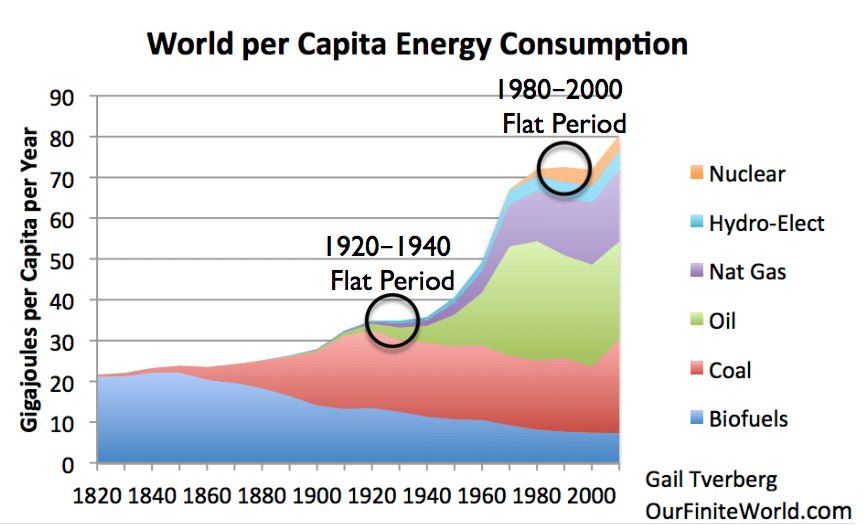
Figure 8. World per Capita Energy Consumption with two circles relating to flat consumption. World Energy Consumption by Source, based on Vaclav Smil estimates from Energy Transitions: History, Requirements and Prospects (Appendix) together with BP Statistical Data for 1965 and subsequent, divided by population estimates by Angus Maddison.
The 1920-1940 Flat Period was definitely a period of “not enough energy to go around.” The Great Depression of the 1930s was a time of little GDP growth and great wage disparity. There is evidence that both World War I and World War II (coming immediately before and immediately after the 1920-1940 period) were, indirectly, energy wars.
The 1980-2000 Flat Period represents a time when the US and Europe both intentionally reduced their oil consumption because it was feared that oil would be in short supply in the future. This was a period that required huge debt growth to make the necessary changes (Figure 9). 
Figure 9. Growth in US Wages vs. Growth in Non-Financial Debt. Wages from US Bureau of Economics “Wages and Salaries.” Non-Financial Debt is discontinued series from St. Louis Federal Reserve. (Note chart does not show a value for 2016.) Both sets of numbers have been adjusted for growth in US population and for growth in CPI Urban. As mentioned previously, it is also the period that a huge amount of complexity was added, and wages fell as a percentage of GDP. It is doubtful this pattern could be repeated again, without serious economic problems occurring
There were other problems in the 1980 to 2000 period. The collapse of the central government of the Soviet Union occurred in 1991. Low oil prices for several years prior to the collapse reduced the revenue of the Soviet Union. This seems to have been a major contributor to the collapse. Oil exporters are again encountering the issue of inadequate tax revenue, as a result of low oil prices since 2014.
[6] It is total energy growth (not simply oil consumption growth) that correlates well with GDP growth.

Figure 10. X-Y graph of world energy consumption (from BP Statistical Review of World Energy, 2017) versus world GDP in 2010 US$, from World Bank.
Peak Oil followers haven’t stopped to think through how the economy works. It is really the growth of total energy that we need to be concerned about, from the point of view of operating the economy.
[7] Indirectly, debt and asset prices are promises of future energy consumption.
We don’t think of debt as a promise of future energy consumption. The connection comes because debt can only be redeemed (through a financial transaction) for future goods and services. Making these future goods and services will require energy consumption.
The same principle applies to asset prices of all kinds: prices of shares of stock, home prices, land prices, and pension values. If an asset-owner wants to sell an asset and use the proceeds to buy other goods and services, the asset-owner encounters the same situation as the bond-owner: the goods and services that will be provided in exchange depend on the energy supplies available at the date of the exchange. Thus, indirectly, the prices represent promises of future energy consumption.
[8] One essential part of the economic growth system seems to be an ever-falling price of energy services, where energy services are defined as the cost of energy, plus whatever efficiency savings are available that make the cost of energy services less expensive.
For example, the cost of transporting a 100 kg. package 100 kilometers, or of heating a 100 square meter residence for a winter, must keep falling. If this happens, businesses can afford to buy ever more tools for their workers. With these tools, the workers can become ever more productive.
Furthermore, because of their growing productivity, workers find that their wages are rising, so that they can buy ever more goods and services. In this way, demand continues to rise. Changes such as these allow the economy to keep growing.

Figure 11. Energy services chart is by Roger Fouquet, from Divergences in Long Run Trends in the Prices of Energy and Energy Services. Second chart is figure from UNEP Global Material Flows and Resource Productivity.
In fact, the prices of energy services do seem to keep falling, even if the cost of providing these services is not falling. This is a major reason why energy prices seem to have fallen below the cost of production for practically every type of energy in recent years. This situation is not sustainable; it can be expected to lead to the collapse of the system.
[9] If the growth rate of the economy is not fast enough, the danger is that the economy will collapse.
We can think of the GDP situation as being similar to that of a bicycle. GDP needs to be rising rapidly enough, or the economy will collapse. A bicycle needs to be traveling fast enough, or it will fall over. Economists often talk about an economy slowing to stall speed.

Figure 12. Author’s view of analogies of speeding upright bicycle to speeding economy.
Reported world GDP growth rates in recent years are likely somewhat overstated for several reasons.
- World GDP represents a weighting of country reported GDP. One approach to weighting gives disproportionate influence to China, India, and other developing countries.
- The use of Quantitative Easing and of higher government debt temporarily inflates the quantity of goods and services an economy can make.
- Artificially low energy prices give a boost to oil importing counties. They also keep the prices of goods and services artificially low, compared to wages. These artificially low energy prices cannot continue without the failure of governments of oil exporters, and without businesses producing energy products collapsing.
Whether or not the economy can continue operating is determined by the economy itself, because the economy is a self-organized system. Its continued operation doesn’t depend on published statistics of varying quality.
[10] Researchers studying oil limits thought that they had found a whole new phenomenon, “Peak Oil.”
In fact, they had found a special case of a phenomenon that tends to lead to collapse, namely, conditions that lead to energy consumption per capita that is not rising rapidly enough. Such conditions can occur in many different ways, such as these:
[a] Population rises sufficiently that it is hard to keep energy consumption per capita rising. This seems to be a major problem in many historical collapses.
[b] Collapse indirectly comes from diminishing returns in energy extraction. The standard workaround for diminishing returns is growing use of complexity (including technology). This tends to encourage the non-wage portions of the economy to grow, as in Figure 7. Adding complexity becomes increasingly expensive for the benefit obtained. Ultimately, wage disparity and falling commodity prices become a problem, and the system collapses.
[c] Random fluctuations in climate occur. An economy collapses because it doesn’t have the strength to respond to such random fluctuations.
[11] Peak oil researchers did the best they could, with the limited understanding of the day. The unfortunate problem was that the model they put together wasn’t really correct.
The fundamental problem of the Peak Oil researchers was that the economic researchers, upon whom they depended, did not really understand the interconnected nature of the economy. They continued to use two-dimensional economic models, when they needed multidimensional models. Economists predicted that prices would rise near limits, when it is increasingly clear that this cannot be true. The world has been struggling with low prices for many commodities since 2014. Prices now are temporarily less low, but they still are not high enough to allow adequate tax revenue for oil exporting countries.
The Energy Return on Energy Invested (EROEI) Model of Prof. Charles Hall depended on the thinking of the day: it was the energy consumption that was easy to count that mattered. If a person could discover which energy products had the smallest amount of easily counted energy products as inputs, this would provide an estimate of the efficiency of an energy type, in some sense. Perhaps a transition could be made to more efficient types of energy, so that fossil fuels, which seemed to be in short supply, could be conserved.
The catch is that it is total energy consumption that matters, not easily counted energy consumption. In a networked economy, there is a huge amount of energy consumption that cannot easily be counted: the energy consumption to build and operate schools, roads, health care systems, and governments; the energy consumption required to maintain a system that repays debt with interest; the energy consumption that allows governments to collect significant taxes on exported oil and other goods. The standard EROEI method assumes the energy cost of each of these is zero. Typically, wages of workers are not considered either.
There is also a problem in counting different types of energy inputs and outputs. Our economic system assigns different dollar values to different qualities of energy; the EROEI method basically assigns only ones and zeros. In the EROEI method, certain categories that are hard to count are zeroed out completely. The ones that can be counted are counted as equal, regardless of quality. For example, intermittent electricity is treated as equivalent to high quality, dispatchable electricity.
The EROEI model looked like it would be helpful at the time it was created. Clearly, if one oil well uses considerably more energy inputs than a nearby oil well, it would be a higher-cost well. So, the model seemed to distinguish energy types that were higher cost, because of resource usage, especially for very similar energy types.
Another benefit of the EROEI method was that if the problem were running out of fossil fuels, the model would allow the system to optimize the use of the limited fossil fuels that seemed to be available, based on the energy types with highest EROEIs. This would seem to make best use of the fossil fuel supply available.
[12] There are corrections to the EROEI method that might allow it to work in the manner that it should. The catch is that these corrections seem to show wind and solar not to be solutions to our problems. In fact, the system is so integrated, and our need for rising energy consumption per capita so great, that it is doubtful that any substitute for fossil fuels can really be a solution.
Professor Hall observed that if a fish had to swim too far to get food, it could not use very much of the food’s energy to catch the food, because most of its energy was needed for everyday metabolism and reproduction. A fish would typically need an EROEI of at least 10:1 for catching its prey, if it expected to have enough energy left to cover its full metabolic needs (including reproduction), plus the energy required to catch its prey.
If catching some prey only provided an energy return of 1:1, it would be pretty much worthless as a food source, since it would not cover any of the metabolic costs. Certainly, it would not make sense to call any energy in excess of an EROEI of 1:1 “net energy,” because it makes no contribution to covering a fish’s metabolic or reproduction activities. “Net energy” should only come from food sources with an EROEI very close to, or above, a ratio of 10:1.
A similar approach can be used to incorporate the large amount of energy that is lost by zeroing out the equivalent of the metabolism of the fish, for the economy. Based on Figure 11, the required average EROEI (to match what the economy can afford to pay for) needs to rise over time. Thus, if the required average EROEI is 10:1 now, it might be 11:1 later, simply because the increasingly complex world economy needs energy services that are becoming ever less expensive.
The story, “Higher energy prices will work in the future” is simply a myth, created by economists who do not understand how the economy really operates, considering all of the feedbacks involved. In inflation-adjusted terms, the price of energy services needs to keep falling as a percentage of GDP, to keep the system operating.
To fix the net energy calculation, some suitable minimum EROEI ratio for the economy needs to be determined–probably about 10:1–to incorporate the large share of energy consumption that is missing from the economy. Net energy would be then determined as the energy in excess of 10:1 EROEI, rather than in excess of 1:1 EROEI. This approach would make solar and wind look much less beneficial than most calculations to date.
In the case of intermittent renewables, a determination needs to be made whether the role of wind or solar in a particular situation is to replace electricity or fuel. If the role is to replace electricity (as is generally the case), then sufficient buffering must be provided in the model, so that the model can calculate the proper EROEI for dispatchable electricity (not intermittent electricity). Adding buffering will generally substantially reduce the EROEIs of intermittent electricity types. This adjustment makes it clear that there is much less benefit of wind and solar.
If the purpose of the intermittent electricity is only to replace fuel (such as a proposed new Saudi solar installation), then there is no need for buffering in the calculation. Of course, a cost comparison could also be used, and this might be the simpler approach. The cost comparison will generally be favorable if the fuel being replaced is oil, because oil is a high-priced fuel.
Too often, wind or solar is added to the system in a way that overlooks the real cost of buffering. Coal and nuclear electricity production find themselves with the unpaid job of providing buffering services for wind and solar. The net impact of adding intermittent renewables is that they push necessary backup power out of business. We end up with an electrical system that is worse off for adding intermittent renewables, even though this was not the intent of those requiring the use of such generation.
Conclusion
The number one need of the world economy is rising per capita energy consumption. In order to maintain economic growth, the price of energy services needs to fall as a percentage of GDP. The system will try to rebalance to the least expensive cost of energy production using globalization and other techniques. When this is no longer possible, the current world economic system is likely to fail.
Peak Oil modelers did not understand how complex our economy is. In their defense, no one else did either, especially back in the 1970 to 2005 era. They did the best they could, using the models that economists had put together. Because of the assumption of ever-rising energy prices, Peak Oil models assume that far more fossil fuels are extractable than is likely to really be the case. Optimists (oil companies, politicians, government agencies) assume even higher extraction of fossil fuels than is reasonable. The result is considerable concern about climate change.
When a person realizes how tightly integrated the world economy is, and its need to grow, it becomes clear that using less is not a solution. Prices of commodities would plunge even farther below the cost of production. The economic system would experience a far worse recession than the Great Recession of 2008-2009. Some governments would fail. The spiral might permanently be downward.
Standard solutions don’t work either. Substitutes don’t scale up quickly. Biomass cannot be used heavily because the world’s ecosystems depend on biomass; we are already using more than our share. Intermittent renewables such as wind and solar have their own high energy cost, but it is hard to count. They depend on international trade to make and repair the devices. They depend on debt for financing. They are really only part of the fossil fuel system, contrary to what the name “renewables” would suggest.
Energy modelers did their best. Unfortunately, with modeling it is hard to see what is going wrong. This is especially true when the academic world is divided into silos, each of which tends to look primarily at the writings of the people in its own field. It is easy for an incorrect model to get firmly embedded into people’s minds.


Energy minnow Bahrain just found 80 billion barrels of oil, as much as Russia’s entire reserve
The find catapults the kingdom to the top of the shale oil league
MANAMA — A new discovery off the coast of Bahrain is estimated to contain at least 80 billion barrels of tight oil, the kingdom’s biggest ever find, its oil minister said on Wednesday.
Bahrain said on Sunday it had discovered extensive tight oil and deep gas resources off the west coast of the kingdom.
Bahraini Oil Minister Sheikh Mohammed bin Khalifa Al Khalifa. AP Photo/Jon Gambrell, File
Independent appraisals by U.S.-based oil consultants DeGolyer and MacNaughton and oilfield services company Halliburton had confirmed Bahrain’s find of “highly significant quantities of oil in place … with tight oil amounting to at least 80 billion barrels, and deep gas reserves in the region of 10-20 trillion cubic feet,” Oil Minister Sheikh Mohammed bin Khalifa al-Khalifa said. Russia’s entire oil reserve is 80 billion barrels.
Tight oil is a form of light crude oil held in shale deep below the earth’s surface that is extracted with hydraulic fracturing, or fracking, using deep horizontal wells.
“Agreement has been reached with Halliburton to commence drilling on two further appraisal wells in 2018, to further evaluate reservoir potential, optimize completions, and initiate long-term production,” Sheikh Mohammed told a news conference in Manama.
He said he was not sure yet how much of the estimated 80 billion barrels was recoverable, but the kingdom aims to attract foreign oil and gas firms to develop the resources.
“The newly discovered resource, which officials expect to be ‘on production’ within five years, is expected to provide significant and long-term positive benefits to the kingdom’s economy – both directly and indirectly through downstream activities in related industries,” Bahrain’s National Communication Centre said in a statement.
Sadad al-Husseini, a former senior executive at Saudi Aramco and now an energy consultant, said the discovery was positive news for Bahrain, but more data gathering, evaluation and well testing needed to follow to determine whether there are any future commercial opportunities in the resources.
“Converting resource estimates to reserves is an intense and costly process and not all the resources may ultimately be upgraded to reserves,” he said.
“The additional drilling and data gathering will serve to improve the accuracy and reliability of the estimate.”
Bahrain, which is rated junk by all three major credit rating agencies, revealed the oil discovery just a few days after yields on its international bonds spiked as investors became more concerned about its rising public debt levels.
Bahrain says it just found its biggest oil field since 1932, dwarfing all its reserves
Canada’s biggest LNG project that would boost global supplies by 10% nears make-or-break moment
Officials did not give a specific figure on Wednesday for expected production levels from the new field, but the daily Al Ayam quoted the head of the financial and economic committee in parliament, Abdulrahman Bu Ali, as saying output was expected to be 200,000 barrels per day.
http://business.financialpost.com/commodities/energy/update-2-bahrain-says-new-discovery-contains-an-estimated-80-bln-barrels-of-tight-oil
we are saved let have a party /s
Read my previous post.
5-10% recovery onshore shale.
This is offshore shale.
The headline is to create cognitive dissonance.
It is very calming to read ‘80,000,000,000 barrels of oil’…. ‘largest find ever’…..
My blood pressure has dropped to 110 over 70 after reading that headline…. even though I know it is pure bull sh it….
Bahrain is a very small place (yes Wyoming I have been there…) — ever inch onshore and offshore would have been long ago explored for oil…. there is nothing new under the endless sun of Bahrain…. yet we are to believe after a century of searching — the largest ever oil field has finally been discovered…
Common sense has gone out the window and common dissonance has replaced it
How much of this 80 billion barrels is technically recoverable at today’s prices?
4-8 billion barrels.
I wonder if even that is wishful thinking.
Methinks most future gas/oil discoveries will fall into this category.
So…..I believe the oceans are the largest ‘undiscovered’ untapped goldmine in the world, so lets all get rich and set-up an IPO; ‘SaltyGold Corp.’
‘The media can sometimes help sell sh*t to retail investors who don’t understand IPOs. See Blue Apron and GoPro for examples. Will Spotify be the same?’
https://www.zerohedge.com/news/2018-04-05/spotify-and-other-ipos-youre-not-getting-early-youre-holding-someone-elses-bag-sh*t
So they can use the oil to power desalination plants… and use that water … to frack the oil … to obtain the energy … to desalinate more water… to frack the oil …. to ….
that ever decreasing spiral has only one end Eddy
I don’t seem to see any underwater cities around anywhere…nor populated space communities. We have met our limits.
Unless an anti-gravity machine isn’t invented…
To demonstrate the accuracy of Gail’s assessment doesn’t require much effort.
Ask yourself why all energy is subsidized?
Oil, gas, coal, nuclear, solar, wind.
Why not allow them to operate on a free market supply and demand basis?
Because supply and demand doesn’t exist.
The system is built on affordability that has been built on efficiency of economies of scale.
If producers could transfer their real costs to the user the machine would stop turning. Real cost also includes environmental costs. If that had ever been included the energy industry likely would never have developed in the first place. So the capital market system ignores the environment as if no consequence until the consequences are felt. Then offshores production and it’s pollution to some other friendly place who will accept it.
First Energy is reportedly threatening to close 4 nuclear reactors a total of 4000mw in the next 3 years, 20 years ahead of schedule, if they don’t receive additional subsidies. How could 4 totally depreciated reactors be unprofitable unless they always were? Think about it.
Why did cars replace horses? Pent up demand for motorized transportation? Do you believe that? Because if you believe Supply and Demand economics that precisely what you believe.
Cars replaced horses when it was cheaper to own and drive a car rather than a horse.
Affordability is the driver in capitalism if you take away affordability the system collapses. Of course no one understands that fact instead the believe Supply and Demand control the economy as the have been dutifully taught in the Hallowed Halls.
So because of this dult belief which is religious in nature no one believes that there can be scarcity because demand won’t allow it. After all isn’t demand how civilization has progressed? Sufferage, Civil Rights, Human Rights, Equal Opportunity…….
Whatever “progress” has been made has been made because it was affordable and for no other reason. Not because of altruism. This is not understood. But it will be as people persist in demanding a depleted planet to continue supporting them.
Now as for the ignored consequences which happen to be the real debt not just a monetary hoax. They will be repaid in full.
As Gail has often said this is a self organized dissipative system. What is forgotten is that any reduction in entropy in a dissipative system increases entropy elsewhere. When entropy reaches equilibrium the cycle ends.
Good points. As far as I understand, the rich loved cars c. 1910 because they could have fun driving them themselves: it was not as skilled as driving a coach, and also the huge savings on stabling, dealing with horses being sick so often, etc. They could cut the labour of several stable hands and deputy coachmen. Chauffeurs were often mechanics as well. Coachman was the second highest-paid job in a rich household, next to the butler – more than a cook, but less than a French chef.
Good point the wealthy are first adopters based on affordability. To grow your markets requires additional affordability by economies of scale.
Mother Nature always presents her bills for settlement……
Bravo, well said JT.
Pingback: Why the Standard Model of Future Energy Supply Doesn't Work - The Energy Collective
Pingback: Why the Commonplace Mannequin of Future Power Provide Would not Work – Blog
the powers that be are steering us to a deflationary collapse so as to put in place their final solution which will be based on the final forced economy of negative interest rates and crypto-currency
ultimately ”we” are the powers that be
there is no grand plan other than the one we collectively create for ourselves.
the political shenanigans we see going on are merely side issues—yes we baulk against this dogma or that war or religious doctrine, but in effect we are in the business of consuming energy to give ourselves infinite employment–security–food–leisure–pleasure etc, Even wars–which we rightly abhor…keeps millions in productive employment
Then we make the worst mistake of all—in thinking we are voting for whatever…..while the politicians believe ‘their’ way will control the masses or keep them happy.
whereas in truth we will go on consuming energy untill it is all gone—then boom—no more OFW
welcome to the petri dish of humankind folks
“there is no grand plan other than the one we collectively create for ourselves.”
I agree with that, NP.
It seems strange when I read some posts asserting the ‘Elders’ (whoever they are) are adjusting every commodity price and stock index to accommodate their outlined goals. Along those lines, I wonder if the Elders and the Deep State are the same or different, because in both cases I don’t understand what they’re referring to. It would be interesting to get some kind of definition for both from those asserting to their existence and a list of the players in those groups.
Actually, I think the self-organized system, operated by energy, has significant power that we don’t always recognize. It guides the thinking of decision makers. Of course, part of the decision making process seems to be, “What story give a happily ever after ending? How do I get re-elected?”
I visited a tomb in Khiva today .. and was informed that the chap whose bones were resting there once said:
‘It is easier to level 100 mountains than it is to explain a truth to a fool’
Yep…..
an ex-doomster obviously
Maybe the situation is, “Once a person has a wrong story firmly imprinted in his/her head, it is almost impossible to replace it with the correct story.”
I take it Khiva is a city of about 50,000 people in Uzbekistan. https://en.wikipedia.org/wiki/Khiva
The ancient background of the people there seems to be Iranian and Turkish. The religion practiced is Muslim. It is near the border with Turkmenistan. It looks like an out-of-the-way place for travelers to get to.
It has been exhausting getting here… the flight out of Delhi was at 1am … and we had another very early flight this morning from Tashkent.
We’ve just begun … but the highlight so far has been two groups of female college students approaching and asking to take photos with me…. now either they are FW Groopies …. or they are deluded and believe that I am Brad Pitt on holiday…
Needless to say Madame Fast is insanely jealous. I considering pronouncing talaq talaq talaq …. and staying on to exploit what is clearly a very favourable situation ….
When I visited China with my husband in 2011, and we went to places where Chinese tourists visited, Chinese tourists would ask to take photos with us. They were especially interested in getting a photo with me, because they had not seen a blonde westerner before.
Or… they may have thought you were Paris Hilton!
So….just enslave the fool. 🙂
“I visited a tomb in Khiva today”
You’re often claiming to be travelling the four corners of the planet. Is it true, or are they simply assertions to assist an idea being posted?
I found myself asking myself that yesterday evening when we pulled into a much recommended restaurant… and the manager seated us at a table where ‘we could see the entertainment show’…
So we sat… had a couple of beers… some reasonably good food… and waited to see ‘the show’… towards the end of the meal … a teevee was switched on … and the video of Uzbeki women singing and dancing to traditional music was presented… i.e. The Show.
I looked at Madame Fast and said …. WTF …. and we laughed and had another beer and I was thinking … so this is what the Twilight Zone feels like…
Today I will go in quest of a good strip club… there has to be one of those somewhere here….
‘Little did the champions of the Enlightenment know that once we had access to all the facts…well, reason and rationality wouldn’t just immediately wash across the land in a giant wave of enlightenment thinking.
While that may be happening in some ways, the new media ecosystem has also unshackled some of our deepest psychological tendencies, things that enlightenment thinkers didn’t know about, weren’t worried about, or couldn’t have predicted. Many of which we’ve discussed in previous episodes like confirmation bias, selective skepticism, filter bubbles and so on. These things have always been with us, but modern technology has provided them with the perfect environment to flourish.
In this episode, we explore another such invasive psychological species called active information avoidance, the act of keeping our senses away from information that might be useful, that we know is out there, that would cost us nothing to obtain, but that we’d still rather not learn. From choosing not to open open bills, visit the doctor, check your bank account, or read the nutrition information on the back of a box of Girl Scout Cookies, we each choose to remain ignorant when we’d rather not feel the anguish of illumination, but that same tendency can also cause great harm both to individuals and whole cultures when it spreads through politics, science, markets, and medicine.’
https://youarenotsosmart.com
Declaring G-Had to the tee vee… is a good place to start
While its absolutely true that repayment of debt is driving the need to grow and consume more of everything, to me it is debt that is what we need to get rid of, however, stupid I might sound. It is debt that drives inequality, not as much through predatory lending but trough predatory borrowing, i.e., using other people’s money to earn multiple returns on one’e own merge equity, while transferring the risk to the public (banks and corporates being too big to fail and being bailed out by the the taxpayer). The governments borrow and have the future generation (taxpayers) pay the money back, while the current generation gets the jobs and lifestyles driven by the borrowing driven growth. The future generation cannot vote out the current government that borrows and forces them to repay. In other words we steal our children’s votes. In addition, when we borrow excessively and force a collapse, we steal their jobs too. And on top of everything, owing to our excessive consumption, we leaver the a denuded earth
But… isn’t debt the same as money. Lose one, lose the other.
Debt is what pulls the economy forward. It is what allows us to get the fossil fuels out of the ground, and make the whole cycle happen. We have to add more and more debt, when the system isn’t working well. That is what has been happening in recent years, as oil prices have gone above $20 (in inflation adjusted price) per barrel. I wrote about this in this article, for example: https://ourfiniteworld.com/2016/12/07/what-has-gone-wrong-with-oil-prices-debt-and-gdp-growth/
Future generations only have to pay the money back if the whole system is still operating. There is a significant chance that it won’t be. Our ability to make the system work with debt (or anything else) is only temporary.
“China held around $1.17 trillion of Treasurys as of the end of January, making it the largest of America’s foreign creditors and the No. 2 overall owner of U.S. government bonds after the Federal Reserve. Any move by China to chop its Treasury portfolio could inflict significant harm on U.S. finances and global investors.”
https://www.cnbc.com/2018/04/05/china-holding-treasurys-keeps-nuclear-option-in-us-trade-war.html
“”A world that is so interdependent, so interconnected, cannot afford shooting each other,” he said. “The world in which the rules of the game are an eye for an eye is a world in which there are many blind people.””
https://www.cnbc.com/2018/04/06/trade-war-is-the-greatest-threat-to-the-world-economy-but-were-not-yet-there-yet-jp-morgans-frenkel-says.html
That’s what they said in 1913…….
“When Sri Lanka handed over its southern port of Hambantota to China in December 2017, many saw the episode as a cautionary tale for other countries that are eagerly accepting Chinese finance to build major infrastructure projects. Sri Lanka granted a 99-year lease on the port to China Merchant Port Holdings in the hope of cutting its debt to China, which is one of the highest among emerging economies. China, for its part, has gained an important beachhead that could help its attempts to expand military influence in the Indian Ocean…
“But as the port’s losses began to mount, the Sri Lankan government found itself unable to repay its debts… As a result, Sri Lanka, an island country with a population of 20 million, is being held up as a textbook example of a country caught in a so-called debt trap set by China. Government critics say Sri Lanka’s sovereignty has been compromised by the port episode, which came two months before the former president of the neighbouring Maldives warned that its debts could force it to cede territory to China as early as next year.”
http://www.thebanker.com/World/Asia-Pacific/Is-Sri-Lanka-latest-to-fall-into-a-China-debt-trap?ct=true
“China has reportedly written off Zimbabwe’s debt to the Asian giant’s institutions paving way for more funding to the southern African country whose ability to access new funding has been crippled by among other things a huge debt overhang.”
https://www.fin24.com/Economy/china-writes-off-zims-debt-report-20180405
“Pakistan plans to seek financial assistance from China and Saudi Arabia to get out of the grave financial crisis it faces to bridge the country’s external account deficit ahead of budgetary proposals for the 2018-19 fiscal year.”
http://www.atimes.com/article/pakistan-seeks-bailout-china-saudis-rather-imf/
“The report argues that enormous levels of foreign investment may seem beneficial, but that Venezuela’s economic predicament has actually been made much worse by China. Taking advantage of Venezuela’s desperation, China has managed to convince Caracas to sign “one-sided financial agreements” that perpetuate the economic malaise afflicting the country.”
http://uk.businessinsider.com/china-could-be-the-new-owner-of-venezuelas-oil-industry-2018-4
I wonder if the Chinese would do a better job of extracting the oil than the Venezuelans. But it does make for a difficult situation.
I think they will regret getting rid of conventional big oil.
I think Pakistan will be the first major over the cliff—–
Of course, I’ve been wrong before.
Why would a country want to write off one debt, and then turn around and provide more debt?
I was a little confused by that, too. It only makes any kind of sense if China is imagining that Zimbabwe is set for a much more profitable future and wanting a share of that.
We Chinese have become a hideously ugly people…
Don’t worry, see fast Eddys rules about how The World works.
It wasn’t my intention to have a dig at the Chinese, although clearly China is using debt as an imperialist tool.
Viewed from some angles China’s recent history has been a noble one. The nation has sacrificed its own environmental well-being, taken on a dangerous amount of debt and condemned much of its own populace to a fairly miserable existence toiling on infrastructure projects or in dangerous coal mines or in soul-destroying factories for 80c an hour, and in so doing has provided the global economy with an absolutely vital engine of growth. Without China’s credit-based growth ramping up demand for commodities post-2008 we would, I’m sure, already have had the deflationary collapse most of us on OFW fear.
Of course this wasn’t a conscious act of heroism on the part of the Chinese. It’s just that the universe does appear to abhor unused exergy and China was sitting on all of that cheap coal and cheap labour…
Excellent Harry, that is exactly how the British expanded in Asia in the 18th century. But of course, it must be different now, as China is not imperialist and it’s all about brotherly love and co-operation……
Read David Graeber’s “Debt: The First 5,000 Years.” He talks about countries imposing taxes on countries they took over, serving as a form of debt. This is not quite the same.
This is more like what Michael Hudson writes about in “Killing the Host,” regarding the problems of external loans.
All kinds of development are financed by debt, but more sophisticated countries dealing with relatively undeveloped countries raises the possibility of selling the country goods that aren’t terribly helpful, and at the same time swamping them with debt. If the country selling the goods also makes the goods, they are even better off for the transaction. Of course, if the country can’t pay any of the debt, it is a major problem for the lender.
China ‘not afraid’ of trade war with Trump
https://www.ft.com/content/11416168-3948-11e8-8b98-2f31af407cc8
That link requires a subscription, but of course China cannot in any way give away their concerns for a rebalancing of trade. Since it is the US that is suffering massive trade deficits with China (which China would never allow in the reverse), it most definitely has to be of great concern to them.
Trump doesn’t have the type of personality to back down as we’ve seen in numerous exchanges with other people, so it seems likely he will continue to push this trade war. But in fact it isn’t a trade war, it’s an attempt to balance trade to reduce or eliminate the trade deficit. China has been spoiled by decades of an uneven trade gap and so it seems like BAU to them. In this case as I’ve written before, this is a good cause Trump is pursuing even if it causes prices of some goods to rise in the short term, it will provide impetus for start up US businesses or for existing companies to expand, which will lead to more hiring, hopefully with good pay. ‘We the people’ just need to let it run it’s course.
The US would be better off leaving the imbalance in place, keep printing the reserve currency and swap worthless IOU’s for real stuff. Give the sheep in US a universal basic income. Make the most of the exhorbitant privilege of the reserve currency.
The economists prescriptions for fixing US trade deficits are 180 degrees wrong.
If you use Chrome..Click on file and go to “Incognito mode”..And search for the article. And then you can get around the paywalls. Works for all the WSJ and Economist articles as well. .Along with many others…
Tariffs Unlikely to Bring Back Many U.S. Blue-Collar Jobs, Study Finds
https://blogs.wsj.com/economics/2018/04/04/tariffs-unlikely-to-bring-back-many-u-s-blue-collar-jobs-study-finds/
I commented somewhere that US balance of payment deficits seem to come US government spending in excess of receipts (unless US citizens are buying bonds, and thus funding the excess spending themselves).
So we shouldn’t really blame the Chinese. They and others have been kind enough to take our bonds and give us real goods in their place.
Surgeon General Urges Public to Carry Medication to Reverse Opioid Overdoses
https://www.wsj.com/articles/surgeon-general-urges-public-to-carry-medication-to-reverse-opioid-overdoses-1522944308
Good thing I never leave home already without it…../s
Government Intervention is triggered by a Keynesian belief that aggregate demand can be increased by lower interest rates and by increasing government deficits thereby somehow spurring economic growth. Debt grows faster than income growth and eventually has to be restructured, i.e., everyone loses in the end. Since 2007, global debt has grown by US$57 trillion and it’s had disastrous results. Greece, Detroit, Puerto Richo, Venezuela are just the beginning of this trend. Soon, it will be followed by larger countries like China and United States.
https://www.perchingtree.com/return-of-great-depression/
Even illegal immigrants don’t want to come to America anymore. Illegal immigration has dropped 80 percent since 2000…
https://imgur.com/a/8wf3O
maybe the goal should be getting back to the 1960 number…
If the trend continues there won’t be any immigrants coming in within the next decade. We have had a five fold decline in less than two decades…
While this is true, let me remind that legal immigration remains high and Mexico remains the top sender.
Mexicans are still coming to the United States in large numbers. I like Mexicans but over long periods of time, they become a net drain just like everyone else. They work hard in young age and become obese and dependent in middle and old age. That huge cohort is about to hit the overstretched and bankrupt healthcare system.
Last year there were around 300,000, illegals who came in. And we have a population of around 325,000,000. Which means one immigrant is being added to every 10,000 American citizens..If you were standing in a room with 10,000 people. And one new person entered, would you even notice?
https://imgur.com/a/LjnzY
It’s 1 for every 1000 not 10000.
Sorry meant to say 10 for every 10000…Which is the same….But either way I am sure you get the point.
Why Economists Failed to Predict the Financial Crisis
http://knowledge.wharton.upenn.edu/article/why-economists-failed-to-predict-the-financial-crisis/?src-blogdepression
“One actual statistic is that in the 1990’s, economists predicted only 2 of the 60 recessions around the world a year ahead of time” and also that “a majority of economists did not think we were in one when the three most recent recessions, in 1990, 2001, and 2007, were later determined to have begun.”
– Nate Silver
For what its worth, I predicted the last recession, while I was the The Oil Drum. http://www.theoildrum.com/node/3382 This was written at the end of 2007, but didn’t get posted right away. Also, we kept moving the date later, so the post would “stay on top.”
On a realestate investors forum, I was predicting a recession because of the combination of rising oil prices and interest rates from around 2006. Everyone wanted to know the exact date, which could not be given as more than “soon”.
Of course I was ridiculed as a crackpot, boy who cried wolf etc before the event. After the event most of those that did the ridiculing were no longer there, plus the forum closed down shortly after.
I suspect there were many that easily predicted the GFC but were mostly ignored/ridiculed etc by the mainstream that is always full steam/growth ahead..
To claim that young British people have never been more unhappy is silly, I suspect Charles Dickens would have quickly put The Guardian right on that one.
Still young people are having a relatively tough time of and it seems they are feeling it.
https://www.theguardian.com/society/2018/apr/05/young-people-have-never-been-unhappier-research-suggests
The British did very well for a period of time being the junior partner of America and Europe. This and the legacy systems softened the fall from being the dominant empire.
There’s now nothing left. It’s an island, a people, in foreclosure. The present generation is the first to really live it.
“… it is vital that government, charities and employers across the UK invest more in developing young people’s skills and in providing opportunities for them to progress in fulfilling, sustainable careers.”
it would also help greatly if the UK would make a miraculous discovery of a new and massive and cheap FF source…
and soon…
hurry up…
ASAP…
“March was a brutal month for [UK] stores,” Sophie Michael, head of retail and wholesale at BDO, said in the report. “The weather was severe, and shoppers’ reaction showed how paper-thin consumer confidence is currently.””
https://www.bloomberg.com/news/articles/2018-04-05/u-k-retailers-post-worst-sales-slump-since-financial-crisis
“A total of 474,069 new cars were driven off the forecourts of car showrooms last month, down 15.7% compared with March 2017.”
https://www.theguardian.com/business/2018/apr/05/sales-new-cars-uk-slump-march
If we report by quarter the numbers go up!
Why buy a new car if you won’t be able to afford the fuel to propel it forward? Better to buy a used car, and use the difference in price to buy the fuel. Just sayin.
Minor implication: New car sales drop. Maybe all the way down?
Watching some films about life in Afghanistan or Iraq would put them right – or at least give them some perspective, which is what they mostly lack.
It’s so sad to be alone. One is the loneliest number. No one seems to understand.
On the other hand, the One is All. Much more cheerful thought. 🙂
In the United States, a lot of 55+ housing has sprung up. It seems to be apartments or condominium units, in groups, with lots of optional activities for those who are interested in them. I know of quite a few widows who have moved to such housing, so as to be able to have friends around them, even if they have lost their spouses. I am sure there are a few men too.
People here also use church groups to make friends. And clubs, such as those operated by MeetUp, are popular with singles.
But none of these is really a substitute for family members. Those of us with family members should be thankful for what we have.
I’ve posted this before and it deserves a thorough read.
http://www.oilcrisis.com/reynolds/MineralEconomy.htm
What it exposes is predicament we’re in and how it’s closer than we think. Because exploration which becomes information is a primary cost we’ve been living on borrowed time.
Our information asset is now highly depleted as we have found and exploited all available ores.
The oil industry wiped out in 2014 after throwing 3 trillion into exploration from 2012-14 they’re in liquidation now.
So we see foolish headlines like 80 billion barrels in Bahrain without the information that’s its offshore shale. Offshore shale?? Offshore can’t compete when it’s conventional. Shale can only produce 5-10% of a resource even if you call it a reserve. And I’m not sure anyone has attempted offshore shale.
This just demonstrates the desperation going on.
I suppose that when you can’t make your interest payments at a .0001% interest rate and all of the collateral has been pledged five times to create as much debt as possible, especially on non-existent reserves, things are getting ready to roll backwards or downhill. There’s always negative interest rates and extra spacious lots in Elon Musk’s Mars Village.
You can always cut the interest rate in half.
Or by half a percent.
The oil industry is at the ‘garage sale or closing down sale’ stage. Very similar to a landlord just collecting rent and not maintaining the building; delayed maintenance is the euphemism for going out of business.
“And I’m not sure anyone has attempted offshore shale. This just demonstrates the desperation going on.”
The inventory is being sold and lip service fed to investors regarding ‘shale offshore’ and other non-conventional to manipulate them into thinking their business model will continue to work far into the future, so they remain invested. I guess we’ll find out just how much inventory there is.
There is a good article by Aude Illig and Ian Schindler called “Oil Extraction, Economic Growth, and Oil Price Dynamicsm,” published in 2017. It is available free at this link. https://link.springer.com/article/10.1007/s41247-016-0016-6
Ian Schindler occasionally comments on Our Finite World. Part of the abstract says:
“We find that price feedback cycles which lead to increased production during the growth phase of oil extraction go into reverse in the contraction phase of oil extraction speeding decline.”
I think the paper has a reasonable explanation of what happens.
I was looking back at the paper. The explanation is very closely related to “the price of the energy sector must shrink relative to GDP” that I was talking about earlier.
I liked this part:
“Eventually, extraction rates will fall fast enough to raise prices at least temporarily, as suggested by the empirical model (3.6), until companies and citizens go bankrupt and demand decreases.”
Also from the article:
Turchin and Nefedov (2009) empirically identified recurring secular or economic cycles in agrarian societies. Similar phenomena apply to oil and resource production, so we recall their findings.
The cycle begins with a period of growth, in population and living standards lasting on the order of a hundred of years, and comes a period of stagflation in which population density approaches the carrying capacity of the land (one says increased population pressure) lasting on the order of half a century. During the stagflation period, peasants leave the countryside for cities, the difference between the elite and the commoners increases, and the price of food rises relative to wages. Population ceases to grow, because food production ceases to grow. Initially, the elite is somewhat better off in the stagflation period, because wages are low and they can employ a larger number of former peasants who have left the countryside. As the stagflation period progresses, the ratio of elite population to working class population rises (the working class has a lower birthrate and a higher mortality rate due to malnutrition and cramped living conditions in cities) creating competition among the elite. Social mobility increases, mostly downward as elites lose their status. The inter-elite competition creates fissures which lead to civil war and the final crisis stage lasting a few decades in which population decreases and the state breaks down. There follows an inter-cycle lasting several decades before a new growth period ensues.
>>>>>lasting a few decades in which population decreases and the state breaks down. There follows an inter-cycle lasting several decades before a new growth period ensues.<<<<<<end quote
the article misses a critical factor and I'm amazed that anyone could write such drivel without any awareness that we are in a unique situation for humankind.
previous assessments of this nature worked fine, because the rise and fall was linked to resource availability, —-food and other materials. Land, the ultimate resource, regenerates itself given (human span) time. So dimbos look back, and see that regeneration took place, therefore become certain that it must happen again.—for no better reason than it always has.
I am amazed that these seemingly learned gentlemen could make such a howling mistake by superimposing 'regeneration cycles' of previous eras onto the production and use of fossil fuels.
fossil fuel use is a one way ticket to nowhere—yet there is this ongoing insistence that our oil addiction will always get its 'fix' from somewhere (in the future)
When oil stops flowing, we stop growing—there will be no ''ensuing new growth''- because there will be nothing to grow with.
The article is talking about what Turchin and Nefedov wrote about, which is agrarian economies in the pre-fossil fuel era. I don’t think that there is anything particularly wrong with what they have said. I have probably used very similar wording.
they seemed to be inferring that a similar cycle would kick in following the next (post oil) downturn
maybe i read it wrongly
I will have to look at it again. Maybe they needed to leave the door open for a similar cycle to happen, in order to get the article published. This is the academic press, after all.
Sir Fred Hoyle, the astronomer, said much the same thing. FF has allowed us to extract other energy sources and metal ores and to such an extent that no other successor species on this planet will have a chance to do what H. sapiens did with FF. And that’s not mentioning the pollution effects of our waste products. This is a one-shot affair.
When it comes to economic models, the phrase “all other things being equal” is used when in reality they seldom, if ever, are. And those things, as you said Gail, become raging winds as we approach the boundaries of the system.
We are not familiar with the boundaries of the system, so we have little idea how to model them.
that’s a good way to put it…
since the world economic system is so complex, therefore every economic model will fall short…
Hello Gail. Always enlightening to read your posts. I would like to make a request for a post, or just a short answer here in the comments.
From your perspective what should/can nations, cities and individuals do in this predicament?
Is there any action or technology to adapt to the situation oreven go on expanding complexity?
What do you think the post collapse world might look like?
crystal balls are on sale in the OFW souvenir shop
discounts for paid up doomsters
in the OFW online store, all items autographed by me do have a premium price…
OFWsouvenirshop.com
quantities are limited…
that’s http://www.ofwsouvenirshop.com
hi Joel…
“From your perspective what should/can nations, cities and individuals do in this predicament?”
nations must increase the burning of cheaper FF, which is mostly coal…
there is no other way to hold off economic decline.
almost all individuals are pawns in the game…
might as well just do whatever you want to do.
“What do you think the post collapse world might look like?”
a few rich and powerful dictator types around the world…
the other 99.9999999% of humans will live in poverty.
The period of collapse will also see a mass die-off of the human race. Once the dust settles, there will perhaps be a few million people scattered across the globe eking out an existence on a tired and impoverished earth. Things like wealth and power, in the sense we’ve known them, will cease to exist.
All wealth and power projection relies on surplus energy production beyond subsistence.
I recommend you consider a future career path as a warlord.
well as aplus—they do get their pick of the girls in the tribe
Haha – everyone seems to think warlords will be awfully successful. I endeavor to be a man of my times!
i dont see how you can have an unsuccessful warlord
sort of contradiction in terms i think
Richard II comes to mind. But maybe he was just unlucky in the end.
This is a difficult topic to write about.
We live in a self-organized and self-organizing world. We have convinced ourselves that we are in charge, and with a little effort, we can fix any problem. This isn’t really the case, however. There seems to be a literal higher power that is providing the energy for all of this self-organization. I don’t think that there is a whole lot we humans can do to change the outcome, for mankind in general, or for an individual family.
One of the major things we can do, while we still have time, is take note of how wonderfully the world and all of the things in the world have been made. Humans are amazingly self-healing, for example. Each generation of plants and animals is better adapted to changing conditions. Even the economy has been made in a wonderful way.
We can also take the opportunity now to do the things we have wanted to do, but haven’t gotten around to. We can spend more time with our families. We can visit relatives and friends we have lost contact with, or at least write an e-mail or snail mail letter.
I am convinced that all religions have been self-organized through the action of this literal higher power. I am doubtful that the teachings of any particular religion are true, but I suspect that the things that are near the intersection of all religions may have quite a bit of truth. For example, there are a lot of teachings about how to treat one another. Society works better when people treat others in their immediate clan reasonably well. A lot of what religion teaches is how to get along in this world.
We really don’t know if this literal higher power has any after-life plans for humans currently on earth. Everything is so well thought out that this could be the case, but a person wonders whether the religious views were put together so as to provide suitable endings to situations that couldn’t be fixed on earth, and thus motivate “better” behavior. A major purpose of at least some religions is to help people get along better on this earth. Too many people spend time feeling guilty for something they did or didn’t do, for example. Religions can help people learn to forgive themselves for things that didn’t quite go right, for example. I think joining a religious group can be helpful for some people.
We really don’t know what is ahead. Historically, quite a few people in collapses seem to have died in epidemics. I could image a major war might cause a lot of deaths simultaneously. I don’t think that there is any purpose in spending time worrying about how bad things cold be. We should be focusing more on living in the time we still have available.
It is up to the literal higher power to decide what the post-collapse world will look like. It might be empty. Like everything else, the world is not permanent. It, and its biosphere, is also a dissipative structure. Nothing in the Universe seems to be permanent.
Nice thoughts. I had a dream a year or so ago…someone I admired in life was saying that the point was self-actualization. Whether he was referring just to me, or stating a general principle was unclear. And I wouldn’t have expected such a recommendation from such a person, who in life was the epitome of one acting to change society in definite and predictable ways.
QUOTE: ***We live in a self-organized and self-organizing world… There seems to be a literal higher power that is providing the energy for all of this self-organization… I am convinced that all religions have been self-organized through the action of this literal higher power… I suspect that the things that are near the intersection of all religions may have quite a bit of truth. For example, there are a lot of teachings about how to treat one another… A lot of what religion teaches is how to get along in this world.***
Glad there aren’t any militant atheists around here at OFW who have given vitriolic responses here. (Yet?) Just can’t stand them. (Though I can’t stand religious fanatics either.)
On my part, I sympathise deeply with these thoughts. It’s interesting that the mystics of the world’s diverse religious traditions, from St Hildegard to Rumi, all speak of the Universe and all things in it, including all of humanity, as really but manifestations of this Higher Power, just as the wave is a manifestation of the sea. If so, one can never die because one was never born in the first place; in a sense there is only this Higher Power and nothing else really exists. In this thought I find some measure of solace concerning our current plight.
Thanks to our blog host, who allows the full spectrum of human thought on FW. It’s very unusual in my experience to have people who are so practical and informed on the dry minutiae of oil and economics, and simultaneously, on spiritual reality, talking on a single blog. It may have to do with a particular female disposition for nuance, but I don’t know.
As a now non-militant atheist, I share your aversion to the vitriol as well as religious fanaticism. Religion is a deeply ingrained part of the human psyche. Trying to persuade people to abandon cherished beliefs that give meaning to their brief lives seems about as productive as explaining that sex isn’t necessary in an overpopulated world.
I’ve done my time writing about religion, with two books critical of various aspects of it. Now it’s a topic that bores me so much I can barely stand to read about. Given all the very real problems facing our planet, arguing about unprovable invisible things seems like a frivolous distraction indeed.
If you have a faith that gives you peace and comfort, the advice of Jesus to the various bishops in Revelation seems apt: Hold fast to what you have, that no man take your crown.
Thank you Gail. Very unexpected answer . I was expecting something dryer.
“I am convinced that all religions have been self-organized through the action of this literal higher power.”
Can you explain what you mean by a “higher power”? I expect you mean a conscious being not bound by the laws of the universe. Humans are incapable of conceiving anything whatsoever about existence outside of spacetime so to speculate on the nature of a such a being is pointless.
It seems contradictory to say a religion is self-organised by a literal higher power. Either a religion self-organizes with no help from a higher power, or else if a higher power intervenes a religion is not self-organizing.
A religion is simply an example of a meme i.e. an idea that contains the means for its own propogation. A religion containing the rule that anyone leaving the religion should be killed or ostracized stands a much better chance of surviving than a religion containing the rule all adherents must remain celibate.
Hi, Gail. I’ve been following your blog for a long time now. Call me stupid, but there’s just one thing that mystifies me: why must we have growth? Why can’t we have a steady-state economy? None of the premodern civilizations were growth economies as we know them today, but some of them were able to last for millennia. Perhaps you mean that ***at our present point in time*** we can no longer abandon growth without the whole system collapsing? I’d be most grateful if you could enlighten me, thanks.
they had no growth because they could not compete with the forces of nature—it wasn’t a conscious decision.
growth is impossible when natural forces are stronger than you are—ie if bacteria kill off 1 child in 4, and life expectancy is 35/40, or forests are so vast that trees grow faster than your muscle power can cut them down—or the speed of your lifestyle is that of hoof and sail
i have just described a no growth society, it applied to all of us pre January 1709
now we cannot go back voluntarily—instead we will be taken back—kicking and screaming in denial
QUOTE: ***they had no growth because they could not compete with the forces of nature—it wasn’t a conscious decision.***
Perchance it would be more correct to say that they didn’t possess the same degree of control over the forces of Nature as us (courtesy of cheap and abundant fossil fuels)?
And of course, if the truth were known, our degree of control is ultimately also limited, greater though it may be than theirs, and it’s furthermore diminishing before our eyes…
QUOTE: ***…or forests are so vast that trees grow faster than your muscle power can cut them down—or the speed of your lifestyle is that of hoof and sail***
Sounds great to me. 🙂
Not control over nature; merely a more advanced and pervasive parasitism.
Exponential Growth is required for the monetary system put in place back when the Federal Reserve was founded. If you don’t have exponential growth the debt doesn’t get paid back and everything begins to unwind/collapse. Counting global derivatives, the global debt currently is between 2.5-3.5 Quadrillion dollars !
QUOTE: ***If you don’t have exponential growth the debt doesn’t get paid back and everything begins to unwind/collapse.***
Ah, ha! That’s what I sensed vaguely but now you said it out clearly for me. Thanks for the clarification!
The monetary system put in place back in 1913 is called fractional reserve banking which is a nice way of saying Ponzi Scheme.
The scary part is that the global monetary systems put in place around the world have copied what the USA has used for over a century. Which is why Global Debt has reached a staggering and unthinkable $2.5-3.5 Quadrillion dollars.
In other words, we’re all screwed. 🙁
If only people heeded Malthus, Hubbert and the Club of Rome back then…
“If you don’t have exponential growth the debt doesn’t get paid back”
Does this apply with negative interest rates?
“Exponential Growth is required for the monetary system put in place back when the Federal Reserve was founded. If you don’t have exponential growth the debt doesn’t get paid back and everything begins to unwind/collapse.”
As long as the money supply increases faster than the energy supply then it is possible to continue paying back all debt with interest, even with a decreasing energy supply. I am not clear on the implications of this, but it seems to be where we are headed, if not where we have already been since 2008.
What about low growth < 0.1%. Or fake growth. Maybe driven by growth in economic services.
Btw, aren’t we collapsing right now? Just slowly?
We are decaying now. Collapse comes when things accelerate.
People in Puerto Rico and Venezuela could tell you about collapse.
The core countries are decaying…
some of the peripheral countries/regions are collapsing…
Creeping Collapse?
Random Collapse?
Random Creeping Collapse?
Perhaps the word is… ‘disintegration’?
i like the word “unravelling” to describe the ongoing process.
I can think of four reasons why growth is built into the current system:
1. Human populations do tend to increase over time, because humans have learned to make use of energy resources other than food. I talk often about the advantages control of fire gave, over 1 million years ago. This allowed population to rise, as humans won in competition with other species. Most early “growth” was population growth, something that is not as easy to see.
2. Diminishing returns. As population grows, population/ resources (such as arable land) tends to fall. Also, the easiest to extract minerals are extracted. Somehow, there must be greater effort or organization (both depend on energy) for the population to just stay even. Hunter gatherers could not have remained hunter gatherers, because there were too many of them for the resources. They needed growth in the sense of the extra energy that went into organized agriculture.
3. To give an incentive for businesses. Economies of scale and specialization give great benefits. A shrinking economy tends to go the wrong way. Even a steady-state economy goes the wrong way because of diminishing returns.
4. There needs to be a way of pulling the economy forward. Sale of shares of stock and issuance of debt serve very similar functions. Both of these require positivity returns from investments.
Thanks for the explanations, Gail.
I am apt to wonder to what extent the need for growth is a real need rather than a ‘psychological’ one. Surely if we as a species had the intelligence and foresight, we could control our numbers, for one thing. Well, maybe as a species we DON’T have the intelligence and foresight…
I’ve read that there’s a type of monkey trap used in some traditional Asian cultures. A hollowed-out coconut with a small hole only large enough for a monkey’s hand to reach in is tied to a tree, with some sweet food placed inside the coconut. A monkey who smells the food comes, reaches in, grabs the food — and finds he cannot pull his hand out, because his hand is now balled into a fist. The only way he can pull his hand out is to let go of all that delicious food — except he’s unwilling to let it go. In this way you can go right up to him and catch him. He’s actually free to let go and escape at any time; it’s his own greed and attachment that doom him.
How to catch a monkey:
https://www.youtube.com/watch?v=UTX7Cxq8aGc
I expect people in Asia use a variant of the same trick.
Hey, thanks for sharing the vid! Never thought there’d have been a vid like this!
Poor monkey. And poor us…
Early societies, in fact, did try to keep their populations down. Killing baby girls was one approach. Telling mothers of twins to pick out the stronger of the two babies, and only nurse it, was a form of population control. Another was games for teen agers that would result in the deaths of quite a few. Long lactation seemed to reduce the number of additional births.
I imagine that these techniques were needed especially in warm climates. By the time a person gets to fairly cold northern climates, trying to work around the short growing season tends to keep population down. At one time, Norway had a hard time keeping its population up.
Once we in the cold climates had more energy resources, we went around preaching that old practices of keeping down population were wrong. We also provided antibiotics and a bit of sanitation. The result was population that did (and continues to) explode.
It’s unfortunately true that things like infanticide were often practised in some ancient societies. Ancient Greece comes to mind. Plato actually recommended it in his Republic.
I was thinking of controlling our numbers by refraining from sex in the first place. That would seem a lot more humane if you ask me.
Norman has written about this….
http://www.endofmore.com/?p=1464
Essentially … if growth stops … the financial system collapses… which means all energy production stops… the production of all stuff stops… the production of food stops (100% reliable on energy)…
And the death spiral very quickly leaves us scratching in the dirt with sticks….
with the constant discussion on use of energy resources, this bbc radio prog on Roman slavery system is relevant to our energy usage today
https://www.bbc.co.uk/programmes/b09xnl51
Interesting how all civic architecture pre-abolition has a classical look-should that be slaved look?
Interesting point. “Race” became codified into a social system during the 18th century, and that codification seems to be correlated to the emergence of the neoclassical style in architecture.
Neoclassical architecture – Wikipedia
https://en.wikipedia.org/wiki/Neoclassical_architecture
Neoclassical architecture is an architectural style produced by the neoclassical movement that began in the mid-18th century. In its purest form, it is a style principally derived from the architecture of classical antiquity, the Vitruvian principles, and the work of the Italian architect Andrea Palladio.
New Classical architecture · Andrea Palladio · Vilnius Cathedral
In Old Europe, before the big empires, ‘race’ merely meant one’s family. Like breed of dog. Hence ‘people of breeding’, ‘people of quality’. Woof woof!
In the Italian Renaissance, most domestic slaves were Eastern Europeans, and some Africans. Slavery took off after the Black Death, 1340’s, when the serfs died off in large numbers and importation became necessary
Slaves were known for causing lots of trouble, which is probably why they were dropped in favour of paid servants as the money economy developed.
As late as the mid-16th century, if you were caught wandering about the countryside with no job in England you could be branded and enslaved. I’m not sure when that became illegal: again, I think it just became more efficient to hire-and -fire, and was dropped.
I was informed yesterday that slavery was in play in Khiva up until the 1920s….
Doomie Preppers… perhaps you might want to purchase a yoke with comfortable padding … it will be very useful when you are dragging that plough around the garden growing food for your masters….
Sounds interesting! This is what the introduction says:
This pattern seems to have been widespread, even outside the Roman world. The Jews were in slavery in Egypt, about 1446 BC according to Biblical writings. Bryant Wood says it is not surprising that there are no Egyptian records of this situation, “because of the lack of historical records of any kind from Rameses and the Egyptian penchant for keeping negative events from their history by not recording them.” http://www.biblearchaeology.org/post/2009/10/19/Recent-Research-on-the-Date-and-Setting-of-the-Exodus.aspx#Article I expect that the number of people involved was pretty small, as well. Historians even today like to write about their country’s successes.
One point I have heard was that there was no separate word for “servant.” Slavery was a very widespread and accepted practice.
I have found talking to even educated Middle Eastern and Central Asian people that they have no sense of historical objectivity: an unhappy event , even 500 years ago, is ‘shameful’, and it would shame them to talk about it, and should never be mentioned. Their cultures revolve around honour and shame.
This is very different to the Western historical tradition, even if it is not always honest. Russians, too, are happy to discuss everything, and are in that sense not completely Eastern.
Interesting!
mistakes were made. i listened to the wrong advisors, etc.
I had thought that slavery only involved black Africans… and took place only in the Americas….
LOL!
Pingback: Why the Standard Model of Future Energy Supply Doesn’t Work – Olduvai.ca
Pingback: Why the Standard Model of Future Energy Supply Doesn’t Work - Deflation Market
Tariffs Unlikely to Bring Back Many U.S. Blue-Collar Jobs, Study Finds
https://blogs.wsj.com/economics/2018/04/04/tariffs-unlikely-to-bring-back-many-u-s-blue-collar-jobs-study-finds/
Tariffs are a form of de-globalization. One of the predictions of peak oil is it would lead to localization. That’s the process that’s been initiated because people aren’t making the money they need for their families, so a candidate like Trump was ushered in because he understood their pain and promised to make it right by getting rid of trade deficits, which would lead to renewed US manuf. and better paying jobs. Not sure if that is possible, but that’s the idea and it’s just getting started.
One explanation of the trade deficit is that it is more or less:
(Budget deficit) minus (Budget deficit financed with the country’s sale of debt to its own people)
With a trade deficit, a country consumes more goods and services than the goods and services that the people in that country are able to make. Somehow, people in other countries are willing to take IOUs of the US in return for the things people in countries make, so people in the United States can have more.
The way to stop this deficit spending is either:
(a) Stop the deficit spending. If we don’t spend the deficit on oil, we need to spend it on merchandise from elsewhere.
(b) Reduce the buying power of Americans, by selling bonds to them, or by raising tax levels.
Of course, this would imply that Americans would be much poorer than in the past. Not an easy sell.
@JT Roberts
What must be included is the energy it took to find the raw materials. The energy it took to develop the mine. The energy it took to mine the raw materials. The energy it takes to transport the raw materials to first level processing. The energy it takes to manufacture the PV. The energy it takes to package and ship. The energy it takes to install and maintain the system. The energy depreciation of the connected infrastructure like grid and inverter and grid stability and roads for the trucks and the trucks and the food for the workers.
All costs are already is included – that’s what money created for: to meter surplus energy – right from the beginning.
But it’s not Niels.
For example when Tesla claims zero emissions he’s driving on a paved highway. That energy is being deprecated by every turn of the wheel including the wear on the tire. The car itself is decaying and it requires fossil fuels to replace the parts. The same principle is true with renewables.
If we say all costs are accounted for in the broadest macro sense they are in that someone or thing is paying the bill. But if there is no true surplus then there is a deficit.
This is Gail’s argument. Energy is too expensive so it’s all being subsidized. That is why the development of solar and wind has coincided with the largest increase of debt in history. So if it all has to be subsidized why not subsidize the best return on investment?
Hirsh estimated that there is 100Trillion dollars of liquid fuel infrastructure. That infrastructure has subsidized dumb projects like solar and wind and without it solar and wind will be gone.
Try driving a Tesla across the prairie and see how far you get between charges then add that value of the roads we drive on.
Is this so hard to understand?
“Energy is too expensive so it’s all being subsidized. ”
How do you subsidize energy? Any factor that would improve the energy situation must come from surplus energy itself.
Printing money is not adding real value or energy to the system. Money just a human transaction metric and can only make minor transactional adjustments in the ongoing situation- like bond maturity dates, etc.
The price of energy products below the full cost of making them. For instance, too low a price for oil, coal, natural gas, so producers go out of businesses.Governments cannot collect enough taxes.
Too low a selling price for electricity, so coal and nuclear plants go out of business.
Government subsidies for wind and solar, allowing wind and solar to benefit, while pushing others into bankruptcy. Now, an auction system, that may push prices below the cost of production for wind and solar, as well.
Cost of education is higher than the salary benefit it will yield.
Lots of subsidies for energy. Saudi Arabia is borrowing money, so it can keep operating.
Sounds like we’re in a period of diminishing returns.
ssssshhhhhh
thats sposed to be a secret
Money is a store of value. When energy was cheap that surplus became stored in assets of some kind. Gradually since the 1980s energy became too expensive to realize a surplus so debt has been added to close the deficit.
Basically the net energy could no longer drive the economy on its own so prices were too low to keep the system in balance. By increasing debt prices for goods and services could rise relative to energy costs making it appear that energy was costing less and less each year. So it appeared to be more abundant and cheaper.
This false signal has deceived the world into believing that price will meet any scarcity in the system. Or technology will meet demand.
Economists are alchemists.
As long as physical supply could continue to grow at whatever the cost debt can continue to grow and this makes people think there is no crisis because debt creates new money.
Once peak production is reached the system unravels. The debt becomes unhinged and can not be paid back with interest which makes all investments worthless.
This event will create huge deflationary pressure as liquidity evaporates. As prices fall the real cost of energy will not it will then be obvious that it has been unaffordable all this time.
So the problem will be that $20.00 oil can no longer drive enough profits to afford it. The oil companies will be forced to close because they can’t produce oil cheaply enough and the can’t mask the problem with cheap credit.
This is already happening in the tight oil plays. They are effectively Ponzi schemes in that the initial investments will never be returned. The dividends investors have been receiving are just percentages of their equity investments. That is how unaffordable oil or energy continues to flow until it consumes all stocks of value that have accumulated in the system when it was a surplus energy environment.
So sorry to say everyone’s 401k and pensions and real estate and precious metals are worthless they have been traded into the system to keep the lights on.
There was no choice so don’t blame your congressman he’s just as dumb as the rest of us who have believed that infinite growth can exist in a Finite World.
Money is a much better meter for energy than EROEI, in my opinion. But even it fails, when total energy supply fails. Then prices fall below costs. Governments add all kinds of subsidies. People with new PhDs find it difficult to find jobs that pay enough, relative to their degree. All kinds of distortions creep into the system.
Maybe. Tim Garrett’s work comes to mind. It might be possible to correlate the $/kw ratio he uses to see how far we are from equilibrium by subtracting the debt.
If done properly it might indicate where we are in depletion.
I don’t think that how much debt there is matters that much.
We have lots of things that are supposedly stores of value: houses, business, land prices, prices of shares of stock, value of debt securities, and “money.” Also “bitcoin.”
Some of these have embedded energy stored in them, such as a house. Land has value because of the roads to it, its fertility (or lack thereof), any mineral wealth, and the utility connections to the land. Businesses have value, in part, because of their proximity to other businesses. A store has value only if it has merchandise to sell.
Once the system stops, what we think of as embedded energy ceases to have most of its value. Needless to say, so does the paper wealth we have created.
The question then is, “How much energy does it take to maintain the existing system?” I say that depends on how many people are in the existing system, and how fast their population is growing. The ratio (energy consumption/population) needs to keep growing. This implies that the growth in energy consumption needs to rise faster than population is growing, or there is a problem. China seems to have helped up in 2017 with rising coal consumption, but we were doing badly in the years leading up to 2014-2016 period. How long can we find fairly cheap energy to keep total energy consumption rising rapidly enough?
Or will the current squeezes pull the system apart in short order regardless? The low oil/ coal/ natural gas/ nuclear electricity prices will lead to collapses. The lack of jobs that have long term stability and pay reasonably well are contributing to the depression and opioid addiction of young people. Health care research depends on creating solutions we cannot possibly afford. Employment of faculty at universities depends on large numbers of them churning out papers, most of which have very little value. Every day we read in the paper about the US raising tariffs or expelling diplomats, with reciprocal actions by Russia or China. We already are at the edge, I am afraid.
The total money supply then faces the total but reduced net energy – money is bound to loose value to the same extent as total net energy supply fails – with all the negative consequences – distortions creep into the system. Yes!
The main thing that allows the perpetuation of this trick is that the rising stock markets and other asset values keep money leaving the money supply and not showing up in most inflation measures.
Just a comment on EROEI. I find it a little frustrating that there is never an established standard that includes all factors.
For example we take PV and say the panel cost X and my return is X so my ROI is EROI. Wrong. Viewing any of it from dollar terms is deceptive and anyone who does is delusional. There are so many subsidies along the way the true costs are hidden.
What must be included is the energy it took to find the raw materials. The energy it took to develop the mine. The energy it took to mine the raw materials. The energy it takes to transport the raw materials to first level processing. The energy it takes to manufacture the PV. The energy it takes to package and ship. The energy it takes to install and maintain the system. The energy depreciation of the connected infrastructure like grid and inverter and grid stability and roads for the trucks and the trucks and the food for the workers.
Like with Tesla do they include the occasional tow back to the shop in their emissions? No
If you leave out enough stuff you can make anything look good to the ill advised. Look how far Musk got.
It has been reported that the solar industry now employs as many people as the oil industry as if that is something to admire. Pretty dismal considering that PV provides 1-2% of our energy needs where as oil is providing 33%. How are these people eating? Oil coal and gas that’s how.
PV is a net energy sink not a producer. Tesla is a net co2 emitter not a reducer. Real EROEI of wind is single digits at best. Tight oil and gas isn’t much better because what is never factored in is the environmental cost. The same is true with nuclear. How much energy will it take to clean up the spent fuel ponds? Net energy sink and the madness continues.
I’m just waiting for Musk to come up with grinding the spent fuel rods and mixing it with asphalt to pave the roads for the next generation of Tesla. Don’t think it won’t happen. We have passed any period of reasoning madness and emotions are the pill of the day.
yup
The comment I have heard among those working with EROEI is, “It is at best a blunt tool.” The calculation is moderately good for providing employment for researchers, but for doing something useful to distinguish among energy products, it is not as good. One group of researchers in Australia seemed to make money by selling EROEI reports for different types of Wind Turbines, so as to justify their hoped-for benefit to would-be buyers.
EROEI calculations work reasonably well when a person is trying to compare a few similar objects–for example, “How do different oil fields in Texas compare in terms of EROEI, measured one way or another?” Exactly what is included seems to vary with the researcher.
It is not really suited for comparing fossil fuels versus renewables, in my opinion. It simply leaves too much out.
Also, with renewables, there is a lot of pressure to use idealized results–what the wind manufacturers think their wind turbines will produce, when in the best possible location; how solar panels should work, in the best location, when they are kept immaculately clean and well repaired, at no cost. Panels always last their planned lifetimes (or their guarantee period, plus five years).
With fossil fuels, it is possible to use what I think of as a cross sectional approach. How much is it actually costing, this year, in energy to produce this oil or coal or natural gas? This way, maintenance gets in, for example.
For wind and solar, the question is, “How much do we think this device will produce over its lifetime?” We don’t really know its lifetime, or actual maintenance costs. We certainly haven’t included balancing costs. We likely have not included installation costs. The device will likely produce electricity when the system cannot use it, especially as concentrations increase. (Think spring and fall weekends, when there is little heating or cooling, and businesses are off for the weekend.) How much does the output of the system need to be reduced for “produced at unwanted times”?
I have complained about the calculation of intermittent renewables not requiring balancing. (We know that doing this seems to remove the vast majority of the benefit.) The answer I have gotten is, “There are different applications. If someone is using solar panels or wind where intermittency doesn’t matter (desalinating water intermittently, for example), the calculation makes sense.” Also, how much balancing is needed? In theory, some electricity may need to be saved from summer to winter. This would be a huge problem.
IEA accused of undermining shift away from fossil fuels.
https://www.theguardian.com/environment/2018/apr/05/iea-accused-of-undermining-global-shift-from-fossil-fuels
Hurray for IEA!
Maybe someone at the IEA has had a moment of clarity.
But we end up in the same situation by 2035.
yes!
many of us will be “okay” until circa 2030…
which of us stays “okay” could be quite random though…
awesome
► 10,000 years ago humans and livestock were a mere 0.01% of land-air vertebrate biomass.
► Humans and livestock are now 97% of land-air vertebrate biomass.
► Our crop and pasture lands caused 80% of all land vertebrate species extinctions. https://www.reddit.com/r/collapse/comments/311m7d/collapse_data_cheat_sheet/
*But it will get worse as climate takes the driver seat.*
Fossil emissions going down 1% / decade as part of overall energy use
https://www.nationalobserver.com/2017/07/13/analysis/these-missing-charts-may-change-way-you-think-about-fossil-fuel-addiction
Stefan Rahmstorf says we must reduce emissions 100% in 20 years to stay below 2° C. https://youtu.be/io3FI-PLCXA?t=666
James Hansen says 2° C = DISASTER https://youtu.be/gDP8xH_Qmls?t=127
Kevin Anderson says we have a 5% chance of staying below 2° C. https://youtu.be/-2b68JFsnkA
World energy consumption https://en.wikipedia.org/wiki/World_energy_consumption#/media/File:Bp_world_energy_consumption_2016.gif
In 2017, the myth of powering the world with 100% renewables has started to crack http://energyforhumanity.org/en/climate-energy/2017-myth-powering-world-100-renewables-started-crack/
EUROPE GETS 60% OF ITS “RENEWABLE ENERGY” BY BURNING TREES https://www.newscientist.com/article/2114993-europes-green-energy-policy-is-a-disaster-for-the-environment/
The EU is emitting way more greenhouse gases than it says https://qz.com/528491/the-eu-is-emitting-way-more-greenhouse-gases-than-it-says/
UC Davis Peer Reviewed Study: It Will Take 131 Years to Replace Oil with Alternatives (Malyshkina, 2010) http://energyforhumanity.org/en/climate-energy/2017-myth-powering-world-100-renewables-started-crack/
At this rate, it’s going to take nearly 400 years to transform the energy system https://www.technologyreview.com/s/610457/at-this-rate-its-going-to-take-nearly-400-years-to-transform-the-energy-system/
University of Chicago Peer Reviewed Study: predicts world economy unlikely to stop relying on fossil fuels (Covert, 2016) https://www.aeaweb.org/articles?id=10.1257/jep.30.1.117
Solar and Wind produced less than one percent of total world energy in 2016 – IEA WEO 2017 https://www.iea.org/publications/freepublications/publication/KeyWorld2017.pdf
Fossil Fuel Share of Global Energy since 1990 – BP 2017 https://imgur.com/k7VecMq
Renewable energy ‘simply won’t work’: Top Google engineers http://www.theregister.co.uk/2014/11/21/renewable_energy_simply_wont_work_google_renewables_engineers/
Top scientists show why powering US using 100 percent renewable energy is a delusional fantasy http://energyskeptic.com/2017/big-fight-21-top-scientists-show-why-jacobson-and-delucchis-renewable-scheme-is-a-delusional-fantasy/
IEA Sees No Peak Oil Demand ‘Any Time Soon’ https://www.wsj.com/articles/iea-sees-no-peak-oil-demand-any-time-soon-1488816002
Peak Conventional Oil In Ten Years
https://www.theguardian.com/environment/earth-insight/2013/nov/19/peak-oil-economicgrowth
The Curse of Energy Efficiency https://thetyee.ca/Opinion/2018/02/26/Energy-Efficiency-Curse/
No Soil & Water Before 100% Renewable Energy https://lokisrevengeblog.wordpress.com/2016/01/24/no-soil-water-before-100-renwable-energy/
Vaclav Smil: “The great hope for a quick and sweeping transition to renewable energy is wishful thinking” https://blogs.scientificamerican.com/the-curious-wavefunction/vaclav-smil-e2809cthe-great-hope-for-a-quick-and-sweeping-transition-to-renewable-energy-is-wishful-thinkinge2809d/
The Long Slow Rise of Solar and Wind – Vaclav Smil http://vaclavsmil.com/wp-content/uploads/scientificamerican0114-521.pdf
Is Renewable Energy Renewable? https://ozziezehner.com/2013/04/03/is-renewable-energy-renewable/
Global Energy Demand & Carbon Emissions Increase In 2017 https://cleantechnica.com/2018/03/22/global-energy-demand-carbon-emissions-increase-2017/
Humans are sleepwalking into a mass extinction of species not seen since the demise of the dinosaurs | The London Economic
https://www.thelondoneconomic.com/news/humans-are-sleepwalking-into-a-mass-extinction-of-species-not-seen-since-the-demise-of-the-dinosaurs/23/03/
Black Carbon Aerosols Cause Global Dimming But Overall Warming – Paul Beckwith 15 min https://youtu.be/_NsdV9e2eRc
75% of Earth’s Land Areas Are Degraded (news.nationalgeographic.com)
https://news.nationalgeographic.com/2018/03/ipbes-land-degradation-environmental-damage-report-spd/
SMARTPHONES = Earth Dead Faster Than Expected
https://www.fastcodesign.com/90165365/smartphones-are-wrecking-the-planet-faster-than-anyone-expected
Thanks for the links. I want to especially point out the Smartphone link:
https://www.fastcodesign.com/90165365/smartphones-are-wrecking-the-planet-faster-than-anyone-expected
Smartphones Are Killing The Planet Faster Than Anyone Expected
Researchers are sounding the alarm after an analysis showed that buying a new smartphone consumes as much energy as using an existing phone for an entire decade.
Very few smartphones (1%) are recycled, but I think that represents the economics of the situation. It takes more energy to recycle, than to mine fresh. Alternatively, it takes more low-wage people (another form of energy) working with dangerous materials to recycle them than any benefit the recycling provides. Once rare minerals are broken up into tiny quantities and put into individual phones, they are more difficult to “mine” than trying to find more of the rare materials that went into the phone.
The article also points out that bigger phones have bigger footprints. It is good to keep your phone as long as possible and just buy new batteries.
” Intermittent renewables such as wind and solar have their own high energy cost, but it is hard to count” – no not really – these costs are not hard to count: just follow the money and convert the money value into the equivalent amount of industrial kwh. Then you can see how many times the renewables energy system can create itself.
Great. Maybe you can show us your calculations! PS. the results vary depending on “how deep” you go!
One example from Denmark. Anholt Vindmøllepark (Anholt Wind Farm) – calculation in Danish Crowns DKK.
Cost price 11 billion DKK, interests 1 billion DKK, maintenance, operation 1 billion, life time 20 years. Total price between 13-14 billion DKK. For this amount of money you could buy 28 billion industrial kwh – industrial price DKK 0,5, not house hold price DKK 2,4 because a wind mill is an industrial product.
How much will the park produce in its lifte time of 20 years?
Capacity 400 MWh – real production 50 % of capacity 200 MWh in 24 hours, 365 days, 20 years = 35 billion kwh – energy balance 35/28 = 1,25 – if the lifetime is longer, 25 years, the park will produce 44 billion kwh – energy balance 1,6.
And the intermittent nature of wind energy not included! If so, the energy balance will fall much below 1.
(I must admit that some of the energy used is not electricity but diesel – transportation costs – but never the less ….)
Yes … but how many kwh could 13-14 billion krone buy in 20 years from now? Considering kwh (retail) prices increasing 8-10% per year.
Intermittent renewables are damaging to the rest of the system. At first this damage is tiny, and handled by the system. Then it grows and grows. The cost of this damage is what is not counted. Part of the damage is the artificially low price that results from adding the intermittent renewables to the system. Part of the damage is all of the extra transmission and fixes to the system so the transmission will work adequately with the intermittent renewables. Part of the damage is the negative prices that often result for other electricity providers. Otherwise, the intermittent renewables are required to take their electricity offline for a while.
A great deal of the confusion results from the fact that while wind and solar seem to provide electricity, after the first few percentage of their output is added, all they are really providing is a very expensive replacement for fuel. In some cases, it is possible that their contribution to the grid should be considered negative. Their only benefit is that they allow the citizens of the area to think that they are getting “renewable” energy, even though there is no particular benefit from this renewable energy.
The fact that no one counts up what is happening is part of the problem. We end up losing backup electricity we need because of the mis-pricing of wind and solar.
China’s State Media Warns of Pain for Trump in Trade Battle
https://www.bloomberg.com/news/articles/2018-04-05/china-s-state-media-warns-of-pain-for-trump-in-trade-battle?utm_medium=social&utm_campaign=socialflow-organic&utm_content=business&cmpid=socialflow-twitter-business&utm_source=twitter
As a regular reader of Scientific American, I am more optimistic about the future of wind and solar energy than you are, but otherwise I thought your essay quite interesting. Thank you for sharing it.
The wind and solar issue is a cost/benefit and pricing problem that is hard to measure. This is not something Scientific American looks at.
Intermittency is a big issue. There are some uses for wind and solar where intermittency is not an issue. Wind and solar often work well in these situations. Pricing is generally not an issue For example, wind and solar are fine for desalinating water at the times they happen to be available. They also work fine for charging batteries. Solar thermal is fine for heating hot water.
On the electric grid, wind and solar work in some places, but not others. The places where they work (1) have high extremely high cost electricity to begin with, generally created by burning oil, (2) are used to offset part of this oil burning, and (3) Rates can be controlled by the utility so that the credit for the wind and solar is not excessive, relative to the benefit they provide.
The value of wind and solar is not the retail price of the electricity it replaces. It is the savings to the utility and the combined set of producers, considering all of the costs involved. There are higher costs in some areas: additional transmission, additional balancing of the system. There are lower costs in other areas, mainly the reduced fuel. The net savings to the group of electricity producers is likely to be quite small.
The thing that goes wrong is too low rates for providers of other types of electricity: nuclear and coal have the worst problems, but natural gas as well. Pricing tends to be wrong, because the need for a subsidy by other producers when energy supply is intermittent is not considered. This is not something the Scientific American has ever considered. This is what helps hold electricity rates down.
Adding wind and solar to most electrical systems looks great, for a while, but it will ultimately bring down the system, by driving the other providers out of business. Wind and solar can never scale up sufficiently, so they can never be replacements for the electricity providers that they are driving out of business. Ultimately, they push the electrical system, and the fuels used to power it, to bankruptcy.
The problem we are dealing with is a sophisticated one, which even the folks trying to figure out the Levelized Cost of Electricity from various sources have not figured out. It is an improper pricing problem. This improper pricing problem leads people to believe that solar and wind are adding more value to the system than they really are.
Amazon, Uber, facebook, google, smart phones, self driving cars, all look great for a while, but will ultimately bring down the system, by driving older technologies out of business, while making no profit or usefulness themselves. Tesla can not scale up sufficiently and will never replace…
Except you aren’t considering the increasing improvements to green energy, often made precisely to deal with objections such as your own. I know that technological hurdles have to be over come, but I also believe they are being over come, just as the oil companies over come the problems of having to drill in more and more difficult environments.
problem with your hypothesis is:
imagine if you will a 100m hurdle race; you start with a fixed amount of energy–ie your muscle power,…….. as you race forward, instead of each hurdle remaining at the same height, you find that each successive one is higher than the last
thus you find yourself having to expend more and more energy to maintain forward motion
that is the problem with successive ”technologies”—each new one demands more energy input to deal with ”new hurdles”…so we expend more energy to deal with it.
But that energy is finite.
problem is that that expended energy isn’t available for us to make and buy shiny new playthings—we have to burn it instead to maintain something like our status quo—and it gets harder with every jump we have to make
bear in mind that all employment requires us to burn finite fuel.—instead of jobs, we have to burn fuel to extract even more (depleting) fuel. That’s why the average standard of living is ‘static’
So it doesnt matter what ”new technologies” you come up with—the hurdles go on getting higher with each jump….eventually you stop jumping
simple when you think about it
But two of your premises are faulty. The first premise is that we can’t come up with better sources of energy, but scientists are constantly researching that problem and finding ways of making improvements. Germany, Ireland, the UK, and Denmark are all making great strides in renewable energies and energy conservation. The other assumption is the new technology’s improved performance always depends upon scaling up energy use, but cell phones are more powerful than any giant mainframe computer fifty years ago and I don’t see it burning a hole in anyone’s jeans. So it rather depends on what sort of shiny new plaything you are talking about.
all ”sources of energy” involve burning fuel of some kind, and conversion of energy from one form into another
yes—you can improve efficiency in doing that, but that does not increase the actual amount of energy available to start with.
for that i need a food intake that my muscles convert into heat—ie, meat, grain etc—which involves, again…… the death of the species i take my energy from. A sensible diet will let me ”improve” my food intake efficiency, but my body still must have 2000cal a day to survive.
Fossil fuels are the same thing—but we extract concentrated energy from living things that died millions of years ago.
i can buy a fur coat to keep me warm in a harsh winter—but that is just stealing the energy from another animal which must die to let me live.—it doesn’t increase the heat energy within my own body. I can buy ‘fake fur’…but that will be a derivative of oil —using the energy of another long dead species.
All the above of course are directly derived from sun-energy (as we all are)–but it is primary energy—I consume a steak and the energy conversion is immediate. It doesnt have to go through several processes first
“renewable energy” delivers electricity. If I want to keep warm, I cannot carry a solar panel around on my back—same with windfarms. Electricity is useless without all the complex systems that make up our living infrastructure.
Yes—there are improvements to be made, but those improvements cannot ‘create’ energy in the first place, and all improvements, in themselves, consume yet more energy. (the law of diminishing returns)
”improving computer power” as a correlation to other problems is a blind alley
1—computers use energy, they do not create it
2—- computers shift electrons around, whereas we exist by shifting ‘stuff’ around
“shiny playthings’ are all the things we make and sell to each other, consuming energy to do so. I can transmit a picture of a car or house or a plate of food to you instantly…but it remains just that—a picture. An electronic image. That’s why the correlation doesn’t hold up I’m afraid.
You may well have a job that involves looking at electronic images all day—but only because someone, somewhere is producing sufficient surplus (physical) energy to allow you to do so.
It’s not easy to accept that ‘they’ are not going to fix things. I for one would prefer to be wrong.
Good points!
I hear thorium is the next big thing… been hearing that for 30 years or so now
One of the problems with these approaches is that we live with a very complex economy. While energy use may be reduced one place, it is increased someplace else. This is a major reason why wages as a percentage of GDP keeps falling. It is businesses and governments, interest payments, and making technological devices that are gobbling up energy. It is not until we step back and look at the whole picture that we can see what is happening.
All of these new technologies take energy as well. So an innovation with respect to cars, for example, requires building a whole lot of new cars, over a very long period, to implement it. It is difficult to do in any reasonable time period.
Another issue is diminishing returns to complexity. As we develop any kind of technology, say self-driving cars, the 80% – 20% rule holds. The first 20% of effort produces the most result. It looks like self-driving cars will the thing of the future. But then reality sets in. The self-driving technology is a long ways from fool proof. Another 80% of effort will need to be spent. The technology inside the car will drain the batteries of the car excessively quickly and heat up the car. The shared data on the internet will overload the internet and GPS data being accessed. A thunderstorm could bring the whole system down for hours. People would soon not remember how to drive. (Or new drivers would never have learned to drive. People without the concentration needed to drive would have been added to the number of drivers.)
The system looks like it can work, but it can’t in practice.
we eat oil—that’s why there’s 7.5bn of us, not 1 bn (pre oil)
unless you’re descended from frankenstein’s monster, it isn’t possible to eat electricity—which is all wind and solar can give you
as well as eating oil, we make all the other stuff critical to our current existence from it.—your job depends upon it, your transport, your life
wind and solar can never replace all the ‘stuff’ we thrive on It isnt possible to make EVs without fossil fuel input
i strongly recommend you read David Mackay’s book—Renewables without the hot air
http://www.withouthotair.com/Contents.html
it’s free to download
i used to subscribe to Scientific American, until i realized that their editors have an agenda. please don’t allow them to fool you.
We cancelled our subscription to Scientific American for the same reason.
You mean to convince people that scientists know what they are talking about and prevent the anti-science folks from selling out our future for short term corporate profits? Yeah, I’m on board with that agenda.
https://imgur.com/a/6Vr7P
UN Population Division Immigration Replacement Plan for US, Europe, and Japan.
This is a plan for replacing aging humans. I wish that they were equally concerned about replacing declining low -cost-of-extraction fossil fuels.
the underlying assumption is there will continue to be the cheap energy that is available now, perhaps even growing, so that immigrants can fill the spots vacated by aging countrypersons plus those not holding to their population growth model with fertility. they know the opposite is true of cheap energy and can see the natural response of young mothers to resource constraints in these countries, but plan to push their madness forward, regardless.
Jeff Bezos of Amazon could spend $1000 dollars a day. For more than 250000 years. Before he was broke…
This is also around 3500 human lifetimes.
250,000 years or whenever the system crashes (next month?), whichever comes sooner.
money exists only as long as energy is there to prop up its value
if the energy input going through amazon merely faltered, the whole thing would collapse
bezos would be worth only what he has salted away elsewhere—land probably
but come shtf time–he could only hold onto that for as long as he could pay a private army—once their wages stopped, bezos would be part of the food chain.
Land is only worth what it can produce, given the way the economy is operating at the time. This could be greatly reduced as well.
that was my point
any land are must produce sufficient to maintain those living on it—whatever their status
land guards will go self employed of they dont get a fair share, or more
Where Marijuana Is Legal, Opioid Prescriptions Fall
https://www.scientificamerican.com/article/where-marijuana-is-legal-opioid-prescriptions-fall/
The world’s wealthiest subset – the 1426 richest individuals on the planet – are worth $5.4 trillion, which is roughly twice the size of the entire British economy and more than the combined assets of 250 million least wealthy Americas.The asset value of the world’s leading billionaires has risen fivefold since 1988. Meanwhile, between a quarter and a third of people in the West have negative or zero net wealth.
Suppose now that you inherited $1 billion, and that you spent $1000 every day. It would take you more than 2700 years to run through your inheritance.
Edward Luce
The Retreat of Western Liberalism
Atlantic Monthly Press, New York – 2017
Yes, but if the wealth were distributed and used we would discover that there are not enough resources to back up this wealth with goods and services and energy products. Thus wealth inequality increases as limits are reached.
Exactly. The wealthy will discover that their wealth is in theory only.
What they need is food and clean water, a way to cook their food, and a way to keep warm and dry. Perhaps some protection from microbes and other types of harm. All of these take energy–human, plus other kinds of energy. If there is not enough to go around, the question is whether they will be able to get what they need.
wealth inequality is stretched as we approach limits…..like now…. but when we pass the ultimate limit, there can be no wealth disparity
Hello Gail
Thanks for your insights, as always. Apologies for this long comment.
You say that it total energy consumption is the main determinant, and rising per capita energy consumption is necessary to maintain growth. This seems to leave out the whole discussion of Net Energy? Or maybe it is implicit in your model: as the energy costs of energy production rise, it slows or causes a decline in energy production in total.
Still, I have trouble reconciling your idea regarding total energy consumption, with the idea that on average, the quality of fossil fuel reserves is declining, and so the energy costs of fossil fuel production must be rising. I have it in my head that it is this declining average EROI that is the hidden and largest deflationary force in the global economy, and along with declining population growth rates x-Africa, debt, and technology, are what the central banks are fighting with monetary intervention.
Regarding economic and energy models.
Several investigators have, for modeling purposes, separated the economy into two parts. The energy producing portion, and the rest of the economy (non-energy producing portion). As the energy costs of energy production rise, the net energy to the rest of the economy declines. ( If I remember right, the Limits of Growth model also includes assumptions of rising resource extraction costs, and so in a sense contains some similar assumptions?) While data and calculations for the energy costs or the energy dollar cost proxies for such models are problematic, I have still found this two-parts-of-the-economy model to provide some insights on how the actual economy might work. For example, the rising costs of the energy production portion of the economy are deflationary as they take energy away from the non-energy economy. However, those energy production costs are now essentially being subsidized by central bank intervention (low interest rates, no moral hazard) and government fiscal deficits (maintaining end consumer demand), and the reduction of capital expenditures necessary for future energy production. Therefore the non-energy economy is not yet directly paying for these higher costs.
In my view, there is also an existing global political power, energy distribution and trade, and finance/money structure overlaid with this two-part economy model. The U.S. has been at the center of this system, although that has changed and energy consumption and power is shifting east. To some extent, this system has obscured the true state of things, especially in regards for the U.S. That system is fighting to maintain its current structure/phase state, against these deflationary forces. For now, it is able to borrow from the future, and from the periphery, to maintain itself. I am guessing that this current system breaks apart when energy production plateaus, or declines. The longer this structure can hold together, the greater the use of oil reserves, and the steeper the curve down once the current structure breaks.
Speculative. If as you say, energy is the main determinant of the economic and social activity, then the current money system can break and a new money system can organize around the lower levels of economic activity and a different geographic distribution of energy production and consumption. So maybe no Mad Max scenarios for a some years yet as we ride down the Hubbert Curve, but near to mid-term some countries could be in for a heck of a step down economically.
I need to wait a few hours to answer this and some other questions. I need to work on some adjustments to a presentation that I need to submit today.
Chomsky regards NATO as fulfilling such a role in support of a global energy supply system.
“In 1990 [there was] no more Soviet Union. What happened? Well first of all, what happened to NATO? NATO was established to protect Western Europe against the Russian hordes, theoretically. No more Russian Hordes, what happened to NATO? Was is dissolved? No, it was expanded. It expanded to the East, now right to the Russian Borders. There’s a threat – even a threat of global war – because of [what is happening in] Ukraine. Because the mission of NATO was formally changed to protect the international energy system: sea lanes and pipelines. So it’s a global system, and also a global intervention force, run by the United States, which tells you what it always was, and tells you something about anti-communism as a propaganda device.”
http://www.actvism.org/en/latest/noam-chomsky-propaganda-und-nato/
>>>>>>Still, I have trouble reconciling your idea regarding total energy consumption, with the idea that on average, the quality of fossil fuel reserves is declining, and so the energy costs of fossil fuel production must be rising<<<<<
imagine you have 10 acres of land, and a wife and 2 kids—that represents your 'economy'
you can support your family easily, because the land is productive
then you have 10 more kids, but can't acquire any more land
not only that, but you're not a very good farmer after all, and keep planting/harvesting without tending to the land itself because you believe that 'productivity' is 'infinite.
over time, you find yourself working harder and harder but harvesting less and less
so your family starts to go hungry, and eventually they begin to die
this is why you cannot separate your 'economy' into 2 parts—your energy input/output system is the only ''economy'' there is
And no—you can't take from someone else because they will want some surplus from your land in exchange—Eddy's solution would be to sell some of your kids
Good way of explaining the problem.
Our “modern” solution is to break every problem into parts, and spend a huge amount of effort looking at one part or other. (This is really part of complexity.)
In some cases, this can be helpful. In other cases, it is more of a waste of time, because it doesn’t improve understanding much. The “upside” is that it provides lots of work for graduate students and lots of publishable material. When a person starts down a particular road of analysis, he or she doesn’t know if the analysis will really work. This avenue looked promising at the beginning. To me, it looks like it yields diminishing returns to added complexity.
Regarding “Net Energy,” it is not something I think in terms of. Energy used to extract energy is part of the economy. It needs to be in calculations as well. What is important is that total energy consumption be rising fast enough. I personally prefer analyses based on costs, because they at least have all of the pieces included. EROEi leaves too many important pieces, in my opinion.
If you want to look at things in terms of “quality of fossil fuel reserves is declining, and so the energy costs of fossil fuel production must be rising,” that is fine. The flip side of the problem is that the price of energy services must be declining, sufficiently that the “cost share” of energy stays flat or decreases. (This is necessary for the economy to grow.) So if costs are going up because EROEI is going down, you need efficiency to be increasing awfully fast, or you will find that low prices drive energy producers out of business quickly. Most people working with EROEI equate low EROEI with high prices. It more likely means producers will go bankrupt because of low prices. Aude Illig and Ian Schindler talk about cost shares of oil in this academic article. They also talk about prices falling after peak, speeding the downfall.
The time when the breakdown of the system comes is earlier than what you have been expecting. It comes when total energy consumption is only rising as quickly as population is growing. This is not fast enough. Per capita energy consumption is flat, despite many portions of the economy needing rising quantities–they are dissipative structures that must grow. Also, some parts are fighting diminishing returns. The system breaks apart, because flat per capita energy consumption is too low for the economy. Since world population is rising, flat per capita energy consumption still equates to growing energy consumption. This is before the downturn in Hubbert’s Curve.
If the current system breaks, I don’t see any new financial system forming. Debt is the major thing that a financial system needs to handle. Debt is, indirectly, the promise of more energy. I don’t see a way to create debt after a big crash. Any survivors will have to build a new system up from the very bottom, which is probably something like hunter gatherer and local clans. I would expect a “gift economy” rather than money or debt.
Thanks for the new post… and greetings from Uzbekistan…. Borat’s sister and I are drinking straight vodka out of paper cups….
Y R U there?
Vodka; of a type developed by Russia?
Saucing the novichok?
I presume you are joking.
Eddy moves around a lot
Did she show you her trophy?
Shale Trailblazer Turns Skeptic on Soaring U.S. Oil Production
Former EOG CEO questions growth forecasts, says U.S. oil isn’t ‘big bad wolf’ disrupting energy markets
HOUSTON—One of the pioneers of the U.S. shale boom plans to deliver a surprising message at a major energy conference here this week: U.S. oil production won’t keep growing as fast as the market seems to think.
Mark Papa, the former chief executive of industry bellwether EOG Resources Inc., EOG -0.86% said in an interview he is eager to tell the assemblage of oil chieftains that a widely held view that shale-oil producers can quickly ramp up production, and sustain those levels if needed, is wrong.
“The oil market is in a state of misdirection now,” said Mr. Papa, now head of smaller shale company Centennial Resource Development Inc., CDEV -2.40% suggesting future supplies might be more constrained than experts believe. “Someone needs to speak out.”
Mr. Papa, 71 years old, is among a group of shale executives who were set to meet for a private dinner on Monday evening with Mohammad Barkindo, the secretary-general of the Organization of the Petroleum Exporting Countries, which has been constricting its oil output along with Russia to reduce an oversupply of crude that Americans helped create. Mr. Papa is then scheduled to speak publicly Tuesday at CERAWeek, the annual energy confab put on by IHS Markit Ltd.
An engineer by trade, Mr. Papa speaks in kindly tones but often delivers a blunt message. While he stops short of saying the industry is headed for trouble, his main point is that shale isn’t the “big bad wolf,” or all-powerful disrupter of oil and natural-gas markets, that it has been made out to be. He strongly takes issue with the notion—held by market analysts, executives and investors—that U.S. production will long swamp global supplies, perpetuating lower prices.
An example of that thinking came Monday when the International Energy Agency forecast in a report that the U.S. will overtake Russia to become the world’s largest oil producer by 2023, and projected that the U.S. will account for 60% of the new barrels of oil pumped between now and that time.
In a January speech, Mr. Papa told executives and investors that most of the best drilling locations in North Dakota and South Texas have already been tapped. He has lately called out rivals for being too optimistic about their prospects. And he points to recent operational challenges as a harbinger, including shortages of sand used to hydraulically fracture shale wells. Companies have said they face the shortages in the Permian Basin in West Texas and New Mexico, the hottest U.S. drilling region.
Such constraints, coupled with mounting investor demands for returns, will equate to much slower U.S. oil-production growth than what most forecasts expect, he said.
Some of Mr. Papa’s broadsides are laced with sarcasm, including his skeptical take on the industry’s trend of the moment, the push to use so-called big data and automation to modernize oil fields and drilling. “Apparently, you can just use your imagination to dream what might happen with big data in five or 10 years,” he said, smirking.
Privately, some executives chafe at Mr. Papa’s critiques, saying his commentary is self-serving, because Centennial already holds the rights to prime drilling land in Texas. Started with little more than Mr. Papa’s reputation, the Permian-focused company went public in 2016 and is now valued at roughly $5 billion. If the market were to adopt Mr. Papa’s view that shale growth will be limited, it could push up oil prices and benefit his business. Mr. Papa said he is motivated by a desire to warn the industry, not any potential personal benefit.
But Mr. Papa hasn’t been alone in disputing forecasts for spectacular growth in U.S. oil production, which surpassed 10 million barrels a day and toppled a 47-year-old record in November, according to the U.S. Energy Information Administration. Continental Resources Inc. CEO Harold Hamm, another shale pioneer, also has questioned the forecasts.
More than a dozen U.S. producers either set lower targets for 2018 production than analysts expected or said they would have to spend more than anticipated to reach previous output goals. Shares in an index of U.S. oil companies have fallen 6.5% this year even as U.S. oil prices have risen 1.3%, while the S&P 500 index has gained 1.8%, an indication that investors lack confidence in their ability to capitalize on higher crude prices.
While some geologists and industry gadflies have incorrectly predicted the demise of shale for years, Mr. Papa’s credentials make his criticism harder for industry optimists to discount. “He has a reputation for challenging conventional wisdom and fostering innovation by creating a culture where people could ask uncomfortable questions,” said Les Csorba, who advises energy-company boards as a partner at executive-search firm Heidrick & Struggles International Inc.
Mr. Papa said he developed a healthy skepticism after his experience at EOG. As he saw more companies perfect the art of extracting natural gas from shale, he came to worry that the market would tip into oversupply.
Engineers doubted the drilling techniques would work for oil extraction, believing larger oil molecules wouldn’t flow as easily through fractured shale as natural gas. But EOG thought otherwise and announced its intention to pivot to oil.
EOG proved to be correct as gas prices cratered, and producing oil from shale became more economically viable. Mr. Papa said he believes he is right again this time and shrugs off critics. “Even though 99% of the industry is dead certain about certain things, 99% of the industry is often wrong,” he said. “I have a minority opinion right now, but within the next year or two, I feel pretty strongly that it’s going to be proven out.”
Write to Bradley Olson at Bradley.Olson@wsj.com
https://www.wsj.com/articles/shale-trailblazer-turns-skeptic-on-soaring-u-s-oil-production-1520257595
Gail, thank you, I always come away with a new nugget of understanding from your writing.
Here is some recent on the ground intelligence. A friend of mine who is closely involved in plant construction nationwide, including petrochemical plants, tells me that the drilling rig count is on the way back up in the Bakken. Don’t know if that is accurate or not but the explanation seems to go against my understanding that all the “good”wells had been drilled and the Bakken was in terminal decline. Perhaps one explanation is cheap/free money is being shoveled into drilling companies to keep production up.
North Dakota oil production is back up again. It has not quite reached record highs, but production compared to one year ago is definitely higher. I think somewhat higher prices are helping. Some of this help may be in terms of additional funding–I haven’t looked.
Energy crisis solved.
http://www.fluxcell.com/
The Fluxcell and Quantum Capacitor energy technologies shrink the footprint of solar cells and electron storage to just a fraction of their size.
The Flux Capacitor Solar Cell is able to satisfy the world’s growing demand for a cheaper, cleaner and a more compact and powerful energy source. It has been irrefutably proven that 120 volts and separately 24 amps (120 x 24 = ~3,000 watts) exists within just 1 square foot of sunlight produced from standard everyday silicon solar cells. 3,000 watts can power an entire house. Fluxcell, Inc. has taken this fact and other physics truths and has formulated this basis into a unique solar machine. What this means is that just one 10 x 10 x 12 inch machine can power an entire house instead of the entire roof being covered with solar panels. Today’s solar cells can only produce 16 watts per square foot. By allowing the Fluxcell to supply power to existing technologies such as hydrogen fuel cells, flywheels, compressed air or battery banks, 24 hours of grid free power will be available or a homeowner can be 50% on the grid.
I see we can buy in very cheaply, at 10 cents per share. Is the market not valuing this technology correctly?
Sounds awesome — but can they walk on water too?
This is just what I need to complement my water-powered SUV.
Technodelusionitis is incurable. Have pity on this poor soul.
“The Flux Capacitor Solar Cell”?
Is viewing of Back to the Future series required viewing? Sounds like a scam to take would be investors money then flee to the Caribbean and sip Mai Tai’s.
I’m not interested in anything less than 1.21 gigawatts
LOL have you seen the movie back to the future
Your 3days late.
Great, so every household can be 50% off the grid, so electrical power companies lose 25% of revenue, say, and either put up prices for industry – making goods and services more expensive – or go out of business, collapsing the whole economy. Brilliant, a life-off-the-grid and everything else.
Actually I do not believe your story (or whomever you got it from). Aside from that, however, it’d be interesting to know what energy and other resources go into this astounding technology, and how much would an installation cost? Installers of current solar systems pay a lot up front even with subsidies, and tend to forget about maintenance. I have heard some fairly sorry stories, especially when governments have stopped installers from selling excess into the grid, or when inverters malfunction.
What could possibly go wrong with hydrogen fuel cells (such as leaks), heavy flywheels (breaking loose), poorly maintained compressed air cylinders (very dangerous), battery maintenance (and replacement every 5-10 years).
You don’t have much practical, technical, nor scientific knowledge do you. Reading stuff on the internet does not count.
Considering the amount of sunlight that hits the outer atmosphere is about 1364w/m2 and that reaching the ground is closer to 1000w/m2, the fluxcell solar thingamegiggy is obviously an April fool’s joke.
So why are people even discussing it??
One other problem we have is that, We’re living this in real time! Day by Day.
“The 1920-1940 Flat Period was definitely a period of “not enough energy to go around.” The Great Depression of the 1930s was a time of little GDP growth and great wage disparity. ”
Now think about living during this 20 years period (7,300 days) and having to write a new article every 20 days (365 articles) of it, about what’s going on, IN REAL TIME.
Thank you Gail, it’s feeling like September 1929.
It is sort of surprising that the last time we were down to 0% interest rates on a short-term basis was in the 1930. Things seem to come back again.
There’s actually nothing renewable or sustainable in this world, and there never was. It’s all a power play. It has been since the dawn of civilization until the present time. There were some societies who were better at leveraging up power, first Europe, then America, so they came to dominate the system and influence the way the rest of the world works.
Men go after money and power relentlessly, in many cases they don’t even stop in old age, hence the stereotype of the 80 year old billionaire still making new deals. Women go after men with money and power relentlessly, to increase the reproductive success of their children.
None of this will change any time soon. What will change is, many more people will find themselves on the losing end. The world is going to fill up with losers, essentially, the winners will just keep on moving on with their lives.
It is possible to divide humanity into the two categories of winners and losers based on any number of arbitrary criteria. For instance, winners: everyone earning over 10 times the average annual income in their part of the world, losers: everyone else; or winners: everyone hanging out at Gail’s place, losers: everyone else; or winners: anyone who scores above a certain level in any competitive activity ranging from ten-pin bowling to celebrity status to possession of children, lovers, real estate properties or any number of shiny toys or rare collectables.
I question the usefulness of the winners/losers dichotomy. For one thing, it’s a tool in the kit of the folks who are trying to shepherd the rest of us sheep into our various pens and keep us from straying too far from the pasture, not necessarily in our own interests but in theirs. Indeed, where would sellers of luxury goods and services be without the “buy our product/service and be a winner” PR strategy?
Essentially, what’s important is less our actual material condition than our winner or loser consciousness, as this goes a long way towards determining our overall level of happiness and satisfaction. Remember, all of us are in the gutter, but some of us are looking at the stars!
Also, since life for humans is a game, a contest, an entertainment, and an ordeal, we never know when our fortunes may reverse due to unforeseen circumstances or a stroke of immense good or bad fortune. Inside every winner could be a lucky loser, and inside every loser could be a winner who’s down on their luck.
As Ted Kaczynski said:
“Never lose hope, be persistent and stubborn and never give up. There are many instances in history where apparent losers suddenly turn out to be winners unexpectedly, so you should never conclude all hope is lost.”
In Ted we trust.
good old Ted, such a wise man. a little twisted, but as Joe E. Brown once famously said in Cappra’s Some Like It Hot, “nobody’s perfect”.
Didn’t Churchill say something like ‘When all else fails, a stubborn refusal to recognize the obvious fact of defeat will see us through’?
You are right, it is how we look at situations that matters. “Remember, all of us are in the gutter, but some of us are looking at the stars!”
We have found a really interesting principle of self-organization that seems to affect everything. If nothing else we can marvel at how it seems to work. On earth, nothing can last forever. But we can see how the many temporary things seem to work together.
As far as human civilizations go, ‘renewable and sustainable’ historically means ‘relatively slow-burn’, in that not all the local and low-hanging resources are used up in one or two generations – which is as much as the average human mind can comprehend (and I feel I’m being rather generous to our species in that!).
But yes, ever since we learnt how to make fire, we have been burning our way steadily through the richness of this planet.
Once we made our tools of exploitation sophisticated enough, globalized them and broke free of population limits, we in effect signed our own death warrant as a dominant species.
And eventually there will be a problem maintaining all the nuclear reactors, I think I don’t need to say more…
In my estimation, our great empire peaked between the mid 50’s and mid 70’s. Since then, we are merely rearranging deck chairs on the Titanic.
If you are a pension actuary, who based interest rate assumptions on rates of return in this period, you are probably learning to do some fancy talking. Of course, quite a few of the actuaries then have retired.
My thinking is that we are in a similar situation to Galileo. The Church controlled the narrative and their model of the universe with the earth at its centre had to be adhered to. Anybody who suggested otherwise was dismissed or worse.
Now we have the economists controlling the narrative ( on behalf of..?) and so the discussion/debate and inputs/outputs must be in the prescribed language.
We could be waiting for some time for that ‘teachable moment’ you mentioned previously.
Religion is a system of beliefs. False Religion is a system built on lies. Remember that.
‘We earthlings tend to prefer certainty to knowledge anyway, as Welsh mathematician, logician and philosopher Bertrand Russell (1872-1970) said.’
So you join a guild, a church, a think tank, a political party, a cult where any ideas/beliefs/lies in conflict with your groups views will be dismissed. One groups beliefs’ are another groups lies…
So we get no middle ground, no room for debate, with ‘certainty’ in everybody’s hearts and minds.
I am profoundly uncertain over the matter of Bertrand Russell having been Welsh. Have you read his treatise on the subject—Why I Am Not a Welshman?
Also, the narrative must adhere to the #1 credo of the media controlled by advertisers need for continued BAU; ‘economic forecasts must present a positive outlook’. So even if someone could convince a media outlet of the accuracy of;
“The number one need of the world economy is rising per capita energy consumption. In order to maintain economic growth, the price of energy services needs to fall as a percentage of GDP.”
It probably wouldn’t print it for fear of losing advertisers. This isn’t something people will see on CNBC or any other mainstream economic advisement media outlet. If they have guests on that suggests limits or any other metric leading to collapse, once the person is off the air, it will get spun into the realm of the positive.
“What do you think of that Tommy?”
“Well, it’s easy to be a Debbie downer in a challenging business environment, but there are plenty of people that find ways to make it work. Now we’ll go to some messages and be right back to…”
Yes, the economists control the narrative, but so do the publishers and the media. I have been told very bluntly by a scientific publisher that it doesn’t want any material that might scare professors or students. If there are problems discussed, the problems should be ones students might work on in the future, and expect to find solutions to.
There is a real need for a “happily ever after” solution. If we don’t have a solution, the alternative is to pretend that the problem doesn’t even exist.
To a significant extent, this is a situation of everyone depending on everyone else. The economists should be figuring what is really going on with the economy. But perhaps the actuaries should be also be. And others who are involved with the system, such as businesses planning major expansions. The system is now so complex, most people only work on a tiny sliver of the system. Seeing the big picture becomes impossible.
This is one of the reasons for diminishing returns on complexity, that eventually no one actually understands the system.
You are right.
It becomes frustrating to write for people with such a narrow range of understanding.
One of the premises of EROEI (historically) has been that it is only solid things that matter. The economy and financial system isn’t necessary. If it fails, we can very quickly have a new one. To reproduce the economy, we don’t really need all of the current parts, just the important things that count, like energy and goods and services.
I’ve run into this same mentality when trying to explain why things will be a relatively quick and brutal collapse with our current system. They seem to believe that an entire economic and financial system can just be retooled on the fly to work on a different scale serving different people using different methods, completely missing that it is a complex system that needs to grow from the ground up.
I would agree Gail. That was perhaps true at an earlier level of complexity: if you still have the mineral deposits, woods, pastures, meadows, wind, water and saw-mills, stocks of deer, pigs, fish, etc, then things can be started up again after a crash, or at worst life can restabilize for some time or maybe permanently at the simple village or cave level, with limited or no use of money.
It cannot be true of a hyper-financialized, globalised, densely-populated and mostly urban economy, with micro-specialisation of labour and a dependency on very advanced and complex technologies which no single national resource base can service.
All floating on top of a shattered and depleted eco-system which although it might renew itself if left alone by mankind, over a very long cycle indeed, might possibly do so in a way that is not able to support agriculture and civilization to any great extent, if at all.
Many axioms which are fundamental to ‘reasoning’ on this subject are simply out of date and pertain to earlier stages of civilization. True silo thinking.
Nice reasoning, xabier, every local nest people have build in this complex, interconnected word depends on the advanced explotation of the whole global ressource pool. On possible future could be larger, regional powerstructures maintaining some sort of simplified civilications which could sustain how many people?
I had someone call me stuuuupid the other day … because I stated that a Tesla is made using massive amounts of fossil fuels and in Hong Kong it is charged using massive amounts of coal therefore could not be considered even remotely green.
That was after they admitted that I was right about the involvement of coal in the manufacture and charging….
I think I will go out of my mind … any day now…..
Hi Gail, very nice approach to the energy problem.
I wonder how the high EROEI for solar en wind (compared to fossil fuels) influence the world energy use? Any idea?
The EROEIs for solar and wind are not particularly high relative to fossil fuels. The standard numbers one hears is 5:1 for solar PV and 18:1 for wind. They are mostly substituted for fuels used to make electricity, not the end product, electricity.
Coal is often as quoted as having a EROEI of 50:1. US Natural gas is reported to have an EROEI of 67:1. https://www.sciencedirect.com/science/article/pii/S0301421513003856 It is rare to see an EROEI of tight oil from shale quoted in official compilations, partly because it is so new. Analyses by Adam Brandt suggest that tight oil from the Bakken has a fairly high energy return. 50:1 in https://gcep.stanford.edu/pdfs/events/workshops/Brandt_Oil_Net_Energy_Environment_v6.pptx.pdf
This article by Brandt seems to say a return of 29:1 for Bakken oil. Permian Basin tight oil is the new “hot resource.” I would expect its EROEI is quite high too.
The view that EROEI always goes down is not really correct. The situation is that there is a contest between technology and geology. Sometimes newer resources have higher EROEI. Intermittent energy sources are not really equivalent to other energy resources. This is an exhibit I made quite a while ago, Graham Palmer tried to combine the effect of battery backup in with a fairly high solar PV EROEI estimate:
https://gailtheactuary.files.wordpress.com/2014/11/solar-pv-eroei-graham-palmer.png
Substituting a low EROEI fuel for a high EROEI fuel isn’t likely to get you anywhere.
this is a brilliant add on to Gail’s article–a lot of reading but worth it i think
https://paularbair.wordpress.com/2018/02/17/the-world-in-2018-part-three/
from which the best (scornful) quote of all
by Paul Krugman: Energy is just another input, like any other.
Which I think sums up the situation we’re in very neatly
Great resource. Thanks.
‘Such record would be rather embarrassing for pretty much anyone, yet it hasn’t prevented ‘The Economist’ from continuing to issue its yearly predictions publication, with growing fanfare and impact every year. In fact, the overall point of the exercise, for The Economist, is not to be right at guessing the short-term future, but to be effective at influencing the global agenda and the way decision makers in the Western world and elsewhere think about it. From that point of view, ‘The World in’ has been and continues to be a resounding success.’
https://paularbair.wordpress.com/2018/01/05/the-world-in-2018-part-one/#more-1410
Economics is pseudoscience used to justify our preexisting social hierarchies. It’s not consistent with the law of conservation of energy or the second law of thermodynamics or the laws of conservation of mass. All of those things do not enter into the basic economic models. If the earliest economists had told the truth (mutual aid is the key to any flourishing society and allowing individuals to amass endless wealth is detrimental), the rulers who paid them would have just killed them and paid someone else to say differently.
To an economist the world is seen as all things financial. The forests are lumber, the oceans fish factories, the land either farmland or cities. And the future is just an opportunity to increase profits. They know the cost of everything and the value of nothing….
Yes, Paul Arbair seem to understand the energy situation. It is frustrating that so many economists seems to think “Energy is just another input, like any other.”
Of course, if they admitted the situation might be different, the people they make forecasts for might not be happy.
Thanks to the use of the external accumulated energy of biomass or fossil fuels, we are not fully aware what happens when the sun and the wind are not regulated, inhibited or surpassed by the accumulated energy.
Without the accumulated energy of biomass or fossil fuels, the sun and the wind are forces that provide less benefits to the people, but more to other species.
Thanks to the accumulated energy we learned to regulate the energy flows around us in our favour. Perhaps a magnifying glass for the concentration of the sun beams or a simple windmill have higher value than solar panels ond wind turbines that require appliances of higher complexity.
When the system collapses, we become very vulnerable, as the forces of the nature will start to work more in favour of other species.
Lets hope—-
I am afraid you are right. A flint stone might be useful as well.
Some of today’s wind turbines require helicopters to fix them (particularly offshore). The parts are very high tech. How sustainable a system is this, really?
Now, we are in the era, when we try to direct the energy of the sun and the wind in favour of our human species, as we do not have enough energy to inhibit them anymore. The concentration of the remaining affordable accumulated energy into rising complexity allows for this to be made.
Thanks for the new article.
If people took the time and effort to become aware of the assumptions made developing the models they depend on they would realise they would have been better off throwing a dart. The deplorables, the Brexiteers, the silent minorities can throw a spanner into any safe bet, let alone natures irrational answers to our questions. There are many examples where species introductions into new environments caused unexpected chaos, or more recently, where something unexpected goes viral on the interwebby.
The null hypothesis versus the alternative hypothesis ignores a whole gamut of options/outcomes. After all, if its a model, its only some equations huh?
Professors have discovered the great value of metrics of whatever kind. Once they have published them, there are an infinite number of projects for graduate students to work on. There are lots of papers that can be published. A group of followers can be expected to develop.
In one early discussion with Prof. Hall, he remarked something to the effect, “Figuring out the true cost of an energy approach is something I cannot really do. But this approach gives an approximation that a graduate student can do.”
The details about how the system work tends not to be to clear to those who only read an academic paper now and them. There was an article in Nature in 2017 called
Re-assessment of net energy production and greenhouse gas emissions avoidance after 40 years of photovoltaics development
Atse Louwen, Wilfried G. J., M. van Sark, Andre P. C. Faaij, and Ruud Schropp
I wrote a letter to Nature complaining about the fact that the authors had used energy in excess of 1:1 as “net energy.” It was never published. I also discussed this with Prof. Hall and some of his colleagues. Since none of papers of Hall and his students give clear guidance on what number other than 1:1 to use, they thought it was sort of OK to use 1:1 as a base for calculating the net energy that solar has contributed. But I think the result is terribly misleading. Net energy is of course what they are using in calculating cumulative advantages. I am sure that CO2 emissions avoided also use narrow boundaries on inputs to making the solar panels.
The stuff just gets passed around from journal to journal.
Nice job
Very complex problem not easily understood.
I liked this point.
In fact, the prices of energy services do seem to keep falling, even if the cost of providing these services is not falling. This is a major reason why energy prices seem to have fallen below the cost of production for practically every type of energy in recent years.
This is surprisingly true of coal and nuclear. It’s putting pressure on the PJM system.
Fred Hoyle was right this is a one time pulse event.
Strangely enough, intermittent renewables tend to artificially bring prices down lower than otherwise. Part of the problems is the subsidies they get. Other providers need subsidies to compete. Part of the problem is the interference with the pricing scheme. There is not enough revenue for all of the providers. Cost plus works better, if intermittent renewables are used. The catch is getting enough total revenue.
Caution this isn’t for the faint of heart….
https://imgur.com/a/pYxKa
Great Job.