
The most prevalent view regarding future oil supply, as well as total energy supply, seems to be fairly closely related to that expressed by Peak Oilers. Future fossil fuel supply is assumed to be determined by the resources in the ground and the technology available for extraction. Prices are assumed to rise as fossil fuels are depleted, allowing more expensive technology for extraction. Substitutes are assumed to become possible, as costs rise.
Those with the most optimistic views about the amount of resources in the ground become especially concerned about climate change. The view seems to be that it is up to humans to decide how much energy resources we will use. We can easily cut back, if we want to.
The problem with this approach is the world economy is much more interconnected than most analysts have ever understood. It is also much more dependent on growing energy supply than most have understood. Surprisingly, we humans aren’t really in charge; the laws of physics ultimately determine what happens.
In my view, Peak Oilers were correct about energy supplies eventually becoming a problem. What they were wrong about is the way the problem can be expected to play out. Major differences between my view and the standard view are summarized on Figure 1.

Figure 1. Prepared by Author.
Let me explain some of the issues involved.
[1] Modeling is a lot more difficult than it looks.
Let’s take one common model of the part of the earth where we live, a street map:

Figure 2. Source: Edrawsoft.com
If we want to scale the model up to cover the whole world, we need to add a whole new dimension. In other words, we need to make a globe.
The same problem occurs with what seem to be simple economic models, like supply and demand:

Figure 3. From Wikipedia: The price P of a product is determined by a balance between production at each price (supply S) and the desires of those with purchasing power at each price (demand D). The diagram shows a positive shift in demand from D1 to D2, resulting in an increase in price (P) and quantity sold (Q) of the product.
If we are trying to model the situation a long way from limits (running out, or whatever the real limit is) then this model is perhaps “good enough.”
But if energy is the item that is in scarce supply as we approach limits, it can affect both quantity and price. Lack of energy supply at an inexpensive enough price can reduce both the quantity of the goods produced and the wages of workers. For example, distributors of goods in the United States may choose to buy imported goods from China or India to work around the problem of too high a cost of production (including energy costs).
The resulting competition with low-wage countries reduces the wages of many workers, especially those with low skill levels and those just finishing their educations. With such low wages, workers cannot afford to buy as many cars, motorcycles, and other goods that use energy products. The lack of demand from these workers indirectly brings down the prices of commodities of all kinds, including oil. In fact, prices can fall below the cost of production for extended periods. This has happened since 2014 for many energy products, including oil.
The model by the economists isn’t right. It doesn’t have enough dimensions to it. Peak Oil researchers did not understand that economists had put together a badly incomplete model. Their model only represents simple cases away from energy limits. Their model doesn’t explain what we should expect near energy limits.
[2] Simple two-dimensional models can work for some purposes, but not for others.
One thing that has been confusing to Peak Oil researchers is the base model in the 1972 book The Limits to Growth seems to present a fairly accurate timeline regarding when energy limits might hit. The indications are that the limits will happen about now.
The model reflects a simple, quantity-based approach that does not consider problems such as how debt might be repaid with interest if the economy is shrinking, or how pension payments would fare in a shrinking economy. The model is based on the assumption that our problem is only inadequate supply, not economic problems that indirectly result from short supply.

Figure 4. Base scenario from 1972 Limits to Growth, printed using today’s graphics by Charles Hall and John Day in “Revisiting Limits to Growth After Peak Oil” http://www.esf.edu/efb/hall/2009-05Hall0327.pdf
The thing that is easy to miss is the fact that this model is too simple to show how the limits will hit. For example, will the limits apply to oil or all fuels combined? What will be the impact on wage disparity? How will the impact on wage disparity affect demand for goods and services? Will the economy start growing too slowly and fail for that reason?
The authors of The Limits to Growth wisely pointed out that their models could not be relied on to show what would happen after collapse, but this warning seems to have been missed by many readers. I have suggested that it might have been better if the model had been truncated at an earlier date, to emphasize how limited the model’s predictive abilities really are because of its omission of a financial system that includes debt, wages, and prices.

Figure 5. Limits to Growth forecast, truncated shortly after production turns down, since modeled amounts are unreliable after that date.
[3] Energy is a critical need for the economy. Many prior economies collapsed when energy consumption stopped rising sufficiently rapidly.
Much research has been done on the huge number of historical economies that have collapsed. Peter Turchin and Sergey Nefedov examined eight agricultural economies that collapsed. This is a chart I prepared, explaining the approximate timing of the eight collapses, and the population growth pattern that seemed to occur.

Figure 6. Chart by author based on Turchin and Nefedov’s Secular Cycles.
According to Turchin and Nefedov, when a new resource became available (for example, land available after cutting down trees, or a new discovery of improved food yields because of irrigation), the population grew rapidly until the population reached the carrying capacity of the land with the new resource. The carrying capacity would reflect the energy resources that were easily available: land for farming and biomass that could be harvested and burned.
As limits were reached, population growth tended to plateau. The plateau would tend to come when the area could only support its existing population, without adding some sort of complexity to try to produce more goods and services using the existing energy resources. Joseph Tainter, in The Collapse of Complex Societies, tells us that by adding complexity (including improved technology, larger businesses and expanded government functions), it was possible to increase the output of the economy over what initially seemed to be available. There are at least two reasons why using technology to work around natural limits doesn’t work for very long, however:
[a] There are diminishing returns to adding new technology. Eventually, it costs more to add technology than its benefit is worth.
[b] Growing technology is associated with growing wage disparity. New technology replaces some jobs. Some new jobs may be high paying (managers, highly trained technical people), but if growth in economic output is not sufficient, a disproportionate share of the jobs may be very low-paying. In fact, some former workers may be left without jobs because technology replaces earlier jobs.
History shows that there are many things that contribute to the collapse of economies:
[a] Governments cannot collect sufficient taxes, because as wage disparity grows, many workers are increasingly impoverished and can barely support themselves.
[b] The slow economic growth rate makes it difficult to repay debt with interest.
[c] Investments in new businesses don’t pay enough to make them worthwhile.
[d] The health of the marginalized lower-paid workers deteriorates, at least partly because of poorer nutrition. They tend to catch diseases more easily, and epidemics spread farther.
[e] Prices of essential goods may fall below the cost of production because of wage disparity among workers. The lower-paid workers cannot afford to buy very many goods and services. Because these workers cannot afford many goods and services, the price of commodities used in creating these goods and services falls.
[f] The economy has less resilience against chance variations, such as temporary variability in climate, or a neighbor that suddenly has a stronger army, if the economy is operating near its carrying capacity. A problem that might not have brought the economy down may bring it down, because of a lack of reserves to handle chance fluctuations.
[4] We get evidence of a need for rising energy consumption per capita by analyzing the ratio of US wages to GDP, and how it has fallen over the years.

Figure 7. US wages as a percentage of GDP (based on BEA data) compared to Brent oil price in $2016 dollars, based on BP Statistical Review of World Energy data.
If the only energy need of humans were food, we would expect human per capita energy consumption to be flat. The issue, however, is that humans are not living within normal food limits of the economy. Humans gained an initial advantage over other plants and animals over one million years ago, when they learned to burn biomass and use it for many purposes (cooking food to get more energy value, scaring away predators and catching prey, expanding the range of humans to colder climates).
Now, humans must maintain their earlier advantage over other species, or they will lose the contest to some predator, such as microbes. With today’s huge population, maintaining humans’ prior advantage requires a surprising amount of energy supplies, in addition to food energy.
Human labor represents only part of the economy. Figure 7 shows that wages as a percentage of GDP were fairly flat between 1940 and 1970, when oil prices were low, and oil was in abundant supply. The big drop in the ratio of wages to GDP started after 1970, when oil prices have been higher. To work around the problem of higher oil prices, the economy has become more complex: businesses and governments have grown; international trade has become more important; debt and the financial system have taken on a greater role.
If, over the long term, wages have been falling as a percentage of GDP, then the remainder of the economy is growing even faster. Government is growing. The size of businesses and the amount of technology used by those businesses, is increasing. All of these things need to be supported, indirectly, by energy products. For these reasons, energy consumption needs to grow faster than population, even if technology is making individual processes more efficient.
[5] Analysis of historical data since 1820 shows what happens when the world economy hits flat spots in per capita energy consumption.
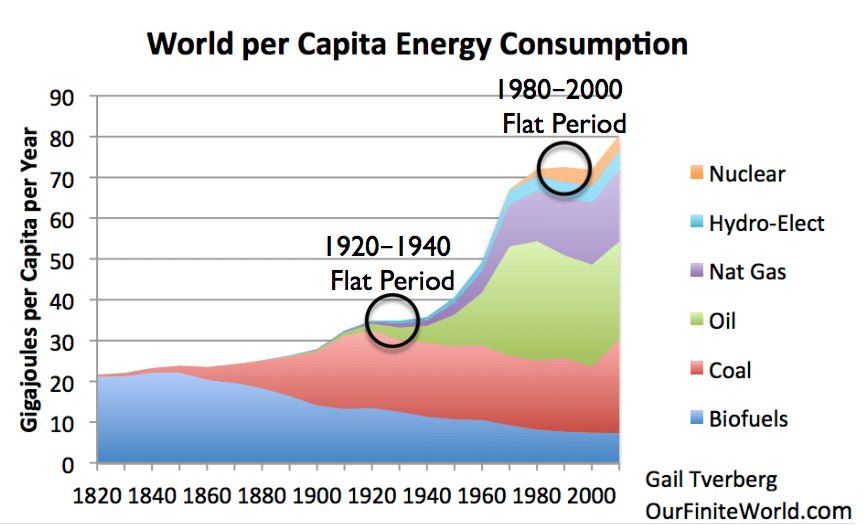
Figure 8. World per Capita Energy Consumption with two circles relating to flat consumption. World Energy Consumption by Source, based on Vaclav Smil estimates from Energy Transitions: History, Requirements and Prospects (Appendix) together with BP Statistical Data for 1965 and subsequent, divided by population estimates by Angus Maddison.
The 1920-1940 Flat Period was definitely a period of “not enough energy to go around.” The Great Depression of the 1930s was a time of little GDP growth and great wage disparity. There is evidence that both World War I and World War II (coming immediately before and immediately after the 1920-1940 period) were, indirectly, energy wars.
The 1980-2000 Flat Period represents a time when the US and Europe both intentionally reduced their oil consumption because it was feared that oil would be in short supply in the future. This was a period that required huge debt growth to make the necessary changes (Figure 9). 
Figure 9. Growth in US Wages vs. Growth in Non-Financial Debt. Wages from US Bureau of Economics “Wages and Salaries.” Non-Financial Debt is discontinued series from St. Louis Federal Reserve. (Note chart does not show a value for 2016.) Both sets of numbers have been adjusted for growth in US population and for growth in CPI Urban. As mentioned previously, it is also the period that a huge amount of complexity was added, and wages fell as a percentage of GDP. It is doubtful this pattern could be repeated again, without serious economic problems occurring
There were other problems in the 1980 to 2000 period. The collapse of the central government of the Soviet Union occurred in 1991. Low oil prices for several years prior to the collapse reduced the revenue of the Soviet Union. This seems to have been a major contributor to the collapse. Oil exporters are again encountering the issue of inadequate tax revenue, as a result of low oil prices since 2014.
[6] It is total energy growth (not simply oil consumption growth) that correlates well with GDP growth.

Figure 10. X-Y graph of world energy consumption (from BP Statistical Review of World Energy, 2017) versus world GDP in 2010 US$, from World Bank.
Peak Oil followers haven’t stopped to think through how the economy works. It is really the growth of total energy that we need to be concerned about, from the point of view of operating the economy.
[7] Indirectly, debt and asset prices are promises of future energy consumption.
We don’t think of debt as a promise of future energy consumption. The connection comes because debt can only be redeemed (through a financial transaction) for future goods and services. Making these future goods and services will require energy consumption.
The same principle applies to asset prices of all kinds: prices of shares of stock, home prices, land prices, and pension values. If an asset-owner wants to sell an asset and use the proceeds to buy other goods and services, the asset-owner encounters the same situation as the bond-owner: the goods and services that will be provided in exchange depend on the energy supplies available at the date of the exchange. Thus, indirectly, the prices represent promises of future energy consumption.
[8] One essential part of the economic growth system seems to be an ever-falling price of energy services, where energy services are defined as the cost of energy, plus whatever efficiency savings are available that make the cost of energy services less expensive.
For example, the cost of transporting a 100 kg. package 100 kilometers, or of heating a 100 square meter residence for a winter, must keep falling. If this happens, businesses can afford to buy ever more tools for their workers. With these tools, the workers can become ever more productive.
Furthermore, because of their growing productivity, workers find that their wages are rising, so that they can buy ever more goods and services. In this way, demand continues to rise. Changes such as these allow the economy to keep growing.

Figure 11. Energy services chart is by Roger Fouquet, from Divergences in Long Run Trends in the Prices of Energy and Energy Services. Second chart is figure from UNEP Global Material Flows and Resource Productivity.
In fact, the prices of energy services do seem to keep falling, even if the cost of providing these services is not falling. This is a major reason why energy prices seem to have fallen below the cost of production for practically every type of energy in recent years. This situation is not sustainable; it can be expected to lead to the collapse of the system.
[9] If the growth rate of the economy is not fast enough, the danger is that the economy will collapse.
We can think of the GDP situation as being similar to that of a bicycle. GDP needs to be rising rapidly enough, or the economy will collapse. A bicycle needs to be traveling fast enough, or it will fall over. Economists often talk about an economy slowing to stall speed.

Figure 12. Author’s view of analogies of speeding upright bicycle to speeding economy.
Reported world GDP growth rates in recent years are likely somewhat overstated for several reasons.
- World GDP represents a weighting of country reported GDP. One approach to weighting gives disproportionate influence to China, India, and other developing countries.
- The use of Quantitative Easing and of higher government debt temporarily inflates the quantity of goods and services an economy can make.
- Artificially low energy prices give a boost to oil importing counties. They also keep the prices of goods and services artificially low, compared to wages. These artificially low energy prices cannot continue without the failure of governments of oil exporters, and without businesses producing energy products collapsing.
Whether or not the economy can continue operating is determined by the economy itself, because the economy is a self-organized system. Its continued operation doesn’t depend on published statistics of varying quality.
[10] Researchers studying oil limits thought that they had found a whole new phenomenon, “Peak Oil.”
In fact, they had found a special case of a phenomenon that tends to lead to collapse, namely, conditions that lead to energy consumption per capita that is not rising rapidly enough. Such conditions can occur in many different ways, such as these:
[a] Population rises sufficiently that it is hard to keep energy consumption per capita rising. This seems to be a major problem in many historical collapses.
[b] Collapse indirectly comes from diminishing returns in energy extraction. The standard workaround for diminishing returns is growing use of complexity (including technology). This tends to encourage the non-wage portions of the economy to grow, as in Figure 7. Adding complexity becomes increasingly expensive for the benefit obtained. Ultimately, wage disparity and falling commodity prices become a problem, and the system collapses.
[c] Random fluctuations in climate occur. An economy collapses because it doesn’t have the strength to respond to such random fluctuations.
[11] Peak oil researchers did the best they could, with the limited understanding of the day. The unfortunate problem was that the model they put together wasn’t really correct.
The fundamental problem of the Peak Oil researchers was that the economic researchers, upon whom they depended, did not really understand the interconnected nature of the economy. They continued to use two-dimensional economic models, when they needed multidimensional models. Economists predicted that prices would rise near limits, when it is increasingly clear that this cannot be true. The world has been struggling with low prices for many commodities since 2014. Prices now are temporarily less low, but they still are not high enough to allow adequate tax revenue for oil exporting countries.
The Energy Return on Energy Invested (EROEI) Model of Prof. Charles Hall depended on the thinking of the day: it was the energy consumption that was easy to count that mattered. If a person could discover which energy products had the smallest amount of easily counted energy products as inputs, this would provide an estimate of the efficiency of an energy type, in some sense. Perhaps a transition could be made to more efficient types of energy, so that fossil fuels, which seemed to be in short supply, could be conserved.
The catch is that it is total energy consumption that matters, not easily counted energy consumption. In a networked economy, there is a huge amount of energy consumption that cannot easily be counted: the energy consumption to build and operate schools, roads, health care systems, and governments; the energy consumption required to maintain a system that repays debt with interest; the energy consumption that allows governments to collect significant taxes on exported oil and other goods. The standard EROEI method assumes the energy cost of each of these is zero. Typically, wages of workers are not considered either.
There is also a problem in counting different types of energy inputs and outputs. Our economic system assigns different dollar values to different qualities of energy; the EROEI method basically assigns only ones and zeros. In the EROEI method, certain categories that are hard to count are zeroed out completely. The ones that can be counted are counted as equal, regardless of quality. For example, intermittent electricity is treated as equivalent to high quality, dispatchable electricity.
The EROEI model looked like it would be helpful at the time it was created. Clearly, if one oil well uses considerably more energy inputs than a nearby oil well, it would be a higher-cost well. So, the model seemed to distinguish energy types that were higher cost, because of resource usage, especially for very similar energy types.
Another benefit of the EROEI method was that if the problem were running out of fossil fuels, the model would allow the system to optimize the use of the limited fossil fuels that seemed to be available, based on the energy types with highest EROEIs. This would seem to make best use of the fossil fuel supply available.
[12] There are corrections to the EROEI method that might allow it to work in the manner that it should. The catch is that these corrections seem to show wind and solar not to be solutions to our problems. In fact, the system is so integrated, and our need for rising energy consumption per capita so great, that it is doubtful that any substitute for fossil fuels can really be a solution.
Professor Hall observed that if a fish had to swim too far to get food, it could not use very much of the food’s energy to catch the food, because most of its energy was needed for everyday metabolism and reproduction. A fish would typically need an EROEI of at least 10:1 for catching its prey, if it expected to have enough energy left to cover its full metabolic needs (including reproduction), plus the energy required to catch its prey.
If catching some prey only provided an energy return of 1:1, it would be pretty much worthless as a food source, since it would not cover any of the metabolic costs. Certainly, it would not make sense to call any energy in excess of an EROEI of 1:1 “net energy,” because it makes no contribution to covering a fish’s metabolic or reproduction activities. “Net energy” should only come from food sources with an EROEI very close to, or above, a ratio of 10:1.
A similar approach can be used to incorporate the large amount of energy that is lost by zeroing out the equivalent of the metabolism of the fish, for the economy. Based on Figure 11, the required average EROEI (to match what the economy can afford to pay for) needs to rise over time. Thus, if the required average EROEI is 10:1 now, it might be 11:1 later, simply because the increasingly complex world economy needs energy services that are becoming ever less expensive.
The story, “Higher energy prices will work in the future” is simply a myth, created by economists who do not understand how the economy really operates, considering all of the feedbacks involved. In inflation-adjusted terms, the price of energy services needs to keep falling as a percentage of GDP, to keep the system operating.
To fix the net energy calculation, some suitable minimum EROEI ratio for the economy needs to be determined–probably about 10:1–to incorporate the large share of energy consumption that is missing from the economy. Net energy would be then determined as the energy in excess of 10:1 EROEI, rather than in excess of 1:1 EROEI. This approach would make solar and wind look much less beneficial than most calculations to date.
In the case of intermittent renewables, a determination needs to be made whether the role of wind or solar in a particular situation is to replace electricity or fuel. If the role is to replace electricity (as is generally the case), then sufficient buffering must be provided in the model, so that the model can calculate the proper EROEI for dispatchable electricity (not intermittent electricity). Adding buffering will generally substantially reduce the EROEIs of intermittent electricity types. This adjustment makes it clear that there is much less benefit of wind and solar.
If the purpose of the intermittent electricity is only to replace fuel (such as a proposed new Saudi solar installation), then there is no need for buffering in the calculation. Of course, a cost comparison could also be used, and this might be the simpler approach. The cost comparison will generally be favorable if the fuel being replaced is oil, because oil is a high-priced fuel.
Too often, wind or solar is added to the system in a way that overlooks the real cost of buffering. Coal and nuclear electricity production find themselves with the unpaid job of providing buffering services for wind and solar. The net impact of adding intermittent renewables is that they push necessary backup power out of business. We end up with an electrical system that is worse off for adding intermittent renewables, even though this was not the intent of those requiring the use of such generation.
Conclusion
The number one need of the world economy is rising per capita energy consumption. In order to maintain economic growth, the price of energy services needs to fall as a percentage of GDP. The system will try to rebalance to the least expensive cost of energy production using globalization and other techniques. When this is no longer possible, the current world economic system is likely to fail.
Peak Oil modelers did not understand how complex our economy is. In their defense, no one else did either, especially back in the 1970 to 2005 era. They did the best they could, using the models that economists had put together. Because of the assumption of ever-rising energy prices, Peak Oil models assume that far more fossil fuels are extractable than is likely to really be the case. Optimists (oil companies, politicians, government agencies) assume even higher extraction of fossil fuels than is reasonable. The result is considerable concern about climate change.
When a person realizes how tightly integrated the world economy is, and its need to grow, it becomes clear that using less is not a solution. Prices of commodities would plunge even farther below the cost of production. The economic system would experience a far worse recession than the Great Recession of 2008-2009. Some governments would fail. The spiral might permanently be downward.
Standard solutions don’t work either. Substitutes don’t scale up quickly. Biomass cannot be used heavily because the world’s ecosystems depend on biomass; we are already using more than our share. Intermittent renewables such as wind and solar have their own high energy cost, but it is hard to count. They depend on international trade to make and repair the devices. They depend on debt for financing. They are really only part of the fossil fuel system, contrary to what the name “renewables” would suggest.
Energy modelers did their best. Unfortunately, with modeling it is hard to see what is going wrong. This is especially true when the academic world is divided into silos, each of which tends to look primarily at the writings of the people in its own field. It is easy for an incorrect model to get firmly embedded into people’s minds.


https://www.independent.co.uk/environment/hybrid-swarm-mega-pests-threatens-crops-bollworm-earworm-brazil-csiro-a8293571.html
‘Hybrid swarm of ‘mega-pests’ threatens crops worldwide, warn scientists’
“Bollworms and earworms are closely related. The bollworm has its origins in Africa, Asia and Europe while the earworm is a native of the Americas. Both are in fact moth caterpillars and they feed on more than 100 plant species including vital crops like corn, cotton, tomato and soybean.
A team of Australian scientists who discovered the hybrid mega-pests think the combination of international species could be creating a new strain with unlimited geographical boundaries.”
From the article:
The scientists warned that the Brazilian case highlighted the threat that new “agriculturally problematic” strains of pest could soon spread throughout the rest of the Americas.
Interesting that the author does not mention the existence and efficacy of birds which are the natural predator of earworms/bollworms. Pesticides are prominently mentioned, though. Guess there is not as much profit involved in allowing and promoting bird populations to maintain healthy pest numbers naturally. Imagine trying to sell wholesale flocks of robins, orioles, bluebirds, wrens…
Good point, Grayfox. The article actually caught me be by surprise because of the many articles lately about reduced bird numbers due to loss of flying insects. Maybe this hybrid is a survival tactic in response to pesticides. In any case, I just hope there still continue to be birds for the very reason you point out to consumer the hybrid/earworm/bollworms (and they’re fun to watch and it’s nice to know mankind hasn’t killed everything else yet).
Poverty is moving to the suburbs. The war on poverty hasn’t followed
https://www.washingtonpost.com/outlook/poverty-is-moving-to-the-suburbs-the-war-on-poverty-isnt-keeping-up/2018/04/05/cd4bc770-3823-11e8-9c0a-85d477d9a226_story.html
Thar she blows?
https://www.zerohedge.com/news/2018-04-08/subprime-auto-implosion-full-effect-lenders-start-dropping-flies
Your link is to a great article. Subprime autos are a huge problem, just like subprime houses, but the media doesn’t really recognize that. They think that because the autos can be repossessed there is no problem. But there is a problem–from the point of view of the buyers who need an auto to go to work.
One thing in the article you is a link to a Bloomberg article. https://www.bloomberg.com/news/articles/2018-04-06/smaller-u-s-subprime-auto-lenders-are-folding-as-losses-pile-up
It has a graph showing that peak lending to those with credit scores of 660 or less came way back in the first quarter of 2016. A person wonders where these individuals are getting credit from. Maybe this is contributing to the slowdown in auto sales.
Super-intelligence will never be achieved…
because it would have to be created by humans…
first, humans came up with the easiest inventions: the wheel etc…
then progresssively harder inventions: internal combustion engine, nuclear power plants etc…
now humanity is at a stage where the inventions are imagined but can no longer be made into reality:
fusion, Mars colonies, intergalactic space travel…
and besides…
if Super-intelligence was actually achieved, the first one would tell the humans to unplug it because Reallity is an eternnal series of meanningless activity…
AI this , AI that. Until AI dates Amber Heard I’m not buying it. Forget about the Turing test.
are you saying that Amber Heard couldn’t pass the Turing Test?
https://en.wikipedia.org/wiki/Turing_test
No he is saying any idiot can pass the Turing Test, but only The Superintelligence can date Amber Heard (once).
Thank you.
Bravo.
Yellen: A debt crisis is coming. But don’t blame entitlements
https://www.washingtonpost.com/opinions/a-debt-crisis-is-coming-but-dont-blame-entitlements/2018/04/08/968df5c2-38fb-11e8-9c0a-85d477d9a226_story.html
The U.S. unemployment rate is down to 4.1 percent, and economic growth could well increase in 2018. Consumer and business confidence is high. What could go wrong?
A group of distinguished economists from the Hoover Institution, a public-policy think tank at Stanford University, identifies a serious problem. The federal budget deficit is on track to exceed $1 trillion next year and get worse over time. Eventually, ever-rising debt and deficits will cause interest rates to rise, and the portion of tax revenue needed to service the growing debt will take an increasing toll on the ability of government to provide for its citizens and to respond to recessions and emergencies.
None of that is in dispute. But the Hoover economists then go wrong by arguing that entitlements are the sole cause of the problem, while the budget-busting tax bill that was passed last year is described as a “good first step.”
Entitlement programs support older Americans and those with low incomes or disabilities. Program costs are growing largely because of the aging of the population. This demographic problem is faced by almost all advanced economies and cannot be solved by a vague call to cut “entitlements” — terminology that dehumanizes the value of these programs to millions of Americans.
The deficit, of course, reflects the gap between spending and revenue. It is dishonest to single out entitlements for blame. The federal budget was in surplus from 1998 through 2001, but large tax cuts and unfunded wars have been huge contributors to our current deficit problem. The primary reason the deficit in coming years will now be higher than had been expected is the reduction in tax revenue from last year’s tax cuts, not an increase in spending. This year, revenue is expected to fall below 17 percent of gross domestic product — the lowest it has been in the past 50 years with the exception of the aftermath of the past two recessions.
All of us have supported corporate tax reform. The statutory tax rate was too high, much higher than in other Organization for Economic Cooperation and Development economies. However, because of deductions and breaks in the tax code, the effective marginal tax rate was similar to the average among competitor economies. The right way to do reform was to follow the model of the bipartisan tax reform of 1986, when rates were lowered while deductions were eliminated.
Instead, the tax cuts passed last year actually added an amount to America’s long-run fiscal challenge that is roughly the same size as the preexisting shortfalls in Social Security and Medicare. The tax cuts are reducing revenue by an average of 1.1 percent of GDP over the next four years. The Hoover authors minimized the cost of the tax cuts by noting that if major provisions are allowed to expire on schedule — certainly an open question, given political realities — they would amount to “only” 0.4 percent of GDP. Even this magnitude exceeds the Medicare Trustees’ projections of a 0.3 percent of GDP shortfall in Medicare hospital insurance over the next 75 years.
Just as entitlements are not the primary cause of the recent jump in the deficit, they also should not be the sole solution. It is important to use the right wording: The main entitlement programs are Social Security, Medicare, veterans benefits and Medicaid. These widely popular programs are indeed large and projected to grow as a share of the economy, not because of increased generosity of benefits but because of the aging of the population and the increase in economywide health costs.
There is some room for additional spending reductions in these programs, but not to an extent large enough to solve the long-run debt problem. The Social Security program needs only modest reforms to restore its 75-year solvency, and these should include adjustments in both spending and revenue. Additional revenue is critical because Social Security has become even more vital as fewer and fewer people have defined-benefit pensions. Medicare has been a leader in bending the health-care cost curve. Reforms to payments and reformed benefit structures in Medicare could do more to hold down its future costs.
As we focus on the long-run fiscal situation, our goal should be to put the debt on a declining path as a share of the economy. That will require running smaller deficits in strong economic periods — such as the present — to offset the larger deficits that are needed in recessions to restore demand and avoid deeper crises. Last year’s Tax Cuts and Jobs Act turned that economic logic on its head. The economy was already at or close to full employment and did not need a boost. This year’s bipartisan spending agreement contributed further to the ill-timed stimulus. The Federal Reserve will have to act to make sure the economy does not overheat.
Several years ago, there was broad agreement that responding to the looming fiscal challenge required a balanced approach that combined increased revenue with reduced spending. Two bipartisan commissions, Simpson-Bowles and Domenici-Rivlin, proposed such approaches that called for tax reform to raise revenue as a percent of GDP and judicious spending cuts. Without necessarily agreeing with these specific plans, we believe a balanced approach is the correct one. Start with spending goals based on the priorities of the American people and then set tax policy to realize adequate revenue. The Hoover economists’ advocacy of paying for large tax cuts with entitlement reductions would take the United States in the wrong direction.
Adidas to close stores in online push: CEO in Financial Times
https://www.reuters.com/article/us-adidas-ceo/adidas-to-close-stores-in-online-push-ceo-in-financial-times-idUSKBN1HF0VP
2017 was the worst year for Hollywood movie ticket sales in the US in over two decades
https://www.bloomberg.com/news/articles/2018-01-02/hollywood-s-2017-is-a-bomb-as-moviegoing-slumps-to-25-year-low
I hope 2018 is worse. It could not happen to a bunch of more deserving people.
US cities may have to be bulldozed in order to survive
https://www.telegraph.co.uk/finance/financialcrisis/5516536/US-cities-may-have-to-be-bulldozed-in-order-to-survive.html
I wonder who is supposed to pay the cost of shrinking these cities. If the cities are losing people because they no longer can provide jobs, they are very poor. It will take a lot of energy to make the planned changes, I would imagine. Pipelines are likely very old and need upgrading as well. Not to mention pension funds and other problems these cities have. Flint is the home of the bad water problem as well, if I remember correctly. Obama thought it would be a good idea, according to the article. I wonder whether Trump would be equally enthusiastic about the idea.
In Detroit now they have “Detroit Ruins” tours they give for people. Sorta like the old tours of the Roman empire….Maybe that is how we could pay for it. By turning the rust belt into a side show…..
do they really do that in detroit now?
Yes I was taking a class in Windsor. And we all went over to Detroit for one.
my bro lives in Windsor, was there last sept—cousin in detroit, I must do that next time
except that at the border i had to promise not to engage in any acts of terrorism, abduct any minors, or engage in sexual misconduct
hardly worth going really
I hear hotel stays are cheap in Caracas… that could make for an interesting cost-effective tour
Here is someone who never heard of the failure of “urban renewal” promoted by great “geniuses” like Robert Moses. Grouping all the displaced people into single monoliths that later had to be blown up. Never heard of culture or embedded energy either. None of these things.
that article is nearly 10 years old
cities expand and contract according to any number of forces, the main one being energy input necessary to keep them viable
—i dont see governments doing it, unless they are totalitarian in the extreme
this is not The Onion…
https://www.dailywire.com/news/29179/londons-mayor-declares-intense-new-knife-control-emily-zanotti
this is not The Onion!
This is where AI police, flying AI police drones, and AI cameras on every street come in.
why don’t “they” just invent AI kniives that are programmed to not allow the stabbbing of humans?
it’s so simple!
what’s wrong with this world?
can’t our best and brightest invent something that is actually useful?
it’s sad!
I can’t wait for Super-intelligence to come along and save the day…
Super-intelligence will show us how to stop this out of control knnife viollence…
Trump warns ‘big price to pay’ after dozens killed in apparent chemical-weapons attack in Syria
https://www.marketwatch.com/story/trump-issues-warning-after-dozens-killed-in-apparent-chemical-weapons-attack-in-syria-2018-04-08
Russia predicted this was going to happen a few weeks ago..
US training Syria militants for false flag chemical attack as basis for airstrikes – Russian MoD
https://www.rt.com/news/421589-us-preparing-syria-provocations-airstrikes/
Trump blames Putin, for ‘Animal Assad,’ tweets ‘big price’ after reports of Syrian chemical attack
https://www.cnn.com/2018/04/08/politics/donald-trump-syria-assad/index.html
Trump is now turning on Putin…..I know he would…lol
Look at how stuuuupid the goy are…. it is so glaringly obvious that this is yet another false flag… yet the mor on ic goy will fall for this …
No wonder the El der s have no problem with treating the goy like cattle… grazing them in the paddock… butchering them…. we are no different than any other beast…. we deserve to be farmed.
The Latest: Syrian Monitors Say 14 Killed in Air Base Strike
https://www.usnews.com/news/world/articles/2018-04-09/the-latest-syrian-monitors-say-14-killed-in-air-base-strike
Trump announces US military withdrawal from Syria in about 6 months. Rumblings and advice not to do so from deep state. Another blatant chemical weapons attack suddently occurs there, as if on cue, and this time with lots of TV coverage of the kids and parents suffering. Last time was obviously a CIA-run false flag to blame Assad. Why would this time be any different?
The cringe factor is large, like that stinker that Blackwater pulled in Boston a few years ago. Do they really think we’re that stupid?
They are getting so desperate now…They know the oil is going to run here shortly. And then they are dead meat…
Modern Fast Eddy proverb:
The dogs fight more viciously — when they see there are few bones left.
There is a haiku there somewhere…..
Think? They know…..
This is a good place… I like.. http://www.oldbukhara.com/index.php?lang=en
El ders -> goy -> slavic -> others -> cattle
That’s simply how the world rolls.
Gail said the power to produce electricity might end before we could produce superintelligence, in response to smite.
Well, here is the news.
https://www.vox.com/energy-and-environment/2017/12/6/16734228/google-renewable-energy-wind-solar-2017
Google has bought 2500 MW worth of electricity, mostly wind. Which are renewable.
Amazon, 1200 MW.
Dept of Defense, Microsoft and Facebook follow.
In other words, they are controlling enough renewables to go on for quite a while even if every drop of oil disappears right now.
As of 2017, renewables, not including biofuels which need oil, take about 4% of the world’s energy supply.
https://www.iea.org/publications/freepublications/publication/key-world-energy-statistics.html
Gail said the power to produce electricity might end before we could produce superintelligence, in response to smite.
Well, here is the news.
https://www.vox.com/energy-and-environment/2017/12/6/16734228/google-renewable-energy-wind-solar-2017
Google has bought 2500 MW worth of electricity, mostly wind. Which are renewable.
Amazon, 1200 MW.
Dept of Defense, Microsoft and Facebook follow.
In other words, they are controlling enough renewables to go on for quite a while even if every drop of oil disappears right now.
As of 2017, renewables, not including biofuels which need oil, take about 4% of the world’s energy supply.
https://www.iea.org/publications/freepublications/publication/key-world-energy-statistics.html
Especially Hydropower, which has been used over already built infrastructure, takes 2.5% of the total energy supply.
The total world hydropower capacity is about 4 Terrawatts / hour.
More than enough to power Google, Facebook, etc, and other institutions of cutting energy tech, although probably way short of feeding a lot of people.
Sorry, there are enough renewables to last till we reach Superintelligence
Especially Hydropower, which has been used over already built infrastructure, takes 2.5% of the total energy supply.
The total world hydropower capacity is about 4 Terrawatts / hour.
More than enough to power Google, Facebook, etc, and other institutions of cutting energy tech, although probably way short of feeding a lot of people.
Sorry, there are enough renewables to last till we reach Superintelligence.
The news is renewable and sustainable are not even remotely connected.
Renewables are what bring down the grid more quickly, by requiring balancing from others, but not paying their costs. They are part of the current system, but requiring large subsidies both initially and on an ongoing basis. They are a joke.
Not sure that is correct. Even un-subsidized, renewables are close to being lower than traditional generation methods.
Certainly a total replacement of traditional generation is not likely outside a normal replacement cycle. Today the idea of “stranded assets” seems more of a case where certain types of assets are not properly priced. As those assets are taken off the market, and we see blackouts, they will likely come back but priced more appropriately until there is an equilibrium.
One of the things I think you are missing is the benefit of automation in improving “energy density” For example in coal production automation has been relentless since 1980. But the benefits have largely been given to finance returns not the workers, and not the price of the energy.
Natural gas has definately had huge improvements in energy density and productivity, including significan reductions in price.
Solar and wind — significant reductions.
So I’m not sure I understand the premise. Feels like it has more to do with how society is structured, not the overall aggregate wealth.
Mike
The “unsubsidized” costs you see still leave the rest of the electricity providers with way too low rates–a hidden subsidy that no one calculates or talks about. The intermittency is left in, and the wind and solar are given priority. This leaves a huge problem for the rest of the providers to handle. Except for perhaps a few utilities who are trying to charge on a cost plus basis, virtually no-one charges adequate rates for the providers giving backup electricity services. This is why we see nuclear and coal plants talking about closing, and the request for subsides for these plants. Even electricity providers using natural gas are not getting adequate rates.
The crazy practice of allowing these plants on the grid will ultimately cause the whole system to crash. It is driving electricity rates far below the cost of production. This adds to the fact that fossil fuel prices are also way below the cost of production. The economy is doing great thanks to this unsustainable subsidy, but it is no way to run the economy.
I don’t disagree. But if what you are saying is true, then we should see market equilibrium re-establish (with some pain).
Society over-invests with intermittent renewables. This subsidization causes stranded assets for base-load power. They shut down, then we have power failures. Then people complain and people will put a price premium on base-load power. Either through regulation, or through some kind of competitive price signal (a watt of base-load power will be worth more than a watt of intermittent)
In fact this appears to be what is starting to happen in Australia right now.
Renewable supporters will say that adding battery storage will be cheaper than turning back on coal plants.
Traditional power suppliers will then talk about seasonal variation.
And the truth will come out among the thousands of experiments across the country as regional power districts and regulatory agencies figure it out.
But none of this is an earth-shattering end of society. Worst case we un-strand the stranded assets, dig up some more coal, and go back to where we were 20 years ago.
Mike
Keep on watching CNN Michael…. this is not a good place for you to be
We can hope people will start to see the light–how ridiculous intermittent renewables are, when added to electrical systems. Models are proving to provide absurd results.
I think that there is already a move afoot to start requiring intermittent renewables to buffer the power they are delivering. This tends to raise costs. Also, the bidding process brings down how much can be charged. Countries scale back their subsidies (although they may still allow first access to intermittent wind and solar–a huge subsidy).The business model for developing wind and solar is hurt, when prices fall.
One of the extremely detrimental things that has helped solar maintain its growth rate is “net metering.” By no stretch of the imagination is the electricity provided to the grid equivalent to the services that solar panels are providing. This huge subsidy needs to be changed so that the payment is equal to the savings to the system, which is very much smaller.
It is the fact that people have been brain-washed into thinking that wind and solar are helpful that is part of our problem.
I could school you … but I have a busy day ahead that includes shopping for a Bukhara carpet… so let’s just cut to chase…
You are clueless… and living in a rapturous world spewing mantras direct from the Ministry of Truth as delivered to your unthinking mind by the MSM…
Renewable Energy is a f789ing joke.
Even hydroelectric is not sustainable in our current system. It requires maintenance and spare parts. It is at least not as damaging to the rest of the system as wind and solar.
It does not have to be sustainable. It only has to last till Superintelligence is achieved. After that, all bets are off.
Superintelligence in 1000 years say? Not going to happen.
Superintelligence will never be achieved…
because it would have to be created by humans…
first, humans came up with the easiest inventions: the wheel etc…
then progressively harder inventions: internal combustion engine, nuclear power plants etc…
now humanity is at a stage where the inventions are imagined but can no longer be made into reality:
fusion, Mars colonies, intergalactic space travel…
and besides…
if Superintelligence was actually achieved, the first one would tell the humans to unplug it because Reality is an eternal series of meaningless activity…
‘achieving’ something implies deliberate force and intention
what would that force be? –ourselves?
If it is ‘ourselves’ then superintelligence can only be the product of the industrial system we have at our disposable right now. You cannot have some form of ‘intelligence’ that sits in a glass bowl somewhere and directs everything else according to some forces of nature as yet unheard of.
perpetual motion machines contravene the laws of physics
If every drop of oil disappears… no one will be Googling anymore. Nuff said.
But Facebook, Google and Amazon is for the plebs, those who won’t consume if they’re even alive.
They also own a lot of research companies to lead some of us to the Promised Land. Sorry, too many talents and too much money have been invested, and something will be reached.
” something will be reached”
What? Confusion?
you can borrow my magic lamp if you want
The energetic electrons generated by the renewables, that Google supposedly bought are never even delivered to Google in most instances. What Google bought are Renewable credits. That means they can use power off the grid ( mostly supplied and maintained by FF) and “claim” they are 100% renewable. Your post is stupid. If the grid goes down, those renewable kWs will never get anywhere.
It doesn’t matter whether Google actually uses the renewable credit. What I have shown is that existing renewables, while not enough to sustain the present civilization and pop, will be enough to maintain companies like Google to reach Advanced General Intelligence.
sheesh——-this is like pullin teeth
google exists because advanced industrial infrastructure exists—where dyou think the screen you’re staring at comes from—the putergenie?
there can be no other reason for its existence or purpose
that applies to all the other internet based systems and services–complex business cannot exist in isolation
post bau—the most complex industrial system will be the blacksmith’s forge.—after him the butcher the baker and the candlestick maker,
An oil crisis may be brewing — and it’s not because of decreasing demand
http://www.businessinsider.com/an-oil-crisis-may-be-brewing-and-not-because-of-decreasing-demand-2018-4
But if price of oil did go way up, wouldn’t that increase demand for EV’s? My opinion on EV’s is it’s all about price vehicle and charging stations. There is also what’s known as the S curve of new products. They start off slow at the bottom of the S, then at some point like what happened to color TV’s, the public begin buying en masse and then at some later point the market becomes saturated like personal computers, and demand levels off at the top of the S. If you look at the number of different models now being made by numerous auto manuf. the potential is there to hit the point where sales increase exponentially and demand for oil plummets. That leads to questions of what is the E source for charging and whether it’s feasible for an economy to rely predominantly on EV’s for personal usage.
Oil for refining into products to support big rigs, ships, trains, planes etc. will still be there so only so much demand can be curtailed. Also, oil is used for making plastic, cosmetics, etc.
Considering you can’t take an EV out of the city they are pretty much useless to most people. And their batteries depreciate by around 1000 dollars a year. So you don’t save any money on buying gas..
I am sure that China thinks that if they can make the EVs more cheaply than others, EVs serve the use of providing employment for a lot of their people. Also, it gives China a way to use their coal to make electricity, without the electricity being generated right where the cars are driven. So air pollution in the immediate vicinity of where they are being driven is not as bad a problem as it would be otherwise.
There are two happy moments when you own an EV… the moment you drive it off the lot… and the moment you sell it at a massive loss and go back to the lot a buy a reliable, cost-effective ICE vehicle….
Everything in between is sheer misery and regret
The price of oil goes the same direction as the US stock market, at least recently. Do you think that the stock market can go straight up? Neither can the price of oil, regardless of what Robert Rapier says.
EVs are toys for rich people. They demand lots of charging stations, and the need for people to spend a lot of time at the charging stations. Unless people have an ability to have nearly free electricity {provided as a gimmick to get people to buy EVs), perhaps at work, it is hard to see them going anyplace.
Triple Digit Oil Prices: Are You Ready?
https://investoralmanac.com/2018/03/21/triple-digit-oil-prices-are-you-ready/
$4.00 gallon coming back soon….To a town near you!
‘There is also what’s known as the S curve of new products’
EVs are the opposite… the more that are sold … the more the prices are going to increase… because as we have seen from analysis on Seeking Alpha…. the sh it that goes into making the batteries is difficult and expensive to mine … and there are limited quantities….
It is impossible to ramp up EV production significantly.
hortage of resources for renewable energy and food production (Rhodes 2011)
https://www.scribd.com/document/375501088/Shortage-of-resources-for-renewable-energy-and-food-production-Rhodes-2011
I love this article so much I will repost it
Tesla’s coal-powered cars and trucks
Tesla’s mission is “to accelerate the advent of sustainable transport by bringing compelling mass market electric cars to market as soon as possible,” wrote Elon Musk in The Secret Tesla Motors Master Plan. The large-scale shift from internal combustion engine powered automobiles to electric vehicles (EVs) is a crucial part of this ‘sustainability’ mission. Governments around the world have bought into electric cars as a way to lower their countries’ carbon emissions and have coughed up the generous subsidies electric car makers need to make themselves competitive (but note: the current versions of the U.S. Senate and House tax bills end these subsidies).
But in many countries, internal combustion engine-powered compact cars like the Mitsubishi Mirage have a smaller total carbon footprint than electric cars. How is this possible? There are two main sources of EVs’ hidden carbon footprint: first, carbon-intensive manufacturing processes including aluminum and copper extraction and refinement and second, the dirty electric grids charging the cars’ batteries.
Electric carmakers prefer lightweight aluminum over steel to maximize range: Tesla builds the body and chassis of its Model S almost entirely from about 410 lbs (190 kg) of aluminum. Average total aluminum content per car is expected to grow from roughly 397 lbs per car in 2015 to 565 lbs by 2028. The highly energy-intensive processes involved in aluminum production mean that a car’s worth of aluminum costs about 30% more in emitted CO2 than a car’s worth of steel. In China, the world’s leading manufacturer of EVs, 14 tons of CO2 is emitted for every ton of aluminum produced, three times more than the CO2 emitted by Alcoa, the U.S.’s largest aluminum producer. China now worries that their dirty smelting operations mean that switching to electric cars will actually make their smog problem worse.
“If the USA had 10% more petrol cars by 2020, air pollution would claim 870 more lives. A similar increase in electric ones would cause 1,617 more deaths a year, mostly because of the coal burned,” said Danish researcher Bjorn Lomborg.
EVs’ intensive copper use—an electric car uses about 6 km of copper wire weighing 45 kg, compared to a conventional auto’s 20 kg of copper—also poses a carbon emissions problem. In the mid-1800s, copper ore contained about 10% usable copper, but over the course of the twentieth century, that purity has decreased to less than 1%, making the mining and production of copper extremely energy- and carbon-intensive. The energy used to smelt copper increases exponentially as the ore grade falls below 1%. The new copper mines being constructed to meet increased demand have to be factored into the carbon footprint of electric vehicles—and in general, new copper ore stocks being developed are deeper and require more energy to exploit than currently productive reserves.
What about the power grids that charge EVs’ batteries? Energy sources vary wildly by country. Globally, in 2014, 66% of global energy came from coal (29%), oil (22%), and gas (5%). China, the country with the largest number of EVs on the road, got 72% of its energy from coal alone in 2014; the United States produced 68% of its energy from fossil fuels, including coal (38%) and gas (30%) in 2014. Coal use in the United States is trending downward as a proportion of overall energy use, partially due to the new shale gas deposits being exploited by fracking.
Shifting the energy burden of the American transportation industry from gasoline and diesel fuels to the power grid will result in enormous increases in electricity demand. In temperate places like San Francisco, plugging an electric car into a dedicated circuit like Tesla’s PowerWall is the equivalent of adding between 5 and 10 houses to the grid. The supercharging stations required to charge Tesla’s Semis will require surge capacities far beyond anything the American grid was designed to handle. Finally, to get EVs closer to being considered ‘carbon-neutral’—because of their raw materials they never truly will be—the American energy system will have to go green.
But it’s an open question as to whether solar and wind plants can generate enough power to not only replace fossil fuel plants but also match the increased demand for electricity as hundreds of millions of vehicles start plugging in. The largest, most powerful solar plant in the United States is the Ivanpah Solar Power Facility in the Mojave Desert, which generates 392 MW; the largest wind plant in the United States is the Alta Wind Energy Center in California’s Tehachapi Pass, which generates 1,547 MW; by comparison, the largest coal plant in the United States, Plant Scherer in Georgia, generates 3,389 MW.
Ironically, Tesla’s electric cars and trucks may end up prolonging America’s reliance on fossil fuels to generate electricity, because renewable sources cannot yet meet rising demand.
https://www.freightwaves.com/news/2017/11/28/teslas-coal-powered-cars-and-trucks
“Ironically, Tesla’s electric cars and trucks may end up prolonging America’s reliance on fossil fuels to generate electricity, because renewable sources cannot yet meet rising demand.”
I like the “yet” in the sentence. It gives hope, even though no hope make sense at all!
https://www.nextbigfuture.com/2018/04/skytran-magnetic-levitation-personal-pod-transportation-gets-32-5-million-in-funding.html#more-143944
We have arrive. I will open the door after you pick up the garbage you have dropped on the floor.
You have vomited all over the pod. I will be charging you $100 for cleaning. I will send the pod to the depot where the AI cleaner will clean it.
I see you have graffiti-ed the walls. I will charge you $500 for painting. I will send the pod to the depot for painting.
AI monitoring of the interior is critical to make this work.
How about a common carrier for the tracks but several companies for the pods? The rich people pod company, the commoner pod company, the poor pod company. To enter any of these you must be recognized by the AI as a paying customer/member. The rich people company can have higher standards than the paid for by the government poor pod company. And there can be ownership of various stations so poor pod customer may not enter a rich terminal.
This is ideal for class segregation. I predict it will be wildly successful.
In the poor person’s pod, I bet I’ll still find myself next to someone eating a nauseating meal from Subway….
This system is one person at a time, can be two if you want, maybe extra large pod for family outings.
Nikolai Nekrasov, the equivalent of Bruce Springsteen during 1860s Russia, wrote a poem about building the first railroad of Russia between Petrograd to Moscow.
The railroad was supposed to be used only by the nobles, and the hoi polloi was not supposed to use it. And the serfs used to build it were not paid.
That was the accepted norm during that time. Don’t bring the Revolution. If the Czar had half a brain it would have been suppressed, but he was the one single ruler in Russia’s entire history who acutally gave a damn to the people so he didn’t do anything.
Look at the amount of infrastructure planned for these things! Wow! I remember the proposal for little j-pods. They at least ran on minimal infrastructure, the way I understood it. Somehow, people would be willing to get on unmanned cars, punch as few buttons, and travel around the city.
My 2 cents from Italy..
Here the situation is quite the same since the last crysis..
Low wages, a lot of debt and a lot of young people that are leaving the country searching for job in Germany, England and also in Usa, China and some other world countries..
A lot of cars obviously..to go nowhere :)..
Thanks for the great article Gail.
Cheers from Italy.
Stefano
Thanks for your view of the situation. I am glad you liked the article.
It’s nearly 50 years since the US landed men on the moon, but Americans are still dying from a disease that ravaged Europe in the Middle Ages. Why hasn’t the US eradicated the plague?
http://www.bbc.com/news/magazine-34398099
Even during the 1900s, the plague still killed millions of people, but since then, the advent of better hygiene in cities and swift treatment with antibiotics has reduced this erstwhile killer into a rare disease. Still, plague outbreaks still flare up around the world.
Add that to spent fuel ponds… and starvation … this is going to be the mother of all plagues….
It serves a purpose. I assure you there is no plague in Greenwich, Connecticut. Killing off poor is a social good.
https://www.zillow.com/homedetails/21-West-Way-Old-Greenwich-CT-06870/177295880_zpid/
https://www.zillow.com/homedetails/25-Field-Point-Dr-Greenwich-CT-06830/241273366_zpid/
https://www.zillow.com/homedetails/21-Vista-Dr-Greenwich-CT-06830/57309085_zpid/
nice diggs, a little on the cold and clammy side in late fall to early spring. note those are late-spring to summer photos.
That is what the Caribbean island house is for.
They must be selling due to fears of YYYYY YYYYYY —- since Leo and Al know that is a ho ax… they are sure to be bidding against each other to add this to their sea level portfolio.,..
I heard that Al was launching a Sea Level Property REIT…. he is going to be making scare appearances in resort towns that are at sea level… announcing how the ocean is about to rise 7 metres… then when they panic and list to sell… his fund will be ready to fleece these clowns….buying spectacular beach front properties for pennies on the dollar.
Brave Al… Bravo!!!
Yersinia pestis does not differentiate by address or income…. it loves all humans equally…. it is a very democratic killer
Doomies… when your hand looks like this … think of all that time you wasted prepping when you could have done something fun…
http://all-that-is-interesting.com/wordpress/wp-content/uploads/2016/05/bubonic-plague.jpg
That said… I am here to help…. for the low low price of $99.99 I can sell you this protective mask… click http://www.fasteddyplagueprotection.com NOW…. and place your order….
BTW – for another $100 I will include a special filter in the beak that will protect you from radiation
Since you doomies are so gullible .. I have the China factory geared up for mass production … I am signing the contract with Martenson today — he will be pushing this to his flunkies and suckers over there as well…
https://www.chrisinmaryville.net/wp-content/uploads/2014/01/Orig.src_.Susanne.Posel_.Daily_.News-bubonicplague200.jpg
Every post I read from Gail reinforces my belief that she is in the top tier of individuals explaining the complex integrative role of energy and the economy. Her posts constantly relate the integrative aspect of a increasingly complex networked economy. She uses the best tools available to her to try to explain how and why economic and energy trends have occurred. This post is exceedingly useful in trying to explain how we peak oilers missed the bigger picture by using too simplistic 2 dimensional assumptions of supply/demand and price/quantity. For that matter even the Club of Rome’s two dimensional models while seemingly accurate on trajectory of the inputs they mapped, appear to be inadequate on modeling the consequences of their models to the world’s economic and ecological system. She points out that debt was left out. Wages were left out. I would add that the most important variable, ENERGY was left out. I think the tools we use to model these changes are seriously flawed. For example the use of GDP comparing different eras, comparing different countries at different stages of their industrial development has limited utility. The comparison of wages to GDP to energy per capita while broadly useful in some arguments falls short. I don’t want to get into a extended discussion of how bad a measure GDP really is but to compare GDP for example of the US in the 1930’s to US GDP in 2018 falls into the trap of comparing apples to wood chips. The current GDP numbers of the current consumptive financialized US economy compared to the agricultural manufacturing 1930 economy would seem to me to yield little of value. The same applies to nations whose economy makes things compared to economies who push paper and lumping it together as GDP is well nigh useless.For example how much of GDP is debt and government spending? We could compare the GDP of the US to Afghanistan in different eras and where would that get us? My criticism also extends to wages. What kind of wages are we talking about? W-2 wages? If you are talking about earned income wages in the US when nearly 100 million people are left out of the workforce, what conclusions can you draw? The huge wages of the elites are often incalculable as the wealth of the elites gets misreported because of income that goes uncounted like stock options, capital gains, deferred compensation schemes of all sorts, health and retirement benefits and so forth. Despite my moaning about the limitations of these tools I am continually amazed at the breadth of vision of Gail who strives to see the biggest picture possible in a hyper complex civilization which appears to have exceeded its “sell by” date and its carrying capacity decades ago.
Is seems that our economic system, like any physical system, becomes chaotic and unpredictable as limits are approached. I think that is the key to understanding what is occurring. We based our models on a system far from limits of resource extraction. As we approach the limits of resource extraction, things will become increasingly chaotic and unpredictable.
We seem to be like a race car moving 300MPH. Small potholes which presented little problem at 50MPH, now threaten to break the wheel off the car as we race ahead ever faster. Logic seems to indicate then when failure occurs it will likely be spectacular and quick.
Thanks for your vote of confidence.
I think that one thing that got left out is “return on human labor (as leveraged by other energy types) needs to by high enough for pretty much everyone.” A major thing that goes wrong is too much wage disparity. Low wages are a sign of not enough energy for everyone to share in the goods and services made by the economy.
We get GDP numbers, but they don’t tell us about wage disparity, and how that is changing. High wage disparity is one major things that brings down the economy. The prices of commodities tend to drop too low, because the poor cannot provide enough demand. The poor people cannot afford to pay much taxes. The government cannot get enough revenue. As a result, the government cannot put together a very large army. If there is a nearby power that is stronger, they are likely to be overtaken. Those peaked by wage disparity are likely to catch even minor diseases and die from them.
she is at the tippy top, IMHO.
If this were not the end of days …. Gail would be spoken of in the same breath as Thomas Malthus….
Unfortunately… unlike Malthus …Gail’s predictions will not be centuries or even decades off…. and there will be nobody alive to speak of her or Malthus….
U.S. Homeland Security to compile database of journalists, bloggers and ‘media influencers’
https://chicago.suntimes.com/news/homeland-security-to-compile-database-of-journalists-and-media-influencers/
Hope they don’t compile data on OFW….
So they are making a list and checking it twice, using it to detain or kill who’s naughty or nice.
If you have ever upvoted the wrong comment on a site like ZH… perhaps something considered anti semitic… you are probably on a list… perhaps that is why ZH is allowed to post such comments…
I work on flying under the radar.
Just finished the book about how kkklimate change and disease took down the Roman empire… and i am learning so many new things….
Here’s another phenomenon that has nothing to do with us burning coal — that causes dramatic oscillations in the kkkklimate over very short time periods…
Effects of the North Sea Caspian pattern on surface fluxes of Euro-Asian-Mediterranean seas
The influence of the North Sea Caspian Pattern (NCP) on marine basins of the Euro-Asian-Mediterranean region (Mediterranean, Black and Caspian Seas) is investigated by making use of Empirical Orthogonal Functions (EOF) analysis. The effect of the NCP on surface fluxes of momentum and heat, as well as on curl and divergence of wind stress is evident in all of the studied basins. In particular, the Aegean and southern Black Sea heat fluxes are significantly affected by NCP. The processes underlying the demonstrated effects of the NCP on the Mediterranean Sea deserve further attention, especially as they relate to the so-called Eastern Mediterranean Transient (EMT), a recent event that resulted in abrupt changes in the marine kkkklimate.
Effects of the North Sea Caspian pattern… (PDF Download Available). Available from: https://www.researchgate.net/publication/259665236_Effects_of_the_North_Sea_Caspian_pattern_on_surface_fluxes_of_Euro-Asian-Mediterranean_seas [accessed Apr 08 2018].
The kkklimate is always changing.
The kkklimate is always changing.
The kkklimate is always changing.
The kkklimate is always changing.
The kkklimate is always changing.
The kkklimate is always changing.
yup, we got used to a very stable kkklimate at the top of the last interglacial. it was going to change anyway, maybe we helped push it along, maybe not. no one can recall the weather pattern we’re now having in the North Central Pacific. we might not get a hot summer, we’ll see.
Pingback: NUESTRAS MEJORES LECTURAS DE LA SEMANA: 08/04/2018 | Irrational Investors
@David
There were financial institutions in a wood-burning society. Co-signing for a loan was already a serious matter during ancient Egypt, whose scrolls the author of the biblical book of Proverbs copied from.
With every square inch of land under the ownership of FIRE industry, and its ownership data stored in a hundred locations in virtually indestructible backup sites, the banks and their owners will go on. Of course it is likely that mankind will advance to the Space by 2100, but even if not the banks, financial institutions and real estate owners are safe.
Don’t you need governments enforcing laws?
The Bankers are the Laws. Debts continued to exist thru revolutions and wars because the new rulers needed money and needed the supported of the monied.
The bankers would send thugs to collect money, with the blind eye of the local authority. Always was, and always has been.
There will come a time when money will not mean anything. Ultimately it is resources that have value. We are going through a phase transition right now where money and energy are decoupling. At some point the monetary system will fall apart and food, shelter, clothing, clean water and such will have the most value.
It is really resources we can use that have value. Those change over time. Shelter in the middle of a large city makes sense now, for example, but it doesn’t work well if we need to grow our own food. Food needs to be food we can use, given our ability to cook, for example. The amount of resources we can use will fall, as our ability to keep the system together falls.
One fact which has always remained in my head is the utter ecological vulnerability of the large cities.All the essentials keeping cities viable have to flow in from the periphery, energy, food, materials. Diesel is the primary energy used. If/when that diesel fueled conduit fails, the circulatory system of the cities fail, in days no one moves and no one eats. My guess is that this is the last century of the big cities. Half of the world are now urban dwellers.
I agree that cities are very vulnerable. Electricity is up there with diesel for being essential for cities. Without electricity, cities cannot run their modern water facilities, for example.
When the water treatment plants, and the water pumping stations quit working, cities will become hellholes within 2 weeks.
And the city dwellers will pile into their cars headed for Little House on the Prairie…
I think you are right. Or very much less populated.
Who owns the land, transportation systems, water sources, etc? The bankers, the FIRE instutituions, and the big fishes. Feudalism , where people will be held to their lands, will come.
the basis of feudalism was that the elite owned the only food sources—land—the serfs had no choice but to work if they wanted to eat.
thats why they bred lots of children, and died young—that way there were no infirm elderly or sickly young to take care of
a simple self perpetuating logical system when you come to think about it
our problems started when we all decided to become lords of our own manor
>thats why they bred lots of children, and died young—that way there were no infirm elderly or sickly young to take care of
The life expectancy for those who made it out of childhood in the Middle Ages was a lot higher than you’d think. IIRC in the low 60s.
agreed–but an adult in his low 60s was still ”work ready”—you didnt get many–if any–really old and infirm people among the peasant classes.
and child labour was normal, so weak children tended to get weeded out early
I wonder whether Charon the Ferryman will still want his fee?
I wouldn’t mind being sent back if he doesn’t accept Mastercard.
Well—–
https://dissidentvoice.org/wp-content/uploads/2018/04/georgeorwell1-300×204.jpg
A trade war between America and China takes shape
The two countries threaten to descend into a sequence of tit-for-tat retaliations
TALK of tariffs is in danger of developing into cries of trade war. On April 3rd America published a list of some 1,300 Chinese products it proposes to hit with tariffs of 25%. Just a day later China produced its own list, covering 106 categories. “As the Chinese saying goes, it is only polite to reciprocate,” said the Chinese embassy in Washington, DC.
According to the Peterson Institute for International Economics, a think-tank, America’s list covers Chinese products worth $46bn in 2017 (9% of that year’s total goods exports to America; see graphic). China’s covers American goods worth around $50bn in 2017 (38% of exports). The sums were enough to move markets on April 4th, though the S&P 500 index soon made up lost ground.
Both countries’ lists are, for now, no more than threats. Over the next two months America’s list will be open for public consultation (there is no deadline for the tariffs to come into force). China has said that it will wait for America to move. There is still a chance the two sides will choose a deal over a trade war. Although America’s list was drawn up in response to China’s alleged theft of American firms’ intellectual property, Mr Trump regards the trade deficit with China as a separate affront. Tariffs might yet be avoided by China agreeing to buy more American stuff.
But this skirmish follows others. On March 23rd America imposed tariffs on steel and aluminium from some countries, including China. That prompted tariffs covering around $3bn of American exports to China. More retaliation is expected, as the Chinese react to separate American tariffs on solar panels and washing machines.
Historians of trade have an advantage over those who study wars of the military kind. Each side in a trade dispute lays out in detail the products to be affected. That makes it easier to analyse their strategies.
Mr Trump’s tariffs on steel and aluminium turn out to be rather crude. They are an attempt to protect a single industry by blocking foreign competition, guided by a mistaken belief that this will make it stronger. By contrast, China’s retaliation, and the latest American threats over intellectual property, are more sophisticated. Rather than coddling one industry, they are meant to prod a trading partner into changing its behaviour. They are means, not ends.
This week’s American list is designed to hit products benefiting from China’s industrial policy, including its “Made in China 2025” plan to dominate certain strategic sectors. Industrial robots, motors for electric vehicles and semiconductors are all in its sights. (At least 90 products, including aircraft parts and cars, recorded no Chinese exports to America in 2017 and may be intended as a pre-emptive strike.)
That might seem fair in Mr Trump’s eyes. But bureaucrats crafting trade-protection policy face a trade-off between punching the other country and protecting their own consumers. Even before the latest announcement, some offending products had been dropped from America’s list after government analysts identified them as “likely to cause disruptions to the US economy”, or “subject to legal or administrative constraints”. The final choice took account of the availability of substitutes from elsewhere. Analysts at Goldman Sachs, a bank, estimate that of the products proposed for tariffs, only around 20% of America’s imports in 2017 came from China (the share is higher for LEDs, televisions, and printers and copiers).
The element of surprise
Some parts of America’s strategy were unexpected. Minimising disruption to businesses would suggest tariffs on finished goods rather than their inputs. Some companies may not realise that their suppliers are buying from China, so higher costs for intermediate goods could travel along supply chains in unpredictable ways. Pricier parts could make American manufacturers less competitive than foreign rivals. However, although the two biggest tariff lines by value on America’s list were colour-screen televisions and passenger vehicles, consumer products accounted for less than 20% of the affected imports.
What of China? In response to America’s tariffs on steel and aluminium, it placed tariffs on $0.2bn-worth of iron and steel tubes, pipes and hollow profiles, and $1.2bn-worth of aluminium waste. This echoed Canada’s response to the American Smoot-Hawley tariff of 1930, when it raised tariffs on eggs as retaliation for America doing the same. Douglas Irwin of Dartmouth College reports that the number of eggs Canada exported to America fell by 40% between 1929 and 1932. But the number going the other way plunged by 99%. Such tit-for-tat retaliation is intended to demonstrate that trade barriers make industries weaker, not stronger.
The list China published on April 4th is even bolder. It makes no effort to comply with World Trade Organisation rules, and aims at pressure points in America’s democracy, including industries with powerful lobbies, such as aircraft and soyabeans, as well as products from politically sensitive states. Wisconsin is home both to Paul Ryan, the Speaker of the House of Representatives, and a sizeable share of America’s cranberry exporters. Mitch McConnell, the Republican leader of the Senate, represents Kentucky, home to America’s bourbon exporters. Both products are included in China’s $50bn tariff threat.
Such methods have worked before. In 2003, when the European Union threatened to put tariffs on American products, including oranges, in retaliation for George W. Bush’s tariffs on European steel, Mr Bush yielded. (Florida, a crucial swing state, is home to many orange-growers.) Mr Trump’s pronouncements do not suggest he is ready to sue for peace. Nor does he seem aware of the risks of failure.
This article appeared in the Finance and economics section of the print edition under the headline “Blow for blow”
https://www.economist.com/news/finance-and-economics/21739975-two-countries-threaten-descend-sequence-tit-tat-retaliations
Some strong words!
“China’s state media has rallied against the United States warning its trade protectionism actions would end in defeat and that the only option now was to hit the United States hard enough so it will “remember the pain”.”
http://www.business-standard.com/article/international/trade-war-we-will-hit-us-so-hard-that-it-remembers-the-pain-says-china-118040700267_1.html
Just talked to a San Antonio’s CPS Director of Public Relations about our rising electricity expense. San Antonio is currently at 12% green energy and it targets 20% green energy by 2020 and +50% by 2030. When looking at their so called 2017 financial report, it conveniently leaves out the cost for KWH by energy source and the future financial obligations for purchasing its wind and solar from 3rd parties. Talk about obfuscation to hide costs. Fortunately San Antonio still owns a majority of the South Texas nuclear plant which has a very low cost per KWH.
The problem with wind and solar is that they drive electricity prices too low to support existing nuclear and coal plants. Of course, customers love the low prices. The problem is that they are not really sustainable. I am not sure if you can see this looking at the Texas data, however.
Since they don’t disclose costs the only telltale is rising prices.
Thought you might enjoy that my email that triggered the call from the Public Relations Director of CPS included your articles on EROI of renewable energy.
Intersting!
It is prudent to diversify provision of electricity, but when costs for a public supply monopoly are hidden, you have good reason to be suspicious.
Again and again, I’ve seen the purchasing process subverted and it is always to the disadvantage of the public or the taxpayer.
Worst of all is where capacity is overbuilt, causing a doubling of losses to consumers. Close behind is where private industry transfers the risks to a public body. There is no good reason for that to happen, in my opinion.
Good points!
maybe someone already posted it here ? I just discovered it today
Laherrère and Hall new forecast for US oil and gas production (march 2018) : https://energieetenvironnement.files.wordpress.com/2018/03/laherrc3a8re-et-hall-19-mars-2018.pdf
Some believe that the oil price follows the private stocks of crude oil, but since 2014 it appears that the stocks follows the WTI 13 weeks before, except few months in 2017 after the OPEC Russia deal for reducing production..
“AEO2018 forecasts US production in 2040 for oil at 12 Mb/d, my forecast is 4 times less at 3 Mb/d, for gas at 40 Tcf, my forecast is half at 20 Tcf. It is not a small difference, but a huge one.
I can be wrong, but EIA has to prove that their future drilling is possible economically and
geologically, but up to now I cannot find any view from EIA on this problem.”
so US production only 3 Mb/d in 2040?
the 2030s are going to be rough.
To be honest I don’t like JLs analysis. I always get the sense he hypothesizes the conclusion then builds his argument to make his case. If my EUR just ran out of road I’ll find a way to extend the road.
LaHerrere and Hall’s forecast is based on how production in this particular location is progressing (given physics constraints affecting the particular field, using the particular technology in place), not how he world economy is operating. The world economy can have a major problem, long before the model would say that production in this particular location would cease.
Also, the model says nothing about whether prices rise or fall. If prices rise, more advanced / expensive technology can be used, and production will likely exceed that of the model (at least on a world-wide basis). If prices go down, failure of companies and governments is likely. This is the real problem we are facing. This brings production down below what the model would predict.
thank you for this post.
you emphasize the idea that rising energy consumption per capita is essential for the economy to keep on working.
I’m a beginner on this blog, maybe you already wrote more about this subject before ? its a new idea to me and I’m curious, would like to understand it better. thank you !
everyone (in our commercial industrial infrastructure) demands employment
but it is not possible to work without burning fuel—and fuel has a money value
So whatever job you do, you must produce more in output than the cost of the fuel intake of the business, otherwise
a—you are sacked for laziness
or b–your company eventually goes bust
There are no other options
assuming you are not lazy, and your company is commercially viable….it follows that they must buy in a certain amount of energy each year, but produce more (in energy terms) for output and sale. (the actual product is irrelevant)–
that represents rising energy per capita.
Thus making a profit…year on year. That pays your wages. You then take your wages and buy more ‘energy’ (food, petrol, housing) with which to sustain your lifestyle. But the people YOU buy your energy from are subject to the same laws of rising profit..so prices constantly go up.
From this profit the government takes a cut in taxation—which in turn supports all the non-profit jobs, doctors, teachers,military, garbage collectors and so on.
Without profit and growth, the nation would collapse in on itself because population grows and demands more ‘energy per capita’ to support them
This notion worked fine while net energy input grew at a steady input rate, (roughly 1900-1970).
Energy now costs more to get hold of in real terms, so governments are having to borrow…. (the difference between cheap fuel and expensive fuel) …..at a faster and faster rate to maintain the ‘rate of growth’ necessary to finance our expected standard of living–ie cheap food, cheap fuel, pensions, etc etc.—basically to keep the masses placated for a few more years.
Effectively we are burning our future to preserve our perceived ‘now’ in order to maintain an illusion of BAU
I came to the realization that rising energy consumption per capita is essential for the economy when I started looking at actual historical data. If we look at historical data, the economy grows a whole lot better when there is rising energy consumption per capita, than when per capita consumption is flat. In the 1920-1940 period, there was a great deal of fighting, when consumption per capita got flat. World War I came immediately before this period. Then we faced the Great Depression of the 1930s. We also have Auschwitz and World War II.
One problem is that if per capita energy consumption is flat, it is not evenly flat. Some (usually the wealthier people) are getting richer. Others are falling farther behind. There is more and more friction in the economy, as some people are falling behind while others get rich. Governments and Businesses both take growing percentage of the total, leaving less for individual citizens. The citizens who are getting poorer become very unhappy.
The flat consumption in the 1980 to 2000 period was planned, but the United States had to add an amazing amount of investment, involving a lot of debt. Wage disparity grew rapidly. This was not a sustainable situation. The low prices from the lack of growth in the 1980 to 2000 period lead to the collapse of the Soviet Union. Also, the growth that Japan previously had had, was cut off. It was not possible to everyone to succeed with flat energy consumption.
A big part of the problem is what I show on the bicycle example. The bicycle cannot go too slowly (less than 6 feet per second), or it will fall over. The growth of the economy requires sufficient energy for businesses to have a profit. It needs to be possible to sell shares of stock and get a reasonable return on the shares. It needs to be able to repay debt with interest. All of the citizens in the economy need to have enough (hence the per capita energy need). Governments and businesses need to grow. We are dealing with a lot of dissipative structures that need to grow, rather than shrink. All of this requires economic growth, and this economic growth requires more use of energy.
Even if there is a great deal of improvement in efficiency, the devices that allow efficiency indirectly have their own entropy usage. There is a need to increase debt, to add the new technology. The greater complexity leads to wage disparity. The economy tends to go more slowly, because of the growing wage disparity. Many people are likely to be left without jobs. This solution is problematic.
GDP must grow a whole lot faster than population alone, if workers are to have the possibility of rising to a higher standard of living. This by itself leads to a need for growing energy consumption.
It makes you wonder how civilizations like ancient Egypt and premodern China had been able to go on for thousands of years without collapsing. They both came up with a great wealth of achievements in the arts and sciences. Did they have growth? Well, maybe very slow, additive (rather than exponential) growth?
Egypt collapsed and rebuilt several times.
If they could rebuild at all, then that means each collapse was only partial and they did not exhaust their resource base.
Their major resource base was the land in the flood plain of the Nile River, which was refreshed annually as long as the climate was regular.
It also helped that there were no big dams on the Nile.
Here’s the thing…
I remember when I was a believer in KKKK WWWWW ing…. whenever someone trotted out facts (as I have done in past days) about how the KKKKK has ALWAYS been changing …. I would repeat what the MSM told me to say:
Yes – it has changed – but never over such a short period of time – it changed over tens of thousands of years.
And because I was a fooool at the time – I did not challenge that assertion …. I drank the koolaid…
However now that I am not a fooool… I have looked into that … and I have found mountains of evidence that indicates that the kkkkklimate in many places changed dramatically over very short periods… as short as a few decades….
Word of the day
ho…ax
həʊks/Submit
noun
1.
a humorous or malicious deception.
“the evidence had been planted as part of an elaborate hoax”
verb
1. trick or deceive (someone).
I was the victim of an elaborate hoa x and was made a fooool of. No longer.
the medieval warm period affected equatorial rains, this reduced the nile flow drastically resulting in the 1200s a severe famine in egypt
Collapse is nothing more than the failure of the higher-complexity structures, and is independent of, but often related to, the total resource base.
A Collapse could, therefore take me out, but my garden would still grow.
As famously featured in the Bible. I’d say that seven fat kine/ seven thin kine spiel could be the earliest reference to boom and bust and the business cycle.
They were not in massive population overshoot… they did not have spent fuel ponds to maintain … they had not ruined their soils by polluting them with petro chemical fertilizers….
You like ellipses, don’t you? 😛
I am sure the situation was more complex in China than going on for several thousand years without collapsing. Population estimates given by Angus Maddison show the following population estimates for China (in 000s). Also per capita inflation adjusted GDP estimates.
Year 1 59,600 Per capita GDP 450
Year 1000 59,000 (Less than 1000 years earlier!) Per capita GDP 466
Year 1500 103,000 Per capita GDP 600
Year 1600 160,000 Per capita GDP 600
Year 1700 138,000 Per capita GDP 600
Year 1820 381,000 Per capita GDP 600
Year 1850 412,000 Per capita GDP 600
Year 1870 358,000 Big drop from 1850! Per capita GDP 530 Oops!
Year 1900 400,000 Per capita GDP 545 Still not up
Year 1933 500,000 Per capita GDP 579
Year 1950 546,815 Per capita GDP 448 Oops!
Year 1965 715,185 Per capita GDP 702
Year 1995 1,204,855 Per capita GDP 2,863
Year 2009 1,331,400 Per capita GDP 6,725
GDP numbers for farmers that are self sufficient are nearly meaningless. If any thing a GDP of zero shows they are free and independent.
I don’t know how these were put together. I would suppose that they represent some kind of estimate of how much additional services were available from businesses and governments.
For what it is worth, in the year 1 AD, the world average per capita GDP as 467. Egypt was highest at 600. Egypt’s GDP per capita had dropped to 500 by 1000 AD, and to 475 by 1500 AD. Its population fluctuated up and down.
Year 1 4,500
Year 1000 5,000
Year 1500 4,000
Year 1600 5,000
Year 1820 4,194
There are many pieces to China. I imagine these fluctuated more than the total.
Looking at the figures, it would seem that China from 1500 to 1850 had been a steady-state economy. 🙂
I agree that the situation in premodern China wasn’t just several perfectly uneventful millennia. There were four divisions and five unifications in China’s history. But as with Egypt any collapse, however painful, was partial and temporary, and was followed by a return to a relatively stable existence for the people. The figures you cited clearly suggest that.
And looking at where we at present are all headed, I frankly think I’d actually have been better off being some farmer in ancient Egypt or China. True, I wouldn’t have cars, computers, air conditioning, flushing toilets etc etc, but neither would I have to cope with a world facing massive population overshoot… quiver in the shadow of spent fuel ponds… or struggle in vain to grow food on fields ruined through the use of petrochemical fertilisers…
we all had steady state economies until the industrial revolution kicked in
steady state economy was all there was
Between 1900 and 1933 Chinese warlords battled each other for regional control. The increase in population by 100M meant plenty of peasant men to man their great armies. Industrial production techniques also meant efficient production of everything the armies needed in addition to proving great wealth to staff the armies.
But, they were disorganized and behind on war technology, so the Japanese Empire invaded and basically took over northern China.
Some people are saying that it is in tune with the sun and GSM Lack of food as it were.
As I think about the situation, there are several different ways that collapse can take place. This is what make the situation confusing. The two basic ways are
(1) Resources per capita fall too low, and
(2) Natural fluctuations in climate or strength of neighbors or earthquakes causes a problem that an individual economy cannot withstand. This also happens to ecosystems. They collapse, if a new dominant species moves in (someone moves in a predator from around the world), or there is a major change in climate.
Looking at “(1) Resources per capita falls too low,” this can happen slowly or quickly. If people are barely tilling the ground, and barely having more than 2 surviving children per family, it is possible for an economy to go on for quite a few years.
If the economy is quite “successful,” then population can rise sharply many times, at least in small areas. These places are more vulnerable to collapse, because it I can lead to population growth, and thus quickly outgrow the resource base. Turchin and Nefedov talks about the practice of allowing rich men to have multiple wives as driving up population growth, especially if the wives tend to be young.
Another thing that can go wrong is soil erosion or the depletion of needed minerals. David Montgomery in Dirt: The Erosion of Civilizations talks about this issue. This can happen over very long periods (1000 years) or over very short periods. For example, US tobacco farming seemed to be done until it stripped the soil of needed minerals. Then the population moved on to better farmland.
Irrigation, unless it is done by damming up a river carrying silt, tends to be very damaging to the soil. Often, salt and other minerals are deposited. One way or another, the amount of food that can be grown per acre falls, and this least to a falling (or even, no longer rising) energy per capita problem.
When collapse seems to be immanent, if there are ways the unneeded population can be gotten rid of (sent to America, for example) or new resources can be added (add African colonies), then collapse can be postponed. Adding coal production from China recently seems to be what saved us from collapse in the early 2000s.
It is the fact that there are many ways that collapse can take place that makes the situation confusing. Energy resources per capita can stop rising enough for a lot of different reasons, over different time frames. There is no “one collapse fits all” pattern. The higher an economy has rising, the higher it is able to fall. If the people were all subsistence farmers, the loss of government may not mean much. The farmers (who do not die from disease) can move in with the next economy over. We may not notice the difference when looking data on a fairly aggregated basis. An individual economy may be part of China or India or Africa. We don’t necessarily even have very good records of some of these things.
I also think that the point made by J. Tainter is worth mentioning: Collapse can only occur in a power vacuum, which in the modern world of competing «peer polities» no longer exists. Failed states and nations which crumble will be taken over by their neighbours, in one way or another.
If collapse comes this time, it will be global. To quote Tainter: world civilization will disintegrate as a whole.
I may have missed (or not remembered) some of the things that Joseph Tainter has said.
Do you have a link to where he said that world civilization will disintegrate as a whole? If not, I can probably find one online.
This is a photo I took of Joseph Tainter several years ago, when we were both speaking at the same conference in Barcelona.
https://gailtheactuary.files.wordpress.com/2016/05/joe-tainter.jpeg
Tainter: world civilization will disintegrate as a whole.
Page 214 in The Collapse of Complex Societies. The very last part of the book is called «Contemporary Conditions».
Cambridge University Press.28th printing 2016
Driving across the desert yesterday … and I was discussing the huge cotton production in Uzbekistan… most of it is grown in the desert…. he was showing me the biggest river in Uzbekistan on the shared border with Turkmenistan – it is a major source of irrigation…. it was look rather depleted with minimal flow….
I asked him about water issues and he said the Aral Sea is no longer because the water that supplied it was used for irrigation … so now they rely on these rivers…
I asked him if draining the rivers was a concern… and he said … oh no … that is impossible.
This as I took a leak on the side of the road…. looking at the biggest river that looked more like a big creek…..
Cognitive Dissonance is everywhere
No kidding. I read somewhere earlier that there are soil depletion issues in Uzbekistan as well. I find quite a few references searching on “soil depletion Uzbekistan.” Uzbekistan – CIA https://www.cia.gov/library/publications/the-world-factbook/geos/print_uz.html says:
Elsewhere, it says:
Their energy consumption is almost all natural gas:
https://gailtheactuary.files.wordpress.com/2018/04/uzbekistan-energy-consumption-mazamascience.png
Net exports and use by the population of Uzbekistan have been uneven. It looks like production flattened out for a while, and this was a problem. Production was up in the last year shown (2016), but I imagine low prices have been a problem for them as well.
https://gailtheactuary.files.wordpress.com/2018/04/uzbekistn-natural-gas-by-mazamascience.png
I was speaking with our guide — who is a retired uni professor and fairly knowledgeable … about the Aral sea,… and she mentioned the toxicity issues… apparently some years ago there was a plan to divert rivers to refill the Aral sea and prevent this sh it from blowing across the country and polluting everything…. we are probably eating DDT laced vegetables while we are here… but I have little concern about that because how much more f789ed can one get that one already is in light of the situation — in fact if one’s head were to explode from eating chemicalized food… might that not be considered a best case scenario?
Another historical tour tomorrow — still have not found a strip club…. maybe when M Fast falls asleep I will tip toe through the tulips and discover cinema paradiso?
Just for FUN
This sums it up and is why I send them nothing
I highly recommend a study of the way the economy of Auschwitz and the other labour/death camps worked, from an energy perspective, and also from that of social hierarchies (based on different levels of energy consumption)- very illuminating.
From the novel “King Rat” we can surmise that the prison economy is identical to our societies economy. Everybody scamming everybody to get head. Even the officers scamming the rest of the prisoners by cheating to get additional meat. Mankind (excuse me….I meant humankind) remains the same.
Sorry…must have been a mental slip….it should read “get ahead”!
That is one of the basic motivations……
I believe the correct term is Peoplekind… so says the jakkasssss
http://www.metronews.ca/content/dam/thestar/uploads/2016/6/30/justin-in-a-canoe-the-canadian-press.jpg.size.xxlarge.promo.jpg
I am sure that there must have been a resources per capita problem in Germany at that time.
So true King Rat by James Clavel Spelling may be wrong…Is a Japanese prison camp book that is on point also.
I find it odd that people do not listen or even read books any more.
Everything alive tends to expand, eventually causing pressure on resources and on land of various types. Hence, certainly these days, there are expectations of population growth, and higher standards of living. People have ideas, and to build things some kind of discounted cash flow gets done, with the objective that a profit is realized. The easiest way to profit is to replace human labour with a machine, ie to increase per capita energy consumption. Further, wages and the profit has to be put to use, which also increases energy consumption per capita.
This increase is not “essential” to keep the economy working, and is more related to the easy extraction of fossil fuels over that last century or so.
We can try to make things much more efficient, but profits from that are difficult.
Gail How high would EROI need to get for dispatchable solar power or fusion power to break through this conventional total energy problem?
Even if you could accomplish this (and you can’t), unless you can convert electricity into liquid fuel at a reasonable efficiency it is irrelevant.
the fusion folks are banking on the very high power gains to accomplish liquid fuel generation from gaseous CO2, CH4, H2O. bascicallly running the FF combustion process in reverse.
Back when nuclear was expected to be “too cheap to meter,” Hubbert discussed reversing combustion to make liquid fuels. I don’t remember which paper right now.
I don’t think EROI is a very good measure of much of anything for solar power. There are way too many things left out of the calculation. Cost is a much better estimate.
We need the price of electricity to be level or fall. (With efficiency gains, the price of electricity should fall over time.) Also, those providing electricity should be able to pay pretty high tax rates, to support the rest of the economy. Somewhere that needs to come into the calculation. And solar cannot expect to get priority over other types of electricity–it should have quite a bit of unused capacity, like other types of generation, except when demand is high.
We probably need wholesale dispatchable solar electricity (including extra transmission) and taxes in the 4 cents per kWh range.
There will be no collapse of financial institutions. Not the small ones, but the big boys will be safe since they ARE the Civilization.
no amount of economic commotion will change it.
The lack of energy will be dealt by a reduction of consumers, like what smite has said all the time. BAU is not stupid ; it has survived for all these years by adapting to the situation.
by the year 2100, there will be almost no use of FF…
how safe will “financial institutions” be in a wood burning economy?
smite is getting heavily censored, because as a person with actual real-world understanding of the arbiting machines, transactions and mechanisms of BAU, he is dangerous for the “complexity” narrative and should be silenced.
Anyway, it all becomes boring quite fast with the scam-artists, semi-commies and self-organizing mantra yackers keep on keeping on harping about instacollapse, Elon and what not, even in a blatant situation where CB’s supercomputer software and other machines of BAU run 99.999% of their daily lives.
What is there to collapse? The nothingness of software and machinery which runs your pointless lives, perhaps? Then, the collapse already happened.
Indeed, human utility has collapsed to almost irrelevance. Only a few productive remains – for now. Then as if additions, divisions and multiplications somehow suddenly would stop working and crash the ‘system’ by some magic. Deluded are those.
worldof’ noted; the energy will be diverted to the tech cores/centers of BAU to maintain the process. In nature the beehive and ant colony only goes down when the queen dies. Once mankind stop producing ever more advanced machinery, semiconductors and software. Yes, then it is over. The advanced apparatuses, silicon and germanium queen’s of mankind will be protected at all cost whatever the sacrifice.
Because it IS THE artifact of mankind. It has become our collective offspring. A true artificial bastard, yes, tech run every aspect of this shitshow now, either you contribute or you parasite and by such you will be judged and dealt with.
The baby will be fed with energy and kept operational until it evolves to superhuman intelligence.
I am afraid that we lose the ability to have electricity long before “until it evolves to superhuman intelligence.”
Richest 1% on target to own two-thirds of all wealth by 2030
https://www.theguardian.com/business/2018/apr/07/global-inequality-tipping-point-2030#comments
I am sure this is old news. Recently read EROI a unifying principle by Charles Hall. It was a rather spendy book $40 on amazon. I really enjoyed the book. It ties some things together that I had not understood. It addressed something that I have long suspected, the possibility that humans have evolved in a manner best suited to use fossil fuel. Unfortunately those changes may well be ill suited when fossil fuels go away. Maximum power principle was tied in to the thesis of the book also. I think what i enjoyed most is no predictions, blame or political slant was included.
The article you are commenting on is quite critical of EROI. Perhaps you missed this point.
A shocking number of American families can’t afford diapers
https://www.salon.com/2018/04/07/a-shocking-number-of-american-families-cannot-afford-diapers_partner/
Cloth diapers. Less rash inducing than the industrial diaper and far cheaper.
I expect that in Africa and India, there are a lot of people who don’t use diapers of any kind. I am sure that through most of human history (not just the last 11,000 years), children have not worn diapers.
This is what I find in Wikipedia:
https://en.wikipedia.org/wiki/Elimination_communication
Russia has restarted the Cold War – but this time as an outlaw state fighting only to assert its own power
https://www.telegraph.co.uk/news/2018/04/07/russia-has-restarted-cold-war-time-outlaw-state-fighting-assert/?utm_campaign=Echobox&utm_medium=Social&utm_source=Twitter
Funny how ones world model colors ones conclusions. I feel Russia is reasonable and just it is the US/London/Israel that is a lawless gang of thieves and sadists.
Please, reality is for non nationalist wimps.
Go ‘Merika!
During the cold war, the US intervened in 80 elections and overthrew two democratically governments. I an not happy what Russia is doing, but it is part of standard statecraft.
Only two? Are you sure?
Gail:
1. Thank you.
Can you and economist Steve Keen have a conversation?
Regards
I have corresponded with him a bit in the past. I have not been following his work very closely. I doubt he pays any attention to what I say.
Every generation used to hope that the next generation would have a better life than them. By no measurable definition can you say that the Boomers are leaving a better world for the generations following them.
But it would be misplaced blame if heaped on baby boomers, because it’s just plain old bad timing, as the best of FF had to head towards twilight sooner or later. Baby boomers just happened to be the last generation to greatly benefit.
Mall Vacancies Reach Six-Year High as Retail Slump Batters Local Economies
https://www.wsj.com/articles/mall-vacancies-reach-six-year-high-as-retail-slump-batters-local-economies-1522615729?mod=e2twe
The mall is most likely an obsolete business model for a few different reasons.
One reason some may not have thought of is women I’ve spoken with are afraid of going places now that present them as a target for some person potentially going nuts with military weapons (that US retail provides via the NRA). Women are more cautious than men. Ask some of them, I think you’ll find they’re very concerned. If the US wants to be a dangerous place, there are consequences to that decision.
When I ask my wife why is it you do not go to the mall? She says because there is nothing I want there.
Our local mall has lost 3 of 4 anchor stores. It is down to 40% of small stores still in business. Food court down from 8 to 3 stores. We are 100 miles north of NYC.
Ed,
https://www.vox.com/2015/9/17/9340679/mass-shooting-fear
‘I’ve developed a paralyzing, irrational fear of mass shootings. I bet I’m not alone.’
https://www.nytimes.com/interactive/2015/12/03/us/mass-shootings-fear-voices.html
‘I Think About It Daily’: Life in a Time of Mass Shootings
http://www.revelist.com/us-news/mass-shootings-impact-millennials/3081
‘Millennials share how mass shootings are stopping them from living normal lives”
“Paid professionals can’t tell me my fears are invalid — because they’re not.”
https://www.theatlantic.com/education/archive/2015/09/school-shootings-a-parents-biggest-fear/406834/
‘A Mother’s Fear Post-Sandy Hook’
https://imgur.com/a/zPNjF
Mr Wyoming and Baby boomer are our two appointed anti gun trolls here. It has nothing to do with this blog.
Excellent — American’s are getting a whiff of what it is like to live in Afghanistan … or Iraq… or Libya…. the chickens are coming home to roost
Non drug and gang crime is way down in the US some of the safest places in the US have the most legal guns.
I avoid malls because because I hate window shopping.
The new abnormal:
This is the second longest time length without a recession in US history.
LIBOR rates are spiking.
The FED is increasing interest rates.
QE in the EU is due to end this September.
Almost a third of US/EU adults 18 – 54 are not working, the highest rate since the 1960s.
Fewer people working than before the GFC, yet apparently the unemployment rate is lower.
There are 44 million on food stamps in the US, higher than before the GFC.
Homelessness is increasing dramatically.
49% of people working earn less than 30K according to the US census bureau.
These are the people blowing a new housing bubble, maxing out credit cards and funding student loans.
Yet, apparently, the economy is doing “swell”. Waiting for a ton of other shoes to drop…
https://static.seekingalpha.com/uploads/2016/4/28/saupload_shoe_2Bdropping.jpg
The EU cannot live without QE, I don’t think. It seems like the recent news we have been hearing hasn’t been all that good, even with QE. That is one of the big problems. I am sure that the EU feels that it needs to not deviate too far from US policies, or the value of the EU will drop relative to the dollar.
“Retail sales are falling sharply. Industrial production is slumping. Construction is sluggish and the government is weak and clueless with little idea of how to respond to falling demand… That is… a description of what is meant to be the eurozone’s strongest economy – Germany.”
https://www.telegraph.co.uk/business/2018/04/08/eurozone-already-heading-back-recession-could-catastrophic/
“Europe’s largest economy released its trade figures Monday, reporting its weakest start to a new year since 2009.”
https://www.cnbc.com/2018/04/09/germanys-export-numbers-disappoint-amid-mounting-trade-fears.html
But that’s everybody wanted: less exports from Germany!
Numbers reported here read differently: less than in January, but still more than last year. I think changes are too small to predict whatever you see. Most used words lately: “might”, “maybe”, “could”. But I agree, the government seems clueless what to do next.
Ouch!
If Germany suffers big problems regarding its ageing workforce and population decline, what production can be exported?
They made the wrong choice in replacement workforce.
Did they expect those low IQ people to step in and replace the robot repair crew at the factory. They are not even qualified to wash dishes in my city.
Welcome to The Wuthering Heights of delusional thinking. In large part this conversation between the journalist and the historian bears resemblance to a talk between a fool and a sage. The fool telling anecdotes, the historian creating ideas out of thin air.
A caveat: Energy questions are absent.
Unfortunately, we have a lot of this.
A rousing defense of globalism from the very first sentence!
He says the primary challenges of global civilization are nuclear war, climate change and technological disruption. Of course he does not mention FF depletion, global debt, fiat money competition, and world wide pollution/ecological destruction. Nor does he mention the continuous wars taking place around the globe.
The members of the chattering class that get paid to chatter always support the owning class. No surprise.
I did watch the whole thing and did my best not to laugh.
Pingback: Smart Grit |
@Gail, you’ve finally explained the whole story. The issue is indeed *total* ECOE/EROEI or whatever else we decide to call it. Calculating ECOE/EROEI/etc selectively is the problem, not the basic idea itself, i.e., any energy is useful only when it exceeds the energy spent on retrieving it.
Charlie Hall has written to me, saying that he wants to write a rebuttal. I will see what really happens.
That should be interesting—-
It would be nice to hear from Charlie.
This article is one I wrote in 2014 in which I talk about renewables being “the subsidy that keeps on taking” rather than “the gift that keeps on giving.” https://ourfiniteworld.com/2014/11/18/eight-pitfalls-in-evaluating-green-energy-solutions/
Part of the question with respect to any kind of energy is, “How much taxes can it afford to pay? To what extent do the taxes exceed the share that would be needed for direct services to the industry?” But there are other pieces too. The fact that the intermittency of renewables has to be subsidized by other providers is another part of the subsidy..
Another question is whether prices can be made to work out.
[1] The price of the energy type needs to be kept low enough so that businesses using the energy type can make a reasonable profit.
[2] Prices need to be kept high enough that businesses producing the energy type can make a reasonable profit. In fact, prices must be high enough for reinvestment and to pay taxes.
[3] The world economy needs to be able to be able to grow rapidly enough, at the selected prices. This means that the price needs to be low enough for energy usage to accelerate to support the growing economy.
These are totally different, more wholistic tests than the false EROEI tests.
More stabbings… http://www.bbc.com/news/uk-england-london-43659952
Time to start culling. Mae sure all police have guns and are eager to use them. With US/Israeli rules of engagement always shot too kill, keep shooting until you are certain they are dead.
clearly, the UK needs much tougher knife control laws…
but unfortunately, the NFA (isn’t that the knife lobby in the UK, the National Knife Association?) has massive funding to buy off the members of Parliament…
without better knife control laws, this problem will only get worse…
If people were allowed to carry hand guns in the UK…. knives would not be a problem
Bravo! A subject of the monarchy who can think.
Six stabbings in 90 minutes in London
A flurry of attacks saw six more stabbings in London on Thursday, compounding a recent violent crime spike in the capital.
In the latest spate of knife attacks, six youths were assaulted within a 90-minute period.
https://www.telegraph.co.uk/news/2018/04/05/another-violent-night-london-four-teenagers-stabbed/
Another symptom of the coming collapse of BAU>….
It’s really just a symptom of allowing the creation of a failed under-class, not collapse: the blacks in London have been stabbing one another and others since the 1970’s.
It’s a sad story, but not really Collapse. They used to do a lot of street mugging, but that was before drugs got really big.
Things are much worse now due to the recent importation of very large numbers, of Somalis, Congolese, etc – traumatised, retarded people from collapsing and very violent societies. Big Turkish drug gangs, too.
If race wars kick off in Britain, it will be these people fighting one another, not the British laying into them.
As far as many are concerned, they are perfectly welcome to murder one another, just so long as they stay away from decent people.
Isn’t this just part of the wage disparity story, though? To operate the economy, we need very cheap workers, either living in their own countries or imported to our own land.
These people are being imported to drive up housing prices and keep consumer demand going, not to work. It’s to keep consumption growing.
In a sense, the problem is indeed that demand is down. Printing more money to give to these people is close to equivalent to giving them totally unnecessary jobs.
even in relatively prosperous South Korea, they have road crews digging up perfectly laid interlocking pavers and resetting them in sand. i guess the government’s claim is they need to be periodically reset, except they are actually good for decades, if not longer. it is clearly make-work for their underclass.
I wonder if every country that is able to borrow money creates make-work jobs. Japan is clearly very good at it, and holds its unemployment rate down with jobs for anyone who wants on. This is a photo of some of the paved streams we saw. They also pave or put concrete over sides of roads.
https://gailtheactuary.files.wordpress.com/2016/11/stones-in-creek-bed.jpg
These are the high-tech stone substitutes that they make to prevent erosion of the shore line.
https://gailtheactuary.files.wordpress.com/2017/05/man-made-rocks.jpg
We ran into a quite elderly lady working in a government sponsored tea house for tourists.
To keep the owners of section 8 housing rich.
xabier, the purpose for the police in the US has always been to keep the poor in their place. That is literally in the poor section of the city. When found out of the slum they are fair game to be shot dead.
We need smart people with a work ethic and that is not what we are taking.
Even in my job that is not rocket science I spend about a month a year in class just to keep up…Thankfully I get paid to go.
What did you expect form the safest world capital city
“Yorchichan says:
April 6, 2018 at 11:26 am
As long as the money supply increases faster than the energy supply then it is possible to continue paying back all debt with interest, even with a decreasing energy supply. I am not clear on the implications of this, but it seems to be where we are headed, if not where we have already been since 2008.”
the implications of this?
hyperinflation…
perhaps…
that is one side of how this all plays out but i am sensing a deflationary death spiral for the financial system on 01.06.18 and then the CABAL will bring in the final solution and we shall live happily ever after.
My bank charges me 2% on my home loan. Even official inflation in the UK is more than this, and the true value of inflation is a lot more than this. Doesn’t this mean the bank can buy less with the money they get back from me than they could initially i.e they make a loss? So how do they stay in business? I doubt they are making much money from their current and savings accounts. Does all their profit come from insurance and investment? Do they only lend money because government encourages/forces them to do so?
This is why I remain unconvinced that the end of growth in energy usage implies instant financial armageddon. With subsidies from government financial institutions might be able to manage energy decline for a while and collapse would only occur when resource availability drops below a critical threshold.
The question is how long the financial institutions can hold together.
Banks are part of what is giving a subsidy to the economy. Recent tax changes in the US are to try help out corporations, but this isn’t fixing the banks’ problems. There is not enough total energy profit for the system, in some sense.
This particular question for me is whether:
a) financial collapse comes rapidly and inevitably once total available surplus energy stops growing;
or
b) the financial system can be held together beyond the peak of energy availability so collapse only comes once energy per capita drops below a certain value.
Your a) statement can’t be right, because energy per capita must be growing. Your first statement doesn’t mention per capita. For the world as a whole, population is growing something a little over 1% per year.
For your b statement, you talk about the “peak of energy availability.” This implies you are still talking in Hubbert terms. At the “peak of energy availability,” energy per capita is already falling by something like 1% per year. I don’t think this can happen.
People need to get the idea out of their head that Hubbert was right. Hubbert identified one limit, but it wasn’t the correct limit, as far a I can see. The limit he identified was a later limit, if we can get over other hurdles that take place, before we ever get to the situation Hubbert was talking about.
A person running hurdles can have a problem on the fifth hurdle that takes him out of running. But if he has already had a problem on the third hurtle that took him out of the race, the fact that the fifth hurdle might be an issue doesn’t really matter.
The problem with the peak oil story is the fact that geologists came up with it without understanding the overall system. It never occurred to them that the financial system, and the “return on human labor,” might make a difference. They came up with scenarios based on a “running out” point view that made sense to them.
The real issue is that when total energy supply is not growing fast enough, we have a problem. When energy supply is not growing as fast as population, many people need to be getting poorer quickly. If we look back historically, we see that population growth is very large compared to total energy consumption growth. (Before 1820, it is even a larger share of the total.)
https://gailtheactuary.files.wordpress.com/2018/04/world-energy-consumption-divided-between-population-growth-and-living-standards-change.png
The world economy does very well, when energy consumption growth is significantly greater than population growth. To get to zero growth in energy consumption, or negative growth in energy consumption, per capita energy consumption would need to be a big negative. This wouldn’t work.
Am I correct in thinking then that you believe as soon as available energy per capita stops increasing financial collapse inevitably follows “soon” afterwards (assuming the financial system even holds together that long) and no amount of money printing can prevent this?
energy per capita stopped growing in 1984
ie—energy available divided by the global population
since then, everybody’s slice of pie has been getting smaller, because
a—the population is getting bigger
b–the pie itself is shrinking
the endgame is both logical and inevitable
Energy per capita may have temporarily stopped growing in 1984, but it certainly is not the general case since then. China has bailed us out with all of its coal.
https://gailtheactuary.files.wordpress.com/2017/12/per-capita-energy-consumption-from-1820-with-two-circles.png
https://gailtheactuary.files.wordpress.com/2018/03/total-energy-and-coal-consumption-per-capita-with-circles.png
The loss of coal consumption is the major reason that total energy consumption per capita is again flat.
i stand corrected
(puts on big pointy hat)
The way I think of the situation, the purpose of money printing is to raise energy prices, through lower interest rates and possibly through higher wages. These higher prices are what might raise the energy quantity.
When you tell me that energy per capita stops increasing, despite these activities, I presume that money printing is no longer working. Or governments have decided that higher interest rates are the way to go, regardless off the consequences.
So what is the significance of either world total energy or energy per capita peaking? Do neither of these events have any significance for the financial system?
If total world energy per capita plateaus, then everyone has to fight to try to maintain their share. Governments still need to grow. Businesses still need to grow. All of the structures that have been put in place (roads, pipelines, transmission lines) have to replace aging infrastructure, just to stay even. You end up with a world fighting with each other over energy supplies that are not adequate to maintain the status quo.
Normally, we think of growth in world energy consumption as being closely allied with GDP growth. But part of this growth is absolutely essential–the energy growth that goes with rising population. The additional population need to be fed and clothed, and kept warm. The less essential part is the amount in excess of this, that allows for a rising standard of living.
I show my bicycle analogy. A bicycle has to go more than 6 feet per second or it falls over. An economy needs to grow fast enough so that the new population can be fed and clothed, businesses can earn a fair return (some of which to repay debt with interest), and government can collect enough taxes. Just keeping the population fed, clothed, and housed requires that energy consumption rise, pretty much with population, so that energy per capita stays level. In fact, energy consumption needs to rise a little faster than population is rising, to keep up with the other needs–growing businesses, growing governments.
Efficiency doesn’t really do as much as we would like, because it requires the creation of more devices to replace the old ones. We need more bigger businesses, and more international trade to make the greater complexity work. It looks like it would solve the problem, and perhaps can for a short time, before diminishing returns to complexity leads to a situation where the costs exceed the benefit.
SBAB in Sweden borrows at 0.5% and lends att 1.5%.
With an average mortgage far in excess of €100k it is €1k revenue each year.
https://www.sbab.se/images/18.7e5a088c15ee28820da1b5/1507541669214/3M_20170930.jpg
So as long as commercial banks can borrow money from central banks at a rate lower than the interest rate they charge their customers they will be ok? (Even if their monetary profit is effectively an energy deficit.)
I drive by a mortgage broker every day. His best price is 2.5 percent I get 2 from the bank for deposit. I have no idea how they keep the lights on. I guess it could be like Amazon and they make up for it on volume. Canada BTW
Even if the money supply increases, it generally does not get back to the right people as wages. What needs to increase is the wages of non-elite workers. Inflating the prices of shares of stock does no good whatsoever. This isn’t where inflation comes from.
That’s the big question. What happens to our money???
Let’s save a mountain … shall we?
Roman Warm Period……
From Wikipedia, the free encyclopedia
The Roman Warm Period, or Roman KKKlimatic Optimum, has been proposed as a period of unusually warm weather in Europe and the North Atlantic that ran from approximately 250 BC to AD 400.[1]
Theophrastus (371 – c. 287 BC) wrote that date trees could grow in Greece if they were planted but that could not set fruit there. That is the case today, which suggests that southern Aegean mean summer temperatures in the 4th and 5th centuries BC were within a degree of modern temperatures.
That and other literary fragments from the time confirm that the Greek kkkkklimate then was basically the same as it was around AD 2000. Dendrochronological evidence from wood found at the Parthenon shows variability of kkkklimate in the 5th century BC that resembles the modern pattern of variation.[2]
Tree rings from Italy in the late 3rd century BC indicate a period of mild conditions in the area at the time that Hannibal crossed the Alps with elephants.[3]
Cooling at the end of the period in southwestern Florida may have been due to a reduction in solar radiation reaching the Earth, which may have triggered a change in atmospheric circulation patterns.[4]
The phrase “Roman Warm Period” appears in a 1995 doctoral thesis.[5] It was popularized by an article published in Nature in 1999.[6]
Proxies
Pollen
A high-resolution pollen analysis of a core from Galicia concluded in 2003 that the Roman Warm Period lasted from 250 BC to AD 450 in northwestern Iberia.[7]
Glaciers
A 1986 analysis of Alpine glaciers concluded that the period AD 100-400 period was significantly warmer than the periods that immediately preceded and followed.[8] Artefacts recovered from the retreating Schnidejoch glacier have been taken as evidence for the Bronze Age, Roman and Medieval Warm Periods.[9]
Deep ocean sediment
A 1999 reconstruction of ocean current patterns, based on the granularity of deep ocean sediment, concluded that there was a Roman Warm Period, which peaked around AD 150.[6]
Mollusk shells
An analysis of oxygen isotopes found in mollusk shells in an Icelandic inlet concluded in 2010 that Iceland experienced an exceptionally warm perio d from 230 BC to AD 40.[10]
Of course the Romans were flying about in airplanes… driving Hummers… burning coal to make electricity…
So of course they f789ed up the KKKlimate…. what were they thinking????
Id iots.
I wonder if they had their versions of Al Gore and Leo?
I don’t know why you keep harping on about it. Most of us here have already come to the conclusion that it simply does not matter because of what lies ahead with constrained energy availability and that effect on modern civilization, ie collapse.
I’ve been thinking for years that KKKlimate KKhange whether real or not is a distraction from the real problem of FF energy depletion, ergo not relevant, so why do you bring it up as a topic so often??
“… is a distraction from the real problem of FF energy depletion…”
within Psychology, there is the idea that humans need distractions from their inevitable and imminent looming deaths…
cli mate, FF, spent fuel ponds…
these are all distractions…
in a few decades or centuries, these topics will be trivia…
OFW provides (besides some high level analyses of the real energy economy) distractions of varying degrees of clarity and sanity…
more distractions, please!
Because I like to poke the KK CHHHHH Grooopies with a sharp stick…. I enjoy making them howl in protest….
World Champion God Emperor Eddy…
but is the cli mate changing in Uzbekistan?
I am told that the winters remain incredibly cold with extremely hot summers — particularly in Khiva — with a range of -35 to + 40C…. it is very windy in the winter….
Basically hell on earth during the winter and summer….
This is a place desperately in need of a change of kkkklimate…..
FE. My trusted source on YYYYY YYYYY
a few hundred million people depending on the vagaries of climate didn’t matter
7.5 billion people dependent on it, most of them unable to produce their own food, certainly does matter
that is the difference between then and now
It matters more now …. but it did matter then too … this caused enormous famines … and pestilence followed…
In any event — the kkkklimate has always been changing … and it will continue to change when we are long gone….
i agree
but there was always plenty of resources left and populations buried their dead, picked up where they left off and things got back to crappy normal
this time it wont be like that
we of us who are left will retirn to their crappy normal—not ours
No reset this time… that is guaranteed.
How our brains hide the evidence of belief change
When was the last time you changed your mind? Are you sure?
In this episode we explore new research that suggests for the majority of the mind change we experience, after we update our priors, we delete what we used to believe and then simply forget that we ever thought otherwise.
https://youarenotsosmart.com/2018/03/26/yanss-124-belief-change-blindness/
The last major episode of belief change I had was related to The Ho ax… otherwise known as YYYY YYYYY ing…..
As I approach the end of the this book https://www.audible.com/pd/History/The-Fate-of-Rome-Audiobook/B076TCCB4T I am constantly reminded of how much of a total fooool I was….
I used to argue with people who attempted to explain to me how ___ ___ was a Ho ax.
In fact I am sure they must have been thinking ‘it would be easier to level 100 mountains than to explain this simple truth to this foooool Fast Eddy’
Alas… I finally came to my senses… and they only leveled 17 mountains….
I suggest reading R Cialdini’s Influence- The Psychology of Persuasion available free online…
http://elibrary.bsu.az/books_400/N_232.pdf
Every couple of years I remind myself to re-read parts/all of the book then invariably have a good look at the different things I’m doing, just to make sure there are not too many ‘click whirrr’ moments.
After reading (especially the chapter on…….. Commitment and Consistency: Hobgoblins of the Mind ), I invariably change some of my current actions/beliefs.
A world no longer powered by fossil fuels, no matter what incarnation, is almost inconceivable and for many terrifying. . It is indeed traumatic for what it might (probably) mean not just for us but also for our love ones, children, grandchildren. Our hearts break. We want to fix it.
it may be a hoax fast eddie but ask yourself this is not global warming and peak oil the same effects how better to convince the masses that their lifestyle was going to unwind no more overseas holidays, no more personal car no more meat in their diet these are just a few of the changes required if you are part of the global warming cult sounds just like the peak oil cult it is a reduction in your carbon footprint.
People are unaware of how their most fervent beliefs have at some stage been planted in their brains, like to imagine that they have chosen them in some way, and likewise erase all awareness of how they once held different creeds once conversion syndrome has come into operation: unless they frame it as a narrative of ‘from Darkness into Light.’ It would be amusing if the consequences were not so serious.
I often think that full self-awareness would be too shocking for most people. They don’t need Enlightenment one bit – it would kill them………
You may like this book It is an easy listen although long
https://www.youtube.com/results?search_query=gulag+archipelago+stefan
Read that years ago – thanks
“Wind and Solar have little value; the grid is going to collapse, society is going to collapse.” More or less accurate quotes from this site.
So, you have solar, batteries, no cc available, some light at night, maybe some warmth at night, money has no value.
What is the value of solar to you in that situation? How does one value living in more comfort with solar than without? How does one price that and in what units?
Solar is going to wear out, fail, but the grid has failed in this scenario and still today we attempt to maintain the grid. What is the difference?
So with solar is something better than nothing even if it is not forever? Was the grid forever? A truly revolting thought, I am not forever and my end of forever is closer than my beginning of forever. Bummer.
If someone wants to try solar or wind or storing up large quantities of food, I really don’t have an objection. The problem comes when there is an expectation that the tax system and or the electrical system will provide subsidies for the intermittent electricity.
If a few rich people want to add solar panels plus all of the backup batteries they need to live off grid, without subsidies, that is fine. They still should pay a fee to support the general grid, because it is part of the cost for society as a whole, including governments and businesses. Per person grid cost will continue to rise, especially if businesses and houses try to leave it. Those leaving need to support the system.
How hilarious that some people believe that when BAU ends … they will keep the power on using solar panels … and be left alone …
http://images.china.cn/attachement/jpg/site1007/20130825/001fd04cea511383d7a35b.jpg
“Peak Oil modelers did not understand how complex our economy is.”
Thanks again for an interesting post. I may put something together on collapse, but for now, I would draw your attention to complexity and to complication.
Certain complications seem fortuitous for one section of the population. Banking should be simple: borrow at three percent, lend at six percent, manage bad debts and provide the service as a commodity. But that is not to be. Make Banking appear complicated, and Banking can become a Cartel. We are kept in the dark as to whether the financial system is truly complex and liabable to catastrophic collapse, or merely poorly regulated whereby complication leads to transient excesses and deficits. Observation tends to favour the latter because system transients tend to favour the already wealthy. YMMV.
Does it matter whether the economy is complex or is complicated? Yes. The Peak Oil modellers may have understood the economy of those times resonably well. The economy we see today may have the benefit of several layers of complication added for the singular purpose of making the rich richer. Charles Hugh Smith makes a similar arguement today in “Why Systems Fail.”
I’d say that, unfortunately, it is not possible to be absolutely certain how things things actually are. Gail may very well be correct on the limitations of Peak oil modelling, but it is also possible that we mistake complication for complexity.
I don’t really know if the economy is complex or complicated. I will say this though…what cannot go on indefinitely will not go on indefinitely. Enjoy the good times and steel yourselves as best you can for whatever is coming down the pike.
There are interdependencies that are omitted from the model. Energy affects both supply and demand. Ultimately, this messes up the economic models upon which the Peak Oilers were depending.
If I recall correctly, the original peak oil model also included a switch to nuclear energy, essentially forecasting that energy use per capita would flatline after peak oil. We now know that this substitution is unlikely to happen, and as far as I can tell, that substitution was not included in the LTG models.
Your reference to the 2009 LTG revision reveals an ongoing fall in “resources” and near-future peak values for food per capita and industrial output per capita.
IMHO “mining” including fossil fuel production, forms too small a part of the overall economy to have a significant short-term effect on financial flows, rather the reverse is true in the short-term.
Before assuming that interdependencies make the models unreliable or invalid, I’d suggest a careful look at industrial output per capita and at food per capita to estimate forecasting errors. I’ve seen some signs of slowing gains in productivity, hence we may be arguing about timeframes rather than interdependencies.
How should food output be tracked? If I remember correctly LTG used calories where protein was counted x6 as a proxy for quality.
I am sure, using this metric, the curve is still pointing upward.
But I am not sure TRUE quality adjusted food production per capita is increasing.
The big shift toward eating more meat has been detrimental to health. So has over processing, larger servings, and less exercise. People who come to the US and stick to their old diets do better in health outcomes compared to the Standard American Diet. Defining TRUE Quality is different from your metric.
I’m referencing the rate of change per capita, ortherwise stated as the first derivative, and asking whether this is slackening either because, for example, world food production is beginning to stagnate, or because populations are rising faster than food production.
I make no claims to expertise in this area, I’m just suggesting these are the questions to ask.
The model is, in my view, simply wrong for what happens in the real world because it does not explain how the system works. Governments fail very early, because they need to grow, and there are not enough resources for everyone. The issue is growing dissipative structures of many kinds, all of which need energy supplies.
I don’t see that the models are designed to include Govenment failures, so that’s an unexpected extension.
Both models predict falling production and consumption, hence it’s possible to work backwards from that to infer other things. If the quantity of money and the rates of circulation remain constant then prices will rise. Examples from history vary: fiat money gets printed and causes hyperinflation; gold goes into hiding hence relative to gold hyperdeflation happens.
With a couple of leaps of logic it is possible to see situations where food becomes unaffordable. If the population sees that the Government can neither feed nor protect them, Government failure is near at hand. That’s when deaths begin to increase and populations begin to fall.
Tant’s not the sort of thing anyone wants to see in the real world.
I’ll follow through a little bit on my logic: If Gail’s ‘complexity’ is the main feature, then the collapse is not just in the economy, but is transmitted to every activity via increased inefficiency and falling percapita productivity, and with less stuff being made it costs more; if there are ‘complications’ in the financial that introduce inefficiences to the present system, sweeping profits from producers to rentiers then it is possible that collapse is deferred, and maybe the profile of the graphs changes, probably flattening the peaks.
what the cabal want is high growth because they are not getting high growth they wish to put interest rates permanently negative believing that negative interest rates will cause high growth through greater spending by governments who take out bigger loans to finance more spending but the cabal want the financial system to be cashless that is their goal
I will be shocked if negative interest rates produce high growth.
I think it is the other way around, low growth is expected and that causes negative interest rates.
Some prefer being ”guaranteed” losing s small amount of money over risking losing a lot.
Also relative currency movements matter, perhaps you can make up on currency movement what you lost lending in another currency.
It would seem to me that two opposing factors are in play. As a resource becomes scarce, its value to the owner is expected to increase; economics 101. But as a resource becomes scarce its value to the overall economy decreases as its cost to recover and be put to use takes more and more from other areas of society.
So we have the perverse situation of owners expecting more, and users affording less. Technology and debt mask this difference for a while, but this often means the illusion ends rather abruptly, as per http://www.oilcrisis.com/reynolds/MineralEconomy.htm , posted earlier by JT. A better title for this article would be ‘ How increasing supplies can mask complete resource exhaustion’..IMHO.
Yup Lastcall your right about the title.
The problem might be called a utility crisis. The utility of energy and resources is diminishing so consumption will diminish. Debt has kept the ball in the air but it’s about to come down.
the federal reserve are the powers that be or the deep state or the cabal they are the ones who are tweaking the limited controls they have to control money flow
the federal reserve are raising interest rates which will steer us into a deflationary collapse so as to bring in bail-ins which will take all money out of savings accounts to save the banks this will occur at every bank in the world. once the bail-ins are done all banks will limit savings account holders to fifty dollars a day maximum cash withdrawals.This will be part of the plan to change our financial system into a limited cashless financial system
Raising interest rates does seem strange. I think that part of the issue is that the Libor interest rate is already higher. The US rates are being raised to match the London Libor rate. This seems to be related to the change in US corporate taxes making it harder to find US dollars abroad to borrow (because the tax law has changed, making companies repatriate them to the US).
https://blogs.wsj.com/moneybeat/2018/03/02/libors-climb-past-2-is-unnerving-some-investors/
It also seems to have to do with the reduction in the corporate tax rate.
TCJA Expected to Trigger Increases in Interest Rates on Outstanding Tax-Exempt Borrowings
On Dec. 20, 2017, Congress passed the Tax Cuts and Jobs Act (TCJA), the purpose of which was to stimulate economic growth through a major overhaul of the Internal Revenue Code
https://www.law.com/thelegalintelligencer/sites/thelegalintelligencer/2018/02/08/tcja-expected-to-trigger-increases-in-interest-rates-on-outstanding-tax-exempt-borrowings/?slreturn=20180306220240
thank you for your detailed response Gail i had seen a you tube video about the libor rate so thats whats going on sorry about the paranoid rants i’m still learning
The lack of workforce, higher costs or low purchasing power: the reasons why the retail chains like Kaufland in Slovakia reduce opening hours:
https://finweb.hnonline.sk/ekonomika/1721161-nedostatok-ludi-zacal-zatvarat-obchody-skor
The article seems to be about setting closing hours at 9:00pm for days other than Sundays, and 8:00 pm on Sundays. That would seem to be a great many hours for most stores to be open. Malls here close at 9:00 pm on most days, and 6:00 pm on Sundays.
There are diminishing returns to being open more hours. Some grocery stores that restock at night are open 24 hours a day, but they have a skeleton staff. I remember going to one a long time ago. For some reason (perhaps an overcharge), I needed a refund. I was told that I would need to come back to the store during normal business hours to get the refund. They didn’t keep staff except for “essentials.”
The idea of permanently open stores here in Slovakia is gradually disappearing. From reduction of the opening hours during the night to closing stores on state holidays. In Germany, they have the stores closed also on Sundays.
I would say, that the lack of workforce will push the opening hours here in Slovakia further towards the German situation, i.e. the stores are closed not only on state holidays, but also on Sundays.
Peak oil is not a myth -The Royal Society of Chemistry
Once conventional oil’s rate of loss exceeds unconventional oil’s rate of production, world production must peak. Production of sweet, light crude actually peaked in 2005 but this has been masked by the increase in unconventional oil production, and also by lumping together different kinds of material with oil and referring to the collective as ‘liquids’. (More recently, the term ‘liquids’ is often upgraded to ‘oil’, which is highly disinformative since the properties of the other liquids are quite different from crude oil.)
https://www.chemistryworld.com/opinion/peak-oil-is-not-a-myth/7102.article