
The most prevalent view regarding future oil supply, as well as total energy supply, seems to be fairly closely related to that expressed by Peak Oilers. Future fossil fuel supply is assumed to be determined by the resources in the ground and the technology available for extraction. Prices are assumed to rise as fossil fuels are depleted, allowing more expensive technology for extraction. Substitutes are assumed to become possible, as costs rise.
Those with the most optimistic views about the amount of resources in the ground become especially concerned about climate change. The view seems to be that it is up to humans to decide how much energy resources we will use. We can easily cut back, if we want to.
The problem with this approach is the world economy is much more interconnected than most analysts have ever understood. It is also much more dependent on growing energy supply than most have understood. Surprisingly, we humans aren’t really in charge; the laws of physics ultimately determine what happens.
In my view, Peak Oilers were correct about energy supplies eventually becoming a problem. What they were wrong about is the way the problem can be expected to play out. Major differences between my view and the standard view are summarized on Figure 1.

Figure 1. Prepared by Author.
Let me explain some of the issues involved.
[1] Modeling is a lot more difficult than it looks.
Let’s take one common model of the part of the earth where we live, a street map:

Figure 2. Source: Edrawsoft.com
If we want to scale the model up to cover the whole world, we need to add a whole new dimension. In other words, we need to make a globe.
The same problem occurs with what seem to be simple economic models, like supply and demand:

Figure 3. From Wikipedia: The price P of a product is determined by a balance between production at each price (supply S) and the desires of those with purchasing power at each price (demand D). The diagram shows a positive shift in demand from D1 to D2, resulting in an increase in price (P) and quantity sold (Q) of the product.
If we are trying to model the situation a long way from limits (running out, or whatever the real limit is) then this model is perhaps “good enough.”
But if energy is the item that is in scarce supply as we approach limits, it can affect both quantity and price. Lack of energy supply at an inexpensive enough price can reduce both the quantity of the goods produced and the wages of workers. For example, distributors of goods in the United States may choose to buy imported goods from China or India to work around the problem of too high a cost of production (including energy costs).
The resulting competition with low-wage countries reduces the wages of many workers, especially those with low skill levels and those just finishing their educations. With such low wages, workers cannot afford to buy as many cars, motorcycles, and other goods that use energy products. The lack of demand from these workers indirectly brings down the prices of commodities of all kinds, including oil. In fact, prices can fall below the cost of production for extended periods. This has happened since 2014 for many energy products, including oil.
The model by the economists isn’t right. It doesn’t have enough dimensions to it. Peak Oil researchers did not understand that economists had put together a badly incomplete model. Their model only represents simple cases away from energy limits. Their model doesn’t explain what we should expect near energy limits.
[2] Simple two-dimensional models can work for some purposes, but not for others.
One thing that has been confusing to Peak Oil researchers is the base model in the 1972 book The Limits to Growth seems to present a fairly accurate timeline regarding when energy limits might hit. The indications are that the limits will happen about now.
The model reflects a simple, quantity-based approach that does not consider problems such as how debt might be repaid with interest if the economy is shrinking, or how pension payments would fare in a shrinking economy. The model is based on the assumption that our problem is only inadequate supply, not economic problems that indirectly result from short supply.

Figure 4. Base scenario from 1972 Limits to Growth, printed using today’s graphics by Charles Hall and John Day in “Revisiting Limits to Growth After Peak Oil” http://www.esf.edu/efb/hall/2009-05Hall0327.pdf
The thing that is easy to miss is the fact that this model is too simple to show how the limits will hit. For example, will the limits apply to oil or all fuels combined? What will be the impact on wage disparity? How will the impact on wage disparity affect demand for goods and services? Will the economy start growing too slowly and fail for that reason?
The authors of The Limits to Growth wisely pointed out that their models could not be relied on to show what would happen after collapse, but this warning seems to have been missed by many readers. I have suggested that it might have been better if the model had been truncated at an earlier date, to emphasize how limited the model’s predictive abilities really are because of its omission of a financial system that includes debt, wages, and prices.

Figure 5. Limits to Growth forecast, truncated shortly after production turns down, since modeled amounts are unreliable after that date.
[3] Energy is a critical need for the economy. Many prior economies collapsed when energy consumption stopped rising sufficiently rapidly.
Much research has been done on the huge number of historical economies that have collapsed. Peter Turchin and Sergey Nefedov examined eight agricultural economies that collapsed. This is a chart I prepared, explaining the approximate timing of the eight collapses, and the population growth pattern that seemed to occur.

Figure 6. Chart by author based on Turchin and Nefedov’s Secular Cycles.
According to Turchin and Nefedov, when a new resource became available (for example, land available after cutting down trees, or a new discovery of improved food yields because of irrigation), the population grew rapidly until the population reached the carrying capacity of the land with the new resource. The carrying capacity would reflect the energy resources that were easily available: land for farming and biomass that could be harvested and burned.
As limits were reached, population growth tended to plateau. The plateau would tend to come when the area could only support its existing population, without adding some sort of complexity to try to produce more goods and services using the existing energy resources. Joseph Tainter, in The Collapse of Complex Societies, tells us that by adding complexity (including improved technology, larger businesses and expanded government functions), it was possible to increase the output of the economy over what initially seemed to be available. There are at least two reasons why using technology to work around natural limits doesn’t work for very long, however:
[a] There are diminishing returns to adding new technology. Eventually, it costs more to add technology than its benefit is worth.
[b] Growing technology is associated with growing wage disparity. New technology replaces some jobs. Some new jobs may be high paying (managers, highly trained technical people), but if growth in economic output is not sufficient, a disproportionate share of the jobs may be very low-paying. In fact, some former workers may be left without jobs because technology replaces earlier jobs.
History shows that there are many things that contribute to the collapse of economies:
[a] Governments cannot collect sufficient taxes, because as wage disparity grows, many workers are increasingly impoverished and can barely support themselves.
[b] The slow economic growth rate makes it difficult to repay debt with interest.
[c] Investments in new businesses don’t pay enough to make them worthwhile.
[d] The health of the marginalized lower-paid workers deteriorates, at least partly because of poorer nutrition. They tend to catch diseases more easily, and epidemics spread farther.
[e] Prices of essential goods may fall below the cost of production because of wage disparity among workers. The lower-paid workers cannot afford to buy very many goods and services. Because these workers cannot afford many goods and services, the price of commodities used in creating these goods and services falls.
[f] The economy has less resilience against chance variations, such as temporary variability in climate, or a neighbor that suddenly has a stronger army, if the economy is operating near its carrying capacity. A problem that might not have brought the economy down may bring it down, because of a lack of reserves to handle chance fluctuations.
[4] We get evidence of a need for rising energy consumption per capita by analyzing the ratio of US wages to GDP, and how it has fallen over the years.

Figure 7. US wages as a percentage of GDP (based on BEA data) compared to Brent oil price in $2016 dollars, based on BP Statistical Review of World Energy data.
If the only energy need of humans were food, we would expect human per capita energy consumption to be flat. The issue, however, is that humans are not living within normal food limits of the economy. Humans gained an initial advantage over other plants and animals over one million years ago, when they learned to burn biomass and use it for many purposes (cooking food to get more energy value, scaring away predators and catching prey, expanding the range of humans to colder climates).
Now, humans must maintain their earlier advantage over other species, or they will lose the contest to some predator, such as microbes. With today’s huge population, maintaining humans’ prior advantage requires a surprising amount of energy supplies, in addition to food energy.
Human labor represents only part of the economy. Figure 7 shows that wages as a percentage of GDP were fairly flat between 1940 and 1970, when oil prices were low, and oil was in abundant supply. The big drop in the ratio of wages to GDP started after 1970, when oil prices have been higher. To work around the problem of higher oil prices, the economy has become more complex: businesses and governments have grown; international trade has become more important; debt and the financial system have taken on a greater role.
If, over the long term, wages have been falling as a percentage of GDP, then the remainder of the economy is growing even faster. Government is growing. The size of businesses and the amount of technology used by those businesses, is increasing. All of these things need to be supported, indirectly, by energy products. For these reasons, energy consumption needs to grow faster than population, even if technology is making individual processes more efficient.
[5] Analysis of historical data since 1820 shows what happens when the world economy hits flat spots in per capita energy consumption.
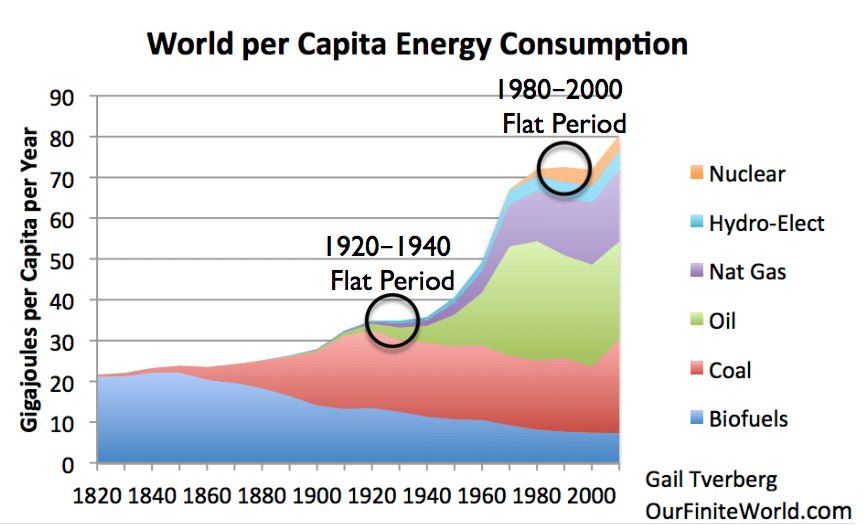
Figure 8. World per Capita Energy Consumption with two circles relating to flat consumption. World Energy Consumption by Source, based on Vaclav Smil estimates from Energy Transitions: History, Requirements and Prospects (Appendix) together with BP Statistical Data for 1965 and subsequent, divided by population estimates by Angus Maddison.
The 1920-1940 Flat Period was definitely a period of “not enough energy to go around.” The Great Depression of the 1930s was a time of little GDP growth and great wage disparity. There is evidence that both World War I and World War II (coming immediately before and immediately after the 1920-1940 period) were, indirectly, energy wars.
The 1980-2000 Flat Period represents a time when the US and Europe both intentionally reduced their oil consumption because it was feared that oil would be in short supply in the future. This was a period that required huge debt growth to make the necessary changes (Figure 9). 
Figure 9. Growth in US Wages vs. Growth in Non-Financial Debt. Wages from US Bureau of Economics “Wages and Salaries.” Non-Financial Debt is discontinued series from St. Louis Federal Reserve. (Note chart does not show a value for 2016.) Both sets of numbers have been adjusted for growth in US population and for growth in CPI Urban. As mentioned previously, it is also the period that a huge amount of complexity was added, and wages fell as a percentage of GDP. It is doubtful this pattern could be repeated again, without serious economic problems occurring
There were other problems in the 1980 to 2000 period. The collapse of the central government of the Soviet Union occurred in 1991. Low oil prices for several years prior to the collapse reduced the revenue of the Soviet Union. This seems to have been a major contributor to the collapse. Oil exporters are again encountering the issue of inadequate tax revenue, as a result of low oil prices since 2014.
[6] It is total energy growth (not simply oil consumption growth) that correlates well with GDP growth.

Figure 10. X-Y graph of world energy consumption (from BP Statistical Review of World Energy, 2017) versus world GDP in 2010 US$, from World Bank.
Peak Oil followers haven’t stopped to think through how the economy works. It is really the growth of total energy that we need to be concerned about, from the point of view of operating the economy.
[7] Indirectly, debt and asset prices are promises of future energy consumption.
We don’t think of debt as a promise of future energy consumption. The connection comes because debt can only be redeemed (through a financial transaction) for future goods and services. Making these future goods and services will require energy consumption.
The same principle applies to asset prices of all kinds: prices of shares of stock, home prices, land prices, and pension values. If an asset-owner wants to sell an asset and use the proceeds to buy other goods and services, the asset-owner encounters the same situation as the bond-owner: the goods and services that will be provided in exchange depend on the energy supplies available at the date of the exchange. Thus, indirectly, the prices represent promises of future energy consumption.
[8] One essential part of the economic growth system seems to be an ever-falling price of energy services, where energy services are defined as the cost of energy, plus whatever efficiency savings are available that make the cost of energy services less expensive.
For example, the cost of transporting a 100 kg. package 100 kilometers, or of heating a 100 square meter residence for a winter, must keep falling. If this happens, businesses can afford to buy ever more tools for their workers. With these tools, the workers can become ever more productive.
Furthermore, because of their growing productivity, workers find that their wages are rising, so that they can buy ever more goods and services. In this way, demand continues to rise. Changes such as these allow the economy to keep growing.

Figure 11. Energy services chart is by Roger Fouquet, from Divergences in Long Run Trends in the Prices of Energy and Energy Services. Second chart is figure from UNEP Global Material Flows and Resource Productivity.
In fact, the prices of energy services do seem to keep falling, even if the cost of providing these services is not falling. This is a major reason why energy prices seem to have fallen below the cost of production for practically every type of energy in recent years. This situation is not sustainable; it can be expected to lead to the collapse of the system.
[9] If the growth rate of the economy is not fast enough, the danger is that the economy will collapse.
We can think of the GDP situation as being similar to that of a bicycle. GDP needs to be rising rapidly enough, or the economy will collapse. A bicycle needs to be traveling fast enough, or it will fall over. Economists often talk about an economy slowing to stall speed.

Figure 12. Author’s view of analogies of speeding upright bicycle to speeding economy.
Reported world GDP growth rates in recent years are likely somewhat overstated for several reasons.
- World GDP represents a weighting of country reported GDP. One approach to weighting gives disproportionate influence to China, India, and other developing countries.
- The use of Quantitative Easing and of higher government debt temporarily inflates the quantity of goods and services an economy can make.
- Artificially low energy prices give a boost to oil importing counties. They also keep the prices of goods and services artificially low, compared to wages. These artificially low energy prices cannot continue without the failure of governments of oil exporters, and without businesses producing energy products collapsing.
Whether or not the economy can continue operating is determined by the economy itself, because the economy is a self-organized system. Its continued operation doesn’t depend on published statistics of varying quality.
[10] Researchers studying oil limits thought that they had found a whole new phenomenon, “Peak Oil.”
In fact, they had found a special case of a phenomenon that tends to lead to collapse, namely, conditions that lead to energy consumption per capita that is not rising rapidly enough. Such conditions can occur in many different ways, such as these:
[a] Population rises sufficiently that it is hard to keep energy consumption per capita rising. This seems to be a major problem in many historical collapses.
[b] Collapse indirectly comes from diminishing returns in energy extraction. The standard workaround for diminishing returns is growing use of complexity (including technology). This tends to encourage the non-wage portions of the economy to grow, as in Figure 7. Adding complexity becomes increasingly expensive for the benefit obtained. Ultimately, wage disparity and falling commodity prices become a problem, and the system collapses.
[c] Random fluctuations in climate occur. An economy collapses because it doesn’t have the strength to respond to such random fluctuations.
[11] Peak oil researchers did the best they could, with the limited understanding of the day. The unfortunate problem was that the model they put together wasn’t really correct.
The fundamental problem of the Peak Oil researchers was that the economic researchers, upon whom they depended, did not really understand the interconnected nature of the economy. They continued to use two-dimensional economic models, when they needed multidimensional models. Economists predicted that prices would rise near limits, when it is increasingly clear that this cannot be true. The world has been struggling with low prices for many commodities since 2014. Prices now are temporarily less low, but they still are not high enough to allow adequate tax revenue for oil exporting countries.
The Energy Return on Energy Invested (EROEI) Model of Prof. Charles Hall depended on the thinking of the day: it was the energy consumption that was easy to count that mattered. If a person could discover which energy products had the smallest amount of easily counted energy products as inputs, this would provide an estimate of the efficiency of an energy type, in some sense. Perhaps a transition could be made to more efficient types of energy, so that fossil fuels, which seemed to be in short supply, could be conserved.
The catch is that it is total energy consumption that matters, not easily counted energy consumption. In a networked economy, there is a huge amount of energy consumption that cannot easily be counted: the energy consumption to build and operate schools, roads, health care systems, and governments; the energy consumption required to maintain a system that repays debt with interest; the energy consumption that allows governments to collect significant taxes on exported oil and other goods. The standard EROEI method assumes the energy cost of each of these is zero. Typically, wages of workers are not considered either.
There is also a problem in counting different types of energy inputs and outputs. Our economic system assigns different dollar values to different qualities of energy; the EROEI method basically assigns only ones and zeros. In the EROEI method, certain categories that are hard to count are zeroed out completely. The ones that can be counted are counted as equal, regardless of quality. For example, intermittent electricity is treated as equivalent to high quality, dispatchable electricity.
The EROEI model looked like it would be helpful at the time it was created. Clearly, if one oil well uses considerably more energy inputs than a nearby oil well, it would be a higher-cost well. So, the model seemed to distinguish energy types that were higher cost, because of resource usage, especially for very similar energy types.
Another benefit of the EROEI method was that if the problem were running out of fossil fuels, the model would allow the system to optimize the use of the limited fossil fuels that seemed to be available, based on the energy types with highest EROEIs. This would seem to make best use of the fossil fuel supply available.
[12] There are corrections to the EROEI method that might allow it to work in the manner that it should. The catch is that these corrections seem to show wind and solar not to be solutions to our problems. In fact, the system is so integrated, and our need for rising energy consumption per capita so great, that it is doubtful that any substitute for fossil fuels can really be a solution.
Professor Hall observed that if a fish had to swim too far to get food, it could not use very much of the food’s energy to catch the food, because most of its energy was needed for everyday metabolism and reproduction. A fish would typically need an EROEI of at least 10:1 for catching its prey, if it expected to have enough energy left to cover its full metabolic needs (including reproduction), plus the energy required to catch its prey.
If catching some prey only provided an energy return of 1:1, it would be pretty much worthless as a food source, since it would not cover any of the metabolic costs. Certainly, it would not make sense to call any energy in excess of an EROEI of 1:1 “net energy,” because it makes no contribution to covering a fish’s metabolic or reproduction activities. “Net energy” should only come from food sources with an EROEI very close to, or above, a ratio of 10:1.
A similar approach can be used to incorporate the large amount of energy that is lost by zeroing out the equivalent of the metabolism of the fish, for the economy. Based on Figure 11, the required average EROEI (to match what the economy can afford to pay for) needs to rise over time. Thus, if the required average EROEI is 10:1 now, it might be 11:1 later, simply because the increasingly complex world economy needs energy services that are becoming ever less expensive.
The story, “Higher energy prices will work in the future” is simply a myth, created by economists who do not understand how the economy really operates, considering all of the feedbacks involved. In inflation-adjusted terms, the price of energy services needs to keep falling as a percentage of GDP, to keep the system operating.
To fix the net energy calculation, some suitable minimum EROEI ratio for the economy needs to be determined–probably about 10:1–to incorporate the large share of energy consumption that is missing from the economy. Net energy would be then determined as the energy in excess of 10:1 EROEI, rather than in excess of 1:1 EROEI. This approach would make solar and wind look much less beneficial than most calculations to date.
In the case of intermittent renewables, a determination needs to be made whether the role of wind or solar in a particular situation is to replace electricity or fuel. If the role is to replace electricity (as is generally the case), then sufficient buffering must be provided in the model, so that the model can calculate the proper EROEI for dispatchable electricity (not intermittent electricity). Adding buffering will generally substantially reduce the EROEIs of intermittent electricity types. This adjustment makes it clear that there is much less benefit of wind and solar.
If the purpose of the intermittent electricity is only to replace fuel (such as a proposed new Saudi solar installation), then there is no need for buffering in the calculation. Of course, a cost comparison could also be used, and this might be the simpler approach. The cost comparison will generally be favorable if the fuel being replaced is oil, because oil is a high-priced fuel.
Too often, wind or solar is added to the system in a way that overlooks the real cost of buffering. Coal and nuclear electricity production find themselves with the unpaid job of providing buffering services for wind and solar. The net impact of adding intermittent renewables is that they push necessary backup power out of business. We end up with an electrical system that is worse off for adding intermittent renewables, even though this was not the intent of those requiring the use of such generation.
Conclusion
The number one need of the world economy is rising per capita energy consumption. In order to maintain economic growth, the price of energy services needs to fall as a percentage of GDP. The system will try to rebalance to the least expensive cost of energy production using globalization and other techniques. When this is no longer possible, the current world economic system is likely to fail.
Peak Oil modelers did not understand how complex our economy is. In their defense, no one else did either, especially back in the 1970 to 2005 era. They did the best they could, using the models that economists had put together. Because of the assumption of ever-rising energy prices, Peak Oil models assume that far more fossil fuels are extractable than is likely to really be the case. Optimists (oil companies, politicians, government agencies) assume even higher extraction of fossil fuels than is reasonable. The result is considerable concern about climate change.
When a person realizes how tightly integrated the world economy is, and its need to grow, it becomes clear that using less is not a solution. Prices of commodities would plunge even farther below the cost of production. The economic system would experience a far worse recession than the Great Recession of 2008-2009. Some governments would fail. The spiral might permanently be downward.
Standard solutions don’t work either. Substitutes don’t scale up quickly. Biomass cannot be used heavily because the world’s ecosystems depend on biomass; we are already using more than our share. Intermittent renewables such as wind and solar have their own high energy cost, but it is hard to count. They depend on international trade to make and repair the devices. They depend on debt for financing. They are really only part of the fossil fuel system, contrary to what the name “renewables” would suggest.
Energy modelers did their best. Unfortunately, with modeling it is hard to see what is going wrong. This is especially true when the academic world is divided into silos, each of which tends to look primarily at the writings of the people in its own field. It is easy for an incorrect model to get firmly embedded into people’s minds.


Southern Greenland Was Once Green; Earth Warmer
Biologist Eske Willerslev of the University of Copenhagen and an international team of colleagues discovered DNA from alder, spruce, pine and yew trees at the glacier’s base as well as insects ranging from butterflies to spiders.
This is the “first evidence for a forested southern Greenland,” Willerslev says. And based on the tree species found, Greenland must have been warmer than 50 degrees Fahrenheit (10 degrees Celsius) in summer and never colder than one degree F (–17 degrees C) in winter, much warmer than present conditions.
https://www.scientificamerican.com/article/proof-on-ice-southern-greenland-green-earth-warmer/
Though North Africa is currently covered by the world’s largest non-polar desert, kkkkkklimate conditions in the region have not been constant there for the last several million years.
Subtle changes in Earth’s tilt toward the sun periodically increase the amount of solar energy received by the Northern Hemisphere in summer, altering atmospheric currents and driving monsoon rains. North Africa also sees more precipitation when less of the planet’s water is locked up in ice. Such increases in moisture limit how far the Sahara can spread and can even spark times of a “green Sahara”, when the sparse desert is replaced by abundant lakes, plants and animals.
Before the great desert was born, North Africa had a moister, semiarid kkkklimate.
Read more: https://www.smithsonianmag.com/science/sahara-millions-years-older-thought-180952735/#g4U2UuMDoB22oOVA.99
If one reads history … one finds similar information … the kkkklimate has always been changing … always… and in relatively short periods of time — decades…
Isn’t it funny — I could post these FACTS day after day after day …. and the ZZZ CCCCCing groopies… would remain in a zombified state… repeating exactly what the MSM told them to repeat…
XX XXXing is real. XXX XXXXing is real. We must stop burning coal and oil XXX XXing is real. We must switch to solar and wind generated energy – and EVs. XXX XXXing is real.
This truly is madness. If this is your position then you truly are insane.
http://sagadb.org/eiriks_saga_rauda.en
“In the summer Eirik went to live in the land which he had discovered, and which he called Greenland, “Because,” said he, “men will desire much the more to go there if the land has a good name.”
Truly a visionary…the Elon Musk of his day!
It’s sad.
FE used to post some pretty good stuff. Now he posts this kind of anti-science gibberish.
Scientific American What would you prefer CNN
This is just another epiphany I have had… in a long line of epiphanies…. since joining FW
Too bad you are unable to see the logic of what I have presented….
Alas life is a journey …. you grow… you change…. hopefully you improve… and you end up leaving people in your wake… as you progress to higher levels of understanding….
“Greenland” was a marketing ploy to get settlers to come.
And it worked—- amazing!
The “Renewable Energy” folks followed a similar marketing ploy!
Only the young Irish female slaves they took to Greenland (and Iceland) didn’t have much say in the matter….. Worked out OK in Iceland though.
Greenland was green, until the little ice age hit.
Stop, please stop. It has gotten so old.
Fast Eddy cries out in pain … as he strikes the Green Groopies.
“This truly is madness. If this is your position then you truly are insane.”
So if someone doesn’t agree with you, you claim they are insane? Isn’t that the argument of an adolescent? You have finished 8th grade, right?
If someone does not accept the facts and logic that I have presented… because I am the world champion of facts and logic then yes — there is clearly something wrong with that person.
They are f789ed up in the head
I recently engaged on another forum — someone said Tesla was saving the world — I asked how – they of course said they were green cars… I posted this information on how Tesla is manufactured and powered by coal….
They called me an id iot and said this was bull s hit.
I see those who believe XXXX XXXX is caused by man… in the exact same light as the f789ing MORE on who refuses to accept the facts and logic that demonstrate Tesla is a rolling toxic waste dump
In other words… my omnipotence grows stronger day by day… soon there will be nothing to be learned… and when that moment is reached… I will be elevated to the status of God of Facts and Logic… my head will explode … and I will exist in another level of consciousness.
Hopefully this process will be complete before BAU collapses.
Want to be entertained?
I will entertain you!!!
THIS IS WHAT $30,000 OF DAMAGE LOOKS LIKE ON A TESLA MODEL S
Tesla Motors has tackled a number of pressing issues in the auto industry, from electric cars to direct sales. But one thing Tesla can’t control are the high costs of repairs that comes with the newness and relative rareness of the Model S. A Model S owner recently found out the hard way that even seemingly minor damage can total a $90,000 vehicle due to the high costs of repairs.
Over at the Tesla Motors Club, forum by new user standardcode, who posted that after a year of happy ownership, his Tesla Model S 85 was involved in (what looks like) a relatively minor accident. A flat tire, a damaged door, some wheel well damage…too bad to drive around with, but surely not enough to total a car that sold for around $90,000, right? Wrong. I’ll the post speak for itself.
So the Tesla-certified body shop takes apart my car to check for the damage and meets the appraiser sent by my insurance (Ameriprise) to discuss the repair. A day later it turns out that Ameriprise is declaring my baby a total loss!! Why you ask? Apparently Tesla-certified body shops aren’t cheap. In addition to the $10,000 in parts there’s $20,000 in labor. Ameriprise decided they’d rather declare the car a total loss than pay $30k+tax for repair.
https://gas2.org/2015/01/06/this-is-what-30000-of-damage-looks-like-on-a-tesla-model-s/
https://gas2.org/wp-content/uploads/2015/01/tesla-accident.jpg
https://youtu.be/nq5c4jGR2gM
I understand Tesla auto insurance costs are very high.
https://electrek.co/2017/06/05/tesla-owners-insurance-rates/
Tesla owners might have to pay higher insurance rates based on weird data
The question is what you compare Tesla’s to. One report said, ““AAA is raising rates on Tesla vehicles based on data showing that the Model S and Model X had abnormally high claim frequencies and high costs of insurance claims compared with other cars in the same classes.””
Tesla denies that the right classes of cars were chosen for comparison. Tesla now has an insurance program especially for Teslas, with established insurers.
https://electrek.co/2017/02/23/tesla-insurance-program-self-driving-technology/
According to the article,
The recent two self-driving accidents will not help insurance premiums at all, IMO.
Today, there was a sunny day in Slovakia and I met a Tesla car driving on a dusty road… with the driver window open. All that dust getting inside – not a luxury ride, I would say…
Maybe the ventilating system took too much battery power.
Not sure how many of you have experienced a repair yet. My wife drove through the garage with a wing door open, and completely smashed the door.
Like any other $100k car, you would expect to be able to bring it to a high end body shop or one of your preference.
Not with Tesla.
Here in my area, there are only TWO certified auto-body shops, and one of them, the owner is old, slow, and doesn’t seem competent.
That’s not the worse part, the worse part, is that the body shop says it takes about 9 weeks to receive parts from Tesla. Therefore, to replace just a single wing door, it’s a 4-6 month process.
I’m wondering if anyone else has had this terrible news. It’s unacceptable in my mind.
I just finished waiting 15 weeks to get a drivers side headlight for my 2012 MS… and the car was in the shop the entire time… SMH….
Hi All,
Here’s an update.
Car has been sitting at John Eagle for over 4 weeks now waiting for parts.
I have 90% of the parts in, however still waiting for a few, which John Eagle says they will not start on the car until they receive all the parts.
The service manager at Tesla, keeps giving me the run around. He promises parts in 3-5 days, and keeps insisting that a 3 – 5 month process is NORMAL body shop procedure. Total BS. My buddy ownes a collision shop and says typical is 2-3 weeks for the worst front end or rear end collisions.
John Eagle, (which i now know i made a bad decision to go with them) still claims the car is 5 weeks out after parts come in. 5 WEEKS OUT? says there is a specific JIG the car needs to get onto. once the car gets on this JIG to have it’s spine checked out, it stays on this JIG until the car is repaired. The problem is, they only have 1 JIG. So they can only repair 1 F’ing car at a time!!
1. Please let me know if anyone has escalated this above. Please send me contacts at TESLA
2. I’m considering bringing this to media
3. I also have lawyers looking into how i can get out of these lease.
4. I want to escalate this as far as i can, but please let me know if any of you have had similar issues.
https://teslamotorsclub.com/tmc/threads/repair-nightmare.80729/
I am also reading reports of massive waits for repairs in Hong Kong….
How this company stays in business is beyond me….. at some point the belief that you are saving the world … surely must get overridden by a repair bill that costs as much as a quality ICE car…..
https://www.youtube.com/watch?v=nq5c4jGR2gM
Now imagine the costs that Tesla is eating on these warranties… endless major repairs…
No wonder they are losing billions each year
Now, in Slovakia, they are trying to introduce the law which requires that you must repair your car only in a certified shop after an accident that affects safety parts of the car due to the safety reasons and then pass the vehicle inspection.
There is a wide opposition to this law in the public, as it means, that much more cars will be declared a total loss by the insurance companies…
https://auto.hnonline.sk/servis/1723392-len-certifikovana-oprava-auta-na-navrh-zakona-boli-vznesene-stovky-pripomienok
“Years of easy money have pushed the world’s interlinked property markets to the same frothy extremes seen before the Lehman crisis in 2008, posing a mounting risk to economic and social stability. The IMF warns that houses have increasingly become a commodity like any other, exploited by global investors in the relentless hunt for high-yielding assets.”
https://www.telegraph.co.uk/business/2018/04/10/imf-warns-contagion-risks-global-property-slump/
“More Americans are stretching to buy homes, the latest sign that rising prices are making homeownership more difficult for a broad swath of potential buyers.”
https://www.wsj.com/articles/rising-home-prices-push-borrowers-deeper-into-debt-1523356200
I can believe this. It is possible to build new one, so replacement cost becomes an issue.
“…while banks like Wells Fargo & Co. no longer make these loans directly to borrowers, they are providing funding to non-bank financial firms that do, according to The Wall Street Journal. Those big banks have reportedly helped Irving, Texas-based Exeter Finance LLC make $1.4 billion in subprime auto loans.”
https://www.investopedia.com/news/how-big-banks-are-slipping-back-subprime-loans/
I suppose the subprime lending doesn’t show up in financial reports this way.
“Iran will enforce a 42,000-rial exchange rate for the US dollar as of Tuesday, in a move expected to end a currency crisis that has angered Iranians. The Iranian rial hit an all-time low against the dollar on Monday, when the majority of exchange offices in Tehran turned off their indicators amid fluctuating rates.”
https://www.aljazeera.com/news/2018/04/iran-scrambles-halt-rial-slide-threat-sanctions-180410073325673.html
“New data revealed by Iran’s largest banks shows that a banking crisis is happening in the country, with big-name financial institutions experiencing horrific losses and being unable to even pay the interest on deposits.”
http://www.iranfocus.com/en/index.php?option=com_content&view=article&id=32623:banking-crisis-in-iran-getting-worse&catid=31&Itemid=125
I thought usury was not allowed in Islam, so banks ought to not be able to charge interest on loans and customers ought not to be able to receive interest on deposits.
I had a Google and it looks like there are ways around it:
“There are several ways that banks can structure accounts so that they are sharia-compliant.
“Ijara works as a leasing arrangement: the bank buys something for a customer and then leases it back to them. Different forms of leasing are permissible, including those where part of the instalment payment goes toward the final purchase. This might be used to help you buy a car or other item, or to help a business buy equipment.
“Murabaha works by the bank supplying goods for resale to the customer at a price that includes a margin above the costs, and allows them to repay in installments. This might be used to provide a mortgage on a property. The property is registered to the buyer from the start.
“Musharaka is a joint venture in which the customer and bank contribute funding to an investment or purchase and agree to share the returns (as well as the risks) in proportions agreed in advance.
“Wakala is an agreement that the bank will work as the individual’s agent. If a saver enters into this type of agreement, the bank can use their cash to invest in sharia-compliant trading activities to generate a target profit for them.”
https://www.theguardian.com/money/2013/oct/29/islamic-finance-sharia-compliant-money-interest
Thanks for looking that up. Very sneaky how the banks and customers try to circumvent the rules of their religion. Of course Christianity once also had a no usury rule, but this was abandoned many centuries ago. I believe historically Jews became money lenders because their religion does not forbid usury and in the middle ages many other professions were forbidden to them.
These days money trumps all religion.
I think that the reason Jews became money lenders had to do with their exile to Babylon. When they returned to Israel in 539 B.C.E., whatever land they had had, had been taken over by others. They suddenly needed to find new ways of supporting themselves. They had learned “new approaches” from the more advanced civilization in Babylon. These new approaches could be used back in Judah.
Regarding whether or not Jewish beliefs forbid usury, I suspect that religious law adapts somewhat to the situation. If lending money seems to be a reasonable way of supporting yourself, perhaps usury is not so bad after all. (In fact, adding debt helps the economy grow better!) Each religion adapts and interprets religious writings to follow the thinking and needs of the day. I don’t see very many of today’s Right Wing Christians refusing to take out mortgages or to take out auto loans because lending at interest is forbidden in the Bible.
Not sure about the present but Mormons were taught by their “prophet” to buy cars cash because they are depreciating assets, but home loans were ok since they became a long term asset.
Inevitable in life: death, taxes and…….. interest.
We don’t need bank problems anywhere in the world! Iran is of course an oil exporter, so it has the low oil price problems of other oil exporters.
Indirectly, low oil price problems, I expect.
This article suggests Iran doesn’t have much spare capacity:
“Iran may be cautiously trying to increase its oil exports to increase the government’s supply of dollars. According to Platts, Iran’s oil production inched up to 3.83 million barrels per day in February from 3.80 million barrels per day in November. However, the Iranian oil industry seems to be unable to increase production much beyond that.
“Even though its OPEC allocation is technically 3.797 million barrels per day, it is permitted to produce up to 4 million barrels per day as long as its 12 month production average remains at 3.797 million barrels per day. Iran has been known to cheat on its OPEC quotas in the past, so it would be expected for Iran to increase oil production and exports to help relieve its currency—if only the Iranian oil industry was capable of producing more.”
https://www.forbes.com/sites/ellenrwald/2018/04/11/iran-currency-crisis-could-threaten-political-stability/#19deb4a12360
“Escalating tensions with Washington could send Russia spiraling into a “severe” economic slowdown, BMI analysts wrote in a note to clients Tuesday. “Russia-US relations are at a recent low point and developments set the stage for additional deterioration,” they wrote.”
http://markets.businessinsider.com/news/stocks/us-sanctions-hurting-russian-markets-things-could-get-worse-2018-4-1021076126
“Wednesday’s fall follows violent swings over the past two days that have left the rouble down 9.9 per cent on the week. It has not faced such a heavy fall since 1999 — even worse than falls in 2014, a year that marked both the collapse in the oil price and Russia’s annexation of Crimea.”
https://www.ft.com/content/9db65450-3d4e-11e8-b9f9-de94fa33a81e
Not so good!
Looks like China and Russia will continue to become closer allies.
Gail and the rest. Thank you for killing all hope 😉 Do you think Cuba’s Special Period after the collapse of the Soviet Union is a good guide for our future? Any good book on that subject?
Sorry about the lack of hopefulness! I see the whole self-organization process as miraculous in itself. There clearly is a literal higher power takes this possible. What this literal high power chooses to do in the future it not for us to know precisely. We have been given the privilege of seeing the most advanced civilization to date. Nearly all of us are alive because of the benefits of fossil fuels. We do not know exactly what is ahead, but that has been true as long as people have lived on the earth. We have put together “models” in our minds of what the future is expected to be. It is these models that are not right.
I don’t know whether the Cuban special period has lessons for us or not. They certainly tried to work together to do what they could. But they did have others, outside, that they could get some materials from. I am not certain how sustainable some of their techniques really are. For example, irrigation using water under Havana is likely not very sustainable for the long term (just as irrigation in Florida has problems). Cuba was not able to produce 100% of their food back in the Special Period, and I think they are further away from that situation now.
No worries about lack of hope. Seneca wrote many things apart from his famous cliff. It is worth reading his books. In the long term all of us will be dead, as lord Keynes said (don’t ask me to find the reference). I regret not sharing your view on something greater than us. My physicist friends say that they can explain this self organised system 🙁
I just let go. Lost in oblivion. Dark and silent and complete. I found freedom. Losing all hope was freedom.
Chuck Palahniak
Fight Club
Freedom. Not a bad value to face the end of our post industrial society.
++++++++++++
And for those who cannot handle the loss of all hope there is … Oxycontin
99+% of all farmland is farmed using petro chemical fertilizers… take those away .. and nothing grows without years of organic inputs… all animals that provide inputs will be killed and eaten…
Spent fuel ponds.
No … the USSR nor Cuba would be models for what post BAU looks like
IMF chief warns trade war could rip apart global economy
Lagarde says countries should ‘steer clear of protectionism’
Christine Lagarde warned on Wednesday that the rules that underpin global trade were “in danger of being torn apart” by protectionist forces in what the IMF managing director said would be “an inexcusable, collective policy failure”.
Speaking at the University of Hong Kong, Ms Lagarde warned of the gathering threats of a trade war and the rapid rise in public and private debt around the world. But she stresses that the global economy continued to grow strongly and remained optimistic about the remainder of 2018 and 2019.
Tit-for-tat tariffs announced by the US and China have sparked fears of a damaging trade war between the world’s two largest economies.
“The multilateral trade system has transformed our world over the past generation. But that system of rules and shared responsibility is now in danger of being torn apart. This would be an inexcusable, collective policy failure,” she warned.
Her concerns came in the week before finance ministers from around the world gather in Washington to discuss what the IMF chief said were “darker clouds looming” on the horizon.
Ms Lagarde criticised the thinking of Donald Trump’s administration, while also directing her ire at Germany’s trade imbalances and the lack of proper protection of intellectual property and inefficient state subsidies in China.
Tariffs “not only lead to more expensive products and more limited choices, but they also prevent trade from playing its essential role in boosting productivity and spreading new technologies” Ms Lagarde said, as she called on countries to “steer clear of protectionism in all its forms”.
She hit at the Trump administration’s focus on the US bilateral trade deficit with Beijing, saying this was the result of complicated global supply chains in which China ran a significant trade deficit with other countries from which it imported component parts.
She said the Trump administration should look closer to home to improve its overall trade deficit. “The US, for example, could help tackle excessive global imbalances by curbing gradually the dynamics of public spending and by increasing revenue — which would help reduce future fiscal deficits.”
Germany, meanwhile, should use its excess savings, which drives its trade surplus “to boost its growth potential — including through investments in physical and digital infrastructure”.
And in a passage aimed at China, she said an important trade policy reform package “includes better protecting intellectual property, and reducing the distortions of policies that favour state enterprises”.
“Let us redouble our efforts to reduce trade barriers and resolve disagreements without using exceptional measures,” Ms Lagarde urged.
The IMF managing director also sought to highlight fears for the continued growth of public and private debt, which IMF research to be published next week will say has reached an all-time high at $164tn.
“Compared to its 2007 level, this debt is now 40 per cent higher, with China alone accounting for just over 40 per cent of that increase,” Ms Lagarde said.
Without action being taken to reduce the build up of debt, countries were more vulnerable to shocks, as are the banks and corporate sectors of countries where debts had grown quickly, especially China and India.
https://www.ft.com/content/c8c4bb22-3ccd-11e8-b9f9-de94fa33a81e
“Without action being taken to reduce the build up of debt, countries were more vulnerable to shocks, as are the banks and corporate sectors of countries where debts had grown quickly, especially China and India.”
Actually, it is sort of the reverse. Countries need more and more debt. Of course, without cheap energy supplies to make use of the higher debt, it just gets us into trouble.
I agree, we need ever increasing debt, wages, population. But, to offset all of this we need ever more and ever cheaper energy supplies. What we are doing is not going to last much longer.
Love how this IMF chief talks about Chinese trade deficits with some countries over components yet fails to mention their overall trade balance is in the positive of 33.7 billion USD, which means that the Chinese have overall exported more goods/services in exchange for worthless promises from others.
I suppose it’s not enough for the west to exploit them in return for worthless debt we also have to delude ourselves into thinking that the Chinese are the exploiters as well.
But they trade the worthless promises for actual property in America, Canada, and Australia as well as ownership of companies like Volvo.
AFAIK a sale of property or shares to a Chinese national still counts as the Chinese importing the good.
Check out the general definition of import:
https://en.wikipedia.org/wiki/Imports
“<>. However, in specific cases national accounts impute changes of ownership even though in legal terms no change of ownership takes place (e.g. cross border financial leasing, cross border deliveries between affiliates of the same enterprise, goods crossing the border for significant processing to order or repair). Also smuggled goods must be included in the import measurement.”
Oops didn’t know that would obscure the text:
“An import of a good occurs when there is a change of ownership from a non-resident to a resident; this does not necessarily imply that the good in question physically crosses the frontier.”
The average American household carries $137,063 in debt, according to the Federal Reserve
https://www.usatoday.com/story/money/personalfinance/2017/11/18/a-foolish-take-heres-how-much-debt-the-average-us-household-owes/107651700/
We really are no different than yeast… or rats… or cancer cells…. although I don’t think that any of these organisms would engage in such utter nonsense…. check out that room full of programmers dedicated to this insanity…..
I bet the founder sees herself as the new Edison ….
http://www.bbc.com/capital/story/20180411-altered-faces-are-dominating-chinas-selfie-industry
lotus eating is always popular just before the collapse.
So it’s basically like any pic suite but real-time and women use it to mislead men about their appearance…the singularity is near!
Perhaps this is something I should be using as well. [sarc] Better than having someone retouch a photo.
It would be very useful for someone using dating sites…. however it could lead to huge problems on the first date….
Unless of course both parties were making use of the software….
https://russia-insider.com/en/russia-ready-war-mood-prime-time-tv-grim/ri23019
Amusing…
Tommy Jensen • 2 days ago
The Russians certainly have the finger on the pulse, “the general public in the West has been hopelessly zombified”.
The western public accept any atrocities, child rape, child molesting, torture chambers, false accusations on innocents, murdering, robbing, as long as they get a new car and can continue drinking chocolate discussing how superior they are.
If anyone deserve a Kalibr missile exploding right in their faces, its the Western public.
How entertaining would a flock of Russian nukes into Tel Aviv be? Might I suggest….Very….
And given Israel is not exactly a key pillar (see Korowicz) of BAU…. it would not necessarily be suicidal…. it would certainly get the attention of the El ders…. and it would be very interesting to observe how the el der s… who are never poked…react….
Let’s pop the pop corn… and chill the champagne… and great ready for The Big Show!
This is … totally… f789iiing … in sane…..
The mother of the mother of the mother of the mother of the mother… of the mother … of all bubbles….
New home prices in Hong Kong rose by 18 per cent in last quarter, says property broker Ricacorp
Average home prices stood at US$2.05 million, and are expected to rise further
The prices of new homes in Hong Kong rose by 18 per cent to an average of HK$16.08 million (US$2.05 million) each in the quarter ending in March. And market watchers said they expect prices to rise further.
“Strong sales have encouraged developers to adopt more aggressive pricing strategies, with some new projects able to raise prices by 10 to 20 per cent within weeks,” he said.
For instance, the prices at Malibu in Lohas Park have risen by close to 20 per cent, to HK$17,000 per square foot, in three weeks. Its builder, Wheelock Properties, said it had earned HK$12.89 billion from the sale of 1,440 units. Malibu will have 1,600 units for sale in total.
Meanwhile, developers are offering an array of flexible financing schemes to help prospective buyers, which could accelerate sales even at higher prices.
“Compared with the secondary market, buyers require a smaller cash outlay if they buy from developers, who will provide mortgage loans of up to 80 per cent,” said Cheng. “It means buyers only require a 20 per cent down payment against a 40 to 50 per cent down payment in the secondary market.”
http://www.scmp.com/property/hong-kong-china/article/2141140/new-home-prices-hong-kong-rose-18-cent-last-quarter-says
Real estate bubbles in prime locations will never end.
http://greyenlightenment.com/?s=real+estate
The reason it will rise forever is because
1) all the money issued will have to go somewhere
and
2) they are not making any more prime real estate spots.
Until interest rates rise, and pop the bubbles.
Speaking of people who are completely wrong in the head….
“Average home prices stood at US$2.05 million, and are expected to rise further”
This does sound insane!
This is a different insane than the insane demonstrated by those who refuse to understand that the kkkklimate has always been changing…regardless of what man does…
https://www.zerohedge.com/news/2018-04-10/alert-issued-syria-air-strike-within-hours-russia-relcates-military-helicopters
So why doesn’t Putin turn off the gas tap to the EU about now?
When something doesn’t make sense… it doesn’t make sense
So why doesn’t Putin turn off the gas tap to the EU about now?
I assume that Europe would consider that an act of war and I doubt Putin wants to take on Europe and all of it’s allies over a dispute in Syria.
From what it looks like … although you never really know what it looks like… he is going to war regardless…
Perhaps he might want to prevent that?
Keep in mind — if Russia is attacked…. the gas goes off anyway… and BAU likely is finished… because nuclear has quite a few nuclear weapons…
Better to threaten the EU and the US with a brief shut down of the gas … threatening to launch nukes is already assumed if this stand off in syria escalates
Putin’s gas threat: What happens if Russia cuts the gas to Europe?
Expert says: ‘If there was a general shortage of gas across Europe, Britain would run short very soon’
https://www.independent.co.uk/news/world/europe/putins-gas-threat-what-happens-if-russia-cuts-the-gas-to-europe-10074294.html
That is a 2015 story… notice how there is no mention in that article or any recent articles about how Putin could shut down the EU within days… if he wanted to ….
There must be a reason this is not discussed as an option … not even on RT.com…. surely it would be useful to put this threat on the table… it is the ultimate Trump card….
So why not JUST DO IT? (for a few days at least… just to send a message…)
What would happen to Europe if Putin turns it off?
We had a taste of this in 2009 when there was the last cut-off, when one of the problems identified was that the interconnections between southern European countries was poor. So, for instance, Bulgaria suffered when Russia cut off the main pipeline because it had hardly any storage and little means of getting gas from the rest of Europe.
John Lough, an associate fellow with the Russia and Eurasia programme at Chatham House, says that five years later interconnectivity is much better in Europe and a mild winter means storage levels across the continent are generally OK.
In the event of a lengthy cut-off – more than a few days – he says the immediate problem would be for people in south-eastern Europe who still rely largely on direct Russian supply.
But it would soon start to effect prices across the rest of the continent, as new deals for alternative gas sources would have to be struck.
And to the UK?
One of Britain’s weaknesses, according to Professor Thomas, is that we have far too little storage for gas – about 15 days’ worth compared to the Netherlands having a year or more. “This dates back to when we were self-sufficient in gas and could simply turn up or down production when needed,” he says. “So if there was a general shortage of gas across Europe, we would run short very soon.”
Mr Lough agrees, but says it would require a cut-off lasting “a few weeks” for the effects to be felt strongly in the UK.
On the subject of a hike in bills for British families, he says: “I think we could be talking about that if wholesale prices have to rise. But it depends on the duration of the shortage and the amount of gas in storage.”
Even though Britain doesn’t buy any more than a tiny amount of gas direct from Gazprom, the supplies it takes from other European countries are, in part, topped up by Russia.
It means that Britain is far from detached from the European marketplace – and if Russia reduces supplies for more than a few days, that will likely have an impact across at some level across the whole continent.
Good point!
Russia’s weapons are hopelessly outdated, and it is not exactly producing cutting edge research.
If Putin does that, Germans will be allowed to take Moscow, this time.
Kilmer, you are beyond comedic in some of your statements.
Because he wants the money? Pipeline to China is due for next year, than he can turn it off….
In case you hadn’t noticed… the USA is supposedly trying to make sure Putin does not exist next year…. or next month… kinda like Saddam and Gaddafi no longer exist….
Might I suggest that wanting money should take a back seat to remaining alive…. Putin is not stuuuupid .. he would understand this …
So why is he not even threatening to shut off the lights in Europe…. it does not make sense
Well, living in Europe, we don’t cry “war”.
Right … Europe is the continent of eternal peace.
Never mind Yugoslavia, Ukraine 🙂
Or that little shower room incident.
That was before! So still, never ever had international war on USA territorium, want now?
that was because the first nations didn’t have guns, and the european invaders did
the american continent suffered a 200 year invasion…an inter-national war.
like all other invasions and wars, it was over resources.
the same applied to africa, india, and australasia
Ya that was before Europe become collection of pathetic weak granny states…. under the yoke of America … who leads you around by the nose….
In case you have not noticed… the UK and France are both involved in Syria …. because your master insists…. hardly peaceful…
And — at the end of the day — peace is what weaklings yearn for — because weaklings are just that — weak… peace is what a scrawny mongrel dog years for – when there is a brute between him and the last piece of meat….
Peace is Koombaya. i.e. it is impossible — and something that stinky hippies sing about when dancing around camp fires eating organic pop corn
I believe we are world record holder in peace, 200+ years.
DJ—see my comment above
Roman Warm Period
The Roman Warm Period, or Roman KKKKKlimatic Optimum, has been proposed as a period of unusually warm weather in Europe and the North Atlantic that ran from approximately 250 BC to AD 400.[1]
Theophrastus (371 – c. 287 BC) wrote that date trees could grow in Greece if they were planted but that could not set fruit there. That is the case today, which suggests that southern Aegean mean summer temperatures in the 4th and 5th centuries BC were within a degree of modern temperatures.
That and other literary fragments from the time confirm that the Greek kkkkkklimate then was basically the same as it was around AD 2000. Dendrochronological evidence from wood found at the Parthenon shows variability of kkkkkkkklimate in the 5th century BC that resembles the modern pattern of variation.[2]
Tree rings from Italy in the late 3rd century BC indicate a period of mild conditions in the area at the time that Hannibal crossed the Alps with elephants.[3]
Cooling at the end of the period in southwestern Florida may have been due to a reduction in solar radiation reaching the Earth, which may have triggered a change in atmospheric circulation patterns.[4]
The phrase “Roman Warm Period” appears in a 1995 doctoral thesis.[5] It was popularized by an article published in Nature in 1999.[6]
https://en.wikipedia.org/wiki/Roman_Warm_Period
I wonder if the Romans referred to this as xxxx xxxxxing… or kkkkklllimate ccchhhhange?
Fallacy. Area != World. Also, tree rings are not a particularly reliable indicator of cl-imate.
https://en.m.wikipedia.org/wiki/Dendroclimatology
Yep – the KKKKLimate has always been the same everywhere … that said…. Greenland is called Greenland for a reason …..
https://robertscribbler.com/
Tesla model 3 production just hit another record of 2394 in the 1st week of April. That link also has a drone flyover of the production facility.
A bit to catch GM at 8288 (average), but better.
Lets see if they can stay alive—–
Opps!
That per day—
So— thats 58016 per week—
Oh well.
That’s like starting a soda pop brand name and increasing production, but then people compare that to Coca Cola.
Actually they are very nice vehicles (I have ridden in many EV’s).
But I would not hold your breath on acceptance——
No it’s like starting a soda pop brand and claiming it prevents various forms of cancer if consumed regularly, but nevertheless failing to take over coca cola’s market at an exponential rate.
PBS:Civilizations premieres Tues, April 17 at 8/7c
http://www.pbs.org/civilizations/home/
https://imgur.com/a/rC7fn
I’ll bet if this series were produced a few decades back, eight parts would be about the West and only a miserable one part the rest.
How much progress we’ve made!
speaking of progress:
“The Cult of Progress
Examine the rise and fall of ‘progress’ as an ideology
EPISODE 8 PREMIERE DATE: JUNE 26 AT 8/7C
About
This episode is about the “Progress” as an ideology, and how the “civilizing” project that arose from Enlightenment ideas was fraught with contradictions.”
this episode looks particularly interesting…
though…
IC might be done by June 1st, so there’s that…
$10 Trillion Investment Needed To Avoid Massive Oil Price Spike Says OPEC
https://oilprice.com/Energy/Crude-Oil/10-Trillion-Investment-Needed-To-Avoid-Massive-Oil-Price-Spike-Says-OPEC.html
if that’s what is needed…
then the CBs will likely create those monetary digits on their computers…
isn’t global debt about $200 trillion?
$10 trillion is peanuts…
If it was just digits, it would be equally as effective if they created 10 million instead of trillion. After all, printing 10 trillion just like that may reduce the legitimacy of the system in the eyes of the public, especially if they don’t receive (and spend) any of it.
Retail defaults soar to record high in 2018
http://money.cnn.com/2018/04/10/investing/retail-defaults-sears-moodys/index.html
These are the defaults:
The latest retail trouble included Sears Holdings (SHLD), the owner of Sears and Kmart, which has been fighting off bankruptcy rumors for years. Sears refinanced nearly $500 million in debt last month, but credit ratings firms ruled the deal a “distressed exchange” (essentially a default).
Claire’s, the mall-based ear piercing hub, filed for Chapter 11 bankruptcy in March. Slumping mall traffic made it difficult for Claire’s to pay down a mountain of debt taken on following a 2007 leveraged buyout by private-equity firm Apollo Management.
Two holding companies that control Tops Markets, a supermarket chain that filed for bankruptcy in February, also defaulted.
Department store chain Bon-Ton Stores went bankrupt in February. A pair of mall owners are in talks to save Bon-Ton from liquidation, according to CNBC.
Moody’s listed defaults from BI-LO LLC and BI-LO Holding Finance. BI-LO owner Southeastern Grocers filed for bankruptcy last month.
Teen clothing retailer Charlotte Russe slashed its debt through a recent distressed exchange. UK-based BrightHouse Group, which sells rent-to-own refurbished sofas, TVs and fridges, also completed a distressed exchange.
Another retailer succumbed to financial pressure this week as Nine West Holdings, the owner of the Nine West and Anne Klein brands, filed for Chapter 11 bankruptcy.
Moody’s cited the “fallout of changing consumer behavior and advancing e-commerce for traditional brick-and-mortar retail.”
That’s it in a nutshell. Here’s a simple example of the difference between retail and online: 2″ chip brushes. Their not fancy boar bristle brushes, just basic brushes to apply liquid and semi-liquid material. In a hardware store: $2.79 each. Online .39 cents each if buying 24 plus + shipping. If I buy 8 boxes X 24, I get 192 brushes for 8 x 24 x .39 = 74.88 + 14.20 for shipping = 89.08 divided by 192 brushes = .46 cents a brush. Plus I save the money to travel to the store and I don’t have to ever go to the store again for chip brushes.
Which translates into fewer miles driven, fewer trips into retail locations, which translates into fewer retail sales, which translates in some cases into bankrupt retail outlets. If there was no option to buy online, then I’d be stuck buying from the hardware store in this case. My wife has found that buying cloths on Ebay she gets designer cloths at really cheap prices and if they don’t fit all she has to do is click few things online, print a sticker, put it on the box and it gets picked up for return. She doesn’t go shopping for cloths at retail outlets anymore. A woman? That’s a big deal.
That is not it…Online has been around for 20 years and only makes up 9.1% of all retail sales.
A Nation of Broke People Are Killing Retail More Than Amazon: Top Expert
https://www.thestreet.com/story/14277483/1/a-nation-of-broke-people-are-killing-retail-more-than-amazon-peter-schiff-says.html
https://www.statista.com/statistics/266282/annual-net-revenue-of-amazoncom/
Ok, look at that graph and tell me what you see happening over time.
https://valentj.wordpress.com/2012/11/27/online-vs-retail-shopping/
There’s another one. What is happening over time?
https://www.smartinsights.com/ecommerce/ecommerce-strategy/top-ecommerce-trends-inform-2017-marketing-strategy/
Scroll down on that link. What is happening over time? Sales are increasing right. Not just millions but billions of dollars increases. Where is that money coming from? It’s coming from walk in retail.
Amazon is only 4% of the entire retail market. Which is made up of around 2 trillion dollars revenue…And Amazon is a profitless company.
https://www.forbes.com/sites/jonmarkman/2017/05/23/the-amazon-era-no-profits-no-problem
The Amazon profitless share of 4% is analogous to wind and solar being a profitless competitor to other electricity types. We end up with an oversupply situation in total. Even a small percentage hurts.
Online doesn’t even make up 10 percent of all retail sales JH..Sorry but the math just doesn’t add up. And numbers aren’t debatable.
The percentage varies a lot with the product sold. Not much gasoline is bought online, for example, but a lot of toys, books, and video games are.
My reason I don’t go to malls: I don’t want that lousy stuff. Everything cheap, no quality. And to be honest: I have everything I need. No need to buy 10 pairs of shoes. No need to buy 3rd jacket…..
I agree, malls are ghastly. Lousy stuff; fake sales; depressed-looking people. Much better to deal with the nice cheerful Arab/Nigerian/Bangladeshi van driver who brings the online orders. And the online sales, too, are often real discounts on top-class inventory as the season ends.
One of the issues is, “Time is money.” With the many choices available today, it is hard to find the right store, and the then find the thing you want in the store–say a battery of a certain type. If you know what kind you need, it is easier to go online to buy it. The time and money involved in going to the right store, and finding it among all of the other stuff is a problem.
If you are looking for a hard-to-find size of clothing (big shoes, for example), a person pretty much is forced to go online. Either that, or find shoes in an appropriate store. My return rate is probably pretty high, when I am buying things that have to fit, and it isn’t possible to try on in advance.
“With the many choices available today, it is hard to find the right store, and the then find the thing you want in the store–say a battery of a certain type. If you know what kind you need, it is easier to go online to buy it.”
Exactly, Gail. My wife and I have small businesses that require specialized equipment and materials. In our early years of the businesses, we tried to find things locally but often couldn’t. Over time more was available online and now most of what we get is shipped to us from online sales. But also for consumer goods, like clothing for my wife, but as you mentioned Gail, also specialized stuff that is often hard to find in stores.
If people think online sales is just a niche manner of selling goods, it’s not. It’s expanding by billions every year, not just in the US but worldwide and the graphs I provided help get that idea across.
Explanation: The myth that cockroaches will inherit the Earth in the event of nuclear warfare surfaced shortly after the United States dropped atomic bombs on Hiroshima and Nagasaki in 1945. Reports later emerged that the 300 million-year-old insects were among the razed Japanese cities’ only survivors. During the Cold War, anti-nuclear activists and scientists spread the myth far and wide as a cautionary tale of the atom bomb’s destructive potential.
To test whether this doomsday scenario has any legs, the MythBusters subjected German cockroaches to three levels of radioactive metal cobalt 60. They started with a baseline exposure of 1,000 radon units (rads) of cobalt 60, capable of killing a person in 10 minutes, and followed it up with 10,000 and 100,000 rad exposures on separate guinea pig — er, roach — groups. (As a comparison, the bomb on Hiroshima emitted radioactive gamma rays at a strength of around 10,000 rads.)
Since radiation gradually destroys organisms on the cellular level, the MythBusters monitored the radiated roaches for 30 days. After a month, half the roaches exposed to 1,000 rads were still kicking, and a remarkable 10 percent of the 10,000 rad group was alive. The results confirmed that cockroaches can survive a nuclear explosion — but only to a point, as none of the critters in the 100,000 rad group made it through.
Cockroaches’ ability to withstand extreme radiation exposure may come down to their simple bodies and slower cell cycles. Cells are said to be most sensitive to radiation when they’re dividing. That’s why humans are more vulnerable — they have some cells that are constantly splitting up.
Roaches, on the other hand, only molt about once a week at most, which makes radiation’s window of opportunity to attack cells much narrower. But if the nuclear explosion was powerful enough, even these ancient critters couldn’t continue on.
http://www.discovery.com/tv-shows/mythbusters/mythbusters-database/cockroaches-survive-nuclear-explosion/
So likely some cockroaches that aren’t right in the midst of the radiation will survive. Also, some similar insects, I expect,.
“So likely some cockroaches that aren’t right in the midst of the radiation will survive.”
Yes, big difference between being in the midst and even a short distance away. Also, unlike people, insects reproduce on much shorter time scales so they can more quickly pass on genetic adaptations. At Fukushima they have tried to roll in automated camera equipment but in the real hot spots its so radioactive the cameras stopped working.
If I recall the research… some of the cockroaches survived after thirty days…. radiation f789s up your genetic material…. did they survive a year…. could they breed?
And anyway so what…. at best the cockroaches inherit the earth…. we die
then, 100 to 200 million years after human extinction…
these survivors may have evolved into the Earth’s second self-conscious species…
(or third, if the smartest dinosaurs were the first…)
then, eventual extinction…
repeat every one or two hundred million years, until the sun grows into a red giant and makes the Earth uninhabitable…
huh…
winter seemed really long this year…
From 2007 to 2016, US productivity grew at about 1 percent—a historic low
https://www.bls.gov/opub/ted/2017/labor-productivity-growth-since-the-great-recession.htm
That is a nice graph. I am fairly certain that per capita energy consumption growth shows a similar pattern. Would be worth checking.
some time ago fast eddy say that no species can survive in nuclear radiation
how stupid here one species that can survive almost anything
Tardigrade can with individual species able to survive extreme conditions that would be rapidly fatal to nearly all other known life forms, such as exposure to extreme temperatures, extreme pressures (both high and low), air deprivation, radiation, dehydration, and starvation
https://en.wikipedia.org/wiki/Tardigrade
Well then … perhaps you need to inform TEPCO that they can use these instead of those robots that keep melting down …. to carry cameras into Fukushima… sort of like a monkey cam … you know what i mean?
1. Assuming this tardigrade thing really can survive almost anything, so what? So there’s hope for life on Earth after all, because after a few million years this organism will evolve into a new intelligent species and inherit the Earth?
2. What good is it for us humans if some odd species can survive nuclear radiation? Can we perhaps incorporate its genes into our bodies so we can survive nuclear radiation, too?
The doomie preppers can breed with one of those bugs… snicker snicker….
A selective trade war against Russia is now seeing the light of day as China opens up to America.
China needs global trade and high enough commodity and energy prices to survive.
I was totally wrong.
Triple digit oil prices are coming? No.
I was recently reading a book about how kkklimate change and disease caused the fall of Rome — there was mention of gargantuan floods during one of the periods … in fact there was a widespread belief when these events happened (including plagues that wiped out millions) that they signaled the approach of the end of the world.
Some things never change… there are always more idi ots born to spew then same stuuuupid nonsense….
“…debt-financed expenditure appears to drive the growth underpinning the still weak recovery visible 10 years after the crisis first broke. But, as the experience of a decade back demonstrated, growth of this kind is clearly unsustainable.”
https://www.thehindubusinessline.com/opinion/columns/c-p-chandrasekhar/the-true-face-of-the-global-recovery/article23483647.ece
“Global debt rose to a record $237 trillion in the fourth quarter of 2017, more than $70 trillion higher from a decade earlier, according to an analysis by the Institute of International Finance.”
https://www.bloomberg.com/news/articles/2018-04-10/global-debt-jumped-to-record-237-trillion-last-year
Government Intervention is triggered by a Keynesian belief that aggregate demand can be increased by lower interest rates and by increasing government deficits thereby somehow spurring economic growth. Debt grows faster than income growth and eventually has to be restructured, i.e., everyone loses in the end. Since 2007, global debt has grown by US$57 trillion and it’s had disastrous results. Greece, Detroit, Puerto Richo, Venezuela are just the beginning of this trend. Soon, it will be followed by larger countries like China and United States.
https://imgur.com/a/pYxKa
I frankly don’t think Carl Sagan has lived up to his own dictum that extraordinary claims require extraordinary evidence. He seriously believed that given a few billion years of evolution mere hydrogen atoms can give rise to things like human civilisations, ecosystems etc. Well, I think this is an immensely extraordinary claim — as extraordinary as the claim that given a long enough time a bunch of apes striking away blindly at the keys of a word processor can produce Milton’s Paradise Lost. Okay, if you can show me some truly extraordinary evidence to support your claim, you win. Yet I seriously doubt he had any truly extraordinary evidence to support it, as in real and replicable examples of hydrogen atoms giving rise to entire thriving civilisations.
big bang…
13.7 billion years later…
and here we are with our IC…
Reality is the evidence…
sorry…
Several scientists don’t think there was a Big Bang…
Sorry…
The Big Bang originated as a theological concept by a Catholic who was trying to integrate Catholicism and contemporary science. It’s just a “scientific” version of the creation ex nihilo of Christianity.
Actual evidence is quite scant, particularly if you realize that the Cosmic Microwave Background is A. not a strong enough signal compared to the noise they remove to generate it to actually have the evidentiary power claimed B. most likely microwave radiation from the water vapor in the Earth’s atmosphere (the bonds in water molecules absorb and radiate at microwave frequencies which is why microwave ovens work).
Numerous cosmological claims have scant evidence. For example…dark matter. No one knows what it is, has ever held it, touched it, measured it, yet they claim it exists. Actually, it is a fudge factor to make their equations work.
Auto loan delinquency rates are worse now than during the financial crisis
http://www.businessinsider.com/auto-loan-delinquency-rates-worse-now-than-during-the-financial-crisis-2018-4/?r=AU&IR=T
http://start.att.net/news/read/category/lifestyle/article/marie_claire-leonardo_dicaprio_has_a_new_20yearold_girlfriend-rhearst
For all those DiCaprio fans, here’s an article on his latest young lass.
but is she as amazing as Amber Heard?
The World Income Database found that the U.S. has the highest inequality among all Western countries
http://wid.world/country/usa/
Gail you might like that site..You can really dig into the data on income inequality.
Very interesting! Some of the data sets go back a very long way. For example, the per capita national wealth in the UK dropped dramatically after 1913, which was the same time that peak coal occurred there. The UK joined in WWI in 2014.
Stressed, Struggling, and Suicidal: America’s Farmers Are Begging for Mental Health Services
https://www.motherjones.com/politics/2018/04/stressed-struggling-and-suicidal-americas-farmers-are-begging-for-mental-health-services/
Nearly a year has passed since the devastating floods hit Houston back in August 2017 in the wake of Hurricane Harvey. The after effects from that event are still being felt across the city. I imagine scenarios like Houston will play out at an ever increasing rate, whatever the agent or agents, of the end of industrial civilization may be, simply hastening its demise.
“First we went broke slowly, then, all of a sudden”
Brutal Choice in Houston: Sell Home at a Loss or Face New Floods
https://fm.cnbc.com/applications/cnbc.com/resources/img/editorial/2017/08/28/104676583-RTX3DKUE.1910×1000.jpg
“Hundreds of homeowners in Canyon Gate at Cinco Ranch, a quiet subdivision in a west Houston suburb, are mired in a slow, frustrating effort to rebuild. Others have formed an uneasy exodus, their attachment to familiar places and routines irreparably battered by a storm that dumped 50-plus inches and caused widespread flooding. They are now selling their gutted homes at well below pre-storm prices.
The fundamental decision — stay or go — is one being faced by homeowners all around the Houston area. As climate change increases the frequency and intensity of storms like Harvey, no neighborhood is immune from being flooded again.”
Note to FE: substitute whatever favoured harbinger of doom for KKK CCC you like. Okie dokie?
Cinco ranch use to be low lying rice fields. It shouldn’t be a surprise to anyone that it would flood.
Yep – a flood here a drought there…. that’s been happening for billions of years…. the KKKlmate is NOT static… it is changing … it has always been changing often dramatically in just a few decades
So what is your point?
Did you even read what I wrote? Obviously not, just keep your head firmly planted in the sand.
Wnen I have determined someone is always wrong … I ignore them…
I am sure you have experienced this … you know what it is like when you try to tell some solar and EVs are not going to save the world? And what do they do? Yep – just like you then run off at the mouth with BS….
Or maybe you have tried to explain to someone that the never ending crisis is caused by the end of cheap oil — and they spew vomit about America Arabia… thorium…. etc etc…
Drives you nuts doesn’t it?
Now you know why I turn off when you post this drivel.
Man made XXXX XXXXX is a F789ing HO AX. I have demonstrated this absolutely. The subject is not up for discussion – it is not even a subject
This Is the Year China’s Economy Passes the Eurozone
https://www.bloomberg.com/news/articles/2018-03-07/this-is-the-year-china-s-economy-passes-the-eurozone
The Wit & Wisdom of Cancer
“A cartoon by Nina Paley features the philosophical discussions of cancer. If the philosophy of the cancer cell seems reminiscent of our own civilization, well, I’m sure that’s just coincidence, right?”
good video… thanks…
so we humans are the cancer cells in the body of Gaia…
so a human with cancer is also a “cancer cell”…
a rich irony…
and I could have cancer and not even know it…
I share the views of the green cell at 3:21.
Amber in the news!
http://people.com/movies/amber-heard-makes-7-figure-donation-childrens-hospital-after-johnny-depp-divorce/
“The actress is currently single after splitting from Elon Musk for a second time in February; they first broke up because of their increasingly busy schedules in August of last year.”
“Elon decided it was time to end it and Amber agreed,” a source close to the couple told PEOPLE last month. “They both still care deeply for each other but the timing wasn’t right.”
great news!
now Elon can focus all of his energy on Tesla and SpaceX…
and Amber is single again!
win-win!
Two-thirds of Americans see docs who got paid by drug companies
https://www.sciencedaily.com/releases/2017/03/170306114211.htm
The pharmaceutical companies purposefully develop drugs to get people hooked on for life, and employ their personal doctors to prescribe them. The article below describes what a woman had to do to get off of Zoloft.
https://www.nytimes.com/2018/04/07/health/antidepressants-withdrawal-prozac-cymbalta.html
There seems to be evidence that Depression is often related to dietary problems.
https://www.ncbi.nlm.nih.gov/pmc/articles/PMC2738337/
https://www.health.harvard.edu/blog/nutritional-psychiatry-your-brain-on-food-201511168626
Great book called “Anatomy of an Epidemic” by Robert Whitaker documents the national addiction to psychiatric drugs. The addiction is worse than heroin.
Doctors go to medical conventions for their continuing education. These conventions in the past were sponsored by pharmaceutical companies. I am not sure if this is still the case.
A person finds web links like these:
http://www.ismanet.org/ISMA/About_Us/ConventionSponsorOpportunities.aspx
Sponsor/Advertising Opportunities
http://www.hcea.org/2018-hceaconnect-sponsorship-opportunities/
Don’t Blame Amazon for the Retail Apocalypse
https://www.bloomberg.com/view/articles/2018-04-09/trump-is-wrong-that-amazon-caused-the-u-s-retail-apocalypse
Amazon’s PR team in action … and the who res Bloomberg is happy to accept the advertorial payment
Richard Dawkins says England is becoming a ‘nasty little backwater’
https://www.independent.co.uk/news/uk/home-news/richard-dawkings-england-nasty-little-backwater-brexit-uk-britain-scientists-racism-a7655136.html
bloody ‘ell…
just wait until the Queen deals with ‘im…
“We have no right to condemn future generations to abide, irrevocably, by the transient whims of the present.”
so Dawkins is worried about future generations…
that they will be negatively impacted by the Brexit vote…
obviously, just another top intellectual (like Hawkings) who is entirely clueless about the decline of FF which is roaring down the railroad tracks and heading right for us at quite a high speed…
Brexit or no Brexit, the UK has very little FF and is headed for poverty…
The very powerful and the very stupid have one thing in common. They don’t alter their views to fit the facts. They alter the facts to fit their views.” – Dr Who
Dawkins should stick to his own field: and even in that he is not infallible.
He is voted England’s smartest man nearly every year. And his book “The Selfish Gene” was named the best science book of the 20th century by the Royal Society….So yeah…
As a highly privileged,tenured, academic, Dawkins has lived off the British people for his whole adult life -so he might do well to mind his manners.
As for racism, Spaniards , Italians, French, etc, are of course never racist. What a shocking thought that would be! 🙂
Janet Yellen and other economists say tax cuts are blowing up the budget
https://www.cnbc.com/2018/04/09/yellen-and-other-economists-say-tax-cuts-are-blowing-up-the-budget-not-entitlements.html
“Last year’s aggressive tax cuts are at the heart of a worsening budget situation that will see deficits surge in the years ahead, according to an op-ed by former Fed Chair Janet Yellen and others.”
I’ve written about this numerous times on here, but what’s amazing is the glaring inability of politicians in DC to have foreseen this problem coming post tax cuts. Are they not very smart or are they doing exactly what they want to do? Wasn’t it Reagan that wanted to increase the debt to the point it would force major reductions in entitlements? I’m still expecting this to happen after the Nov. elections, provided the balance of power is still in tact to do so. Ryan wanted to cut entitlements drastically right after the tax cuts, but turtle face McConnell told him they’d have to wait until after the Nov. elections. So folks, go right ahead and vote again for the R’s again and see your world get much more difficult. They’ll change it so you’ll be eligible for social security at 78. Medicare & Medicaid reduced 30-50% and age eligible raised to 78 also.
With Bolton and Syria on the agenda, it is probably a moot point——
I expect that other countries will do exactly the same thing. The UK and Italy come to mind. If people say they don’t have enough money, the solution seems to be to cut taxes.
“If people say they don’t have enough money, the solution seems to be to cut taxes.”
Not sure I agree with you on this one, Gail. The tax cuts were predominantly for the rich.
Whether or not the tax cuts were predominantly for the rich, this is predominantly what the government is able to give away. There is always hope that somehow there will be a “trickle down” effect. No one stops to think what the adverse results might be, when much more debt needs to be issued to keep the system operating. Won’t interest rates try to spike?
Dawkins…Typical claim by liberals today….pull out the race card first.
It all started in the late 60s: «From the late 1960s cultural anthropologists—in concert with their counterparts in departments of English, education, journalism, political science, cultural studies, science studies, and humanities—collectively engaged in a seemingly well-intentioned intellectual enterprise to “speak truth to power.” Their objective was to promote epistemological egalitarianism open to diverse viewpoints and create a more tolerant, multicultural society free of all the evils of modernity. They argued that modernity’s hegemonic power and authoritarianism had to be exposed, and these savants claimed to possess the intellectual tools to accomplish this task. In their discourse, science and scientific truths (deceptively misconstrued as “absolute truths”) were cast as the embodiment of that hegemonic power and its evils, such as racism, sexism, imperialism, colonialism, militarism, oppression, slavery, white supremacy, the atomic bomb, and the destruction of the biosphere.»
https://www.csicop.org/si/show/e_war_on_science_anti-intellectualism_and_alternative_ways_of_knowing_in_21
While their intentions were commendable (from the POV of a non-Westerner like me anyway), the deconstructive postmodernism which I suspect this movement gave rise to basically seems to lead to total relativism. You can believe whatever you like; anything goes. So if the said movement undermined the foundations of the exploitative philosophies listed, at the same time I think it also left no prospects for the erecting of more positive alternatives. The medicine has killed the disease… but also the patient. 🙁
Russia issues stark warnings on risks US military action in Syria
After pictures of dead bodies and wounded children hooked up to respirators in the besieged Syrian town of Douma went viral, Russia was thrust into the centre of international anger over a suspected chemical weapons attack.
Now, as the world awaits President Donald Trump’s response, Russian officials and analysts warn that any American retaliatory air strikes in Syria risks triggering a military confrontation between Russia and the US as relations between the countries hit new lows.
Andrei Kortunov, head of the Russian International Affairs Council, a state-backed think-tank, said an escalation of tension between Russia and the west on a broad front over the past month had sharply increased the risk of a clash that, in the worst-case scenario, raises the spectre of nuclear war.
“I don’t want to sound apocalyptic — we are not there yet. But we are moving in that direction,” he said.
I don’t want to sound apocalyptic — we are not there [nuclear war] yet. But we are moving in that direction
Andrei Kortunov Such doomsday predictions are not coming out of the blue. Russia’s foreign ministry set the tone on Sunday with a sharply worded statement that claimed that the information about the suspected attack on Sunday in Douma was a lie created as a pretext for US military action against the government of Syria’s President Bashar al-Assad.
“We recently warned of the possibility of such dangerous provocations,” it said. “We have to say once again that military interference in Syria, where Russian forces have been deployed at the request of the legitimate government, under contrived and false pretexts, is absolutely unacceptable and can lead to very grave consequences.”
General Valery Gerasimov, chief of the general staff of the Russian armed forces, publicly warned last month that Russia would strike back against the US if Washington targeted government-controlled territory in Syria.
Mr Trump said on Monday that the US will make a decision in 24 to 48 hours on whether to launch an assault on Syria in response to the suspected Douma attack. He has already set a precedent for striking after a chemical attack: US forces fired 59 cruise missiles at a Syria air base a year ago after a gas attack in Khan Sheikhoun killed more than 80 people. Moscow criticised those US strikes, but refrained from a military response.
Russian security experts now say that relations with western governments has deteriorated so much over the past 12 months that the constraint which Moscow practised then had disappeared.
A retired army general said the US had done “immense damage” by expelling 60 Russian diplomats and closing a Russian consulate-general in solidarity with the UK over the poisoning in Britain of Sergei Skripal, a former Soviet double agent, and his daughter. “They sent a clear signal that they are not in the mood for improving relations,” he said.
Washington further enraged Moscow on Friday by imposing US sanctions on seven oligarchs and 14 companies, adding to the perception that Washington was angling for all-out confrontation with Moscow.
The worst-case scenario would be if there’s kind of massive military action from the US side with Russian casualties. Then, Russia can sink an aircraft carrier. For Trump, that would be a difficult choice: Does he want to start a nuclear war?
Andrei Kortunov Russian analysts said the replacement of Rex Tillerson, US secretary of state, with Mike Pompeo and the arrival of John Bolton, both of them foreign policy hawks, in the administration had strengthened those in the Russian leadership who were sceptical of engagement with Washington.
Mr Kortunov said if the US was to target a Syrian air base with cruise missiles, Russian forces shooting down some with missile defence systems would be “a relatively minor response” from Moscow.
“If they want to go further, they [Russia] could take an aircraft down. The worst-case scenario would be if there’s kind of massive military action from the US side with Russian casualties. Then, Russia can sink an aircraft carrier,” he said. “For Trump, that would be a difficult choice: Does he want to start a nuclear war?”
Frederic Hof, Syria expert at the Atlantic Council, said the Trump administration is likely to be considering a targeted military strike or a range of assaults in order to deter the use of chemical weapons.
“If the objective is some combination of upholding America’s credibility — defending the integrity of yet another red line — and signalling to Assad that there is a price to be paid if you continue to indulge in mass homicide, then I would imagine the administration is giving very, very serious consideration to a strike or series of strikes,” he said.
But Mr Hof, former special adviser on Syria during the Obama administration, warned of the risk of escalation. He cautioned that limited strikes were unlikely to change the trajectory of the seven-year war in Syria, where Russia’s military intervention has tipped the conflict in Mr Assad’s favour.
“It’s a tough decision for the administration,” he said. “I think the likelihood of armed conflict between the US and Russia is extraordinarily low, but I would not rule out a ratcheting up of the esclatatory chain in Syria,” he said. “The Russians certainly have the option of deciding to confront the US directly.”
https://www.ft.com/content/35e249d8-3c09-11e8-b9f9-de94fa33a81e
Russia acts like they can operate in a vacuum; that the world body has no power to respond. That’s bound to lead to trouble, but I also think the bellicose responses from Russia are mostly bluster. There isn’t going to be any apocalypse because neither side benefits from that, which would end the world economy as we know it.
USA is not spelled R-u-s-s-i-a…
“USA acts like they can operate in a vacuum; that the world body has no power to respond.”
there… I fixed your misspelling…
I was thinking of making the very same correction myself. 😉
“I fixed your misspelling…”
Please don’t be arrogant. If you have a comment of your own, then do so. My post stands as spelled.
USA! USA! USA!!!
This may be the glowball warmink moment huh?
You have never heard of Operation Gladio? My oh my, this is why history rhymes.
Operation Northwoods memorandum (13 March 1962)[1]
Lyman L. Lemnitzer, who was in charge as the Chairman of the Joint Chiefs of Staff
Operation Northwoods was a proposed false flag operation against the Cuban government that originated within the U.S. Department of Defense (DoD) and the Joint Chiefs of Staff (JCS) of the United States government in 1962. The proposals called for the Central Intelligence Agency (CIA) or other U.S. government operatives to commit acts of terrorism against American civilians and military targets, blaming it on the Cuban government, and using it to justify a war against Cuba. The plans detailed in the document included the possible assassination of Cuban émigrés, sinking boats of Cuban refugees on the high seas, hijacking planes, blowing up a U.S. ship, and orchestrating violent terrorism in U.S. cities.[2] The proposals were rejected by the Kennedy administration.[3]
At the time of the proposal, communists led by Fidel Castro had recently taken power in Cuba. The operation proposed creating public support for a war against Cuba by blaming it for terrorist acts that would actually be perpetrated by the U.S. Government.[4] To this end, Operation Northwoods proposals recommended hijackings and bombings followed by the introduction of phony evidence that would implicate the Cuban government. It stated:
The desired resultant from the execution of this plan would be to place the United States in the apparent position of suffering defensible grievances from a rash and irresponsible government of Cuba and to develop an international image of a Cuban threat to peace in the Western Hemisphere.
Several other proposals were included within Operation Northwoods, including real or simulated actions against various U.S. military and civilian targets. The operation recommended developing a “Communist Cuban terror campaign in the Miami area, in other Florida cities and even in Washington”.
The plan was drafted by the Joint Chiefs of Staff, signed by Chairman Lyman Lemnitzer and sent to the Secretary of Defense. Although part of the U.S. government’s anti-communist Cuban Project, Operation Northwoods was never officially accepted; it was authorized by the Joint Chiefs of Staff, but then rejected by President John F. Kennedy. According to currently released documentation, none of the operations became active under the auspices of the Operation Northwoods proposals.
https://en.wikipedia.org/wiki/Operation_Northwoods
But it is ok if USA does whatever it wants because they are the ‘good’ guys.
Two dogs… one bone…. this gets interesting…
Perhaps they could delay the Big Show another week…. I’d prefer to see the end of days from NZ….
The stock market is evidently primed for at least -50-75% correction, hm but given the overall OFW predicament rather expect some nationalization schemes first..
https://econimica.blogspot.com/2018/04/trade-wars-just-beginningthe-war-is.html
entertainment!
bring it on!
more distractions, please!
so this guy has a fixation on population growth/decline…
that’s a significant part of the economic equation…
but energy has much more significance…
I suspect that he blows off the FF predicament because he lacks a good understanding of the ongoing decline of cheap energy resources…
Understanding all of the pieces at once is not very easy!
More migrant workers needed to offset ageing population, says IMF
https://www.theguardian.com/business/2018/apr/09/get-more-migrant-workers-to-offset-strain-of-ageing-population-warns-imf?CMP=twt_gu
UN Population Division Immigration Replacement Plan for US, Europe, and Japan.
https://imgur.com/a/6Vr7P
The UN is easy to understand anything that they say the opposite is true.
This is how we pick fruit now.
https://www.youtube.com/watch?v=rcgG2GmK9xY
But they want to bring people from low footprint areas and drop them in high foot print areas. Almost like they dont believe the BS they are selling.
MIT expert claims latest chemical weapons attack in Syria was staged
https://www.ibtimes.co.uk/mit-expert-claims-latest-chemical-weapons-attack-syria-was-staged-1617267
https://imgur.com/a/TOxnl
Alice “the other Gail” Friedemann has posted a good article about wind on her site:
http://energyskeptic.com/2018/why-it-is-futile-to-think-that-wind-could-ever-make-a-significant-contribution-to-energy-supplies/
Original:
https://www.spectator.co.uk/2017/05/wind-turbines-are-neither-clean-nor-green-and-they-provide-zero-global-energy/#
Excerpt–“Even put together, wind and photovoltaic solar are supplying less than 1 per cent of global energy demand. From the International Energy Agency’s 2016 Key Renewables Trends, we can see that wind provided 0.46 per cent of global energy consumption in 2014, and solar and tide combined provided 0.35 per cent. Remember this is total energy, not just electricity, which is less than a fifth of all final energy, the rest being the solid, gaseous, and liquid fuels that do the heavy lifting for heat, transport and industry.”
Nothing new or groundbreaking was said, of course, but always nice to hear the better/more reasonable opinions read on OFW repeated elsewhere.
WTF there was nothing remotely offensive in that comment! Gail, please consider taking your moderation bot to the woodshed.
I don’t always understand myself. Let it out. Thanks!
A trade war will lead to lower oil prices.
Russia and Saudi Arabia cooperated by cutting supply, which cleared the oil glut and led to higher oil prices.
Twice the WTI spiked to above 65 USD and both times the markets started to collapse.
The U.S and China will now cooperate by going into a trade war, which will lead to lower global trade, lower economic activity, lower demand for energy and lower oil prices.
Triple Digit Oil Prices: Are You Ready?
https://investoralmanac.com/2018/03/21/triple-digit-oil-prices-are-you-ready/
yes!
I am ready!
I got my US dollars and I’m ready to spend!
Automation has hurt labor-force participation, and it’s going to get worse, IMF finds
https://www.marketwatch.com/story/automation-has-hurt-labor-force-participation-and-its-going-to-get-worse-imf-finds-2018-04-09
>>>>>For instance, moderately intelligent/educated workers from Mexico would produce oil at a quarter the wages of the average. <<<<<<<
Oil is of no use until it is burned, or converted into some other usable product—plastic for instance.
it isn't possible to deliver more oil with lower wages, or make oil significantly cheaper with lower wages.
Oilworkers are just a part of the production cost—lost in the EROEI factor somewhere.—when a rig costs $ 1m a day or whatever , wages are small change.
The fact remains that we built our current economic system on fuel that was abundant and cheap to get hold of.
What people cannot accept is that it is impossible to sustain the same system using fuels that are no longer similarly abundant, and paying cheap workers will not change that…constant demand for ''growth'' is how we disguise from ourselves the futility of our collective actions
I covered "why do we need/expect growth" in a post a couple of days ago…this is part of the same problem.
We also reject the notion that, while we can make individual decisions, we cannot alter collective intent.
you can decide to stop eating and thus die—but the global population can't.
Instead it can, and will, consume what is easily available. Then by imperceptible degrees consume what is harder to get at, unaware of the ultimate trap of demand….which will continue until there's nothing left.
The 'trap of demand' creates conflict for depleting resources—thus ensuring, in nature's terms, that the fittest of us remain to breed new human stock—at least that's what works for animals.
Unfortunately we are the only species with the means to destroy ourselves completely as part of that struggle—thus eliminating 'demand' altogether on our terms, while remaining in a state of denial right to the end.
That rids the earth of its only plague species.
“That rids the earth of its only plague species.”
I was informed by someone a couple of weeks ago that ‘surely you cannot believe that everything will just suddenly stop — that THEY will obviously not allow that to happen’
The all powerful THEY! snicker…..
“it isn’t possible to deliver more oil with lower wages, or make oil significantly cheaper with lower wages.”
Why? What about emergent China or Soviet Russia? And what do you mean by “more” oil? The oil we have now has the physical capability to run the world we have. How this physical capability squares with financial and social systems is another subject that needs to be addressed more clearly. You can’t do that without starting on the ground where everybody is–separately, or however deemed best to group us–and that is an extremely laborious thing to do. Grand theories of human nature and energy dynamics strike me as a cop out, just your opinion in the long run.
all kinds of side issues on this subject, some of which are open to infinite debate—i don’t dispute that.
The term ”running the world we have now” effectively means the provision of gainful employment (as opposed to mere cashpassing) to everyone in the job market, and paying them enough money to provide adequate food, housing, clothing and so on.
Fossil fuels supply the primary energy to make/sell/buy ”stuff” in an endless spiral of consumption. It is not possible to have employment without converting one form of energy into another—but ”the world we have now” consists of just that.
there is no other form of existence, there never has been, or will be. At least not on human terms.
We cannot cease employment, or production, or buying and selling–therefore energy consumption must continue, and increase for as long as possible.
Because money is only a token of energy, that means sufficient energy has to be produced to fulfil the above requirements. Energy input/availability will always be the basis of money value.
But oil resources have been in decline for decades, that is beyond question. So in real terms we do not have enough oil to run the world we have now.
Yet we insist that our lifestyle remains in a state of BAU—or better.
With that in mind, our “BAU” can only come from borrowing money. And there is only one place from which it can be borrowed—our future. So we do that by printing energy tokens, without real energy to back them up, only the ”promise” of energies to be produced 25 years hence. (aka IOU’s)
By which time the borrowers will likely be dead, while the debtors (our grandchildren) will still be here.
*********
the cost of an oil/gas drilling rig is the same wherever it is used–the cost variation comes in usage—sea–land–depths and so on.
The number of workers involved cannot influence the amount of oil/gas produced.
Their wages are irrelevant in the overall costs involved.
**********
Grand theories of human nature maybe—but we are all (collectively) driven by it. We burn fuels because they are available, just as our ancestors consumed a mammoth because it was available.
This is why there is little concern for the future—we are conditioned the think there will always be another mammoth for slaughter tomorrow
PART !
“The term ”running the world we have now” effectively means the provision of gainful employment (as opposed to mere cashpassing) to everyone in the job market, and paying them enough money to provide adequate food, housing, clothing and so on.”
True. And I wonder why, to the extent possible, we don’t examine that reality microscopically? How money is circulated in London is different from how it is in Pyongyang. And “cashpassing” may well be the survival means of a billion people, which wouldn’t be a triviality. The majority of people in India and China and Africa–the most populous parts of the earth–are in the very poor bracket.
http://www.pewglobal.org/2015/07/08/mapping-the-global-population-how-many-live-on-how-much-and-where/
“Fossil fuels supply the primary energy to make/sell/buy ‘stuff’ in an endless spiral of consumption. It is not possible to have employment without converting one form of energy into another—but ”the world we have now” consists of just that.
there is no other form of existence, there never has been, or will be. At least not on human terms.”
Statements like this is what causes people to reject useful information you could otherwise share. Assuming that 1/7 th of the world exist on your “cashpassing,” that early slave kingdoms used some other means of instigation to get people to work, and that tribal communities needed neither stands in the way of your sweeping conclusion.
“We cannot cease employment, or production, or buying and selling–therefore energy consumption must continue, and increase for as long as possible.”
Sure. Every living creature has to work for a living. Animals manage it without money. So can humans. You appear to be confounding biology and economics. If humans can’t live without money, that could be due to how we are organized and how that has affected behavior, resources and skills. It can’t be based on biology.
“Because money is only a token of energy, that means sufficient energy has to be produced to fulfil the above requirements. Energy input/availability will always be the basis of money value.”
If you want to confuse average people, just keep on like this. Couldn’t the fact that our economic system is based on exploitation of the highest ever sources of energy have produced the size of population and the complex growth needs of the economic system?
“But oil resources have been in decline for decades, that is beyond question. So in real terms we do not have enough oil to run the world we have now.”
This would tend to support my point.
But oil is a product of a particular civilization, isn’t it? What does it have to do with hunter gatherers, for instance? Maybe, as Gail seems to suggest, this civilization and its energy use is dictated from beyond somehow. Fair enough if that’s what you believe, but the human species had and should still have other options beyond forfeiting common sense when up against limits.
PART 2
“Yet we insist that our lifestyle remains in a state of BAU—or better.”
I don’t, and I know other people who don’t. I actually want to lower costs in many cases. Many of us frequent dollar stores, and we like that very much. And dollar stores are a quickly growing phenomenon. If I buy a picture frame for a dollar, and my time has no market value (as it does not), I can put a sketch in that dollar frame and sell it for $2. Since other parts of the economic system keep me alive, a dollar profit here and there is progress. BTW, I use creative means to create my “products.” I only use cardboard and scrap paper to make art. To say that everybody wants to earn as much as possible is absolute, perfect nonsense to me.
The money from the bigger system that keeps me going is less than $650/mo. And yet I have a car and a fridge and a computer. The fact that the larger economy that supports my voluntary poverty is headed for a crash doesn’t mean the crash couldn’t be avoided with a much lower rate of consumption in selected spots within the system. Working poor and working homeless (that are proliferating) have no other choice.
“With that in mind, our “BAU” can only come from borrowing money. And there is only one place from which it can be borrowed—our future. So we do that by printing energy tokens, without real energy to back them up, only the ”promise” of energies to be produced 25 years hence. (aka IOU’s)”
Well that is a ridiculous way to live, and it’s not just small fish like me who are looking to change it. People with serious power are too. I imagine major debts will be written off, and some rich folks will come down a peg or two. They have to, and can, deal with it. My job is to show how they can do that in style. And whether they learn or not is their problem. Meanwhile your growth determinism might not be the most helpful thing toward that end.
*********
“the cost of an oil/gas drilling rig is the same wherever it is used–the cost variation comes in usage—sea–land–depths and so on.”
I don’t see how this can be. Corporation offshore labor where labor is cheaper. So the price of labor must matter with oil production too. If that affects the networked global system, that’s not exactly the same issue, and needs a separate kind of explanation. The fact is that a given amount of energy can be produced for less at a certain stage and a certain place in a networked global system…based on the same principles that drive offshoring.
“We burn fuels because they are available, just as our ancestors consumed a mammoth because it was available.
This is why there is little concern for the future—we are conditioned the think there will always be another mammoth for slaughter tomorrow.”
If people are taught to think and to be rational, they could see why this approach won’t work too well in a depleted and crowded world.
a long and thoughtful reply
thank you.
Ultimately one runs into problems along this line of discussion, when one protagonist thinks of ”I, we and our” in the close personal context, while the other thinks of ”I we and our” as collective humankind.
That seems insoluble.
This might be worth a read:
http://peakoil.com/generalideas/richard-heinberg-on-why-low-oil-prices-do-not-mean-there-is-plenty-of-oil-eroi-collapse
In which there is this quote from Turchin:
>>>>>My research showed that about 40 seemingly disparate (but, according to cliodynamics, related) social indicators experienced turning points during the 1970s. Historically, such developments have served as leading indicators of political turmoil. My model indicated that social instability and political violence would peak in the 2020s.
Turchin sees the recent U.S. presidential election as confirming his forecast: “We seem to be well on track for the 2020s instability peak. . . . If anything, the negative trends seem to be accelerating.” He regards Donald Trump as more of a symptom, rather than a driver, of these trends.<<<<<<<
Which follow more or less my own conclusions—I’ve said on numerous occasions that Trump is a symptom—and we cannot remove ourselves (see above) from the world in which we live.
But to look at a few points you make, briefly… All debts written off?
Fine. Now you've destroyed the global financial system….how? Because we (see above) have locked ourselves into a debt economy, where the value of money is dependent on the product of infinite (yet finite) energy with which to drive our economy and serve future indebtedness. Idiotic I agree, but we are stuck with it.
Wipe it out and you destroy even the illusion of civilised existence.
That came about when we decided to monetize the earth we live on, and ‘’capitalize’’ the planet.
this maybe explains it better:
https://extranewsfeed.com/no-matter-how-much-oil-is-down-there-it-still-costs-too-much-f7142428849b
Animals live without money for a reason I would have thought too obvious to require pointing out:
Animals consume energy directly from their environment. Whereas humans do not. We have tokenized energy (into wages) and barter with each other for it.
Remove money and grazing is all that’s left, which is fine, but be under no illusions as to what that means.
On the ''mammoth energy'' concept—I agree it's idiotic, but our brains work that way, whether we like it or not. We consume what is in front of us. Supermarket shelves are full today–therefore they will always be so. In 10,000 years, our brains have not had time to evolve beyond that. It is as you say—exploitation of the highest available energy system—ie a dead mammoth. That is what we have evolved to do.
There is no material difference in the energy in a dead mammoth feeding a tribe, or a colossal oilfield feeding a nation….That is the direct and specific link between ourselves and hunter gatherers
When it’s gone, another must be found. Hence Resource wars. The mammoth wouldn’t have been best pleased at having his ‘resources’ appropriated by a bunch of Neanderthals and would have fought to keep it.
Acquiring life-energy is a struggle for all species—the last 100 years or so has been an anomaly in human history, we are in the process of reverting to normal energy contest.
As a final point—if we’re touching on ‘’forces from beyond’’ or whatever, I think it’s best we leave it at that. My explanations run out when dealing with those theories
“Animals consume energy directly from their environment. Whereas humans do not. We have tokenized energy (into wages) and barter with each other for it.
Remove money and grazing is all that’s left, which is fine, but be under no illusions as to what that means.”
I like your quote.
I once suggested that if we want to save the environment, all we need to do is act like the animals around us. Move out of our houses, take off our clothing, and eat the food close at hand–a worm or two, and whatever other food we can get our hands on and can digest, raw and unprocessed.
that would give an entirely fresh dimension to
”coveting thy neighbour’s ass”
Recently I was informed that a new system would replace this wasteful system….. I asked – how do you define waste? The response was plastic bags buying stuff we dont need… etc….
But you live in this house and you have a lot of stuff and you fly away on holidays regularly — we need this house and stuff… and we try to be green when we fly on holidays.
But would you not agree that everyone believes what they do and buy is needed?
Isn’t what is really needed limited to enough food – simple shelter .. and water… so wouldn’t the only people who are truly green those who live in grass huts and hunt and gather…
The response… was as expected.. a blank stare….
JMG talks about Oswald Spengler’s analysis of how all civilization are born, mature and decline. JMG’s thesis is that you can’t change this, but stick in a Darwin at a given stage (or name your genius) and civilizations can go through these stages very differently, even allowing for survival after collapse that might not have been possible without them.
I certainly don’t know whether/how Spengler’s views coincide with yours. So the two views should be placed side by side to see what sense we can make of their relationship.
For what it’s worth, I see a symbiosis of energy systems and a cultural systems–that might be the point Lewis Mumford is making–but I’m at a disadvantage to make that clear since I read hardly anything, and only get engaged when it’s an issue of empirical evidence or what I see as common sense. So I believe the cultural system also influences the energy system. And even so, those cycles of civilization’s birth and collapse are fundamental to consider. But then no other civilization has been as global and interdependent as this one, and so it might face collapse in some unprecedented way, desirable or otherwise. I’m a whole lot more qualified to discuss the cultural system.
I’m sorry I can’t discuss this more on your terms, but I really value your insights and patience
“I once suggested that if we want to save the environment, all we need to do is act like the animals around us. Move out of our houses, take off our clothing, and eat the food close at hand–a worm or two, and whatever other food we can get our hands on and can digest, raw and unprocessed.”
8 Billion people doing that wouldn’t work well. As you’ve said, being unskilled and pampered, they’d be inept. They’d also cut down all the trees, and die when the thousands of nuclear waste sites worldwide exploded. Any saving of the world that has to be done has to be done in and through centers of civilization; only a less mindless, culture deprived and left-brained one than this one.
unfortunately this civilisation is the only one we have
it isnt possible to build ‘civilisations’ without energy input—we burnt all our fuel building this one.
there’s nothing left to build another.
this why there will not be ‘civilisations ‘ on mars or the moon or the planet zarg—we dont have enough energy left to build and sustain them
“unfortunately this civilisation is the only one we have”
It does seem to be varied, perhaps owing to different levels of energy availability, and the relationship between energy systems and cultural systems in different places. It’s too easy to paint all of human society with the same broad brush.
“it isnt possible to build ‘civilisations’ without energy input—we burnt all our fuel building this one.”
We, I suppose meaning the Euro-Asian industrial world. Never mind. There is plenty of coal and oil in the ground. It’s a matter of it not being affordable to turn into useful energy within “our” economic system. The coal and oil are still there, and so is the knowledge and the current infrastructure to develop it. The economic system is the problem. It is more correct to say you see no way (and no replaceable economic system) under which coal and oil can be developed. That is a modest and limited claim that will earn respect very broadly. It will also avoid confusion.
“there’s nothing left to build another.”
Not another like this one for darn sure. And everything about this one hasn’t evaporated into thin air. Most of it is still here, and nothing needs to be removed. What is needed is something to be added. Something based on the knowledge of limits, for one thing. Things like buildings never ever need to be replaced if they are continually repaired. Micro repairs will be needed almost on a daily basis, requiring 5 minutes or less each day in most cases. And extremely small amounts of non human energy.
“this why there will not be ‘civilisations ‘ on mars or the moon or the planet zarg—we dont have enough energy left to build and sustain them”
What doesn’t work is to pose two extreme alternatives, with nothing in between. Living the life of Riley, as we are doing, with increasing inequality in energy distribution, is widely seen as not workable, while being posited as the most sensible way forward–just keep on keeping on until we die. Tesla cars and self driving cars and missions to Mars are seen by some people as a solution to the first alternative, and that is total lunacy, I will concur. A too simplified analysis is to say, look, you don’t believe in Scenario A, so you must believe in Scenario B. That is a very inadequate analysis.
50ft beneath my feet, there is a 6ft thick coal seam, plus ironstone–if i knew how to put pictures on here i could post a photo of it. (from when a new road was cut through a mile away)
at the bottom of my garden, there used to be canal for moving it to an ironworks some distance away—long since closed as uneconomic. (in 1818) Opposite my house, the house of the man who built the canal still stands.
it is still uneconomic now because the effort to dig it out would bring insufficient return on the effort expended
digging coal out of the ground, then sitting round a coal fire brewing tea does not deliver sufficient return to build a civilised society.
instead you have to convert the coal-heat into something else—starting with a blacksmiths forge, and finishing in a steam engine—oil is the same.
that means expending effort in moving it around
before the canal, coal from here used to be carried on packhorses—which made it phenomenally expensive, thus keeping the brakes on ”development” of any kind, even in the nearest ”big town” 10 miles away—with the canal, 70 tons could be moved by 1 horse, as opposed to maybe 5 horses moving 1 ton.—suddenly energy became cheap
The equation simplifies the EROEI thing very neatly.
it’s not possible to go back to that ”working system”…if for no better reason than there isnt enough coal under me to give a return on the energy expended to do it. (or anywhere else)
i offer the above point, because Rockefeller was faced with the same problem. Oil used to be transported in woodern barrels in carts.
His oil didnt find volume use until he built a pipeline into Chicago, which made it cheap to burn—–and the faster people burned it, the richer he got.
the same applies to all fossil fuel producers.
If you try to supply a city with food, but without fossil fuels, you run into the same problem
the complexity of civilisation is entirely dependent on available energy—to repeat myslf, Eskimos never invaded south. It was our industrial society that invaded north.
Explaining why would be tedious.
It should be clear that the current economic system depending on infinite growth CAN’T work. Neither, without unreal amounts of energy, can a centralized global economic system work. When I tell people how simply I live and still enjoy the benefits of industrial civilization, they pretend they didn’t hear. How many people living “normally” do so on under $650/mo? So let smart people who get paid to do it figure how everyone can live on that little and maintain industrial society. I’m not paid to figure it out, although I do my best in relation to several places in the world. I’m also an old moan, and might be out of here before the whole thing goes down. People who have more to lose should try a bit harder to figure something out too. If doing something different would require living more simply, I have explained how living more simply works. If people want to sit around beating a dead horse instead, let them. I have better things to do.
A reminder: I don’t want to change anything that exists: Let a self organizing system do that if it wishes. I only want to add. If what I insist on adding contributes to global welfare, so be it. Let the old and new battle it out and find compromise and balance if it can. I’m not responsible for the world. What I do feels meaningful and healthy to me. Others can take it or leave it.
>>>>>So let smart people who get paid to do it figure how everyone can live on that little and maintain industrial society<<<<<<
is the critical quote there…and part of the fantasy too of course.
your body needs a min of 1500 cal a day to live—-our ''industrial society'' burns through ten times that amount of energy to deliver those calories to you—and to the rest of us
so no—you do not live on 650 a month, you live on the benefits that 200 years worth of industrial development has delivered and currently maintains.—you get 650 energy tokens each month to let you buy the end products of our colossal industrial system
unsustainable yes—but lets not be under any illusions as to its existence, at least for the time being
this is the only era in history when such life support payments have been made, they date back just over 100 years
“so no—you do not live on 650 a month, you live on the benefits that 200 years worth of industrial development has delivered and currently maintains.—you get 650 energy tokens each month to let you buy the end products of our colossal industrial system”
I’m aware of that. But I have a way to live somewhat comfortably within that system, while not making much effort. It suits me. Some people make far more energy tolens with each breath. There is probably a cost for the inequality. I am trying to keep down that cost (much as I don’t know how to describe it). A great proportion of the population use energy avoiding my sort of relative poverty, and that probably has a cost too (equally hard to quantify and describe…for me anyway).
So I’m in an intermediate space between those who earn my monthly token worth every time they breath, and those who live way outside this bubble of luxury I’m aware that i live in. This imbalance between the poles on either side of me probably has a cost that would be better avoided.
You can give me some abstract formula for why things must continue on like this and get even more unbalanced, but I will insist on attempting to bring those poles more into the middle. Not that I’d expect them to MEET in the middle.
The fact that we have nuclear sites requiring eternal and sophisticated management means we need an unspecified but advanced-enough civilization to remain somewhere in some form. J. B. Jackson, who was “was influential in broadening the perspective on the ‘vernacular’ landscape” proposed two complementary systems: the “establishment” and the “vernacular.” .https://en.wikipedia.org/wiki/J._B._Jackson While I’m more oriented toward the vernacular than the establishment, OFW has helped me to better accept the role of the establishment–meaning for our discussion, some sort of networked economic system (that I admittedly don’t understand, but that highly trained “experts” have a working grasp of). The vernacular and the establishment can be in better balance than they are. I’m quite sure there is theory that elegantly explains what I’m saying, but I won’t search it out for you, and you wouldn’t accept it anyway.
I’m talking about factors like nuance and balance. I suspect I’m no more equipped to see you point than you are to see mine. A pity. We generally do better when we can learn from each other. I’m also trying to be constructive.
“One issue he gives special weight is what he calls “elite overproduction,” where a society generates more elites than can practically participate in shaping policy. The result is increasing competition among the elites that wastes resources needlessly and drives overall social decline and disintegration. He sees plenty of historical antecedents where elite overproduction drove waves of political violence. In today’s America there are far more millionaires than was the case only a couple of decades ago, and rich people tend to be more politically active than poor ones. This causes increasing political polarization (millionaires funding extreme candidates), erodes cooperation, and results in a political class that is incapable of solving real problems.”
I found this quote helpful, since I totally am not into the overproduction of elites. My thing with the lower prices is that very poor people can somehow have a place within some kind of economic system that might also allow them to pay some degree of taxes. Oddly enough, I saw a video of post ISIS residue showing how good they were at governing, and how much they depended on and were able to collect taxes. If ISIS could do that under such pressure and in a war confirms that stringent circumstances ought not prohibit a poor people’s civilization. I’m in no way equipped to understand any but an economic order suited to the poor.
Read about industrialization and the competition between West and East: both agreed, that 20% of population need to have an higher education, the rest has to work. Now OECD recommends 50% of young people have to study, that brings a lot of “Bullshit-jobs”.
Well, higher education itself became a big business that needed continual growth. And with the availability of government backed student loans, it was able to grow explosively while also massively raising prices and adding all kinds of extra complexity and management jobs.
that’s why i call them cashpassing non-jobs
yet i have almost insurmountable difficulty in convincing some people that cashpassing nonjobs do not contribute to the overall and increasing national prosperity.
ISIS was very good at collecting taxes from Christians…for being Christians.
So what is your point? Governments have collected taxes like….FOREVER.
And you use ISIS for an example? That is laughable.
I mentioned ISIS for one reason only: to demonstrate that it’s possible govern in a sensible way under the most dire circumstances–pick up trash, provide clean water, collect taxes…,
you might find that isis ruled like a european medieval society
back then we had a whole string of petty offences for which you could be executed, even children as young as 12, this was the case until the early 1800s, mass public executions were normal procedure—that didnt end until the 1860s. Execution of children under 16 didnt end until 1908
much of it stopped because or transportation….even then you could get 7 years for the most petty of offenses
“you might find that isis ruled like a european medieval society”
Interesting point. There may well be ways to have a similar outcome using different means. I suppose it helps to make self organization do as much of the work as possible. Which would be somewhat consistent with subdividing communities into small, relatively self-governing hubs, and seeing that they don’t need and are not motivated to fight too much between themselves. Seeing to balance of power could be one way. Aspiration anyway. Somebody has to lead with unyielding authority. How, at what levels, is the mystery. Such people tend to be born and not made.
nope
all medieval societies were ultimately despotic and brutal
bear in mind that slavery and serfdom (in Russia) didnt end until the mid 1800s
rulers were usually by inheritance—any change to that was by war.invasions
medieval rulers owned their countries, and sublet it for rentals–peasants were forced to behave themselves—or else.
saudi king is exactly the same—he owns the country, and thus the oil.
the russkis run a kleptocracy–they own vast portions of the nation’s wealth—and as that wealth goes into decline they will do 2 things
1—take it from somewhere else
2 fight among theselves in a state of denial
the usa is headed the same way—more and more wealth in the hands of fewer and fewer people
they too will have civil wars as things go into acute decline.
thus the poor majority are left out—usa, russia—saudi–all the same result–a return to medieval fiefdoms, fighting over resources.
Which is why communities have to draw their boundaries, define themselves, form powerful alliances and work like maniacs to control and govern a limited territory of their own. All the evidence points to them continually drifting along like chickens in the backyard, passive barflies, being as mindless as can be. Till the strongest among them grab up all the land and take full control. Trying to wake them up is a thankless task. but without abundant energy, the managerial scope of respective despots will be limited.
ISIS and other groups are no different than us — other than the fact that we have far more firepower and we kill far more people when we get wound up…
I am greatly amused when I hear stories about how barbaric ISIS etc are…
So what they cut off a few heads…
We bomb entire countries back to the stone age… you can’t even call us terrorists — that would be too kind… we don’t terrorize…
We eliminate.
Execution is a lot cheaper (requires less energy) than reform school or jail.
“For these reasons, energy consumption needs to grow faster than population, even if technology is making individual processes more efficient.”
I’m sorry. I keep trying to understand, but so much of this is still isn’t getting through. Some points were a little easier to grasp than the above.
I’ve assumed that a global economy with depleting resources has to get more complex to survive the challenge. And that the ever increasing complexity can’t be afforded eventually.
Meanwhile, the entire global economy can’t be understood even by experts. Why aren’t we looking at first principles instead of simply considering what can keep an unworkable, overly complex system going? Where we are now, we need fossil fuels to survive. Many things can’t be wound back and have to grow somehow. But that might be a simple problem of physics that can be planned for? But why does *everything* have to grow in the same way? Why aren’t simple measures to compartment too much top down organization into more bottom up, small-scale units?
Why must the entire economy be viewed through the lens of unyielding top down, unevolved, growth? Why treat the species as hopelessly deranged and incapable of any kind of independent adjustment? For instance, moderately intelligent/educated workers from Mexico would produce oil at a quarter the wages of the average. And if that average pop would cause mayhem through unemployment, the fossil fuels would still be available to address the mayhem in some way…
This book helped me a lot-
https://www.goodreads.com/work/quotes/148280-the-pentagon-of-power
I was trying to understand exactly what this book is–when it was written, etc. Wikipedia says
Amazon has used hard cover versions of the book from $3.39 apiece.
The top review at Amazon says:
.
++++++++
Thanks. i like how it starts. Will read it in stages.
http://www.oregonlive.com/today/index.ssf/2018/04/hanford_nuclear_plant_demoliti.html
Nuclear power…the gift that keeps on giving.
Here I thought that taking down nuclear plants could be our next great “jobs” program. Seems that the process is more dangerous than expected.
“Earthlings do not yet know the meaning of suffering.”
— Morbo the Annihilator
“Britain’s biggest solar farms receive more cash from green subsidies than from selling the e electricity they produce, figures reveal. Energy producers were encouraged to start solar farms with generous handouts funded by a ‘green levy’ on taxpayers’ bills.
“But many of them now make the majority of their cash from the subsidy – instead of the electricity they produce. The total subsidy provided to all generators of solar electricity last year is estimated to be about £1.2billion.
“This was part of the £5.6billion subsidy paid to green energy producers, which critics say inflates household energy bills. Figures from the Department for Business, Energy and Industrial Strategy (BEIS) following a Freedom of Information request show ten of the biggest solar farms in the country pocketed more than £2.5million each in eco-subsidy last year…”
http://www.dailymail.co.uk/news/article-5592691/Solar-farms-receive-cash-green-subsidies-selling-energy-produce.html
It boggles the mind….
Shocked I am I thought the UK was known for sun shine.
As such it would appear to be the ideal country to plant solar panels
“The IMF is set to release its twice yearly global outlook on Monday, providing economic growth forecasts for almost every country in the world.
“However, a closer look at its record on reading the future suggests it is unlikely they will accurately predict even how many economies will expand or contract this year.
“The FT looked at the number of countries that the IMF expected to be in recession for every year since 1991 and compared it with the number of economies that turned out to have actually contracted.
“Over the last 27 years, the IMF has predicted every October that an average of five economies will contract the following year. In practice, an average of 26 have contracted…
“In October 2008, after the collapse of Lehman Brothers, the IMF forecast that seven countries would be in recession in 2009 and it predicted global output would expand by 3 per cent. In reality, world GDP contracted by 0.1 per cent and 91 countries went into recession.”
https://www.ft.com/content/60581224-3335-11e8-b5bf-23cb17fd1498
The IMF are simply utter darlings: they just want to keep our consumer spirits up with growth forecasts. The best of intentions. 🙂
How gorgeous of them. 😀
Can one be high camp in Scots, Mr Gibbs?
Islay is many things, Xabier, but *fabulous* isn’t one of them, lol.
Not intolerant, you understand, but stolid, predominantly working class – not much time for fripperies.
too draughty up there for fripperies
the whisky is good there.
Forecasting record is horrible!
https://imgur.com/a/oyq73
In the perspective, it looks obvious these are not forecasts anymore ! These are prayers to the gods, these are mantras. These are want we want, want we need, what is necessary. This is the story that we need to believe. This is the Promised Land, this is Zion, the Kingdom of Heaven. I’m getting really sick.