
(This post consists of a short overview article I recently wrote for Transform, a magazine for Environment and Sustainability Professionals, plus six related Questions and Answers.)
Reading many of today’s energy articles, it is easy to get the impression that our energy problem is a quality problem—some energy is polluting; other energy is hoped to be less polluting.
There is a different issue that we are not being told about. It is the fact that having enough energy is terribly important, as well. Total world energy consumption has risen quickly over time.

Figure 1. World Energy Consumption by Source, based on Vaclav Smil estimates from Energy Transitions: History, Requirements and Prospects and together with BP Statistical Data for years 1965 and subsequent.
In fact, the amount of energy consumed, on average, by each person (also called “per capita”) has continued to rise, except for two flat periods.
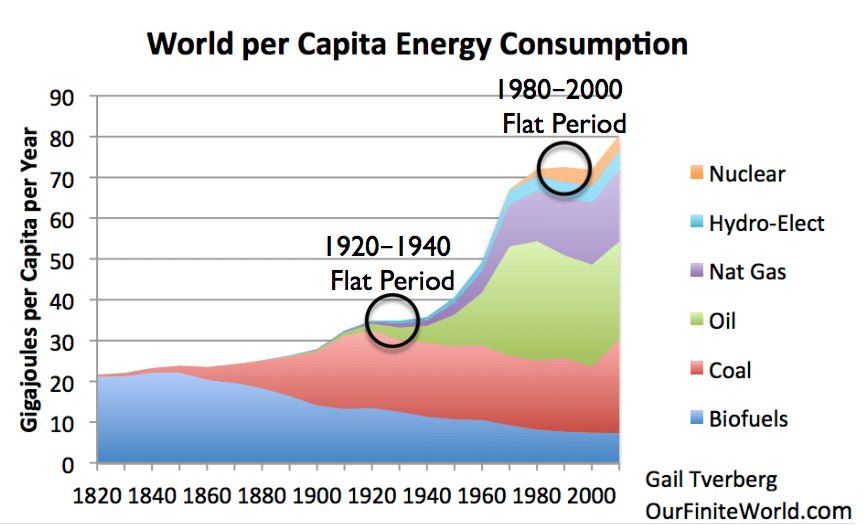
Figure 2. World per Capita Energy Consumption with two circles relating to flat consumption. World Energy Consumption by Source, based on Vaclav Smil estimates from Energy Transitions: History, Requirements and Prospects (Appendix) together with BP Statistical Data for 1965 and subsequent, divided by population estimates by Angus Maddison.
There is a good reason why energy consumed has risen over time on a per capita basis. Every human being needs energy products, as does every business. Energy is what allows food to be cooked and homes to be heated. Energy products allow businesses to manufacture and transport goods. Without energy products of all kinds, workers would be less productive in their jobs. Thus, it would be hard for the world economy to grow.
When energy consumption per capita is rising, it is easy for workers to become more productive because the economy is building more tools (broadly defined) for them to use, making their work easier. Manufacturing cell phones and computers requires energy. Even things like roads, pipelines, and electricity transmission lines are built using energy.
Once energy consumption growth flattens, as it did in the 1920-1940 period, the world economy is negatively affected. The Great Depression of the 1930s occurred during the 1920-1940 period. Problems, in fact, started even earlier. Coal production in the United Kingdom started to drop in 1914, the same year that World War I began. The Great Depression didn’t end until World War II, which was immediately after the 1920-1940 period.
In the 1920-1940 period, many people, especially farmers, were not able to earn an adequate living. This is a situation not too different from the one today, in which many young people are not able to earn an adequate living. Strange as it may seem, this type of wage disparity is a sign of inadequate energy per capita, because jobs that pay well require energy consumption.
The 1980-2000 flat period was in many ways not as bad as the earlier one, because the lack of growth in energy consumption was planned. The United States changed to smaller, more energy-efficient cars in order to reduce the amount of gasoline consumed. Oil-powered electricity generation was taken out of service and replaced with other types of generation, such as nuclear. Heating of homes and businesses was changed to more efficient systems that did not burn oil.
The indirect effect of the planned reduction in oil consumption was a drop in oil prices. Low oil prices adversely affected all oil exporters, but the Soviet Union was especially affected. Its central government collapsed, at least partly because of its reduced revenue stream. Member republics continued to operate, somewhat as in the past. Russia and Ukraine cut back greatly on their industrialization, leading to less use of energy products. Population tended to drop, as citizens found better work prospects elsewhere.
Eventually, in the early 2000s, oil prices rose again. Russia was able to become a major oil exporter again, but Ukraine and other industrialized areas were permanently handicapped by the collapse. Countries affiliated with the Soviet Union (including Eastern European countries, North Korea, and Cuba) found themselves permanently lagging behind the US and Western Europe.
Recently (2013-2017), the world economy seems to have again reached a period of flat energy consumption, on a per capita basis.

Figure 3. Based on data of BP Statistical Review of World Energy, 2017, and 2017 UN Population Estimates.
In fact, in many ways the flattening looks like that of the 1920 to 1940 period. Increased wage disparity is again becoming a problem. Oil gluts are again becoming a problem, because those at the bottom of the wage hierarchy cannot afford goods using oil, such as motorcycles. Young people are finding their standards of living falling relative to the living standards of their parents. They cannot afford to buy a home and have a family. Governments are becoming less interested in cooperating with other governments.
Why is world energy consumption per capita flat, or actually falling slightly, after 2013? The answer seems to be diminishing returns with respect to coal production. Diminishing returns refers to the fact that while at first coal is inexpensive to extract, the cost of extraction rises after the thickest seams and those closest to the surface have been extracted.
A chart of China’s energy production shows how China’s coal production first rose as low cost made its usage advantageous, and then fell due to diminishing returns. China experienced a major ramp-up in coal production after it was added to the World Trade Organization in 2001.

Figure 4. China’s energy production, based on data from BP Statistical Review of World Energy, 2017.
As the extraction of coal progressed, China found itself with many mines with rising production costs. Coal prices did not rise to match the higher cost of production, so a large number of unprofitable mines were closed, starting in about 2012.
A major reason for the flat world per capita energy consumption starting in 2013 is the fall in China’s coal production after 2013. Coal production is falling in quite a number of other countries as well, as the cost of production rises, and as users become aware of coal’s environmental issues. Other sources of energy have not been rising sufficiently to keep total per capita energy consumption rising. A person can see in the China chart that wind and solar production are not rising sufficiently to offset its loss of coal production. (Wind and solar are part of Other Renewables.) This situation occurs elsewhere, as well.
What role do wind and solar play in maintaining world energy supply? The truth is, very little. While a great deal of money has been spent building them, wind and solar together amounted to only about 1% of total world primary energy supply in 2015, according to the International Energy Association.
A major problem is that wind and solar do not scale well. As larger quantities are added to electricity networks, more workarounds for their intermittency (such as batteries and long distance transmission) are needed. Bid prices for wind and solar give a misleadingly low impression of their real cost, unless the projects include many hours’ worth of storage to offset the impact of intermittency.
The key to rising energy consumption seems to be the falling cost of energy services, when efficiency is included. For example, the cost of delivering a package of a given size a given distance must be falling, relative to inflation. Similarly, the cost of heating a home of a given size must be falling. Governments must be able to tax producers of energy products, rather than providing subsidies.
Globalization requires ever-expanding energy supplies to meet the needs of a rising world population. To maintain globalization, we need a growing supply of energy products that are very cheap and scalable. Unfortunately, wind and solar don’t seem to meet our needs. Fossil fuels are no longer cheap to extract, because we extracted the resources that were least expensive to extract first. Our problem today is that we have not been able to find substitutes that are sufficiently cheap, non-polluting, and scalable.
A Few Related Questions and Answers:
(1) What is the biggest impediment to raising total energy consumption?
We cannot get the price of oil and of other fuels to rise high enough, for long enough, to encourage the production of the fossil fuel supplies that seem to be in the ground. What happens, instead, is that energy prices hit an affordability limit and fall back.

Figure 5. NASDAQ three month price chart for Brent Crude oil. Source: NASDAQ
The recent strike in Brazil over high diesel prices shows the kind of issues that occur. Oil prices are still far below what many oil exporters (such as Norway, Venezuela, and Iraq) really need, when needed taxes are included.
Of course, the problem with not being able to get prices high enough also discourages the use of alternatives to fossil fuels, such as wind and solar.
(2) Aren’t wind and solar low-cost approaches?
It is easy to think that wind and solar will be huge improvements over burning fossil fuels directly for fuel, but nearly all of these analyses overlook the problems that are added by introducing intermittency to the electric grid. The assumption was made in early analyses that with enough scale, intermittency in one location would tend to offset intermittency in another location. Also, it was hoped that electricity consumption could be shifted to different times of day.
There have been several recent analyses that look more closely at these assumptions. Jean-Marc Jancovici has shown that if sufficient storage is added for wind and solar to make it “dispatchable,” it takes an order of magnitude more physical resources to produce wind and solar compared to what it takes to produce the dispatchable nuclear electricity used in France. Both have low long-term operating costs. Thus, we would expect the true cost of wind and solar to be far higher than France’s nuclear electricity.

Figure 6. Source: Favorable to all scenario from https://jancovici.com/en/energy-transition/renewables/100-renewable-electricity-at-no-extra-cost-a-piece-of-cake/
Roger Andrews, writing on Euan Mearns site Energy Matters, shows that some recent solar and wind auction prices appear to be far below actual costs, when reasonable minimum cost assumptions are used.
Regarding “Demand Response” as a solution to intermittency, Roger Andrews shows how little time of day pricing for consumers affects consumption curves. It appears that people don’t stop eating dinner after they get home in the evening, no matter how high the cost of electricity is at that time.
Interruptible supply is another way of reducing demand. This link describes some of the issues encountered when interruptible supply was tried on a large scale in California.
(3) Can’t we simply get along using less energy? That is what everyone tells us is possible.
The historical record in Figure 2 doesn’t give much indication that this is possible. Whenever there is even a small drop in energy consumption per capita, it seems to have an adverse effect. On Figure 3, even the small dip in energy consumption per capita in 2008 and 2009 led to a serious recession in many countries of the world.
The people who talk about getting along with less energy haven’t thought through the likely ramifications of this. There would be fewer jobs that pay well, because jobs such as those for construction workers would disappear. The economy would shrink, because of the fewer jobs, in a much worse recession than the Great Recession of 2008-2009.
We know that in past collapses, one of the big problems was inability of governments to collect enough taxes. We would likely encounter the same problem again, if there are fewer people making high wages. Most of the tax dollars for the US Federal Government are paid by private citizens (as income taxes or as Social Security funding), rather than by corporations.

Figure 7. Sources of US Federal Governments Revenue, based on US Bureau of Economic Analysis data.
The last year shown on Figure 7 is 2017, which is before the recent corporate tax reduction. This change will tend to shift the burden on Federal Taxes even further in the direction of payroll related taxes.
(4) How about efficiency savings? Can’t efficiency savings fix our problem?
There are two issues involved. If we were really efficient at fuel savings, as we were in the early 1980s, oil and other energy prices would drop dramatically. This would push oil, coal, and gas producers worldwide toward bankruptcy. Governments of oil exporting countries, such as Venezuela and Saudi Arabia, would have difficulty collecting enough tax revenue. They would likely collapse from lack of tax revenue, substantially reducing supply.
A second issue is that historically we have been adding efficiency. In fact, efficiency is what has tended to make fuel more affordable. As noted in the article, energy use could grow, as the cost of energy services fell.

Figure 8. Total Cost of Energy and Energy Services, by Roger Fouquet, from Divergences in Long Run Trends in the Prices of Energy and Energy Services. The cost of energy services combines (a) the cost of energy with (b) the impact of efficiency savings.
Some of the changes we have been making recently go in the opposite direction of efficiency. For example, the recent article, Biggest Ever Change in Oil Markets Could Send Prices Higher, discusses a new regulation requiring the use of low-sulfur fuel oil for ships. Doing this would greatly reduce the quantity of sulfur being released to the atmosphere as emissions. This is not a change toward efficiency; it is a change toward higher cost of production, which is the opposite of efficiency. Regulators plan to use part of our energy supply to eliminate the excess sulfur before the oil is sold.
As undesirable as sulfur pollution is, the problem is affordability and higher cost. Wages are not high enough for workers around the world to afford the required higher cost of food (because food production and transport use oil) to support the new regulation. So, the likely result of the regulation is to push the world toward recession. Beyond a certain affordability point, it is hard to push oil prices higher, because wages don’t rise at the same time.
(5) Could you explain further why flat energy consumption per capita is not sufficient for the world economy–this amount really has to grow?
Perhaps looking at charts of recent trends in energy consumption of a few countries can help explain what happens when overall per capita energy consumption is flat.
Joseph Tainter in The Collapse of Complex Societies explains that economies often use “complexity” to work around problems as they approach resource limits. In the particular version of complexity tried in this case, manufacturing was increasingly globalized. Workers suddenly found themselves competing for wages with workers from much lower wage countries. Wage disparity became more of a problem.
When workers are increasingly poor, they can afford to purchase fewer goods and services. This can be seen in energy consumption per capita data. Figure 9 shows energy consumption per capita for three European countries experiencing difficulties. In all three, energy consumption per capita has been falling for several years. When manufacturing was sent to Asia, workers found themselves earning less, so they were able to purchase fewer goods made with energy products. Also, European products were less competitive on the world market, with the new competition from low-cost markets.

Figure 9. Energy Consumption per Capita for three European Countries, based on BP Statistical Review of World Energy data and UN 2017 population estimates.
The countries that have been able to grow more rapidly in response to globalization (such as those in Figure 10) need to keep up their patterns of growth, or they start encountering financial problems because their prior growth was generally financed with debt. Without sufficiently rapid growth, they have difficulty repaying debt with interest.

Figure 10. Energy Consumption per Capita for five countries that recently have been growing rapidly. Based on BP Statistical Review of World Energy data and UN 2017 population estimates.
Brazil’s energy consumption per capita has recently fallen, and it is encountering severe problems. Argentina is a country with flattening energy consumption growth. China’s growth in energy consumption has slowed as well; we often read statements about its debt problems.
One of the problems that these rapidly growing countries encounter is currency fluctuations. As long as their particular country seems to be growing rapidly, the currency level of their country can remain high, relative to the US dollar or the Euro. But if obstacles are encountered, such as the low price of their major export, or slower economic growth, the currency of the country may fall relative to major currencies.
A falling currency relative to major currencies is a problem for these rapidly growing countries for three reasons. For one, imports become expensive. For another, any debt denominated in a foreign currency (such as the US dollar) becomes more difficult to repay. The reason why this is an issue is because rapidly growing countries often do not find enough credit available locally, so are forced to borrow internationally. A third problem with slowing growth and a falling currency relativity is that it becomes more difficult to attract new investment to the country. Instead, outside investors may decide to leave; they want to seek the next growth opportunity, in different, more rapidly growing country.
Turkey and Argentina both seem to be having problems with their currencies falling relative to the US dollar.
Another issue that makes flat worldwide per capita energy consumption unworkable is “diminishing returns” as resources become depleted. For example, wells for fresh water must be dug deeper, ores of metals include higher percentages of waste materials, and oil wells must be sunk in less convenient locations. These problems can be worked around, but they require increased energy consumption. All of these uses for energy products leave less for the rest of the economy. Thus, if we deduct the extra energy needed to compensate for diminishing returns, what at first looks like flat per capita energy consumption worldwide really equates to declining per capita energy consumption.
(6) Isn’t there anything that we can do to reduce carbon dioxide emissions?
The task of reducing carbon dioxide emissions is much more difficult than it appears to be, because the world economy requires energy consumption in order to operate.
The best thing I can see that an individual can do is reduce his or her consumption of meat and other animal products (fish, cheese, milk, leather). To offset, a major increase should be made in the consumption of vegetables that are filling to eat (such as potatoes, beets, carrots, beans, sweet potatoes, taro root, turnips, and corn). Some of these perhaps can be grown locally. Humans’ use of animal products adds to carbon dioxide levels, partly because of the quantity of food that needs to be grown and transported to feed the animals, and partly because of the direct emissions of some animals (including cattle, pigs, buffalo, chicken, sheep and goats).
In fact, cutting back on highly processed food of all sorts (particularly sugars, high fructose corn syrup, and oils) would seem to be worthwhile, as well. Growing, processing, and transporting the crops used in these highly processed foods all add to CO2 emissions.
Our problem is that we have grown attached to the flavors of these foods, and we have become convinced that they help us grow big and strong. While they may do this, they also set us up for problems in old age. Starchy vegetables have played a major role in the diets of long lived people. We may need to start giving them, and other less processed foods, a more prominent role again.


“Salvini and Luigi Di Maio, Five Star’s leader, are both committed to remaking the E.U.’s economic treaties and introducing expansionary tax and spending policies. Both of these things will place them on a collision course with the authorities in Brussels, Berlin, and Frankfurt. And at this stage, neither side seems likely to back down.”
https://www.newyorker.com/news/our-columnists/italys-challenge-to-the-eurozone-is-only-beginning
“Italian bonds may have bounced off this week’s stunning losses, but some of the biggest investors say the worst isn’t over.”
https://www.bloomberg.com/news/articles/2018-06-01/worst-month-ever-in-italian-bonds-leaves-confidence-in-tatters
“Although Italy’s politics are a byword for crisis they still managed to rattle investors this week. But even more shocking to some was the sudden evaporation of liquidity in the country’s bond market.”
https://www.ft.com/content/3797c4a8-64ac-11e8-90c2-9563a0613e56
“This week, it emerged that in Europe, banks are giving up their primary dealership roles in dealing European government bonds. This issue threatens to further reduce liquidity and eventually make it more expensive for some countries to borrow money.”
https://seekingalpha.com/article/4178715-liquidity-crisis-looming
A change in the sales practice could be a problem. A while back there was an article saying that the new US tax law changes for corporations was having an adverse impact on the availability of US bonds, I believe it was for hedging. All of these things add up.
Interesting times in the Emerging Markets. Malaysia crowdfunding its sovereign debt now:
“The Tabung Harapan Malaysia (THM) fund – otherwise called the Hope Fund – to contribute to settling the national debt has collected RM7 million (S$2.35 million) in 24 hours, said Malaysia’s Finance Minister Lim Guan Eng. Asked whether the fund would affect confidence in the economy of the country, he told a press conference on Thursday (May 31) that “if people want to show their patriotism by donating, we welcome it”.”
https://www.straitstimes.com/asia/se-asia/malaysians-donate-s235m-in-24-hours-to-hope-fund-set-up-to-help-reduce-national-debt
“Turkish banks are learning that all good things come to an end. After piling on corporate loans only a few years ago, lenders are now facing a surge in demand from companies seeking to reorganize debt repayments.”
https://www.bloomberg.com/news/articles/2018-05-31/turkish-banks-face-increasing-pile-of-debt-restructuring-demands
“Over the past 10 days, Brazil has sometimes seemed a country on the brink of an apocalypse. Usually traffic-clogged highways around Sao Pãulo have been deserted, gasoline stations emptied, and food supplies to supermarkets have dwindled. For lack of poultry feed, there has been a gruesome cull of 100m chickens. There has even been wild talk of a military coup.”
https://www.ft.com/content/77a4eefa-64c4-11e8-a39d-4df188287fff
The reason their oil consumption is down is because their oil production is down. Falling oil production by itself is a problem. It may be that with prices so low, they decided it was unprofitable to extract.
I know that China’s oil production has been falling because of low prices.
Another article blaming the politicians
A Tesla owner in Brussels said his Tesla on autopilot drove away on its own and crashed into five parked cars…
https://www.bloomberg.com/news/articles/2018-05-31/tesla-denies-autopilot-feature-engaged-in-brussels-car-crash
https://www.godlikeproductions.com/sm/c3549d16.gif
Russian hackers no doubt about it.
This is a clever excuse to use anytime a Tesla driver is involved in a wreck. Just blame it on the car and it’s software.
let’s celebrate this great news on Adonis Day:
https://www.oilandgasinvestor.com/report-us-oil-output-jumps-record-high-march-1704031
new US record high oil output of 10.5 million barrels per day…
that’s the final report for March…
April and May will likely be higher…
so on Adonis day:
BAU tonight, baby!
Since it is Adonis day I will pay with cash today.
Adonis could be right. Trade war IN Europe, Italian bait and switch and Spanish vote of no confidence
Could be a start of fast collapse
Or could be autumn? I know that Tim Morgan has tentatively suggested that sort of timing.
“With President Trump’s incredibly foolhardy decision Thursday to impose tariffs on steel and aluminum from Canada, Mexico, and the European Union, the probability grows of an economic crash this fall. When the likely crash hits (I predict late-October), this nation will be psychologically ill-equipped to handle it. Get ready for rough times. The crash is likely because both public and private-sector debt levels are too high; assets are overvalued; wage pressure soon will massively increase…”
https://www.washingtonexaminer.com/opinion/a-recession-or-depression-is-coming-this-fall-heres-why
The collapse is always 2 years away.
Trump getting elected was supposed to crash the markets right after.
Apparently Apple accounted for 30% of all increases in both the Dow and the S&P recently. That just shows you what a joke the markets are right now.
And the Apple increases were generated by
http://pebblewriter.com/wp-content/uploads/2018/05/apple-buybacks.png
http://www.macrotrends.net/stocks/charts/IBM/shares-outstanding/intl-bus-mach-shares-outstanding-history
Economists Think the Next U.S. Recession Could Begin in 2020
Majority of forecasters surveyed by WSJ predict the current expansion will end only after setting a record for longevity
The economic expansion that began in mid-2009 and already ranks as the second-longest in American history most likely will end in 2020 as the Federal Reserve raises interest rates to cool off an overheating economy, according to forecasters surveyed by The Wall Street Journal.
Some 59% of private-sector economists surveyed in recent days said the expansion was most likely to end in 2020. An additional 22% selected 2021, and smaller camps predicted the next recession would arrive next year, in 2022 or at some unspecified later date.
“The current economic expansion is getting long in the tooth by historical standards, and more late-cycle signs are emerging,” said Scott Anderson, chief economist at Bank of the West, who was among those predicting a 2020 recession.
As for the most likely primary cause of the next downturn, 62% selected an overheating economy leading to Fed tightening. Other options picked by at least 5% of economists surveyed were a financial crisis, the bursting of an asset bubble, a fiscal crisis or disruptions to international trade.
Recessions are notoriously difficult to predict, and sometimes are tricky to recognize even after they start. The recession that began in December 2007 wasn’t officially proclaimed by the National Bureau of Economic Research’s recession-dating committee until a year had gone by. Forecasters saw the chances of a recession rise back in 2011 and in 2016; both turned out to be false alarms.
“Recessions occur because of unforeseen shocks, so by definition there is no meaningful answer,” said Deloitte economist Daniel Bachman, who declined to estimate either the timing or cause of the next downturn.
Still, the predictions in this month’s Journal survey offer insight into the current consensus among professional forecasters: A recession isn’t imminent, but the expansion won’t last forever—and the next downturn might arrive in the thick of the 2020 presidential campaign.
“Any year from 2019 onward is in play,” said Lou Crandall, chief economist at Wrightson ICAP.
The longest expansion tracked by the NBER dating panel, going back to 1854, was the information-technology-fueled 1990s boom that lasted 10 full years. May marks the 107th month of the current expansion, surpassing the 106-month expansion of the 1960s, and forecasters have become increasingly confident the current expansion will set a longevity record by extending into the second half of 2019.
Indeed, in the near term, forecasters think the U.S. economy is on solid footing.
–– ADVERTISEMENT ––
On average, economists predicted gross domestic product will expand 2.9% in the fourth quarter of 2018 compared with a year earlier, up from 2.6% growth in 2017. The unemployment rate, which fell to 3.9% in April, was expected to slide further to 3.7% by the end of this year and 3.6% by mid-2019. The average risk of a recession in the next 12 months was pegged at 15%.
Forecasters do see risks looming, with many mentioning mounting tensions over U.S. trade policy. Some 60% of economists saw greater risk that growth would undershoot expectations than overshoot over the next year.
One bright spot: Economists think long-sluggish U.S. productivity growth is poised to pick up at least modestly in the next few years.
Labor-productivity gains averaged just 1.2% a year in 2007 through 2017, according to the Labor Department, a weak trend that threatens to restrain the pace of economic growth. After remaining flat in 2016, nonfarm business labor productivity rose 1.3% in 2017, and economists on average predicted annual growth will average 1.5% over the next five years.
“More capital investment should help revive productivity,” said Lynn Reaser of Point Loma Nazarene University.
Even more encouraging, 71% of economists said they saw a greater risk that productivity growth would exceed forecasts, rather than disappoint.
The package of corporate and other tax cuts enacted in December is playing a supporting role, but most economists said it isn’t the sole explanation for recent strength in U.S. business investment. Most described tax-code changes as one of several major causes, with just 5% calling them the main cause.
“The tax-code changes should be a major driver of business investment spending, but the monthly orders data have been surprisingly soft thus far,” Mr. Crandall said. “Growing confidence in the global expansion in 2017 would seem to have been a bigger driver thus far.”
The Journal’s survey of 60 business, financial and academic economists was conducted May 4-8; not every economist answered every question.
https://www.wsj.com/articles/economists-think-the-next-u-s-recession-could-begin-in-2020-1525961127
Less than 3% annual growth. Man its getting hot in here.
Why poverty is rising faster in suburbs than in cities
https://theconversation.com/why-poverty-is-rising-faster-in-suburbs-than-in-cities-97155
The price of oil causes inflation in commodities as well..See Copper for example..
http://www.infomine.com/investment/metal-prices/copper/all/
I live about an hour and half away from Detroit..And now they have “Detroit ancient ruins” bus tours..Where they drive you through the ghetto and show you all the burned down and abandoned buildings..
https://i.redd.it/i0m3swzyea111.jpg
Disaster tourism might be catching on.
Another reason why shale oil is so expensive…
When reading this .. I feel the epic desperation that is going into keeping the oil spigot open…
https://srsroccoreport.com/the-unbelievable-amount-of-frac-sand-consumed-by-u-s-shale-oil-industry/
https://d3hxt1wz4sk0za.cloudfront.net/wp-content/uploads/2018/05/Permian-Basin-Frac-Sand-Loads-2018.png
https://d3hxt1wz4sk0za.cloudfront.net/wp-content/uploads/2018/05/Walmart-vs-Permian-Annual-Number-Truck-Loads-2018.png
that’s a great way to use sand…
In Saudi Arabia they import the sand they use for construction..Because their sand is too salty and fine..Not all sand is equal..Just like energy..
Just fill up the empty oil tankers with sand on the return journey 🙂
Lots of jobs hauling stuff!
https://www.nytimes.com/2018/05/31/opinion/oh-what-a-stupid-trade-war-very-slightly-wonkish.html
aren’t trade wars just battles of “the haves” vs “the haves”?
the “have-nots” can’t even get into the battle…
But the situation is not that different from the 1930s. There are not enough resources to go around. Somehow, the sad story plays out.
U.S. Shale Production May Be Plateauing
https://oilprice.com/Energy/Crude-Oil/US-Shale-Production-May-Be-Plateauing.html?utm_source=fb&utm_medium=fb_repost
Protesters meet US military convoys streaming through Europe ‘preparing for war’
https://www.rt.com/news/428350-us-military-europe-movement-germany/
I believe it is June 1st somewhere in the world.
This is it.
6:25 AM
Friday, June 1, 2018 (GMT+10)
Time in Guam
perhaps the right date, wrong year. it’s easy to do on collapse predictions.
Calling Adonis, it is June 1 here and i can still use my bank account, Next?
it’s getting dark here and suddenly everything went black. oops, it was just my laptop going into sleep mode…
but wait!
June 1st isn’t over yet!
give it a chance…
there are about 30 hours to go before Hawaii reaches June 2nd…
patience!
but USA daylight savings time in the eastern time zone has one hour until June…
this is so exciting!
no way I can go to sleep now…
I’ll be watching the clock…
wow!
I hereby declare June 1st to be a new worldwide holiday:
Adonis Day…
I will not be going in to work tomorrow…
I will be celebrating…
and…
in honor of my online friend adonis…
BAU tonight, baby!
The Unbelievable Amount Of Frac Sand Consumed By U.S. Shale Oil Industry
https://srsroccoreport.com/the-unbelievable-amount-of-frac-sand-consumed-by-u-s-shale-oil-industry/
In My mind this is the most beautiful pumping industrial music ever created in the the honor of the petroleum engine.
https://m.youtube.com/watch?v=ENZ03gwce_8
This is what happens when the Anglo-American world is mixed up with Finland.
https://m.youtube.com/watch?v=unhUjEoNbdU
Nuke us!
this is what people do when they have lots of surplus energy…
Man wearing dress paying metal accordion. I have to say we are still on the upswing.
and I like it. will have to jet over to Finland and catch the show. How about a OFW get together in Finland.
Nobody in Japan ate any meat until 1872 when Emperor Meiji ate meat for the first time in Japan’s history. Until then, eating meat was punishable by execution. (Some people occasionally killed and ate wild boars, but that was about it.)
Which is why the Japanese are so obsessed by whale meat, since it was the only kind of meat they could have. In some Buddhist script, whales were described as fish so eating whalemeat was considered to be eating fish, so there was no restriction against it.
The Japanese will never give up eating whale meat, even if that might bring the death of the last whale.
We just can’t seem to get past people’s behavior. Too much freedom. Too much discretionary activity. People need to be limited very strictly. But how?
Thank you Kulm. It is always reassuring hear the opinions of an expert in these matters.
Incidentally, how do you account for the fact that the people who raise the cattle for Omi Beef claim that their ancestors have been doing it for 400 years and shipping it from Shiga to Edo to feed the Shogun and his merry band of samurai?
http://www.oumiushi.com/en/about/history.html
And how do you account for the fact that some of the people marketing kushikatsu claim that eating grilled meat on sticks is a Japanese tradition that dates back to at least the 17th century?
https://savorjapan.com/contents/more-to-savor/kushiyaki-guide-how-to-enjoy-japanese-skewered-cuisine/
The Japanese obsession with whale meat is really something, isn’t it? They eat an average of 30g of the stuff (one ounce) per person per year. Very occasionally, I actually run into a Japanese who eats the occasional peace of blubber. But the vast majority are indifferent to whaling and to whalemeat. The Japanese national obsession with whaling is about as widely held as the British obsession with fox-hunting.
I went to Spain a few years ago … it was off-season for bull torture…. but we went for a tour of one of the dungeons…
The group guide was very pleased with the whole thing … regaling us with tales of ‘brave’ matadors and the few who die — what great heroes!
I just had to interrupt… asking…. how many bulls die each season?
She didn’t answer… and I walked out…. not because she didn’t answer but more because it was a boring tour…
Funny how the Japanese whale meat thing is a big deal… but the brutal slaughter of thousands of bulls for entertainment no less…. is mostly off the radar….
Steewpid f789ing huuuumans….
I have an idea!!!!
Let’s fly those kids on the private jets to Madrid…. and use them instead of bulls.
How entertaining would that be!!!!
I’d buy a seasons ticket to that.
The problem isn’t quantity… It’s simply WASTE & INEFFICIENCY!
Of course that we always like to pretend that we are something that we aren’t!
Don’t troll the site.
And here it is! The first exemplar of what I’ve just written!
JT Roberts likes to pretend that waste and inefficiency (and I didn’t even mention the superfluity of the system!) are not the major problem in the energy sector, and so he does what every narrow-minded people do.
it’s not that simple. while there can certainly be some improvements made, the “discarded energy” in the LLL diagram is actually the physical waste energy, like resistive heat loses in transmission wires, that are nearly impossible not to lose. the heat from your car engine is another form of waste energy from the ICE under the hood. one can get some of this waste heat back into useful energy with co-generation, like when your cat lies upon the hood to keep warm at night, but you can only get so much back this way.
there are many other waste energy recovery schemes, like replacing copper wires with laser beams, but the lasers take a lot of energy to produce the beams, so it’s adding complexity with a diminishing return.
Of course it’s not simple… That’s why the quantity will never be a solution!
hi voza…
of course waste and inefficiency are two of many problems…
but if you don’t think quantity is a problem…
then could you send me all of your money?
since “all of your money” is just a quantity…
Even worse than JT Roberts!
How many trillions of “money” as the FRS created (out of TA) since the “financial crisis” of 2007/8?
It’s seems that, at least for you, the situation isn’t better – since you are asking for money – so the huge amount of money created – QUANTITY! – didn’t fix the problem, at least the problem of the Herd of Dumb Slaves.
Men nearly caused human extinction 7,000 years ago, new theory states
https://nypost.com/2018/05/31/men-nearly-caused-human-extinction-7000-years-ago-new-theory-states/
if those men had succeeded, they would have eliminated a lot of human suffering…
How close we were to saving the planet…. just 7000 more…. 🙁
People do not take the risks involved in killing the neighbors unless they need the resources. Just as 5000 years ago so today. Its time to kill.
I don’t think the ‘solution’ of going vegetarian/vegan will help the population in the longer term. Effectively more food just allows the population to grow until the resource gets used. So instead of having 8 billion humans involved in a population collapse, we might put collapse off by 30 years and have a collapse of 15 billion humans.
Realistically though it is not food production that is the problem, whether meat of plant based. It is the system staying in tact that allows food to get to the enormous cities of the modern world. With depletion of energy supplies, added to debt collapses, combined with a Just In Time delivery economy for everything, then added again to complexity and specialisation around the world, it is a miracle the system is still working (to a degree) today.
When I look around the world at stupid decision after stupid decision of governments of all types, the big picture is that we are in collapse, losing bits off the periphery one after the other, but fake news will tell us the latest football scores as the really important item, or what new gimicky internet stock will make a fortune.
We sometimes talk of tipping points that will cause the next stage of collapse, or some talk of tipping points starting collapse, but what I see is just a continuance of what is already underway.
Where I live we have an abundance of energy in low cost lignite, 430 billion tonnes to be precise and all only 10-20 metres below the surface, so cheap to extract. However because of other decisions it has been relegated to stay in the ground and not be burnt, well not by our civilization anyway.
In a few hundreds to thousands of years, when some type of civilization again rises after our collapse, these people will use the lignite plus whatever else they can garner from the natural world, in what they think will be a sustainable society. Only problem is they to will end up running into limits that collapses their civilization, and so the process will repeat until some bug wipes us all out.
We have lived in the golden age of the last few decades on increasing energy (of the right type) per capita, and like all good yeast have or are using it all with unlimited growth, until we run out of fuel and foul our nest.
The only question that really remains is will we collapse fast enough to prevent a major conflict between the major powers, or will there be huge resource wars that bring on further collapse faster with no possible winners??
Try digging a hole 1 metre deep in your back yard…. come back a week later…. notice how it has filled with water….
“The only question that really remains is will we collapse fast enough to prevent a major conflict between the major powers, or will there be huge resource wars that bring on further collapse faster with no possible winners??”
or will peripheral countries continue to collapse first, allowing the Core countries to buy some time by having less competition for the remaining resources?
and then what?
it’s hard enough to foresee what will happen to peripheral countries in the next few years…
beyond that, it’s totally unpredictable…
but…
that doesn’t stop folks like me from making predictions…
I’m starting to warm up to starchy vegetables. They were very widely uses by the laborer class in my youth, and those who consumed them has better physiques and could work harder than their grandchildren today. But I don’t see how this connects with everything else in the networked global economy. What happens to the broken window effect, for instance?
Exactly! Poor people around the world have done well on starchy vegetables. Industrial agriculture has not warmed up to starchy vegetables, because their is not much money to be made off of them, unless they are fried our otherwise processed. These vegetables are too low class to be bothered with, in their opinion.
Grains are much better from the point of industrial agriculture. They can be ground up into tiny pieces. The nutritious parts that don’t keep well can be removed. People can be encouraged to fill up things that store well, are easy to prepare, but have little real nutrition. Of course, root vegetables need thirs skins for proper nutrition, also.
I wonder when Venezuelans will start growing tubers.
This article says High demand for Yucca leads to sometimes fatal results
This article says, https://www.theguardian.com/world/2017/aug/26/nicolas-maduro-donald-trump-venezuela-hunger
”
I meant growing for themselves, personally. Tubers and root vegetables produces more calories per square meter than anything else, much more than slave crops. And healthier too.
After they kill and eat all the doomie prepper farm animals? And their kids? After ra.ping their wives and dotters?
Looks like we have our trade war. I actually thought Trump was just throwing his weight around as a negotiating tactic or for kicks but it looks like he is serious about instigating protectionism:
“The US is to impose tariffs on steel and aluminium imports from allies in Europe and North America.
“The US said a 25% tax on steel and 10% tax on aluminium from the EU, Mexico and Canada will start at midnight.
“The move immediately triggered vows of retaliation from Mexico and the EU, which called the tariffs “protectionism, pure and simple”.
“The UK said it was “deeply disappointed” by the US decision, which followed weeks of negotiations.
“EU trade commissioner Cecilia Malmstrom said it was a “bad day for world trade”, while European Commission president Jean-Claude Juncker said the move was “totally unacceptable.
“The EU had “no choice” but to bring a case before the World Trade Organization and impose duties on US imports, he added.
“Europe had previously outlined a list of items, including US bourbon, cranberries and jeans, as potential targets for retaliation.
“Mexico’s Economy Ministry said it would place tariffs on items such as steel, pork legs and shoulders, apples, grapes, blueberries and cheese…”
http://www.bbc.co.uk/news/world-us-canada-44320221
If Trump puts tariffs on China..Does this mean Trump products will cost more?
I saw a sub-headline that suggested the EU foresaw a probable need apply tarrifs on a number of goods, one of which was Motorcycles.
So are they thinking Harley Davidson? Is that why Harley seem to be planning to move production to Thailand?
Upon reading this post I couldn’t help but be reminded of Richard Duncan’s work and his Olduvai theory.
As he argues in a 2001 article entitled World Energy Production, Population Growth, and the Road to Olduvai Gorge:
“Although all primary sources of energy are important, the Olduvai theory identifies electricity as the quintessential end-use energy of Industrial Civilization…[A]ccording to the Olduvai schematic, world energy production per capita will decrease…[then] there will be a rash of permanent electrical blackouts worldwide. Consequently the vital…functions—communication, computation, and control—will be lost.
…Mother Nature then solves for us the (apparently) insuperable problem of the Tragedy of the Unmanaged Commons, which the human race seems either incapable or unwilling to solve for itself.
Governments have lost respect. World organizations are ineffective. Neo-tribalism is rampant. The population is over [seven] billion and counting. Global warming and emerging diseases are headlines. The reliability of the electrical power networks is failing. And the instant the power goes out, you are back in the Dark Ages.”
Extinction awaits
Pingback: Our Energy Problem Is a Quantity Problem – Olduvai.ca
Pretty Comprehensive Gail. You might add the social effect in the future which we can use as a barometer of where we are in the collapse that is already underway. For example the discretionary spending patterns of the millennials compared to the baby boomers. Or the migration of people to lands with access to resources. And the resource wars we have been experiencing. We can also include the infrastructure that is wearing out that was past abundance to recent scarcity. This includes towns at the periphery of the economy un-incorporating because they can’t afford there own governments and have no access to credit. And so on many angles and evidence that we’re already down the road quite far.
Yes, if you are taking requests … 🙂
Maybe JT and I are wrong, but you and the commentary seems to be about predicting the future decline as if there is no current decline. Is that your actual position?
The world is already declining, but some parts are declining faster than others. People living on the street, or earning minimum wage, are already starting to see the impact. The high opioid death rate is one symptom, too.
“And so on many angles and evidence that we’re already down the road quite far.”
I’ve heard that there was a lot of decline in the 1930s…
situations are complex… trends always do change eventually, and declines can reverse…
but… the facts seem to show that population keeps rising and energy surplus keeps falling…
I sometimes look at it this way:
we can be certain that many decades from now there will be little or no usage of FF… let’s suppose the year 2100… or 2050… whenever…
so, between now and then, what’s gonna happen?
I appreciate commentary that points out trends that have begun recently and where those trends will or will not go…
The Fake New Media wrote (and I was dumb enough to believe them) that 64 million chicken in Brazil had starved to death.
The truth is that 64 million chicken had been slaughtered, becaus when chicken start to starve they turn into cannibals.
The media doesn’t want to disturb our sweet dreams.
https://m.youtube.com/watch?v=RxOBOhRECoo
Oh…and if someone prefers the version made by Fine Young Cannibals over the The King’s original…well…then you don’t even fit on my menu.
The song Elvis loved. He tried to fake it as best he could…he gave all he had…
https://m.youtube.com/watch?v=yTwJvVTQ6-0
Sears to close another 72 stores amid falling sales
https://www.upi.com/Top_News/US/2018/05/31/Sears-to-close-another-72-stores-amid-falling-sales/1841527763883/?utm_source=dlvr.it&utm_medium=twitter
Global growth too dependent on cheap borrowing – OECD
https://www.theguardian.com/business/2018/may/30/unemployment-to-drop-to-lowest-level-since-1980-says-oecd
We need cheap credit, because we ran out of cheap oil..
Gail, I always enjoy reading your articles. Okay, maybe “enjoy” is not the word–but I always look forward to them. Thanks!
Down the road, do you think you can address the issue of what happens to oil consumption and economic growth when a country’s population size remains the same or starts to decline?
Sorry I am not Gail…For what it is worth IMHO You need to grow in population and productivity per person…I see no way out.
I have crews out looking for bottles tho.
We can look at Japan. Lots of problems. Not enough young people. Too much debt. Japan hasn’t collapsed yet, but it is headed the same direction that the rest of the world is going.
Japan recently planned to let 500.000 immigrants in. Labour shortage.
https://japantoday.com/category/politics/japan-to-welcome-500-000-foreign-workers-to-help-plug-labor-shortage
And Japan has been quite conservative / xenophobic in some way country. We’ll see how this experiment works.
500 000 foreign workers, not a few million non-workers.
I will be traveling today. I may be less available to answer comments.
“Spain’s parliament starts formal debate on Thursday over a vote of no-confidence against prime minister Mariano Rajoy. The vote, set for Friday, could see the collapse of Spain’s centre-right government after six years in power.”
https://www.ft.com/content/d1493cbc-6420-11e8-a39d-4df188287fff
“Whether by land, sea or air getting around Greece proved a challenge on Wednesday as a nationwide labor strike gripped the country. Public transportation was disrupted; some flights canceled and sea-going ships were left in their docks.”
http://www.dw.com/en/greek-workers-strike-over-austerity-bailout-reform/a-43990229
“After months of political deadlock following an inconclusive election, Italy is on the verge of a major political crisis with global implications.”
https://www.aljazeera.com/indepth/opinion/italy-crisis-worse-180530085048055.html
“A group of major European companies has warned the Prime Minister they may cut investment without more clarity over the terms of Britain’s EU exit. Business leaders, including from BP, BMW, Nestle, and Vodafone, told Theresa May that “time is running out”.”
https://www.bbc.co.uk/news/business-44310224
I have an EU passport and did vote BY BY Germany have a nice life.
Strange, I thought the election was quite conclusive. It is just that the globalists want to ignore it.
I imagine all of these worrisome headlines are not helping the tourist trade.
The best thing that an individual can do is *stop having children*:
https://www.theguardian.com/environment/2017/jul/12/want-to-fight-climate-change-have-fewer-children
Yea I did that only to be told I did not have enough so In its infinite wisdom the government of Canada is importing a bunch of people with an average IQ of 85 with no work ethic.
this website is about how oil limits effects the economy
not about which race has higher iq
It has nothing to do with race. I answered a statement about children.
Just to be clear Islam is not a race it is a political thing.
Finite the number of kids you can have…On topic
zenny, Just to be clearer. Islam is not a ‘political thing’: Islam Is! And that’s not a Freudian slip. Regrettably, there are two branches of Islam – each regards the other as apostates and heretics – hence can be exterminated. Islam is at year 1386 AM, that is since it was founded in 632 AD. Like to guess where the Holy Roman Empire was in 1386 AD? It was! And It carried on like that until Martin Luther pulled the Indulgences from under It.
I think that Zenny,’s comment has a point, however. In a self-organized system, everything a person does has follow on consequences. If you and your neighbors don’t have children, the government is smart enough to figure out that in a few years, there will not be enough taxpayers. It will import some more. You may not like them as well.
The place where birth rates are out of line with death rates is on the other side of the globe. It is hard to do anything about that problem.
Or at the very least … DO less ! As in ; ( much ) less driving – less use of electronic devices – less online ordering (BUY LOCAL .. online purchasing is highly inefficient what with the massive energy consuming computer farms/hotels needed to keep the infrastructure going etc – et al – ad nauseam ) – smaller homes ( with no higher than eight foot ceilings ) – smaller more efficient cars – less automated home features ( all of which from plug to server require massive amounts of energy ) – less air travel ( extremely inefficient ) – substantially less consumption overall etc – etc – et al … e.g. LESS LESS LESS
None of which will effect the economy in the slightest as populations continue to grow requiring more energy by the day no matter how efficient their behaviors may be . All LESS will do is to moderate the situation . Less … anything else is simply MORE … which regardless of what the insular Ivy Tower crowd incapable of seeing beyond their own noses may make claim to … will only serve to create even greater economic divides , pollution , rapid collapse of over strained grids etc – et al – ad nauseam … all of which will eminently bring us down
LESS ! Or suffer the consequences therein
so, as Keynes said, in the long run we’re all dead?
no matter what we do?
Consume more – have more children — or suffer the consequences
https://i2.wp.com/www.rollingalpha.com/wp-content/uploads/2016/03/deflation.png
We have next to no effect on the kkkklimate so make sure to burn more fossil fuels
but “sustainability” is still only having a limited reach:
https://transform.iema.net/article/limited-sustainability-reach-throughout-global-supply-chains
so sad!
great news from Transform magazine:
https://transform.iema.net/article/green-economy-create-24-million-jobs-2030
24 million jobs…
the world is saved!
We can all learn how to wash solar panels!
There has to be a joke here somewhere… how many green groopies does it take to make a solar panel? At least 3 to clean it ….
SSE has become the last of the “big six” energy companies to announce early summer price rises, with a 6.7% average increase in gas and electricity bills.
The move will see gas prices rise by 5.7% and electricity prices go up by 7.7% on 11 July for SSE customers on variable deals.
This will mean an average £76 per year rise for 2.36 million customers.
The company said the price rise was the result of increasing costs “largely outside our control”.
“We deeply regret having to raise prices and have worked hard to withstand the increasing costs,” said Stephen Forbes, chief commercial officer at the company.
“The cost of supplying energy is increasing and this ultimately impacts the prices we are able to offer customers.”
http://www.bbc.com/news/business-44300394
http://1.bp.blogspot.com/-J8Ig0gEfPr8/TjhZQGNvnAI/AAAAAAAAAO8/aB2bdxaZZR0/s1600/Man+in+despair-wallpapers.jpg
The 5 horsemen are in the stirrups now … (the 5th being spend fuel pond radiation).
Hands up if your nett income has increased 5.7 to 7.7% this year.
(raises hand)…
by sheer luck…
I am at 0% over two years. I work for a hot AI company. Go figure.
I have come to suspect that many forms of AI, together will the preceding BI and Big Data bubbles, will be unable to deliver anything that adds sufficient benefit to make it worth the effort.
It’s a bit like going to a gym and riding a static bicycle attached to a generator in order to charge the battery of an electric bike that will take you home.
At the level of detailed analysis that the Guru’s propose I really doubt the collected data, in many if not most situations, will be either suitable or of a good enough standard.
Any attempt to improve on that, even ignoring personal data and security issues, will be so costly that the benefits, even if there are any, will be lost.
“Why is world energy consumption per capita flat, or actually falling slightly, after 2013? The answer seems to be diminishing returns with respect to coal production. Diminishing returns refers to the fact that while at first coal is inexpensive to extract, the cost of extraction rises after the thickest seams and those closest to the surface have been extracted.”
there’s lots of coal left:
https://www.eia.gov/energyexplained/index.php?page=coal_reserves
“Based on U.S. coal production in 2016 of about 0.73 billion short tons, the recoverable coal reserves would last about 348 years, and recoverable reserves at producing mines would last about 23 years. The actual number of years that those reserves will last depends on changes in production and reserves estimates.”
“Five countries had about 75% of the world’s coal reserves:
China—23%
United States—21%
Russia—14%
Australia—9%
India—8%”
but what cost of extraction?
And what is the quality of what remains?
Loads of shite lignite no doubt….
“Anthracite, often referred to as hard coal, is a hard, compact variety of coal that has a submetallic luster. It has the highest carbon content, the fewest impurities, and the highest energy density of all types of coal except for graphite and is the highest ranking of coal.
Anthracite accounts for about 1% of global coal reserves…”
Can you hear my groans of dismay….
You can’t get it out, unless the price rises high enough. The problem with coal has been exactly the same one as with oil and natural gas: the price doesn’t rise high enough to get the resources that seem to be there, out.
The belief of Hubbert and others that the resources that we have the technology to extract, we can actually get out, is false. The whole system must provide enough benefit, for the price to rise high enough. This is hard to see.
“This post consists of a short overview article I recently wrote for Transform, a magazine for Environment and Sustainability Professionals…”
https://transform.iema.net/
this would be great if all of the people who work for and read it would get a good dose of reality through your article…
though you will likely convince very few…
denial is a tough shell to crack…
the end of the answer to question 5:
“Thus, if we deduct the extra energy needed to compensate for diminishing returns, what at first looks like flat per capita energy consumption worldwide really equates to declining per capita energy consumption.”
brains at Transform magazine will be melting…
wow… several “sustainability” jobs in the UK!
https://www.iemajobs.net/
better hurry… these are very desirable positions…
sustainability professionals are happy people:
https://transform.iema.net/article/sustainability-professionals-among-happiest-uk
who knew?
I knew Brainwashed is the way to go Forward over the cliff…Wish I did not know
…. thanks for this
Scientist predicts our future will be ‘worse than extinction’
https://www.rt.com/news/428273-paradox-extinction-prediction-humans/
Pingback: Gail Tverberg: Our energy problem is about quantity, not just quality - Ecologise
Taylor Swift couldn’t sell out any concerts, Star Wars bombed..The consumer is tapped out..
https://imgur.com/a/omSHRx2
I tend to discount references to information on Energy Matters as so much “analysis” there seems to be done to fit an agenda of dismissing climate change science and any corresponding actions to mitigate emissions. So I wouldn’t simply accept the figures on the cost of renewables (though I’m also skeptical of the rosy picture that many environmentalists paint for renewables and associated technologies).
This may or may not help…It is baked in the cake as in it is a done deal.
In my country Canada we have a province that is shipping mega tons of coal that they could burn semi clean…to China…Think again if you think China is worried about it.
If a person wanted to get ahead academically in the past ten years, the thing to do was write wind and solar will save us articles. Everyone wants a solution. If you can present something as a solution, you can get funding, There seems to be lots of money funding the wind and solar will save us view.
I suppose I view Euan Mearns the opposite way you do. I see him as one of the few willing to tell the truth.
EM is a breath of fresh air in a world stinking of more onic rubbish about how man is supposedly changing the kllllimate that has beeen ccchanging since the beginning of time…
Likewise he destroys the renewable energy crap….
Oh boy, another one who ignores the science. It’ll be the death of us.
Oh boy .. another je.rk off who su.cks the MSM tit and gets told what to think….
Perhaps you can explain why Leo Dicaprio – the poster boy along with Al Gore of the ho ax — is spending millions to develop a concrete eco resort on an island that is barely above sea level… that will be below sea level in a few short years…
How about you explain the ‘science’ behind that MORE on?
https://static01.nyt.com/images/2015/04/05/realestate/20150405COVER-slide-LZ8O/20150405COVER-slide-LZ8O-videoSixteenByNine1050-v2.jpg
https://www.nytimes.com/2015/04/05/realestate/an-idea-hits-the-beach.html
Funny how the MSM does not ask Leo about this rather illogical investment …
Add to that that he “works” in a somewhat pointless high carbon consumption industry and seems to like flying around the world a lot as well as hiring expensive and hugely polluting (according to Green Politics) boats on which to party (pointlessly?) several times a year.
Still, he knows far better how to spend the punters’ money that they do and so taking charge of some of the mortgage repayment cash he can have some effect on the economy and prevent people buying ever more polluting energy.
Yes, that’s one way of looking at it but the blog seems so determined to gainsay everything about mitigation that one would have to spend too long researching the analysis to see if it makes sense, making it not worth going to in the first place. The posts about simple energy facts (e.g. oil production) are fine but there is too much of an agenda there to make it worth frequenting, IMO.
Another fascinating article from Gail. It’s really all about the 2nd law of thermodynamics, pure and simple.
Good stuff as ever, Gail.
I’m re-posting a comment from the fading embers of the previous article’s comments section, as I think the linked essay is worth reading:
Mac10 has laid out his summary of our global economic predicament on ponziworld. Very happy to see he’s included resource-constraints:
“The root failure of Globalization is the fact that a finite planet cannot service the infinite growth aspirations of an ever-growing human population. Since 1970, the human population has doubled while the wildlife population has been reduced by 50%. Thus creating a 4:1 asymmetric imbalance increasing on an exponential basis. The fact that the average developed world lifestyle uses 3-4 times as much resources as the average developing nation, should have exposed the failed third grade math behind the perpetual growth model. If not, then oil at $150/barrel in 2008 should have provided the final convincing.”
http://ponziworld.blogspot.com/2018/05/what-went-wrong.html
Thanks! I saw the comment earlier. I thought the quote was a good one. I followed the link back, but didn’t notice where the quote came from. Was this from a longer piece that might also be of interest?
the comment is from the link about — you need to click in the “The Sustainable Economy” article in the page and then you can search for the quote in the article
Gail, yes – if you click the link and scroll down the page there is a whole essay embedded there. It is entitled ‘The Sustainable Economy: Why Globalization Failed and The Best Way Forward.”
I haven’t got to the bit where he lays out his “way forward” yet, and obviously I am sceptical that he really has one, but it’s a good read so far.
He thinks we need to balance the interests of labor and capital (or wages and profit). The historical trend has been to repeat crises – revolutions or debt collapses. I think we’ll repeat another crisis, especially considering that this “balance” is about surplus, of which there is not much left.
The URL is correct. Its just that Mac10 imbedded a long article inside a rather flippant post. To see the long article scroll down where you will find the table of contents.
Mac10 is very smart about economics and finance but has spent all his time specializing in those two things and has thus no understanding of biology and physics (thermodynamics). We see it all the time.
At least he mentioned the fact that infinite growth on a finite planet is not possible.
Then, he completely ignored that conclusion and explained how growth will continue post collapse.
Flatland again. ( http://www.declineoftheempire.com/2014/10/adventures-in-flatland.html )
His arrows (down) in his charts usually don’t pan out, but I highly appreciate his blog. As far as collapse goes, it’s happening right now, I think. Right?
I mean we have tents along the freeways in Seattle. Wasn’t like that when I came 20 years ago.
BTW, in Sweden now, and apparently a small pamphlet has been sent out talking about preparedness about a potential crisis or war. There are some risk factors listed, such as drier cllmmmte and risk for firres. But not hyper inflation or systemic banking collapse.. Too scary!
Sweden is in the occupied territories and they are worried about Russia.
I just call it Newlebanon
Quite the clever distraction for the Swedes. Worry about Russia when they should be worried about their “liberal democracy”rulers who are systematically destroying their country.
Any opinions on whether this could make a difference in the industry.
http://www.321gold.com/editorials/moriarty/moriarty052418.html
Interestingly enough given all the oil ever produced in history, we know where there is twice as much oil today and we ignore it. Conventional oil recovery only extracts 35% of the OOIP (Original Oil In Place). That means two thirds of all the oil ever discovered is still sitting in the ground at the bottom of the wells. Given a $1.72 trillion size market yearly, it seems pretty obvious to me that even a tiny increase in oil recovery would mean billions of dollars in revenue and profit. Estimates put the trapped oil at 6 trillion, with a T, barrels of oil. At today’s prices, that is $420 trillion potential in recovered oil.
Titan Oil Recovery has an oil recovery system that works. It has been tested on 81 injector wells with a 98% success rate. A paper written for the SPE (Society of Petroleum Engineers) by Husky Energy showed production increases of 225%, 450%, 100%, and 533% on different wells. Another SPE paper by Venoco, Inc demonstrated increases of 300%, 15%, 27% and 752%. Tests in over 100 wells showed average increases of 127% with an 89% success rate.
The process is both simple and totally patented by Titan. Oil is produced under conditions of heat, pressure and biology. Bacteria consume vegetation buried tens of millions of years ago under exactly the right circumstances and produce oil. Where it is trapped, it becomes an oil field just waiting to be discovered.
The Titan process requires a water flood where water is pumped down wells to pressurize the OOIP so it will come up the well. Titan takes samples of the water and oil and tests the bacteria. Certain bacteria will break down the surface tension allowing smaller droplets of oil to flow. All Titan does is feed exactly the right bacteria food down the injection well. That encourages the growth of exactly the right bacteria lowering the surface tension of the oil and providing for easier extraction of the oil.
Yes, Titan’s process works very well. It just has one problem as I see it.
I think it takes more energy to produce the oil using this system then your recover.
So it’s a net loss,
Just another great idea to make a small fortune out of a large one.
If the well is only trickling, then 100%, 200% or even 1000% makes no difference…
A different way of describing the problem is that we simply cannot get the price high enough to use high cost extraction techniques, There is a whole system that needs to be supported. Governments need to get their share of the output as tax revenue. Workers need to be paid. When oil is $20 per barrel or less (in 2018$), it is possible to extract a lot of it, and use it to build electric transmission lines and new roads. But as the cost of extraction has risen, we find it difficult or impossible to simply keep up the services we had in the past. Interest rates drop. Return on new investment drops. We get a lot of companies with go-go growth patterns but virtually no profits.
This type of system is prone to collapse. Or leaders start imposing tariffs, with the hope of getting more of the jobs and profits for themselves. We get a time period like that of 1914-1945, with wars and major depression. The oil we can see, we simply cannot get out. It costs too much to support the overall system.
“This type of system is prone to collapse.”
But there is no current alternative to “this kind of system?” If this is so, then it’s necessary to make it endure rather than collapse?
Right. About all we can do is try to keep what we have going, at least a little longer.
Thanks for the new article. What about hunting deer/elk/turkey etc. ? What about stewardship farming that adds topsoil such as Joel Salatin?
Most vegetarians have never produced food is any quality, or have gotten their hands real dirty or bloody.
The vast grain deserts (80% of calories for the slaves) are death traps for most species.
What is really the issue is bringing our population to its historical level (1-10 million).
Lets share this planet with more of its other inhabitants.
Grain deserts … slaves … 🙂
Here here!
We don’t have enough wildlife. Hunting deer, elk, and turkey is not really a good idea either.
Joe Salatin’s plan for the topsoil assumes that we will continue to be using a lot of animal products. The pictures accompanying articles about his ideas show modern farm equipment. While it is an interesting idea, it ends up with humans and our livestock using too much of the earth’s resources. People in Africa seem to have farmed by leaving soil fallow for a number of years, to restore fertility. Perhaps that is what we should be doing as well.
Thanks, I meant as individuals reducing participation in the mass agriculture system. (We know what happens when using too much of the earth’s resources and exceed carrying capacity.)
The energy per capita chart for the UK almost exactly describes the decline in orders I’ve experienced: except that there was a bit more more of an uptick 2010-2014, but the real slide started then, 2014. Now it is far worse than 2004, and I see no hope of recovery.
orders of what, xabier?
In the 1920-1940 period it was so bad for farming here in Britain that farms could almost not be given away – it was possible to lease or buy one very cheaply indeed.
So many were abandoned that canny Scots came down and took them over: apparently, nothing daunted them, and life in Scotland was even worse.
There was a lack of money to pay men to keep trees and hedges in order, and they grew across roads creating dark tunnels. Much land fell out of production,
It was also possible for a farmer to get a loan very cheaply from a local person with money but worried about return of their capital from other investments – farming was seen as being very secure in the long term, and these loans were at good rates for the farmer.
And these farms had failed to produce enough food to feed the English during the Second World War. In 1943, half of the entire shipment from North America to England was not weapons, armory, etc but foodstuff to feed the people of England.
With a large number of adults committed to military service, some in the UK, others scattered around the world and, eventually, a large number of additional military personnel from other nations billeted on the islands it was hardly surprising that food production might not be able to keep up with demand.
All of that on top of the potential worker generation that had been removed in the first WW 20 odd years before. And, of course, the very recent fading away of the great 30s recession.
If seemingly cheaper and more efficiently processed foodstuff was available from elsewhere, some of it being imported from places that were now experiencing their own difficulties in a more or less global war, it would make sense wouldn’t it?
In any case I doubt the American farmers after the problems of the 30s would be inclined to turn the business away.
PS And reading interviews and memoirs of those hard-up farming people, the one thing they dreamed of eating was: MEAT.
Good thick, juicy, fatty meat. Not factory-farmed, of course.
Not porridge and beans……
Veganism is a fantasy for those who have never known real labour, cold, hunger and the anxiety arising from a precarious life.
!!!!!!!!!
http://img.aws.livestrongcdn.com/ls-article-image-673/ds-photo/getty/article/152/30/485900522_XS.jpg
+++++++
it’s a little overdone but i’d still eat it.
Dear Gail,
I’m curious why you chose to highlight a reduction in the consumption of animal products as “the best thing” you think an individual can do to curb CO2 emissions. Why not highlight the decision to have a small family?
https://www.theguardian.com/environment/2017/jul/12/want-to-fight-climate-change-have-fewer-children
Best,
Rob
Small family is up there as well. For many people, it is too late to make a small-family decision. And trying to convince other people, in less developed countries, to have small families is fraught with peril.
I originally had “biggest” instead of “best.” But having a small family would have a very big long-term effect.
Either “biggest” or “best” is false though, which the results of the study in the Guardian article show. That was the reason for my question, since you chose to highlight just one individual action.
No question though that a plant-based diet is a prudent personal choice. Thank you.
You cannot fight climate change with a small family. What you can do is limit your ecological impact with a small family. Climate has been changing for millions of years…and will continue to do so. The sun controls our climate.
Also, any change in a self-organized system seems to be balanced by other changes in the opposite direction. Somehow, available energy resources will be used. More babies may live to maturity because you are having fewer babies yourself, for example. Or you and your spouse will have more money to spend on overseas trips. It is really difficult to fix the system.
Jevon’s paradox is inescapable — unless you take your salary — and burn it… but even then … as has been pointed out… if the CBs notice too much of that happening… they will just release more cash into the economy another way…
Of course nobody puts their money where their mouths are — nobody turns down a salary increase… and absolutely nobody takes half their salary and throws it in the fire…
And nobody turns down a billion dollar no strings attached offer… some might say they would … but if the situation really did present itself… who are we kidding
Check the science, there is no plausible explanation for the climate of the last couple of centuries without human influence.
Think of it this way: the same forces that allowed/caused human population to rise also led to climate change. All of these things are part of the same self-organized system. Antibiotics and sanitation are as much a cause of climate change as coal. Why not get rid of them?
This should put an end to this nonsense… but of course it won’t …
Because there is no cure for St u pi dity.
https://en.wikipedia.org/wiki/Medieval_Warm_Period
Indeed. From that link, “It was only in the 20th and 21st centuries that the Northern Hemisphere experienced warmer temperatures. Climatic Proxy records show peak warmth occurred at different times for different regions, indicating that the Medieval Warm Period was not a globally uniform event.”
And just like now — some places are getting warmer — some colder … some wetter … some drier…
Kkkklimate Chhhange is perpetual….
And burning fossil fuels would have at best a minimal impact on the overall kkkkklimate…
https://theconversation.com/ice-ages-have-been-linked-to-the-earths-wobbly-orbit-but-when-is-the-next-one-70069
must be the masochist in me that keeps spelling this out
the med warm period was an anomaly of the northern hemisphere and lasted about 400 years
whatever caused it is irrelevant—we are now entering another warm periodthe signs of which are too numerous to dismiss or dispute or discuss
we caused it, by industrial activity—you can’t make ”stuff” without heat application, industrial activity brought population increase—ad infinitum
in any event, during the med warm period, we had not planted cities of 5-7-10-15 million on our coasts.
sea levels are already rising, and with world pop increased by x 7….there’s nowhere to move to without fighting for space in the lifeboat
Did I mention that in ancient iraq wihtin a matter of decades some villages were lost to the sands… then became fertile again decades later?
And Greenland used to be green…
The kkkkllliiimmate has always changes – everywhere — sometimes very rapidly
It is not changing rapidly now – this is just BAU
And wnile you are explaining — please expain to me why — after having burned over 90% of all the fossil fuels we are ever going to burn — some parts of the plant are experiencing record cold periods?
Surely that would be impossible
interesting last line in that link:
////////If I had to put money on it, I’d say the Earth has experienced its last ice age for a very, very long time.///////
some people can/will never be convinced of that
1–i t would crash their business to say so in public
2 it would crash their political career—or both
3 some cant do a mind change for fear of embarrassment—find it impossible to admit to being wrong about anything–you recognise them because they are always right about everything
4 most are too stupid anyway, and remain convinced of bau–new ”technology” saving us etc etc
5 the final lunacy is ”god wont let it happen”
Grab hold tightly to your pc glo…ba..l wa…rm..ng beliefs while we suffer a 10-20yr cooling era due to the SUN. Food will be in short supply due to shorter growing seasons.
Read this 10 times… then sleep on it… if you still feel st u pid in the morning….. try 6 tablets of Fenatyl…. that will definitely cure you.
https://en.wikipedia.org/wiki/Medieval_Warm_Period
Fair enough. I missed the word “change” in there but surely you knew what I meant. Check the science without cherry picking.
When it comes to dramatic shifts in kkkkklimate… there is an entire orchard of cherries to be picked… if you read history and keep your eyes open — you would pick up on this..
What we have experienced in our life times is not abnormal…. the kkkkklllllimate is ALWAYS changing…
“The best thing I can see that an individual can do is reduce his or her consumption of meat and other animal products (fish, cheese, milk, leather).”
thank you for advocating personal responsibility Gail! many people think government or the god of technology can fix the problems 7.6 billion humans living luxurious, massive carbon footprint, non-negotiable lifestyles, when that is actually the job of the person we see in the mirror.
ceasing (or severely limiting) 600 mph air travel is another way to radically reduce ones carbon footprint. i have not been in an airplane since 2011, have no children, have been a near vegan vegetarian since 1977 and live on ~3 tons of carbon a year. like you i advocate people walking the talk and being the change they wish to see in the world.
Wait till Fast Eddy sees your comment. You need to consume as much as possible to keep BAU functioning properly. So back to eating lots of meat, taking no less than 25 air flights and buying the biggest fuel burning truck on the planet. 😉
You don’t actually have to EAT the meat, just buy it and throw it away.
I have eaten very little meat for over twenty years. Sometimes, when I am traveling, I find I need to eat what I am served, however.
About the only thing you cant get from veggies can be found in a B complex pill. Dairy is a D3 pill.
Homegrown veggies is a decent source of protein. If not washed to carefully.
Do you eat dairy? Eggs? Seafood?
Long before I started reading about energy problems, I started reading about health-related issues. One thing that impressed me is the fact that your body is adapted to eat food, the way it grows, not in some procecessed state. I believe that one book said that pre-digested food confuses your body. So one of things I stay away from is most processed food, regardless of whether it is called vegan or something else. I do a lot of food shopping in the produce isle. I also eat a lot of beans, lentils, brown rice, and canned tomatoes.
I do sometimes use a little bit of meat in soups for flavoring. But I never sit down and eat a piece of meat. I am known for bringing peas to pot luck meals. If we go out to eat, it is generally in Asian or Mexican restaurants where it is possible to get no meat or low meat meals. We have been eating fish once a week, but not very large portions. I don’t use many eggs. I use unsweetened soy milk, rather than cow’s milk. Lately, I have not been eating cheese, and I have cut way back on the use of oils. We eat fruit for dessert. We eat whole grain rye crackers, but not bread.
So I am a bit flexible, especially when I am traveling. But the needs/desires of other family members play a role as well.
Sounds like you get enough animal products to avoid vit B problems.
I thought pre-digested (fermented, sprouted) food were mostly good.
We certainly eat sour kraut and kimchee. What we don’t eat is food made with finely ground flour, especially if it is not glued together into whole wheat pasta. We also don’t eat much made with sugar. Processing such finely ground particles leads to too many highs and lows with our metabolism.
I try to buy single ingredient foods, rather than foods with a lot of unknown additives. For example, I find the idea of brightly colored cupcakes and frosting revolting. But even foods that are marketed to vegans I tend to pass by.
I am more inclined to eat foods that have been eaten for many years by diverse people than foods that a manufacturer has put together that supposedly taste good.
You eat better than me. But it is not the meat, eggs, fish and shrimps I’m thinking of.
Have you ever tried eating an entire pizza… saving the crusts… and dipping them in Haagen Dazs caramel and biscuit ice cream for dessert?
https://crazyfooddude.files.wordpress.com/2013/04/f9eaa-haagen-dazsspicedcaramelbiscuiticecreamclose.jpg
The only thing an individual can do that would make a difference is not having children. At least then you are sparing a sentient being from the horrific suffering and early death they would experience at the end of BAU. Humans hate to die. Nothing else you can do matters. I was a vegetarian for 12 years 1990-2002 before I realized locally raised grass fed meat is a better ecological choice than soy products produced by industrial agriculture. But given the extent of overshoot it doesn’t matter. These days I eat whatever I want.
almost every person would actually consume more, if they had more wealth to do so…
I agree with all the sentiments here that say “do whatever”…
humans are ravenous consumers because of human nature… and human nature will never change…
so what do I do?
I try to support the incomes of workers in the supply chain of meat…
this is a noble cause, and I’m sure these workers are thankful for all of us meat eaters…
ps: I continue to support the supply chain of dark chocolate also…
I also support the vegetarian food chain of potato chips…
We are adding 200,000+ people per day to the world population. We have known about these finite world issues since at least the early 1970’s. Hell, the president of the United States (Jimmy Carter) TOLD us we had to change. We voted in Reagan and tore the solar panels off the white house roof. The die is cast. I took the family to Tulum, Mexico in February. Wife and I are hiking the Inca Trail to Machu Picchu next month. I’m burning up all the jet fuel I can before commercial airfare disappears. If we get lucky and end up impoverished instead of extinct, I’ll have some memories to reflect back on while I’m digging potatoes and chasing rats. F789 it, Dude, nobody else cares. Dance while the music is still playing.
Change? What could we have changed?
Ripping those panels off the White House was a brilliant move. All solar panels should be ripped down and buried – along with all wind mills. The Tesla factory should be carpet bombed.
These are inefficient systems that are 100% powered by fossil fuels.
They need to be eliminated because they waste energy — just burn the coal and oil and gas directly.
Renewable energy is BULL SH IT
I dunno, massive light rail build out to replace cars, renewable energy build out to extend FF’s, conservation through smarter building and more efficient appliances, elimination of planned obsolescence, household caps on annual energy consumption, and a global 1 child policy would have done a lot to help. It was never politically feasible, but we could have extended bau and created a softer landing. Not that its worth debating now, we are going headlong into the brick wall. So like I said, F789 it. I got a bunch of preparedness stuff in place in case the future might be survivable, and now I’m going on vacation…..
I can’t see a good end to that Karl.
By the time they had finished building the Light Rail system that takes people from places that most don’t live to places that most don’t work, a generation or two would have passed and with the reduced birthrate I think you would already be at the end of if not well past BAU.
So no point at all in building the Light Rail. Well, unless the H&S requirements are greatly reduced from BAU and the work effort (make it all manual labour? No Machines? ) supports the objectives of the 1 child policy. However I can see how the children could be highly beneficial as conveniently small labourers in some situations.
Thanks for the new article!
Then, unfortunately, a Utilitarian solution will have to be implemented. Those who can create teh most economic value should be given the priority to the energy supply.
but that’s not reality…
in the real world, people grab as much energy supply as they can (usually in the form of money) and then, if they have extra beyond obtaining necessities, they squander that extra wealth on a vast array of trifles and nonsense…
whatever meets their desires, really…
again, this is human nature…
which will never ever change…
another realistic “solution” would be human extinction…
this will be “implemented” in the future…
not soon enough…
but someday…
If money is a token for energy.
And money is a economic value.
I think it already is so that those who create most economic value gets most energy.