
(This post consists of a short overview article I recently wrote for Transform, a magazine for Environment and Sustainability Professionals, plus six related Questions and Answers.)
Reading many of today’s energy articles, it is easy to get the impression that our energy problem is a quality problem—some energy is polluting; other energy is hoped to be less polluting.
There is a different issue that we are not being told about. It is the fact that having enough energy is terribly important, as well. Total world energy consumption has risen quickly over time.

Figure 1. World Energy Consumption by Source, based on Vaclav Smil estimates from Energy Transitions: History, Requirements and Prospects and together with BP Statistical Data for years 1965 and subsequent.
In fact, the amount of energy consumed, on average, by each person (also called “per capita”) has continued to rise, except for two flat periods.
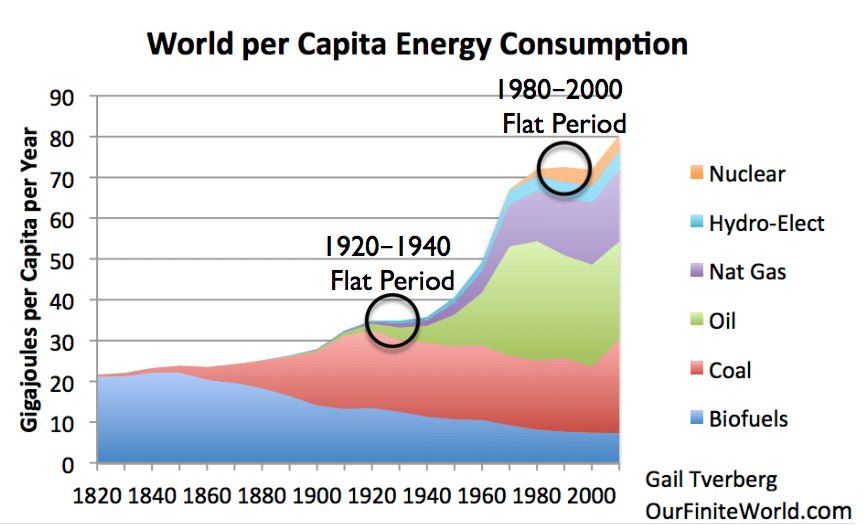
Figure 2. World per Capita Energy Consumption with two circles relating to flat consumption. World Energy Consumption by Source, based on Vaclav Smil estimates from Energy Transitions: History, Requirements and Prospects (Appendix) together with BP Statistical Data for 1965 and subsequent, divided by population estimates by Angus Maddison.
There is a good reason why energy consumed has risen over time on a per capita basis. Every human being needs energy products, as does every business. Energy is what allows food to be cooked and homes to be heated. Energy products allow businesses to manufacture and transport goods. Without energy products of all kinds, workers would be less productive in their jobs. Thus, it would be hard for the world economy to grow.
When energy consumption per capita is rising, it is easy for workers to become more productive because the economy is building more tools (broadly defined) for them to use, making their work easier. Manufacturing cell phones and computers requires energy. Even things like roads, pipelines, and electricity transmission lines are built using energy.
Once energy consumption growth flattens, as it did in the 1920-1940 period, the world economy is negatively affected. The Great Depression of the 1930s occurred during the 1920-1940 period. Problems, in fact, started even earlier. Coal production in the United Kingdom started to drop in 1914, the same year that World War I began. The Great Depression didn’t end until World War II, which was immediately after the 1920-1940 period.
In the 1920-1940 period, many people, especially farmers, were not able to earn an adequate living. This is a situation not too different from the one today, in which many young people are not able to earn an adequate living. Strange as it may seem, this type of wage disparity is a sign of inadequate energy per capita, because jobs that pay well require energy consumption.
The 1980-2000 flat period was in many ways not as bad as the earlier one, because the lack of growth in energy consumption was planned. The United States changed to smaller, more energy-efficient cars in order to reduce the amount of gasoline consumed. Oil-powered electricity generation was taken out of service and replaced with other types of generation, such as nuclear. Heating of homes and businesses was changed to more efficient systems that did not burn oil.
The indirect effect of the planned reduction in oil consumption was a drop in oil prices. Low oil prices adversely affected all oil exporters, but the Soviet Union was especially affected. Its central government collapsed, at least partly because of its reduced revenue stream. Member republics continued to operate, somewhat as in the past. Russia and Ukraine cut back greatly on their industrialization, leading to less use of energy products. Population tended to drop, as citizens found better work prospects elsewhere.
Eventually, in the early 2000s, oil prices rose again. Russia was able to become a major oil exporter again, but Ukraine and other industrialized areas were permanently handicapped by the collapse. Countries affiliated with the Soviet Union (including Eastern European countries, North Korea, and Cuba) found themselves permanently lagging behind the US and Western Europe.
Recently (2013-2017), the world economy seems to have again reached a period of flat energy consumption, on a per capita basis.

Figure 3. Based on data of BP Statistical Review of World Energy, 2017, and 2017 UN Population Estimates.
In fact, in many ways the flattening looks like that of the 1920 to 1940 period. Increased wage disparity is again becoming a problem. Oil gluts are again becoming a problem, because those at the bottom of the wage hierarchy cannot afford goods using oil, such as motorcycles. Young people are finding their standards of living falling relative to the living standards of their parents. They cannot afford to buy a home and have a family. Governments are becoming less interested in cooperating with other governments.
Why is world energy consumption per capita flat, or actually falling slightly, after 2013? The answer seems to be diminishing returns with respect to coal production. Diminishing returns refers to the fact that while at first coal is inexpensive to extract, the cost of extraction rises after the thickest seams and those closest to the surface have been extracted.
A chart of China’s energy production shows how China’s coal production first rose as low cost made its usage advantageous, and then fell due to diminishing returns. China experienced a major ramp-up in coal production after it was added to the World Trade Organization in 2001.

Figure 4. China’s energy production, based on data from BP Statistical Review of World Energy, 2017.
As the extraction of coal progressed, China found itself with many mines with rising production costs. Coal prices did not rise to match the higher cost of production, so a large number of unprofitable mines were closed, starting in about 2012.
A major reason for the flat world per capita energy consumption starting in 2013 is the fall in China’s coal production after 2013. Coal production is falling in quite a number of other countries as well, as the cost of production rises, and as users become aware of coal’s environmental issues. Other sources of energy have not been rising sufficiently to keep total per capita energy consumption rising. A person can see in the China chart that wind and solar production are not rising sufficiently to offset its loss of coal production. (Wind and solar are part of Other Renewables.) This situation occurs elsewhere, as well.
What role do wind and solar play in maintaining world energy supply? The truth is, very little. While a great deal of money has been spent building them, wind and solar together amounted to only about 1% of total world primary energy supply in 2015, according to the International Energy Association.
A major problem is that wind and solar do not scale well. As larger quantities are added to electricity networks, more workarounds for their intermittency (such as batteries and long distance transmission) are needed. Bid prices for wind and solar give a misleadingly low impression of their real cost, unless the projects include many hours’ worth of storage to offset the impact of intermittency.
The key to rising energy consumption seems to be the falling cost of energy services, when efficiency is included. For example, the cost of delivering a package of a given size a given distance must be falling, relative to inflation. Similarly, the cost of heating a home of a given size must be falling. Governments must be able to tax producers of energy products, rather than providing subsidies.
Globalization requires ever-expanding energy supplies to meet the needs of a rising world population. To maintain globalization, we need a growing supply of energy products that are very cheap and scalable. Unfortunately, wind and solar don’t seem to meet our needs. Fossil fuels are no longer cheap to extract, because we extracted the resources that were least expensive to extract first. Our problem today is that we have not been able to find substitutes that are sufficiently cheap, non-polluting, and scalable.
A Few Related Questions and Answers:
(1) What is the biggest impediment to raising total energy consumption?
We cannot get the price of oil and of other fuels to rise high enough, for long enough, to encourage the production of the fossil fuel supplies that seem to be in the ground. What happens, instead, is that energy prices hit an affordability limit and fall back.

Figure 5. NASDAQ three month price chart for Brent Crude oil. Source: NASDAQ
The recent strike in Brazil over high diesel prices shows the kind of issues that occur. Oil prices are still far below what many oil exporters (such as Norway, Venezuela, and Iraq) really need, when needed taxes are included.
Of course, the problem with not being able to get prices high enough also discourages the use of alternatives to fossil fuels, such as wind and solar.
(2) Aren’t wind and solar low-cost approaches?
It is easy to think that wind and solar will be huge improvements over burning fossil fuels directly for fuel, but nearly all of these analyses overlook the problems that are added by introducing intermittency to the electric grid. The assumption was made in early analyses that with enough scale, intermittency in one location would tend to offset intermittency in another location. Also, it was hoped that electricity consumption could be shifted to different times of day.
There have been several recent analyses that look more closely at these assumptions. Jean-Marc Jancovici has shown that if sufficient storage is added for wind and solar to make it “dispatchable,” it takes an order of magnitude more physical resources to produce wind and solar compared to what it takes to produce the dispatchable nuclear electricity used in France. Both have low long-term operating costs. Thus, we would expect the true cost of wind and solar to be far higher than France’s nuclear electricity.

Figure 6. Source: Favorable to all scenario from https://jancovici.com/en/energy-transition/renewables/100-renewable-electricity-at-no-extra-cost-a-piece-of-cake/
Roger Andrews, writing on Euan Mearns site Energy Matters, shows that some recent solar and wind auction prices appear to be far below actual costs, when reasonable minimum cost assumptions are used.
Regarding “Demand Response” as a solution to intermittency, Roger Andrews shows how little time of day pricing for consumers affects consumption curves. It appears that people don’t stop eating dinner after they get home in the evening, no matter how high the cost of electricity is at that time.
Interruptible supply is another way of reducing demand. This link describes some of the issues encountered when interruptible supply was tried on a large scale in California.
(3) Can’t we simply get along using less energy? That is what everyone tells us is possible.
The historical record in Figure 2 doesn’t give much indication that this is possible. Whenever there is even a small drop in energy consumption per capita, it seems to have an adverse effect. On Figure 3, even the small dip in energy consumption per capita in 2008 and 2009 led to a serious recession in many countries of the world.
The people who talk about getting along with less energy haven’t thought through the likely ramifications of this. There would be fewer jobs that pay well, because jobs such as those for construction workers would disappear. The economy would shrink, because of the fewer jobs, in a much worse recession than the Great Recession of 2008-2009.
We know that in past collapses, one of the big problems was inability of governments to collect enough taxes. We would likely encounter the same problem again, if there are fewer people making high wages. Most of the tax dollars for the US Federal Government are paid by private citizens (as income taxes or as Social Security funding), rather than by corporations.

Figure 7. Sources of US Federal Governments Revenue, based on US Bureau of Economic Analysis data.
The last year shown on Figure 7 is 2017, which is before the recent corporate tax reduction. This change will tend to shift the burden on Federal Taxes even further in the direction of payroll related taxes.
(4) How about efficiency savings? Can’t efficiency savings fix our problem?
There are two issues involved. If we were really efficient at fuel savings, as we were in the early 1980s, oil and other energy prices would drop dramatically. This would push oil, coal, and gas producers worldwide toward bankruptcy. Governments of oil exporting countries, such as Venezuela and Saudi Arabia, would have difficulty collecting enough tax revenue. They would likely collapse from lack of tax revenue, substantially reducing supply.
A second issue is that historically we have been adding efficiency. In fact, efficiency is what has tended to make fuel more affordable. As noted in the article, energy use could grow, as the cost of energy services fell.

Figure 8. Total Cost of Energy and Energy Services, by Roger Fouquet, from Divergences in Long Run Trends in the Prices of Energy and Energy Services. The cost of energy services combines (a) the cost of energy with (b) the impact of efficiency savings.
Some of the changes we have been making recently go in the opposite direction of efficiency. For example, the recent article, Biggest Ever Change in Oil Markets Could Send Prices Higher, discusses a new regulation requiring the use of low-sulfur fuel oil for ships. Doing this would greatly reduce the quantity of sulfur being released to the atmosphere as emissions. This is not a change toward efficiency; it is a change toward higher cost of production, which is the opposite of efficiency. Regulators plan to use part of our energy supply to eliminate the excess sulfur before the oil is sold.
As undesirable as sulfur pollution is, the problem is affordability and higher cost. Wages are not high enough for workers around the world to afford the required higher cost of food (because food production and transport use oil) to support the new regulation. So, the likely result of the regulation is to push the world toward recession. Beyond a certain affordability point, it is hard to push oil prices higher, because wages don’t rise at the same time.
(5) Could you explain further why flat energy consumption per capita is not sufficient for the world economy–this amount really has to grow?
Perhaps looking at charts of recent trends in energy consumption of a few countries can help explain what happens when overall per capita energy consumption is flat.
Joseph Tainter in The Collapse of Complex Societies explains that economies often use “complexity” to work around problems as they approach resource limits. In the particular version of complexity tried in this case, manufacturing was increasingly globalized. Workers suddenly found themselves competing for wages with workers from much lower wage countries. Wage disparity became more of a problem.
When workers are increasingly poor, they can afford to purchase fewer goods and services. This can be seen in energy consumption per capita data. Figure 9 shows energy consumption per capita for three European countries experiencing difficulties. In all three, energy consumption per capita has been falling for several years. When manufacturing was sent to Asia, workers found themselves earning less, so they were able to purchase fewer goods made with energy products. Also, European products were less competitive on the world market, with the new competition from low-cost markets.

Figure 9. Energy Consumption per Capita for three European Countries, based on BP Statistical Review of World Energy data and UN 2017 population estimates.
The countries that have been able to grow more rapidly in response to globalization (such as those in Figure 10) need to keep up their patterns of growth, or they start encountering financial problems because their prior growth was generally financed with debt. Without sufficiently rapid growth, they have difficulty repaying debt with interest.

Figure 10. Energy Consumption per Capita for five countries that recently have been growing rapidly. Based on BP Statistical Review of World Energy data and UN 2017 population estimates.
Brazil’s energy consumption per capita has recently fallen, and it is encountering severe problems. Argentina is a country with flattening energy consumption growth. China’s growth in energy consumption has slowed as well; we often read statements about its debt problems.
One of the problems that these rapidly growing countries encounter is currency fluctuations. As long as their particular country seems to be growing rapidly, the currency level of their country can remain high, relative to the US dollar or the Euro. But if obstacles are encountered, such as the low price of their major export, or slower economic growth, the currency of the country may fall relative to major currencies.
A falling currency relative to major currencies is a problem for these rapidly growing countries for three reasons. For one, imports become expensive. For another, any debt denominated in a foreign currency (such as the US dollar) becomes more difficult to repay. The reason why this is an issue is because rapidly growing countries often do not find enough credit available locally, so are forced to borrow internationally. A third problem with slowing growth and a falling currency relativity is that it becomes more difficult to attract new investment to the country. Instead, outside investors may decide to leave; they want to seek the next growth opportunity, in different, more rapidly growing country.
Turkey and Argentina both seem to be having problems with their currencies falling relative to the US dollar.
Another issue that makes flat worldwide per capita energy consumption unworkable is “diminishing returns” as resources become depleted. For example, wells for fresh water must be dug deeper, ores of metals include higher percentages of waste materials, and oil wells must be sunk in less convenient locations. These problems can be worked around, but they require increased energy consumption. All of these uses for energy products leave less for the rest of the economy. Thus, if we deduct the extra energy needed to compensate for diminishing returns, what at first looks like flat per capita energy consumption worldwide really equates to declining per capita energy consumption.
(6) Isn’t there anything that we can do to reduce carbon dioxide emissions?
The task of reducing carbon dioxide emissions is much more difficult than it appears to be, because the world economy requires energy consumption in order to operate.
The best thing I can see that an individual can do is reduce his or her consumption of meat and other animal products (fish, cheese, milk, leather). To offset, a major increase should be made in the consumption of vegetables that are filling to eat (such as potatoes, beets, carrots, beans, sweet potatoes, taro root, turnips, and corn). Some of these perhaps can be grown locally. Humans’ use of animal products adds to carbon dioxide levels, partly because of the quantity of food that needs to be grown and transported to feed the animals, and partly because of the direct emissions of some animals (including cattle, pigs, buffalo, chicken, sheep and goats).
In fact, cutting back on highly processed food of all sorts (particularly sugars, high fructose corn syrup, and oils) would seem to be worthwhile, as well. Growing, processing, and transporting the crops used in these highly processed foods all add to CO2 emissions.
Our problem is that we have grown attached to the flavors of these foods, and we have become convinced that they help us grow big and strong. While they may do this, they also set us up for problems in old age. Starchy vegetables have played a major role in the diets of long lived people. We may need to start giving them, and other less processed foods, a more prominent role again.


NAFTA is dead and Canada should move on
https://www.theglobeandmail.com/opinion/article-nafta-is-dead-and-canada-should-move-on/
Manufacturing jobs peaked in June of 1979, nearly 15 years before NAFTA. Also note that manufacturing jobs rose for the first eight years after NAFTA started. Trump is clueless about trade and barking up the wrong tree..
https://imgur.com/a/Kicjf04
or Canada could quietly do what’s best for themselves for the next 2.5 years and wait for the democrat POTUS in January 2021…
900 days is not a long time…
or do they think Trump will last 6.5 more years?
If the struggle between the US and China merely leads to a trade war, the world can consider itself lucky. Historically, when a rising power challenges the existing top dog it has more often than not led to bloodshed..
-Larry Elliot
PP link..
https://fr.slideshare.net/JoelleLeconte/jancovici-presentation-of-the-conference-can-we-save-energy-jobs-and-growth-at-the-same-time
https://i.redd.it/55q3n4cn0s111.png
A really good blog piece by Bruce Wilds that is worth a read, is titled: “Mankind’s Struggle Viewed Through The Peter Principle”
http://brucewilds.blogspot.com/2018/06/mankinds-struggle-viewed-through-peter.html
https://imgur.com/a/yrYqOND
they’re going to get a whole lot lower before we collapse.
The US also has an incredibly expensive medical system. Our bad food system and high level of wage disparity no doubt contribute to this outcome.
It looks like France, Britain and Germany may be starting to see downturns in life expectancy too.
Brexit: No-deal would lead to immediate food and medicine shortages, government ‘doomsday’ study claims
https://www.independent.co.uk/news/uk/politics/brexit-no-deal-food-medicine-shortage-doomsday-armageddon-david-davis-a8381076.html
Jordan on the brink of collapse
“‘Right to demonstrate’ –
Demonstrators tussled with security forces and some fainted, but others smoked water pipes and one sat on the pavement and played the Arabian lute or oud.
In another part of the city, security forces used tear gas to prevent hundreds of demonstrators from joining the rally near Mulki’s office, Jordanian news websites reported.
“Women have started looking in rubbish bins to find food for their children, and every day we’re hit by price hikes and new taxes,” said one protester.
Bank employee Mohammad Shalabiya, 28, said demonstrators wanted “to tell the government that the citizen’s income isn’t suitable for this kind of law and that we have a right to demonstrate”.
Lina Rsheidat, 35, a housewife with a red keffiyeh scarf around her neck, said the proposed law was “unjust” and would “harm the Jordanian people”.
According to official estimates, 18.5 percent of the population is unemployed, while 20 percent are on the brink of poverty.
The Economist Intelligence Unit earlier this year ranked Jordan’s capital as one of the most expensive in the Arab world.
– Struggling economy –
Jordan, a key US ally, has largely avoided the unrest witnessed by other countries in the region since the Arab Spring revolts broke out in 2011, although protests did flare late that year after the government cut fuel subsidies.
But the country has long played host to refugees from neighbouring Iraq, and according to government figures, over one million people have fled to Jordan from Syria’s devastating seven year war, exacerbating its struggling economy.
Amman has repeatedly urged international donors to provide extra funds to help it host them.”
This is from a couple of years ago. It says, Jordan is Sliding Toward Insolvency
The smart money = Equity traders
The dumb money = Corporate buybacks
https://pbs.twimg.com/media/DetBXXdU8AAdBSZ?format=jpg
But corporate buybacks make earnings per share look better. The swap debt at low interest rates for equity. Indirectly, insiders can have a larger percentage of shares, if new shares are issued to insiders.
It works just fine as long as interest rates are low, but when they rise the bubble bursts?
The “smart money” is now out as the yields and rates are rising?
There is an awfully lot of money in pension funds. They have a hard time getting out of the system. Perhaps they can buy derivatives, but that just transfers the risk to some big bank that will need to be bailed out.
Can someone explain why the term glllllobal wormmming was changed to kkklimmmate ccchhange
I have given you the knife — now slit your throat with that
Even if kkkklimate cccchange turns out to be a hoax (!!), that will still give us scant comfort in the face of resource depletion.
yup
as i’ve pointed out before
we have 3 dangers—energy depletion, climate change and overpopulation
deal with one, and one or both of the other two will come up behind you and bite you in the ass
We probably could add maintaining our financial system to the list as well. Fixing any of the three problems you listed tends to collapse the financial system.
the financial system remained more or less stable as long as it was tied to the value of ores—gold and silver
as population expanded, at least as i understand it, there wasn’t enough gold to redeem the ”promises” of it, so instead we came to think of paper as meaning the same thing—-ie–”promise to pay the bearer of this note” and so on–which our banknotes still state.
which seems meaningless anyway
I don’t see how you can separate any of the three (or four). Wouldn’t it be like dealing with the major organs of the body? If they were all defective and you fixed one, it wouldn’t hurt the others. Wouldn’t fixing one improve the prospects of the others? Wouldn’t that be the case with a networked system of systems?
If you fix one sub system as if it wasn’t networked, that wouldn’t be understanding the nature of that subsystem, which is that it is intricately networked with others. So if you tried to fix CC by eliminating coal, it WOULD wreck the economic system, and everything else. But if you tried to fix CC by stopping deforestation, doing reforestation, stopping construction, stopping road paving, etc, that would not necessarily wreck the economic system. Those measures would mitigate the polluting effects of coal. Instead, if your course is to build solar panels intended to run industrial civilization on them, then you increase the use of coal and the pollution from coal. Nothing is improved.
But then again, reforestation on its own is not enough, so the burning of coal (and oil and gas) will have to be stopped (or almost stopped) anyway. And reforestation would cut down on some livelihoods as well as taking away land from grazing and industrial agriculture (which is supposedly needed to feed a still growing population). So there it’s highly unlikely we’ll actually see enough reforestation to make a difference and it’s highly likely that we’ll continue to burn more FF than is good for us whilst continuing to extract finite resources. It can’t end well, whatever we do but there is one thing humans, and all other species need, a habitable environment. The sooner collapse comes, the less environmental damage we’d ultimately cause.
4000 spent fuel ponds burning out of control when BAU ends… is not environmental damage?
I reckon that could be enough radiation to extinct every living organism on the planet.
Hands up anyone who believes a change in the KKKK … man-caused or otherwise…. is going to be the trigger that extincts us.
using different names for the same thing doesn’t change the subject under discussion
and i missed the connection with throat slitting—must be one of my slow days
historically, cli-mate ch-ange has always been a show stopper for civilizations. it may have impacted the Romans (north african grain production) and certainly got the Maya and the Anazasi, the Greenland Norse, etc. Jared Diamond features these in his book Collapse. what overpopulation and resource depletion do is weaken a civilization’s resiliance to CC, a recent example being the lack of a complete recovery from storm damage in SE Texas, New Orleans, Puerto Rico. it’s the death of a thousand cuts, made worse from the effects of our own pollution.
This take is correct. It’s best understood, in my opinion, from Tainter’s complexity framework. With complexity already well into diminishing returns (or potentially into negative returns even), there is simply no ability to respond to a significant pressure like C.C. with adding complexity to the system.
” With complexity already well into diminishing returns (or potentially into negative returns even)…”
that’s a great point…
“diminishing returns” is something so familiar, that perhaps we have missed the boat that the eventual destination is indeed “negative returns”…
The storm damage in Texas has nothing to do with the KKK… there are always storms… well actually there were no storms for a number of years in this area … but that is another story…
It does have everything to do with having nearly 8B people on the planet… and we respond by building in areas that are prone to flooding…. because we are f7879ing stoooopid…. and we very much deserve to go extinct
“It does have everything to do with having nearly 8B people on the planet… and we respond by building in areas that are prone to flooding”
So true !
In Hawaii they built a geothermal power planet in close proximity to an active volcano. In Japan they built a nuclear power plant in an earthquake prone area next to a tidal wave prone area. People build houses in California at risk of earthquakes, wildfires and mudslides. People have to accept the consequences for dumb mistakes. Fukushima is a prime example of dumb vs dumber and we are all paying the price for that.
Geothermal plants work best when they are in close proximity to a geological hot spot. This means that there is an incentive to put them in areas prone to volcanic eruption.
Hawaii – the whole point was to be close to geothermal activity. An eruption had to be a possible. Maybe they’d costed for that?
I doubt it. I imagine they assumed normal life expectancy of the plant.
Check what IP CC means, and when it was established.
Looks like I have to spell it out…
It’s because the kkk is worming in some places … and getting colder in some places…
Just like it always has since the beginning of time…
And although humans are very stoooopid f789s …. they are not so stoooopid that you can tell them the klklklk is worming — when they see record cold winters in some regions…
So Don Draper went back to the drawing board and worked out a one phrase fits all…. kkkk cccchhh….gets hotter …kkkkccc… gets colder..kkkk cccc…
And the stewpid humans as usual … ask no questions…
But I have a question — how in the f789… after nearly two centuries of supposedly adding layers of insulation to the planet…. with most of the FFs burned that are ever going to be burned….
Is it possible to have RECORD COLD TEMPERATURES… anywhere on the planet?
This is like granny complaining it’s chilly and putting on one sweater…. then putting on a second… and a third… and a 5th and a 10th… till she’s one big ball of sweaters…. and complaining ‘god damn I’m colder than when I started out!!!’
I am surrounded by a sea of More ons….
Maybe the best way to think it is as a pendulum. As more energy builds up in the system the arc is getting larger so we hotter and colder extremes occurring. And the movement of energy from one to the other becomes more intense. When I was at uni back in the 90’s it was already being referred to as clim ate chan ge because simple heating was well too simple….
I think that pollution and disease will get us mostly. It may even be your spent fuel ponds FE.
Now if I was f789ing re tar de d…. I would read this f789ing r e t ard ed explanation … and say ya … that is logical… it makes perfect sense!
But alas I am not f789ing re tar d ed…
We have been told that burning ffs releases carbon creating a GREENHOUSE EFFECT… trapping heat….
The more ffs we burn the greater the greenhouse effect… the wormer the planet becomes….
Year after year .. wormer and wormer…
I am taking this sh it verbatim from the KKKKK scientists research…. I am not making it up
http://www.way2science.com/wp-content/uploads/2012/05/greenhouse-effect.jpg
Does this not cause you to pause and think …. hang on …. maybe I am a f789ing re tar d …. maybe Fast Eddy is — as he almost always is — RIGHT.
Like I have said — one must be willing to change ones mind in order to grow stronger… and wiser….
Here is your chance to be strong and wise.
All that is needed is a handful of key strokes:
I was wrong – GG WWWW is bu ll sh it…. I now see the light
The point is, if the greenhouse effect is too strong, Earth gets warmer and warmer. This is what is happening now. Too much carbon dioxide and other greenhouse gases in the air are making the greenhouse effect stronger.
https://KKKKKlimatekids.nasa.gov/greenhouse-effect/ (swap the KKK for a c
Hello???? Hello???? wormer and wormer…. every year getting wormer… but it isn’t getting wormer and wormer…. in some places it is getting colder… in others not much is happening… in some places yes it is getting wormer….
At what point do I become a fo.ol for arguing with fo.ols?
right about now?
Your second grade answers to CC and simple expectations of ponds killing us all should be enough for you to realise that if you need a fool to talk to just go to a mirror FE.
You say more trapped heat more warmth. That seems to be the case when averages are observed but that doesn’t mean that everywhere gets hotter at once. Energy flows from high to low state. The result can be higher highs and lower lows. Anyway it is your pet peeve not mine. You just seem to need something to bitch about because total collapse isn’t here yet and you may run out of money before it does.
Unfortunately most of what you post now FE is skipable – FaKKKKKKe and the ponds are coming, the ponds are coming. It would be great if it was at least humourous but alas.
I hate to say it .. (actually I don’t mind)… but you are profoundly stewpid.
What I have presented is easier to understand than 1+1=2….. yet you just don’t get it.
you don’t see the humor?
no it is just boring as I don’t really find much wit in it. Others like yourself use humour better.
What I have presented is easier to understand than 1+1=2…..
It famously took Bertrand Russell the best part of four hundred pages to show why 1+1=2. If he’d consulted with Fast Eddy first, he could have saved himself an awful lot of time and effort.
Like I said… this is easier
Many throw around the term climate change in various discussions. It is an entirely unscientific catch phrase now being used to justify and describe almost any event. Now we have CC as causing significant events in history when in reality, the said events were complex interactions of man, energy, war, economy and exploitation. Claiming CC as the cause of everything actually reduces the utility of the term itself. It has become an over used and hence almost an ambiguous term. Hence you can identify the weakest thinkers who ALWAYS throw in CC as being one of the BIG causes.
A single hurricane that occurs after a long period of few hurricanes is now claimed to be CC. We had a hurricane that wiped out Galveston Island once, killing 1900 people. It was not CC. It was a hurricane.
The hurricane that hit New York was supposed to be due to CC. In reality it was no more severe than hurricanes that had hit the same area decades before. However over population and development led to record damage…not CC.
I suspect it is natural for people to jump on the bandwagon and spout the latest popular claims. They feel they are being part of the advanced intellectual conversation. And notice how they gang up together to reinforce it. It is the old, “if you all say it enough and with adequate gravitas or authority” then you must be on the right side and win the argument.
And then there are all the data massaging scandals….the warmest year ever….turns out to be a minute fraction of a degree based on massaged data…very suspect and unmeaningful.
Our climate will always change, and we will ultimately end up in another ice age…a real one. Until then, the earth will ride through the ups and downs of our circuit through the solar system and galaxy.
Man’s industrial civilization may just be a blip in the earth’s history. Our demise will not be due to CC, whatever that means. We will have exhausted our resources.
There will be massive blowback to this of course, for those who have religiously grabbed hold of the catch phrase will not let it be disparaged.
What changes as an economy approaches limits is ability to work around changing climate. Resilience decreases.
Ecosystems in general are affected by changing climate. If they are otherwise being stressed (say by rising insect population, or falling population of a key predator) they too will be more affected by changing climate. Forest fires may become more common, for example.
But what are the major causes of forest fires?
Before human attempts to manage forests one might assume the lightning strikes were most likely, especially during extended dry spells. Lightning still has a role today.
Managed forest for commercial use tended to clear the tinder that helped fires take hold but that has been a discouraged activity for some years adding fuel back to the lightning strikes.
Human influence might add both accidental fire starting via discarded glass debris, for example (plastic bottles so much safer in that respect?) And deliberate fire starting – a seemingly frequent event in recent years.
The effects of climate change on forests over a human lifetime must be difficult to assess with any genuine confidence.
I haven’t studied this. I know that the practice of preventing forest fires has led to bigger fires, when they do happen.
There is something called “ecological succession.” https://sciencing.com/stages-ecological-succession-8324279.html Ecosystems naturally go through changes. Fluctuations of weather can affect these, as can human interference with natural processes (killing off all of the wolves in an area, or building a highway so that animals cannot get to their preferred food supply). Forest fires are to be expected, because lightening is always striking dry forests. No ecosystem lasts forever, just as no economy lasts forever. Forest fires are a major piece of how ecosystems change over time.
Those subscribers who live in Australia probably have the most experience of forest fires. Much of the year the gum trees are especially susceptible to fire which spreads fast.
It doesn’t stop people wanting to live in the forests though!
Lightning has been the usual cause for millennia. There are plants out there that rely on fire to come to them as part of their reproductive and regeneration cycle.
But the often reported causes of fires starting are human actions – in one case a few years ago the source was a military exercise that went wrong and resulted in a large widespread fire over some days.
Of course some people, often young, may take a risk or even deliberately start a fire during high risk periods, not fully appreciating the likely consequences.
One has to wonder about the efficacy of the education system. (World wide, not just Australia …)
Instead of shooting up a school…why not start a series of massive fires?
Imagine attending a dinner party and announcing that you have decided to stop participating in the Blue Box programme …. because — for the most part — it is an energy sink and therefore actually bad for the environment….
Then following up with a comment that plastic bags are awesome … and that it is the third world countries that are causing these plastic islands in the ocean – not us — because they cannot afford to dispose of plastic properly…. then suggesting that if people want to solve the problem… the wealthy first worlders should pay a tax that goes towards supplying the poor with reusable bags and weekly garbage pick up and disposal.
Imagine saying that you remember while in high school… thinking that Celine Dion was a bit of a dog….
Instant pariah.
https://pbs.twimg.com/media/DeqnPjyXcAER2ZC?format=jpg
French FinMin Bruno Le Maire has a message for the German govt on reform in the euro area: “It is now or never – jetzt oder nie” as French banks have biggest exposure to #Italy w/ $310bn, >3 times as much as German banks.
(link: https://www.bloomberg.com/news/articles/2018-06-02/le-maire-tells-germany-it-s-now-or-never-to-strengthen-eurozone)
bloomberg.com/news/articles/…
Well…who’s got exposure to France?
https://www.bloomberg.com/news/articles/2018-06-01/the-latest-private-jet-amenity-is-a-theme-party-for-your-children
The starvation and radiation cannot come too soon for these people
What would the innocent little children know? 🙁
And thinking of what all the innocent little children of the world are going to face when TSHTF, I want to ask: Why, O Heaven, why?
These children comes with silver spoons… which can be used to scrape the flesh from their bones when they come off the BBQ….
Annual homeless count reveals more people sleeping outside than ever before
https://www.seattletimes.com/seattle-news/homeless/new-homeless-count-in-king-county-shows-spike-in-number-of-people-sleeping-outside/
There is no excuse for this!
Nearly 1M jobs were created last month. Companies cannot find enough people to fill positions.
These people are lazy bas tards.
Probably can’t justify the carbon output from putting the aircon on.
EU and its many crises:
http://www.france24.com/en/20180602-eu-counts-its-crises-problems-mount
“Asked this week if Rome had become Europe’s Achilles Heel, Gianni Riotta from the Council on Foreign Relations joked: “How many heels can Europe sport? Greece, the United Kingdom, Poland, Hungary -? too many, I’d say.”
ah…
still retaining a good sense of humor…
when it gets serious, you have to tell some jokes.
Or else you’ll go crazy.
– Europe is in serious trouble? (Reporter)
– Yes! Haha hahaha hahaha! But hey…seriously…never underestimate Europe. (Putin)
Soros is now gloomy about Europe as well. I guess that’s it for Europe? Maybe…
How This Economic Recovery Ends
Every time there’s full employment, there’s a spike in oil prices. And guess what comes next.
The first and most extreme case was the 1973 OPEC oil embargo that began in October 1973. At that time the unemployment rate was 4.6 percent. Over the next five months the price of oil tripled in global markets, plunging the U.S. into an immediate recession that eventually coincided with the resignation of President Richard Nixon.
The second case was the First Gulf War. The unemployment rate touched as low at 5 percent in early 1989. Because of rising tensions in the Middle East, eventually leading into Iraq’s invasion of Kuwait and the American military response, the price of oil jumped from around $16 in June 1990 to $40 later that fall. Recession began in July.
The late 1990s boom in the U.S. may be remembered more for technology stocks, but it also coincided with an oil spike. After the emerging market crises of 1998, the price of oil dropped as low as $11 a barrel. Yet by March 2000, as technology stocks were peaking, it had soared to over $33 a barrel, its highest level since the Gulf War. And in the last economic cycle, even as the housing market was collapsing, the price of oil soared, rising from $52 a barrel in January 2007 to almost $150 a barrel by the summer of 2008.
https://www.bloomberg.com/view/articles/2017-06-14/how-the-u-s-economy-will-enter-its-next-recession
‘Every time there’s full employment, there’s a spike in oil prices.’
Lie.
https://www.zerohedge.com/news/2018-06-01/record-959-million-americans-are-no-longer-labor-force
https://www.zerohedge.com/sites/default/files/styles/inline_image_desktop/public/inline-images/LFP%20May%202018%202.jpg
new Italian government makes promises:
https://apnews.com/2c3771ee21c045c3ac87c1d6369f89fc/New-Italian-govt-vows-to-create-jobs,-deport-migrants
same old story, same old song and dance…
What stage of Capitalism is this?
https://i.imgur.com/LbpEa3G.jpg
yours for only $14.42:
https://www.amazon.com/Pilot-Automotive-PR-039SH-French-Holder/dp/B06ZYSDGY2/ref=sr_1_3?ie=UTF8&qid=1528002039&sr=8-3&keywords=pilot+french+fry+holder
considering that it’s probably 25 cents of plastic…
I dunno…
I suppose this is still 80-energy-slaves-per-person capitalism…
“we” can still afford to make this kind of nonsense…
and the cars that it goes into…
Still no room for ketchup. Damn.
Next stage will be either :
A. Integrated Ketchup delivery device
B. Collapse
I am watching the Stanley Cup finals..And one of the hockey players is named “Dmitry Orlov”..
https://en.wikipedia.org/wiki/Dmitry_Orlov_(ice_hockey)
https://imgur.com/a/CqjEwR6
Dmitry is a very common Russian first name. Orlov seems to be common as well. So it is possible that there are lots of Dmitry Orlov’s.
I’m primping, not prepping, for Armageddon
https://www.ft.com/content/a73d4f1a-5ea0-11e8-ab47-8fd33f423c09
No, you are wrong as usual. But, that’s what we loce about FE. Always wrong, and always typing. Back to the storage container!!!
“A prominent Iranian economist says that 33 percent of the population is living in absolute poverty, and 6 percent are starving.”
Murder rates are rising in Iran. Food stores are forced to close early since people are trying to take food by force. People are eating their cats.
And now the truckers are on strike in Iran…and the U.S is imposing sanctions on Iran…and Iran is involved in wars in the Middle East…
Iran is a troubled nation.
“A prominent Iranian economist says that 33 percent of the population is living in absolute poverty, and 6 percent are starving.”
Probably the same one who said for sure Iraq had “Weapons of Mass Destruction”
Low oil prices adversely affect all oil exporters, including Iran.
Many like to think of Iran as a country of rabid fundamentalist Muslims. Nothing could be further from the truth. Iran — or Persia, as she used to be called — originally wasn’t Muslim at all. Her national religion was Zoroastrianism. Islam was forced upon her in history by hostile aliens. The Qajar Dynasty (1794 – 1925) also saw yet further exploitation of Iranians by the said aliens. Chris Hedges also informs us that ‘Iran Had a Democracy Before We Took It Away’.
https://www.truthdig.com/articles/iran-had-a-democracy-before-we-took-it-away/
Hedges is quite correct
June 2nd, Baby Doomer’s birthday! (now how did i know that 😉 )
Yup! Going to an arts festival today!!
https://imgur.com/a/S77ATok
another completed year of BAU?
here’s wishing BD 10 more…
Thank You!
If the economy is so great, why are 78 million hustling for dimes?
https://www.marketwatch.com/story/if-the-economy-is-so-great-why-are-78-million-hustling-for-dimes-2018-06-01
Did I ignore a headline that a record number of jobs were created in America last month???
The economy must be booming!
http://m.likesuccess.com/quotes/20/994439.png
It must be getting very serious….
+++++++++
Pepe Escobar- Some good commentary + some fallacies.about US energy independence.
“Oil and Gas Geopolitics: No Shelter From the Storm
Asian Times May 31 2018
Russia and Saudi Arabia are in deep debate on whether to raise OPEC and non-OPEC oil production by 1 million barrels a day to offset the drastic plunge in Venezuela’s production plus possible shortfalls when new US sanctions on Iran kick in in November.
The problem is that even a production raise would not be enough, according to Credit Suisse; only 500,000 barrels a day would be added to the global market.
And then there’s the further issue of depleting OPEC supplies. There’s a consensus among traders that, “the depletion that has to be replaced is about 8% of total supply, which comes out to approximately 8 million barrels a day per year. Most of this has been made up by pre-2014 drilling but in the next four years will fall short very considerably as drilling has collapsed 50%.”
Once again, the heart of the matter concerns the petrodollar. After the Trump administration’s unilateral pull-out from the Iran nuclear deal, known as the Joint Comprehensive Plan of Action (JCPOA), European Union diplomats in Brussels, off the record, and still in shock, admit that they blundered by not “configuring the eurozone as distinct and separate to the dollar hegemony”. Now they may be made to pay the price of their impotence via their “outlawed” trade with Iran.
In Brussels, there’s increased recognition that US pressure on Iran, Russia and China is out of geopolitical fear the entire Eurasian land mass, organized as a super-trading bloc via the Belt and Road Initiative (BRI), the Eurasia Economic Union (EAEU), the Shanghai Cooperation Organization (SCO), the Asia Infrastructure Investment Bank (AIIB), is slipping away from Washington’s influence.
This analysis gets closer to how the three key nodes of 21st century Eurasia integration – Russia, China and Iran – have identified the key issue; both the euro and the yuan must bypass the petrodollar, the ideal means, as the Chinese stress, to “end the oscillation between strong and weak dollar cycles, which has been so profitable for US financial institutions, but lethal to emerging markets.”
And that’s why the Shanghai oil futures experiment is such a game-changer, already deepening China’s sovereign bond market. Persian Gulf traders show a keen interest in how Asian traders are profiting from the fact the petro-yuan may be redeemed for gold. Iranian oil being sold in Shanghai will further expand the process.
It’s also no secret among Persian Gulf traders that in the – hopefully unlikely – event of a US-Saudi-Israeli war in Southwest Asia against Iran, a real scenario war-gamed by the Pentagon would be “the destruction of oil wells in the GCC [Gulf Cooperation Council]. The Strait of Hormuz does not have to be blocked as destroying the oil wells would be far more effective.”
And what the potential loss of over 20% of the world’s oil supply would mean is terrifying; the implosion, with unforeseen consequences, of the quadrillion derivatives pyramid, and consequentially of the entire Western financial casino superstructure.
Call it a nuclear financial weapon of mass destruction chain reaction. Compared to that, the 2008 financial crisis would be little more than a walk in an ecologically friendly park.
http://www.atimes.com/article/oil-and-gas-geopolitics-no-shelter-from-the-storm/
Here-
> “In Brussels, there’s increased recognition that US pressure on Iran, Russia and China is out of geopolitical fear the entire Eurasian land mass, organized as a super-trading bloc via the Belt and Road Initiative (BRI), the Eurasia Economic Union (EAEU), the Shanghai Cooperation Organization (SCO), the Asia Infrastructure Investment Bank (AIIB), is slipping away from Washington’s influence.”<
When the day comes that they no longer have the ability to even discuss the possibility of “raising oil production” we will know we are close to the end of the oil age.
Or the governments of several oil exporting countries have collapsed. Also the governments of several oil importing countries, and the electric grid is down in those countries.
“Bank of Mum & Dad,” Huge Prop under UK Housing Bubble, is Running Out of Liquidity
by Don Quijones • May 31, 2018 • 31 Comments
“Mum & dad are lending money to their kids so their kids can afford to pay the prices demanded by mum & dad & their friends. It’s like a giant Ponzi scheme but where the victims are your children.”
By Don Quijones, Spain, UK, & Mexico, editor at WOLF STREET.
As the economic growth in the UK stutters — for the first quarter, the UK posted the worst GDP figures in five years on weak business investment and household spending — the country’s all-important housing market is beginning to show signs of strain. In April house sales were down 9.4% on the previous year. In the UK’s most valuable market, London, house prices had their worst month since 2009, slipping 0.7%, according to the latest figures from the Office for National Statistics (ONS).
As credit demand slips, some banks have decided to bring back a financial relic that should never have seen the light of day in the first place: the 100% mortgage. Both Barclays Bank and the recently privatized Post Office have recently unveiled 100% mortgage deals.
A high-risk loan instrument that helped fuel madcap property booms in countries like Spain and the UK, the 100% mortgage allows property buyers to borrow the entire amount of the purchase price. During the heady days of the UK’s pre-2008 property boom, some banks even offered loans that were 20% more than the property value. They included Northern Rock, one of the first lenders to collapse in the Global Financial Crisis.
https://wolfstreet.com/2018/05/31/bank-of-mum-dad-huge-prop-under-uk-housing-bubble-is-running-out-of-liquidity/
Much of Tweddle’s work these days is helping plug and cap wells. You might imagine that beneath each platform is a single well, but wells might be as far as five or six miles away from the platform, and they often come in clusters—imagine using 10 straws to drink a milkshake instead of just one. But now the North Sea oil run is winding down, as the price of oil stagnates and the cost of extraction from increasingly empty fields grows. New exploration has gravitated to areas too deep for even saturation divers. Soon, the jobs will be harder to come by.
https://www.atlasobscura.com/articles/what-is-a-saturation-diver
Brazil, Scared and Leaderless, Looks to the Military
The once unthinkable is now becoming normal, writes AQ’s editor-in-chief.
SÃO PAULO – I arrived here on Sunday in the middle of the zombie apocalypse. Or so it seemed. A nationwide truckers’ strike was in its seventh day and 99 percent of São Paulo’s service stations had run out of gasoline. The roads of South America’s biggest city were deserted of cars and people, and the skies were a murky gray. The normally hellish drive from the airport, which often lasts two hours or more, took a disconcerting 23 minutes.
Up on Avenida Paulista, the city’s closest thing to a public square, things seemed more normal – at first. Huge crowds milled about, vendors were grilling beef and sausage, and girls in hot pink roller skates clomped by. A quadruple amputee was belting out the falsetto ending of Pearl Jam’s “Black” to an enthralled crowd. The sun was out now, and families sat at wooden tables with sweaty buckets of beer, laughing. Of course, I mused, Brazilians are going to make a party out of a bad situation. I bought a can of Skol and decided to join the fun.
Then I saw it. A huge banner, spanning the entire avenue, carried by a group of protesters:
“SUPPORT FOR THE TRUCK DRIVERS. MILITARY INTERVENTION! ARMED FORCES, URGENT!”
And that was the start of a week where I saw and heard things I never believed I would in Brazil.
The Brazil of mid-2018 is a frightened, leaderless, shockingly pessimistic country. It is a country where four years of scandal, violence and economic destruction have obliterated faith in not just President Michel Temer, not just the political class, but in democracy itself. It is a country where there will be elections in October, but most voters profess little faith in any of the candidates. Given that vacuum, many Brazilians – perhaps 40 percent of them, according to a new private poll circulating among worried politicians – believe the military should somehow act to restore order. Amid this week’s strike, the clamor became so loud that both Temer and a senior military official had to publicly deny the possibility of an imminent coup.
https://www.zerohedge.com/news/2018-06-01/i-arrived-brazil-middle-zombie-apocalypse
Now I get it… when people say ‘they’ will not allow the unthinkable to happen…
They means the military … a dictator…
It all makes sense now… the military will fix the end of oil problem… because ‘they’ are all powerful. God-like.
Expect the situation in Brazil — to arrive on your doorstep soon
When I read this Brazil story … I am reminded of Century of Self… and comments about how the masses needed to be controlled… the gods of MORE needed to always be appeased (with MORE)….
This is a perfect example… when the gods are not appeased… the crowds lose faith in the system…
And when faith and hope are lost… the crowds turn volatile… and unstoppable…. and extremely violent…
Civilization is no more than a thin petroleum-based veneer….
No mention of the oil story in that piece…. it’s the politicians fault… elect the right ones and this will get fixed
Uh… this time is different
“Every 20 or 30 years in Brazil, there’s an attempt to reinvent things … to destroy what is there and build a new order,” he said.
He’s right. And for that, Brazilian politicians can largely blame themselves.
Why poverty is rising faster in suburbs than in cities
https://www.houstonchronicle.com/news/article/Why-poverty-is-rising-faster-in-suburbs-than-in-12956554.php
Pingback: Pressenza - Our Energy Problem Is a Quantity Problem
The collapse will happen on April 22. I’m not sure which year, but April 22 is definitely the date.
and April 22 2019 is a Monday!
because it’s Hit_ler’s birthday?
Close. Someone else’s birthday.
The US economy is unstoppable!
https://www.cnbc.com/2018/06/01/the-us-economy-suddenly-looks-like-its-unstoppable.html
okay, it does say it “looks like it’s unstoppable”…
appearances can be deceiving…
The devil is in the details.
How Orwellian..2+2=5 Winston..
The Great Depression 1929-1940 US Economic Growth GDP (1%)
https://en.wikipedia.org/wiki/Great_Depression
The Great Recession 2006-2017 US Economic Growth GDP (1.5%)
https://data.worldbank.org/indicator/NY.GDP.MKTP.KD.ZG?locati
Growth in world energy consumption per capita is close to zero both times.
June 1st, and the economic news is fantastic!
http://www.breitbart.com/big-government/2018/06/01/atlanta-fed-boosts-second-quarter-gdp-forecast-to-4-8/
4.8% GDP growth!
New York Fed GDP Nowcast is only at 3.2
https://www.newyorkfed.org/research/policy/nowcast
That Atlanta Fed GDP forecast is strange..It started out first quarter at 5.4 and ended up at 2.3..
3.2 as the new low range estimate sounds good to me…
Civilization will be killed off in one of these three ways, scientists say
https://nypost.com/2018/06/01/civilization-will-end-in-one-of-three-incredibly-bad-ways/
once again i was wrong about june the 1st but at the least i have learnt a valuable lesson trust no one including your self some times that is why i return to the only truth presently left for me Gail’s teachings.
Kind of like predicting the Second Coming. Plenty of folks wrong on that one too.
You should read the book “When prophecy fails”…
Propecy does not exist.
Correction- PROPHECY does not exist.
It’s a holdover from the days before science- when religion was believeable.
Maybe at some point we will be saying the reverse: religion ultimately proved to be believable. Too much of science was wishful thinking and wrong models.
the bible waswritten—in places—by remarkable ”seers”
some people have that gift, that’s been established for millenia….but it doesn’t make it the word of god, maybe some other capacity that human kind has that we may never understand.
Prove it.
first off—i am an atheist—but i recognise that ”foretelling” has always been a part of history, if it has no ”god” involvement, then it can only be the result of some sense that humankind is largely unaware of–the logical reaction is to involve some god or other which adds to religious beliefs
eg 1—”armageddon” is foretold, as the ”final battle”:
////////Some 60 air miles north of Jerusalem lies the ancient city of Megiddo (now called Tell el-Mutesellim). In its north-central Palestinian location, Megiddo overlooks the great Plain of Esdraelon, an area of some 20 by 14 miles in which many great battles took place anciently. Megiddo is the older Hebrew form of Armageddon or Har-Magedon meaning the Mount or Hill of Megiddo, or the Hill of Battles; it is ‘the valley of Megiddon ’ mentioned in Zechariah. (Zech. 12:11.)////////
The final battle before the end of ww1 in palestine, which freed the ”holy land” from the ottoman empire took place at Megiddo.
eg 2….the bible prophecies that israel shall be built in a day
///////Isaiah 66:8
Who has heard such a thing? Who has seen such things? Shall a land be born in one day? Shall a nation be brought forth in one moment? For as soon as Zion was in labor she brought forth her children.
https://history.state.gov/milestones/1945-1952/creation-israel
14 May 1948 Israel was declared a nation/////
these are just a couple, i’m no bible scholar—there are others
I am a seer … I see radiation extincting us. Soon
I’m getting some of those dry casks for infinite winter heating at zero cost. I love nuclear. Proud graduate of the Applied Physics and Nuclear Engineering department of Columbia University. The future’s so bright I have to wear shades.
Ed, i hope you and the missus don’t mind a bit of gamma radiation to go along with that waste heat.
In some religions, such as Buddhism, there’s very little prophecy. If you study (the original unadulterated) Buddhism carefully, the Buddha’s teaching just comes down to saying: I have found a way that leads to genuine and lasting happiness for me. This is the way. Try it and see for yourself. Well, some have said that Buddhism should be considered a philosophy, not a religion.
True, the Buddha spoke of an ‘Unborn, Unmade, Unbecome’ — and that’s about it. No vengeful God who picks His favorites among nations or rains fire upon them etc.
A lot of people seem to make a great many more demands of religion than I do. I don’t claim that “prophesies” are correct, or that the Judeo-Christian religions have a corner on what is true. I certainly don’t think that the Bible is literally true.
The self-organized way the world and everything that is in it operates is to me miraculous. Religions around the world recognize the miraculous. They also provide kernels of truths that we can learn, if we study them. They often show how we should treat our neighbor, especially if resources are not scarce. They act as a balance against some of the other forces within our world system. It even makes sense that people of different religions fight. Territoriality of animals is important in keeping down population growth.
but every major god-cult has gone to war to ‘prove’ its own righteousness, and grab the resources of the other god cult at the same time
Resources per capita that are not rising rapidly enough has been a problem, over and over again, throughout history.
Religion is as good as an excuse as any for a war against other peoples. Political leaders need some excuse for resource wars. Religions are a necessary part of our self-organized system. In recent years, we seem to have added faith in science and scientific modeling as the new religion. I am wondering if next time, the attacks will be against countries that do not follow this religion adequately. Perhaps those countries who do not subscribe to the Paris Accord adequately will be the countries attacked. (Upholding democracy seemed to be an excuse for wars for a while. Belief in democracy as the perfect system takes on aspects of a religion as well.)
Politics and religion go hand in hand; politics and science to support political agendas also go hand in hand. All it takes is hand-outs of research grants to those who will create models that support the story that political leaders want to sell. Wind turbines and solar panels will save us! There are no problems ahead, if you will re-elect us. Alleluia!
hi adonis…
I hope you are well…
I also hope that no one remembers my New Year’s Day predictions…
I think I was about half wrong…
oh well… there’s always 1/1/2019…
You need to keep throwing predictions out there… just like these finance people do … eventually you will be right…. eventually you will be right….
Just live your life each day and don’t think too much of the future. Time passes no matter what happens.
true, but this blog is dedicated to worrying about the future, the real one, not the fantasy stories.
Yes, worry at first, in the end accept that we have no control of the final outcome.
Rather than worry I would say understand.
That about sums it up for me. (Though I’m still trying to get a little more income — I’m not so loaded I can travel around the whole planet like FE…)
Trump is using socialism ie bail out..To save the coal industry now. He is turning us into a planned economy..
https://www.godlikeproductions.com/sm/c3549d16.gif
but the coal industry MUST be saved…
The ability for the world’s economy to continue depends on total energy consumption. Without coal, we are literally dead. The coal industry needs to be saved, whether or not there are adverse climate impacts.
And hitting closer to home… wood burns too quickly … so no coal would mean having to wake up in the middle of the night to pile more logs into the Rayburn…. so coal MUST be saved…
Did I mention that something is wrong with the system… the Rayburn gets roaring hot but we are getting minimal heat circulation through the radiator system… and trying to get a technician out to sort this out is harder than trying to get Putin on the phone… they are all busy beyond belief… two have come – rushed through… were unable to get it fixed… and moved on…
Times like this one wishes we could get a some more of the medieval warming happening….
Just another nail in the coffin of doomie prepping… what can go wrong .. will go wrong… and there will be no technician nor Wally’s World to help
It is interesting that one never heard the cry of socialism when the government is funding new solar startups and providing monetary assistance to consumers to purchase them.
Global civilization will collapse within the next ten years according to (Meadows 1972) (Motesharrei, 2014) (Turchin, 2010) (Ehrlich, 2013) (Turner, 2014) (Korowicz, 2012)
https://www.scientificamerican.com/article/apocalypse-soon-has-civilization-passed-the-environmental-point-of-no-return/
https://www.nature.com/articles/463608a
http://www.sciencedirect.com/science/article/pii/S0921800914000615
https://www.ncbi.nlm.nih.gov/pmc/articles/PMC3574335/
https://www.scribd.com/document/379418787/Is-Global-Collapse-Imminent-An-Updated-Comparison-of-The-Limits-to-Growth-with-Historical-Data-Turner-2014
http://www.feasta.org/wp-content/uploads/2012/06/Trade-Off1.pdf
visa crashes across europe—interesting foretaste of what’s to come i think
I was a cross country trucker back years ago. I don’t think that I would have left home if there was some question of how I would buy fuel to get back. All my fuel purchases were through the networked system. We don’t need the grid to go down to bring the zombie apocalypse. Just wreck the pay system where the truckers can’t get fuel and the trucks stop running and we’ll be there.
A gentleman came to my farm back about 2011 of so when gas was $3.50/gal. He was buying some berry plants and we got his order all loaded up and the high gas price came into the conversation. He was a computer programmer for a super market chain. He said, “We”ve got three days inventory in our stores. If those trucks stop running there won’t be a dog or cat anywhere inside of a week.”
What are we going to eat the second week?
that was the situation in uk in 2001, a fuel tankers strike
the govt waswarned there were 3 days supply of essential goods in stores
http://www.breitbart.com/national-security/2018/02/26/venezuelan-prisoners-eating-rats-pigeons-survive/
One inmate, 41-year-old Alejandro Manuel Mago Coraspe, was transferred to a nearby hospital last week after falling ill from eating dead rats he found in a prison garbage disposal.
“We cooked them, but they were still raw. We ate them anyway. I think they were poisonous and that’s why I fell ill. I normally kill them myself,” he told the NGO Window to Liberty.
Note to self — make sure to cook the rats thoroughly….
I would only ever eat organic grassfed.
Fair-trade…
Each other? Tender babies and young children?
Cashless society doesn’t seem like such a good idea now.
Poo-tin!
Financial sharks are beginning to smell blood in the markets.
Yup we have around 3.9 Trillion in dodgy HY(high yeild) and corporate debt at risk. Also lots of zombie companies who are surviving on masses of low interest debt but who will be rightly barbecued as rates rise.
And we are looking at a needle to pop this balloon in the form of rising interest rates, scheduled reductions in the CB holdings, and a financial system lacking the necessary liquidity to absorb a selling avalanche of low grade paper being dumped on the market…..
“The Spark That Lights The Fire”: Oaktree Spots A $1T Opportunity In The Coming Bond Crash”
ZH May 31, 2018
“Citing a recent IMF Global Financial Report, Clark said that “US investment grade debt is very low quality, and could produce some large fallen angels [and] mutual funds are much larger in the high yield market than they used to be. [L]ow rates means the capital losses are much higher than they used to be. And that investors in high yield mutual funds are much flightier than they used to be! Essentially the IMF are telling me that if you get a large enough fallen angel, the high yield market will freak out, and volatility will spike causing volatility targeting investors to dump leveraged positions. Sounds good to me.”
Picking up on last week’s warnings by Moody’s, in which the rating agency warned of a junk bond default avalanche as rates rise, Wintrob said that the supply of low-quality debt is significantly higher than prior periods, while the lack of covenant protections makes investing in shaky creditors riskier than ever.
“The amount of “dry powder” held by fund managers to invest in low-quality debt has grown to around $150 billion, Wintrob estimated. Quoted by Bloomberg, he said this number has shown steady growth as the duration of bonds has increased, which could make the coming price drops even more significant than during the turn of the last credit cycle in 2008.
Which of course would be great news for America’s bankruptcy advisors: as a reminder, last weekend we quoted Moelis’ co-head of restructuring Bill Derrough who said that “I do think we’re all feeling like where we were back in 2007,” adding that “there was sort of a smell in the air; there were some crazy deals getting done. You just knew it was a matter of time.”
All that is needed is the spark.
https://www.zerohedge.com/news/2018-06-01/spark-lights-fire-oaktree-spots-1-trillion-opportunity-coming-bond-crash
Revised OPEC Production Quotas Won’t Derail Higher Oil Prices
Oil prices to continue upward trend based on supply constraints and disruptions against robust global demand despite OPEC plans to loosen production quotas.
IEA officials warn that oil market’s shrinking spare capacity is vulnerable to shocks and destabilizing price spikes.
US shale oil is unable to fill global supply shortfall until late 2019 at earliest because of infrastructure constraints.
Wild cards Libya and Nigeria oil production is hobbled byinternal strife.
Venezuelan oil production is in free-fall and could possiblygo “off-line” by the end of 2018.
https://seekingalpha.com/article/4178781-revised-opec-production-quotas-derail-higher-oil-prices
Why some countries come together, while others fall apart
https://aeon.co/essays/why-some-countries-come-together-while-others-fall-apart?utm_source=Aeon+Newsletter&utm_campaign=7bfea5d269-EMAIL_CAMPAIGN_2018_05_28_04_06&utm_medium=email&utm_term=0_411a82e59d-7bfea5d269-70359561
https://imgur.com/a/C2lB7RX
CDC Study Reveals Teen Death Toll Rises To Shocking Levels, Reasons Concern Experts
https://www.inquisitr.com/4922922/cdc-study-reveals-teen-death-toll-rises-to-shocking-levels-reasons-concern-experts/
Saudi threatens military action against Qatar over S-400: report
https://www.aljazeera.com/news/2018/06/saudi-threatens-military-action-qatar-400-report-180601165304449.html
Are we facing an oil shock? These signs say yes
https://economictimes.indiatimes.com/news/economy/indicators/are-we-facing-an-oil-shock-these-signs-say-yes/articleshow/64410090.cms
June 1. Adonis, Adonis! Where is Adonis? Ohhhh. He meant June 1,2020. Now I get it.
Wait untill after NYSE close. 24 minutes left.
To be fair, he did post that he was wrong about that a few weeks ago.
Fox News proposes blasting down school walls with cannons in event of school shootings..
https://imgur.com/a/6WWGsZt
Is this a joke, I hope?
No its not.. It’s as sad as it’s funny…
School shootings: This cannon fires unbelievable ammo to blast through walls and help rescue victims
http://www.foxnews.com/tech/2018/05/31/school-shootings-this-cannon-fires-unbelievable-ammo-to-blast-through-walls-and-help-rescue-victims.html
Nope—
Just Republicans.
9/10 for entertainment value
I’d but that for a dollar
-6 tonight. Must burn more coal… must turn winter into summer
Has any body noticed that Brazil, Argentina, Italy, Turkey spell out BAIT. What are the powers that be trying to catch?
Economic nationalism leads to war. This is exactly what happened in the 1930s
http://www.dw.com/en/as-us-tariffs-go-into-effect-europe-vows-retaliation/a-44028802
https://imgur.com/a/8M1cUR0
When total energy consumption per capita worldwide is flat, it leads to war.
Diminishing returns with respect to resources tends to take a chunk out of the middle. Complexity tends to redistribute resources in a more unequal way. Too many find themselves without enough.
It is hard not confusing correlation with causation.
Especially when you do it on purpose!
https://imgur.com/a/4OAsIjZ
why?
Who’s on first?
who is this Voltaire guy?
if a tree falls in a forest and no human is around…
does it make a sound?
does anyone care?
Any actions by any nation to secure resources, regardless of nationalism or. It, leads to war.
Two good articles linked at Naked Capitalism today illustrating the slow and painful collapse of the periphery back to the core. Natural disasters reveal how the burden of pre-existing debt, rising energy cost of obtaining energy and increasing cost of obtaining other natural resources leads to a woefully inadequate response and inability to rebuild to the level of prior conditions. This collapse to a lower level not only takes its own toll, but assures even greater successive losses in the next disaster.
Puerto Rico Grid Teetering: https://apnews.com/fa210cd1434c4d909e6030c7da884bce?utm_medium=AP&utm_source=Twitter&utm_campaign=SocialFlow&via=newsletter&source=CSPMedition
Low-income hurricane victims in Houston can’t get federal aid, can’t rebuild: https://www.politico.com/story/2018/05/29/houston-hurricane-harvey-fema-597912
“March-dated lumber futures at the Chicago Mercantile Exchange hit a record of $532.60 per 1,000 board feet last week after climbing more than 50% in 14 months.”: https://www.wsj.com/articles/with-lumber-in-short-supply-record-wood-costs-are-set-to-juice-home-prices-1519916401
Interesting!
I think the trade dispute with Canada related to how wood was taxes in Canada relative to the US; the difference made Canadian wood cheaper than US wood. Energy resources in general have been heavily taxed, historically. This is a point many people miss.
https://twitter.com/elerianm/status/996844139210653696
One of the big problems for emerging markets is keeping their currencies high enough, relative to the countries that they have borrowed money from. If their currencies drop too low, they cannot repay their debt.
Their biggest problem however, is ‘currencies’.
They shouldn’t have borrowed money.
“They” is a concept. Most ruling elites have borrowed — and left the proletarians to cover the debts.
Paul Krugman Joins Chorus of Doomsayers on Emerging-Market ‘Crisis’
https://www.bloomberg.com/news/articles/2018-05-23/krugman-joins-chorus-of-doomsayers-on-emerging-market-crisis