
Where is the world economy heading? In my opinion, a large portion of the story that we usually hear about how the world economy operates and the role energy plays is not really correct. In this post (to be continued in Part 2 in the near future), I explain how some of the major elements of the world economy seem to function. I also point out some relationships that tend to make the world’s economic condition more fragile.
Trying to explain the situation a bit further, the economy is a networked system. It doesn’t behave the way nearly everyone expects it to behave. Many people believe that any energy problem will be signaled by high prices. A look at history shows that this is not really the case: fighting and conflict are also likely outcomes. In fact, rising tariffs are a sign of energy problems.
The underlying energy problem represents a conflict between supply and demand, but not in the way most people expect. The world needs rising demand to support the rising cost of energy products, but this rising demand is, in fact, very difficult to produce. The way that this rising demand is normally produced is by adding increasing amounts of debt, at ever-lower interest rates. At some point, the debt bubble created to provide the necessary demand becomes overstretched. Now, we seem to be reaching a situation where the debt bubble may pop, at least in some parts of the world. This is a very concerning situation.
Context. The presentation discussed in this post was given to the Casualty Actuaries of the Southeast. (I am a casualty actuary myself, living in the Southeast.) The attendees tended to be quite young, and they tended not to be very aware of energy issues. I was trying to “bring them up to speed.” This is a link to the presentation: The World’s Fragile Economic Condition.

Slide 1
–
Slide 2
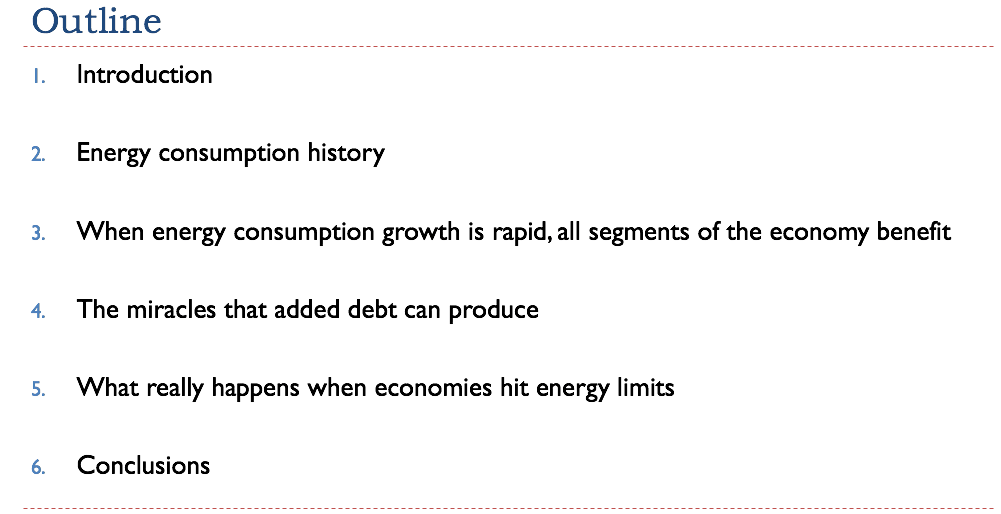
This post covers only Items 1, 2, and 3 from the Outline in Slide 2. I will save Items 3 through 6 for a post called “The World’s Fragile Economic Condition-Part 2.”

Slide 3
Slide 4
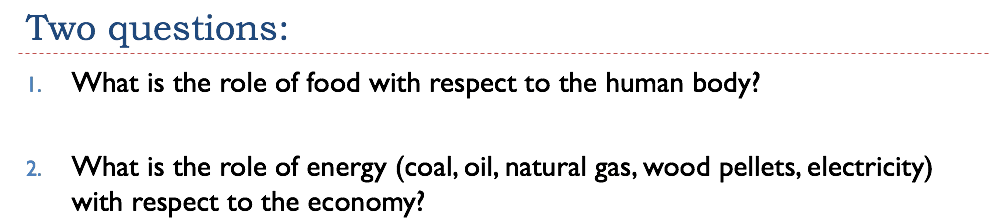
The audience was able to guess that the situation for humans and the economy are parallel. Energy in some sense powers the economy, in a way similar to how food powers humans.

Slide 5
On Slide 5, I am pointing out that changes in the red line, denoting energy consumption growth, tend to come before the corresponding changes in the blue line. This is one way of confirming that energy consumption causes GDP growth, rather than vice versa.
In recent years, countries have found ways of creating GDP growth, without adding true value. This may explain why GDP growth is higher than Energy growth since 2013 on Slide 5. As an example of GDP growth with overstated value, a large share of young people are now being encouraged to purchase advanced education, at considerable cost. This would make sense, if there were suitable high-paying jobs for all of those graduating. It is questionable whether this is the case.

Slide 6
Of course, the issue is not only energy consumption, just as our health is influenced by more than simply what food we eat.

Slide 7
At one time, the emphasis in physics was on systems that are “closed” from an energy point of view. Such systems never grow; they simply decline toward “heat death.”
The real world is made up of many structures that grow and change over time. This growth and ability to change is possible because the energy system we live in is thermodynamically “open,” thanks to flows of energy from the sun, and thanks to fossil fuel energy, which represents stored solar energy from long ago.

Slide 8
The answers to the questions on Slide 8 are easy to guess.

Slide 9
The economy adds new businesses, as citizens see new needs and set up companies to meet those needs. Customers make choices regarding which goods and services to buy, based on their income (primarily wages) and the prices of available goods and services. Governments gradually add new laws, including changes to the way taxes are assessed. The system gradually grows and changes, as the population grows, and as the quantity of goods and services created to meet the needs of that population increases.
One thing to note is that the goods and services produced by the system will eventually be divided among the various players in the system. If one group gets more (say, those receiving interest income), then other groups will necessarily receive less.
Another important point to note is that as new products are added, old ones disappear. For example, once cars came into use, we lost the ability to go back to horses and buggies. There are no longer enough horses; there are no longer facilities to “park” the horses in downtown areas, while at work or shopping; and there are no longer services to clean up after the mess that the horses make.
Without being able to go backward, the system is quite brittle. It would appear that under sufficiently adverse conditions, the entire system could collapse. In fact, we know that many ancient civilizations did collapse, when conditions weren’t right.

Slide 10
The strange interconnections of a networked system make the world economy behave in a different way than we might initially expect. Later in this presentation (in Part 2 of the write-up), I will show some examples of inadequate energy supplies leading to very different results than high prices.

Slide 11
The model of The Limits to Growth looked at how long resources might last, before the growth of the world economy came to a halt from a variety of problems, including a lack of easy-to-extract resources. In some ways, the model was quite simple. For example, the model did not include a financial system or debt. In the single most likely scenario, the base run, the world economy hit limits about now, in the 2015 to 2025 time period. The authors have said that, once limits are hit, the forecast on the right-hand side of the chart cannot be relied upon; the model is too simple to forecast how the down slope might actually occur.

Slide 12
–

Slide 13
The pattern of world energy consumption seems to be one of rapid growth, especially in the period since World War II.

Slide 14
Energy consumption growth is particularly high in the period covered by the red box. In other words, energy consumption growth is particularly high from the 1940s through the 1970s. If the economy relies on energy, we would expect this to be a particularly booming period for the economy.

Slide 15
We can break energy consumption growth down into two components: (1) the portion to cover higher population, and (2) the portion to cover improved standards of living. Looking at this chart, it is clear that “higher population” takes the majority of the increase, except when increases are very large.

Slide 16
I have labelled the three big bumps with my view of what seems to have led to them. The first is early electrification, when street cars were added and when the early mechanization of farming was implemented. The second is the postwar boom and the third is the recent period of globalization, led by China’s major ramp up in coal production.

Slide 17
China’s energy consumption grew rapidly after it joined the World Trade Organization in 2001. The thing that most people don’t realize is that China is reaching limits on its coal extraction. Its coal production seems to have peaked about 2013. Its comparatively tiny amount of wind and solar (shown in orange on the chart) is not making up the shortfall. Instead, China is being forced to rely more on imported energy. Imported energy tends to be higher in cost, and may be limited in supply. For all these reasons, we cannot rely on China to continue to power future world economic growth.

Slide 18
It is not just China that gets only a small share of its energy production from wind and solar. This is also true of the world as a whole.

Slide 19
–

Slide 20
Boxes 1 through 4 show a different model of how the world economy works than that shown earlier (in Slide 9). In Slide 20, the Economy (in Box 3) acts like a giant factory. It uses Resources of various kinds (a few of which are listed in Box 2) to make Goods and Services (a few of which are listed in Box 4). If the Economy is getting to be more and more efficient, Box 4 will expand much more rapidly than Box 2, producing a great abundance of goods and services. If this happens, all of the Resource Providers in Box 1 (plus some I have failed to list) can be rewarded more than adequately for their services, with Goods and Services produced by the economy. The transfer of these Goods and Services occurs through the use of money.

Slide 21
Everyone can get rich at once!

Slide 22
The top line is GDP growth including inflation; the bottom line is GDP growth excluding inflation. Before the dotted line, both GDP growth rates and inflation rates are high; after the dotted line (when energy growth was lower), they tend to be lower.

Slide 23
Interest rates were raised to try to damp down oil and other energy prices. We will see in a later section that reducing interest rates helped hide the fact that energy growth was slower after 1980.

Slide 24
The wages shown on Slide 24 have already been inflation adjusted. Thus, in the period before 1968, wages for both the lower 90% of workers and for the top 10% of workers were rising rapidly, even considering the impact of inflation. Many families were able to afford a car for the first time. After 1980, the wages of the top 10% rose much more quickly than the wages of the bottom 90%.

Slide 25
In 1930, wage disparity seems to have been at about today’s level. Early mechanization had replaced many jobs, both on the farm and elsewhere. Farmers who could not afford the new technology found that they could not produce food cheaply enough to compete with the low prices made possible by the new technology. The growing wage disparity meant that a large share of the population could not afford more than the basic necessities of life. The many people with low wages kept demand for most goods and services low. Oil prices were low, and there was a glut of oil, not unlike what recent markets have experienced. New tariffs were added, and immigration was restricted.

Slide 26
The period before the mid-1970s is when a great deal of the United States’ infrastructure was built. The Eisenhower Interstate Highway System dates from this time period. Many of the oil and gas pipelines and electricity transmission systems in use today were also built in this period.
Once the price of oil and other energy products started rising, it became much more expensive to add or replace this type of infrastructure. Once oil prices rose, more debt at lower interest rates seemed to be needed to keep the economy growing, as I will explain in Part 2 of this write-up.

Slide 27
The least expensive to extract oil supply–US oil supply in the contiguous 48 states that could be extracted by conventional means–was developed first. Alaska production was added when it was clear that the early supply was starting to deplete. It was more expensive, as was North Sea oil, which was also added after early US oil began to deplete.
Once oil prices rose in the 2005-2008 period, companies became interested in developing oil from shale formations (sometimes called tight oil). This oil seems to be much more expensive. It is doubtful that this oil is profitable at today’s prices.

Slide 28
Many people believe that oil prices will rise, indefinitely, with the cost of production. The thing that they don’t realize is that high oil prices tend to lead to recession. When this happens, employment drops, and the average buying power of the population no longer rises–it tends to remain flat or falls. As a result, high oil prices do not “stick.”

Slide 29
We are today in a situation where oil prices have been too low for years. For a while, this situation can be hidden, but eventually low investment can be expected to lead to lower production of energy products. It is even possible that some governments of oil exporters may collapse from lack of adequate tax revenue. Governments of oil exporters often obtain over half of their total tax revenue from taxes on oil production. Adequate tax revenue for these governments requires a high selling price for oil.
The situation with food prices tends to parallel oil prices. This occurs partly because oil is used in growing and transporting food, and partly because of substitution issues. For example, corn can be used to make either ethanol for vehicles or food for people.

Slide 30
M. King Hubbert was one of the early scientists who talked about what appeared to be a problem of running out of oil and other fossil fuels. While I call him a geologist, he really was a geophysicist. The catch was that the physics thinking of the day was mostly about “thermodynamically closed systems.” If closed systems were the problem, then running out of fossil fuels that could be extracted using current techniques was the major issue.
Hubbert and others did not realize that energy supply is part of a larger economic system, which also functions under the laws of physics. The economic system is part of a thermodynamically open system, not a closed system. It gets energy both directly from the sun and from fossil fuels, which provide solar energy stored as fossil fuels.
The issue is how this larger economic system behaves: does it allow the oil prices to rise to a high enough level to extract all of the oil and other fossil fuels that seem to be available? I don’t think it does. But under the “right” conditions (lots of debt growth), the economic system does allow energy prices to rise somewhat. This is what we have seen since the 1970s.
It is extremely difficult to figure out what true costs and true benefits are in a networked system. The standard approach for evaluating the benefit of wind and solar considers only a small part of the system. If the proposed devices do not directly burn fossil fuels and if not too much fossil fuel is used in their production, the usual practice is to assume that the devices must be helpful to the overall system, because they seem to be “low carbon.” This approach leaves out many important costs.
The problem is that wind and solar are not now, and never can be, standalone devices. When all costs are considered, they are simply very inefficient add-ons to the fossil fuel system. These costs include buffering services (using batteries or other storage), the cost of capital, the cost of leases, and wages and taxes. A very high-cost electricity generating system is not likely to be helpful to the economy because such a system is very inefficient. It can be expected to affect the economy as adversely as high-priced oil does.
Slide 31
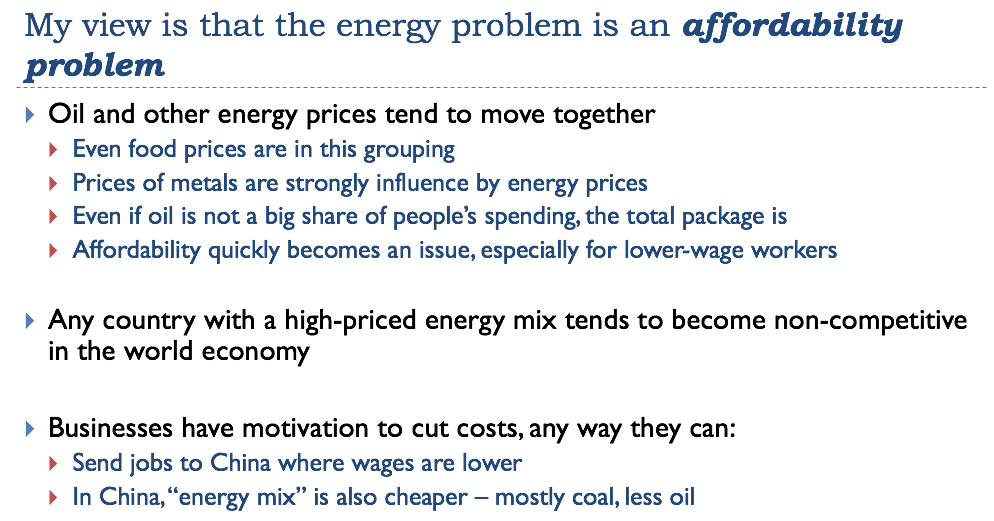
An economy operates best when energy costs are very low because goods and services made with this low-cost energy tend to be low-cost as well. Oil is used in producing and transporting food. Thus, low-cost oil tends to produce inexpensive food.
If energy costs begin to rise in a country, it tends to make that country less competitive in the world marketplace. It also tends to push the country toward recession, because the higher costs are difficult to recover from customers whose wages don’t rise to cover the higher costs.

Slide 32
Many people believe that the amount of fossil fuel that will ultimately be extracted depends on a combination of (a) the amount of resources in the ground, and (b) the technology developed for extraction. While these are indeed eventual limits, I think that a maximum affordable price limit comes much sooner. This depends on how high a debt bubble the economy can sustain. The role of debt will be discussed in Part 2.

Slide 33
One thing that is confusing is the familiar supply and demand curve for energy. Many people believe that “of course” prices must rise if energy is scarce. The catch is that energy consumption affects all parts of the economy. It takes energy to create jobs, just as it takes energy to produce goods and services. Because both supply and demand are affected by a shortage of energy, our intuition regarding how prices should move can be totally wrong.
The word “Demand” is confusing, also, because most energy use is difficult to see. Most energy use is not found in the gasoline we buy at the pump or the electricity we purchase. Instead, energy is used in creating the streets that we drive on, and in building the schools that our children attend. Building new homes and manufacturing cars also takes huge amounts of energy. If energy costs rise very much, the problem is that many people can no longer afford homes or cars. Instead, young people live in their parents’ basements indefinitely. Governments may decide to stop paving some roads, because repaving is too expensive to afford. Reduced demand for oil might be better described as reduced purchases of goods and services of all kinds, because certain groups of would-be buyers find prices too high to afford.
[To be continued in “The World’s Fragile Economic Condition – Part 2”]


Thanks you very much for this paper ! Really great ! It is rare to see links between GDP-energy-debt. yongtai888 (from France)
Correction: Probably, China through France.
Academic Pressure Pushing S. Korean Students To Suicide
Gangnam Style Education: South Korea is battling the world’s highest teen suicide rates as pressure on Korean students to achieve reaches astronomical levels.
https://youtu.be/TXswlCa7dug
this show The two Korean countries – North Korea depicts a 1984 dystopia, while South Korea rivals with its hedonist-plastic-surgery culture not dissimilar to Brave New World
The EM haven’t been only dependent on the Fed’s QE and Zirp, but also on the ECB’s QE and Zirp.
The Fed is now reducing its balance sheet and raising rates, while the ECB has reduced its QE program and will end it at the end of this year.
I haven’t got a clue what they are doing or what they are seeing on the horizon. But they are moving in the same direction with a time delay only.
Hyper inflation and collapse of either the dollar or the euro? Are they at war now?
EU is really building its own international payment system and IMF.
Russia has been talking about switching to the petroeuro.
Brexit will probably change EU into a more pro Russian entity.
I suspect what they are seeing is what they expected … that QE is not a perpetual economic motion machine… and that if continued past a certain point the machine explodes…. so now they are forced to slow the QE…. however the machine will still explode because it has been terribly damaged by feeding so much QE through it….
We know that higher interest rates are deadly … 2.54 mark…..
https://youtu.be/WDRxK6cevqw
hey this remind me of ending scene of great movie called Koyaanisqatsi
https://youtu.be/OacVy8_nJi0
The WTI 72.27 USD.
The oil price hasn’t collapsed. The euro hasn’t collapsed. The dollar hasn’t spiked.
The FX trader is blocking trolls since his predictions haven’t materialized. He assures that they will materialize soon though.
I actually expected the oil price to collapse too. Something big will have to break first?
OIL (BRENT) PRICE COMMODITY
81.28
This is what 3/4 of the planet uses.
I was a little pessimistic on the rise.
Not good for buyers!
Do they have a choice?
That is the question that will be answered.
Choice is not the determining factor. The question is whether and to what degree, businesses and individuals will be able to absorb the inflated costs that come with higher oil prices. Obviously the more vulnerable entities simply won’t be able to cope with them and will go out of business and/or default on loans, which can then become a self-reinforcing process, ie a recession (or worse).
Last time, the debt bubble had to break, before a big turnaround in oil prices and several other related things. Maybe this time, too.
But we didn’t actually have a supply shortage—-
By early next year, we probably will.
New game on—–
Please spend 20 mins to listen the following. I can assure you that this is one of the best 20 mins that you have spent listening to something that you think you know but you don’t.
“This is water.” It is so obvious that it is being taken for granted. I believe that is what an open mind should have when you “take the red pill” or “see what others cannot see”.
Commencement Speech to Kenyon College class of 2005 written by David Foster Wallace
Wallace’s suicide was a true loss—
Try his writing if you haven’t.
Yep–
https://s.hdnux.com/photos/72/12/17/15246288/3/1024×1024.jpg
“There’s a time when the operation of the machine becomes so odious, makes you so sick at heart, that you can’t take part! You can’t even passively take part! And you’ve got to put your bodies upon the gears and upon the wheels…upon the levers, upon all the apparatus, and you’ve got to make it stop! And you’ve got to indicate to the people who run it, to the people who own it, that unless you’re free, the machine will be prevented from working at all!”
Pretty words, the machine grinds on. Why is it the US requires a constant stream of immigrants? It grinds up and kills off the stock.
The average births per mother is below replacement rate, also.
@ CTG
“Does the rain have a Father?” “Who Fathers the drops of dew?”
Answer those 2 questions and you have the answer to all education and knowledge period and hint it revolves around H2O.
Interesting talk!
I am not sure a liberal arts education has to be part of this discussion. It seems like attending a liberal church on a regular basis might get a person thinking in the right direction. We don’t have to be caught up in the constant problems of all of the boredom and things that go wrong. People who have problems with depression seem to get caught in this trap. We have to see our way around these issues. We need to build meaningful parts into our lives. We need to figure out changes to our lives so we are not caught in this unending routine. Building relationships with others is part of what it takes. Changing our routine so it is not so stressful is part of it as well.
“In a provocatively titled video, “Will one phone call drop home prices by 80 per cent?”, Digital Finance Analytics founder Martin North, economist John Adams and PhD student Sean Quinn, who was in Ireland at the time, discussed what would happen here in a similar scenario [to GFC 1.0]. They debated whether, in the event of a major financial crisis, Australia should similarly agree to guarantee its banks — or let the whole system collapse and “reset”.”
https://www.news.com.au/finance/economy/australian-economy/the-phone-call-that-could-drop-house-prices-by-80-per-cent-if-another-financial-crisis-hits/news-story/ca0b7f50fcb991cdf816e44d30a3ecd8
“Apparently, investors believe that this boom is going to last, or at least that other investors think it should last, which is why they are bidding up stock prices in a dramatic response to the earnings increase. The reason for this confidence is hard to pin down, but it must be rooted in the public’s loss of healthy skepticism about corporate earnings, together with an absence of popular narratives that tie the increase in earnings to transient factors… A bear market could come without warning or apparent reason…”
https://www.theguardian.com/business/2018/sep/24/us-stock-market-highs-bubble-earnings
“Your blood should be boiling as you read this. It means that some CEOs are managing their companies’ buyback programs in order to increase their bonuses.
“[Companies are] using an ‘Accelerated Share Repurchases’ to goose earnings… As you might imagine, companies using ASRs to manipulate earnings are engaging in financial engineering for cosmetic purposes rather than promoting genuine long-term value for shareholders.“
https://www.marketwatch.com/story/how-some-companies-manipulate-share-buybacks-to-inflate-earnings-2018-09-24
“The $37 billion in new supply of 2-year Treasury notes on Monday were sold at the highest yield at auction since June 2008 to the weakest demand since December 2008. Demand was lackluster despite low prices… The 2-year yield is a gauge of market expectations of interest-rate hikes.”
https://www.reuters.com/article/usa-treasury-auction/update-1-weakest-demand-highest-yield-since-2008-at-us-2-year-auction-idUSL2N1WA0YU
I think this has been obvious since the beginning of QE and ZIRP and it is more obvious under the Trump tax cuts.
“For the third time in a month, crippled [Indian] infrastructure conglomerate IL&FS Financial Services on Monday defaulted on interest payments on commercial papers. The interest payment on the papers were due Monday, the company informed the exchanges… The company did not quantify the default amount.”
https://www.businesstoday.in/current/corporate/ilfs-default-crises-financial-services-arm-debt/story/282792.html
“North Eastern Electric Power Corp., an Indian state-run power generator, planned to raise 3 billion rupees ($41.3 million) selling bonds. It couldn’t manage 5 percent of that amount, prompting it to scrap the sale on Monday.
“Three Indian companies have pulled 58 billion rupees ($800 million) of debt sales this month, the most in at least a decade, according to data compiled by Bloomberg.”
https://www.bloomberg.com/news/articles/2018-09-24/pulled-bond-sales-at-decade-high-as-il-fs-default-spooks-buyers
The United States is putting “a knife to China’s neck” on trade issues, a senior Chinese official has said, as the two sides struggle to find a way to end a months-long standoff over trade…
“US tariffs on $200bn worth of Chinese goods and retaliatory taxes by Beijing on $60bn worth of US products kicked in on Monday as the trade dispute between the world’s two biggest economies escalated, unnerving global financial markets.
“China also accused the United States of engaging in “trade bullyism”, and said Washington was intimidating other countries to submit to its will, according to a white paper on the dispute published by China’s state council, or cabinet, on Monday.
“Asian shares were broadly down on Tuesday amid nervousness on markets about the ongoing dispute…”
https://www.theguardian.com/business/2018/sep/25/trade-war-us-is-putting-a-knife-to-chinas-neck-says-top-official
“The US could start to sell short the stocks of Chinese firms listing on the US markets – that is, bet that they will fall in value – and use the media to exaggerate weaknesses in the Chinese economy, the report warned. This could put significant downward pressure on those stocks…
“The US could also encourage – and even pressure – US firms to exit their investments in China. The US may target the highly leveraged segment of China’s economy to do damage to China’s financial and property markets, triggering a financial crisis.
“The currency market could also take a beating if the US were to take financial positions reinforcing expectations that the yuan would continue to weaken against the US dollar. Such a tactic would likely trigger funds to rapidly move into “safe haven” assets, causing a sell-off in Chinese assets, real estate in particular. This, in turn, could produce massive capital outflows that would cause a systemic crisis in China’s financial system…”
https://www.scmp.com/economy/china-economy/article/2165529/trade-war-escalation-may-trigger-financial-crisis-china
How does the reported trillion dollars worth of US Govt. debt that China holds fit into all this?
“Foreign investors hold US$6 trillion of outstanding US government debt – which totals around US$20 trillion. China’s holdings of nearly US$1.2 trillion account for about 20 per cent of all US Treasuries in the hands of foreign investors, and 6 per cent of total US government debt.
“For China, that means it may have invested some 60 per cent of its dollar-denominated foreign exchange reserves in US Treasuries.
“It’s critically important for Beijing to ensure the value of its US dollars because the greenback is its main diplomatic tool for buying influence in Asian, African and Latin American countries with low-interest loans and aid. Those dollar assets also make it possible for China to promote its “Belt and Road Initiative” – a vast trade and infrastructure network spanning Asia, Africa and Europe – via overseas direct investment.
“And with few countries in the world in a position to buy such a huge chunk of US bonds, bills and notes from Beijing, it would be nearly impossible for China to find a buyer unless it sold them at a heavy discount.
“If it did offload them at lower prices, it would result in a dramatic reduction in the central bank’s assets, weakening Beijing’s financial leverage – and its influence on the world stage.”
https://www.scmp.com/news/china/economy/article/2160270/why-trade-war-wont-prompt-beijing-dump-its-us-treasuries
Its easy to see how all disputes, wars since the dawn of man have been about control of resources and since the machine age about energy. Its no coincidence the Bush family ascended when new sources of cheap oil were needed. Now the attack is against Russia and Iran for the same reason, they have to demonise these two first and provoke a reaction as an excuse for war. China will defend its own source of gas and oil in Russia now that their own coal has peaked. War is coming because mankind’s consciousness is still juvenile, perhaps maturity could begin now – we don’t know.
For all its talk about cutting coal mining capacity, China actually plans to add more. The world’s biggest producer and user of the fuel may see net annual capacity additions of as much as 400 million tons by 2020, according to estimates from analysts including Wood Mackenzie Ltd. That’s about 10 percent of its current capacity and almost as much as Indonesia, the world’s biggest exporter, sells each year.
https://www.bloomberg.com/news/articles/2018-09-24/china-is-adding-more-coal-capacity?srnd=premium-asia
China knows that the world’s exports of coal are limited. It needs to develop its own coal if it is to have close to enough. Old mines tend to become less and less economic over time, so it is clear that some will need to be closed. Thus, part of the additions are to offset “depletion.”
Notice how there are no MSM stories about how China has halted solar expansion … in favour of Burning Moar Coal….
How can it be? There are thousands of MSM outlets…. how can it be possible that all of them WERE reporting on China’s renewable energy miracle…. (which never was) … and now they are all silent?
Two things:
1. The MSM is centrally controlled…. (a division of http://www.E.ld.ers.com)
2. This rhymes with …. the story known as … ggg wwwwww….. people like to point to the fact that there is consensus in the MSM on this issue… therefore it must be so…..
When the Supply of Uber and Lyft Drivers Rises, Their Earnings Fall
Average monthly pay from online transportation platforms is down by half since 2013
https://blogs.wsj.com/economics/2018/09/24/when-the-supply-of-uber-and-lyft-drivers-rises-their-earnings-fall/
‘To somehow measure wealth by GDP is a mistake. Having worked in places, especially Africa, in vast urban slums, I know the poverty is worse [than it was] for people who at least had subsistence agriculture before. So the whole measurement of wealth is wrong.’
‘The dollar as the world’s current reserve currency is running on fumes. The moment that’s over, American financial supremacy is instantly finished. It will be very similar to the aftermath of the Suez disaster—something like that is always characteristic of late empire. And the fragility of an empire means that when collapse comes it’s almost instantaneous. You look back at the rapid final fall of the old Soviet Union. A failing empire is like a house of cards that just comes down—it’s not a slow descent. We know from history what happens. It’s not a mystery.’
https://www.zerohedge.com/news/2018-09-24/why-chris-hedges-thinks-american-empire-has-lost-control-and-its-failure-imminent
Ignore the immediacy of the message, cos who really knows ‘when’; but the content will be familiar to any who lurk here.
The lower rungs of the ladder just ain’t there anymore. We have been too busy looking up to where we want to be to see how we have trashed the option of any u-turn. I do see that many millenials are escaping the sinking ship tho’….https://www.zerohedge.com/news/2018-09-24/millennials-are-flocking-cheap-rust-belt-cities….
Thelma, meet Louise.
President-Elect of Mexico’s Bombshell: Economy in “Situation of Bankruptcy”
And why are Bank of Mexico executives and employees resigning in droves?
Around 200 central bank employees, including 20 senior executives, have left their posts at the Bank of Mexico (Banxico) since presidential elections on July 1 handed a resounding victory to populist Andrés Manual Lopez Obrador (or AMLO). Unsurprisingly, their sudden departure has a lot to do with money.
Whatever AMLO might say in the heat of the moment, Mexico’s economy is far from bankrupt. Unlike certain other Latin American economies, it has not gambled away all trust and can still service its public debt pile with relative ease. But it is only 36 years ago that Mexico last defaulted, during the Latin American Debt Crisis of the early eighties.
Thankfully, memories are short, and today Mexico’s economy is in better shape, although growth is weak, poverty and inequality are still rife and the state-owned oil company Pemex still shows no sign of curing its addiction to debt. Inflation, at just under 5%, is a shadow of its former self.
https://wolfstreet.com/2018/09/24/president-elect-mexico-amlo-economy-in-situation-of-bankruptcy/
Sorry bud… but this time is different…. there will be no default… and rinse…. Mexico is the next Venezuela…..
Why Mexico’s Oil Production Could Fall Even Further
For June C&C was 1870 kbpd, down 25 kbpd from May and 170 kbpd y-o-y. Yearly decline rates for each region are shown in the chart below. Production peaked in 2004/2005 at just over 3500 kbpd, so overall decline is approaching 50 percent.
https://oilprice.com/Energy/Energy-General/Why-Mexicos-Oil-Production-Could-Fall-Even-Further.html
I emailed Quijones some months ago … he really does think that the oil issue is no big deal…. he believes it is the corruption within the company and government that are the problem …. he refuses to see that this is not a problem …. a problem assumes there is a solution …
There is no solution …. bankruptcy awaits… collapse awaits…. it’s just a matter of time….
Mexico is indeed a concern. I expect that the reason that Trump wanted the wall was concern about the potential for a bankrupt country on its Southern border. Mexico had been an oil exporter. It depended on tax revenue from oil to cover part of its budget. With both the quantity of oil exported down and the price for those exports down, Mexico is in very bad shape. Its long-term rising population has contributed to its problems.
I believe that even saint Obama added to the wall. Is this correct?
It’s like cauterizing a wound….
https://www.zerohedge.com/news/2018-09-24/worlds-fragile-economic-condition-part-1
12964 reads
15 comments
Cognitive dissonance has been triggered…. look away…..
Or it might be that the fat combovered racist MORE ons…. who sit in their basements in wife beater shirts… monitoring ZH… counting bullets … and stroking their rifle collection while watching p.orn … are just too stuuuupid to realize what they have just read…..
Probably a bit of both…..
Once upon a time ZeroHedge used to write it’s own articles and the comment section was made up of intelligent financial individuals. Then they became an aggregate news site and now 90% of the comments are from individuals who don’t have a clue about anything and are in competition to post the most clever comments.
ZH has gone down hill with the Trumpers. Back in the day like Rodster said the articles and comments were well written and logic based. Now anything that may even hint the world is not fine and will not be fine even with their idol at the helm triggers their feelings and makes them role around in their piles of bullets and cry.
For what used to be a politically agnostic site and group of commenters it has gone down the drain. Still not quite sure what all the jew hatred in the comments is about, but it speaks poorly to me.
The comments section of ZH went downhill long before Trump landed….
Indeed, the comments section devolved into who could come up with the wittiest most clever and ‘liked’ comments. That happened several years ago, way before Trump came on the political scene.
ZH needs a filter that allows one to only view the comments from non MOre Ons….
https://www.zerohedge.com/news/2018-09-25/un-audience-laughs-when-trump-lists-his-accomplishments
Good sweet god almighty!!! Imagine if North Koreans had access to the internet and the world laughed at their sweet dear leader.
Quick we need some puppies and kittens for for these people to hold.
The 15 year old girl that we sponsor came up with this…. and won the top award at the high school speaking competition the other day….. there are parallels with respect to how we should be spending the remaining days of BAU….. appreciate life now — because this is by far as good as it is going to get…..
“No such thing as a life that’s better than yours,” a simple, significant, and meaningful phrase. A phrase composed by a rapper named J.Cole and was used as the chorus of his song titled “Love Yours.” A phrase that inspired me to write this speech, a speech that talks about life, happiness, and love. A speech that tells every single person in this room to be contented with the life that you were given. A life entitled to 7 billion human beings alive on this planet. A life that should be delighted instead of regretted, a life that should be cherished not rejected, and a life that we should all be proud of not ashamed of.
“No such thing as a life that’s better than yours,” words that most of the time aren’t part of my dictionary. Words that don’t exist in our minds when we see a better outfit than the ones we have on. Houses that are bigger than ours, phones flashier than the ones we have. All these things that we want that makes us forget the things that we have. The truth is, the media that surrounds today’s teenagers are always trying to convince us that the more expensive our clothes are the better person we’re going to be and having an expensive car somehow makes us superior to the ones who don’t.
Look, all these ideas created by the media are just ideas, they’re there to make us think that that’s what we should do. They are myths created by people who want to sell more of their products. Myths that influenced today’s teenagers. Us teenagers shouldn’t be distracted by these things instead we should be motivated by them in order to have the things we never had, experience what we haven’t experienced, and go to places we’ve never been.
“No such thing as a life that’s better than yours,” words that we should always keep in mind. As long as we have our family’s love and support and we know how to love and accept ourselves then we have the greatest treasure of all time. A treasure that will never lose its value, a treasure we should all protect. True money can buy us happiness. It can buy us designer coats, plane tickets, and other things.
Things that might give us happiness for a short period of time, but they are also things that might open doors to more problems. The good news is, there is something much more valuable that no amount of money can buy. Love. All of us are capable of loving our parents. Loving ourselves and the world around us. As long as we love ourselves and are loved by the people that matter to us the most, we can be the luckiest and happiest people in the world.
“No such thing as a life that’s better than yours.” We and I mean all of us are very lucky. We are lucky that we have food on the table three times a day, lucky that we have a roof over our heads, and lucky that we live in a country where opportunities of being successful are right in front of our eyes. We should all be thankful for what we have. Many children out there wants to study more than we would like to.
Children that lack healthy meals, shelter, clothing, and support. J.Cole’s “Love Yours” talks about gratitude in adversity. This song reminds us to hold on, and to never compare our life to anyone else’s and to just simply love the life that we have but that doesn’t mean that we shouldn’t work harder to get to the top.
There will always be things in others that we can compare ourselves to. Regardless that you need to “Love Yours.” The people, things and life that you have. We can’t control what other people have in their lives but we can control how we view those things. I know that sometimes we feel like the whole world is against us but in every dark night, there is always bright days after that. So no matter how hard it gets, keep your head up and handle it, and remember that there is no such thing as a life that’s better than yours.
http://www.online-literature.com/tolstoy/2738/
Tolstoy in a similar vein; made me laugh!
Ah, the earl of Tolstoy. Whose mother was one of the richest heiress of Russia, and ugly as hell. (All told in War and Peace which is basically his family’s story.) He gambled away most of his fortune, fucked around with serfs’ daughters, and played a saint after he had enough. His descendants were treated well by lenin, stalin, etc and they still hold his huge estate near Tula (the heart of Soviet/Russian defense industry).
bizarre
Pingback: The World’s Fragile Economic Condition – Part 1 – The Conservative Insider
Pingback: The World's Fragile Economic Condition - Part 1 - noticiasp
Pingback: The World's Fragile Economic Condition – Part 1 – The Trading Letter
Pingback: The World's Fragile Economic Condition - Part 1 | StockTalk Journal
Pingback: The World's Fragile Economic Condition – Part 1 | Newzsentinel
Pingback: The World’s Fragile Economic Condition – Part 1 – Wall Street Karma
Pingback: The World's Fragile Economic Condition - Part 1 - Get the latest financial news. Free real time quotes, 25 Trading Tools, Technical analysis, and much more.
Pingback: The World’s Fragile Economic Condition – Part 1 | peoples trust toronto
Pingback: The World’s Fragile Economic Condition – Part 1 – iftttwall
Pingback: The World's Fragile Economic Condition - Part 1 - open mind news
Pingback: The World's Fragile Economic Condition – Part 1 – students loan
Pingback: The World’;s Fragile Economic Condition – Part 1 – Viralmount
Major Traders Are Talking About $100 Oil Again
Major trading houses predict crude-price spike later this year
https://www.bloomberg.com/news/articles/2018-09-24/major-traders-see-return-of-100-oil-due-to-u-s-iran-sanctions?srnd=premium-asia
Recall…
HSBC: Brace for the oil, food and financial crash of 2018
80% of the world’s oil has peaked, and the resulting oil crunch will flatten the economy
https://medium.com/insurge-intelligence/brace-for-the-financial-crash-of-2018-b2f81f85686b#.z9uwvj2gd
Germany’s rising electricity prices this year.
https://assets.bwbx.io/images/users/iqjWHBFdfxIU/iOvLyQ2gCDY8/v1/600x-1.png
What exactly is this a measure of? It looks like future contract prices for wholesale electricity.
Electricity is mostly made by burning natural gas and coal. Energy prices tend to move together, so electricity rises with oil (and natural gas and coal) prices. The chart starts at the beginning of 2016, when oil prices were there lowest. So it is sort of a gee-whiz chart, showing what a run-up in Brent oil prices from a low of $26.01, to something over $81 today, will indirectly do to electricity future contract prices.
This is what historical average monthly spot market prices for electricity look like.
https://gailtheactuary.files.wordpress.com/2018/09/germany-average-monthly-electricity-spot-prices.png
Also CO2 emssion permits went up significantly.
MOAR solar energy!
World sinks to 10-year happiness low
Conflict-hit Central African Republic was the world’s unhappiest place last year
) – World happiness levels are at their lowest level in over a decade, with the number of people who say they feel stressed and worried rising, according to a survey published on Wednesday.
Conflict-hit Central African Republic (CAR) was the world’s unhappiest place last year, with Iraq in second place, according to the ranking by pollsters Gallup.
“Collectively, the world is more stressed, worried, sad and in pain today than we’ve ever seen it,” the group’s managing editor, Mohamed Younis, wrote in a foreword to the study.
Gallup surveyed more than 154,000 people in 146 countries on whether they had felt pain, worry, stress, anger or sadness the previous day. It said the global mood was at its gloomiest since the first such survey in 2006.
Sub-Saharan Africa led the way, with 24 of 35 countries surveyed reaching a 10-year happiness lows in 2017, often due to civic unrest crippling healthcare systems and causing people to go hungry.
“In CAR and some of these other places, high percentages of the population are just struggling to afford the basics,” the study’s lead author, Julie Ray, told the Thomson Reuters Foundation by phone.
CAR has been ravaged by violence, with most of the country now beyond the control of the government, and about three in four residents said they experienced pain and worry.
Wealthier countries were not immune to the dip in mood. About half the Americans interviewed said they were stressed – roughly the same proportion of respondents as in the CAR.
http://news.trust.org/item/20180912045953-zbeac/
We’re told constantly that the human condition is better, as a whole, for humans today that it has ever been it at any point in all of history.
Maybe that’s not the whole story.
btw living in india where the change is happened in front of my eyes
it is happening so fast, people used to be poor and unusually happy, now they have smart phones and are miserable and angry, beating people to death because of rumours on whatsapp
It’s like the reindeer herder who said; ‘We are more connected now, but that gives us more to worry and get angry about!’
What do people get beaten to death for, TWP?
for things like finding cow meat in the house or cars
which is not true in majority of the cases
https://youtu.be/196ruectuKM
rumor about child kidnapping of poor people
https://youtu.be/wuJJHod1CLQ
Just like Europe in the old days: ‘Witch!’ ‘Child sacrificer!’, etc.
but this time with internet and tv
This is sad!
It is sad. Too bad common sense is so uncommon.
It rather refutes the ‘ordinary people are decent, and only want peace, love and happiness’ meme. Unrestrained, they would create Hell.
If anyone wants to dispute this … just imagine what the world would look like if there were no police, courts or prisons….
A happiness measure is reflective of an economic measure. Where people are happy, their economic system must be effective in some way.
So couldn’t you assess the efficacy of an economy in reverse? If people were happy, then their economy would be good enough by definition?
gail i dont disagree with you , and clearly EM demand will be under a lot of pressure given currency weakness vs USD but oil demand worldwide has been steadily growing.. from low 90’s to about 100mm bpd – that doesnt exactly fit your thesis?
It does if that demand growth is predicated on an unprecedented and unsustainable expansion of debt. Also demand has been contracting or flatlining in less competitive parts of the global economy with China and the EM’s propping up growth. We are running out of ‘engines’ to push demand growth forward.
I happened to see a newspaper headline today ‘Minister wants more low-skill migrants’.
Why low skill?
They would say it’s to do the low-skill jobs, but it’s really about boosting domestic demand -low-skill people spend all of their earnings.
Real growth, however, it is not. Low-skill immigrants do not create cheap energy.
Eureka!!!
Here’s the plan….. The EU is going to introduce MMA (free money to each person for doing f789 all)….
There is a pool of 18 trillion Euros available…. with allocations on a per capita basis….
EU nations are fighting to allow in as many useless f789s as possible … as they bid to increase their populations and get a greater share of the spoils….
Hungary is missing the boat….
Consider this riddle… solved.
Fast Eddy Akbar. Fast Eddy Akbar.
Pretty near the truth: the gypsies in the Basque Country have a 100% unemployment rate, receive state benefits,and get a bit on the side through crime (remember, estimated turn-over from crime now counts as GDP in many countries!).
Demand for total energy energy (coal+oil+natural gas+ nuclear+ hydroelectric+ wind+solar+ everything else) has not been growing sufficiently. The big issue is that coal is not growing sufficiently, and nothing is replacing it. It is the rate of growth of total energy supply that is important, not what is (or isn’t) happening to oil. All of the focus on oil has been confusing to people. Our economy is based on a having a not-too-expensive mix of energy products. If we partially remove a cheap type of energy (coal) and add expensive substitutes, this tends to push the economy over a cliff.
>Greg Machala
>Escape? Define escape. For how long? The only people that will truly “escape” what lie ahead are those that are already living primitive, hunter-gatherer lifestyles.
===
For example, Easter Island. The natives at that island is going to be doomed as Chile’s President Sebastian Pinera, a billionaire, will arrive with his bodyguards and entourage when the shit hits.
There are a lot of spots which will only be accessible by air, ship, etc and not on any map. The elites have lobbied google, etc (whose owners are elites too) to take their locations off from navigation. They don’t have to hide in bunkers, which are for the second tier of elites.
As for hired guns killing the elites, that never happened. Even Nero’s guards remained loyal after his depose; he killed himself, and as Quo Vadis tells us, just when the knife was entering his neck a sentry had announced a relief force was coming to save him, so if he had been patient just for one more minute the history of Rome would have been vastly different.
The people who hire bodyguards are not stupid. They hire the guards who are preferably without a family so there would be little incentive to kill the master. Many of them come from Eastern Europe where life is cheap and there is still the code of loyalty.
What will they live on? How will they adapt from having all of modern luxuries to having much less? Drought? Famine? Disease? How will they access medical care? Where will the fuel and power come from? What when things break and there are no parts to fix it? What about pirates? Nuclear fallout if there is war? If there are enough people on said island how do you control in-fighting? I don’t see a utopia for the super elites. I see a grinding existence ahead for even the wealthiest of elites. Without abundant and cheap energy our lives become brutish and short.
It’s happened before: in Dark Age Europe, none of the elites of 800 AD were people of great and ancient ancestry – they had all been eliminated in the fierce struggle for survival after the fall of Rome.
If they had an early ancestry, those ancestors had been comparatively minor figures c 500 AD.
But great wealth is a truly delusory state of mind……
Even insignificant people of today like to think of their great-grandchildren’ carrying on the line’, and ‘taking their genetic material forward’ – hilarious!
What happened is the chieftains took the pretty daughters of the great families so the latter’s bloodlines survived thru the maternal line, which is why Latin continued to be used as the chief language o the West for a long time.
Old Guards never die – they just change their colors.
After the Russian Revolution, many nobles who stayed in Russia found they were shorn of their property and wealthy, but many of them somehow survived as commoners. Since they still had some value as carriers of culture, quite a lot of them were allowed to exist until Stalin’s paranoid got too high during 1930s, and even then some of them did become avid communists and retained some of their power. After 1938, as World War 2 drew closer, Stalin thought these people were no longer a threat to his power and left them alone, and quite a few o their descendants have returned to important positions after 1991.
Fuel – solar/hydro. Yes, they won’t be great or efficient but anything is better than nothing. Dirt poor peasants of vietnam built a ‘dam’ like this
http://blogs.worldbank.org/climatechange/hydropower-vietnam-right-way-do-it
Medicine – the unfit will be taken care by nature. However some will survive
Infighting – Easter Island culled all of its nonelites. However, there was a winner, and his family continue to reign as the “King of Rapanui” until early 20th century.
Great synopsis, Gail. It seems to me that this is strong evidence for Joseph Tainter’s thesis that THE leading factor leading to eventual sociopolitical collapse is diminishing marginal utility. We have to run faster and faster to stand still, until eventually the building fragility leads to a ‘reset’ of some kind. And a ‘collapse’ of the oil and gas industry due to prices being ‘too low for too long’ would certainly contribute to that. It will be ‘interesting’ to see how ‘the-powers-that-be’ attempt to handle this…
I have had some comments on Facebook that indicated the readers could not understand what was happening. This is a different explanation I tried to give to them:
Thanks. The following is clear to me.
“The problem is that we have made many promises with respect to the future payments that are based on what has been available in the past. These involve many different parts of the system: interest payments, Social Security payments, payments for the value of shares of stock, and private pension promises.”
The metaphor (?) of disks doesn’t work , since all I can imagine are CD disks. It’s hard to get across the idea that something is growing and contracting at the same time. Maybe explaining that in terms of trajectories–something in motion–would work slightly better. One kind of movement versus another, maybe something not as hard as a disk. As FW teaches, all is energy. So how do physicists measure energy entities and how they might interact? For us among the masses, knowing such terms would make us smarter.
You need to have these images in your mind.
https://gailtheactuary.files.wordpress.com/2013/02/growing-economy.png
https://gailtheactuary.files.wordpress.com/2013/02/declining-economy.png
They are 5.5 years old, so I can’t blame you if you don’t have them well-embedded in your mind.
The problem is that some pie pieces get bigger and bigger, as the economy shrinks in future years.
https://gailtheactuary.files.wordpress.com/2013/01/figure-7-draft.png
“The problem is that some pie pieces get bigger and bigger, as the economy shrinks in future years.”
Interesting.Thanks.
We end up with nothing left over for “everything else.”
Gail, have you ever considered doing something similar with plates spinning in the air?
Or perhaps a caricature of the earth riding a bicycle while spinning a dozen plates and cursing, “darn it, I’ve dropped Venezuela!”
Pingback: The World’s Fragile Economic Condition – Part 1 – Olduvai.ca
“Are we nearing another financial crisis? … the economic expansion is very mature, now about a decade old. Another downturn is only a matter of time. Global “synchronized growth” ended earlier this year, with emerging markets running into trouble. The U.S. is largely alone with robust GDP figures, and it is hard to believe that this rate of growth can be sustained with the expansion slowing elsewhere… The icing on the cake could be high oil prices… The stage is set for a downturn in the next year or two.”
https://oilprice.com/Energy/Energy-General/What-Will-Trigger-The-Next-Oil-Price-Crash18362.html
It sounds like Nick Cunningham understands what the problem is!
“Nandi Hills MP Alfred Keter has warned of a silent revolution in [Kenya] as a result of the ‘near collapse’ of the economy.
“Keter says the country, with the Sh 6 trillion debt and corruption cartels seizing most sectors of the economy, is literally bankrupt. In a statement, he blamed those in charge of the economy of living in denial and continuing to drive deep into more problems.”
https://www.the-star.co.ke/news/2018/09/23/keter-warns-of-silent-revolution-amid-kenyas-debt-woes_c1823567
“Zimbabwe faces a deepening economic crisis as hopes fade of a new wave of international investment and aid following historic elections in July…
“Majory Manjoro, a part-time currency dealer in Harare, said life had become unbearable. “Things are getting worse. Everything goes up [in price]. Those in authority need to make sure things get better,” Manjoro, 33, said.”
https://www.theguardian.com/world/2018/sep/23/things-are-getting-worse-economic-collapse-looms-again-in-zimbabwe
China may help.
I think they were better off before.
I am still waiting for a peripheral country to actually collapse…. I am wondering if the rest of the world will step in to help at all….. or do we go into media blackout (see yemen) – seal the border (shoot to kill) ….pretend nothing has happened….. and let things play out….
I expect that quite a bit of the world is literally bankrupt. Debt promises exceed the ability of the economy to repay them.
The world’s Central Bankers and Government’s are fearful of that day when everyone on the planet realizes ‘the Emperor has no clothes’. There are some economists and financial experts who have the global derivatives figure at a monstrous $1.8 quadrillion. Good luck getting paid back when all the bankrupties are exposed.
“As negotiations become fraught before Britain’s exit from the European Union in March, tensions of a different kind are surfacing on the currency markets — derivatives activity is rising sharply as investors bet on a weaker sterling.”
https://uk.reuters.com/article/britain-eu-currency/rpt-analysis-sterling-derivative-bets-rise-as-brexit-endgame-nears-idUKL8N1WA0UB
Derivatives are clearly another weak point for the economy.
I think Keter should re-read Out of Africa.
During 1930s expats from Europe built a paradise in the middle of Kenya. Some of their descendants still live there and they are above Kenyan law – no Kenyan politician dare to cross them.
Africa is being prepared for the return of the colonials.
I guess you have been ignoring what is going on in South Africa…. just wait till the lights go off…. permanently…. Africa will be one of the most horrifying places to be a white man….
Remember the Mau Mau… https://www.dailymail.co.uk/news/article-1375967/Kenya-Mau-Mau-atrocities-1950s-dossier.html
They are going to skin the white men alive… salt their meat while still alive …. and boil them in pots…..
“Iran’s Revolutionary Guards yesterday vowed “deadly and unforgettable” vengeance for the mass shooting at a military parade as Iran’s president blamed US-backed insurgents for killing 25 people in a hail of bullets… President Hassan Rouhani accused the US of inciting an unnamed ally in the Persian Gulf to carry out the attack… Mr Rouhani is on a collision course for US President Donald Trump, whose decision to quit the 2015 nuclear deal is, to Mr Rouhani’s mind, directly to blame for Iran’s crippling financial crisis.”
https://www.telegraph.co.uk/news/2018/09/23/rouhani-blames-us-inciting-deadly-shooting-prepares-confront/
Sounds familiar, “Crippling financial crisis.”
“The 73rd United Nations General Assembly opens on Tuesday in New York with world leaders bracing for the next global crisis – and the rest of us uncertain about what they would do if it comes.
“Don’t be fooled by the fact that U.S. markets hit record highs this past week, that global growth remains steady, or that the Trump administration in its first two years has escaped any crisis of the sort that came with the 9-11 terrorist attacks of 2001, the 2003 Iraq War or the Lehman Brothers meltdown of 2008.
“In my many years of taking the global pulse around UN week, where more than 120 leaders will gather, I’ve seldom seen or sensed such uneasiness and uncertainty. I’ve never known a time when the potential sources of volatility have been so widespread geographically.
“The debate, hence, has become less about the likelihood of a crisis and more about what form it might take, with what severity it will strike, and whether world leaders will have the capacity to contain it.”
https://www.cnbc.com/2018/09/21/a-new-global-crisis-is-brewing-as-un-general-assembly-meets.html
“The trade fight between the United States and China intensified Monday as the two economic superpowers hit each other with their biggest round of tariffs yet. The Trump administration imposed new 10% tariffs on $200 billion of Chinese goods just after midnight ET (noon in Beijing), spanning thousands of products…
“China retaliated immediately with new taxes of 5% to 10% on $60 billion of US goods such as meat, chemicals, clothes and auto parts. The moves are a significant escalation in the growing conflict between the world’s top two economies.”
https://edition.cnn.com/2018/09/23/politics/trump-trade-war-china/index.html
“China’s spiralling debt, a major concern for the slowing down of its economy, has risen to USD 2.58 trillion, a media report said Sunday.
“China’s local government debt balance stood at 17.66 trillion yuan (USD 2.58 trillion) by the end of August… Regarded as the “hidden debt”, the steady rise of the local government debt worries economists and regulators.”
https://economictimes.indiatimes.com/news/international/business/chinas-debt-rises-to-usd-2-58-trillion/articleshow/65923608.cms
“The US tariffs have already undermined global growth and weakened the WTO.
“In a world of cross-border supply chains and increasing interconnectivity, the unnecessary disruption to the iron and steel trade will result in less production not just in exporting countries, but also in the US. And the likelihood that other countries will retaliate makes the situation all the more dangerous.”
https://timesofoman.com/article/141665
The whole thing is beginning to look like a dumpster fire.
This:
https://www.msn.com/en-us/money/markets/oil-prices-hit-4-year-high-after-opec-rebuffs-trump/ar-AAAyYsG?li=BBnbfcN
Coupled with the rising prices on consumer goods that will be exacerbated by increased tariffs.
John Fogerty in 1969!
“The global economy could face a “relapse” of the crisis that rocked the world a decade ago, the Bank of International Settlements (BIS) warned in its annual report on Sunday, stressing that there would not be enough “medicine” available to treat the problem this time, AFP reported.
““Things look rather fragile,” BIS chief economist Claudio Borio told reporters. “There is little left in the medicine chest to nurse the patient back to health or care for him in case of a relapse.””
http://www.atimes.com/article/bis-warns-global-economy-could-suffer-serious-relapse/
“Across the Eurozone the level of Debt:GDP stands at 86.7%. A far cry from the 60% limit that was established by the deeply flawed Stability and Growth Pact… Interest rates in the Eurozone have been fixed at 0.0% since March 2016 and there is no sense of conviction when the European Central Bank will be able to raise them again.”
https://www.forbes.com/sites/stephenpope/2018/09/22/brexit-is-just-one-of-many-european-problems/#35b87fcb1536
“Inflation [in Japan] has stubbornly refused to tick up towards the bank’s two-percent target; growth has remained sluggish and the bank is stuck in neutral, without a major policy change in years. The bank is in “deadlock,” Shigeto Nagai, head of the Japan department at Oxford Economics told AFP. “They can’t tighten, they can’t ease further from here. They have to stick to the current policy but inflation will not rise,” added Nagai.”
https://japantoday.com/category/business/bank-of-japan-mired-in-‘mission-impossible’-against-deflation
The problem is a demand problem. With Japan’s workforce shrinking rather than growing, this adds to the problem.
The average Japanese individual is probably thinking “the more money I make, the more I’ll spend, and the more inflation I will gladly contribute to.” But unlike the average American, the average Japanese individual is reticent to erode their savings or go into debt to fund consumption they can’t afford.
Unless the country can export much much more than it imports—which is far from the case these days, this means the economic engine won’t turn very quickly, leading to less income for everyone—rinse and repeat. So the government takes up the slack, borrowing heavily and spending on things that produce jobs and consume resources, but which don’t necessarily produce useful end products or generate a profit.
Also, the aging society is another noose progressively tightening around the country’s economic neck on top of the one represented by rising energy costs/net energy decline. The national newspapers these days tend to consist of 50% ads, and most of these ads are not for cars, consumer durables or cosmetics but for anti-aging supplements to help stop joint pain, osteoporosis or macular degeneration, lower the triglycerides or raise the libido, or for life or cancer insurance plans that even the over 70s can join. . Absolutely miserable reading they make! We only buy the papers because they are essential for wrapping up used cat litter.
Just a perfect example of an exponential growth driven economy. It has to grow or it collapses and this problem will spread worldwide becuase ALL the economies are interconnected. This is not just a Japan problem.
In your opinion, has Japan collapsed, or is collapse something that could still happen?
No they haven’t collapsed as they still have a “functioning society” but their economy has been in a recession/depression for decades. If not for the multiple attempts by their CB’s to inflate their economy back to growth they would be facing deflation.
And as Gail has mentioned their aging demographics leans towards savers, not spenders. There’s the reason why Governments encourage a healthy birthrate to keep the economy moving.
Japan:
http://www.jolt.marsdd.com/wp-content/uploads/2013/09/FP-mentors-take-the.gif
We often say that it’s growth or collapse, and Japan seems to be 10 years ahead of the rest, no growth, (or actualy shrinkage) and it still hasn’t really collapsed.
In my crystal ball, ‘m looking ahead to after the 2020 Tokyo Olympics.
The cost of that may just be the straw that breaks the camel’s back.
Japan still has the rest of the World to depend upon, trade with. their cars still sell well, for example. maybe that matters.
As long as a nation is relevant to the global economy, it will not collapse. The other side of the interconnected-coin is that everybody depends on each other and will work towards finding solutions.
The growth or collapse dichotomy is flawed imo. We have not experienced anything but growth, so we assume we cannot have a world without growth. Like a child who has never slept without their blanket, of course it will be sad and maybe even crying if the blanket disappears, but will the child die?
Is it a favorite blanket that we are losing, or something essential to life? Something like air or water, for example. Or food.
The system will be kept afloat, and when it goes down the elites will hide away in faraway getaways, not on the map, gps or whatever, and ride the storm out.
I am sorry but the elites will escape this, just like every other disaster in history.
Escape? Define escape. For how long? The only people that will truly “escape” what lie ahead are those that are already living primitive, hunter-gatherer lifestyles. If you think escape is living in isolation in a bunker with MRE’s and some questionable guards with guns – then no, I don’t agree that is “escape”. That is more like prison. They will be trapped in the collapse and not able to escape its grip. What happens when their guards with guns turn on them? Some small tribes in South America might escape this if some nasty disease or nuclear accident doesn’t reach them.
our only chance is to crash now while the legacy oil fields still have some life to them then we can transition to a 19th century lifestyle maybe the spent fuel pools could provide some energy via their heating properties
You are ….
A comedian?
‘Situation under control’… or not? Libya seeks UN intervention Tripoli battles leave 110+ dead
https://www.rt.com/news/439173-tripoli-libya-fighting-un/
Since media orgs won’t send reporters in to cover a lot of this … due to the danger… I reckon individual fighters should accept sponsorship — and wear go pro cams on their heads… and fire up real time footage to the web…..
Everyone needs to put food on the table…..
Now THAT…. would be truly f789ed up!
I can see why the US likes to be in the weapons business.
Weapons sales is the perfect career path for…. a psychopath….
Not only the population is ageing, but also the number of the disability pensioners is steeply rising in Slovakia:
https://spravy.pravda.sk/domace/clanok/485118-pocet-invalidnych-dochodcov-prudko-stupa/
Is it not only that they have realized they will never get a decent job so they solved their income problem that way?
It is like in Japan – overworked…
Recently, Elon Musk seems to be overworked too:
Worldwide, I think most of the developed countries are facing this problem. Certainly, the US faced a big increase in disability pensioners, when a lot of people got laid off at the time of the Great Recession.
The central banks are here:
https://www.smartinsights.com/wp-content/uploads/2011/09/Pushing-rock-uphill.png
Thanks!
Peak oil caused the 08 crash, they dragged it out a few years by creating money, lowering the interest rate, and dumping cash down the sinkhole that is fracking, but the collapse process has already been initiated..
Buckle up, it’s gonna be a bumpy ride..
I just read an article in TheNarwhal.ca about the proposed Teck Resources’ Frontier oil sands mine in Alberta. This proposal is in addition to all of the other existing and permitted-but-untapped oil sands operations. Given the cost of extraction and transportation, I don’t know how this could ever be economical without an enormous energy subsidy from other resources. As it is, the entire Canadian oil sands industry wouldn’t exist at anything near its present scale without cheap natural gas to provide heat to make steam for bitumen extraction. In addition, bitumen needs to either be upgraded via coking units (heated by electrical energy or natural gas), and hydrocracking and hydrodesulfurization (both of which requires hydrogen made from natural gas) to make syncrude, or else thinned out to make it flow in pipelines by using diluents made from either natural gas liquids (a byproduct, or sometimes the main product, of shale gas wells) or extra-light oil from shale oil wells in certain areas. Is anybody out there in comment land aware of any studies or analyses of how well these kinds of resources are matched, and where extraction costs for gas/NGLs/light tight oil might go? It seems to me that there will be LOTS of stranded investments in shut-in tar sands in 20 years, whether by economics or carbon taxes.
I thought I recently read of a new massive natural gas discovery in Canada, which was reported to be just what the tar sands producers needed…
perhaps someone will reply with a helpful reference here…
regardless of plentiful natural gas to aid tar sand oil production, there is an obvious answer to your suspicion in your last sentence:
in 20 years, all over the world, the majority of remaining oil reserves will definitely be “stranded” oil…
and that’s forever…
never to be extracted…
Gail’s newest post here actually answers your concern… supply and demand break down when it comes to energy resources, so there will never be a “high enough” price to extract those reserves…
Sadly, the central planners will resort to any extrordinary measure, to keep this hopeless system afloat. The final blow off top will be stunning. Afterwords, people will die in mass.
In a day dream the cook came in and said, “Boss we’re down to the last bag of rice and there’s 300 people out there. What about tomorrow?”‘
So that’s the question. What about tomorrow? How do I get rid of the useless eaters and keep the functioning individuals. We need the workers to stay alive but we can’t carry the useless eaters any longer. How do I get rid of the dead weight?
Thats the dilemma that the overload billionaires are trying to work out right now. How do they get rid of the seven billion useless eaters and keep the billion productive eaters? They’re not worried about debt or oil or what we call God or interest rates. They got to figure out how to cull the herd without bringing on the Zombie Apocalypse.
Good luck you billionaires. It’s all up to you to save the world.
It all works out in the end because one of life’s great equalizer is death and even the billionaires aren’t immune from it.
bingo!
it’s hard to believe that any billionaire is so delusional as to think that getting rid of 7 or so billion people would benefit them in any significant way, when all of them have a mere handful of fleeting decades of life remaining…
Sadly?
You don’t like life? If you cannot wait to die… try Fentanyl…. ‘one sniff is enough’
The “sadly” part is probably referring to the fact that this system cannot hold forever. That’s impossible. But the attempt to keep it going with both damage the environment further and decrease our ability to manage the change. So the attempts to keep things going will likely result in much greater tragedy later on.
I don’t think it matters…. the soil is already ruined by petrochemicals… so nothing will grow …. and the amount of spent fuel in the 4000 ponds = 56 million Hiroshima bombs… enough to poison the entire planet many times over…..
So I fully support kicking the can as far as possible…. the Rubicon was crossed long ago
The final nail in the coffin of hope is the depletion and poisoning of water sources: regions which have supported modest agricultural populations and small towns for thousands of years have – thanks to chemicals and modern pumps – destroyed the foundation of their existence.
In our region of Spain, which only industrialised in the 1960’s, about 50% of the water sources tested are now unfit for consumption: not all have yet been tested, so the proportion might well be even greater, who knows? In this time, the population has more than trebled, and mostly urbanised.
If this is a ‘tragedy’, it is one of utter stupidity.
The heirs of an ancient and beautiful house, which we trashed in one giant, drunken, drugged party……..
It’s really no different anywhere you look. Governments have a good habit of hiding the truth from it’s citizens. A few years ago in Flint Michigan, USA there was the water poisoning of lead leaking into the drinking supply.
Recently there was a story about US cities wanting to treat sewage water for drinking purposes. So this is probably happening all over the world. Mexico has had the long standing joke of ‘don’t drink the water’. I used to frequently visit Massachusetts, USA back in the mid 80’s and drinking the water there would make you run to the toilet if you weren’t used to it.
Pretty much all municipal water is treated in some form for human consumption. Water is pretty much like a USA staple, “The Hotdog”, don’t ask what’s in it or you won’t want to eat it. At one point in time NYC had to stop using the Hudson River for drinking water because it was just too polluted.
https://www.scientificamerican.com/article/only-60-years-of-farming-left-if-soil-degradation-continues/
“Only 60 Years of Farming Left If Soil Degradation Continues”
Generating three centimeters of top soil takes 1,000 years, and if current rates of degradation continue all of the world’s top soil could be gone within 60 years, a senior UN official said
David Montgomery wrote the book “Dirt: The Erosion of Civilization.” His thesis is that erosion causes civilization collapses, if economies do not run into limits earlier. I recommend reading the book!
https://www.audible.com/search?keywords=Dirt%3A+The+Erosion+of+Civilization&ref=a_typ_t1_header_search
Thanks… this will kill time on the China flight later this week….
Aljazeera Inside Story
Mikhail Krutihin:
min 6:58
Russia’s role is very specific. Basically, when Russia agreed to decrease oil production it was against the benchmark of October 2016 when the Russian oil production peaked for some domestic reason and after that it fell down to the regular level, again, absolutely naturally. And the Russian Ministry of Energy said it carried out the promise it gave to OPEC. Basically, Russian oil companies are producing at the maximum of their capacity. And they are not prepared to increase production to accommodate the wishes of Saudi Arabia or President Trump or anyone else. Essentially, next year or maybe a year from now Russian oil production is going to start declining. It has already peaked. The decline will be caused by the deterioration of oil reserves. The majority of oil which still remains in Russia, 70% of that is hard to recover. And it is difficult to produce this oil at the current level of prices.So, please do not expect that Russia is going to increase oil production. On the contrary, it is going to decrease.
Manouchehr Takin:
20:22 min
Coming back to the question what countries can produce. Assuming that OPEC as a group decides to increase and agree with each other to increase supply. The nominal figure which is in the press is 2 mb/d spare capacity of Saudi Arabia. There is a smaller quantity spare capacity available in the UAE and Kuwait. But one does not know that much. It is small. The main key player in that scenario would be Saudi Arabia which nominally has 2 million, everyone is talking about. I want to mention this point: if it comes to the crunch that Saudi Arabia decides to increase it is not guaranteed that technically this spare capacity can be brought on stream quickly and without any problems to go up to 2 mb/d of supply from next week or next month into the world market without problems. There is a great possibility that it may actually not be 2 mb/d spare capacity available to put the key on and off. It tell you one experience: in 1979/80 Saudi Arabia did produce almost 10 mb/d in those years.And for the following 10 years the nominal figure everyone accepted in the press was that Saudi Arabia’s oil production capacity was 10 mb/d. And in 1990 in August when Saddam forces entered Kuwait the world put an embargo and decided not buy oil from Iraq and Kuwait. So 5 mb/d was lost on the world market and Saudi Arabia decided on a crash program, put all the experts and engineers to try to increase production in 6 months or so. And they did the best they could, the best technology, the best engineering, planning and so on. And yet, 6 months later in early 1991 they reached 8.5 mb/d. So their nominal capacity which was 10 at the time they were producing around 5 mb/d . So there would be 5 mb/d coming out of Saudi Arabia to compensate for the loss of oil from Kuwait and Iraq and yet it was 8.5 and not 10 mb/d. So my view is that the extra spare capacity of nominally 2 mb/d may not actually be available. Maybe 1.5 mb/d and it would take some time to de-mothball them and get all these wells which have been closed starting to produce, all these surface facilities get together and working. It is not like a switch to put on and off.
https://www.aljazeera.com/programmes/insidestory/2018/09/opec-appease-donald-trump-180922175718803.html
Right. Saudi Arabia’s spare capacity may not be there. Even if it is, the types of oil it produces may not be the types of oil that refineries prefer.
It seems like the neutral sector oil was heavy oil that was not really economic at low prices (300,000 bpd?). If prices are higher, I can see work being undertaken to produce this oil. This article that the higher prices are leading to plans to resume production in 2019. https://www.ft.com/content/103243d2-7dfe-11e8-8e67-1e1a0846c475