
Where is the world economy heading? In my opinion, a large portion of the story that we usually hear about how the world economy operates and the role energy plays is not really correct. In this post (to be continued in Part 2 in the near future), I explain how some of the major elements of the world economy seem to function. I also point out some relationships that tend to make the world’s economic condition more fragile.
Trying to explain the situation a bit further, the economy is a networked system. It doesn’t behave the way nearly everyone expects it to behave. Many people believe that any energy problem will be signaled by high prices. A look at history shows that this is not really the case: fighting and conflict are also likely outcomes. In fact, rising tariffs are a sign of energy problems.
The underlying energy problem represents a conflict between supply and demand, but not in the way most people expect. The world needs rising demand to support the rising cost of energy products, but this rising demand is, in fact, very difficult to produce. The way that this rising demand is normally produced is by adding increasing amounts of debt, at ever-lower interest rates. At some point, the debt bubble created to provide the necessary demand becomes overstretched. Now, we seem to be reaching a situation where the debt bubble may pop, at least in some parts of the world. This is a very concerning situation.
Context. The presentation discussed in this post was given to the Casualty Actuaries of the Southeast. (I am a casualty actuary myself, living in the Southeast.) The attendees tended to be quite young, and they tended not to be very aware of energy issues. I was trying to “bring them up to speed.” This is a link to the presentation: The World’s Fragile Economic Condition.

Slide 1
–
Slide 2
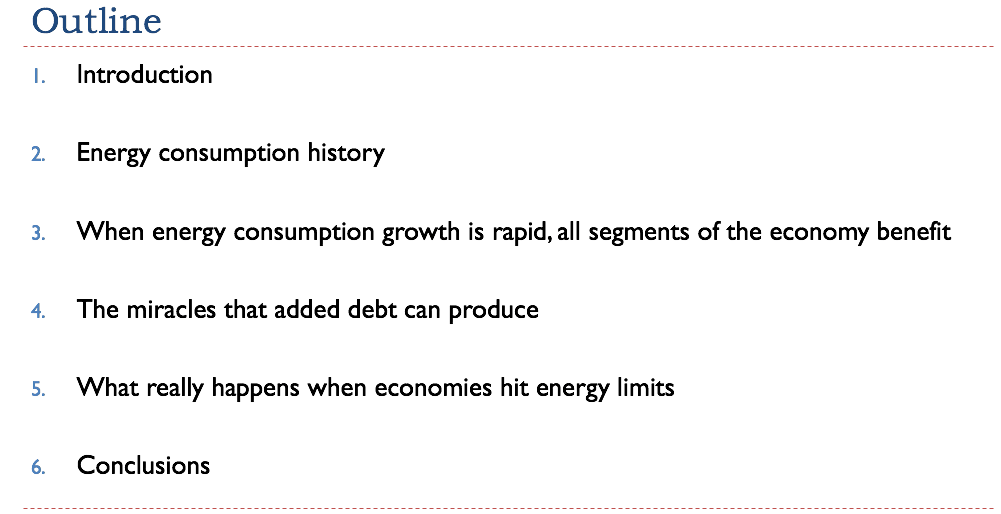
This post covers only Items 1, 2, and 3 from the Outline in Slide 2. I will save Items 3 through 6 for a post called “The World’s Fragile Economic Condition-Part 2.”

Slide 3
Slide 4
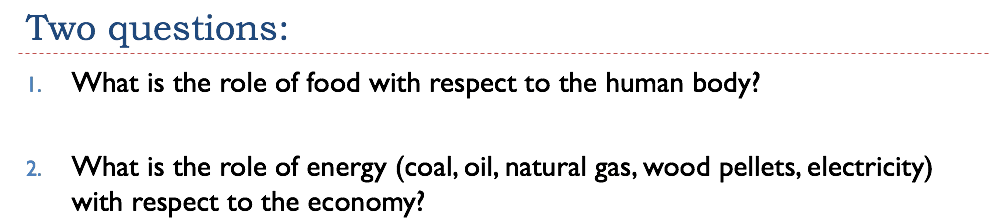
The audience was able to guess that the situation for humans and the economy are parallel. Energy in some sense powers the economy, in a way similar to how food powers humans.

Slide 5
On Slide 5, I am pointing out that changes in the red line, denoting energy consumption growth, tend to come before the corresponding changes in the blue line. This is one way of confirming that energy consumption causes GDP growth, rather than vice versa.
In recent years, countries have found ways of creating GDP growth, without adding true value. This may explain why GDP growth is higher than Energy growth since 2013 on Slide 5. As an example of GDP growth with overstated value, a large share of young people are now being encouraged to purchase advanced education, at considerable cost. This would make sense, if there were suitable high-paying jobs for all of those graduating. It is questionable whether this is the case.

Slide 6
Of course, the issue is not only energy consumption, just as our health is influenced by more than simply what food we eat.

Slide 7
At one time, the emphasis in physics was on systems that are “closed” from an energy point of view. Such systems never grow; they simply decline toward “heat death.”
The real world is made up of many structures that grow and change over time. This growth and ability to change is possible because the energy system we live in is thermodynamically “open,” thanks to flows of energy from the sun, and thanks to fossil fuel energy, which represents stored solar energy from long ago.

Slide 8
The answers to the questions on Slide 8 are easy to guess.

Slide 9
The economy adds new businesses, as citizens see new needs and set up companies to meet those needs. Customers make choices regarding which goods and services to buy, based on their income (primarily wages) and the prices of available goods and services. Governments gradually add new laws, including changes to the way taxes are assessed. The system gradually grows and changes, as the population grows, and as the quantity of goods and services created to meet the needs of that population increases.
One thing to note is that the goods and services produced by the system will eventually be divided among the various players in the system. If one group gets more (say, those receiving interest income), then other groups will necessarily receive less.
Another important point to note is that as new products are added, old ones disappear. For example, once cars came into use, we lost the ability to go back to horses and buggies. There are no longer enough horses; there are no longer facilities to “park” the horses in downtown areas, while at work or shopping; and there are no longer services to clean up after the mess that the horses make.
Without being able to go backward, the system is quite brittle. It would appear that under sufficiently adverse conditions, the entire system could collapse. In fact, we know that many ancient civilizations did collapse, when conditions weren’t right.

Slide 10
The strange interconnections of a networked system make the world economy behave in a different way than we might initially expect. Later in this presentation (in Part 2 of the write-up), I will show some examples of inadequate energy supplies leading to very different results than high prices.

Slide 11
The model of The Limits to Growth looked at how long resources might last, before the growth of the world economy came to a halt from a variety of problems, including a lack of easy-to-extract resources. In some ways, the model was quite simple. For example, the model did not include a financial system or debt. In the single most likely scenario, the base run, the world economy hit limits about now, in the 2015 to 2025 time period. The authors have said that, once limits are hit, the forecast on the right-hand side of the chart cannot be relied upon; the model is too simple to forecast how the down slope might actually occur.

Slide 12
–

Slide 13
The pattern of world energy consumption seems to be one of rapid growth, especially in the period since World War II.

Slide 14
Energy consumption growth is particularly high in the period covered by the red box. In other words, energy consumption growth is particularly high from the 1940s through the 1970s. If the economy relies on energy, we would expect this to be a particularly booming period for the economy.

Slide 15
We can break energy consumption growth down into two components: (1) the portion to cover higher population, and (2) the portion to cover improved standards of living. Looking at this chart, it is clear that “higher population” takes the majority of the increase, except when increases are very large.

Slide 16
I have labelled the three big bumps with my view of what seems to have led to them. The first is early electrification, when street cars were added and when the early mechanization of farming was implemented. The second is the postwar boom and the third is the recent period of globalization, led by China’s major ramp up in coal production.

Slide 17
China’s energy consumption grew rapidly after it joined the World Trade Organization in 2001. The thing that most people don’t realize is that China is reaching limits on its coal extraction. Its coal production seems to have peaked about 2013. Its comparatively tiny amount of wind and solar (shown in orange on the chart) is not making up the shortfall. Instead, China is being forced to rely more on imported energy. Imported energy tends to be higher in cost, and may be limited in supply. For all these reasons, we cannot rely on China to continue to power future world economic growth.

Slide 18
It is not just China that gets only a small share of its energy production from wind and solar. This is also true of the world as a whole.

Slide 19
–

Slide 20
Boxes 1 through 4 show a different model of how the world economy works than that shown earlier (in Slide 9). In Slide 20, the Economy (in Box 3) acts like a giant factory. It uses Resources of various kinds (a few of which are listed in Box 2) to make Goods and Services (a few of which are listed in Box 4). If the Economy is getting to be more and more efficient, Box 4 will expand much more rapidly than Box 2, producing a great abundance of goods and services. If this happens, all of the Resource Providers in Box 1 (plus some I have failed to list) can be rewarded more than adequately for their services, with Goods and Services produced by the economy. The transfer of these Goods and Services occurs through the use of money.

Slide 21
Everyone can get rich at once!

Slide 22
The top line is GDP growth including inflation; the bottom line is GDP growth excluding inflation. Before the dotted line, both GDP growth rates and inflation rates are high; after the dotted line (when energy growth was lower), they tend to be lower.

Slide 23
Interest rates were raised to try to damp down oil and other energy prices. We will see in a later section that reducing interest rates helped hide the fact that energy growth was slower after 1980.

Slide 24
The wages shown on Slide 24 have already been inflation adjusted. Thus, in the period before 1968, wages for both the lower 90% of workers and for the top 10% of workers were rising rapidly, even considering the impact of inflation. Many families were able to afford a car for the first time. After 1980, the wages of the top 10% rose much more quickly than the wages of the bottom 90%.

Slide 25
In 1930, wage disparity seems to have been at about today’s level. Early mechanization had replaced many jobs, both on the farm and elsewhere. Farmers who could not afford the new technology found that they could not produce food cheaply enough to compete with the low prices made possible by the new technology. The growing wage disparity meant that a large share of the population could not afford more than the basic necessities of life. The many people with low wages kept demand for most goods and services low. Oil prices were low, and there was a glut of oil, not unlike what recent markets have experienced. New tariffs were added, and immigration was restricted.

Slide 26
The period before the mid-1970s is when a great deal of the United States’ infrastructure was built. The Eisenhower Interstate Highway System dates from this time period. Many of the oil and gas pipelines and electricity transmission systems in use today were also built in this period.
Once the price of oil and other energy products started rising, it became much more expensive to add or replace this type of infrastructure. Once oil prices rose, more debt at lower interest rates seemed to be needed to keep the economy growing, as I will explain in Part 2 of this write-up.

Slide 27
The least expensive to extract oil supply–US oil supply in the contiguous 48 states that could be extracted by conventional means–was developed first. Alaska production was added when it was clear that the early supply was starting to deplete. It was more expensive, as was North Sea oil, which was also added after early US oil began to deplete.
Once oil prices rose in the 2005-2008 period, companies became interested in developing oil from shale formations (sometimes called tight oil). This oil seems to be much more expensive. It is doubtful that this oil is profitable at today’s prices.

Slide 28
Many people believe that oil prices will rise, indefinitely, with the cost of production. The thing that they don’t realize is that high oil prices tend to lead to recession. When this happens, employment drops, and the average buying power of the population no longer rises–it tends to remain flat or falls. As a result, high oil prices do not “stick.”

Slide 29
We are today in a situation where oil prices have been too low for years. For a while, this situation can be hidden, but eventually low investment can be expected to lead to lower production of energy products. It is even possible that some governments of oil exporters may collapse from lack of adequate tax revenue. Governments of oil exporters often obtain over half of their total tax revenue from taxes on oil production. Adequate tax revenue for these governments requires a high selling price for oil.
The situation with food prices tends to parallel oil prices. This occurs partly because oil is used in growing and transporting food, and partly because of substitution issues. For example, corn can be used to make either ethanol for vehicles or food for people.

Slide 30
M. King Hubbert was one of the early scientists who talked about what appeared to be a problem of running out of oil and other fossil fuels. While I call him a geologist, he really was a geophysicist. The catch was that the physics thinking of the day was mostly about “thermodynamically closed systems.” If closed systems were the problem, then running out of fossil fuels that could be extracted using current techniques was the major issue.
Hubbert and others did not realize that energy supply is part of a larger economic system, which also functions under the laws of physics. The economic system is part of a thermodynamically open system, not a closed system. It gets energy both directly from the sun and from fossil fuels, which provide solar energy stored as fossil fuels.
The issue is how this larger economic system behaves: does it allow the oil prices to rise to a high enough level to extract all of the oil and other fossil fuels that seem to be available? I don’t think it does. But under the “right” conditions (lots of debt growth), the economic system does allow energy prices to rise somewhat. This is what we have seen since the 1970s.
It is extremely difficult to figure out what true costs and true benefits are in a networked system. The standard approach for evaluating the benefit of wind and solar considers only a small part of the system. If the proposed devices do not directly burn fossil fuels and if not too much fossil fuel is used in their production, the usual practice is to assume that the devices must be helpful to the overall system, because they seem to be “low carbon.” This approach leaves out many important costs.
The problem is that wind and solar are not now, and never can be, standalone devices. When all costs are considered, they are simply very inefficient add-ons to the fossil fuel system. These costs include buffering services (using batteries or other storage), the cost of capital, the cost of leases, and wages and taxes. A very high-cost electricity generating system is not likely to be helpful to the economy because such a system is very inefficient. It can be expected to affect the economy as adversely as high-priced oil does.
Slide 31
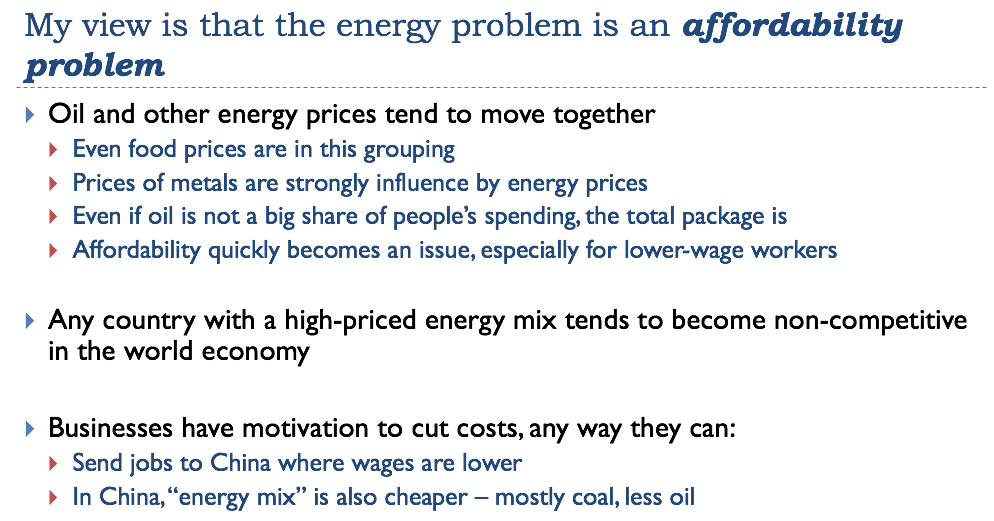
An economy operates best when energy costs are very low because goods and services made with this low-cost energy tend to be low-cost as well. Oil is used in producing and transporting food. Thus, low-cost oil tends to produce inexpensive food.
If energy costs begin to rise in a country, it tends to make that country less competitive in the world marketplace. It also tends to push the country toward recession, because the higher costs are difficult to recover from customers whose wages don’t rise to cover the higher costs.

Slide 32
Many people believe that the amount of fossil fuel that will ultimately be extracted depends on a combination of (a) the amount of resources in the ground, and (b) the technology developed for extraction. While these are indeed eventual limits, I think that a maximum affordable price limit comes much sooner. This depends on how high a debt bubble the economy can sustain. The role of debt will be discussed in Part 2.

Slide 33
One thing that is confusing is the familiar supply and demand curve for energy. Many people believe that “of course” prices must rise if energy is scarce. The catch is that energy consumption affects all parts of the economy. It takes energy to create jobs, just as it takes energy to produce goods and services. Because both supply and demand are affected by a shortage of energy, our intuition regarding how prices should move can be totally wrong.
The word “Demand” is confusing, also, because most energy use is difficult to see. Most energy use is not found in the gasoline we buy at the pump or the electricity we purchase. Instead, energy is used in creating the streets that we drive on, and in building the schools that our children attend. Building new homes and manufacturing cars also takes huge amounts of energy. If energy costs rise very much, the problem is that many people can no longer afford homes or cars. Instead, young people live in their parents’ basements indefinitely. Governments may decide to stop paving some roads, because repaving is too expensive to afford. Reduced demand for oil might be better described as reduced purchases of goods and services of all kinds, because certain groups of would-be buyers find prices too high to afford.
[To be continued in “The World’s Fragile Economic Condition – Part 2”]


Gail, I’m wondering how your model will change if you would account for debt as a promise of more into the future. Sort of like a trust in the narrative of more, the expansion. You were one of the first to point out that the interest (and by extension “added value”, which is also a promise of more) does NOT exist (and IMHO MUST not exist, or hyperinflation happens). I see money as a psychological phenomenon (positive EROI, trust of getting more), not merely as a promise for future goods and services. As a logical explanation, positive EROI is necessary for survival (and the better the EROI, the better the standard of living), so promises of more are merely an extension of a biological imperative.
PS: I’m here for Fast Eddy’s comments. https://www.youtube.com/watch?v=Oc2bWmOT6Ds 🙂
PPS: and for your blog posts 🙂
The story is more than/different from EROI. We are up against multiple limits. One of them is too much use of capital instead of labor. This shifts the output of the system to the top 10% or even top 1% of the system.
EROI looks at one narrow piece of the system, and calculates a ratio based on a system that does not consider quality at all. Intermittent electricity is equated with good quality electricity, delivered to where it is needed, for example. It can be misleading. I would not use it for much of anything.
Positive EROI (actually EROI greater than 1.0) doesn’t tell us anything at all. We need oil less than $20 per barrel. This equates to EROI of 50:1 or greater. The system suffers badly from lack of understanding regarding how the economy works.
I think EROI is useful aid for beginners to understand of how our energy based economy works. And why it cannot continue going beyond a certain point. I think that using EROEI to predict dates/times and or determine the efficacy of energy sources is beyond its capability. It is too simple of a concept to extrapolate into something as dynamic as our global economy.
I think of EROI as a calculation in one dimension, when we have a problem in more than one dimension.
If EROI is low (and I think “low” may be less than 50:1, not less than 10:1 or less than 3:1 or 1:1) that is a problem. Not having a proper “base” for what a passing EROI is makes the whole discussion sort of a waste of time. In a sense, if an EROI of some lower level is chosen as passing, it is saying that some diminishing returns is OK. The economy can somehow handle the situation (perhaps with lower interest rates and more debt, but not otherwise).
But there are other deal-killing problems, besides what is measured by EROI. Too much use of capital is also a problem that EROI doesn’t measure. This is why EROI seems to give wind and solar a “pass,” when on the basis of the amount of capital and thus required debt, it is a no-go.
Total unsubsidized cost needs to be very low. I expect it needs to be lower than the equivalent of $20 per barrel for oil. Wind and solar fail on this basis as well.
End of the Oilocene: The Roar of the Oil-Fizzle Dragon King
http://www.feasta.org/2018/09/20/end-of-the-oilocene-the-roar-of-the-oil-fizzle-dragon-king/
Good read !
yes, a good read…
the penultimate paragraph:
“We urgently need to start talking about what is coming, the reasons why, and how to survive it as a society. Plan B is urgently needed, and new very creative policies urgently need to be devised around the core question of initially how to survive the coming crisis, and subsequently to maintain a hopefully reasonable standard of living and economic activity using a fraction of the energy and resources we currently use.”
very weak… most talks and plans will be futile…
BAU will continue until it doesn’t… no talking or planning will change that…
human nature guarantees that we will consume as much as possible for as long as possible…
we “discount the future”… definitely… “today” is (almost) everything…
the last sentence is strong:
“Time is short.”
“BAU will continue until it doesn’t… no talking or planning will change that…human nature guarantees that we “
That’s how I see it as well.
Musk Settles with SEC, Booted as Tesla Chairman. SEC Forces Tesla to Control his Lie-Tweets
https://wolfstreet.com/2018/09/29/musk-settles-booted-as-tesla-chairman-sec-forces-tesla-to-control-his-lie-tweets/
he stays on the board but not as chairman…
he remains CEO…
so his “total control” of Tesla will be diluted…
too bad…
it would have been much more fun to watch the Tesla train wreck with him at the controls…
What do people here think of the concept of “peak oil” ? How would you define it, if at all? Gail says she is not a peak oiler and considers the concept to be outmoded. One fellow did not like this at all:
https://baudoom.wordpress.com/2018/09/15/blog-review-gail-tverbergs-our-finite-world-not-a-peak-oil-blog/#comment-33
I admit I still think of the general subject area with which Gail deals as “peak oil”, but with the important financial and economic subtleties that she brings to the subject, it seems there is no single catch-all term that fits.
I kinda get Gail’s explanation of Peak Oil or the lack thereof. If I understand her correctly, there’s no such thing as Peak Oil because there’s enough oil to pull out of the ground and it all depends on how high you can blow up the debt bubble. The debt bubble is the money the energy producers use to pull it out of the ground. If you can inflate the debt bubble high enough there’s always enough money to go find oil, implement new technologies such as fracking and pull it out of the ground.
Then my mind goes 180 deg in the opposite direction because all I read is how we are finding less and less oil. We are pulling less oil out of the ground and we are going to extreme measures to get it, BP even says we have roughly 50.2 yrs left of discoverable oil left. That even includes inflating up the debt bubble. So I kinda get where she’s going but my brain is stuck with all the low hanging fruit has been plucked and there’s less oil to pull out of the ground.
Rodster, what you say is correct. If you look at the small picture, you can see either 1)you need a lot of money to bring out the oil or 2) oil is getting less.
If you look at the big picture (which many people just simply could not), they are both linked. It is just one big picture.
Analogy, there is this gigantic apple farm. When the doors opened to humans, they rushed in and just picked the apples with their hands (literally low hanging fruit). They got greedy and took all the low hanging fruit and then they need to tip toe to get some higher ones and at some places, they need a step stool. After sometime, step stools are common and they need a short ladder. After that, a longer ladder. All these step stools, ladders are all “cost” that needs to be put in place to get the oil. You need more and more sophisticated equipment to get the apples which are now getting more and more difficult to get.
Since the farm is gigantic, there will always be lots of apples. The question here is that – do you want to get a crane or a helicopter to pluck the apples from the top most branch of the tree? EROEI will tell you that the energy that you spend to get the apples will be so much higher than what you can get from the apple itself. Based on this example, I think people will just stop at small cranes or tall ladders. It is just too expensive to get a crane to pluck the apples. Even if bags of money drop down from the sky, there is a limit to how you can spend on getting the apples.
With enough energy, one can even extract gold from sea water (there millions of tons probably inside the water). You can even combine CO2 and water (break the hydrogen-oxygen bond to get the hydrogen) to form oil.
Think back – Does it make sense to make hydrocarbons this method? You have access to a great source of energy and you are using it to make gasoline?
There is a limit to everything in this dimension of universe. Too much sugar, water or any of the good healthy stuff that you eat will eventually harm you. Same goes for debts.
It does not mean that you are wrong for 4 years (of predicting doom), you will continue to be wrong. As I have said, it is just that some people got it earlier, some people understand it later and some of them do not even know what hit them. Have a great Sunday.
There are different kinds of oil. And there are different levels of discovery. You have to “read the fine print.” Otherwise, there are a lot of apples to oranges comparisons. Discovery in some contexts seems to mean, “Look at closely enough to figure out how your oil company will be able extract this particular oil in a way that has a reasonable chance of being profitable.”
If we include all of the oil resources we know about, which have already been (sort of been) discovered, there is plenty of oil, if oil prices go to something like $300 per barrel. If oil prices are a whole lot lower–say $80 per barrel, or $50 per barrel, the amount that can be profitably extracted falls way, way down.
One of the distinctions is “conventional crude oil.” This is liquid oil that is found in conventional formations. This is the one which a person reads is falling. It doesn’t include very heavy oil and it doesn’t include oil from fracking. It doesn’t include the liquids part of natural gas liquids. Indeed, this is falling. This is (sort of) the inexpensive to extract oil. But it is not really defined in this way.
This is a chart that the International Energy Agency put together a few years ago, giving their estimates of the amount available at different prices.
https://gailtheactuary.files.wordpress.com/2016/07/2015-iea-weo-figure-1-4.png
Their chart distinguishes among three types of crude oil:
(1) Conventional oil
(2) Tight oil — in other words, oil from shale formations
(3) EHOB = Extra heavy oil and bitumen
For all three, if prices go high enough, we could get a huge amount out. The problem is that prices can’t go high enough. How high prices can go depends on the size of the debt bubble.
Not all energy is equal..
Coal cannot work without crude, crude cannot work without coal, natural gas cannot work without both oil and coal, unconventional oil cannot work without any of those, and so on etc.
I agree.
EROEI tries to measure all energy as equal, and that is a problem.
gail i believe 300 dollar oil is on the cards the government will be able to afford it because they have a printing press and a future of negative interest rates, what i believe will take us out is hyperinflation
300 dollar oil = hyperinflation. first, those countries tied to the petrodollar go pop, then the USA. those countries divested of the petrodollar may survive, especially if self contained, e.g. Russia, perhaps China, Iran.
then everything else linked to oil would take a similar hike
thus you would have $300 food/heat supplies, one way or another.
which would mean everyone in poverty or close to it now would starve/freeze to death.
But all this happened back in the 70s when oil quadrupled. So it did, but then oil quantities quadrupled which cancelled out the rise. Everything settled back into the status quo for a few more years
until now
where we’re back in the same situation, but with no possibility of quadrupling oil output again
there’s you difference
One thing is the amount of oil in the ground, and another thing is how fast can we extract it. There may be trillions of barrels in EHOB, but we won’t be able to extract it fast enough.
You are right about extra heavy oil being slow to extract. It usually requires some kind of heat for the extraction process. The fuel uses for heat tends to be natural gas, because natural gas is much cheaper than oil. Nuclear has been suggested as well. I don’t think solar has been suggested by anyone–intermittent solar thermal heat could in theory be used for heating.
It is the growth rate of the entire energy supply that is important in determining how fast the world economy grows. If the growth rate is too slow, it is hard to repay debt with interest.
Gail, Glasspoint is using solar to heat oil fields in Omam.
https://www.glasspoint.com/
That seems like a reasonable approach. It is related to hot water heating. It is not an issue of creating electricity 24/7/365.
https://imgur.com/a/rBtIrfg
Note that this is “conventional oil.”
This study has conventional/unconventional and coal and gas..
Projection of World Fossil Fuels by Country (Mohr, 2015)
https://www.scribd.com/document/375110317/Projection-of-World-Fossil-Fuels-by-Country-Mohr-2015
These projections assume that a collapsing world economy is not a problem. Demand will be there, when needed. Population will continue to rise to 11 billion.
They likely represent vast overestimates of the amounts that actually will be extracted. If nothing else, trying to use natural gas by itself pretty much doesn’t work.
Note that is what we are using, except a minor amount of shale oil.
Shall we continue to check the price? We will actually see what comes to pass.
“What do people here think of the concept of “peak oil” ? How would you define it, if at all?”
I would define it literally… to mean that at some point in time, probably in the near future, the world production of oil will reach its peak level and then decrease, never to reach that level again…
why not define it thus?
I still think it’s way cool that Hubbert, using his math skills with the data available to him in 1956, predicted the US peak in 1970, which was spot on, given his limited data ie no data on Alaska or the “tight oil” that could be extracted using radical amounts of debt that was beyond the sane imaginings of the oil industry back then…
the majority of so-called “experts” in economics would likely not be “peak oilers” so it’s important (to me) not to deny the reality of peak oil…
but it’s also important not to deny that earlier attempts at explaining peak oil were simplistic…
deniers would point to the new record that has recently surpassed 1970 and say “see, they will always think of something”…
this is where OFW has reached an overall understanding of the many aspects of peak oil besides just geology… debt and finance and politics etc…
so peak oil WILL HAPPEN SOON, if it hasn’t already…
it’s just that now, some people (like readers of OFW) have a broader understanding of how and why it will happen…
for “conventional” oil, the peak is probably in the past…
for “total liquids”, the peak seems likely before 2030…
the appearance of a major black swan could bring an immediate peak…
I think the limit is peak economy. It comes when energy per capita is no longer rising quickly enough to keep debt being repaid with interest. All types of energy supply decrease at the same time. The result is much more of a Seneca Cliff than a Hubbert Curve.
I’m dreading the Seneca Cliff and the loss of continually progressing technology.
I’m not excessively materialist, but my best buy this year was a solid state drive to replace my hard disk drive, which was slowing markedly. The SSD cost only 71 British pounds for 250 GB, though in reality you get around 232 GB after all the system stuff has been accounted for – more than enough for my purposes. The SSD works like a dream. My desktop used to take about 2 minutes to close down, but now with the SSD, it closes before I get the chance to get up from my chair. Looking at desktop PCs with any SSD included, they are usually over 1000 pounds, but you can install your own SSD in any modern PC for much less. I’m surprised that computers are still being made with HDD storage instead of SSD.
What are your own favourite recent hi-tech buys, and for how long do you think technology will continue to progress markedly?
I am afraid I am fairly cynical about hi-tech buys. In 1970, calculators were rare. “Clerks” would have fancy adding machines on their desks. If two numbers were to be multiplied, the adding machine would add them together that many times. If division was needed, the adding machine would subtract the divisor, as many times as it could, and eventually tell you the result.
In this early era, the secretaries who typed letters, using carbon paper for copies, were very valued members of the office team. A person who hand-wrote a memo, and asked a secretary to type it up, would be filled with fear if he or she found that the paper from which the typing was done contained an error of more than a single letter or character. Often, a whole page would need to be retyped.
I am not certain that things worked very much less well in this early era. There were cars, rail systems, and planes that went about as fast as today. Telephones used land lines. There wasn’t e-mail; there was snail mail. There were mainframe computers, even at this time. Punchcards were a standard method of input. Office buildings didn’t look too different from today. Most of our roads, bridges, pipelines, and electrical transmission systems pre-date 1970.
I take your point about certain items. However, computers and the internet truly have brought about an information revolution. I can search my own computer data at high speed and come across info on the internet that I’d never even heard about. Of course, caution must be used too, as regards assessing found information.
But really, would you personally be so far ahead now, if you’d still had to write and post letters to people and wade through books and paper documents, looking for specific facts? And the synergies of the internet are enormous. And try doxing yourself online. See how many people refer to your work, that you wouldn’t have known about otherwise. However, if you’d like to return to the mangle and the crank handle, be my guest. 😉
On a practical level, I do not know how efficient the manufacture of an SSD is compared to an HDD, or how polluting it is, or whether an SSD uses rare earths that an HDD doesn’t.
I think what has happened with the huge amount of data we have is excessive focus on the detail, and lack of attention to the big picture. Technology seems to work based on being able to make small details work. The catch is that overhead becomes so high that the overall system becomes too expensive.
Very clearly put. So we need to think about conventional oil, tight oil, total liquids. It depends on which factors you consider to be important, and which way you choose to look.
Agree with your definition.
A not too large drop in total energy production from a peak two years earlier and a financial crisis and we could conclude that was peak oil.
Thank you all for your analysis. That makes things very clear. The only remaining question is, who still thinks in terms of “peak oil”, or if not, what is a better catch-all term to catch the subtleties of the situation?
I think of peak oil as the year that the most oil will be consumed in. That year will certainly mark the end of growth. Without growth there can not be a financial system as we know it.
There is no way to forecast or predict the year peak oil will occur. But I can see that with each passing year the rate of growth in oil consumption is flattening. Still creeping up though. In 2005 a global consumption of 100 million barrels per year was deemed unlikely … yet here we are.
https://cdn1.investingdaily.com/res/images/2017/06/World-Oil-Demand-e1497481237310.png
From:
https://peakoil.com/consumption/robert-rapier-global-oil-demand-hits-new-record-high
Here’s an EXCELLENT article Chris Martenson posted on Peak Prosperity everyone should read and YES it’s all about our thirst for that liquid called Black Gold, Texas Tea: “Our Delusional Economy Is Poised To Slam Into The Brick Wall Of Reality”
https://www.peakprosperity.com/blog/114404/our-delusional-economy-poised-slam-brick-wall-reality
Excerpt: “Here’s the thing: Unless there’s a very sudden and rapid change in how we are approaching the looming brick wall of resource shortages, the future is going to be quite difficult.”
Excerpt: “Here’s the thing: Unless there’s a very sudden and rapid change in how we are approaching the looming brick wall of resource shortages, the future is going to be quite difficult.”
No change is required. There is no change possible. We must burn more energy. Every day more than the last.
And the future will not be difficult. There is no future.
maybe if everyone shouted at the sky in unison, outside help would arrive.
I definitely disagree with some of what Martenson says. In particular, his points 4. and 6. are nonsense.
These are
4. A little self-sacrifice today would go a long way in the future.
6. Therefore conserving and controlling energy are determined by political will.
Reducing fossil fuel use means reducing jobs and collapsing the economy. It is not something anyone should want to do.
His point 5 is pretty iffy as well:
5. Energy output creates political power.
While this point is true, energy consumption creates jobs. It creates stable governments. Energy consumption allows the high level of food production per arable acre that we have today. There is nothing reasonably we can do to reduce energy consumption. Doing so would be like giving up food. It simply collapses the overall system.
No matter what we do, the future is going to be worse than difficult. We need some outside help.
I posted the article becuase the fact is we will hit that brick wall at some point. Chris has to sell Hopium, I do get that but the end result I took from his article is that nothing will change the tragectory we are on. We could have done something about it decades ago but that ship has sailed.
I agree we “could have” done something 40 or 50 years ago to slow down the inevitable. But, on the flip side of that, we wouldn’t have all the technology we have today either; not necessarily a bad thing.
As far as humans are concerned, using less resources is like trying to get a heroine addict to use less heroine. It just doesn’t work. Energy consumption is ingrained in our DNA. Once people saw the power of fossil fueled growth, for every one person in positions of authority that says we must conserve, there were many more that wanted to consume even more. If there is money to be made by burning more fossil fuels you can bet your bottom dollar more fuel will be burned.
I have come to the conclusion that any attempt to counter fossil fueled growth is like pissing into a 60MPH wind. It can be done…yes…but you won’t like it.
I think that the communist countries have done as much as any to slow down economic growth. Giving fairly equal wages to all doesn’t encourage the best work ethic. Using little debt makes it hard for countries to grow because they cannot afford to buy new machinery and citizens cannot afford to buy new cars and homes. The central government of the Soviet Union collapsed, at least indirectly because the country was not doing as well as other oil exporters. Even now, Russia, Cuba, and North Korea have been lagging behind. If an inappropriate enough system is chosen, a country can truly lag behind.
I would expect that trying to go to 100% renewables would be a good way to slow down an economy as well. Going to electric cars would be another way to slow an economy down. Lots of money sunk/wasted on things that don’t work very well.
“No matter what we do, the future is going to be worse than difficult. We need some outside help.”
What’s the difference between outside and inside?
That’s a very deep and profound question.
I seriously wonder if anyone on this site is clever enough to fully appreciate it, let alone provide an adequate answer.
Most of us these days are taught that we live in a Universe in which everything apart from the smallest most fundamental particles are containers and everything apart from the entire Universe taken in Total is content. Under this conception, human beings are both containers and contents, and anything that we contain—all our contents—all that comprises us—is inside us, while anything that contains us or that is not part of our contents—all that doesn’t comprise us—is outside us.
But there are other ways of conceiving the matter. The Hindus, the Buddhists and the Boaters of Eaton are taught that “life is but a dream”, and modern science agrees with that up to a point. Apparently, we create our own experience of reality based on the receipt of sensory data from “outside” and the processing of said data going on “inside” in our minds.
Based on this view, we might say that the Universe as we perceive it or believe it to be is a figment of our imaginations. We contain the Universe in our minds. If so, what contains our imaginations and our minds. Are they inside or outside the Universe?
Elon Musk recently pondered whether we were all living in a simulation. The verdict is not yet in, but my hunch is that Elon himself could very well be doing that. Or then again, perhaps he’s been smoking too long.
https://youtu.be/0vzkB8fScIY
Indeed we are an ongoing part of the process that is called the universe. There is no separation between our human existence, thoughts and feelings. It is a complete and all-encompassing part of the universe.
Speaking about the universe as a simulation. It depends what one means by a simulation.
Is the bits and bytes inside the computer a simulation or are they an integral part of the machinery that runs them? Is it possible to pick the system apart and point at the simulation as an entity separate from the machinery, in the same manner a human can’t be ripped out of the universe and somehow retain its physical laws?
A simulation is only relevant and has meaning inside the system which it simulates. Anything outside the system is by definition not running a simulation. Then for all intents and purposes “it” runs reality, which is no simulation by definition.
Outside and inside: ‘Allah is closer to you than the vein of your neck’; the Kingdom of Heaven is within you’, ‘You are your own obstacle, rise above it’ etc.
I think outside help would entail something like getting another Earth to use up for free. But, even if we did get another Earth to use up, we wouldn’t get a repeat of 200 years of growth. Instead, we might get 20 years out of another Earth. Then, we could get another free Earth and get an additional 2 years of growth. So, we get a fourth Earth and its gone in 2 months, then every few days we would need another Earth to consume.
Exponential growth is a killer. The only reasonable solution is to live in sync, in real-time, in harmony with the natural world and take things at the pace they are offered us instead of trying to rig the system in our favor.
How about starting over in an entirely different kind of universe, without resources or energy supplies or food?
i think that’s called a black hole
Touche!
I am wondering if there hasn’t always been an “outside” something going on that an errant species couldn’t see?
What do you mean? It happens all the time 😉
https://youtu.be/bWcASV2sey0
My hero is Albert Bartlett.
“Our Delusional Economy Is Poised To…”
just to add my 2 cents worth:
there’s nothing “delusional” about our economy in the present:
there is BAU in IC and it is real and it works to give billions of us a level quite a bit above poverty…
of course, it is delusional to think that this will last for many more decades…
My Twitter account has been locked by the thought police due to unusual activity.
I was talking with an information warfare expert about global warming. I don’t even deny global warming. Recycling co2 back into the atmosphere to warm up the planet is a good thing. I mentioned falling net energy from fossil fuels and that the fighting and kiIIing over what’s left has started.
I guess I crossed a sacred line with climate change?
🙂
First they came for the deniers. All kinds of deniers. Who denied any of the established orthodoxies.
Then they came for the racists, sexists, ageists, lookists, ablists, homophobes, white nationalists, home school schoolers, gun owners, anti-vaxxers, and bakers who refuse to make cakes for couples planning same-sex weddings.
Then they came for people who pointed out that the WIlliams sisters were, biologically speaking, brothers, or that Rachel Maddow possibly had a Y chromosome or else was a replicant.
And next they rounded up the conspiracy theorists, including those who believe that Elvis, Lives, Levis, Evils, Viles, and Veils sharing all the same letters IS NO COINCIDENCE!
And finally, they came to lock My Twitter account, and there was nobody left to protest. But fortunately I outwitted them by not opening a Twitter account in the first place because Twitter, like Facebook and Instagram and Pinterest are anathema to me, and on the grounds that having a Twitter Account is equivalent to having the Number of the Beast tatooed on one’s genitals. Ha! Ha!
Did the Oil Price Boom of 2008 Cause Crisis?
https://blogs.wsj.com/economics/2009/04/03/did-the-oil-price-boom-of-2008-cause-crisis/
Peak oil caused the 08 crash, they dragged it out a few years by creating money, lowering the interest rate, and dumping cash down the sinkhole that is fracking, but the collapse process has already been initiated..
Buckle up, it’s gonna be a bumpy ride..
Look at my article, Oil Supply Limits and the Continuing Financial Crisis. It shows that a combination of high oil prices and the Federal Reserve’s actions with respect to short term interest rates caused the recession. In fact, the government now is trying to raise interest rates again, in response to high oil prices, among other things.
Trump administration acknowledges g w but says it’s too late to do anything, so party on!
https://www.google.com/amp/s/www.washingtonpost.com/amphtml/national/health-science/trump-administration-sees-a-7-degree-rise-in-global-temperatures-by-2100/2018/09/27/b9c6fada-bb45-11e8-bdc0-90f81cc58c5d_story.html
but trump said that The concept of global warming was created by and for the Chinese in order to make U.S. manufacturing non-competitive.
https://twitter.com/realdonaldtrump/status/265895292191248385?lang=en
The global warming concept clearly benefitted the Chinese and Indians greatly. The Kyoto Protocol, in effect, told countries to limit their own CO2 emissions. But there was no charge for goods and services imported from elsewhere, made with coal. In fact, there was no charge for ramping up the overall building in these countries–for example, the millions of concrete homes built in China, and the huge amount of concrete roads built in China, to further its new place as primary producer for the world economy. The Kyoto Protocol, in effect, said, “Go ahead and ramp up your coal based manufacturing industry; we won’t compete with you any more.”
Economists, who could not think any more broadly than looking at each economy separately, assumed that reducing emissions locally would somehow fix the world situation. This is complete hog wash. It represents a problem with models that are not sufficiently complete. Unfortunately, the climate change models are not sufficiently complete, for the same reason. They model future scenarios that cannot possibly happen, because we cannot get energy prices high enough, for long enough, to extract most of what we see in the ground. The economy cannot continue growing for very long.
I agree, but the current atmospheric chemistry might already be sufficient to melt down the poles; it could be a matter of the process taking a long time to run its course.
If things proceed in the direction they seem to be heading, humans won’t be around to observe the outcome, anyhow. It is just one of this things that happen.
We should sue Mr God for dereliction of duty. A few decades in a US jail, alongside all those former celebrities and rogues, would make him rethink his attitude.
I should add that perhaps the story of climate change is a type of miracle, which has allowed BAU to more or less continue for at least a few years beyond the time peak oilers thought that the system would collapse. Adding coal from China, India, Australia, and other countries helped to “average down” the average energy cost, and keep the system operating a few years longer than otherwise it would have continued to operate. Our problem is not with running out; it is with high average energy cost. Finding a way to add more coal to the mixture (and thus reduce average costs) was a true miracle. We simply don’t frame the story in the correct way.
Furthermore, climate change and technology have helped create a new religion. Another part of the new religion relates to the ability of our financial leaders to fix all problems with interest rate. We have high priests of several types–scientists with their too-narrow models, and politicians who anoint their favorite economists. People have been convinced that we humans are all powerful (literally). We no longer need supplemental energy to power our system.
The new religious leaders have convinced people that all previous religions were wrong. No one has stopped to figure out that the new religion is equally (or perhaps, even more) wrong. It is based on faith in too narrow models. Unlike the earlier religions, it loses its sense of awe at some energy source outside ourselves.
Without the discredited religions, we end up worse off than we were, with the discredited religions. If there is help to be received, it has to come from outside the ability of humans. Without the sense of awe, the possibility of this happening seems to be truly remote.
Somehow, the world has continued through something like 4 billion years. They are a whole lot of coincidences that have allow human life and economies to form in this world. We don’t really know what is in the next chapter. Our new religious leaders have taught us that thanks to the powers of humans, BAU goes on forever. This story is as untrue as any miracle story you can find in religious writings of any type. We don’t understand the story for what it is.
” If there is help to be received, it has to come from outside the ability of humans. Without the sense of awe, the possibility of this happening seems to be truly remote.”
So well stated.
‘…new religious leaders…’ is exactly how I see the emergence of the new narratives. They seem to hold hands across technology-politics-environment and race/gender issues.
What an ‘unholy alliance’ you might say!
Agreed!
In the big picture, where the laws of physics dictate the outcome, just another form of religion, I guess. http://evonomics.com/tragedy-of-the-commons-elinor-ostrom/?utm_source=newsletter_campaign=organic
As far as I can see, there has to be an “organizer” behind the laws of physics. Creation seems to be continuous. There is some literal Higher Power that makes the whole system work. A great many early people figured out this principle, but we seem to have substituted a new religion, of everyone being able to do everything for themselves. We have forgotten that there really is a God. This God reveals himself/herself to different people in different ways over time.
We got so hung up on the myths of the Old Testament not really being true, that we didn’t realize that today, we are creating a whole new set of myths. Compound interest indefinitely is a myth. Oil prices rising endlessly is a myth. Technology will save us is a myth. The basic underlying truth–of there being a higher power, outside ourself–is in fact true.
This is not that complicated:
https://static.skepticalscience.com/images/Greenhouse_Spectrum.gif
that is so scary!
it is now 4 parts of C O 2 per 9,996 “other”…
soon it might be 5 parts C O 2 per 9,995 “other”…
we’re doomed!
We were doomed before any CO2 issues came along. And we have essentially no way of fixing the CO2 problem, short of exiting from the scene ourselves.
The meldown we are going to witness is not going to be at the poles; its going to be at the polling stations on November 6, when we will see the complete and total meldown of the disgusting, nasty, and increasingly psychotic Democratic Party. Lying about everything—including about scientific matters—constantly guilt tripping people, and engaging in the politics of personal destruction. And it just gets worse and worse. Trying and convicting people on the basis of zero evidence. Judging them guilty because they like beer.
It’s been a sick and twisted game they’ve been playing. But now the Dems have woken the long-sleeping mass of politically apathetic ordinary Americans. Millions of people were in the dark buy now they know what’s going on now. They see it for what it is—vile, twisted, and warped. And they are angry. You can’t do that to people, not without the mother of all backlashes. And the Dems are going to get decimated come November 6. Save the date. It’s going to go down in history as “Lemming Tuesday.”
Sorry for that. I don’t know what came over me apart from having been watching the Kavanaugh coverage on Fox News.
Since the outcome is already foreordained, don’t bother to vote. Convince all your like-minded friends not to vote either.
Sorry Duncan, but we can’t let this shoddy piece of deception pass undebunked, can we? That would make us complicit in your attempt to to lie to the kiddies.
The truth is that CeeOhTwo is distinctly wimpy as a green house gas compared with the elephant in the room, AichTwoOh, which the graph you’ve posted omits to include.
Here’s a much better graph. Unlike your graph, it covers the bulk of the solar radiation spectrum—not just the tail end of it. And it’s in color. When it comes to absorbing radiation, as you can see, AichTwoOh—the gas your graph fails to mention—is responsible for the red bit. CeeOhTwo is responsible for the green bit.
https://geosciencebigpicture.files.wordpress.com/2018/03/spectrum.jpg?w=768&h=542
You see Tim, the plebs has to stop consuming copious quantities of a finite resource, then at least the bought and paid for shills Al Gore and MSM can give the consumerist horde a bit of bad conscience while the hoi-polloi accepting the stuff they take for granted gets ever more expensive and harder to obtain as entropy steadily increases in the world energy-economic system.
https://news.nationalgeographic.com/2018/02/ross-ice-shelf-bore-antarctica-freezing/
Well, that is coming from a ex tv host/real estate hustler who had a daddy that gave him 100 million dollars and has been bankrupt 4 times.
Perfect leader for late stage capitalism!
“The child already fell into the well, there is no longer any need to cover it.”
http://www.moonofalabama.org/images7/browncoal.jpg
pretty!
Yes, it’s quite picturesque in a “dark satanic mills” sorta way.
Prosperity!
BURN MORE COAL!!!!
Sustainability!!
The Beast!
While not ‘allowed’ to intervene directly until 44/USD, Bloomberg reports that Argentina just hiked its Leliq rate to 65%.
The sharp drop follows Thursday’s 2.8% decline and comes despite the IMF agreeing on Wednesday to increase its bailout package to the Latin American country by an extra $7.1bn.
Paging Christine Lagarde…
https://www.zerohedge.com/news/2018-09-28/aregntina-hikes-rates-65-peso-plunges-new-record-low
The IMF people will be busy this weekend….
busy partying…
peripherals like Argentina can wait until Monday…
OIL (BRENT) PRICE COMMODITY
82.69 USD +1.01 (1.24%)
Well, comrades——-
You know the harder they come, the harder they fall, one and all.
10 dollars a barrel after october the 2nd and BAU will grind to a halt forget any plans you have as panic sets in
oh…
I was planning to give you all of my millions on 10/3…
but we’ll have to cancel…
so sorry…
“… after october the 2nd and BAU will grind to a halt forget any plans you have as panic sets in…”
my NFL schedule shows (American football) games every weekend in October… and November and December…
I have a winning gambling season going… as usual… not much profit but it is fun!
therefore, Creeping Collapse cannot reach the USA before 2019…
I’ve got a skin doctor appointment on Oct 2—
Priorities—–
I need to buy my turkey so I think you got the date wrong. I think you meant Monday sept 2, 2019. That sort of makes sense. However, my source says not until summer of 2020.
82.69 USD +1.01 (1.24%)…
good for major oil producers…
for Russia, the USA etc…
that’s some good news in this otherwise troubled world…
like the saying: every cloud has a silver lining…
The FX trader is expecting a deflationary black swan event, perhaps in the EU, that will lead to a collapse in the WTI that will start at the end of this year. It looks “great” on paper…but who knows?
https://pbs.twimg.com/media/DoRCpa-W0AAozxt?format=jpg
It seems like we have a lot of things that could go wrong and start a downward spiral.
Yes it seems as if we are very close to some kind of event.
yes, I agree…
like the OFW discussion a few days ago about Charles Hugh Smith, who places “some kind of event” for circa 2022-2025…
that timeline is very close…
or maybe even October 2nd…
ya think?
I think that the WTI will rise to 80 USD and then something will break.
Nov-Dec 2018?
It won’t be the end of the world though…
https://i.redd.it/0y53h068k1p11.png
The Fed is raising rates to attract dollars to the U.S. The money flow into the U.S is inflationary for the U.S, but deflationary for the world, which is experiencing a dollar shortage. In compensation the world is printin money in local currencies, which is causing destruction of their own currencies.
The Fed is flexing its muscles. No other currency can do this. To not over heat the U.S economy by raising rates, the Fed has to do some QT as well.
https://m.youtube.com/watch?v=uAE6Il6OTcs
So awesome!!!
You describe the situation well. QT of course stands for Quantitative Tightening, which is the opposite of Quantitative Easing. It involves selling the securities purchased previously.
We are dealing with a “fixed sum” world. There is a total amount of energy products to distribute. There is a total amount of goods and services to distribute. The hope seems to be for the US to get a disproportionate share of the total, as the total fails to rise adequately. It may even begin to fall.
The Inevitable Oil Supply Crunch
“The warning signs are there – the industry isn’t finding enough oil.”
That’s the start of a new report from Wood Mackenzie, which concludes that a supply gap could emerge in the mid-2020s as demand rises at a time when too few new sources of supply are coming online. By 2030, there could be a supply shortfall on the order of 3 million barrels per day (mb/d), WoodMac argues. By 2035, it balloons to 7 mb/d, and by 2040, it reaches 12 mb/d. “Barring technology breakthrough beyond what we already assume, we’ll need new oil discoveries,” the report says.
The precise figures vary, but Rystad Energy came a similar conclusion, noting that the total volume of new oil and gas reserves discovered plunged to a record low in 2017. “We haven’t seen anything like this since the 1940s,” Sonia Mladá Passos, Senior Analyst at Rystad Energy, said in a December 2017 statement. “The most worrisome is the fact that the reserve replacement ratio in the current year reached only 11% (for oil and gas combined) – compared to over 50% in 2012.”
But, of course, that rate of discovery remains far below those levels, so the supply crunch may take place much sooner. Moreover, because large-scale projects take several years to develop, the activity taking place today will determine the supply mix in the mid- to late-2020s.
https://oilprice.com/Energy/Energy-General/The-Inevitable-Oil-Supply-Crunch.html
The crunch is already here…. oil at 80 bucks is not sustainable
According to the OECD Economics Department and the International Monetary Fund Research Department, a sustained $10 per barrel increase in oil prices from $25 to $35 would result in the OECD as a whole losing 0.4% of GDP in the first and second years of higher prices. http://www.iea.org/textbase/npsum/high_oil04sum.pdf
Pingback: Why Must We Be Morons? | OmegaShock.com
Some outside observations from a “foreigner”:
The USA
“The blinkered people, the tax collectors roadside (police everywhere collecting taxes), the tax collecting at every opportunity, the welfare state, the severe drop in service at restaurants, the tattoos, the green hair, the lard-asses everywhere, the severe over-population of great swathes of the country, the hideous media out only to inflame, and not to report, the aged and infirm working at whatever jobs they can find, the homeless everywhere, the beggars, the filth roadside, the severe health issues seen at every turn (people everywhere too fat to walk, carrying oxygen, diabetes inflicted, toothless), casinos one after another, hideous roads, etc. ad naseum, lead me to but one conclusion: the US is fo-cked….They have no insight, no curiosity, no sense of understanding of the world, no vision of anything outside their tiny bubble of existence.”
The art conservator mentality might be compatible with such a situation. Conservator types like the challenge of restoring things, the more deteriorated the better…
https://2.bp.blogspot.com/-ywVbOmJP5dw/WLVpLHMeX6I/AAAAAAAAEc8/uHO_C58G4SkoCcdBe0SrACtXyP0dx-69wCLcB/s640/Whom%2Bthe%2BGods%2Bwould%2Bdestroy.jpg
Subsidizing renewables has cost the German taxpayers and consumers >>>AT LEAST<<< 185 billion $ (conservative estimate) over the past 5 years according to "Die Welt" (big German newspaper).
“According to the latest figures from the Federal Court of Audit , the energy turnaround in 2017 alone cost around 34 billion euros… The resource consumption for the implementation of the energy transition is “unprecedented”.”
https://www.welt.de/wirtschaft/article181690102/Bundesrechnungshof-wirft-Regierung-Versagen-bei-Energiewende-vor.html
Das ist nicht do gut
Interesting, for us that read german, could you send the link?
Sven, I must confess I used Google Translate. I don’t think there is an English version of the article as yet.
“On Wednesday, the U.S. Federal Reserve hiked its benchmark interest rate by a quarter-percentage point to 2% – 2.25%, which is the highest level since April 2008. As rates continue to climb off their post-Great Recession record lows, market participants and commentators are showing almost no signs of fear as the stock market is hitting records again and complacency abounds.
“Unfortunately, “soft landings” after rate hike cycles are as rare as unicorns and virtually all modern rate hike cycles have resulted in a recession, financial, or banking crisis. There is no reason to believe that this time will be any different….
“When central banks set interest rates and hold them at low levels in order to create an economic boom after a recession (as our Federal Reserve does), they interfere with the organic functioning of the economy and financial markets, which has serious consequences including the creation of distortions and imbalances. By holding interest rates at artificially low levels, the Fed creates “false signals” that encourage the undertaking of businesses and other endeavors that would not be profitable or viable in a normal interest rate environment [in other words, malinvestments]….
“Though it can be difficult to tell precisely which investments or businesses are malinvestments in a central bank-distorted economy, a quote by Warren Buffett is extremely applicable: “only when the tide goes out do you learn who’s been swimming naked.” For the purpose of this discussion, “the tide going out” refers to rising interest rates. The mass failure of malinvestments in an economy as interest rates rise typically results in recessions or banking/financial crises.”
https://www.forbes.com/sites/jessecolombo/2018/09/27/how-interest-rate-hikes-will-trigger-the-next-financial-crisis/#3f7139967170
You could argue that one such malinvestment is the fracking industry, which had in aggregate, from mid-2012 to mid-2017, negative free cash flow of $9 billion per quarter, and which has been propped up by over-ambitious equity issuance and artificially low interest rates.
http://www.abc.net.au/radionational/programs/saturdayextra/template/10232684
Or it could be the various property bubbles that have been inflated around the world:
https://www.ft.com/content/723fd474-c21c-11e8-8d55-54197280d3f7
I can certainly believe soft landings are as rare as unicorns after rate hikes.
“A measure of global trade weakened this month, dropping to the lowest since 2016 and indicating a slower pace of growth in the months ahead. DHL cited “rising political tensions” for the slump in its trade barometer, as the tariff battle between the U.S. and China escalated.”
https://www.bloomberg.com/news/articles/2018-09-27/global-trade-is-pinched
“A widely watched private survey of China’s factory activity is expected to show further slowdown in the manufacturing sector’s growth in September, as the country’s trade dispute with the U.S. escalates.”
https://www.cnbc.com/2018/09/28/caixin-china-pmi-september-manufacturing-purchasing-managers-index.html
“Eurozone manufacturers grew less upbeat about their prospects in September, as French businesses saw a slowdown in new orders and pared back production expectations. Consumer confidence also weakened, largely as a result of a gloomier assessment of the economic outlook in France, where growth slowed sharply in the first six months of the year, and Spain.”
https://www.wsj.com/articles/eurozone-manufacturing-confidence-slips-as-french-orders-slow-1538048773
“IL&FS’s defaults have highlighted the risk of a sharp growth slowdown in the world’s fastest growing major economy, as lenders pare their exposure to the shadow banking space, or what are called non-banking finance companies in India.”
https://www.business-standard.com/article/reuters/analysis-india-s-shadow-banking-scare-could-derail-its-robust-growth-story-118092701150_1.html
“Turkey’s economic confidence index has taken a nosedive to its lowest level in nearly 10 years, the Turkish Statistical Institute revealed on Thursday. Economic confidence index decreased by 15.4% compared to previous month decreasing from 83.9 to 71 in September.”
https://sputniknews.com/middleeast/201809271068388645-turkey-economic-confidence/
“Drug gangs and addicts are a common scourge in the Villa Zavaleta slum in Buenos Aires, where even before the recent economic crisis brought them to their knees, the 1,200 families faced a daily struggle just to eat. “Rubbish and excrement fill the streets where a dog chews on a cow’s jaw bone and a drugged woman staggers about.”
https://www.france24.com/en/20180927-argentinas-economic-woes-exacerbate-misery-slum-life
“Argentina has received the biggest loan package ever from the International Monetary Fund, aimed at shoring up the country’s ailing finances: a whopping $57.1bn that will be disbursed over the next three years.
““This is the biggest loan in the history of the IMF,” said the fund’s director, Christine Lagarde, on Wednesday as the final loan agreement was announced in New York.”
https://www.theguardian.com/world/2018/sep/26/argentina-imf-biggest-loan?CMP=soc_567
I see rooftops in the photo…. I don’t understand …. why don’t they just grow food in rooftop gardens?
Poverty acts as a magnet for crime and drugs.
And then there is the police. Last week, three officers were convicted of torturing youngsters in Villa Zavaleta.
“Living in a slum is very hard, very violent. You have to endure economic violence, police violence, political violence. We run the place ourselves because there’s no state presence,” said Fidel Ruiz, 23, who finds it increasingly difficult to find little part-time jobs.
Just sing Koombaya … everything will become…. wonderful
Ha ha, FE’s inner permaculturist was immiedidly starting to design an food system for argentinan slum dwellers. Maeby add aquaponics, beside rooftop gardens, and mushroom growth system? You have never told us if you made your PDC? 😉
They haven’t quite collapsed yet, not if dogs are still roaming the streets.
That is a huge decrease!
“The Italian government agreed to a 2019 budget deficit target at 2.4% of GDP on Thursday night in a move that was celebrated by leaders but could bring the heavily indebted country into conflict with the European Union.”
https://www.theguardian.com/business/2018/sep/27/the-euro-and-stock-markets-fall-amid-italy-budget-fears
“The European Union on Friday issued a stern warning to Italy’s populist leaders following their defiant pledge to increase spending and run a budget deficit that risks putting Rome on a collision course with Brussels. Thursday’s deal on a 2.4 percent deficit for the next three years came after warnings from the European Commission, the EU’s executive arm, to hold the reins on spending.
“It vastly exceeds the 0.8 percent forecast by the previous centre-left government…”
https://www.thelocal.it/20180928/eu-warns-italy-over-budget
“Italian banking shares on course for biggest one-day loss since 2016 Back to Italy now, where the sell-off of shares and bonds continues after the government announced it would increase public spending despite a massive debt pile.
“The benchmark equities index, the FTSE MIB, is now down 2.7% at 20,930…”
https://www.theguardian.com/business/live/2018/sep/28/brexit-fatigue-weighs-on-uk-businesses-and-consumers-business-live
Meanwhile –
“Nearly two-thirds of businesses have yet to do any risk assessment of a no-deal outcome in the Brexit negotiations as “Brexit fatigue” sets in, the British Chambers of Commerce has found. Adam Marshall, the director general of the BCC, said: “Too many businesses across the UK are still not ready for Brexit. Many smaller firms don’t have the capacity to scenario plan, don’t think they’ll be affected or have simply switched off from the process altogether.”
https://www.theguardian.com/politics/2018/sep/28/brexit-fatigue-leaves-british-businesses-unprepared-for-no-deal
Police prepared for disorder due to shortages of food and medicine:
https://www.scotsman.com/news/police-prepared-for-potential-disorder-sparked-by-food-shortages-post-brexit-1-4806595
The SEC announcement points out that just because it’s said on Twitter doesn’t mean it’s OK to blatantly lie to investors to manipulate up the shares. Providing “truthful and accurate information is among a CEO’s most critical obligations,” the statement said. “That standard applies with equal force when the communications are made via social media or another non-traditional form.”
And it doesn’t matter if Musk has a halo: “An officer’s celebrity status or reputation as a technological innovator does not give license to take those responsibilities lightly,” it said.
Alas, these charges apparently do not include the most recent lies, such as his absurd BS tweet three days ago that Tesla was “upgrading” its “logistics system,” and because it was “running into an extreme shortage of car carrier trailers,” it would start “building our own car carriers this weekend to alleviate load.”
Tesla building car carrier trailers over the weekend? What moron would actually believe this blatant lie?
Even if no one believes his blatant lies, he still tells them. But then on second thought, there are many true believers who believe anything he says, and plenty of fund managers that have too much money at stake with their Tesla shares that they rode all the way up into ludicrousness so that they must believe every blatant lie he tells, because they must buy the shares when they sell off because they have too much at stake, and they cannot allow the shares to drop….
https://wolfstreet.com/2018/09/27/tesla-ceo-musk-gets-socked-by-the-sec/
Wolf is not a fan of Musk, it sounds like.
But he is a believer in EVs and renewable energy
“Capitalism as we know it is over”
It can only survive in a grow or die environment.
That is over.
What comes next?
Economic triage unless good leadership among the superstates can commit to some level of powerdown. To Trump’s credit, he seems to have foreign relation flexibility that mainstream Washington does not have, but I’m unsure if it is of any positive consequence. He’s also all-in on pro-growth.
“To Trump’s credit, he seems to have foreign relation flexibility that mainstream Washington does not have”
When they can catch a breath from laughing.
Yeah. trump and washington are about as funny as being covered in ticks. Blood suckers are real funny.
Trump is a reflection of late stage capitalism.
A ex tv host, real estate scammer, daddy gave him 100 million, but he still has been bankrupt 4 times.
Seems to fit the times.
All politicians are joke… I don’t know why they are laughing
Cosmic baking.
Possibility——
Women taking over is a possibility, that I would endorse.
All these dumb rich men seem to really screw things up.
https://s.hdnux.com/photos/75/75/23/16241872/3/920×920.jpg
Here in the UK, Theresa May is making a mess of things. In some countries it is illegal for women to be intelligent. Not every woman can be a Gail.
The only way a woman ever gets to a senior position — whether it is within a corporation or a government — is to behave ‘like a man’
Basically you need to be hard as nails – and obtain some fake charisma by reading this https://en.wikipedia.org/wiki/How_to_Win_Friends_and_Influence_People
Let’s get this straight — it’s a jungle — and if a woman – or a man — brings caring and nurturing and kindness to the table…. they’ll be gutted and roasted over a fire…
People who think otherwise clearly have never had much contact with the sort of people who run companies … every single day someone is trying to rip the meat from your mouth…. you are either smart and ruthless… or you starve…..
When someone says woman would do a better job … that is just plain nonsense….
That is the problem—-
You just can’t see it.
I was a manufactures representative in LA for quite while, and in board rooms with many a player.
They all could do the con, but not realize the results.
Not the brightest porch lights on the block. But that is a requirement for the job.
When something was really screwed up, they would send me in– I could care less and the delivery was upfront.
Finally, it was just too lower chakra for me.
My father … the worthless ba.stard…. had the same attitude….
Management knew nothing about anything…. they were all a bunch of over-educated big city as.sholes….
He spent his life driving a truck and drinking beer….
But he was a fantastic reverse role model…. he ‘taught’ me — if you think you can do better — then do it …. be the boss…. run the f789ing show…. take responsibility and see how you do….
Don’t sit there and moan and whine…. and criticize….
I have zero time for people who do that…
Yes. This system has no fixes, gender of others.
I don’t think the idea is for women to adapt or conquer the system. Since the system is extinction bound and is self organizing, it will have to figure some way to survive (if it does). I’m quite certain it will prefer to change in ways less oppressive of women than to perish.
If capitalism as we know it is over we get something else, dont believe for a second you get rid of private ownership, profits and money.
http://static3.businessinsider.com/image/553e84beecad044d6249ec88/earth-is-on-the-edge-of-a-sixth-extinction.jpg
Another UN report, here partially summarized by Nafeez Ahmedin the Independent:
“Capitalism as we know it is over. So suggests a new report commissioned by a group of scientists appointed by the UN secretary general. The main reason? We’re transitioning rapidly to a radically different global economy, due to our increasingly unsustainable exploitation of the planet’s environmental resources and the shift to less efficient energy sources.
Climate change and species extinctions are accelerating even as societies are experiencing rising inequality, unemployment, slow economic growth, rising debt levels, and impotent governments. Contrary to the way policymakers usually think about these problems these are not really separate crises at all.”
https://www.independent.co.uk/news/long_reads/capitalism-un-scientists-preparing-end-fossil-fuels-warning-demise-a8523856.html
He gets EROEI mostly wrong, but I think this represents surprising advancements in thinking. If he keeps thinking and reading OFW, he’ll eventually get there. If we’re not extinct by then.
It mentions worldwide scorching. Gail will not approve.
I don’t know hoe much he reads OFW. The last time I tried to send him an email (admittedly a while ago), I didn’t get any response back.
‘Transitioning’, as a living body ‘transitions’ to a dead one……
I am just reposting these paragraphs I discovered in a United Nations document explaining their concerns about consumption which clearly shows ‘the powers that be’ do not understand the “diminishing returns” dilemma that the Financial System is at the mercy of. The date of the document’s drafting is round about 1991 or 1992. This in my opinion is huge because it is evidence proving ‘the powers that be” are pursuing some sort of “Plan B” to fix the worlds problems with no understanding of the real problem. ”'”Special attention should be paid to the demand for natural resources generated by unsustainable consumption and to the efficient use of those resources consistent with the goal of minimizing depletion and reducing pollution. Although consumption patterns are very high in certain parts of the world, the basic consumer needs of a large section of humanity are not being met. This results in excessive demands and unsustainable lifestyles among the richer segments, which place immense stress on the environment. The poorer segments, meanwhile, are unable to meet food, health care, shelter and educational needs. Changing consumption patterns will require a multipronged strategy focusing on demand, meeting the basic needs of the poor, and reducing wastage and the use of finite resources in the production process.
6. Growing recognition of the importance of addressing consumption has also not yet been matched by an understanding of its implications. Some economists are questioning traditional concepts of economic growth and underlining the importance of pursuing economic objectives that take account of the full value of natural resource capital. More needs to be known about the role of consumption in relation to economic growth and population dynamics in order to formulate coherent international and national policies””.
“Changing consumption patterns will require a multipronged strategy focusing on demand”.
Does this mean that the “changing consumption pattern” is increased demand, as from population increase means more mouths to feed? I think they know how to fix that one.
“Meeting the basic needs of the poor” is no problem. When they get hungry, just throw some food out in the street and the strong will survive and the weak will go on to heaven.
“and reducing wastage and the use of finite resources in the production process.” Gotta cut down on that demand. Too many useless eaters.
greetings Kurt I arrived at the oct 2nd date due to deciphering the front cover of the 1988 edition ‘economist magazine’ which had some numbers displayed there. https://kingworldnews.com/rothschilds-1988-prediction-for-new-world-currency-in-2018-set-to-rock-global-markets/
You arrived, and now you shall depart. Besides, I’ve already planned my vacation for the 7th and 8th and then I need to get the turkey for thanksgiving. So much to do. I just don’t have time for collapse. You will need to work it in about 2 years from now … on a Monday.
My prediction is:
If a crash is predicted it will not happen. You would need a black swan event, which is not predictable by definition!
October 2 is a Tuesday so no collapse. The collapse will happen on a Monday. That’s been confirmed by nearly everyone.
If it doesn’t happen on a Monday, we can safely assume that we live in a physics-defying VR simulation run by aliens.
So, my dermatology appointment on the 2nd may not be that important?
Possible causes of the next crash:
1.) Interest Rates Jump – “Risk-taking and leveraging have exploded. Interest rate increases that are faster than expected could push down stocks and commodities and trigger a domino effect.”
2.) Certifiably Crazy World Leaders with Their Finger on the Trigger – “The threats posed by countries like North Korea and Iran are very real… and very unpredictable.”
3.) Cyber Attacks and Disruptions to the Power Grid – Attacks by countries like China, North Korea, Russia, and Iran are becoming more common and more debilitating.
4.) Emerging Markets in Distress or Chaos – “Countries from Turkey to Argentina and South Africa are experiencing market and currency plunges, along with interest rate and recession woes which could spread to other countries.”
5.) China Could Crack – China has so far weathered the threats of a trade war and a rising But a real-estate crash or defaults of local government-owned financing vehicles could be the breaking point and would impact our economy.
6.) Trump Might Be Impeached – Although he would likely stay in office, confidence in the bull market that really took off when Trump got elected could be undermined.
7.) Very Tight Labor Market – An incredibly tight labor market has resulted in 911 emergency call centers not being able to get enough people to answer the phones. And prisons are now training inmates to be coders. What could possibly go wrong with that?
https://www.valuewalk.com/2018/09/7-possible-causes-next-market-crash/
8.) The electric grid or other major infrastructure going down due to lack of maintenance.
“EU leaders last week rejected British Prime Minister Theresa May’s proposals for post-Brexit trade, standing firm on their position that the plan would undermine their cherished single market.
““The British made their choice, that’s fine. Excuse me to say so brutally, but there are more important things for us than the future of the United Kingdom. It’s the future of the European Union,” French Finance Minister Bruno Le Maire told a small group of foreign journalists on Tuesday.”
http://uk.businessinsider.com/france-suicidal-accept-theresa-may-uk-brexit-proposals-2018-9?r=US&IR=T
“Rents in Spain are soaring post-crisis, fuelling concerns of a new “bubble” in a country still traumatised by the collapse of its housing sector…. more and more Spaniards are having trouble paying their rising rents, with many forced to move, particularly in Madrid and Barcelona, as they struggle on low salaries or benefits.”
https://www.businesstimes.com.sg/real-estate/mounting-concern-over-rising-rents-in-spain
“Contemporary Italian society is awash in resentment and fear, and this mindset is an obstacle to economic growth, Italy’s Center for Social Investments Studies said in a statement on Wednesday… The think tank attributed this mindset to the poverty of young families headed by individuals under 35, whose average income is 15 percent lower and whose personal wealth is 41 percent lower than the national average.”
http://www.xinhuanet.com/english/2018-09/27/c_137494895.htm
Your updates are still very much appreciated. My reptilian-brain intuition senses something big in the near future (hope its not the Chipotle’s lunch).
You are welcome, Jupiviv!
It does feel like we are running out of road now but the central banks (of Japan and China, especially) surprised me with the shrewdness and decisiveness of their interventions in early 2016 when we were last really on the ropes, so who knows? Perhaps they still have a few tricks up their sleeves.
Kasper Bartholdy of Credit Suisse suggests that if we look at the central banks in toto, there is no aggregate tightening yet, so they are still being very cautious:
“We …question the whole notion that the sum of the G4 central banks’ balance sheets can really meaningfully be said to be falling at this stage. The ECB, the BOJ, and the central bank of China have all continuously been expanding their balance sheet this year. Only the Fed has reduced its balance sheet in local currency terms. If we compute the sum of G4 central bank balance sheets by converting local-currency data for all days into dollars at the set of exchange rates that applied at the end of last year, we find that on that measure there has been no shrinkage in the sum of the G4 central bank balance sheets in recent months.”
Perhaps numb that tiresome reptilian brain with a generous slug of booze, I would.
The world economy remains on shaky ground a decade after the 2008 financial crisis, with trade wars a symptom of a deeper malaise, according to UNCTAD’s Trade and Development Report 2018: Power, Platforms and the Free Trade Delusion…
“The world economy is again under stress,” UNCTAD Secretary-General Mukhisa Kituyi said. “The immediate pressures are building around escalating tariffs and volatile financial flows but behind these threats to global stability is a wider failure – since 2008 – to address the inequities and imbalances of our hyperglobalized world…”
“With downside risks increasing and financial fault lines widening in several countries, the report sees economic storm clouds gathering.
“Today’s $250 trillion debt stock – 50% higher than at the time of the crisis – is three times the size of the global economy. Private debt, particularly corporate debt, has been behind this surge in borrowing but without stimulating business investment – a disconnect that spells trouble ahead.
“Even as advanced economies have not done enough to rebalance the global economy, there are concerns that their “normalizing” monetary policies could send new shock waves through capital and currency markets, with a vicious economic spiral in more vulnerable economies already looking possible…”
https://unctad.org/en/pages/newsdetails.aspx?OriginalVersionID=1853
“An “explosion” in corporate and household debt across the developing world since the financial crisis has left some of the world’s poorest countries with little protection against Donald Trump’s trade wars and a slowdown in global growth.”
https://www.theguardian.com/world/2018/sep/26/corporations-behind-increase-in-developing-world-debt-report
“The report [showing that China’s household debt has reached a record high] comes amid rising concerns over China’s debt-fuelled spending in the wake of the global financial crisis…”
https://www.ft.com/content/5d01b4d8-c1f9-11e8-95b1-d36dfef1b89a
“Despite direct orders from Beijing to cut leverage, China’s local governments continued to create illegal debt this year in part to offset the impact of the trade war with the United States, according to the National Audit Office… However, any attempt to clamp down on local government debt could also adversely affect financing for local infrastructure projects, a key part of the central government’s plan to stabilise the economy amid the trade war with the United States.”
https://www.scmp.com/economy/china-economy/article/2165844/chinas-illegal-local-debt-pile-grows-beijing-looks
China and the developing world Mr McGibbs ? The EU ? The developing world ? Heck lets look a little closer to home .
Suffice it to say when the likes of Vanguard is telling its premium investors to move the entirety of their overall portfolio back to low risk and secure stocks over the next two months because they are forecasting a major meltdown no later 2020 : y’all better start worrying .. regrades of what the energy sector dependent on extreme levels of debt ( every energy sector from coal to nuclear is up to its eyeballs in debt ) along with massive amounts of tax payer funded subsidies may be saying ( no subsidies/corporate welfare – no energy sector.. period )
Tag on the realities of extremely high debt in the private sector worldwide … futile trade wars .. political instability across the globe .. relaxed to the point of ludicrousness lending standards etc … and we’ll be sining ‘ Tonight We’re Going to Party Like its 1929 ‘ before you know it
As to what will cause what can only be considered imminent crash ? My guess is a toxic combination of many things triggered by the ” Black Swan ” no one sees coming
Pingback: The World’s Fragile Economic Condition – Part 1 | Basic Rules of Life
Waiting to catch an early flight and some people next to us were having a bowl of shoe string fries…
And I was saying to M Fast… I would like to try just a few pieces… she said why dont you just buy a bowl? I said nah.. I dont want a whole bowl… + I just had breakfast… I just want to try a few to see if they are as good as they look… and maybe next time we can share a bowl…
I said to M Fast – I wonder what they would think if I asked them to just let me try a few…. she said haha – go right ahead… I said… that might seem weird don’t you think? She said — well you ARE weird so what’s the big deal…
I thought about it for a few minutes… greedily eying the diminishing bowl of fries…. trying to decide what to do….
Then M Fast went to the bathroom… and while she was away … the people got up and left their remaining fries… must have been half a bowl!!!! I was so excited…. I could hardly control myself…
M Fast came back and she saw me looking at the bowl… and she said … DONT YOU DARE!!!!
I thought about covertly walking by … and secretly scoffing a few …..
Fortunately I was able to overrode my Id…. and realized the immense shame that would go with being seen doing this….. and I returned to replying to emails on my laptop….
But now I am having very deep regrets…. M Fast is trying to calm me saying I made the right decision … the best decision …
I am not sure.
What do you think?
I think FE succumbs to pressure, just like the rest of us.
“Well, you ARE weird…” Sounds like she’s got you sussed, FE. 😀
I would have avoided the fries but more due to the risk of infectious disease rather than fear of social embarrassment. We’ve just had a mini-outbreak of monkey pox here in the UK – looks absolutely vile!
You waste far too much time travelling. You should stay home and cultivate your garden. And if you want to visit the Philippines, WALK! Or lose your six-pack. 😉
you b lew it, man. now those tasty fries will haunt you for the rest of your days. sorry.
When BAU ends and you lay dying and starving succumbing to knife wounds from the rioting hoards with radiation pulsing through your veins you’ll remember not trying those fries and them laying there uneaten.
Or you could have gotten the monkey pox and missed out on all that.
Alas… I will return to the Queenstown airport in 12 days… and I will take lunch upon arrival….
‘Funny how the chump rages at the “fake media” but when its about foreign issues like non sense chemical attacks both are in the same page and its no longer fake news.’
And who decides on foreign policy? And why do Dems and Reps always agree – when it comes to war?
They agree because they profit from it and they aren’t the ones directly involved in the killing and dying.
They are power mad, insane, and evil. I for one would love to chain the capital doors shut and make them fight it out to the death until there is only one of them left and then throw that one into a volcano.
No politician in my 48 years on this planet has benefited me or made my life better – not a single one from either side – EVER.
The US foreign policy is primarily centered around oil and money. Even a more or less pacifist of a president Jimmy Carter said as much. I remember the early to mid 70’s and the oil embargo and gas lines.
https://www.washingtonpost.com/archive/opinions/1979/06/03/a-carter-doctrine-for-mideast-oil/af3fb2c8-5f5e-4ed4-b1df-de980fd60e18/?noredirect=on&utm_term=.32003b5d9e0e
Think of what the Romans did…. if you were a Roman you benefitted….
You are a modern day Roman….
You benefit from what the el ders do
https://www.zerohedge.com/sites/default/files/inline-images/2h1lf9.jpg
Believe in renewable energy….
Believe in EVs….
Believe Putin is the devil….
Believe Assad is the devil….
Believe Iraq had WMD…
Believe Iraqi soldiers killed babies….
Believe America stands for democracy…
Believe POTUS is the most powerful man on earth…
Believe fracking will supply one hundreds worth of oil….
Believe in Saudi America….
and last but not least…
Believe in GGG WWWW…
Get it? Come on … it’s simple
Believe Earth is round…
MSM says that Earth is round, so it has to be a lie!
G W is multidecadal science backed by thousands of evidences. First idea that gre enhouse gases could warm Earth are from 19th century. But if MSM talks about it, it has to be a lie.
msm doesn’t see the need to remind us daily that the earth is round..
And still we don’t know who really did NINE ELEVEN.
I for one would love to see the transcripts of the secret meetings Cheney had with the big oil executives leading up the Iraq war, the explosion in oil prices, and the GFC. Also, the meeting notes the Bush-Cheney / Obama team had with Paulson / Berneke for the bailouts and most of all ZIRP that led to the shale boom.
When you begin tracing back to get a glimpse of what is ahead they know what is coming and they are trying to control it. Unfortunately its unraveling too fast and soon it’s going to break apart. It is beyond them and they know it.
Yes, I’m sure Cheney understood about peak oil. Dubya, I regard as a dipsh*t – more of a Deputy Dawg than a president. He was hung out to dry on 9/11, as he kept reading that story to the schoolchildren – LIVE ON TV, where the “terrorists” could have seen and targeted him, had they wanted to. Meanwhile Cheney was physically lifted by his body guards and carried to safety.
we know they were very clever. they managed to take down 3 buildings with only 2 planes.
[/sarc] 😉 Yes, Tower 7, that everybody seems to forget about.
Spooked by the prospect of rising interest rates, a slowing economy and a mounting supply of new apartments, Hong Kong developers are going all out to woo buyers, offering bigger loans, longer repayment periods and even discounts for school tuition.
https://www.reuters.com/article/us-hongkong-property-analysis/hong-kong-property-firms-scramble-to-lure-buyers-as-rate-hikes-loom-idUSKCN1M60JL
OIL (BRENT) PRICE COMMODITY
81.75 USD +0.25 (0.31%)
that’s better for producers…
supply might just go up…
thanks for the good news…
The Fed’s In A Box And People Are Starting To Notice
It’s long been an article of faith in the sound money community that the Fed, by bailing out every dysfunctional financial entity in sight, would eventually be forced to choose between the deflationary collapse of a mountain of bad debt and the inflationary chaos of a plunging currency.
That generation-defining crossroad is finally in sight.
With a system this highly leveraged it’s completely possible that the next recession will threaten the whole fiat currency/globalization/fractional reserve banking world. No one at the Fed wants to preside over that, leading some to view rising inflation as the lesser of two evils. See Atlanta Fed Chief Pledges to Oppose Hike Inverting Yield Curve.
A lot of people seem to be aware of the Fed’s dilemma. Here’s an excerpt from a recent Reuters article on the subject:
Fed’s Powell between a rock and hard place: Ignore the yield curve or tight job market?
Unemployment near a 20-year low screams at the U.S. Federal Reserve to raise interest rates or risk a too-hot economy. The bond market, not far from a state that typically precedes a recession, says not so fast.
The decision of which to heed looms large when the Fed’s interest-rate setters meet next week. Which path they follow will begin to define whether Chairman Jerome Powell engineers a sustained, recession-free era of full employment, or spoils the party with interest rate increases that prove too much for the economy to swallow.
New Fed staff research and Powell’s own remarks seem to put more weight on the risks of super-tight labor markets, which could mean a shift up in the Fed’s rate outlook and a tougher tone in its rhetoric.
Goldman Sachs economists, for instance, contend the Fed’s “optimal” rate path is “well above market pricing under a broad range of assumptions.” They see four increases likely next year, while investors expect only one or two, a significant gap.
https://www.dollarcollapse.com/feds-box-people-notice/
There is no interest rate that will work anymore. Too low and retirement and insurance plans fail; too high and consumers stop buying things on credit. It is just like the oil price problem. The Goldilocks zone is gone. The feds job of setting interest rates is just theater. I doubt there is any real growth left to support interest rates at all.
The financial markets seem more like money investing in money that money investing in real, tangible projects. I think I read that the derivatives market is now in the quadrillions of dollars. There aren’t enough real resources in the world to back these kind of promises. I don’t see how this doesn’t just explode soon.
Right. Tomorrow I talk to the life insurance/ pension people about this issue. At latest count, there are 330 registered for this conference. There are only three of us giving real talks, plus two panels at the end of the day giving updates on some topics of interest.
The first talk is by Neil Howe, one of the authors of the Fourth Turning, talking about demographic issues. I give the second talk. Our two talks fill the entire morning period. After lunch, a fellow named Joe Jordon gives a talk called “Reaffirming our Purpose,” presumably to cheer folks up again. Then there are the two panel discussions.
“Reaffirming our Purpose”…
isn’t their purpose making lots of money?
Right. And making themselves and customers feel good about the future.
But if most of the jobs being added are low paying and thus require two jobs, and then debt loads by average citizens increasing, how can economy “overheat?” Are producers having to raise prices because they are simply in so much debt?
adding to that…. the 4% unemployment rate is a massive lie…. and wages are stagnant at best…
Perhaps he refers to the massive bubbles that are forming across a range of assets including property ….
It feels like a Wile Coyote moment…. if the bubbles keep blowing higher Wile crashes to the ground… so the CBs make one last desperate move that keeps Wile suspended at the top for a while longer… before he crashes to the grounds…
I hope I am wrong.
Rising debt is part of the problem. So is rising oil and other energy prices. So is rising interest rates on the rising debt. All of these things are adding to pressures. Also, wages of lower paid workers have been rising recently, adding to company problems. And some international supply chains aren’t really working as promised. Goods that were promised on a given date are not really available.
But some kind of debt needs to grow is what we’ve been hearing?
Some debt is merely a drain, and other debt can extend the economic system (with luck).
My talk was very well received. I was surprised at the number of people who came up to me afterward and said something like, “That was a really an outstanding talk.” I somehow hit the sweet spot of an audience who was mostly knowledgeable enough to understand the talk (and quite concerned about the issues) and not saying so much that I scared the audience to death. They also didn’t come with a preconceived idea as to what the right answer was.
I wonder how Fast Eddy would be received if he presented at one of these conferences….
I could start off with the nothing grows without the petrochemicals… then move on to the spent fuel ponds…. a bit on disease…. for a bit of humour I’d touch on how people will be shiiitting in their back yards…. and how that would lead to a cholera epidemic….
On his trip to Mars, Elon Musk will find some aliens who will be happy to invest in an astronomical amount of US Treasury Bonds, as long as they can pay for it in Bitcoin.
“Fracking Chemicals Dumped in Allegheny River a Decade Ago Entered Food Chain”
https://truthout.org/articles/fracking-chemicals-dumped-in-allegheny-river-a-decade-ago-entered-food-chain/
Maybe a GenX spill will counteract any effects.
So I was on a trip to Washington DC this week, and I found the place amazing. When you think about the amount of deficit spending that there is in USA, you can certainly see it reflected in DC.
I’ve never seen so many attractive women in business suit skirts before, in my life, but strangely enough, there were lots of government employees or contracted equivalents dressed down too. Beyond that, it was interesting to watch the scores of people walking in to all of the government facilities on the alphabet streets as I made my way to my own destination. Who knows what their salaries were, but I’m sure they were high. The city strikes me as a good destination to be if you’re a big-shot, maybe even better than NYC. There are just blocks and blocks of townhouse rows that must cost a fortune. But it teems with homeless as well, or at least where I was at.
As I walked around Union Station, I imaged this painting, as somewhat of an analog. http://richardblundell.net/wp-content/uploads/2010/12/Fall-Of-Roman-Empire.jpg. DC will have to wall itself off like a new Green zone if the gravy train ever ends.
Jason Burack of Wall Street for Main Street lives in the northern Virginia area and reminds his audience of the orgy of building and the amount of money being sucked out of the rest of the country and funneled into that black hole of waste, lobbying, and corruption.
Kind of ironic-
Insiders say the German industrial giant (Siemens) is close to winning huge contracts to rebuild Iraq’s power grid.
Note also Iraq’s electricity energy mix is projected to utilize exactly zero solar or wind through 2022.
https://global.handelsblatt.com/companies/siemens-massive-iraq-deal-germany-ge-general-electric-abb-965892
Perhaps the folks in Iraq are smart. Adding wind and solar makes the grid harder to manage. Savings in CO2 could be described as speculative. Wind and solar are ways of increasing debt and driving wealth into the hands of the 1%. They nearly always need subsidies, particularly in the form of “going first.” They tend to be popular with green politicians.
Exactly what I was thinking. You need western technoogy to help get your oil out of the ground, but yet you don’t want them getting their hands in both of your pockets “economic hit man style.”
“Germany’s BDI industry association said on Tuesday it had lowered its 2018 growth forecast for Europe’s largest economy citing weaker demand for German goods due to increased business uncertainty and U.S. President Donald Trump’s trade policies.”
https://www.euronews.com/2018/09/25/german-bdi-industry-association-cuts-gdp-growth-exports-forecasts
“Delays of only half an hour at UK ports and the Irish border would risk one in 10 British firms going bankrupt, according to a report laying bare the severe risk to the economy from no-deal Brexit. According to the Chartered Institute of Procurement and Supply, failure to reach a deal with Brussels before March could trigger massive queues of trucks at British borders from a vast increase in paperwork and checks to clear customs.”
https://www.theguardian.com/business/2018/sep/26/no-deal-brexit-minor-port-delays-30-minutes-bankrupt-1-in-10-uk-firms
Will my iberico chorizo supplies be endangered? !!! This is starting to look somewhat serious……
Dear God, no – not the iberico chorizo! Get me Raab, NOW. 😀
For breakfast, with Catalan cognac, ‘to kill the worm’.
It’s why the milky tea and marmalade ‘Breakfasters’ are losing the negotiations….. 🙂
“Under President Recep Tayyip Erdogan, [Turkey] embarked on a building spree that remade its urban skylines and public infrastructure, often making life easier for average Turks. The booming economy, which relied heavily on borrowing from foreign banks, grew last year by a robust 7 per cent, according to the International Monetary Fund. Now the frenzy is crashing to a halt as Turkish companies’ heavy foreign debts come due and the boom’s excesses surface.”
https://www.straitstimes.com/world/middle-east/turkeys-spending-spree-crashes-to-a-halt
“The US sanctions will have a serious impact on Iran in 2018-19, pushing its economy into recession for two consecutive years due to a drop in oil exports, forecasts a new report released on Tuesday… Unemployment in Iran could rise to above 14 per cent, Iradian said, adding that the sharp depreciation of the rial has made imports, particularly intermediate and capital goods, very expensive in local currency, leading to cancelling contracts and a drop in industrial production.”
https://www.khaleejtimes.com/business/global/sanctions-bite-iran-to-slip-into-recession-in-2018-and-2019
“India’s stellar economic growth of the past two decades may not have meant much for its citizens. “Employment generation has remained weak, and India has struggled to convert high rates of economic growth into good jobs, particularly for its educated youth,” a report by the Bengaluru-based Azim Premji University’s Centre for Sustainable Employment has said. Even as GDP growth rates have risen, the relationship between growth and employment generation has grown weaker over time, the report said. This gap has increased even further over the years.”
https://qz.com/india/1401357/indias-high-gdp-growth-is-hiding-an-unemployment-crisis/
“For the most hawkish central banks in Asia, Thursday’s choice is less about whether to raise interest rates than by how much. After Turkey and Russia surprised with strong policy action this month, the focus shifts to Indonesia and the Philippines this week as emerging markets struggle to contain a rout in their currencies. Pressure is building with the U.S. Federal Reserve expected to tighten monetary policy again on Wednesday, adding to risks of capital outflows.”
https://www.bloomberg.com/news/articles/2018-09-25/it-s-asia-s-turn-as-worst-hit-emerging-markets-set-to-hike-rates
More of the increase goes to capital goods, less to labor. Spending a lot of money on capital goods increases the wealth of the already rich. The money spent on labor recirculates through the economy.
Also, an increasing share of fuel is imported. That has a similar impact. It usually needs to be purchased using credit. Any new jobs are jobs elsewhere.
“A partnership between the UAE government, the Galadari Brothers and the Dawn Group of Companies”
So, use these guide lines for your info—–
“History shows us that Emerging Markets often are the “canary in a coal mine” that tips the market’s hand that there are real concerns about the global economy. In turn, these concerns can lead to investors “voting with their feet” and eventually taking all global equity markets down… The eventual decline in the S&P 500 will be more than just another “correction” or “bear market” by the time it is done.”
https://www.forbes.com/sites/robisbitts2/2018/09/25/emerging-markets-may-be-forecasting-an-emerging-disaster/#3a288d925adb
“Shops across Argentina were shuttered and the streets in the capital, Buenos Aires, were quiet on Tuesday after the country’s largest union called a 24-hour strike to protest President Mauricio Macri’s handling of the economy, which has been racked by runaway inflation. Argentina’s main agricultural port of Rosario was closed by the strike, as were public transport services and private freight shippers, unions said.”
https://www.reuters.com/article/us-argentina-strike/nationwide-argentine-strike-protests-inflation-shuts-grains-port-idUSKCN1M51LN
“Nearly 13 million [Brazilians] – or more than the entire population of Greece – are out of a job, with the unemployment rate hovering between 12 percent to 14 percent since 2016. As a result, unemployment is among voters’ top concerns ahead of next month’s election. The desperate search for work amid a string of political graft scandals and rising violence has soured the mood, polarizing debate and distracting from the country’s underlying fiscal challenges.”
https://www.euronews.com/2018/09/25/brazils-jobs-crisis-lingers-posing-challenge-for-next-president
“The business cycle in South Africa, where the economy entered its first recession in almost a decade in the second quarter, is in its longest downward phase since records started in 1945. It entered a 58th straight month of declines in September, central bank data showed Tuesday. The regulator monitors about 200 indicators representing economic processes such as production, sales, employment and prices to determine the direction of the trend.”
https://www.bloomberg.com/news/articles/2018-09-26/south-africa-business-cycle-in-longest-slump-since-1945-chart
“The monetary policy committee of the Central Bank of Nigeria says the economy’s exit from recession may be under threat. While reading out the outcome of the two-day meeting of the committee to reporters on Tuesday, Godwin Emefiele, CBN governor, said: “The Committee was concerned that the exit from recession may be under threat as the economy slowed to 1.95 and 1.50 per cent in Q1 and Q2 2018, respectively.”
https://www.thecable.ng/cbn-mpc-nigeria-may-slip-back-recession
Cheap energy is needed for jobs. Seems like not enough is available.
“Relations between the US and China are crumbling rapidly. Against a backdrop of an escalating trade war between the two countries, Washington has continued to push Beijing’s buttons on flashpoints, stoking fears on whether Donald Trump’s end goal is aimed at containing China.
“On Monday, the US began taxing $200 billion in imports from China, the biggest round of tariffs to take effect in the trade conflict. The US also approved a $330 million arms sale to Taiwan, an island nation China claims sovereignty over whose ties with the US have long concerned Beijing.
“Just last week, Washington ordered Chinese state media to register as foreign agents and slapped sanctions on the Chinese military for buying weapons equipment from Russia. And over the summer, the US barred China from participating in the biennial Pacific Rim military exercises.
“Washington’s reasoning runs the gamut – rebalancing bilateral trade, targeting Russia with China as mere collateral damage – all falling under Trump’s line of “America First.” But the quick succession of these changes has worried Beijing that the ultimate end is about arresting China’s growth and influence at the very moment it seeks to make a splash on the world stage…”
https://www.telegraph.co.uk/news/2018/09/25/us-china-relations-crumble-disputes-extend-beyond-trade-war/
KANSAS CITY, Missouri (Reuters) – Significant levels of the world’s most-used herbicide have been detected in air and water samples from two U.S. farm states, government scientists said on Wednesday, in groundbreaking research on the active ingredient in Monsanto Co’s Roundup.
“It is out there in significant levels. It is out there consistently,” said Paul Capel, environmental chemist and head of the agricultural chemicals team at the U.S. Geological Survey Office, part of the U.S. Department of Interior.
Capel said more tests were needed to determine how harmful the chemical, glyphosate, might be to people and animals.
The study comes on the heels of several others released recently that raise concerns about the rise of resistant “super weeds,” and other unintended consequences of Roundup on soil and animals.
Capel said glyphosate, the key ingredient in “Roundup” herbicide, was found in every stream sample examined in Mississippi in a two-year period and in most air samples taken. Tests were also done in Iowa.
“So people are exposed to it through inhalation,” said Capel.
More https://www.reuters.com/article/us-glyphosate-pollution/u-s-researchers-find-roundup-chemical-in-water-air-idUSTRE77U61720110831
The USGS said more than 88,0000 tons of glyphosate were used in the United States in 2007, up from 11,000 tons in 1992.
The big increase in usage has spurred concerns on many fronts, most recently from farmers and environmentalists noting the rise of “super weeds” that are resistant to Roundup.
Just the point I made up about the destruction of water sources in Spain, and ….everywhere.
Even where it still flows, it’s poisoned…..
We have done ourselves in ‘good and proper’, as the Brits say.
We’ve drenched the soil with this wonderful poison…. kinda like selling your soul to the devil…
We get big crop yields now … but when the poison is no longer available… we get hell on earth….
Yikes!
Sounds like Roundup is about to hop on the diminishing-returns train too. More evidence of limits to growth. One often overlooked limit is pollution. We always think of limits in terms of energy but, pollution is another limit as well.
One of my former neighbours… who are ‘completely self-sustainable’ used a fair bit of round up around the yard (whenever you see a tidy yard with zero weeds… that’s Round up at work) and on the veg garden edges…. was mentioning that it was not nearly as effective as it used to be… they were having to spray more often
my dear finite worlders we all know what is required to keep the system going , Growth. The Central Banks have at their disposal a digital printing press which will provide the stimulus to keep the financial system going once it crashes and the Currency Reset is ushered in which will cause a wealth transfer from the developed countries to the developing countries so kiss your lifestyle goodbye things are gonna change for the developed countries and according to my calculations on October the 2nd 2018.
Never forget June 1st.
October 2nd 2018. Right!
I’ve written the date in my diary.
I’ve always loved October surprises.
“Approaching tsunami” of coal plants
China is building an extra 259 gigawatts of coal plants, increasing capacity by 25%. This is huge, bearing in mind that apparently half the planet’s existing coal plants are in China.
https://www.theguardian.com/world/2018/sep/26/satellite-images-show-runaway-expansion-of-coal-power-in-china
Finally! A bit of positive new for once….
Like stakes into the hearts of the Green Groopies…
Burn MORE Coal!!!! I am lov’in IT!!!!
Let me guess that they are getting some of the extra coal from the green countries like Australia and Canada.
You gotta charge all those EVs with something….
As far as i can see, the world needs to rely on coal in a big way. Why has coal been constrained, apparently to the “detriment” of the world’s economy? You could certainly blame the green groups. You could also blame the stew pd t of TPTB. The latter played into the hands of the former by linking coal use with every form of wrong headed land use–sprawl, deforestation, anti-creativity, general dumbness–it could devise. So we could try using coal without these additional burdens put on it. Due to entrenched behavior patterns and lack of thinking ability, making those changes in non authoritarian countries will be very hard to do.
‘In recent years, the average viewer has begun to admit that this is largely a stage show; that conservative networks present a dramatically-skewed conservative slant, whilst liberal networks present a dramatically-skewed liberal slant. This practice has become so extreme that, if the viewer can force himself to flip back and forth from one station to the other, the same news event actually appears to be two different occurrences, the reporting is so divergent.
The net result is that, with each passing day, the media increase the polarization between the two primary political factions. Conservatives blindly hate liberals; liberals blindly hate conservatives.
And, of course, this is the whole point. Just like televised wrestling, the idea is to increase the drama as much as possible, in order to keep viewers tuning in each night. …..As Hitler said, “Make the lie big, keep it simple, keep saying it and eventually they will believe it.”
https://www.zerohedge.com/news/2018-09-25/professional-wrestling-americas-news-media
And then some of us would like to beat conservatives and liberals about the head with baseball bats….
Or even better…. line them up in rows… and blast away at them with 50 calibre machine guns….
Good points from Zero Hedge, but Hitler didn’t actually say that, did he? It’s a bastardized fabricated quote often attributed to Hitler and/or to Goebbels by someone who reasoned, quite reasonably, that if they kept saying it, eventually people would believe it.
Goebbels did say that propaganda musn’t depart too far from the truth if it isn’t to lose credibility. He was quite wrong!
It isn’t just repeating a lie that is nefarious, it is the tactic of divide and conquer at play here. By pitching everything as liberal vs. conservative, attention is diverted away from real issues (and the truth) by getting the population to fight against itself. Liberal vs. conservative…pick your side…you know one is right the other is wrong don’t you? Very clever. The powers behind the MSM know the average Joe does not have the cognitive ability to recognize that they are being played against each other.
Fast Eddy … on STuuuupidity….
I am currently listening to The Other Side of History: Daily Life in the Ancient World… one of the lectures deals with the rebellion against the Romans in Britain….
Apparently the locals did not like the fact that they were ruled by a foreign power — and they rose up murdering and torturing Roman men women and children – that of course did not end well for them…..
Let’s have a read of OBL’s demands https://www.theguardian.com/world/2002/nov/24/theobserver
No doubt the Celts in what is now Britain could have written those demands (or any other conquered people)….
Yet OBL was a monster…. all Middle East ‘terrorists’ are monsters…. how easy it is to convince the masses in the west of this … in spite of the obvious (the Founding Fathers and anyone who fought against Britain should – by this logic — be treated by history in the same vein as OBL)….
If I locked 100 people in a room who are anti middle east…. and played that 40 minute lecture over and over and over and over….. for hours… for days…. for weeks
I suspect that… the 100 people would emerge from lock down… and continue to blurt such things as yes but these people blow up innocent people using the barbaric practice of suicide bombs…. they are abhorrent….
And that is because they are stuuuupid…. more stuuuupid than the people portrayed in Idiocracy … or in the petrol fight in Zoolander…
Truly truly truly absolutely f789ing duuumb as stumps…..
And while we are at it …. I mentioned to someone the other day that Bob Woodward said he found not evidence of collusion between Trump and Russia …. when he was writing his smear piece on Trump …. surely that should be on CNN… but it is not….. will that cause this person to question CNN and the MSM?
Nope.
This is the world we live in — it is rather sickening…..
Re: This Is Water – Full version-David Foster Wallace Commencement Speech
The thing is….
Once you realize that you were deluded (have I mentioned that I used to be a NY Times subscriber?) …. then you can very quickly begin to learn … because you know what to look for (have I mentioned that if the MSM pounds the drum on an issue – then you can be 100% certain you are being lied to/manipulated)…..
And once you know what to look for — with the help of strategic thoughtful google searches — and a decent level of intelligence…. you can soon become enlightened….
I have a very bright friend … very analytical … he believes much MSM is rubbish … but he trusts some of it … including the bastion of truth – the BBC….
He will never be enlightened so long as he believes this…
One must acknowledge … and reject the matrix… if one is to evolve.
Once one starts subtracting or adding things to observation, you are on the road to loss.
The most blatant example, and easiest to point out to people, just now is the contrast between he handling of Syria, and of the Yemen: in the Yemen an entire country wrecked, women and children murdered regularly by the Saudis and allies, and hardly a peep from the MSM; but, in Syria,relentless propaganda against only the Assad ‘regime’ and front-page images of some very dubious ‘atrocities’.
These are Soviet/Nazi/ Chinese levels of propaganda.
Just imagine how mendacious the media will be when real food and fuel crises, violent civil disorder, hit the still-prosperous countries…..
The US is spreading democracy again…better take cover. I always thought it was incredible that the US makes it appear to have altruistic intentions to “save” people from vicious dictators in resource rich countries. On the other hand there are millions, perhaps billions, of people in Africa living in even worse conditions that are never even mentioned by politicians or the MSM…. ever!
Pingback: Gail Tverberg – GDP energy debt | Blog du contrarien